Will Bunch’s recent column on Donald Trump and how he is guided by “his own morality” hit me hard. Bunch alluded to “America’s battered psyche.” That is exactly how I feel — battered. Every day seems to fill me with sadness as our president and the people who surround him weaken our democracy and diminish our moral standing as a country to be proud of. American citizens and immigrants are being bullied, beaten, and killed.
The president has even threatened to use force if other countries do not bend to his will.
Meanwhile, people in our own country are struggling to pay for healthcare because the president and our congressional leaders do not have the decency to vote for affordable healthcare.
So where do I find hope? I see hope when Bunch reminds us that our morality is what can make a difference. Hope comes from seeing my neighbors and members of my parish at the recent MLK Day of Action. Hope also comes when I remember I am not alone.
Mary DiVito, Philadelphia
Madam President
Jenice Armstrong wrote an excellent column on what a massive difference a Kamala Harris victory in last year’s presidential election would have meant to this nation and to the world. Every newspaper in the country should publish her commentary. Voters made a catastrophic mistake by not electing Harris. As Ms. Armstrong’s article details, it is a tragedy on a global scale.
The corruption, self-enrichment, and cruelty of the Donald Trump presidency cannot be overstated. By 180-degree contrast, a Harris administration would have been competent, stable, humane, and dedicated to improving the lives of all people in our nation. Under a President Harris, we would have sane foreign policies aimed at peaceful relations and fair trade with other countries, while promoting human rights and providing humanitarian aid for people harmed by wars and natural disasters.
Harris would have brought intelligence, integrity, altruism, and decency to the presidency. Instead, over the past 12 months, Trump’s lawlessness and pathological character have become blatantly clear.
I thank and commend Ms. Armstrong and The Inquirer. Please continue to write your critically important observations and analyses about the destructive, immoral, malignant, egomaniacal insurrectionist who never should have been allowed to have any position in government.
Mark DeWitte,Lyndell
Join the conversation: Send letters to letters@inquirer.com. Limit length to 150 words and include home address and day and evening phone number. Letters run in The Inquirer six days a week on the editorial pages and online.
In the sweltering August heat of the West Texas desert, U.S. Immigration and Customs Enforcement — through a $1.2 billion private contract that was awarded under some strange circumstances — in 2025 opened up a large tent city detention camp near El Paso to take some of the thousands swept up in Donald Trump’s mass deportation raids.
It took just a matter of days for horror stories to begin leaking out of the sprawling camp on the grounds of Fort Bliss.
A Cuban refugee identified as Isaac, a pseudonym, told investigators from a coalition of human rights groups that guards had violently assaulted him as part of a campaign to convince him and other detainees to be dumped in Mexico rather than tocontest their deportation.
Isaac told the groups’ lawyers in a sworn declaration that “the guards hit my head” and “slammed it against the wall approximately ten times” before grabbing and crushing his testicles, then handcuffing him and putting him on a bus with 20 other detainees that was driven to the border. They were told, according to Isaac, “If we don’t want to go to Mexico, then we would either be sent to a jail cell in El Salvador or Africa.”
This undated photo provided by Jeanette Pagan-Lopez shows Geraldo Lunas Campos with his three children. Lunas Campos died Jan. 3 at an ICE detention facility in El Paso, Texas.
The implication was that if the Trump regime did not act, things at Camp East Montana would get worse.
They did.
Over a 33-day stretch that straddled the arrival of the new year, three ICE detainees at the Texas camp died under murky circumstances. One of the cases — the Jan. 3 death of 55-year-old Geraldo Lunas Campos, also a Cuban immigrant — was on Wednesday ruled a homicide by the county medical examiner, citing efforts by camp guards to restrain him. The medical examiner wrote in his report that Campos died from “asphyxia due to neck and torso compression.”
The U.S. Department of Homeland Security, which oversees ICE, has continued to maintain that Campos’ death was “a suicide,” and that any encounter he had with guards was an effort to prevent him from taking his own life. Two fellow detainees who reported seeing guards choking Campos have now received deportation notices. The mother of two of Campos’ children told the New York Times, “He was being abused and beaten and choked to death.”
The alleged killing of Campos is arguably the worst example of what many critics predicted when Trump won the presidency in 2024, behind supporters waving placards, “Mass Deportation Now.” The squalid, hastily erected tent city in the Texas desert is the flagship of what experts describe as a growing network of concentration camps. And now, one year into Trump’s second term, people are dying in them.
“It’s everything that we warned it would be, even before it opened,” Haddy Gassama, a senior policy counsel at the ACLU who’s been working on the issues around Camp East Montana, told me this week. “I think their goal is still to put 5,000 people in this space with inadequate healthcare, inadequate food, and inadequate recreation.”
The high-profile, increasingly violent immigration raids that have been taking place in Minneapolis, Chicago, and other U.S. cities have swelled the number of detainees in ICE custody to more than 73,000, an all-time record. DHS is currently planning a large-scale 2026 expansion of its gulag archipelago that would even include repurposing remote rural warehouses for holding human beings.
In such a large population of detainees, some deaths would be inevitable, but the current ongoing spike in fatalities has shocked and alarmed experts. The sixth ICE detainee death of 2026 took place on Sunday, which is a rate of one every three days. That extrapolates to more than 120 deaths over a year, which would be more than 10 times the rate in the last year of the Biden administration, when only 11 detainees perished.
Parady La, of Upper Darby, died while in ICE custody in Philly.
That Jan. 18 fatality also occurred at Camp East Montana, when Victor Manuel Diaz, 36, of Nicaragua, died of what government officials called a “presumed suicide.” Unlike Campos, the autopsy on Diaz will not be done by the county medical examiner, but by government doctors at an Army medical center. Diaz was one of many migrants swept up in the current ICE operation in Minnesota.
The third recent death tied to the Texas concentration camp — Francisco Gaspar-Andres, 48, of Guatemala, who wastaken to an El Paso hospital — was determined by an autopsy to have been caused by complications of alcohol-related liver disease.
That the majority of ICE custody deaths are linked to medical causes doesn’t necessarily exonerate either the agency or its private contractors. A 2024 report by Physicians for Human Rights that looked at 52 deaths in ICE custody from 2017 to 2021, or during Trump’s first term, found that 95% were preventable, or possibly preventable, if appropriate medical care had been provided.
One such medical death occurred here in Philadelphia earlier this month when Parady La, a 46-year-old Cambodian refugee who lived in Upper Darby, died after he was taken from the city’s federal detention center to Thomas Jefferson University Hospital. ICE said La was suffering from severe drug withdrawal symptoms, but family members are questioning whether the feds paid enough attention to his illness, or even administered the right treatment.
Human rights watchers insist that the spike in ICE detention deaths cannot be viewed as a coincidence, but as an outgrowth of problems that include not only medical neglect but also squalid conditions, substandard food, rancid water, and patterns of physical and sexual abuse by guards. They say the problems are not new, but have substantially worsened as the Trump regime hastily expands its networks of detention centers and camps.
In December, another Camp East Montana detainee — Thomas, also a pseudonym — told human rights lawyers that “he was beaten by officers so severely he sustained injuries across his body, lost consciousness, and had to be taken to a hospital in an ambulance.” Like his fellow detainee Isaac, he alleged guards grabbed his testicles and crushed them.
Today, I was notified of yet another death at Camp East Montana.
This is the 3rd person who has died in the $1.24 billion privately-run facility that focuses on profits instead of meeting basic standards. https://t.co/pZuXwfNS1T
Gassama, the ACLU attorney, said the horrific track record of ICE detention raises all kinds of red flags about its current plans, aided by its $175 billion windfall in Trump’s “Big Beautiful Bill” that was signed last year, to house as many as 80,000 detainees in a new network of revamped warehouses. “You can only imagine what a remodeled warehouse would be like to detain people, human beings, long term,” she said.
It’s true that — as right-wing pundits are always quick to point out — the U.S. mass deportation regime offers nothing that comes close to the death camps Nazi Germany established at the end of the Holocaust. But experts like author Andrea Pitzer say the similarities to concentration camps that Adolf Hitler set up for his political enemies after taking power in 1933 are too many to ignore.
History has shown again and again that rounding up masses of people based on their identity strips them of their basic humanity. And that becomes the sick justification for violent abuse, neglect, endemic disease, and, ultimately, death.
The most famous victim of the Nazi Holocaust, the teenage diarist Anne Frank, wasn’t killed in a gas chamber, but died from typhus at the Bergen-Belsen concentration camp, which was the result of unsanitary conditions and medical neglect.
Now, people are dying in record numbers in “the camps” on sunbaked U.S. soil. This is shameful beyond words.
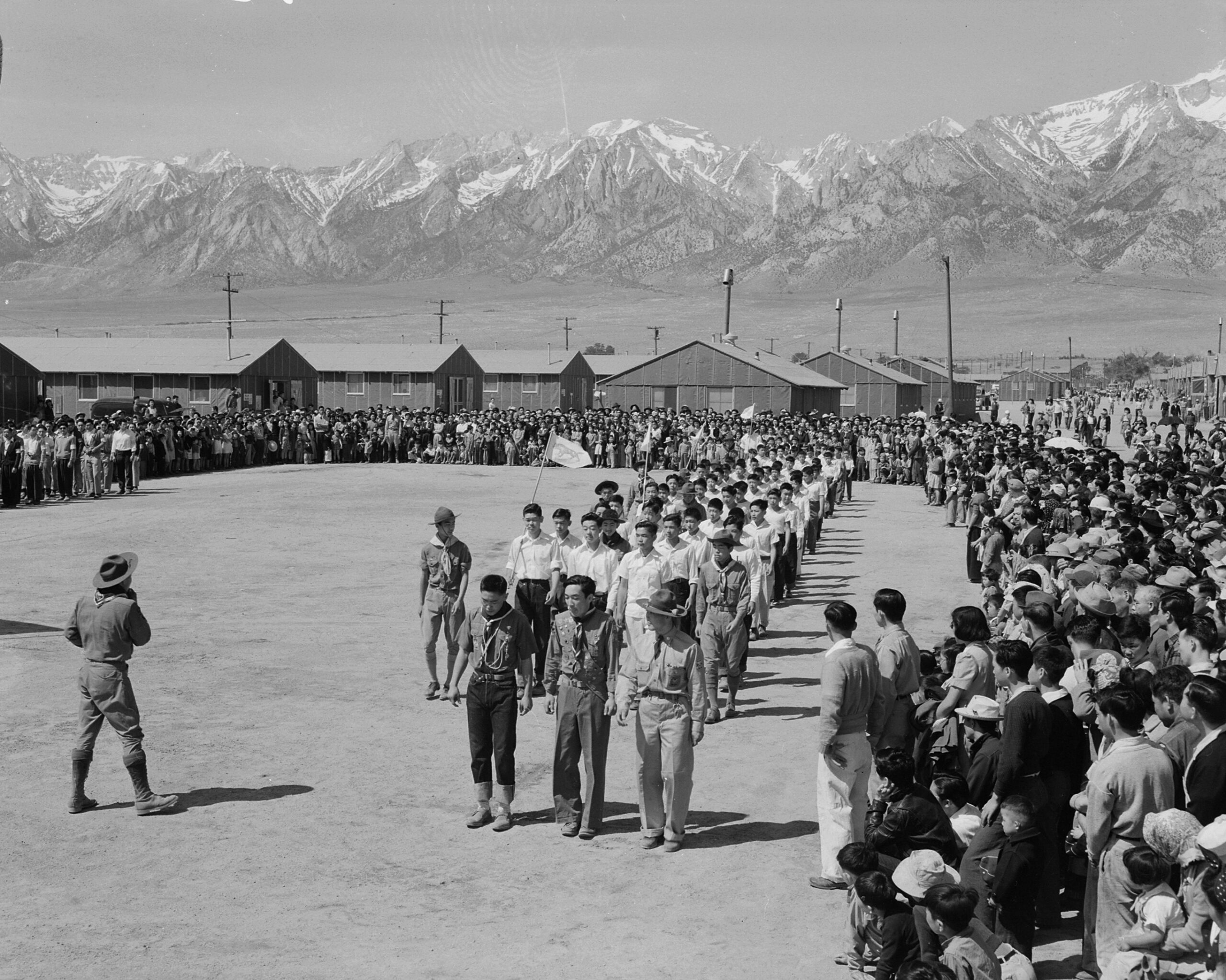
In this photo provided by the National Archives, Japanese Americans, including American Legion members and Boy Scouts, participate in Memorial Day services at the Manzanar Relocation Center, an internment camp in Manzanar, Calif., in May 1942.
These human rights abuses now occurring at Camp East Montana are also a tragic echo of the longer arc of history of its Fort Bliss location. In 1942, thousands of detainees — mostly Japanese Americans, with some people of German or Italian descent — were shipped from the West Coast to be held in a barbed-wire camp under constant watch by armed guards. Over the course of World War II, some 1,862 Japanese Americans died in the broader network of internment camps, many from harsh conditions.
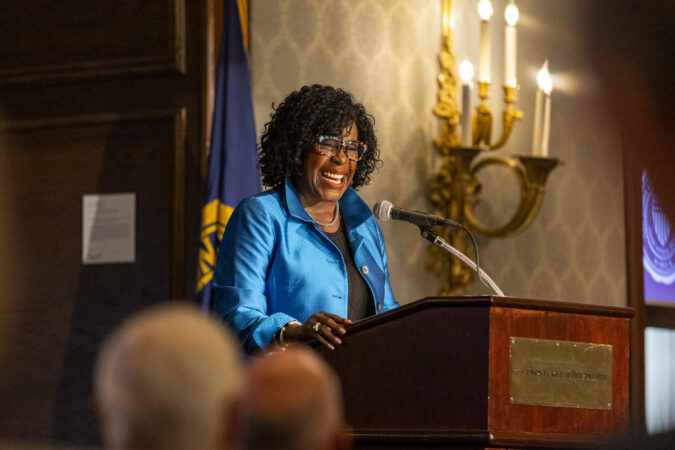
Shalimar Thomas speaks for many about how Mayor Cherelle L. Parker is doing at the halfway point of her first term.
“I can see the difference in the neighborhood,” said Thomas, the executive director of North Broad Renaissance, a nonprofit that manages the business improvement district along North Broad Street.
Indeed, the big picture shows Parker is delivering on her campaign promise to make the city “clean, green, and safe.” While polls indicate a large majority of Philadelphia residents support the mayor, the reviews from the more than a dozen people I spoke with were mixed.
Ed Rendell, the former governor who is widely considered the city’s most consequential mayor of the last half century, gave Parker high marks for tackling quality-of-life issues, particularly crime.
“What she has done under the circumstances is remarkable,” Rendell said. “The city was demoralized, people had lost faith in government.”
Allan Domb, the real estate mogul and former City Council member who ran against Parker in the 2023 mayoral primary, said Parker’s best decision was to appoint Kevin J. Bethel as police commissioner.
“If the city is not safe, you can’t do anything else,” Domb said.
Under Parker, crime is way down. The city recorded the fewest murders in 60 years in 2025. Enhanced technology has helped police solve homicides at the highest rate in 40 years.
But this is not just a Philly thing. Crime is down across the country, thanks to several factors such as an aging population, a return to work and school after the pandemic, and investments in violence reduction programs.
A former City Council member called Parker’s selection of Kevin J. Bethel as police commissioner the best decision of her tenure so far.
Philadelphia had 222 homicides last year compared with 305 in New York, which has a population more than five times larger. Boston had just 31 murders. San Antonio, roughly the same size as Philadelphia, had 99 murders.
Despite the improvement, Philly remains a laggard when it comes to policing.
Mayor Jim Kenney fizzled out following the pandemic, but other positive trends were set in motion during his administration. The city’s finances are strong, property values are increasing, and job growth is outpacing many other big cities, including tech capitals like Seattle and San Francisco.
Parker deserves credit for working to scrub the city’s negative image as “Filthadelphia.” She launched an effort in 2024 to clean every block in the city. Abandoned cars were towed, graffiti scrubbed, dilapidated buildings were sealed, and vacant lots cleaned.
Parker recently announced plans to clean and beautify some of the busiest roadways in preparation for the more than one million tourists expected this year for the World Cup matches, the MLB All-Star Game, and the 250th anniversary of the signing of the Declaration of Independence.
Parker deserves big props for tackling the opioid crisis that has long plagued Kensington. The city has cracked down on open-air drug markets and homeless encampments in Kensington, while pushing those battling addiction to get help.
Crime has dropped in Kensington, and the quality of life has improved. Critics argue that the problems have not gone away since the dealers and many homeless people were just displaced. But overdoses across the city dropped to the lowest levels in a decade.
Even still, some City Hall insiders and political operatives were critical of the day-to-day operations. Several criticized the administration for being slow to return calls or provide basic information. Despite Parker’s often-repeated slogan of a unified “One Philly,” some said the mayor does not respond well to anyone who disagrees with her.
Parker during a news conference in West Philadelphia last month. She recently announced plans to beautify some of the city’s busiest roadways in preparation for the more than one million tourists expected to visit this year.
“One Philly can’t be just your Philly,” one City Council staffer said. “Some of the things Mayor Parker does, Councilmember Parker would not tolerate.”
Like many interviewed, the City Council staffer asked not to be named, so as to speak candidly.
Several pointed to the proposed Sixers arena in Center City as a microcosm of Parker’s inability to compromise. Nearly a year was spent forcing Council to back the deal — despite stiff opposition across the city — only to see it collapse.
“[Council] is still pissed about the Sixers,” the Council staffer said.
Others said Parker’s hard-line stance in the labor negotiations with the city’s trash haulers and other blue-collar union workers led to an unnecessary strike and left bruised feelings among many who are part of her base of support.
“That was a strike that didn’t need to be,” said one political consultant. “After it was settled, there was no need for the victory lap.”
Parker’s signature housing initiative, known as Housing Opportunities Made Easy, or H.O.M.E., has been slow to become reality. After two years of planning, the program remains bogged down in Council.
“It’s surprising how slow out of the gate this has been,” said another political consultant. “She could be halfway through Year Three before it even gets going.”
The plan to create and preserve 30,000 housing units will be funded by borrowing $800 million in bonds — a hefty number with a murky return on investment.
Parker discusses the municipal workers’ strike during a July news conference. “That was a strike that didn’t need to be,” said one political consultant, who took issue with the mayor’s hard-line stance in contract talks.
Some believe the problem is that Parker micromanages her administration and does not empower top staffers to make decisions.
“I think she tries to be too hands-on,” said the first political consultant.
This is where it would have been helpful to hear directly from the mayor, but Parker’s communications team did not make her available for an interview despite several requests.
Rendell, who did not support Parker in the crowded primary, had a simple answer: “You can’t make everyone happy.”
That holds true with the way Parker has responded to Donald Trump’s attacks on cities, migrants, affirmative action, and many other issues.
Rather than push back, Parker has laid low — much to the outrage of those who argue that this is not the time to remain silent. Others argue Parker is wise not to poke the wildebeest.
Trump has not sent National Guard troops into Philadelphia, but U.S. Immigration and Customs Enforcement agents have made arrests across the city.
Philly is a tough town, but a poll last summer found Parker’s approval rating at 63%. Despite some setbacks, she is off to a good start.
Crime, poor schools, and high taxes have long prevented Philadelphia from achieving its full potential. Until all three are addressed, lasting improvement will be incremental.
Time will tell if Parker’s strategy is the right one. Or if her tenure will result in substantive change.
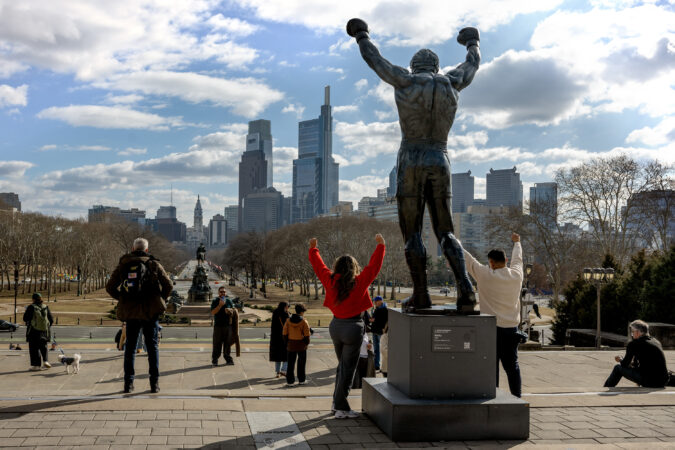
To hear the Parker administration officials tell it, moving the Rocky statue from the bottom of the Philadelphia Art Museum steps to the top is a victory for the underdog.
The new location, which received a green light from the Art Commission on Jan. 14, will certainly create a dramatic, Instagrammable moment for tourists, and further elevate the Rocky brand (and value).
But it’s no victory for Philadelphia residents, who remain the true underdog in this saga. Allowing the old movie prop to dominate the Parkway’s iconic vista is simply the latest in a series of decisions that have privatized the Art Museum’s gorgeous, landscaped grounds.
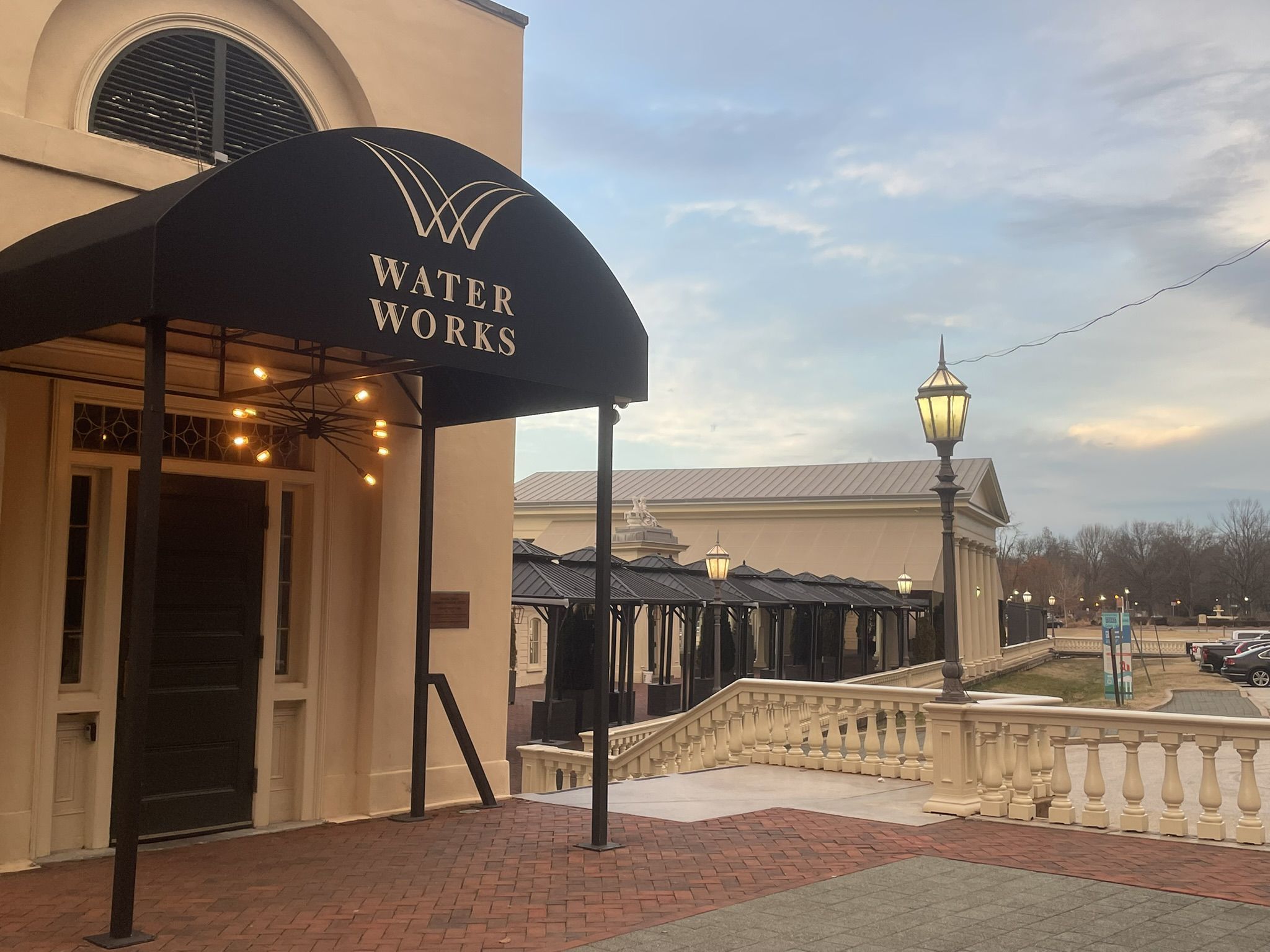
If you walk to the back of the museum, you’ll find the most egregious example of Philadelphia’s zeal for monetizing public space: the sprawling Cescaphe banquet operation at the Fairmount Water Works.
While the main Engine House had been used as a restaurant in the past, the city allowed Cescaphe to take over the entire complex in 2021. Today, the Water Works is surrounded with a cordon of server stations, portable restrooms, and covered walkways.
Since 2021, the historic Fairmount Water Works has been surrounded by a cordon of server stations and covered walkways. A glass party room prevents the public from enjoying the Mill House Deck, a pier overlooking the Schuylkill.
Cescaphe’s presence has drastically limited the public’s access to this historic landmark, a scenic spot where generations have come to stroll and take in views of the Schuylkill. Although visitors are permitted to wander though the Water Works’ classically inspired temples and colonnades when no events are going on, who would know that, given the messaging conveyed by Cescaphe’s formidable barricades?
Preparations for evening events often start in the afternoon, further limiting access. Every spring, Cescaphe installs an enormous glass party room on the pier known as the Mill House Deck. It remains in place until late fall, which means the public gets to use the overlook only during the coldest months of the year.
Rocky already has a good spot
Moving the Rocky statue to the top of the steps might seem like a modest imposition by comparison, but the new location will interfere considerably with the public’s enjoyment of the space.
Since people with mobility limitations will have trouble climbing the 72 steps to the top of the museum’s grand staircase, they’ll need transportation. The Philadelphia Visitor Center — the initial advocate for the new location — has offered to run a shuttle bus around the museum apron every 15 minutes. Better watch out when you’re taking that selfie!
During the recent Art Commission hearings, the city’s two top cultural officials, Valerie V. Gay and Marguerite Anglin, argued that the Rocky statue deserves a higher profile perch because it’s a unique tourist attraction. They noted that the statue has been the subject of books and podcasts and will soon be the focus of a major Art Museum exhibition, “Rising Up: Rocky and the Making of Monuments,” curated by Monument Lab’s Paul Farber.
Yet, given the added complications, it’s hard to understand what the city gains by changing the statue’s location.
Rocky’s current home — a shady grove at the bottom of the steps — has been a huge success. The statue was installed there in 2006, after years of shuttling around Philadelphia, from the museum to the sports complex and back. In a typical year, 4 million people make the pilgrimage to see Rocky, the same number who visit the Statue of Liberty annually.
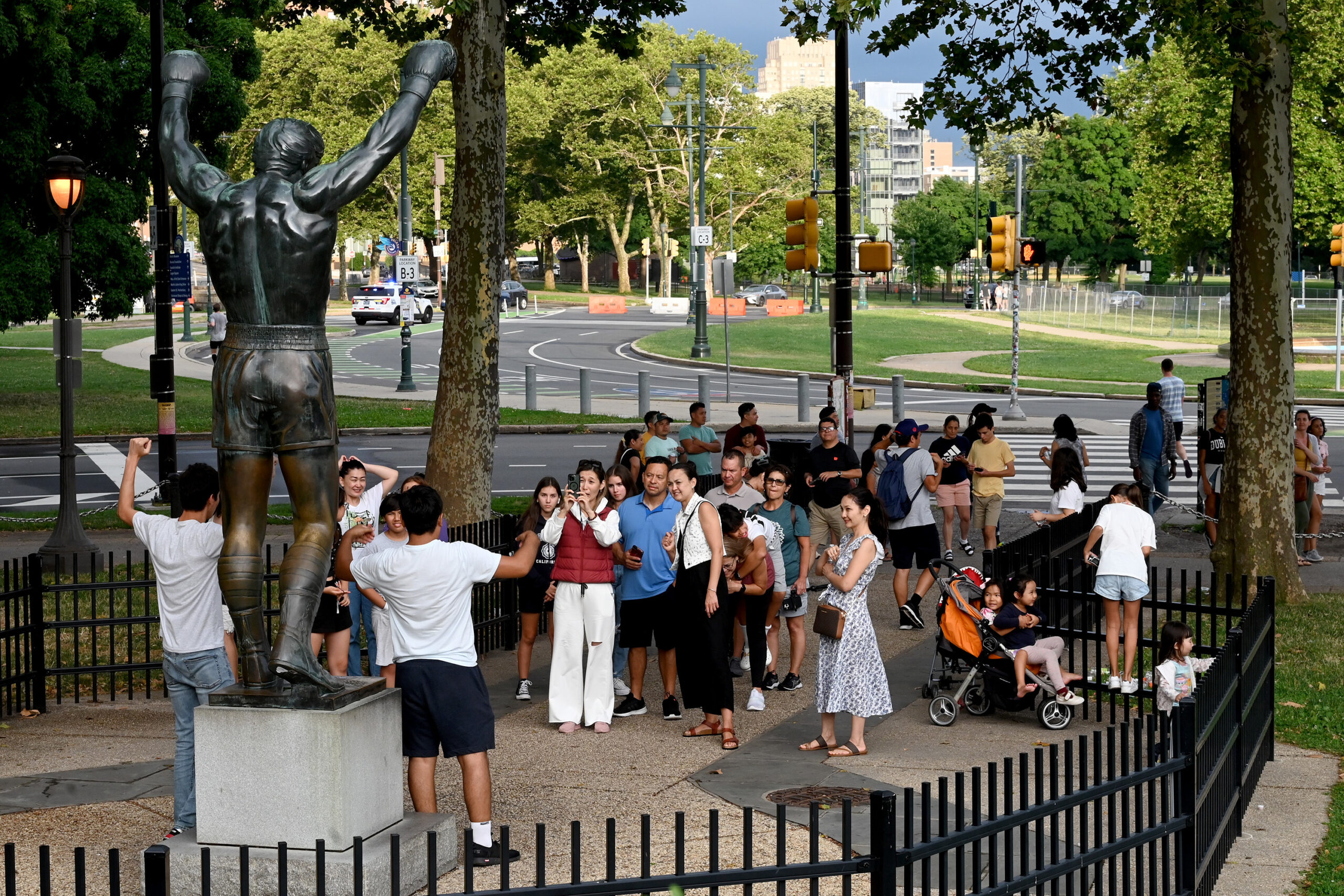
The Rocky statue, currently at the base of the Art Museum steps, is easily accessible to visitors and tour groups.
Because the grove is so close to the street, there are no accessibility issues. Tour buses and cars can pull up to the curb, allowing people to jump out for a quick selfie. Sometimes there’s a line for photos, but the mood is always festive, with visitors and locals mingling along the sidewalk. Anyone who wants to reenact the fictional boxer’s run up the museum stairs can do that, too.
Yes, this site occupies a piece of the museum’s grounds. But the intrusion is relatively discreet. Considering how well this location works, why change it? It’s not like there was a huge public clamor to give Rocky more prominence. When Inquirer columnist Stephanie Farr polled readers in September, most respondents said they were happy to keep the statue in its current location — or get rid of it entirely.
Only a single person testified at the Art Commission’s Jan. 14 hearing — and he argued against the move. Several civic organizations, including the Design Advocacy Group (DAG), sent written statements urging the city to reject the proposal.
“All we’re doing is glorifying Sylvester Stallone, who sells merchandise at bottom of the steps,” complained David Brownlee, a member of the DAG board and a renowned University of Pennsylvania art historian who has written a history of the Art Museum.
Those Stallone-licensed souvenirs are sold in the “Rocky Shop,” a metal shipping container that was allowed to encroach on the plaza at the base of the museum steps in 2023. Although the metal structure doesn’t take up as much public land as Cescaphe’s banquet operation, it clunks up the approach to the museum’s elegant stone staircase.
The Parkway Visitor Center & Rocky Shop at the base of the Philadelphia Art Museum steps Jan. 20, 2026. In 2023, the city allowed Sylvestor Stallone to set up the metal shipping container at the base of the Philadelphia Art Museum steps.
Initial reports said the Visitor Center, which pushed for the shop, would get a cut of the sales. Yet when I asked how much money that partnership had yielded, a spokesperson for the independent tourism agency declined to answer. The Visitor Center is now run by Kathryn Ott Lovell, who was parks commissioner when the department signed off on Cescaphe’s 2021 expansion at the Water Works.
The exorbitant cost of moving
What jumped out at me during the Art Commission hearing was the cost of moving the bronze sculpture and setting it up on a new base.
Creative Philadelphia, the city department overseeing the move, originally estimated the job would run about $150,000. Now it says the price could rise to $250,000. Those figures don’t include the cost of operating the shuttle, which will be borne by the Visitor Center.
To put those numbers in context, consider the basepayment the city receives from Cescaphe annually for operating a banquet hall at the Water Works: $290,000.
When Cescaphe was given permission to occupy the Water Works complex in 2021, the city said the arrangement was necessary because the parks department could no longer afford to adequately maintain the property. In addition to rent, the agreement generated about $187,000 annually in concession fees between 2015 and 2022 for the city.
That income isn’t peanuts, but is it really worth severely limiting public access to such an iconic Philadelphia landmark? What’s the point of monetizing our parks if the businesses prevent us from enjoying them?
Except for a few months during the winter, the Mill House Deck pier at the Fairmount Water Works is covered with Cescaphe’s glass party room, making it impossible for Philadelphians to enjoy the space.
The privatization of such beloved sites is the direct result of city government’s unwillingness to properly fund its parks. For years, Philadelphia has spent far less than peer cities on green space. Maintenance declined to the point where some parks became unusable.
Rather than devote more money to this basic public amenity, the city has increasingly outsourced its parks to private managers. Enormously popular destinations, such as Dilworth Park and Franklin Square, are run by independent groups.
Cescaphe, a banquet company, has surrounded the Fairmount Water Works with a cordon of arcades, server stations and portable restrooms since it began holding events there in 2021.
But there’s a crucial difference between those private managers and the likes of Cescaphe. First, they’re nonprofits, not businesses. They exist to serve the public. While it’s frustrating when they close their parks for private fundraising events, all the money they raise goes back into improving the parks for the public’s use.
With the Cescaphe deal, the city has crossed a line. Cescaphe is a money-making business that runs the Water Works for its own benefit. In theory, the rent and concession fees are supposed to be invested in the maintenance of the complex, which was considered one of the wonders of the world when it opened in 1815. But it’s Cescaphe, not the public, that benefits from the improvements.
It’s not even clear that Cescaphe is doing the promised maintenance. The Engine House suffered a serious fire in November, and the company still has several outstanding building code violations.
When asked about the citations, a spokesperson for Parks & Recreation described the infractions as minor. “Cescaphe has been a great partner,” Commissioner Sue Slawson said in a statement.
To be clear, there is a big difference between leasing a public building to a restaurant concession and privatizing public space for the sole use of a single business. Restaurants are open to everyone. They also provide services, such as restrooms, that the public can use. It’s a win-win: The city makes a little money on the deal, and the public gets a nice amenity.
The city had the right idea when it leased the Water Works’ Engine House to a restaurateur in the early 2000s. But instead of finding a replacement when that restaurant shut down in 2015, the city turned the complex over to Cescaphe. This April the banquet company’s lease will come up for renewal. It’s time to go back to the original model.
Wouldn’t it be great to grab a sandwich at a Water Works cafe after a long walk or bike ride along the Schuylkill River Trail? The trail, which just completed a spectacular extension, does not have a single cafe between its new Grays Ferry terminus and the museum, apart from a small snack bar at Lloyd Hall. Philadelphia has plenty of great restaurateurs who would jump at the chance to operate in a prime spot like the Water Works.
People have framed the Rocky discussion as a clash between elites, who object to the glorification of a movie prop as art, and the mass of fans who believe the statue embodies their aspirations.
The reality is, there’s nothing less democratic than turning over the public’s land to private companies driven by their own gain.
An earlier version of this column listed FDR Park as one of several city parks that are run by private managers. The Philadelphia Department of Parks & Recreation operates the park and provides workers to staff it.
This story has been updated to remove the Schuylkill River Trail from a list of private managers because the Schuylkill River Development Corp. has a different type of contractual agreement with Philadelphia’s Department of Parks & Recreation and does not lease the land it oversees.
When it opened in 1815 to provide the growing city with a reliable supply of drinking water, the Fairmount Water Works was a major engineering advance and was considered one of the wonders of the world.
The primary responsibility of law enforcement is to ensure the safety and security of its citizens.
Cooperation between jurisdictions and among all levels of law enforcement is a key component in obtaining that objective in our democracy. When state and local elected officials prevent their police from cooperating with federal officers enforcing federal law while allowing lawbreaking illegal aliens to roam their streets, it creates a dangerous situation for all involved — as we clearly see now. Through their inflammatory rhetoric, they incite and condone the type of resistance and violence against federal law enforcement that they would not tolerate if directed at their own police officers. Their words “inspire” Renee Good and many like her to put themselves in harm’s way while impeding U.S. Immigration and Customs Enforcement efforts illegally. Liberals decry Good’s death while curiously being silent when members of their community were the victims of murder and violent crime at the hands of illegal immigrants. It is a sad commentary on sanctuary states and cities when the plight of illegals is prioritized over the safety of their actual citizens.
What kind of democracy do we have where so many of these liberal elected officials ignore their oaths of office to defend the Constitution by obeying only the laws that they agree with?
Mark Fenstermaker,Warminster, markfense@gmail.com
Wait, he said what?
“The moment you start dehumanizing people, the moment you start calling people Hitler, the moment you start doing that, it’s a slippery slope to violence,” Republican U.S. Sen. Dave McCormick said during a recent interview with CBS.
If I‘m reading this quote right, Sen. McCormick is saying if you call ICE Hitler, you’re going to get Hitler. That’s the problem in the first place: U.S. Immigration and Customs Enforcement is operating like the Gestapo. All rhetoric aside, an American mother was killed on the streets of an American city while exercising her constitutional right to protest. How can anyone be OK with that?
Michael Galante, Philadelphia
Investigation warranted
The U.S. Department of Justice has said it will not be investigating the U.S. Immigration and Customs Enforcement agent who killed Renee Good in Minneapolis. In Philadelphia, if a police officer discharges their weapon, it automatically triggers an Internal Affairs investigation, and I believe that is true for all local law enforcement agencies.
I retired from a federal law enforcement agency under the DOJ, and any use of force automatically triggered an investigation and after-action review by the Office of Inspector General (OIG). ICE is an agency under the U.S. Department of Homeland Security. I have not seen any reports of the DHS OIG investigating this use-of-force incident.
Julio Casiano Jr., Philadelphia
New precedent?
Since Donald Trump’s invasion and arrest (kidnapping?) of Venezuelan President Nicolás Maduro and his wife, I have been thinking about an analogy that could put this in a different context for Trump supporters.
Let’s go back to 1970. We are deep in the midst of the war we were carrying out against Vietnam. What if the North Vietnamese sent a secret commando force to Washington, D.C., and captured Richard Nixon, brought him to Hanoi, and put him on trial for crimes against humanity? Whatever we might think of him, Maduro was the head of state in Venezuela. If another country did to our head of state what we did to him, we would be outraged, too.
Peter Handler,Philadelphia
Join the conversation: Send letters to letters@inquirer.com. Limit length to 150 words and include home address and day and evening phone number. Letters run in The Inquirer six days a week on the editorial pages and online.
As many as 85 million deaths were caused by World War II, including more than 400,000 U.S. service members. It was the largest and deadliest conflict in history, involving more than 70 countries.
Out of that horrific six-year battle, the United States, Canada, and 10 Western European nations forged the North Atlantic Treaty Organization to deter Soviet aggression, prevent renewed German militarism, stop the spread of communism, and ensure European security.
For more than 75 years, NATO — backed by U.S. presidents from both parties — has maintained peace and prosperity throughout the Western world.
But in a matter of months, Donald Trump has upended that order — bombing and threatening countries while using tariffs as an economic weapon. His latest effort to take over Greenland could shatter the NATO alliance altogether.
Trump’s idea defies reason, especially since Greenland is an autonomous territory of Denmark — a founding member of NATO and a loyal ally of the U.S.
Seizing Greenland without congressional approval is also unconstitutional, violates international law, flouts United Nations Charter principles, and would breach NATO’s mutual defense clause.
Beyond that, it is reckless and could set off a perilous chain of events leading to more wars or economic disruptions. Some have urged Europe to fight back with a so-called trade bazooka that would essentially cut off economic ties with the U.S.
Flags flap in the wind outside NATO headquarters in Brussels on Monday.
Trump dialed down the rhetoric on Wednesday, claiming the U.S. “won’t use force” to take Greenland, but insisted the territory was needed for national and international security. He also backed off his tariff threat against NATO allies, claiming a framework of a deal regarding Greenland.
But even if the latest made-up crisis is averted,Trump has already burned bridges with some of America’s closest collaborators.
Canada’s Prime Minister Mark Carney said there was a “rupture” in the world order. “The rules-based order is fading,” he told leaders at the World Economic Forum on Tuesday.
Ed Davey, a member of Parliament in the United Kingdom, called Trump “an international gangster” who was threatening to “trample over the sovereignty of an ally.”
After Trump initially threatened to impose more tariffs over opposition to American control of Greenland, financial markets tumbled, and eight European countries issued a joint statement warning that transatlantic relations face a “dangerous downward spiral.”
Trump’s threats to invade or buy Greenland add to his lawless, wrecking ball approach to both foreign and domestic affairs since his tumultuous return to the White House last year.
Trump continues to enable Russia’s unfathomable atrocities in Ukraine, while abandoning another ally. He has strongly supported Israel’s ghastly assault on Gaza, and is now corruptly selling “peace seats” for $1 billion to pay for the rebuild. Both Vladimir Putin and Benjamin Netanyahu are wanted on war crimes charges, but Trump stands by their side.
Trump ordered the bombing of nuclear facilities in Iran as well as military strikes in Iraq, Nigeria, Somalia, Syria, and Yemen.
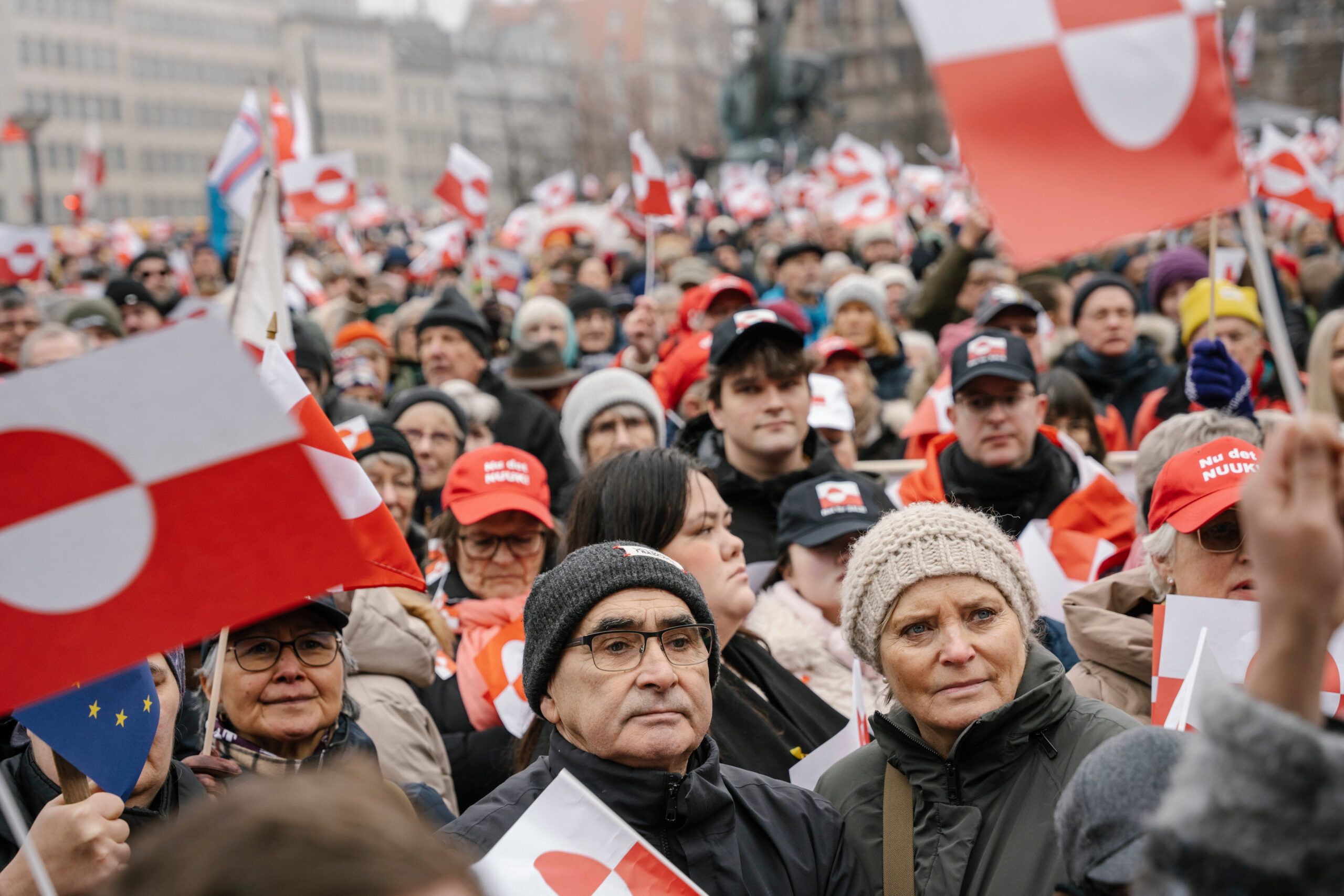
People march during a pro-Greenlanders demonstration in Copenhagen, Denmark, on Saturday.
Trump made clear the military action was not about stopping the flow of drugs or spreading democracy, but rather all about gaining control of Venezuela’s oil.
For added bluster, Trump also threatened attacks on Cuba, Colombia, Mexico, and Canada.
At home, Trump continues to wage war in the streets, as U.S. Immigration and Customs Enforcement agents kill and harass — including U.S. citizens and off-duty police officers — while deporting more than 230,000 people.
The daily chaos has served as a distraction from the unreleased Jeffrey Epstein files and Trump’s profiteering of at least $1.4 billion last year.
President Donald Trump speaks during the 56th annual meeting of the World Economic Forum in Davos, Switzerland, on Wednesday.
Through it all, Trump has acted like a petulant child, debasing the office of the president and tarnishing the global reputation of the United States.
On social media,Trump posted a manipulated photo of himself meeting with European leaders in the Oval Office with a map showing Greenland and Canada covered with a U.S. flag.
He also posted a fake photo of himself and two lackeys, JD Vance and Marco Rubio, planting a U.S. flag next to a sign that read: “Greenland — US Territory est. 2026.”
Trump shared a text exchange with Norway’s prime minister, saying he no longer felt an obligation to think about peace since he did not win the Nobel Peace Prize.
As always, everything is about Trump. The Republicans in Congress — the only ones with the power to stop him at this point — remain mostly silent as the convict in the White House mocks allies and turns the U.S. into a pariah state.
Destroying NATO has long been Putin’s goal. Trump is doing the former KGB agent’s dirty work.
Meanwhile, as the GOP sleeps, everything the Greatest Generation fought and died for is being casually discarded.
Donald Trump now believes he is the master of the universe, not just of the United States and the Americas. This is not hyperbole.
The president’s determination to seize Greenland from Denmark by bullying or force, his threats to NATO allies, his obsession with the Nobel Peace Prize, the ego-driven list goes on. His speeches and posts reveal a man convinced he is the world’s most brilliant leader, who can split control of the world with Vladimir Putin and Xi Jinping and best both.
The madness of King Donald has metastasized to the point where it threatens U.S. and global security — unless GOP members of Congress, sane business leaders, and five sober Supremes move to curb him.
Don’t take my word for how dangerous Trump has become. Take Trump’s.
“We are going to do something on Greenland whether they like it or not,” he told the press this month. “One way or the other, we’re going to have Greenland.” Never mind that taking Greenland would put the U.S. at war with its NATO allies, including the island’s owner, Denmark.
Trump has already pledged to slap new tariffs on Copenhagen and seven European allies who support the Danes.
This is nuts. A 1951 treaty basically lets the U.S. put as many troops and bases in Greenland as it wishes. The island’s government is eager for U.S. investment to mine rare minerals. Yet, the president is ready to destroy NATO, and possibly fight with our closest allies, whose help and Arctic experience are essential to protecting Greenland from Russia and China.
The only ones to benefit from Trump’s Greenland obsession are Putin and Xi, as they sit back and watch him destroy the NATO alliance they have been eager to shred for decades.
Indeed, Russian officials and talking heads are exulting over America’s self-destruction, which shifts attention away from Moscow’s ongoing, massive attacks on Ukraine’s urban centers, trying to destroy all electricity and heating during a brutal winter.
“It would have been difficult to imagine something like this happening before,” Russian Foreign Minister Sergey Lavrov told journalists this week, gloating that Trump’s actions diminished the “prospects of preserving NATO as a unified Western military-political bloc.”
In other words, Trump’s Greenland mania is undermining U.S. security at a rapid clip. His foolishness raises the possibility of NATO allies shooting at each other, rather than working together to block Russia’s desire for territorial expansion. The White House is putting America in league with Moscow as an aggressor willing to invade or coerce a neighbor into handing over territory.
And for what reason? So that Trump can boast he has made the best land grab since the Louisiana Purchase?
The president hints at this with a doctored photo on Truth Social, which shows European leaders in his office looking raptly at a map of Canada, Greenland, and Venezuela covered with American flags.
People protest against Donald Trump’s policy toward Greenland in front of the U.S. Consulate in Nuuk, Greenland, on Saturday.
Buoyed by the U.S. military’s kidnapping of Nicolás Maduro (a one-off extraction bearing no resemblance to seizing a NATO ally’s territory), Trump acts as if he believes he can grab anything he wants.
For the 79-year-old president, the signs of dementia — or an ego gone wild — are expanding.
Boiling with frustrated desire for the Nobel Peace Prize, Trump wrote the Norwegian foreign minister that Oslo’s decision “not to give me the Nobel Peace Prize for having stopped 8 Wars PLUS” was to blame for his aggression toward Denmark. Due to this insult, the president claimed, “I no longer feel an obligation to think purely of Peace … but can now think about what is good and proper for the United States of America.”
When the Norwegian leader replied that the Nobel was awarded by an independent committee, not the government, Trump insisted this was false. He appeared oblivious to how this churlish behavior makes him and our country look idiotic. All the more so because Trump’s repeated claim about stopping eight wars is a complete falsehood.
Trump achieved several temporary ceasefires in outbreaks of border violence in Africa, the Caucasus, and Asia, but ended no wars. And the best-known of those ceasefires, in Gaza, is already falling apart.
Sen. Lisa Murkowski (R., Alaska) arrives as members of the Danish Parliament and a Greenlandic committee meet with American members of Congress at the Danish Parliament in Copenhagen, Denmark, on Friday.
Yet, this week at the World Economic Forum in Davos, Switzerland, the president will unveil his putative “Board of Peace,” a proposed group of top global leaders who would preside over an unwieldy, as yet nonexistent series of subordinate structures tasked with rebuilding and setting up a government for Gaza.
This concept was endorsed by the U.N. Security Council specifically to deal with Gaza. But in a bait-and-switch, the White House has crafted a charter that ignores Gaza; instead, this aspirational board appears aimed at replacing the United Nations in dealing with global hot spots. At every turn, according to the charter, its players and committees would be subject to Trump’s final control.
The president has already invited Putin, that great Russian peacemaker, to join the board.
The top level of the group is supposed to consist “exclusively of heads of state and government” under Trump’s leadership. It’s unclear how many will join. Consider that the entrance fee for full membership is $1 billion, apparently creating a slush fund with no visible rules on whether it will be spent at Trump’s sole discretion.
What is clear is that Trump’s war on NATO allies and his embrace of Putin — along with his affection for the dog-eat-dog system that led to two world wars — are the work of a president who has lost all moorings. Add to that the economic blindness of a man who, when warned of the grave cost of subordinating the independent Federal Reserve Bank to his political will, responded, “I don’t care.”
Trump’s behavior is that of a self-appointed Sun King, who is not only convinced that “L’État, c’est moi” but “Le monde, c’est moi.” Unless this madness is checked soon by the other government branches, America may be reverting to the kind of world most of us never imagined we’d face.
During a recent CBS News interview, Sen. Dave McCormick — who was appearing with Sen. John Fetterman — drew a sharp distinction between violent language and physical violence, and I found myself in rare agreement with him. After all, that is exactly what happened on Jan. 6, 2021, when Donald Trump and his minions spewed violent language that stoked a mob to attack the U.S. Capitol, where they physically injured law enforcement officers. And, to the extent our dear senator was referring to actions in Minneapolis, I will remind him that the last words Renee Good spoke were, “I’m not mad at you,” which is about as nonviolent a statement as one could utter — but an agent still shot her three times. So, in the case of U.S. Immigration and Customs Enforcement, calm words still provoke violence.
Steve Morley, Philadelphia
. . .
I am appalled by comments made by both of Pennsylvania’s U.S. senators, John Fetterman and Dave McCormick, during their recent interview with CBS News.
McCormick complained that protesters were “dehumanizing” U.S. Immigration and Customs Enforcement agents by comparing them to Hitler. Fetterman said, “ICE has a job to do, as well,” and that everyone doesn’t have to agree on the tactics.
Both Presidents Barack Obama and Joe Biden deported more people than Donald Trump did in his first term, without the fuss and protests now accompanying the “jobs” of ICE agents, because they did it legally and followed international and U.S. law. Almost all of those deported were recent arrivals or convicted criminals, not people who peacefully made their homes here and contributed positively to their communities.
Trump wants the public to see ICE treating immigrants brutally, and has posted many videos on U.S. Department of Homeland Security websites as a display of what he sees as his unstoppable power — just in case the public was missing the point.
Most Americans want ICE to follow the law, obtain court-issued warrants, stop detaining and beating U.S. citizens caught up in its roundups, and allow immigrants to have the due process the Constitution affords to everyone, citizens and noncitizens alike. We want ICE agents to take off the masks and display their badges. And we want the shootings to stop — and justice for the senseless execution of Renee Nicole Good.
Jodine Mayberry, Brookhaven
. . .
I must respond to something Brian Fitzpatrick said in an interview with Philadelphia Magazine, as reported recently in The Inquirer. Mr. Fitzpatrick is quoted as saying, “[W]e’ve seen the weaponization of the Justice Department now, I believe, in two administrations.” Statements like that are exactly why Fitzpatrick has to go. It is not “weaponization” when egregious behavior is confronted by law enforcement authorities and criminal and civil charges are brought to stop that behavior. Donald Trump was convicted in civil court of sexually abusing a woman. Mr. Trump was convicted of cheating the state of New York out of millions of dollars of tax revenue. We all saw dozens of boxes of United States government documents, many of them highly classified, stored in bathrooms and hallways at Mar-a-Lago, after they were illegally removed by Trump from the White House. And even Sen. Mitch McConnell (R., Ky.) assumed the U.S. Department of Justice would bring charges against Trump in the wake of the Jan. 6, 2021, insurrection. At Trump’s second impeachment, McConnell said that, even though Trump could not be impeached, he was “still liable to be tried and punished in ordinary tribunals of justice.”
To imply that Trump or his Jan. 6 insurrectionists were unfairly targeted is a grave misrepresentation of our justice system. The fact that Fitzpatrick cannot — or will not — acknowledge that justice must be done disqualifies him from being a member of the House of Representatives.
Michael Walsh, Elkins Park
Love thy neighbor
The Inquirer recently reported that a Norristown day center serving the city’s homeless population is itself in need of a new home. The day center was forced out of its current location and has been blocked from its new location over residents’ superfluous concerns about “loitering.” The fact that Norristown needs this center says something about our faltering economy, but this particular story says more about the failures of our culture — and each of us individually. The idea that we should “love thy neighbor” goes back to antiquity. Yet, Norristown residents demonstrated active disdain for their less fortunate neighbors by depriving them of much-needed support. Unfortunately, the NIMBYs of Norristown are not unique. Every day, Philadelphians turn a blind eye to our struggling, homeless neighbors living in Center City. Too many of us fail to empathize with those who are less fortunate than ourselves, and even more of us fail to offer help. Our collective lack of compassion is an evil that spreads through the body politic, infecting each of us. We must be better. The only way we can redeem ourselves is through action. We must actively love those less fortunate than ourselves, otherwise we contribute to the suffering of our neighbors.
Owen Castle,Philadelphia
Shift subsidies
I appreciated your editorial regarding the administration’s energy policies, but it’s not just that fossil fuels are “promoted.” It’s that the government is using our tax dollars to make the air we breathe dirtier and the weather we live in more dangerous.
President Donald Trump has been threatening to invoke the Insurrection Act and deploy the military to Minneapolis to quell the unrest. But when I look at the streets of Minneapolis these last few weeks, it feels like the military is already there: thousands of heavily armed federal agents are using tear gas, flash-bangs, pepper spray, and guns to intimidate (even kill, in one case) unarmed protesters exercising their constitutional right to express themselves. The presence of masked U.S. Immigration and Customs Enforcement agents and their heavy-handed tactics is what’s causing the unrest and fear, not the city residents. Remove ICE and the temperature will lower quickly. Sending in the military will have the opposite effect and is exactly what is not needed.
Stephen Kunz,Phoenixville, spkunz@aol.com
Admirable vs. abominable
Albert Schweitzer was awarded the Nobel Peace Prize in 1952. This gifted scientist, musician, and doctor gave up a prosperous life to found humanitarian clinics where there were none. Finding Schweitzer in what was then known as French Equatorial Africa, Norman Cousins, editor of the then-influential magazine Saturday Review, asked him what the most important thing was that he had learned during his lifetime. Schweitzer responded after delivering a baby in a nearby village that the most important thing he had learned was that each person at birth contains a “cathedral within — a vast, precious, sacred cathedral!” Schweitzer sets a high standard for recipients of the Nobel Peace Prize. Donald Trump accuses the Minneapolis immigrants from Somalia (people he describes as “garbage”) of fraud. His recent acceptance of the Nobel Peace Prize awarded to María Corina Machado is fraud at the highest level. He should return it to her immediately. His motive for MAWA (Make America White Again) is in sharp contrast to Schweitzer’s “cathedral within!”
Terry Furin,Philadelphia
Patient in spirit
I was so happy to read recently that Goldman Sachs and Morgan Stanley have reported double-digit increases in their profits. Does anyone know when that will trickle down to me?
Dale Cochran,Downingtown
Join the conversation: Send letters to letters@inquirer.com. Limit length to 150 words and include home address and day and evening phone number. Letters run in The Inquirer six days a week on the editorial pages and online.
I’m Jewish, and like most other Jews I know, I often wonder who else is. When I meet someone at a party, or see a new face on TV, I think: yes or no? It’s a game, and it’s all in good fun.
But when the government does it, it isn’t. It’s a dagger at our hearts.
That’s why so many people at the University of Pennsylvania — where I teach — are up in arms about the Trump administration’s effort to compel the university to identify Jewish students and employees. It’s part of an investigation of antisemitism on campus by the Equal Employment Opportunity Commission, which issued a subpoena demanding the names and contact information of members of Jewish-related student groups, staffers at the school’s Jewish studies program, and anyone who had filed an antisemitism complaint.
Fortunately, Penn said no. The EEOC sued the university back in November for refusing to comply with the subpoena. And last week, several groups at Penn filed their own motion in the case. “Compiling and turning over to the government ‘lists of Jews’ conjures a terrifying history,” they wrote.
Indeed, it does. Going back to the Middle Ages, state officials have tried to establish who is Jewish. And it never ends well.
In 1215, Pope Innocent III decreed that Jews must wear markers at all times that made them distinguishable from Christians. Two years later, in England, King Henry III ordered male Jews to wear a badge on the front of their outer garments.
In England, the badge was shaped like the tablets upon which Moses — according to the Old Testament — received the Ten Commandments. In France, it was a circle of red or yellow felt. Hungarian Jews had to wear red capes. And in German-speaking parts of Europe, Jews were required wear a cone-shaped Judenhut, or “Jew’s Hat.”
The goal of these rules wasn’t simply to identify Jews; it was to segregate, humiliate, and persecute them. Jews wearing badges were mocked by children and attacked by bandits. Badge laws also led to extortion: To receive exemptions from the laws, Jews had to pay large sums to the state.
In the so-called Jewish Emancipation era of the 18th and 19th centuries, when Jews finally received citizenship in the nations where they lived, badge laws disappeared. But they returned with a vengeance in the 1930s and 1940s, when the Nazis required Jews in Germany and the territories it conquered to wear yellow stars.
That helped facilitate their deportation and murder in concentration camps, where a new set of markers developed. Jews who were also political prisoners wore a red triangle, superimposed on a yellow one; gay Jews were identified by the pink triangle, which was later adopted by LGBTQ+ activists as a symbol of pride.
And Jewish camp prisoners often received tattooed numbers on their arms. Again, that was a way to degrade Jews as well as to identify them.
“My number is A-10572. That is what I was, they did not call us by our names,” recalled Holocaust survivor Lilly Ebert, whose TikTok video about the Auschwitz death camp went viral in 2021. “We were no longer humans. We were only a number, and we were treated like numbers.”
Since then, every state effort to count or list Jews has reflected disdain for them. Convinced that Jews at the Bureau of Labor Statistics were altering employment statistics to undermine him, President Richard Nixon ordered aides to find out how many BLS workers were Jewish. “The government is full of Jews,” Nixon fulminated in a taped 1971 White House conversation. “Most Jews are disloyal … You can’t trust the bastards. They turn on you.”
An aide scrutinized the BLS employees’ names — never a perfect way to figure who is Jewish — and concluded that 13 of 35 fit the “demographic criterion that was discussed,” as he delicately reported. Less than two months later, two Jewish senior officials were removed from their posts and demoted to less visible positions in the agency. That was “the last recorded act of official antisemitism by the United States government,” as political commentator Tim Noah wrote.
Forcing Penn to cough up a list of Jews would be the next one. It doesn’t matter that it comes as part of a Trump administration investigation of antisemitism. Frankly, I doubt a president who welcomed Holocaust denier Nick Fuentes to his home for dinner — and who still refuses to criticize him — cares very much about the safety of Jews on campus.
But even if he does, that’s no reason to count them. When the government does that, it isn’t fun anymore. It’s game over.
On Monday, America — some of it, anyway — paused to celebrate the Rev. Dr. Martin Luther King Jr., who would have turned 97 this month. In one sense, there’s never been a rougher time for the legacy of the slain civil rights icon, with the U.S. Supreme Court perhaps poised to gut the 1965 Voting Rights Act and a president who barely acknowledged the holiday. But thousands of everyday Americans now resisting U.S. Immigration and Customs Enforcement are channeling the spirit of the man who said one has “a moral responsibility to disobey unjust laws.” Happy belated birthday, Dr. King.
Dems, stop trying to make ICE better. Make them go away.
Aliya Rahman is detained Jan. 13 by federal agents near the Minneapolis street corner where Renee Good was fatally shot by an ICE officer.
Imagine this … and if you watch the daily stream of videos coming from the ICE raids that have roiled Minnesota since the start of the new year, it’s not that hard to imagine.
You’re minding your own business, or maybe picking up your kid at their school, when suddenly you find yourself in the middle of a platoon of masked, armed, camouflaged government agents. One thing leads to another, and in a flash, an agent has wrestled you to the ground, and is brandishing a weapon — maybe a Taser … if you’re lucky.
But what if I told you that lawmakers on Capitol Hill have a solution? They are proposing a brave new world, where now — flat on your back and gasping for air, and perhaps able to bravely manage to free your phone from your pocket — you could scan a federally mandated QR code on the agent’s uniform and find out the identity of the man who is currently pummeling you to within an inch of your life.
You’re probably thinking the same thing I did when I read about New York Rep. Ritchie Torres’ new bill he called the Quick Recognition (get it?) Act, which is his big idea for how Democrats can respond to public anger over the murder of Minneapolis mom Renee Nicole Good by an ICE agent, and the raidsthat have led to violent encounters and made a major U.S. metropolis look and feel like a war zone.
A four-word sentence that begins with, “What the actual …?”
“There is nothing the Trump administration fears more than transparency and accountability,” a spokesperson for Torres, who faces a primary challenge, in part, because of his outspoken views on Gaza, said recently.
Really? Is that true? Because everything I’ve seen is that Donald Trump is mainly terrified about a GOP bloodbath in the November midterms, which would surely lead to his impeachment, his eventual disgrace, and even a shot at the real accountability that takes place only behind prison bars. But that’s not going to happen unless Democrats can convince those midterm voters they are serious about dismantling the rotten system that murdered Good — so there are no bad guys left to scan.
It’s tempting to write off Torres’ idea as one stray piece of almost comically misguided legislation. But the truth is that his core idea — that what’s evolved during the Trump era into an American secret police force that folks like Joe Rogan and Bruce Springsteen are openly calling “the Gestapo” can be tweaked into something great — isendorsed by Democratic leaders in Congress and many rank-and-file members.
“Clearly, significant reform needs to take place as it relates to the manner in which ICE is conducting itself,” House Minority Leader Hakeem Jeffries (D., N.Y.) told MS Now, bloodlessly. “ICE is using taxpayer dollars to brutalize American citizens and to unnecessarily and viciously target law-abiding immigrant families and communities.”
So you’re going to halt the flow of those taxpayer dollars, right?
Right?
Actually, many key Democrats — facing a Jan. 30 deadline for new appropriation bills — say they are willing to keep the dollars flowing to the embattled and increasingly unpopular agency, but with hopes of leveraging the Minneapolis controversy in return for major reforms. Sen. Chris Murphy (D., Conn.), who has been a leading critic of the Trump regime, has suggested banning masks, mandating badges, requiring warrants to make an arrest, and returning Border Patrol agents to the border.
Most critics of ICE, Border Patrol, and any other immigration raiders under the U.S. Department of Homeland Security would agree that all of those things should have happened yesterday. But the lack of appetite for utterly dismantling the DHS regime — despite its culture of violence and disrespect for law-abiding refugees — reminds too many voters of the cowardice that branded the Dems as losers in the first place.
Progressive attorney Aaron Regunberg mocked the stance of some mainstream Democrats as: “We are the resistance. We are also negotiating furiously to figure out how to fully fund the Gestapo.” He’s right. Under Trump, with recruitment ads inspired by white nationalist memes, ICE has become a tool of a new American fascism.
You don’t “significantly reform” fascism. You need to crush it. As Andrea Pitzer, who literally wrote the book on the history of concentration camps, noted Monday night, “The correct response to Dachau was not better training for the guards.”
It’s telling that — as often is the case — everyday people are way out in front of the supposedly opposition Democrats. The latest polls show that a strong majority of Americans oppose Trump’s immigration policies — with just 38% approving of them in a new AP-NORC poll, down sharply — and that, for the first time, a plurality would like to see ICE (which has only existed since 2003) eliminated. No wonder the number of Americans who now identify as liberal — 28% — is the highest since Gallup began asking in the early 1990s.
And yes, more Democratic officials are starting to get it than ever before. More than 100 members of the House Progressive Caucus said last week that they won’t vote for any budget bill with additional funding for the immigration raid agencies without an end to their militarized policing. Arizona Democratic Sen. Ruben Gallego, who seemed to tack right on immigration issues in winning a close election in 2024, surprised political observers when he declared this weekend in a CNN interview that “I think ICE needs to be totally torn down.”
Note that he didn’t say “abolish” — a word that causes Democrats to break out in hives. That’s OK. Call it a teardown, or a demolition, but every day, more Americans can see that the United States would function better without ICE — as it did the first 227 years of its history — and with the work that’s actually needed, like arresting the sliver of immigrants who really are violent criminals, given to all new people.
The problem is that Democratic fecklessness isn’t limited to just the future of ICE. Our European allies are disappointed that the opposition party isn’t out manning the barricades and calling for much more forceful action to curb Trump’s bat-guano crazy demand for Greenland, apparently because he feels slighted by not getting the Nobel Peace Prize. And sure, Americans want lower coffee prices, but they care more about not having Captain Queeg with the nuclear football.
Dismantling the ICE regime needs to be the floor, not the ceiling, and any Democrat in Congress who doesn’t get with the program can — and should — be replaced in the primaries to avoid another debacle with alienated or apathetic voters in November. Call your member and find out where they stand. You won’t even need a QR code.
Yo, do this!
I didn’t feel a compelling need to memorialize one year of Trump’s second presidency, since that’s kind of what we do here every week. But M. Gessen, the Russian émigré whose understanding of how authoritarians rule has been a blessing for American readers, did write the piece that captures the fierce urgency of now. Their new New York Times column (gift link) calls on us to use our freedoms before they totally disappear. “The only way to keep the space from imploding is to fill it, to prop up the walls: to claim all the room there still is for speaking, writing, publishing, protesting, voting,” they wrote. “It’s what the people of Minnesota appear to be doing, and it’s something each of us needs to do — right now, while we still can.”
In a month of short, frigidly cold days, with a deteriorating political situation, the Eagles’ one-and-done, and up-and-too-often-down 76ers and Flyers, my main source of pleasure is getting under several blankets and watching football games in which I don’t much care who wins. The NFL playoffs, minus the Birds’ fiasco and one or two clunkers, have been the most compelling drama on TV in years. Don’t miss Sunday’s Final Four: Patriots-Broncos (CBS) followed by Rams-Seahawks (Fox), kicking off at 3 p.m.
Ask me anything
Question: One question that is top of my mind is “does this week feel like a tipping point?” Can’t shake the feeling that it is. — Marguerite Fahey (@margueritefahey@bsky.social) via Bluesky
Answer: Marguerite, I got several variations of your question, so this is definitely on the minds of folks. But while Trump’s bizarre actions surrounding Greenland have raised questions about the president’s fitness to hold office on a level we’ve never seen before, including Watergate, it is less clear what affirmative actions can take place. It’s impossible to imagine the lackeys in Trump’s cabinet, like Kristi Noem, ever green-lighting the 25th Amendment, let alone the 20 GOP Senate votes that would be required to remove the president in an impeachment. An increasingly likely possibility is high-ranking generals refusing a Trump order to send troops to Greenland or Minnesota. Yes, it has come to this.
What you’re saying about …
Sometimes, readers of this newsletter still surprise me. While most of you are righteously appalled at the immigration raid abuses in Minnesota and elsewhere, many still want to see major reforms at ICE and its sister agencies rather than abolishing them altogether. “ICE doesn’t need to be abolished,” Ed Truncale wrote. “ICE is like a child that has lost their way and needs to be disciplined, redirected.” Cathie Cush agreed. “I’d feel a lot more comfortable with ‘Demilitarize ICE’ and ‘Demilitarize the police,’” she wrote. “And make them accountable. And reduce their ranks.”
📮 This week’s question: Donald Trump’s increasingly aggressive demands for Greenland have not only threatened the post-World War II global order but raised legitimate mental health questions about the commander of the world’s largest military. But how can Europe, Democrats, and any remaining sane Republicans respond to this? Please email me your answer and put the exact phrase “Greenland response” in the subject line.
History lesson on America’s betrayal of the Hmong
ChongLy “Scott” Thao, a U.S. citizen, sits in his St. Paul, Minn., home Monday, the day after federal agents broke open his door and detained him without a warrant.
A long time ago, on the other side of the world, began what would become a fraught relationship between the Hmong tribal people of northern Laos and the United States, as represented by the CIA. At the dawn of the 1960s, American spies recruited the Hmong to fight communism in their homeland and neighboring Vietnam, which proved a disastrous bet. Thousands died in the next 13 years of combat in Southeast Asia, and more would perish when the communists took over Laos in 1975, while others dodged bullets, swimming the Mekong River toward overcrowded refugee camps in Thailand.
Fifty years ago, the United States was led by people who at least understood our deep debt to the Hmong, forged in blood. Thousands who’d escaped the slaughter were eventually resettled in the United States, and Minnesota — aided by Lutherans and other religious charities and good public housing, and despite its frigid weather — became an unlikely magnet. Today, a population of 94,000 people, with a slightly higher average salary than the state as a whole, and including the mayor of St. Paul, the state capital, makes Minnesota home to the largest U.S. Hmong population.
It’s an immigration success story that makes the events of recent days beyond baffling. In one Minneapolis neighborhood this weekend, a witness reported that roving ICE agents who have flooded the metropolis pulled over a car and asked the driver, “Where the Hmongs at?” St. Paul Mayor Kaohly Her said: “We’ve received reports of ICE officers going door to door asking where the Asian people live … I myself have received advice to carry my passport with me because they may target me based on what I look like.”
On Sunday, federal agents broke down the front door of a St. Paul home and took away ChongLy “Scott” Thao, also known as Saly, a Hmong American who was born in a Laotian refugee camp but is a U.S. citizen after living most of his life here. A photo of the man being led out of the house — wearing only boxer shorts and Crocs on a bitterly cold day, a plaid blanket hastily thrown over his exposed torso — went viral on social media. Family members said ICE agents drove Thao around for an hour while they questioned him, but brought him back home when they realized he was a naturalized citizen with no criminal record. Still, the episode was traumatizing, and it epitomized the big question hanging over all of this.
What is this even for? ICE’s harsh and disruptive focus on the Hmong people of Minnesota — people who were brought here because of their support for America in wartime, with the encouragement of the federal government as well as their new prairie neighbors — makes absolutely no sense. A people who suffered in their homeland for their ties to the United States are now facing new torment in their adoptive land — judged not for the content of their character, but for the color of their skin. This is a new, shameful moment in American history.
What I wrote on this date in 2021
Looking back at the dawn of what’s proved to be a painful decade for America can be difficult. Tuesday is the fifth anniversary of Joe Biden’s inauguration as the 46th president, and like most Americans, I had thoughts and prayers that the deep stain of Donald Trump’s lawbreaking first term could be erased. On Jan. 20, 2021, I predicted we’d understand “this nation will not have peace without justice. That empathy is empty without accountability. And that American carnage cannot be healed until we can handle the truth.” Yeah, how did that work out? Read the rest: “After four years of ‘American carnage,’ President Joe Biden gets it: Truth must come before healing.”
Recommended Inquirer reading
With so much happening, I did an NFL coin-toss move and elected to defer my Martin Luther King Jr. holiday day off until some warmer, happier time. In my Sunday column, I looked at how economic pressure campaigns against U.S. corporations aiding Trump’s immigration policies, like Avelo Airlines — which halted ICE deportation flights after months of protests and boycotts — are starting to make a difference. With boycotts getting results at firms like Disney and Spotify, can Americans do more to vote with their wallets? Over the weekend, I dug into CBS News and its new Trump-friendly regime headed by Bari Weiss, and how its slanted journalism — including a highly inflammatory and factually dubious story about the Minneapolis ICE shooting — is a bad sign for the future of democracy.
We now know Trump told Pennsylvania Gov. Josh Shapiro not to run for president, which normally would be tantamount to an endorsement. But that disclosure — which comes from the governor’s new autobiography, Where We Keep the Light, that is also functioning as a curtain-raiser on Shapiro’s 2028 presidential ambitions — might have been a rare case of good advice from The Donald. The Inquirer’s crack political team is already all over the book and its fallout, including Shapiro’s controversial claim that aides to Kamala Harris — vetting him as a potential 2024 running mate — asked the Jewish governor if he was “a double agent” for Israel. The book is already generating backlash and some TV punditry that Shapiro’s once-rising star has dimmed, but the broader implication remains clear. One way or the other, the road to the 48th presidency runs through Pennsylvania, and the best way to keep up is to follow our in-depth coverage in The Inquirer. Subscribe today and get on the bandwagon.
By submitting your written, visual, and/or audio contributions, you agree to The Inquirer’s Terms of Use, including the grant of rights in Section 10.