There’s an old saying that “only the good die young.” Not true, of course, but the sentiment is understandable given the complex twists and turns of any life, including that of the Rev. Jesse Jackson, the civil rights titan and noteworthy presidential candidate, who at age 84 died Tuesday at his home in Chicago.
The Rev. Jackson’s rise into America’s awareness was itself triggered by a death. He was with the Rev. Dr. Martin Luther King Jr. on the balcony of a Memphis hotel in 1968 when an assassin’s bullet killed his mentor. Who knew then that the Rev. Jackson would become as forceful a voice for equality as King, and later, a credible though unsuccessful political candidate for the nation’s highest office?
Both the Rev. Jackson and King were gifted with voices that moved people to action, not just with their words, but with how they expressed them. King’s cadence perfected in sermons from pulpits across the South stirred the souls of folks who were cautioned to peaceably place their bodies in harm’s way to achieve dignity.
The Rev. Jackson more so appealed to people’s outrage as he urged protesters to let their oppressors know, “I am somebody!” Hearing the Rev. Jackson speak, you got the feeling that those three words meant more to him than the disparate treatment Black people were afforded in then-segregated America. It was true that some aspects of the Rev. Jackson’s life had also been a struggle.
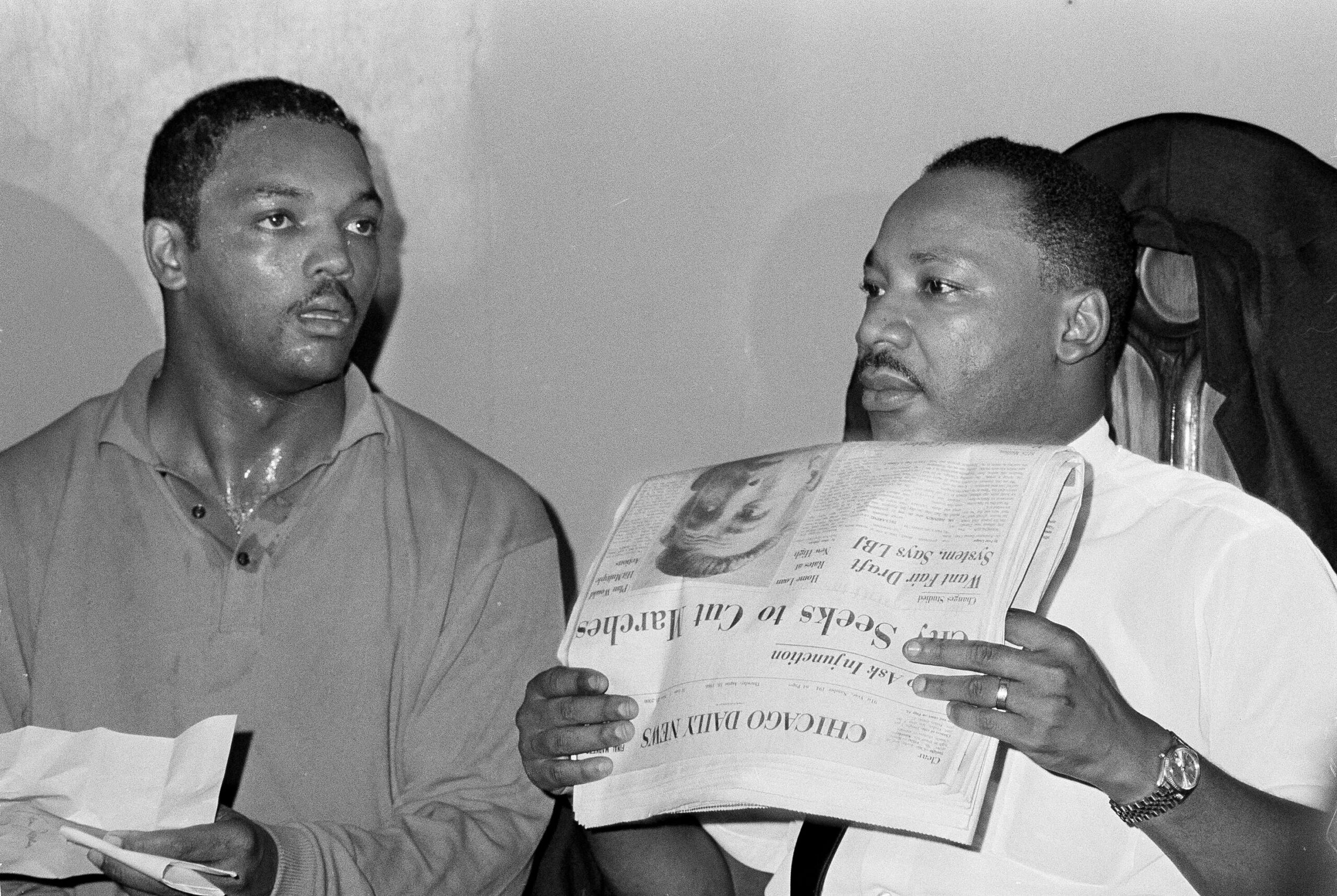
Civil rights leader the Rev. Dr. Martin Luther King, Jr. (right) and his aide, the Rev. Jesse Jackson, are seen in Chicago in August 1966.
Born in 1941 in Greenville, S.C., the mother of Jesse Louis Burns was a 16-year-old high school majorette who had been impregnated by a 33-year-old married man who lived next door, but denied his paternity. Two years later, Jesse’s mother married Charles Jackson, whom she met when he was a barbershop shoeshine man. Jackson sent the boy to live with his grandmother and didn’t adopt Jesse until he was 16 years old.
After high school, the Rev. Jackson enrolled at the University of Illinois Urbana-Champaign on a football scholarship. After his freshman year, he transferred to North Carolina A&T University, a historically Black institution in Greensboro, N.C., where he became a leader in his Omega Psi Phi fraternity chapter and president of the student body. In those roles, the seeds of the Rev. Jackson’s dynamic activism were sown.
Earlier, the Rev. Jackson had been a member of the “Greenville Eight,” the eight African American students arrested for refusing to leave the then-segregated Greenville County Public Library. By 1965, he was marching with King in Selma, Ala., and in 1967 was named head of Operation Breadbasket, the Southern Christian Leadership Conference program developed to help poor Black communities across the nation.
The Rev. Jackson eventually left the SCLC after King’s death and, in 1971, created his own organization, Operation PUSH, and later the Rainbow Push Coalition, which became as involved in politics as it was with social justice. That political involvement is credited with being a factor in the 1983 election of Chicago’s first Black mayor, Harold Washington.
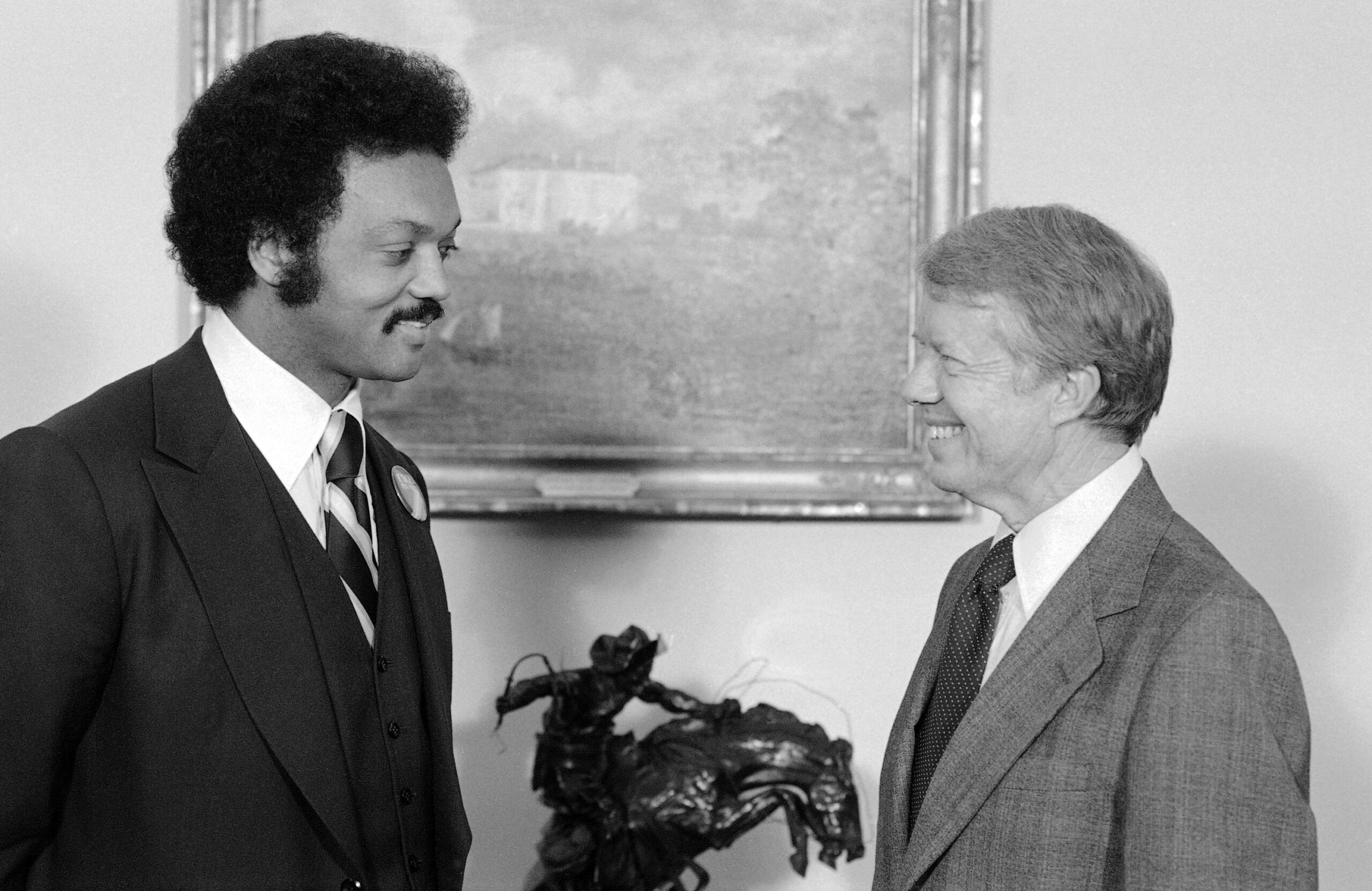
President Jimmy Carter speaks with the Rev. Jesse Jackson at the White House in Washington, April 4, 1979.
The Rev. Jackson’s subsequent 1984 presidential campaign resonated with voters of all colors and backgrounds who agreed with him that America wasn’t doing enough “to clothe the naked, to house the homeless, to teach the illiterate, to provide jobs for the jobless, and to choose the human race over the nuclear race.”
The Rev. Jackson won 465 delegates to the 1984 Democratic National Convention and 1,218 delegates in 1988, both times far exceeding Shirley Chisholm’s 151 delegates when the New York member of Congress ran for president in 1972. But the Rev. Jackson never gave it a third shot. He instead spoke out for justice not just in this country but around the world, and, in 2000, was awarded the Presidential Medal of Freedom by President Bill Clinton.
Those were good times, but life isn’t always good.
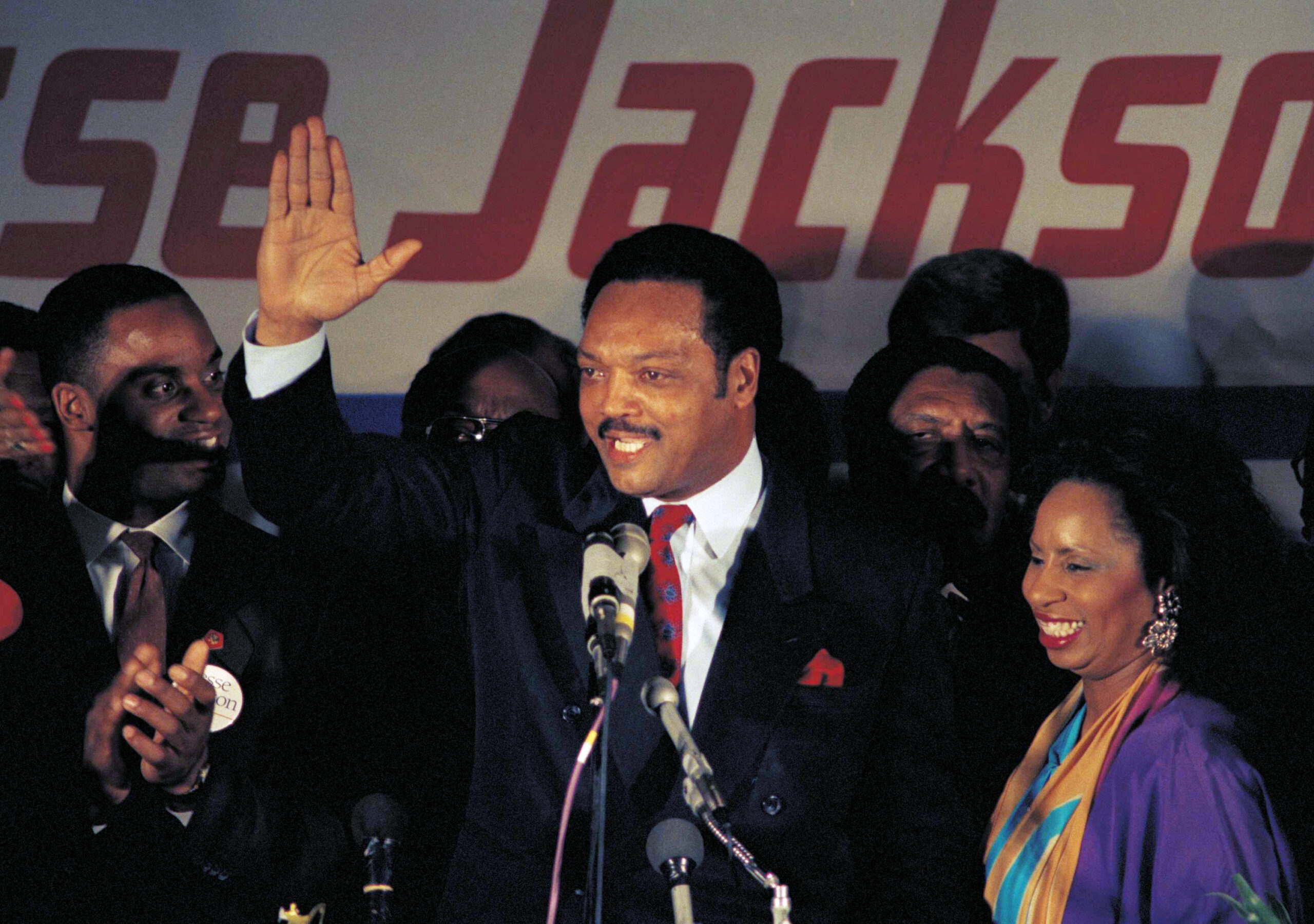
The Rev. Jesse Jackson, with his wife, Jacqueline, concedes defeat in the Illinois Democratic primary on March 16, 1988, in Chicago.
Watching the Rev. Jackson in his final years, attending public events but barely able to move or speak, made you wish for a better summation of a life once so full of zest and vigor. But the Rev. Jackson has left behind vivid memories captured in print, video, and downloads of a man history should not forget. Memories of crowds screaming, “Run, Jesse, Run,” as the Rev. Jackson tried to fulfill a political dream left to be carried out by someone else. Thank God, Jesse did live to see that.
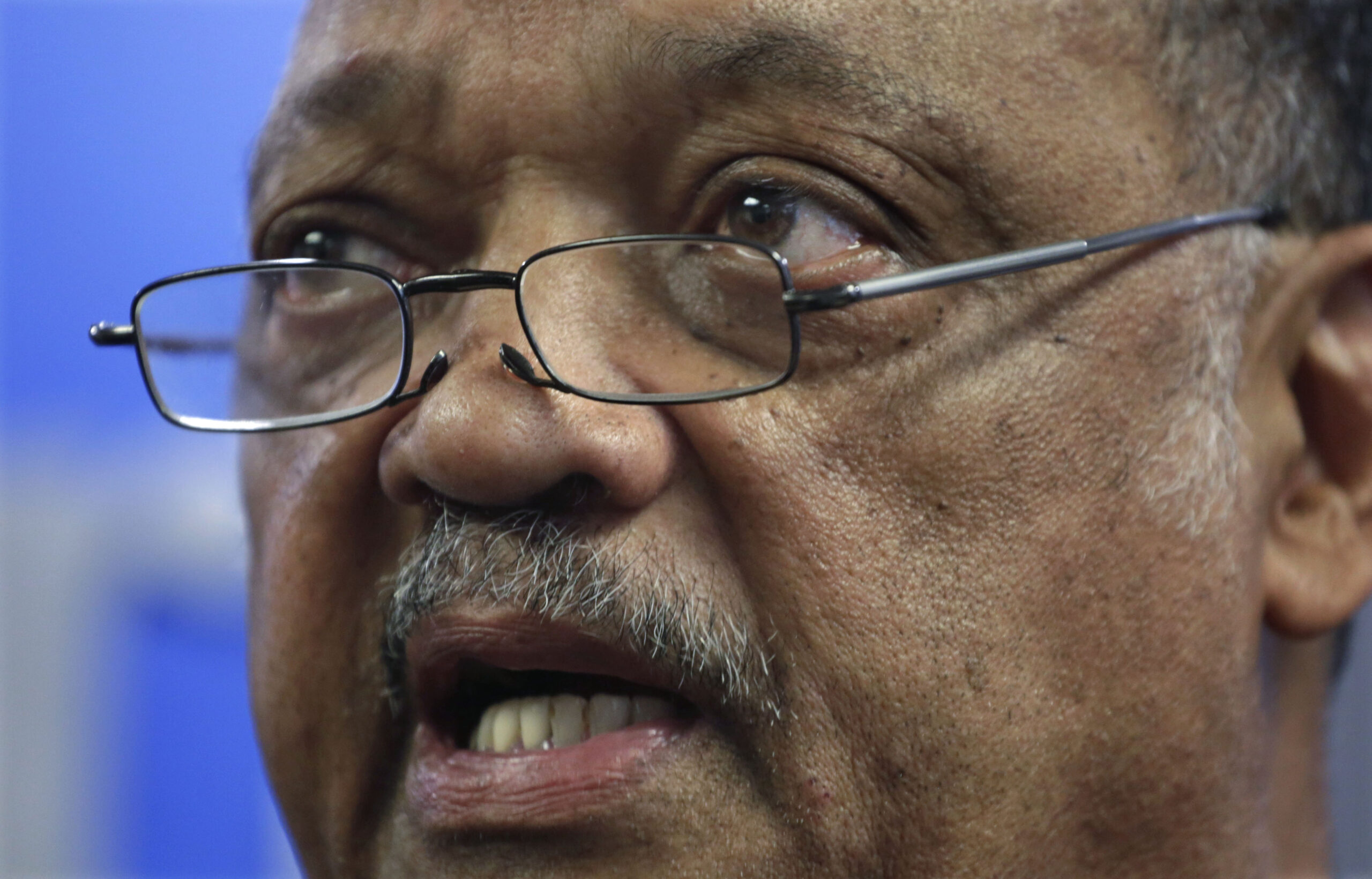
Jackson speaks at a Chicago news conference in February 2015.
Pick any of the seminal moments from Black history over the last six decades — from the assassination of the Rev. Dr. Martin Luther King Jr. in 1968 to Barack Obama’s first speech as president-elect 40 years later — and the chances are that the Rev. Jesse Jackson Sr. was there, front and center.
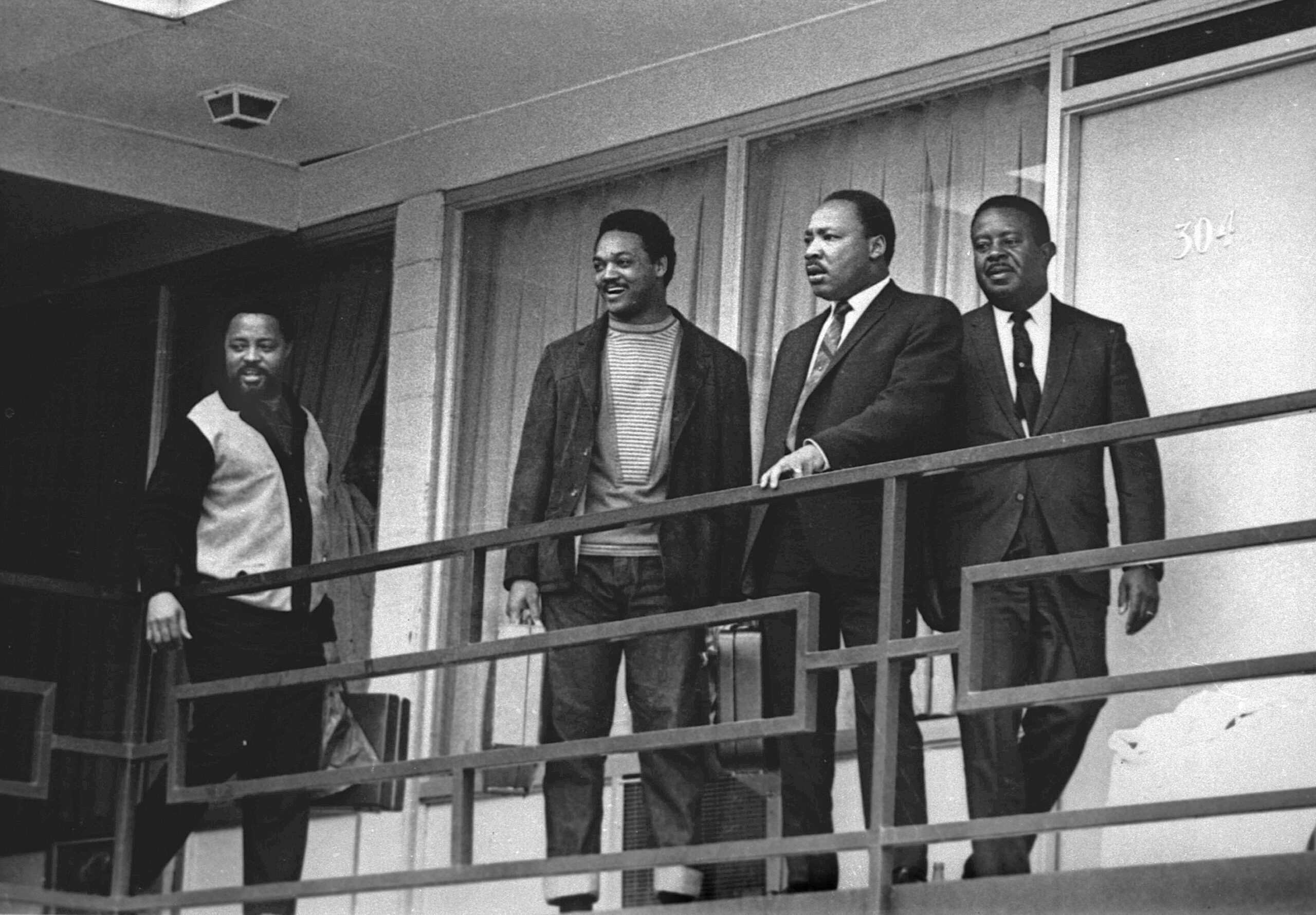
Jackson had spoken to King only moments before the civil rights leader was fatally shot while standing on a balcony of the Lorraine Motel in Memphis on April 4, 1968. Even though he was only 26 years old, Jackson went on to position himself to take up the mantle of leading the civil rights movement.
Years later, Jackson explained to an interviewer, “What I was clear on was that we could not let one bullet kill the whole movement.” He used the analogy of an athletic event during which the best player gets hurt. The answer, he said, isn’t to forfeit the game: “You can’t run away. You’ve got to keep fighting.”
The Rev. Martin Luther King Jr. (second from right) stands with Hosea Williams (left), Jesse Jackson (second from left), and Ralph Abernathy (right) on the balcony of the Lorraine Motel in Memphis on April 3, 1968, a day before he was assassinated while standing in approximately the same spot.
And that’s what he did for the rest of his life, advocating tirelessly for an end to racial injustice as well as for economic opportunities for poor people of all racial backgrounds through his iconic Rainbow coalition and during his two historic runs for the presidency.
Back when most Americans couldn’t conceive of a Black man becoming president of the United States, he could and tried to get the rest of us to believe in it, too. Jackson launched his first bid for the Democratic presidential nomination in 1984 and again in 1988.
Jackson rarely gets the credit, but his run for the White House helped lay the groundwork for the election of Obama, who fulfilled Jackson’s vision.
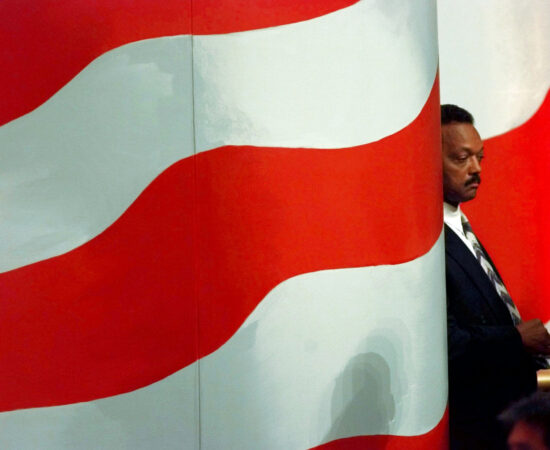
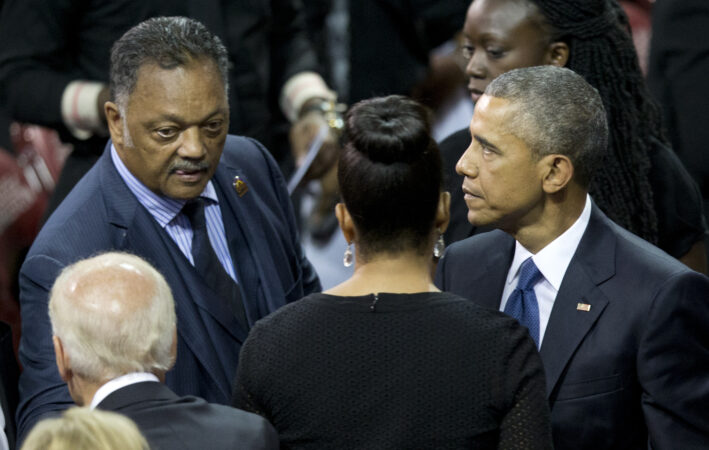
And, yes, when Obama gave his victory speech in Chicago’s Grant Park on election night 2008, Jackson was there, too. While Obama spoke, Jackson could be seen holding a miniature American flag with tears streaming down his cheeks.
“I wish for a moment that Dr. King or Medgar Evers” — the civil rights leader who was assassinated in Mississippi in 1963 — “could’ve just been there for 30 seconds to see the fruits of their labor,” Jackson later told the Associated Press about his emotions that night. “I became overwhelmed. It was the joy and the journey.”
Jackson’s death on Tuesday at the age of 84 came after years of illnesses, including a rare neurological disorder. Even in his later years, however, he stayed in the game — to continue his football metaphor — making an appearance onstage to thunderous applause during the Democratic National Convention in Chicago in 2024.
Inquirer columnist Jenice Armstrong interviews Jesse Jackson during the 50th anniversary commemoration of the assassination of the Rev. Martin Luther King Jr. on April 4, 2018.
News he had died hit me as hard as if I’d lost a dear relative. I didn’t know Jackson personally, but had the privilege of interviewing him multiple times during my career.
In fact, the first time I met him was asa student journalist on the campus of Howard University. The last time I’d actually gotten a chance to interview him was in 2018 during the 50th anniversary commemoration of King’s assassination in Memphis outside what had been the Lorraine Motel, which is now part of the National Civil Rights Museum. I wish I’d kept the recording of what he said.
As I processed the news of his death, I made a point of posting on Abby Phillip’s Instagram page a brief note ofthanks for her work chronicling Jackson’s life and legacy in her book, A Dream Deferred: Jesse Jackson and the Fight for Black Political Power. Phillip told me last year that she knew she was working against time and Jackson’s frail health to finish the project before his death.
Her goal, she said, “was to make sure that this chapter didn’t get lost to history.”
I was a kid in the 1970s during the Black Power era who repeated his chants, “I am somebody!”
Back then, it was affirming to see Jackson on TV with his then-signature Afro, or later delivering electrifying speeches during his groundbreaking runs for the presidency. We used to chant, “Run Jesse Run!”
One of the first articles I wrote for my student newspaper was about Jackson’s Operation PUSH, or People United to Save Humanity.
Jacksonspent his adult life at the forefront of the pursuit of equality for African Americans, and for that, we should always be grateful.
To me, losing this great leader in February during Black History Month — at a time when our people’s contributions to the nation’s history are being threatened with erasure — only magnifies the sense of loss. It should also remind those of us who care about civil and human rights that it’s our turn to take up the struggle — and keep fighting.
I was cranking out the newsletter in Tuesday’s predawn darkness when we learned that the Rev. Jesse Jackson Sr., who’d been our greatest living bridge to the civil rights heroics of the 1960s and ‘70s, had died at age 84. Covering his groundbreaking 1984 campaign as a cub reporter at the Birmingham News is still a career highlight four-decades-plus later — a memory that was reinforced recently listening to Abby Phillip’s excellent new book on Jackson. He leaves us right when his victories for African Americans in arenas such as corporate hiring and college admissions are under attack, and it challenges us to fight to preserve them. RIP to an American original.
How ICE protest by ‘an average Joe’ from Haddon Heights went viral
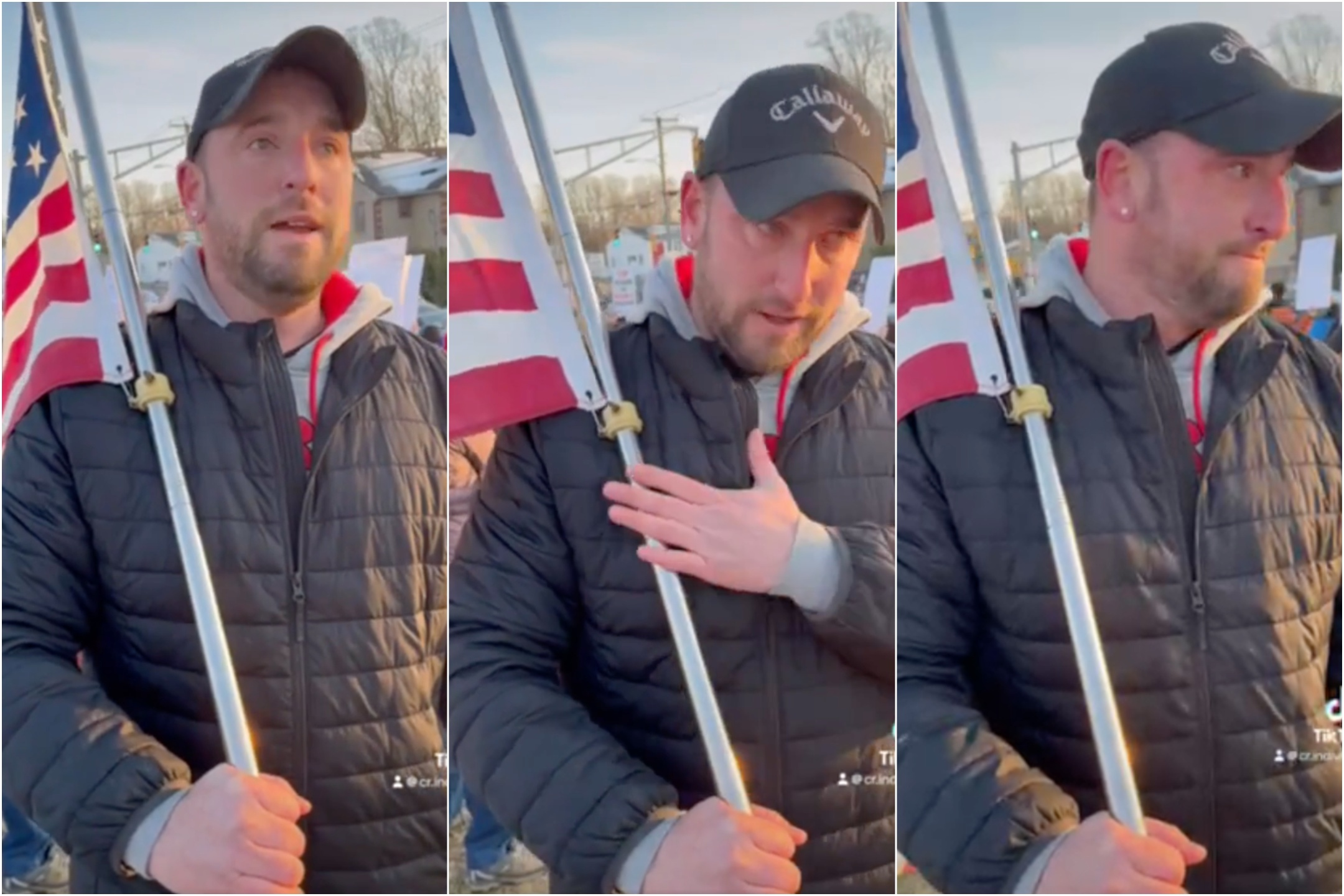
“I never want to see a child run away from our own government again,” said this self-described first-time protester, Joseph Zobel from Haddon Heights, at a rally in Lindenwold, N.J., the day after children ran from a school bus stop after ICE appeared to conduct an operation in the area.
Last Friday, “an average Joe who grew up in Haddon Heights” named Joseph Zobel was at work when he saw a viral video from the nearby South Jersey town of Lindenwold that shocked the nation, and shocked him.
The clip from a Ring doorbell camera showed a gaggle of fourth and fifth graders running in a panic, screaming, “ICE! ICE!” as masked federal immigration agents had approached their morning bus stop the day before.
“I just thought, ‘How can that be happening here in the United States?’” Zobel told me Monday in his first media interview, conducted by email. When he got home from work, he saw online that the group Cooper River Indivisible was holding an “ICE Out” protest at the Lindenwold municipal building at 4 p.m.
He looked at the clock. It was 3:58.
“Something inside of me said, ‘Go up there and stand with these people,’” said Zobel, a 36-year-old school coach who said he’s never been to a protest before in his life. “I wanted to stand for what is right.” As he dashed out, Zobel also grabbed one thing — the American flag he flies in front of his house most of the time (except during football season, when an Eagles flag replaces it).
As many as 300 people were at the protest, as Indivisible organizer Amber Clemments asked the flag-bearing Zobel if he’d be willing to film a video. Zobel’s raw emotion, choking back tears as he said, “I watched fourth- and fifth-grade kids run away from our own government,” soon ignited across social media over the long Presidents Day weekend.
By Tuesday morning, the 47-second clip of Zobel had been watched an astronomical 2.9 million times on TikTok — and liked by some 709,000 viewers — even as it also went viral on Bluesky, X, Threads, and other social media platforms.
It’s not hard to understand why. Zobel, who described himself as a patriotic regular voter but never very political, instantly became the bearded, baseball hat-wearing, anguished face of a new American majority — an Everyman shocked into action by the horror of immigration raids, wondering how best to protect his neighbors.
The two South Jersey viral videos — the one depicting the raid itself and Zobel’s raw reaction — revealed how both the terrorizing tactics of masked immigration cops and the powerful reaction from often nonpolitical Americans, dubbed “neighborism,” are spreading far beyond the Minnesota tundra where this battle was initially met.
Indeed, local activists say Lindenwold — last stop on the heavily traveled PATCO line, just over 15 miles southeast of Philadelphia — has been under a relentless siege from U.S. Immigration and Customs Enforcement (ICE) and other federal agents since last spring, not long after Donald Trump became president. The transit hub has become a magnet for immigrants in recent years, with a local school population that is just under 60% Latino.
Craig Strimel, a leader of Cooper River Indivisible, a local chapter of the group that organized the large “No Kings” protests, said activists first learned of the ICE activity when a Lindenwold immigrant couple escaped agents last year by taking refuge in the local high school, where the principal blocked the feds at the doorway. Since then, Strimel said, ICE watchers have seen frequent activity in and around a cluster of five apartment complexes with large immigrant populations, but few known arrests.
“It was becoming apparent early on that this was all about creating terror,” said Strimel of the frequent ICE sightings. Some local residents stopped leaving their apartments, he said, and a once-popular restaurant in Lindenwold just closed its doors amid rumors that the couple that owned it has returned to Mexico.
All of this set the stage for last Thursday, when masked federal agents wearing tactical gear arrived early in the morning at Lindenwold’s Woodland Village Apartments just as 44 elementary school kids were waiting for their school bus. The sighting triggered a panic that saw some kids running away and others frantically hustling onto the bus as the driver arrived. No one was apprehended or reported hurt.
On Monday, U.S. Department of Homeland Security officials said the agents went to the complex hoping to arrest a Honduran immigrant who’d once been convicted of aggravated assault. The man was not taken on Thursday and remains free.
Although some outlets reported the large protest was in response to the high-profile raid — which has been covered by the CBS Evening News, MS Now’sMorning Joe, and elsewhere — that took place just a day and a half earlier, the rally actually had been in the works for several weeks.
It had been organized by a young woman from Lindenwold named Tatiana — a 20-year-old business major at Camden County Community College who spoke with me Monday on the condition that I not use her full name — who’d been seeing the ICE activity in her hometown and felt it was time local people spoke out.
Tatiana told me that the idea behind the Lindenwold protest was “to give the community a voice — to be able to say, ‘No, we don’t stand for this.’ That’s the most important thing for me. It’s just bringing community together and deciding we’re not OK with this at all.” But she agreed the bus stop raid had given the event a boost from residents believing “that children should not be scared of federal law enforcement.”
Zobel was one of those neighbors. In the email interview, he described himself as “just your average Joe who grew up in Haddon Heights.” He did volunteer that he’s voted in every election since he turned 18, and that his first ballot was cast for Barack Obama, “and I felt proud walking out of the booth that day.”
Fittingly, Zobel sounded somewhat Obama-esque when he described his dismay over America’s bitter partisan divide. “We as a nation are so angry with one another, and that makes me so sad,” he said. Not surprisingly, he’s as stunned as anyone at the millions of views for Friday’s video, and somewhat concerned about the impact, saying, “I just hope this video does not divide people.”
But Zobel’s words and teary-eyed emotion went viral because it was such a shot of hope — that in a moment when hate is on public display in the streets of the United States, “your average Joe” who’d once stood on the sidelines is now grabbing the American flag and taking the field to fight for their neighbors. An authoritarian movement dependent on rage simply never counted on the brotherly love that sent this nonpolitical Eagles fan to his first protest.
It might not be his last. “I am always happy,” he said, “to help support humanity.”
Yo, do this!
With several inches of snow still on the ground, it might shock you to hear this, but American soccer is back! The Philadelphia Union — despite winning the 2025 Supporters Shield and boasting Major League Soccer’s best winning percentage in the 2020s — radically shook things up during the offseason. With new strikers Ezekiel Alladoh and Agustín Anello looking to amp up their attack, the Union’s quest for the CONCACAF Champions Cup begins Wednesday in Trinidad against Defence Force FC at 6 p.m. on FS2. Saturday night at 7:30 p.m., it’s back to the chillier climes of Washington for the MLS opener against DC United on Apple TV (with no need in 2026 for an additional Season Pass subscription, as in past years).
In the quest for what’s new in American popular culture, sometimes we take for granted the established jewels in our midst. I’ve long felt that MS Now’s 9 p.m. (now just on Monday nights) host Rachel Maddow is our best TV commentator because of the way she weaves the historical past into the headlines of America’s tortured present. But since last summer, she has upped her game. Maddow’s coverage of two stories underreported in most of the mainstream media — grassroots resistance to the Trump regime, and now the push for a nationwide network of warehouse concentration camps — has created appointment television every Monday.
Ask me anything
Question: What is your take on the latest CBS censoring of [Stephen] Colbert? — @bcooper82.bsky.social via Bluesky
Answer: Another Tuesday morning breaking story on deadline: The CBS overseers of Late Night with Stephen Colbert — the top-rated talk show that’s nevertheless ending this year in what critics see as genuflecting to the Trump regime that the program frequently mocks — would not air a recorded interview with Texas state lawmaker and Democratic Senate primary candidate James Talarico. The backstory here is that the Federal Communications Commission has long exempted late-night talk shows from its equal time rule about political candidates on licensed broadcast outlets, but last month, FCC chair Brendan Carr — a pro-Trump MAGA pit bull — said this is changing. That apparently was enough for CBS’s new Trump-friendly management, which would not broadcast the interview (available on YouTube, now certain to get more views than if it hadn’t been censored). This new flap just highlights what a perilous moment this is for the First Amendment and American democracy writ large. Government limits on what viewpoints you can see or hear are a sign of dictatorship, full stop.
What you’re saying about …
Last week’s question about a winning Democratic strategy for the 2026 midterms drew a robust response, and almost all of the replies were thoughtful and nuanced. If there was a consensus, it was that Democrats should tailor their candidates to the divergent views of the congressional districts they hope to win. As Naomi Miller stated, “I think progressive candidates should run in progressive districts, and mainstream democrats in mainstream, purple, and red districts.” Still, a number of you think America’s bad experience with MAGA extremism means a sharp left turn is warranted in response. “I’d like for the Democrats to become more progressive and combative toward Trump than they already are,” wrote Benjamin Spohn, voicing an opinion many share these days.
📮 This week’s question: Tuesday’s passing of the Rev. Jesse Jackson is one more reminder that many icons of America’s tumultuous 20th century are disappearing. So who do you think is the current greatest living American, and why? Please email me your answer and put the exact phrase “greatest living American” in the subject line.
Backstory on the main reason the media is not trusted
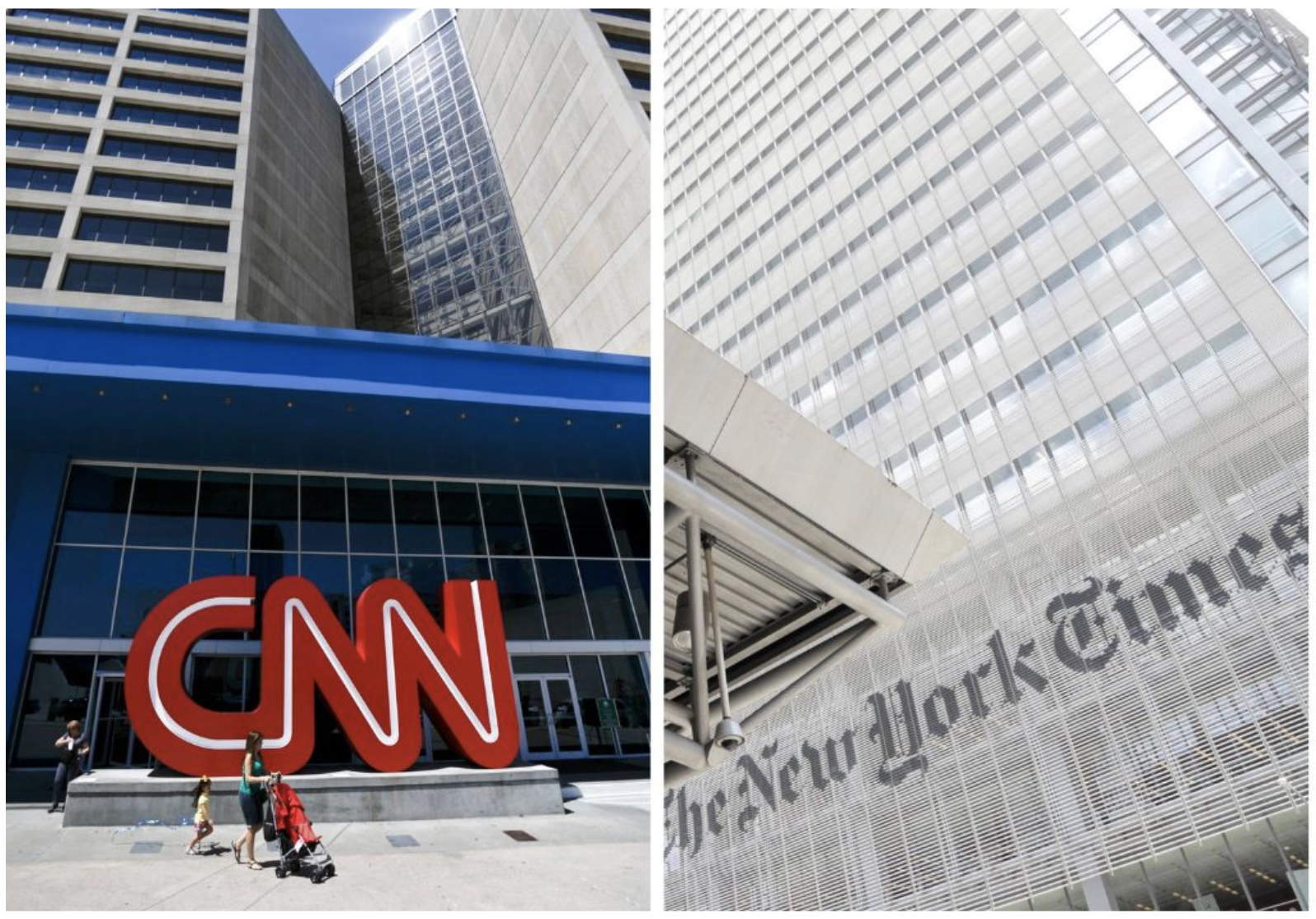
Exterior images of CNN headquarters in Atlanta and the New York Times Building in Manhattan.
It’s rare these days to write something that everyone can agree on, but here goes: Public trust in the media has never been lower than it is today. How low? A Gallup poll last fall found that public trust in the ability of newspapers, TV, and radio to fairly and accurately report the news had plunged to 28%, the lowest ever recorded. Why? It’s complicated. The people’s faith in every major institution has declined in the 21st century, after all. And it’s clear that in a deeply divided America, rage against the media machine looks different from the left than it does from the right.
This weekend, in a New York Times piece largely about the broken promises of one media-mogul billionaire — Washington Post owner and Amazon founder Jeff Bezos — columnist Lydia Polgreen put forth an explanation for sinking media trust that jibes with a lot of what I’ve witnessed since graduating into full-time journalism back in 1981. I believe it’s not the only reason — but the biggest, and maybe the most misunderstood.
Polgreen noted that the common theory for the public turning against Big Media — that journalists grew more partisan and biased after the tumult of the 1960s and ‘70s — doesn’t comport with the bigger reality. The era that peaked with the publication of the Pentagon Papers and the Watergate scandal launched a decades-long golden era of profitable news organizations spending big on investigative and accountability journalism — exactly what viewers and readers claimed they wanted.
Yet, trust declined as that happened. Polgreen cited a study in the late 1990s that compared then-contemporary media to 1960s newspapers and found the earlier times were “naïvely trusting of government, shamelessly boosterish, unembarrassedly hokey and obliging.” Polgreen wrote that moving “away from deferential stenography and toward fearless investigation … led to declining trust in the news media. Aggressive, probing and accountability-oriented journalism held up a mirror to American society — and many Americans didn’t like what they saw.”
I think this explanation is spot on, but before readers jump all over me, let me quickly add a couple of caveats. Starting way back in Ronald Reagan’s 1980s, there was also a response to the growing backlash — especially in elite, Beltway journalism — that resulted in too much groveling to authority, and thus stenography around government lies like the 2003 Iraq War. This has only gotten worse with the current wave of billionaire owners like the Post’s Bezos. This means many liberals now also distrust the media, but not for the same reasons as conservatives, who’ve long loathed journalism for probing America’s inequities around race or gender.
The explanation offered by Polgreen jumped out at me because it fit with what I explored in my 2022 book, After the Ivory Tower Falls, which looked at Americans losing trust in another large institution: colleges and universities. The liberal ideas that were nurtured on campuses in the postwar college enrollment boom — including the civil rights movement — triggered the same grievance-filled, largely white working-class backlash as did journalism about social injustice. Today, the only road back for the media is to hold the powerful to account — and understand that not everyone is going to like it.
What I wrote on this date in 2022
People can’t say they didn’t see America’s current crisis coming. On this date four years ago, I expressed my shock and amazement that little more than one year beyond Donald Trump’s attempted coup to stay in power, the right-wing’s creation of a political fantasy world was spiraling out of control, with lies about Hillary Clinton spying on Trump’s 2016 campaign and Joe Biden giving out free crack pipes (?!!). I wrote, “[Historian Ruth] Ben-Ghiat told me that the failure of the Jan. 6 insurrection only forced the GOP to double-down on embracing alternate realities, because ‘they have to reckon with the fact that [Trump] lost, that he’s no longer the leader.’”
There’s been no rest on themass deportation beat. In my Sunday column, I looked at the out-of-control lying from the Trump regime, with unbelievable fictions about everything from shootings and rampant brutality by masked immigration officers to Commerce Secretary Howard Lutnick’s whoppers about his friendship with Jeffrey Epstein. I argued that government lying is fundamentally unconstitutional and that the perpetrators need to be punished, including prison time. Over the weekend, I wrote about how, while Minneapolis was a victory for the forces resisting American authoritarianism, that won’t stop Homeland Security from putting thousands of new officers on the street and expanding its concentration camps. The fight for the soul of the nation has only just begun.
What was I saying higher up in this newsletter about accountability journalism? Ever since Lyndon B. Johnson’s Great Society push in the mid-1960s, community nonprofits have been a valuable source of urban renewal, yet aresometimes dragged down by waste, fraud, and abuse. It’s a problem that sadly persists, as shown last week by a major Inquirer investigation into Philadelphia’s NOMO Foundation, one of the best-funded nonprofits attacking youth violence and crime. Ace reporters Ryan W. Briggs and Samantha Melamed found that the foundation has received more than $6 million in public funds in recent years, but faced an IRS lien and eviction lawsuits while it was forced to close its housing program. This is why we have a First Amendment, so that a free press can report on the problems a corrupt or inept government refuses to deal with. Subscribing to The Inquirer gives you access to this type of essential journalism, and you’ll also feel good about supporting this vital work.
By submitting your written, visual, and/or audio contributions, you agree to The Inquirer’s Terms of Use, including the grant of rights in Section 10.
For one day at least, Donald Trump’s bigoted effort to whitewash history was foiled in Philadelphia.
A federal judge ordered the Trump administration to restore the slavery exhibits that were removed last month from the President’s House in Independence National Historical Park.
Fittingly, the legal rebuke came during Black History Month as Trump tries to rewrite America’s history of slavery, undermine voting rights, and rollback civil rights efforts designed to live up to the Founding Fathers’ vision of a country where all are created equal.
Even better, the ruling came on Presidents Day, a federal holiday first set aside to honor George Washington, who voluntarily gave up power, unlike Trump, who was criminally indicted for trying to overturn an election he lost.
In a poetic touch that feels conjured by Octavius V. Catto or William Still, the Trump administration lost in federal court on a lawsuit brought by the City of Philadelphia, which is headed by its first African American female mayor.
The President’s House exhibit was created to recognize the enslaved people who lived in Washington’s home in Philadelphia while he was president. Like the nearby Liberty Bell and Independence Hall, the President’s House is an essential part of American history.
Trump wants to airbrush the parts of American history that do not fit with his racist record and white supremacist messaging. But understanding how slavery shaped the economic, social, and political forces across the United States is crucial to addressing the systemic racism and inequality that persists today.
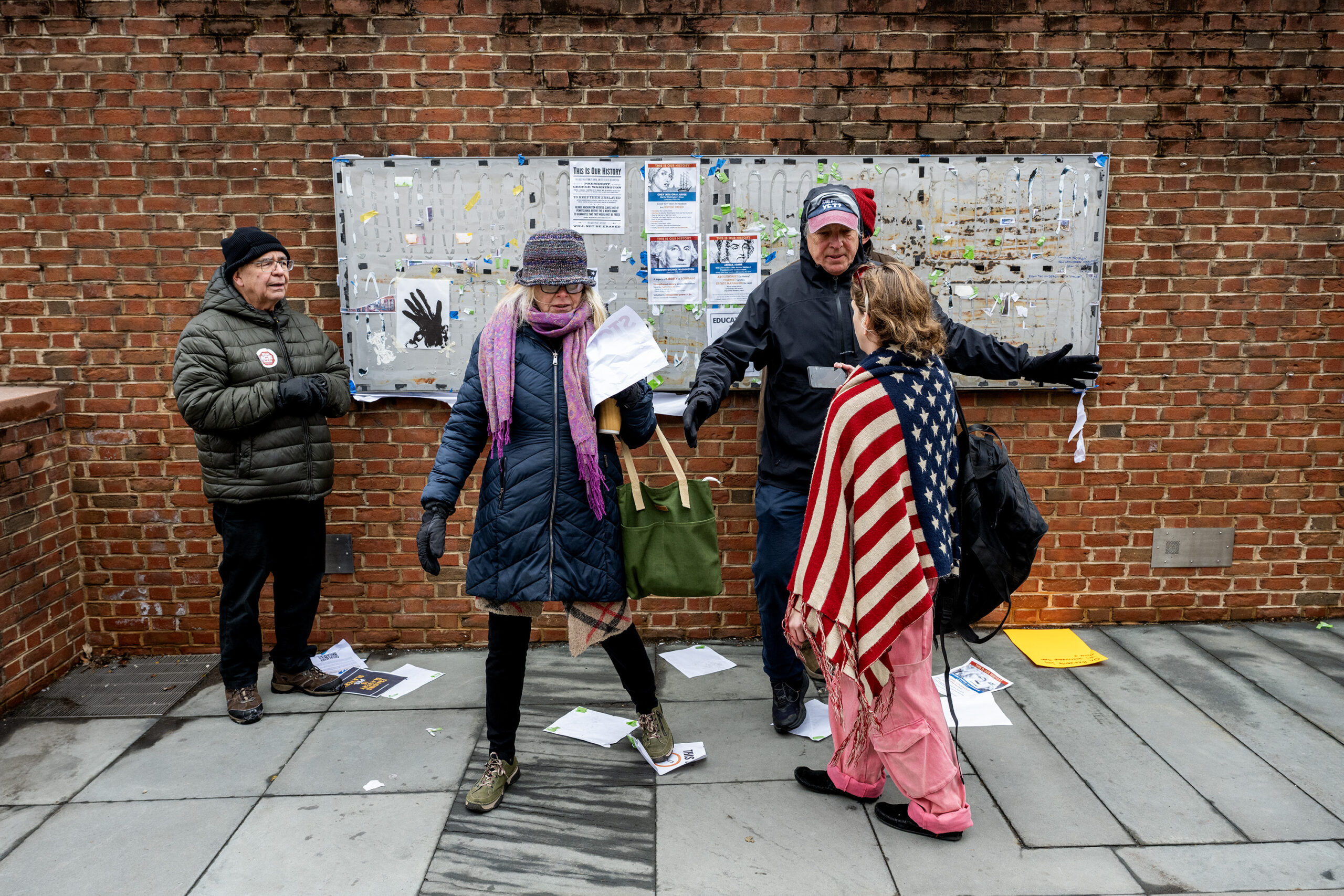
Glenn Bergman (right) and Dianne Manning try to prevent a “counterprotester” from removing notes posted by visitors on the walls where the National Park Service removed panels about slavery at the President’s House site on Monday. The woman began ripping down the mostly handwritten signs while the group Avenging the Ancestors Coalition was gathered for an annual Presidents Day observance on the other side of the wall.
U.S. District Judge Cynthia M. Rufe called out Trump’s cruel attempt to take the country backward in unsparing terms. She began her 40-page opinion by quoting directly from 1984, George Orwell’s dystopian novel about a totalitarian regime:
“All history was a palimpsest, scraped clean and reinscribed exactly as often as was necessary. In no case would it have been possible, once the deed was done, to prove that any falsification had taken place.”
She compared the Trump administration’s claim that it can unilaterally remove exhibits it does not like to Orwell’s Ministry of Truth.
“As if the Ministry of Truth in George Orwell’s 1984 now existed, with its motto ‘Ignorance is Strength,’ this Court is now asked to determine whether the federal government has the power it claims — to dissemble and disassemble historical truths when it has some domain over historical facts,” Rufe wrote. “It does not.”
Rufe, who was appointed to the federal bench by former President George W. Bush, did not buy the Trump administration’s authoritarian argument. “[T]he government claims it alone has the power to erase, alter, remove and hide historical accounts on taxpayer and local government-funded monuments within its control.”
She added: “The government here likewise asserts truth is no longer self-evident, but rather the property of the elected chief magistrate and his appointees and delegees, at his whim to be scraped clean, hidden, or overwritten. And why? Solely because, as Defendants state, it has the power.”
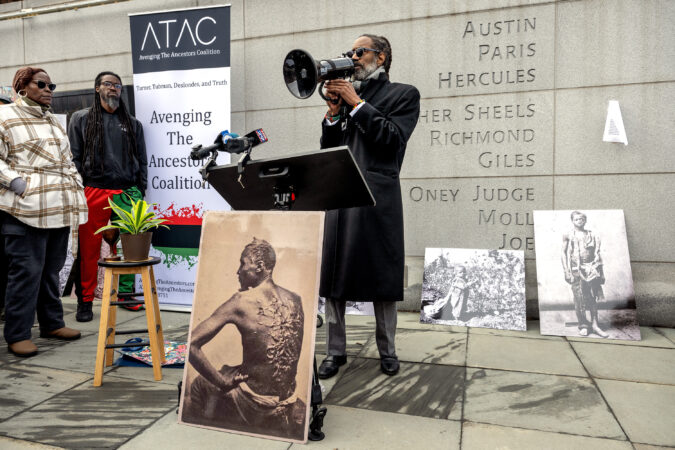
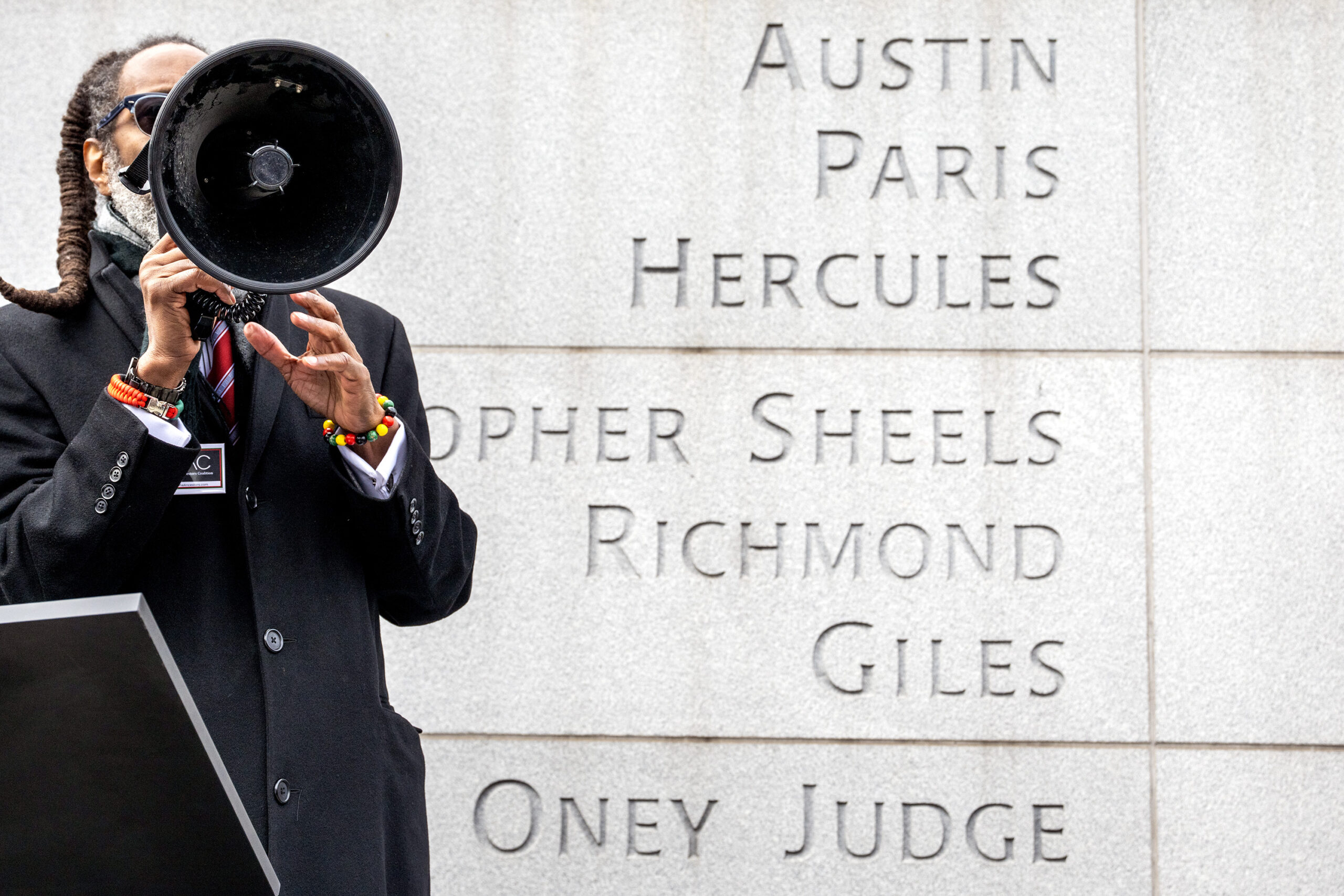
Attorney Michael Coard, leader of the Avenging the Ancestors Coalition, speaks at the President’s House site Monday, during the group’s annual gathering for a Presidents Day observance.
Rufe dismissed those claims and ordered the federal government to “restore the President’s House Site to its physical status as of January 21, 2026,” the day before the exhibits were removed.
Initially, Rufe did not set a deadline to restore the displays. But she updated her order, requiring the exhibits to be restored by 5 p.m. Friday.
The Trump administration will likely do everything it can to drag out a resolution.
There is no time to waste in ending this racist charade.
The country is celebrating the 250th anniversary of the signing of the Declaration of Independence. It is a national embarrassment that the President’s House exhibits are missing while the city expects 1.5 million visitors this year.
Philadelphia is the birthplace of America. It is here that the founders declared their independence from King George III. Their list of grievances against the king echoes some of Trump’s abuses.
Judge Rufe’s order struck a blow for telling the truth, something Washington would appreciate.
“It is not disputed that President Washington owned slaves,” Rufe wrote. “Each person who visits the President’s House and does not learn of the realities of founding-era slavery receives a false account of this country’s history.”
Somewhere, the enslaved who labored at the President’s House smiled.
Say their names: Ona Judge, Hercules Posey, Moll, Giles, Austin, Richmond, Paris, Joe Richardson, Christopher Sheels, and William Lee.
If Mayor Cherelle L. Parker and City Council needed more convincing about why Philadelphia should no longer elect a register of wills, they now have $900,000 worth of reasons.
That is the amount taxpayers have shelled out in recent years to settle lawsuits by former employees who refused to play the shopworn patronage game.
This appalling waste would not happen if the city stopped electing a register of wills.
There is no logical reason for this to be an elected position. It is a back-office function that issues marriage licenses, probates wills, and maintains records of residents who got married and died.
In most world-class cities, such as New York and Los Angeles, a clerk or court office handles these mundane tasks. But in Philadelphia, the register of wills stands as a relic from the city’s corrupt and contented era of machine politics.
The sooner the elected post goes away, the sooner Philadelphia can move into the modern era. The problem is that no elected official in a one-party town has the courage to do what is right by taxpayers and push to eliminate the so-called row offices, which include the register of wills and the sheriff, another elected post with a long history of corruption and inefficiency.
Former Mayor Michael Nutter, who served from 2008 to 2016, was one of the few elected leaders in recent times who supported eliminating the row offices. He was successful in folding the obscure Clerk of Quarter Sessions office into the Philadelphia court system, but City Council refused to eliminate the other two row offices.
In the past decade, there has been scant talk about reforming city government or increasing efficiency — even as Philadelphia’s budget ballooned by roughly 75%.
The register of wills stands as Philly’s patronage poster child.
For four decades, the office was run by Ron Donatucci and was staffed with ward leaders, committee members, friends, and family members connected to different power players in the Democratic Party.
Tracey Gordon, former register of wills for the city of Philadelphia.
In 2019, Donatucci was defeated by Tracey Gordon, who previously ran for City Council, city commissioner, and state representative. Things didn’t exactly improve.
Gordon lasted only one term, but left taxpayers with a trail of lawsuits by former employees who said they were pressured to donate to her campaign.
Last week, the city agreed to pay $250,000 to a former clerk who said he was fired for refusing to contribute $150 to Gordon’s campaign. Several other former employees received six-figure payments after filing similar complaints.
Gordon was defeated in the 2023 Democratic primary by John Sabatina Sr., a ward leader from the Northeast. He began swapping out old patronage hires for new ones, which led to more lawsuits.
The city has paid out $256,000 in settlements to nine former register of wills employees who filed lawsuits alleging Sabatina fired them.
Five cases are still pending, which means taxpayers will keep paying.
This Editorial Board has long called for the elimination of the register of wills and the sheriff’s office, moves that would save the city tax dollars and unending embarrassment.
The Committee of Seventy and the Pennsylvania Intergovernmental Cooperation Agency both issued reports in 2009 calling for the elimination of row offices. (The title of one was “Needless Jobs.” The title of the other was “A history we can no longer afford: Consolidating Philadelphia’s Row Offices.”)
But until voters demand change, the inefficient patronage system will grind on.
Philadelphia has always understood that music is never just music; sometimes rhythm becomes resistance. In this city, songs have spilled out of union halls and church basements, echoed off rowhouse walls, and marched alongside movements for labor rights and racial justice.
That tradition shows why Bruce Springsteen’s music, and his choices, still matter, decades after a summer night in East Berlin when rock and roll quietly challenged both sides of a superpower rivalry.
In 1988, nearly 300,000 young East Germans gathered for the largest rock concert in the history of the German Democratic Republic. The performer was Springsteen, a working-class songwriter whose music had already been widely misunderstood in the United States.
Ronald Reagan appropriated the pounding chorus of “Born in the U.S.A.” as a patriotic anthem while ignoring its verses — the story of a Vietnam veteran sent off “to go and kill the yellow man,” only to return home abandoned by the country he served.
In East Germany, those lyrics landed differently. Listeners heard the betrayal beneath the beat. They recognized themselves in the song’s moral tension. That understanding is why, unlike most Western rock stars, Springsteen was invited to play behind the Iron Curtain.
Pressure to stop the concert came from both sides of the Cold War. The U.S. Embassy urged Springsteen to cancel, fearing the show would legitimize a communist regime. At the same time, the East German youth organization sponsoring the concert — without Springsteen’s knowledge — advertised it as a “solidarity concert” for Nicaragua’s Sandinista government.
Springsteen refused both. He told U.S. officials he would not cancel. He told East German organizers he would not perform unless Sandinista banners were removed. His music, he insisted, belonged to ordinary working people, not to politicians.
About an hour into the concert, Springsteen stopped and addressed the crowd in halting German. “It’s great to be in East Berlin,” he said. “I’m not here for or against any government. I came to play rock and roll for East Berliners in the hope that, one day, all barriers will be torn down.”
He had wanted to say “walls,” but anxious officials begged him to soften the language. So he let the music finish the thought, launching into Bob Dylan’s “Chimes of Freedom,” a song written for the refugees, the silenced, the imprisoned, which Springsteen has lately reprised. A year later, the Berlin Wall fell. Many described the night as a widening crack — a moment when imagination briefly outran fear.
People protest against ICE outside the Bishop Henry Whipple Federal Building on Jan. 30 in Minneapolis.
This pattern is familiar. Springsteen’s work has long been embraced by audiences while misread, or deliberately misunderstood, by power. His songs are moral arguments set to melody, like the Academy Award-winning tune “Streets of Philadelphia.” They insist the American dream is fragile. It collapses when dignity, accountability, and justice are denied.
His message to them has never changed. Freedom does not come from walls. Power does not come from cruelty. The streets belong to everyone, or they belong to no one. Will this be the moment when they hear Donald Trump’s administration is destroying whatever is left of the American dream?
Music alone does not tear down barriers — or walls. But it shapes what people are willing to imagine, what they are willing to demand, and who they are willing to stand beside.
Springsteen’s music calls us to rise up against injustice, whether in the streets of Philadelphia, Berlin, or Minneapolis.
Kristen Ghodsee is a professor of Russian and East European studies at the University of Pennsylvania. She is the author of 12 books and is currently on academic sabbatical as an honorary fellow of the Einstein Forum in Potsdam, Germany. Susan Neiman has been the director of the Einstein Forum since 2000. She is a philosopher, essayist, and the author of 10 books.
The Thursday print edition of The Inquirer provided several reasons why we should applaud the current presidential administration for its contributions to criminal justice reform. For example, unlike many liberal state and local politicians who have talked the talk about providing employment opportunities for former criminals, Associated Press writer Ryan J. Foley reported that enlightened managers from U.S. Immigration and Customs Enforcement have hired these individuals while they were still exhibiting criminal behavior. It should be mentioned that ICE has found creative ways for these individuals to sublimate their violent temperaments and offensive libidos into constructive law enforcement activities that have made cities like New York, Minneapolis, and Chicago so much safer.
In that same edition of The Inquirer, Washington Post reporters described how the U.S. Department of Justice has successfully kept the names of sexual predators in the Jeffrey Epstein files out of the public eye. In an era in which progressives have rallied to “ban the box” that would otherwise require job applicants to describe their criminal history, the Justice Department has gone one step further in assuring Epstein criminals will not be economically penalized.
It is refreshing to see that just like Lady Justice, the U.S. Departments of Homeland Security and Justice have undertaken their duties as if they were blindfolded.
In 1973, White House counsel John Dean famously warned President Richard Nixon that the Watergate cover-up was a “cancer within — close to the presidency.” He cautioned that this corruption would consume Nixon’s presidency if allowed to fester. History proved him right, as Nixon resigned in disgrace.
Today, that warning rings with renewed urgency. By appointing Kurt Olsen as director of election security and Heather Honey as deputy assistant secretary for election integrity — both known election deniers — Trump has institutionalized systemic subversion. With his intent to nationalize elections on the heels of these appointments, the administration is poised to seize state-run processes, despite having no constitutional authority to do so.
Had it not been for the stabilizing counsel from the president’s first-term advisers, who have since been replaced with yes-men and ideologues, the republic may not have survived. With these guardians of democracy gone, the American Experiment is in grave jeopardy.
Donald Trump’s administration spends a fortune of our tax dollars to create concentration camps across the country. The cruelty is mind-boggling.
Meanwhile, we have a housing crisis throughout the nation. Imagine if those funds were diverted from tormenting our immigrant neighbors and devoted to providing affordable housing for our communities.
Judith Silver,Philadelphia
. . .
ICE is going to spend over $38 billion on detention centers. This country has so many needs — medical costs skyrocketing, a housing shortage, people mired in poverty, disaster relief, drunk drivers who kill 10,000 people per year (far more than ever have been killed by foreign nationals in the last half century), and the list goes on and on — and yet, the Trump administration believes this is a good use of our tax dollars. This surge to “mass deportation” is just another solution in search of a problem.
Steven Morley,Philadelphia
Join the conversation: Send letters to letters@inquirer.com. Limit length to 150 words and include home address and day and evening phone number. Letters run in The Inquirer six days a week on the editorial pages and online.
That’s one of my favorite questions to ask students. I want them to scrutinize their most deeply held beliefs. When you do that, I tell them, you sometimes find out you don’t believe them any longer.
A few weeks ago, a student put the same question to me. I thought about it for a few days, and then I came back with my answer: I changed my mind about protesters wearing masks on campus.
I used to think they should be allowed to cover their faces, and that it was a mistake for universities to prohibit them from doing so. But I think differently now.
And my reason has three letters: ICE.
Like many other Americans, I’m appalled by the presence of masked agents from U.S. Immigration and Customs Enforcement on our streets. Even before they killed two protesters in Minnesota, I was afraid of them. Now, I’m terrified.
And I’m proud of Democrats in Congress for demanding that ICE agents be prohibited from wearing masks that hide their identities. Blocking a GOP spending bill that lacked any new curbs on ICE, the Democrats forced a partial shutdown of the federal government over the weekend. They should hold out until the mask ban is in place.
I also support a proposed City Council measure that would block law enforcement officers in Philadelphia — including ICE agents — from obscuring their identities with facial coverings.
A demonstrator in Los Angeles wears a mask in front of an image of Renee Good during a protest last month to denounce the Trump administration’s immigration enforcement polices.
But now I believe campus demonstrators — like ICE agents — should also be barred from wearing masks. Their facial coverings stoke fear, too. And they make it next to impossible for officials to keep everyone else safe.
If you think otherwise, consider what happened at Haverford College earlier this month. Interrupting a talk by a pro-Israel speaker, several masked demonstrators burst into the room. One of them shouted into a bullhorn that “Israeli occupation forces” were killing children. “When Gaza is burned, you will all burn, too,” she said.
Most universities already have rules barring disruption of public events. But masks add something worse: intimidation.
When the masked protesters entered the room, a Haverford professor said he thought they were “terrorists trying to get in and kill us.” Another witness said she worried she might be attacked.
“No one knew who they were or whether they were armed,” the witness added. “Imagine fully masked people entering through emergency exits, hiding objects under their coats, blocking basic points of egress. It is reasonable to fear for your physical safety.”
And it’s also reasonable for colleges to ban masks. In a statement, Haverford officials said the protester carrying the bullhorn was not a member of their community. But nobody could know that when she entered the room.
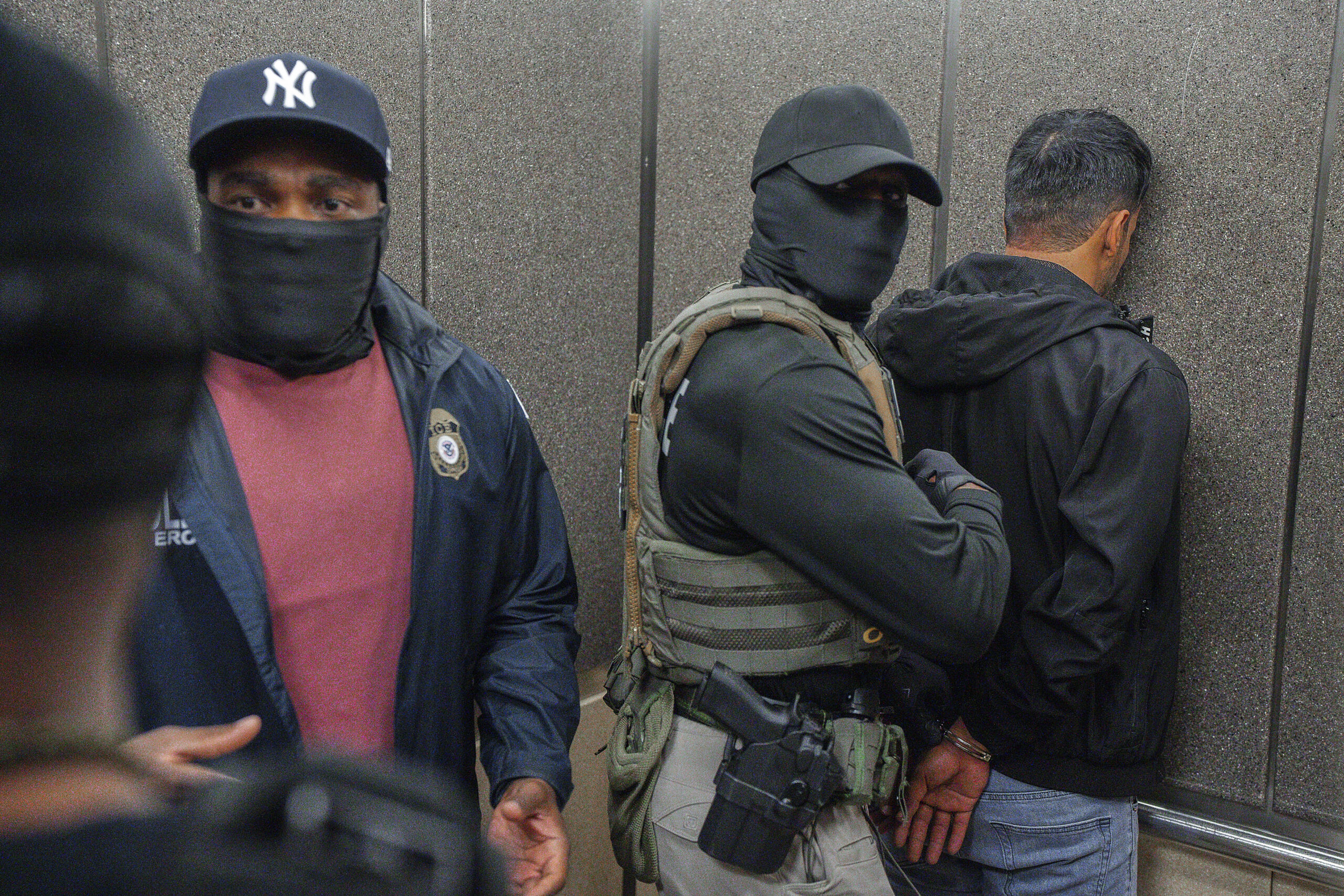
Masked U.S. Immigration and Customs Enforcement agents escort a detained immigrant into an elevator after he exited an immigration courtroom in New York in June.
How can we keep the university safe if we don’t know who is from the university and who isn’t?
At the University of Pennsylvania, where I teach, only nine of 33 people arrested during the clearing of pro-Palestinian encampments in May 2024 were students at the university. At Swarthmore, just two of nine arrested demonstrators were members of the college community.
It shouldn’t be. We need a free and open dialogue about Israel, and everything else. And that’s also why we should ban masks, which inhibit that same dialogue. You can’t have a conversation if you don’t know who is talking.
I used to think masks were a form of free expression, so universities should allow them. I also thought protesters needed to hide their identities so they wouldn’t get doxed, which would subject them to violence and harassment.
Then the Trump administration said the same thing about ICE agents — they need masks to protect them from doxing — and I changed my mind. Regular police officers don’t wear masks; instead, they wear numbers and name tags. That’s how we hold them accountable for their actions.
Putting masks on ICE agents does the opposite: It lets them act with impunity. The goal of the masks is not to protect the agents. It’s to foster fear in our communities and our nation.
They need to take their masks off. But so do we.
Of course, we should make exceptions for people who cover their faces for reasons of health, religion, sports, or entertainment. I’d hate to see a college kid barred from wearing a Halloween mask, for example.
But a protester? Let us see who you are. Don’t cower behind a mask. That’s what ICE does.
MUNICH — Last year, at the Munich Security Conference, where top U.S. and European leaders gather each year, Vice President JD Vance gave a shocking speech that nearly broke the NATO alliance of democracies that had kept the peace in Europe for 80 years.
Vance claimed the threat to Europe was “not Russia, not China,” but rather came “from within” our NATO allies themselves — falsely accusing European democracies of stifling the radical, pro-Russia, and sometimes neo-Nazi parties that the Trump White House openly supports. The veep never even mentioned the threat from Russia, or its war on Ukraine.
The acrid impact of that speech has hung over U.S.-European relations and the future of the NATO alliance over the past year.
“Under Destruction” was the title of this year’s conference, held at the elegant Bayerischer Hof hotel. Its annual security report opened with these grim words, aimed at the “current U.S. administration”: “The world has entered a period of wrecking-ball politics. Sweeping destruction — rather than careful reforms and policy corrections — is the order of the day.”
And yet, this year, I heard a startlingly different tone from European leaders. Stunned by Trump’s demands and disdain, awakened by Russian aggression against Ukraine and much of Europe, furious at President Donald Trump’s threats vs. NATO ally Denmark to seize its sovereign territory of Greenland, European leaders have woken up to the need for dramatic changes — though not in the way envisioned by Trump.
“Europe has just returned from a vacation from world history,” stated German Chancellor Friedrich Merz, who like other leaders here, recognized they had depended for too long on an American ally they trusted for their postwar defense.
Merz chose to speak first at the conference, taking a European leadership role (while insisting, with a nod to his country’s history, that Germany would “never again go it alone”).
“The international order based on rights and rules is currently being destroyed,” he said. “But I’m afraid we have to put it in even harsher terms. This order, as flawed as it has been even in its heyday, no longer exists.”
Merz added, “It does not mean that we accept it as an inevitable fate. We are not at the mercy of this world. We can shape it. And I have no doubt that we will preserve our interests and our values in this world if we step up together with determination, with confidence in our own strengths.”
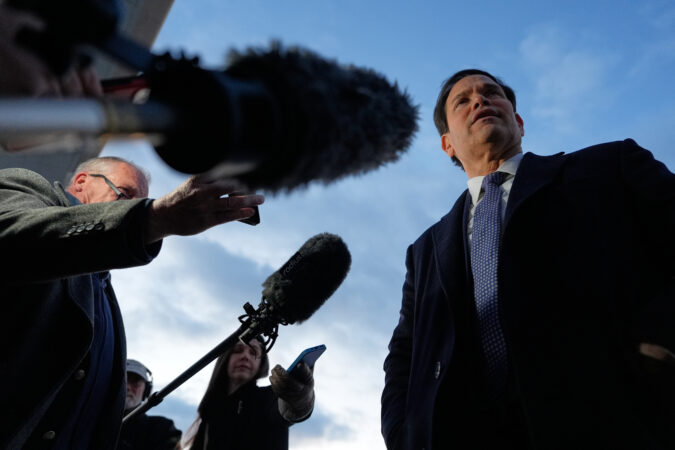
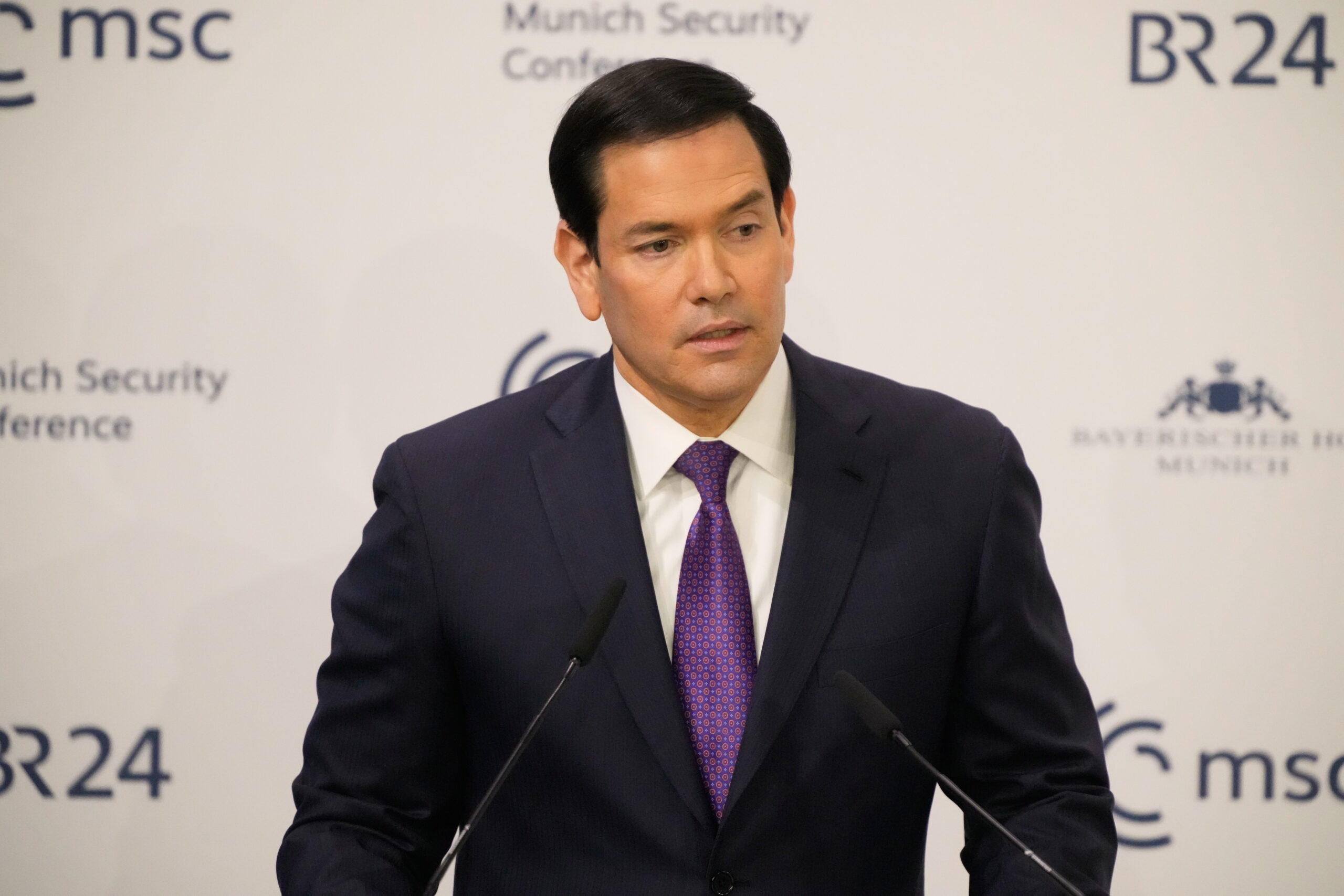
U.S. Secretary of State Marco Rubio speaks at the Munich Security Conference Saturday.
Indeed, the message of this European leaders meeting in Munich, in sharp contrast to European paralysis at Vance’s onslaught last year, was that they must and can organize to defend against Russia while protecting democratic values — and Ukraine — even if the United States won’t.
Of course, skeptics, including Trumpers, will claim that Europe has become irrelevant. But what I heard this weekend is far more realistic than Trump’s fantasies about a Ukraine deal that bows to Putin and envisions big business deals with Russia.
Pressed by Trump (and this was a good thing), NATO allies have significantly increased their defense budgets. Now that the U.S. has cut off almost all aid to Ukraine, Europe is paying for all U.S. weapons that are purchased for Kyiv, and the EU has pledged to cover most of Ukraine’s military budget for the next two years.
But, unlike the U.S. president, the Europeans recognize that Ukraine is a symbol of the threat posed by an imperialist, aggressive Vladimir Putin.
“With the beginning of Russia’s aggression, we entered a new phase of open conflict and wars, which changed the [security] situation more than we ever thought possible a few years ago,” Merz continued.
The Kremlin also pushes claims of defending its “Russian civilization” to include any territory where it falsely claims that Russians are mistreated. This could include the Baltics, Poland, parts of the Arctic, all of Ukraine, Moldova. The list goes on.
European officials are acutely aware of Russian threats, since they are the constant victims of Russian sabotage, underwater cable cutting, and political assassinations, all of which the White House downplays.
During the conference British intelligence announced they had proof that Russia had assassinated opposition leader Alexei Navalyny in prison with a rare toxin, just as Russian agents murdered a Russian dissident on British soil.
What I heard over and over was European astonishment that the White House ignores the massive slaughter of civilians by Putin, while pressing only for concessions by Ukraine. President Volodymyr Zelensky spoke bluntly at Munich about the need for more air defenses, but only Europe is responding.
Indeed, Ukraine was central to the whole conference, with many speakers, warm applause, and frequent sessions featuring Ukrainian military innovations, while Europeans emphasized the importance of Ukraine’s trained army to Europe in the future.
There was constant praise for Kyiv as the defender of Western values, holding the line between Russia and the democratic West.
Ukrainian President Volodymyr Zelenskyy, left, and German Defence Minister Boris Pistorius talk during their visit of drone producing company Quantum Frontline Industries near Munich Friday.
Yet, it was clear from the American position at Munich that the administration sees the world entirely in a different light.
No doubt aware that Vance redux would have been booed off the stage, the White House dispatched the somewhat more diplomatic (but far less powerful) Secretary of State Marco Rubio who soothed European fears slightly with an emphasis on continued U.S.-European ties. However, Rubio pointedly never mentioned the Russian threat hanging over Europe in his speech. He pushed the same nationalist MAGA line about the main threat to “thousands of years of Western civilization” coming from immigrants and multilateral ties.
More disdainful was Deputy Secretary of Defense Elbridge Colby, who praised Secretary Pete Hegseth repeatedly and fulsomely, and insisted that the essence of Trump foreign policy was “hard-nosed common sense.”
“You can’t base an alliance on sentiment alone,” he insisted, in a discussion held in the Bar Montez at the Rosewood Hotel, without taking any questions. “Maybe there is a difference in values.” Then he laughed that he had only heard the words “rules-based international order” once in Munich so “that is a piece of progress.”
It is not clear whether the Europeans can achieve the weapons production goals they discussed and develop an integrated military force that takes over ground protection of Europe within NATO by the end of this decade. And leaders I spoke with recognize they can’t succeed alone without active partnership with — not subordination to — the United States.
But what I heard in Munich made clear that they are far more aware of the threat democracies face and the values that need to be protected than is the White House.
“We will preserve our interests and values if we step up together,” said Merz.
That is wise advice that the White House continues to ignore.
Primary election season is approaching, but for some reason, most Americans do not bother to participate. Typically, in nonpresidential election years, somewhere around 20% of voters take part. So often, because of the poor turnout in the primaries, a tiny fraction of the population decides which candidates will represent the two parties in the general election. This often leads to a situation in which many voters complain that neither candidate excites them. You should keep in mind that about 95% of elected offices are held by either a Republican or a Democrat, and they were all nominated in a primary election. And for those who have decided to register as independent, be aware that in Pennsylvania, New Jersey, and Delaware, the primaries are closed, meaning only Republicans can vote in the Republican primary, and only Democrats in the Democratic primary. Rather than bemoan the system, why not take 10 minutes, look at the party platforms, decide which one comes closer to your worldview, and change your registration so that you can be part of the solution? Registration can be done online in two minutes, and it is free of charge. This year, why not make an effort to get back in the habit of being part of our great democratic process? Your country needs you.
Patrick J. Ream,Millville
Opposing ICE
I am grateful that Sen. John Fetterman has voiced his opposition to the planned immigrant detention centers in Berks and Schuylkill Counties. His reasons, which focus primarily on the strain to the local communities, are valid. But he doesn’t talk about the effect on the people who might be sent to those centers. Since Donald Trump became president, at least 30 people have died in U.S. Immigration and Customs Enforcement custody. Centers have been reported to have inadequate food and housing, and now that the government won’t reimburse for it, medical care is almost nonexistent. Most of these detainees are not dangerous criminals. Most make valuable contributions to our communities. They are our neighbors.
Almost as troubling is the profit made by the wealthy, well-connected few. For example, records show a Berks County family sold a property for $1.5 million in 2021. It was sold again, in 2024, with a warehouse on it for $57.5 million, and ICE bought it for $84.5 million. Then, there are the profits of the private companies that run the centers and often have no demonstrated capacity to do so.
Twenty public schools are scheduled for closure in Philadelphia, where 90% of the student population is African American and where half the seats are empty. This may seem like a problem, but with imaginative thinking, it can present a great opportunity. Educators should continue to teach in one half of the buildings and use the other half for community services that support building skills for young people, such as operation of retail stores run by students, teaching them about businesses and financial literacy, spaces for town watches and police, protecting the schools and the community, and spaces for the homeless. With hundreds of seats in these school buildings closed, hundreds of minds in our school administration may be opened.
Leon Williams, Philadelphia
Truth hurts
In a recent letter to the editor, Mark Fenstermaker took offense to what he believes is the left-handed slant of The Inquirer. Without citing any factual support, he says that 95% of viewpoints in The Inquirer are slanted to the left. He writes that he hopes the paper would strive to present “unbiased, factual reporting and opinion.” That does not mean the editors at The Inquirer should abandon reality in favor of artificially balancing the number of left vs. right-sided opinions. It seems to me that, like the current herd of Donald Trump followers, truth and facts are your kryptonite. If you don’t like the truth, demean it. If facts get in the way, ignore them. Yes, U.S. Immigration and Customs Enforcement has a legitimate goal in policing illegal immigration. Dressing up like Nazi brownshirts and wearing face masks does not advance that goal or engender public support. And killing two innocent people is “slaughter” under any reasonable definition. By the way, the writer’s MAGA hat is showing: neither of these victims “chose to put themselves in danger.” I find the letters policies of The Inquirer quite fair. If not, why was I subjected to the opinion of Mark Fenstermaker?
Jim Lynch, Collegeville
. . .
In a recent letter to the editor, Mark Fenstermaker asks why The Inquirer does not cover the “tens of thousands” of migrants who have committed violent crimes.
It’s a fair question in the current climate, where our top officials falsely accuse Haitians of eating dogs and where the president’s comment about “shithole” countries echoes years later. The fact of the matter is, according to the American Immigration Council, violent crime among immigrant populations — both documented and undocumented — is about half what it is among the native-born population. There are not “tens of thousands” of cases to cover.
During times of economic unrest, immigrant populations have become scapegoats for larger social issues. In fact, during the late 19th and early 20th centuries, the scapegoats were often Southern Europeans, particularly Italians. Earlier, Irish immigrants were assumed to bring increased crime to the U.S. During this time period, fear of Catholicism was baked into the anti-immigrant propaganda, much like fear of migrants today targets Muslims.
Considering the historic pattern of attacks on migrants helps us understand the propaganda currently promoted by the White House and circulating on social media.
Ann E. Green, Bala Cynwyd
. . .
To rebut statements by the obviously biased person from Warminster: “Tens of thousands of violent, criminal, illegal immigrants” removed from our streets? A gross, unproven exaggeration. About 30% of those arrested have criminal charges pending. Speaking as a retired Philadelphia police sergeant, the two killings by ICE personnel were both manslaughter. The shots were fired by agents who were in no danger, thus making it unnecessary to take innocent lives.
Words of exaggeration and gross generalization matter.
Larry Stroup,Warwick
Toxic brew
In response to the article about the city no longer dumping snow in the Schuylkill: Granted, the snow piled up on the side of our roads does contain a toxic brew of chemicals, but where does one think those chemicals go when the snow is collected and moved to land-based locations? Do they magically evaporate, never to be seen again? Of course not. The snow melts, and those chemicals are released to either wash into the river or soak into the ground, where they, too, will most likely end up in the river. That part of the argument against dumping accumulated snow into the river doesn’t hold water. Pun intended?
Tim Reed, Philadelphia
Learn all history
I write this having just finished reading the Feb. 8 Opinion section of The Inquirer, which was entirely made up of essays about the 100th anniversary of Black History Month. What a treat to learn about the evolution of what was Negro History Week in 1926 into what became Black History Month in 1976 — and to learn, from the seven essayists, Philadelphia’s role in its growth until now. I concur that “studying the history of Black achievement is integral to understanding the American Experiment.” I am a “Johnny come lately” in learning about the heritage of our African American brothers and sisters. I was studying at Bennett College in Greensboro, N.C., and was able to take an Afro-American studies six-credit course in 1970. It was quite an opportunity for this young white woman from suburban Philadelphia to become someone “ahead of her times” in learning the names, achievements, and obstacles of prominent African Americans such as Alain Locke, W.E.B. Du Bois, Phillis Wheatley, James Weldon Johnson, and Mary McLeod Bethune. As one of the writers in the section, Harold Jackson, pointed out, now, “instead of celebrating individuals, Black History Month should focus more on the events and ideas that continue to impact how Black and White people coexist in an America that continues to struggle with covert and subtle racism.” Black History Month is a good time to reflect on “the uncomfortable reminders of what America was, and to take the steps to avoid slipping into a past we need to remember but not repeat.” We are still being called to a “more perfect union.”
Mary A. McKenna,Philadelphia
Join the conversation: Send letters to letters@inquirer.com. Limit length to 150 words and include home address and day and evening phone number. Letters run in The Inquirer six days a week on the editorial pages and online.