Category: Opinion

  • As demand soars and resources dwindle, the Share Food Program stays focused on its mission | Philly Gives

    As demand soars and resources dwindle, the Share Food Program stays focused on its mission | Philly Gives

    To this day, George Matysik, executive director of Share Food Program, can’t bite into a South Indian dosa without remembering a daily act of kindness that mattered to him when he was a young man, a paycheck away from poverty.

    When he would arrive for his 6 a.m. shift as a housekeeper at the University of Pennsylvania’s engineering school building, the engineering school’s librarian would hand him a homemade dosa, a thin crepe redolent with the warm smells of curry and potatoes.

    “My stomach was growling by then,” he said, sitting in a warehouse full of food ready to be packed for the nearly three million people who rely on the Philadelphia nonprofit for food.

    “The moment of her handing me that dosa, I felt like I was going to be OK,” he said. Matysik, who graduated from Mercy Career and Technical High School across the street and down the block from Share’s main warehouses near Henry, Hunting Park, and Allegheny Avenues, went on to earn a degree in urban studies from Penn.

    “I felt supported,” he said. Now, Matysik leads an organization that supports people who are missing meals and are worried about getting their next ones.

    Look, Matysik said, society has many problems, and most are difficult to solve. Homelessness is complicated. Addiction grips its victims in its relentless stranglehold. “They don’t have simple solutions,” he said.

    “But with hunger, it is simple. It’s getting food to the people who need it,” he said, like the dosa that began his day of washing floors and cleaning toilets at Penn.

    “It’s frustrating to me that in the richest country in the world, a food program like Share has to exist at all,” Matysik said. “Food is a human right, and hunger is solvable. We have the resources in this country to eliminate food insecurity, and we can do it in Philadelphia if organizations like Share can get the resources.”

    But it’s daunting.
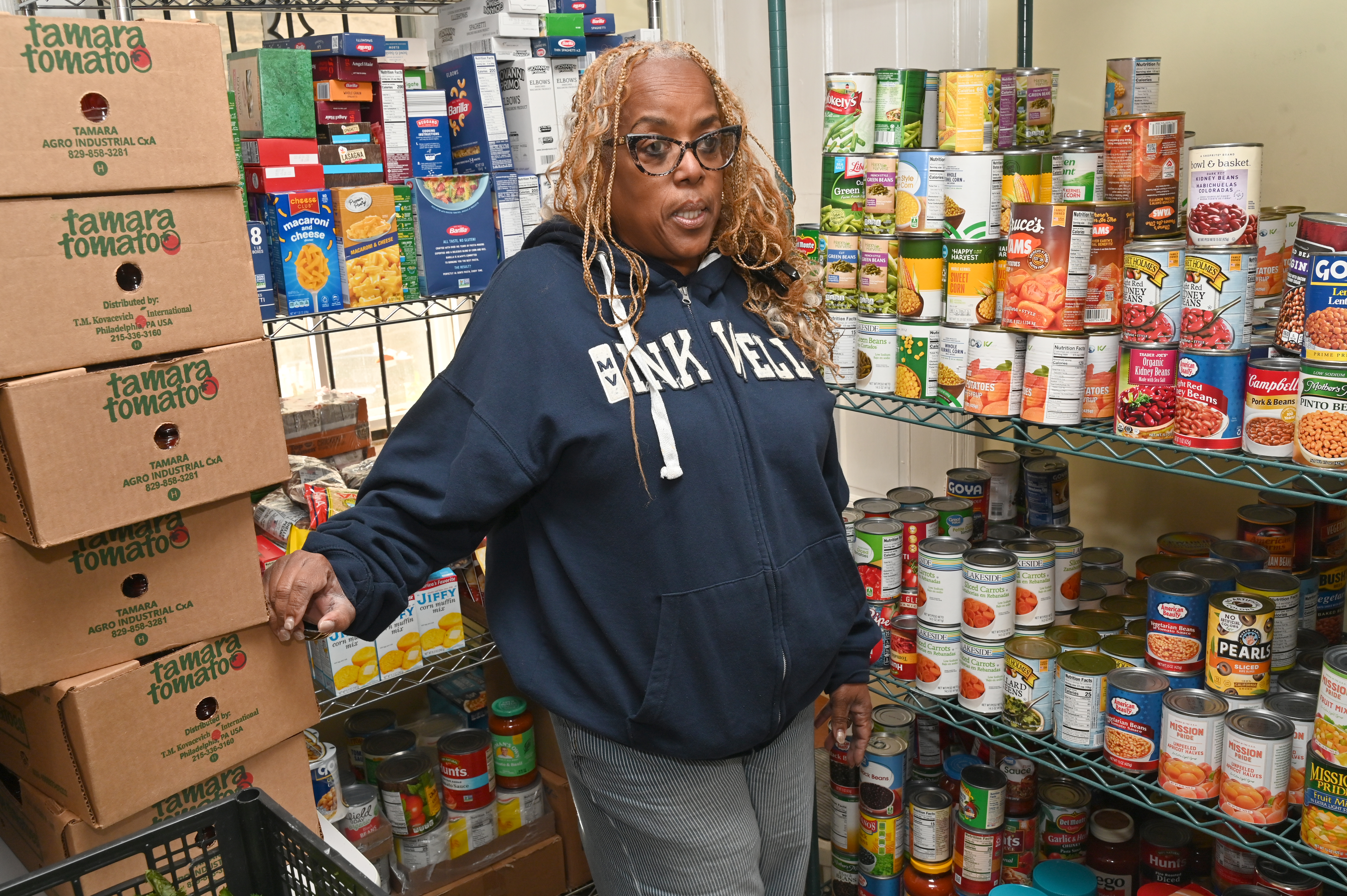
    Jimmette Hughes, a volunteer at the Canaan Baptist Church’s Family Life Center, which distributes food contributed by Share.

    Since the start of President Donald Trump’s second term in office in January, Share’s funding from the federal government has been cut by $8.5 million, or about 20% of the nonprofit’s annual expenses.

    Also, the cost of the food Share buys wholesale by the pallet has risen. The increase in food costs will come as no surprise to grocery shoppers around the nation, Matysik said. “We can all see our receipts.”

    Even as Share’s resources are being depleted, demand for the food it provides is increasing. Share distributes food to nearly 400 community partners — religious groups, food pantries, neighborhood organizations — and all of them are telling Share that more and more people are coming for food.

    Community partners report that the number of new families or individuals registering to receive food has increased 12-fold. For example, in the past, a community partner might register five new families or individuals a week. But in late October and early November, with the government shutdown and the delay in government SNAP food benefits, that number might have risen to 60.

    And more people than ever are coming to receive food. Organizations that served 100 people or families on their food distribution days were seeing 150 in line, Matysik explained.

    “It’s making it more and more challenging for families to get the resources they need,” he said.

    Patricia Edwards understands. When Edwards, a retired security guard, opened her refrigerator on Veterans Day in mid-November, she saw one box of powdered milk. That was it.

    Supplemental Nutrition Assistance Program benefits had provided barely enough in the past, but with all the back-and-forth during the shutdown, her benefits weren’t available. “I’m looking at a bare cabinet and a bare refrigerator,” she said.
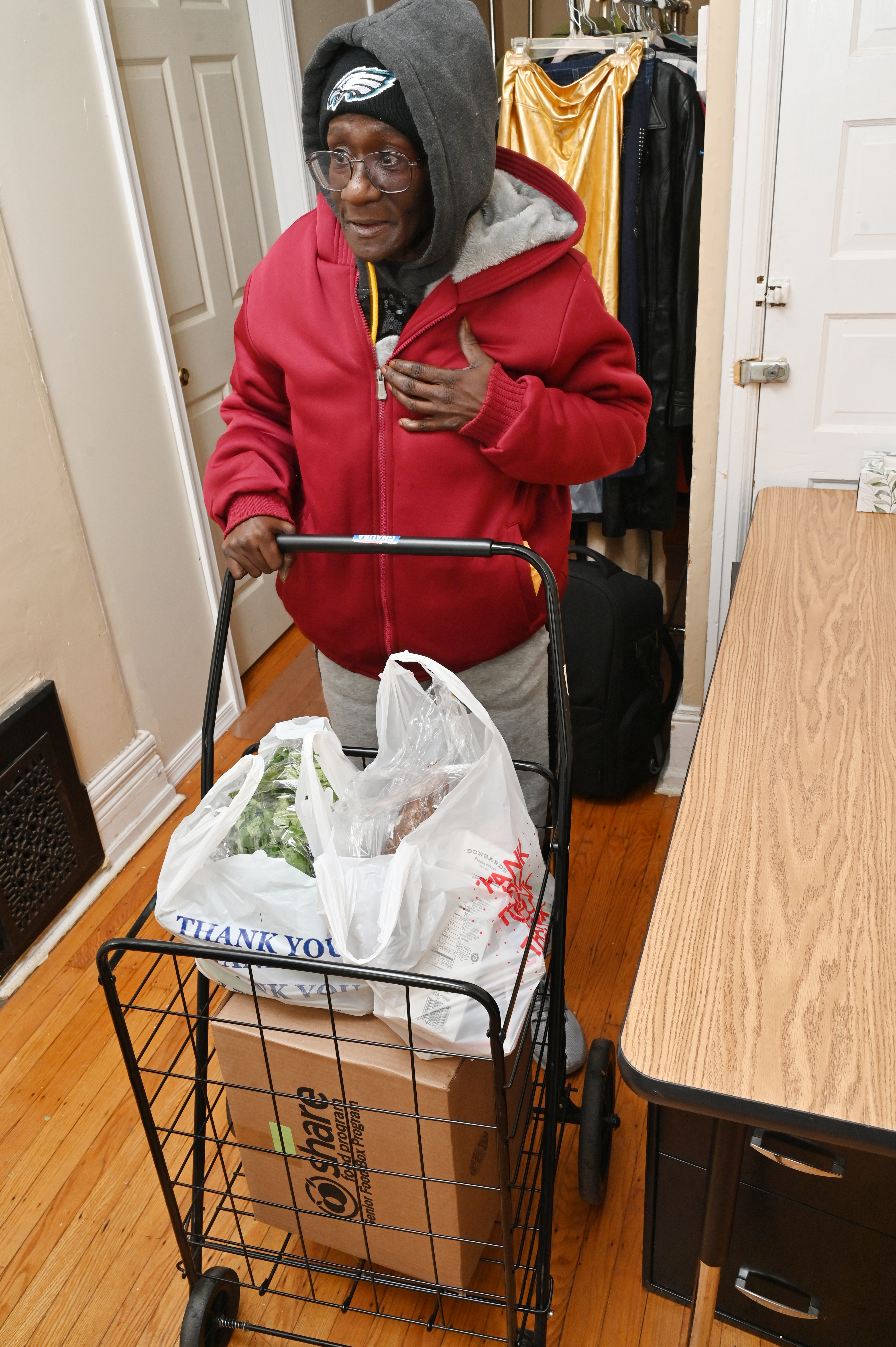
    Patricia Edwards picks up food, including a Share box of food in her cart, at the Canaan Baptist Church’s Family Life Center.

    The only reason Edwards had anything to eat leading up to Veterans Day was that a neighbor stopped by with some prepackaged meals.

    “I didn’t know what to do. I didn’t know where to go,” she said, “but a neighbor told me about this.”

    So, on that cold November day, Edwards walked a few blocks from her home in Germantown to the Canaan Baptist Church’s Family Life Center, hoping she could get some groceries at its weekly food pantry. “I need some food in the house,” she said.

    She wound up with a box of food from Share and two bags of groceries filled with tuna, noodles, cereal, and vegetables.

    “It’s a blessing,” she said.

    Of course, those blessings cost money.

    Share pays $12,000 to $14,000 a month for electricity to keep its warehouses running. Each tractor-trailer-sized truckload of food costs $40,000. Each industrial-sized freezer costs $800,000, and Share bought three of them in the last two years.

    Three years ago, Share expanded into two warehouses, one in Ridley Park in Delaware County and the other near Lansdale in Montgomery County, the better to serve people in Philly’s surrounding communities.

    Share needs money for forklifts, for payroll, for trucks. Funding pays for food, of course, but it’s also necessary to bankroll the infrastructure required to move not just boxes of food, but tons of it, to the people who need it. Share pays drivers to deliver food to homebound seniors. Even that’s a cost.

    Share also has government contracts to provide school meals to 300,000 kids per day in public and charter schools in 70 districts, including Philadelphia’s public schools.

    It’s a source of revenue, “but we lose money on it,” Matysik said.

    Beyond that, Share runs gardens and greenhouses, which serve both as food sources and educational laboratories for young people.

    Years ago, Matysik was one of those young people crossing the street from his high school to pack boxes as a Share volunteer.

    These days, his work at Share involves budgeting and fundraising — balancing demand against resources.

    “I’ve never been more disappointed in the American government,” he said, “And yet, I’m inspired every day by the American people stepping up to support organizations like ours.”

    This article is part of a series about Philly Gives — a community fund to support nonprofits through end-of-year giving. To learn more about Philly Gives, including how to donate, visit phillygives.org.
    For more information about Philly Gives, including how to donate, visit phillygives.org.

    About Share Food Program

    Mission: Share Food Program leads the fight against food insecurity in the Philadelphia region by serving an expansive, quality partner network of community-based organizations and school districts engaged in food distribution, education, and advocacy.

    People served: 2,901,243 in 2024

    Annual spending: $42 million, including $25 million distribution of in-kind donations and $6 million to purchase food.

    Point of pride: In 2024, Share Food Program supported nearly 400 food pantry partners across the region, provided more than 6,500 30-pound senior food boxes each month, ensured over 300,000 children had access to nutritious food every day through its National School Lunch Program, and rescued and redistributed nearly six million pounds of surplus food. Altogether, Share distributed 32,214,873 pounds of food.

    You can help: Volunteer your time packing boxes, rescuing food, or make calls from home to help coordinate senior deliveries.

    Support: phillygives.org

    What your Share donation can do

    • $25 supports seeds for produce growth and upkeep at Share Food Program’s Nice Roots Farm.
    • $50 feeds a school-age child for a week.
    • $100 fuels Share’s ability to transport millions of pounds of emergency food relief a month.
    • $250 nourishes a family of four for a week.
    • $500 enables Share to deliver 30-pound boxes of healthy food to thousands of older adults each month.
  • Letters to the Editor | Nov. 30, 2025

    Letters to the Editor | Nov. 30, 2025

    No plausible deniability

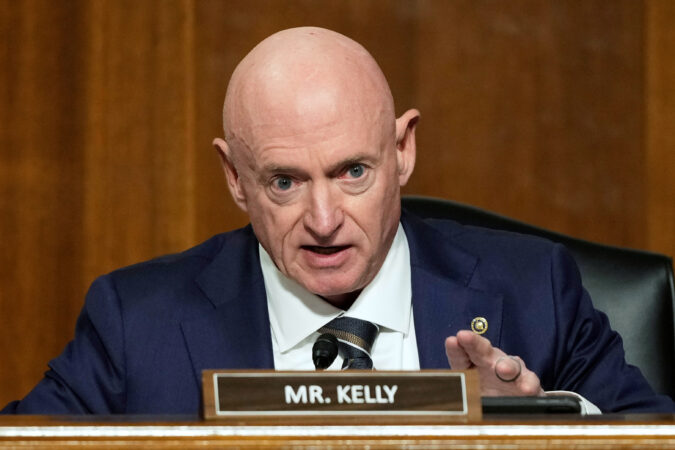
    The American military has always been required not to comply with illegal orders; however, Donald Trump and his lackeys have claimed that the Democrats’ effort to remind our service members of that fact is, to quote Trump, “seditious behavior punishable by death.” Trump, either by ignorance or intent, misstated the Democrats’ statement by leaving out the word “illegal.”

    The Nazi murderers, during their trials at the end of World War II, justified their actions by saying “they were following the orders given to them by their superiors.” The tribunals judging these men found them guilty of the most heinous war crimes, and they were either imprisoned or executed.

    Our troops have a duty to disregard any illegal orders — no matter who gives them.

    Paul S. Bunkin, Turnersville

    . . .

    Six Democratic members of Congress with military and/or intelligence backgrounds recently advised current members of the military that they did not have to obey illegal orders. For this, these six have been roundly criticized by many and might face federal investigations.

    About 80 years ago, at the end of World War II, some members of the German military and other Germans were tried in Nuremberg for war crimes. Their defense? “I was only following orders.” The Nuremberg judges rightly declared that this was not a valid defense. Illegal orders are illegal and should not be followed.

    What was true for Germans then is true for Americans now: Illegal orders are illegal and should not be followed.

    Joan Chinitz, Philadelphia

    Welcomed tax credit

    In a rare moment of bipartisan state legislative reform, Pennsylvania now has its first earned income tax credit for lower-income workers. The measure complements the 50-year-old (and highly successful) federal Earned Income Tax Credit. It has the progressive hallmark of being refundable, allowing refunds where the credit exceeds state income tax liability. And although it is set at a refund level of 10% of the federal EITC benefit — which is far too low — it has the potential for future increases.

    The state’s new credit should shine a light on the city of Philadelphia’s wage tax refund law, which is beset by an embarrassingly low 4½% take-up rate for those eligible; that figure is the result of a number of arbitrary eligibility and processing barriers that demand councilmanic reforms. An excellent start toward this end was made through a bill introduced this year by Councilmembers Kendra Brooks and Nicolas O’Rourke. These reforms — which will ensure continued upward mobility for lower-income workers and help keep our local tax system from undermining the financial security of its working-class residents — now await the full support of Mayor Cherelle L. Parker, Council President Kenyatta Johnson, and fellow members of City Council.

    Jonathan Stein, Philadelphia

    Join the conversation: Send letters to letters@inquirer.com. Limit length to 150 words and include home address and day and evening phone number. Letters run in The Inquirer six days a week on the editorial pages and online.

  • Shapiro helps SEPTA move ahead, while councilmanic prerogative drags community projects down | Shackamaxon

    Shapiro helps SEPTA move ahead, while councilmanic prerogative drags community projects down | Shackamaxon

    This week’s Shackamaxon welcomes back City Council’s quarrelsome contrarian and makes the most out of SEPTA’s “new” funding.

    Council vs. community

    Councilmanic prerogative, a tradition that gives individual district Council members sole discretion over land-use decisions within their constituencies, is not popular with the public. A 2022 poll found that only 22% of Philadelphians wanted to keep the practice, while more than two-thirds wanted it abolished. Among Council members themselves, however, prerogative is king.

    During a recent City Council meeting, 7th District Councilmember Quetcy Lozada wondered when the phrase “councilmanic prerogative became a dirty word.” Council President Kenyatta Johnson said that “it isn’t like they say in the newspaper.” Most of their colleagues and predecessors make similar defenses of the tradition, which they claim is just a way to make sure the community doesn’t get steamrolled by powerful interest groups.

    The process, however, often stymies community aspirations or pits the interests of some neighbors against those of others.

    Fourth District Councilmember Curtis Jones Jr. reduced the number of development projects allowed along a stretch of Ridge Avenue in Roxborough, citing community opposition to new construction and parking woes.

    The move, known as downzoning, took a sledgehammer to the net worth of longtime business owners along the corridor, with the value of their life’s work deflated overnight. They testified against the move at City Council, to no avail.

    In the 8th District, Councilmember Cindy Bass has discouraged the redevelopment of sizable properties like the former YWCA, Germantown Town Hall, and the Ada H.H. Lewis Middle School, despite community support for doing something with those buildings.

    In extreme cases, councilmanic prerogative has also been an invitation to more questionable practices. Just ask former 7th District Councilmember Rick Mariano, who was convicted in 2005 of taking prerogative-enabled bribes. “It’s just a very sketchy and nontransparent thing,” Mariano told WHYY in an interview a decade ago. “If I could do everything over again, I wouldn’t be a councilman. But if I was, I would not want anything like that. It can just come back and bite you in the ass.”

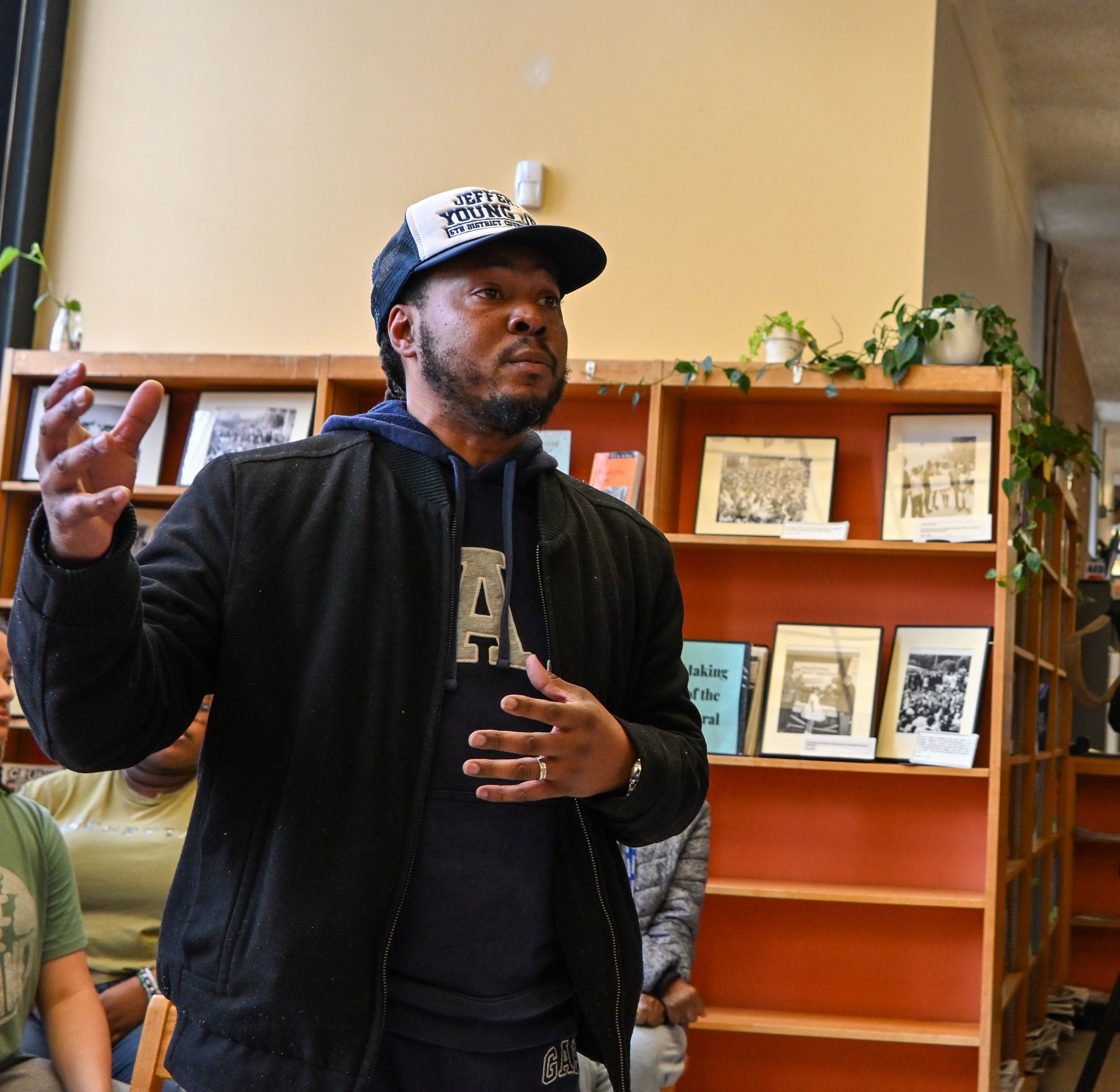
    Councilmember Jeffery “Jay” Young speaks to community members at the Cecil B. Moore Library on Saturday.

    No fighting in the library

    A good example of how prerogative can get in the way of a neighborhood’s wishes is the recent debate over the future of the Cecil B. Moore Library.

    Cierra Freeman, Claire Newsome, and the rest of the Save Cecil B. Moore Library coalition have been organizing and campaigning for years to renovate the current library building, which is on the 2300 block of Cecil B. Moore Avenue in North Philadelphia. They helped secure millions of dollars for the effort from the city’s Rebuild initiative. Then they were blindsided by Councilmember Jeffery “Jay” Young, who is finishing his second year representing the 5th District.

    My newsroom colleagues have branded Young as City Council’s “quarrelsome contrarian.” While he’s bristled at the description, he also regularly confirms its accuracy. More than any other member of Council, Young has employed a haphazard approach to using the powers of his office, often stepping in at the very last moment to scuttle long-standing plans. Small businesses, street safety campaigners, and affordable housing advocates have all been burned by his tendency toward unilateral and inexplicable decision-making.

    The library renovations are the centerpiece of what’s shaping up as his legacy of obstinacy.

    First, Young opposed renovating the library because he wanted to redevelop the site as a mixed-use building, with affordable housing above and library services below. Community members expressed deep skepticism about the idea, and Young never produced a rendering or other documentation to prove that his plan was feasible.

    On Saturday, Young told a packed community meeting about his plan to move the library, with a nearby city-owned lot on 19th Street identified as a potential location. Young, wearing a baseball cap emblazoned with his own name, presented the move as a way to ensure the community gets everything it deserves, including space for teenagers.

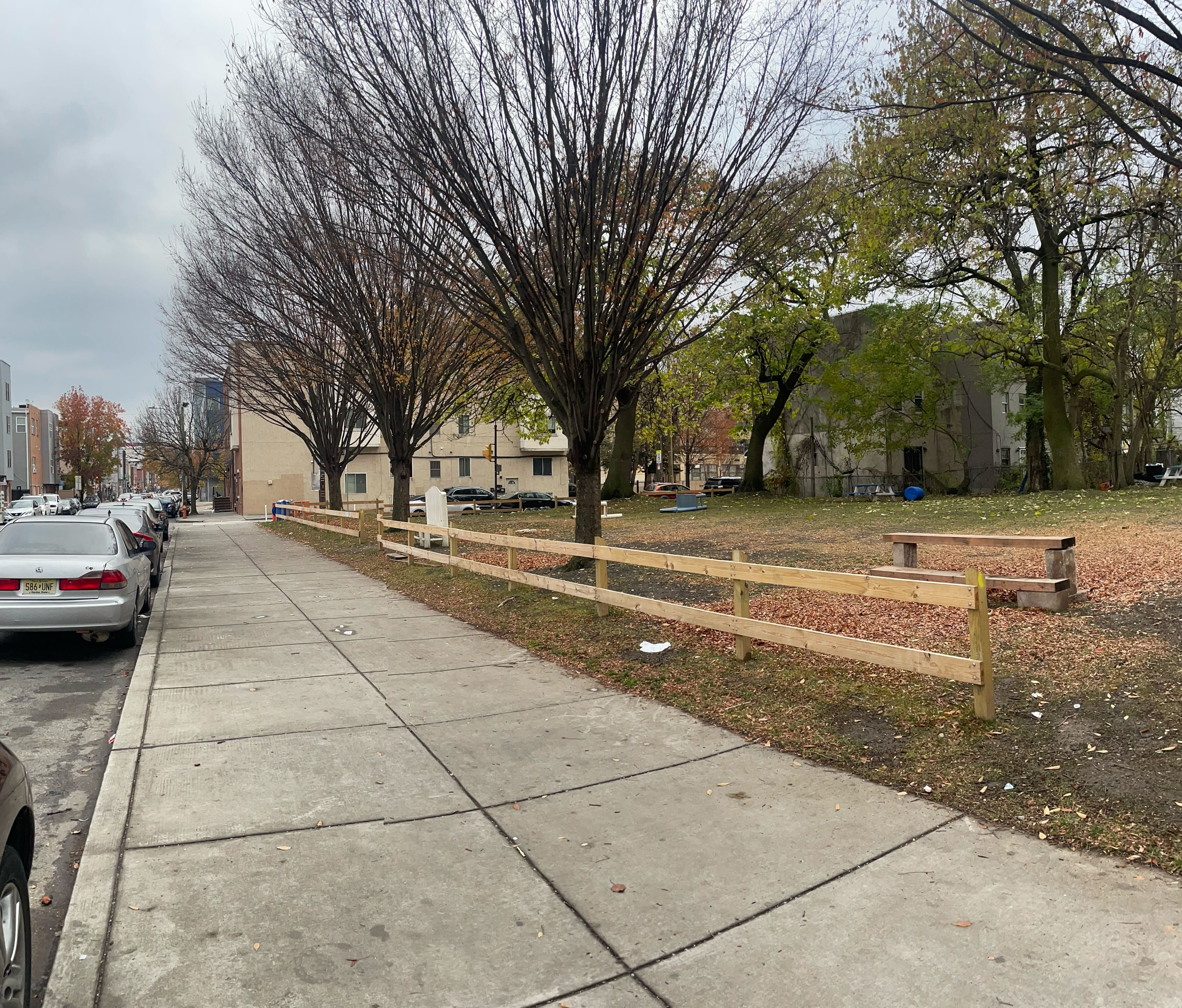
    This vacant lot at 19th Street and Cecil B. Moore Avenue, currently used as a pocket park, would be the new home of the library if Councilmember Jeffery “Jay” Young gets his way.

    Of course, the current renovation plans already include a revamped teen space. They are also the product of years of engagement between the city and the community. Young’s proposal, once again, lacks even the basics you’d expect from any developer coming to the community with a new construction project.

    When I first arrived at the meeting, Young already had his hackles raised. He was berating a constituent and disrupting the proceedings. Another neighbor, Nadine Blackwell, who has lived in the area for 73 years, told Young, “I’m not gonna hit you,” citing his “defensive body communications.” The only resident to express any interest in his ideas was Bonita Cummings, a former staff member in his office.

    Renovating a library should not be a contentious issue. It has become one only because City Council’s traditions allow members like Young to make it one.

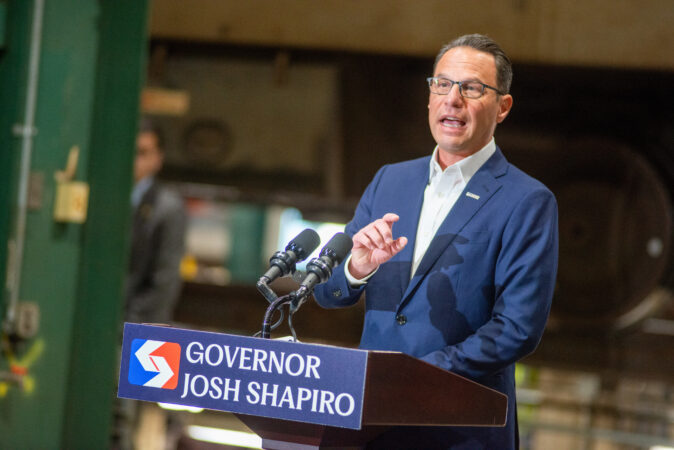
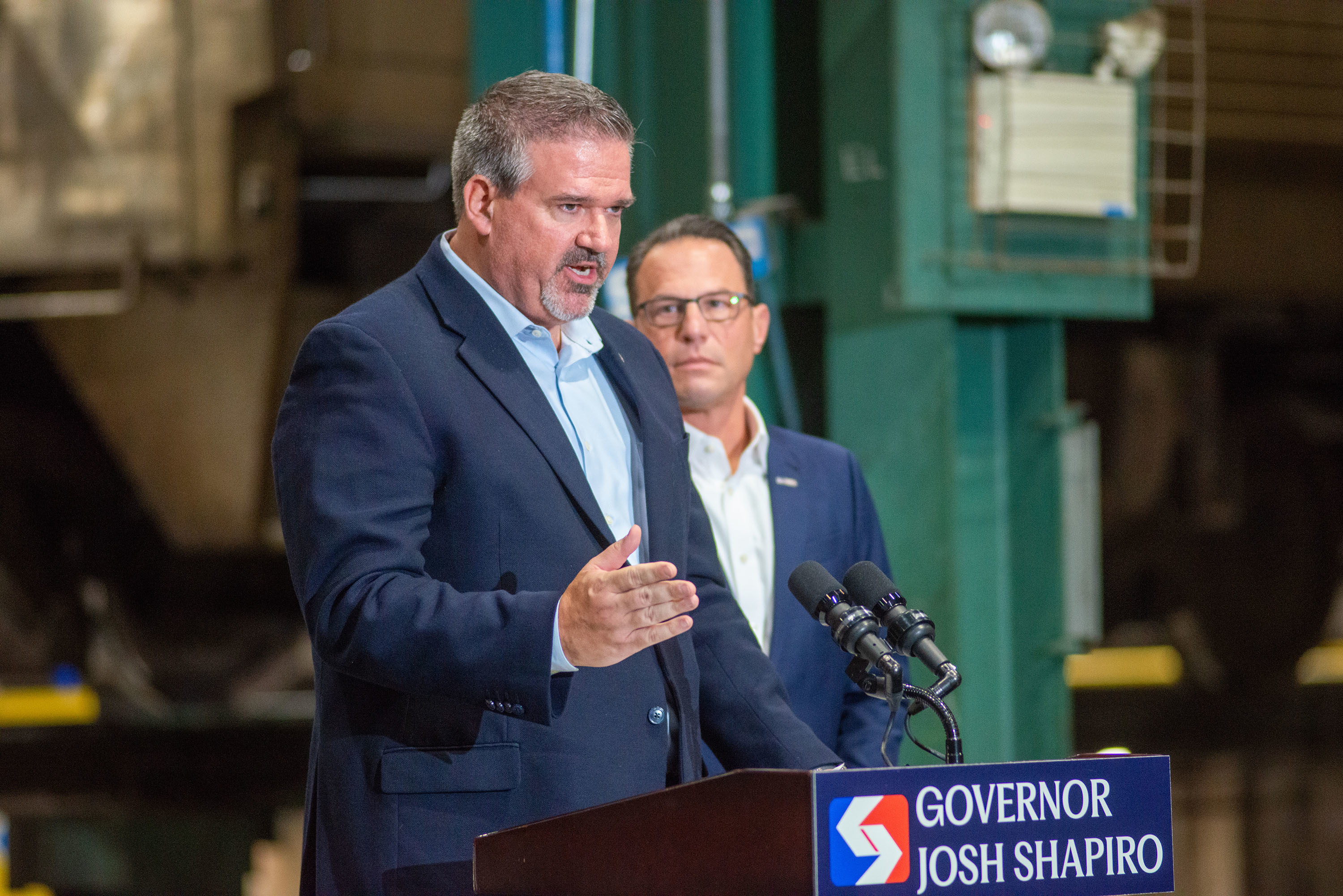
    Gov. Josh Shapiro looks on as SEPTA General Manager Scott Sauer speaks at the agency’s Frazer Shop and Rail Yard in Malvern on Monday.

    Don’t call it a bailout

    There are few things Gov. Josh Shapiro loves more than talking about how he likes to take decisive action. From quickly repairing the I-95 collapse to last year’s maneuvers in Harrisburg that secured an infusion of money for SEPTA, it all helps buttress his “get stuff done” reputation. But Monday’s announced transfer of $220 million to SEPTA, while necessary, does not represent a real solution for our commonwealth’s transit woes. In fact, it makes transit’s future more precarious, absent new sustainable funding from intransigent Republicans in Harrisburg.

    That’s because Shapiro took the money from the state’s public transit trust fund, which is tasked with supporting systems across Pennsylvania. While Republicans have presented the fund as money that’s “just sitting there,” those dollars have already been earmarked for specific projects, like SEPTA’s proposed modernization of its trolley system. The money Shapiro used was being set aside for emergencies. Using it to abate a wholly political crisis is not ideal.

    The proposed investments, however, represent a judicious use of public resources. Nearly every part of the system will be revamped, providing riders with faster and more efficient trips. It’s an opportunity for Scott Sauer, who’s been working as general manager for 11 months, to prove to the General Assembly that the transit agency can be effective and efficient if given the chance.

  • Faith communities are showing up at the ICE office for 40 weeks of prayer and protest

    Faith communities are showing up at the ICE office for 40 weeks of prayer and protest

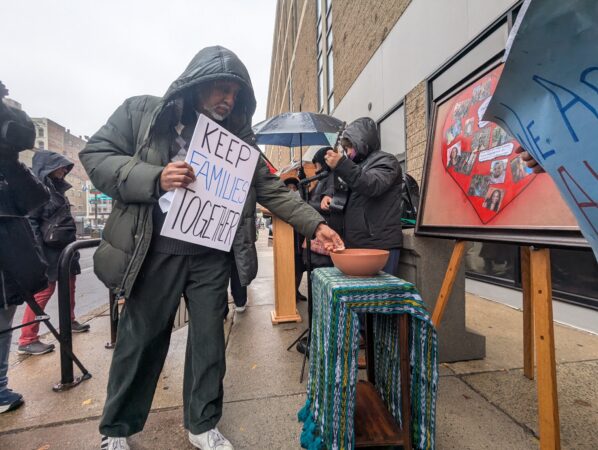
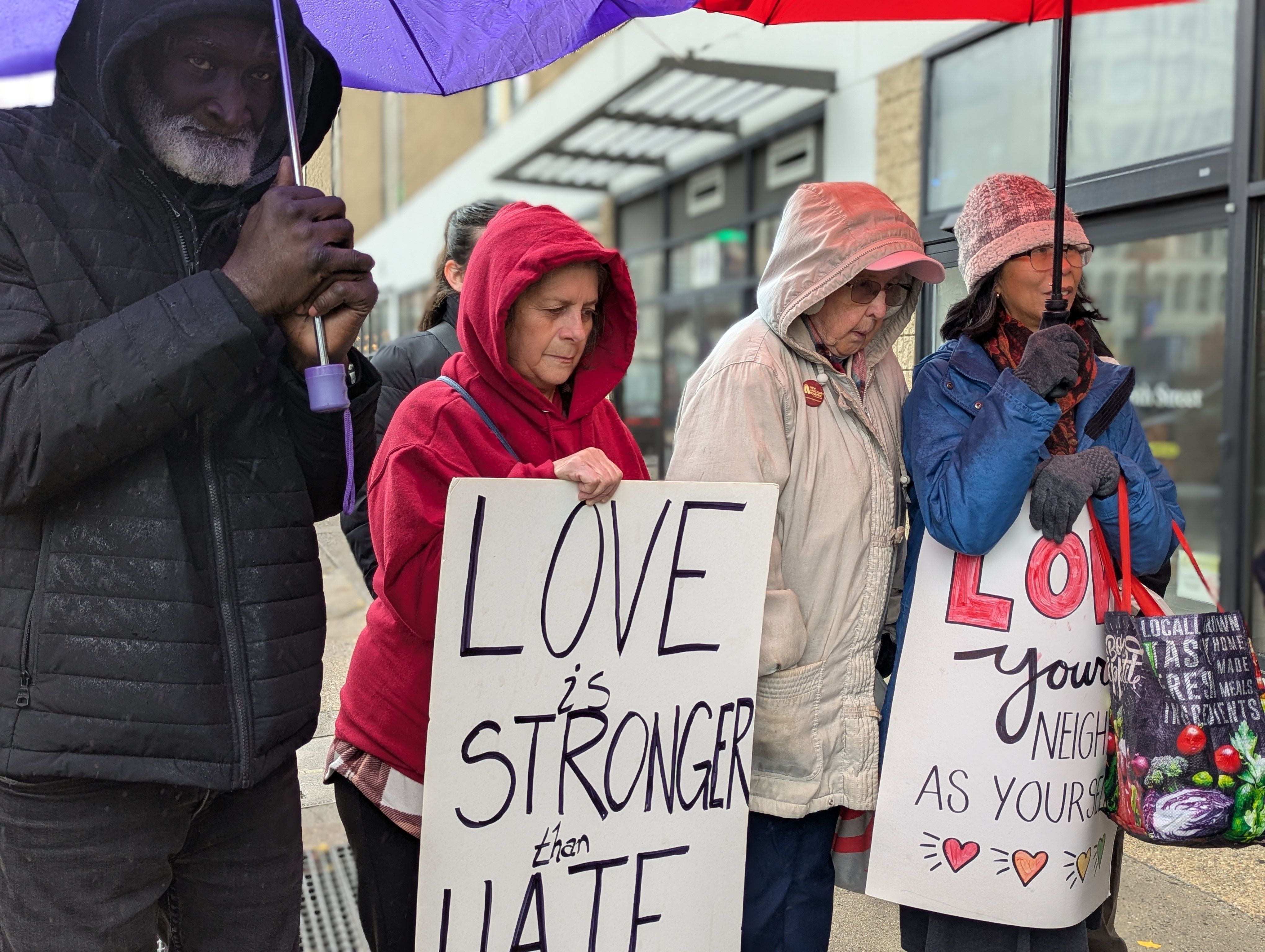
    On a rainy Wednesday a week before Thanksgiving, members of the congregations of the Roman Catholic parishes of Holy Innocents and St. Joan of Arc gathered in front of the U.S. Immigration and Customs Enforcement office in Center City.

    They stood vigil in witness to what the Rev. Christopher Neilson — the founder and president of Christianity for Living Ministries and founder and pastor of the Living Church at Philadelphia — calls “the core requirements God has for humanity”: act justly, love mercy, and walk humbly with God.

    Another religious group appeared at ICE’s door near Eighth and Cherry Streets on the day before Thanksgiving. This time, it was an interfaith mix of folks led by Christianity for Living Ministries.

    And there will be more. On Wednesdays to come, members of Mennonite Action, a couple of United Methodist churches, a Quaker meeting, two synagogues, a Presbyterian church, the Sisters of St. Joseph of Philadelphia and more Catholic parishes have all pledged to take part in a recurring demonstration that Neilson calls ICE Profest 40 — an ecumenical and interfaith action to oppose the government’s pitiless anti-immigrant crackdown slated to take place over 40 weeks. The word profest was coined by Neilson to mean “an amalgamation of faith expressed through proclamation, prayer, and protest.”

    Members of the congregations of Holy Innocents and St. Joan of Arc parishes gathered Nov. 19 for an interfaith prayer vigil outside the ICE office in Center City. It was the kickoff of 40 weeks of vigils planned by faith communities across Philadelphia.

    It’s easy for small, quiet acts like this to get lost in the din of all the outrageous actions coming from President Donald Trump and his administration, or amid the larger protests that draw millions of participants.

    But organizers are hopeful that whatever their movement might lack in numbers, it more than makes up for in the power of their spiritual conviction — a conviction that is grounded in the Bible and other sacred texts.

    “We proclaim God’s word of justice, mercy, and humility (Micah 6:8),” Neilson told me via email. “We pray for ICE agents and authorities (St. Matthew 5:44-45; St. Luke 3:24; 6:27-28; I Timothy 2:1-4), many of whom are conflicted and have crises of conscience. [We pray] for their courage, transformation, and turning, and for the protection and provision of the detainees and deportees, who are traumatized, from family separation and living in constant fear (Isaiah 1:17; Psalm 10:17-18; 82:3; St. Luke 4:18-19).”

    “And,” he added, “we protest ICE activity, i.e., the orders ICE agents are given and the ways in which they are carried out, that dehumanizes and victimizes those created in the image and likeness of God [who] are our neighbors, and [which] disobeys and violates God’s command to welcome and love the stranger and alien (Leviticus 19:33-34; Deuteronomy 10:18-19; St. Matthew 25:31-46).”

    The Rev. Christopher Neilson said that demonstrators at the protests pray for detainees and deportees who have been traumatized by family separation and are living in fear. They also pray for the safety of ICE agents and that the organization’s leaders might change their policies.

    The number of weeks — 40 — during which this will happen has biblical significance, Neilson said, as a period of transition from trial to transformation. (Think of the 40 days and 40 nights Jesus traveled in the wilderness before the crucifixion.)

    For me, the timing of when ICE Profest 40 is gearing up is especially resonant.

    We’re moving from Thanksgiving — a secular holiday which, in good years, I get to celebrate with a family that includes foreign-born and U.S.-born folks — into Advent.

    The beginning of the liturgical year is when Christians like me move from anticipation to action as we wait to celebrate the birth of Christ into a humble, migrant human family. I love the hush that precedes a world on the brink of transformation. I suspect that is why the quiet power of ICE Profest 40 actions moves me so deeply.

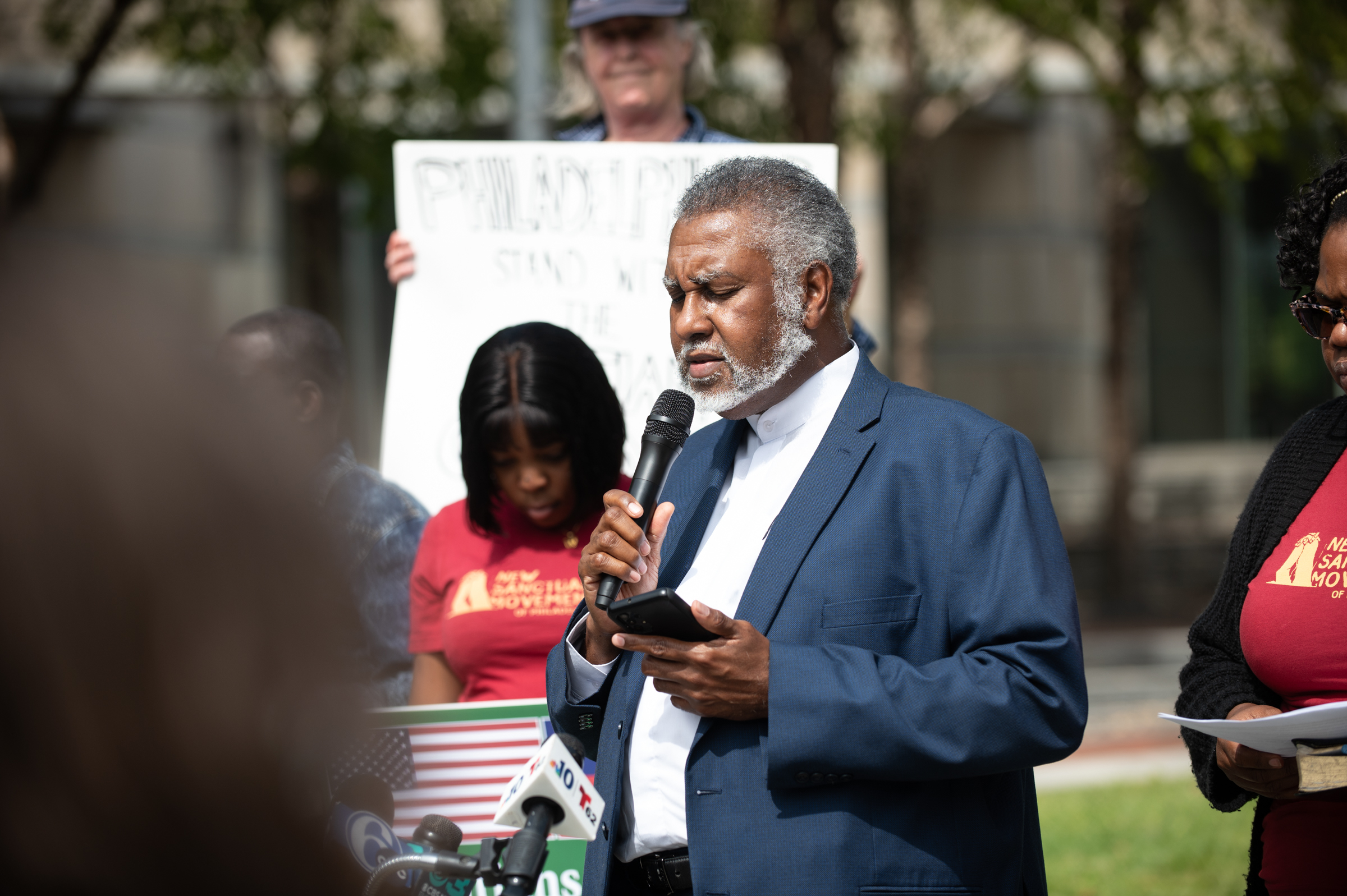
    “The tone of these vigils is different,” Peter Pedemonti, the codirector of New Sanctuary Movement of Philadelphia, told me via email.

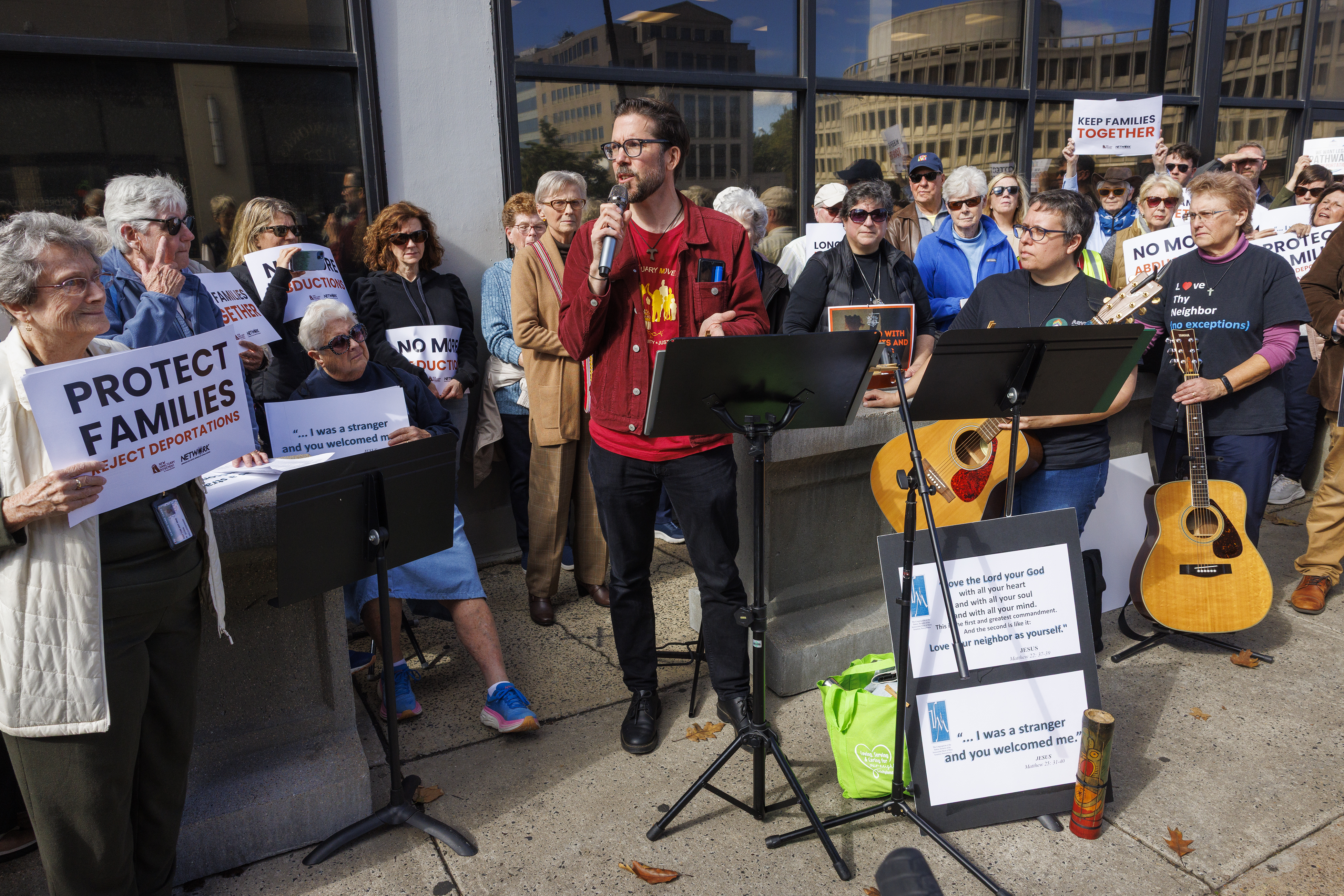
    Peter Pedemonti, codirector of the New Sanctuary Movement, addressing Catholics gathered outside the ICE office at Eighth and Cherry Streets, in October.

    “They are not as loud as a protest, but they have the potential for big impact,” he said. “We are seeing people sign up who are new to public witness, and so they serve as an entry into collective action. This is important as we fight not only the attacks on immigrant communities, but also Trump’s rapid steps toward authoritarianism. We need everyone right now, and it is really important we have paths for new people to get involved.”

    “I have been doing faith-rooted organizing for nearly 20 years. These spiritual tools we have work. We can’t always see the immediate impact, but I have seen them help win campaigns. And so I believe that when we bring them to ICE, we are engaging in something powerful,” Pedemonti added. “The religious community has an important role right now. We are the moral voice, and when we see Trump trample our faith teachings and our democracy, it is critical [that] faith communities speak out.”

    While my own faith tradition has long had priests, religious men and women accompanying immigrants and advocating for their rights, the United States Conference of Catholic Bishops has been pretty circumspect about commenting on the Trump administration’s policies.

    But that changed this November.

    In a statement issued after the conference’s plenary meeting, the bishops wrote, “We oppose the indiscriminate mass deportation of people,” and soon thereafter, Pope Leo XIV expressed his wholehearted support for the bishops’ statement.

    Leaders from many other faith traditions and denominations have, of course, also stood publicly with immigrant communities threatened by Trump’s policies.

    But for Catholics who supported Trump — 55% overall (62% of white Catholics, 41% of Hispanic Catholics), according to the Pew Research Center — the Catholic bishops’ statement could serve as a come-to-Jesus (heh!) moment.

    It is certainly a clear call for transformation during this most transformative of seasons.

    What can the birth of Christ mean to us Christians if we would deny people shelter near us simply because they are unknown to us, and from elsewhere? What can it mean if we don’t stand against the indiscriminate targeting of innocents? What can it mean if we justify killing people based on the mere prognostication of threat?

    I won’t speak for other people of faith, but for me, those are questions that go beyond political affiliation or temporal power, and touch on the “act justly, love mercy, and walk humbly” core requirements Neilson referenced.

    On the first Sunday of Advent, one of the readings will be Isaiah’s proclamation that the people “shall beat their swords into plowshares, and their spears into pruning hooks; one nation shall not raise the sword against another, nor shall they train for war again,” and that throws me right back into the fact that both the Catholic bishops in their statement, and the Rev. Neilson in his description of the ICE Profest 40 vigils, reference ICE agents.

    ICE agents aren’t wielding swords, of course, but they do carry firearms and other implements with which they smash the windows and doors of terrified immigrants. And with the proposal that military members could be “trained” by deployment to U.S. cities to support ICE and U.S. Customs and Border Protection agents, it’s not that much of a stretch to make Isaiah fit the moment.

    I’m going to confess something now. I’ve prayed often for immigrants, never for ICE agents. In fact, I bristled a bit when I heard the bishops equating the vilification immigrants have experienced with the vilification of ICE agents — no one has accused ICE agents of eating pets, or separated them from their families, or turned them from legally residing to unauthorized in a moment.

    But, as we saw with this week’s shooting of two National Guard members in Washington, D.C., those who have been asked to carry out the administration’s ill-conceived and oppressive policies may also be endangered by them.

    The shooting reminded me of what Pedemonti told me: “If we want ICE to see the humanity of those they are persecuting, then we need to model that and see the humanity of ICE agents.”

    “The religious community has an important role right now. We are the moral voice, and when we see Trump trample our faith teachings and our democracy, it is critical [that] faith communities speak out,” Peter Pedemonti said.

    “We believe all people can change,” he added, “and so in the tradition of St. Óscar Romero, who called on soldiers in El Salvador’s authoritarian regime to put down their arms, we call for ICE agents to follow their conscience and refuse to follow orders, to leave people with their families, to leave the people in peace.”

    I guess it’s time to broaden my prayers. Don’t get me wrong, my rosary (the one which, along with its crucifix and Our Lady of Guadalupe medallion, has monarch butterfly beads representing migrants) will still be in regular rotation with prayers for immigrant justice. But maybe the Romero quote with which I open my prayers using a niner that has his medallion will be different: I want to make a special appeal to soldiers, National Guard members, and policemen: Each of you is one of us.

    The first candle we light at Advent represents hope, after all, and no matter how far away or unlikely the desired outcome appears, hope always leads to transformation.

  • It’s Trump — not service members — who could benefit from a reminder about following the law | Editorial

    It’s Trump — not service members — who could benefit from a reminder about following the law | Editorial

    Six lawmakers, including two from Pennsylvania, had good reason to remind military members not to follow unlawful orders, given Donald Trump’s illicit history and recent actions, such as sending federal troops into cities and boat strikes that violate international law.

    The six Democrats, who either served in the military or the intelligence community, posted a short video telling their former counterparts that “no one has to carry out orders that violate the law or our Constitution.”

    Right on cue, Trump responded with a fury of unhinged social media posts calling for the lawmakers to be jailed or executed.

    “Each one of these traitors to our Country should be ARRESTED AND PUT ON TRIAL,” Trump wrote. He followed that with: “SEDITIOUS BEHAVIOR FROM TRAITORS!!! LOCK THEM UP???” He escalated in yet another post: “SEDITIOUS BEHAVIOR, punishable by DEATH!”

    Trump later claimed he was not calling for members of Congress to be put to death — though his words plainly suggested otherwise.

    When he isn’t lying, Trump’s abhorrent rhetoric over the past decade has become so routine that it barely causes a stir. (See: his recent outburst telling a reporter, “Quiet, piggy!” and shameful defense of Saudi Crown Prince Mohammed bin Salman, who authorized the vile murder of a journalist.)

    Given Trump’s record of abusing his power, the members of Congress were right to sound the alarm.

    In his previous term, Trump incited a violent insurrection at the U.S. Capitol. Let’s not forget he is a convicted felon who was criminally indicted three other times.

    Trump was also impeached twice in his first term. Since his return, he has committed as many as eight impeachable offenses, according to legal scholars.

    Trump’s first year back in office has been marked by relentless abuses. A federal judge said his attempt to eliminate birthright citizenship was “blatantly unconstitutional.” (The U.S. Supreme Court is weighing whether to take it up.)

    Trump’s pardon of more than 1,500 insurrectionists, including nearly 200 who assaulted police officers, rewarded lawbreakers. Other steps to freeze foreign aid, fire federal workers, send troops into cities, and deport migrants have faced more than 100 legal challenges and strong rebukes from judges.

    The Republicans who control Congress have done nothing to stop Trump’s abuses, let alone investigate whether he has used the presidency to enrich himself.

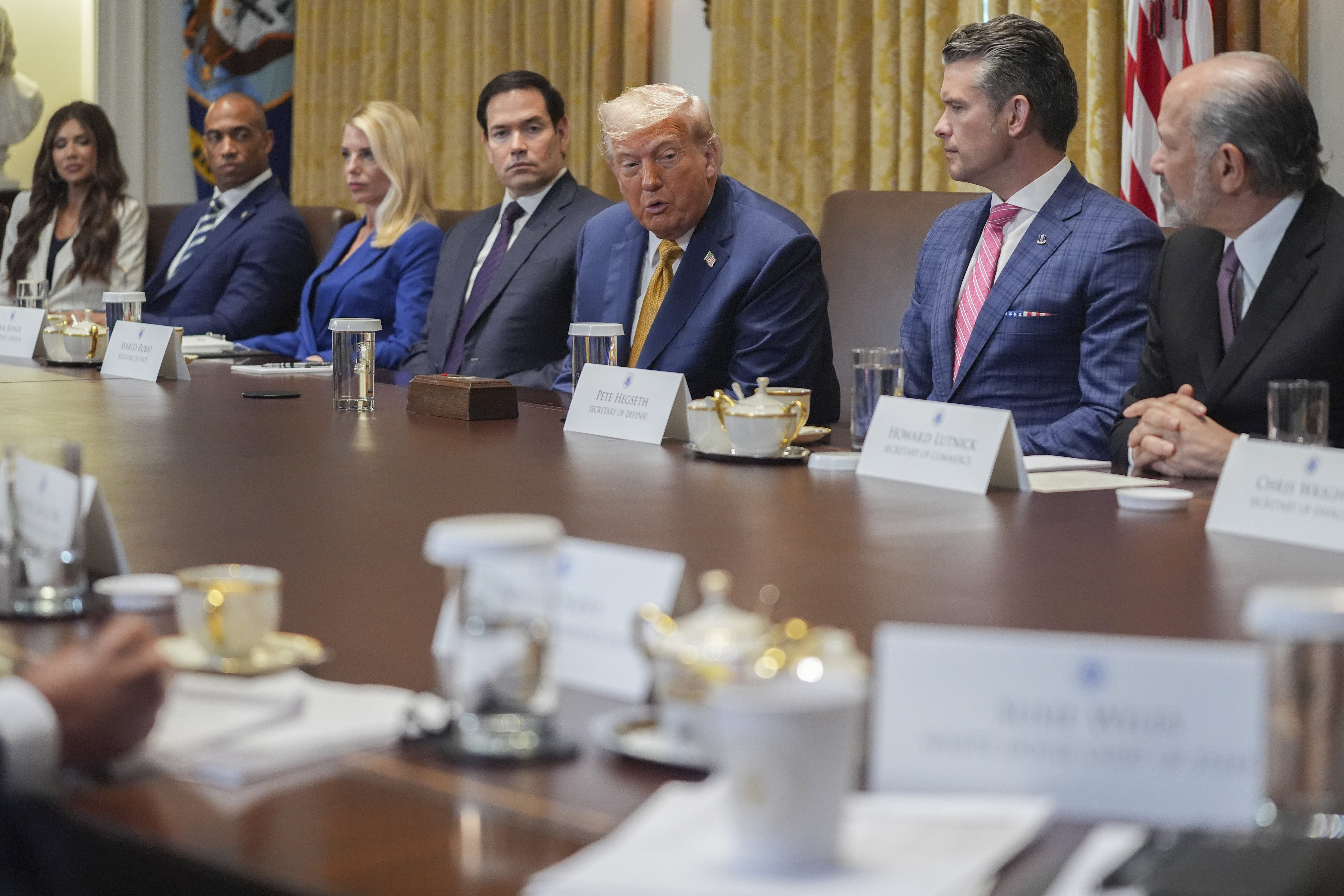
    President Donald Trump speaks during a cabinet meeting at the White House in July.

    Likewise, the unqualified loyalists overseeing the various government departments do whatever Trump demands. See: Attorney General Pam Bondi’s willingness to fire career prosecutors and go after Trump’s perceived political enemies.

    Former Defense Secretary Mark Esper ignored Trump’s suggestion to shoot demonstrators following the death of George Floyd. Does anyone trust Pete Hegseth — a former weekend Fox News host who has faced allegations of financial mismanagement, sexist behavior, and excessive drinking — to show similar restraint?

    That explains why the members of Congress urged service members to follow their constitutional oath — and not any unlawful orders.

    Trump’s response to jail and kill elected officials is especially irresponsible given the rise in political violence, including murders of state lawmakers, a judge, and far-right podcaster Charlie Kirk. Not to mention the attack on former House Speaker Nancy Pelosi’s husband, the firebombing of the Pennsylvania governor’s mansion, and the attack on Trump’s own life.

    After the president targeted the six Democrats, Pennsylvania Reps. Chrissy Houlahan and Chris Deluzio received bomb threats at their offices. Michigan Sen. Elissa Slotkin received a similar threat at her home.

    Meanwhile, House Speaker Mike Johnson (R., La.) deflected Trump’s outrageous behavior by claiming it was “wildly inappropriate” for Democrats to urge troops not to follow the chain of command.

    But that was not what the six legislators did. They reminded military members not to follow unlawful orders in accordance with Article 92 of the Uniform Code of Military Justice.

    For example, the legality of Trump’s boat strikes — which have killed more than 80 people — is dubious.

    A secret U.S. Department of Justice memo reportedly blessed the strikes by claiming the U.S. is in an armed conflict with drug cartels. But members of Congress from both parties argue it is illegal to target civilians — even suspected criminals — who do not pose an imminent threat. The United Nations’ human rights chief said the strikes violated international law.

    As such, legal experts said if the strikes are found to be illegal, a defense by military officials of “just following orders” may not hold up in court.

    Of course, Trump is shielded from prosecution thanks to a Supreme Court ruling last year that placed presidents above the law.

    The same cannot be said for those who do Trump’s bidding.

  • Letters to the Editor | Nov. 28, 2025

    Letters to the Editor | Nov. 28, 2025

    Tilted table

    U.S. Citizenship and Immigration Services (USCIS) is making it more difficult for immigrants to register to vote.

    Several years ago, I went to a naturalization ceremony at Pennsbury Manor museum in Bucks County, welcoming more than 50 new Americans. Joy and hope danced in the air. As we left, I was thrilled to see volunteers at a nonpartisan League of Women Voters table helping our new citizens register to vote.

    What a dirty shame to learn that recently, USCIS announced that nonpartisan organizations and their volunteers are no longer allowed to register new citizens to vote after ceremonies — even though the work of those organizations is crucial in states like Pennsylvania, with no automatic or same-day voter registration.

    Lynne Waymon, Newtown

    A former aide faces charges

    Earlier this month, Natalie Greene, a former aide in the office of New Jersey Republican Rep. Jeff Van Drew, was charged with faking a politically motivated attack on herself.

    Greene said that three men slashed her and wrote “Trump Whore” across her stomach before leaving her zip-tied in the woods in Egg Harbor Township.

    But prosecutors said that it was all a lie, that Greene paid a scarification artist to cut her — and that they even had a receipt and a signed consent form (including a copy of Greene’s driver’s license) from the artist to prove it.

    It is not known if Greene remained employed as an aide to Van Drew during the four-month period between when she said the attack occurred on July 23 and when the criminal complaint was filed against her on Nov. 14.

    It is not known when Van Drew — who has not been accused of any wrongdoing — was informed of this situation.

    Quite frankly, not much is known besides the facts in the criminal complaint because Rep. Van Drew has mostly been silent.

    After the charges were announced, members of Van Drew’s team put out a statement offering “thoughts and prayers” and saying they “hope she’s getting the care she needs.” But no one has heard much else.

    And, strangely enough, Van Drew isn’t even mentioned by name in the criminal complaint — he’s only referred to as “Federal Official 1.”

    Rep. Van Drew’s constituents want to hear from him. The congressman often talks about transparency — this is his chance to be transparent.

    Michael J. Makara, Mays Landing, N.J.

    ACA enhanced subsidies

    A recent editorial states that subsidies are for Americans who earn up to 400% of the federal poverty level. However, the enhanced subsidies, which are due to expire, have no income limit. They are designed to keep the cost to an individual at no more than 8.5% of income. Consider this example: a single 60-year-old millionaire with $150,000 income. If the insurance company charges $1,300 per month ($15,600 per year), the ACA currently will subsidize this individual by $2,850 = $15,600 – 0.085 x $150,000. Whether such a person should receive government subsidies is debatable.

    Tom Muench, Ridley Park

    Brew safer than water

    As one who is fond of the malty brew, a former home brewer, and a student of history, I read with great interest the recent article about the role of tavern life in shaping the American Revolution. I enjoyed it and am certain it enlightened many of your readers, but there was one major oversight. While the Founding Fathers certainly enjoyed their brews and other beverages, there was, I think, another reason for imbibing so much not only in Philadelphia but throughout colonial and revolutionary America: the water. Even well water was usually extremely unhealthy to drink. The water of the period was often highly contaminated and the bearer of diseases, many fatal. People knew this. Beer, wine, hard cider, and distilled liquors like whiskey, consisting of a certain amount of alcohol and brewed and distilled often with heated water, were far safer than water and even milk. It was not unusual for “small beer” (beer with a lower alcohol content) to be imbibed even by children (small amounts) and with breakfast. I’m disappointed this was overlooked by the author.

    Kenneth J. Wissler, Halifax, Nova Scotia

    Forgotten American hero

    Ken Burns deserves great credit for producing the magnificent six-part PBS series documenting The American Revolution. But there is no mention of any Jews who helped win the nation’s freedom, which is a major oversight. Many Jews fought on the side of the patriots — perhaps none more selflessly than Haym Salomon.

    The British arrested Salomon for revolutionary activities in New York City in 1778. He was sentenced to be executed, escaped from prison, fled to Philadelphia, and became a prominent member of Congregation Mikveh Israel, Philadelphia’s oldest synagogue. He is most remembered for financing George Washington’s Yorktown campaign, the decisive battle of the American Revolution. Washington believed that without Salomon’s financing to provide salaries and supplies, much of the Continental Army would have deserted with catastrophic consequences. Salomon died destitute at age 44. He is buried in Mikveh Israel Cemetery.

    In 1975, the United States issued a commemorative stamp honoring Salomon as the “Financial Hero” of the American Revolution. A 1939 film, Sons of Liberty, depicts his life; Salomon is played by Claude Rains. The movie won an Academy Award for best short film.

    At a time when antisemitism is once again raging in America, Haym Salomon’s life deserves to be remembered.

    Jacob Daniel Kanofsky, Philadelphia

    Right side of history

    Assuming civility and sanity return and American democracy survives, I would love to be here a hundred years from now to read historical accounts of what’s happening in America today. If the reporting is reliable and factual, Will Bunch’s recent column, “The night America’s doomed ruling class gorged on lamb, blood, and oil,” should definitely be included. Sure, it’s an opinion column, but he paints a truthful overview that will serve historians well.

    Jacques Gordon, Devon

    Join the conversation: Send letters to letters@inquirer.com. Limit length to 150 words and include home address and day and evening phone number. Letters run in The Inquirer six days a week on the editorial pages and online.

  • Food is health. Localizing its production and distribution is key.

    Food is health. Localizing its production and distribution is key.

    In September, I traveled from Philadelphia to Washington, D.C., for the National Farmers Union’s legislative convention.

    Over the course of three days, I met with 13 congressional legislators or their staffers, spoke to representatives of the U.S. Department of Agriculture and the White House, as well as fellow farmers, to discuss a very real threat impacting our nation: the instability of our food system.

    Across the United States, food system organizations — from regenerative farms and gleaning networks, to food access nonprofits and community grocers — are all under immense pressure because of federal funding cuts, rising tariffs, and labor shortages. The entire food chain is strained, and the effects are compounding.

    Recently, during the government shutdown, families across the country were not receiving SNAP benefits. American farms and families are still struggling and need relief now.

    Farmers suffer even as food prices rise

    While food prices continue to rise, farmers make less than 16 cents on every food dollar spent, according to the National Farmers Union. Even worse, there has been a severe labor shortage because of outdated agricultural workforce policies, while large corporate farms are making record profits.

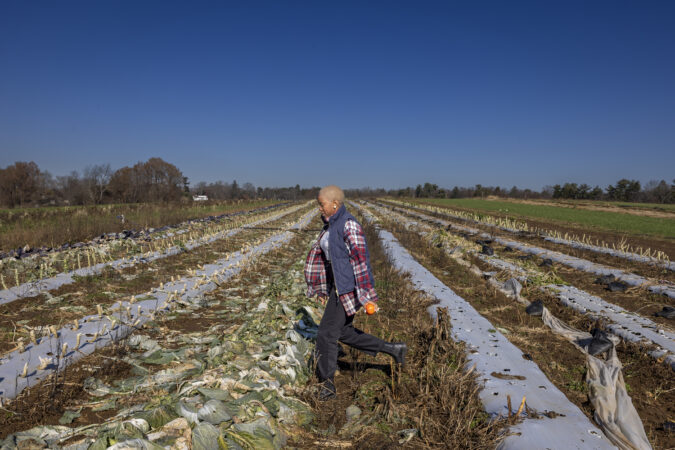
    Suicide among farmers is at an all-time high, and the sixth highest among all occupational groups. As the largest Black food grower in Pennsylvania, I am seeing these challenges each and every day.

    Earlier this year, the Trump administration, without congressional approval, canceled the Local Food Purchase Assistance Program: a $1 billion federal spending initiative that provided schools and food banks with funding to purchase food from local farms and ranchers.

    In addition to the impact this will have on our children and our most vulnerable communities, the killing of this program is having a direct impact on small and first-generation farmers like me. My produce farm lost upwards of $150,000 between contracts with local food banks that were supported by the LFPA Program and the loss of the Agriculture Department’s Climate Smart Partnerships.

    These drastic cuts have strained our operations and have impacted our ability to promptly pay our workers and ensure our communities have access to food that is not only locally and regeneratively grown, but also 100% chemical-free.

    Food anchors social drivers

    At the heart of this challenge is a simple truth: Food is the anchor to all social drivers of health. When food is unstable, so is health, education, safety, economic opportunity, and environmental well-being.

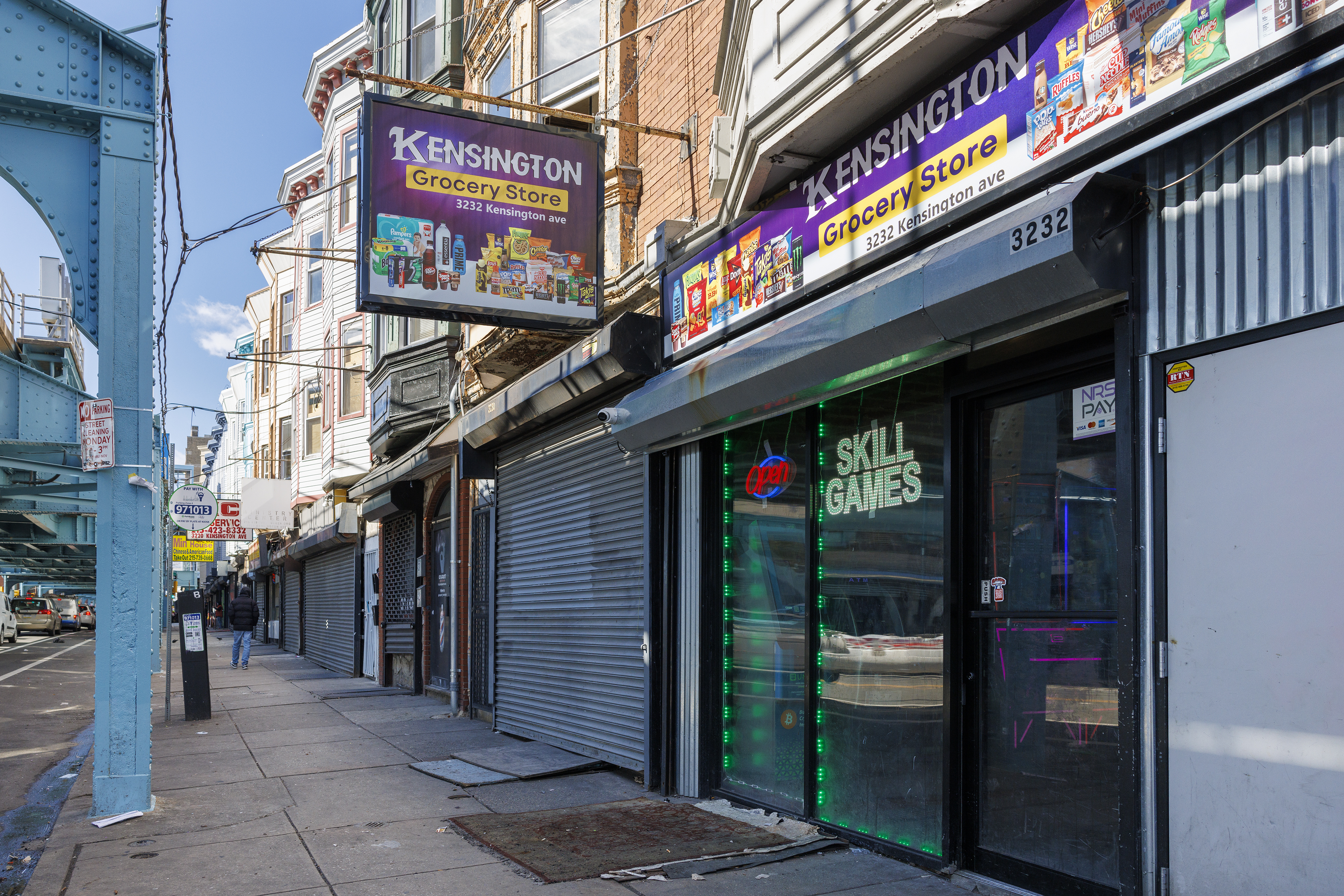
    This is evident in North Philadelphia’s Kensington neighborhood, which is plagued by an opioid epidemic, crime, food apartheid, and nutrition insecurity.

    A corner store in Philadelphia’s Kensington neighborhood. Such stores should be part of the local food system, writes Christa Barfield.

    According to a 2019 report released by the city of Philadelphia and Drexel University’s Dornsife School of Public Health, Upper Kensington ranked last out of 46 Philadelphia neighborhoods in terms of health factors and health outcomes.

    Addressing food access through a regenerative and localized lens is not just a response — it is a long-term strategy for national security.

    In my September conversations with members of Congress, it became abundantly clear that an updated Farm Bill would not be passed into law by the Sept. 30 deadline. And it wasn’t.

    Due to this failure to prioritize the needs of small family farmers, we must now turn inward and rely on our communities to design and implement a scalable, regionally coordinated food system.

    This is possible by supporting local farmers and workers through fair, reliable markets, reducing food waste via efficient, community-based recovery, and empowering neighborhoods with increased food sovereignty and local ownership.

    I founded FarmerJawn Agriculture seven years ago, and I know that for a community or nation to be healthy, it must be well-fed. Food is medicine. Good food means good health.

    Despite the challenges we face, this idea is more relevant now than ever. I am eager to launch CornerJawn, a farm-to-store operation that will reimagine the corner store as a preventative healthcare hub.

    CornerJawn will increase access to fresh and nutrient-dense food that is both convenient and affordable through a dignified pricing model.

    It will enhance urban living for the strategically forgotten communities that are now seeing record development in hopes of creating, what? Wealth? True wealth is measured in longer lives with beautified communities and healthier families.

    We must treat food like medicine, invest in those specialty farms that feed us, and watch our country thrive.

    Remember: Agriculture is the Culture.

    Christa Barfield, a.k.a. FarmerJawn, is a healthcare professional turned regenerative farmer, an entrepreneur, an advocate for food justice, and a James Beard Award winner. As the founder of FarmerJawn Agriculture, she manages 128 acres across three counties in Pennsylvania, making her the largest Black food grower in the state.

  • At Project HOME, providing shelter is just one link in a chain that restores dignity and offers hope | Philly Gives

    At Project HOME, providing shelter is just one link in a chain that restores dignity and offers hope | Philly Gives

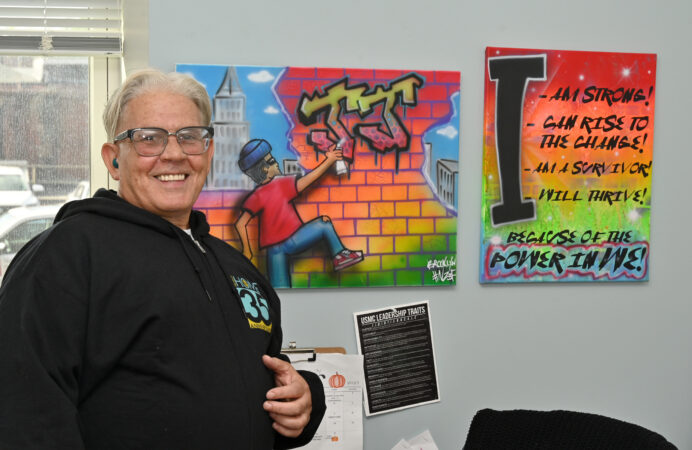
    As charming and ebullient as Nephtali Andujar is (lots of hugs, compliments, and gifts of his homemade pottery), the 61-year-old is also pretty blunt about why people should give to Project HOME, one of the city’s largest nonprofit housing agencies.

    Because of Project HOME, said Andujar, who spent years living on the streets, he is no longer desperate — desperate to get money to feed a heroin addiction, desperate to scrape $5 together to pay someone to let him drag a discarded mattress into an abandoned house for a night’s sleep out of the rain.

    “It’s not just giving someone an apartment,” said Andujar, who sheepishly described a past that included stealing cars and selling drugs. “It’s the snowball effect.

    “You are not just helping the homeless,” he said. “You are helping the city. You are helping humanity.”

    In the agency’s name, the letters HOME are capitalized, because each letter stands for part of the multipronged approach that Project HOME takes in addressing homelessness and combating poverty for the 15,000-plus people it serves each year.

    There’s H, for Housing — not only housing in the literal sense, but also in the teams of outreach workers who comb through the city’s neighborhoods looking for people like Andujar. One outreach worker found Andujar in 2021 at a critical moment in his life — clean, just out of the hospital for liver treatment, and back on the streets of Kensington ready to begin anew.

    “We know we have to do the most we can to preserve these resources that we’ve come to rely on,” says Donna Bullock, president and CEO of Project Home.

    For Andujar, it was a race. What would find him first?

    Would it be heroin, as it had so often been in the past? It was tempting. It’s painful being on the street — cold, hungry and dirty, ashamed and alone. “When you do heroin, you don’t feel the cold. It kills the hunger,” he said. “When you use the drugs, you don’t have to suffer for hours. Heroin numbs you.”

    Instead, though, it was the outreach worker — someone who had been through Project HOME’s recovery program — who plucked Andujar off the street in the nick of time and took him to a shelter.

    A year later, that same outreach worker helped Andujar move to his own room at Project HOME’s Hope Haven shelter in North Philadelphia.

    “You get tired of the streets. They were killing me,” Andujar said.

    Next Andujar found Project HOME manager JJ Fox, who helped him get a birth certificate and other documents, and arranged for him to stay. But he needed more than a warm bed.

    The problem with getting straight after a heroin addiction, Andujar explained, is finding a new purpose and direction. For so long, life was focused on a repeat cycle of getting the next fix and then becoming numb to pain while it was working.

    So when he got to Project HOME, he needed a new direction, which is where both the O and E in HOME came in for Andujar.

    “JJ Fox gave me direction,” he said, and so did Project HOME employment specialist Jamie Deni.

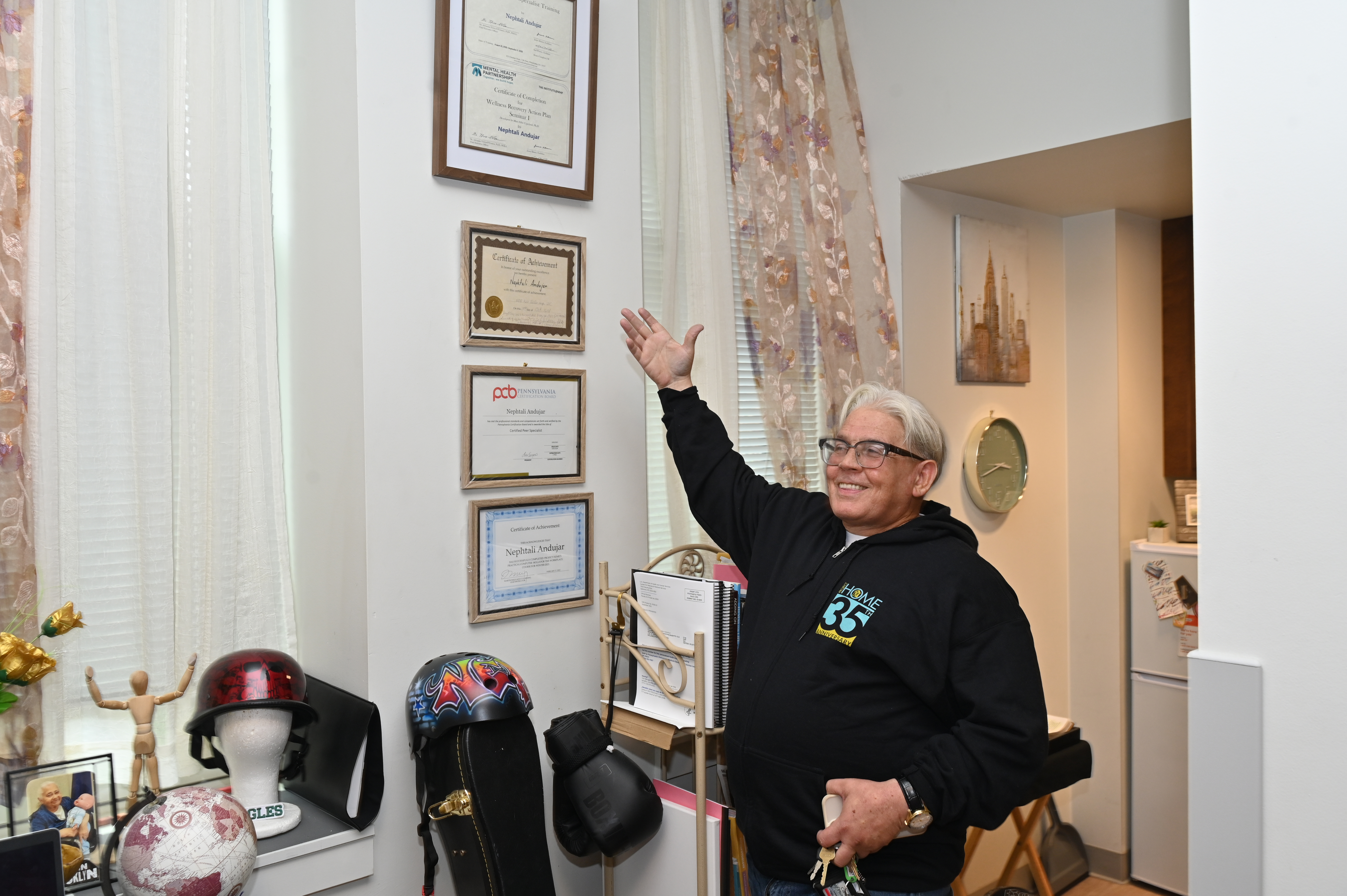
    Training certificates cover a wall in Nephtali Andujar’s studio apartment in Project HOME’s Inn of Amazing Mercy in Kensington.

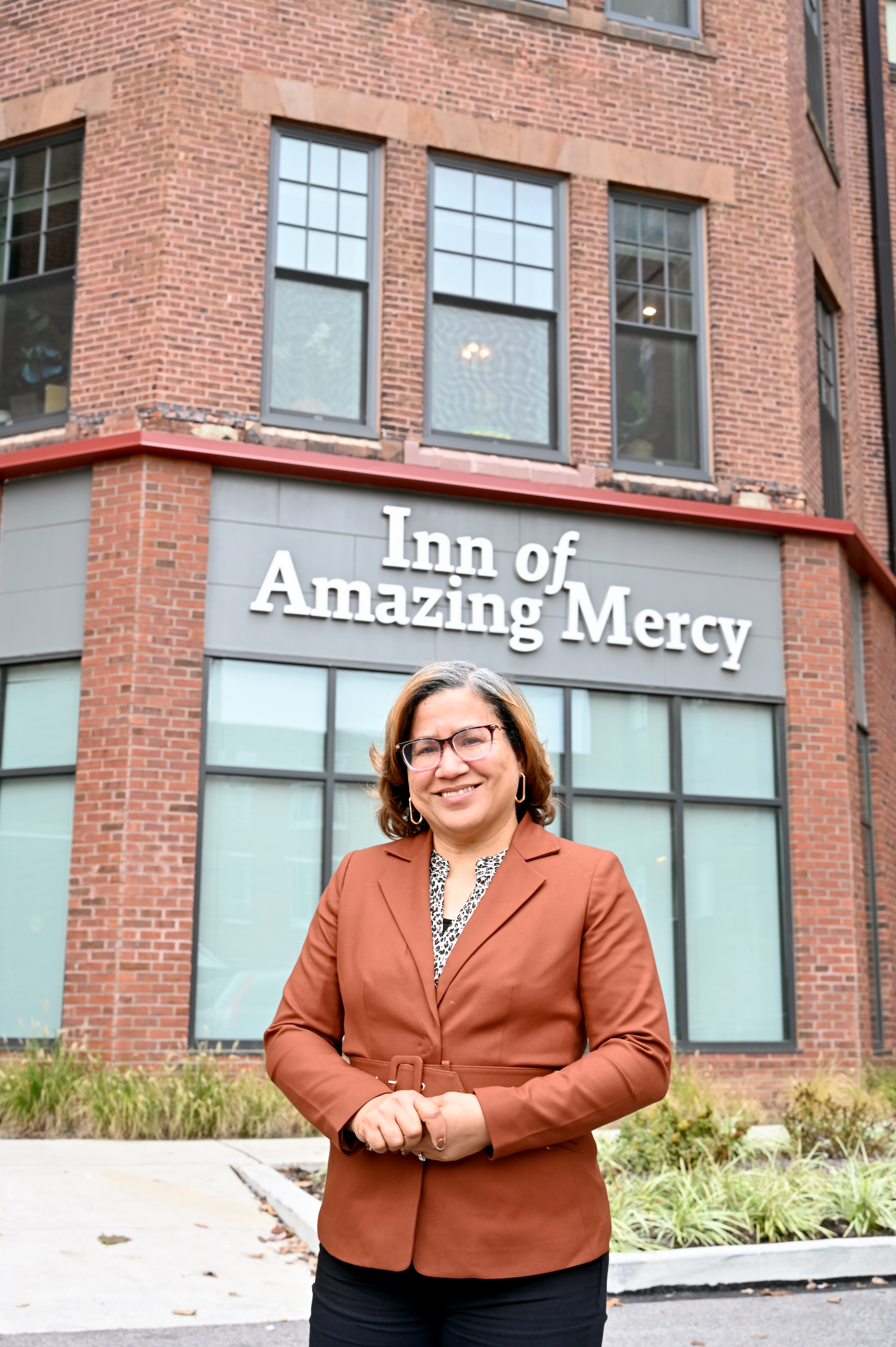
    The “O” in HOME has to do with Opportunities for employment. Certificates cover one wall in Andujar’s studio apartment in Project HOME’s Inn of Amazing Mercy, a 62-unit apartment building and offices in a former nursing school dormitory in Kensington. He can point to his accomplishments in computer skills, barbering, and training as a peer specialist to help others the way the outreach worker helped him.

    But Andujar is not in good health, as vigorous as he appears. His addictions will someday exact their price, even though with cirrhosis of the liver, he is already living years beyond what his doctor predicted.

    Full-time work is not an option. So Andujar is part of the “E,” as in Education. Deni helped him get a grant to take art classes at Community College of Philadelphia. She helped him understand CCP’s education software so he could turn in his homework.

    Project HOME offers classes in graphic design, music production training, ServSafe food handling, forklift and powered industrial trucks certification, and website building, among other courses.

    The M stands for Medical. Project HOME doctors, nurses, and other health practitioners treat 5,000 people a year, both in a fully equipped health center and by sending medical teams into the streets, caring for people, literally, where they live.

    “My dad always told me that you need three things — housing, food, and love. You get all that here,” Andujar said.

    And for him, it goes beyond that. During a stable period in his life, Andujar had a partner and a child. His daughter is now 14 and living with her aunt in New Jersey. Her mother, who was also stable for many years, fell into addiction but is clean now. She is living in another Project HOME apartment.

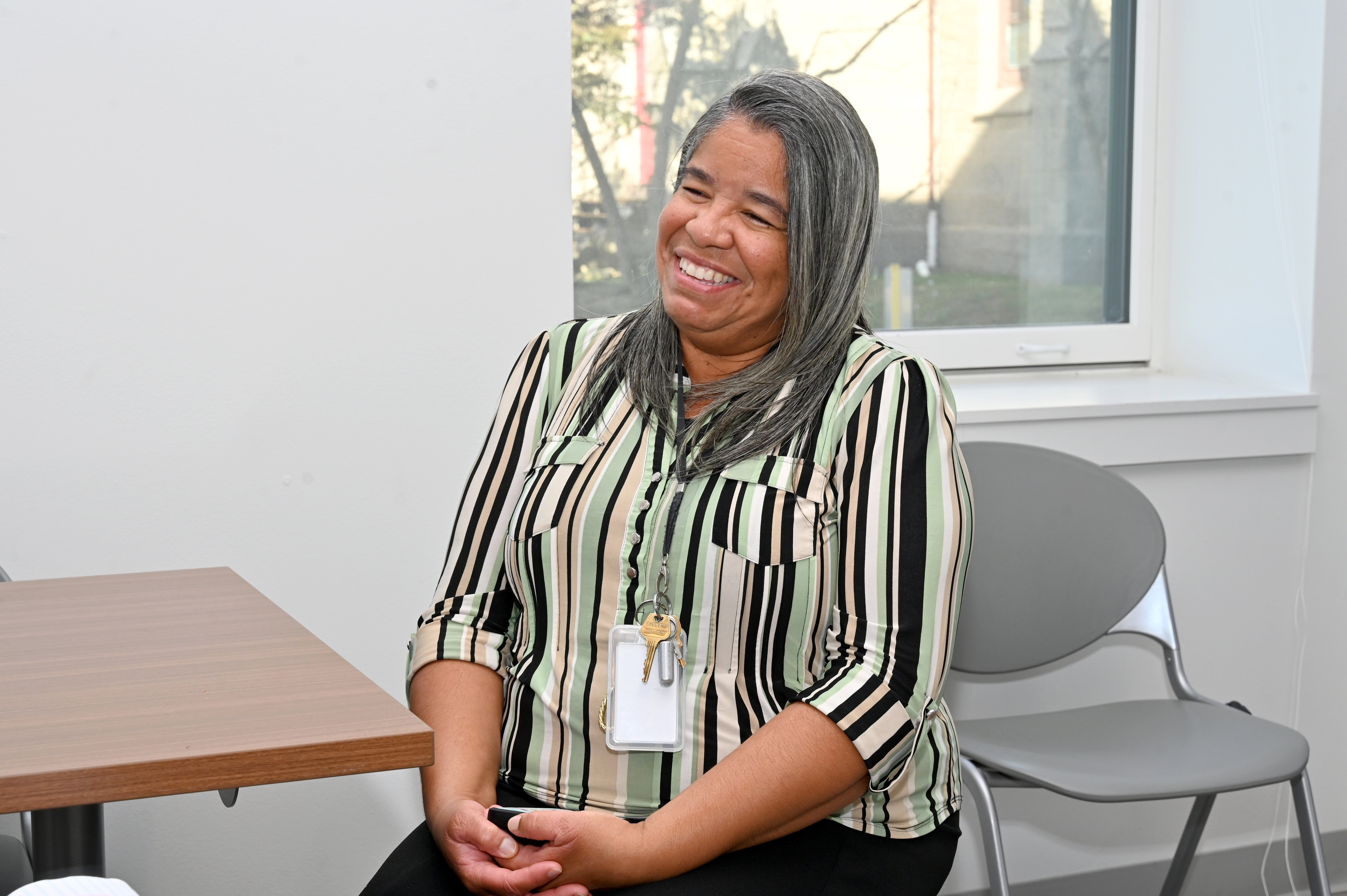
    Like Andujar, Omayru Villanueva, 49, another resident at the Inn of Amazing Mercy, recalls her first night of homelessness.

    She remembered a cold slushy rain.

    She remembered sweeping every corner of her house, determined to leave it clean, no matter what. Her husband had been convicted and jailed for a federal crime. She couldn’t make the payments on the house, so she sold or stored all of her belongings and prepared to leave.

    On her last morning at home, she and her school-age twin sons walked out the door before the sheriff came. Her older daughter was able to find a place in a shelter. Her second daughter, just under 18, said she was living with a boyfriend, but it turned out that she had been trafficked.

    “There’s a sense of dignity and respect when you have your own place,” says Omayra Villanueva, another resident of the Inn of Amazing Mercy.

    By that evening, Villanueva was desperate. She took her boys to a hospital emergency room. At least they could sit indoors while she figured out something. “I was crying inside.” Finally, she called a friend from church who took her and her sons in.

    From there, they moved from shelter to shelter, and ultimately to a Project HOME apartment with two bedrooms.

    “That night we had a pizza party. We were so happy,” she said. “There’s a sense of dignity and respect when you have your own place. You can take your worries away from having a place to live, and you can focus on other things.”

    She remembered lying in her new bed, “thanking God and rubbing my feet against the mattress.” The next day, she woke up, opened the window, and listened to the birds. Then she asked her sons what they wanted for breakfast. “When you are in a shelter, you eat what they give you.”

    The simple pleasures.

    Three of her four children, scarred from the experience, have also been homeless and living on the street. Her two sons, now 23, are in Project HOME apartments. Both daughters are now fairly well-established.

    Villanueva appreciates the medical help she has been given at Project HOME, particularly for mental illness stemming from the trauma she has experienced with her ex-husband’s arrest and homelessness.

    “Anybody can end up being homeless,” she said. “I wasn’t a drug addict. I wasn’t an alcoholic. It can happen to anybody.”

    She thinks of her daughter, who has a house, a job, and a car. But if something happens to the car, her daughter won’t be able to get to work. She won’t be able to pay her mortgage, and she could wind up homeless. It’s that simple.

    “It’s important to donate because people can help break the cycle of homelessness,” Villanueva said.

    “It’s about housing and education. It’s about medical help. It’s about employment,” she said. “Project HOME helped me a lot.”

    The truth is that every person in Project HOME has a story. Those stories keep Donna Bullock, president and chief executive, motivated to preserve and protect the agency founded just over 35 years ago by Sister Mary Scullion and Joan Dawson McConnon.

    She worries about how the city will respond to federal executive orders amounting to the criminalization of homelessness. Will there be tightened requirements for agencies that provide shelter?

    Project HOME is reimbursed for some of the medical care it provides, but Bullock worries that new rules involving Medicaid reimbursement will impact the agency’s budget, while cutbacks in services increase demand.

    “It’s terrifying,” she said. “We know we have to do the most we can to preserve these resources that we’ve come to rely on.

    “In this job, I’ve learned to appreciate the humanity of folks — the residents and the stories they tell and the contributions they make to our community.”

    Sometimes, she said, Project HOME residents walking the path of recovery slip and fall away. Sometimes the results are tragic, the losses devastating.

    “We’re experiencing all these moments — communal grief and communal celebrations as well. We talk a lot about how every journey of recovery is unique. Everyone walks their own journey. We can’t do the walk for you, but we can walk with you,” she said.

    Bullock invites others to the journey, promising that when people give to Project HOME, they can be assured that their money is carefully managed. “We’re good stewards of the resources entrusted in our care. We know how to leverage the resources given to us.

    “Folks expect a return on their investment, and the return is the difference in individual lives and also building a community,” she said. “Your investment is magnified 10 times over.”

    This article is part of a series about Philly Gives — a community fund to support nonprofits through end-of-year giving. To learn more about Philly Gives, including how to donate, visit phillygives.org.

    For more information about Philly Gives, including how to donate, visit phillygives.org.

    About Project HOME

    Mission: To empower adults, children, and families to break the cycle of homelessness and poverty, to alleviate the underlying causes of poverty, and to enable all of us to attain our fullest potential.

    People served: More than 15,000 annually — with street outreach, housing, opportunities for employment, medical care, and education.

    Annual spend: $49.06 million

    Point of pride: Project HOME, which operates 1,038 housing units, broke ground in October for construction of 45 new apartments; also under construction are 20 respite beds. In the pipeline are an additional 44 apartments. Project HOME also operates the Honickman Learning Center Comcast Technology Labs, Stephen Klein Wellness Center, Helen Brown Community Center, and Hub of Hope.

    You can help: Volunteers tutor students, serve meals, participate in neighborhood cleanups, and organize donation drives at their organizations for household items or other items useful to families or people still experiencing street homelessness.

    Support: phillygives.org

    What your Project HOME donation can do

    Here are some ways that a gift can help the people we serve:

    $25 provides warm clothing and new socks for a visitor at the Hub of Hope.

    $50 supports a behavioral health counseling visit.

    $100 provides a month’s worth of hygiene products and toiletries for a family.

    $250 provides a welcome basket for a new resident complete with sheets, towels, and cooking supplies.

    $500 supports five dental visits at the Stephen Klein Wellness Center.

    $1,000 funds six weeks of summer camp at the Honickman Learning Center Comcast Technology Labs, keeping a child’s mind active during the summer and supporting moms who work.

    $1,500 funds a certification program through the Adult Education and Employment program leading to employment readiness.

  • Letters to the Editor | Nov. 27, 2025

    Letters to the Editor | Nov. 27, 2025

    What’s in your wallet?

    Are you experiencing the Donald Trump/JD Vance boom? Vance recently said, “It’s gonna take a little bit of time for every American to feel that economic boom which we really do believe is coming.” How long does “every American” need to wait? Do you know who doesn’t have to wait? Do you know who is feeling a boom you or I will never see? The Trump family.

    Since Trump has taken office, the family has made over a billion dollars. No waiting there. No deciding how they are going to pay bills. But the everyday American — who can’t afford rent, groceries, or healthcare — needs to wait.

    How many vacations have you taken since this regime took office? Vance has taken how many? Last I saw was eight. That’s almost one a month. He’s not waiting for a boom. Does this administration even know what affordability means?

    Trump and Vance imposed tariffs — “the most beautiful word” — that raised prices on everyday goods and services. Now they are retracting them to make life “affordable” again. That’s the only boom you and I will see. And they will expect you to be humble and ever grateful for their willingness to put out the very fire they started.

    This is your economy. This is your mess. This administration is so out of touch with the everyday Americans they swore to serve. They ran on making life affordable, and the only ones who seem to be able to afford basic life needs are they and their oligarch cronies.

    Ellen McGuigan, Clarks Summit

    . . .

    In 1992, James Carville coined the phrase, “It’s the economy, stupid.” It’s still a priority today, but Donald Trump’s solutions to the pesky economic challenges are little more than trumped-up pigs in a poke to sell us a bill of goods. Can’t buy a first home? How about a 50-year mortgage? Lower monthly payments, but pay no attention to the fact that banks will likely charge higher interest, the total cost will increase 86%, and the first 10 years of payments cover interest and no equity. Need affordable healthcare? The Affordable Care Act is now offering catastrophic coverage (plans once limited to people under 30). Lower monthly payments (sound familiar?) but with a whopping $10,000 deductible. It’s gonna cost ya! Chris Bond, a spokesperson for AHIP, an insurance lobbying firm, cautions that “catastrophic plans … are not a replacement for affordable comprehensive coverage.” And let’s not even get started on Robert F. Kennedy Jr.’s “miasma theory,” his blast us back into the past approach to medicine that Amesh Adalja, of the Johns Hopkins Center for Health Security, said is “all just obfuscation to support his idea that vaccines are not valuable.” Pigs in a poke. A bill of goods. Don’t do us any favors. And the final insult? JD Vance, sensing Trump’s lame-duck status, is suddenly in the picture, all unctuous empathy, addressing our concerns about the high cost of living, assuring us, “We hear you,” and we just need to “have a little patience.” Yeah, right. They might hear us, but they are not listening. It’s still the economy, but it’s their lame brain “solutions” that are the epitome of stupid.

    Deborah DiMicco, Newtown

    Loss of HUD funding

    The announcement that the U.S. Department of Housing and Urban Development will no longer fund permanent supportive housing is a disaster for homeless service providers like the Bethesda Project, Project HOME, and the women and men who live in HUD-supported rooms or apartments. The Bethesda Project operates 150 units of permanent, supportive housing for formerly homeless men and women. Most, if not all, of those units are supported by HUD subsidies that make up the difference between one-third of a resident’s income and the market rate for a permanent room or apartment. Absent the HUD subsidy, most residents cannot pay the market rate. Those residents will likely end up back on the streets of Philadelphia. This Trump administration policy is misguided, counterproductive, and stupid.

    Angelo Sgro, Philadelphia

    Restore viable vacancies

    In another world, the demolition of the former Admiral Court apartment building at 237 S. 48th St. would never have happened. A sturdy four-story apartment building with 46 units, in a city that is in need of affordable housing, should have been a prime target for rehabilitation and reuse. Instead, the building is lost. Even after a devastating fire that investigators are treating as arson, there was still enough of the structure left that this building could have been saved. Now, the neighborhood will get an empty lot to look at, despite pleas from neighbors and from a member of City Council to see this building put back into service.

    The current owners of Admiral Court also control 4710 Locust St., which is listed as having 56 apartments and has been vacant for many years. Hopefully, the city can intervene before another arson fire destroys this building, as well.

    Katherine Dowdell, Philadelphia

    No promises

    New York City Mayor-elect Zohran Mamdani met with President Donald Trump. I hope no one thinks Trump promised Mamdani anything. President Trump talked only in generalities.

    President Trump said he agrees that it would be great if Mamdani could make NYC more safe. He said it would be great if Mamdani could make things more affordable, and great if he could help the housing shortage. That means ab-so-lute-ly nothing. Trump just wished him well. President Trump did not promise to do or finance anything specific to help, for sure. Mayor-elect Mamdani’s methods may be way, way different from President Trump’s methods to help anything, and we will all wait with bated breath to see what the future brings.

    Also, Mamdani is not a dictator. He can only pass laws with the majority agreement of himself and of 51 city council members from the five boroughs. That has never even been mentioned. How will the 51 members vote?

    All President Trump really did was to say hello and good luck.

    David F. Lipton, Toms River

    Join the conversation: Send letters to letters@inquirer.com. Limit length to 150 words and include home address and day and evening phone number. Letters run in The Inquirer six days a week on the editorial pages and online.

  • Giving thanks — and offering up a prayer — for America’s free press

    Giving thanks — and offering up a prayer — for America’s free press

    Thanksgiving is the sole American holiday whose name tells us exactly what we are meant to do.

    This Thanksgiving — among many other blessings — I am giving thanks for our country’s vibrant, independent local journalism, and for the nation of laws and press freedoms that help preserve and defend it.

    More than any other American holiday, Thanksgiving is about the exercise of free speech. Whether cordial or contentious, our views of our families, our culture, our sports teams, or our politics are debated freely over the American Thanksgiving table.

    In a world in which we spend far too much time living in our own information bubbles, Thanksgiving allows — indeed forces — us to communicate across the table, across generations, and across sometimes deep partisan divides.

    From the outset, the notion of Thanksgiving and freedom has been intertwined. In George Washington’s Thanksgiving Proclamation of October 1789, the new president asked the nation to give thanks “for the civil and religious liberty with which we are blessed, and the means we have of acquiring and diffusing useful knowledge.”

    As worded, the proclamation is more a celebration of American freedoms than the blessings of a sumptuous meal. If Independence Day celebrates the declaration of American freedoms, then Thanksgiving celebrates their enactment and — one hopes — their permanence.

    But on this, more than any Thanksgiving in memory, a free and independent American press seems in peril.

    This Thanksgiving follows a year in which an American president has sued and collected multimillion-dollar personal damages from CBS’s 60 Minutes and forced the suspension of an outspoken late-night talk show host.

    The current administration has orchestrated the virtual elimination of Voice of America and other vital U.S. international broadcasting and the defunding of NPR and PBS, among several other legal suits and regulatory intimidations.

    What does not get printed is as important as what does. The palpable chill of partisan press criticism has meant the self-censorship of even some of the nation’s wealthiest newspaper owners.

    It doesn’t have to be this way.

    More than a decade ago, The Inquirer was purchased by the late H.F. “Gerry” Lenfest, a philanthropist and cable television pioneer, and donated to the nonpartisan Lenfest Institute for Journalism.

    The Inquirer is now the largest American newspaper under nonprofit ownership. The newspaper remains editorially independent of its parent company to protect the very freedoms for which its owner stands.

    Thanks, in part, to this nonprofit structure, The Inquirer and its independent, high-impact journalism enjoy the funding support of individual donors, large and small, and of foundation and corporate contributors, both local and national.

    It is said that “all politics is local,” and the same may be said of news. What happens in our nation or on our planet can often be best understood when reported from a local perspective.

    The Inquirer, and the dynamic Philadelphia-area journalism scene of which it is a part, are a blessing for our city, our region, and our country.

    Over the past year, a skilled, dedicated, and high-integrity group of women and men from The Inquirer, our region’s local TV stations, WHYY, WURD Radio, Impacto, the Philadelphia Tribune, Spotlight PA, and a diverse array of community news organizations have reported on the region’s biggest challenges: from the plight of our immigrant communities to solutions for gun violence, to economic mobility in what remains among the poorest big cities in America, to electoral politics in America’s largest swing state. This work saves lives, makes kids safer, and holds local and state government to account.

    All those who report and edit the news, all who stand ready to defend their words in the courts or in the court of public opinion, everyone who helps fund great local journalism with their subscriptions or their donations, and all who read and act upon the vital insights of a free and independent local press deserve our thanks — and these days, our prayers.

    Jim Friedlich is CEO and executive director of The Lenfest Institute for Journalism, the nonprofit organization that owns The Inquirer. @jimfriedlich