“I do solemnly swear that I will support and defend the Constitution of the United States against all enemies, foreign and domestic … and that I will obey the orders of the President of the United States and the orders of the officers appointed over me,” according to law.
Military and intelligence community members were recently reminded of this oath when, on Nov. 18, six members of Congress released a direct-to-camera video, telling service members that they “can refuse illegal orders.”
In response, the president unleashed a spate of social media posts calling for the lawmakers to be jailed, charged, and even executed. He subsequently doubled down on his threats of arrest and prosecution.
If there were any doubt whether the president’s words were empty rhetoric, look no further than the just-dismissed case against former FBI Director James Comey, who, after the president directed Attorney General Pam Bondi to pursue Comey via a Truth Social post, found himself under federal indictment weeks later.
The First Amendment does not permit the government to prosecute lawmakers for telling service members to hold the line against unlawful orders.
With a U.S. Department of Justice willing to pursue political prosecutions, another round of charges is almost certainly coming. The question is whether the Constitution’s protections will hold.
First Amendment barriers
Under modern First Amendment doctrine, the government cannot punish speech because it conveys a message the government dislikes. The law is especially protective of “core political speech,” i.e., speech advocating for sociopolitical change.
Meanwhile, speech loses protection when it is “directed to inciting or producing imminent lawless action and is likely to [cause] such action.” The standard — set intentionally high by the U.S. Supreme Court — comes from a 1969 case, Brandenburg v. Ohio, reversing a Ku Klux Klan leader’s conviction over his Klan rally speeches. As the court explained it, the First Amendment does not permit punishment for “mere advocacy,” no matter how abhorrent.
In other words, just like the government could not prosecute someone for using a vulgarity to describe the draftto protest the Vietnam War (Cohen v. California) or the KKK for saying that “there might have to be some revengeance taken” (Brandenburg), the First Amendment does not permit the government to prosecute lawmakers for telling service members to hold the line against unlawful orders.
Vindictive prosecution
Prosecuting these lawmakers would also present a textbook case of “vindictive prosecution.” As lawyers in the Comey case recently argued, the due process clause forbids prosecutions based on “a government official’s animus” or “personal spite” toward a person. Showing that, here too, the government acted because of “genuine animus,” as is required, would not seem difficult.
And although most grand jury proceedings come with a “presumption of regularity,” as one federal court recently put it, that may no longer be the case: “the irregular is now the regular.” Take the Comey case, for example. While the charges were just dismissed, recall that days before Comey was indicted, the then-head prosecutor for the Office of the U.S. Attorney for the Eastern District of Virginia declined to charge him.
In response, the president installed his own attorney, Lindsey Halligan, who had no prosecutorial experience, as interim chief of the office. Halligan then personally presented Comey’s case to the grand jury, days before the statute of limitations ran out, and recently admitted the final indictment was never reviewed by the full grand jury.
Lindsey Halligan, outside of the White House in August, had no prosecutorial experience before being named U.S. attorney.
Now, one federal judge has ruled that Halligan’s appointment was invalid, requiring dismissal, while another federal judge seems primed to dismiss the charges for good on vindictive and selective prosecution grounds, among others. Talk about unprecedented.
Even assuming the president found a prosecutor to pursue charges, and a grand jury indicted — neither of which is guaranteed — it seems highly unlikely the charges would survive against the growing backdrop of this administration playing fast and loose with the grand jury process to exact political retribution on the president’s perceived enemies.
Going on offense
But bracing for an onerous — even if legally faulty — investigation is not the only option. The president’s next political target to catch wind of a grand jury investigation against him or her could take a page from Ealy v. Littlejohn.
In that post-civil rights movement era case, a Black organization in Mississippi, which came under investigation for accusing local officials of failing to investigate the suspicious death of a young Black man, sued and got a court order to stop the investigation in its tracks.
The federal court determined that the investigation was being carried out for “the purpose of harassing and intimidating the plaintiffs in violation of their First Amendment rights,” and said it would be a “sorry day” for the country “were we to allow a grand jury to delve into” protected First Amendment activity “on the pretext that” it might reveal “some information relevant to a crime.” If ever there was a case to test out this affirmative strategy, this would seem to be it.
David Axelrod, a partner at Ballard Spahr, is a former Securities and Exchange Commission supervisory trial counsel in Philadelphia and a former assistant U.S. attorney in the Eastern District of Pennsylvania. Isabella Salomão Nascimento is a senior associate in Ballard Spahr’s Media and Entertainment Group. Before joining the firm, she was a staff attorney at the ACLU of Minnesota, where she specialized in civil rights and constitutional law.
Trump is ready to press Ukraine to bow to a plan that guarantees further Russian destruction. Let’s hope the backlash to the proposal stiffens the backbone of GOP supporters of Ukraine against the pro-Russian White House crowd.
The drama hasn’t ended yet.
The 28-point plan was cooked up by Trump’s feckless negotiator, Steve Witkoff, and first son-in-law Jared Kushner. Two real estate moguls with zero knowledge of Ukraine wrote a draft plan based heavily on input from Kremlin insider Kirill Dmitriev.
Dmitriev is Putin’s representative for economic cooperation and has wooed Witkoff and Kushner with fantasies of joint U.S.-Russian investment. The three men met for secret talks in October in Miami, at Witkoff’s home.
The resulting document reads like Kremlin talking points; some Russia experts point out that the English syntax sounds as if it were google translated directly from the Russian text.
“Even Neville Chamberlain would blush at this,” said Rep. Don Bacon (R-NE), referencing the British prime minister who infamously appeased Adolph Hitler. “It’s embarrassing to our country.”
Painfully true.
The deal demands suicidal concessions from Ukraine, the victim of Russian aggression, but none from the Russia invader. The points echoed a Putin wish list, and green-light Moscow’s complete subordination of Ukraine, by shrinking Kyiv’s army, limiting its alliances and weapons, and leaving it wide-open to future Russian attacks.
Trump was — and still is — ready to sell out Kyiv in pursuit of an imaginary Nobel Peace Prize along with lucrative business deals with Moscow and predatory deals for Ukrainian minerals (both are touted in the plan).
In clear evidence of Russian untrustworthiness, Dmitriev leaked the proposal last week to journalist Barak Ravid of Axios in order to box in the Americans before consultations with Ukraine. Yet Trump quickly endorsed this capitulation document.
Dmitriev’s betrayal alone should disqualify him from further negotiations, but there’s no sign Witkoff will abandon his new Russian pal. As for Witkoff and Kushner, Trump is rewarding their blunders by sending them to meet Putin next week.
Russian President Vladimir Putin’s envoy Kirill Dmitriev (left) and President Donald Trump’s special envoy Steve Witkoff attend talks in St. Petersburg, Russia, in April.
How do we know for sure that Dmitriev was the leaker? Because Witkoff posted on X, “He [Axios’ Ravid] must have got this from K …,” meaning Kirillov. Apparently, Witkoff thought he was sending a private message, another sign he isn’t up to the job.
Equally egregious, Secretary of State Marco Rubio, who does know something about Russia, was kept out of the loop by Witkoff. After the leak, he got a firestorm of complaints from upset European counterparts and GOP supporters of Ukraine. That led him to call Sen. Mike Rounds (R., N.D.), who was at an international security conference in Halifax, Nova Scotia, along with a bipartisan Senate delegation.
Rounds recounted to journalists that Rubio described Witkoff’s plan as a Russian “wish list” and not an actual U.S. proposal. Under White House pressure, Rubio soon reversed himself and posted online that the senators were mistaken. A State Department spokesperson falsely accused the senators of lying
I spoke to Sen. Chris Coons (D., Del.), who was with the delegation during the call (although not on the phone). “I heard what [my colleagues] said immediately after the call,” he told me. “They couldn’t have been clearer about what Marco said, and what the complications were. I hope after today we’ll see a proposal which enables Ukraine to remain free and sovereign and defend itself in the future.”
With this White House, don’t hold your breath.
The pushback from GOP backers of Ukraine, as well as from the EU and Kyiv, was so intense, however, that Rubio rushed to “update” the document in weekend negotiations with Ukrainian officials in Geneva.
Very sensitive issues remain unresolved, yet Trump is still pressuring Kyiv to sign on this month. There is an acute danger that he and Vice President JD Vance may try again to bushwhack Ukraine’s Volodymyr Zelensky, who will probably visit the White House this month.
European allies, who were not consulted on the deal, have been desperately trying to bolster Zelensky and get Trump’s ear.
In this image taken from video provided by Russian Presidential Press Service on Nov. 20, Russian President Vladimir Putin speaks as he visits one of the command posts of the West group of Russian Army in an undisclosed location.
But given the president’s eagerness for a “deal” — any deal, no matter how fatal to Ukraine — Trump is more likely to squeeze Kyiv than press Putin for concessions. Russian Foreign Minister Sergey Lavrov made clear this week that Putin is only interested in the original pro-Russian points, and not any revision that protects Ukraine from future attack.
It’s important for Americans to understand why the Putin-Trump 28-point deal wouldn’t stop Russian aggression and would only encourage Moscow to continue the war.
As former Ukrainian Defense Minister Andriy Zagorodnyuk pointed out: “Ukraine has never attempted to seize Russian territory. Russia, on the other hand, has repeatedly invaded Ukraine and continues to strike Ukrainian cities daily.”
The bottom line for achieving peace is that any plan must strengthen Ukraine’s defenses and provide concrete U.S. guarantees that Russia won’t destroy the Ukrainian state in the future. The 28-point plan does just the opposite (and the revisions aren’t strong enough.)
The Kirillov proposal shrinks the size of the Ukrainian army by a third while putting no limits on Russia’s army, which is roughly twice the size of Ukraine’s. It prevents Ukraine from ever joining NATO and forbids NATO peacekeepers on its soil.
Imagine if Franklin Delano Roosevelt had endorsed a peace plan between Winston Churchill and Hitler in 1940 that left Hitler free to expand his army while demanding Churchill halve his forces, ground his Spitfires, and promise never to ask the Yanks for help.
Which brings us to the ugliest part of Trump’s fake peace efforts. There is a lot of loose verbiage about “guarantees” against a future Russian invasion in the 28 points, and in a side letter offering Kyiv a “security assurance modeled on the principles of [NATO’s] Article 5.” Note the weasel words.
Let me assure you, I have read and reread the texts, and they offer Ukraine no firm U.S. or allied commitment to intervene if Russia attacks again.
The real hint of the worthlessness of this Kremlin-born document comes with point 16, which proclaims: “Russia will enshrine in law its policy of non-aggression toward Europe and Ukraine.”
Does Trump not know Putin has violated every accord he or his predecessors signed with Kyiv. That includes the 1994 Budapest Memorandum by which Ukraine surrendered its nuclear weapons in exchange for guarantees of sovereignty from the U.S., the U.K., and Russia? We know how much those paper assurances have been worth.
POTUS refuses to face reality: Putin respects only strength; there will be no peace until the costs of war are more than the Russian economy and military can bear.
Peace negotiations are worthless unless backed by tougher U.S. sanctions and sales of U.S. air defense systems and missiles to Ukraine.
By his continual concessions to Moscow, Trump has convinced the Russian leader that he is a weak pushover. That guarantees that Russia will continue the war.
Why is Donald Trump deserting Ukraine? Ukraine has demonstrated superior battlefield and technical skills over Russia and taken back territory that Russia has captured. Ukraine has suffered severe losses fighting for its sovereignty. International experts believe Ukraine could defeat Russia. Why aren’t we giving help to our ally? We’ve given and taken it away twice. Trump and Vladimir Putin now suggest a plan giving Russia a major gift. Russia started this war and should never be rewarded. The plan sounds like a big win for Russia and a loss for the U.S., Ukraine, and NATO. Trump continues to show admiration for Putin, who has humiliated him more than once. Trump flattered Putin in Alaska. It didn’t work. Do we really want to give Russia control over major territory in Ukraine, relief on sanctions, and limitations on NATO countries? Russia has been trying to damage NATO countries’ airports. We should never reward Russia when we’ve seen these actions. Allies in Europe don’t favor the referenced plan, nor should the U.S.
Robert Turnbull, Media
. . .
Ukrainian President Volodymyr Zelensky must not agree to the Trump administration’s Russia-friendly proposal to end hostilities between the two neighboring countries. The American people support Ukraine’s fight, but their president never has. He’s a grudge holder who likely blames Zelensky (for his refusal to investigate the Bidens) for his first impeachment. Trump wants Ukraine to capitulate in order to boost his campaign for a Nobel Peace Prize. Trump is for Trump and no one else. Vladimir Putin manipulates Trump, who has done nothing to earn Zelensky’s confidence and trust. Trump’s demand that Ukraine accept terms that are favorable only to Russia is a knife in the hearts of all peace-loving and battle-weary Ukrainians. Zelensky repeatedly held out his hand (both hands to be accurate) to Trump, requesting “U.S. support” in the form of aid and defensive military weaponry. Each ask resulted in no aid. Nada, from the onetime swaggering candidate who even before the inauguration told voters he would end hostilities in short order if elected. Volodymyr, don’t lose Ukrainian dignity. Trump is not your friend.
David Kahn,Boca Raton, Fla.
Unfair
On Nov. 13, Sen. John Fetterman was hospitalized following a minor cardiac event. How nice for him to be able to draw on government-subsidized health coverage to access the care he needs. What a shame he couldn’t be bothered to fight to protect access to affordable healthcare for his constituents.
When I received a breast cancer diagnosis a few days shy of my 34th birthday, it was my Affordable Care Act plan that ensured I could get the treatment I needed without decimating my financial reserves. Now, thanks to Fetterman’s spinelessness, what cancer treatment couldn’t wipe out, a 75% increase in insurance premiums just might. How many Pennsylvanians are going to find themselves in a comparable position? Trapped between healthcare they can’t afford to go without and coverage they can no longer afford to pay.
Katherine Roberts,Philadelphia
Join the conversation: Send letters to letters@inquirer.com. Limit length to 150 words and include home address and day and evening phone number. Letters run in The Inquirer six days a week on the editorial pages and online.
Twenty-five years of running a small business teach you a lot. I have owned the Night Kitchen Bakery since 2000, and worked in the food business for over 40 years, at hotels, restaurants, and for caterers. In that journey, you start to see patterns as to how the economy and major events affect the business.
Anyone who has ever worked in the food and/or hospitality business will tell you it is incredibly hard work, but often rewarding and sometimes exciting. Anyone who has owned a food business will tell you that owning one is even harder, but can also be the most satisfying work.
Food is love
Feeding people is a beautiful love language. For those of us lucky enough to keep our small businesses going for so long, we know that, as my grandmother used to say, “It is a nickel-and-dime business.” The bottom line is so small that price fluctuations in raw product, broken equipment, or increases in other business expenses can be the difference between a tiny profit, zero profit, or a significant loss.
Large losses can be impossible to recover from for a mom-and-pop shop, or even a medium-sized restaurant. We learn to keep an eye on the small details every day. We often change the way we operate with new technologies to help become more efficient. Our staff often have skills and knowledge we learn from to improve our operation. We watch as sales patterns emerge every day of the week, every season, every holiday, and every year.
Most people love to have a treat or entertain on weekends, so most food businesses are busier Friday through Sunday. Our biggest expense is staffing, and we adjust schedules to account for slow and busy times of the year. Much of it is an educated guessing game.
The 12 finalists in the 2021 Holiday Cookie Challenge.
People tend to celebrate holidays at the same time, and want pies for Thanksgiving and cookies in December. Spring and warmer weather demand fruitier flavors. Buying seasonal products helps keep costs lower. Raw products constantly fluctuate, so we adjust our prices when we can without alienating our customer base. All this is challenging, but I’m used to it.
We have not been able to increase the prices of some of our products to match the rise in the cost of ingredients. In my 25 years here, I have never seen costs fluctuate so wildly and frequently. The cost of raw products, such as chocolate, coffee, jams, and other imported ingredients, is going through the roof. My vendors tell me this is largely due to tariffs.
We cover the cost of health insurance for some employees, which is also one of our biggest monthly bills. We just received our rate sheet for 2026, and the increase is over 20% — the largest hike I have ever seen. This is another expense that will make doing business extremely difficult. Other business owners I know are also struggling.
Growing stress
I see the job market changing fast, and I am seeing more applicants than ever before. Several customers have confided in me that they have government jobs and are worried they will not receive back pay when they return to work. It is very stressful for them, and stress has a trickle-down effect.
This all adds up, not only in expenses for the business, but in time spent adjusting to all the factors. We are lucky. We have a loyal customer base and, so far, have been able to accommodate ourselves to the changing market, if barely.
But it can’t go on forever.
Small businesses make up the vast majority of all U.S. businesses. So I offer this not as a personal problem, but an alarm about what is happening to the economy as a whole.
What can be done? Everyone has to decide this for themselves, but I think action is needed. I am in touch with our government representatives regularly to express my concerns. Whatever your situation, everyone is affected and burdened by the choices our politicians are making.
After all, our business is your business, too.
Amy Beth Edelman has been co-owner of the Night Kitchen Bakery and Cafe in Chestnut Hill for 25 of the shop’s 44-year history. She lives in Bala Cynwyd.
There’s an old saying — well, there ought to be one — that the surest way to jinx something is to write, “I don’t want to jinx it…” My Border Patrol tornado-chasing trip to Charlotte was doomed the moment I posted about it here — frantically canceled when I learned 17 hours before takeoff that the BP had abruptly ditched North Carolina. There is a Plan B but no way will I jinx it a second time.
It’s better to stop Trump’s illegal orders than hope troops will disobey them
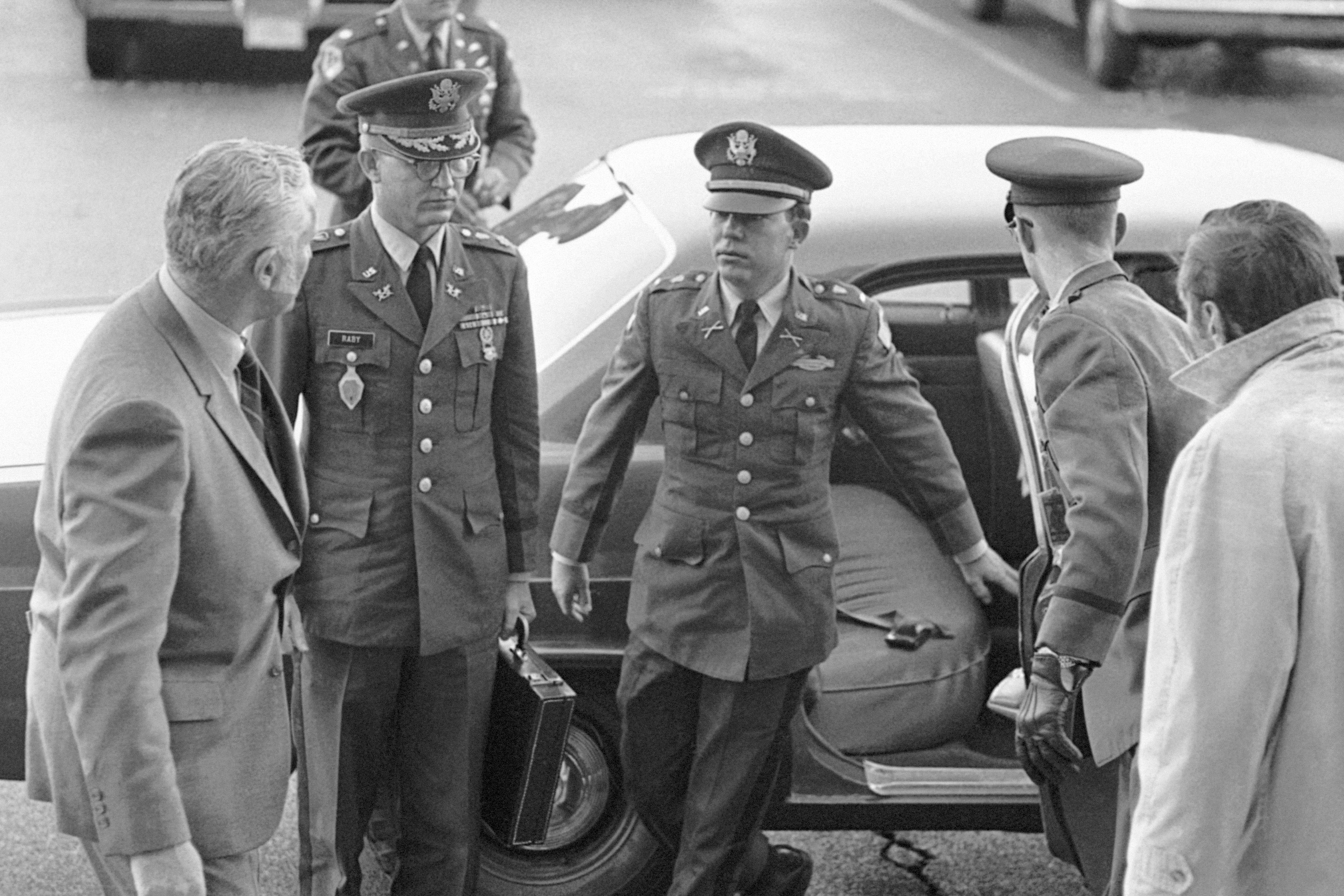
Lt. William L. Calley Jr., center, and his military counsel, Maj. Kenneth A. Raby, left, arrive at the Pentagon for testimony before an Army board of investigation hearing into the My Lai Massacre in December 1969. Calley led the U.S. soldiers who killed hundreds of Vietnamese civilians in the most notorious war crime in modern American military history.
A U.S. Army helicopter pilot named Hugh Thompson Jr. may be the greatest American hero you’ve probably never heard of. On March 16, 1968, Thompson — a warrant officer serving in Vietnam — and his crew were dispatched to support a “search and destroy” mission supposedly targeting the Viet Cong in a tiny hamlet called My Lai.
Instead, the Georgia-born soldier came up upon arguably the most notorious war crime in U.S. history — with thatch hutches ablaze and countless villagers, including women and children, laying dead or dying in an irrigation ditch.
Thompson landed and found the commander on the ground, Lt. William Calley. “What is this?” he asked. “Who are these people?”
“Just following orders,” Calley replied. After some more back and forth, the flustered Thompson replied: “But, these are human beings, unarmed civilians, sir.”
What Thompson and his helicopter crew did next was truly remarkable. Holding Calley and their other U.S. comrades at bay, they shielded a group of Vietnamese women, children and old men as they fled. Eventually, he loaded 11 villagers into the helicopter, and then Thompson and his men thought they detected movement in the ditch. Two fellow solders found a boy, just 5 or 6, hiding under the corpses, “covered in blood and obviously in a state of shock.” After safely evacuating the boy to a military hospital, Thompson reached a lieutenant colonel who ordered Calley to stop the killings.
Near the end of his life, Thompson — who died in 2006 — and two comrades were recognized for their courage and the many lives they saved at My Lai, awarded the Army’s highest award for bravery not in conflict with an enemy (the Soldier’s Medal), as well as the the Peace Abbey Courage of Conscience Award. He even returned to My Lai for an emotional reunion in 1998.
But it wasn’t like that in real time. During the war, a prominent congressman demanded that Thompson be court-martialed. “I’d received death threats over the phone,” he told CBS’ 60 Minutes in 2004. “Dead animals on your porch, mutilated animals on your porch some mornings when you get up.”
A generation after Thompson’s death, the kind of bold action he took that day in 1968 — disobeying what he correctly understood as an illegal order — is yet again on America’s front burner. This time, the debate is fueled by a video from six veterans who now serve as Democrats in Congress ― reminding today’s soldiers about their sworn duty to disobey unlawful commands.
That every expert in military law agrees with this principle hasn’t stopped President Donald Trump or his defense secretary, Pete Hegseth, from going ballistic — calling the Democrats “traitors” or even reposting calls for their death by hanging.
On Monday, Hegseth kicked things up a notch by endorsing a plan for one of the six — Arizona Sen. Mark Kelly, a former astronaut and decorated Navy fighter pilot — to return to active duty, so that he can be court-martialed for taking part in the video. A statement from the Pentagon, which Trump and Hegseth call “the Department of War,” insisted that “orders are presumed to be lawful. A servicemember’s personal philosophy does not justify or excuse the disobedience of an otherwise lawful order.”
Even as the growing controversy dominates the headlines, there is one aspect to the illegal-orders debate that practically no one is talking about. Actions like Thompson’s refusal at My Lai don’t only stand out for the soldier’s gumption. It is also the stuff of peace prizes and 60 Minutes profiles because it is so incredibly rare.
Do your own research. It’s very difficult to find examples in America’s 249-year history of troops disobeying orders because they are believed to be illegal. To be sure, there are famous incidents of soldiers who disobeyed an order and heroically saved lives — but almost all of them were because the command was reckless or just plain stupid, which isn’t the same as illegal or unconstitutional.
It’s not like there haven’t been opportunities. There have been American war crimes from Wounded Knee to Abu Ghraib, what Barack Obama famously called “dumb wars” like the 2003 assault on Iraq, and moments of intense moral agony, like dropping atomic bombs on Hiroshima and Nagasaki. These did produce a few whistleblowers or conscientious objectors, of course, but cases of actually refusing an order are few.
It’s not hard to understand why. Most military orders — even ones later reviled by history — come with some veneer of legality, whether it’s an opinion from a military lawyer or a congressional authorization vote, as happened with Vietnam, Iraq, and other conflicts.
The video recorded by Kelly and the others (including Pennsylvania Reps. Chrissy Houlahan and Chris Deluzio) focuses only on the widely accepted principle that military men and women must follow the law and the Constitution above all else, and doesn’t mention Trump or any specific disputed orders. In interviews, though, Democrats like Kelly and Houlahan have criticized Trump’s ongoing attacks on boats off South America that the regime claims are smuggling drugs.
While almost every expert on military laws describes these attacks — which have killed at least 83 people— as extrajudicial killings lacking legal justification, the Office of Legal Counsel in Trump’s Justice Department has nonetheless written a secret classified memo to justify them. Any officer or lower-level troop ordered to blow up these boats and kill all the people on board hasn’t seen the memo. And they won’t get a medal for saying “no” — at least not in 2025. They will be court-martialed and vilified by MAGA.
New York Times opinion writer David French, a Harvard Law grad who served as an Army lawyer in Iraq, notes the congressional video didn’t advise troops on what exactly is an illegal order, and adds: “Individual service members don’t have sufficient knowledge or information to make those kinds of judgments. When time is of the essence and lives are on the line, your first impulse must be to do as you’re told.”
Not always, as Thompson showed at My Lai, but military matters are rarely that black and white. The Trump regime’s sending of National Guard units and even active-duty military into cities such as Los Angeles may be an unnecessary and inflammatory violation of democratic norms, but experienced judges continue to debate its legality. Expecting the rank-and-file troops to decide is asking a lot.
It is very much in the spirit of Joseph Heller’s World War II novel and its legendary Catch-22: A soldier must disobey an illegal order, yet orders, in the heat of the moment, are almost never illegal.
That doesn’t mean Trump and Hegseth threatening Kelly and the other Democrats with jail and possibly the noose isn’t utterly outrageous. After all, they did nothing more than remind soldiers of their obligation to the law in the same language their drill sergeants use in boot camp.
I do also think — understanding the limitations of a MAGA-fed Congress — that good people of both parties on Capitol Hill should be doing a lot more to invoke the War Powers Act, hold hearings, debate impeachment, and do whatever else they can to prevent Trump’s reckless acts in the Caribbean and elsewhere. In other words, stop illegal orders before they’re given.
That said, as the Trump regime deteriorates, there may come a day when right and wrong feels as obvious as it did that 1968 day in the rice paddies of Vietnam. If, heaven forbid, this government ever ordered troops to put down a protest by firing on citizens, we will need a platoon full of Hugh Thompsons and no William Calleys, “just following orders.”
Yo, do this!
The writer Anand Giridharadas is the best of today’s public intellectuals, with a laser focus on the 1 Percent and the devastating role of income inequality in works such as Winners Take All, which rips apart the facade of modern philanthropy. So who better to pour through the late financier-and-sex-fiend Jeffrey Epstein’s emails and find the true meaning? His recent, masterful New York Times essay — “How the Elite Behave When No One Is Watching: Inside the Epstein Emails” — parses the small-talk and atrocious grammar of America’s rich and powerful to decipher how they rule. It is a must read.
Saturday was the 62nd anniversary of the day that changed America, for bad: the assassination of President John F. Kennedy as his motorcade rolled through downtown Dallas. It was also the day I was savaged by several dozen people on Bluesky for expressing an opinion shared by 65% of Americans: that we haven’t been told the whole truth about what really happened on Nov. 22, 1963. Kudos to ABC News for a new special that aired Monday looking at both sides of the endless controversy — Truth and Lies: Who Killed JFK? — that included skeptics like veteran journalist Jefferson Morley of the excellent site JFK Facts. The one hour-special is now streaming on Hulu.
Ask me anything
Question: Why is the Trump administration uncritically regurgitating the Russian “peace plan”? — @kaboosemoose.bsky.social via Bluesky
Answer: That’s a great question as our president has consistently told us that the “Russia! Russia! Russia!” scandal around Vladimir Putin’s U.S. election interference and his seeming sway over the 45th and 47th president is all a massive hoax. How to explain, then, that the supposedly-Trump-drafted 28-point peace plan to end the fighting in Ukraine was translated from its original Russian, with its details hashed out in Florida by corrupt and contented Trump son-in-law Jared Kushner and Kirill Dmitriev, a U.S.-sanctioned Russian envoy? It’s probably true that liberals were naive during Trump’s first term to believe the strange ties between MAGA and the Kremlin would bring down his presidency, but it’s also true that where there’s smoke, there’s fire. We all want peace in Ukraine, but Trump and his U.S. government simply are not honest brokers.
What you’re saying about…
Last week’s question about the Jeffrey Epstein files, and whether they’ll ever see the light of day despite enactment of the law calling for their release, was kind of open-ended, and thus it drew an array of responses. But most agreed with my view that it’s highly unlikely we’ll see the files, or see very much. “They won’t release them because they are now investigating the Democrats in the files, thus they won’t be able to release them due to the investigation,” Rosann McGinley wrote. “Also they’d be heavily redacted, ‘nothing to see here.’” Added Judy Voois: “I would not be surprised if he declared war on Venezuela just to steer the media and public interest away from continued scrutiny of the Epstein saga.”
📮 This week’s question: The heated reaction I received online about the JFK assassination now has me wondering what newsletter readers think. Do you believe Lee Harvey Oswald was the lone killer of John F. Kennedy, or do you think there was a conspiracy? Please email me your answer and put the exact phrase “JFK assassination” in the subject line.
Backstory on Pennsylvania’s budget deal with the devil
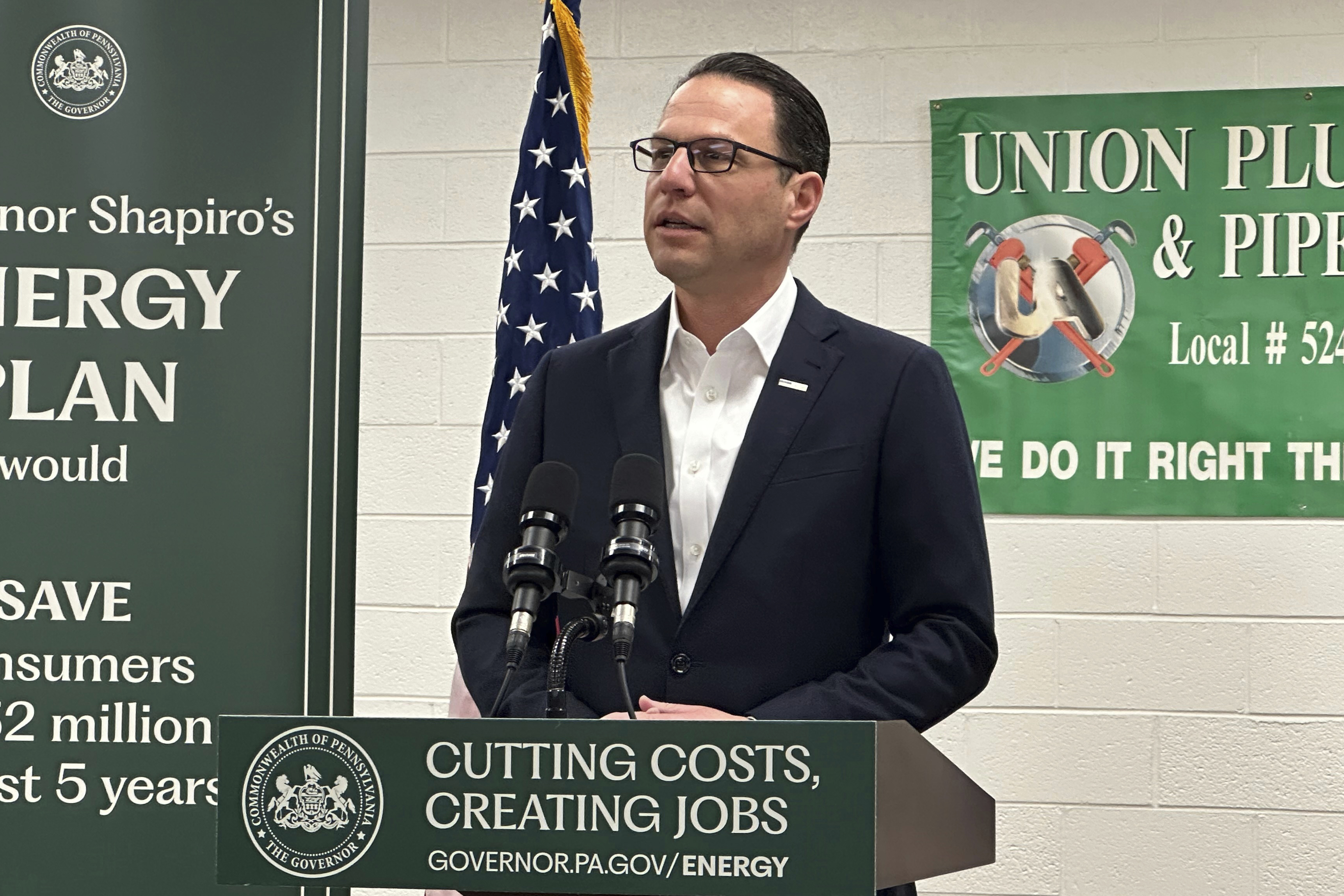
Pennsylvania Gov. Josh Shapiro speaks at a news conference at the United Association Local 524 union building in Scranton, Pa. in March 2024.
Saturday was the 62nd anniversary of the JFK assassination, but on Nov. 22, 2025 it was the entire planet that was under fire. One researcher declared that globally it was the hottest Nov. 22 ever recorded. It didn’t feel that way at my windswept dog park in Delco, but it did from the American Southeast — experiencing a record heat wave — to Tehran, where an epic drought has seen water fountains run dry. And yet the world’s leaders were on a full-fledged retreat from climate action, from the White House, where U.S. CEOs toasted the oil dictatorship of Saudi Arabia at a posh dinner, to Brazil, where a global summit on climate change failed to take on the hegemony of fossil fuels, to Harrisburg.
In a state that’s kowtowed to Big Oil and Gas interests since the days of John D. Rockefeller, Pennsylvania Republicans used the shame of the nation’s longest state-budget impasse to finally ram home their most cherished agenda item: gutting efforts in the Keystone State to work with our neighbors to control the greenhouse-gas pollution behind climate change. The GOP-run state Senate backed Democratic Gov. Josh Shapiro into a corner. Pennsylvania had to withdraw from Regional Greenhouse Gas Initiative (RGGI), a regional pollution-control system, or the money wouldn’t resume flowing to schools and other vital services.
To be clear, the drivers of this giant step backward were state lawmakers who’ve been swimming in Big Oil’s tainted campaign cash for a couple of decades now. But the capitulation, even at political gunpoint, was not Shapiro’s finest hour — especially as the Democrat with apparent ambition for higher office continues to push for polluting and energy-devouring data centers that he claims will boost the economy. As the American Prospect noted in a new piece, Pennsylvania’s environmental retreat came at the same time Virginia was electing a Democratic governor in Abigail Spanberger who’d promised to restore her state to the RGGI. If Shapiro does run for president in 2028, he may struggle to explain this deal to climate-minded voters.
The real problem, though, is that the best way to tackle climate change is by going on offense, with aggressive programs to promote alternative energy such as wind (there seems to be a lot of that around here) and solar that aren’t not only cleaner but a better deal for beleaguered consumers. While Pennsylvania — second only to Texas in natural-gas production — went all in on fracking, a 2024 survey found the commonwealth was 49th on expanding wind power and energy efficiency. With RGGI in the rearview mirror, the Shapiro administration needs to work a lot harder on green energy. That would be good for our governor’s White House dreams, but it would be a lot better for the planet.
What I wrote on this date in 2020
In the late fall of 2020, when I wasn’t trying to warn people that Donald Trump was planning a coup, I turned my attention to the incoming president, Joe Biden — and it’s both fascinating and sad to read how naive we were in the giddy aftermath of Trump’s defeat. In writing about Biden’s early Cabinet picks, the subhead read: “America is seeing the start of something it’s not used to: A White House that’s experienced, qualified … and boring. Could Biden’s ploy work?” NO! The answer turned out to be “no.” But still read the rest: “Biden’s Cabinet is ‘delightfully boring.’ Can reality-TV-addled America deal with it?”
Recommended Inquirer reading
Only one column last week as I spent time both preparing for and then canceling the Charlotte trip that never happened. In that piece, I vented my rage at the lavish White House shindig for a monster: Saudi Crown Prince Mohammed bin Salman, who was behind the brutal bone-saw murder of Washington Post journalist Jamal Khashoggi. The man that Joe Biden all too briefly promised to make “a global pariah” was feted by the CEOs of Apple, Nvidia, GM and just about any big business entity you can think of, in a stunning embrace of corruption that should end the myth of “woke corporations.”
There are two things, more than anything else, that keep local news in America alive: Hometown sports teams, and restaurants. Here in Philly, it was a lousy week for the former but a remarkable moment for the latter, as restaurants in the City of Brotherly Love competed for the very first time for recognition from the world’s ultimate dining survey, the Michelin Guide. In a glitzy ceremony at the Kimmel Center, Michelin bestowed its coveted star on three Philadelphia restaurants and honored more than 30 others — and Inquirer readers were obsessed. Four of the newsroom’s top seven most-read articles online last week were about the Michelin madness — including the bittersweetness of one eatery cited just before its closing, the cheesesteak shop that was honored but not invited, and other various snubs and surprises. The Inquirer has amped up its food coverage this year, and if you live and eat in this region I don’t know how you’d survive without it. If you don’t subscribe, please sign up today.
By submitting your written, visual, and/or audio contributions, you agree to The Inquirer‘s Terms of Use, including the grant of rights in Section 10.
The Democrats had a great election night earlier this month when the democratic socialist Zohran Mamdani scored a smashing triumph in New York’s mayoral race, and mainstream Democrats won gubernatorial contests in New Jersey and Virginia. Savoring the victories, left-wing standard-bearer Alexandria Ocasio-Cortez said her party had united against a common foe: fascism.
“It’s not about progressive, it’s not moderate, it’s not liberal,” Ocasio-Cortez declared. “This is about, do you understand the assignment of fighting fascism right now? And the assignment is you come together across difference no matter what.”
She’s right about the need for my fellow Democrats to join hands to challenge President Donald Trump and his MAGA loyalists. But she’s wrong to call them fascists. That doesn’t hamper Trump; it empowers him.
And you know who gets that? Zohran Mamdani.
Witness his meeting with Trump at the White House on Friday, when a reporter asked Mamdani if the president was a fascist. Before the mayor-elect could answer, Trump threw him a lifeline.
“That’s OK, you can just say yes,” Trump said. “It’s easier than explaining.” Laughing, he gave Mamdani a light pat on the arm. “I don’t mind,” Trump added.
Mamdani played along, smiling widely. “OK, all right,” he replied.
But it was better than all right. It was brilliant.
Calling Trump a fascist does nothing — literally, nothing — to advance the Democrats’ cause. And Mamdani was wise to steer away from it.
To win elections, the Democrats need to claw back voters who tipped for Trump and the GOP in 2024. Do you think they’re going to be persuaded by someone telling them they supported a fascist?
If so, you just haven’t been listening. Last October, a mask-wearing protester accosted Tom Eddy — chairman of the Republican Party in Erie County, Pa. — and called him a fascist. “Do you even know what it means?” Eddy asked. “Don’t need to know,” the masked man replied. “I know who you are.”
A month later, Trump won Pennsylvania by the largest margin of victory for a Republican presidential candidate since 1988. Of course, Democratic accusations of fascism weren’t the only reason for that. But they certainly didn’t help.
Neither does calling Trump a white supremacist or racist, which is another turn-off for voters. In a 2023 Public Agenda survey, 77% of Americans said it was a “serious problem” that “people are too quick to accuse others of racism.”
And it’s not just white voters who think that. In the poll, 77% of Latino Americans and 76% of Asian Americans agreed with the statement. The percentage of African American voters who agreed was a bit lower — 68% — but still represented a significant majority.
Let me be clear: Donald Trump has said some horribly racist things: Haitians eat pets, Mexicans are rapists, Africa is full of shithole countries, and so on. But calling him a racist won’t sway anyone into the Democrats’ column; it’s more likely to bring people to his side because they’re sick and tired of hearing about how racist America is.
“Enough with the ‘He’s a Hitler,’” the comedian Jon Stewart said of Democratic candidates who attack Donald Trump. “Tell people what you would do with the power that Trump is wielding, and then convince us to give that power to you, as soon as possible.”
Ditto for labeling Trump a fascist. I’ve read my Timothy Snyder and Jason Stanley, and I do see elements of fascism in Trump’s MAGA movement: the relentless denunciation of internal enemies, the Big Lie about elections (see: 2020), and the celebration of a strongman who will save us. But I still think it’s an enormous mistake to imagine all of his supporters — or, even, his entire party — as fascist.
That’s what the American Association of University Professors — our nation’s most venerable academic organization — did earlier this fall.
Rebutting the idea that academia is biased against conservatives, the AAUP posted that “fascism generally doesn’t do great under peer review.”
Translated: The reason there aren’t more conservative professors is that they’re actually fascists. So is anyone who disagrees with the dominant liberal consensus on campus.
As comedian Jon Stewart warned back in January, none of this is going to enlist more voters for the Democrats. “Enough with the ‘He’s a Hitler,’” Stewart urged. “Tell people what you would do with the power that Trump is wielding, and then convince us to give that power to you, as soon as possible.”
That’s exactly right. And that’s also what Mamdani has been doing, with his persistent focus on housing and affordability.
Pressed by an interviewer on Sunday, Mamdani said he stood by his earlier comments that Trump was a “despot” as well as a fascist. But he quickly changed the subject, because he knows that’s a game Democrats can’t win.
“I’m not coming to the Oval Office to make a point or make a stand,” Mamdani declared. “I’m coming in there to deliver for New Yorkers.”
The way for Democrats to defeat Trump and the GOP is to show we can deliver for all Americans, in the ways that matter most to them.
So enough with the name-calling, OK? It makes us look churlish and small. Focus instead on the big things we can do. And we will be all right.
As families across America prepare to settle in for turkey, stuffing, and football, the Trump administration is imposing a brutal choice on the people of Ukraine: capitulate by Thanksgiving, or lose U.S. support.
If the bloodiest fighting in Europe since World War II is to come to an end, any peace plan must be fair and hold Russia accountable for invading its neighbor. The 28-point plan released last week and endorsed by the White House would enshrine injustice instead.
Perhaps the only surprise about the lopsided peace proposal is that it took so long. Ever since Donald Trump returned to the Oval Office, it has often felt like an all-out push for Kyiv’s surrender is just around the corner.
Meanwhile, the situation on the ground has deteriorated.
Ukrainians have taken to covering their streets and homes with anti-drone nets due to the Russian military’s “human safari” tactics. Russian drone operators have terrorized civilians and aid workers by attacking them indiscriminately, making simple errands dangerous in cities close to the front lines.
Russia’s military, fueled by the conscription of ethnic minorities, convicted criminals, and Ukrainians from Russian-occupied territories, has made incremental gains. Meanwhile, the Ukrainian military has suffered from increasing rates of desertion and low morale. While most Ukrainians do not want to give up territory to end the fighting, this position has become more popular over time because of the suffering and devastation the war has unleashed.
American support for Ukraine has reached new lows under Trump, but President Joe Biden bears much of the blame for what’s happening today. The past administration never supplied Ukraine with anything close to the kinds of weapons it needed to succeed in the war’s early stages. Instead of rushing F-16 fighter jets into the country, Biden held off on delivering them for years. Long-range missiles, which would have allowed Ukraine to strike deeper into Russian territory, were also delayed.
The Trump administration seems prepared to compound this betrayal by forcing Ukrainians to accept a peace plan that some U.S. senators have suggested was written by Moscow.
As released last week, the plan would force Ukraine to cede territory, abandon hopes of joining NATO, and cap the size of its military. It would create a blanket amnesty for war crimes and allow Russia to rejoin the G8 and reintegrate into the global economy.
Given the scale of the suffering in Ukraine’s towns and cities and along the front lines, peace is a crucial goal. Beyond the direct human toll, the war has also led to the destruction of the Khakhovka Dam on the Dnieper River, a major environmental disaster. Russian recklessness has also repeatedly endangered nuclear plants.
Zelensky and European leaders have countered the plan with one of their own, which was immediately criticized by the Kremlin. Ukrainian negotiators are keen to avoid formally handing over territory, remove or raise the cap on the size of their military, and allow for eventual NATO membership, even if it is off the table in the foreseeable future.
U.S. efforts to end the war should be more in line with its allies’ proposal, instead of fulfilling Putin’s wish list. If Trump sides with Russia, it will send a clear message to other authoritarians that the West will not stand together against illegal aggression.
If America sells out Ukraine, the world will be watching.
As your recent editorial noted, the central sticking point in negotiations between City Council and the mayor on the best and fairest way to focus limited housing funds appears to be how to divide that pie between the neediest and those who have just a little bit more. One way of addressing this dilemma is to increase the size of the pie. This could be done, not by borrowing more, which would just jack up the already eye-popping amount we’ll have to pay back in interest, but by utilizing resources from the city’s $8 billion pension fund. For decades, our neighbors in New York City have directed 2% of the investments by their pension fund to local housing. As a result, the fund has produced almost 100,000 affordable units. One of the groups they invest in is the AFL-CIO Housing Investment Trust, whose sole purpose is to invest public and union pension funds in the construction and rehabilitation of housing. Let’s get some of our pension fund’s billions working here in the city, and reap the rewards of more affordable housing for all.
I am troubled by potential funding cuts at the Environmental Protection Agency. I want my children, grandchildren, and great-grandchildren to live on a planet where the air is safe for them to breathe, where fruits and vegetables are safe for them to eat, and where the water is clean and safe to drink. I’m sure all of you want the same. If we don’t do something immediately, the generations after us will not be able to turn things around because of the terrible things we have done — and continue to do — to the earth’s air, water, and soil. Our planet, and everything on and around it, needs our protection.
Please write your senators and representatives and ask them to make clear their strong support for the EPA when funding decisions are being made.
Becky Comer, Gilbertsville
Review resign-to-run rule
We should press for a no vote on City Councilmember Isaiah Thomas’ proposed amendment to the resignation-to-run rule. If Thomas gets his way, Council members would be allowed to stay in office while running for state or federal elections.
This is just a step toward eventually letting city officials stay in their official capacities while running for another city office.
How about letting them use their own money, or campaign funding, to support their efforts while campaigning for a higher or different office?
Or maybe a compromise could be that they wouldn’t be paid their city salary if they run for local, state, or federal elections?
Michael Miller Jr., Philadelphia
Abortion stance unbrotherly
I was both shocked and disheartened to learn that the City Council of Philadelphia, where I was born and raised, has recently passed a resolution declaring abortion a “human right.” This decision prompts serious reflection on the meaning of human rights and who they truly protect.
Human rights, by their very definition, are meant to be universal and encompass all individuals, including the unborn child. These children in the womb are among the most vulnerable members of our community, yet they have become the victims of an industry that regards the termination of their lives as necessary for controlling population growth in our city.
In light of this, I propose that our City Council consider a new resolution: to remove the long-standing moniker “City of Brotherly Love” from Philadelphia. It is a contradiction to celebrate brotherly love while simultaneously excluding and disregarding the rights of the most defenseless among us. How can we claim to embody brotherly love if we do not extend it to every member of our population?
Patricia Dowling,Philadelphia
Join the conversation: Send letters to letters@inquirer.com. Limit length to 150 words and include home address and day and evening phone number. Letters run in The Inquirer six days a week on the editorial pages and online.
This is not to say people of color aren’t getting city business. The Office of Economic Opportunity (OEO) said what it calls “minority, women, and disabled business enterprises” received more than $370 million in city contracts in fiscal year 2023.
The city’s goals call for 35% of city contracts to be awarded to businesses owned by women, people of color, and people with disabilities. During the 2023 fiscal year, 31.4% of city contracts went to companies owned by people from those demographic groups.
However, Black-owned businesses only accounted for about 13.5% of all city contracts.
So why don’t participation goals work better for Black people? I believe the answer is simple. Bias and race-based exclusion are built into a system where money is plentiful but accountability is not.
Ryan Boyer, the head of the city’s building trades unions, speaks at a January news conference. Although Boyer now leads the group, the unions spent generations excluding Black people, Solomon Jones writes.
That leaves the city asking white-owned businesses with largely white workforces to meet minority participation goals set by the Office of Economic Opportunity.
According to a former manager in the OEO, who would speak to me only on the condition of anonymity, companies that don’t meet the goals rarely face consequences.
That’s been the case for years. In fact, I wrote a 2016 Inquirer column that noted that in the 2015 fiscal year, nearly 70% of city-funded construction projects with budgets over $250,000 did not reach the city’s participation goals for people of color, and 44% had no participation by people of color at all.
Very few were held accountable for it then, and very few are held accountable now.
But even if the goals didn’t deliver what they should have, it’s galling to lose them at a time when the president is pushing an anti-Black agenda, complete with policies that led to job losses for over 300,000 Black women during his first year in office. Sadly, that’s just the tip of the iceberg.
But this is about more than the president’s recent actions. This is about Trump’s long game. From Road-Con Inc. v. City of Philadelphia, which challenged the city’s minority set-asides, to the U.S. Supreme Court’s decision to kill affirmative action, the multipronged attack is not just meant to set precedents. This attack is meant to set us back.
That’s why, when we see our civil rights gains under attack, we want our leaders to stand and fight.
I asked Mayor Cherelle L. Parker if changing the minority participation goals to small and local business goals represented the kind of fight our community wants from her.
“I am 53 years old,” she said, “and I have been working in government and public service since I was 17 years old. I don’t know anyone in this city who knows me who has ever questioned whether or not I’m willing to fight for what I believe in. I’m a product of this city. You heard me reference the intersection of race and gender. But I thank God that I’m made and built from the kind of material that says a speech is not enough. You have to deliver tangible results.”
The mayor went on to say the community should hold her accountable. I agree, and we will.
But I am also one of those people who have known the mayor for years. She is indeed a fighter, and she’s fighting this her way. We only need one thing from her: a win.
Now and then, we still see the Amish horse and buggy tooling its way down Fairview Road. Occasionally, someone will alert their neighbors in a Facebook post that a cow or a horse has escaped a pasture and is blocking the road. “That’s so Glenmoore,” a local resident will chime in nostalgically.
But Glenmoore, like the rest of America, is changing, in ways both obvious and subtle.
It’s rare now to see a horse travel down a road that has a steady flow of traffic. Where cows once used to escape to sip the water of the branch of the Brandywine Creek that flows through the part of town residents call “the village,” you can look up a hill and see the large homes of the newest development, just one in an array of luxury homes built on the hill.
Don’t get me wrong. Wallace Township (the Glenmoore postal area is significantly larger) is still pretty amazing. It’s Glen Moore Fire Co. members lined up in a row at a funeral inside one of our historic churches to honor the wife of a longtime member. It’s Pete the cat walking his people to the elementary school on days when it’s in session. Some of my best friends are people I’ve met on walks, often punctuated with a stop at the village coffee shop, the Mean Bean.
The Chester County poll book debacle in the Nov. 4 election didn’t help nurture a sense of calm about something many of us had taken for granted — the sanctity of our vote. In case somehow you missed the hubbub, when independent and third-party voters (there are approximately 18% of us) got to the polling place, we were told that, because they hadn’t gotten the right poll books for us, most of us would have to cast provisional ballots.
I was aware of others in my position. We kept checking to see if our vote showed up on the Voter Services website. As of last Monday, resident Dorothy Kirk, an independent, said, “I am skeptical that our votes were counted.” It took almost 15 days to register Kirk and her husband’s votes on the Voter Services website.
Unlike some other townships in our environs, which have become increasingly blue, Wallace voters are registered as more than 50% Republican, and have been for many years.
This year, we already had more of a local stress test: a competitive race for one seat in the three-member board of supervisors — replete with candidate websites, campaign literature, and canvassing. That’s a lot of drama for our relatively small (less than 3,000 registered voters) township.
Call me naive, but knowing the local judge of elections, I had confidence my vote would count.
But it wasn’t long before I started to hear from other residents. Let’s just say, they had questions.
Tish Molloy, a former Wallace poll worker, spent a few hours observing the ballot certification process in West Chester after the election, curious to see how it was done. Though onlookers could not see everything, she said, the workers seemed to be “careful, cautious, and mindful,” as well as efficient.
Though Wallace Supervisor Rob Jones, serving as a Republican, had some pointed comments about the potential for mismanagement at the county level, he said he didn’t think anything “nefarious” had occurred. “I just think we have a basically honest populations out there,” said Jones. “I do think the county learned a lesson.”
As for the township? Jones was ready to move on from what was a fairly heated campaign by Wallace standards, urging neighbors in this small community to avoid viewing each other through a political lens. “The way you show love for people with your township is through what you do. When I make a decision [about the township], I don’t care what their party is. How can I bless the most people in the township?”
Though he came closer than other Democratic candidates in recent memory, Andrew Holets conceded the supervisor’s race to Republican candidate John Thomas last Friday evening. Perhaps it’s not surprising, in a town where so many people know and depend on each other, that his vision is similar to that espoused by Jones. Building trust isn’t just up to leadership, he said. It’s about practicing kindness and doing the right thing.
“Everybody has responsibility,” said Holets. “How they wake up and how they spend their day makes a difference in how much we care for ourselves and others. I don’t want to buy into the division that seems to be here in our country. I don’t think we need to have that locally.”
Nonetheless …
The bonds of mutual trust and affection are still pretty strong around here. At the same time, it’s hard not to wonder what else could go wrong, and it’sarrogant to think ourselves immune from the polarization that has divided neighbor from neighbor and family from family.
While it’s up to Chester County to rectify its mistake, the future of our community is also, as both Jones and Holets said, in our hands. We can’t afford to assume our neighbors trust us. We have to renew those bonds together, one act of service, citizenship, and kindness at a time.
We’ve had our shot across the bows. Now it’s up to us to make sure we get safely to harbor. The cost of drifting is way, way too high.
Elizabeth Eisenstadt Evans is a freelance journalist in Chester County. Her writing has appeared in Religion News Service, the National Catholic Reporter, Sojourners, Christian Century, the Washington Post, and The Inquirer.