Category: Politics

Political news and coverage

  • Takeaways from Trump’s address: Sales mode on economy, heavy on patriotism, dark turn on Democrats

    Takeaways from Trump’s address: Sales mode on economy, heavy on patriotism, dark turn on Democrats

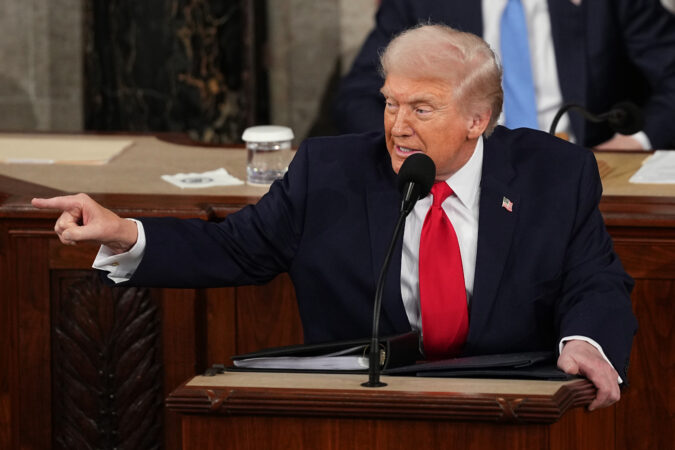
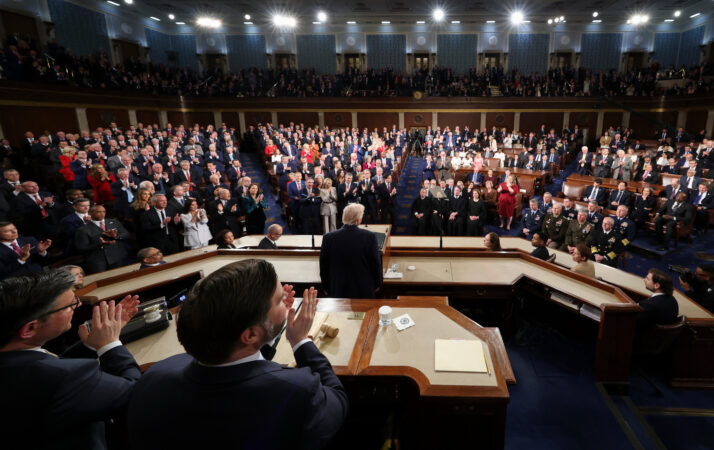
    WASHINGTON — President Donald Trump started in sales mode, using his State of the Union address to deliver an upbeat vision of the U.S. economy.

    But that portrayal collides with the sentiment of Americans who remain anxious about their finances and feel they haven’t benefited from Trump’s policies. He took the high road to honor the gold medal-winning U.S. men’s Olympic hockey team and a war hero before pivoting abruptly to a darker tone as he ridiculed Democrats.

    Here are takeaways from the speech.

    Trump’s ‘roaring’ economy is at odds with sour public sentiment

    Much of the nation is worried about the direction of the economy, but Trump says the good times are here, insisting repeatedly that rising costs are no longer a problem.

    “The roaring economy is roaring like never before,” he said. He cheered the lower cost of gasoline, mortgage rates, prescription drug prices, and the rising stock market: “Millions and millions of Americans are all gaining.”

    Such optimism, as so many Americans are feeling economic strains, risks painting Trump as out of touch. Just 39% of U.S. adults approved of Trump’s handling of the economy in February, according to AP-NORC polling.

    Still, the president focused much of the first hour of his speech on the economy, something Republicans had urged him to do as they head into the midterm elections.
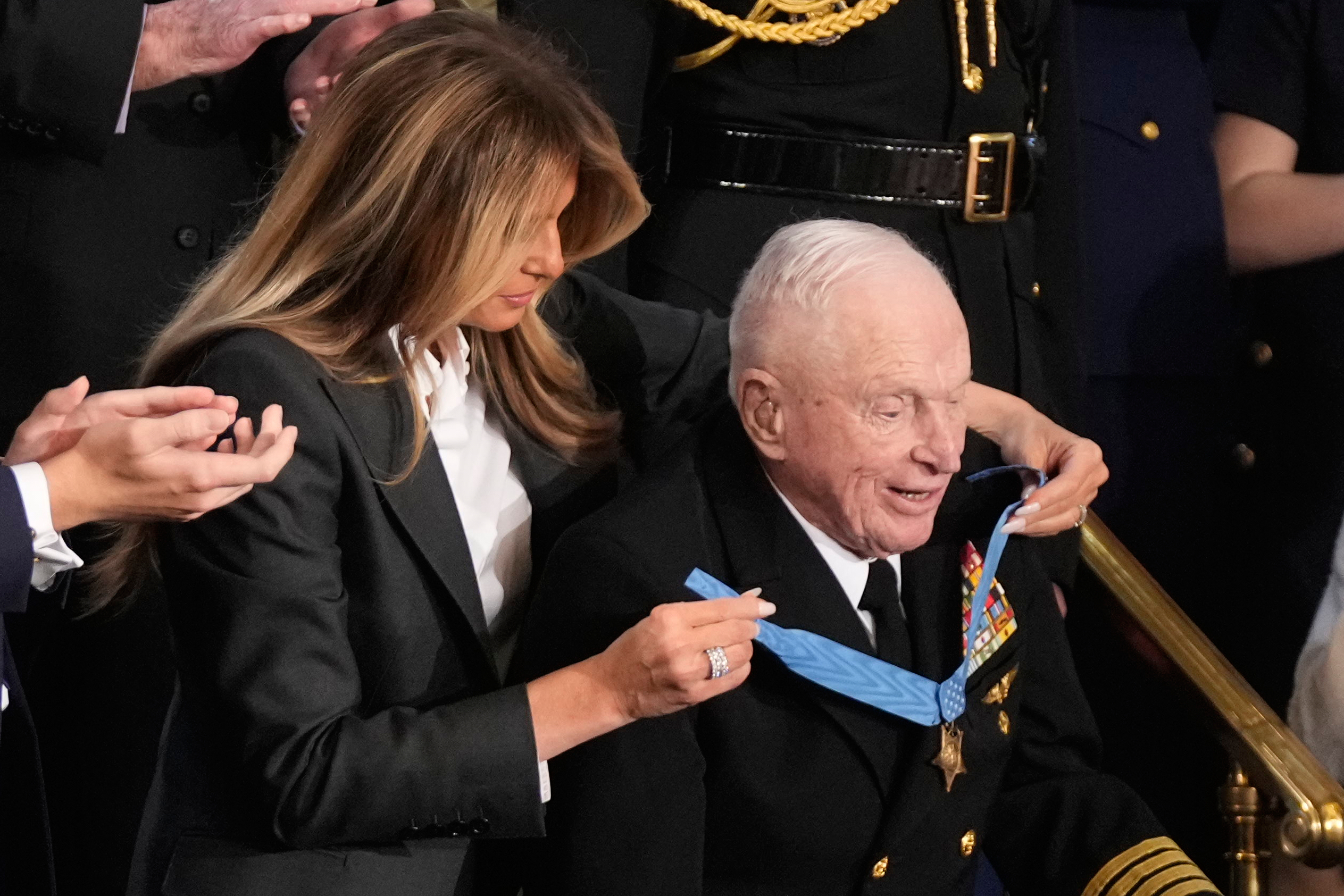
    First lady Melania Trump awards World War II Navy pilot Capt. Royce Williams the Congressional Medal of Honor as President Donald Trump delivers the State of the Union address to a joint session of Congress.

    Trump wraps himself in the flag

    For a president who always seems to be spoiling for a fight, Trump also tried to summon Americans’ innate patriotic impulses. In addition to the hockey team, he singled out war heroes and those who had taken brave stands in other countries, using the moment to bestow numerous presidential medals in an effort to give the address a more positive gloss.

    It underscored the president’s media savvy and understanding that even if a moment isn’t appreciated completely in real time, it can have an afterlife in the days following speech, especially on social media.

    Yet in one revealing moment, Trump lamented why he couldn’t give a congressional medal to himself.

    Taking aim at Democrats

    Tributes to the Olympic hockey team and a World War II veteran didn’t unify the room for long.

    The Republican president soon took aim at Democrats and blamed them for many of the nation’s ills.

    Trump said rising healthcare premiums are “caused by you,” suggested Democrats “are not protecting” Social Security and blamed them for the nation’s affordability crunch. “You caused that problem. You caused that problem,” Trump said as he glared at the Democratic side of the room.

    He seemed to get angrier as the speech progressed.

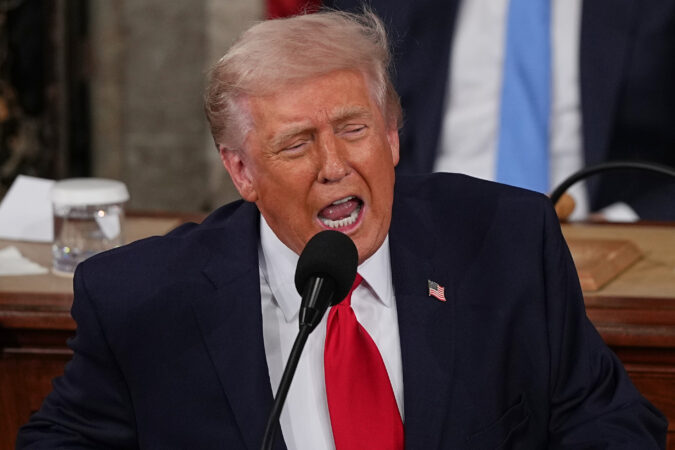
    “These people are crazy, I’m telling you, they’re crazy,” he said. “Democrats are destroying this country.”

    Trump’s MAGA base loves such aggression. It’s unclear, however, if the rest of the country feels the same.
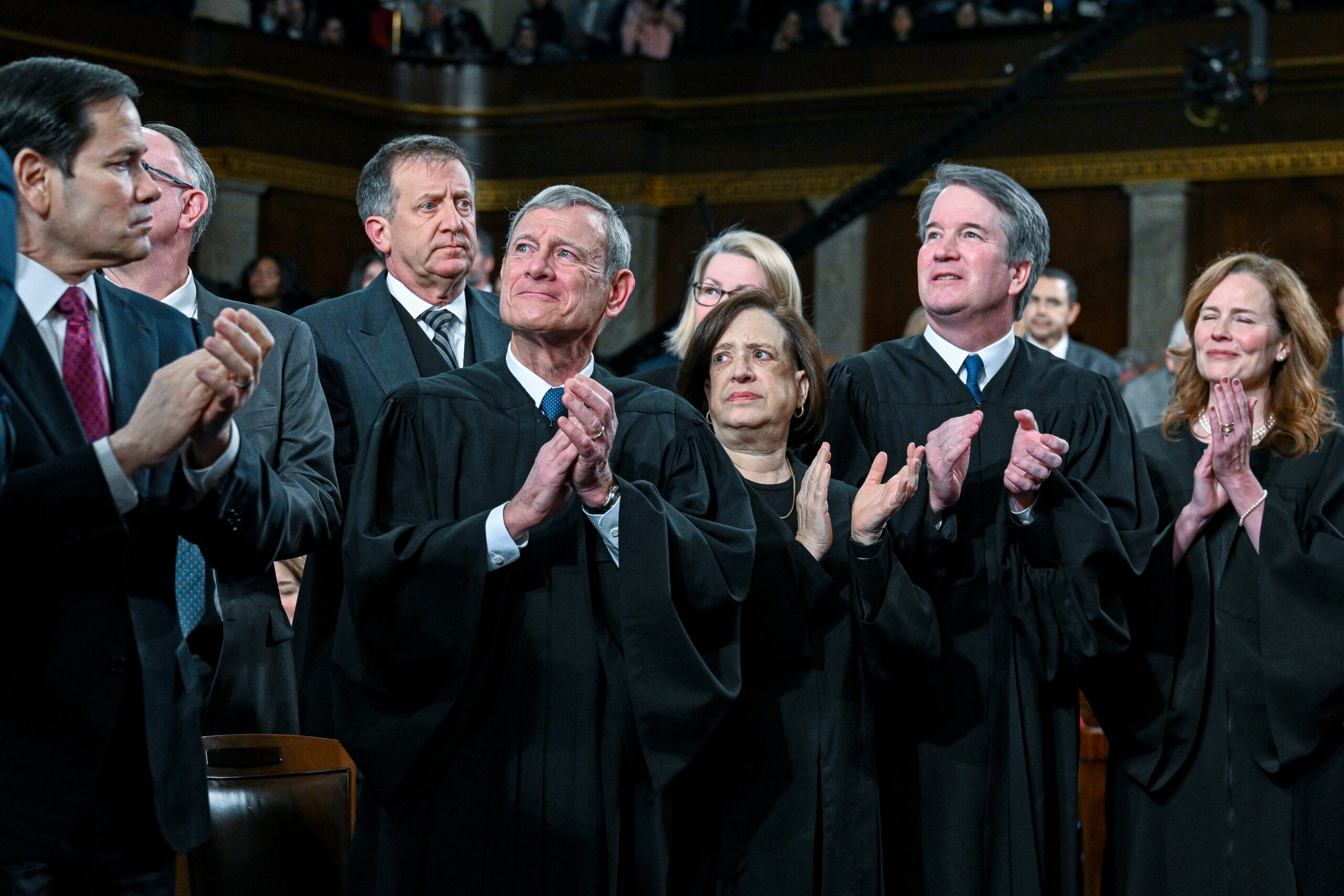
    Secretary of State Marco Rubio (from left), Chief Justice John Roberts, Justice Elena Kagan, Justice Brett Kavanaugh, and Justice Amy Coney Barrett applaud before President Donald Trump delivers the State of the Union address Tuesdy to a joint session of Congress in the House chamber at the U.S. Capitol.

    The Supreme Court’s ‘unfortunate’ decision

    By Trump’s standards, he held his tongue when it came to the Supreme Court.

    After the court struck down his tariff policy last week, Trump said the justices who voted against one of his signature issues were an “embarrassment to their families.” By Tuesday, he simply called the ruling “unfortunate.”

    Trump sought to treat the ruling with indifference, insisting that tariff revenues were “saving” the U.S., ignoring the fact that the levies haven’t made a significant dent in government debt. He said the tariffs were paid by foreign countries even as virtually every study concludes that costs have been paid by U.S. firms and consumers.

    At one point, he seemed to take the long view that history would ultimately vindicate him even if the Supreme Court would not.

    “As time goes by, I believe the tariffs paid by foreign countries will, like in the past, substantially replace the modern day system of income tax, taking a great burden off the people that I love,” he said.

    That is unlikely. The federal income tax is authorized by the 16th Amendment to the Constitution and the power to collect revenue is ultimately defined by Congress, not the president.

    Trump vows action on election ‘cheating’

    The president also used the speech to reprise his attack on the integrity of U.S. elections.

    “Cheating is rampant in our elections,” Trump said.

    Trump has made such claims for years, focused on his 2020 election loss, claims rejected by dozens of courts and his own attorney general at the time.

    But the timing of Tuesday’s prime-time claims, less than nine months before voters across America are scheduled to decide control of Congress, was noteworthy. So, too, was Trump’s suggestion that he would take action to address a problem that doesn’t appear to exist.

    “They want to cheat. They have cheated, and their policy is so bad that the only way they can get elected is to cheat,” Trump said of Democrats. “And we’re going to stop it. We have to stop it.”

    Trump is calling on Congress to pass a bill requiring voters to show a photo ID before casting ballots. But he also recently vowed to enact an executive order to address the issue, although the White House has not clarified what it might entail.

    No mention of Minneapolis

    Sometimes what’s not said is as notable as what is.

    Trump has highlighted immigration since the very first speech in which he announced his 2016 presidential campaign. And on Tuesday night, he revived much of the same language he’s used throughout the past decade, blasting “criminal aliens” and warning of “drug lords, murderers all over our country.”

    What he didn’t mention: the most aggressive immigration enforcement tactics that threatened to bring the U.S. to the brink earlier this year. He didn’t mention the deaths of two U.S. citizens in Minneapolis last month at the hands of federal agents.

    Indeed, it was Rep. Rashida Tlaib (D., Mich.), who shouted that “Alex wasn’t a criminal,” referring to Alex Pretti, one of the U.S. citizens killed in Minneapolis.

    During her Democratic rebuttal, Virginia Gov. Abigail Spanberger said law enforcement must work to build trust in communities and said Trump “every minute spent sowing fear is a minute not investigating murders.”

    Trump said nothing of his administration’s shift in tactics, including a drawdown of agents in the Twin Cities. And he made no acknowledgment of the broad concerns in the U.S. about Trump’s approach on immigration, as demonstrated by the 60% of U.S. adults who disapproved of his handling of the issue in February, according to AP-NORC polling.

    Drumbeat for war gets louder

    Trump has already built up the largest U.S. military presence in the Middle East in decades. And in his speech, he outlined a rationale for using those forces to launch a major military strike against Iran.

    The president said that Iran and its proxies have “spread nothing but terrorism, death and hate,” adding that its leaders killed at least 32,000 protesters in recent weeks, which is at the further end of estimates over the death toll. The U.S.-based Human Rights Activist News Agency has so far counted more than 7,000 dead and believes the death toll is far higher. Iran’s government offered its only death toll on Jan. 21, saying 3,117 people were killed.

    Trump also warned that the nation has developed missiles that can threaten Europe and is working on missiles “that will soon reach” the U.S.

    “My preference is to solve this problem through diplomacy. But one thing is certain, I will never allow the world’s number one sponsor of terror, which they are, by far to have a nuclear weapon. Can’t let that happen.”

    On brand, the speech was the longest SOTU ever

    The president, ever mindful of records that allow him to say he was the first, the best or had done the most, succeeded clearly on one thing: he beat his own record for the longest, clocking in at just under 1 hour, 48 minutes.
  • New Jersey lawmakers got a 67% pay increase, but most have other jobs too

    New Jersey lawmakers got a 67% pay increase, but most have other jobs too

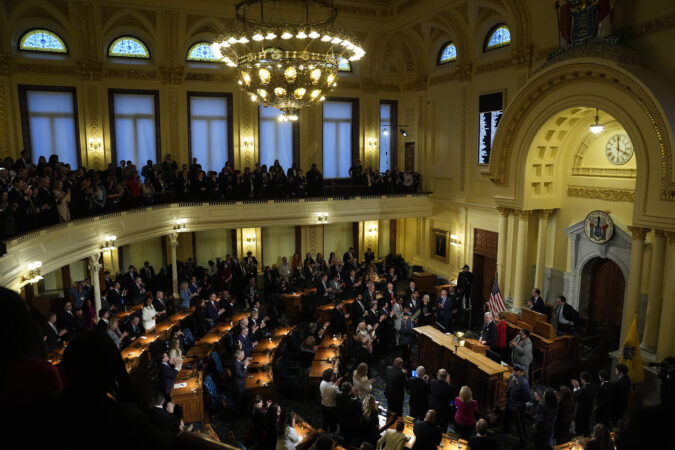
    New Jersey lawmakers just got a nearly 70% raise when they took their oaths in January.

    It’s their first pay bump in more than two decades. The state’s legislators had been paid a $49,000 salary since 2001, but this year they saw it jump to $82,000 under a law signed in 2024.

    Despite the increase, their spending power isn’t any bigger than it was 25 years ago. But legislators giving themselves a raise is a politically fraught move.

    Their new salaries fall below the state’s median household income of more than $100,000, though the legislature says most of its members have other employment. Garden State lawmakers are considered part-time, even though they meet throughout the year and some members say the job is a full-time commitment.

    “They say it’s part-time but I would argue that people act like it’s full-time, and it really is a full-time job,” said Assemblymember Anthony Angelozzi, a newly elected Democrat who represents parts of Burlington and Atlantic Counties and also works as a Hammonton teacher and leads the Hammonton Education Association, the local teachers union.

    “My term is two years, and I am in a swing district … so if I don’t work hard every day to do things in my district and to talk to people, build relationships, visit the 25 towns that I represent, I’m going to lose my seat,” he said.

    window.addEventListener(“message”,function(a){if(void 0!==a.data[“datawrapper-height”]){var e=document.querySelectorAll(“iframe”);for(var t in a.data[“datawrapper-height”])for(var r,i=0;r=e[i];i++)if(r.contentWindow===a.source){var d=a.data[“datawrapper-height”][t]+”px”;r.style.height=d}}});

    New Jersey legislators are now among the highest-paid in the country, but they’re still paid less than their counterparts in Harrisburg, whose salaries are more than $113,000, including per diems, above Pennsylvania’s median household income of roughly $78,000.

    Though Pennsylvania lawmakers only come to Harrisburg a few times per month to vote on bills — and many hold other jobs — they are considered a full-time legislature.

    In New Jersey, each chamber was scheduled to meet for less than a dozen full sessions in 2025, but members met more frequently for committee meetings and quorums, in which lawmakers can conduct business if more than half are present.

    Most New Jersey state lawmakers have other jobs, too

    Along with Angelozzi, all of the other 19 state lawmakers who represent Camden, Burlington, and Gloucester Counties in the state House and Senate also received a paycheck from outside employment, according to 2024 financial disclosures. A handful of them also reported receiving Social Security or pension income.

    Assemblymember Balvir Singh, a Burlington County Democrat who began his term last year, said he’s not sure he would have voted for the pay increase given the drastic jump at once, though he would have supported a formula with annual increases over time.

    “I think not doing something for so many years and then doing it all of a sudden, definitely is a suspicion among people, and rightfully so,” he said.

    Singh works as a public school curriculum and instruction supervisor, which gives him flexibility to plan his work hours around days he has to be in the legislature, though he still uses his time off for legislative matters and constituent services.

    window.addEventListener(“message”,function(a){if(void 0!==a.data[“datawrapper-height”]){var e=document.querySelectorAll(“iframe”);for(var t in a.data[“datawrapper-height”])for(var r,i=0;r=e[i];i++)if(r.contentWindow===a.source){var d=a.data[“datawrapper-height”][t]+”px”;r.style.height=d}}});

    Does better pay mean Trenton can better represent New Jerseyans?

    Proponents of paying elected officials higher salaries argue that it can lead to a more diverse legislature that’s more representative of New Jerseyans, though the evidence is limited.

    Anthony Campisi, a political consultant who works in both New Jersey and Pennsylvania, said higher legislative pay opens up the prospect of running for state office to those who aren’t independently wealthy or hold white-collar jobs, that come with the flexibility to go to Trenton regularly, like lawyers.

    “I think it’s a good thing to pay legislators living wages,” he said. “They’re responsible for appropriating billions of dollars for overseeing important legislative work that impacts every aspect of our lives.”

    But Peverill Squire, a national expert on legislative pay based at the University of Missouri, said pay increases lead to minimal changes in the makeup of legislatures because of the financial and time commitment that comes with running for office.

    “It makes it more attractive for more people to think about, but it’s still a very difficult thing to run for office, and so in the final analysis, it doesn’t have as big an impact as one might have thought it would,” he said.

    That being said, higher pay can incentivize legislators to remain in the job. Squire said state lawmakers who step down voluntarily often do so because of the financial impact on their families.

    The average state legislator salary across the country hasn’t kept pace with inflation over the past few decades, according to the National Conference of State Legislatures (NCSL). In New Jersey, the old salary of $49,000 in 2001 had the buying power of roughly $90,000 today.

    New Hampshire legislators receive the lowest annual salary of $100, which has not been changed since 1889. Meanwhile, New Mexico lawmakers do not receive a salary, but they receive per diems.

    In 2025, only six states paid their lawmakers more than New Jersey lawmakers’ new salary of $82,000, while Pennsylvania lawmakers made the third most behind New York and California, according to NCSL data.

    New Jersey Gov. Mikie Sherrill holds up a just signed executive order during her inauguration ceremony in Newark, N.J., Tuesday, Jan. 20, 2026. Sherrill will received a higher salary than her predecessor, former Gov. Phil Murphy, under a law taking effect this year.

    Should New Jersey become a full-time legislature?

    The 2024 law, which was signed by former Gov. Phil Murphy, also increased the salary for the governor and other public employees, including legislative staff, cabinet members, and judges.

    Starting this year with Gov. Mikie Sherrill, the state’s top executive got a 20% pay increase from $175,000 to $210,000. For comparison, Pennsylvania Gov. Josh Shapiro’s salary has risen to nearly $254,000 this year.

    The Office of Legislative Services estimated in 2024 that the increases altogether would bring a cost increase to the state of at least $9.8 million for 2026 and at least $12.4 million in 2027 and thereafter.

    The bill faced opposition from some Republican lawmakers, including member Alex Sauickie, a Republican whose district includes parts of Burlington, Middlesex, Monmouth, and Ocean Counties. Sauickie said the bill was brought forward at a horrible time as New Jersey residents struggled with the high cost of living — an issue that persists as the law takes effect.

    “We should fix the state for everybody else before we make adjustments for ourselves,” said Sauickie, whose district includes parts of Burlington, Middlesex, Monmouth, and Ocean Counties.

    The GOP lawmaker said he does not believe higher wages lead to better legislators.

    “Under the old salary we had questionable legislators, and out of the gate on the new salary I think we still have questions about certain legislators,” he added.

    Antoinette Miles, the state director of the progressive Working Families Party, said New Jersey should have a full-time legislature with term limits, attractive pay, and limits on outside income.

    “The real problem is that too many legislators are moonlighting as lawyers, lobbyists, or even at a second public job,” she said.

    But even with a higher salary, the lack of job security as an elected official makes it a hard sell as an only source of employment, especially in a politically fickle district like Angelozzi’s.

    “Nothing in politics is guaranteed … if I lose my job, I would have to be guaranteed to go back to my full-time day job, because, you know, I have bills to pay,” Angelozzi said.

  • How a land dispute between Gov. Josh Shapiro and his neighbor is shaking up a sleepy Abington neighborhood — and why he says it’s a ‘political stunt’

    How a land dispute between Gov. Josh Shapiro and his neighbor is shaking up a sleepy Abington neighborhood — and why he says it’s a ‘political stunt’

    When a messy land dispute between Gov. Josh Shapiro and his backyard neighbor poured into public view via federal court filings earlier this month, it jolted his sleepy Montgomery County neighborhood.

    The picturesque suburban community tucked behind Penn State Abington is usually quiet and boring, current and former neighbors said, just the way they like it. It’s a great place to raise their kids, and where Shapiro’s four children have grown up. Among the biggest points of contention is when one neighbor fails to say hello to another. Many houses in the neighborhood sit a quarter-mile away from the main road, behind winding, tree-lined driveways. Some of the homes have been purchased in recent years for upward of $1 million. In many ways, the neighbors said, it’s the perfect picture of the suburban American dream.

    But this month, the neighborhood also became the battleground for dueling lawsuits between Shapiro and his neighbors, Jeremy and Simone Mock, bringing tension to a tranquil community.

    What’s more: Shapiro’s office alleges the lawsuit against him is a political hit job to hurt him as he runs for reelection, citing the Mock family’s communications with the top Republican in the state Senate and his frequent sparring partner, President Pro Tempore Kim Ward. The family’s attorney in the lawsuit is also a local lawyer known to represent Republican causes, and whose former clients include the political campaigns of President Donald Trump and U.S. Sen. Dave McCormick.

    The Mocks, meanwhile, argue in their lawsuit — filed in the U.S. District Court for the Eastern District of Pennsylvania — that Shapiro has used his powerful position as governor to infringe on their constitutional rights and take their land.

    The disputed land — a 2,900-square-foot strip between Shapiro and his neighbor’s lawn — had not been an issue between them until security updates were proposed to Shapiro’s home after a Harrisburg man firebombed the state-owned governor’s residence last April while Shapiro and his family slept inside, both the Shapiros and Mocks said in court filings. The man, Cody Balmer, later pleaded guilty to attempted murder and related crimes for the attack, and was sentenced to 25 to 50 years in prison.

    Afterward, state police proposed security upgrades to Shapiro’s personal residence and the state-owned governor’s mansion in Harrisburg, suggesting the installation of an eight-foot fence along the perimeter of Shapiro’s personal property, along with tree trimming, a new security system, and other landscaping efforts expected to cost more than $1 million, Spotlight PA reported. The proposed taxpayer-funded improvements to the Montgomery County home — criticized by the Republican-controlled state Senate — came in addition to the more than $32 million in repairs and security upgrades made to the governor’s mansion in Harrisburg, which included the replacement of an existing security fence there.

    (function() { var l = function() { new pym.Parent( ‘shapiroyard__graphic’, ‘https://media.inquirer.com/storage/inquirer/ai2html/shapiroyard/index.html’); }; if(typeof(pym) === ‘undefined’) { var h = document.getElementsByTagName(‘head’)[0], s = document.createElement(‘script’); s.type = ‘text/javascript’; s.src = ‘https://pym.nprapps.org/pym.v1.min.js’; s.onload = l; h.appendChild(s); } else { l(); } })();

    The Shapiros allege in a countersuit that they believed the disputed piece of lawn was theirs, and that they had maintained it for 22 years. When a land surveyor hired by the state to help with the security upgrade projects found that the Shapiros did not own the disputed part of the land, the Shapiros approached the Mocks in July to purchase or lease it.

    Ultimately, the talks fell apart, as the neighbors blamed one another for being unwilling to make a deal.

    Any resolution is now likely to be decided in court.

    The Mocks in their lawsuit — represented by Delaware County attorney Wally Zimolong, who describes himself on his website as the “‘go-to’ lawyer in Pennsylvania for conservative causes and candidates” — accused Shapiro in his official capacity as governor of an “outrageous abuse of power” by illegally occupying a part of their yard that they pay taxes on. The Shapiro family quickly filed a countersuit in the Montgomery County Court of Common Pleas, arguing they have control of the land through adverse possession, a legal mechanism through which a person can gain ownership of a property they’ve actively used for at least 21 years.

    The Mocks have asked a federal judge to find that Shapiro, as governor, violated their constitutional rights; as well as prohibit state officials from trespassing on their property moving forward; and to award them damages. Private attorneys representing Shapiro have asked the Common Pleas Court to find they are the owners of the disputed part of the yard and refund attorney fees.

    ‘Everybody got along’

    Shapiro and his wife, Lori, have lived in the same home in the neighborhood for 22 years, purchasing the four bed, three-and-a-half bath property in June 2003 for $465,000 as the young couple wanted to move back to the Philadelphia suburbs after spending several years working as staffers on Capitol Hill. Shapiro ran for state House the following year and represented the area until 2011, in what was the beginning of his decades-long political career that has helped flip Montgomery County, the state’s third-most populous county, from red to blue.

    Several current and former neighbors in the Philadelphia suburb raced to defend the Shapiros as great neighbors, adding they don’t mind the additional state police presence as his star rises as a top Democrat and after the governor and his family were victims of political violence. Others said they’ve had a good relationship with the Mocks so far.

    “We had nothing but pleasant experiences with Josh. I have nothing that I can say negative in any way, shape, or form,” said Eileen Simon, who used to live next door to Shapiro until 2020. Simon lived in the neighborhood for 48 years. She hasn’t spoken to the Shapiro family in a few years, but recalled that her grandchildren would often play on the Shapiro’s backyard swing set.

    “We were all neighbors together, and everybody got along,” Simon added. “I’m devastated that this has happened.”

    Cathy Keim, who moved out of the neighborhood seven years ago and shared a boundary line with the Shapiros for some of the nearly 40 years she lived there, also recalled a neighborhood where everyone got along. Keim said she believes the current dispute is petty, and added that when Shapiro first built his swing set behind her pool fence, he mistakenly put it on her property. When the Keims alerted him to it, Shapiro quickly moved it back onto his own backyard, she said.

    “That area, it looked like it should be theirs because of the pool fence,” she said. “I had to tell them, ‘that’s our property,’ and they very quickly moved it.”

    Stephanie Berrong, whose backyard also abuts the Shapiro’s property, said in a text message that after the arson attack, the Shapiros asked if they could remove a tree on her property to build the security fence. Berrong and her husband agreed, and said the Shapiros were “respectful of our time and our property” throughout the tree-removal process. She did not comment on the Mocks.

    “We just felt it was the right thing to do, considering someone tried to burn down the governor’s mansion with them, and their kids, inside,” Berrong added.

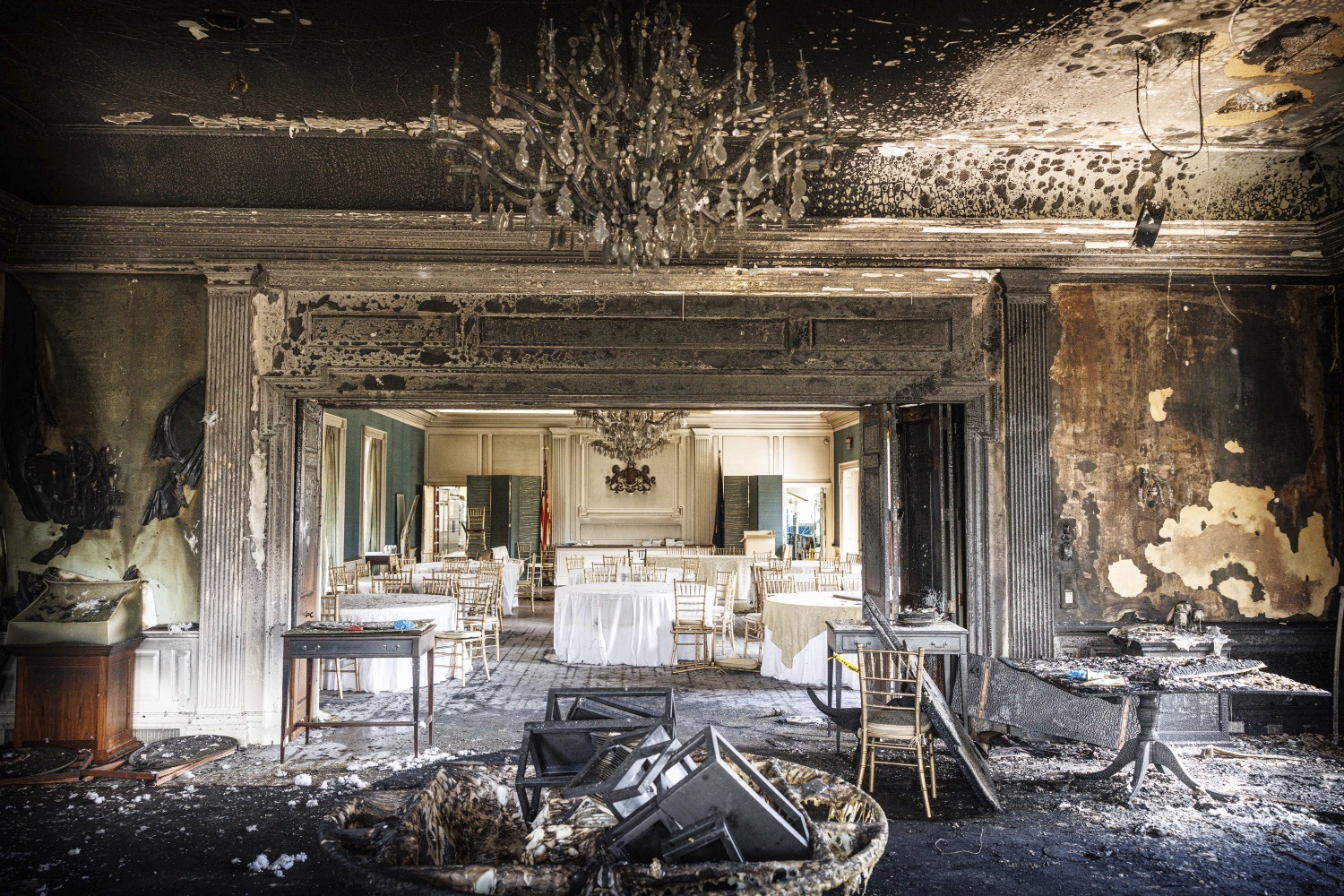
    This image provided by Commonwealth Media Services shows damage after a fire at the Pennsylvania governor’s mansion while Democratic Gov. Josh Shapiro and his family slept inside on April 13, 2025, in Harrisburg.

    State police never built the security fence that started the land feud, instead opting to surround Shapiro’s home with updated landscaping. That escalated the conflict with the Mocks. In their lawsuit, the Mocks allege that despite ongoing negotiations over the strip of land, the Shapiros began planting arborvitae-type trees and other plants on the Mocks’ property, flying drones over it, and threatening to remove healthy trees. The lawsuit also accuses state police of “chasing away” contractors who came to work in the Mocks’ yard.

    The Shapiros, meanwhile, argue in court filings that the Mocks’ alleged harassment is causing them irreparable harm and further threatening their safety. According to a source briefed on the conflict, the Mocks at one point posted a series of signs on the land and a tree that read “Hippity hoppity, stay off my property,” and “This is my property,” among other efforts to antagonize the Shapiros.

    John Ginsberg grew up in the home now owned by the Mocks during the 1970s and ‘80s, and said he never thought of their property as stretching into the land now owned by the Shapiro family.

    “It just wasn’t an area that was used,” said Ginsberg, who now works as an attorney in Washington. “It wasn’t maintained, and it was brambly.”

    Another man, who requested anonymity to speak freely about his neighbors, said he lived next to the Shapiros for more than 21 years, and has for decades shared the upkeep on a portion of the property highlighted in the lawsuit with Shapiro, taking turns clearing and replanting the area.

    “I don’t think either of us thought twice about that little strip of land,” he said.

    The Shapiros have been great neighbors, he said, and the Mocks have been “good neighbors to us,” describing them as a “nice young family.”

    Political allegations

    Shapiro has faced ongoing scrutiny from the state Senate for implementing the $1 million in security upgrades to his personal home, in addition to $32 million in repairs and security upgrades to the governor’s mansion following the arson attack. All of the upgrades were implemented without legislative approval due to their urgent nature.

    A Senate committee in December took the unprecedented step to subpoena Shapiro over the security upgrades to his personal home, arguing that his administration had not been transparent in previous inquiries about how state taxpayer dollars were being used to upgrade security at Shapiro’s personal home.

    Ward, the top official in the state Senate, has been critical of the state spending on security upgrades, saying that taxpayer dollars should not be funding security upgrades to Shapiro’s private residence.

    Shapiro’s office is quick to note that Ward has been in contact with the neighbors taking the governor to court — saying that helps show the land dispute lawsuit is politically motivated.

    Ward, of Westmoreland County, told ABC27 earlier this month that she had had contact with the Mock family on two occasions. A person close to Ward said that the senator is an acquaintance of the Mocks, but that the family had already obtained legal counsel by the time Ward reached out to them, and that the lawmaker did not encourage Shapiro’s neighbors to take any legal action against him.

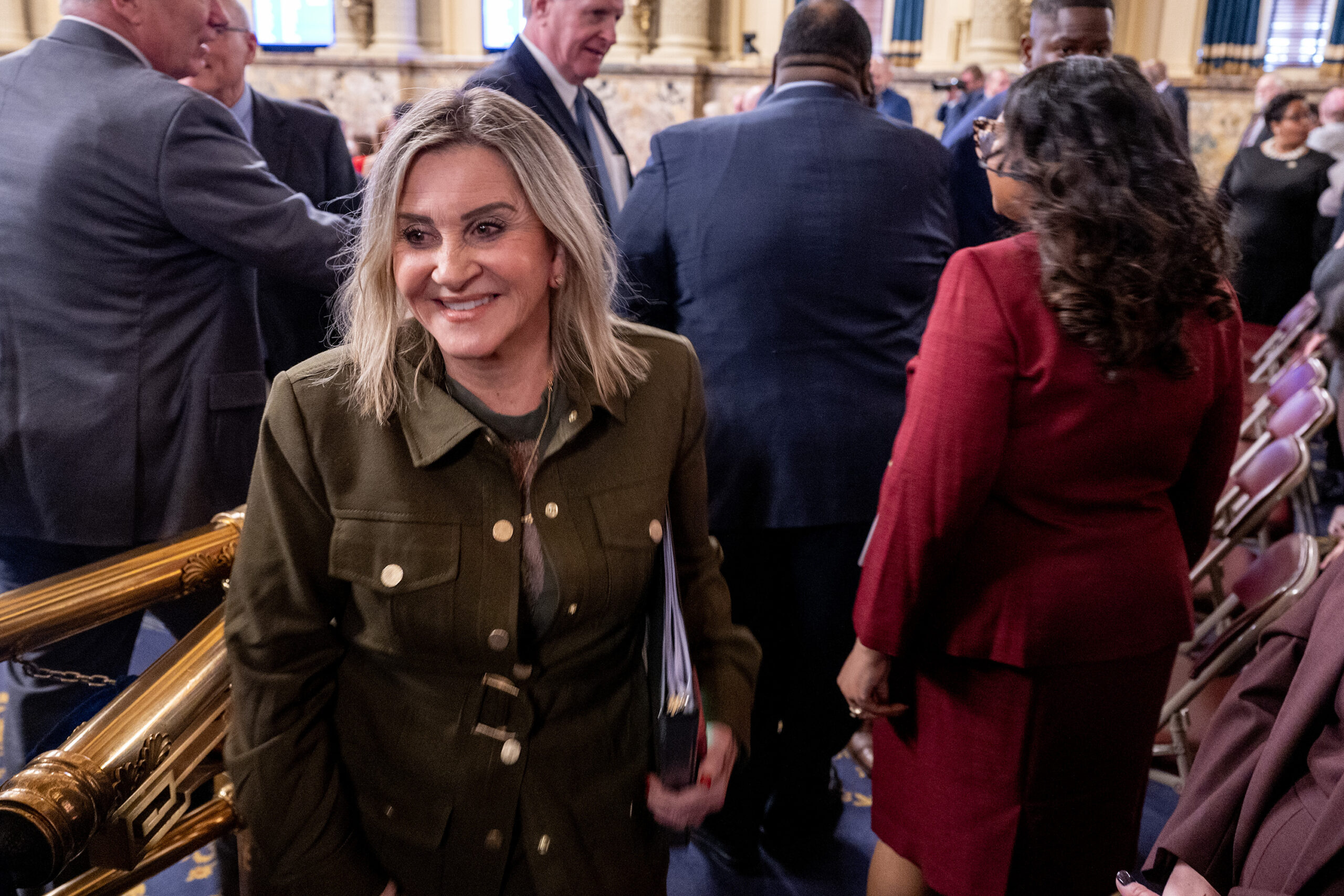
    Senate President Pro Tempore Kim Ward leaves the House chamber Feb. 3 following Gov. Josh Shapiro annual budget proposal in Harrisburg.

    Jeremy Mock has owned a small coffee business in Ward’s legislative district in western Pennsylvania since 2022, according to public business filings. He and his wife moved to the Abington Township neighborhood in 2017, and have had no issues with the Shapiros until the fence feud, according to both parties’ lawsuits.

    “This dispute over a small piece of the Shapiros’ backyard has been turned into a shameless political stunt by their neighbors and members of the Republican State Senate, who are now harassing and exploiting the Shapiros,” said Rosie Lapowsky, a spokesperson for Shapiro, without directly naming Ward.

    Zimolong, the Mocks’ attorney, said the fact that the couple was willing to work with the Shapiros to find a solution dispels any claim that their suit is politically motivated. The Mocks could have said “no” from the outset when the Shapiros approached them, he argued, but instead participated in negotiations.

    “At base, this is a straightforward defense of the property rights of two innocent owners, who were living peacefully next to the Shapiros for over nine years,” Zimolong added in a statement.

    “Even today, the Mocks remain open to resolving the dispute,” Zimolong said.

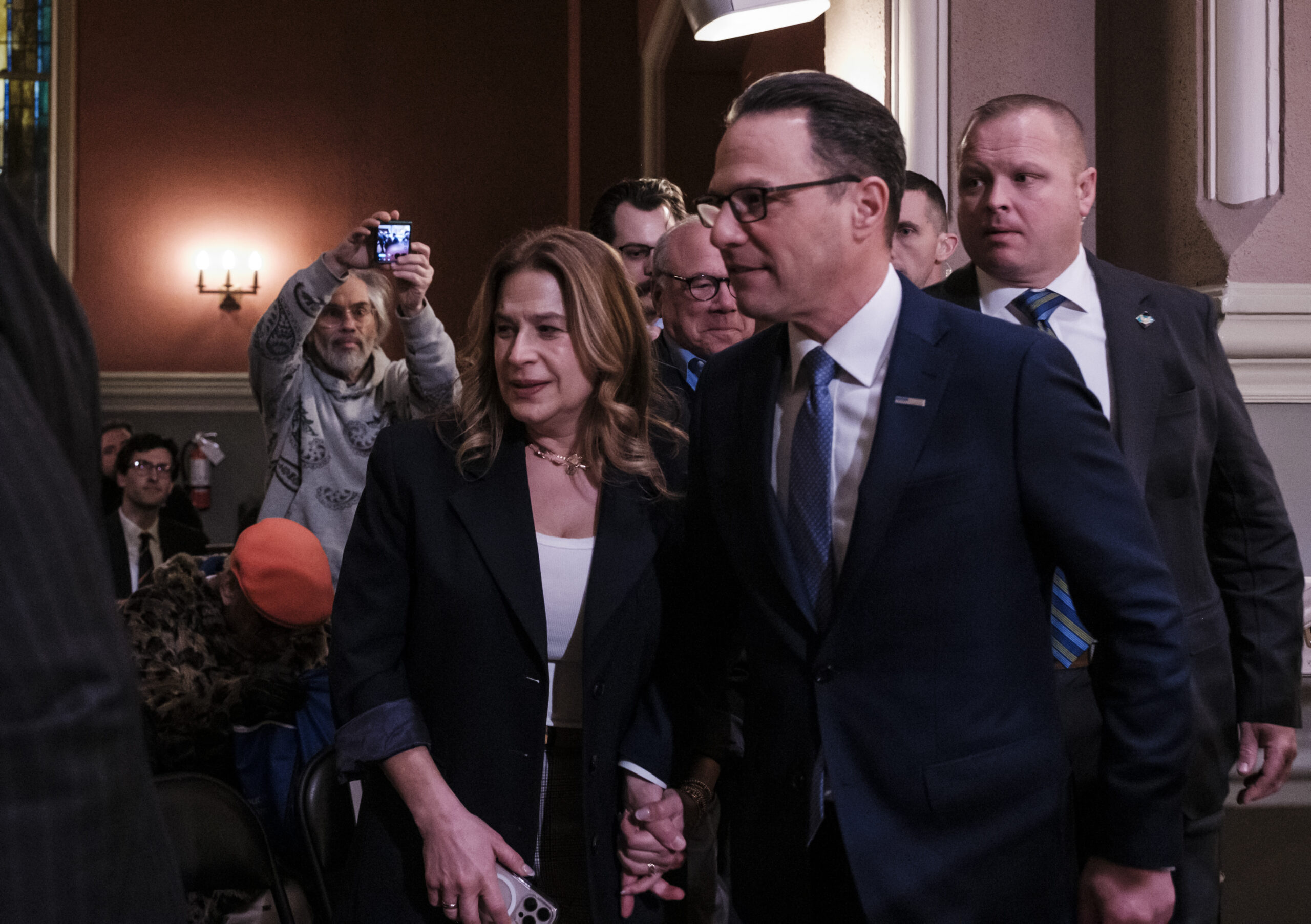
    Gov. Josh Shapiro and his wife, Lori Shapiro, depart a talk for his new memoir “Where We Keep the Light” on Jan. 29 in Washington, D.C

    Zimolong says he has never discussed the lawsuit with Ward or coordinated with her staff over the issue, “and I have no intention of doing so.”

    He said he is one of few attorneys in southeastern Pennsylvania who is “not afraid to hold a powerful governor accountable” and does not have work before the state that would present an ethical conflict.

    Erica Clayton Wright, a spokesperson for Ward, noted that taxpayer funds have now been used to pay for security upgrades to Shapiro’s personal residence and the property of his neighbors, and argued that it’s “not the first time Gov. Shapiro’s team has been put in the awkward position of pointing fingers to distract from Gov. Shapiro’s questionable methods of operation.”

    “It is important not to lose sight of the need to ensure the governor and his family are safe while also safeguarding the processes in place to manage taxpayer funds,” Clayton Wright said.

    “Absolutely no one but Gov. Shapiro himself is responsible for trying to take his neighbor’s property via squatter rights, which has resulted in federal and state lawsuits,” she said.

    Staff writer Abraham Gutman contributed to this article.

  • From talking up the 250th anniversary to shaking John Fetterman’s hand, here are the Pa. moments in Trump’s State of the Union address

    From talking up the 250th anniversary to shaking John Fetterman’s hand, here are the Pa. moments in Trump’s State of the Union address

    President Donald Trump ended his historically long State of the Union address Tuesday night with how he began it — talking about the United States’ 250th birthday this summer.

    He mentioned the “historic streets of Philadelphia,” Thomas Jefferson’s final breath, and the FIFA World Cup games, some of which will take place in the city this summer.

    But his talk of the 250th celebrations served as bookends to what was otherwise a speech in which he railed against immigrants, spread falsehoods and lashed out at political opponents.

    During the speech, Trump took credit for ending DEI programs across the country, doubled down on his push to end sanctuary cities, falsely suggested his opponents cheat during elections and called for proof of citizenship in order to vote.

    The president chastised Supreme Court justices for their recent ruling against his tariffs. And he frequently lambasted Democrats, bristling when they would not stand to applaud.

    “These people are crazy,” Trump said.

    Pennsylvania popped up throughout the evening as Trump leaned on the 250th as a framing device for his speech and pointed to a woman from the Poconos to promote his economic agenda.

    Trump talks of ‘epic milestone’ 250th celebrations

    Trump mentioned the “epic milestone” of the United States’ upcoming 250th anniversary in July just moments in his remarks.

    “This July 4, we will mark two and a half centuries of liberty and triumph, progress and freedom, in the most incredible and exceptional nation ever to exist on the face of the earth and you’ve seen nothing yet, we’re going to do better and better and better,” Trump said.

    Philadelphia will be at the center of 250th anniversary celebrations this year, especially during the warmer months when the city is expected to see an influx of tourism which by one estimate could bring in as much as $2.5 billion to the city and region.

    But when visitors stop by Philly’s iconic sites, it’s unclear whether they’ll be seeing the full picture of U.S. history.

    Last month, the Trump administration ordered the takedown of every educational panel from the President’s House at Independence National Historical Park. The site serves as a memorial to the nine people George Washington enslaved at his Philadelphia residence.

    The incident has sparked outrage from Philadelphians who have rallied to protect the site and spurred Mayor Cherelle L. Parker’s first major confrontation with Trump.

    After a lawsuit from the Parker administration and tireless community activism, a federal judge last week ordered the site to be restored. The panels were mostly reinstalled Thursday and Friday before a federal appeals judge ordered park employees to pause while the Trump administration’s appeal remains pending.

    Trump did not address the controversy in his speech even as he touted the city’s history and the founding fathers in his speech.

    The Philadelphia case is the most high-profile battle over the Trump administration’s broader effort to sanitize U.S. history ahead of the 250th. The National Park Service has removed content from parks throughout the country, including the Grand Canyon, underan order from Trump forbidding displays that “inappropriately disparage Americans past or living.”

    Trump gives a shoutout to working mom from Pa.

    The president brought Megan Hemhauser, a waitress and mom of two from Cresco, Pa., a town in the Poconos, as one of his guests to his address Tuesday night, saying in his speech that because of his “No Tax on Tips” and “No Tax on Overtime” policies she is “so, so much richer.”

    Hemhauser was also featured at Trump’s rally in Mount Pocono in December when the president invited her to speak. She shared that these policies have helped her invest in her family.

    “It saves us and it’s for the future of our children,” she said at the time.

    Under Trump’s One Big Beautiful Bill Act, tipped workers can deduct up to $25,000 of certain tips per year, but the lowest earners and some tipped workers won’t be eligible for the tax break, CNBC reported. For overtime, certain individuals can deduct up to $12,500 for single filers or $25,000 for married couples filing their taxes jointly each year from 2025 through 2028.

    Both tax breaks are available from 2025 through 2028 and decreases in size when earnings exceed $150,000 for single filers or $300,000 for married couples filing jointly.

    Democrats have pointed out the same legislation also included cuts to SNAP and Medicaid, two programs heavily relied by low-income Americans. They’ve blamed other Trump policies, including his signature tariffs and his opposition to extending health care policies, for exacerbating the cost of living for Pennsylvanians.

    “Trump promised to lower costs for Pennsylvania families on Day One, but he’s done the exact opposite,” said DNC chair Ken Martin in a statement ahead of the speech.

    Protesting with a pin

    U.S. Rep. Madeleine Dean (D., Montgomery) attended Trump’s State of the Union, but ended up leaving the event once Trump announced that Vice President JD Vance would be leading a “war on fraud.”

    “I just had had enough of the lies,” Dean said in an interview after the address.

    The Pennsylvania lawmaker joined other members of the House Democratic Women’s Caucus in wearing white as an homage to the suffragettes. She also wore a pin and scarf showing her support for Ukraine, as Tuesday marks four years since Russia waged its attack on the country.

    “How I would have wished the president would have said ‘I am dismayed that I have not been able to bring an end to that brutal war and that is going to be my singular focus,’” said Dean, a member of the Ukraine caucus. “But, of course, he doesn’t say that.”

    Other Democrats showed their opposition to Trump by boycotting his speech, including several from the region.

    U.S. Rep. Mary Gay Scanlon (D., Delaware) and U.S. Rep. Summer Lee (D., Allegheny) both attended “People’s State of the Union,” an alternative event hosted by progressive groups instead of the president’s address.

    Other Democrats who skipped Trump’s speech include retiring U.S. Reps. Dwight Evans of Pennsylvania and U.S. Sen Cory Booker of New Jersey.

    John Fetterman wears a suit and shakes hands with Trump

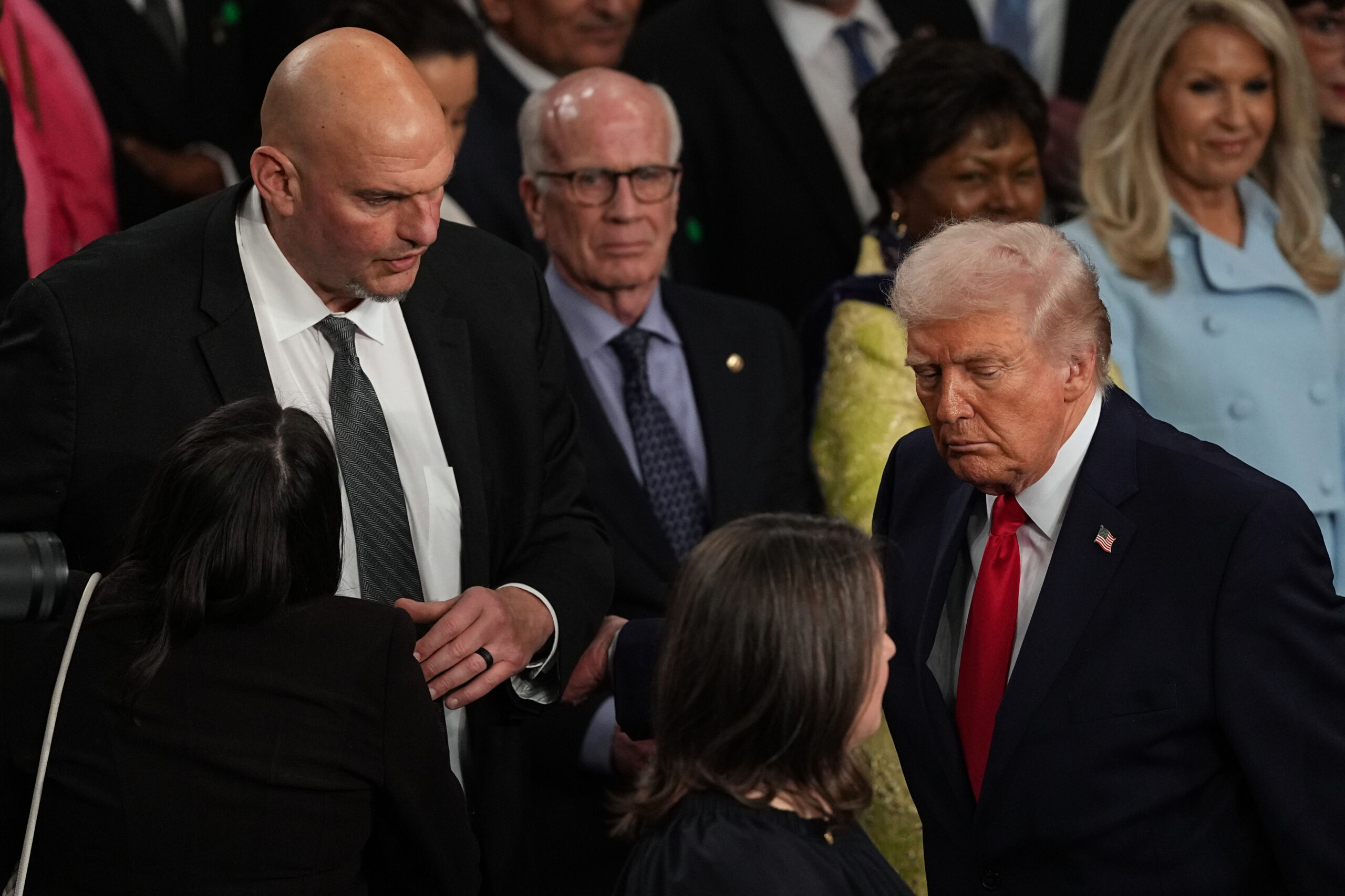
    Known to seldom wear dress clothes, U.S. Sen. John Fetterman traded his usual hoodie for a suit Tuesday evening when he shook hands with Trump during the president’s entrance to the House chamber.

    Fetterman’s greeting of Trump comes in contrast to many of his Democratic colleagues and underscores the senator’s willingness to embrace the other side of the political aisle, often earning him ire from his own party.

    U.S. Rep. Brendan Boyle (D., Philadelphia) criticized Fetterman in a post on X Tuesday night.

    “I’m not surprised PA Senator John Fetterman finally got dressed up for once and so warmly greeted Donald Trump tonight,” wrote Boyle, who has been floated as a potential primary challenger to Fetterman in 2028. “After all, as the White House has previously stated, John Fetterman is Trump’s favorite Democrat.”

    During a Wednesday morning interview with Fox News, Fetterman criticized fellow Democrats for not standing and applauding during several moments in Trump’s speech that he felt should have garnered bipartisan support, including when Trump recognized Erika Kirk, whose husband Charlie Kirk was shot and killed last year during a speech in Utah.

    Fetterman also defended his handshake with the president and believes he was only Democrat to make such a gesture.

    “Yes, I shook his hand. Of course. He walked in, and I’m always going to do that, for sure,” Fetterman said.

    President Donald Trump passes Sen. John Fetterman, D-Pa., as he departs after delivering the State of the Union address to a joint session of Congress in the House chamber at the U.S. Capitol in Washington, Tuesday, Feb. 24, 2026.

    Summer Lee’s Working Families Party response

    Lee, a Pittsburgh progressive in her second term, delivered a response to Trump’s address on behalf of the Working Families Party, a grassroots progressive party that often endorses Democratic candidate.

    The Pennsylvania lawmaker criticized Trump’s tariffs, Medicaid cuts, escalation of federal immigration agents, and mass layoffs of federal employees.

    “The state of the union is dire,” Lee said. “We can’t afford to believe Trump’s lies, and we have to pay attention to his actions. This is not a normal time, and our response to it can’t be politics as usual.”

  • Trump used the longest-ever State of the Union to try to convince voters that the U.S. is ‘winning so much’

    Trump used the longest-ever State of the Union to try to convince voters that the U.S. is ‘winning so much’

    WASHINGTON — President Donald Trump declared during a marathon State of the Union on Tuesday that “we’re winning so much” — insisting he’d sparked an economic boom at home and imposed a new world order abroad in hopes it can counter his sliding approval ratings.

    Trump’s main objective was convincing increasingly wary Americans that the economy is stronger than many believe, and that they should vote for more of the same by backing Republicans during November’s midterm elections. In all, Trump spoke for a record 108 minutes, breaking — by eight minutes — the previous time mark from his address before a joint session of Congress last year.

    The president largely avoided his usual bombast, only occasionally veering off-script — mostly to slam Democrats. As he did during such addresses in his first term, Trump relied on a series of surprise special guests to dramatically punctuate his message. They included U.S. military heroes and a former political prisoner released after U.S. forces toppled Venezuelan President Nicolás Maduro.

    Trump drew some of the loudest applause of the night when he invited the Olympic gold medal-winning U.S. men’s hockey team into the House chamber.

    “Our country is winning again. In fact, we’re winning so much that we really don’t know what to do about it. People are asking me, ‘Please, please, please, Mister President, we’re winning too much. We can’t take it anymore,’” Trump said before introducing the team.

    The hockey players, wearing their medals and “USA” sweaters, drew a bipartisan standing ovation. Trump pointed to the Democratic side of the chamber and quipped, “That’s the first time I ever I’ve ever seen them get up.”

    In a made-for-TV moment, the president announced he would be awarding the Presidential Medal of Freedom, America’s highest civilian honor, to the hockey team’s goaltender, Connor Hellebuyck. He also bestowed the Purple Heart on Andrew Wolfe — a National Guard member who was shot while deployed on the streets of the nation’s capital. Wolfe made his first public appearance since then during the speech.

    That scene recalled a similar surprise announcement in 2020, when Trump gave the Medal of Freedom to conservative radio host Rush Limbaugh during his State of the Union speech.

    Trump decries tariff decision as justices look on

    The president championed his immigration crackdowns and his push to preserve widespread tariffs that the Supreme Court just struck down. He drew applause only from Democrats while describing the high court’s decision, which he called “an unfortunate ruling.”

    Trump vowed to plow ahead, using “alternative” laws to impose the taxes on imports and telling lawmakers, “Congressional action will not be necessary.” Trump argued that the tariffs are paid by foreign countries, despite evidence that the costs are borne by American consumers and businesses. “It’s saving our country,” he said.

    The only Supreme Court justices attending were Chief Justice John Roberts, as well as Justices Brett Kavanaugh, Amy Coney Barrett and Elena Kagan. Trump greeted them personally before the speech, despite last week slamming Coney Barrett — who he appointed to the high court in his first term — for siding with the majority against his tariffs.

    Democrats also stood for Trump vowing to halt insider trading by members of Congress. But Rep. Mark Takano, a California Democrat, yelled, “How about you first!” Rep. Rashida Tlaib, a Michigan Democrat, called out, “You’re the most corrupt president!”

    When some heckling continued, Trump proclaimed, “You should be ashamed of yourselves.” Later, he pointed at Democrats and proclaimed, “These people are crazy.”

    Democratic Rep. Al Green was escorted from the chamber early in the speech, after he unfurled a sign of protest that read “Black People Aren’t Apes!” That was an apparent reference to a racist video the president posted that depicted former President Barack Obama and First Lady Michelle Obama as primates in a jungle. Green was also removed during Trump’s address last year.

    The president, meanwhile, was mostly optimistic and patriotic, but Trump struck a darker tone in large swaths of his speech to warn about the dangers posed by immigrants. He invited lawmakers from both parties to “protect American citizens, not illegal aliens” and championed proposals to limit mail-in ballots and tighten voter identification rules.

    Affordability gets relatively little time

    Trump didn’t dwell on efforts to lower the cost of living — despite polling showing that his handling of the economy and kitchen-table issues has increasingly become a liability. Such concerns about the high costs of living helped propel Democratic wins around the country on Election Day last November.

    There also are persistent fears that tariffs stoking higher prices could eventually hurt the economy and job creation. Economic growth slowed in the last three months of last year.

    It is potentially politically perilous ahead of November elections that could deliver congressional wins to Democrats, just as 2018’s blue wave created a strong check to his administration during his first term.

    On Tuesday, Trump blamed his predecessor, former President Joe Biden, along with Democratic lawmakers in the chamber, saying they were responsible for rising prices and health care costs, two issues his political opponents have repeatedly raised against him.

    “You caused that problem,” Trump said of affordability concerns. He added a moment later, “They knew their statements were a dirty, rotten lie.”

    Trump also said he’d press tech companies involved in artificial intelligence to pay higher electricity rates in areas where their data centers are located. Such data centers tend to use large volumes of electricity, potentially increasing the cost of power to other consumers in the area.

    Another notable off-script moment came as Trump was referencing prescription drug prices, saying, “So in my first year of the second term — should be my third term — but strange things happen,” prompting at least one chant in the chamber of “Four more years!”

    Virginia Gov. Abigail Spanberger, who delivered the Democratic response to Trump’s speech, slammed the president’s aggressive immigration policies, his widespread cuts to the federal government and his tariffs.

    “Even though the Supreme Court struck these tariffs down four days ago, the damage to us, the American people, has already been done. Meanwhile, the president is planning for new tariffs,” she said. “Another massive tax hike on you and your family.”

    A warning to Iran

    Trump’s address came as two U.S. aircraft carriers have been dispatched to the Middle East amid tensions with Iran. Trump said, “My preference is to solve this problem through diplomacy.”

    “But one thing is certain, I will never allow the world’s number one sponsor of terror — which they are, by far — to have a nuclear weapon,” he added.

    The president also recounted U.S. airstrikes last summer that pounded Tehran’s nuclear capabilities, and lauded the raid that ousted Maduro in Venezuela — as well as his administration’s brokering of a ceasefire in Israel’s war with Hamas in Gaza.

    “As president, I will make peace wherever I can,” Trump said. ”But I will never hesitate to confront threats to America, wherever we must.”

  • Hegseth warns Anthropic to let the military use the company’s AI tech as it sees fit, AP source says

    Hegseth warns Anthropic to let the military use the company’s AI tech as it sees fit, AP source says

    WASHINGTON — Defense Secretary Pete Hegseth gave Anthropic’s CEO a Friday deadline to open the company’s artificial intelligence technology for unrestricted military use or risk losing its government contract, according to a person familiar with their meeting Tuesday.

    Anthropic makes the chatbot Claude and is the last of its peers to not supply its technology to a new U.S. military internal network. CEO Dario Amodei repeatedly has made clear his ethical concerns about unchecked government use of AI, including the dangers of fully autonomous armed drones and of AI-assisted mass surveillance that could track dissent.

    Defense officials warned they could designate Anthropic a supply chain risk or use the Defense Production Act to essentially give the military more authority to use its products even if it doesn’t approve of how they are used, according to the person familiar with the meeting and a senior Pentagon official, who both were not authorized to comment publicly and spoke on condition of anonymity.

    The development, which was reported earlier by Axios, underscores the debate over AI’s role in national security and concerns about how the technology could be used in high-stakes situations involving lethal force, sensitive information, or government surveillance. It also comes as Hegseth has vowed to root out what he calls a “woke culture” in the armed forces.

    “A powerful AI looking across billions of conversations from millions of people could gauge public sentiment, detect pockets of disloyalty forming, and stamp them out before they grow,” Amodei wrote in an essay last month.

    The person familiar called the tone of the meeting cordial but said Amodei didn’t budge on two areas he has established as lines Anthropic won’t cross — fully autonomous military targeting operations and domestic surveillance of U.S. citizens.

    The Pentagon objects to Anthropic’s ethical restrictions because military operations need tools that don’t come with built-in limitations, the senior Pentagon official said. The official argued that the Pentagon has only issued lawful orders and stressed that using Anthropic’s tools legally would be the military’s responsibility.

    Anthropic will no longer be the only AI company approved for classified military networks

    The Pentagon announced last summer that it was awarding defense contracts to four AI companies — Anthropic, Google, OpenAI, and Elon Musk’s xAI. Each contract is worth up to $200 million.

    Anthropic was the first AI company to get approved for classified military networks, where it works with partners like Palantir. Musk’s xAI company, which operates the Grok chatbot, says Grok also is ready to be used in classified settings, according to the senior Pentagon official.

    The official noted that the other AI companies were “close” to that milestone. SpaceX, Musk’s space flight company that recently merged with xAI, didn’t immediately return a request for comment Tuesday.

    Hegseth said in a January speech at SpaceX in South Texas that he was shrugging off any AI models “that won’t allow you to fight wars.”

    Hegseth said his vision for military AI systems means that they operate “without ideological constraints that limit lawful military applications,” before adding that the Pentagon’s “AI will not be woke.”

    The defense secretary said that Grok would join the secure but unclassified Pentagon AI network, called GenAI.mil. The announcement came days after Grok — which is embedded into X, the social media network owned by Musk — drew global scrutiny for generating highly sexualized deepfake images of people without their consent.

    OpenAI announced in early February that it, too, would join GenAI.mil, enabling service members to use a custom version of ChatGPT for unclassified tasks.

    Anthropic calls itself more safety-minded

    Anthropic said in a statement after Tuesday’s meeting that it “continued good-faith conversations about our usage policy to ensure Anthropic can continue to support the government’s national security mission in line with what our models can reliably and responsibly do.”

    Anthropic has long pitched itself as the more responsible and safety-minded of the leading AI companies, ever since its founders quit OpenAI to form the startup in 2021.

    The uncertainty with the Pentagon is putting those intentions to the test, according to Owen Daniels, associate director of analysis and fellow at Georgetown University’s Center for Security and Emerging Technology.

    “Anthropic’s peers, including Meta, Google, and xAI, have been willing to comply with the department’s policy on using models for all lawful applications,” Daniels said. “So the company’s bargaining power here is limited, and it risks losing influence in the department’s push to adopt AI.”

    In the AI craze that followed the release of ChatGPT, Anthropic closely aligned with President Joe Biden’s Democratic administration in volunteering to subject its AI systems to third-party scrutiny to guard against national security risks.

    Amodei, the CEO, has warned of AI’s potentially catastrophic dangers while rejecting the label that he’s an AI “doomer.” He argued in the January essay that “we are considerably closer to real danger in 2026 than we were in 2023″ but that those risks should be managed in a “realistic, pragmatic manner.”

    Anthropic has been at odds with the Trump administration

    This would not be the first time Anthropic’s advocacy for stricter AI safeguards has put it at odds with President Donald Trump’s administration. Anthropic needled chipmaker Nvidia publicly, criticizing Trump’s proposals to loosen export controls to enable some AI computer chips to be sold in China. The AI company, however, remains a close partner with Nvidia.

    Trump’s Republican administration and Anthropic also have been on opposite sides of a lobbying push to regulate AI in U.S. states.

    Trump’s top AI adviser, David Sacks, accused Anthropic in October of “running a sophisticated regulatory capture strategy based on fear-mongering.”

    Sacks was responding on X to Anthropic cofounder Jack Clark, writing about his attempt to balance technological optimism with “appropriate fear” about the steady march toward more capable AI systems.

    Anthropic hired a number of ex-Biden officials soon after Trump’s return to the White House, but it’s also tried to signal a bipartisan approach. The company recently added Chris Liddell, a former White House official from Trump’s first term, to its board of directors.

    The Pentagon’s “breakneck” adoption of AI shows the need for greater AI oversight or regulation by Congress, particularly if AI is being used to surveil Americans, said Amos Toh, senior counsel at the Brennan Center’s Liberty and National Security Program at New York University.

    “The law is not keeping up with how quickly the technology is evolving,” Toh wrote in a post on Bluesky. “But that doesn’t mean DoD has a blank check.”

  • Texas Rep. Gonzales resists calls to resign over allegations of an affair with an ex-staffer

    Texas Rep. Gonzales resists calls to resign over allegations of an affair with an ex-staffer

    HOUSTON — U.S. Rep. Tony Gonzales of Texas resisted growing calls Tuesday from fellow congressional Republicans to resign over a report of an alleged affair with a former staffer who later died after she set herself on fire.

    Rep. Thomas Massie of Kentucky joined Reps. Lauren Boebert of Colorado, Anna Paulina Luna of Florida, and Nancy Mace of South Carolina in demanding that Gonzales step down immediately. Gonzales is in a tough race in Texas’ Republican primary on March 3, facing a challenger he narrowly defeated in a 2024 GOP runoff.

    He told reporters he will not resign. A resignation would leave Republicans with a 217-214 majority until March, when the first of three special elections to fill vacancies is set in Georgia.

    “There will be opportunities for all of the details and facts to come out,” he said. “What you’ve seen is not all the facts.”

    House Speaker Mike Johnson said he would talk to Gonzales on Tuesday.

    Johnson said Monday that the accusations against Gonzales “must be taken seriously,” but he added, “in every case like this, you have to allow the investigation to play out and all the facts to come out.”

    “If the accusation of something is going to be the litmus for someone being able to continue to serve in the House, a lot of people would have to resign or be removed or expelled from Congress,” Johnson said.

    Meanwhile, Mace announced that she has introduced a resolution to force the House Ethics Commission to publicly release its reports and records of allegations of sexual harassment against members of Congress.

    Gonzales said in a social media post last week that he was being blackmailed and then suggested in another post Sunday that he is the target of “coordinated political attacks.”

    His main primary opponent is Brandon Herrera, a gun manufacturer and gun rights influencer who calls himself “the AK Guy” on YouTube, where his channel has nearly 4.2 million subscribers. Gonzales defeated Herrera by fewer than 400 votes in their 2024 runoff.

    President Donald Trump had endorsed Gonzales for reelection in December.

    The San Antonio Express-News reported last week that it had obtained text messages in which the former staffer, Regina Ann Santos-Aviles, wrote to a colleague that she had an affair with the lawmaker.

    The Associated Press has not independently obtained copies of the messages. An attorney for Adrian Aviles, Santos-Aviles’ husband, has said the husband found out about the affair before his wife’s death.

    Regina Ann Santos-Aviles, 35, died in September 2025. The Bexar County Medical Examiner’s Office later ruled her death was a suicide by self-immolation.

    “Where are the other men in the GOP?” Massie asked Tuesday in a post on X in calling for Gonzales to resign, adding that Trump should revoke his endorsement.

    Gonzales, whose district stretches from San Antonio to El Paso and runs along the U.S.-Mexico border, has six children with his wife.

    His allegation of blackmail is based on an email from the attorney for the staffer’s husband, Robert Barrera, discussing a possible lawsuit against the lawmaker and a potential settlement with a nondisclosure agreement. The email says that the maximum recoverable amount is $300,000.

    Barrera has said he was not trying to blackmail Gonzales and called the accusation an attempt by the congressman to look like a political victim.

  • Trump administration sues New Jersey over restrictions on immigration arrests

    Trump administration sues New Jersey over restrictions on immigration arrests

    TRENTON — The Trump administration is suing New Jersey over a state order that prohibits federal immigration agents from making arrests in nonpublic areas of state property, such as correctional facilities and courthouses.

    The Justice Department lawsuit, filed Monday in federal court in Trenton, challenges Gov. Mikie Sherrill‘s Feb. 11 executive order, which also bars the use of state property as a staging or processing area for immigration enforcement.

    Sherrill, a Democrat who took office Jan. 20, “insists on harboring criminal offenders from federal law enforcement,” the lawsuit said, accusing her of attempting to obstruct federal law enforcement and thwart President Donald Trump’s immigration crackdown.

    Sherrill’s executive order “poses an intolerable obstacle” to immigration enforcement and “directly regulates and discriminates” against the federal government, said the lawsuit, which misspelled her name as “Sherill.”

    Asked about the lawsuit Tuesday, Sherrill said: “What I think the federal government needs to be focused on right now, instead of attacking states like New Jersey working to keep people safe, is actually training their ICE agents.”

    The state’s acting attorney general, Jennifer Davenport, said the Trump administration was “wasting its resources on a pointless legal challenge.” New Jersey will fight the lawsuit and “continue to ensure the safety of our state’s immigrant communities,” she said.

    The lawsuit is the latest in the Trump administration’s fight against state and local level restrictions on immigration enforcement.

    Last year, the Justice Department sued Minnesota and Colorado, as well as cities including New York, Chicago, Los Angeles, and Denver over so-called sanctuary laws, which are aimed at prohibiting police from cooperating with immigration agents.

    Last May, the Trump administration sued four New Jersey cities — Newark, Jersey City, Paterson, and Hoboken — over such policies. That case is pending.

  • The candidates vying to succeed Dwight Evans got a chance to ask each other questions. Things got tense.

    The candidates vying to succeed Dwight Evans got a chance to ask each other questions. Things got tense.

    With a crowded field of Democrats who largely agree on policy issues, it’s been difficult to differentiate the candidates in this year’s race for Philadelphia’s open congressional seat.

    But at a forum Monday night, the top candidates for the 3rd Congressional District, which is being vacated by retiring Democrat Dwight Evans, began to make clear where the battle lines are — by taking shots at one another.

    At the end of the event, the moderator, 21st Ward Leader Lou Agre, allowed the candidates to ask one another questions. Their choices offered hints as to which of their rivals the candidates view as most threatening.

    Dr. Ala Stanford, who appears to be the strongest candidate among the non-elected officials in the race, questioned the accomplishments of State Sen. Sharif Street, who is seen by many as a frontrunner after being endorsed by the Democratic City Committee and building trades unions.

    Street, in turn, fired a question about hate crime legislation at State Rep. Chris Rabb, a progressive who could counter Street’s hold on the Democratic establishment if he consolidates support from left-leaning organizations.

    Lastly, State Rep. Morgan Cephas came after Stanford, prompting a tense exchange about the physician’s government contracts.

    The 3rd District covers about half of Philadelphia and is, by some measures, the bluest seat in Congress. The Democratic primary is May 19.

    The forum was initially scheduled to be held in-person at the Polish Legion of American Veterans’ Adam Kowalski post in Roxborough, but it was moved to Zoom due to the blizzard on Sunday and Monday.

    Here are the issues the candidates debated Monday night.

    Stanford questions Street’s accomplishments

    Stanford, a pediatric surgeon, has been widely celebrated for founding the Black Doctors Consortium to help reach underserved communities during the COVID-19 pandemic.

    She began the candidate-on-candidate questioning on Monday by asking Street for instances in which his work has helped constituents in tangible ways, setting up a juxtaposition with her record.

    “In a time when the people are asking for new leadership, they’re asking for innovation, they’re asking for not the same politics as usual … can you tell the people a time when the seas were rough and you stepped up and delivered for them that they felt it?” Stanford asked, adding: “Can you share what you can do during the chaos that people can feel — and where was it during COVID?”

    Physician Ala Stanford (left) and State Sen. Sharif Street at a December forum hosted by the 9th Ward Democratic Committee.

    Street began by saying that, as the top Democrat on the Senate Banking & Insurance Committee in Harrisburg, he boosted Stanford’s work during the pandemic by pressuring insurance companies to reimburse her fledgling organization, which provided testing and vaccinations for thousands of Philadelphians in disadvantaged neighborhoods.

    “Independence Blue Cross was not moving forward with the reimbursement rates for the Black COVID Doctors Consortium,” Street said. “I spoke with you, and I helped, and I reached out to them to make sure that [the Medicaid plan] Keystone First would begin to pay the reimbursement in an immediate way.”

    He also said his office distributed food to constituents and helped process rent rebates during the pandemic.

    In the run-up to the 2020 election, Street, as chair of the Pennsylvania Democratic Party at the time, repeatedly fought in court against President Donald Trump’s campaign over election administration issues. In her question, Stanford asked Street to focus on what he delivered for his constituents — “not that you sued Donald Trump 20 times and won every time, because how do the people feel that?”

    But Street said those legal victories resulted in tangible results, as well.

    “Donald Trump wanted to challenge people’s ability to vote in some of the most vulnerable communities,” he said. “I went to court, I stopped him, and I made sure that they had the right to vote, and that was why we were able to pass the vote to remove him from office.”

    Street and Rabb clash over hate-crime legislation

    When it was his turn to pose a question, Street pressed Rabb on why the progressive was opposed to hate-crime legislation, an issue the two had sparred over at a forum last week.

    “You and I have worked to fight for regular folks, for disadvantaged people, for a long time. I was shocked that you … want to prevent hate-crimes legislation,” Street, a centrist Democrat, said to Rabb. “I’ve heard from so many trans women of color, who are most likely to be victims of hate crimes, and they don’t understand.”

    Rabb responded by saying that Street’s line of attack was “shameful and unnecessary.”

    “I know you want to win. I just thought you would do it with honor,” Rabb said. “I am an active member of the LGBTQ Equality Caucus. I am the father of a queer son. I represent an active queer community. … To use this as a political punching bag is just — man, it’s beneath you.”

    At the end of the forum, Street clarified that he has no doubts about Rabb’s commitment to the LGBTQ community.

    At a December candidates forum in Mount Airy, (from left) State Reps. Morgan Cephas and Chris Rabb and physician David Oxman.

    “I had a policy dispute about hate crimes,” Street said. “I did not mean to question your commitment to the trans community or to your kid.”

    The dust-up got in the way of a meaningful debate over hate-crime laws, which increase sentences for people convicted of crimes that prosecutors prove were motivated by prejudice against particular groups.

    Such laws are common across the country, but they have long faced criticism from the libertarian right, which fears that such regulations could be used to target citizens for political views. The laws have also faced pushback from some on the progressive left, who contend that they contribute to mass incarceration.

    “Politicians tout hate-crime laws as proof they care about the marginalized,” Rabb wrote in an op-ed for PennLive last fall. “In reality, the main outcome is more policing, more prosecution, and more incarceration.”

    Street said last week that people who oppose hate-crime laws on the “far left … don’t want to address the antisemitism on the left or the right.”

    Rabb has been the 3rd District candidate most critical of Israel’s war in Gaza. Street has also been critical of Israeli Prime Minister Benjamin Netanyahu’s handling of the war, but holds a more centrist view on the conflict in the Middle East.

    The Pennsylvania House in 2023 approved a bill to expand the state’s law that criminalizes ethnic intimidation to include sexual orientation and disability status. Rabb voted for the bill, which ultimately died in the Senate amid GOP opposition, but said he had “considerable reservations.”

    “We should collectively focus on structural violence and hatred that has been cultivated by the very institutions that have been asked to address this legislation,” Rabb said at the time.

    Cephas presses Stanford about her government contracts

    Cephas, who represents a West Philadelphia district and chairs the Philadelphia delegation to the state House, questioned how much money Stanford’s nonprofit organization has made from government contracting since the onset of the pandemic.

    “You oftentimes quote that you, as a private citizen, came in and saved Philadelphia from COVID, and, you know, there are a number of people on this [Zoom] call that stepped up during COVID,” Cephas said, noting that she worked with Stanford to set up clinics in her district during the pandemic.

    “We all did it in our own individual capacity, and we didn’t receive government contracts for it. … How much in government contracts did you receive during the COVID-19 period?”

    Stanford noted that she initially launched the Black Doctors Consortium with her own financial resources to serve neighborhoods that were not being reached by existing healthcare and government institutions. She said her first $1 million city grant for testing came months after she began her work.

    In 2020 and 2021, Stanford’s groups received $2.5 million in grants and contracts from the city, state, and federal governments, according to Stanford campaign manager Janée Taft-Mack. That money covered costs including supplies, staff, mobile medical units, personal protective equipment, and facility rentals, Taft-Mack said.

    Since then, Stanford has continued partnering with government agencies to address healthcare inequality. She has opened the Dr. Ala Stanford Center for Health Equity in Swampoodle and secured a $5.38 million contract for the Black Doctors Consortium to work at Riverview Wellness Village, the city-owned drug recovery home.

    The total amount Stanford and her organizations have received for work since 2021 was not immediately clear.

    Cheesesteaks, of course

    Dr. David Oxman, an intensive care physician at Jefferson University Hospital who lives in South Philadelphia, closed the open question session by asking his fellow candidates what cheese they order on their cheesesteaks.

    Philly’s most famous culinary offering has proven politically hazardous over the years, such as when John Kerry catastrophically asked for Swiss cheese while visiting Pat’s King of Steaks during the 2004 presidential election.

    This year’s congressional hopefuls were better prepared than the Massachusetts senator.

    Agre, the moderator whose ward includes much of Roxborough, interjected to insist that Dalessandro’s served up the best steak sandwiches in the city.

    At a candidate’s forum on Feb. 9 at the Church of the Holy Trinity, (left to right) Alex Schnell, physician Dave Oxman, State Sen. Sharif Street, physician Ala Stanford, State Rep. Morgan Cephas, and Pablo McConnie-Saad.

    Cephas said she orders Cooper Sharp at Angelo’s Pizzeria. Stanford’s go-to is American from Dalessandro’s. Street, a vegetarian, said he gets non-meat cheesesteaks from Hip City Veg and enjoys the cheese they use. (Mozzarella, per Hip City’s website.)

    And Rabb shouted out the cheesesteak egg rolls from Black Dragon, a West Philadelphia establishment offering a “unique fusion of Black American cuisine presented with the familiar aesthetics of classic Chinese American takeout,” according to its website.

    Still tense from the previous questions and perhaps a bit peckish, the candidates declined Agre’s offer to deliver closing remarks.

    Staff writers Max Marin and Ryan W. Briggs contributed to this article.

  • Supreme Court rules the Postal Service can’t be sued, even when mail is intentionally not delivered

    Supreme Court rules the Postal Service can’t be sued, even when mail is intentionally not delivered

    WASHINGTON — A divided Supreme Court on Tuesday ruled that Americans can’t sue the U.S. Postal Service, even when employees deliberately refuse to deliver mail.

    By a 5-4 vote, the justices ruled against a Texas landlord, Lebene Konan, who alleges her mail was intentionally withheld for two years. Konan, who is Black, claims racial prejudice played a role in postal employees’ actions.

    Justice Clarence Thomas, writing for a majority of five conservative justices, said the federal law that generally shields the Postal Service from lawsuits over missing, lost, and undelivered mail includes “the intentional nondelivery of mail.”

    In dissent, Justice Sonia Sotomayor wrote that while the protection against lawsuits is broad, it does not extend to situations when the decision not to deliver mail “was driven by malicious reasons.” Justice Neil Gorsuch joined his three liberal colleagues in dissent.

    President Donald Trump’s Republican administration had warned that a ruling for Konan would have led to a flood of similar lawsuits against the cash-strapped Postal Service.

    Konan, who’s also a real estate agent and an insurance agent, claims two employees at a post office in Euless, Texas, part of the Dallas-Fort Worth metroplex, deliberately didn’t deliver mail belonging to her and her tenants because, she alleges, they didn’t like that she is Black and owns multiple properties.

    According to court documents, the dispute began when Konan discovered the mailbox key for one of her rental properties had been changed without her knowledge, preventing her from collecting and distributing tenants’ mail from the box. When she contacted the local post office, she was told she wouldn’t receive a new key or regular delivery until she proved she owned the property. She did so, the documents say, but the mail problems continued, despite the USPS inspector general instructing the mail to be delivered.

    Konan alleges the employees marked some of the mail as undeliverable or return to sender. Konan and her tenants failed to receive important mail such as bills, medications, and car titles, according to the lawsuit. Konan also claims she lost rental income because some tenants moved out due to the situation.

    After filing dozens of complaints with postal officials, Konan finally filed a lawsuit under the 1946 Federal Tort Claims Act, which allows some lawsuits against the government. The case focused on the reach of the special postal exemption to the law.