Category: Politics

Political news and coverage

  • Supreme Court put the brakes on Trump, after Congress helped him step on the gas

    Supreme Court put the brakes on Trump, after Congress helped him step on the gas

    The Supreme Court delivered a stinging rebuke Friday to President Donald Trump’s favorite instrument of economic and foreign policy power, by rejecting his claim that his presidential emergency authority allows him to unilaterally impose sweeping tariffs.

    Trump’s assertion that the 1977 International Emergency Economic Powers Act allowed him to put tariffs in place without any action by Congress was unprecedented, as are some of his other declarations of emergencies where there is no evidence they exist.

    Among the avalanche of executive orders he signed on his first day in office was one “declaring a national energy emergency” at a time of record U.S. oil and gas production and the lowest gasoline prices in years. Another emergency declaration deemed there to be an “invasion” and “widespread chaos” taking place on the southern border, even as Border Patrol statistics were showing the number of illegal crossings had dropped sharply and were lower than they had been at the end of Trump’s first term.

    But while Trump has far outpaced his modern predecessors when it comes to emergency declarations, presidents of both parties have used them in dubious ways to eliminate obstacles to their political agendas.

    President Joe Biden claimed the COVID-19 pandemic allowed him to cancel $400 billion in student debt, citing authority under the 2003 Heroes Act. That law allowed the education secretary to rewrite rules that apply to student loans during times of war or national emergencies but was meant to help military personnel serving in Iraq and Afghanistan. (The Supreme Court blocked Biden’s directive.)

    Congress shares a significant portion of the blame for presidential overreach, given that it has granted the chief executive no fewer than 150 statutory powers that become available upon the declaration of a national emergency, according to a tally by New York University Law School’s Brennan Center for Justice. Those emergency powers stretch across and beyond actions involving health and the environment, troop deployments, seizure of private property, even the dumping of infectious medical waste in ocean waters.

    Although it has always been recognized that the nation’s chief executives need flexibility to act in times of crisis, members of both parties have long been concerned that presidents can abuse their emergency powers.

    In 1976, Congress passed the National Emergencies Act, setting up more formalized procedures governing how presidents exercise them, including setting a renewable one-year expiration date for emergency actions.

    Presidents since then have made 91 emergency declarations under the act, more than half of which are still in effect. One of them — imposing economic sanctions on Iran — dates to the Carter administration.

    The law also specified that Congress could nullify an emergency declaration by passing a resolution in each chamber on a simple majority vote that would go into effect without the president’s signature.

    But the Supreme Court ruled that such resolutions were unconstitutional with its 1983 decision in INS v. Chadha. Congress, meanwhile, became lax even in exercising its enforcement and oversight authority that remained, said Elizabeth Goitein, senior director of the Brennan Center’s liberty and national security program.

    However, the legislative branch is not without other tools for reining in emergency actions, including cutting off funding or exercising more diligent oversight of them. Neither of which the Republican Congress has shown much inclination to do since Trump took office.

    “We have had decades of legislative fecklessness,” said Georgetown University law professor Stephen I. Vladeck. “Things have run totally off the rails in the last 13 months.” With Congress supine before Trump, “what you see is the increased proliferation of executive-judicial confrontation,” he added.

    Still, there have been stirrings of alarm in Congress at some of the emergency actions Trump has taken. Both the House and the Senate have voted to overturn his tariffs on Canada, although not by veto-proof majorities.

    During Trump’s first term, conservative Sen. Mike Lee (R., Utah) introduced what he called the Article One Act, after the section of the Constitution that sets out the role of the legislative branch. His bill would automatically end presidential emergency declarations unless Congress voted to extend the emergency.

    “If Congress is troubled by recent emergency declarations made pursuant to the National Emergencies Act, they only have themselves to blame,” Lee said in a statement when he introduced the bill. “If we don’t want our president acting like a king we need to start taking back the legislative powers that allow him to do so.”

    The bill, which he has subsequently reintroduced, has won bipartisan support.

    Rep. Chip Roy (R., Texas), who sponsored a companion measure in the House, said Friday that the Supreme Court decision on tariffs will not be enough to solve the problems that have arisen over presidential assertions of executive power.

    “The fact is, Congress is the one who made the mess out of all of this,” Roy said in an interview with Newsmax. “Congress needs to clean it up.”
  • Armed man shot and killed after entering secure perimeter of Mar-a-Lago, Secret Service says

    Armed man shot and killed after entering secure perimeter of Mar-a-Lago, Secret Service says

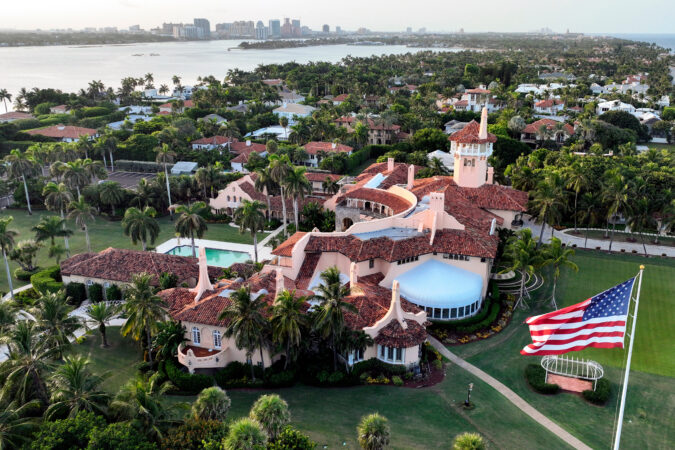
    WASHINGTON — An armed man drove into the secure perimeter of Mar-a-Lago, President Donald Trump’s resort in Palm Beach, Fla., before being shot and killed early Sunday morning, according to a spokesperson for the U.S. Secret Service. Trump was not there but was at the White House in Washington.

    The man, who was in his early 20s and from North Carolina, had a gas can and a shotgun, according to Anthony Guglielmi, the spokesperson. He had been reported missing by his family a few days ago, and investigators believe he headed south and picked up the shotgun along the way.

    Guglielmi said a box for the weapon was discovered in the man’s vehicle after the incident, which took place around 1:30 a.m.

    The man killed was identified by investigators as 21-year-old Austin Tucker Martin, according to a person familiar with the matter. The person spoke on the condition of anonymity because they were not authorized to publicly discuss details of the investigation.

    Trump has faced threats to his life before, including two assassination attempts during the 2024 campaign. Although the president often spends weekends at his resort, he and first lady Melania Trump were at the White House when the breach at Mar-a-Lago occurred.

    The man entered the north gate of the property as another vehicle was exiting and was confronted by two Secret Service agents and a Palm Beach County sheriff’s deputy, according to Palm Beach County Sheriff Ric Bradshaw.

    “He was ordered to drop those two pieces of equipment that he had with them. At which time he put down the gas can, raised the shotgun to a shooting position,” Bradshaw said at a brief news conference. The two agents and the deputy “fired their weapons to neutralize the threat.”

    The FBI asked residents who live near Mar-a-Lago to check any security cameras they may have for footage that could help investigators.

    In a post on X, FBI Director Kash Patel said that the bureau would be “dedicating all necessary resources” to the investigation.

    Investigators are working to compile a psychological profile and a motive is still under investigation. Asked whether the individual was known to law enforcement, Bradshaw said “not right now.”

    On Sunday afternoon, vehicles blocked the entrance to a property listed in public records as an address for Martin at the end of a private road in Cameron, N.C.

    Braeden Fields, Martin’s cousin, reacted with disbelief. He described Martin as quiet, afraid of guns, and from a family of avid Trump supporters.

    “He’s a good kid,” Fields, 19, said. He said they grew up together. “I wouldn’t believe he would do something like this. It’s mind-blowing,” Fields said.

    He said Martin worked at a local golf course and would send money from each paycheck to charity.

    “He wouldn’t even hurt an ant. He doesn’t even know how to use a gun,” Fields said.

    He said his cousin didn’t discuss politics.

    “We are big Trump supporters, all of us. Everybody,” Fields said, but his cousin was “real quiet, never really talked about anything.”

    The incident comes as the United States has been rocked by spasms political violence.

    The incursion at Mar-a-Lago took place a few miles from Trump’s West Palm Beach club, where a man tried to assassinate him while he played golf during the 2024 campaign.

    A Secret Service agent spotted that man, Ryan Routh, aiming a rifle through the shrubbery before Trump came into view. Officials said Routh aimed his rifle at the agent, who opened fire and caused Routh to drop his weapon.

    Routh was found guilty last year and sentenced this month to life in prison.

    Trump also survived an assassination attempt at a Butler, Pa., campaign rally. That gunman fired eight shots before being killed by a Secret Service counter sniper. One rally attendee was killed by the gunman.

    White House press secretary Karoline Leavitt said in a post on X that “the United States Secret Service acted quickly and decisively to neutralize a crazy person, armed with a gun and a gas canister, who intruded President Trump’s home.”

    Leavitt used her post to blame Democratic lawmakers in Congress for the partial government shutdown affecting the Homeland Security Department that began Feb. 14 after Democrats demanded changes to the president’s deportation campaign.

    The Secret Service is among the agencies where the vast majority of employees are continuing their work but missing paychecks.

    “Federal law enforcement are working 24/7 to keep our country safe and protect all Americans,” Leavitt said. “It’s shameful and reckless that Democrats have chosen to shut down their Department.”

    The White House referred all questions to the Secret Service and FBI. Both Trump and his wife posted statements on social media after the incident, but they were unrelated to the shooting.

    There have been other recent incidents of political violence as well.

    In the last year, there was the assassination of conservative activist Charlie Kirk; the assassination of the Democratic leader in the Minnesota state House and her husband and the shooting of another lawmaker and his wife; and an arson attack at the official residence of Pennsylvania Gov. Josh Shapiro.

    Five days ago, a Georgia man armed with a shotgun was arrested as he sprinted towards the west side of the U.S. Capitol.

  • Trump administration doesn’t need to restore more President’s House exhibits for now, appeals court says

    Trump administration doesn’t need to restore more President’s House exhibits for now, appeals court says

    President Donald Trump’s administration won its first court victory in the President’s House case Friday afternoon, when a federal appeals judge paused the injunction ordering the restoration of the slavery exhibits to the site.

    Third Circuit Judge Thomas M. Hardiman, a George W. Bush appointee, overruled a district judge’s order just an hour before the government’s deadline to comply with the injunction.

    The National Park Service does not need to restore the exhibits for the the moment, the order said, but is enjoined from damaging the exhibits and required to take “all necessary steps” to ensure they are not harmed.

    The order further prohibits the federal government from making any other changes to the site, including setting up replacement exhibits, which the Department of Interior said would have been installed “in the coming days” if not for the injunction.

    “[The Department of Interior and National Park Service] are to preserve the status quo as to the President’s House as of the entry of this order,” Hardiman wrote.

    The order is not accompanied by an opinion or memorandum explaining which of the government’s arguments Hardiman found compelling.

    Hardiman’s ruling landed an hour before the deadline District Judge Cynthia M. Rufe set for the administration to restore the site to its condition before the Jan. 22 abrupt removal of the exhibits.

    Park Service staff began reinstalling exhibits Thursday.

    In a legal filing Friday, U.S. attorneys said National Park Service staff had begun planning to reinstall the exhibits once they received the Feb. 16 order to restore the site.

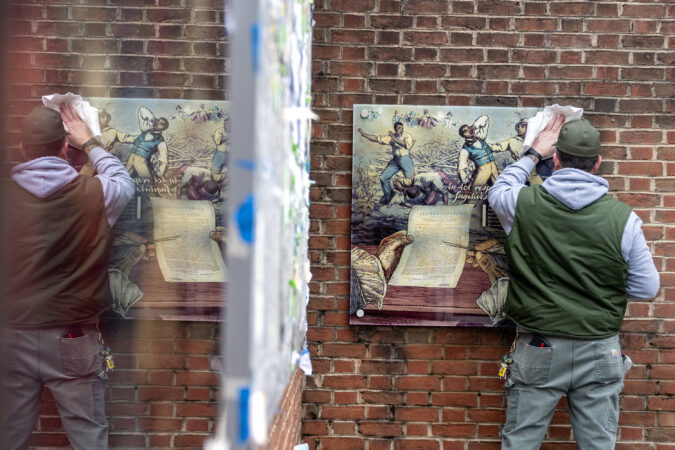
    On Thursday, 16 of 17 glass panels were reinstalled, with the remaining one needing repairs. Prior to the Third Circuit order, National Park Service employees on Friday restored panels around the site’s glass-enclosed archaeological dig, the wayside panel identifying the site, and four functioning video monitors, the federal government said.

    The federal government also had not reinstalled 13 metal panels, but was in the process of doing so prior to the stay, according to the filing.

    The city declined to comment on Hardiman’s order. The National Park Service did not immediately respond to a request for comment.

    The government argued to the Third Circuit that Rufe misunderstood the difference between the laws and agreements that govern the 55-acre Independence Hall National Historic Park and the stricter rules regarding Independence Hall National Historic Site, the city-owned block between Chestnut and Walnut Streets.

    The President’s House, on the corner of Sixth and Market Streets, sits on federal land and the law “imposes no restriction on the government’s removal of the President’s House exhibit,” the filing said.

    The city failed to demonstrate harm from the removal of the exhibits, the administration argued, because it has other avenues to promote the history of slavery in the President’s House.

    But an injunction forcing the restoration of the exhibits violates the federal government’s free-speech rights, the stay request argued.

    “It requires the display and operation of expressive exhibits — at a marquee national historic site in the run-up to the nation’s 250th anniversary — when the government has chosen not to display those exhibits,” the court filing said.

    The city responded to the request in a letter in which it expressed confusion about what the administration was asking for. After all, the government already began restoring the exhibits.

    “It is not clear whether the United States is asking the court for permission to re-remove the panels that were just reinstalled yesterday, or whether they are asking to be relieved of the duty to reinstall the remaining panels, or whether they are asking for more time to restore the remaining panels because today’s deadline is not feasible,” the city’s letter said.

    Either way, the city reiterated its opposition to a stay.

    Philadelphia’s lawsuit was the first in the nation challenging the removal of exhibits from national parks in accordance with Trump’s March executive order, which instructed the Interior Department to remove any content or displays that “inappropriately disparage Americans past or living.”

    Advocates celebrated the return of the exhibits commemorating the nine enslaved people who lived in George Washington’s house in a Thursday afternoon rally.

    The site will see no further changes for now. Hardiman placed the injunction appeal on an expedited track. With the current deadlines set by the judge, a ruling on the injunction is unlikely before May.

  • Supreme Court strikes down Trump’s sweeping tariffs, sparking fierce pushback and vow of new levies

    Supreme Court strikes down Trump’s sweeping tariffs, sparking fierce pushback and vow of new levies

    WASHINGTON — The Supreme Court struck down President Donald Trump’s far-reaching global tariffs on Friday, handing him a stinging loss that sparked a furious attack on the court he helped shape.

    Trump said he was “absolutely ashamed” of some justices who ruled 6-3 against him, calling them “disloyal to our Constitution” and “lapdogs.” At one point he even raised the specter of foreign influence without citing any evidence.

    The decision could have ripple effects on economies around the globe after Trump’s moves to remake post-World War II trading alliances by wielding tariffs as a weapon.

    But an unbowed Trump pledged to impose a new global 10% tariff under a law that’s restricted to 150 days and has never been used to apply tariffs before.

    “Their decision is incorrect,” he said. “But it doesn’t matter because we have very powerful alternatives.”

    The court’s ruling found tariffs that Trump imposed under an emergency powers law were unconstitutional, including the sweeping “reciprocal” tariffs he levied on nearly every other country.

    Trump appointed three of the justices on the nation’s highest court during his first term, and has scored a series of short-term wins that have allowed him to move ahead with key policies.

    Tariffs, though, were the first major piece of Trump’s broad agenda to come squarely before the Supreme Court for a final ruling, after lower courts had also sided against the president.

    The majority found that it is unconstitutional for the president to unilaterally set and change tariffs because taxation power clearly belongs to Congress. “The Framers did not vest any part of the taxing power in the Executive Branch,” Chief Justice John Roberts wrote.

    Justices Brett Kavanaugh, Samuel Alito, and Clarence Thomas dissented.

    “The tariffs at issue here may or may not be wise policy. But as a matter of text, history, and precedent, they are clearly lawful,” Kavanaugh wrote. Trump praised his 63-page dissent as “genius.”

    The court majority did not address whether businesses could get refunded for the billions they have collectively paid in tariffs. Many companies, including the big-box warehouse chain Costco, have already lined up in lower courts to demand refunds. Kavanaugh noted the process could be complicated.

    “The Court says nothing today about whether, and if so how, the Government should go about returning the billions of dollars that it has collected from importers. But that process is likely to be a ‘mess,’ as was acknowledged at oral argument,” he wrote.

    The Treasury had collected more than $133 billion from the import taxes the president has imposed under the emergency powers law as of December, federal data show. The impact over the next decade has been estimated at some $3 trillion.

    The tariffs decision doesn’t stop Trump from imposing duties under other laws. Those have more limitations on the speed and severity of Trump’s actions, but the president said they would still allow him to “charge much more” than he had before.

    Vice President JD Vance called the high court decision “lawlessness” in a post on X.

    Questions about what Trump can do next

    Still, the ruling is a “complete and total victory” for the challengers, said Neal Katyal, who argued the case on behalf of a group of small businesses.

    “It’s a reaffirmation of our deepest constitutional values and the idea that Congress, not any one man, controls the power to tax the American people,” he said.

    It wasn’t immediately clear how the decision restricting Trump’s power to unilaterally set and change tariffs might affect trade deals with other countries.

    “We remain in close contact with the U.S. Administration as we seek clarity on the steps they intend to take in response to this ruling,” European Commission spokesman Olof Gill said, adding that the body would keep pushing for lower tariffs.

    The Supreme Court ruling comes after victories on the court’s emergency docket have allowed Trump to push ahead with extraordinary flexes of executive power on issues ranging from immigration enforcement to major federal funding cuts.

    The Republican president had long been vocal about the tariffs case, calling it one of the most important in U.S. history and saying a ruling against him would be an economic body blow to the country. But legal opposition crossed the political spectrum, including libertarian and pro-business groups that are typically aligned with the GOP. Polling has found tariffs aren’t broadly popular with the public, amid wider voter concern about affordability.

    While the Constitution gives Congress the power to levy tariffs, the Trump administration argued that a 1977 law allowing the president to regulate importation during emergencies also allows him to set import duties. Other presidents have used the law dozens of times, often to impose sanctions, but Trump was the first president to invoke it for tariffs.

    “And the fact that no President has ever found such power in IEEPA is strong evidence that it does not exist,” Roberts wrote, using an acronym for the International Emergency Economic Powers Act.

    Trump set what he called “reciprocal” tariffs on most countries in April 2025 to address trade deficits that he declared a national emergency. Those came after he imposed duties on Canada, China, and Mexico, ostensibly to address a drug trafficking emergency.

    A series of lawsuits followed, including a case from a dozen largely Democratic-leaning states and others from small businesses selling everything from plumbing supplies to women’s cycling apparel.

    The challengers argued the emergency powers law doesn’t even mention tariffs and Trump’s use of it fails several legal tests, including one that doomed then-President Joe Biden’s $500 billion student loan forgiveness program.

    Justices reject use of emergency powers for tariffs

    The three conservative justices in the majority pointed to that principle, which is called the major questions doctrine. It holds that Congress must clearly authorize actions of major economic and political significance.

    “There is no exception to the major questions doctrine for emergency statutes,” Roberts wrote. The three liberal justices formed the rest of the majority, but didn’t join that part of the opinion.

    The Trump administration had argued that tariffs are different because they’re a major part of Trump’s approach to foreign affairs, an area where the courts should not be second-guessing the president.

    But Roberts, joined by Justices Neil Gorsuch and Amy Coney Barrett, brushed that aside, writing that the implications for international relations don’t change the legal principle.

    Small businesses celebrated the ruling, with the National Retail Federation saying it provides “much needed certainty.”

    Illinois toy company Learning Resources was among the businesses challenging the tariffs in court. CEO Rick Woldenberg said he expected Trump’s new tariffs but hoped there might be more constraint in the future, both legal and political. “Somebody’s got to pay this bill. Those people that pay the bill are voters,” he said.

    Ann Robinson, who owns Scottish Gourmet in Greensboro, N.C., said she was “doing a happy dance” when she heard the news.

    The 10% baseline tariff on U.K. goods put pressure on Robinson’s business, costing about $30,000 in the fall season. She’s unsure about the Trump administration’s next steps, but said she’s overjoyed for now. “Time to schedule my ‘Say Goodbye to Tariffs’ Sale!”

  • House Speaker Mike Johnson denies request for Rev. Jesse Jackson to lie in honor in U.S. Capitol

    House Speaker Mike Johnson denies request for Rev. Jesse Jackson to lie in honor in U.S. Capitol

    WASHINGTON — The late Rev. Jesse Jackson will not lie in honor in the United States Capitol Rotunda after a request for the commemoration was denied by the House Speaker Mike Johnson’s office due to past precedent.

    Johnson’s office said it received a request from the family to have Jackson’s remains lie in honor at the Capitol, but the request was denied, because of the precedent that the space is typically reserved for former presidents, the military, and select officials.

    The civil rights leader died this week at the age of 84. The family and some House Democrats had filed a request for Jackson to be honored at the U.S. Capitol.

    Amid the country’s political divisions, there have been flare-ups over who is memorialized at the Capitol with a service to lie in state, or honor, in the Rotunda. During such events, the public is generally allowed to visit the Capitol and pay their respects.

    Recent requests had similarly been made, and denied, to honor Charlie Kirk, the slain conservative activist, and former Vice President Dick Cheney.

    There is no specific rule about who qualifies for the honor, a decision that is controlled by concurrence from both the House and Senate.

    The Jackson family has announced scheduled dates for memorial services beginning next week that will honor the late reverend’s life in Chicago, Washington, D.C., and South Carolina. In a statement, the Jackson family said it had heard from leaders in both South Carolina, Jackson’s native state, and Washington offering for Jackson to be celebrated in both locations. Talks are ongoing with lawmakers about where those proceedings will take place. His final memorial services will be held in Chicago on March 6 and 7.

    Typically, the Capitol and its Rotunda have been reserved for the “most eminent citizens,” according to the Architect of the Capitol’s website. It said government and military officials lay in state, while private citizens in honor.

    In 2020, Rep. John Lewis, another veteran of the Civil Rights movement, was the first Black lawmaker to lie in state in the Capitol Rotunda after a ceremony honoring his legacy was held outside on the Capitol steps due to pandemic restrictions at the time.

    Later that year, then-House Speaker Nancy Pelosi allowed services for Supreme Court Justice Ruth Bader Ginsburg at the Capitol’s Statuary Hall after agreement could not be reached for services in the Capitol’s Rotunda.

    It is rare for private citizens to be honored at the Capitol, but there is precedent — most notably Civil Rights icon Rosa Parks, in 2005, and the Rev. Billy Graham, in 2018.

    A passionate civil rights leader and globally-minded humanitarian, Jackson’s fiery speeches and dual 1984 and 1988 presidential campaigns transformed American politics for generations. Jackson’s organization, the Rainbow PUSH Coalition, became a hub for progressive organizers across the country.

    His unapologetic calls for a progressive economic agenda and more inclusive policies for all racial groups, religions, genders and orientations laid the groundwork for the progressive movement within the Democratic Party.

    Jackson also garnered a global reputation as a champion for human rights. He conducted the release of American hostages on multiple continents and argued for greater connections between civil rights movements around the world, most notably as a fierce critic of the policies of Apartheid South Africa.

  • Which Trump tariffs did the Supreme Court strike down? Here’s what to know

    Which Trump tariffs did the Supreme Court strike down? Here’s what to know

    NEW YORK — The nation’s highest court struck down some of President Donald Trump’s most sweeping tariffs on Friday, in a 6-3 decision that he overstepped his authority when using an emergency powers law to justify new taxes on goods from nearly every country in the world.

    Trump has launched a barrage of new tariffs over the last year. Despite Friday’s ruling, many sectoral levies remain in place — and the president has already said that he’ll turn to other options for more import taxes, including plans to impose a new 10% tariff globally. But the Supreme Court decision upends a core set of tariffs that Trump rolled out using the 1977 International Emergency Economic Powers Act, or IEEPA.

    IEEPA authorizes the president to broadly regulate commerce after declaring a national emergency. Over the years, presidents have turned to this law dozens of times, often to place sanctions on other countries. But Trump was the first to use it to implement tariffs.

    Here’s a look at the now-overturned tariffs Trump imposed using IEEPA — and other levies that still stand today.

    ‘Liberation Day’ tariffs

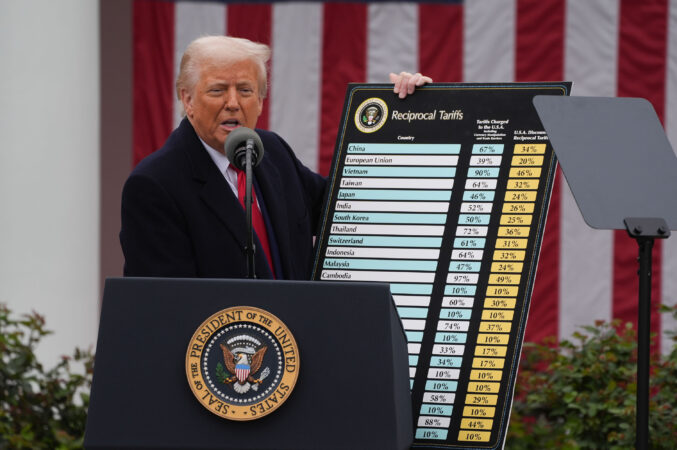
    Trump used IEEPA to slap import taxes on nearly every country in the world last spring. On April 2, which Trump called Liberation Day, he imposed “reciprocal” tariffs of up to 50% on goods from dozens of countries — and a baseline 10% tariff on just about everyone else.

    The 10% tax kicked in early April. But the bulk of Liberation Day’s higher levies got delayed by several months, and many rates were revised over time (in some cases after new “framework” agreements). Most went into effect Aug. 7.

    The national emergency underlying these tariffs, Trump argued at the time, was the long-running gap between what the U.S. sells and what it buys from the rest of the world. Still, goods from countries with which the U.S. runs a trade surplus also faced taxes.

    Major trading partners impacted by Liberation Day tariffs include South Korea, Japan and the European Union — which combined export a range of products to the U.S., like electronics, cars, and car parts and pharmaceuticals. Following trade talks, Trump’s rates on most goods stood at 15% for the EU, Japan and South Korea ahead of Friday. But just last month, Trump threatened to hike levies on certain South Korean products to 25% — and countries worldwide still face sector-specific, non-IEEPA tariffs.

    ‘Trafficking tariffs’ on Canada, China and Mexico

    At the start of his second term, Trump used IEEPA to impose new tariffs on America’s three biggest trading partners: Mexico, Canada, and China.

    To justify these tariffs, Trump declared a national emergency ostensibly over undocumented immigration and the trafficking of drugs like fentanyl and the chemicals made to use it. The levies were first announced at the start of February 2025, but went into effect over time — and were at times delayed, reduced or heightened through further retaliation.

    Ahead of Friday’s decision, “trafficking tariffs” on Canadian and Mexican imports were 35% and 25%, respectively, for goods that don’t comply with the 2020 United States-Mexico-Canada Agreement. China, meanwhile, faced a 10% fentanyl-related tariff. That’s down from 20% imposed by Trump earlier last year. Chinese goods also once saw sky-high levies after Liberation Day, but rates had since come down during trade talks.

    Top U.S. imports from China include mobile phones and other electronics, as well as clothing, toys and household appliances. Meanwhile, Canada and Mexico are both major sources of cars and auto parts. Canada is also the U.S.’s largest supplier of crude oil. And Mexico is a key exporter of fresh produce, beverages and more.

    Tariffs on Brazil over Bolsonaro trial

    Trump also used IEEPA to slap steep import taxes on Brazilian imports over the summer, citing the country’s policies and criminal prosecution of former President Jair Bolsonaro.

    Brazil already faced Trump’s 10% baseline Liberation Day rate. The Bolsonaro-related duties added another 40%, bringing total levies to 50% on many products ahead of Friday.

    The U.S. has actually run a consistent trade surplus with Brazil over the years. But top exports from the country include manufactured products, crude oil and agricultural products like soybeans and sugar.

    Tariffs on India linked to Russian oil

    India has faced additional IEEPA tariffs, too. After Liberation Day, Trump slapped a 25% levy on Indian imports — and later added another 25% for the country’s purchases of Russian oil, while also citing the emergency powers law, bringing the total to 50%.

    But earlier this month, the U.S. and India reached a trade framework deal. Trump said Prime Minister Narendra Modi agreed to stop buying Russian oil, and that he planned to lower U.S. tariffs on its ally to 18%. Meanwhile, India said it would “eliminate or reduce tariffs” on all U.S. industrial goods and a range of agricultural products.

    India’s top exports to the U.S. include pharmaceuticals, precious stones, clothing and textiles.

    What are other non-IEEPA tariffs that countries still face today?

    Despite the Supreme Court knocking down sweeping import taxes Trump imposed with IEEPA, most countries still face steep tariffs from the U.S. on specific sectors.

    Citing national security threats, Trump has used another law — Section 232 of the 1962 Trade Expansion Act — to slap levies on steel, aluminum, cars, copper, and lumber worldwide. He began to roll out even more Section 232 tariffs in September, on kitchen cabinets, bathroom vanities and upholstered furniture.

    Amid pressure to lower rising prices, Trump has rolled back some of his tariffs recently. Beyond trade frameworks, that’s included adding exemptions to specific levies and scrapping import taxes for goods like coffee, tropical fruit and beef.

    Still, Trump has threatened more sectoral levies are on the way. And following Friday’s decision, he said that he would sign an executive order to enact a 10% global tariff — using another federal law, known as Section 122. Those tariffs would be limited to just 150 days, unless they are extended legislatively.

  • Josh Shapiro visits the White House as Mikie Sherrill skips governors meeting after clash with Donald Trump over Democrats’ attendance

    Josh Shapiro visits the White House as Mikie Sherrill skips governors meeting after clash with Donald Trump over Democrats’ attendance

    Pennsylvania Gov. Josh Shapiro joined President Donald Trump at the White House for a breakfast on Friday, following weeks of uncertainty and strife over whether any Democrats would attend the traditionally bipartisan annual event after Trump reversed course on a decision to disinvite two other blue-state governors from the meeting.

    A spokesperson for Shapiro said he decided to attend the meeting at the White House once Maryland Gov. Wes Moore and Colorado Gov. Jared Polis were invited, despite Trump previously declaring the pair of Democratic leaders were not welcome.

    “Gov. Shapiro chose to join his colleagues and go to the White House to raise real issues and harm the Trump administration is doing to Pennsylvania,” Rosie Lapowsky, Shapiro’s press secretary, said in a statement.

    Trump initially planned to invite only Republican governors to the annual event that coincides with the National Governors Association winter meeting in Washington, D.C., but faced pushback by the group’s GOP chair. Trump then invited Democrats, as well, but rescinded the invitations for Moore and Polis. In a post on his Truth Social platform earlier this month, Trump wrote that the two Democratic governors were “not worthy of being there.”

    The weekslong back-and-forth threatened the nonpartisan nature of the National Governors Association that represents 55 governors, including those from all 50 states and five U.S. territories. Ultimately, the NGA declined to facilitate the annual breakfast event, and Trump later re-invited Polis and Moore.

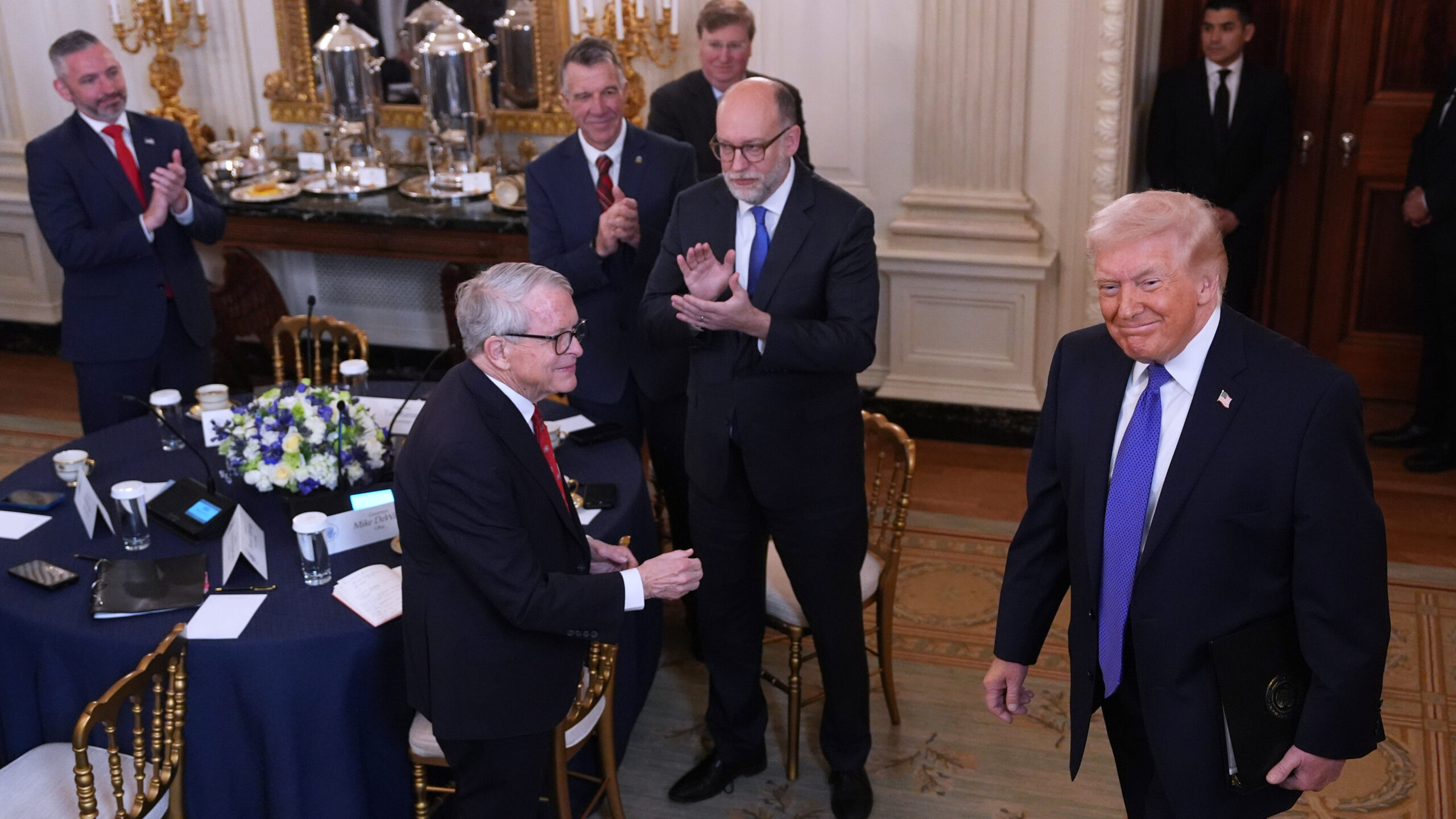
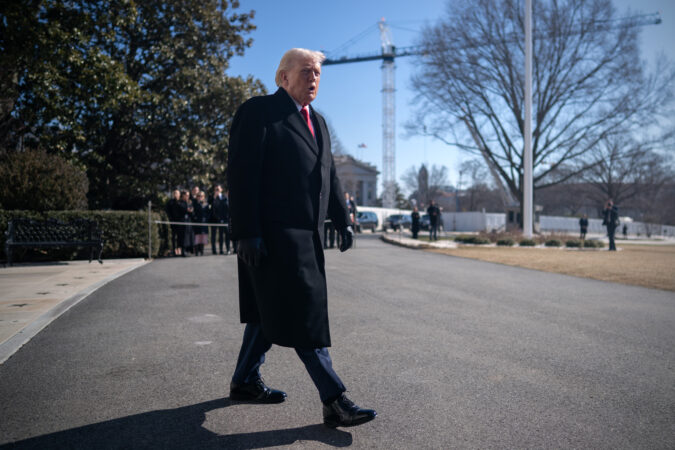
    President Donald Trump arrives to speak during a breakfast with the National Governors Association in the State Dining Room of the White House, Friday, Feb. 20, 2026, in Washington. (AP Photo/Evan Vucci)

    Moore, Polis, and Shapiro were among the more than two dozen governors who attended the White House breakfast Friday, where Trump delivered brief remarks. Other Democrats, including New Jersey Gov. Mikie Sherill, decided against going.

    Sherrill, a former member of Congress who just began her term last month, said in a statement that she opted to skip the White House breakfast to “focus on other NGA meetings.”

    “The president’s chaotic back-and-forth about the NGA was counterproductive and Gov. Sherrill decided not to attend,” said Sean Higgins, a spokesperson for Sherrill.

    What Shapiro talked about

    Shapiro described the closed-door meeting between Trump, the governors, and all of Trump’s cabinet as productive for him to advocate for specific issues directly with federal leaders.

    “Folks were respectful to me,” Shapiro told reporters following the meeting. “I went there with a mission to talk about things that were important to Pennsylvania.”

    Shapiro, who is currently running for reelection and touts his ability to work across partisan lines, has expressed an openness to working with Trump on issues specific to Pennsylvania, though he has challenged the president more than a dozen times in court since Trump took office last year.

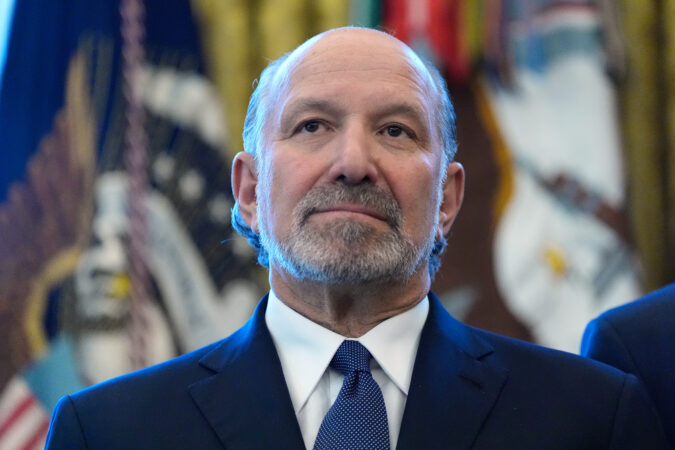
    Shapiro said he was able to discuss his top issues directly with federal officials. He said he spoke with U.S. Department of Agriculture Secretary Brooke Rollins about the reemergence of the avian flu in Pennsylvania; discussed releasing withheld broadband funding with Treasury Secretary Howard Lutnick about releasing withheld broadband funding; and talked with U.S. Secretary of Health and Human Services Robert F. Kennedy Jr. and Director of the Office of Management and Budget Russ Vought about the ways “their policies are hurting rural Pennsylvanians.”

    New York Gov. Kathy Hochul, another Democrat who attended the meeting, said afterward in a news conference that she was glad to hear what lessons Trump said he learned from his administration’s immigration enforcement mission in Minneapolis that led to mass protests and the fatal shootings of two U.S. citizens by federal agents.

    Hochul said Trump told the group that “we’ll only go where we’re wanted,” alleviating concerns among some Democratic governors that their states may be the next to see a full-scale federal presence upending daily life.

    Weeks of back-and-forth ahead of the White House breakfast

    Sherrill and Shapiro were among the 18 Democratic governors who earlier said they would not attend the event if their colleagues were excluded.

    “Democratic governors have a long record of working across the aisle to deliver results and we remain committed to this effort,” they said in a joint statement on Feb. 10 through the Democratic Governors Association. “But it’s disappointing this administration doesn’t seem to share the same goal. At every turn, President Trump is creating chaos and division, and it is the American people who are hurting as a result.”

    They added: “Democratic governors remain united and will never stop fighting to protect and make life better for people in our states.”

    In comments to CNN last week, Sherrill said that “worse decisions” would be made without all the governors there.

    “For the president to pick and choose who he is going to have to sort of undermine the very focus of this, of coming together to get stuff done for the country just seeds more … chaos,” the New Jersey Democrat said.

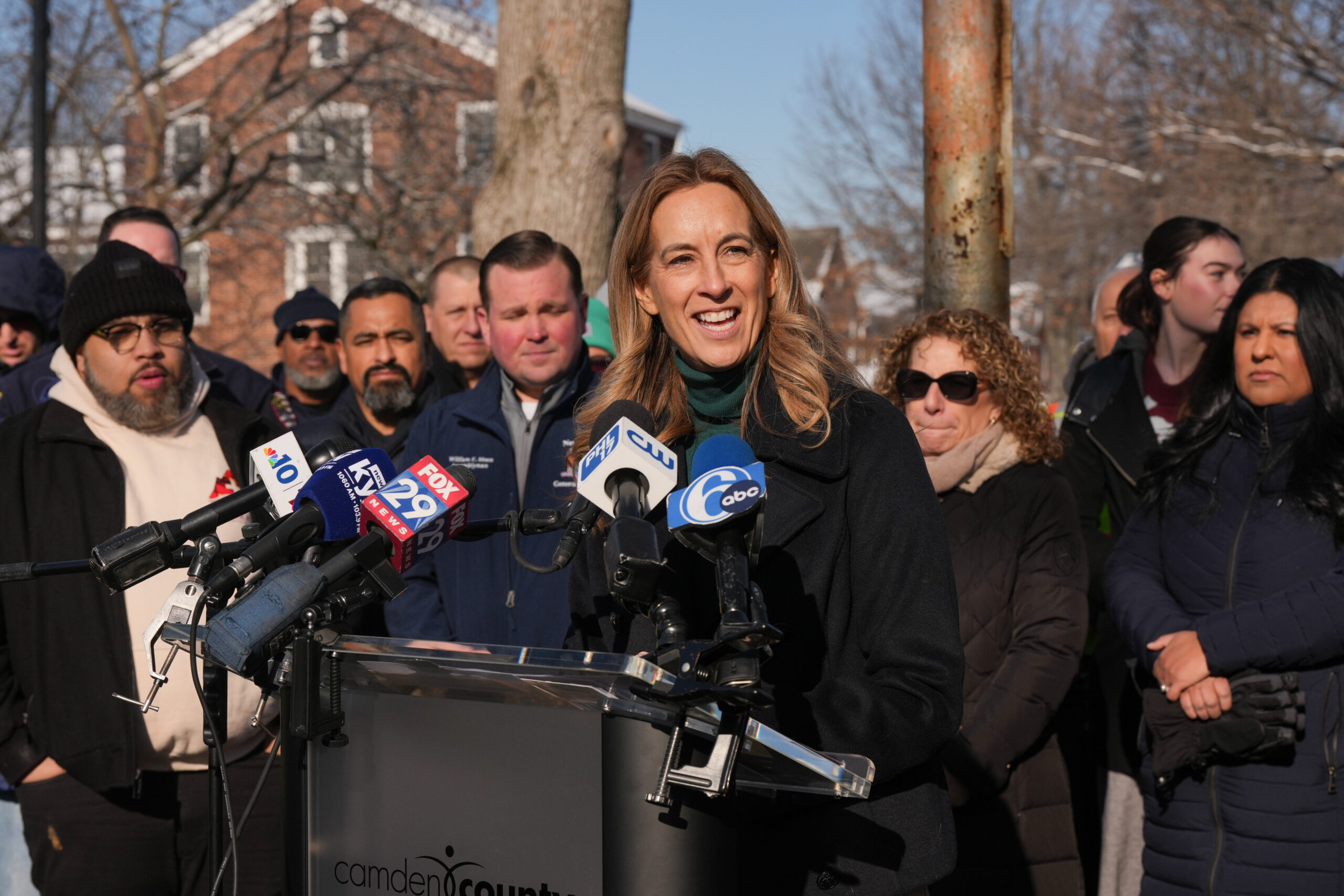
    Gov. Mikie Sherrill, shown here at a news conference as volunteers gather prior to shoveling snow at Fairview Village on Martin Luther King Day during a day of service, in Camden, New Jersey, January 19, 2026.

    Moore, the nation’s only Black governor, and Polis, the first openly gay man elected to U.S. governor, were the only two leaders Trump singled out, raising concerns by civil rights groups.

    Trump, however, cited different reasons for his objections to Moore and Polis’ attendance. He said he wanted to exclude Polis because his state continues to incarcerate a former county clerk over her conviction related to allowing election-denier activists access to election data following the 2020 election. Trump also expressed a number of grievances toward Moore, including his handling of the rebuilding of the Francis Scott Key Bridge and Baltimore’s crime rates.

    Following the meeting Friday, governors from both parties reaffirmed that they were still committed to working with Trump despite the turmoil.

    “It’s really important imagery that we stand together as governors of our states and represent all of America, and just remind people that there’s really more that brings us together and unites us than divides us,” said Oklahoma Gov. Kevin Stitt, a Republican who chairs the NGA.

    Shapiro separately told reporters that he has worked with directly Trump to “save steelworker jobs” but remains ready to challenge them in court if they threaten Pennsylvanians’ rights.

    Asked whether he has a good relationship with Trump, Shapiro said: “We have a relationship where we can work for the people of Pennsylvania, that’s my job.”

  • Trump banner on Justice Dept. building draws authoritarian comparisons

    Trump banner on Justice Dept. building draws authoritarian comparisons

    A new banner hanging along the facade of the Justice Department’s headquarters in Washington is sparking criticism from Democrats and a former FBI director, who suggest that it exemplifies President Donald Trump’s encroachment on the agency, which has long prided itself on being independent from the White House.

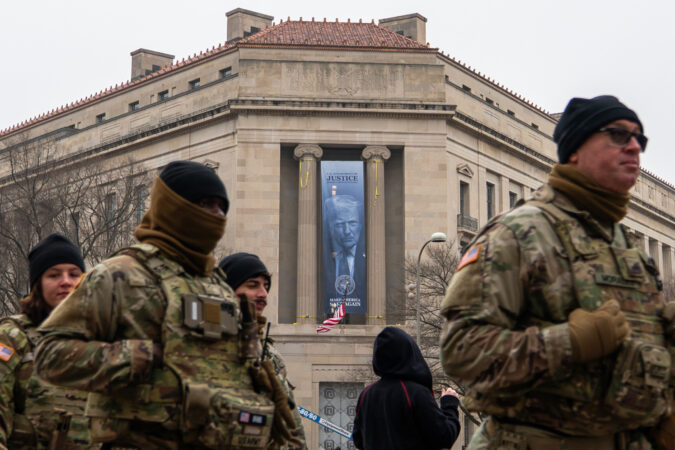
    The tall banner displays a portrait of Trump, cast in a dark blue hue, staring down at tourists, commuters and cars along Washington’s bustling Pennsylvania Avenue. “MAKE AMERICA SAFE AGAIN,” reads the banner, which is emblazoned with the Justice Department’s seal.

    A Justice Department spokesperson said the banner was hung in commemoration of the United States’ Semiquincentennial, writing in a statement: “We are proud at this Department of Justice to celebrate 250 years of our great country and our historic work to make America safe again at President Trump’s direction.”

    Similar banners have appeared recently on other government buildings in Washington. But Democrats said that the decision to install one at the Justice Department symbolizes the influence Trump has wielded over the agency during his second term and that the display is comparable to the imagery deployed by authoritarian regimes.

    “The irony of a twice-impeached, convicted felon putting his own picture on the wall of the Department of Justice,” Sen. Ben Ray Luján of New Mexico wrote on X. “President Trump is weaponizing the DOJ as his own personal law firm.”

    Rep. Mike Quigley of Illinois shared an image of the banner online and wrote: “POTUS is putting his face on the Justice Department. … This is not the work of an independent and impartial justice system.”

    “Ok Kim Jong Un,” Rep. Jim McGovern of Massachusetts wrote.

    A pair of similar banners hung at the U.S. Department of Agriculture showed Trump and Abraham Lincoln’s portraits emblazoned with the phrase: “Growing America Since 1862.” (A government purchase order for the pair of banners at USDA showed they cost $16,400.) And banners hung on the Labor Department’s building featured portraits of Trump and Theodore Roosevelt that read, “American workers first.”

    The addition to the Justice Department building follows a pattern of norm-breaking efforts that critics say amount to Trump using the agency as a personal cudgel against his political enemies.

    In a speech delivered inside the building last year, Trump declared himself the nation’s “chief law enforcement officer.” Attorney General Pam Bondi rarely misses an opportunity to praise the president and credit him with the department’s success, including at a contentious congressional oversight hearing last week in which she repeatedly described him “the greatest president in American history.”

    To Trump’s critics, the banner is also striking given his status as a felon. He was found guilty in 2024 in a New York state case on 34 counts of falsifying business records to conceal a hush money payment to an adult-film actress.

    Less than two years ago, Justice Department prosecutors had been pursuing two federal cases against him led by former special counsel Jack Smith. One focused on efforts to overturn the 2020 election, while the other related to Trump’s handling of classified documents.

    Trump is continuing to appeal his state court conviction in New York. A Georgia criminal case against Trump related to efforts to change the 2020 election result was dismissed last year.

    The two federal cases were also dismissed. One ended because of issues with Smith’s appointment. The other Smith withdrew after Trump’s 2024 election victory, in line with long-standing Justice Department policies preventing prosecution of a sitting president.

    Trump and his Justice Department appointees have contended that the prosecutions arose out of a Biden-era weaponization of the justice system to punish political foes.

    Since his return to the White House, Trump has ordered several prosecutions of political rivals on social media. Federal prosecutors brought charges against former FBI Director James B. Comey and New York Attorney General Letitia James last year — both of whom Trump had demanded Bondi move swiftly to prosecute. Those cases were later thrown out over issues with the appointment of the U.S. attorney selected to oversee them.

    Comey, in a social media post Thursday, called the installation of the banner outside the Justice Department headquarters “sickening.”

    “But they forgot to cover the inscription on the Pennsylvania Avenue side: ‘WHERE LAW ENDS TYRANNY BEGINS,’” he wrote.

    The banner is hardly the first time the Trump administration has been accused of adopting aesthetics and deploying imagery typically associated with imperialism or authoritarianism since his return to office last year.

    The administration, for example, roiled the art world when the Department of Homeland Security used images of Americana paintings to bolster support for Trump’s large-scale deportation campaign.

    There was also a massive military parade in Washington last year, which ran against an American tradition of avoiding public displays of martial strength more common in authoritarian regimes. The president is also planning a giant triumphal arch across from the Lincoln Memorial, which could dwarf the size of that and other monuments.

  • Philly-area lawmakers applaud Supreme Court striking down Trump’s tariffs as area businesses brace for uncertainty on refunds

    Philly-area lawmakers applaud Supreme Court striking down Trump’s tariffs as area businesses brace for uncertainty on refunds

    Pennsylvania lawmakers say Congress should reclaim its power over taxes and tariffs after the U.S. Supreme Court quashed President Donald Trump’s controversial global tariffs.

    The nation’s high court ruled 6-3 Friday that Trump overstepped with tariffs imposed under an emergency powers law, dealing a significant blow to the president’s economic agenda and reasserting congressional authority.

    Chief Justice John Roberts and Justices Neil Gorsuch and Amy Coney Barrett — both Trump nominees — joined liberal justices in the majority. Justices Brett Kavanaugh, Clarence Thomas, and Samuel A. Alito Jr. dissented.

    Trump told reporters at the White House Friday that he was “ashamed” of the three Republican-appointed justices for not having “the courage to do what’s right for our country.”

    But local lawmakers celebrated the decision as a step toward alleviating inflation exacerbated by Trump’s tariffs.

    It’s “​​the first piece of good news that American consumers have gotten in a very long time,” said U.S. Rep. Brendan Boyle (D., Philadelphia), the ranking member of the House Budget Committee.

    The decision is unlikely to be the end of the road for Trump’s efforts to impose tariffs. The court struck down the broad authority Trump had claimed to impose sweeping tariffs, but he could still impose additional import and export taxes using powers he employed in his first term.

    Friday’s decision centers on tariffs imposed under an emergency powers law, including the “reciprocal” tariffs he waged on other countries, The Associated Press reported.

    What’s next

    It remains unclear what will happen to tariff revenue that’s already been collected — about $30 billion a month since Trump took office last year, NPR reported. But Pennsylvania lawmakers are pushing for Congress to reassert its power to control the country’s purse strings.

    “As the Supreme Court validated this morning, Congress has the authority to levy taxes and tariffs,” Boyle said. “It’s time now for us to finally reclaim that authority and bring some certainty and rationality to our tariff policy, which under Donald Trump has been all over the map and changes day by day, even hour by hour.”

    Casey-Lee Waldron, a spokesperson for U.S. Rep. Brian Fitzpatrick (R., Bucks), said in a statement Friday that the lawmaker “applauds” the high court’s decision, “which validates the Congressman’s opposition to blanket and indiscriminate tariffs that are not narrowly tailored, and that do not lower costs for the American consumer.”

    Waldron added that Fitzpatrick supports enforcing trade laws, but “this should always be done in a collaborative manner with a bipartisan, bicameral majority in Congress.”

    Pennsylvania Gov. Josh Shapiro and N.J. Gov. Mikie Sherrill, both Democrats, celebrated the decision Friday in statements that noted the challenges the tariffs had caused for local economies.

    Speaking to reporters at the National Governors Association meeting in Washington, Shapiro said tariffs had done real harm to Pennsylvanians, citing rising prices for farmers and for consumer goods.

    “There is a direct line connecting those price increases to the president pushing the tariff button,” Shapiro said. “I think the Supreme Court got it right, and I say that as a former attorney general, and I say that as someone who actually follows the law.”

    U.S. Sen. Dave McCormick (R., Pa.), however, came to the defense of Trump’s tariff policies, saying in a statement that he believes Trump “was using legitimate emergency authorities very effectively to protect our national security and achieve fair trade for U.S. companies and American workers.”

    McCormick, a former Treasury official and former hedge fund executive, said he was disappointed with the court’s ruling and called to find other ways to accomplish Trump’s economic and national security goals, which include preventing “foreign competitors from cheating Pennsylvania workers.”

    Shockwaves in Philly and beyond

    Trump enacted the sweeping tariffs early last year, arguing that the move would incentivize companies to bring operations back to the United States and even trade deficits with other countries.

    The move, however, sent shock waves through the U.S. economy as prices increased and U.S. exports, including Pennsylvania’s lumber sales, suffered.

    Tariffs slowed business at the Port of Philadelphia, which reported cargo volume down across the board.

    Philly is a major gateway for produce, bringing in more fresh fruit than any other U.S. port, largely from Central and South America. The port saw record container volume last year, handling almost 900,000 units, up 6% over 2024. About two-thirds of that cargo was refrigerated — fruit and meat, for example.

    But this year got off to a slow start. “The story is increased competition and tariffs,” Sean Mahoney, marketing director at the Philadelphia Regional Port Authority (PhilaPort), said during the agency’s board meeting on Wednesday.

    Leo Holt, president of the city’s primary terminal operator Holt Logistics, hopes companies that see savings would pass them on to consumers. In practice, he acknowledged many would likely take a conservative approach.

    “I think consumers are going to demand that at least there’s an accounting for what they’re paying,” Holt said Friday.

    U.S. Sen. Chris Coons (D., Del.) said in a statement that he knows many Republican colleagues of his “are privately breathing sighs of relief this morning at the court’s decision.”

    “They should instead be asking themselves why they didn’t use their legislative authority to do more to stop these tariffs when they had the chance — and what they’ll do differently next time when President Trump inevitably tries again,” Coons said.

    ‘Nobody is going to rush to drop their prices’

    The Supreme Court’s ruling will be welcome news for some businesses, but it also sparks uncertainty.

    Not all of Trump’s tariff increases came through the use of the International Emergency Economic Powers Act, and therefore some will remain in place, said Julie Park, a partner at London-based tax and business advisory firm Blick Rothenberg.

    “This decision brings further uncertainty for businesses,” she said in a statement. That’s in part because Trump could seek to reimpose tariffs through other legal tools, leaving “businesses in limbo about if they will get refunded.”

    U.S. exporters will also be closely following what happens next, since the fate of Trump’s tariffs will likely determine whether other countries, like Canada, keep their retaliatory measures in place. Canada is Pennsylvania’s biggest export market, with the state sending more than $14 billion in goods there in 2024. Top exports included machinery, cocoa, iron, and steel.

    Pennsylvania’s dairy industry has also been caught in the middle of the global trade war, as China and Canada imposed extra taxes on those goods in response to U.S. tariffs.

    It’s also unclear whether companies will receive refunds for the tariffs they’ve paid in the past year.

    Tim Avanzato, vice president of international sales at Lanca Sales Inc, said his New Jersey-based import-export company should be eligible for as much as $4 million in tariff refunds.

    “It’s going to create a paperwork nightmare for importers,” he said, noting that he doesn’t expect the Trump administration to make it easy to retrieve this money.

    Avanzato said he is also watching for ways the administration may implement new tariffs. Consumers, he said, shouldn’t expect changes in the immediate term.

    “Companies are not very good at passing on savings,” Avanzato said. “Nobody is going to rush to drop their prices.”

    Sen. Andy Kim (D., N.J.) said Trump cost Americans “a lot of money.”

    “Trump 2.0: You pay for his tariffs, tax breaks for his billionaire donors, & insane corruption for his friends and family,” the South Jersey Democrat added in a social media post.

    The Supreme Court’s decision is “a step” in righting wrongs by the Trump administration, he said, but there’s “so much more to go.”

    Staff Writers Katie Bernard, Max Marin, Aliya Schneider and Rob Tornoe and The Associated Press contributed to this article.

  • Haverford president is considering convening committee to review Howard Lutnick’s name on campus library

    Haverford president is considering convening committee to review Howard Lutnick’s name on campus library

    Haverford College president Wendy Raymond is considering convening a committee that would review whether mega donor and U.S. Commerce Secretary Howard Lutnick’s name should remain on the campus library.

    Raymond’s statement to the campus community this week follows concerns expressed by Haverford students and alumni about Lutnick’s ties to sex offender Jeffrey Epstein. She noted “a growing number of Fords have written to express their dismay.”

    “While forming a naming review committee does not predetermine any outcome, it is a serious step and not something I would take lightly,” Raymond wrote to the campus. “I will take the time necessary to continue to reflect and to engage with thought partners before determining whether to activate a review committee.”

    Under Haverford’s gift policy, the school can rename a building if “the continued use of the name may be deemed detrimental to the college, or if circumstances change regarding the reason for the naming.” If Raymond convenes a committee, she would then consider its recommendations and make her recommendation to the external affairs committee of the board of managers, as well as to its chair and vice chair. The external affairs committee then would make its recommendation to the full board of managers.

    Lutnick, a 1983 graduate and former chair of the college’s board of managers, is one of the school’s biggest donors, having given $65 million. Documents released by the U.S. Justice Department this month show that Lutnick had contact with the late financier as recently as 2018, long after Epstein pleaded guilty to obtaining a minor for prostitution and soliciting a prostitute.

    And during congressional testimony last week, he said he visited Epstein’s private island with his family in 2012. Lutnick previously said he had not been in a room with Epstein, whom he found “disgusting,” since 2005.

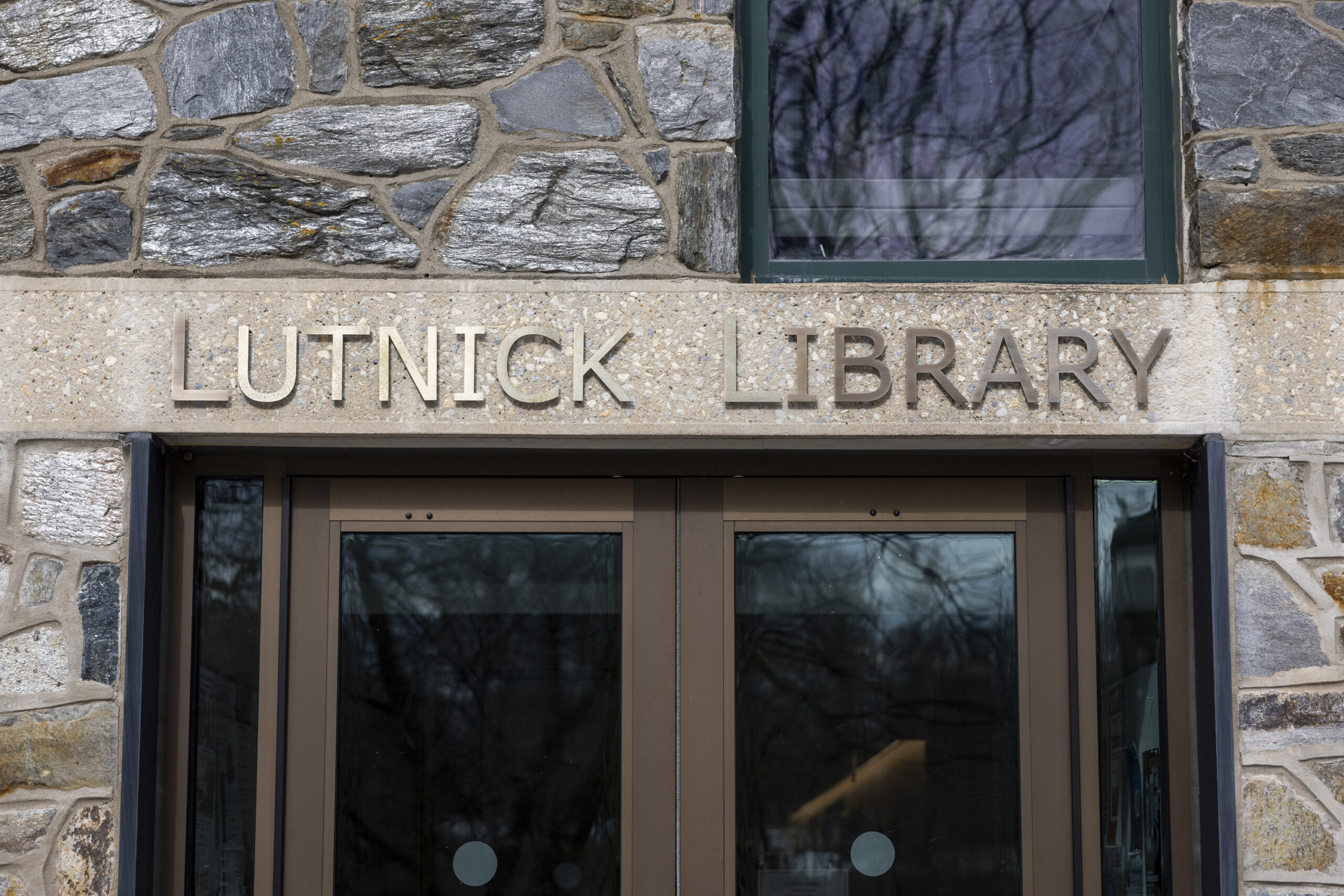
    The outside of the Lutnick Library at Haverford College.

    Raymond’s announcement comes one day after students held a town hall to discuss their concerns and feelings about Lutnick‘s ties to Epstein.

    Students who organized the town hall said Raymond’s communications about Lutnick have fallen short. They said they had hoped at least to see a review committee started.

    “Many students, including myself, are deeply disappointed and, in many cases, hurt by the neutral and softened language in these communications,” senior English major Paeton Smith-Hiebert wrote to Raymond.

    Smith-Hiebert is co-founder of the Haverford Survivor Collective, which started in 2023 and is led by Haverford students and survivors of sexual assault. She said while Raymond notes she is having conversations about the topic, the collective hasn’t been consulted.

    “Given the gravity of this situation, survivors are among those most directly affected,” she wrote. “Many are feeling significant harm and institutional betrayal … While I understand there are many stakeholders to consult, it is difficult to reconcile the stated commitment to engagement with the apparent absence of those most impacted.”

    Raymond’s message, she said, also should have included a reference to resources or support for survivors who are struggling, she said.

    Between 50 and 100 students attended the nearly two-hour town hall, several attendees said, with no students speaking in favor of keeping Lutnick’s name on the building. Students introduced an open letter with demands that has since been signed by 235 students, staff, and alumni as of 8:30 a.m. Friday, said Smith-Hiebert. The letter calls on the college to immediately convene a review committee, rename the library, acknowledge the distress and harm members of the community are experiencing, and “adopt a clear and unambiguous morals clause” in the gift policy.

    Students also discussed the possibility of protest actions to urge the college to act as soon as possible.

    The issue of Lutnick’s name on the library is likely to come up at a plenary session, where students discuss and vote on important campus issues. That session is scheduled for March 29.

    If the students were to pass a resolution calling for the removal of Lutnick’s name from the library, it would go to Raymond for signing.

    Milja Dann, 19, a sophomore psychology major from Woodbury, N.J., said she went through all of the Epstein files that mention Lutnick and Epstein and saw references to at least seven planned in-person encounters. Students compiled a 10-page document on the Lutnick-related material in the files.

    “I feel it is extremely difficult for survivors of sexual violence to see that name and know it is so closely associated with a man who has perpetuated violence and harm to so many people,” Dann said.

    A Commerce Department spokesperson told the Associated Press last month that Lutnick had had “limited interactions” with Epstein, with his wife in attendance, and had not been accused of “wrongdoing.” Lutnick told lawmakers last week: “I did not have any relationship with him. I barely had anything to do with him.”

    Some students at the town hall talked about the difficulty of going in the library, which is the heart of the academic campus.

    “For me, walking into that space has been uncomfortable for a while,” Smith-Hiebert said, referring to when Lutnick was named President Donald Trump’s commerce secretary. “That discomfort has only intensified given this news.”

    Lutnick, formerly chairman of Cantor Fitzgerald L.P., a New York City financial firm that lost hundreds of employees in the 9/11 World Trade Center attacks, served on Haverford’s board for 21 years.

    In addition to the library, which also bears his wife Allison’s name, the indoor tennis and track center is named for his brother Gary Lutnick, a Cantor Fitzgerald employee who was killed on 9/11, and the fine arts building carries the name of his mother, Jane Lutnick, a painter. He also funded the college’s Cantor Fitzgerald Art Gallery.

    Students discussed whether removing Lutnick’s name from the library would be enough or if other references should come down, too, said Cade Fanning, the associate editor of the Clerk, Haverford’s student newspaper, who attended the meeting.

    “That had the most split opinions,” said Fanning, 21, a senior history major from Annapolis.

    But people were concerned that seeing the Lutnick name on anything, even if it was a relative, would be difficult for survivors, Fanning said. And the relatives’ names still signify Lutnick’s “imprint” on the college, he said.

    Students also discussed that while they want his name off the library, the college should install a plaque explaining the history, rather than erasing it, Smith-Hiebert said.