Category: Pennsylvania Politics

  • Rape crisis centers are finally getting funding from Pennsylvania’s budget, but advocates say it’s not enough to support survivors

    Rape crisis centers are finally getting funding from Pennsylvania’s budget, but advocates say it’s not enough to support survivors

    Rape crisis centers in the Philadelphia region are sounding the alarm that the slight increase in funding in the recently passed state budget won’t be enough to sustain or improve crucial services for survivors of sexual assault.

    The Pennsylvania Coalition to Advance Respect (PCAR), which funds rape crisis centers via the state allocation, estimates centers will only see an average increase of $5,300 from the state to support their work assisting victims of sexual violence.

    The Philadelphia Center Against Sexual Violence had to lay off most of its staff and reduce services due to the nearly five-month state budget impasse. And while leaders in the region appreciate the funding — the first increase for rape crisis centers in years — it’s only a fraction of what Philly’s only rape crisis center says it needs to survive.

    “Even with the budget now passed, the funding increase is minimal compared to the overwhelming need,” said LaQuisha Anthony, senior manager of advocacy at the center, in a news release last week. The center is known as WOAR, the initials of its former name, Women Organized Against Rape.

    Now advocates in Philadelphia and the suburbs are turning their focus to next year’s budget, pushing for an $8 million increase in state funding to rape crisis centers, which, among other services, offer victim advocacy, legal services, and crisis hotlines. A surge in funding will help provide stability for survivors and adequately compensate staff who dedicate their lives to this work.

    “An $8 million increase would help ensure that every survivor across the Commonwealth, urban, suburban, and rural, has access to care, advocacy, and prevention,” said Joyce Lukima, coalition director and chief operating officer at PCAR, in a statement.

    More than $12 million of a $50.1 billion state budget was allocated to rape crisis this year, a $250,000 increase from last year. Lukima said this $250,000 will be split among 47 rape crisis centers in the state.

    In a statement, a spokesperson for the Pennsylvania Department of Human Services, which oversees rape crisis center funding, highlighted Gov. Josh Shapiro’s history of support for survivors of sexual violence.
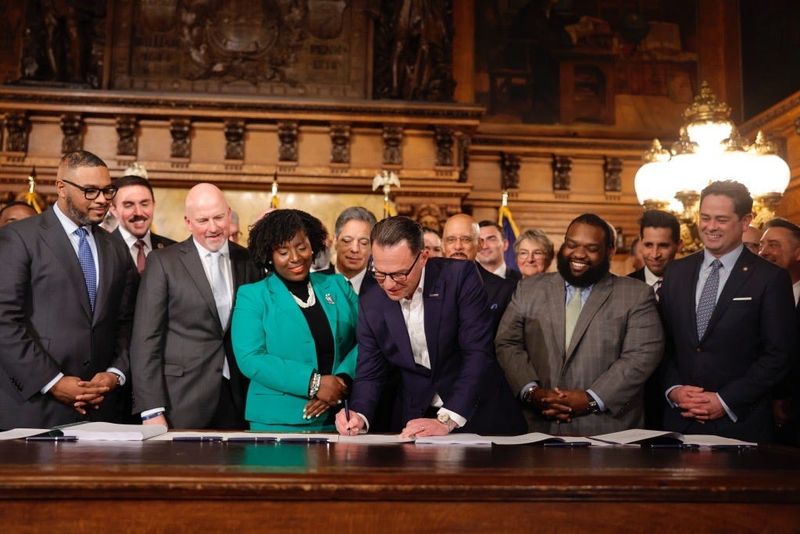
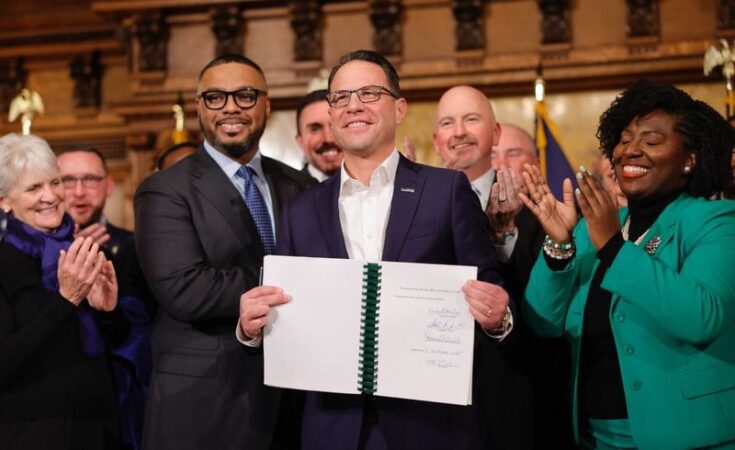
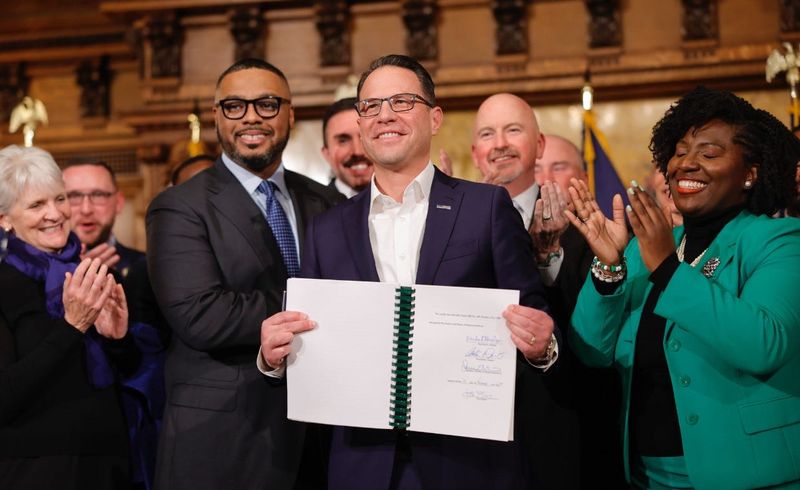
    Gov. Josh Shapiro signs the fiscal year 2025-26 budget surrounded by General Assembly members on Nov. 12 at the Capitol in Harrisburg. The state budget had been due June 30, and Pennsylvania is the final state in the country to approve a funding deal.

    “The final budget reflects the realities of working with one of the only divided legislatures in the entire country – but Gov. Shapiro will continue to fight for survivors and the Commonwealth’s rape crisis centers,” said Ali Fogarty, the DHS spokesperson.

    Victim services centers in the suburbs, which also offer rape crisis services, are echoing WOAR and PCAR’s message, highlighting the urgent need for greater funding. These suburban centers receive funding from additional sources because they support victims of other crimes.

    “For now, we’re doing OK, but another year of no increase in funding while the cost of living is going up has a significant impact on our staff as well as our organization,” said Penelope Ettinger, executive director of Network of Victim Assistance – Bucks County.

    Trying to stay afloat

    While Pennsylvania lawmakers were failing to come to an agreement on a far overdue state budget last month, rape crisis centers in Philadelphia and the suburbs were trying to make ends meet and provide services to survivors of sexual violence.

    For instance, the Victim Services Center of Montgomery County had to use a line of credit, delay bill payments, institute a hiring freeze, increase the number of interns, and commit to “triaging services,” said Mary Onama, executive director.

    “If they hadn’t passed the budget the time that they did, by December or January, we would have had to close, because we couldn’t go much longer,” Onama added.

    At the Crime Victims’ Center of Chester County, it “added a layer of stress to an already very stressful job,” though the center did not have to reduce services, said Christine Zaccarelli, the organization’s CEO.

    And at WOAR, the changes were drastic.

    The nonprofit cut their 30-person staff and paused counseling and therapy services and prevention-education programs. Other programming was kept afloat by the handful of staff members that remained.

    WOAR’s release last week said the closure of therapy and counseling services left “106 individuals wait-listed, 33 group clients waiting for services to resume, and eight child clients referred elsewhere for care.”

    The center has been serving Philadelphia since 1971 and was one of the first rape crisis centers in the United States, according to the organization. Between January and October, the center said it responded to 3,820 calls on its crisis hotline.

    But there have been recent shake-ups at the nonprofit, including the hiring of Gabriella Fontan, WOAR’S executive director, which was announced roughly a week before layoffs began in October. Prior to Fontan, the center had two interim executive directors since 2022.

    The dysfunctional approval of the state budget, though, will have lingering effects on WOAR, warning in the news release that without a “long-term, sustainable investment,” the center won’t be able to meet a rising demand for resources.

    The Bridge Loan, from the Pa. Treasury Department, provided WOAR funding owed for July through September, but it still wasn’t enough to return WOAR to full capacity, said Demetrius Archer, PCAR’s communications director. The center also brought back two employees this month, but it’s still in need of community support and is hoping to bring back more staff when possible.

    “When services are underfunded, survivors and entire communities feel the impact,” said Fontan in the news release. “In a city as large and diverse as Philadelphia, every minute counts when someone is in crisis. Survivors deserve to know that when they reach out for help, someone will be there to answer.”

    All eyes on Harrisburg

    At Temple University’s campus Tuesday, student advocates bundled up in their coats, hats, and scarves and gathered at the Bell Tower to discuss an anti-sexual violence state bill they helped develop.

    The Every Voice Bill, which primarily focuses on sexual violence prevention resources on college campuses, is even more important now that survivor services from WOAR are “unstable,” said Bella Kwok, a senior criminal justice major and president of Temple’s Student Activists Against Sexual Assault, in an interview prior to Tuesday’s event

    “This bill would ensure that stability at least on an institutional level,” Kwok said.

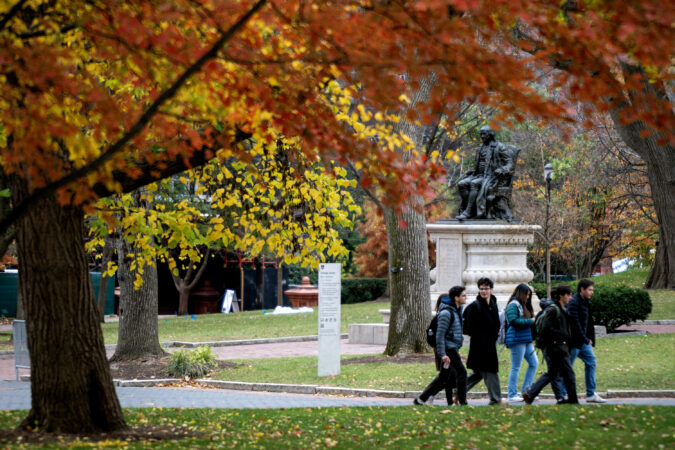
    Temple University students Emma Wentzel, left, and Bella Kwok speak at a podium on Polett Walk on Tuesday, Nov. 18, 2025, about campus sexual assault and a state bill they helped craft to strengthen protections against sexual violence at colleges.

    Kwok is not the only one who is turning their attention to Harrisburg. PCAR and other rape crisis centers are continuing their push for next year’s budget to include an $8 million increase in the Pa. DHS line item for rape crisis.

    As the first increase for rape crisis centers in a few years, the new budget’s funding gives advocates “hope,” even if the amount is “disappointing,” said Zaccarelli, of the Crime Victims’ Center of Chester County.

    “Maybe our advocacy is making a little bit of a difference and shining a light on survivors and their needs and how important our centers are in the community,” Zaccarelli said.

    Ettinger said that Bucks County’s state lawmakers have been supportive of NOVA Bucks, which had to place a hiring freeze on some positions and issue “significant” restrictions on spending due to the impasse, but that a lack of increased funding from the state is “very telling.”

    “I believe that the fact that the state did not allocate a significant increase is very telling to what they believe, where they put it on the priority list,” Ettinger said.

    For his part, Shapiro signed Act 122 in October 2024, which aimed to increase transparency by requiring a statewide electronic system to track evidence kits for sexual assaults, Fogarty, the DHS spokesperson said. And in December 2023, he signed Act 59, which aims to improve access to treatment for survivors of sexual assault.

    It’s a “societal” problem, not a government problem, said Vincent Davalos, interim executive director of the Delaware County Victim Assistance Center.

    “When we talk about sexual violence, the first thought is, of most people, is to say ‘Maybe this didn’t happen,” Davalos said. “And even if they do believe it happens… it’s just a really difficult topic for people to engage and talk about it plainly.”

    This week, victim services leaders across Pennsylvania will gather in Harrisburg for an annual conference to address funding challenges among other concerns, Davalos said, noting that with more funding, his center could improve staff retention.

    But this year, the newly passed state budget is likely to be top of mind.

    “I think money is going to be a big topic,” Davalos said.

  • Trump administration steers $1 billion to Three Mile Island, Pennsylvania’s shuttered nuclear power plant championed by Shapiro

    Trump administration steers $1 billion to Three Mile Island, Pennsylvania’s shuttered nuclear power plant championed by Shapiro

    The U.S. Department of Energy will loan $1 billion to help finance the reopening of Three Mile Island, a nuclear power plant in Pennsylvania that has been renamed the Crane Clean Energy Center.

    The nuclear plant is owned by Constellation Energy Corp. and located on an island in the Susquehanna River just outside Harrisburg. The federal loan will lower Constellation’s price tag to get the mothballed plant running again, an effort that was already put on an accelerated timeline with the support of Democratic Gov. Josh Shapiro over the summer.

    The plant shuttered its one functioning reactor in 2019 when its then-parent company Exelon said it was losing money and that state lawmakers wouldn’t subsidize it. The one other reactor at the Londonderry Township site was destroyed in 1979 in the nation’s worst commercial nuclear power accident.

    “Constellation’s restart of a nuclear power plant in Pennsylvania will provide affordable, reliable, and secure energy to Americans across the Mid-Atlantic region,” Secretary of Energy Chris Wright said in a statement. “It will also help ensure America has the energy it needs to grow its domestic manufacturing base and win the AI race.”

    Constellation announced last year that it planned to spend $1.6 billion to reopen the plant as the demand for energy increases. The company announced a 20-year agreement with Microsoft to buy the power for its data centers.

    Shapiro has supported that plan and touted pushing grid operator PJM to approve an early interconnection request for the site. Constellation employees celebrated with the governor in July with news that the plant’s last working reactor would be slated to open as early as 2027, a year ahead of schedule.

    Joe Dominguez, president and CEO of Constellation, said in a statement this week that the DOE and Federal Energy Regulatory Commission have “made it possible for us to vastly expedite this restart without compromising quality or safety.”

    Constellation spokesperson Mark Rodgers said Thursday the loan “supports” the already-existing plan.

    When asked for comment on the federal loan, Shapiro did not mention the federal financing or the Trump administration at all, focusing instead on his own administration’s efforts.

    “In Pennsylvania, we’re doubling down on our legacy of energy leadership by taking big, decisive steps to build new sources of power,” Shapiro said in a statement. “As an all-of-the-above energy Governor, my Administration is supporting new energy projects from all sources —from natural gas and solar to geothermal and nuclear.”

    “The Crane Clean Energy Center takes advantage of our Commonwealth’s energy assets and brings more energy onto the grid, creating jobs and more opportunity for Pennsylvanians,” he added.

    A group of people who called themselves survivors of the plant’s 1979 partial meltdown protested the reopening plan earlier this year.

    Trump’s administration has said bolstering nuclear power and artificial intelligence are among its priorities.

    Constellation is working to restore equipment for the plant, including the turbine, generator, main power transformer and cooling and control systems. Its 835-megawatt reactor can power the equivalent of approximately 800,000 homes, according to the DOE.

    The agency said in a statement that the reactor “will provide reliable and affordable baseload power,” in turn helping to lower electricity costs, strengthen the reliability of the energy grid, and “advance the Administration’s mission to lead in global AI innovation and restore domestic manufacturing industries.”

    Sen. Dave McCormick, a Republican who has championed embracing tech and energy in Pennsylvania, said in a statement that the state is “leading America’s energy independence and the AI revolution by providing safe, clean, reliable nuclear power.” He said the center brings 3,400 jobs and “carbon-free electricity operating 24/7 to meet our increasing energy demands and economic growth across the region.”

    The loan is being issued under an existing $250 billion energy infrastructure program initially authorized by Congress in 2022. Neither the department nor Constellation released terms of the loan.

    The plan to restart the reactor comes during a sort of renaissance for nuclear power, as policymakers are increasingly looking to it to shore up the nation’s power supply, help avoid the worst effects of climate change, and meet rising power demand driven by data centers.

    The Associated Press contributed to this article.

  • Trump administration threatens to withhold $75 million from Pennsylvania over immigrant truck drivers

    Trump administration threatens to withhold $75 million from Pennsylvania over immigrant truck drivers

    The Trump administration threatened Thursday to withhold nearly $75 million in funding if Pennsylvania does not immediately revoke what the administration claims are illegally issued commercial driver’s licenses to immigrants.

    The move by U.S. Transportation Secretary Sean Duffy to target Pennsylvania follows similar action against California. Both states are run by Democratic governors who have criticized President Donald Trump’s administration and who are viewed as potential top-shelf contenders to be the party’s 2028 presidential nominee.

    Duffy has made it a priority to scrutinize how the licenses are issued since August, when a tractor-trailer driver not authorized to be in the U.S. made an illegal U-turn and caused a crash in Florida that killed three people. That incident thrust the issue into the public’s consciousness.

    In a statement Thursday, DOT spokesperson Danna Almeida said all states were being reviewed.

    It’s unclear how many people would be affected in Pennsylvania. In any case, Pennsylvania Gov. Josh Shapiro ‘s administration said the federal government didn’t identify a single commercial driver’s license issued to someone who wasn’t eligible.

    Still, a letter Thursday from the Republican administration to Shapiro cited an audit that found two out of 150 people whose licenses exceeded their lawful presence in the country.

    In four cases it had reviewed, the federal government said Pennsylvania provided no evidence that it had required noncitizens to provide legitimate proof that they were legally in the country at the time they got the license.

    The Trump administration called on Pennsylvania to stop issuing new, renewed and transferred commercial driver’s licenses and permits, as well as conduct an audit to identify those licenses whose expirations exceed the driver’s lawful stay in the U.S.

    It is also asking the state to void noncompliant licenses and remove those drivers from the road. The administration said approximately 12,400 noncitizen drivers hold an unexpired commercial learner’s permit or commercial driver’s license issued by Pennsylvania.

    The governors of California and Pennsylvania — Gavin Newsom and Shapiro — are tough critics of Trump, and both have been repeated targets of Trump’s administration.

    Shapiro’s administration said the state transportation department ceased issuing commercial driver’s licenses to noncitizens after the Federal Motor Carrier Safety Administration published a regulation in late September that would severely limit which immigrants can get one.

    A federal court has put the rule on hold for now, but Shapiro’s administration said its transportation department still hasn’t resumed issuing what are called “non-domiciled CDLs.”

    Pennsylvania’s transportation department said Thursday that it follows federal rules for verifying an immigrant applicant’s lawful presence in the country by checking the U.S. Department of Homeland Security’s database.

    But Shapiro this week suggested that DHS was falling short by failing to properly maintain that database, which states use to check an immigrant’s legal status before issuing a driver’s license to a noncitizen.

    His comments came after DHS said it had arrested an Uzbek national with a commercial driver’s license issued by Pennsylvania. The man, who had a work authorization granted in 2024, was wanted in his home country for belonging to a terrorist organization, the department said.

    But Shapiro said the state transportation department checked the federal database over the summer before issuing a CDL to the man, and he was authorized to get one. The state rechecked the database this week, and it still listed him as qualified to get a CDL, Shapiro said.

    “They clearly are not minding the shop, and they’ve gotta get better, because every single state in the country relies on this database when making a determination as to who qualifies for a CDL. We relied on the feds before issuing this one,” Shapiro said.

    California, which said it would revoke 17,000 licenses, is the only state the administration has acted against because it was the first one where an audit was completed. The government shutdown delayed reviews in other states, but the Transportation Department is urging all of them to tighten their standards. ___ Catalini reported from Trenton, New Jersey, and Levy from Harrisburg, Pennsylvania. Associated Press writer Josh Funk contributed.

  • Trump accuses Democratic vets in Congress of sedition ‘punishable by death,’ including two lawmakers from Pa.

    Trump accuses Democratic vets in Congress of sedition ‘punishable by death,’ including two lawmakers from Pa.

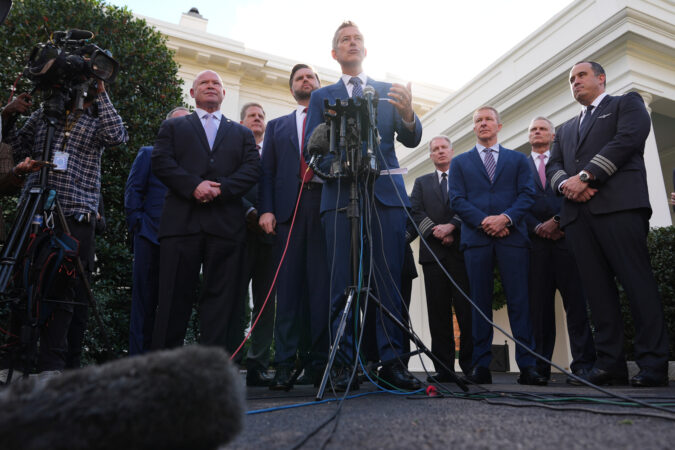
    U.S. Rep. Chrissy Houlahan was in her Washington office when she saw attacks directed at her and other military veteran members of Congress from President Donald Trump, days after they urged members of the military and intelligence community to “refuse illegal orders.”

    Trump called the Democrats “traitors” in a Thursday post on Truth Social and, in a second post, accused them of sedition that he said is “punishable by DEATH.”

    Houlahan, a Chester County Democrat and an Air Force veteran, was one of six Democratic members of Congress who released a video Tuesday contending that Trump’s administration is “pitting” service members and intelligence professionals against American citizens and urging them not to “give up the ship.”

    All six lawmakers are either veterans or members of the intelligence community.

    “The idea that the most powerful man on the planet, who wields the power of the United States military and should be emblematic of all the things we value in this republic, would call for the death and murder of six duly elected members of the House of Representatives and the Senate — I’m speechless and I’m devastated,” Houlahan told The Inquirer on Thursday afternoon.

    Houlahan said she had anticipated there might be a response from the president after Stephen Miller, Trump’s deputy chief of staff and homeland security adviser, spent much of Wednesday railing against the lawmakers in the video. But Trump’s comments went beyond anything Houlahan imagined even from a president known for extreme and sometimes violent rhetoric.

    “I’ve been struggling with the right words for this,” she said. “‘I weep for our nation’ would be an understatement.”

    U.S. Rep. Chris Deluzio, a Navy veteran who was also featured in the video, called Thursday “a dark day in America” in an interview with The Inquirer.

    “It tells me who he is and it tells me exactly why we should be talking about the rule of law and the Constitution,” said Deluzio, an Allegheny County Democrat.

    In the video that set Trump off, the lawmakers, finishing one another’s sentences, reminded service members of their oath to the Constitution and instructed them to refuse to follow any order that would violate it.

    “Right now, the threats to our Constitution aren’t just coming from abroad,” Deluzio says in the video.

    “But from right here at home,” adds U.S. Rep. Jason Crow (D., Colo.) a former paratrooper and Army Ranger.

    The video was shared by U.S. Sen. Elissa Slotkin (D., Mich.), a former CIA officer, and also included U.S. Sen. Mark Kelly (D., Ariz.), a former Navy captain, and U.S. Rep. Maggie Goodlander (D., N.H.) a former intelligence officer.

    Houlahan said she considered the video “innocuous.”

    “It literally talked about the fact that you should follow only lawful orders, an obvious reminder that those of us who served have grown up on,” she said.

    On Thursday morning, Trump shared a Washington Examiner article about the video with the headline “Dem veterans in Congress urge service members to refuse unspecified unlawful orders,” saying their message “is really bad, and Dangerous to our Country.”

    “Their words cannot be allowed to stand. SEDITIOUS BEHAVIOR FROM TRAITORS!!! LOCK THEM UP???” the president wrote on Truth Social, his social media platform.

    About an hour later, Trump added in his second post: “SEDITIOUS BEHAVIOR, punishable by DEATH!”

    Sedition and treason cases in modern U.S. history are very rare.

    Democratic condemnations of Trump’s comments poured in from across the country Thursday. Republicans were more muted. House Speaker Mike Johnson (R., La.) defended Trump’s claim that the Democrats had engaged in “sedition,” describing the video as “wildly inappropriate.”

    “It is very dangerous. You have leading members of Congress telling troops to disobey orders,” he told CNN.

    Sen. Dave McCormick, a Pennsylvania Republican and U.S. Army veteran, who has called out political violence in the past, both after Charlie Kirk’s killing and an arson at Gov. Josh Shapiro’s residence, defended the president’s verbal attacks on the lawmakers. “Not a single unlawful order is cited in this video — because there aren’t any,” he said in a statement.

    “The video is inappropriate and unwarranted, and I didn’t hear any of these calls to defy orders when Democrats were using lawfare against President Trump,” he added, “Giving outlandish pardons, or intimidating tech companies to stop free speech.”

    About an hour later McCormick’s spokesperson sent a second comment from him, adding: “President Trump can speak for himself, but as I’ve said repeatedly, there is no place in either party for violent rhetoric and everyone needs to dial it down a notch.”

    One of the few Republicans to offer any criticism of the president was U.S. Rep. Brian Fitzpatrick, a former FBI agent, who said in a statement that in the FBI he saw “how inflamed rhetoric can stoke tensions and lead to unintended violence.”

    Fitzpatrick, a moderate from Bucks County who has butted heads with Trump in the past, did not name him in the statement but said the “exchange” was “part of a deeper issue of corrosive divisiveness that helps no one and puts our entire nation at risk. Such unnecessary incidents and incendiary rhetoric heighten volatility, erode public trust, and have no place in a constitutional republic, least of all in our great nation.”

    Houlahan and Deluzio respond

    Houlahan served three years on active duty as an Air Force engineer and an additional 13 years as a reserve, and reached the rank of captain. She has been outspoken against the Trump administration on military issues, particularly surrounding women serving in combat roles.

    The lawmakers did not refer to any specific orders from the president in their video, but they had numerous concerns in mind.

    Houlahan said it was sparked, in part, by military troops being deployed to U.S. cities and lethal strikes against suspected drug boats in the Caribbean.

    Trump has suggested that American cities should be “training grounds” for the military, and targeted Los Angeles, Chicago, Washington, and Portland for National Guard deployments. His administration’s boat strikes, which have led to protests in Philadelphia, have come under scrutiny by experts who say they are illegal, per the New York Times, which found Trump’s claims justifying the attacks to be questionable.

    “What we were speaking to is the future, those who are currently serving, and making sure they remember who they serve and what they serve,” Houlahan said.

    She said the lawmakers felt “a responsibility to … make sure people understood there are people in Congress who have your back.”

    Deluzio pointed to reporting about concerns from military personnel who were deployed to U.S. cities. PBS reported this week that people in uniform have been seeking outside legal advice about some of the missions the Trump administration has assigned them.

    “This is a guy who’s been documented in a meeting with the secretary of defense talking about shooting unarmed civilians in the legs,” Deluzio said, citing an account from former Defense Secretary Mark Esper.

    Deluzio said he learned about the oath the first day of boot camp and trained sailors on it when he gained rank.

    “This is something that is fundamental to how our military works and the respect we show our service members,” he said.

    Deluzio served six years in the Navy including three deployments. He cofounded the Democratic Veterans Caucus in June, which was formed in opposition to the Trump administration.

    He said he has heard from people on both sides of the aisle and encouraged Republican colleagues to speak out publicly against the president’s remarks.

    “Republican officials should be stepping up loudly and clearly and saying the calling of death by hanging to members of Congress is out of bounds,” he said.

    James Markley, a spokesperson for the Pennsylvania Republican Party, declined to comment on Trump’s remarks and said in a text that “the woke left continues to attempt to rip apart the fibers of our communities and our country.”

    “Our party will continue focusing on making our country safer, prosperous and more affordable,” he added.

    A spokesperson for Pennsylvania Treasurer Stacy Garrity, an Army veteran who is running for governor next year with the state GOP’s endorsement, did not respond to a request for comment.

    Sen. John Fetterman, a Pennsylvania Democrat who has made a name for himself working across the aisle, said in a post on X that threatening members of Congress is “deeply wrong” without exception, regardless of political party.

    “I strongly reject this dangerous rhetoric,” he said.

    Gov. Josh Shapiro also quickly denounced Trump for calling for violence against Houlahan and Deluzio, describing them in a post on X as “two outstanding members of Congress from Pennsylvania who have fought for our country.”

    “There should be no place for this violent rhetoric from our political leaders, and it shouldn’t be hard to say that,” said Shapiro, who has consistently spoken out against the threat of political violence since a politically motivated arsonist firebombed the governor’s mansion while he and his family slept inside in April.

    Trump’s attack on Houlahan and other Democratic veterans marks the second time in two months Democratic lawmakers who served in the armed forces have been the subject of attacks from across the aisle.

    U.S. Rep. Scott Perry, a Trump ally who represents parts of central Pennsylvania, told a conservative radio station in October that Democrats in Congress “hate the military,” based on their voting records.

    Deluzio and Houlahan, both members of the House Armed Services Committee, also banded together then to push back on Perry’s comments, calling them “garbage.”

  • Delco homeless shelters prepare to reopen after state budget impasse stretched limits of regional nonprofits

    Delco homeless shelters prepare to reopen after state budget impasse stretched limits of regional nonprofits

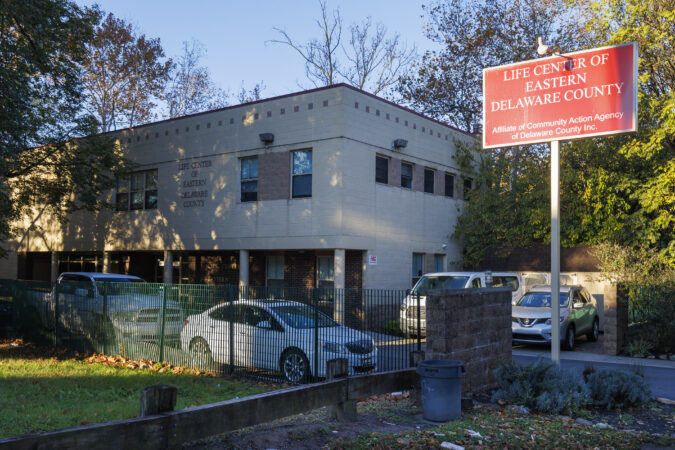
    For the first time in months, the director of the Community Action Agency of Delaware County, which operates three homeless shelters and a rental assistance program, isn’t thinking about service cuts.

    The organization was forced to reduce capacity at one of its shelters to 50% in October and close the other two on Nov. 1 as a result of the state budget impasse. Delaware County, which had been backfilling for missing state dollars, had to cut the funds it delivered to social service organizations in half last month.

    Now, the agency is beginning to reopen its doors and its rental assistance program.

    “[Employees] have been busy kind of preparing for the residents to come back,” said Ed Coleman, the nonprofit’s executive director.

    The Community Action Agency is one of several nonprofit organizations across the region that were stretched and stressed over the last several months as state dollars stopped flowing in the absence of a budget. Since January, they have grappled with uncertainty over federal funds as President Donald Trump’s administration cancels grants and Congress considers major cuts to social service programs.

    The dynamics exposed the vulnerabilities facing philanthropic organizations while threatening the assistance they provide to those they serve.

    Last week the Pennsylvania General Assembly finally passed a budget, ending one source of uncertainty. At the Community Action Agency, this meant employees began swapping out bedding and restocking toiletry bags given to incoming residents this week, undoing significant reductions in service.

    By Wednesday, Wesley House Shelter, a facility for families and single women that Community Action manages, was able to take in a senior citizen whom a church had placed in a hotel amid the budget stalemate. A former resident who had to stay with a relative until the shelter could reopen also returned to the facility.

    The promise of state funds could not have come soon enough.

    Coleman said since Nov. 13, the agency received a little more than 250 rental assistance requests — including almost 80 on Tuesday alone.

    The organization, Coleman said, is now assessing how much it can spend on services as it waits for state dollars to begin flowing again — which is expected to happen in the next 30 to 90 days as state agencies catch up on millions in missed payments to counties, schools, and nonprofits.

    “We really don’t get paid very quickly with most of the contracts we have,” Coleman said.

    The rebuilding mirrors what nonprofits across the Philly region are managing after the state budget impasse. Several nonprofit organizations told The Inquirer they had to freeze hiring and take out lines of debt. Nearly all reported burnout among staff as need increased and uncertainty over funding loomed large.

    The federal government shutdown, which saw a pause in federal food subsidies, only exacerbated the problem.

    “In many ways, it felt similar to the early months of COVID,” said Jennifer King, executive director of the Council of Southeast Pennsylvania.

    The Bucks County Opportunity Council was forced to reduce the number of individuals it could provide rent assistance to.

    And at A Woman’s Place, a domestic violence shelter in Montgomery County, more people were showing up at the shelter door, even if they weren’t domestic violence survivors, asking for help the shelter was not equipped to provide. Often, she said, staff did not even have an answer of where to send people because of the reduction in services across the board.

    “That takes a toll on staff, and they start thinking, ‘Do I really want to do this work?’” said Beth Sturman, the shelter’s executive director.

    Providers worried most about the impact the freeze had on those they served. Jill Whitcomb, president and CEO of Surrey Senior Services in Delaware County, said older adults are facing greater stress and anxiety as a result of state and federal services being rolled back.

    “Our mission is to help people remain at home and independent and engaged as long as they possibly can or want to,” Whitcomb said. “That becomes really hard on a limited income when those incomes are already tenuous, and then they’re living with the anxiety about losing their Social Security.”

    Jeannine Litski, president of Mental Health Partnerships, said the closure of shelters in the region resulted in greater trauma to unhoused people.

    “Imagine you’re just holding on by a thread, and you have at least a place you can lay on a cot for the night and you have a little food, and now that’s taken away,” she said.

    While philanthropic organizations were grateful for the state budget deal, they remained anxious about the possibility of another federal government shutdown at the end of January and questioned how much more they could take.

    “We got through COVID. Let’s see if we can get through this,” Whitcomb said. “It’d be interesting to talk five years from now and see where everybody is.”

    This suburban content is produced with support from the Leslie Miller and Richard Worley Foundation and The Lenfest Institute for Journalism. Editorial content is created independently of the project donors. Gifts to support The Inquirer’s high-impact journalism can be made at inquirer.com/donate. A list of Lenfest Institute donors can be found at lenfestinstitute.org/supporters.

  • A new Pa. tax credit could put up to $805 in your pocket. Here’s what to know.

    A new Pa. tax credit could put up to $805 in your pocket. Here’s what to know.

    Nearly 1 million Pennsylvanians are expected to qualify for a new state tax credit that is meant to ease the burden of making ends meet.

    The new Working Pennsylvanians Tax Credit will allow eligible low- and moderate-income filers to receive a state tax credit that is equal to 10% of what they qualify for through the federal Earned Income Tax Credit (EITC). Like the EITC, the state credit will depend on income and number of children. The highest credit will be $805 and, according to Gov. Josh Shapiro’s office, the average credit will be around $240.

    In Philadelphia alone, 175,393 people are estimated to benefit from the new state tax credit totaling $41.7 million, according to Shapiro’s office. Statewide, it is expected to provide a total of $193 million in tax relief to 940,000 Pennsylvanians.

    The policy had bipartisan support since 2023, and was led by State Rep. Christina Sappey, a Chester County Democrat. Sappey and a team of Democrats sponsored a bill that passed the Democratic-led House in May that would have allowed a 30% credit, but that figure was lowered to 10% as a result of budget negotiations with the Republican-led Senate and Shapiro.

    It’s one of the measures being hailed as a major win for Democrats in the $50.1 billion state budget deal, which was approved last week after a more than four-month impasse.

    Sappey said that she was approached by the United Way of Pennsylvania “several years ago” about the idea.

    “I think of all of the folks who are really just struggling right now to make ends meet — but they’re working,” Sappey told The Inquirer.

    “They get thrown a curveball, like an unexpected healthcare expense, get in a car accident, need a giant car repair, something like that,” she added. “They really get kind of knocked off the rails, and then they kind of spiral.”

    At a news conference on Tuesday, Shapiro listed examples of Pennsylvanians who will qualify for the tax credit.

    “That single mom who’s raising three kids whose making about $25,000 a year as a waitress, she can get $770 back on her state taxes on top of whatever relief she was going to get from the federal government,” Shapiro said.

    “This isn’t some giveaway … we’ve come together on a bipartisan basis to say, ‘If you’re working, if you’re doing everything right by the book, we’re going to put money back in your pockets,’” he added.

    Who is the Working Pennsylvanians Tax Credit for?

    The tax credit is designed for working Pennsylvanians with a total income up to $61,555 if filing alone, and up to $68,675 if filing jointly as a married couple, according to the IRS guidelines for the EITC.

    Eligibility for the state credit is based on the federal EITC, which is meant for low- to moderate-income workers. Workers with kids can qualify for a bigger credit that increases with the number of children up to three or more kids.

    Individuals must be employed and earn income to qualify.

    Households that can benefit from this program may earn too much to qualify for public assistance while not earning enough to be able to handle an unplanned financial emergency, according to the United Way. About 28% of Pennsylvanians fall into this group, according to testimony from the United Way of Pennsylvania president Kristen Rotz.

    How does the tax credit work, and how much is it for?

    Pennsylvania’s state credit will be 10% of the EITC amount a filer qualifies for. Filers will automatically qualify for the state credit.

    “This is probably one of the more easy tasks you’re going to have to deal with as you’re helping people fill out their taxes,” Shapiro told a group of Widener University students Tuesday.

    The program will begin for tax year 2025, so Pennsylvanians can use it this forthcoming tax season. The credit is refundable, so taxpayers will get money back if the credit exceeds how much they owe.

    The credit amount initially increases based on how much money the earner makes and then decreases after it reaches a certain amount, resembling a bell curve, said Montgomery County accountant David Caplan. That “tipping point” differs depending on the tax filer’s status and number of dependents, he said.

    The maximum state credit for filers with no kids is $65, and about 261,739 Pennsylvanians are expected to fall in that tier, according to the Office of state House Speaker Joanna McClinton, a Philadelphia Democrat.

    That maximum raises to $432 for households with one child, $715 for two children, and $805 for households with three or more kids. About 133,641 Pennsylvanians are expected to fall in that maximum credit tier, according to McClinton’s office.

    There were 802,000 claims for the federal EITC in Pennsylvania for the 2023 tax year, totaling $2.086 billion, according to the IRS. The average federal credit amount was $2,600. Under the new state credit, that would amount to $260.

    “While it’s not much, it’s certainly a help, and that’s something that’s tangible,” said State Rep. Tarik Khan, a Democrat who cosponsored the state tax credit bill and represents parts of Philadelphia.

    Do other states have a credit like this?

    According to the National Conference of State Legislatures, 31 states, D.C., Guam, Puerto Rico, and some municipalities have their own version of the EITC.

    Most of those states calculate their credit as a percentage of the federal program, ranging from 4% in Wisconsin to 125% in South Carolina, according to the group.

    Neighboring New Jersey offers a 40% credit and Delaware has 4.5% refundable and 20% nonrefundable credits.

    State Rep. Steve Samuelson, a Northampton County Democrat who chairs the House Finance Committee and cosponsored the tax credit bill, called the credit a “commonsense” measure. He pointed out how existing states have varying political leanings, from the redder Oklahoma, Indiana, and Kansas to bluer states like New York, Hawaii, and California.

    “Better now than never,” Samuelson said.

    Is a 10% tax credit the right amount?

    Sappey and other Democrats see the 10% credit as a starting point. They hope to increase the size of the credit in future years.

    “If this is a program that both sides can agree to, getting a program established is more important than, you know, how big it is at the beginning,” she said in an interview.

    Caplan, who chairs the Pennsylvania Institute of Certified Public Accountants’ Local Tax Thought Leadership Committee, said he believes the 10% tax credit could be higher, but maybe not as high as the 30% initially approved by the House.

    “I don’t think the 10% is outrageously low that it’s kind of chintzy,” he said. “I think it’s just a nice thing to do.”

    Sen. Lynda Schlegel Culver, a Republican from Northumberland County who said she championed the policy, lauded the program for helping taxpayers who work.

    “This credit rewards work, strengthens household stability, and helps those doing everything right, working, paying their bills, and supporting their families,” she said in a statement. “This is a commonsense investment in both our workforce and the future of our Commonwealth.”

    Concerns from other Republicans about the program were related to the cost and its size.

    Sappey said “that’s legitimate” but contends that the program helps people “increase their earning power” and that the hope is, in turn, for them to no longer be eligible for the credit. And when they get it, she argues, “they are spending it in really good ways.”

    “We’re keeping people in the workforce, we’re generating revenue, and we’re keeping them out of social safety net programs,” she said.

    Rotz, of the United Way, said in her testimony that EITC recipients often spend their credit on grocery stores, vehicle and home repairs, paying off debt, and sometimes education.

    Khan lauded House Democratic leaders for holding onto the tax credit in negotiations — and compared their long-delayed negotiations to the Eagles’ season, which has seen the team rack up wins despite offensive struggles.

    “You love them, and then you watch the game, and you’re like, ‘Goddamn it. Why can’t you just play like a normal team?’ But then they win in the end, and you’re like, ‘You know what? That was a tough game, but damn it, I’m so happy right now,’ and so that’s how I feel with this.”

  • Delco GOP reports vandalism to Media police in second incident in 13 months

    Delco GOP reports vandalism to Media police in second incident in 13 months

    Staff members arrived at the Delaware County Republican Party headquarters in Media on Wednesday morning to find the building’s glass door shattered.

    The apparent vandalism appeared to have occurred overnight, said Frank Agovino, the party chair. The Media Police Department, he said, is investigating.

    The incident comes a year after the local party had to call police to the same office when protesters cornered two volunteers ahead of the presidential election.

    “It’s just a sign of the times, unfortunately,” Agovino said. “There’s some people who just refuse to be civil about political disagreements.”

    It was unclear who damaged the office or their motive. However, according to photos shared to Facebook by the Delaware County GOP, a sign identifying the office as a Republican office was posted on the door above the broken glass.

    The Media Police Department did not immediately comment on the incident.

    Political violence has become increasingly common across the United States in recent years, including the September killing of right-wing activist Charlie Kirk.

    Agovino called for state and federal officials to consider stricter penalties for the perpetrators of such violence.

    “People that are working in the political arena need to be protected,” he said.

    This suburban content is produced with support from the Leslie Miller and Richard Worley Foundation and The Lenfest Institute for Journalism. Editorial content is created independently of the project donors. Gifts to support The Inquirer’s high-impact journalism can be made at inquirer.com/donate. A list of Lenfest Institute donors can be found at lenfestinstitute.org/supporters.

  • EEOC sues Penn for failing to release information related to antisemitism investigation

    EEOC sues Penn for failing to release information related to antisemitism investigation

    The U.S. Equal Employment Opportunity Commission is suing the University of Pennsylvania for failing to release information related to an investigation it began in 2023 over the school’s treatment of Jewish faculty and other employees regarding antisemitism complaints.

    Penn, according to the complaint filed in federal court Tuesday, has not complied with a subpoena for information, including the identification of employees who could have been exposed to alleged harassment and the names of all employees who complained about the behavior.

    In its quest to find people potentially affected, the EEOC demanded a list of employees in Penn’s Jewish Studies Program, a list of all clubs, groups, organizations and recreation groups related to the Jewish religion — including points of contact and a roster of members — and names of employees who lodged antisemitism complaints.

    Penn usually does not comment on litigation, but in this case, the school ardently objected to the EEOC’s characterization of its cooperation and the personal nature of the material it was still seeking.

    The school said in a statement it has cooperated extensively with the EEOC, including providing more than 100 documents and over 900 pages.

    But the private university said it will not disclose personal information, specifically “lists of Jewish employees, Jewish student employees and those associated with Jewish organizations, or their personal contact information” to the government.

    “Violating their privacy and trust is antithetical to ensuring Penn’s Jewish community feels protected and safe,” the university said Tuesday.

    Penn also provided information on employees who complained and agreed that it could be shared, the school said, but the school would not provide information on those who objected.

    “Penn also offered to help the EEOC reach employees who are willing to speak with the agency by informing all employees of the investigation and how they could reach out to the agency,” the university said. “The EEOC rejected that offer.”

    The original complaint was launched by EEOC Commissioner Andrea Lucas, now chair of the body, on Dec. 8, 2023, two months after Hamas’ attack on Israel that led to unrest on college campuses, including Penn, and charges of antisemitism. It was also just three days after former Penn President Liz Magill had testified before a Republican-led congressional committee on the school’s handling of antisemitism complaints; the testimony drew a bipartisan backlash and led to Magill’s resignation days later.

    Lucas, who was appointed chair this year by President Donald Trump, also brought similar antisemitism charges against Columbia University that earlier this year resulted in the school paying $21 million for “a class settlement fund.”

    EEOC complaints typically come from those who allege they were aggrieved. Lucas, according to the complaint, made the charge in Penn’s case because of the “probable reluctance of Jewish faculty and staff to complain of harassing environment due to fear of hostility and potential violence directed against them.“

    The EEOC’s investigation ensued after Lucas’ complaint to the EEOC’s Philadelphia office that alleged Penn was subjecting Jewish faculty, staff, and other employees including students “to an unlawful hostile work environment based on national origin, religion, and/or race.”

    The allegation, the complaint said, is based on news reports, public statements made by the university and its leadership, letters from university donors, board members, alumni and others. It also cited complaints filed against Penn in federal court and with the U.S. Department of Education over antisemitism allegations and testimony before a congressional committee.

    The EEOC complaint pointed to public comments by Magill, addressing antisemitism while she led Penn.

    “I am appalled by incidents on our own campus, and I’ve heard too many heartbreaking stories from those who are fearful for their safety right here at Penn,” Magill said in 2023. “This is completely unacceptable.”

    Magill also in a message had addressed “a small number of Penn staff members” who “received vile, disturbing antisemitic emails that threatened violence against members of our Jewish community,” in November 2023.

    The complaint cited incidents of antisemitic obscenities being shouted on the campus, destruction of property in Penn’s Hillel, a swastika painted in an academic building, graffiti outside a fraternity and a pro-Palestinian encampment on the campus in 2024 that eventually was dismantled by police.

    “Throughout its investigation, the EEOC has endeavored to locate employees exposed to this harassment and to identify other harassing events not noted by respondent in its communications, but respondent has refused to furnish this information, thereby hampering the EEOC’s investigation,” the complaint said.

    Penn said it had received three antisemitism complaints, according to the federal complaint, but the EEOC questioned that number given the university’s workforce of more than 20,000. It demanded that the school provide names of all people who attended listening sessions as part of the school’s task force on antisemitism and all faculty and staff members who took the task force’s survey.

    Penn objected to the subpoena and the commission partially modified it in September, ordering the school to comply within 21 days, the complaint said.

    In its statement to The Inquirer, Penn defended its response to antisemitism.

    “Penn has worked diligently to combat antisemitism and protect Jewish life on campus,” the school said.

  • Every Pa. lawmaker votes to release Jeffrey Epstein records as Congress passes bill after Trump’s reversal

    Every Pa. lawmaker votes to release Jeffrey Epstein records as Congress passes bill after Trump’s reversal

    WASHINGTON — Congress passed legislation Tuesday to require President Donald Trump’s administration to release troves of records related to notorious sex trafficker Jeffrey Epstein after months of pressure from Democrats and survivors on the issue.

    The U.S. House voted 427-1 to pass the bill on Tuesday, prompting lawmakers in the chamber to cheer. The legislation was then rapidly passed by the U.S. Senate through unanimous consent, a process that skips debate when no senator objects to a bill.

    Despite the overwhelming bipartisan consensus, Tuesday’s House vote followed months of pushing by Democrats to bring it the floor as Trump unsuccessfully lobbied to prevent it from receiving a debate.

    The president abruptly changed his stance on the bill this week after it became clear it had enough Republican support to pass against his objections. The veto-proof bill now heads to Trump’s desk for his signature.

    U.S. Rep. Rob Bresnahan, a freshman Republican who represents Northeastern Pennsylvania, told The Inquirer after the vote that his office “had a lot of phone calls” about the bill.

    “We listened to our constituents… and I want to thank the people at home for bringing this to our attention,” he said outside the House chamber.

    U.S. Rep. Clay Higgins, a Louisiana Republican, was the sole no vote. Five House members did not vote.

    Trump said this week he would sign the bill into law, but he doesn’t actually need congressional approval to order the release of the files and could have already done so — a fact noted by U.S. Rep. Dwight Evans in the lead-up to the vote.

    “Let’s be clear — Donald Trump doesn’t have to wait until Congress votes on this resolution,” Evans, a retiring Philadelphia Democrat, said in a Monday post on X. “If he wanted to, he could tell the Justice Department to release the Epstein files TODAY.”

    The bill, called the Epstein Files Transparency Act, requires the Department of Justice to publish all unclassified files related to the prosecution and investigation of Jeffrey Epstein, a well-connected financier and convicted sex offender who was found dead in his jail cell in August 2019 and determined to have died by suicide after being federally charged with sex trafficking underage girls. After his death, his close associate Ghislaine Maxwell was convicted of sexually exploiting and abusing girls with him over the course of a decade.

    The bill was led by U.S. Rep. Ro Khanna, a California Democrat who grew up in Bucks County, and U.S. Rep. Thomas Massie, a Kentucky Republican who frequently breaks with party leadership. U.S. Reps. Mary Gay Scanlon and Chris Deluzio, both Pennsylvania Democrats, were cosponsors.

    Trump suggested on the campaign trail that he would release files related to the Epstein investigation, but after his administration faced uproar over their lackluster release of information surrounding the investigation, he began discrediting the cause.

    Trump is mentioned numerous times in files that have already been released, including in an email in which Epstein claims Trump “spent hours at my house” with a young woman who later said she was a victim of Epstein, the New York Times reported last week. The president was neighbors with Epstein in Florida and was photographed with him at numerous social occasions in the 1990s and 2000s. He has called the efforts for more transparency a Democratic “hoax” that had fooled “stupid” Republicans who would be committing a “hostile act” by supporting the release.

    Bresnahan was hesitant to answer whether any of the mentions of the president concern him.

    “I saw some of the email threads; a lot of it was snippets. I don’t know where it came from,” said Bresnahan, who represents a swing district.

    “I want to look at the whole comprehensive picture,” he added.

    House Speaker Mike Johnson (R., La.) wasn’t going to allow the bill to be voted on the floor, so Khanna and Massie successfully forced the vote through a discharge petition, which was supported by all House Democrats and just three other Republicans — U.S. Reps. Marjorie Taylor Greene of Georgia, Nancy Mace of South Carolina, and Lauren Boebert of Colorado.

    Massie and Khanna started to gather signatures in September and got the 218th needed on Wednesday last week when U.S. Rep. Adelita Grijalva (D. Ariz.) was sworn into office after winning a special election in September.

    U.S. Rep. Brendan Boyle, a Philadelphia Democrat, blamed the delay for Grijalva’s swearing in on Trump and Johnson‘s resistance to the bill getting to the floor.

    “There is a reason why Donald Trump has worked so hard to keep these Epstein files covered up,” he said in a video he shared on social media.

    The bill reaching the floor put Republicans in a new bind: their stance on the matter would be on the record. They had to choose whether their loyalty to Trump would outweigh pressure from constituents on the matter.

    Once it became clear the president wouldn’t prevail, Trump had a complete about-face Sunday night and called for lawmakers to support the bill.

    “House Republicans should vote to release the Epstein files, because we have nothing to hide, and it’s time to move on from this Democrat Hoax perpetrated by Radical Left Lunatics in order to deflect from the Great Success of the Republican Party,” he posted on Truth Social.

    “I DON’T CARE!” he added in the post and claimed that the files are a “curse on the Democrats, not us.”

    Khanna said that almost 100 Republicans would have voted for the bill before Trump changed course in an interview with The New York Times.

    “Trump saw his MAGA coalition was splintering and the last thing he could have had is a hundred Republicans vote for a Democratic bill in defiance of what he wanted,” he said in the interview. “Obviously, he has enough political instincts to realize how much he was losing on this issue.”

    Once Trump signaled support for the bill, Khanna said he would “be surprised if it’s not close to unanimous.”

    A separate House Oversight Committee investigation has released thousands of files from Epstein’s estate that show his connections spanning from Trump to influential leaders on Wall Street and across the globe. The Wall Street Journal also revealed over the summer a sexually explicit birthday message that appeared to be from the president to Epstein.

    Trump has since called on the Justice Department to investigate ties between his political adversaries and Epstein, particularly the Clintons.

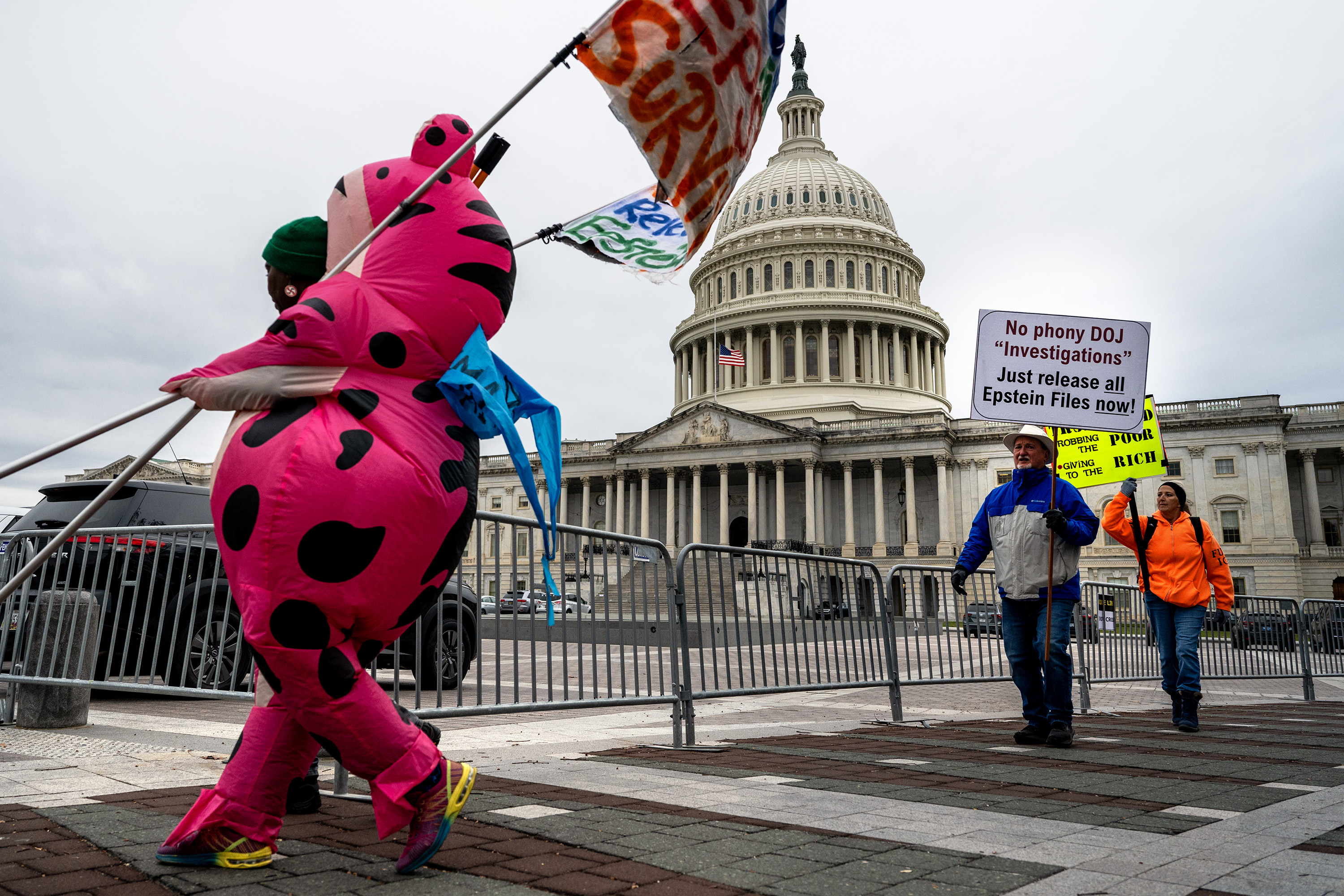
    Survivors of Epstein’s abuse rallied outside the Capitol in the cold Tuesday morning.

    Liz Stein, a survivor of Epstein’s abuse, said in a statement that she hopes “our elected leaders show the courage to stand with survivors.”

    “Those of us directly impacted and harmed by the crimes of Jeffrey Epstein and Ghislaine Maxwell deserve justice and for the world to know our story,” she said. “It’s time for real accountability and true transparency.”

    Where did Pa. Republicans stand prior to Tuesday’s vote?

    U.S. Rep. Brian Fitzpatrick, a Bucks County Republican and former FBI agent who represents a purple district, had been quiet on the issue.

    World Without Exploitation, an anti-human trafficking group that has called for the release of all Epstein files, put a billboard up in Fitzpatrick’s district that says: “Courage is Contagious: Release ALL The Epstein Files.”

    Fitzpatrick was also the subject of digital ads from the Democratic National Committee about the Epstein files over the summer that called him one of Trump’s “sycophantic enablers.”

    Even though no Pennsylvania Republicans signed onto the petition to allow a vote on the bill, some had previously indicated that they wanted the records released.

    Bresnahan said on FOX56 WOLF on Friday that he would vote to release the files while making sure victims are protected. He told The Inquirer after the vote that he made that decision “weeks ago.”

    When asked whether he was surprised at the near-unanimous support from his Republican peers, he said he “really wasn’t talking to a lot of my peers as to where they were going to be on it.”

    Other Republicans made statements over the summer after the Justice Department said it would not release any more files. Attorney General Pam Bondi suggested in February that she had Epstein’s “client list,” but the department released files that were long in the public eye before claiming in July that Epstein didn’t actually have a list of clients.

    U.S. Rep. Ryan Mackenzie, a freshman Republican who represents the Lehigh Valley, said during a telephone town hall in July that he would support measures to release DOJ files on Epstein if Trump’s administration doesn’t do more, NPR reported. He echoed that position Monday night, according to news reports.

    “I know they have not released as much as I would like to see to date, but hopefully they’re going to be doing that,” he said in July. “And if not, then Congress should potentially step in and compel them to do that because again, the American people deserve to have full transparency and information about what is in those files, and ultimately, we’re going to get there.”

    U.S. Rep. Scott Perry, a Trump ally who represents parts of Central Pennsylvania, shared a letter to Bondi on July 18 expressing “serious concern” over how the Epstein case had been handled and said it “remains one of the most troubling examples of apparent failures within our justice system.”

    He said the Trump administration’s handling of the case at that point had “only heightened public distrust.” He cited how the administration’s February 2025 release of documents “contained little new information” and its pivot on a supposed client list.

    “The continued secrecy surrounding these records undermines public confidence in the Justice Department’s commitment to justice,” he said at the time, requesting a special prosecutor to investigate the handling of the case.

    Perry supported a Democratic motion in July to subpoena the Justice Department for the Epstein files in an effort led by U.S. Rep. Summer Lee, a progressive Democrat from Pittsburgh. He also backed motions to subpoena former President Bill Clinton and former Secretary of State Hillary Rodham Clinton related to the case.

    Fitzpatrick, Perry, Mackenzie, and Bresnahan all represent districts that will be targeted by Democrats during next year’s midterms.

    Also in July, U.S. Rep. Dan Meuser (R., Luzerne) called for the release of “all the pertinent, credible Epstein files” but focused squarely on Clinton.

    Other Republicans in the state have been pretty quiet on the matter.

    Lee, the Pittsburgh Democrat who led the summer subpoena effort, said in a post on X after the vote that the Department of Justice has “slow-walked” the release of files for months and echoed that Trump hasn’t acted on his ability to compel the department to release the files.

    “No matter how wealthy or well-connected, every person who is complicit, enabled, or abused women and girls will be brought to justice,” she added.

    Protesters head to the U.S. Capitol in Washington D.C. Tuesday, Nov. 18, 2025 as a bill that would require the release of records relating to Jefrey Epstein comes to a vote.
  • Gov. Josh Shapiro says national Democrats folded in the federal shutdown, while he stayed ‘at the table’ for Pa.’s late budget deal

    Gov. Josh Shapiro says national Democrats folded in the federal shutdown, while he stayed ‘at the table’ for Pa.’s late budget deal

    The turning point in Pennsylvania’s budget impasse, by Gov. Josh Shapiro’s telling, came just before Halloween, when he and leaders in Harrisburg gathered in his stately, wood-paneled office to meet twice daily to hash out a deal to end the bitter, monthslong stalemate.

    The long grind eventually led to compromises 135 days in, and a deal Shapiro said he thinks is far better than what national Democrats, hoping to extend healthcare subsidies, got in Washington at the end of the federal shutdown.

    “Sometimes you’ve got to show that you’re willing to stay at the table and fight and bring people together in order to deliver,” Shapiro told The Inquirer in an interview Friday, touting the state budget agreement finally signed that week.

    “I think it’s a stark contrast, frankly, with what happened in D.C., where they didn’t stay at the table, they didn’t fight, and they got nothing,” he said.

    Washington is controlled by Republicans, while in Pennsylvania, Democrats control the state House and governorship, and Republicans hold a majority in the Senate.

    Both state and federal budgets were signed the same day, offering Pennsylvanians relief from more than a month of government dysfunction at two levels. But for Shapiro — an exceedingly popular Democratic governor facing reelection in 2026 as whispers swirl over his potential 2028 presidential ambitions — the moment was bigger than a procedural win. In the end, Shapiro, preaching his oft-used slogan of “getting things done,” cast the outcome as proof he can muscle through gridlock of a divided legislature, cut deals under pressure, and hold firm where others cave.

    So what if it took almost five months? Shapiro argues. At least he didn’t fold.

    “I would have hoped to have gotten this budget done, you know, 100 or so days earlier,” Shapiro said, putting pen to paper in the state Capitol building’s baroque reception room last week. “But I think what you also saw was the result of having the courage to stay at the table and keep fighting for what you believe in. And we got a lot more than we gave in this budget.”

    Gov. Josh Shapiro signs the fiscal year 2025-26 budget surrounded by General Assembly members on Nov. 12 at the Capitol in Harrisburg. The state budget had been due June 30, and Pennsylvania the final state in the country to approve a funding deal.

    As Shapiro portrays the outcome of Pennsylvania’s 2025 state budget as an across-the-board victory, the path to get there was harder and messier than he would have liked: a nearly five-month slog that strained his dealmaker image and forced concessions to get the deal across the line — including no new money for mass transit. The absence of a new funding stream in the budget marked a final blow in the saga to Southeastern Pennsylvania commuters who rely on SEPTA — and who are likely to be reminded of the beleaguered agency’s funding woes as delays, staffing issues, and needed repairs persist.

    Critics are quick to note it took the self-proclaimed dealmaker so long to get a deal. Counties, school districts, and nonprofits struggled through four months without state payments while officials remained at loggerheads. Pennsylvania was the last state in the nation to pass a spending plan for the 2025-26 fiscal year.

    “He’s five months late. He’s the governor of the fifth-biggest state in the country and the last state to get a budget done,” GOP consultant Vince Galko said. “It’s not a failing grade because it got done, but it’s still a D.”

    ‘A tremendous cost’

    The $50.1 billion budget includes several key priorities for Shapiro and Democrats: significant increases in public education funding, a new tax credit for lower- and middle-income residents, continuation of a popular student-teacher stipend, and other economic and workforce development initiatives.

    House Speaker Joanna McClinton (D., Philadelphia) heaped praise on Shapiro during a Monday news conference celebrating the budget’s new Working Pennsylvanians tax credit. “I am grateful that here in Harrisburg we have a hero among us for working families, and his name is Josh Shapiro.”

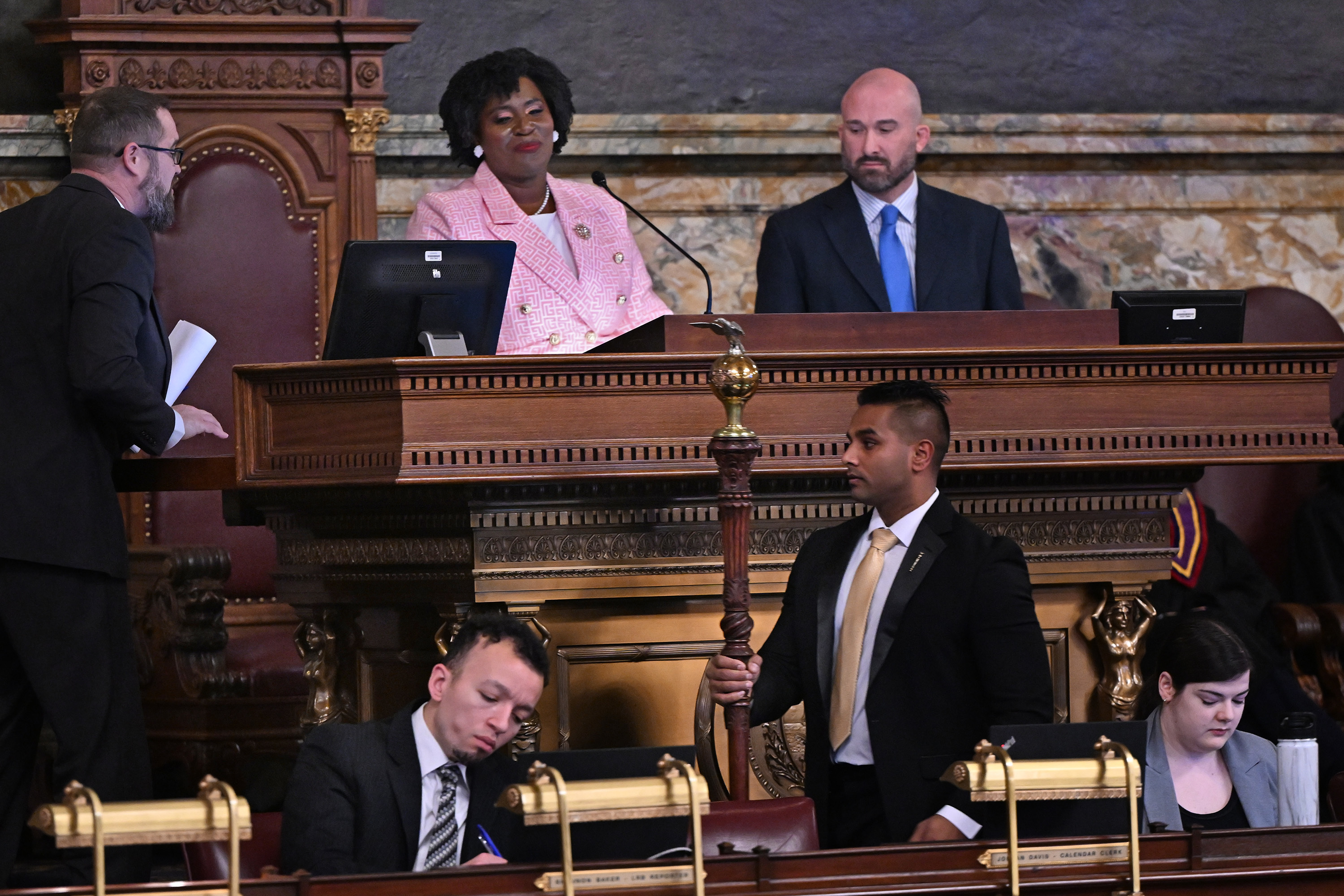
    State Rep. Joanna McClinton (D., Philadelphia) is on the rostrum in the House chamber on Jan. 7 after she was reelected speaker of the House despite an initial 101-101 tie vote along party lines.

    But the spending plan also fails to find a long-term revenue source for mass transit — a top Democratic priority that dominated debate in Harrisburg for weeks during the budget impasse and kicked up the state’s rural-urban divide. Shapiro ultimately removed mass transit from the negotiating table in September and approved his third short-term fix to keep SEPTA afloat. SEPTA and transit agencies across the state say they are still floundering.

    Shapiro last week called funding mass transit “unfinished business,” and top House Democrats maintain it’s a top priority for them heading into America’s 250th anniversary in 2026. Senate Republicans, for their part, were proud to not give in to a mass transit deal they didn’t like, even when advocates and Democrats unleashed intense political pressure on them to buckle, the two top Senate GOP leaders said in interviews.

    State Sen. Nikil Saval, a progressive lawmaker who represents part of Philadelphia, was one of a handful of Democrats to vote against the bipartisan Pennsylvania budget bill that was largely lauded by Democrats and Republicans in Harrisburg and beyond. Saval applauded the school funding, anti-violence grant funding, and childcare support but slammed the absence of transit funding and Democrats’ agreement to end their pursuit to join a key climate program.

    “Unfortunately, it comes at this tremendous cost,” he said. And ultimately, Saval said, the finished product didn’t seem to justify the time it took to get there.

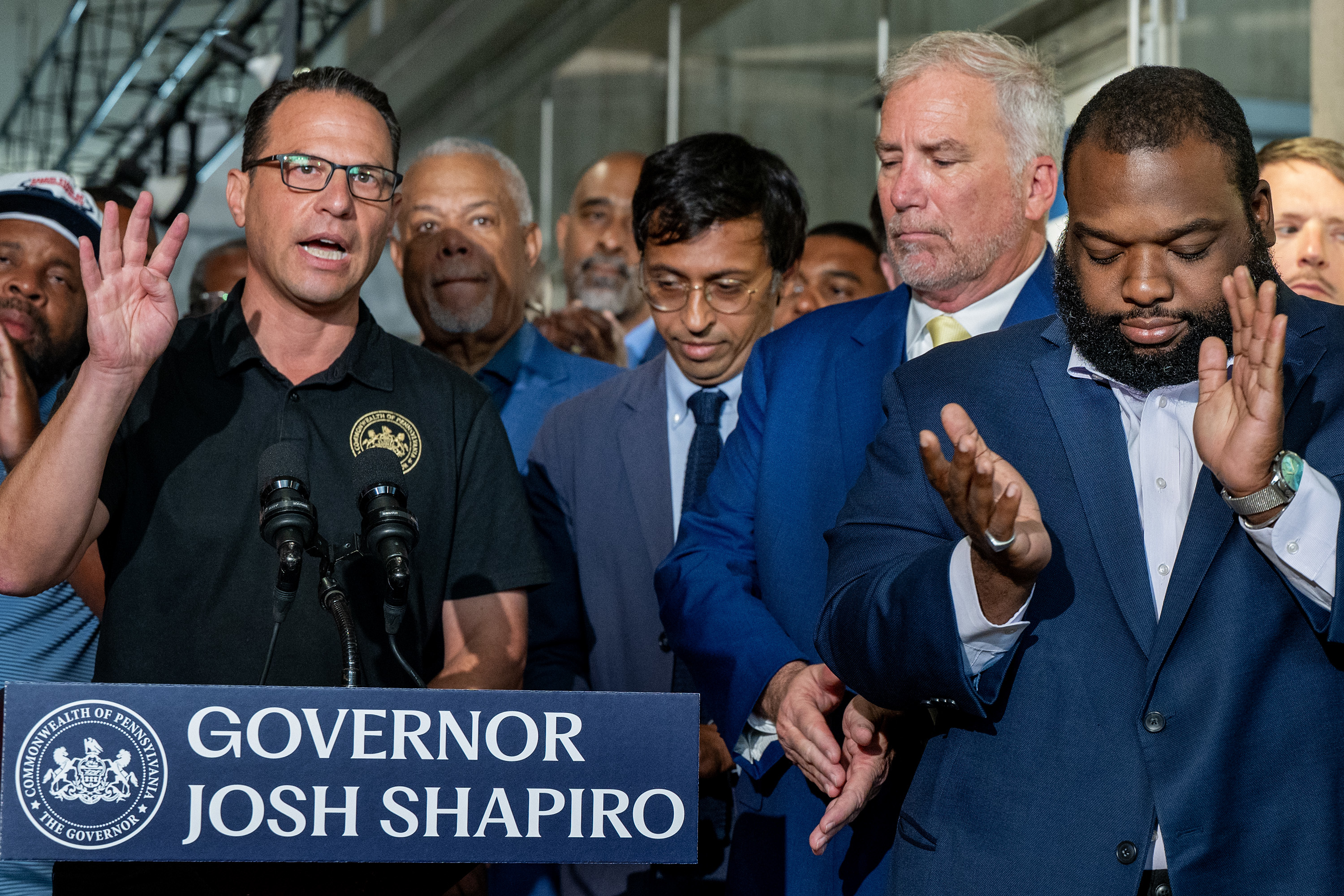
    Gov. Josh Shapiro visits SEPTA headquarters on Aug. 10 to discuss funding for the transit agency. To his right, from left, are state Democratic legislators Sen. Anthony H. Williams; Sen. Nikil Saval; Rep. Ed Neilson; and Rep. Jordan Harris.

    It was not just transit funding that took a back seat to get the budget deal over the line. To the delight of Republicans — and the chagrin of some progressive Democrats and the climate-conscious — the deal also pulled the state out of the Regional Greenhouse Gas Initiative, a cooperative among states to reduce carbon emissions.

    For Shapiro, ending the state’s effort to join RGGI, a program of which he has long been skeptical, was hardly a political loss. It mirrored the path of other blue-state governors who are prioritizing economic headwinds over President Joe Biden-era climate and clean energy policies. In remarks made before signing the budget deal Wednesday, Shapiro said it also removed a hurdle in negotiations.

    “For years, the Republicans who have led the Senate have used RGGI as an excuse to stall substantive conversations about energy,” Shapiro said. “Today, that excuse is gone.”

    The powerful Pennsylvania Building and Construction Trades Council had lobbied heavily for lawmakers to walk away from the initiative, and it was a top win for state Republicans, who have long said the state should not join the multistate cap-and-trade emissions program they see as hamstringing Pennsylvania’s energy industry from accessing the state’s plentiful natural resources.

    ‘Two-a-days’

    Shapiro said he spent months “running back and forth” to broker a deal between Senate Majority Leader Joe Pittman (R., Indiana) and House Majority Leader Matt Bradford (D., Montgomery). The three met on-and-off in private talks, attempting to hammer out a compromise between the Democratic House and Republican-controlled Senate. But the week of Oct. 27, more than four months into the stalemate, Shapiro said a “breakthrough” finally came when he broadened the talks to include McClinton and Ward.

    Minority leaders Rep. Jesse Topper (R., Bedford) and Sen. Jay Costa (D., Allegheny) also joined the group, as it became clear that neither of the tightly controlled chambers would have the votes needed to pass a final budget deal.

    The group met twice daily in a conference room in Shapiro’s office. Shapiro, always a fan of the sports metaphor, called the meetings “two-a-days.”

    “We would come in the morning, go over the issues. We’d have our homework for a few hours, then come back in the afternoon and talk about, you know, the progress that we made,” Shapiro said. Coming out of that week, the governor said, leaders “had a clear direction on where we were going to go.”

    Pennsylvania Lt. Gov. Austin Davis and Gov. Josh Shapiro show a budget document moments after it was signed Nov. 12 while surrounded by legislators at the state Capitol. A deal struck Nov. 12 ended a budget delay that lasted more than four months.

    At the negotiating table, Shapiro served as “referee and facilitator” between House Democrats and Senate Republicans, McClinton said in an interview Monday.

    “The man is nothing if not dogged and determined,” Bradford said of Shapiro last week.

    Two officials in the closed-door talks said Topper’s presence, as the House minority leader who understands House Democrats and Senate Republicans, helped change the dynamic and got leaders on track toward a deal. Other officials in negotiations noted that once the state’s two top leaders — McClinton and Ward, who are both the first women to serve in their roles — the breakthrough deal swiftly came together.

    Topper, for his part, didn’t try to take credit for striking the final budget deal, calling himself “a neutral arbiter” and “someone all sides can trust to have an honest dialogue.”

    There were other signs of tensions easing as the legislators worked through the fall. Ward, a top critic of Shapiro since he reneged on a promise he made over school vouchers during his first budget negotiations, joined the conversations. The two had not met in person since 2023, and had barely communicated. Suddenly, they were sitting across from one another.

    Kim Ward, president pro tempore of the Pennsylvania Senate, talks with her chief of staff Rob Ritson in her office Tuesday, Jan. 17, 2023, before heading out to preside over the swearing-in of Lt. Gov. Austin Davis in the Senate chambers.

    Ward said her criticisms of Shapiro still stand — she wants him to be more transparent, among other disagreements. But she described the conversations as “very cordial, very professional.” And there were moments of levity that helped, said the top Republican leader in the Senate, who is known for her wry humor.

    “He did leave me a sugar sprinkle heart [cookie] one day at my seat, and I told him, ‘You know, I’m too old for you, and we’re both married,’” she joked.

    Compromise, ‘in this day and age’

    As Shapiro looks toward reelection in 2026, his likely opponent — the GOP’s endorsed candidate, State Treasurer Stacy Garrity — is already throwing barbs at the handling of the budget.

    “I can’t understand why all these legislators think they did a great job,” she said on The Conservative Voice radio program, breaking with GOP leaders, like Ward and Pittman, who lauded the deal. “… Next year, they’re going to have to dip into the Rainy Day Fund to plug a budget, and then taxes are going to go up.”

    Because of how long this budget took to finalize, Shapiro will already need to introduce his next budget in just three months, and in proximity to the 2026 midterms and Pennsylvania governor’s election. But it’s unclear whether those negotiations will be as fraught, given budgets tend to get resolved faster in election years with both parties eager to focus on the campaign trail.

    And polling shows Pennsylvania’s governors throughout history have rarely been blamed for budget impasses.

    “In this day and age, I would not downplay the fact that there was compromise,” said Berwood Yost, a pollster with Franklin and Marshall College. “People want their problems solved. They want politicians to do things that help their everyday lives and that, for most people, means some kind of compromise. Getting this problem solved fits with his narrative.”

    Yost thinks Shapiro’s bigger challenge will be answering rumors about his national ambitions as he tries to run for reelection in Pennsylvania.

    Galko, the GOP consultant, looked further ahead to a potential 2028 presidential election. The budget impasse, he said, could provide material for Democratic rivals on the national stage. The possible field is filled with other governors, several from blue states, like Gov. JB Pritzker of Illinois and Gov. Gavin Newsom of California, where in-state dealmaking is easier among a uniform legislature.

    “If he’s unable to negotiate with the Pennsylvania Senate, what’s he gonna do when he goes up against China or Russia?” Galko asked, previewing the possible attack.

    Ultimately, history suggests Shapiro’s political success is likely to hinge less on the nuts and bolts of a budget only some Pennsylvanians — and even fewer outside Pennsylvania — are familiar with, and more on his ability to bolster his image as a bipartisan governor in a purple state.

    On Friday morning in South Philadelphia, Shapiro sported a bomber jacket while posing for selfies with Eagles fans, nodding along to a rock band’s cover of “Santeria” in a tent outside the Xfinity Mobile Arena at an event hosted by radio station WMMR.

    Casually, almost as a throwaway line, Shapiro mentioned to radio hosts Preston and Steve during an interview that he planned to bring Michigan Gov. Gretchen Whitmer — a fellow swing-state governor seen, too, as a possible 2028 Democratic contender — as his guest to the Eagles-Lions game at the Linc that Sunday.

    “She actually said, ‘Is it OK if I wear Lions stuff?’” Shapiro told the kelly green-clad crowd in Philadelphia, riffing on the friendly football rivalry — the undercurrents of national politics left unspoken. “And I’m like, ‘No problem. You’re on your own in the parking lot. I can’t protect you.’”

    Michigan Gov. Gretchen Whitmer joined Pennsylvania Gov. Josh Shapiro at Sunday’s game between the Eagles and Detroit Lions at Lincoln Financial Field.

    The event was a food drive but also served as a tribute to the station’s beloved late host, Pierre Robert. Shapiro brought along a commendation from the governor’s office for the occasion.

    “He created community, created joy, brought people together,” Shapiro said of Robert. “You think about just how divided we are as a world, there’s a few things that still bring us together, right?”

    “By the way, I’ve learned those lessons. That’s what I try and do governing with a, you know, divided legislature.”

    Music and sports, the governor mused before the crowd of Philadelphia fans, are two things that bridge the gap. “Go Birds,” he added with a grin.

    Staff writer Katie Bernard contributed to this article.