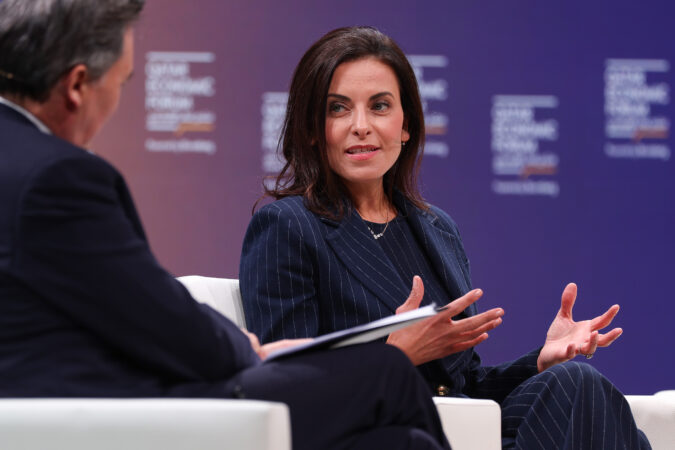
Dina Powell McCormick, a former Trump official and former member of Meta’s board, has been hired as the company’s new president and vice chair, CEO Mark Zuckerberg announced Monday morning.
“Dina has been a valuable member of our board and will be an even more critical player as she joins our management team,“ Zuckerberg wrote on Threads,one of Meta’s platforms alongside Facebook and Instagram. ”She brings deep experience in finance, economic development, and government.“
He also noted that she will be involved in all of Meta’s endeavors, but will particularly focused on ”partnering with governments and sovereigns to build, deploy, invest in, and finance Meta’s AI and infrastructure.”
Powell McCormick has extensive business leadership and government experience. She spent 16 years in different leadership roles at Goldman Sachs, according to her LinkedIn page. Powell McCormick was most recently the vice chair, president, and head of global client services at BDT & MSD Partners, a banking company.
She worked in the White House and the U.S. Department of State under former President George W. Bush and was deputy national security adviser during President Donald Trump’s first term.
The move also signifies what appears to be Meta’s intention to create stronger tieswith the federal government as it develops artificial intelligence tools. Trump praised Zuckerberg’s decision Monday.
“A great choice by Mark Z!!! She is a fantastic, and very talented, person, who served the Trump Administration with strength and distinction!” Trump said on Truth Social, his social media platform.
U.S. Sen. Dave McCormick (R., Pa.), Powell McCormick’s husband, has been heavily involved with AI and tech policy. For instance, he convened an AI summit in Pittsburgh in July 2025 where billions of dollars in planned projects for Pennsylvania were announced.
McCormick, in a post on X Monday, said he is “incredibly proud” of his wife.
Asked about how he would mitigatepotential conflicts of interest that arose from Powell McCormick’s position, a spokesperson for the senator said: “As he has from day one, Senator McCormick will continue to comply with all U.S. Senate ethics rules and honorably and enthusiastically serve the great citizens of Pennsylvania.”
Powell McCormick is also the second former Trump official to be hired by Meta in recent weeks, CNBC reported. Earlier this month, Meta said that it had hired Curtis Joseph Mahoney, a former deputy U.S. trade representative, to be its chief legal officer.
This story first appeared in PA Local, a weekly newsletter by Spotlight PA taking a fresh, positive look at the incredible people, beautiful places, and delicious food of Pennsylvania. Sign up for free here.
Last fall, communities across Pennsylvania elected officials who have yet to turn 30 to one of the most visible local roles: mayor.
This month, those mayors begin their first terms and their political careers, bringing new perspectives and concerns to local government.
Spotlight PA spoke to four incoming young mayors — all of them members of Generation Z, by Pew Research Center’s definition (though some noted they feel culturally closer to millennials) — about their ambitions, their platforms, and what drew them to the position.
While they span the ideological spectrum and have jobs as disparate as coffee roaster and political operative, all want to improve their local governments, and share optimism about the future of their communities.
Although it’s not unheard of for Pennsylvanians to elect young local leaders, it’s rare. Just 3% of the 866 local elected officials who answered a 2021 Pennsylvania Local Government Commission survey were under 35. The average age of a respondent was about 61.
Cassandra Coleman, the former mayor of Exeter in Luzerne County who was appointed to her first term at 20, recommended the latest crop make sure they’re “listening and learning” and not coming in too “forceful.”
“But also,” Coleman added, “I think you have to also weigh that with not being overshadowed and not being kind of pushed to the side because of your age.”
New perspectives
Now is an important time to get involved in government and run for office, said Sam Bigham, the new Democratic mayor of Carnegie in Allegheny County.
“We’re seeing a lot of leaders at different levels not really delivering on their promises or keeping their constituents’ best interest at heart, especially not for young people like me,” he said, pointing to issues like unaffordability and climate change.
In Pennsylvania, the roles and responsibilities of mayors vary by municipality type. In some cities, the job is powerful and wide-reaching. In boroughs, the mayor’s primary responsibilities are to “preserve order” (i.e., oversee police and respond to emergencies) and enforce local ordinances. They can also break ties among council members.
It’s often a part-time job, and state law caps salaries based on the size of the borough, though individual municipalities may set pay well below the mandated maximums.
The mayors who spoke to PA Local all represent boroughs, and acknowledged the limited powers that come with their office. But they hope to lean into the position’s more ceremonial role as a representative of their community — and use it to bring fresh points of view to government.
Matt Zechman, a Libertarian who was sworn in as mayor of Cleona Borough in Lebanon County this week, said it’s vital for young people to start running for local office and working their way up so they can “change their own future.”
“It’s a much different time than it was 20, 30, 40, 50 years ago,” he said. “And if we have the same mindset that today’s problems are the same as they were 50 years ago, and we treat them the same way, we’re just going to keep spiraling downward even more.”
Winning support
As Bigham went door to door during his campaign, he found “a whole lot of people were actually excited about a young person running for office,” he told PA Local.
While some were skeptical of his age and experience level, he said he responded by “running a very serious campaign,” listening to people, speaking intelligently about local issues, and making sure all his paperwork was in order.
Joar F. K. Dahn, the new mayor of the borough of Darby in Delaware County, also said he ran into a “a handful of people that were kind of very against a young person running,” and insisted he “wait his turn.”
But he stressed that those folks were a vocal minority, and thanked the older adults who’ve guided him and made it “their mission to to mentor the next generation,” which he sees as “contributing to our future.”
“The young people are going to come, you just got to invite them to the table,” Dahn said. “You got to make them feel like they also belong here, and you got to make sure they understand that their opinions [are] valid.”
Several of the mayors hope to motivate their peers to run for office or get civically involved in another way.
“I just want to let everybody know regardless of their background, age, or affiliation, or anything like that, that they do matter,” said Dylan Stevens, a member of the Liberal Party who was elected mayor of the borough of Westover in Clearfield County by a one-vote margin. “If they want to make a difference, just go for it.”
And it’s “really not as difficult as some people might think” to run for local office, Carnegie’s Bigham pointed out. He collected 10 signatures to secure his place on the ballot, and raised a few thousand dollars — “probably more than what you need in a lot of places,” he said.
“Obviously, you have to be comfortable putting yourself out there and talking to all different kinds of people,” Bigham said. “I’m a bit more introverted, so sometimes it can get really tiring to have to do that, but it can also be really rewarding.”
Meet the mayors
Joar F. K. Dahn of Darby
Dahn, 28, calls himself Darby’s “biggest cheerleader.” When he was at college, the Bloomsburg University alumnus didn’t tell people he was “from Philly,” like other students from Delaware County would, he told PA Local. He’d say “Darby.”
Dahn, whose family fled the Liberian Civil War when he was a child, has called Darby home for 20 years. He describes the small borough of 10,749 as a “very close-knit community,” but one that “has its struggles.”
His dissatisfaction with local leadership motivated him to run for mayor. Working as a political operative for several years, he was inspired by the campaigns he was hired by and felt the officials in Darby weren’t as committed.
He started looking for someone to throw his support behind — and that person turned out to be himself, Dahn told PA Local. Several residents encouraged him. So he challenged the incumbent mayor in the Democratic primary and ended up winning by 20 points. Dahn ran unopposed in November.
In his first 100 days, he wants to motivate community members to get more involved in local government and “feel like they’re part of the process.”
“Sometimes, we’ll have council meetings, and I’m the only resident in the room,” Dahn said. “We have council meetings and there’s literally nobody there. … I want people to understand now that this is a new leadership.”
Public safety is a big priority for Dahn, who on the campaign trail heard from concerned grandmothers. He hopes to promote a positive relationship between residents and police, and work to reduce gun violence.
“I need every single grandmom to feel comfortable to walk any single street in Darby,” Dahn said.
Sam Bigham of Carnegie
Carnegie’s “old-style” Main Street and strong community connections drew Bigham — a resident since age 10 with deep family roots in the area — back to the borough of about 8,000 after he graduated from Indiana University of Pennsylvania in 2024.
Now the commonwealth’s youngest active mayor, the 23-year-old had known for years that he wanted to work in government or public service, and his resumé proves it. A former junior councilperson, Bigham also interned for a state representative and a congressman, and worked as a Democratic organizer ahead of last year’s election.
Early last year, Bigham landed the position of executive director of the Carnegie Community Development Corporation, a nonprofit that aims to support local businesses and boost the area’s attractiveness. He plans to continue in that role alongside his part-time mayoral duties.
He told PA Local he decided to run after talking with the incumbent, who was planning to step down. A friend from college helped Bigham campaign, and after lots of door-knocking and securing endorsements from several local politicians, he won the Democratic primary with 661 primary votes to his opponent’s 204. (He also won enough write-in Republican votes to be listed under both parties on the November ballot.)
“I wanted to run on a message of community development and optimism and looking forward to the future,” he told PA Local.
Bigham’s first-term goals include revitalizing Main Street, improving local infrastructure, updating the borough’s branding, facilitating events between police and residents, and working on sustainability initiatives.
Matt Zechman of Cleona
Zechman has worn many hats in his 27 years: volunteer firefighter, EMT, combat medic in Afghanistan, coffee roaster, and father. His latest is mayor of Cleona, a 2,000-person borough he describes as a quiet place with “two traffic lights,” a “really nice playground,” and “a lot of hometown spirit.”
Although he didn’t see a glaring need for major changes in his community, the lifelong resident ran to bring his skills and a “new perspective” to the role.
Zechman did much of his campaigning via social media, he told PA Local. Running on the Libertarian ticket, he beat the Republican incumbent by a nearly 2-to-1 margin in the November election.
As mayor, Zechman wants to implement what he calls “windows-down policing,” a practice he said remembers from his childhood.
“We would see the police chief and the mayor — they would drive in their vehicle, windows down, going slow, talking to residents, engaging,” Zechman explained. “I knew their names, they knew my name, they knew everyone’s name. And in a town this small, that is very well possible.”
And even though it’s not part of his job description on paper, he said he also wants to use his bully pulpit to find local business sponsors, seek grant funding, or crowdfund to install flashing pedestrian crossing signs, which he called an “absolute must” for local road safety.
Dylan Stevens of Westover
Stevens made a “spontaneous decision” to run for mayor of Westover, a roughly 350-person borough in Clearfield County, just four days before the November election, he told PA Local.
Raised in a conservative Republican household, Stevens began exploring third parties when he “became disillusioned with the whole political situation” in 2020. He landed on the Liberal Party of Pennsylvania, which was formed as the “Keystone Party” in 2022 by a group of people who believed the Libertarian Party was moving too far right.
When Stevens, a 26-year-old who’s lived in Westover for 11 years and works at a gas station in another town, realized there wasn’t anyone on the ballot for mayor, he decided to give it a go. He wanted to “do more” in his community and bring more exposure to the Liberal Party, he said.
Stevens had mostly kept to himself before, so he took a “kids’-lemonade-stand-type-of-approach” to drum up support, he told PA Local. With help from Liberal Party members from out of town, he introduced himself to people outside a general store a few days before the election and did the same on Election Day outside Westover’s polling place. He said reactions ranged from neutral to “OK, well, good luck.”
Stevens ended up getting 13 write-in votes, a single vote more than the next most popular write-in. According to a Liberal Party news release, his election marked the party’s first mayoral victory in Pennsylvania.
“Even though I was kind of an unknown, I guess I had the gift of the gab enough to let people know that I wanted to make a difference in my community and I wanted to give it my best effort,” Stevens said. “And for a lot of them, it seemed to be enough.”
Stevens hopes to work with the borough council to attract businesses and explore alternative water sources. He also wants to poll residents on local issues, revive the borough’s Facebook page, and livestream public meetings to improve access for people who aren’t able to attend in person.
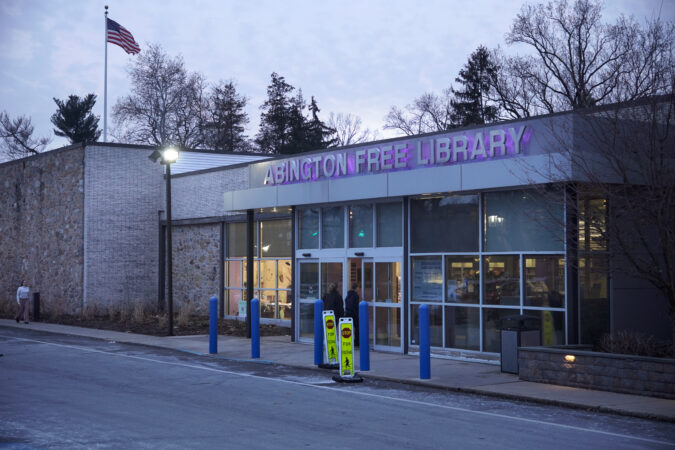
For more than four years, dozens of LGBTQ+ kids and their families have joined the Abington Township Public Library for Rainbow Connections, a monthly Zoom program, to read children’s books, craft, make new friends, and meet interesting people, such as “Jeopardy!” super champ Amy Schneider.
But within the past week, the program — the only one of its kind in Montgomery County libraries — has become a target of a right-wing social media campaign that has circulated misinformation and directed threatening language at the program, prompting the library to release a statement Monday setting the record straight, said Library Director Elizabeth Fitzgerald in an interview Tuesday.
“Rainbow Connections is not a sexual education class. Sexual health, reproduction, puberty, and intimate relationships are not discussed,” the statement said in part.
Though it’s “not different from any other story time or library program,” Fitzgerald says, Rainbow Connections’ mission is to foster a welcoming and intentional environment for LGBTQ+ kids in grades K-5, including those who may be struggling to make friends at school. Its virtual format has allowed families from around the country to join.
“Ultimately just a space where the kids could attend a library program and feel safe,” Fitzgerald said.
Comments attacking the program appeared on the library’s Facebook page early last week. A day later, LibsofTikTok, a controversial far-right social media account founded by Chaya Raichik, as identified by the Washington Post, posted about Rainbow Connections.
LibsofTikTok, which frequently targets LGBTQ+ people nationwide, spurred misinformed outrage from its millions of followers about the program’s upcoming events.
The account’s posts have often provoked real-life consequences. In 2024, after posting about the William Way Community Center, an LGBTQ+-focused nonprofit in Philadelphia, Democratic Sen. John Fetterman and former Democratic Sen. Bob Casey signed a letter requesting to withdraw federal funding from a renovation project that would have made the center’s headquarters more accessible and expanded William Way’s programming space.
“These are difficult times, and I think that the commentary that took off on social media underscores the reason why we need to create spaces where members of the LGBTQ community feel safe,” Fitzgerald said.
Library staff established the program in November 2021 after a community member reached out and asked if the library would help address a need for a safe space for LGBTQ+ kids.
According to anonymous comments from families provided by the library to The Inquirer, parents are profoundly grateful for the safe environment that Rainbow Connections has created for their children. Names were withheld by the library to protect families’ safety and privacy.
“My children live in a two-mom household, so I thought it would be a great program to connect with other kids and possibly see other families that look like ours,” one parent said.
Another parent said they had “tears in my eyes listening to [the kids] introduce themselves, awed by their bravery and vulnerability.”
A family who lives in North Carolina said Rainbow Connections helped their child better understand their identity and build community — “Your program brought us light, hope and education when we were feeling isolated, confused and hopeless.”
In Abington, it’s not the first time that events related to the LGBTQ+ community have been disparaged, said Township Commissioner John Spiegelman, who represents the area where the public library is located. The township’s yearly raising of the Pride flag has provoked a lawsuit against Spiegelman and other members of the board, he said.
“Is it getting worse here and everywhere? Certainly it is,” Spiegelman said.
In the aftermath of the social media posts, Fitzgerald said Rainbow Connections will be contacting parents to say the program will continue and that “their safety is ensured.”
“It is my hope that the children who participate don’t have any idea that this is going on,” Fitzgerald added.
Since the online backlash, the Montgomery County community has rallied around the library and Rainbow Connections, which has served as a model for other Pennsylvania libraries’ programming for LGBTQ+ youth.
“More communities should embrace programs like Rainbow Connections,” said Jason Landau Goodman, board chair of the Pennsylvania Youth Congress, an LGBTQ+ advocacy organization, in a statement. “Young students today read books that feature all types of people because diverse stories reflect the real world we live in.”
“Some students experience bullying or harassment based on who they are — and many still do not get opportunities to see themselves reflected in the stories they learn from,” added Goodman, who is also running for state representative in Montgomery County.
The Abington Human Relations Commission said in a statement Monday that they stand in “solidarity” with the library and encouraged community members to “seek information directly from reliable sources and to engage in dialogue grounded in respect and understanding.”
Fitzgerald said that in spite of the derogatory comments snowballing online, the library has been receiving an onslaught of supportive calls and emails.
“That’s really meant the world to us,” she said. “Just to know that the people who don’t want this program to exist, they’re a vocal, small, nonlocal majority, and that I believe there’s a much larger number of residents who love the library and who care about their neighbors and fellow community members.”
Pennsylvania’s race for governor has officially begun. And 10 months before the election, the November matchup already appears to be set.
Democratic Gov. Josh Shapiro formally announced his reelection campaign Thursday — not that anyone thought he wouldn’t run. And Republicans have rapidly coalesced behind thestate party’s endorsed candidate, Pennsylvania Treasurer Stacy Garrity.
The racewilldominate Pennsylvania politics through November,but it could also havea national impact as Democrats hope Shapiro at the top of the state ticket can elevate the party’s chances in several key congressional races.
Here’s what you need to know about the high-stakes contest.
Shapiro was elected state attorney general in 2016, a year when Pennsylvania went for Republican Donald Trump in the presidential contest. The position put Shapiro in the national spotlight in 2020 when Trump sought to overturn his loss in the state that year through a series of legal challenges, which Shapiro’s office successfully battled in court.
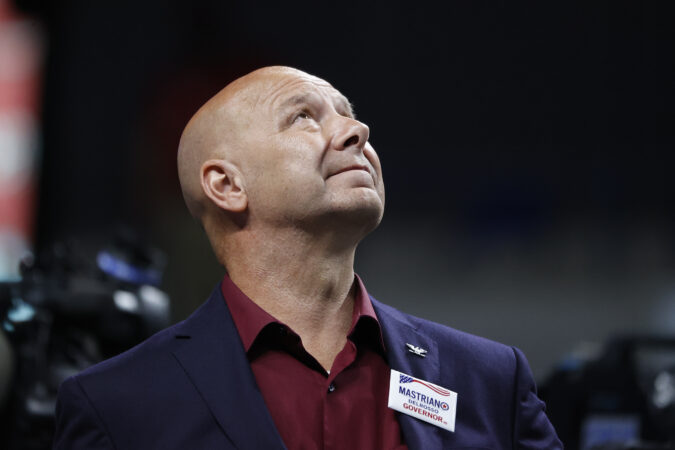
He went on to decisively beat Trump-backed Republican State. Sen. Doug Mastriano for the governorship in 2022. Despite an endorsement from Trump, Mastriano lacked the support of much of Pennsylvania’s Republican establishment and spent the election cycle discouraging his supporters from voting by mail.
Throughout Shapiro’s first term as governor, he has highlighted his bipartisan bona fides and ability to “get stuff done” — his campaign motto — despite contending witha divided legislature. His launch video highlights the quick reconstruction of I-95 following a tanker explosion in 2023.
A strong supporter of Trump, Garrity is one of the only women that has been elected to statewide office in Pennsylvania history. If elected, she would be the first female governor in state history.
Garrity is a retired U.S. Army colonel who was executive at Global Tungsten & Powders Corp. before she was elected treasurer in 2020. Running a relatively low-key state office, Garrity successfully lobbied Pennsylvania’s General Assembly to allow her to issue checks to residents whose unclaimed property was held by her office, even if they hadn’t filed claims requesting it.
Anyone else?
While Shapiro and Garrity are the likely nominees for their parties, candidates have until March to file petitions for the race. That theoretically leaves the possibility of a primary contest open for both candidates, but it appears unlikely at this point.
The outcome of Pennsylvania’s gubernatorial race could hold wide-ranging impacts on transportation funding, election law, and education policy, among other issues.
The state’s governor has a powerful role in issuing executing actions, setting agendas for the General Assembly, and signing or vetoing new laws. The governor also appoints the secretary of state, the top Pennsylvania election official who will oversee the administration of the next presidential election in the key swing state.
Throughout the entirety of Shapiro’s first term, he has been forced to work across the aisle because of the split legislature. Throughout that time the balance of power in Harrisburg has tilted toward Democrats who hold the governor’s mansion and the Pennsylvania House. But many of the party’s goals — including expanded funding for SEPTA and other public transit — have been blocked by the Republican-held Senate.
If Garrity were to win that dynamic would shift, offering Republicans more leverage as they seek to cut state spending and expand school voucher options (while Shapiro has said he supports vouchers, the policy has not made it into any budget deals under him).
Shapiro coasted to victory against Mastriano in 2022, winning by 15 points. The 2026 election is expected to be good for Democrats with Trump becoming an increasingly unpopular president.
But Garrity is viewed as a potentially stronger opponent to take on Shapiro than Mastriano, even though her political views have often aligned with the far-right senator.
When the midterms conclude, the 2028 presidentialcycle will begin. If Shapiro can pull off another decisive win in a state that voted for Trump in 2024, it could go a long way toward aiding his national profile. But if Garrity wins, it could endthe governor’s chances of putting up a serious campaign for the presidency in 2028.
Every other race in Pennsylvania
The governor’s contest is the marquee race in Pennsylvania in 2026. Garrity and Shapiro have the ability to help or hurt candidates running for Pennsylvania’s statehouse and Congress.
The momentum of these candidates, and their ability to draw voters to the polls could play a key role in determining whether Democrats can successfully flip four competitive U.S. House districts as they attempt to take back the chamber.
Democrats also narrowly hold control of the Pennsylvania House and are hoping to flip three seats to regain control of the Pennsylvania Senate for the first time in decades. If Democrats successfully flip the state Senate blue, it would offer Shapiro a Democratic trifecta to push for long-held Democratic goals if he were to win reelection.
Strong Democratic turnout at the statewide level could drive enthusiasm down-ballot, and vice versa. Similarly, weak turnout could aid Republican incumbents in retaining their seats.
The dates
The election is still months away but here are days Pennsylvanians should put on their calendars.
May 4: Voter registration deadline for the primary election.
May 19: Primary election.
Oct. 19: Voter registration deadline for the general election.
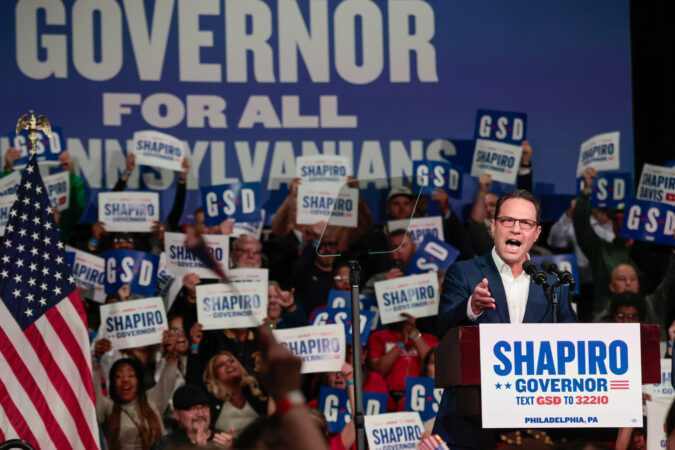
Pennsylvania Gov. Josh Shapiro officially launched his widely expected bid for reelection Thursday, spending his first day back on the campaign trail in one of the nation’s most politically divided states by touting his achievements for workers, seniors, and schools while contrasting himself against Republicans in President Donald Trump’s Washington.
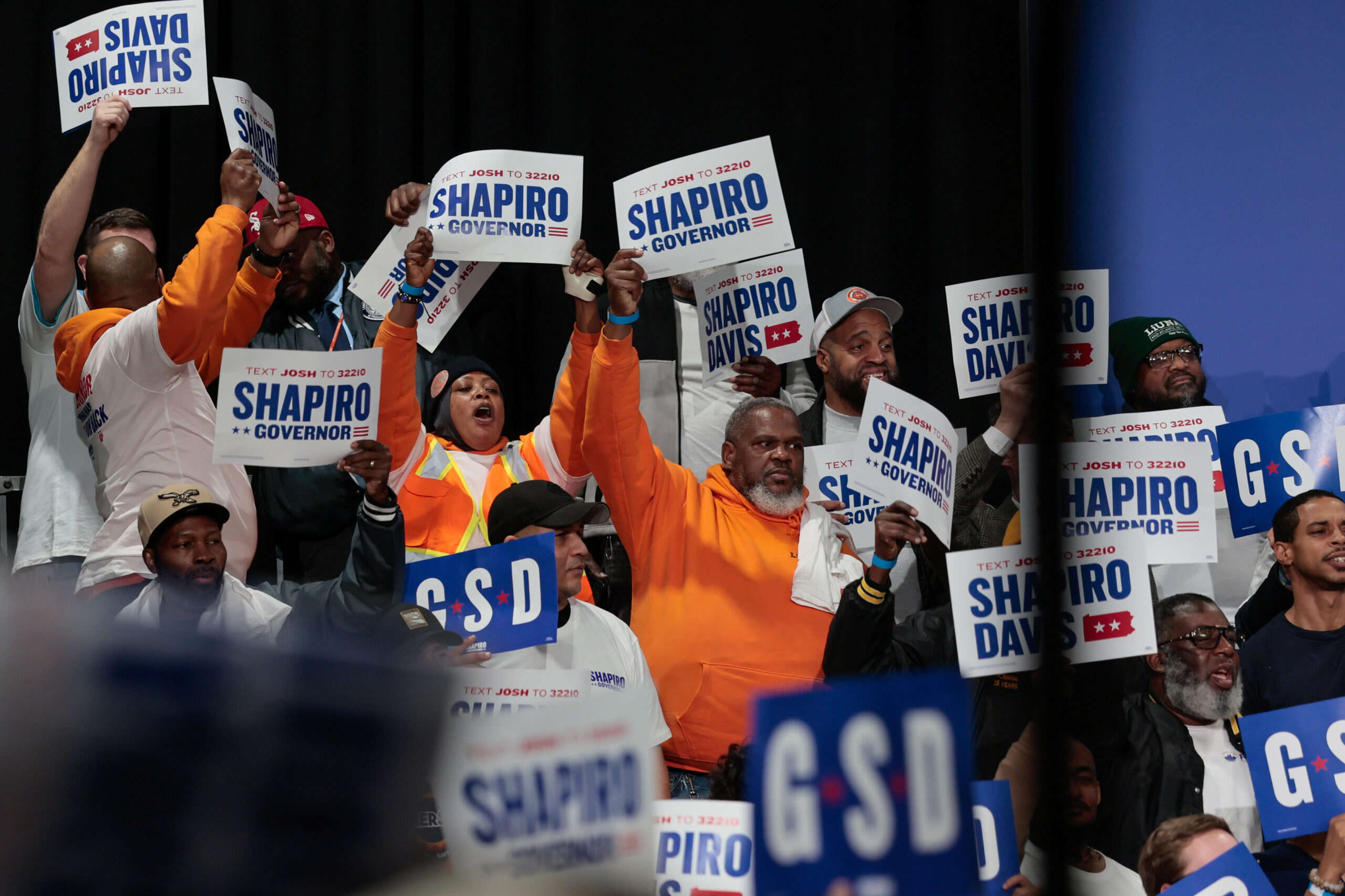
The Montgomery County Democrat presented his opening argument to voters Thursday afternoon in a highly produced campaign rally at a Pittsburgh union hall, before appearing Thursday night before Philadelphia voters at the Alan Horwitz “Sixth Man” Center in Nicetown.
Shapiro, 52, of Abington Township, will pursue his reelection bid by crisscrossing the state, boasting a high approval rating that Republicans hope to damage as talk of his potential 2028 candidacy continues to build.
Shapiro took the stage in Pittsburgh and Philadelphia following speeches from Lt. Gov. Austin Davis and a parade of public officials, labor leaders, and community advocates who touted his first term accomplishments, all delivering a similar message: Shapiro shows up and delivers for residents across the commonwealth.
At the Sixth Man Center, supporters and local leaders packed the event space in the youth sports center where Shapiro delivered a speech next to a huge mural of 76ers star Joel Embiid. Shapiro joked about his midrange jumper as he praised the center’s work.
“I am proud to be here on today to say that Josh Shapiro as governor of the commonwealth has delivered for us in a way that some thought … was impossible,” said Philadelphia Mayor Cherelle L. Parker to an excited crowd.
The rollout signaled Shapiro’s campaign will be anchored in his administration’s motto, “Get S— Done,” emphasizing that state government should be able to solve residents’ problems effectively.
“You deserve someone who goes to work every day focused on you and on getting stuff done,” Shapiro said.
He is not expected to face a primary challenger, just like in 2022, when he later cruised to victory in the general election against far-right State Sen. Doug Mastriano (R., Franklin). Mastriano, who had been teasing another run, announced Wednesday he would not join the race for governor.
This time, Republicans hope to take a stronger swing at Shapiro by coalescing around one candidate early. The state GOP endorsed State Treasurer Stacy Garrity more than a year in advance of November’s midterm election.
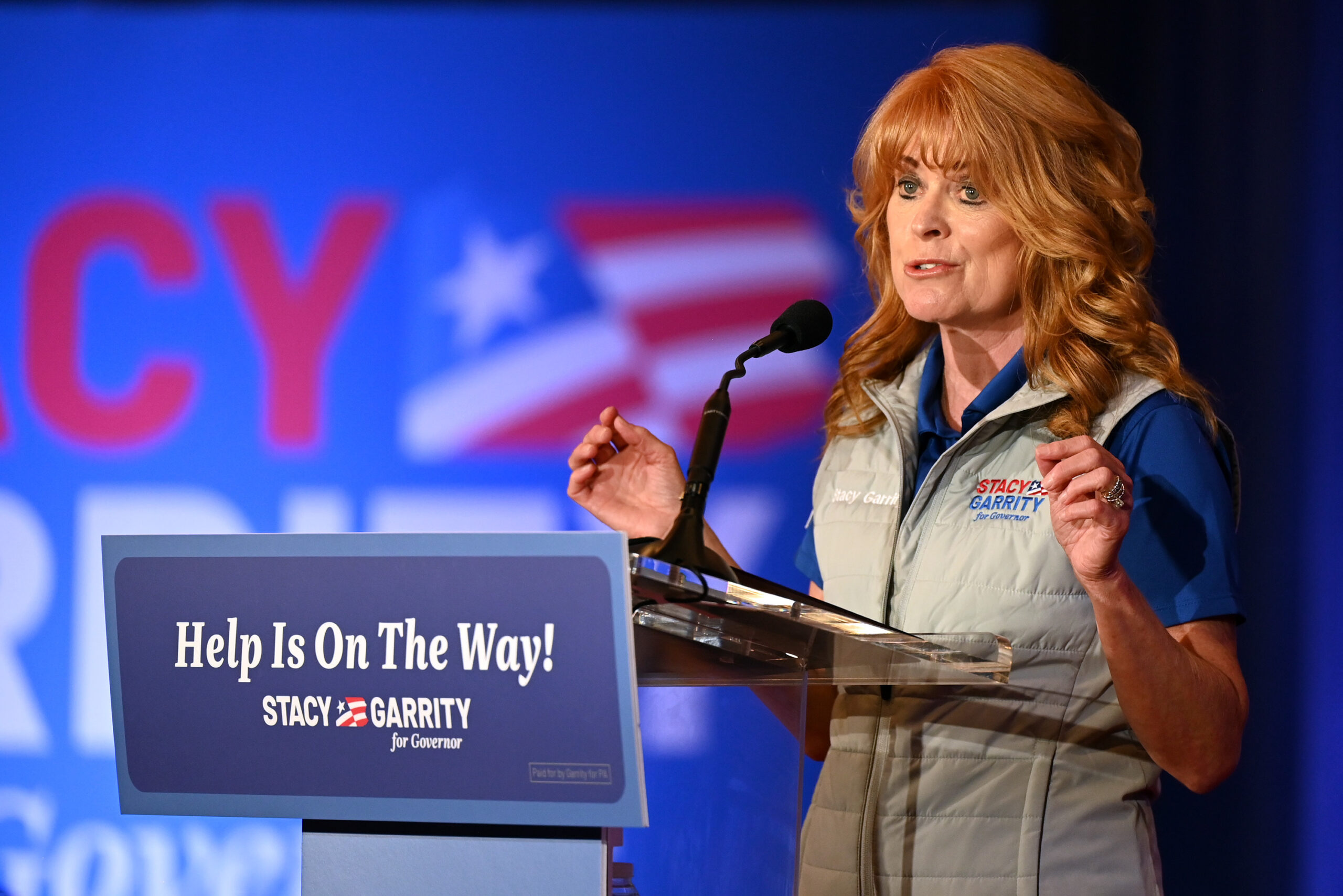
State Treasurer and Republican candidate for governor Stacy Garrity holds a rally on Sept. 25, 2025 at the Newtown Sports & Events Center in Bucks County.
State Republican Party Chair Greg Rothman said in a statement Thursday that Pennsylvanians have had “enough of Josh Shapiro’s lack of leadership and broken promises,” noting several of Shapiro’s missteps in his administration such as his reneging on school vouchers, a $295,000 payout over a sexual harassment claim against a former top aide, and failing to send a month’s worth of state agency mail.
“[Garrity] actually gets stuff done, she doesn’t just talk about it on the campaign trail,” Rothman added.
Garrity has contended that Shapiro — a former attorney general, county commissioner, and state representative — is more focused on running for president in 2028 than leading the state.
“Josh Shapiro is more concerned with a promotion to Pennsylvania Avenue than serving hardworking Pennsylvanians,” Garrity said in a statement earlier this week, noting the state fared poorly in U.S. News and World Report rankings on the economy and education.
But that’s part of the appeal for some of Shapiro’s supporters.
Fernando Rodriguez, who works at Fox Chase Farm in Philadelphia, was eager to hear Shapiro’s stump speech. The 37-year-old didn’t vote for Shapiro in 2022 and had cast only one ballot for a presidential election, voting for President Barack Obama in 2008.
But he wanted to see Shapiro win reelection and, more importantly, go on to run for president in 2028.
“There seems to be some maturity, some presidential qualities to him,” Rodriguez said, noting that is particularly important given the direction of national politics.
Shapiro has already raised $30 million to support his reelection, which is likely to boost the entire ticket.
State Democrats hope Shapiro will be able to leverage his popularity and growing national brand to bring more voters out to the polls, in what is already likely to be an advantageous midterm year for the party.
“We’ve got a lot of work to do and it’s not just about reelecting the governor,” Eugene DePasquale, the chair of the state Democratic Party, said Thursday in Pittsburgh.
Gov. Josh Shapiro’s supporters cheer as he makes his way to the stage during a reelection announcement event event at the Alan Horwitz “Sixth Man” Center in Philadelphia on Thursday, Jan. 8, 2026.
‘The hard work of bringing people together’
Offering an opening pitch to voters, Shapiro highlighted key themes he is expected to repeat during the next 10 months on the campaign trail: He’s protected Pennsylvanians’ freedoms and created jobs, with more work to do.
He noted several bipartisan achievements passed by the state’s divided legislature during his time in office, including a long-sought increase to the state’s rent and property tax rebate, historic funding increases for public education, and more. Pennsylvanians, he argued, have a simple choice in November.
“Will we continue to do the hard work of bringing people together to get stuff done, or will we descend into the chaos and extremism that has gripped too many other places across our nation?” Shapiro asked in his stump speech in Pittsburgh and Philadelphia.
In Philly, the crowd gave this question a resounding “No.”
Shapiro’s launch drew a distinction between his style of leadership and that of Trump — whom Shapiro repeatedly called a danger to democracy prior to his reelection in 2024. Shapiro did not name the president during his announcement, but alluded to Trump — while noting his legal challenges against the Trump administration.
The move followed Shapiro’s oft-repeated tactic since Trump took office for a second time: Criticize his policies, while not alienating Trump’s supporters in Pennsylvania, as the state swung in favor of Trump in 2024.
In addition to his two campaign rallies, Shapiro kicked off his reelection bid in a video advertisement posted on social media. He led that off with footage from one of his biggest accomplishments from his first three years in office: rebuilding a collapsed section of I-95 in 12 days, in what was expected to take months.
The quick rebuild also featured in his speech in Philly, where he heaped praise on organized labor for its role in the reconstruction.
Rob Buckley with Buckley & Company, Inc., shakes hands with Gov. Josh Shapiro (right) at the end of a 2023 news conference before the reopening of I-95.
MORGANTOWN, Pa. — The Trump administration says it is focused on protecting unaccompanied migrant children. It imposed strict new background checks on those seeking custody of young migrants and cut ties with a chain of youth shelters accused of subjecting children in its care to pervasive sexual abuse.
“This administration is working fearlessly to end the tragedy of human trafficking and other abuses of unaccompanied alien children who enter the country illegally,” saidHealth Secretary Robert F. Kennedy Jr., who oversees the Office of Refugee Resettlement, or ORR, which cares for unaccompanied migrant children.
But for the last three months, that office has also locked some teenage migrant boys inside a secure juvenile prison about 50 miles west of Philadelphia with a long and publicly documented history of staff physically and sexually abusing juvenile offenders in its care, a Washington Post investigation has found.
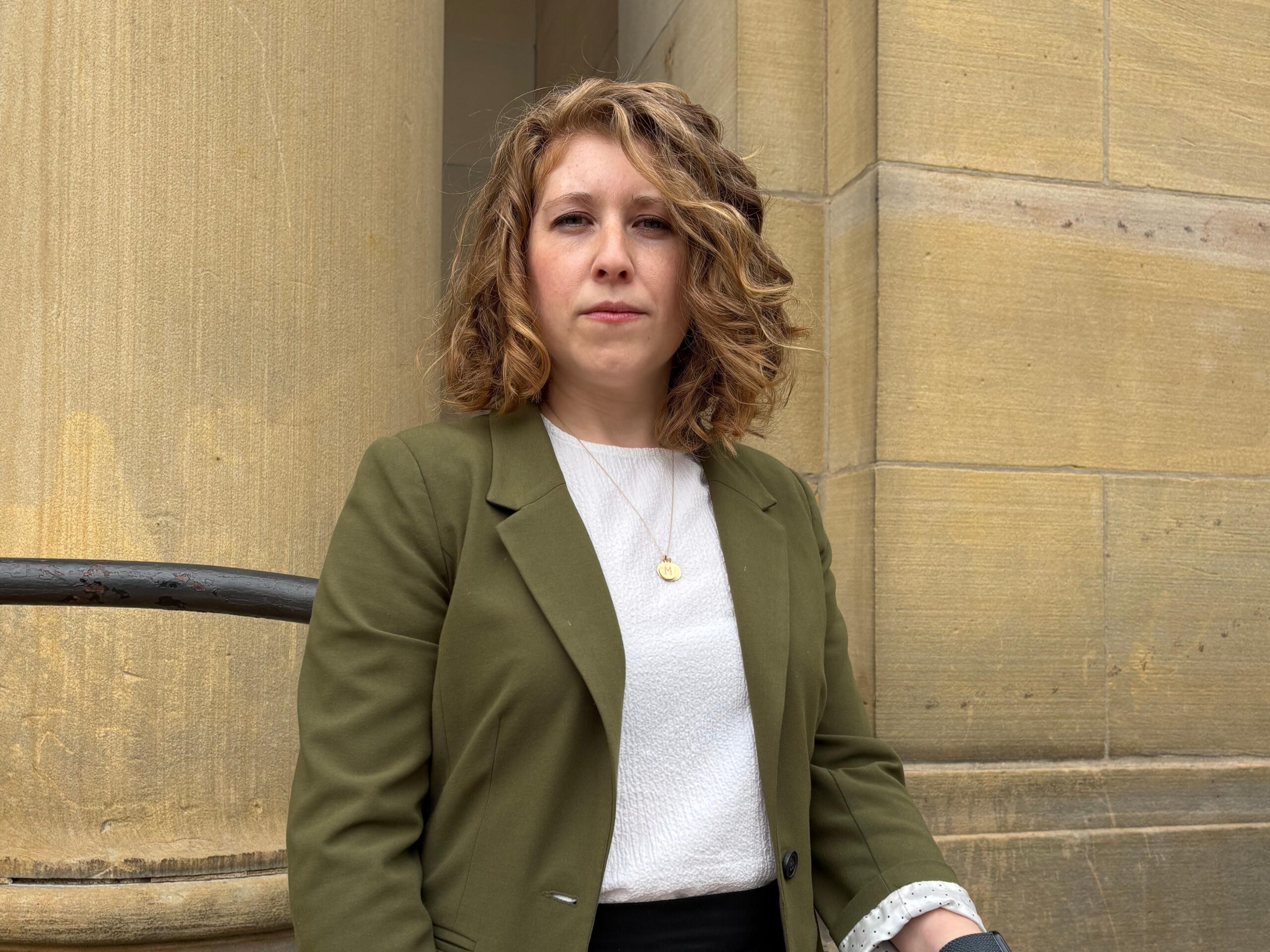
“ORR is sending children to a juvenile detention center who should not be there,” said Becky Wolozin, a senior attorney at National Center for Youth Law.
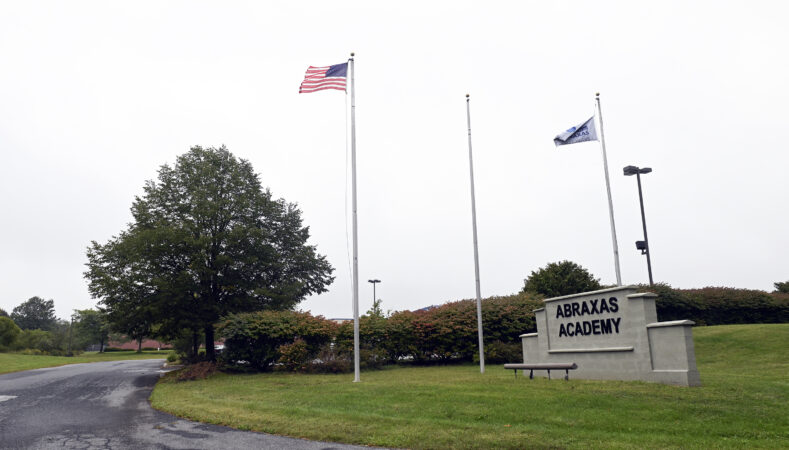
ORR awarded $9 million to Abraxas Alliance in August to hold up to 30 young immigrants deemed a danger to themselves or others in its facility in Morgantown, Berks County. At various times since early October, between five and eight migrant teenage boys have been held inside a dedicated wing of the juvenile detention center, sleeping inside locked cells the size of walk-in closets, according to lawyers who met with them.
Pennsylvania state inspectors have documented at least 15 incidents since 2013 in which they said staff physically mistreated minors at the Morgantown facility, which holds principally juveniles facing or convicted of criminal offenses. In at least two incidents, officials documented allegations of staff sexually harassing or sexually abusing young residents. The most recent reported abuse occurred in November.
In a lawsuit filed in 2024, six former residents of the facility allege they were sexually abused by staff between 2007 and 2016, accusing management of enabling a “culture of abuse.”
A spokesperson for Abraxas Alliance, the Pittsburgh nonprofit that operates the facility,did not respond to a long list of questions about its treatment of children. After some of the incidents cited by inspectors, Abraxas suspended or fired staff members and submitted correction plans to state regulators, promising to retrain workers on proper restraining techniques and install more surveillance cameras.
ORR has wide latitude over the types of facilities it uses to house children, though federal rules require it to use “the least restrictive setting that is in the best interests of the child.” The rules say ORR may place minors in secure facilities if they have been charged with a crime, or if the agency determines they could harm themselves or others.
HHS spokesman Andrew Nixon said decisions on where to place migrant children “are based on each child’s specific circumstances, behavior-based risk assessments, and legal criteria.” All the teens at the Morgantown facilitywere provided a notice with “specific details as to why they are placed there,” he added.
Some of the migrant boys have no pending criminal charges, and several have parents or close relatives in the U.S. asking to be reunited with them, said Becky Wolozin, a senior attorney at National Center for Youth Law who visited the facility and spoke to some of the boys in November.
The Post was unable to identify any of the boys or verify Wolozin’s claims about their circumstances, because neither their immigration lawyers nor government officials would share details about their cases due to strict rules protecting the records of minors.
License revoked
In November, Pennsylvania revoked one ofthe three licenses held by different units within the Morgantown facility, Abraxas Academy. The state accused Abraxas of “gross incompetence, negligence, and misconduct” following a Nov. 4 incident of staff violence against a child, state records show. According to those documents, a staff member put his hand on a child’s neck andshoved his face into a table, an incident the facility’s operatordid not report to local authorities.
Ali Fogarty, a spokeswoman for Pennsylvania’s Department of Human Services, said state law prevented her from commenting on the incident, includingwhether the child was a migrant placed by ORR or another juvenile held in the facility. The state increased its monitoring of the Morgantown facility and reduced its maximum capacity under one license by 25 residents whilethe companyappeals the revocation. Its two other licenses were unaffected, and it is still permitted to hold more than 100 individuals, Fogarty said.
Nixon, the HHS spokesman, saidORR “will make any necessary adjustments to its use of the facility based on the outcome of the state’s licensing process” and its own review of the incident,adding that “ORR has zero tolerance for sexual abuse and harassment of children in our care.”
The problems at the nation’s only secure jail for migrant youths are unfolding as the Trump administration pushes measures it says are aimed at safeguarding the 2,300 unaccompanied migrant children in its custody, as well as those it releases to sponsors within the country.
In March, ORR ended its use of shelters operated by Southwest Keys — a Texas nonprofit which the Justice Department sued in 2024, alleging its workers repeatedly sexually abused children in the nonprofit’s shelters from 2015 to at least 2023. The company said in a 2024 statement that the lawsuit did not “present the accurate picture of the care and commitment our employees provide to the youth and children.” The department dropped the lawsuit last year.
Around the same time, ORRalso began requiring people to provide income documents and submit to DNA testing, fingerprinting and interviews before regaining custody of young migrants, including their own children, which agency officials say will help ensure they are not being claimed by traffickers.
The Trump administration said President Joe Biden had released tens of thousands migrant children to sponsors with little or no vetting, including to some adults with a history of violent crimes. U.S. Immigration and Customs Enforcementsays it’s enlisting the help of local law enforcement agencies to locate the children and verify their safety.
Jen Smyers, a former deputy director of ORR under Biden, said this population has faced abuse for decades, across several administrations. She said stricter vetting cannot always prevent mistreatment.
Partly as a result of the Trump administration’s new vetting procedures, the average child remains in ORR custody about six months —nearly three times longer than at the beginning of 2025, government data shows.
A history of abuse allegations
By jailing migrant children in a secure detention center, especially one with a recent history of abuse, the administration is exposing these young people to some of the same risks it says it wants to eliminate, said Jonathan White, a former career HHSofficial who managed the unaccompanied children program during part of Trump’s first term.
Under any previous administration, a track record of physical or sexual abuse would be “instantly disqualifying” for federal contracts involving the care of minors, White said. “This is the kind of thing under Republican and Democratic administrations you terminate existing grants for — you don’t give new grants to places like that.”
Abraxas Academy, part of a chain of 10 youth detention and treatment centers, holds dozens of teenage boys from surrounding areas, many of whom are serving sentences for violent crimes or awaiting court hearings. Rob Monzon, a former director of the Morgantown facility, calls it “the most extreme setting in juvenile detention.”Its young inmates, some who claim to be from gangs, frequently lash out at one another, vandalize the building and attack staff members, he said.
State inspection records show that staff members have at times responded with violence.
One staff member“picked up[a child] by the shirt and threw the child to the ground, holding the child down with a knee, and banging the child into the wall,” a 2013 report on the state’s website said. Another threw punches at a different minor and yet another bit an incarcerated child in the abdomen, other reports said.The reports noted that one staff member “frequently escalates situations” by applying restraint holds that are “known to cause pain to the child.”
Workers have been trained to defend themselves by placing inmates into restrictive holds, waiting for them to calm down and calling for help from other employees, according to Shamon Tooles, who worked as a supervisor at Abraxas Academy for eight months in 2023. But due to a lack of training, supervision, and frequent short-staffing, he said, some workers resorted to fighting back.
“A lot of the staff were just scared,” said Tooles, who said he does not condone any mistreatment of children.
In December 2016, Pennsylvania state inspectors said they found “a preponderance of evidence” that a staff member sexually harassed a child at the Morgantown facility. The staff member, who was not identified, was put on leave and subsequently resigned.
One of the former detainees who is suing AbraxasAllianceclaimed a staff membertook away his food or gym privileges or locked him in his room if he did not comply with sexual requests.
In court records, attorneys for Abraxas Alliance denied any wrongdoing and said they would need the names of all the abusers to confirm details of the alleged abuse. The lawsuit, which covers allegations lodged by 40 former residents from fiveAbraxas facilities, is still active and no trial date has been set.
Nixon,the HHS spokesman, saidAbraxas Academy was the only state-licensed facility that submitted a bid on the ORR contract that “operated a secure care facility for youth between the ages of 13 to 17.” He said the contract is part of an effort to “restore” the government’s capacity to hold “children whose needs cannot be safely supported” in less restrictive settings.
Fresh paint
Abraxas Academy sits at the end of a three-mile road, deep in the farmlands of Amish country. It’sso remote that when nine boys escaped through a hole in the barbed wire fence in 2023, they were quickly discovered a few miles away, lost and shivering in the rain, ready to go back,according to Paul Stolz, the police chief of nearby Caernarvon Township.
When Wolozin visited Nov. 5, she said the walls smelled like fresh paint and workers were still renovating the floors of the wing designated for immigrant boys, separate from the teens serving criminal sentences. At that time, there were eight migrant boys; at least two have since been transferred to less restrictive facilities, and another was moved to an adult detention center upon turning 18, according to their lawyers. At least two new detainees arrived in December.
Wolozin’s group advocates for children in the foster care, juvenile detention and immigration detention systems and has special permission to meet with them per the terms of a landmark 1997 legal agreement. She has personally supported Democratic politicians and causes.
According to Wolozin, the conditions for migrant boys at Abraxas Academy mirror those of children serving criminal sentences. The boys are woken from their cells and counted every morning. Their use of a “family room,” with TVs, board games and bean bag chairs, is restricted to certain times, as is their access to an outdoor recreation area with farm animals and an indoor gym. Some have told lawyers and advocates they have been limited to two 15-minute phone calls to family members per week. Federal rulesrequire at least three calls per week.
Wolozin, who interviewed five of the migrant boys but has not reviewed their files, said one appeared to have severe cognitive disabilities. Another had completed his sentence for a criminal charge and was set to be released to his familybut was instead transferred to ORR custody. Others had never been in jail before.
“What became very apparent to me is that ORR is sending children to a juvenile detention center who should not be there,” she said.
The vast majority of the migrant children in government custody live in shelters where they move freely around a campus. But the government can place children in more restrictive settings if they are deemed a risk — a broad authority that former child welfare officials say ORR has misused.
In 2018, ORR found it had “inappropriately placed” 18 of the 32 minors who were in secure facilities at the time, according to the court deposition of a former agency official. One child, the official said, had been placed in a jail because they were an “annoyance” and not an actual danger.
ORR had moved away from juvenile detention centers since 2023, after the government settled lawsuits that claimed children in these facilities were subjected to inhumane punishments or illegally locked up based on being mislabeled gang members. As part of the settlements, ORR agreed to implement new rules providingstronger legal protections for migrant children in custody.
Now, the administration is expanding the practice of secure detention once more. Along with the 30 beds for migrant teens at Abraxas Academy, ORR is exploring a second secure facility that would hold up to 30 additional migrant children in Texas, government procurement records show.
Advocates for migrant youths say these jails are unnecessary and harmful — and evident from the government’s tumultuous history with ORR detention centers before the Abraxas contract.
‘I just went on myself’
Young peopledetained at Virginia’s Shenandoah Valley Juvenile Center said in 2018 court declarations that they had been locked in small rooms for most of the day. Some said they were beaten by guards. If they acted out, some said, they were put in a restraint chair, with straps around their head, elbows, legs and feet, and wheeled into a room where they were left to sit alone for hours with their head covered in a white mesh hood so they couldn’t spit on the guards.
“This is embarrassing, but on one occasion, I had to pee, and they wouldn’t let me, so I just went on myself,” a child identified as “R.B.”said in a court filing. “I know one or two other kids this happened to as well; they peed on themselves while they were in the chair.”
Shenandoah’s operators said their use of the restraint chair was not abuse. ORR policies permit such restrains as a last resort. A federal judge ruled in 2018 that the government had improperly placed minors in secure facilities including Shenandoah but did not determine whether its use of restraints constituted abuse.
California’s Yolo County Juvenile Detention Center commonly used chemical agents and physical force to control children, the state’s attorney general found in 2019. A spokeswoman for Yolo County said in an emailed statement that the facility took measures to reduce its reliance on chemical agents, including staff training on nonviolent crisis intervention.
Community activists pressured city and state officials to stop jailing migrant children there, citing lawsuits and the growing costs of defending against them. One Salvadoran teen alleged in court papershe was shipped across the country to the facility simply because New York police claimed he was a member of MS13. A federal judge found no unequivocal evidence of the boy’s ties to any gang.
By 2023, Shenandoah, Yolo and another juvenile detention center in Alexandria, Va., had all opted not to renew their contracts with ORR.
“Nobody wants these contracts,” said Holly S. Cooper, co-director of the Immigration Law Clinic at UC Davis, who was involved in the effort to end the Yolo contract. “There was a massive public outcry.”
According to Smyers, ORR’s No. 2 official at the time, the agency in late 2023 solicited proposals for a new kind of facility where children could have restrictions increased or reduced depending on their behavior. ORR has not awarded this contract, but Nixon said it is still a priority.
Fights, an escape attempt
The Abraxas chain of youth detention and treatment centers has changed ownership at least twice. At the time of many of the abuse incidents in the inspection reports, it was owned by private prison firm Geo Group, which purchased the chain for $385 million in 2010. Geo has said in court records it is not aware of any sexual abuse.
The company sold parts of the Abraxas business to a nonprofit group run by Jon Swatsburg, the unit’s longtime executive, for $10 million in 2021.At the time, Geo was losing federal contracts and being shunned by major banks in response to community activism against its business. Geo still owns the building in Morgantown and leases it out to Abraxas Alliance, securities filings show.
A spokesman for Geo did not respond to requests for comment.
Swatsburg, who has overseen the properties for more than two decades, was paid $752,000 by Abraxas and related entities in 2022, according to the most recent tax filings available. Inperium, an investor in the nonprofit group, said Swatsburg was departing in 2023, but he continued to list himself as president and chairman of Abraxas in corporate filings in 2024 and 2025. As of last year, Swatsburg was also listed as a vice president of Geo Group.
Last year alone, police responded to at least 34 incidents at the facility, local records show, including inmate fights, at least one attempted escape,a suicidal detainee, an incident that left three police officers with minor injuries and another incident in which a staff member’s finger was partly amputated by a door.
Meanwhile, the migrant boys at Abraxis havetold advocates that they feel stuck.
“They had plans and family, and lives and school and girlfriends, and things going on that they planned to do,” Wolozin said. “Instead, they are in this place.”
Gov. Josh Shapiro officially announced his widely expectedreelection bid for Pennsylvania governor Thursday, as speculation over a 2028 run for president continues to build. The question now: How will the Democrat’s rumored presidential ambitions bolster or detract from his must-win election at home in 2026?
Shapiro will kick off his reelection campaign with not one but two rallies— first stopping in Pittsburgh, then in Philadelphia. In a campaign video posted to social media Thursday morning, he touted his three years of leading a divided legislature and his bipartisan achievements in a politically split state, via a campaign that has already amassed a record $30 million war chest.
He coasted to victory in 2022, elevating his profile within the national Democratic Party, and is not expected to face a primary challenger. In the general election, he will likely face Republican State Treasurer Stacy Garrity, who largely consolidated GOP support early.
But that’s not the only race on the line in November.
As Shapiro looks to potential parallel runs, he’ll need to continue to build a national profile without outwardly focusing too much on the presidential picture.
Gov. Josh Shapiro is interviewed by TV news in the spin room at the Convention Center following the debate between former President Donald Trump and Vice President Kamala Harris Tuesday, Sept. 10, 2024.
“The challenge, of course, is you have to take care of your next election first,” said Christopher Borick, a pollster at Muhlenberg College. “Of anything he does, he knows this is the most important thing for his potential success in 2028 if he was to run.”
In the governor’s race, Shapiro will likely face a more formidable opponent in Garrity than he did in state Sen. Doug Mastriano (R., Franklin) in 2022, but he’ll also be running in a far more favorable political atmosphere for Democrats amid souring attitudes toward President Donald Trump and the GOP. If he can retain the governor’s mansion decisively and bring a ticket of Democrats vying for the statehouse and Congress to victory with him, that’s a narrative that could be strong in a Democratic presidential primary.
“Having a win, and maybe an impressive one in Pennsylvania, the key swing state heading into that cycle, is about as big of a boost as any that you can have,” Borick added.
Running local
The 2028-curious Democrats include several other sitting governors generating buzz: California’s Gavin Newsom, Kentucky’s Andy Beshear, Maryland’s Wes Moore, Michigan’s Gretchen Whitmer, and Illinois’ JB Pritzker. Shapiro has formed alliances with several of them.
But unlike some of his peers, Shapiro hasn’t been a frequent guest on cable news or podcasts with national reach.
On Oct. 4, 2024, nearly a month before Harris lost the presidential election to Trump, Shapiro confidentially requested that the state ethics commission determine whether he would violate any state ethics laws for accepting royalties from a book about his life in public service, according to the filing.
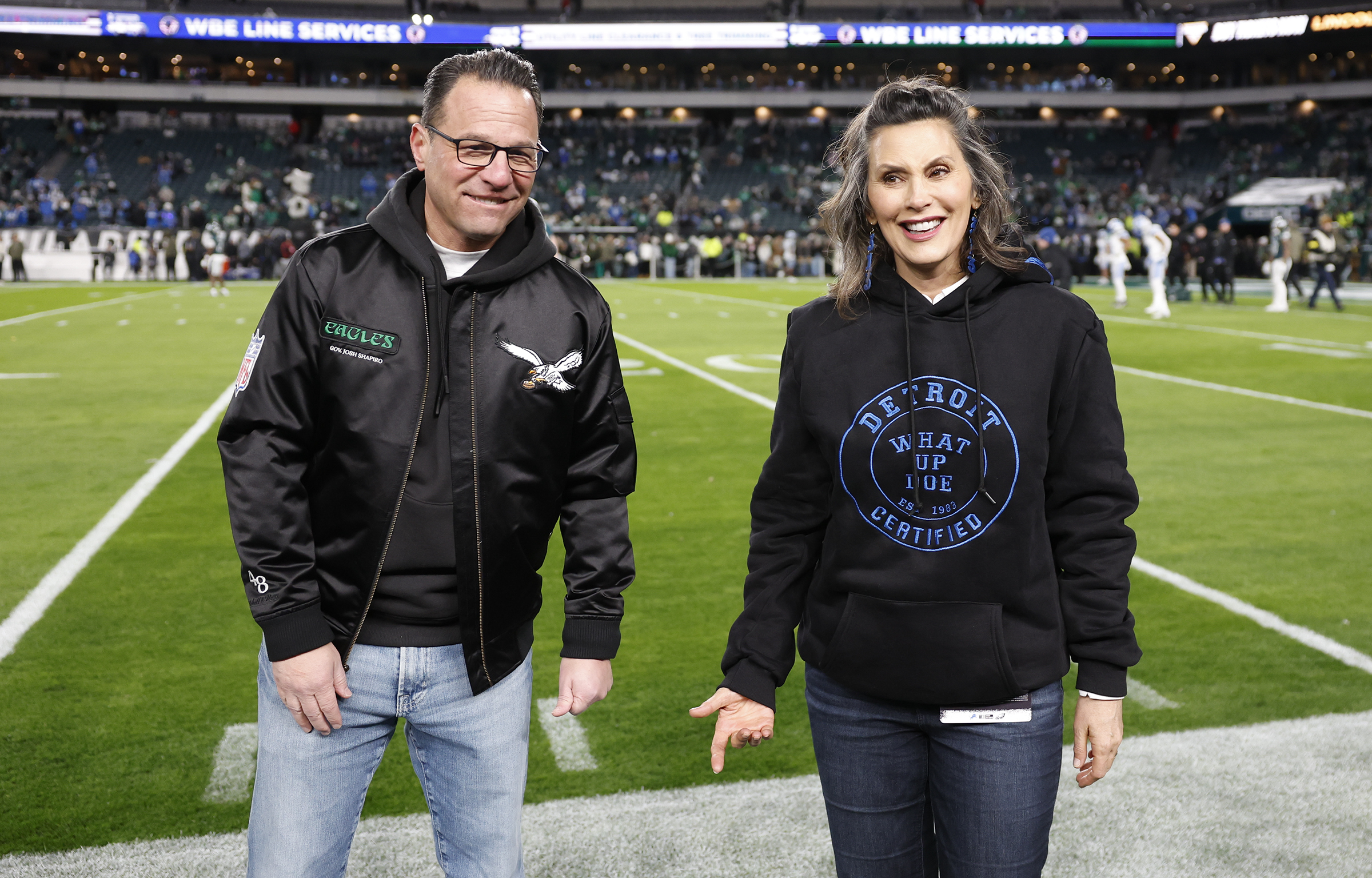
Pennsylvania Gov. Josh Shapiro (right) and Michigan Gov. Gretchen Whitmer before the Eagles played the Detroit Lions at Lincoln Financial Field on Sunday, Nov. 16, 2025, in Philadelphia, PA.
His book, Where We Keep the Light, will publish later this month, recounting his political upbringing, his vice presidential vetting, and the firebombing of his home last year. He’s not alone. Harris published a memoir about the 2024 election last year, and Newsom is due out with Young Man in a Hurry: A Memoir of Discovery in February.
But in the coming months, several Democratic strategists predict Shapiro will be squarely focused on the governor’s race he has to win in Pennsylvania — simultaneously proving he has what it takes to capture the vote of the nation’s most important swing state.
“He’s such a careful politician. He’s not taking anything for granted,” said former Gov. Ed Rendell, a Democrat who also once faced scrutiny for having potential presidential ambitions.
Shapiro is likely to follow the same campaign playbook in Pennsylvania as he did in 2022: Stump in every region of the state, including areas where Democrats don’t usually show up. That helped him run down the margins in longtime GOP strongholds like Lancaster or Schuylkill Counties toward his resounding victory over Mastriano. Those stops in most of Pennsylvania’s 67 countieswon’t give him as much time to visit South Carolina, Iowa, and New Hampshire, as the other Democratic presidential hopefuls start their sojourns.
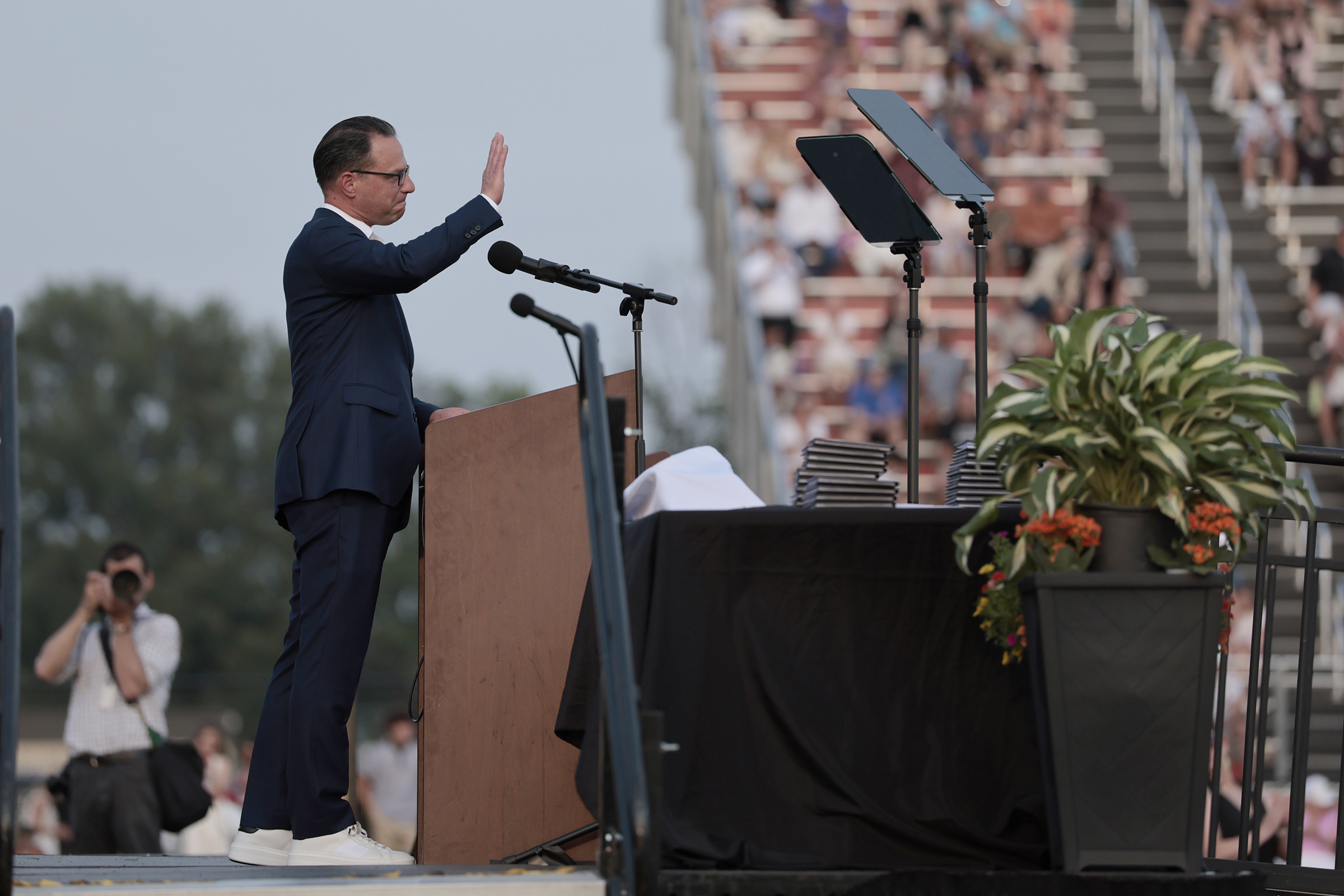
Pennsylvania Governor Josh Shapiro waves goodbye to the crowd after speaking during graduation ceremonies at Pennsbury High School in Fairless Hills on Thursday, June 12, 2025.
“The No. 1 caveat is stay focused on the race you’re running,” echoed Alan Kessler, a national fundraiser based in Philadelphia who has supported and fundraised for Shapiro.
Still, the campaign is likely to generate attention beyond the Keystone State.
Shapiro will still court donors in blue states as he fundraises for reelection, Kessler added.
Come November, he will be the only governor with rumored 2028 aspirations up for reelection in a swing state. And his brand as a popular, moderate Democratic governor trying to restore trust in government — as well as his potential to help boost Democrats down ballot — will easily capture a wider audience and bring national media into Pennsylvania.
As Democrats seek to flip control of the U.S. House in 2026, targeting several congressional districts in the state, the election may once again come down to Pennsylvania, and in turn, increase the spotlight on Shapiro. The governor is widely seen as someone who can boost the congressional Democratic candidates also on the ballot, having won three of the four districts that Democrats are targeting in the state by double digits in 2022.
Republicans have targeted several weaknesses to try to erode Shapiro’s popularity in Pennsylvania and boost Garrity. They point to a lack of rigorous electoral challengers in his past. They question his record of “getting stuff done” — his oft-repeated motto — including three late state budgets. And they’ve harped on a lack of transparency as governor, including claims he used tax dollars for political benefitas well as a sexual harassment scandal involving a former top aide. They’ve also criticized his support for Minnesota Gov. Tim Walz, who recently dropped his third gubernatorial bid following a fraud scandal among the state’s Somali refugee population totaling $1 billion, according to federal prosecutors.
Among the emerging attacks: Republicans want to highlight Shapiro’s presumed presidential ambitions, as they try to cast him as an opportunist more interested in a future White House bid than the problems of everyday Pennsylvanians.
“Josh Shapiro is more concerned with a promotion to Pennsylvania Avenue than serving hardworking Pennsylvanians,” Garrity said in a statement, noting the state fared poorly in U.S. News and World Report rankings on the economy and education. “In the military, I learned the importance of putting service before self. Pennsylvanians are the hardest-working, most compassionate, strongest people in the nation, and together we will return Pennsylvania to our rightful place as a national and global leader.”
State Treasurer and Republican candidate for governor Stacy Garrity holds a rally in Bucks County Sept. 25, 2025 at the Newtown Sports & Events Center.
Mastriano, the far-right Republican state senator who announced Wednesday he won’t run for governor, said in a statement earlier this week that Shapiro “owes [Pennsylvanians] straight answers” over his use of the state plane, security updates to his personal home in Abington Township, and more.
“Pennsylvanians deserve accountability, not ambition,” he added, making a nod to Shapiro’s potential longer-term plans.
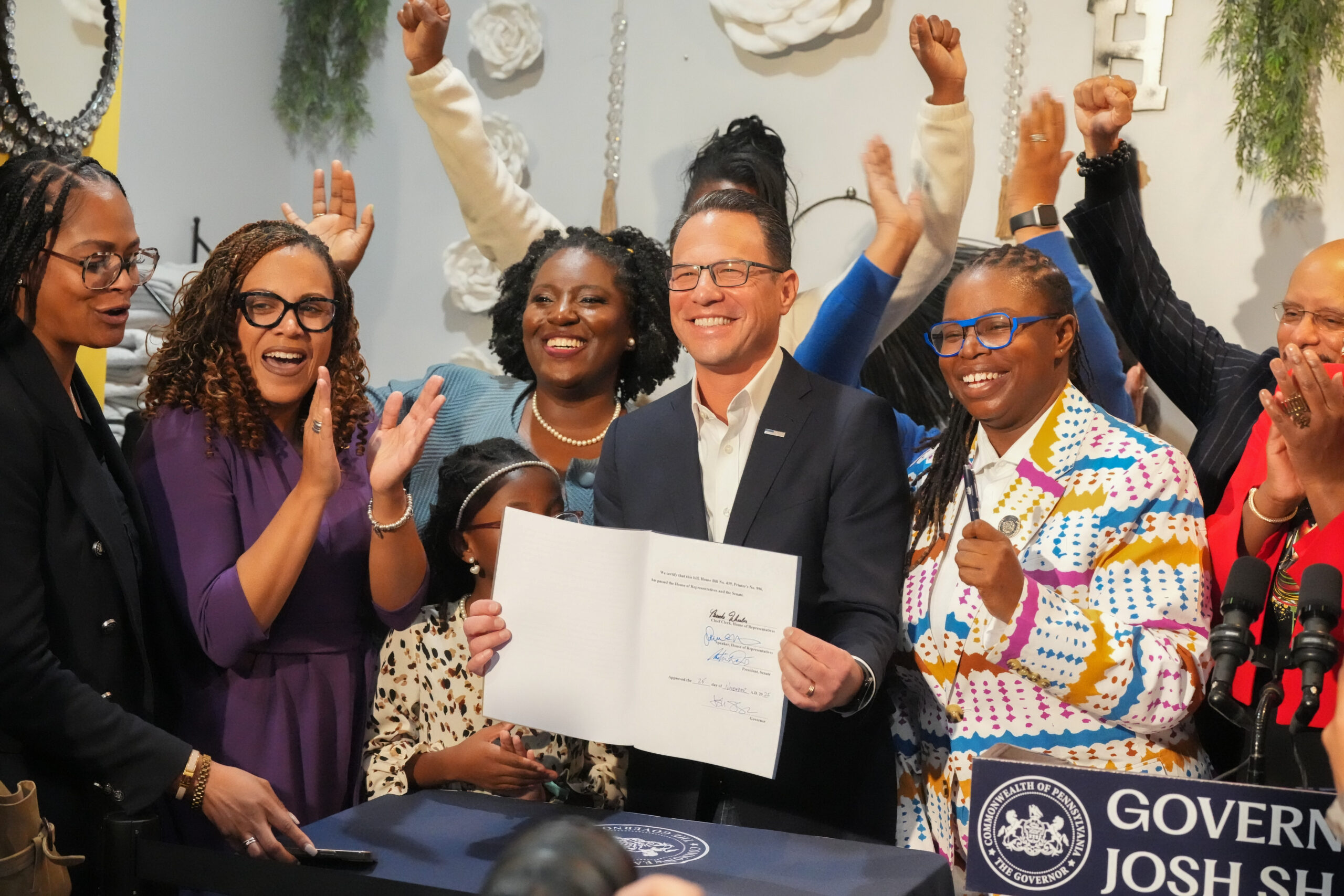
House Speaker Joanna McClinton, back center left, Gov. Josh Shapiro, front center, and State Rep. La’Tasha D. Mayes, right, celebrate the signing of the CROWN Act, which prohibits discrimination based on a person’s hair type, during a press conference at Island Design Natural Hair Studio, in West Philadelphia, November 25, 2025.
Borick, the pollster, was skeptical that attacks on Shapiro’s potential wider ambitions could reverse hislargely positive public sentiment.
“If that’s all they got, they don’t got a lot.”
Republicans insist they see a path to victory for Garrity in a politically divided state with months to go until the election. But behind the scenes, some Republicans are already acknowledging the goal is to lose by less and prevent big losses in state legislature or congressional races.
If Shapiro does look poised to cruise to victory, it might mean less media attention on the race, and it could mean he’s less vetted ahead of a much bigger stage.
“I think Josh is better served if the [Republican Governors Association] puts $100 million into this race because then it’s nationalized,” said a Democratic political strategist based in Pennsylvania who did not want to be named speculating on Shapiro’s presidential run. “If it’s a cakewalk, CNN’s not gonna cover it …If he wants to be governor for another four years, he should pray for a cakewalk. If he wants to be president, he should pray for a difficult campaign.”
Florida Gov. Ron DeSantis, for example, the strategist noted, cleaned up in his 2022 reelection, but failed to gain traction in the GOP presidential primary that Trump dominated.
Beyond 2026
Shapiro speaks Pennsylvanian very well. Raised in Montgomery County, he’s lived here almost all of his life, and has built an image as a popular moderate focused on problem-solving in a purple state. That’s earned him the support of about 30% of Trump voters in the state.
But winning a general election in Pennsylvania is different than winning a Democratic presidential primary.
He’s tried not to alienate the MAGA base, focusing on issues with bipartisan appeal like funding for apprenticeship and vocational-training programs. He’s taken on Trump in court, but has picked his personal battles with the president more carefully.
But being a strategic, self-described “progressive pragmatist” can end up alienating voters on both sides.
Gov. Josh Shapiro leaves after an event at the Port of Philadelphia Thursday, Apr. 10, 2025, the day after President Trump paused some tariffs.
Becky Carroll, a Democratic political consultant in Chicago who has worked with Pritzker, said Shapiro seems less on the radar of voters in the Midwest. As she’s followed Shapiro’s career, she said she sees a “damn fine governor,” but someone who’s taken a more muted approach to Trump than blue state governors like Pritzker and Newsom.
When it comes to a Democratic primary, candidates may be judged in part on their pushback to Trump, she said. “I think we’re in a moment where you can sulk in a corner and hope it’ll all go away or fight …,” Carroll said. “And if you’re gonna put yourself out there for a primary battle, you better show you have battle scars to prove you can fight for the most vulnerable in the country right now.”
Gov. Josh Shapiro is interviewed by TV news in the spin room at the Convention Center following the debate between former President Donald Trump and Vice President Kamala Harris Tuesday, Sept. 10, 2024.
But other national strategists see Shapiro’s moderate appeal as a potential asset in 2028. Jared Goldberg-Leopold, a former communications director for the Democratic Governors Association, thinks Shapiro’s biggest asset is his electoral track record in a state the nation knows is critical on the path to the White House. Primaries have previously been won by moderates whom the party thinks have the best chance at winning the general.
But the first step, Goldberg-Leopold stressed, is the governor’s race ahead.
“It would be easy for the Eagles to look past the 49ers to the next week of playoffs, but they’ve gotta focus on only one thing. And the same is true for the governor,” he said. “You can only prepare for what’s ahead of you, and the way people get in trouble in politics is planning too many steps ahead.”
Staff writer Katie Bernard contributed to this article.
Mastriano’s announcementWednesday now clears the way for State Treasurer Stacy Garrity, who was endorsed by the state GOP last fall as the party’s best pick to challenge Gov. Josh Shapiro this November.
“We believe, with full peace in our hearts, God has not called us to run for governor,” Mastriano said in a Facebook Live video stream alongside his wife, Rebbie.
He did not endorse Garrity as part of his announcement, nor did he mention her by name.
“For you to have a Republican governor here, the grassroots is going to have to back the candidate,” Mastriano said, referring to Garrity.
Republicans chose Garrity early — endorsing her more than a year before the 2026 election — in an effort to avoid a crowded primary like the one that eventually led to Mastriano’s nomination in 2022. They hope that a candidate like Garrity, who has won statewide elections twice and dethroned Shapiro for receiving the most votes of any state-level candidate, will have a better chance at beating Shapiro, or at least, preventing a down-ballot blowout in an election that already is likely to favor Democrats.
Mastriano, a two-term state senator representing Gettysburg and the surrounding area, publicly criticized the state party for endorsing Garrity so early, and has repeatedly said that their endorsement would not deter him from getting in the race.
In a statement, Garrity said she respected Mastriano’s decision not to run, calling him a “strong voice for faith, family and freedom.”
“I look forward to working with him to restore integrity, fiscal responsibility, and common-sense leadership in our commonwealth,” Garrity added.
Mastriano, a former U.S. Army colonel with top-secret clearance, built a grassroots online following during the early days of the COVID-19 pandemic for his resistance to business shutdowns. That support continued to grow after the 2020 presidential election as he promoted President Donald Trump’s false claims that Pennsylvania’s election results were rigged. He has remained a staunch supporter of Trump ever since.
Trump’s advisers, however, feared that Mastriano’s presence on the ticket would hurt Republicans up and down the ticket despite him leading Garrity in private polling by 21 points, Politico reported in July.
Mastriano and his wife spent much of his 20-minute announcement on Wednesday reminiscing on their movement since 2020: their daily virtual fireside chats during COVID-19 closures and their other attempts to reopen the state’s businesses amid the pandemic, their efforts to overturn Pennsylvania’s 2020 election results for Trump, Mastriano’s 2022 gubernatorial run, and the GOP’s electoral successes in 2024.
However, things are different now, the couple said. The grassroots supporters aren’t as unified as they once were, and the state party overstepped in its early endorsement.
“Bottom line is: They don’t have the last say,” said Rebbie Mastriano, in a reminder to their supporters. “You have the last say.”
In the 2022 primary, the state GOP declined to endorse candidates in the gubernatorial or U.S. Senate races. That led to a crowded, nine-candidate GOP primary ballot for governor that was advantageous for Mastriano, who had built name recognition through his anti-lockdown and 2020 election efforts.
The state Democratic Party responded to Mastriano’s announcement with fresh attacks on Garrity, calling her a “far-right, toxic candidate” and noted some of the areas where she and Mastriano agree, including that she denied the 2020 election results and her past opposition to abortion. (She now says she would not support a state abortion ban.)
As of Wednesday, no GOP candidate had announced their candidacy for lieutenant governor. Garrity told The Inquirer last month she was vetting candidates and planned to announce who she’d endorse as her running mate in February, ahead of the next state GOP meeting.
Lower Merion swore in five new commissioners on Monday, kicking off the board’s 126th year of governing the Montgomery County township.
Between rounds of applause and family photos, commissioners outlined the major challenges, and opportunities, the body will face in 2026. Board members highlighted recent accomplishments — creating a process for establishing board priorities, restricting gas-powered leaf blowers and plastic bags, advancing capital projects, hiring a police superintendent, supporting the development of affordable housing, and reversing the post-pandemic decline in police staffing levels.
“We’re solving problems, we’re moving forward, and we’re even having a little fun,” said commissioner V. Scott Zelov, who was sworn in for his sixth term.
Zelov on Monday night became the eighth commissioner in Lower Merion history to serve for at least 20 years, board President Todd Sinai said.
Sinai, who was first elected to the board in 2017, was unanimously reelected board president. Incumbent commissioner Sean Whalen called Sinai a “stalwart leader of this board,” praising Sinai’s leadership througheconomic ups and downs.
Jeremiah Woodring, also an incumbent commissioner, was unanimously elected vice president. Sinai described Woodring as “thoughtful and inquisitive,” “balanced,” and “diplomatic.”
Jana Lunger was sworn in as Lower Merion tax collector.
Here’s a who’s who of the five newly elected Lower Merion commissioners, all of whom replaced outgoing commissioners who chose not to run again in 2025.
Michael Daly, an attorney and the former president of the Gladwyne Civic Association, was sworn in to represent Ward 2, which includes Gladwyne and Penn Valley. Daly has lived in Lower Merion for around 15 years with his wife and three children, all of whom are products of the Lower Merion School District. In his law practice, he focuses on defending class action lawsuits and complex litigation. In a candidate interview earlier this fall, Daly said he’s focused on quality of life issues, including walkability, public parks, and safe streets. He replaced outgoing commissioner Joshua Grimes.
Charles Gregory, a longtime township employee, will represent Ward 4, which encompasses Ardmore and Haverford. Gregory, who was born and raised in Ardmore, worked for Lower Merion Township for 23 years until 2024. He’s the former president of the Lower Merion Workers Association and a Boy Scout troop leader. During a candidate forum, Gregory said he believed he could “make a difference from a blue collar aspect.” Gregory replaced outgoing commissioner Anthony Stevenson.
Christine McGuire is a forensic psychologist and business owner who will serve Rosemont and Villanova in Ward 6. McGuire lived in Gladwyne for nine years before moving to Villanova around three years ago. In a candidate forum, McGuire said she has been active in the Gladwyne Civic Association and in the parent group that studied Lower Merion’s school start time change. As the owner of a psychology practice, she said she understands “what a budget is and that you have to work within the budget and not look at it like a blank check.” She replaced outgoing commissioner Andrew Gavrin.
Craig Timberlake, an Ardmore resident who was instrumental in the 2025 redevelopment at Schauffele Plaza, will represent Ward 8’s South Wynnewood and East Ardmore. Timberlake moved to Ardmore around 15 years ago from Maine. He says he was drawn to Ardmore’s high-quality schools, walkable neighborhoods, and transit options. He believes the township should incentivize “smaller,” “incremental,” and locally funded development and decrease speed limits to protect pedestrians. Timberlake is a project manager at OnCourse, an education technology platform. He replaced Shawn Kraemer, the board’s outgoing vice president.
Shelby Sparrow, the former president of the Penn Wynne Civic Association and a longtime community organizer, will represent Penn Wynne and Wynnewood in Ward 14. Sparrow’s priorities include ensuring the community is engaged in Main Line Health’s redevelopment of the St. Charles Borromeo Seminary property; addressing pedestrian safety; and encouraging sustainability and park stewardship. She was previously the director of development for St. Peter’s Independent School in Center City. She replaced outgoing commissioner Rick Churchill.
Sinai and Zelov, who were reelected in November, were sworn in, and sitting commissioners Woodring, Whalen, Daniel Bernheim, Louis Rossman, Ray Courtney, Maggie Harper Epstein, and Gilda Kramer were welcomed back.
This suburban content is produced with support from the Leslie Miller and Richard Worley Foundation and The Lenfest Institute for Journalism. Editorial content is created independently of the project donors. Gifts to support The Inquirer’s high-impact journalism can be made at inquirer.com/donate. A list of Lenfest Institute donors can be found at lenfestinstitute.org/supporters.
Five years after rioters stormed the U.S. Capitol, Gov. Josh Shapiro and other Pennsylvania Democrats on Tuesday marked the anniversary of the Jan. 6, 2021, attack by sharply criticizing President Donald Trump.
Trump, who was impeached for inciting the riot in the final days of his first administration, pardoned nearly every Jan. 6 defendant and commuted sentences for a handful of violent offenders as one of his first actions upon returning to office last year.
“Law enforcement officers literally gave their lives to protect our country and our democracy — yet one of the first things Donald Trump did when he took office was pardon people who were convicted of assaulting police officers,” Shapiro said in a post on X Tuesday morning.
“The President may not respect our law enforcement officers’ courage and commitment to service — but here in Pennsylvania, we remember the sacrifices they make and will always have their backs.”
Shapiro played a key role as state attorney general in defending the 2020 election results in Pennsylvania in the weeks leading up to the attack, which took place the same day that Congress was certifying former President Joe Biden’s victory.
Trump has downplayed the events of Jan. 6, and on Tuesday the White House unveiled a webpage dedicated to the events, falsely describing the riot as a peaceful protest and blaming Capitol Police for the violence that unfolded.
Pennsylvania Senate Democrats hold an event in the state Capitol Tuesday to commemorate the Jan. 6, 2021, attack on the U.S. Capitol.
Shapiro was one of several Democrats who marked the anniversary of the attack for the first time since Trump returned to office.
State Rep. Malcolm Kenyatta, of Philadelphia, introduced a resolution alongside other House Democrats to designate Jan. 6 as the “Democracy Observance Day for Education, Remembrance, and Vigilance.”
AndPennsylvania Senate Democratsheld an event in the state Capitol Tuesday.
State Sen. Art Haywood, who represents parts of Montgomery County and Philadelphia, described the events of Jan. 6, 2021, as an “attempted coup” orchestrated by Trump.
He recounted the events in minute-by-minute detail drawing from what has been reported about the day, from Trump’s direction to rally-goers to go to the Capitol to former Vice President Mike Pence’s evacuation from the Senate chambers and rioters’ success breaking into offices.
State Sen. Jay Costa, of Pittsburgh, said Tuesday’s anniversary eventwas aimed at drawing attention to the “lawlessness” of the day. Trump’s decision to pardon those involved, he said, was a “slap in the face” to law enforcement.
Costa contended that other incidents of political violence in the years that have followed could be traced back to Jan. 6.
“We cannot pick and choose, as our president has done, when we think about what we’re going to do and say about our law enforcement officers,” he said. “We need to stand with them all the time.”