Category: Real Estate

  • A look inside one couple’s office-turned-apartment on Market Street

    A look inside one couple’s office-turned-apartment on Market Street

    Allison Levari and Frank DiMeo were among the first tenants to move into 17 Market West last June. DiMeo had driven past the converted office building during construction and was intrigued.

    “When I did the tour I was just wowed by it,” recalled DiMeo, an attorney at Rosen, Schafer, & DiMeo.

    Their corner unit faces southeast, flooding the apartment with natural light through windows that stretch from the floor nearly to the ceiling. The 1,200-square-foot unit features an open-concept floor plan with two bedrooms and two bathrooms.

    “We love the city feel, seeing the skyline,” said Levari, a court stenographer. She opens the windows each morning, letting in the fresh air and sounds of the city. “I will follow the light around the apartment throughout the day, finding the sunniest spot to enjoy a good book.”
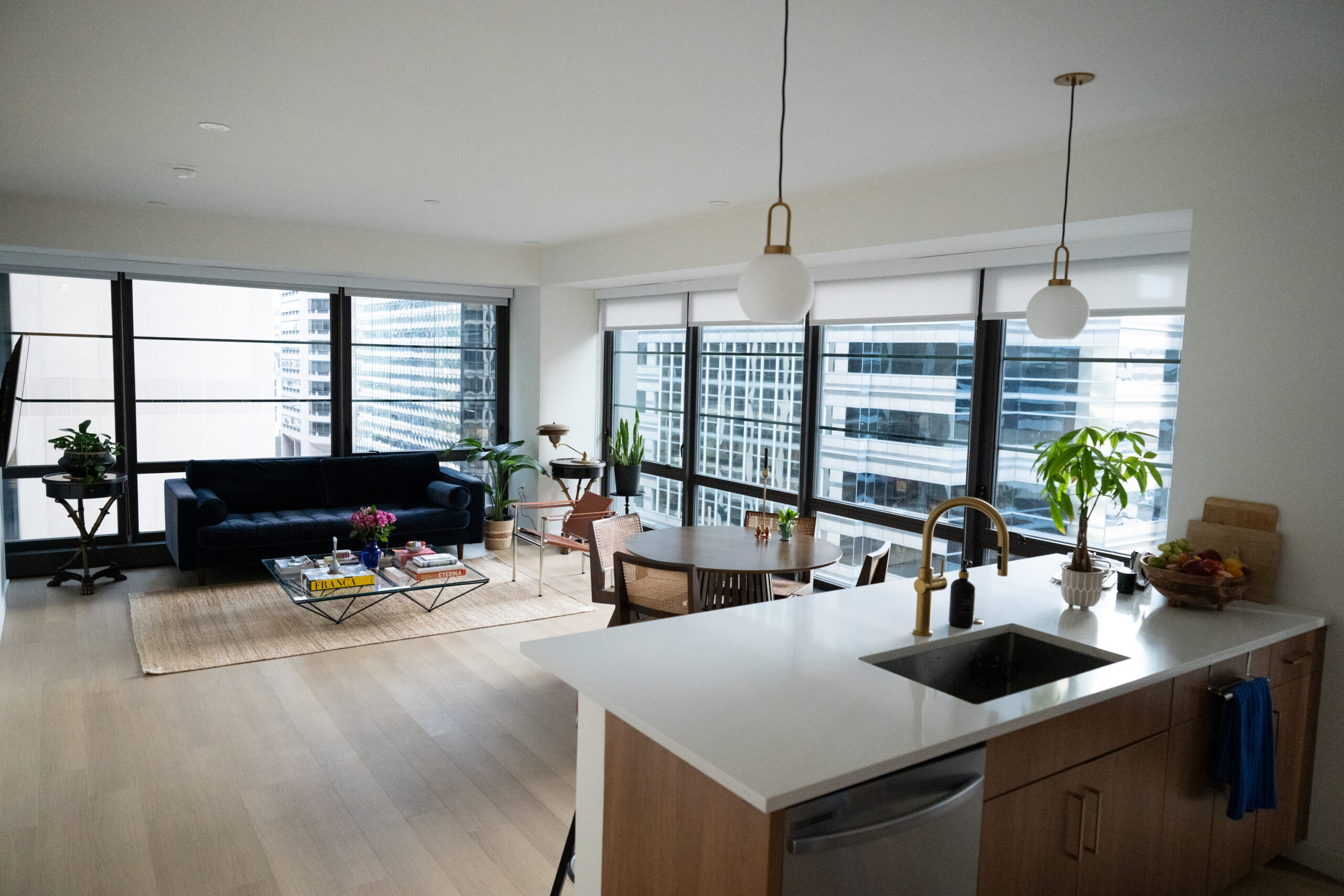
    The kitchen, dining area, and living room, where light pours in from the nearly floor-to-ceiling windows.

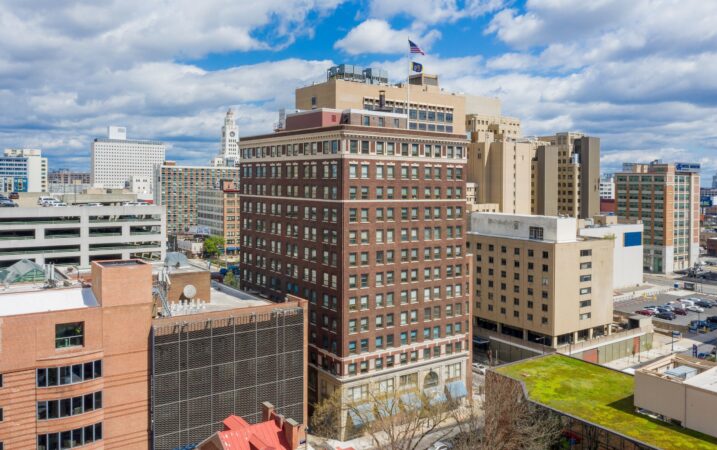
    Those windows were a priority when Alterra Property Group converted the old Morgan Lewis office building into an 18-story, 299-unit luxury apartment building, opened last May.

    “Replacing the old office windows with floor-to-ceiling glass was a complex work sequence but necessary in order to transform the interiors, bringing in natural light and city views that define the new apartments,” said property manager Jennifer Oyola.

    The design pays quiet tribute to its origins, honoring the strength and scale of a classic Center City high-rise while reshaping it for the way people live now, she added.

    The couple enjoy dining in front of the wall of windows, watching the activity down below. In the evening, they admire the sights of City Hall, Liberty Place, and other buildings lighting up.
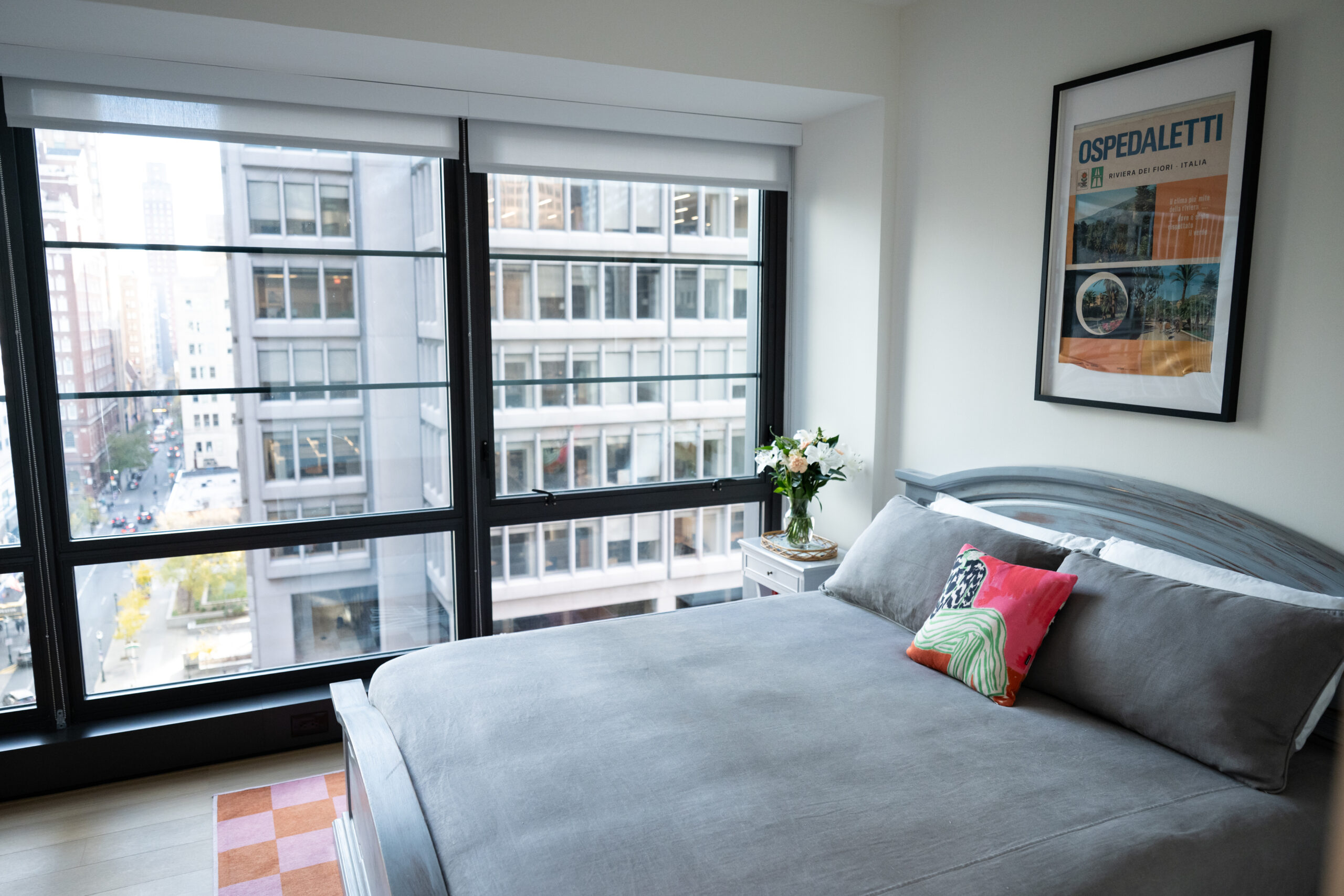
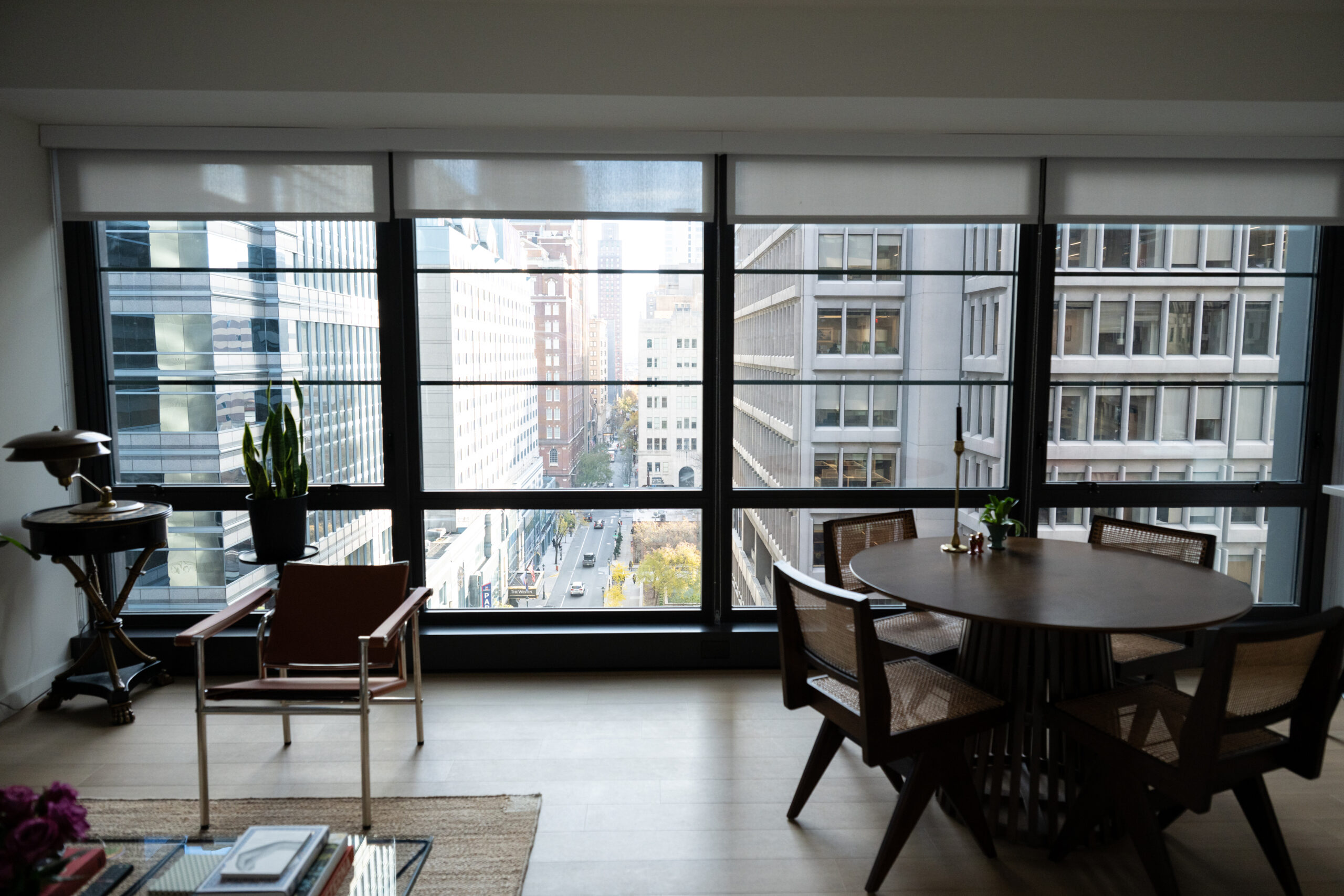
    The guest bedroom, with views of the street below.
    DiMeo says dining in the apartment feels like dinner at a fancy restaurant.

    “Frank says he feels like he’s at a fancy restaurant with the view, especially at night,” Levari said.

    Both love to cook, and Italian food is their specialty. The kitchen is equipped with Samsung appliances, including a smart oven with phone app features, which is especially helpful to ensure they turned the stove off, Levari said with a laugh. There is plenty of counter space for meal prep and a lot of cabinet space.

    The apartment’s construction — windows framed in black, light brown luxury vinyl tile plank floors, and plentiful glass — lends itself to a contemporary design.

    Levari chose mostly neutral tones with pops of color to complement the look. She enjoys mixing classic pieces with vintage styles.
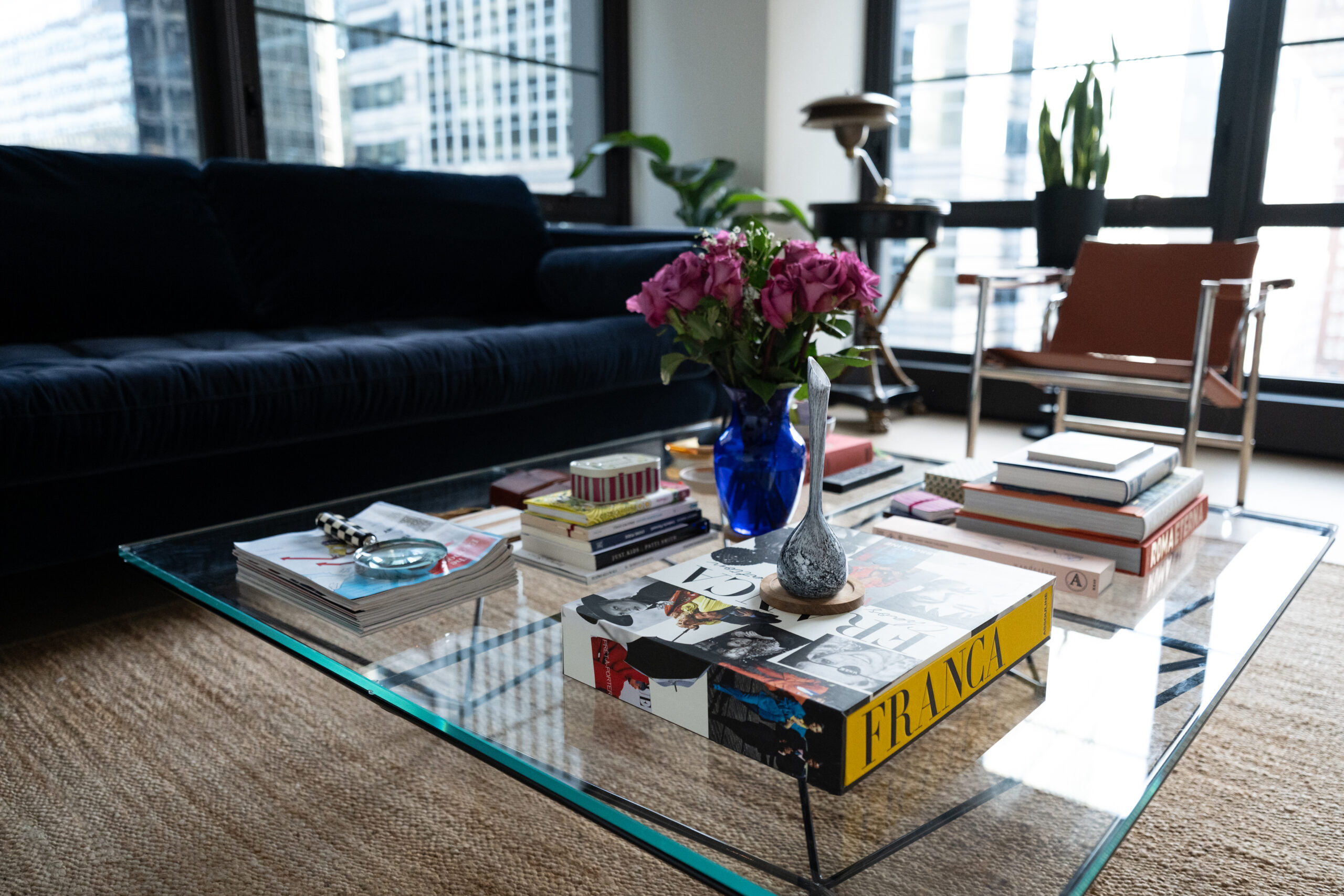
    The Alanda glass coffee table, made by Italian designer Paolo Piva, complements the apartment’s contemporary style.

    The living room features a lush velvet navy blue couch, a comfy spot to curl up on weekend nights and watch TV. The couple bought their Alanda glass coffee table, made by Italian designer Paolo Piva, at B&B Italia in New York.

    “It’s one of those designs that never goes out of style,” Levari said.

    The guest room/office includes the bedroom furniture she shipped over from Italy, where she lived for many years and taught English. It’s a comfortable reminder of the time she spent there. The only drawback is that the mattress is a European size that would be difficult to replace and it’s hard to find sheets that fit.

    “I felt it was worth it for the memories, look, and quality,” Levari said. “It’s hard to find pieces of quality that you love. Therefore, the shipping cost made sense.”

    The walnut Renaissance revival style cabinet in the primary bedroom came from a vintage shop outside of Como, Italy.
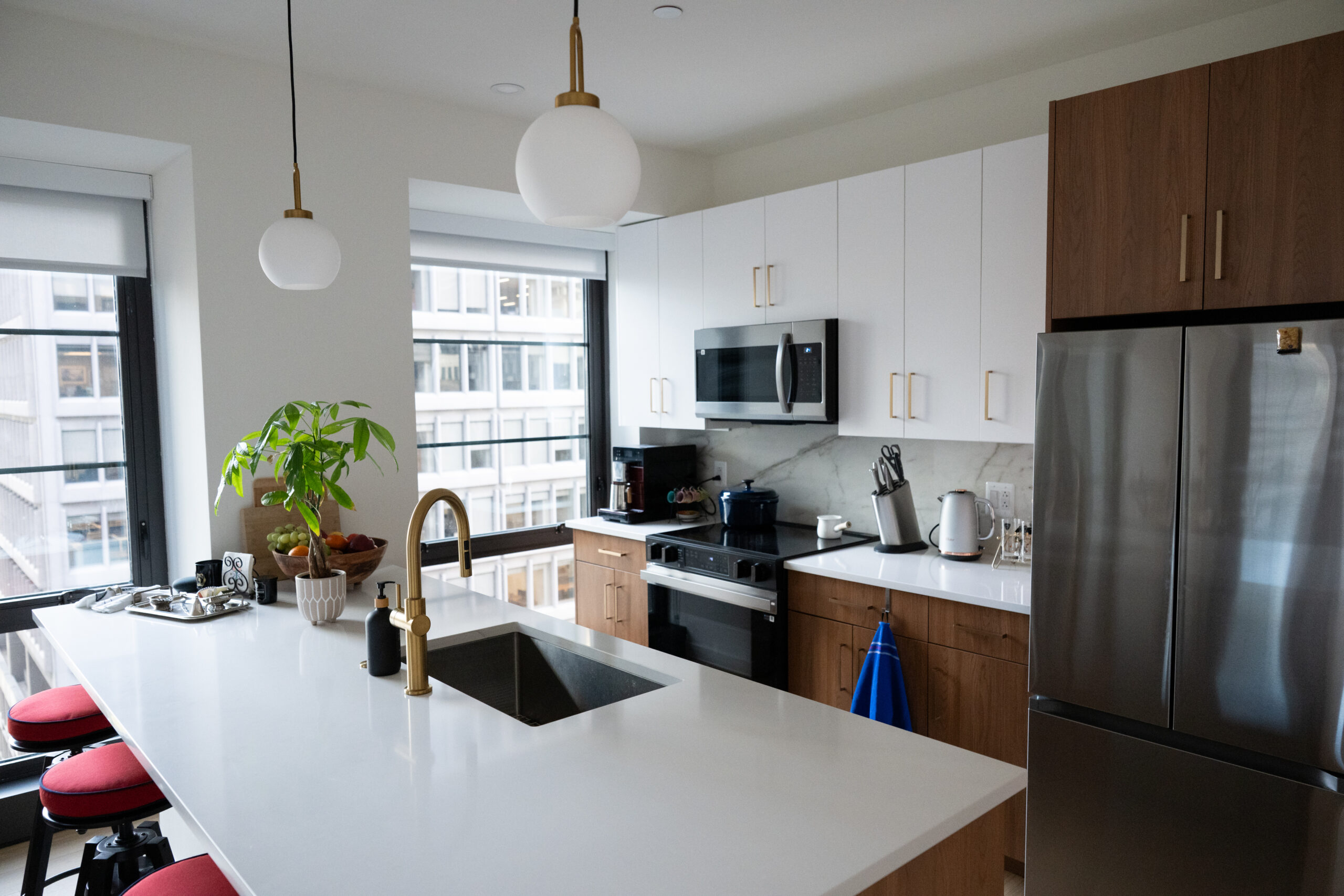
    The kitchen provides ample counter space and cabinet storage, with stainless steel appliances and gold details.

    Levari and DiMeo appreciate the building’s amenities, starting with the rooftop, which includes a saltwater pool, sauna, and cold plunge.

    “You really get the city vibe there because it’s on the 19th floor and you have all the highest buildings in the city surrounding you,” Levari said.

    Other amenities include the fitness center with a turfed area for cross training, pickleball and basketball courts, a yoga studio, and sport simulator. A club-style lounge includes a chef’s prep kitchen, private dining room, and billiards table. For furry friends, there’s a pet spa and park.
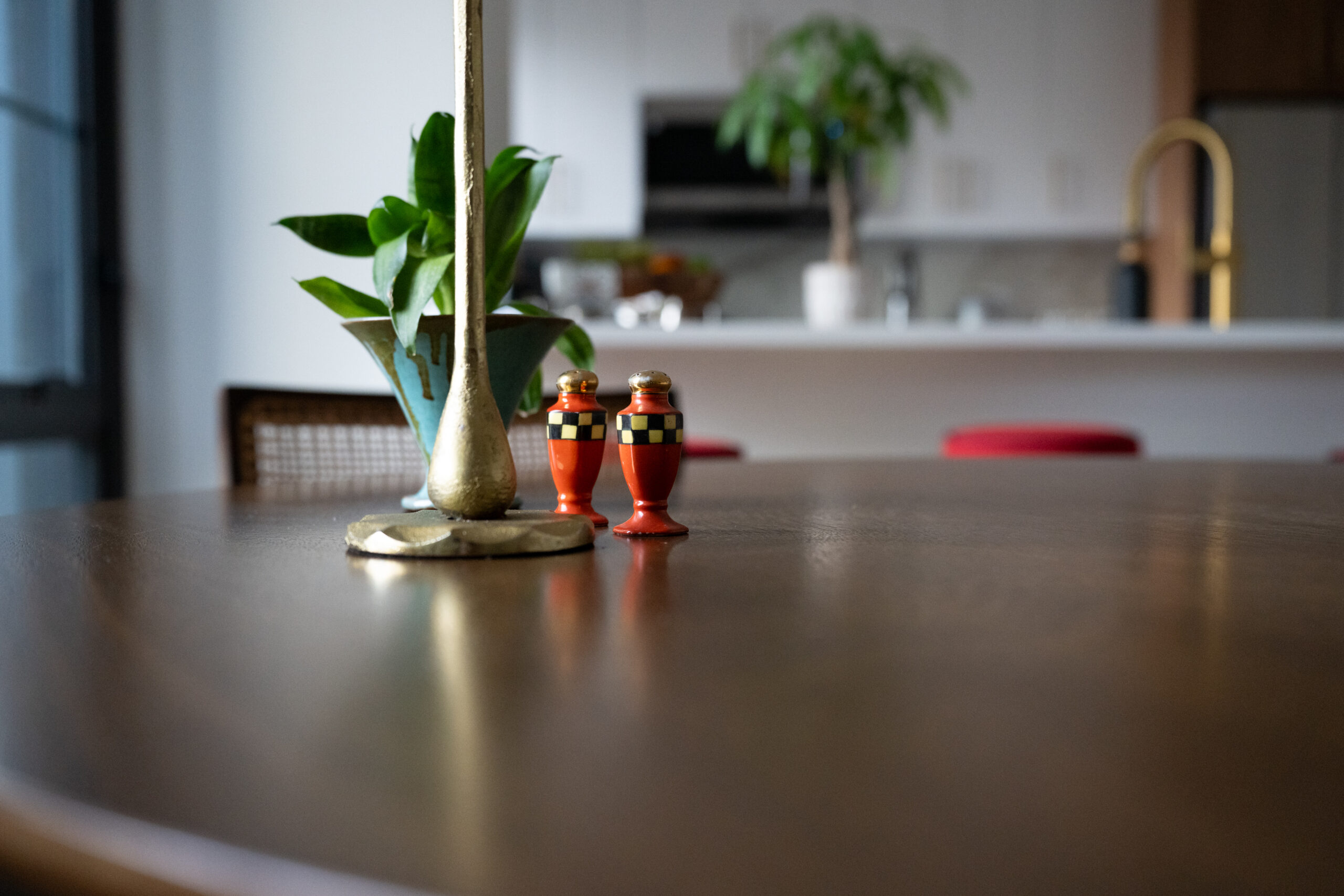
    Decorations on the dining room table echo the gold details in the kitchen.
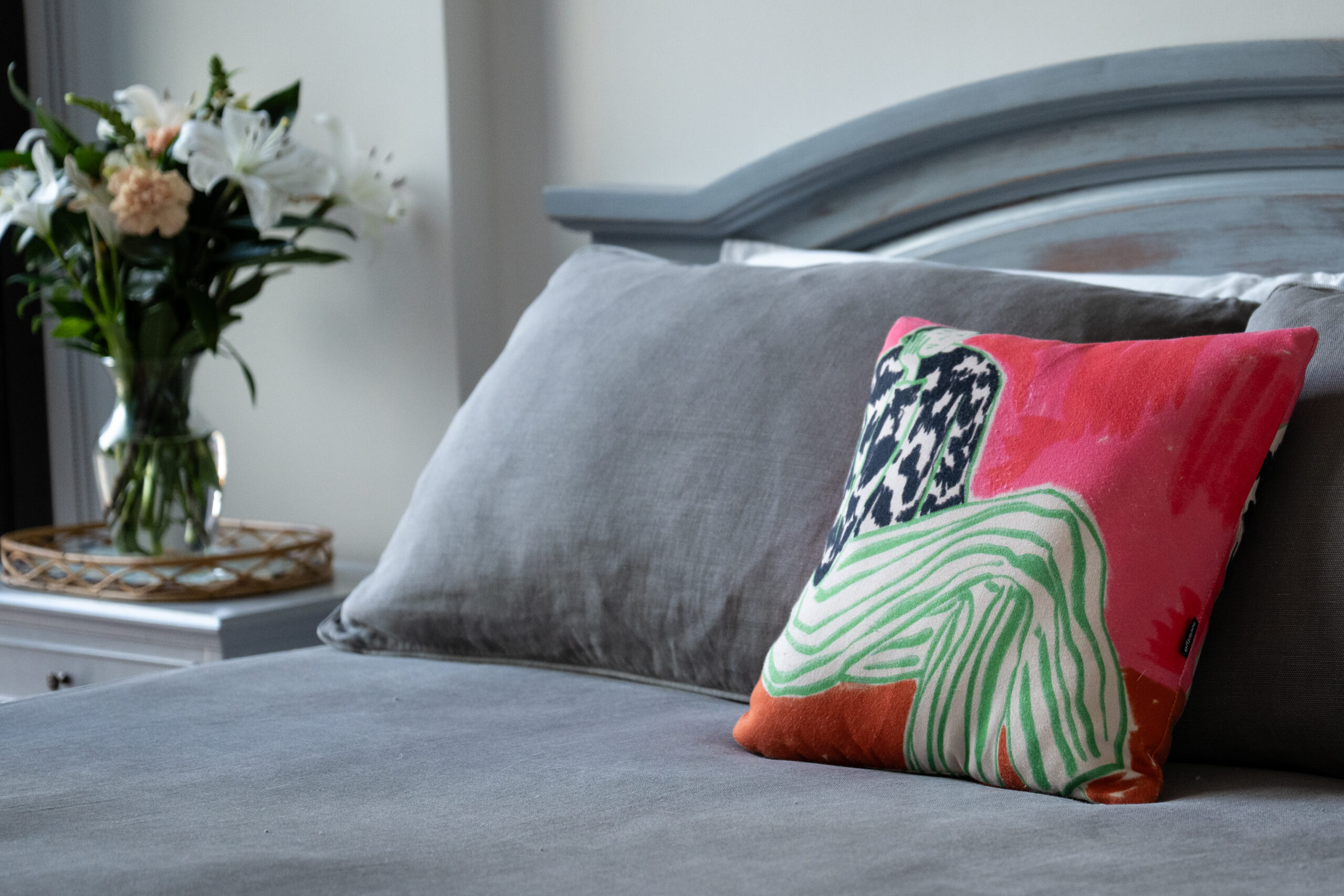
    The apartment is decorated in neutral tones with some pops of color, like this throw pillow on the guest bed.

    The couple are embracing life in the city, where they can walk to great restaurants, shows, concerts, and the ballet. But they are also happy to come back home.

    “Having our corner apartment with the huge windows makes it feel like I’m on vacation,” said DiMeo.

    Is your house a Haven? Nominate your home by email (and send some digital photographs) at properties@inquirer.com.

  • All Amazon Fresh stores, including six in the Philly area, are closing

    All Amazon Fresh stores, including six in the Philly area, are closing

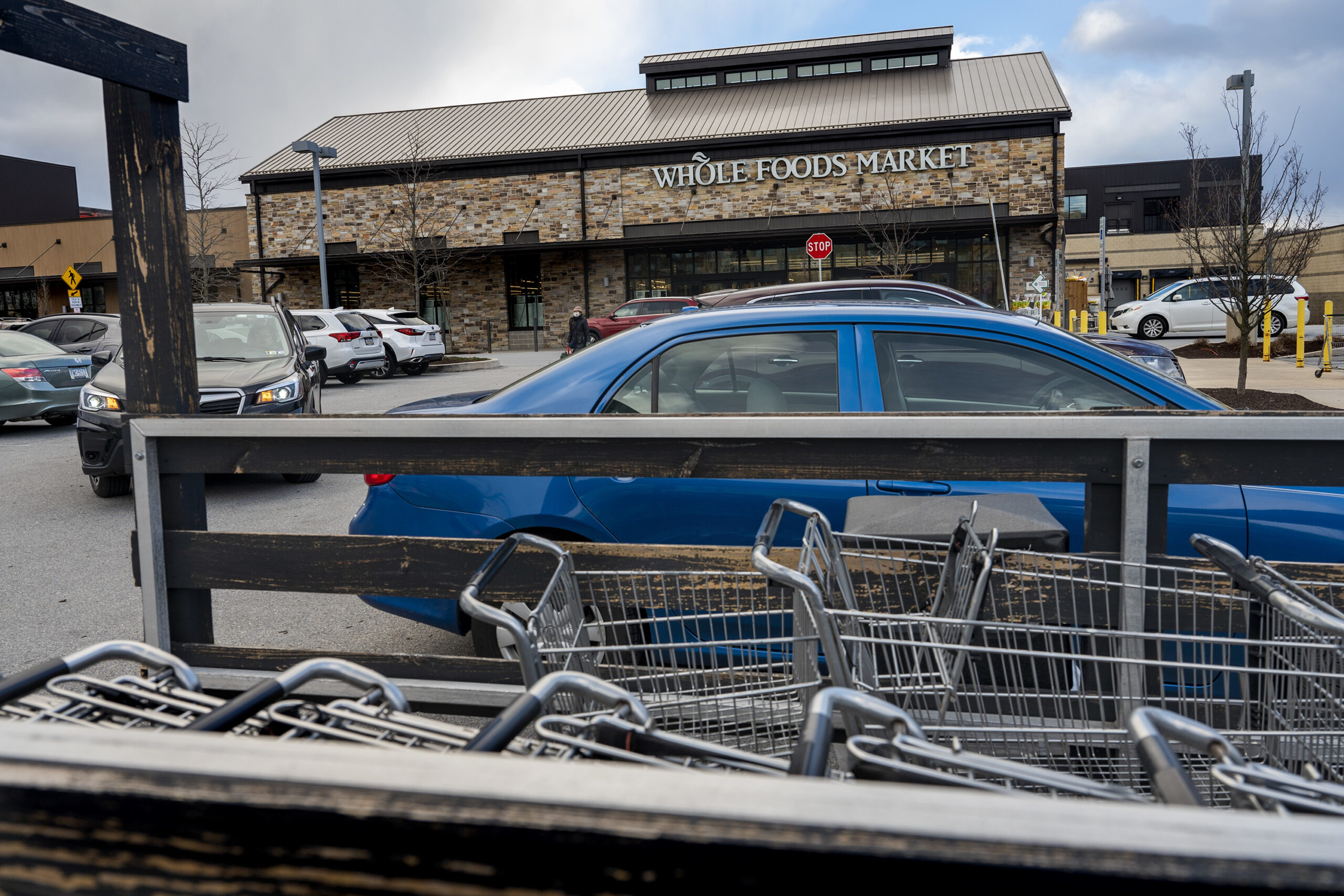
    Amazon will be closing all its physical Amazon Fresh stores, including six in the Philadelphia region, as it expands its Whole Foods footprint and grocery delivery services.

    The e-commerce giant made the announcement in a statement Tuesday, noting that it would convert some Amazon stores into Whole Foods Markets.

    “While we’ve seen encouraging signals in our Amazon-branded physical grocery stores, we haven’t yet created a truly distinctive customer experience with the right economic model needed for large-scale expansion,” the company said.

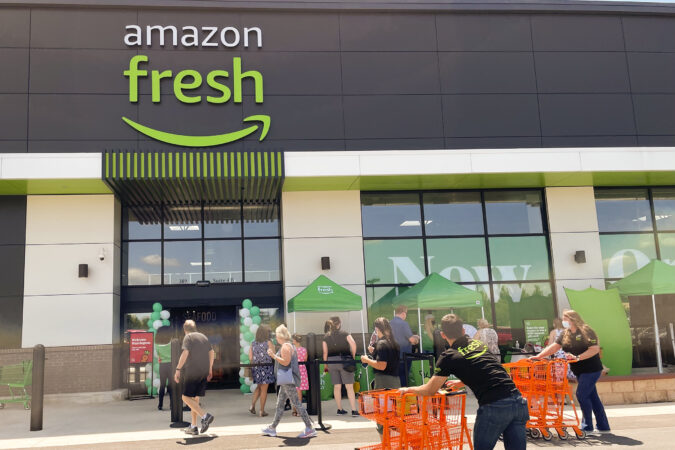
    People shop inside the Amazon Fresh in Warrington in August 2021. The store and all other Amazon-branded grocers are closing.

    The statement did not specify which Amazon Fresh stores would become Whole Foods, and company spokespeople did not answer questions about whether any Philadelphia-area locations would be converted.

    Amazon Fresh has stores in Broomall, Bensalem, Langhorne, Northern Liberties, Warrington, and Willow Grove. The Northern Liberties location on Sixth and Spring Garden Streets opened this summer after years of construction.

    Two more potential Amazon Fresh stores seemed to be in the works in Havertown and Northeast Philadelphia as of the summer, according to PhillyVoice.

    Customers use the Amazon Dash Cart at the Amazon Fresh grocery store in Warrington in 2021.

    Smaller-format Amazon Go stores, the closest of which are in New York, will also be shuttered or converted.

    As the company winds down its Amazon-branded physical stores, it says it will “double down” on online grocery delivery, including by expanding its same-day services to more communities.

    Amazon’s same-day delivery has been available in the Philadelphia market since 2009. Since December, Amazon has been testing “Amazon Now” delivery — which aims to get groceries to customers in 30 minutes or less — in parts of Philadelphia and Seattle.

    Amazon also said it plans to invest more in physical Whole Foods stores, adding more than 100 stores nationwide in the coming years.

    The Whole Foods store in Exton, as pictured in 2022.

    Amazon said Tuesday that Whole Foods has seen a 40% growth in sales since Amazon purchased the organic-grocery chain in 2017.

    Whole Foods has 550 locations nationwide, including more than a dozen in the Philadelphia area. Amazon spokespeople did not answer questions about whether more Whole Foods stores were in the works in the Philly region.

    Amazon also expects to open at least five more smaller-format Whole Foods Market Daily Shop stores by the end of the year. The company said that decision was based on “strong performance” at the five existing shops in the New York City area and Arlington, Va.

    The Center City Whole Foods Market as pictured in February 2025.

    The online retailer said it plans to continue to experiment with new ways of shopping at its physical stores.

    In its statement, Amazon gave a shout-out to one such test in the Philadelphia area: “The store within a store” experience at the Whole Foods in Plymouth Meeting.

    Since November, customers at that store have been able to browse the physical aisles of Whole Foods, while digitally ordering unique products from Amazon and Whole Foods. The orders are then packaged in minutes in an automated micro-fulfillment center within the grocer’s back-of-house area.

  • Permits for 824 apartments issued ahead of housing ban at former Hahnemann Hospital site

    Permits for 824 apartments issued ahead of housing ban at former Hahnemann Hospital site

    In the month since Philadelphia Councilmember Jeffery Young introduced a bill banning residential development around the former Hahnemann University Hospital, 824 apartments have been permitted in the area.

    The latest zoning permits include 163 units at 1501-11 Race St., which were issued Monday. Brandywine Realty Trust purchased the former Bellet Building office tower in 2021 for $9.7 million.

    Brandywine did not immediately respond to a request for comment. It is not clear whether Brandywine is seeking to develop the apartments or to just secure permits to preserve the option for a future buyer.

    Last week, zoning permits were issued for 300 units at 300-304 N. Broad St., known as Martinelli Park, the last piece of the former Hahnemann Hospital site that has yet to be sold. The last bid for the site came from the HOW Group, which offered $5.5 million and planned multifamily housing there. But the sale did not go through.

    Attempts to reach Hahnemann’s representatives were unsuccessful. It is likely the permits are being secured to preserve the property’s value.

    A City Council Rules Committee hearing on Young’s bill is scheduled for Feb. 3.

    The rush for permits began on Dec. 24, two weeks after Young introduced his bill, when the Dwight City Group received a zoning permit for 222-48 N. Broad St. to build a 361-unit apartment building.

    The developer had long planned a building on that site, but the total number of units in the permit was far larger than the original plan.

    When “an overlay is placed like this … even though we have our zoning permit already from one of the buildings, the message that it sends is that this area is closed for business,” Judah Angster, CEO of Dwight City Group, said at a January meeting of the Philadelphia Planning Commission.

    He said the project now includes 90,000 square feet for commercial use, which would be dedicated to local small businesses.

    Why does Young want to ban housing?

    Young’s bill would create a new zoning overlay covering the area “bounded by the north side of Race Street, the east side of North 16th Street, the south side of Callowhill Street, and the west side of North Broad Street.”

    This covers the former Hahnemann campus, which included seven medical buildings, a parking garage, and some surface lots. The hospital dated to the 19th century and had been operating from this location for 90 years before its bankruptcy.

    A handful of other buildings are in the proposed overlay as well, including a PHA apartment building and a homeless shelter.

    What once was the Hahnemann campus sprawls over nearly six acres, centered on Broad Street along the Vine Street Expressway, comprising seven medical buildings, a parking garage, and surface lots.

    Young said that he wanted to ban new homes from the site to preserve job opportunities in the city, hopefully prompting the reuse of the site for office, medical, or educational use.

    At the Planning Commission meeting, the bill was largely discussed as Young’s effort to force developers to meet with him over their plans. The Hahnemann site is zoned with Philadelphia’s most flexible land use rules, which means that under normal circumstances, residential conversions would not require neighborhood meetings or political approvals.

    “I look forward to continuing dialogue that brings community stakeholders to the table for this important section of Center City,” Young said in an email Tuesday.

    Dwight Group has said that it is having productive conversations with Young.

    The legislation is considered by some legal experts as a blatant use of spot zoning, when a change in land use rules is targeted to a limited geography. Such legislation is often introduced to help or hurt a particular project.

    “In my time as a zoning lawyer for 27 years, I don’t think I’ve seen a greater example of illegal spot zoning,” Matt McClure, head of law firm Ballard Spahr’s land use practice and a lawyer for developer Dwight City, said the January meeting. “It is targeted at a particular property, targeted around a certain transaction that was talked about. It’s just illegal.”

    Hahnemann University Hospital has been closed for more than six years, and attempts to preserve medical and educational uses in its former buildings so far have faltered. Most are still vacant.

  • They own their homes but not the land. In N.J., a new law could help change that.

    They own their homes but not the land. In N.J., a new law could help change that.

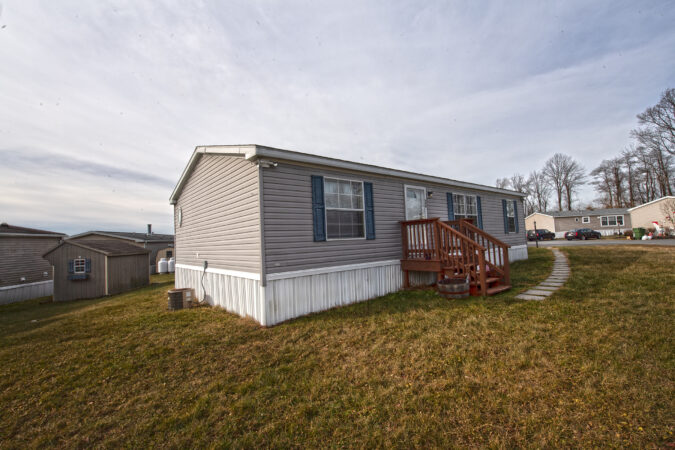
    Manufactured homes — single-family dwellings often built off-site and placed on a lot — are one of the most affordable forms of homeownership. But families who live in these homes are often left vulnerable, because companies that own the land can hike rents for their lots or sell communities for redevelopment.

    This type of unsubsidized affordable housing tends to be more accessible for low-income households than typically built homes.

    A bill that former N.J. Gov. Phil Murphy signed last week makes it easier for manufactured home and mobile home residents to buy their communities when a landowner decides to sell or change the use of the land.

    Landowners who want to sell or redevelop these communities must give notice to residents and local and state leaders. If 51% of residents agree to purchase the community, and they meet the price and conditions of the sale, they have 120 days to buy it. Previously, this action required two-thirds of residents, who had 45 days to sign a contract.

    Lawmakers found that the prior parameters were too high of a bar for residents to meet.

    New Jersey’s new law is based on model legislation from the National Consumer Law Center. There are more than 1,000 resident-owned mobile and manufactured home communities across the country. None are in New Jersey.

    Almost 100,000 New Jersey residents live in 250 manufactured or mobile home communities, many of which are in South Jersey, said State Assembly member David Bailey Jr., a Democrat who sponsored the legislation and represents residents in Gloucester, Salem, and Cumberland Counties.

    Imagine you’ve owned your home for 20 years and “somebody comes and says, ‘We’re selling this land and you either follow these new rules or you gotta move,’” Bailey said. “That would never happen in suburbia. But that’s what could happen to these people. Because they have no choice. They’re stuck.”

    He said that when he took office in 2024, he immediately started getting calls from constituents in Salem County who lived in manufactured home communities. They told him about rising costs to rent the land their homes were on and deteriorating property conditions and infrastructure in their communities.

    Many of the properties had been owned by local families who later sold the land to companies that hiked rents, Bailey said. In 2022, the CEO of the Lincoln Institute of Land Policy said that in the prior eight years, roughly 800,000 home sites in manufactured housing communities were bought by private equity companies and other institutional investors. Rent hikes tended to follow.

    Another recent New Jersey law addresses this reality.

    In July, the state enacted a law that caps annual rent increases at 3.5%. Landlords who want higher increases must ask the state’s Department of Community Affairs for permission.

    After an earlier version of the legislation passed the state Senate this spring, Sen. Paul Moriarty said in a statement that the usual renting setup of mobile and manufactured home communities “often leads to unfair price hikes by landlords, as they know that there is no other option besides moving the home to another site.”

    Moriarty, a Democrat who represents residents in Gloucester, Camden, and Atlantic Counties, noted that moving these homes to different sites can be “incredibly difficult” because of “potential difficulties in financing a move, exclusionary zoning practices, and restrictions on the age and condition of incoming homes.”

    A previous version of this story misstated the number of mobile homes purchased by private equity companies. It is roughly 800,000 manufactured home sites.

  • PHA says former Germantown Settlement properties will be reopened by 2029 — at great cost

    PHA says former Germantown Settlement properties will be reopened by 2029 — at great cost

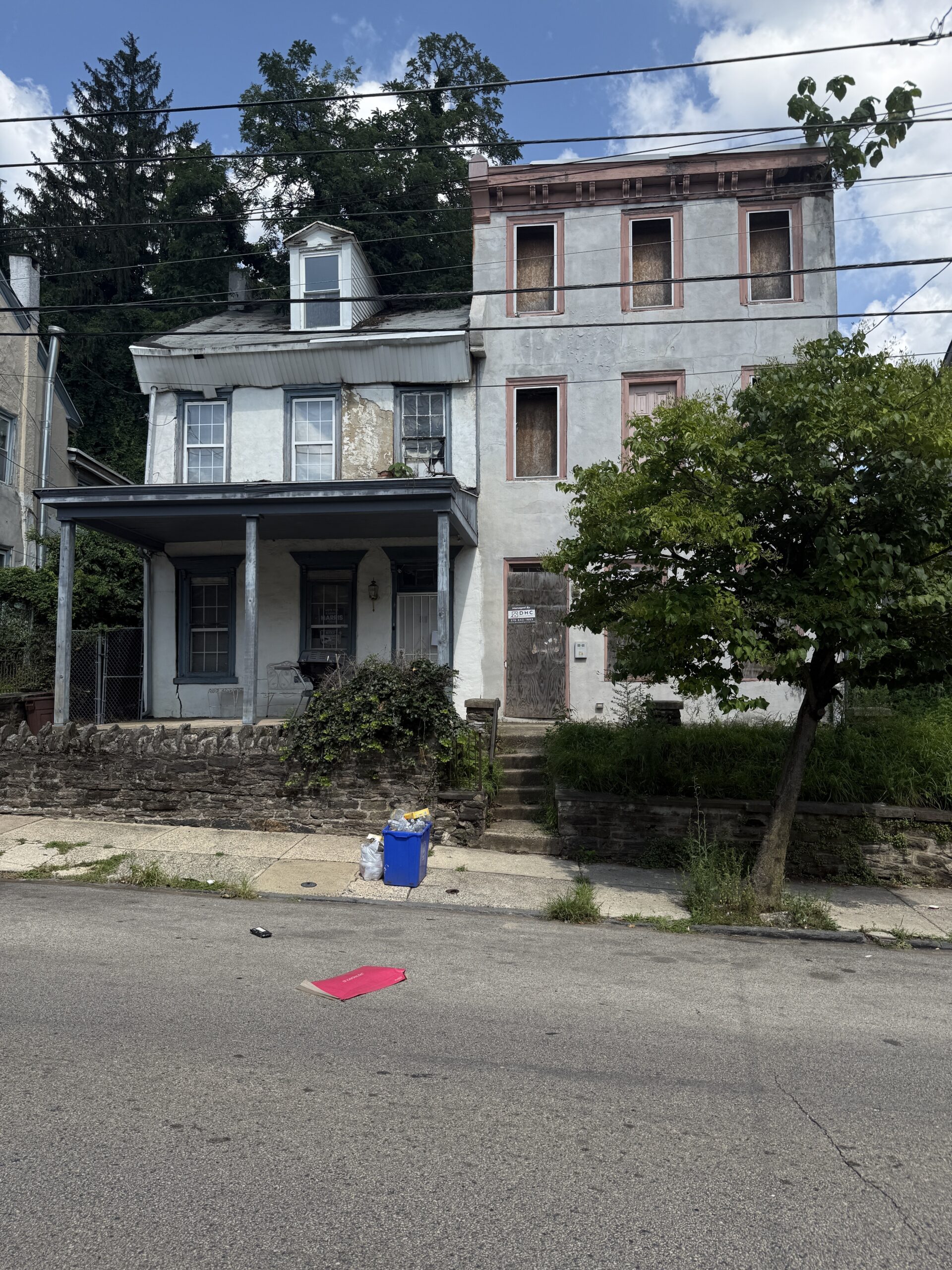
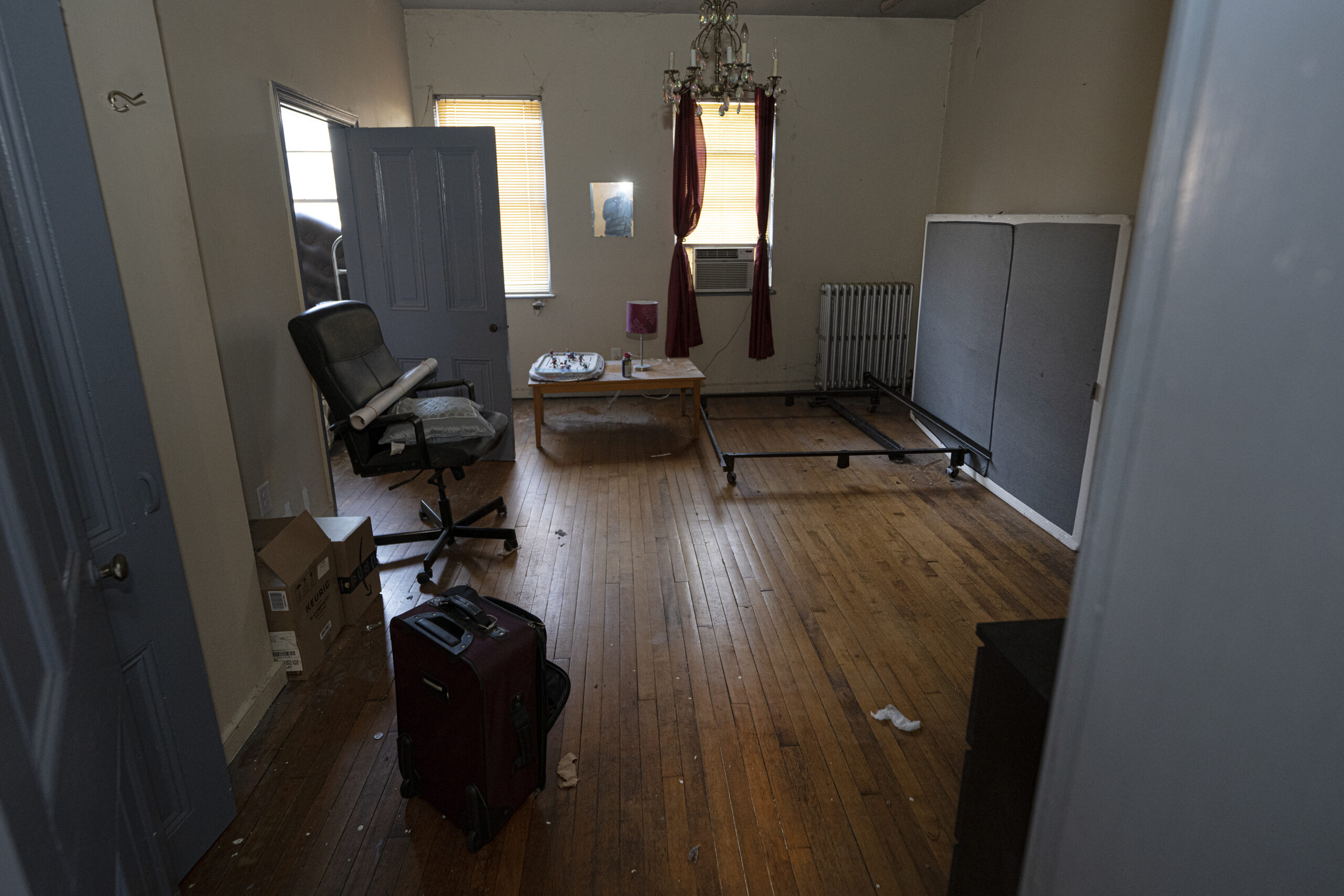
    For over 15 years, dozens of properties once owned by disgraced nonprofit Germantown Settlement have sat derelict and mostly empty.

    In 2024, the properties were given to the Philadelphia Housing Authority (PHA). This month the agency finally announced its plans: $84 million will be spent to gut and rehabilitate 113 units and build 40 apartments for seniors.

    Most of the properties will be earmarked as rentals for very low-income Philadelphians at 30% of area median income, or roughly $32,000 for a family of three. The former Settlement buildings are a mix of rowhouses, duplexes, and small apartment buildings.

    “I was shocked and dismayed by the conditions,” said Kelvin Jeremiah, CEO of PHA. “It’s going to cost a lot of money to get it back to habitable use.”

    Some critics of the plans say the amount PHA plans to spend beggars belief. Spilt 153 ways, $84 million is almost $550,000 a property.

    Longtime Northwest Philadelphia developer Ken Weinstein says his company could build new units at $284,000 a unit, and small developers who are active in the neighborhood can rehab houses for $152,000 apiece.

    “We have limited government resources, and we have so many people that need subsidies to put a roof over their heads,” Weinstein said. “I don’t know why we wouldn’t stretch our dollars as far as possible.”

    (function() {
    var l2 = function() {
    new pym.Parent(‘GERMANTOWN.html’,
    ‘https://media.inquirer.com/storage/inquirer/projects/innovation/arcgis_iframe/GERMANTOWN.html’);
    };
    if (typeof(pym) === ‘undefined’) {
    var h = document.getElementsByTagName(‘head’)[0],
    s = document.createElement(‘script’);
    s.type = ‘text/javascript’;
    s.src = ‘https://pym.nprapps.org/pym.v1.min.js’;
    s.onload = l2;
    h.appendChild(s);
    } else {
    l2();
    }
    })();

    Weinstein emphasized that he thinks Jeremiah has been a transformative and innovative leader for PHA, but he doesn’t understand why the agency isn’t trying to get the properties back into productive use in a more cost-effective way.

    He noted that PHA has sold scattered site single-family units it owns in the area to small developers for low-cost revitalization, with deed restrictions in place to keep them affordable in the long term.

    Weinstein also points to PHA’s campaign to obtain struggling new apartment buildings as an example of its capacity for flexibility and cost sensitivity. Jeremiah has said the purchases are being made because they cut the agency’s costs in half in contrast to building new.

    “I thought it was brilliant that PHA set out to buy existing apartment buildings at $200,000 a unit. That is a much better way to address the affordability issue in housing,” Weinstein said. “I don’t know why PHA would go out of their way to spend 2½-times that to rehab and newly construct in Germantown.”

    The transfer of the former Germantown Settlement properties from the Redevelopment Authority to PHA was controversial in 2024. Some residents felt a community engagement campaign had been ignored. Many attendees had expressed a desire for more homeownership opportunities.

    Jeremiah says that after a community meeting earlier this month, he is open to using 16 of the properties for affordable homeownership.

    “We heard that they would like to see a more balanced community, and so we’re going to work through what that means,” Jeremiah said. “We are revisiting some of the suggestions that we heard from the community, and we are going to revise our plans.”

    But Jeremiah says that sales to small developers for homeownership units, even with deed restrictions, would not help the poorest Philadelphians.

    When PHA does sell scattered site homes for private redevelopment, the rebuilt houses primarily go to those making 60% of area median income or $64,000 for a family of three.

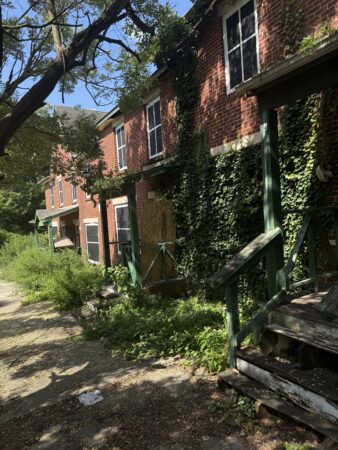
    A former Germantown Settlement property, courtesy of Kelvin Jeremiah.

    The lowest-income residents, who make half that, are the overwhelming majority of PHA’s tenants. They are not in a position to buy a home — even a subsidized and permanently affordable one.

    “A mom and pop [developer] would be hard-pressed to maintain permanent affordability,” Jeremiah said.

    Keeping the former Germantown Settlement properties as PHA-run rentals will guarantee a repository of affordable units no matter how this corner of Northwest Philadelphia evolves, he said.

    “Some of our assets are in communities that are rapidly becoming unaffordable,” Jeremiah said. “Our assets in those communities ensure we are maintaining some level of affordability.”

    Jeremiah himself has often criticized how much it costs PHA to build or gut rehabilitate projects, but he notes that the agency is restricted by a variety of federal regulations.

    “The construction costs are untenable for us, but it’s driven by the regulatory requirements that we must adhere to,” he said. “I have no flexibility.”

    Jeremiah estimates that the rehabilitation work will begin in 2027, after PHA hopefully secures Low Income Housing Tax Credits this year. Once begun, he expects the project to take 15 months, so at earliest the homes will be ready for habitation again in 2028.

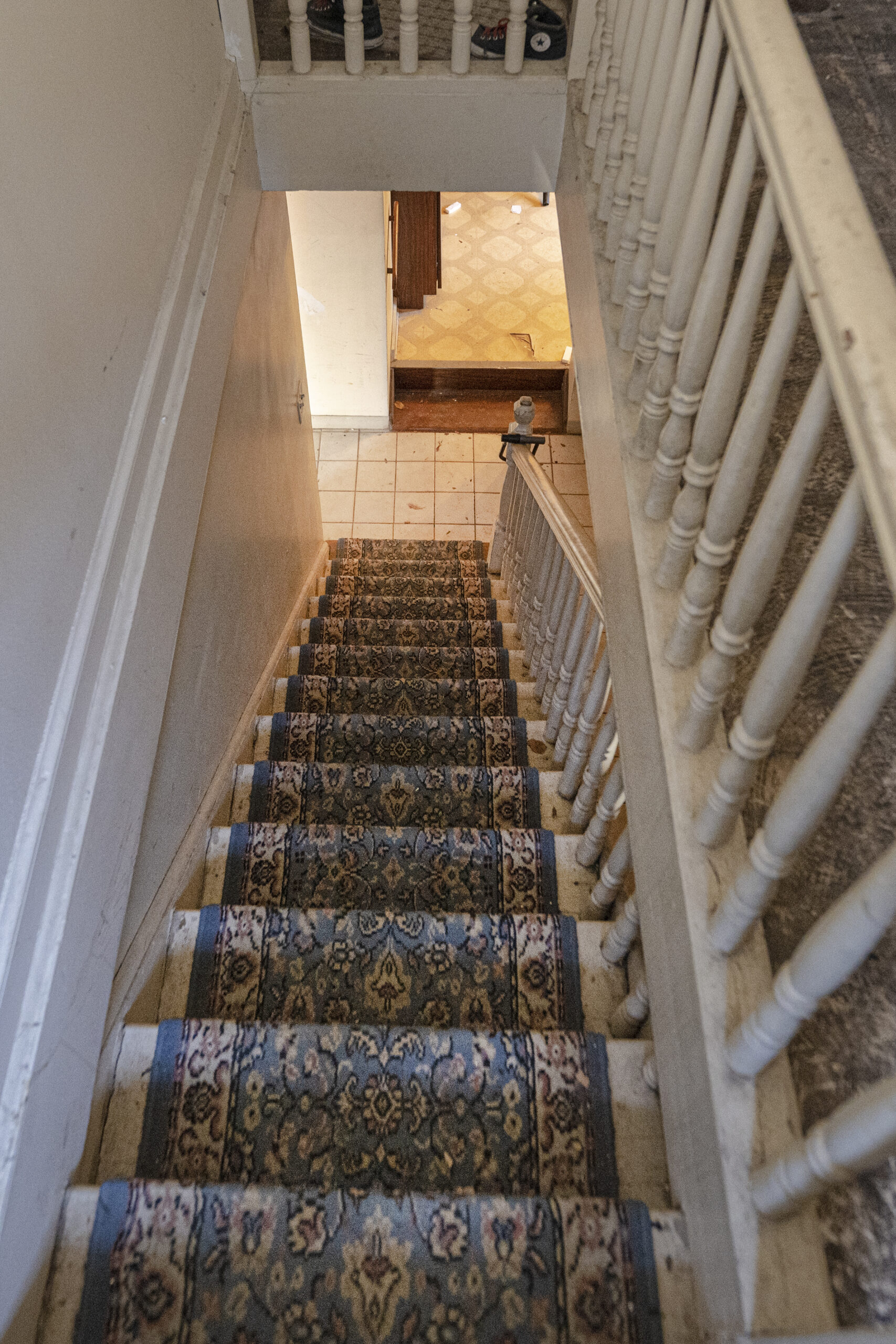
    Many of the former Germantown Settlement properties have fallen into ruin over the last 10 years, with copper wiring stripped out and mold or insect infestations harrowing their interiors.

    The city demolished the Blakemore Apartments because of their poor condition. Its site is where PHA will build a new 40-unit building for seniors. (PHA received 121 of 140 of the expired nonprofit’s units, with the rest going to smaller developers.)

    The former Germantown Settlement properties are heavily concentrated in two sections of East Germantown, creating pockets of dense vacancy near the intersection of Church Lane and Lena Street and on the 40th blocks of Wister and Garfield Streets.

    For Councilmember Cindy Bass, who represents the neighborhood, PHA is the right entity to redevelop these long troubled buildings.

    “It’s very important to preserve affordable housing, and that’s what we’re doing here,” Bass said. “This is not for profit. This is for people.”

  • Iron Hill Brewery could be revived in some locations as judge OKs trademark acquisition

    Iron Hill Brewery could be revived in some locations as judge OKs trademark acquisition

    Iron Hill Brewery may get a second life.

    Four months after the chain closed nearly 20 locations and filed for bankruptcy, a federal judge has approved the acquisition of Iron Hill’s trademark and intellectual property in conjunction with the transfer of five restaurant leases, including one in Philadelphia, according to court documents filed over the weekend.

    The shuttered brewpubs in Center City, Huntingdon Valley, Hershey, Lancaster, and Wilmington are set to be taken over by new tenants, each of which is referred to as “IHB” in the documents. Earlier this month, these tenants registered as business corporations under “IHB” and the name of each location, according to state records in Pennsylvania and Delaware.

    Judge Jerrold N. Poslusny Jr. also approved a written agreement that allowed for “Rightlane LLC” to assume Iron Hill Brewery’s trademark and intellectual property, according to the same filing in U.S. Bankruptcy Court in New Jersey.

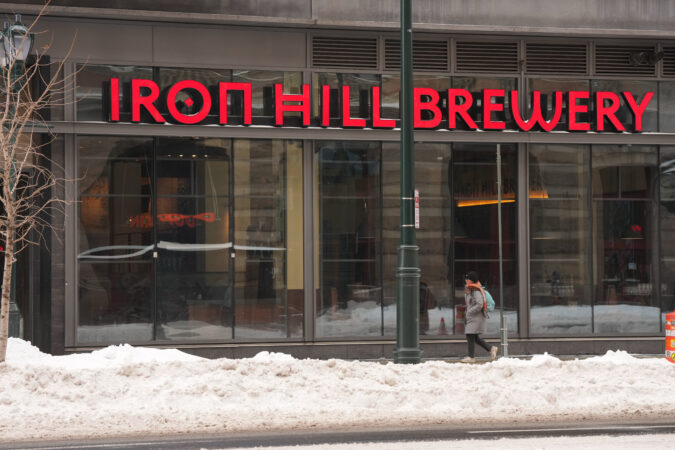
    A view from the outside looking in on a closed Iron Hill Brewery.

    Jeff Crivello, the former CEO of Famous Dave’s BBQ, was originally set to buy the assets of these five Iron Hill locations, along with those of five others that he has since sold.

    On Monday, Crivello confirmed that the assets of his five remaining Iron Hills, along with the brand’s trademark and intellectual property, had been acquired by a buyer called Right Lane.

    There are several companies that go by the name Rightlane or Right Lane. Attempts to reach representatives of the Right Lane that was involved in the Iron Hill deal were unsuccessful.

    The deal could revive some prime real estate in the Philadelphia region. In Center City, the 8,500-square-foot restaurant was meant to help revitalize the troubled Market East. In Wilmington, Iron Hill had renovated its 10,000-square-foot restaurant on the waterfront.

    In December, Crivello had hinted at the possibility of an Iron Hill resurrection, saying, “We’re working with a couple buyers that want to reopen [closed breweries] as Iron Hill.”

    Iron Hill Brewery, which was founded in Newark, Del., developed a loyal following over its nearly 30 years in business. Fellow business owners and brewers considered it a pioneer in the local craft beer scene and a restaurant that helped put suburban downtowns like West Chester and Media on the map. Customers said they loved its family-friendly atmosphere.

    In more recent years, Iron Hill opened a production facility in Exton, started canning its beers, and unveiled new locations in Philadelphia, South Carolina, and Georgia. This expansion occurred against the backdrop of the coronavirus pandemic and a nationwide decline in consumers’ thirst for beer and other alcohol.

    For Iron Hill, it did not prove a winning strategy. By the time the chain filed for liquidation bankruptcy this fall, it owed more than $20 million to creditors and had about $125,000 in the bank.

    Since then, massive shells of former breweries have sat vacant throughout the region. As the case made its way through bankruptcy court, landlords were delayed in their searches for new tenants.

    Many locations still remain empty, with no word on what might fill the spaces. But in some spots, there are signs of life.

    The company that owns P.J. Whelihan’s may be moving into the former Iron Hill in Newtown, Bucks County.

    Last month, PJW Opco LLC, which is registered at the headquarters of PJW Restaurant Group, was approved to take over a lease for an 8,000-square-foot closed Iron Hill in the Village at Newtown shopping center.

    In South Carolina, Crivello has sold the assets of the former Iron Hills in Columbia and Greenville to Virginia-based Three Notch’d Brewing Co.

    This story has been updated to reflect additional information about Right Lane.

  • Pennsylvania officials vote for land deal widely opposed by Limerick residents

    Pennsylvania officials vote for land deal widely opposed by Limerick residents

    A split Pennsylvania Game Commission has voted in favor of a developer’s land swap widely opposed by Limerick Township residents who fear it could pave the way for a large data center.

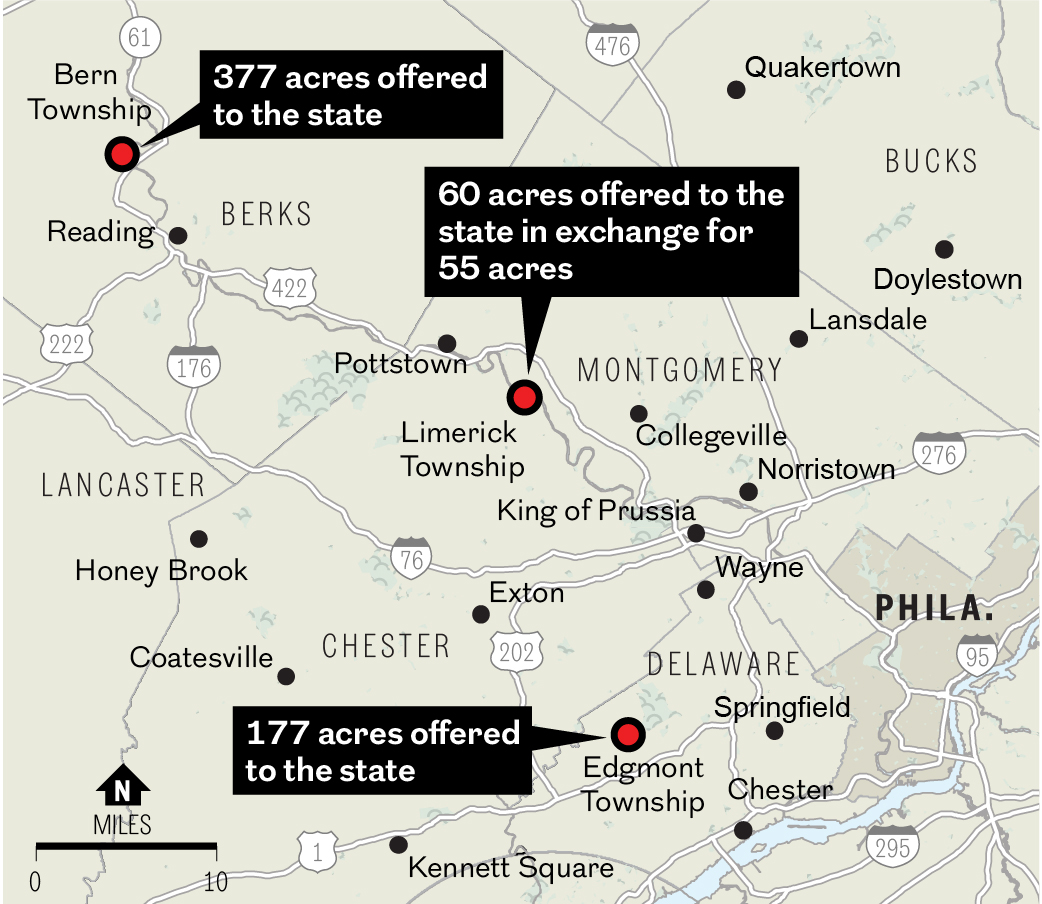
    The commission voted 6-3 on Saturday in favor of a contract with developer Limerick Town Center LLC that would yield the state 559 new acres across three counties. The swap would include what would become Delaware County’s first state game land.

    As part of the land trade, Limerick Town Center LLC would get 55 acres of state Game Land 234 in Limerick, Montgomery County. The land is adjacent to an industrial site the developer already owns and that’s currently proposed for warehousing.

    Limerick Town Center LLC has not said what it plans for the new land. A representative of the company could not be reached for comment.

    In return, however, Limerick Town Center LLC would give the state 60 acres in Limerick it owns immediately to the south of the existing game land, next to the Schuylkill.

    Steve Hacker, who lives near Game Land 234 and opposes the swap, called it “a great deal for other townships who will gain all that land … but it comes with a pretty heavy price.”

    Commissioners made their decision after listening to the public, who were also split over the deal.

    Revised land swap map new

    For and against the swap

    In general, residents who live in or near Limerick mostly opposed the swap, saying it would destroy a game land teeming with wildlife and a popular spot for hunting.

    Many are wary of what Limerick Town Center LLC wants to do with the 55 acres it would gain, fearing it’s part of a broader plan for a large data center. Although the developer has not proposed building a data center, the idea has been widely circulated on social media, including in posts by State Sen. Katie Muth. Data centers are used to handle the massive amounts of computing needed for artificial intelligence.

    The land they’ll be getting in return, residents said, is in a flood plain and has been clear-cut. In addition, those opposing the contract believes it sets a precedent of letting developers use leverage to get what they want.

    Limerick officials sent a letter to the commission last week in opposition to the swap.

    But hunters who live outside of Montgomery County, as well as some commissioners, spoke in favor of the deal. They said it would provide the state hundreds of acres of new hunting grounds at no cost.

    As part of the deal, Limerick Town Center LLC will give 377 acres in Bern Township, Berks County, to the state. And the company would give the state 177 acres in Edgmont Township in what would become the first state game land in Delaware County.

    The commissioners

    Stanley Knick, president of the Game Commission, who is from Northeastern Pennsylvania, voted against the contract, as did Commissioner Robert Schwalm of Bethlehem.

    Commissioner Todd Pride, of Cochranville, Chester County, voted in favor of the contract. Pride said there is, “a lot of information being passed around that was not correct.”

    He said Limerick Town Center LLC’s current proposal was “clearly going to have an impact on our existing game lands if we do nothing.”

    Now, he said, the commission, “would be swapping 55 acres to get 60″ acres in Limerick while “protecting that area along the Schuylkill.”

    “So we’re not losing,” Pride said.

    He estimated the overall gain of acreage to the state at $20 million.

    ‘Simply irreplaceable’

    However, Fred Ebert, owner of Ebert Engineering in Montgomery County, speaking as a member of the public, said the current location of state Game Land 234 “is simply irreplaceable.”

    He said the new land the state would get in Limerick is surrounded by a railroad and consists mainly of wetlands. The only access, he said, is existing farmland.

    State Game Land 234, he said, was entrusted by the former Pennhurst State School and Hospital before it shut down.

    “This exchange places a target on all in all game lands for development,” Ebert said. “It provides developers with a game plan and a path to seek out desirable land.”

    One East Vincent Township, Chester County, woman who did not identify herself, told the commission she lives across the Schuylkill from the Limerick swap site.

    She said so many residents have come forward with stories about how they walk the game land with their children, “showing them what wildlife is still around.”

    “If this heavy industry gets to switch out this property, that’s not going to be there for them any longer,” she said.

    But Steve Tricarico, a member of the Bern Township planning commission, sees the 377 acres of conserved space his municipality is gaining as a win given the development pressure in Berks County.

    “This land would offer new opportunities for outdoor activities and public enjoyment,” Tricarico said.

  • Gloucester County warehouse project has been undermined by a ‘rogue’ employee and rival firm, lawsuit says

    Gloucester County warehouse project has been undermined by a ‘rogue’ employee and rival firm, lawsuit says

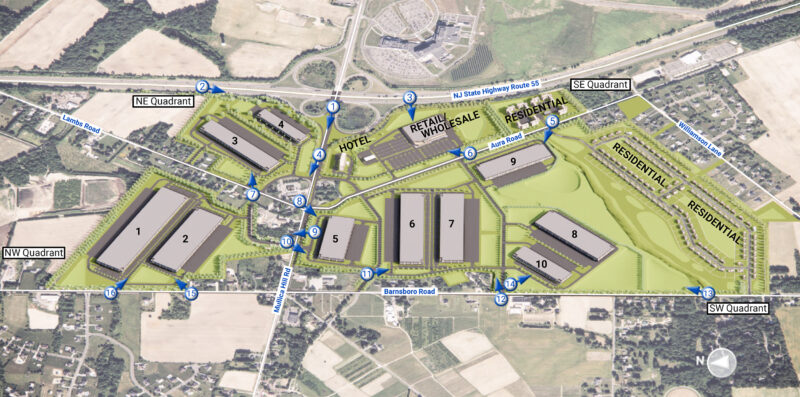
    The developer behind a massive mixed-use project in South Jersey has filed a lawsuit accusing a “rogue” employee of derailing municipal approvals and plotting to steer the property to Rowan University and a rival firm.

    For more than two years, Seth Gerszberg and his Englewood, N.J.-based firm Active Acquisitions have been pursuing a development at the intersection of Route 322 and Route 55 in Gloucester County including proposals for 10 warehouses, a wholesale retail club, a hotel, and 117 single-family homes.

    An affiliate of Gerszberg’s firm agreed to buy the property — totaling 429 acres, about 29 times the footprint of Lincoln Financial Field — in May 2023 for $23 million from Madison Richwood Village LLC, the suit says.

    But the government approval process hit a snag in recent months, the suit alleges, as Gerszberg’s project manager, Sean Earlen — a land-use consultant, former mayor of Lumberton, and chair of the Burlington County GOP — “leveraged his close personal relationship” with Harrison Township’s mayor, Republican Adam Wingate, “to sow doubt within the township” about the viability of the development.

    Yearslong saga

    It’s the latest twist in a development saga that dates to 2008, when plans for a walkable town center in Harrison’s Richwood section were unveiled, including talk of a new elementary school and liquor licenses for restaurants in what had been a dry town.

    But development efforts went nowhere, and the new push for warehouses — in a region that’s added tens of millions of square feet of warehousing space in recent years to meet demand for online shopping — has faced some resistance from residents in the affluent rural town of 14,000.

    Now those plans could be in question.

    According to the suit, Earlen has been pushing the current property owner, Madison Richwood, to do a deal with Rowan and Ohio-based Fairmount Properties LLC, which has been pursuing a “wellness district” at the university featuring proposals for a headquarters for Inspira Health, a hotel, as well as shops and restaurants.

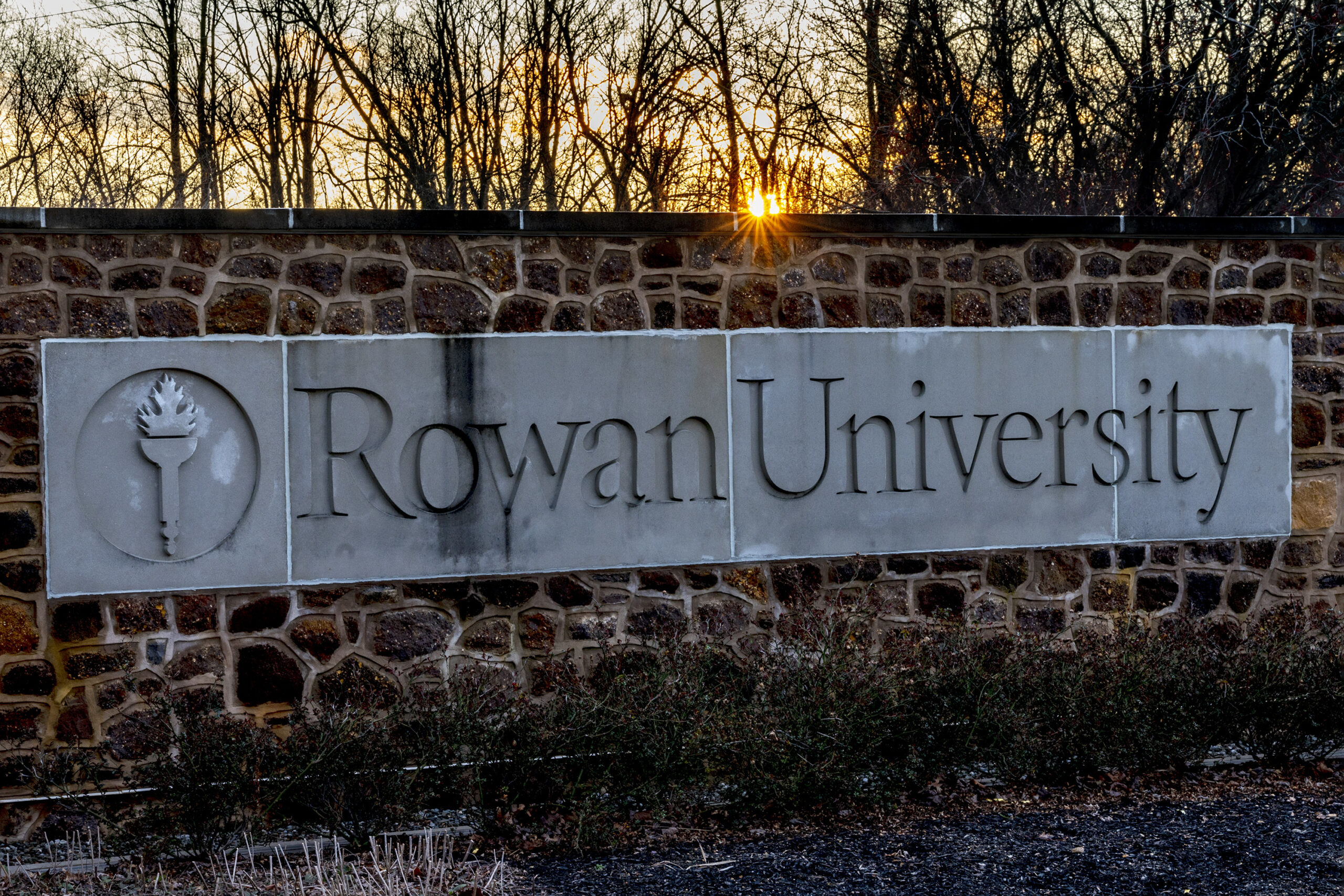
    Rowan University in Glassboro.

    At some point last year Rowan negotiated a deal with Madison Richwood to buy the property for $31 million, plus another $10 million in 2026, the complaint says, in an effort to “fulfill the university’s vision for a comprehensive plan at the Route 55/Route 322 interchange.”

    As the township’s confidence in the warehouse project has eroded, the suit alleges, a neighboring property owner filed a lawsuit in October challenging Active’s government approvals.

    The developer — which has industrial and residential projects across New Jersey — has sunk roughly $4 million to obtain the necessary approvals for the project and $7 million in “consultant and development expenses,” according to court records.

    Gerszberg, who before his work in real estate was cofounder and president of hip-hop fashion brand Marc Ecko Enterprises, didn’t respond to requests for comment.

    What does Rowan say?

    The most recent suit, filed this month in Bergen County Superior Court by Active affiliate ActiveRWHA Property LLC, names Earlen and Fairmount Properties as defendants. It alleges interference with contractual rights, misappropriation of trade secrets, and defamation, among other counts.

    Representatives for Fairmount and Rowan — a public research institution that isn’t a party to the suit — did not directly answer questions about whether they intend to buy the property. Neither Earlen nor Wingate — who took office as mayor last year — responded to requests for comment.

    Randy Ruttenberg, a Fairmount principal, said the suit is “completely without merit” and called it an “ill-advised attempt to disrupt the very straightforward development process we continue to diligently pursue for the benefit of the entire region.”

    “Fairmount Properties is focused fiercely on executing their own world-class development, and no matter what obstacle is placed in our path, we will not be distracted, bullied or deterred,” he said in a statement.

    Joe Cardona, a spokesperson for Rowan, said it would be inappropriate to comment on pending litigation. “Rowan remains focused on its academic mission and on conducting all institutional planning activities responsibly and in accordance with applicable laws and governance standards,” he said in an email.

    Madison Richwood affiliate Madison Marquette — a Washington, D.C.-based real estate investment and operating company — said in court papers that Gerszberg’s concern about a sale to Rowan is “without merit.”

    Madison Marquette “will not sell the property, as defined in the [purchase and sale agreement], to Rowan, Fairmount, or any other entity while the PSA is in full force and effect,” firm president and managing principal William Sudow said in a court filing in a related case that has since been resolved.

  • They paid $2.5 million in cash to renovate a historical Society Hill church | How I Bought This House

    They paid $2.5 million in cash to renovate a historical Society Hill church | How I Bought This House

    The buyers: Carrita Thomas, 33, nonprofit program evaluator; Jake Stein, 42, CEO of a tech start-up

    The house: A 6,775-square-foot church in Society Hill built in 1920

    The price: Listed for $2.5 million, purchased for $2.5 million

    The agent: Kate McCann, Elfant Wissahickon Realtors

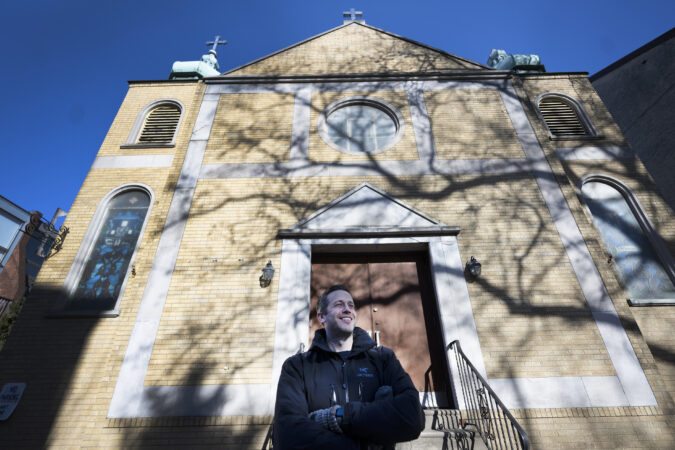
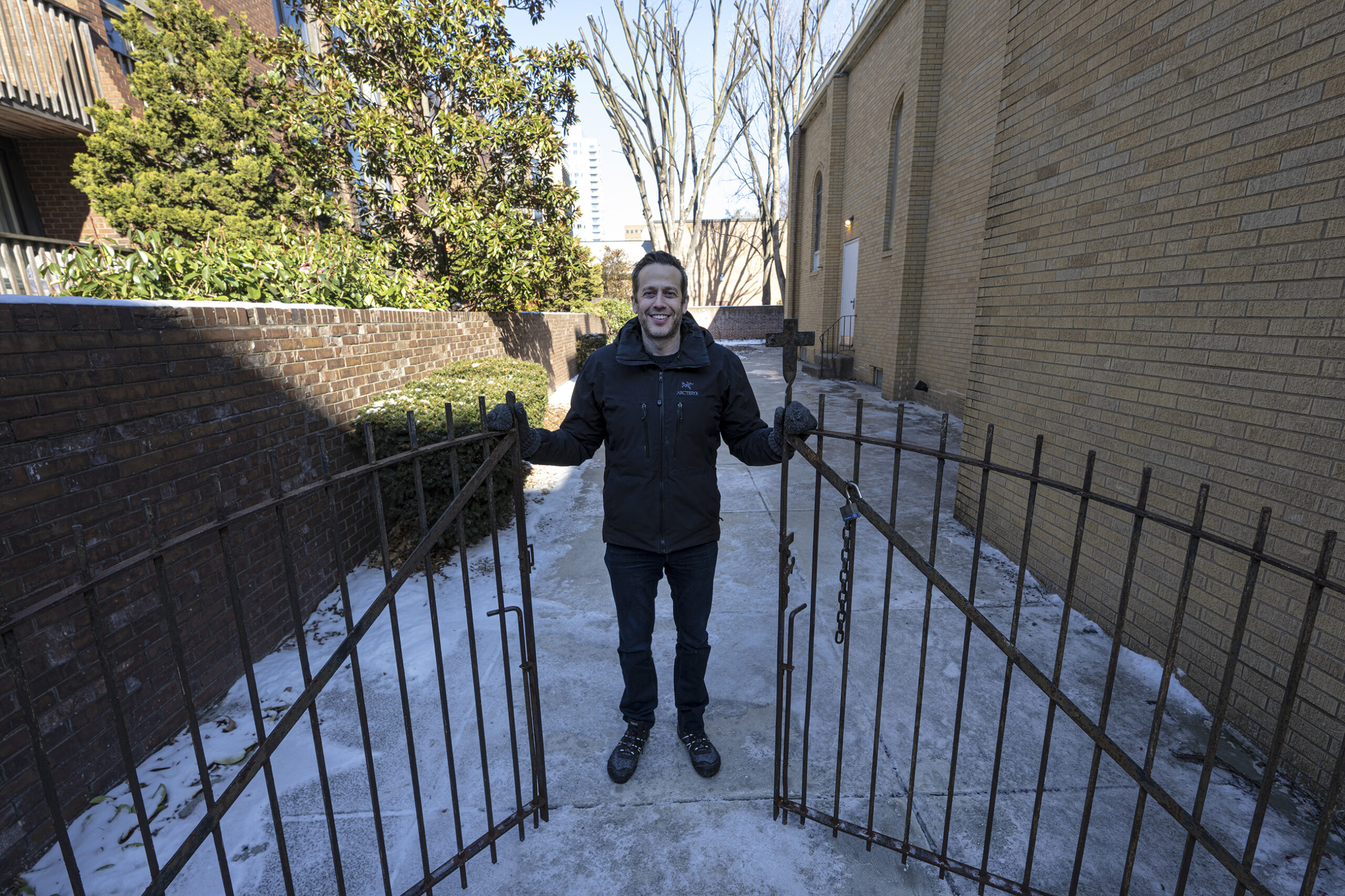
    Carrita Thomas and Jake Stein on the main floor of their newly purchased church in Society Hill.

    The ask: Carrita Thomas and Jake Stein moved to Society Hill in 2021 and immediately fell in love. They grew even more attached after having their first child. They loved the abundance of playgrounds and parking. But most of all, they appreciated how the area functioned as a village. “We have a great community of friends,” Thomas said. “We are very close with our neighbors.”

    But when they found out that Thomas was pregnant with twins, their rowhouse, which once felt generous, suddenly seemed cramped. They needed more space fast but didn’t want to leave the neighborhood. They also wanted on-site parking and outdoor space for Thomas to garden. Plus they needed at least six bedrooms. The couple knew they were in for a difficult search.

    One of the church’s courtyards with plant beds where Thomas and her daughter recently planted bulbs with friends.

    The search: The market moved fast for houses that met their criteria. More than once, they scheduled showings for houses already under contract. Once, they scheduled a showing three days after a house came on the market, only to have the agent cancel because it had already sold. After several misses, they decided to reassess their options, including renovation. “We had not been interested in it before because we’d only heard negative stories,” Thomas said.

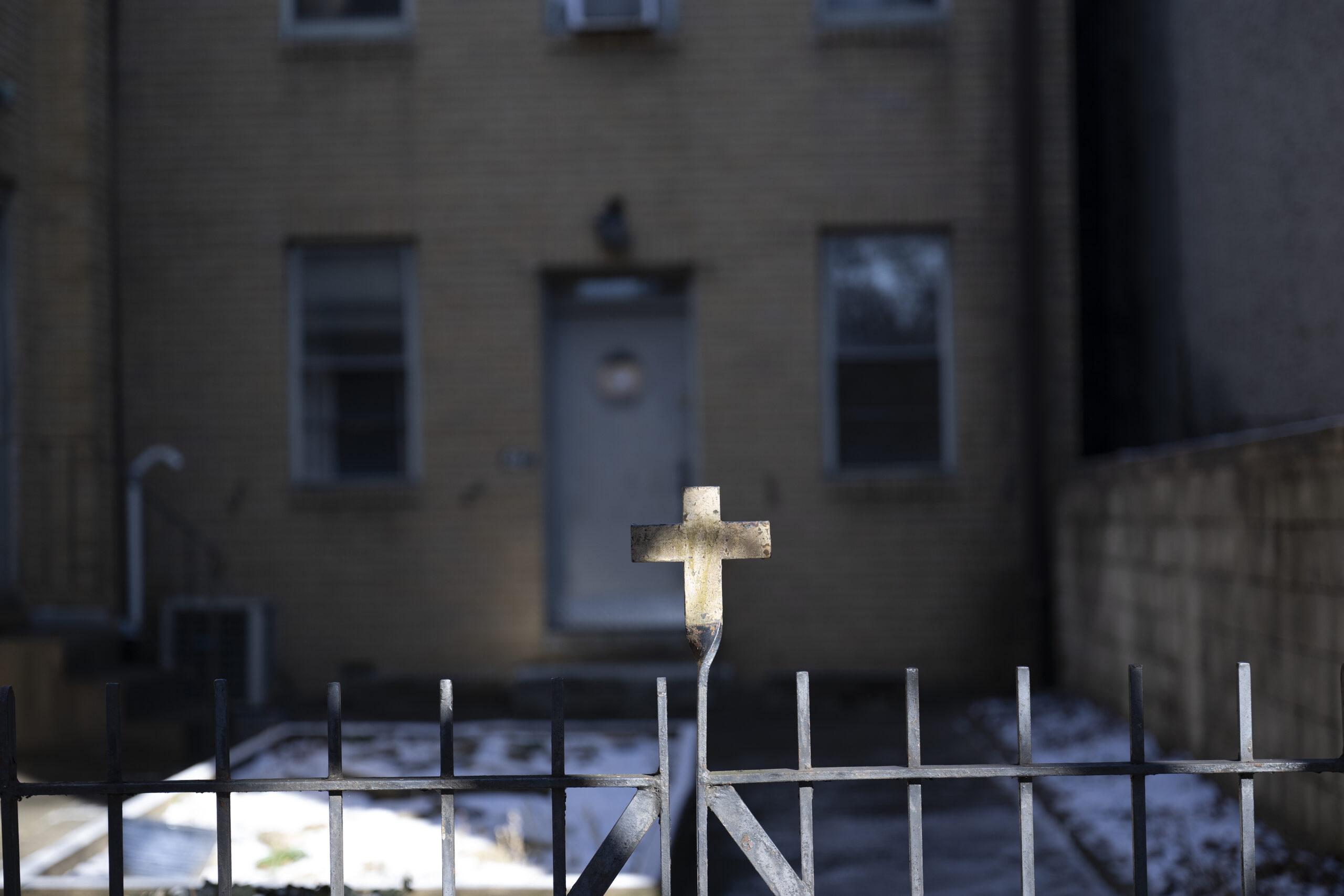
    Around the same time, Stein noticed a sale sign on a vacant church two blocks from their home. It had been unused for decades, its landscaping overgrown, its windows dark. “I always thought it was so cool and interesting,” Stein said. “And what a waste.”

    That discovery shifted their search. Instead of continuing to hunt for the impossible-to-find, perfect rowhouse, the couple began to consider the most glaring fixer-upper in the neighborhood.

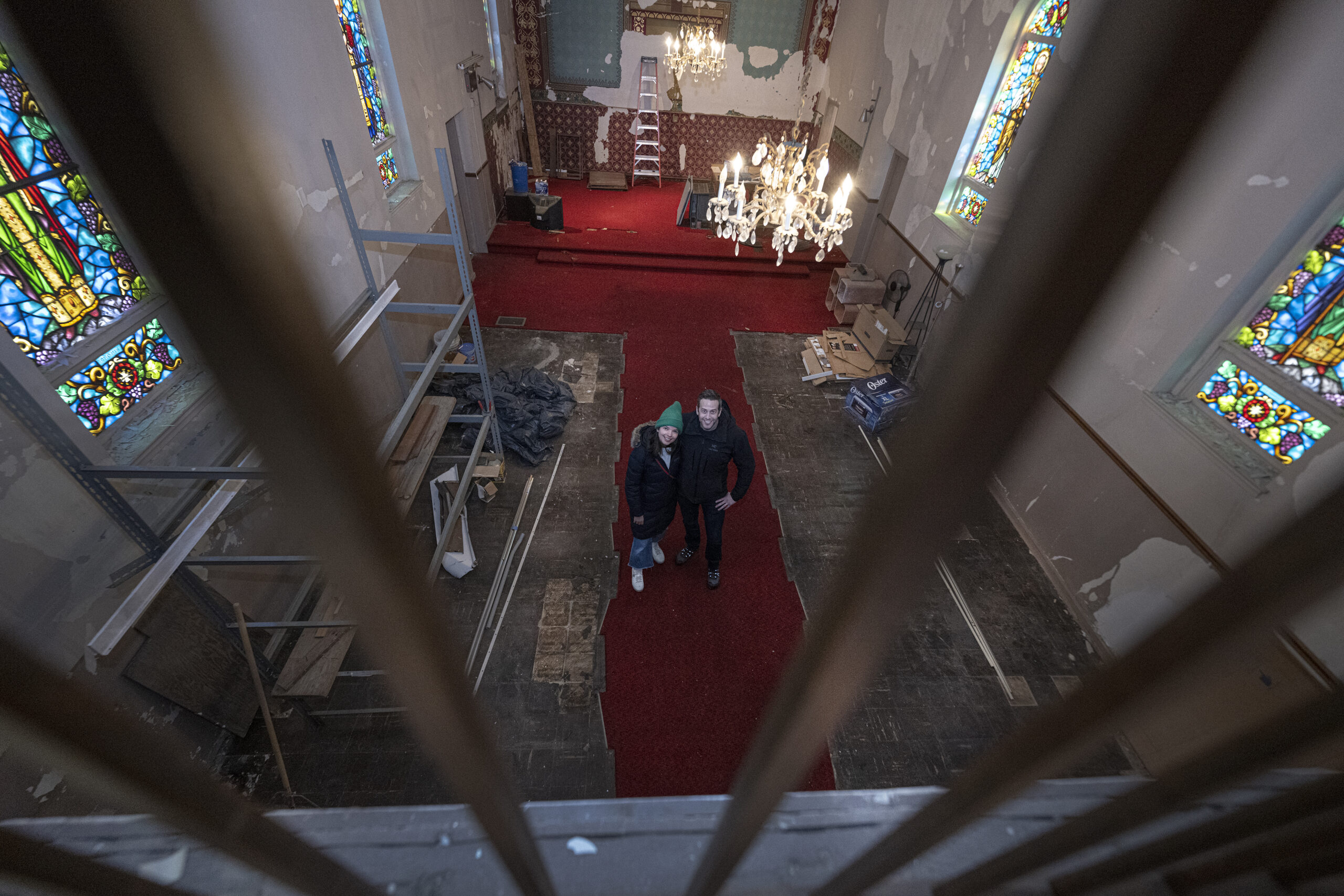
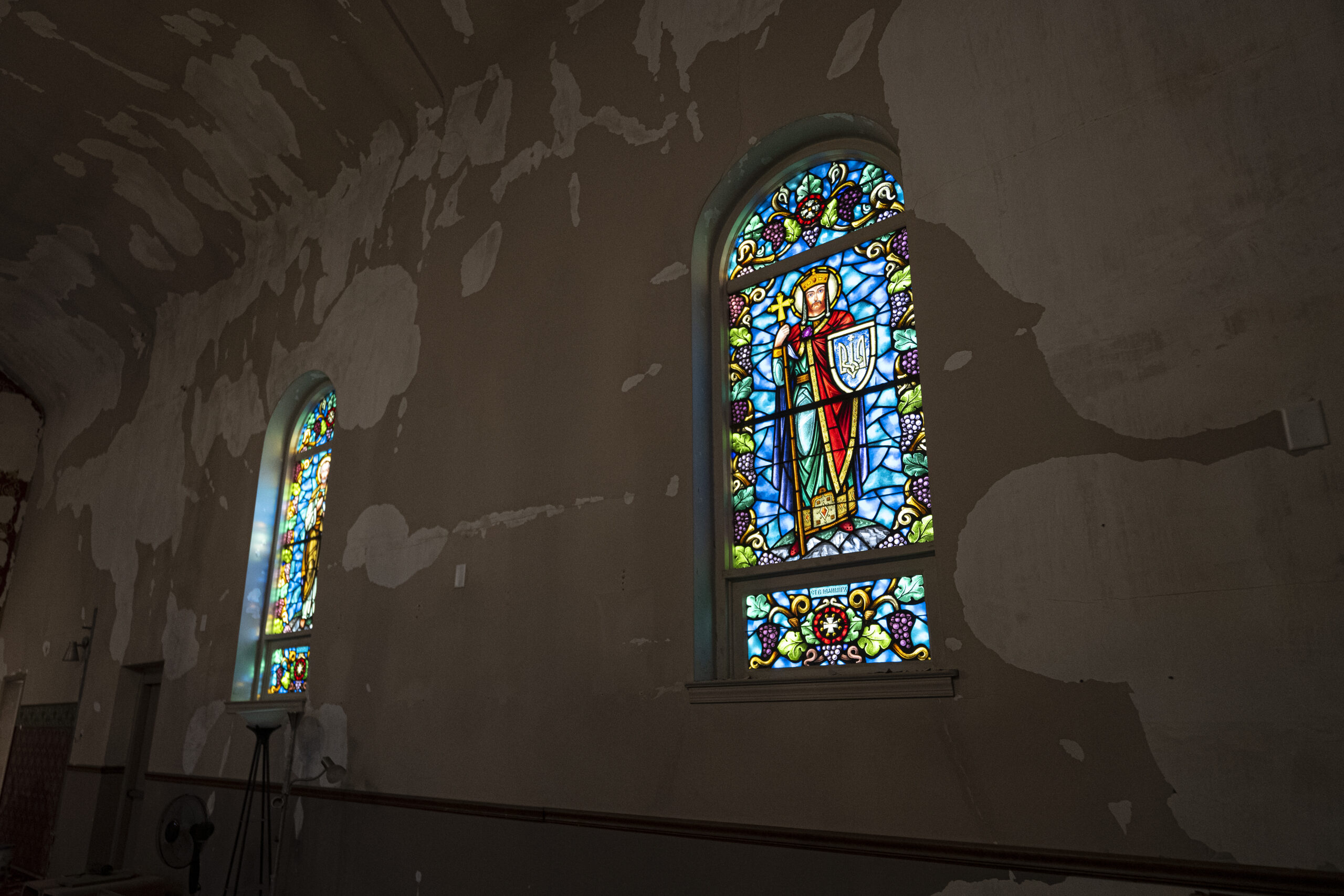
    The couple fell in love with the church’s raw materials, like the stained glass windows lining its walls.

    The appeal: Thomas was initially skeptical. Every church conversion she had seen leaned toward a loft-style layout, and she didn’t want to live in an open, cavernous space. But walking through the property with an architect helped her picture more-private floor plans.

    One of the church’s main selling points was its driveway and ample parking space.

    Inside, the building was structurally sound and full of “high-quality raw material,” said Thomas. But what really sold them was the “insane amount of outdoor space.”

    To get a sense of renovation costs and trade-offs, the couple also consulted with someone who had previously run a design-build construction company. That process replaced vague anxiety about expenses with concrete ranges. “There are really expensive versions of renovations,” Stein said, “and there are much more reasonable versions.”

    Understanding that they could “choose their own adventure” and “dial up or dial down the budget based on their design decisions” made the renovation seem actually doable, if not meaningful.

    Thomas appreciated that the church had once been a place where people gathered. “One of our primary values is community,” she said. And the idea of restoring that function — even in a different form — felt really special to the couple. “It just adds so much richness to our lives,” she said.

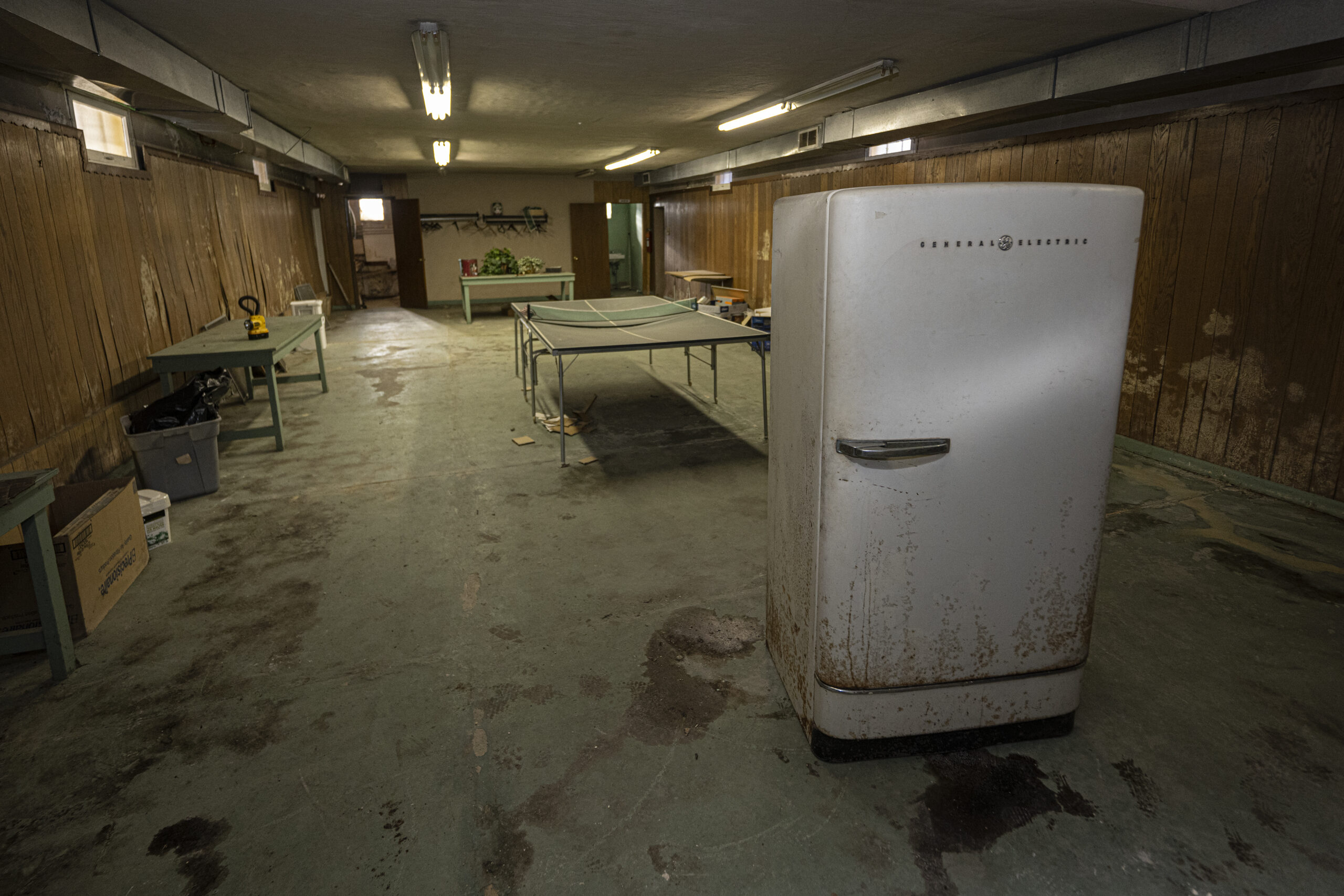
    One of Stein’s favorite features of the church is the basement and the giant warped Ping-Pong table, on which he’s played multiple games.

    The deal: Thomas and Stein knew that the terms would be largely out of their control. The seller, who lived out of state, had owned the building for decades and was not inclined to negotiate. She had rejected several offers over the years and did not advertise her property as being for sale online. Even getting the asking price took effort. Their agent had to follow up multiple times. The seller eventually told them it was $2.5 million. She had recently rejected an offer below the asking price without counteroffering, so the couple didn’t bother negotiating. “We know we would only get it if we met all of her terms,” Thomas said. They submitted a straightforward offer, including skipping the inspection, at the asking price, and the seller accepted.

    Interior views of the newly purchased church owned by Carrita Thomas and Jake Stein.

    The money: Thomas and Stein put $2.5 million down in cash — the full cost of the property — the day they closed. They did not take out a mortgage. The funds came from the sale of Stein’s former software company, which he sold in 2018 for $60 million. Their renovation budget is still fluctuating.

    The move: Thomas and Stein closed on the church at the end of September.

    A view of the staircase in the rectory that is attached to the church.

    They spent the past few months figuring out how to approach the renovation, talking with people who had done similar projects, and meeting with contractors. “It’s a slow process,” Thomas said, “but it’s a really important part of it.” Now, they are finalizing contracts with vendors. She expects the entire project to take about two years. Construction is still a ways away.

    They are living in their Society Hill rowhouse for now, and it no longer feels too small. “We’re pretty comfortable,” Thomas said. “Something changed for me after I had the twins. I think both of our tolerance for chaos just went up a lot.”

    Any reservations? The couple is happy with their purchase, even though there are still many unknowns. “A lot of careful planning needs to go into this,” Thomas said. “There are a lot of open questions still,” Stein added. They will have to knock down a few walls to figure out what is even possible. It will take at least 10 months to finalize the design. The couple is up for it. “It’s a cool project,” Thomas said.

    Life after close: Even though the renovation hasn’t started, the building is already functioning as part of the neighborhood again. The couple hosted a Halloween party for their neighbors, and a few weeks later Thomas had her daughter’s friends over to plant bulbs.

    Did you recently buy a home? We want to hear about it. Email acovington@inquirer.com.
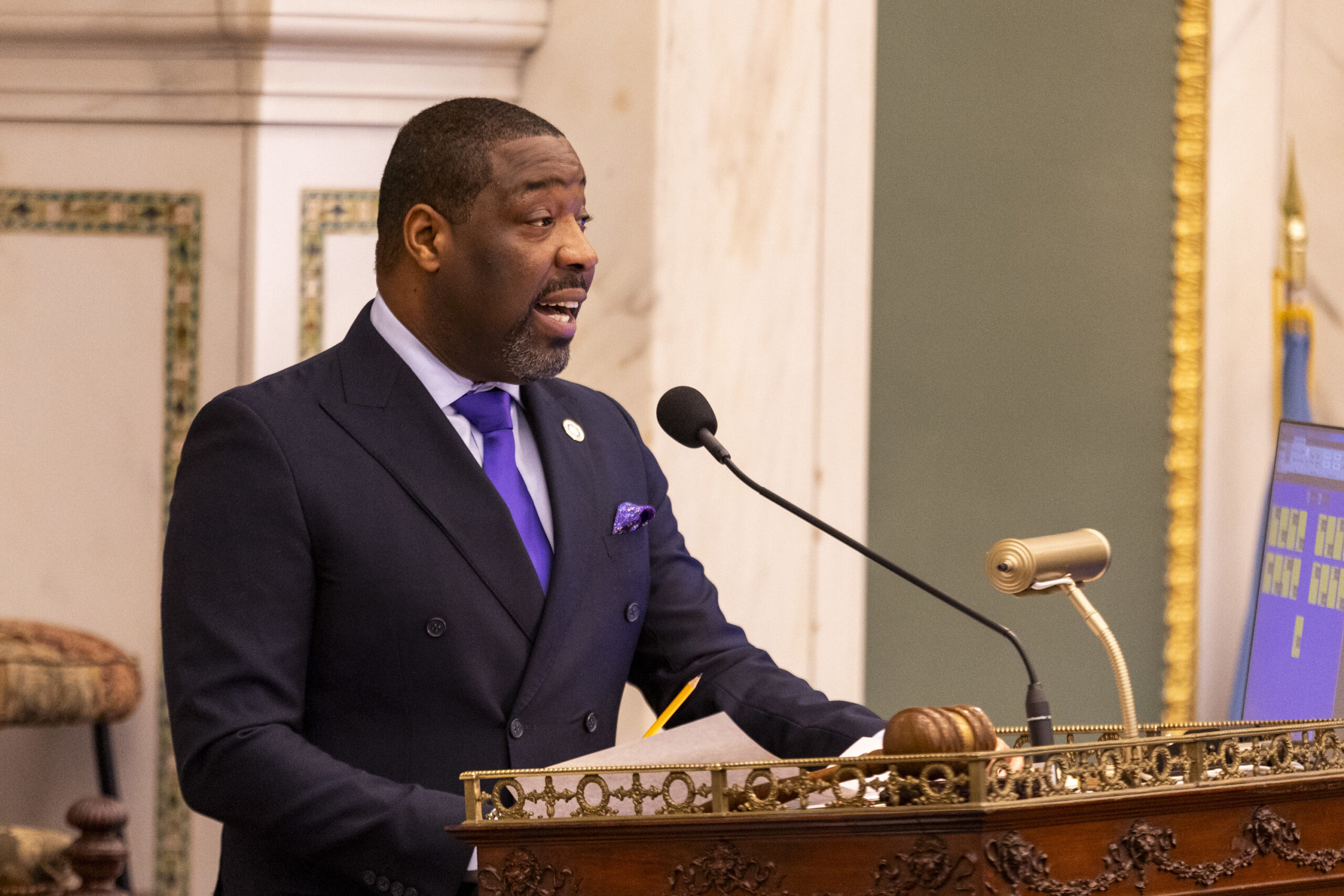
  • Mayor Cherelle Parker’s housing plan is back on track after Council again reapproved $800 million in city bonds

    Mayor Cherelle Parker’s housing plan is back on track after Council again reapproved $800 million in city bonds

    Mayor Cherelle L. Parker’s housing initiative is back on track.

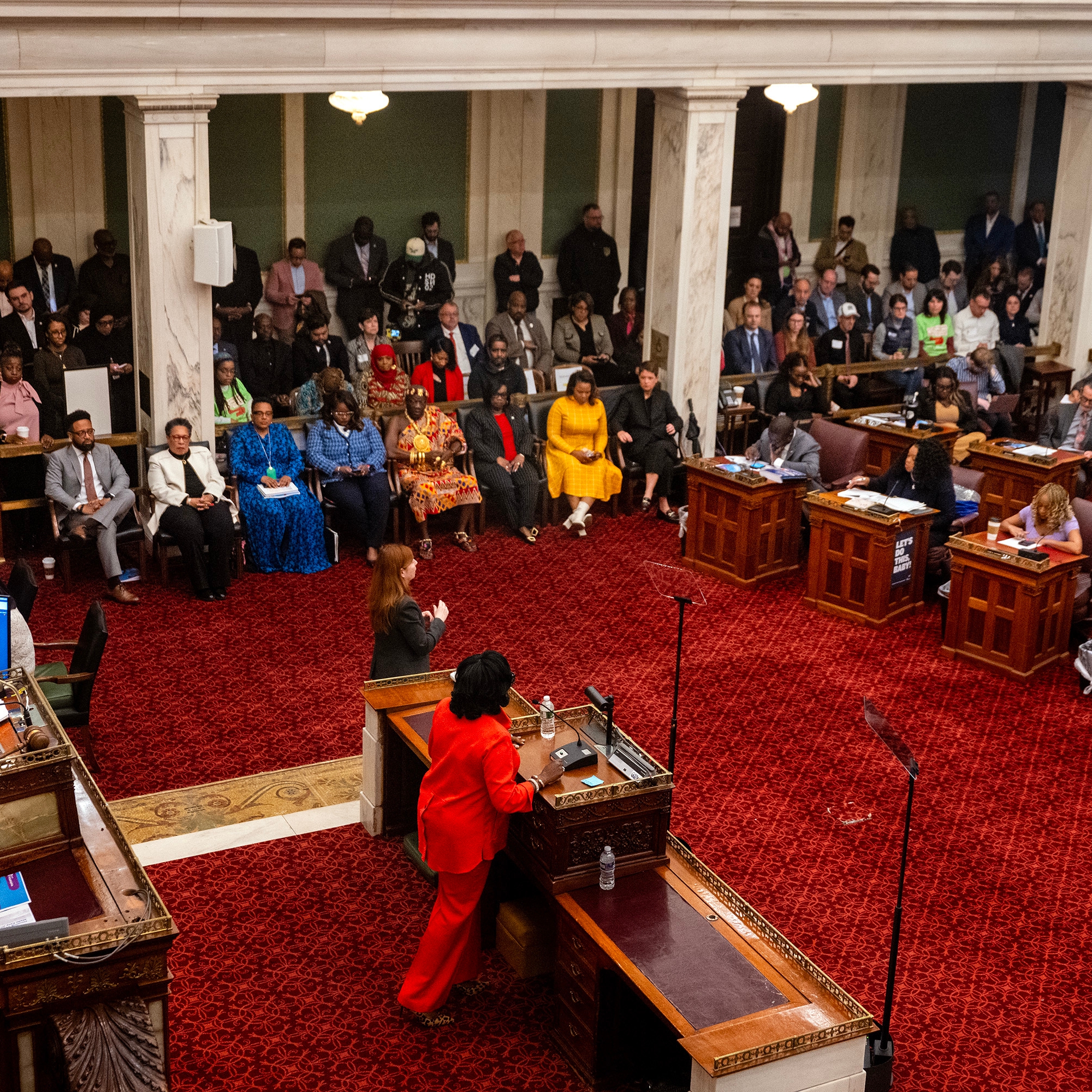
    In its first meeting of the year, City Council on Thursday reapproved a bill to authorize the administration to issue $800 million in bonds to fund the Housing Opportunities Made Easy, or H.O.M.E., initiative.

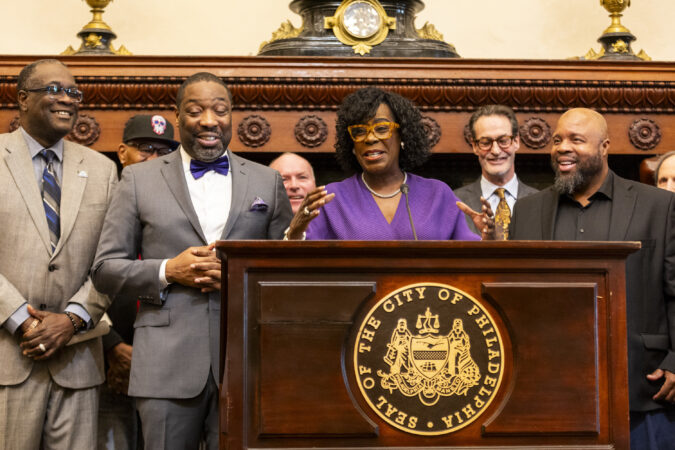
    Parker wasted no time, signing the bill into law at a news conference Thursday afternoon to fast-track the process for the city to sell the first $400 million tranche of bonds in late March or early April. The administration plans to sell the second $400 million in 2027.

    “We are signing into law the largest and most significant investment in housing in the city of Philadelphia’s history, a $2 billion plan that will create and preserve 30,000 units of housing here in the city of Philadelphia,” Parker said, citing a sum for H.O.M.E.’s budget that also includes other funding steams and the value of city-owned land the administration hopes to redevelop into housing through the plan.

    In March 2025, when Parker unveiled her housing plan — with the goal of helping the city build or preserve 30,000 units of housing in her first term — she wanted to issue the bonds that fall. Council initially approved the bond authorization and other legislation related to H.O.M.E. in June.

    But in the fall, lawmakers made significant changes to a related piece of legislation — which details the $277 million first-year budget for spending the bond proceeds — that triggered a redo of the bond bill.

    The most notable changes, championed by progressive Councilmembers Jamie Gauthier and Rue Landau, lowered the income thresholds for some of the programs funded by H.O.M.E. to prioritize lower-income Philadelphians.

    Mayor Cherelle L. Parker unveils her long-awaited plan to build or preserve 30,000 units of housing during a special session of City Council Monday, Mar. 24, 2025. Council President Kenyatta Johnson is at left.

    Parker opposed the amendment, and administration officials testified that H.O.M.E. was meant to serve residents at a variety of income levels, including middle-class households that are struggling but often make too much to qualify for government support programs.

    But Council members argued that even with the new infusion of funds, Philadelphia’s resources are too limited to help the city’s hundreds of thousands of impoverished residents — let alone aid middle-income residents as well.

    “City Council demonstrated through its actions — not just its words — that it’s serious about putting City Hall to work for communities that have too often been left behind,” Gauthier, Landau, and their allies said in a group statement Thursday.

    The dispute proved to be the most significant public disagreement to date between Parker and Council President Kenyatta Johnson, who sided with Gauthier and Landau.

    The changes required Council to pass an updated bond authorization before moving forward because the previously adopted version no longer aligned with the language in the budget resolution. Lawmakers ran out of time to pass the new bond bill before adjourning for their winter break in December.

    They approved it unanimously on Thursday.

    A couple of hours later, Johnson and Parker profusely praised each other at the bill-signing ceremony, going out of their way to show that their strong working relationship remains intact now that the conflict was behind them.

    “My commitment is to make sure that our 100th, first woman, mayor is successful,” Johnson said.

    The moment of congeniality was a stark contrast to the dynamic between the two late last year.

    Parker at one point said Council’s delay “means homes are not being restored” and “homes are not being built or repaired.” Johnson fired back, “Council’s responsibility is not to rubber-stamp legislation.”

    City Council President Kenyatta Johnson speaking at the City Council’s first session of the year in Philadelphia, Pa., on Thursday, Jan. 22, 2026.

    But on Thursday, there was enough feel-good energy between the mayor and Council that it extended beyond Johnson to members who have more frequently clashed with the administration.

    Gauthier and Councilmember Isaiah Thomas, who questioned the mayor’s agenda last year over concerns that she was taking out too much debt for housing, also stood alongside the mayor at Thursday’s news conference.

    After the delays to her agenda at the end of last year, the mayor appears to be trying to regain control of the narrative this week. Thursday’s bill-signing ceremony marked Parker’s third major update related to H.O.M.E. in three days.

    On Tuesday, she announced that her administration was partnering with the city’s building trades unions and the Philadelphia Housing Authority to redevelop the Brith Sholom House, a notoriously dilapidated senior facility that closed in 2024, into affordable housing for seniors.

    And on Wednesday, she laid out a vision to build a modular housing manufacturing facility on the long-vacant Logan Triangle tract in North Philadelphia. The city issued a request for information from developers potentially interested in building such factories in the city, with a deadline in late March.

    Parker on Thursday only indirectly responded to a question about how many units could be built or repaired in the two years left in her term.

    But she said that her administration is working on a second package of zoning legislation to accelerate home construction in Philadelphia, and that she is working with Council to speed 1,000 properties through the land bank.

    She also expects Gov. Josh Shapiro, at his forthcoming budget address, to announce state-level housing reforms that would help “as it relates to streamlining state processes [to] run more efficiently.”

    Staff writer Anna Orso contributed to this article.