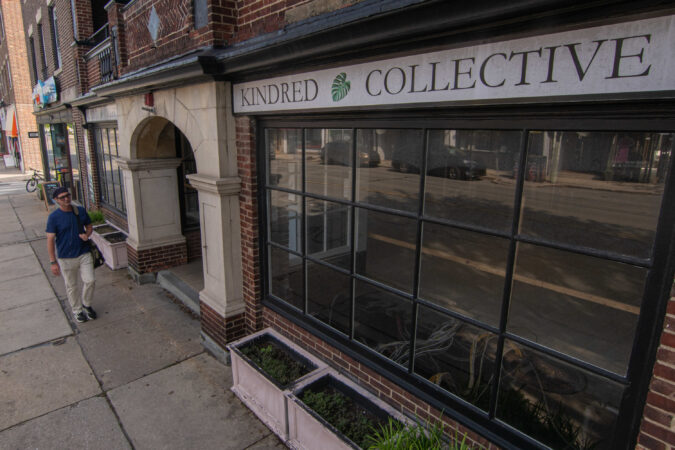
Five buildings in downtown Bryn Mawr, including the storefronts of Carina Sorella, Jeni’s Splendid Ice Creams, and the Buttery Bryn Mawr, are up for sale.
The Bryn Mawr Collection, a nearly26,000-square-foot portfolio that includes residential, retail, medical, and office space, was recently listed by real estate firm CBRE. The properties are owned by Main Line-based real estate developer Tim Rubin and are located in the heart of Bryn Mawr at 834-40 W. Lancaster Ave. and 860-66 W. Lancaster Ave.
CBRE’s Chris Munley said the properties could sell for around $12 million.
Rubin is a Narberth native who has owned the properties for almost 20 years. With the sale, he is hoping to recycle capital and make a similar investment somewhere else, Munley said.
The Bryn Mawr Collection is “extremely rare, irreplaceable ‘Main Street’ real estate, providing a once-in-a-lifetime opportunity to break into a high barrier to entry market,” according to the listing. The portfolio is a stone’s throw from the Bryn Mawr SEPTA station and down the road from Villanova University, making it well positioned in one of the region’s most “affluent, educated, and densely populated suburban communities,” the listing reads.
The properties are currently home to TCO Fly Shop, the Buttery, Jeni’s Splendid Ice Creams, and Carina Sorella, as well as apartments and offices.
Beloved tenants such as Carina Sorella and The Buttery, which opened last week, aren’t going anywhere, Munley said. The successful businesses are “one of the reasons this is attractive” for potential buyers, and they have long-term leases that would extend beyond the sale of the properties.
The properties are in their second week on the market, and Munley said the level of interest has been “eye-opening.” In addition to local players looking to expand their portfolio on the Main Line, Munley said he has seen interest from investors that usually focus on larger markets like New York, San Francisco, and Los Angeles.
This suburban content is produced with support from the Leslie Miller and Richard Worley Foundation and The Lenfest Institute for Journalism. Editorial content is created independently of the project donors. Gifts to support The Inquirer’s high-impact journalism can be made at inquirer.com/donate. A list of Lenfest Institute donors can be found at lenfestinstitute.org/supporters.
More than a third of short-term rental properties like Airbnb and VRBO in Philadelphia have licensing issues, according to a new report from the City Controller’s office released Tuesday.
The controller found that of 3,734 analyzed licenses associated with short-term rentals, 1,327 were expired ornoncompliant.
“Short-term rentals are an increasingly important part of Philadelphia’s lodging market, especially during major events that we’re experiencing right now,” City Controller Christy Brady said in a news release.
“The industry’s growth requires a clear, efficient regulatory framework with strong licensing and enforcement tools to identify noncompliance,” her statement read.
In one casehighlighted by the report, the controller found a host operating 50 listings in the city without any of the correct licensing.
In other cases — including one property offering renters the chance to “Chill in Style Anime Themed Escape”— licenses were either absent or associated with unrelated uses like dumpsters or towing companies.
Philadelphia’s short-term rental market has been in the spotlight this summer, as the city hosts major tourism events including the 250th anniversary of the Declaration of Independence, the World Cup, and Major League Baseball’s All-Star Game.
The city has 121 registered hotels with 19,615 rooms and over 4,000 short-term rentals.
That’s a large reduction from before the licensing regulations took effect in 2023, according to the Department of Licenses and Inspections (L&I).
L&I says it has removed 10,452 unlicensed properties from rental sites since the beginning of 2024.
Under the regulations adopted in 2023, short-term rental hosts who live in the properties they are renting have to get a zoning permit and a “Limited Lodging Operators License.”
For those who do not live in the property, a zoning permit and a rental license with a hotel designation is needed. The licenses must be renewed annually.
No short-term rentals are allowed in the Far Northeast section of Philadelphia, where City Councilmember Brian J. O’Neill, a Republican, banned them.
The controller’s report recommends simplifying the “complicated compliance process for hosts” and switching to a more tech-oriented enforcement approach, which could monitor “noncompliant listing across multiple platforms.”
The result, the report suggests, would help the system move away from “complaint-driven enforcement managed by a small staff” of L&I workers.
Nashville and Mount Pleasant, S.C., have outsourced short-term rental regulation monitoring to third-party companies using automated tools to track listings across platforms.
As a result, they both saw over 90% of rentals complying with local laws, a huge increase from the previous status quo.
“The city can benefit from using technology-assisted monitoring tools that can support the identification of potentially noncompliant listings across multiple booking platforms,” Brady said in a statement. “Other cities are already utilizing this technology and significantly improving their enforcement measures.”
In the run up to the World Cup, short-term rental hosts in Philadelphia — as well as hotel leaders — have expressed concern that the anticipated level of consumer interest before this summer’s festivities has not fully materialized.
Just before the games began, the region’s short-term rental market had an occupancy of about 60%, according to AirDNA, which analyzes data from companies like Airbnb and VRBO.
In the post-pandemic hybrid-work environment, Philadelphia office space remains cheaper than most other major metro areas, according to a new report from the online real estate platform Commercial Cafe.
Asking rents for Philly offices were $31.26 per square foot on average as of May, the report found. That makes Philadelphia the only major market in the Northeast below the national average of $33.61 per square foot.
Relative to other major U.S. markets, only Chicago, Houston, and Phoenix recorded lower average asking rents.
Elsewhere in the Northeast, Manhattan averaged the most expensive asking rents at more than $69 per square foot, according to the report. Boston’s asking rents were around $44 and New Jersey’s were more than $35.
Philadelphia’s 18.4% office vacancy rate, meanwhile, was slightly higher than the other Northeast markets, as well as the national average of 17.6%, according to the report.
The analysis, released last week, reflected the broader challenges that all office markets are up against. In Philadelphia and elsewhere, the office landscape has shrunk since the pandemic, with many employers downsizing their space amid the rise of hybrid work.
Some Center City office buildings have plummeted in value and are now becoming apartment complexes. Among them: The iconic Wanamaker Building and Centre Square, better known as the “Clothespin building” for the sculpture outside it.
Between January and May, $220 million in office sales were recorded in Philadelphia, according to the Commercial Cafe report, and $387 million in New Jersey. In the Garden State, 630,000 square feet of offices were under construction, found the report, which did not have under-construction data for Philadelphia.
Peter Kolaczynski, the director of Yardi Research, helped compile the report, and noted the trend toward office reuse.
“The destruction of value that we have discussed for years is showing through in the sales data,” Kolaczynski said in a statement. “With this decrease cost in acquisition comes opportunity — whether that is conversions to apartments, repositioning to best-in-class office and coworking, or full-on redevelopment and revitalization projects.”
Over more than 25 years, Jean Miller and Craig Heim have transformed their East Mount Airy home, a 1907 Dutch Colonial, through countless renovation projects.
“But no matter what state the house was in, whatever was torn apart or upended as we did a project, it’s always been an amazing house to come home to,” Heim said. “We are always happy to come in the front door.”
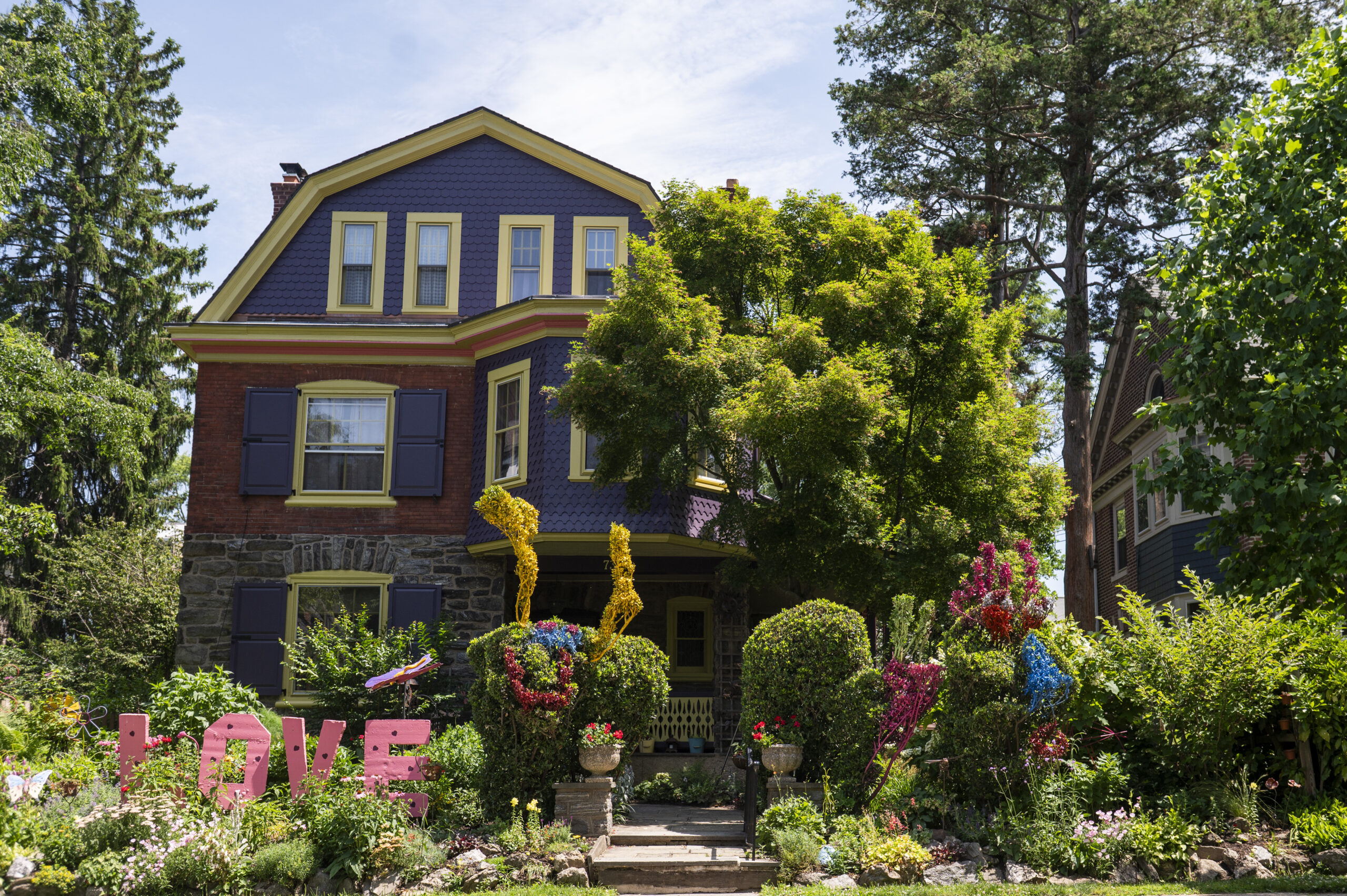
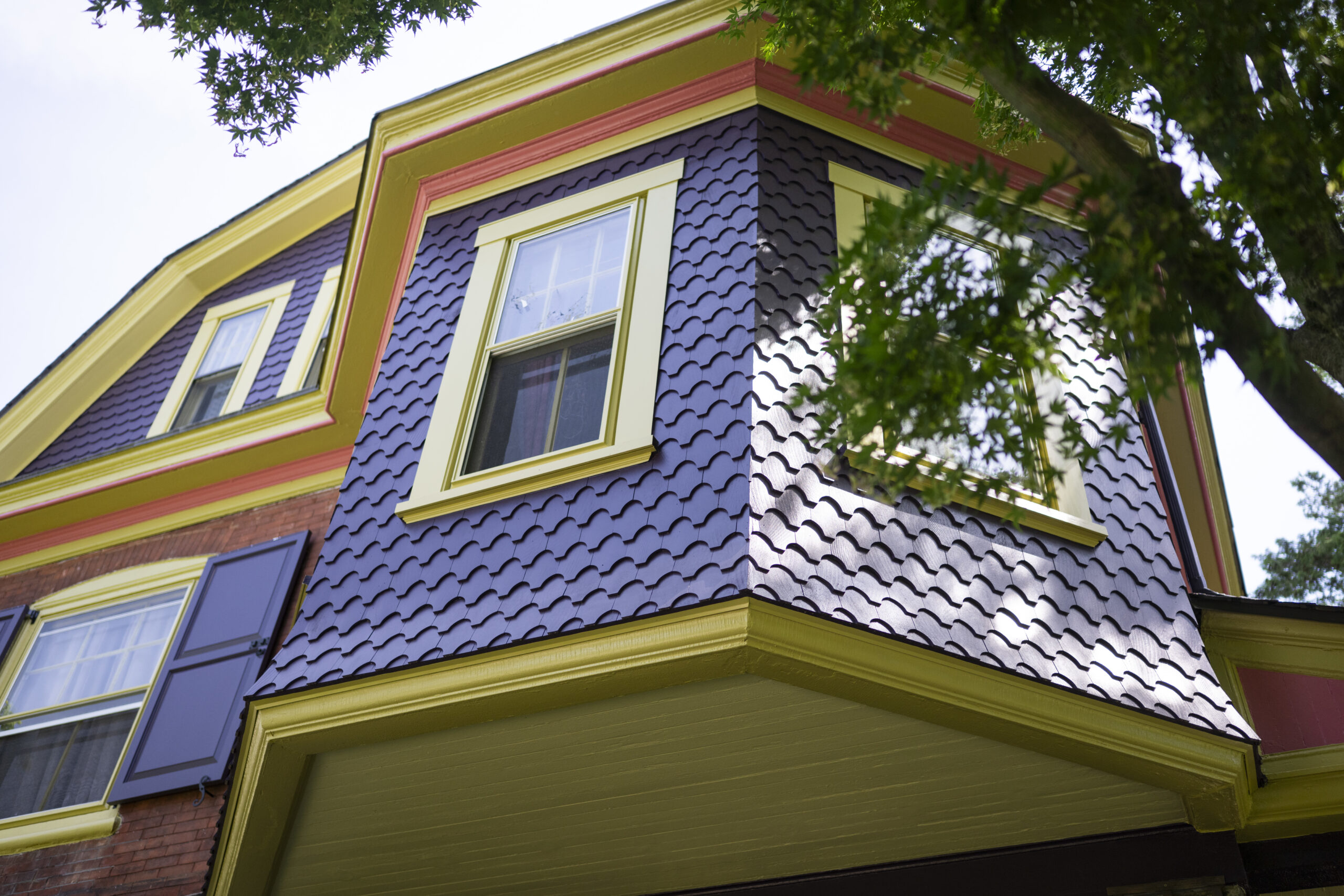
The facade surrounding that front door was the most recent project. They painted it a bold purple and updated the porch, shutters, and shingles.
Miller said she had always wanted a purple house. “It makes the house pop.”
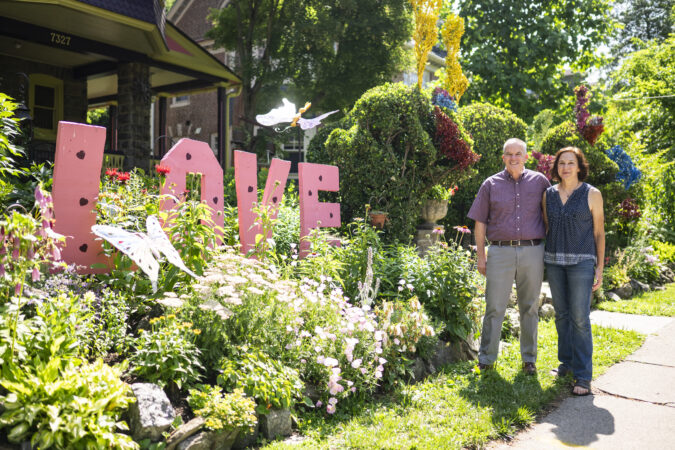
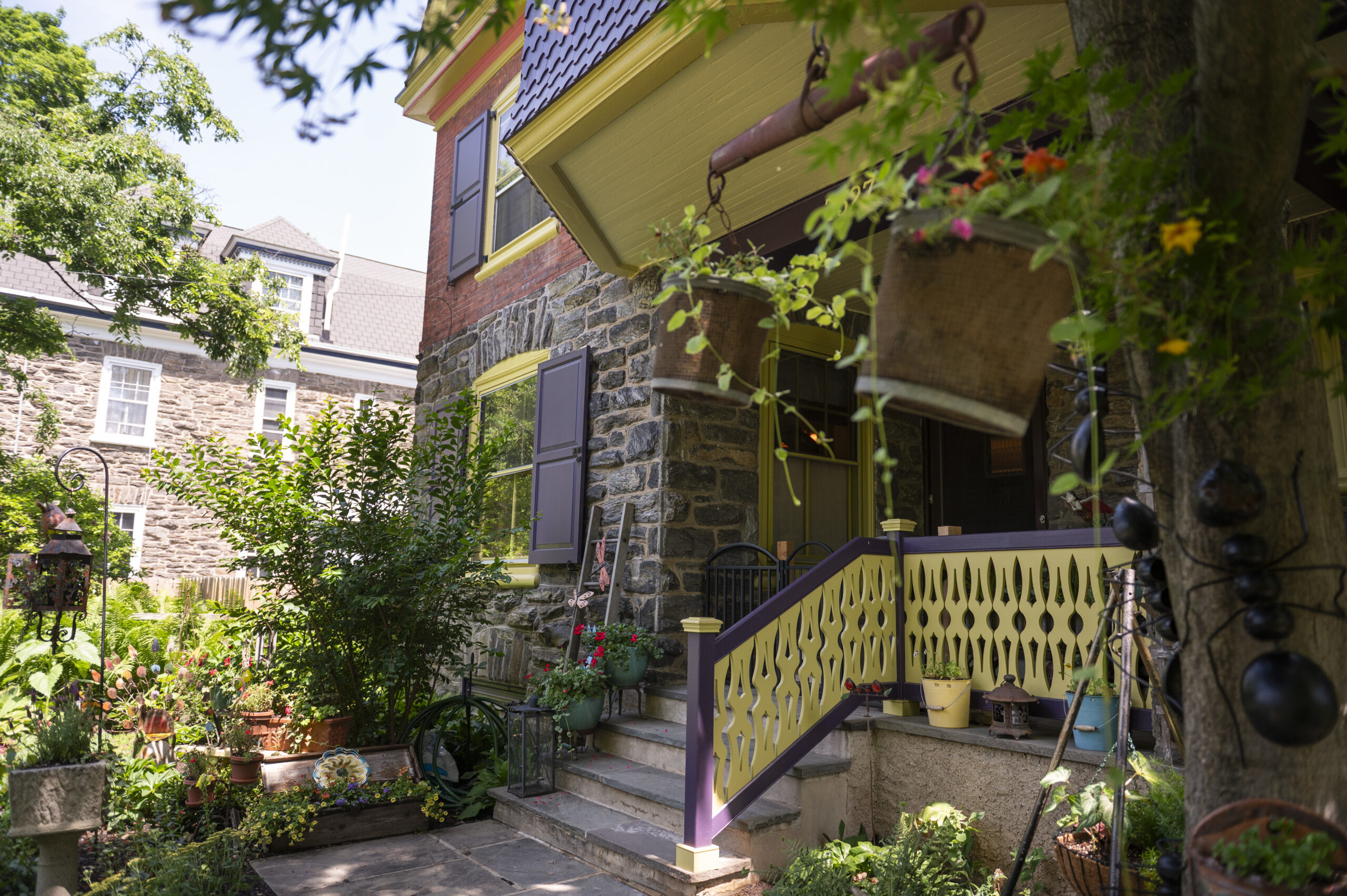
The exterior of Miller and Heim’s home and their front garden are bursting with color.The porch railing and soffit are painted purple and yellow.The home was covered in asbestos shingles when Miller and Heim bought it, and they uncovered the original cedar shakes.
The couple bought the seven-bedroom, 2½-bath home in March 2000, and moved in that spring after some initial work. At the time, they were renting near the Italian Market in South Philly and planned to buy there.
“On a whim, we looked in Mount Airy after friends mentioned a huge house for sale nearby. Once we saw the neighborhood and how much space we could afford — including a yard — we shifted our search to Mount Airy,” recalled Miller, a physician at the Hospital of the University of Pennsylvania. Heim works for human services nonprofit Face to Face in Germantown.
Over the past two decades, they updated nearly every part of the 3,200-square-foot house and its garden, as they raised their two children. Sara, 22, is a Penn graduate who now lives in South Philly, and Pete, 20, is a sophomore at Michigan State.
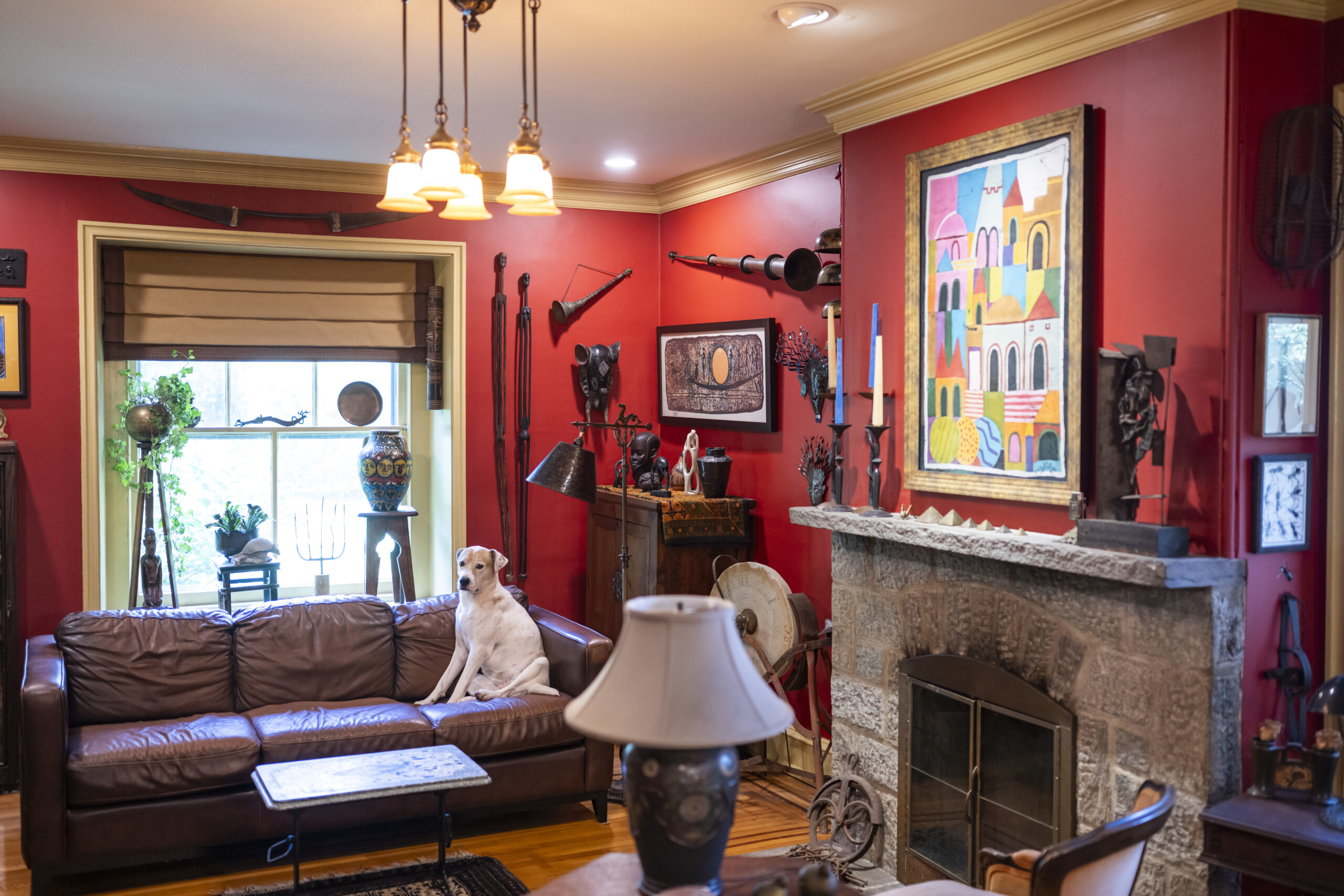
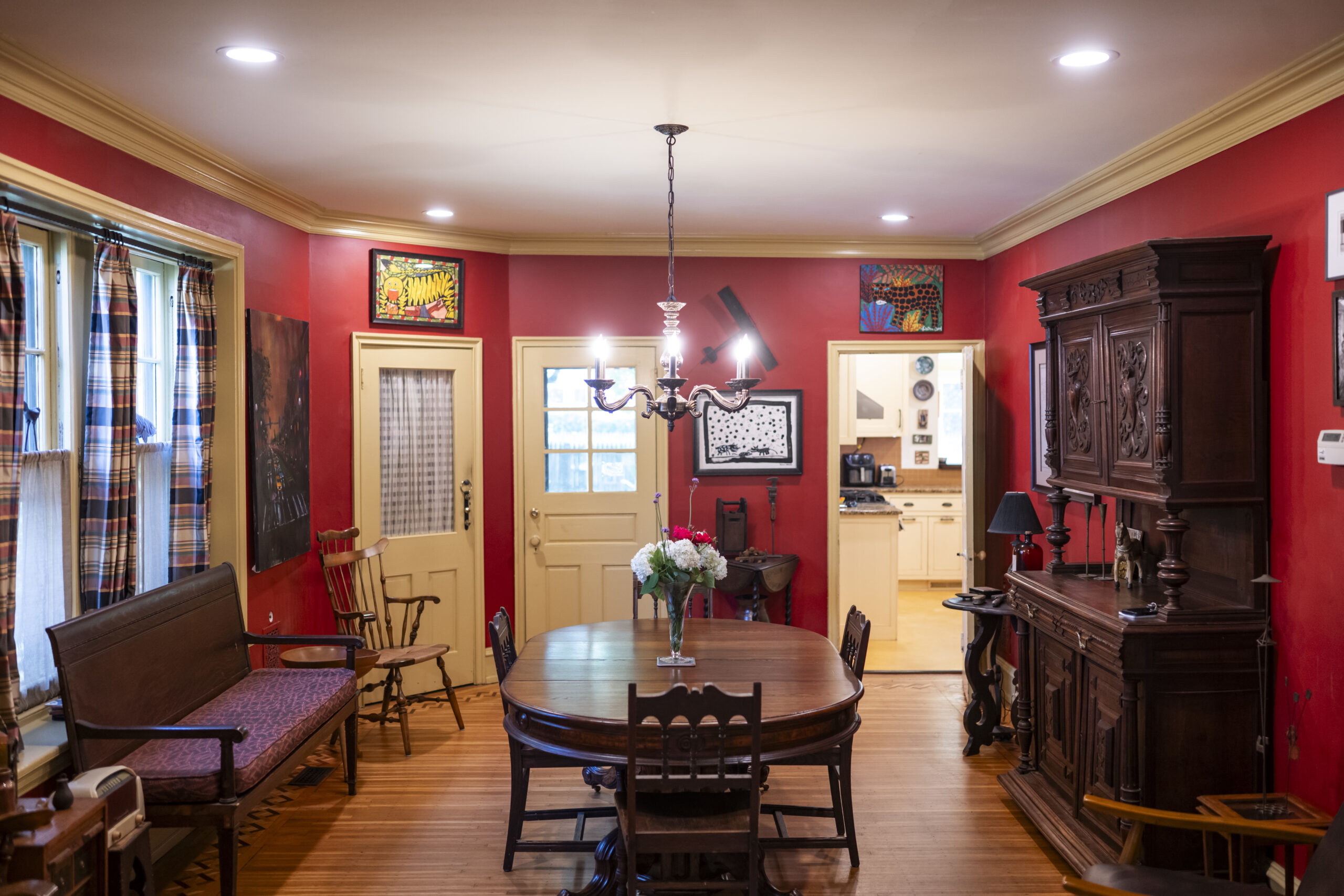
Miller said the living room and dining room are favorites. The spaces are made cozy by a wood-burning fireplace, also a backdrop for entertaining.
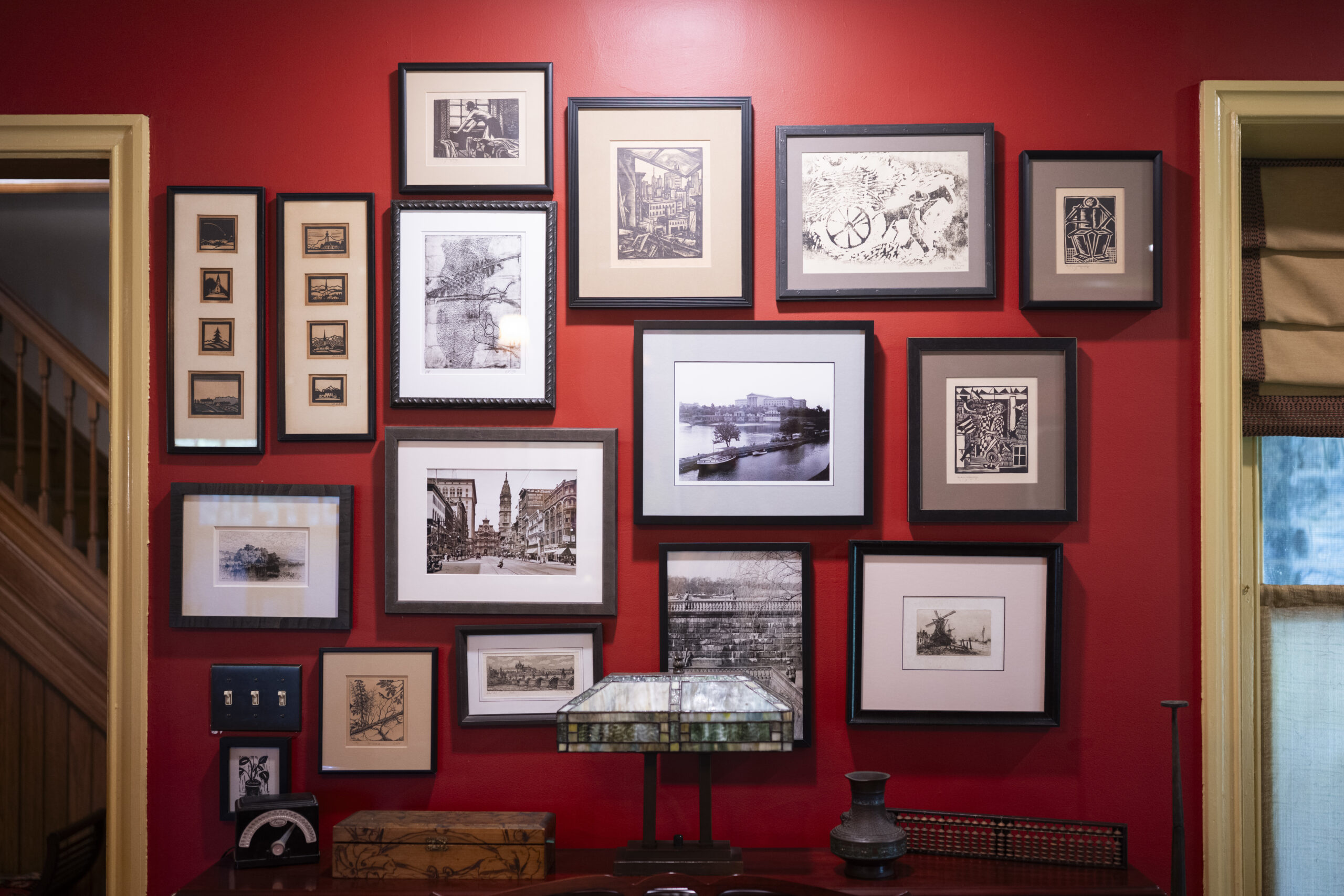
Art and instruments line the walls of the living room, as Maddie the dog enjoys the couch.The dining room has red walls and crown molding.
When they moved in, Miller recounted, the home’s living and dining rooms had already been altered, losing their original woodwork. A wall with pocket doors had likely been removed and replaced with folding screen doors. The rooms were painted red with white trim.
“We designed a wooden arch, installed larger crown molding, and removed a non-original built-in cabinet in the dining room,” said Miller. “Fortunately, the contractor removed it in sections and discovered it had been supporting the house’s main beam after studs had been taken out.”
They decided to keep the red walls and, after testing many samples, chose a trim color in greenish gold that gave the rooms a completely different look.
The home boasts an eclectic mix of furniture that they acquired from family, vintage shops, and what Miller described as “trash picking.”
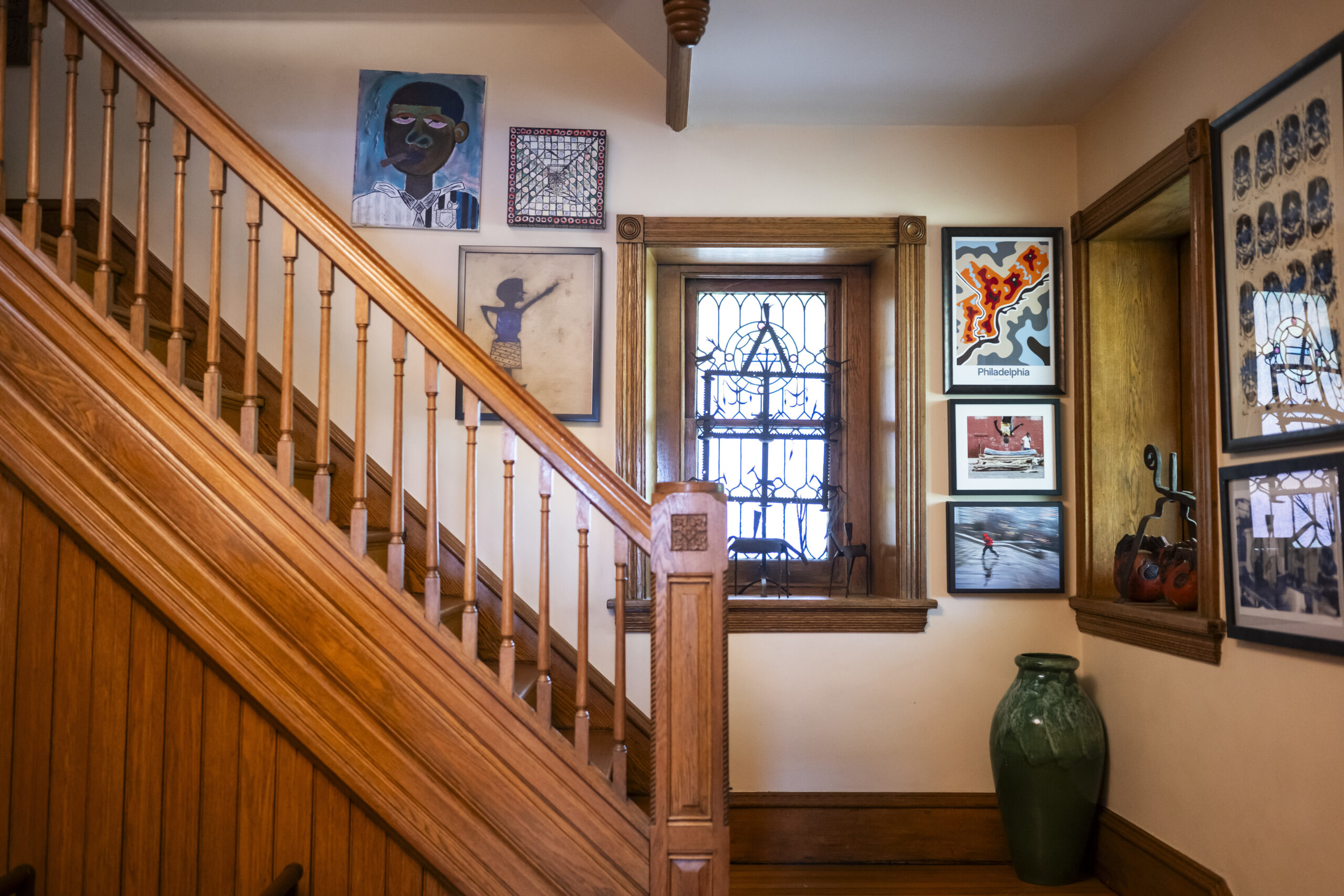
Paintings and photographs by local artists line the walls along the staircase.Art fills nearly every inch of this wall in the living room.
An abundance of art hangs on the walls, loosely grouped into collections. Miller has dedicated one whole wall to “works from family and local artists.”
“We use every space to display art and objects.”
Back when Miller and Heim bought the house, the kitchen appeared to have been last renovated in the 1960s. The sheet-vinyl floor was torn and the subfloor so soft, it crumbled to dust when they pulled it up, recalled Miller.
As a temporary fix, they installed veneered plywood, adding lines and nail marks to mimic wide-plank hardwood, and sealed it with polyurethane. They also painted the cabinets and walls. Those quick fixes held them over until a full kitchen renovation. A neighbor who is an architect designed the new kitchen, transforming it to include a bright breakfast room filled with natural light.
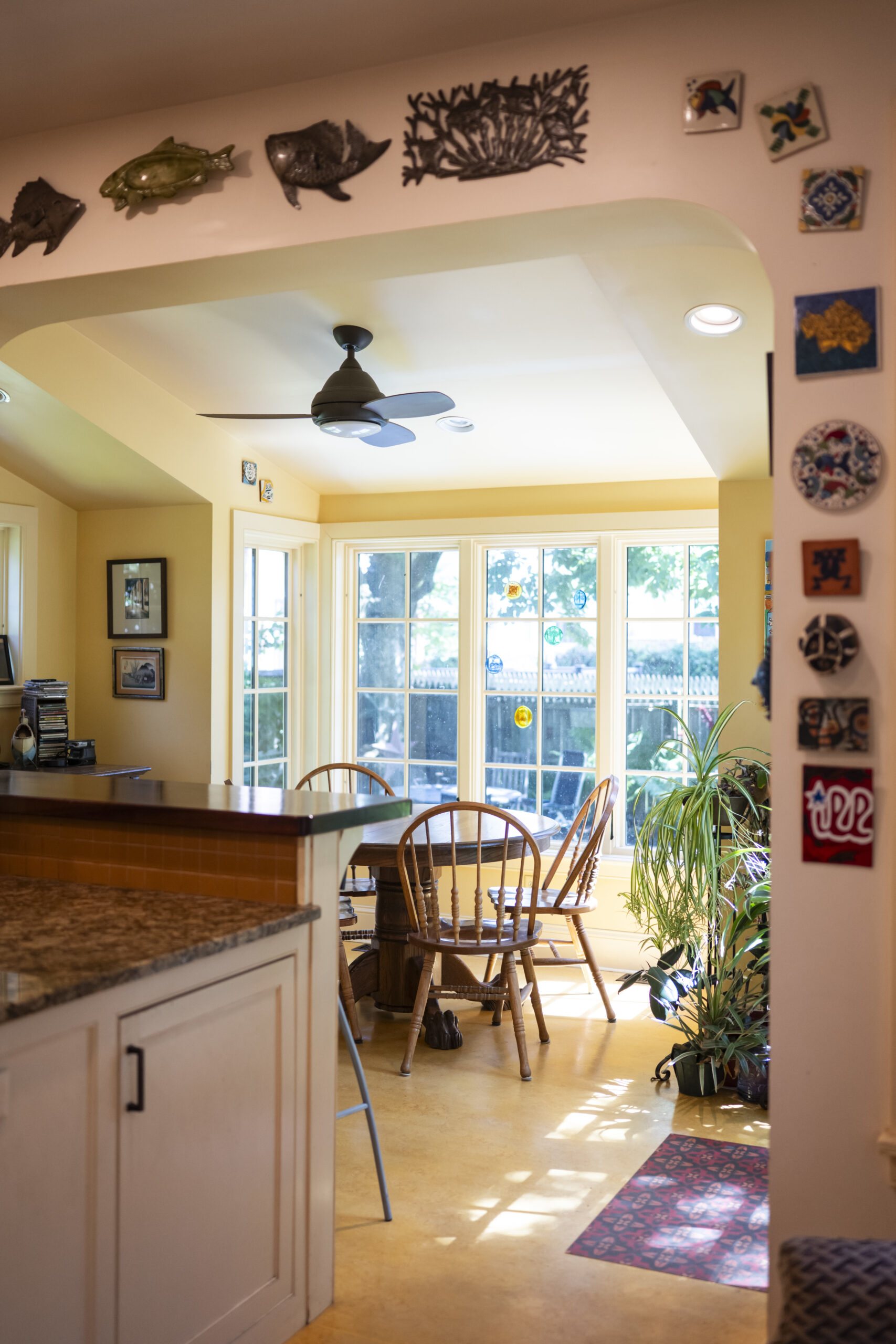
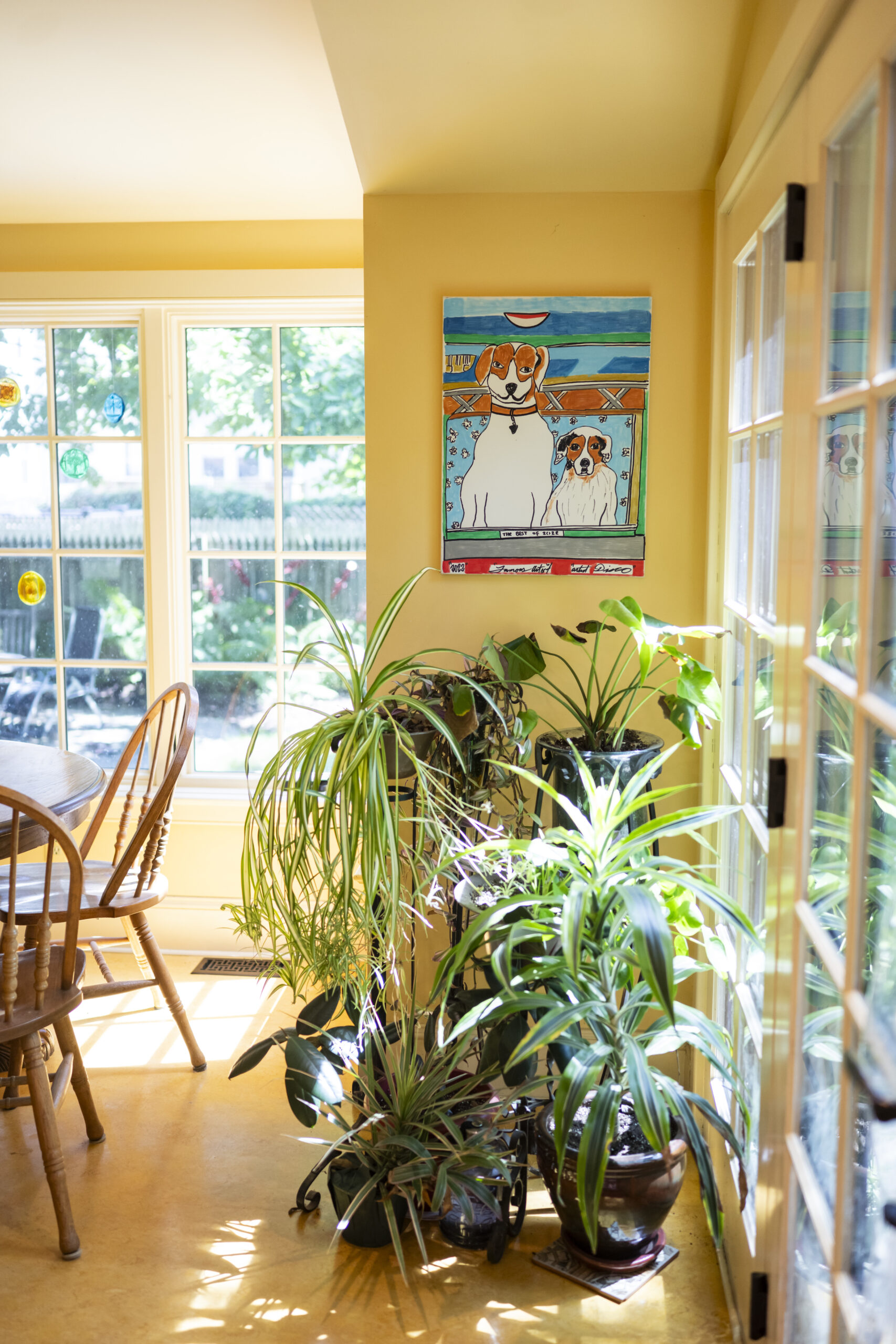
Tiles and wall sculptures line an arch into the kitchen’s breakfast nook.A portrait of Jean Miller and Craig Heim’s dogs, Maddie and Mabel, is on display in the sun-filled breakfast area.
“The kitchen was definitely a game changer, and it still feels new to me after 17 years. I love walking into it and feeling the brightness and natural light,” said Heim. “It’s the hub for so much of what happens every day and for special occasions, a very natural gathering place.”
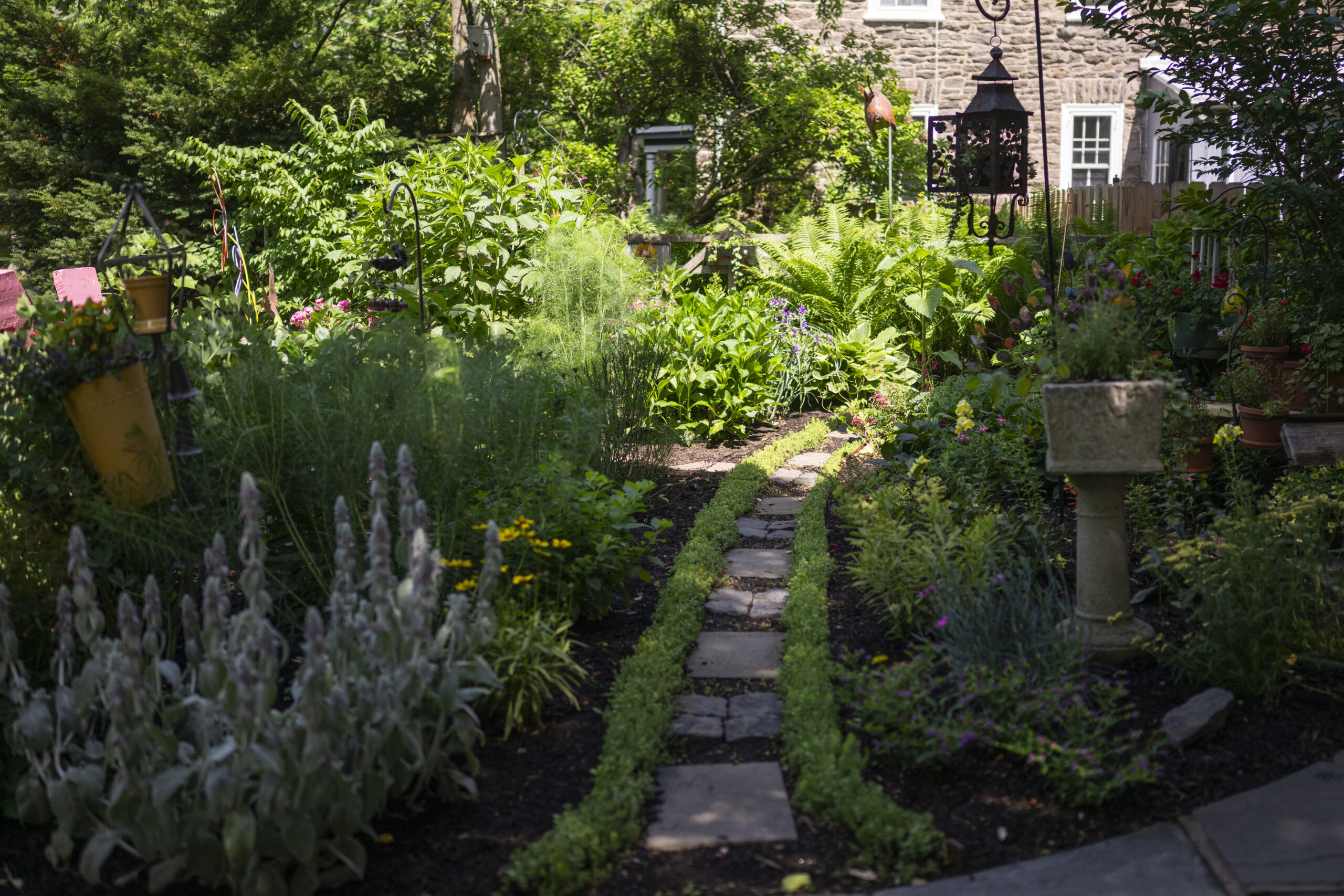
Outdoors, the garden is a treasure trove of found objects combined with topiary and plantings to create an eye-catching mix. The large porch leads to the front garden.
“It connects us to our neighborhood and neighbors,” Miller said. “Our garden is a destination for many on their walks and allows us to connect with people. It feels like an outdoor room.”
A path of stones runs through the garden.A planter the family trash-picked is filled with and surrounded by potted flowers.
The creativity inspiring the garden also shines through in the house’s bold facade.
“When the house recently needed to be repainted, we wanted to do something with a bit more pop,” Heim said. “So, we added the golds and pink to give things a little more zip.”
For holidays, they decorate the yard with inflatables, lights, and ornaments.
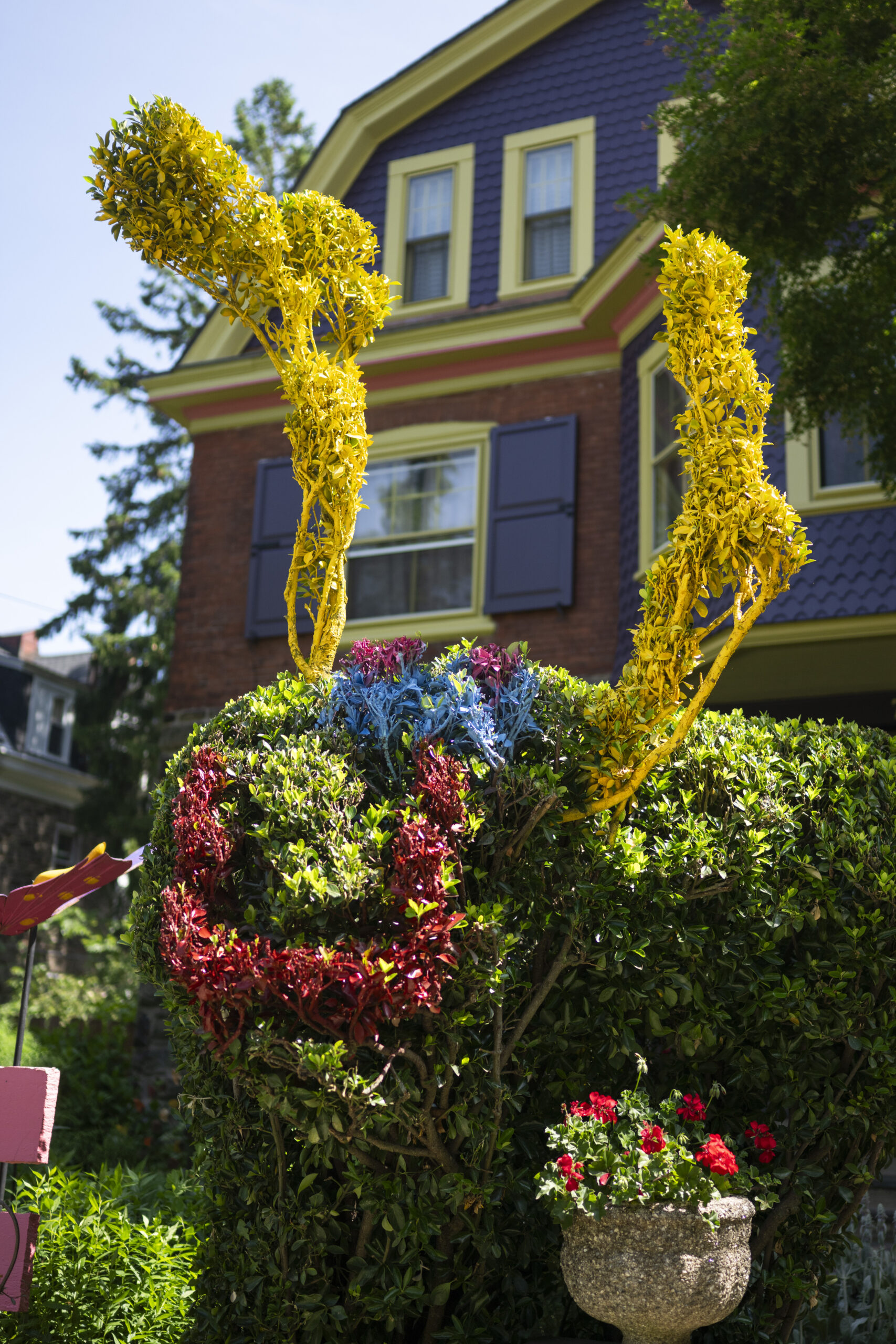
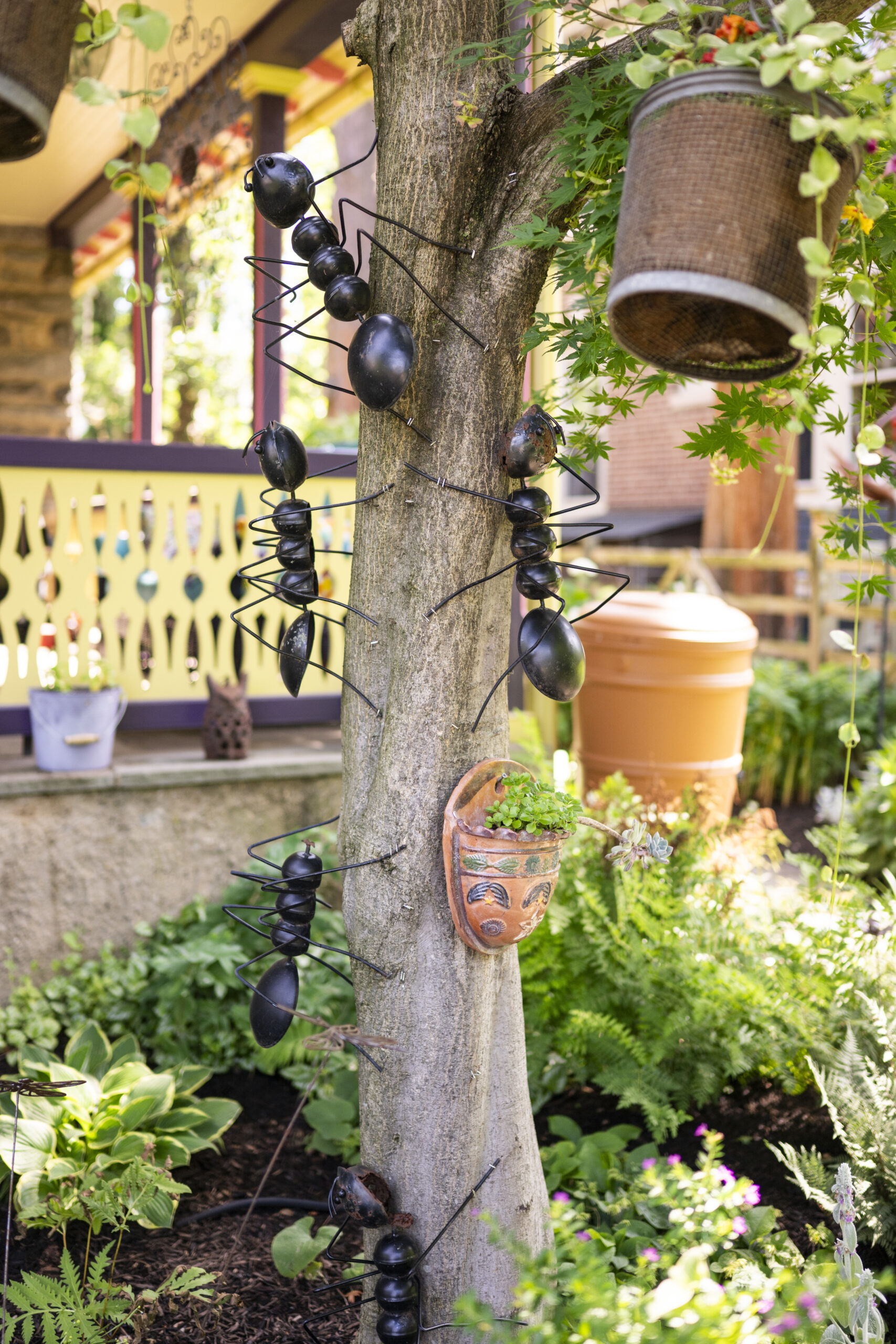
A hedge painted and shaped into a “happy bull” grows in front of the home. Heim often spray paints and cuts the hedges into shapes or characters.Decorative oversized ants are arranged as though climbing up a tree in the front garden.
Mount Airy now holds a special place in both of their hearts. They enjoy an easy walk to the train, Germantown Avenue’s commercial strip, the Wissahickon, and Chestnut Hill.
“We have a tight-knit group of neighbors, many long-term residents from our era and even earlier, and a whole new generation of younger people with kids,” said Miller. “It’s a wonderful community.”
Is your house a Haven? Nominate your home by email (and send some digital photographs) at properties@inquirer.com.
Homeowners across the Philadelphia region want to build garage apartments, in-law suites, and backyard cottages on their properties.
Mario Mascioli, owner of Acorn Built Homes, said he gets hundreds of inquiries per month for these accessory dwelling units (ADUs), which have made up the bulk of Mascioli’s business since his company opened in late 2024.
“The demand is real,” said Mascioli, who works across southeastern Pennsylvania and in Princeton. And builders like him are ready to create ADUs. But municipalities’ varying and often restrictive land-use rules often make that difficult.
Pennsylvania lawmakers are currently considering legislation that would allow homeowners to create ADUs in places that are zoned for single-family houses without having to get special permission. The bill passed the state House earlier this month and is now before a state Senate committee.
Mascioli has testified before state lawmakers to advocate for the loosening of restrictions for ADUs.
“It would mean that homeowners that want these — which are plenty of them — would be able to get it done quickly, more economically, favorably,“ he said. ”It would be fantastic.”
The Inquirer talked to Mascioli about the ADU landscape.
This interview has been edited for length and clarity.
Mario Mascioli, owner of Acorn Built Homes, testifies about accessory dwelling units at a policy committee hearing of Pennsylvania legislators on May 21, 2026.
Why do people want ADUs?
The three drivers for why people want them are: aging-in-place elderly parents; adult children that can’t afford rent or can’t afford to buy a home; and third, people want rental income.
What types of ADUs do you offer?
We build studios as small as 240 square feet. [But] most people want a space that has at least 500 square feet. Most opt for one or two bedrooms.
We [also] do additions. We do garage conversions. We do conversions of basements.
In many cases, we have to attach an ADU as an addition to a house because of the township requirements. And in many cases, we’re limited as to the features we can put into it, because of those requirements.
What’s something that clients have asked for that they weren’t able to get because of local land-use rules?
I’ll give you a real-time example. We start every project with what we call our “feasibility and scoping” phase. That takes about four or so weeks to dial in on what’s buildable from a structural, construction, architectural, and also an approvable perspective.
We have a customer we’re in the final phase of that study with. They have a beautiful property, plenty of land. They wanted a detached ADU for the couple’s mother, who’s going to be moving up from Florida to take care of their newborn, [who is due] in December. In this case, we can’t do a detached unit without going through a variance.
We also uncovered through our feasibility process that … if we were to extend the garage and build on top of it, that would require a variance.
Third thing is there’s a floodplain that runs through the property. And any modification to the footprint of the property would also be a variance.
Those are three separate variance processes, each of which would require attorneys and fees and zoning hearing boards.
So what we’re left building[without zoning approvals] is to raise up the loft on the second floor of the garage, put some dormers in it to make it more spacious, and create a one-bedroom living space there — butwithout a full kitchen with built-in cooking facilities. We can only put a kitchenette in.
That is very typical. That’s 90% of what we deal with as it relates to ADUs.
What’s different about building an ADU vs. a typical single-family home?
Basically, the red tape impedes or kills [ADU] projects before they start. And that is because there’s over 2,500 municipalities in Pennsylvania. Each with different zoning rules as it relates to ADUs.
In some townships, you can build one with no issues. But if you step, you know, a mile over the line in any direction, it’s either banned entirely or there are so many restrictions and other requirements that it takes [a] very long [time], if at all, to get through zoning hearing boards.
Permitting and the expense of the red tape can make many projects impractical.
Why did you decide to go into the ADU business in Pennsylvania with the challenges you’ve described?
If you look at things from a national perspective, 20 states have passed legislation like Pennsylvania currently has in its legislature.
People want them. That’s about affordable housing. I thought and still believe that it would be inevitable that ultimately Pennsylvania would pass such legislation. And if we were here in advance of that, establishing ourselves in the market, we would benefit from that legislation being passed.
The six-bedroom, three-bathroom twin in University City is just two blocks from where Emma Steiner was born. Still, it has given her and her husband, Joe Leonard, a totally new housing experience.
Steiner, a psychotherapist, and Leonard, an attorney, had been renting in the Graduate Hospital neighborhood when they decided in 2013 to make the Victorian twin their first house.
The living room. The home has hardwood floors.
The open floor plan was unusual for the neighborhood, Steiner said, and Leonard “was blown away by the big old trees.” And she said both were impressed by the large windows at the front of the house.
The couple and their two children, aged 10 and 7, will be moving three blocks away to a larger house with a bigger yard.
“We’re staying in the neighborhood we love,” Steiner said.
KitchenBreakfast nook
Their home had undergone a complete renovation in 2008, opening up the first floor with high ceilings.
Steiner and Leonard replaced the flat roof and mansard roof last year and this year, adding a new skylight. And they replaced the porch steps and basement electrical panel.
Office
Built in 1913, or perhaps a little earlier, the house has hardwood floors, central air, and is 2,760 square feet.
There are three bedrooms on the second floor, including the primary suite and its en suite bathroom. One of the bedrooms is used as a family room.
Back yard
There are three bedrooms on the third floor. The second and third floors each have a hall bathroom.
The house is a short walk to Clark Park, the renovated Kingsessing Recreation Center, Baltimore Avenue stores, Children’s Hospital of Philadelphia, and Drexel University.
It is listed by Asher Brooks Chancey of OCF Realty for $689,000.
The buyers: Rebecca, 43, surgical oncological nurse, and Ryan Taylor, 43, chief financial officer
The house: A 3,250-square-foot home in Chestnut Hill with five bedrooms and 4½ bathrooms built in 1898.
The price: $925,000. Originally listed for $1,100,000.
The agent: Jacob Markovitz, Elfant Wissahickon Realtors
Rebecca and Ryan Taylor’s home in Chestnut Hill became “an amazing deal” after they negotiated for repairs, the couple said.
The ask: Originally from Westchester, N.Y., and Wayne, respectively, Rebecca and Ryan Taylor have been in Chestnut Hill since they bought their first house there in 2017. They loved their other house — a 1920s twin off Germantown Avenue with beautiful architecture, and the place where they’d had their two children, Lily, 3, and Asher, 5. But they felt the need for more space.
“We wanted property for the kids to run around, at least four bedrooms, and two-plus bathrooms,” said Rebecca.
The search: The couple were on the lookout for a new house since they had their second child. But it had to be right, so they took their time exploring options. School districts were a big factor in their decision. “We hadn’t fully decided if we wanted to stay in the city or not,” said Rebecca.
They toured a few houses in Glenside, but that didn’t feel like the right fit. Eventually, they decided they wanted to do whatever they could to stay in Chestnut Hill and upped their search in the area with their agent.
The family of four wanted several bathrooms in their new home. This one has 4 and a half.
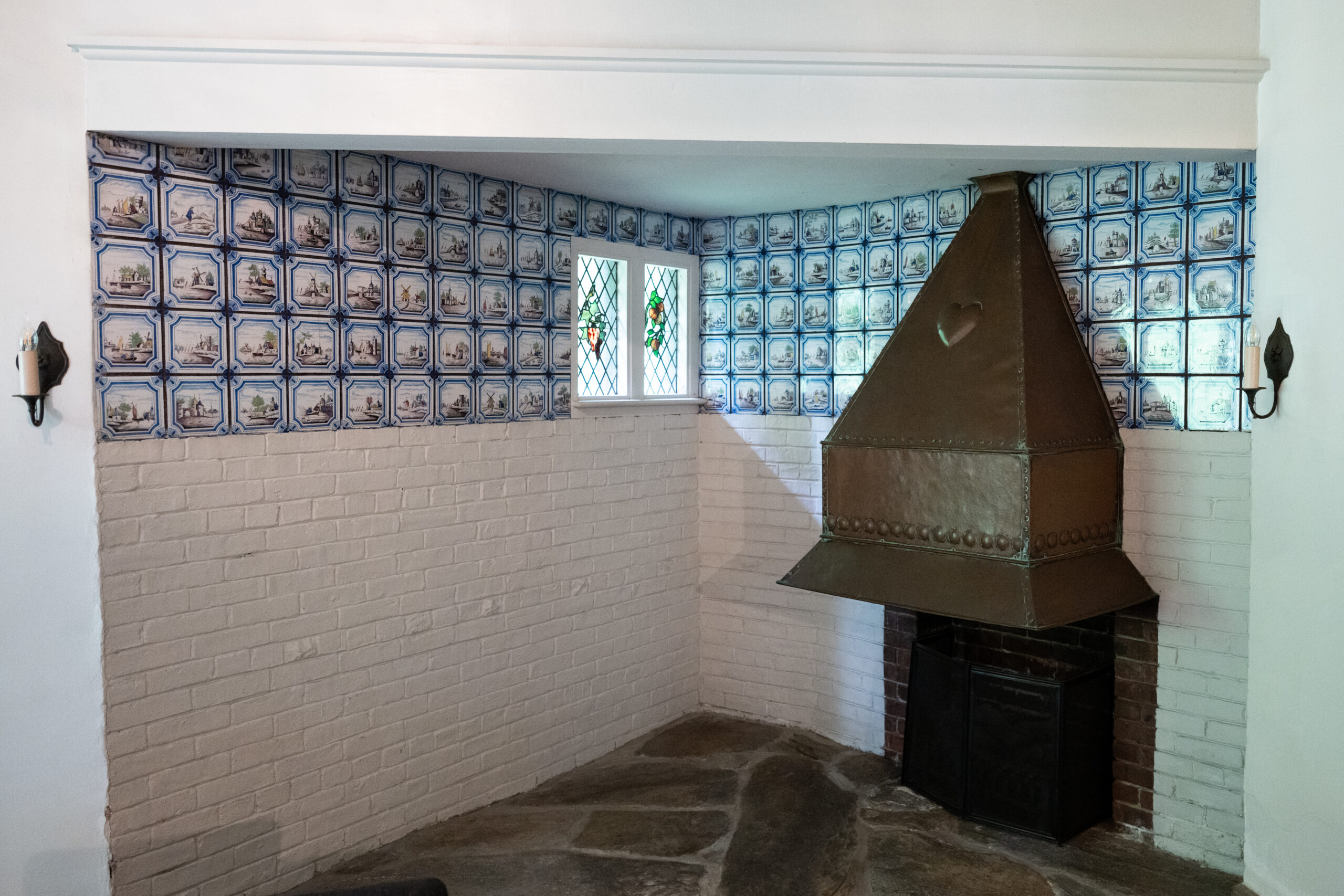
The appeal: After two years of searching, their agent found a five-bedroom, 4½-bathroom house, listed in an estate sale. They both fell in love with the historical details: heart carvings in the stairwell, stained glass all over the house, as well as the Dutch tiling in the dining room.
“There’s craftsmanship that you can’t find anymore,” Ryan said. “This house was built largely by hand 127 years ago.”
Plus, the location was right: Chestnut Hill, with its small-town feel, city access, and plentiful nature.
“The community with small children is huge,” she said. “There’s so many trees. You can hike in the Wissahickon, and Pastorius Park is right in town.”
Equally important was public transportation. Rebecca’s commute on the Chestnut Hill West Line to Center City would take only 40 minutes.
But the house was old and in need of repairs.
The deal: The Taylors were surprised to find the house’s septic system was eroded, and they had to use a private septic system, rather than city water management. An initial evaluator told them they might not be able to put in a new septic at all.
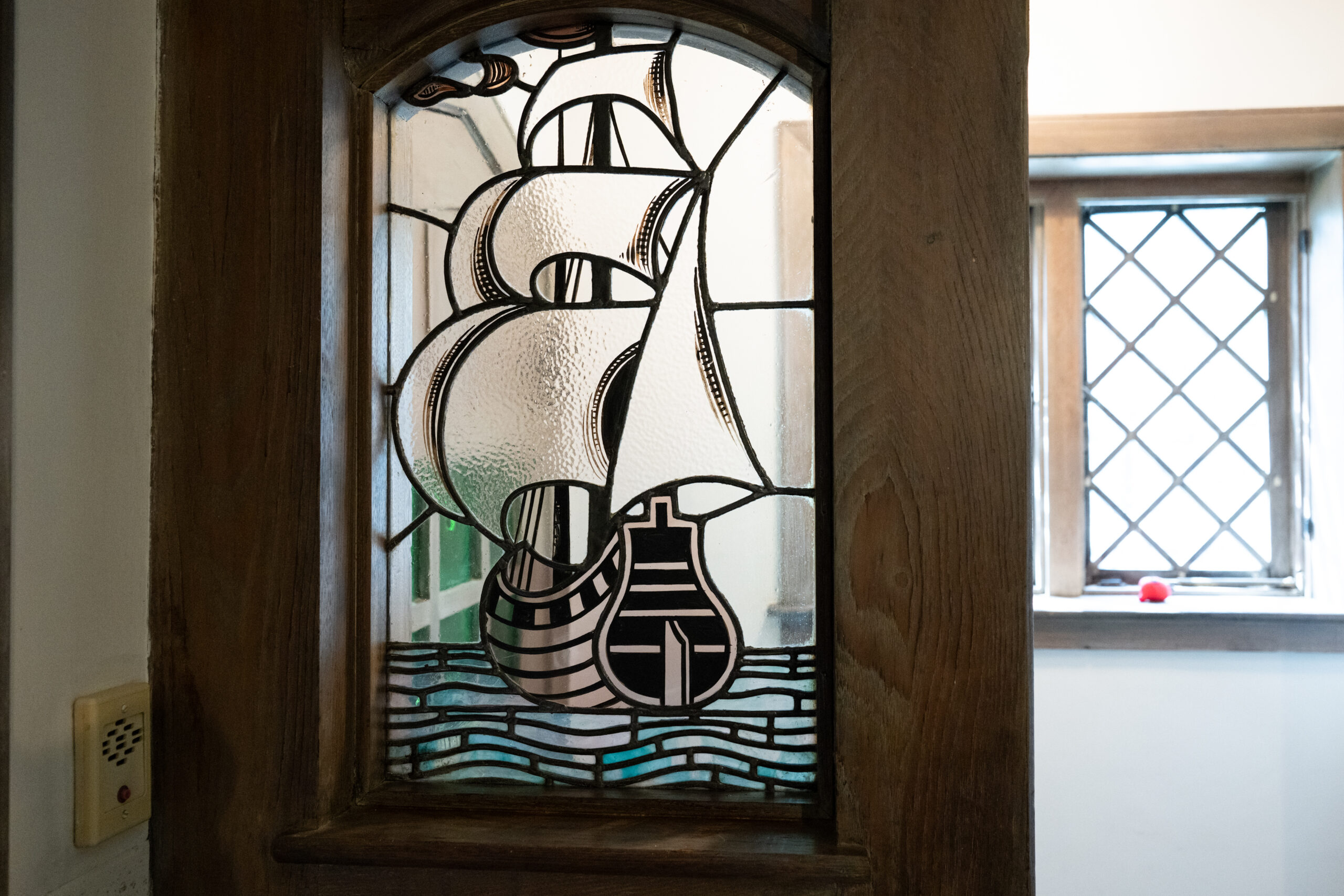
A nautical stained glass window in the front entryway of the Taylors’ home. The couple loved the historical details of the old home.
“That was scary. We backed out from the deal because we felt like, ‘Oh my God, this wouldn’t be a livable house.’ I mean, what would we do?” said Rebecca.
When they took steps to walk away from the sale, their agent suggested they ask the sellers to drop $100,000 so they could figure out the issue. They agreed, and the sellers accepted their negotiated offer on the house in a verbal contract. The Taylors then listed their own home, which sold within a week.
“We got an amazing deal on this,” said Ryan.
The money: They purchased the home for $925,000 after negotiation. It was originally listed for $1,100,000. The mortgage rate is 6.625%. They borrowed $740,000 (80%). The down payment was $185,000, paid with the proceeds from the sale of their previous home, which they sold for $675,000. The closing costs were $42,500, and their monthly payment is $5,750 with escrow, interest, and principal.
The move: They closed on Aug. 6, 2025, and moved in shortly after, going on a preplanned vacation to the beach the day after move-in. They immediately had the original quarter sawn floors refinished in white oak.
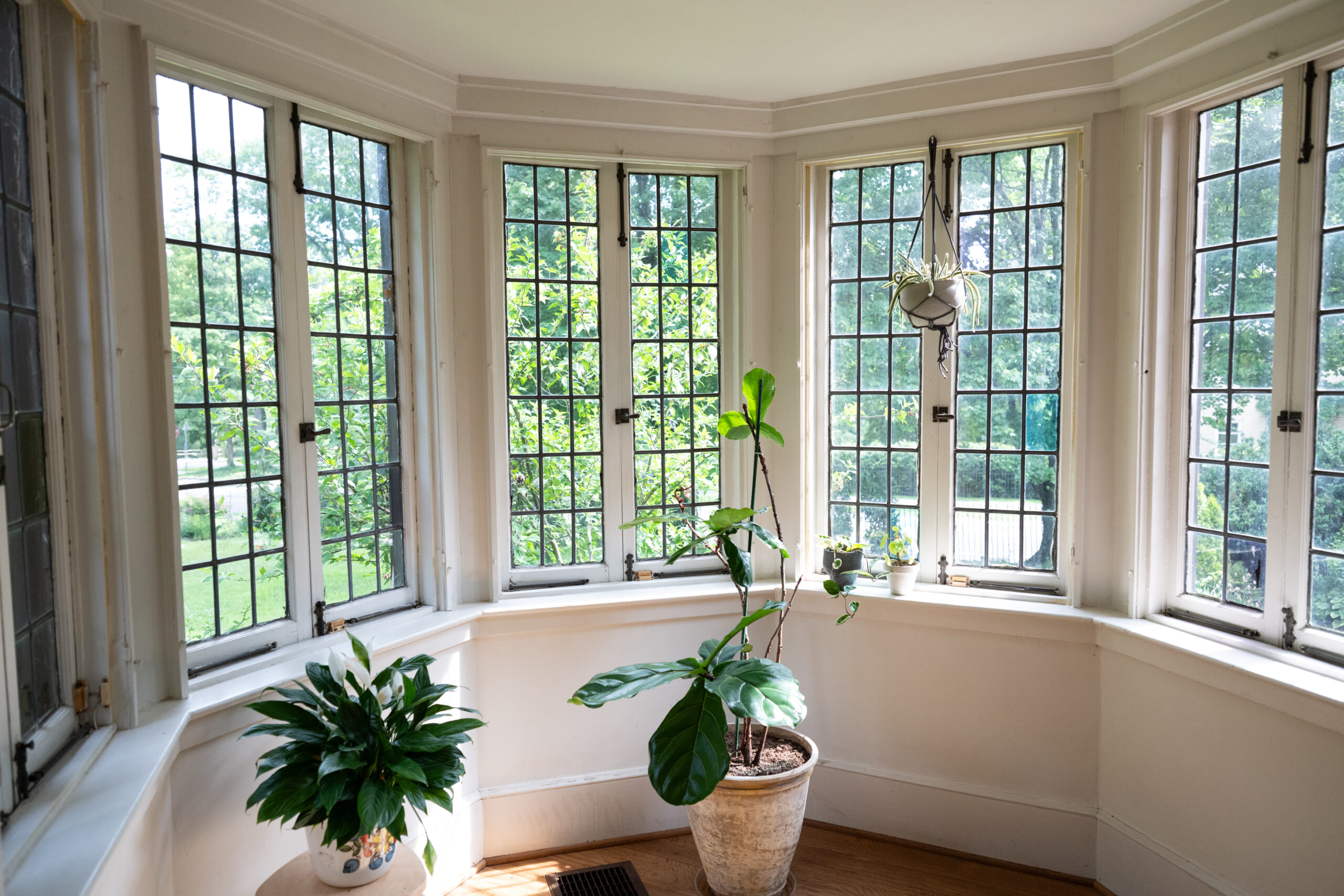
Outdoor space for the kids and natural light were selling points in the Chestnut Hill home.
“The floors had a dark stain,” Rebecca said. “As soon as we did the floors, the whole house lit up.”
They had a lot of work planned, including the new septic system, so they rented a house in Conshohocken for a month while the larger renovations were ongoing.
Life after close: The house needed significant renovations and repairs, which Ryan estimated at $200,000 so far.
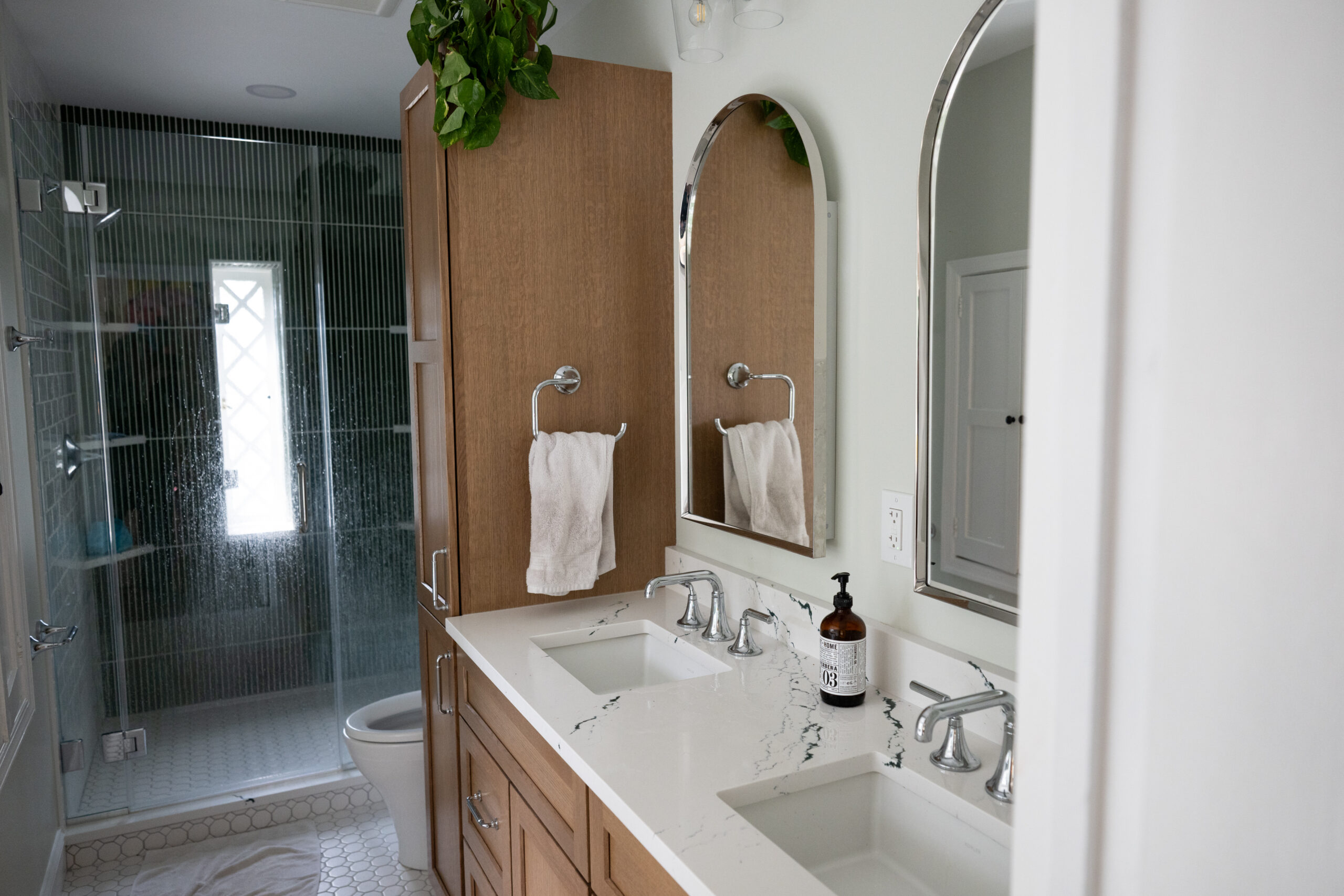
Projects included asbestos removal in the basement, replacing the septic system, refinishing the floors, replacing the roof on the garage, renovating the kitchen, renovating the master bathroom, replacing the windows, landscaping with privacy hedges and tree removal, and converting a second-floor closet into a laundry room. The windows in the sunroom had been plastered over, so they exposed those. They wanted to make the bathroom feel luxurious with green tones and exposed the brick of the old stove in their kitchen.
After investing in their first round of repairs, they find the home to be peaceful and idyllic, with trees and greenery outside and a natural flow inside. “It’s been a wonderful transition, a wonderful home. The house is just easy to live in,” said Rebecca.
Details like Dutch tiles in the kitchen made the Chestnut Hill home appealing.
Did you recently buy a home in the Philadelphia area or South Jersey? Share the story of how you did it. Email Inquirer real estate reporters at properties@inquirer.com.
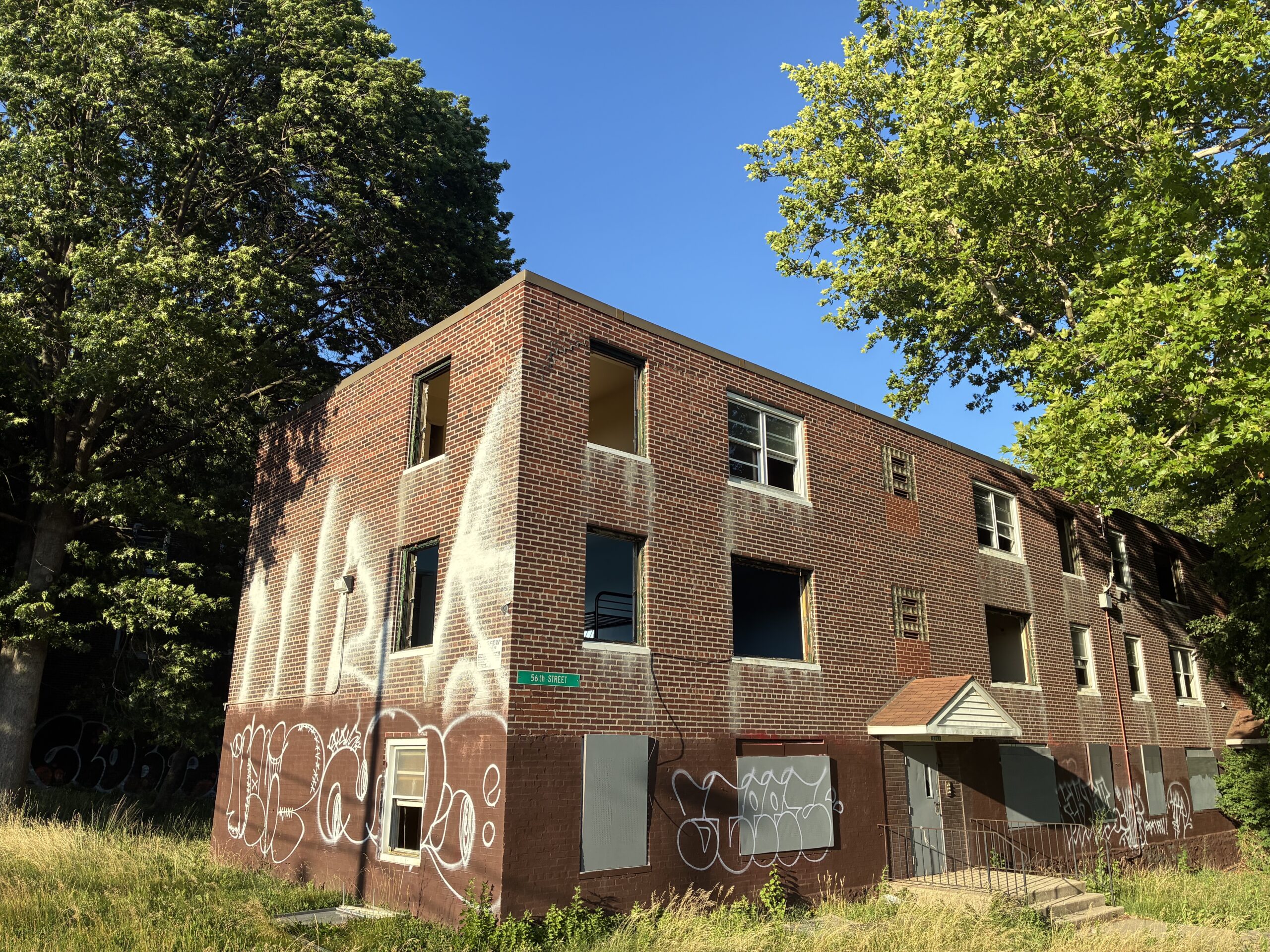
Mayor Cherelle L. Parker has declared a public safety emergency at Bartram Village, a vacant Philadelphia Housing Authority (PHA) complex in Southwest Philadelphia, after squatters moved in and caused extensive damage.
This declaration clears regulatory hurdles that had delayed PHA’s plans to rapidly demolish the 45-building complex, where the last tenant moved out in 2025.
“For too long, these vacant buildings have posed serious safety risks to surrounding residents and the broader community,” Parker said in a statement Thursday. “This action clears the way to remove those hazards and replace them with new housing, new opportunity, and new investment.”
Bartram Village dates to World War II, when it was built to host defense workers during the wartime industrial boom. The site was later transitioned to the traditional public housing program, providing affordable housing for up to 500 households.
PHA has been planning a probable demolition for a major redevelopment since at least 2018, when it was estimated the buildings required repairs reaching almost $200 million in today’s dollars. Former residents would have a right to one of the 688 new units planned for the site.
But after tenants were moved out, the 22-acre property attracted squatters despite PHA’s security patrols in the area. Beyond occupying the space, squatters tore copper wiring from the buildings and damaged the popular neighboring park and historic site of Bartram’s Garden.
“We boarded it up, it was secured, and almost immediately we realized that folks were penetrating those areas in the back and coming in through Bartram’s Garden,” said Kelvin Jeremiah, president of the housing authority. “But because of the size … it became a real issue. The more we removed people, the more they came in.”
Councilmember Jamie Gauthier’s office began raising alarms in February about the state of Bartram Village.
“I warned that failing to act quickly would [exacerbate] safety issues and cost taxpayers’ money,” Gauthier said. “The buildings became hot spots for squatters and provided cover for inflicting over half a million dollars of damage to Bartram’s Garden.”
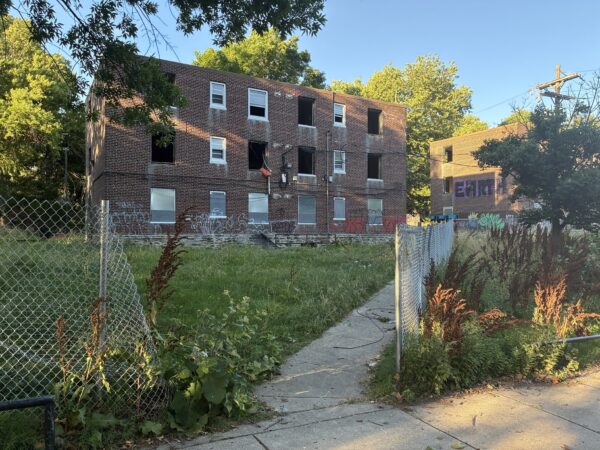
An abandoned Bartram Village apartment, which will soon be demolished.
Jeremiah said the housing authority couldn’t move to demolish the buildings immediately because Bartram Village is eligible for inclusion on the National Register of Historic Places. The mayor’s emergency declaration allows the agency to bypass a lengthy federal review process. The buildings are not protected by local preservation regulations.
Following Parker’s actions Thursday, “we are now prepared to move forward on an expedited basis to have the site demolished,” Jeremiah said.
PHA plans nine apartment buildings and over 150 townhouses for the Bartram Village site, supported in part by a $50 million grant from the federal government.
It is a major part of Jeremiah’s aggressive plan to renovate all of the authority’s existing holdings while building 3,000 new units and buying at least 4,000 units from the private sector.
The redevelopment has been years in the making because of tenant relocations and the federally mandated delay in demolition.
“Southwest Philadelphians have waited far too long for promised improvements at Bartram Village,” said Gauthier, who represents the area.
“I’m glad that Mayor Parker took the important step today of signing a public safety declaration giving PHA permission to demolish existing structures because they have been causing unsafe conditions to the community for a very long time,” Gauthier said in a statement.
Brian and Robyn Emmons can’t sell their 12-year-old, $900,000 rowhouse in Northern Liberties in its current state.
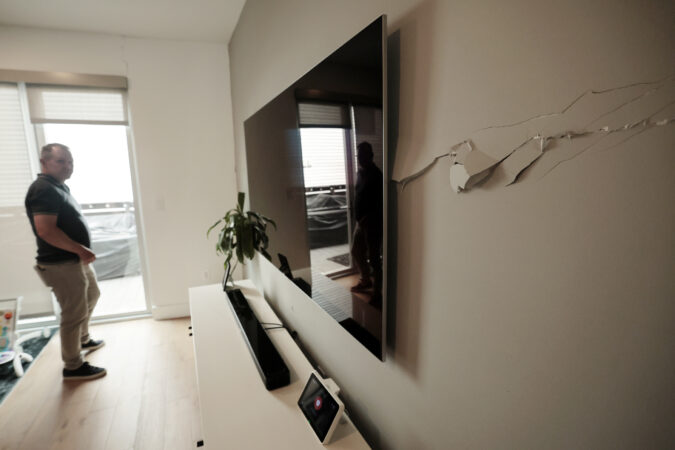
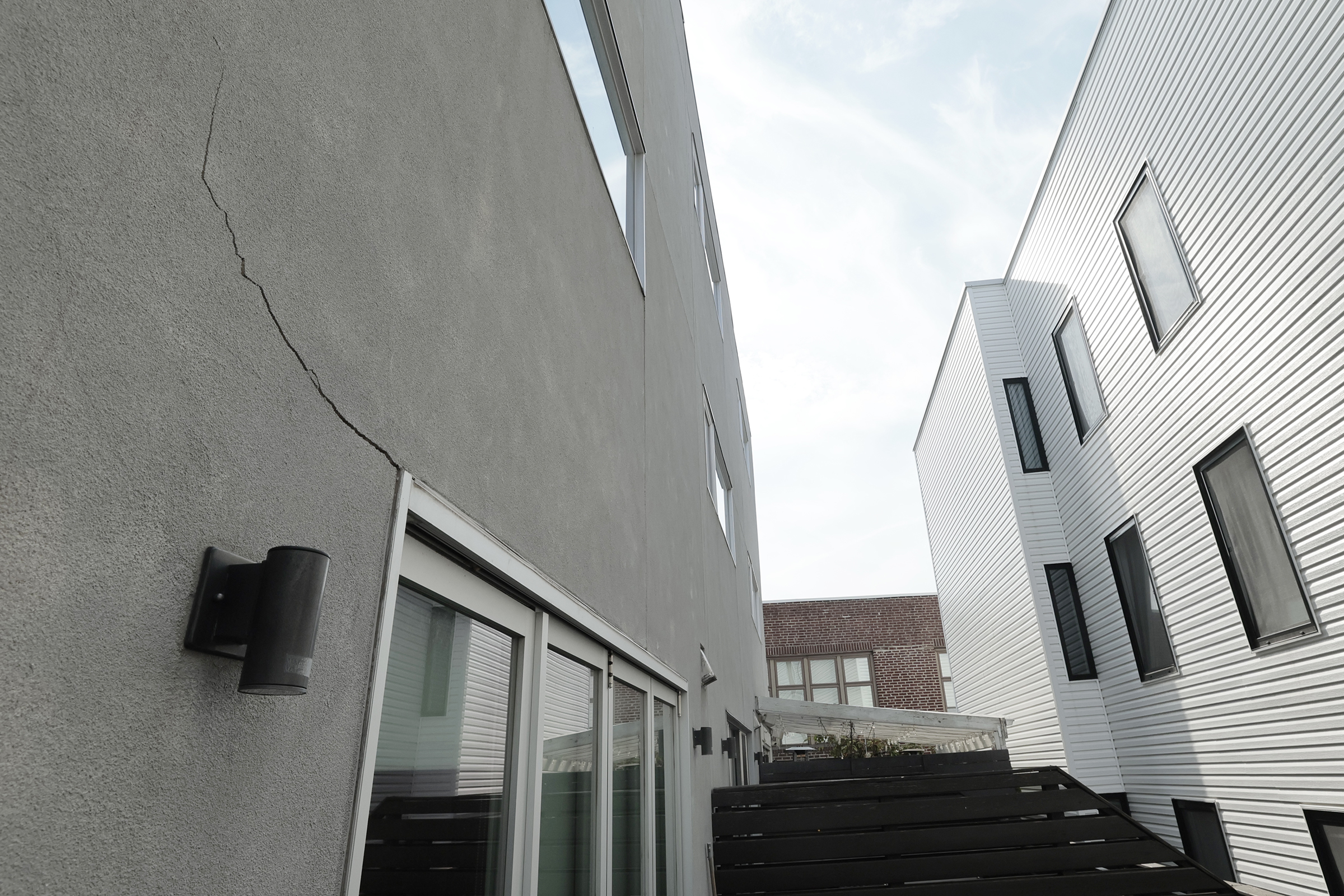
Fissures have spread across some of the walls in their home — which was built in 2014 — and cracks radiate from many doors and windows.
Three of their neighbors on Brown Street face similar issues. They say their homes were damaged by an apartment building constructed in 2023 that’s so close to the rear of their house they can almost touch it.
One family moved out after the city Department of Licenses and Inspections declared their home unsafe in 2024.
The Emmonses want to move to South Jersey, closer to family. Instead, as they wait for their second child to be born, they feel trapped.
“The fact that my neighbor was issued an order not to occupy the house, and it’s attached to our house, it’s just really scary,” said Brian Emmons, who has been a real estate developer in Philadelphia for almost 20 years. “We are stuck.”
Along with two neighbors, the Emmonses are suing the developer of the apartment building: Brian Zoubek, president and CEO of Zoubek Properties, who has built 250 houses in Philadelphia over his roughly decade-long career.
Since graduating from Duke University in 2010, where he played basketball for the Blue Devils, including on the national champion team that year, Zoubek tried his hand at a few occupations before settling on development. He has expanded his business to the Jersey Shore, recently debuting 10 almost million-dollar townhouses at a news conference with New Jersey Gov. Mikie Sherrill.
“I’m extremely proud of what we’ve built in Philadelphia,” Zoubek said in an email. “I put my own name on my work because I stand behind every project we build.”
Zoubek faces lawsuits from the owners of three properties, all alleging that he damaged their Brown Street homes. An Inquirer review of court records found that Zoubek’s companies were similarly taken to court over allegations of sloppy construction practices by their contractors in at least three prior development projects.
The eastern end of Brown Street with rowhouses (gray), the new apartment building Zoubek built next door (white), and the former school he transformed into apartments (red brick).
The Northern Liberties rowhouses
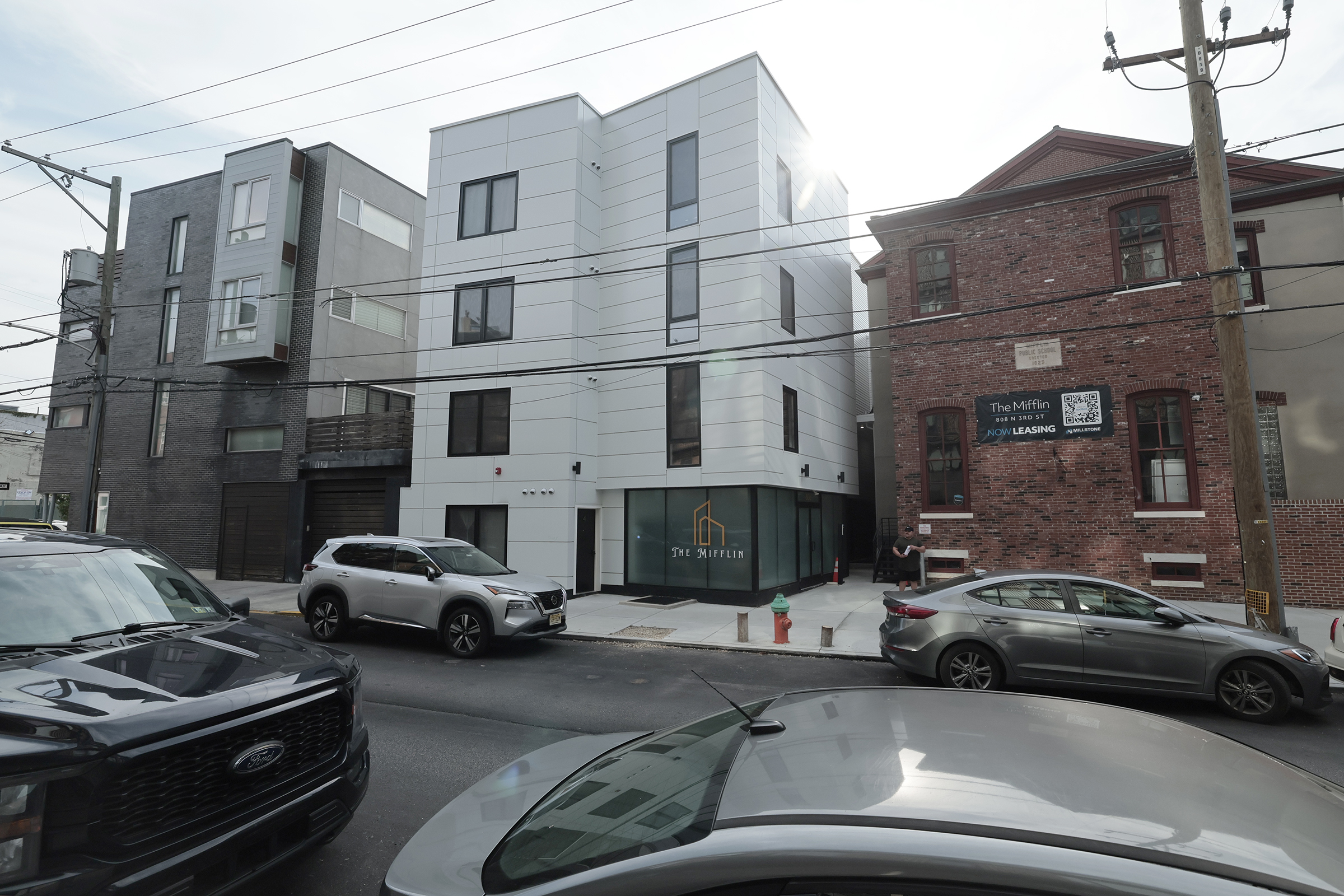
Emmons and his neighbors sued last year alleging that the damage to their homes is the direct result of Zoubek’s redevelopment of the Mifflin School, built in 1825, just to the north of their homes.
In mid-2021, Zoubek purchased the property — the oldest surviving public school building in Philadelphia — and carved it into 15 apartments with 14 more wedged into a four-story addition on a small lot between the Brown Street homes and the historic structure.
The recent lawsuits contend that the developer dug too deep while excavating the basement of the new building and damaged their adjacent foundations. Within the three homes — which The Inquirer toured with Emmons — cracks grow in walls, floors slant, the shared garage leaks, and residents have struggled to open some windows and doorways.
The other two homeowners declined to speak on the record, citing the ongoing lawsuits. The residents of a fourth house have resolved their case against Zoubek.
“We are aware of the pending litigation and are actively defending these claims,” Zoubek said in an email. “Given the involvement of multiple parties, we are engaged in ongoing discovery and investigation and are confident the process will bear out the facts.”
Zoubek was named in two earlier lawsuits that accused his construction crews of slapdash work that damaged neighboring properties. A third suit alleged that his company’s work triggered a floor collapse that injured two deliverymen.
Zoubek said in a statement that all prior suits have been resolved.
For Emmons, the experience on Brown Street has an irony to it. Ten years ago, he was the face of development in Philadelphia as president of the Building Industry Association (BIA) — a real estate advocacy group — and vice president of a development firm Toll Brothers runs in the city.
Usually in the position of advocating for new development, Emmons counseled his neighbors when the project was announced that it was allowed by the property’s zoning and not worth resisting. But he did ask his fellow developer about his plans for the new apartment addition to the Mifflin School.
A gaping crack in a first-floor wall in a home at 301B Brown St. in Philadelphia.
“He clearly was doing things the wrong way,” Emmons said. “And I know that because I’m in the construction industry.”
Zoubek contests Emmons’ assertion. He argues that many of his 30 building projects in Philadelphia involve basement excavation next to existing properties and that the Mifflin School project was fully permitted and supervised by skilled professionals.
“That experience, combined with the engineering oversight on this project, reflects how seriously we take this work,” Zoubek said in an email. “After concerns were raised, the project was reviewed by L&I, which did not issue violations or take enforcement action.”
A trail of lawsuits
Zoubek has been building in the Philadelphia area for more than 10 years, mostly developing small apartment buildings or a handful of rowhouses in the city’s booming river ward neighborhoods.
Zoubek, at 7-foot-1-inch, was a basketball star at Haddonfield Memorial High School and got into real estate after a stint running a cream puffery and, later, as a real estate agent for Cushman Wakefield.
He started his own firm, Zoubek Properties, in 2014 and a related construction management company called Z Builds. He also cofounded another company, Catalyst City Development, with childhood friend Tyler McNeil.
As his construction business grew, his enterprises were drawn into complex litigation alleging property damage or injury caused during construction.
Brian Zoubek in his now defunct cream puff shop Dream Puffz, a pre-development venture, in 2012.
According to one lawsuit, Catalyst, the company Zoubek cofounded, and Manayunk-based Grit Construction worked together on a small development on Hope Street in Northern Liberties in 2019. During construction, Grit ruptured a lateral pipe connecting a sewer main to a strip of nearby businessesfacing an adjacent block of Front Street.
Exhibits from that lawsuit show Zoubek proactively contacted the neighboring property owner, reassuring him that his crews had quickly rerouted the noxious flow by splicing in PVC piping until a more permanent fix could be made.
“Broke some sort of line,” Zoubek texted to the adjacent property owner, along with a photo of the messy scene. “So we put in a temp one.”
But a week later, business owners next door were complaining about chronic plumbing issues. The temporary line had become clogged with rubble and other debris from the ongoing construction.
According to the suit, in June, the toilets and sinks at a packing business on Front Street erupted as sewage backed up and flooded into the commercial unit. The next day, a barbershop next door was inundated with filth.
A plumber came out to snake out the line but discovered that Zoubek’s crews had capped the severed line. Eventually, tenants fled.
“Our tenants cannot continue with sewage backed up into their space,” a property manager for the commercial units next door wrote to Zoubek, in a 2020 email.
Zoubek said that the case had settled but offered few other details: “The matter was ultimately resolved between the parties.”
Zoubek Properties had also hired Grit and contractor All-State Services to demolish a building under the El in Fishtown in 2019 and build several new apartments.
In 2021, the owner of a neighboring apartment complex sued, saying that during teardown crews punched holes in the side of the adjacent building, damaging its roof, framing, and supports.
According to that complaint, tenants told a property manager about “a big noise and shaking in the building” during the demolition process.
After arriving on the scene a short time later, the manager “observed All-State Services employees drinking alcohol while on the job and stumbling down off of heavy equipment,” the complaint said.
Zoubek said that his contractor eventually repaired the wall and that a claim for further damages was handled by the two insurance carriers.
“The matter is fully resolved,” he said.
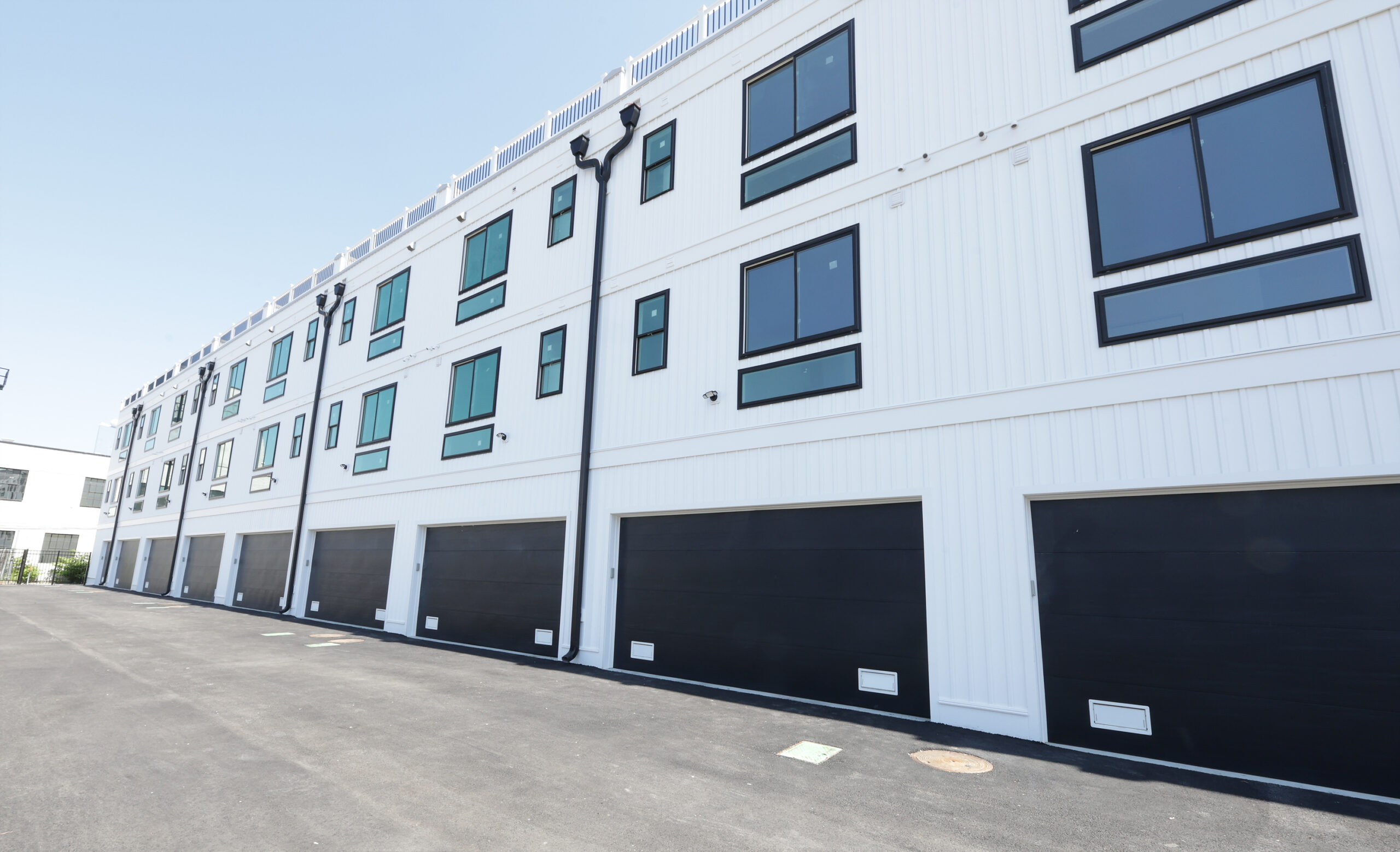
The new luxury townhouses on Kentucky Avenue known as the Residences at Orange Loop in Atlantic City, which Zoubek revealed with New Jersey politicians earlier this year.
As that suit unfolded, Zoubek had another project underway in Old City, again for a small apartment complex on the 100 block of North Third Street.
In 2021, two deliverymen bringing in elevator counterweights for the construction project were told to use a rear entrance to deposit their cargo, according to a personal injury lawsuit filed the next year.
The suit contends that both the delivery company and the workers quizzed Zoubek’s crews about whether the rear entrance of the partially constructed building was structurally sound enough to handle the extreme weight of their load. They were assured that it had been inspected and was safe.
Instead, the floor collapsed, sending the men and their equipment crashing into the basement, injuring both delivery workers.
The suit was later settled for $6.5 million default judgment against the subcontractor.
“That matter was resolved through the appropriate legal and insurance processes,” Zoubek said.
Construction damages 50 rowhouses a year
Lawsuits and claims of construction damage are endemic to the real estate industry. And building in the tight confines of Philadelphia’s dense rowhouse neighborhoods can be especially contentious.
In the case of Brown Street, a spokesperson for Zoubek pointed The Inquirer to the website of Fortis Construction & Design, which built the five rowhouses there in 2014 and is now suspended by the city for “unpermitted, potentially dangerous underpinning and excavation.”
Cracks on the exterior of a home at 303A Brown St. in Philadelphia (left) on June 9.
Emmons, however, argues that the fault lies with Zoubek: The extensive damage to the Brown Street homes appeared only after the basement was dug out for the expansion of the Mifflin in 2023.
“He can point the finger all he wants, but I hope he lies awake at night praying nobody gets injured or killed,” Emmons said in an email.
If you made the typical income in your community, could you afford to buy the typical home for sale there?
Across the Mid-Atlantic, “the answer is a resounding no in most places,” said Lisa Sturtevant, chief economist at the multiple listing service Bright MLS.
But in a region where buying a home can be challenging, Delaware County stands out.
It was the only county in the Philadelphia region where a household making the median income could afford to buy a median-priced home for sale at the end of last year, according to an analysis by Bright MLS. In Delaware County, the median asking price of homes in the last quarter of 2025 was $289,450, and the median household income was about $89,500.
Bright MLS calculated affordability based on a homebuyer’s ability to qualify to purchase a median-priced home, assuming a 10% down payment with the average interest rate for a 30-year, fixed-rate mortgage and average payments for property taxes and insurance.
Of the roughly 90 counties in the company’s service area across Pennsylvania, New Jersey, Delaware, Maryland, Virginia, West Virginia, and the nation’s capital, Delaware County was one of only five counties where the median-priced home was affordable for a household making the median income in the last quarter of 2025. The city of Baltimore also made the affordable list.
Sturtevant said everyone knows housing affordability is a challenge, but “when you see the data so starkly like this, it really brings the point home.”
window.addEventListener(“message”,function(a){if(void 0!==a.data[“datawrapper-height”]){var e=document.querySelectorAll(“iframe”);for(var t in a.data[“datawrapper-height”])for(var r,i=0;r=e[i];i++)if(r.contentWindow===a.source){var d=a.data[“datawrapper-height”][t]+”px”;r.style.height=d}}});
Across the Mid-Atlantic, median home prices are up 35% since 2020. The five counties that are most affordable are generally places with lower costs of living where the housing stock is older, she said.
Michael Maerten, a real estate agent on the board of directors for Tri-County Suburban Realtors, which represents members in Chester, Delaware, and Montgomery Counties, said Delaware County’s dense housing and smaller homes also help keep costs down.
He’s seen homebuyers in Chester and Montgomery Counties have a harder time affording homes. He said he’s working with a homebuyer who was originally focused on the area around Abington Township in Montgomery County and is now looking in the Haverford Township area of Delaware County where they can get what they want with the money they have.
“The running joke about Delaware County is people don’t leave,” he said.
But Delaware County’s spot on Bright MLS’ affordable list doesn’t mean households aren’t struggling to afford homes. It’s still challenging for many people, Sturtevant said.
First-time homebuyers in particular have it rough. Bright MLS found that across the about 90 counties it tracks, renters are effectively priced out of becoming homeowners. There is no county where a renter who makes the median income could afford to buy a starter home.
“That’s crazy to me,” Sturtevant said.
window.addEventListener(“message”,function(a){if(void 0!==a.data[“datawrapper-height”]){var e=document.querySelectorAll(“iframe”);for(var t in a.data[“datawrapper-height”])for(var r,i=0;r=e[i];i++)if(r.contentWindow===a.source){var d=a.data[“datawrapper-height”][t]+”px”;r.style.height=d}}});
Bright MLS defines starter homes as those priced at the 35th percentile, meaning 35% of homes are priced below that level and 65% are priced above.
Sturtevant said high construction costs have made building starter homes more difficult. At the same time, homeowners are holding onto smaller, more affordable homes instead of selling for a larger home because of elevated mortgage interest rates and uncertainty in the economy. So first-time buyers have fewer options and more competition.
Still, Maerten said a “good percentage” of his buyers are purchasing for the first time.
“They’re going through their struggles of making offers and competing in the suburbs,” he said.
Maerten said that in his experience, homebuyers know exactly where they want to purchase and are more likely to save money until they can buy where they want rather than buying in an area just because it’s more affordable.