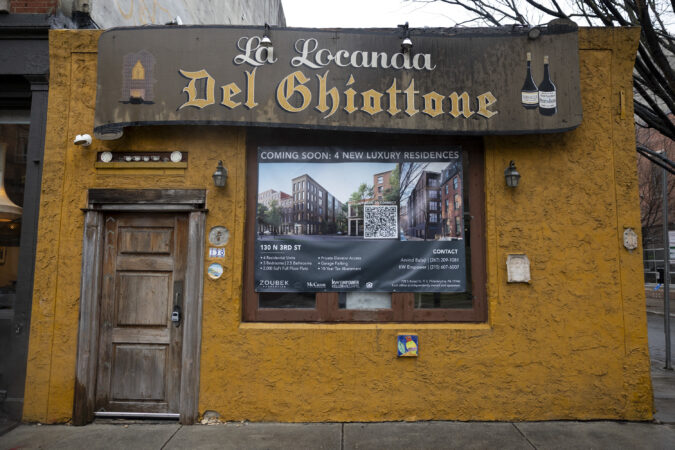
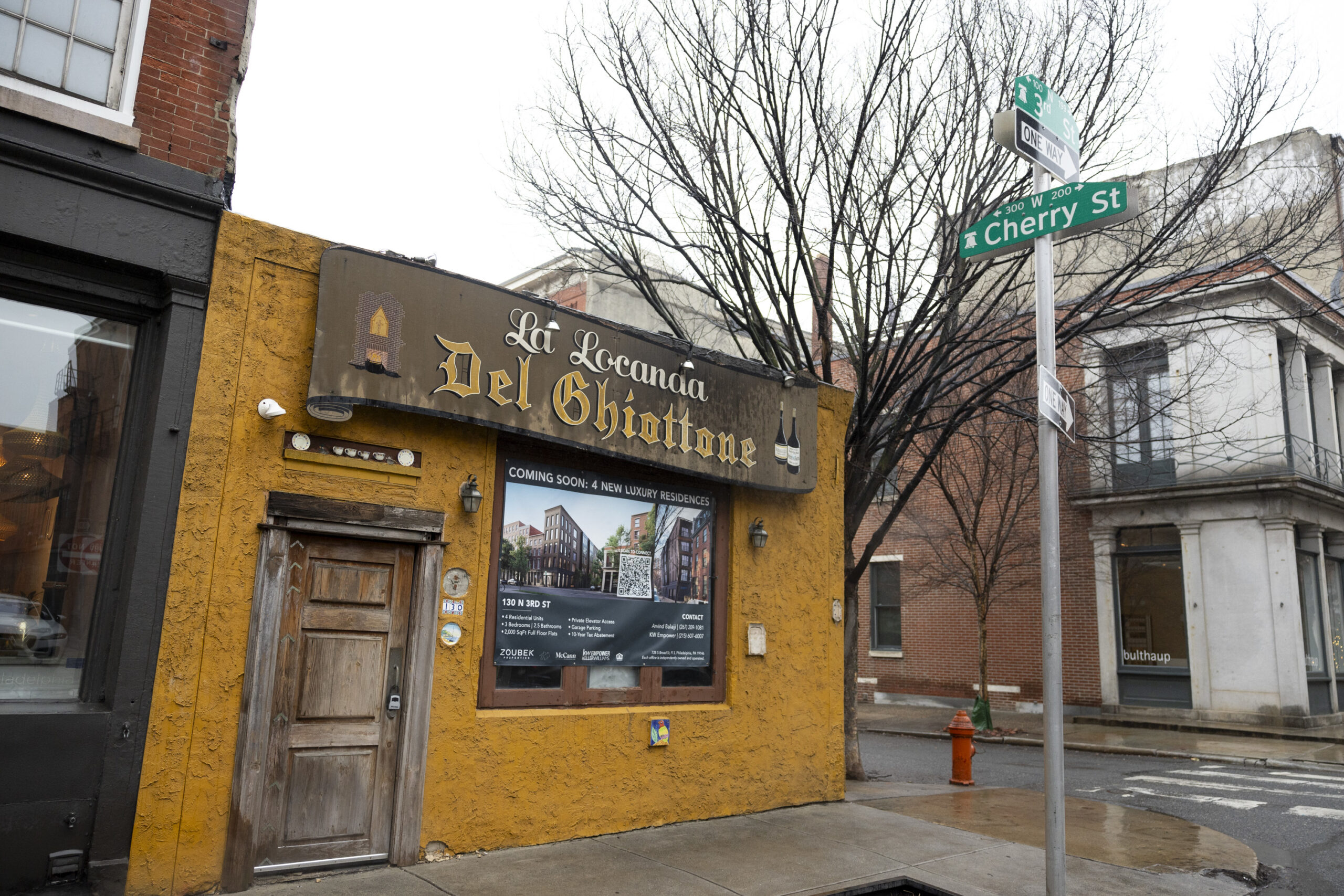
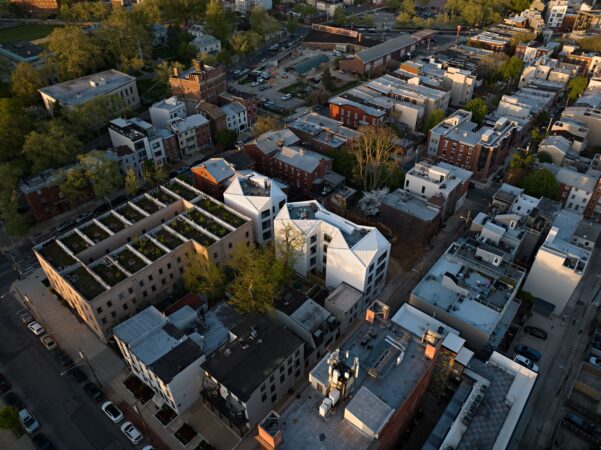
The quaint mustard yellow former home of La Locanda Del Ghiottone, a former Italian restaurant in Old City, is slated for demolition, according to city records.
Brian Zoubek, the developer behind the hotel down the block, Sosuite at the Loxley, plans to turn the lot into luxury condos.
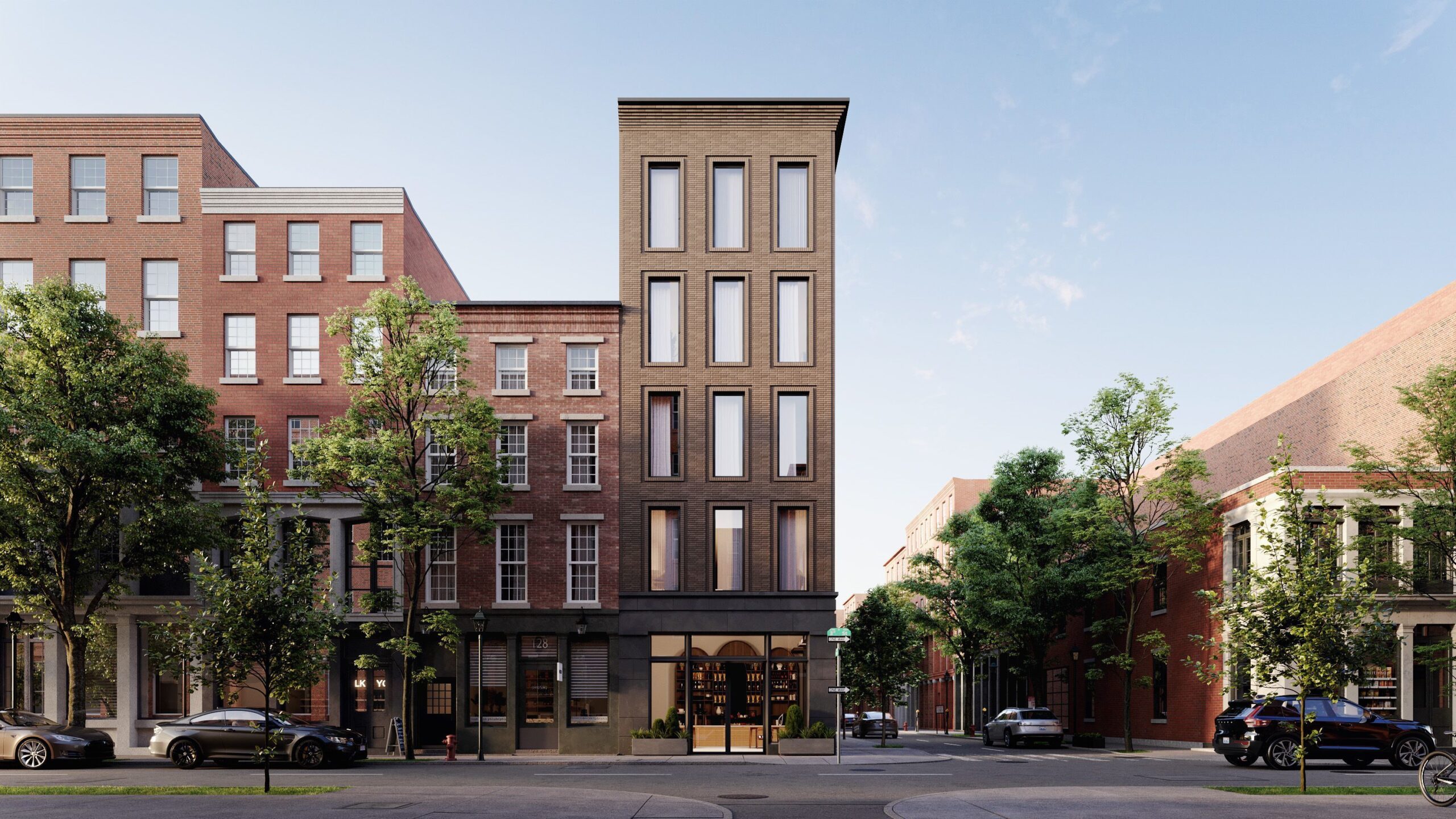
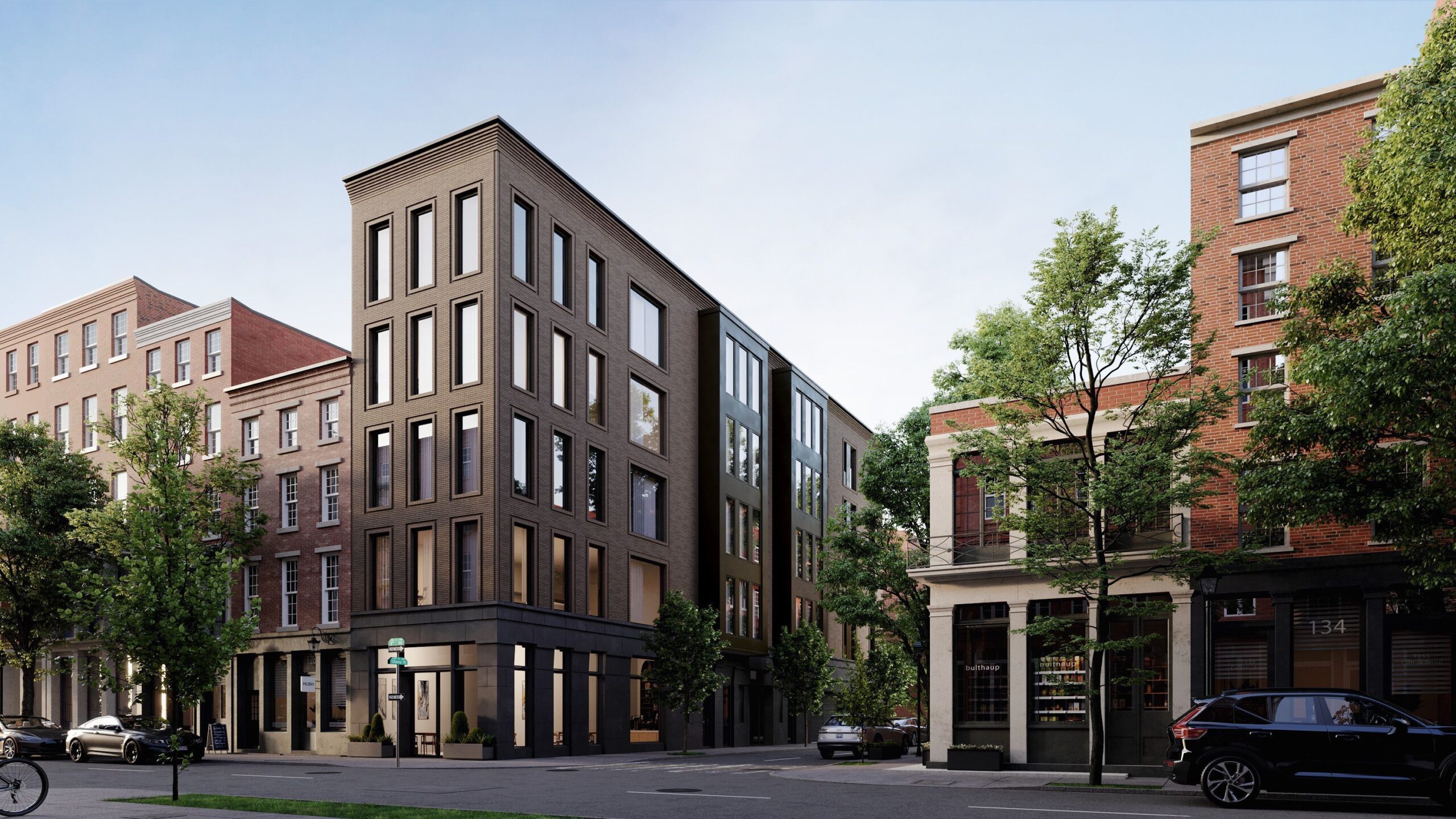
The property will take on a new character, Zoubek said. Gone will be the vibrant, squat structure decorated in colorful plates. In its place will stand a sleek, narrow five-story mixed-use building. The bottom floor will be retail and the four floors above will each feature one condo. Prices will range from around $1.6 million to about $1.95 million per unit, he said.
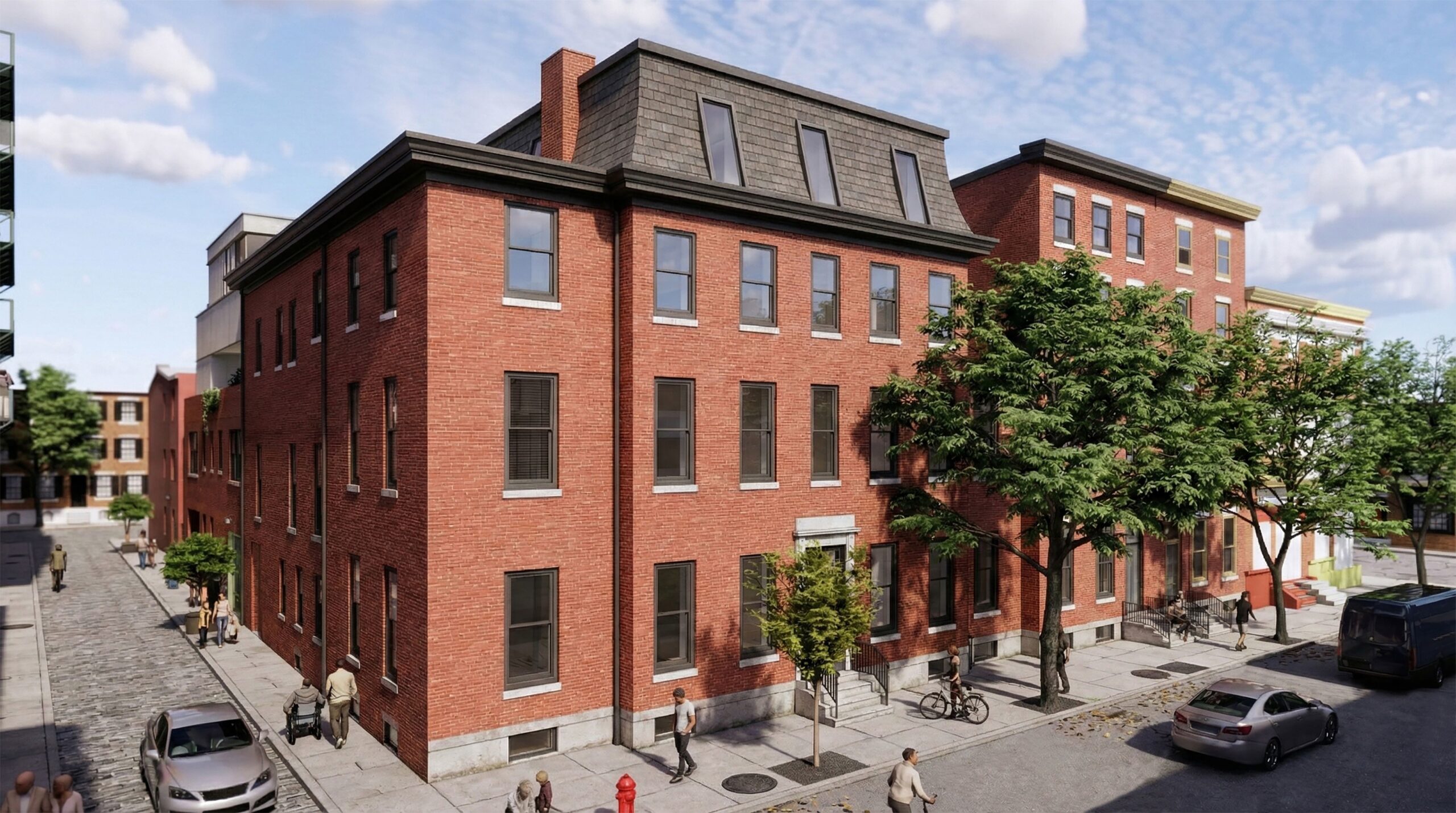
A rendering of a new five-story building coming to the corner of Third and Cherry Streets in Old City.
Zoubek said he’s expecting demolition to start this month and construction to take about 12 to 14 months. He’s hoping the condos will open next summer. He purchased the building in 2022, according to city property records.
To align the new building with the historic aesthetic of that block, he said the building will be covered in brick with a stone facade on the first floor.
A rendering of a new five-story building coming to the corner of Third and Cherry Streets in Old City.
Residential use is a change for the property anchoring the southwest corner of Third and Cherry Streets. It hit the market in 2020 when La Locanda Del Ghiottone relocated to Port Richmond.
The restaurant’s history at the property dates back to 1989, when Giuseppe Rosselli, an immigrant from northern Italy, took over the building at 130 N. Third St.
Rosselli, a character who used to post screeds outside the restaurant, originally named the 35-seater Trattoria Dell’Artista. In 1992, Rosselli opened L’Osteria dell’Artista down the block at 114 N. Third St., and a year later, renamed his original restaurant Ristorante der Ghiottone (”the glutton”). He later tweaked the name to La Locanda Del Ghiottone. Rosselli died at age 51 in 2000.
Ghiottone was a favorite of Inquirer critic Jim Quinn, who raved about the “rough and ready cuisine moded on the bargain-price restaurants of Italy. Portions are huge, prices extremely low, and all food is rushed directly from the stove to you.”
La Locanda Del Ghiottone’s building, seen on March 3, 2026, will be demolished and replaced with luxury condos.
Reporter Michael Klein contributed to this article.
Donna Wise doesn’t know if this was on the builder’s mind in 1970, but he designed a house that combined sociability and privacy.
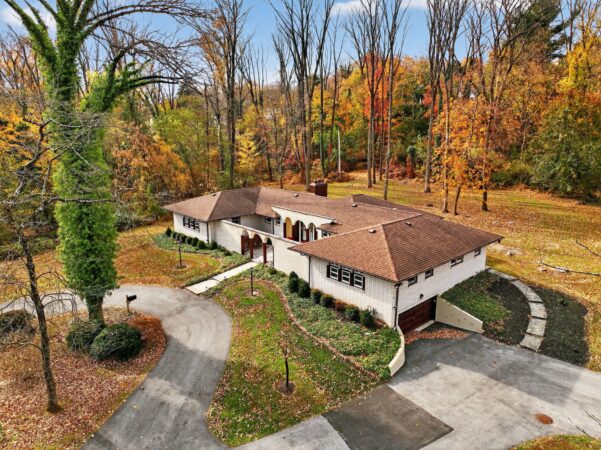
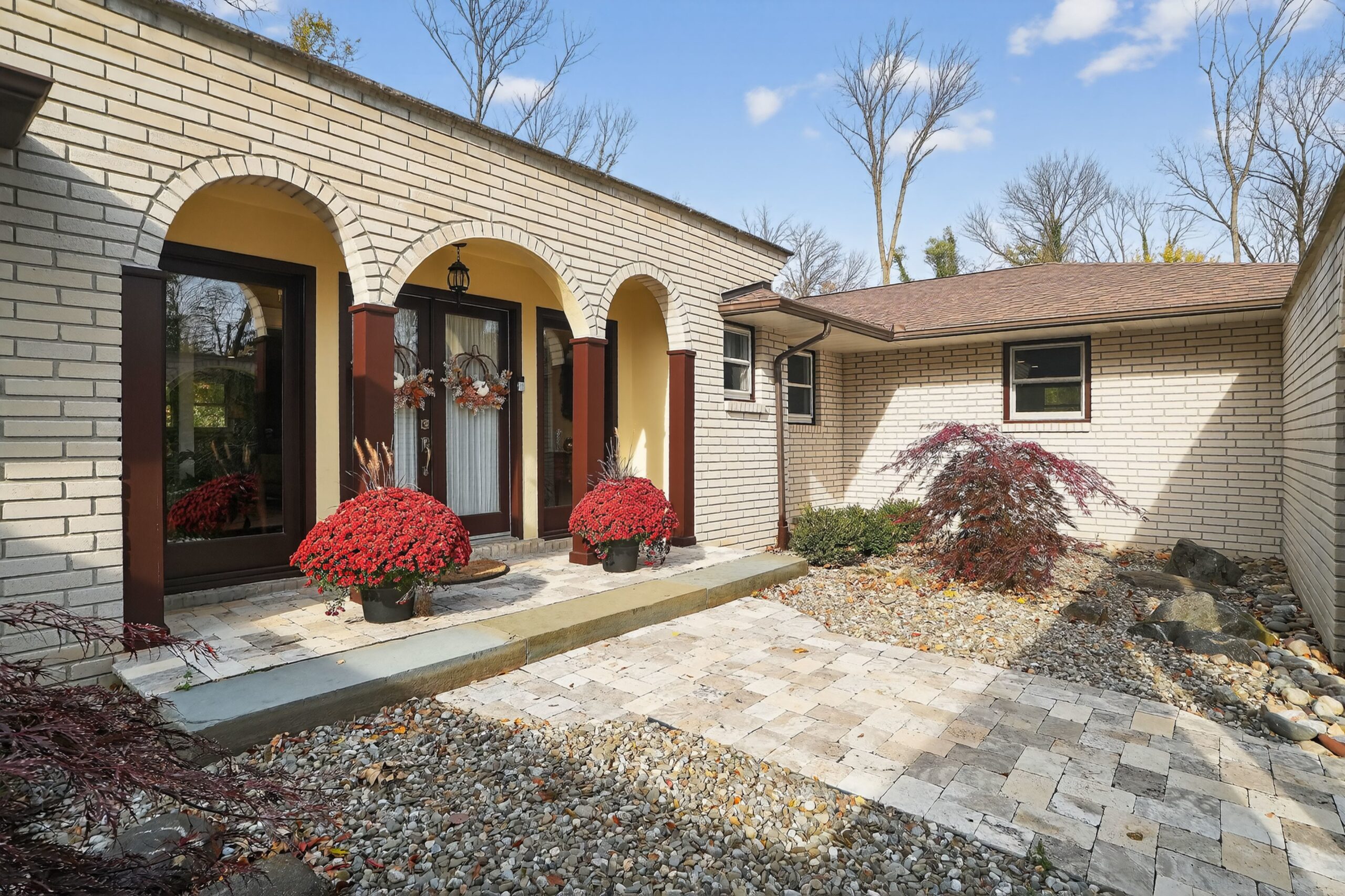
The four-bedroom, 2½-bathroom ranch house in Wallingford has the kitchen, living room, dining room, basement, and two-car garage on one side of the house and the living quarters on the other side.
That way, Wise said, guests “can ask to use the bathroom without passing through your bedroom. And the grounds are beautiful.”
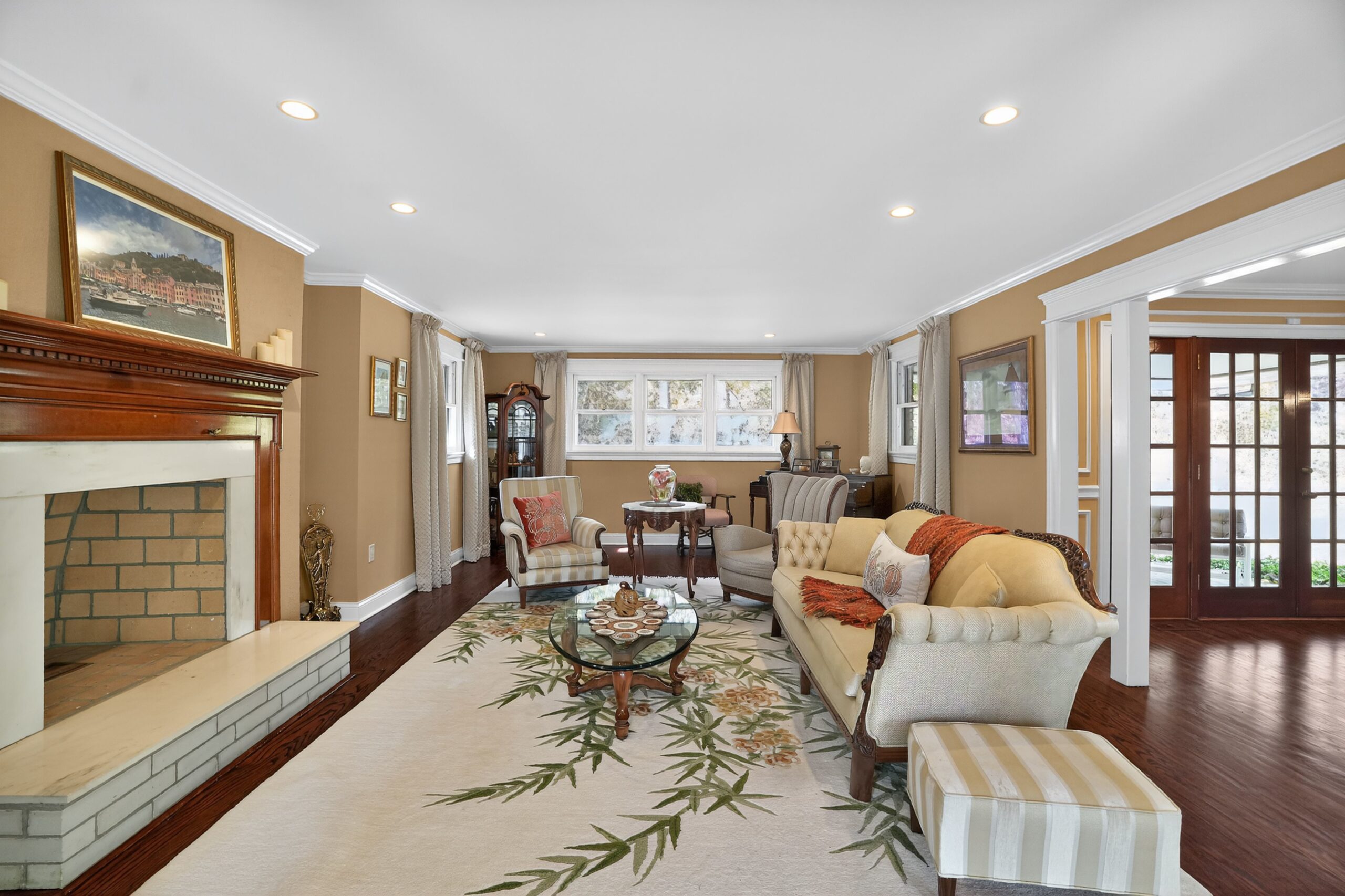
The living room.
The builder’s other houses nearby were all Colonials, she said. Her parents, Mary and Robert Wise, bought the Spanish-style house 42 years ago. After her father died in 1995 and her mother in 2006, she and her sister, Cheryl Wise, remained there.
Now the sisters, who grew up in Folcroft, Delaware County, are moving to a nearby condo.
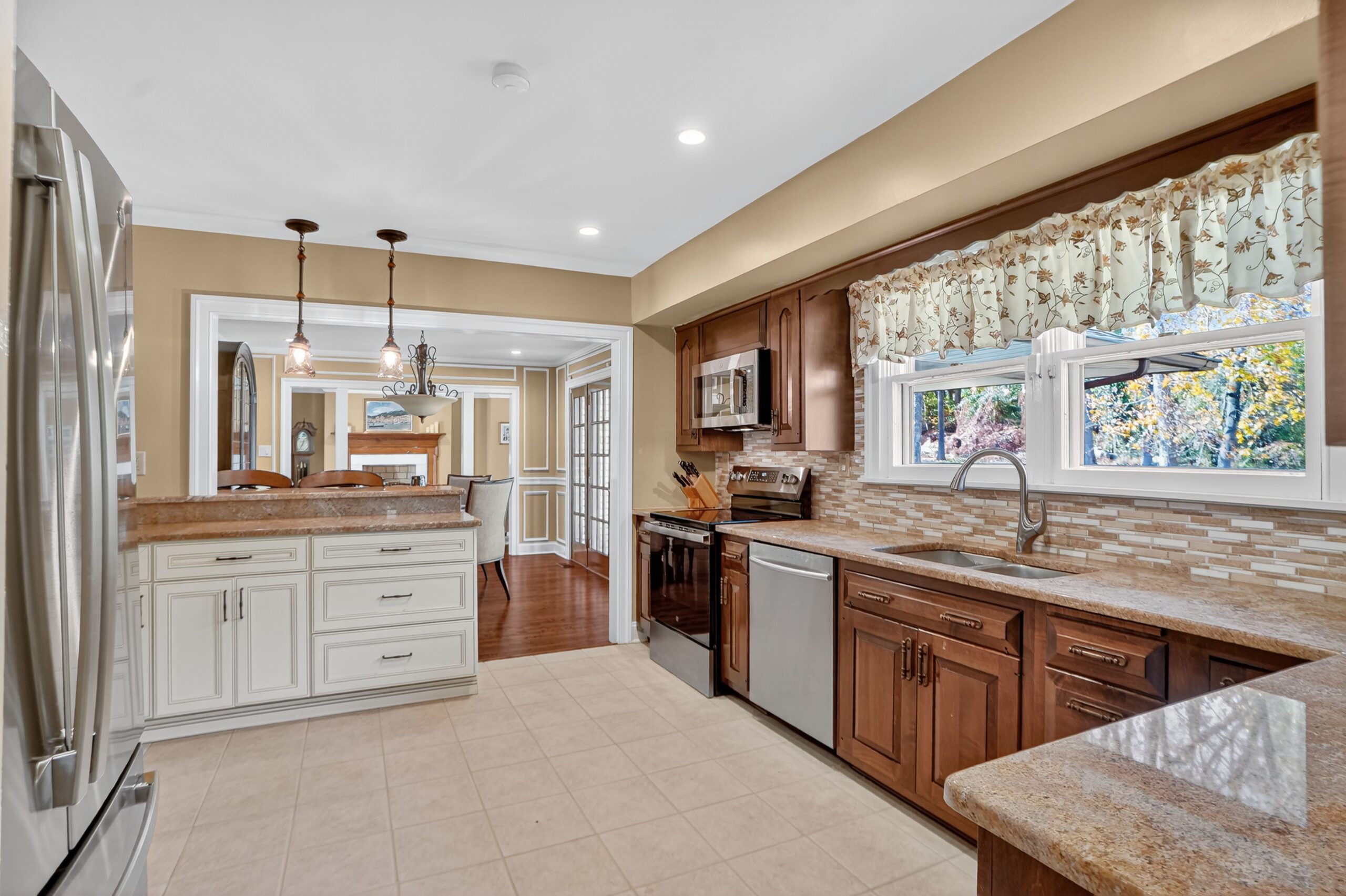
The kitchen has stainless steel appliances.
The approach to the 3,064-square-foot house is on a circular driveway.
Donna said the construction is so symmetrical that if one looks through a window, they can see through the whole house.
The kitchen has stainless steel appliances, and the office could be converted to a fifth bedroom.
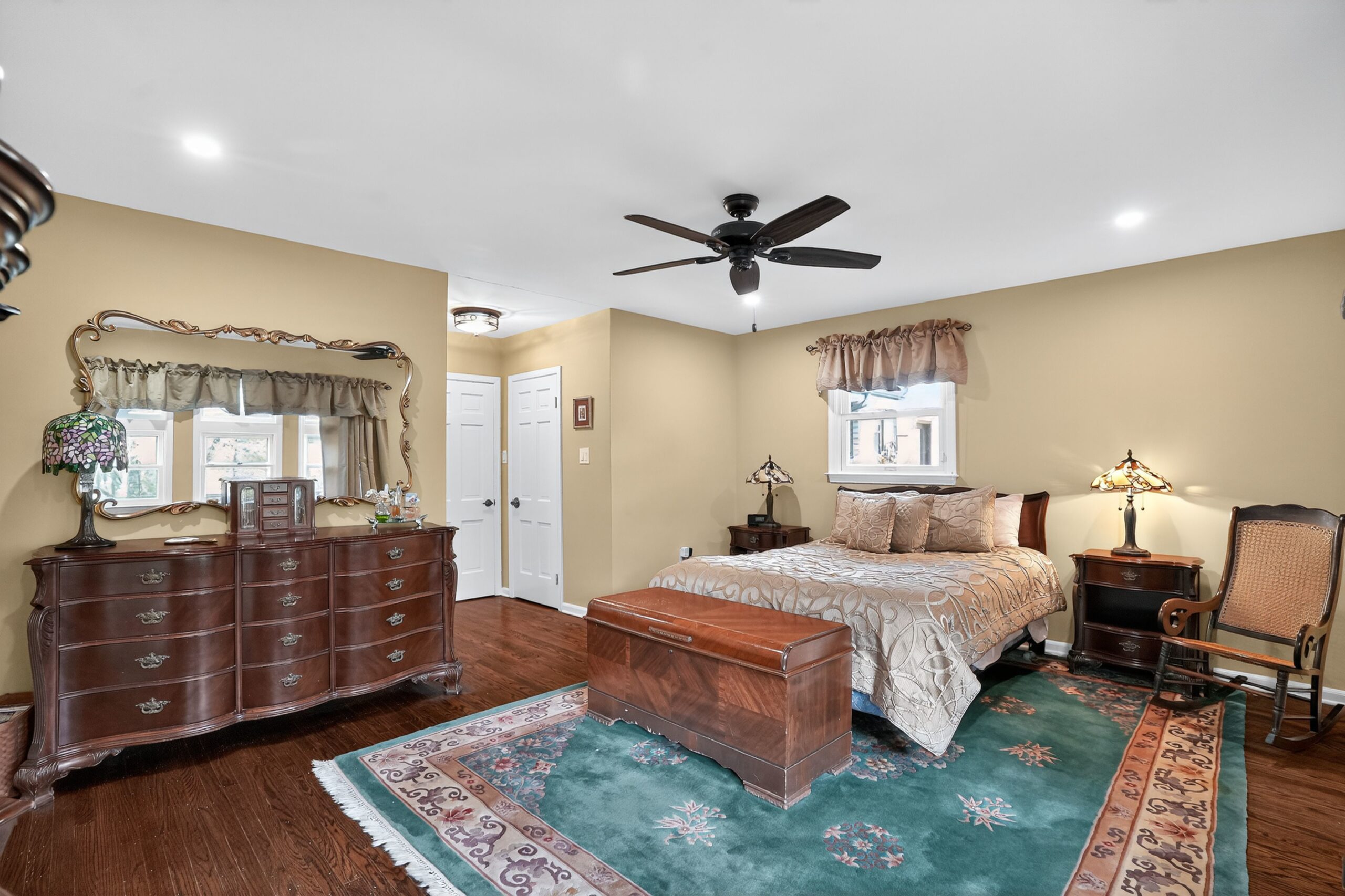
The primary bedroom.
The family opened up the layout, knocking down a wall separating the kitchen and the dining room. The basement is unfinished.
The house is near the Commodore Barry Bridge, which provides easy access to the Jersey Shore. It is also close to the Swarthmore SEPTA Regional Rail station. It is also convenient to Tyler Memorial Arboretum and several parks.
The front entrance to the house.
The house is in the Wallingford-Swarthmore School District.
It is listed by Lindsay Wise of Coldwell Banker Realty for $699,000.
An 835-acre property in Burlington County once threatened by development will be sold to the New Jersey Conservation Foundation for $15 million, according to a deal announced Tuesday.
Evesham Township plans to incorporate the new property into its already popular Black Run Preserve, swelling the size of that 1,300-acre holding widely used by hikers, bird-watchers, and cyclists.
Developer Linda Samost has agreed to the sale, with the price $2.4 million less than the property’s full market value, the announcement said.
“We are eager to move forward with the project so that the community can experience and appreciate the natural beauty of this land for years to come,” Samost said in a statement.
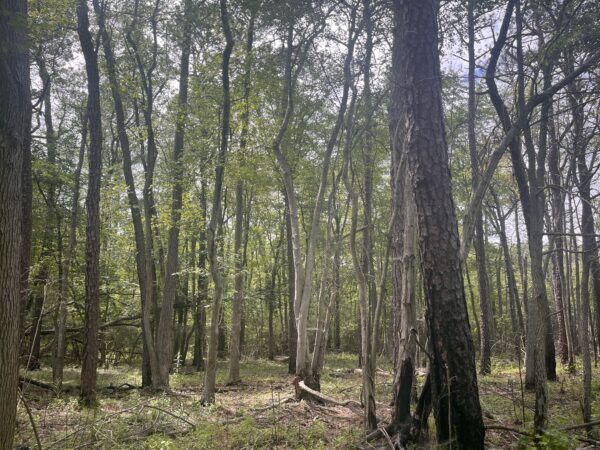
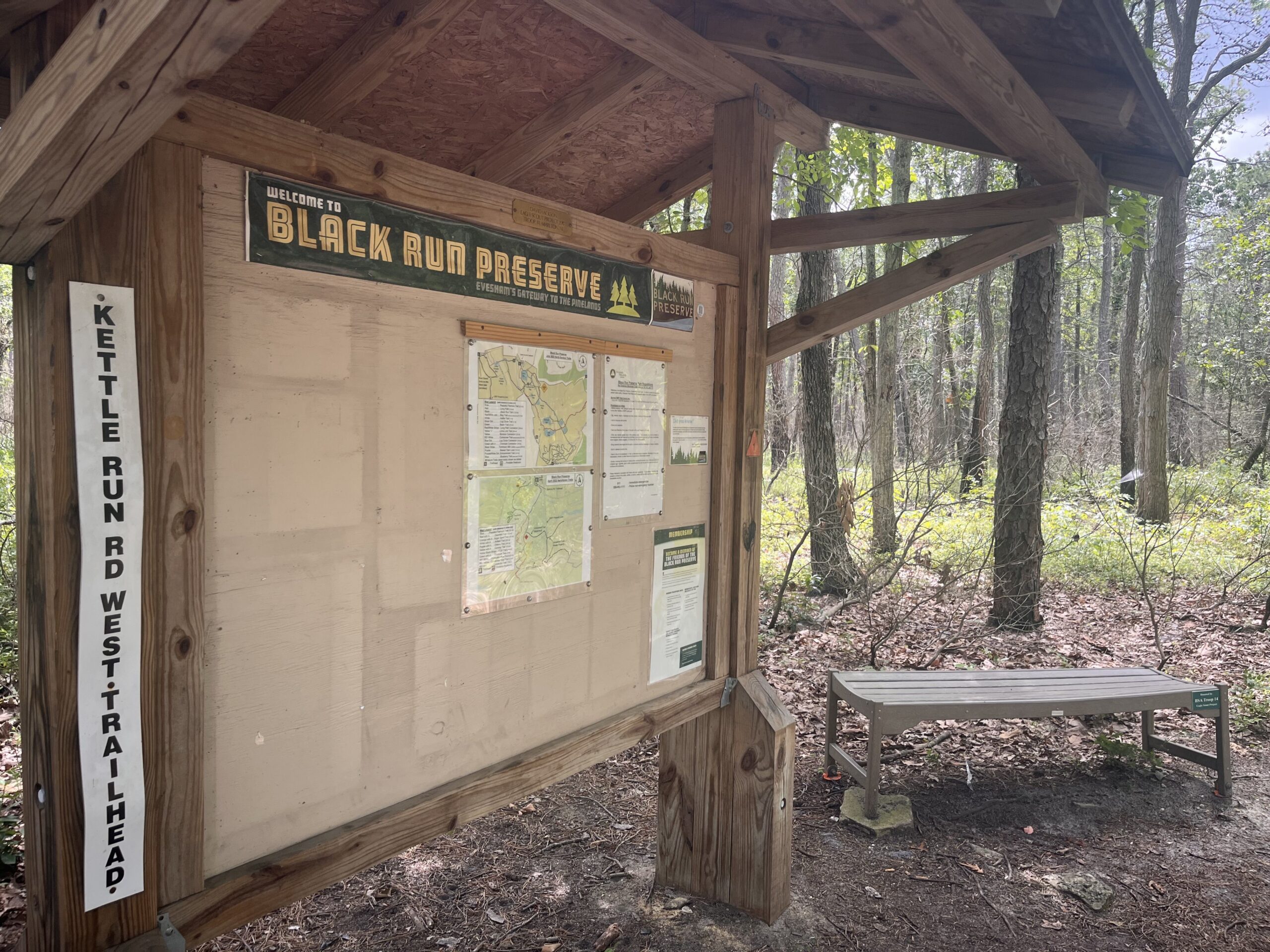
File: A 2025 of a trail at Black Run Preserve off Kettle Run Road in Evesham, Burlington County, N.J.
Tuesday’s announcement noted, however, that while a sale contract has been signed, the foundation still needs to raise more money before taking ownership. It plans to launch a fundraising campaign with partners that will allow for public contributions.
The property has been the site of a fight over its future since 2024, when Kettle Run Investments LP, led by the Samost family, submitted plans to the New Jersey Pinelands Commission to build 250 single-family homes on a portion of the tract.
That plan drew vehement opposition from the community, the nonprofit Pinelands Alliance advocacy organization, and local officials.
At the same time, the Pinelands Commission was rezoning a large area from rural development (RD-3) to Pinelands Forest Area, which would have greatly reduced the amount of development that could have taken place on Samost’s property.
Linda Samost told The Inquirer last year that her “inclinations” were to have the land “benefit the community and the ecosystem, the environment,” rather than be developed.
But the price had to be right, and the New Jersey Conservation Foundation began negotiating with Samost.
In November, the Burlington County commissioners authorized $5 million from open-space funds to help with a purchase. The Pinelands Commission, an independent state agency, also approved a $3 million grant toward the purchase.
It was not immediately clear how much additional money the foundation needs to raise.
The Samost property is situated between Kettle Run, Tomlinson Mill, Kenilworth, and Egret Roads in Evesham.
It is part of New Jersey’s Pinelands and the source of the Black Run, a tributary that feeds Rancocas Creek. The property is habitat for numerous species, including the threatened Pinelands tree frog.
window.addEventListener(“message”,function(a){if(void 0!==a.data[“datawrapper-height”]){var e=document.querySelectorAll(“iframe”);for(var t in a.data[“datawrapper-height”])for(var r,i=0;r=e[i];i++)if(r.contentWindow===a.source){var d=a.data[“datawrapper-height”][t]+”px”;r.style.height=d}}});
Robyn Jeney, a New Jersey Conservation Foundation regional manager, said the preservation means “water quality, critical plant and animal habitat, and the overall ecological integrity of the area will be protected for generations to come.”
“This agreement marks a historic milestone for Evesham Township and a victory for every resident who treasures our natural landscape,” said Evesham Township Mayor Jaclyn Veasy.
Jane Dean, board president of the Friends of the Black Run Preserve, said the deal means “this place will remain as it should be, unbroken, instructive, and alive.”
Susan Grogan, executive director of the Pinelands Commission, called it “the best possible outcome for this property.” She noted the property has long been a “top target” by the commission for preservation.
When Coach opened a store at the Cherry Hill Mall in November, mall executives were ecstatic — even though it’s been 85 years since the high-end retailer was founded.
Coach is as hot as ever. And its new shop in Cherry Hill is just another sign of the South Jersey mall’s success, according to leaders with Pennsylvania Real Estate Investment Trust (PREIT), which owns the complex.
“Cherry Hill is clearly a dominant fashion property,” Paula Charles, PREIT’S first vice president of leasing, said in a recent interview.
In the competitive Philadelphia market, “the better retailers have gravitated toward the better assets,” including Cherry Hill, added Joe Aristone, PREIT’s chief revenue officer.
They noted that top-tier retailers increasingly include legacy brands — long-established companies like Coach, Zara, and Levi’s, that are making a nostalgic, social media-fueled comeback with younger consumers.
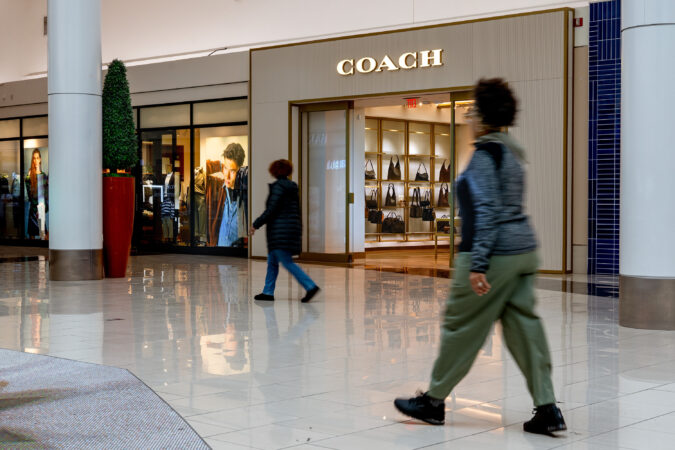
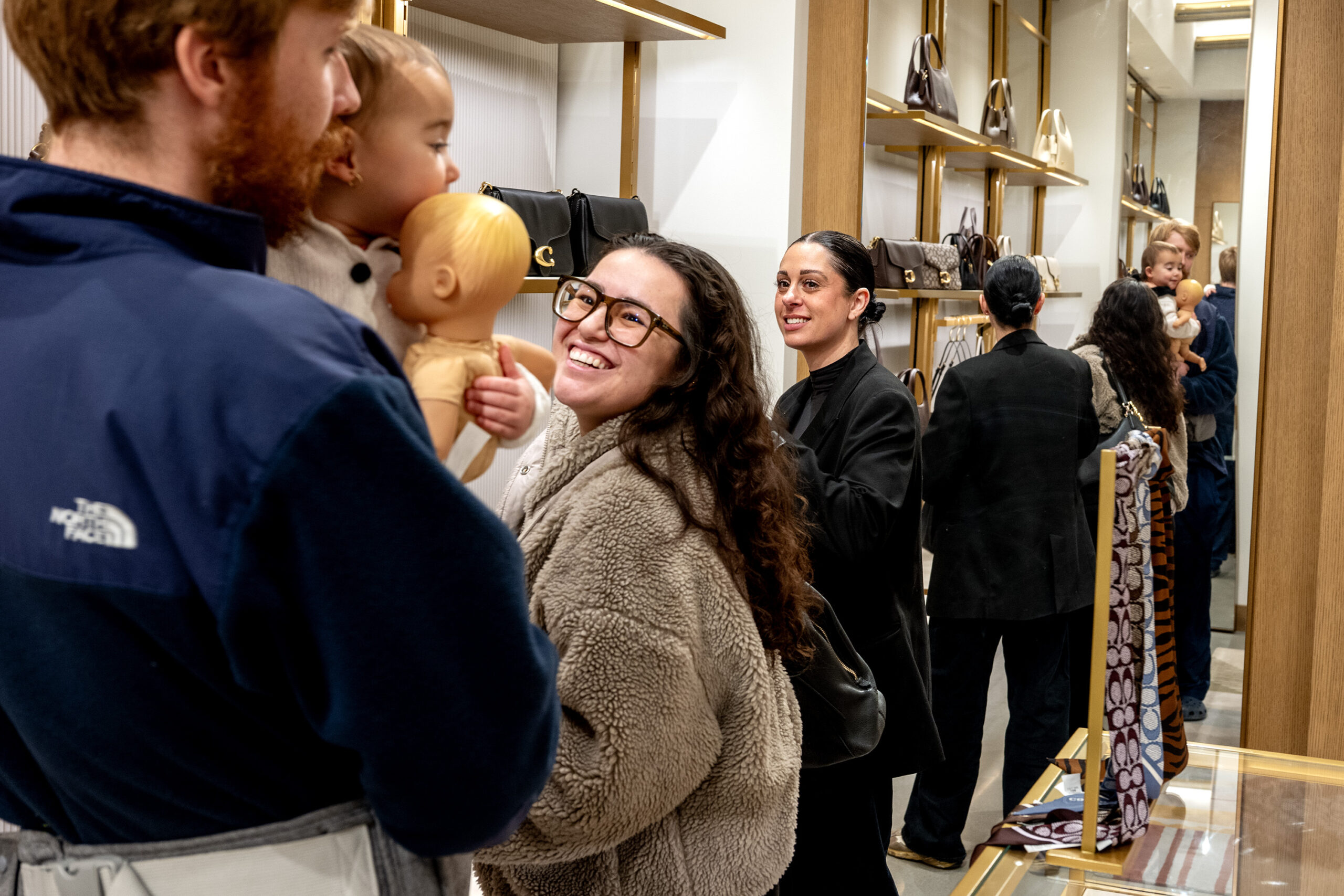
Employee Alex Costa (right) assists Alessandra Bruno as she shops for purses with husband, Luke Baur, and their 20-month-old daughter, Rosalina, at the Coach store at the Cherry Hill Mall.
In the Philadelphia area, these retailers have maintained a presence along shopping corridors in Center City and at higher-performing malls like Cherry Hill and King of Prussia, which is owned by Simon Property Group.
Prior to the Cherry Hill opening, Coach operated shops in King of Prussia and Marlton, as well as off-price locations at the Philadelphia Premium Outlets near Pottstown, the Gloucester Premium Outlets in Blackwood, and the Tanger Outlets in Atlantic City. The brand also has an outpost at the Philadelphia International Airport.
Coach spokespeople did not return requests for comment about their investment in the region.
PREIT executives declined to comment on sales so far at their new Coach store, but said brand and mall executives are pleased with how the store is doing — and what that means going forward.
“Coach has had a strategy to make sure that they capture Gen Z,” a demographic that PREIT executives also want to attract and retain as they age, Charles said.
Why Gen Z and millennials love Coach
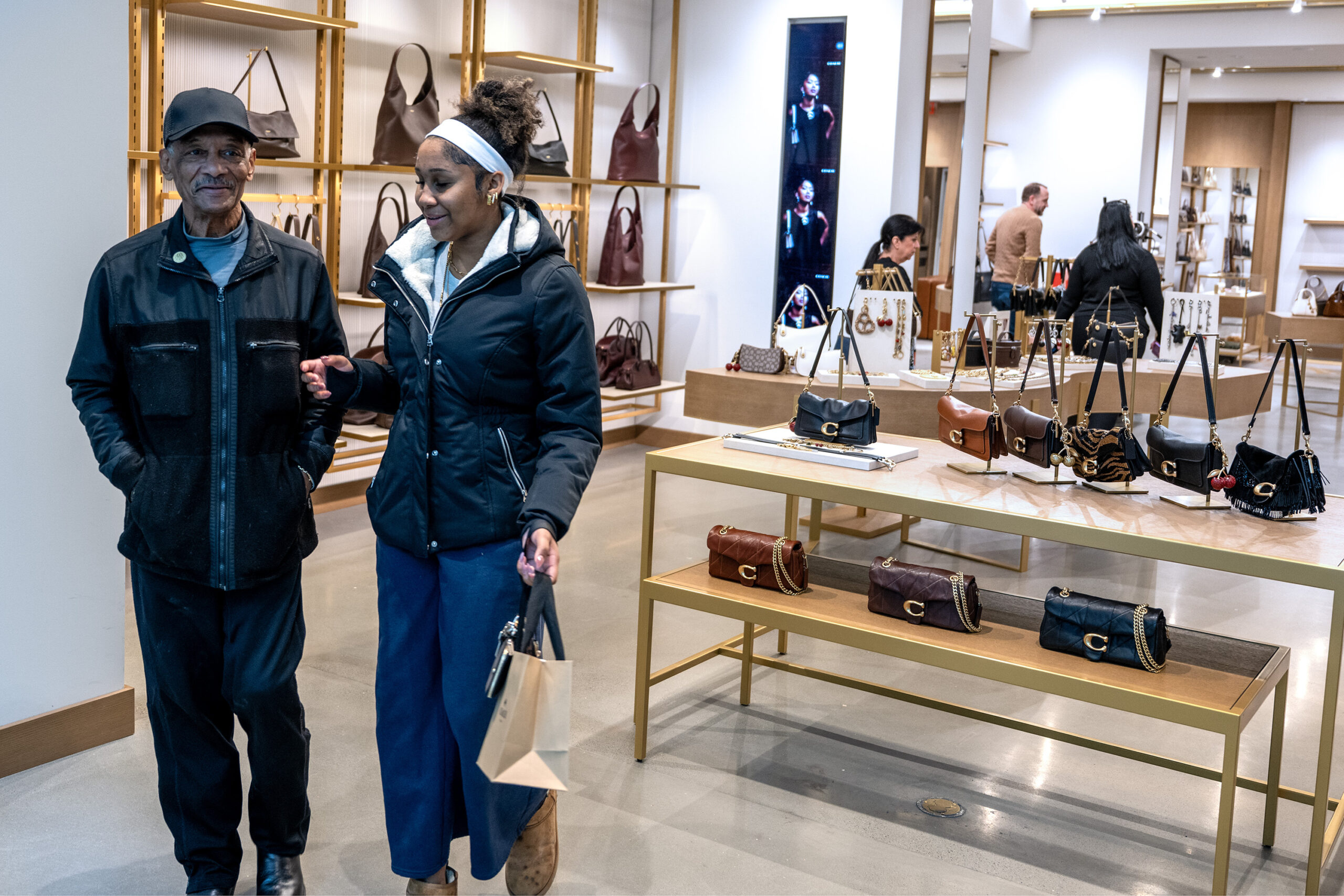
Joe Williams, of Magnolia, N.J., buys a handbag for his daughter, Samantha Williams, at the Coach store at the Cherry Hill Mall.
About two years ago, Breana Stringer, now 26, noticed that many of her friends were going out with Coach bags. And when she’d open TikTok, she said, the platform’s algorithm showed her videos of other users’ Coach collections.
Up until that point, the Fishtown resident had been an accessory minimalist: “I was very much an ‘if it doesn’t fit in my pocket, I’m not bringing it’” type of person.
But Stringer said she was influenced by her friends and TikTok to start buying Coach bags, mostly secondhand (though she has received new Coach bags as gifts). She has come to enjoy styling them with her outfits.
To Stringer, Coach’s appeal to Gen Z consumers is simple, she said: “They’re affordable in terms of a luxury name brand, and they’re vintage styles.”
New Coach bags start at $95 for a short shoulder bag, while larger purses can cost $500 or more. At outlet stores and secondhand shops, prices are lower.
In South Philly, Stephanie Gonzalez, 33, has restored and resold dozens of vintage Coach bags, mostly to Gen Z and millennial women.
She said these women see the Coach brand as “timeless.”
For Gen Z, “what is happening is they are really into Y2K, late-’90s, early-’90s nostalgia,” Gonzalez said. “TikTok has been a big hub for people” to share their love of Coach and brands that were popular in those years.
As for other legacy brands, Stringer said some of her Gen Z friends have also started wearing Cartier rings, which have been around since the mid-1800s and can cost more than $1,000. It’s a trend Stringer has yet to get behind, she said, because she has a tendency to lose small accessories: “I’m less likely to lose a bag.”
How legacy brands are boosting Philly-area malls
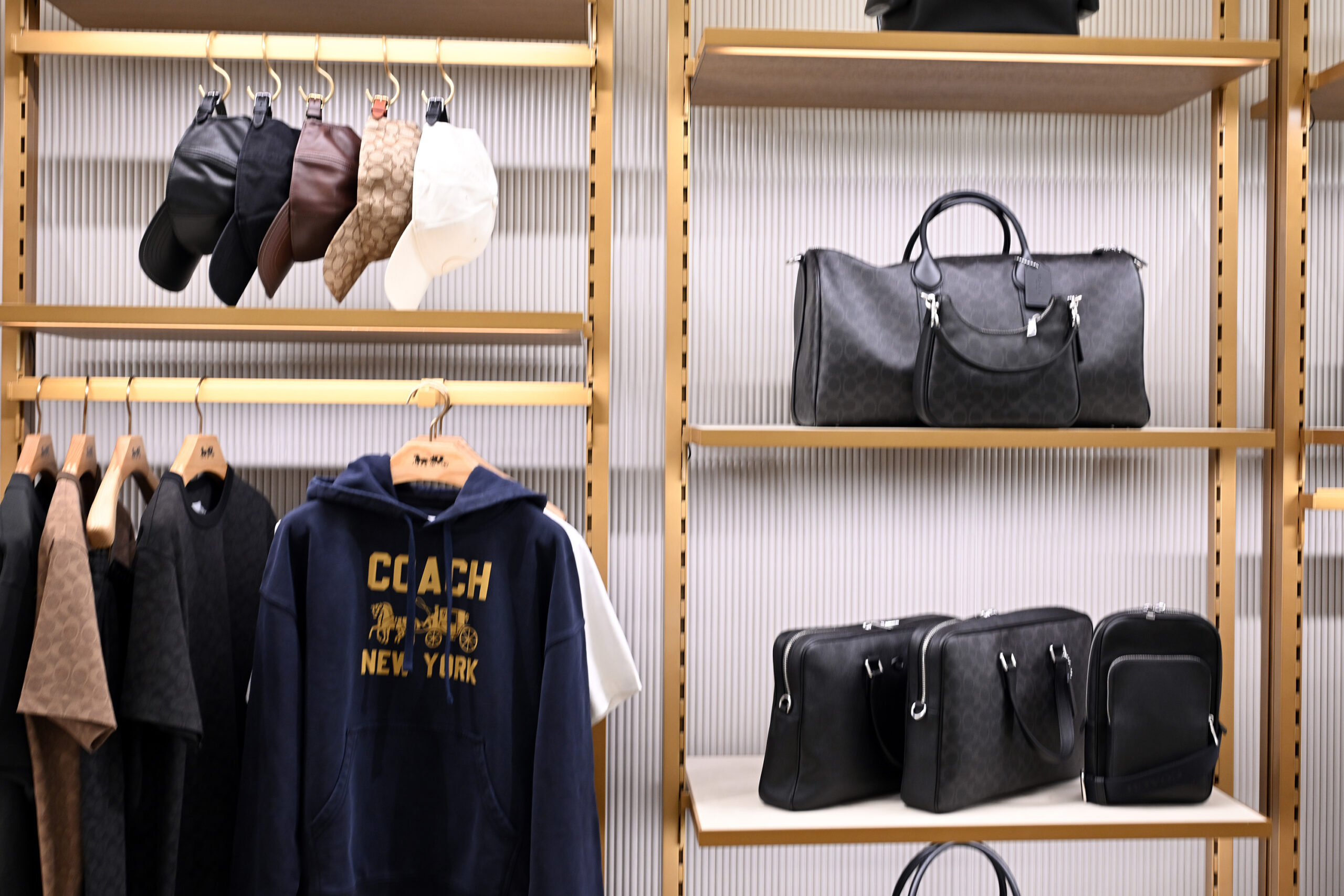
Products are displayed at the Coach store at the Cherry Hill Mall.
Cherry Hill Mall isn’t the only local shopping center to have welcomed new legacy retailers recently.
In the past six months, Abercrombie & Fitch, Columbia Sportswear, Lacoste, and New Balance have opened new stores at the King of Prussia Mall, and an Adidas outpost is also set to open there soon.
At the Philadelphia Premium Outlets, Hugo Boss, Marc Jacobs, and New Balance have opened stores in the past year, while the Gloucester Premium Outlets in Blackwood have added New Balance and Columbia locations. Like the King of Prussia Mall, both outlet malls are owned by Simon Property Group.
Typically, these re-energized brands are attracted to places where other similar companies have already set up shop, say the PREIT executives who help shape the tenant mix at the Cherry Hill Mall.
And they said this cyclical effect further cements the region’s dominant retail centers as shopping destinations.
“There is so much media out there as it relates to closed malls,” said Aristone, the chief revenue officer. Many of the surviving malls, however, are thriving, he said, thanks in part to these legacy brands.
The Plaza Grande apartment complex, part of a Cherry Hill housing development that took almost two decades to complete, is now on the market.
The apartments in the 55+ housing complex near the former Garden State Park Racetrack were listed for sale last month, as first reported by the Philadelphia Business Journal. The 507 rental units across 16 buildings are located just south of the Cherry Hill Mall between Routes 70 and 38 and were completed last year.
The residential Plaza Grande at Garden State Park was the last piece of a $1 billion redevelopment of the former Garden State Park horse racing track and surrounding area. The mixed-use complex spans hundreds of acres and is known for Wegmans, Trader Joe’s, restaurants, and other stores.
Home construction at the 34-acre Plaza Grande portion began in 2007, and 101 condos were built. But several builders failed to finish the project in the face of hurdles that included the Great Recession and lawsuits.
A few years ago, New York-based investor and developer William “Billy” Procida stepped in. He completed construction on the remaining283 of the 507 apartments last summer, and the units are now 80% leased.
“We’re not in the business of holding property,” he said. “But this one, I put so much blood, sweat, and tears in it, it’s a hard one to let go.”
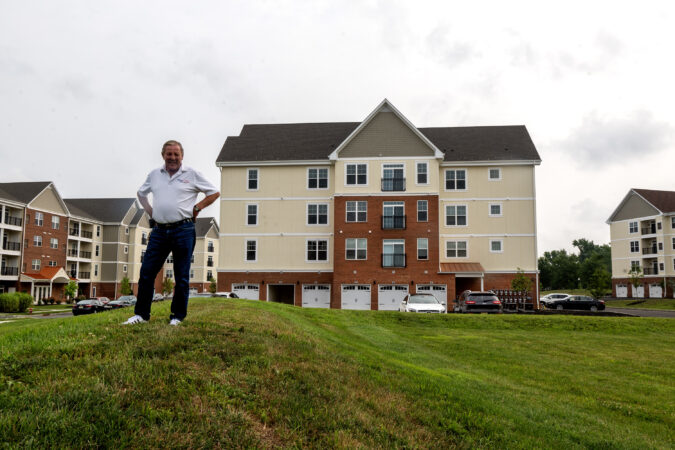
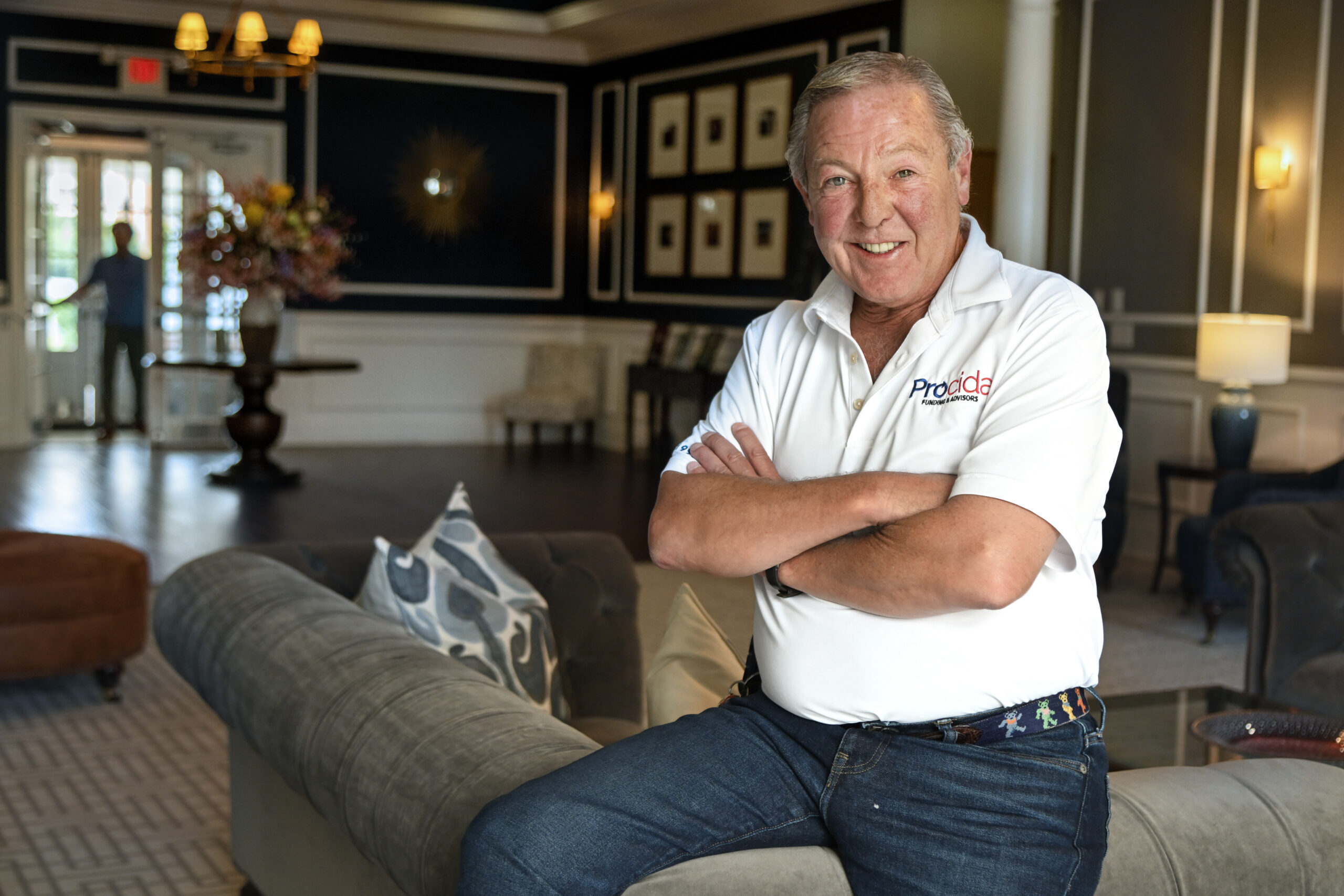
Developer William “Billy” Procida poses in the lobby of the clubhouse at Plaza Grande at Garden State Park in Cherry Hill on Aug. 6, 2025.
He said he’d like to find a buyer “who’s going to treat it really nice.”
Offers are due in a month, said Samantha Kupersmith, senior director at JLL Capital Markets, which is handling the sale. The property listing does not include an asking price, as is generally the case for properties JLL handles, she said.
The property is in “such a good location with a lot of scale,” which makes this “a unique deal,” Kupersmith said.
One- and two-bedroom apartments at the Plaza Grande are currently available starting at $2,200 and $2,800 per month, respectively. Five three-bedroom apartments started at $5,500 but allare leased.
The property has an 18,500-square-foot clubhouse and offers programming such as cooking and fitness classes, concerts, and wellness events. Condo owners and renters have access to amenities that include a movie theater, a gym, tennis and pickleball courts, indoor and outdoor pools, and indoor golf.
Procida’s company announced last month that it had chosen Millstone Property Management to oversee operations at the apartment complex starting March 21. Millstone Property Management specializes in managing multifamily properties across Pennsylvania, New Jersey, Delaware, and Florida.
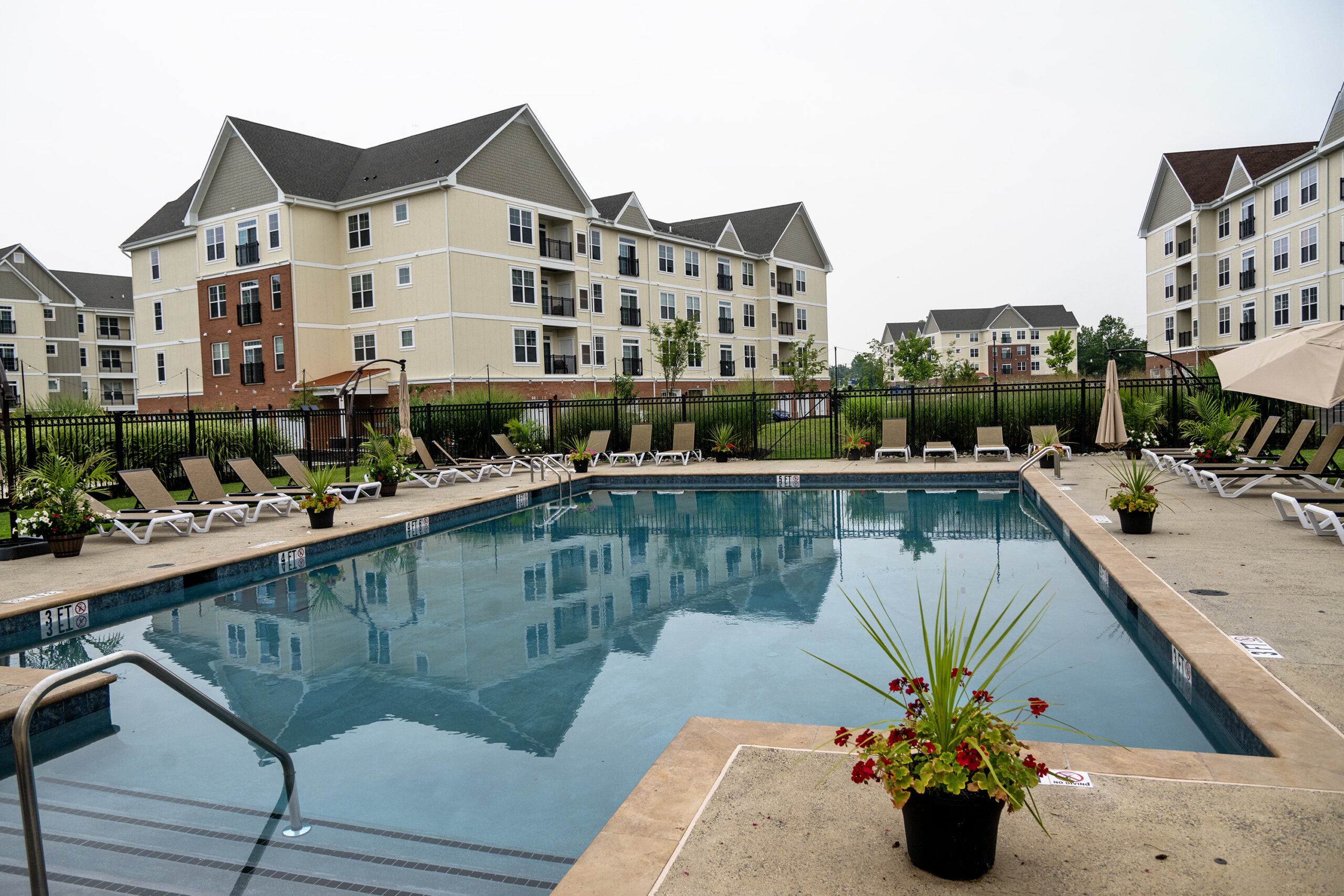
The newest rental apartments at Plaza Grande at Garden State Park in Cherry Hill are reflected in the clubhouse pool on Aug. 5, 2025.
No matter what folks in Boston tell you, Philadelphia is America’s most historic big city. So why is architectural preservation increasingly under attack here, especially as Philadelphia gets ready for its star turn in the nation’s 250th birthday celebrations?
The movement to protect Philadelphia’s rich and varied architectural heritage was thrown into disarray Feb. 26 when a Court of Common Pleas judge invalidated the historic district created in 2024 to protect Washington Square West, a neighborhood that includes both Colonial-era masterpieces and nationally important infill buildings from the 1960s urban renewal period.
Judge Christopher R. Hall’s decision primarily focused on procedural issues and could be reversed if it’s appealed. Yet it is just one of several existential threats facing the preservation regimen that has guided the city for the last 40 years.
His decision is likely to encourage a group of developers who are challenging the Spruce Hill historic district, which also was created in 2024. It could similarly embolden Councilmember Mark Squilla, a former preservation champion who once created a controversial zoning carve-out to protect a one-story supermarket in Society Hill. Having jumped on the anti-preservation bandwagon, he’s now pushing legislation that many believe would gut the powers of the Historical Commission.
While the issues driving each of these challenges vary, it’s no accident that they’re happening at a time when people are increasingly concerned about rising housing costs. For years, pro-development activists have argued that there is a link between the city’s historic preservation laws and the scarcity of affordable housing. By adding an extra layer of regulation, they contend, those laws restrict where people can build, limit new construction, and raise maintenance costs for homeowners.
There’s no doubt that the city’s preservation laws require owners of historic properties to go through an extra step in the approval process. That takes time and can sometimes add to the cost of a project.
Yet it seems odd that pro-development activists have cast historic preservation as the main villain when so many factors influence the city’s housing supply: zoning regulations, interest rates, availability of labor, cost of construction materials. President Donald Trump’s tariffs alone sent the price of lumber soaring in the last year.
In an effort to put things in perspective, the nonprofit Preservation Alliance recently commissioned an economic analysis to explore its impact on housing prices. The report made two interesting observations: Apartments in older buildings rent for less than those in new ones. And protecting those older buildings actually helps maintain a supply of “naturally occurring affordable housing.”
The study, prepared by the Washington-based Place Economics, also examined claims that historic districts are enclaves for the wealthy and exclude renters. Data show the opposite: Historic districts continue to gain new residents long after they been designated. In fact, between 2010 and 2020, the population of Philadelphia’s historic districts grew almost five times as fast as the city as a whole, which suggests new housing is being built despite the additional oversight.
Not all that construction takes the form of new buildings, however. Even in the best of economic times, erecting a new apartment building in Philadelphia is far more expensive than fixing up an old one. As a result, the city has come to rely on older buildings to provide new housing. Without them, Philadelphia would be a much less affordable place.
In the past, the city’s obsolete offices and factories were the main targets for housing conversion. Those buildings are relatively easy to adapt because they have large, rectangular footprints.
But what about smaller, more irregularly shaped historic buildings? Are the city’s preservation and zoning laws flexible enough to allow more density in old townhouses, which, after all, constitute the bulk of Philadelphia building stock?
This sprawling complex of 19th-century buildings at 15th and Waverly Streets is being converted to a 32-unit apartment building by Lo Design for developer Keith Alliotts. By installing a penthouse level over the former stable (rear left), the architects will be able to improve the interior circulation and increase the density.
Converting townhouses into apartments
To understand the role those buildings can play in the great Yimby-Nimby debates, I reached out to Lea and Evan Litvin, who run Lo Design, an award-winning firm that has its offices in the Rittenhouse-Fitler historic district. Lo Design started out doing single-family homes for developers, but lately they’ve taken on commissions to turn large townhouses into apartments.
Small conversions are more labor-intensive than erecting a new townhouse on an empty site, but they allow the Litvins to do work that aligns with their architectural ideals. The conversions create more housing for less money, using fewer natural resources. “Saving an old building is the most sustainable form of construction,” Evan explained.
Since Philadelphia’s historic townhouses were never meant for multiple tenants, and often have awkward layouts, the Litvins have developed architectural tricks to make them function as apartment buildings. Sometimes that means attaching a new wing on the back. In other cases, they’ve built freestanding structures in backyards.
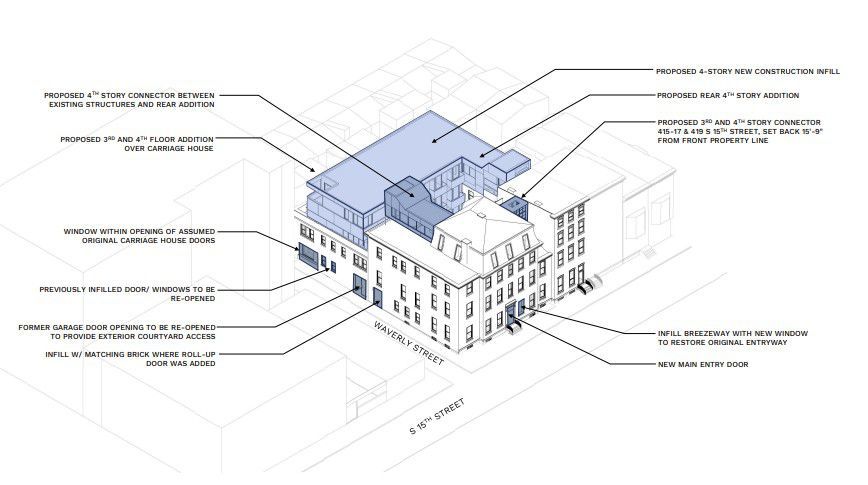
Their current project at 15th and Waverly Streets used a little of everything to transform a historic Greek Revival mansion into a 32-unit building.
The brick building began its life in 1860 as a private home, complete with a stable. At some point, someone popped on a mansard roof to create a fourth story and added wings on the sides. Then, in the early 20th century, the mansion, stable, and a neighboring townhouse were fused into a single building that served as offices for what was then known as the Society to Protect Children from Cruelty.
For the project’s developer, Keith Alliotts, the building’s main attraction was its size — 26,000 square feet, significantly larger than a typical townhouse, which might be 6,000 square feet. He also liked that the location, a few steps from the former University of the Arts’ Hamilton Hall, felt like part of the Rittenhouse Square neighborhood.
Yet the challenges of transforming the awkward amalgamation into a coherent, multifamily residence soon became clear. None of the floors in the different buildings lined up. The U-shaped footprint complicated the flow through the building. The interior was a mashup of Victorian and post-modern details. On top of everything else, the project would need a zoning variance and approval from the Historical Commission.
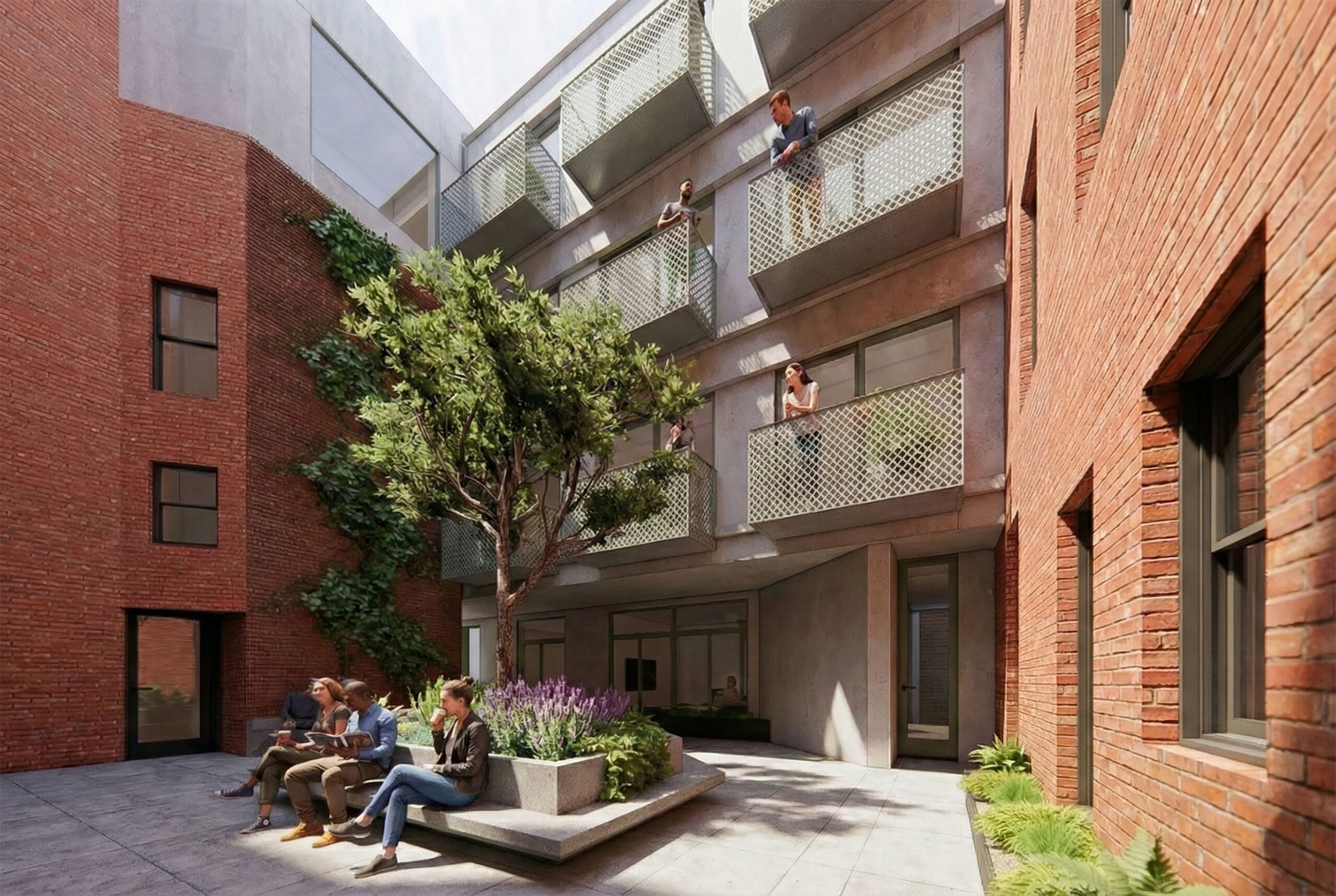
Lo Design plans to create an internal courtyard at the center of a new residential building at 15th and Waverly. The project will turn a group of historic 19th-century buildings into a 32-unit apartment building.
Getting those permits turned out to be the easy part, the Litvins said. Because the complex had been empty for years and was starting to deteriorate, the neighborhood enthusiastically embraced the idea of using it for apartments.
From the start, the Litvins knew they would have to expand the already sprawling complex to ensure the apartment layouts weren’t too eccentric. Fortunately, there was a large yard behind the house where they could add a new wing to turn the U into an O. They decided to install a large penthouse on top of the stable and insert several connecting passages to improve the interior circulation.
This diagram shows how LoDesign plans to turn an awkward amalgamation of 19th century buildings at 15th and Waverly Streets into a coherent, multifamily building with 32 apartments. The portions in blue will be added during construction.
While reusing these buildings was no easy feat, the project is a good example of “gentle density.” The neighborhood gets more rental housing, yet the look of the 19th-century mansion remains substantially the same.
By comparison, the first collaboration between the Litvins and Alliotts was a breeze. Alliotts had spent most of his career developing single-family housing in North Jersey before “discovering” Philadelphia during the pandemic. Coming from such a pricey environment, he said, “I was really taken aback by the city’s affordability.” After studying the market here, he fell for an early 20th-century brownstone on the 2000 block of West Girard Avenue in Francisville.
The townhouse could have been torn down
Despite the house’s impressive architecture, it wasn’t listed on the city’s historic register. That meant Alliotts could have demolished the building for something new, an approach taken by several other developers on that once-elegant stretch of Girard Avenue.
Alliotts liked the house too much to destroy it. And since the site was unusually deep, he knew he could fit the equivalent of a second house in the yard. But rather than build another stand-alone house, he asked the Litvins to fit a 12-unit condo building in the same space. Alliotts envisioned the condos — now called The Francis — as starter homes, so he wanted to keep the prices below $300,000 for a two-bedroom unit.
Still, 12 units is a lot of density, even for a generous townhouse yard that was 200 by 31 feet. By making a donation to the city’s Housing Trust Fund, Alliotts was able to get a zoning bonus that allowed him to raise the structure’s height to 45 feet, enough for a fourth story.
To avoid jamming the new, metal-clad building against the old brownstone, the Litvins decided to push the condos toward Cambridge Street, which was once a service street lined with carriage houses. That gave the architects space to create a landscaped courtyard between the two buildings.
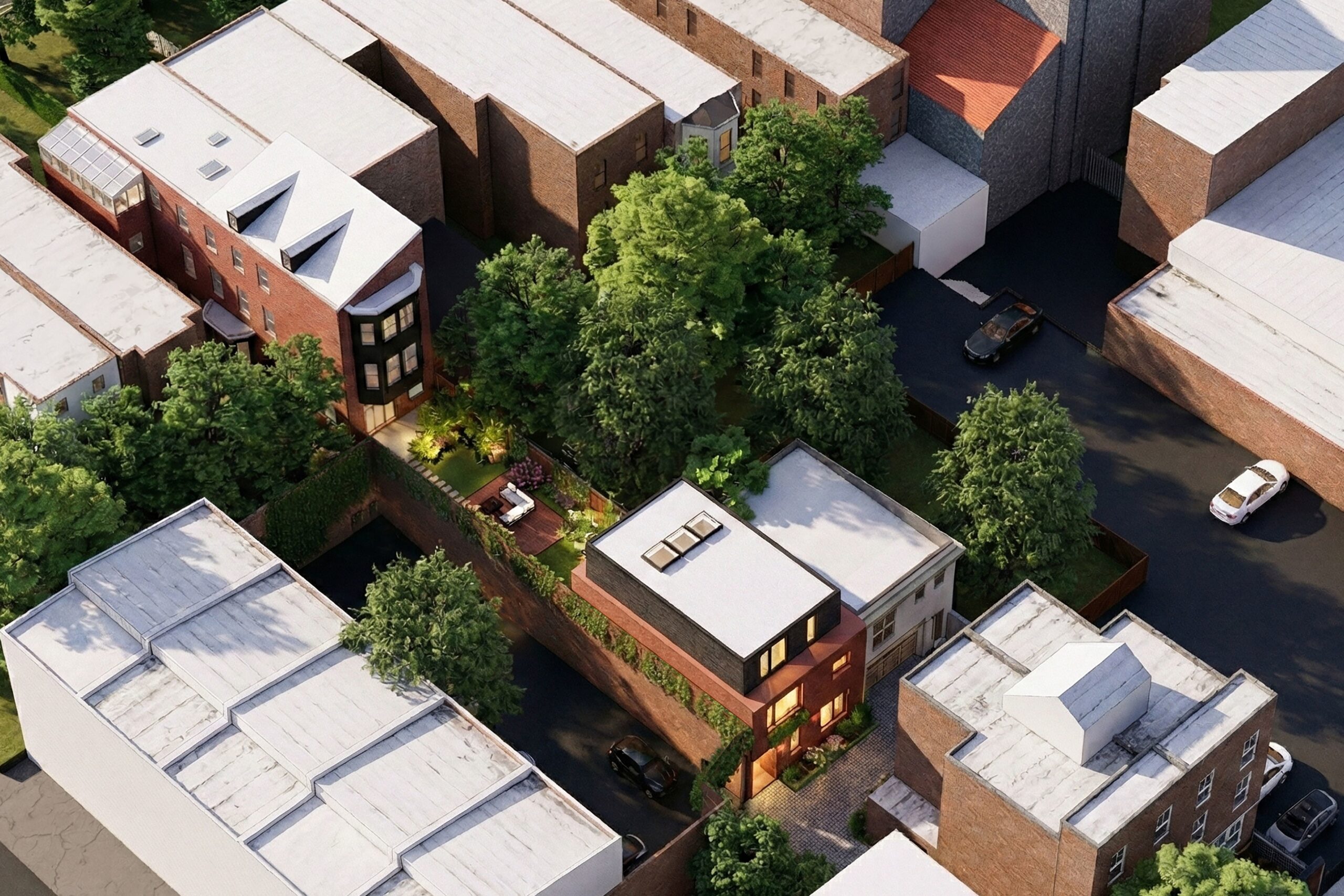
Lo Design was able to create nine apartments in the Spring Garden neighborhood by replacing a small garage with a three-unit apartment building in the garden of an early 20th-century townhouse at 2313 Green St. The project’s density was the result of a compromise with neighbors and the Philadelphia Historical Commission.
After the success of the Francis, the Litvins had hoped to replicate the model for a new project at 2313 Green St. in the Spring Garden neighborhood. The main house there had already been divided into five apartments, but the site at 238 feet was even deeper than the Girard Avenue property. They proposed a five-unit stand-alone building in the garden, accessed from alley off Wallace Street.
But this time the Historical Commission and neighbors rejected the proposal.
So, the Litvins reduced the size of the building and turned it into a carriage-house-sized structure with three units. They offset the loss of units by adding a sixth apartment to the main house for a total of nine units.
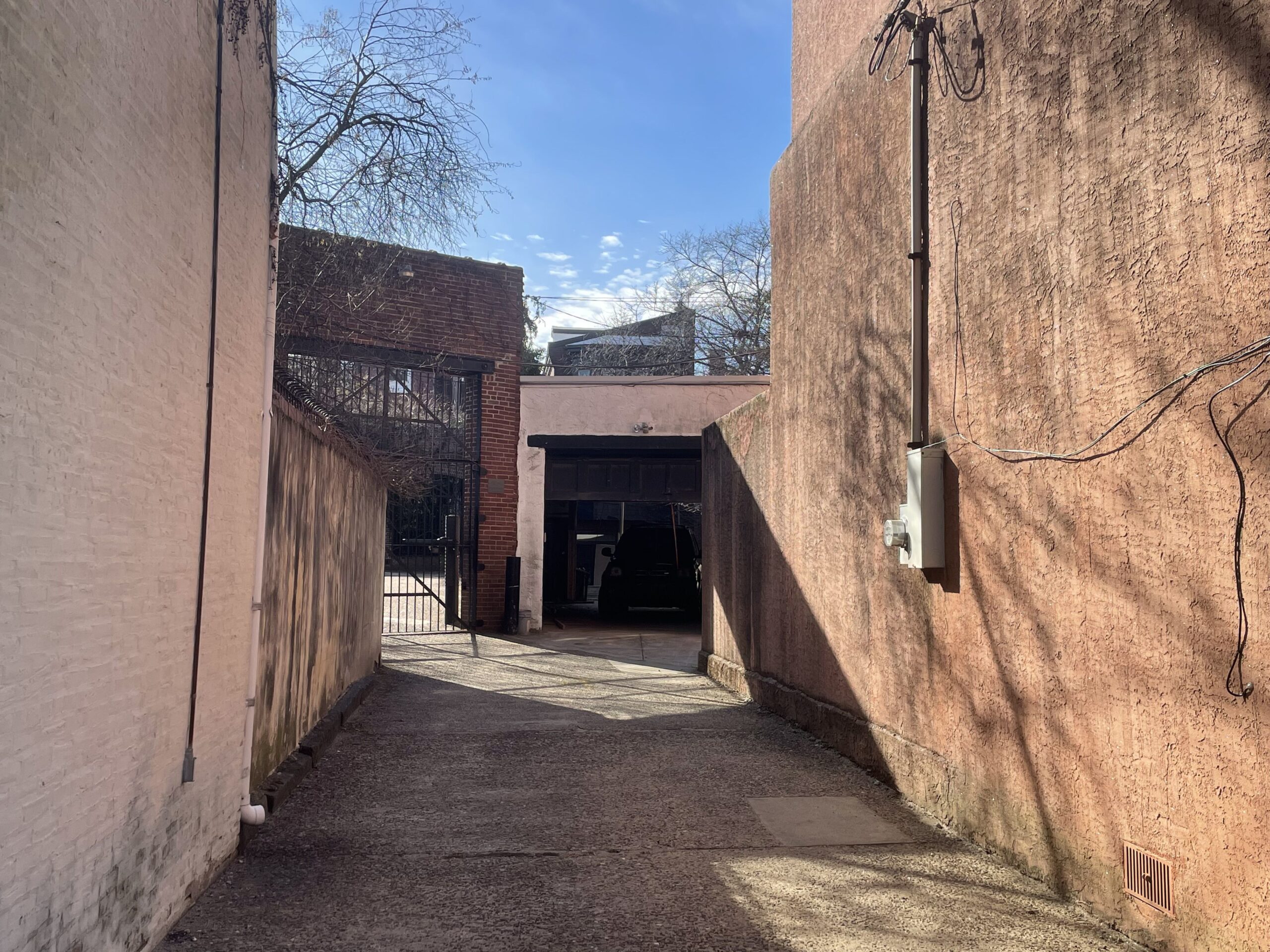
The garage on the right will be replaced by a three-unit building that is part of the redevelopment of 2313 Green St. It will be accessed through an alley off Wallace Street in the Spring Garden neighborhood.
Some preservation opponents may see the outcome as an example of the nickel-and-diming that occurs when developers attempt to add density to historic properties.
But the fact that a former single-family house will soon accommodate nine apartments reveals the untapped density in Philadelphia’s historic buildings. These conversions prove more housing can be created without sacrificing the city’s heritage.
The Washington Square West historic district, which covers 1,441 properties in Center City, has been overturned in a ruling by Court of Common Pleas Judge Christopher Hall.
Approved in 2024, the historic district was the largest in decades, covering a variety of buildings that date between 1740 and 1985. It was supported by the nonprofit Preservation Alliance of Greater Philadelphia and the Washington Square West Civic Association.
Opponents of the district, led by Washington Square West residents Jonathan Hessney, Colin Murphy, and Joshua Zugerman, contended that historic regulations would add cost burdens to property owners. In court, their lawyer, Dan Auerbach, argued against what he described as flaws in the Philadelphia Historical Commission’s consideration of the case.
Auerbach took issue with the involvement of Emily Cooperman, a member of the Historical Commission, in drafting the nomination. He argued that her role in working on the case was improper, even though she recused herself from voting.
Auerbach also argued that the nominators did not present substantial evidence at the commission meeting to support their claims that the large geographic area covered constituted a unified historic district.
“There was literally no evidence to support that,” Auerbach’s legal brief says. “Nobody testified. The nominators seeking designation put no facts or evidence into the record.”
In his one-page ruling, the judge appeared to agree with the challengers of the Washington Square West Historic District on those two arguments.
In a brief footnote, containing the only explanation for his ruling, Hall described the nomination as “not in accordance with the law.”
He cited an ethics provision in the Philadelphia code that no city officer or employee “shall assist another person by representing him directly or indirectly … in any transaction involving the city.”
(function() {
var l2 = function() {
new pym.Parent(‘washwest_rescinded’,
‘https://media.inquirer.com/storage/inquirer/projects/innovation/arcgis_iframe/washwest_rescinded.html’);
};
if (typeof(pym) === ‘undefined’) {
var h = document.getElementsByTagName(‘head’)[0],
s = document.createElement(‘script’);
s.type = ‘text/javascript’;
s.src = ‘https://pym.nprapps.org/pym.v1.min.js’;
s.onload = l2;
h.appendChild(s);
} else {
l2();
}
})();
In a phone interview, Cooperman said that she worked on the nomination largely because she had helped write a version of the case for a Washington Square West historic district that was presented in 2009, long before she sat on the commission.
She said she believed that the small amount of paid work she did on behalf of the Washington Square West Civic Organization in bringing the 2024 nomination up-to-date was legal, as long as she recused herself from the case before the commission.
“There have been other members of the commission that have had work before the commission, so that’s particularly surprising,” Cooperman said about Hall’s ruling. “That’s what the whole recusal aspect of the city’s ethics regulations are for.”
Hall also agreed that the supporters of the historic district had not presented sufficient evidence to make their case.
“The decision to designate the district, moreover, was not supported by ‘substantial evidence,’” Hall wrote.
At the Feb. 19 hearing, Hall persistently questioned the city’s lawyer, Leonard Reuter, to present support for the Historical Commission’s ruling, dismissing his statements as “a conclusion” and not evidence.
“At this time, the Historical Commission staff is working with the city’s Law Department to review the court’s decision and are preparing to evaluate their options,” city spokesperson Bruce Bohri said in an email. “We don’t have further comment beyond that right now.”
Auerbach also argued that the historic merits of the case presented by the nominators to the commission were flawed, but the judge did not appear to rule on that claim.
“Washington Square West was one of the most significant historical district designations in the city’s history,” Auerbach said in an email statement. “There was absolutely no evidence to support it. We are delighted that it has been overturned.”
The appeal of the Washington Square West historic district is one of several recent cases against the Historical Commission.
A judge ruled against a challenge to the Spruce Hill Historic District, a decision that is currently being appealed to Commonwealth Court. Another case against the Northwest Apartments Thematic Historic District — which covers 30 properties from the first half of the 20th century — has not yet been ruled on.
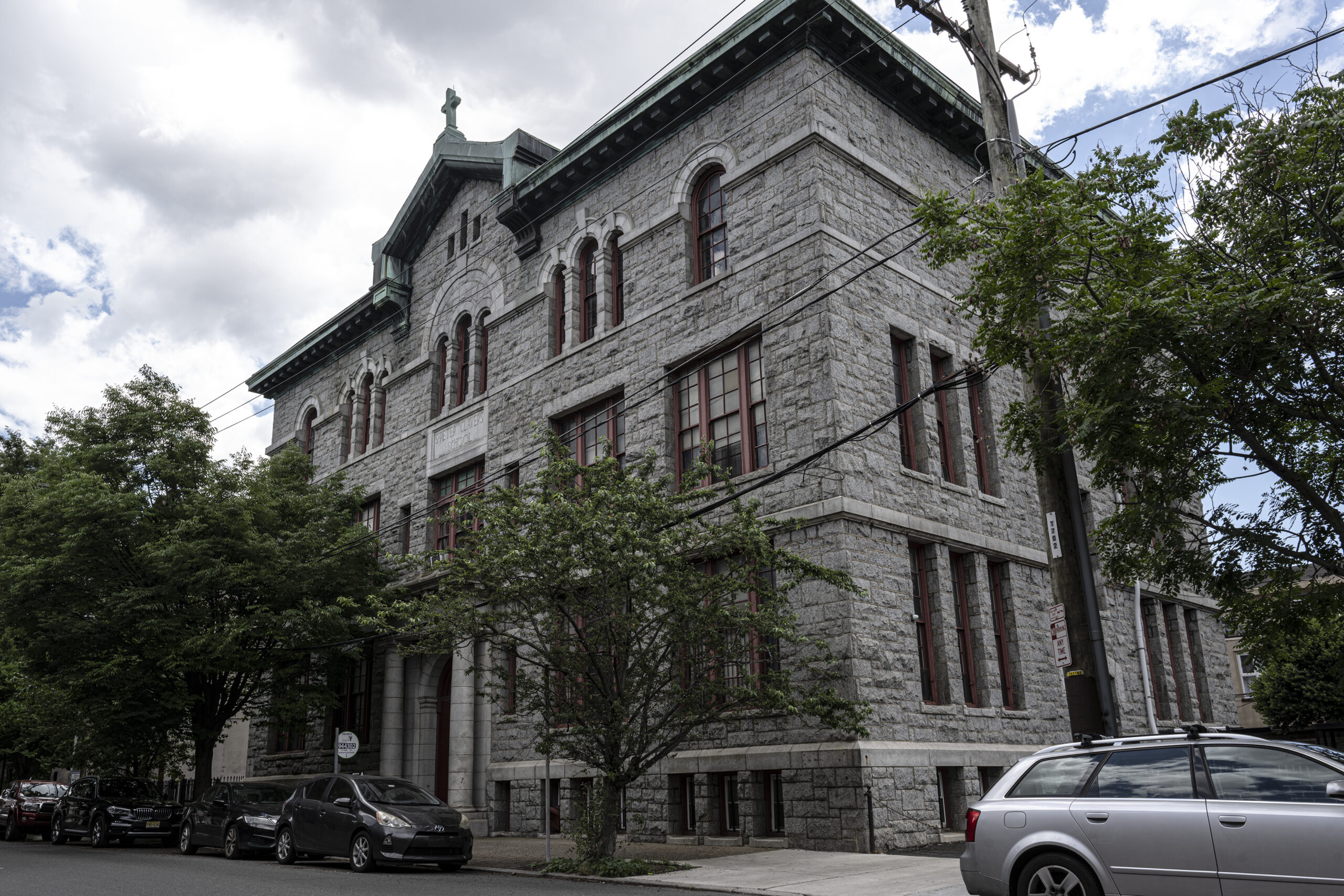
St. Peter Claver’s School, in the Washington Square West historic district.
Hall’s ruling will have no effect on cases that have already been decided.
But Auerbach says it will require preservationists to be more careful in framing their cases: “Future nominations will have to be based on real evidence with procedures that far better protect property owners,” he said in an email.
Historic nominations are frequently challenged, but the courts generally find in favor of the commission, trusting its expertise on historic matters.
“This comes as a surprise and disappointment,” said Paul Steinke, head of the Preservation Alliance. “To our knowledge, the provisions of the city’s historic preservation ordinance with respect to designating historic districts were followed. We are confused as to what aspect of that process did not comply with the law.”
Delaware’s only Nordstrom store is set to close its doors next month.
The Christiana Mall location will shutter on April 30, the company confirmed in an email on Monday. The closure was reported over the weekend by the Delaware News Journal.
“We believe we’ll be best able to serve customers in the area by leveraging our surrounding stores and through our digital channels,” Nordstrom said in a statement.
The two-story, 123,000-square-foot department store opened in the Newark mall 15 years ago. The high-end retailer is one of four anchors alongside J.C. Penney, Macy’s, and Target.
Once Nordstrom closes, the nearest full-price location will be more than 30 miles away at the King of Prussia Mall. The company’s discount counterpart, Nordstrom Rack, operates a store nearby at the Christiana Fashion Center complex in Newark.
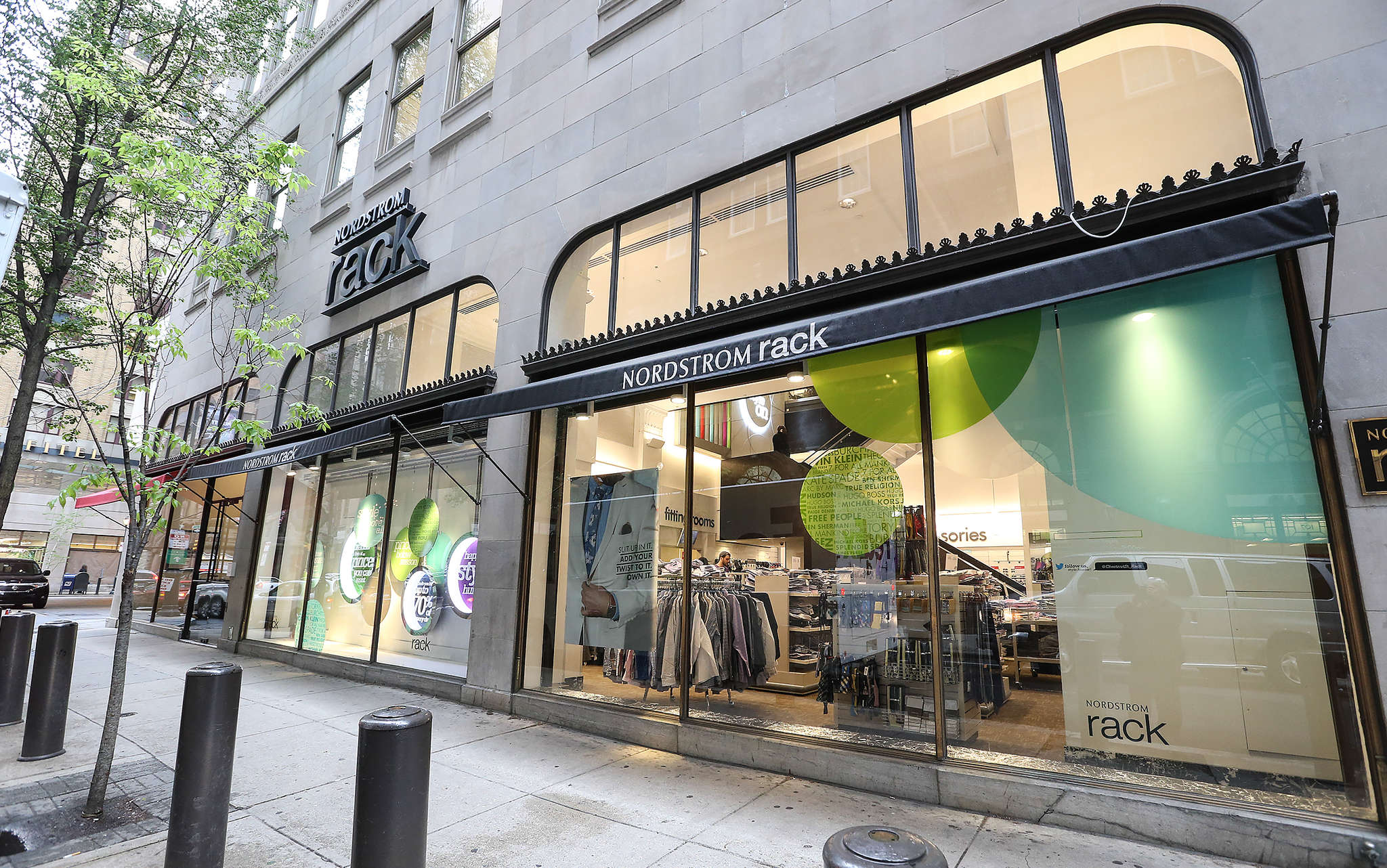
Nordstrom Rack in Center City is shown in 2018. Recently, the retailer has been expanding its off-price footprint.
The retailer has announced plans to open more than a dozen additional locations this year. They include Nordstrom Rack stores in the Main Street at Exton shopping center and at the Promenade at Granite Run in Media.
At the Christiana Mall, Nordstrom said it is “committed to taking care of our employees through this transition, including supporting those who are interested in finding another role within Nordstrom.” It did not say how many people would lose their jobs.
A search of Delaware’s online database of WARN Act notices, which are required in advance of closures and mass layoffs, did not yield any results.
Christiana Mall is billed by its owner, General Growth Properties (GGP), formerly Brookfield Property Partners, as “one of the most productive retail centers in the country.” The developers say that each year 10 million people visit the 1.2-million-square foot “tax-free shopping destination” that is home to more than 140 stores. Delaware has no state or local sales tax.
The Christiana Mall is shown in 2018. Its owners say 10 million people visit the Newark shopping destination each year.
A GGP spokesperson declined to comment on Nordstrom’s departure and said it was too soon to discuss what’s next for the space.
The news of the closure comes amid an uncertain time for the retail industry.
After decades in business, Saks Fifth Avenue in Bala Cynwyd is set to close next month after its parent company filed for Chapter 11 bankruptcy. In another segment of the retail industry, West Chester-based home shopping network QVC Group, according to a Bloomberg report, is considering filing for Chapter 11 bankruptcy to reorganize billions in debt.
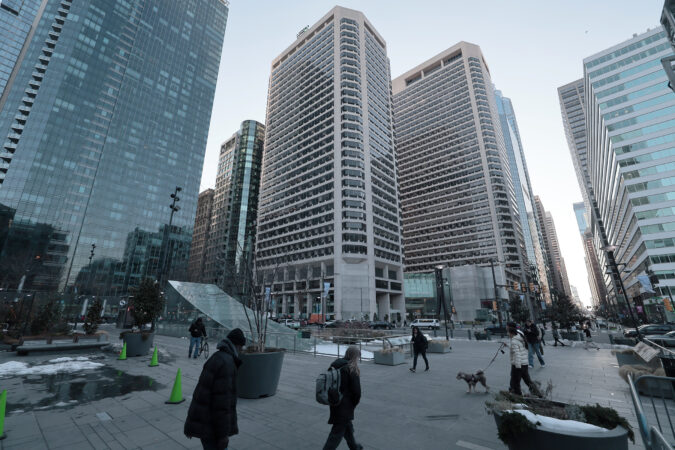
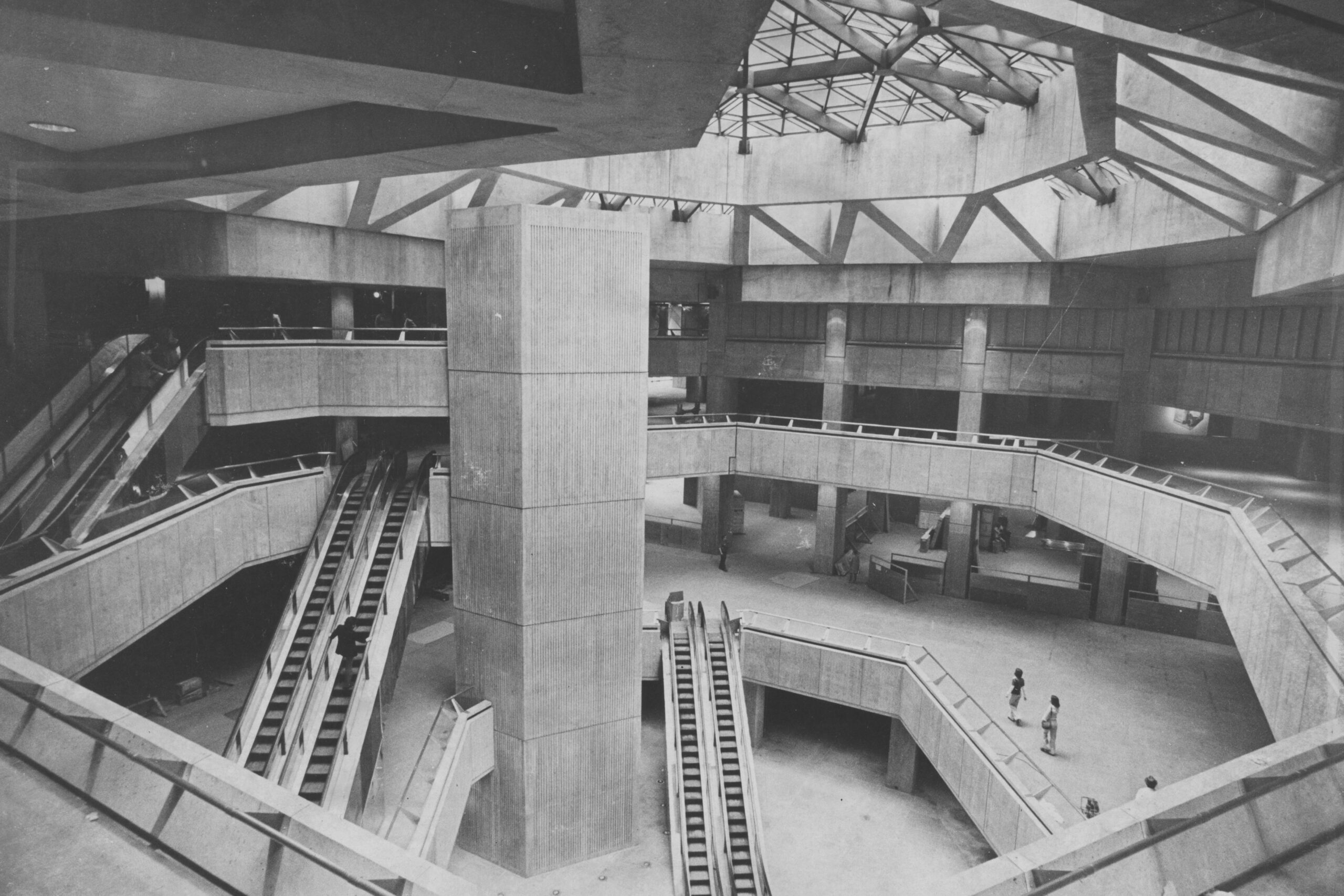
When it opened in 1974, the connected concrete towers of Centre Square boasted the most office space in Philadelphia, at over 1.7 million square feet.
Over 51 years later, the Brutalist behemoth still holds that title.
Butprobably not for much longer.
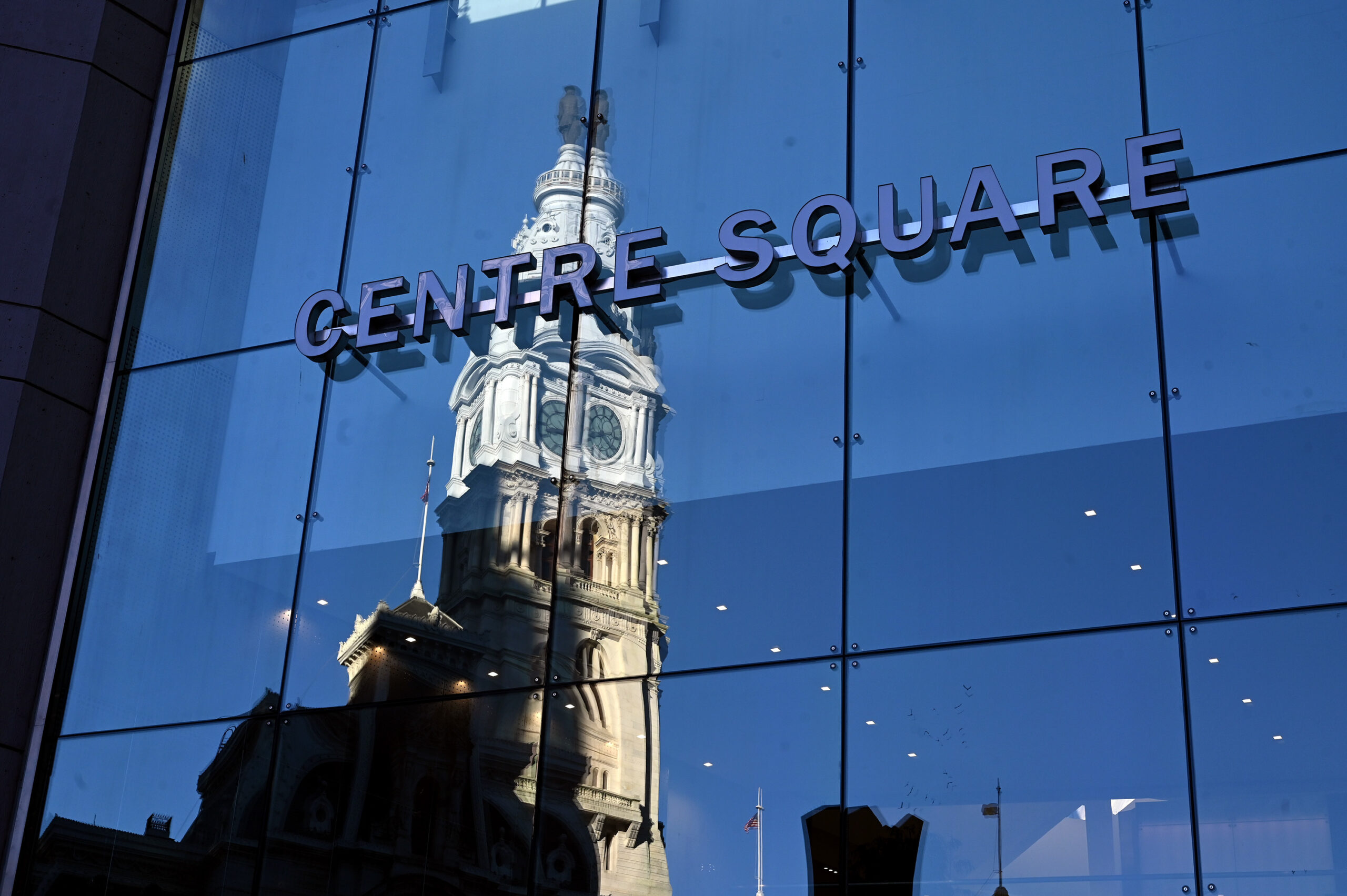
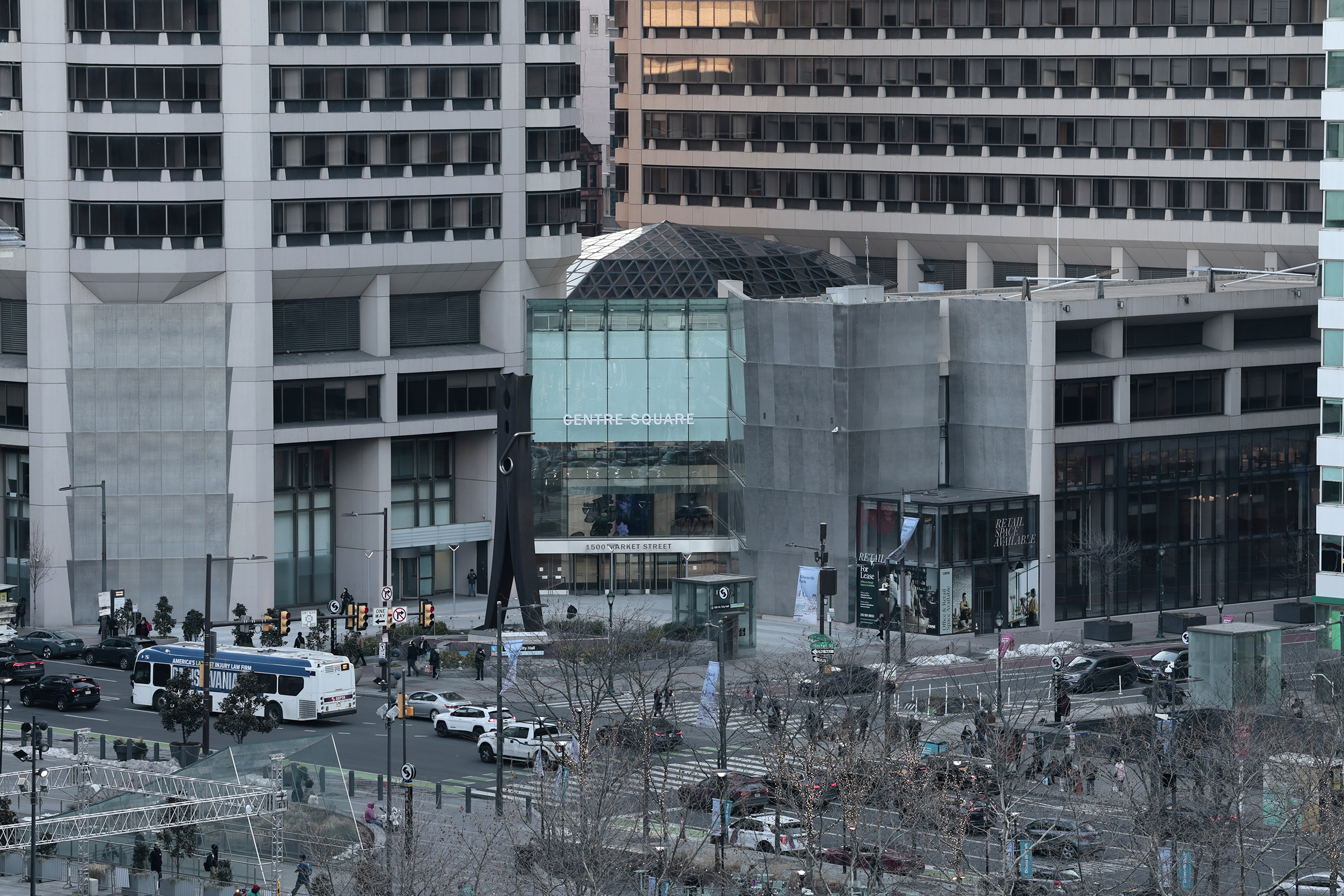
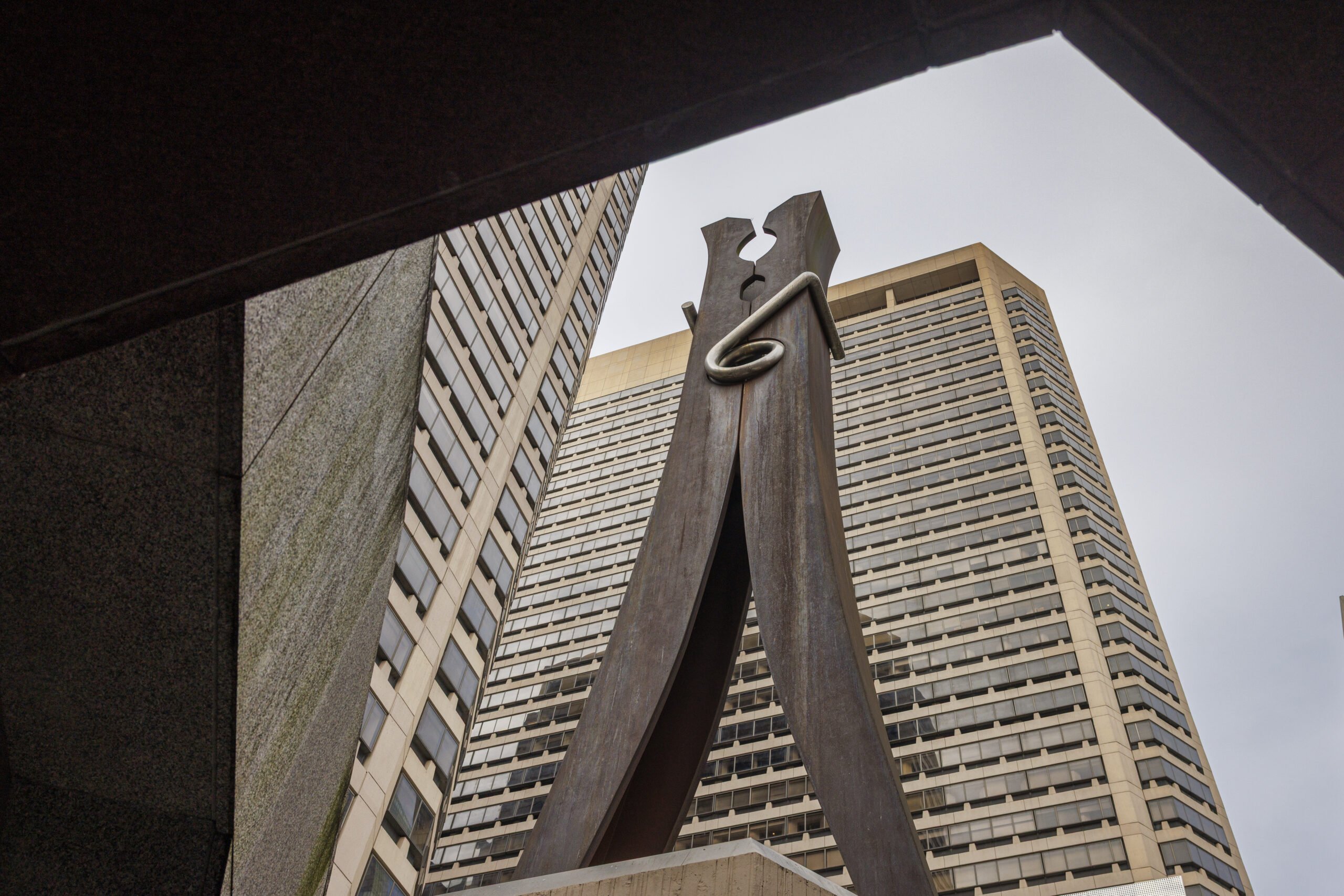
Centre Square — also known as the “Clothespin building” for its four-story pop art sculpture — is slated for mixed-use redevelopment by PMC Property Group and investor and developer Dean Adler, with much of the complex being devoted to hotel rooms and apartments.
“That corner of West Market is the best corner in the city,” Adler said. “You get …all the visibility going around the circle. When you look at City Hall, it may not be so nice inside, but outside, it’s a 1904 Beaux Arts building.”
Centre Square’s fortunes sank when COVID-19 struck and have never recovered. At the end of 2025, occupancy stood at 37.6%, giving it the highest vacancy rate in Center City,according to Morningstar Credit.
In 2017, when Centre Square last sold, it went for $328 million. Last July, the complex was appraised at $104.4 million and is now under agreement of sale to PMC and Adler for less than $94 million, according to Adler.
He says the plan is to retain 500,000 square feet of office space, enough to house the remaining tenants. Then there will be between 250 and 500 apartments spread between thebuilding’s two towers. Three hundred luxury hotel rooms will be built on the upper floors of the east tower, facing City Hall.
“William Penn is in your bedroom,” Adler said of the hotel.
Centre Square is located across from City Hall on what investor Dean Adler calls “the best corner in the city.”
On the lower levels of Centre Square, Adler says there will also be a spa and a 50-meter pool — amenities that he says the building previously had.
The acquisition of Centre Square is part of a wave of high-profile redevelopments between Adler and PMC, led byits president, Ron Caplan.
In recent years, the partners have purchased and redeveloped the Bellevue on South Broad Street, the Battery on the Delaware River, and the Bourse on Independence Mall.
“In today’s environment, there’s a real estate crisis, and we are buying these buildings for 20 cents on the dollar,” Adler said. “We …are rejuvenating architectural gems that are functionally obsolete.”
PMC declined to comment. News of Centre Square’s acquisition was first reported by the Philadelphia Business Journal.
Centre Square (center) at 1500 Market Street in Philadelphia on Friday, Feb. 27, 2026
More than ‘an office district’
The new Centre Square is part of a trend in which struggling office buildings have sold for less than half their previous prices with plans to convert the spaces into homes.
Centre Square’s discount was even deeper: The reported sale price is almost half what it sold for in 2002, not even adjusting for inflation.
The Wanamaker Building, which had over 1.4 million square feet of office space, is another example. Previously one of Philadelphia’s largest office buildings, it is being turned into apartments by TF Cornerstone and Alterra Property Group. Only a small number of offices will be preserved.
“The office district isn’t only an office district anymore,” said Prema Katari Gupta, president of the Center City District.
“There’s hospitality; there’s increasing residential. What makes a city great is when you have these layered neighborhoods with a lot of different types of demand drivers,” Gupta said.
The partners in Centre Square’s redevelopment haveworked together for decades, including on the new Aramark headquarters on the Schuylkill and 2040 Market St.
Adler‘s longtime business partner, Ira Lubert, with whom he founded real estate investment group Lubert-Adler, is not involved in the project. Instead, the Centre Square project partnership with PMC is being done under the auspices of a new venture, Adler & Co.
Philadelphia’s No. 1 business address
Centre Square spans two towers because it dates to an era when developers would not build taller than the William Penn statue atop City Hall, an unofficial agreement with the city that lasted until the 1980s when the Liberty Place skyscrapers were erected.
Planning for Centre Square began in the mid-1960s, signaling a shift, along with the construction of Penn Center, for Philadelphia’s office district from the Art Deco South Broad Street to West Market Street.
Centre Square’s atrium and retail space in in 1974.
“Those buildings created the momentum,” said Bill Hankowsky, former CEO of Liberty Property Trust, which developed neighboring office skyscrapers like Liberty Place and the Comcast towers. “It was the biggest single project that said we’re going down Market West.”
Designed by architect Vincent Kling and developer Jack Wolgin, it was seen as a revolutionary project and hailed as Philadelphia’sNo. 1 business address in ads in The Inquirer.
Centre Square also bears the architectural hallmarks of the 1960s, like its poured concrete building materials that — along with its respect for the old height limit — set it apart from the steel skyscrapers built farther down West Market later in the decade.
The building’s Brutalist architecture — often a polarizing style — has bedeviled many of its subsequent owners, who pumped millions of dollars into Centre Square nearly every decade since the 1970s to keep it competitive.
“It is structurally built differently than other buildings on Market West,” Hankowsky said. “It’s a substantial building, but also it is a tougher building to deal with. The walls are thick, the floors are thick. It’s a big challenge.”
That’s part of what deterred many other developers who considered buying the building.
The sheer scale is a challenge, too. Some interested parties were put off by the percentage of the building that would have to remain office, as a full residential conversion is unlikely.
“The buildings don’t particularly lend themselves to a complete conversion to apartments,” said John Grady, who used to lead the Philadelphia Industrial Development Corp. and studied the building for its prior ownership. “They’re too big, and the floor plates don’t work as well as other buildings.”
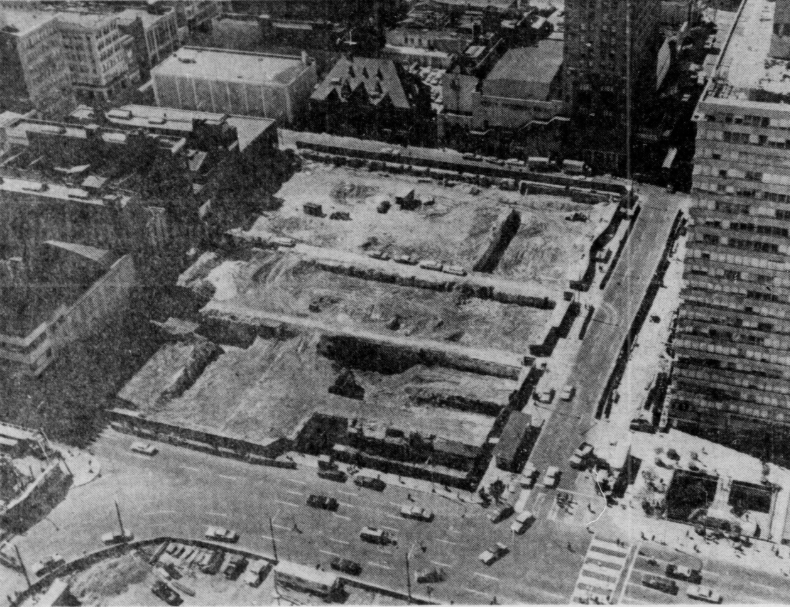
A photo of the long vacant lot while Centre Square went through its fiscal and legal trials during construction.
Born in drama, consideredfor Comcast HQ
Centre Square’s birth was not easy. Its planning and construction took almost 10 years, with legal and financial delays that included an investigation of the project by then-District Attorney Arlen Specter. (Wolgin told reporters that the Republican politician was “out to get” him.)
The delays left a yawning vacant lot just west of City Hall, which led Mayor James Tate to describe Centre Square as “doomed” in 1969.
When Wolgin eventually began construction, he then faced blowback from powerful critics of Claes Oldenburg’s Clothespin sculpture that he wanted to place in front of his towers.
“It was a disaster!” Jack Wolgin told The Inquirer in 2001. “They said, ‘How can you take something like this pop art and put it in front of City Hall? It’s a monstrosity! It’s a disgrace!’”
Despite the building’s polarizing beginnings, it became a mainstay of the office market, attracting one-time corporate giants like CoreStates bank and Towers Perrin consultants.
Claes Oldenburg’s pop art Clothespin sculpture stands in front of Centre Square.
It snagged Comcast as a tenant in the early 1990s, after the company was forced out of its first urban home by the fire that destroyed One Meridian Plaza.
Comcast studied the building as a possible headquarters for the company before eventually turning to Liberty Property Trust to build their skyline-defining towers.
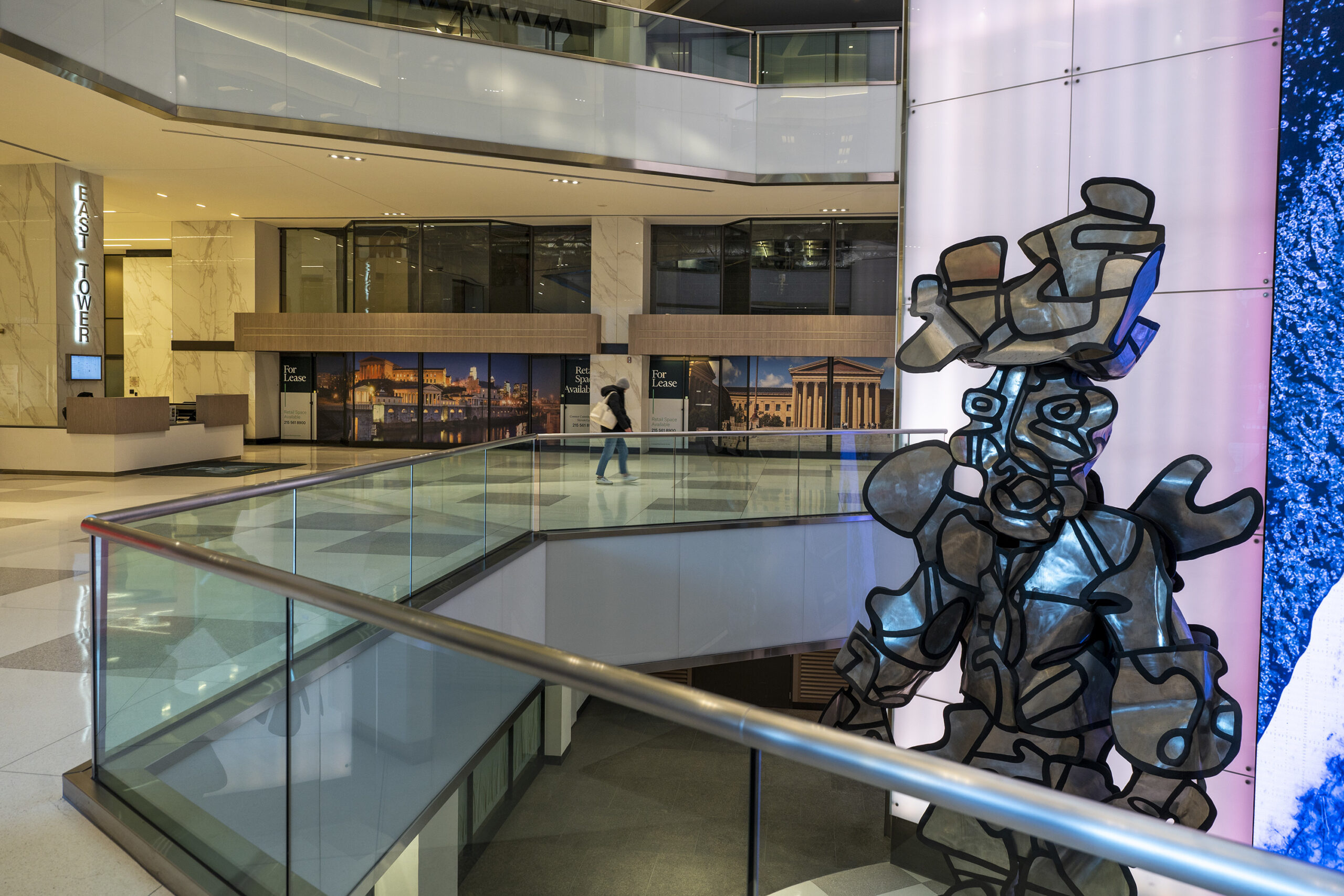
Still, many of its 1960s-era flourishes proved difficult to adapt to the modern era. By the 1980s, the atrium that connects the two towers and houses its inward-facing retail received its first renovation.
Centre Square’s atrium has undergone renovations almost every decade since.
The lobby of Centre Square in 2024.
Looking ahead
Inquirer architecture critic Inga Saffron wrote about Centre Square‘s latest update in January 2020.
“Fortunately for Philadelphia, the city’s biggest, baddest Brutalist complex, Centre Square, has always been too big to fail,” she wrote just before COVID-19 struck and emptied office towers around the country.
Now, six years later, Adler and PMC Property Group believe they can bring it back as something new.
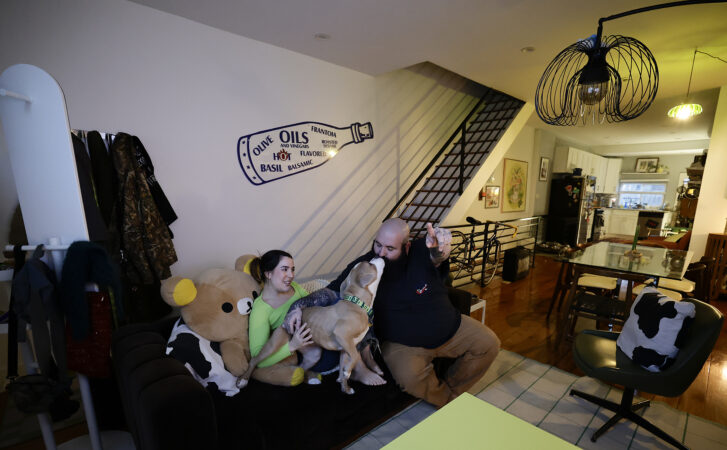
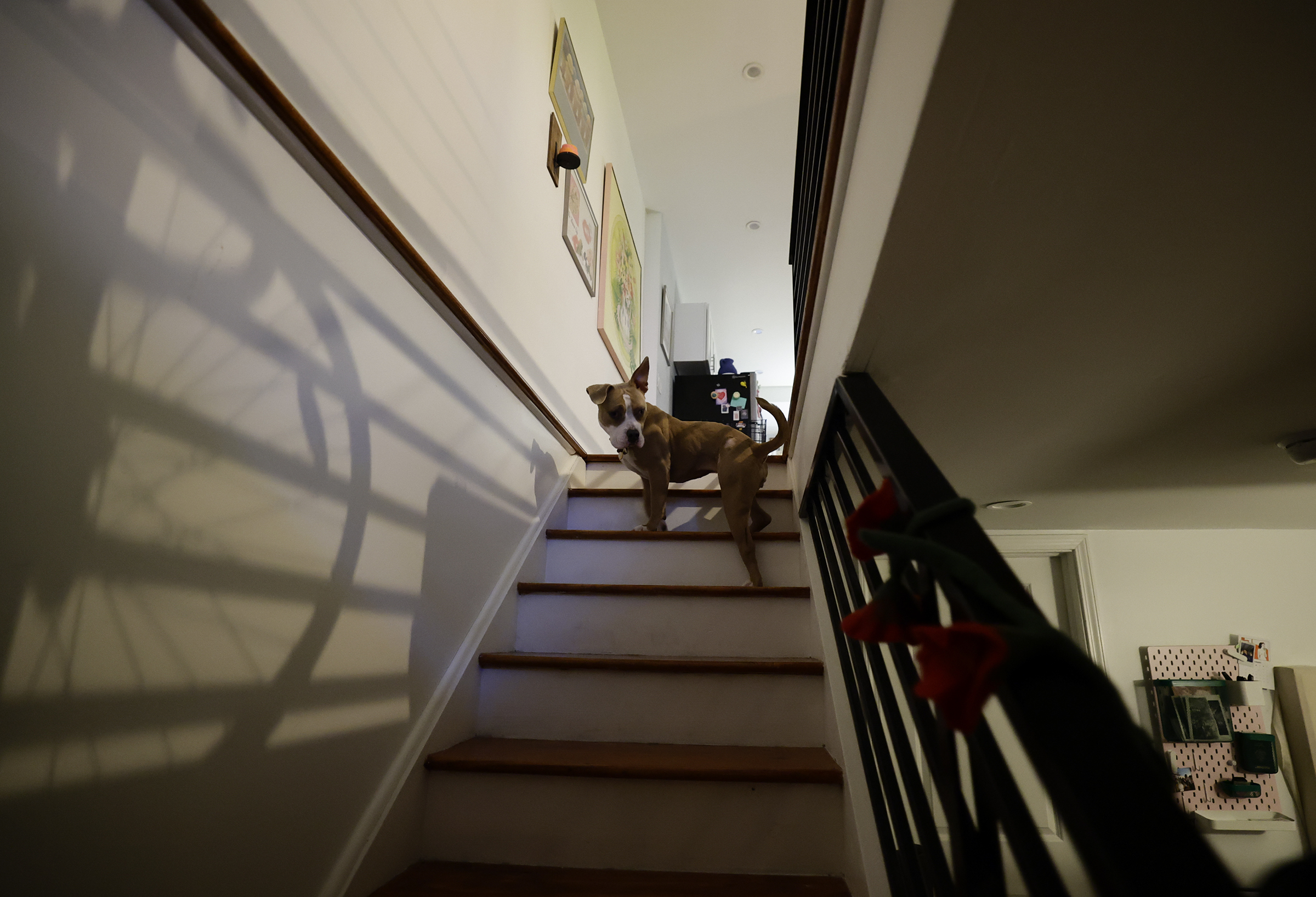
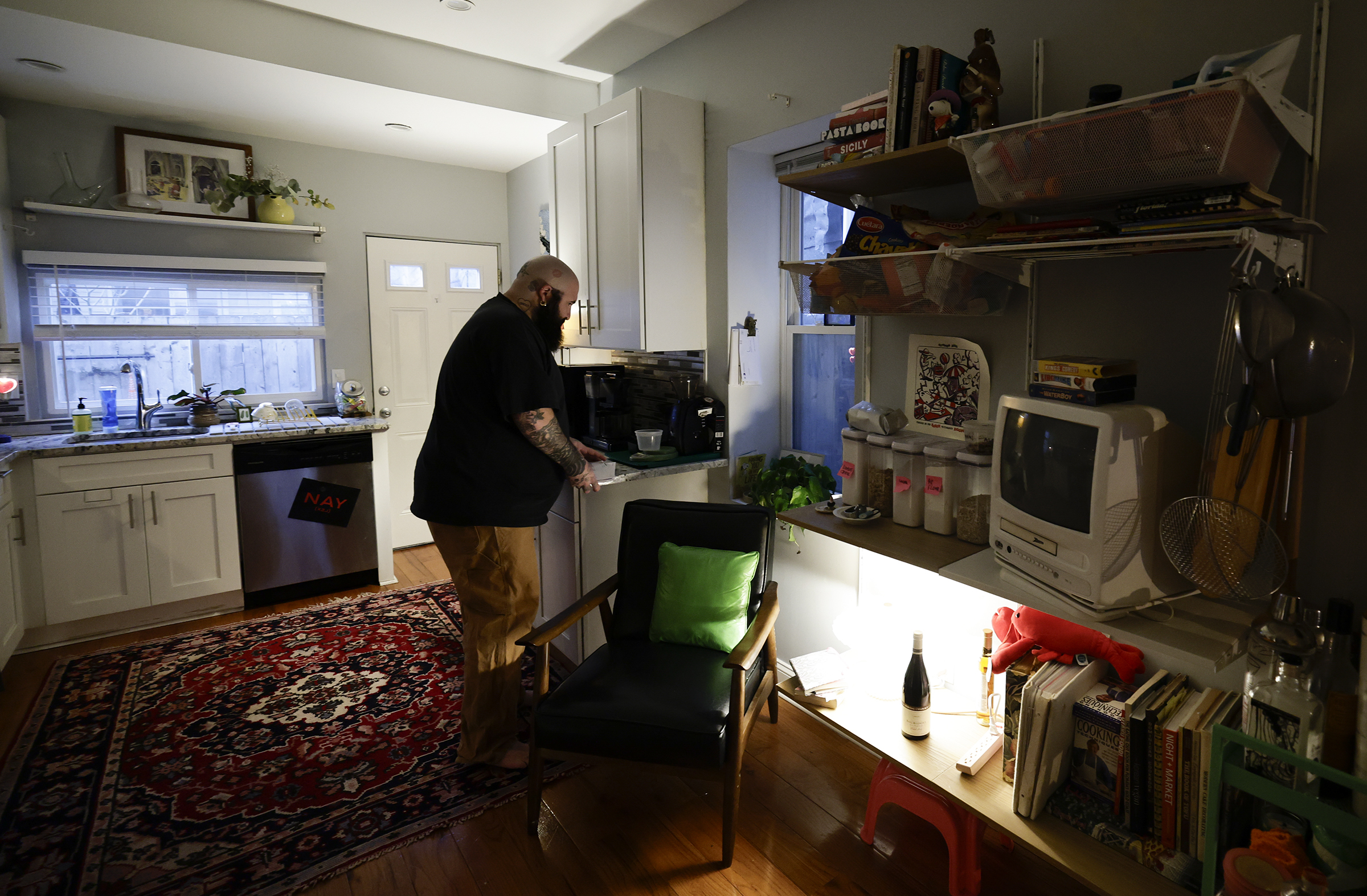
Mooshy the dog stands on the steps leading to the basement of the South Philadelphia home of Sam Gellerstein and Sara Sarmiento on Friday, Feb. 27, 2026.
The ask: Sam Gellerstein wanted space.
He’d been in South Philly for the better part of a decade, and he loved the area. But his one-bedroom off East Passyunk Avenue was starting to feel small. What’s more, after a three-year long-distance relationship, his partner, Sara Sarmiento, was moving to Philadelphia from South Florida. He needed a place big enough for both of them — and big enough to support a future family.
The one-bedroom “was cool for me as a person living by myself,” said Gellerstein, who cofounded and plays bass for Philly band Snacktime. “But wanting to have a dog and start a family, we wanted to have a nice, big house, and we wanted to be around cool stuff.”
It was important to stay in South Philly and to be able to have friends and family visit, too — so extra living spaces were a must. He and his partner also wanted something they could make their own.
“My girlfriend’s an amazing artist, and I like to think I have some style myself, so it was really important to have a place we could put our touches on,” Gellerstein said. “We didn’t want to just hang up the pictures and be like, ‘This is our place.’ We wanted to be able to put our personality into it.”
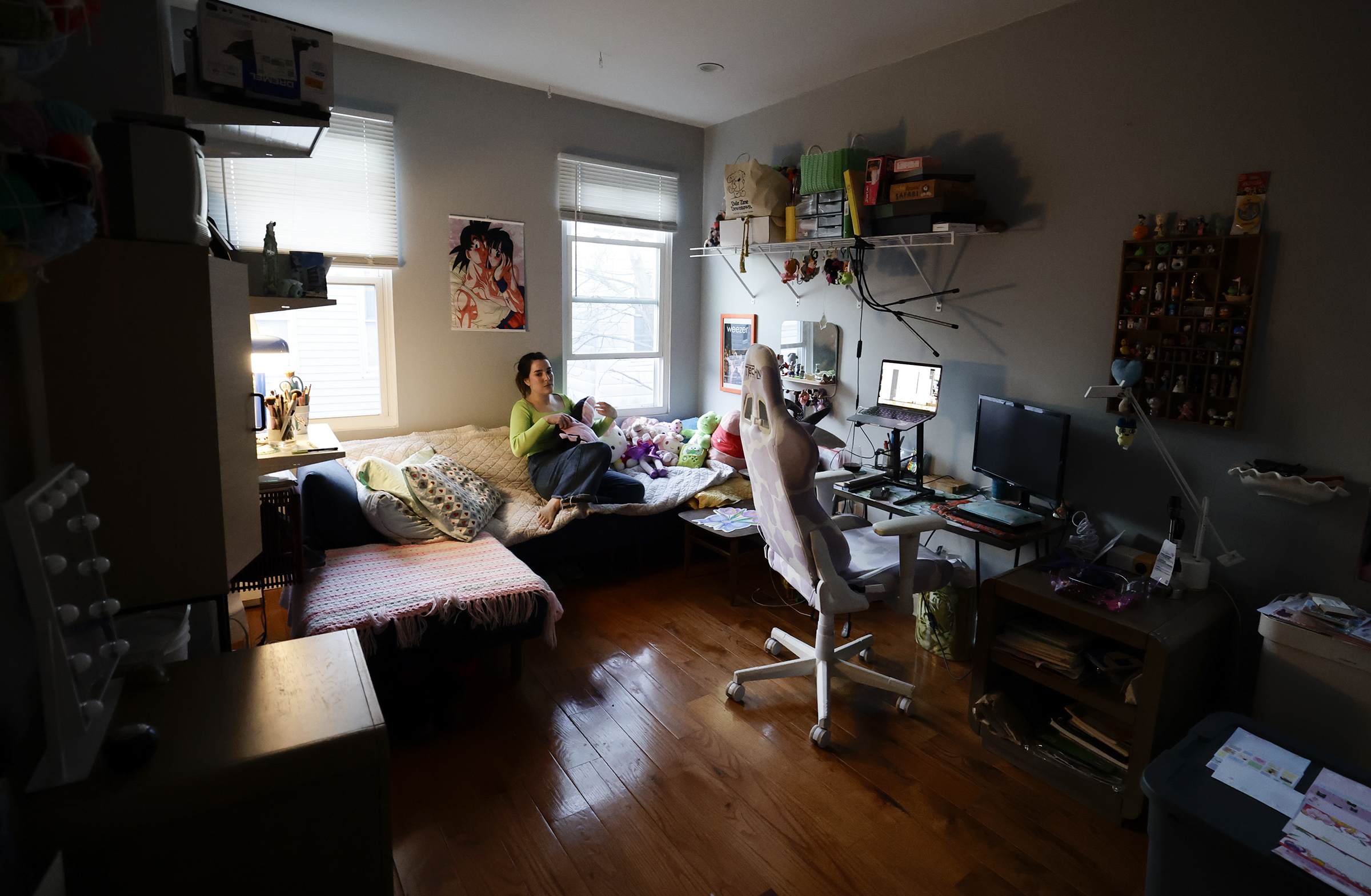
Sara Sarmiento sits with Mooshy in the South Philadelphia home on Friday, Feb. 27, 2026. She and boyfriend Sam Gellerstein closed on the home in August.
The search: Their search began last June. Gellerstein estimates that they looked at about 15 houses — pretty much all of them south of WashingtonAvenue. One, near 13th and West Ritner Streets, seemed promising. “It was a really beautiful house with one of the craziest backyards I’ve ever seen in Philly,” he said. “Really amazing high ceilings. It was really special.” The downside was that it didn’t have central air, and the basement was in need of significant work. So when they submitted an offer and didn’t get it, it wasn’t the end of the world. Not long after, they found The One.
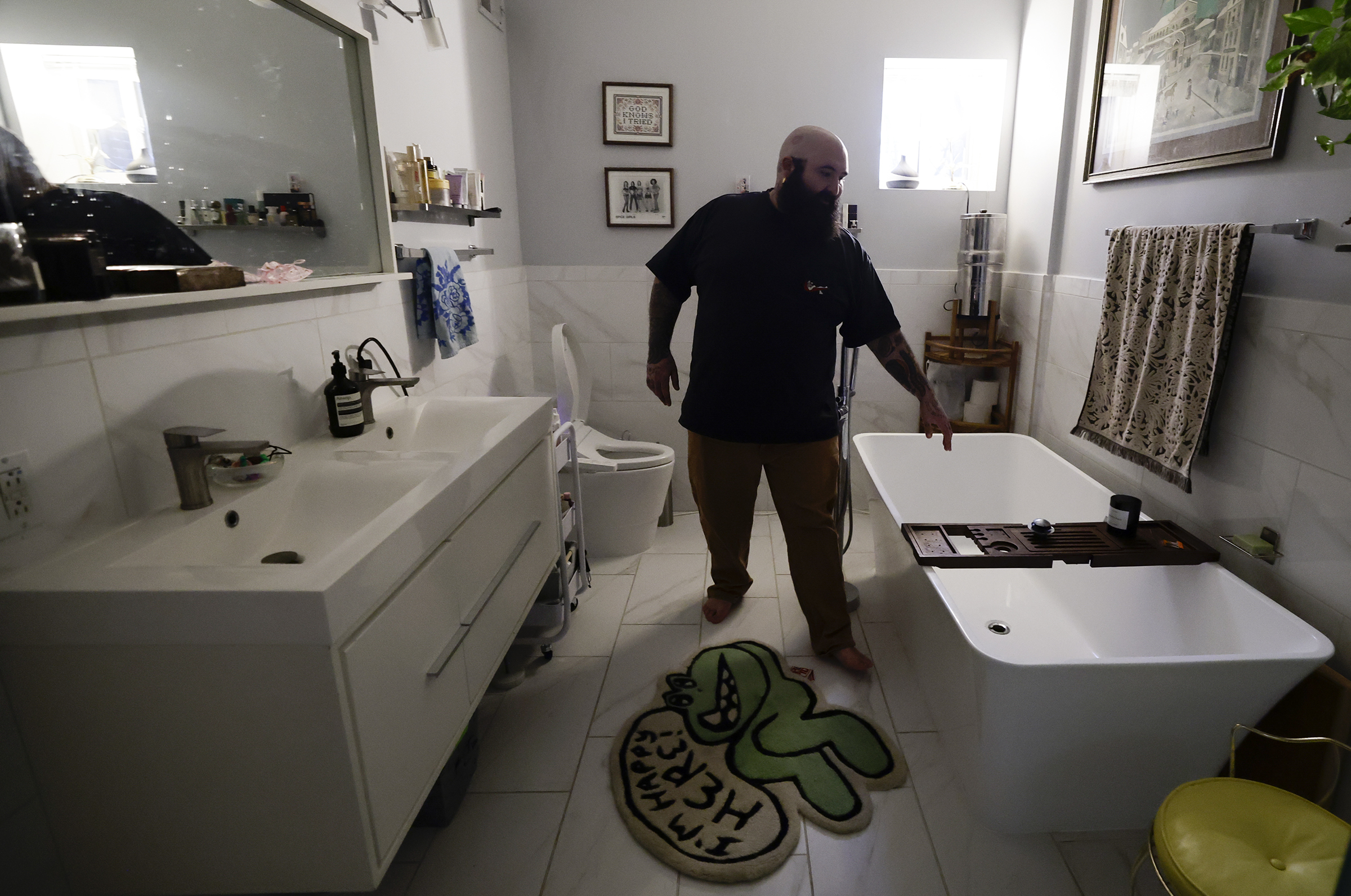
The appeal: Unlike the previous house, this one had central air as well as a mostly finished basement. They liked that this house didn’t need a ton of work and that the money they’d save on renovations could be used on other things. Gellerstein loved the standalone bathtub. It also had a backyard and was next to Wharton Square Park.
Sam Gellerstein in the second-floor bathroom of his South Philadelphia home on Friday, Feb. 27, 2026. The bathtub was one of his favorite features when considering the home.
The decision to make an offer was easy. “There wasn’t too much drama in selecting the house,” Gellerstein said.
The deal: The home had multiple offers, so the couple put in a bid over asking price. Ultimately, they offered $346,000, and the bid was accepted. As part of the negotiation, the couple agreed to informational inspection, and the seller offered $11,000 to help with closing costs.
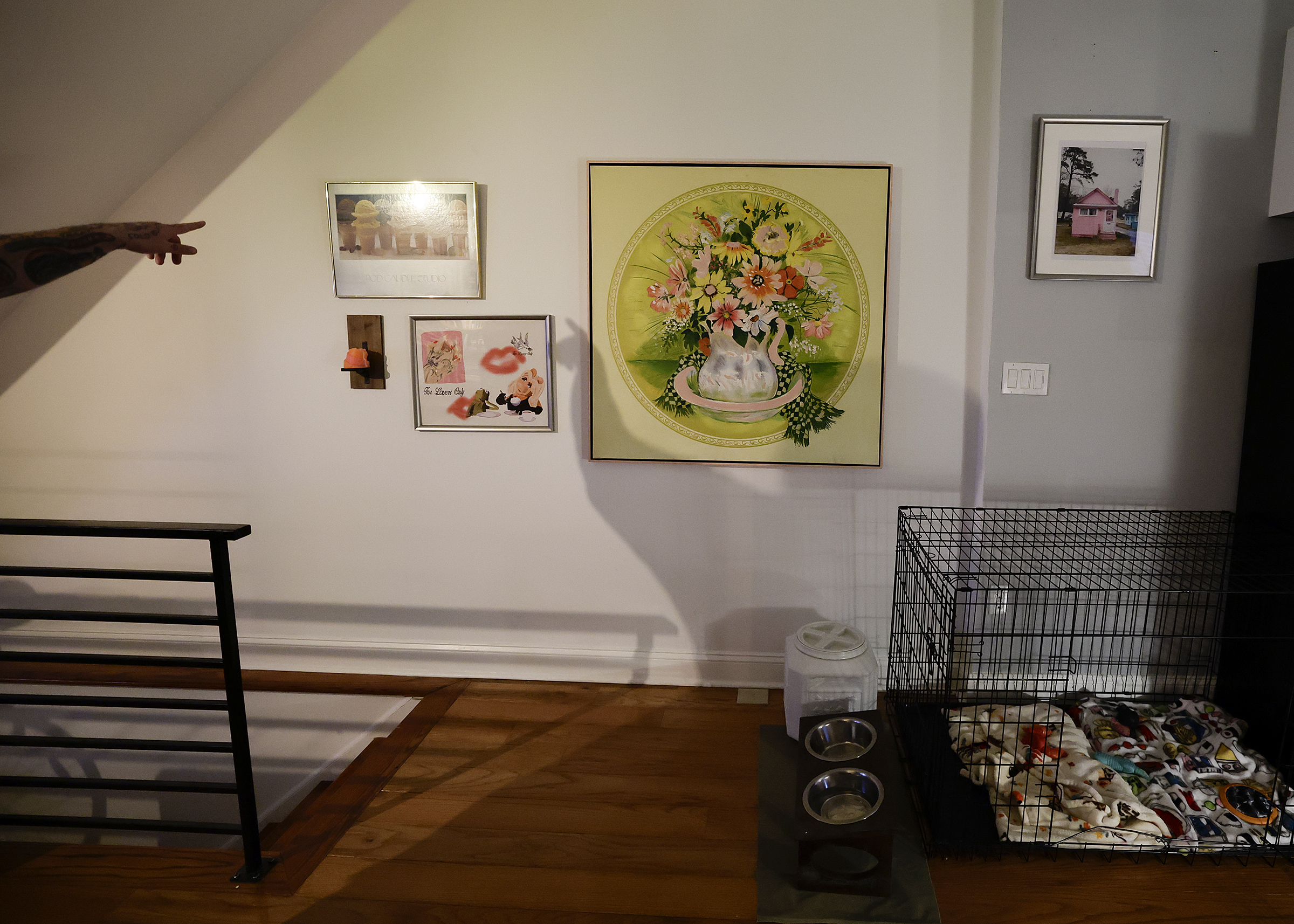
Art work hangs in the South Philadelphia home of Sam Gellerstein and Sara Sarmiento on Friday, Feb. 27, 2026. They wanted a home that would allow them to put some of their own personality into the space.
The money: “I had some money that I found in a couple different accounts that I’d been saving up in, and I used some of my old retirement money from a previous job,” Gellersteinsaid. All told, they put $19,000 down and were able to secure a monthly mortgage payment of $2,375.
The move: Gellerstein hired movers to take his belongings from the one-bedroom to the new home, and the couple used a moving van to get his partner’s things from Florida to Philly.
Sam Gellerstein in the kitchen of his South Philadelphia home on Friday, Feb. 27, 2026.
Any reservations? With the exception of a dryer that needed replacing shortly after moving in, “the house has been very good to us,” Gellersteinsaid. “It held up through these cold winter months, nothing crazy happened, so we’re really grateful.”
He’s loving the basement, particularly. “We put a [vintage] Herman Miller cubicle down in the basement and separated it off from the den so it almost functions as another little tiny room,” he said. And after years spent working in a cramped bedroom, the added space has been revelatory.
Sam Gellerstein sits at his basement music work area in his South Philadelphia home on Friday, Feb. 27, 2026.
“It’s really nice to be able to work and write music and compose and get my emailing done,” he said.
Having a fenced-in backyard has been great for the couple’s new pit bull, Mooshy, on mornings when a long walk isn’t possible. Next on their to-do list is turning an unfinished portion of the basement into an additional bathroom.
Sara Sarmiento sits in her second-floor office in the South Philadelphia home she shares with boyfriend Sam Gellerstein. She recently moved to Philadelphia from Florida.
Life after close: They’ve quickly fallen in love with the neighborhood, which they’ve found incredibly welcoming. “The block is super tight,” Gellerstein said. Meanwhile, a collection of nearby restaurants and coffee shops offers plenty to do.
“We put a lot of work into getting this house that’s perfect for us,” he said. “Who knows what the future might hold? But we don’t view this as a starter house — we view this as our house.”
Did you recently buy a home? We want to hear about it. Email darnett@inquirer.com.
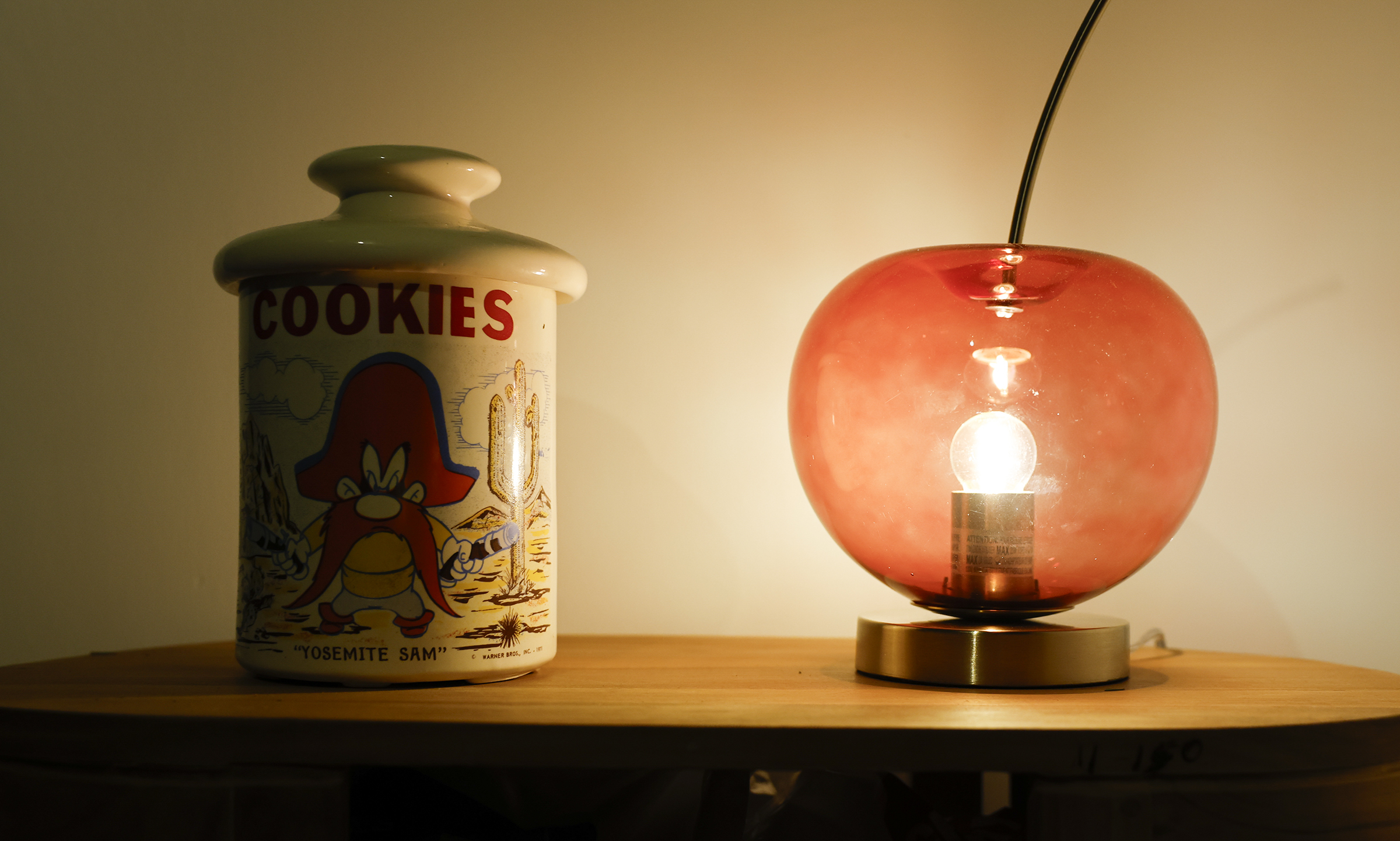
A cookie jar and lamp in the South Philadelphia home of Sam Gellerstein and Sara Sarmiento. Purchasing a home that didn’t need significant work allowed them to save money for additions they wanted to make, rather than needed.