Category: Real Estate

  • Original mid-century features and colorful vintage design in Delco

    Original mid-century features and colorful vintage design in Delco

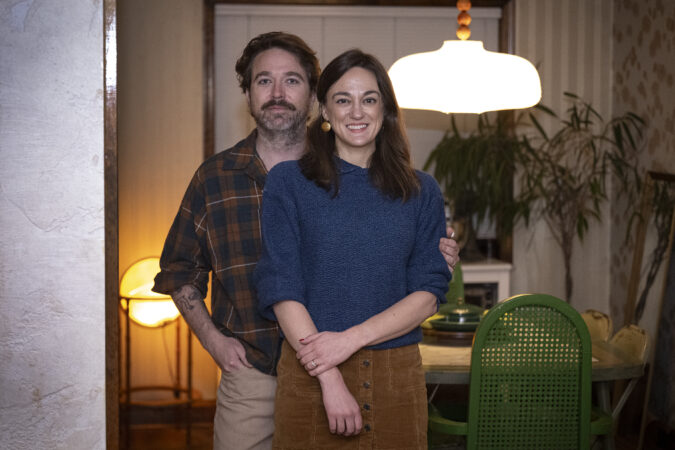
    It may have been the pink and green bathroom that sold Genevieve DeChellis on the mid-century, 1,450-square-foot, five-bedroom brick house in Clifton Heights in early 2024. Or perhaps the colorful lighting above the basement bar sealed the deal.

    She and her fiancé, Jesse Blankschen, had been on the hunt for a house for a while, but nothing felt quite right.

    “We didn’t fully know what we wanted, but we knew what we didn’t want,” DeChellis recalled. “No millennial gray, or millennial beige, or a house without any sign of life.”

    When they spotted the Zillow listing for this home, they instantly knew it was the one. The house not only was filled with color, but it had only been lived in by just one owner who had built the house for his family. It was evident he took great care of the house.

    “The fact that I have a pink and green bathroom feels like a cosmic design,” DeChellis said. “There is so much beautiful tile work in homes and so often it just gets torn out. It’s so happy and I love those two colors together.”
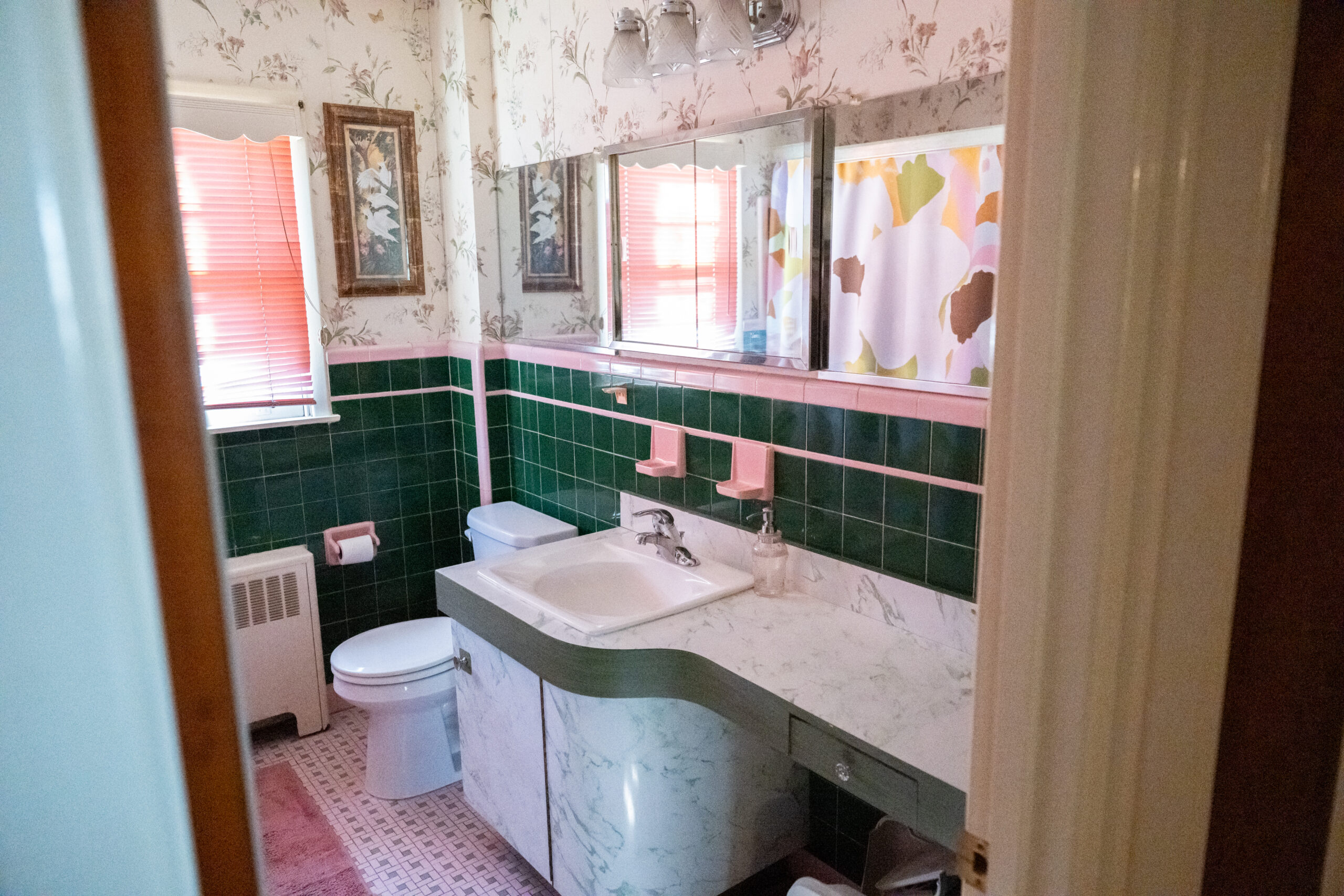
    The pink and green tiled bathroom was one of the features that drew DeChellis to the house.
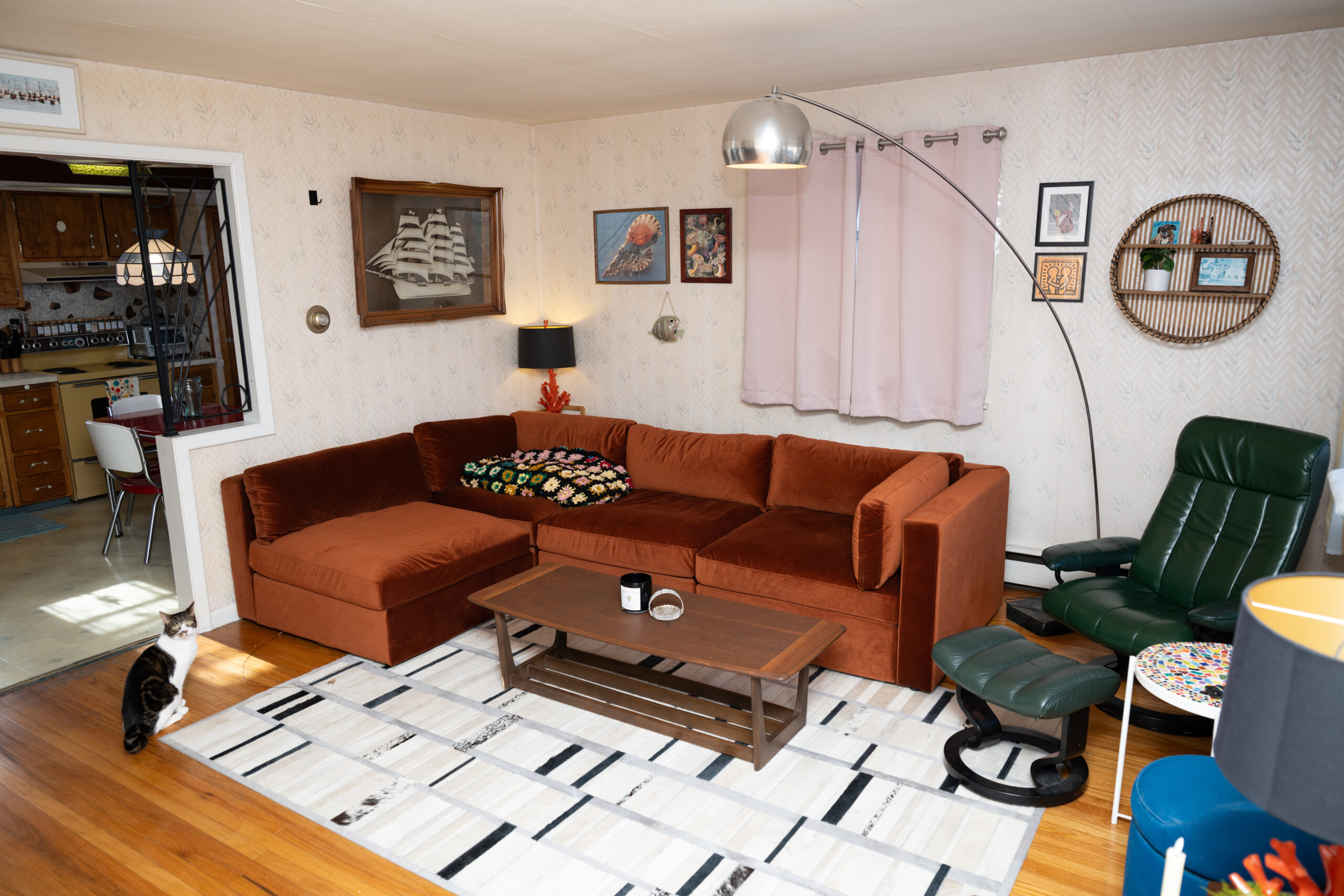
    The living room’s orange velvet sectional draws the eye, surrounded by secondhand, vintage, and mid-century decor.

    The couple is putting their own personal stamp on the house through aesthetic changes. They’ve been replacing the original wallpaper with fresh paint and thrifting unique items to fill meaningful spaces.

    At the same time, they are preserving the integrity of the home — “those pink and green tiles aren’t going anywhere,” DeChellis insisted.

    She and Blankschen are avid thrifters, and some of their favorite finds come from the Dust Shuttle, an online antiques auctioneer. They’ve snagged unusual art, funky lamps in the shape of a fish and an ice cream cone, and an array of furniture.

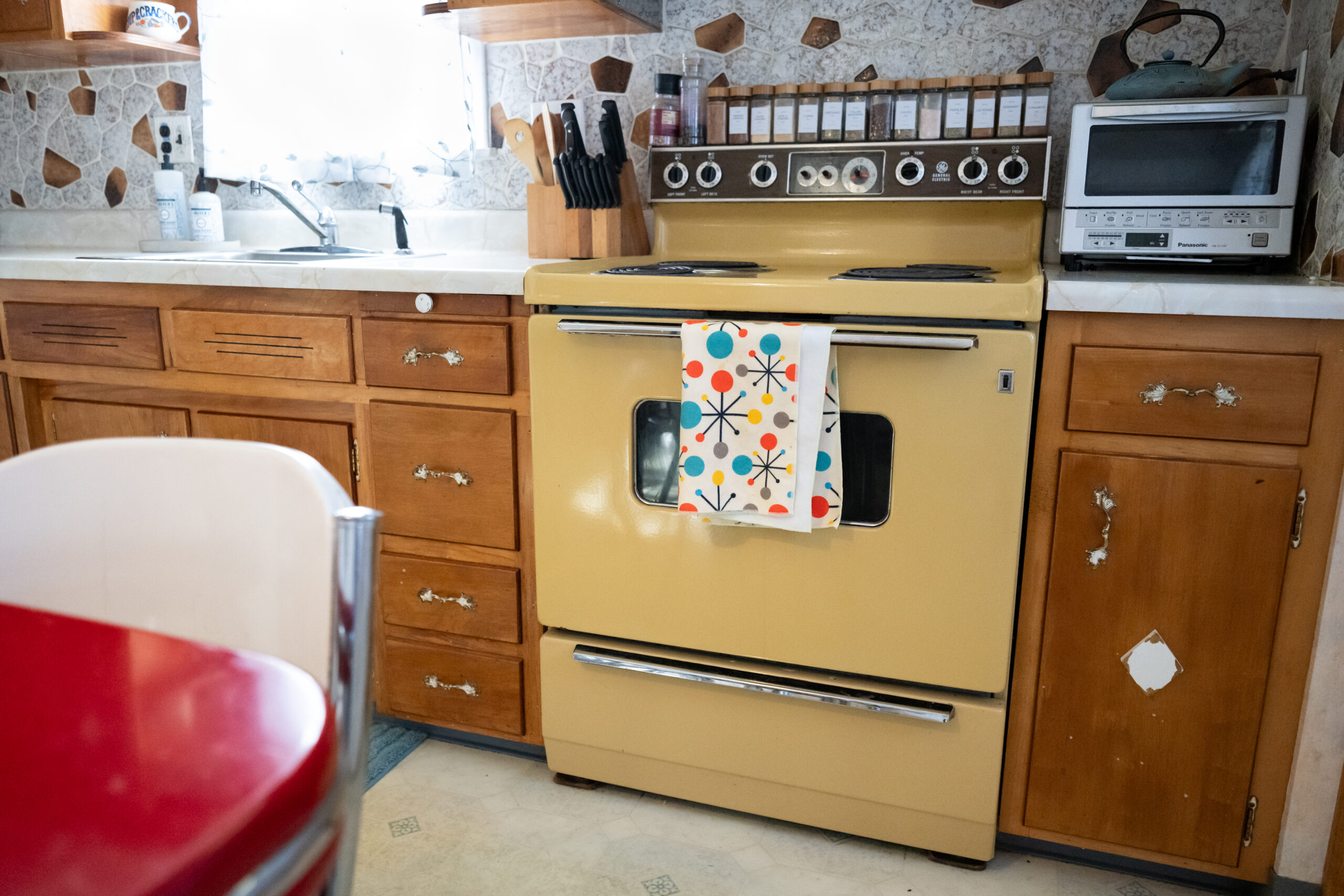
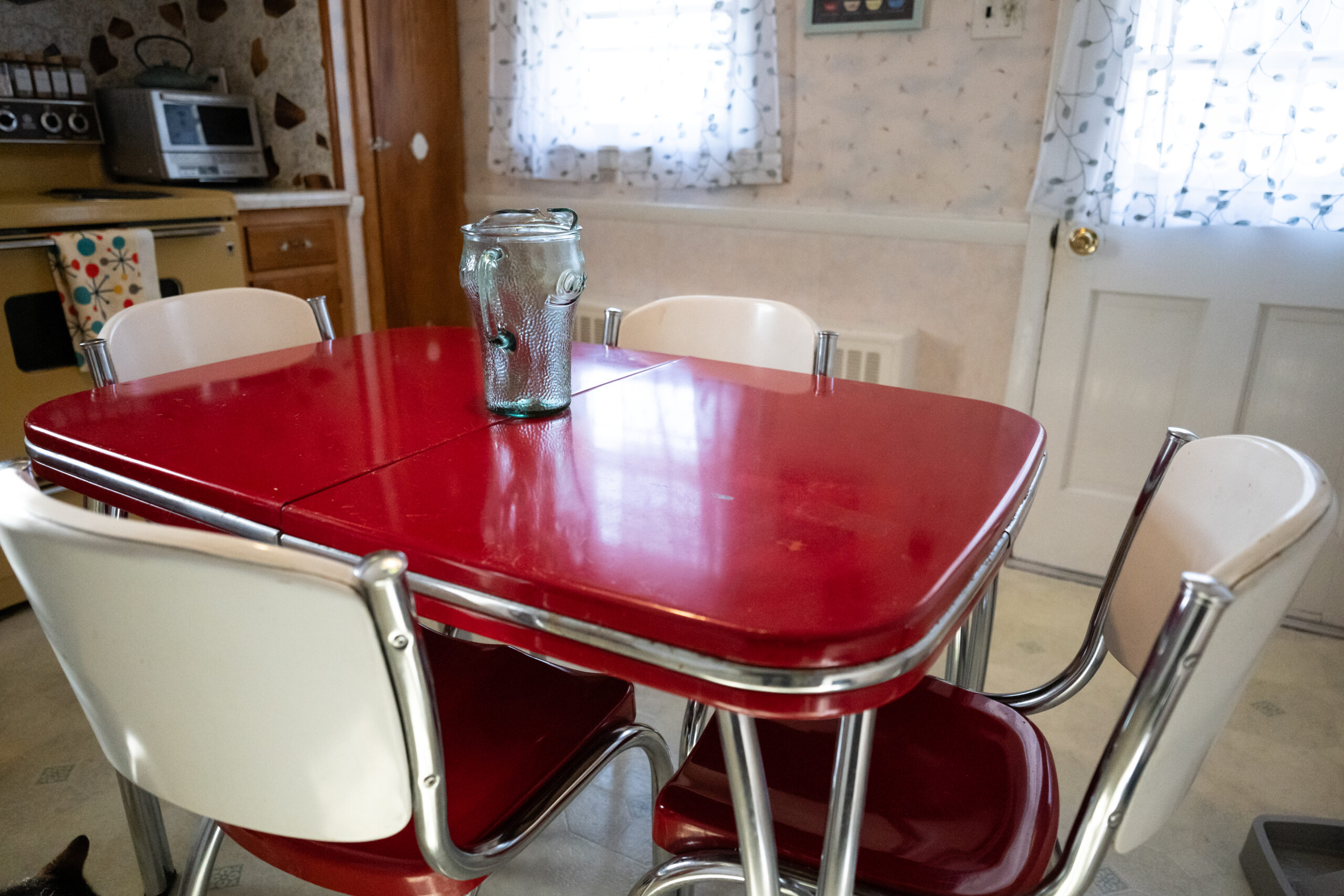
    The mid-century kitchen features a yellow GE oven, a stained-glass ceiling soffit light, and a stained-glass pendant light. A red metal table à la 1950s diner is surrounded by red and white vinyl chairs, a Facebook Marketplace purchase.
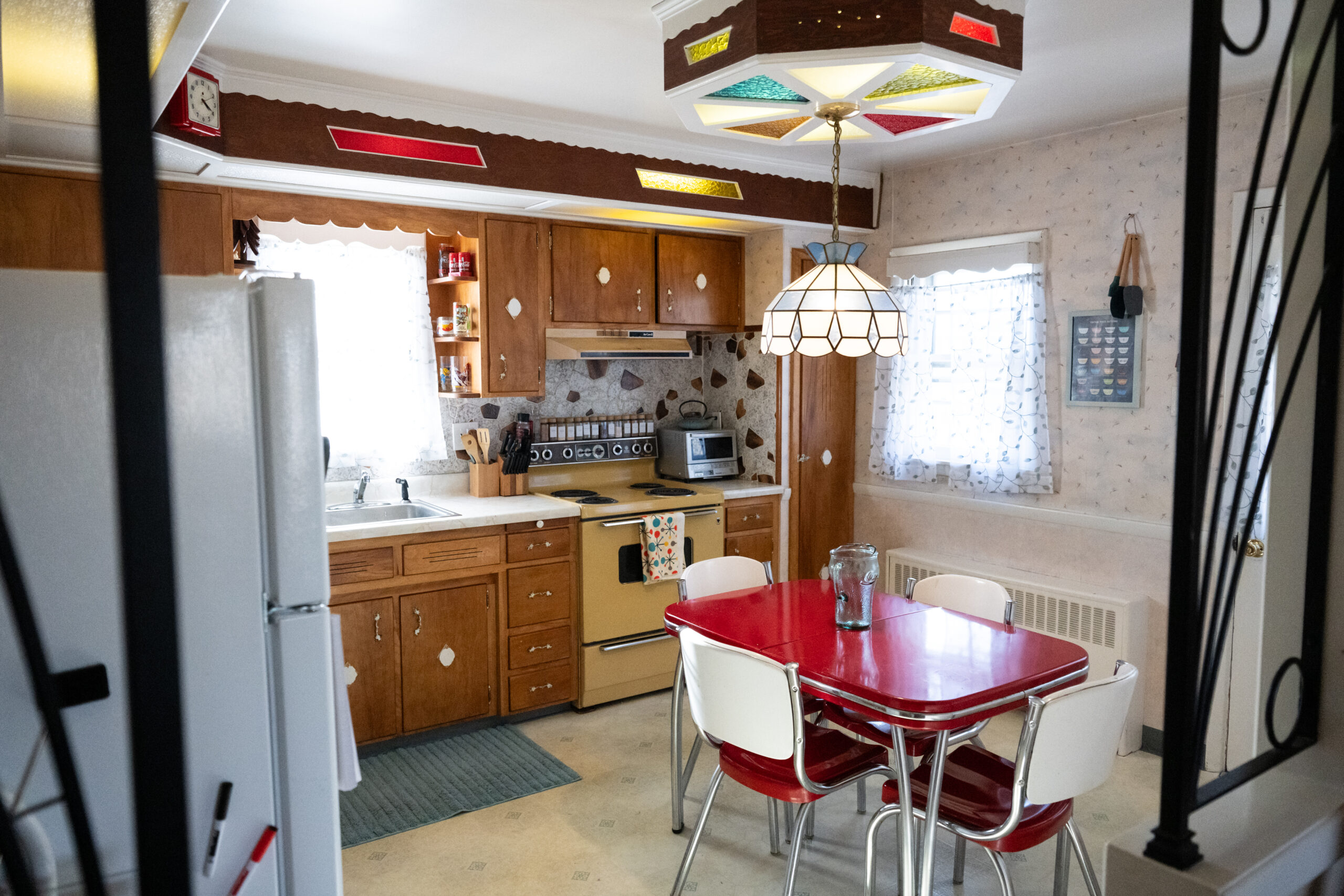
    The kitchen features soffit lighting and a pendant lamp in stained glass.
    The table and chairs in the kitchen were secondhand finds.
    The mustard-yellow oven is not equipped with modern features.

    “I messaged my mother about how to clean the oven and she said to turn on the self-cleaning function,” DeChellis recalled. “I said, ‘Mother, this is not a 21st-century oven.’”

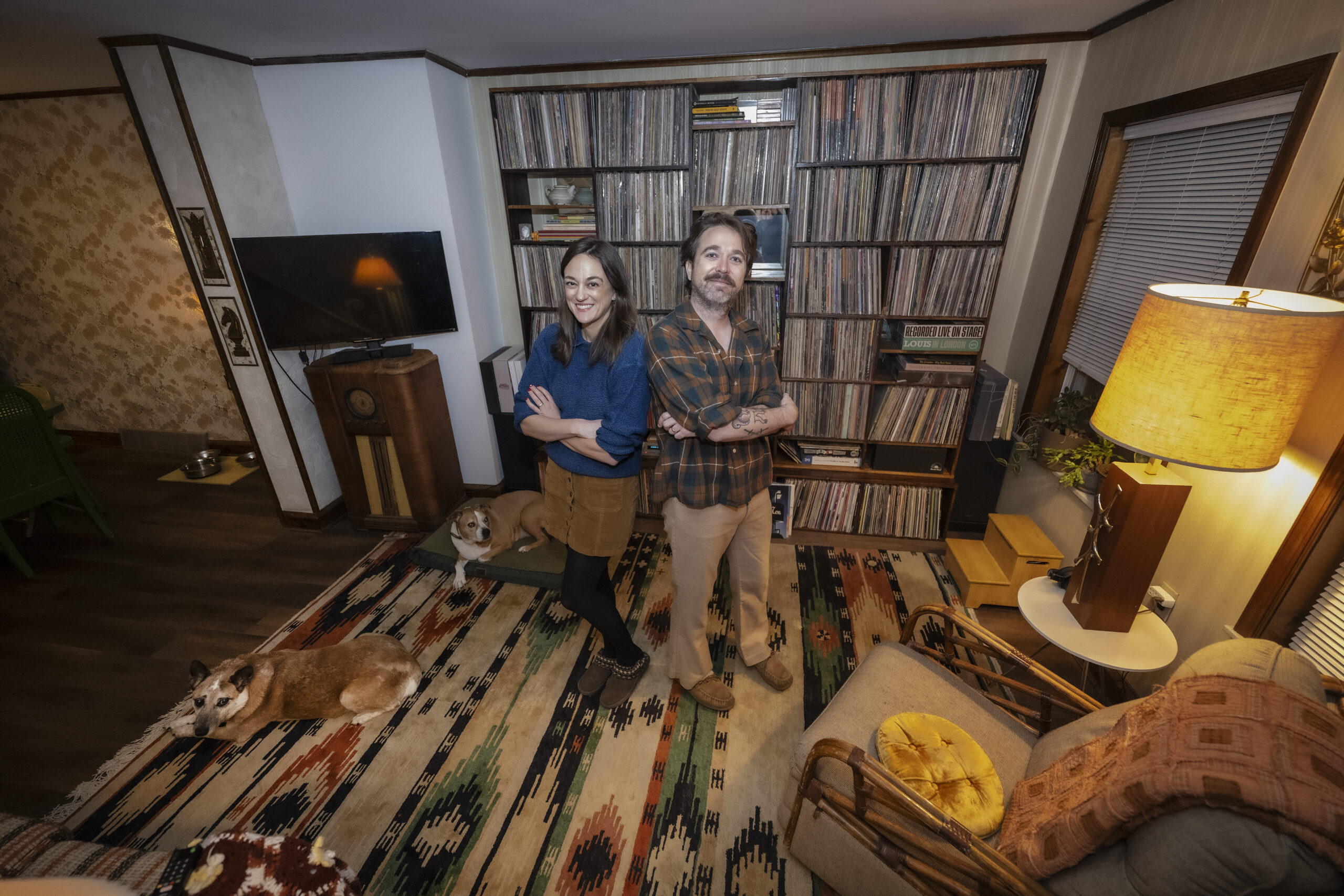
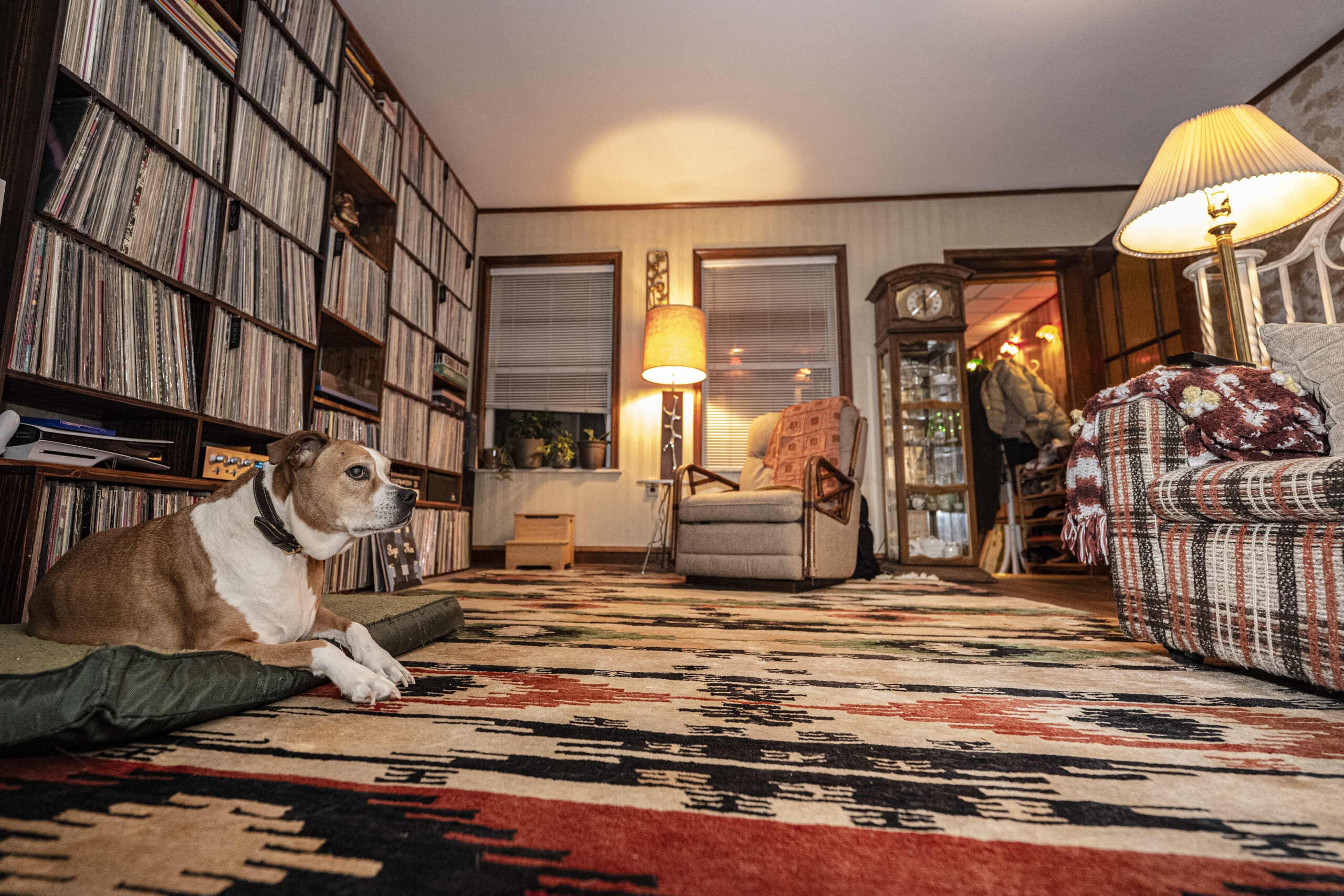
    The living room contains a comfortable velvet orange-brown sectional couch. That’s where the couple, who plan to marry in May, relax and watch TV. The bookshelf is home to some of their funky thrift finds, including the fish lamp.

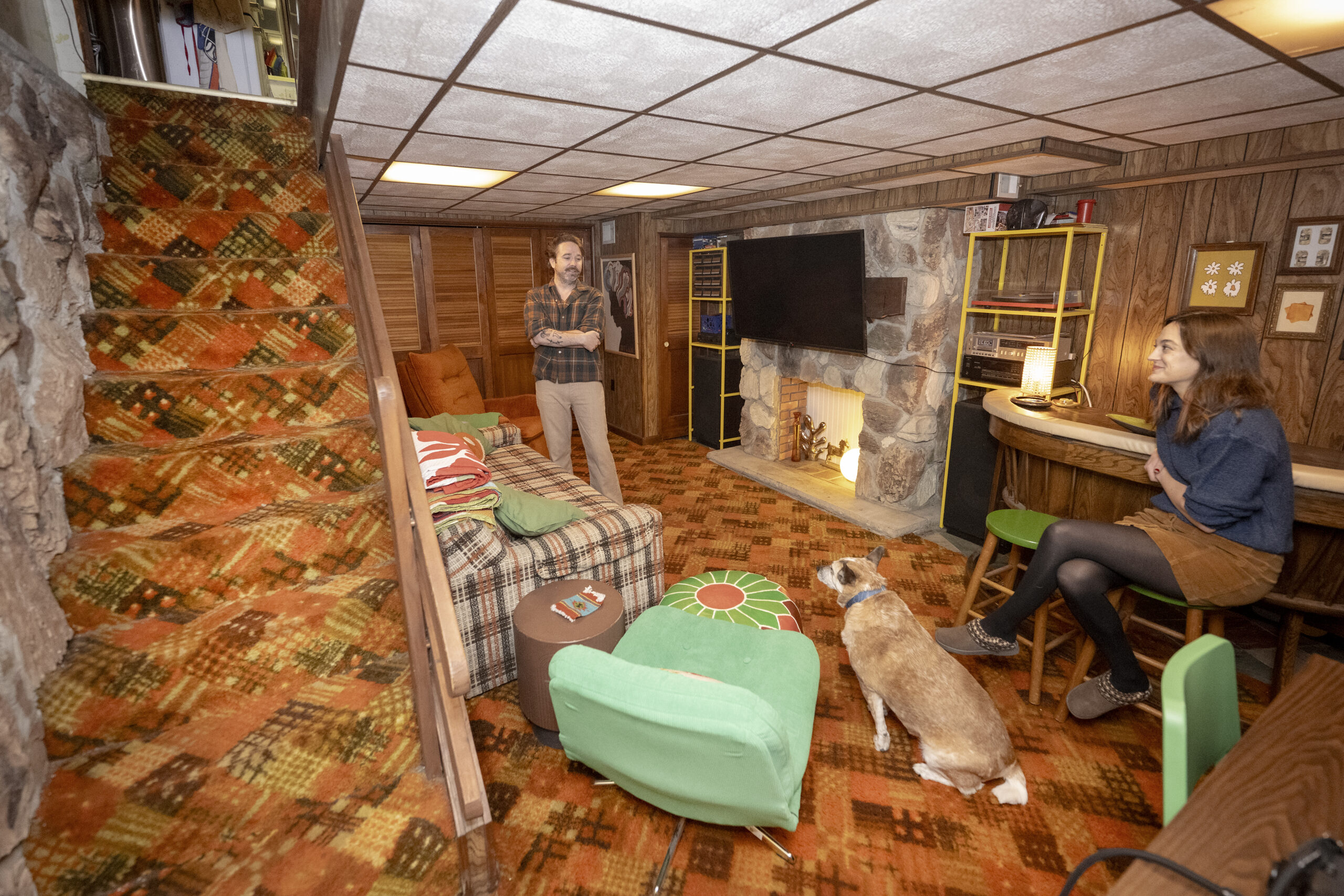
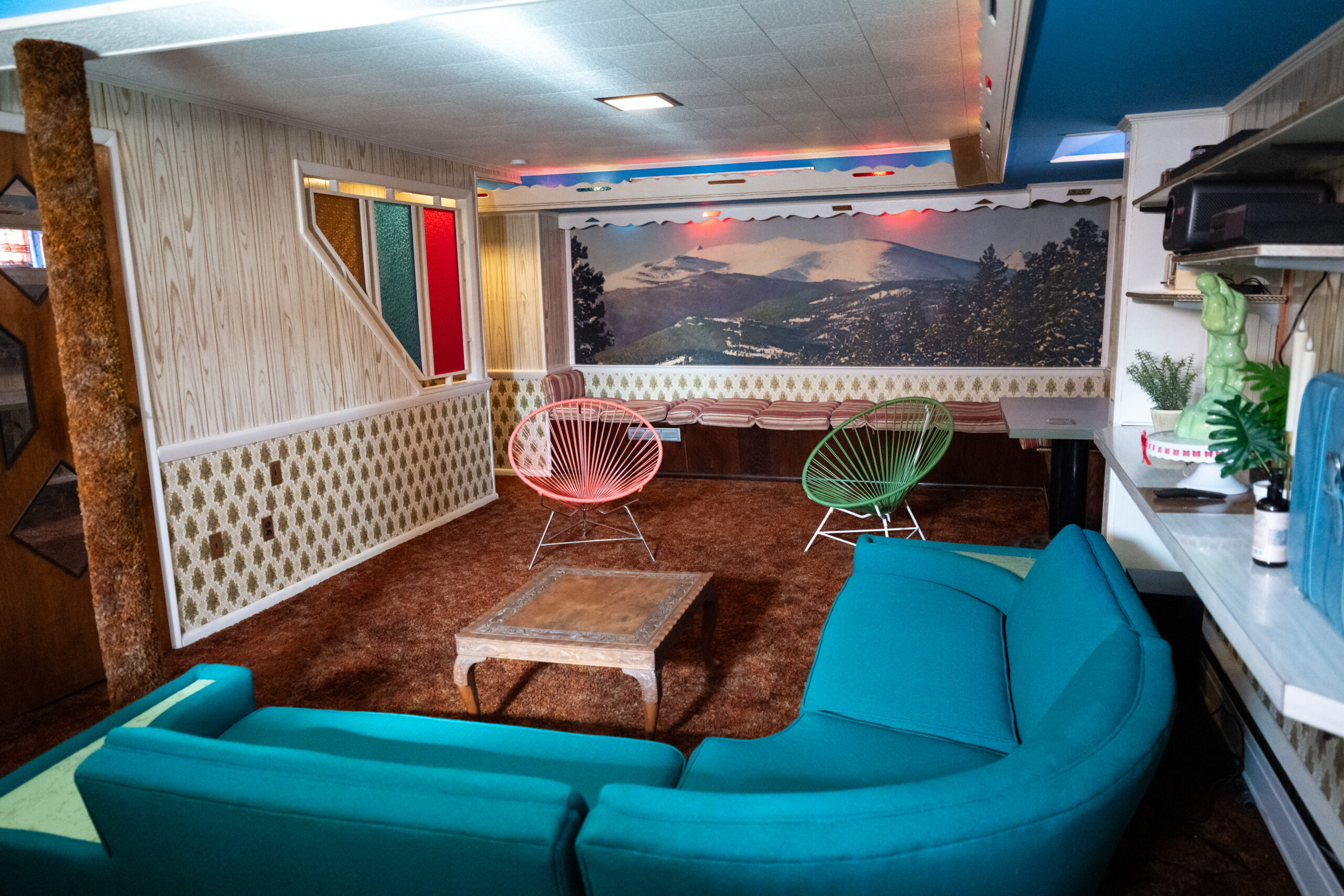
    The cozy basement is perfect for movie nights where friends gather to watch films from a projector, displayed onto a screen. Guests lounge on the blue couch with attached Formica end tables or in the pair of vintage wire Mexican Acapulco chairs — one orange and one green. The couple found the chairs at the Elephant’s Trunk Flea Market in Connecticut, and managed to squeeze them into their car for the ride home.

    “They are very comfortable, which is kind of surprising,” DeChellis said.
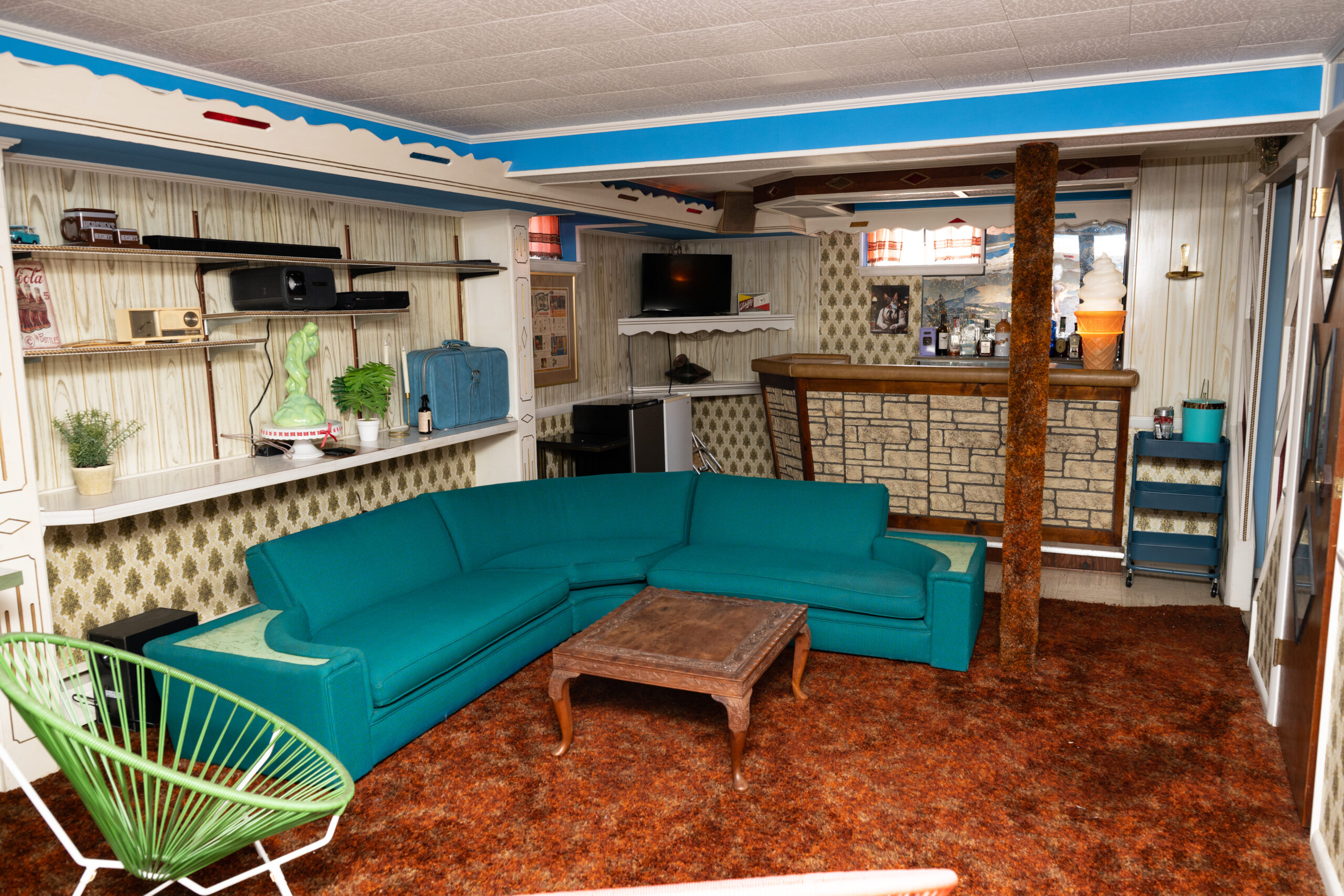
    The basement, where the couple enjoy movie nights with friends.

    The vintage wooden bar, with a faux stone facade and Formica top, set under colorful stained-glass lighting, evokes a scene from Mad Men. The bar is home to the vanilla ice cream lamp that stands about two feet tall, a very special thrifting find. She first spotted a similar one years ago, then again at a friend’s house.

    “I thought it was a sign” that such a distinctive lamp crossed her path twice, recalled DeChellis. “A few weeks later I found it at a thrift store. Somewhere out there a chocolate one and strawberry one are waiting for me.”

    DeChellis finds beauty in the rich histories of the pieces she thrifts. They lived a life making someone else happy, and now it’s her turn.
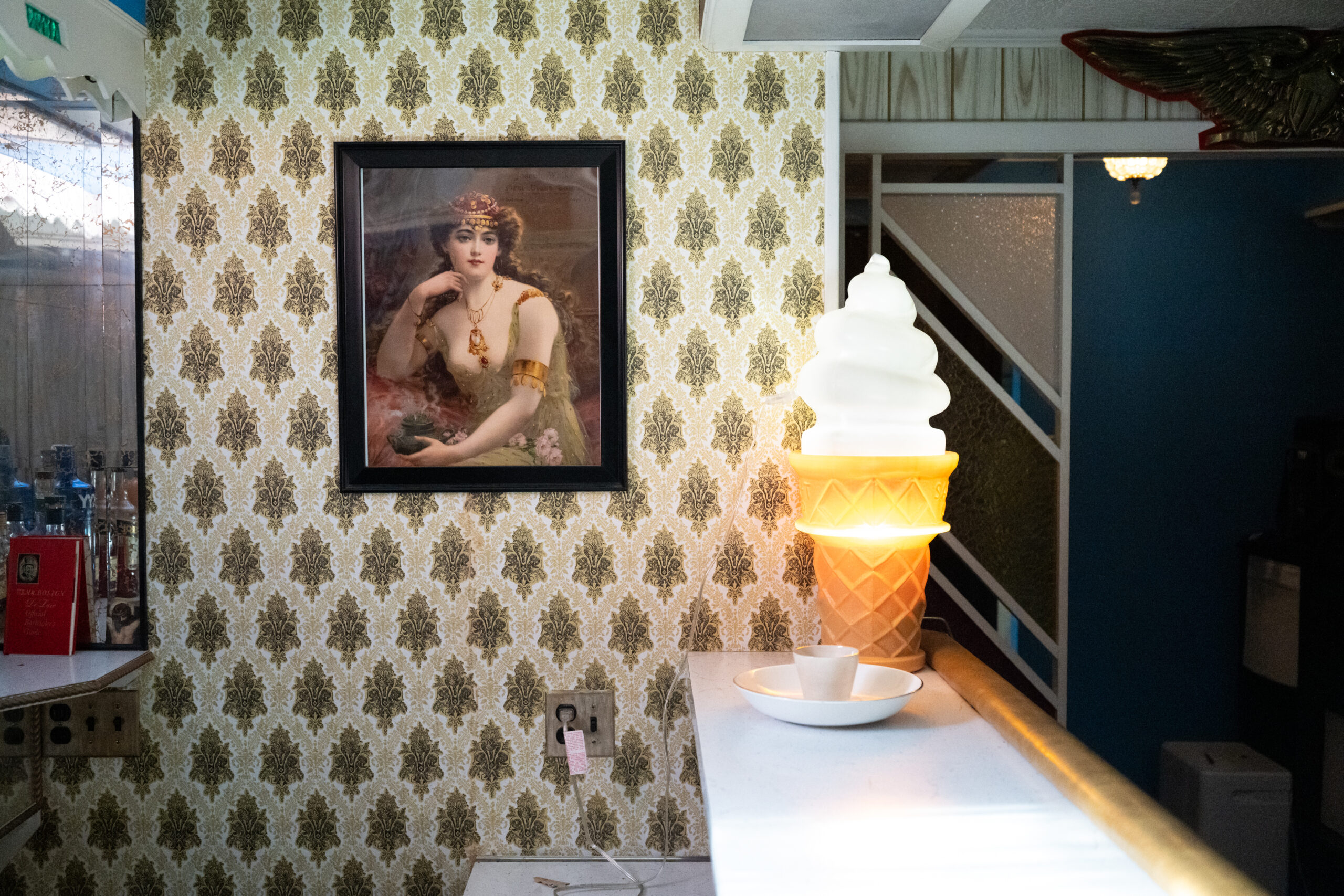
    The ice cream lamp sits on the bar in the basement.
    The Mexican Acapulco chairs, in orange and green, are surprisingly comfortable, DeChellis said.
    A whale lamp in the dining room.
    Decor on the landing of the stairwell.

    “We’ve always loved to thrift and antique and have found a lot of meaning and purpose in older things,” DeChellis said.

    The couple also enjoy their outdoor spaces, which include the front porch and enclosed backyard. DeChellis’s first experiment with a small cut flower garden was an initial success.

    “We grew pink and orange zinnias and put them in a fish vase that we got from the Dust Shuttle Auction,” she said.
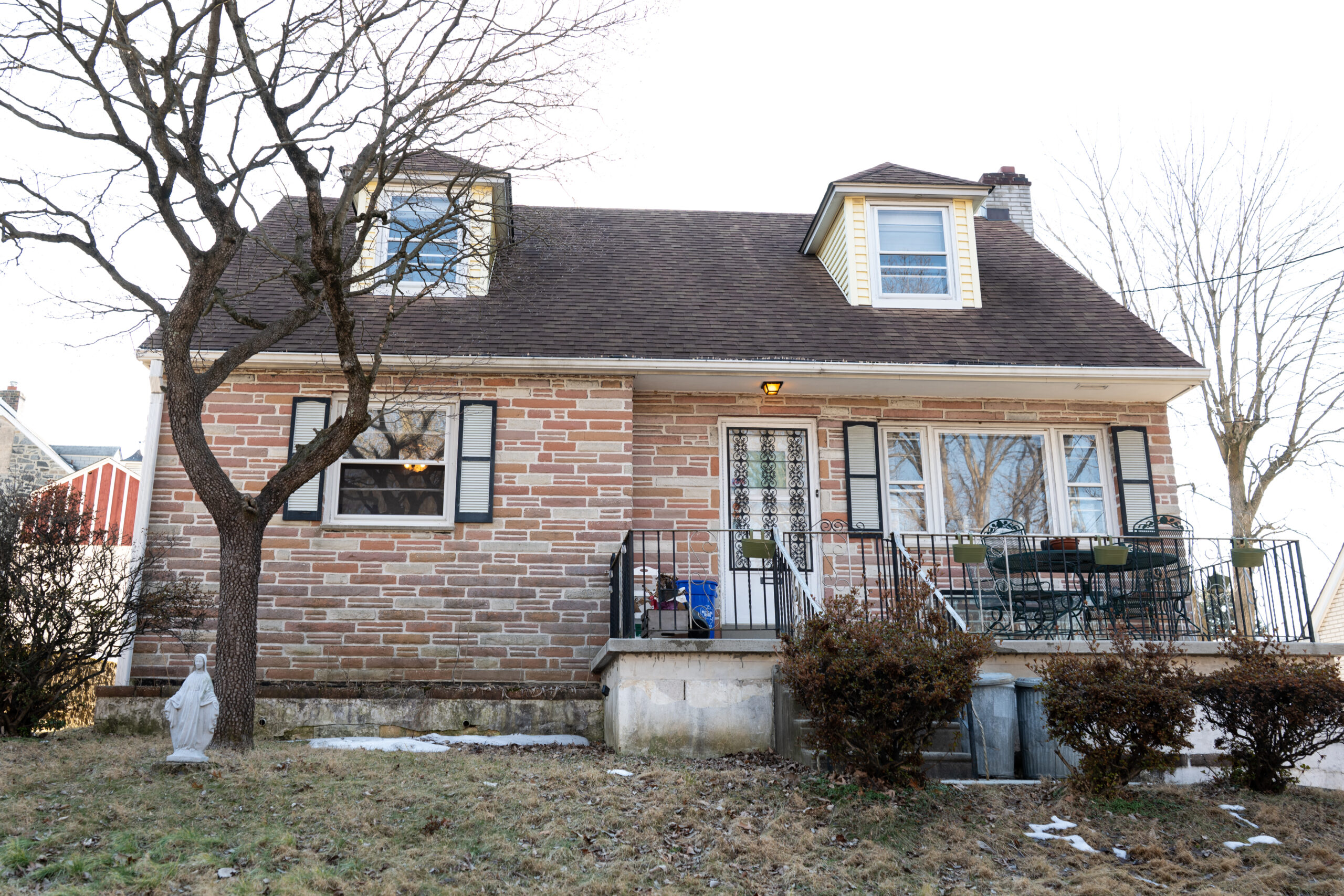
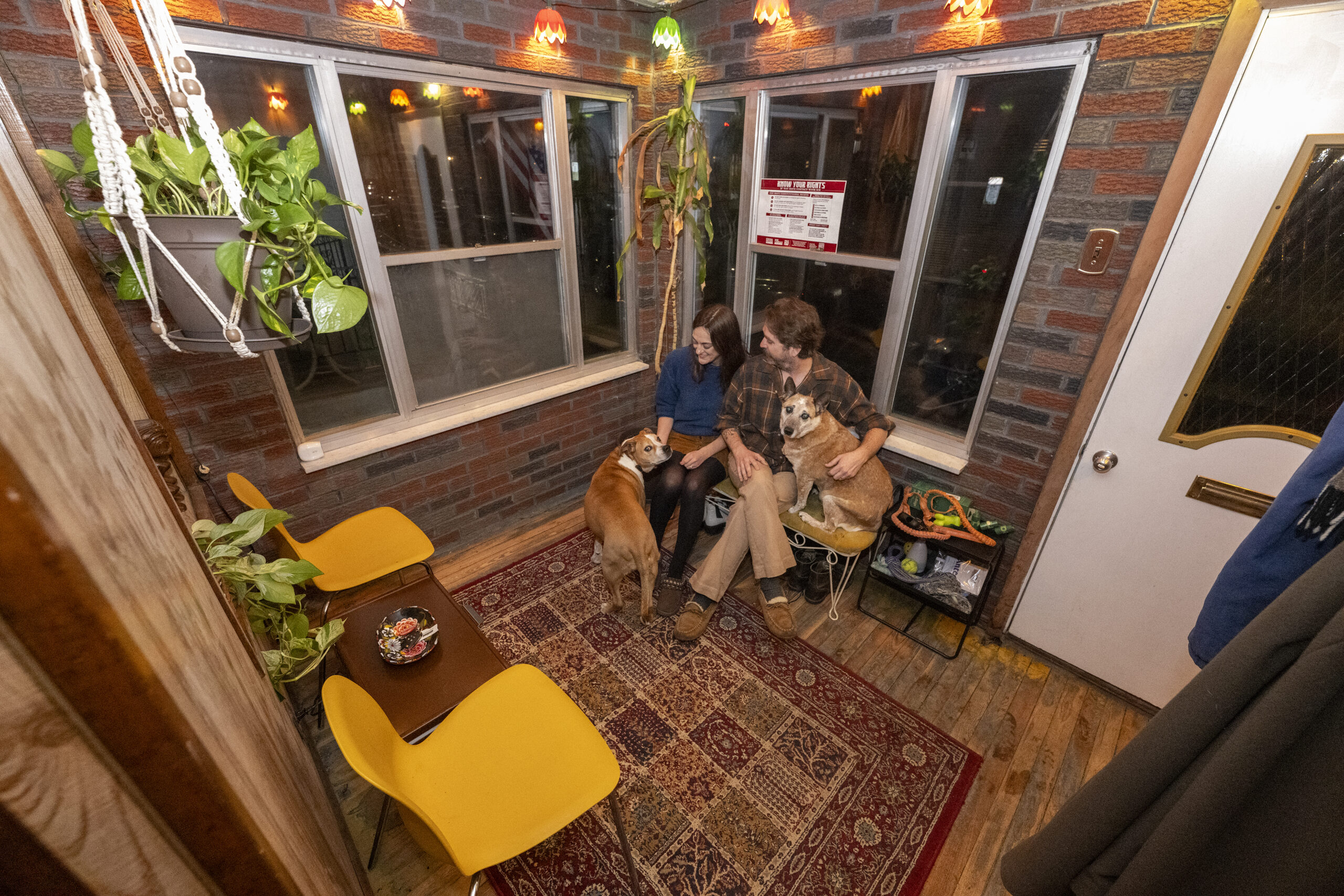
    The couple has a table on their front porch, where they peacefully take in the neighborhood surroundings.

    Their front porch is a peaceful respite where they look out at the woods and playground surrounding their home.

    “I love living in Delaware County,” DeChellis said. “It’s a very tight-knit community where everyone is looking out for their neighbors. Getting to start our lives here and have this be our first home felt really special.”

    Is your house a Haven? Nominate your home by email (and send some digital photographs) at properties@inquirer.com.
  • House of the week: A three-bedroom rowhouse in East Falls for $415,000

    House of the week: A three-bedroom rowhouse in East Falls for $415,000

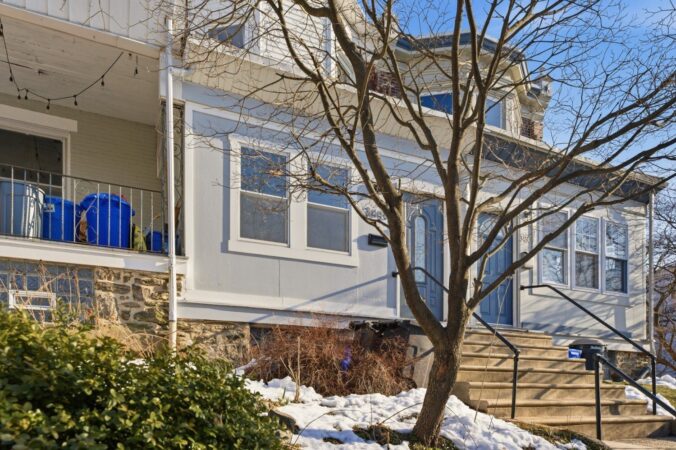
    For Sarina Sims, the four years spent in the East Falls rowhouse and the surrounding neighborhood was “like a warm hug.”

    For her wife, Phoebe Sims, leaving will be “kind of bittersweet.”

    But their well-planned stay in Philadelphia is ending as they return to their native North Jersey. They had wanted to try something different for a few years and “Philly seemed like a great option,” Phoebe said.

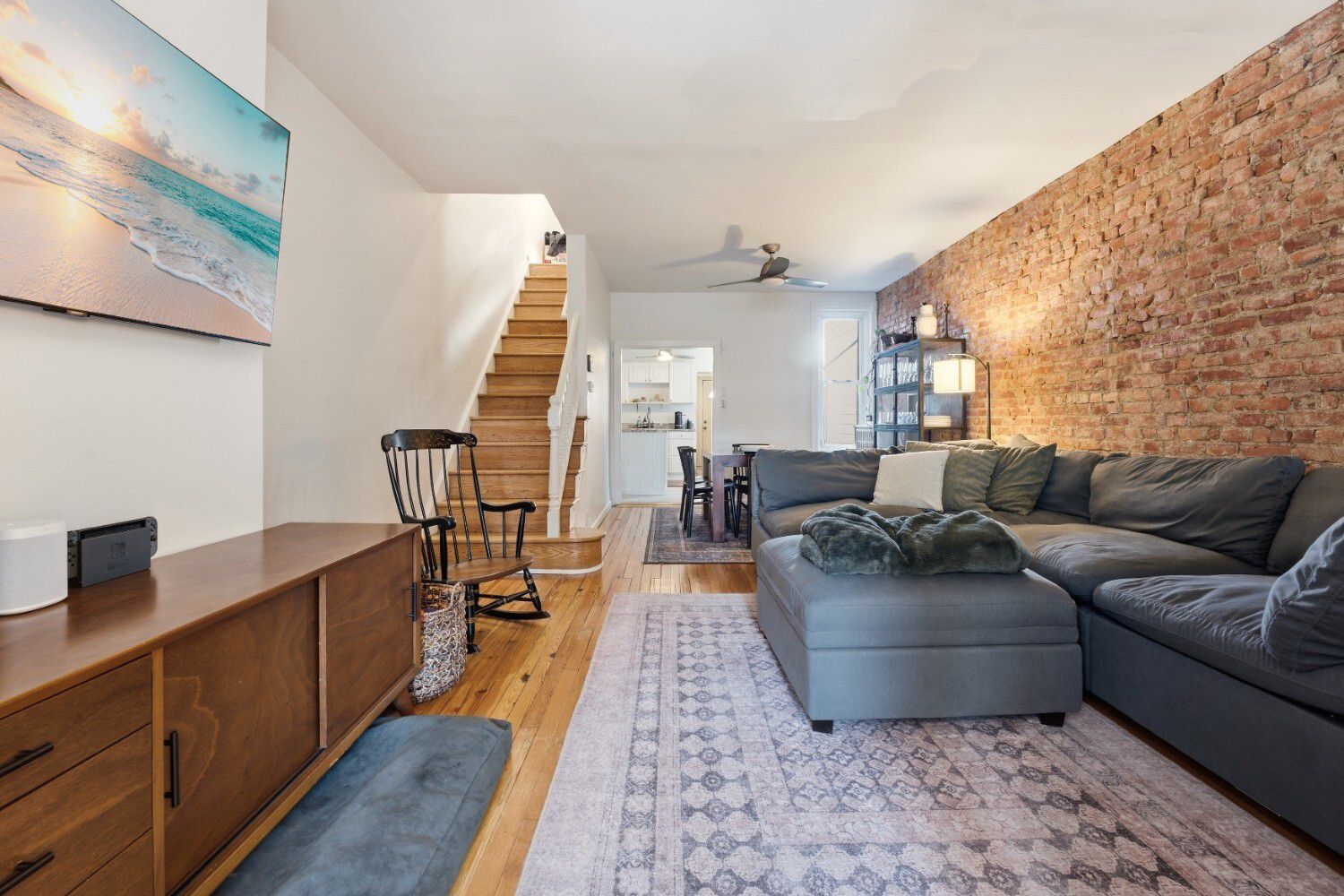
    The living room has hardwood floors and an exposed brick wall.

    Sarina is a producer of music festivals and other live events, and Phoebe is in learning and development for a restaurant chain.

    They had never heard of East Falls, but while walking in Manayunk they met a man who recommended it. Reasons included easier parking, less noise, and room for their two dogs to roam.

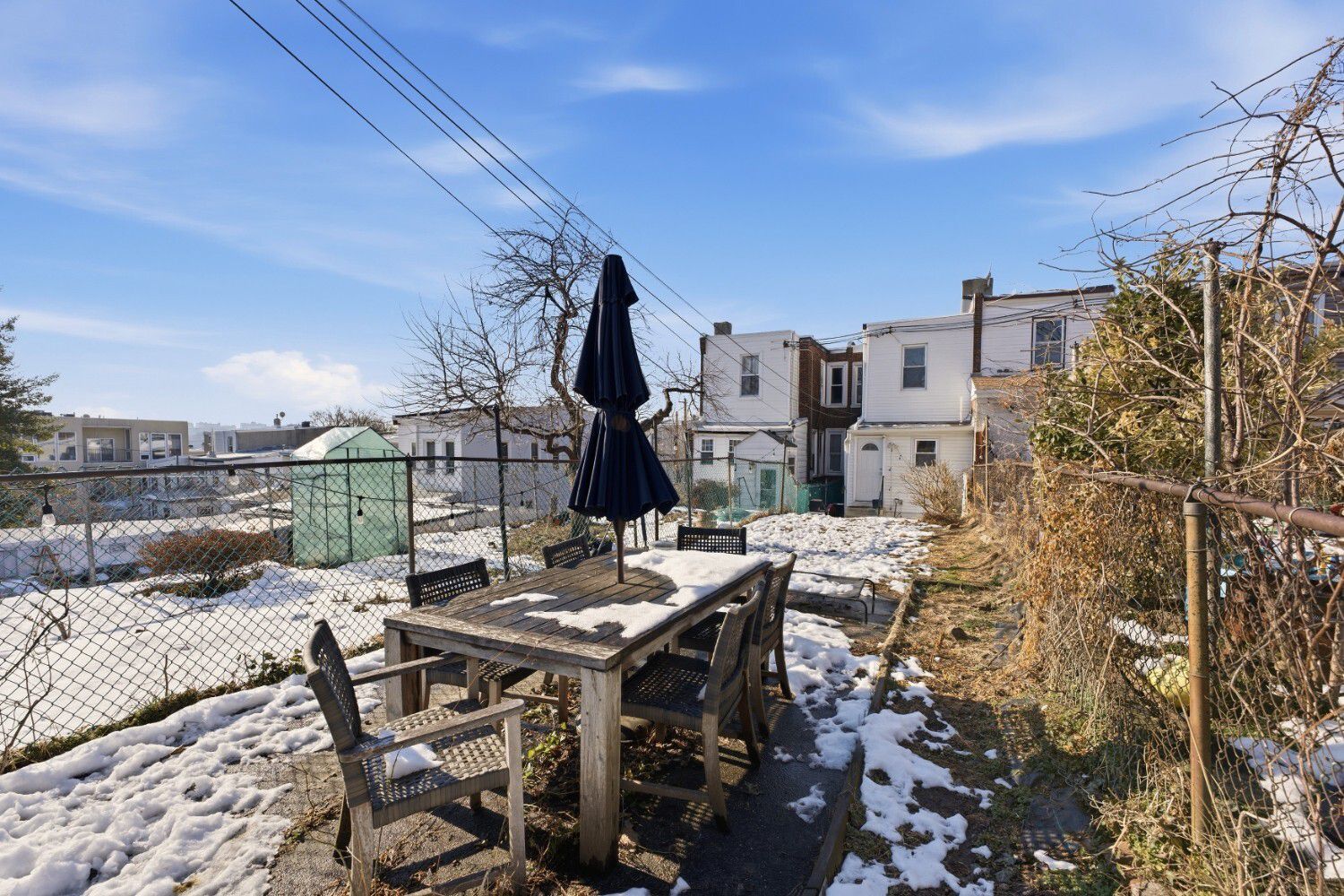
    The backyard, which has a brick patio and outdoor fireplace.

    The three bedroom, two-bathroom house, built in 1939, has 1,183 square feet of living space.

    The tiled entryway leads to the living room with hardwood floors, and an exposed brick wall. A “bonus room” connected to the living area could serve as a home office.

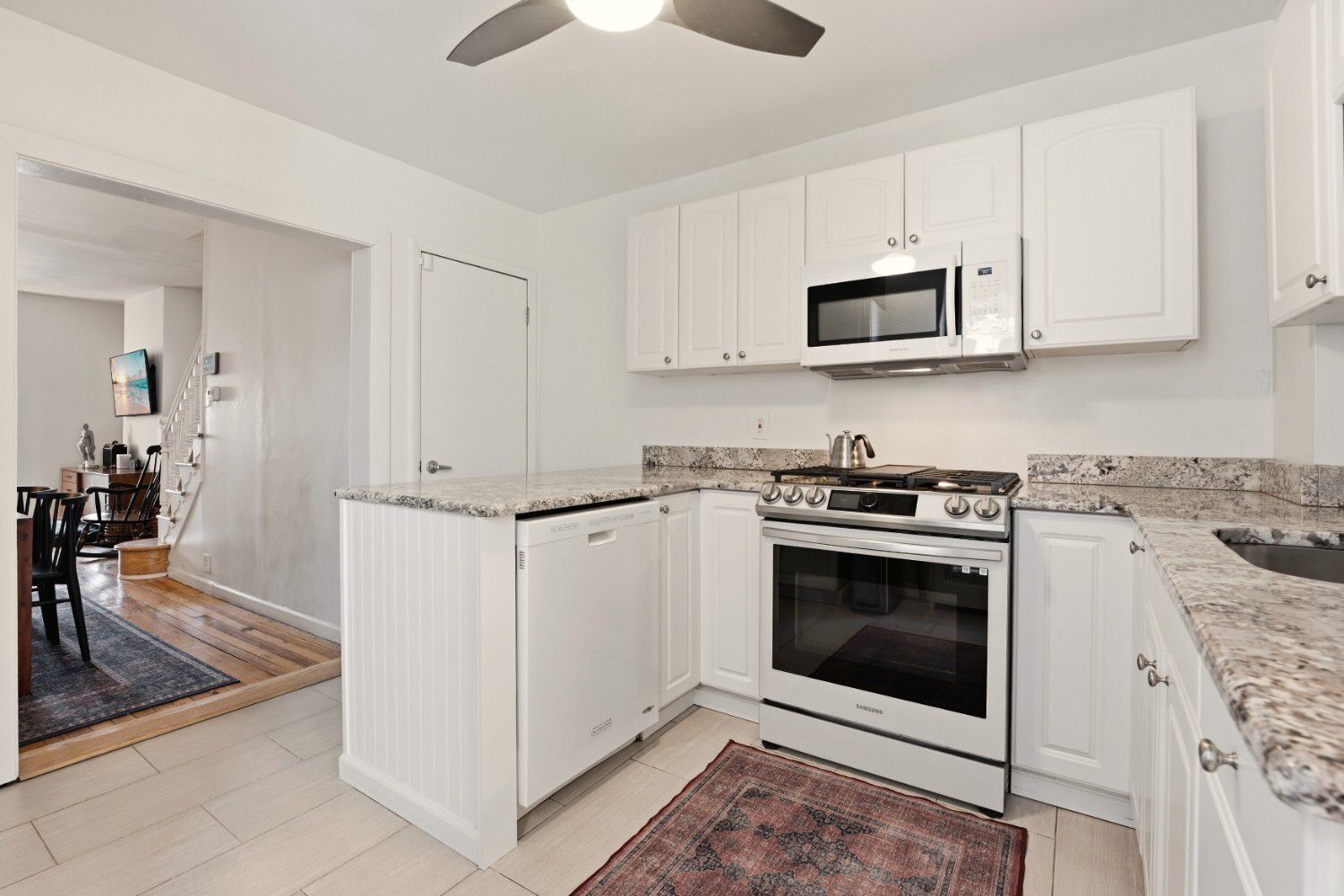
    The dining room can accommodate a large table, and the kitchen has granite counter tops, tile flooring, and updated appliances including a Samsung four-door refrigerator, a five-burner gas range, and chrome hardware.

    The kitchen has granite counter tops, tile flooring, and updated appliances.

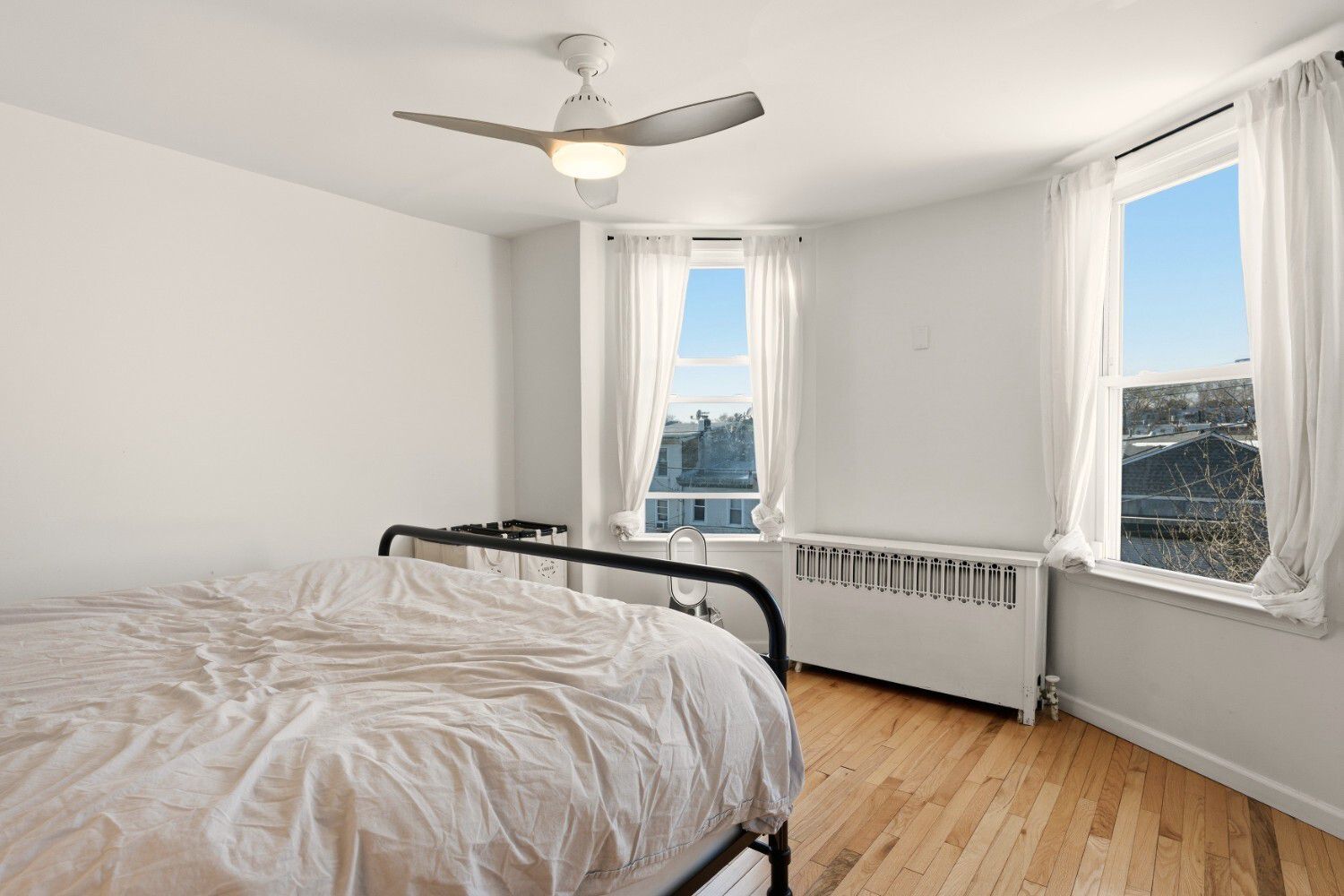
    The bedrooms are on the second floor. The primary has bay windows and two closets.

    The backyard has a brick patio and outdoor fireplace.

    The primary bedroom has bay windows and two closets.

    The house is a short ride to Main Street Manayunk and Thomas Jefferson University. The East Falls SEPTA Regional Rail station is walkable.

    It is listed by Evan Frisina of Compass Realty for $415,000.

  • They paid $259,000 for a South Philly rowhouse with vibes and an ‘eagles nest’ | How I Bought This House

    They paid $259,000 for a South Philly rowhouse with vibes and an ‘eagles nest’ | How I Bought This House

    The buyers: Katherine Rumble, 38, public engagement manager; Benjamin Rumble, 39, graphic designer

    The house: a 960-square-foot-home near South Philly’s Marconi Plaza with three bedrooms and one bathroom, built in 1957

    The price: listed for $259,000; purchased for $259,000

    The agent: Sue Liedke, Compass

    Benjamin and Katherine Rumble pin their new home in South Philadelphia.

    The ask: Katherine and Benjamin Rumble were looking to leave Nashville. They wanted a city that was affordable, walkable, and had decent public transit. “Philadelphia was pretty much the only option,” said Katherine. After falling in love with South Philly, they moved in 2023 and rented a place in Point Breeze.

    Two years later, they started searching for their forever home. Their wish list was specific: proximity to the Broad Street Line, central air, office space for both of them, and ideally a home that hadn’t been gutted, flipped, and turned “millennial gray.”

    “We did not want to live in a doctor’s office,” Katherine said. “We wanted to live in a place that felt warm and welcoming like your grandma’s house.”

    Benjamin and Katherine Rumble’s dog, Miller, relaxes in their living room.

    The search: The couple already had a habit of checking Zillow regularly, but the listing that caught their attention came through Instagram.

    They had long followed the account of Sue Liedke, a Philadelphia real estate agent who highlights vintage homes across the city. “We were obsessed with her account,” Katherine said. When Liedke posted a house near Oregon Station, they reached out.

    The home checked many boxes. It was close to the Broad Street Line and near Marconi Plaza, which was a major plus for the couple, who have two dogs. It also had central air and enough space for both of them to work from home.

    The appeal: They went to see the house immediately and loved it. “It had vibes,” Benjamin said. “The basement looked like people had been watching Eagles games down there since 1974.”

    “The basement looked like someone had been watching Eagles games down their since 1974,” said Benjamin.

    Upstairs, there were original wood doors, wood trim, and wallpaper that appeared decades old. The bathroom featured seafoam-green and pink tile and a skylight.

    “We loved everything already in it,” Benjamin said. “I thought I wanted to buy a house so I could paint the walls. Then we bought this house and realized we didn’t want to change anything.”

    At the front of the house was a small screened-in room sometimes referred to as a Florida room, a term Katherine rejected immediately. “I said, ‘We’re not calling anything Florida in this house,’” she recalled. They renamed it “the eagles’ nest.”

    For all its charm, the house did still have its drawbacks. There was only one bathroom, and the kitchen was tiny. But “it had so many of the things we wanted that it felt worth it,” Katherine said.

    The deal: The house had been on the market for only a few days when they saw it. The listing price was $259,000, and it was being sold as-is, meaning the seller was not required to pay for any issues uncovered during the inspection. “It was a risk,” Katherine said.

    They offered the full asking price and requested a $5,500 seller’s assist to help cover closing costs. The seller agreed and even repaired a plumbing issue that came up during the inspection, despite selling the house as-is. In the end, the appraisal came in $5,000 above the asking price, which reassured the couple that the deal made financial sense.

    The money: The couple put down 5%, or $12,590.

    The money came from a second retirement account Katherine opened several years earlier. “It wasn’t really making any money,” she said. She decided cashing it out to buy a home was a better investment.

    Benjamin and Katherine Rumble and their dogs, Miller and Bambi, in the eagle’s nest.

    After the seller credit and deposit adjustments, the couple needed $24,225 in cash to close. They used almost all their personal savings to cover the remaining costs. They are rebuilding their nest egg from $2,000.

    One thing boosting their savings is their low mortgage payment. They purchased mortgage points, an upfront fee paid at closing that lowers your interest rate, to get their monthly payment below $2,000. “That was our big goal,” Katherine said. “It’s a miracle.”

    The move: To save money, the couple moved themselves. They couldn’t get a full-sized truck down their narrow street, so they rented a U-Haul van and shuttled their belongings back and forth across four weekends. They also had to get rid a lot of their existing furniture, requiring extra trips to 2A Thrift and Philly AIDS Thrift. “It was harder moving 10 minutes down the road in South Philly than it was moving from Nashville to Philadelphia three years ago,” Katherine said.

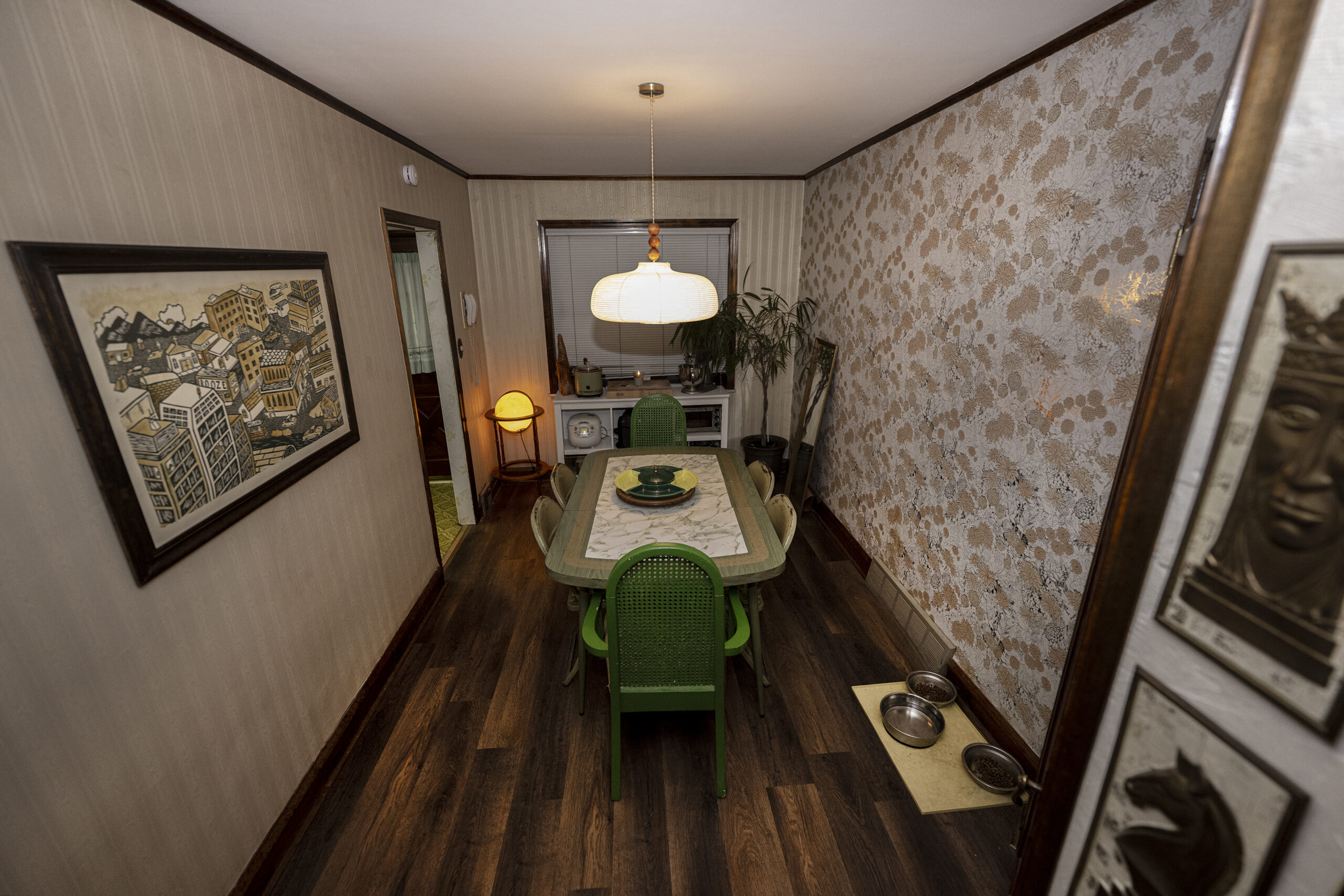
    Benjamin and Katherine fell in love with the home’s original details, like the wallpaper in the dining room.

    Any reservations? One thing the couple wasn’t prepared to deal with was a private neighborhood sewer line. It connects all the houses on the block before linking up with the main public sewer line. The couple both grew up in parts of the country where individual houses connect directly to the main sewer line. After moving in, neighbors explained the history of the sewer line. It hasn’t caused any major issues yet, but if something goes wrong, the neighbors will have to pay for the repairs together.

    Life after close: The house has influenced their interior design choices. Because it was built in the 1950s, the couple has tried to source furniture from the 1960s and 1970s.

    They regularly browse thrift stores, Facebook Marketplace, and vintage shops such as Thunderbird Salvage and Jinxed.

    “We’re trying to find things that fit the character of the house,” Katherine said. “It takes time to find the things you want. But it’s really exciting when you do.”

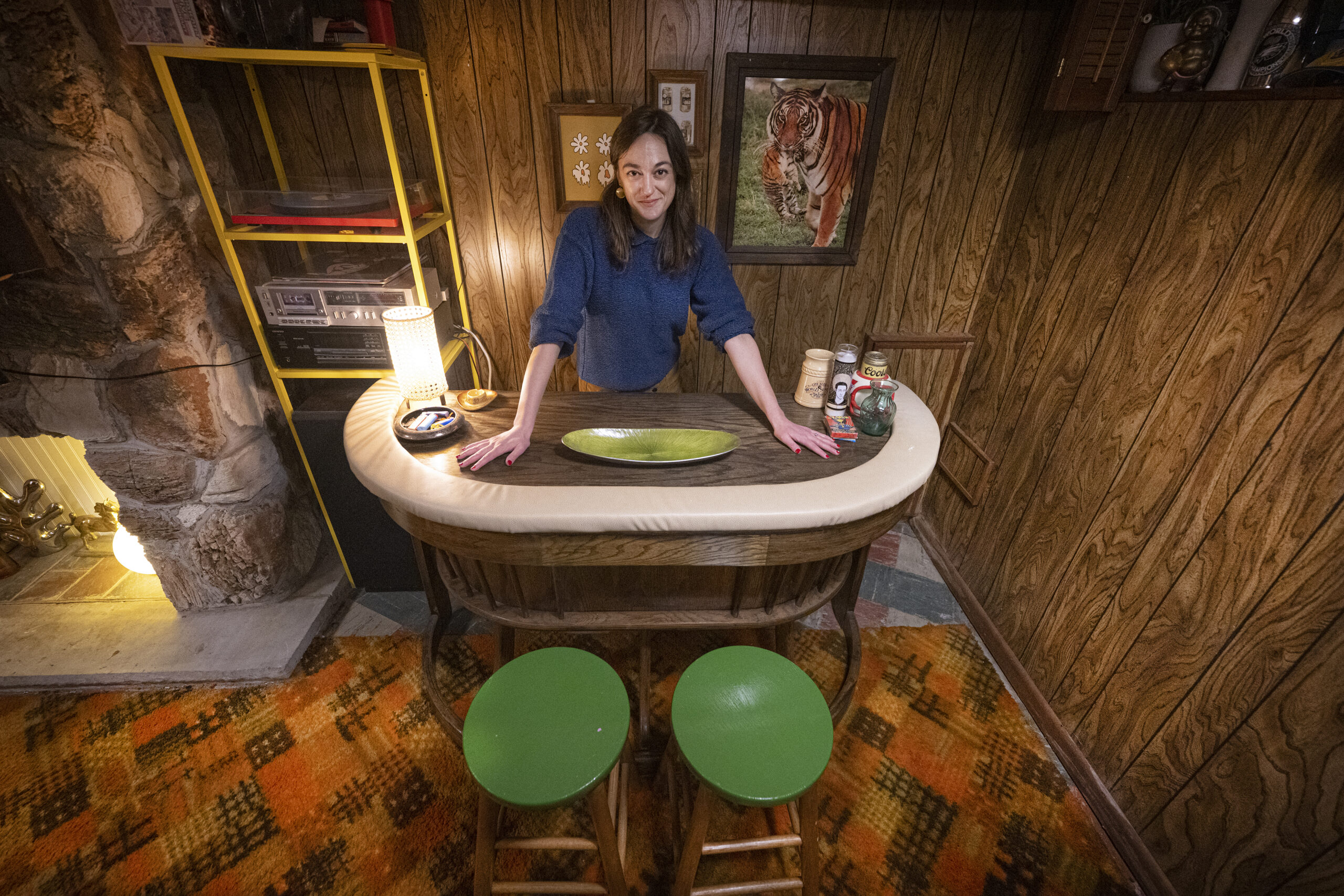
    Katherine Rumble behind the bar.

    It also helped that the previous owner let them keep some furniture, including, said Benjamin, “a really rad set of couches.”

  • Grocery Outlet is closing stores in South Jersey, Philadelphia, and Kennett Square

    Grocery Outlet is closing stores in South Jersey, Philadelphia, and Kennett Square

    Grocery Outlet bargain market is closing dozens of stores nationwide, including eight in the Philadelphia area.

    The closures were first referenced earlier this week in the company’s earnings report. The California-based grocer recorded an operating loss of $221.7 million last year, much of which it attributed to “certain underperforming stores” that will now close.

    These include five Grocery Outlets in South Jersey, two in Philadelphia, and one in Kennett Square, according to real estate marketing released Thursday.

    A company spokesperson did not return a request for comment about when the stores would close.

    The impacted Philly-area stores are located at:

    • 4004 U.S. Route 130, Delran
    • 401 Harmony Rd., Gibbstown
    • 345 Scarlet Rd., Kennett Square
    • 190 Hamilton Commons Dr., Mays Landing
    • 2017 W. Oregon Ave., Philadelphia
    • 2524 Welsh Rd., Philadelphia
    • 3174 U.S. Route 9 S., Suite 5, Rio Grande
    • 677 Berlin-Cross Keys Rd., Sicklerville
    People shop at a Grocery Outlet in Philadelphia in 2022.

    Gordon Brothers, a Boston investment firm, is looking to sublease all 36 closing Grocery Outlets. The Philadelphia-area properties range in size from 14,000 to 21,000 square feet.

    After the closures, the chain will still have several locations in the city, collar counties, and South Jersey.

    Grocery Outlet calls itself an “extreme value retailer.” It was founded in 1946, and has expanded from 128 stores to 570 stores over the past two decades. Many locations are operated by entrepreneurs who live nearby.

    In recent months, Grocery Outlet’s bottom line was impacted by economic uncertainty, as well as the November suspension of SNAP benefits that tens of millions of U.S. consumers rely on, according to president and CEO Jason Potter.

    “Consumer pressure intensified, federally funded benefits were delayed, and competition grew more promotional in the fourth quarter,” Potter said in a statement. “In response, we have begun to sharpen our focus on what matters most: delivering clearer value and a better in-store experience.”

    Customers and employees inside a Grocery Outlet in Philadelphia in 2023.

    While the grocery industry remains relatively resilient, it has faced a challenging few years with persistent inflation, tariffs that further drove up prices on some products, and continued competition from other retailers and restaurants.

    In recent weeks, Amazon closed all of its brick-and-mortar Amazon Fresh stores, including six in the Philadelphia region. The company says it plans to expand grocery-delivery services and open more Whole Foods markets, to the dismay of some Amazon Fresh customers who said they were drawn to the low prices at the smaller-format stores.

    Gourmet markets have been impacted, too. Three Di Bruno Bros. locations in Ardmore and Wayne closed last month, two years after being acquired by Wakefern Food Corp., the North Jersey-based supermarket cooperative that operates ShopRite.

    A Wakefern spokesperson said the company planned to refocus on its flagship stores in South Philadelphia and Rittenhouse, as well as its growing online business. The move, spokesperson Maureen Gillespie said, would be “a positive reset that allows us to preserve and elevate the in‑store tradition while growing the brand’s reach in meaningful new ways.”

  • William Way will demolish its historic LGBT Community Center and construct a building with affordable apartments

    William Way will demolish its historic LGBT Community Center and construct a building with affordable apartments

    After months of varying reports about the future of the William Way LGBT Community Center’s headquarters in Philadelphia, a firm plan is finally emerging.

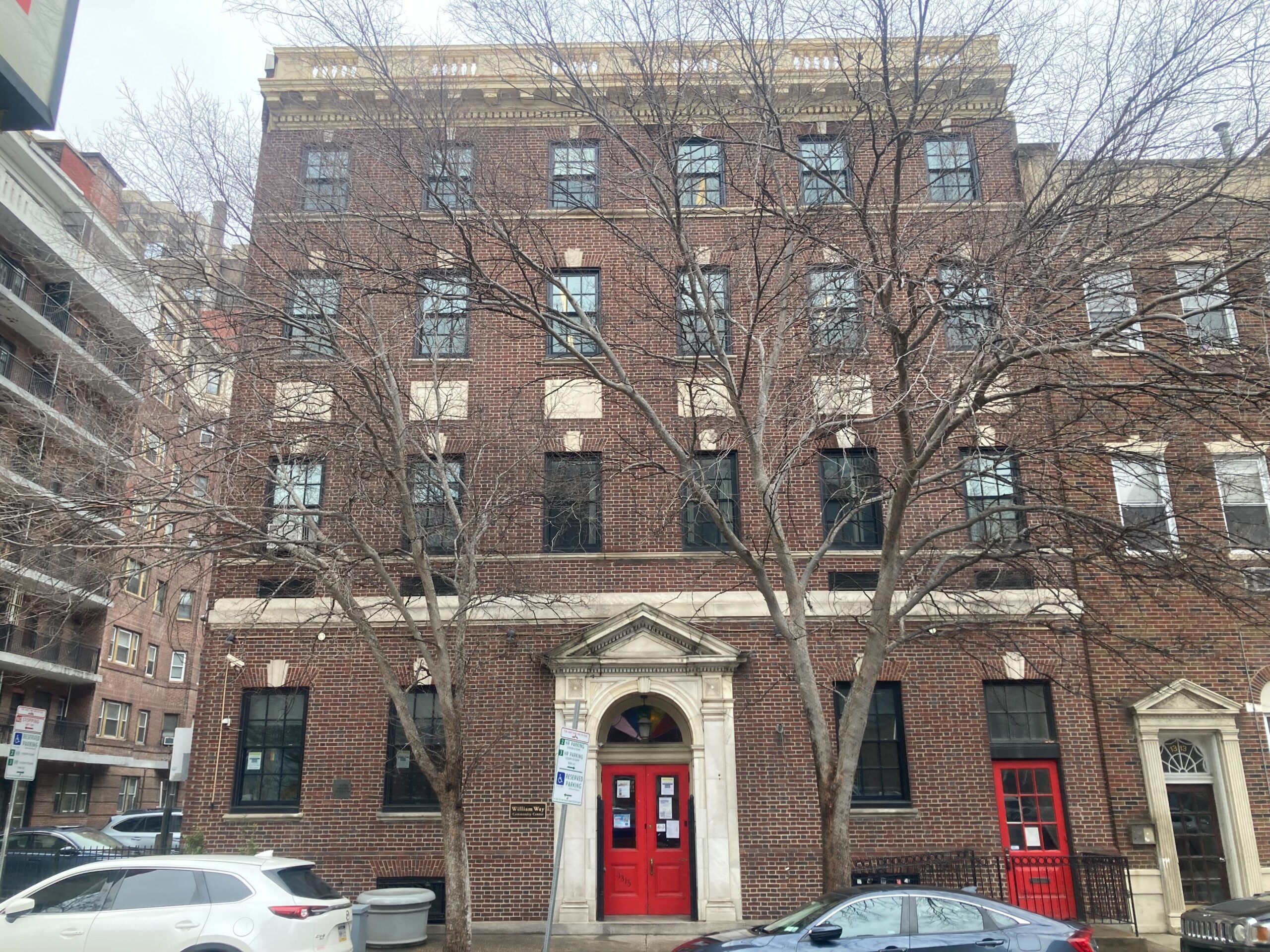
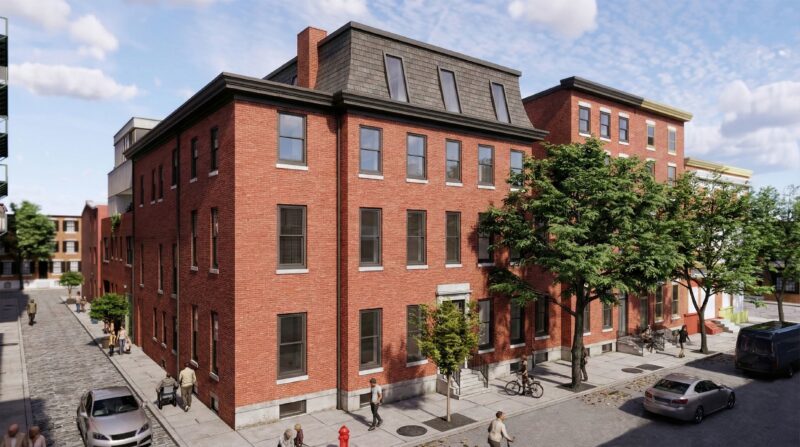
    The 176-year-old building at 1315 Spruce St. will be torn down and replaced with a new headquarters, which will include up to 42 new affordable apartments for seniors, according to the development team.

    The existing four-story, 14,000-square-foot building is expected to be replaced by a six-story structure. The apartments would be on the top four floors and William Way’s community center on the bottom two.

    The idea is to give the storied organization more space, while providing housing for people who might not otherwise be able to live in Philadelphia’s historic Gayborhood.

    “We want to make sure that people are given the opportunity to live in all areas of the city, including areas like Washington Square West that have a lot of higher income folks,” said Dan Anders, a vice chair of Dr. Magnus Hirschfeld Fund (DMH Fund), a group that also developed the celebrated John C. Anderson apartments, half a block away.

    The DMH Fund is partnering with HELPDevCo, an affordable-housing builder. William Way Center referred all questions about the proposed building to those two groups.

    The William Way Center is not likely to demolish the building in the immediate future, as the project will need funding from the federal Low Income Housing Tax Credit, which will not disperse funds again until late this year. The community center is currently still open.

    The property is within the recently designated Washington Square West historic district, which was overturned in court last week. The timing of the announcement was coincidental, however. Plans have been in the works for months.

    The facade of the William Way LGBT Community Center, located at 1315 Spruce St.

    William Way purchased 1315 Spruce St. in 1996, and over the last 10 years, the LGBTQ community has been trying to raise money to stabilize and redevelop the historic headquarters.

    Last June, the group announced that even after a fundraising drive, $3.5 million was still required for “immediate repairs.”

    Swathes of the building are currently unusable, although the structure is not imminently dangerous. There are holes in the floor of some rooms, roof leaks, and standing water often fills the basement.

    “It sounds like a really good plan,” said Councilmember Mark Squilla, who represents the area. “The building is in really, really bad shape. It’s been hard to maintain. The reason why it hasn’t been fixed is because the cost to fix it has been astronomical.”

    In late November, William Way announced that it would shutter the building and disperse its operation to other locations, raising concerns about clients maintaining access to services.

    But a week later, the community center said it planned to rehabilitate the historic building and would return to the existing structure.

    “We know that there are questions regarding the future of the building and acknowledge that messaging has been confusing,” William Way board chairs Laura Ryan and Dave Huting said in a January email to supporters. “We understand the frustration and will be sharing more information soon.

    Last week Philadelphia Gay News reported that William Way would be demolishing its building and moving forward with a comprehensive redevelopment.

    The announcement occurred at a gala for the publication’s 50th anniversary, with Gov. Josh Shapiro and Mayor Cherelle L. Parker in attendance and expressing support for the proposal.

    “I strongly support the restoration of the William Way Community Center, as an essential part of the LGBTQ+ community in Philadelphia,” said Mayor Parker in a statement, “and will commit resources through our H.O.M.E. initiative to support this vital project.”

    Historic preservation advocates have expressed concern and sadness over the proposed demolition.

    “We are alarmed by the news that the historic William Way building would be demolished in the recently announced plans for the future of the real estate,” said Paul Steinke, head of the Preservation Alliance. “We hope they will be willing to incorporate historic preservation into their plans.”

    Steinke served on William Way’s board for six years and helped lead a pre-pandemic fundraising drive to replace the windows and HVAC system and conduct other repairs. (In the end, that plan did not move forward.)

    Steinke said he has reached out to William Way for more information on its proposal. He also hopes that the city will appeal the ruling against the Washington Square West historic district.

    “I understand the frustration of some folks that the building will be demolished, but it’s in such a state that it’s not feasible to renovate it,” Anders said.

    “It is a sad reality, but that’s where we are. We will honor the tradition of that location and the William Way Center and build a building that celebrates our community and that everyone can be proud of,” he said.

    The Washington Square West Civic Association declined to comment on William Way’s plans.

    The property is in one of Philadelphia’s most flexible zoning categories, so land use regulations will not pose a barrier to the community center’s proposal.

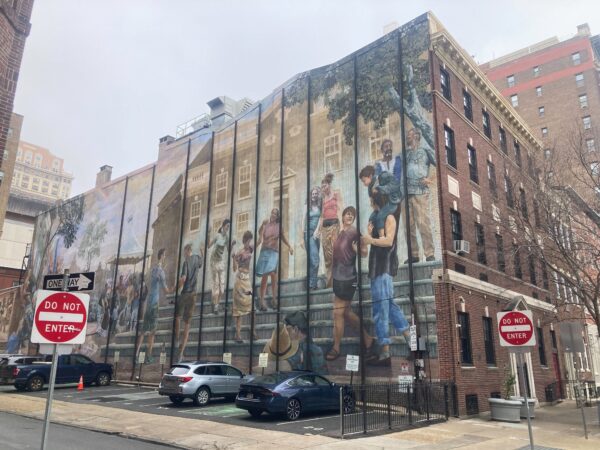
    The prominent mural on the side of William Way’s building is crumbling. Anders said the new structure would be designed to advertise the community center’s mission.

    “The artist herself acknowledged that the mural was never intended to be permanent,” Anders said. “What we want to do when we’re designing the building is very clearly communicate with passersby and the community itself that something LGBT is going on inside, and to celebrate that.”

  • Mayor Parker backs legislation to boost housing development around SEPTA stations

    Mayor Parker backs legislation to boost housing development around SEPTA stations

    Mayor Cherelle L. Parker’s administration sent City Council a bill on Thursday to encourage more apartment construction around SEPTA stations, in hopes of boosting ridership.

    The proposal expands an existing law. Currently, if a SEPTA station is made a “transit-oriented development” district — a designation City Council must adopt — then most properties within a 500-foot radius receive a variety of benefits that allows developers to build more housing with less parking than otherwise allowed.

    The legislation sent to Council by the Parker administration would expand that radius to 1,320 feet, or a quarter of a mile.

    The bill is part of a package of zoning legislation meant to boost Parker’s effort to build or repair 30,000 homes in the coming years.

    “Zoning is how we turn housing ambition into housing reality,” said Angela D. Brooks, chief housing and urban development officer. “These bills help us put more homes where our infrastructure can support them, near transit, near jobs, and near opportunity, while respecting the character of the neighborhoods Philadelphians already love.”

    The hope is that SEPTA will benefit from a ridership boost if more housing is built close to transit, and more people will be able to afford to live near public transportation — which, in some areas, is in more expensive and sought-after neighborhoods.

    The zoning overlay grants different types of development benefits depending on the existing zoning around transit stations.

    In a bid to avoid controversies that have undermined similar laws in other cities, land zoned for single-family housing would not be given any development advantage under the law.

    But properties already zoned for dense housing would be allowed to build many more units, with additional benefits given if they provide affordable housing or environmentally friendly design.

    “This package will also increase ridership, reduce costly trips to the [zoning board], and allow more investment in transit stations,” Brooks said. “Zoning may sound technical to some, but investments in transit are something residents can see, touch, and feel every day.”

    Projects that have benefited from the existing transit-oriented development overlay include The Noble, with 360 units, near the Spring Garden stop on the Market-Frankford Line, and a proposal for a 134-unit mixed-income development at the Frankford Transportation Center.

    Land zoned for more modest density would be allowed to build 50% more units. That means if developers could build four units under normal conditions, in a transit-oriented development district, they could build six.

    The overlay requires that the ground floor of commercially zoned buildings have active uses. Curb cuts, parking garages, and one-story buildings are not allowed.

    Parker’s bill further eases some parking requirements, although the requirement for developers building in such areas is already less than under normal zoning rules.

    The bill was circulated to City Council on Wednesday. Members wanted more time to review it before it was formally introduced.

    “In general, I’ve been a proponent of the basic concept of increasing density around our transit stops,” said Councilmember Jamie Gauthier, who chairs City Council’s housing committee.

    “It makes our neighborhoods more lively, more livable,” Gauthier said. “We have a great transit system, and we should be trying to help it be as successful as possible.”

    Because City Council must pass legislation to include transit stations in the zoning overlay, district Council members are given effective control over how many stations will be included in the law’s benefits.

    Both the Broad Street and Market-Frankford Lines run between Council districts, which means half of many stations are under one Council member’s purview while the other half are in another’s control.

    Transit advocates have long hoped for legislation that would automatically apply to all major transit stations, but that idea could prove difficult to get through City Council.

    Gauthier is one of the few Council members who have embraced transit-oriented development. All of the Market-Frankford Line stations in her district are covered by the overlay.

    No stations on the Broad Street Line are included so far.

    “I don’t want to speak about areas of the city that are not mine,” Gauthier said. But in her transit-rich West Philadelphia district, “I do think we can consider expanding that radius more. We know that less people are driving nowadays.”

    City Councilmember Jamie Gauthier is one of the most enthusiastic proponents of transit-oriented development on City Council.

    The urbanist advocacy group 5th Square says that Parker’s bill should be broader.

    The group called for the elimination of parking minimums near transit, an even larger coverage radius, and for multifamily housing to be allowed on land zoned for single-family homes near stations.

    “These bills are a welcome step toward more housing near transit, but their scope doesn’t quite address our massive housing shortage,” said Fae Ehsan, board member with 5th Square Advocacy.

    The other housing-related bill Parker sent to Council includes legislation that would make it easier to build more apartments above commercial buildings on the ends of some rowhouse blocks, which are currently allowed to have only one unit above ground-floor retail.

    The bill would allow owners to convert the ground floor to residential uses if they cannot fill the storefront. The administration believes 7,000 to 12,000 more housing units could be allowed under the change.

  • History as a housing affordability tool | Real Estate Newsletter

    History as a housing affordability tool | Real Estate Newsletter

    In Philadelphia, one of the arguments against the historic preservation of buildings is that it makes homes less affordable.

    But architecture critic Inga Saffron makes the case that preservation isn’t the villain in the story of Philly’s declining affordability.

    With examples, she argues that developers can create more housing for less money “without sacrificing the city’s heritage.”

    Keep scrolling for that story and more in this week’s edition:

    — Michaelle Bond

    If someone forwarded you this email, sign up for free here.

    Historic buildings as an affordability tool

    Architecture critic Inga Saffron noted in a column this week that a bunch of factors working together are making homes less affordable. They include land-use regulations, costs of construction materials, and interest rates.

    Pro-housing activists also argue that Philly’s historic preservation laws restrict the supply of affordable homes.

    But Saffron said preservation might help solve some of the city’s housing problems by adding density. She cited a report commissioned by the Preservation Alliance for Greater Philadelphia that found that preserving older buildings protects housing affordability.

    Saffron pointed to projects that added homes while protecting historical buildings.

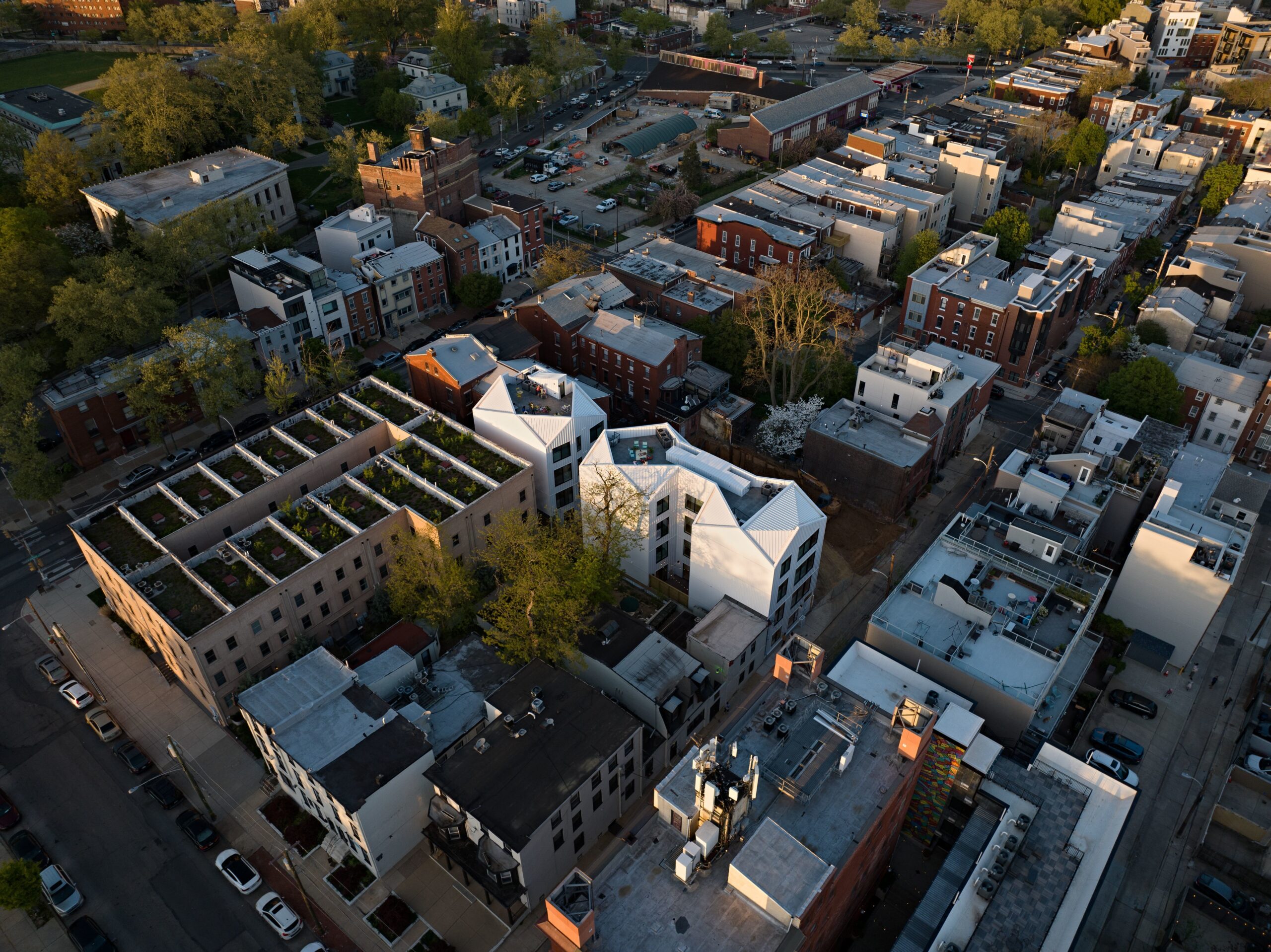
    In one, an architecture and design firm turned a historic Greek Revival mansion into a 32-unit building.

    Keep reading to learn more about that project and what Saffron calls “the untapped density in Philadelphia’s historic buildings.”

    Redeveloping the ‘Clothespin’ building

    Centre Square is Philadelphia’s biggest office complex, with more than 1.7 million square feet of office space.

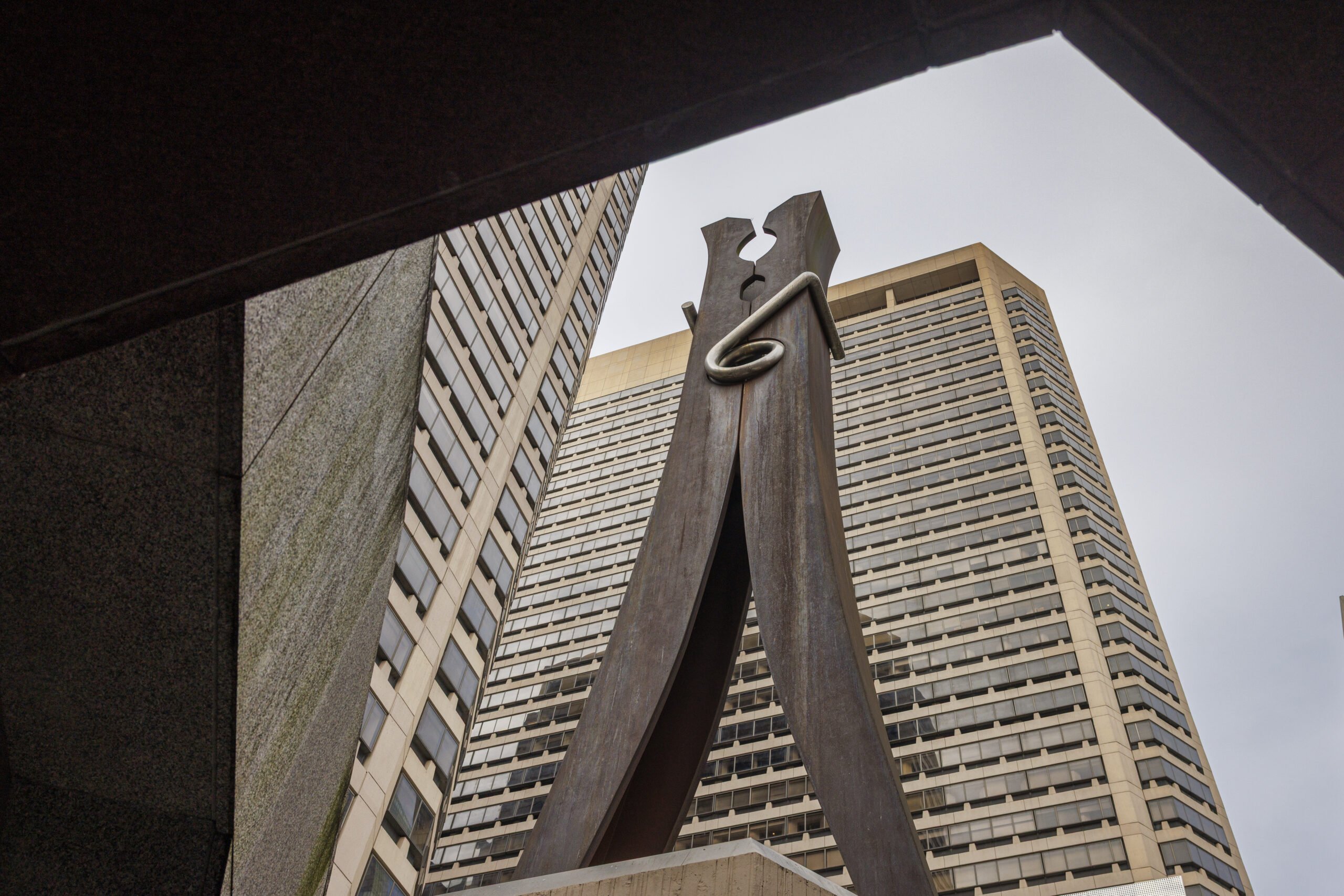
    You may know it as the “Clothespin building” for the giant pop art sculpture outside.

    The property was hit hard by the remote-work wave sparked by the pandemic. By the end of last year, Centre Square had added another superlative: the office building with the highest vacancy rate in Center City.

    Now, a developer wants to reimagine Centre Square. According to the plans, it’ll still have some office space. But its two towers will also have hundreds of apartments and luxury hotel rooms.

    The partnership behind the proposed redevelopment is responsible for other recent high-profile projects in the city. The developer says “we … are rejuvenating architectural gems that are functionally obsolete” amid “a real estate crisis.”

    Keep reading to learn about Centre Square’s history and find out why the building scared off other developers who considered buying it.

    The latest news to pay attention to

    Home tour: Black and white in West Philly

    Since Jasmine Williams was a kid, she’s always liked art and design. Now, she’s an interior design consultant.

    And she’s brought her knowledge and personal style to her 1,000-square-foot apartment in West Philly.

    Williams keeps it simple and classic by mainly focusing on two colors: black and white. She took inspiration from features that were already in her apartment, including the black cabinets and white countertops in her renovated kitchen.

    She added black furnishings and had one wall and a set of folding doors painted black. Most of her walls are white and so are rugs, ottomans, throw pillows, and other accessories.

    Peek inside Williams’ apartment and find out how she ended up at Garden Court Towers.

    📷 Photo quiz

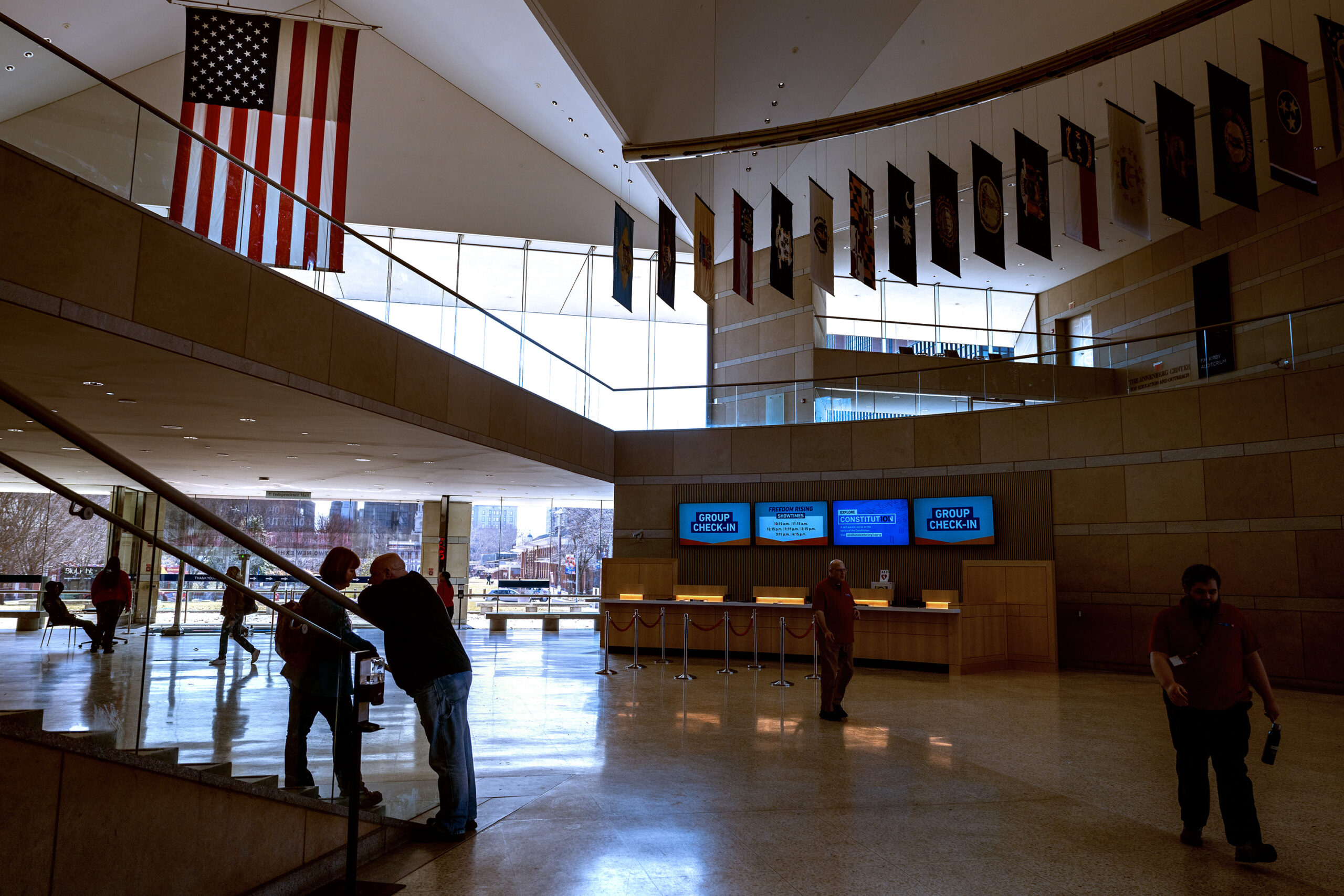
    Do you know the location this photo shows?

    📮 If you think you do, let me know.

    Shout-out to Lars W. for knowing that last week’s quiz featured a photo of the Rail Park in Philly’s Callowhill neighborhood.

    I thought that one would have been easier. Maybe the snow in the photo threw you off. Or maybe it’s just because I know it well. We’ve written about it a lot.

    I’ll leave you with a story that’s only kinda related to homes, but it’s an interesting read. My colleague Zoe Greenberg wrote about people who dig for artifacts buried in Philadelphia’s centuries-old outhouses.

    Philly’s full of fascinating people.

    Enjoy the rest of your week.

    By submitting your written, visual, and/or audio contributions, you agree to The Inquirer’s Terms of Use, including the grant of rights in Section 10.

  • In Philly homes, wallpapering is back and the rules have changed

    In Philly homes, wallpapering is back and the rules have changed

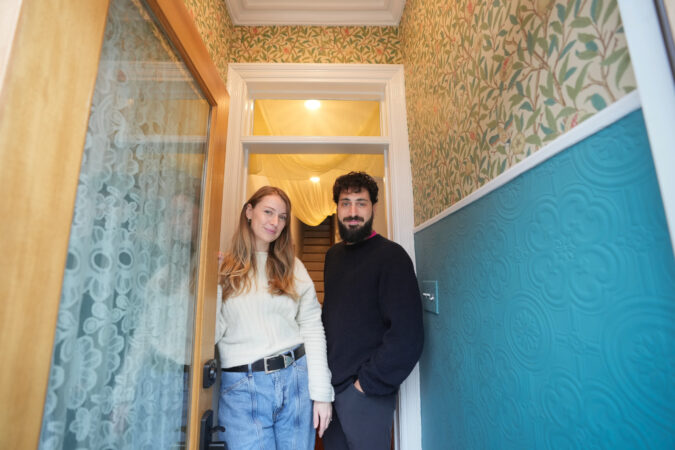
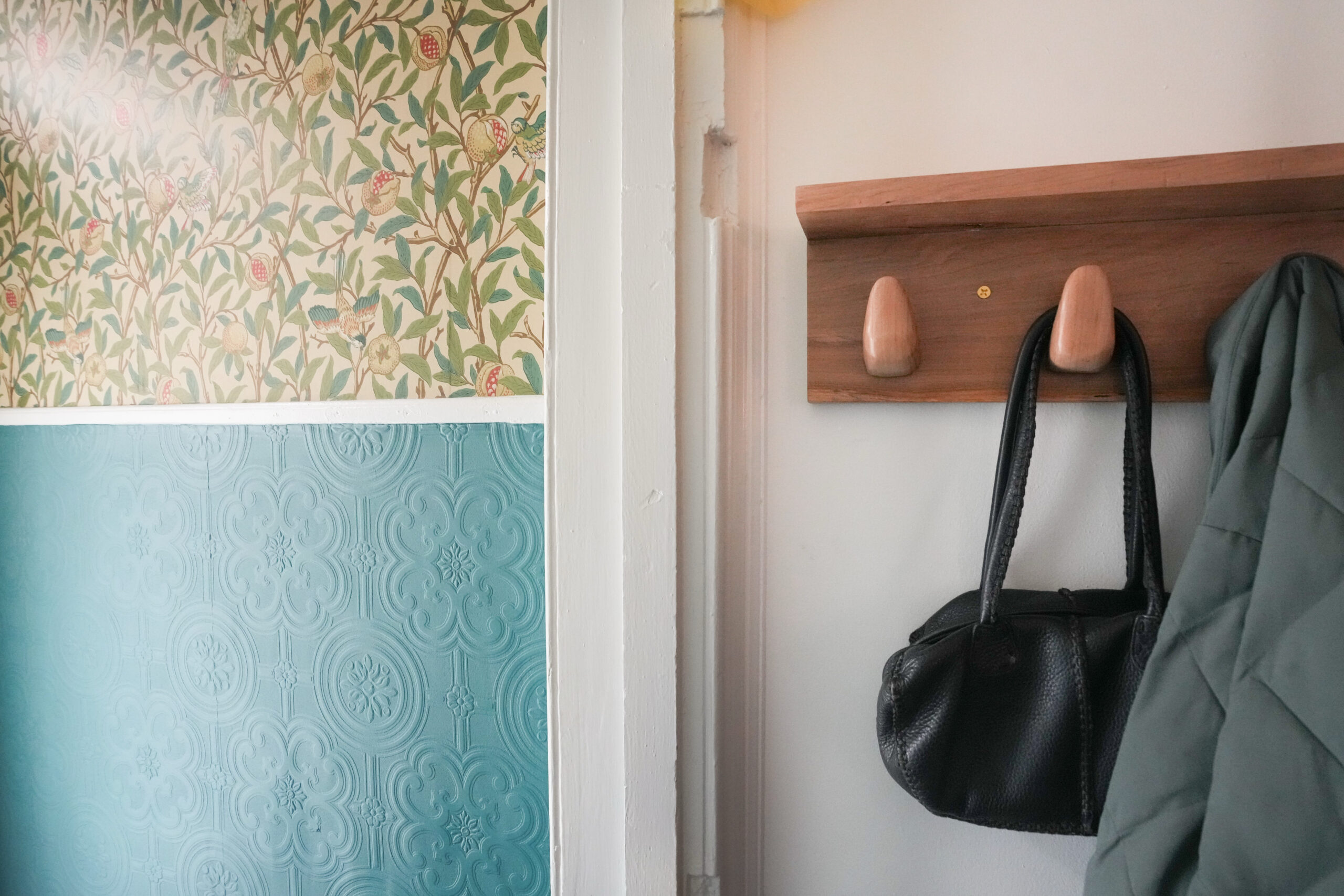
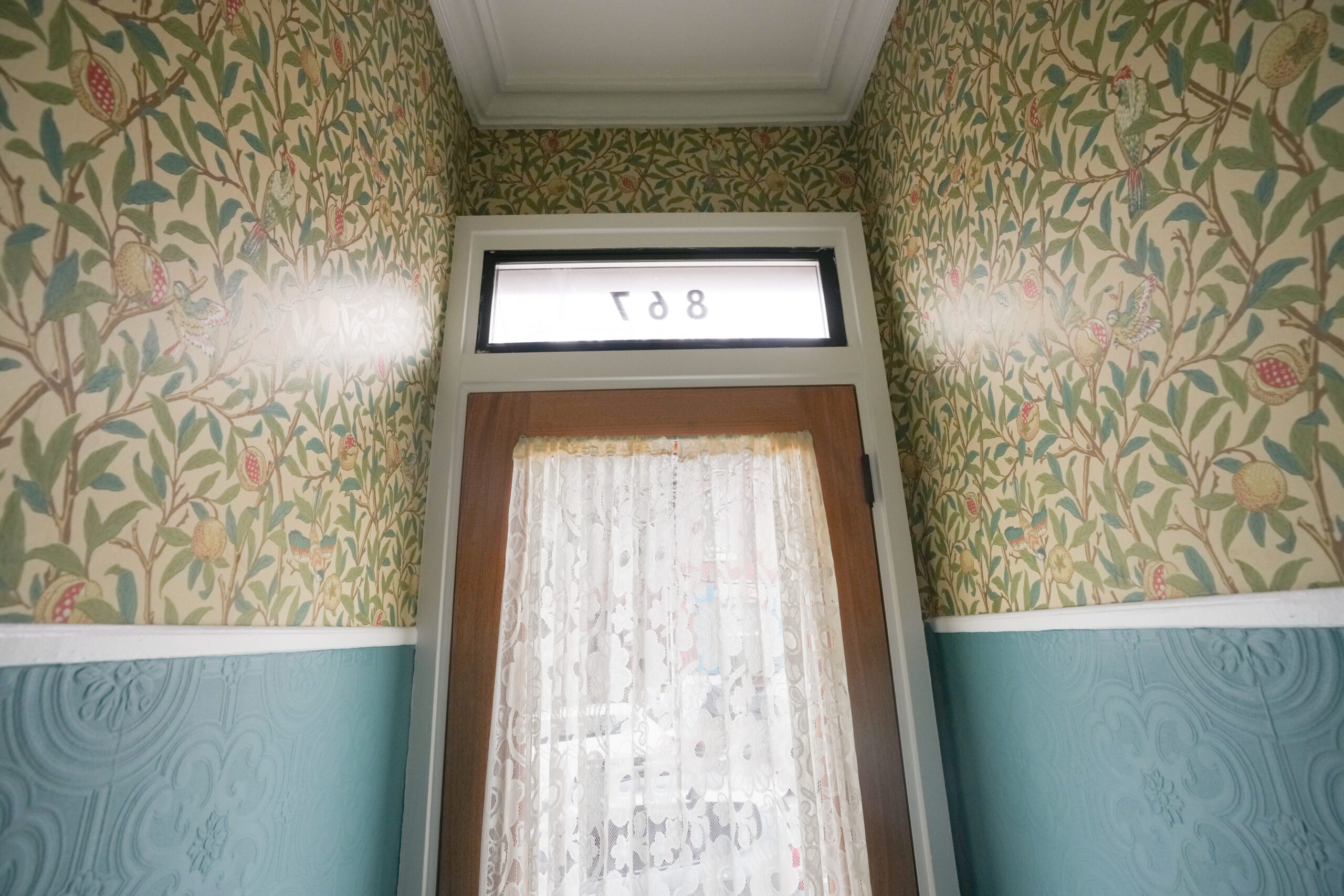
    When decorating their circa-1920 townhouse, Eli Steiker-Ginzberg and Sarah Schrading wanted their vestibule to represent the home’s history. They chose a classic William Morris wallpaper called Bird and Pomegranate for above the chair rail and a textured Anaglypta paper painted in Benjamin Moore Baltic Sea below.

    “Colonial Wallcoverings had so many options it was overwhelming,” recalled Steiker-Ginzberg, who lives in the Fairmount area. “The leaves and birds and colors of this one really jumped out.”

    The William Morris paper was a splurge, so to stay on budget, they matched it with a less expensive paintable wallpaper. In total they spent about $2,000 on the materials and installation “for the smallest room in my house,” he joked.

    Wallpaper is showing up in unique ways and in new places. Bold patterns on the ceiling, colorful oversized florals on an accent wall, custom murals in the living room, and funky patterns in the closet and mudroom that add pizzazz and make a statement.

    The wallpapered vestibule in Eli Steiker-Ginzberg and Sarah Schrading’s home leads to a painted wall on the home’s first floor.

    More homeowners are embracing bold wall coverings, according to the 2026 U.S. Houzz Fall Design Trends Report. The shift reflects a move toward deeply personal designs, with homeowners opting for vivid, expressive details that make their spaces feel unique and emotionally resonant, the report found.

    “Wallpaper has character and brings out the life and beauty of a room,” said Paul Sperling, owner of Colonial Wallcoverings in Queen Village. “It shows off your personality.”

    Modern wallpapers are also easier to hang and strip than older versions, with paste-the-wall and self-adhesive DIY options.

    “A lot of people are afraid of wallpaper because it used to be a nightmare to take off,” Sperling said. “But most wallpapers now are easier to remove because of changes in how the papers are printed.”

    Making a statement

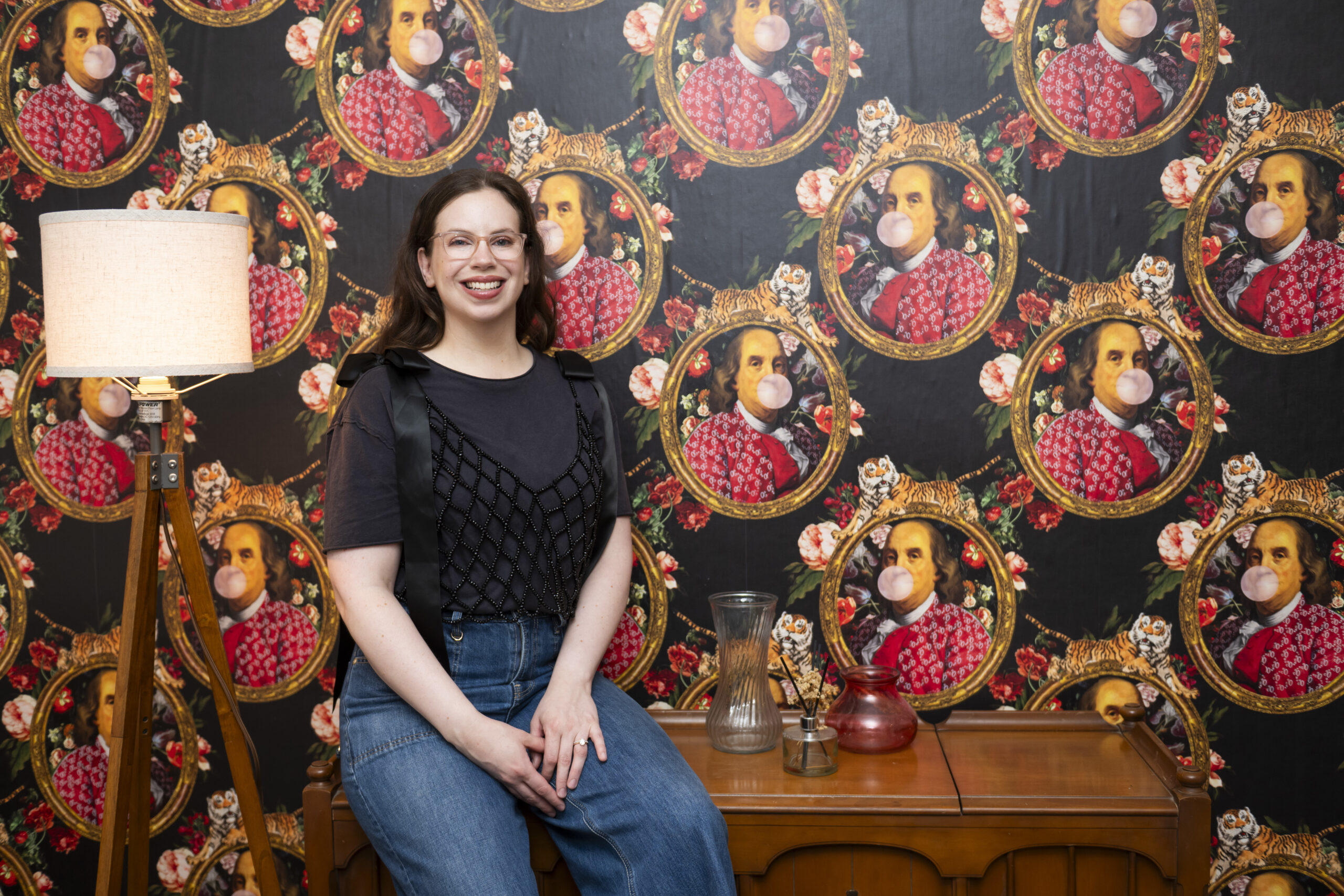
    When Jessica Maiuro moved into her Rittenhouse apartment in 2024, she wanted a wow factor as soon as she came through the front door. After a couple months of searching, she discovered a bold patterned wallpaper featuring Ben Franklin within a gilded picture frame blowing a bubble gum bubble, surrounded by a tiger and flowers.

    “I wanted something that would really make a bold statement and be a conversation starter when I hosted,” she recalled. “I had never seen any design like this, and I was instantly sold and in love. What could be more Philly?”

    Jessica Maiuro was delighted to find this Benjamin Franklin wallpaper for her home in Center City.

    Maiuro spent about $500 on the peel-and-stick wallpaper from the online seller Spoonflower and corralled her husband, John Jeong, and a friend to help her hang it. Her apartment is a rental, but she tested the paper and knows it will easily strip off when it’s time to take it down.

    When investing in wallpaper, consider where and how it will make the most impact. Wallpapers with small, repeating patterns work best in a smaller space, such as a powder room or vestibule.

    For larger spaces, wallpaper murals can serve as a focal point on the wall behind the bed or sofa, or continuing across several walls. They often feature grand designs or landscapes, including big, bold flowers and jungle scenes. Murals are more popular than ever, said Sperling, with brands like Rebel Walls and Glamora that specialize in custom sizes.

    For a more personal design, Rich Art Graphics in Center City will take your artwork and create a custom wallpaper to fit your dimensions.

    “Most of the time, a designer or artist will come to us with a fine art interpretation to be printed and installed in homes,” said Michael Antner, the print shop’s owner. “It’s something personal that they are very passionate about.”

    For example, a client may have a favorite painting or photograph they want to reimagine on an entire wall. Cityscapes and naturescapes are especially popular. Rich Art will create a digital file with the picture and manipulate it to the exact size of the wall.

    They offer traditional wallpaper adhered with paste or peel-and-stick adhesive. The average cost is $8 per square foot to create the paper, plus installation.

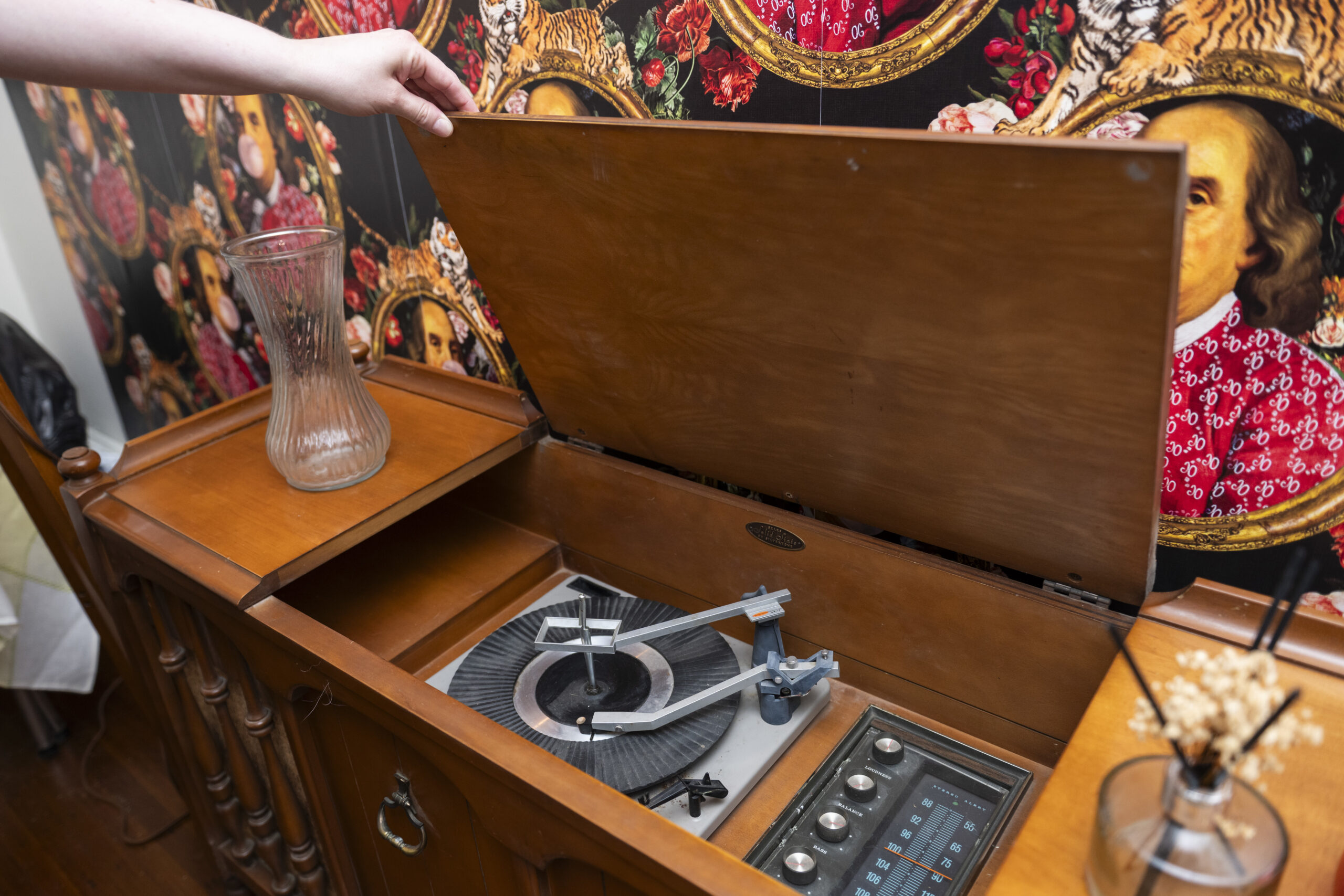
    A record player dating to the 1960s sits in Maiuro’s home under the gaze of bubble-gum-chewing Ben Franklin.

    The fifth wall

    The ceiling has become the fifth wall of the room, where wallpaper can make a bold statement and add a new dimension. Options include very intricate designs where viewers can spot new details to simpler patterns like clouds or green tree canopies.

    “It’s much more dramatic and brings more attention to the room,” Sperling said. “It takes vision.”

    Parents are even wallpapering nursery ceilings as a stimulating focal point for their babies.

    “Wallpapered ceilings have been a design staple for centuries in Europe, especially in homes where pattern and ornamentation played an important role in creating atmosphere and storytelling,” said Krystal Reinhard, founder and principal designer at Old Soul Design Studio in downtown West Chester.

    She’s seen a noticeable uptick in the past five years as homeowners look for more expressive, layered interiors. Papered ceilings work in smaller, contained spaces like powder rooms, nurseries, and offices. But they can also make sense on larger ceilings in bedrooms, dining rooms, and kitchens.

    When papering the ceiling, it’s important to consider the scale of the pattern — motifs or tonal textures often work beautifully overhead, Reinhard said. It’s best to hire an experienced installer because ceilings require precision and strong adhesive knowledge. Before committing to a pattern, one should test how it interacts with overhead lighting — fixtures can cast shadows that change the effect.

    “A wallpapered ceiling is one of the most effective ways to give a room soul,” Reinhard said. “It’s a detail that feels thoughtful and intentional.”

    Especially in the Philadelphia region, where so many homes have architectural character worth celebrating, treating the ceiling as a design opportunity can elevate the entire space, she said.

    It’s a way to honor historic craftsmanship while embracing a very current, expressive design moment.

    Steiker-Ginzberg and Schrading chose the wallpaper in their vestibule to represent the home’s history.

    How much does wallpapering cost?

    Wallpaper costs vary widely, starting at about $40 per 50-square-foot roll for peel-and-stick options from online sellers such as Wayfair. Textured materials from brands like Arte or historical luxury design houses like de Gourney or Zuber can reach several hundred dollars per individual square foot, Sperling said.

    Many companies provide a measuring calculator to determine exactly how much is needed for your project. It’s essential to take pattern repeat into account and add an extra 10% for mistakes and future repairs.

    Most companies sell samples. It’s helpful to hang those in various spots and observe over a few days to see how the pattern looks in the light at different times of day and night.

    For Steiker-Ginzberg, the wallpaper investment was worthwhile.

    “There’s something important and meaningful about the portal into your house and there being an intentional transition,” he said. “It makes a difference in the impression people get.”

  • In a Philly apartment, a monochrome design brings splash without color

    In a Philly apartment, a monochrome design brings splash without color

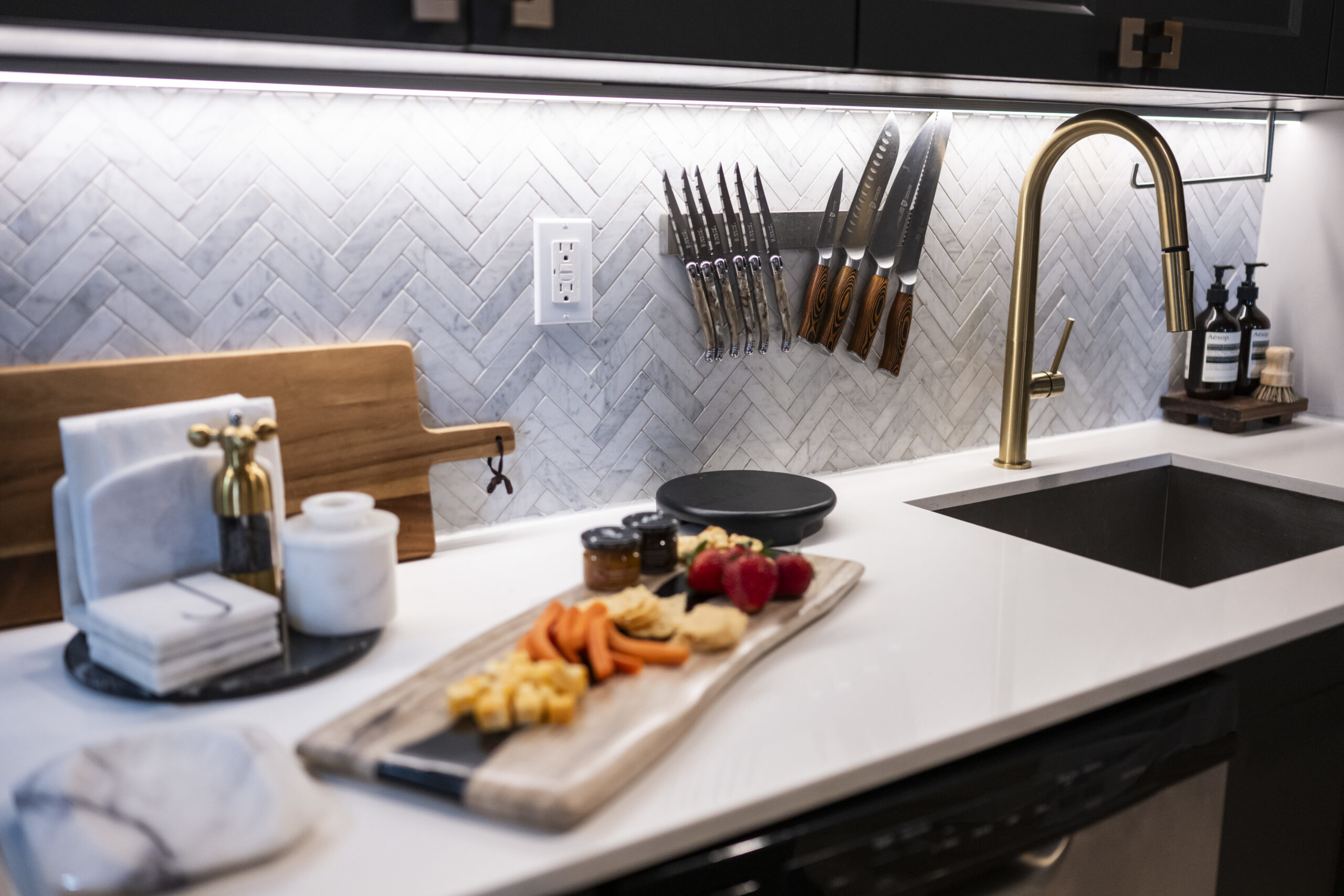
    Bright red strawberries and orange carrot sticks on the kitchen cutting board and greenery in white sculptural vases on the white counter and black dining table add rare splashes of color to Jasmine Williams’ one-bedroom apartment.

    Williams has lived in her mostly two-toned residence in Garden Court Towers, in the Garden Court neighborhood in West Philadelphia, for four years. She loves the “clean and classic” white of the apartment’s walls, chairs, rugs, ottomans, throw pillows, and other accessories.

    Contrasting black furnishings include leather chairs in the entry hall, a round table, the bench and chairs in the dining area, and black cabinets in the bedroom, which flank a radiator whose cover she painted black. She also painted the wall dividing the entry hall and the living area black.

    Recently, Williams’ niece, Aubrey Harris, painted the folding doors to the laundry black. The rest of the doors in the apartment are white.

    Williams already had the essentials when she chose her dramatic decor. Her 1,000-square-foot apartment’s renovated kitchen had black cabinets with white countertops. There were white fixtures in the bathroom and powder room. The laminate floors resembled white oak.

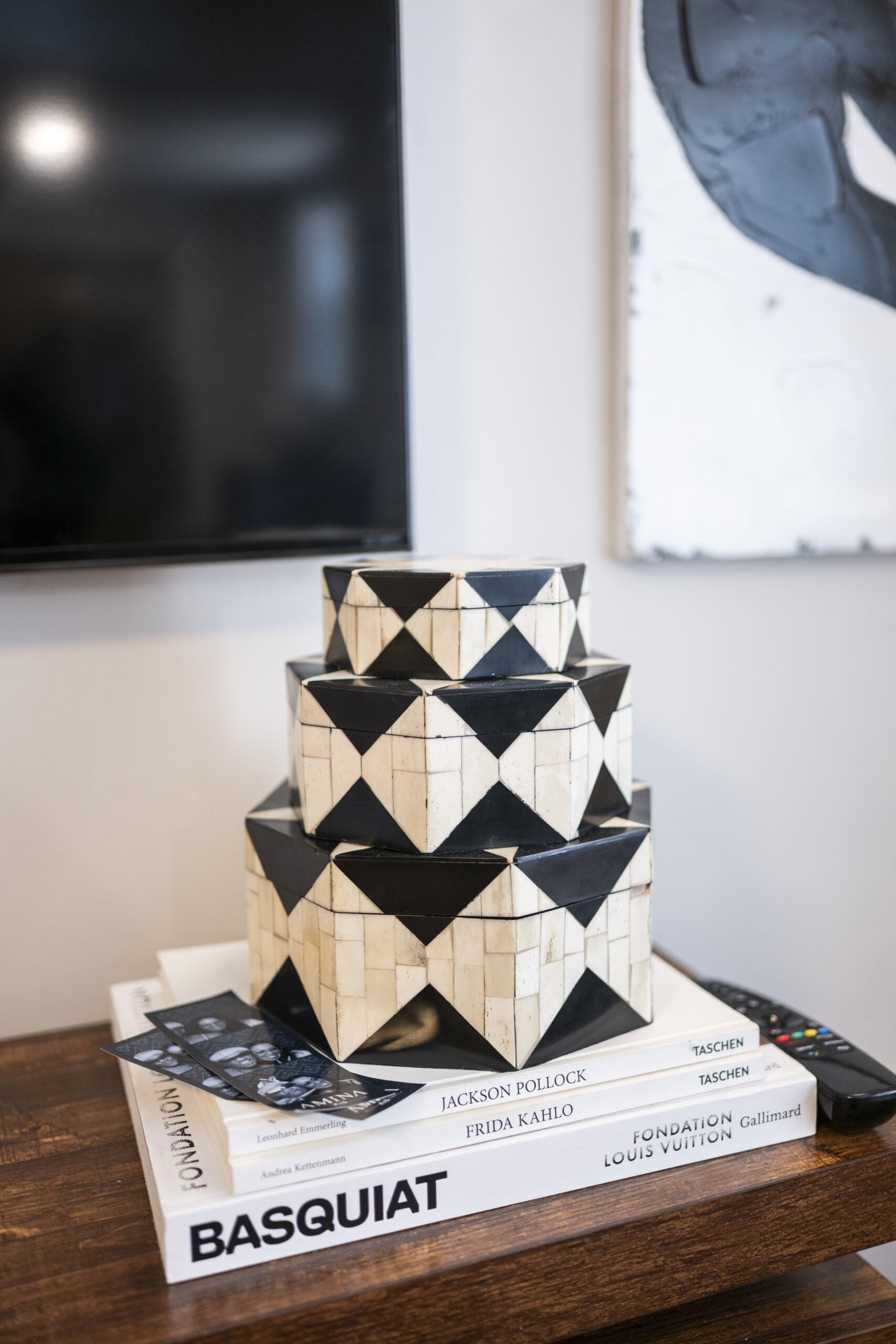
    Decorative boxes and books are stacked on a media console in the living room.
    Decor on the nightstand next to Williams’ bed.

    Williams, 36, spent the first decade of her life in a home on Larchwood Avenue, just blocks from Garden Court Towers. Her family then moved to Berlin, N.J. She graduated from Eastern Regional High School in Voorhees.

    During the early days of the COVID-19 pandemic, she lived with her grandmother, Dolores Cook, in Northeast Philadelphia and redecorated Cook’s home.

    “From the time she was a little girl Jasmine always liked art and design,” her mother, Yvette Baker, boasted during a visit with her daughter.

    Williams was a project manager for nonprofits before becoming an interior design consultant. She is also a disaster relief volunteer for the American Red Cross in Philadelphia.

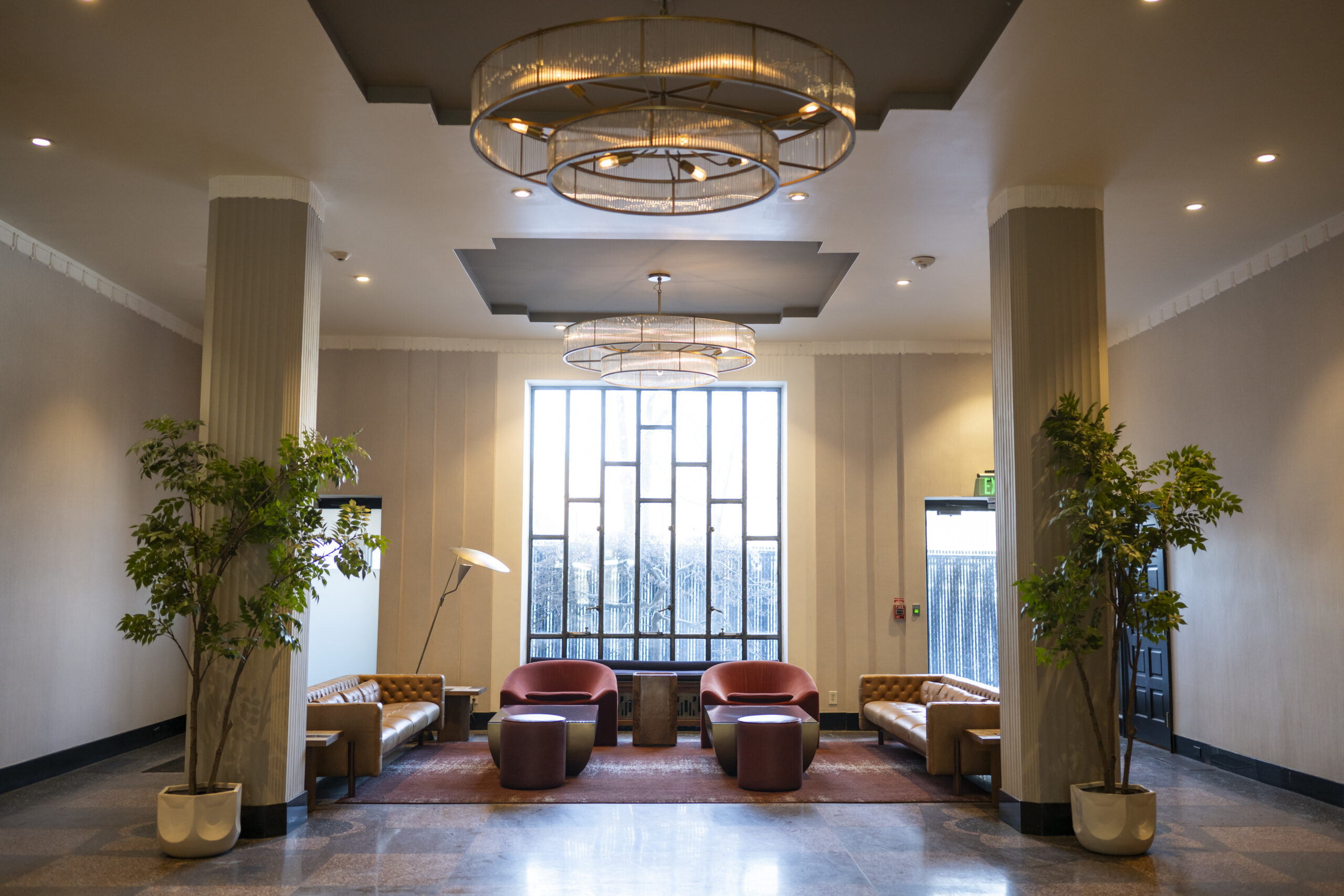
    After her grandmother’s death in December 2020, “the housing market was awful,” Williams said, so she looked for a place to rent. She visited Garden Court Towers and admired the 1929 Art Deco lobby with its canopied entrance, carved wood paneled foyer, tile walls and floor, and original brass U.S. Mail box.

    The lobby of the Garden Towers apartment building in West Philadelphia.

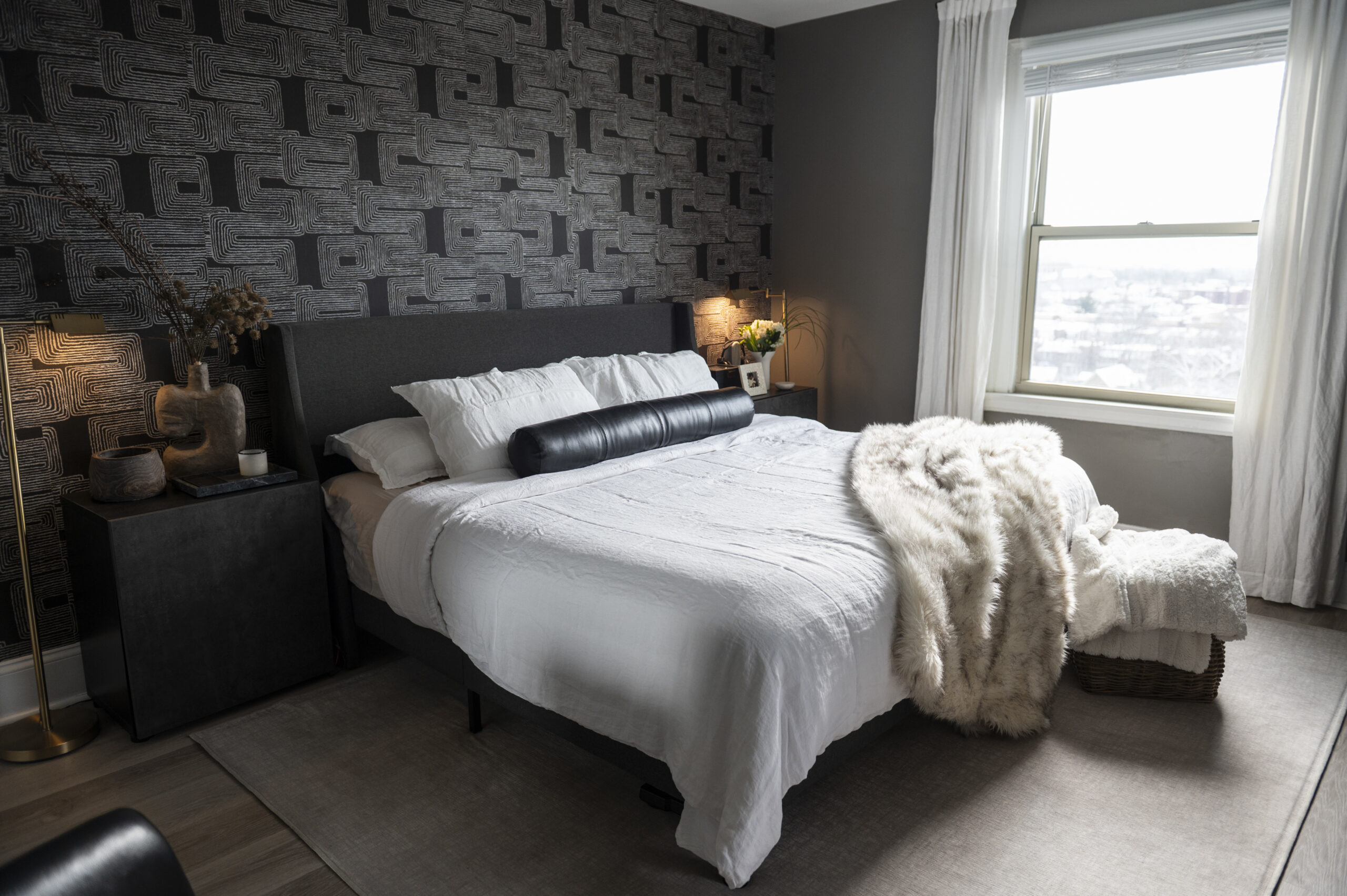
    The Art Deco geometric design of the hallway carpeting is similar to the gray-and-white pattern of the wallpaper Jasmine chose to hang behind her bed, which has a gray headboard. She hung gray wallpaper as an accent on two other walls.

    The living room couch is gray, as is the herringbone-patterned kitchen backsplash.

    Gray softens the bold black-and-white surroundings, as does the wood-toned Parsons table under the TV in the living room. Brass lamps in the bedroom and a gilt mirror in the dining area add sparkle.

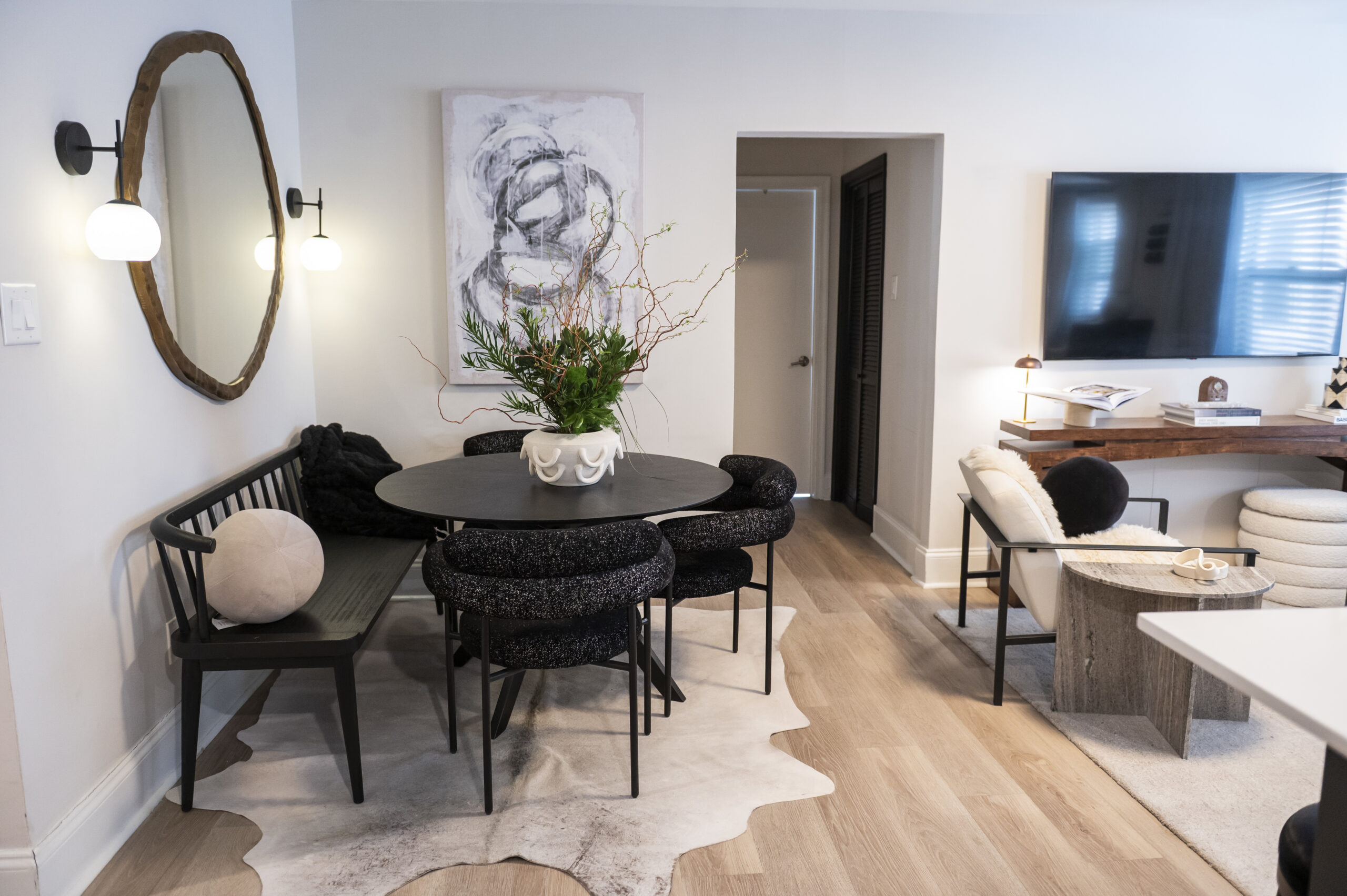
    The dining area, with a variety of monochrome shapes and textures, connects to the living area.

    The miniature antique radio on the Parsons table is actually a holder for wood coasters. Williams inherited the radio from her grandmother.

    Abstract art in the apartment include two striking oil paintings from Amazon in the entry hall, depicting black figures on a white background.

    Nearby hangs a painting of gray, beige, and black stripes and swirls on a white background. The work was more colorful when Williams purchased it from CB2, but she and her sister Melyssa Pollard brushed over the vibrant shades to produce a more muted palette.

    Williams’ brother in law, Jay Pollard, and her father, Edward Williams, installed light fixtures and hung paintings in the apartment.

    Her favorite shopping destinations are CB2 and Crate & Barrel, but she has also purchased items from Amazon, Pottery Barn, Wayfair, and other vendors. The cowhide rug under the dining table came from Burke Decor.

    Patterned wallpaper and simple white bedding contrast in the bedroom, where brass lamps add some shine.
    In the kitchen, an arrangement of brightly colored produce stands out from the black, white, and gray.

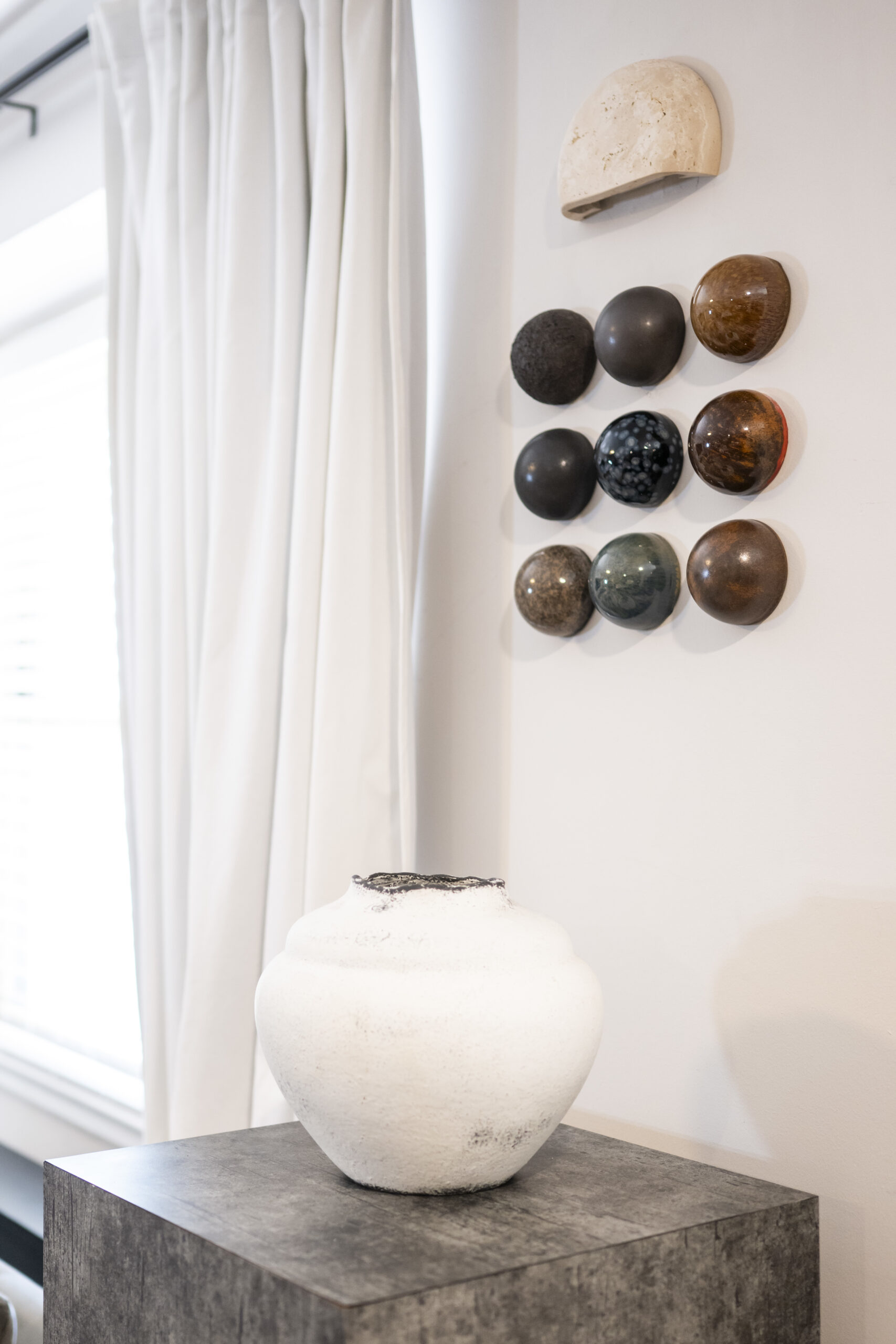
    In the living room, a unique art installation of nine small domes in shades of black, brown, and gray are arranged on the white wall above a white clay bowl on a black pedestal. The glazed clay domes are the work of New Zealand ceramicist Sam Mayell.

    Large windows fill the tenth-floor apartment with light.

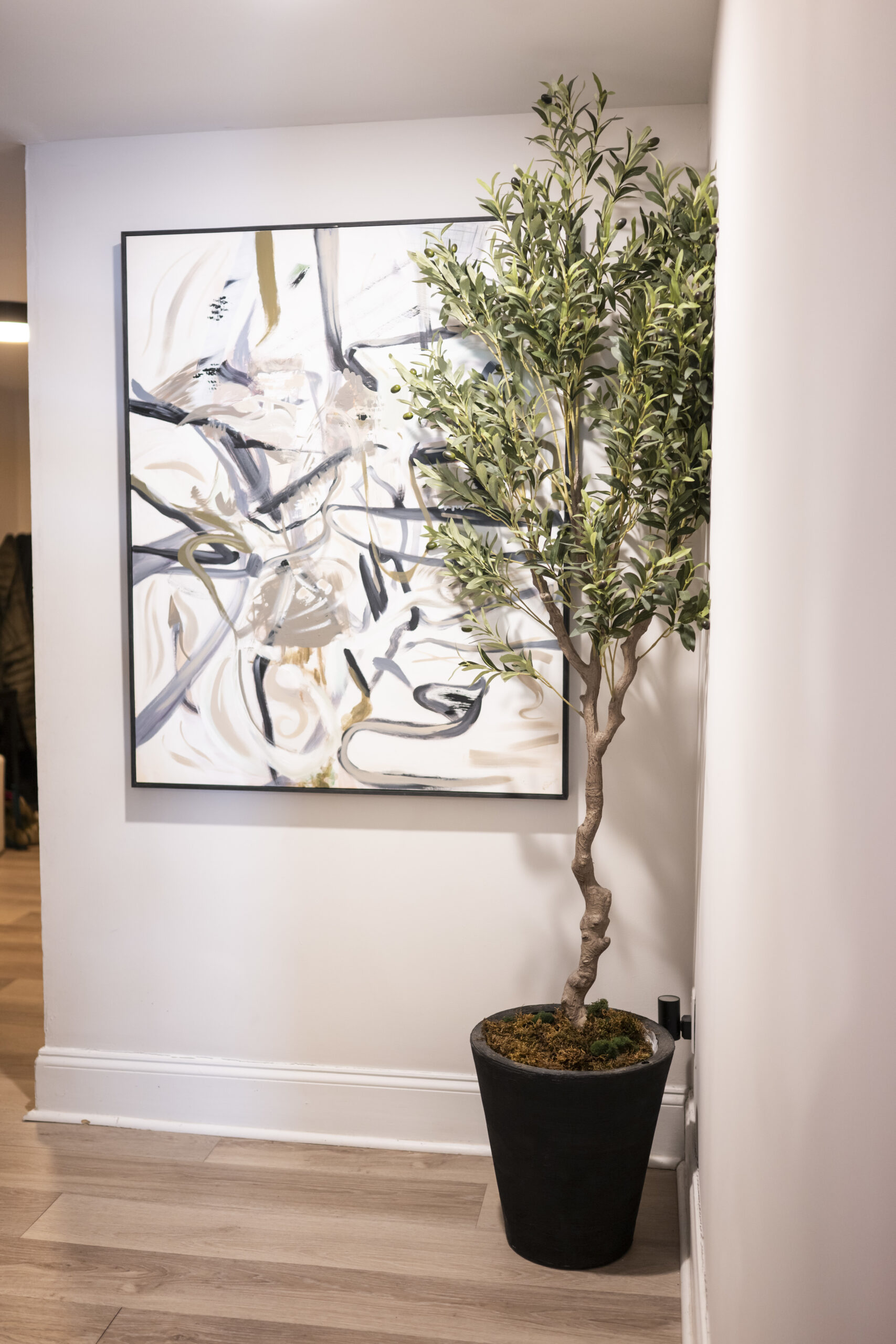
    An abstract painting and large olive plant decorate the hallway.
    Ceramics and wall art bring texture to the apartment’s interior design.

    In the bedroom, with its white and black furnishings, a window frames a view of Garden Court homes below with their snow-covered lawns and rooftops.

    The winter-white scene was “keeping my theme going,” quipped Williams.

    Is your house a Haven? Nominate your home by email (and send some digital photographs) at properties@inquirer.com.
  • From proactive inspections to retaliation protection, here’s what Philly renters should know about advancing Council bills

    From proactive inspections to retaliation protection, here’s what Philly renters should know about advancing Council bills

    City Council’s housing committee advanced two bills on Wednesday meant to help Philadelphia renters living in unsafe or unhealthy homes.

    One bill would protect tenants who complain about housing conditions from retaliation by rental property owners and affirm tenants’ rights to safe and sanitary homes.

    The other seeks to hold landlords accountable for repairs and would authorize the Philadelphia Department of Licenses and Inspections to create a program to proactively inspect rental units instead of relying on tenants’ complaints to trigger inspections.

    The bills are the two remaining pieces of a legislative package of renter protections introduced by Councilmember Nicolas O’Rourke. The first bill in the Safe Healthy Homes Act passed last year and created an anti-displacement fund to give financial help to renters forced to move out of their homes because of unsafe or unhealthy conditions.

    The remaining bills passed out of the housing committee Wednesday after months of discussions with Council members, Parker administration officials, and landlords.

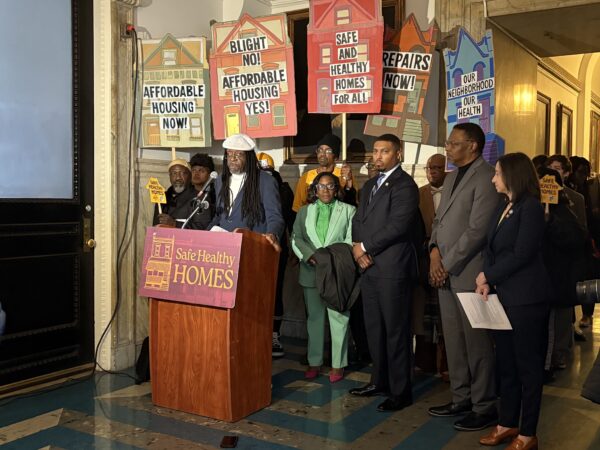
    All three bills were written in partnership with the groups OnePA Renters United Philadelphia, a coalition of renters unions and advocates, and Philly Thrive, an advocacy group for racial, economic, and environmental justice. At Wednesday’s Council hearing, tenants from these groups and others who rent homes across the city testified about living with mold, pests, leaks, lack of heat, and falling ceilings.

    “The stories that inform the creation of this legislation come from the tenants,” O’Rourke said. Philadelphia renters “have long had to fight for the right to dignified living.”

    Proactive inspections

    Bridget Collins-Greenwald, commissioner of L&I’s quality of life division, said the bill that allows for a program to proactively inspect rental homes incorporates the Parker administration’s feedback.

    “We believe the administration’s concerns have all been addressed and that the bill as amended can be successfully implemented,” Collins-Greenwald said to cheers and applause from tenants in the audience.

    A year ago, Collins-Greenwald testified at a Council hearing that L&I was working to create a proactive inspection program. According to a Pew report from 2021, the department inspected only about 7% of Philadelphia’s rentals in a year.
    O’Rourke’s legislation would require L&I to provide annual reports to Council members about the progress of the proactive inspection program.

    The bill also would require rental property owners to share a copy of their rental license with tenants and to inform tenants if the license is suspended. Landlords need a valid license in order to collect rent.

    Owners would also have to tell tenants about outstanding health and safety violations.

    Retaliation against renters

    O’Rourke’s second bill would expand protections against landlord retaliation for renters who participate in tenant unions and/or investigations of code violations.

    Katharine Nelson, who oversees a housing studies initiative at the Rutgers Center on Law, Inequality and Metropolitan Equity, said the legislation addresses “a longstanding power imbalance between landlords and tenants.”

    “With less fear of reprisal, tenants will be emboldened to advocate for themselves around severe habitability and repair issues,” she said. “Far too many Philadelphians live in rental units in need of significant repairs.”

    The bill also would expand the city’s requirement that landlords have “good cause” for ending a tenancy — whether by lease nonrenewal or termination — and explain to tenants in writing why their tenancy is ending. Under the bill, this provision of the city’s landlord-tenant law would apply to most tenants, not just those with leases of less than a year, as it does now.

    More amendments?

    Groups that represent rental property owners and managers said that they support the broad goals of the bills, but that the legislation needs to be further amended. They said they worried about unintended consequences that could harm landlords, especially ones with only a few housing units.

    The legislation includes a provision that would allow rental property owners to collect the full rent if they can show that the city was the reason they were unable to get a valid rental license on time. But landlords said they want more protections for rental property owners who strive to follow city laws but are stymied by government bureaucracy and frequently changing regulations.

    For example, Steven Chintaman, vice president of government affairs at the Pennsylvania Apartment Association, said landlords should have to forfeit rent only if code violations impact the habitability of a home, “not [for] technical or administrative issues.”

    “We remain committed to working collaboratively to preserve the intent of these bills while ensuring that they are balanced, workable, and do not unintentionally harm housing providers and the residents we serve,” Chintaman said.

    O’Rourke said he would continue to work with rental property owners and other stakeholders and is open to further amendments as his bills move forward.