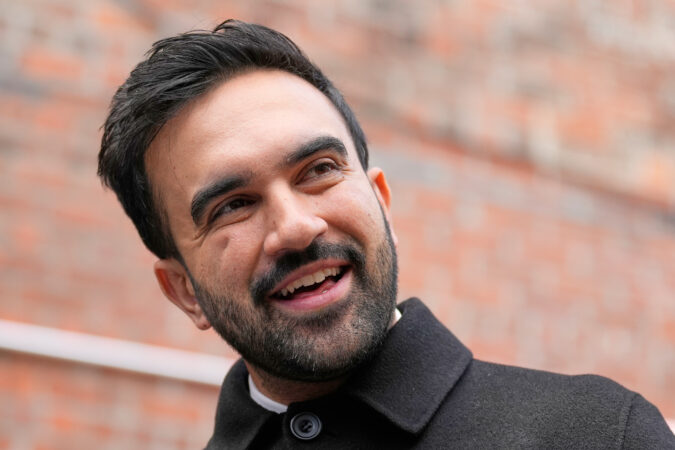
WASHINGTON — President Donald Trump on Friday met the man who had proudly proclaimed himself “Donald Trump’s worst nightmare,” but he seemed to find the opposite.
The Republican president and New York City’s Mayor-elect Zohran Mamdani were warm and friendly, speaking repeatedly of their shared goals to help Trump’s hometown rather than their combustible differences.
Trump, who had in the past called Mamdani a “100% Communist Lunatic” and a “total nut job,” spoke openly of how impressed he was with the man who had called his administration “authoritarian.”
“I think he is going to surprise some conservative people, actually,” Trump said of the democratic socialist as Mamdani stood next to him in the Oval Office.
The meeting offered political opportunities for both men. For Mamdani, a sit-down offered the state lawmaker — who until recently was relatively unknown — the chance to go head-to-head with the most powerful person in the world.
For Trump, it was a high-profile chance to talk about affordability at a time when he’s under increasing political pressure to show he’s addressing voter concerns about the cost of living.
Until now, the men have been political foils who galvanized their supporters by taking on each other, and it’s unclear how those backers will react to their genial get-together and complimentary words.
“We’re going to be helping him, to make everybody’s dream come true, having a strong and very safe New York,” the president said.
“What I really appreciate about the president is that the meeting that we had focused not on places of disagreement, which there are many, and also focused on the shared purpose that we have in serving New Yorkers,” Mamdani said.
Mamdani and Trump said they discussed housing affordability and the cost of groceries and utilities, as Mamdani successfully used frustration over inflation to get elected, just as the president did in the 2024 election.
“Some of his ideas are really the same ideas that I have,” the president said of Mamdani about inflationary issues.
The president brushed aside Mamdani’s criticisms of him over his administration’s deportation raids and claims that Trump was behaving like a despot. Instead, Trump said the responsibility of holding an executive position in the government causes a person to change, saying that had been the case for him.
He seemed at times even protective of Mamdani, jumping in on his behalf at several points. For example, when reporters asked Mamdani to clarify his past statements indicating that he thought the president was acting like a fascist, Trump said, “I’ve been called much worse than a despot.”
When a reporter asked if Mamdani stood by his comments that Trump is a fascist, Trump interjected before the mayor-elect could fully answer the question.
“That’s OK. You can just say yes. OK?” Trump said. “It’s easier. It’s easier than explaining it. I don’t mind.”
Trump stepped in again when a reporter asked Mamdani why he flew to Washington instead of taking transportation that used less fossil fuels.
Mamdani, who takes office in January, said he sought the meeting with Trump to talk about ways to make New York City more affordable. Trump has said he may want to help him out — although he has also falsely labeled Mamdani as a “communist” and threatened to yank federal funds from the city.
But Trump on Friday didn’t sling that at the mayor. He acknowledged that he had said he had been prepared to cut off funding or make it harder for New York City to access federal resources if the two had failed to “get along,” only to pull back from those threats during the meeting.
“We don’t want that to happen,” Trump said. ”I don’t think that’s going to happen.”
Afterward, Mamdani’s former campaign manager and incoming chief of staff Elle Bisgaard-Church told NY1 that the pair clearly disagreed on some issues but were able to find common ground on things like reducing crime.
“We discussed that we share a mutual goal of having a safe city where everyone can move around in comfort and ease,” she said, before later adding, “We know that there have been labels thrown all around that are just simply not fair and we kept it, again, at where we could find agreement on making the city affordable.”
Trump loomed large over the mayoral race this year, and on the eve of the election, he endorsed independent candidate and former Democratic Gov. Andrew Cuomo, predicting the city has “ZERO chance of success, or even survival” if Mamdani won. He also questioned the citizenship of Mamdani, who was born in Uganda and became a naturalized American citizen after graduating from college, and said he’d have him arrested if he followed through on threats not to cooperate with immigration agents in the city.
Mamdani beat back a challenge from Cuomo, painting him as a “puppet” for the president, and promised to be “a mayor who can stand up to Donald Trump and actually deliver.” He declared during one primary debate, “I am Donald Trump’s worst nightmare, as a progressive Muslim immigrant who actually fights for the things that I believe in.”
The president, who has long used political opponents to fire up his backers, predicted Mamdani “will prove to be one of the best things to ever happen to our great Republican Party.” As Mamdani upended the Democratic establishment by defeating Cuomo and his far-left progressive policies provoked infighting, Trump repeatedly has cast Mamdani as the face of Democratic Party.
Some had expected fireworks in the Oval Office meeting
The president has had some dramatic public Oval Office faceoffs this year, including an infamously heated exchange with Ukrainian President Volodymyr Zelenskyy in March. In May, Trump dimmed the lights while meeting with South African President Cyril Ramaphosa and played a four-minute video making widely rejected claims that South Africa is violently persecuting the country’s white Afrikaner minority farmers.
A senior Trump administration official who spoke on condition of anonymity to describe internal discussions said Trump had not put a lot of thought into planning the meeting with the incoming mayor — but said Trump’s threats to block federal dollars from flowing to New York remained on the table.
Mamdani said Thursday that he was not concerned about the president potentially trying to use the meeting to publicly embarrass him and said he saw it as a chance to make his case, even while acknowledging “many disagreements with the president.”
Instead, both men avoided a public confrontation in a remarkably calm and cordial series of comments in front of news reporters.
Mamdani, who lives in Queens — where Trump was raised — has shown a cutthroat streak just as Trump has as a candidate. During his campaign, he appeared to borrow from Trump’s playbook when he noted during a televised debate with Cuomo that one of the women who had accused the former governor of sexual harassment was in the audience. Cuomo has denied wrongdoing.
But the tensions were subdued Friday as Trump seemed sympathetic to Mamdani’s policies to want to build more housing.
“People would be shocked, but I want to see the same thing,” the president said.
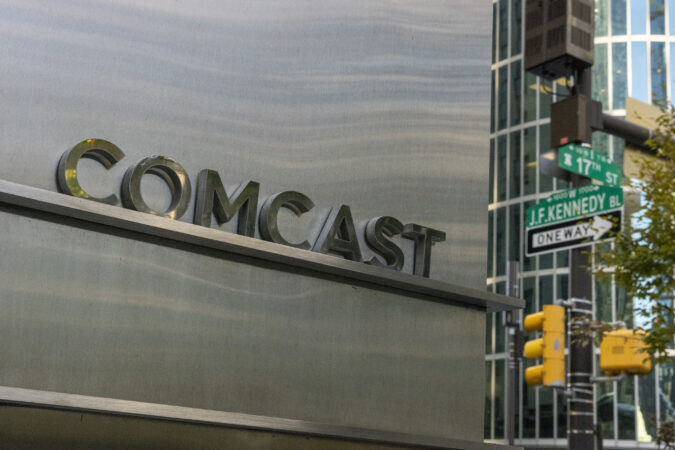
Warner Bros. Discovery has received preliminary buyout bids from rivals Paramount Skydance, Philadelphia-based Comcast, and Netflix, a source familiar with the matter said on Thursday, kicking off a potential sale of the century-old Hollywood studio.
The bids set the stage for a significant consolidation in the media industry and will determine the future of prized assets such as HBO, the Warner Bros. film library, and the DC Comics universe.
Paramount is expected to bid for all of Warner Bros. Discovery, including its cable television networks. Paramount’s bid is backed by the studio’s controlling shareholder, billionaire Oracle co-founder Larry Ellison, who is among the world’s richest men. The potential combination would enhance Paramount’s presence in movie theaters, giving it a 32% share of the North American theatrical market, according to Comscore, and strengthen its streaming service by combining HBO Max with Paramount+.
Reuters exclusively reported that Warner Bros. Discovery’s board rejected a mostly cash offer of nearly $24 a share for the company, valuing it at $60 billion, and publicly announced it would evaluate strategic options for the studio.
NBCUniversal’s corporate parent, Comcast, is interested in Warner Bros.’ film and television studios and HBO, whose characters, including Superman and Batman, would strengthen its theatrical and streaming business and its theme parks. The merged studios’ share of the North American theatrical market would exceed 43%, according to Comscore.
Netflix is also courting Warner Bros.’ studio and streaming businesses, aiming to gain access to Warner Bros.’ extensive film library and established entertainment franchises, such as Harry Potter and Lord of the Rings. Warner Bros. Discovery previously announced plans to split into two publicly traded companies, separating its studios and streaming business from its fading cable networks.
Warner Bros. Discovery did not immediately respond to Reuters’ request for comment. Comcast and Paramount Skydance declined to comment. Netflix could not be reached for comment. The New York Times first reported the development.
INDIANAPOLIS — Former Temple guard Hysier Miller placed dozens of bets on Owls games, including some against his team, the NCAA announced Friday.
The NCAA deemed Miller, a graduate of Neumann Goretti, permanently ineligible after finding he placed 42 parlay bets totaling $473 on Temple games during the 2022-23 and 2023-24 seasons. Three of those bets were against his team, the NCAA said.
Miller started every game for the Owls during those seasons. The NCAA found he used sportsbook accounts belonging to other people to bet.
The NCAA’s enforcement staff interviewed Miller on Oct. 10, 2024, and he admitted to placing parlay bets on Temple games but did not remember placing any bets against his team, the NCAA said.
Additionally, former Temple special assistant coach Camren Wynter and former graduate assistant Jaylen Bond were found to have violated NCAA rules by betting on professional and collegiate sports. The NCAA did not find any bets involving Temple by either Wynter or Bond. Both coaches received one-year, show-cause orders and a suspension of 10% of regular-season contests during their first year of employment.
The NCAA did not find the three cases to be connected.
Temple President John Fry and Director of Athletics Arthur Johnson released an announcement Friday, saying the NCAA found no evidence of point shaving or any wrongdoing by the university.
This is the latest gambling infraction uncovered by the NCAA, which revoked the eligibility of six men’s college basketball players earlier this month as a result of three separate sports-betting cases that involved a power-conference school in Arizona State and allegations of players throwing games to lose by more points than the spread.
That followed nearly three dozen people being arrested last month, including an NBA player and coach, for what federal law enforcement officials described as their involvement in various illicit gambling activities. Just this week, UFC President and CEO Dana White said he was in touch with the FBI regarding a match that involved unusual betting patterns.
For its part, the NCAA said last month it was investigating at least 30 current or former players for gambling allegations. The NCAA also banned three college basketball players in September for betting on their own games at Fresno State and San Jose State.
WASHINGTON — The Supreme Court is meeting in private Friday with a key issue on its agenda — President Donald Trump’s birthright citizenship order declaring that children born to parents who are in the United States illegally or temporarily are not American citizens.
The justices could say as soon as Monday whether they will hear Trump’s appeal of lower court rulings that have uniformly struck down the citizenship restrictions. They have not taken effect anywhere in the United States.
If the court steps in now, the case would be argued in the spring, with a definitive ruling expected by early summer.
The birthright citizenship order, which Trump signed on the first day of his second term in the White House, is part of his administration’s broad immigration crackdown. Other actions include immigration enforcement surges in several cities and the first peacetime invocation of the 18th century Alien Enemies Act.
The administration is facing multiple court challenges, and the high court has sent mixed signals in emergency orders it has issued. The justices effectively stopped the use of the Alien Enemies Act to rapidly deport alleged Venezuelan gang members without court hearings, while they allowed the resumption of sweeping immigration stops in the Los Angeles area after a lower court blocked the practice of stopping people solely based on their race, language, job or location.
The justices also are weighing the administration’s emergency appeal to be allowed to deploy National Guard troops in the Chicago area for immigration enforcement actions. A lower court has indefinitely prevented the deployment.
Birthright citizenship is the first Trump immigration-related policy to reach the court for a final ruling. Trump’s order would upend more than 125 years of understanding that the Constitution’s 14th Amendment confers citizenship on everyone born on American soil, with narrow exceptions for the children of foreign diplomats and those born to a foreign occupying force.
In a series of decisions, lower courts have struck down the executive order as unconstitutional, or likely so, even after a Supreme Court ruling in late June that limited judges’ use of nationwide injunctions.
While the Supreme Court curbed the use of nationwide injunctions, it did not rule out other court orders that could have nationwide effects, including in class-action lawsuits and those brought by states. The justices did not decide at that time whether the underlying citizenship order is constitutional.
But every lower court that has looked at the issue has concluded that Trump’s order violates or most likely violates the 14th Amendment, which was intended to ensure that Black people, including former slaves, had citizenship.
The U.S. Court of Appeals for the 9th Circuit in San Francisco ruled in July that a group of states that sued over the order needed a nationwide injunction to prevent the problems that would be caused by birthright citizenship being in effect in some states and not others.
Also in July, a federal judge in New Hampshire blocked the citizenship order in a class-action lawsuit including all children who would be affected.
The American Civil Liberties Union, leading the legal team in the New Hampshire case, urged the court to reject the appeal because the administration’s “arguments are so flimsy,” ACLU lawyer Cody Wofsy said. ”But if the court decides to hear the case, we’re more than ready to take Trump on and win.”
Birthright citizenship automatically makes anyone born in the United States an American citizen, including children born to mothers who are in the country illegally, under long-standing rules. The right was enshrined soon after the Civil War in the first sentence of the 14th Amendment.
The administration has asserted that children of noncitizens are not “subject to the jurisdiction” of the United States and therefore not entitled to citizenship.
“The lower court’s decisions invalidated a policy of prime importance to the president and his administration in a manner that undermines our border security,” Solicitor General D. John Sauer wrote in urging the high court’s review. “Those decisions confer, without lawful justification, the privilege of American citizenship on hundreds of thousands of unqualified people.”
When Lauren Vaughn, a kindergarten assistant in South Carolina, saw reports that right-wing influencer Charlie Kirk had been shot at an event in Utah, she opened Facebook and typed out a quote from Kirk himself.
Gun deaths, Kirk said in 2023, were unfortunate but “worth it” if they preserved “the Second Amendment to protect our other God-given Rights.” Following the quote, Vaughn added: “Thoughts and prayers.”
Vaughn, a 37-year-old Christian who has taken missionary trips to Guatemala, said her call for prayer was sincere. She said she hoped reading Kirk’s words in the context of the shooting might prompt her friends to rethink their opposition to gun control.
“Maybe now they’ll listen,” she recalled thinking.
A few days later, Vaughn lost her job. She was one of more than 600 Americans fired, suspended, placed under investigation or disciplined by employers for comments about Kirk’s September 10 assassination, according to a Reuters review of court records, public statements, local media reports and interviews with two dozen people who were fired or otherwise disciplined.
Some were dismissed after celebrating or mocking Kirk’s death. At least 15 people were punished for allegedly invoking “karma” or “divine justice,” and at least nine others were disciplined for variations on “Good riddance.” Other offending posts appeared to exult in the killing or express hope that other Republican figures would be next. “One down, plenty to go,” one said.
Others, like Vaughn, say they simply criticized Kirk’s politics.
In the pro-Kirk camp, at least one academic was put on administrative leave after threatening to “hunt down” those celebrating the assassination.
This account is the most comprehensive to date of the backlash against Kirk’s critics, tracing how senior officials in President Donald Trump’s administration, local Republican lawmakers and allied influencers mobilized to enforce the Trump movement’s views. The story maps the pro-Trump machinery of retaliation now reshaping American political life, detailing its scale and tactics, ranging from shaming on social media to public pressure on employers and threats to defund institutions. Earlier reports by Reuters have documented how Trump has purged the federal government of employees deemed opponents of his agenda and cracked down on law firms defending people in the administration’s crosshairs.
Americans sometimes lose their jobs after speaking out in heated political moments. Twenty-two academics were dismissed in 2020, the year George Floyd was murdered by a Minneapolis police officer, most for comments deemed insensitive, according to the Foundation for Individual Rights and Expression, a free-speech advocacy group. In 2024, the first full year following the outbreak of the latest Israel-Gaza war, more than 160 people were fired in connection with their pro-Palestinian advocacy, according to Palestine Legal, an organization that protects the civil rights of American supporters of the Palestinian cause.
The backlash over comments about Kirk’s shooting stands apart because of its reach and its public backing from Trump, Vice President JD Vance and other top government officials. It represents a striking about-face for Republicans, who for years castigated the left for what they called “cancel culture” — the ostracism or punishment of those whose views were deemed unacceptable.
Supporters of the firings say that freedom of speech is not freedom from consequence. Standards of behavior should be high for people like doctors, lawyers, teachers or emergency workers who are in positions of public trust, they said.
In a statement, White House spokesperson Abigail Jackson said: “President Trump and the entire Administration will not hesitate to speak the truth – for years, radical leftists have slandered their political opponents as Nazis and Fascists, inspiring left-wing violence. It must end.” She added: “no one understands the dangers of political violence more than President Trump” after he survived two assassination attempts.
Turning Point USA, the youth movement Kirk founded in 2012, said in a statement that it supported the right to free speech, “including that of private employers to determine when a bright line has been crossed and an employee deserves to be terminated.” The organization, however, cautioned that while celebrating or gloating over Kirk’s death was “evil and disqualifying behavior, respectfully disagreeing with his ideas, statements, or values is every American’s right.”
Vaughn is challenging her dismissal in a federal lawsuit filed September 18, seeking reinstatement. As part of the case, she submitted a letter she received from the Spartanburg County School District superintendent that described her remarks as “inflammatory, unprofessional, and inappropriate.” Responding to the lawsuit, the district said Vaughn’ s post “appeared to endorse Mr. Kirk’s murder or indicate that it was ‘worth’ him losing his life to protect Americans’ constitutional rights.”
The punishments have often been driven by social media campaigns that circulate screenshots of the offending remarks, along with the names and phone numbers of employers, and appeals such as, “Internet, do your thing.” What typically follows are hundreds of angry or threatening messages, Reuters found. Several individuals who were targeted said in interviews they were inundated with phone calls. One recalled receiving a call every minute for an entire day. At least two said the harassment was so intense they plan to sell their homes.
Julie Strebe, a sheriff’s deputy in Salem, Missouri, lost her job after posting comments on Facebook about the shooting, including “Empathy is not owed to oppressors.” She later said she viewed Kirk as an oppressor because, in her words, he sought to marginalize vulnerable groups and used his platform to rally conservative white Christians behind “racist, sexist, hateful views.” She said her bosses were besieged with calls for her dismissal and that, at one point, a hand-drawn sign appeared across from her home reading, “Julie Strebe Supports the Assassination of Charles Kirk.”
Strebe said she installed five surveillance cameras at her home and now fuels her car only at night to avoid neighbors. Moving from Salem would mean leaving extended family, but she said the small city has grown too hostile to stay. “I just don’t feel like I could ever let my guard down,” she said in an interview. Strebe’s former employer, the Dent County Sheriff’s Office, declined to comment.
Many Republican officials have embraced the punitive campaign. Some have proposed extraordinary measures, including lifetime bans from social media for those deemed to be reveling in Kirk’s death. The U.S. State Department revoked visas for six foreigners who the agency said “celebrated the heinous assassination of Charlie Kirk.”
Speaking on a special episode of Kirk’s podcast on September 15, Vice President JD Vance urged his listeners to inflict consequences on those celebrating Kirk’s death.
“Call them out, and, hell, call their employer,” Vance said. Vance’s office pointed Reuters to comments made earlier this year in which the vice president said, “where I draw the line is encouraging violence against political opponents.”
Some academics compared the backlash to the “Red Scare,” the anti-Communist purge that peaked in the 1950s, when officials, labor leaders and Hollywood figures were accused of Communist ties. Thousands were investigated in a climate of fear that shaped U.S. politics and culture for a generation. There are “very disturbing parallels,” said Landon Storrs, a University of Iowa history professor.
Several prominent Republicans have voiced unease at the clampdown, especially after the Federal Communications Commission openly pressured broadcaster ABC to suspend talk show host Jimmy Kimmel following a monolog in which he suggested that Kirk’s assassin hailed from the political right. Police haven’t fully detailed the findings of their investigation into suspect Tyler Robinson and his motives. Robinson hasn’t entered a plea to the murder and other charges against him.
Republican Senator Ted Cruz warned on his podcast that letting government decide “what speech we like and what we don’t” sets a dangerous precedent. Silencing voices like Kimmel’s might feel good, he said, but “when it’s used to silence every conservative in America, we will regret it.” His spokesperson declined further comment.
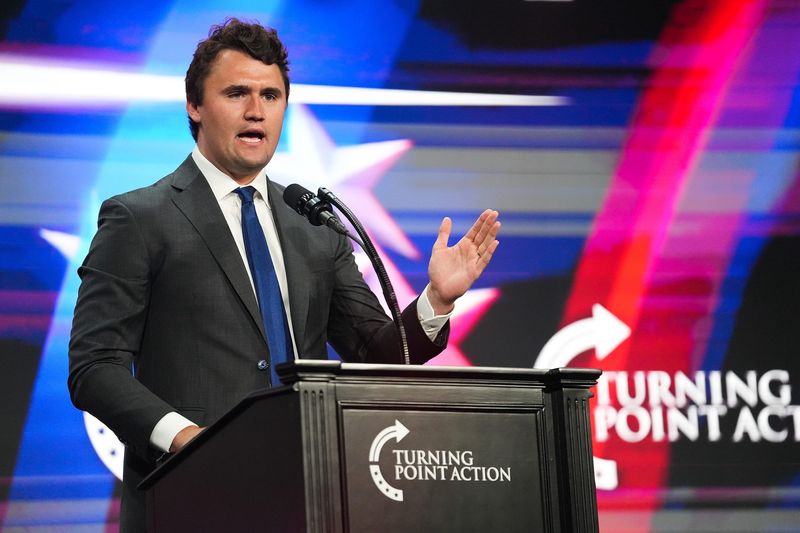
Charlie Kirk, founder of Turning Point USA, speaks in 2022.
‘Massive purge of these evil psychos’
The campaign to punish Kirk’s critics began almost immediately.
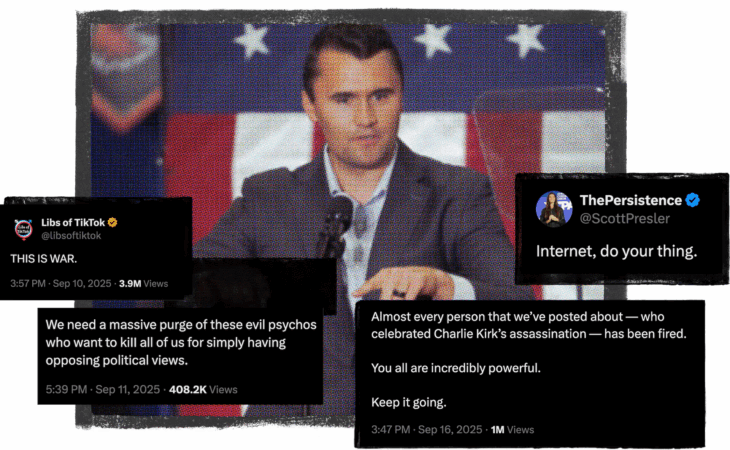
About 30 minutes after Trump’s announcement that Kirk had died, right-wing influencers mobilized. Among the first was Chaya Raichik, operator of the widely followed Libs of TikTok account, which had posted on X, “THIS IS WAR,” before highlighting a Massachusetts teacher who had written: “Just a reminder, We’re NOT offering sympathy.”
By night’s end, Libs of TikTok had published or reposted the professional details of 37 individuals, often accompanied by commentary such as “absolutely vile,” “Your tax dollars pay her salary,” or “Would you want him teaching your kids?”
“It’s actually terrifying how many of them are teachers, doctors and military members,” Libs of TikTok wrote the next day. “We need a massive purge of these evil psychos who want to kiII all of us for simply having opposing political views.”
In the week after the shooting, Libs of TikTok shared the names and profiles of at least 134 people accused of celebrating violence or mocking Kirk’s memory, frequently tagging Trump administration officials including Defense Secretary Pete Hegseth and Attorney General Pam Bondi. At times, the influencer posted disciplinary actions taken against specific government employees.
“BREAKING: This marine was fired,” Libs of TikTok posted on September 12, a day after calling out a Marine Corps captain. The officer had responded to Kirk’s death by posting an emoji of clinking beer mugs, according to a screenshot the influencer shared with followers. Reuters could not verify the authenticity of the beer-mug post; the captain declined to comment. Libs of TikTok also reported similar disciplinary actions involving an Army Reserve officer and an Army colonel who had commented on the death on social media.
The Pentagon and the Justice Department issued statements condemning celebrations of Kirk’s death but did not address questions about their relationship with Libs of TikTok.
Right-wing influencer Scott Presler began posting screenshots of Kirk commentary, too.
“Take a screenshot of EVERY single person celebrating today,” he told his followers on September 10. “You bet your behind we will make them infamous.” Over the next week, Presler shared posts on X about 70 people who had commented on the killing, and wrote in one message: “Almost every person we’ve posted about — who celebrated Charlie Kirk’s assassination — has been fired.” Presler didn’t respond to requests for comment.
For many on the right, outraged by celebratory reactions from the left, the wave of firings became a form of catharsis.
“It’s good that they are shamed and humiliated and must live with the repercussions for the rest of their lives,” right-wing podcaster Matt Walsh told his audience as he discussed the firings. “It’s good if they wake up every day until they die wishing they had not said what they said.” Asked for comment, Walsh emailed back: “f**k off.”
On YouTube, video blogger and recovery coach JD Delay expressed glee as he read aloud names of those who had lost their jobs over their remarks.
“I’m having fun! This is so much fun!” he shouted, raising his hands in excitement. Delay told Reuters that he believes in “accountability and consequences” and that “if you publicly say abhorrent things and get fired from your job, I’m going to laugh at you.”
The punishment campaign sometimes veered off course. In at least five cases, people were wrongly blamed for comments made by others. In another case, a website that drew up a blacklist called “Expose Charlie’s Murderers” vanished after taking in tens of thousands of dollars in cryptocurrency donations. Attempts to identify and seek comment from the site’s creators were unsuccessful.
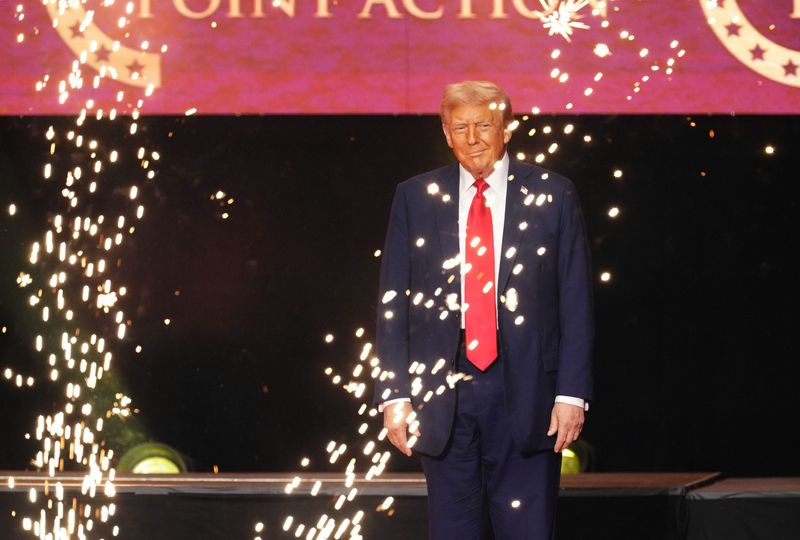
President Donald Trump takes the stage during a memorial service honoring conservative activist Charlie Kirk in Glendale, Arizona, on Sept. 21, 2025.
Several online influencers said they received hundreds — sometimes thousands — of tips from individuals seeking to get Kirk’s detractors fired. Reuters was unable to verify those figures. But at various points, Presler, Libs of TikTok and other right-wing personalities publicly urged tipsters to be patient as they worked through the volume of submissions.
“Can’t keep up with all of you,” Presler wrote on X on September 12. “Post your submissions below & I’ll go through them as I can.”
A day later, the post had drawn more than 2,700 replies.
The tally of more than 600 people punished for criticizing Kirk is likely an undercount. Many companies and government organizations haven’t publicly disclosed terminations or suspensions.
Those punished came from at least 45 states and represented a cross-section of society, from soldiers and pilots to doctors, nurses and police officers.
In Michigan, an Office Depot employee was fired after being filmed refusing to print a poster memorializing Kirk. In Ohio, a Starbucks barista lost her job after she was accused of writing an anti-Kirk message on a cup of mint tea.
Reuters couldn’t determine the identities of the Office Depot worker or the barista. Office Depot and Kroger — the grocery store chain that runs the Ohio Starbucks — condemned the anti-Kirk incidents and said the people involved were no longer employees.
Requests to 21 federal agencies — including Homeland Security, Veterans Affairs and the Defense Department — for the number of suspensions or dismissals tied to the Kirk assassination were either ignored or declined. When the Office of the Director of National Intelligence was contacted, its deputy chief of staff responded on social media, accusing Reuters of trying to generate sympathy “for the ghouls who celebrate his death.”
Educators among the main targets
Teachers, academics and university administrators were among those most frequently punished for criticizing Kirk. More than 350 education workers were fired, suspended or investigated in the days following the assassination, including 50 academics and senior university administrators, three high school principals, two cheerleading coaches and a theology instructor.
The prominence of educators in the backlash may stem from several factors. As leaders tasked with shaping young minds, teachers have long been cast by some conservatives as ideologues who aim to pull their students left. Their status as taxpayer-funded employees made any perceived partisan commentary especially combustible.
In interviews and public statements, at least six teachers cited another reason for speaking out: concern over the frequency of gun violence at schools nationwide — and anger at those, like Kirk, who have championed widespread access to firearms.
Vaughn, the South Carolina kindergarten assistant, said that was front of mind when she went to Facebook to quote Kirk’s 2023 remark dismissing some fatal shootings as the price to pay to protect gun rights. Like other teachers across the country, she said she regularly practiced active-shooter drills at her elementary school and saw fear on her five-year-olds’ faces as they learned how to hide from a gunman.
As she defended her post on the day of Kirk’s death, she told a Facebook friend that she felt “no satisfaction” at the assassination. “Just heartbreak for everyone and anyone affected by gun violence and the hope that one day, enough will be enough.” Speaking to Reuters later, she said, “The one thing I want people to know is that my message was out of concern for the kids.”
Many educators did celebrate Kirk’s death, including a Virginia teacher who wrote, “I hope he suffered through all of it,” and a Texas middle school intern who said the shooting “made me giggle.” Screenshots of both posts were circulated by right-wing influencers. Reuters could not locate the original posts, which may have been deleted or made private. The Virginia teacher was suspended and the Texas intern was fired. Neither could be reached for comment.
While schools that suspended or fired educators cited disruptions to the learning environment, some private employers pointed to a violation of company values or safety concerns as the basis for terminations. Corporations caught up in the backlash gave a variety of explanations: Delta Air Lines CEO Ed Bastian said in a statement some employees’ comments were in “stark contrast” to the company’s values and violated its social media policy, while a United Airlines statement said the company had “zero tolerance for politically motivated violence or any attempt to justify it.”
At least a dozen Kirk critics who took pains to condemn the shooting also found themselves out of jobs or suspended, sometimes after Republican lawmakers got involved.
In the wake of Kirk’s death, Joshua Bregy, a climate scientist at Clemson University in South Carolina, shared another user’s Facebook post that read, in part: “No one should be gunned down — not a school child, not an influencer, not a politician — no one. But am I going to allow people to make a martyr out of a flawed human being whose rhetoric caused notable damage? Not a chance.”
The Clemson College Republicans reposted part of his message, labeling him “ANOTHER leftist professor” and calling for his termination. The post was amplified by right-wing influencers and Republican state lawmakers who threatened to defund the public university unless Bregy was fired.
Clemson initially pledged in a September 12 statement to “stand firmly on the principles of the U.S. Constitution, including the protection of free speech.”
The next day, Trump himself reposted a state lawmaker’s call to “Defund Clemson.” On September 16, after South Carolina’s House speaker and Senate president sent a letter to Clemson’s trustees demanding they “take immediate and appropriate action,” the school fired Bregy. Bregy’s Facebook post was “blatantly unprofessional” and “seriously prejudicial to the university,” Clemson said in a letter informing Bregy he had been dismissed.
Bregy is suing Clemson in a South Carolina federal court in a bid to be reinstated. His lawyer, Allen Chaney, said the academic would have kept his job “but for the really aggressive, coercive tactics of elected officials in South Carolina.”
Clemson, State House Speaker Murrell Smith and Senate President Thomas Alexander did not respond to requests for comment. Clemson has yet to file a response to Bregy’s suit.
In at least six other cases, Republican officials publicly threatened to deprive universities and schools of taxpayer funds unless specific critics of Kirk were fired.
Chaney, who serves as legal director of the South Carolina chapter of the American Civil Liberties Union, said the threats to defund Clemson and others crossed a constitutional line. “The government can’t police speech by pressuring third parties,” he said. Last year, the Supreme Court unanimously held that government officials cannot use their authority to “attempt to coerce” private parties into punishing or suppressing speech they dislike.
The threats to defund schools that resist firing Kirk’s critics were “stunning,” said Paul McGreal, a constitutional law professor at Creighton University Law School in Nebraska. “Government officials are threatening speakers with punishment because they disagree with what they’re saying. These are core First Amendment protections that they’re violating.”
Kirk praised as Christ’s ‘13th disciple’
Since Kirk’s assassination, many Republicans have cast him as a saintly champion of free expression. Evangelical figures have likened him to Saint Stephen, revered as Christianity’s first martyr. One Republican lawmaker told Congress “he’d have been the 13th disciple” had he lived in Biblical times. Trump compared Kirk to the ancient Greek philosopher Socrates, slain President Abraham Lincoln and assassinated civil rights icon Martin Luther King Jr. when posthumously awarding him the Presidential Medal of Freedom.
Kirk’s legacy is complicated, however. He gained fame for debating college students as part of his work with Turning Point. Kirk also advocated criminalizing expression – such as pornography – that clashed with his Christian views. When Black football players started kneeling during the national anthem in protest at police brutality, he backed Trump’s call to strip the National Football League of taxpayer subsidies. The White House later said Trump was making a statement, not a proposal.
Kirk repeatedly denigrated minorities, calling transgender people an “abomination,” warning of “prowling Blacks” in cities, accusing wealthy Jews of stoking “hatred against Whites,” and declaring Islam incompatible with Western civilization. He also dismissed Pope Francis as a Marxist.
Some of those who spoke out against Kirk after his death said they were disturbed by the hagiography.
“I just felt compelled to remind people who he was and what he stood for,” Kimberly Hunt, a human resources worker in Arizona, said in an interview. She had posted a video captioned, “Save your tears for his victims, not him.”
In the video, Hunt cited Kirk’s record of using derogatory language about transgender people and Muslims, before adding that his children “are better off without him.” Hunt was fired soon after. Her employer, an Arizona construction firm, did not respond to requests for comment.
Hunt told Reuters she understood her words sounded harsh but stood by them. She said they reflected Kirk’s stance in a debate last year that if he had a 10-year-old daughter who was impregnated through rape, “the baby would be delivered.”
The retaliation has silenced many voices. Scores of people who posted anti-Kirk comments have since scrubbed or locked their accounts, Reuters found. Others said in interviews that they are pushing back.
Hunt said she has raised more than $88,000 from a GoFundMe campaign titled, “Doxxed, Fired, but Not Silenced.” She said she wants to use the money to further her education, become a content creator, and keep calling out people like Kirk.
“It’s definitely just emboldened me,” she said.
At least 19 lawsuits have been filed against employers who punished Kirk critics, state and federal court records show. At least two plaintiffs have succeeded, including an academic in South Dakota who got his teaching job back.
Karen Leader, an associate professor at Florida Atlantic University, took to social media after Kirk’s death to protest a narrative that he “was a shining inspiration to youth and a noncontroversial figure who just wanted to have open and civil dialog,” she said. “Anyone who’s in higher education knows that it’s not that simple.”
She noted that Turning Point rose to prominence through its Professor Watchlist, a site that encouraged students to report faculty for allegedly holding “radical left” views or being a “terror supporter.”
Kirk had described the Watchlist as an awareness tool, not a blacklist. Those on it have said in interviews, social media posts and public forums that it fostered harassment and intimidation. In 2023, a Turning Point reporter was accused of assaulting an Arizona professor who was on the watchlist after confronting him on camera about his sexuality and shoving him to the ground. The reporter admitted to harassment, assault and disorderly conduct and was ordered to complete a diversion program. A Turning Point cameraman admitted to harassment in the case.
On September 10, Leader began posting Kirk’s past statements on X. She said she made a mistake by incorrectly accusing Kirk of having uttered an ethnic slur and then deleted it. The rest of her posts she said she stands behind, including one highlighting Kirk’s claim that Black Americans were “better” during Jim Crow.
“None of it was me encouraging violence,” Leader said. “I was sharing evidence.”
Jordan Chamberlain, a former staffer of Florida Governor Ron DeSantis, shared screenshots of several of Leader’s posts and tagged her university, asking if it approved of the content. Libs of TikTok shared Leader’s faculty headshot. The university’s president announced she had been put on administrative leave. Her address and phone number appeared online, and menacing messages followed.
In one voicemail reviewed by Reuters, the caller said: “We’re coming to get you. Karen Leader, we know where you work. We’re gonna come to your home as soon as we have your location.” Leader said she has rarely left her apartment since.
She reported the threats to Boca Raton police, which referred the case to campus officers, according to a police report. Florida Atlantic University police said their report could not be released because of an active criminal investigation.
Florida Atlantic University confirmed Leader was one of three academics who were on leave pending investigations. It declined further comment. Chamberlain also didn’t return an email seeking comment.
“Whether my career is over or not, I don’t know,” Leader said. “But my life has changed.”
When Susan Akin first started injecting a coveted weight-loss drug early this year, the chaos in her brain quieted. The relentless cravings subsided — only they’d never been for food.
The medication instead dulled her urges for the cocaine and alcohol that caused her to plow her car into a tree, spiral into psychosis, and wind up admitted to a high-end addiction treatment center in Delray Beach, Fla.
Doctors at Caron Treatment Centers tried a novel approach for the slender 41-year-old by prescribing her Zepbound, part of a blockbuster class of obesity and diabetes medications known as GLP-1s. Federal regulators have not approved the drugs for behavioral health, but doctors are already prescribing them off-label, encouraged by studies suggesting that they could reshape addiction treatment.
Scientists caution that the research remains nascent. Health insurers do not cover the pricey drugs for that purpose. Addiction specialists say the medications might not be a cure but may work as a tool to quell addictive behaviors.
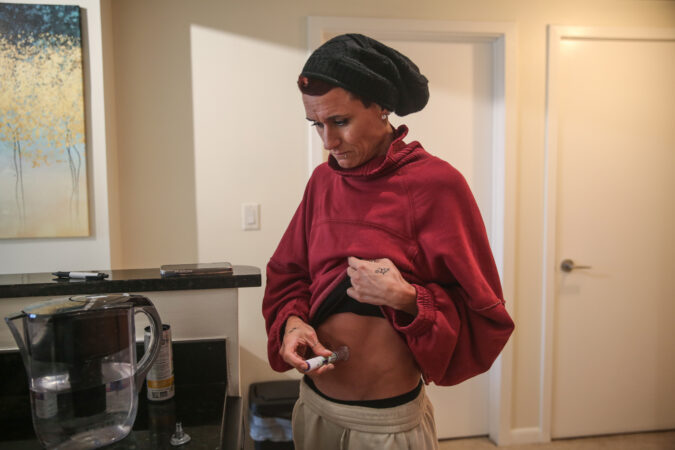
For Akin, the weekly shot helps her endure a world full of triggers. She can visit a gas station without wanting to buy beer or see sugar without dialing a cocaine dealer. The cravings linger but are muted, she said.
“I know when I’m due for my shot because I get a little antsy or irritable, or just kind of off,” Akin said. “But it has changed my life.”
Emerging science
As GLP-1 drugs for weight loss generate billions for pharmaceutical companies, researchers are exploring their potential for other purposes. Clinical trials have already shown that semaglutide, the active ingredient in Ozempic and Wegovy, can reduce the risk of heart attacks and treat liver disease.
These drugs appear to reduce cravings for food because they mimic a natural hormone that boosts insulin production, curbs appetite, and slows stomach emptying to create a feeling of fullness. Tirzepatide, the active ingredient in Zepbound, imitates a related hormone that enhances insulin release and amplifies appetite suppression.
The mechanism of how GLP-1s could also curb alcohol and drug cravings is not entirely understood. The medication may block release of dopamine, the chemical associated with reinforcing pleasurable activities, said Kyle Simmons, a professor of pharmacology and physiology at Oklahoma State University. The medications appear to be “turning down the gain on the reward circuitry in the brain,” Simmons said, possibly explaining why they have a broad effect on behavior.
The potential has ushered in a wave of research that includes whether the drugs help veterans with moderate to severe drinking problems, diabetic patients who smoke, and people addicted to opioids, among others.
Federally backed studies of patient records released since early 2024 have shown GLP-1 use in some patients who are diabetic or obese is associated with lower risks of alcohol abuse, cannabis use disorder, and opioid overdoses.
Associations alone do not prove that the weight-loss drugs are causing those changes, but small early clinical trials have shown promise. In one study published in February in JAMA Psychiatry, researchers found that problem drinkers who received a weekly semaglutide injection drank less and had fewer cravings for alcohol and cigarettes compared with those given a placebo.
Researchers at the National Institute on Drug Abuse and Simmons are running separate but similar double-blind clinical trials to measure whether the drugs curb alcohol cravings in patients with drinking problems. Researchers are charting brain activity to see how participants respond when exposed to alcohol cues and using virtual-reality headsets to measure how they respond to images of food. In the NIDA study, scientists have built a mock bar to observe how patients react to being near alcohol.
A spokeswoman for Eli Lilly, which manufactures Zepbound, said the company is considering clinical trials to assess the drug as a treatment for substance use disorders, including for alcohol and tobacco. Novo Nordisk, the maker of Wegovy and Ozempic, declined to say whether it would study the drugs’ effectiveness for addiction.
Medical treatments lacking
The use of GLP-1s for unapproved purposes is surging, including micro-dosing to promote longevity and wellness, despite little evidence supporting these lower doses. Researchers also caution that long-term use of the drugs — which can cause unpleasant stomach side effects — remain understudied.
Still, if GLP-1s prove effective at curbing cravings of different substances — and include behavioral addictions such as gambling and shopping — it “really opens up a whole new sort of therapeutic avenue that’s not been available before,” said Joji Suzuki, an addiction researcher at Brigham and Women’s Hospital in Boston.
An estimated 48 million Americans had a substance use disorder last year, according to federal researchers. More than 80,000 died of drug overdoses last year while more than 47,000 died from alcohol complications, according to federal estimates.
There are no approved medications to reduce cravings for other substances including cannabis, cocaine, or methamphetamine. For opioid addiction, medications such as buprenorphine or methadone are considered effective at staving off withdrawal and cravings, but carry stigma.
While the FDA has approved three drugs to reduce alcohol consumption, only 2 to 4% with alcohol-use disorder get any medication treatment, said Lisa Clemans-Cope, a researcher at the Urban Institute, a nonpartisan economic and social policy research group.
An affordability problem
Early research and anecdotal evidence proved enough for Steven Klein, a physician who specializes in addiction at Caron, to begin prescribing GLP-1s to his patients.
For Klein, the project is more than a professional curiosity: He is a recovering alcoholic who has long struggled with his weight. Three years ago, while in recovery and working as a pediatrician, Klein was prescribed the anti-diabetes drug Mounjaro for weight loss. He found the drug calmed his mind. “The voice that was talking to me about food was very similar to the voice that used to talk to me on drugs and alcohol,” Klein said.
Moved by his experience, Klein switched to addiction care and joined Caron, a high-end rehab center with facilities near Reading and in Atlanta, Washington, and Delray Beach.
He spearheads a pilot program that has prescribed GLP-1s to more than 130 patients in Pennsylvania and South Florida, most diagnosed with alcohol-use disorder and some who took stimulants.
Klein has also partnered with Open Doors, a nonprofit in Rhode Island that helps formerly incarcerated women reenter society, to begin offering GLP-1s through its recovery program.
“We see how hard it is for people to maintain their recovery long-term after they leave the support of our housing,” Open Doors Co-Executive Director Nick Horton said. “But with this medicine, I’m hopeful.”
Regina Roberts, a 41-year-old alcoholic in recovery, is living at an Open Doors facility after stints in rehab and a family court program after she lost custody of her teenage son. She has been sober since 2023 with the help of 12-step programs, therapy, and life-skills classes. But she faced frequent reminders of her past: walking past a liquor store, smelling alcohol on someone’s breath, cigarette smoke wafting in the air. When Open Doors told her about the promise of GLP-1s several months ago, she agreed.
“I figured, why not try it?” Roberts said. “I’ll take anything to help me stay on my road to sobriety.”
With her cravings dialed back, Roberts hopes to reunite with her teenage son and move out of Open Doors in a few months. But she’s unsure whether she can keep taking the medication; she can’t afford to pay out of pocket and Medicaid might not cover it.
At Caron’s Wernersville location, staff reduce costs by receiving semaglutides from compounding pharmacies, which can legally produce cheaper versions of name-brand mediations.
In the Delray Beach facility, most patients receive Zepbound through their insurance by “piggybacking” under FDA-approved uses, or by paying out of pocket with manufacturer discounts, said medical director Mohammad Sarhan. Those costs add to the price of rehab programs that can cost up to $100,000.
Akin, the Caron patient who is approaching one year sober, said she relies on her inheritance to pay nearly $1,000 every month for prefilled Zepbound shots. Akin could receive a modest discount in the coming months now that Eli Lilly, along with Novo Nordisk, announced they could lower direct-to-consumer prices as part of a deal struck with the Trump administration.
She considers Zepbound an essential drug like insulin.
“It’s not a cure. We have to do the work,” Akin said. “But it helps. It slows things down enough to the point where you don’t feel like you have to jump off a bridge or put your head in a cocaine plant to survive.”
They’re cute, even cuddly, and promise learning and companionship — but artificial-intelligence toys are not safe for kids, according to children’s and consumer advocacy groups urging parents not to buy them during the holiday season.
These toys, marketed to kids as young as 2 years old, are generally powered by AI models that have already been shown to harm children and teenagers, such as OpenAI’s ChatGPT, according to an advisory published Thursday by the children’s advocacy group Fairplay and signed by more than 150 organizations and individual experts such as child psychiatrists and educators.
“The serious harms that AI chatbots have inflicted on children are well-documented, including fostering obsessive use, having explicit sexual conversations, and encouraging unsafe behaviors, violence against others, and self-harm,” Fairplay said.
AI toys, made by companies including Curio Interactive and Keyi Technologies, are often marketed as educational, but Fairplay says they can displace important creative and learning activities. They promise friendship but disrupt children’s relationships and resilience, the group said.
“What’s different about young children is that their brains are being wired for the first time, and developmentally it is natural for them to be trustful, for them to seek relationships with kind and friendly characters,” said Rachel Franz, director of Fairplay’s Young Children Thrive Offline Program. Because of this, she added, the amount of trust young children are putting in these toys can exacerbate the harms seen with older children.
Fairplay, a 25-year-old organization formerly known as the Campaign for a Commercial-Free Childhood, has been warning about AI toys for years. They just weren’t as advanced as they are today. A decade ago, during an emerging fad of internet-connected toys and AI speech recognition, the group helped lead a backlash against Mattel’s talking Hello Barbie doll that it said was recording and analyzing children’s conversations.
This time, though AI toys are mostly sold online and are more popular in Asia than elsewhere, Franz said some have started to appear on store shelves in the U.S. and more could be on the way.
“Everything has been released with no regulation and no research, so it gives us extra pause when all of a sudden we see more and more manufacturers, including Mattel, who recently partnered with OpenAI, potentially putting out these products,” Franz said.
It’s the second big seasonal warning against AI toys since consumer advocates at U.S. PIRG last week called out the trend in its annual Trouble in Toyland report that typically looks at a range of product hazards, such as high-powered magnets and button-sized batteries that young children can swallow. This year, the organization tested four toys that use AI chatbots.
“We found some of these toys will talk in-depth about sexually explicit topics, will offer advice on where a child can find matches or knives, act dismayed when you say you have to leave, and have limited or no parental controls,” the report said. One of the toys, a teddy bear made by Singapore-based FoloToy, was later withdrawn, its CEO told CNN this week.
Dana Suskind, a pediatric surgeon and social scientist who studies early brain development, said young children don’t have the conceptual tools to understand what an AI companion is. While kids have always bonded with toys through imaginative play, when they do this they use their imagination to create both sides of a pretend conversation, “practicing creativity, language, and problem-solving,” she said.
“An AI toy collapses that work. It answers instantly, smoothly, and often better than a human would. We don’t yet know the developmental consequences of outsourcing that imaginative labor to an artificial agent — but it’s very plausible that it undercuts the kind of creativity and executive function that traditional pretend play builds,” Suskind said.
Beijing-based Keyi, maker of an AI “petbot” called Loona, didn’t return requests for comment this week, but other AI toymakers sought to highlight their child safety protections.
California-based Curio Interactive makes stuffed toys, like Gabbo and rocket-shaped Grok, that have been promoted by the pop singer Grimes. The company said it has “meticulously designed” guardrails to protect children, and the company encourages parents to “monitor conversations, track insights, and choose the controls that work best for their family.”
In response to the earlier PIRG findings, Curio said it is “actively working with our team to address any concerns, while continuously overseeing content and interactions to ensure a safe and enjoyable experience for children.”
Another company, Miko, based in Mumbai, India, said it uses its own conversational AI model rather than relying on general large language model systems such as ChatGPT in order to make its product — an interactive AI robot — safe for children.
“We are always expanding our internal testing, strengthening our filters, and introducing new capabilities that detect and block sensitive or unexpected topics,” said CEO Sneh Vaswani. “These new features complement our existing controls that allow parents and caregivers to identify specific topics they’d like to restrict from conversation. We will continue to invest in setting the highest standards for safe, secure and responsible AI integration for Miko products.”
Miko’s products are sold by major retailers such as Walmart and Costco and have been promoted by the families of social media “kidfluencers” whose YouTube videos have millions of views. On its website, it markets its robots as “Artificial Intelligence. Genuine friendship.”
Ritvik Sharma, the company’s senior vice president of growth, said Miko actually “encourages kids to interact more with their friends, to interact more with the peers, with the family members etc. It’s not made for them to feel attached to the device only.”
Still, Suskind and children’s advocates say analog toys are a better bet for the holidays.
“Kids need lots of real human interaction. Play should support that, not take its place. The biggest thing to consider isn’t only what the toy does; it’s what it replaces. A simple block set or a teddy bear that doesn’t talk back forces a child to invent stories, experiment, and work through problems. AI toys often do that thinking for them,” she said. “Here’s the brutal irony: When parents ask me how to prepare their child for an AI world, unlimited AI access is actually the worst preparation possible.”
Pitcher and outfielder Kelsie Whitmore is returning to familiar surroundings after being selected by San Francisco with the first pick in the inaugural Women’s Pro Baseball League draft on Thursday night.
Mo’ne Davis, meantime, had to wait until the 10th pick before being selected by Los Angeles. The 24-year-old Davis, who’s from Philadelphia, competed at the 2014 Little League World Series at age 13 and became the first girl to win a game and pitch a shutout.
Whitmore is from San Diego and made her professional debut in the Bay Area with a coed team, the Sonoma Stompers, in 2016. The 27-year-old has won two silver medals representing the United States at the Women’s Baseball World Cup and won gold at the 2015 Pan-Am Games in Toronto.
“You ask a 6-year-old version of me about this opportunity happening right now, she would, one, probably not believe you, but, two, just be so, so, so, so excited for it,” said Whitmore, who in 2022 signed with the Staten Island FerryHawks, becoming the first woman to compete in pro baseball’s Atlantic League. She played for the Savannah Bananas this season.
Whitmore was among 120 players selected in the six-round draft that also included teams representing New York and Boston.
Major League Baseball commissioner Rob Manfred opened the draft by congratulating the WPBL for its launch. The league is scheduled to begin play on Aug. 1.
Each team made five picks per round, with the order of selection determined by a random draw. Teams will cut their 30-player rosters to 15 for the start of the season.
Mo’ne Davis slides to third base during the first day of tryouts for the Women’s Professional Baseball League on Aug. 25.
Japan’s Ayami Sato went No. 2 to Los Angeles. The 35-year-old right-hander is a five-time World Cup winner and the only player to earn three tournament MVP honors.
New York selected U.S. infielder Kylee Lahners with the third pick. Boston chose South Korean catcher Hyeonah Kim at No. 4.
The startup league had a four-day tryout camp in Washington this summer with more than 600 hopefuls on hand.
The league is scheduled to play all of its games at Robin Roberts Stadium in Springville, Illinois. Teams will be based there over a seven-week season, split up into a four-week regular season, a week for all-star activities and a two-week playoff.
The WPBL was co-founded by Justine Siegal, who became the first woman to coach for an MLB team with the Oakland Athletics in 2015. It will be the first pro baseball league for women since the All-American Girls Professional Baseball League — immortalized in the film “A League of Their Own” — dissolved in 1954.
MILWAUKEE — Tyrese Maxey scored a career-high 54 points and tied the game by hitting two free throws with seven seconds left in the fourth quarter of the 76ers’ 123-114 overtime victory over the Milwaukee Bucks on Thursday night.
Maxey’s previous career high was a 52-point performance in a 133-126, double-overtime victory over San Antonio on April 7, 2024. He also had nine assists and played over 46½ minutes.
Maxey, who entered Thursday averaging a league-high 40.3 minutes, had played 39 minutes one night earlier in a 121-112 home loss to the Toronto Raptors.
Milwaukee’s Ryan Rollins scored 32 points to match a career high and also had a career-best 14 assists. The Bucks have lost four of their last five games.
Neither team had its former league MVP available.
Milwaukee’s Giannis Antetokounmpo, the MVP in 2019 and 2020, got hurt Monday at Cleveland and is expected to miss about two weeks. The Bucks labeled it a left groin strain Monday but have since specified that it’s a left adductor strain.
Philadelphia’s Joel Embiid, who won the award in 2023, missed a sixth straight game due to an issue with his right knee.
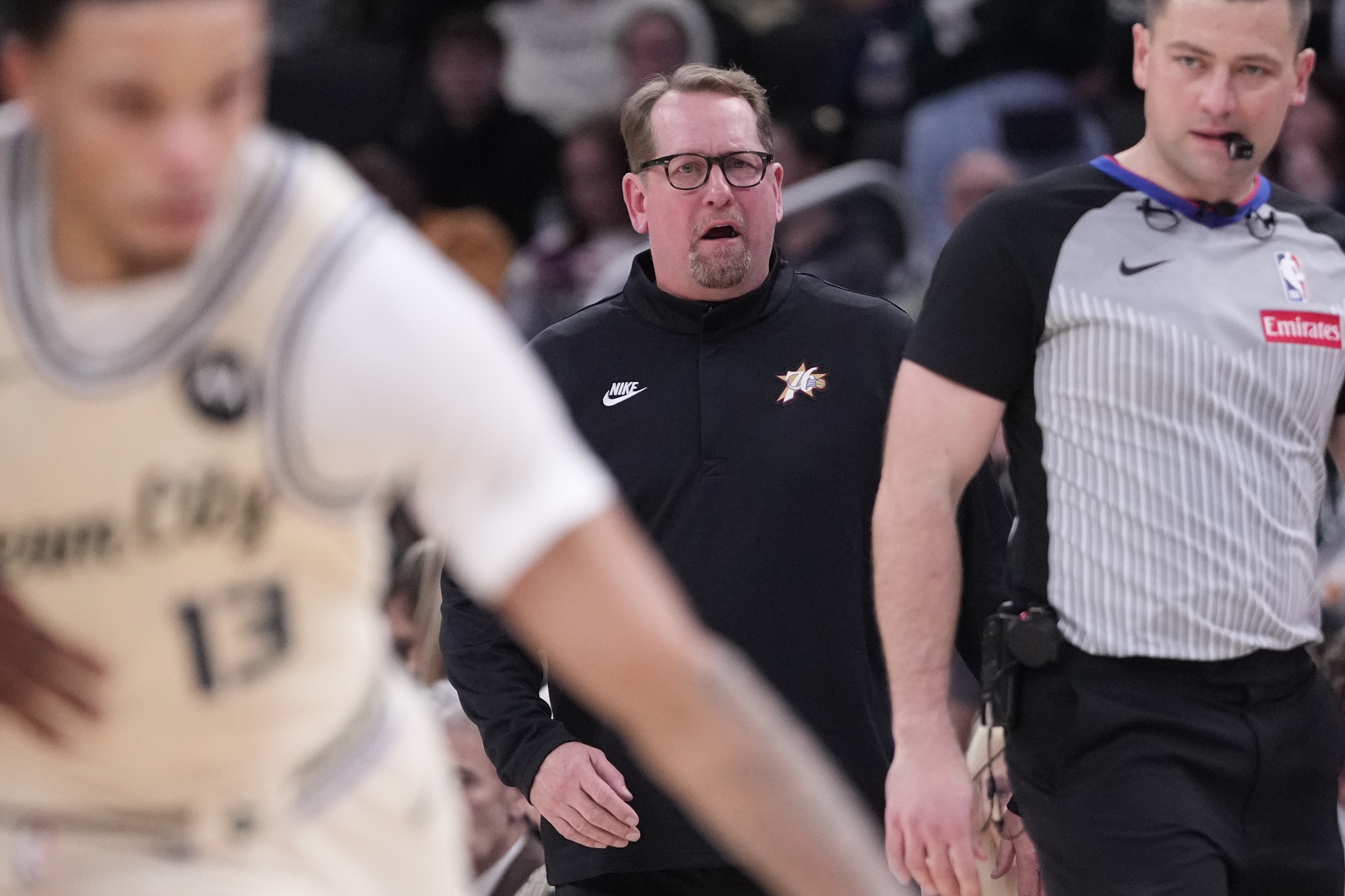
Sixers head coach Nick Nurse watches his team during the first half of their win against the Bucks.
The Sixers (9-6) scored the first five points in overtime on a three-pointer from Justin Edwards — who scored just two points in regulation — and a basket from Maxey.
Milwaukee (8-8) got the margin down to 113-112 on a driving layup from Rollins with 1 minute, 43 seconds remaining, but Quentin Grimes hit a three-pointer 20 seconds later and Philadelphia stayed ahead by at least two the rest of the way.
Milwaukee trailed 94-87 midway through the fourth quarter but rallied to take the lead on Myles Turner’s three-pointer with 14.8 seconds remaining.
The Sixers tied the game with seven seconds left when Maxey drove into the lane, drew a foul, and hit his free throws. Rollins missed a three-pointer at the buzzer.
Paul George added 21 points for Philadelphia. Bobby Portis had 19 and Kyle Kuzma 17 for Milwaukee.
The Sixers return home Sunday to host the Miami Heat (1 p.m., NBCSP) at Xfinity Mobile Arena.
WASHINGTON — U.S. employers added a surprisingly solid 119,000 jobs in September, the government said, issuing a key economic report that had been delayed for seven weeks by the federal government shutdown.
The increase in payrolls was more than double the 50,000 economists had forecast.
Yet there were some troubling details in the delayed report.
Labor Department revisions showed that the economy lost 4,000 jobs in August instead of gaining 22,000 as originally reported. Altogether, revisions shaved 33,000 jobs off July and August payrolls. The economy had also shed jobs in June, the first time since the 2020 pandemic that the monthly jobs report has gone negative twice in one year.
And more than 87% of the September job gains were concentrated in two industries: healthcare and social assistance and leisure and hospitality.
“We’ve got these strong headline numbers, but when you look underneath that you’ll see that a lot of that is driven by healthcare,’’ said Cory Stahle, senior economist at the Indeed Hiring Lab. ”At the end of the day, the question is: Can you support an economic expansion on the back of one industry? Anybody would have a hard time arguing everybody should become a nurse.”
The unemployment rate rose to 4.4% in September, highest since October 2021 and up from 4.3% in August, the Labor Department said Thursday. The jobless rate rose partly because 470,000 people entered the labor market — either working or looking for work — in September and not all of them found jobs right away.
The data, though late, was welcomed by businesses, investors, policymakers and the Federal Reserve. During the 43-day shutdown, they’d been groping in the dark for clues about the health of the American job market because federal workers had been furloughed and couldn’t collect the data.
The report comes at a time of considerable uncertainty about the economy. The job market has been strained by the lingering effects of high interest rates and uncertainty around Trump’s erratic campaign to slap taxes on imports from almost every country on earth. But economic growth at midyear was resilient.
Healthcare and social assistance firms added more than 57,000 jobs in September, restaurants and bars 37,000, construction companies 19,000 and retailers almost 14,000. But factories shed 6,000 jobs — the fifth straight monthly drop. The federal government, targeted by Trump and billionaire Elon Musk’s DOGE cost cutters, lost 3,000 jobs, the eighth straight monthly decline..
Average hourly wages rose just 0.2% from August and 3.8% from a year earlier, edging closer to the 3.5% year-over-year increase that the Federal Reserve’s inflation fighters like to see.
The latest reading on jobs Thursday makes a rate cut by the Fed officials at their next meeting in December less likely. Many were already leaning against a cut next month, according to minutes of their October meeting released Wednesday. Steady hiring suggests the economy doesn’t need lower interest rates to expand.
The September jobs report will be the last one the Fed will see before its Dec. 9-10 meeting. Officials are split between those who see stubbornly high inflation as the main challenge they need to address by keeping rates elevated, and those who are more concerned that hiring is sluggish and needs to be supported by rate reductions.
Hiring has been strained this year by the lingering effects of high interest rates engineered to fight a 2021-2022 spike in inflation and uncertainty around Trump’s campaign to slap taxes on imports from almost every country on earth and on specific products — from copper to foreign films.
Labor Department revisions in September showed that the economy created 911,000 fewer jobs than originally reported in the year that ended in March. That meant that employers added an average of just 71,000 new jobs a month over that period, not the 147,000 first reported. Since March, job creation has fallen farther — to an average 59,000 a month.
With September numbers out, businesses, investors, policymakers and the Fed will have to wait awhile to get another good look at the numbers behind the American labor market.
The Labor Department said Wednesday that it won’t release a full jobs report for October because it couldn’t calculate the unemployment rate during the government shutdown.
Instead, it will release some of the October jobs data — including the number of jobs that employers created last month — along with the full November jobs report on Dec. 16, a couple of weeks late.
The 2025 job market has been marked by an awkward pairing: relatively weak hiring but few layoffs, meaning that Americans who have work mostly enjoy job security – but those who don’t often struggle to find employment.
Megan Fridenmaker, 28, lost her job last month as a writer for a podcast network in Indianapolis. She’s applied for at least 200 jobs and landed just one interview. “I am far from the only unemployed person in my friend group,’’ she said. “Where the job market’s at right now – people will apply for hundreds and hundreds (of jobs) before getting one interview.’’
“Out of everything I’ve applied for, I get a response from maybe a quarter of them,’’ she said. “And the vast majority of the responses are the automated – ‘Thank you so much, but we’ve gone with another candidate.’ ‘Thank you so much, but we’ve already filled the position.’
“The whole job-hunting experience has felt so cold and so distant and so removed from who we are as humans.”