Category: Washington Post

  • Trump team puts a target on Cuba, with threats and oil blockade

    Trump team puts a target on Cuba, with threats and oil blockade

    No place was hit harder than Cuba by the shock waves that Saturday morning’s U.S. military seizure of Venezuela’s Nicolás Maduro sent throughout Latin America and the world.

    Within hours of the operation — long before the government in Havana acknowledged it — phone calls and texts across the island spread the news that dozens of elite Cuban security forces had been killed guarding Maduro.

    But by the time it finally released a statement late Sunday saying that 32 of its military and security personnel were dead in Caracas, the Cuban government had bigger problems on its hands.

    Both President Donald Trump and Secretary of State Marco Rubio made clear over the weekend that the collapse of Cuba’s communist government was not only a likely side benefit of Maduro’s ouster but a goal.

    “I don’t think we need [to take] any action,” Trump said as he flew back to Washington from his extended Florida holiday break. Without Maduro and the oil supplies Venezuela provided, he said, “Cuba looks like it’s ready to fall.”

    Rubio went further, indicating that the United States might be willing to give it a push. “I’m not going to talk to you about what our future steps are going to be,” he told NBC’s Meet the Press on Sunday. But, he added, “If I lived in Havana and I was in the government, I’d be concerned.”

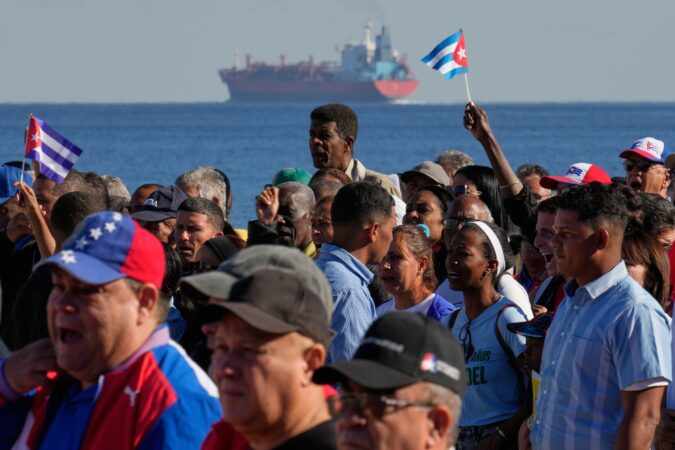
    Their words resonated with many in the Miami-centered exile community, where the struggle to free Cuba from communist rule has dominated politics for decades. On Saturday, South Florida Cuban exiles — some wearing red Trump hats and Cuban flags as capes — joined hundreds of revelers at spirited, impromptu celebrations from Little Havana to Doral, a city nicknamed “Doralezuela” because of its large population of Venezuelans. Cuban American leaders, most of them Republican, issued statements as Venezuela coverage dominated local TV stations.

    Cuba is the “root” of problems with Venezuela, Nicaragua, and other leftist regimes in the region, said Dariel Fernandez, Miami-Dade County’s elected tax collector. “Now the time has come … for the Castro communist and socialist assassin regime to be held accountable as well, and for the Cuban people to finally be free.”

    Absent direct U.S. intervention, however, Cuba experts here and on the island were less certain.

    “If you’re asking if the Cuban government will just collapse on its own because the economic pain is bound to increase” without shipments of Venezuelan oil, “I’m very skeptical,” said Michael J. Bustamante, associate professor of history and director of the Cuban studies program at the University of Miami.

    To keep the lights on and cars running, Cuba has long been dependent on Venezuelan oil supplies, for which it has exchanged security and medical personnel in a sympathetic contract with leftist allies in Caracas.

    “I could very well be proven wrong, but Cuba has been here before” and survived, Bustamente said, referencing what is known in Cuba as the “special period” that began in 1991 with the abrupt cutoff of outside assistance after the demise of the Soviet Union.

    Juan Gonzalez, who served as Western Hemisphere director on the Biden administration’s national security staff, said that “cutting off the oil deliveries is going to put a huge squeeze on the humanitarian situation” in Cuba, which is already suffering regular electricity blackouts and food scarcities. “But I don’t think the regime is going to cry uncle.”

    Aside from an economic uptick during the Obama administration, when the resumption of diplomatic relations between Washington and Havana led to increased tourism and slender openings for private ownership and outside investment, the Cuban economy has never really recovered from the Soviet fall.

    The nation has been on a steady slide into economic chaos for years, owing to U.S. sanctions and what even many of its supporters see as mismanagement by a sclerotic Cuban Communist Party.

    Some chose to see opportunity in the darkness following Maduro’s ouster. Carlos Alzugaray, a retired career Cuban diplomat reached by phone at his Havana home, said, “There is of course an increase of the threat, a very bad thing.”

    But it was possible, he said, that Cuba’s allies in Russia and elsewhere would help, “and just maybe the government will … open up the economy and do what the economists have been telling them for a long time and they have refused to do.”

    Venezuelan support under Maduro’s predecessor, Hugo Chávez, in the early 2000s helped Cuba emerge from the special period and the weight of decades-long U.S. sanctions. Since then, Havana has weathered the death of revolutionary leader Fidel Castro, COVID, Trump’s dismantling during his first administration of the limited Obama opening and furious street protests in 2021.

    But the emboldened second Trump administration presents an entirely new threat to Cuba’s leaders.

    At various points over the years, Cuba’s own government economists have advised overhauling the economy and have been urged to do so by allies in China, Vietnam, and Russia.

    Raúl Castro, who took over from his ailing brother, Fidel, in 2006, warned of needed reforms in a lengthy 2010 speech to the Cuban parliament. “We are playing with the life of the revolution,” he said. “We can either rectify the situation, or we will run out of time walking on the edge of the abyss, and we will sink.”

    But his plans to expand the role of the private sector and reduce state ownership were seen as contradictory and insufficiently implemented, ultimately resolving few of Cuba’s systemic problems. Other pushes for change have run into similar roadblocks over the ruling party’s refusal to allow private businesses and farms to sell their goods directly for market prices, its rejection of currency reforms, heavy government investments in a failing tourism industry and the growing power of GAESA, the military-controlled conglomerate that runs vast swaths of the economy.

    At their peak of about 100,000 barrels a day, Venezuelan oil shipments allowed Cuba to serve its own energy needs and sell refined petroleum products overseas for desperately needed cash. But as Venezuela dealt with sharp drops in output, due to U.S. sanctions and mismanagement, shipments dropped to about 30,000 barrels last year.

    Those cuts, along with Cuba’s aging refineries, failing infrastructure and the occasional hurricane, led to at least five islandwide blackouts last year.

    “They have to realize they can’t depend on foreign help anymore,” Alzugaray said. Russia and Mexico have supplied some oil, although Mexican President Claudia Sheinbaum is likely to come under increasing U.S. pressure to cut off aid to Havana. China, which holds major Cuban debt, has shown little interest in helping.

    Reforms have been approved “on paper,” Alzugaray said. “The problem is they don’t do it. The essence is opening to market economics, allowing expansion of the private sector, and eliminating or selling socialist state enterprises that don’t produce. They have to do it, and they have to do it fast. They have lost too much time.”

    Few Cuba watchers have much confidence that reforms will happen, at least under the party government of President Manuel Díaz-Canel and the current power structure.

    “There are reformers inside the regime,” said Gonzalez, the Biden administration official, who had extensive dealings with the Cuban government. “They have a vision, but they don’t have the wherewithal and the influence to have it done.”

    Even if they did, he said, “it won’t be enough” for Rubio, whose parents fled the island before Fidel Castro’s 1959 takeover, and Cuban American lawmakers and power brokers, he said. “They’re going to want big change.”

    Opposition on the island is diffuse and leaderless since arrests following the 2021 street protests.

    “People who aspire to be opposition leaders are either in Miami or in Madrid or in jail,” said William LeoGrande, a specialist in Latin American affairs at American University. A Venezuela-like removal of even a handful of individuals is unlikely to rattle the multilayered, entrenched party and military power centers to the point of collapse, he said.

    As for Cubans themselves, Alzugaray said, “I wouldn’t think that people are so desperate that they will welcome an American intervention or a group of Miami Cubans taking over. What people want is the Cuban government to change,” he said, “but in Cuban terms, not imposed by the outside.”
  • More than 2 million Epstein documents still unreleased, officials say

    More than 2 million Epstein documents still unreleased, officials say

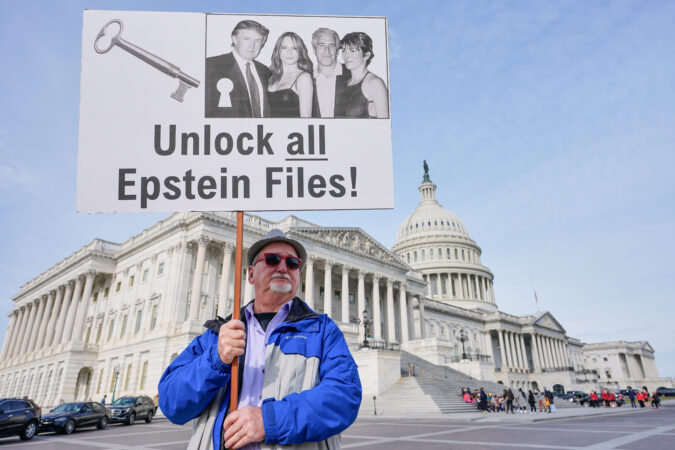
    More than 2 million documents regarding convicted sex offender Jeffrey Epstein remain to be released, Justice Department officials told a federal judge Monday, offering the most precise estimate so far of the size of the file still under review.

    In a letter to U.S. District Judge Paul Engelmayer in New York, officials said the department had released 12,285 documents, comprising about 125,575 pages, but that the vast majority of the Epstein files had not yet been released. Last month, Engelmayer issued an order allowing the department to release grand jury documents related to the 2021 trial and conviction of Ghislaine Maxwell, Epstein’s accomplice, on sex-trafficking charges.

    Justice Department officials had previously given even larger estimates of the number of documents still under review. The letter notes that the department has identified a large number of documents that are “copies of (or largely duplicative of) documents that had already been collected.”

    The letter was signed by Attorney General Pamela Bondi, Deputy Attorney General Todd Blanche, and Jay Clayton, the U.S. attorney in Manhattan.

    A new law passed in November mandated that the entire trove of Epstein files be released by Dec. 19. Justice Department officials said late last month that they hope to release the rest of the documents by Jan. 20. Members of Congress who pushed the legislation say that the department has not released key documents they want to see.

    “DOJ’s refusal to follow the law I passed in Congress and release the full files is an obstruction of justice,” Rep. Ro Khanna (D., Calif.), one of the new law’s main sponsors, said in a statement. “They also need to release the FBI witness interviews which name other men, so the public can know who was involved,” he said.

    More than 400 lawyers and 100 specially trained document analysts “will dedicate all or a substantial portion of their workday” to getting documents ready for release, the officials told the judge.

    The letter — a progress report of sorts — gives a glimpse into the daunting labor that lies ahead for federal officials.

    Those reviewing the unreleased documents must determine whether each document falls under the law’s broad mandate, review the documents to redact information that could identify victims, and respond to requests from victims or their family members for additional redactions, according to the letter.

    Officials offered similar explanations for a delay in releasing all unclassified Epstein documents last month, after the Justice Department failed to meet its deadline.

    Epstein was arrested on federal sex-trafficking charges in 2019 and died in federal custody later that year. His death was ruled a suicide. Judges and lawmakers say that over decades, he abused, trafficked, and molested scores of girls, many of whom have come forward in court and in other public forums.

    Epstein’s friendships with prominent political, business, and cultural figures, including President Donald Trump, also continue to be under intense scrutiny.

    Trump had a long-standing friendship with Epstein. He has said he knew Epstein socially in Palm Beach, Fla., and that they had a falling out in the mid-2000s. Trump has attributed the end of their relationship to a quarrel over a real estate deal and to Epstein hiring employees away from Trump’s Mar-a-Lago Club. White House spokeswoman Karoline Leavitt has said Epstein was ejected from the club “for being a creep” to female workers there.

    Trump has not been accused of participating in Epstein’s criminal conduct.

    Documents released last month confirmed that the FBI received a complaint about Epstein as far back as 1996. But Epstein did not appear to come under serious law enforcement scrutiny until about a decade later, when he was arrested in 2006.

    At the time, Epstein reached an agreement with officials in Florida that enabled him to plead guilty in 2008 to two state charges of soliciting prostitution, including one involving a minor, while avoiding federal charges and serving just over a year behind bars — with ample work-release privileges.

  • NRA sues its own charity in growing schism over trademarks, fundraising

    NRA sues its own charity in growing schism over trademarks, fundraising

    The National Rifle Association is suing its own charitable wing in federal court, alleging that the nonprofit NRA Foundation, which it founded in 1990, is unfairly using the NRA logo to attract a rival donor base and undercut it.

    The lawsuit, filed Monday in federal court, marks the latest strife for the gun rights group, which has been trying to balance its books and rebuild its reputation after years of misspending, allegations of corruption, and internal conflict.

    The suit alleges that the NRA’s official charity was “seized by a disgruntled faction of former NRA directors who lost control of the NRA’s Board.”

    The filing accuses the foundation’s leadership of misleading donors by suggesting that they were supporting the NRA, when in fact the funds were going to a charity that the NRA alleges had been transformed into “a vehicle for personal reprisal.” It also says the NRA Foundation was using the NRA’s trademark without permission.

    The NRA Foundation did not respond to a request for comment about the lawsuit early Tuesday.

    “This is a disappointing day, and it should not have come to this,” NRA CEO Doug Hamlin said in an emailed statement. “A foundation established to support the National Rifle Association of America has taken actions that are adversarial at a time when the NRA is rebuilding and focused on its long-term mission,” he said, describing the lawsuit as a “last resort.”

    In the lawsuit, attorneys for the NRA ask a judge to prevent the foundation from unfairly competing with the NRA, as well as order the foundation to stop using the NRA’s trademarks and pay an unspecified sum in damages.

    Monday’s court filings marked the latest explosion of internal warfare at the group, whose finances have been ravaged in recent years. According to campaign data tracker OpenSecrets, the NRA spent $11 million in the 2024 elections, one-third of its 2020 spending and less than one-fifth of its 2016 spending.

    In February 2024, a jury in New York found that Wayne LaPierre, the NRA’s longtime leader who resigned on the eve of the trial, had squandered funds on vacations, private jets, and designer clothes and was liable to pay $5.4 million in damages. Former CFO Wilson “Woody” Phillips was ordered to pay $2 million in damages.

    Some weeks later, the NRA avoided a second trial by reaching a settlement with the D.C. district attorney, agreeing to reform how the NRA Foundation distributed money. That lawsuit had accused the charity of funneling millions of dollars without proper oversight back to the NRA. The NRA did not acknowledge any wrongdoing in the settlement and had denied the lawsuit’s claims in court filings.

    According to the lawsuit, the foundation’s chairman and the majority of its trustees are former NRA board members who were allied with LaPierre. It accused the charity of being “stacked with trustees associated with the Old Guard faction that had lost control of the NRA, including Foundation Chairman Tom King, whom NRA members had voted off of the NRA Board in 2024.”

    King declined to provide an immediate comment on the suit Tuesday morning.

    The NRA has been trying to turn a new leaf on a painful chapter in its 155-year-old history. In recent years, many of the group’s former critics have joined the NRA’s 76-member board, which likes to call itself “NRA 2.0.” In November, it announced plans to furlough more than 30 staff members in a bid to save about $16 million.

    It was not immediately clear how Monday’s lawsuit would affect the link between the NRA and the NRA Foundation. The NRA’s website continued on Tuesday to prominently promote a link to “Friends of NRA,” the foundation’s main fundraising program.

    The NRA Foundation’s annual report for the 2024 calendar year, its most recent, listed net assets exceeding $200 million and annual revenue of $41 million.

  • Corporation for Public Broadcasting, gutted of federal funds, votes to dissolve

    Corporation for Public Broadcasting, gutted of federal funds, votes to dissolve

    The Corporation for Public Broadcasting’s board of directors voted to dissolve the organization, officials announced Monday, ending the 58-year-old agency that distributed federal funds to NPR, PBS and more than 1,500 local public radio and television stations.,

    The move formalizes the shutdown that began this summer after Republicans in Congress rescinded $1.1 billion in funding at President Donald Trump’s behest. At the heart of the campaign was a long-standing conservative critique that public media outfits produce news that is liberal, biased, and should not be funded by taxpayer dollars.

    CPB leaders said they chose dissolution over maintaining a dormant organization that could become manipulated by new stewards acting without public media’s best interest at heart.

    “CPB’s final act would be to protect the integrity of the public media system and the democratic values by dissolving, rather than allowing the organization to remain defunded and vulnerable to additional attacks,” said Patricia Harrison, CPB’s president and chief executive.

    Ruby Calvert, chair of CPB’s board, called the defunding “devastating” but expressed hope that “a new Congress will address public media’s role in our country because it is critical to our children’s education, our history, culture, and democracy to do so.”

    Created by Congress through the Public Broadcasting Act of 1967, CPB served as a middleman between taxpayers and public media, distributing most of its appropriations directly to local stations. The funding was particularly crucial for small and rural stations, which relied on federal dollars for a significant share of their budgets. The organization also negotiated music rights and procured technical infrastructure on behalf of stations — functions that now have no clear successor.

    CPB said it would complete distribution of its remaining funds and support the American Archive of Public Broadcasting in digitizing and preserving historical content. The organization’s own archives, dating to its 1967 founding, will be maintained in partnership with the University of Maryland.

    The organization’s closure caps months of turmoil for the public media system. In April, CPB sued the Trump administration after the president attempted to fire three of its board members, arguing it was not a government agency subject to presidential authority. In May, Trump signed an executive order instructing CPB to halt all funding to NPR and PBS, calling them “biased media.” NPR and PBS sued, arguing the order amounted to unconstitutional viewpoint discrimination.

    In September, after Congress passed its rescission bill, CPB announced it would redirect $57.9 million in satellite funding away from NPR to Public Media Infrastructure, a newly formed nonprofit backed by other public radio organizations, including PRX and American Public Media.

    In response, NPR sued its longtime ally CPB, arguing the move improperly allocated funds meant for NPR and violated the Public Broadcasting Act and was made under pressure from the Trump White House — a claim CPB disputed. The parties settled in November, with NPR receiving nearly $36 million for its satellite system. NPR also said it would waive fees derived from public radio stations for accessing its satellite services for the next two years.

    PBS has had staff cuts and NPR has reportedly made budget cuts. But for local stations that relied on CPB for a large share of their budgets, the federal funding cuts have been devastating.

    Major foundations, including Knight, MacArthur and Ford, have pledged tens of millions of dollars in emergency funding to keep the most vulnerable stations afloat, but some are already considering dropping national programming or shutting down entirely.

    NJ PBS, New Jersey’s public television network, announced in September that it may close next year, while Arkansas Public Television dropped its PBS affiliation — just as several public radio stations have dropped their NPR affiliation — showing that federal defunding has destabilized a system scrambling for answers.

    NPR, PBS, and the White House did not respond to requests for comment.

  • U.S. to promise Ukraine support to counter new Russian attacks

    U.S. to promise Ukraine support to counter new Russian attacks

    PARIS — Ukraine’s allies said Tuesday they had agreed to provide the country with multilayered international defense guarantees as part of a proposal to end Russia’s nearly 4-year-old invasion of its neighbor.

    At a key meeting in Paris, leaders from European countries and Canada, as well as U.S. representatives and top officials from the European Union and NATO, said they would provide Kyiv’s front-line forces with equipment and training and back them up with air, land and sea support to deter any future Russian attack.

    The size of the supporting forces was not made public, and many of the plan’s details remain unclear.

    U.K. Prime Minister Keir Starmer said the meeting made “excellent progress” but cautioned that “the hardest yards are still ahead,” noting that Russian attacks on Ukraine continue.

    He said allies will participate in U.S.-led monitoring and verification of any ceasefire, support the long-term provision of armaments for Ukraine’s defense, and work toward binding commitments to support Ukraine in the case of any future attack by Russia.

    There was no immediate comment from officials in Russia on Tuesday, which was the eve of Orthodox Christmas.

    Moscow has revealed few details of its stance in the U.S.-led peace negotiations. Officials have reaffirmed Russia’s demands and have insisted there can be no ceasefire until a comprehensive settlement is agreed. Russian President Vladimir Putin has ruled out any deployment of troops from NATO countries on Ukrainian soil.

    Starmer added that there can only be peace if Russia compromises, and “Putin is not showing that he is ready for peace.”

    In the event of a ceasefire, he said the U.K. and France “will establish military hubs across Ukraine and build protected facilities for weapons and military equipment to support Ukraine’s defensive needs.”

    Ukrainian President Volodymyr Zelensky said progress was made in the talks, although commitments need to be ratified by each country so that they can be put in place after any settlement.

    “We determined what countries are ready to take leadership in the elements of security guarantees on the ground, in the air, and at sea, and in restoration,” Zelensky told a news conference in Paris. “We determined what forces are needed. We determined, how these forces will be operated and at what levels of command.”

    He said details of how monitoring will work remain to be determined, as do the size and financing of the Ukrainian army.

    U.S. envoy Steve Witkoff said U.S. “strongly stands behind” security guarantees

    French President Emmanuel Macron said the security statement endorsed by Ukraine’s allies is a “significant step” toward ending Russia’s invasion.

    A joint statement said the allies also agreed to continue long-term military assistance and armament to Ukraine’s armed forces, which “will remain the first line of defense and deterrence” after any peace deal is signed.

    The allies still must finalize “binding commitments” setting out what they will do to support Ukraine.

    Prospects for progress at the meeting had been uncertain as the Trump administration’s focus is shifting to Venezuela, while U.S. suggestions of a Greenland takeover caused tension with Europe, and Moscow shows no signs of compromise.

    The countries dubbed the “coalition of the willing have been exploring for months how to deter any future Russian aggression should it agree to stop fighting Ukraine.

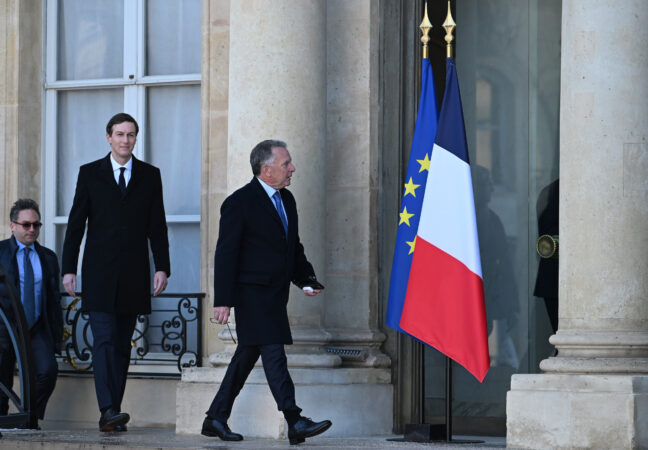
    Macron’s office said an unprecedented number of officials attended in person, with 35 participants including 27 heads of state and government. Witkoff and Trump’s son-in-law Jared Kushner, met with Macron at the Elysee presidential palace for preparatory talks ahead of the gathering.

    A series of meetings on the summit’s sidelines illustrated the intensity of the diplomatic effort and the complexity of its moving parts.

    Zelensky met with Macron ahead of the summit. French, British, and Ukrainian military chiefs also met, with NATO’s top commander, U.S. Gen. Alexus G. Grynkewich, participating in talks that France’s army chief said focused on implementing security guarantees. Army chiefs from other coalition nations joined by video.

    Macron’s office said the U.S. delegation was initially set to be led by Secretary of State Marco Rubio, but he changed his plans after the U.S. military intervention in Venezuela.

    Tension rises over Greenland comments

    Trump on Sunday renewed his call for the U.S. to take control of Greenland, a strategic, mineral-rich Arctic island.

    The leaders of France, Germany, Italy, Poland, Spain, and the U.K. on Tuesday joined Danish Prime Minister Mette Frederiksen in defending Greenland’s sovereignty in the wake of Trump’s comments about the self-governing territory of the kingdom of Denmark.

    But the continent also needs U.S. military might to back up Ukrainian security guarantees and ward off Russia’s territorial ambitions. That could require a delicate diplomatic balancing act in Paris.

    Participants are seeking concrete outcomes on five key priorities once fighting ends: ways to monitor a ceasefire; support for Ukraine’s armed forces; deployment of a multinational force on land, at sea and in the air; commitments in case of more Russian aggression; and long-term defense cooperation with Ukraine.

    But whether that’s still achievable Tuesday isn’t so clear now, after the U.S. military operation targeting Maduro in Venezuela.

    Ukraine seeks firm guarantees from Washington of military and other support seen as crucial to securing similar commitments from other allies. Kyiv has been wary of any ceasefire that it fears could provide time for Russia to regroup and attack again.

    Important details unfinalized

    Zelensky said during the weekend that potential European troop deployments still face hurdles, important details have not been finalized, and “not everyone is ready” to commit forces.

    He noted that many countries would need approval from lawmakers even if leaders agreed on military support for Ukraine. But he recognized that support could come in forms other than troops, such as “through weapons, technologies, and intelligence.”

    Zelensky said deployments in Ukraine by Britain and France, Western Europe’s only nuclear-armed nations, would be “essential.”

    “Speaking frankly as president, even the very existence of the coalition depends on whether certain countries are ready to step up their presence,” he said. “If they are not ready at all, then it is not really a ‘coalition of the willing.’”

    In fighting Tuesday, Ukraine’s Security Service (SBU) carried out drone strikes on a military arsenal and an oil depot deep inside Russia, according to a security official who was not authorized to comment publicly and thus spoke on condition of anonymity.

    The long-range drones hit the arsenal in Russia’s Kostroma region, triggering explosions that lasted for hours and forced the evacuation of nearby settlements, the official said. The site was described as a key logistics hub supplying ammunition in western and central Russia.

    In a separate strike, SBU drones hit an oil depot in Russia’s Lipetsk region, causing a huge fire, the official said.

  • Democrats look primed to win the House, but a wave might be harder

    Democrats look primed to win the House, but a wave might be harder

    Democrats are celebrating signs that the tide is turning their way for the 2026 midterms. But translating dissatisfaction with President Donald Trump into an electoral tsunami, or even a wave election, will be much harder to achieve than in years past.

    History, polling, a narrow Republican majority, a string of off-year victories, and voter anxiety over the economy favor the Democrats, who lead in support for control of Congress by five percentage points in a Post average of November and December national polls.

    It’s unclear what effect the Trump administration’s recent intervention in Venezuela will have, if any, and will probably depend on how deeply the U.S. involves itself in running that country’s affairs. Democrats hope it further splits Trump’s MAGA coalition.

    But the battlefield in the House is smaller than ever, according to political analysts, experts, and operatives, meaning Democrats will need to compete in districts that Trump won by large margins to pick up a significant number of seats.

    Of the 39 seats Democrats are competing for, 28 are in districts that Trump won by five or more percentage points.

    A gerrymandering spree instigated by Trump has narrowed the number of truly competitive seats, furthering a trend that was already underway in recent elections as the nation has become more polarized. That has not affected the race for the Senate, which Republicans are favored to hold.

    Just 36 races in this year’s election are rated competitive by the Cook Political Report, compared with 49 races at the same point in the 2018 cycle. Half of the seats rated competitive by Cook this year are already held by Democrats, leaving the party even less room to gain ground.

    “Democrats will have a very narrow but viable path to the majority. That’s a different scenario than 2006 or 2018, when Democrats put a ton of Republican-held seats in play,” said David Wasserman, senior editor and elections analyst at the Cook Political Report. “There’s so little elasticity in U.S. House elections these days compared to prior eras.”

    Democrats won 40 House seats in the “blue wave” of 2018 during Trump’s first term, easily erasing the Republicans’ then 23-seat governing margin.

    The good news for Democrats this year: They need only three seats to regain control of the House.

    That is achievable, but 2018-sized “waves” are harder now given increasingly partisan maps and a more divided electorate that has become more rigidly partisan, according to Wasserman and other analysts.

    Party leaders, however, argue they are well positioned to compete in heavily Trump districts. Trump’s 2024 victory was powered by a historic realignment of the electorate that upended decades of traditional coalitions. He made inroads with Latinos, young voters, first-time voters, and middle- and lower-income households. Democrats say they can unwind many of those gains with a slate of less traditional, and in some cases less partisan, candidates.

    One of them is Paige Cognetti, the mayor of Scranton, Pa., who won her current seat by running as an independent in a campaign called “Paige Against the Machine.” Even though Trump won her district by about eight percentage points, voters are open to her because they still cannot afford basic necessities like housing and groceries and are not “bleeding Democrats or hardcore Republicans,” she said in an interview. She noted that Gov. Josh Shapiro (D) won the same district by eight percentage points in 2022.

    Cognetti is challenging Rep. Rob Bresnahan (R., Pa.), who has faced scrutiny for stock trades while he was in Congress after campaigning on a ban on stock trading for members of Congress.

    “This is the exact type of public corruption and cynical behavior that people here really, really loathe,” Cognetti said. “Government should work and people want to see it at their local level and federal level, too.”

    Bresnahan supported an effort last year that would restrict members of Congress from trading stocks and has said lawmakers should not profit off the information that they have. Bresnahan’s stocks are in an institutionally managed fund that is run by financial advisers, spokesperson Hannah Pope said.

    In a statement, Bresnahan’s campaign attacked Cognetti’s record as mayor and as “a former Goldman Sachs banker who made the richest Americans even richer.”

    Democrats have coalesced around a midterm message focused on the cost of living and healthcare, hammering Republicans for passing a $4 trillion budget bill that includes steep cuts to Medicaid and food stamps. They have also highlighted Republicans’ failure to extend pandemic-era Obamacare subsidies that expired Dec. 31 that will drive up premiums for millions of Americans this year.

    Democratic Party leaders have been energized by off-year and special elections in which Democrats performed above expectations. In a Tennessee special election last month in a district Trump won by 22 points, Republican Matt Van Epps won by about nine percentage points.

    Some Republicans have urged the party to focus more on affordability, rather than solely focusing on issues such as crime or immigration that played a significant role in their 2024 sweep. Trump kicked off a tour last month in Pennsylvania to focus on Americans’ struggles with rising prices, but veered off-script, mocking the word “affordability,” touting the stock market, and disparaging Somalia.

    Republicans say they also have a slate of strong candidates in the country’s most competitive districts, including Kevin Lincoln, a former mayor and pastor running against incumbent Adam Gray (D., Calif.) in a central California district, and Eric Flores, a Republican army veteran and lawyer challenging Rep. Vicente Gonzalez (D., Texas) in Texas’s 34th Congressional District, near the state’s southern Gulf Coast and the border with Mexico.

    Mike Marinella, spokesperson for the National Republican Campaign Committee, agreed the battlefield is smaller than in past midterm elections. But he said Republicans hold the advantage, pointing to about a dozen Democratic incumbents who are fending off challenges in districts that Trump won narrowly.

    “Fundamentally, we have the upper hand just by looking at the pure numbers, and Democrats are certainly on defense in a lot more districts than we are,” Marinella said.

    Rep. Suzan DelBene (D., Wash.), chairperson of the Democratic Congressional Campaign Committee, said in an interview that many candidates competing in Trump districts are closely connected to their communities and “independent-minded.”

    “Authenticity matters a ton because you’re talking to folks across the political spectrum,” DelBene said.

    Democrats believe they have effectively neutralized Republican efforts to pick up additional seats through gerrymandering in Texas, Ohio, and North Carolina by gaining seats of their own in California and Utah. The Indiana Senate rejected a partisan gerrymander last month, and Democrats are still exploring whether they could pick up seats in Virginia, Illinois, and Maryland. Wasserman said the post-gerrymandering landscape remains “pretty equitable to both parties.”

    As Trump’s approval ratings fall — 39% of voters approve of the job he is doing, according to a Washington Post average of polls in early December — Democrats are working to wipe out some of the gains he made with voter groups that are traditionally aligned with them.

    In South Texas, Tejano music star Bobby Pulido is competing in one of the new districts Republicans drew to try to maintain the House majority.

    Key to Trump’s victory in Texas’ 15th District, which includes the Rio Grande Valley, was an unprecedented rightward swing among Latino voters. Pulido has broad name recognition in the Southwest and in Mexico in large part because of his 1995 debut single “Desvelado.” Trump’s immigration crackdown is devastating tourism and the rest of the economy in South Texas, Pulido said, creating an opening among those who supported him.

    “These immigration raids are hurting a lot of these small business owners or builders where their workforce they’ve had for years is no longer either there or afraid to go to work,” Pulido said in an interview. “I understand that a lot of Democrats don’t want to get labeled open borders. I’m sure as heck not open borders. … But due in large part to the immigration policies this administration has taken, we need to fix it.”

    There are still myriad questions about where the final map for 2026 will end up. In addition to ongoing gerrymandering efforts by both parties, the Supreme Court is expected to decide whether to strike down the last major pillar of the Voting Rights Act, a provision that has bolstered the power of minority voters and candidates for more than 50 years.

    If the court issues a ruling early enough and sides with Louisiana and the Trump administration — which has argued that race played too large a role in the decision to create a second Black-majority congressional district in the state — some states might scramble to redraw their maps and add Republican seats.

    Chris Warshaw, professor of political science at the McCourt School of Public Policy at Georgetown University, said it’s not clear how aggressively Republican states will respond, if at all, if the Supreme Court strikes down Section 2 of the Voting Rights Act. Even if Republican states try to redraw their maps, he said, Democrats have shown they are willing to respond.

    But the cost of last year’s redistricting fights is the health of American democracy, particularly as the country had previously made progress toward less partisan maps, he said.

    “The unwinding of that progress is really sad, and there’s no reason to think this genie is going to go back into the bottle,” Warshaw said.

  • Trump revives an old vision of American power, with global implications

    Trump revives an old vision of American power, with global implications

    The nighttime raid that ousted Venezuelan President Nicolás Maduro this weekend was the most dramatic demonstration of President Donald Trump’s vow to focus U.S. might on the Americas, as the White House re-creates a stance toward the Western Hemisphere that more resembles its 19th century empire-building era than the laissez-faire attitude of recent generations.

    Trump and his top allies suggested that the Venezuelan operation could be the start of efforts to remake the region, warning the governments of Cuba and Colombia that they might be next. Trump and some backers have also brought up Mexico as a potential target, and they are reviving talk of attempting to acquire Greenland, a Danish territory.

    After announcing Maduro’s capture, Trump boasted of the “Donroe Doctrine,” a twist on the strategy articulated by President James Monroe in 1823 that European powers should stop interfering in the Western Hemisphere. The national security strategy released by the White House in December noted a “Trump Corollary” to the Monroe Doctrine that promised “to protect our homeland and our access to key geographies throughout the region.”

    The effort carries significant risks. Washington could get pulled into the nation-building invasions that Trump has long sworn to avoid if the Venezuelan military or people are unwilling to go along with his plans. It also makes it harder for the United States to argue to Russia and China that they should steer clear of their neighbors. And it may reshape global affairs more broadly, as smaller nations that were long dependent on Washington’s guarantees for global trade and stability hedge their bets by building ties elsewhere.

    Backers of Trump’s strategy downplay the drawbacks and say a narrower focus on U.S. regional interests is long overdue.

    “The goal of the policy is to see changes in Venezuela that are beneficial to the United States first and foremost, because that’s who we work for, but also, we believe, beneficial for the people of Venezuela, who have suffered tremendously,” Secretary of State Marco Rubio told NBC’s Meet the Press on Sunday, a day after Trump said U.S. forces were ready to reinvade Venezuela if Maduro’s de facto successor, Delcy Rodríguez, did not comply with his wishes.

    Rubio — the son of Cuban immigrants to the United States — has long backed efforts to oust Venezuela’s leaders, who have presided over a decline in their country’s economy, ignored election results, and built ties to U.S. adversaries including Russia and China. Deposing Venezuela’s government would probably weaken the Communist leaders of Cuba as well, since they have long depended on Caracas for energy and other economic support.

    “This emphasis on the Western Hemisphere should not come as a surprise to anybody. It matters more to American security than any other part of the world,” said Nick Solheim, chief executive of American Moment, a group that backs Trump’s policies and trains junior staffers.

    But he said advocates of a more robust focus on the Western Hemisphere were not saying Washington should abandon global affairs entirely.

    “It’s making sure that our neighbors are not doing anything that is, that would adversely affect the United States, and then focused on our greatest geopolitical challenge right now, which is China,” he said. “That is not a retreat from the world of foreign policy. It is an accurate prioritization of what actually matters the most, what poses the biggest threats to the United States.”

    The move against Venezuela drew criticism from both the center and the right, as some influential “America First” advocates said that military conflicts and expanded foreign opportunities for U.S. oil companies weren’t why voters backed Trump.

    “This is the same Washington playbook that we are so sick and tired of that doesn’t serve the American people, but actually serves the big corporations, the banks, and the oil executives,” Marjorie Taylor Greene, a longtime Trump ally who is retiring from Congress after breaking with the president, said on NBC’s Meet the Press on Sunday. “We don’t consider Venezuela our neighborhood. Our neighborhood is right here in the 50 United States, not in the Southern Hemisphere.”

    Washington has a long history of efforts to back friendly leaders in Latin America, including at times intervening with force to do so. But it has not done so directly since the 1991 end of the Cold War, and Venezuela — with 30 million residents and a territory double the size of Iraq’s — is an especially large nation to take on.

    “I understand how we got here, but there’s been no forethought to the difficulties of the plan or the ideas that they seem to have adopted as the way ahead, and there definitely is no plan to the level of detail that’s required,” said Jennifer Kavanagh, a senior fellow at Defense Priorities, a think tank that advocates a more limited role for the U.S. military in the world.

    She said she wasn’t sure that China and Russia would be emboldened by Trump’s actions, since they already appear to feel unconstrained toward their neighbors. But she noted that Trump appears to be cautious about tangling with militaries that can inflict serious damage on the United States.

    “This sort of spectacular operation is very consistent. He likes to hit adversaries that can’t hit back, whether it’s small drug-smuggling boats, or Iran with no air defenses, or Venezuela, which is also weak,” she said. “And to me, that explains the more accommodating approach to Russia and China, in the sense that his view of military power is kind of go big or go home. But that model doesn’t work against Russia and China.”

    Some of Trump’s former advisers warn that the world the president is building may turn out to be more dangerous than the era of the 1990s and 2000s, when the United States was the preeminent global power and backed a broad effort to strip barriers to trade.

    “It just seems to be back to the 18th and 19th centuries,” said Fiona Hill, an expert at the Brookings Institution who was Trump’s top Russia adviser in his first term. “If you’ve bought into the idea of competition among the great powers and that Russia is another great power that’s inevitably going to dominate in its region, just as China is in its region, then this is the logical conclusion from this.”

    Hill said countries that have deep, allied ties to the United States but are threatened by Trump may seek to protect themselves by building trade and security relationships elsewhere, a move that will ultimately weaken Washington, not strengthen it.

    The raid has sparked fears elsewhere that Trump could act on other threats toward U.S. neighbors, which have included demands to take over the Panama Canal, to turn Canada into the 51st state, to annex Greenland, and to overthrow Cuba’s government.

    Trump on Sunday said he didn’t plan action against Havana, but offered tough language nevertheless.

    “I think it’s just going to fall. I don’t think we need any action,” he told reporters on Air Force One. “You ever watch a fight, they go down for the count, and Cuba looks like it’s going down.”

    He was sharper toward Greenland.

    “We need Greenland from a national security situation,” Trump said. “It’s so strategic. Right now, Greenland is covered with Russian and Chinese ships all over the place. … Denmark is not going to be able to do it.” On Saturday, an influential former White House aide, Katie Miller, posted on social media an image of Greenland with the U.S. flag superimposed on top of it.

    The president’s repeated statements about Greenland drew a sharp response earlier Sunday from Danish Prime Minister Mette Frederiksen. “I have to say this very directly to the United States: It makes absolutely no sense to talk about the need for the United States to take over Greenland,” she said.

    In a statement, she said Denmark is a U.S. military ally and that the United States has extensive access to Greenland.

    “I would therefore strongly urge the United States to stop the threats against a historically close ally and against another country and another people who have said very clearly that they are not for sale,” she said.

  • Who is Delcy Rodriguez, Venezuela‘s new leader?

    Who is Delcy Rodriguez, Venezuela‘s new leader?

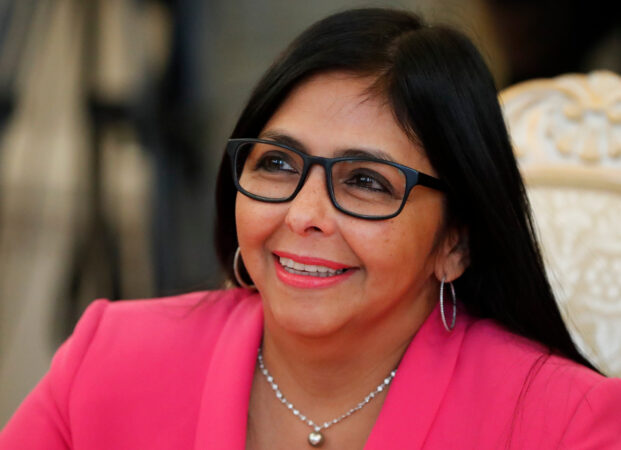
    Venezuela’s vice president, Delcy Rodríguez, has taken over as acting leader in the wake of a U.S. raid that deposed President Nicolás Maduro over the weekend.

    Rodríguez, 56, is a veteran politician, lawyer, and diplomat who had served as Maduro’s vice president since 2018. She has deep family ties to leftist politics in Venezuela, though she was generally viewed as more pragmatic than other members of Maduro’s government. While Rodríguez played a key role in overhauling Venezuela’s economic policy, developing close ties with the business community, she has also been accused of corruption and human rights abuses as part of Maduro’s inner circle.

    Venezuela’s Supreme Court ordered Rodríguez late Saturday to assume the presidency in Maduro’s absence, a position she would hold on an interim basis. On Sunday, Defense Minister Vladimir Padrino López also recognized Rodríguez as acting president, saying in televised remarks that the nation’s forces must be unified in “the mission of confronting imperial aggression.”

    Rodríguez’s first public comments came Saturday when, in an address to the nation, she denounced the U.S. operation to take Maduro and said he is the country’s only president.

    But in a Sunday night statement, Rodríguez offered a more conciliatory message, calling for “peaceful coexistence.”

    “President Donald Trump, our peoples and our region deserve peace and dialogue, not war,” Rodríguez said. “This has always been President Nicolás Maduro’s message, and it is the message of all of Venezuela right now.”

    Earlier, Trump suggested Rodríguez was willing to work with the United States, which he said would “run” Venezuela. But on Sunday, he threatened the vice president in an interview with the Atlantic, saying that “if she doesn’t do what’s right, she is going to pay a very big price, probably bigger than Maduro.”

    On Monday, lawmakers aligned with the ruling party, including Maduro’s son, gathered in the capital, Caracas, to follow through with a scheduled swearing-in ceremony of the National Assembly for a term that will last until 2031.

    Rodríguez was sworn in as interim president by her brother, Jorge Rodríguez, who was reelected as speaker.

    “I come with sorrow for the suffering inflicted upon the Venezuelan people following an illegitimate military aggression against our homeland,” she said with her right hand up.

    Here’s what we know about the interim Venezuelan leader.

    Who is Delcy Rodríguez?

    Rodríguez is a Caracas native and was born in the Venezuelan capital in 1969.

    She was 7 years old when her father, leftist political leader and guerrilla fighter Jorge Antonio Rodríguez, was killed while under interrogation by counterintelligence agents for his alleged role in the abduction of an American executive in Caracas.

    His death left an indelible mark on Rodríguez and her brother, Jorge Rodríguez Gómez, 60, who is president of Venezuela’s National Assembly, according to a 2020 profile in Vanity Fair España.

    After growing up in a deeply socialist family and hearing tales about their father, the siblings embarked on lifelong political careers, embedding themselves in the country’s leftist politics and serving in key roles under Venezuela’s former firebrand president and socialist icon, Hugo Chávez, and his handpicked successor, Maduro.

    Rodríguez, who often wears black-rimmed glasses and bright-colored fabrics, was educated in Caracas, Paris, and London, studying law at the Central University of Venezuela, where she later worked as a professor. She started her professional career as a labor lawyer and joined the Chávez administration in 2003.

    What political role has Rodríguez played in government?

    Rodríguez’s political resumé stretches back over two decades, during which she held positions that led her to the upper echelons of power.

    She started in the office of the general coordinator for the vice president in 2003, moving then to the Ministry of Energy and Mines, where she served as director of international affairs.

    Later, she became minister of presidential affairs under Chávez in 2006.

    She was a fierce defender of Chávez’s Bolivarian Revolution — named after 19th century Venezuelan revolutionary Simón Bolívar — which envisioned social and political reforms that would lift millions out of poverty and build a Latin America free of U.S. influence.

    “She has defended Venezuelan sovereignty, peace and independence like a tiger,” Maduro said of Rodríguez in 2017.

    But even as Chávez sought to fund social welfare programs, he let the country’s strategic petroleum reserves dwindle and made authoritarian moves that stifled the press and gutted the nation’s stable of experts.

    After Chavez died in 2013, Maduro elevated Rodríguez to minister of popular power for communication and information — and appointed her as his top diplomat and foreign minister the next year.

    When the price of oil plummeted in 2014, it set off economic chaos in Venezuela, characterized by severe food shortages, runaway inflation and an exodus from the country.

    On the heels of that collapse, in 2018, Rodríguez became Maduro’s vice president (while serving later as finance minister and minister of oil). A few months afterward, the U.S. placed sanctions on Rodríguez, her brother and other members of Maduro’s inner circle, accusing them of corruption and human rights abuses.

    “The revolution is our revenge for the death of our father and his executioners,” Rodríguez said in an interview that year with Venezuelan journalist José Vicente Rangel.

    What’s next for Rodríguez?

    With her broad portfolio, Rodríguez sought to implement economic changes while maintaining state control over key sectors and continuing to prioritize social spending.

    She has been viewed generally as more pragmatic and willing to oversee a limited opening of Venezuela’s economy than hard-line government officials, including the defense and interior ministers.

    Trump said Saturday that Rodríguez had spoken to Secretary of State Marco Rubio. “She said, ‘We’ll do whatever you need,’” he added. “I think she was quite gracious,” Trump said. “But she really doesn’t have a choice.”

    In some of her first actions as acting president, Rodríguez announced the creation of two commissions in a statement published by Communications Minister Freddy Ñáñez. The first is a high-level panel dedicated to the release of Maduro and his wife, Cilia Flores. The second will focus on guaranteeing and consolidating “food sovereignty and supply projects” in Venezuela, the statement said.

    Rodríguez also visited people who were injured in the U.S. attacks that deposed Maduro, according to the statement, referring to them as “brave and heroic young people who stood up to defend our sovereignty and the integrity of our President, Nicolás Maduro Moros.”

    Rodríguez and her brother are seen as modernizers who want a semiopen country and economy and warmer relations with the broader world, Tulane University sociologist David Smilde said.

    The siblings, however, “don’t have guns,” said Phil Gunson, a senior analyst for the Andes region with the International Crisis Group. And even with Delcy Rodríguez as interim president, the interior and defense ministers could still hold most of the power, given their control of the military and security forces.

    “If it comes to a fight, they’re left hanging because they don’t have anyone to back them,” Gunson said. “What I suspect is going to happen is, she will occupy the presidency, but the powers will be the defense and interior ministers, and that’s not good.”

    Information from the Associated Press was used in this report.

  • U.S. overhauls childhood vaccine schedule, recommends fewer shots

    U.S. overhauls childhood vaccine schedule, recommends fewer shots

    The Trump administration is overhauling the list of routine shots recommended for all babies and children in the United States, bypassing the government’s typical process for recommending vaccines and delivering on Health Secretary Robert F. Kennedy Jr.’s longstanding goals to upend the nation’s pediatric vaccine schedule.

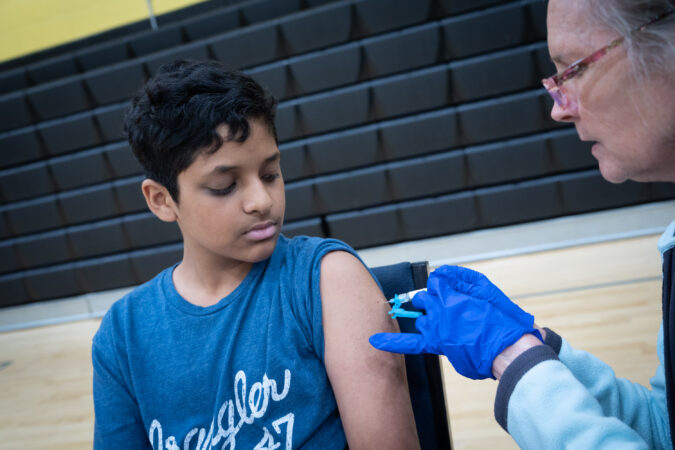
    Effective immediately, the Centers for Disease Control and Prevention will no longer recommend every child receive vaccines for rotavirus, influenza, meningococcal disease, respiratory syncytial virus (RSV), hepatitis A and hepatitis B, according to materials released Monday by the Department of Health and Human Services. Instead, smaller groups of children and babies should get those vaccines only if they are at high risk or if a doctor recommends it.

    Administration health officials said they were aligning U.S. recommendations more closely with vaccine schedules in other countries, citing decreased public confidence in vaccinations, especially following the COVID-19 pandemic.

    “We are aligning the U.S. childhood vaccine schedule with international consensus while strengthening transparency and informed consent,” Kennedy said in a news release. “This decision protects children, respects families, and rebuilds trust in public health.”

    Children could still receive vaccines that are no longer broadly recommended by the federal government and insurers would still have to pay for them, officials said. Officials said coverage in private plans, Medicare, Medicaid and the Children’s Health Insurance Program wouldn’t be affected by the new recommendations.

    Officials are dividing vaccines into three categories. The first category includes vaccines recommended for all children, such as to protect against measles and polio and whooping cough.

    The second category encompasses vaccines recommended for certain high-risk groups or populations, such as RSV, hepatitis A, hepatitis B and meningitis. The third category includes vaccines that can be given under a designation known as “shared clinical decision-making” that allows children to get the shots after families consult with their healthcare providers. Officials said they didn’t undergo a fresh assessment of who is considered high risk.

    The new set of recommendations align the U.S. more closely with Denmark’s schedule, something administration officials had previously suggested.

    Two of the vaccinations – for influenza and rotavirus – should only be given when a doctor recommends it, under the new CDC guidance. The CDC already shifted to this model for coronavirus vaccines in the fall.

  • Secret Service plans unprecedented staff surge with anxious eye on 2028

    Secret Service plans unprecedented staff surge with anxious eye on 2028

    The Secret Service has launched one of the most ambitious hiring efforts in its history, seeking to bring on thousands of agents and officers to ease strain on its overstretched workforce and prepare for multiple major events in 2028, including the presidential election and the Olympics.

    Service leaders say they want to hire 4,000 new employees by 2028 — a surge that law enforcement experts say has no clear precedent and reflects mounting concerns about staff burnout, a loss of experienced agents, and a relentless operational tempo. The added staff would make up for expected retirements and increase the size of the agency by about 20%, to more than 10,000 for the first time.

    Under a plan led by Deputy Director Matthew Quinn, the service aims to expand its special agent ranks from about 3,500 to about 5,000. Officials also want to add hundreds of officers to the Uniformed Division, for a total of about 2,000, and hire additional support staff. The figures have not been previously reported.

    The agency faces serious obstacles, however, including a shortage of qualified candidates; competition with other law enforcement agencies, especially in immigration enforcement; and bottlenecks in hiring and training, according to former service officials.

    A previous attempt to reach 10,000 employees over a roughly 10-year period ending in 2025 failed as the agency struggled with leadership turnover and disruptions from the coronavirus pandemic, among other issues. The service fell far short of recruitment and retention goals despite offering some of the biggest financial incentives of any federal law enforcement agency.

    “Our mindset is, we aren’t going to pay our way out of this,” said Quinn, a longtime Secret Service official who returned to the agency in May after several years in the private sector. “We can’t create enough incentives to negate the fact that we’re working our people very, very hard.”

    Quinn said he and Secret Service Director Sean Curran, the former head of President Donald Trump’s protective detail, have set out to make hiring a top priority, second only to protection. Senior administration officials have backed them, he said.

    “The protective mission has expanded,” he said. “Our numbers are low to meet those needs. We have to achieve what we said we were going to do 10 years ago. We’ve got to achieve it now.”

    Agency officials want to improve the quality of life in the service by shortening hours and reducing time on the road for officers and agents, many of whom spend months each year traveling on protective assignments.

    A larger staff could also allow the Secret Service to lean less on other law enforcement agencies for help securing high-profile events, giving it tighter control over venues. Poor communication with other agencies played a major role in the service’s most publicized failure in recent years, the attempted assassination of Trump in 2024 at a campaign rally in Butler, Pa.

    Some former officials questioned whether the service can achieve its goal.

    “They are going to have to eliminate all the management and red-tape barriers,” said Janet Napolitano, a former secretary of the Department of Homeland Security, the service’s parent agency. “They have to be able to swiftly recruit, maintain quality, and train that number of new agents. They’re going to have to turn headquarters into a hiring machine.”

    In 2024, Napolitano helped lead a bipartisan investigation of the Secret Service failures that led up the Butler assassination attempt, the first time a president or former president had been fired upon since 1981.

    Others said even more modest hiring targets could be a stretch on such a short timeline. Getting hired and trained for a job in the Secret Service is a long, strenuous, and heavily bureaucratic process, even by federal government standards. It involves multiple rounds of interviews, an intensive background check, and a notoriously tough polygraph test that officials say screens out some otherwise strong candidates.

    All of those steps place heavy demands on already understaffed field offices, according to a former Secret Service executive familiar with the process, who like others spoke on the condition of anonymity due to concerns about retaliation. The former executive said it was difficult to see how the agency could clear those hurdles while significantly expanding the workforce.

    “I hope they have success in getting those numbers as much as anybody, but it’s not realistic,” said another former senior official, who retired recently. “There’s no part of law enforcement that’s not struggling to hire.”

    Service leaders are adamant that they are not lowering standards to meet their goals.

    Some service officials had floated the possibility of curtailing or suspending the investigative portion of agent training, focusing only on the protective portion of the service’s mission, according to people familiar with the discussions. But Quinn said that was out of the question. “Investigations are the lifeblood of this organization,” he said.

    Instead, officials say, they have found ways to speed the process.

    In November, the service held the first of what officials expect to be multiple accelerated hiring events in which candidates complete assessments over several days, including a physical fitness test, a security interview, and a full polygraph.

    Historically, those assessments have taken months, according to Delisa Hall, the Secret Service’s chief human capital officer. About 350 candidates out of nearly 800 who attended the first event advanced to the next phase, she said.

    “It’s becoming evident that this may be our new normal to push applicants through,” she said.

    Agency officials say they have compressed the timeline for a job offer down to less than a year from the previous 18 months or more and hope to cut the timeline by roughly another four months. The long wait in the past has led some candidates to withdraw or take positions with other agencies that moved more quickly.

    Hall said the agency is recruiting from the military, college athletes, and law enforcement, and it’s staying more engaged with applicants to keep from losing people along the way.

    Getting new hires trained and field-ready on time could also present challenges as the Secret Service races to staff up.

    Officials say the service has secured 42 classes at the federal government’s main training center for law enforcement agents in Glynco, Ga., for the 2026 fiscal year. All the service’s new agents and officers must undergo basic criminal investigator training at the facility, known as FLETC, for about three months alongside recruits from other agencies.

    The campus is expected to remain packed for the foreseeable future with recruits from Immigration and Customs Enforcement and other immigration agencies hired as part of the Trump administration’s crackdown. Secret Service leaders say they have not had to compete for space. But several former officials said they worry the service’s recruits could take a back seat to training for ICE or the Border Patrol, both of which are hiring aggressively.

    The pressure on the agency will only mount as 2028 approaches. Some in the Secret Service have privately referred to the year as “Armageddon” because of the extraordinary security demands posed by the election and other major gatherings, including the Los Angeles Olympics, the first Summer Games in the United States since Atlanta in 1996.

    The workforce carrying out the mission could look dramatically different from the last election cycle. Many experienced agents have departed for other agencies or jobs in the private sector in recent years. Others from a large cohort hired in the years surrounding the Sept. 11, 2001, terrorist attacks may not stay for another breakneck campaign.

    “About a third of the workforce will be retirement-eligible before the start of 2028,” said Derek Mayer, a former deputy special agent in charge of the Secret Service’s Chicago field office. “That’s definitely a cause for concern. There were periods during hiring freezes in the 2010s when we didn’t hire anyone. When that happens, it does hurt, but it hurts five or 10 years later.”

    With Trump term-limited, both major parties are expected to have competitive primaries, raising the number of people the service will have to protect. The eventual nominees, their running mates and their spouses will receive full-time Secret Service details.

    The agency is also tasked with coordinating protection around the 2028 Summer Olympics and Paralympics, scheduled during the last two weeks of July and the last two weeks of August, respectively.

    “No matter what, I don’t care how successful we are,” Quinn said, “it’s still going to be a rough summer.”