Category: Washington Post

  • TikTok’s mental health ‘rabbit hole’? It’s not in your head.

    TikTok’s mental health ‘rabbit hole’? It’s not in your head.

    At first, the mental health-related videos that popped up on Amy Russell’s TikTok feed made her feel seen. The tips and funny anecdotes about living with ADHD reminded her of herself — maybe her forgetfulness wasn’t a flaw but a symptom.

    After two years of learning about the condition on TikTok, she went to a doctor for an assessment. The resulting diagnosis changed her life for the better, she said, as she started taking medication and using strategies to manage daily tasks. She attributes the transformation in part to TikTok.

    There’s just one problem: Now she can’t get the ADHD videos off her feed. The more she scrolls, the stranger and less trustworthy the content becomes, she said. Her efforts to see less of it — scrolling past videos and not engaging — don’t seem to help.

    “You just keep finding more tunnels and it gets harder to find your way out,Russell, 35, said.

    She’s not imagining it. TikTok’s algorithm favors mental health content over many other topics, including politics, cats, and Taylor Swift, according to a Washington Post analysis of nearly 900 U.S. TikTok users who shared their viewing histories. The analysis found that mental health content is “stickier” than many other videos: It’s easier to spawn more of it after watching with a video, and harder to get it out of your feed afterward.

    “It felt like a rabbit hole to me because you kept going down deeper and deeper,” Russell said.

    TikTok uses an algorithm to select a video and gives users two main options: Watch it or skip past to something else. Along the way, the app learns what a user like Russell likes and dislikes, based on her watching and skipping behavior. It takes skipping past 1.3 videos, on average, to undo the effect of watching one full video about cats or politics, The Post analysis found. For mental health, it takes 2.2 skips — meaning users must work harder to get it out of their feeds.

    TikTok spokesperson Mahsau Cullinane criticized The Post’s methodology as incomplete and said it doesn’t “reflect the reality of how our recommendation system works.”

    This finding comes amid a broader debate on the role of algorithms and influencers in Americans’ understanding of mental health. Content about mental illness and neurological differences is extremely popular across social media apps, with about as many TikTok posts using the hashtag #mentalhealth as those that mention #sports, according to data from analytics firm Sprout Social. Mental health content on TikTok deals with not just conditions like depression or anxiety, but also living with a neurological type such as ADHD or autism.

    People are turning to social media for health information as Americans face a shortage of mental health professionals, barriers to accessing and paying for care, and lingering stigma. Information from social media helps underserved and underdiagnosed populations better understand themselves, many users say. What happens next, however, is rarely examined.

    Over the period that The Post examined Russell’s TikTok data, about one in 11 videos on her feed were mental-health-related. Russell, who spent more than an hour watching videos on many days, said the more she scrolled, the more often she saw videos from nonprofessionals that seemed designed to get a reaction rather than educate.

    Efforts to evaluate mental health content on TikTok support Russell’s impression. Anthony Yeung, a psychiatrist and University of British Columbia researcher, ran a study examining 100 top TikTok videos about ADHD and found that some were helpful, but about half were misleading. (Videos about creators’ personal experiences weren’t classified as misleading.) Other reviews of TikTok content about ADHD and autism by mental health practitioners have found similar results.

    “The algorithm says, ‘Well, you like this video about ADHD, even though it’s misleading, let’s give you another video,’” Yeung said. “And it becomes this very vicious feedback loop of misinformation.”

    The phenomenon is having a profound effect on real-world mental health treatment, clinicians say. Yeung said he deals with “two visions of what ADHD is”: the one discussed on social media and the one he sees among actual patients. On TikTok, ADHD content often paints with a broad brush, portraying common quirks or struggles as not just personal experiences but diagnostic criteria for the condition.

    One popular ADHD account, @lifeactuator, regularly earns views in the millions with titles like “What ADHD feels like” and “Things people with ADHD do despite knowing better.” One widely watched video with the caption “if the world was made for ADHD” depicts a Costco store with ADHD shoppers being chased around by store employees to stop them from making impulse purchases.

    Eric Whittington, the Arizona-based creator behind @lifeactuator, said that because of the constraints of short-form video, he’s not able to include all the information viewers might need to understand what, if anything, his videos reflect about ADHD as an actual medical condition. Taken individually, his videos probably apply to a broad swath of the population, he said — not just people with ADHD.

    “When you only have a minute to work with, it’s hard to add disclaimers on the content saying, ‘Yes, everybody experiences this from time to time, but if it happens all the time, you may have ADHD,’ ” he said.

    Rana Coniglio, an Arizona-based therapist who works primarily with Gen Z clients, said they often arrive at her practice already attached to a diagnosis they found on TikTok. Sometimes, that attachment makes it harder to accurately diagnose or make a treatment plan that could improve that person’s symptoms.

    “I have had people come to me and say, ‘Hey, I saw this video on TikTok and it’s actually the reason that I’m seeking therapy because it made me think I actually do need help,’ and there are benefits to that,” she said. “But I think the majority of people see a diagnosis, take it and run with it.”

    High volume, low quality

    For Ace Bannon, a 19-year-old in Utah, the more he watched, the darker the content became.

    Bannon first got curious about autism and its characteristics after learning that many of his best friends — people he’d met on a Discord server — were autistic. He started watching TikTok videos, with content about autism taking up a growing chunk of his feed. Then, TikTok served him video after video of autistic adults discussing the trauma they endured as children, Bannon said. Before long, he wanted his old algorithm back.

    “Because you’re interested, it starts recommending more of those videos and it makes you fall into these rabbit holes that you just want to get out of after a while, but you can’t.”

    Sometimes this experience actually exacerbates existing mental health problems, some users say. Kailey Stephen-Lane, 30, said she had to temporarily stop using the app because spending time on TikTok was worsening the symptoms of her obsessive compulsive disorder. While her real-life therapist was helping her sit with fears and insecurities without fixating, TikTok was “bombarding” her with videos about the very symptoms that made her so anxious, she said.

    “The TikToks that I’ve been getting are not helpful to my recovery,” she said. “They lead me down a lot of spirals, and me just clicking ‘not interested’ doesn’t seem to work anymore.

    TikTok provides a high-level description of some of the data its algorithm uses but few details. That makes it difficult to know why mental health videos are stickier than other topics, says Stevie Chancellor, an engineering professor at the University of Minnesota who studies AI and its risks, and whose research found that the algorithm creates a “runaway train” of mental health content.

    But the app’s business incentives offer some clues, Chancellor says. Maybe users who see a lot of mental health videos spend longer on the platform or are more likely to spend money down the line, she said. Maybe the effect is completely unintentional, an example of a black-box algorithm optimizing for what it thinks users want.

    “Watching [mental health] content might lead to other behaviors that are valuable on the platform,” Chancellor said.

    The topic may become sticky because it’s one “that a user only wants to engage with sometimes,” said Laura Edelson, a computer science professor at Northeastern University who collaborated with The Post in a parallel TikTok research effort.

    Cullinane, the TikTok spokesperson, said the company is “transparent” about how its feed works.

    For TikTok users, adjusting the type of content that shows up on their feeds can be hard. It’s not always clear when engaging with a certain video would spawn something undesirable: Even watching clips about romantic relationships made a user more likely to encounter mental health content, The Post’s analysis found. TikTok has gradually added options that could help users tailor their feeds, such as clicking a “not interested” button, blocking videos with certain keywords or resetting their algorithms from scratch. A new “Manage Topics” menu lets users adjust the prevalence of 12 specific topics on their For You page — but mental health isn’t one of them.

    As for Russell, she is glad for the journey toward an ADHD diagnosis because of TikTok. She just wishes her favorite type of content — lighthearted cat videos — got the same treatment from the app’s algorithm.

    “I want like 10-20% cute cat videos, probably even like 30%,” she said. “But those disappear really quickly.”

    Methodology

    Hundreds of TikTok users in the United States sent their watch history data to The Washington Post. We downloaded the collective 14.8 million videos they’d been shown and then sorted them into topics, based on keywords in the transcripts and on-screen text. The Post calculated the stickiness of each topic by computing the difference between the number of topical mental health videos each user had been shown in the previous 50 videos and how many they saw in the next 50. We averaged this for all videos, aggregated by whether the user watched at least 90% of the video, or skipped it.

  • The Trump administration’s immigration raids are testing this sanctuary city

    The Trump administration’s immigration raids are testing this sanctuary city

    GRETNA, La. — Siomara Cruz was not troubled when she saw two Latina immigrants handcuffed earlier this month by masked immigration agents outside a restaurant in this New Orleans suburb.

    “They need to do things the proper way,” said Cruz, 59, a housewife whose parents emigrated from Cuba. “The law is the law. Every country has their law, and you’ve got to respect it.”

    Across the street, Tracey Daniels said it was “awful” to see immigration agents in an unmarked SUV detain a Latino man outside the gas station kitchen where she was preparing lunch plates of red beans, rice, and fried catfish.

    “They’re just snatching these people, snatching them away from their families,” said Daniels, 61. “Now they got people afraid to come outside, businesses closing.”

    The immigration operation, dubbed Catahoula Crunch by the Department of Homeland Security, follows similar crackdowns in Chicago, Los Angeles, Charlotte, N.C., and other cities. DHS Assistant Secretary Tricia McLaughlin said in a statement earlier this month that 250 people had been arrested since the start of the operation.

    The mission is exposing stark divides in and around New Orleans that reflect broader national reactions to the administration’s immigration raids — and who should help enforce them.

    Across 10 national polls in November and early December, 43% approve of President Donald Trump’s handling of immigration, while 55% disapprove. The share of people who approve of Trump’s handling of immigration has dropped from about 50% in March. Last week, Illinois Gov. JB Pritzker, a Democrat, signed a law seeking to limit immigration enforcement in his state as he continues challenging the administration’s aggressive campaign there.

    New Orleans is a “sanctuary city,” where officials have historically refused to support federal immigration sweeps. But new state laws designed to penalize those who impede immigration enforcement could put officials and officers at risk if their departments do not cooperate with federal operations.

    And some surrounding police departments, including in Gretna, have signed 287(g) agreements to work with U.S. Immigration and Customs Enforcement to deport people who authorities say entered the country illegally.

    Those agreements have also divided residents. Some said that immigration enforcement should fall exclusively to federal agents — that having local officers partner on the issue risks alienating immigrant communities or violating people’s rights. But police supporting the operations said they get more complaints about crime in their communities than they do about Catahoula Crunch.

    Gretna Deputy Police Chief Jason DiMarco said his 150-person force needs to serve everyone in its diverse community, but added that having so many undocumented residents in the city makes it harder to identify suspected criminals. Last month, he said, local police accompanied ICE agents on a raid that picked up four suspects, including an alleged MS-13 gang member. DiMarco noted that within the last year, Gretna police have investigated several serious crimes committed by undocumented suspects, including one who fled the country after allegedly killing an immigrant who had come to the United States legally.

    Now, because of the 287(g) agreement, officers can coordinate directly with ICE.

    “If they run across an illegal immigrant in their day-to-day patrol activities … they can actually detain the person, check their legal status, and if they aren’t here legally, we can contact ICE and they’ll come and get them,” DiMarco explained of the partnership during an interview at his office earlier this month.

    DiMarco, who is from Gretna, has watched the city of nearly 18,000 grow more diverse, to include a member of his own family who emigrated from Honduras. Like many in the New Orleans area, his family tree includes immigrants from several countries, including France, Italy, and Cuba.

    “New Orleans is the original melting pot of the world,” he said. “… People from every walk of life lived in this city. And they intertwined and managed to live together cohesively.”

    So far, DiMarco said, he hasn’t fielded any complaints about his department’s work with ICE. Even if people don’t agree, he said, officers have a duty to enforce the law, including one signed in June by Gov. Jeff Landry, a Republican, that criminalized “any act intended to hinder, delay, prevent, or otherwise interfere with or thwart federal immigration enforcement efforts.”

    Anyone in violation could face jail time or fines.

    “We don’t get to pick and choose which you can and can’t enforce,” DiMarco said.

    But DiMarco also worries the ongoing raids may make immigrants even more hesitant to report crime.

    “We don’t want somebody to get victimized and get picked on, whether they be illegal or not,” he said. “Nobody deserves to be a victim of a crime.”

    Most Catahoula Crunch activity has been to the west of New Orleans in Jefferson Parish, which includes Gretna and other towns where law enforcement agencies signed 287(g) agreements. In last year’s presidential election, 55% of Jefferson Parish voted for Trump, while 82% of neighboring Orleans Parish voted for Democratic nominee Kamala Harris.

    Kenner, Jefferson Parish’s most populous city, has more than 64,000 residents — about one-third of whom are Latino, according to U.S. Census Bureau data. Police Chief Keith Conley said Kenner partnered with ICE at the request of local business owners, including immigrants.

    “We had members of our community pleading with us to keep our community safe,” Conley said, describing gang activity that he said had its roots in Central American countries that residents of Kenner had fled. “They saw the ways of their home countries coming here. When I have business leaders coming to me, I have to respond.”

    Conley said his city has experienced “some pretty heinous crimes” in recent years, including murder and child sexual assaults.

    “And we weren’t getting much cooperation” from federal officials, he said. “It was a failure at the top.”

    Landry requested a National Guard deployment to New Orleans in September, citing an alleged increase in violent crime, even though police and city leaders say crime has decreased and federal support is not needed. The city’s homicide rate is nearly the lowest in 50 years. Violent crimes — including murders, rapes, and robberies — have all decreased 12% through October compared with a year ago, according to New Orleans police.

    Conley and some Jefferson Parish residents, however, said they are grateful the Trump administration has sent federal agents into their region. Outside a Lowe’s hardware store in neighboring Metairie, where immigration agents were spotted this month, Howard Jones, 71, said he was supportive of local law enforcement agencies joining the operation.

    “I’m all for people being deported who are not here legally,” said Jones, a retired data warehouse analytics consultant and self-described moderate conservative who voted for Trump the last three presidential elections.

    But Gloria Rodriguez, 38, a Mexican immigrant who works in construction, said she did not like seeing local police involved. Though she is a legal permanent resident and her husband and 18-year-old son who were in the truck with her are U.S. citizens, they carried their passports and immigration paperwork in case they were stopped by federal agents.

    “They should not cooperate with immigration, just do their job and get criminals out of the streets instead of hardworking people,” Rodriguez said, adding that she has been troubled by reports of U.S. citizens being caught up in the immigration crackdown.

    “What if they take us?” she said.

    Unlike their counterparts in Gretna, Kenner, and other cities with 287(g) agreements, New Orleans officials have resisted cooperating with the Trump administration’s efforts.

    New Orleans police adopted a policy that prohibits officers from assisting federal immigration enforcement except under certain circumstances, such as a threat to public safety. The policy resulted from a 2013 federal consent decree to address a history of unconstitutional practices, including racial profiling. Last month, a federal judge ended the consent decree, but Police Superintendent Anne Kirkpatrick said last month that immigration remained a civil issue, adding that police would not enforce civil laws but instead ensure that immigrants “are not going to get hurt and our community is not in danger.”

    Louisiana Attorney General Liz Murrill, a Republican, has since encouraged Kirkpatrick to have officers “fully cooperate” with federal immigration officials.

    Murrill warned that New Orleans police policies “appear to conflict with current state law,” referencing this year’s statute that says thwarting federal immigration efforts could be considered obstruction of justice.

    Kirkpatrick did not respond to a request for comment, but a department spokesperson said in a statement this month that “NOPD is not involved in, informed of, or responsible for any enforcement activity conducted by ICE, DHS, or U.S. Border Patrol.”

    The police department’s role, the statement added, “is to enforce state and municipal criminal laws. We do not handle or participate in federal immigration enforcement.”

    Murrill is also embroiled in a legal battle with the Orleans Parish Sheriff’s Office, which operates city jails under a federal consent decree and has refused to cooperate with ICE.

    Chief Border Patrol Agent Gregory Bovino has appeared in the French Quarter of New Orleans, Kenner, and other areas with agents, where he has been met with protests and signs of support. Anti-ICE protesters confronted Bovino and temporarily shut down a New Orleans City Council meeting this month, but other residents posed for photos with Bovino while holding a homemade sign that read: “Thank you ICE.”

    New Orleans Mayor-elect Helena Moreno is already pressing federal officials to prove they are targeting only immigrants with violent criminal histories. Moreno, a Democrat who will be the city’s first Latina mayor, will not take office until Jan. 12. But she said she is concerned Catahoula Crunch is creating a “culture of fear” and forcing businesses to close and workers to stay home. She created a website advising residents of their rights, and the city council launched an online portal where they can report alleged abuse by federal officers.

    Some New Orleans business owners posted “ICE Keep Out” signs this month, while others said they worried that doing so could make them targets. Antoine’s Restaurant in the French Quarter held meetings with employees — all documented — to address their fears after seeing reports of masked immigration agents conducting raids in armored vehicles.

    “It’s giving a lot of people anxiety, including our employees,” said Lisa Blount, whose family owns the restaurant, as she stood near the packed bar. “We are in a busy season, an important, celebratory time in New Orleans. We’re not going to let them bully their way in.”

    A few streets away, Dominican immigrant Diomedes Beñalo was unloading gold chairs for a wedding and said he wished local police would do more to protect residents’ rights. He questioned why federal agents are hiding their faces.

    “That seems like a thing that can make them violate people’s rights,” said Beñalo, 40, adding that undocumented immigrants’ civil rights should not be violated.

    “The police should make sure that doesn’t happen,” he said. “That’s what we pay police to do.”

  • Coast Guard enacts policy calling swastikas, nooses ‘potentially divisive’

    Coast Guard enacts policy calling swastikas, nooses ‘potentially divisive’

    The U.S. Coast Guard has allowed a new workplace harassment policy to take effect that downgrades the definition of swastikas and nooses from overt hate symbols to “potentially divisive” despite an uproar over the new language that forced the service’s top officer to declare that both would remain prohibited.

    The new policy went into effect Monday, according to written correspondence that the Coast Guard provided to Congress this week, a copy of which was reviewed by the Washington Post. The manual is posted online and makes clear that its previous version “is cancelled.”

    Spokespeople for the Coast Guard and the Department of Homeland Security, which oversees the military service, did not immediately respond to requests for comment. The symbols issue was expected to come up at a House committee hearing Tuesday.

    The Post was first to report on the Coast Guard’s plan to revise its workplace harassment policy last month. The Trump administration called the article “false,” but within hours of its publication the service’s acting commandant, Adm. Kevin Lunday, issued a memo forcefully denouncing symbols such as swastikas and nooses, and emphasizing that both remain prohibited.

    Lunday said at the time that his Nov. 20 memo would supersede any other language. It was not immediately clear Tuesday why publication of the new harassment policy was not paused so the “potentially divisive” language used to describe swastikas and nooses could be removed to align with Lunday’s directive.

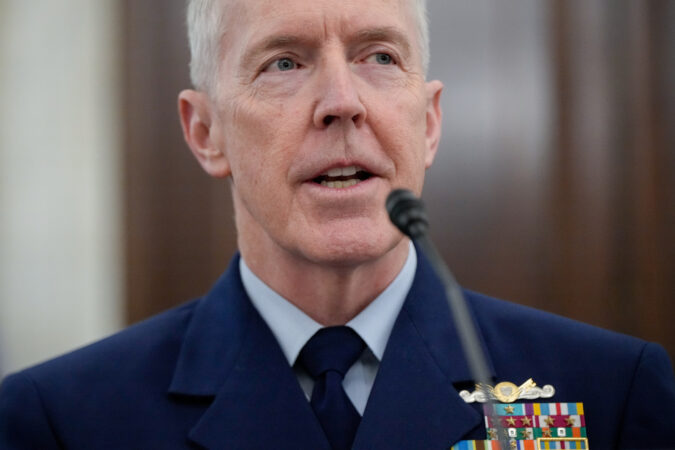
    Lunday has been the Coast Guard’s acting commandant for several months. He was elevated to the role after the Trump administration ousted his predecessor, Adm. Linda Fagan, citing among other things her “excessive focus” on “non-mission-critical” diversity and inclusion initiatives. The Senate is expected to hold Lunday’s confirmation vote later this week.

    The Coast Guard’s policy softening the definition of a swastika — an emblem of fascism and white supremacy inextricably linked to the Nazis’ extermination of millions of Jews and the deaths of more than 400,000 U.S. troops who died fighting in World War II — comes as antisemitism is on the rise globally. At least 15 people were killed over the weekend at a Hanukkah celebration in Australia.

    Deborah Lipstadt, a historian who served as President Joe Biden’s special envoy to monitor and combat antisemitism, said the Coast Guard’s decision to approve the change was “terrifying.”

    “What’s really disturbing is, at this moment, when there is a whitewashing of Nazis amongst some on the far right, and Churchill is painted as the devil incarnate when it comes to World War II, to take the swastika and call it ‘potentially divisive’ is hard to fathom,” Lipstadt said. “Most importantly, the swastika was the symbol hundreds of thousands of Americans fought and gave their lives to defeat. It is not ‘potentially divisive,’ it’s a hate symbol.”

    Citing court documents, Lipstadt noted that Unite the Right marchers in Charlottesville, Va., while planning a 2017 demonstration that left a woman dead and 19 others injured, had urged one another not to use swastikas “because it will paint us as Nazis.”

    “When far-right protesters in Charlottesville were strategic enough to recognize the swastika would do them no good and now we have an arm of the U.S. military saying, ‘It’s not so bad,’ that’s frightening,” Lipstadt said.

  • Robot smaller than grain of salt can ‘sense, think, and act’

    Robot smaller than grain of salt can ‘sense, think, and act’

    Solving a technical challenge that has stymied science for 40 years, researchers have built a robot with an onboard computer, sensors, and a motor, the whole assembly less than 1 millimeter in size — smaller than a grain of salt.

    The feat, accomplished by a partnership of researchers at University of Pennsylvania and University of Michigan, advances medicine toward a future that might see tiny robots sent into the human body to rewire damaged nerves, deliver medicines to precise areas, and determine the health of a patient’s cells without surgery.

    “It’s the first tiny robot to be able to sense, think, and act,” said Marc Miskin, assistant professor of electrical and systems engineering at University of Pennsylvania, and an author of a paper describing the work published this week in the journal Science Robotics.

    The device, billed as the world’s smallest robot able to make decisions for itself, represents a major step toward a goal once rooted in science fiction. In the 1960s, the story and movie Fantastic Voyage imagined a medical team placed aboard a submarine and shrunk to the size of a microbe. The microscopic medical crew was then injected into the body of a dying man in order to destroy an inoperable blood clot.

    “In the future, let’s say 100 years, anything a surgeon does today, we’d love to do with a robot,” said David Gracias, a professor in the department of chemical and biomolecular engineering at Johns Hopkins University who was not involved in the study. “We are not there yet.”

    In 1989, two decades after Fantastic Voyage, Rodney A. Brooks and Anita M. Flynn, scientists at the Massachusetts Institute of Technology, wrote a paper called, “Fast, Cheap, and Out of Control: A Robot Invasion of the Solar System,” that described a robot they’d built measuring just 1¼ cubic inches, dubbed Squirt.

    Sawyer Fuller, an associate professor of mechanical engineering at the University of Washington, said that when “Fast, Cheap, and Out of Control,” was published, “people thought microrobotics was coming any minute now. … Turns out it has taken a little longer than expected to put all these things together.”

    Fuller, who was not involved in building the new microrobot, called it “the vanguard of a new class of device.”

    Miskin said the microrobot built by the Michigan and Pennsylvania teams is about 1/100th the size of MIT’s Squirt but isn’t ready for biomedical use.

    “It would not surprise me if in 10 years, we would have real uses for this type of robot,” said David Blaauw, a co-author of the paper in Science Robotics and professor of electrical engineering and computer science at University of Michigan.

    For decades scientists have dreamed of building a microrobot less than 1 millimeter in size, a barrier that corresponds to the smallest units of our biology, Miskin said. “Every living thing is basically a giant composite of 100-micron robots, and if you think about that it’s quite profound that nature has singled out this one size as being how it wanted to organize life.”

    For comparison, a human hair has a diameter of about 70 microns, while human cells are about 20 to 40 microns across.

    Although scientists and engineers have been miniaturizing circuits for the last half-century, the challenge has been to shrink all of the parts needed for a computer-guided microrobot, then assemble them without damaging the parts or causing them to interfere with one another. The robot needs an energy source of sufficient power to operate the computer and move the robot.

    Five years ago, Miskin, whose specialty has been building microrobots, met Blaauw when the two gave back-to-back talks. Blaauw’s lab then held ― and still holds ― the distinction of having built the world’s smallest computer.

    “Even in the presentations we were like, ‘Oh, we need to talk to each other,’” Blaauw recalled.

    The device they built uses tiny solar cells that convert light into energy. Some of that energy powers the computer, and some propels the robot as it swims through liquid. The computer runs at about one-thousandth the speed of today’s laptops and has far less memory.

    In the lab, the scientists shone an LED light down into the lab dish that contained the robot in a solution. The robot is made of the same kinds of materials found in a microchip: silicon, platinum, and titanium.

    To protect it from the effects of fluids, the microrobot is encased in a thick layer of what is essentially glass, Miskin said. There are a few holes in the glass that are filled in with the metal platinum, forming the electrodes that provide electrical access.

    At Johns Hopkins, Gracias stressed that scientists need to ensure that the materials they use for microrobots can be safely used inside a human body.

    Sensors on the robot allow it to respond to different temperatures in liquid. To move, the device uses energy from the solar panels to charge two metal electrodes on either side of it. The electrodes attract oppositely charged particles in the water, generating a flow that pulls the robot along.

    As it swims, the robot communicates with the person operating it.

    “We can send messages down to it telling it what we want it to do,” using a laptop, Miskin said, “and it can send messages back up to us to tell us what it saw and what it was doing.”

    The robot communicates using movements inspired by the waggle dance honeybees use to communicate.

    During the summer, the scientists invited a group of high school students to come in and test the new microrobots. The students were able to track the movements of the robots using a special low-cost microscope.

    “They loved it,” said Miskin. “It was definitely a little bit challenging at first, just getting oriented to working with something that small. But that’s part of the appeal. Once they got the hang of it, they were all in.” Miskin said the version of the robot the students used cost only about $10.

    Researchers are working now to develop the microrobot so that it can work in saltwater, on land, and in other environments.

    The long-term vision, Blaauw said, is to design tiny computers that can not only talk back and forth to their operators.

    “So the next holy grail really is for them to communicate with each other,” he said.

  • He survived the Holocaust and exile only to die a hero in Australia attack

    He survived the Holocaust and exile only to die a hero in Australia attack

    SYDNEY, Australia — Alexander Kleytman was just a boy when he fled the Holocaust and then endured a harrowing train journey to Siberia, where years of starvation left him permanently hunched. He suffered decades of antisemitism in the Soviet Union but never stopped being “a proud Jew,” his daughter, Sabina, recalled Tuesday.

    It was that pride that took him every year to the Hanukkah celebration at Bondi Beach in Sydney, where he had brought his family to live in 1992.

    And it was that pride — that identity — that made him, his wife, and scores of other Jewish Australians the target of Sunday’s deadly antisemitic attack, in which the 87-year-old was killed while shielding his wife, Larisa, from a hail of bullets.

    “Dad died doing what he loved the most,” Sabina Kleytman said in a tearful interview. “Protecting my mother — he probably saved her life — and standing up and being a proud Jew: lighting the light, bringing the light to this world.”

    Fifteen people were killed Sunday when two gunmen, apparently motivated by Islamic State ideology, opened fire on the festive gathering. Among the dead were a 10-year-old girl who had been happily eating cake moments earlier, an assistant rabbi known for his positivity, and a 62-year-old man who threw bricks at one of the gunmen in a desperate attempt to defend his community.

    But perhaps no death reflects the shock of the attack here in Australia more than that of Kleytman, who survived the Holocaust and a childhood of hardship only to die in the country he considered a safe haven.

    “He lived a remarkable life,” his daughter said, “and he could have had another 10 years in him if it wasn’t for this horrendous atrocity.”

    Australia has a long Jewish history dating to the arrival of the First Fleet in 1788, said Andrew Markus, emeritus professor at Monash University in Melbourne and an expert on Jewish migration. But the biggest wave of Jewish immigrants came after World War II.

    “There were a lot of people who had the sense that Europe was the charnel house of the world after what had happened to them, so to get as far away as possible was one of the attractions of Australia,” he said.

    As in the Oct. 7, 2023, attack in Israel, which claimed some Holocaust survivors, there is a “tragic irony” in Kleytman’s death in a land that he and so many other Jews saw as their refuge, Markus said.

    In Australia, Kleytman became a collector of stories from Jews from the former Soviet Union, writing two books about them even as he resisted his family’s pleas to pen his own memoir.

    Still, snatches of that remarkable life filtered down in reluctantly told tales. He was born in 1938 in what is now Ukraine. When World War II broke out, he fled to Siberia with his parents and younger brother on a long and arduous journey with other evacuees.

    “They were on a train. There were bombs coming down. So many people died,” Sabina Kleytman said.

    Along the way, her father fell sick and had to be hospitalized. He was separated from his family and feared he would never see them again. But he managed to reunite with them and make it to Siberia, where they shared a tiny room.

    They had “very little food, almost no warmth,” his daughter said. Years of malnourishment and cramped conditions left her father partially deformed, she said.

    After the war, he was eventually able to move back to what is now Ukraine — then part of the Soviet Union — where he met Larisa, the daughter of Holocaust survivors. They had Sabina and her brother and built a life there, although they could not openly celebrate being Jewish, she said.

    In 1992, after the fall of the Soviet Union, Alexander Kleytman took his family to Australia. There, the civil engineer built a successful career for himself, contributing to major projects, including Sydney’s Olympic stadium. He helped build his newfound home.

    He reluctantly retired a decade ago, at 76, and immediately turned his mind toward writing books.

    “He didn’t want to write a book about himself,” Sabina Kleytman said with a laugh. “We did ask many times. He didn’t want to do it. He wanted to write books about the lives of Jews in the Soviet Union and the terrible things which we went through.”

    It was in Australia that her father could finally fully celebrate his Jewish pride, she said. But in the two years since the Oct. 7 attack in Israel, he began to worry that Australia was becoming less safe for Jews.

    On Sunday, he nonetheless went to the Hanukkah event on Bondi Beach with his wife.

    When the gunmen — identified as father and son Sajid Akram, 50, and Naveed Akram, 24 — opened fire on the festival, Kleytman covered his wife.

    Sabina Kleytman, who was supposed to go with her parents but could not attend, received a call from her cousin, telling her to call her mother because there was news of something bad happening in Bondi.

    “I called my mom, and she said, ‘Your dad is no more. Your dad’s just been killed,’” Sabina Kleytman recalled.

    “I couldn’t stop screaming because this is not what you expect,” she said. “You go to a joyful family cultural event with hundreds of people, a peaceful family event where we sing, have some doughnuts, and dance. Everybody brings their kids.”

    “After that, it’s been a nightmare that I cannot wake up from still,” she said, sobbing.

    Part of the pain for the victims’ families is the ongoing struggle to receive their loved ones’ bodies, which, according to Jewish custom, need to be buried as soon as possible. That tradition has run up against a complex crime-scene investigation.

    In the meantime, Sabina Kleytman said, she is trying to take solace in the “outpouring of love” her family has received and the memories of a joyous and kind man: a youth chess champion who taught her to read at age 3 and spent countless hours playing table tennis with her and her brother in their Ukraine apartment; a grandfather of 11 who taught his family to be proud of their Judaism and was looking forward to lighting the first Hanukkah candle with them — only to never get the chance.

    “He never stopped being a proud Jew,” she said. “Never. Not in Ukraine, and he had absolutely no plans to stop here in Australia. And apparently he paid with his life for it.”

  • New clues about long COVID’s cause could unlock treatments

    New clues about long COVID’s cause could unlock treatments

    Why some people experience long-lasting physical and mental effects from COVID-19 could be linked to chronic inflammation, according to new research that experts say could help develop new treatments for the confounding condition that continues to afflict millions.

    Some early research on the condition has suggested that long COVID’s symptoms linger because the virus persists in people’s bodies. But the new study published Friday in Nature Immunology found that people with long COVID had activated immune defenses and heightened inflammatory responses for more than six months after initial infection compared with those who fully recovered.

    The latest research “leads to a hypothesis that there might be therapeutic targets related to inflammation that might be worth exploring in clinical studies,” said Dan Barouch, the study’s lead author and director of the Center for Virology and Vaccine Research at Beth Israel Deaconess Medical Center.

    The study’s findings signal progress in understanding a condition that is estimated to affect more than 400 million individuals around the world as the coronavirus continues to infect people every day, said Ziyad Al-Aly, a clinical epidemiologist at Washington University in St. Louis who studies long COVID. There are no drugs approved for treatment of long COVID, leaving doctors to tackle individual symptoms with various therapies.

    “This is one piece of the puzzle,” said Al-Aly, who was not involved in the new study. “It’s eye-opening in the sense that it gives us more information that these pathways seem to be upregulated or activated in people with long COVID.”

    What does the new research mean?

    Anyone, regardless of their age or severity of their original symptoms, can develop long COVID, though some people have a higher risk, according to the World Health Organization. People have reported a constellation of symptoms, as many as 200 different ones, including brain fog, fatigue, dizziness, gastrointestinal problems, heart palpitations, and issues with sexual desire. The effects can be present four or more weeks after infection with SARS-CoV-2 and can last weeks, months, or even years.

    Researchers studied people during the early years of the pandemic from 2020 to 2021 as well as another cohort between 2023 and 2024. The 180 participants included people who were healthy, people infected with the coronavirus but recovered fully, and people with long COVID. Scientists analyzed protein levels, gene expression levels, immune responses, and viral measurements to see if there were differences between people who went on to develop lingering symptoms.

    Across both groups, the researchers saw multiple inflammatory pathways — how the body responds when it is injured or fighting infection — were triggered and stayed activated in people with long COVID.

    “We would speculate that the initial COVID infection triggered chronic inflammation in the host and that it’s probably not the only factor, but probably one of the factors that was associated with long COVID afterward,” Barouch said. He noted that while the researchers did not have access to data before patients were infected, they had “no reason to suspect” that those people already had chronic inflammation.

    Barouch said the findings of his study were limited, in part, by a small group of participants. While the researchers documented similar observations between both groups, which suggests that the findings could be generalized, he noted the need for larger studies of more diverse populations followed over a period of time.

    Based on the study’s data, Barouch said he started a clinical trial to test an anti-inflammatory drug that is typically used to treat eczema which targets one of these pathways. The trial has enrolled 45 participants and is ongoing, he said.

    A randomized trial of a drug commonly used to treat gout that reduces inflammation found that the medication did not help people with long COVID. This medication targets inflammation in a different way than the anti-inflammatory therapies Barouch said he and his team are studying.

    He also cautioned that more research needs to be done. Questions still remain, he said, about whether using a drug on one pathway is enough to treat long COVID when multiple pathways are activated.

    “But I do think that in the broader sense, identification of chronic inflammation as associated with long COVID will lead to therapeutic strategies that include anti-inflammatory drugs,” he added.

    What’s the latest on treatments?

    Understanding the biological causes of long COVID is critical for developing treatments, Barouch and other experts said.

    Because some research has suggested that the coronavirus could be lingering in people with long COVID, there have been studies of the antiviral Paxlovid, which is used to treat acute COVID infections. At least two initial studies using the drug for long COVID treatment showed no therapeutic efficacy, but other research is ongoing.

    Barouch emphasized that his research doesn’t contradict any existing theories, but adds data that can be used to support more studies of other therapies.

    The new study marks a welcome shift toward more investigation of alternative treatments, said Alba Azola, a rehabilitation physician and the co-director of the Long COVID/Chronic Fatigue Syndrome Clinic at Johns Hopkins Medicine.

    “For too long in the field of long COVID a lot of attention has gone to viral persistence and viral specific kind of interventions,” said Azola, who was not involved in the latest research. “It’s important to look at, but also not the only pathway.”

    Long COVID could have different biological pathways and responses to treatments.

    “If we can get to a place where we can potentially find specific biologics that are going to be effective against the pathways that we’re seeing in common, that may give us a bigger gun to target more of those symptoms that are presenting,” Azola said.

  • Pentagon plan calls for major power shifts within U.S. military

    Pentagon plan calls for major power shifts within U.S. military

    Senior Pentagon officials are preparing a plan to downgrade several of the U.S. military’s major headquarters and shift the balance of power among its top generals, in a major consolidation sought by Defense Secretary Pete Hegseth, people familiar with the matter said.

    If adopted, the plan would usher in some of the most significant changes at the military’s highest ranks in decades, in part following through on Hegseth’s promise to break the status quo and slash the number of four-star generals in the military. It would reduce in prominence the headquarters of U.S. Central Command, U.S. European Command, and U.S. Africa Command by placing them under the control of a new organization known as U.S. International Command, according to five people familiar with the matter.

    Joint Chiefs Chairman Dan Caine is expected to detail the proposal, which had not previously been reported, for Hegseth in the coming days. Such moves would complement other efforts by the administration to shift resources from the Middle East and Europe and focus foremost on expanding military operations in the Western Hemisphere, these people said. Like others interviewed for this report, they spoke on the condition of anonymity to discuss the effort before it is conveyed to the secretary.

    Hegseth’s team said in a statement that it would not comment on “rumored internal discussions” or “pre-decisional matters.” Any insinuation that there is a divide among officials over the issue is “completely false — everyone in the Department is working to achieve the same goal under this administration,” the statement said.

    The Pentagon has shared few, if any, details with Congress, a lack of communication that has perturbed members of the Republican-led Senate and House Armed Services Committees, according to two people familiar with how the panels have prepared for the proposal. Top officers at the commands involved are awaiting more details as well, officials said.

    The plan also calls for realigning U.S. Southern Command and U.S. Northern Command, which oversee military operations throughout the Western Hemisphere, under a new headquarters to be known as U.S. Americas Command, or Americom, people familiar with the matter said. That concept was reported earlier this year by NBC News.

    Pentagon officials also discussed creating a U.S. Arctic Command that would report to Americom, but that idea appears to have been abandoned, people familiar with the matter said.

    Combined, the moves would reduce the number of top military headquarters — known as combatant commands — from 11 to eight while cutting the number of four-star generals and admirals who report directly to Hegseth. Other remaining combatant commands would be U.S. Indo-Pacific Command, U.S. Cyber Command, U.S. Special Operations Command, U.S. Space Command, U.S. Strategic Command, and U.S. Transportation Command.

    Those familiar with the plan said it aligns with the Trump administration’s national security strategy, released this month, which declares that the “days of the United States propping up the entire world order like Atlas are over.”

    The proposal was organized by the Pentagon’s Joint Staff under the supervision of Caine, and is due to be shared with Hegseth as soon as this week as the preferred course of action among senior military officials. It grew from a request made by Hegseth in the spring to look for ways to improve how troops are commanded and controlled, a senior defense official familiar with the discussion said, adding that Hegseth has kept in touch with Caine about the issue over the last several months.

    Any changes would need the approval of Hegseth and President Donald Trump. The moves would come in the Pentagon’s Unified Command Plan, which lays out the roles of the military’s major headquarters.

    Lawmakers have taken the extraordinary step of requiring the Pentagon to submit a detailed blueprint that describes the realignment’s potential costs and impacts on America’s alliances. The measure, included in Congress’ annual defense policy bill, would withhold money to enact the effort until at least 60 days after the Pentagon provides lawmakers with those materials.

    The bill has cleared the House and is expected to pass the Senate this week.

    The senior defense official said the proposed realignment is meant to speed decision-making and adaptation among military commanders. “Decay” had been observed in how the U.S. military commands and controls troops, he added, suggesting that the need for sweeping change is urgent.

    “Time ain’t on our side, man,” the senior defense official said, describing internal conversations around the plan. “The saying here is, ‘If not us, who, and if not now, when?’”

    The potential reorganization comes as Hegseth has begun broader efforts to cull the number of generals and admirals across the military. He also has fired or otherwise forced out more than 20 senior officers, threatened others with polygraph tests to determine whether they have leaked information to the news media, and told those remaining that if they do not like the administration’s policies they should “do the honorable thing and resign.”

    Chuck Hagel, who served as defense secretary during the Obama administration and as a Republican member of the Senate before that, expressed concerns about the Trump administration’s ambitions. There are different dynamics, needs, and security threats throughout the globe, he said.

    “The world isn’t getting any less complicated,” Hagel said in an interview. “You want commands that have the capability of heading off problems before they become big problems, and I think you lose some of that when you unify or consolidate too many.”

    Senior military officials considered about two dozen other concepts, the senior defense official said. At least one discussion called for a reduction to six total combatant commands. Under that plan, Special Operations Command, Space Command, and Cyber Command would be downgraded and placed under the control of a new U.S. Global Command, said other officials familiar with the discussion.

    Caine is expected to share at least two other courses of action with Hegseth, people familiar with the matter said. One concept calls for creating two commands to house all of the others, with all major geographic organizations such as Central Command and European Command placed under the control of an entity that would be called Operational Command. Other major headquarters, such as Transportation Command and Space Command, would fall under an organization called Support Command.

    One proposal suggested the creation of a new headquarters unit, Joint Task Force War, to be based at the Pentagon. It would focus on planning and strategy when the United States was not at war, and be capable of controlling forces anywhere in the world when there was a conflict, people familiar with the matter said.

    The idea didn’t “test well” in exercises with military officials and appears unlikely to be adopted, the senior defense official said. Top military officials expressed concerns that such an organization would not possess the same regional expertise and relationships inherent to the military’s current construct.

    Even if you have “some of your best people” in such a task force, the senior official said, “you don’t have a fingertip feel” for what is occurring in a region. A second official said it seemed “very confusing” to have top commanders in a region prepare for a conflict there, only to hand those plans over to another commander when something occurred.

    Another plan sought to reorganize the military by domain, with operations organized and led by whether they occurred on land or in air, sea, space, or cyberspace, people familiar with the matter said. The idea had supporters in the Space Force but had few other proponents, people familiar with the matter said. It also limited the Marine Corps’ influence, with it falling under the control of the Navy Department even as the other branches of service were elevated.

    Military officials involved in the reorganization effort also considered whether to elevate the chairman’s role to allow him to command forces, rather than serving as the senior military adviser to both the president and the defense secretary. That could have occurred through the Joint Task Force War framework, two officials said, but the concept seemed murky.

    The idea also could have been complicated by the Goldwater-Nichols Act of 1986, landmark legislation that reorganized the military and defined the chairman’s role. Under the law, the chairman is considered the “principal” military adviser to the president, the defense secretary, and other senior officials. Operations are controlled through a chain of command that runs from combatant commanders to the defense secretary and then to the president.

  • The stocks to watch when the Supreme Court rules on Trump’s tariffs

    An upcoming U.S. Supreme Court ruling on the legality of the sweeping tariffs that President Donald Trump rolled out in April — briefly sending markets worldwide into a tailspin — could be the next test for stocks that have been flying high.

    The S&P 500 Index has since rallied 39% from the lows hit that month. It closed at a record high Thursday, in part because tariffs have settled lower than Trump’s highest threats, while support has come from an artificial-intelligence investment boom and a U.S. economy that has kept expanding fast enough to throw off record corporate profits.

    If the nation’s top court says Trump exceeded his authority with the blanket tariffs on countries around the globe, there will still be significant uncertainty. The White House could use other laws to reimpose some new levies, for example. Bond traders could push up yields over worries about the deficit, and that concern could spread into the equity market.

    A ruling this year is increasingly unlikely. The court held its last scheduled public session of the year on Wednesday and isn’t scheduled to sit again until Jan. 9. The court’s standard practice is to issue decisions in argued cases from the bench, generally a day or more after making a public announcement that opinions are likely.

    But when a decision does come, market participants say the initial reaction, at least, would likely be positive for stocks should the court strike down the tariffs. A ruling upholding the tariffs would likely have the opposite effect.

    There are a few reasons why. Striking down the tariffs would eliminate a tax that many businesses haven’t completely passed along to customers, resulting in a drag on the bottom line. Refunds on what they’ve already paid could provide a windfall. And consumer spending may get a boost, too, given that Democrats in Congress estimate tariffs have cost the average American family some $1,200 over the past 10 months.

    Overall, a ruling against the tariffs would boost the earnings of companies in the S&P 500 Index, before interest and taxes, by 2.4% in 2026 compared to current-year levels, Wells Fargo & Co. chief equity strategist Ohsung Kwon estimated in October.

    “That’s good for the market generally, because they look at tariffs as a tax,” said James St. Aubin, chief investment officer at Ocean Park Asset Management. “This will be a catalyst for a little bit of a rally.”

    Some companies, and their stocks, stand to benefit more than others. The tariffs have been particularly painful for those that are heavily dependent on imported goods, such as apparel companies and toymakers. Financial firms, for their part, stand to benefit from a more confident or flush consumer.

    “On the flip side,” said Haris Khurshid, chief investment officer at Karobaar Capital, “materials, commodities, and domestic producers that benefited from protectionism might lag a bit.”

    Here’s a look at some of the sectors and companies with the most at stake when the decision does come.

    Consumer

    Clothing and toy companies — both heavily dependent on imports from China and other Asian countries targeted with some of the highest tariffs — are seen as clear winners, according to Bloomberg Intelligence. Nike Inc. and Mattel Inc. are potential standouts.

    Others include Deckers Outdoor Corp., Under Armour Inc., Crocs Inc., and American Eagle Outfitters Inc., all of which have struggled with tariff-related uncertainty. Home furnishing stocks have been volatile too, including Wayfair Inc., Williams-Sonoma Inc., and RH.

    Texas Capital’s Eric Wold singled out some potential winners among the leisure-related companies he follows: boat-maker Brunswick Corp., toymaker Funko Inc., and Topgolf Callaway Brands Corp.

    Industrials

    Industrial manufacturing giants Caterpillar Inc. and Deere & Co. are among the firms set to benefit the most from tariff refunds, according to Wells Fargo’s Kwon. Stanley Black & Decker Inc., Fortive Corp., and Lennox International Inc. also make the list.

    Shares of automakers General Motors Co. and Ford Motor Co. advanced during the Supreme Court hearing last month, when the justices’ skepticism about the administration’s arguments increased market speculation that the tariffs would be struck down. While the case doesn’t affect the industry-specific tariff on automakers, they stand to gain from a stronger consumer.

    Investment firm Hedgeye also sees positive implications for transport stocks, expecting a boost if the tariffs are struck down and importers move to snap up inventory before any new ones are imposed. That could benefit United Parcel Service Inc., FedEx Corp., and trucking companies.

    Financials

    Major banks such as JPMorgan Chase & Co. and Goldman Sachs Group Inc. faced volatility earlier this year, alongside private equity giants like Blackstone Inc., amid concerns that Trump’s trade war will slow economic activity. Financial-technology companies such as Affirm Holdings Inc. and Block Inc. are prone to big swings, as are stocks linked to cryptocurrencies.

    Lower tariffs may ease pressure on U.S. consumers and support the broader economy. If inflation expectations move lower, it’ll also support the case for more rate cuts by the Federal Reserve, Clear Street analyst Owen Lau said.

    Lower interest rates encourage “loan growth, refinancing, stronger equities markets, and even higher consumer spending,” Lau said, “which will fundamentally benefit financial stocks in general.”

  • Trump’s library plan: An iconic building in Miami and a ‘fake news wing’

    Trump’s library plan: An iconic building in Miami and a ‘fake news wing’

    Eric Trump sounded triumphant after Florida officials recently approved giving away a prized piece of Miami real estate for his father’s presidential library. “I got the library approved yesterday,” Trump said on a podcast, adding that “we just got the greatest site in Florida and I’m going to be building that.”

    Then, speaking on another program, Trump said he would take the host’s suggestion to create a “fake news wing” — paid for with money from lawsuit settlements with ABC, CBS, and other sources. It would run clips from 60 Minutes and other programs that he said were evidence of the media organizations’ animus against his father.

    These little-noticed statements by the president’s son provide a revealing look into the zeal of President Donald Trump and his family to build a likely high-rise with a museum that they say will be unlike any other presidential library — and which could tell the story of his presidency only as he wants it to be told.

    Much about the process is secretive, with no federal rules requiring disclosure of the donors — some of whom may have interests affected by White House policy — who are expected to provide hundreds of millions of dollars. A recent filing, for example, says the Donald J. Trump Library Foundation raised $50 million this year but doesn’t provide any donor names. It says $6 million has been spent for “program services” but doesn’t provide specifics.

    The White House referred questions to the foundation, which did not respond to an emailed list of queries and has not said whether Trump might use some of the site for a hotel or other development.

    It is also unclear whether the Trump library will function as the name implies — providing a center for research of presidential papers — or whether museum exhibits would be reviewed by government historians. Trump might follow the example of former President Barack Obama, who created a private foundation that is building his Chicago center where the museum exhibits will not be subject to government review.

    Running a center under the Obama model would require huge sums of money, which might be why Trump’s strategy of using money from lawsuits against media companies and many other sources has become a crucial component.

    Trump hasn’t said whether he will follow Obama’s example, but if he does, experts said, he would be free to tell his own version of his presidencies — including his false assertion that the 2020 election was stolen. That would be in contrast, for example, to the library of former President Richard M. Nixon, where the National Archives created an exhibit on Watergate that was vetted by nonpartisan government historians but is decried by some Nixon supporters.

    Tim Naftali, who helped create that Watergate exhibit in his former role as the National Archives-appointed director of the Nixon library, said he is concerned that Trump could create a museum that tells a misleading story about his presidency without oversight.

    “If they are going to have a ‘fake news wing,’ it would be awfully hard for nonpartisan library professionals at the National Archives to swallow,” said Naftali, now a senior research fellow at Columbia University’s School of International and Public Affairs.

    But if Trump follows the Obama model, the National Archives would be powerless to object, he said. The archives would still control the presidential papers, which belong to the federal government and would gradually be made available online after undergoing review for classified material.

    That model will become clearer once the Obama Presidential Center, as it is called, opens in June. Asked how Obama’s center will tell his story, a spokesperson said in a statement that Obama and his foundation consulted with leading independent historians and “take the study of history and the U.S. Constitution seriously, and these values are reflected in the work at the center — and in particular, the Museum.”

    But Curt Smith, a former speechwriter for President George H.W. Bush who wrote a book on presidential libraries, said in an interview that the Obama model “is a terrible example to follow” because it allows a former president to write whatever script they choose. “I would be truly alarmed if the Trump library followed that model,” he said.

    There is no law requiring the construction of a presidential library; with or without it, presidential papers and artifacts are the property of the federal government and controlled by the National Archives. Indeed, after Trump’s first term, he did not establish such a center. When Trump took some classified presidential papers to Mar-a-Largo in Palm Beach, Fla., he was charged with willful retention of national defense secrets. The case was dismissed.

    From the earliest days of his second administration, however, Trump has focused on raising millions of dollars for his center, while Eric Trump focused on gaining land for the project. Once President Trump decided to build his center, he had no choice other than to raise private funds because Congress does not provide taxpayer money for construction.

    The rules say not only that the construction funds be privately raised, but also that an additional 60% of that cost be provided as an endowment if the government maintains the facility. That requirement was enacted because the National Archives is spending $91 million annually to cover expenses of most earlier presidential libraries, almost one-fourth of its congressional budget. As a result, the Archives has been negotiating deals that would transfer much of that cost to foundations.

    “Today, preserving the presidential library system requires acknowledging these facts and addressing mounting expenditures across the system,” Jim Byron, senior adviser to the archivist of the National Archives, said in a statement to the Washington Post.

    If Trump keeps his center private, as is widely expected, his foundation would be responsible for maintenance and would not cede control of the museum to the National Archives — saving taxpayer money while enabling him to write his own story.

    That has led to the current situation in which Trump is raising funds from the settlement of lawsuits against the media and other sources.

    “We gave away very valuable land”

    On Sept. 16, a vague ad appeared in the Miami Herald announcing that Miami Dade College would hold a public hearing to “discuss potential real estate transactions.” There was no indication that a 2.6-acre property in downtown Miami — which is appraised at about $60 million but which real estate brokers have said could be worth $300 million or more — was about to be donated to Trump’s library foundation.

    Seven days later, at 8 a.m. Sept. 23, the meeting of the college board of trustees convened. Chairman Michael Bileca called for approval of Agenda Item A, a proposal to convey an unnamed piece of property to an entity known as the “Internal Trust Fund of the State of Florida.” Again, there was no mention of land being given for a Trump library. Bileca opened the floor for discussion; there was none. The motion was passed unanimously by the seven members. Bileca did not respond to a request for comment.

    At exactly 8:03 a.m., according to board minutes, the meeting adjourned and the deal was done.

    Gov. Ron DeSantis and his cabinet then announced they had agreed to give the land to the Trump library foundation. The only requirement is that construction begins within five years and that it “contains components of a Presidential library, museum, and/or center.”

    The secretive deal took many people by surprise — including at least some members of the college board of trustees — and caused an uproar among critics.

    Roberto Alonso, vice chair of the Miami Dade College board of trustees, said the governor’s office sent a letter to the college asking for the land transfer to the state, without explaining why.

    “When I found out that this was exactly what the state wanted was literally right after we voted,” Alonso said.

    Alonso said because Miami Dade is a state college, the land is owned by the state, so his board had little choice but to do what DeSantis wanted and convey the deed.

    He called the library an “incredible opportunity for our students and our community.” The college did not respond to a request for comment.

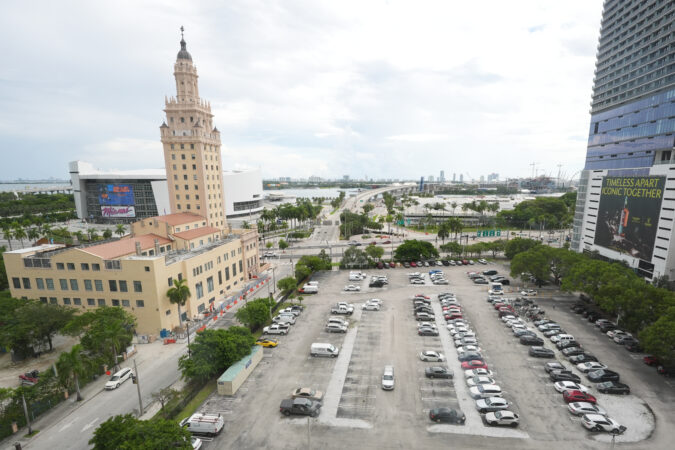
    The property is a parking lot on the downtown campus of the college. It’s next to the Freedom Tower, an iconic and recently restored landmark on Biscayne Boulevard often referred to as the “Ellis Island of the South.”

    The plan drew immediate backlash from many in the Cuban community who said Trump’s immigration policies contrast with the treatment their families received under previous administrations.

    The college board’s approval also became the target of a lawsuit filed by Miami historian Marvin Dunn, who said the vague notice about the action violated state government Sunshine Laws. The judge in the case set a trial date for next year, but the trustees held a second vote Dec. 2, this time with input from the public, that ended in the same result — a unanimous vote.

    Dunn’s lawyer, Richard E. Brodsky, said in an interview the lawsuit has succeeded in gaining a temporary injunction that prevents the conveyance of the land pending a further order of the court.

    “It’s not over yet,” Brodsky said.

    Miami mayor-elect Eileen Higgins — the first Democrat to win the office in almost 30 years — said before Tuesday’s election that she had questions about the deal.

    “We gave away very valuable land to a billionaire for free. That doesn’t make sense to me,” she said during a televised debate this month.

    Dunn said Eric Trump’s statement that the library will be an “iconic building” raises the alarming prospect of “a 47-story condominium hotel banquet hall” or other oversize structure.

    “If the argument is that this library is going to bring tourism and economic development to the wider region, that may well be true,” Dunn said in an interview. “Then why doesn’t the foundation pay for the land? Why give that to them for free?”

    DeSantis said in September that “we had worked and negotiated” other possible locations for the library, including at Florida Atlantic University in Boca Raton, which is in Palm Beach County about 30 miles from Mar-a-Lago.

    “But their preference was for this land, next to the Freedom Tower. So you’re going to have a presidential library in the state of Florida, which I think is good for the state of Florida. I think it’s good for the city of Miami,” he said.

    “A possible tool for corruption and bribery”

    While the state filing by Trump’s library foundation doesn’t disclose funding sources, President Trump has spoken often about some of them. The largest projected donation is a gift of a Boeing 747-8 aircraft valued at $400 million from the Qatari royal family — which has many interests in Washington policy — that would replace Air Force One and then be given to his library. It is not clear how or whether the plane could be exhibited at the Trump library as Ronald Reagan’s Air Force One is exhibited at his library in California.

    Other funds for the library stem from payments from media companies — some of which have interests before the government — to settle lawsuits filed against them by Trump. These include: $22 million from Meta Platforms, Facebook’s parent company, part of a settlement to resolve a lawsuit over the company’s suspension of Trump from the platform in the wake of the events of Jan. 6; $16 million from CBS; $15 million from ABC; and an unspecified part of a $10 million settlement with X, formerly known as Twitter, which had banned him from the platform. In addition, millions of dollars raised from private interests left from Trump’s inauguration may be transferred to the library foundation.

    These gifts and payments, and the potential of hundreds of millions more from unknown donors, have led Democrats to introduce the Presidential Library Anti-Corruption Act, which would ban fundraising until after a president leaves office, except from nonprofits. It would require a two-year delay after a president leaves before donations can be accepted from foreign nationals or foreign government, lobbyists, individuals seeking pardons, and federal contractors.

    Sen. Elizabeth Warren (D., Mass.) issued a report in support of the legislation that said Trump “may be using his future presidential library as a possible tool for corruption and bribery while still in office.” The report then listed donations intended for Trump’s library. Warren was unavailable for an interview, an aide said.

    Presidential libraries are seen as a crucial pillar for portraying the history of White House occupants and making their materials widely available. They have proven invaluable to historians and others seeking to piece together the strands of a presidency that often become clearer in hindsight; author Robert Caro used materials at Lyndon B. Johnson’s presidential library in Texas for his prizewinning multivolume biography.

    But in recent years, historians have raised concerns that presidential libraries have focused more on hagiography than clear-eyed biography — particularly as increasingly large sums have come from private donors, including those who have interests before the federal government and who favor a particular storyline about a president.

    Obama’s center, backed by a $1.6 billion fundraising effort, is being built on a 19-acre site that will be run by his foundation. It is not designed to include on-site research materials, which are being digitized with the help of a $5 million payment from the foundation and will be retained by the National Archives, a foundation spokesperson said.

    Former President Joe Biden, meanwhile, is at the beginning of his effort. While he said the library would be in Delaware, he has not provided specifics and has not announced any donation of land. A tax filing says $4 million was raised for Biden’s library in 2024. A Biden spokesperson, who spoke on the condition of anonymity to discuss internal matters, said a board has been named and that a foundation is focused on creating a planning study and a budget for the facility. Biden plans to attend a holiday gathering today at which he will lay out his vision for his library, but it will not be a fundraiser, an associate said.

    Trump and his family, meanwhile, have been aggressive in gathering land and money for his center while he is in office. After the state authorized the land transfer, Eric Trump went on conservative commentator Glenn Beck’s show to say that he was responsible for the approval and would build his father’s facility, while ridiculing the Obama center, which he said looked like a “jailhouse.”

    Then, appearing on a podcast called The Benny Show, Eric Trump said he would take host Benny Johnson’s suggestion to create a “fake news wing of the library” — paid for with money from settlements with ABC, CBS, and other media — which would run clips that he said were evidence of the media’s animus against his father.

    “What we’ll do is, we’ll just roll the 60 Minutes clip over and over of how they doctored Kamala’s interview,” Trump said, referring to his father’s assertion that the newsmagazine show deceptively edited its interview of Democratic presidential candidate Kamala Harris. Trump said creating such a wing “is a phenomenal freaking idea” and vowed, “I will do an entire floor dedicated to the fake news.”

    CBS said in October 2024 that the Harris interview was edited for time but stood by its accuracy. Paramount, the parent company of CBS, which produces 60 Minutes, settled the suit for $16 million in July; that agreement did not include an apology, according to a story posted on the CBS website. The payment was designated for Donald Trump’s library foundation. It came as Paramount was attempting to complete an $8 billion sale to Skydance Media, a deal that required FCC approval.

    Shortly afterward, in July, the agency assented to the deal. A Paramount spokesperson did not respond to a request for comment.

  • Higher costs push holiday shoppers toward socks, coffee, and diapers

    Higher costs push holiday shoppers toward socks, coffee, and diapers

    Shirley Spillane’s holiday shopping list is decidedly no-frills this year: cutting boards, coffee, and socks.

    The Los Angeles-based school counselor used to spend big for Christmas. But this year, with stubbornly high prices, rent, and utilities, as well as a 6-month-old baby, she’s paring back. Spillane is buying a car duster for her husband and jam for her aunt — all within her $200 budget, made up almost entirely of gifts she can pick up grocery shopping at Sam’s Club.

    “This season looks different than usual,” the 26-year-old said. “With the economy the way it is and a new baby, we’re keeping it small.”

    Across the country, Americans are putting a practical spin on holiday shopping. Another year of stubborn inflation and new tariffs that have lifted the prices of appliances, shoes, and toys has led many families to think twice about what they’re buying, and why. Early holiday spending data shows people are scooping up more necessities like appliances, clothing, and furniture than they did last year.

    On Cyber Monday alone, online sales of refrigerators and freezers rose 1,700% from average levels in October, according to data from Adobe Analytics. Other run-of-the-mill products in high demand included vacuum cleaners (up 1,300%), small kitchen appliances (up 1,250%), cookware (up 950%), power tools (up 900%), and jackets (up 850%).

    “These are items that are, in many instances, absolutely essential,” said Vivek Pandya, director of Adobe Digital Insights. “Consumers are cognizant of the broad environment and they’re being very strategic about purchases, whether it’s for themselves or gift-giving.”

    While inflation has risen modestly this year, five years of price increases have led to deepening dissatisfaction with how much things cost. That sentiment helped cement political wins last month for Democrats in Virginia, New York, and New Jersey and spurred President Trump to kick off an “affordability tour” touting what his administration has done for the economy. “Our prices are coming down tremendously from the highest prices in the history of our country,” he said at a Pennsylvania casino last week.

    But in interviews with nearly a dozen shoppers around the country, the Washington Post found that almost all of them said they had become more strategic about their holiday shopping this year. They were looking for discounts and comparing prices. Many were buying fewer gifts, and for fewer people.

    Some parents, like Meghan Orr in Austin, said they’d begun wrapping everyday items like diapers and baby shampoo to fill the space under their Christmas trees. “At this point we’re just being silly, but it’s fun to unwrap things.”

    When it came to their own wish lists, several said they wanted to do away with gifting conventions and ask family for help paying the bills — though very few thought the approach would work.

    Alecia Bencze, director of career services for a law school in Akron, Ohio, has had a good year financially. Still, she’s spending about half of the $1,000 she usually does on Christmas gifts, and is sticking to items she knows will come in handy: golf balls for her father, a barbecue set for her brother, and shoes for her sister-in-law. Her own wish list includes a skillet and measuring cups.

    “I’m not feeling the pinch as much as other people are, but this is the least I’ve ever spent on Christmas,” Bencze, 35, said. “I just went through and got one thing from each person’s list.”

    Early holiday shopping data shows a discernible shift in spending patterns, with lower- and middle-income Americans pulling back, and the wealthy trading down from luxury stores to lower-priced retailers. Although Black Friday sales were unexpectedly strong, those gains were largely concentrated at discounters, dollar stores, off-price department stores, and online marketplaces such as Amazon and eBay, according to Consumer Edge, which tracks transactions from more than 100 million credit and debit cards. The firm’s data showed that purchases between Black Friday and Cyber Monday tumbled 10% at high-end department stores, while luxury clothing brands saw a 5% decline from the same period last year, as even the most well-off looked for deals.

    At Twiggy, a small business that sells tote bags and other gifts in Oahu, Hawaii, more customers are veering toward everyday items like kitchen towels, reusable snack bags, and sticky notes this holiday season, owner Jessica Leong-Thomas said.

    “It started during the government shutdown, when people became hesitant to buy frivolously,” she said. “Since then I’ve seen a real shift. People come in and say, ‘I want to buy something that will be useful.’” (Leong-Thomas understands the impulse: “Personally, what I want for Christmas is for someone to buy me toilet paper and dish soap,” she said.)

    When they do shop, data shows Americans are increasingly turning to off-price retailers such as TJ Maxx, and warehouse discounters such as Costco and Sam’s Club, for discounts on basic items, according to Mary Brett Whitfield, senior vice president for shopper insights at the data analytics firm Kantar. Overall, she said, Americans appear to be spending more than they did last year, but on fewer items.

    “You look at what’s happening with prices, tariffs, and other inflationary pressures, and it definitely seems like people have a more practical mindset,” she said. “I see it with my own adult children: One of them asked for socks.”

    In all, holiday sales are expected to grow about 4% this year, slightly less than last year’s 4.3% increase and a notable slowdown from 13% growth in 2021, according to the National Retail Federation.

    When JoEllen Barnes’s refrigerator broke down in mid-November, she and her family made do until they could scoop up a discounted replacement on Black Friday. With food and utility costs up this year, the mother of two says it’s been tougher to cover everyday costs. Instead of splurging on a Nintendo Switch for her sons like she did last year, she’s been scouring neighborhood Facebook groups for lightly used toys.

    “I usually ask my husband for jewelry but that doesn’t feel appropriate now, given the extra cost of things,” said Barnes, a 43-year-old educator in Charlotte. Instead of their usual wish lists, they’re sticking to the utilitarian this year. She got him a discounted iPad on Black Friday; he’s already bought her gift too, though she doesn’t know what it is.

    “Part of me is like, ‘Please don’t let it be an appliance or pots,’” Barnes said. “Although, well, it would be nice to get new pots.”