Three of the five Di Bruno Bros. locations will close in the coming weeks, the specialty grocery chain’s owner confirmed to The Inquirer.
Maureen Gillespie, a spokesperson for Wakefern Food Corp., the New Jersey-based supermarket cooperative that acquired the Di Bruno’s brand in 2024, said closing dates were not available.
Employees at the Ardmore Farmer’s Market location, which opened in 2011 at Suburban Square, said they were told that its last day would be Feb. 4. Staff at the locations in Wayne, which opened in 2021 in Strafford Shopping Center, and at the Franklin Residences on Ninth Street in Center City, which opened in 2013, said they were notified Wednesday that those stores would shut down Feb. 11.
Di Bruno’s original location on Ninth Street in South Philadelphia and the two-level store at 18th and Chestnut Streets will remain.
In a statement, Gillespie said the company was “refocusing” Di Bruno’s market strategy on “the heart of the brand”: its Italian Market and Rittenhouse locations and “growing online business.” Concentrating on the two flagship stores and online business will be “a positive reset that allows us to preserve and elevate the in‑store tradition while growing the brand’s reach in meaningful new ways,” Gillespie said.
Jobs will be offered to every retail employee, said a Sandy Brown, executive vice president of Di Bruno’s parent company, Brown’s Super Stores, the regional grocery chain founded by her husband. The news follows this week’s announcement that Amazon Fresh stores would close, putting about 1,000 people out of work at the six Philadelphia-area stores.
The three affected stores share the same core Di Bruno’s DNA: cheese, charcuterie, and specialty groceries. The Ardmore Farmer’s Market location is the most “grab-and-go”: a compact counter where bagels and schmear, coffee, and quick bites sit alongside the cheese-and-cured-meat staples. Wayne is more of a full-on neighborhood market with the familiar cheese and charcuterie counters plus a cafe, Roman-style pizza, and an on-site bar for wines and small plates. The outpost at the Franklin, 834 Chestnut St., is the most Center City-practical and office-friendly. It has a coffee bar, sandwich shop, and petite bottle shop — suitable for lunch runs, last-minute gifts, and commuter provisions.
The five Di Bruno’s stores were acquired in April 2024 by corporate entities controlled by Brown’s Super Stores. Six months later, Wakefern acquired the Di Bruno’s trademark and branded products.
At the time, Wakefern said it expected to grow the Di Bruno brand and take it “to the next level.” In December 2024, Brown’s Super Stores said it planned to open an additional 12 to 15 Di Bruno stores in the coming decade.
Wine and cheese at Di Bruno Bros. in South Philadelphia.
The 2024 acquisition of Di Bruno Bros. turned heads in the grocery world, as the Brown family supermarkets like ShopRite and the Fresh Grocer operate in a considerably different fashion than Di Bruno’s specialty model.
Italian immigrant brothers Danny and Joe Di Bruno opened the first Di Bruno’s store in Philadelphia’s Italian Market in 1939. The grandsons and nephews of the founders took over in 1990 and grew the brand. In 2005, the cousins opened the first store outside South Philadelphia at 18th and Chestnut Streets.
Clarification:A comment from Sandy Brown, executive vice president of Brown’s Super Stores, was added to this article after publication to explain that affected Di Bruno’s employees would be offered other jobs.
A Luzerne County jury on Wednesday awarded a $7.8 million verdict to the family of Justin King, a Montgomery County resident and Bloomsburg University student who died in a 2019 fall after a night of drinking at a fraternity rush party.
The fraternity, Kappa Sigma, and dozens of individual defendants previously reached confidential settlements with King’s mother, Carol King, who brought the complaint in 2021, said the family’s lawyers Helen Lawless, Benjamin Present, and Mark Fuchs of the Kline & Specter law firm.
But the sorority, Alpha Sigma Tau, whose members’ house was used for the event, chose to go to court, and now it faces paying $3.5 million, including delay damages, the lawyers said.
“I’m pretty happy about the verdict from the standpoint of its holding the national organization responsible for the actions of what happened,” said Carol King, of Gilbertsville in Montgomery County. “There is no bringing him back, and I will always have a hole in my heart for him. But this gets me closer to doing what I wanted to do, which is find some sort of justice for Justin.”
The sorority in a statement said it was disappointed that it was held partially liable for King’s death.
“We fundamentally disagree with this outcome and believe it both wrongly holds innocent parties responsible for circumstances beyond their control and establishes a deeply concerning precedent that violates settled Pennsylvania law,” Jordan Feldhaus, CEO of the sorority, said in a statement.
The sorority is considering its legal options, Feldhaus said.
King filed the lawsuit against the fraternity, sorority, and 36 of their members, alleging that they plied her son, then an 18-year-old freshman at Bloomsburg — now part of Commonwealth University — with liquor as part of an initiation process.
He was given liquor, including a mixture with vodka known as “jungle juice” or “blackout water,” participated in a “crate race” — a game involving large amounts of alcohol consumption over little time — and later fell down a 75-foot embankment, where he was found the next morning, according to the wrongful-death lawsuit. King had a .22 blood alcohol content, which is nearly three times the legal limit, his lawyers said.
Bloomsburg was not sued.
“They took action in this case, unlike the national sorority office,” said Lawless, one of King’s lawyers.
Bloomsburg permanently revoked the fraternity’s recognition, and the chapter was later expelled from the campus. The sorority was suspended for four years.
The verdict assigned 35% of the fault for the death to the sorority, 35% to the fraternity, 24% to King, and 1% each to six fraternity members, King’s lawyers said.
That means the sorority would be responsible for $2.73 million, but the delayed damages raise that to more than $3.5 million, King’s lawyers said.
“The jury’s award makes clear that national Greek organizations cannot turn a blind eye to rampant drinking and policy violations on college campuses,” King’s lawyers said. “It speaks volumes that the six individual fraternity members each received only 1% of the causal fault. The jury understood where the culture at Bloomsburg came from, and they understood this case was about corporate responsibility.”
Carol King said she understood the jury’s decision to assign some of the fault to her son.
“He was drinking,” she said.
King had been at Bloomsburg only three weeks before attending the Sept. 13, 2019, party. He had been recruited to join the fraternity through a flier distributed in freshman dorms.
The lawsuit contended that the defendants violated the anti-hazing law enacted after the 2017 death of Tim Piazza, a Pennsylvania State University student who died after attending a booze-fueled fraternity party where he fell down stairs.
The sorority, according to King’s lawyers, was found liable for negligence as well as for violating the Anti-Hazing Statute.
Since her son’s death, Carol King, a retired corporate human resources director, said she has been speaking out about hazing to raise awareness and pursuing the legal action in her son’s case.
“It was never about the money,” she said. “It was about them taking responsibility,”
The doors of Independence Hall had been flung open, and the British were coming.
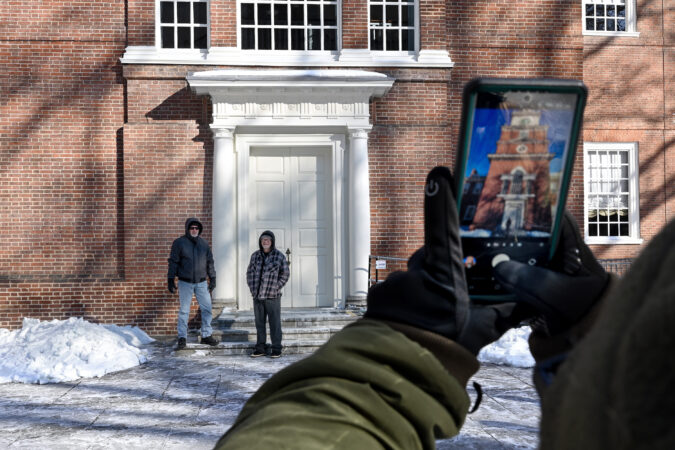
More specifically, English tourists Chadi Rahim and his daughter, Sophia Rahim, 18, shivered in their parkas Thursday, awaiting one of the first tours of Independence Hall since its 119-day closure.
The historic state house, where American democracy was born in 1776, had been closed to the public since Oct. 1 — a temporary pause of access, stretching through the federal government shutdown and weeks of planned preservation work ahead of Philadelphia’s Semiquincentennial celebrations this year. The revamp included restoration of wood, masonry, plaster, and metal, historically accurate paint finishes, and the construction of accessibility ramps. The work would ensure that Independence Hall would continue as a “beacon of American freedom,” the National Park Service had said.
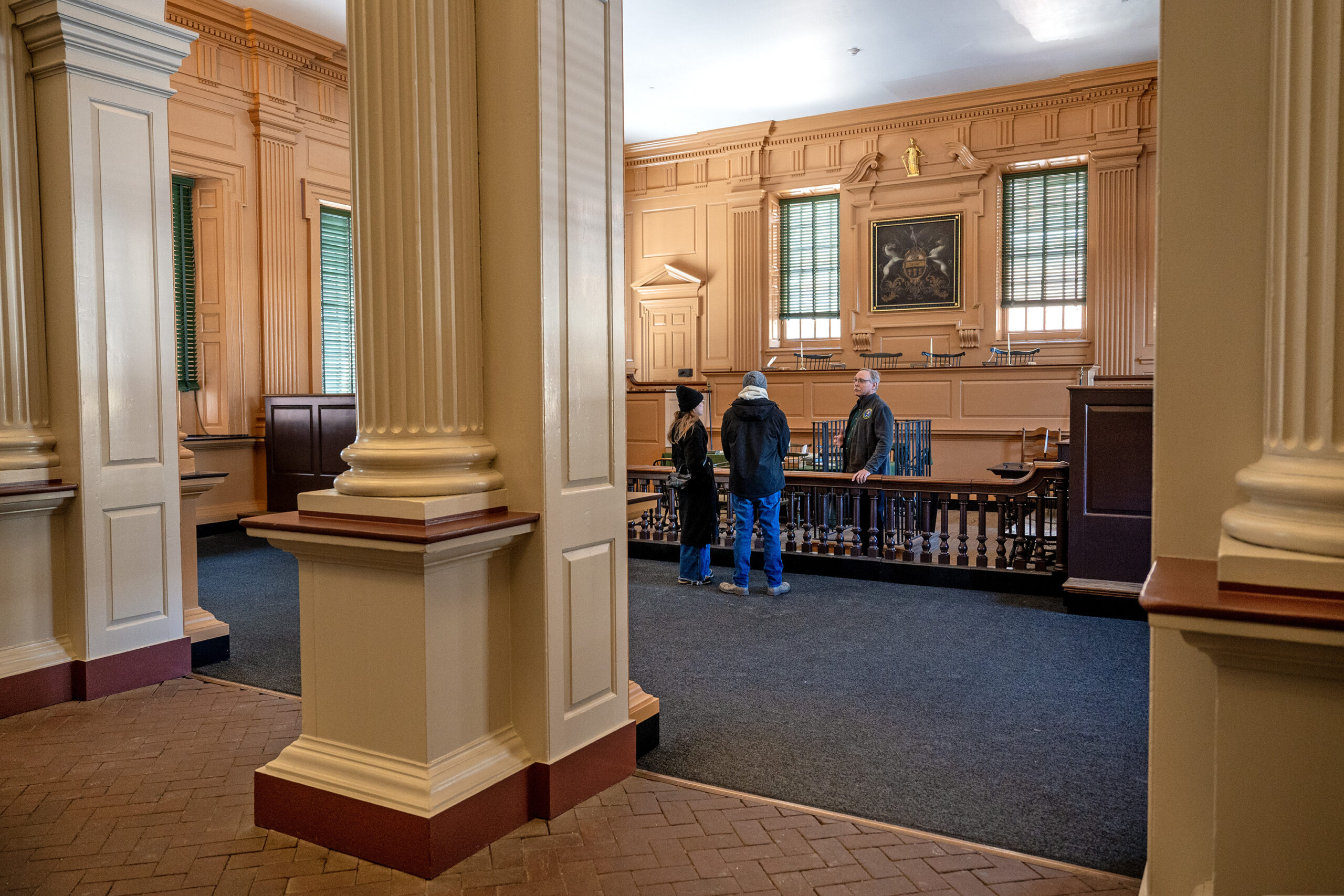
Tourists Jenna Lippert and Brandon Camperlino from Syracuse, NY listen as park service volunteer Bill Rooney (right) gives a tour in the Pennsylvania Supreme Court Chamber in Independence Hall Thursday, Jan. 29, 2026.
As part of the Independence Square Improvement Project, similar repairs were planned for Congress Hall and Old City Hall, which are part of the Independence Hall complex.
“Wear and tear,” National Park Ranger Hugh Evans assured 14 visitors assembled for the 11:30 a.m. tour.
All morning, a steady trickle of travelers trekked to the redbrick building in Old City where the Founding Fathers staked their necks on the promise of a freer and more perfect future.
Independence Visitor Center information desk host Woody Rosenbach displays a free Independence Hall cookie offered to the first 250 visitors on Thursday.
In Thursday’s cold, the tourists came from the rocky coasts of Oregon and the sunlit shores of California, from small towns and big cities, from red states and blue states. And their presence on such an auspicious day was completely by chance. None of the more than a dozen pilgrims to American democracy who braved frozen temps and icy footpaths said they had been aware that Independence Hall had only just reopened.
The site where the Declaration of Independence was signed 250 years ago, the building is one of Independence National Historic Park’s central attractions. The Liberty Bell Center, which was also closed during the shutdown, reopened in November. Officials expect that more than five million people will visit Independence Hall in 2026 for the national milestone.
Learning that their visits had fallen on the reopening of the historic site only lent more power, visitors said.
Rahim, a business owner with the sturdy frame of a Victorian boxer, said he and his daughter had decided on a Philadelphia holiday for shopping and relaxation and Rocky (Sophia is also a fan of National Treasure, a 2005 Nicolas Cage history caper that was filmed at Independence Hall and other historic district sites). But also because of the story only Philadelphia can tell about America’s founding.
And especially now, when the future of American democracy feels more at stake than ever.
“We know the story about independence,” Rahim said, buttoning up against the cold. But he and his daughter had wanted to experience it up close. “Sometimes stuff gets in the way. But if you see the history, it makes you realize what people went through to get us where we are now.”
During the 11 a.m. tour, National Park Ranger David Powers welcomed a half-dozen visitors into the stately, Georgian state room, where the Founders first passed independence. Walls and floors in the rooms where it happened reflected a new polish, while some painting could still use touching up.
After four months of closure and renovations, guided tours resumed every half hour Thursday. Security staff said they did not encounter crowds of guests seeking to stroll the sun-streaked confines where profound compromises of democracy were hashed out 2½ centuries ago.
Rather, on the day of the building’s reopening, many of the visitors represented just normal Americans, looking for signs of hope in uncertain times.
Rachel Lawson of Bend, Ore., and Amanda Shapiro of Southern California, colleagues in town for a work event, admired the simple elegance of the original woodwork design inside Congress Hall, home of the U.S. Congress from 1790 to 1800.
A newly painted pediment above a doorway in Independence Hall on Thursday, Jan. 29, 2026.
“The attention to detail, the thoughtfulness, the regal energy,” she said.
Nearby, Luke Morris, a 20-something political podcaster from Washington, had planned his visit to Independence Hall as a reminder that Americans are still fighting for that promised future amid all the pain and turmoil.
“We are still fighting for what we think is right,” he said.
MINNEAPOLIS — The Justice Department has charged a man who squirted apple cider vinegar on Democratic U.S. Rep. Ilhan Omar at an event in Minneapolis, according to court papers made public Thursday.
The man arrested for Tuesday’s attack, Anthony Kazmierczak, faces a charge of forcibly assaulting, opposing, impeding and intimidating Omar, according to a complaint filed in federal court.
Authorities determined that the substance was water and apple cider vinegar, according to an affidavit. After Kazmierczak sprayed Omar with the liquid, he appeared to say, “She’s not resigning. You’re splitting Minnesotans apart,” the affidavit says. Authorities also say that Kazmierczak told a close associate several years ago that “somebody should kill” Omar, court documents say.
Kazmierczak appeared briefly in federal court Thursday afternoon. His attorney, Jean Brandl, told the judge her client was unmedicated at the time of the incident and has not had access to the medications he needs to treat Parkinson’s disease and other serious conditions he suffers from.
U.S. Magistrate Judge Dulce Foster ordered that Kazmierczak remain in custody and told officials he needs to see a nurse when he is transferred to the Sherburne County Jail.
Kazmierczak also faces state charges in Hennepin County for terroristic threats and fifth-degree assault, Hennepin County Attorney Mary Moriarty announced Thursday.
“This was a disturbing assault on Rep. Omar, who is frequently the target of vilifying language by fellow elected officials and members of the public,” Moriarty said. “The trust of our community in the federal government keeping politics out of public safety has been eroded by their actions. A state-level conviction is not subject to a presidential pardon now or in the future.”
The attack came during a perilous political moment in Minneapolis, where two people have been fatally shot by federal agents during the White House’s aggressive immigration crackdown.
Kazmierczak has a criminal history and has made online posts supportive of President Donald Trump, a Republican.
Omar, a refugee from Somalia, has long been a fixture of Trump’s anti-immigrant rhetoric. After she was elected seven years ago, Trump said she should “go back” to her country. He recently described her as “garbage” and said she should be investigated. During a speech in Iowa earlier this week, shortly before Omar was attacked, he said immigrants need to be proud of the United States — “not like Ilhan Omar.”
Omar blamed Trump on Wednesday for threats to her safety.
“Every time the president of the United States has chosen to use hateful rhetoric to talk about me and the community that I represent, my death threats skyrocket,” Omar told reporters.
Trump accused Omar of staging the attack, telling ABC News, “She probably had herself sprayed, knowing her.”
Kazmierczak was convicted of felony auto theft in 1989, has been arrested multiple times for driving under the influence and has had numerous traffic citations, Minnesota court records show. There are also indications he has had significant financial problems, including two bankruptcy filings.
In social media posts, Kazmierczak criticized former President Joe Biden and referred to Democrats as “angry and liars.” Trump “wants the US is stronger and more prosperous,” he wrote. “Stop other countries from stealing from us.”
In another post, Kazmierczak asked, “When will descendants of slaves pay restitution to Union soldiers’ families for freeing them/dying for them, and not sending them back to Africa?”
Threats against members of Congress have increased in recent years, peaking in 2021 following the Jan. 6 attack on the U.S. Capitol by a mob of Trump supporters before dipping slightly, only to climb again, according to the most recent figures from the U.S. Capitol Police.
Officials said they investigated nearly 15,000 “concerning statements, behaviors, and communications directed against Members of Congress, their families, staff, and the Capitol Complex” in 2025.
WASHINGTON, D.C. – Gov. Josh Shapiro told national reportersThursdaythat he likes U.S. Sen. John Fetterman (D., Pa.), and still talks to him — citing a meeting several months ago.
It’s long been clear that Pennsylvania’s two top Democrats have a tense relationship, a dynamic Fetterman explained in detail in his memoir, Unfettered, released in November, writing that the two men no longer speak after they butted heads as members of the Pennsylvania Board of Pardons.
Speaking to a roundtable of Washington journalists hosted by the Christian Science Monitor on Thursday, Shapiro said he “of course” likes the commonwealth’s senior senator and still speaks to him.
“We were in a meeting together a few weeks ago with (U.S. Transportation) Secretary (Sean) Duffy, working on an important issue in Pennsylvania. So we all work together, Senator McCormick as well,” Shapiro said. “We’ve got to work together for the people of Pennsylvania.”
That meeting, however, was in November when Shapiro and Fetterman met with Duffy to discuss SEPTA — roughly a week before the release of Fetterman’s book. Mayor Cherelle L. Parker and Sen. Dave McCormick (R., Pa.) also participated in that meeting.
A spokesman for Shapiro did not immediately respond to questions about whether they’ve spoken since.
Though Shapiro and Fetterman’s disagreements date back to the pair’s days on the state pardons board, the senator has increasingly drawn ire from his fellow Democrats in recent months for voting with Republicans and has faced calls for a primary challenge.
Shapiro was mum when asked whether he’d support Fetterman if he sought reelection.
“John will decide if he wants to run for reelection. I appreciate the service,” he said.
Fetterman claims in a chapter of his book titled “The Shapiro Affair” that Shapiro, as attorney general, had been unwilling as a member of the pardons board to recommend the commutation of two men that Fetterman strongly believed should be released.
Fetterman, who was lieutenant governor at the time, even threatened in a private meeting to run against Shapiro for governor if he didn’t support the commutations.
“I told him there were two tracks — that one and the one in which he ran for governor and I ran for the Senate (which was the one I preferred),“ Fetterman wrote in the memoir. ”I had no interest in friction, only in what I felt was justice.”
Fetterman also claimed that Shapiro’s cautionin these cases was about protecting his future political ambitions.
“I believe what drove him to delay and deny applications was not the facts of a given case as much as a fear that someone whose sentence he’d commuted would go on to commit terrible violence on the outside,” Fetterman wrote.
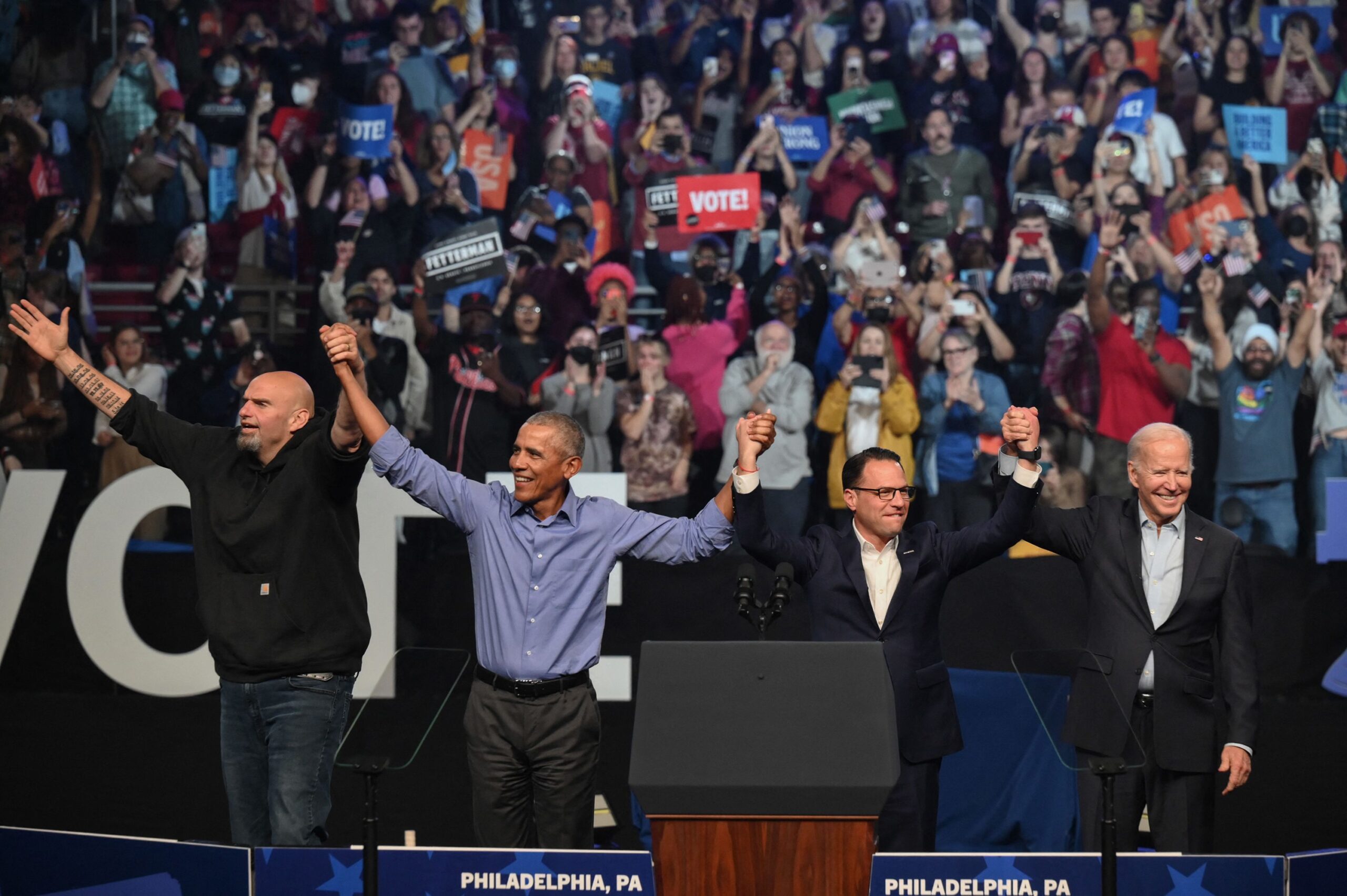
Then-Senate candidate John Fetterman, former President Barack Obama, then-candidate for governor for Pennsylvania Josh Shapiro, and then-President Joe Biden ahead of the 2022 election.
In his own book, Shapiro reflects on agonizing over those decisions including the concern that a commuted individual would go on to harm others. Throughout his book tour he has dodged questions about potential presidential aspirations.
Things got so bad that then-Gov. Tom Wolf had to get involved by meeting with them privately, and Fetterman later got caught on a 2020 Zoom meeting calling Shapiro a “f— asshole,” not realizing that his microphone was still live.
While Fetterman devoted an entire chapter of his 240-page book to Shapiro, the state’s senior U.S. senator only gets two passing mentions in Shapiro’s book.
In one mention, Shapiro notes that he spoke with Fetterman backstage at a 2022 Erie County Democratic Committee dinner when Shapiro debuted a new speech about what “real freedom” means, just days before Fetterman had a stroke in lead up to that year’s primary election.
Shapiro also mentions Fetterman in a chapter about the governor’s history with former President Barack Obama. Shapiro and Fetterman were both on the ballot in 2022 and cohosting a campaign rally, where Obama and former President Joe Biden came to stump for them.
Fetterman is not mentioned in the rest of the book. Shapiro does not delve into the fellow Democrat’s threat to run against him.
On the 800th episode of The Simpsons, the beloved show will send its cartoon family to Philly.
Now in its 37th season, the comedy will ring in the milestone on Feb. 15 with “Irrational Treasure,” a spoof on Nicolas Cage’s National Treasure franchise that filmed (a bit) in Philadelphia.
The episode will feature a slate of Philly-raised talent including Abbott Elementary creator Quinta Brunson, The Bondsman actor Kevin Bacon, and The Roots drummer Questlove — as well as Boyz II Men, who will sing their own rendition of the show’s legendary theme song.
A still from “The Simpsons” episode “Irrational Treasure,” airing on Fox on Feb. 15.
“Marge’s crusade to get the family dog in better shape leads to her entering Santa’s Little Helper in canine agility competitions and a trip to the National Dog Show in Philadelphia,” reads the logline, according to Entertainment Weekly. “There, Marge and Homer suddenly find themselves — and the dog — mixed up in a historical conspiracy adventure worthy of a National Treasure movie.”
The Philly adventure will see Homer (Dan Castellaneta) chomping on a cheesesteak in front of Pat’s and Geno’s, and a Segway tour guide (voiced by Questlove). The Roots will also make an animated cameo. Given the dog show premise, could there also be a reference to Best in Show, another classic Philly film? We’ll have to wait and see.
The Roots make a cameo in a milestone episode of “The Simpsons.”
Brunson will voice a character named Adrienne (Yo! Is that perhaps a Rocky reference?), while Bacon takes on a Philly concierge.
Other guest stars include The Pittactors Noah Wyle, Katherine LaNasa, and Taylor Dearden voicing a doctor, nurse, and intern, respectively. (The HBO show is set in Pittsburgh, but the actors aren’t from there.)
Questlove will voice a Philly segway tour guide in “The Simpsons” special 800th episode, airing Feb. 15 on Fox.
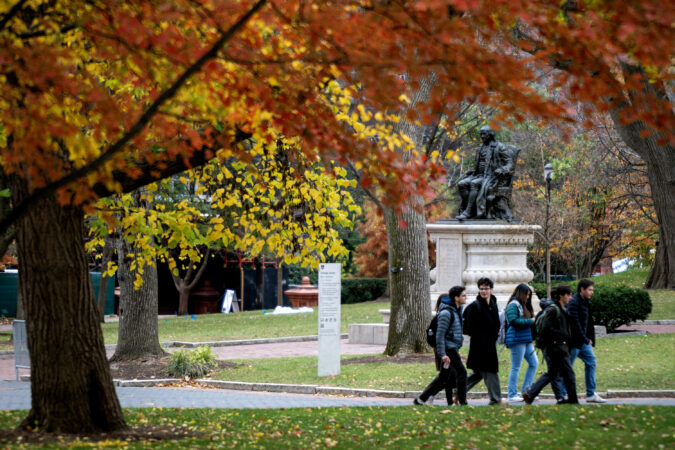
The University of Pennsylvania will instituteanother round of budgetcutsin response to Trump administration actions that threaten future funding and revenues, and because of rising legal and insurance expenses.
That is even though officials said finances look better than they anticipated a year ago, though they did not provide specific numbers.
Penn’s schools and centers have been directed to cut 4% from certain expenses in the next fiscal year and keep in place financial cutbacks instituted last year, including a staff hiring freeze and freezes on midyear adjustments in staff salaries. Schools and centers also were asked last year to cut 5% of certain expenses, and the new 4% reduction would be on top of this.
The university did not detailwhich expenses would be cut, but it is likely that discretionary funds for things like travel and entertainment would be targeted.
Penn leaders cited changes in student loan programs and visa policies, an increase in the endowment tax, and potential losses in research funding as reasons for continued financial restraint. Legal, insurance, and employee-benefit expenses also are rising faster than revenues, said Mark F. Dingfield, executive vice president, and John L. Jackson Jr., provost.
“Taken together, these conditions reinforce our responsibility to continue careful financial management to stabilize our finances for the long term,” the leaders wrote. “It is important to note that this planning effort is just that — an effort to plan deliberately and collaboratively against a changing financial landscape.”
Penn, which is the city’s largest private employer, with about 53,000 employees across the university and its health system, is expected to set tuition and fees and discuss its budget at board of trustee meetings in March.
Penn’s legal expenses have increased as the universityresponds to the Trump administration’s demands and investigations, including an ongoing Equal Employment Opportunity Commission lawsuit seeking in effect personal contact information for Jewish faculty and staff. And the school faced additional costs related to a data breach in November.
School officials noted that Penn has not enacted some of the deeper cuts instituted by its peer schools. Columbia University in May laid off 180 people following the loss of government research grants. Stanford said in August it would lay off more than 360 staff as part of budget cuts. Duke also instituted voluntary buyouts and layoffs last year. And Brown University, amid a $30 million deficit last year, planned for dozens of layoffs.
But Penn said it had to take steps to prepare for the ongoing impact of federal policies.
The tax on Penn’s endowment earnings will rise to 4% in 2027, up from the 1.4% the school has been paying since 2022. In 2024, Penn — which has a $24.8 billion endowment — paid $10.4 million in endowment tax. The increase is not as steep as the 14% to 21% that federal lawmakers had included in earlier budget versions, but it will still financially impact the school. The tax is applied to net investment income.
Penn also stands to lose about $250 million if President Donald Trump’s cap on indirect cost reimbursement from the National Institutes of Health, currently the subject of litigation, is allowed to proceed.
It is unclear what long-term impact those policies may have on international enrollment. International student enrollment at U.S. colleges declined 1% from fall 2024 to fall 2025, according to the Institute of International Education. The number of international graduate students declined 12%.
Penn also is bracing for the effects of the federal government’s decision, among other policy changes, to place new caps on loans that graduate students can take out.
Conditions were rough when staff and students arrived at Penrose Elementary in Southwest Philadelphia — some paths they needed to access to get inside the school were untouched by shovels or plows.
Some buses could not open their doors to let students out at their usual spot because snow banks were so high, according to multiple people who work at the school and teachers union officials. A ramp that students with disabilities use to get into the school was blocked.
And the heat was on the fritz for part of the day as outside temperatures were barely in the double digits.
“It’s about 45 degrees inside this classroom,” one Penrose staffer said Thursday morning. The staffer was not authorized to speak to the media and asked not to be identified. “We’re all in jackets and hats.”
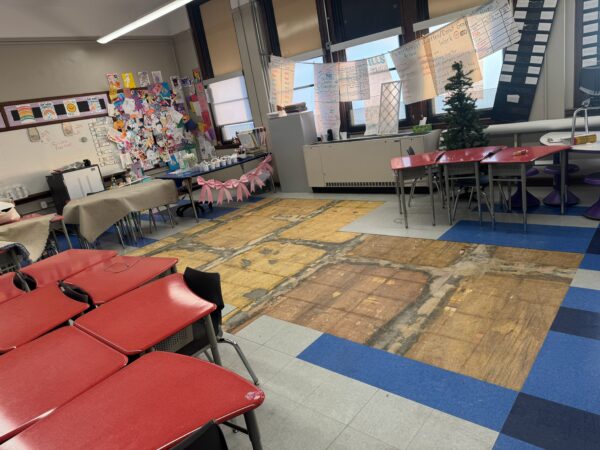
After Monday’s snow day and virtual learning Tuesday and Wednesday, Philadelphia schools reopened Thursday, but for many students, it was anything but an inviting return. The combination of accumulated snow, days of subfreezing temperatures, and a clutch of old buildings — many of which have maintenance issues — made in-person learning challenging across the district.
The rocky return came just hours before a planned rally to protest the district’s proposed $2.8 billion school facilities master plan, which is necessary, officials say, because of poor building conditions and other disparities.
Around some schools, crosswalks were covered by giant piles of snow, forcing children to walk in streets. Elsewhere, there was no place for staff to park.
At Vare-Washington Elementary, in South Philadelphia, pipes burst, rendering six classrooms, the cafeteria, the gym, and the entire basement unusable, according to the Philadelphia Federation of Teachers. There was a strong chemical odor throughout the building.
At Mitchell, another Southwest Philadelphia elementary, “it’s a mess,” said a staffer who asked not to be identified for fear of retribution.
A pipe broke at the school, and Mitchell had no running water for most of the day, with just one brief window where students could use the bathroom. And Mitchell’s student lunches were never delivered, so kids were fed cereal for lunch.
“A lot of our kids rely on those lunches to sustain them throughout the day,” the staffer said.
In addition, Mitchell’s back doors and fire tower exits were blocked by snow, so if there had been a fire or emergency, the only available exits would have been the front doors.
Taylor, also in North Philadelphia, also had burst pipes, with four rooms unusable and most of the school cold. School officials asked for permission to hold classes virtually Friday, but had received no response as of Thursday afternoon.
The Philadelphia Federation of Teachers has called on the district to return to remote learning on Friday in light of “treacherous commutes and dangerous building conditions,” Arthur Steinberg, PFT president, said in a statement issued Thursday afternoon.
Steinberg said in an interview that his office was inundated with reports of heating issues or a lack of snow removal or other problems at schools including School of the Future in Parkside; Farrell, Swenson, Mayfair, and Fox Chase in the Northeast; and others.
“The District must also show respect to students, families, and our members by rectifying the broken heaters, burst pipes, icy sidewalks, and piles of snow in parking lots as soon as possible, so that students and staff can safely resume in-person instruction on Monday,” he said in the statement.
Monique Braxton, a district spokesperson, said “the safety and well-being of our students, staff, and families remains our top priority.”
Staff worked long hours inspecting boilers and buildings, restarting heating systems, clearing snow and ice, and more, Braxton said.
“Across the district, teams are responding in real time to heating concerns, snow and ice conditions, and other weather-related issues as they arise. When conditions do not meet District standards, we work closely with school leaders to take appropriate action and communicate directly with our families,” she said in a statement. “We will continue to closely monitor building conditions throughout this bitter cold period and make adjustments as needed, while temperatures remain below freezing.”
Both Thursday and Friday had long been scheduled as half days for students, with parent-teacher conferences planned. Those would be held virtually.
John Bynum, a former building engineer who is now an official with 32BJ SEIU Local 1201, the union representing 2,000 Philadelphia school building engineers, maintenance workers, and bus drivers, said the going was rough for many schools in terms of building condition.
“Most of these buildings are operating with the original boilers,” Bynum said. “We know with antiquated equipment, there’s going to be problems.”
In some cases, snowblowers that school staff were using to attempt to clear parking lots and sidewalks failed, Bynum said.
And like other school staff, his members often coped with trouble getting to work themselves, he said.
“There were challenges regarding SEPTA not running at a full schedule and the anxiety of getting to work without a robust transportation system,” Bynum said. “Street conditions weren’t the greatest. However, they made the best of it, and they showed up.”
Conditions like Thursday’s, Bynum said, highlight why the district needs more resources to address its buildings — and students’ learning conditions.
All but two of Philadelphia’s 17 City Council members have sponsored a package of legislation aimed at limiting ICE operations in the city, a level of support that could ensure the measures become law even if they are opposed by the mayor.
The 15 cosponsors, confirmed Thursday by a spokesperson for Councilmember Kendra Brooks, indicate a potentially veto-proof majority of lawmakers back the sweeping “ICE Out” effort.
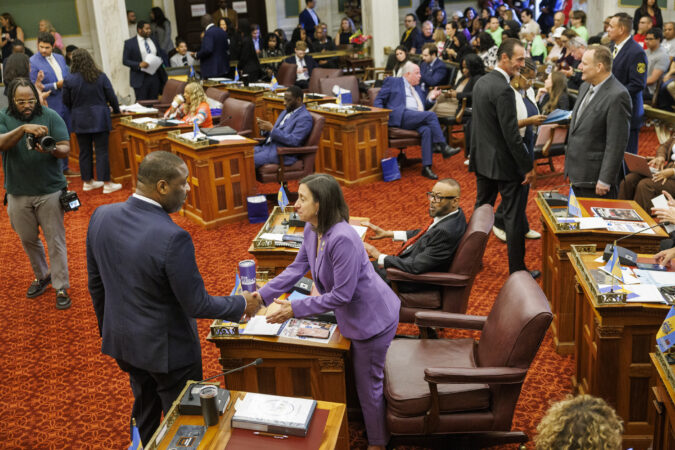
Brooks and Councilmember Rue Landau, the proposal’s authors, on Thursday formally introduced the seven bills in the package, which includes measures that would codify Philly’s “sanctuary city” status, ban U.S. Immigration and Customs Enforcement from operating on city-owned property, and prohibit employment discrimination on the basis of immigration status.
Landau said that “reaching a majority sends a clear message.”
“Philadelphia stands with our immigrant communities,” she said in a statement. “At a moment when the federal government is using fear and violence as governing strategies, this level of support shows that Council will do everything we can to protect our immigrant neighbors.”
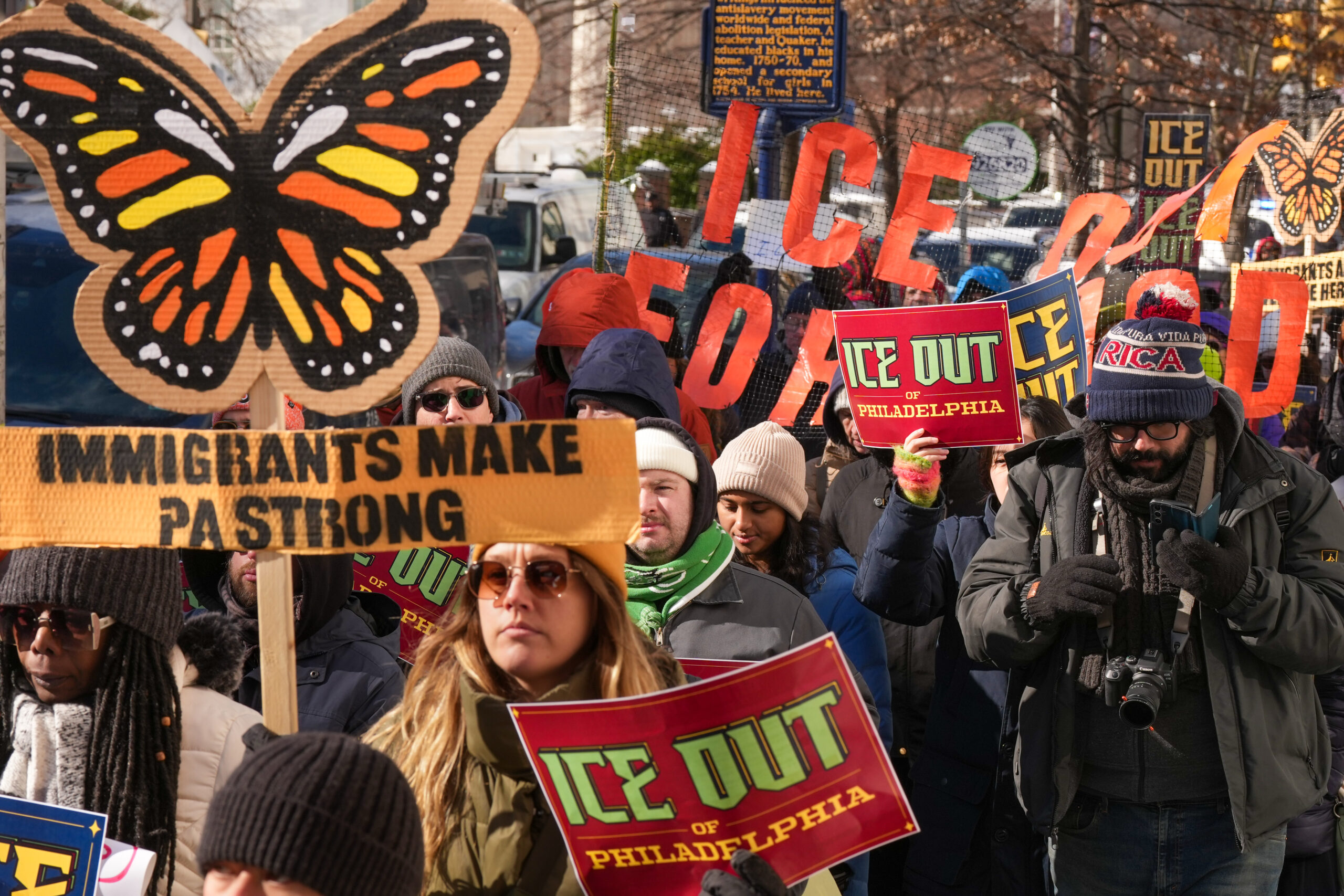
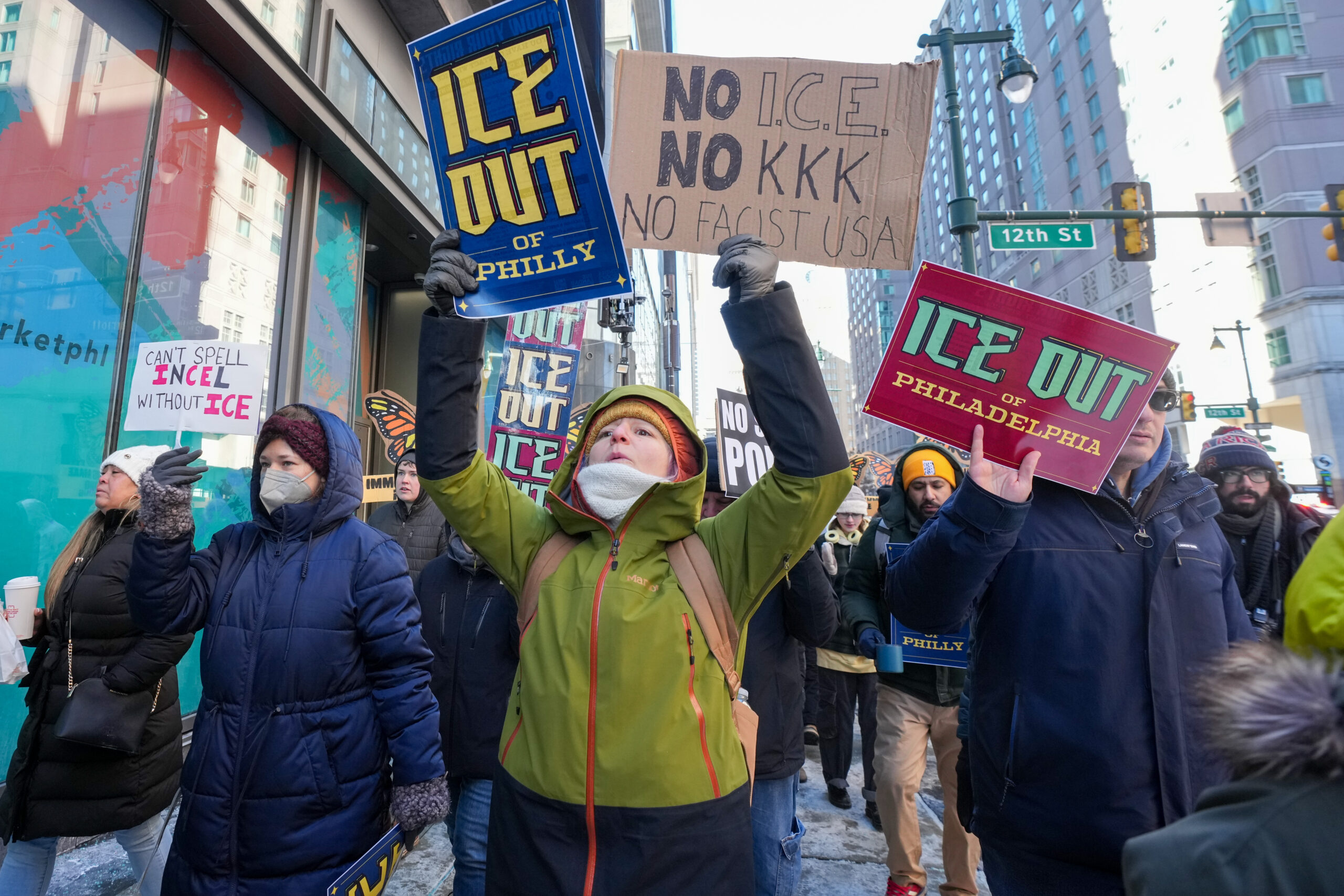
Advocates and protesters call for ICE to get out of Philadelphia, in Center City, January 27, 2026.
The 15 lawmakers on board with Brooks and Landau’s proposal have each cosponsored all seven bills, Brooks’ spokesperson Eric Rosso said. Only Councilmembers Mike Driscoll, a Democrat, and Brian O’Neill, Council’s lone Republican, declined to cosponsor the legislation, he said.
Driscoll, who represents lower Northeast Philadelphia, said in a statement that the shootings of Renée Good and Alex Pretti by federal agents in Minneapolis this month “caused real pain and fear” and “deserve serious attention.”
“Locally, we should aim for immigration policies that are focused, proactive and aimed at practical, long-term solutions that ultimately hold up in court,” he said.
Driscoll said he is open to amended versions of the legislation.
O’Neill, whose district covers much of Northeast Philadelphia, could not immediately be reached for comment.
The developments Thursday prompted Mayor Cherelle L. Parker to make one of her first public comments about President Donald Trump’s mass deportation campaign, saying in a statement that her administration “understand[s] the public’s fear of the unknown as it relates to federal policy associated with immigration.”
“We have a comprehensive approach to public safety, and we will always be prepared for any emergency, as we have consistently demonstrated and will continue to demonstrate,” Parker said. “I have a great deal of faith in our public safety leaders — our subject matter experts — who I asked to be a part of this team and we’re going to do our best to work in an intergovernmental fashion, along with City Council, to keep every Philadelphian safe.”
Parker said she and her team are reviewing the legislation.
Advocates and protestors call for ICE to get out of Philadelphia, in Center City, January 27, 2026.
The mayor has largely avoided confrontation with Trump’s administration over immigration policy, a strategy some have speculated has helped keep Philadelphia from the National Guard deployments or surges of ICE agents seen in Minneapolis, Chicago, Los Angeles, and elsewhere.
But the popularity of the “ICE Out” package among Council members may force her to wade into the issue. Administration officials will testify when the bills are called up for committee hearings. If they are approved, Parker will have the choice of signing the bills into law, vetoing them, or letting them become law without her signature.
Council bills require nine votes for passage, and 12 votes are needed to override mayoral vetoes. With 15 Council members already signaling their approval for the bills, chances appear strong that the city’s legislative branch has the numbers to override any opposition.
Mayor Cherelle L. Parker has avoided confrontation with the White House on immigration issues.
In a Council speech, Brooks addressed the debate over whether the legislation would draw Trump’s ire.
“Staying silent is not an option when people are being publicly executed in the streets and the federal government is covering up their murders,” Brooks, of the progressive Working Families Party, said. “I want to be clear: ICE is already here. We don’t want a Minneapolis situation, but I reject the claim of those who are pretending we don’t already have a problem.”
Council President Kenyatta Johnson, a centrist Democrat and an ally of Parker, shared a similarview.
“From my perspective, the Trump administration has already been looking at the city,” Johnson told reporters. “Overall, the majority of members of City Council support the legislation, and so we see this legislation being successfully voted out of committee.”
ICE agents have been arresting suspected undocumented immigrants in the city before and during Trump’s tenure, and his administration has canceled grants for the city and educational and medical institutions in Philadelphia. But the city has not seen a mass deployment of ICE agents or federalized troops.
Councilmember Anthony Phillips, also a centrist and Parker ally, represents the 9th District, from which the mayor hails.
“What the ’ICE Out’ legislation ultimately says to Donald Trump,” Phillips said, “is that no matter what you try to do to undermine the health and safety and well-being of Philadelphia citizens, we will stand up to you.”
Johnson suggested potential legal issues could be ironed out through amendments if needed.
“The reality is this: This is a moral issue, right?” he said. “And if there are any legality issues that has to be addressed as a body, we’ll work with our members to address it.”
Next, Johnson will refer the legislation to committee, where members will hold one or more hearings featuring testimony from administration officials, experts, stakeholders, and the public. Council members can also amend the bills in committee.
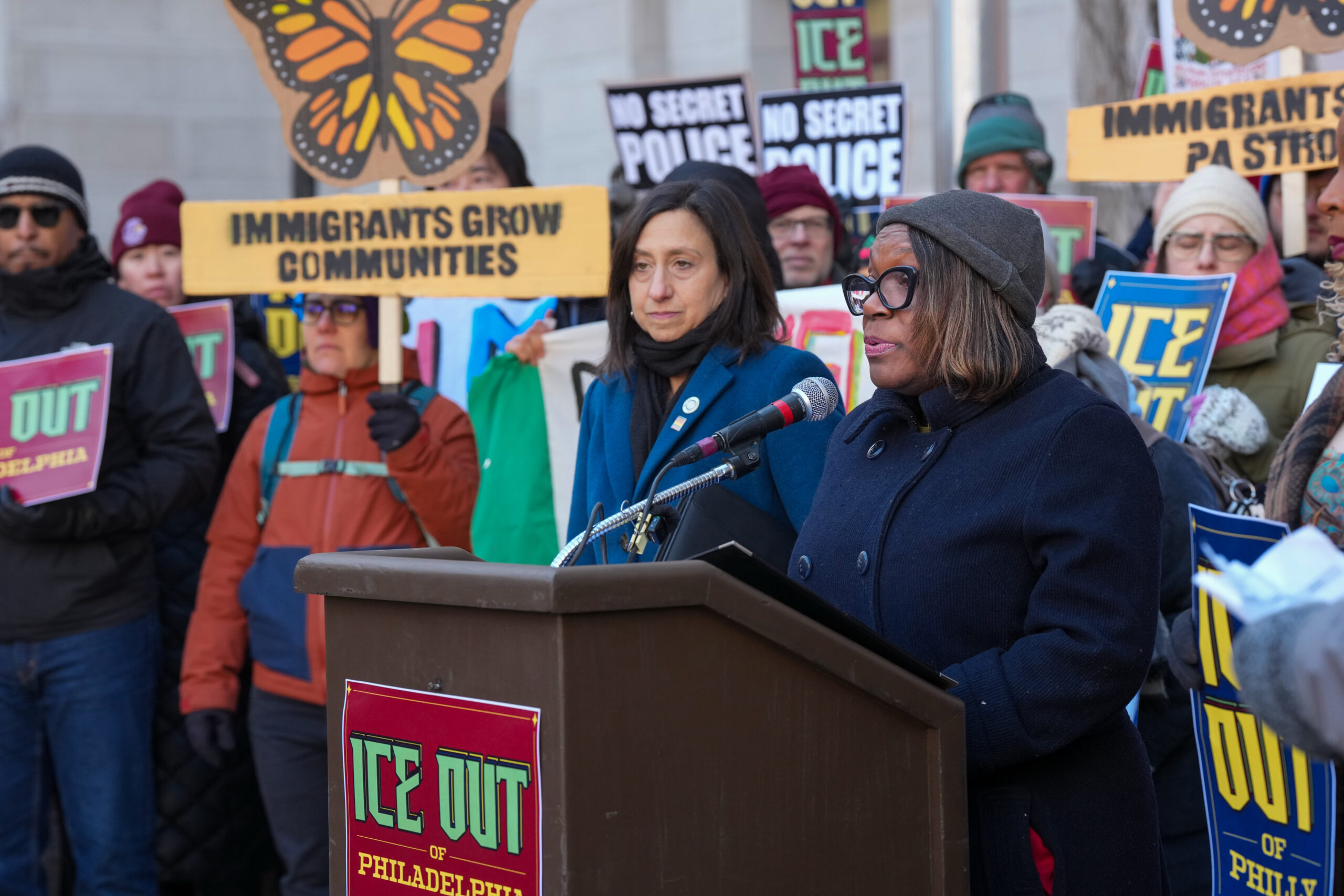
Kendra Brooks shown here during a press conference at City Hall to announce a package of bills aimed at pushing back against ICE enforcement in Philadelphia, January 27, 2026.
Supporters of the legislation packed Council chambers Thursday morning, and many spoke during public comment, ranging from leaders of advocacy organizations to a former immigration judge to immigrants who tearfully pleaded for Council to pass the package swiftly.
Several Spanish-speaking residents spoke through interpreters; other residents testified on behalf of friends or family members who are undocumented and were fearful to come to City Hall themselves. A school nurse told Council members that her students have asked her what tear gas feels like.
“The traumatic effects of these [ICE] raids on our children and our families and our communities will last for years and generations to come,” said Jeannine Cicco Barker, a South Philadelphia psychologist who said she is the daughter of immigrants. “These times call for bold, brave new measures to protect our community, and you have a chance to do some of that here. Philly urgently needs these protections.”
Ethan Tan, who said he is an immigrant and a father of two, said he is fearful for his family and community.
“To this administration, fear is the point. Alienation is the point. Isolation is the point,” he said. “The ‘ICE Out’ package says to me and immigrants that we may be afraid, but we can show solidarity and resolve anyway.”
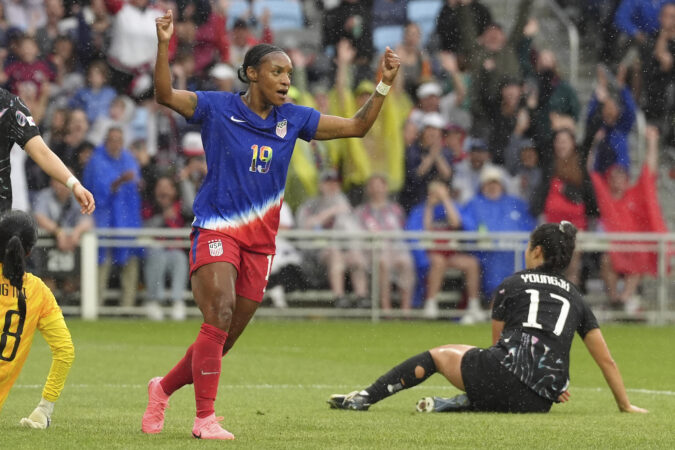
PARIS — United States international Crystal Dunn has retired from professional soccer after a decorated playing career to spend more time with her family.
The 33-year-old New York native helped the U.S. win the 2019 women’s World Cup and the gold medal at the Paris Olympics.
“This decision has not come easily, but I am at peace and deeply fulfilled with all that I have accomplished,” she wrote in an Instagram post Thursday. “I’ve achieved nearly everything I dreamed of in this sport and gave all I had to give.
“I’m ready to embrace the life that awaits me on the other side. I look forward to spending more time with my family and being a more present mom.”
Dunn was under contract with Paris Saint-Germain, which said Thursday that both sides agreed to end their collaboration. A versatile player who contributed from multiple positions, Dunn joined PSG in January 2025 after leaving Gotham FC of the NWSL. She made nine appearances for PSG, scoring two goals and providing two assists.
Dunn appeared in 160 games for the United States, scoring 25 goals.
“As one of the first Black stars of the U.S. women’s national team, especially as a field player, Dunn has long been a role model to many young players of color across the country who aspired to reach the highest levels of the game,” the U.S. Soccer Federation said in its announcement about Dunn’s retirement.
“Dunn’s career will be remembered for her versatility, her tremendous one-on-one defending, her ability to perform far above her size (5-foot-1), her popularity among her teammates, her ability to inspire generations of U.S. Women’s National Team players and for a heck of a lot of winning.”
Before Gotham, Dunn played for the Portland Thorns and took most of 2022 off for the birth of her son, Marcel. She also had stints with the North Carolina Courage, Chelsea, and the Washington Spirit.