Blog

  • How some Philly-area workers make $100,000 without a bachelor’s degree

    How some Philly-area workers make $100,000 without a bachelor’s degree

    Can you make $100,000 a year in the Philadelphia area without a four-year college degree?

    Yes. But it’s not common.

    “There is no magic wand to get to a six-figure salary,” said Cynthia Figueroa, who leads workforce development nonprofit JEVS Human Services. “There’s a lot of steps that have to happen along the way.”

    Companies including IBM, Delta, and Google have dropped degree requirements in recent years. Locally, Pennsylvania Gov. Josh Shapiro slashed college degree requirements for most state jobs in 2023, and Mayor Cherelle L. Parker has advanced an effort to do the same for some city jobs. Meanwhile, more are pursuing vocational training, the Wall Street Journal reported, as some in Gen Z turn to the trades amid the rising cost of college.

    Data center technicians are increasingly in demand, don’t require a college degree, and can make a six-figure salary after some experience. And store managers at Walmart, who often don’t have college degrees, can make $128,000 before bonuses.

    But who actually makes $100,000 or more in the Philadelphia area without a four-year degree and what does that path look like? The Inquirer took a look at the data.

    Cynthia Figueroa poses for a portrait in Philadelphia in 2019. She is the CEO and president of JEVS Human Services.

    What industries pay $100,000-plus without a bachelor’s degree?

    Among the Philadelphia metro area’s 3.97 million workers, the vast majority who make a six-figure salary have at least a bachelor’s degree, according to Census data compiled by IPUMS USA at the University of Minnesota. The metropolitan area includes 11 counties in Pennsylvania, New Jersey, Delaware, and Maryland.

    Roughly 159,000 people made $100,000 or more without a four-year college degree in 2024, the data indicates. (That includes people with an associate’s degree.)

    window.addEventListener(“message”,function(a){if(void 0!==a.data[“datawrapper-height”]){var e=document.querySelectorAll(“iframe”);for(var t in a.data[“datawrapper-height”])for(var r,i=0;r=e[i];i++)if(r.contentWindow===a.source){var d=a.data[“datawrapper-height”][t]+”px”;r.style.height=d}}});

    “There is potential” for high earning without college, but it’s not typical, said Sean Vereen, president and CEO of career-focused education nonprofit Heights Philadelphia.

    “We know that not everybody wants to go to college, but particularly the way the economy in this region is constructed, that college degree still is very useful,” said Vereen.

    But the majority of the workforce in the Philadelphia metro area lacks a bachelor’s degree. Only about 7% of them reach the high-earning $100,000-plus bracket.

    It’s more common in jobs where salaries overall tend to be higher, such as management, business, and finance. About 51,000 Philly-area people in those jobs with less than a bachelor’s degree earned $100,000 or more in 2024.

    window.addEventListener(“message”,function(a){if(void 0!==a.data[“datawrapper-height”]){var e=document.querySelectorAll(“iframe”);for(var t in a.data[“datawrapper-height”])for(var r,i=0;r=e[i];i++)if(r.contentWindow===a.source){var d=a.data[“datawrapper-height”][t]+”px”;r.style.height=d}}});

    What industries are adding more $100,000 jobs?

    Still, more opportunities for people without a four-year degree could be on the horizon.

    Shipbuilding is having a resurgence in Philadelphia’s Navy Yard, and more electricians, carpenters, and welders will be needed, said Figueroa.

    Among Philadelphia construction workers, including carpenters and welders, more than 11,000 do not have a bachelor’s degree and make at least $100,000 annually.

    Hanwha plans to expand its shipbuilding operations in Philadelphia and will need to hire. That includes positions requiring considerable math skills, said Figueroa, of JEVS. The organization is currently figuring out how to get job-training graduates into opportunities.

    Philadelphia Works, the city’s workforce development board, is working closely with Hanwha, CEO and president H. Patrick Clancy said.

    “Our goal is to do more of the pre-apprenticeship,” Clancy said. “They have a lot of people interested in applying for their roles, but not all of them are passing the math and reading [requirements].”

    The newly repainted Goliath Crane is shown July 16, 2025, at the Hanwha Philly Shipyard in Philadelphia.

    Last year, a Brookings Institution report highlighted enterprise digital solutions (business software), specialized manufacturing (like producing parts for medical devices or industrial electronics), and biomedical commercialization (life sciences businesses) as areas where Philadelphia residents should be able to find good jobs. Many jobs in those sectors don’t require a college degree.

    “We need to be focused on creating the right kinds of jobs,” said Chellie Cameron, CEO and president of the Chamber of Commerce for Greater Philadelphia, which is now focusing on the areas Brookings identified.

    The right kinds of jobs, Cameron said, are not minimum-wage positions. They “start at a place where people can earn a family-sustaining wage and have access to pathways for promotion and making more money over the course of their career.”

    Paths and training for high-earning jobs

    Orleans Technical College in Northeast Philadelphia, run by JEVS, trains people for building trades and healthcare professions. It had 379 students last year. Tuition ranges from roughly $13,000 to $25,000, but most students get financial assistance and typically leave with $6,000 or less in debt.

    Residential and commercial electrician Dan Finke, 25, of Abington, (right), is learning about motor controls with fellow classmates at Orleans Technical College, in Northeast Philadelphia on a Friday in September 2020.

    “There’s still very much the physical application of running wire, bending metal,” said Figueroa, and many medical tasks seem to be AI-proof for now. “At the end of the day, you need somebody who is taking the blood pressure next to the bed, and who is drawing the blood.”

    Construction management and HVAC students can expect starting salaries around $75,000 and $60,000 respectively. Those who work overtime can make even more, Figueroa noted, and pay also increases over the course of a career.

    That’s not a six-figure salary on Day One, she acknowledged. But college graduates can make a similar amount in their first job, and “they have this enormous debt” from their schooling.
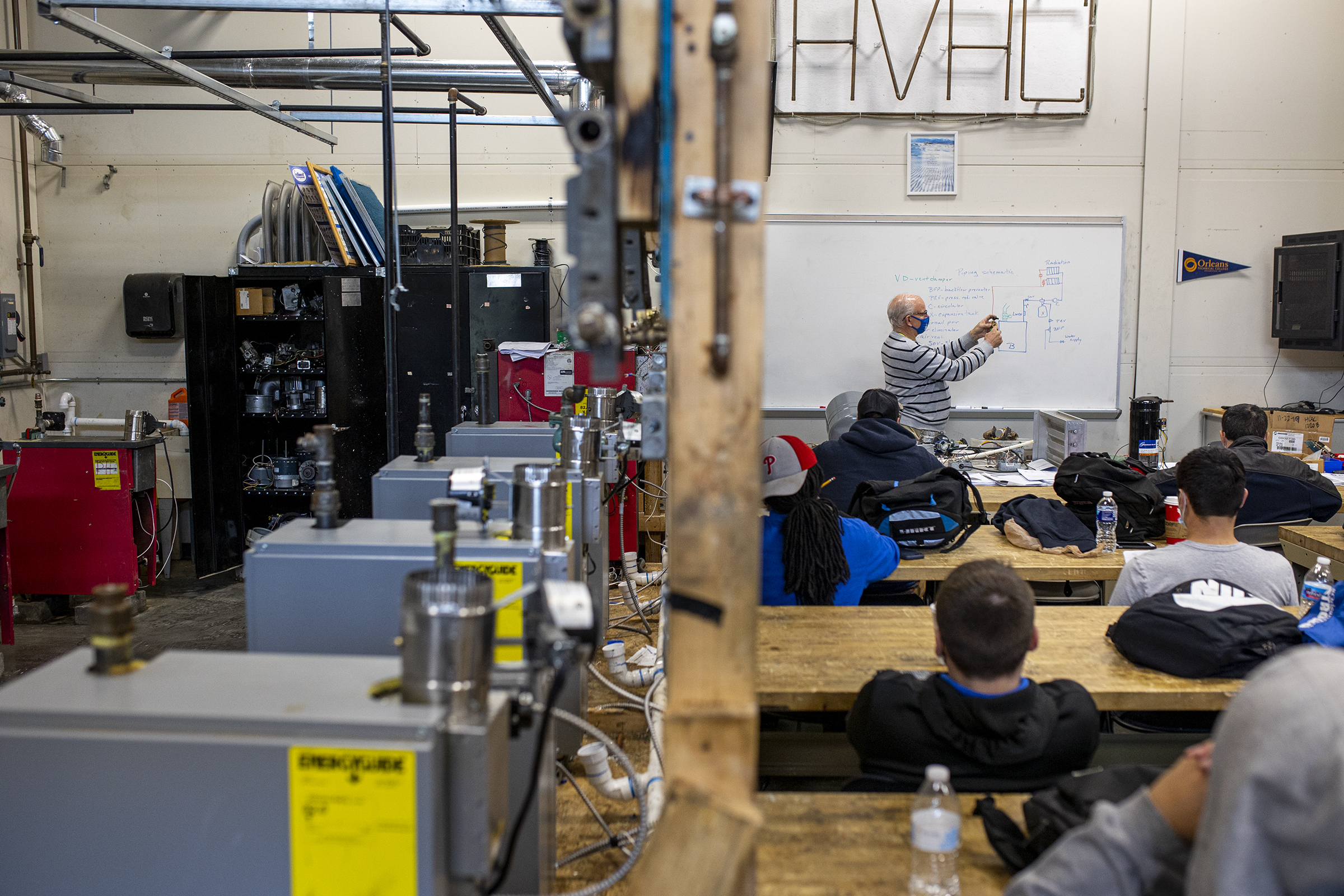
    Lou Abruzzese, HVAC Instructor, is teaching his class about hydronics at Orleans Technical College, in Northeast Philadelphia on Friday, Sept. 25, 2020.

    Orleans also offers healthcare training for clinical medical assistants and practical nursing. Starting salaries for those jobs are generally around $44,000 and $64,000 respectively.

    “Going from an hourly wage — at like a Target, McDonald’s, Walgreens, what have you — to salaried, hopefully with benefits, is a huge first step,” Figueroa said.

    Connecting people to employment also means addressing barriers like lacking a driver’s license, needing childcare, financial literacy, or housing support, says Clancy. Pursuing training might mean going without paid work for weeks or months, which can be a challenge. Philadelphia Works has some funds available to pay people during their training.
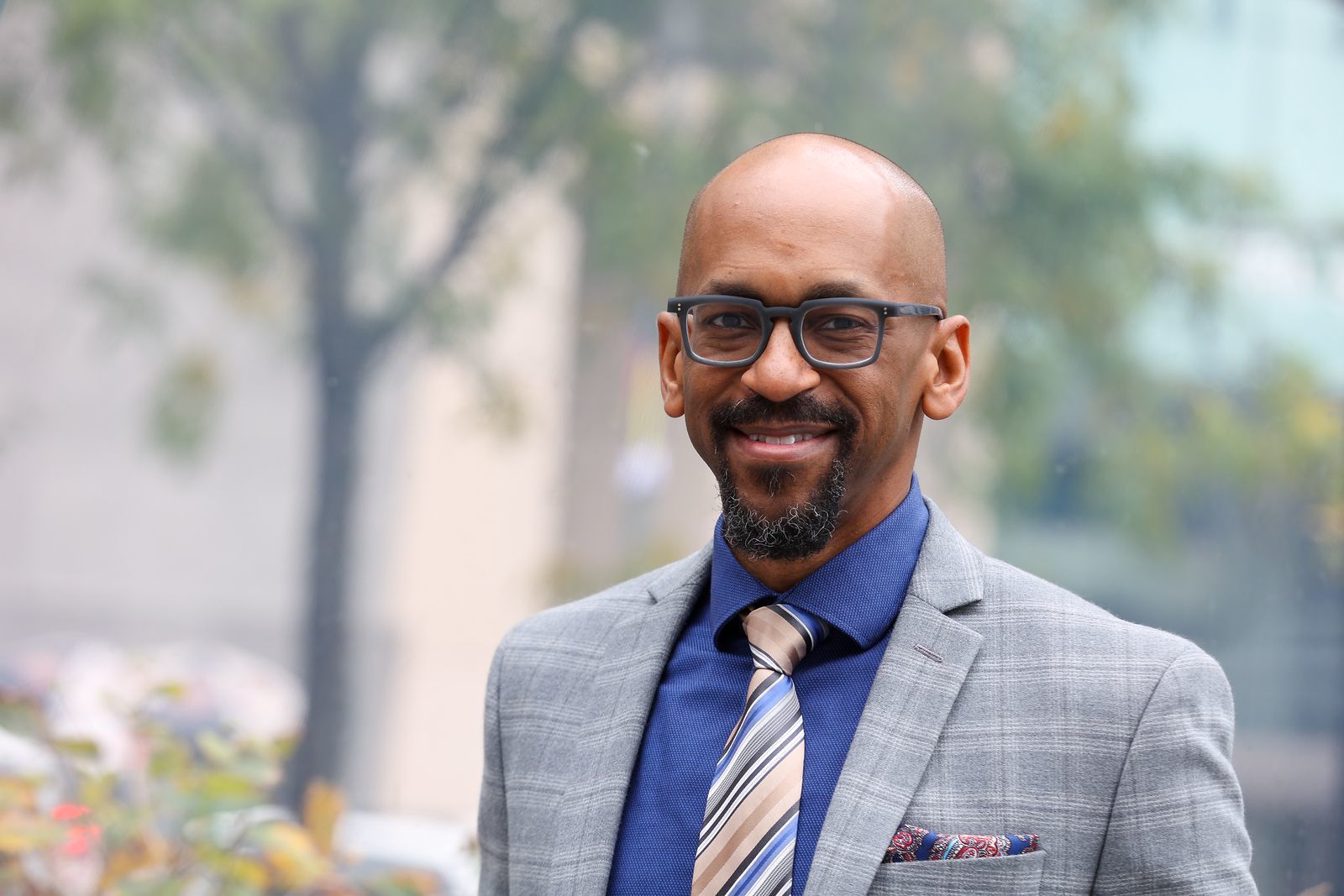
    Sean Vereen is the president and CEO of Heights Philadelphia.

    Young adults need to be aware of opportunities, too, said Vereen. For instance, he said, sterilization technician is a good job within a hospital, but young people may not know it’s a path available to them without going to college.

    And sometimes young people need to catch up before training for jobs in the trades, Vereen says. “We’ve heard things like, ‘The kid coming from the school district doesn’t have strong enough math skills to take the test for the building trades,’” he said.

    “You need basic academic skills that are about math and reading and reading comprehension,” he said. “We don’t get away from giving kids basic knowledge.”

  • Tackling gun violence as our shared purpose

    Tackling gun violence as our shared purpose

    As we start the new year, many of the challenges that persisted in 2025 remain on our horizon for 2026. Sadly, gun violence is one such challenge, but our city has demonstrated what the power of working together can do in making progress in such a significant way.

    Philadelphia made history in 2025, recording the fewest homicides in almost 60 years, and it is true that many cities nationwide are also experiencing this trend. But Philadelphia’s gains are noteworthy in that it is seeing these tremendous public safety gains despite continuing to struggle with issues like deeply entrenched poverty.

    There are many factors driving these numbers, and Mayor Cherelle L. Parker’s public safety strategy of prevention, intervention, and enforcement (PIE) has brought vital focus and intention driven by data. Working together — the Philadelphia Police Department and the Office of Public Safety working in tandem, along with organizations like the group I lead, the Civic Coalition to Save Lives — enable the sum to become greater than the parts in their overall effectiveness in bolstering the city’s strategy.

    For our part, we represent nonprofit and private-sector partners by activating resources like subject matter experts, new data infrastructure, and innovative cross-jurisdictional collaborations.

    The results are compelling: One analysis found that Philly had the best community safety infrastructure of any of the nation’s 10 largest cities, and a Pew poll found that public perception of safety is improving. That means the Office of Public Safety — an entity only two years old — is leading other major cities in its comprehensive approach to violence prevention and intervention.

    This is something our city should be proud of and raise up.

    Just a few years ago, the city was struggling with record-high shooting and homicide rates coming out of the pandemic, and while many individuals and organizations from every sector had meaningful tools to address the issue, it lacked one cohesive, well-coordinated approach to save the maximum number of lives from gun violence in the near term.

    From this gap, both the coalition and the Office of Public Safety were derived, the latter via mayoral executive order, and have grown intertwined in expanding the reach and capacity of Philadelphia’s vast network of anti-violence and cognitive behavioral health approaches deployed to reduce shootings.

    The credit for the success of these many violence prevention and intervention strategies lies with our leaders who have the focus and political will, the practitioners and participants in these programs relentlessly choosing to do this hard work, the public and private funders, and informed and engaged nongovernmental partners.

    Looking to the future, maintaining success and remaining focused on Mayor Parker’s and City Council’s goal of being the safest city will require continued vigilance and commitment to what works. Unfortunately, many organizations are already facing historic budget challenges exacerbated by losses of funding at the federal level that had incentivized proven, focused violence intervention practices.

    As we confront this reality, let’s keep in mind the adage that an ounce of prevention is always worth a pound of cure.

    According to a report by the city, every fatal shooting in Philadelphia can cost as much as $1.5 million in related policing, healthcare, job/property loss, and that is not even accounting for the indirect lost tax revenue or economic activity in high crime areas, or the most important cost: the human impact and intergenerational trauma carried through families and communities.

    A report by the City Controller’s Office also estimated that an investment of $43 million over five years could reduce homicides by 35%, which would translate into a more than $70 million return on investment in increased property tax revenue alone.

    Our call to action for Philadelphians when it comes to reducing violence is this: Stay tuned in and keep showing up, however you can. As Mayor Parker often says, don’t just listen to what is said, watch what people do.

    The unified, coordinated effort to reduce gun violence is working (for context, 2025 saw fewer than half of the record-high homicides and shootings seen in 2021). Mayor Parker, Police Commissioner Kevin J. Bethel, and Public Safety Director Adam Geer have said it, too: “We can’t let up off the gas pedal.”

    We agree.

    There is an African proverb that says: “If you want to go fast, go alone. If you want to go far, go together.” Reducing gun violence can only be achieved over time — not overnight. And the only way we’ll be able to solve it is by working together.

    Here’s to the promising journey ahead.

    David W. Brown serves as the executive director of the Civic Coalition to Save Lives.

  • CHOP launches Philly-area autism therapy network in partnership with Soar Autism Centers

    CHOP launches Philly-area autism therapy network in partnership with Soar Autism Centers

    The Children’s Hospital of Philadelphia and Denver-based Soar Autism Centers have opened in Newtown the first of five planned early childhood autism centers in the Philadelphia region and expect the network could grow to more than 30 centers, officials said.

    The 50-50 joint venture is designed to reduce wait times for therapy and to make it easier for families to access multiple types of therapy at one location while remaining connected to CHOP specialists.

    “It can take a year to get into therapy on a regular basis,“ an extremely long time in a young child’s neurological development, Soar cofounder and CEO Ian Goldstein said.

    Such wait times continue to frustrate families despite dramatic growth in the autism-services sector over the last 15 years or so, as states mandated insurance coverage and diagnosis rates soared with more awareness and an expanded definition of autism.

    Nationally, applied behavioral analysis, commonly known as ABA therapy, has become popular for autism treatment, increasing nationally by 270% between 2019 and 2024, according to Trilliant Health, a Nashville data analysis firm. The volume of services provided locally — where companies including ABA Centers, Helping Hands Family, and NeurAbilities Healthcare have expanded — was not available.

    The increase in diagnoses has outpaced the growth in available services, said Matthew Lerner, an autism expert at Drexel University, who is not involved with the newly launched CHOP-Soar Autism Centers.

    When Lerner moved to the Philadelphia region from Long Island in 2023 and started getting plugged into the autism network, a few clinicians here would ask if he could connect patients with services in New York.

    “I was coming from eastern Long Island, two hours east of New York City, and people were like, do you know anyone closer to you?” he recalled.

    CHOP’s road to a joint venture with Soar

    The freestanding, 10,000 square-foot clinic that opened on Jan. 5 in suburban Bucks County near CHOP Pediatric Primary Care Newtown has 35 to 40 rooms and an indoor playground for therapeutic uses.

    CHOP, among the largest children’s health systems in the country, has long been concerned about limited access to autism care in the region, said Steve Docimo, CHOP’s executive vice president for business development and strategy.

    The nonprofit has provided diagnostic services, but not the forms of therapy that the CHOP-Soar centers will offer. “The threshold to doing this on our own has always been high enough that it hasn’t been a pool that we’ve jumped in,” he said.

    CHOP was in talks with Soar for three years before agreeing to the 50-50 joint venture with the for-profit company. CHOP’s investment will be its share of the startup costs for CHOP-Soar locations.

    The partnership plan calls for five locations in the first two years. The partners did not say where the next four centers will be.

    Soar has 15 locations in the Denver area, which has about half the population of the Philadelphia region, Goldstein said.

    That comparison implies that the CHOP-Soar partnership could grow to 30 centers, Goldstein added. He thinks the region’s needs could support additional expansion, saying the total could reach “into the dozens.”

    The first CHOP-Soar Autism Center opened this month in Newtown. Shown here is the reception area.

    That’s assuming CHOP-Soar provides high quality care for kids, an appealing family experience, and a system of coordinated care: “There will be a need to do more than five, and I think we’re jointly motivated to do so,” Goldstein said.

    The CHOP-Soar approach

    Families seeking care for an autistic child typically have to go to different places to get all the types of therapy they need.

    Families “get behavioral analytics in one place, occupational therapy somewhere else, and speech language pathology in another place,” Docimo said.

    Soar brings all of that together in one center. “If it can be scaled, this will fill a gap in our region in a way that I think will work very well for these families,” he said.

    CHOP-Soar centers will emphasize early intervention and treat children through age six. “The brain has its greatest neuroplasticity” up to age 3, “so waiting a year is a really big deal,” Goldstein said. “You’re missing out on that opportunity to really influence the child’s developmental trajectory at a young age.”

    Some autism services providers focus on ABA therapy, which breaks social and self-care skills, for example, down into components and then works discretely on each.

    But Soar offers what Goldstein described as “integrated, coordinated care for the child.” That includes speech, occupational, and behavioral therapies.

    With CHOP, medical specialties, such as genetics, neurology, and gastrointestinal care, can be tied in as well, Goldstein said.

    It’s rare for autism providers to offer a wide variety of commonly needed services under one roof, said Lerner, who leads the A.J. Drexel Autism Institute’s Life Course Outcomes Research Program.

    He said Soar’s evidence-based, multidisciplinary approach has a lot to offer the region.

    “A person diagnosed with autism will have complex care needs throughout their life, and a one-size-fits-all, one-intervention approach will not work,” he said.

  • Citizens Bank CEO talks about record business profits, data centers, and Phillies’ prospects

    Citizens Bank CEO talks about record business profits, data centers, and Phillies’ prospects

    Big U.S. banks have hit record stock-market highs this month, with hopes for cheaper money from Federal Reserve rate cuts outweighing fears of war, tariffs, and rising prices.

    Citizens Financial Group stock topped $65 for the first time Tuesday, as the owner of Citizens Bank reported higher-than-expected profits. Citizens, based in Providence, R.I., is one of a dozen U.S. banks with a thousand or more branches. With rivals Wells Fargo, PNC, and TD, it controls more than half of Philadelphia-area bank deposits.

    Like its rivals, Citizens has boosted profits by targeting more affluent Americans and their businesses, while shutting some branches. Wall Street is happy: The share price has gone so high, Citizens can afford to buy other banks, analyst David J. Long wrote in a report to clients at Raymond James & Associates on Jan. 23.

    Locally, Citizens is best known as the longtime sponsor of the Phillies ballpark, under a $95 million deal expiring in 2028.

    Bruce Van Saun, chief executive of Citizens Bank’s parent, Citizens Financial Group, since it went public in 2013, agreed to answer questions about business and consumers, whether the data-center boom is for real, and hopes for the Phillies’ 2026 season. Answers edited for clarity and brevity.

    Bruce Van Saun (center, blue jacket), chief executive of Citizens Financial Group, with Leslie Winder (left), a director of the nonprofit Urban Affairs Coalition of Philadelphia, and Arun Prabhakaran, coalition president and former chief of staff to Philadelphia District Attorney Larry Krasner, in March 2025.
    Was business hurt by trade and tariff costs, inflation, or the labor market slowdown?

    The very biggest companies have more diversification and more ability to withstand choppy waters. The smaller the business, the less diversified it is and the more impacted it is by exogenous factors.

    But most middle-market companies have had a successful year. They have come through the pandemic closings, the bout with high inflation, the higher interest rates, then the tariffs.

    Businesses had to become more adaptable and better at scenario planning, at predicting what events will do to their suppliers. Companies have sharpened how they manage real estate, digital technology, and now AI. And they locked in very attractive financing when rates were lower.

    What about the middle class, homebuyers, credit card borrowers?

    People lost a little purchasing power. People are eating out a little less. They are taking fewer trips.

    But we are not seeing a lot more loan delinquencies. Prices go up more than wages, but they are still saving for kids’ education and retirement. Maybe they are taking a home-equity line of credit.

    As economic growth stabilizes and inflation comes down, you’ll see wages increase and people get to a place where they feel better.

    Which sectors are improving?

    Tech-related, health-related show a lot of strength and resilience. Aerospace and the whole military defense sector, companies like Day & Zimmerman [which makes ammunition for the U.S. and clients such as Israel]. There are many wars going on; people need their armament. We’ve seen pretty dynamic strength last year.

    Transportation and logistics — road construction — is pretty strong.

    And data center construction. I hope Pennsylvania gets its share.

    Is Pennsylvania a good place for data centers? How do you overcome local opposition?

    There is a general NIMBY attitude: ‘I like to play on my phone and get the advantages of Microsoft Copilot and AI. Just don’t put a data center near me to use a lot of power.’ There’s controversy around that.

    But if you look at the investment and jobs that go with data centers — they need access to low-cost energy and water — then look at Pennsylvania with its natural gas and its nuclear plants like Three Mile Island. Data centers need low-cost energy and water. Pennsylvania has it.

    Will 2026 improve on last year?

    Our returns should continue to go up. Our net interest margin [the difference between what banks charge borrowers and what they pay depositors] widened last year, and we expect it will be up this year. And all our businesses are demonstrating loan growth.

    Whom do you lend to?

    We serve the middle market, from $25 million in revenues up to corporations with around $3 billion in yearly sales. PNC and Wells Fargo [are larger, but] we aren’t playing the game materially differently from what they offer. If a company wants to finance more, they go to maybe JPMorgan or Bank of America.

    We started building a private bank [focused on business owners and wealthy professionals] a couple of years back. Now we have $14 billion in deposits, $7 billion in loans, $10 billion in client investments, just in that unit. And growing faster than we projected, with more accretion to our bottom line.

    We help our clients become more successful: ‘Here’s an acquisition idea. Here’s a working-capital idea.’ That level of personalized attention has been a winning strategy for us.

    U.S. software start-ups, and biotech centers like Philadelphia, staggered a bit when the best-known tech banks failed in 2023. JPMorgan bought First Republic, but you hired a lot of their staff. How’s that going?

    What First Republic did really well for company founders was advice banking, wealth needs, family financial planning. And we invested heavily in technology to get to the service levels First Republic was famous for. We took on 150 of their people, teams of strong, highly regarded wealth managers, and added private bankers, to locate with our banking teams. That group is now 550 people.

    We went into areas where they were strong — Boston, New York, Palm Beach, and three areas of Northern California. We had to add teams in Southern California — San Diego, Orange County, and one in Los Angeles.

    But not Philly?

    Philly is high on the list of new markets we want to attack with that approach. There is a cadre of successful people here. We want to be known as the bank for successful people.

    Gov. Josh Shapiro talks about a Pennsylvania manufacturing revival. What signs do we see that’s happening?

    We are positioning ourselves for a lot of inbound investments. President Donald Trump is going to our allies in Japan and South Korea to invest and bring skilled jobs into our country to be more self-sufficient in manufacturing — in steel, in shipbuilding, for example. It all sounds good on paper. I think it will come.

    Why do car factories and other big manufacturers open down South, instead of in Pennsylvania?

    They find the states willing to take a fresh look at how much bureaucracy they have and cutting it back. You are competing with Texas, Virginia, the Carolinas, which are very successful at attracting industry. I don’t think Pennsylvania will want to miss out.

    What will it take to bring the World Series back to Philly, which increases fan and ad spending?

    We are hopeful the Phillies have a great offseason. I’m a little disappointed [Bo] Bichette went to the Mets. But, hey, they signed J.T. [Realmuto]. John [Middleton, the Phillies’ lead owner] is very committed to fielding a winning team. Go Phils!

  • Letters to the Editor | Jan. 26, 2026

    Letters to the Editor | Jan. 26, 2026

    Our history removed

    The dirty business of censorship snuck its way into Philadelphia Thursday afternoon and removed panels from the President’s House memorial to the nine people enslaved by George Washington on Independence Mall.

    Ripped from the walls was our history, our freedom of expression, and the respect and dignity for all human beings.

    Peter Tobia, Philadelphia

    The writer formerly worked as a visual journalist at The Inquirer.

    . . .

    What? No one protested and said they wouldn’t take down the slavery exhibit at the President’s House here in Philly? No one protested that taking down the pictures of enslaved people was destroying our country’s history, whitewashing a people’s history?

    What kind of country rewrites history? Certainly not a democratic country. Little did I know that years ago, when I read Cry, the Beloved Country, I would now be crying for our own country.

    And what would have happened if everyone refused to take down the exhibit? Of course, they knew they would lose their jobs. But beyond that, it would have made news, and I believe a lot of us Americans, particularly here in Philly, would have joined in their courageous protest.

    After desecrating our history, how can we feel good about Philadelphia’s historical significance as the Semiquincentennial City in 2026?

    Ettie Davis, Philadelphia

    Cruel tradition

    Bucks County is home to a cruel practice that most Pennsylvanians believe belongs in the past: live pigeon shoots. At the Philadelphia Gun Club in Bensalem, birds are released and shot at close range. It is reported that the club holds about a dozen shoots per year. While the vast majority of states have outlawed this cruelty, political maneuvering has allowed it to continue in Pennsylvania.

    House Bill 1097, sponsored by State Rep. Perry Warren, aims to finally close this shameful chapter by banning live pigeon shoots statewide. The passage of this legislation is an urgent imperative. The movement to ban live pigeon shoots has a long history and is supported by a broad coalition of veterinarians, hunters, and concerned citizens. Yet, HB 1097 has languished for more than 30 years in the General Assembly.

    Please contact your state representative and senator and demand they take immediate action by stating support for HB 1097. In November, every state representative and many state senators are up for reelection. To find your local lawmakers, visit: www.palegis.us/find-my-legislator.

    Victor M. Verbeke, Pennsylvania Voters for Animals, Harleysville

    A firmer foundation

    Today, our Constitution, like the chassis of a very old car, is breaking down. Perhaps it’s time to trade it in. Our current Constitution, drafted in Philadelphia in 1787, certainly lasted longer than our first constitution, the Articles of Confederation — a document that was drafted in Philadelphia in 1777. Our founders were not hesitant to toss a constitution that was not working for a new and improved model. What better place than Philadelphia, and what better time than now to begin an inclusive conversation about a new foundation for our federal government? We deserve a government that is less chaotic and more respectful of the common citizen.

    Hank Bienkowski, Boothwyn

    Join the conversation: Send letters to letters@inquirer.com. Limit length to 150 words and include home address and day and evening phone number. Letters run in The Inquirer six days a week on the editorial pages and online.

  • Dear Abby | Best friend refuses to end abusive relationship

    DEAR ABBY: My best friend, “Brooke,” started dating a man, “Angus,” last year. From the start, he made a poor impression. He met Brooke while he was dating another woman but didn’t tell Brooke about her. Brooke continued hanging out with him only after he broke up with his girlfriend.

    The past few months have been nothing short of awful. I see Brooke weekly for coffee, and all she does is tell me how mean Angus is to her and her family. He calls her names, emotionally manipulates her, tells her what she can and cannot wear and looks through every inch of her phone.

    Her family loathes him. Her dad told me he never wants to see him again. They are constantly urging Brooke to end the relationship. None of her friends likes him, and she doesn’t seem to either, but will not, for whatever reason, break up with him.

    Last week, they decided to get a puppy together. It’s getting exhausting for all parties, including Brooke. What should I do? Should I just leave it alone and let her figure it out and be there when it ends?

    — WISE FRIEND IN NEBRASKA

    DEAR WISE FRIEND: You are a supportive friend, but you cannot live Brooke’s life for her. Buying a puppy with someone who is abusive does not bode well for her or for the animal, which may become the focus of the abuser’s anger if he feels he cannot control Brooke. Because she won’t listen to family or friends, Brooke IS going to have to figure things out for herself. Save your advice for people who will listen.

    ** ** **

    DEAR ABBY: My longtime friend has distanced herself over the last two years. Unless I call her or invite her to join us at our vacation home, I hear nothing from her, and we are never invited to visit them. We grew up together, were in each other’s weddings, raised our children together and went on many fun trips over the years.

    When our husbands were hunting together a few weeks ago, her husband told mine that it would be better if we didn’t mention our grandchildren to them. All of their children have been married and divorced and have no plans to have children. I know she always wanted to be a grandmother, and I am sorry that didn’t happen. Sometimes my grandchildren call while our friends are visiting, and, of course, we have lots of pictures of them around, but we don’t talk about them all the time.

    I don’t know how to handle this. I’m hurt that she would cut me off after all these years just because I have grandchildren.

    — GAG ORDER IN GEORGIA

    DEAR GAG ORDER: She is not cutting you off because you have grandchildren; she is LIMITING HER TIME WITH YOU because she doesn’t, and the phone calls and pictures are depressing for her. A way to handle this would be to see her away from your home so she isn’t constantly reminded.

  • Sam Darnold and Seahawks advance to Super Bowl with thrilling 31-27 win over Rams in NFC title game

    Sam Darnold and Seahawks advance to Super Bowl with thrilling 31-27 win over Rams in NFC title game

    SEATTLE — Sam Darnold threw for three touchdowns, the Seahawks’ “Dark Side” defense came up with a critical fourth-down stop, and Seattle advanced to the Super Bowl, beating the Los Angeles Rams 31-27 in an electrifying NFC championship game on Sunday.

    Led by second-year coach Mike Macdonald and Darnold — an eight-year veteran playing for his fifth team — the Seahawks (16-3) reached the fourth Super Bowl in franchise history and first in 11 years. Seattle lost that most recent appearance to New England, its opponent in two weeks at Levi’s Stadium in Santa Clara, California.

    With Los Angeles (14-6) facing fourth-and-4 at the Seattle 6, coach Sean McVay elected to go for it and Matthew Stafford’s pass was broken up in the end zone by Devon Witherspoon. The Rams didn’t get the ball back until there were 25 seconds left, and Puka Nacua was tackled inbounds near midfield on the final play.

    Stafford threw for 374 yards and three touchdowns, but the Rams were undone by critical errors, including a muffed punt by Xavier Smith in the third quarter. On the next play, Darnold connected with Jake Bobo for a 17-yard touchdown.

    Darnold, who flopped in his playoff debut last season with the Minnesota Vikings, played through an oblique injury and completed 25 of 36 passes for 346 yards with no turnovers. Jaxon Smith-Njigba had 153 yards receiving and a touchdown on 10 catches.

  • Philly’s biggest snow in 10 years has an icy finish, and it isn’t going anywhere soon

    Philly’s biggest snow in 10 years has an icy finish, and it isn’t going anywhere soon

    Hours of percussive sleet layered a nasty icing on Philadelphia’s biggest snowfall in 10 years Sunday, and it may be some time before bare ground resurfaces in the region, if not normality.

    “We’re going to have a rather glacial snowpack for the foreseeable future,” said Alex Staarmann, meteorologist with the National Weather Service in Mount Holly.

    This is not the stuff of postcards.

    Michael Thompson (right) and Jonathan Ahmad clear snow Sunday in Old City.

    Officially 9.1 inches of snow was measured at the unusually quiet Philadelphia International Airport, with similar amounts reported at some locations in the neighboring counties, as temperatures were stuck in the teens around Philly. Skippack, Montgomery County, reported just over a foot. For Philly, it also was a record for a Jan. 25.

    Late in the morning, the snow flipped over to sleet, which continued in the evening and added to accumulations through the region, including an additional 2.5 inches at the weather service Mount Holly office.

    Sleet — liquid that freezes before it lands — counts as snow in official measurements. In some places it fell at the rate of 0.5 inch an hour, the weather service said, an extraordinary rate for sleet.

    And shovelers beware: That mess may weigh as much as a foot or more of pure snow. Besides, we may be out of practice. This was the most snow since the 22.4 inches of Jan. 22-23, 2016.

    Along with sleet, some freezing rain — liquid that freezes on contact with a surface — was possible Sunday night, said Nick Guzzo, meteorologist at the National Weather Service in Mount Holly.

    However, only scattered power outages, a function of the unusual behavior of a potent but peculiar storm that wrought a familiar set of disruptions and inconveniences.

    At the airport, 651 of 672 flights were canceled Sunday, said spokesperson Heather Redfern, with the last departure at 10:30 a.m.

    SEPTA suspended Regional Rail and bus service at 2 p.m. Sunday. Schools decided preemptively to close on Monday. Speeds were reduced on highways. Mayor Cherelle L. Parker advised everyone to stay in their houses and out of their cars.

    Luis Nova digs his car out of his plowed-in space in an otherwise empty parking lot at the Westmont PATCO station in Haddon Township onSunday. Nova left his car there last Friday, and was in Philadelphia all weekend helping friends move and going to a goodbye party. He spent the morning sledding with friends in Clark Park in West Philadelphia, Nova said. “I knew what I was signing up for and was ready. I left all my equipment to get myself out. I spent four years in Rochester [New York] so I have a little experience with this. The only thing I’m missing is the kitty litter I usually keep in case I have to put it under the tires.”

    Malls and other businesses called it a day. Blue Mountain decided to suspend ski operations until Monday at noon — and when was the last time a ski outfit shut down because of snow, of all things?

    All things considered, a trauma-free day

    For the abject unpleasantness of the weather Sunday, the region for the most part appeared to be trauma-free.

    That probably had something to do with the fact that it was indeed, Sunday, and that the storm may have set an unofficial record for a pre-event drumbeat.

    Computers had been on to something big happening for about a week, at one point suggesting historic amounts of snow for Philly. The anticipation and anxiety evidently were major boons to local supermarkets — where carb shortages and human stampedes were reported — and hardware stores.

    In the end, the storm did unfold pretty much as the late-week forecasts suggested, with a thump of heavy snow in the morning with several inches accumulating.

    One not-so-mild surprise was the cold, with temperatures during the day Sunday several degrees below forecasts.

    The cold had a benefit: It resulted in a dry, powdery snow, said Tom Kines, senior meteorologist with AccuWeather. That robbed the region of that postcard look as the moderate winds were able to shake it off the trees, but it also reduced the power-outage potential.

    For those who have endured long power outages, it very likely was worth the aesthetic deprivation.

    When the snow turned to sleet during the late morning, temperatures were still in the teens, and the ice balls accumulated on the snowpack, adding unwanted weight.

    The ice also will add endurance to the snowpack, meteorologists said. Snowflakes can out-melt ice anyway. So forget the yard work for a while.

    What’s ahead for Philly’s weather?

    The sleet was likely to yield to freezing rain Sunday evening along and near the I-95 corridor, the weather service said, perhaps adding up to 0.2 inches of ice, especially south and east of the city.

    The precipitation was due to shut off during the early-morning hours of Monday. Then, the melt is going to take its good old time.

    Temperatures Monday are expected to be in the upper 20s.

    Then, it’s going to turn colder.

    Highs in Philly will struggle to reach 20 Tuesday through Saturday, with overnight lows in the single digits.

    The next several days should be dry, said Kines. Some talk is brewing about a storm threat late next weekend or early in the week, but that can wait for another day.

    Staff writer Michael Klein contributed to this article.

  • Sixers game at Hornets rescheduled for Monday afternoon because of storm

    Sixers game at Hornets rescheduled for Monday afternoon because of storm

    Because of the snow and ice storm that hit roughly half of the nation on Sunday, the 76ers’ game against the Hornets in Charlotte, N.C., initially scheduled for Monday night, has been moved up to 3 p.m.

    The game will be televised on NBC Sports Philadelphia.

    The NBA postponed games in Memphis and Milwaukee on Sunday because of the massive winter storm that is creating dangerous travel conditions across much of the U.S.

    The Dallas Mavericks tried twice to fly to Milwaukee for their Sunday night game against the Bucks, but conditions didn’t allow it. A decision to postpone was announced a few hours before tipoff. Food that had been prepared for the game was donated to shelters in the Milwaukee area.

    Earlier Sunday, a game between the Denver Nuggets and Memphis Grizzlies was postponed about three hours before tipoff. Reschedule dates were not announced.

    The league also changed the start time for the Indiana Pacers’ game at Atlanta Hawks from 7:30 p.m. to 1:30 p.m.

    At least two college women’s basketball games were postponed: No. 17 Tennessee’s visit to No. 18 Mississippi on Monday and Tulane’s visit to Memphis on Tuesday. Reschedule dates were not announced.

    In men’s basketball, a game featuring Tennessee at No. 21 Georgia was pushed back a day from Tuesday to Wednesday. Purdue Fort Wayne and IU Indianapolis, and Southern Illinois and Evansville had Sunday games postponed without make-up dates announced.

    Separately, on Saturday, the NBA postponed a game between the Warriors and Timberwolves to “prioritize the safety and security of the Minneapolis community” after the fatal shooting of a man by a federal officer in a district located less than two miles away from where the Timberwolves play.

  • Trump says it’s ‘too late’ to stop White House ballroom construction

    Trump says it’s ‘too late’ to stop White House ballroom construction

    President Donald Trump on Sunday insisted his proposed ballroom is a done deal — even as Justice Department lawyers in court present the plans as flexible and subject to federal reviews.

    In a lengthy post to his Truth Social platform, Trump said the project could not realistically be reversed because key materials have been lined up, writing that “there is no practical or reasonable way to go back” and declaring: “IT IS TOO LATE!”

    The president’s comments contrast with his administration’s position in federal court, where three days earlier Justice Department lawyers told a judge that the ballroom plans can be modified and that the White House intends to wait for two federal advisory panels to review the project before beginning aboveground construction in April. U.S. District Judge Richard Leon, an appointee of President George W. Bush, said he intends to rule in the coming weeks on whether the project may advance.

    The White House did not immediately respond to questions about how Trump’s post about the ballroom aligned with his administration’s legal argument. Trump and his deputies have said that the ballroom project is personally important to him, and the president wrote Sunday that it is a national security matter.

    “Stoppage of construction, at this late date, when so much has already been ordered and done, would be devastating to the White House, our Country, and all concerned,” Trump wrote in a late-morning note that published as much of the United States was under a weather alert connected to a significant winter storm. He also listed materials that he said had either been ordered or were “ready” to be obtained: “All of the Structural Steel, Windows, Doors, A.C./Heating Equipment, Marble, Stone, Precast Concrete, Bulletproof Windows and Glass, Anti-Drone Roofing, and much more.”

    The roughly 450-word statement came in between two posts that referenced Minnesota, the site a day earlier of another fatal shooting connected to immigration enforcement that roiled domestic politics and raised the possibility of a government shutdown. Democrats pledged to block a funding package that must be approved by Friday to keep much of the government open, saying that they could not support continued funding for federal immigration enforcement without operational changes.

    Trump in October rapidly demolished the White House’s East Wing annex to make way for his planned ballroom addition, prompting criticism from Democrats, watchdogs, and some conservatives who said the administration should have sought public comment before making such significant changes to a building long described as the “People’s House.” The White House has begun construction on the underground elements of the project, deploying workers, construction machinery, and a tower crane, with administration officials saying the work is necessary to protect the president.

    The National Trust for Historic Preservation, a nonprofit group charged by Congress with helping to preserve historic buildings, sued the Trump administration in December, saying it failed to undergo legally required reviews or receive congressional authorization for the project. The group has asked Leon to pause construction until those reviews take place, arguing that every additional day of work locks the project into place.

    “We are fully committed to upholding the interests of the American public and advocating for compliance with all legally required review and approval processes — and an opportunity for the American people to weigh in on a project that impacts one of the most historically significant buildings in our country,” the National Trust said in a statement Sunday following Trump’s post, which also took aim at the group.

    The Justice Department has argued that Trump has significant authority to make changes to White House grounds. The department also submitted testimony from an engineer working on the ballroom project who said the planned building can still accommodate significant design changes. The National Trust has submitted testimony from architect William Bates, former president of the American Institute of Architects, who said in a sworn statement that a building’s subterranean infrastructure essentially predetermines critical aspects of what can be built aboveground.

    “Altering these conditions after the fact would require major demolition and redesign,” Bates wrote last month.

    Leon, who is hearing the case at the U.S. District Court in Washington, D.C., on Thursday, appeared skeptical of the administration’s arguments and pressed the Justice Department to explain how Trump had the legal right to fund the project using hundreds of millions of dollars in private donations. Publicly identified donors, such as Amazon, Google, and Lockheed Martin, collectively have billions of dollars in contracts before the administration. (Amazon founder Jeff Bezos owns the Washington Post.)

    The two federal panels set to review the ballroom project — the Commission of Fine Arts and the National Capital Planning Commission — are now led by Trump appointees after the president removed members named during the Biden administration. White House officials have said they hope to win approval from the panels by March, and the panels’ leaders have signaled support for ballroom construction.

    “I know the President wants to get on with this, and we need to let him do his job,” Rodney Mims Cook Jr., the chairperson of the Commission of Fine Arts, said at a hearing last week.