Blog

  • Dana Edwards fell in love with Narberth 5 years ago. Now, he’s the mayor.

    Dana Edwards fell in love with Narberth 5 years ago. Now, he’s the mayor.

    As he stands outside the Narberth Bookshop on a frigid January afternoon, it’s clear Dana Edwards has a vision.

    Imagine, he says, as he sweeps his hands toward the borough’s downtown corridor, getting off the train and stopping into a small grocery for a bite to eat before heading home on foot. Maybe you buy a gift, or an ice cream cone, or a bottle of wine.

    Like anywhere, Narberth “could use a little bit of revitalization here and there,” Edwards said. But you can “see the potential.”

    Edwards, 53, was sworn in as Narberth’s mayor earlier this month. The longtime financial technology officer moved there from Pittsburgh five years ago with his wife, Miranda. They have a 2-year-old son, and Edwards has two older children, 19 and 22, from his first marriage. Edwards had never run for office before, but after falling in love with the borough (and being encouraged by neighbors), he stepped into the public eye last year. He won the local Democratic Party’s endorsement, then ran unopposed in the primary and general election. This month, Edwards replaced Andrea Deutsch, who had served as Narberth’s mayor since 2017.

    As the 0.5-square-mile, 4,500-person borough faces infrastructure challenges and debates over development, Edwards says he is ready to steer Narberth in the right direction through communication, thoughtful growth, and a social media presence he calls “purposely cringey and fun.”

    Narberth Mayor Dana Edwards talks about the empty storefronts on Haverford Avenue on Tuesday, Jan. 6, 2026 in Narberth, Pa.

    From San Juan to Narberth, with stops in between

    Edwards grew up in San Juan, Puerto Rico. There, Edwards says, he saw power outages, infrastructure issues, and food shortages. It was a formative experience that taught him about the collective — what it means to come together in the face of persistent challenges.

    He earned a degree in chemistry in 1994 from the College of Charleston in South Carolina. Though the goal was to become a doctor, Edwards was drawn to technology. He went back to school, and in 1997 earned a degree in computer science, also from the College of Charleston. Edwards has a master’s in business administration from Queens University of Charlotte in North Carolina.

    Edwards has spent three decades in the world of information technology, working mostly for major banks. He was the chief technology officer of the Mitsubishi UFJ Financial Group, then for PNC Bank. He is now the group chief technology officer for Simply Business, a London-based online insurance broker. He has lived in Puerto Rico, South Carolina, Los Angeles, Pittsburgh, and now Narberth. He has over 18,000 followers on LinkedIn.

    By his own admission, Edwards’ civic background is “a little bit light.” He has given to various causes over the years, and said he was involved in the ACLU in the early 2000s. He helped organize Narberth’s first Pride in the Park event in 2022 and said he has joined the Main Line NAACP chapter.

    The corner of Haverford and North Narberth Avenues on Monday, June 2, 2025 in downtown Narberth, Pa.

    Polarization happening ‘in our little town’

    Edwards started thinking about running for office “when the national scene changed dramatically.”

    He described beginning to sense a deep polarization both between and within America’s political parties.

    “I felt like I saw it happening locally. I saw it happening in our little town,” he said.

    As the mayoral race approached, neighbors began telling Edwards he had the right “thing” to run. He could build a strategic plan, lead an organization, and understand financials. At a candidate forum last year, Edwards said he originally planned to run for mayor in 2029, but decided to move his campaign up to 2025.

    Edwards earned the backing of Narberth’s Democratic committee people last April, beating out attorney Rebecca Starr in a heated endorsement process.

    During a March 2025 meeting, local Democrats squabbled over whether or not to endorse a candidate, citing “animosity” in the race (candidates are discouraged from running as Democrats if they do not receive the endorsement of the local committee). The committee ultimately voted to make an endorsement, which went to Edwards.

    After the meeting, Starr withdrew from the race, citing “vitriol” in the campaign.

    “I think [in] any good race, at some point, you have to have more than one candidate. Because otherwise, people are just getting selected, not elected,” Edwards said, referencing the endorsement process. “I do think that she would be a great candidate also, and I hope she runs again.”

    Edwards believes the community has largely moved on from any division that colored the primary. Really, he added, it’s more important to get people talking about the issues the mayor can solve — streets, garbage pickup, infrastructure.

    “I’m just really focused on Narberth,” he said.

    The SEPTA train station on the Paoli/Thorndale Line on Monday, June 2, 2025 in Narberth, Pa.

    Building a ‘community-oriented’ future

    Edwards says he is committed to sustainable growth in a borough whose residents have diverse, and sometimes competing, visions for its future.

    There are two extremes, Edwards says. On one end, the borough could leave everything as it is. The buildings might fall apart, but they would be the same buildings that everyone knows and loves. On the other end, there is rapid growth, like bringing a Walmart Supercenter to Haverford Avenue.

    “It’s that thing in the middle that we’re looking for,” he said — a “hometown feel” with “community-oriented” businesses.

    Edwards is eager to get the 230 Haverford Ave. development across the finish line. The long-awaited project plans to bring 25 new apartment units and ground-floor retail to Narberth’s commercial core. The project, helmed by local real estate developer Tim Rubin, has been in the works for over five years, but faced pandemic-era setbacks that have left a number of vacant storefronts downtown.

    The mayor is also focused on the Narberth Avenue Bridge, a century-old span and main artery that has been closed for several years due to safety concerns and subsequent construction. Road-Con, the contractor updating the bridge, anticipates it will be completed by summer 2029.

    Edwards plans to write a regular newsletter, hold town halls, and host coffee chats. He hopes to put together an unofficial advisory group to bring together people, and opinions, from across the small borough.

    Edwards believes “the DNA of Narberth is alive and kicking,” from the Dickens Festival to the Narberth Outsiders baseball team. To keep it alive, though, the borough needs to bring business in and remind people why they love to live, shop, and work in Narberth.

    “It’s all about relationships and commerce,” he said. “[That] is going to be what brings us together.”

    This suburban content is produced with support from the Leslie Miller and Richard Worley Foundation and The Lenfest Institute for Journalism. Editorial content is created independently of the project donors. Gifts to support The Inquirer’s high-impact journalism can be made at inquirer.com/donate. A list of Lenfest Institute donors can be found at lenfestinstitute.org/supporters.

  • Mice, graffiti, and broken bathrooms: Teachers and parents sound an alarm about building conditions at this Philly school

    Mice, graffiti, and broken bathrooms: Teachers and parents sound an alarm about building conditions at this Philly school

    The Philadelphia School District is poised to announce soon which of its aging buildings it will fix up and which it might close, or consolidate, or reimagine in the coming years.

    But teachers and parents at one South Philadelphia elementary school say they cannot wait for help and have appealed to Superintendent Tony B. Watlington Sr., Mayor Cherelle L. Parker, and others.

    “Southwark School is desperately in need of changes,” a letter signed by 300 people and sent to Watlington and Parker on Friday read. “Our children are learning in an unhealthy environment that no child should have to experience.”

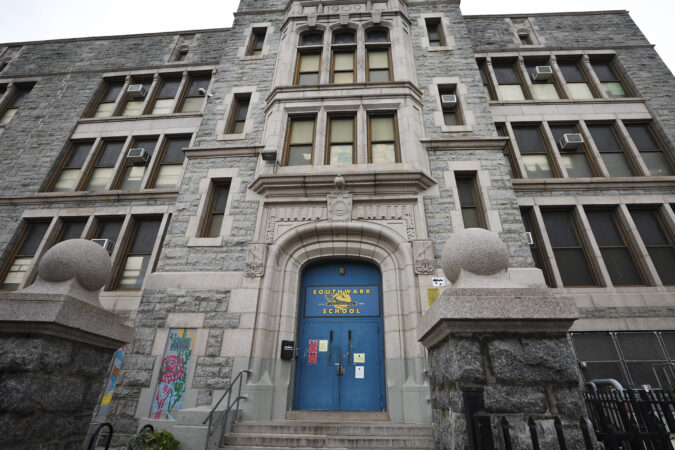
    In many ways, Southwark, a K-8 facility constructed in 1905, is a thriving school — it has strong academics, a diverse student body of about 900, a dual language immersion program, and a robust complement of activities. Southwark is a community school, with city-paid resources including free before- and after-school care.

    Mayor Cherelle Parker and Superintendent Tony B. Watlington Sr. visit a classroom at Southwark Elementary to discuss the city’s extended day extended year programming in this 2024 file photo.

    But it also has issues including bathrooms that “break down nearly every day,” the letter said. “The plumbing has gotten so bad that sewage comes dripping down from the ceiling into classrooms.”

    The letter outlined other issues including a rampant bug and rodent problem, a stairwell covered in graffiti and trash, dank hallways, a lack of adequate ventilation, and more.

    “Our children tell us that classrooms feel like prisons because the windows can’t be opened fully and they have opaque coverings,” the letter read.

    Nyera Parks, a Southwark second-grade teacher, said she doesn’t think the community is asking for too much.

    “These conditions are affecting the children’s health, their focus, their sense of safety,” Parks said. “It’s the bare minimum — we’re asking for a clean and safe school.”

    Responding to teacher and parent concerns, district chief operating officer Teresa Fleming said in a letter sent Monday the school system “has already taken concrete action to address conditions at Southwark while continuing to plan for sustained improvement.”

    Fixes Fleming cited include “mass” trapping, plaster and plumbing work, and adjustments to the cleaning staff.

    Some staff have reported “visible improvement in cleanliness and operational response,” Fleming wrote in the letter to State Rep. Elizabeth Fiedler (D., Philadelphia). “At the same time, we recognize that some of Southwark’s challenges are rooted in aging infrastructure and require longer-term planning. My team is developing an actionable plan that includes feasibility reviews of plumbing systems, HVAC needs, and cafeteria kitchen capacity, with attention to major shared spaces, including the gymnasium, cafeteria, and auditorium.”

    Southwark, according to data released by the district this summer, is in “poor” building condition. It is also operating at 104% of its building capacity.

    Fleming said the school “will likely receive facility enhancements” through the forthcoming facilities master planning process.

    ‘It shouldn’t have to be like this’

    The first thing Jennifer O’Shaughnessy, a teacher and part of the morning care staff, does when she gets to Southwark early is pick up trash. Then, when she gets to the cafeteria, where kids will eat breakfast, she grabs wipes to clear the mouse droppings that have accumulated overnight.

    At least once a week, O’Shaughnessy said, “the kids are eating breakfast and we see a mouse come out, and then they’re standing up, screaming. We tell them it’s going to be OK, but it shouldn’t have to be like this.”

    O’Shaughnessy has worked at Southwark for 15 years and is now the upper school coordinator, teaching writing and a elective and supporting other educators. She loves the school so much she sends her own daughter to Southwark.

    But it troubles her that because of the old heating system, the school’s classrooms are either freezing or so hot students sometimes get nosebleeds.

    “I’ve had teachers take their kids into the hallway because it’s too hot in their classrooms,” O’Shaughnessy said. “It’s 80, 90 degrees in there, and you can’t think. And when the heat is not on, it’s freezing and you have students with winter jackets on.”

    City demographics and Southwark’s burgeoning popularity have brought new life to the school, but have also strained the building.

    Bathrooms are a particular issue. The restrooms that get the most use are in the basement, near the cafeteria. But those bathrooms are frequently closed because of plumbing issues and other problems.

    Last month, a student told O’Shaughnessy they couldn’t use the bathroom because no toilets were working. There had been no news of a closure, so O’Shaughnessy went in to investigate.

    “Every toilet was running over,” she said. “I went in there and almost lost my lunch. They had taped off half the stalls because flood water was running over. The other toilets were clogged.”

    O’Shaughnessy had the bathroom shut down, leaving a common problem — there are a few other bathrooms, but not enough to accommodate the large student population’s needs.

    ‘It’s still a mess’

    Appealing to the superintendent and mayor was not the teachers’ and parents’ first move. They worked within the system, staff said, putting in countless work orders and making more direct appeals to district officials.

    Southwark recently got a permanent building engineer — that has helped some, said Justin Guida, the school’s STEM teacher, but the problems can never be rectified by one employee.

    “We get a little Band-Aid here and there, it looks like they helped, but it’s still a mess,” said Guida, who lives in the neighborhood and has worked at Southwark for 10 years. “When the kids complain because of the bathrooms or the food or the bugs or mice, it breaks my heart. The kids say, ‘I love Southwark, but it’s dirty.’”

    Southwark teachers say that school material often get ruined by rodents.

    “We’re growing plants as a science experiment, and the plants get destroyed because they’re getting eaten by the mice,” Guida said.

    Guida knows the district has billions in unmet facilities needs, but the changes Southwark needs are not all costly, he said.

    “Can the windows get uncovered so we can see out them and have natural light come in? Can we clean the fire towers that our kids have to walk through?” he asked.

    Parks, the second-grade teacher, is frustrated by air filters that do not get changed, especially given the high rates of asthma among Southwark children.

    In 2023, Southwark was temporarily closed because of damaged asbestos, with the school split between South Philadelphia High and Childs Elementary. The damaged asbestos was removed, but Parks and others worry about the asbestos that remains in the building.

    Parks attended Southwark as a child and is dismayed that her second graders may not be having the same experience she had as a student. She never had sewage leaking from bathrooms into her classroom, or had lessons interrupted by a mouse scurrying across the floor.

    “I remember feeling safe there,” she said. “Some of the things that I’m seeing in the building now are not how I saw and experienced it when I was there. How are they able to learn and feel comfortable in these types of conditions?”

    Parks and others who signed the letter to Watlington and Parker have asked for fixes including repainting hallways, ensuring every classroom has a working lock, and guaranteeing that stairways and outdoor areas will be regularly cleaned, that every room has air-conditioning and regular air filter changes, and that there are specific plans for long-term bathroom repairs.

    Fiedler said that she appreciated Fleming’s response, but that Southwark’s conditions generally “are a major concern.”

    “We know that there’s many years of deferred maintenance in the School District of Philadelphia and across the commonwealth,” Fiedler said. “I think this is a really good, really sad, and scary example of a place where more needs to be invested.”

  • How can the Philadelphia Art Museum move past the turmoil? Daniel H. Weiss has a few ideas.

    How can the Philadelphia Art Museum move past the turmoil? Daniel H. Weiss has a few ideas.

    If the question of who gets to call the shots at the Philadelphia Art Museum was a major source of friction between its former chief and board and staff, the museum’s new director and CEO arrives as something of a salve.

    Eight weeks on the job, Daniel H. Weiss is signaling a philosophy that is anything but authoritarian.

    “I believe very strongly in the idea of shared governance,” Weiss said in a recent interview that represents his most extended public comments since taking over the troubled museum. “Any mission-driven institution is almost axiomatically in service to all of the people who have an interest in what it does. So I don’t really have a lot of executive authority as the director of this institution.”

    And yet, Weiss obviously understands that he is the one being tasked with the turnaround of one of the city’s flagship cultural groups. He also knows he must take action quickly.

    “I don’t have the luxury of saying, ‘I’m going to spend the next 12 to 18 months meeting with people and then we’ll figure out what needs to happen.’ We need to get after it.”

    Daniel H. Weiss, director and CEO of the Philadelphia Art Museum, walks through galleries with museum staffer Laura Coogan on Jan. 7.

    The listening tour

    Weiss, 68, the former leader of the Metropolitan Museum of Art, is well into his listening tour, talking to staff, board members, and others about the museum’s last three years with Sasha Suda at the helm and the messy split with her still playing out in courts both legal and of public opinion.

    He says the next few months are about him getting a sense for “the most present problems that need to be addressed.”

    Several are obvious, starting with what to do about the controversial name change and rebrand the museum rolled out in October.

    “We need to sort out the rebrand and determine whether we change it or stay with it. And we’re looking at that,” said Weiss, who has put together a task force of staff and board to consider the question.

    Earlier this week, the museum confirmed that it was parting ways with the marketing chief who oversaw the rebrand.

    The financial picture remains challenging.

    “We have a deficit. It is not sustainable and we need to fix it. In order to do that, we need to take a larger look at the organization and build a healthy model.”

    There are facilities needs that are complex and very much rooted in the reality of how to pay for them. Like, what form a proposed new education center should take; what to do about the Perelman annex, the former office building across the street that opened in 2007 after a $90 million renovation and has been closed to the public since the pandemic; and where and how to address deferred maintenance to the main building.

    “We need to prioritize our list so that we can begin a thoughtful plan of following up on all the work that was done before on the core project to figure out the next chapter.”

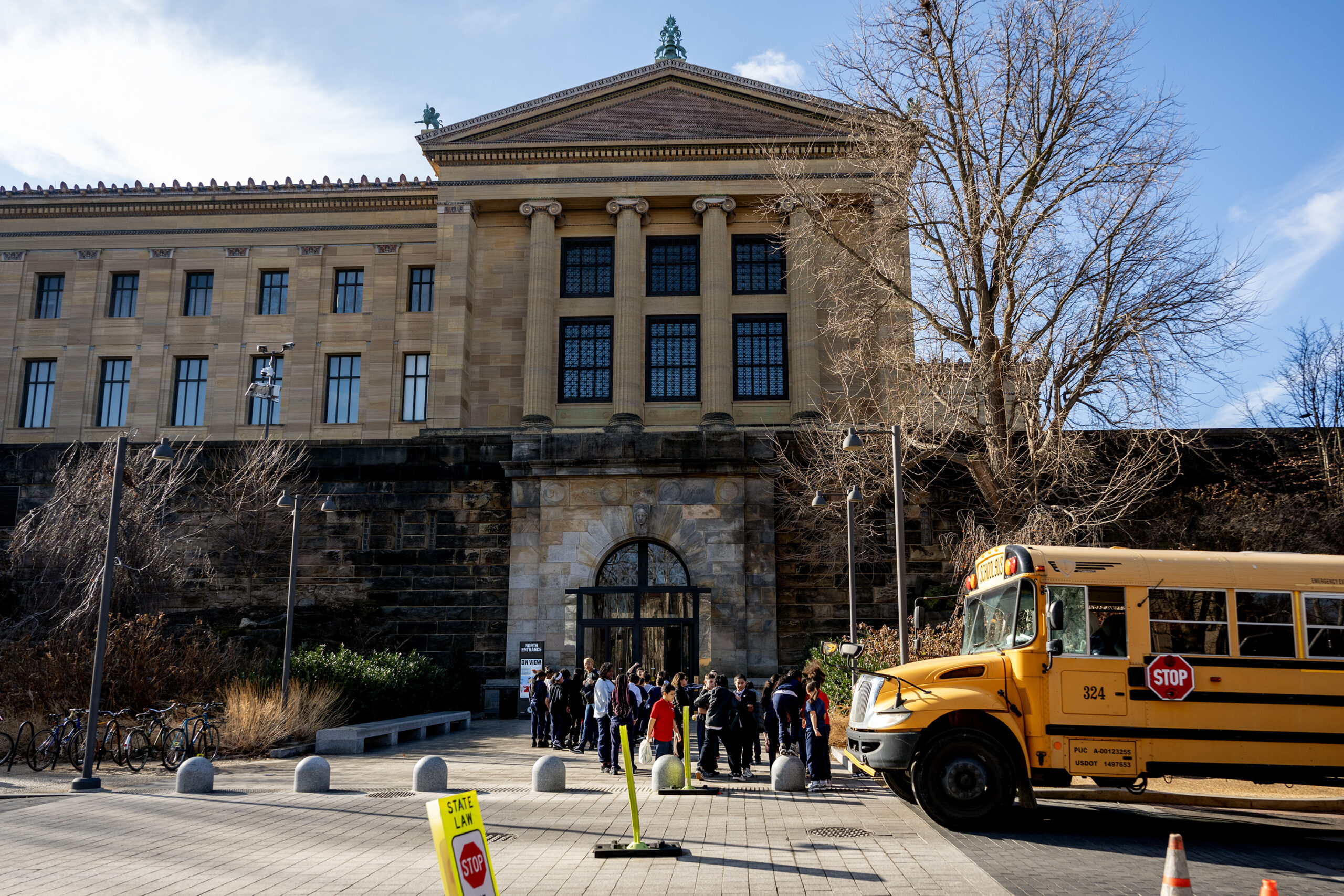
    School groups at the North Entrance to the Philadelphia Art Museum on Jan. 7.

    A strategic plan

    The “next chapter” will eventually take shape in a new strategic plan.

    In the spring and summer, Weiss hopes, conversations with board and staff will give the museum a “better sense of what our resources could be as we work our way to balance and health. And then next year, maybe early next year, we begin the process of putting together a plan.”

    Weiss’ credentials in both business and art seem suited to the moment. He holds an MBA from Yale School of Management and has worked for Booz Allen Hamilton. His master’s degree in medieval and modern art and Ph.D. in Western medieval and Byzantine art were earned at Johns Hopkins University, where he is finishing up his teaching at the end of the semester.

    Weiss, who has moved to Philadelphia with his wife, Sandra, sees his immediate job as reminding everyone what Philadelphia has in its museum.

    The events of the last few months — the widely ridiculed rebrand, Suda’s mid-contract ouster, and the dramatic language used in her subsequent wrongful-dismissal lawsuit against the museum — have often eclipsed the art and made the main message coming out of the museum one of acrimony.

    The new director is eager to change the message.

    “What I’d like to do over the next six months to one year is to get everybody excited about what’s possible, what we already have. How, by supporting each other and investing excitedly in our mission, we can do something really important.”

    Daniel H. Weiss, director and CEO of the Philadelphia Art Museum, with “The Bride Stripped Bare by Her Bachelors, Even” (1915–1923, also called “The Large Glass”) by Marcel Duchamp.

    The role of the board

    Weiss also needs to consider the role of the Art Museum board, which, on the one hand, was not informed that the rebrand was final, according to some board members. On the other hand, it has been accused in Suda’s initial court filings of being overinvolved in museum matters.

    “I don’t think our board needs radical restructuring … and this may seem counterintuitive in light of what you’ve been reading about in the newspapers, I think our board needs to be embraced as a real partner,” Weiss said. “And I do believe deeply in shared governance and that means the director and the senior administration have a job to do and the board has a job to do.”

    “They’re different jobs but when they’re working in concert, you get much more for the institution than you do if they’re at odds with each other.”

    How much of board-CEO relations is about structure, and how much is it the function of the personality of the person whose job it is to be the connective tissue? “Almost always it is more a function of the personalities than it is the structure,” he said.

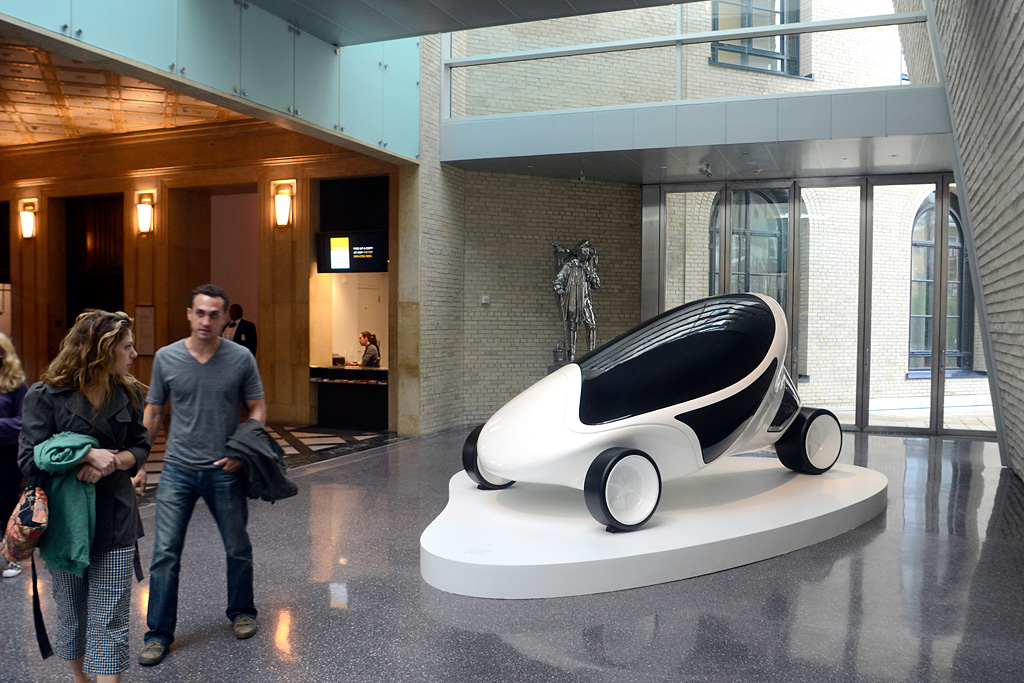
    In 2011, when the museum’s Perelman building was still open to the public, visitors view a three-wheel car.

    As for the involvement of one emeritus board member, Julian A. Brodsky, Weiss has to determine the future of an unannounced, but reported by Philadelphia Magazine, $20 million pledge from the Comcast cofounder toward a dreamed-of education center.

    “It’s an incredible gift and we’re enormously grateful for that. I’m in the process of talking about the timing of that and all of that,” he said.

    The art itself

    Weiss does not dispute that the museum needs changing. But a host of questions beckon.

    What about the art itself? Is the museum’s pipeline of shows — some of which are years in the planning — the right mix for the audience the museum wants to attract? Why are doors open only five days and past 5 o’clock one day a week? Is a general admission ticket of $30 too high for this city?

    Daniel H. Weiss, director and CEO of the Philadelphia Art Museum, is well into his listening tour.

    “Every great art museum faces the same challenge, which is that these are intimidating places by design. So how do you, on the one hand, celebrate this great magnificent institution sometimes called a castle on the hill? And at the same time [be] welcoming to schoolchildren who have never been here before? That’s not easy. We faced the same issue at the Met.”

    He sees the shifting societal context in which the museum finds itself as an opportunity.

    “The world is a mess,” he said. He would like the museum to be an answer to that turmoil — though clearly, given the last few months, Philadelphia’s major art museum is not cloistered from conflict.

    “There are very few places in the world that are entirely to the good, and art museums are among them. We are here to enrich, to enlighten, to inspire, to build community, to invite difference to come together, to have shared learning experiences for everyone,” Weiss said.

    “The world is a lot bigger, more complicated, richer, and inspiring than just the world you live in on a day-to-day basis. If everybody can have that experience, we are incrementally a more civil society than we were before people came into the institution. Those are all great things.”

  • Letters to the Editor | Jan. 21, 2026

    Letters to the Editor | Jan. 21, 2026

    Fighting words

    During a recent CBS News interview, Sen. Dave McCormick — who was appearing with Sen. John Fetterman — drew a sharp distinction between violent language and physical violence, and I found myself in rare agreement with him. After all, that is exactly what happened on Jan. 6, 2021, when Donald Trump and his minions spewed violent language that stoked a mob to attack the U.S. Capitol, where they physically injured law enforcement officers. And, to the extent our dear senator was referring to actions in Minneapolis, I will remind him that the last words Renee Good spoke were, “I’m not mad at you,” which is about as nonviolent a statement as one could utter — but an agent still shot her three times. So, in the case of U.S. Immigration and Customs Enforcement, calm words still provoke violence.

    Steve Morley, Philadelphia

    . . .

    I am appalled by comments made by both of Pennsylvania’s U.S. senators, John Fetterman and Dave McCormick, during their recent interview with CBS News.

    McCormick complained that protesters were “dehumanizing” U.S. Immigration and Customs Enforcement agents by comparing them to Hitler. Fetterman said, “ICE has a job to do, as well,” and that everyone doesn’t have to agree on the tactics.

    Our senators have got this completely wrong. The protesters are out there confronting ICE because of heavily armed, masked agents who are dehumanizing immigrants, invading their homes and workplaces without warrants, manhandling pregnant women, deporting children with cancer, arresting immigrants in courthouses when they show up for the very hearings they are required to attend to attain legal status here, and allegedly depriving them of contact with their families and attorneys.

    Both Presidents Barack Obama and Joe Biden deported more people than Donald Trump did in his first term, without the fuss and protests now accompanying the “jobs” of ICE agents, because they did it legally and followed international and U.S. law. Almost all of those deported were recent arrivals or convicted criminals, not people who peacefully made their homes here and contributed positively to their communities.

    Trump wants the public to see ICE treating immigrants brutally, and has posted many videos on U.S. Department of Homeland Security websites as a display of what he sees as his unstoppable power — just in case the public was missing the point.

    Most Americans want ICE to follow the law, obtain court-issued warrants, stop detaining and beating U.S. citizens caught up in its roundups, and allow immigrants to have the due process the Constitution affords to everyone, citizens and noncitizens alike. We want ICE agents to take off the masks and display their badges. And we want the shootings to stop — and justice for the senseless execution of Renee Nicole Good.

    Jodine Mayberry, Brookhaven

    . . .

    I must respond to something Brian Fitzpatrick said in an interview with Philadelphia Magazine, as reported recently in The Inquirer. Mr. Fitzpatrick is quoted as saying, “[W]e’ve seen the weaponization of the Justice Department now, I believe, in two administrations.” Statements like that are exactly why Fitzpatrick has to go. It is not “weaponization” when egregious behavior is confronted by law enforcement authorities and criminal and civil charges are brought to stop that behavior. Donald Trump was convicted in civil court of sexually abusing a woman. Mr. Trump was convicted of cheating the state of New York out of millions of dollars of tax revenue. We all saw dozens of boxes of United States government documents, many of them highly classified, stored in bathrooms and hallways at Mar-a-Lago, after they were illegally removed by Trump from the White House. And even Sen. Mitch McConnell (R., Ky.) assumed the U.S. Department of Justice would bring charges against Trump in the wake of the Jan. 6, 2021, insurrection. At Trump’s second impeachment, McConnell said that, even though Trump could not be impeached, he was “still liable to be tried and punished in ordinary tribunals of justice.”

    To imply that Trump or his Jan. 6 insurrectionists were unfairly targeted is a grave misrepresentation of our justice system. The fact that Fitzpatrick cannot — or will not — acknowledge that justice must be done disqualifies him from being a member of the House of Representatives.

    Michael Walsh, Elkins Park

    Love thy neighbor

    The Inquirer recently reported that a Norristown day center serving the city’s homeless population is itself in need of a new home. The day center was forced out of its current location and has been blocked from its new location over residents’ superfluous concerns about “loitering.” The fact that Norristown needs this center says something about our faltering economy, but this particular story says more about the failures of our culture — and each of us individually. The idea that we should “love thy neighbor” goes back to antiquity. Yet, Norristown residents demonstrated active disdain for their less fortunate neighbors by depriving them of much-needed support. Unfortunately, the NIMBYs of Norristown are not unique. Every day, Philadelphians turn a blind eye to our struggling, homeless neighbors living in Center City. Too many of us fail to empathize with those who are less fortunate than ourselves, and even more of us fail to offer help. Our collective lack of compassion is an evil that spreads through the body politic, infecting each of us. We must be better. The only way we can redeem ourselves is through action. We must actively love those less fortunate than ourselves, otherwise we contribute to the suffering of our neighbors.

    Owen Castle, Philadelphia

    Shift subsidies

    I appreciated your editorial regarding the administration’s energy policies, but it’s not just that fossil fuels are “promoted.” It’s that the government is using our tax dollars to make the air we breathe dirtier and the weather we live in more dangerous.

    The U.S. provides an estimated $35 billion annually in subsidies to the fossil fuel industry, more than we give to the 10 biggest recipients of foreign aid combined. At the same time, support for clean energy is being slashed.

    This makes no sense when solar has become the cheapest form of electricity. A local business is installing solar panels that will cut my energy bill in half. If the federal government reallocated subsidies away from people like Dallas Cowboys owner (and fossil fuel billionaire) Jerry Jones and toward regular Americans like you and me, we could empower 54 million households to do the same.

    Joe Pelusi, Rydal

    Lower the temperature

    President Donald Trump has been threatening to invoke the Insurrection Act and deploy the military to Minneapolis to quell the unrest. But when I look at the streets of Minneapolis these last few weeks, it feels like the military is already there: thousands of heavily armed federal agents are using tear gas, flash-bangs, pepper spray, and guns to intimidate (even kill, in one case) unarmed protesters exercising their constitutional right to express themselves. The presence of masked U.S. Immigration and Customs Enforcement agents and their heavy-handed tactics is what’s causing the unrest and fear, not the city residents. Remove ICE and the temperature will lower quickly. Sending in the military will have the opposite effect and is exactly what is not needed.

    Stephen Kunz, Phoenixville, spkunz@aol.com

    Admirable vs. abominable

    Albert Schweitzer was awarded the Nobel Peace Prize in 1952. This gifted scientist, musician, and doctor gave up a prosperous life to found humanitarian clinics where there were none. Finding Schweitzer in what was then known as French Equatorial Africa, Norman Cousins, editor of the then-influential magazine Saturday Review, asked him what the most important thing was that he had learned during his lifetime. Schweitzer responded after delivering a baby in a nearby village that the most important thing he had learned was that each person at birth contains a “cathedral within — a vast, precious, sacred cathedral!” Schweitzer sets a high standard for recipients of the Nobel Peace Prize. Donald Trump accuses the Minneapolis immigrants from Somalia (people he describes as “garbage”) of fraud. His recent acceptance of the Nobel Peace Prize awarded to María Corina Machado is fraud at the highest level. He should return it to her immediately. His motive for MAWA (Make America White Again) is in sharp contrast to Schweitzer’s “cathedral within!”

    Terry Furin, Philadelphia

    Patient in spirit

    I was so happy to read recently that Goldman Sachs and Morgan Stanley have reported double-digit increases in their profits. Does anyone know when that will trickle down to me?

    Dale Cochran, Downingtown

    Join the conversation: Send letters to letters@inquirer.com. Limit length to 150 words and include home address and day and evening phone number. Letters run in The Inquirer six days a week on the editorial pages and online.

  • Horoscopes: Wednesday, Jan. 21, 2026

    ARIES (March 21-April 19). You honor someone by giving them a gift that shows you were listening to who they are, what they like and what they need. Bonus: You’re also paying attention to who they were and where they’re headed. Witnessing means more than you could know.

    TAURUS (April 20-May 20). Today feels like a pop quiz from the universe. The lesson arrives as if guided by fate. Something you experienced or learned in the past becomes relevant again, and you can apply it here. Trust that you have the skills, insight and perspective to ace this.

    GEMINI (May 21-June 21). Some people play every game like it is a long game, and those are the ones you want on your side. The gracious and the generous may lose a play or two, but they always win in the end. The real prize is integrity.

    CANCER (June 22-July 22). The ability to read a room comes to those who have been in many rooms and been many people, too. You’ll do your best with it today and keep getting better with time and experience.

    LEO (July 23-Aug. 22). No, you’re not making it up. The things filling your day are actually necessary to your current role. Although, you might consider whether your ideal role is something else entirely, and thus worthy of a different routine.

    VIRGO (Aug. 23-Sept. 22). Playfulness happens when there is room for it. If a person can be playful, even when the situation is serious, it’s because their psyche is expansive, their emotional range as wide as a field. This is who you are today.

    LIBRA (Sept. 23-Oct. 23). What if the thing you’ve been avoiding is exactly the thing that changes everything for the better? Instead of seeing it as a chore, see it as a gamble. Once upon a time, something you almost didn’t do opened a world to you, and it’s about to happen again.

    SCORPIO (Oct. 24-Nov. 21). Intensity is so easy for you to create, wield and deal with. That’s why you’re fascinated by restraint. You observe, and life opens to you. You press or pry, and it closes. What matters will surface in its own time.

    SAGITTARIUS (Nov. 22-Dec. 21). You’re in a friendly mood today. The more inclusive you are, the more people you’ll know. The more people you know, the easier it is to connect with the person who will help you solve a problem.

    CAPRICORN (Dec. 22-Jan. 19). Knowing what’s good for you and getting more of it is wonderful. What’s less wonderful is finding out that what you like isn’t all that good for you. Luckily, in today’s case, substitutions abound.

    AQUARIUS (Jan. 20-Feb. 18). There are always pros and cons to consider. For instance, taller people have farther to fall, the richer have more to lose and the powerful few at the top are vulnerable to being conquered by the power of many at the bottom. You’ll look at all sides of an issue today.

    PISCES (Feb. 19-March 20). Your work will get the attention it deserves. You may not know exactly what to make of the feedback, but things are still settling in. For now, it’s very good just to get the exposure.

    TODAY’S BIRTHDAY (Jan. 21). Welcome to your Year of the Evolving Love Story. People, places and projects receive your enthusiasm and heart, and wonderful feelings boomerang back to you, sending you sailing on clouds. More highlights: You’ll lead where you once followed. You’ll cash in on what’s been growing in value for years. A problem is fixed once and for all, freeing your time and energy. Aries and Sagittarius adore you. Your lucky numbers are: 17, 32, 20, 18 and 25.

  • Dear Abby | Wife finally tired of being told to whom she can talk

    DEAR ABBY: My husband and I have been married for 40 years and share the same friendships — joint, his and mine. We have camped, hosted parties and traveled with the same friends. My problem is my husband says I’m not allowed to speak privately with the males in our group unless I first confirm with him what I’m talking about. He also gives me the third degree about my visits with the wives, mainly to find out if their husbands were around.

    In all our married years, I have never given him reason to think there’s anything going on between me and anyone else. I have always held him in high regard. I consider him to be somebody with honesty and integrity, and I love him wholeheartedly.

    Where in the world does he get off trying to order me around and think that I can’t ask a question of his friends, or visit with his friends and their wives without asking his permission? This has been a longtime situation between us, and I’m tired of it — almost to the point of leaving him and enjoying what’s left of my life in peace with all kinds of people and relationships. Please help.

    — PUT IN A CORNER IN OREGON

    DEAR PUT: Why didn’t you write to me about this 39 years ago? Your husband may be a man with “honesty and integrity,” but he is also someone with bottomless insecurities and an insatiable need to control you. I am surprised it has taken 40 years of this for you to finally say to yourself, “Enough!” I would recommend marriage counseling for the two of you, but I seriously question his ability to change. Counseling for you alone might give you the courage to draw the line.

    ** ** **

    DEAR ABBY: After I found the courage to leave my abusive marriage, it has been difficult. My family refuses to accept that a woman could have actually abused a man, and they are very skeptical. Even after my mother and sister attended therapy with me, they still question my honesty, something that has never been questioned before. Still, I have an amazing 9-year-old daughter from the marriage. She is part of the reason I had to leave her mother: There was no way I could model acceptance of that abuse after her mother refused to seek help. I tried.

    Now, two years later, I’m in a healthy relationship — with another man. While my daughter is overjoyed because he treats both of us well, my family continues to attack me, even saying they were no longer going to speak to me. They say this is why I left my ex, even though it is not true. (I didn’t anticipate this either.)

    My mother, who refuses to talk to me, recently let me know she wants to take me to court for the right to see my daughter. My daughter no longer wants to spend any time with her after seeing how she has treated me. I don’t think allowing visitation would be in my daughter’s best interest. Should I be worried?

    — UNRESOLVED IN OHIO

    DEAR UNRESOLVED: Not every state has laws on the books that govern grandparents’ rights. Ohio, where you reside, is one of those that does. Because your question is legal in nature, and you are rightly worried, the person you should ask would be a lawyer familiar with family law. I understand why you are worried, and you have my sympathy.

  • Mets acquire CF Luis Robert Jr. in a trade with the White Sox

    Mets acquire CF Luis Robert Jr. in a trade with the White Sox

    CHICAGO (AP) — The New York Mets acquired Luis Robert Jr. in a trade with the Chicago White Sox on Tuesday, filling a hole in center field.

    New York sent infielder Luisangel Acuña and minor league pitcher Truman Pauley to Chicago for Robert, who has struggled with injuries and inconsistency since a stellar 2023 season.

    The Mets had been looking for outfield help since they traded Brandon Nimmo to the Texas Rangers for second baseman Marcus Semien. They were in the mix for Kyle Tucker before he signed with the Los Angeles Dodgers.

    The trade was announced after New York finalized a $126 million, three-year contract with Bo Bichette, a two-time All-Star shortstop who is moving to third base with the Mets.

    Robert hit a career-low .223 with 14 homers, 53 RBIs, and a career-best 33 steals in 110 games last year. Despite the shaky performance, the White Sox picked up his $20 million option for 2026.

    Robert’s contract also has a $20 million club option for 2027 with a $2 million buyout.

  • Air Force One returns to Washington area due to minor electrical issue, White House says

    Air Force One returns to Washington area due to minor electrical issue, White House says

    WASHINGTON — President Donald Trump’s plane, Air Force One, returned to Joint Base Andrews about an hour after departing for Switzerland on Tuesday evening.

    White House press secretary Karoline Leavitt said the decision to return was made after takeoff when the crew aboard Air Force One identified “a minor electrical issue” and, out of an abundance of caution, decided to turn around.

    A reporter on board said the lights in the press cabin of the aircraft went out briefly after takeoff, but no explanation was immediately offered. About half an hour into the flight reporters were told the plane would be turning around.

    Trump will board another aircraft and continue on with his trip to the World Economic Forum in Davos.

    The two planes currently used as Air Force One have been flying for nearly four decades. Boeing has been working on replacements, but the program has faced a series of delays. The planes are heavily modified with survivability capabilities for the president for a range of contingencies, including radiation shielding and antimissile technology. They also include a variety of communications systems to allow the president to remain in contact with the military and issue orders from anywhere in the world.

    Last year, the ruling family of Qatar gifted Trump a luxury Boeing 747-8 jumbo jet to be added into the Air Force One fleet, a move that faced great scrutiny. That plane is currently being retrofitted to meet security requirements.

    Leavitt joked to reporters on Air Force One Tuesday night that a Qatari jet was sounding “much better” right now.

    Last February, an Air Force plane carrying Secretary of State Marco Rubio to Germany had to return to Washington because of a mechanical issue. In October, a military plane carrying Defense Secretary Pete Hegseth had to make an emergency landing in United Kingdom due to a crack in the windshield.

  • Lindsey Halligan out as U.S. attorney following pressure from judges

    Lindsey Halligan out as U.S. attorney following pressure from judges

    Lindsey Halligan, a Trump administration lawyer who was named head of a key U.S. attorney’s office in Virginia last year with instructions to seek criminal charges against President Donald Trump’s perceived political adversaries, left her post at the Justice Department on Tuesday.

    Halligan’s departure followed a pair of extraordinary moves by two federal judges who issued court orders hours earlier saying they intended to replace Halligan at the helm of the U.S. attorney’s office for the Eastern District of Virginia and threatening disciplinary sanctions for any government lawyer who continued to refer to her as U.S. attorney in legal filings.

    The separate actions by Chief Judge M. Hannah Lauck and Judge David J. Novak, who were nominated by President Barack Obama and Trump, respectively, signaled a breaking point for the federal bench in the Eastern District of Virginia months after Halligan was disqualified from serving as U.S. attorney in the high-profile office.

    The orders intensified a battle playing out nationwide between the executive and judicial branches over how the nation’s 93 U.S. attorneys can be appointed for temporary terms without Senate confirmation. And they had posed obstacles for Halligan — who had no prosecutorial experience before she was installed in the job — as she attempted to carry out Trump’s directions to levy criminal charges against two of his perceived political foes: former FBI director James B. Comey and New York Attorney General Letitia James.

    Halligan, in a statement, accused the district’s federal judges of a campaign to pressure her to leave after the court ruling declaring her appointment was invalid. She said that effort had diverted “time and resources from public safety responsibilities.”

    It was unclear Tuesday night who would be in charge of the U.S. attorney’s office. The Justice Department this month dismissed the first assistant U.S. attorney, Robert K. McBride, who would have automatically assumed the top job under federal law. A Justice Department spokesperson did not immediately respond to requests for comment.

    Halligan is the third Trump-appointed U.S. attorney pick to leave their post in the face of a growing body of court rulings that have deemed their appointments illegal.

    Alina Habba, a former Trump lawyer he picked to lead the U.S. attorney’s office in New Jersey, resigned last month after a monthslong legal battle over whether she was lawfully serving in that role.

    While the Justice Department continues to appeal the decision, Habba stepped down and moved to another role in the Justice Department.

    Julianne Murray, another contested pick, resigned her post as U.S. attorney in Delaware days afterward. Before her appointment, she had served as the state’s Republican Party chairwoman.

    Attorney General Pam Bondi praised Halligan for her service in a statement Tuesday.

    “While we will feel her absence keenly, we are confident that she will continue to serve her country in other ways,” Bondi said. “The circumstances that led to this outcome are deeply misguided. We are living in a time when a democratically elected President’s ability to staff key law enforcement positions faces serious obstacles.”

    Several judges had suggested for weeks that Halligan should resign and sharply questioned her continued use of the U.S. attorney title after an out-of-district judge, Cameron McGowan Currie, ruled in late November that the Trump administration had used an unlawful maneuver to install Halligan.

    On Tuesday, Lauck directed the court’s clerk to publish the U.S. attorney job posting in local newspapers, asking anyone interested to apply by Feb. 10. “The position of United States Attorney for the Eastern District of Virginia is vacant,” reads a public notice posted on the court’s website Tuesday.

    Lauck’s order marked an escalation, signaling active efforts by the judges to appoint the district’s top federal prosecutor under a federal law that gives them the power to do so after an interim U.S. attorney has been in office for 120 days. It was followed hours later with another order from Novak, who raised the threat of disciplinary action for anyone who described Halligan as the U.S. attorney in legal filings.

    “No matter all of her machinations, Ms. Halligan has no legal basis to represent to this Court that she holds the position. And any such representation going forward can only be described as a false statement made in direct defiance of valid court orders,” Novak wrote. “In short, this charade of Ms. Halligan masquerading as the United States Attorney for this District in direct defiance of binding court orders must come to an end.”

    The Trump administration has appealed Currie’s ruling, but it never requested a stay, so the ruling disqualifying Halligan remained in effect. Nonetheless, she continued to represent herself as the U.S. attorney in court filings.

    This month, Novak ordered Halligan to explain why she continued to use the title, suggesting she may be making false or misleading statements. The Justice Department responded defiantly to that order last week, arguing that Currie’s ruling was not binding and that Novak had no authority to strike Halligan’s name from the signature block of Justice Department court filings.

    The response, which accused Novak of making “rudimentary” legal errors and missing “elementary” legal principles, was written in a derisive tone unusual for a government lawyer addressing a federal judge.

    Novak said in response that Halligan’s rhetoric was beneath the court’s dignity and more suitable for cable news. He said Halligan’s continued use of the U.S. attorney title after Currie’s ruling was an affront to the legal system.

    “The Court cannot tolerate such obstinance, because doing so would undermine the very essence of the Rule of Law,” he wrote in Tuesday’s order. “If the Court were to allow Ms. Halligan and the Department of Justice to pick and choose which orders that they will follow, the same would have to be true for other litigants and our system of justice would crumble.”

    Halligan’s nomination for a full term as U.S. attorney is pending in the Senate, and it was unclear Tuesday whether the White House also intended to withdraw it. Even if they don’t, the nomination is unlikely to move forward because it lacks support from Virginia’s two senators — Mark R. Warner and Tim Kaine, both Democrats — who have emphasized that the Eastern District of Virginia handles a complex portfolio of cases dealing with national security, leaks of classified information, and international terrorism.

    In disqualifying Halligan last fall, Currie ruled that Halligan was never legally appointed to the position of interim U.S. attorney because the Trump administration had already named someone to that role — Halligan’s predecessor, Erik S. Siebert, who served a full 120-day term, from January to May 2025. The district judges then unanimously extended Siebert in the role at the Justice Department’s request, Novak wrote in his order.

    But Siebert was forced out in September after declining to seek charges against Comey and James. Career prosecutors had recommended against pursuing the two cases because of insufficient evidence of wrongdoing. Trump then named Halligan, who promptly secured indictments against Comey, on allegations that he made false statements to Congress, and James, who was accused of mortgage fraud. Currie tossed both indictments after finding that Halligan was unlawfully appointed.

    Halligan’s 120-day appointment concluded Tuesday.

    Justice Department lawyers maintain that the statute allows for back-to-back interim appointments. But in addition to Currie, at least five other federal judges have rejected that argument while ruling on challenges to other Trump U.S. attorney appointees. In each case, the judges have said that if the attorney general could legally name a string of interim appointees, there would be no need for an administration to put a nominee up for a Senate vote.

    Judges across the country have been cautious in exercising their authority to name replacements for the president’s picks. When New Jersey’s federal judges named a veteran federal prosecutor to replace Habba last summer, the Justice Department fired their pick within hours and undertook a series of legal maneuvers aimed at keeping Habba in the role.

    Delaware’s chief federal judge began soliciting applications this fall to replace Murray in Delaware. But Murray resigned her post in December before a potential standoff with the administration could come to a head.

    Judges in other districts have refused to reappoint Trump’s interim U.S. attorney picks but declined to choose replacements. The chief federal judge in Seattle issued an order last week soliciting applications to potentially appoint a new acting U.S. attorney there, when the interim appointment of Trump’s current pick expires next month.

  • 76ers fall to Suns, 116-110, despite 25 points from VJ Edgecombe

    76ers fall to Suns, 116-110, despite 25 points from VJ Edgecombe

    PHILADELPHIA (AP) — Devin Booker scored 27 points and Jalen Green added 12 points in his return to the lineup as the Phoenix Suns beat the 76ers 116-110 on Tuesday night in a matchup of teams playing the second game of a back-to-back.

    Grayson Allen and Jordan Goodwin scored 16 points apiece, and former Villanova star Collin Gillespie and Oso Ighodaro each added 12 as the Suns won their third straight game and for the 12th time in 16 games.

    Rookie VJ Edgecombe led the 76ers with 25 points. Kelly Oubre Jr. finished with 21 points, and Tyrese Maxey added 20. Andre Drummond finished with eight points and 15 rebounds for the Sixers, who lost for the fourth time in six games.

    Philadelphia was without Joel Embiid (right ankle injury management) and Paul George (left knee injury management).

    Green played in just his third game of the season, and his first since Nov. 8, because of a right hamstring injury. He is in his first season with the Suns, arriving in the offseason as part of the trade in which Kevin Durant was sent to the Houston Rockets.

    Green came off the bench to score seven points in nine minutes in the first half, and went on to shoot 4 for 11 from the field, including 2 for 4 from distance, in 20 minutes, with three assists and two rebounds.

    The Suns, coming off a win over Brooklyn on Monday, got 13 points from Booker, 10 from Ighodaro, and were perfect on 13 shots from the free-throw line on the way to a 57-53 lead at the break.

    The Sixers, who beat Indiana on Monday, opened the second half with a 13-2 run for a 66-59 lead. The Suns tied it at 68 and built a 97-84 lead by the end of the third period. Phoenix extended its lead to 103-86 with 9 minutes, 37 seconds left in the fourth after Sixers coach Nick Nurse received a technical foul for contesting a call. Philadelphia chipped away down the stretch, but never really threatened.

    Up next

    The Sixers host Houston on Thursday (7 p.m., NBCSP) in the fifth game of a six-game homestand.