Blog

  • Joel Embiid, Paul George return to Sixers lineup to face Raptors

    Joel Embiid, Paul George return to Sixers lineup to face Raptors

    TORONTO — Joel Embiid (knee/groin) and Paul George (knee) will return for the 76ers’ game at the Raptors on Monday night after missing Sunday’s overtime loss against the same opponent.

    Embiid had been ruled out of Sunday’s game earlier in the day after groin soreness popped up following Friday’s victory against the Magic in Orlando, coach Nick Nurse said. George was a late scratch after he attempted his pregame warmup twice and could not adequately push off his leg, Nurse said.

    Before Sunday, Embiid and George had gained some rhythm in availability and production after a cautious ramp-up following knee surgeries. Embiid, the former MVP, is averaging 23.5 points, 7.1 rebounds, and 3.3 assists in 19 games. George has averaged 16 points, 5.4 rebounds, 3.5 assists, and 1.4 steals in 20 games.

    Their returns will boost a 21-16 Sixers team playing its final regular-season game against the 24-16 Raptors, who would be their first-round opponent if the playoffs began Monday.

  • WNBA, players’ union agree to moratorium, halting initial stages of free agency

    WNBA, players’ union agree to moratorium, halting initial stages of free agency

    NEW YORK — The WNBA and its players’ union agreed to a moratorium for league business Monday.

    The moratorium, which was confirmed by the league, was necessary because the sides failed to reach a deal on a new collective bargaining agreement or an extension of the current one by Friday night’s deadline.

    The sides are continuing to negotiate in good faith on a new CBA and are far apart on salaries and revenue sharing.

    The moratorium will halt the initial stages of free agency in which teams would seek to deliver qualifying offers and franchise tag designations to players.

    Before the moratorium, the WNBA, under U.S. labor law, had a status-quo obligation to allow teams to send out qualifying offers under the expired CBA agreement. Sunday was the first day that teams would have sent out offers to players.

    While the moratorium makes sense for both sides, they are still far apart on key issues.

    The league’s most recent offer last month would guarantee a maximum base salary of $1 million in 2026 that could reach $1.3 million through revenue sharing. That’s up from the current $249,000 and could grow to nearly $2 million over the life of the agreement, a person familiar with the negotiations told the AP earlier this month. The person spoke on condition of anonymity because of the sensitive nature of the negotiations.

    The moratorium will halt the initial stages of free agency in which teams would seek to deliver qualifying offers and franchise tag designations to players.

    Under the league’s proposal, players would receive in excess of 70% of net revenue — though that would be their take of the profits after expenses are paid. Those expenses would include upgraded facilities, charter flights, five-star hotels, medical services, security and arenas.

    The average salary in 2026 would be more than $530,000, up from its current $120,000, and grow to more than $770,000 over the life of the agreement. The minimum salary would grow from its current $67,000 to approximately $250,000 in the first year, the person told the AP.

    The proposal would also financially pay star young players like Caitlin Clark, Angel Reese and Paige Bueckers, who are all still on their rookie contracts, nearly double the league minimum.

    Revenue sharing is one of the major sticking points in the negotiations.

    The union’s counter proposal to the league would give players around 30% of the gross revenue. The player’s percentage would be from money generated before expenses for the first year and teams would have a $10.5 million salary cap to sign players. Under the union’s proposal, the revenue sharing percent would go up slightly each year.

  • Jeffrey Rosen steps down as head of National Constitution Center

    Jeffrey Rosen steps down as head of National Constitution Center

    Jeffrey Rosen has stepped down as president and CEO of the National Constitution Center after 12 years of leading the private, nonprofit institution.

    The center made the announcement Friday on the social media platform LinkedIn.

    Rosen will remain as CEO emeritus. Vincent Stango, who has been serving as executive vice president and chief operating officer, has assumed the role as interim president and CEO. The center will conduct a national search for the top leadership position, a spokesperson said Monday.

    “It has been an honor to serve the National Constitution Center and to work alongside such an extraordinary board and staff in advancing this mission,” Rosen said in a statement.

    “As we approach America’s 250th anniversary, I am proud to pass the baton to Vince and our exceptional leadership team who are fully ready to guide the Center’s next chapter,” Rosen said.

    “As CEO Emeritus, I’m looking forward to devoting more time to scholarship, writing, and public engagement around the enduring ideas of the Constitution and the American experiment. This seems like the right time to do that given the exciting programs we have in place for America 250,” Rosen added.

    The National Constitution Center is known for awarding the annual Liberty Medal, which has been given to such notable figures in recent years as Volodymyr Zelensky, the president of Ukraine; legendary boxer Muhammad Ali; and then-Supreme Court Justices Ruth Bader Ginsburg and Anthony M. Kennedy.

    The center, located at the north end of Independence Mall, was the stage for the only 2024 presidential debate between Kamala Harris and Donald Trump, and has held talks with Supreme Court justices, including in September with Amy Coney Barrett.

    Jeffrey Rosen (left), then-president and CEO of the National Constitution Center, speaking during ceremonies as Ukraine President Volodymyr Zelensky was awarded the 2022 Liberty Medal.

    Stango has been with the National Constitution Center for 26 years.

    “I’m grateful for the trust our Board of Trustees has placed in me, privileged to work with colleagues whose dedication and talents I admire tremendously, and enormously thankful to Jeffrey Rosen for his 12 years of extraordinary service and the legacy he leaves behind,” Stango said in a statement.

    In a 2014 Inquirer interview, Doug DeVos, a board member and president of Amway, said Rosen was picked for the job because of his background as a constitutional scholar and his network of friends at the highest legal levels, including Ginsburg.

    “He had the skills to engage people in conversation, and really that was the piece that set him apart. He doesn’t do it in a way that says: ‘Hey, I am really smart. Let me tell you everything I know. It’s more like, ‘Let’s talk,’” DeVos said.

    Rosen graduated from Harvard University and earned a Juris Doctor degree from Yale Law School. He served as a law clerk for Chief Judge Abner Mikva of the U.S. Court of Appeals for the District of Columbia Circuit.

    He was legal affairs editor at the New Republic and found himself interviewing members of the Supreme Court. Rosen was an early advocate for Ginsberg, and she credited him with helping her get the 1993 nomination from President Bill Clinton to the high court.

    Rosen remains listed as a professor of law at George Washington University.

    He is the author of several books, most recently The Pursuit of Liberty: How Hamilton vs. Jefferson Ignited the Lasting Battle Over Power in America.

  • Eagles offseason guide: Key dates for fans to know, from free agency to the draft to opening kickoff

    Eagles offseason guide: Key dates for fans to know, from free agency to the draft to opening kickoff

    The Eagles season ended early after a wild-card loss to the San Francisco 49ers on Sunday. Now, it’s back to the drawing board. Here are some important offseason dates to know, from the Super Bowl to the start of next season.

    Jan. 17 to Jan. 25: Divisional and championship round of NFL playoffs

    The Eagles may be eliminated, but the playoffs will continue with the divisional round on Jan. 17-18, followed by the AFC and NFC championship games on Jan. 25.

    Jan. 27: East-West Shrine Bowl game

    One of the two major college football showcase games, the East-West Shrine Bowl in Frisco, Texas features some of the top NFL draft prospects, and hosts scouts, coaches, and executives from all 32 NFL teams.

    Jan. 31: Senior Bowl game

    In addition to the Shrine Bowl, there’s the Senior Bowl, which also draws personnel from across the NFL to Mobile, Ala.

    Feb. 3: NFL Pro Bowl Games

    Since 2023, the NFL has hosted Pro Bowl Games, which features flag football and other skills contests instead of a traditional football game. This year, those games kick off on Feb. 3, and so far five Eagles have been named, almost entirely on the defensive side of the ball. Center Cam Jurgens is the lone offensive player, joining defensive tackle Jalen Carter, linebacker Zack Baun, and cornerbacks Quinyon Mitchell and Cooper DeJean. Injuries, players opting out, and Super Bowl restrictions could mean more Eagles players make it.

    Feb. 8: Super Bowl LX

    This year, the Super Bowl, the NFL’s 60th, will take place on Feb. 8 at Levi’s Stadium in Santa Clara, Calif., the home of the 49ers. Bad Bunny is scheduled to be the halftime performer.

    Feb. 17 to March 3: Franchise tag period

    Teams can place the franchise tag on players starting Feb. 17 through 4 p.m. on March 3. The Eagles haven’t done this since placing a franchise tag on DeSean Jackson in 2012.

    Eagles first-round pick Jihaad Campbell runs the 40-yard dash during last year’s scouting combine in Indianapolis.

    Feb. 23 to March 2: NFL Scouting Combine

    The NFL Scouting Combine will take place at Lucas Oil Stadium in Indianapolis. Top draft prospects have their physical attributes tested, run drills, and conduct interviews with coaches, front office staff, and the media.

    March 11: Free agency begins

    Free agency begins on March 11 at 4 p.m. ET, the official start of the 2026 season. Teams can begin contract negotiations two days earlier on March 9. However, they may not sign until this day.

    March 29 to April 1: Annual league meeting

    Will there be more discussion centered around banning the Tush Push? This is when those kind of topics will be discussed as owners meet up in Phoenix, Arizona.

    April 20: Offseason workouts can begin

    Teams with returning head coaches can start their optional workout programs. Meanwhile, teams that hired a new head coach after the end of the 2025 regular season can start offseason workouts on April 6.

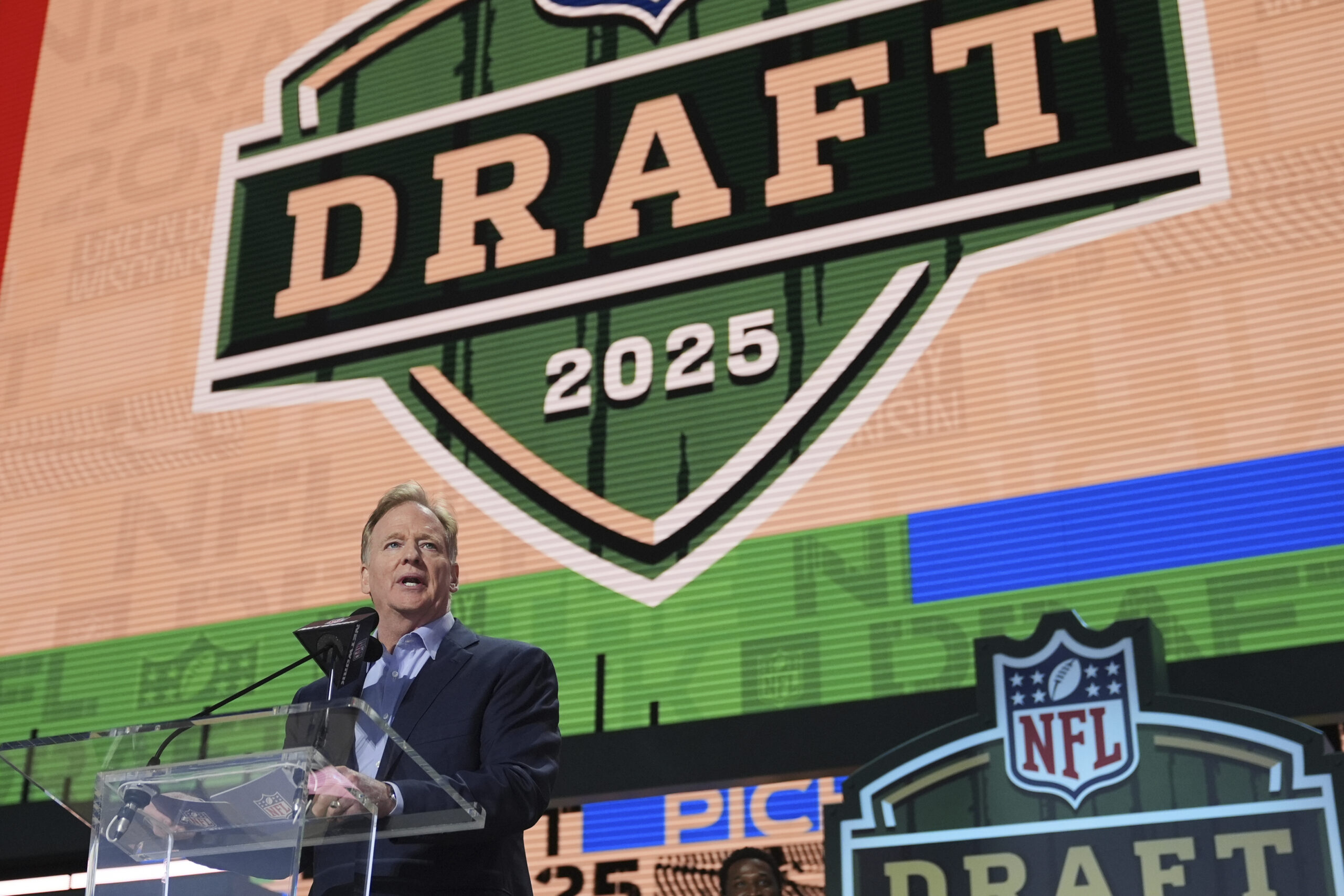
    NFL Commissioner Roger Goodell always gets a healthy dose of boos at the start of the draft.

    April 23 to 25: NFL draft

    The NFL draft will take place between April 23 to 25 in Pittsburgh, Pennsylvania. The Eagles enter the draft with eight picks: a first-round pick, a second-round pick, two third-round picks, two fourth-round picks, and two fifth-round picks.

    May 1: Decision day for former first-rounders

    Teams will have to decide whether to exercise their fifth-year option on 2023 first-round draft picks. Carter and Nolan Smith are Eagles players who have fifth-year options coming up.

    Early May: Rookie minicamp

    After he draft, teams will host a three-day minicamp for rookies to welcome the players into the NFL. This year, they can choose between May 1-4 or May 8-11.

    Mid-May: NFL schedule release

    In May, the NFL will release the dates of each matchup for the 2026 season. Some game times may be changed throughout the season.

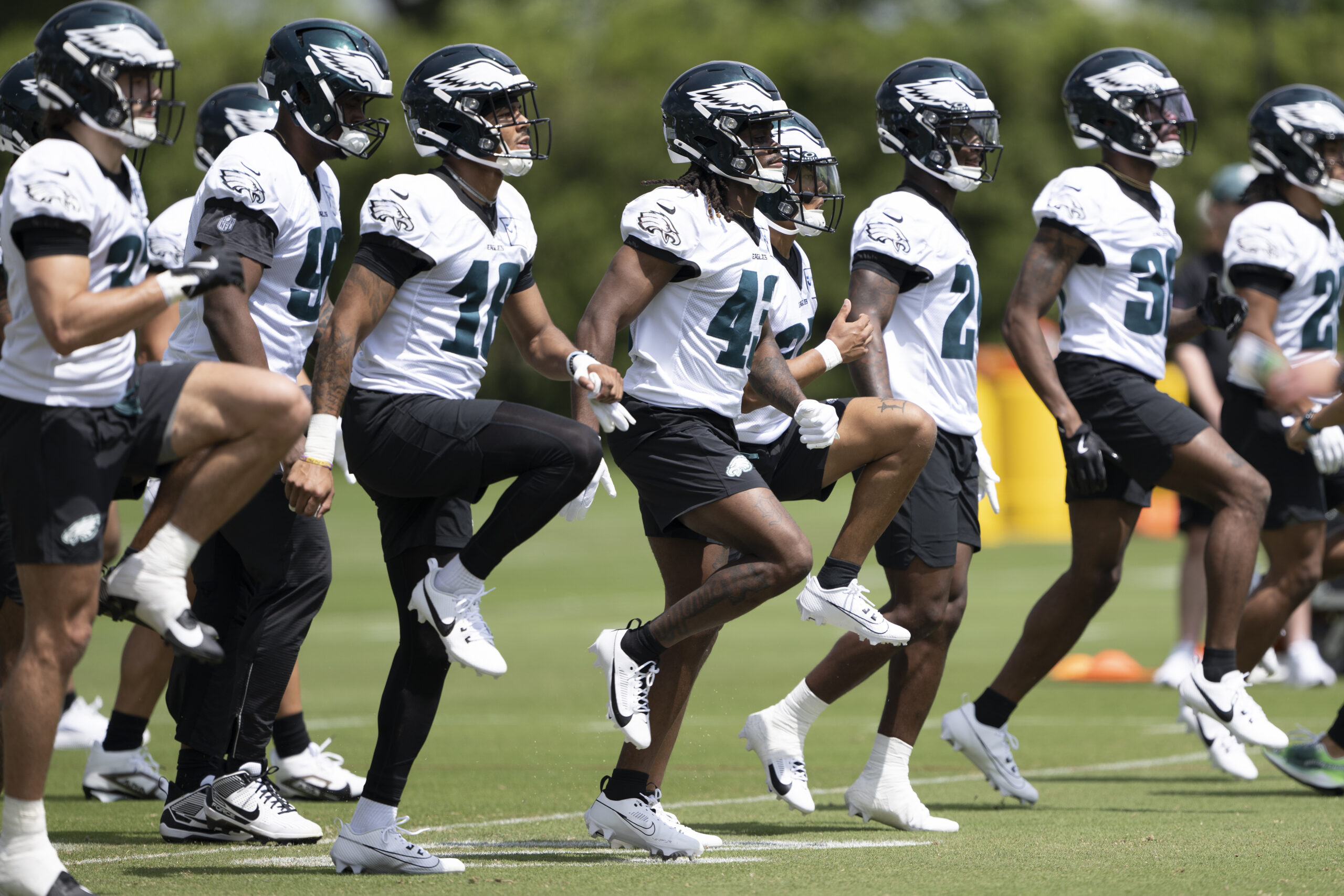
    The Eagles will host several offseason workouts, including rookie minicamp following the draft.

    Late May: OTAs

    Last year, the Eagles hosted a number of optional workouts before mandatory minicamp. The workouts took place in late May and early June, beginning on May 27.

    Early June: Mandatory minicamp

    The team should hold a mandatory minicamp some time in June. Las year, the team hosted a one-day mandatory minicamp on June 10.

    Mid-late July: Training camp begins

    There’s no official date for the start of Eagles training camp. Last season, camp began on July 22 and the team hosted an open practice at Lincoln Financial Field on Aug. 10.

    First week of August: NFL preseason begins

    Teams will get their first taste of action in the first week of August with the start of the NFL preseason as they prepare for the next step of the 2026 season …

    First week of September: Regular season begins

    Although we won’t know who the team will be competing against until May, the Eagles will have a chance to start the season on a high note after an early playoff exit as defending Super Bowl champions.

  • New Jersey sues Camden metal recycler over a dozen ‘especially dangerous’ fires

    New Jersey sues Camden metal recycler over a dozen ‘especially dangerous’ fires

    New Jersey officials have filed suit against the large scrap metal recycler EMR over a string of hazardous and “especially dangerous” fires at its facilities, especially in Camden.

    One four-alarm fire at an EMR scrapyard on Camden’s Front Street nearly a year ago resulted in black, billowing smoke that could be seen for 15 miles and led to the voluntary evacuation of 100 families.

    As a result of that Feb. 21, 2025, fire, the U.K.-based metal recycler agreed in August to pay $6.7 million toward improvements to Camden’s Waterfront South neighborhood. The fire occurred when a lithium ion battery embedded in an item ignited while being recycled.

    That fire was one of a dozen at the Camden facilities in the last five years, says the suit filed by the state Attorney General Matthew Platkin and the Department of Environmental Protection (DEP). EMR has several facilities in Camden.

    “It is outrageous that EMR has failed to correct the dangerous conditions at its facilities in Camden — conditions that have resulted in over a dozen hazardous fires in recent years that threaten the lives and health of Camden residents,“ Platkin said in a statement. ”We’re taking action today to hold EMR accountable for its reprehensible conduct and to protect Camden residents.”

    He accused EMR of turning “a quick buck at the expense of their communities.”

    Joseph Balzano, CEO of EMR USA, on Monday pointed to the $6.7 million agreement from August. “It appears the current Attorney General is not aware of … EMR’s fire suppression investments,” he said. “We look forward to working with the State of New Jersey to addressing the scourge of lithium ion battery fires plaguing recycling facilities throughout the country.”

    ‘Severe harm’

    The civil suit, filed Monday in New Jersey Superior Court in Camden, alleges that fires at EMR facilities have created an “ongoing public nuisance.”

    It alleges that the company’s facilities are unsafe, and that the company has failed to take steps to remedy those conditions.

    As a result, EMR has caused “severe harm” to the “health and well-being” of nearby communities.

    EMR’s global headquarters is in England. But the company has various subsidiaries in the U.S. EMR USA Holdings Inc. is a Delaware company with its headquarters on North Front Street in Camden. Both EMR Eastern, LLC and Camden Iron & Metal Inc are subsidiaries with Camden addresses.

    The lawsuit alleges that fires related to EMR’s scrap metal operations have occurred in multiple locations. The company also has facilities in Bayonne and Newark. The suit notes a fire that broke out in May 2022 on a barge in the Delaware Bay carrying scrap metal between the company’s Newark and Camden locations.

    But the suit singles out the Camden location as the worst with some fires occurring within days of each other.

    “Over the last five years, at least 12 major fires have occurred in scrap metal piles at Defendants’ facilities in the Camden Waterfront South neighborhood,” the lawsuit states.

    The suit states that the fires filled streets with smoke and air pollution, “causing chemical and burning smells to permeate through homes and causing residents to suffer from asthma and other acute respiratory illnesses.”

    It alleges the fires have “caused severe harm to the health and well-being of individuals and communities in the vicinity.”

    The Feb. 21, 2025, fire occurred at EMR’s waterfront shredder facility. It started in a large pile of scrap metal material waiting to be shredded. It burned for eight hours before Camden firefighters brought it under control, but took 12 hours to fully extinguish.

    The burning pile measured 300 feet by 250 feet, according to the suit, and was roughly two stories high. It was destined for a conveyor belt leading to a four-story building.

    The pile, conveyor belt, and building all became fully engulfed in the city’s Waterfront South area, which is home to 2,300 people. The suit states that the community already “experiences disproportionate environmental harm and risks due to exposures or cumulative impacts from environmental hazards.”

    The scene at EMR Metal Recycling in Camden on Feb. 22, 2025, the morning after a four-alarm fire.

    The fires

    Among the fires in Camden since 2020, according to allegations in the suit:

    • Feb. 18, 2020: “Automobile fluff” caught fire at the shredder facility on Front Street.
    • Nov. 29, 2020: EMR failed to notify the DEP of this fire at the Kaighns Avenue facility.
    • Jan. 29, 2021: EMR failed to notify the DEP in a timely manner when a pile of material three stories high and 300 feet by 150 feet ignited at the shredder facility, causing the nearby Sacred Heart School and 30 families to evacuate. Five firefighters were treated for smoke inhalation and one was hospitalized. Two residents were hospitalized for smoke inhalation.
    • Feb. 27, 2021: Residue caught fire at the shredder facility and could be seen burning from Philadelphia and the Benjamin Franklin Bridge.
    • Feb. 28, 2022: A pile of shredded material caught fire at the South Sixth Street facility.
    • July 21, 2022: A fire occurred at the shredder facility.
    • July 22, 2022: A fire broke out at the South Sixth Street facility, possibly from a lithium ion battery.
    • Oct. 18, 2022: During a fire at the shredder facility, residents were offered hotel accommodations by EMR if they needed to evacuate.
    • July 29, 2024: A pile of material caught fire at the South Sixth Street facility.

    “Neighbors of EMR should not have to live in fear of the industrial business next door to them, wondering whether the air is safe to breathe and the company values its role in the community as much as its profits,” DEP commissioner Shawn LaTourette said in a statement.

    The suit seeks to make EMR take measures that include adding continual surveillance and monitoring, reducing the height of scrap piles, hiring an engineer to evaluate its facilities and issue a report to the DEP, installing a system that can generate real time reports, and immediately notifying the DEP of any issues.

    It seeks a maximum allowable penalty of $1,000 under a nuisances law, and any other money a court might award.

  • Pit bull that attacked dogs in Center City is in ACCT custody

    Pit bull that attacked dogs in Center City is in ACCT custody

    For Brian Lovenduski and J. Bazzel, the week after Christmas turned into horror when a pit bull in Center City attacked their beloved dogs. Now that the canine is in custody, they can’t help but feel a bittersweet sense of solace.

    “I feel relieved that the dog is not a danger to other people on the streets, but I have mixed feelings that the authorities didn’t work faster,” Lovenduski said.

    Between Dec. 26 and 31, three dogs and two owners were attacked by a pit bull in Center City, leaving behind thousands in veterinary bills and GoFundMe pages asking for help.

    Lovenduski’s miniature pinscher, Ziggy, lost a leg after a pit bull lunged at him at 12th and Chestnut Streets. And, Stella, Bazzel’s sheltie pup, required surgery, a plate, and a skin graft to piece her crushed foreleg together, after being attacked at Juniper and Chestnut Streets.

    It that intersection where police located the pit bull and her owner, whom they believed to be a homeless woman, on Jan. 6.

    Stella, an 11-month-old sheltie, seen here recovering from surgery after she was attacked by a pitbull Dec. 26 in Center City. Police believe the pitbull is responsible for three recent attacks.

    Miguel Torres, a spokesperson for the Philadelphia Police Department, said the woman was arrested for an unrelated matter he would not disclose. So far, no charges have been filed in connection with the dog attacks, Torres said.

    The pit bull was transported to ACCT for evaluation. She has not been euthanized, but is not a candidate for adoption, said Sarah Barnett, ACCT Philly executive director.

    All incidents remain under investigation, police said.

    Both Lovenduski and Bazzel were told the pit bull responsible for their dogs’ attacks was in custody at ACCT.

    “It’s bittersweet. We have a dog that is not in a great situation, which creates situations for other dogs and other people. I’m relieved, but I’m not happy it had to come to that,” Bazzel said.

    Stella, an 11-month-old sheltie, seen here recovering from surgery after she was attacked by a pit bull Dec. 26 in Center City. Police believe the pit bull is responsible for three recent attacks.

    Regardless, his full focus is on his 11-month-old puppy, Stella, who is working on her recovery and getting ready for her first birthday on Jan. 23.

    Looking at Ziggy, Lovenduski feels like he may be heartbroken forever, but he is pulling strength from seeing his little guy trying to keep going.

    “He is this innocent little creature that relies on me for his safety, and this horrible thing happened that changed his life forever,” Lovenduski said. “I never expected to be in this situation, but the kindness of people has really reminded me that even when it feels like the world is rotten, kindness wins among the lost.”

    Ziggy, a miniature pinscher, was attacked by a pit bull while being walked by owner, Brian Lovenduski on Dec. 29, 2025. It was one of three known attacks by the pit bull.
  • Minnesota and the Twin Cities sue the federal government to stop the immigration crackdown

    Minnesota and the Twin Cities sue the federal government to stop the immigration crackdown

    MINNEAPOLIS — Minnesota and its two largest cities sued the Trump administration Monday to try to stop an immigration enforcement surge that led to the fatal shooting of a Minneapolis woman by a federal officer and evoked outrage and protests across the country.

    The state, joined by Minneapolis and St. Paul, said the Department of Homeland Security is violating the First Amendment and other constitutional protections. The lawsuit seeks a temporary restraining order to halt the enforcement action or limit the operation.

    “This is, in essence, a federal invasion of the Twin Cities in Minnesota, and it must stop,” state Attorney General Keith Ellison said at a news conference. “These poorly trained, aggressive, and armed agents of the federal state have terrorized Minnesota with widespread unlawful conduct.”

    Homeland Security is pledging to put more than 2,000 immigration officers into Minnesota and says it has made more than 2,000 arrests since December. Immigration and Customs Enforcement has called the surge its largest enforcement operation ever.

    The lawsuit accuses the Republican Trump administration of violating free speech rights by targeting a progressive state that favors Democrats and welcomes immigrants.

    “They’re targeting us based on what we look and sound like. Our residents are scared. And as local officials, we have a responsibility to act,” said St. Paul Mayor Kaohly Her, who was born in Laos.

    Feds say they’re protecting the public

    In response, Homeland Security spokesperson Tricia McLaughlin accused Minnesota officials of ignoring public safety.

    “President Trump’s job is to protect the American people and enforce the law — no matter who your mayor, governor, or state attorney general is,” McLaughlin said. “That’s what the Trump administration is doing; we have the Constitution on our side on this, and we look forward to proving that in court.”

    The government also faces a new lawsuit over over a similar crackdown in Illinois. More than 4,300 people were arrested last year in Operation Midway Blitz as patrols of masked agents swept the Chicago area. The lawsuit by the city and state says the campaign had a chilling effect, making residents afraid to leave home or use public services.

    Since the deployment in the Twin Cities, whistle-burst warnings by grassroots activists are commonly heard when agents flood streets. Witnesses have regularly posted video of federal officers using tear gas to discourage the public from following them.

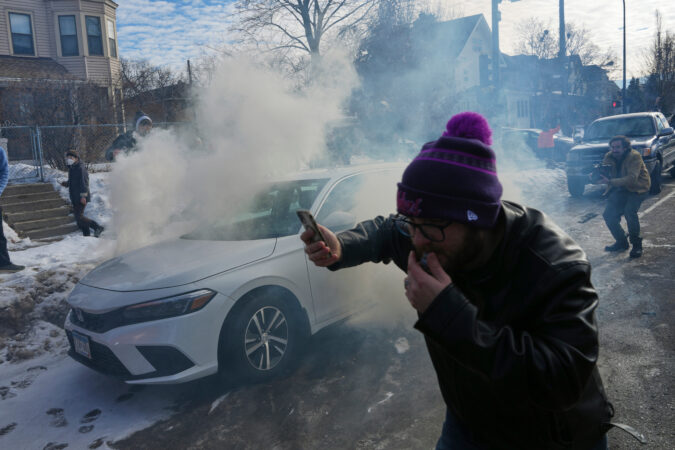
    Earlier Monday, agents fired tear gas to break up a crowd of people who showed up to see the aftermath of a car crash in Minneapolis, just a few blocks from where Renee Good was fatally shot.

    A crowd emerged to witness a man being questioned by agents who had rear-ended his car. Agents used tear gas to try to discourage the group, then drove off as people screamed, “cowards!”

    “I’m glad they didn’t shoot me or something,” Christian Molina told reporters.

    Standing near his mangled fender, he wondered aloud: “Who’s going to pay for my car?”

    It was another tense scene following the death of Good on Jan. 7. There were dozens of protests or vigils across the U.S. to honor the 37-year-old mother of three and to passionately criticize the Trump administration’s tactics.

    Trump administration officials have repeatedly defended the immigration agent who shot her, saying Good and her vehicle presented a threat. But that explanation has been widely panned by Minnesota Gov. Tim Walz and others based on videos of the confrontation.

    Students walk out of school

    Hundreds of students walked out of Roosevelt High School in Minneapolis, where federal agents had deployed tear gas on students and staff last week. Adults wearing safety vests cleared traffic, and many parents who are Roosevelt alumni showed up in old school wear.

    Marchers held signs that said, “ICE out” and “Welcome to Panem,” a reference to the dystopian society from the Hunger Games book series.

    Meanwhile, in Portland, Ore., federal authorities filed charges against a Venezuelan national who was one of two people shot there by U.S. Border Patrol on Thursday. The U.S. Justice Department said the man used his pickup truck to strike a Border Patrol vehicle and escape the scene with a woman.

    They were shot and eventually arrested. Their wounds were not life-threatening. The FBI said there was no video of the incident, unlike the Good shooting.

  • Why the Federal Reserve has historically been independent of the White House

    Why the Federal Reserve has historically been independent of the White House

    WASHINGTON — The Justice Department has threatened the Federal Reserve with a criminal indictment over the testimony of Fed Chair Jerome Powell this summer regarding its building renovations, Powell said over the weekend.

    It is a major escalation by the administration after repeated attempts by President Donald Trump to exert greater control over the independent institution.

    Trump has repeatedly attacked Powell for not cutting its short-term interest rate, and even threatened to fire him. Powell’s caution has infuriated Trump, who has demanded the Fed cut borrowing costs to spur the economy and reduce the interest rates the federal government pays on its debt. That anger has not subsided even after the Fed cut interest rates in three of the final four months of 2025.

    Trump has also accused Powell of mismanaging the U.S. central bank’s $2.5 billion building renovation project. In a sharp departure from his previous responses to attacks by Trump, Powell described the threat of criminal charges as simple “pretexts” to undermine the Fed’s independence when it comes to setting interest rates.

    Trump is already seeking to fire Federal Reserve Governor Lisa Cook over unproven allegations that she committed mortgage fraud. The allegation was made over the summer by Bill Pulte, a Trump appointee to the Federal Housing Administration.

    Here are some reasons why the independence of the U.S. Federal Reserve is guarded so closely.

    Why the Fed’s independence matters

    The Fed wields extensive power over the U.S. economy. By cutting the short-term interest rate it controls — which it typically does when the economy falters — the Fed can make borrowing cheaper and encourage more spending, accelerating growth and hiring. When it raises the rate — which it does to cool the economy and combat inflation — it can weaken the economy and cause job losses.

    Economists have long preferred independent central banks because they can more easily take unpopular steps to fight inflation, such as raise interest rates, which makes borrowing to buy a home, car, or appliances more expensive.

    The importance of an independent Fed was cemented for most economists after the extended inflation spike of the 1970s and early 1980s. Former Fed Chair Arthur Burns has been widely blamed for allowing the painful inflation of that era to accelerate by succumbing to pressure from President Richard Nixon to keep rates low heading into the 1972 election. Nixon feared higher rates would cost him the election, which he won in a landslide.

    Paul Volcker was eventually appointed chair of the Fed in 1979 by President Jimmy Carter, and he pushed the Fed’s short-term rate to the stunningly high level of nearly 20%. (It is currently 3.6%, the lowest it has been in nearly three years.) The eye-popping rates triggered a sharp recession, pushed unemployment to nearly 11%, and spurred widespread protests.

    Yet Volcker didn’t flinch. By the mid-1980s, inflation had fallen back into the low single digits. Volcker’s willingness to inflict pain on the economy to throttle inflation is seen by most economists as a key example of the value of an independent Fed.

    Investors are watching closely

    An effort to fire Powell would almost certainly cause stock prices to fall and bond yields to spike higher, pushing up interest rates on government debt and raising borrowing costs for mortgages, auto loans, and credit card debt. The interest rate on the 10-year Treasury is a benchmark for mortgage rates.

    All major U.S. markets slid Monday at the opening bell, bond yields edged higher, and the value of the U.S dollar declined.

    Most investors prefer an independent Fed, partly because it typically manages inflation better without being influenced by politics, but also because its decisions are more predictable. Fed officials often publicly discuss how they would alter interest rate policies if economic conditions changed.

    If the Fed was more swayed by politics, it would be harder for financial markets to anticipate — or understand — its decisions.

    While the Fed controls a short-term rate, financial markets determine longer-term borrowing costs for mortgages and other loans. And if investors worry that inflation will stay high, they will demand higher yields on government bonds, pushing up borrowing costs across the economy.

    In Turkey, for example, President Recep Tayyip Erdogan forced the central bank to keep interest rates low in the early 2020s, even as inflation spiked to 85%. In 2023, Erdogan allowed the central bank more independence, which has helped bring down inflation, but short-term interest rates rose to 50% to fight inflation, and remain high.

    Fed’s independence doesn’t mean it’s unaccountable

    Fed chairs like Powell are appointed by the president to serve four-year terms and have to be confirmed by the Senate. The president also appoints the six other members of the Fed’s governing board, who can serve staggered terms of up to 14 years.

    Those appointments can allow a president over time to significantly alter the Fed’s policies. Former President Joe Biden appointed four of the current seven members: Powell, Cook, Philip Jefferson, and Michael Barr. A fifth Biden appointee, Adriana Kugler, stepped down unexpectedly on Aug. 1, about five months before the end of her term. Trump has already nominated his top economist, Stephen Miran, as a potential replacement, though he will require Senate approval. Cook’s term ends in 2038, so forcing her out would allow Trump to appoint a loyalist sooner.

    Trump will be able to replace Powell as Fed chair in May, when Powell’s term expires. Yet 12 members of the Fed’s interest-rate setting committee have a vote on whether to raise or lower interest rates, so even replacing the chair doesn’t guarantee that Fed policy will shift the way Trump wants.

    Congress, meanwhile, can set the Fed’s goals through legislation. In 1977, for example, Congress gave the Fed a “dual mandate” to keep prices stable and seek maximum employment. The Fed defines stable prices as inflation at 2%.

    The 1977 law also requires the Fed chair to testify before the House and Senate twice every year about the economy and interest rate policy.

    Could Trump fire Powell before his term ends?

    The Supreme Court last year suggested in a ruling on other independent agencies that a president can’t fire the chair of the Fed just because he doesn’t like the chair’s policy choices. But he may be able to remove him “for cause,” typically interpreted to mean some kind of wrongdoing or negligence.

    It’s a likely reason the Trump administration has zeroed in on the building renovation, in hopes it could provide a “for cause” pretext. Still, Powell would likely fight any attempt to remove him, and the case could wind up at the Supreme Court.


  • ‘It’s too soon to think about that’: Jalen Hurts puts off talking about Kevin Patullo’s future

    ‘It’s too soon to think about that’: Jalen Hurts puts off talking about Kevin Patullo’s future

    A dramatic end to the Eagles’ campaign for a Super Bowl repeat could bring some dramatic changes to the team in the coming days, weeks, and months.

    But less than 24 hours after the 23-19 wild-card loss to the San Francisco 49ers, Jalen Hurts said he wasn’t ready to declare whether he hoped to see offensive coordinator Kevin Patullo return for a second season.

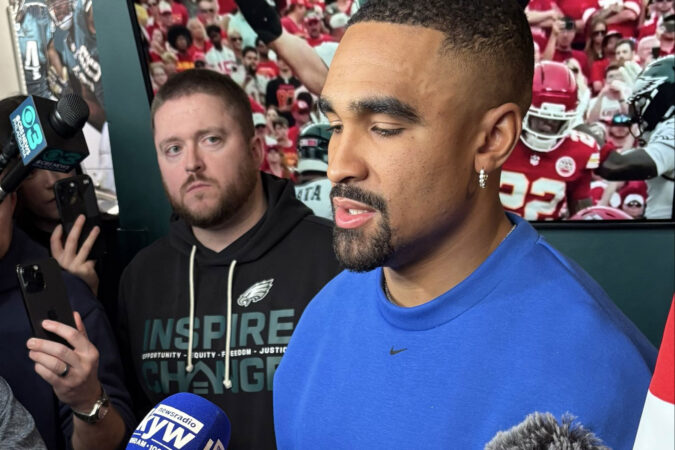
    “It’s too soon to think about that,” Hurts said Monday afternoon during the Eagles’ locker cleanout. “I put my trust in Howie [Roseman], Nick [Sirianni], and Mr. [Jeffrey] Lurie.”

    The offense’s shortcomings, fresh off the Eagles’ Super Bowl-winning season, reflected poorly on Patullo, the 44-year-old, first-time offensive coordinator. He had a wealth of talent at his disposal on the most expensive offense in the league that returned 10 of 11 starters from the championship run.

    Yet the group underperformed and often collapsed in the second halves of games, the latest example coming Sunday night against the 49ers. The offense finished the regular season ranked No. 19 in the league in scoring, No. 24 in total yards, and No. 13 in expected points added per play, which measures the average points added by the offense on each play.

    The Eagles fared worse in each category compared to last season. Still, Hurts said that any discussion about impending changes to the Eagles’ offensive coaching staff or personnel would not occur in his parting meeting with team officials on Monday.

    “No, I’d speak more so on just having a home base of what we do, who we are, and obviously we really made an effort to establish an identity along the way,” Hurts said. “Ultimately, it was a bit too late. Always got a lot of confidence when we step out on that field with this group, with this team. It just wasn’t our turn this time around.”

    Hurts used “home base” as another way to say “identity,” something that the Eagles struggled to establish throughout the season. He said the team needed to find its “comfort zone of where you lay your head,” the go-to concepts that the Eagles could execute at a high level, no matter the caliber of defense they faced.

    Where is the Eagles’ home base going forward? Hurts said the team has time to figure it out. Ultimately, though, the quarterback emphasized that he just wants to win.

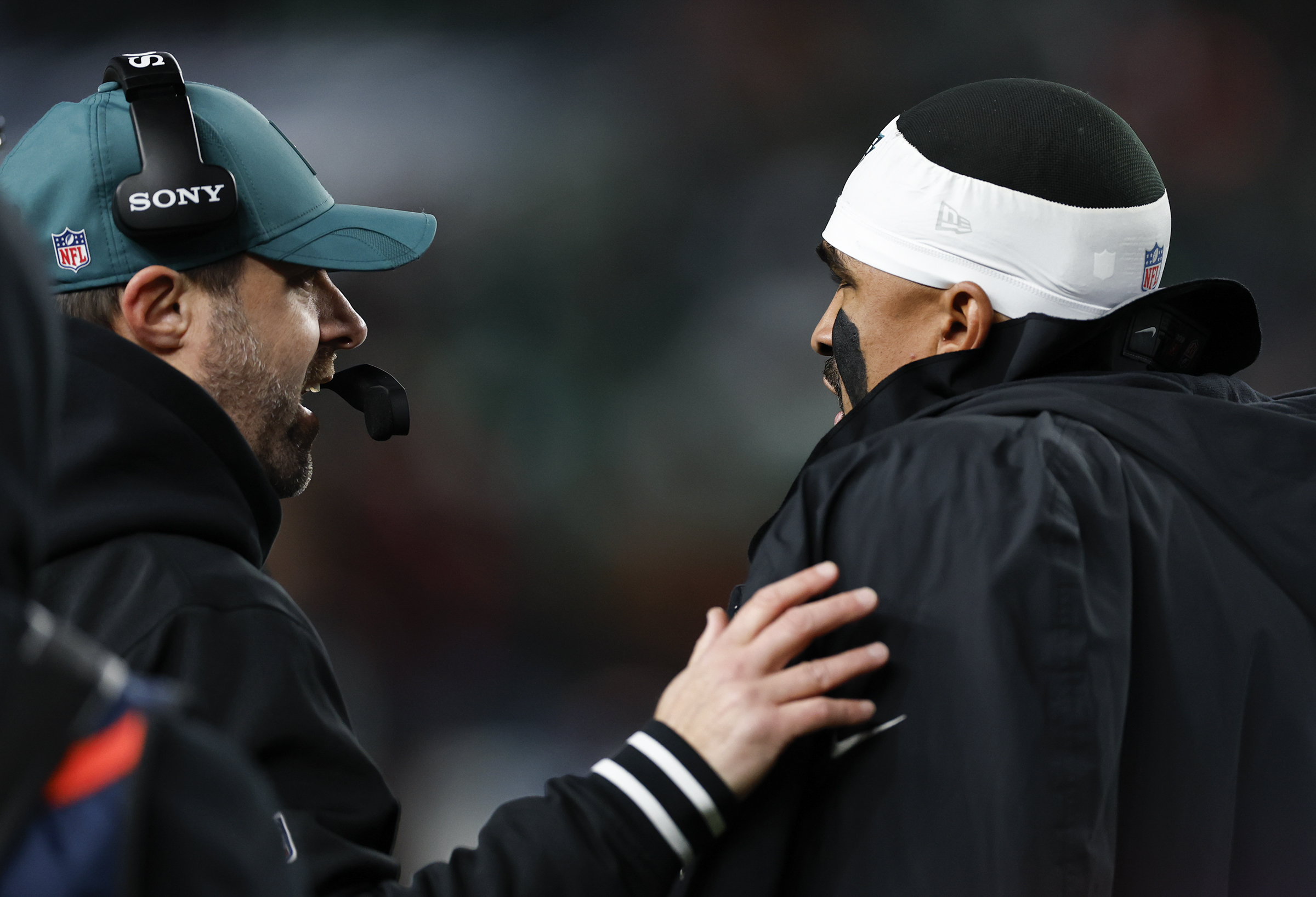
    Eagles offensive coordinator Kevin Patullo and quarterback Jalen Hurts never seemed to get into a rhythm this season.

    “You play the game to play for championships and put yourself in those opportunities to win championships,” Hurts said. “And so, obviously, that starts with having cohesiveness and great sequencing and having a flow where everyone’s on the same page and going out there and doing that.”

    Hurts is no stranger to change. He has had six offensive play-callers in his NFL career, including Doug Pederson, Sirianni, Shane Steichen, Brian Johnson, Kellen Moore, and now Patullo. In the aftermath of Johnson’s 2024 firing, Hurts said that he longed for continuity at the position.

    But he acknowledged Monday that he has embraced the revolving door of offensive coordinators and translated those changes into postseason appearances. After all, the Eagles won a Super Bowl in Moore’s lone year as the offensive coordinator.

    “The changes have not prevented us from having an opportunity to go on championship runs, and so with all the changes and with all the things that have gone and have changed over time, we still found ourselves in the playoffs, and we still found ourselves in positions to be in the tournament and play in the tournament,” Hurts said. “I don’t like the trend of wild-card [loss], big-time [Super Bowl appearance], wild-card [loss], big-time [Super Bowl win], and wild-card [loss]. … So competitively as a quarterback, as a leader, that’s a big focus of mine, trying to break that.”

    Hurts will look to return the Eagles to their winning ways next season, when he embarks upon his sixth year as the full-time starting quarterback. Given his track record and his importance to the team, he said he has a degree of influence in important matters concerning the offense.

    “I think overall, my line is always open, and so however involved or whatever level inquiry I am, I’ll definitely be available,” Hurts said.

    Those important matters include the roster. While 10 of the 11 starters on offense are under contract for next season (tight end Dallas Goedert is a pending unrestricted free agent), Roseman may opt to make some changes to its core.

    Could A.J. Brown’s future in Philadelphia come into question? The 28-year-old receiver is under contract through 2029. He had expressed his dissatisfaction with the offense earlier in the season, but he has not spoken publicly since the Dec. 8 loss to the Los Angeles Chargers. Hurts did not directly answer a question about whether he wants Brown back in 2026.

    Jalen Hurts says that he and wide receiver A.J. Brown are in a “great place.”

    “A. J. and I will talk,” Hurts said. “We’re in a good, great place.”

    Many of the team’s prospective changes are out of his hands. Repeatedly, Hurts acknowledged that he must focus on the details within his control, especially his own performance. While he seeks a “home base” for the offense, he said he has never run away from the growth that comes with embracing the responsibilities he finds uncomfortable as a quarterback.

    With the extra time that comes with an abrupt playoff exit, Hurts said he will do a “deep dive” on how he can improve as a player and as a leader before the Eagles restart once more next season.

    “Obviously, every year is different,” Hurts said. “Changes are inevitable in a number of ways, but my focus is on growth. My focus is on improvement, and my focus is on embracing the challenges that come with where I am in my career.”

  • FBI: Suspect in Mississippi synagogue fire targeted house of worship because of its ‘Jewish ties’

    FBI: Suspect in Mississippi synagogue fire targeted house of worship because of its ‘Jewish ties’

    JACKSON, Miss. — A suspect in an arson fire at a historic Mississippi synagogue admitted to targeting the house of worship because of its “Jewish ties” and was turned in to authorities by his father who had observed burn marks on his son’s ankles, hands, and face, the FBI said Monday.

    Stephen Pittman was charged with maliciously damaging or destroying a building by means of fire or an explosive. The suspect confessed to lighting a fire inside the building, which he referred to as “the synagogue of Satan,” according to an FBI affidavit filed in U.S. District Court in Mississippi on Monday.

    There was no attorney listed for Pittman in the court docket Monday.

    The fire ripped through the Beth Israel Congregation in Jackson shortly after 3 a.m. on Saturday. No congregants or firefighters were injured. Security camera footage released Monday by the synagogue showed a masked and hooded man using a gas can to pour a liquid on the floor and a couch in the building’s lobby. More than five decades earlier, the synagogue was bombed by the Ku Klux Klan because of its rabbi’s outspoken support for civil rights.

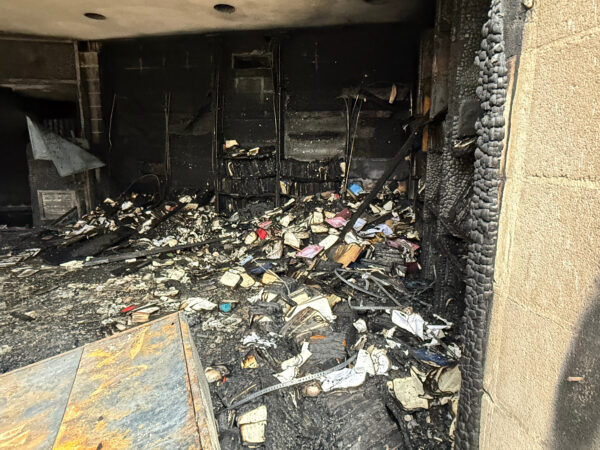
    The weekend fire badly damaged the 165-year-old synagogue’s library and administrative offices. Five Torahs — the sacred scrolls with the text of the first five books of the Hebrew Bible — located inside the sanctuary were being assessed for smoke damage. Two Torahs inside the library, where the most severe damage was done, were destroyed. One Torah that survived the Holocaust was behind glass and was not damaged in the fire, according to the congregation.

    The suspect’s father contacted the FBI and said that his son had confessed to setting the building on fire. Pittman had texted his father a photo of the rear of the synagogue before the fire, with the message, “There’s a furnace in the back.” His father had pleaded with his son to return home, but “Pittman replied back by saying he was due for a homerun and ‘I did my research,’” the affidavit said.

    During an interview with investigators, Pittman said he stopped at a gas station on his way to the synagogue to purchase the gas used in the fire. He also took the license plate off of his vehicle at the gas station. He used an ax to break out a window of the synagogue, poured gas inside and used a torch lighter to start the fire, the FBI affidavit said.

    The FBI later recovered a burned cell phone believed to be Pittman’s and took possession of a hand torch that a congregant had found.

    Yellow police tape on Monday blocked off the entrances to the synagogue building, which was surrounded by broken glass and soot. Bouquets of flowers were laid on the ground at the building’s entrance — including one with a note that said, “I’m so very sorry.”

    The congregation’s president, Zach Shemper, has vowed to rebuild the synagogue and said several churches had offered their spaces for worship during the rebuilding process.

    With just several hundred people in the community, it was never particularly easy being Jewish in Mississippi’s capital city, but members of Beth Israel took a special pride in keeping their traditions alive in the heart of the Deep South.

    With the exception of the cemetery, every aspect of Jewish life in Jackson was under Beth Israel’s roof. The midcentury modern building not only housed the congregation but also the Jewish Federation, a nonprofit provider of social services and philanthropy that is the hub of Jewish institutional life in most U.S. cities. The building also was home to the Institute of Southern Jewish Life, which provides resources to Jewish communities in 13 southern states. A Holocaust memorial was outdoors behind the synagogue building.

    Because Jewish children throughout the South have attended summer camp for decades in Utica, Miss., about 30 miles southwest of Jackson, many retain a fond connection to the state and its Jewish community.

    “Jackson is the capital city, and that synagogue is the capital synagogue in Mississippi,” said Rabbi Gary Zola, a historian of American Jewry who taught at Hebrew Union College in Cincinnati. “I would call it the flagship, though when we talk about places like New York and Los Angeles, it probably seems like Hicksville.”

    Beth Israel as a congregation was founded in 1860 and acquired its first property where it built Mississippi’s first synagogue after the Civil War. In 1967, the synagogue moved to its current location, where it was bombed by local Ku Klux Klan members not long after relocating. Two months after that, the home of the synagogue’s leader, Rabbi Perry Nussbaum, was bombed because of his outspoken opposition to segregation and racism.

    At a time when opposition to racial segregation could be dangerous in the Deep South, many Beth Israel congregants hoped the rabbi would just stay quiet, but Nussbaum was unshakable in believing he was doing the right thing by supporting civil rights, Zola said.

    “He had this strong, strong sense of justice,” Zola said.