Philly is getting ready to dress itself up — with Liberty Bells. Lots of Liberty Bells.
Organizers of Philadelphia’s yearlong celebrations for America’s 250th anniversary in 2026 gathered in a frigid Philadelphia School District warehouse in Logan on Tuesday, offering a special preview of the 20 large replica Liberty Bells that will decorate Philly neighborhoods for the national milestone.
Designed by 16 local artists selected through Mural Arts Philadelphia — and planned for commercial corridors and public parks everywhere from Chinatown and South Philly to West Philly and Wynnefield — the painted bells depict the histories, heroes, cultures, and traditions of Philly neighborhoods.
As part of the state nonprofit America250PA’s “Bells Across PA” program, more than 100 painted bells will be installed across Pennsylvania throughout the national milestone, also known as the Semiquincentennial. Local planners and Mural Arts Philadelphia helped coordinate the Philly bells.
“As Philadelphia’s own Liberty Bell served as inspiration for this statewide program, it makes sense that Philly would take it to the next level and bring these bells to as many neighborhoods as possible,” Mayor Cherelle L. Parker said in a statement. “We are a proud, diverse city of neighborhoods with many stories to tell.”
Kathryn Ott Lovell, president and CEO of Philadelphia250, the city’s planning partner for the Semiquincentennial, said the bells are a key part of the local planners’ efforts to bring the party to every Philly neighborhood.
Local artist Bob Dix paints a portrait of industrialist Henry Disston on his bell.
“The personalities of the neighborhoods are coming out in the bells,” she said, adding that the completed bells will be dedicated in January, then installed in early spring, in time for Philly’s big-ticket events next summer, including six FIFA World Cup matches, the MLB All-Star Game, and a pumped-up Fourth of July concert.
Planners released a full list of neighborhoods where the bells will be placed, but said exact locations will be announced in January. Each of the nearly 3-foot bells — which will be perched on heavy black pedestals — was designed in collaboration with community members, Ott Lovell said.
Inside the massive, makeshift studio behind the Widener Memorial School on Tuesday, artists worked in the chill on their bells. Each bell told a different story of neighborhood pride.
Chenlin Cai (left) talks with fellow artist Emily Busch (right) about his bell, showing her concepts on his tablet.
Cindy Lozito, 33, a muralist and illustrator who lives in Bella Vista, didn’t have to look for inspiration for her bell on the Italian Market. She lives just a block away from Ninth Street and is a market regular.
After talking with merchants, she strove to capture the market’s iconic sites, history, and diversity. Titled Always Open, her bell includes painted scenes of the market’s bustling produce stands and flickering fire barrels, the smiling faces of old-school merchants and newer immigrant vendors, and the joy of the street’s annual Procession of Saints and Day of the Dead festivities. Also, of course, the greased pole.
“It’s a place where I can walk outside my house and get everything that I need, and also a place where people know your name and care about you,” she said, painting her bell.
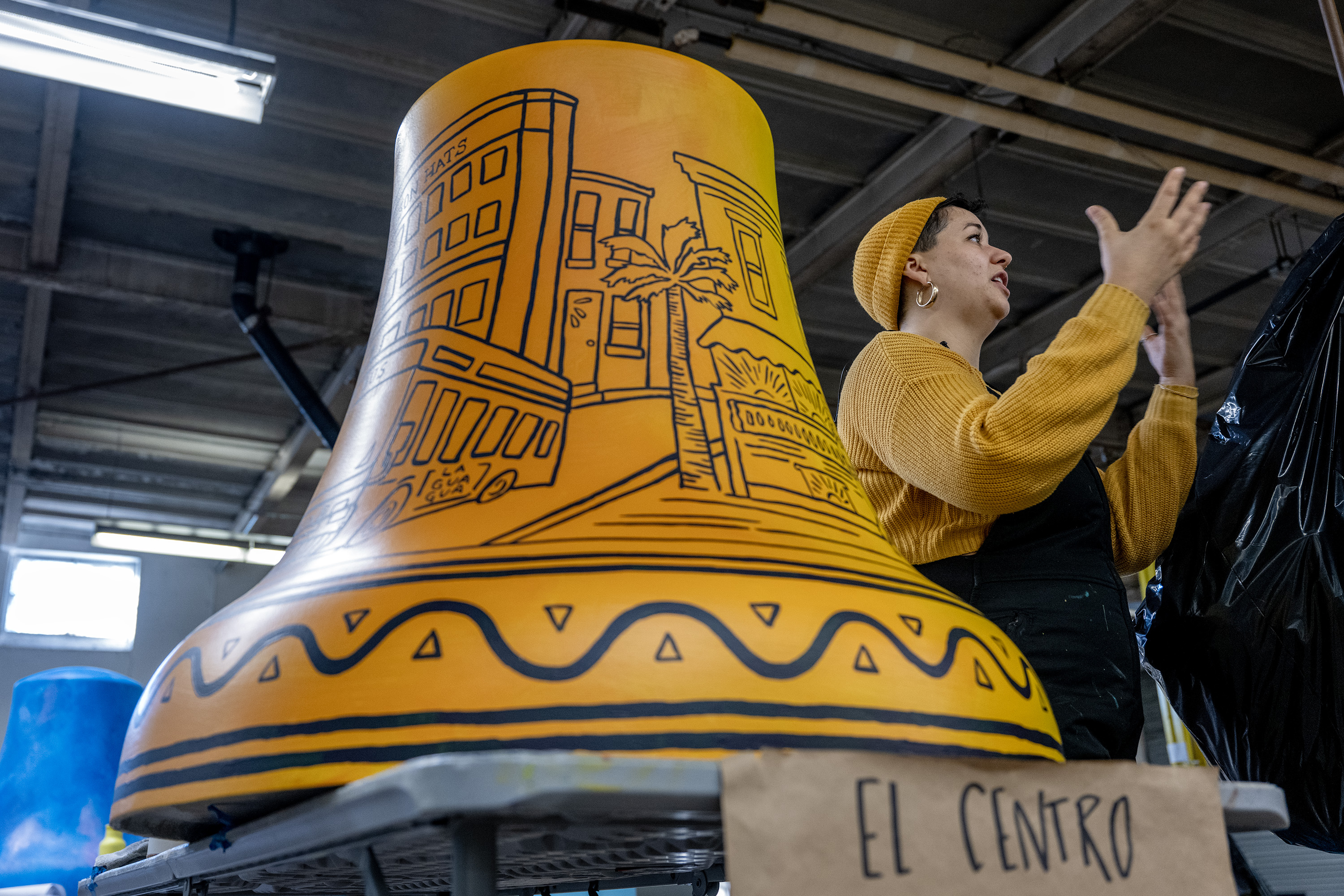
For her bell on El Centro de Oro, artist and educator Symone Salib, 32, met twice with 30 community members from North Fifth Street and Lehigh Avenue, asking them for ideas.
“From there, I had a very long list,” she said. “People really liked telling me what they wanted to see and what they did not.”
Local artist Symone Salib talks with a visitor as she works on her bell.
Titled The Golden Block, the striking yellow-and-black bell depicts the neighborhood’s historic Stetson Hats factory, the long-standing Latin music shop Centro Musical, and popular iron palm tree sculptures.
To add that extra bit of authenticity to his bell depicting Glen Foerd, artist Bob Dix, 62, mixed his paints with water bottled from the Delaware River, near where the historic mansion and estate sits perched in Torresdale, overlooking the mouth of Poquessing Creek.
“I like to incorporate the spirit of the area,” he said, dabbing his brush in the river water. “I think it’s important to bring in the natural materials.”
Local artist Bob Dix displays waters he collected from the Delaware River and Poquessing Creek to use in his painting of one of 20 replica Liberty Bells representing different neighborhoods Tuesday, Dec. 9, 2025.
Planners say they expect the bells to draw interest and curiosity similar to the painted donkeys that dotted Philadelphia neighborhoods during the 2016 Democratic National Convention.
Ott Lovell said organizers will install the bells around March to protect them from the worst of the winter weather.
“I don’t want any weather on them,” she said with a smile. “I want them looking perfect for 2026.”
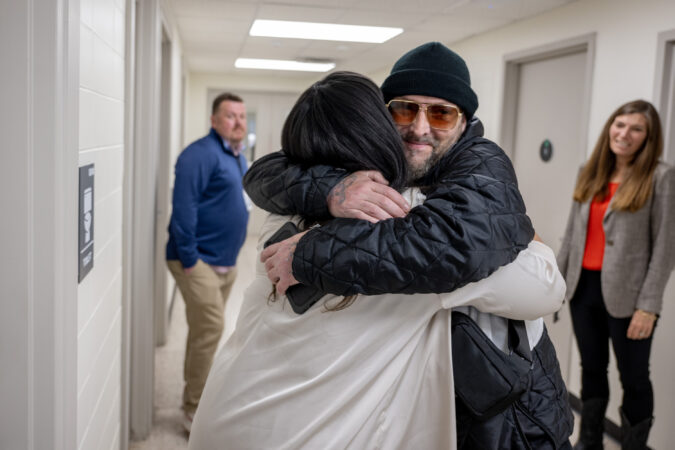
Kevin Bean was a frail 125 pounds last February when he entered a brand-new recovery house, a facility where he landed after spending four years in the throes of addiction — at times on the streets of Kensington, the epicenter of the city’s drug crisis.
The Frankford native was one of the first residents to enter the Riverview Wellness Village, the 20-acre recovery facility that Mayor Cherelle L. Parker’s administration opened in Northeast Philadelphia nearly a year ago as part of City Hall’s efforts to address opioid addiction and the Kensington drug market.
Bean, now 46 and boasting a healthier frame, just celebrated one year of sobriety and is preparing to move out of Riverview early next year.
He described his transition simply: “whole new life.”
Much of the mayor’s agenda in Kensington has been visible to the neighborhood’s residents, such as increased law enforcement and a reduction in the homeless population. But the operations and treatment outcomesat Riverview, located down a winding road next to the city’s jail complex, happen largely outside of public view. Last spring, some city lawmakers complained that even they knew little about the facility operations.
An inside look at the Riverview complex and interviews with more than a dozen residents and employees showed that, over the last year, the city and its third-party healthcare providers have transformed the facility. What was recently a construction zone is now a one-stop health shop with about 75 staff and more than 200 residents, many of whom previously lived on Kensington streets.
Those who live and work at Riverview said the facility is plugging a hole in the city’s substance use treatment landscape. For years, there have not been enough beds in programs that help people transition from hospital-style rehab into long-term stability. The recovery house industry has been plagued with privately run homes that are in poor condition or offer little support.
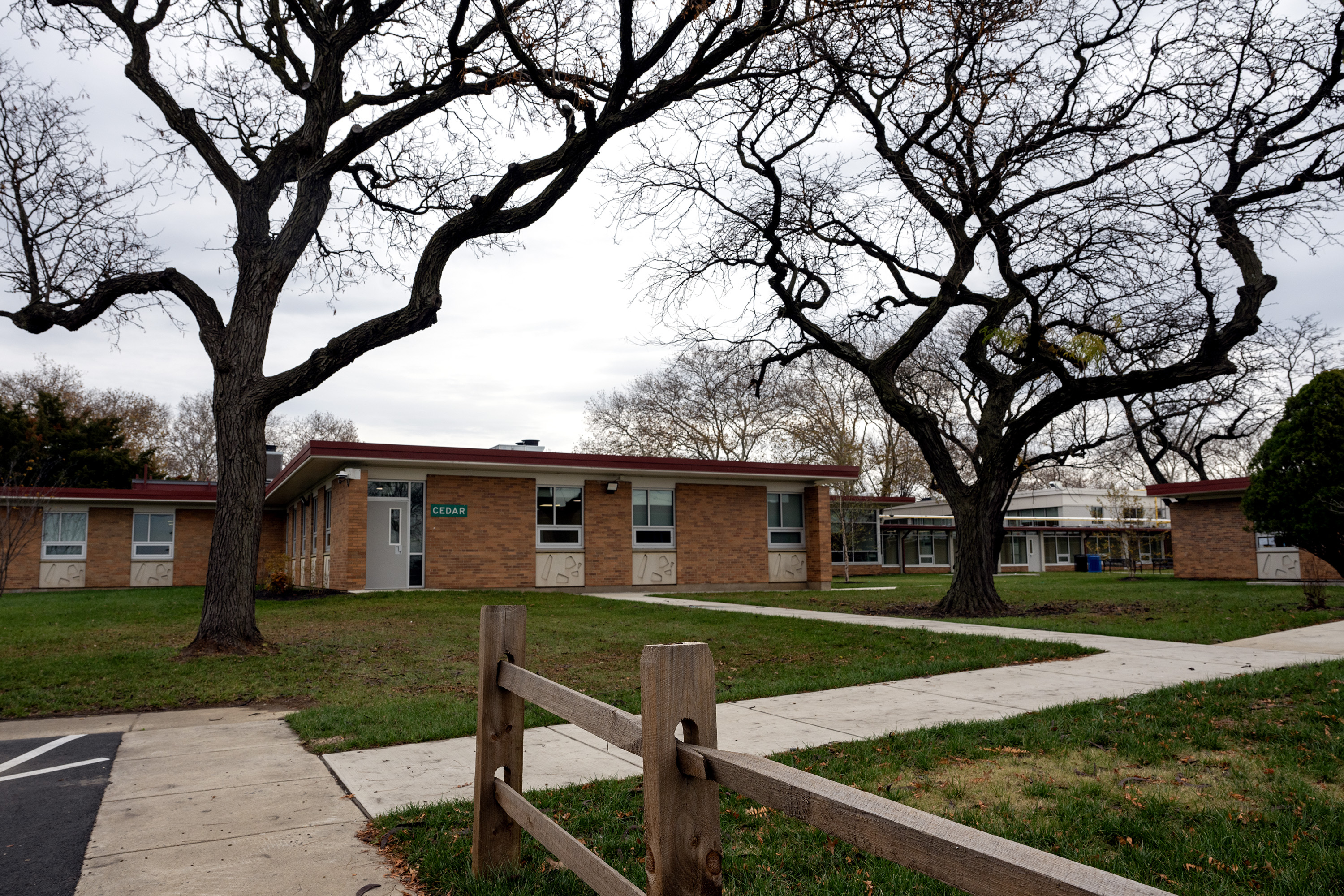
The grounds and residence buildings at Riverview Wellness Village, a city-owned drug recovery home in Northeast Philadelphia.
At its current capacity, Riverview has singularly increased the total number of recovery house beds in the city by nearly 50%. And residents — who are there voluntarily and may come and go as they please — have much of what they need on the campus: medical care, mental health treatment, job training, and group counseling.
They also, as of last month, have access to medication-assisted treatment, which means residents in recovery no longer need to travel to specialized clinics to get a dose of methadone or other drugs that can prevent relapse.
Arthur Fields, the regional executive director at Gaudenzia, which provides recovery services to more than 100 Riverview residents, said the upstart facility has become a desirable option for some of the city’s most vulnerable. Riverview officials said they aren’t aware of anywhere like it in the country.
“The Riverview Wellness Village is proof of what’s possible,” Fields said, “when we work together as a community and move with urgency to help people rebuild their lives.”
While the facility launched in January with much fanfare, it also faced skepticism, including from advocates who were troubled by its proximity to the jails and feared it would feel like incarceration, not treatment. And neighbors expressed concern that the new Holmesburg facility would bring problems long faced by Kensington residents, like open drug use and petty theft, to their front doors.
But despite some tenets of the mayor’s broader Kensington plan still facing intense scrutiny, the vocal opposition to Riverview has largely quieted. Parker said in an interview that seeing the progress at Riverview and the health of its residents made enduring months of criticism “well worth it.”
“I don’t know a Philadelphian who, in some way, shape, or form, hasn’t been touched by mental and behavioral health challenges or substance use disorder,” said Parker, who has spoken about how addiction shaped parts of her own upbringing. “To know that we created a path forward, to me, I’m extremely proud of this team.”
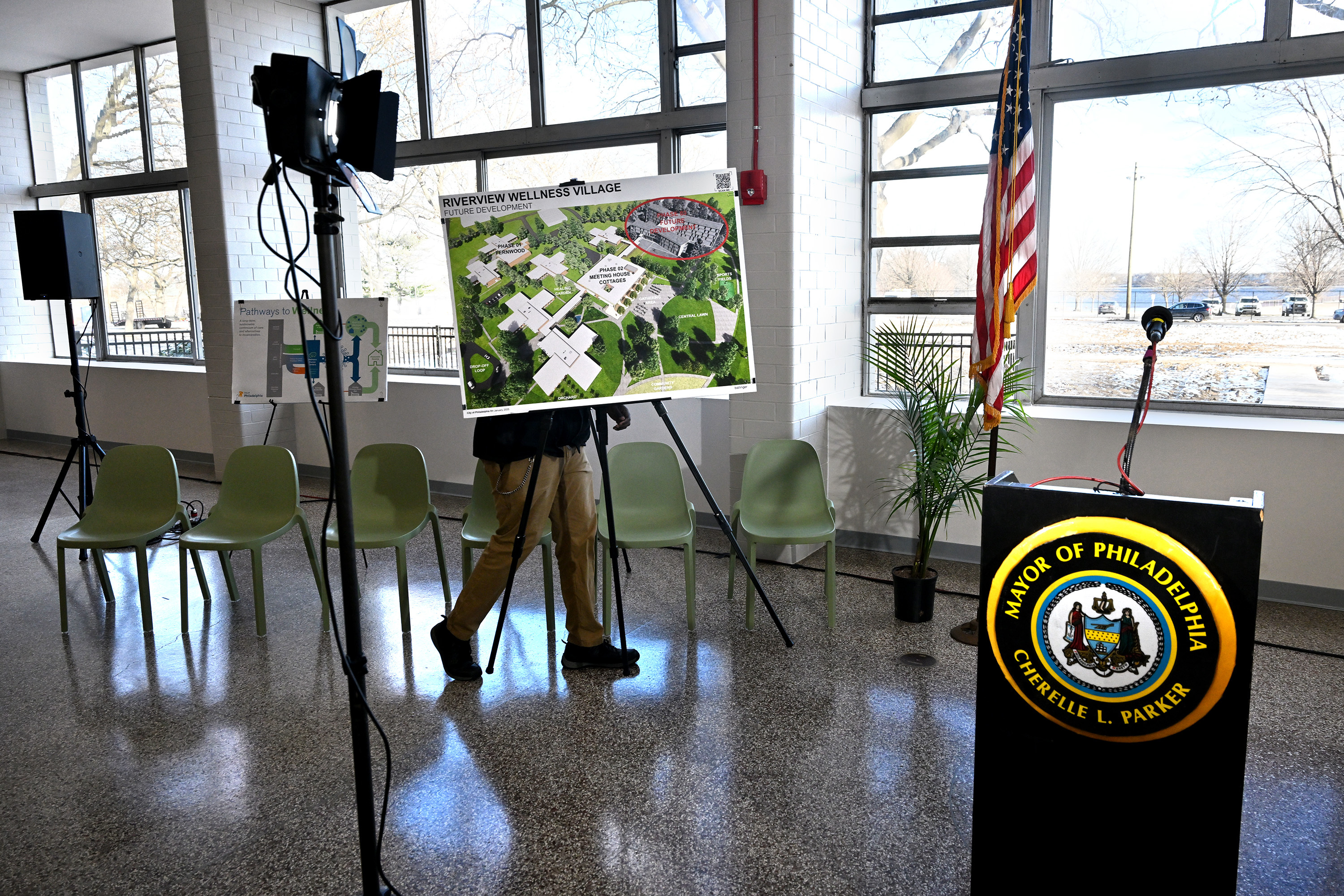
Mayor Cherelle L. Parker places a new block on the scale model of the Riverview Wellness Village on Wednesday, Jan. 8 during the unveiling of Philadelphia’s new city-operated drug treatment facility. At left is Managing Director Adam Thiel. City Councilmember Michael Driscoll is at right.Isabel McDevitt, executive director of the Office of Community Wellness and Recovery, points to a model with upcoming expansion at Riverview Wellness Village, a city-owned drug recovery home in Northeast Philadelphia on Nov. 25.Staffers move photos into place at the Riverview Wellness Village on Jan. 8 before the unveiling of Philadelphia’s new city-operated drug treatment facility.
Meanwhile, neighbors who live nearby say they have been pleasantly surprised. Pete Smith, a civic leader who sits on a council of community members who meet regularly with Riverview officials, said plainly: “There have been no issues.”
“If it’s as successful as it looks like it’s going to be,” he said, “this facility could be a model for other cities throughout the country.”
Smith, like many of his neighbors, wants the city’s project at Riverview to work because he knows the consequences if it doesn’t.
His son, Francis Smith, died in September due to health complications from long-term drug use. He was 38, and he had three children.
Getting a spot at Riverview
The sprawling campus along the Delaware River feels more like a college dormitory setting than a hospital or homeless shelter. Its main building has a dining room, a commercial kitchen, a gym, and meditation rooms. There are green spaces, walking paths,and plans for massive murals on the interior walls.
Katherine Young, director of Merakey at Riverview Wellness Village, talks with a resident at the city-owned drug recovery home in Northeast Philadelphia on Nov. 25.
Residents live and spend much of their time in smaller buildings on the campus, where nearly 90% of the 234 licensed beds are occupied. The city plans to add 50 more in January.
Their stays are funded through a variety of streams. The city allocated $400 million for five years of construction and operations, a portion of which is settlement dollars from lawsuits against pharmaceutical companies that manufactured the painkillers blamed for the opioid crisis.
(function() {
var l2 = function() {
new pym.Parent(‘RIVERVIEW_MAP2.html’,
‘https://media.inquirer.com/storage/inquirer/projects/innovation/arcgis_iframe/RIVERVIEW_MAP2.html’);
};
if (typeof(pym) === ‘undefined’) {
var h = document.getElementsByTagName(‘head’)[0],
s = document.createElement(‘script’);
s.type = ‘text/javascript’;
s.src = ‘https://pym.nprapps.org/pym.v1.min.js’;
s.onload = l2;
h.appendChild(s);
} else {
l2();
}
})();
To get in to Riverview, a person must complete at least 30 days of inpatient treatment at another, more intensive care facility.
(function() { var l = function() { new pym.Parent( ‘riverview-flowchart__graphic’, ‘https://media.inquirer.com/storage/inquirer/ai2html/riverview-flowchart/index.html’); }; if(typeof(pym) === ‘undefined’) { var h = document.getElementsByTagName(‘head’)[0], s = document.createElement(‘script’); s.type = ‘text/javascript’; s.src = ‘https://pym.nprapps.org/pym.v1.min.js’; s.onload = l; h.appendChild(s); } else { l(); } })();
Still, residents at Riverview have come from more than 25 different providers, according to Isabel McDevitt, the city’s executive director of community wellness and recovery. The bulk were treated at the Kirkbride Center in West Philadelphia, the Behavioral Wellness Center at Girard in North Philadelphia, or Eagleville Hospital in Montgomery County.
They have ranged in age from 28 to 75. And they have complex medical needs: McDevitt said about half of Riverview’s residents have a mental health diagnosis in addition to substance use disorder.
She said offering treatment for multiple health conditions in one place allows residents to focus less on logistics and more on staying healthy.
“Many of the folks that are at Riverview have long histories of substance use disorder, long histories of homelessness,” she said. “So it’s really the first time a lot of people can actually breathe.”
When new residents arrive, they go through an intake process at Riverview that includes acute medical care and an assessment for chronic conditions. Within their first week, every resident receives a total-body physical and a panel of blood work.
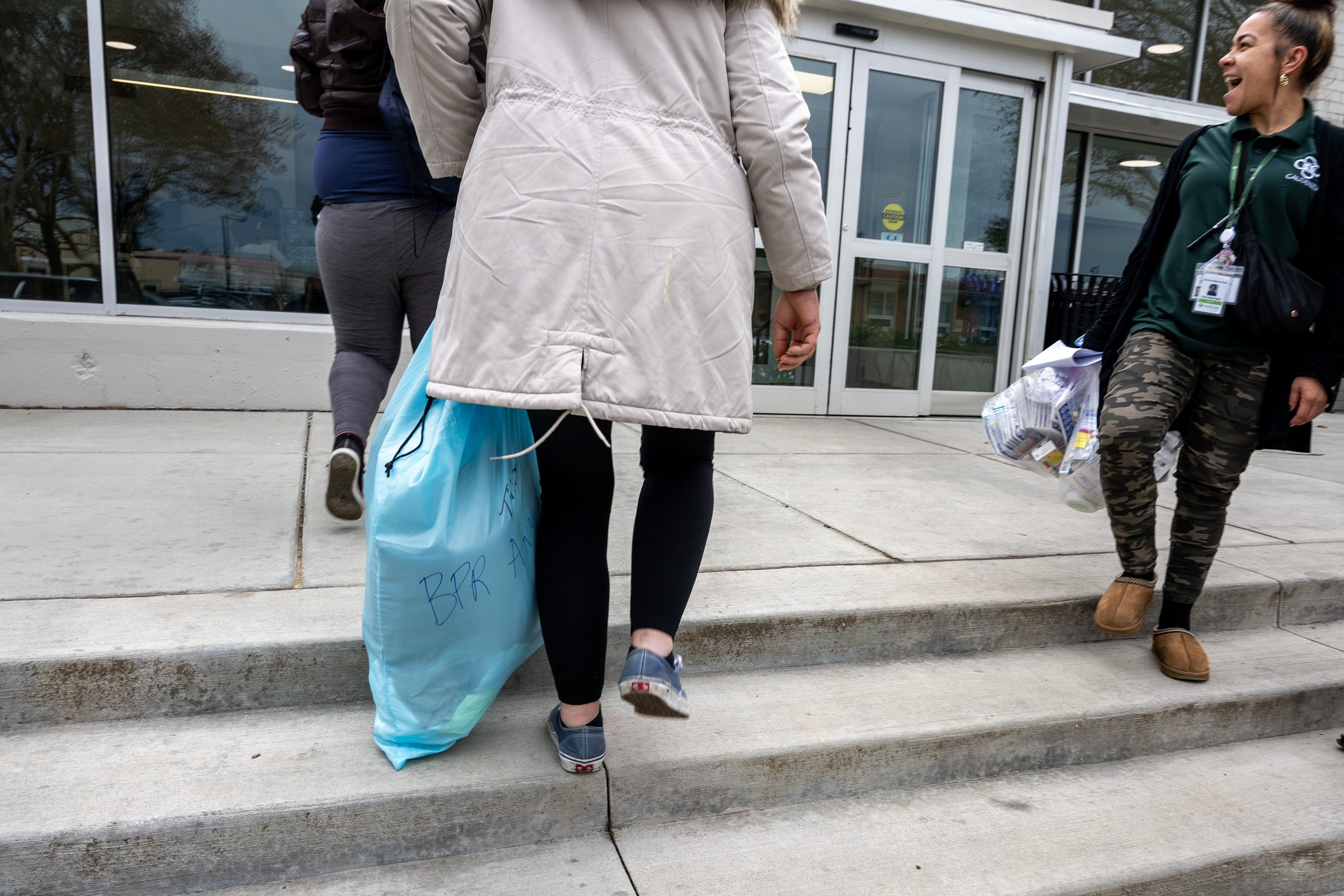
“They literally arrive with all of their belongings in a plastic bag and their medications and some discharge paperwork,” said Ala Stanford, who leads the Black Doctors Consortium, which provides medical services at Riverview. “We are the ones who greet them and help get them acclimated.”
Stanford — who this fall announced a run for Congress — said doctors and nurses at Riverview have diagnosed and treated conditions ranging from drug-related wounds to diabetes to pancreatic cancer. And patients with mental health needs are treated by providers from Warren E. Smith Health Centers, a 30-year-old organization based in North Philadelphia.
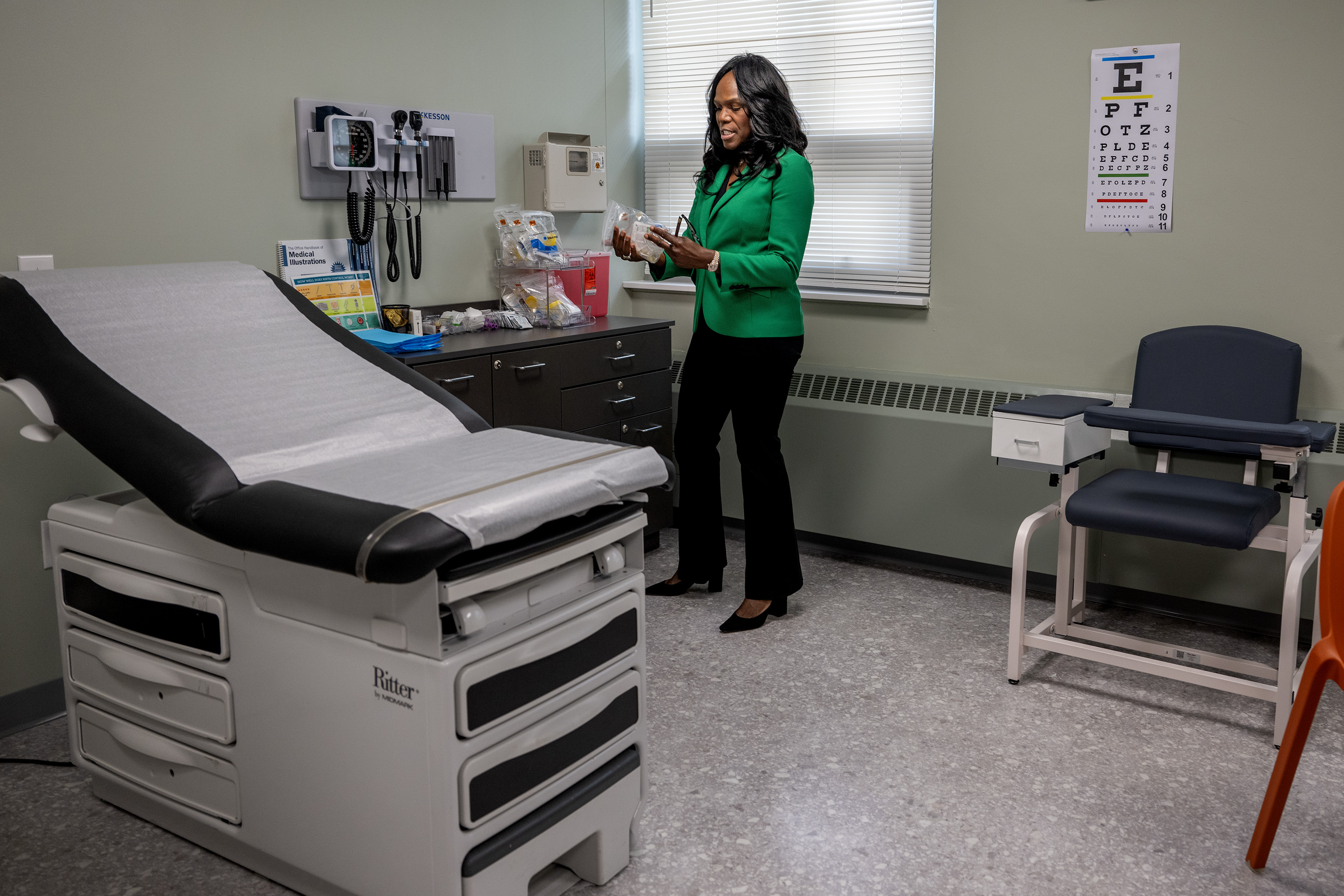
Physician Ala Stanford in an examination room at the primary medical care center run by her Black Doctors Consortium at Riverview Wellness Village, a city-owned drug recovery home in Northeast Philadelphia, on Nov. 25.Francesca Colon (right), a recovery support professional with Gaudenzia, brings people in recovery to the main entrance of the Meetinghouse at Riverview Wellness Village on Nov. 25.
Residents’ schedules are generally free-flowing and can vary depending on their wants and needs. About 20% have jobs outside the campus. Culinary arts training will be available in the next month or so. And residents can meet with visitors or leave to see family at any time.
They also spend much of their time in treatment, including individual, family, and group therapy. On a recent day, there were group sessions available on trauma recovery, managing emotions, and “communicating with confidence.”
Vernon Kostic, a 52-year-old Port Richmond native who said he has previously been homeless, has been in and out of drug treatment facilities for years.
He said he’s been content as a Riverview resident since July, and called it “one of the smartest things that the city has ever done.”
“We have the doctor’s office right over here,” he said. “They’ve got counseling right here. Everything we need. It’s like a one-stop recovery place.”
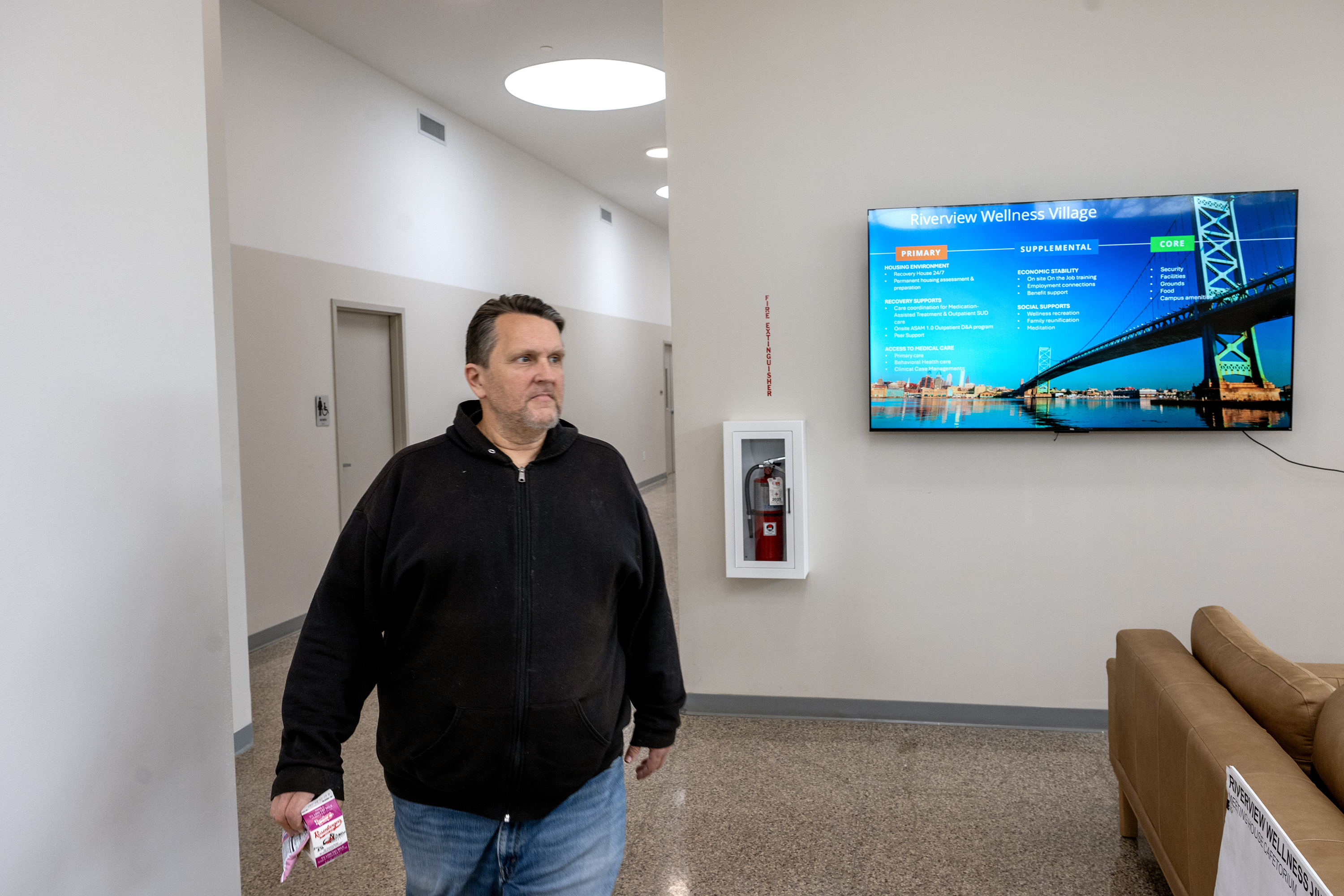
Resident Vernon Kostic heads to a group meeting at Riverview Wellness Village on Nov. 25.The dining room and meeting room in the Meetinghouse at Riverview Wellness Village. At rear left is a brand-new, industrial, restaurant-quality kitchen that was not operational yet on Nov. 25.
Finding ways to stay at Riverview
Finding success in recovery is notoriously hard. Studies show that people who stay in structured sober housing for at least six months after completing rehab see better long-term outcomes, and Riverview residents may stay there for up to one year.
But reaching that mark can take multiple tries, and some may never attain sobriety. McDevitt said that on a monthly basis, about 35 people move into Riverview, and 20 leave.
Some who move out are reunited with family and want to live at home. Others simply were not ready for recovery, McDevitt said, “and that’s part of working with this population.”
Fields said a resident who relapses can go back to a more intensive care setting for detoxification or withdrawal management, then return to Riverview at a later time if they are interested.
“No one is punished for struggling,” he said. “Recovery is a journey. It takes time.”
Providers are adding new programming they say will help residents extend their stays. Offering medication-assisted treatment is one of the most crucial parts, said Josh Vigderman, the senior executive director of substance use services at Merakey, one of the addiction treatment providers at Riverview.
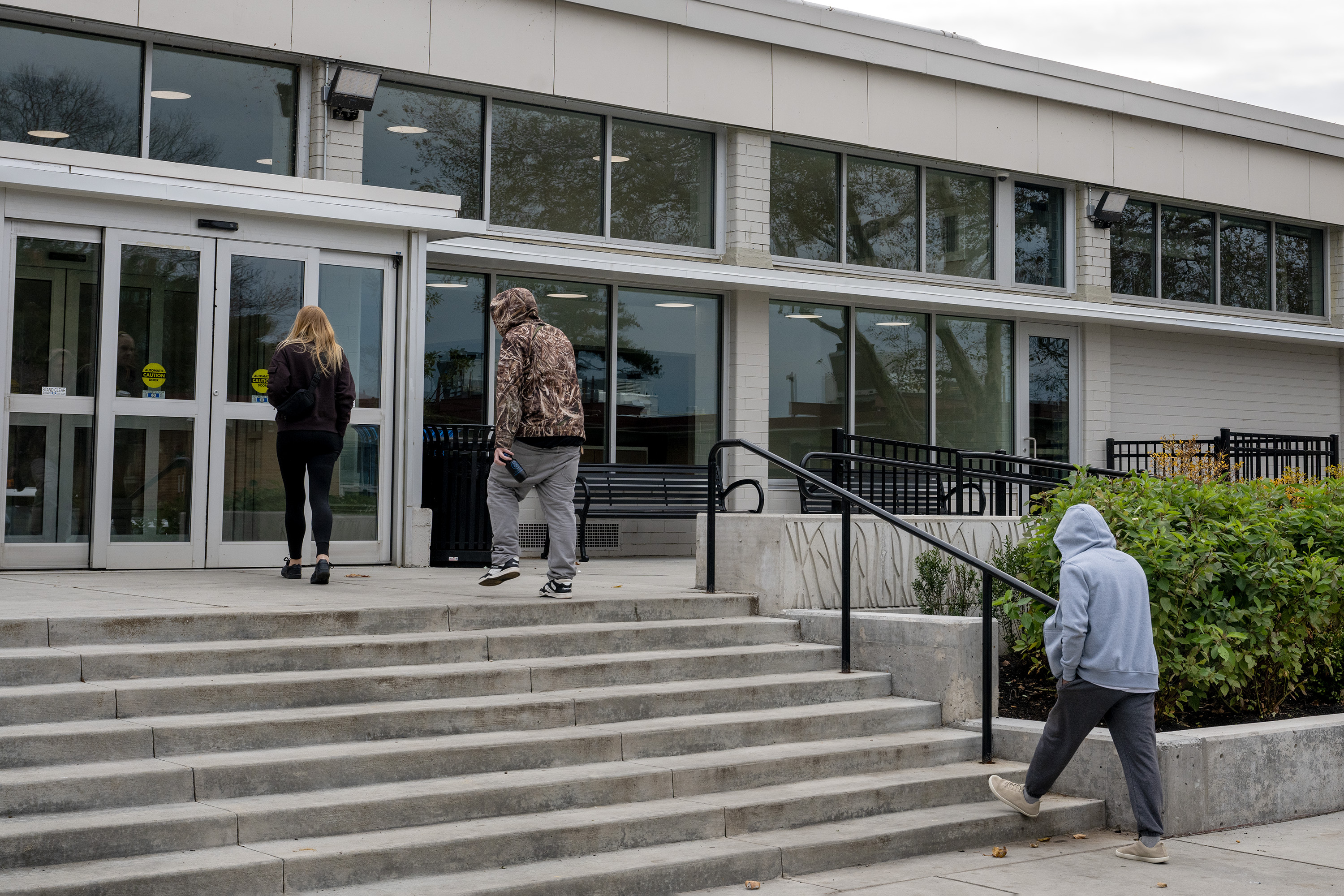
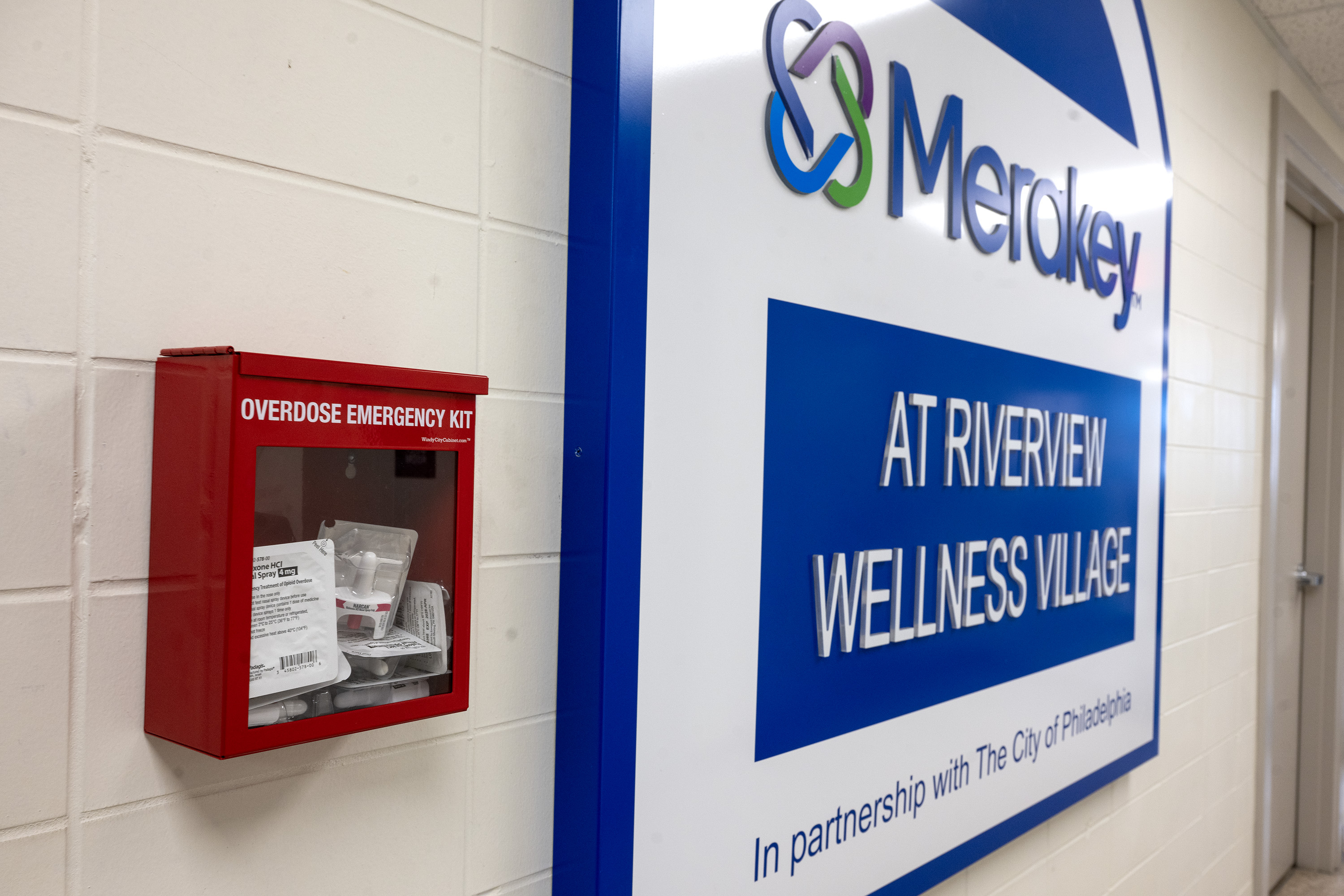
Entry to the primary medical care center run by the Black Doctors Consortium at Riverview Wellness Village.The main entry Meetinghouse at Riverview Wellness Village.Naloxone (Narcan) in an “overdose emergency kit” at Riverview Wellness Village.
In the initial months after Riverview opened its doors, residents had to travel off campus to obtain medication that can prevent relapse, most commonly methadone and buprenorphine, the federally regulated drugs considered among the most effective addiction treatments.
Typically, patients can receive only one dose of the drug at a time and must be supervised by clinicians to ensure they don’t go into withdrawal.
Vigderman said staff suspected some residents relapsed after spending hours outside Riverview, at times on public transportation, to get their medication.
This fall, Merakey — which was already licensed to dispense opioid treatment medications at other locations — began distributing the medications at Riverview, eliminating one potential relapse trigger for residents who no longer had to leave the facility’s grounds every day.
Interest in the program has been strong, Vigderman said, with nearly 80 residents enrolling in medication-assisted treatment in just a few weeks. Merakey is hiring more staff to handle the demand.
What’s next at Riverview
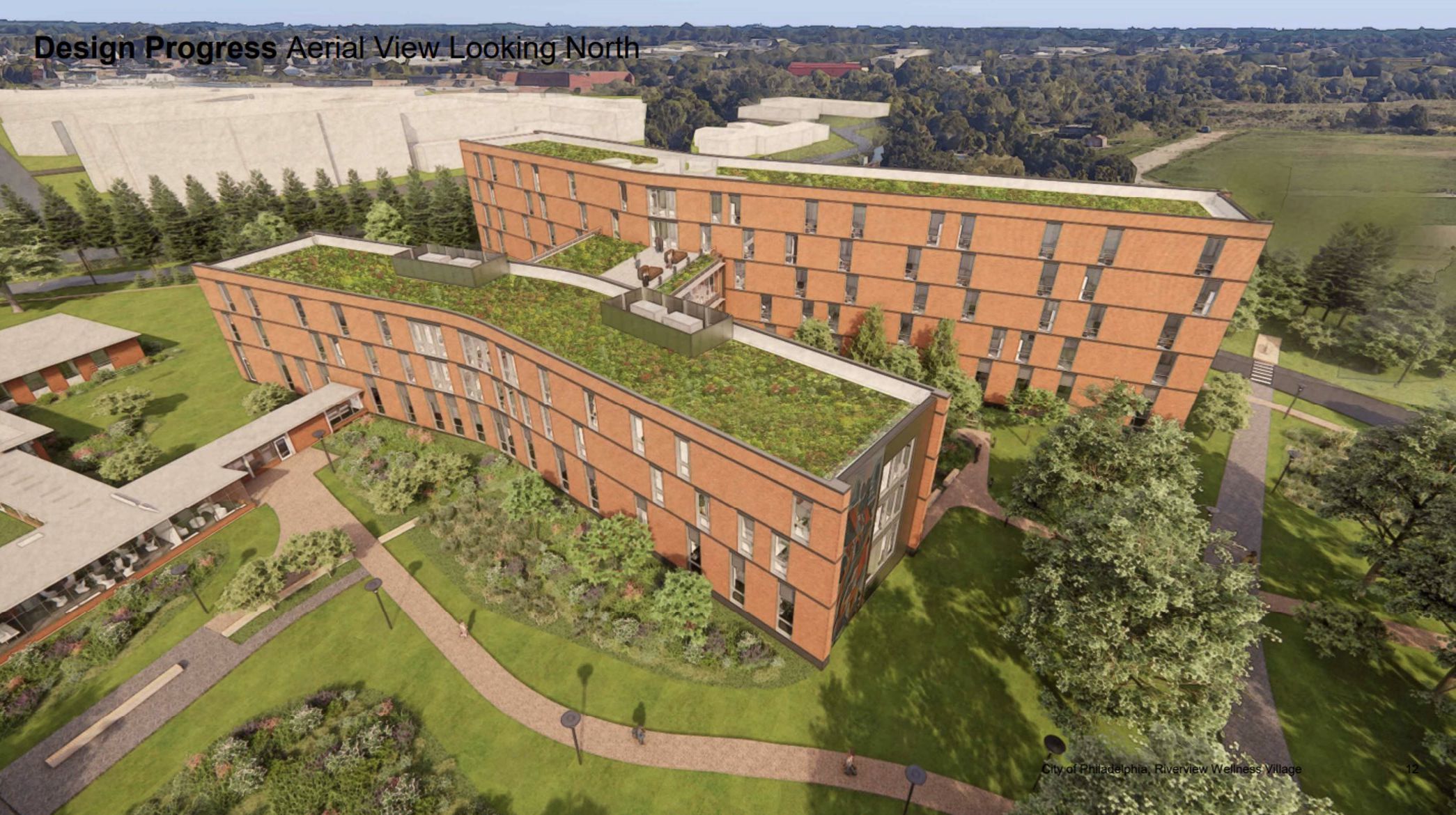
The city is eying a significant physical expansion of the Riverview campus, including a new, $80 million building that could double the number of licensed beds to more than 500. That would mean that about half of the city’s recovery house slots would be located at Riverview.
Parker said the construction is “so important in how we’re going to help families.” She said the process will include “meticulous design and structure.”
“The people who come for help,” she said, “we want them to know that we value them, that we see them, and that we think enough of them to provide that level of quality of support for them.”
In the meantime, staff are working to help the center’s current residents — who were among the first cohort to move in — plot their next steps, like employment and housing.
A rendering of the new, $80 million five-story building to be constructed on the campus of Riverview Wellness Village. It will include residences and medical suites.
That level of support, Vigderman said, doesn’t happen in many smaller recovery houses.
“In another place, they might not create an email address or a resumé,” he said. “At Riverview, whether they do it or not is one thing. But hearing about it is a guarantee.”
Bean is closing in on one year at Riverview. He doesn’t know exactly what’s next, but he does have a job prospect: He’s in the hiring process to work at another recovery house.
“I’m sure I’ll be able to help some people,” he said. “I hope.”
The Philadelphia school board on Monday signaled its intentions to play ball: Later this week, it will hold a special action meeting to vote on a resolution authorizing Superintendent Tony B. Watlington Sr. and his team to consider handingover a portfolio of unused school buildings to the city.
Watlington, the resolution states, “recommends that, in the best interests of the district and its students, the district explore and pursue negotiations with the city to potentially convey certain vacant and surplus district property.”
Parker, in a statement, said the process was about “public health and public safety” and the school buildings can be used to improve residents’ quality of life.
Officials “cannot let blighted buildings in the middle of residential neighborhoods lie vacant — many of which have been vacant for many years — from two years to over 30,” Parker said. “It’s unconscionable to me that we are in the middle of a housing crisis and we have government buildings sitting vacant for years or even decades. That cannot continue.”
School board president Reginald Streater said that no decisions are final and that public deliberation will still happen at the special meeting at 4 p.m. Thursday. But, he said, the move makes sense with “the board moving toward being much more willing to be intergovernmental partners” with the city.
“Many of these properties have not been used in the last decade or more, and they require a significant amount of upkeep and maintenance,” Streater said. “These properties are unused, for the most part, and unnecessary for K-12 education.”
The district is in the business of running schools, Streater said.
“I do believe that the city possesses considerably more expertise and capacity than the district does regarding property development,” Streater said. “We are an education institution. To build the capacity to do such things is out of our wheelhouse, and economic development would take us out of our lane.”
According to the language of the resolution, the district is urging Watlington to consider all angles — bond obligations, property conditions, financial protection of the district, any legal processes that would need to happen, and more.
The action comes as something of a surprise, happening just a week after what was to be the final voting meeting of the year. Streater said he did not want to add it as a walk-on resolution to the December school board meeting, but wanted to give members of the public time to understand it and provide testimony, if desired.
Giving unused school buildings to the city could further academic outcomes, the school board president said.
“It’s possible,” Streater said, “that conveying these vacant and surplus properties to the city for redevelopment and revitalization could help stabilize and grow the city and district’s tax base … and consequently positively impact future revenues to the district and educational experiences for students.”
Asked for a list of the unused buildings the resolution would cover, school board officials said more internal evaluation is needed before such a list is released.
The possible transfer of district properties to the city comes as officials debate the specifics of one of Parker’s signature initiatives.
The mayor wants to spend $800 million on her housing initiative, Housing Opportunities Made Easy, or H.O.M.E. In a rare sign of division, Council last week allotted more housing funds to the city’s poorest residents over the Parker administration’s objections.
Because of Council’s move, more legislation is now needed to advance H.O.M.E. It will not come until January at the earliest.
Thomas, chair of Council’s education committee, has long been pushing for a school facilities plan.
“It’s unclear to say what this step forward means, but I want to understand how it fits into a larger plan for Philly’s educational institutions,” Thomas said in a statement.
“Without getting into hypotheticals, and due to a lack of communications with City Council, there are a lot of moving pieces and still many questions about what this means and what is the overall plan for the future of our school buildings,” Thomas said.
A former top Philadelphia labor official claims in a lawsuit that she was passed over for a promotion because she’s a woman, and was later fired afterraising concerns about gender-based discrimination spanning two mayoral administrations.
Monica Marchetti-Brock, the former first deputy director of the Department of Labor, said in a federal lawsuit filed Wednesday that Mayor Cherelle L. Parker fired her last year, days after Marchetti-Brock had reiterated complaints about gender bias at the top rungs of the city government that had occurred before Parker took office.
Marchetti-Brock had worked for the city since 2013. Under former Mayor Jim Kenney, she rose to the city’s No. 2 labor role.
The man hired for the position was Basil Merenda, a former top state labor official whom Marchetti-Brock claims “had a problem with women.”
What started as a change in boss under then-Mayor Jim Kenney culminated in spring 2024 with Parker firing Marchetti-Brock after she complainedof sex-based discrimination, according to the suit. The lawsuit says an outside investigator probed Merenda’s behavior and in 2023 recommended he undergo implicit bias training.
The lawsuit accuses the city of minimizing the results of that investigation and of terminating Marchetti-Brock and a second woman who was mistreated by Merenda.
“When [Marchetti-Brock] asked if her termination had anything to do with her sex discrimination complaints, [the city] refused to answer the question,” the complaint says.
Merenda is currently one of two commissioners of the Department of Licenses and Inspections. Parker announced his appointment in February 2024, a few weeks before Marchetti-Brock says she was fired. It is common for there to be significant turnover in personnel at the beginning of a new mayoral administration.
A city spokesperson declined to comment, citing the pending litigation.
Attempts to reach Kenney were unsuccessful. The former mayor appointed many women to his top staff through his more than two decades in City Hall. When he took office as mayor in 2016, the majority of his cabinet were women.
Marchetti-Brock began reporting to Merenda in January 2023. He ignored his deputy, excluded her from meetings and communications, yelled, and “unjustly” criticized her, the suit says.
Marchetti-Brock says she complained of sex discrimination in the labor department to a long list of officials, some of whom still work for the city, including City Solicitor Renee Garcia and Chief Administrative Officer Camille Duchaussee. Marchetti-Brock “described how she was treated compared to how male employees were treated, including that Merenda ignored what female employees said and focused on what male employees said,” according to the lawsuit.
The city opened an investigation in the spring of 2023, the suit says.
After Parker was elected in November 2023, Marchetti-Brock again expressed her interest in the top labor role. However, the incoming mayor ultimately tapped Perritti DiVirgilio, who was previously the city’s director of labor standards. Marchetti-Brock described DiVirgilio in the suit as a “noncomplaining, male employee.”
In February 2024, Marchetti-Brock received a letter summarizing the findings of the investigation into Merenda. The letter said that the probe concluded that “no violation” of the city’s sexual harassment prevention policy occurred. According to the complaint, Marchetti-Brock was told that Merenda had received a warning and the investigator recommended he undergo implicit bias training.
The policy says city employees are protected from sexual harassment regardless if it’s “unlawful,” and it prohibits retaliation against employees who raise concerns or complain. Marchetti-Brock had a role crafting the policy following a critical 2018 City Controller report that said the city’s sexual harassment reporting protocols were inadequate.
According to the suit, Marchetti-Brock pushed back on the summary letter in an email to Andrew Richman, a city attorney, saying that even though no unlawful behavior was found, “there were findings of bias toward me and other women.”
“As you are aware, our policy holds our leaders to a higher standard than the law,” Marchetti-Brock wrote, according to the complaint. “It is misleading to say there are no findings under our policy.”
Three days later, in early March 2024, top officials from Parker’s administration informed Marchetti-Brock that her employment would be terminated, according to the complaint. The suit states that another female employee who had complained about Merenda was terminated as well.
The lawsuit asks the federal court to find that the city violated antidiscrimination laws and award Marchetti-Brock an unspecified amount of damages.
Philadelphia could soon become the first American city to establish its own retirement savings program for residents whose employers don’t offer one.
City Council is poised to pass legislation that would enable the plan, called PhillySaves, which is modeled on similar state-facilitated “auto-IRA” programs that have been increasingly established across the country.
The idea is that workers would be automatically enrolled in the city-managed plan and would contribute through payroll deductions at no cost to their employer. The plan would then follow employees, even as they change jobs.
Council President Kenyatta Johnson, a Democrat, said during a committee hearing on the legislation last week that the program is an anti-poverty measure aimed at generating wealth for more than 200,000 Philadelphians who do not have access to a retirement savings plan through their job.
“We want to make sure we are lifting all Philadelphians out of poverty, building generational wealth, and ensuring our seniors are financially stable in retirement,” Johnson said.
A Council committee approved the legislation following a hearing last week, and the full Council is expected to pass it. Voters would have to approve the creation of an investment management board through a ballot question, which could come as early as the May primary election.
Councilmember Cindy Bass, a Democrat who represents parts of North and Northwest Philadelphia, called the plan a “game changer.”
“There was a time when you could retire just on Social Security alone,” she said. “That day has come and gone.”
How would the program work?
Workers would be automatically enrolled in the plan with a default contribution rate of 3 to 6% of their wages, however they can opt out or change their contributions at any time.
Employers that do not offer their own retirement plans would be required to sign up. Their only responsibility would be facilitating the payroll deductions for their employees. There is no matching program for employers or the city.
City Councilmember Mike Driscoll, a Democrat who represents parts of Northeast Philadelphia and is sponsoring the legislation, emphasized last week that there is “no cost” to employers and no fiduciary liability.
“The goal is to make it easy for employees who want to save,” he said, “and not burden employers who are already managing their many responsibilities.”
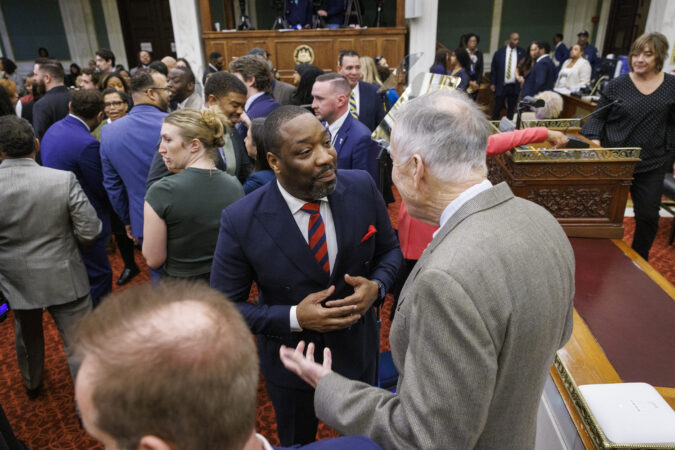
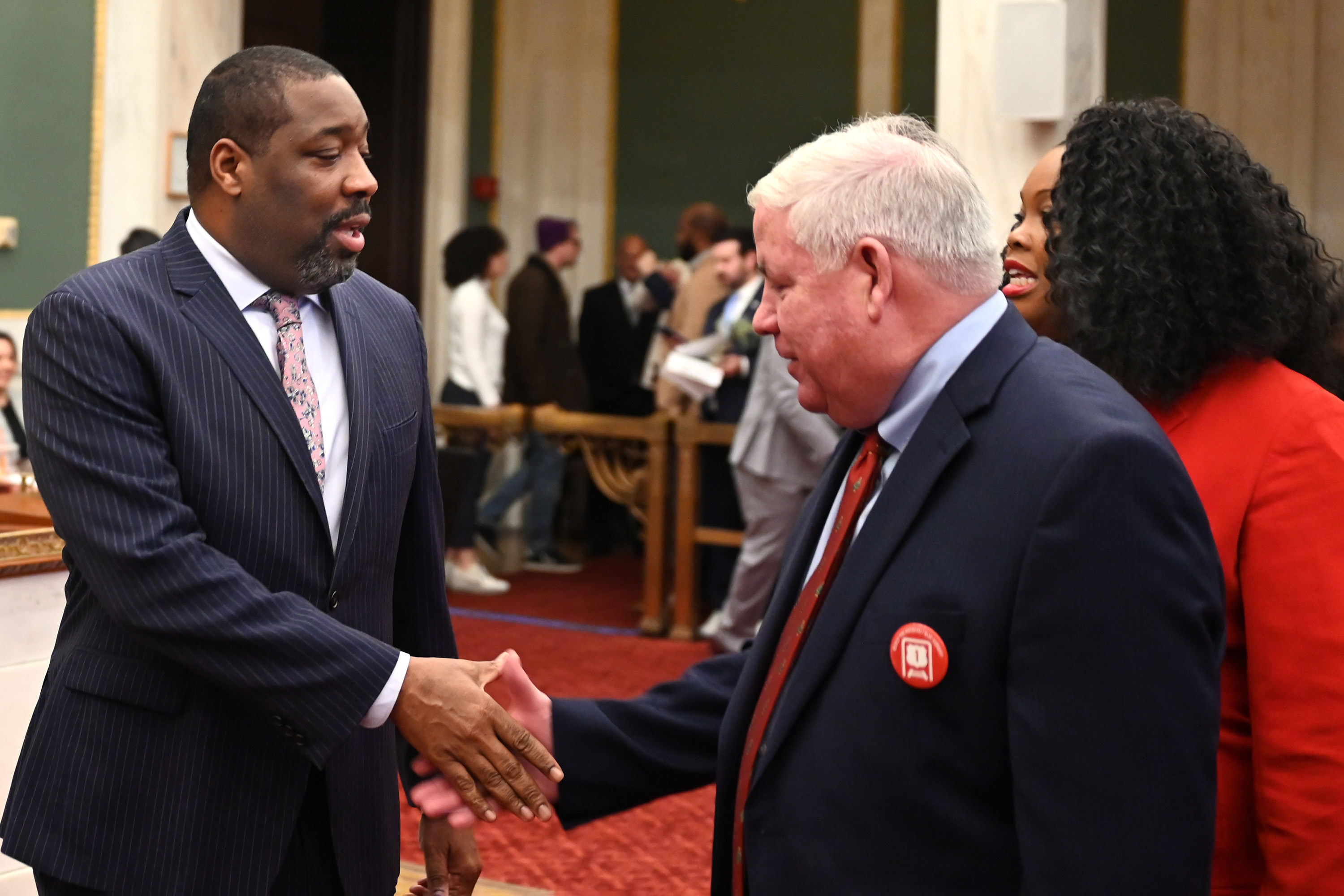
In this 2023 file photo, Council President Kenyatta Johnson (left) greets 6th District Councilmember Michael J. Driscoll (center) and Councilmember At-Large Katherine Gilmore Richardson (right) before the last City Council meeting of the year.
The legislation includes minimal fines for employers who don’t enroll employees. But Council members said the city will launch a significant public education and outreach campaign before levying fines.
Who is the program for?
Under the current version of the legislation — which could still be amended — the program applies to businesses with at least one employee. It must have been operating in Philadelphia for at least two years.
Auto-IRA plans are especially geared toward hourly workers who generally have fewer employer-covered benefits, such as 401(k) plans, as well as people who work for small businesses that can’t afford to provide retirement benefits.
Pennsylvania is not among them, but New Jersey launched a state-run retirement savings program last year. That plan, called RetireReady NJ, was first established in 2019 and signed into law by Gov. Phil Murphy, a Democrat.
It is more limited than Philadelphia’s would be, in that it only applies to businesses with at least 25 employees. Philadelphia’s would apply to businesses with just one.
Gov. Phil Murphy speaks with members of the media after meeting with Governor-elect Mikie Sherrill at the governor’s office in Trenton on Nov. 5.
Two other cities — New York and Seattle — passed legislation enabling auto-IRA programs, but neither was implemented because both New York and Washington states enacted state-run programs that include the cities.
The Democratic-controlled Pennsylvania State House passed legislation in 2023 along party lines enabling a similar program called Keystone Saves, but it stalled in the Republican-controlled Senate.
The city would create a nine-member Retirement Savings Board, which would include four appointees by the mayor, four by the City Council president, and one by the city controller.
That board would be responsible for facilitating the program and may contract third-party consultants, financial advisers, actuaries, and other experts to manage the investments.
The program defaults to a Roth IRA, though people covered can elect to switch to a traditional IRA.
John Scott, director of the retirement savings project at Pew Charitable Trust, said during the Council hearing last week that Roth IRAs are often the default in auto IRA programs because participating employees can pull money out of those accounts at any time without taxes or penalty.
He said that’s especially appealing to workers “who sometimes have fluctuations in their work schedule or they might have a financial shock.”
“For many of these workers in these programs, this is really the first opportunity to save money,” Scott said. “So, you know, life happens. And sometimes they do need to pull that money out, and the Roth IRA is really the best vehicle to do that.”
When will this become reality?
Creating the board that will oversee the investments requires a change to Philadelphia’s Home Rule Charter, the city’s governing document.
If Council passes legislation and Mayor Cherelle L. Parker signs it — both are expected to support it — then voters could approve the change through a ballot question as early as May.
The legislation says the program must be launched by July 2027, however there are exceptions in the case of legal challenges or a state-level program superseding the city’s.
The fix was needed because Council earlier this week amended a separate but related piece of legislation — called the H.O.M.E. budget resolution — that sets the first-year spending levels for the housing programs funded or created by the initiative.
Council’s changes, which Parker largely opposed, were significant enough that the budget resolution no longer aligns with the bond authorization bill Council approved in June, meaning the administration cannot rely on the original legislation as its legal basis for taking out city debt.
The new bond bill introduced Thursday reflects Council’s changes, which include increasing the first-year H.O.M.E. budget from $194.6 million to $277.2 million and changing eligibility requirements for some programs to make sure the lowest-income Philadelphia households were prioritized.
“We want to make sure that this is a H.O.M.E. plan that supports everyone, but obviously members of Council had an issue and concern about making sure those most in need are supported throughout this process,” Johnson said.
The bill now heads to committee, and Johnson said negotiations could lead to further changes. Next week is Council’s final meeting of the year, and Johnson on Thursday ruled out adding an extra session, meaning the bill likely will not pass until January at the earliest.
“Working with Council President Johnson and the Members of City Council, we are laser-focused on building, repairing and restoring 30,000 units of housing and making H.O.M.E. a reality for the people of Philadelphia,” Parker said in a statement Thursday.
‘That’s my sister’: Johnson says relationship with Parker still strong
Parker-Johnson pact intact: The Council president on Thursday downplayed his spat with Parker that saw both issue pointed statements Tuesday night blaming the other for delays in issuing the bonds.
But Johnson said Thursday their relationship remains the same and has always involved disagreements — just not ones that have spilled out into public view.
City Council President Kenyatta Johnson and Mayor Cherelle L. Parker have maintained a close working relationship.
“That’s my sister,” Johnson said. “Most of the time, when we do have disagreements, y’all just don’t see it. We meet every week, so you don’t get a chance to see the back-and-forth. But at the end of the day, the mission is to move the city of Philadelphia forward together.”
Council makes it harder to open convenience stores and pharmacies in Kensington
The bill, authored by Councilmember Quetcy Lozada, forces any new “sundries, pharmaceuticals, and convenience sales” businesses in her 7th District — which covers much of Kensington and parts of North and Northeast Philadelphia — to get approval from the Philadelphia Zoning Board of Adjustment. That process is notoriously long and can be expensive for applicants.
Lozada has said that the bill is targeted at corner stores and smoke shops, not chain businesses like CVS and 7-Eleven.
The legislation is part of the body’s broader war on so-called nuisance businesses, which lawmakers say attract crime and disrupt neighborhoods. And it comes in addition to a controversial 11 p.m. business curfew in Lozada’s district that took effect earlier this year.
City Councilmember Quetcy Lozada represents Kensington.
It’s one of several legislative remedies lawmakers have undertaken to curb small businesses like smoke shops and convenience stores that have unregulated slot machine-like “skill games,” sell marijuana-like products, and peddle drug paraphernalia without a license to do so.
Seriously … no nuisances, please: Lozada was not the only lawmaker taking aim at “nuisance” businesses Thursday, when Council approved two bills by Majority Leader Katherine Gilmore Richardson on the same topic.
One measure makes it easier for the Philadelphia Department of Licenses and Inspections to issue stop-work and cease-operations orders to businesses violating city regulations. The other is aimed at closing loopholes that “let nuisance business owners avoid enforcement by changing their name or ownership, ensuring those with similar ownership or operations remain accountable for past violations,” Gilmore Richardson’s office said.
The measures, which were both approved 16-0, were aimed at stopping “the spread of dangerous and destructive businesses and the need for further action to address their impact on our communities,” Gilmore Richardson said.
“While I am encouraged by the steps we are taking today, I am also working on additional legislation to more aggressively crack down on these businesses and the bad actors behind them,” she said.
“Anybody that knew Paul will tell you he really was that guy, that guy who would give you the shirt off his back,” Harrity said. “He’s the only person I truly knew never lost faith in me, even when I was at my lowest 10 years deep in my addiction.”
Councilmember Curtis Jones Jr. thanked Harrity, who often gives impassioned speeches, for his heartfelt tribute to Staico.
“I want to shout out Jimmy Harrity for making crying in Council cool,” Jones said. “Nobody does it better, brother.”
Staff writer Jake Blumgart contributed to this article.
For years, preservationists have countered claims that historic designation limits development and housing supply. Some neighborhood groups have gone as far as filing petitions to oppose new historic districts in Philadelphia on these grounds.
Although only about 5% of the city’s land and 4.4% of its buildings are listed on the Philadelphia Register of Historic Places — up from just 2.2% in 2016 — that expansion in designations shows how Philadelphia has begun to catch up with peer cities. This growth reflects both resident advocacy and the city’s expanded preservation capacity, which were spurred by efforts under Mayor Jim Kenney’s administration, including the convening of a Historic Preservation Task Force.
The new report produced striking findings that flip the old narrative on its head: that preservation constricts housing supply and reduces density.
In fact, the data show preservation supports growth and density. Population density in historic districts is 34% higher than in other neighborhoods, and housing units there grew 26% over the past decade, nearly triple the citywide rate.
The study also found that older neighborhoods are becoming more diverse, with preservation helping sustain racial and economic inclusion. Nonwhite homeownership in these areas is rising faster than in the city as a whole, a clear sign that maintaining older housing can open doors to opportunity, not close them.
It’s evidence that preserving the city’s older housing stock is a key component of Mayor Cherelle L.Parker’s H.O.M.E. Initiative to provide new affordable housing opportunities. Investing in these neighborhoods will support the growth of homeownership for Black and Hispanic populations.
The 1500 block of Christian Street in the historic Black neighborhood nicknamed “Doctors Row,” photographed in 2021.
Beyond the data, historic neighborhoods offer beauty, character, and a sense of place that newer developments often struggle to match. Built long before cars shaped our neighborhoods, these areas were designed for people: compact, walkable, and full of architectural variety. Their mix of rowhouses, corner stores, and small apartment buildings naturally creates the kind of density and vibrancy that newer communities struggle to emulate.
Moreover, many older neighborhoods were built at a time when transportation options were more limited, such as walking and transit, causing them to be more densely developed than later, automobile-oriented areas of the city. These neighborhoods were often built with a wide variety of housing types, including multifamily buildings that are inherently denser than neighborhoods of primarily single-family homes.
Historic districts are simply desirable places to live. And that attracts housing developers seeking to put up new housing, whether on vacant lots or on parcels containing “noncontributing” properties, which can be demolished under Philadelphia Historical Commission regulations.
These and other new buildings constructed within historic districts in recent years have been subject to Historical Commission review to ensure they do not detract from the character of the historic districts in which they were built.
Preservation also fuels local jobs and investment. Philadelphia ranks among the nation’s leaders in historic tax credit projects, which, since 2010, have generated roughly 2,500 jobs and $141 million in annual labor income — a steady return that proves preservation is as much an economic strategy as a cultural one.
Historic districts are living, breathing neighborhoods that welcome both new housing and new residents. The findings from the latest study should put to rest some of the more persistent claims of preservation’s detractors.
Paul Steinke is the executive director of the Preservation Alliance for Greater Philadelphia.
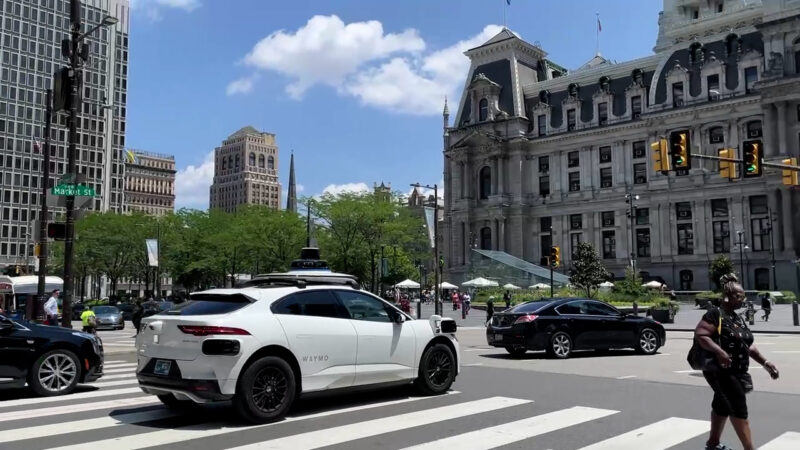
Waymo, the self-driving car company owned by Google’s parent firm, said Wednesday that it has begun autonomous tests in Philadelphia and expects to offer its robo-taxis to customers at some point afterward.
“We’re making it official, Philly: Waymo will bring our service to the City of Brotherly Love!” the company announced on its website.
Ethan Teicher, a spokesperson for Waymo, said in an email: “We recently began driving autonomously with a specialist behind the wheel, after securing permission to do so from PennDOT. We’ll continue laying the groundwork in Philadelphia to open our fully autonomous ride-hailing service for the public in the future.”
In July, a Waymo spokesperson said the company would begin mapping Philadelphia’s neighborhoods, manually “driving through the most complex parts of the city, including downtown and freeways.”
In its Wednesday announcement, Waymo said it will begin the mapping process in Pittsburgh, and noted that city’s connection with autonomous driving history. Carnegie Mellon University, which is located in Pittsburgh, is known as the birthplace of self-driving technology.
Under a 2022 Pennsylvania law legalizing the commercial operation of “highly automated vehicles,” Waymo needs a “certificate of compliance” to conduct autonomous testing in specified locations. In July, the Pennsylvania Department of Transportation said it was reviewing an application from Waymo.
The only other company with a certificate for the city is Perrone Robotics, which operates a self-driving shuttle service at the Navy Yard.
In New Jersey, state law does not allow for commercial services using self-driving vehicles on public streets. Legislation recently was introduced to create a pilot program requiring three years of testing with a human driver in the vehicle.
Waymo offers self-driving taxi service in Los Angeles, San Francisco, Phoenix, Austin, and Atlanta, and has test-driven in dozens of other cities. Testing began in New York City this summer.
Currently, the company says it is performing a total of 250,000 rides a week using fully autonomous electric vehicles.
A spokesperson for Mayor Cherelle L. Parker said Wednesday that the mayor and other city officials are “closely monitoring Waymo and its plans for Philadelphia” but declined to elaborate.
Besides mapping and testing its vehicles, Waymo has “engaged with community organizations” in Philadelphia and Pennsylvania, including the Bicycle Coalition of Greater Philadelphia and the National Federation of the Blind of Pennsylvania, said Teicher, the company spokesperson.
In the company’s announcement, it included a statement from Samantha Civitate, the Pennsylvania state director for Best Buddies, a nonprofit that brings together volunteers and people with intellectual and developmental disabilities.
“Accessible transportation remains a vital piece of fostering independence and inclusion,” Civitate said.
There has been no groundswell of opposition to Waymo coming to Philadelphia. The company, however, has had to deal with recent incidents elsewhere that have generated negative attention.
A Waymo taxi in Los Angeles was caught on video making a left turn just feet away from an incident involving police officers positioned behind their vehicles shouting commands at a suspect who was lying facedown on the ground, apparently waiting to be arrested.
In San Francisco on Sunday, a Waymo taxi hit an unleashed dog, which reportedly needed to be euthanized because of its injuries.
Waymo vehicles have also been targeted, though mainly because they were in the wrong place at the wrong time. In June, several Waymo taxis were burned during anti-ICE protests in Los Angeles. The company temporarily halted service in the area.
City officials and housing advocates want Philadelphia to close a loophole in its tax code that allows people who forge deeds and steal homes to get a refund for taxes they paid to commit their crimes.
Thieves commit deed fraud when they illegally transfer a property’s ownership and record a fraudulent deed with the city.
This fraud often occurs after a homeowner dies but remains the legal owner of a property. Thieves use deceptive means, such as posing as fake heirs and forging documents, to take and sell properties, often flipping them to developers for large profits.
To record a deed, property owners — including fraudsters — need to pay a realty transfer tax. If a judge later determines that a sale was fraudulent, the person who paid the tax can request a refund from the city. That includes thieves.
“It’s a nightmare for victims of deed fraud, and while we can’t necessarily improve the situation, we can help to ease some of their financial burden,” Gilmore Richardson said during a Council hearing Wednesday.
Philadelphia’s portion of the realty transfer tax is 3.578% of the value of a home sold. So for a stolen $100,000 home, a victim could receive a refund of about $3,500.
A longstanding issue
Deed fraud is a persistent problem in Philadelphia. The city’s records department received about 130 reports of deed fraud in 2023 and about 110 reports in 2024.
Investigations by The Inquirer have shown that deed theft grew alongside gentrification in Philadelphia, as property values rose in neighborhoods that became more desirable. Victims of deed fraud disproportionately are people of color and seniors.
James Leonard, commissioner of the Philadelphia Department of Records, said the Parker administration supports the Council bill, which “addresses a gap in how we help victims of deed fraud.”
“We see these cases regularly,” he said. “They devastate families, they undermine confidence in our property system, and they impose significant costs on victims, who must fight in court to reclaim what was always rightfully theirs.”
Victims face a long legal battle in which they must prove that a deed is fraudulent and often must pay attorney fees. And they have to keep paying mortgages while they fight to reclaim properties.
“When they finally win, they get their property back. But they’re often financially and emotionally devastated by the process,” Leonard said.
The new Council legislation allows a victim who gets a court order that voids a fraudulent deed to request a refund of the realty transfer taxes that a thief paid. Leonard estimates the city will see at most 25 to 50 cases per year, a “modest” fiscal impact for the city.
And under current law, the city keeps tax payments that it never would have received if not for the deed fraud, he said, so the city has been benefiting from fraudsters’ payments.
“From an equity standpoint, this bill is the right thing to do,” he said.
Vincent Gilliam and his family were victims of deed fraud when his deceased mother’s home in North Philadelphia was stolen. Between the belongings that deed thieves took and the fight to reclaim the home, he estimates that the ordeal cost his family at least $5,000.
He told Council members that getting some money back from the city through a realty transfer tax refund “would be a tremendous help.”
Kate Dugan, a divisional supervising attorney at the legal aid nonprofit Community Legal Services of Philadelphia, said the problem of deed theft “is expensive and complicated to fix.”
“Even when free representation is available, which is normally not the case, victims are stuck paying for costs like repairs, changing locks, filing fees … out of their own pockets,” she said. “It’s rare for a deed fraud victim to collect any meaningful money damages or restitution.”
On Wednesday, Council’s Finance Committee sent the bill to the full Council for consideration.
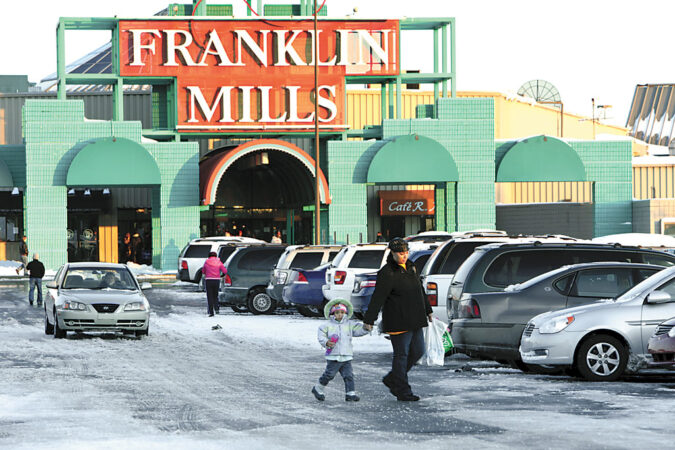
Northeast Philadelphia’s Franklin Mall — better known by its original name, Franklin Mills — is for sale after years of plummeting valuation, occupancy, and visitor numbers.
A listing on the website of real estate brokerage Jones Lang LaSalle (JLL) includes possible uses a new owner can consider, including industrial and office development. The parcels including Sam’s Club and Walmart are not included in the sale.
“Franklin Mall presents the opportunity to acquire meaningful control of more than 137 acres … in a densely populated location that may support additional densification and redevelopment,” the listing reads.
The move comes amid a wave of mall sales and redevelopments in the region, with demolition and residential construction a common fate for many struggling shopping centers.
Over 68% of Franklin Mall is occupied, which could be an incentive for continued retail operations. But sales and visitor numbers have been falling for years,and JLL reports the average existing lease lasts for only another 1.7 years.
If a new use is sought, the mile-long, one-story structure would be difficult to repurpose.
“I think it’s unlikely to be a shopping mall” again, said Jerry Roller, founder of the design firm JKRP and a longtime architect in Philadelphia. “What could it be? Obviously, residential. It might be a warehouse. It’s essentially a large vacant piece of land. It was fairly inexpensive when it was built, so it’s not hard to demolish.”
The hundred acres of land that Franklin Mills sits on at the edge of Far Northeast Philadelphia is zoned for auto-oriented commercial use.
JLL’s listing advertises the site’s suitability for industrial redevelopment.
“The property’s infill location and highway access make it a strong candidate for redevelopment into a modern industrial facility,” the listing reads. The zoning “could provide a basis for an investor to pursue the development of up to 1.4 million square feet of new warehouse space.”
The residential redevelopment opportunities for the site could be aided by a promised 20-year property tax abatement for the conversion or demolition of outmoded commercial buildings into housing, which Mayor Cherelle L. Parker’s administration promises next year following enabling legislation from Harrisburg.
But the existing zoning would not allow that, so a residential project would need to win the permission of the city’s Zoning Board of Adjustment or have the land-use rules changed legislatively by Councilmember Brian O’Neill.
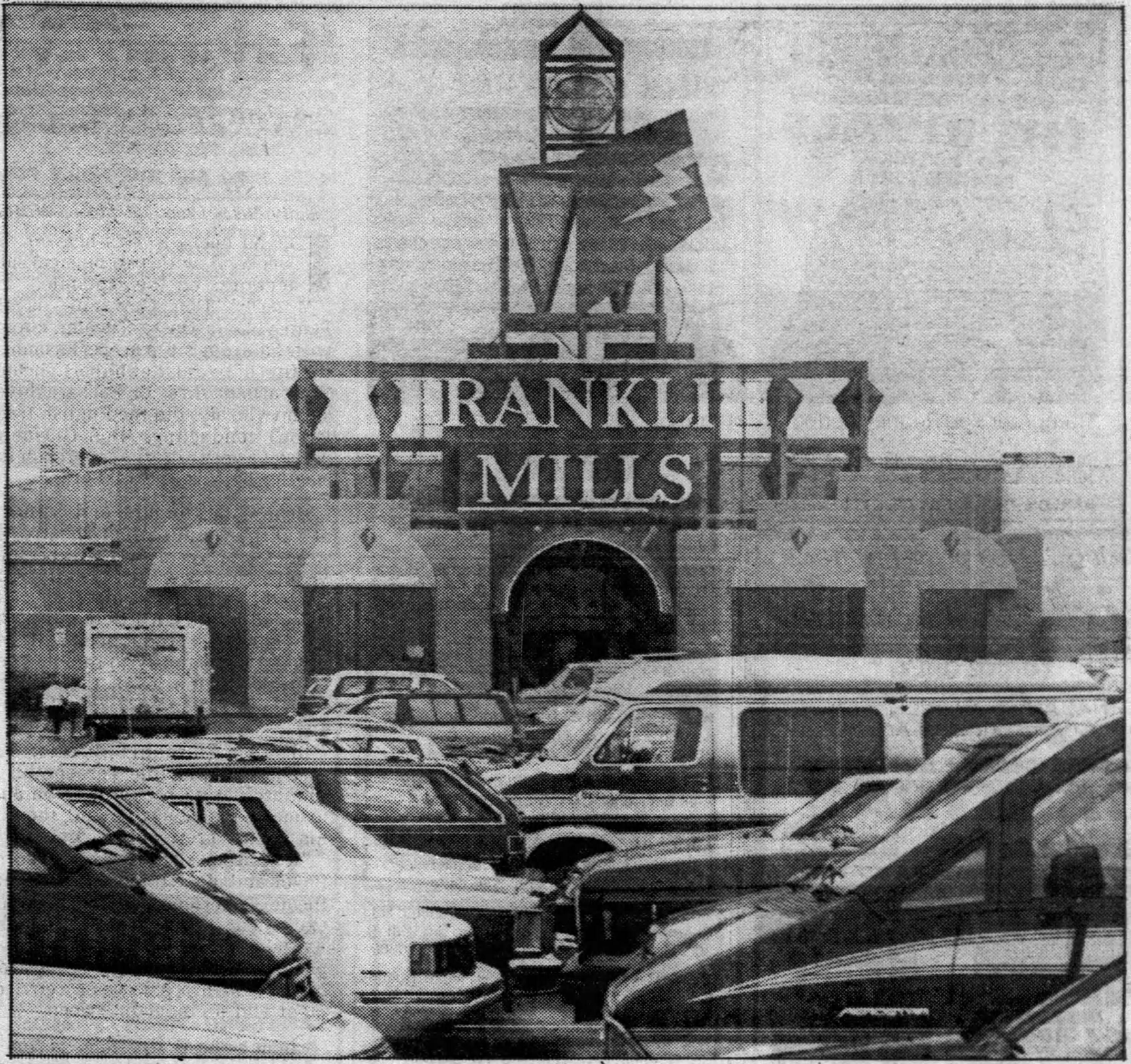
The mile-long Franklin Mills mall drew Christmas-size crowds at its opening in May of 1989.
Tribulations of a Northeast Philly icon
The 36-year-old, 1.8-million-square-foot facility at Knights and Woodhaven Roads is the second largest mall in the Philadelphia area after King of Prussia. But while its larger cousin remains a dominant retail force, Franklin Mall has been struggling for years.
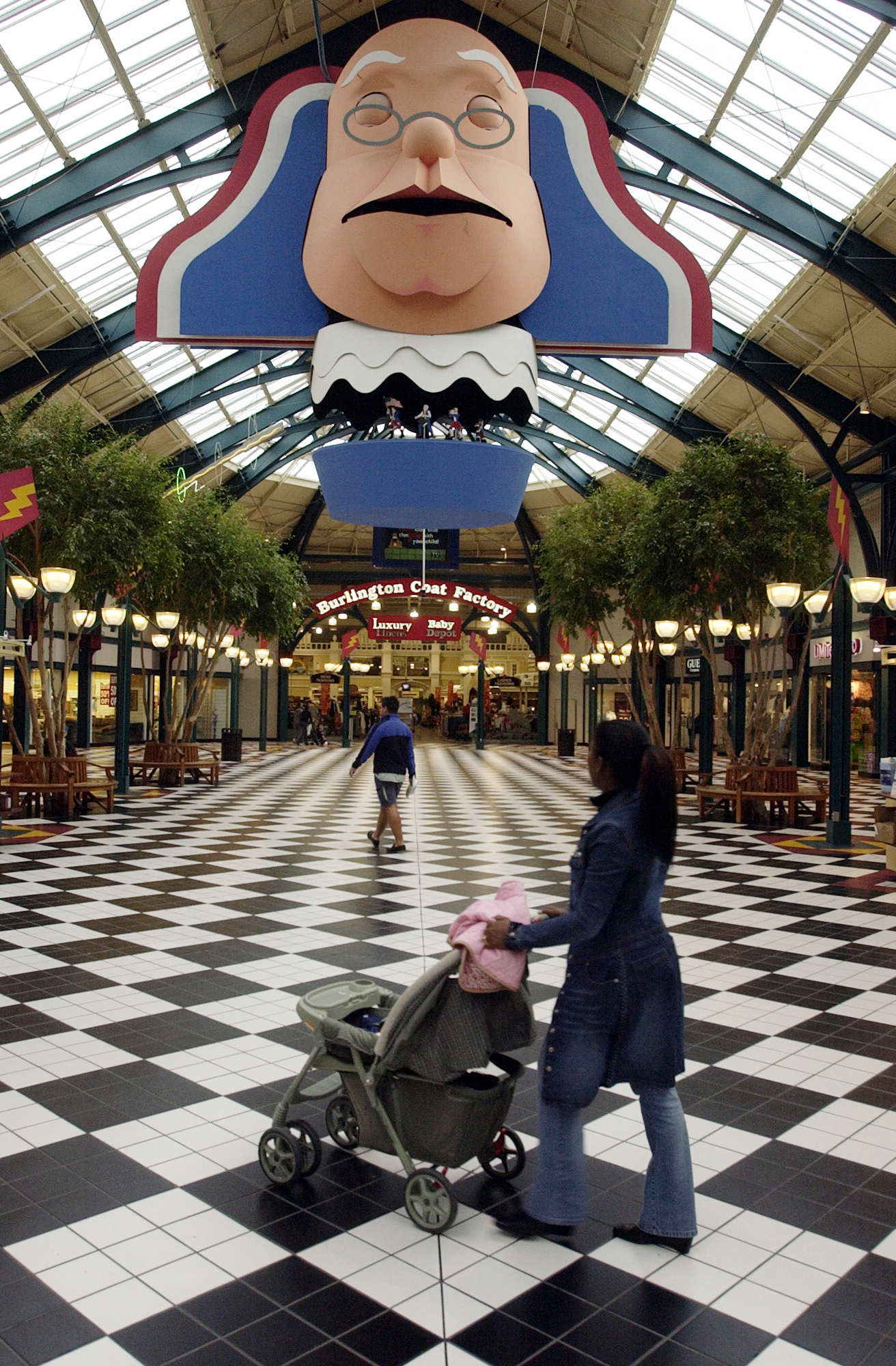
The mall opened in 1989 to great fanfare as the largest outlet mall ever, with an iconic zigzag-shaped concourse that stretched for 1.2 miles.
In 2007, in retrospect near the end of Franklin Mills’ golden era, the property and the rest of the Mills Corp. was taken over by Simon Property Group, the largest mall owner in the country. The new ownership group rehabbed the property in 2014, although there were already signs Simon was distancing itself by moving Franklin Mills (renamed Philadelphia Mills) into a different balance sheet category than its core properties.
Simon’s loan on the property had been intermittently distressed since 2012. An April 2024 report from real estate analytics firm Morningstar Credit was headlined “Legacy Philly Mall Back to Special Servicing for the Umpteenth Time.”
Shoppers stroll through the Franklin Mills mall in 2014.
The 2007 loan still had an outstanding balance of almost $250 million when it came to maturity in July 2024. Simon stepped away from the day-to-day operations at that time, with Philadelphia-based OPEX CRE Management appointed as receiver of the distressed property. The name was changed to Franklin Mall because Mills was trademarked by Simon.
Last year Franklin Mall’s appraised value was $76 million, a precipitous decline from its $201 million valuation in 2012 and $370 million in 2007. According to Morningstar Credit, a new appraisal is likely in the next month.
Full financials haven’t been publicly updated since last year, but at that time, the cash flow for the property was $9.5 million, the lowest since Simon took over in 2007. That’s down from 2019, when cash flow was $17.5 million, according to Morningstar, and from $11 million in 2022.
According to Morningstar, the latest reports from the special servicer for the property, Greystone Servicing Co., say cash flow is even lower this year and occupancy has fallen to 65.4%.
Possible reuses for Franklin Mills
Franklin Mall’s for-sale status comes as some old-school regional shopping destinationsare declining.
While some of its counterparts like King of Prussia and the Cherry Hill Mall are still thriving, there has been a wave of sales and redevelopments of area malls as the nature of retail evolves.
Some ailing malls have been purchased on the cheap, allowing their new owners to reinvest and refurbish the property in its previous mold.
“In terms of using the buildings that are there, it’s a challenge because they are generally big box retail, and they’ve got a center mall, which is completely out of fashion,” Roller said. “Could somebody, if they had the right tenants, recreate the mall? Turn it inside out, open the thing up?”
“Maybe it’s possible,” Roller said. But “I don’t see a lot of uses for the buildings that are there right now.”
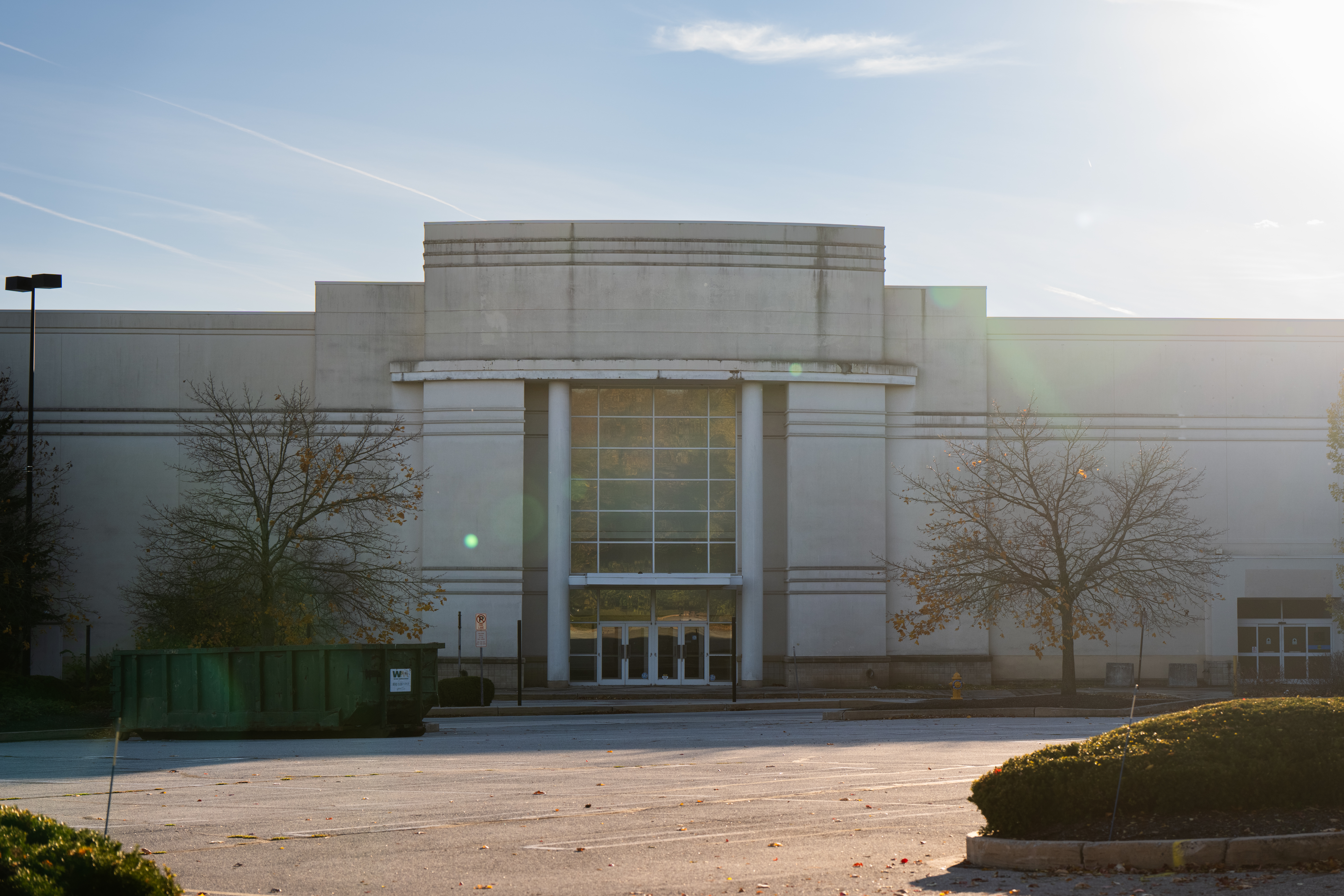
The redevelopment of Exton Square Mall is in legal limbo.
When regional malls are redeveloped, more commonly, the retail options are reduced with much of the old structure demolished. Diverse new uses often take a faded shopping center’s place.
In New Jersey, the Echelon, Moorestown, and Burlington Center malls have or are going through a variety of demolition and redevelopment options. The commonality is that residential building is a part of all three plans.
At Franklin Mall, redevelopment would likely require demolition of the existing building.
“Ultimately, it may just be a piece of land” for sale, said Roller.
JLL’s listing, however, pitches the property as either redevelopment or continued mall use.
“This offering presents prospective purchasers with the opportunity to acquire a strategically positioned super regional shopping center with significant upside potential and/or redevelopment opportunity,” it reads.
JLL’s managing directors on the sale are John Plower, David Monahan, and Jim Galbally.