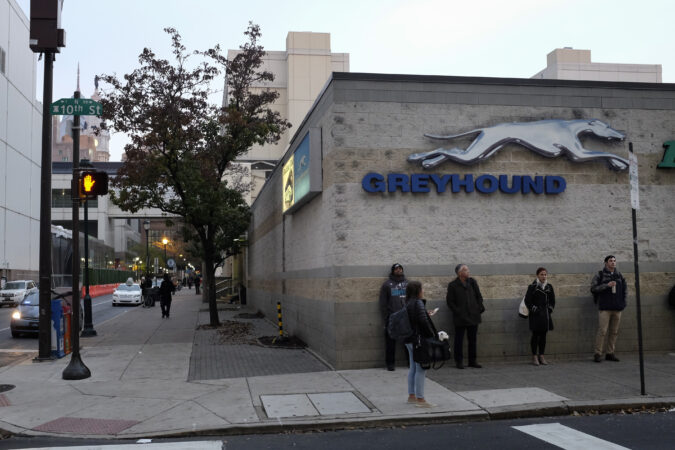
City Council passed legislation Thursday to restore the abandoned Greyhound terminal on Filbert Street as Philadelphia’s new intercity bus station in time for an expected flood of tourists in 2026.
Under the measure, the Philadelphia Parking Authority will operate the station on behalf of the city, collecting fees from bus companies to pay costs.
A refurbished facility is scheduled to open in May 2026, which would resolve more than twoyears of chaos after Greyhound ended its lease, forcing the city to allow the bus companies to operate at the curbs of public streets with few amenities and no shelter for riders.
The saga was embarrassing, and it became more untenable for city leaders with Philadelphia set to host celebrations of the 250th anniversary of the Declaration of Independence, and a round of international FIFA World Cup soccer matches.
The plan came together over the last few months as at least three city departments collaborated and reached an agreement with the parking authority. Mayor Cherelle L. Parker’s administration sent a bill to Council.
Councilmember Curtis Jones Jr. said in a Finance Committee hearing last week that he found the speed of “galvanized” departments working together impressive.
“You can’t put that genie back in the bottle. I know you can cooperate now, and that’s going to be the expectation from now on,” Jones said.
Greyhound ran the terminal at 10th and Filbert Streets for 35 years but ended its lease in June 2023 as the bus line (and its corporate parent) began shedding real estate and leases in the U.S. to cut costs.
First, the buses operated along the 600 block of Market Street. Since November 2023 they have loaded and unloaded passengers in the open along Spring Garden Street.
“This is an opportunity that kind of came from the heavens,” said Mike Carroll, the city’s assistant managing director for transportation.
Bus companies would pay a $40 fee for each stop in the city until the terminal is open, when it would be increased to $65. A smaller number of buses subsidized by the Pennsylvania Department of Transportation under a program to provide rural service would pay $16 a stop.
Operating the renovated terminal will cost $4.7 million to $4.8 million annually, Carroll said.
City officials say they plan to keep researching other possible locations for an intercity bus station but note the lease provides stability.
PPA will provide 24-7 security, 16-hour daily custodial coverage, maintenance staff, and an on-site program manager under terms of an intergovernmental agreement with the city that is part of the legislation.
It also will be responsible for enforcing rules, such as one that will require buses to bypass the heart of Chinatown.
Since the parking authority regulates rideshare and taxi services, its enforcement officers will help keep traffic flowing around the station, officials said.
Councilmember Nina Ahmad pressed city officials to plan for retail tenants and other ways to generate municipal revenue.
“There’s an element of rush,” Ahmad said during the Dec. 3 hearing. “I understand the urgency, but I hope we don’t overlook things that we should be doing to make it really a transit-oriented development.”
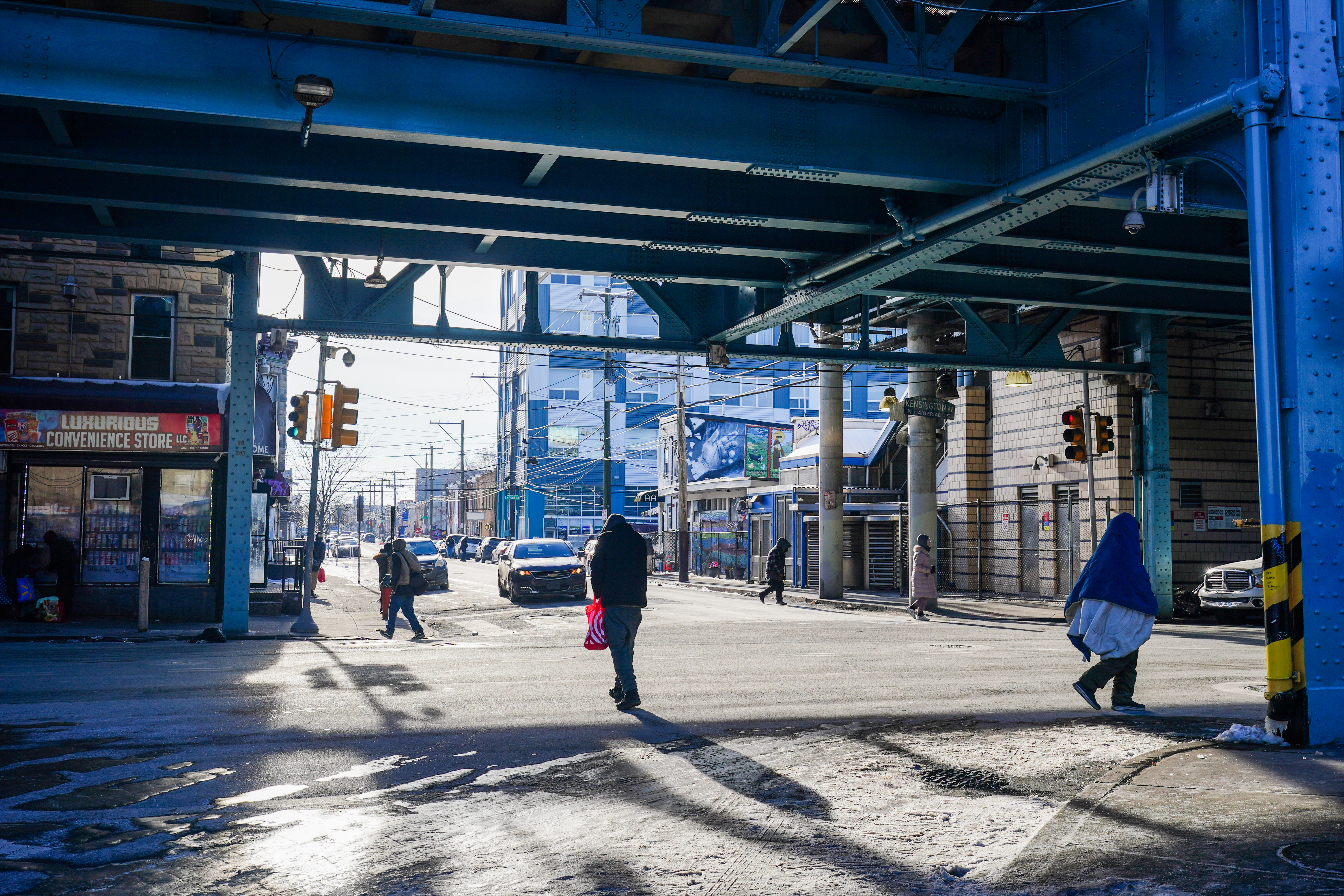
Philadelphia lawmakers voted Thursday to ban mobile outreach groups that provide medical care and support services to people in addiction across a swath of Kensington, the epicenter of the city’s drug crisis.
The vote came just days after the city began enforcing controversial new regulations in a different part of the neighborhood, where the same providers may operate only if they have a permit to do so and park in areas designated by the city.
Taken together, the actions spearheaded by City Council members who represent Kensington and Mayor Cherelle L. Parker’s administration amount to a major shift in how transient people who use drugs obtain medical care and basic needs like food, water, and clothing.
Many have long relied on mobile outreach services that met them on the street. Those same providers can now park only in designated areas or serve people for limited amounts of time.
Council members who support the legislation say residents in the neighborhood do not want people in addiction lining up for medical care or support services near their homes.
Councilmember Mike Driscoll authored the bill banning mobile service providers entirely from his 6th District, which includes parts of the neighborhood that are northeast of the infamous open-air drug market at the intersection of Kensington and Allegheny Avenues.
Driscoll said his bill, which passed Council 14-3 on Thursday,is not aimed at punishing providers. He said he is open to finding a location in his district where they can operate with the city’s permission.
“I just don’t want the service providers picking where they want to go at the expense of the kids and the neighbors,” he said.
Councilmember Michael Driscoll in chambers as City Council meets Thursday, Dec. 11, 2025, on the last day of the 2025 session.
But advocates for people who use drugs slammed the bill, and said reducing access to care will not help people in addiction.
“Restrictions like these will not end the opioid crisis. They will not make anyone in Kensington or District 6 safer,” said Katie Glick, a nurse who treats people in addiction and lives in the neighborhood. “These restrictions will disable and kill people.”
In Kensington, inconsistent rules for providers
If Parker — who has never issued a veto — signs Driscoll’s bill, it would result in a patchwork of rules for mobile service providers in Kensington, which is represented by three different Council members.
The western side of Kensington is in the 7th District, where Councilmember Quetcy Lozada’s legislation that required the permitting system applies. Organizations that do everything from handing out water to providing medical care now face a $1,000 fine for operating without a permit.
In the southern parts of Kensington that fall in the 1st District, represented by Councilmember Mark Squilla, no legislation applies to mobile providers.
(function() {
var l2 = function() {
new pym.Parent(‘kensington_districts’,
‘https://media.inquirer.com/storage/inquirer/projects/innovation/arcgis_iframe/kensington_districts.html’);
};
if (typeof(pym) === ‘undefined’) {
var h = document.getElementsByTagName(‘head’)[0],
s = document.createElement(‘script’);
s.type = ‘text/javascript’;
s.src = ‘https://pym.nprapps.org/pym.v1.min.js’;
s.onload = l2;
h.appendChild(s);
} else {
l2();
}
})();
The inconsistency is the result of councilmanic prerogative, the unwritten rule that gives Council members who represent geographic areas a large amount of sway over what happens in their districts. Lawmakers largely approve legislation offered by a district Council member when it affects only that member’s district.
Some of Council’s progressive members who represent the city at-large have bucked that practice several times on matters related to Kensington, where Parker and her allies in Council have placed an intense focus on improving quality of life.
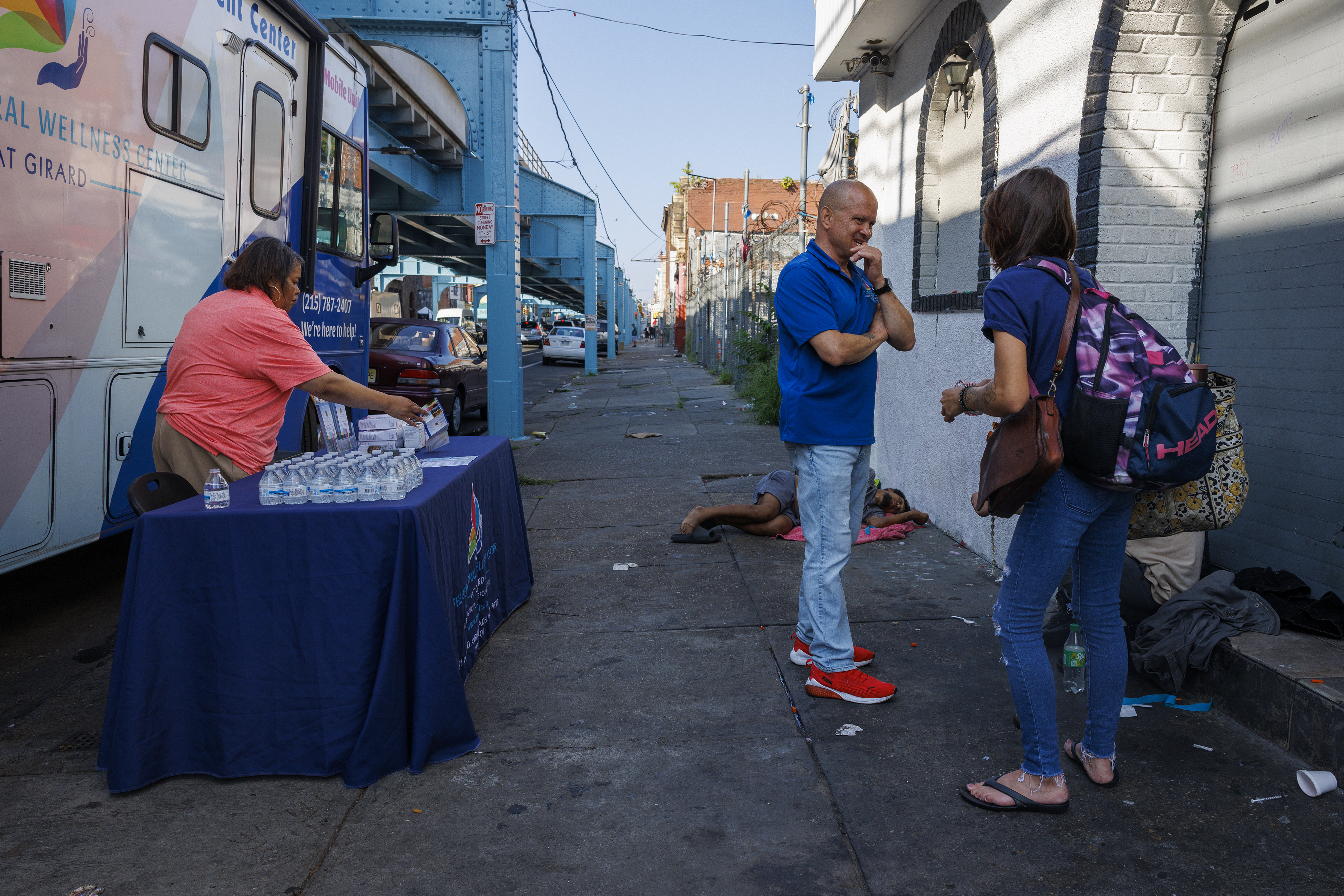
In this 2023 file photo, the mobile home belonging to the Behavioral Wellness Center at Girard parked along Kensington Avenue. It is one of the city’s so-called mobile service providers that have faced increasing regulation from City Council.
The progressives — who favor an approach to the crisis called harm reduction that aims to keep people alive until they are ready to enter treatment — argue that placing restrictions on mobile service providers will make it harder for them to reach vulnerable people in addiction and ultimately reduce the number of providers on the street.
“When human beings are trying to provide help,” said Councilmember Nicolas O’Rourke, “the attitude should never be ‘how can we limit them.’”
O’Rourke and Councilmember Kendra Brooks, both of the Working Families Party, and Democrat Rue Landau voted against Driscoll’s measure.
But Lozada said implementing new regulations was not about restricting care.
“We’re hoping that services continue,” she said. “People have just moved to other spaces to find a way to be able to continue to provide the services that people need.”
And Parker administration officials said the goal is not to reduce the number of providers, but to better coordinate them and ensure safety, especially for people receiving medical services.
Councilmember Quetcy Lozada in chambers as City Council meets Thursday, Dec. 11, 2025, on the last day of the 2025 session.
Kensington has been a key issue for the Parker administration and Council members who have pushed for more law enforcement in the neighborhood, where sprawling homelessness, open drug use, and violent crime have been commonplace for years. There have been some signs of progress, including a reduction in the number of people living on the street.
The city has tried new tactics, including opening its own recovery house and expanding police foot patrols. The local government has also at times operated its own mobile medical services and contracts with organizations that do so.
So far, the city has issued nine permits to providers who perform mobile medical services and 40 to organizations considered “nonmedical,” like those that distribute food. Some of those organizations also operate in other neighborhoods.
“We don’t have a problem if there’s five or 500 providers,” said Crystal Yates-Gale, deputy managing director for health and human services. “As long as they’re qualified to provide the care, and as long as we can help coordinate the care.”
Despite the changes, city says ‘people are still coming’
Under the new rules, nonmedical providers are prohibited from staying in one place for more than 45 minutes. Medical providers can station on a two-block stretch of Allegheny Avenue at nighttime or at a designated parking lot at 265 E. Lehigh Ave. during the day.
That lot, which is managed by the city and addiction service provider Merakey, is connected to the city’s Wellness Support Center.
Inside, people can access first aid, showers, and food, as well as get directed to treatment, legal aid, housing assistance, and other services.
People walk near Kensington Ave. in January 2025.
In the parking lot, two mobile medical service providers run by Merakey and Kensington Hospital are currently stationed, according to Kurt August, executive director of the Philadelphia Office of Public Safety’s Criminal Justice Division. He said officials are looking to expand the number of providers that operate there.
In late October, Merakey began dispensing methadone out of an RV parked in the lot. The tightly regulated opioid medication is a popular treatment for people experiencing withdrawal because it helps stave off cravings.
Raymond Bobb, a medical director at Merakey, said he has seen promising results in just a few weeks, including starting people on methadone and getting them stable enough to transition to inpatient drug treatment. Merakey offers to transport people on the street to the RV to enroll them in medication-assisted treatment.
“We’ve been able to take everything right to the heart of the epidemic and engage people the way you would treat your brother, or your sister, or your family,” said Bobb, who is also in recovery and became emotional when speaking about the program.
“Our goal,” he added, “is to build people up and motivate them to want treatment for themselves.”
August said retention has been high, despite the police presence at the support center. The officers, he said, were “handpicked” to be stationed alongside behavioral health professionals.
“It’s not a secret that police are on site, and people are still coming,” August said.
Still, other providers have expressed concern that requiring people to travel to the lot adds an additional barrier to care, especially for those who were used to mobile services coming to them.
Sarah Laurel, who runs the addiction outreach program Savage Sisters and has a nonmedical permit, said she fears that providers who offered medication-assisted treatment on the street will now be less accessible.
However, she said, some clients greeted the news of service limits with a shrug.
“The friends we serve are so used to not being heard that when they realize that services are going away, they adjust quickly to not having things,” Laurel said. “They just say, ‘No one cares about us. They hate us anyway.’ That is how people feel seen in this city.”
Staff writer Ellie Rushing contributed to this article.
Philadelphia lawmakers on Thursday approved two changes to city law that are aimed at boosting business for restaurants and the hospitality sector ahead of an expected influx of tourists visiting the city next year.
Legislators also voted to ban so-called reservation scalpers, which are third-party businesses that allow people to secure tables and then resell them without authorization from the restaurant.
Both measures passed Council unanimously and were championed by advocates for the restaurant industry, who lobbied lawmakers to ease burdens on the tourism and hospitality industry ahead of several large-scale events in the city next year, including celebrations for America’s Semiquincentennial, when Philadelphia is expected to host a flurry of visitors.
They both now head to the desk of Mayor Cherelle L. Parker, who has never issued a veto.
The outdoor dining legislation, authored by Councilmember Rue Landau, a Democrat who represents the city at-large, expands the number of so-called by-right zones, where businesses can have sidewalk cafes without having to obtain a special zoning ordinance.
Currently, by-right areas are only in Center City and a few commercial corridors in other neighborhoods. Restaurants outside those areas must undertake a sometimes lengthy process to get permission to place tables and chairs outside.
The expanded zones, which were chosen by individual Council members who represent the city’s 10 geographic districts, include corridors in Manayunk and on parts of Washington Avenue, Passyunk Avenue, and Point Breeze Avenue in South Philadelphia.
The legislation also includes all of the West Philadelphia-based Third District, which is represented by Jamie Gauthier, the only Council member who chose to include her entire district in the expansion.
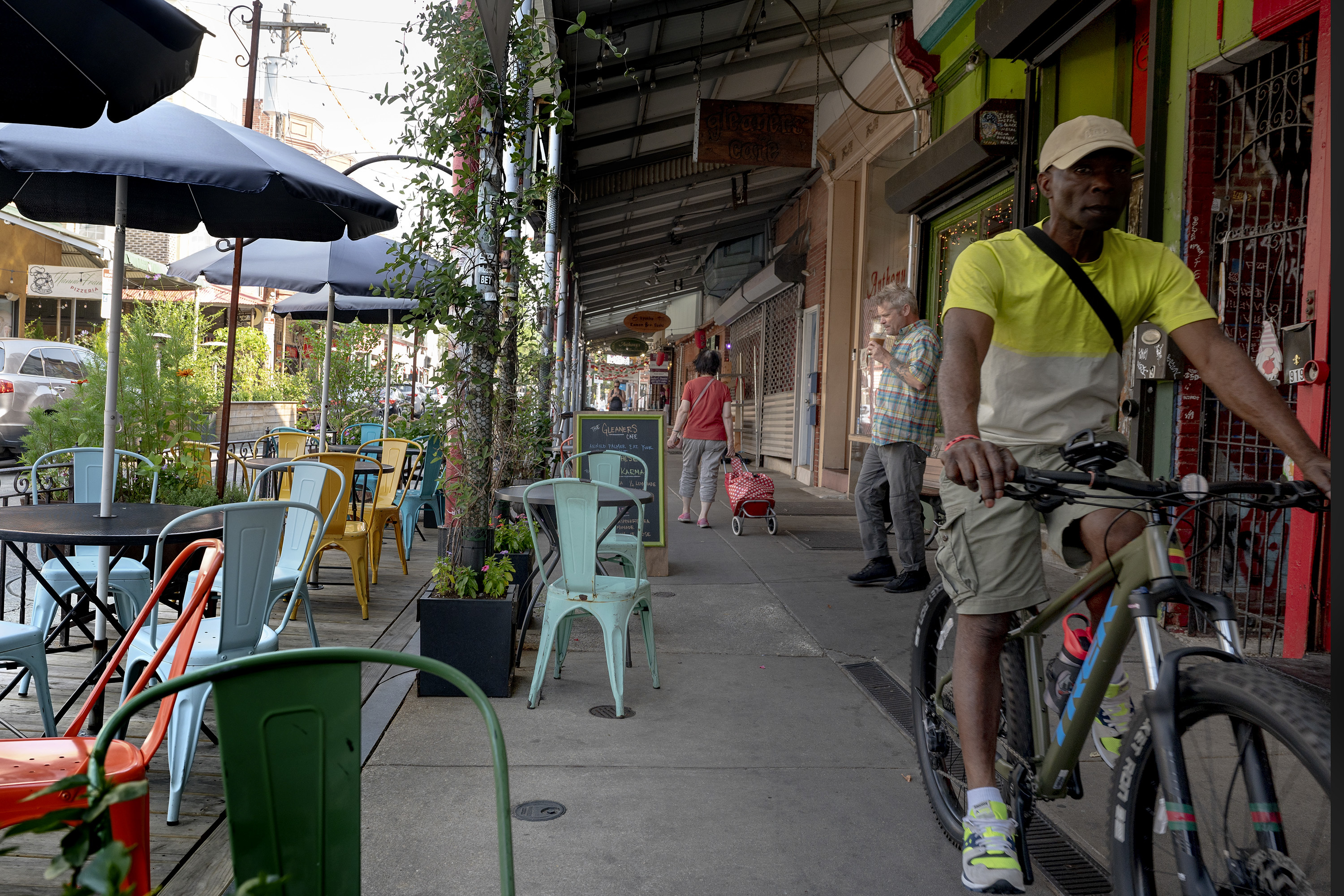
The cafe area on the sidewalk outside of Gleaner’s Cafe in the 9th Street Market on Thursday, July 27, 2023.
Nicholas Ducos, who owns Mural City Cellars in Fishtown, said he has been working for more than a year to get permission to place four picnic tables outside his winery. He said he has had to jump through hoops including working with multiple agencies, spending $1,500 to hire an architect, and even having to provide paperwork to the city on a CD-ROM.
“There are a lot of difficult things about running a business in Philadelphia,” Ducos said. “This should not be one.”
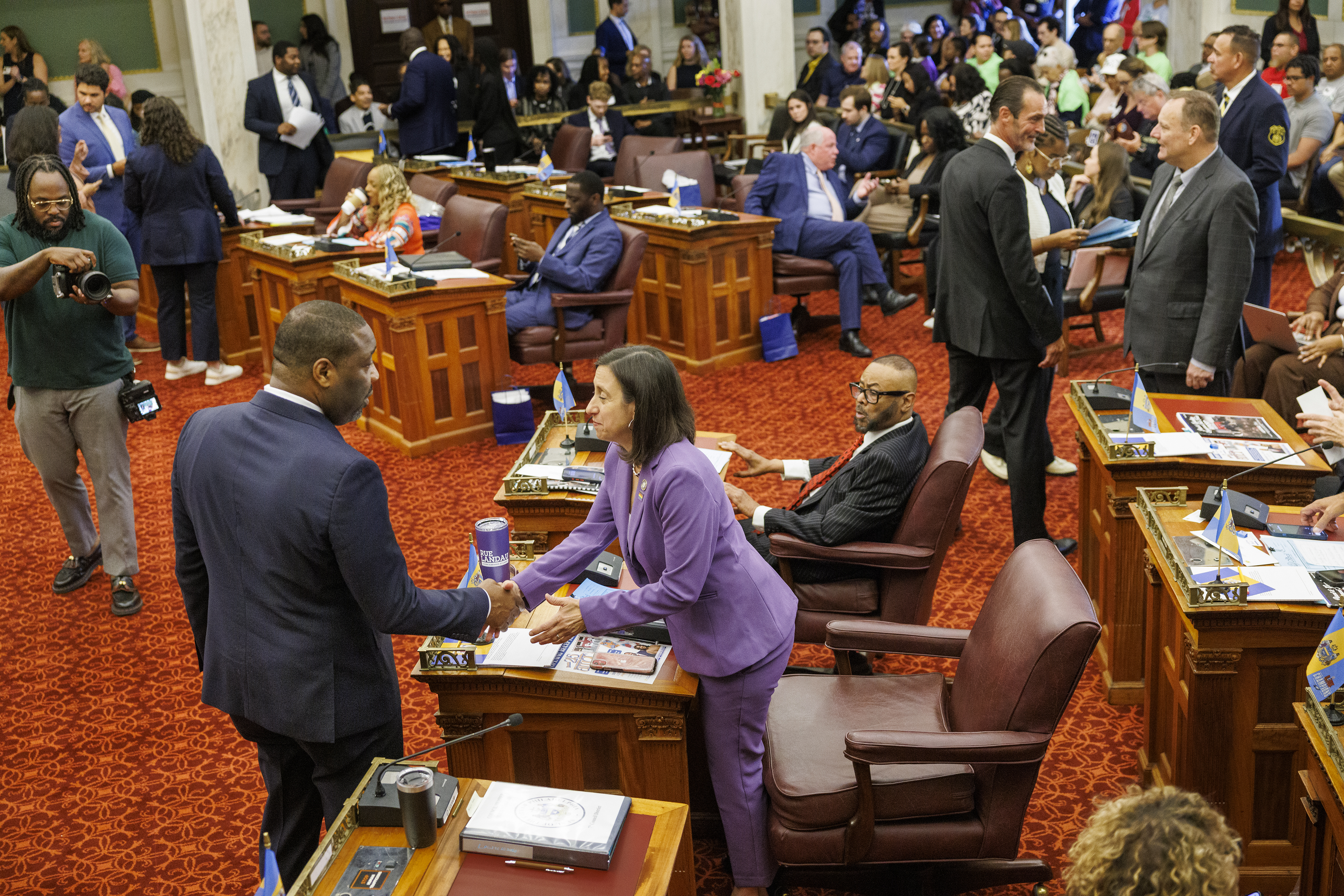
At left is Philadelphia Council President Kenyatta Johnson greeting Rue Landau and other returning members of council on their first day of fall session, City Hall, Thursday, September 11, 2025.
Council members also approved the reservation scalping legislation authored by Councilmember Isaiah Thomas, a Democrat who represents the city at-large. He has said the bill is modeled after a similar law in New York and is not aimed at popular apps and websites like OpenTable, Resy, and Tock that partner directly with restaurants.
Instead, it is a crackdown on websites that don’t work with restaurants, such as AppointmentTrader.com, which provides a platform for people to sell reservations and tickets to events.
Jonas Frey, the founder of AppointmentTrader.com, previously said the legislation needlessly targets his platform. He said his company put safeguards in place to prevent scalping, including shutting down accounts if more than half of their reservations go unsold.
But Thomas has cast the website and similar platforms as “predatory” because restaurants can end up saddled with empty tables if the reservations do not resell.
Zak Pyzik, senior director of public affairs at the Pennsylvania Restaurant and Lodging Association, said the legislation is an important safeguard for restaurants.
“This bill provides clear, sensible protections that will keep restaurants in the driver’s seat,” he said, “and in control of their business and their technology services.”
During a combative hearing on legislation related to Parker’s signature housing initiative, Council President Kenyatta Johnson on Wednesday afternoon refused to allow a vote on an amendment brought by the Parker administration and instead advanced Council’s version of the proposal over the mayor’s objections.
In a voice vote, Council’s Committee on Fiscal Stability and Intergovernmental Cooperation approved its own changes to the legislation — authorizing the city to take out $800 million in city bonds to fund Parker’s Housing Opportunities Made Easy, or H.O.M.E., initiative — without considering the mayor’s requested tweaks.
Councilmembers Brian O’Neill, Anthony Phillips, and Curtis Jones Jr. signaled their support for Parker’s vision by voting against the measure, which now heads to the Council floor for a final passage vote or further amendments, either of which could come as soon as January.
It is unclear how Johnson’s handling of H.O.M.E. will change the tight working relationship Parker and Johnson have maintained since both took office in January 2024. Wednesday’s vote marked their most contentious public disagreement during their tenures. Both officials still agree on many policy goals and have plenty to gain politically from maintaining their alliance.
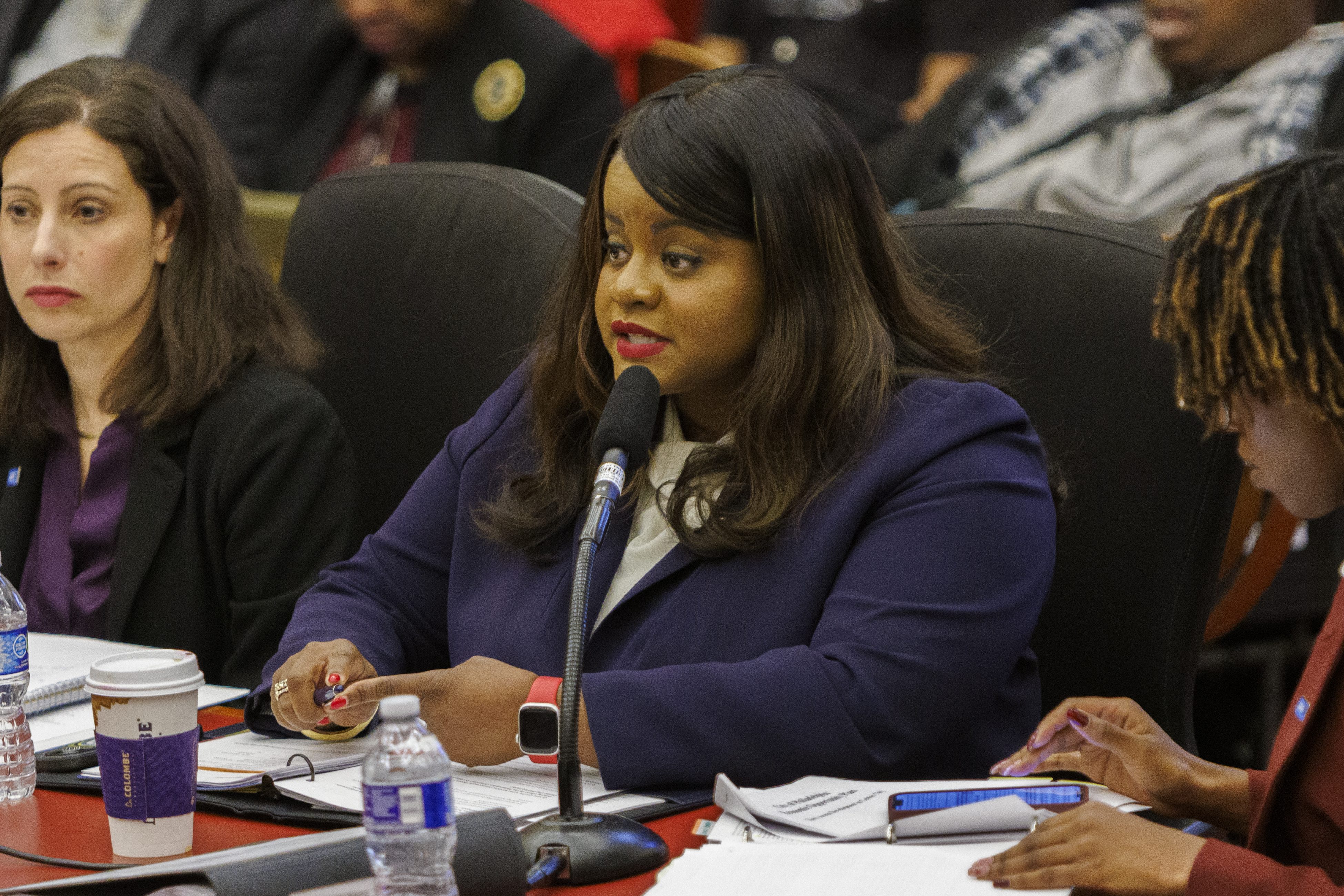
Philadelphia Mayor Cherelle L. Parker stands beside Council President Kenyatta Johnson (left) after finishing her budget address to City Council in Philadelphia City Hall on Thursday, March 13, 2025.
The dispute between Parker and Council centers on income eligibility thresholds for two of the housing programs that will be funded by bond proceeds: the Basic Systems Repair Program (BSRP), which provides funding for needed home improvements to eligible owners who might be displaced by costly repairs, and the Adaptive Modification Program (AMP), which funds projects to improve mobility for permanently disabled renters and homeowners.
“The whole debate over income eligibility limits for BSRP and Adaptive Modifications is to make sure that we leave no working Philadelphian and no qualifying Philly rowhome owner excluded from these vital programs,” Parker said in a statement Wednesday. “If we don’t save Philly rowhomes, we’re going to become a city of used-to-be neighborhoods, blocks that used to be nice but now are showing signs of age and decline. I will not allow that to happen — not on my watch as Mayor of Philadelphia.”
Councilmember Jamie Gauthier, who chairs the Committee on Housing, Neighborhood Development and the Homeless, said Wednesday’s vote sent the message “that Council takes its job seriously as a steward of taxpayer money in the city of Philadelphia, that we are not here to just rubber-stamp in a proposal, that we’re here to work together.”
Change in fortunes for Parker
Wednesday’s vote appears to mark the first instance of Parker’s hard-line negotiating tactics failing her since she took office. Even when she could not get negotiating counterparts to bend to her will in the past, Parker has largely prevailed.
And in July, when the largest union for city workers went on strike to try to squeeze larger raises out of the administration, Parker stuck to her guns amid increasing pressure to fold as trash piled up across the city and 911 wait times grew longer. The union ultimately folded after an eight-day work stoppage with a new contract that closely aligned with Parker’s last offer before the strike began.
But this time, Parker appears to be out of options to prevent Council from getting its way because she cannot veto another key piece of legislation to keep the housing initiative in motion that needs to pass before the city can issue the bonds. That measure — a resolution setting the first-year budget for H.O.M.E. that received preliminary approval in a Council committee last week — could see final approval as soon as Thursday.
“We’ve got to take care of the people who are most in need, but we can’t penalize the people who are going to work every day, pay their taxes, contribute to the city, and they can’t benefit from home improvement programs,” she said.
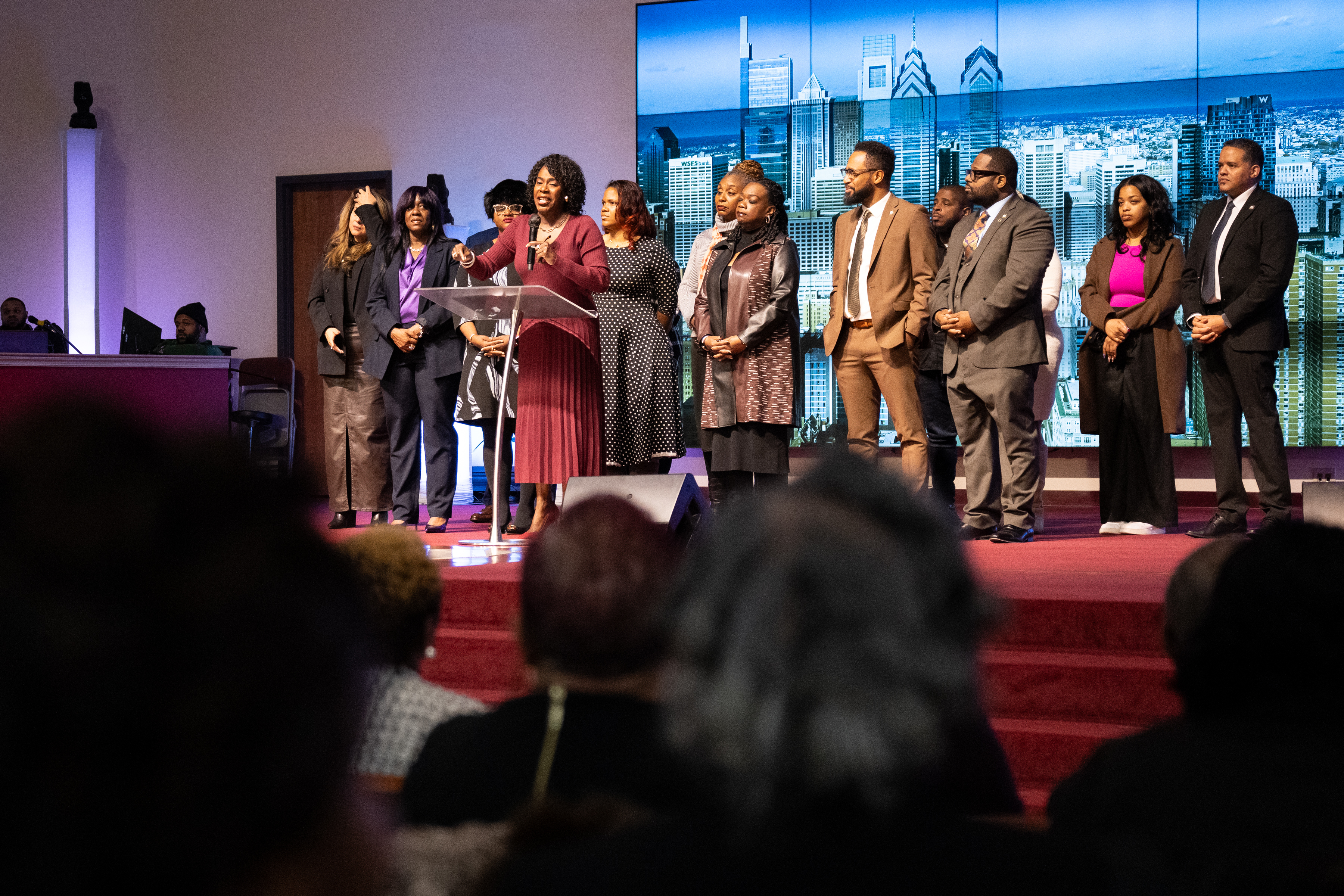
Mayor Cherelle L. Parker speaks to the crowd at The Church of Christian Compassion in the Cobbs Creek neighborhood of West Philadelphia on Sunday, Dec. 7, 2025. Parker visited 10 churches in Philadelphia on Sunday to share details about her H.O.M.E. housing plan.
That maneuver did not appear to go over well with lawmakers, who likely did not appreciate the mayor encouraging their constituents to oppose Council’s version of the plan.
Even before chief of staff Tiffany W. Thurman presented Parker’s amendment at Wednesday’s hearing, lawmakers sounded off, with Gauthier saying the administration was spreading “misinformation” and Councilmember Nicolas O’Rourke calling Parker’s approach “Trumpian.”
“It was in response to misinformation being spread during that tour,” said Gauthier, who, along with fellow progressive Councilmember Rue Landau, led the charge to lower the income eligibility thresholds included in H.O.M.E.
Gauthier noted that Council’s version of the bill still increases those thresholds beyond what is offered in existing programs.
“Obviously, the mayor, all of us, have the right to go and talk to our constituents,” she said, “but we have to be operating from a fact-based perspective, and telling folks that the Council proposal excludes them is not factual.”
No vote on Parker amendment
The legislative process for approving the city bond issuance — the centerpiece of Parker’s H.O.M.E. initiative, which she first proposed in March — has been long and tortured.
Council initially approved the bond authorization in June, but lawmakers at that time inserted a provision requiring the administration to get their approval for annual budget resolutions determining how the proceeds will be spent.
Johnson delayed a vote on the first H.O.M.E. budget resolution for months before allowing it to be approved last week by the Committee of the Whole. But lawmakers made major changes over the mayor’s objections, including granting themselves the right to set income thresholds for the initiative’s programs.
It was the first sign that Council was serious about enacting its own ideas even if Parker was not on board and, in Council’s view, would not negotiate. In a twist, lawmakers took their latest stand Wednesday at a time when the mayor’s team came to the table with a significant, albeit last-minute, counteroffer.
Council’s changes to the eligibility requirements for BSRP and AMP would require 90% of the H.O.M.E. bond proceeds for those programs to be spent on households making 60% of Philadelphia’s area median income, which is about $71,640 for a family of four.
Thurman on Tuesday proposed a compromise in which only 60% of bond money would be set aside for those households. She told lawmakers that Parker, in part, wants to ensure H.O.M.E. helps city workers, who are required to live in Philadelphia but often struggle to make ends meet on municipal salaries. (Parker pointed to the H.O.M.E. plan during the strike as evidence she backed city workers despite opposing higher wages.)
Johnson responded that he hopes “one day our city workers are getting paid enough where they don’t have to sign up” for assistance programs.
“You know as well as I do we agree,” Thurman replied, prompting Johnson to cut her off.
“I’m not acknowledging you yet,” Johnson said, referring to a Council hearing procedure in which the chair must recognize speakers.
Tiffany Thurman, Mayor Parker’s chief of staff, takes questions from Council members in 2024.
Parker’s latest offer, which came months into the standoff over H.O.M.E., appears to have been too little, too late.
Phillips — who voted for the Council budget resolution last week but said he has since changed his mind to support Parker’s vision — wanted to call upthe administration’s amendmentfor a vote, he said in an interview.
“This week I changed my mind because that’s where my mind really has been,” said Phillips, who represents the Northwest Philadelphia-based 9th District that Parker held when she was on Council. “The 9th District neighbors — they’ve made abundantly clear that our housing policy needs to reflect them. … They’re long-term homeowners, residents who are on fixed incomes, multigenerational families.”
Under Council rules, only Johnson can call on members to put forward amendments in committee. But instead he blocked it, prompting Jones, Parker’s most vocal ally on Council, to protest.
“We should do the right thing always, even in spite of its inconvenience and time,” Jones said during Council. “Resolutions and amendments need to be introduced so that they can get the light of day and be heard.”
Johnson said he pushed through Council’s version because the mayor’s administration did not engage with him about its new proposal ahead of the meeting.
“Just for the record … I had not officially seen any official amendment prior to this actual hearing,” Johnson said. “The administration just showed up.”
Despite Wednesday’s vote, the fight over H.O.M.E. may not be over. Councilmember Mike Driscoll, a Parker ally who voted to advance the bond authorization, signaled there may be further changes.
“I wanted to keep the HOME initiative process moving,” Driscoll said in a statement, “but still hope to influence a reasonable solution which includes program support for row home Philadelphians.”
A judge said this week that arguments questioning the legality of Joyce Wilkerson’s seat on the Philadelphia school board had merit, and directed the board to halt nonrenewal proceedings for two charter schools.
Philadelphia Common Pleas Court Judge Christopher R. Hall granted a preliminary injunction to People for People Charter School and KIPP North Philadelphia Academy on Monday, saying that a lawsuit against the school board can continue because lawyers had presented sufficient evidence.
The charters claim that board member Wilkerson — who is perceived to be anti-charter schools — tainted the votes against them this year and should not be on the board.
City Council declined to approve Wilkerson last yearas a school board member, but Mayor Cherelle L. Parker asked her to serve until she named areplacement.
People for People’s initial lawsuit complaint, filed in September, said that Wilkerson is an “illegally and unlawfully seated member of the BOE” and that her participation in the nonrenewal deliberations tainted and ultimately invalidated them.
The city and the board have said that the city’s Home Rule Charter allows Wilkerson to continue to serve — without Council approval — until a replacement is named.
Reginald Streater, the school board president, said the ruling overshadows the underlying issues.
“The board’s decision to begin the process of nonrenewal was on the merits of each board member’s independent assessment of the schools’ outcomes,” Streater said in a statement. Board members’ concerns were aired publicly over months.
Any delay slows the board’s ability to give the schools full hearings, with testimony and the ability to present evidence, he said.
“Our schools, families, and children deserve resolution,” Streater said. “We remain committed to transparency and to continuing this work in the best interest of the community.”
(Nonrenewal does not equal closure, though it is the first step on that path. It triggers an extensive nonrenewal hearing, after which an officer makes a recommendation; then the board votes again on whether to non-renew the school.)
Lawyers for the charters argued that Wilkerson essentially poisoned the votes, and the judge wrote in his order that there was enough evidence to move forward with the injunction.
“This leaves the question whether Ms. Wilkerson’s participation in the pertinent BOE meetings without color of right tainted its vote [on the charter nonrenewals]. Plaintiffs have shown it likely did,” Hall wrote.
Hall’s order means that nonrenewal hearings cannot proceed, but the board had not yet scheduled them.
What was Wilkerson’s role on the People for People and KIPP votes?
Wilkerson, Hall noted in his order, “was the first to press” to issue a nonrenewal notice to the schools at a June board meeting, and in August called for a vote on the nonrenewal notice.
The KIPP North Philadelphia nonrenewal vote passed unanimously; board member Whitney Jones was the onlyvote against the People for People non-renewal.
But Wilkerson, a former school board president and School Reform Commission chair, was not the only board member with concerns about the two charter schools.
Board member Cheryl Harper said People for People is “failing our children. How long do we allow them to keep failing our children? I have an issue with these schools not being able to succeed for our children.”
Board vice president Sarah-Ashley Andrews cited issues with KIPP North Philadelphia’s “failure to deliver for our students,” specifically calling out its academics and suspension rates.
Streater, the board president, called KIPP’s performance “unacceptable.”
What’s next?
Thecourt case will now proceed, andis likely to drag on for months.
But Hall’s legal ruling on Wilkerson’s school board seat could mean open season for other parties that are unhappy with decisions the board has made and are willing to challenge those rulings legally.
As to whether Wilkerson will remain on the board, Parker has staunchly stood by her in the past.
When the People for People suit was first filed, a member of her administration said she stood by Wilkerson as “an official member of the Philadelphia Board of Education” who “has the full support of Mayor Cherelle L. Parker.”
What was the reaction?
Mark Seiberling, a lawyer for People for People, said the ruling was an important one.
“We are pleased with Judge Hall’s thoughtful and well-reasoned decision following a lengthy hearing at which multiple witnesses from the School District of Philadelphia were called to testify,” Seiberling said in a statement. “We look forward to Ms. Wilkerson’s replacement being nominated and confirmed in accordance with Philadelphia’s Home Rule Charter.”
A former top-ranking deputy with the Philadelphia Fire Department has been demoted amid two ongoing investigations into sexual harassment and overtime abuse, The Inquirer has learned.
Former Deputy Commissioner for Operations Anthony Hudgins — who had been the second-highest ranking official in the 2,800-member department — was recently downgraded to deputy fire chief and reassigned to the Incident Safety Office, according to spokespeople with the city and fire department. The demotion cut his annual salary by nearly 25%, from $202,550 to $155,106, payroll records show.
Hudgins was the subject of an array of sexual harassment allegations, which led the city to hire an outside law firm to investigate the claims and interview department personnel. In a May interview with The Inquirer, Hudgins called the probe baseless and claimed he was targeted with false allegations after uncovering rampant overtime fraud. He acknowledged that as fewer than10 employees had lodged complaints against him. The city inked a $35,000 contract with the law firm Campbell Durrant to investigate the allegations.
Hudgins, a 31-year department veteran, did not immediately respond to a request for comment. After publication, Hudgins’ attorney, Amanda N. Martinez, sent a statement saying that Hudgins“remains committed to assisting the City with any legitimate investigation into the overtime fraud that he brought to light.”
She added that Hudgins is “reviewing the details surrounding the City’s actions and all defamatory statements made against him by individuals” and will “pursue all available legal remedies under the law necessary to protect Mr. Hudgins’ reputation and employment rights.”
The fire department has for decades faced allegations of pervasive sexual misconduct, and yet the Hudgins probe is significant in that it targeted a top-ranking department official. Although they acknowledged that Hudgins had been demoted, spokespeople for the city and fire department declined to confirm whether any of the allegations against him had been substantiated, citing the city’s policy to not discuss personnel issues.
Fire department leadership did not elaborate on the results of the investigation. A request for comment from Mayor Cherelle L. Parker resulted in a prepared statement from City Solicitor Renee Garcia, who said the city “takes any allegations of sexual harassment or fraud, including overtime fraud, very seriously.”
“We investigate any such allegations thoroughly and, if misconduct is found, we will take appropriate action to implement any warranted discipline expeditiously,” Garcia said.
The city has also declined to reveal whether any fire department employees have faced discipline as a result of the related investigation into alleged overtime abuse. Inspector General Alexander DeSantis — who as far back as January launched a probe into the overtime fraud claims — said his office’s investigation is “still ongoing and may be for some time.” He described the probe as “active” but declined to elaborate.
City officials have declined to release public records that would shed light on some of the fire department’s top overtime earners — and are taking The Inquirer to court in an effort to keep those records hidden.
In an affidavit submitted to the Office of Open Records, the agency that enforces state open-records laws, DeSantis argued that releasing the records to The Inquirer would jeopardize his office’s investigation and that it could not release the files “without identifying or implying who may be directly involved in this investigation.” Records related to noncriminal investigations are exempt from release under Pennsylvania’s Right-to-Know Law.
The Office of Open Records ruled in May that The Inquirer is entitled to receive the records, which cannot be withheld simply because the OIG opened an investigation.
The city again declined to release the overtime sheets and instead appealed the OOR ruling to the Court of Common Pleas. In a 21-page brief filed in that case, attorneys for the city urged the court to vacate the OOR’s ruling on the grounds that releasing the records would raise questions about “the efficacy of investigations, witness confidentiality, and harm to reputation.”
The OIG probe has yet to publicly reveal any findings. DeSantis offered no timeline for its conclusion, and the results may not be made public even after the investigation ends.
The OIG’s stated mission is to “keep City government free from fraud, corruption, and misconduct,” but the office rarely releases specifics related to the outcome of its fraud investigations. Instead, it publishes an annual report summarizing the office’s work from the previous year.
The OIG has yet to release that report for 2024.
Staff writers Samantha Melamed and Ryan W. Briggs contributed to this article.
Correction: A previous version of this story incorrectly characterized the total number of employees that Hudgins said may have filed complaints against him.
Philly is getting ready to dress itself up — with Liberty Bells. Lots of Liberty Bells.
Organizers of Philadelphia’s yearlong celebrations for America’s 250th anniversary in 2026 gathered in a frigid Philadelphia School District warehouse in Logan on Tuesday, offering a special preview of the 20 large replica Liberty Bells that will decorate Philly neighborhoods for the national milestone.
Designed by 16 local artists selected through Mural Arts Philadelphia — and planned for commercial corridors and public parks everywhere from Chinatown and South Philly to West Philly and Wynnefield — the painted bells depict the histories, heroes, cultures, and traditions of Philly neighborhoods.
As part of the state nonprofit America250PA’s “Bells Across PA” program, more than 100 painted bells will be installed across Pennsylvania throughout the national milestone, also known as the Semiquincentennial. Local planners and Mural Arts Philadelphia helped coordinate the Philly bells.
“As Philadelphia’s own Liberty Bell served as inspiration for this statewide program, it makes sense that Philly would take it to the next level and bring these bells to as many neighborhoods as possible,” Mayor Cherelle L. Parker said in a statement. “We are a proud, diverse city of neighborhoods with many stories to tell.”
Kathryn Ott Lovell, president and CEO of Philadelphia250, the city’s planning partner for the Semiquincentennial, said the bells are a key part of the local planners’ efforts to bring the party to every Philly neighborhood.
Local artist Bob Dix paints a portrait of industrialist Henry Disston on his bell.
“The personalities of the neighborhoods are coming out in the bells,” she said, adding that the completed bells will be dedicated in January, then installed in early spring, in time for Philly’s big-ticket events next summer, including six FIFA World Cup matches, the MLB All-Star Game, and a pumped-up Fourth of July concert.
Planners released a full list of neighborhoods where the bells will be placed, but said exact locations will be announced in January. Each of the nearly 3-foot bells — which will be perched on heavy black pedestals — was designed in collaboration with community members, Ott Lovell said.
Inside the massive, makeshift studio behind the Widener Memorial School on Tuesday, artists worked in the chill on their bells. Each bell told a different story of neighborhood pride.
Chenlin Cai (left) talks with fellow artist Emily Busch (right) about his bell, showing her concepts on his tablet.
Cindy Lozito, 33, a muralist and illustrator who lives in Bella Vista, didn’t have to look for inspiration for her bell on the Italian Market. She lives just a block away from Ninth Street and is a market regular.
After talking with merchants, she strove to capture the market’s iconic sites, history, and diversity. Titled Always Open, her bell includes painted scenes of the market’s bustling produce stands and flickering fire barrels, the smiling faces of old-school merchants and newer immigrant vendors, and the joy of the street’s annual Procession of Saints and Day of the Dead festivities. Also, of course, the greased pole.
“It’s a place where I can walk outside my house and get everything that I need, and also a place where people know your name and care about you,” she said, painting her bell.
For her bell on El Centro de Oro, artist and educator Symone Salib, 32, met twice with 30 community members from North Fifth Street and Lehigh Avenue, asking them for ideas.
“From there, I had a very long list,” she said. “People really liked telling me what they wanted to see and what they did not.”
Local artist Symone Salib talks with a visitor as she works on her bell.
Titled The Golden Block, the striking yellow-and-black bell depicts the neighborhood’s historic Stetson Hats factory, the long-standing Latin music shop Centro Musical, and popular iron palm tree sculptures.
To add that extra bit of authenticity to his bell depicting Glen Foerd, artist Bob Dix, 62, mixed his paints with water bottled from the Delaware River, near where the historic mansion and estate sits perched in Torresdale, overlooking the mouth of Poquessing Creek.
“I like to incorporate the spirit of the area,” he said, dabbing his brush in the river water. “I think it’s important to bring in the natural materials.”
Local artist Bob Dix displays waters he collected from the Delaware River and Poquessing Creek to use in his painting of one of 20 replica Liberty Bells representing different neighborhoods Tuesday, Dec. 9, 2025.
Planners say they expect the bells to draw interest and curiosity similar to the painted donkeys that dotted Philadelphia neighborhoods during the 2016 Democratic National Convention.
Ott Lovell said organizers will install the bells around March to protect them from the worst of the winter weather.
“I don’t want any weather on them,” she said with a smile. “I want them looking perfect for 2026.”
Kevin Bean was a frail 125 pounds last February when he entered a brand-new recovery house, a facility where he landed after spending four years in the throes of addiction — at times on the streets of Kensington, the epicenter of the city’s drug crisis.
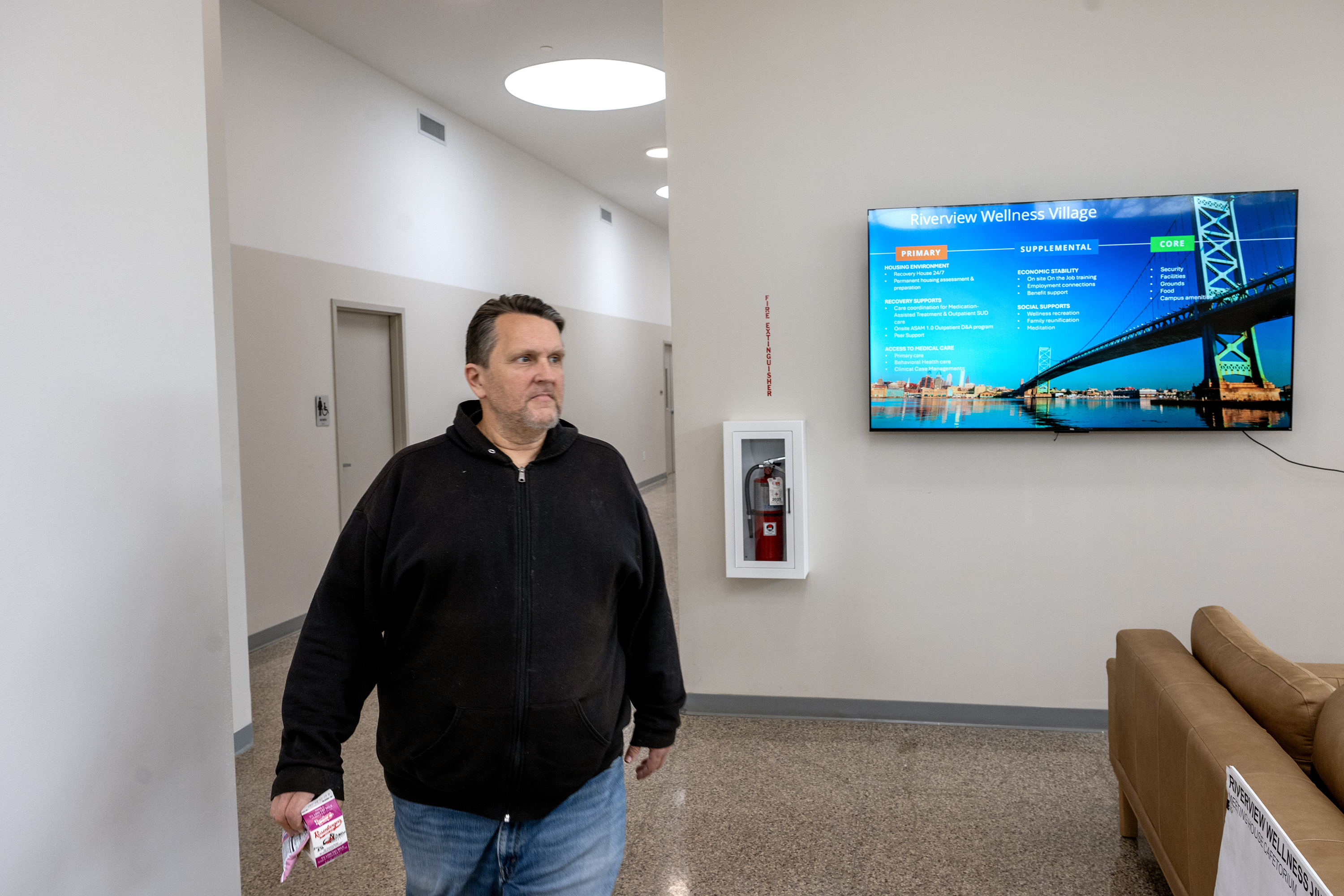
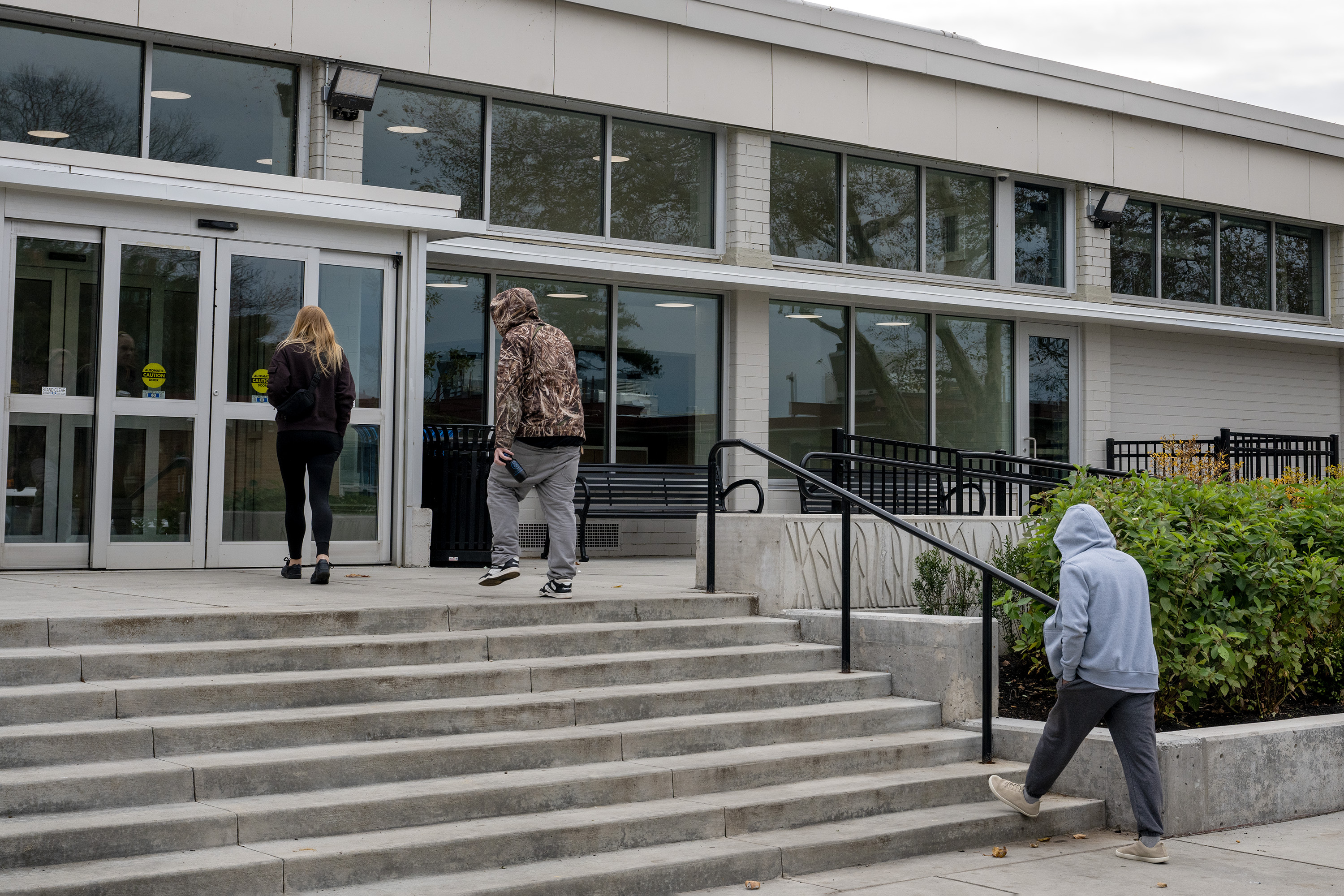
The Frankford native was one of the first residents to enter the Riverview Wellness Village, the 20-acre recovery facility that Mayor Cherelle L. Parker’s administration opened in Northeast Philadelphia nearly a year ago as part of City Hall’s efforts to address opioid addiction and the Kensington drug market.
Bean, now 46 and boasting a healthier frame, just celebrated one year of sobriety and is preparing to move out of Riverview early next year.
He described his transition simply: “whole new life.”
Much of the mayor’s agenda in Kensington has been visible to the neighborhood’s residents, such as increased law enforcement and a reduction in the homeless population. But the operations and treatment outcomesat Riverview, located down a winding road next to the city’s jail complex, happen largely outside of public view. Last spring, some city lawmakers complained that even they knew little about the facility operations.
An inside look at the Riverview complex and interviews with more than a dozen residents and employees showed that, over the last year, the city and its third-party healthcare providers have transformed the facility. What was recently a construction zone is now a one-stop health shop with about 75 staff and more than 200 residents, many of whom previously lived on Kensington streets.
Those who live and work at Riverview said the facility is plugging a hole in the city’s substance use treatment landscape. For years, there have not been enough beds in programs that help people transition from hospital-style rehab into long-term stability. The recovery house industry has been plagued with privately run homes that are in poor condition or offer little support.
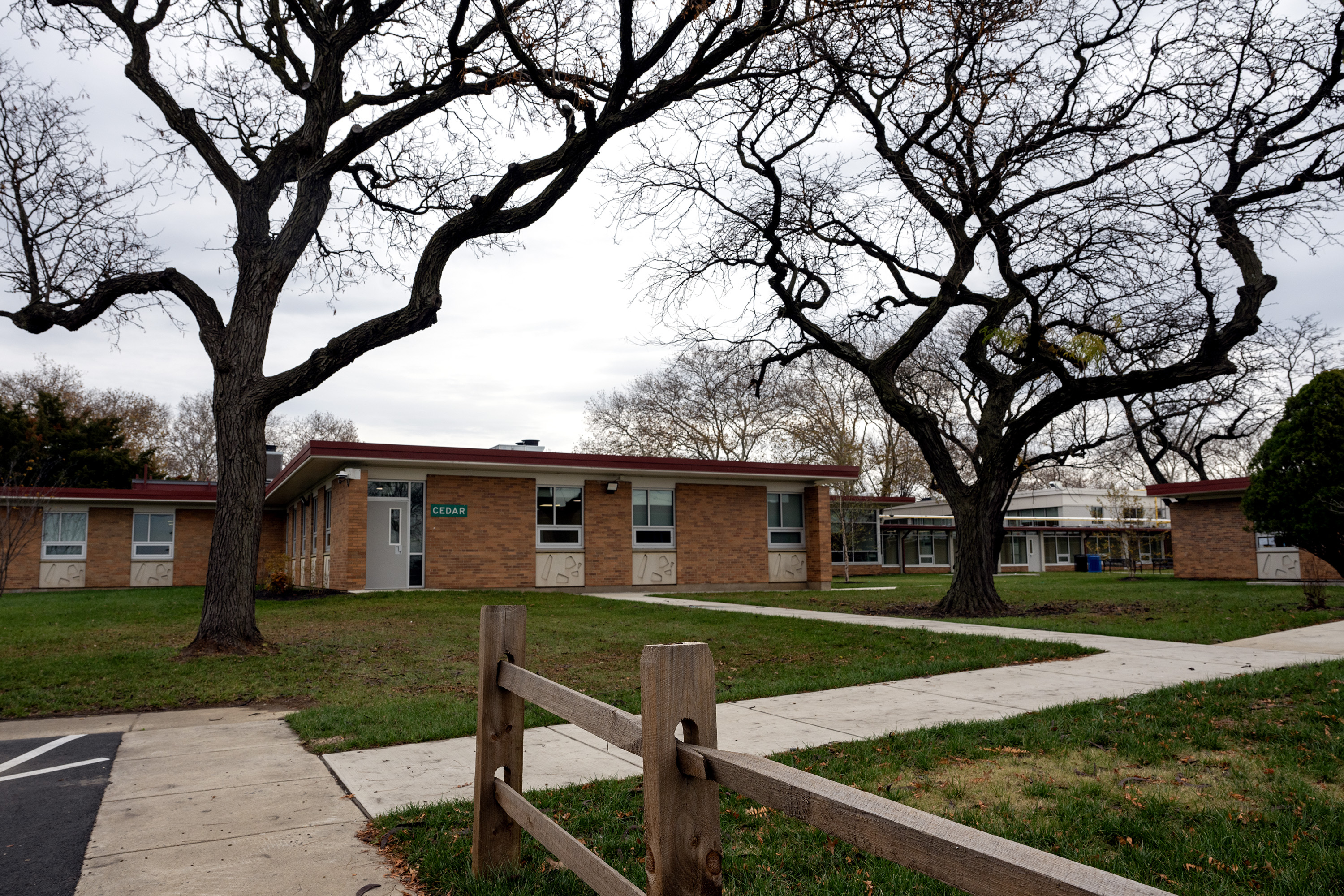
The grounds and residence buildings at Riverview Wellness Village, a city-owned drug recovery home in Northeast Philadelphia.
At its current capacity, Riverview has singularly increased the total number of recovery house beds in the city by nearly 50%. And residents — who are there voluntarily and may come and go as they please — have much of what they need on the campus: medical care, mental health treatment, job training, and group counseling.
They also, as of last month, have access to medication-assisted treatment, which means residents in recovery no longer need to travel to specialized clinics to get a dose of methadone or other drugs that can prevent relapse.
Arthur Fields, the regional executive director at Gaudenzia, which provides recovery services to more than 100 Riverview residents, said the upstart facility has become a desirable option for some of the city’s most vulnerable. Riverview officials said they aren’t aware of anywhere like it in the country.
“The Riverview Wellness Village is proof of what’s possible,” Fields said, “when we work together as a community and move with urgency to help people rebuild their lives.”
While the facility launched in January with much fanfare, it also faced skepticism, including from advocates who were troubled by its proximity to the jails and feared it would feel like incarceration, not treatment. And neighbors expressed concern that the new Holmesburg facility would bring problems long faced by Kensington residents, like open drug use and petty theft, to their front doors.
But despite some tenets of the mayor’s broader Kensington plan still facing intense scrutiny, the vocal opposition to Riverview has largely quieted. Parker said in an interview that seeing the progress at Riverview and the health of its residents made enduring months of criticism “well worth it.”
“I don’t know a Philadelphian who, in some way, shape, or form, hasn’t been touched by mental and behavioral health challenges or substance use disorder,” said Parker, who has spoken about how addiction shaped parts of her own upbringing. “To know that we created a path forward, to me, I’m extremely proud of this team.”
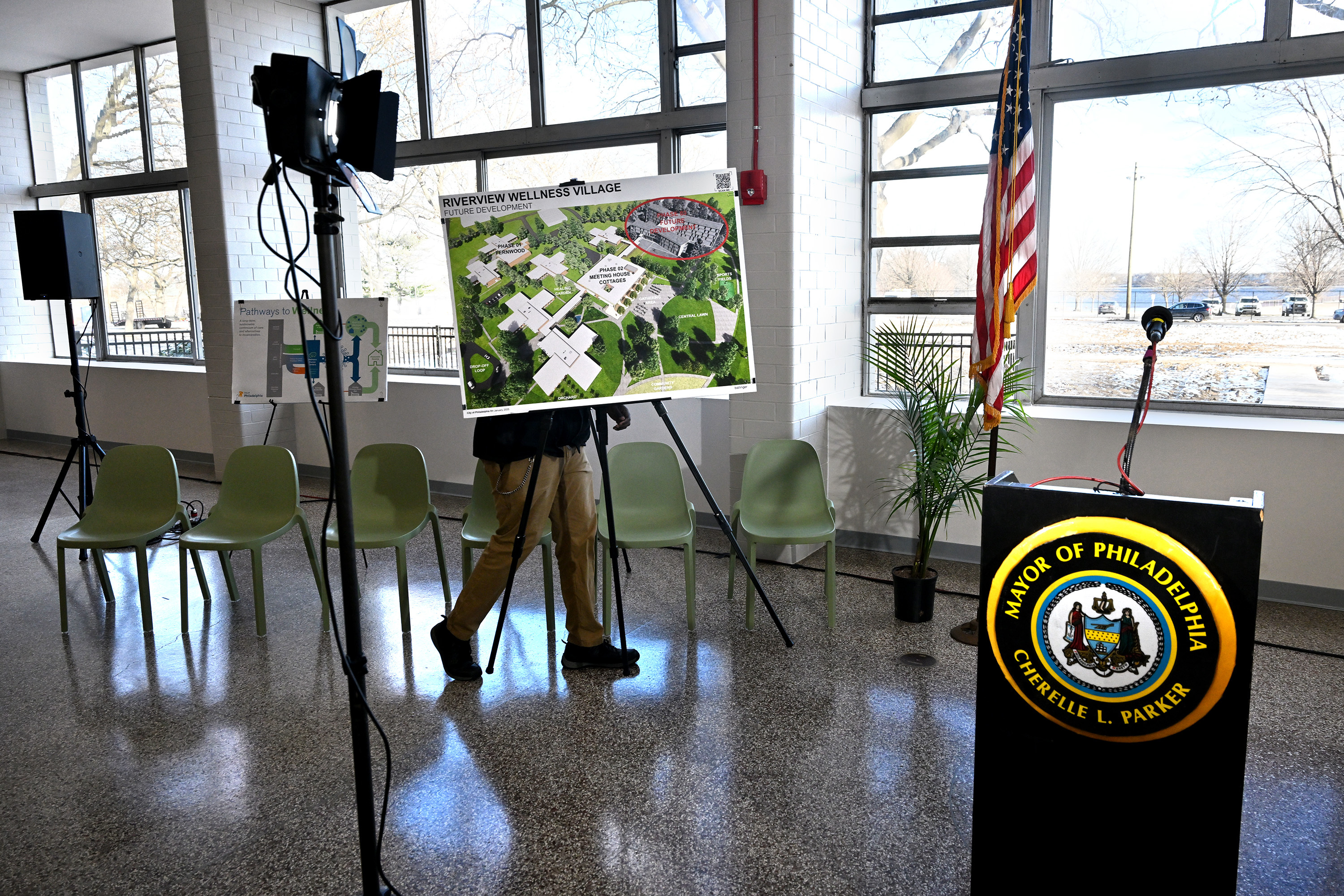
Mayor Cherelle L. Parker places a new block on the scale model of the Riverview Wellness Village on Wednesday, Jan. 8 during the unveiling of Philadelphia’s new city-operated drug treatment facility. At left is Managing Director Adam Thiel. City Councilmember Michael Driscoll is at right.Isabel McDevitt, executive director of the Office of Community Wellness and Recovery, points to a model with upcoming expansion at Riverview Wellness Village, a city-owned drug recovery home in Northeast Philadelphia on Nov. 25.Staffers move photos into place at the Riverview Wellness Village on Jan. 8 before the unveiling of Philadelphia’s new city-operated drug treatment facility.
Meanwhile, neighbors who live nearby say they have been pleasantly surprised. Pete Smith, a civic leader who sits on a council of community members who meet regularly with Riverview officials, said plainly: “There have been no issues.”
“If it’s as successful as it looks like it’s going to be,” he said, “this facility could be a model for other cities throughout the country.”
Smith, like many of his neighbors, wants the city’s project at Riverview to work because he knows the consequences if it doesn’t.
His son, Francis Smith, died in September due to health complications from long-term drug use. He was 38, and he had three children.
Getting a spot at Riverview
The sprawling campus along the Delaware River feels more like a college dormitory setting than a hospital or homeless shelter. Its main building has a dining room, a commercial kitchen, a gym, and meditation rooms. There are green spaces, walking paths,and plans for massive murals on the interior walls.
Katherine Young, director of Merakey at Riverview Wellness Village, talks with a resident at the city-owned drug recovery home in Northeast Philadelphia on Nov. 25.
Residents live and spend much of their time in smaller buildings on the campus, where nearly 90% of the 234 licensed beds are occupied. The city plans to add 50 more in January.
Their stays are funded through a variety of streams. The city allocated $400 million for five years of construction and operations, a portion of which is settlement dollars from lawsuits against pharmaceutical companies that manufactured the painkillers blamed for the opioid crisis.
(function() {
var l2 = function() {
new pym.Parent(‘RIVERVIEW_MAP2.html’,
‘https://media.inquirer.com/storage/inquirer/projects/innovation/arcgis_iframe/RIVERVIEW_MAP2.html’);
};
if (typeof(pym) === ‘undefined’) {
var h = document.getElementsByTagName(‘head’)[0],
s = document.createElement(‘script’);
s.type = ‘text/javascript’;
s.src = ‘https://pym.nprapps.org/pym.v1.min.js’;
s.onload = l2;
h.appendChild(s);
} else {
l2();
}
})();
To get in to Riverview, a person must complete at least 30 days of inpatient treatment at another, more intensive care facility.
(function() { var l = function() { new pym.Parent( ‘riverview-flowchart__graphic’, ‘https://media.inquirer.com/storage/inquirer/ai2html/riverview-flowchart/index.html’); }; if(typeof(pym) === ‘undefined’) { var h = document.getElementsByTagName(‘head’)[0], s = document.createElement(‘script’); s.type = ‘text/javascript’; s.src = ‘https://pym.nprapps.org/pym.v1.min.js’; s.onload = l; h.appendChild(s); } else { l(); } })();
Still, residents at Riverview have come from more than 25 different providers, according to Isabel McDevitt, the city’s executive director of community wellness and recovery. The bulk were treated at the Kirkbride Center in West Philadelphia, the Behavioral Wellness Center at Girard in North Philadelphia, or Eagleville Hospital in Montgomery County.
They have ranged in age from 28 to 75. And they have complex medical needs: McDevitt said about half of Riverview’s residents have a mental health diagnosis in addition to substance use disorder.
She said offering treatment for multiple health conditions in one place allows residents to focus less on logistics and more on staying healthy.
“Many of the folks that are at Riverview have long histories of substance use disorder, long histories of homelessness,” she said. “So it’s really the first time a lot of people can actually breathe.”
When new residents arrive, they go through an intake process at Riverview that includes acute medical care and an assessment for chronic conditions. Within their first week, every resident receives a total-body physical and a panel of blood work.
“They literally arrive with all of their belongings in a plastic bag and their medications and some discharge paperwork,” said Ala Stanford, who leads the Black Doctors Consortium, which provides medical services at Riverview. “We are the ones who greet them and help get them acclimated.”
Stanford — who this fall announced a run for Congress — said doctors and nurses at Riverview have diagnosed and treated conditions ranging from drug-related wounds to diabetes to pancreatic cancer. And patients with mental health needs are treated by providers from Warren E. Smith Health Centers, a 30-year-old organization based in North Philadelphia.
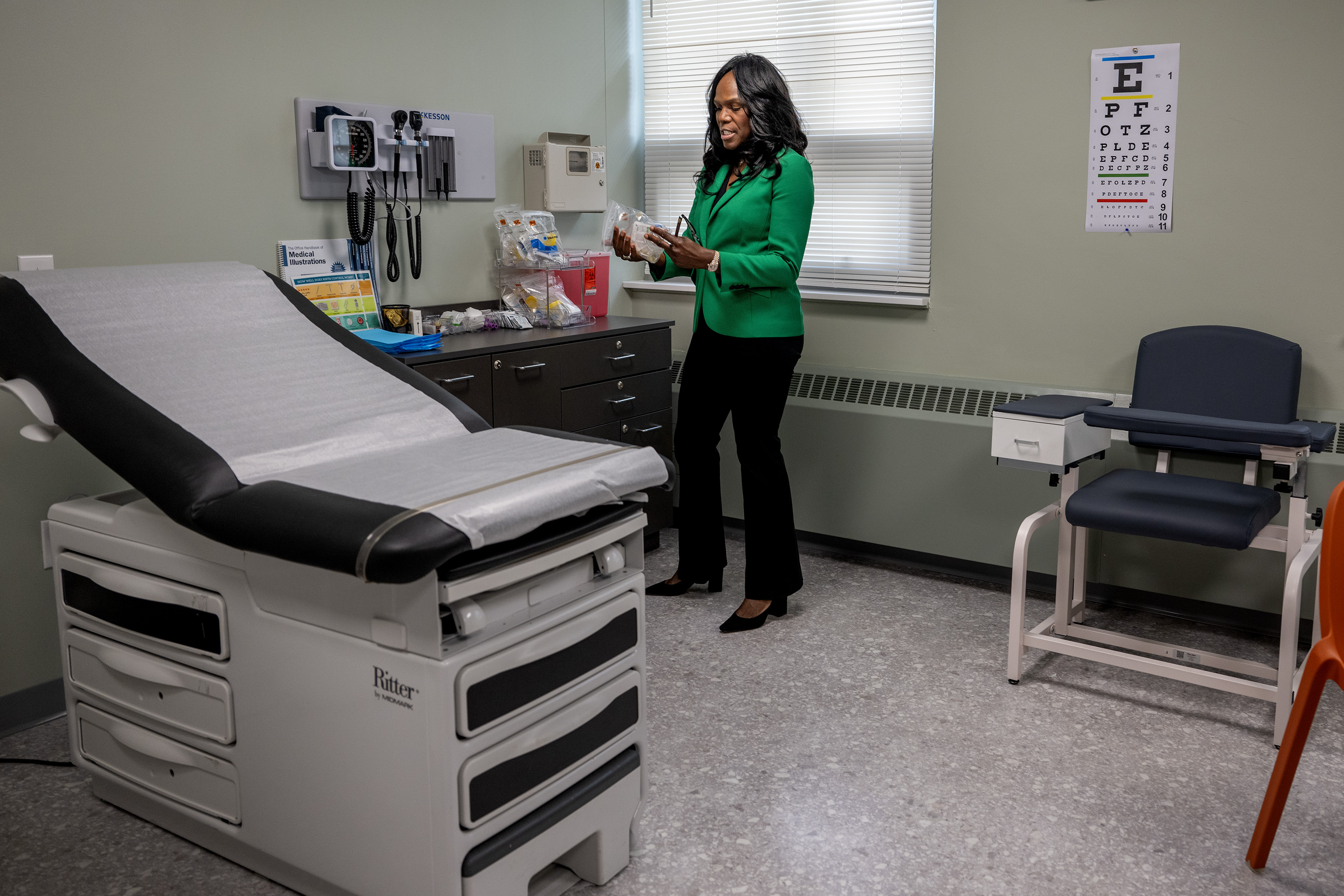
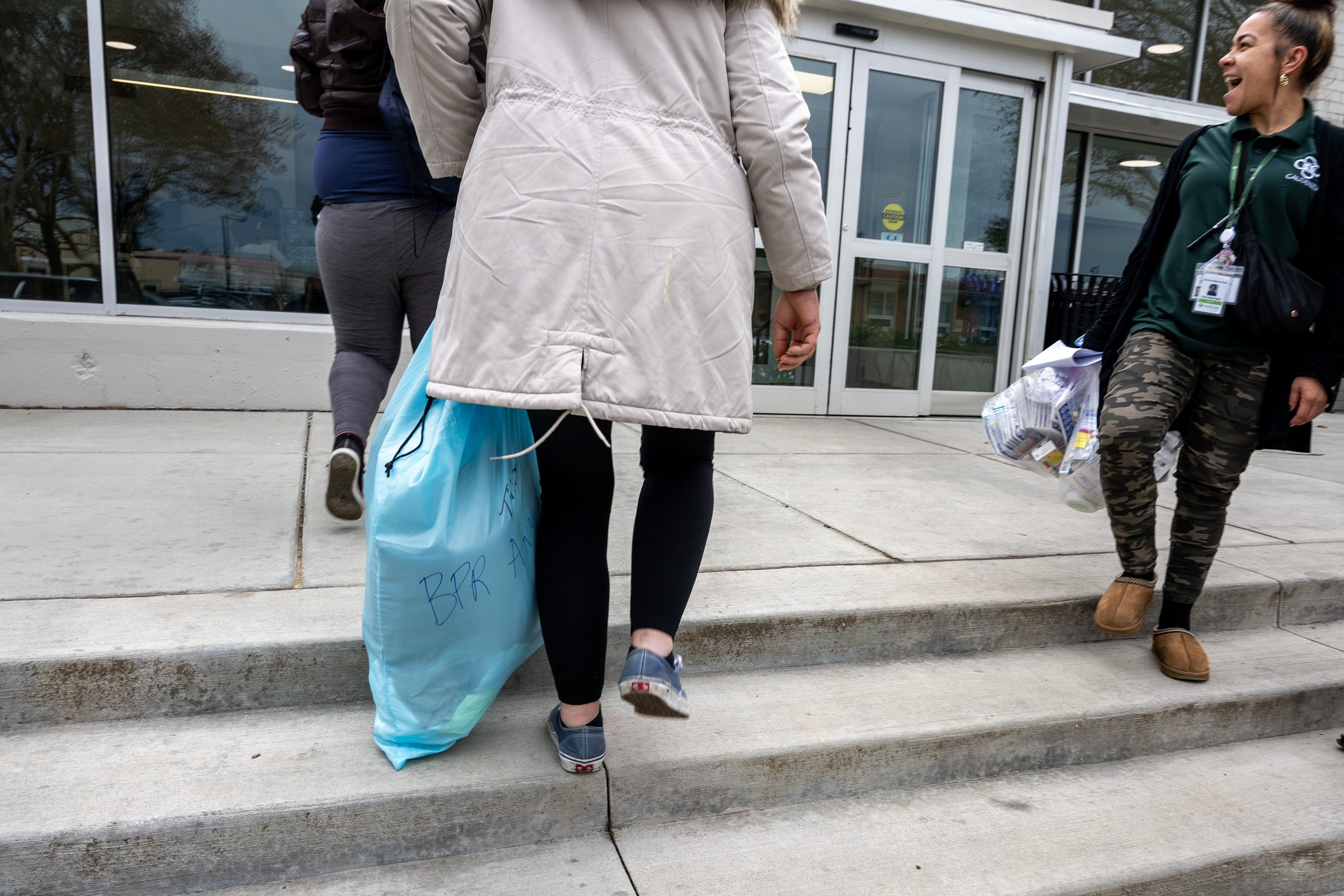
Physician Ala Stanford in an examination room at the primary medical care center run by her Black Doctors Consortium at Riverview Wellness Village, a city-owned drug recovery home in Northeast Philadelphia, on Nov. 25.Francesca Colon (right), a recovery support professional with Gaudenzia, brings people in recovery to the main entrance of the Meetinghouse at Riverview Wellness Village on Nov. 25.
Residents’ schedules are generally free-flowing and can vary depending on their wants and needs. About 20% have jobs outside the campus. Culinary arts training will be available in the next month or so. And residents can meet with visitors or leave to see family at any time.
They also spend much of their time in treatment, including individual, family, and group therapy. On a recent day, there were group sessions available on trauma recovery, managing emotions, and “communicating with confidence.”
Vernon Kostic, a 52-year-old Port Richmond native who said he has previously been homeless, has been in and out of drug treatment facilities for years.
He said he’s been content as a Riverview resident since July, and called it “one of the smartest things that the city has ever done.”
“We have the doctor’s office right over here,” he said. “They’ve got counseling right here. Everything we need. It’s like a one-stop recovery place.”
Resident Vernon Kostic heads to a group meeting at Riverview Wellness Village on Nov. 25.The dining room and meeting room in the Meetinghouse at Riverview Wellness Village. At rear left is a brand-new, industrial, restaurant-quality kitchen that was not operational yet on Nov. 25.
Finding ways to stay at Riverview
Finding success in recovery is notoriously hard. Studies show that people who stay in structured sober housing for at least six months after completing rehab see better long-term outcomes, and Riverview residents may stay there for up to one year.
But reaching that mark can take multiple tries, and some may never attain sobriety. McDevitt said that on a monthly basis, about 35 people move into Riverview, and 20 leave.
Some who move out are reunited with family and want to live at home. Others simply were not ready for recovery, McDevitt said, “and that’s part of working with this population.”
Fields said a resident who relapses can go back to a more intensive care setting for detoxification or withdrawal management, then return to Riverview at a later time if they are interested.
“No one is punished for struggling,” he said. “Recovery is a journey. It takes time.”
Providers are adding new programming they say will help residents extend their stays. Offering medication-assisted treatment is one of the most crucial parts, said Josh Vigderman, the senior executive director of substance use services at Merakey, one of the addiction treatment providers at Riverview.
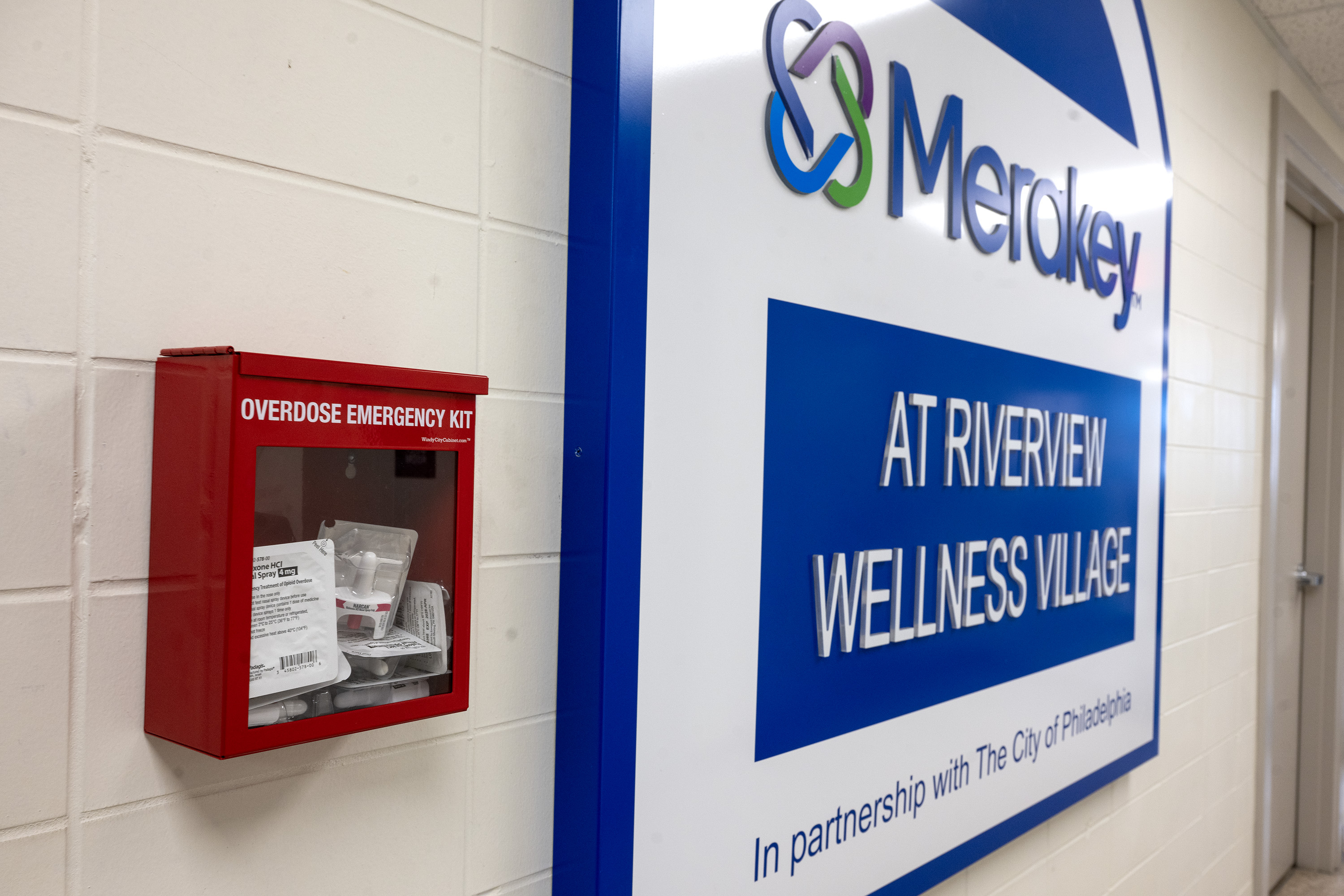
Entry to the primary medical care center run by the Black Doctors Consortium at Riverview Wellness Village.The main entry Meetinghouse at Riverview Wellness Village.Naloxone (Narcan) in an “overdose emergency kit” at Riverview Wellness Village.
In the initial months after Riverview opened its doors, residents had to travel off campus to obtain medication that can prevent relapse, most commonly methadone and buprenorphine, the federally regulated drugs considered among the most effective addiction treatments.
Typically, patients can receive only one dose of the drug at a time and must be supervised by clinicians to ensure they don’t go into withdrawal.
Vigderman said staff suspected some residents relapsed after spending hours outside Riverview, at times on public transportation, to get their medication.
This fall, Merakey — which was already licensed to dispense opioid treatment medications at other locations — began distributing the medications at Riverview, eliminating one potential relapse trigger for residents who no longer had to leave the facility’s grounds every day.
Interest in the program has been strong, Vigderman said, with nearly 80 residents enrolling in medication-assisted treatment in just a few weeks. Merakey is hiring more staff to handle the demand.
What’s next at Riverview
The city is eying a significant physical expansion of the Riverview campus, including a new, $80 million building that could double the number of licensed beds to more than 500. That would mean that about half of the city’s recovery house slots would be located at Riverview.
Parker said the construction is “so important in how we’re going to help families.” She said the process will include “meticulous design and structure.”
“The people who come for help,” she said, “we want them to know that we value them, that we see them, and that we think enough of them to provide that level of quality of support for them.”
In the meantime, staff are working to help the center’s current residents — who were among the first cohort to move in — plot their next steps, like employment and housing.
A rendering of the new, $80 million five-story building to be constructed on the campus of Riverview Wellness Village. It will include residences and medical suites.
That level of support, Vigderman said, doesn’t happen in many smaller recovery houses.
“In another place, they might not create an email address or a resumé,” he said. “At Riverview, whether they do it or not is one thing. But hearing about it is a guarantee.”
Bean is closing in on one year at Riverview. He doesn’t know exactly what’s next, but he does have a job prospect: He’s in the hiring process to work at another recovery house.
“I’m sure I’ll be able to help some people,” he said. “I hope.”
The Philadelphia school board on Monday signaled its intentions to play ball: Later this week, it will hold a special action meeting to vote on a resolution authorizing Superintendent Tony B. Watlington Sr. and his team to consider handingover a portfolio of unused school buildings to the city.
Watlington, the resolution states, “recommends that, in the best interests of the district and its students, the district explore and pursue negotiations with the city to potentially convey certain vacant and surplus district property.”
Parker, in a statement, said the process was about “public health and public safety” and the school buildings can be used to improve residents’ quality of life.
Officials “cannot let blighted buildings in the middle of residential neighborhoods lie vacant — many of which have been vacant for many years — from two years to over 30,” Parker said. “It’s unconscionable to me that we are in the middle of a housing crisis and we have government buildings sitting vacant for years or even decades. That cannot continue.”
School board president Reginald Streater said that no decisions are final and that public deliberation will still happen at the special meeting at 4 p.m. Thursday. But, he said, the move makes sense with “the board moving toward being much more willing to be intergovernmental partners” with the city.
“Many of these properties have not been used in the last decade or more, and they require a significant amount of upkeep and maintenance,” Streater said. “These properties are unused, for the most part, and unnecessary for K-12 education.”
The district is in the business of running schools, Streater said.
“I do believe that the city possesses considerably more expertise and capacity than the district does regarding property development,” Streater said. “We are an education institution. To build the capacity to do such things is out of our wheelhouse, and economic development would take us out of our lane.”
According to the language of the resolution, the district is urging Watlington to consider all angles — bond obligations, property conditions, financial protection of the district, any legal processes that would need to happen, and more.
The action comes as something of a surprise, happening just a week after what was to be the final voting meeting of the year. Streater said he did not want to add it as a walk-on resolution to the December school board meeting, but wanted to give members of the public time to understand it and provide testimony, if desired.
Giving unused school buildings to the city could further academic outcomes, the school board president said.
“It’s possible,” Streater said, “that conveying these vacant and surplus properties to the city for redevelopment and revitalization could help stabilize and grow the city and district’s tax base … and consequently positively impact future revenues to the district and educational experiences for students.”
Asked for a list of the unused buildings the resolution would cover, school board officials said more internal evaluation is needed before such a list is released.
The possible transfer of district properties to the city comes as officials debate the specifics of one of Parker’s signature initiatives.
The mayor wants to spend $800 million on her housing initiative, Housing Opportunities Made Easy, or H.O.M.E. In a rare sign of division, Council last week allotted more housing funds to the city’s poorest residents over the Parker administration’s objections.
Because of Council’s move, more legislation is now needed to advance H.O.M.E. It will not come until January at the earliest.
Thomas, chair of Council’s education committee, has long been pushing for a school facilities plan.
“It’s unclear to say what this step forward means, but I want to understand how it fits into a larger plan for Philly’s educational institutions,” Thomas said in a statement.
“Without getting into hypotheticals, and due to a lack of communications with City Council, there are a lot of moving pieces and still many questions about what this means and what is the overall plan for the future of our school buildings,” Thomas said.
A former top Philadelphia labor official claims in a lawsuit that she was passed over for a promotion because she’s a woman, and was later fired afterraising concerns about gender-based discrimination spanning two mayoral administrations.
Monica Marchetti-Brock, the former first deputy director of the Department of Labor, said in a federal lawsuit filed Wednesday that Mayor Cherelle L. Parker fired her last year, days after Marchetti-Brock had reiterated complaints about gender bias at the top rungs of the city government that had occurred before Parker took office.
Marchetti-Brock had worked for the city since 2013. Under former Mayor Jim Kenney, she rose to the city’s No. 2 labor role.
The man hired for the position was Basil Merenda, a former top state labor official whom Marchetti-Brock claims “had a problem with women.”
What started as a change in boss under then-Mayor Jim Kenney culminated in spring 2024 with Parker firing Marchetti-Brock after she complainedof sex-based discrimination, according to the suit. The lawsuit says an outside investigator probed Merenda’s behavior and in 2023 recommended he undergo implicit bias training.
The lawsuit accuses the city of minimizing the results of that investigation and of terminating Marchetti-Brock and a second woman who was mistreated by Merenda.
“When [Marchetti-Brock] asked if her termination had anything to do with her sex discrimination complaints, [the city] refused to answer the question,” the complaint says.
Merenda is currently one of two commissioners of the Department of Licenses and Inspections. Parker announced his appointment in February 2024, a few weeks before Marchetti-Brock says she was fired. It is common for there to be significant turnover in personnel at the beginning of a new mayoral administration.
A city spokesperson declined to comment, citing the pending litigation.
Attempts to reach Kenney were unsuccessful. The former mayor appointed many women to his top staff through his more than two decades in City Hall. When he took office as mayor in 2016, the majority of his cabinet were women.
Marchetti-Brock began reporting to Merenda in January 2023. He ignored his deputy, excluded her from meetings and communications, yelled, and “unjustly” criticized her, the suit says.
Marchetti-Brock says she complained of sex discrimination in the labor department to a long list of officials, some of whom still work for the city, including City Solicitor Renee Garcia and Chief Administrative Officer Camille Duchaussee. Marchetti-Brock “described how she was treated compared to how male employees were treated, including that Merenda ignored what female employees said and focused on what male employees said,” according to the lawsuit.
The city opened an investigation in the spring of 2023, the suit says.
After Parker was elected in November 2023, Marchetti-Brock again expressed her interest in the top labor role. However, the incoming mayor ultimately tapped Perritti DiVirgilio, who was previously the city’s director of labor standards. Marchetti-Brock described DiVirgilio in the suit as a “noncomplaining, male employee.”
In February 2024, Marchetti-Brock received a letter summarizing the findings of the investigation into Merenda. The letter said that the probe concluded that “no violation” of the city’s sexual harassment prevention policy occurred. According to the complaint, Marchetti-Brock was told that Merenda had received a warning and the investigator recommended he undergo implicit bias training.
The policy says city employees are protected from sexual harassment regardless if it’s “unlawful,” and it prohibits retaliation against employees who raise concerns or complain. Marchetti-Brock had a role crafting the policy following a critical 2018 City Controller report that said the city’s sexual harassment reporting protocols were inadequate.
According to the suit, Marchetti-Brock pushed back on the summary letter in an email to Andrew Richman, a city attorney, saying that even though no unlawful behavior was found, “there were findings of bias toward me and other women.”
“As you are aware, our policy holds our leaders to a higher standard than the law,” Marchetti-Brock wrote, according to the complaint. “It is misleading to say there are no findings under our policy.”
Three days later, in early March 2024, top officials from Parker’s administration informed Marchetti-Brock that her employment would be terminated, according to the complaint. The suit states that another female employee who had complained about Merenda was terminated as well.
The lawsuit asks the federal court to find that the city violated antidiscrimination laws and award Marchetti-Brock an unspecified amount of damages.