As a Pennsylvanian who works with immigrants on the U.S.-Mexico border, I urge people of goodwill in the Keystone State and beyond to stand up for immigrants in our country. Our democracy depends on it.
I am a Sister of Mercy of the Americas, a Catholic order that has accompanied immigrants in Pennsylvania, across the United States, and internationally since 1843. We take seriously the Gospel command to “welcome the stranger.”
On the border, I am a community worker. Part of my ministry is to help immigrants in the United States apply for citizenship or renew their legal permanent residence and DACA (Deferred Action for Childhood Arrivals) status.
Migrants are arrested at the Texas-Mexico border in 2024. Migrants’ lives have become a nightmare, writes Sister Patricia Mulderick.
Most are doing everything they can to follow the rules, to attain or hold on to legal status. But their lives have become a living nightmare, and their plight fills me with anguish.
Migrant workers in Texas are terrified of being picked up in the fields, where they toil 12 hours a day under the hot sun to pick melons, onions, carrots, and other fresh produce destined for grocery stores and our kitchen tables around the country, anonymous but vital to our economy and way of life.
The migrants left in Mexico are in limbo, denied hearings by U.S. immigration officials and often unable to return to their home countries.
“You could send me a limousine with a marching band, and I could not return,” one man said to me. “I would be dead within 24 hours.” And a woman I know sold everything she owned to make the journey north — she has nothing to go back to.
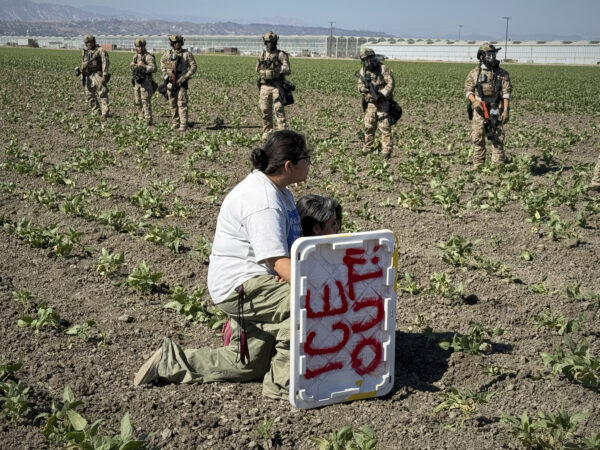
On the U.S. side of the border, people are being terrorized by masked U.S. Immigration and Customs Enforcement agents stalking our neighborhoods. One elderly woman who has worked in the fields for four decades hid in her bedroom as they pounded on her front door. Neighbors alerted a women’s group I am part of, and members asked to see the agents’ warrant. It turned out ICE was looking for someone else. I shudder to think what would have happened if those brave advocates had not stepped up.
I first learned about the bonds between democracy and our nation of immigrants at my public school in the coal regions. The brutality and terror inflicted by security forces all around our country are un-American.
When Pennsylvanians helped unite 13 colonies into one country by inviting new Americans to Philadelphia’s Independence Hall to debate and sign the Declaration of Independence and the U.S. Constitution, they knew their “experiment” in self-governance wasn’t guaranteed. Ben Franklin famously said that Americans had “a republic, if you can keep it.” We must again help lead the way.
Pennsylvanians take pride in being standard-bearers for liberty. We also value the vital contributions newcomers make in our state, in industries ranging from construction and hospitality to high-tech.
More than ever, we must stand up for immigrants and democracy together. We must hold our nation to the ideals inscribed on the Statue of Liberty: “Give me your tired, your poor, your huddled masses yearning to breathe free.”
Pope Leo and I met in the 1980s, when he was the young priest Father Robert Prevost, and we both were serving in Peru. His humility and concern for people living in poverty moved me deeply.
In Mexico recently, I held hands with a woman who wept after her immigration hearing — scheduled for the day after President Donald Trump’s inauguration — was canceled by the president on his first day in office. This woman had lived in a tent for eight months, waiting to cross legally.
“Your president says we are criminals, but I have never broken a law in my life,” she told me. “They seem to hate us, but I will not hate back. I will not let hate win.”
Will we?
Sister Patricia Mulderick is a member of the Sisters of Mercy of the Americas, the largest order of Catholic religious women in the United States. She serves in both Pennsylvania and Texas.
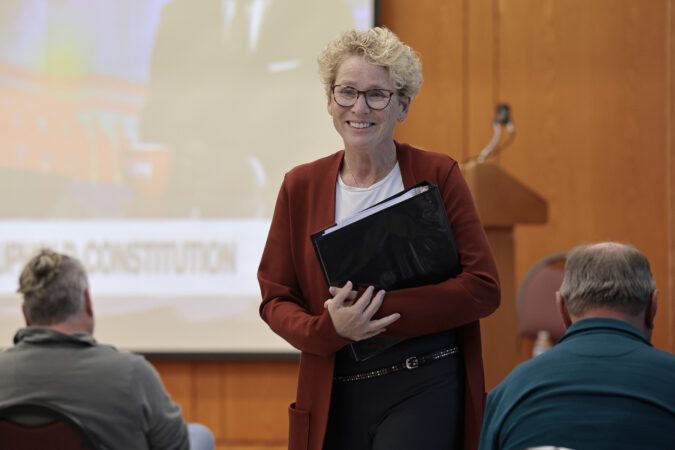
U.S. Rep. Chrissy Houlahan said it’s unclear what crime the Department of Justice was trying to charge her with when a grand jury refused an indictment over a video in which she, with five other Democratic colleagues, called on service members to “refuse illegal orders.”
“The regular American people that comprised the grand jury saw this for what it was, which was kind of a spurious misuse, abuse of the power of the federal government against the people,” Houlahan, of Chester, said in an interview Wednesday.
“It’s not about me or my colleagues,” continued Houlahan, a former Air Force officer. “It’s about the fact that the Constitution allows for all of us to be treated as equals, and all of us to have the freedom to speak with freedom.”
The Justice Department investigated the six Democratic lawmakers who made the video, all of whom previously served in the military or intelligence agencies. But a Washington grand jury would not sign off on chargeson Tuesday, The Associated Press reported.
It’s a setback for President Donald Trump’s administration, which has targeted the lawmakers in a variety of ways since November, when the president claimed the video was an act of sedition.
Houlahan said none of the Democrats’ lawyers could identify what charges could have legitimately been brought against them.
“Collectively, we all, of course, have unfortunately had to secure lawyers in this process,” she said. “And to a person, none of them could come up really with what it was that we had purportedly done. And clearly the people in the grand jury saw the same thing.”
The Justice Department did not respond to a request for comment on Wednesday.
U.S. Rep. Chris Deluzio, an Allegheny County Democrat who also appeared in the video, said in an interview Wednesday he is “not surprised at all” by the grand jury’s decision.
“The fact that the Trump administration and their lawyers want to try to charge us with crimes for stating the law and saying words that they don’t like is outrageous, and of course, not something that you should be able to throw people in prison for,” said Deluzio, who served in the Navy.
In a news conference Wednesday, some of the lawmakers suggested legal action against the Trump administration is on the table.
“There will be accountability, and they should be preserving documents, preparing for what’s coming,” Deluzio said.
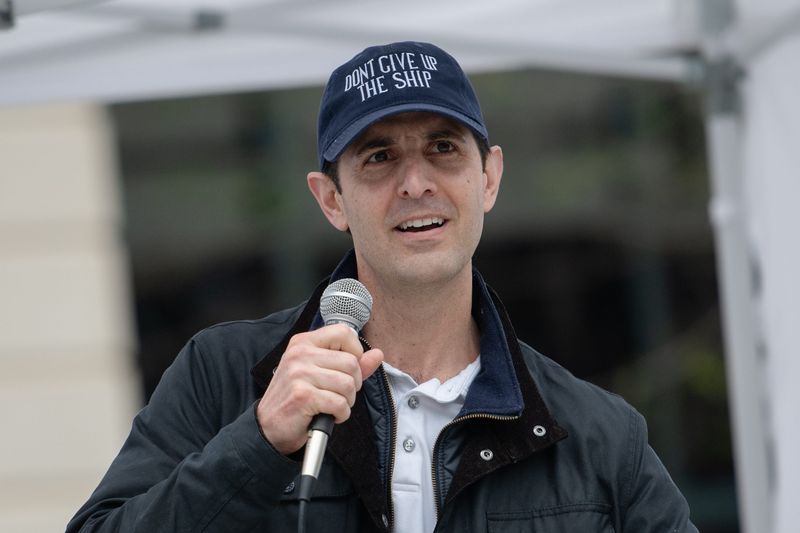
U.S. Rep. Chris Deluzio speaks to a large crowd in front of the Beaver County Courthouse in April 2025 wearing a hat that says “don’t give up the ship.”
Trump accused the Democratic lawmakers of sedition “punishable by death” after they posted the video in November, warning service members and intelligence workers to “refuse illegal orders.” In the video, the Democrats urged service members and intelligence professionals not to “give up the ship,” a sentiment Deluzio repeated Tuesday night.
The phrase, which Deluzio has long referenced, is a rallying cry that’s hung on the wall at the Naval Academy’s Memorial Hall.
“It’s a phrase that means a lot, and it means a lot in this moment of great stress to our country — that this thing is worth our efforts and that we should not give it up,” Deluzio said in theWednesday interview.
The Democrats did not mention any specific orders in the video, but lawmakers who appeared in the video expressed concerns at the time about strikes on boats in the Caribbean and National Guard operations in U.S. cities.
Houlahan said they continue to be concerned about “the unlawfulness of the administration.”
The video also included U.S. Sen. Elissa Slotkin (D., Mich.), a former CIA officer; U.S. Sen. Mark Kelly (D., Ariz.), a former Navy captain; U.S. Rep. Maggie Goodlander (D., N.H.), a former intelligence officer; and U.S. Rep. Jason Crow (D., Colo.), a former paratrooper and Army Ranger.
Federal prosecutors unsuccessfully tried to secure the indictment against all six lawmakers in the video, The New York Times reported. The office that pursued the case is led U.S. Attorney for D.C. Jeanine Pirro, the former Fox News personality who served as district attorney in Westchester County, N.Y., during the 1990s and early 2000s.
Grand jury rejections are extraordinarily rare, but have occurred repeatedly in recent months in Washington, as citizens who have heard the government’s evidence have come away underwhelmed in a number of cases. Prosecutors could try again to secure an indictment.
Attention on the lawmakers’ video escalated days after they initially posted it when Trump began his social media tirade in November.
“This is really bad, and Dangerous to our Country,” he wrote on his social media platform Truth Social. “Their words cannot be allowed to stand. SEDITIOUS BEHAVIOR FROM TRAITORS!!! LOCK THEM UP???”
He also shared posts from supporters calling for retribution against the Democrats, including one that said, “HANG THEM GEORGE WASHINGTON WOULD !!” and another calling them domestic terrorists.
“The fact that the president and the people around him, in hearing a reminder about the law, reacted the way they did, which is to call for our death, arrest, to try to imprison us, tells me more about them than I could ever know,” Deluzio said Wednesday.
“A normal person, a normal president, would be reminding their troops of their obligations to follow the law as well because they care about the rule of law,” he added.
Hegseth has censured Kelly for participating in the video and is trying to retroactively demote him from his retired rank of captain.
In response, Kelly is suing Hegseth to block those proceedings, calling them an unconstitutional act of retribution. During a hearing last week, the judge appeared to be skeptical of key arguments that a government attorney made in defense of Kelly’s Jan. 5 censure by Hegseth.
This article contains reporting from The Associated Press
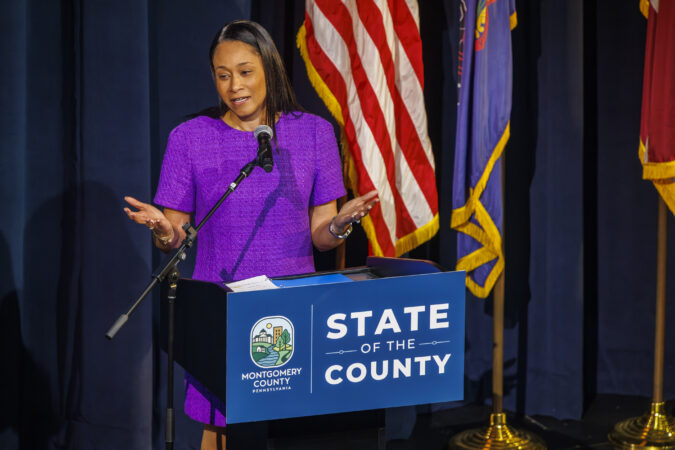
Talking to reporters gathered at the front of an auditorium at Montgomery County Community College, the collar county’s top officials engaged in a friendly back-and-forth about something local leaders have had to pay unprecedented attention to since last year: how to handle any future federal funding cuts under President Donald Trump.
Within the last year, counties have navigated uncertainty surrounding reductions in funding under the Trump administration. In Montgomery County, those cuts have jeopardized key resources for public health, higher education, and homeless services.
“Naturally, our teams are following what’s coming out of [the Department of Housing and Urban Development], what’s happening with SNAP. We’re trying to anticipate,” said Jamila Winder, a Democrat and thechair of the Montgomery County Board of Commissioners.
Community needs “that arise from the cuts to SNAP and the cuts to Medicaid are significant,” said vice chair Neil Makhija, a Democrat.
Tom DiBello, the board’s lone Republican, had a different view.
“Well, we also have to maybe look at what those reductions are, why those reductions are occurring … and I know this is where we divide,” he said.
Crossing the aisle has become rare in the rancorous national political environment. But at Montgomery County Community College on Wednesday, the commissioners emphasized at their annual State of the County address that they are striving for cooperation to be their norm, even as lawmakers in Harrisburg and Washington struggle to work together.
The commissioners have navigated their own tense moments in recent months, particularly related to immigration.
“Look, there are definitely things that we disagree on as a team, but what’s most important is that we’re able to fund the services that we provide to people in Montgomery County,” Winder told reporters.
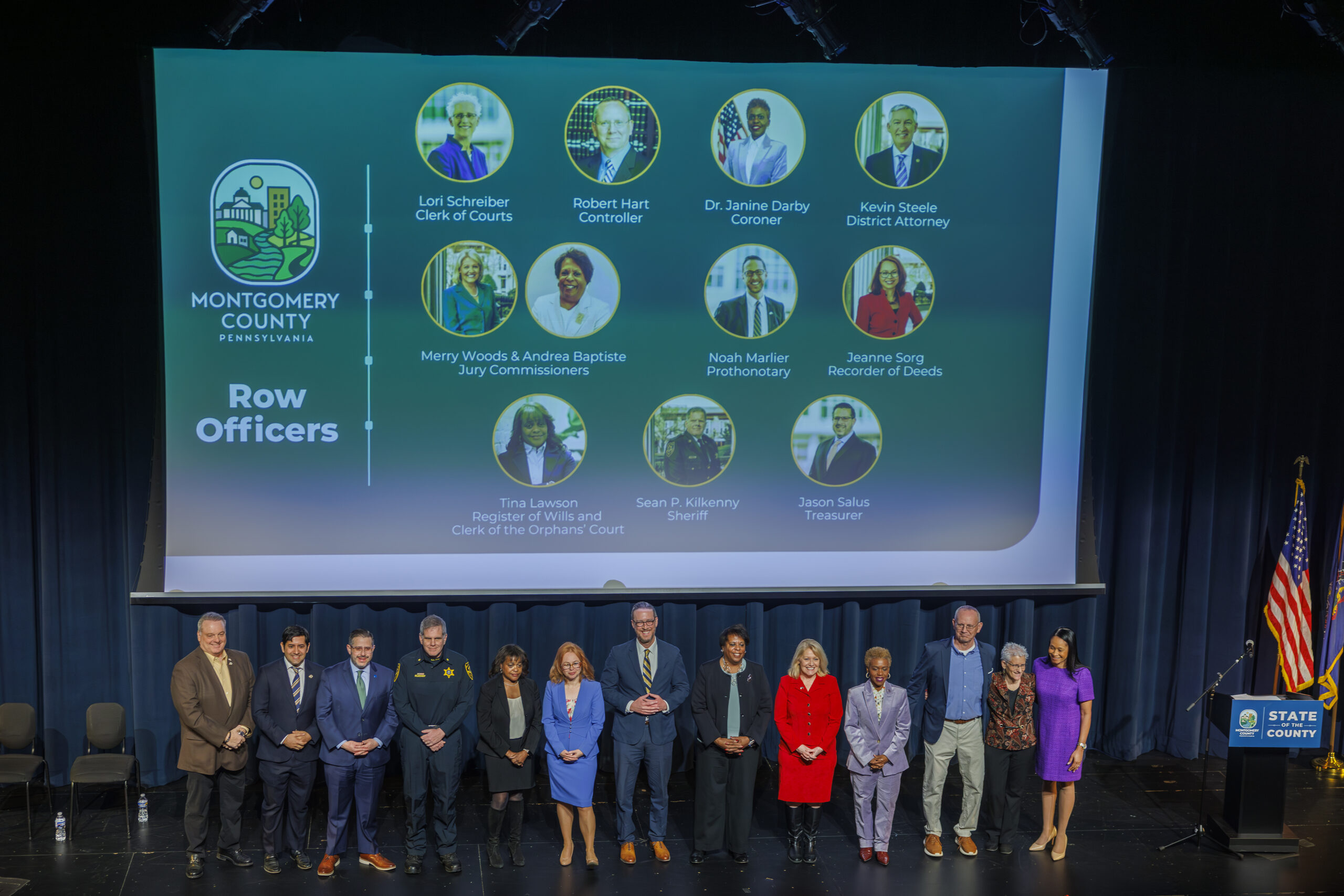
Montgomery County commissioners and row officers stand on stage during introductions.
Wednesday’s address featured the commissioners reflecting on the county’s accomplishments in 2025 and outlining their goals for the year ahead to an audience of constituents and officials. Those include opening shelters for people experiencing homelessness, determining how to best integrate artificial intelligence in county services, and cutting red tape for residents trying to access local services.
And it was also sprinkled with displays of camaraderie despite political differences, such as the commissioners touting 2026’s bipartisan budget as the first in nearly a decade or DiBello going in for a hug after turning the microphone over to Winder for her closing remarks.
“If there’s one thing I want you to take away from today, it’s this: Under our collective leadership as commissioners, this board will continue to put politics aside to do what’s best for our communities,” Winder said at the address, of which the theme was “collaboration.”
But their interactions have not always fit the cordial image presented Wednesday.
Winder and Makhija called for ICE agents to be held accountable, while DiBello encouraged respect for law enforcement and denounced the incorporation of politics into the meeting.
“People are being terrorized by masked ICE agents in Montgomery County, that’s what we’re saying. And if you can’t be empathetic to that, that’s disconcerting,” Winder said at the time.
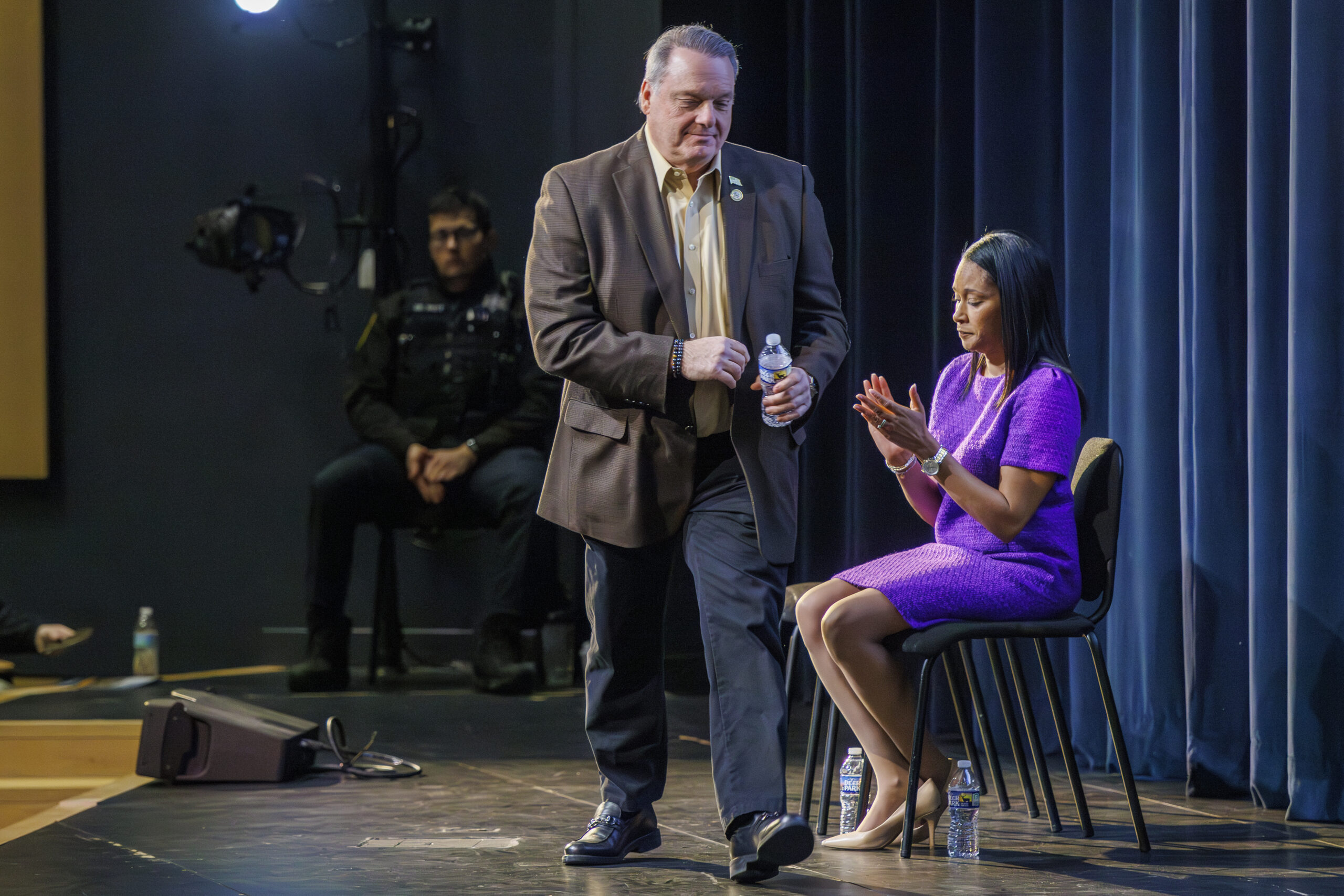
Thomas DiBello, the lone Republican commissioner, walks to the podium for remarks during the Montgomery County’s 2026 State of County event in Blue Bell. At right is Jamila H. Winder, the board’s Democratic chair.
“No matter what, we should be respecting our law enforcement agencies until they break the law,” DiBello responded.
On Wednesday, immigration-related disagreements lingered when Makhija told reporters about his opposition to ICE buying warehouses in Pennsylvania, including in Berks County, that may be used to detain people.
“Again we divide, because I will support the rule of law,” DiBello said on immigration enforcement. ”I stand with law enforcement, and if people want changes, they need to go to Washington and ask and promote those changes.”
WASHINGTON — A grand jury in Washington refused Tuesday to indict Democratic lawmakers in connection with a video in which they urged U.S. military members to resist “illegal orders,” according to a person familiar with the matter.
The Justice Department opened an investigation into the video featuring Democratic Sens. Mark Kelly and Elissa Slotkin and four other Democratic lawmakers urging U.S. service members to follow established military protocols and reject orders they believe to be unlawful. All the lawmakers previously served in the military or at intelligence agencies.
Grand jurors in Washington declined to sign off on charges in the latest of a series of rebukes of prosecutors by citizens in the nation’s capital, according to the person, who spoke on the condition of anonymity because they were not authorized to publicly discuss the matter. It wasn’t immediately clear whether prosecutors had sought indictments against all six lawmakers or what charge or charges prosecutors attempted to bring.
Grand jury rejections are extraordinarily unusual, but have happened repeatedly in recent months in Washington as citizens who have heard the government’s evidence have come away underwhelmed in a number of cases. Prosecutors could try again to secure an indictment.
Spokespeople for the U.S. attorney’s office and the Justice Department didn’t immediately respond to requests for comment Tuesday.
The FBI in November began contacting the lawmakers to schedule interviews, outreach that came against the backdrop of broader Justice Department efforts to punish political opponents of the president. President Donald Trump and his aides labeled the lawmakers’ video as “seditious” — and Trump said on his social media account that the offense was “punishable by death.”
Besides Slotkin and Kelly, the other Democrats who appeared in the video include Reps. Jason Crow of Colorado, Chrissy Houlahan of Pennsylvania, Maggie Goodlander of New Hampshire and Chris Deluzio of Pennsylvania.
Slotkin, a former CIA analyst who represents Michigan, said late Tuesday that she hopes this ends the Justice Department’s probe.
“Tonight we can score one for the Constitution, our freedom of speech, and the rule of law,” Slotkin said in a statement. “But today wasn’t just an embarrassing day for the Administration. It was another sad day for our country,” she said.
Kelly, a former Navy pilot who represents Arizona, called the attempt to bring charges an “outrageous abuse of power by Donald Trump and his lackies.”
“Donald Trump wants every American to be too scared to speak out against him,” Kelly said in a post on X. “The most patriotic thing any of us can do is not back down.”
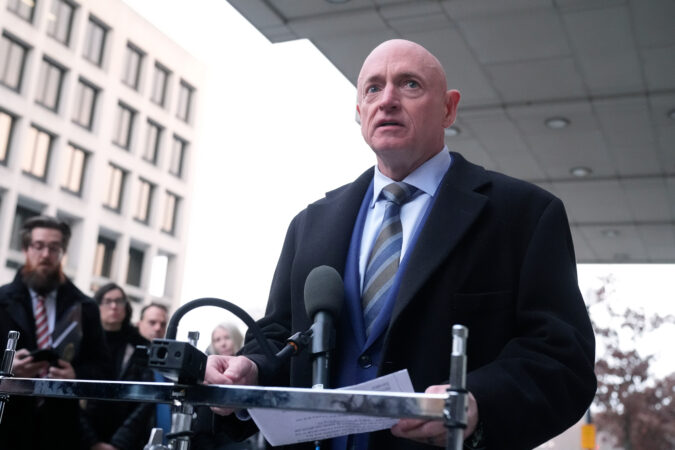
In November, the Pentagon opened an investigation into Kelly, citing a federal law that allows retired service members to be recalled to active duty on orders of the defense secretary for possible court-martial or other punishment. Defense Secretary Pete Hegseth has censured Kelly for participating in the video and is trying to retroactively demote Kelly from his retired rank of captain.
The senator is suing Hegseth to block those proceedings, calling them an unconstitutional act of retribution. During a hearing last week, the judge appeared to be skeptical of key arguments that a government attorney made in defense of Kelly’s Jan. 5 censure by Hegseth.
A still image from the documentary “Expanding Sanctuary” by Philadelphia filmmaker Kristal Sotomayor. The 2024 BlackStar award-winning short film will have a virtual screening on Wednesday, Feb. 11, and a local screening on April 29 and 30, as part of the Table Sessions at Bartram’s Garden.
For anyone viewing Philadelphia filmmaker Kristal Sotomayor’s short film, Expanding Sanctuary, for the first time at a free virtual screening and Q&A on Wednesday at 8 p.m., the issues depicted as impacting the lives of Philadelphia’s unauthorized immigrants will seem both meaningfully the same, and poignantly different, than they are today.
Philadelphia immigrants haven’t changed really — they still fall in love, get married, tend to their children, work hard, and look out for neighbors in need. They still give their time to building strong and loving communities.
Legislation, like the Laken Riley Act, has passed with bipartisan support, essentiallytreating immigrants accused of a criminal offense as if they had already been found guilty of it — codifying the violation of their constitutionally protected rights. Plus, thanks to Trump’s “Big Beautiful Bill,” ICE now has an extraordinary amount of funding to do with what it will.
A still image from the documentary, Expanding Sanctuary, by Philadelphia filmmaker Kristal Sotomayor. The 2024 BlackStar award-winning short film will have a virtual screening on Wed. Feb. 11, and a local screening on April 29 and 30, as part of the Table Sessions at Bartram’s Garden.
So, I asked Sotomayor: Why release the film now, into a U.S. that speaks more frequently in virulent terms about immigrants, when the national justice picture is grimmer, and our municipal leaders have chosen to stay more silent than before?
“Yeah, many things have changed,” Sotomayor told me via email. “Politically in Philadelphia, you are right that there is now a mayor who is less willing to push back against the federal government to protect immigrant rights. The mayor has not been willing to uphold sanctuary status or sanctuary policies. We are also dealing with far more mass surveillance than there was in 2018 … ICE now has access to everything from tax records to hospital records to things we probably are not even fully aware of yet.”
“I also do not think immigrant rights are as much of a national issue as they were in 2018,” Sotomayor added, “when the photo of the young boy in a detention center (essentially a cage) sparked widespread national outrage. I am not really seeing that same level of response right now [even though] there are protests around the country against the ramping up of ICE enforcement.”
Kristal Sotomayor, the award-winning, nonbinary, Philadelphia-area Peruvian American director and producer of “Expanding Sanctuary” will lead a Q&A after the film’s virtual screening on Feb. 11.
But, Sotomayor added: “For me, it is vital that this film is circulating now. Expanding Sanctuary is a hopeful story. In many ways, the film feels like it could have been shot last week. It shows how communities organized, changed policy, and protected their families during the first Trump presidency, and [it] reminds us that collective action is still possible now.”
“At a time when so many people are feeling overwhelmed and hopeless, this film offers a success story,” they added. “It demonstrates that change is possible, that policy can be shifted, and that families can be protected, not just in the past, but moving forward into the future.”
The Wednesday virtual screening of the documentary, which was honored at the 2024 BlackStar Film Festival, will be followed by a Q&A. Featured speakers are scheduled to include Sotomayor, Linda Hernandez, the Philadelphia-based community leader and holistic wellness practitioner who is the protagonist of Expanding Sanctuary, and Katie Fleming, an immigration lawyer and the director of public education and engagement at the Acacia Center for Justice.
I’ll be honest, I came away from my most recent viewing of Sotomayor’s film feeling a bit nostalgic. Not only was it filled with the faces of beloved community members — some of whom have recently stepped away from decades of work helping people see immigrants as human beings, not abstractions — but also because of the intimate specificity of what Expanding Sanctuary celebrates.
There on the soundtrack are the musicians who once told me that making space for convivencia is making space for life, for community, and, yes, for resistance. There on screen is the Philadelphia I adore — where James Beard winners feed desperate families living in sanctuary, where people show up to protest in their wedding dresses, where sidewalks become sign-making studios, and where mothers raise their families on both tortillas and hope.
The huge anti-ICE protests these days are amazing, but they should never obscure the fact that while we must always fight against injustice and the weakening of democratic norms, we cannot forget who we are fighting for — real people, real neighborhoods and communities, real cities whose civic leaders may have forgotten their voices, but whose residents never will.
For their part, Sotomayor is hopeful. “I think we are ramping up toward something that could be just as strong and just as powerful as what is portrayed in Expanding Sanctuary,” they told me.
“It may take some time for immigrant rights to become a national talking point again, as it was in 2018, but I do believe that moment will come with larger protests, deeper outrage, and, ultimately, real change.”
To attend the virtual screening and Q&A on Feb. 11, click here. For more information about the Table Sessions at Bartram’s Garden on April 29 and 30, click here.
More than 80% of mined tungsten comes from China — or did, until limits on China tungsten imports imposed during the Biden administration began last year. China has also imposed tungsten export limits.
The struggle has fed a global tungsten rush, with investors and their allies in the U.S. and foreign governments paying to reopen old mines and secure new suppliers around the globe. The restrictions have also revived production of other strategic metals in many countries.
The biggest tungsten processor in the Western world is the century-old, 400-worker Global Tungsten & Powders (GTP) complex in Towanda, Pa., three hours north of Philadelphia.It produced more than 12,000 of the 117,000 metric tons of tungsten powder made in the world last year, crushing the metal into workable powders because it takes too much energy to melt.
Far from fighting to preserve cheap Chinese tungsten supplies, GTPchampioned laws supporting China import restrictions.
Before Stacy Garrity became Pennsylvania’s elected treasurer in 2021, she worked at GTP for more than 30 years. As vice president for government affairs and head of a metals industry group, she lobbied Congress and the first Trump administration to limit tungsten imports from China and its allies under what she called the “don’t buy from the bad guys” law.
Trump endorsed Garrity last month for the Republican nomination to run against Pennsylvania Gov. Josh Shapiro this fall.
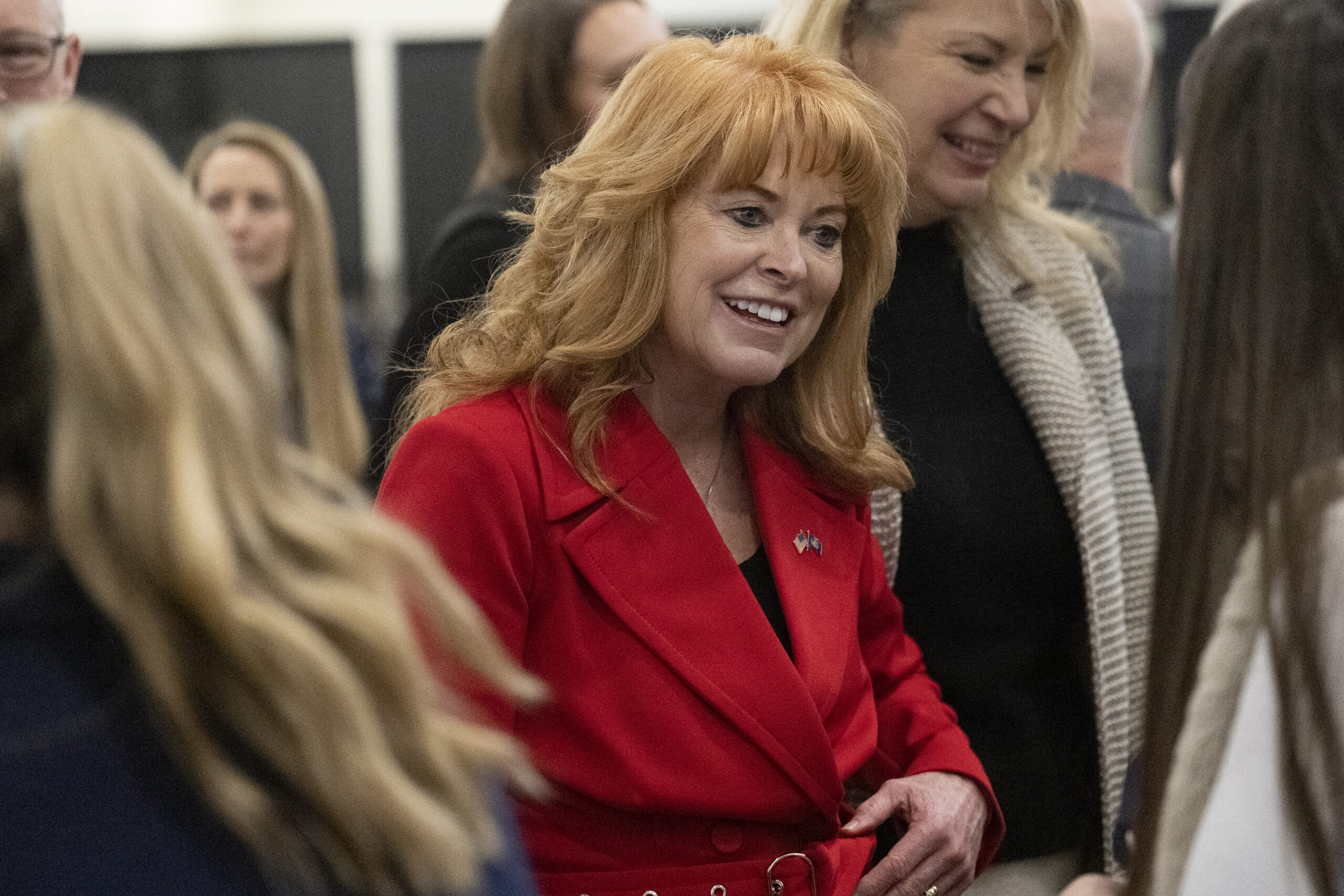
Stacy Garrity, Pennsylvania treasurer, at the Pennsylvania Farm Show in Harrisburg in January.
GTP’s owner, Austria-based Plansee, has relied mostly on recycled Western tungsten, along with the few non-Chinese mines. But with tungsten demand and pricessurging, the company has contracted mined metal from new sources, including Korea and Rwanda, after many years of effort, says Karlheinz Wex, Plansee’s executive board chairman.
Korea’s Sandong mine, once among the world’s biggest suppliers, shut in 1994 as cheaper Chinese tungsten flooded world markets. The mine has reopened with financial support from the Korean government, technical assistance from U.S. agencies, and an exclusive supply deal to GTP. It’s owned by Almonty, a multinational mining company partly owned by Plansee. Almonty is moving its headquarters to the U.S. from Canada.
Wex agreed to take questions about the tungsten trade and GTP, purchased from lighting maker Sylvania in 2007. This conversation has been edited for clarity and length.
How did a tungsten processing plant end up in Pennsylvania?
That is where it started more than 100 years ago. The company focused on medical applications. Later, it went into the lighting business[pre-LED light bulbs used tungsten filament]. We have focused it 100% on tooling and special applications, such as artillery shells, and mostly in alloys with nickel and iron for tools, and with carbide and cobalt in machines for cutting, drilling, mining.
The journey starts by creating tungsten scrap from customers and competitors. Our tungsten supply is 70% scrap recycling, from tools and drill bits.
Austria-based Plansee owns the tungsten powdering plant in Towanda, Pa., which processes about one-tenth of the world’s supply of the heavy metal, used in tools and weapons.
Why did your company, which relied on Chinese tungsten, also lobby to reduce imports from China?
We always had this topic of sources independent from China, from the politics and their pricing. The mining of tungsten in the West was not that much [because of] the unfair competition flooding Chinese materials into the market. We wanted to get independent of that.
Why are you buying tungsten from Africa now?
Tungsten is a so-called conflict material. When we can certify it’s conflict-free, the material from that mine is really sound. The people at Trinity Metals [in Rwanda], we’ve known for years. Our specialists visit their mine.
The U.S. government’s involvement made it easier to prove we can support national security in the West. We buy their entire production.
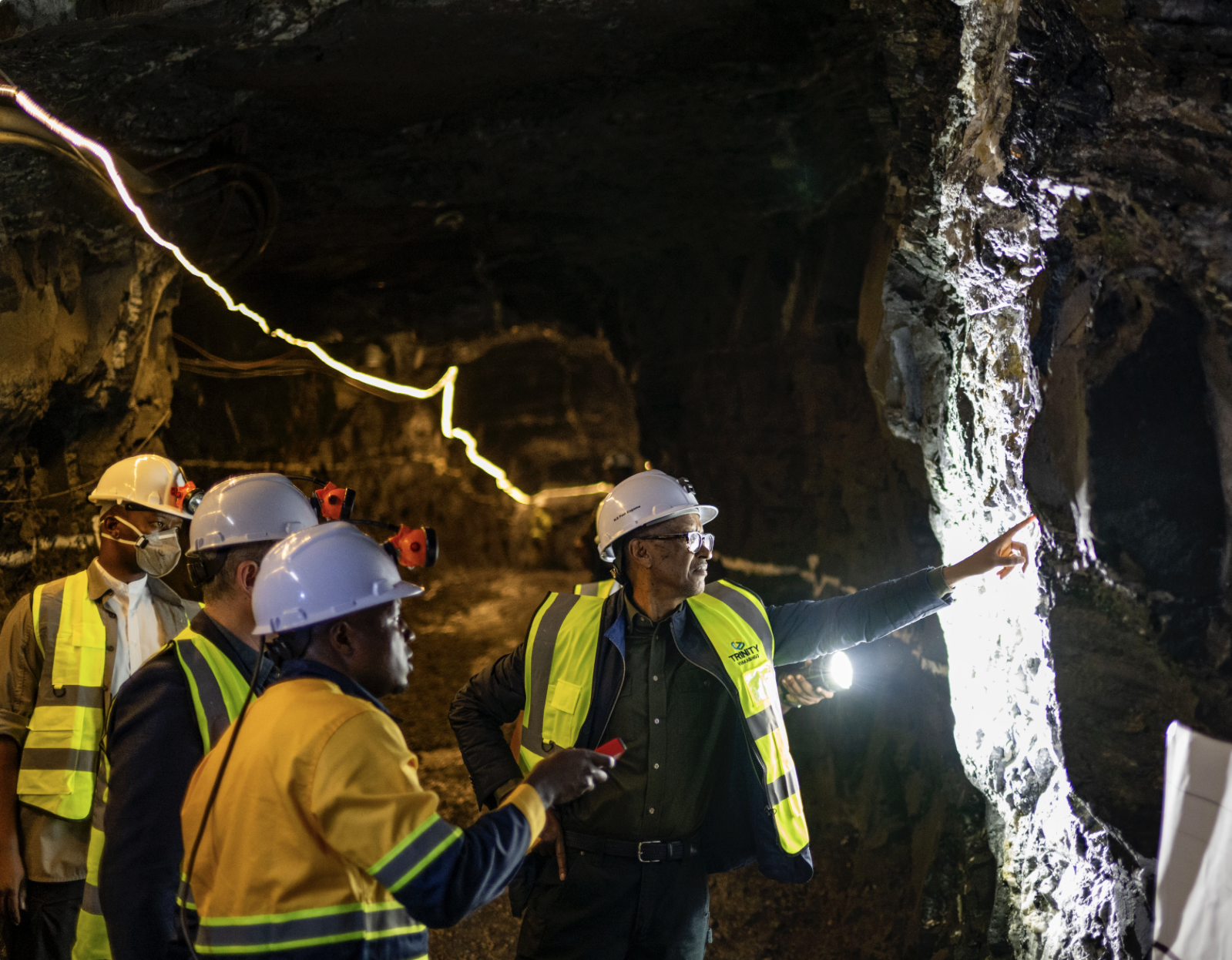
Rwanda President Paul Kagame at Trinity Metals’ newly expanded, reopened Nyakabingo tungsten mine in May 2025. The mine’s entire production is sold to Plansee, an Austrian company that processes one-tenth of world tungsten output at its General Tungsten & Powders plant in Towanda, Pa.
How does tungsten get from Rwanda to Pennsylvania?
At the mine they separate the tungsten, crushing and separating the material by weight, or separating it by flood behind a dam. That makes a concentrate, about 60% tungsten. They put it in big bags and drums, very heavy. It’s easy to transport in standard containers [usually through the port of Mombasa [in Kenya], arriving through Newark or other East Coast ports and trucked to Towanda].
Does the sale price of tungsten today cover all those costs?
We have record prices in the tungsten market. Last year the price tripled. We don’t have enough [supply].
The big problem is the Chinese have restricted exports. And the U.S. has forbidden the use of Chinese material for defense applications, as of this year. About 10% of tungsten goes into defense applications.
Will Rwanda make a big difference in the supply chain?
Rwanda is a small part.
We rely on recycling. The biggest growth in supply that we see is the Sandong mine in South Korea. We have supported that financially. They will ship the concentrate to San Francisco [ports] and then by land to Towanda.
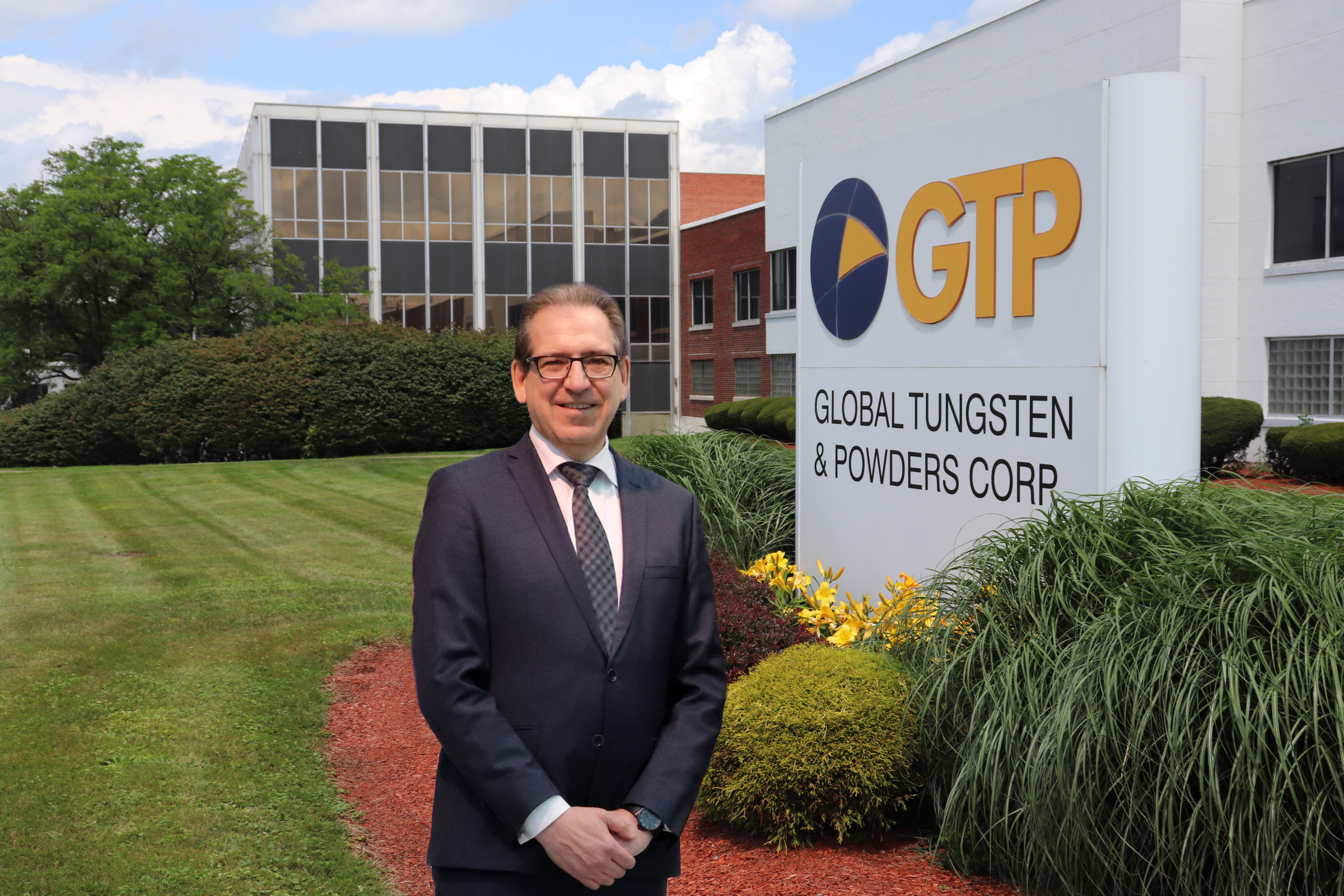
Karlheinz Wex, chairman of the executive committee of Austria-based global miner Plansee, on a 2025 visit to the company’s Global Tungsten & Powder (GTP) mill in Towanda, Pa.
We are working at capacity. We could produce 50-60% more and sell it on the market. We are sold out for the next six to nine months. Some of our customers are desperate.
We are thinking of expanding in Towanda.
Have you kept in touch with Stacy Garrity since she became a public official?
Yes! It’s good to see her as state treasurer and potentially governor of Pennsylvania. She worked a long time for GTP after she was in the Army.
When President Donald Trump and Secretary of State Marco Rubio gutted the U.S. Department of State last year, they said they were doing it to make America “safer, stronger, and more prosperous.” Yet, Trump’s nominee to be assistant secretary of state for international organization affairs, Jeremy Carl, is a white supremacist conspiracy theorist who would undermine the United States’ standing at the United Nations and destroy our relationships with countries around the world.
As former American diplomats, we’ve worked to promote human rights globally. We know the inner workings of this world and can say unequivocally that Carl would be a grave threat in this post, and his nomination must be resoundingly rejected.
The assistant secretary of state for international organization affairs is the architect of U.S. policy at the United Nations and across a wide range of multilateral arenas. Few outside diplomatic circles have heard of this position, but it’s one of the central posts through which the U.S. interacts with the world.
For example, when we stop defending fair labor standards in places like Bangladesh or Vietnam, American workers pay the price as competitors in those countries cut corners and flood markets with cheaper goods. When we look away from corruption and repression in energy-rich regions, instability follows — driving up oil prices and hitting Americans at the pump. When we ignore humanitarian crises until they explode, we spend far more on aid and crisis response than it would have cost to prevent them.
These aren’t far-off problems. In an interconnected world, they’re immediate issues that impact American jobs, consumer prices, and national security. That’s why this role is so crucial.
Carl is moving quietly ahead in the Senate Foreign Relations Committee, on which Pennsylvania Sen. Dave McCormick serves, and his nomination hearing is slated for Thursday. The Senate should stand up for American values and the interests of the American people by rejecting this dangerous nominee.
Carl is not just unqualified for the role — he has no experience working with the U.N. — he represents a dangerous rejection of the ideals of the Universal Declaration of Human Rights: that all humans are born with equal dignity and rights.
Carl has promoted the racist and antisemitic “great replacement” conspiracy theory — claiming that there is a covert effort led by elites to replace white people in Western countries through mass migration and high birth rates of people of color, Muslims, Jews, and immigrants.
He has promoted political violence, including calling for the execution of the president of the American Federation of Teachers, a Jewish lesbian. He claimed that identifying as transgender is “somewhere between demonic and laughable.”
Though he has deleted thousands of his inflammatory tweets, these views are memorialized in his book, The Unprotected Class: How Anti-White Racism is Tearing America Apart. He gave a speech last year titled, “On the Persecution of Whites in America.”
These are not stray remarks. They reflect who Carl is, and the message the U.S. would send by giving him a senior diplomatic post. They are so alarming that the Global Project Against Hate and Extremism wrote an entire article about his work to champion “anti-white racism.”
If Carl becomes the face the U.S. presents to the world, we’ll be telling the world that we care about only one group of people. We also will undermine our interests, because in our racially, religiously diverse world, other countries will rightly see Carl’s views as abhorrent.
A world where human rights are optional and the United States fails to hold abusers accountable is a world where corruption grows, conflicts fester, and authoritarian regimes operate unchecked. The result: increased human suffering at home and abroad, higher prices for Americans, fewer protections for American workers, and greater instability that threatens our own security.
Last month, the Trump administration issued an executive order withdrawing the U.S. from 66 organizations, including 31 U.N. mechanisms. The U.S. was not a significant political or financial supporter of all of them, so the substantive consequences of withdrawal are debatable.
Yet, the symbolism is clear: The U.S. is disproportionately targeting mechanisms that serve the most vulnerable and marginalized, like U.N. Women and the Permanent Forum for People of African Descent, or those tackling the climate crisis, like the U.N. Framework Convention on Climate Change. In other words, being unqualified, opposed to universal human rights, and seeking to undermine global governance is the point of Carl’s nomination.
We know what effective diplomacy looks like. It is steady, principled, and grounded in the belief that America’s power is greatest when guided by its conscience. It also treats the rights and dignity of the most vulnerable as a priority, not an afterthought.
When we lead with our values, we build coalitions that prevent wars and foster prosperity. When we abandon them, chaos fills the vacuum — and history shows that chaos never stays overseas.
Desirée Cormier Smith was the inaugural special representative for racial equity and justice. Jessica Stern was the special envoy for the advancement of the human rights of LGBTQI+ persons at the U.S. Department of State. They are now both cofounders and copresidents of the Alliance for Diplomacy and Justice, promoting human rights as a central pillar of U.S. foreign policy.
Maybe it’s because I’ve watched every blessed one of them, starting as a curious, nearly 8-year-old boy in 1967, but the Super Bowl has always felt like the ultimate barometer of where the American Experiment is at. Super Bowl LX (that’s 60, for those of you smart enough not to take four years of Latin in high school) was no exception. The actual game was something of a snoozefest, but the tsunami of commercials revealed us as a nation obsessed with artificial intelligence, sports betting, weight loss, and anything that can lift us from middle-class peonage without having to do any actual work. As Bad Bunny said, God bless America.
Bad Bunny’s real message: From P.R. to Minnesota, we are neighbors
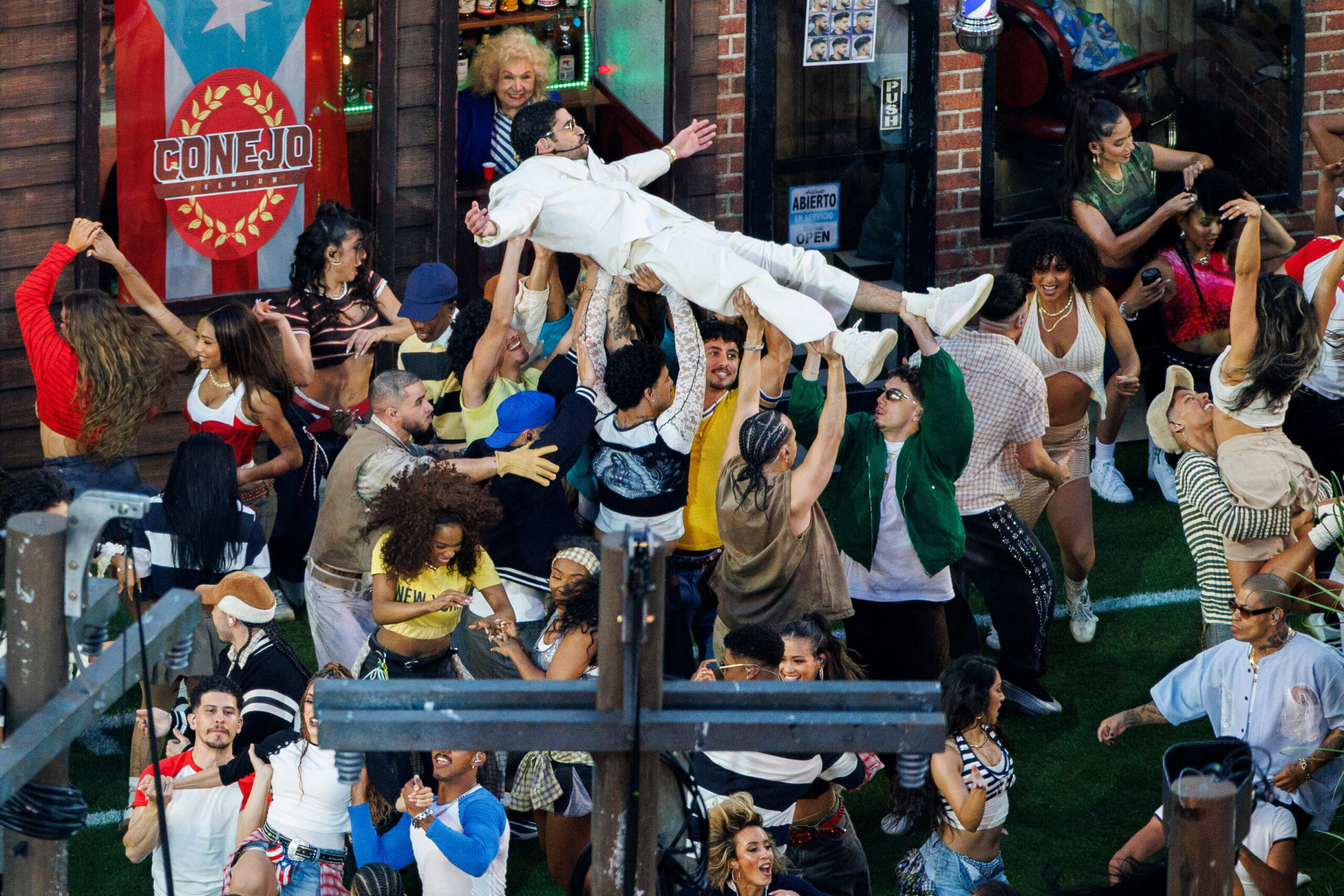
Bad Bunny (center top) performs Sunday during the halftime show of the NFL Super Bowl XL football game between the Seattle Seahawks and the New England Patriots in Santa Clara, Calif.
Right-wing media prattled on for months about how Bad Bunny, the Puerto Rican reggaeton superstar who is the world’s most streamed artist, would politicize and thus ruin the NFL’s halftime extravaganza at Super Bowl LX in Santa Clara, Calif.
The babble became a scream seven days before the Big Game kicked off, when Bad Bunny won the record of the year Grammy Award and began his acceptance speech with the exhortation “ICE out!” adding, “We’re not savages, we’re not animals, we’re not aliens — we are humans, and we are Americans.”
But on the world’s biggest stage Sunday night — seen by 135 million in the United States, a Super Bowl record — Bad Bunny sang not one word about Donald Trump, not that MAGA fans even bothered to hold up a translation app. The white-suited Benito Antonio Martínez Ocasio danced his way through the history of Puerto Rico and the Americas writ large, from the plantations of yore to the exploding power lines of the hurricane-wracked 21st century. He whirled past an actual wedding, stopped for a shaved ice, and for 13 spellbinding minutes turned a cast of 400 into what his transfixed TV audience craved at home.
BadBunny built his own community — a place not torn asunder by politics, but bonded by love and music.
Without uttering one word — in Spanish or English — about the dire situation in a nation drifting from flawed democracy into wrenching authoritarianism, the planet’s reigning king of pop delivered the most powerful message of America’s six decades of Super Bowl fever. Shrouded in sugar cane and shaded by a plantain tree, Bad Bunny sang nothing about the frigid chaos 2,000 miles east in Minnesota, and yet the show was somehow very much about Minneapolis.
Bad Bunny finally gave voice to what thousands of everyday folks in the Twin Cities have been trying to say with their incessant whistles.
We are all neighbors. The undocumented Venezuelan next door who toils in the back of a restaurant and sends his kids to your kids’ school is a neighbor. But Haiti is also a neighbor, as is Cuba. We are all in this together.
The word I kept thinking about as I watched Bad Bunny’s joyous performance is a term that didn’t really exist on New Year’s Day 2026, yet has instantly provided a name to the current zeitgeist.
The great writer Adam Serwer — already up for the wordsmithing Hall of Fame after he nailed the MAGA movement in 2018 in five words: “The cruelty is the point” — leaned hard into the concept of “neighborism” after he traveled to Minneapolis last month. His goal was to understand an almost revolutionary resistance to Trump’s mass deportation raids that had residents — many of whom had not been especially political — in the streets, blowing those warning whistles, confronting armed federal agents, and tracking their movements across the city.
Serwer visited churches where volunteers packed thousands of boxes of food for immigrant families afraid to leave their homes during the U.S. Immigration and Customs Enforcement raids, and talked to stay-at-home moms, retirees, and blue-collar workers who give rides or money to those at risk, or who engaged in the riskier business of tracking the deportation raiders.
“If the Minnesota resistance has an overarching ideology,” Serwer wrote, “you could call it ‘neighborism’ — a commitment to protecting the people around you, no matter who they are or where they came from.” He contrasted the reality on the ground in Minneapolis to the twisted depictions by Trump and his vice president, JD Vance, who’ve insisted refugees are a threat to community and cohesion.
Of course, it’s not just Minneapolis, and it’s not just the many, liberal-leaning cities — from Los Angeles to Chicago to New Orleans and more — that were the incubators of the notion that concerned citizens — immigrant and nonimmigrant alike — could prevent their neighbors from getting kidnapped. Even small towns like rural Sackets Harbor, N.Y., the hometown of Trump’s border czar Tom Homan, rose up in protest to successfully block the dairy farm deportation of a mom and her three kids. It’s been like this everywhere regular folks — even the ones who narrowly elected Trump to a second term in 2024 — realize mass deportation doesn’t mean only “the worst of the worst,” but often the nice mom or dad in the house, or church pew, next to theirs.
Only now that it’s arrived is it possible to see “neighborism” as the thing Americans were looking for all along, even if we didn’t know it. It is, in every way, the opposite vibe from the things that have always fueled fascism — atomization and alienation that’s easy for a demagogue to mold into rank suspicion of The Other.
I’m pretty sure Bad Bunny wasn’t using the word neighborism when the NFL awarded him the coveted halftime gig last fall. But the concept was deeply embedded in his show. He mapped his native Puerto Rico as a place where oppression has long loomed — from the cruelty of the sugar plantations to the capitalist exploitation of the failed power grid — but where community is stronger.
Then Benito broadened the whole concept. Reclaiming the word America for its original meaning as all of the Western Hemisphere, Bad Bunny name-checked “Chile, Argentina, Uruguay, Paraguay, Bolivia, Peru, Ecuador, Brazil,” and Canada, as well as the United States. These, too, are our neighbors. “God bless America,” he shouted — his only message of the night delivered in English.
So, no, Bad Bunny never mentioned Minneapolis, but a tender moment when he seemingly handed the Grammy he’d won just aweek ago to a small Latino boy had to remind viewers of the communal fight to save children like the 5-year-old, blue bunny hat-wearing (yes, ironic) Liam Conejo Ramos, who was just arrested, detained, and released by ICE. (A false rumor that the Super Bowl boy was Ramos went viral.)
But arguably, this super performance had peaked a few moments earlier, when the singer exited the wedding scene stage with a backward trust dive, caught and held aloft by his makeshift community in the crowd below. Bad Bunny had no fear that his neighbors would not be there for him. Viva Puerto Rico. Viva Minneapolis. Viva our neighbors.
Yo, do this!
Some 63 years after he was gunned down by a white racist in his own driveway, the Mississippi civil rights icon Medgar Evers has been having a moment. A fearless World War II vet whose bold stands for civil rights as local leader of the NAACP in America’s most segregated state triggered his 1963 assassination, Evers’ fight has become the subject of a best-selling book, a controversy over how his story is told at the Jackson, Miss., home where he was killed, and now a two-hour documentary streaming on PBS.com. I’m looking forward to watching the widely praised Everlasting: Life & Legacy of Medgar Evers.
After the Super Bowl, February is the worst month for sports — three out of every four years. In 2026, we have the Winter Olympics to bridge the frigid gap while we wait for baseball’s spring training (and its own World Baseball Classic) to warm us up. Personally, I try and sometimes fail to get too jacked up around sleds careening down an icy track, but hockey is a different story. At 2:10 p.m. on Tuesday (that’s today if you read this early enough), the puck drops on USA Network for the highly anticipated match between the world’s two top women’s teams: the United States and its heated rival Canada. Look for these two border frenemies to meet again for the gold medal.
Ask me anything
Question: How is it that some towns have been able to prevent ICE from buying warehouses and turning them into concentration camps, while others say they are helpless against the federal government? What does it mean that several are planned for within a couple of hours of Philly? — @idaroo.bsky.social via Bluesky
Answer: Great question. It seems ICE and its $45 billion wad of cash are racing in near-secrecy to make this national gulag archipelago of 23 or so concentration camps a done deal. The places where they’ve been stopped, like one planned for Virginia, happened because locals were able to pressure the developer before a sale to ICE was concluded. That’s no longer an option at the two already purchased Pennsylvania sites in Schuylkill and Berks Counties. The last hope is pressure from high-ranking Republicans, which may (we’ll see) have stopped a Mississippi site. Pennsylvanians might want to focus, then, on GOP Sen. Dave McCormick. Good luck with that.
What you’re saying about …
It’s conventional wisdom that the best argument for a Gov. Josh Shapiro 2028 presidential campaign is his popularity in his home state of Pennsylvania, the battleground with the most electoral votes. So it’s fascinating that none of the dozen or so of you who responded to this Philadelphia-based newsletter wants Shapiro to seek the White House, although folks seem divided into two camps. Some of you just don’t like Josh or his mostly centrist politics. “I think he’s all ambition, all consumed with reaching that top pedestal, not as a public servant, but because he thinks he deserves it,” wrote Linda Mitala, who once campaigned for Shapiro, but soured on his views over Gaza protesters, New York Mayor Zohran Mamdani, and other issues. Yet, others think he’s an excellent governor who should remain in the job through 2030. “Stay governor of Pa. when good governance and ability to stand up to federal (authoritarian) overreach is dire,” wrote Kim Root, who’d prefer Kentucky Gov. Andy Beshear for the White House.
📮 This week’s question: A shocking, likely (though still not declared) Democratic primary win for Analilia Mejia, the Bernie Sanders-aligned left-wing candidate, in suburban North Jersey’s 11th Congressional District raises new questions for the Dems about the 2026 midterms. Should the party run more progressive candidates like Mejia, who promise a more aggressive response to Trump, or will they lose by veering too far left? Please email me your answer and put the exact phrase “Dems 2026” in the subject line.
Backstory on how the F-bomb became the word of the year
Billie Joe Armstrong of Green Day performs Sunday before the start of Super Bowl XL in Santa Clara, Calif.
I’m old enough to remember when the world’s most famous comedy riff was the late George Carlin’s “Seven Words You Can Never Say on Television” — its point driven home by Carlin’s 1972 arrest on obscenity charges that went all the way to the U.S. Supreme Court. A half century later, you still can’t say dirty words on broadcast TV — cable and streaming is a different story — but that fortress is under assault. In 2026, America is under seemingly constant attack from the F-bomb.
It is freakin’ everywhere. When the top elected Democrat in Washington, House Minority Leader Hakeem Jeffries, cut a short video to respond to the president’s shocking post of a racist video that depicted Barack and Michelle Obama as apes, he said, “[F-word] Donald Trump!” If uttered in, say, 1972, Jeffries’ attack would have been a top story for days, but this barely broke through. Maybe because that word is in the lexicon of so many of his fellow Democrats, like Mayor Jacob Frey, who famously told ICE agents to “get the [F-word] out of Minneapolis,” or Minnesota Sen. Tina Smith, who begged federal agents to “leave us the (bleep) alone.” (Smith is retiring at year’s end and seems to no longer give a you-know-what.)
The poor guys with their finger on the silence button at the TV networks, where you still can’t say Carlin’s seven words, can barely keep up. The F-bomb was dropped at this year’s Grammys, where award-winner Billie Eilish declared “(Bleep) ICE!” as she brandished her prize. The F-bomb was dropped, of course, at the Super Bowl, when the only true moment of silence during 10-plus hours of nonstop bombast came during Green Day’s pregame performance of “American Idiot,” when NBC shielded America’s tender ears from hearing Billie Joe Armstrong sing about “the subliminal mind(bleep) America.”
We’re only about six weeks into the new year, but it’s hard not to think that Merriam-Webster or the other dictionary pooh-bahs won’t declare the F-bomb as word of the year for 2026, even if I’m still not allowed to use it in The Inquirer, family newspaper that we are. So what the … heck is going on here? One study found the F-word was 28 times more likely to appear in literature nowthan in the 1950s, so in one sense it’s not surprising this would eventually break through on Capitol Hill or on the world’s biggest stages.
But the bigger problem is that America’s descent into authoritarianism and daily political outrage has devolved to such a point where, every day, permissible words no longer seem close to adequate for capturing our shock and awe at how bad things are. Only the F-bomb, it turns out, contains enough dynamite to blow out our rage over masked goons kidnapping people on America’s streets, or a racist, megalomaniac president who still has 35 months left in his term. Yet, even this (sort of) banned expletive is losing its power to express how we really feel. I have no idea what the $%&# comes next.
What I wrote on this date in 2019
What a long, strange trip for Amazon founder Jeff Bezos, one of the four richest people on the planet. Today, Bezos is in the headlines for his horrific stewardship of the Washington Post, which has bowed down on its editorial pages to the Trump regime, lost hundreds of thousands of subscribers, and laid off 300 journalists. It’s hard to recall that seven years ago, Bezos and Trump were at war, and there was evidence Team MAGA had enlisted its allies from Saudi Arabia to the National Enquirer to take down the billionaire. I wrote that “a nation founded in the ideals of democracy has increasingly fallen prey to a new dystopian regime that melds the new 21st century dark arts of illegal hacking and media manipulation with the oldest tricks in the book: blackmail and extortion.”
My first and hopefully not last journalistic road trip of 2026 took me to Pennsylvania coal country, where ICE has spent $119.5 million to buy an abandoned Big Lots warehouse on the outskirts of tiny Tremont in Schuylkill County. I spoke with both locals and a historical expert on concentration camps about their fears and the deeper meaning of a gulag archipelago for detained immigrants that is suddenly looming on U.S. soil. It can happen here. Over the weekend, I looked at the stark contrast between Europe’s reaction to the Jeffrey Epstein scandal — where ties to the late multimillionaire sex trafficker are ending careers and even threatening to topple the British government — and the United States, where truth has not led to consequences so far. The Epstein fallout shows how the utter lack of elite accountability is driving the crisis of American democracy.
One last Super Bowl reference: Now that football is over, are you ready for some FOOTBALL? Now just four months out, it’s hard to know what to make of the 2026 World Cup returning to America and coming to Philadelphia for the very first time, and whether the increasing vibe that Donald Trump’s United States is a global pariah will mar the world’s greatest sporting event (sorry, NFL). Whatever happens, The Inquirer is ready, and this past week we published our guide to soccer’s biggest-ever moment in Philly. Anchored by our world-class soccer writer Jonathan Tannenwald and Kerith Gabriel, who worked for the Philadelphia Union between his stints at the paper, the package provides not only an overview of the World Cup in Philly, but previews the dozen teams who will (or might) take the pitch at Lincoln Financial Field, with in-depth looks at the powerhouses (France) as well as the massive underdogs (Curaçao). June is just around the corner, so don’t let the paywall become your goalkeeper. Subscribe to The Inquirer before the first ball drops.
By submitting your written, visual, and/or audio contributions, you agree to The Inquirer’s Terms of Use, including the grant of rights in Section 10.
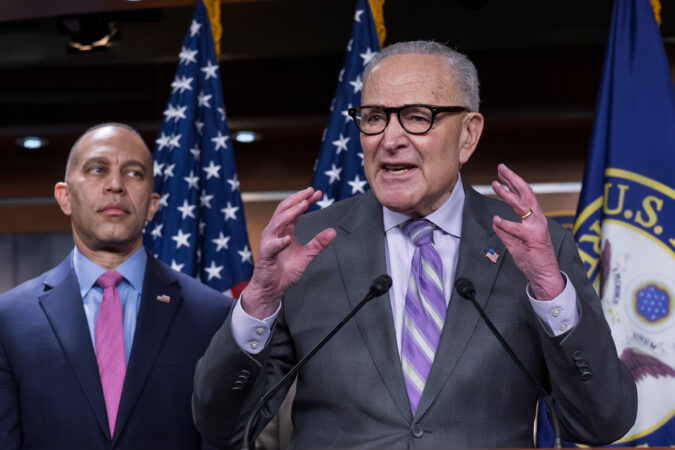
WASHINGTON — Congressional leaders said Tuesday that a deal was still possible with the White House on Homeland Security Department funding before it expires this weekend. But the two sides were still far apart as Democrats demanded new restrictions on President Donald Trump’s immigration crackdown.
After federal agents fatally shot two protesters in Minneapolis last month, Democrats say U.S. Immigration and Customs Enforcement needs to be “dramatically” reined in and are prepared to let Homeland Security shut down if their demands aren’t met. On Tuesday, Senate Democratic Leader Chuck Schumer and House Democratic Leader Hakeem Jeffries said they had rejected a White House counteroffer that “included neither details nor legislative text” and does not address “the concerns Americans have about ICE’s lawless conduct.”
“We simply want ICE to follow the same standards that most law enforcement agencies across America already follow,” Schumer said Tuesday. “Democrats await the next answer from our Republican counterparts.”
The Democrats’ rejection of the Republican counteroffer comes as time is running short, with a shutdown of the Homeland Security Department threatening to begin Saturday. Among the Democrats’ demands are a requirement for judicial warrants, better identification of DHS officers, new use-of-force standards and a stop to racial profiling.
Finding agreement on the charged, partisan issue of immigration enforcement will be exceedingly difficult. But even as lawmakers in both parties were skeptical, a White House official said that the administration was having constructive talks with both Republicans and Democrats. The official, granted anonymity to speak about ongoing deliberations, stressed that Trump wanted the government to remain open and for Homeland Security services to be funded.
Senate leaders also expressed some optimism.
“There’s no reason we can’t do this” by the end of the week, Senate Democratic Leader Chuck Schumer said after meeting with his caucus on Tuesday.
Senate Majority Leader John Thune, R-S.D., said there have been “some really productive conversations.”
Democratic demands
Schumer and Jeffries have said they want immigration officers to remove their masks, to show identification and to better coordinate with local authorities. They have also demanded a stricter use-of-force policy for the federal officers, legal safeguards at detention centers and a prohibition on tracking protesters with body-worn cameras.
Among other asks, Democrats say Congress should end indiscriminate arrests, “improve warrant procedures and standards,” ensure the law is clear that officers cannot enter private property without a judicial warrant and require that before a person can be detained, it’s verified that the person is not a U.S. citizen.
Democrats made the demands for new restrictions on ICE and other federal law enforcement after ICU nurse Alex Pretti was shot and killed by a U.S. Border Patrol officer in Minneapolis on Jan. 24, and some Republicans suggested that new restrictions were necessary. Renee Good was shot by ICE agents on Jan. 7.
Many Democrats said they won’t vote for another penny of Homeland Security funding until enforcement is radically scaled back.
“Dramatic changes are needed at the Department of Homeland Security before a DHS funding bill moves forward,” Jeffries said. “Period. Full stop.”
Republican counterproposal
Jeffries said Tuesday that the White House’s offer “walked away from” their proposals for better identification of ICE agents, for more judicial warrants and for a prohibition on excessive use of force. Republicans also rejected their demand for an end to racial or ethnic profiling, Jeffries said.
“The White House is not serious at this moment in dramatically reforming ICE,” Jeffries said.
Republican lawmakers have also pushed back on the requests. Oklahoma Sen. Markwayne Mullin, a close ally of Trump, said Tuesday that he’s willing to discuss more body cameras and better training — both of which are already in the Homeland spending bill — but that he would reject the Democrats’ most central demands.
“They start talking about judicial warrants? No. They start talking about demasking them? No, not doing that. They want them to have a photo ID with their name on it? Absolutely not,” Mullin said.
Republicans have said ICE agents should be allowed to wear masks because they are more frequently targeted than other law enforcement officials.
“People are doxing them and targeting them,” said House Speaker Mike Johnson, R-La., on Monday. “We’ve got to talk about things that are reasonable and achievable.”
Some Republicans also have demands of their own, including the addition of legislation that would require proof of citizenship before Americans register to vote and restrictions on cities that they say do not do enough to crack down on illegal immigration.
At a House hearing on Tuesday, the acting director of ICE, Todd Lyons, said his agency is “only getting started” and would not be intimidated as his officers carry out Trump’s mass deportation agenda.
Trump deals with Democrats
Congress is trying to renegotiate the DHS spending bill after Trump agreed to a Democratic request that it be separated out from a larger spending measure that became law last week and congressional Republicans followed his lead. That package extended Homeland Security funding at current levels only through Feb. 13, creating a brief window for action as the two parties discuss new restrictions on ICE and other federal officers.
But even as he agreed to separate the funding, Trump has not publicly responded to the Democrats’ specific asks or suggested any areas of potential compromise.
White House press secretary Karoline Leavitt said late last week that the Trump administration is willing to discuss some items on the Democrats’ list, but “others don’t seem like they are grounded in any common sense, and they are nonstarters for this administration.”
Thune said Tuesday that “there are certain red lines that I think both sides have, things they are not going to negotiate on, but there are some things they are going to negotiate on, and that’s where I think the potential deal space is here.”
It was, so far, unclear what those issues were.
“We are very committed to making sure that federal law enforcement officers are able to do their jobs and to be safe doing them,” Thune said of Republicans.
Consequences of a shutdown
In addition to ICE and U.S. Customs and Border Protection, the homeland security bill includes funding for the Federal Emergency Management Agency and the Transportation Security Administration, among other agencies. If DHS shuts down, Thune said last week, “there’s a very good chance we could see more travel problems” similar to the 43-day government closure last year.
Thune has said Republicans will try to pass a two- to four-week extension of the Homeland Security funding while negotiations continue.
Many Democrats are unlikely to vote for another extension. But Republicans could potentially win enough votes in both chambers from Democrats if they feel hopeful about negotiations.
“The ball is in the Republicans’ court,” Jeffries said Monday.
In June 1776, before the Declaration of Independence was signed, a group of leaders from Philadelphia and its surrounding 10 counties — Bucks, Berks, Chester, Lancaster, York, Cumberland, Bedford, Northampton, Northumberland, and Westmoreland — met in Carpenters Hall for the Pennsylvania Provincial Conference. There, the Commonwealth of Pennsylvania was born.
Carpenters Hall, a hidden landmark just two blocks from Independence Hall in Philadelphia’s Old City, is the true birthplace of Pennsylvania, where the state declared its independence from Britain — jump-starting the framework of the state’s influential constitution that would serve as a model for the U.S. Constitution.
Now, the little-known and privately owned historic site is celebrating Pennsylvania’s 250th birthday — which coincides with America’s Semiquincentennial — by holding commemorative events across the state to reflect on Pennsylvania’s history and ask residents how the state constitution should be strengthened in 2026 and beyond.
“It’s the piece of the story we should own and celebrate and use as a platform for civic engagement,” said Michael Norris, the executive director of Carpenters Hall.
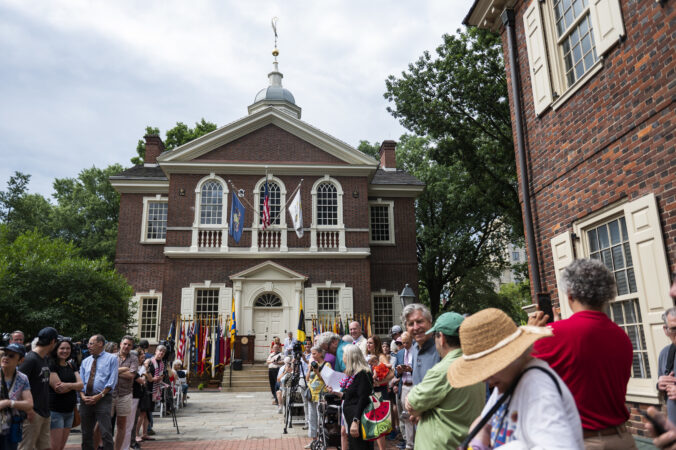
Executive director Michael Norris makes remarks at the reopening ceremony at Carpenters Hall on July 3, 2023.
Last week, Norris and others from Carpenters Hall traveled from Philadelphia — the state’s first capital— to Harrisburg to announce their yearlong schedule of events celebrating Pennsylvania’s founding, including those about the state’s constitution and its past and future.
At a news conference last week, Rep. Mary Isaacson (D., Philadelphia) noted that she occupies the seat once held by former Pennsylvania House Speaker Benjamin Franklin. She said she sees the Carpenters Hall events as “more than learning about a key moment in Pennsylvania history.”
“It’s also about exploring the vital importance of our state constitution in our democracy today and what citizens can do to engage,” she added.
The commemorative events include an interactive town hall series hosted in Philadelphia, Pittsburgh, Harrisburg, and Erie to discuss the importance of the Pennsylvania Provincial Conference in the United States’ founding. The group will also host several events at Carpenters Hall, including the installation of a blue historical marker outside the hall on June 18, in addition to a three-part virtual lecture series on Pennsylvania’s constitution.
The events, funded by America 250 PA and the Landenberger Family Foundation, are open to the public and intended to reach Pennsylvania’s “lifelong learners” who are interested in history and civics,as well as the legal community, who will be eligible for Continuing Legal Education credits for attending the virtual lectures, Norris said.
“To me, 250 is about reflection and engagement,” Norris said. “It’s not about parties and buildings. It’s really a moment to reflect and say, ‘What are we doing here? Do we still want this democracy, and how do we protect it and keep it going?’”
The Carpenters’ Company — the nation’s oldest craft guild, which built and still owns Carpenters Hall — will also conduct polling about how Pennsylvania’s constitution, as well as the U.S. Constitution, should be changed to better represent citizens in a modern time, Norris said. The poll results will be made public at an in-person event in Philadelphia on Sept. 28, the 250th anniversary of when the state constitution was ratified.
Historic flags are displayed outside at the reopening ceremony at Carpenters Hall on July 3, 2023. The building opened for the first time to the public since April 2022.
Rhode Island was the first colony to declare independence from England in May 1776, and Delaware became the first state in December 1787. Pennsylvania followed days after, and its constitution influenced the country’s founding documents. Pennsylvania’s expansive constitution — viewed as radical at the time — focused on personal freedoms and liberties in its “Declaration of Rights,” after which the Bill of Rights was modeled.
Carpenters Hall was the nation’s first privately owned historic landmark, and remains owned by the Carpenters’ Company today, which offers free admission for 150,000 visitors each year. Because it is privately owned, it is not overseen by the National Park Service, which has in recent weeks dismantled exhibits about slavery at the nearby President’s House Site in Independence National Park thatPresident Donald Trump’s administration contends “inappropriately disparage” the United States.