Tag: Donald Trump

  • The Philly School District’s admissions policy could be viewed as unconstitutional and discriminatory, federal judges rule

    The Philly School District’s admissions policy could be viewed as unconstitutional and discriminatory, federal judges rule

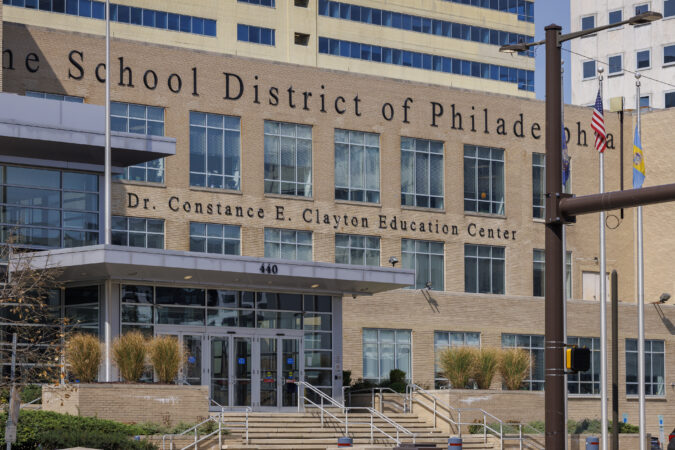
    A federal appeals court revived a lawsuit challenging the legality of Philadelphia School District’s special-admissions process Monday, ruling the policy could be seen as “blatantly unconstitutional” and ”race-based.”

    The U.S. Court of Appeals for the Third Circuit sent the case filed by three Philadelphia parents — which a federal judge tossed in 2024 — back to a lower court.

    The ruling could have long-term implications for the admission process for citywide magnet and special-admissions schools, which has been controversial since its inception.

    While it will have no immediate impact on the school district’s process, the ruling means the case could now proceed to trial.

    The district changed the way it admits students to criteria-based schools in 2021, moving from a system where principals had discretion over who got into the district’s 37 special-admissions schools to a centralized, computer-based lottery for any student who met academic criteria.

    For the city’s five top magnets, all students who met the standards and lived in certain underrepresented zip codes gained automatic admission.

    Officials at the time said they were changing the policy as they “made a commitment to being an antiracist organization” after an “equity lens review” of admissions practices.

    The demographics of some selective public schools do not match the city’s demographics. Masterman, for instance, has much higher concentrations of white and Asian students than the district does as a whole.

    Although the school district has defended its policy change, a panel of federal judges on Monday ruled that it could be viewed as discriminatory.

    “School District officials made public and private statements — both before and after the enactment of the Admissions Policy — that could support a finding that the Policy was intended to alter (and did alter) the racial makeup of the schools,” Judge Thomas Michael Hardiman wrote for the three-member panel.

    “So a reasonable fact finder could conclude that the School District acted with a discriminatory purpose,” the panel wrote. The panel included Hardiman, a George W. Bush appointee; Cheryl Ann Krause, a Barack Obama appointee; and Arianna Julia Freeman, a Joe Biden appointee.

    A district spokesperson said Monday that the school system does not comment on ongoing litigation.

    The legal team representing parents Sherice Sargent, Fallon Girini, and Michele Sheridan — including lawyers from America First, an organization formed by Stephen Miller, a top aide to President Donald Trump called the action “a major victory.”

    “School officials don’t get to rig admissions systems to satisfy ideological goals,” said Gene Hamilton, America First Legal’s president, and a former Trump deputy counsel. “This ruling affirms a basic constitutional principle: government cannot discriminate by race, whether openly or by proxy. AFL will continue fighting to secure accountability and restore equal protection.”

    What did the initial lawsuit argue?

    Sargent, Girini, and Sheridan sued in 2022 to end the policy, to stop the district from using “racially discriminatory criteria” for magnet school admissions, and to award damages to those who might have been damaged by the “gerrymandered lottery” policy.

    A federal judge ruled in favor of the school district in 2024 without a trial, writing that “no fair-minded jury could find that the changes to the admissions process were implemented with racially discriminatory intent or purpose.”

    The district has defended its position, saying it was geography, not race, that gave certain students preferential admission to magnets like Masterman, Central, the Academy at Palumbo, and George Washington Carver High School of Engineering and Science.

    Five admissions cycles have happened since the overhaul.

    Adjustments have been made since the initial rollout — including dropping a controversial, computer-graded essay, adding ranked choice, adding sibling preference, and giving automatic admission to students who attend middle schools with attached high schools and meet academic standards — but the underpinnings remain, as does the preference for qualified students from underrepresented zip codes at selected schools.

    Sargent’s daughter, who is Black, qualified academically for the George Washington Carver High School of Engineering and Science; Girini’s son, who is white, qualified for Academy at Palumbo; Sheridan’s child, who is biracial, met standards for Palumbo. All were denied admission to their top-choice schools, though they gained admission to other district magnets.

    As a result of the shift to the lottery — and changes to admissions criteria — admissions offers to Black and Hispanic students increased significantly at most of the highest-profile schools, and offers to white and Asian students decreased at most.

    What did Monday’s ruling say about the admissions policy?

    District lawyers have said the admissions overhaul “was race-neutral and motivated by legitimate goals, such as increasing objectivity and improving access for qualified students from underrepresented geographic areas.”

    But the appeals panel found that the federal judge who dismissed the case “did not adequately consider the evidence of why the School District implemented the Policy in the first place, including the School District’s stated goals, the historical context behind the ‘equity’ aims, and statements made by School District officials.”

    Before the admissions changes took effect, then-Superintendent William R. Hite Jr. issued an anti-racism declaration in 2020 following the killing of George Floyd by Minneapolis police and the resulting racial justice movement.

    Hite said it was “imperative that we take a laser focus on acknowledging and dismantling systems of racial inequity. For us, this goes deeper and far beyond focusing on individual acts of prejudice and discrimination, but refers to uprooting policies, deconstructing processes, and eradicating practices that create systems of privilege and power for one racial group over another.”

    The school board also included in its Goals and Guardrails, guiding principles by which it judges district progress, a guardrail asking the district to increase the percentage of qualified Black or Hispanic students who qualify for criteria-based schools.

    “These statements and actions, taken together in context, could support a finding that the School District adopted the Admissions Policy to achieve racial proportionality,” the appeals panel wrote.

    What comes next?

    Monday’s ruling has no impact on the existing admissions process, which is already underway for the 2026-27 school year.

    And it is not yet clear what will come of the case after it returns to a lower federal court, but it could potentially now proceed to trial.
  • Trump wants to ‘nationalize the voting,’ seeking to grab states’ power

    Trump wants to ‘nationalize the voting,’ seeking to grab states’ power

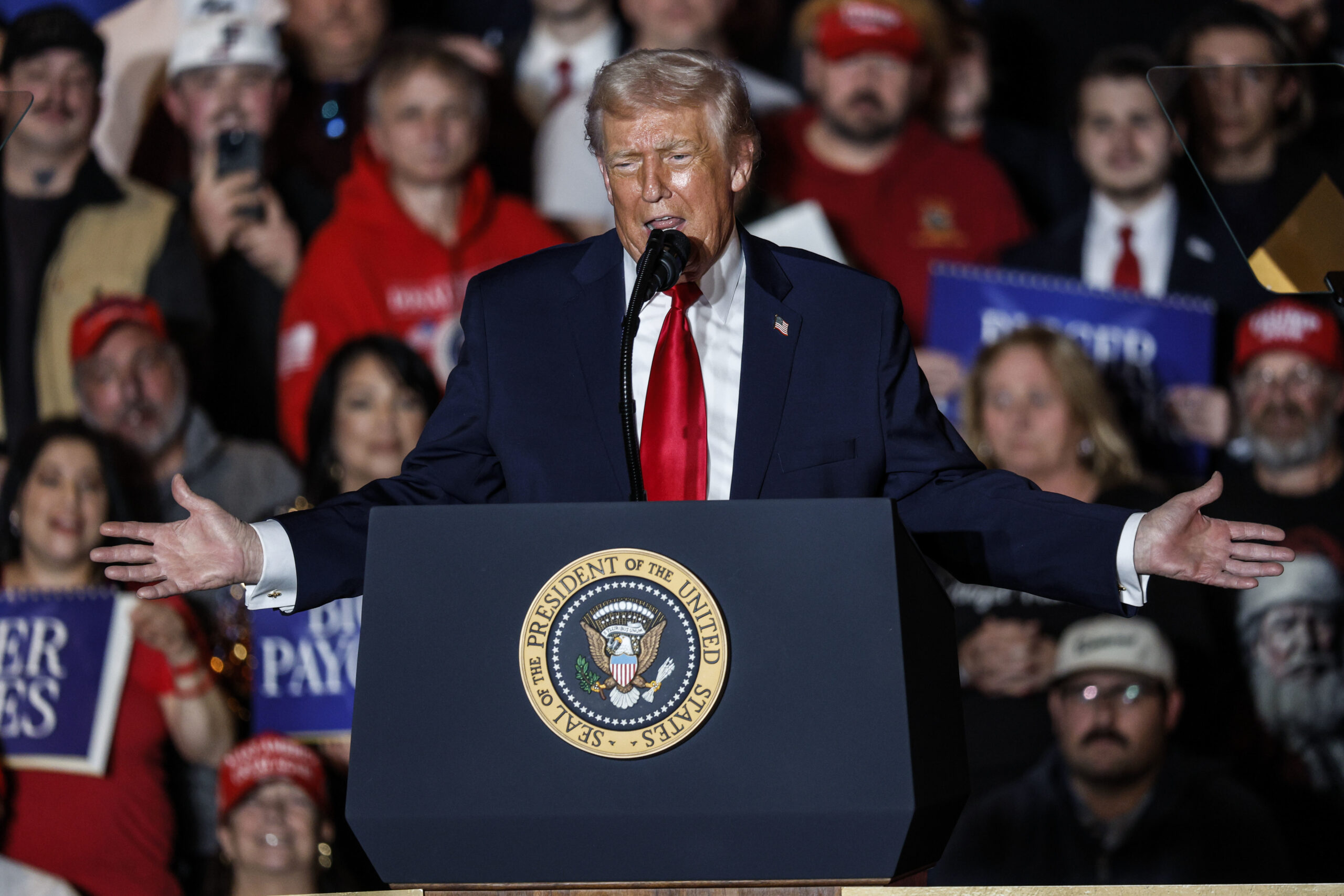
    President Donald Trump said Monday that Republican lawmakers should nationalize voting — claiming a power explicitly granted to states in the U.S. Constitution.

    Speaking to right-wing podcaster Dan Bongino, who recently stepped down from his role as the FBI’s deputy director, Trump again falsely alleged that the 2020 election was stolen from him, and he urged Republicans to “take over” elections and nationalize the process.

    “We should take over the voting, the voting, in at least 15 places,” Trump told Bongino. “The Republicans ought to nationalize the voting.”

    President Donald Trump speaks in Mt. Pocono, Pa., on Tuesday, Dec. 9, 2025.

    Under the Constitution, the “Times, Places and Manner” of holding elections are determined by each state, not the federal government. Congress has the power to set election rules, but the Constitution does not give the president any role on that subject. Republicans in recent decades have often argued in favor of states’ rights and against a powerful federal government.

    Trump’s demand comes less than a week after the FBI executed a search warrant at a warehouse in Fulton County, Georgia, which is at the heart of right-wing conspiracy theories about the 2020 election. The unusual warrant authorized agents to seize all physical ballots from the 2020 election, voting machine tabulator tapes, images produced during the ballot count and voter rolls from that year. Days before the search, Trump claimed in a speech at the Davos World Economic Forum that the 2020 election was rigged.

    On Monday, while speaking to Bongino, Trump said without offering evidence that there are “states that are so crooked” and that there are “states that I won that show I didn’t win.” He also baselessly claimed that undocumented immigrants were allowed to vote illegally in 2020.

    He then teased that there will be “some interesting things come out” of Georgia, but did not discuss the FBI warrant or its findings.

    While Trump has repeatedly and baselessly accused states such as Georgia of running fraudulent elections, U.S. national security officials have said they found no evidence of widespread fraud in the 2020 election, and numerous courts rejected claims of election irregularities as unfounded.

    This is not the first time Trump has tried to minimize states’ roles in the running of elections. In August, while complaining in a Truth Social post about mail-in voting, Trump said he would sign an executive order that would “help bring HONESTY” to this year’s midterm elections, arguing that states are meant to follow federal instructions when it comes to voting.

    “Remember, the states are merely an ‘agent’ for the Federal Government in counting and tabulating the votes,” Trump wrote then. “They must do what the Federal Government, as represented by the President of the United States, tells them, FOR THE GOOD OF OUR COUNTRY, to do.”

    It is not clear what Republicans in Congress could do if they were to “take over” elections, as Trump suggested. While Congress has exercised its power on elections rules throughout history by, for example, creating a national Election Day, or by requiring states to ensure that their voter rolls are accurate, lawmakers have historically allowed states to run elections under their own laws and procedures.

  • Janelle Stelson almost beat Scott Perry in 2024. She keeps outraising him as she prepares for a rematch.

    Janelle Stelson almost beat Scott Perry in 2024. She keeps outraising him as she prepares for a rematch.

    Democrat Janelle Stelson outraised U.S. Rep. Scott Perry for the second quarter in a row in her bid to flip the Central Pennsylvania district, which could determine control of the House in November.

    Stelson, who lost by a little more than 1 percentage point to Perry in 2024, has raised more than $2.2 million since launching her rematch campaign in July. She has outraised Perry in both quarters since her kickoff and has more cash on hand than the incumbent Republican when taking his campaign debt into consideration.

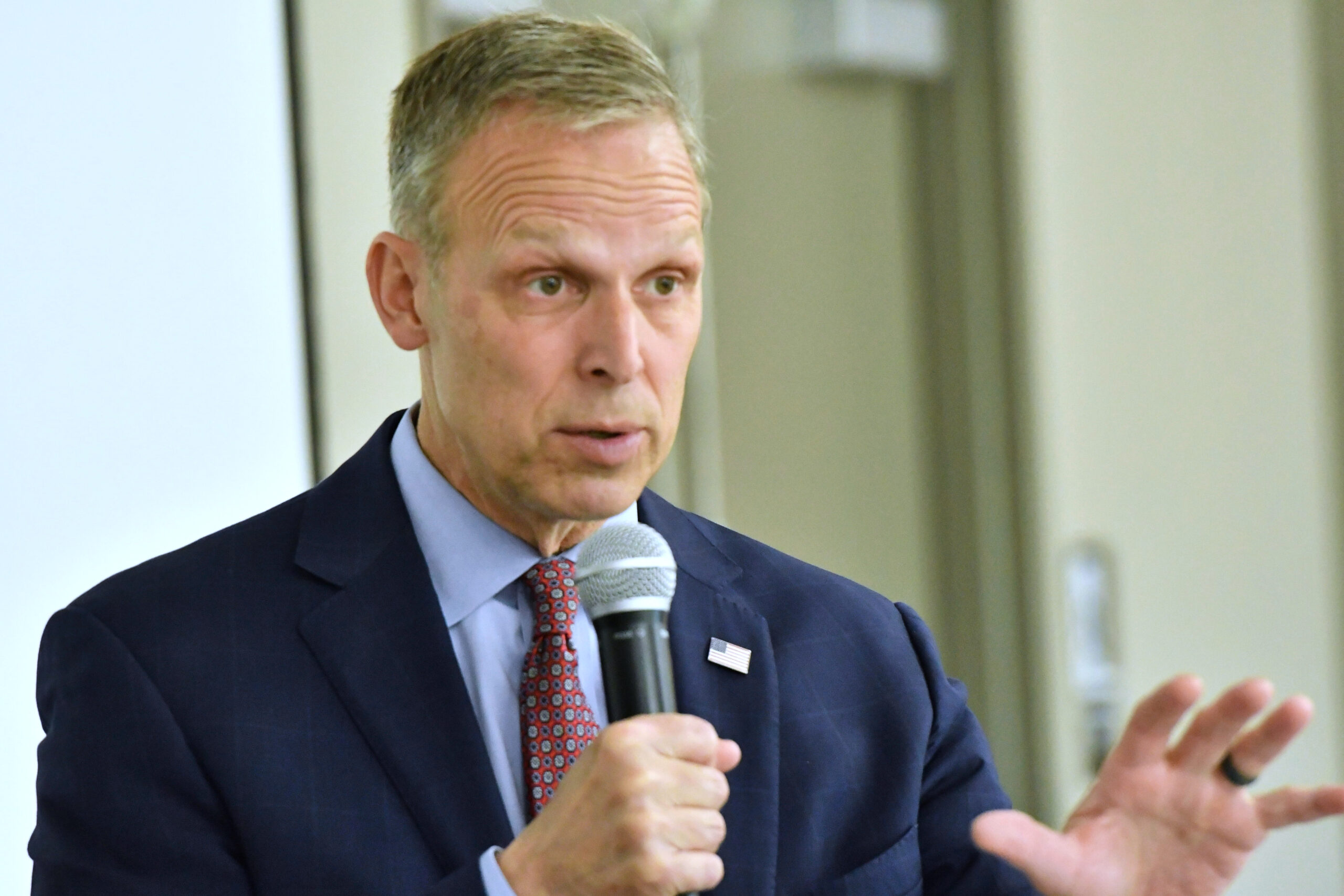
    Perry, a close ally of President Donald Trump, appears to be in the toughest fight of his political career. The seven-term lawmaker continues to be a Trump loyalist even as other swing-district Republicans in the state increasingly look to distance themselves from the president.

    Stelson’s strong fundraising haul indicates Democrats think they can finally flip the seat this year in a more favorable environment after Stelson came close in 2024 even though Trump carried the state and led a red wave.

    Stelson, a former TV anchor and former Republican, has again rooted her campaign in attacks on Perry and Trump. She thinks it will work this time.

    “I think the story of Scott Perry just keeps getting worse,” Stelson, 65, said in an interview. “He’s somebody who I covered for years on the news, and people have just really had enough. After more than a decade in Washington, he’s caused a lot of problems.”

    Perry, 63, a member of the conservative House Freedom Caucus, voted last month against a Democratic-led bill to restore recently expired healthcare subsidies amid a national spike in insurance premiums, a vote Stelson has seized upon. Three other Pennsylvania Republicans who represent swing districts — U.S. Reps. Brian Fitzpatrick, Rob Bresnahan, and Ryan Mackenzie — voted for the measure.

    Stelson would need to win the Democratic primary in May to set up the November rematch. She is facing Dauphin County Commissioner Justin Douglas, a progressive pastor, who has raised under $85,000 this year. Perry also has his first primary challenge, from Karen Dalton, a retired attorney for Harrisburg Republicans, who reported raising a little more than $11,000 since launching her campaign.

    Perry raised more than $2.9 million in 2025, and Stelson has raised $2.2 million since she launched her campaign in July. Stelson raised more than $946,000 from October through December, beating Perry’s haul for the quarter of $780,031.

    Stelson ended the year with $1.52 million cash on hand, while Perry had $1.66 million. But Perry’s campaign also has nearly $280,000 in debt, which would put Stelson ahead when factored into the totals.

    FILE – U.S. Rep. Scott Perry, R-Pa., speaks during a campaign event in front of employees at an insurance marketing firm, Oct. 17, 2024, in Harrisburg, Pa.

    The nonpartisan Cook Political Report rated the district as a toss-up alongside Mackenzie’s Lehigh Valley district, marking them as among the most competitive races in the country.

    Perry campaign spokesperson Matt Beynon said Perry’s fundraising last quarter was “incredibly strong” and pointed to how he outraised fellow swing district Republicans Bresnahan and Mackenzie during that stretch.

    Beynon said Perry is in a better position to ward off a Democratic challenge this year because his district has emerged as a priority for national Republicans, landing on the National Republican Congressional Committee’s Patriots Program — a list of priority races that he was not on in 2024.

    “Seeing the results last go-around, and seeing how hard we fought to make sure that the congressman was reelected, I think did open some eyes, and the congressman has been able to make the case that he needs support, too,” Beynon said in an interview.

    He said it has been “a learning experience for folks to understand” that the district has become increasingly blue in recent years. The 10th Congressional District includes Dauphin County and parts of York and Cumberland Counties, and is home to Harrisburg and Hershey.

    Perry declined to be interviewed for this article.

    Stelson said Republican voters in the district who have historically voted along party lines are “really waking up” and are beginning to view Perry as more of an “extremist” than a Republican.

    She criticized Perry for urging his colleagues to throw out Pennsylvania’s votes hours after the Jan. 6, 2021, attack on the Capitol. She also pointed to his vote against awarding the Congressional Gold Medal to Capitol Police officers, as well as his support for Trump’s One Big Beautiful Bill Act, which made cuts to Medicaid and SNAP in order to help fund Trump’s tax cuts and immigration crackdown.

    “He’s always putting his far-right politics ahead of the needs of people in this area,” Stelson said. “They can’t pay their bills. … His defeat actually would be a defeat for extremism in our politics.”

    Democrats are optimistic that having Gov. Josh Shapiro, who won the district in 2022, at the top of the ticket will boost Stelson’s chances and build on last year’s momentum in local races.

    Perry’s campaign has called Stelson a “carpetbagger,” since she lived outside district lines in nearby Lancaster last time she ran. Stelson has argued that she knows the district well because of her decades-long career as a local journalist, and that she used to live in it.

    Stelson campaign spokesperson Alma Baker confirmed Stelson now rents a home in the district in Camp Hill while still owning her Lancaster residence, noting she lives in the district full-time.

    Stelson pointed to what she described as “national problems” when asked about unique issues in the district, such as the economy. Her campaign soon after unveiled an agenda aimed at supporting farmers and other rural residents.

    Beynon said that Perry will speak about his support for provisions in Trump’s One Big Beautiful Bill Act like ending tax on tips and extending tax benefits for overtime. He will also point to his long-held position sponsoring a bill to ban stock trading in Congress, on which he has collaborated with Democrats.

    Both candidates plan to talk about affordability, which has emerged as a successful message for both sides of the aisle.

    “It’s just getting worse when you have to worry about whether you’re going to put groceries on the table or pay your skyrocketing utility premiums, that’s a real problem,” Stelson said. “You can’t send kids to school without something in their tummies, otherwise they’re going to be thinking about that all day instead of learning.”

    As a broadcast journalist for decades, the second-time candidate said, she listened to and highlighted concerns from people in the district.

    “And I feel like now they can teach me what I need to be doing in Congress when I carry their voices there,” she added.

  • Philly DA Larry Krasner says ‘don’t be a wimp’ after Gov. Josh Shapiro decried his comparison of ICE agents to Nazis

    Philly DA Larry Krasner says ‘don’t be a wimp’ after Gov. Josh Shapiro decried his comparison of ICE agents to Nazis

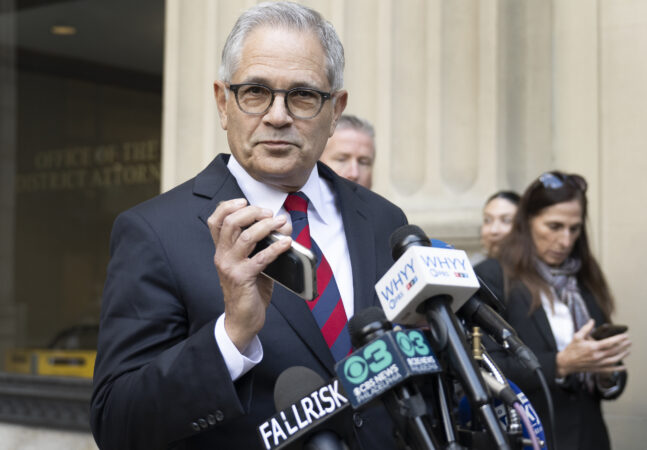
    Philadelphia’s bombastic district attorney, Larry Krasner, is no stranger to opposition from within his own party, but the anger directed at him last week after he said ICE agents are “wannabe Nazis” was more pronounced than usual.

    After making the comparison, Krasner faced a wave of criticism, including from Pennsylvania Gov. Josh Shapiro, a Democrat, who called the comments “abhorrent” and said the rhetoric doesn’t help “bring down the temperature.”

    But the progressive district attorney said Monday that he would not back down, saying “these are people who have taken their moves from a Nazi playbook and a fascist playbook.”

    “Governor Shapiro is not meeting the moment,” Krasner said in an interview. “The moment requires that we call a subgroup of people within federal law enforcement — who are killing innocent people, physically assaulting innocent people, threatening and punishing the use of video — what they are. … Just say it. Don’t be a wimp.”

    Krasner pointed to a speech by Rabbi Joachim Prinz at the March on Washington in 1963: “Bigotry and hatred are not the most urgent problem. The most urgent, the most disgraceful, the most shameful, and the most tragic problem is silence.”

    In invoking that speech, Krasner said: “A reminder, Mr. Governor: Silence equals death.”

    Krasner’s defense came after days of criticism from across the political spectrum, ranging from the White House press secretary to Democratic members of Congress. And it punctuated a yearslong history of conflict with Shapiro.

    The governor and Philadelphia’s top law enforcement official have feuded politically, sparred in court, and disagreed on policy. In 2019 — when lawyers from Krasner’s office decamped to work for then-Attorney General Shapiro — DA’s office staffers referred to Shapiro’s office as “Paraguay,” a reference to the country where Nazis took refuge after the war.

    It is not new for Krasner — whose Jewish father volunteered to serve in WWII — to compare President Donald Trump’s administration to elements of World War II-era fascism. Krasner has on several occasions referred to ICE as akin to the Nazi secret state police, and last year he called the president’s immigration agenda “Nazi stuff.”

    Last week, during a news conference about proposed restrictions on immigration enforcement in Philadelphia, the district attorney said he would “hunt down” and prosecute U.S. Immigration and Customs Enforcement agents who commit crimes in the city.

    “There will be accountability now. There will be accountability in the future. There will be accountability after [Trump] is out of office,” Krasner said. “If we have to hunt you down the way they hunted down Nazis for decades, we will find your identities.”

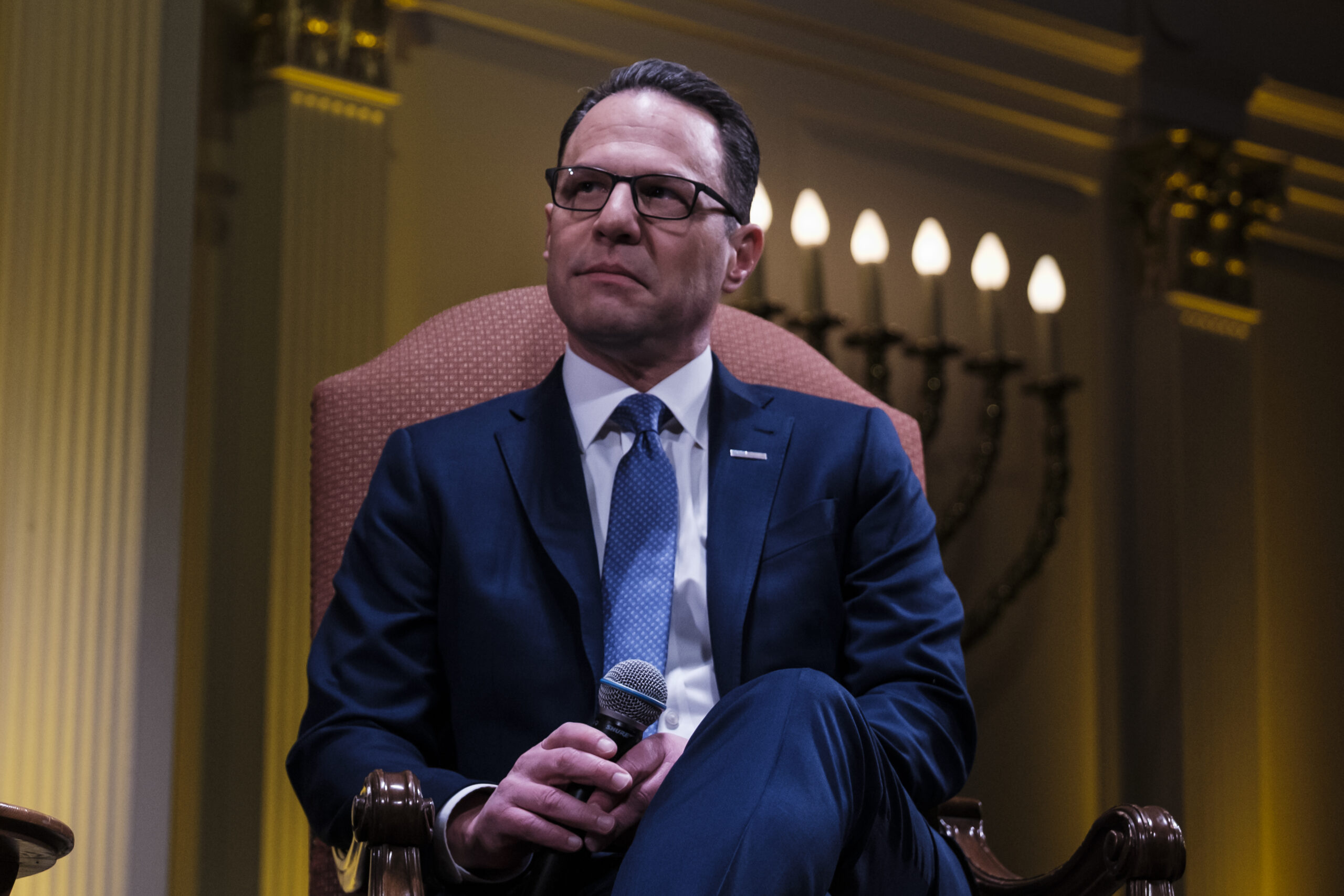
    Pennsylvania Gov. Josh Shapiro during a talk for his new memoir “Where We Keep the Light” on Jan. 29 in Washington.

    Shapiro, who is Jewish and is a rumored presidential contender, was interviewed a dozen times last week on national media while promoting his new memoir and condemned ICE’s tactics during all of them.

    During an interview Thursday on Fox News’ Special Report with Bret Baier, Shapiro was asked about Krasner’s comparison of ICE agents to Nazis and called the comments “unacceptable.”

    “It is abhorrent and it is wrong, period, hard stop, end of sentence,” Shapiro said.

    Several other Democrats in political and media circles weighed in. U.S. Sen. John Fetterman, a Pennsylvania Democrat who has at times sided with Trump on immigration matters, appeared on Fox News and said he “strongly” condemned Krasner’s language.

    He said that “members of ICE are not Nazis.”

    “That’s gross,” Fetterman said. “Do not compare anyone to Nazis. Don’t use that kind of rhetoric. That can incite violence.”

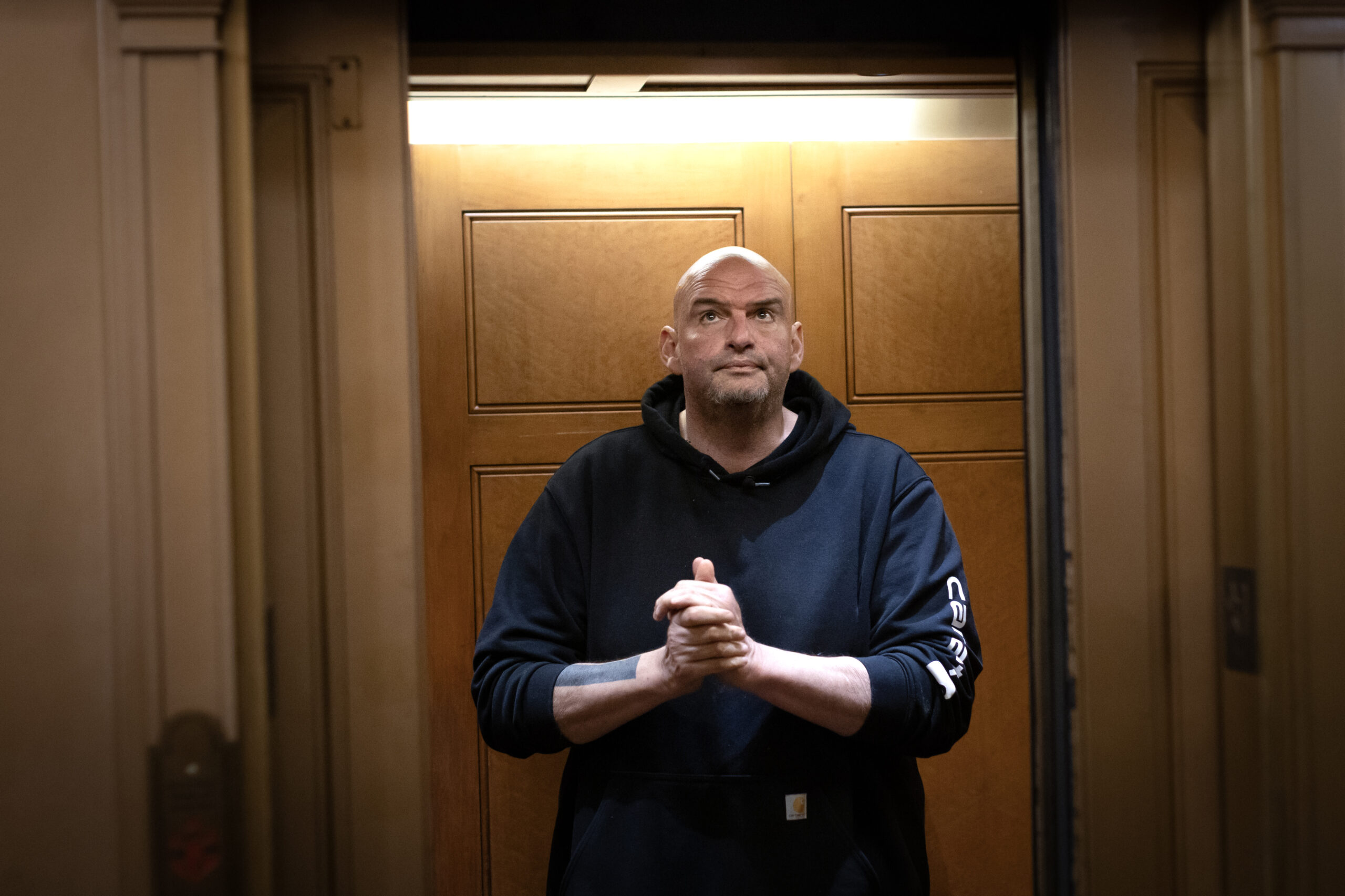
    Sen. John Fetterman (D., Pennsylvania).

    U.S. Rep. Chris Deluzio, a Democrat who represents parts of Western Pennsylvania, in an interview with the Washington Examiner contrasted his own approach with Krasner’s, saying: “I reserve throwing the phrase Nazis at actual Nazis. I don’t just throw that around.”

    And State Rep. Manuel Guzman Jr., a Democrat who represents a significant Latino population in Berks County, wrote on social media Friday: “I really, really want Krasner to chill tf out.”

    “I get it. We want to protect our immigrant community,” Guzman wrote, “but I question if constantly poking the bear is the right strategy. At the end of the day it’s my community that is under siege.”

    Republicans also swiftly castigated Krasner.

    On Wednesday, White House Press Secretary Karoline Leavitt shared a video clip of Krasner’s comments on social media, writing: “Will the media ask Dems to condemn?”

    And U.S. Rep. Dan Meuser, a Republican who represents parts of Northeast Pennsylvania, appeared on Newsmax and called Krasner a “psychopath with a badge.”

    Meuser — who considered challenging Shapiro for governor with Trump’s backing but ultimately decided not to run — also on social media decried “the Left’s silence and, in many cases, encouragement of this rhetoric.”

    Krasner doubled down. In an interview on CNN on Thursday, he criticized Fetterman as “not a real Democrat” and also said, “There are some people who are all in on the fascist takeover of this country who do not like the comparison to Nazi Germany.”

    He said that when he promised to “hunt down” federal agents who kill someone in his jurisdiction, he was attempting to make a point that there is no statute of limitations on homicide.

    The interviewer, Kaitlan Collins, asked Krasner whether he could have made that point without comparing agents to Nazis.

    “Why would I do that?” Krasner responded. “They’re taking almost everything they do out of the Nazi playbook.”

  • Immigrants are a ‘main driver’ of the Philadelphia economy, local leaders say

    Immigrants are a ‘main driver’ of the Philadelphia economy, local leaders say

    Foreign nationals are facing increasing challenges to working and studying in the U.S., but their contributions to the Philadelphia economy are critical, local business leaders say, painting a grim picture of Philadelphia’s future with fewer of them.

    In Philadelphia, “immigrants are not a side factor when it comes to our economy. They are a main driver,” Alain Joinville, from the city’s Office of Immigrant Affairs, said at a panel discussion, hosted last week by the Economy League of Greater Philadelphia, in partnership with immigration-reform organization FWD.us.

    The foreign-born population has supported Philadelphia’s workforce growth in recent years. Between 2010 and 2022, the immigrant workforce grew by 50% from 105,600 to 158,300, according to the Pew Charitable Trusts. In 2022, the foreign-born population represented 15.7% of the total Philadelphia population.

    But over the past year, President Donald Trump’s administration has pushed to carry out the largest deportation effort in the country’s history, and put forward a plan to charge employers $100,000 to secure H-1B visas for their employees. ICE agents have detained immigrants across the region.

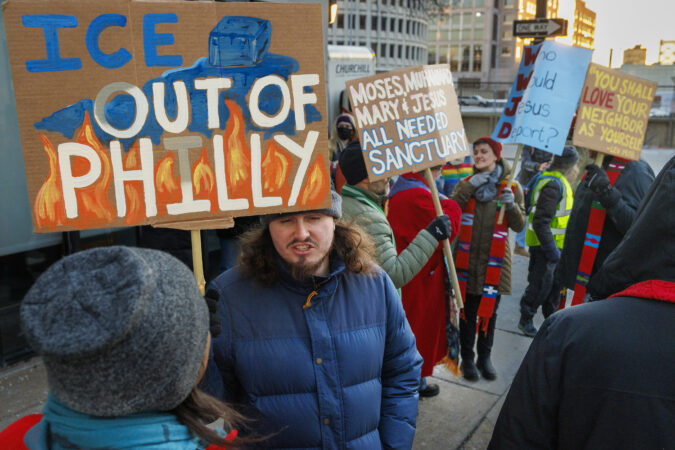
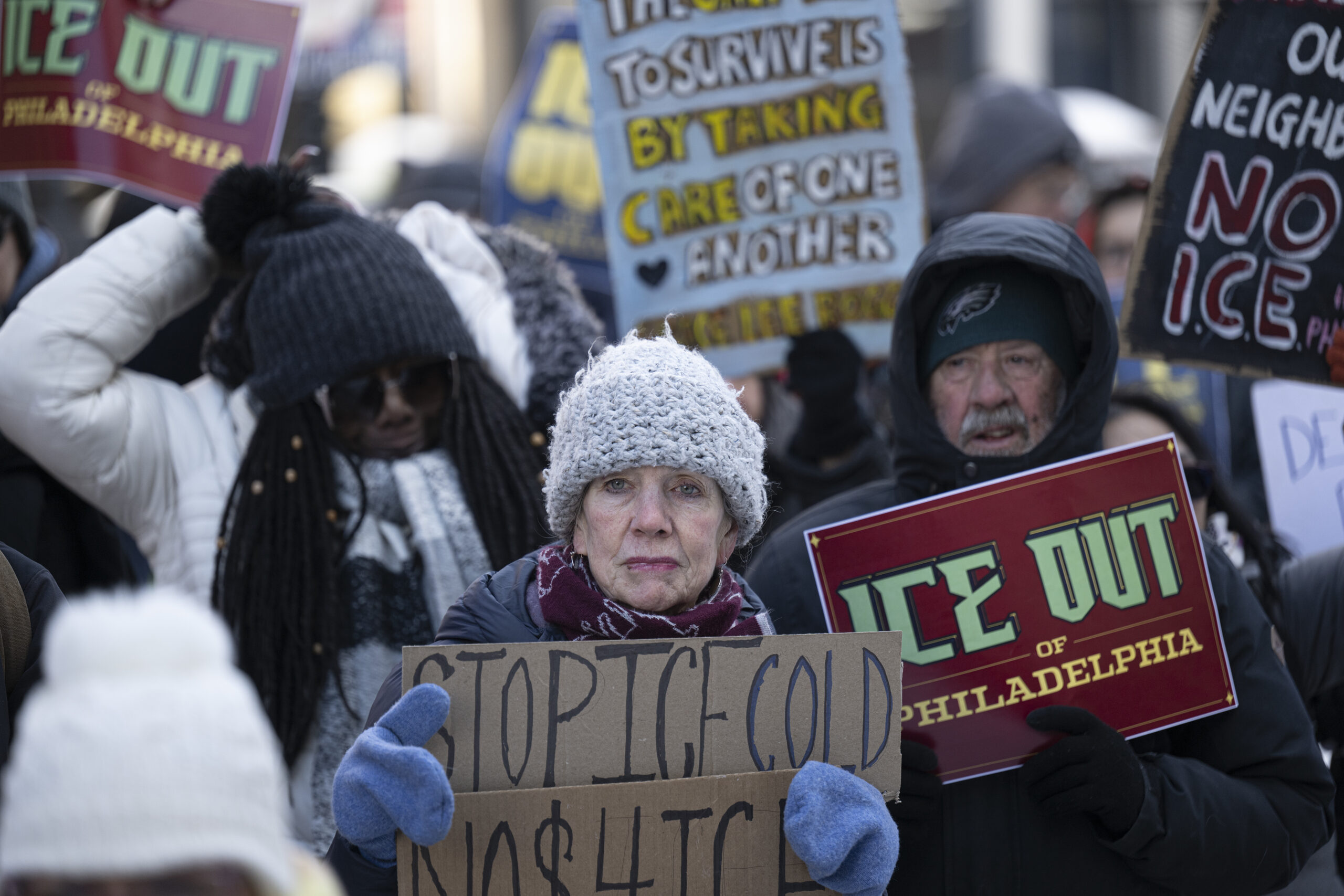
    Anti-ICE activists demonstrate outside U.S. Sen. John Fetterman’s Philadelphia office on Jan. 27, 2026, calling for an end to federal immigration enforcement policies.

    “If we have policies that are disrupting families, detaining people, sending people back, that’s a huge part of our economy that impacts manufacturing, transportation of all the goods and services that we manufacture,” said Elizabeth Jones, of immigrant-support nonprofit the Welcoming Center. “The ripple effect is scary in terms of how it’s going to impact the economy.”

    Potential to lose the research edge

    While the U.S is a global leader in research universities, it could be losing that grip, said Amy Gadsden, from the University of Pennsylvania’s Global Initiatives. Having the best research universities in the world requires the best talent — namely international students that also become faculty, she noted.

    Penn has roughly 9,000 international students and an additional 2,000 faculty, postdoc students, and others who “drive a lot of economic activity, both for Penn and for the city of Philadelphia — for the country, for that matter,” she said.

    International student enrollments are down across the country, and students are being cautious about where they apply.

    “There is not a guidance counselor around the world who is advising their student not to hedge their application to the United States with an application to another country,” she said.

    A view over Walnut Street on the University of Pennsylvania campus, with the Philadelphia skyline at left rear.

    Penn, Philadelphia’s largest employer, depends on international students, said Gadsden. “When we think about what is going on with visa policy in the United States, what we see is a decrease in international students, a decrease in international faculty, a decrease in research output, that will ultimately lead to a decrease in our position as a leading research university in the world,” she said.

    A challenge for employers

    Jennifer Rodriguez, president and CEO of the Greater Philadelphia Hispanic Chamber of Commerce, highlighted the challenge employers can face under the new fee for H-1B visas.

    “Immigrants and the foreign-born population in general is one that is critical for the economic health of the city of Philadelphia and the region,” she said.

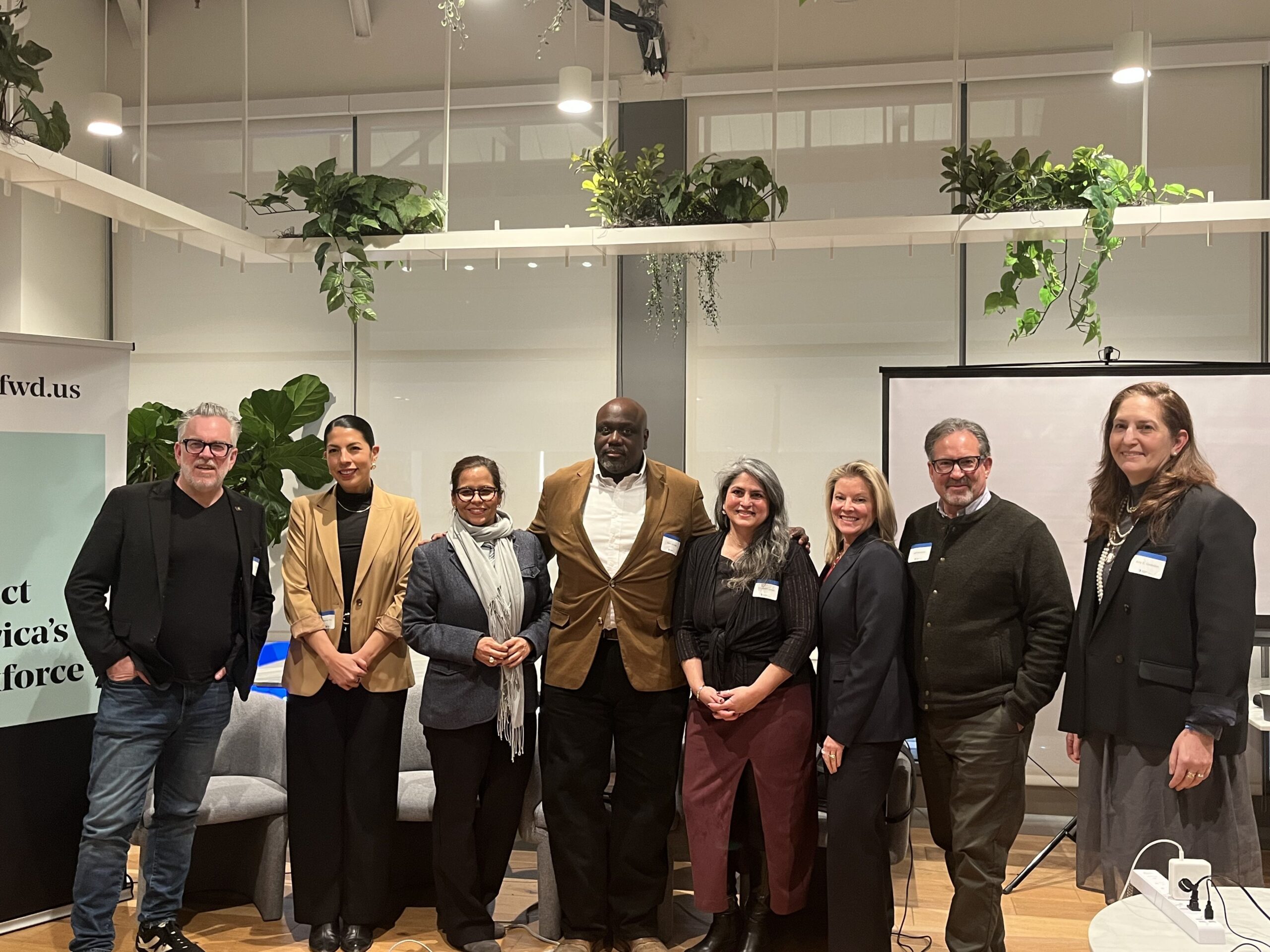
    The Economy League of Greater Philadelphia held a panel discussion in collaboration with FWD.us. From left are Ben Fileccia, Pennsylvania Restaurant & Lodging Association; Maria Praeli, FWD.us; Jennifer Rodriguez, Greater Philadelphia Hispanic Chamber of Commerce; Alain Joinville, Philadelphia’s Office of Immigrant Affairs; Elizabeth Jones, the Welcoming Center; Tracy Brala, University City Science Center; Jeff Hornstein, the Economy League of Greater Philadelphia; Amy Gadsden, University of Pennsylvania.

    Rodriguez described the additional $100,000, which is on top of other expected visa processing costs, as exorbitant. While some large businesses might have resources to handle it, she said, middle-market companies will be more challenged.

    “Philadelphia is desperate to get more of those businesses to establish here, and now you’re making it that much harder,” said Rodriguez. “We are really curtailing the ability of these businesses to innovate, to hire, to really be the contributors to the economy that we want them to be.”

    Immigrants in Philadelphia are of prime working age, noted Joinville, from the city’s Office of Immigrant Affairs.

    “Without immigrants, we have a smaller workforce to drive and support our businesses locally,” he said, adding that immigrants start small businesses at a high rate in Philadelphia.

    “As a child of immigrants, focusing on the economy can be a little tricky for me, because we’re not just data or money or economy,” said Joinville. “Yes, immigrants have an economic impact, but they are cultural leaders, civic leaders, and, yeah, just good people.”

  • The Justice Department released 3 million pages from its Jeffrey Epstein files

    The Justice Department released 3 million pages from its Jeffrey Epstein files

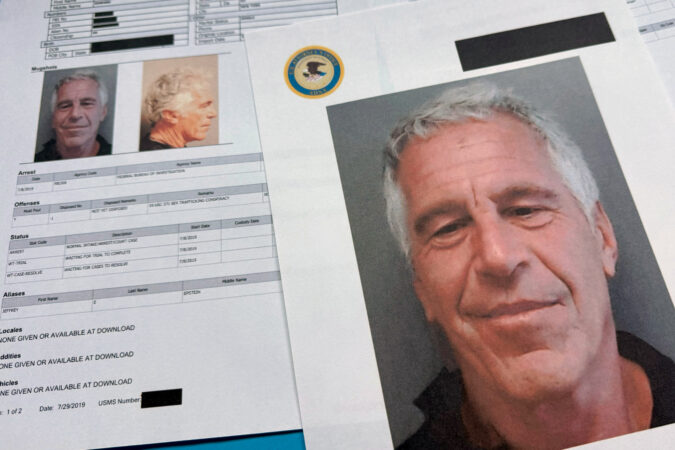
    NEW YORK — The Justice Department on Friday released many more records from its investigative files on Jeffrey Epstein, resuming disclosures under a law intended to reveal what the government knew about the millionaire financier’s sexual abuse of young girls and his interactions with rich and powerful people such as Donald Trump and Bill Clinton.

    Deputy Attorney General Todd Blanche said the department would be releasing more than 3 million pages of documents in the latest Epstein disclosure, as well as more than 2,000 videos and 180,000 images. The files, posted to the department’s website, include some of the several million pages of records that officials said were withheld from an initial release in December.

    Included in the batch were records concerning some of Epstein’s famous associates, including Andrew Mountbatten-Windsor, formerly known as Britain’s Prince Andrew, as well as email correspondence between Epstein and Elon Musk and other prominent contacts from across the political spectrum.

    The documents were disclosed under the Epstein Files Transparency Act, the law enacted after months of public and political pressure that requires the government to open its files on the late financier and his confidant and onetime girlfriend, Ghislaine Maxwell. Lawmakers complained when the Justice Department made only a limited release last month, but officials said more time was needed to review an additional trove of documents that was discovered and to scour the records to ensure no sensitive information about victims was inadvertently released.

    “Today’s release marks the end of a very comprehensive document identification and review process to ensure transparency to the American people and compliance with the act,” Blanche said at a news conference announcing the disclosure.

    Friday’s disclosure represents the largest document dump to date about a saga the Trump administration has struggled for months to shake because of the president’s previous association with Epstein. State and federal investigations into the financier have long animated online sleuths, conspiracy theorists and others who have suspected government cover-ups and clamored for a full accounting, demands that even Blanche acknowledged might not be satisfied by the latest release.

    “There’s a hunger, or a thirst, for information that I don’t think will be satisfied by the review of these documents,” he said.

    After missing a Dec. 19 deadline set by Congress to release all the files, the Justice Department said it tasked hundreds of lawyers with reviewing the records to determine what needed to be redacted, or blacked out. But it denied any effort to shield Trump, who says he cut ties with Epstein years ago despite an earlier friendship, from potential embarrassment.

    “We did not protect President Trump. We didn’t protect — or not protect — anybody,” Blanche said.

    Among the materials withheld is information that could jeopardize any ongoing investigation or expose the identities of potential victims of sex abuse. Women other than Maxwell were redacted from videos and images being released Friday, Blanche said.

    The number of documents subject to review ballooned to roughly 6 million, including duplicates.

    Epstein’s famous friends

    The latest batch of documents include correspondence either with or about some of Epstein’s friends.

    Mountbatten-Windsor’s name appears at least several hundred times in the documents, sometimes in news clippings, sometimes in Epstein’s private email correspondence and in guest lists for dinners organized by Epstein. Some of the records also document an attempt by prosecutors in New York to get the former prince to agree to be interviewed as part of their Epstein sex trafficking probe.

    The records also show that Musk, the billionaire Tesla founder, reached out to Epstein on at least two separate occasions to plan visits to the Caribbean island where many of the allegations of sexual abuse purportedly occurred.

    In a 2012 exchange, Epstein inquired how many people Musk would like flown by helicopter to the island he owned — Little Saint James in the U.S. Virgin Islands.

    “Probably just Talulah and me,” Musk responded, referencing his partner at the time, actress Talulah Riley. “What day/night will be the wildest party on our island?”

    Musk messaged Epstein again ahead of a planned trip to the Caribbean in December 2013. “Will be in the BVI/St Bart’s area over the holidays,” he wrote. “Is there a good time to visit?” Epstein responded by extending an invite for sometime after the New Year holiday.

    It’s not immediately clear if the island visits took place. Spokespersons for Musk’s companies, Tesla and X, didn’t immediately respond to emails seeking comment.

    Musk has maintained that he repeatedly turned down the disgraced financier’s overtures.

    “Epstein tried to get me to go to his island and I REFUSED,” he posted on X in 2025 when House Democrats released an Epstein calendar with an entry mentioning a potential Musk visit to the island.

    The documents also contain hundreds of friendly text messages between Epstein and Steve Bannon during Trump’s first term.

    Bannon, a conservative activist who served as Trump’s White House strategist earlier in the president’s first term, bantered over politics with the financier, discussed get-togethers with him over breakfast, lunch or dinner and, on March 29, 2019, asked Epstein if he could supply his plane to pick him up in Rome: “Is it possible to get your plane here to collect me?”

    Epstein told him his pilot and crew “are doing their best” to arrange that flight but if Bannon could find a charter flight instead, “I’m happy to pay.” Apparently in France at the time, Epstein followed up with a text saying: “My guys can pick you up. Come for dinner.” The exchange did not show how that played out.

    On one occasion in December 2012, Epstein invited Howard Lutnick — now Trump’s commerce secretary — to his private island in the Caribbean for lunch, documents released Friday show. Lutnick’s wife, Allison Lutnick, enthusiastically accepted the invitation and said they would arrive on a yacht with their children. On another occasion in 2011, the two men had drinks, according to a schedule shared with Epstein.

    Lutnick has tried to distance himself from Epstein, saying in a 2025 interview that he cut ties decades ago and calling him “gross.” He didn’t respond to a request for comment Friday.

    During Trump’s first term, Epstein emailed Kathy Ruemmler, a lawyer and former Obama White House official, to warn that Democrats should stop demonizing Trump as a Mafia-type figure even as he derided the president as a “maniac.”

    A spokesperson for Goldman Sachs, where Ruemmler serves as general counsel and chief legal officer, said in a statement that Ruemmler “had a professional association with Jeffrey Epstein when she was a lawyer in private practice” and “regrets ever knowing him.”

    Building on the earlier release

    The Justice Department released tens of thousands of pages of documents just before Christmas, including photographs, interview transcripts, call logs and court records. Many were either already public or heavily blacked out.

    They included previously released flight logs showing Trump flew on Epstein’s private jet in the 1990s, before they had a falling-out, and several photographs of Clinton. Neither Trump, a Republican, nor Clinton, a Democrat, has been publicly accused of wrongdoing in connection with Epstein. Both have said they had no knowledge he was abusing underage girls.

    Epstein killed himself in a New York jail cell in August 2019, a month after he was indicted on federal sex trafficking charges.

    In 2008 and 2009, Epstein served jail time in Florida after pleading guilty to soliciting prostitution from someone under the age of 18. At the time, investigators had gathered evidence that Epstein had sexually abused underage girls at his Palm Beach home. The U.S. attorney’s office agreed not to prosecute him in exchange for his guilty plea to lesser state charges.

    In 2021, a federal jury in New York convicted Maxwell, a British socialite, of sex trafficking for helping recruit some of his underage victims. She is serving a 20-year prison sentence at a prison camp in Texas, after being moved there from a prison in Florida. She denies any wrongdoing.

    U.S. prosecutors never charged anyone else in connection with Epstein’s abuse of girls, but one of his victims, Virginia Roberts Giuffre, accused him in lawsuits of having arranged for her to have sexual encounters at age 17 and 18 with numerous politicians, business titans, noted academics, and others, all of whom denied her allegations.

    Among those she accused was Britain’s Prince Andrew, who was stripped of his royal titles amid the scandal. Andrew denied having sex with Giuffre but settled her lawsuit for an undisclosed sum.

    Giuffre died by suicide last year at age 41.

  • Sharpies, colored paper, and sandwich boards become resistance art at the President’s House site

    Sharpies, colored paper, and sandwich boards become resistance art at the President’s House site

    The resistance was born on a Friday morning at the Gen. George A. McCall School photocopy machine.

    The copier spat the message out on yellow, purple, and orange paper — page after page amplifying the same sentiment scrawled on each in big black letters: Learn all history.

    In the aftermath of the removal of the slavery exhibit at the President’s House Site on Jan. 22, fourth-grade social studies teacher Kaity Berlin wanted to convert her rage into something productive, she said. She quickly thought of the words on one of her shirts: “Teach all history.” So she gathered some teacher friends, took to the photocopier, and headed to Independence National Historical Park.

    Berlin wasn’t the only one who saw the shallow silver frames at the President’s House as a void screaming to be filled.

    The exhibit included a series of signs describing what life was like for those enslaved by George Washington at the site and his complicated relationship with the institution of slavery. The exhibit was dismantled last week, several months after President Donald Trump and Interior Secretary Doug Burgum issued an order requiring the review and potential removal of displays at the national parks that “inappropriately disparage” the United States.

    The city asked a federal justice to order that no more exhibits be removed from the President’s House and that the exhibits that were already removed be kept safe. In a hearing Friday, judge Cynthia M. Rufe didn’t issue a ruling but asked the Trump administration attorney that the exhibits remain untouched so she can review them Monday.

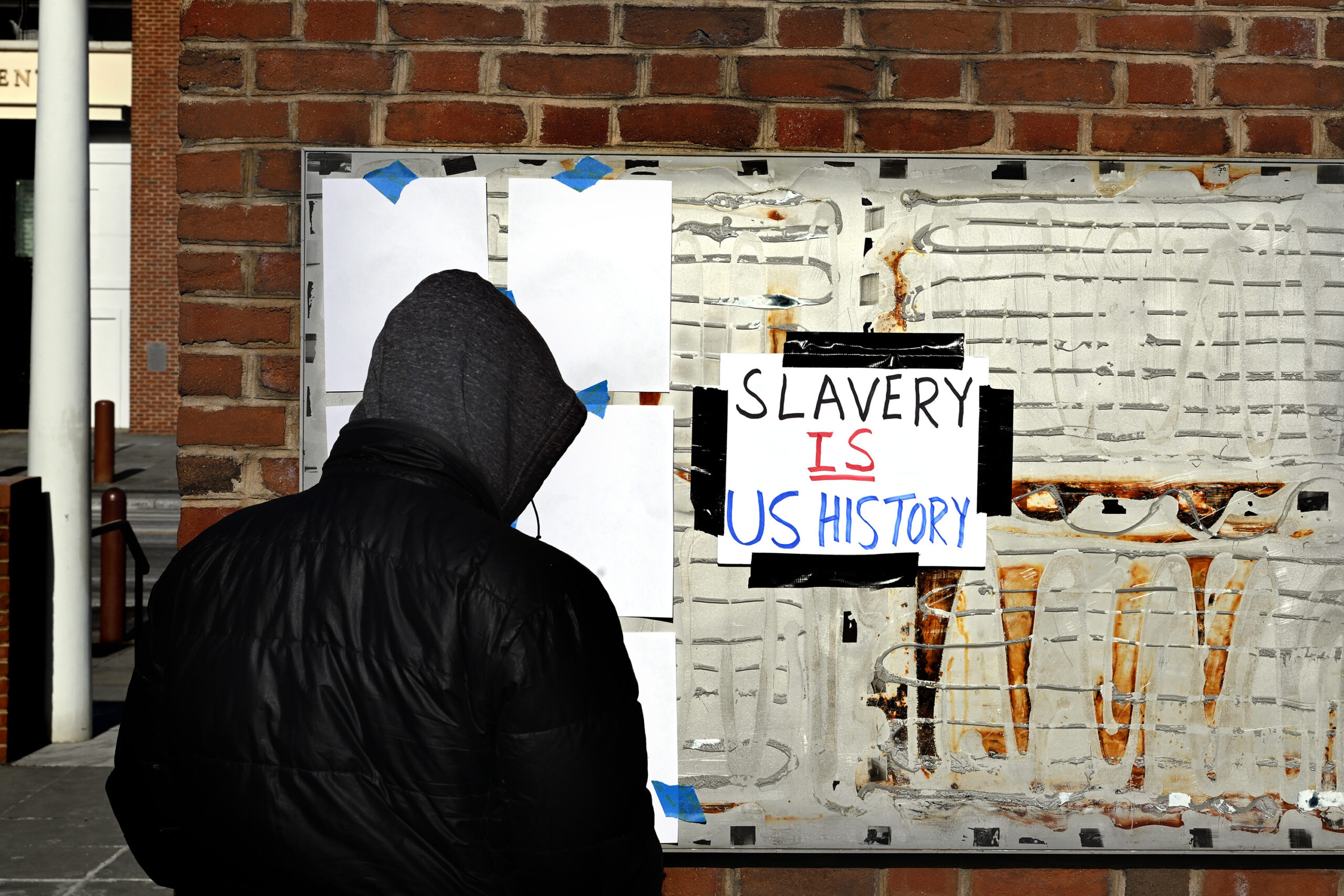
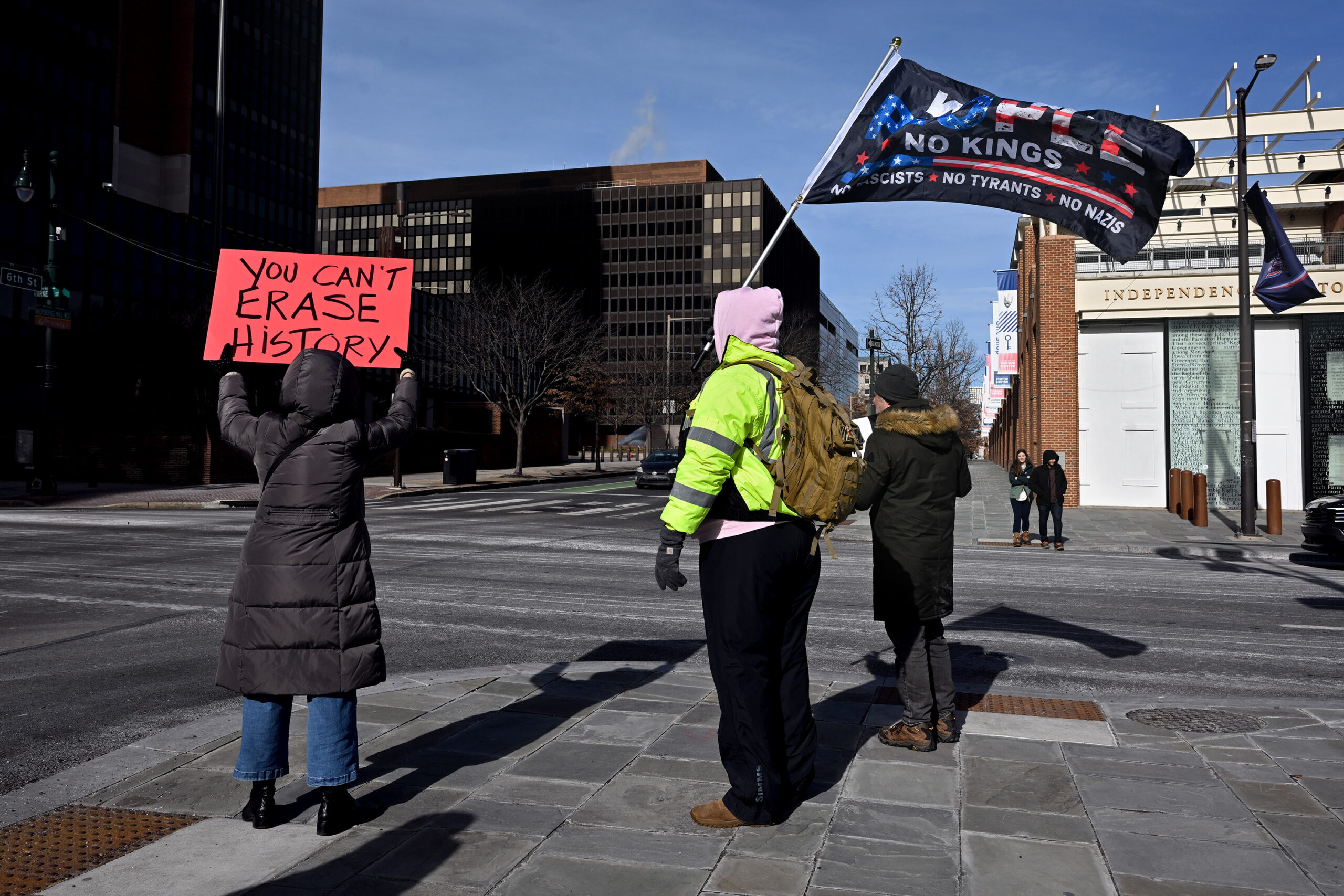
    Over that first weekend colorful signs populated the walls, reenactors donned historic garb and positioned themselves along the red brick pillars with a flourish, some people held giant replica signs of the ones that were removed, and others laid flowers delicately across the facility.

    To Berlin, whose school is a few blocks from the President’s House, posting the colorful signs was just a quick action she could take in her 45-minute prep period.

    “It was just a cathartic way to be like ‘Ugh, this sucks,’” Berlin said.

    But it soon became the first of numerous forms of activism and art that filled the space as more and more Philly-area residents yearned for a similar way to express their opposition to the removal of the plaques.

    Media ranged from cardboard to poster board. Tools included Sharpies and pens. Many of the more informal signs were affixed with painter’s tape to nooks in the brick structure and empty metallic shells where the original signs hung. Some more official-looking signs included QR codes and printed messages balanced on easels. Others were replicas of the signs that were there made with assistance from professional printing services.

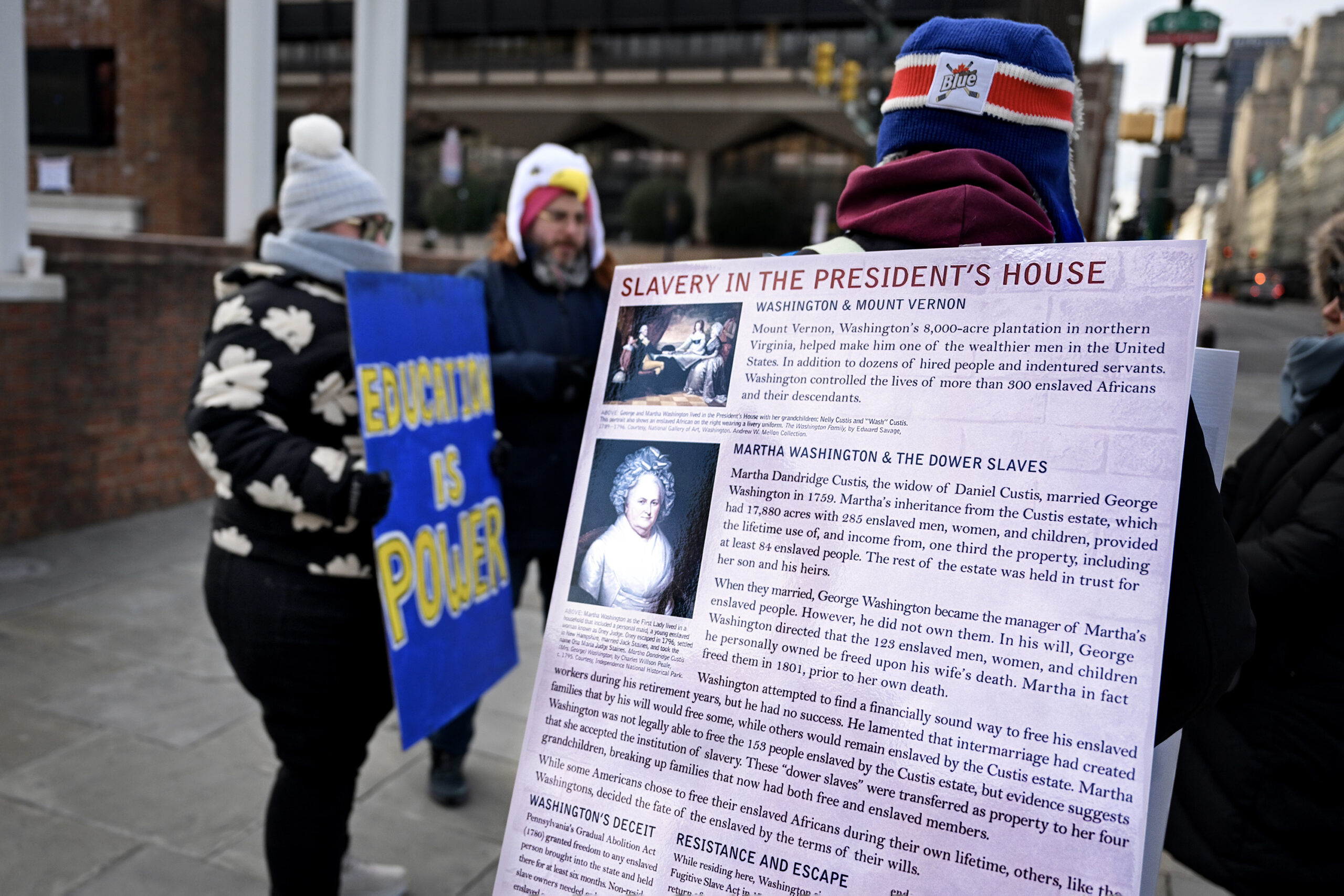
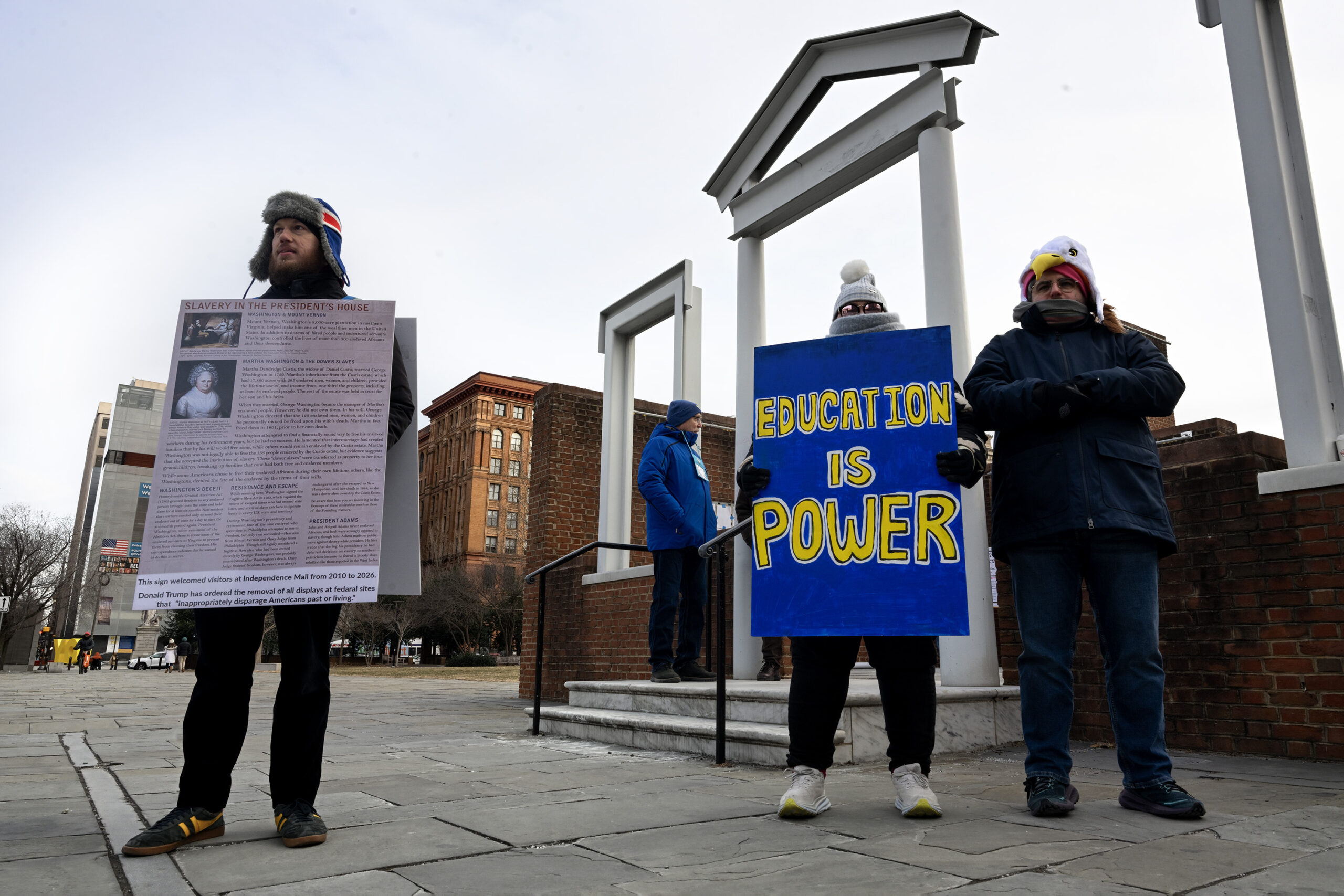
    Ted Zellers, a property manager in North Philly, took a more full-body approach to his protest. He found a high-resolution image online of one of the removed signs, titled “Slavery in the President’s House,” got it printed twice, fashioned a sandwich board out of the posters, and became “a living sign,” he said.

    It was an educational tool he could wield, but it doubled as a warning.

    “I hope people will think about what other information is under threat of being disappeared,” Zellers said.

    He expected to be the only person in the park with a sign, but was heartened to see a few dozen others there withstanding the 17-degree air interspersed with sharp winds slicing through the open air exhibit.

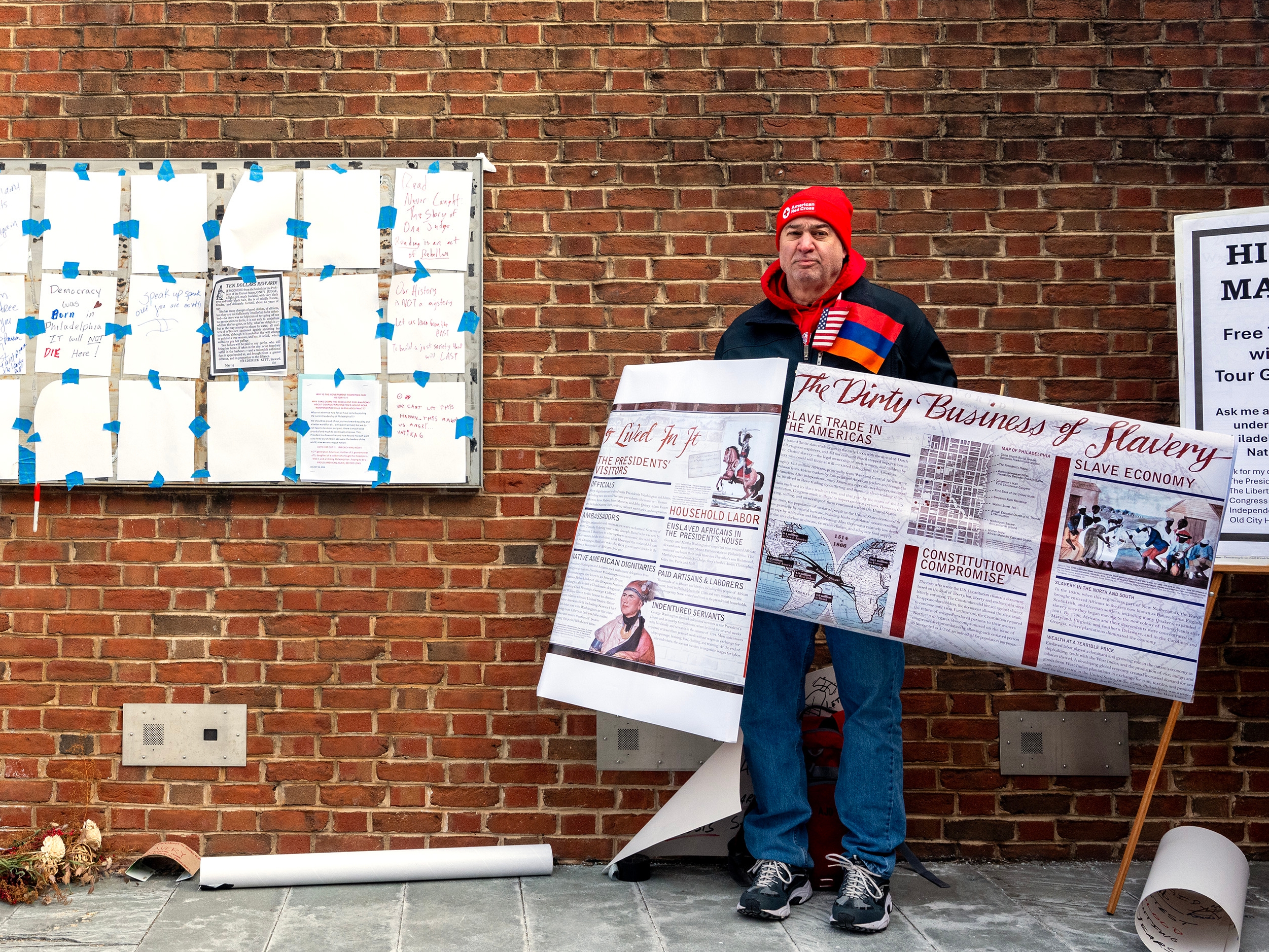
    Albert DerMovsesian from Willow Grove, who came to the site equipped with one vertical sign detailing the labor that took place in the house and a horizontal one titled “The Dirty Business of Slavery,” found himself similarly pleased to see so many like-minded others around him.

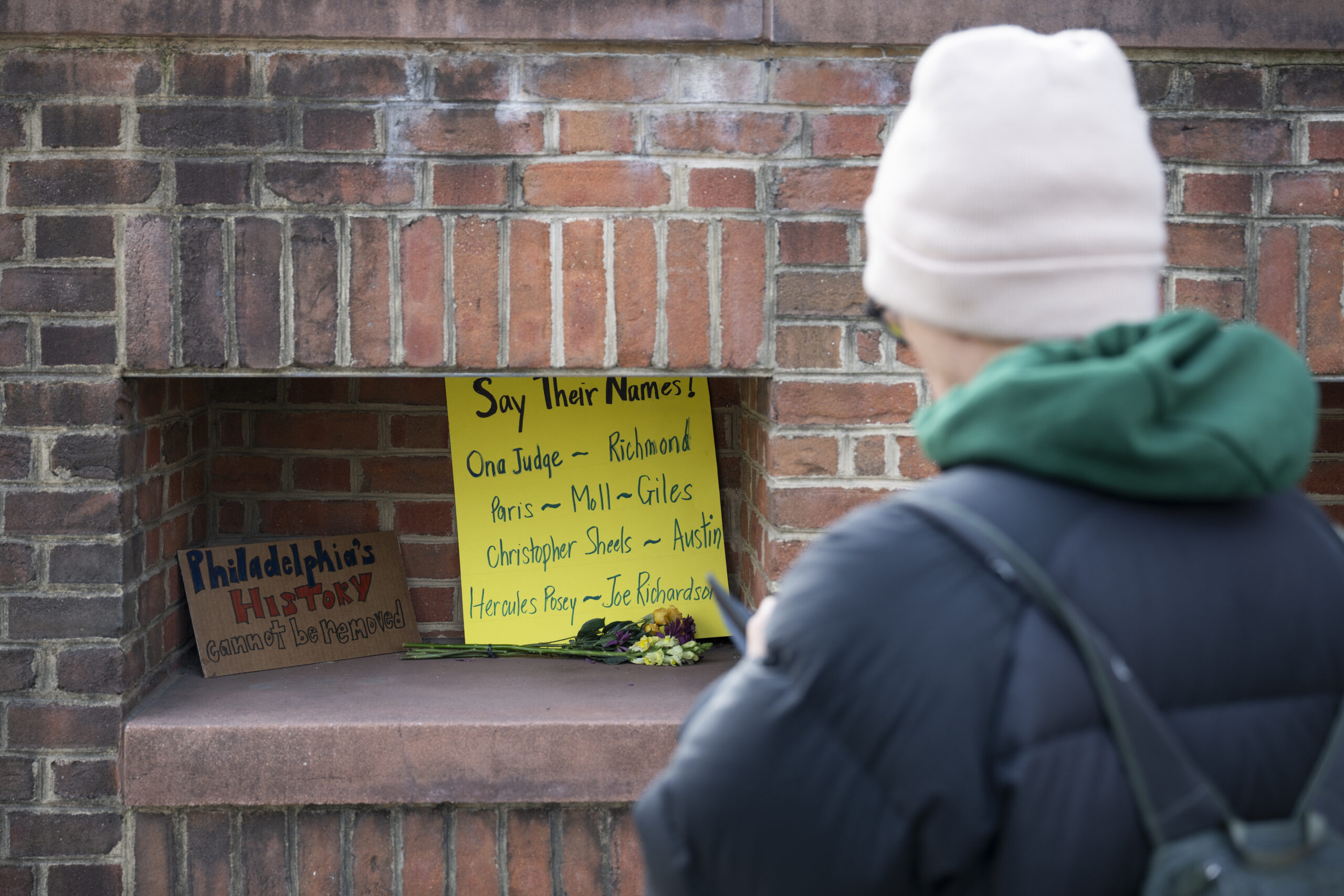
    In the park he saw little kids writing on pieces of paper pasted to the walls, a woman leaving a sign with the names of those enslaved at the site, and people adorning the structure with flowers.

    “It reminded me that I wasn’t alone,” DerMovsesian said.

    “We don’t need 350 million Malcolm X’s to make the country better,” Zellers said. “We just need a lot of regular people who recognize that they’re part of networks and who can take some action and amplify what’s going on, pass it onm and get other people engaged.”

    The collage of images developed organically, but hearkened back to a long lineage of protest art that has become increasingly prevalent under the Trump administration, said Nicolo Gentile, an artist and adjunct faculty member at Temple University’s Tyler School of Art and Architecture.

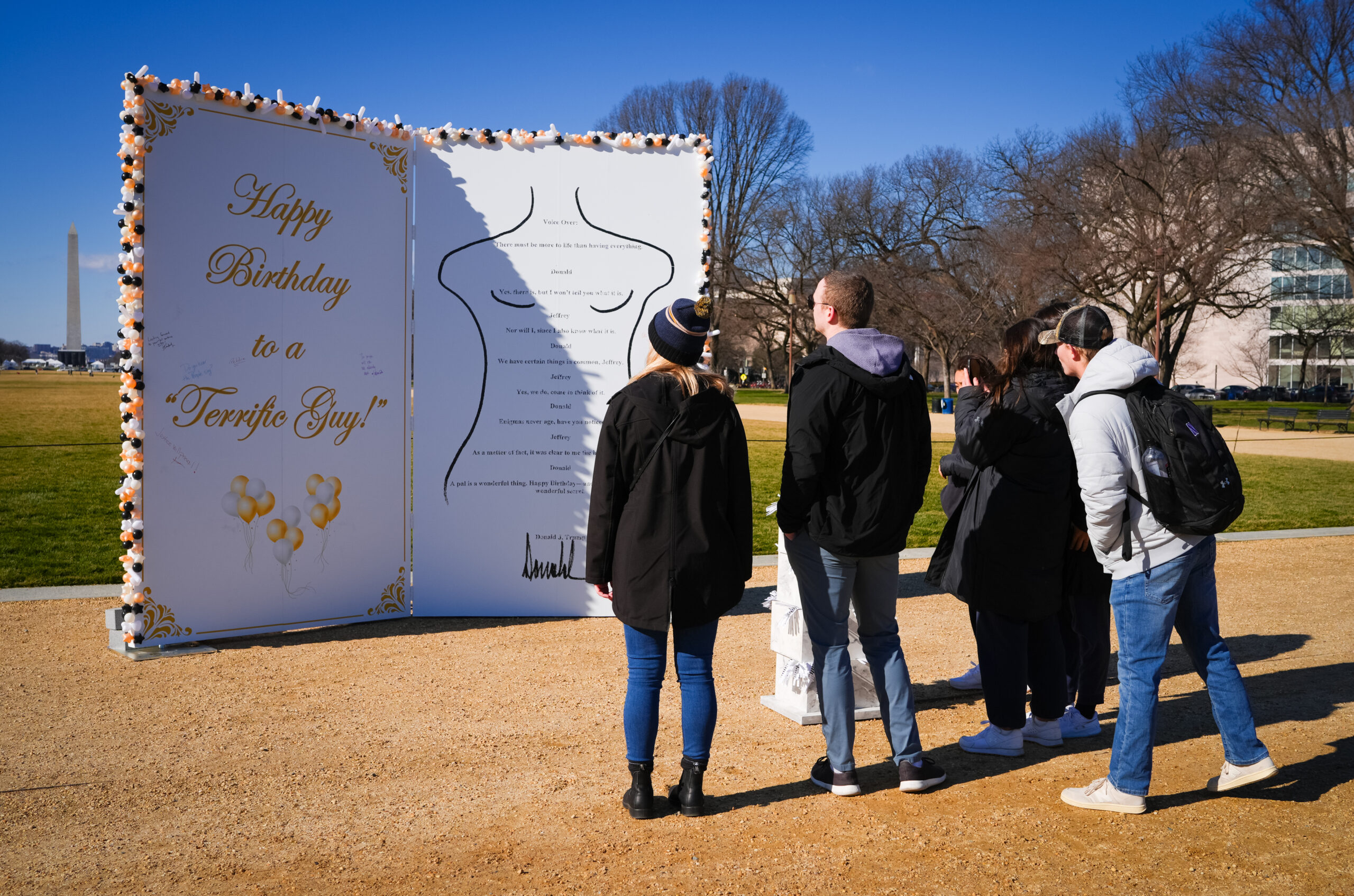
    Gentile likened the immediacy and style of the displays at the President’s House to the enlarged version of Trump’s birthday card to financier and sex offender Jeffrey Epstein that popped up on the National Mall in Washington last month.

    A new protest art installation referencing the Epstein files and President Donald Trump was installed on Third Street SW along the National Mall.

    The assortment of papers reading “learn all history” gets its power from the relative anonymity of its author, Gentile said, as well as its use of repetition.

    “It starts to create a texture of sound of a greater voice the way that the many voices of a chant during protest does,” he said.

    While Berlin said she doesn’t see herself as an artist, she appreciates the punch of a stark and direct message through signage and art.

    “I do love the impact of a good simple piece,” she said.

    In some cases, political art can be used to “accelerate progress,” Gentile said, but sometimes its best use is halting regression and “to wedge our foot in the door as progress may seem to be closing.”

    “This work seems to be the foot in the door,” he said.

    People leave notes on the spaces at the President’s House site in Independence National Historical Park.
    Ted Zellers (right) wears a sandwich board with a replica of one of the removed slavery panels as people visit and protest at the President’s House site.
    Ted Zellers (left) wears a sandwich board with a replica of one of the removed slavery panels, joining Jenna and Gregory May (right) protesting at the President’s House.
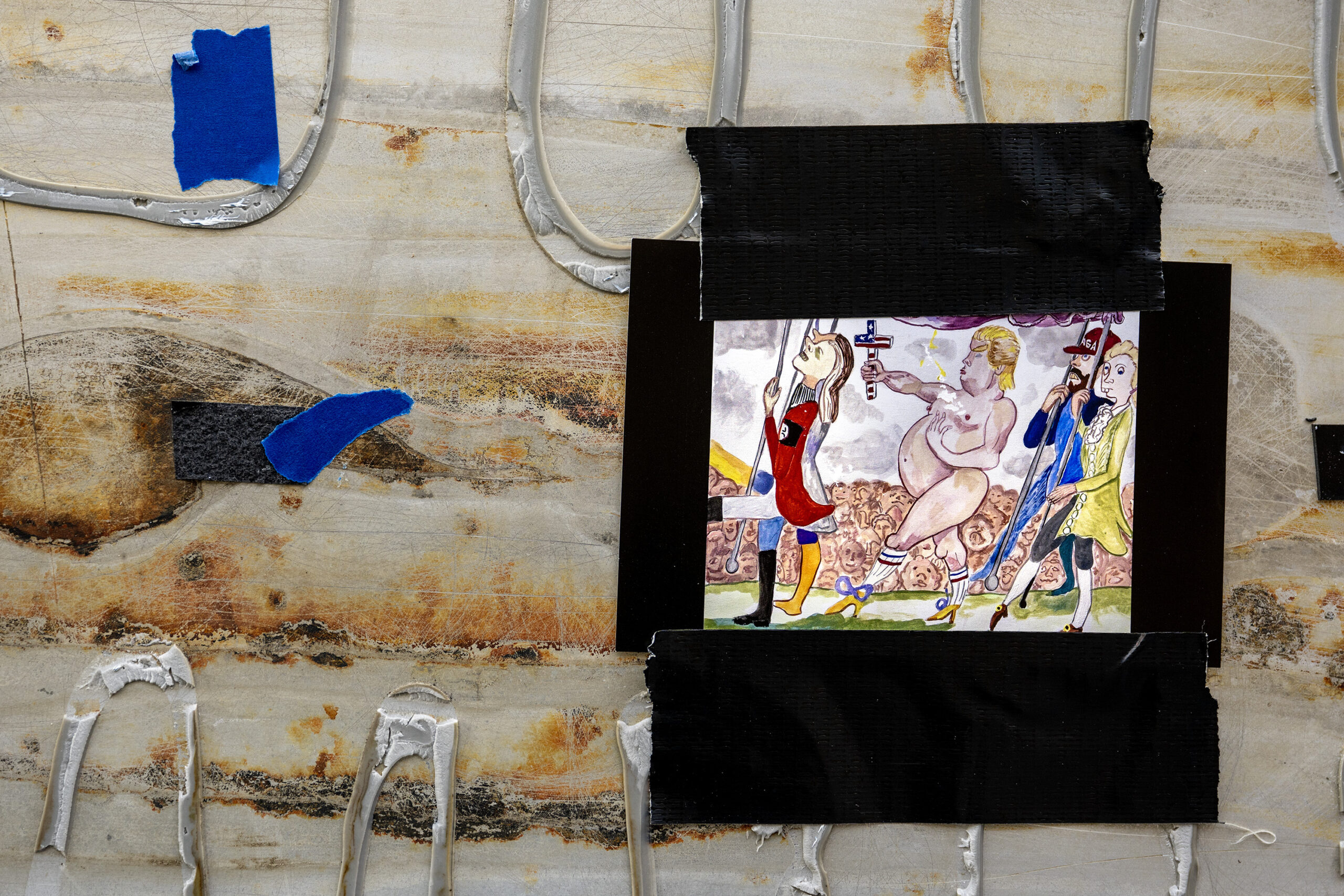
    People leave notes and political satire cartoons in the spaces at the President’s House.
    People protest at the President’s House site.
    Al DerMovsesian holds replicas of some of the removed slavery panels as people visit the President’s House site.
    The President’s House in Independence National Historical Park.
    The President’s House in Independence National Historical Park.
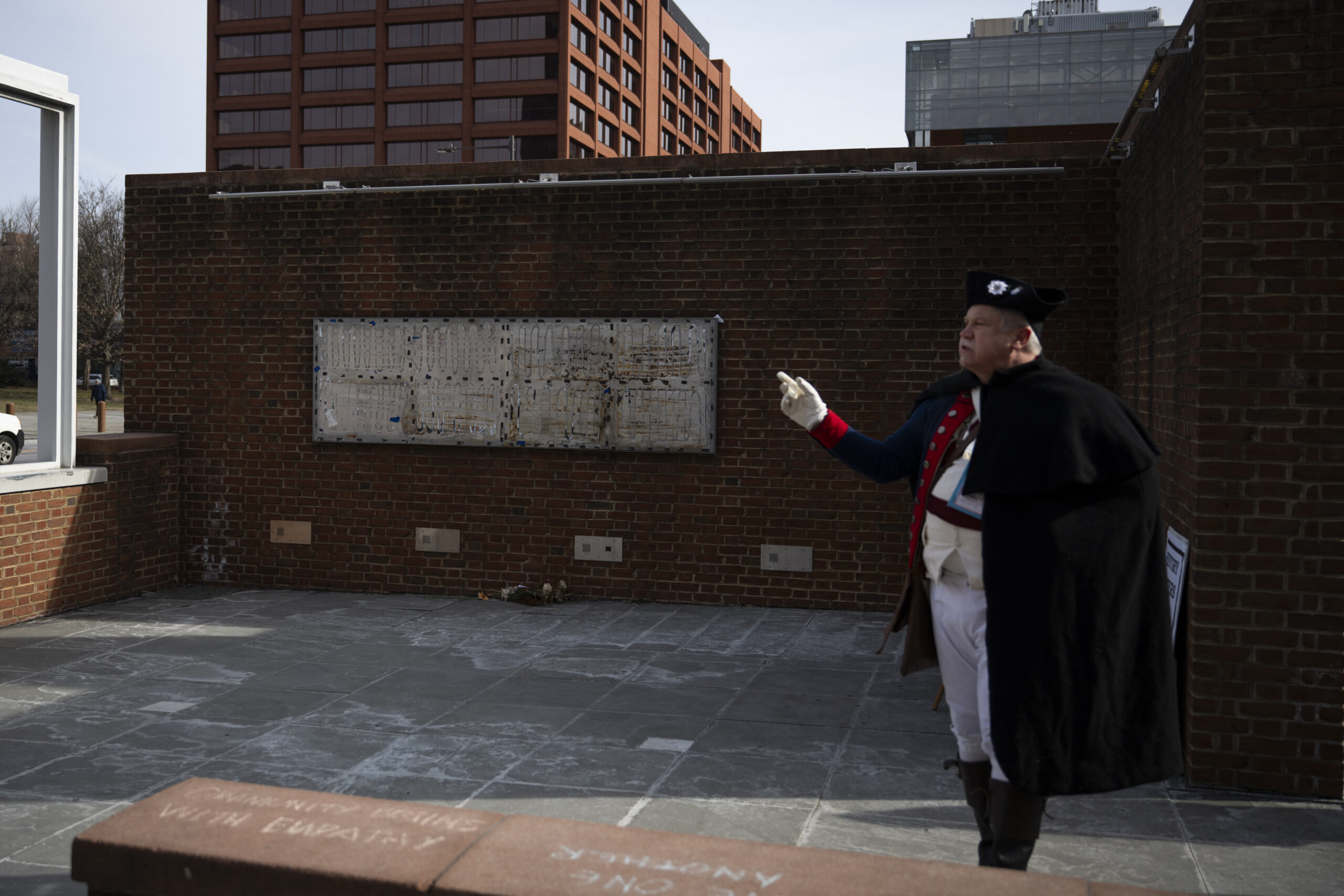
    Michael Carver portrays Mordecai Sheftall as part of a “History Matters” guide at The President’s House.
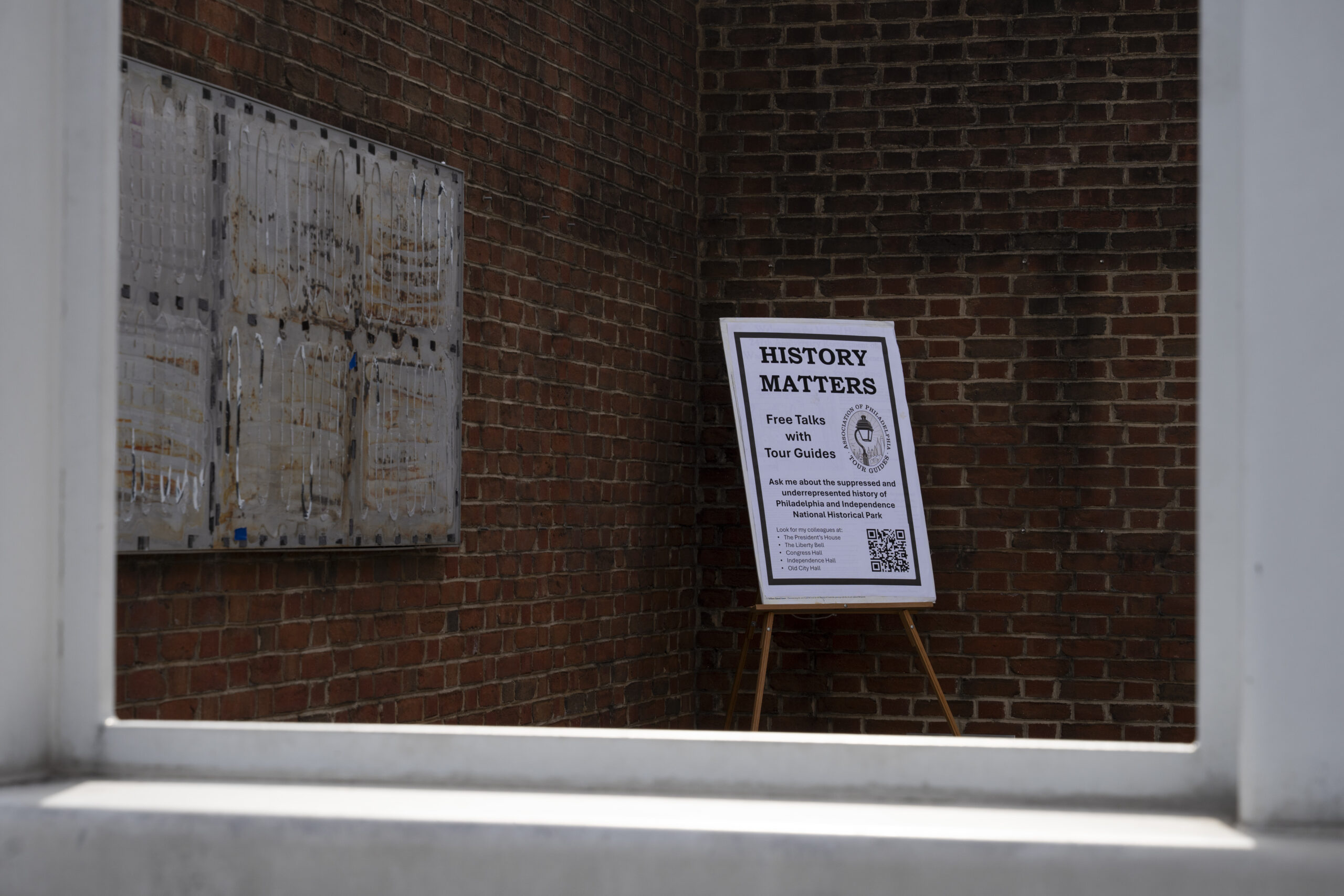
    A sign was placed at the President’s House.
    A group of teacher taped posters along the now barren brick walls of the President’s House.
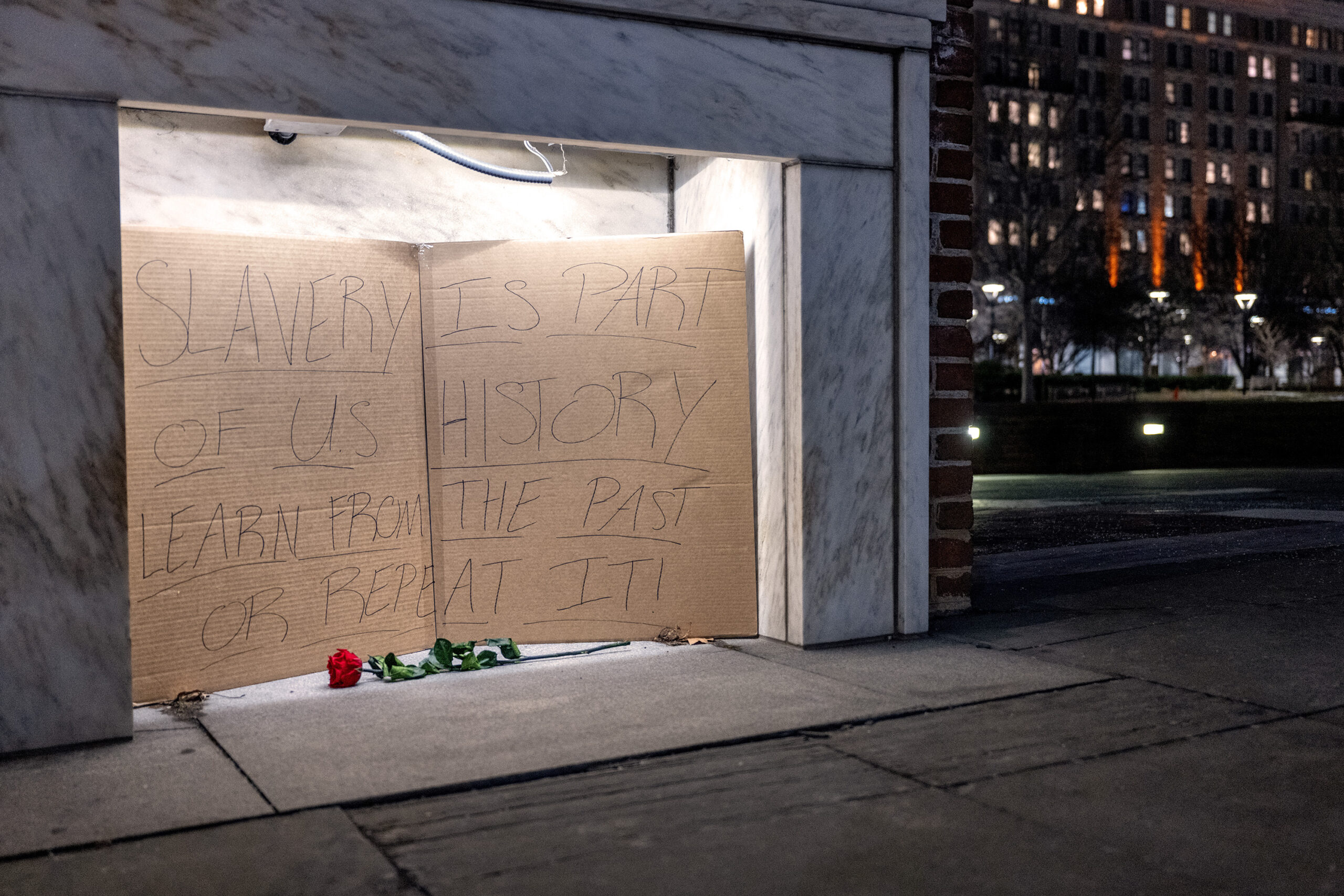
    A single rose and a handwritten cardboard sign (“Slavery is part of U.S. history learn from the past or repeat it”) are inside an empty hearth at the President’s House.
  • Judge chastises Trump administration attorney in hearing over dismantled President’s House exhibits

    Judge chastises Trump administration attorney in hearing over dismantled President’s House exhibits

    Attorneys for the City of Philadelphia and President Donald Trump’s administration sparred in federal court Friday over the abrupt removal of slavery-related exhibits from the President’s House on Independence Mall.

    The hearing centered on the city’s request that the judge order that no more exhibits be removed from the President’s House and that the already-removed exhibits be protected as the effort to return them is litigated.

    Mayor Cherelle L. Parker’s administration is “fighting” to restore the panels, City Solicitor Renee Garcia told reporters after the hearing.

    “I want to be very clear that we want those panels back up, but we also do not want anything else to come down,“ Garcia said.

    Judge Cynthia M. Rufe wasn’t ready to issue a ruling after the daylong hearing in the courthouse across the street from the historic site. On Monday, she wants to visit the President’s House and ensure that the removed exhibits being stored in a National Park Service storage facility adjacent to the Constitution Center are not damaged. She asked the federal government to maintain the status quo until she makes her decision.

    But with the nation’s 250th anniversary celebration being planned for the site in dispute, Rufe said she would not let the case drag into the spring or summer.

    The George W. Bush-appointed judge chastised the attorney representing the government, Assistant U.S. Attorney Gregory in den Berken, for talking out of “both sides of his mouth” and making “dangerous” arguments.

    The federal government argued the injunction request was invalid on procedural grounds, and that the removal was lawful because, in den Berken said, “the government gets to choose the message that it wants to convey.”

    “That’s horrifying to listen to,” Rufe said. “Sorry. That’s not what we elected anybody for.”

    The judge asked the assistant U.S. attorney to imagine Germany removing a monument for the American soldiers who liberated the Nazi concentration camp Dachau in an effort to erase the crimes of the Holocaust. “What are we doing here? Are we speaking truth and justice?” Rufe asked.

    In another notable exchange, the judge read Trump’s posts from then-Twitter in 2017 in which he lamented the removal of statutes of confederate leaders.

    “Sad to see the history and culture of our great country being ripped apart with the removal of our beautiful statues and monuments,” Trump wrote. “You can’t change history, but you can learn from it.”

    Rufe asked the assistant U.S. attorney to reconcile that sentiment with Trump’s directive to remove slavery-related exhibits.

    “Is this a desire to change history?” the judge asked.

    In den Berken declined to respond or opine on the motivations of the president or decision-makers at the Department of Interior, and returned to procedural arguments.

    A three-way collaboration

    Friday’s hearing marked the first time the City of Philadelphia and Trump’s administration have gone head-to-head in court during his second term.

    The city sued Interior Secretary Doug Burgum, acting National Park Service Director Jessica Bowron, and their respective agencies Jan. 22 while Park Service employees were dismantling educational exhibits about slavery at the President’s House.

    The President’s House, which opened in December 2010, seeks to inform visitors about the horrors of slavery and memorialize the nine people George Washington enslaved there while he resided in Philadelphia during the early years of the United States. All information at the site is historically accurate.

    The exhibits were dismantled after increased scrutiny from the Trump administration. Last year, Trump and Burgum issued orders calling for content at national parks that “inappropriately disparage Americans past or living” to be reviewed and potentially removed.

    Garcia argued the removal of exhibits violated federal law and an agreement between the federal government and the city, and caused imminent harm.

    “The contents of the removed panels are critical context to share the stories of the individuals enslaved at the president’s home and their fight for freedom” Garcia said.

    The President’s House exhibition was the results of yearslong collaboration between the city and the federal government that spanned multiple presidential and mayoral administrations, Garcia said. Two former mayoral chiefs of staff testified to the city’s extensive work alongside the National Park Service.

    “I could not imagine that anybody would decide, after all that it took, together, and that we always had each others back, that they would over night tear it down,” said Everett Gillison, chief of staff under former Mayor Michael Nutter. “It boggles my imagination.”

    Valerie Gay, the city’s chief cultural officer, also testified to the historical importance of the site to Philadelphians and to visitors for the upcoming 250th anniversary celebrations.

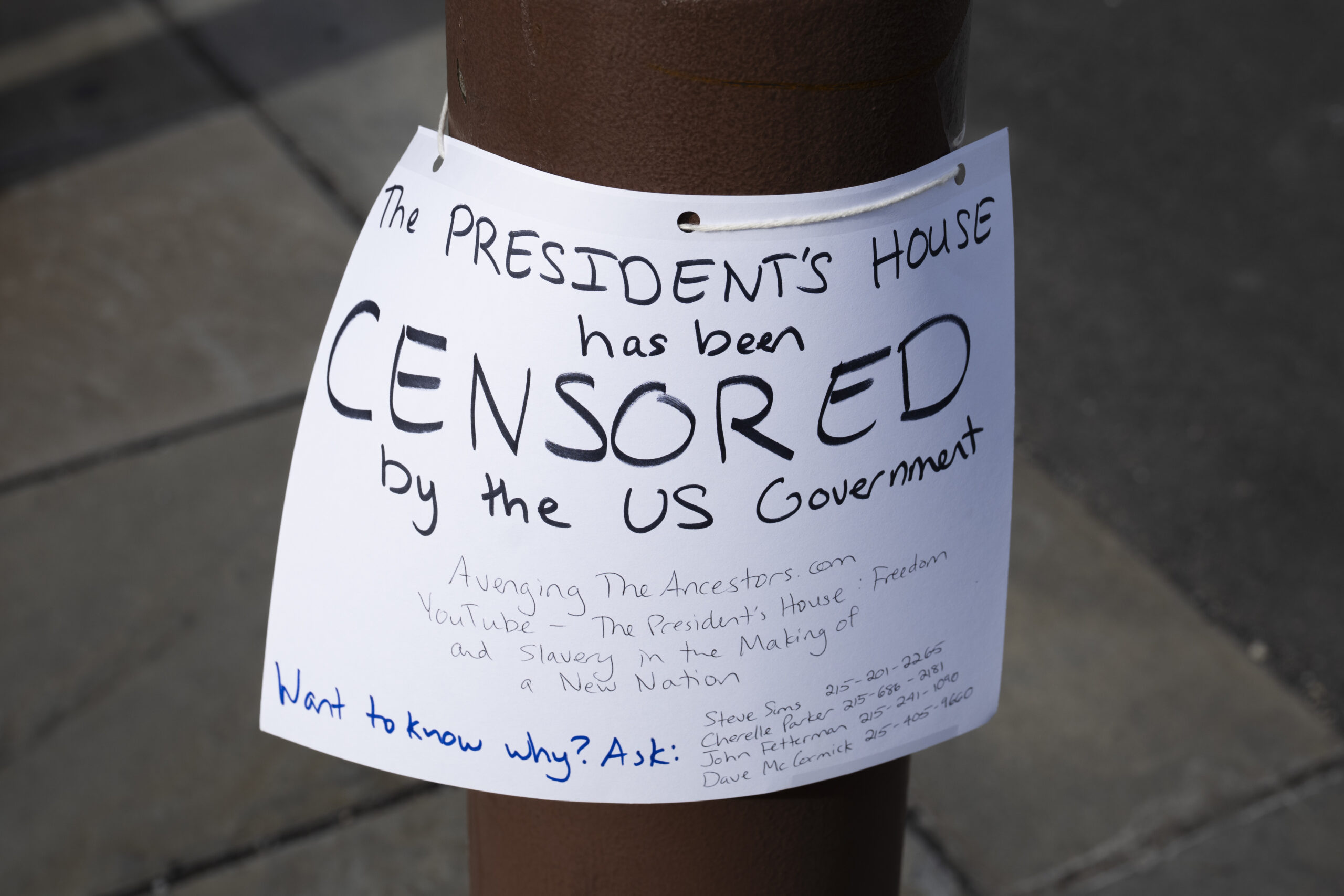
    The city’s lawsuit has been supported by Gov. Josh Shapiro and Democrats in Pennsylvania’s state Senate, who filed briefs in support of the requested injunction alongside a coalition of residents who advocated for historical acknowledgment of the enslaved people living in Washington’s house, Avenging The Ancestors Coalition, and the walking tour company The Black Journey.

    Michael Coard, attorney and founding member of Avenging the Ancestors Coalition, at President’s House in Philadelphia.

    The President’s House was also a partnership with the public, said Cara McClellan, the attorney representing the coalition and The Black Journey

    It was advocacy by coalition leader Michael Coard in the early 2000s that kickstarted the process to recognize the nine enslaved people who lived in Washington’s house through exhibits on the site, McClellan told Rufe. The design was the result of multiple public meetings, with the participation of thousands of Philadelphians.

    Yet the exhibits were removed without public input, notice, or reasoning, the attorney said.

    “This is like pulling pages out of a history book with a razor,” McClellan said. ”History does not change based on who is in political office.”

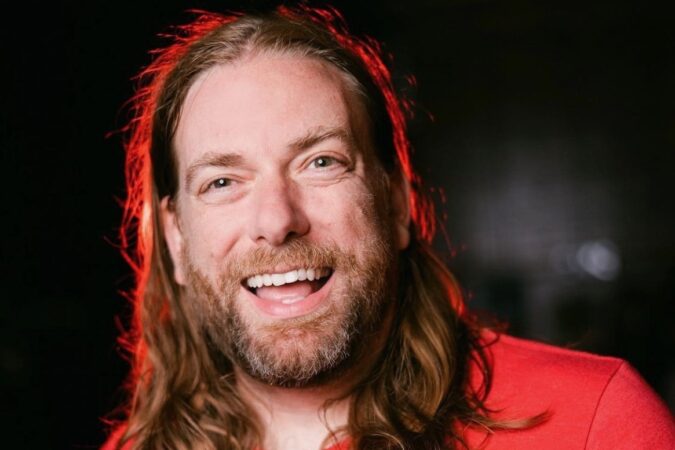
  • Dan McQuade, award-winning writer, tireless community activist, and ‘Philadelphia institution,’ has died at 43

    Dan McQuade, award-winning writer, tireless community activist, and ‘Philadelphia institution,’ has died at 43

    Even as a child, Dan McQuade let his imagination run wild. “What are you doing?” his mother, Denise, would ask if she hadn’t heard any noise from his bedroom for a while. “I’m making stories,” he would reply.

    Later, as a young man about town, his compassion for fellow Philadelphians inspired his father, Drew. Dan volunteered to give blood often, donated brand-new sneakers to other guys in need, and continually reached out to people he saw struggling with drug abuse and homelessness. “His kindness was what I loved about him the most,” his father said.

    Dan McQuade was already an award-winning writer, blogger, and journalist when he met his future wife, Jan Cohen, online in 2014. To her, his jovial humor, wide-ranging intelligence, and shoulder-length hair made him unique in her circle. “I thought he was too cool for me,” she said.

    As it turned out, they were all spot on. Mr. McQuade used his quirky creativity to write memorable blogs and freelance stories about culture and sports for The Inquirer, the Daily News, the New York Times, Sports Illustrated, and other publications. He was a cofounder and visual editor at Defector Media and worked previously for Deadspin, Philadelphia Magazine, Philadelphia Weekly, and other outlets.

    His empathy, likely inspired by his parents, his wife said, led him to toil tirelessly for charitable nonprofits such as the Everywhere Project, Back on My Feet, and Prevention Point. “Service was always part of his life,” his wife said.

    His coolness, as unconventional as it sometimes was, made those he encountered feel cool, too. Molly Eichel, an Inquirer editor and longtime friend, said: “He was annoyingly smart and incredibly kind.”

    Dan McQuade died Wednesday, Jan. 28, of neuroendocrine cancer at his parents’ home in Bensalem. He was 43. His birthday was Jan. 27.

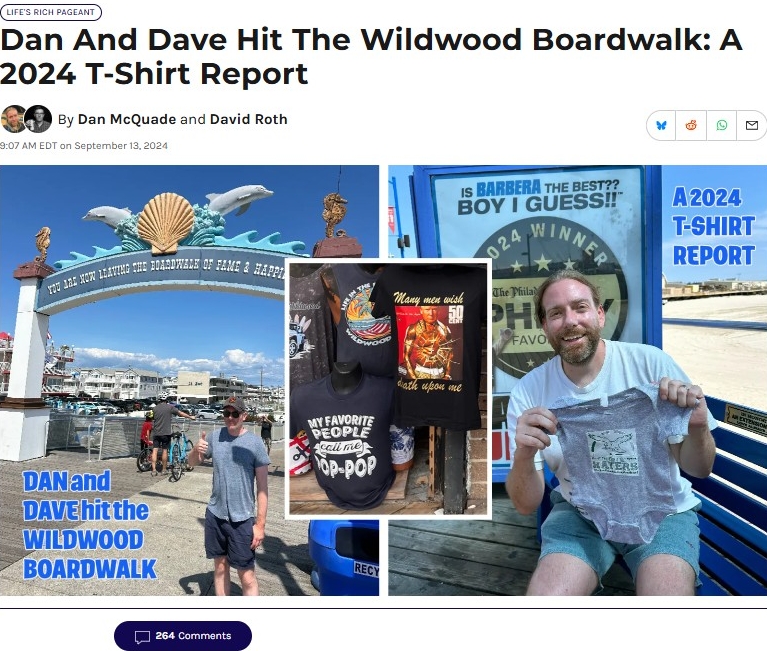
    Mr. McQuade’s annual Wildwood T-shirt report was a favorite of his many readers and fans.

    “It’s incredibly hard for me to imagine living in a Philadelphia without Dan McQuade,” said Erica Palan, an Inquirer editor and another of Mr. McQuade’s many longtime friends. “He understood Philadelphians better than anyone because he was one: quirky and funny, competitive and humble, loyal and kind.”

    A journalism star at the University of Pennsylvania in the early 2000s, Mr. McQuade was a writer, sports editor, and columnist for the school’s Daily Pennsylvanian, and managing editor of its 34th Street Magazine. He earned two Keystone Press awards at Penn, was the Daily Pennsylvanian’s editor of the year in 2002, and won the 2003 college sports writing award from the Philadelphia Sportswriters Association.

    He went on to create Philadelphia Weekly’s first blog, “Philadelphia Will Do,” and was a finalist for the Association of Alternative Newsmedia’s best blogger award. He served an internship at the Bucks County Courier Times in Levittown and worked for a while at the Northeast News Gleaner.

    Often irreverent, always inventive, he filed thousands of notable stories about, among other things, the Wildwood T-shirt scene, the origin of “Go Birds,” sneaker sales, Donald Trump, Wawa hoagies, the Philly accent, parkway rest stops, the Gallery mall, soap box derbies, and Super Bowls. His stories sparkled with research and humor.

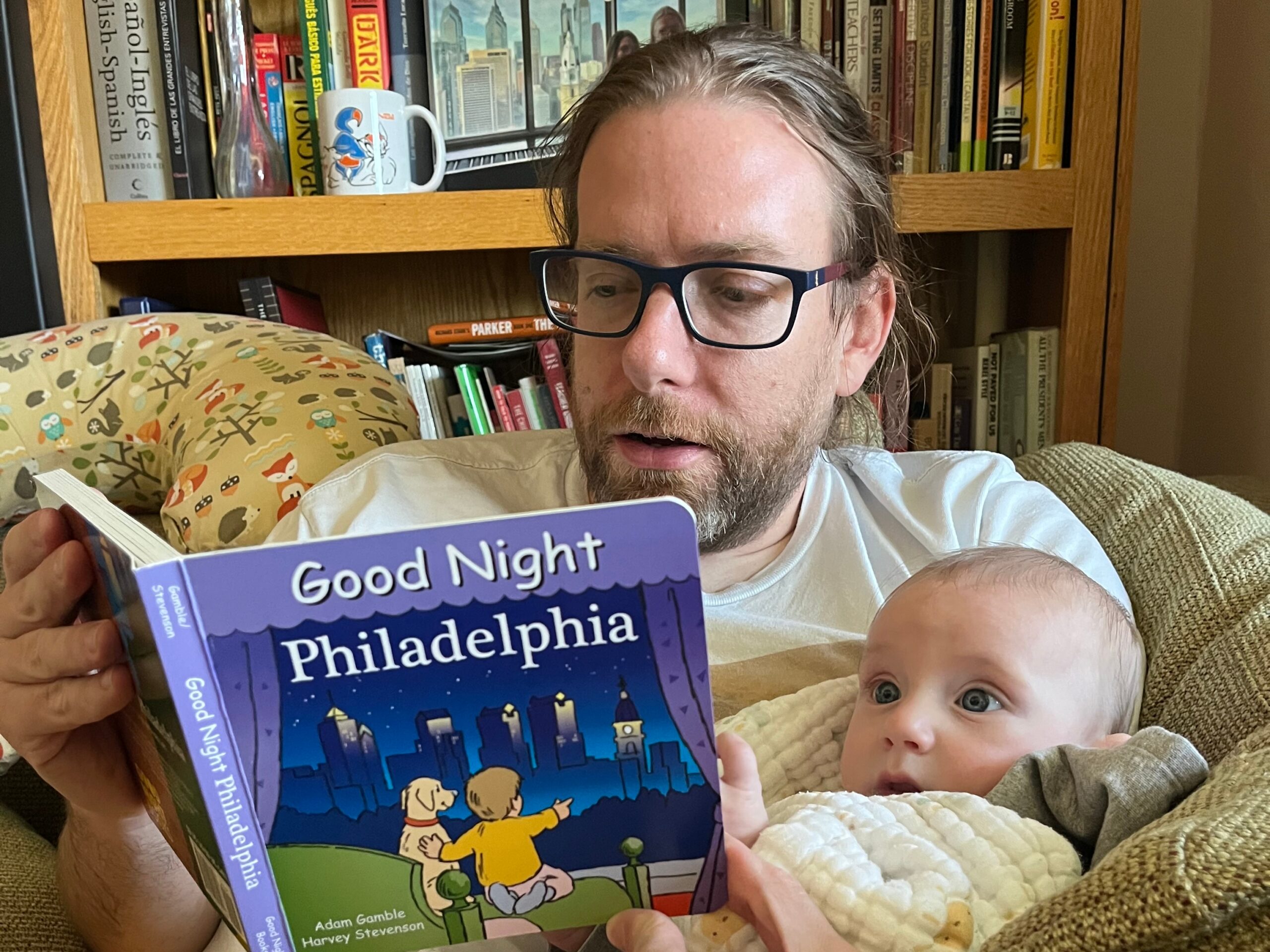
    An avid reader himself, Mr. McQuade enjoyed reading local tales to his son, Simon.

    “Dan was a truly authentic and engaging person,” Tom Ley, editor-in-chief at Defector, said in an online tribute. “His curiosity was relentless, and his interests were varied and idiosyncratic.”

    For example, Mr. McQuade wrote in Philadelphia Magazine in 2013 that Sylvester Stallone’s famous training-run montage in Rocky II — it started in South Philly and ended two minutes of screen time later atop the Art Museum steps — actually showed city scenes that would have had the actor/boxer run more than 30 miles around town. “Rocky almost did a 50K,” Mr. McQuade wrote. “No wonder he won the rematch against Apollo!”

    In 2014, he wrote in Philadelphia Magazine about comedian Hannibal Buress calling Bill Cosby a rapist onstage at the old Trocadero. The story went viral, and the ensuing publicity spurred more accusations and court cases that eventually sent Cosby to jail for a time.

    When he was 13, Mr. McQuade wrote a letter to the editor of the Daily News that suggested combining the Mummers Parade with Spain’s running of the bulls. Crossing Broad’s Kevin Kinkead said he had “an innate gift for turning the most random things into engaging reads.”

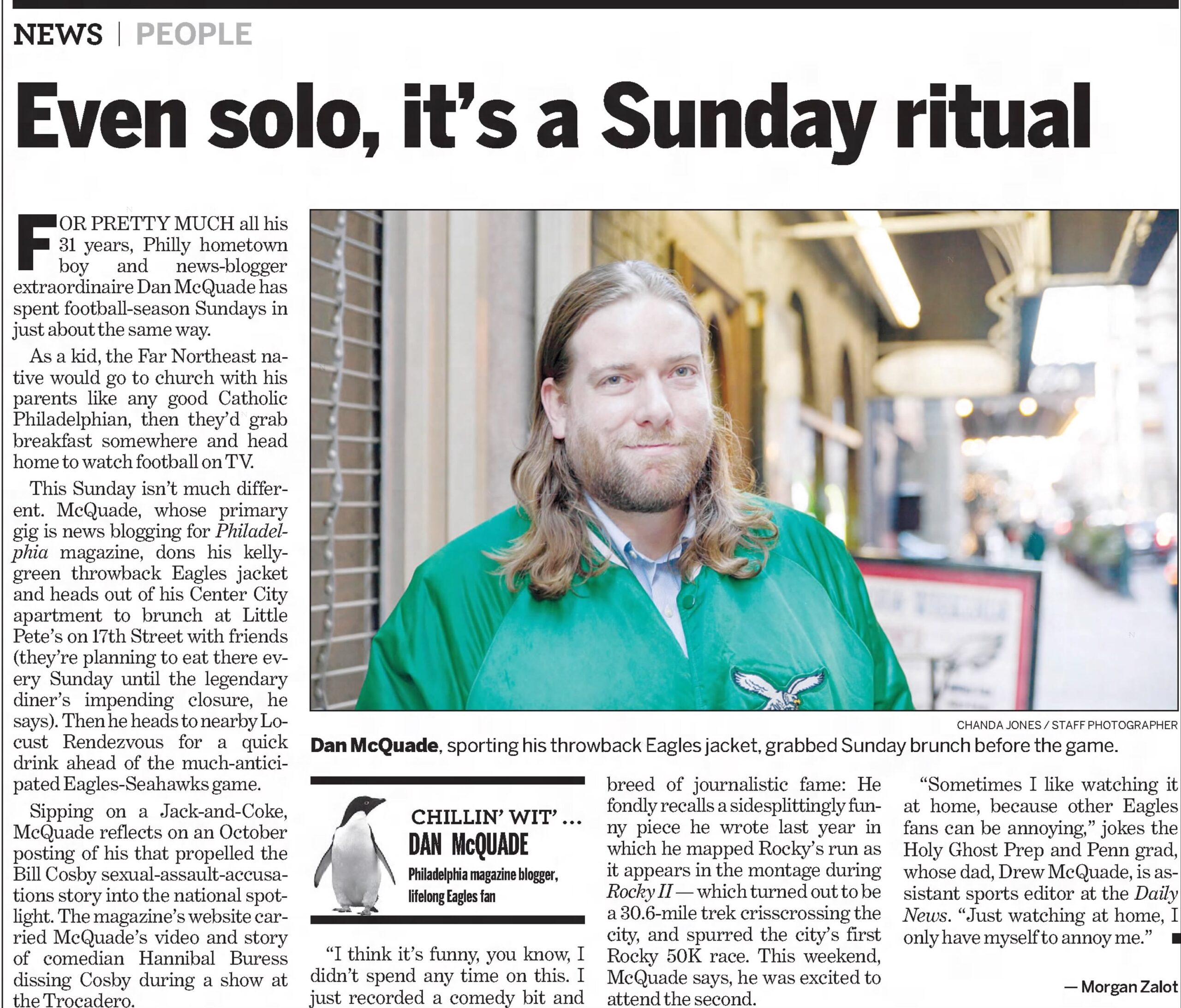
    This story about Mr. McQuade appeared in the Daily News in 2014.

    “Without Dan’s voice, Philly Mag wouldn’t be Philly Mag,” editor and writer Brian Howard said in a tribute on phillymag.com. “And, I’d argue, Philadelphia wouldn’t quite be Philadelphia.”

    Other colleagues called him “a legend,” “a Philadelphia institution,” and “the de facto mayor of Philadelphia” in online tributes. Homages to him were held before recent Flyers and 76ers games.

    “Sometimes,” his wife said, “he inserted himself into stories, so readers had a real sense of who he was because he was so authentic.”

    Daniel Hall McQuade was born Jan. 27, 1983, in Philadelphia. His father worked nights at the Daily News for years, and the two spent many days together when he was young hanging around playgrounds and skipping stones across the creek in Pennypack Park.

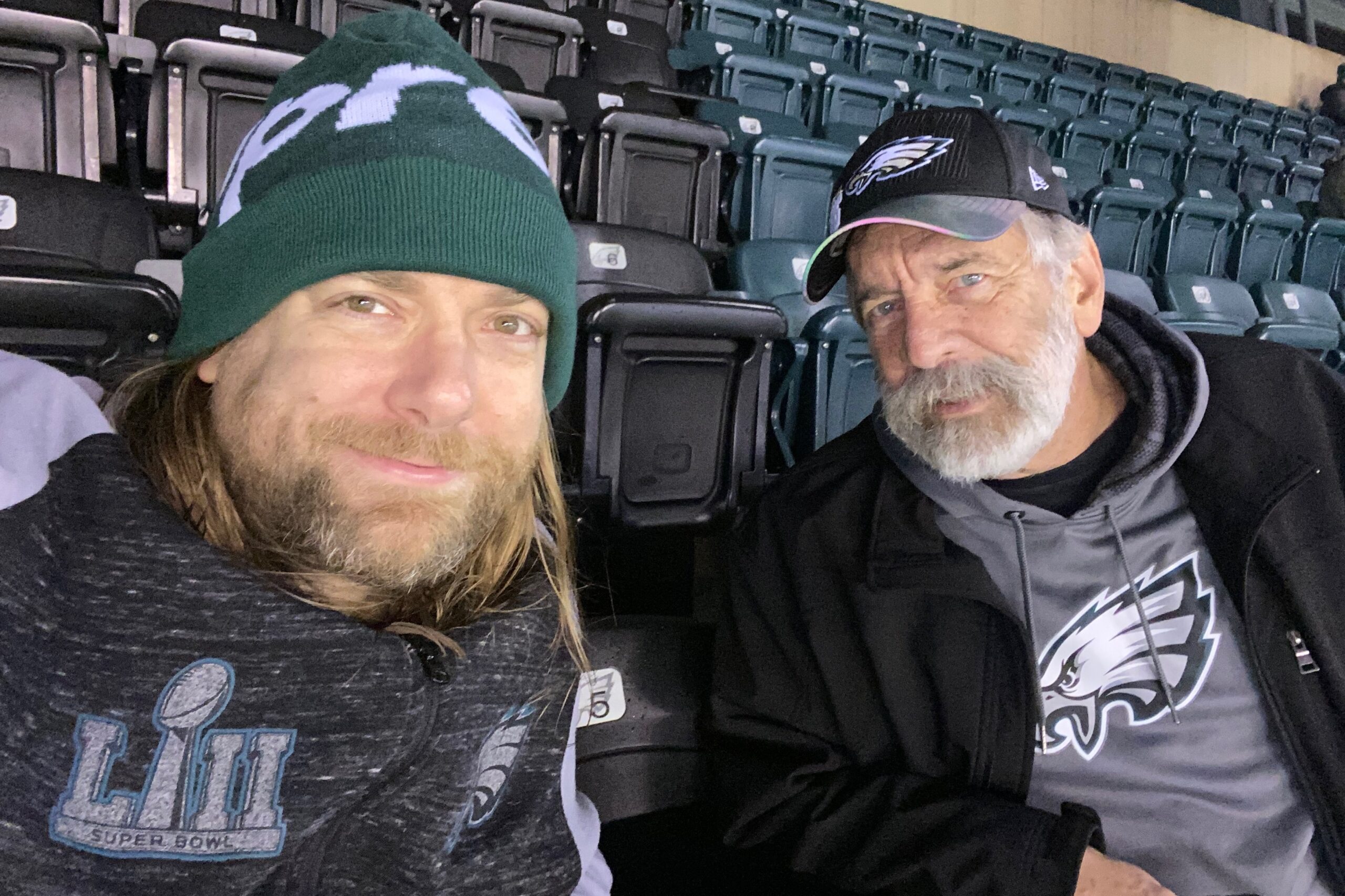
    Mr. McQuade (left) and his father, Drew, shared a love of Philly sports and creative writing.

    Later, they texted daily about whatever came to mind and bonded at concerts, Eagles games, and the Penn Relays. He grew up in the Northeast, graduated with honors from Holy Ghost Preparatory School in Bensalem, and earned a bachelor’s degree in English at Penn in 2004.

    He overcame a serious stutter as a teen and played soccer and basketball, and ran cross-country and track at Holy Ghost. He married Jan Cohen in 2019 and they had a son, Simon, in 2023. They live in Wissahickon.

    Mr. McQuade was a voracious reader and an attentive listener. “He never wanted to stop learning,” his wife said. He enjoyed going to 76ers games with his mother and shopping for things, his father said, “they didn’t need.”

    He was mesmerized by malls, the movie Mannequin, the TV series Baywatch, and his wife’s cat, Detective John Munch. During the pandemic, he and his wife binged all 11 seasons of Baywatch.

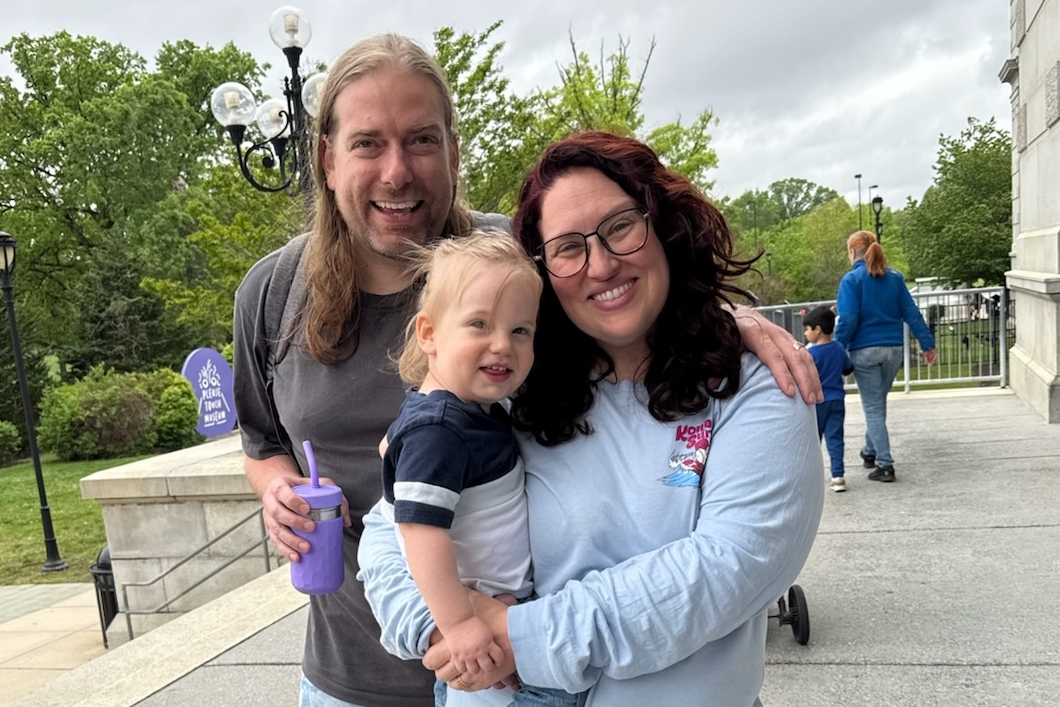
    Mr. McQuade doted on his wife, Jan, and their son, Simon.

    He could be loud, his mother said, and Molly Eichel described his laugh as “kind of a honk.” His friend and colleague Alli Katz said: “In 50 years I’ll forget my own name. But I’ll remember his laugh.”

    He was a vintage bootleg T-shirt fashionista, and his personal collection numbered around 150. He named Oscar’s Tavern on Sansom Street as his favorite bar in a recent podcast interview and said he would reluctantly pick a pretzel over a cheesesteak if that was the choice.

    In September, Mr. McQuade wrote about his illness on Defector.com under the headline “My Life With An Uncommon Cancer.” In that story, he said: “Jan has been everything. My son has been a constant inspiration. My parents are two of my best friends, and I talk to them every day. Jan’s parents have been incredible.”

    He also said: “I believe there are no other people on earth with my condition who are in as fortunate a situation. … For the past thousand words you have been reading about a bad break I got, but if only everyone in my position had it this good.”

    Mr. McQuade and his wife, Jan Cohen, married in 2019.

    His wife said: “He was truly the best guy.”

    In addition to his wife, son, and parents, Mr. McQuade is survived by his mother-in-law, Cheryl Cohen, and other relatives.

    Visitation with the family is to be from 9 to 10 a.m. Thursday, Feb. 5, at St. Martha Parish, 11301 Academy Rd., Philadelphia, Pa. 19154. Mass is to follow from 10 to 11 a.m.

    Donations in his name may be made to the Everywhere Project, 1733 McKean St., Philadelphia, Pa. 19145.

  • As Josh Shapiro calls for ICE to leave Minneapolis, his GOP challenger Stacy Garrity wants Minnesotans — and Pennsylvanians — to cooperate with agents

    As Josh Shapiro calls for ICE to leave Minneapolis, his GOP challenger Stacy Garrity wants Minnesotans — and Pennsylvanians — to cooperate with agents

    As Gov. Josh Shapiro makes the case on national television for ICE to leave Minneapolis, his Republican challenger Stacy Garrity has a different view: Minnesotans should cooperate.

    Garrity, the state treasurer and GOP-endorsed candidate, said “it’s best to cooperate” with U.S. Immigration and Customs Enforcement, in an interview Thursday night at the National Constitution Center following an appearance on a conservative podcast.

    The retired U.S. Army colonel also praised Tom Homan, President Donald Trump’s border czar assigned to take over the Minneapolis operation, as “spot on” in his recent remarks calling for a de-escalation of the conflict between residents and federal officials, and that residents should comply.

    “He said it best: Cooperate and take down the rhetoric,” Garrity said, noting her time as U.S. Army military police officer gives her a “different perspective.”

    Garrity’s comments came days after she received an endorsement from Trump in the Pennsylvania governor’s race. The president on Tuesday evening called Garrity a “true America First Patriot, who has been with me from the beginning.”

    Shapiro, meanwhile, has become more outspoken about ICE’s operations in Minnesota over the last few days while on a national media blitz for his new memoir released this week, Where We Keep the Light. The former Pennsylvania attorney general, known as a careful and deliberate communicator, has now repeatedly called for ICE and the Border Patrol to leave Minneapolis, arguing that the operations are “outside the bounds of law” and “must be terminated.”

    Pennsylvania does not have a sanctuary policy restricting cooperation with ICE by state law enforcement, but several jurisdictions in the state do have such policies, including Philadelphia.

    Garrity was in Philadelphia on Thursday for a live taping of the conservative podcast Ruthless. The event was hosted by Americans for Prosperity, a national libertarian advocacy organization. She largely talked about what led her to politics in 2020 after a long career in the military and private sector, as well as her work as the state’s treasurer.

    When asked whether she was concerned by the shooting of Alex Pretti, an intensive-care nurse at a Veterans Affairs hospital in Minnesota, Garrity said she had not seen the videos of Border Patrol agents fatally shooting Pretti and that she “always waits for the investigation” before forming an opinion. Pretti’s death marked the second killing of a U.S. citizen by federal agents in Minneapolis this month, leading to mass protests and public outrage.

    “The investigation will come out, and then any corrective action that needs to be taken, or we’ll see what the results are,” she said. “I’m going to withhold any judgment until the investigation.”

    In the case of Pretti’s death, Trump said the U.S. Department of Homeland Security is leading the investigation, and he is “going to be watching over it.” Minnesota officials have called for an independent investigation and have protested as federal officials have blocked local authorities from investigating.

    Earlier this week, Shapiro said his staff has been preparing for the chance that Trump sends a surge of ICE agents to a Pennsylvania city like Philadelphia or Pittsburgh.

    If Trump does send more ICE agents to Pennsylvania, Garrity said Pennsylvania officials should cooperate here, too.

    “It’s always good to cooperate with ICE, especially when they’re doing targeted actions,” Garrity added.