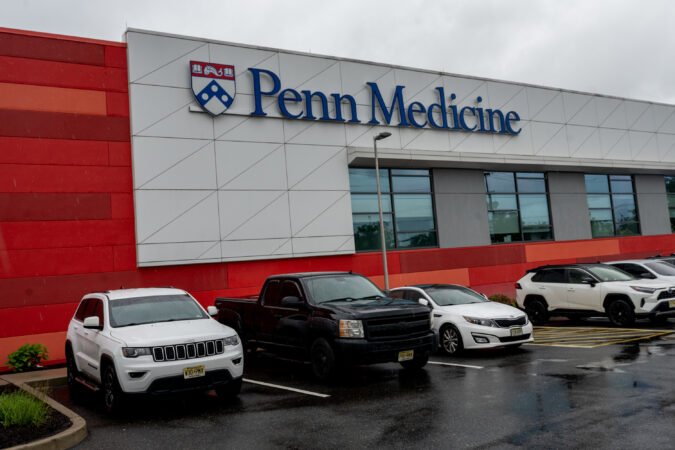
Jefferson Abington Hospital was cited by the Pennsylvania Department of Health for sanitation problems in its trauma center last year.
The incident was among more than a dozen visits health department inspectors made to the Jefferson Health facility between December 2024 and November 2025.
Here’s a look at the publicly available details:
Dec. 4, 2024: Inspectors followed up on a July 2024 citation for failing to report an incident in which a mental health patient ran away from the hospital and security staff left the hospital’s campus to apprehend them.
Dec. 23: The Joint Commission, a nonprofit hospital accreditation agency, renewed the hospital’s accreditation, effective September 2024, for 36 months.
Jan. 16, 2025: The hospital was cited for sanitation issues, including several dirty triage bays, a brown substance under a patient’s head and on the floor, and a black, sticky substance on a hospital bed wheel. Administrators retrained maintenance workers on cleaning protocol and assigned additional staffers to ensure daily cleaning.
Jan. 16: Inspectors came to investigate a complaint and for a monitoring survey but found the hospital was in compliance. Complaint details are not made public when inspectors determine it was unfounded.
Jan. 28: Inspectors visited for a mental health monitoring survey and found the hospital was in compliance.
Feb. 19: Inspectors came to investigate a complaint but found the hospital was in compliance.
March 12: Inspectors came to investigate a complaint but found the hospital was in compliance.
April 17: Inspectors followed up on the January citation regarding sanitation issues and found the hospital in compliance.
May 29: Inspectors came to investigate two complaints but found the hospital was in compliance.
July 16: Inspectors came to investigate a complaint but found the hospital was in compliance.
Sept. 5: Inspectors came to investigate a complaint but found the hospital was in compliance.
Sept. 18: Inspectors came to investigate a complaint but found the hospital was in compliance.
Nov. 5: Inspectors came to investigate a complaint but found the hospital was in compliance.
Every Cure, a biotech nonprofit started by a University of Pennsylvania researcher, has landed $76 million in federal funding to advance its artificial intelligence match-making tool that identifies existing drugs to treat rare diseases.
Over the next three years, Philadelphia-based Every Cure will use the funding from the Advanced Research Projects Agency for Health (ARPA-H) to pursue preclinical studies for at least 20 drugs that show promise for being repurposed for rare diseases with no other treatment options. The company will also pursue clinical trials to further test the safety and effectiveness of repurposing another 10 existing drugs.
The nonprofit was co-founded in 2022 by David Fajgenbaum, an associate professor at University of Pennsylvania, after his own experience with a rare disease.
He was diagnosed with Castleman disease as a medical student at Penn, and experimented in a campus lab with his own blood to try to find an off-label medication that could address his symptoms.
Every Cure’s AI tool expedites a drug discovery process that is otherwise often left to chance. When patients with rare diseases have few treatment options, doctors may scour medical journals or tap expert networks for leads on other drugs to try with mixed results.
The tool automates the process, using an algorithm to read massive biomedical data about diseases, medications, genes, and proteins. The tool looks for bits of data that diseases and medications may have in common that were previously unrecognized.
“This next phase will allow us to do the essential work of evaluating these potentially life-saving treatments in the lab and clinical trials, accelerating access to potential treatments for those who urgently need them,” Fajgenbaum, Every Cure’s President, said in a statement.
The new funding adds to $108 million in federal support the nonprofit has already received.
Main Line Health had an $8.7 million operating profit in the six months that ended Dec. 31, the nonprofit health system reported to bond investors Wednesday.
Main Line’s swing from an $8.9 million loss in the same period of 2024 benefited from a change in accounting for depreciation that reduced expenses. Without that change, Main Line would have had another loss.
“We have been pleased with our continued improvement in fiscal performance year over year, which has been strong outside of the change in depreciation,” Main Line’s chief financial officer, Leigh Ehrlich, said in a statement.
Here are more details on Main Line’s results:
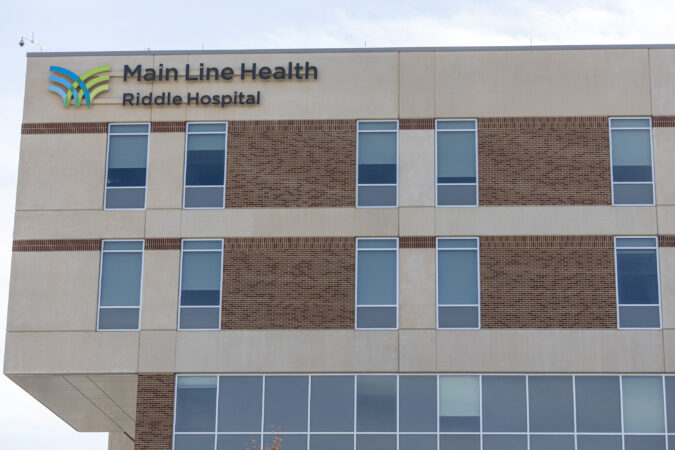
Revenue: Main Line reported $1.35 billion in patient revenue in the first six months of fiscal 2026, up 10.5% from $1.22 billion a year ago. Strong gains in hospital discharges, emergency department visits, and same-day surgeries contributed to the increase. Main Line’s Riddle Hospital near Media has seen a 36% increase in patients following the closure of Crozer Health’s hospitals last spring, contributing to revenue growth, Ehrlich said.
Expenses: Last year, Main Line changed how it accounts for investments in facilities and equipment, significantly reducing depreciation and amortization expenses. In the first two quarters of fiscal 2026, Main Line’s depreciation and amortization expense was $68.8 million, down from $84.5 million the year before. Excluding those expenses from both years, Main Line’s operating profit margin fell slightly, to 5.5% from 5.9%.
Notable: Main Line provides more detail than most systems on its patients’ health insurers. After just two years in Southeastern Pennsylvania, Pittsburgh insurance giant Highmark accounted for 12.5% for the business at Main Line Health. That is just 2 percentage points less than Aetna, which as been in the market for decades.
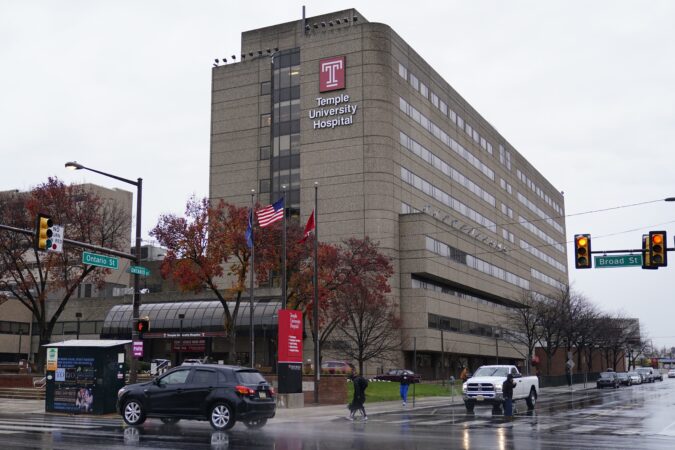
Temple University Health System had a $50.5 million operating loss in the six months that ended Dec. 31, the Philadelphia nonprofit told bond investors Monday. In the same period the year before, Temple reported a $13.5 million operating gain.
Here are some details on Temple results:
Revenue: Total revenue reached $1.64 billion, up 7.3% from the year before. Patient revenue rose 8% due mostly to increased outpatient revenue from Temple’s pharmacy business, infusions, and same-day surgeries. Two hits to revenue were a $14.3 million decrease in state funding and decline in the number of transplants, which bring in large amounts of revenue. Temple said it expects both of them to rebound in the remainer of fiscal 2026.
Expenses: Temple attributed some of its loss in the first six months of fiscal 2026 to $20 million in extra expenses associated with the opening of its new Woman & Families Hospital, a $7.2 million increase in medical liability expenses, and a $6.4 million increase in losses under its Medicaid contract with Health Partners Plans.
Notable: Despite its operating loss, even on a cash basis, Temple financial reserves increased to more than $1 billion as of Dec. 31. Most of the gain came from investments. The reserves equal the amount of money needed to keep the health system operating for 119 days if no more revenue came in. At the end of 2024, that figure was 113 days.
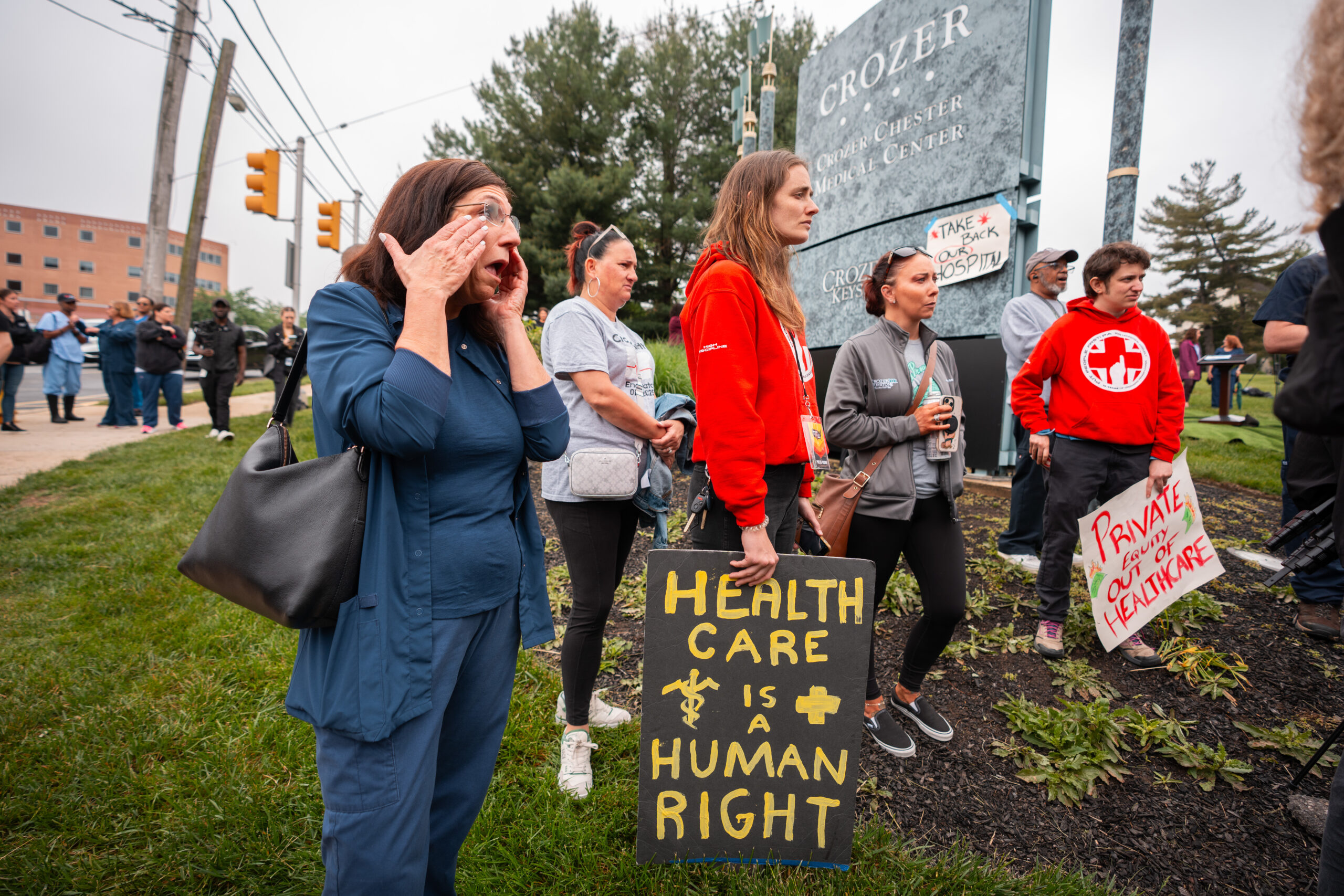
Dawn Pierce felt heartbroken last spring when she learned that Crozer-Chester Medical Center was closing.
The hospital had long been a lifeline in a city with limited healthcare services. Many Chester residents, like Pierce, were unsure where to turn for care when the hospital’s for-profit owner, California-based Prospect Medical Holdings, declared bankruptcy and shut down Crozer and Taylor Hospital in Ridley Park last spring.
“I don’t think of myself as one that will sit around and watch things happen, but I felt hopeless,” Pierce said.
Nearly a year later, Pierce and other residents say the community was left with major healthcare gaps: There are no primary care doctors or pediatricians in town. Locals who received routine care at the hospital had to switch to doctors outside the city, dealing with long drives or rides on public transportation. Some are going without care.
And many worry about whether they can make it to another hospital in time during a medical emergency.
Janice Cimabue, left, and Jamie Blair, center, with Put People First PA, after a news conference outside of the recently closed Crozer Medical Center in Delco, in Philadelphia, May 15, 2025.
These concerns have emerged through grassroots canvassing by One Pennsylvania, which shared its findings at a news conference this month. In recent months in Chester, organizers have knocked on 4,300 doors to gauge residents’ thoughts on Crozer’s closure and encourage them to advocate for better healthcare options in the city.
The membership group focuses on issues including housing rights and environmental justice. Originally founded as part of a 2011 Pittsburgh campaign by the labor union SEIU, it became an independent organization in 2015 and expanded into the Philadelphia area in 2016.
Pierce, who heads its Chester chapter, counts herself relatively lucky: While she saw specialists at Crozer, her primary care physician was at a different health system. But her brother and his significant other spent most of last year looking for a new doctor after Crozer closed.
“I do think they finally found someone, but at this point those visits are not near Chester. They’re 20 to 30-plus minutes away,” Pierce said.
Residents told One Pennsylvania organizers they felt relief that Chester officials did find a solution for EMS services lost in the closure. The city contracted with VSMC, an ambulance company, for higher-level care on the go, including blood transfusions.
“The restoration of EMS services and ambulance for our city — this matters,” Pierce said at the event held outside a downtown church on a recent Saturday. “However, EMS is a bridge. It’s not the final destination.”
(function() {
var l2 = function() {
new pym.Parent(‘he_chester’,
‘https://media.inquirer.com/storage/inquirer/projects/innovation/arcgis_iframe/he_chester.html’);
};
if (typeof(pym) === ‘undefined’) {
var h = document.getElementsByTagName(‘head’)[0],
s = document.createElement(‘script’);
s.type = ‘text/javascript’;
s.src = ‘https://pym.nprapps.org/pym.v1.min.js’;
s.onload = l2;
h.appendChild(s);
} else {
l2();
}
})();
Chester Mayor Stefan Roots told residents at the news conference that he met recently with representatives from the Crozer property’s new owner, for-profit Chariot Equities, which says it wants to restore medical services to the campus.
Roots said he couldn’t provide many details about a plan for the 64-acre campus that straddles Chester and Upland Township in Delaware County, which Chariot purchased last month for $10 million. Chariot said at the time it planned to operate a “right-sized” hospital and emergency department at the facility.
The new ownership comes after government-supported efforts failed to convince other local health systems last year to form a new nonprofit to run Crozer-Chester and other Crozer Health facilities.
Chester Mayor Stefan Roots told city residents that he met recently with representatives from the Crozer property’s new owner, for-profit Chariot Equities, which says it wants to restore medical services to the campus.
Roots said the new owner has impressive plans, but it could take years to bring back medical services, if successful. “It’s going to take some time, it’s going to take some money, and all we can do right here is to readjust,” he said.
Delaware County Council voted Wednesday to end a disaster declaration over lost EMS services in the wake of Crozer’s closure, since communities left without services, like Chester, had been able to contract with other EMS providers, WHYY reported.
Chester resident Andrea Robinson say she’s still feeling the impact of the lost medical services.
Robinson had to find new doctors after the closure, and a family member is now traveling farther to receive care for a mental health condition once treated at Crozer. And while other area hospitals are taking patients from Chester, the influx of new patients has at times led to long wait times elsewhere.
“We are truly in need of medical services now,” she said.
The University of Pennsylvania Health System had an operating profit of $189 million in the first six months of fiscal 2026, up from $117 million in the same period a year ago, the nonprofit reported to bond investors Friday.
Operating income increased, even after Penn put $43 million put into reserves for medical malpractice claims. Two years ago, Penn had recorded charges totaling $90 million for the same purpose.
Here are more details on Penn’s results:
Revenue: Penn had $6.76 billion in total revenue, up nearly 12% even adjusting for the inclusion of Doylestown Health in fiscal 2026. Penn acquired Doylestown last April.
“We’ve had good volume growth over the prior year, particularly in our outpatient activity,” the health system’s chief financial officer, Julia Puchtler, said in an interview.
The system has also had an increase in the acuity level on the inpatient side, she said. That translated into more revenue.
Expenses: The $43 million malpractice charge boosted overall malpractice expenses through December to $125 million, from $69 million in the same period a year ago.
It’s not that Penn is seeing more claims, Puchtler said. “It’s really the average reserve per claim that we’re seeing accelerate,” she said.
Notable: Excluding Doylestown, Penn saw a 5.9% increase in patient volumes, Puchtler said. “That’s mostly outpatient,” she said. “Outpatient surgery, endoscopy, and some of our other infusion therapy are all increased over the prior year.”
Editor’s note: This article has been updated to reflect an additional medical malpractice charge in 2024, bring the total to $90 million.
The University of Pennsylvania is getting $7.8 million over the next two years to study an overlooked aspect of human health: the lymphatic system.
Often described as the body’s sewer system, its main job is to maintain the body’s balance of fluid and filter out waste. Millions of Americans live with dysfunction in the system, often unknowingly.
The time to diagnose some lymphatic disorders is at least five years, said Maxim Itkin, an interventional radiologist who directs Penn’s center specializing in lymphatic disorders.
He’s even had a patient who experienced unexplained symptoms for 50 years before getting treatment.
“Right now, most healthcare providers simply aren’t equipped — or trained — to recognize lymphatic dysfunction, and the tools they need are virtually nonexistent,” said Kimberley Steele, a program manager at the Advanced Research Projects Agency for Health (ARPA-H), the federal agency organizing the research effort.
That’s why the government, through ARPA-H, is investing $135.7 million toward research headed by 11 institutions in the U.S. and Canada, including Penn, to improve detection of issues in the lymphatic system.
With its slice of funding, the team at Penn will develop ways to image the network and identify hidden signs of disease.
An inside look
Similar to plumbing, fluids in the lymphatic system can be flowing, obstructed, or leaking.
Doctors are able to “close” these leaks and even “open” obstructed areas, but the problem is knowing when those procedures are needed.
Existing contrast agents — substances used to increase visibility of tissues during imaging — for the lymphatic system are largely considered obsolete and offer poor resolution, said Itkin, who is leading the Penn project, which started last October.
When he began researching the system 20 years ago, he “started to realize that it’s of enormous importance, and it’s forgotten primarily because nobody can image [it] and do interventions,” he said.
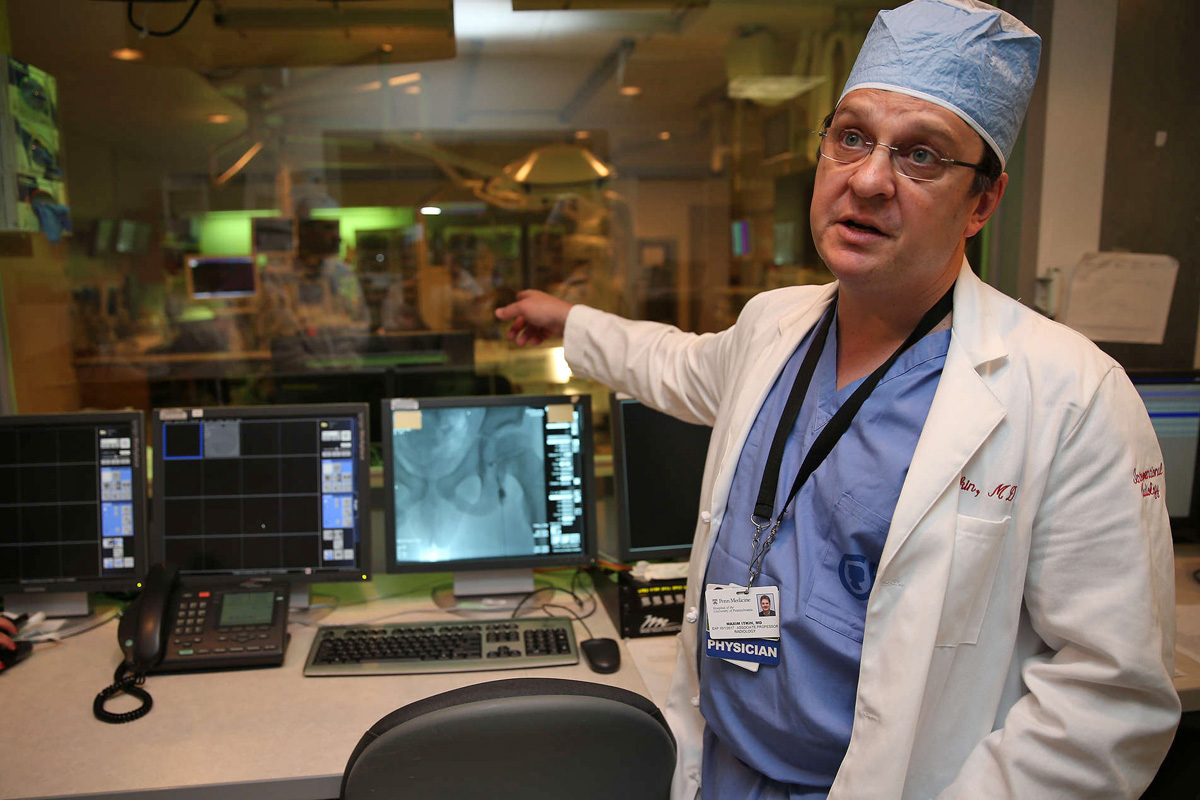
Maxim Itkin, an interventional radiologist at the Hospital of the University of Pennsylvania, found a way to track the flow of lymphatic fluid using X-ray imaging equipment.
Itkin and his team have come up with ways of imaging by injecting dye into lymph nodes and tissues and tracing the dye’s location. This has enabled him to diagnose hidden conditions and develop new treatment methods.
The ARPA-H funding will allow them to go even further, developing imaging agents that focus on the parts of the lymphatic system in the liver and gut — organs that generate the majority of the network’s flow in the body.
These will be used for CT (computed tomography) and MRI (magnetic resonance imaging) scans.
One of the imagingcandidates is designed to be swallowed and absorbed in the intestine, so doctors can see the lymphatic system in the gut. The second imaging agent will be administered via IV to show the system in the liver.
“It was my dream to see the lymphatic system from inside by itself,” Itkin said.
They’ll be using an approach called AI-driven multi-omics, where AI will analyze samples for unique molecules being excreted by the lymphatic system in the liver.
Penn and several other funded groups are working with the New York-based nonprofit Lymphatic Education and Research Network to help with research and patient recruitment.
Current funding is for two years, with the potential to extend for another three years.
Itkin says seeing the lymphatic system in the liver will be a thrill.
Jefferson Health oncologist Jennifer Johnson had exhausted all the standard treatment options for her 49-year-old patient with esophageal cancer, who was likely to die within months.
Surgery, chemotherapy, radiation, and immunotherapy had kept the Northeast Philadelphia woman alive for six years after her diagnosis, but no longer were enough to stop her cancer from spreading.
Johnson knew her patient needed something novel. She recalled a presentation several years prior at a conference for head and neck cancers, where a doctor discussedan experimental treatment called T-cell receptor (TCR) therapy.
This type of cancer immunotherapy works by engineering the immune system to fight cancer, and falls into the same family of treatments as CAR-T, or chimeric antigen receptor (CAR) T cell therapy, an approach pioneered at the University of Pennsylvania that has revolutionized treatment for blood cancers.
She thought TCR therapy’s clever approach could work against solid tumors, where CAR-T had not been effective.
“I just remember sitting in the room and watching him present, thinking, I’m gonna use that one day,” the oncologist and cancer researcher recalled.
As it would happen, the approach was being tested in a phase II clinical trial at Rutgers Cancer Institute against tumors just like her patient’s: metastatic cancers driven by a virus called human papillomavirus 16. One of the most common strains, HPV16 causes roughly half of cervical cancer cases worldwide, as well as cancers of the head and neck area, anus, and genitals.
Cases that reach the metastatic stage like Johnson’s patient often run out of treatment options. Whether T-cell receptor therapy would work was unknown, but the alternatives were expected to fail.
“Anything that you might offer them would definitely not be expected to make their cancer go away completely and do it for a long time,” said Christian Hinrichs, the oncologist and scientist heading the trial whose presentation Johnson saw.
But interim results from the first half of the trial showed improvement in six out of 10 patients, whose tumors at least partially shrank. And two of them had no evidence of cancer after treatment.
Johnson’s patient, Maria Pascale, was one of thetwo whose promising early results were presented at a medical conference and highlighted in a research abstract in the Journal for ImmunoTherapy of Cancer in November.
She arrived at the health system in New Jersey in the summer of 2024 in such poor health thather lungs were starting to collapse.
The therapy has enabled her to celebrate two birthdays, start martial arts classes, reunite with old friends visiting from Argentina, and see her 23-year-old son get engaged.
“Imagine the wedding, then later the grandkids, I’m always thinking about [that],” she said.
What is a T-cell receptor therapy?
In the immune system, T cells act as frontline defenders against viruses, bacteria, and other threats.
Sometimes, these cells aren’t great at their jobs.
In the face of cancer, T cells can become exhausted over time, and fail to recognize invaders or mount attacks.
The idea behind immunotherapy is to transform these regular immune cells into cancer-fighting super-soldiers.
The Rutgers approach, an engineered TCR therapy, involves collecting T cells from a patient’s blood and genetically engineering them to better target a cancer cell for attack.
Afterward, the scientists grow more of the enhanced T cells in the lab and infuse them back into the patient.
The “prototype” for this style of therapy is CAR-T, a treatment that has saved tens of thousands of lives since the first FDA approval in 2017. Scientists have not yet been able to replicate the therapy’s success in blood cancers in solid cancers, although some early stage trials have shown potential.
TCR therapy is thought to be more promising against the latter cancer type — which is what’s being treated in the Rutgers trial — due to differences in the way the engineered T cells identify cancer cells.
CAR-T therapy uses what’s called a chimeric antigen receptor, a protein that recognizes a cell as cancer based on what’s on the outside of the cell.
It’s like knowing you’re at your friend’s house because of a specific doormat or set of house numbers on the exterior.
TCR therapy uses what’s called a T-cell receptor, which can recognize cancer cells based on what’s inside the cell.
It’s like knowing you’re at your friend’s house because you can see your friend inside.
Sometimes cancer cells have more unique identifiable elements on the outside, but other times they don’t. Imagine if multiple houses had the same doormat.
“That target would be on other cells that aren’t cancer cells and cause lots of toxicity,” said Carl June, the pioneering cancer scientist at Penn who developed the first FDA-approved CAR-T therapy and was not involved in the Rutgers trial.
That’s been the problem that’s held back CAR-T’s use in solid tumors.
The target in the Rutgers trial is a protein called HPV16 E7, found inside the cell. In tumors driven by the virus HPV16, it plays a key role in turning a cell into cancer.
“That’s like going after its Achilles’ heel,” June said.
Swarming the cancer
Pascale first arrived at Thomas Jefferson University Hospital in Center City in 2018 after suffering injuries in a car accident.
Doctors found a mass in the 43-year-old’s neck that turned out to be cancer.
Surgeons removed the mass,and she was fine until 2021 when doctors, including Johnson, found the cancer at the top of her esophagus.
They treated her with a combination of chemotherapy and radiation, which worked until March of 2022, when the cancer started appearing in Pascale’s lungs.
“All bets were off,” Johnson said.
Doctors gave Pascale chemotherapy and immunotherapy over the next couple of years, but in the spring of 2024, she developed an allergy to one of her chemotherapy drugs.
Around the same time, the cancer spread to the skin on Pascale’s back.
That’s when Johnson transferred her care to Hinrichs’ team at Rutgers.
Pascale started preparations for the treatment in July 2024, spending a couple weeks in the hospital.
The Rutgers team took T cells from her blood, gave her chemotherapy to knock her immune system down, and then transfused the engineered cells back into her body.
Within 48 hours, Pascale started feeling horrible.
“It was painful. It was my whole body, like I had pneumonia,” she said.
She had trouble breathing as the cells fought the cancer in her lungs. Hinrichs described it as “the T cells swarming the cancer,” leading to an inflammatory reaction.
The same thing occurred on her back. When Pascale’s sister came over, she saw one of the tumors in her skin was suddenly the size of a lemon.
Another one appeared red and felt like someone was burning a cigarette on her back.
The pain continued for three days, and then she felt well enough to go home. Pascale and her sister could see and feel the nodules on her back get smaller, until eventually they were gone.
Roughly five months later, Pascale’s scans showed no evidence of cancer. As of last month, a year and a half after she received the treatment, that was still true.
“What’s three days of pain compared with the opportunity that I have to live a lot of beautiful things with my family and friends?” Pascale said.
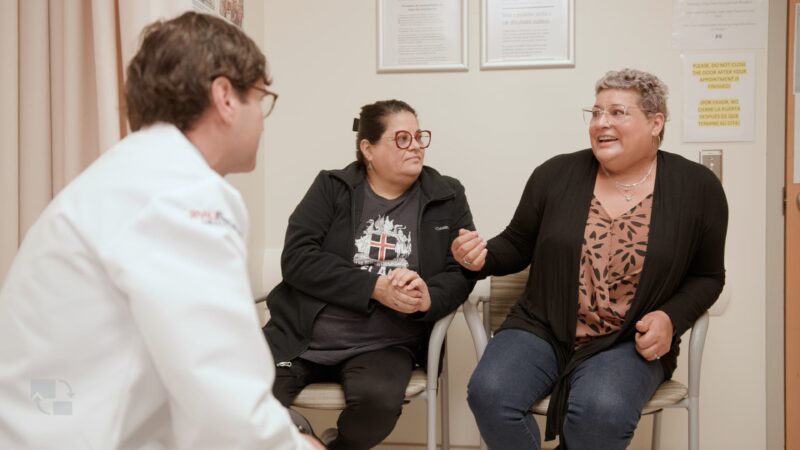
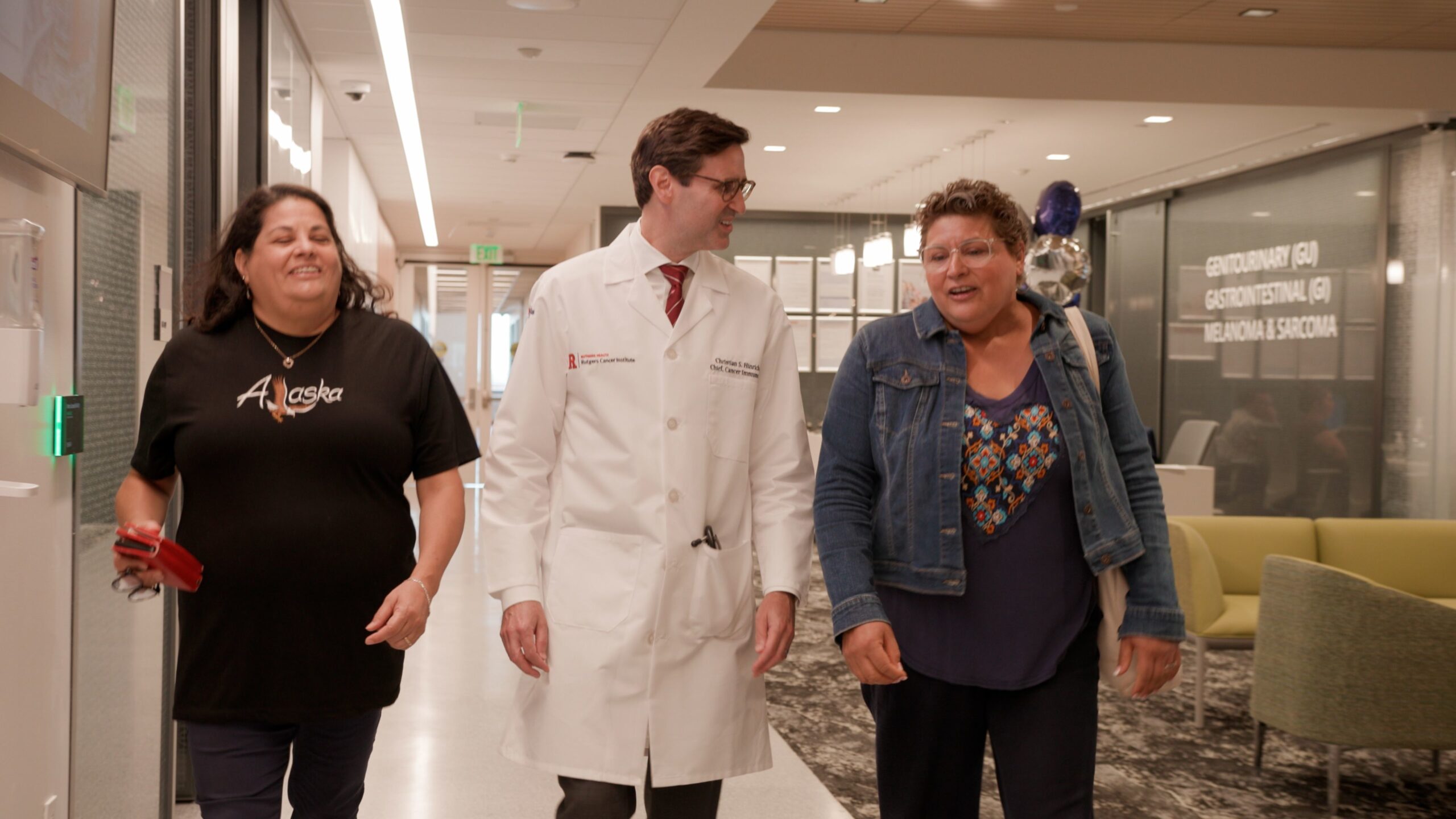
Maria Pascale walks with her sister Maria Durante and her doctor Christian Hinrichs at Rutgers.
The future of the treatment
Hinrichs said his team is working to figure out why two of the patients, including Pascale and a patient with anal cancer, responded better to the treatment.
He cautioned that it’s too early to draw sweeping conclusions since the sample size is small. (Researchers will seek to recruit another 10 patients for the ongoing trial.)
The patients who had complete responses will need follow-up scans every few months to make sure their cancers have not returned.
It will still take years to finish evaluating safety and efficacy. Treatments tested in clinical trials often do not advance to become standard practice.
June, the Penn scientist, called the trial’s early results promising and noted that there weren’t any major safety problems reported.
Adverse effects seen in the trial were mainly those caused by the chemotherapy.
However, the drawback of using TCR therapy is that patients need a certain genetic background for it to work, June said. This is similar to how not every organ donor would be a good match for a recipient.
The genetic profile chosen for the Rutgers therapy is the most common in America. However, it is less common in Black and Asian people compared to white people.
Scientists hope it could one day be possible to manufacture the therapy witha warehouse approach, where TCR therapies that work across genetic backgrounds could be mixed and matched.
“It’s a practical issue that the drug companies face,” June said.
CAR-T, in comparison, canbe used more broadly across different genetic backgrounds.
What matters most, since the treatment is expensive to make, is that the responses hold up over time, June said.
(The TCR therapy’s cost has not yet been set, Hinrichs said, since it is currently manufactured individually for each patient.)
“If they’re long lasting, then it’s really going to be a huge advance because nothing else works in the patients he’s treated,” June said.
At Jefferson, Johnson is cautiously optimistic about the treatment that has kept her patient alive.
If the therapy makes it through the rest of the trial process and proves effective, she hopes it could become “another thing in our armamentarium against this type of cancer.” (A type that doctors would hope to see less of since the introduction of the HPV vaccine in 2006.)
“I can’t tell you how wonderful it is to have a patient responding and living well when you saw things going the wrong way,” Johnson said.
Editor’s note: This story has been updated to clarify where the research has been presented and a reference to the prevalence of the genetic profile used in TCR therapy.
Jefferson Health had an operating loss of $201 million in the six months that ended Dec. 31, compared to a $55 million loss the year before, the nonprofit health system said in a notice to bondholders Friday.
The $201 million loss included a $64.7 million restructuring charge related to severance for 600 to 700 people laid off in October and other changes designed to improve efficiency in the 32-hospital system that stretches from South Jersey to Scranton.
Excluding the restructuring expenses, Jefferson’s operating loss was $136.3 million in the first half of fiscal 2026.
Jefferson said in a statement that it continues facing significant financial headwinds, like health systems nationwide, citing rising pharmaceutical costs.
“We remain focused on driving efficiency, advocating for reimbursement rates that better reflect the true cost of care in Pennsylvania, and advancing the long-term stability of our academic health system,” the health system’s chief financial officer Michael Harrington said.
Here are some details:
Revenue: Patient revenue reached nearly $6 billion in the first half of fiscal 2026. The figure for the previous year is not comparable because it does not include Lehigh Valley Health Network for the full six months. Jefferson acquired the system on Aug. 1, 2024.
Jefferson’s total revenue of $8.6 billion included $145.9 million of investment income that directly boosted operating income. Competitors who use heath-system reporting rules do not include investment income in revenue. Jefferson, by contrast, follows rules for higher-education reporting.
Insurance business: Jefferson noted improvement in its health insurance arm. Jefferson Health Plans’ loss in the six months ended Dec. 31 was $90.7 million, compared to a $118.5 million loss in the same period the year before. The number of people insured in the plans climbed to 371,005 from 359,662. Medicaid recipients account for most of that enrollment.
Notable: Both Moody’s Ratings and Standard & Poor’s Ratings Service in December and January revised their outlooks on Jefferson to negative, which means the agencies could downgrade the organization’s credit rating if Jefferson’s finances don’t improve over the next two years.
“The negative outlook reflects the magnitude of current operating losses as well as anticipated difficulties in returning to or near operating profitability for several years,” Standard & Poor’s said.
Tower Health had an operating loss of $16 million in the first six month of fiscal 2026, according to its report to bondholders Friday. In the same period a year ago, the Berks County nonprofit’s loss was $16.1 million.
Here are some details:
Revenue: Revenue from patient care rose less than 1% to $889.3 million, while total revenue climbed 4.3% to $1.03 billion, thanks to a 34% increase in other revenue.
Cash reserves: Tower reported $244 million in cash reserves on Dec. 31. That translates into enough money to keep operating for 44 days without any new revenue. Both of those figures were at their highest levels since 2022.
The quarterly low was in March 2024, when Tower reported $153 million in cash. That amounted to 30 days of cash on hand. Financially strong systems often have 200 days in reserve.