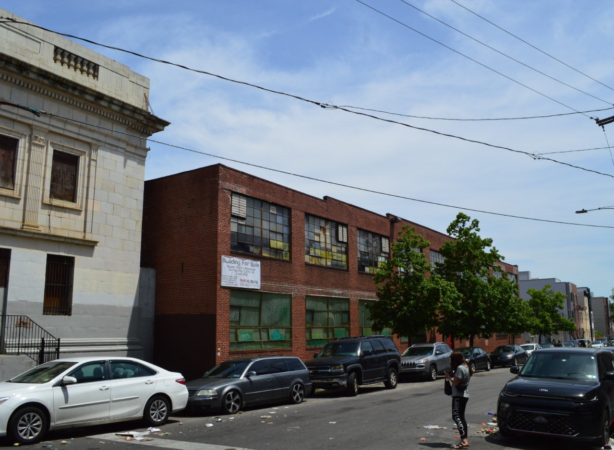
The long vacant industrial building at 1807 Huntingdon St. in East Kensington is moving toward redevelopment after seven years of setbacks.
Philadelphia-based Smith & Roller has been eyeing the faded brick structure since 2019 but struggled with funding following the COVID-19 pandemic and the loss of a lender after Silicon Valley Bank’s collapse in 2023.
But last week New Jersey-based Ellavoz Impact Capital announced that it was acquiring the building in partnership with Smith & Roller, allowing the developers to move forward with their plans near SEPTA’s Huntingdon stop on the Market-Frankford line.
Developers Tayyib Smith and Jacob Roller see the project as a catalyst for change around the elevated train station, which is haunted by the opioid crisis.
“I’ve always imagined connecting nodes of vitality and then seeing how it almost has a regenerative spring of people looking at a neighborhood differently,” Smith said.
“I can imagine that block having a different feel, a different type of lighting, a different type of walkability, more socio-economic diversity, more eyes on the corridor,” he added.
The developers plan to break ground on the project in about six months.
Smith & Roller’s neighboring development, 1801 Huntingdon, will transform a historic bank building into a banquet hall and commissary kitchen for Black-owned caterer Strother Enterprises, which has been expanding elsewhere in the city recently. That development will need approvalby the city’s Zoning Board of Adjustment and is on a longer timeline.
Over the years, the project at 1807 Huntingdon has added more housing and cut back on space for businesses.
The current version of the project includes 109 residential units and 8,600 square feet of commercial space. According to Ellavoz Impact Capital’s news release, the commercial space has been preleased, but the tenant list is not public yet.
A rendering of the redeveloped factory building, as a mixed-use apartment building.
An earlier version of the project, reviewed by the city’s Civic Design Review committee in 2022, would have contained 80 apartments and 38,000 square feet of light industrial space.
That’s partly because the federal program Smith & Roller originally planned to use, New Market Tax Credits, requires that at least a fifth of a mixed-use project be devoted to commercial development.
But the project at 1807 Huntingdon has been in process for so long that this part of Kensington no longer qualifies for the federal incentive, which is meant to spur investment in struggling areas.
The project is still in a Keystone Opportunity Zone (KOZ), however, which will give state tax breaks to businesses at the 1807 and 1801 Huntingdon projects.
That policy is also meant to incentivize development in lower-income areas, but there are many examples of its application to parts of Philadelphia like the Navy Yard and University City.
“I don’t know many [KOZs] that are in neighborhoods like Kensington,” Smith said, “where there’s somebody trying to use it in the spirit and intent of how the legislation was written.”
The project will include both the redeveloped factory with additional space above it and an adjacent parking lot, which will have multiple stories of housing on top.
It will include a mix of studios, one-bedroom, and a few two-bedroom apartments, along with loft-style units that can be rented out as either short-term rentals or office space.
Sixty percent of the units will be set aside for households earning 80% of area median income, or almost $67,000 for one person.
“We don’t have a direct subsidy, like a Low Income Housing Tax Credit or anything like that,” Roller said. “In some cases, it’s not that different a number than a market rent in the neighborhood.”
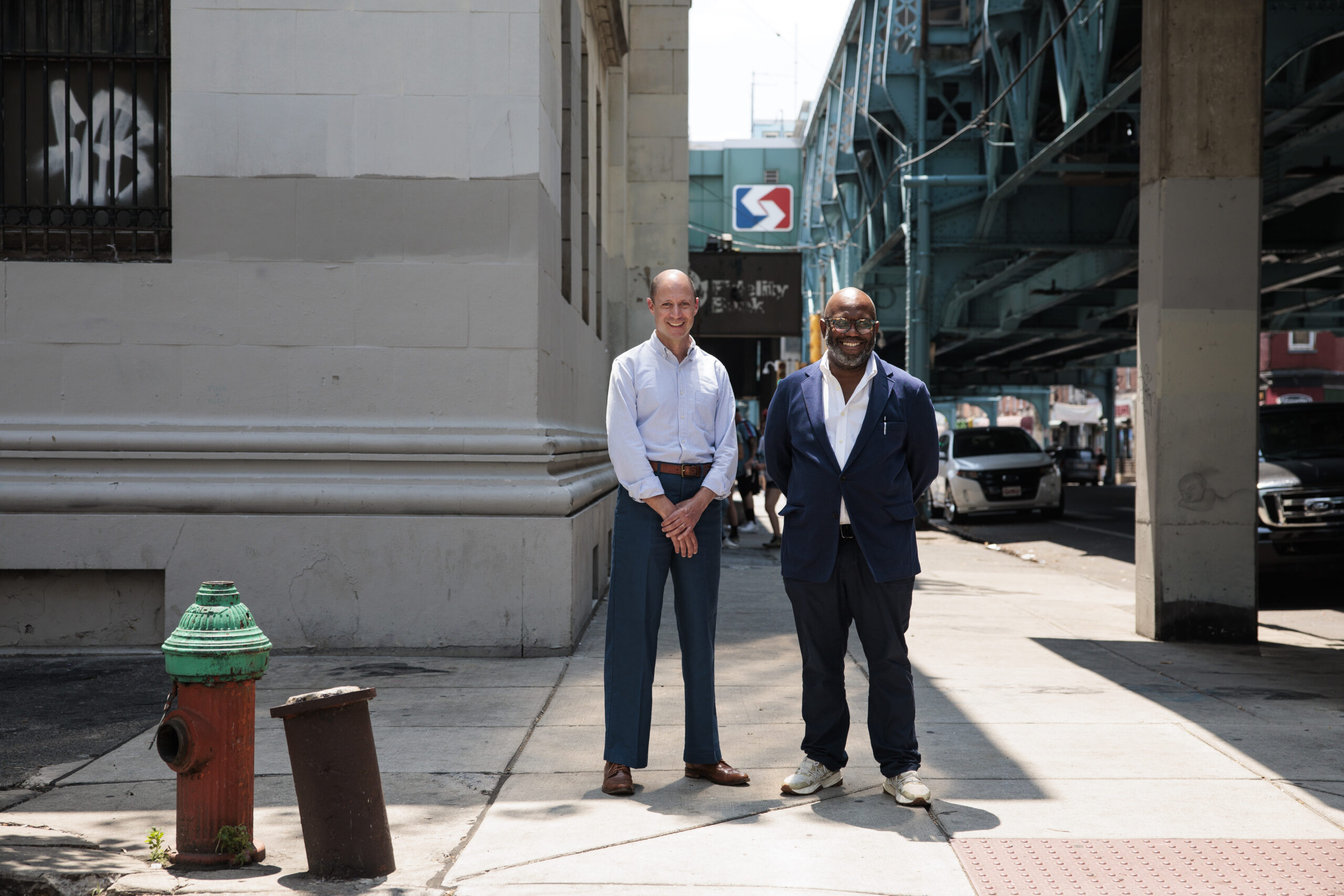
Jacob Roller (left) and Tayyib Smith last June outside the historic bank they plan to turn into a base for Black-owned businesses, which is next to the apartment project farther down Huntingdon Street.
Roller said the project is inspired in unit mix and general location by the success of Shift Capital’s mixed-use project at 3400 J St., home to Càphê Roasters. Smith & Roller was a junior partner in that project.
The Huntingdon Street project will be the firm’s largest project by unit count.
“I am extremely impressed by the work of Smith & Roller,” Jeffrey Crum, president of Ellavoz Impact Capital, said in the news release. “They have proven themselves as professional and experienced urban redevelopers who have a unique vision for revitalizing neighborhoods in partnership with local communities.”
The proposal has been presented to the East Kensington Neighbors Association several times over the years, and the community group is supportive of Smith & Roller’s proposal.
The group also sees the development project as a means to bring new life to the block, where the current dilapidated state of the buildings often attracts opioid users from nearby open-air drug markets on Kensington Avenue.
“The block has been challenged for a long time,” said John Theobald, president of the East Kensington Neighbors Association. “It’s really where a lot of the Kensington Avenue activity impacts the neighborhood, so hopefully more people living there and less vacancy will help.”
The Eberz sisters know they can count on each other to pick another up.
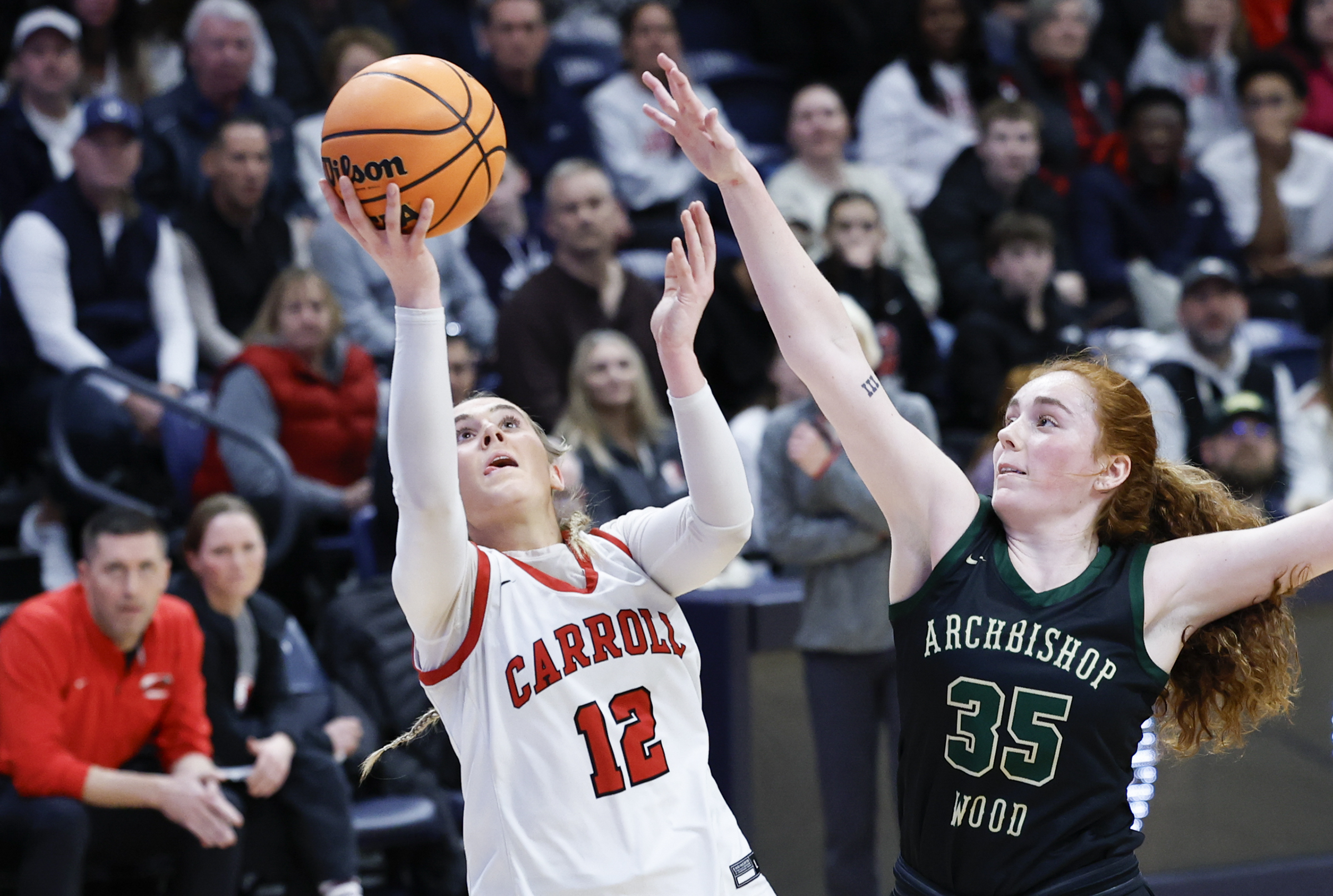
Alexis and Kayla Eberz, two of three sisters on the Archbishop Carroll girls’ basketball team, leaned on another to earn a 50-38 win over Archbishop Wood in a Catholic League girls’ basketball semifinal.
The two combined for 36 of Carroll’s 50 points; sophomore Kayla scored 24 and senior Alexis added 12.
“I definitely look up to Lex a lot,” Kayla Eberz said. “I’m so proud of everything she does, [and] I think we work together really well. So if one’s not doing so [we’re going to] pick the other one up.”
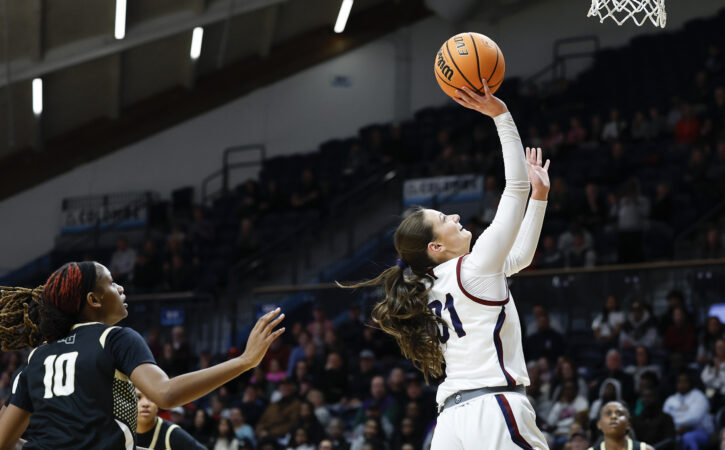
Archbishop Carroll’s Kayla Eberz finished with a team-high 24 points against Archbishop Wood on Monday.
Now, Carroll finds itself in a familiar position: the PCL final. This marks the Patriots’ third straight PCL final appearance.
Last season, Carroll lost to Neumann Goretti, and in 2024, it lost to Wood. The Patriots haven’t won a PCL title since 2019.
This time around, Carroll, which will face Cardinal O’Hara Sunday at the Palestra, believes it’s in a better spot to come out victorious.
“I think our mindset [has changed],” Alexis Eberz said. “We haven’t gotten the outcome we wanted the past two times, but we are using that as motivation this year. … We’re a special team. Staying together, staying composed, having discipline — I think we got it.”
Road to victory
But the Patriots’ semifinal win at Finneran Pavilion — the future home of Alexis Eberz, a Villanova signee — did not come easy.
The Vikings built a 10-point lead about six minutes into the game. Carroll responded with back-to-back three-pointers to cut its deficit and end the first quarter down by two points.
Wood senior forward Colleen Besachio, a Rider signee, was the difference-maker for the Vikings, scoring a team high 15 points. Wood trailed, 21-20, at halftime.
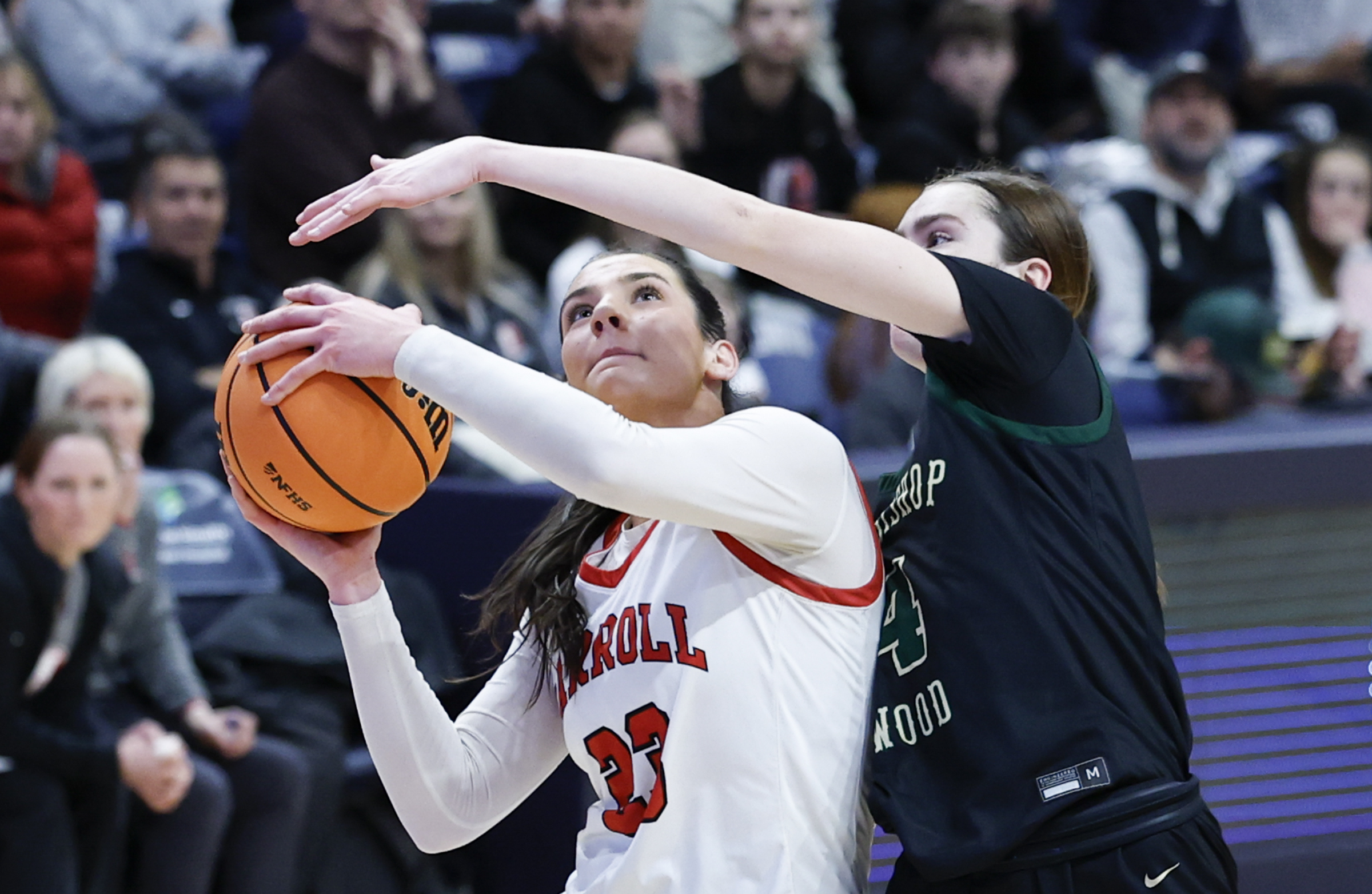
Archbishop Carroll’s Alexis Eberz drives to the basket against Archbishop Wood High’s Colleen Besachio in the third quarter on Monday.
But once the Eberz sisters started to connect in the third quarter, the tempo shifted.
Kayla started the run with a bucket that gave Carroll 31–28 lead, then followed it up with a massive block. On the Patriots’ next possession, Alexis found Kayla for a three-pointer, followed by a Kayla dish to Alexis for an easy layup to make it 36–28.
“Basketball is a game of runs,” Kayla said. “They had their run at first; we had ours. And then we just had to stay on top of it.”
Carroll held an eight-point lead entering the final 10 minutes and extended that advantage to a comfortable 12 points by the final buzzer.
“We just had to [take it one] possession at a time,” Carroll coach Renie Shields said. “When we dug in, took one possession defensively, and offensively got going, I felt more comfortable that we got into a swing of things.”
Back to the Palestra
Carroll has an 11-0 league record. The team is full of chemistry and experience.
The Patriots hope that will help them write a new story and bring home a PCL crown on Sunday afternoon.
“We’re all such good friends. It helps,” said senior forward Bridget Grant, who’s committed to Ursinus. “When one of us is down, another person picks [them up]. If someone takes a bad shot, you can let them know. That’s not us getting mad; it’s just trying to help the team. It really just shows how well we play with each other, that we all love each other.”
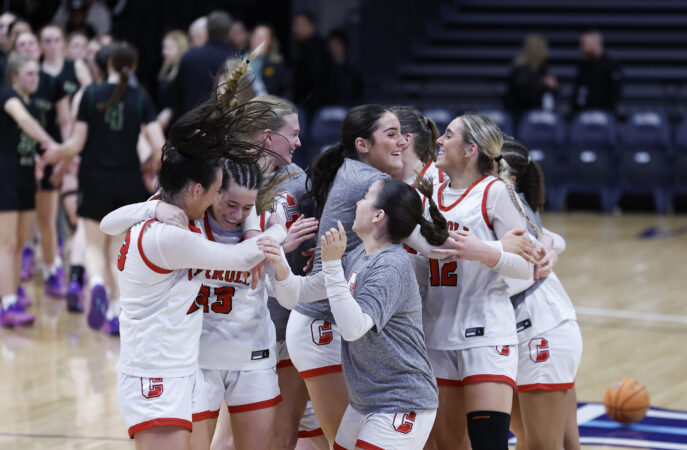
Members of the Archbishop Carroll team celebrate after beating Archbishop Wood in the Catholic League girls’ basketball semifinals on Monday.
The theory after the U.S. women’s soccer team’s January camp was that the SheBelieves Cup in March would be the first big step toward World Cup qualifying in the fall.
Tuesday’s announcement of the tournament roster signaled that the step might not be as big as believed.
The 26-player squad doesn’t lack for marquee names. Naomi Girma, Sam Coffey, Lily Yohannes, Rose Lavelle, Trinity Rodman, and Alyssa Thompson are among them. But just as significant are two names not on the squad.
Sophia Wilson is back from maternity leave and participating in the Portland Thorns’ preseason camp out west. Catarina Macario hasn’t played since December for the U.S. or her English club, Chelsea, but there’s been a lot of chatter that a reported heel injury isn’t the only reason. She turned down a new contract offer in London and could be headed to the NWSL’s San Diego Wave.
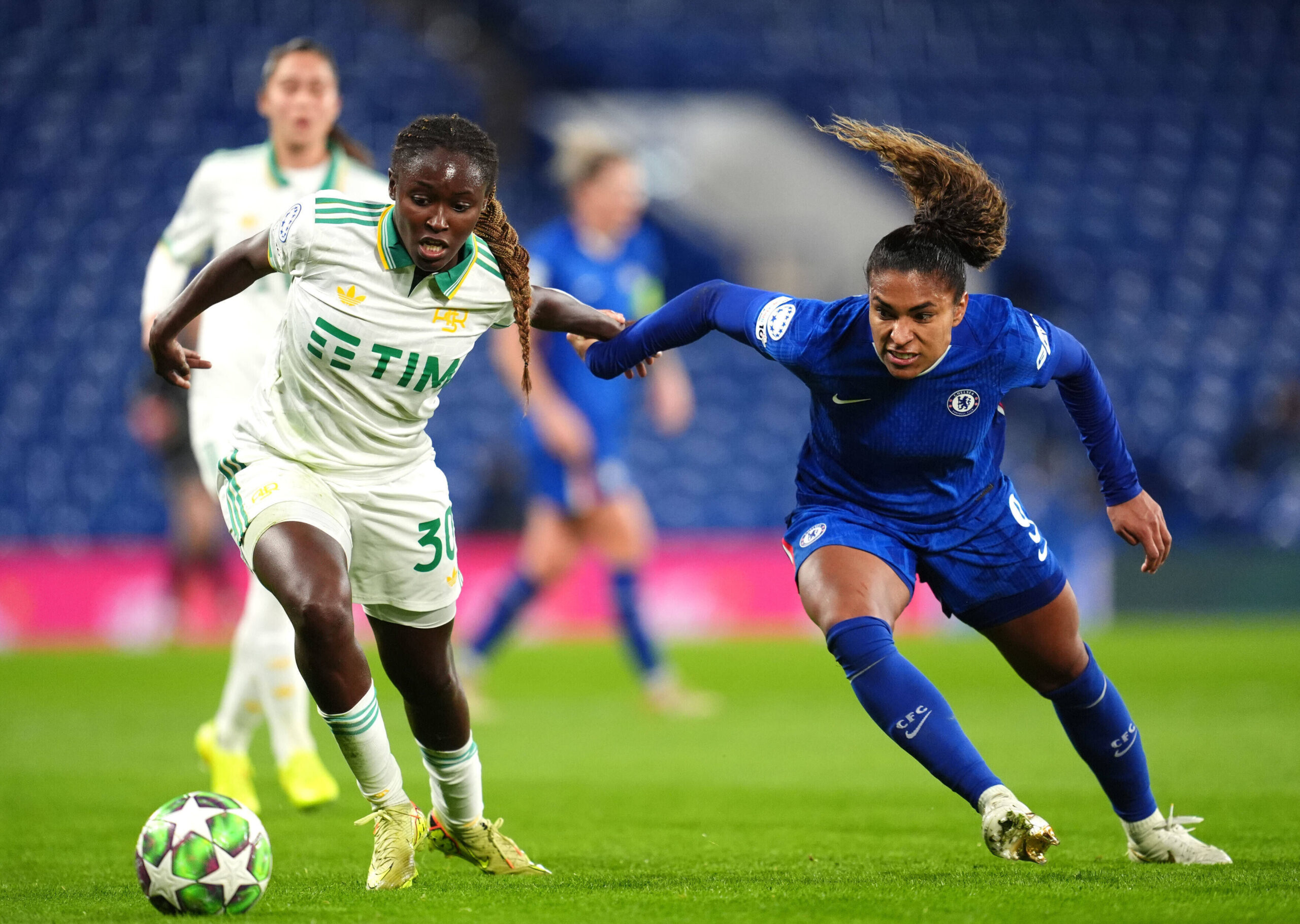
Catarina Macario (right) likely is leaving Chelsea after three years at the London club.
U.S. manager Emma Hayes has made it clear that she won’t call in players who haven’t been playing for their clubs lately. That makes sense. Still, Monday’s news raised some eyebrows. Hayes was not surprised to be asked about the two stars and said she would have called in both, were they healthy.
“‘Soph’ and I spoke, and she’s just not ready,” she said, noting that the Thorns didn’t deem her fit yet either. “The return to play protocol, it’s just not given her enough time, I think, for her to be in the place that she wanted to be in. So it’s right that she’s not part of this squad, however much I want her to be.”
The manager described Macario as “getting closer and closer [to returning] every day” and said she didn’t know when the forward will return to club action.
“She’s not available for selection yet at Chelsea. ”I don’t know when that is going to come — I don’t know if it’s a week, two, three weeks away.”
The situation is different with two other major absentees. Mallory Swanson, the third member of the “Triple Espresso” forward line, is also a new mother and hasn’t returned to work with the Chicago Stars. Centerback Tierna Davidson has resumed training with Gotham FC after a torn ACL last year — “we’ve missed her,” Hayes said — but isn’t yet in game shape.
“A player coming back from injury, you have to give them the time to be able to find their best version of themselves,” Hayes said. “I expect Tierna, when she is cleared to play for Gotham, to be competing, to come back into this side as soon as she, ideally, starts competing for Gotham on a regular basis. But most importantly, when her body is ready.”
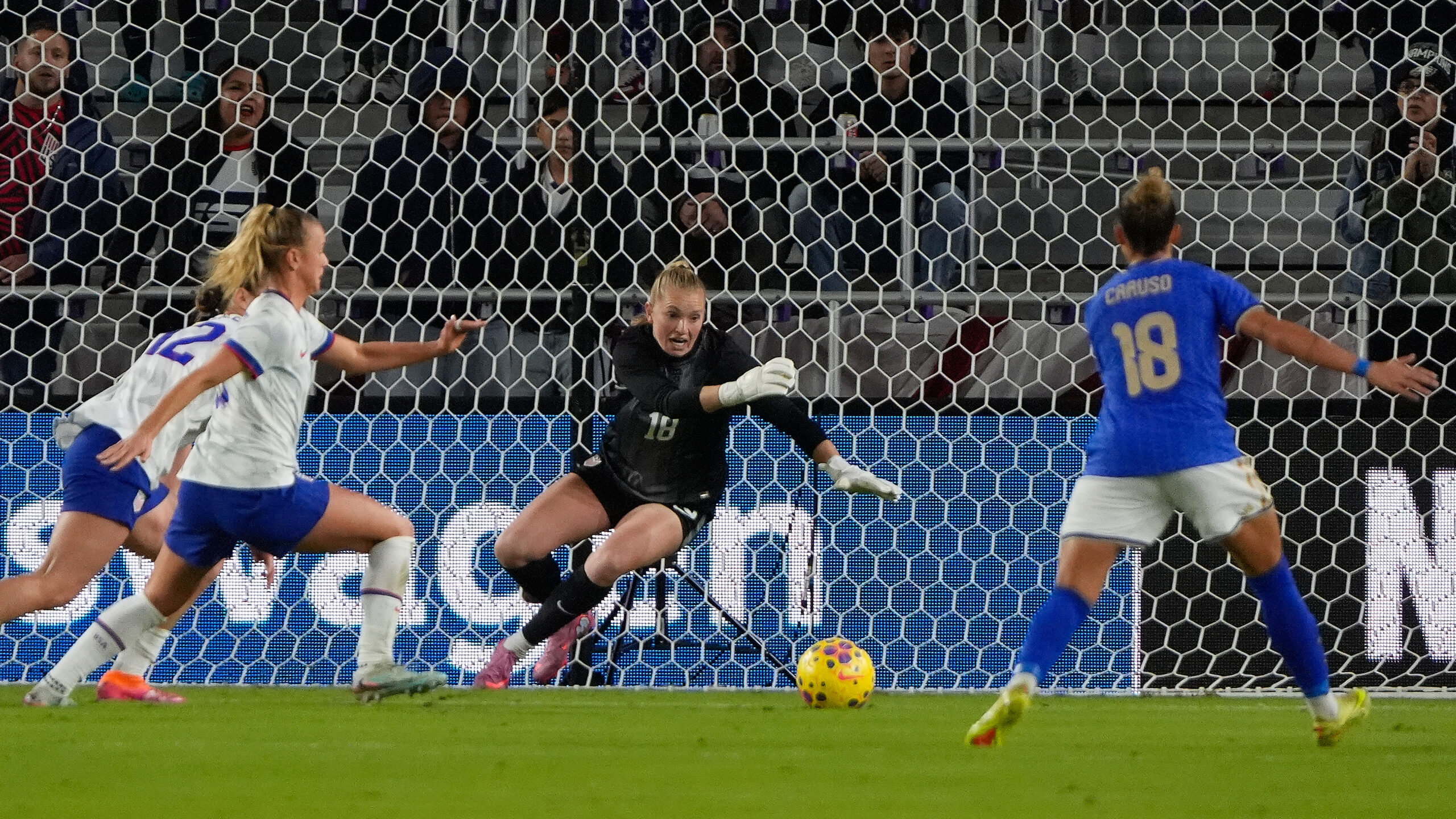
As for players who are on the 26-woman squad, the battle to be the new starting goalkeeper is one of the biggest stories. Phallon Tullis-Joyce, Claudia Dickey, and Mandy McGlynn are the three on this squad as the competition continues.
Tullis-Joyce has the most club pedigree at Manchester United, at least for now. But she hasn’t always looked the part in a U.S. jersey. Dickey, of the Seattle Reign, has looked sharper in starting five of the last seven U.S. games, though Tullis-Joyce missed December’s games with an injury and January’s as they weren’t in a FIFA window.
Phallon Tullis-Joyce hasn’t played for the U.S. since the Americans lost to Portugal in October at Subaru Park.
“I’ve been really happy with Claudia Dickey and Mandy McGlynn from [the] last camp,” Hayes said. “With Phallon, we didn’t get the chance to select her because she was injured in the back end of November, December, so I’m looking forward to having Phallon back with the group. And, for now, I’m happy with this group.”
The U.S. will play Argentina, Canada, and Colombia in this year’s tournament, on March 1, 4, and 7, respectively. Sports Illustrated Stadium in Harrison, N.J., will host the last day’s doubleheader, Argentina-Canada and U.S.-Colombia. As ever, a sellout crowd will be expected, with a few Philadelphia accents in the stands from fans making the trip north.
Six days later, the NWSL season will kick off in Washington with Rodman’s Spirit hosting Wilson’s Thorns. That will be Rodman’s first game since signing her big new contract in D.C. The potential for Wilson to return to action that night will make it an even bigger occasion.
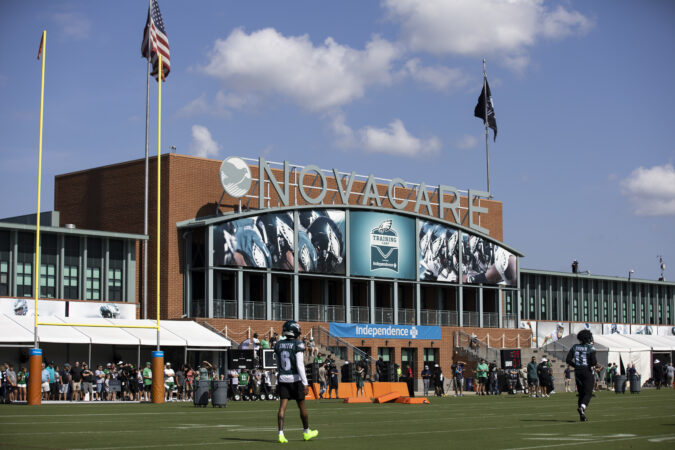
The Eagles’ training facility in South Philadelphia will have a new name this upcoming season: Jefferson Health Training Complex.
Since the practice facility opened in 2001, it has been known as the NovaCare Complex. It’s been home to Eagles training camp since 2013.
The team announced new sponsorship agreements with Jefferson Health and with NovaCare Rehabilitation on Tuesday, which included the renaming of the Eagles’ facility.
The facility, located on the side of Broad Street across from the sports complex, is home to the Birds’ main locker room, team offices, and more.
“The longstanding partnership between the Eagles and Jefferson Health has been built on a shared commitment to the region we serve,” Eagles president Don Smolenski said in a press release. “This multi-year extension marks a defining moment in our partnership — one that will now call the Jefferson Health Training Complex home to the Philadelphia Eagles. We are thrilled to celebrate this moment together and look forward to building upon our joint impact in the community through the core values we share.”
Jefferson Health will also continue to be the jersey patch sponsor for the Eagles’ practice jerseys, while NovaCare will continue to be the team’s official rehabilitation partner.
The Birds will return for practices in late April and May, ahead of mandatory minicamp in June and training camp in July.
For the first time in over two years, Major League Wrestling will return to Philadelphia to host two nights of action at the 2300 Arena as part of the promotion’s 24th anniversary.
“With it being our anniversary this June, we felt like there’s no better place to host it than Philadelphia,” said Court Bauer, the CEO of MLW. “And since fans have been asking for two-and-a-half years for us to come back, we’re like, let’s give them a double shot. Two nights of MLW. Let’s make this as big as we can.”
MLW will visit on June 12 and 13, filming a national television taping of the new season of MLW Fusion and showcasing the promotion’s signature event, Summer of the Beasts.
Fans can expect appearances from MLW world heavyweight champion Killer Cross, Shotzi Blackheart, Matt Riddle, CONTRA Unit, and Don Gato.
“From a matchmaking perspective, as a promoter, it really scratches that itch and gets me thinking creatively in ways that challenges me because you know the bar is going to be high,” Bauer said. “There might be some extreme wrestling. There might be some hard core wrestling. There might be some lucha.”
Although the 2300 Arena has given fans plenty of iconic Extreme Championship Wrestling memories, MLW has its own history at the venue.
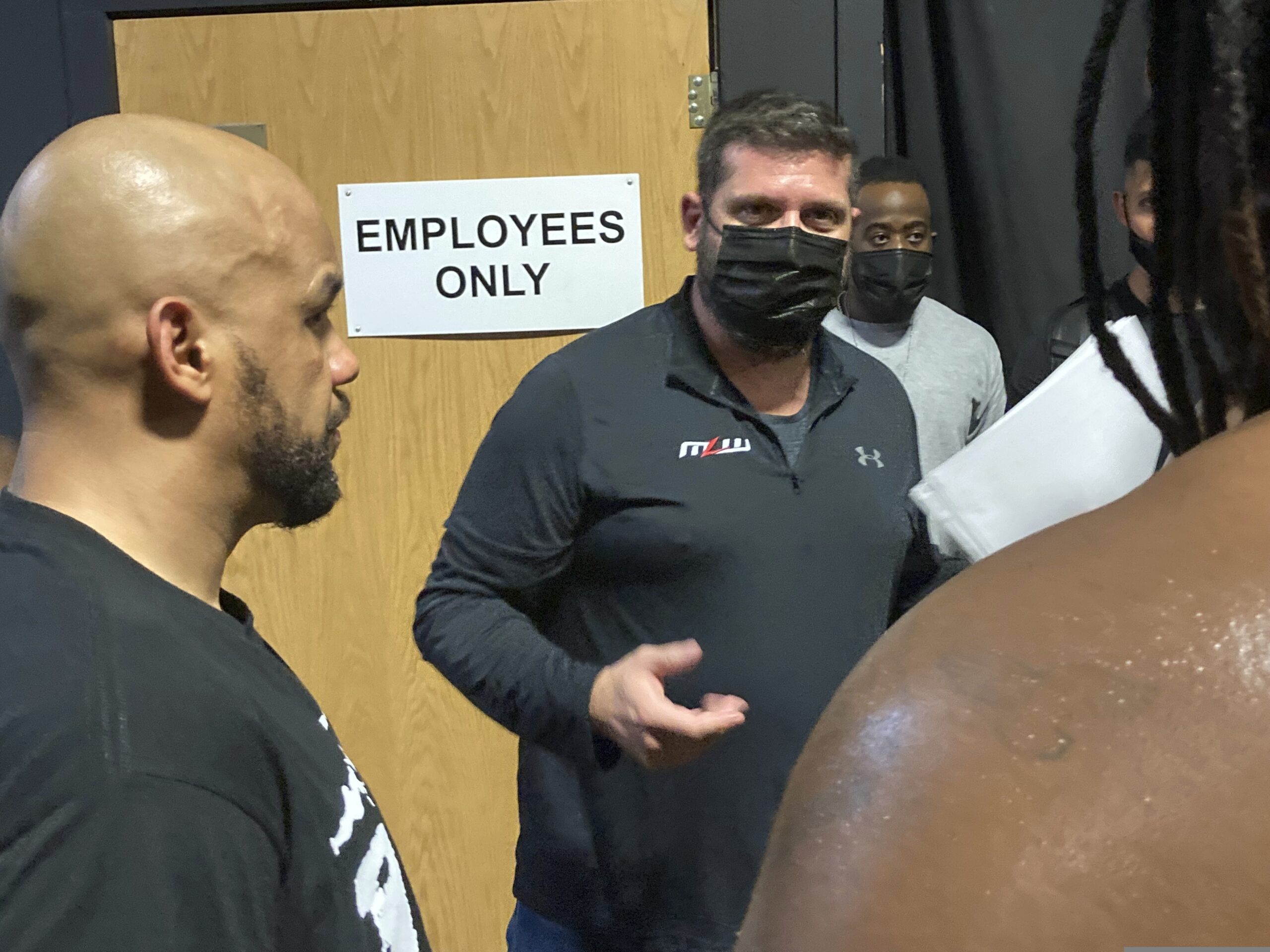
Major League Wrestling CEO Court Bauer (center) shown at 2300 Arena in 2021.
The company’s debut event, Genesis, was held at the 2300 Arena in June 2002. Since then, it has operated in major markets, including New York, Chicago, and Los Angeles.
“There’s just something special that you can’t really find in another city, that intensity that Philly has for pro wrestling,” Bauer said. “And the 2300 Arena is kind of like the cathedral of pro wrestling in America. There’s no other place that’s held as many great matches and has shed as much blood.”
The last time the promotion was at the 2300 Arena was in February 2024 for MLW’s SuperFight card, which featured an MLW world heavyweight title match between Satoshi Kojima and Alex Kane.
Cardinal O’Hara is heading back to the Catholic League girls’ basketball championship for the first time since 2022.
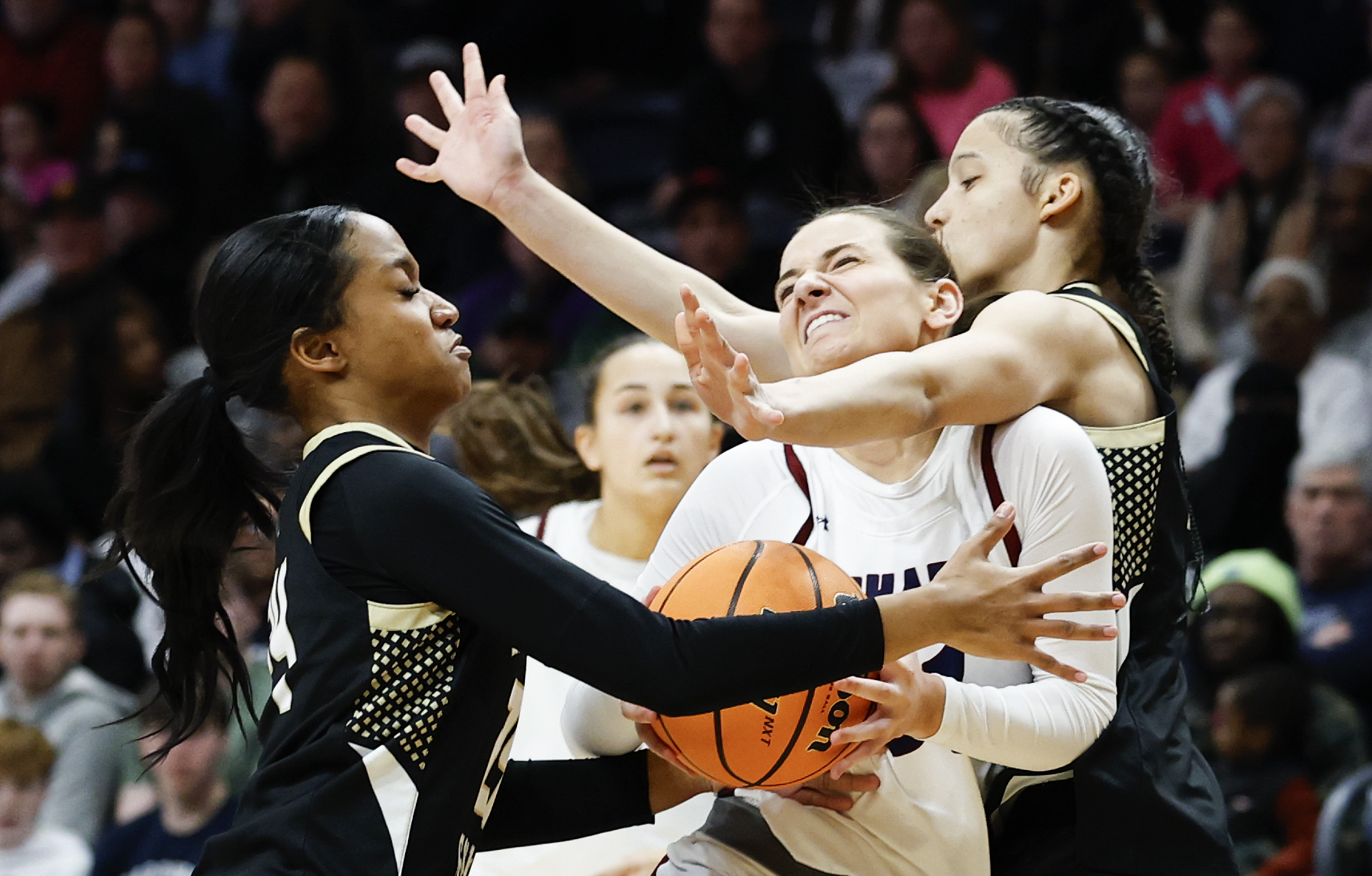
In a rematch of last year’s semifinal, Cardinal O’Hara overwhelmed Neumann Goretti, 51-33, on Monday night. The Lions lost to the Saints last season, when they played without its two stars in senior guard Megan Rullo and junior forward Brezhae Davis.
“Getting those two back on the court definitely helped,” said Cardinal O’Hara coach Chrissie Doogan said. “Neumann Goretti lost their guards from last year, but they’re a very talented team and play well together. … So it’s just a little bit of added incentive against the team that beat you last year to get back and take care of business.”
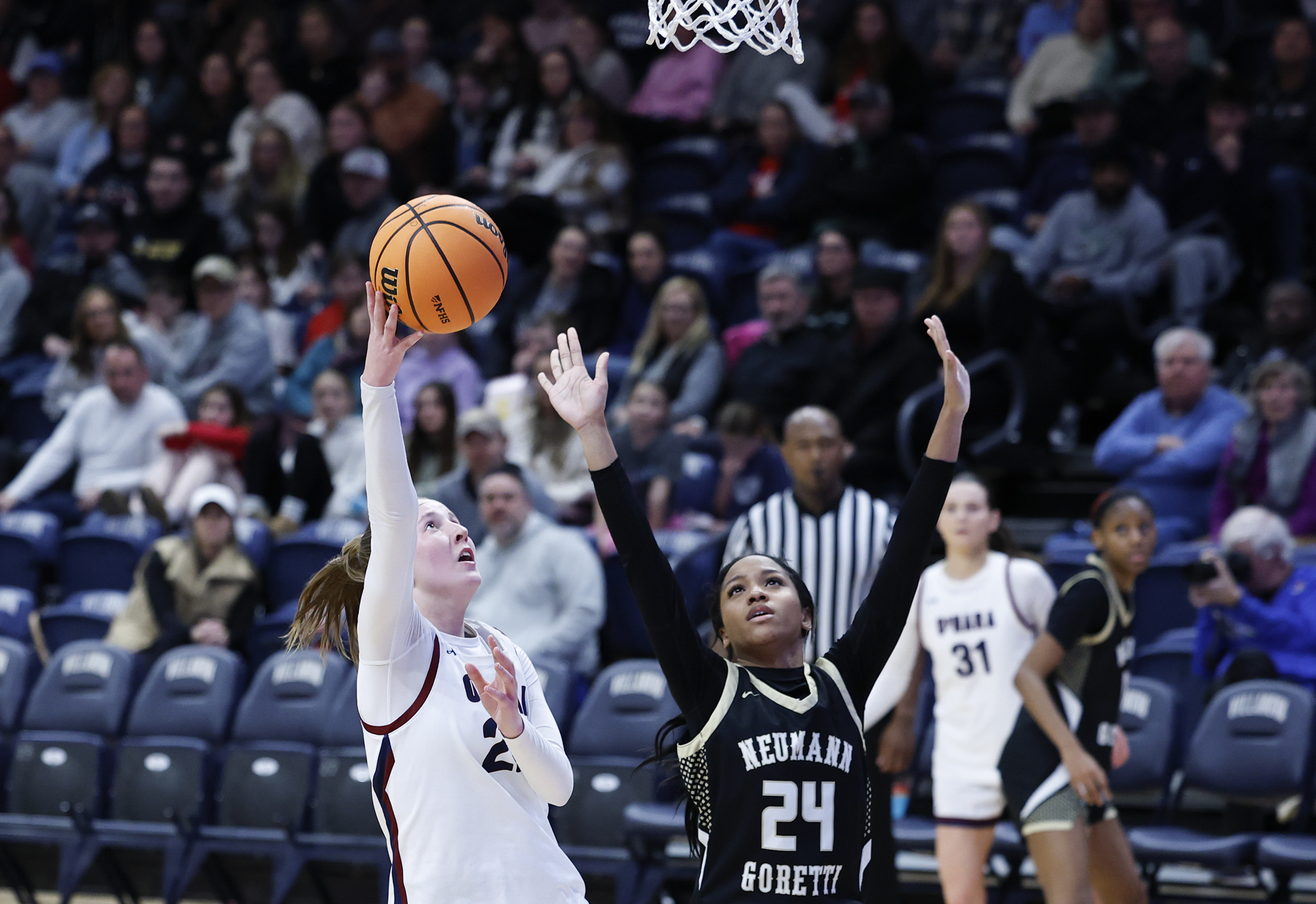
Cardinal O’Hara’s Brigidanne Donohue (left) finished with 13 points against Neumann Goretti on Monday.
Rullo led the Lions with 22 points, eight rebounds, and seven assists. Junior guard Brigidanne Donohue added 13 points, and Davis had 10.
For Neumann Goretti (14-10), freshman guard Azzure O’Connor led the Saints with nine points. Junior guard Reginna Baker contributed seven points.
Cardinal O’Hara (20-3) will face Archbishop Carroll at the Palestra on Sunday for the PCL title. The Lions beat the Patriots, 55-30, in the 2022 final.
“It means a lot,” said Rullo, who is committed to Drexel and will join her sister, Megan, there. “Last year was definitely a learning year, not being able to play. So there’s definitely a lot of wanting to get there. I’ve never played at the Palestra, and that’s definitely been a goal of mine. It’s everyone’s goal, so we’re super excited.”
O’Hara dominates
Cardinal O’Hara controlled the game.
Sophomore Catie Doogan sank a three-pointer, followed by a pair of foul shots from Rullo, to give the Lions a 13-6 advantage at the end of the first quarter.
The Lions continued to climb in the second quarter. Neumann Goretti gained some momentum close to halftime as senior Kamora Berry grabbed a defensive rebound, which led to a three-pointer from senior Zion Coston. But a Rullo layup as time expired sent Cardinal O’Hara into halftime with a 10-point lead.
Neumann Goretti played consistent, high-pressure defense on Rullo, who repeatedly drew fouls as she drove to the rim. Rullo shook off the defense and kept her composure. She totaled 13 points from the free-throw line.
Cardinal O’Hara’s Megan Rullo (center) gets fouled driving to the basket against Neumann-Goretti.
“I like being a leader of this team, and I feel like staying composed is something that I have to do in order to lead this team to success,” Rullo said. “We talk about it all the time, just not getting frustrated and matching the intensity level, giving it back a little bit.”
With seconds left in the third quarter, Donohue tossed in a basket to give the Lions a 40-27 lead. They then solidified their win in the fourth with a pair of foul shots from Rullo in the final minute that pushed the Saints’ deficit to 20 points.
Heading to the Palestra
Cardinal O’Hara lost to Archbishop Carroll, 51-28, on Jan. 13. With the stakes much higher, the Lions are looking forward to their chance at redemption.
“We were embarrassed at Carroll a month ago, but they locked in and recommitted themselves … to the success of our program,” Doogan said. “They really locked in on the defensive end. And, honestly, they don’t care who gets the credit. We’re at our best when we have three or four kids all between eight and twelve points. On any given night, it could be all five of our stars.”
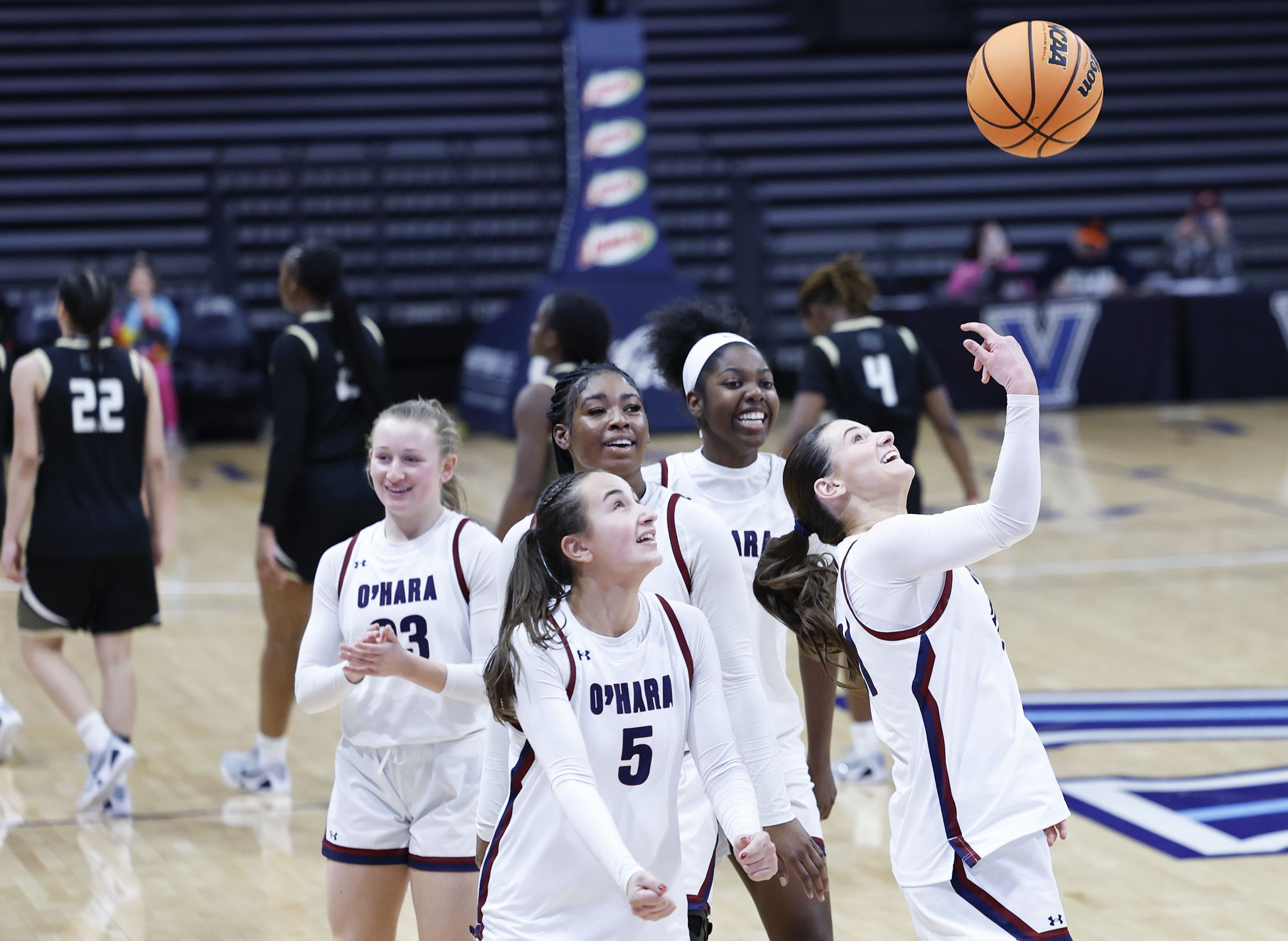
Cardinal O’Hara’s Megan Rullo (right) celebrates tossing the basketball with her teammates after beating Neumann Goretti in the Catholic League girls’ basketball semifinals.
Doogan and Cardinal O’Hara are especially excited for the opportunity to compete at Philadelphia’s most historic basketball arena.
“These kids deserve a chance to play at the Palestra,” Doogan said. “It’s something that every Catholic League kid wants, and I put a little bit of pressure on myself to get them there. Carroll’s a really good team. They’re playing well, and it’s going to be a dog fight.”
For one day at least, Donald Trump’s bigoted effort to whitewash history was foiled in Philadelphia.
A federal judge ordered the Trump administration to restore the slavery exhibits that were removed last month from the President’s House in Independence National Historical Park.
Fittingly, the legal rebuke came during Black History Month as Trump tries to rewrite America’s history of slavery, undermine voting rights, and rollback civil rights efforts designed to live up to the Founding Fathers’ vision of a country where all are created equal.
Even better, the ruling came on Presidents Day, a federal holiday first set aside to honor George Washington, who voluntarily gave up power, unlike Trump, who was criminally indicted for trying to overturn an election he lost.
In a poetic touch that feels conjured by Octavius V. Catto or William Still, the Trump administration lost in federal court on a lawsuit brought by the City of Philadelphia, which is headed by its first African American female mayor.
The President’s House exhibit was created to recognize the enslaved people who lived in Washington’s home in Philadelphia while he was president. Like the nearby Liberty Bell and Independence Hall, the President’s House is an essential part of American history.
Trump wants to airbrush the parts of American history that do not fit with his racist record and white supremacist messaging. But understanding how slavery shaped the economic, social, and political forces across the United States is crucial to addressing the systemic racism and inequality that persists today.
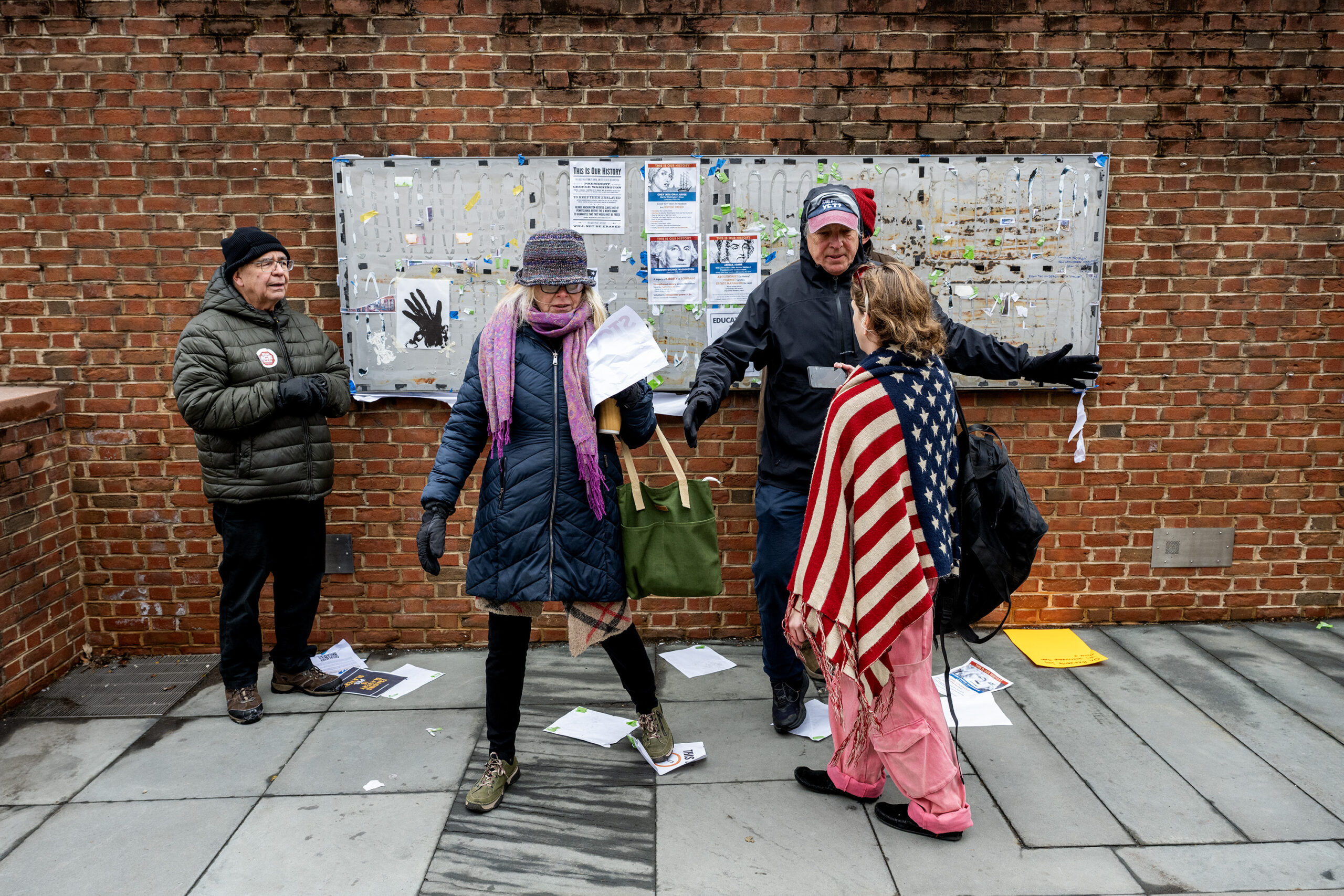
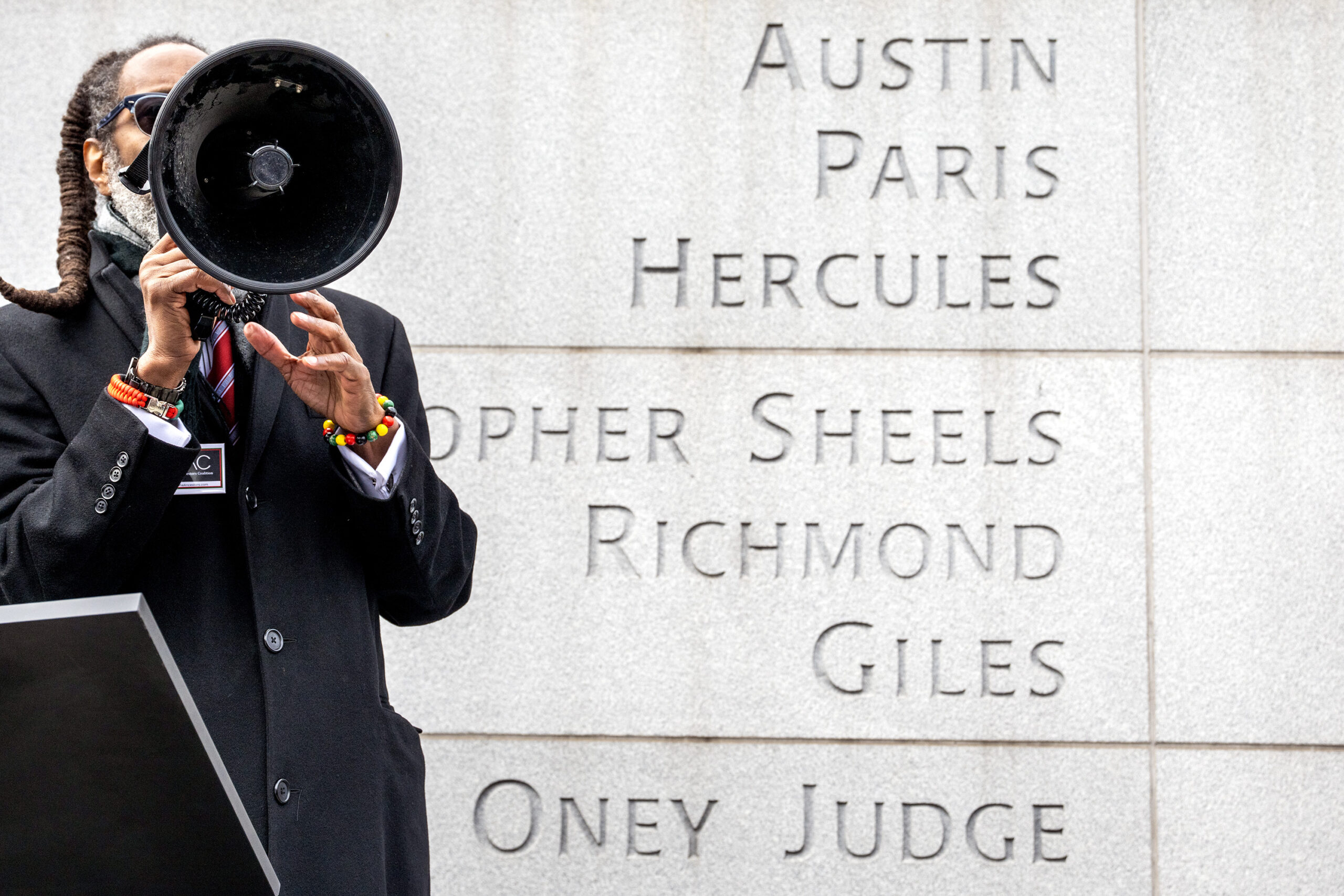
Glenn Bergman (right) and Dianne Manning try to prevent a “counterprotester” from removing notes posted by visitors on the walls where the National Park Service removed panels about slavery at the President’s House site on Monday. The woman began ripping down the mostly handwritten signs while the group Avenging the Ancestors Coalition was gathered for an annual Presidents Day observance on the other side of the wall.
U.S. District Judge Cynthia M. Rufe called out Trump’s cruel attempt to take the country backward in unsparing terms. She began her 40-page opinion by quoting directly from 1984, George Orwell’s dystopian novel about a totalitarian regime:
“All history was a palimpsest, scraped clean and reinscribed exactly as often as was necessary. In no case would it have been possible, once the deed was done, to prove that any falsification had taken place.”
She compared the Trump administration’s claim that it can unilaterally remove exhibits it does not like to Orwell’s Ministry of Truth.
“As if the Ministry of Truth in George Orwell’s 1984 now existed, with its motto ‘Ignorance is Strength,’ this Court is now asked to determine whether the federal government has the power it claims — to dissemble and disassemble historical truths when it has some domain over historical facts,” Rufe wrote. “It does not.”
Rufe, who was appointed to the federal bench by former President George W. Bush, did not buy the Trump administration’s authoritarian argument. “[T]he government claims it alone has the power to erase, alter, remove and hide historical accounts on taxpayer and local government-funded monuments within its control.”
She added: “The government here likewise asserts truth is no longer self-evident, but rather the property of the elected chief magistrate and his appointees and delegees, at his whim to be scraped clean, hidden, or overwritten. And why? Solely because, as Defendants state, it has the power.”
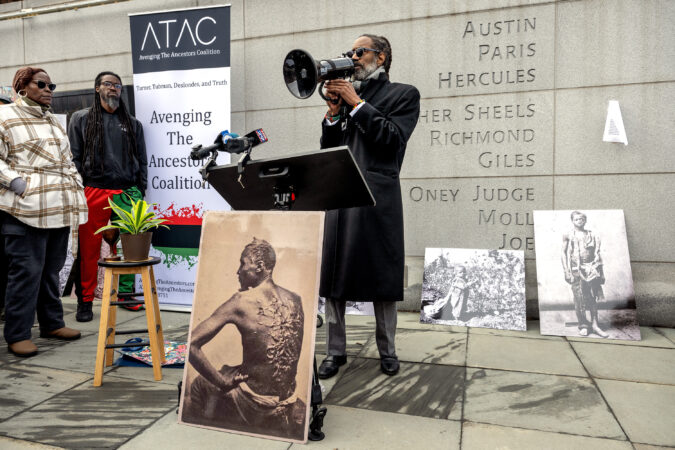
Attorney Michael Coard, leader of the Avenging the Ancestors Coalition, speaks at the President’s House site Monday, during the group’s annual gathering for a Presidents Day observance.
Rufe dismissed those claims and ordered the federal government to “restore the President’s House Site to its physical status as of January 21, 2026,” the day before the exhibits were removed.
Initially, Rufe did not set a deadline to restore the displays. But she updated her order, requiring the exhibits to be restored by 5 p.m. Friday.
The Trump administration will likely do everything it can to drag out a resolution.
There is no time to waste in ending this racist charade.
The country is celebrating the 250th anniversary of the signing of the Declaration of Independence. It is a national embarrassment that the President’s House exhibits are missing while the city expects 1.5 million visitors this year.
Philadelphia is the birthplace of America. It is here that the founders declared their independence from King George III. Their list of grievances against the king echoes some of Trump’s abuses.
Judge Rufe’s order struck a blow for telling the truth, something Washington would appreciate.
“It is not disputed that President Washington owned slaves,” Rufe wrote. “Each person who visits the President’s House and does not learn of the realities of founding-era slavery receives a false account of this country’s history.”
Somewhere, the enslaved who labored at the President’s House smiled.
Say their names: Ona Judge, Hercules Posey, Moll, Giles, Austin, Richmond, Paris, Joe Richardson, Christopher Sheels, and William Lee.
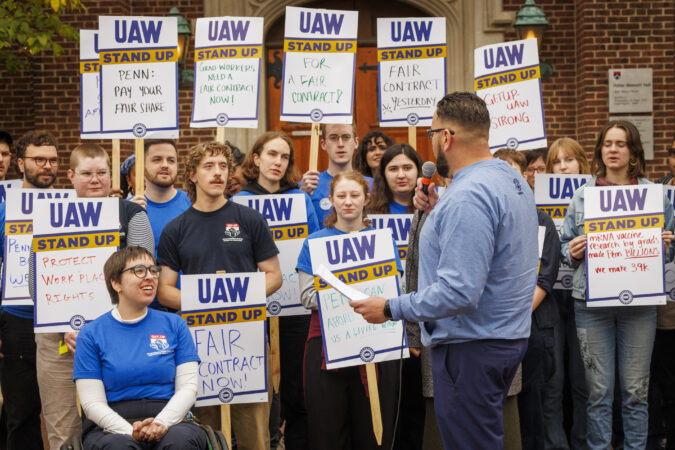
Penn’s graduate student workers have reached a tentative agreement on a first union contract, averting a strike.
The two-year tentative agreement includes increases to wages among other benefits.
“I am so proud of what we were able to accomplish with this contract,” Clara Abbott, a Ph.D. candidate in literary studies and member of the bargaining committee said in a statement. “We won a historic contract that enshrines gains for grad workers.”
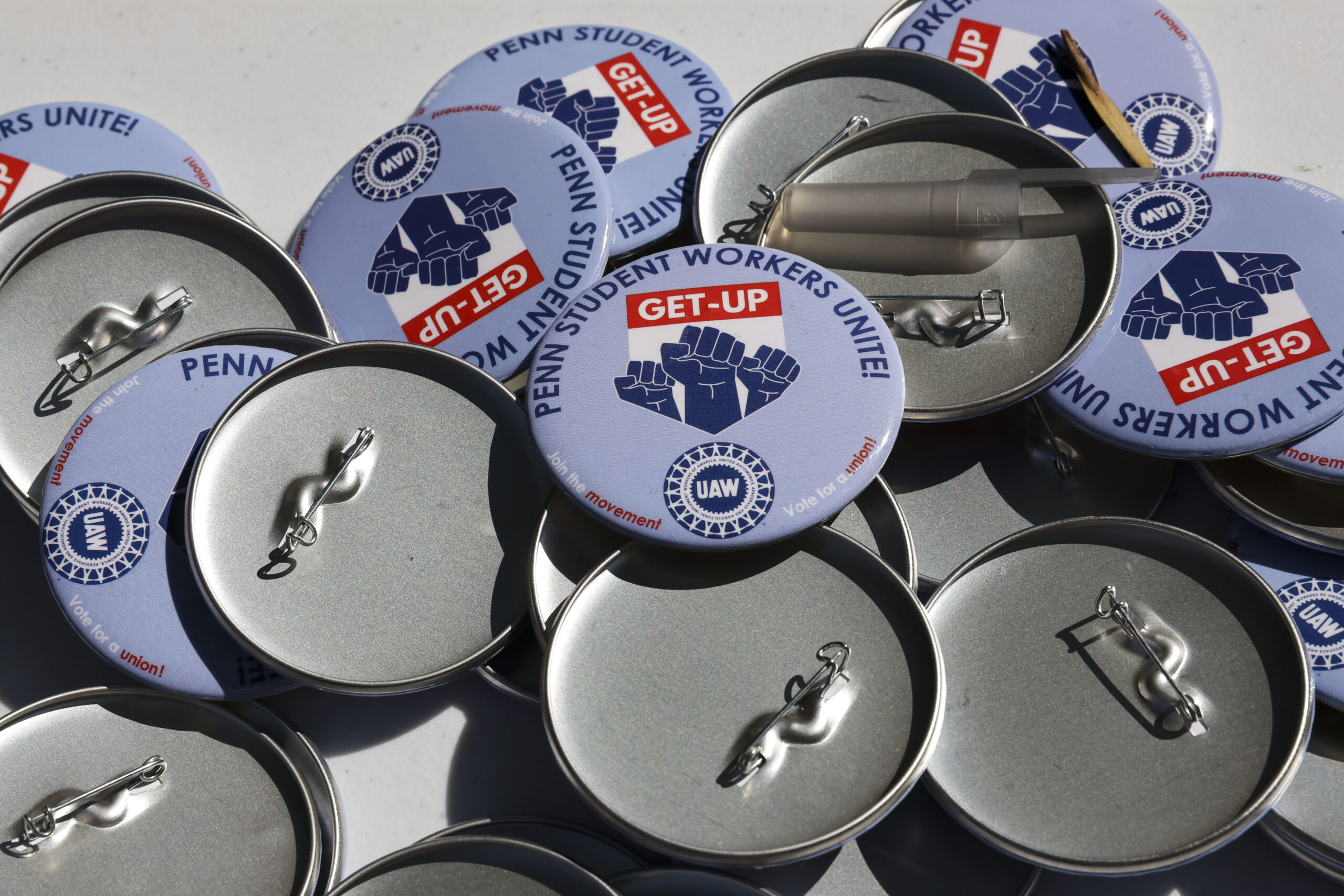
Research and teaching assistants at the university voted to unionize in 2024. The union, which represents about 3,400 graduate student workers, is known as Graduate Employees Together-University of Pennsylvania (GET-UP) and is part of the United Auto Workers (UAW). The union has been negotiating with the university since October 2024 for a first contract.
In November, the union’s bargaining members voted to authorize a strike, if called for by the union. In January, they set a strike deadline, announcing that they would walk off the job on Feb. 17 if they had not reached a deal.
A deal was announced in the early morning hours Tuesday.
While tentative agreements had been reached on a number of issues, some remained without consensus ahead of the final bargaining session on Monday before the strike deadline. Those sticking points included wages, healthcare, and discounts on SEPTA passes.
“We are pleased to announce that a tentative agreement has been reached between Penn and GETUP-UAW,” a university spokesperson said in a statement. “Penn has a long-standing commitment to its graduate students and value their contributions to Penn’s important missions. We are grateful to all the members of the Penn community who helped us achieve this tentative agreement.”
A date to vote on the ratification of the tentative agreement has not yet been announced.
The deal comes as earlier this month Pennsylvania state senators and representatives and Philadelphia City Council members addressed letters to the university’s president and provost, urging them to come to an agreement with the student workers and avoid a strike.
“A strike at the University of Pennsylvania would seriously disrupt life for the tens of thousands of Philadelphians who are students, employees, and patients at Penn,” the letter signed by City Council members reads. “As such, we strongly urge the Penn administration to avert a strike by coming to a fair agreement that meets the needs of graduate student employees prior to February 17th.”
Monday’s bargaining session brought tentative agreements on sticking points that included wages and healthcare coverage.
If ratified, the tentative deal would provide graduate student workers with an annual minimum wage of $49,000, which the union has said is a 22% increase over the previous standard. For those paid on an hourly basis, the minimum hourly rate would be $25. Those rates would go into effect in April and a 3% increase would be provided in July 2027.
The deal would also create a fund with $200,000 annually from which graduate student workers could seek reimbursements to cover up to 50% of their dependent’s health insurance premiums.
Ahead of the Monday bargaining session, other tentative agreements had come together around leave. The university agreed to give six weeks of paid medical leave, as well as eight weeks of paid parental leave.
The university and the union had also recently reached a tentative agreement that would create an annual $50,000 fund to help international graduate student workers with expenses associated with reinstating or extending visas.
What would have happened in the event of a strike?
Graduate student workers in the bargaining group teach and conduct research at the university.
Classes, research, and other academic activities would have continued during a strike, according to the university spokesperson. Penn published guidance on how to continue this work in the event of a work stoppage or other disruption.
Striking graduate student workers would not have been paid throughout a work stoppage, but would have continued to be covered by their health insurance for the time being, according to a university statement.
If others employed at the university who are not in the bargaining group chose to join the work stoppage, they would not have been paid and could have faced consequences “up to and including separation from that position, depending on the circumstances of the refusal to work,” according to a university statement.
Ahead of the tentative agreement on Monday, hundreds signed a pledge indicating that they are employed at Penn and would not do the work of those on strike or assign it to others in the event of a work stoppage.
Time may be a flat circle, but that doesn’t stop us from wondering why. A reader asked through Curious Philly, The Inquirer’s forum for answering questions, why there are so many chicken bones on the sidewalks and streets of Philadelphia.
Two architects appear to bebehind Philadelphia’s chicken-bone temple.
First are animals, who forage through trash looking for the final scraps left on discarded bones. Whether they discover drumsticks by ripping through trash bags on the street or from dumpster diving, these animals likely drop the bones wherever they finish with them.
Theculprits most likely to blame are rats, followed by raccoons and opossums, said Rich Foreman, the owner of Dynamite Pest Control in West Philly.
While it’s unclear if rats have a particular taste for fried chicken, the animals are among the least-picky eaters around and will take advantage of any food source, from human scraps to cannibalism. And Philadelphia is seemingly a good place to be a rat, being declared the eighth-rattiest city in the United States in 2025 by the pest-control company Orkin, measured by tracking its new residential rodent treatments.
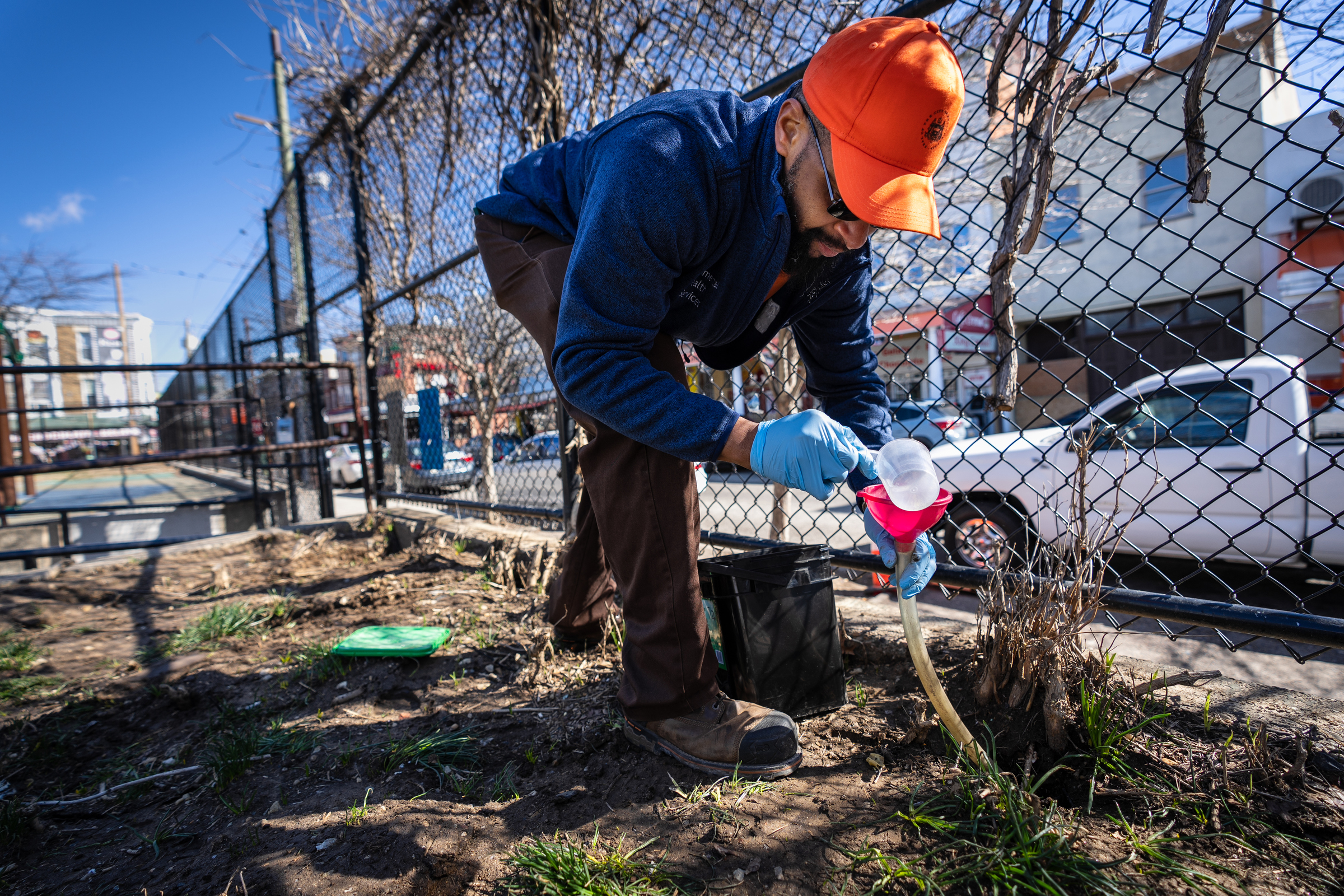
Adrian Jordan, Vector Control Crew Chief, works keeping the rat population under control, in Philadelphia, Friday, March 7, 2025.
Foreman sees the chicken-bone problem all over the city, as with some restaurants in Port Richmond that called Dynamite when they saw their trash all over the street. He is confident animals were behind the mess, and said he has “never seen” humans do anything of the sort.
Foreman said the city’s twice-weekly trash pickup initiative has not helped, since it means an additional day of easily accessible trash on the street for animals.
He said the best way for people to prevent critters from going into their garbage for bones is to get large, durable trash cans.
“And make sure you put the lid on it,” he said.
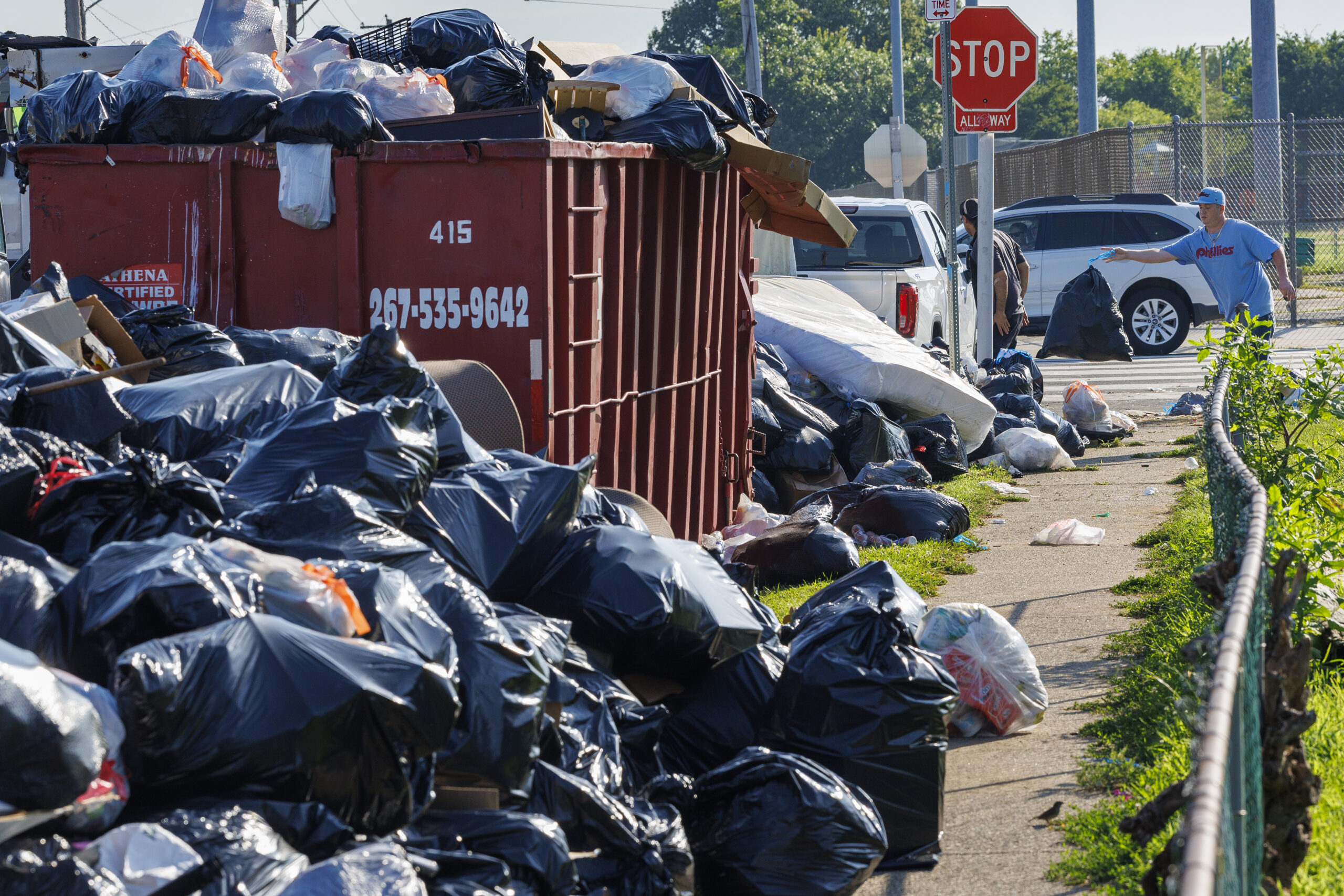
Residents with trash arriving at garbage dump site at Caldera Road and Red Lion Road in northeast Philadelphia. AFSCME District Council 33 workers enter their second week on strike, Tuesday, July 8, 2025.
Scavenging animals was the conclusion that the Search Engine podcast reached in a 2024 episode investigating the cause of the chicken bones littering the streets of New York City. Other cities have reported the same problem, including Chicago, Miami, and Washington.
And yet, anecdotal evidence from residents demonstrates that human activity clearly contributes to the problem.
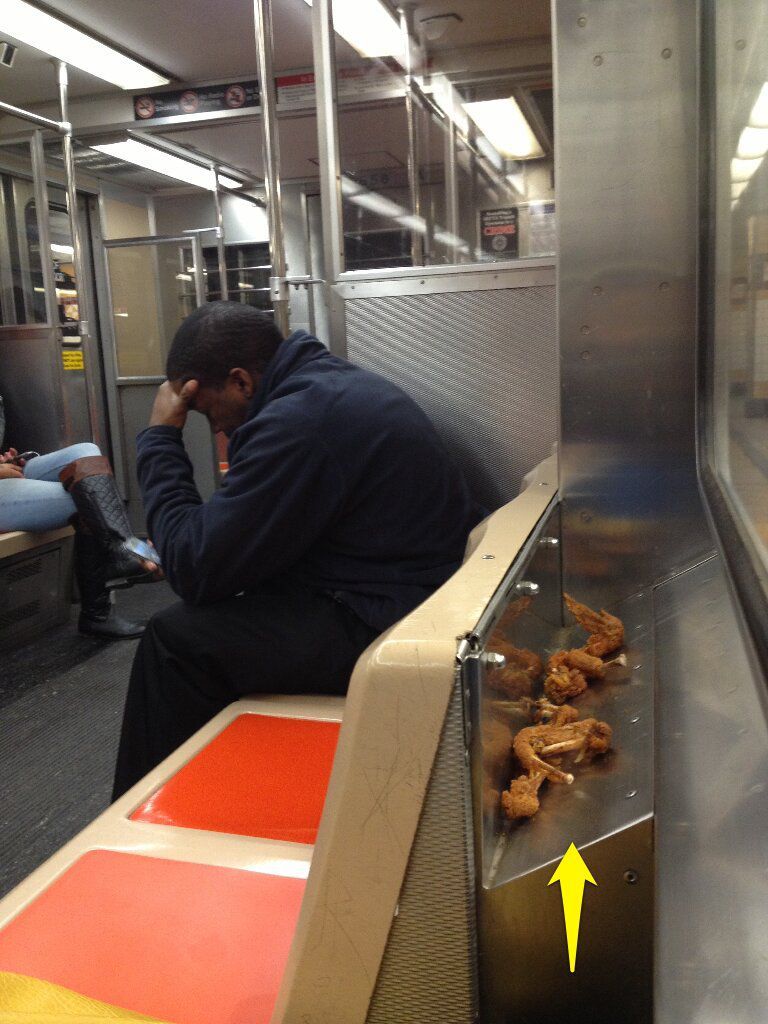
Jessica Griffith has become the David Attenborough of abandoned chicken bones, documenting and appreciating the beauty of what she encounters in the wild. More than 10 years ago, when she lived in South Philly, Griffith, 46, would notice the chicken bones frequently on walks with her dog. She started photographing them and posting the pictures to Facebook, finding the bones everywhere, including a pile on a SEPTA train.
“It was just bizarre to me. Just a phenomenon,” she said.
Jessica Griffith snapped this picture of some discarded chicken bones on the Broad Street Line in 2013.
Her documentation gathered a following, and people started to send their own submissions. Griffith received pictures from all over the globe — people in Seattle, Las Vegas, South Korea, Sweden, and the Dominican Republic all had their own pictures of discarded chicken bones to share.
When Brian Love, 53, walks his miniature pinscher, Ziggy, through the Gayborhood, he often sees other people smiling at his dog. But then he realizes it’s because Ziggy is carrying a chicken bone in his mouth.
Love has complained to his friends about constantly needing to tussle with Ziggy over what the dog sees as a treasure. He has watched people toss chicken bones on the ground, and recently came across a pile of four bones on a mound of snow. Love wishes his neighbors would just use trash bins.
“It’s your food that you’ve literally just had in your mouth. Throw it in the trash,” he said.
Stephanie Harmelin, 43, has the same problem with her dog in West Philly, and she said she accepts the bony sidewalks as part of living in a city. She has seen aggressive squirrels rifling through trash, but also has come across bones at street corners and under park benches that appear to have been dropped by humans.
She said part of the problem is educational. Once, Harmelin pulled her dog away from a bone on the street, and two fellow walkers asked her why.
Harmelin explained how chicken bones are unsafe for most dogs to consume. Cooked bones splinter when a dog chews on them, and the sharp fragments may cause life-threatening damage as they pass through the dog’s digestive track.
One woman was shocked, and said she had not realized chicken bones were potentially dangerous to dogs when she had tossed them to the ground before.
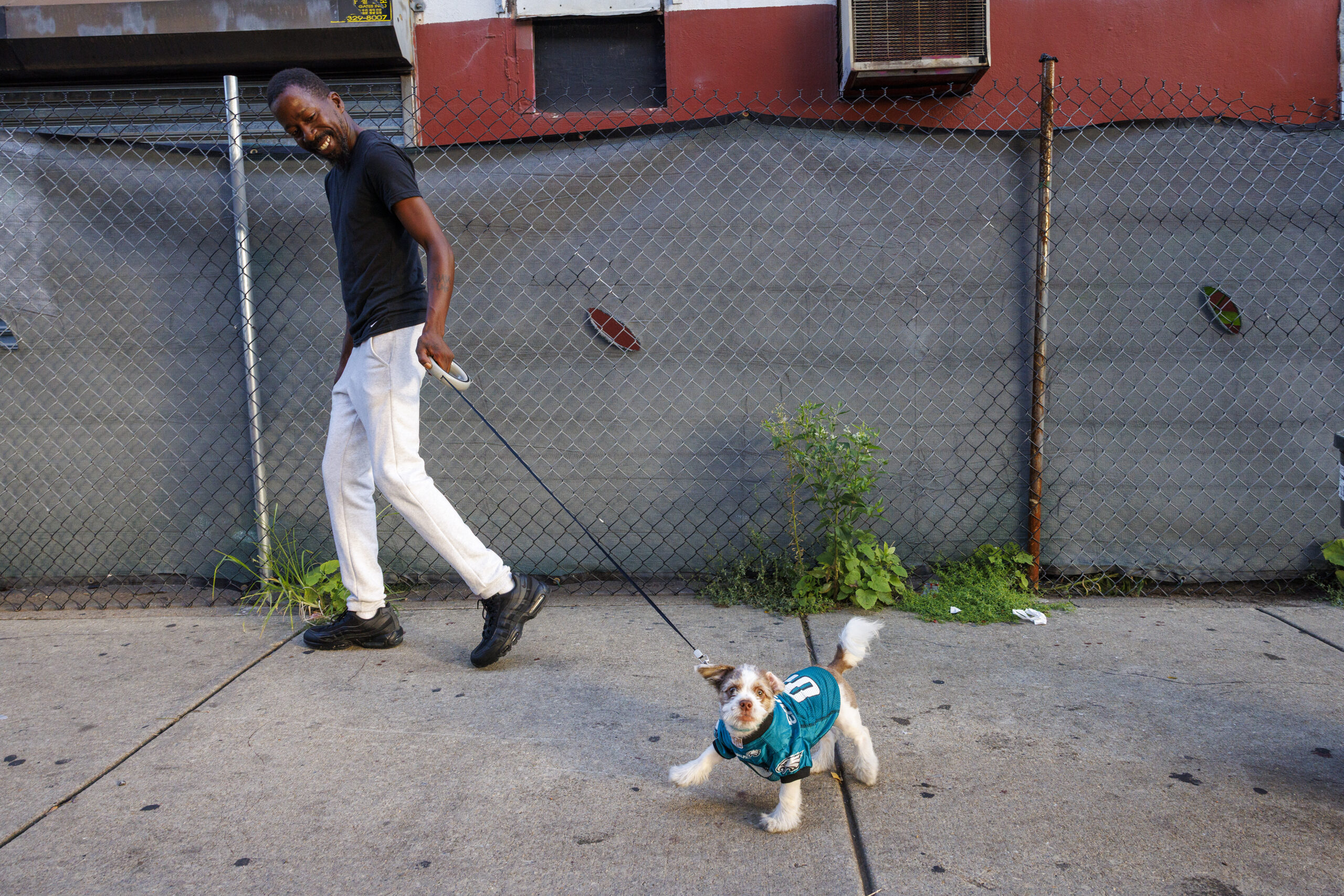
Theo Caraway of Philadelphia walking his dog Cooper, 6 months, Shitzu/Poodle wearing his Eagles jersey along Kensington at Ontario Street on Philadelphia, Friday, September 5, 2025.
Harmelin has had similar conversations with others who were not aware of the hazards bones create. Now, she is less likely to be frustrated at whomever has dropped the chicken bone on her street corner.
“We’re trying to assume what other people know and intend, but we can’t,” she said.
Even if more people get the message, though, it appears you will still be as likely to find a chicken bone on the street as a fallen leaf.
Although they’re a gross nuisance of a sidewalk adornment, Griffith doesn’t really mind them. She said they are more of a curiosity that make Philly what it is, in a small way.
One night in early December, the phones of Radnor High School students started buzzing. Some freshmen girls were getting disturbing messages: A male classmate, they were told, had made pornographic videos of them.
When one of the girls walked into school the next morning, “she said everyone was staring at her,” said her mother, who requested anonymity to protect her daughter’s identity. “All the kids knew. It spread like wildfire.”
So-called AI deepfakes — pictures of a real person manipulated with artificial intelligence,sometimes with “nudify” features that can convert clothed photos into naked ones — have become the talk of school hallways and Snapchat conversations in some area schools.
As Pennsylvania lawmakers have pushed new restrictions cracking down on deepfakes — defining explicit images as child sexual abuse material, and advancing another measure that would require schools to immediately alert law enforcement about AI incidents — schools say they have no role in criminal investigations, and are limited in their ability to police students off campus.
But some parents say schools should be taking a more proactive stance to prepare for AI abuse — and are failing to protect victims when it happens, further harming students who have been violated by their peers.
In the Council Rock School District, where AI-generated deepfakes were reported last March, parents of targeted girls said administrators waited five days to contact the police about the allegations and never notified the community, even after two boys were charged with crimes.
“They denied everything and kind of shoved it under the rug and failed to acknowledge it,” said a mother in Council Rock, who also requested anonymity to protect her daughter’s identity. “Everybody thought it was a rumor,” rather than real damage done to girls, the mother said.
Council Rock spokesperson Andrea Mangoldsaid that the district “recognizes and understands the deep frustration and concern expressed by parents,” and that a police investigation “began promptly upon the district’s notification.”
Mangold said that current laws were “insufficient to fully prevent or deter these incidents,” and that the district was “limited in what we know and what we can legally share publicly” due to student privacy laws.
In Radnor, parents also said the district minimized the December incident. A district message last month said a student had created images of classmates that “move and dance,” and reported that police had not found evidence of “anything inappropriate” — even though police later saidthey had charged a student with harassment after an investigation into alleged sexualized images of multiple girls.
A Radnor spokesperson said the alleged images were never discovered and the district’s message was cowritten by Radnor police, who declined to comment.
The district “approaches all student-related matters with care and sensitivity for those involved,” said the spokesperson, Theji Brennan. She said the district was limited in what it could share about minors.
In both Radnor and Council Rock, parents said their daughters were offered little support — and were told that if they were uncomfortable, they could go to quiet rooms or leave classes early to avoid crossing paths with boys involved in the incidents.
“She just felt like no one believed her,” the Radnor mother said of her daughter.
How an investigation unfolded in Radnor
In Radnor, five freshman girls first heard they were victims of deepfakes on Dec. 2, according to parents of two of the victims who requested anonymity to protect their daughters’ identities. They said boys told their daughters that a male classmate had made videosdepicting them sexually.
In a Snapchat conversation that night, one boy said, “‘Nobody tell their parents,’” a mother of one of the victims recalled. Reading her daughter’s texts, “it quickly went from high school drama to ‘Wow, this is serious.’”
The girls and their parents never saw the videos. In an email to school officials the next morning, parents asked for an investigation, discipline for the students involved, and efforts to stop any sharing of videos. They also asked for support for their daughters.
Schooladministrators began interviewing students. The mother of one of the victims said her daughter was interviewed alone by the male assistant principal — an uncomfortable dynamic, given the subject matter, she said.
One mother said the principal told her daughter that it was the boys’ word against hers, and that he was “so glad nothing was shared” on social media — even though no one knew at that point where videos had been shared, the mother said.
The principal said the school had no authority over kids’ phones, so the girl and her family would need to call the police if they wanted phones searched, the mother said.
Brennan, the Radnor spokesperson, said that administrators contacted Radnor police and child welfare authorities the same day they spoke with families. “The district’s and the police department’s investigations have found no evidence that the images remain or were shared, posted, or otherwise circulated,” she said.
The male classmate acknowledged making videos of the girls dancing in thong bikinis, the parents said police told them. But the app he used was deleted from his phone, and the videos were not on it, the police told them.
The parents didn’t believe the admission.
“I don’t think a 14-year-boy would report a TikTok video of girls in bikinis,” said one of the mothers, who said her daughter was told she was naked and touching herself in videos.
The police told parents they did not subpoena the app or any social media companies, making it impossible to know what was created.
Radnor Police Chief Chris Flanagan declined to comment, as did the Delaware County District Attorney’s Office.
In a message sent to the district community Jan. 16 announcing the end of the police investigation, officials said a student, outside of school hours, had taken “publicly available” photos of other students and “used an app that animates images, making them appear to move and dance.”
“No evidence shared with law enforcement depicted anything inappropriate or any other related crime,” the message said.
A week later, the police released a statement saying a juvenile was charged with harassment after an investigation into “the possible use of AI to generate non-consensual sexualized imagery of numerous juveniles.”
Asked why the district’s statement had omitted the criminal charge or mention of sexualized imagery, Brennan said the statement was also signed by Flanagan, who declined to comment on the discrepancy.
Brennan said the district had provided ongoing support to students, including access to a counselor and social worker.
Parents said the district had erred in failing to initiate a Title IX sexual harassment investigation, instead telling parents they needed to file their own complaints.
“They kept saying, ‘This is off campus,’” the mother said. But “my daughter could not walk around without crying and feeling ashamed.”
Parents say girls were ‘not supported’ in Council Rock
In Council Rock, a girl came home from Newtown Middle School on March 17 and told her mother a classmate had created naked images of her.
“I’m like, ‘Excuse me? Nobody contacted me,’” said the mother, who requested anonymity to protect her daughter’s identity. She called the school’s principal, who she said told her: “‘Oh, my God, I meant to reach out to you. I have a list of parents, I just have not gotten to it’ — you know, really downplaying it.”
The mother and other victims’parents later learned that administrators were alerted to the images on March 14, when boys reported them to the principal. But instead of calling the police, the principal met with the accused boy and his father, according to parents. Police told parents they were contacted by the school five days later. The Newtown police did not respond to a request for comment.
Mangold, the Council Rock spokesperson, declined to comment on the specific timing of the school’s contact with police.
Police ultimately obtained images after issuing a subpoena to Snapchat; in total, there were 11 victims, the parents said.
Through the Snapchat data, police learned that a second boy was involved, the parents said, which made them question what was created and how far it spread.
Parents said they believe there are more pictures and videos than police saw, based on what their daughters were told — and because the delayed reporting to police could have given boys an opportunity to delete evidence.
“That’s kind of what the fear of our daughters is — like, what was actually out there?” said one mother, who also requested anonymity to protect her child’s identity.
Manuel Gamiz, a spokesperson for the Bucks County district attorney, said Newtown Township police had charged two juveniles with unlawful dissemination of sexually explicit material by a minor. Gamiz said the office could not provide further information because the case involved juveniles.
Juvenile cases are not public, but victims’ parents said both boys were adjudicated delinquent. While the boys had been attending Council Rock North High School with their daughters, the district agreed to transfer both after their cases were resolved, according to a lawyer representing four of the parents, Matthew Faranda-Diedrich.
“How can you let this person be roaming the halls?” said Faranda-Diedrich, who said it took formal demand letters in order for the district to transfer the boys.
He accused the district of mishandling the incident and “protecting the institution” rather than the victimized girls.
“They’re putting themselves above these students,” Faranda-Diedrich said.
Parents said school leaders warned their daughters against spreading rumors, and never sent a districtwide message about the incident.
“These girls were victims,” one of the mothers said, “and they were not supported.”
She and the other mothers who spoke to The Inquirer said the incident has deeply affected their daughters, from anxiety around what images may have been created — and how many people saw them — to a loss of trust in school leaders.
Some of the girls are considering switching schools, one mother said.
State law changes and a debate around education about deepfakes
Those changes came in 2024 and 2025, after a scandal over deepfakes of nearly 50 girls at a Lancaster private school.
Another bill that passed the state Senate unanimously in November would require school staff and other mandated reporters to report AI-generated explicit images of minors as child abuse — closing what prosecutors had cited as a loophole when they declined to bring charges against Lancaster Country Day School for failing to report AI images to the police. That legislation is now pending in the House.
Schools can also do more, said Faranda-Diedrich, who also represented parents of victims in the Lancaster Country Day School incident. He has pressed schools to conduct mandated reporter training for staff. “By and large they refuse,” he said.
In Radnor, parents urged the school board at last week’s committee meeting to make changes.
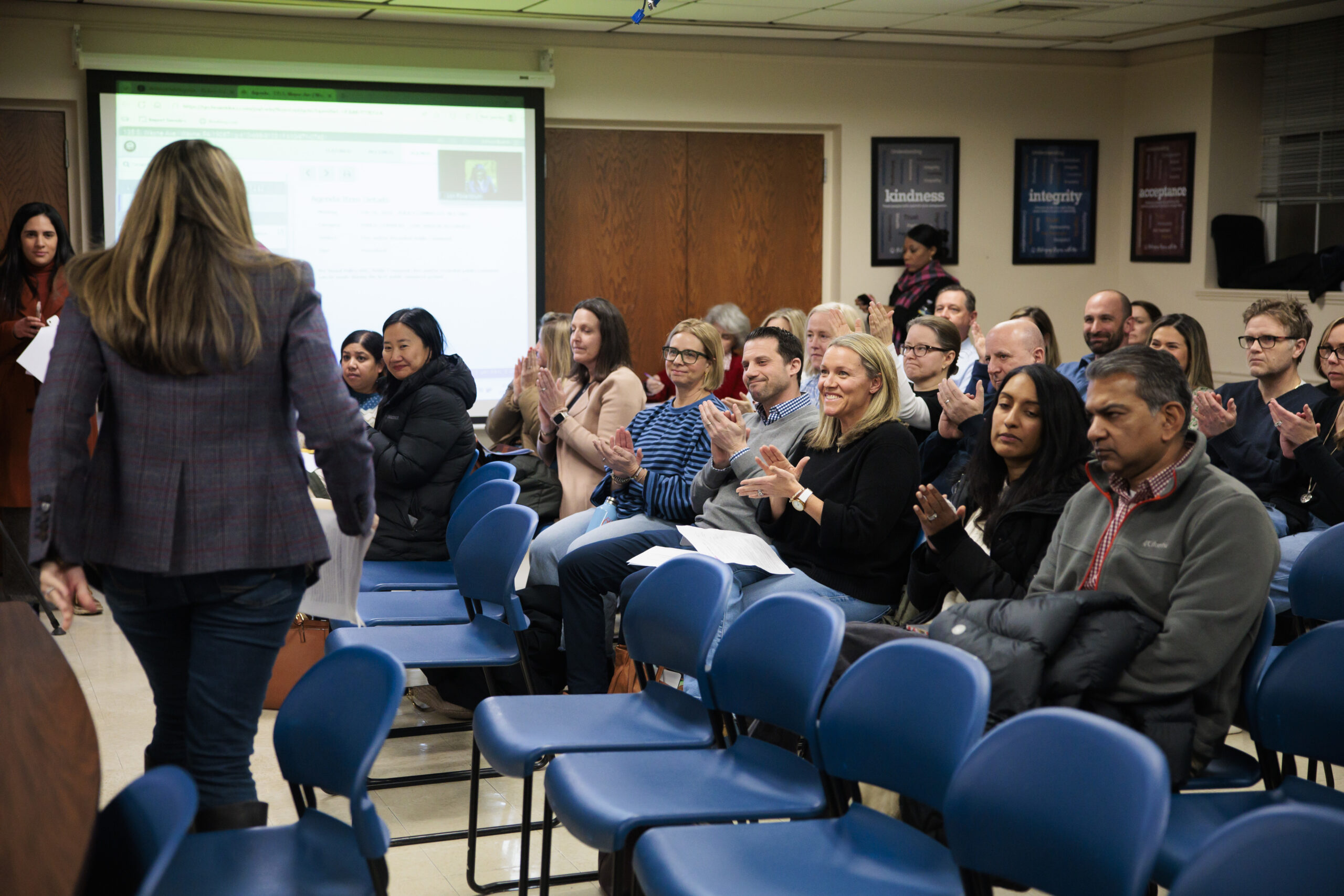
Parent Luciana Librandi walks back to her seat after speaking during a Radnor school board committee meeting last week.
Luciana Librandi, a parent of a freshman who said she had been “directly impacted by the misuse of generative AI,” called for timelines for contacting police following an AI incident, safeguards during student questioning, and annual education for students and parents on AI.
Others called for the district to communicate the criminal charge to families, to enforce existing policies against harassment, and to independently review its response to the recent incident.
Radnor officials said they are planning educational programming on the dangers of making AI images without a person’s consent.
There is somedebate on whether to teach children about “nudify” apps and their dangers, said Riana Pfefferkorn, policy fellow at the Stanford Institute for Human-Centered AI, who has researched the prevalence of AI-generated child sexual abuse material. Alerting kids to the apps’ existence could cause them “to make a beeline for it,” Pfefferkorn said.
While “this isn’t something that is epidemic levels in schools just yet,” Pfefferkorn said, “is this a secret we can keep from children?”
One of the victims’ parents in Radnor said education on the topic is overdue.
“It’s clearly in school,” the mother said. “The fact there’s no video being shown on the big screen in your cafeteria — we don’t live in that world anymore.”