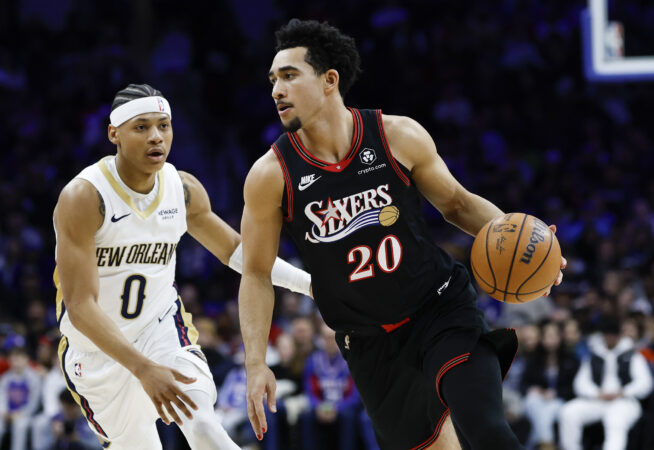
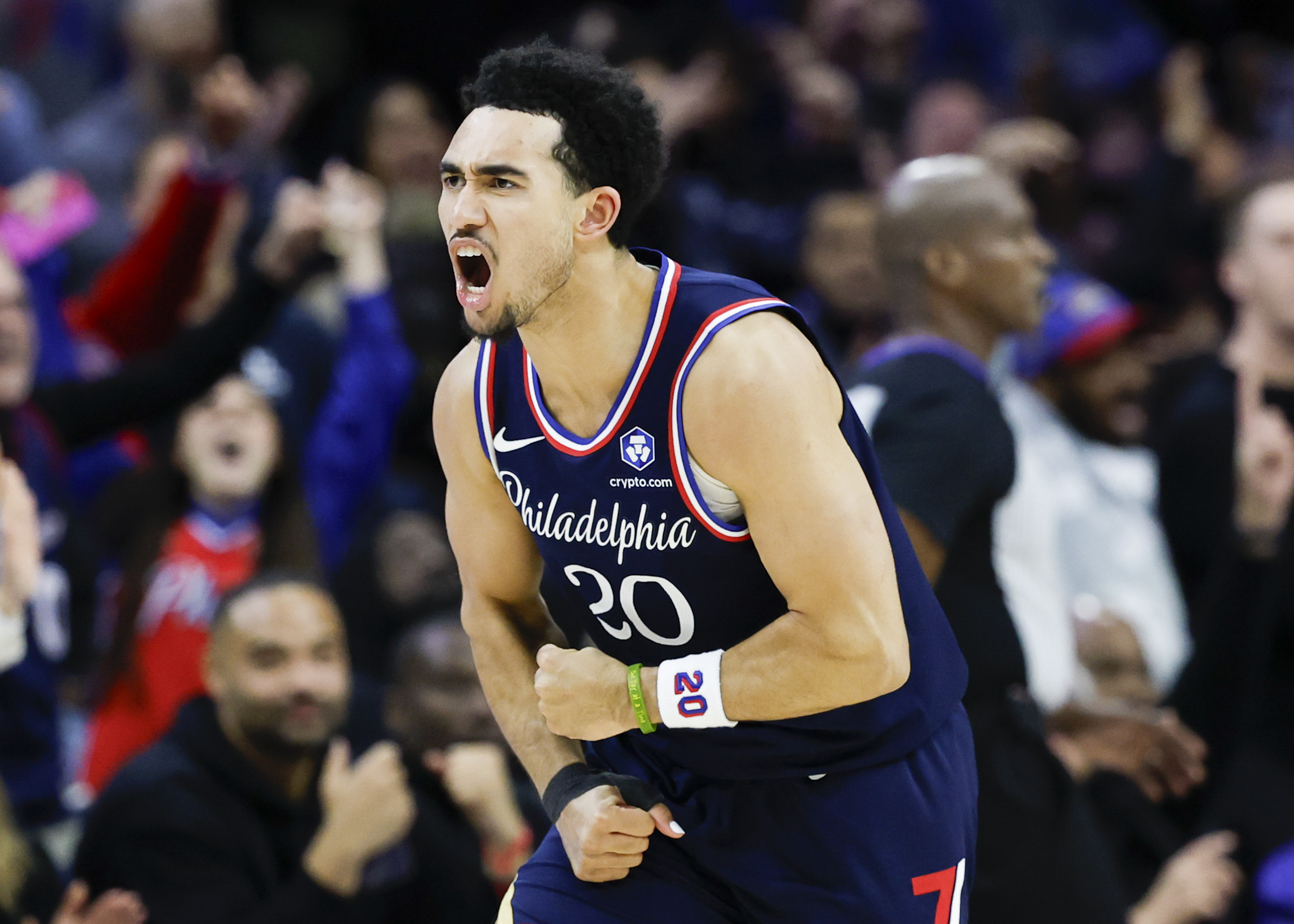
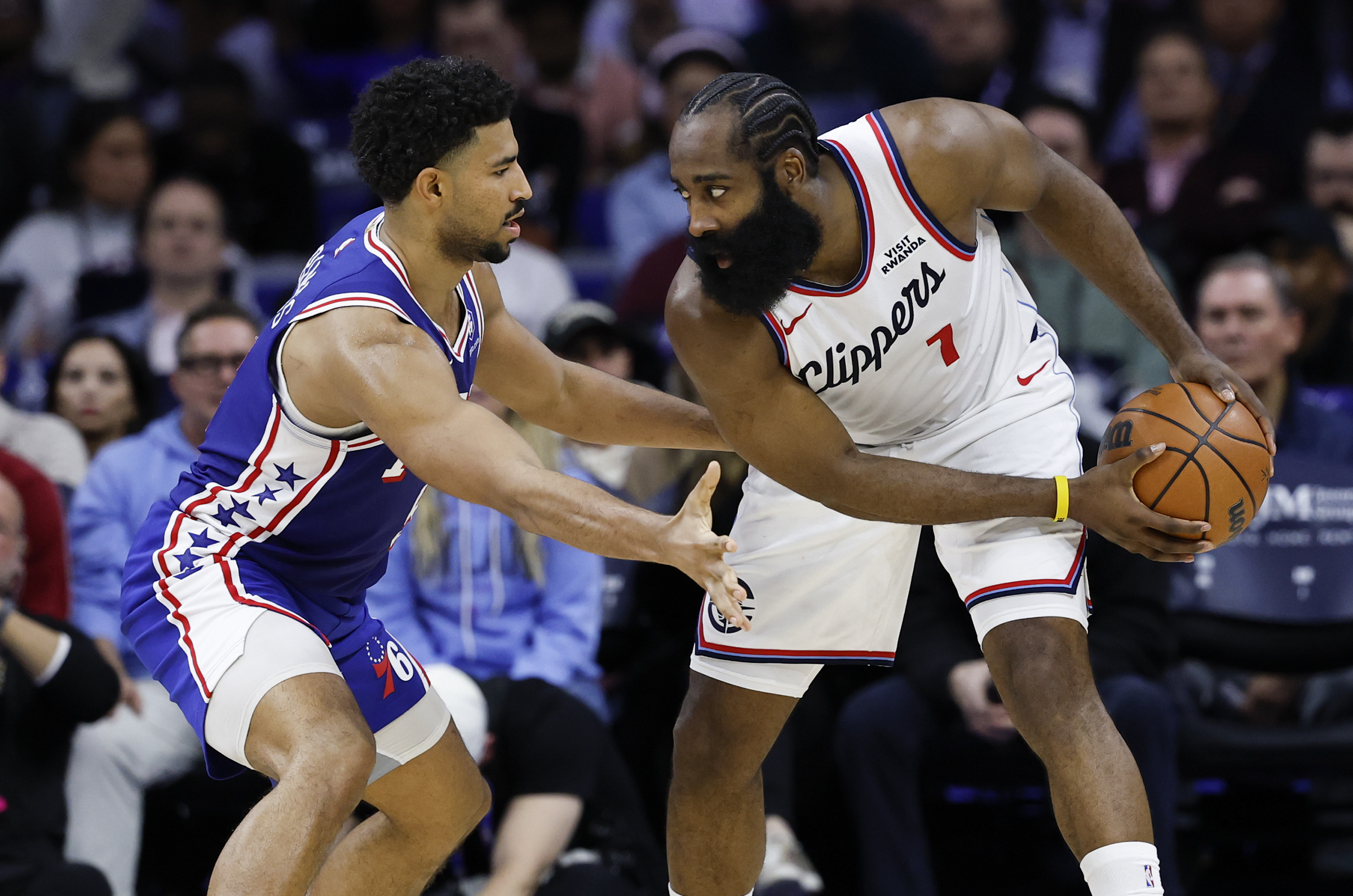
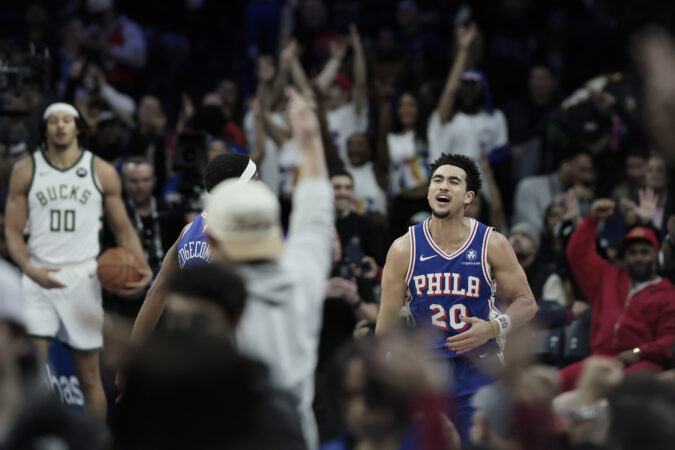
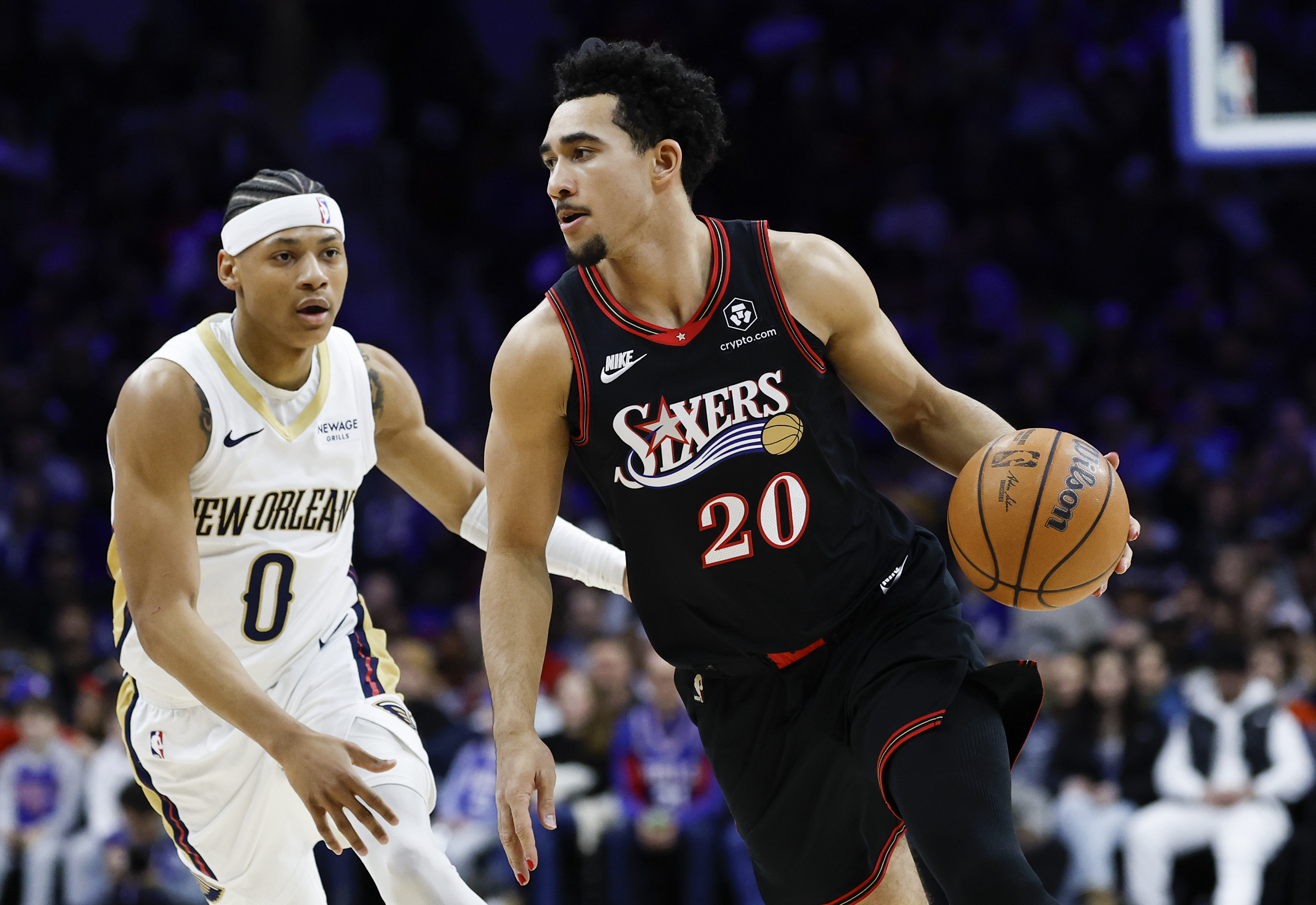
It was a little jarring to see the reaction that Jared McCain got the other night when he checked into a game against the Rockets for his first minutes as a member of the Thunder. The home crowd sure didn’t sound like one that thought the Sixers had sold high on McCain, as Daryl Morey contended the previous day when defending his decision to trade the second-year guard to Oklahoma City for a (presumably) late first-round pick in June’s draft. While the wisdom of NBA crowds probably shouldn’t dictate personnel strategy, the ovation awarded McCain by his new fan base at least served to validate the prevailing sentiment back here in Philadelphia. Given that the defending NBA champs are plenty excited to add McCain to a roster that already had an overabundance of talent, it’s tough to accuse Sixers fans of overreacting if they feel let down by the move.
Time will be the ultimate judge. Morey admitted as much on Friday as he laid out the rationale for the Sixers’ somewhat surprising decision to trade McCain without receiving any sort of established NBA talent in return. The veteran executive said that he made the McCain move with the thought that the draft capital it returned would eventually facilitate the addition of such talent, but that nothing sensible presented itself before Thursday’s 3 p.m. trade deadline.
“We thought that the draft picks we got would help us more in the future — and could’ve helped us this deadline,” Morey said. “The picks we got were offered to many teams and nothing materialized for a player that we thought could move the needle with those picks now. But we feel like going forward, those picks will help us build the team in the future in a good way.”
What might that look like?
It’s a sensible question to consider even now.
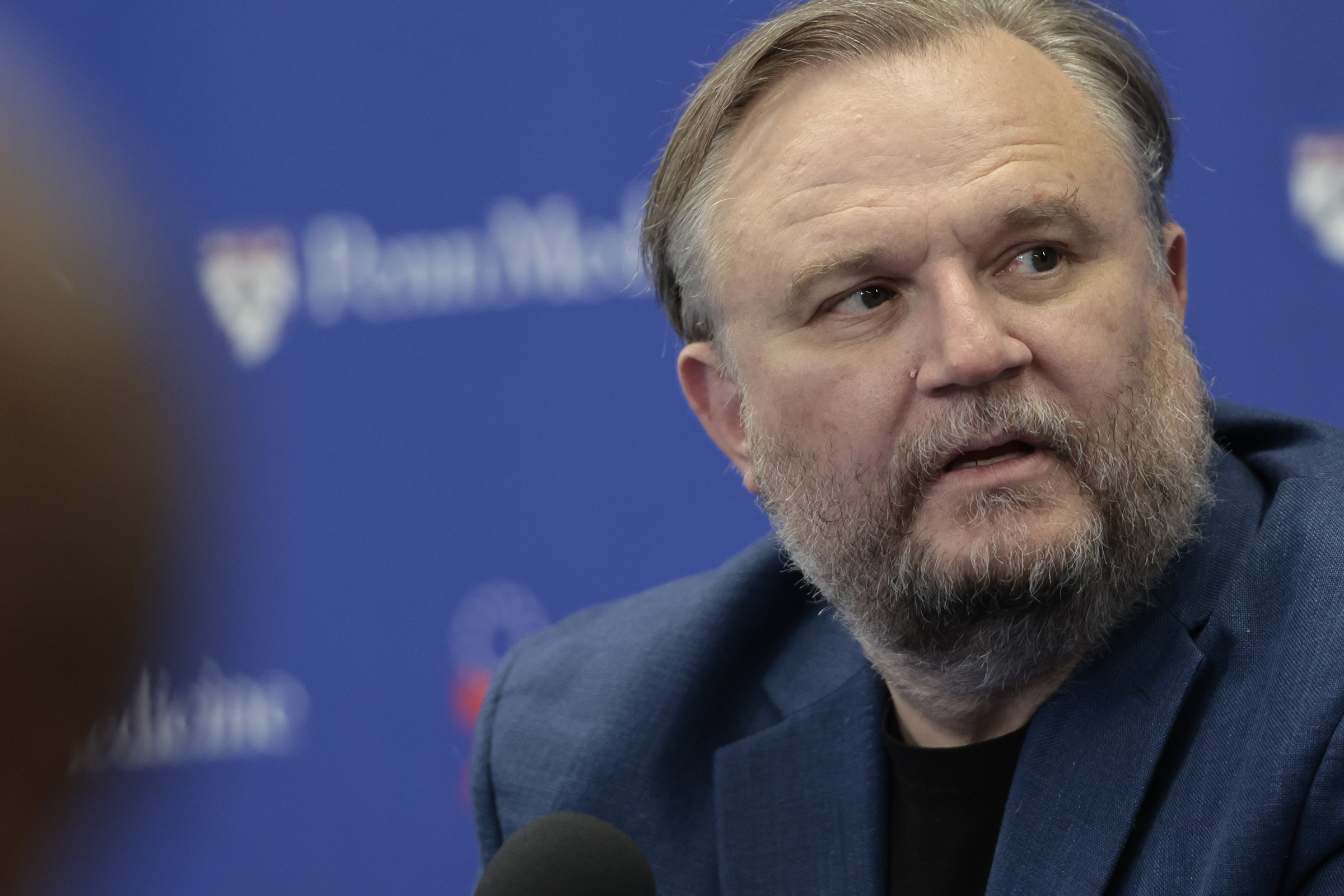
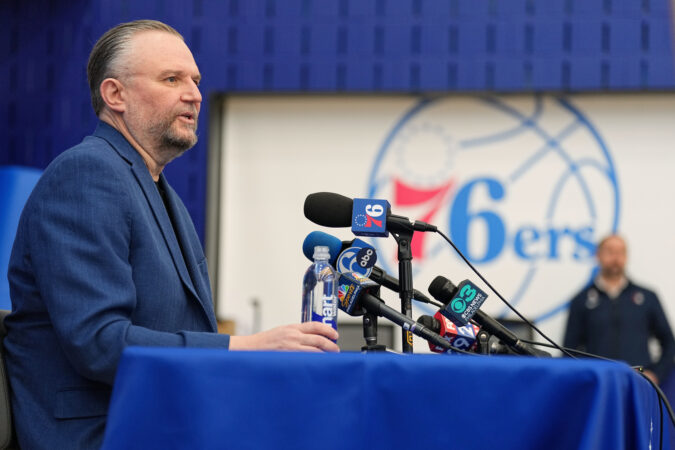
Sixers president Daryl Morey intimated that he could use the draft picks from the Jared McCain trade in a deal for a veteran down the line.
The Sixers still have plenty they can accomplish this season. Whatever they do with the McCain draft capital won’t help them in those endeavors. At 30-22, they are 3½ games behind the second-place Knicks and Celtics, part of a group of six or seven teams jockeying for playoff position in an Eastern Conference that lacks a bona fide powerhouse. Yet their third-best player is a rookie, and their second-best player is only now looking something like the player who single-handedly made them a contender for so many years.
Even in a conference where Jayson Tatum and Tyrese Haliburton are out for the season and the first-place Pistons have the sixth-best championship odds, it’s difficult to picture a Big Three of Tyrese Maxey, Joel Embiid, and VJ Edgecombe winning a title in 2025-26. Especially with Paul George in the early stages of a 25-game suspension for violating the league’s anti-drug policy. Which makes next year a viable consideration.
On Friday, Morey sounded a lot like the guy who entered the 2022 offseason planning on trading away the club’s first-round pick for a win-now player. That year, the Sixers ended up trading the No. 23 pick for De’Anthony Melton (technically, they drafted David Roddy and then shipped him to the Grizzlies). Likewise with the McCain trade. Morey didn’t make it in order to position the Sixers to draft a player in June.
“That wasn’t the main focus,” he said. “I think it’s a nice focus, because we do think this draft is a good draft, but we’re not necessarily using the pick in this draft. It could be used for moves around the draft. The three seconds that we got with it, we think those could be used to move up in this draft. Obviously, myself and our front office have done a lot of deals over the years, and this just gives us more tools to make the moves that we think will help our future more than we saw with Jared, who we gave up. But that’s not a comment on Jared.”
A few things are worth pointing out. The Melton deal is a relevant example of the sort of player the Sixers could potentially acquire in a one-for-one deal. Then 24 years old, Melton was a nice player, but hardly a needle-mover. He was coming off a season in which he averaged almost 23 minutes per game in a playoff rotation, shooting .374 from three-point range and contributing lots of the little things. He ended up averaging nearly 28 minutes and 10.1 points for the Sixers in 2022-23, then missed the second half of 2023-24 with a back injury. Then Melton moved on, signing a free-agent contract with the Warriors.
So, it’s worth noting that Melton spent only two years with the Sixers, which is the same amount of time McCain had left before the team would have needed to make a decision on a contract extension.
That said, the Sixers have more draft capital to play with this time around. They are also heading into an offseason when teams could be looking to accrue draft capital in order to facilitate an offer for Bucks superstar Giannis Antetokounmpo, which could shake loose some opportunities for the Sixers (assuming Antetokounmpo himself isn’t a target).
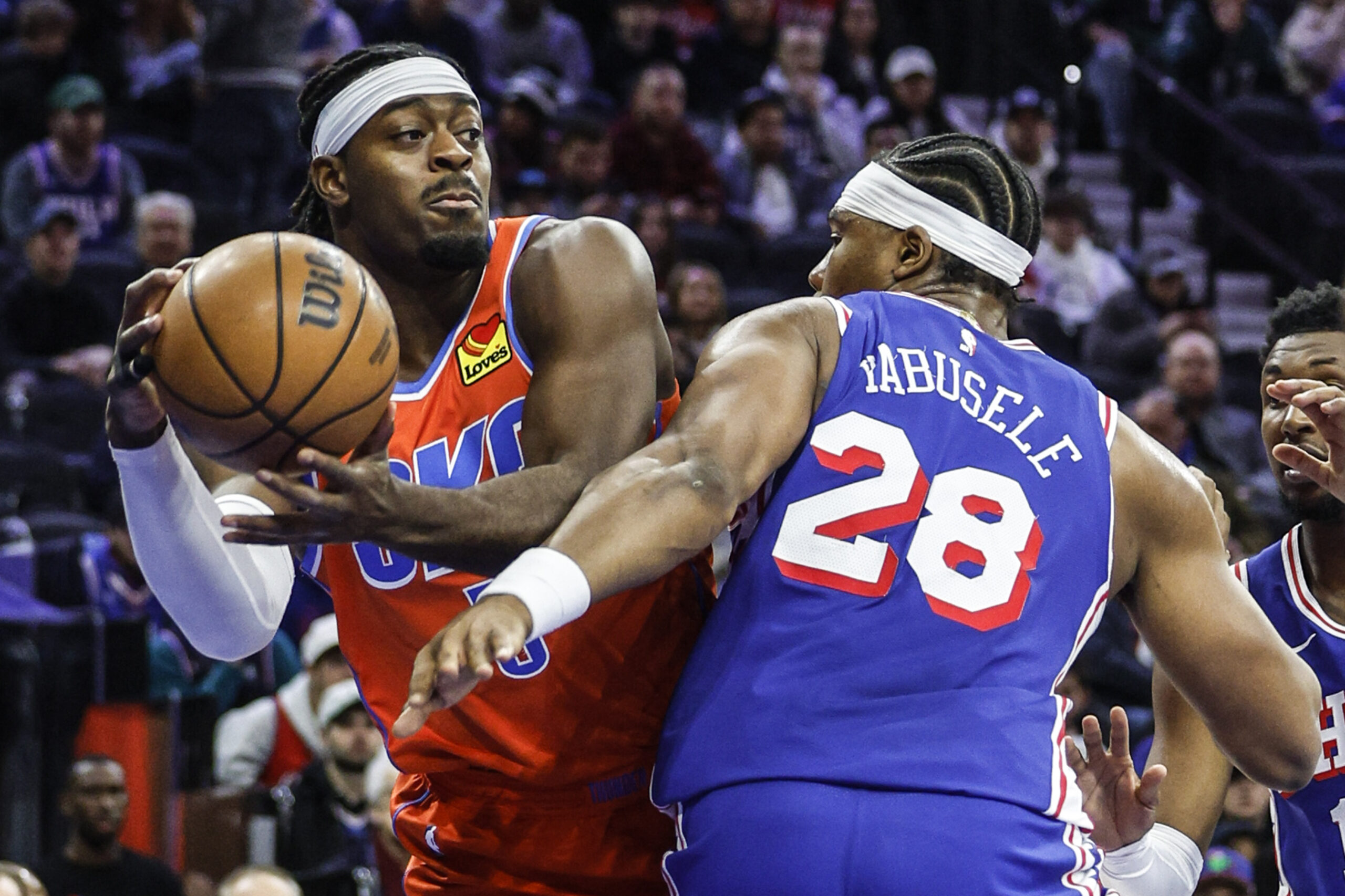
Perhaps Thunder standout Luguentz Dort will be a good fit for the Sixers in the offseason.
It isn’t hard to dream up deals that would lend some new and Sixers-affirming perspective to the decision to trade McCain. One scenario in particular involves the team that just acquired the young guard. The Thunder are fast approaching a point where they could need to make some tough decisions with regard to their roster. One player in particular who would fit nicely with the Sixers — or with any contender — is 26-year-old wing Luguentz Dort, who has an $18.2 million team option next season, his last before free agency. If the Thunder don’t think they can accommodate a market-rate contract for Dort, it would make a lot of sense for them to explore moving him this summer. A defensive dynamo and good shooter, Dort would surely attract plenty of interest on the trade market.
Should the potential for such a move present itself, the Sixers will be in a better position to make a competitive offer. The McCain draft capital could also help them shed the last two years of George’s contract should they have the opportunity to sign or acquire a player using the cap space they would free up by parting ways with George’s salary. Those are just a couple of for-instances.
Again, time will tell. McCain played 14 minutes for the Thunder the other night. He didn’t add much to the stat sheet: five points, a couple of turnovers, 1-for-3 from three-point range. But he did finish with a plus-12 in a game the Thunder lost by six. The Sixers hope they will end up parlaying the McCain trade into a player who can contribute to a championship team. The Thunder hope that’s what McCain is.
Stagecraft and technology being what they are these days, one can imagine any number of ways Peter and the Wolf could be souped up. If the key to audience-building is children, Prokofiev’s children’s classic would seem to be the perfect chance to engage them with eye-popping visuals.
But the Philadelphia Orchestra is smart enough to let the piece speak for itself.
It also knows you don’t mess with success. Saturday morning in Marian Anderson Hall marked the 10th time the orchestra has presented the piece with actor-narrator Michael Boudewyns over nearly two decades, and no one should ever touch a hair on this modest production’s furry little head. In its simplicity and humor, here is one of those rare, perfect things in this world.
The audience applauds for the Philadelphia Orchestra’s performance of “Peter and the Wolf” Saturday in Marian Anderson Hall.
Saturday’s concert was also, judging from an audience whose ages looked to span from 2 years old to 80, a powerful generational bridge. Surely there were a few grandparents in the hall who remember going to these Philadelphia Orchestra family concerts with Leopold Stokowski on the podium.
The series continues in March with another on-ramp to classical music: Britten’s dazzling The Young Person’s Guide to the Orchestra.
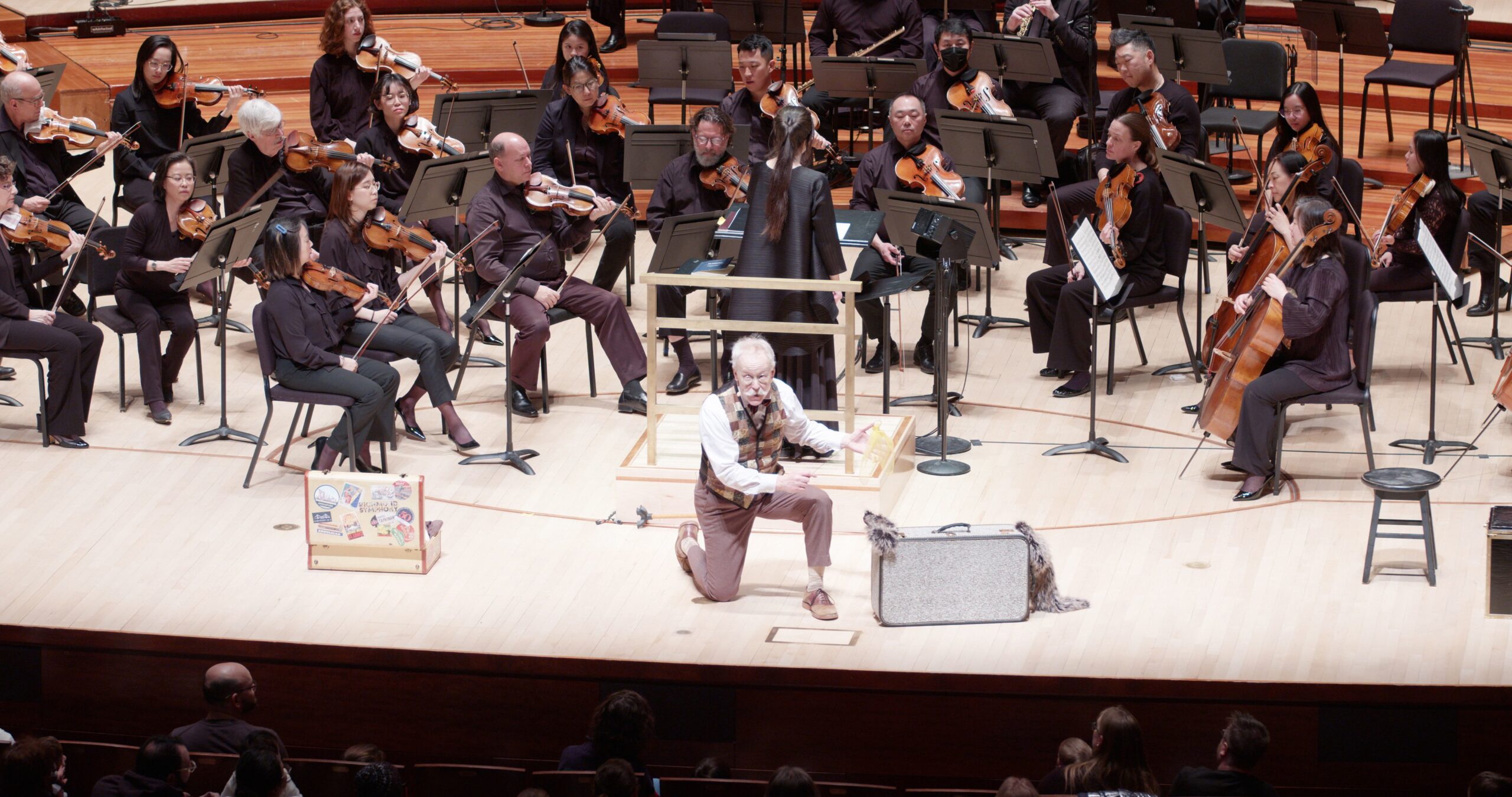
Michael Boudewyns narrating “Peter and the Wolf” with conductor Naomi Woo leading the Philadelphia Orchestra, Feb. 7, 2026, in Marian Anderson Hall.
Prokofiev’s piece — which is about to turn 90 years old — can be frightening in some productions: The French horns are as menacing as the fang-bearing wolf they depict. But Boudewyns has a grab bag of tricks so disarming that the scare factor practically disappears.
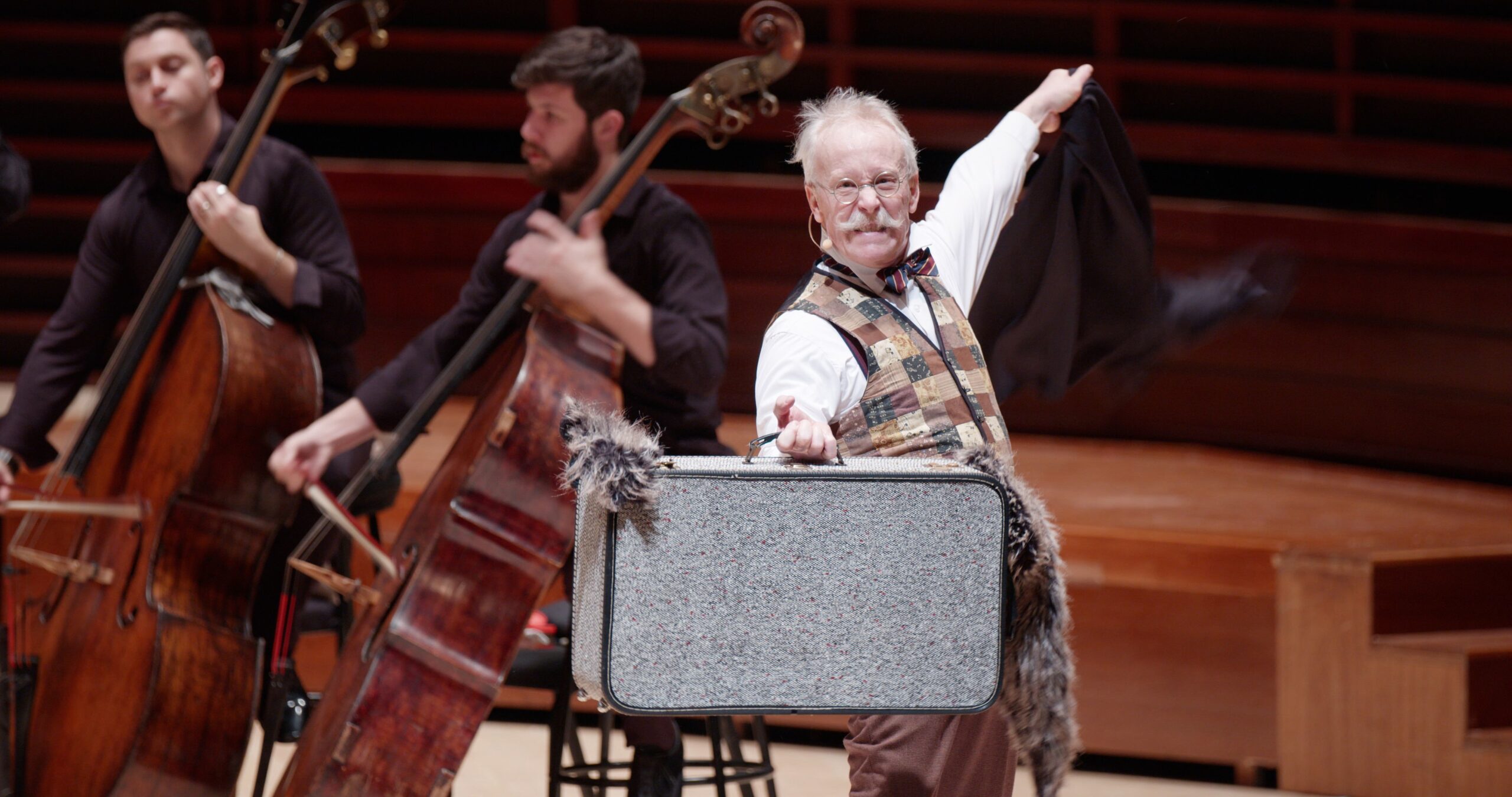
His props are drawn from household items: The duck is a feather duster, the bird a diaphanous, darting, bright yellow swatch of fabric. Who can’t help but laugh at a gun represented by a toilet plunger? Boudewyns narrates while choreographing the action in response to the changing character of the music and arc of the story. For an audience growing up in the digital thicket, here was a bright clearing. Nothing beats a good story, enticingly told and heightened by a great score.
With a suitcase as the wolf, Michael Boudewyns narrating “Peter and the Wolf” with the Philadelphia Orchestra, Feb. 7, 2026, in Marian Anderson Hall. It was his 10th time performing with work with the orchestra since his first appearance in 2007.
Naomi Woo, the orchestra’s assistant conductor, was visually engaging, leading the work and three others, including a truncated version of the first movement of Beethoven’s Symphony No. 5. These concerts are another reminder of the deep bench of talent within the orchestra beyond the principal chairs. In the Prokofiev, that meant Patrick Williams’ glossy flute sound as the bird, clarinetist Samuel Caviezel as the bouncy cat, oboist Peter Smith’s poignant duck, and the appropriately lumbering (but polished) grandfather emanating from the bassoon of Mark Gigliotti.
All deserved special recognition, and Woo gave the players bows, but no orchestra roster was published in the concert’s Playbill (even though the usual lists of board, staff, and oodles of donors were included).
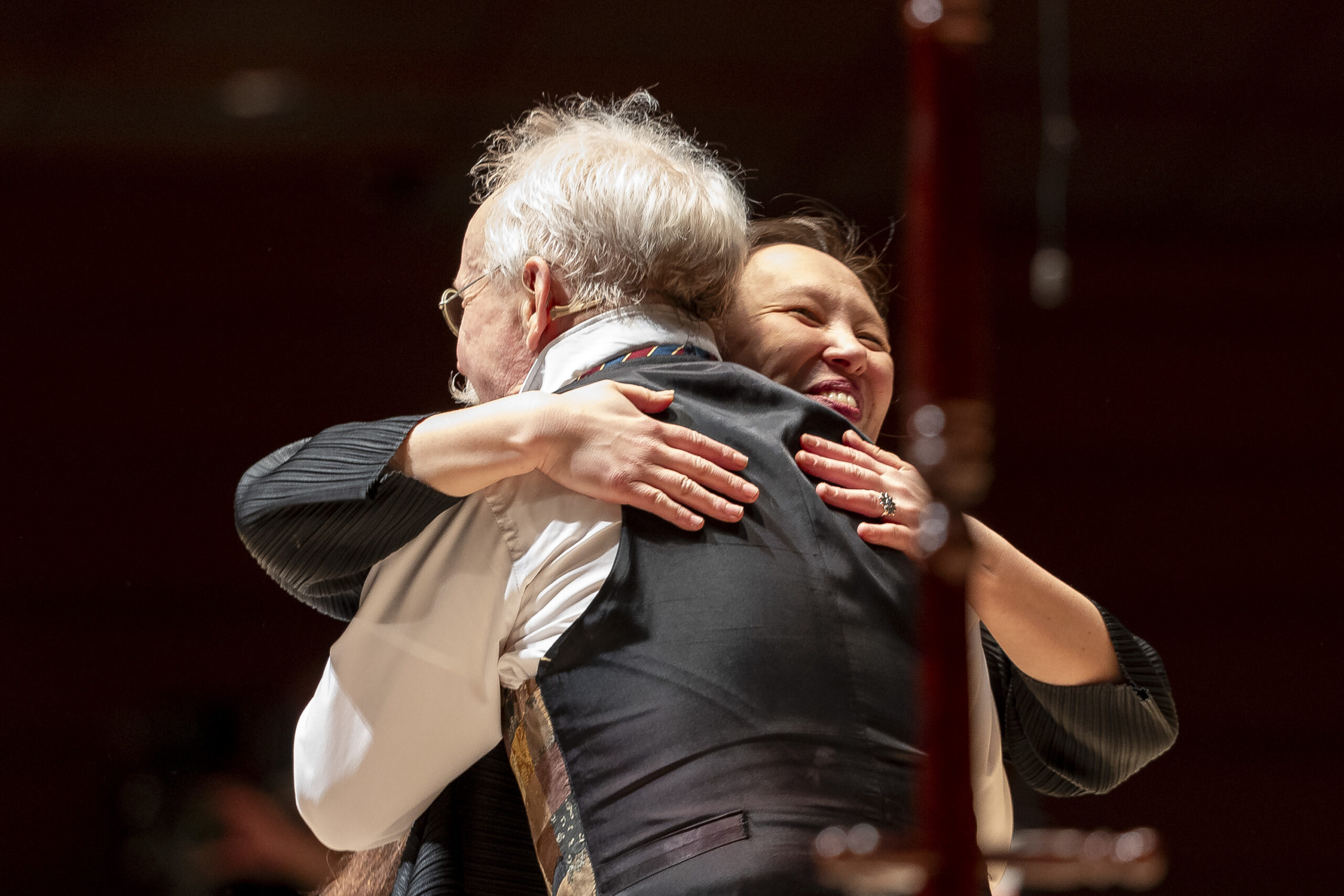
Narrator and actor Michael Boudewyns and conductor Naomi Woo embrace after their performance of “Peter and the Wolf” in Marian Anderson Hall on Saturday.
One of the unspoken truths of all art is that its effect on people is ultimately unknowable. The two children in front of me — one looked to be 3, the other even younger — were ostensibly too small to be there, and yet there’s no way of knowing what they were absorbing. The power of these concerts is in being in the presence of this orchestra, with that incredible sound. No other kind of ensemble has the same impact. And despite all the squirming and low chattering coming from the next row, there was really only one thought to which I kept returning: what lucky children.
The Philadelphia Orchestra, conductor Naomi Woo, and actor Michael Boudewyns perform Britten’s “The Young Person’s Guide to the Orchestra,” March 14, 11:30 a.m., Marian Anderson Hall, Broad and Spruce Streets. Tickets $29-$66. ensembleartsphilly.org, 215-893-1999.
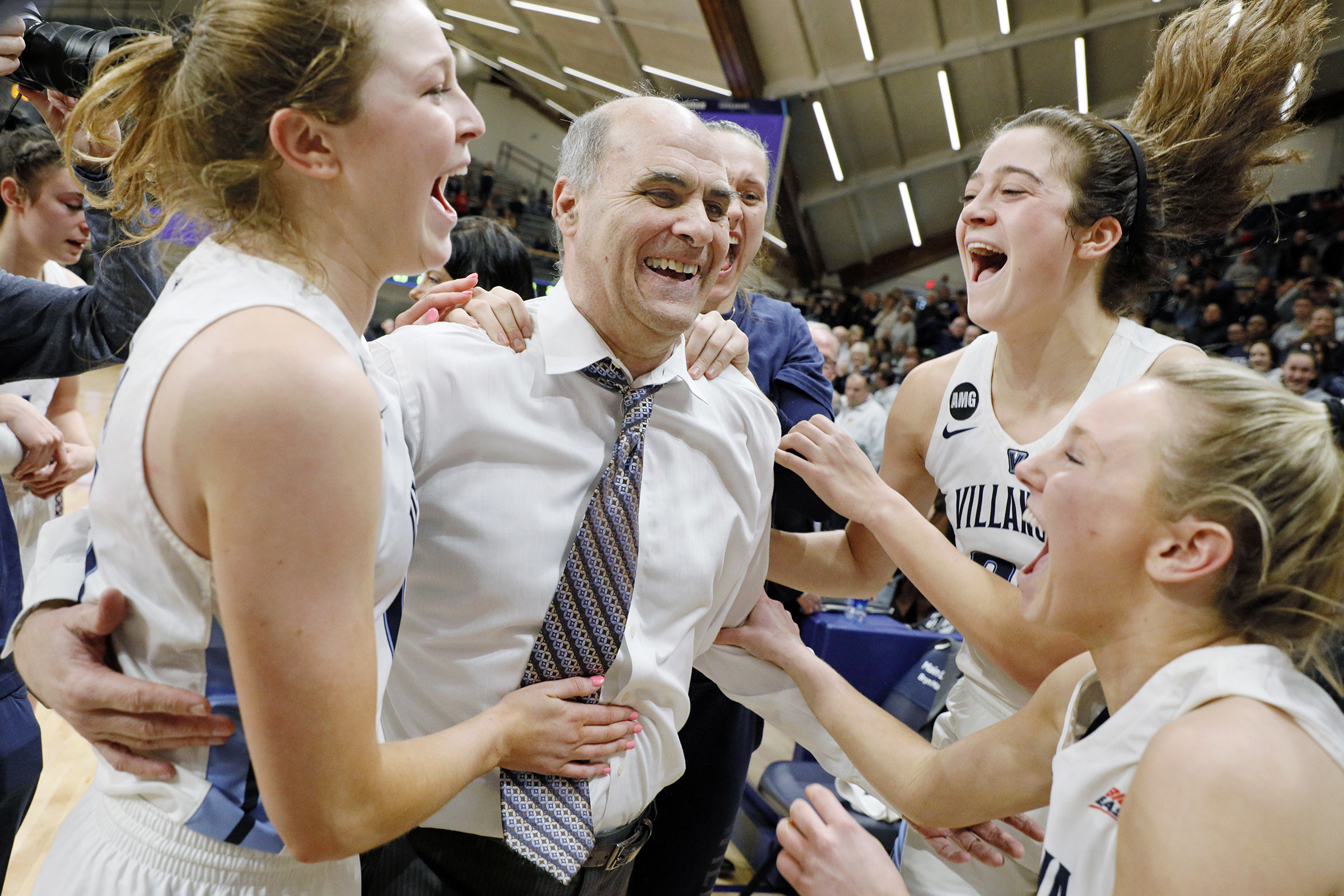
While 70 of the Villanova women’s basketball alumni attending Saturday’s game vs. Georgetown spanned decades of program history, most of them had a common experience: playing for former coach Harry Perretta.
Perretta, who led the Wildcats for 42 years, stood in front of a long line of alumni during the halftime ceremony. It was a moving moment, Perretta said.
“It’s great to come back on alumni day because you realize how many people [who] you’ve met over 42 years,” Perretta added. “That’s what made it even more special to me. Any honor that I get is always associated with my former players and my assistant coaches, because they’re the ones [who] really did it. I just happen to be the common thread.”
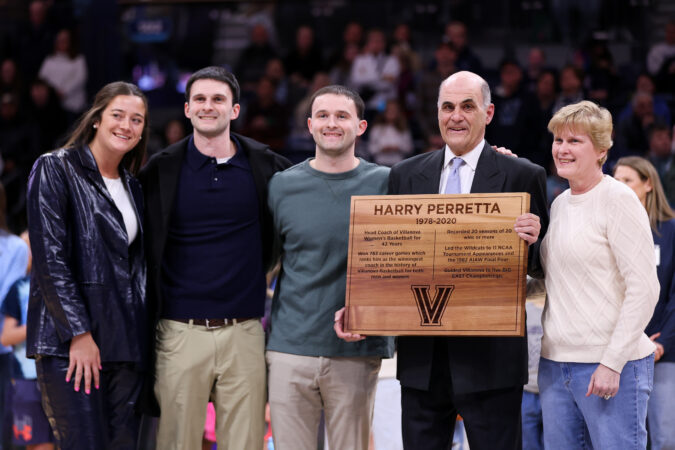
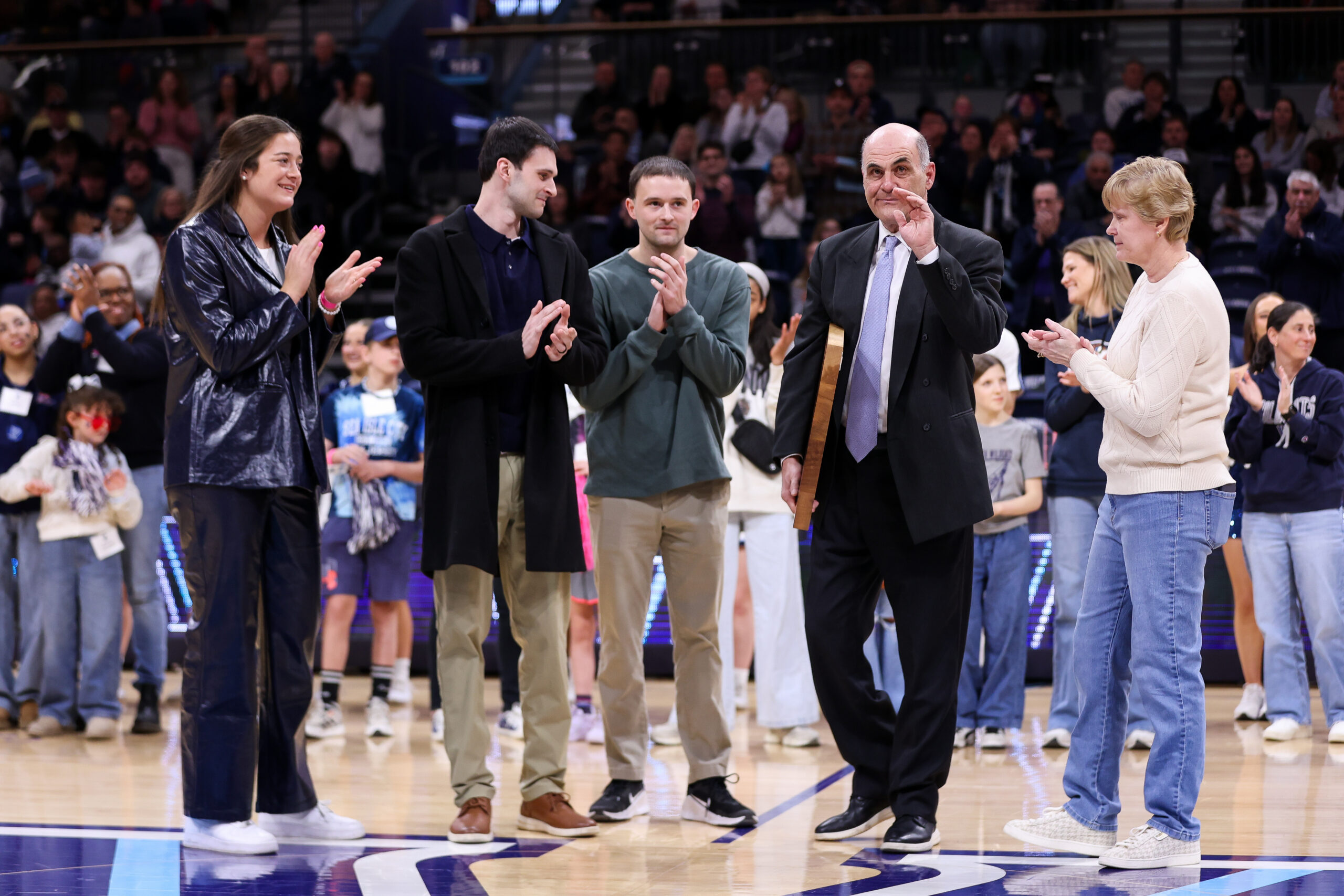
Surrounded by his family and former women’s player Maddy Siegrist (left), former Villanova women’s coach Harry Perretta waves to the crowd during a halftime ceremony in his honor.
Former players walked onto the court in the order of their graduating class. Perretta was there on double duty, and he also announced the game for ESPN+, leaving the broadcast booth to receive an honor set to become a display inside the Finneran Pavilion.
“The turnout here is a testament to the type of coach [Perretta] was and the way he treated players,” said Laura Kurz, a 2009 graduate and former assistant coach to Perretta. “So much of that has to do with Harry, his legacy, and this sisterhood that he created here. Looking back, I learned so much from him. There were definitely tough times, but in the end, it was all a very rewarding experience.”
Following the ceremony, the alumni watched Villanova finish a 67-55 victory over Georgetown.
💙family🤍
Such a special day welcoming back so many of our alumni and honoring Harry Perretta with a plaque of his career accomplishments! pic.twitter.com/TeZCUPvoWB
Perretta, who coached the Wildcats from 1978 to 2020, took the team to 11 NCAA Tournament appearances. He is the winningest coach in Villanova men’s and women’s basketball history with 726 victories.
Kathy Razler, a 1985 graduate, has maintained her longtime connection to the program as a season-ticket holder. Razler has stayed in touch with Perretta and former teammates since their run to the Final Four in the 1982 AIAW Tournament, the predecessor to the women’s NCAA Tournament.
Former Villanova coach Harry Perretta led the team for 42 years.
“It’s so great to see the number of people that continue to come back, and everybody knows that’s because of Harry,” Razler said. “Harry was the connector between all of us. Harry wasn’t always easy, but we all knew that we were going to benefit in the long run from what he requested us to do, and the hard work we put in.”
Past to present
Villanova coach Denise Dillon, who played for Perretta from 1992 to 1996, credited her former coach for influencing her coaching style. Dillon replaced Perretta following his retirement in 2020.
“I think you always teach what you were taught, how you learned the game,” Dillon said. “That’s why I’m in coaching. I had great coaches all the way up the line, and the best in Harry through my college career. It was so intentional how he taught us team basketball and individual development, and most importantly, just about life. … I’ve definitely taken that [coaching philosophy] and passed that along to every player that comes through the program.”
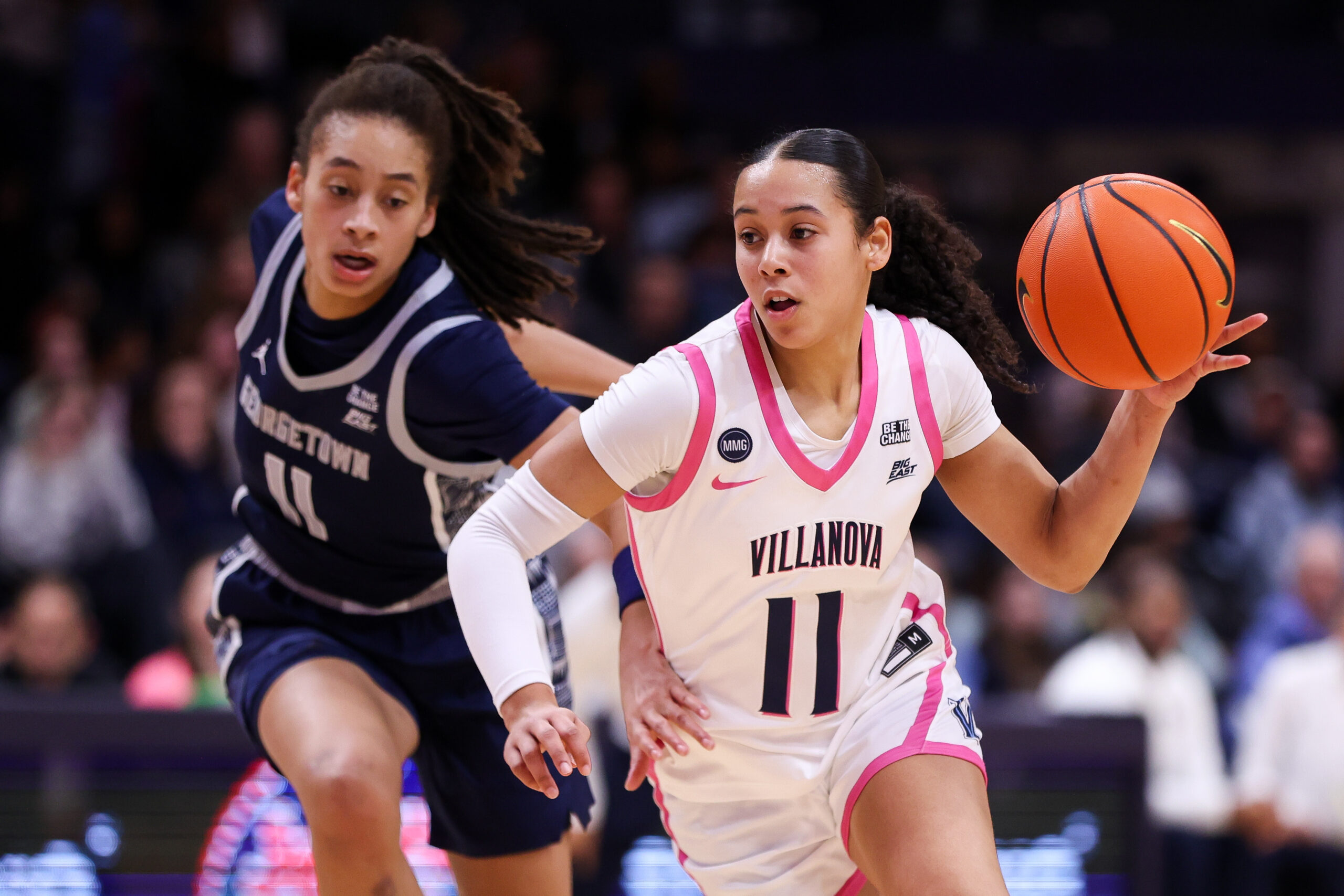
Villanova guard Jasmine Bascoe drives to the basket against Georgetown’s Khia Miller during the second half of their game on Saturday.
For Michele Eberz, a 1995 graduate, attending alumni day was essential, as Villanova basketball runs in the family. Her husband, Eric, is a 1996 alumnus of the men’s program.
Recently, their daughter, Alexis, a senior at Archbishop Carroll, signed to play for the Wildcats next season.
“From when I played to now, there’s just been enormous attention on women’s basketball and women’s sports in general,” Michele Eberz said. “They’re filling seats like never before. I’m just so proud of my daughter to have the opportunity to not only get a tremendous education here [at Villanova], but to also play under the roof of the Finneran Pavilion.”
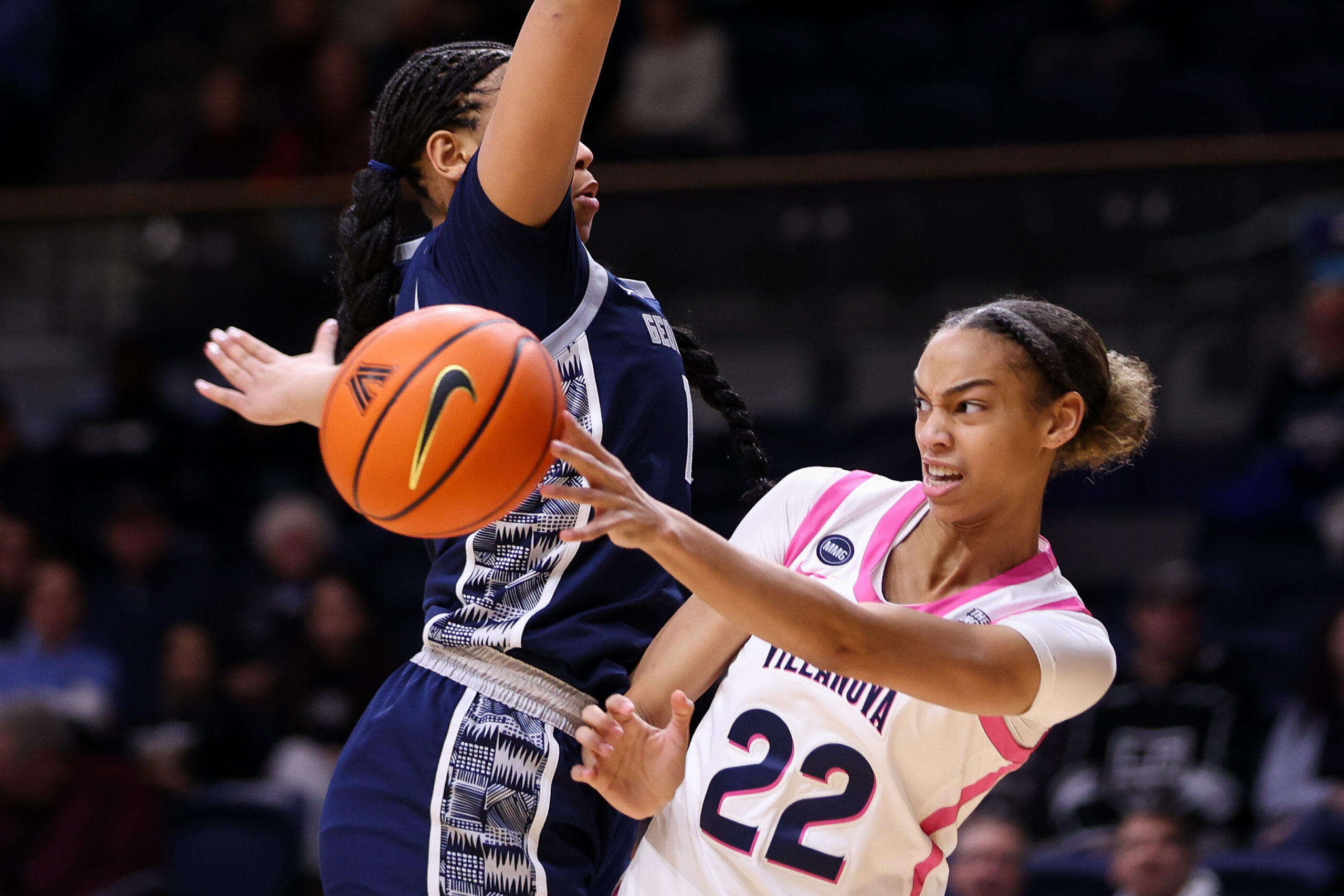
Villanova’s Kennedy Henry passes the ball around Georgetown forward Brianna Scott during the first half on Saturday.
Up next
With the win over Georgetown, Villanova (19-5, 12-3 Big East) remains in second place in the Big East. On Wednesday, the Wildcats will visit Xavier (6:30 p.m., ESPN+).
As Chris Scafario sees it, Philadelphia’s reputation as an “eds and meds” region, referring to its plethora of colleges and hospitals, could grow a third leg.
It could also become the defense industrial base region,said Scafario, CEO of the Delaware Valley Industrial Resource Center.
President DonaldTrump wants to increase defense spending, with $1.5 trillion proposed for 2027. This could mean more research and workforce development training opportunities — and local universities are positioned to take advantage of it, Scafario said.
Chris Scafario, CEO of the Delaware Valley Industrial Resource Center
“A lot of that investment is going to be targeted toward university and innovation-based relationships because they need help getting stuff done,” said Scafario, who is talking to local colleges to help get them ready to capitalize. “They need access to brilliant people, whether they’re faculty or the faculty’s work products, the students.”
The move comes as colleges face potential cuts in research funding under the Trump administration in other areas, such as the National Institutes of Health. Both Princeton University and the University of Pennsylvania in the last month announced cutbacks to cope with potential financial fallout from federal policies.
Scafario’s center, which is based at the Navy Yard and was founded in 1988, aims to foster economic development and local manufacturing.
The Philadelphia region has been involved in defense contracting on and off for years, with major hubs in naval and aerospace manufacturing, and local universities say they worked with the Department of Defense in the past. Rowan University in New Jersey says it has $70 million in defense-related research projects underway.
But Scafario sees the opportunity for major expansion.
Drexel University, Temple University, Penn, Rowan, and Villanova University, which is already a top producer of naval engineers, are among the schools that are “in a great spot to leverage the opportunities that are going to be coming through the defense industrial base,” Scafario said. “In the next year, people are going to start realizing that we are meds, eds, and a defense industrial base region. It’s going to bring a lot of investment, a lot of economic opportunities, and some really, really great employment opportunities in the region.”
The Philadelphia region could become a national anchor for shipbuilding or other maritime industrial-based activities, he said.
Scafario hopes to bring colleges together with other partners for more discussions in the spring when the timeline for those federal investments starts to become clearer, he said.
Amanda Page, Warfighter Technologies Liaison for the Delaware Valley Industrial Resource Center
Colleges could help with efforts to accelerate production capacity of naval ships and work on initiatives such as how to make submarines less traceable and more durable. Or they could help improve medical equipment and training for the battlefield. The treatment standard in the military used to be the “golden hour”; now it’s about “prolonged field care,” said Amanda Page, a retired active-duty Army medic who serves as warfighter technologies liaison for the center.
“Medical personnel need to be prepared mentally, physically, emotionally, and electronically to keep those patients for 96 hours,” Page said. “That’s going to require a ton of research and technology.”
Page was hired by the center in October to help build relationships between the center, the Department of Defense (which the Trump administration has rebranded the Department of War), local higher education systems, and the city.
“I’m super excited about what it will bring to the region and what the region can prove to the Department of War about its legitimacy,” she said, “as a manufacturing and technology powerhouse.”
Local colleges say they are reviewing potential collaborations.
“There are a lot of opportunities we are looking at,” said Aleister Saunders, Drexel’s executive vice provost for research and innovation, declining to provide specificsfor competitive reasons.
In addition to opportunities with the Navy and the Navy Yard, he noted major local companies involved with aerospace and aviation, including Lockheed Martin and Boeing. There are also opportunities around materials and textiles with the Philadelphia-based Defense Logistics Agency Troop Support, which provides many of the supplies to the military.
“Those are really valuable assets that we should find a way to leverage better than we are,” he said.
Key opportunities are available in advanced manufacturing and workforce development, he said.
“There could be folks who are already working in manufacturing who need [upgraded skills] in advanced manufacturing techniques,” he said.
Temple University president John Fry said increasing research opportunities and impact — the school’s research budget now exceeds $300 million — is a priority in the school’s strategic plan. Temple offers opportunities around medical manufacturing, healthcare, and health services, he said.
“The key to doing that is going to be partnerships,” he said.
Josh Gladden, Temple’s vice president for research, said he has met with folks from Scafario’s group and they are talking about some opportunities, but declined to discuss them because they are in early development.
He noted that the Navy is interested in working with Temple’s burn unit.
Temple has also been getting to know the workforce needs of businesses at the Navy Yard and looking at how to align its educational programs, Fry said.
“Those are relationships I would love to pursue,” he said. “Part of our mission is to develop the future workforce and grow the regional economy, and that’s one way of doing it.”
Rowan has been a longtime research partner with the U.S. military, said Mei Wei, the school’s vice chancellor for research.
“It’s encouraging to know there could be more funding available for research,” Wei said. “These projects give our undergraduate and graduate students the opportunities they need to develop their research skills with close guidance from our faculty and our external partners.”
Because of the Winter Olympics, the Flyers won’t play again for another two-and-a-half weeks, not that anyone is all that broken up about their impending absence. They’ve been a lousy hang for a while, losing 12 of their last 15 games, falling out of the playoff picture, and drawing attention primarily for the six degrees of debate around Matvei Michkov’s playing time.
The Michkov issue has been fascinating and revealing. Everyone acknowledges that, after his often-impressive rookie season, he came into training camp out of shape. That reality has precipitated a months-long discussion about how he has played, when he has played, how much he has played, and whether coach Rick Tocchet might be mishandling him and sabotaging Michkov’s career before the kid has a chance to become the star the Flyers and their fans hope he will be.
Tocchet, general manager Danny Brière, and team president Keith Jones have made it clear that they are taking, or trying to take, the long view about Michkov’s development. They have also made it clear that they consider it valuable to put him through a kind of rite of passage, to compel him to learn and practice good habits on and off the ice.
One can make a case that such an approach is too old school, won’t be effective, and risks angering and alienating Michkov. That’s possible, I suppose, but it’s just as reasonable to think the Flyers’ methods are correct and will work.
There are plenty of 76ers fans and former members of the franchise, for example, who wish their team had treated Joel Embiid and other since-departed players with a firmer hand earlier in their careers.
It’s safe to say, though, that within at least a portion of the Flyers’ fan base, a measure of paranoia has arisen when it comes to Michkov and the organization’s handling of him.
Earlier this season, anodyne comments about him, by team captain Sean Couturier, were taken out of context and treated as a major controversy. Tocchet then offered a frank assessment of Michkov’s conditioning and performance during a recent interview with PHLY Sports. And while it wasn’t the smartest media-relations strategy for the head coach to criticize such an important player so brusquely, the reaction to Tocchet’s comments suggested that people were afraid Michkov would be so offended that he would catch the first flight to Little Diomede and hike the Bering Strait back to Putinland.
That fear is irrational, of course, and it’s easy to chalk it up to the longtime overzealousness of the Benevolent Order of the Orange and Black. But in this case, it’s understandable that those fans who have stuck with the Flyers over the last 15½ years — that’s how long it has been since that 2010 run to the Stanley Cup Final — would be a little on edge about Michkov. Even more than a little.
Danny Briere addressed the noise about drama between Rick Tocchet and Matvei Michkov.
“(Tocchet) wants Matvei to succeed. He wants to develop him to be the best player he can be. Along the way, there’s tough lessons that comes with that. It’s like raising a child.”
All anyone has to do is look at the Flyers’ draft history over the last quarter century to understand why their fans want Michkov treated like a prince and shielded from any emotional boo-boos. Because that history is … ugh.
Let’s start with 2001. The Flyers’ first-round pick that year, defenseman Jeff Woywitka, played 278 NHL games in his career, none with the Flyers. Their third-round pick, Patrick Sharp, turned out to be a terrific player … after they traded him to the Chicago Blackhawks.
With the fourth-overall pick in 2002, the Flyers took defenseman Joni Pitkänen. Eh. Their subsequent six picks in that draft played a combined total of one game in the NHL.
The 2003 draft was a red-letter one: Jeff Carter and Mike Richards in the first round. After those two, the Flyers took nine other players. Alexandre Picard, a third-round defenseman, turned out to be the best of the bunch.
If, in 2004, the Flyers were actually trying to tank the draft, no one could tell. They picked 11 players who appeared in a total of 23 NHL games.
Over the ‘05 and ‘06 drafts, they selected 16 players, two of whom had lengthy NHL careers: Claude Giroux and … Steve Downie.
For three straight drafts, 2008 through 2010, the Flyers picked 17 players. Just nine made it to the NHL and two others played only one game. The player who played the most games for them was Zac Rinaldo.
The Flyers took Couturier with the No. 8 overall pick in 2011. Excellent. They found Nick Cousins in the third round. OK. None of their other four picks that year played for them.
Left wing Oskar Lindblom was drafted by the Flyers in 2014.
From 2012 to 2014, the Flyers drafted Travis Sanheim, Scott Laughton, Shayne Gostisbehere, Anthony Stolarz, Oskar Lindblom, and Robert Hägg. They did not draft anyone who could reasonably be called a star.
When the Flyers took Ivan Provorov and Travis Konecny in the first round, 2015 looked like a draft they could take pride in. But Provorov’s gone, and goalies Felix Sandström and Ivan Fedotov couldn’t cut it.
Two words about the 2016 draft: German Rubtsov. Two more words: Carter Hart.
With the No. 2 pick in the 2017 draft, the Flyers selected Nolan Patrick. There are no words for how that decision turned out. But hey, Noah Cates!
The Flyers’ crown jewels from the 2018 draft were Joel Farabee and Sam Ersson.
In 2019 and 2020, the Flyers got Cam York (cool), Tyson Foerster (promising but injured), Bobby Brink (we’ll see), and Emil Andrae (don’t you need more from a second-rounder by now?).
So far, the Flyers’ best pick in the 2021 draft has been Aleksei Kolosov. Which tells you all you need to know about the Flyers’ 2021 draft.
We’re up to 2022. The Cutter Gauthier draft. Best to move on quickly and quietly …
The Jones-Brière regime has overseen the 2023-25 drafts, and yes, it’s early yet to judge the results, and yes, the Flyers were bold in ’23 in taking Michkov. But it’s worth noting that, of the 26 players the Flyers picked over those three years, just three have suited up for them so far: Michkov, Denver Barkey, and Jett Luchanko.
It’s not just that the Flyers have had opportunities to mine the draft for elite talent and failed. It’s that they haven’t even stumbled into a late-round pick or two who ended up becoming cornerstones.
A team that does not draft well cannot win. The Flyers have been proving that maxim true for a long time. No wonder their fans are so protective of the one player who represents even a glimmer of possible greatness.
Last week, with the trade deadline looming, Joel Embiid made a public plea to the 76ers’ front office. He begged them to ignore the luxury tax for once, and to get him the help he needs for what has turned into an unlikely impending playoff run.
“In the past we’ve been, I guess, ducking the tax,” Embiid said last week. “So, hopefully, we think about improving. Because I think we have a chance.”
Embiid made this plea knowing that Tyrese Maxey, VJ Edgecombe, and Embiid himself cannot sustain their high level of play if they have to maintain such a high number of minutes.
Embiid’s plea coincided with the 25-game drug suspension of fellow veteran and max-salary player Paul George, who, like Embiid, was rounding into form after more than a year of debilitating injury issues. George will not be eligible to return until only 10 games remain in the season.
In fact, not only did the Sixers fail to make a significant move to improve the roster, they actually got worse: They traded last year‘s first-round pick, sharpshooter Jared McCain, for future draft picks.
So, despite asking, and asking nicely, Embiid got no help.
Daryl Morey’s message to Embiid:
Trust the process.
“I think we all wanted to add to the team, and, you know, we took his comments to heart,” the Sixers’ president said Friday.
And?
“We were trying to add to the team,” Morey said, “and we didn’t find a deal that made sense — one that we thought could move the needle on our ability to win this year.”
So: Still processing.
McCain trade
Maxey is the team’s most important player, so he was never a trade consideration, but Morey acknowledged that both Edgecombe and Embiid were essentially untouchable, too.
McCain was not untouchable. His departure provided salary-cap relief. Further, though, Morey painted McCain as a long-term project who might not develop faster than whomever the Sixers draft in June with the first-round pick the Sixers got in the trade.
That seemed harsh. True, but harsh.
Sixers guard Jared McCain was shipped after only playing one full season in Philly.
As a rookie, McCain averaged 15.3 points in 23 games mostly as a bench player last season, which was cut short by injury. More injury issues limited his participation this season, and he was averaging just 6.6 points. Morey traded him Wednesday to Oklahoma City for the Thunder’s first-round pick in June, as well as three future second-round picks.
McCain simply was not in the Sixers’ immediate plans, and Morey insisted that they would not have gotten a better return on McCain in the offseason.
Morey also said the Sixers hoped to immediately flip some of the draft picks they received in the McCain deal and improve the team thus.
The emergence of Dominic Barlow, who is starting in place of George, and the continued strong bench play of guard Quentin Grimes convinced him that there were no players available for a sensible asking price that would appreciably improve the Sixers.
Certainly, there were no players that would have warranted the Sixers exceeding the luxury tax, though Sixers ownership had given him permission to spend whatever he needed to spend.
“If we had found an [addition] and we were going to end up higher [than the tax], we would have ended up above it. We’ve done it several times,” Morey said. “We didn’t see something that did.”
So: Still processing.
The Process
The catastrophic, scorched-earth strategy of rebuilding the Sixers, begun in 2013, eventually became known as “The Process.” Trusting in it became the mantra of both the franchise and a cult of devoted, long-suffering fans for whom no sacrifice was too outrageous.
Embiid then hijacked the phrase as his nickname in 2016, after he’d missed his first two NBA seasons due to injury. Personalizing the phrase was an ostentatious act, but, considering the nature of his turbulent career, Embiid has come to embody it.
Now, 13 years and five decision-makers later — Sam Hinkie, Bryan Colangelo, Brett Brown, Elton Brand, and Morey — the Sixers must ask their best player, the last vestige of The Process, to spend one of his twilight seasons hoping the current chapter of The Process has a happy ending.
“This team, we think, can make a deep playoff run and is one of the top few teams in the East,” Morey said.
He’s right.
The Process has a window. It’s a small window, like that triangular side window on old cars, but it’s a window nevertheless.
If you remember opening that little triangular "wing window" in the car to get a breeze right in your face, you must have gray hair. pic.twitter.com/DCZhJJc5VP
As of Friday night the Sixers stood sixth in a sagging Eastern Conference. Injury has diminished both the Celtics, who won the NBA title two years ago, and the Pacers, conference champs last season. The Pistons are in first place, 4½ games ahead of the flawed Knicks and Celtics, but nobody really believes in them. The Sixers are just one game behind the Raptors, who have five players averaging double figures, and 1½ games behind the Cavaliers, who, despite having won seven of their last eight games, were so desperate that they traded for — wait for it — 36-year-old James Harden.
James Harden, formerly of the Sixers, was traded to the Cleveland Cavaliers.
As predicted when Celtics star Jayson Tatum and Pacers star Tyrese Haliburton suffered severe injuries in the 2025 playoffs, the East is weak and vulnerable. These are adjectives that often have been used to describe the 76ers during The Process.
Now, though, the Sixers have won five of their last six games. They’ve ridden Maxey’s MVP campaign, Edgecombe’s Rookie of the Year campaign, and what would be Embiid’s Comeback Player of the Year campaign if the NBA had such an award.
Can they keep it up? We won’t know for months whether the conference is so bad that even the Sixers can win it.
So, until then: Still processing.
You gotta believe
“I believe in myself, so I’m always going to believe I have a chance, as long as I’m healthy,” Embiid told reporters Thursday night, after McCain had arrived in Oklahoma and no new player had joined the Sixers on the road in Los Angeles. “I believe that we can beat anybody. We hold down the fort until [George] comes back. He’s really needed. He’s irreplaceable.”
He’s not in demand, though. League sources indicated that no team was interested in trading for George. No surprise there. At 35, not only is George suspended, but he is also owed almost $110 million over the next two seasons, and he has an injury history as bad as Embiid’s.
That’s OK with the Sixers. George, when not taking banned substances, is probably still very good. Morey adores George, especially as a defensive difference-maker.
“We really like what Paul gives us,” Morey said.
Well, he won’t give them anything for the next 21 games. Which, for the moment, is exactly what the Sixers will get from the 2026 trade deadline.
My chatty Uber driver was born and raised in South Philly and so, as we threaded our way through the cozy rowhouse blocks east of South Broad Street, he reveled in reciting the personal histories behind every deli, seafood market, corner taproom, and red-gravy pasta joint we passed. But even he seemed to be momentarily flummoxed as we pulled up to Tesiny, on the 700 block of Dickinson Street.
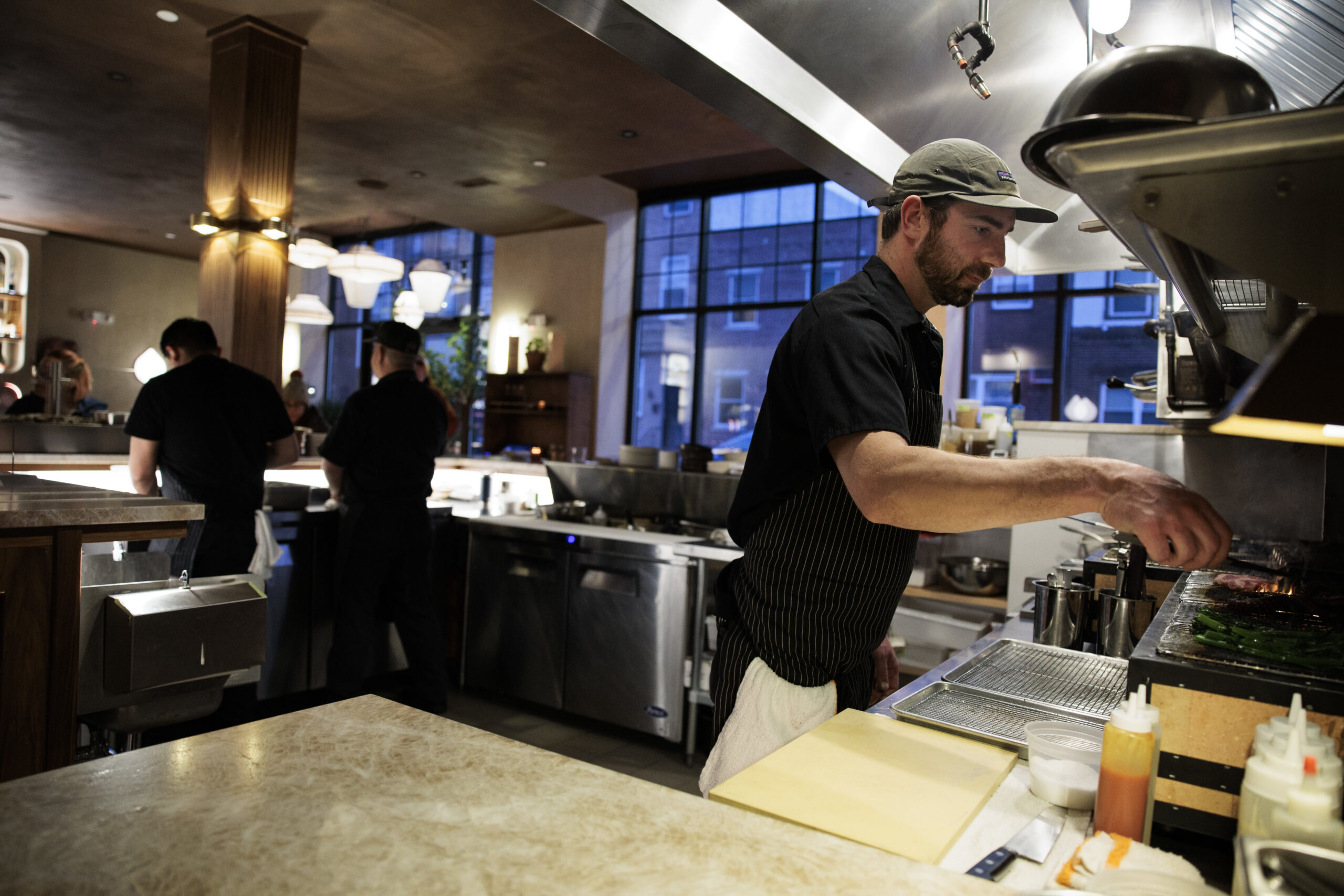
A century-old corner brick building that for much of its life was an auto-repair shop had been completely transformed. Its garage doors were replaced with broad paned windows that glowed amber with the inviting tableau of a bustling restaurant inside. Diners clinked glasses of pink martinis. Chefs were illuminated by the flicker of a live-fire grill in the central open kitchen, where oysters were being shucked at the U-shaped counter, to be dispatched on icy plateaus to date-night duos across the room.
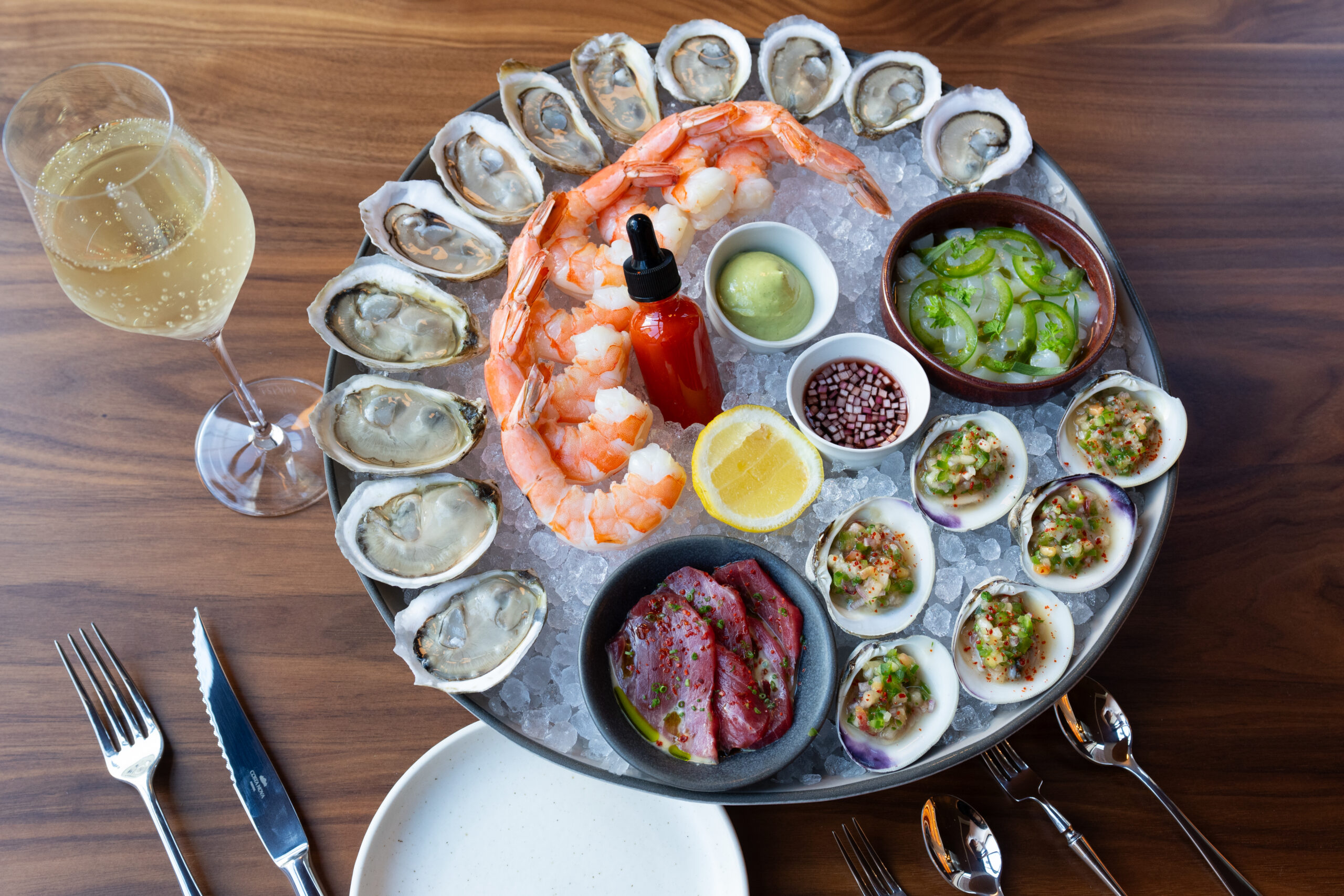
Large seafood plateau with shrimp cocktail, clams ceviche with peach and jalapeño, three types of oysters, scallop crudo with melon water, and bluefin tuna with corn vinaigrette. Sauces are cilantro tarragon aioli and rosé mignonette, at Tesiny.
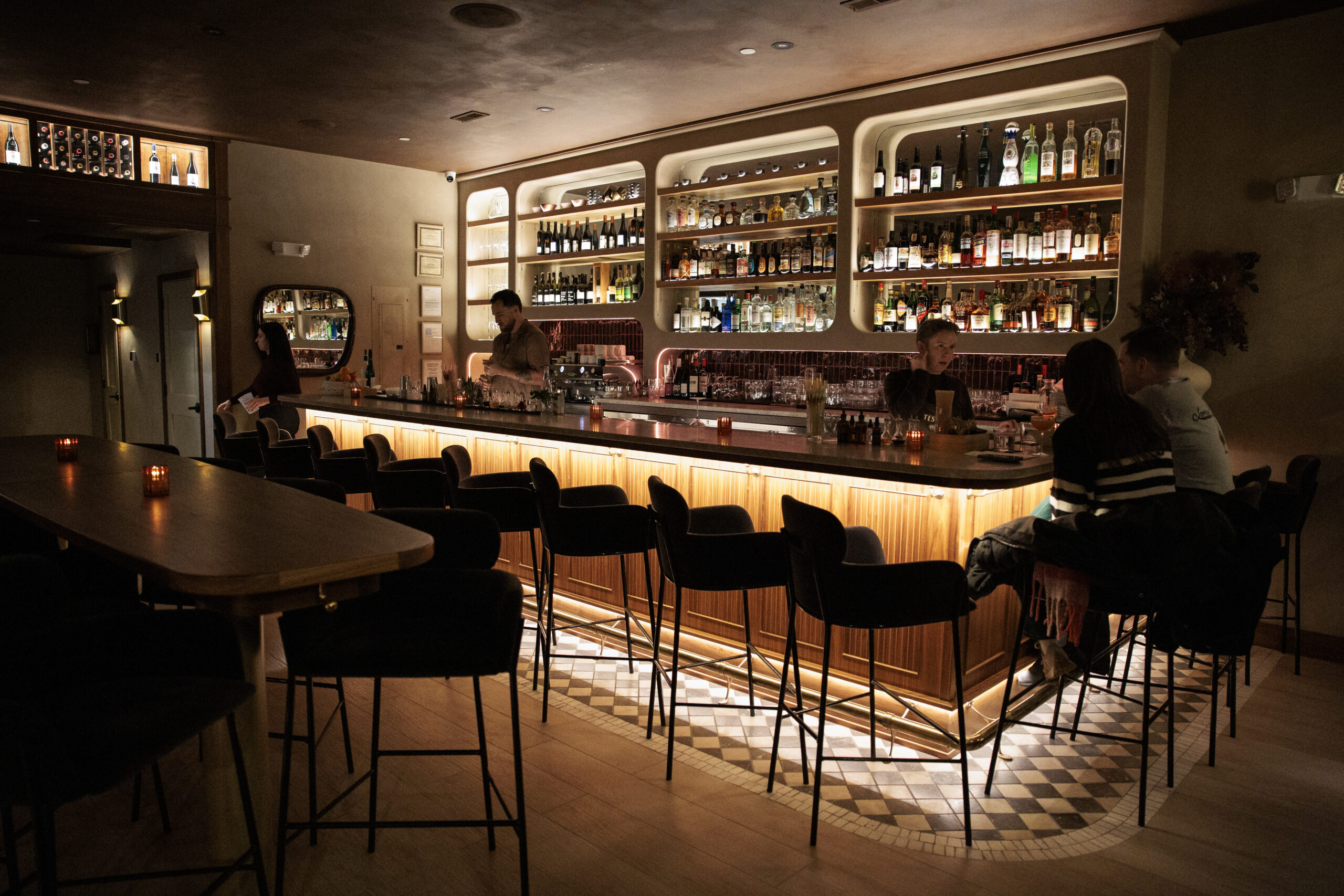
The long bar near the entrance, deftly lit to illuminate its soigné design touches — the rich walnut wood accents, the purple-and-white tiled floor, the smooth curves of a backbar stocked with uncommon sherries — radiated a magnetic glamour.
“Let me know how it is!” he said, as I exited the Uber. I promised a full report.
In a dynamic old city constantly reinventing itself, we could do far worse than watching an industrial space be reborn as such a lovely restaurant. More specifically, you should be so fortunate to have Lauren Biederman be the one to do it.
The exterior of Tesiny on Wednesday, Jan. 21, 2026 in Philadelphia.The bar at Tesiny on Wednesday, Jan. 21, 2026 in Philadelphia.
Biederman, 30, is a bright talent who knows how to turn her quirky hunches into success. She’s best known as the area’s lox-and-caviar queen, after pursuing a “weird idea that popped into my head while driving” — that what Philly really needed was an old New York-style boutique market for hand-cut smoked salmon, fresh bialys, and brunch boards. In fact, we did. Five years after opening Biederman’s in the Italian Market, she’s now also serving caviar bumps from a kiosk beside the Four Seasons Hotel and about to open another Biederman’s near Rittenhouse Square, where Jewish prepared foods will be sold alongside the smoked fish.
But Biederman was a restaurant person before her retail success. The Vermont native worked at Oloroso, where she found her passion for wine, then got into bartending, working at Zahav and several Schulson Collective restaurants, including Osteria, where she met Devon Reyes-Brannan, 30, now her longtime boyfriend and partner at Tesiny. (The name, pronounced “TESS-iny,” is a reference to her late grandmother’s address in Connecticut. The two shared a love of seafood.)
Co-owners Lauren Biederman and Devon Reyes-Brannan at Tesiny on Wednesday, Jan. 21, 2026 in Philadelphia.
Biederman designed the room and nailed the elegantly sultry mood, with the dark brown ceiling and light floors keeping it cozy while the mellow soundtrack shifts throughout service from Sinatra to Sadé, then to hip-hop beats for the livelier later hours. Good spacing between tables keeps conversation possible.
There’s an admittedly amorphous, on-trend quality to Tesiny — the raw bar, craft cocktails, and a chef’s-counter grill turning out shareable plates that resist easy classification as appetizers or entrees — that could just have easily landed in a buzzier restaurant district like Fishtown or Rittenhouse Square. But there’s an extra pulse of intimacy in finding this polished 50-seat oasis in the heart of residential Dickinson Narrows, a hotly debated neighborhood within a neighborhood just east of East Passyunk. It’s upscale, averaging $80 per person for food and drinks, but already resonating as a destination, with up to 100 diners on busy nights.
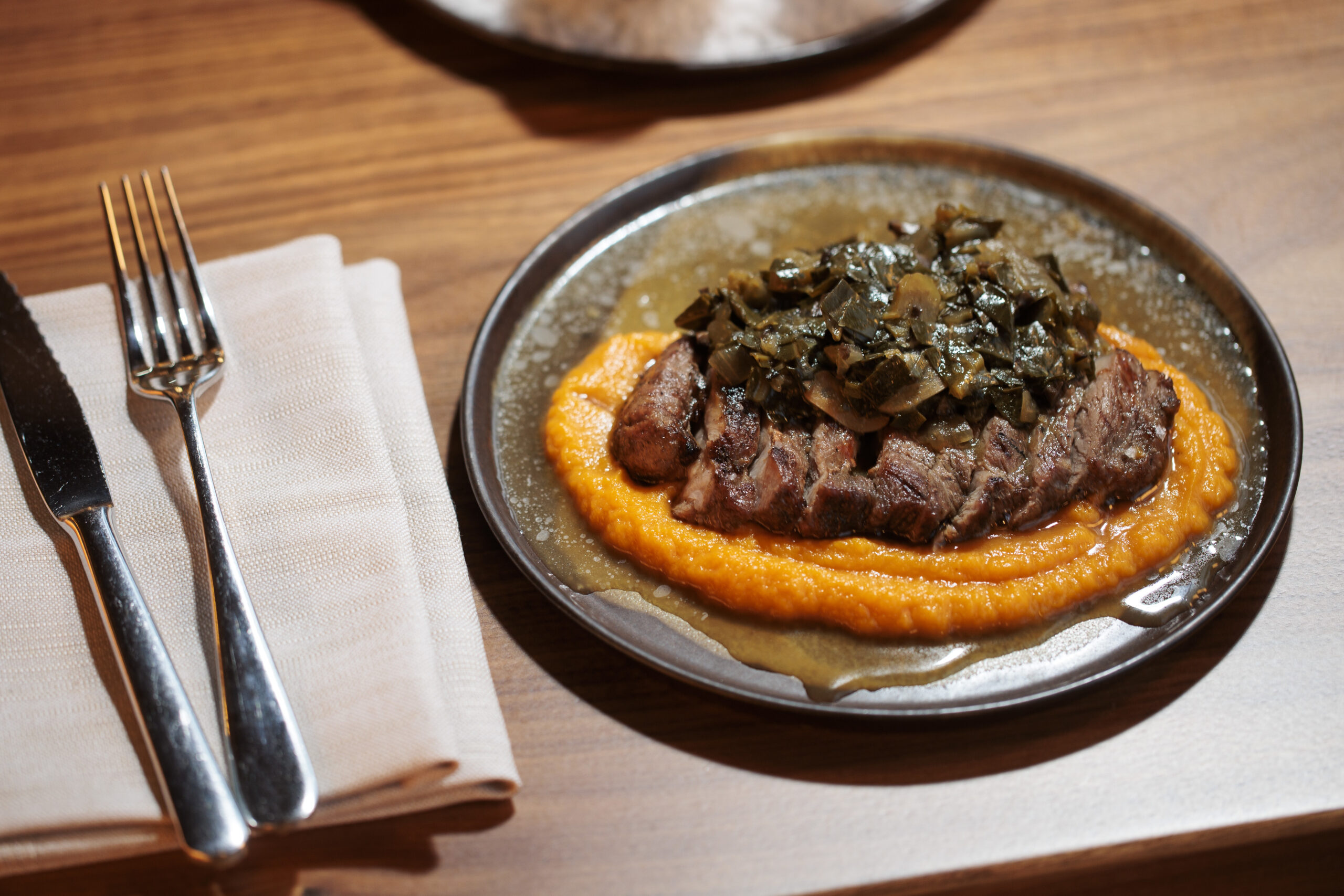
The Iberico pork at Tesiny on Wednesday, Jan. 21, 2026 in Philadelphia.Chef Michael Valent works in the open kitchen at Tesiny on Wednesday, Jan. 21, 2026 in Philadelphia.
It succeeds on its posh vibes, but also the skill of its players to strike the right tone, from the well-informed (but never pushy) servers to chef Michael Valent, 36, with whom Biederman worked at Zahav. There’s nary a noodle on his menu — a rarity in this neighborhood.
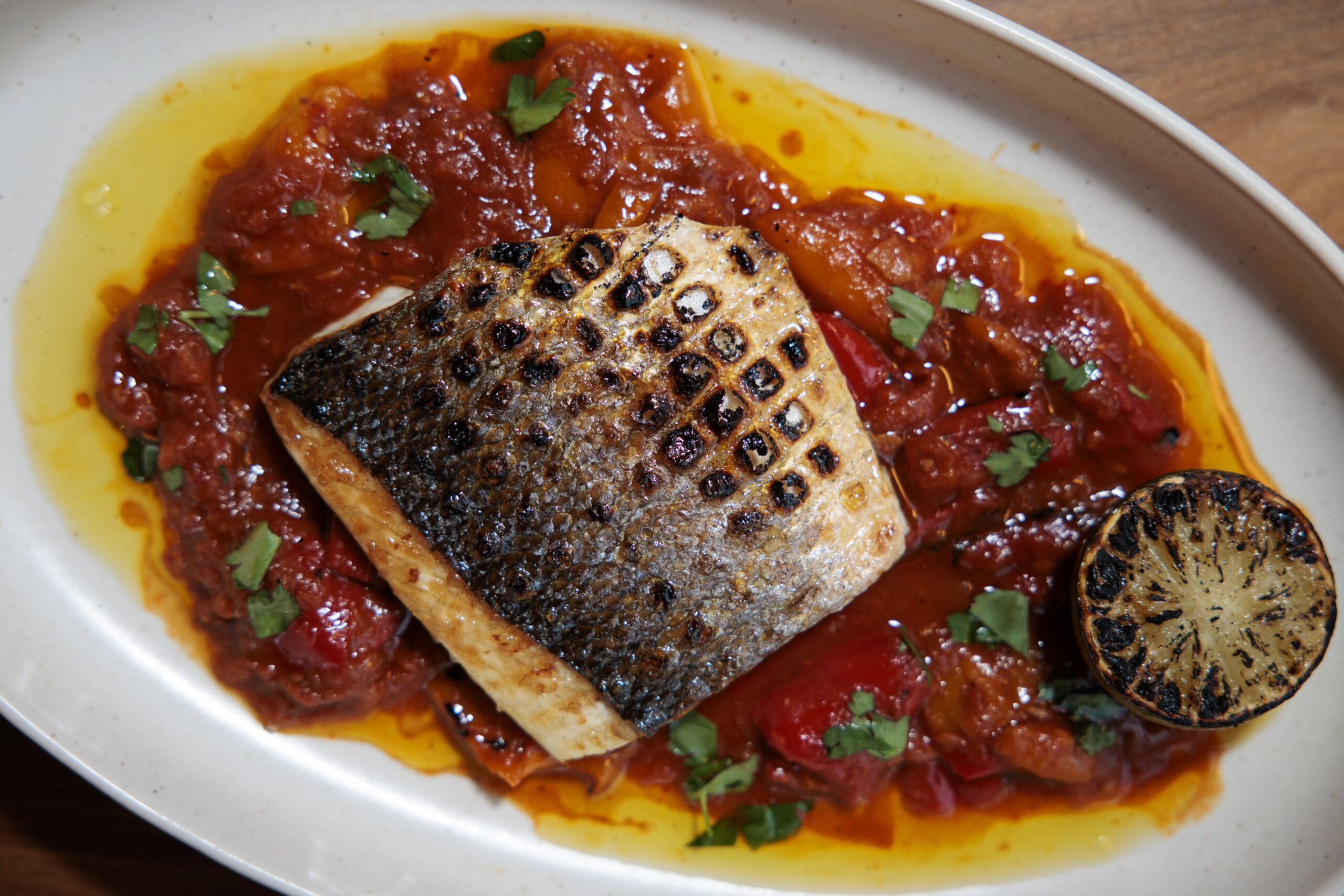
Valent instead deftly draws on an array of multicultural influences without the food ever feeling overly contrived, largely due to the breadth of his experience, including time in Boston, New Orleans, and Philly (at the French-themed Good King Tavern, Superfolie, and Supérette). One moment you’re savoring a tuna crudo dusted with coconut and aji chile spice. The next you’re savoring a tender grilled Ibérico pork collar with silky pureed squash and smoky collards that recall Valent’s stint in New Orleans working for Donald Link at Cochon. Another favorite, a crispy-skinned branzino fillet over a Basque-style pipérade of Jimmy Nardello peppers, is an inviting jaunt to the Mediterranean.
The branzino at Tesiny on Wednesday, Jan. 21, 2026 in Philadelphia.
The raw bar is always a smart place to start. The trio of ever-rotating East Coast oysters, from Canadian Eel Lakes to Sunken Meadows from Massachusetts, comes with a classic mignonette that benefits from being composed à la minute every time, so the shallots retain their bite (rather than pickle) in the rosé vinegar and still-fragrant fresh-cracked peppercorns. The shrimp cocktail was notably tender and flavorful from a citrus-scented poach. And the crudos were also tasty, although I preferred the juicier early version of the scallop crudo, bathed in jalapeño-spiced honeydew-cucumber water, to the more sparely dressed current setup, with smoked olive oil and Korean chile flakes.
A starter of creamy crab salad laced with chorizo oil conveniently cradled in endive spears was solid, but also perhaps a bit boring in a passed-hors d’oeuvres kind of way. It reflected an occasional finger-food aesthetic here, a propensity to lend familiar favorites extra polish for elevated, no-fuss nibbling; that never, however, came with any culinary shortcuts.
The tidiness impulse is especially clear with Tesiny’s labor-intensive chicken lollipops. Drumsticks of Green Circle chicken are “Frenched” to offer a clean bone handle for the poultry mallets that are double-crisped in rice flour, like Korean fried chicken. Glazed in an orange hot sauce made with Fresno chilies and infused with seafood trim (shrimp shells and scallop “feet”), the lollipops are visually appealing. But for a dish that also wants to evoke Buffalo wings, the sauce’s subtle flavors aren’t quite punchy enough for the maximum impact.
The chicken lollipops at Tesiny are double-fried and glazed in a chile-tomato sauce that’s also infused with seafood trim.The broiled oysters at Tesiny on Wednesday, Jan. 21, 2026 in Philadelphia.
Restraint was not the issue with my favorite seafood starter here: a platter of charbroiled Indian Cove oysters that arrive in a pool of Calabrian chile butter, which requires at least one order of Mighty Bread sourdough to mop up from the shells. Whatever crusts are left over, you can swipe through the silky white bean purée that sits beneath the tender grilled octopus topped with harissa-spiced olives and fennel.
Valent’s winter green salad was also remarkably and unexpectedly delicious, its crunchy Little Gem and frisée greens dressed in a citrusy Champagne vinaigrette balanced by toasted almonds and the nutty Alpine richness of shaved Comté.
The bar at Tesiny on Wednesday, Jan. 21, 2026 in Philadelphia.
What to order from Tesiny’s gorgeous bar to accompany all this food? The well-crafted cocktails, many infused with fortified wines, are the most popular place to start. I especially enjoyed Not a Fender, a briny pink riff on a Gibson martini made with pickled red onions, olive oil-washed gin, and a splash of manzanilla sherry. And Tesiny’s thoughtful nonalcoholic offerings were so appealing that we ordered the blood orange-thyme fizz topped with creamsicle foam — and loved it — after spotting another couple order it across the chef’s counter.
The pink Gibson: Olive-oil washed vodka and gin, pickled red onion brine, manzanilla sherry.The Return of Saturn cocktail and Fizz mocktial at Tesiny on Wednesday, Jan. 21, 2026 in Philadelphia.
To pair with the handful of larger plates clustered at the bottom of the menu, it’s worth exploring the wines, an interest of both Biederman (who’s passed her Level 3 Wine and Spirits Education Trust exam) and Reyes-Brannan, a front-house veteran from Tria and Laser Wolf. Reyes-Brannan is partial to the food-friendly acidity of high-altitude wines from Europe, but he’s also been an enthusiastic ambassador for a Mexican version of nebbiolo from Casa Jipi. Lighter and juicier than Italian iterations, it’s a fine match for the juicy Wagyu culotte steak topped with cornmeal-fried oysters. It works equally well with the earthy grilled mushrooms that came dusted with chimichurri over a plate of warm polenta (recently updated to farro risotto).
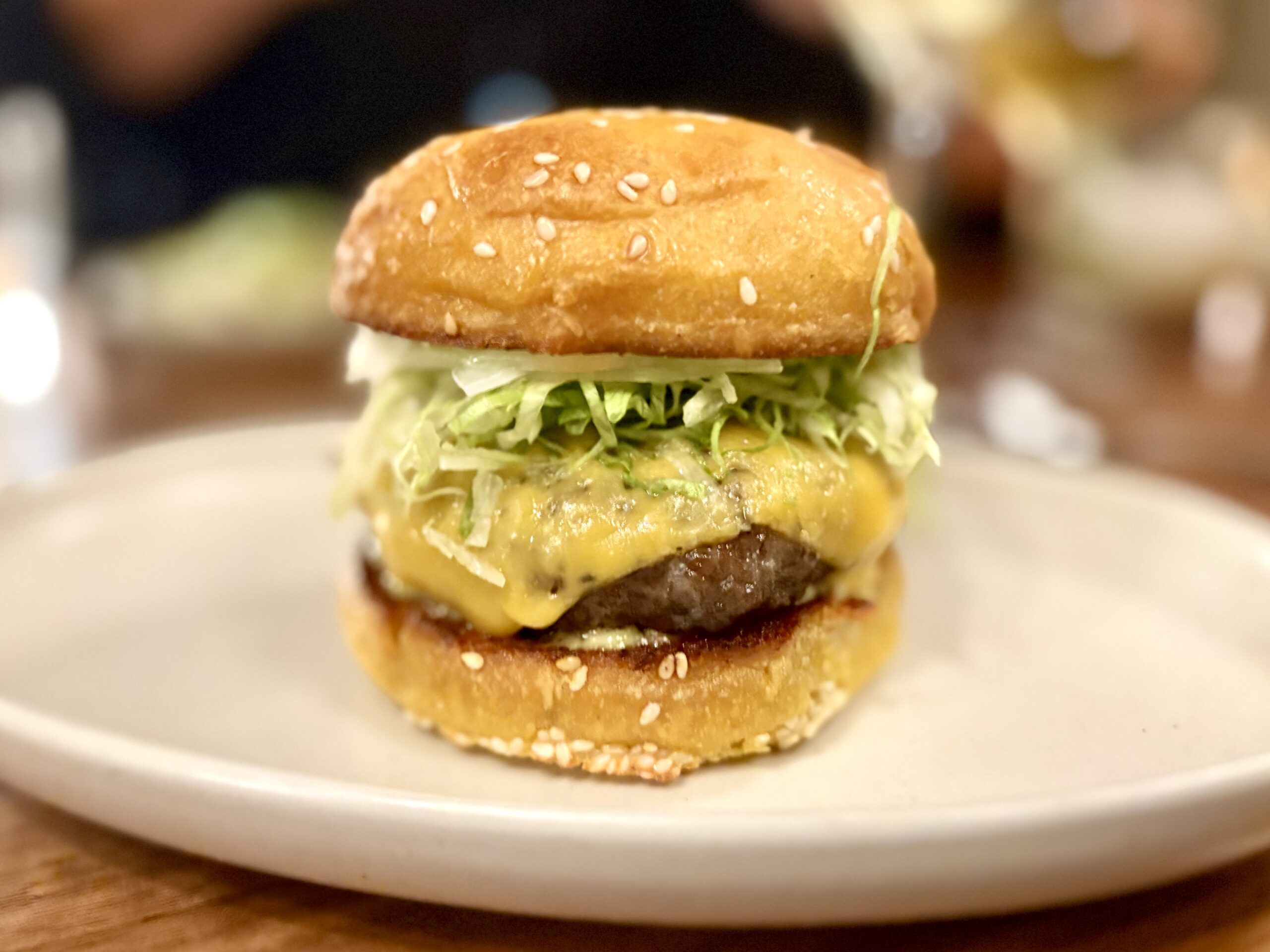
The nebbiolo was also a good match for Tesiny’s single best bite: a 5-ounce burger special called the Lil’ Kahuna, made from the trim of bluefin tuna belly and Ibérico pork shoulder. It’s a remarkably meaty patty with a subtle shade of rich tuna on the finish that shows off Valent’s ability to experiment with something new. It’s limited to just eight or so per night, which means it’s worth coming early. The effort also bodes well as Tesiny prepares to grow its menu and take some chances with larger plates for two, perhaps as soon as this spring.
The Lil’ Kahuna burger from Tesiny, a blend of bluefin tuna and Ibérico pork.
Dessert for two here is already a thing. And you’ll likely be dueling spoons for the espresso-chocolate mousse that Valent serves like a sundae topped with a wave of whipped cream, caramel cocoa nibs, and real maraschino cherries. Order a raisiny sweet pour of Pedro Ximénez from the impressive list of fortified wines — another quirky passion of Biederman’s, rooted in her days of studying abroad in Mallorca and her time at Oloroso.
Is Philly ready for a renaissance of Bual Madeira and vintage Kopke Port? If Lauren Biederman has a hunch, I wouldn’t bet against her. Tesiny is more proof she has a vision worth paying attention to.
The Chocolate Coffee Mousse at Tesiny on Wednesday, Jan. 21, 2026 in Philadelphia.
At least 75% of the menu is gluten-free or can be modified.
Drinks: Creative and well-crafted takes on classic cocktails, frequently made with fortified wines, are the main draw. The wine program is deliberate in its focus on oyster-friendly Euro classics (Sardininian vermentino; muscadet), with an appealing collection of sparklers (try Red Tail Ridge from the Finger Lakes). Finish with a pour of vintage port or Madeira from one of the city’s better collections of fortified wines.
The logo on the door at Tesiny on Wednesday, Jan. 21, 2026 in Philadelphia.
Super Bowl LX will monopolize our attention Sunday as only the Big Game can. But once the buzzer sounds on Patriots-Seahawks, mitts will be poppin’ across Florida and Arizona.
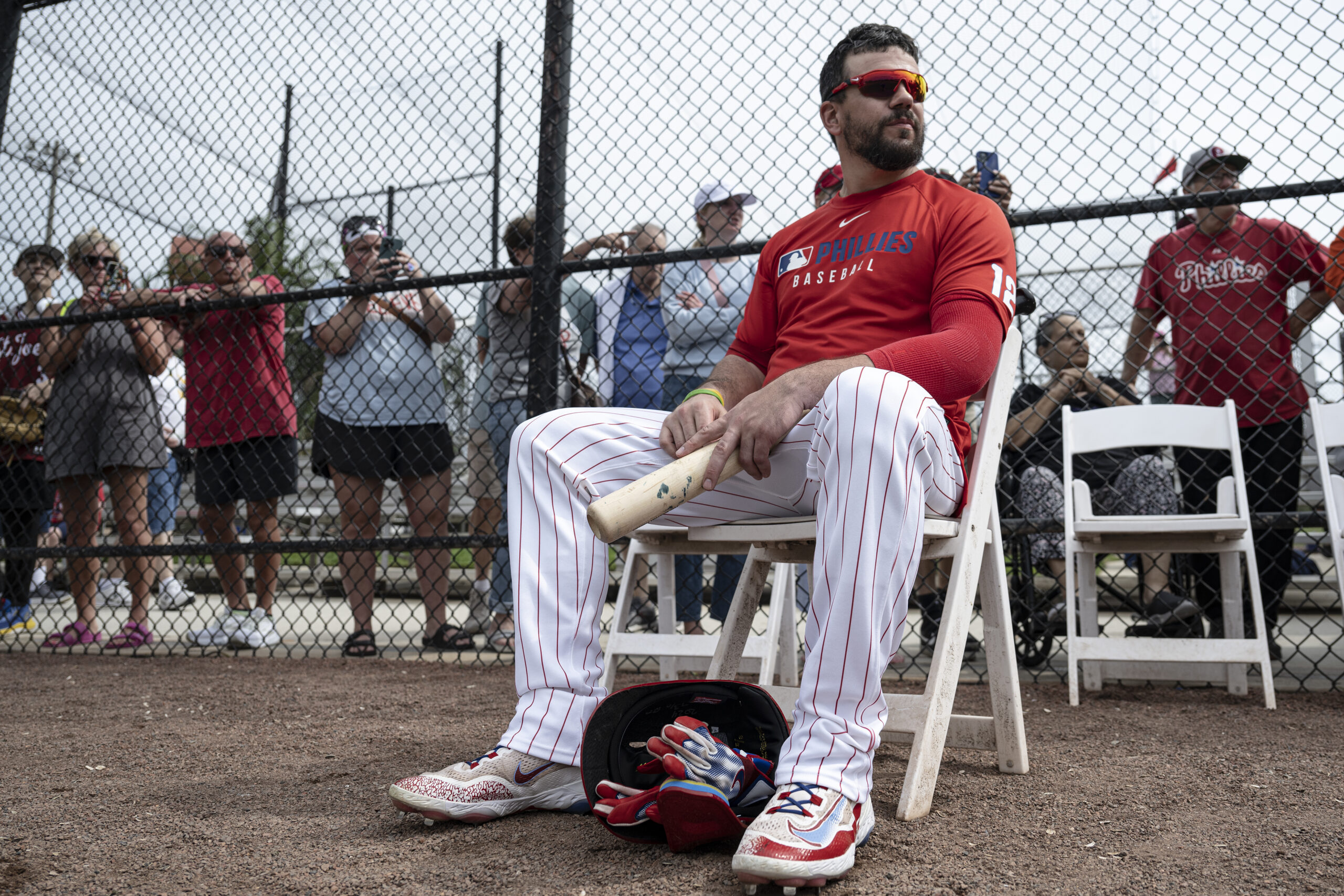
With Phillies pitchers and catchers set for workouts beginning Wednesday in Clearwater, Fla., LX baseball notes:
I. Before the continuation of the “Is Bryce Harper still elite?” debate, another note from last season: Only one of the Phillies’ 43 biggest hits, based on Win Probability Added, belonged to Harper. He had four of their 13 biggest hits from 2019-24.
II. So, whatever you thought of Dave Dombrowski’s assessment that Harper “didn’t have an elite season like he has had in the past,” can we agree that 2025 was un-Bryce-like?
III. It’s probably giving Dombrowski too much credit to suggest he was being calculated. But the last time anyone publicly poked Harper, he homered twice in Game 3 of the 2023 division series and stared a hole through Braves shortstop “Attaboy” Orlando Arcia. A chip on Harper’s shoulder wouldn’t be the worst thing for the Phillies.
IV. Fact: Harper faced a lower rate of strikes (43%) than any hitter in baseball last season.
V. Another fact: Harper swung at 35.6% of pitches out of the strike zone, 129th among 144 qualified hitters and far above his career mark (29.3%), according to Statcast.
VI. It’s about Harper’s swing decisions, then, as much as lineup protection. “If he gets that [chase] number down to 32, just drop it 3%, now he’s swinging at better pitches, he’s going to do more damage,” hitting coach Kevin Long told The Inquirer’s Phillies Extra podcast. “The onus falls on me to make sure he’s swinging at the right pitches and him to make sure he’s not expanding. No matter what, he has to control his at-bats.”
Kyle Schwarber batted in front of Bryce Harper for most of last season, when he hit 56 homers and was runner-up for NL MVP.
VII. Still, don’t be surprised if Rob Thomson puts Kyle Schwarber behind Harper in the batting order. It was the other way around for most of last season.
VIII. A month before the Mets signed Bo Bichette — out from under the Phillies’ nose, by the way — they pushed hard for Schwarber, league sources said. The Phillies re-signed Schwarber to a five-year, $150 million contract, the biggest deal ever for a full-time designated hitter.
IX. Speaking of Bichette, set a calendar reminder for June 18-21, the Mets’ first visit to South Philly.
X. The Mets lost 18½ games in the NL East standings in 108 days, missed the playoffs, then overhauled the roster … and fans bemoaned not bringing back Pete Alonso, Brandon Nimmo, Jeff McNeil, and Edwin Díaz. The Phillies won another division title, had a bad week in October, then ran back the core of the roster … and fans bemoaned keeping the band together. Strange days.
XI. BetMGM set the Phillies’ over/under win total at 90.5. Same as the Mets’.
XII. July will be a big month for business at the corner of 11th & Pattison: Futures Game (July 12), Home Run Derby (July 13), All-Star Game (July 14), Mets (July 16-19), Dodgers (July 20-22), and Yankees (July 24-26).
XIII. Schwarber has 340 homers. If he hits 32 per year — and a work stoppage doesn’t wipe out part of the 2027 season — he would reach 500 homers before his new Phillies contract runs out in 2030.
XIV. Harper has 363 homers and would need to hit 23 per year to reach 500 before the expiration of his 13-year contract in 2031.
XV. Players who hit their 500th homer with the Phillies: Mike Schmidt, on April 18, 1987.
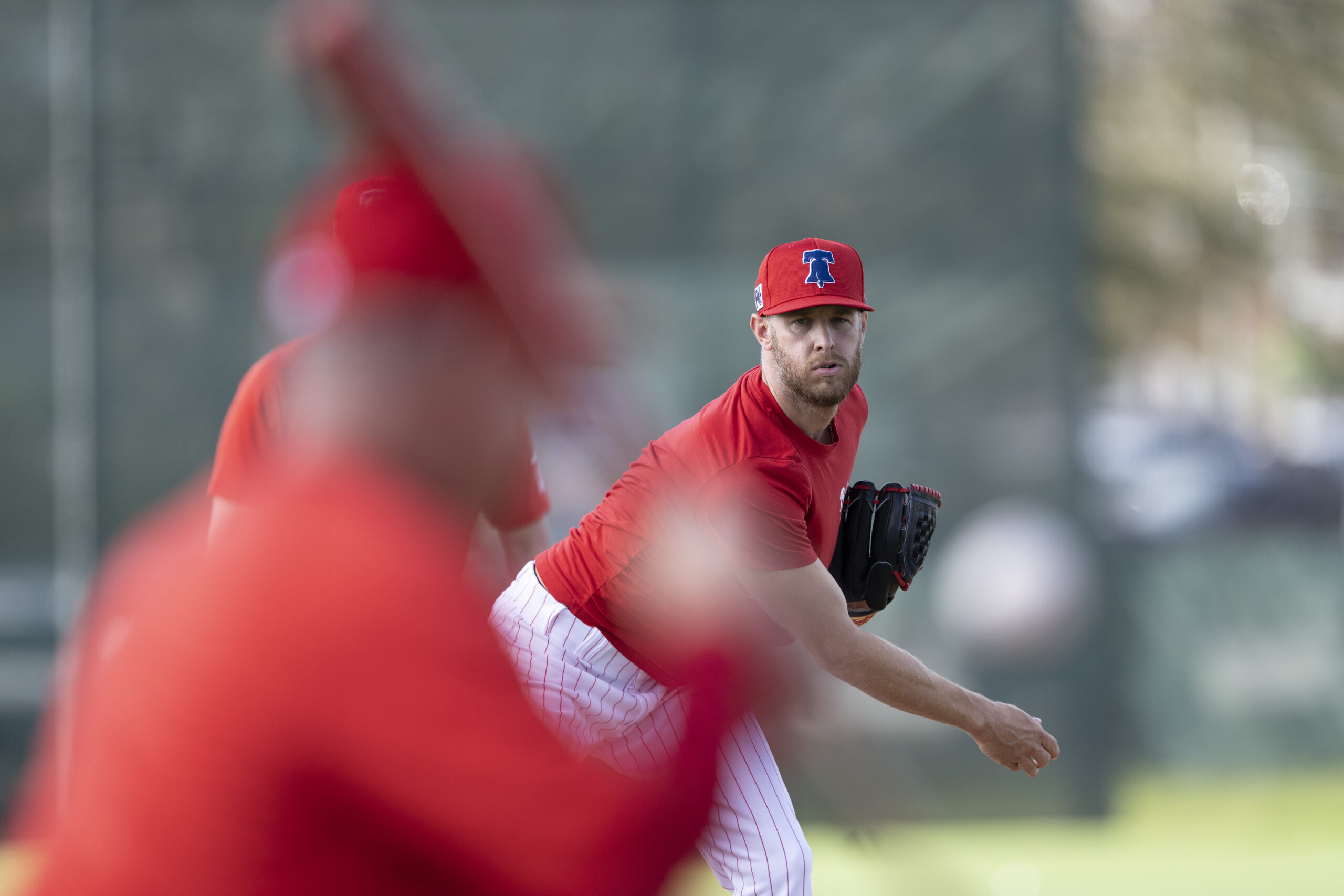
Zack Wheeler is recovering from thoracic outlet decompression surgery in September.
XVI. After being diagnosed with a blood clot in his upper right arm, Zack Wheeler had venous thoracic outlet decompression surgery in September. The recovery for a pitcher typically takes up to eight months, Thomson said, which would put Wheeler on a May timetable.
XVII. Bet on Wheeler to beat that projection. He began throwing from a mound this week, a source close to the 35-year-old righty said. The Phillies won’t push Wheeler, but he’s motivated to make as many starts as possible in what he has said will be his second-to-last season.
XVIII. Not every pitcher recovers at the same rate, but Diamondbacks starter Merrill Kelly had vTOS surgery in September 2020 and started Arizona’s second game of the 2021 season.
XIX. If Wheeler isn’t ready, top prospect Andrew Painter almost certainly will occupy a spot in the season-opening rotation. Painter, who turns 23 on April 10, could be the Phillies’ youngest starter since Ranger Suárez on Aug. 16, 2018 (22 years, 355 days).
XX.Justin Crawfordturned 22 on Jan. 13. If he makes the team out of camp, as expected, he will be the youngest position player on a Phillies opening-day roster since Freddy Galvis in 2012 and the youngest outfielder since Greg Luzinski and Mike Anderson in 1973.
XXI. Crawford’s ground-ball rate in triple A last season (59.4%) would’ve easily led the majors, topping Christian Yelich’s 56.7% mark.
XXII. But Crawford also would’ve ranked fifth with 67 bolts, defined by Statcast as sprints of at least 30 feet per second. (Trea Turner led the majors with 117 bolts.)
XXIII. Is it really so bad, then, that Crawford tends to hit a lot of balls on the ground? “Hopefully it doesn’t matter,” Lehigh Valley hitting coach Adam Lind said. “His approach works right now. He’s super fast. His swing works to where he can hit the ball all over the yard. Whenever a defender has to take one step away from first base, that usually means he’ll be safe.”
XXIV. Quiz: Crawford could be the Phillies’ eighth different opening-day center fielder in nine years. Name the others. (Answer below.)
XXV. Upon stepping down as Twins president last week, Derek Falvey cited ownership’s “different plan” for the team’s direction. If Minnesota enters a full rebuild, All-Star center fielder Byron Buxton would be widely coveted, including by the Phillies. Buxton, 32, has three years and $45 million left on his contract, plus no-trade rights.
XXVI. The Phillies’ projected luxury-tax payroll is $316.3 million, according to Cot’s Baseball Contracts, trailing the Dodgers ($402.5M), Mets ($376.6M), and Yankees ($335.5M). For a second consecutive year, the Phillies will pay a 110% tax on every dollar spent above $304 million, the highest of four thresholds.
XXVII. In 2025, the Phillies paid $56,062,903 in luxury taxes on a $314,329,912 payroll, the Associated Press reported. Their tax bill has risen from $2,882,657 in 2022, $6,977,345 in 2023, and $14,351,954 in 2024.
XXVIII. Owners will gather Wednesday in Palm Beach, Fla., for their quarterly meetings. Many owners are pushing for a salary cap in the next collective bargaining agreement. The players’ union has historically opposed a cap. It would take eight of 30 owners to block a salary-cap proposal. The existing CBA expires Dec. 1, with a lockout likely to follow.
XXVIX. Last month, commissioner Rob Manfred told a New York radio station that MLB has discussed schedule changes, including an in-season tournament similar to the NBA Cup. The players would need to agree to any new formats.
XXX. The Phillies will send 11 players from their 40-man roster to the World Baseball Classic: Schwarber, Harper, and Brad Keller (U.S.); Cristopher Sánchez and Johan Rojas (Dominican Republic); José Alvarado (Venezuela); Taijuan Walker (Mexico); Aaron Nola (Italy); Garrett Stubbs and Max Lazar (Israel); Edmundo Sosa (Panama). Preliminary round games begin March 5, with the final set for March 17 in Miami.
XXXI.Jesús Luzardo was invited to pitch for Venezuela and Team USA but declined. “It’s very important for my family, for me, to represent Venezuela,” Luzardo told Phillies Extra. “But just in terms of intelligent decision-making, after a long last year and looking forward to a long this year, I thought the correct decision would be to take a slow spring training and make sure everything’s along the right line to be prepared for the year.” Luzardo is eligible for free agency after this season.
XXXII. Left-handed pitcher A: 3.59 ERA, 544 strikeouts, 1.287 WHIP, 117 ERA-plus in 588⅓ innings since 2022.
XXXIII. Left-handed pitcher B: 3.83 ERA, 602 strikeouts, 1.186 WHIP, 116 ERA-plus in 529⅓ innings since 2022.
XXXIV. Suárez (Lefty A) signed a five-year, $130 million contract with the Red Sox last month that will cover his ages 30-34 seasons.
XXXV. Luzardo (Lefty B) will pitch at age-28 this season.
XXXVI. Quiz answer: Brandon Marsh (2025), Rojas (2024), Marsh (2023), Matt Vierling (2022), Adam Haseley (2021), Roman Quinn (2020), Odúbel Herrera (2019), and Aaron Altherr (2018).
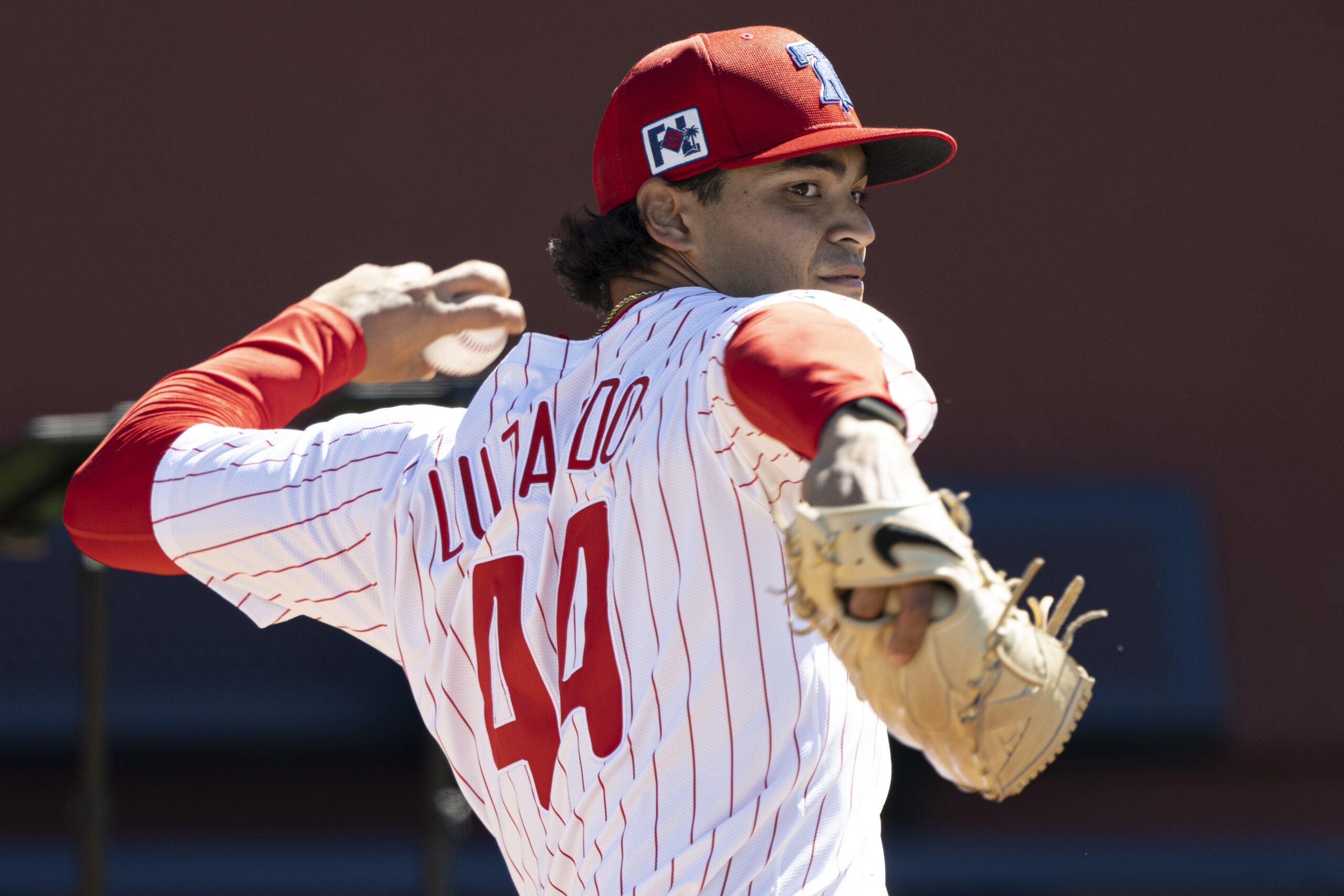
Jesús Luzardo posted a 3.92 ERA in a career-high 183⅔ innings in his first season with the Phillies in 2025.
XXXVII. Sánchez threw the most changeups (1,084) in baseball last season. Among 72 pitchers who threw at least 300, he ranked ninth in opponents’ batting average (.170) and slugging (.243) against his changeup.
XXXVIII. Changeup artist Cole Hamels on why Sánchez’s is so dominant: “One thing I’ve noticed is you cannot recognize the spin. It’s the same [as the two-seamer]. So, it’s a coin flip: Am I going to try to hit 97 [mph] with sink, or am I going to hit 87 with drop-off-the-table [action]? And he’s not scared to throw it in any type of count, with anybody on.”
XXXIX. By finishing second in the Cy Young voting last year, Sánchez’s club options for 2029 and 2030 increased by $1 million apiece to $15 million and $16 million.
XL. The automated ball-strike system is coming to MLB after being tested last year in spring training and the minors. Each team is allowed two challenges per game. Thomson prefers that challenges be initiated by the catcher or batters, with specific hitters getting a green light to challenge.
XLI. Opinions about ABS are varied. “There’s a human element pitchers like with umpires,” reliever Tanner Banks said last month. “Maybe you steal [a strike] because the catcher does a great job. But at the end of the day, you want consistency. The umpires I’ve talked to are for it if it helps make the right call.”
XLII. Imagine if the Phillies could’ve challenged umpire Mark Wegner’s missed strike call on Sánchez’s 2-2 pitch to Alex Call with one out in the seventh inning of Game 4 of last year’s NL division series. Call walked on the next pitch and scored the tying run. Sánchez said Wegner admitted that he got it wrong.
XLIII. A catcher’s game-calling is among the last skills that are largely immeasurable through analytics, which explains why it took so long for the Phillies and J.T. Realmuto to reach an agreement in free agency. At 35, amid three years of declining offense, Realmuto’s value is tied to his intangible impact on the pitching staff.
XLIV. Since 2023, opponents had a .682 OPS and Phillies pitchers had a 3.75 ERA with Realmuto behind the plate. The major-league averages were .722 and 4.18.
XLV. “In my opinion, catchers are undervalued as far as contracts and dollars go,” said Realmuto, who eventually accepted a three-year, $45 million offer. “I truly believe it’s one of, if not the most important position on the field, and I just enjoy fighting for that.”
XLVI. Quiz: Realmuto started a career-high 132 games behind the plate last season. In the last 80 years, how many catchers started that many games at age 34 or older? (Answer below.)
XLVII. Player A: .260/.306/.426, 121 doubles, 82 homers, 100 OPS-plus in 2,477 plate appearances.
XLVIII. Player B: .237/.296/.441, 118 doubles, 110 homers, 107 OPS-plus in 2,473 plate appearances.
LIX.Nick Castellanos (Player A) in four seasons with the Phillies (ages 30-33).
L.Adolis García (Player B) in the last four seasons with the Rangers (ages 29-32).
LI. Castellanos ranked last among all outfielders in defensive runs saved (minus-41) since 2022; Garcia was tied for ninth (plus-23).
LII.Bryson Stott lowered his hands, moved them closer to his body, and batted .294 with an .855 OPS after the All-Star break last season. It’s one reason Phillies officials are confident in running back almost the same lineup.
LIII. Here’s another: Marsh batted .303 with an .836 OPS after May 1.
LIV. If depth is a factor, and it usually is, the open seats in the bullpen could go to Rule 5 pick Zach McCambley and Zach Pop, who is out of minor league options. But Thomson is talking up Kyle Backhus, a lefty with a low arm slot who was acquired in a trade with Arizona.
LV. Righty-hitting outfielder Bryan De La Cruz will be in camp as a nonroster invitee after signing a minor-league contract in November. De La Cruz, 29, has major-league experience, mostly with the Marlins. He was MVP of the Dominican Winter League, batting .301 with eight homers and an .888 OPS in 46 games.
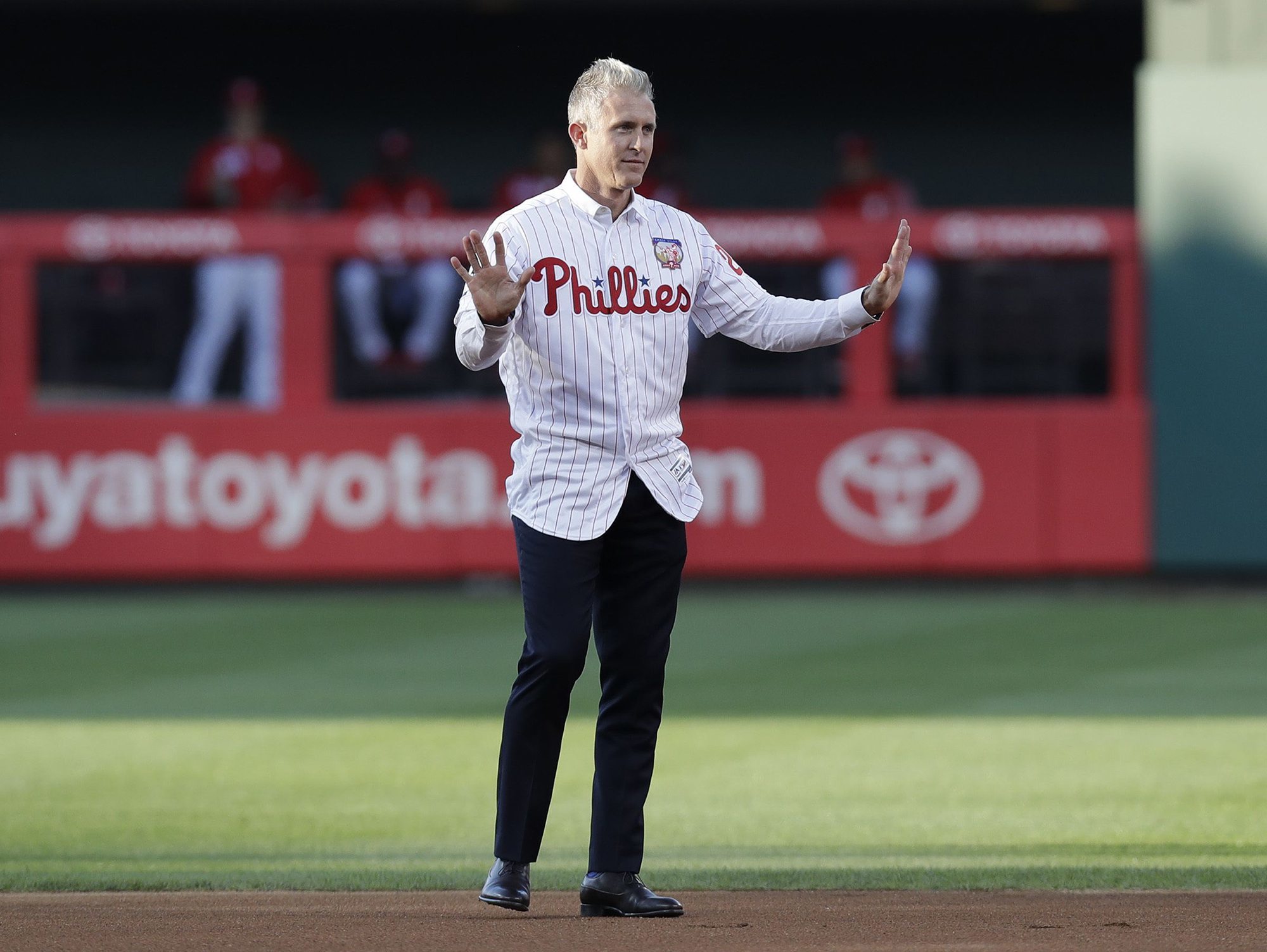
Chase Utley is getting closer to being elected to the Hall of Fame.
LVI. Lefty reliever Génesis Cabrera also will be in camp as a nonroster invitee. Once a promising reliever with the Cardinals, Cabrera hit Harper in the face with a 97 mph fastball in 2021. The Phillies will be his sixth team since 2024.
LVII. It’s clear that Chase Utley will eventually get elected to the Hall of Fame after reaching 59.1%, 68 votes shy of the requisite three-quarter majority, in his third year on the ballot. But will it take one more voting cycle or two for him to get to the 75% mark?
LVIII. The electorate changes each year, depending on how many writers join the process upon reaching 10 years of membership in the Baseball Writers’ Association of America. But consider Carlos Beltrán’s path to election: 57.1% in 2024, 70.3% in 2025, and finally 84.2% this year. So, pencil in Utley for the Class of 2028 … and maybe book a hotel in Cooperstown for 2027 just in case.
LIX. Quiz answer: Six. Realmuto (2025), Yadier Molina (2017), Jason Kendall (2008), Tony Peña (1991), Elston Howard (1964), and Bob Boone (1982-86).
A week ago, Joel Embiid decided to spend a little bit of the organizational capital he reaccrued in recent months. In response to a question about the Sixers’ approach to the upcoming NBA trade deadline, Embiid pointedly expressed his hope that the team would be looking to add talent rather than cut costs.
“Obviously, we’ve been ducking the tax past couple of years, so hopefully, we’ll keep the same team,” Embiid said. “I love all the guys that are here. I think we got a shot.
I don’t know what they’re going to do, but I hope we get a chance to just go out and compete because we’ve got a good group of guys in this locker room. The vibes are great. Like I said, in the past we’ve been, I guess, ducking the tax, so hopefully, we think about improving because I think we have a chance.”
Embiid was surprisingly — some might say ungraciously — candid in noting the Sixers’ recent prioritization of shedding salary at the trade deadline to avoid paying the NBA’s luxury tax (and, thereby, to receive a share of the pooled taxpayer dollars). But he also was prescient, and unfortunately so.
Sixers president Daryl Morey is scheduled to meet with the media on Friday, so we’ll have to wait to hear the official defense of the team’s decision to trade 2024 first-round pick Jared McCain to the Oklahoma City Thunder for what most likely will be a low-value first-rounder (plus the obligatory smattering of second-round picks). We don’t have to wait to judge the optics of the thing.
The optics are poor, and that will remain true even if the thing ends up making more sense than we can immediately glean. The Sixers didn’t trade McCain for a player who is more likely to help them contend for a championship, be it this year or beyond. They didn’t trade him for a pick that they then flipped for a player who can help them capitalize on their momentum this season. Everywhere else, teams got better, and many of them did so in ways beyond this season. The Minnesota Timberwolves can re-sign Ayo Dosunmu. The Indiana Pacers can pair Ivica Zubac with Tyrese Haliburton next season. The Sixers can hope a late first-round pick is worth something in June.
Jared McCain (right) only played in 60 games with the Sixers after being selected in the first round of the 2024 draft.
A good way to judge the optics of a move is to attempt to write an executive summary of it in as favorable a way as possible. That’s an extraordinarily difficult task in this case. The Sixers just traded away a guy who they drafted at No. 16 barely a year and a half ago and who probably would be drafted higher in a redo. In exchange, they received a pick that currently projects as the No. 23 pick in the 2026 draft, two picks later than where the Sixers grabbed Tyrese Maxey almost six years ago. It is a range of the draft that rarely yields starters, let alone stars. It is a range where the odds say you are more likely to draft a player who never cracks a first-division rotation than one who becomes a meaningful starter.
Just look at the track record. Of the 42 players drafted with the last seven picks of the first round since 2020, only 17 have started more than 17 NBA games. Just eyeballing it, you’d be hard-pressed to identify 10 of those 42 who’ve turned out to be better than the median potential outcome of even this year’s version of McCain. Jaden McDaniels and Desmond Bane are stars. They are followed by Payton Pritchard, Immanuel Quickley, Quentin Grimes, and Santi Aldama. Beyond that: Peyton Watson and Cam Thomas, and then Bones Hyland, Day’Ron Sharpe, Nikola Jović, and Kyshawn George. You get the picture.
Risk vs. certainty is the name of the game. The Sixers traded McCain for a first-round pick that will be uncertain, even on draft day. Let alone five months before. Whatever negative certainty they felt about McCain’s mid-to-long-term trajectory, it can’t possibly be greater than the negative uncertainty of a draft-day replacement. Which is why, optically speaking, the move looks like one that was inordinately influenced by the cost-cutting benefits.
The Sixers surely will point to optionality as a variable. On draft day, they will have another opportunity to flip the McCain first-rounder for an established NBA player or include the pick in a package. If that influenced the move, then the bet they are making is that the pick will be more in a draft-day trade than McCain would have been himself. There’s a decent chance that is true, given how far McCain has fallen on the depth chart and how little opportunity he could have to reestablish value.
It just rings a little bit hollow to anybody who has bought into the commendable shift we’ve seen from the Sixers in their roster-building strategy over the last year. And it rings especially hollow when you consider that the team that traded for McCain is one of the best and brightest roster-builders in the modern NBA. As somebody said the other day, when Sam Presti wants one of your guys, it’s a good reason to think a few more thoughts about whether you should want to get rid of him.
Barely a year and a half has passed since the Sixers made McCain the No. 16 pick in the 2024 draft. In that year and a half, we’ve seen McCain:
Play 23 games in which he looked like one of the top five players in the class, forcing his way into the starting lineup and then averaging 19.1 points while shooting 39.7% from three-point range in the 16 games before he suffered a season-ending knee injury.
Play 25 games where he looked like a player working his way back from a broken thumb that he suffered while working his way back from knee surgery.
Play 11 games in a 15-game stretch in which he logged just 132 minutes.
In the Sixers’ defense, they’ve seen much more of McCain than the television cameras capture. Nobody can have a more informed opinion on where he projects within the context of their roster. But it wasn’t long ago that McCain looked like a player who could eventually transcend questions of fit. His ceiling never was close to VJ Edgecombe’s, and his probable reality was always short of Maxey’s. Again, though. The Thunder have a lot of guards. They are built on a two-way mentality. It makes you wonder.
What it comes down to is that the Sixers better be right in their evaluation of McCain. Whatever the marching orders from ownership regarding the luxury tax, there is a level of player even Scrooge McDuck wouldn’t deem an appropriate cost-savings measure. McCain isn’t that player now. The Sixers could be accurate in their judgment of the odds that he ever becomes one. The question is whether they are accurate in their judgment of their risk of being wrong.
A high-concept stunt? A rare stroke of artistic luck? A Frankensteinian collage of 21st-century life?
All of that can be said about Complications in Sue, an opera of sorts that premiered with surprising cohesion and great audience response, on Wednesday at the Academy of Music.
Opera Philadelphia is on new ground with this collection of 10 loosely linked scenes by different composers who did their work without knowing what the others were up to.
Each scene documents a decade of the life of Sue, in a birth-to-death chronicle curiously devoid of outstanding achievements but forming a reflection of the worlds (both inside and outside her psyche) swirling around her.
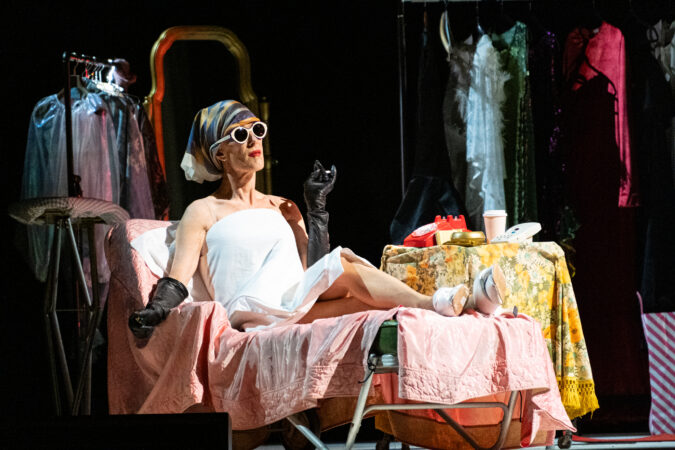
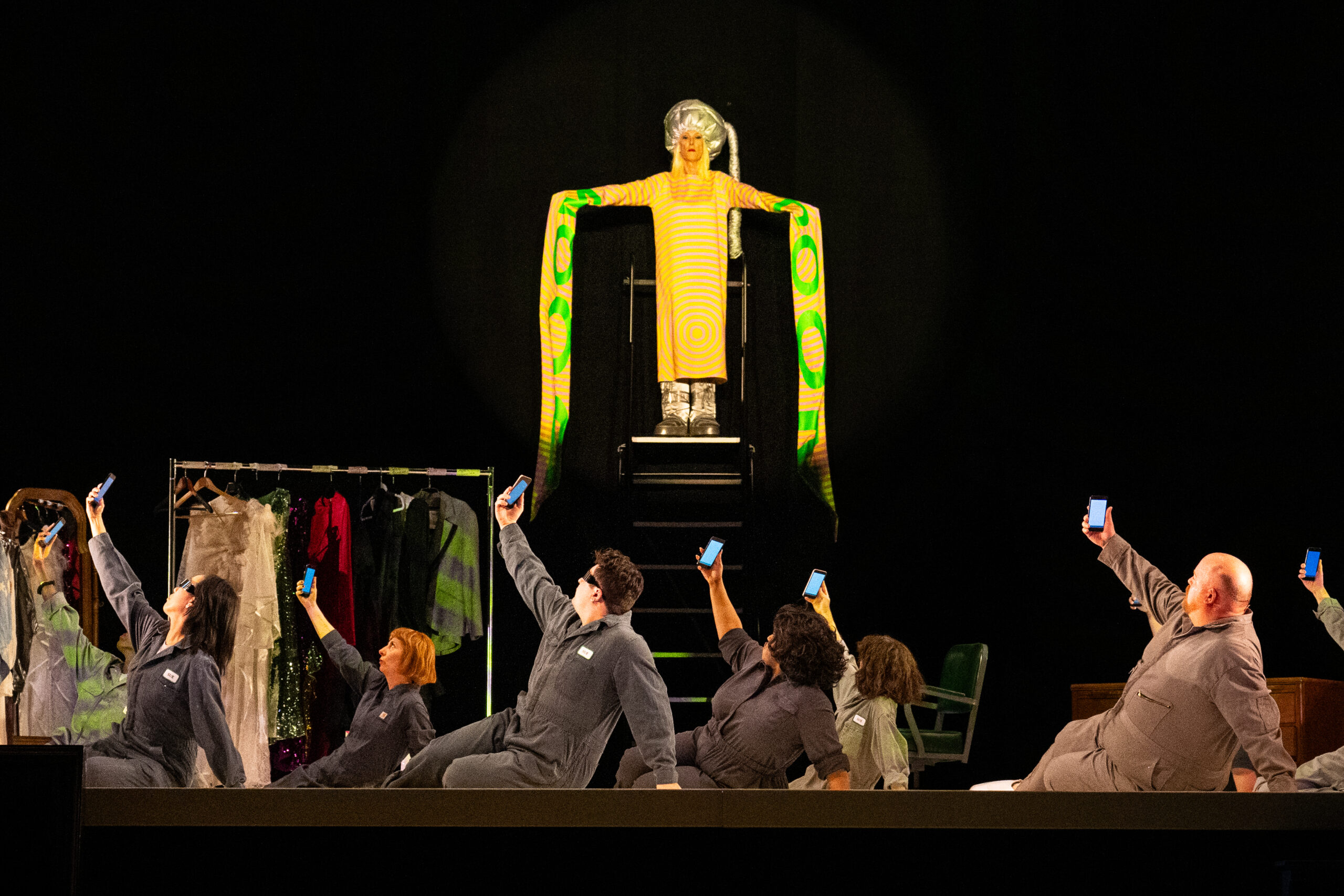
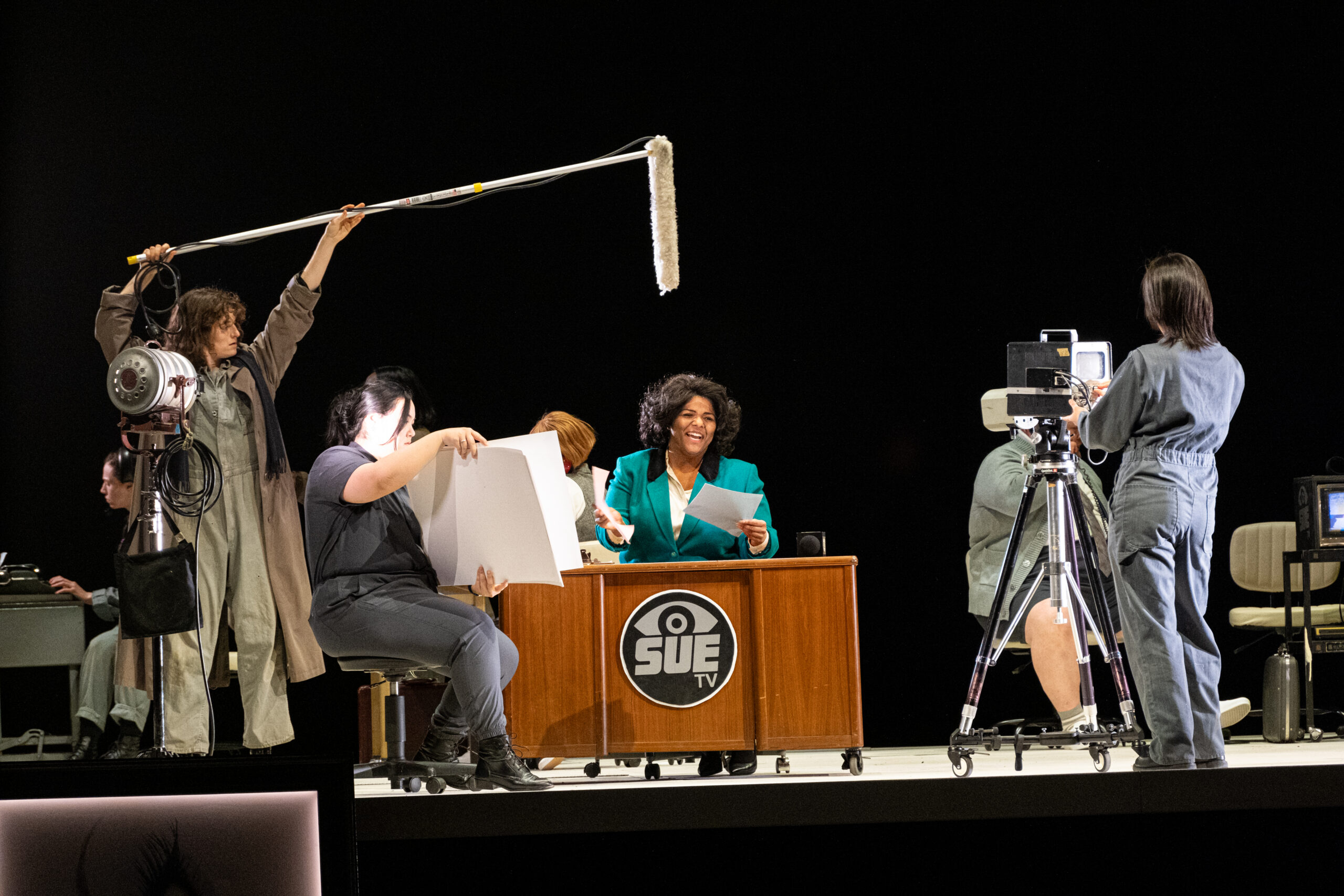
Sue’s shopping algorithm comes to life in Scene 6 of “Complications in Sue.” Justin Vivian Bond’s costumes were designed by JW Anderson.
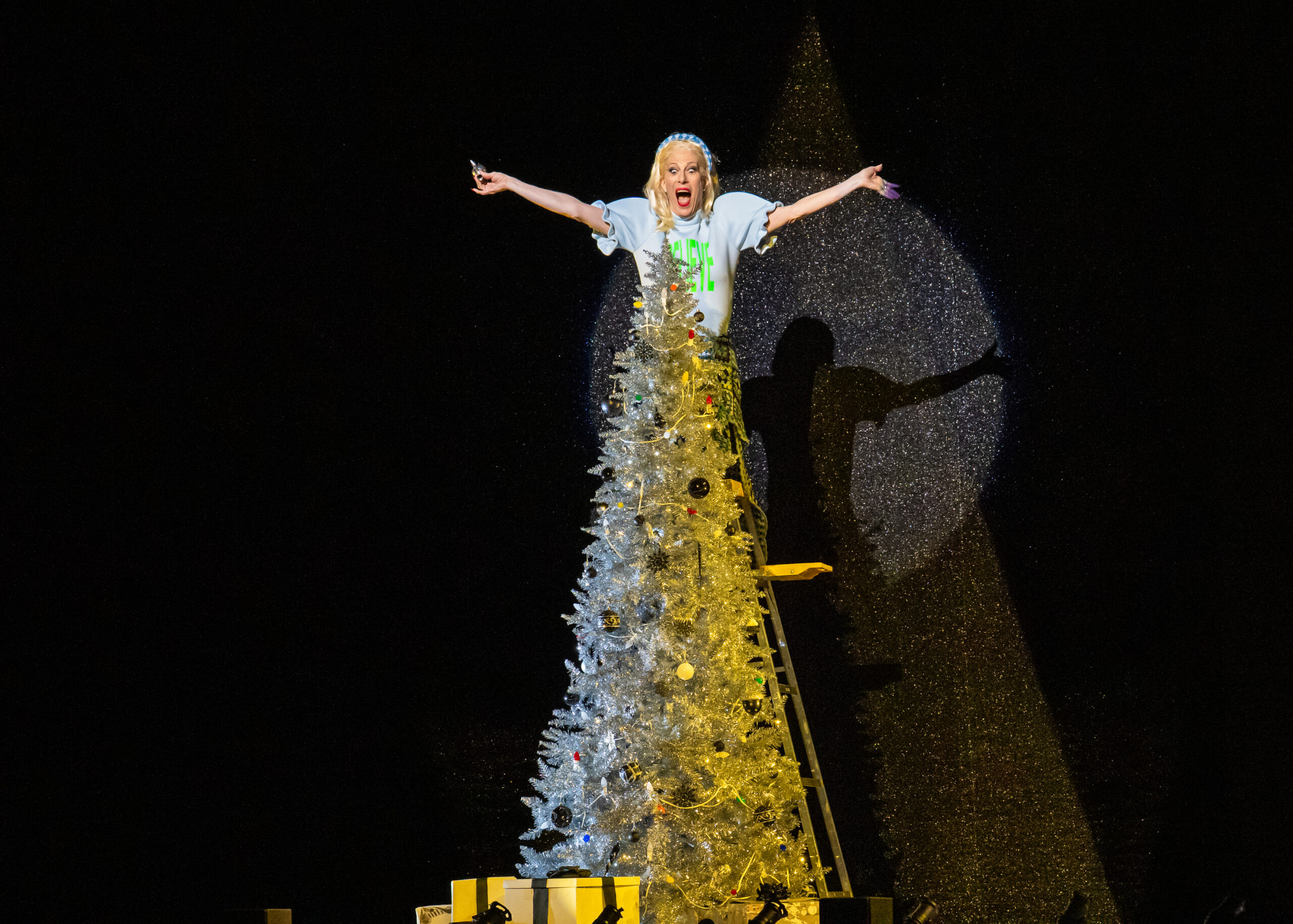
At the center of it all — including episodes about Santa Claus in crisis, a grieving ex-husband, and Sue’s shopping algorithms coming to life — was the sharp-tongued cabaret artist Justin Vivian Bond.
Playing the imaginary Sue, she sang, talked (and danced here and there), and seemed to go off script with a damning litany of current government persons and entities. She prompted the loudest ovation of the evening with a no-holds-barred condemnation of U.S. Immigration and Customs Enforcement.
Somehow, the components came together, thanks partly to the anything-can-happen atmosphere of the piece.
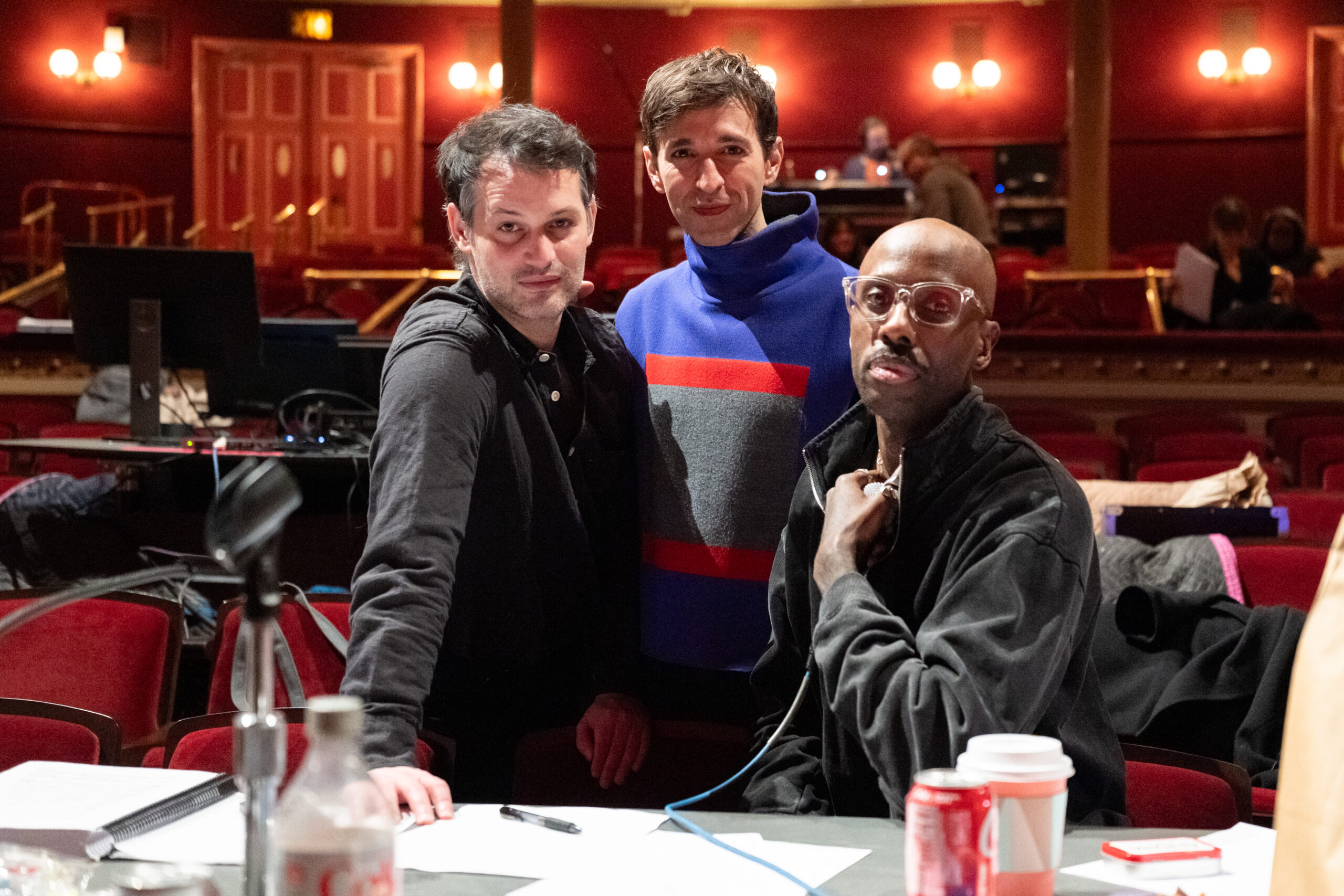
From left: Director Zack Winokur, producer Anthony Roth Costanzo, and director Raja Feather Kelly before a dress rehearsal at the Academy of Music on Jan. 31, 2026. The venue will be showing the new opera “Complications in Sue” from Feb. 4-8.
The 10 episodes — as fantastically conceived by librettist Michael R. Jackson — are like semi-improvised comedy sketches that leave certain psychological doors open for the composers to create a sense of operatic magnitude.
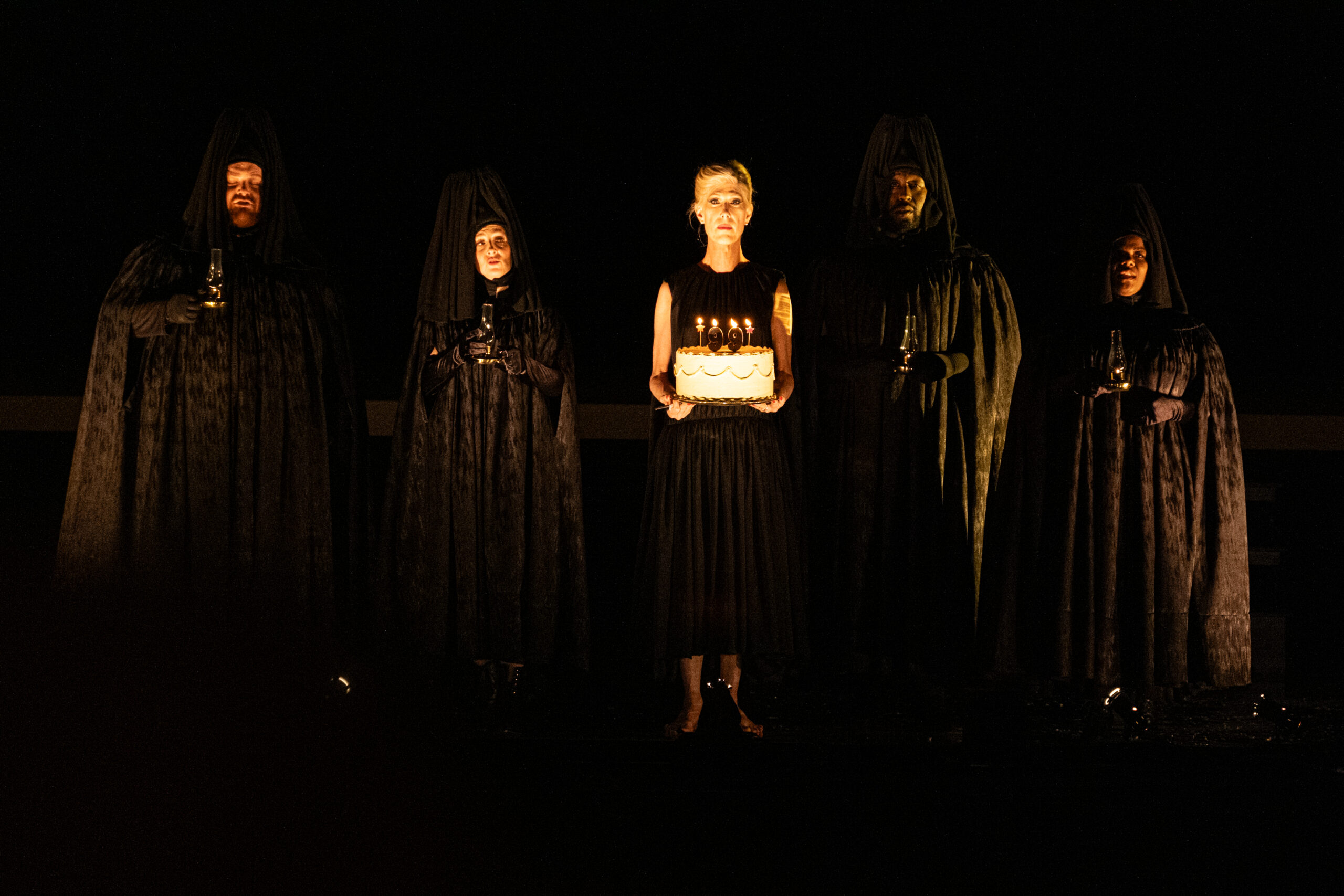
The composer lineup, full of strong personalities, was framed by Errollyn Wallen on birth (during which Bond walked down the theater aisle saying hello to aisle seaters) and Nico Muhly on death (in lovely choral writing with a waning, interior heartbeat).
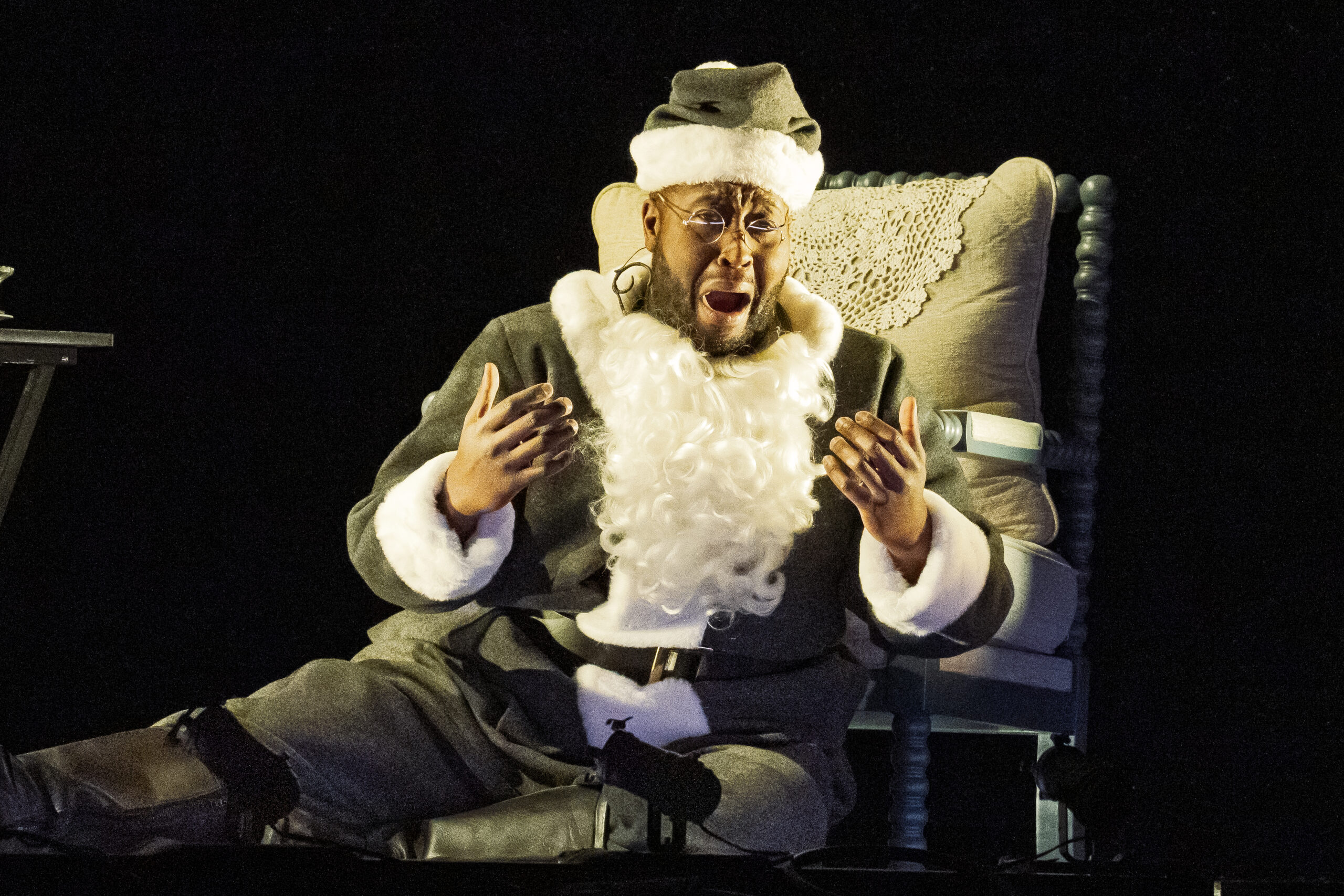
Generally, tunes weren’t a priority as the composers characterized the theatrical events that Jackson gave them, such as Nathalie Joachim’s scene with a newscaster from deep within Sue’s psyche interviewing her about life choices. When Sue’s husband has a meltdown, Dan Schlosberg goes on a rampage through musical styles reflecting the cultural jumbles of our times. Missy Mazzoli makes Santa Claus’ breakdown more tragic than comic.
Bass-baritone Nicholas Newton portrays a disillusioned Santa in Scene 2 of “Complications in Sue.”
Nobody just went for laughs, even when they seemed to.
Andy Akiho had singers being annoyingly manic playing college kids obsessing over who they thought Sue is. But this is where the overall theme of Complications in Sue coalesced: Do we know anybody? Or ourselves? Do we want to?
Composers Cécile McLorin Salvant, Rene Orth, Alistair Coleman, and Kamala Sankaram also wrestled with such issues in one way or another, sometimes using minimalist-shaded repetition for urgency, prominent bass lines for dark corners and with absolutely no need to box these situations into some sort of smooth musical package.
Mezzo-soprano Rehanna Thelwell as Brenda Blackwoman, broadcasting
from inside Sue’s imagination in Opera Philadelphia’s “Complications in Sue.”
That last quality made many of these miniature compositions seem epic in their implications. Was Complications in Sue really just 90 minutes?
Under the confident direction of Caren Levine, the four-member cast consistently gave it their all in deeply unconventional musico-dramatic assignments.
Kiera Duffy and Nicky Spence each had episodes giving them space to dominate the stage on their own. Duffy’s voice was an island of sweet stillness even in tumultuous moments while Spence never let intonation and enunciation slip even in his most reckless moments.
The cast of “Complications in Sue” (From left: Nicky Spence, Kiera Duffy, Justin Vivian Bond, Nicholas Newton, and Rehanna Thelwell) in the final scene of the world premiere opera.
Nicholas Newton played both Santa Claus and Death with equal conviction (an accomplishment indeed). And if you walked in not knowing that Rehanna Thelwell was walking through her stage roles that were actually sung by Imara Miles, you wouldn’t be any the wiser.
The one disappointment on the performance front was Bond’s dance of death: It was just a lot of twirling in moments that asked for transcendence. Much of Bond’s fan base feels anything she wants to do is just fine. I’m not one of them.
One major achievement was how the production elements worked together. That just doesn’t happen very often in new operas.
Justin Vivian Bond as 10-year-old Sue in “Complications in Sue,” directed by Raja Feather Kelly and Zack Winokur
The Krit Robinson-designed production ranged from a charmingly makeshift Christmas tree to dazzling abstraction. In later scenes, the stage had concentric rectangular frames, each with changing, subtle coloring.
Raja Feather Kelly and Zack Winokur shared directing duties but in such fluid, choreographic staging, it was hard to determine where one director’s work started and the other left off.
Consider what this team could do in more conventional operatic circumstances. I hope to see that.
“Complications in Sue,” plays at Feb. 5, 7 p.m. Feb. 6, 8 p.m. Feb. 8, 2 p.m. Academy of Music, 240 S Broad St. All tickets are Pick Your Price, starting at $11. operaphila.org, 215.732.8400, tix@operaphila.org