Nearly a month after dangerous winds snarled their New Year’s Day performances, a dozen Mummers string bands got their encore.
The slate of bands reimagined their Jan. 1 routines Saturday on the snow-covered Lincoln Financial Field. It was a break from the norm — but perhaps the start of a new tradition for the 125-year-old Mummers.
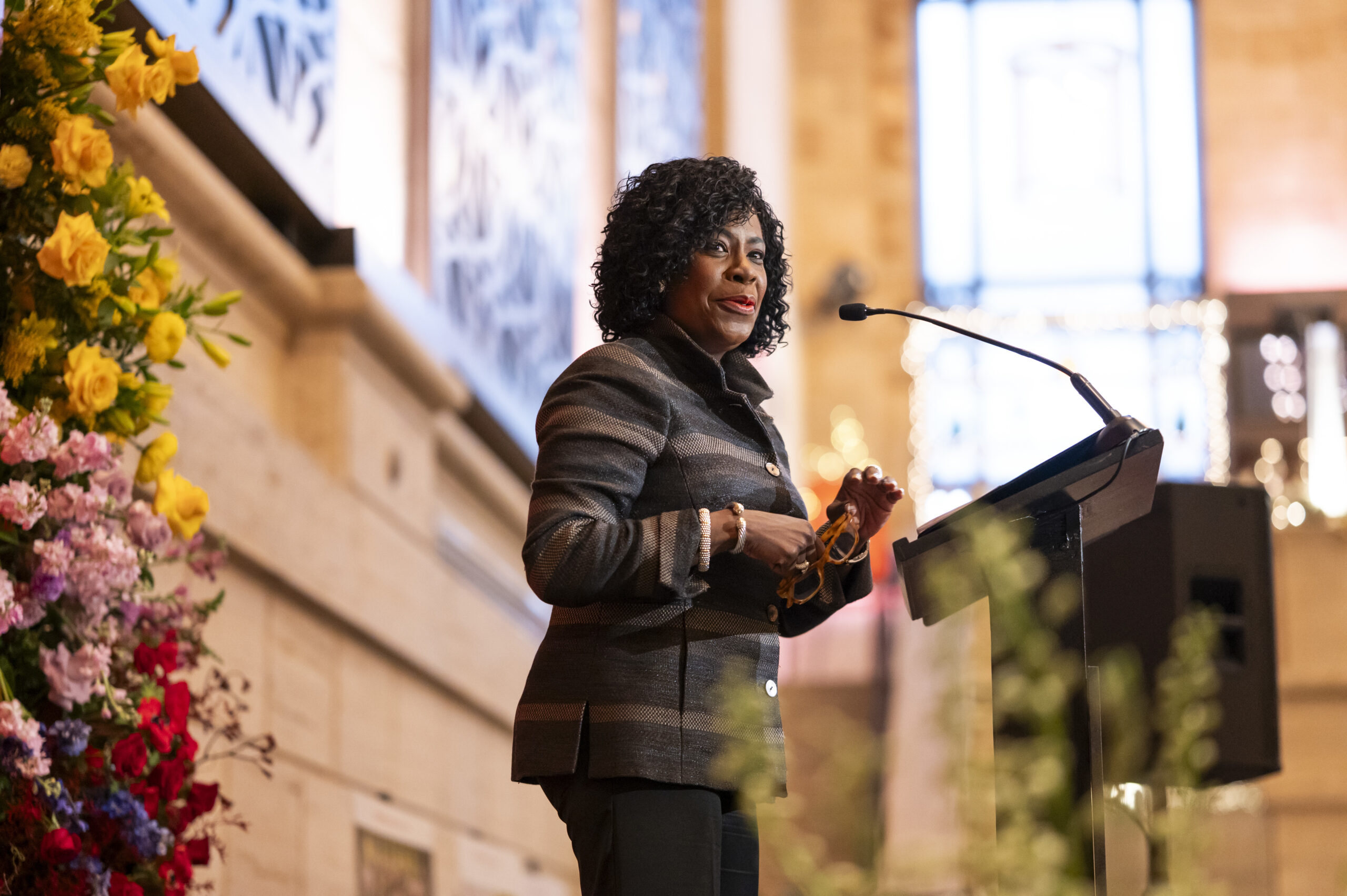
“This is how we do it in our city,” Mayor Cherelle L. Parker rallied the chilly but boisterous crowd. “When we set our minds to get something done, we won’t let the weather or anything stop us.”
The mayor suggested: “I think we might be on to something big.”
Folks applaud the bands during the 2026 String Band Spectacular at Lincoln Financial Field in Philadelphia on Saturday, Jan. 31, 2026.
It was not the first disruption to the century-old holiday parade, but it was the first time that the popular string band division was suspended. The reenvisioned judged portion — dubbed the String Band Spectacular — on the Philadelphia Eagles’ home turf was announced weeks later.
“Thousands of people are out here cheering like it’s New Year’s Day all over again,” Sam Regalbuto, president of the Philadelphia Mummers String Band Association, said. “The cold isn’t keeping the fans away, and it’s definitely not keeping the energy down out on the field.”
Laksumi Sivanandan, 27, and Carter Davis, 30, of East Passyunk, were at the parade on New Year’s Day but were excited to see the string bands with different scenery — and have the rare opportunity to be feet from the Eagles sideline at an accessible price. (More than 5,000 tickets, ranging from $12 to $25, were sold, according to Regalbuto.)
“It’s fun to see it in a different environment — usually you’re sitting on a lawn chair on Broad Street.”
But the rescheduled event was not without its own weather woes: On Friday, at least one string band pulled out of the performance, citing the frigid temperatures. A total of 14 bands make up the Philadelphia Mummers String Band Association, according to its website, but only 12 were scheduled to take the stage Saturday.
A coastal “bomb cyclone” was expected to douse parts of New Jersey and Delaware with some snowfall this weekend, while stinging winds and arctic air in Philadelphia pushed temperatures into single digits and plunged wind chills to as low as 10 degrees below zero. At the height of the show Saturday, temperatures barely eclipsed 20 degrees at the open-air Linc.
For spectators, who were clustered in the stadium’s lower bowl and sprinkled in suites, the keys to staying warm: layers, hand warmers, and beer jackets.
But the event offered Mummers enthusiasts and newbies alike an opportunity to enjoy the bands’ jovial music, unique sound, and elaborate costumes — with performances taking the audience from the sights of Las Vegas to New Orleans, a funhouse, and the Beauty and the Beast mansion — outside of New Year’s revelry.
“This is the moment each of the string bands work so hard for, and we’re so thrilled,” Regalbuto said. “This all came together to give them their shining spotlight out on that field in an unprecedented way. We couldn’t be more excited.”
The Fralinger String Band performs during the 2026 String Band Spectacular at Lincoln Financial Field in Philadelphia on Saturday, Jan. 31, 2026.
The Grammys are here, with lots of familiar faces.
Kendrick Lamar, who won five awards at last year’s show, leads with nine nominations and Lady Gaga, Bad Bunny, and Billie Eilish are up for major awards.
As is Sabrina Carpenter, the Bucks County native who is the Philly region’s great hope. She won twice last year and is nominated six times for her album Man’s Best Friend.
Neither Taylor Swift nor Beyoncé released music in the eligibility period, which runs from Aug. 31, 2024, to Aug. 30, 2025, so that’s why they’re missing from this year’s list.
I’m picking winners in the four major categories, which will be among the dozen or so given away on the awards show hosted by Trevor Noah and broadcast on CBS from the Crypto.com Arena in Los Angeles at 8 p.m. Sunday, and streaming on Paramount+.
A total of 95 Grammys will be given out, however, with most presented in a pre-telecast ceremony streamed on grammy.com and the Recording Academy’s YouTube page, starting 3:30 p.m. Sunday.
That’s where you’ll find the Philadelphians.
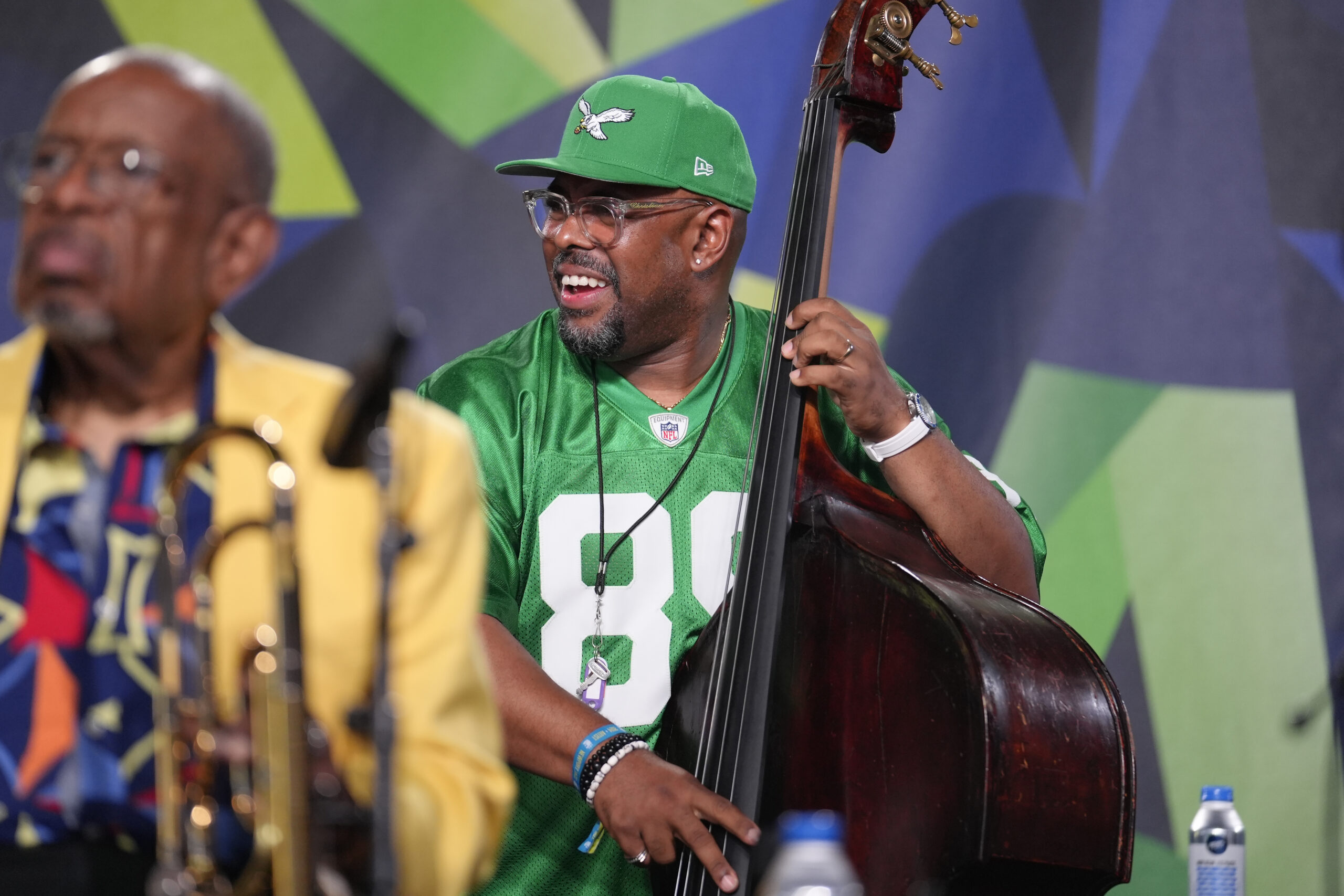
Jazz bassist Christian McBride is up for three awards, with his Big Band’s Without Further Ado, Vol. 1 vying with Sun Ra Arkestra’s Lights on a Satellite for best jazz large ensemble.
Philadelphia Orchestra and music and artistic director Yannick Nézet-Séguin are up for two, and Nézet-Séguin is also nominated for one with the Metropolitan Opera orchestra.
Jazz saxophonist Immanuel Wilkins and University of Pennsylvania graduate John Legend have two noms each. The Crossing Choir, Camden gospel bandleader Tye Tribbett, songwriter Andre Harris, and producer Will Yip each have one.
Bassist Christian McBride (right) performs during the Newport Jazz Festival, Sunday, Aug. 4, 2024, in Newport, R.I. The Philadelphia musician is up for three Grammys on Sunday.(AP Photo/Steven Senne)
As the first major live TV awards show since the death of Alex Pretti in Minneapolis last weekend, the Grammys are likely a platform for anti-ICE protests. We’ll see which, if any, performers or presenters — who include Charli XCX, Teyana Taylor, Queen Latifah, Lainey Wilson, Nikki Glaser, and Chappell Roan — speak out.
Here’s who I think should — and will — win.
Album of the Year
Nominees: Bad Bunny, Debí Tirar Más Fotos; Justin Bieber, Swag; Sabrina Carpenter, Man’s Best Friend; Clipse, Let God Sort ‘Em Out; Lady Gaga, Mayhem; Kendrick Lamar, GNX; Leon Thomas, Mutt;Tyler, the Creator, Chromakopia
My prediction: The most prominent of these in my rotation these days is LetGod Sort ‘Em Out, the topflight reunion of hip-hop brothers Gene “Malice” and Terence “Pusha T” Thornton. But it has little chance among these heavy hitters.
Carpenter will have to be satisfied with a performance slot in the prime-time show, a prize showcase on “Music’s Biggest Night.” But Man’s Best Friend isn’t quite up to the level of her tart 2024 Short n’ Sweet.
The consensus says this is a race between Lady Gaga, Bad Bunny, and Kendrick Lamar. All have an excellent chance, with Gaga being a veteran Grammy favorite back on form. Lamar’s album released way back in November 2024, but he continued to impact culture through his “Grand National” tour with SZA and “Luther,” their collab that topped the pop charts for 13 straight weeks.
But this feels like Bad Bunny’s year. Debí Tirar Más Fotos — which translates as “I should have taken more photos” — is the Puerto Rican singer, rapper, and producer’s most confident, varied, and politically potent work.
It’s poised to become the first Spanish language album of the year, and thus a Grammy statement of multicultural solidarity when immigrant populations in the U.S. are under threat. And it would make for a pretty good start to February for the Super Bowl halftime headliner.
Should win: Bad Bunny
Will win: Bad Bunny
Chappell Roan performs “Pink Pony Club” during the 67th annual Grammy Awards in Los Angeles, Feb. 2, 2025. The singer is nominated for two Grammy awards on Sunday and will also be a presenter at the ceremony, which airs on CBS at 8 p.m. and streams on Paramount+. (AP Photo/Chris Pizzello, File)
Record of the Year
Nominees: Bad Bunny, “DTMF”; Sabrina Carpenter, “Manchild”; Doechii, “Anxiety”; Billie Eilish, “Wildflower”; Kendrick Lamar & SZA, “Luther”; Lady Gaga, “Abracadabra”; Chappell Roan, “The Subway”; Rosé & Bruno Mars, “APT”
My prediction: This is a strong group, including Carpenter’s cheeky “Manchild” and Doechii’s “Anxiety,” which samples Gotye and Kimbra’s 2011 “Somebody I Used to Know.”
Roan’s “The Subway” hearkens back to classic pop and Eilish’s “Wildflower” is lovely, though it’s a little ridiculous that it’s nominated. It’s from Eilish’s Hit Me Hard and Soft, which came out in May 2024 but qualifies because it became a single last February. When the Grammys want you to be part of the show, they’ll find a way to sneak you in.
My pick to win is “APT.” The duet between Bruno Mars and K-pop star Rosé is a super-catchy global hit that borrows from Toni Basil’s 1982 hit “Mickey,” which older Grammy voters will surely remember. It’s the second-fastest song to reach a billion streams after Mars and Gaga’s 2024 “Die With a Smile.”
Will win: “APT.”
Should win: “Luther”
SZA and Kendrick Lamar perform during halftime of the NFL Super Bowl between the Kansas City Chiefs and the Philadelphia Eagles, Sunday, Feb. 9, 2025, in New Orleans. (AP Photo/George Walker IV)
Song of the Year
Nominees: Bad Bunny, “DTMF”; Sabrina Carpenter, “Manchild”; Doechii, “Anxiety”; Billie Eilish, “Wildflower”; Huntr/x — “Golden”; Kendrick Lamar & SZA, “Luther”; Lady Gaga, “Abracadabra”; Rosé & Bruno Mars, “APT”
My prediction: The Grammys are silly. Why are there separate record and song of the year categories? In theory because the latter is a songwriter’s award. But these categories are virtually identical, the only difference being dropping Roan for “Golden” from the Netflix movie KPop Demon Hunters.
Let’s give this one to last year’s Super Bowl halftime headliners to reward their overall excellence and songwriting skills.
Should win: “Luther”
Will win: “Luther”
Olivia Dean performs at the Austin City Limits Music Festival on Oct. 11, 2025, in Texas. The British singer-songwriter is nominated for Best New Artist at the Grammy Awards on Sunday.(Photo by Jack Plunkett/Invision/AP, File)
Best New Artist
Nominees: Olivia Dean, Katseye, The Marías, Addison Rae, Sombr, Leon Thomas, Alex Warren, Lola Young
A little rant detour: Another failing: The Recording Academy has completely ignored country music in the major categories. The Grammys are, in many ways, a popularity contest. Unlike the Oscars, which sometimes reward niche and art house fare and look askance at commercial success, the Grammys are intent on showing they’re in step with the zeitgeist by recognizing big sellers.
Except they don’t bother when it comes to country, thus reinforcing America’s cultural divide. The Recording Academy isn’t too blame when it comes to Morgan Wallen, whose I’m the Problem was the most streamed album in the U.S. in 2025 — because he chose to not submit his music.
But completely credible and widely popular country artists like Ella Langley and especially Megan Moroney are obvious candidates for best new artist. They have been shown no love, either due to cluelessness or a conscious decision to shut out mainstream country. End of rant!
My prediction: In this last of the major categories, Addison Rae is to be commended for making a smart, catchy transition from TikTok to pop star. Leon Thomas emerged as a serious R&B artist with staying power, and Lola Young is a major talent whose “Messy” is a terrific universalist earworm.
But my most confident prediction in these four categories is Olivia Dean. The British songwriter is marked for stardom, simultaneously coming off as a youthful ingenue and an old soul. Her vocals have a slight Amy Winehouse tinge without being imitative. Her breezy, immediately likable The Art of Loving mixes neo-soul 1970s Los Angeles soft-rock is right up the Grammy alley.
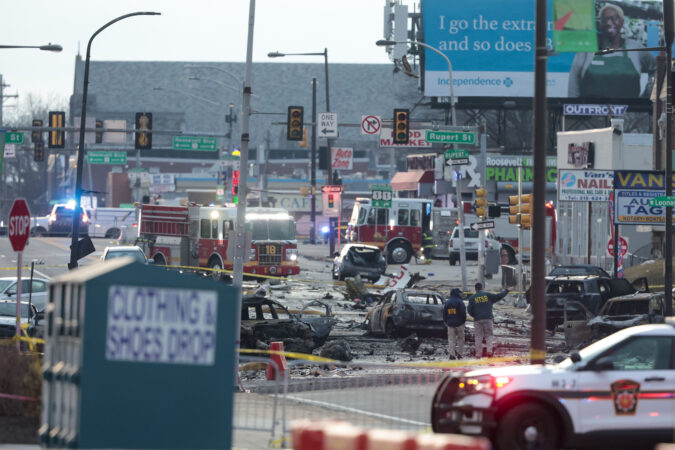
The destruction spanned multiple blocks, spreading wreckage across a debris field that stretched for more than a quarter mile near Roosevelt Mall on Cottman Avenue. The resulting damages totaled in the millions of dollars, and many area residents were left displaced and traumatized.
Now, on its first grim anniversary, the crash’s effects still loom large — not only in the memories of those directly impacted by the crash, but in the local and regional psyche.
With that in mind, city officials plan to hold a memorial observance to honor its victims. The event, slated to start at 5 p.m. at Engine 71 Fire Station — just blocks from where the crash occurred — will include a bell ceremony and wreath-laying. Mayor Cherelle L. Parker and other elected officials will speak.
As city officials said at the time, the crash was among the most significant black swan tragedies in Philadelphia’s history. And, in many ways, the neighborhood is still recovering. Here is what you need to know:
Eight killed, dozens injured
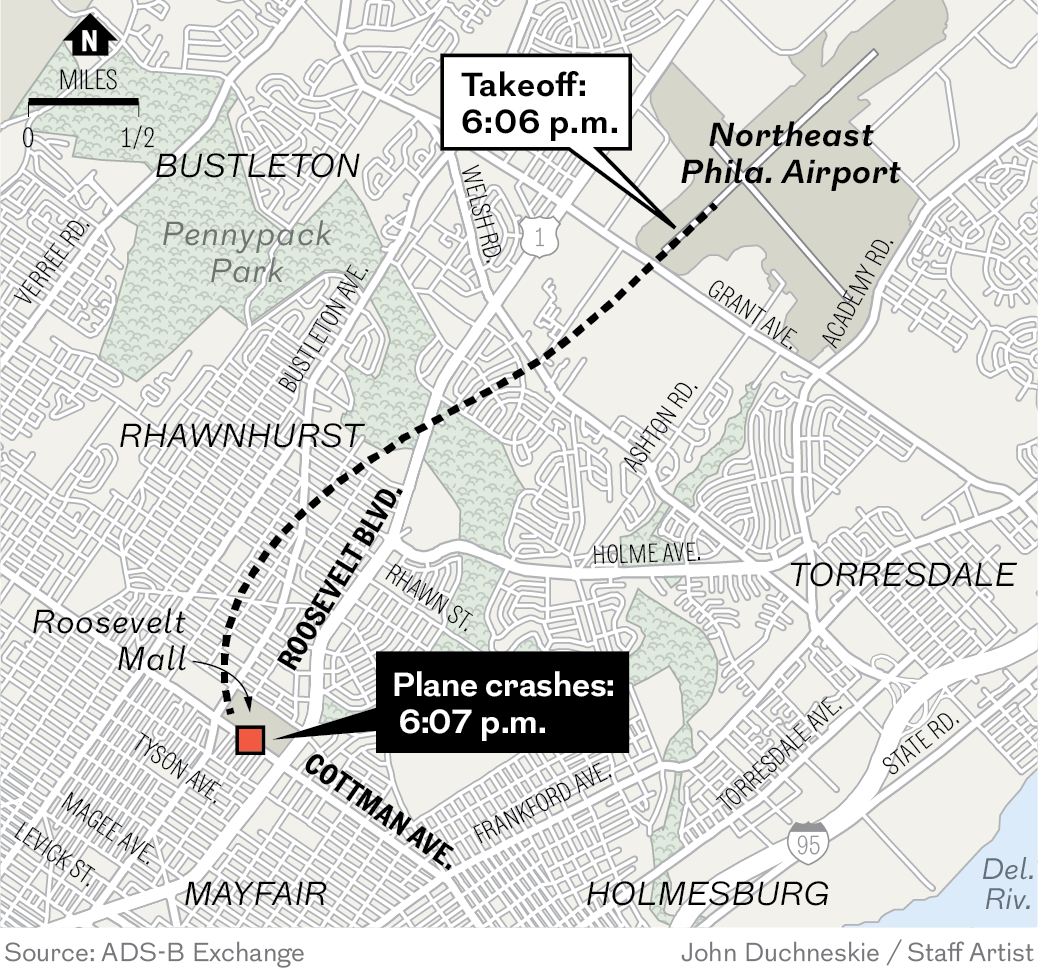
At 6:06 p.m., a Learjet 55 operated by a Mexican medical transport company known as Jet Rescue Air Ambulance took off from Northeast Philadelphia Airport en route to Springfield-Branson National Airport in Missouri on its way back to Mexico. Less than a minute later, after making it 1,650 feet into the air, it went nose down about 3.5 miles away from the airport, slamming into the ground near Bustleton and Cottman Avenues at a 45-degree angle at more than 270 mph.
Map of where a small jet crashed near Roosevelt Boulevard and Cottman Avenue in Northeast Philadelphia on Jan. 31.
The crash tore an 8-foot deep crater into the earth and created a massive fireball that illuminated the neighborhood. The impact spread devastation across a 1,410-foot-long-by-840-foot-wide tract, damaging homes, vehicles, and businesses, and scattering human remains amid the debris field.
All six people aboard the aircraft were killed — among them Valentina Guzmán Murillo, 11, and her mother, Lizeth Murillo Osuna, 31. The pair were on their way home after Valentina had received four months of treatment for a spinal condition at Shriners Children’s Philadelphia, with her doctors celebrating her recovery only hours before.
Also killed were captain Alan Montoya Perales, 46; copilot Josue de Jesus Juarez Juarez, 43; doctor Raul Meza Arredondo, 41; and paramedic Rodrigo Lopez Padilla, 41. On the ground, Steven Dreuitt Jr., 37, died as a result of the crash, as did his fiancée, Dominique Goods Burke, 34, who succumbed months later to injuries she suffered that night.
At least 24 other people were injured, with victims ranging in age from 4 to 85. Many suffered severe burns, smoke inhalation, and skull fractures, including 9-year-old Ramesses Dreuitt Vazquez, the young son of Dreuitt, who suffered burns over 90% of his body and spent nearly a year in the hospital before being released.
‘All hands on deck’
Ryan Tian, 23, of Delaware County, captured an explosion at a parking lot at Cottman and Bustleton Avenues Friday, Jan. 31, 2025. It was later discovered a medical transport plane bound for Mexico took off from Northeast Philadelphia Airport and crash soon after on Cottman.
The emergency response was massive, involving about 400 firefighters, police officers, and other first responders. Investigators later found that more than 300 properties had been impacted in some way.
The incident, Parker said the night of the crash, was an “all hands on deck” situation. Eyewitnesses and emergency responders described the ensuing chaos as resembling a war zone or feeling like a movie.
“This is a huge area,” Police Commissioner Kevin Bethel said of the crash site. “Nothing in that area will ever be normal again.”
Gov. Josh Shapiro and other officials also toured the devastated area. Ultimately, despite the damage the crash wrought, Shapiro’s office found that the impacts were too limited to ask President Donald Trump‘s administration for a federal disaster declaration, leaving the city and state to lead recovery efforts.
Investigation reveals little
An investigator walks by a burned out car on Cottman Avenue Saturday, Feb. 1, 2025, in Philadelphia. A medical jet with six people on board crashed Friday evening near the Roosevelt Mall in Northeast Philadelphia scattering debris throughout the streets, and setting multiple homes and cars ablaze in a devastating scene
The investigation was led by the National Transportation Safety Board, which early on noted that the crashed craft made no distress calls and had only brief, routine communications with the Northeast Philadelphia Airport control tower after takeoff.
That left the aircraft’s cockpit voice recorder — or “black box” — as a key investigatory element. Days later, searchers found the unit at the bottom of the crater the craft had carved into the earth, but it was largely useless.
The recorder, the NTSB said, had “likely not been recording audio for several years,” and contained no clues as to what may have caused the crash. No official cause for the crash has yet been announced.
Reviews of the craft’s flight records, however, found that it had been used extensively in the months and weeks leading up to the crash. In the five days before the disaster, it had flown 12 flights covering 9,400 miles, and in its final year before it was destroyed, the aircraft had 163 takeoffs.
Fallout continues
Homes in the Northeast Philadelphia neighborhood across from the Roosevelt Mall where a plane crashed on nearby Cottman Avenue. More than a dozen properties were severely damaged by flying debris and fire. The home that the Gomez family rented on Calvert Street caught fire after a plane engine slammed into their roof. Photographed Tuesday, Feb. 4, 2025.
In June, five months after the crash, more than a dozen local residents and business owners told The Inquirer they were still grappling with unrepaired property damage and catching up on bills from lost incomes or extra expenses.
The city had marshaled significant resources, including opening sites offering mental health services and financial aid, and steering roughly $264,000 in grants to small businesses. The One Philly Fund, which was launched to serve as the city’s signature relief effort, however, only attracted some $35,000 in donations, falling woefully short of its desired impact.
Meanwhile, insurance claims were expected to exceed $10 million, and the city itself sought claims for property damage and personnel costs eclipsing $2.5 million. The medical jet company’s insurer, El Águila Compania de Seguros, hoped to consolidate all claims under a single court case, and compel a federal judge to divvy up the funds, which it said were “unlikely to be sufficient to resolve all claims.”
Later in the year, lawsuits against the medical jet company were filed.
A silver lining
Caseem Wongus, 26, is meeting Ramesses R. Dreuitt Vasquez, 10, for the first time after saving him from the fire from the jet crash at the beginning of the year, in Germantown, Pa., on Tuesday, Dec. 23, 2025.
Despite the trauma and devastation the crash brought to Philadelphia, at the end of 2025, there was at least some good news. Ramesses Dreuitt Vazquez, a boy who was severely injured in the crash, was released from the hospital, just in time for the holidays.
Vazquez, who turned 10 in October, had endured almost a full year in the hospital, undergoing more than 40 surgeries, including multiple skin grafts, and the amputation of fingers and ears. He spent months in physical therapy relearning how to get out of bed, walk, and climb stairs.
But about a week before Christmas, he made it out. And while noting that Ramesses faced a challenging road ahead, the boy’s grandmother, Alberta “Amira” Brown, expressed happiness with his recovery.
“It’s the best thing ever that he’ll be home for the holidays,” Brown told The Inquirer. “He is truly happy to be coming home.”
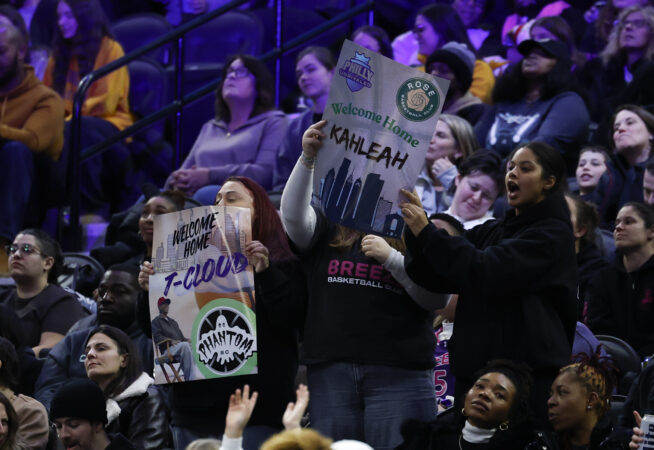
Xfinity Mobile Arena became the home of Unrivaled on Friday night. Fans flooded the arena in their favorite WNBA gear as Philadelphia made history, bringing the world’s top WNBA players to the city for the women’s basketball three-on-three league’s first — and only — tour stop.
The doubleheader, featuring the Breeze, Phantom, Rose, and Lunar Owls, gave Philadelphia an early glimpse of what’s to come in 2030, when the city gets its own WNBA team.
From fans discussing the importance of the night at Stateside Live! to different activations at Xfinity Mobile Arena, here’s everything you missed from the historic night:
‘We’re in the middle of history right now’
To celebrate the landmark event, The Stoop Pigeon by Watch Party PHL partnered with the Philadelphia Sisters and Unrivaled to host a pregame party and watch party across the street from the arena at Stateside Live!
“We’re in the middle of history right now,” said Jen Leary, the founder of Watch Party PHL. “Unrivaled is sold out, and this will be the most-attended women’s basketball game in history, and it’s happening here in Philly. It’s just so important for the city. It shows that not only did Unrivaled make the right decision coming here, but that the WNBA made the right decision giving us a team in 2030.”
The event, which was thrown to build up excitement entering the doubleheader, was free and open to the public. Fans traveled far and wide to witness history in the making, including 35-year old Connecticut native Corrine Sisk.
“Women’s basketball is so important in Connecticut,” Sisk said. “It has been since I was a teenager. I’ve been watching games like this since I was a little kid, and I’m so excited to see it happening countrywide. I think it’s important that we support these women, and they need to know that this is where everybody wants them to be.”
Kiley Gelston, a 25-year-old New Jersey native, has been playing basketball ever since she could walk. As soon as she found out Unrivaled would make its way to Philly, she knew she had to had to be in the arena.
During Friday’s pregame party, Gelston, who is a high school basketball coach, recognized the impact the doubleheader would have on the younger generation.
“It’s important for the younger girls because they can see where they can get to,” Gelston said. “They can have somebody to look up to, especially now with the women’s basketball boom.”
One of those younger girls in attendance was 16-year-old Baylee Rubeck. As a big fan of the WNBA, and a major fan of Paige Bueckers, the Pennsylvania native was excited to see some of her idols take the court at the Xfinity Mobile Arena.
“I’m so excited to see everybody that I’ve been following on social media,” Rubeck said. “I’m so excited to finally get to watch all my role models. I look up to them so much because they’re just amazing human beings. So I’m just so excited to see that in person.”
Another Bueckers superfan in attendance was 15-year-old Laila Perez. Wearing her “Everyone Watches Women’s Sports” T-shirt, she took the train from New Jersey to attend.
An avid women’s basketball fan who started her own basketball YouTube channel called LP’s Bucket List, she was excited to attend her first women’s professional basketball game.
“It’s so cool. It’s kind of crazy,” Perez said. “I’m not used to seeing the players in person. … It’s important for women’s sports to be promoted in Philly because the more people see it and are around it, they’ll be more curious and want to to come and see what it’s all about.”
Although Philadelphia doesn’t have a WNBA team yet, this could be a glimpse of what the city will see in 2030.
“This is just the beginning,” Gelston said. “This is going to continue on for many years to come, hopefully. This is just a taste. It sucks that we have to wait until 2030 now. So it’s almost like a tease. But we can enjoy it now.”
Keeping the energy high
If Friday’s pregame party at Stateside Live! wasn’t enough to get fans excited for the doubleheader, there were activations aplenty. The Sephora tunnel offered fans an opportunity to channel their inner WNBA star with their own tunnel walk.
There were plenty of surprises throughout the night. Fans received a number of chances to win a Sephora goody bag through music trivia, fashion competitions, and parachutes from the rafters.
Time for a little surprise Sephora parachute drop at Unrivaled’s doubleheader pic.twitter.com/UT3SBZRK2Y
And in between games, Philly-born hip-hop artist Lay Bankz performed several songs in front of the sold-out crowd, including her hit single “Tell Ur Girlfriend.”
After both games concluded, smiling fans crowded the main concourse. For 29-year-old Maryland native Brandi McLeain, the night was the perfect birthday present.
“First game was great,” McLeain said. “A real nail-biter. Then we got to see the point god in action in Kahleah Copper. And of course, Marina Mabrey broke a record tonight. So that was amazing.”
Mabrey finished with an Unrivaled single-game record 47 points, and it was clear McLeain wasn’t the only one was impressed by the Belmar, N.J., native’s performance.
Dalilah Haden, 28, and Samantha Woods, 29, made the trip from Brooklyn to watch the doubleheader and said Mabrey was the most impressive player of the night. And this wasn’t Woods’ first Unrivaled game of the week. She also attended Sunday’s game in Medley, Fla., near Miami. But, according to Woods, the 1,000-seat Sephora Arena doesn’t compare to Philly.
“Getting to be here with 21,000 other fans is so cool,” Woods said. “Sephora Arena is dope. But, this is like a treat. The women deserve this kind of love. And you can see it in the way they played tonight.”
Haden added: “Here you had everyone from different backgrounds, different ages, different races, genders, sexualities. This was so cool. And the energy was also crazy.”
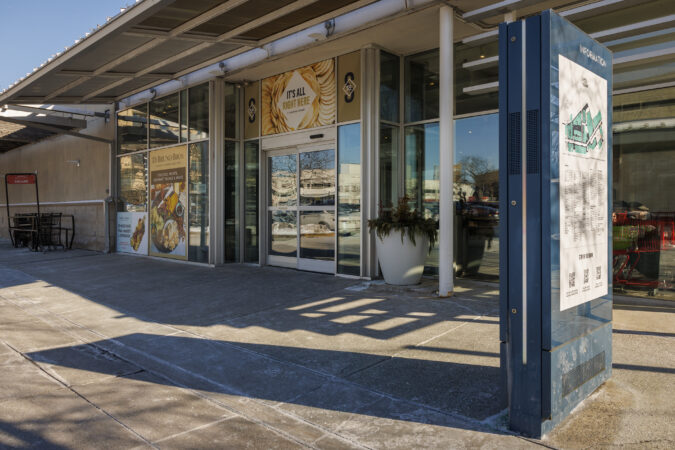
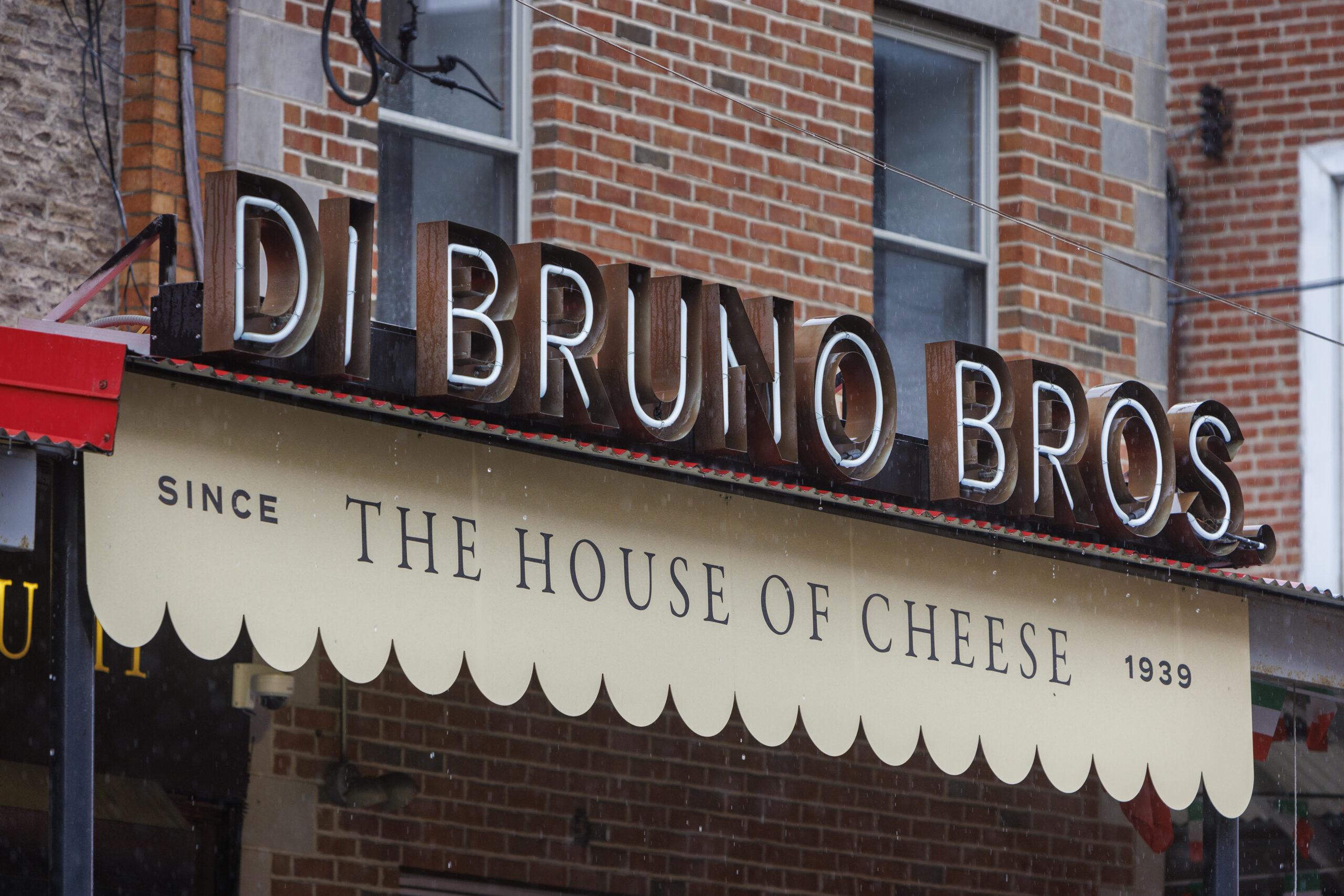
As word spread Friday that upscale grocery Di Bruno Bros. would shutter three of its five grocery stores in the coming weeks, many customers mourned the imminent loss but added they were unsurprised, citing a noticeable change in quality over the last few years.
Xavier Hayden, a lawyer who lives in Narberth, said he stopped shopping at Di Bruno’s a few years ago when he noticed changes in the rolls, the bread, and other items that gave Di Bruno’s its strong reputation. “The quality went down, the taste went down,” Hayden said. “Why am I going to pay upmarket prices for a midmarket product?”
Hayden remembers childhood trips to the Italian Market to visit the original Di Bruno Bros., which will remain open, along with its bottle shop and the store at 18th and Chestnut Streets in Rittenhouse. Its Ardmore store will close Feb. 4, while the location in Wayne as well as the shop at the Franklin Residences at Ninth and Chestnut Streets will close Feb. 11.
Di Bruno’s, established in South Philadelphia in 1939, had become a major player on the Main Line grocery scene since opening at the Ardmore Farmers Market in 2011 and in Wayne’s Strafford Shopping Center in 2021 to complement its two stores in Center City.
Now, the company is pulling back to focus on the Italian Market and Rittenhouse locations and its online business.
The original Di Bruno Bros. location at 930 S. Ninth St. is one of two stores that will remain.
The closings will affect 59 employees, said Sandy Brown, executive vice president of Di Bruno’s parent company, Brown’s Super Stores. She said the workers have been offered new jobs with the other Brown’s stores in the area, including 10 ShopRites and two Fresh Grocer locations.
On social media, some Di Bruno’s patrons attributed a change in the store’s offerings to Brown’s, which bought an ownership stake in the company in early 2024 from the Mignucci family, which had led Di Bruno’s expansion. (It’s a complex arrangement; while Brown’s owns the stores, the Di Bruno’s brand and its packaged-product portfolio were later acquired by Wakefern Food Corp., a New Jersey-based supermarket cooperative that includes the Brown’s stores.)
In an email exchange Friday, Sandy Brown pushed back on the Brown’s company’s role in the closures, saying Di Bruno’s was “very distressed” when her group invested. “We were the only interested party due to the numerous challenges they had,” she said. While many commenters online are blaming her company for the closings, Brown said, “I don’t think they realize the status of the brand at the time of transition.”
Brown said the company had worked to bring back business that was lost prior to the purchase, “but that did not occur.” She added that her company had a plan to sustain Di Bruno’s but declined to share it at this time.
Main Line customers said they were sad to see Di Bruno’s retrenchment from the suburbs, though several said the stores had slipped in recent years.
“It used to be spectacular, delicious … extra special,” said Dana Reisbord, a professor who lives in Ardmore. Reisbord said she used to stop into Di Bruno for a chicken parmesan sandwich and other goodies. Now, she’ll venture into the city if she’s really craving Italian fare. Di Bruno’s fare is too expensive to justify, she said, having “lost that special touch.”
Diane Fanelli, a retiree who lives in Overbrook, visits the Ardmore Farmers Market Di Bruno’s at Suburban Square a few times a month. She said she would be sad to see the store go. Although she did notice a drop-off in quality, she said it wasn’t significant enough to send her shopping elsewhere.
“Their food is expensive. It’s very good, but it’s expensive, and everybody’s watching their budget,” said Mike Manley, a cartoonist from Upper Darby who used to patronize the Ardmore store when he was in town for doctors’ appointments.
It wasn’t necessarily the high-end products that kept Manley coming back. It was the customer service. He liked chatting with the cheesemongers and enjoying samples. Di Bruno’s reminded Manley of his old days in West Philadelphia, when he would regularly patronize Koch’s Deli, known for friendly faces behind the counter.
“That gains you loyal customers, but I don’t know if corporate appreciates that,” he said. (The stores had lost some longtime employees since the Brown’s Super Store purchase.)
Earlier this week, Di Bruno notified two landlords that they would be shutting down, said Douglas Green, a principal at MSC, who handles real estate for Kimco Realty Corp. (owner of Suburban Square) and Korman Communities (owner of the Franklin). A representative of Equity Retail Brokers, which leases at Wayne’s Strafford Shopping Center, declined to comment.
“Operations have not been what they were when the Mignucci family owned the business, and this outcome shouldn’t be a great surprise to most people,” Green said. “It’s a sad day for a very proud Philadelphia brand.”
He suggested that Di Bruno had expanded into too much space at Suburban Square “and affected [Kimco’s] ability to diversely merchandise the farmers market. It felt like they spread themselves too thin, and the quality suffered.”
Speaking specifically of the Franklin and Suburban Square locations, Green said both locations are in areas with “pent-up demand and limited supply, and there should be tremendous interest.” He said Kimco, with MSC, wants to “re-merchandise” the farmers market and Di Bruno’s spaces.
“This gives us a bit of a blank canvas,” Green said. “There are cuisine types not currently represented that we’re excited about bringing to the project. Hopefully, the end of this chapter opens the door to new concepts.”
The hearing centered on the city’s request that the judge order that no more exhibits be removed from the President’s House and that the already-removed exhibits be protected as the effort to return them is litigated.
Mayor Cherelle L. Parker’s administration is “fighting” to restore the panels, City Solicitor Renee Garcia told reporters after the hearing.
“I want to be very clear that we want those panels back up, but we also do not want anything else to come down,“ Garcia said.
Judge Cynthia M. Rufe wasn’t ready to issue a ruling after the daylong hearing in the courthouse across the street from the historic site. On Monday, she wants to visit the President’s House and ensure that the removed exhibits being stored in a National Park Service storage facility adjacent to the Constitution Center are not damaged. She asked the federal government to maintain the status quo until she makes her decision.
But with the nation’s 250th anniversary celebration being planned for the site in dispute, Rufe said she would not let the case drag into the spring or summer.
The George W. Bush-appointed judge chastised the attorney representing the government, Assistant U.S. Attorney Gregory in den Berken, for talking out of “both sides of his mouth” and making “dangerous” arguments.
The federal government argued the injunction request was invalid on procedural grounds, and that the removal was lawful because, in den Berken said, “the government gets to choose the message that it wants to convey.”
“That’s horrifying to listen to,” Rufe said. “Sorry. That’s not what we elected anybody for.”
The judge asked the assistant U.S. attorney to imagine Germany removing a monument for the American soldiers who liberated the Nazi concentration camp Dachau in an effort to erase the crimes of the Holocaust. “What are we doing here? Are we speaking truth and justice?” Rufe asked.
In another notable exchange, the judge read Trump’s posts from then-Twitter in 2017 in which he lamented the removal of statutes of confederate leaders.
“Sad to see the history and culture of our great country being ripped apart with the removal of our beautiful statues and monuments,” Trump wrote. “You can’t change history, but you can learn from it.”
Rufe asked the assistant U.S. attorney to reconcile that sentiment with Trump’s directive to remove slavery-related exhibits.
“Is this a desire to change history?” the judge asked.
In den Berken declined to respond or opine on the motivations of the president or decision-makers at the Department of Interior, and returned to procedural arguments.
A three-way collaboration
Friday’s hearing marked the first timethe City of Philadelphia and Trump’s administration have gone head-to-head in court during his second term.
The city sued Interior Secretary Doug Burgum, acting National Park Service Director Jessica Bowron, and their respective agencies Jan. 22 while Park Service employees were dismantling educational exhibits about slavery at the President’s House.
The President’s House, which opened in December 2010, seeks to inform visitors about the horrors of slavery and memorialize the nine people George Washington enslaved there while he resided in Philadelphia during the early years of the United States. All information at the site is historically accurate.
The exhibits were dismantled after increased scrutiny from the Trump administration. Last year, Trump and Burgum issued orders calling for content at national parks that “inappropriately disparage Americans past or living” to be reviewed and potentially removed.
Garcia argued the removal of exhibits violated federal law and an agreement between the federal government and the city, and caused imminent harm.
“The contents of the removed panels are critical context to share the stories of the individuals enslaved at the president’s home and their fight for freedom” Garcia said.
The President’s House exhibition was the results of yearslong collaboration between the city and the federal government that spanned multiple presidential and mayoral administrations, Garcia said. Two former mayoral chiefs of staff testified to the city’s extensive work alongside the National Park Service.
“I could not imagine that anybody would decide, after all that it took, together, and that we always had each others back, that they would over night tear it down,” said Everett Gillison, chief of staff under former Mayor Michael Nutter. “It boggles my imagination.”
Valerie Gay, the city’s chief cultural officer, also testified to the historical importance of the site to Philadelphians and to visitors for the upcoming 250th anniversary celebrations.
A New Jersey appellate court on Friday declined to reinstate racketeering charges against Democratic power broker George E. Norcross III, dealing a fresh blow to prosecutors who had accused him of running a criminal enterprise.
The three-judge panel affirmed a lower court order dismissing a 13-count indictment against Norcross, 69, and five codefendants, whom a grand jury alleged used threats of economic and reputational harm — as well as their control of Camden government — to obtain property on the city’s waterfront from a developer and a nonprofit.
Acting Attorney General Jennifer Davenport — Democratic Gov. Mikie Sherrill’s nominee for the post — will now have to decide whether to file another appeal in a case that was brought by her predecessor. A spokesperson said the Attorney General’s Office is reviewing the opinion, which says the state has 45 days to pursue an appeal at the state Supreme Court.
Mercer County Superior Court Judge Peter Warshaw ruled last February that none of the threats described in the June 2024 indictment were unlawful because, he said, state law permits such statements in the context of economic bargaining. Warshaw also found the charges were time-barred.
On Friday, the appellate court in a 92-page opinionupheld Warshaw’s order but did so on different legal grounds. The panel said several of the indictment’s racketeering conspiracy and extortion charges were time-barred under the statute of limitations. Other counts failed to state a crime, were untimely, or both, the panel said.
Norcross’ representatives didn’t immediately respond to requests for comment.
In addition to Norcross — founder of insurance brokerage Conner Strong & Buckelew and chair of Cooper University Health Care — the grand jury charged his brother Philip, CEO of the law firm Parker McCay; attorney William Tambussi; former Camden Mayor Dana L. Redd; Sidney R. Brown, CEO of logistics firm NFI; and John J. O’Donnell, an executive at residential developer The Michaels Organization.
Statute of limitations
The case centers on Norcross’ efforts to acquire real estate in Camden following a 2013 New Jersey law he allegedly shaped that turbocharged corporate tax incentives for development in a city that had faced decades of disinvestment.
Prosecutors say that from 2014 through 2016, Norcross and his associates threatened a nonprofit redevelopment group and Philadelphia developer Carl Dranoff, coercing them into selling property for less money than they believed it was worth.
Norcross and his partners then used the properties to obtain millions of dollars in state tax credits for various corporate entities and later sold the credits for cash, the state says.
In contrast to the lower court judge, the appeals panel did not weigh whether the threats allegedly made in 2014 and 2016 were unlawful. Instead, the panel said the charges associated with those threats — racketeering and extortion conspiracies — were filed by prosecutors beyond the five-year statute of limitations.
To comply with that statute, prosecutors needed to show that the conspiracies outlined in the June 2024 indictment continued past 2019. The state contended that it met this burden because corporate entities controlled by Norcross continued to receive tax credits during that period and because the indictment says the power broker took steps to conceal his conduct in the years since.
But the appellate panel agreed with Warshaw that “the objects of the conspiracies were concluded” with the completion of the redevelopment deals years earlier.
The court also rejected the concealment argument, saying the indictment does not meet a legal requirement alleging an “agreement among the conspirators to continue to act in concert in order to cover up, for their own self-protection, traces of the crime.”
Dealings with Carl Dranoff
The appeals court did find that another charge related to waterfront real estate dealings was timely, but failed to satisfy other legal requirements.
When Dranoff in 2018 tried to sell the 349-apartment Victor Lofts to a real estate investment firm for $71 million, the indictment says he faced resistance from Camden officials. They agreed to “slow down” a government approval at the direction of Philip Norcross — an attorney who, like his brother, had no official role in city government, the indictment says.
The sale ultimately fell through, and the city moved to terminate Dranoff’s option to develop another property known as Radio Lofts. The dispute led to years of litigation, and Dranoff ultimately settled with the city in 2023, agreeing to forfeit his rights to Radio Lofts and pay Camden $3.3 million despite believing “he was in the right,” according to the indictment.
Prosecutors allege this was another conspiracy to extort Dranoff. But while the alleged conduct occurred within the limitations period, the appeals panel said, the indictment failed to meet the legal requirements for alleging conspiracy to commit extortion. For example, neither George Norcross nor his codefendants were accused of threatening or planning to threaten Dranoff to settle, the panel said.
Serving on the panel were Appellate Judges Greta Gooden Brown, Lisa Rose and Ellen Torregrossa-O’Connor.
The multimillionaire became a murderer on Jan. 26, 1996. That part is known.
But why John du Pont shot and killed Dave Schultz, an Olympic champion freestyle wrestler who was living and working on du Pont’s Newtown Square estate, is still a mystery.
His great-great-great-grandfather was Eleuthere Irenée du Pont de Nemours, who founded the Wilmington chemicalgiant.
The most notable title of the du Pont heir’s life was sports enthusiast.
He transformed his 800-acre estate, known as Foxcatcher Farm, into a world-class athletic training facility. He opened the facility to athletes and their families so they had a place to stay while wrestlers, like Schultz, could prepare for major competitions.
In 1996, Schultz, a 1984 Olympic gold medalist, and his family stayed there while he trained for that year’s Summer Olympics.
But even before the run-up to the Summer Games, du Pont’s behavior had become increasingly strange.
Conviction
His sister-in-law, Martha du Pont, said they expected something like this to happen.
Foxcatcher’s overseer had been abusing cocaine and alcohol, and had been walking around with loaded guns for several years.
During angry outbursts, he would even threaten athletes with guns.
But why he pointed a .44-caliber revolver at the 36-year-old Schultz during an argument on the estate’s grounds and fired three times will forever be a mystery.
Du Pont holed up in his mansion for two days before surrendering to police after his heat was cut off during an especially cold weekend.
On Feb. 25, 1997, he was ruled guilty but mentally ill, and convicted of third-degree murder.
He offered no explanation for his behavior, only excuses.
He was sentenced to 13 to 30 years in prison.
Du Pont died in prison at age 72 on Dec. 9, 2010, four years before an award-winning film starring Steve Carell about the incident would hit theaters.
Nearly 30 years after his conviction, he is the only member of the Forbes 400 richest Americans to have been convicted of murder.
Nancy Schultz, who witnessed the shooting, said she never understood why her husband was killed. And she was struck by something du Pont never did.
Meeting for the first time since Superintendent Tony B. Watlington presented his sweeping facilities plan, Philadelphia’s school board heard an outpouring of angst Thursday night from community members upset over 20 proposed school closures.
“Closing schools ruins families and neighborhoods, especially Black, brown, immigrant and working-class communities,” said Caren Bennicoff, a veteran teacher at Ludlow Elementary in North Philadelphia, one of the schools targeted for closure. “A facilities dashboard can’t measure what a school means to children.”
Watlington said the plan represented a “once in a lifetime, significant opportunity” for the city to modernize schools.
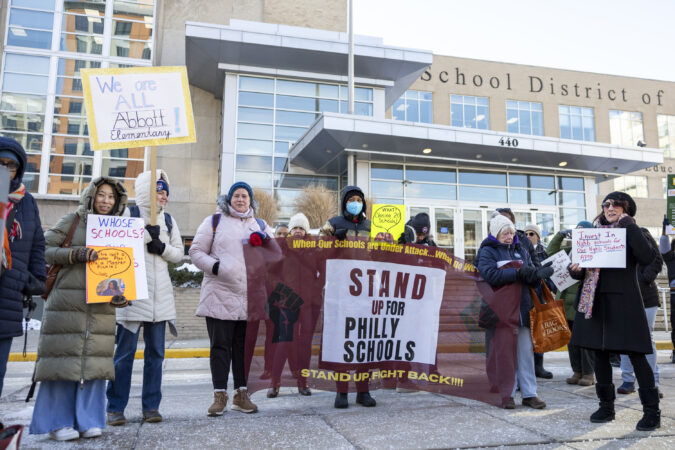
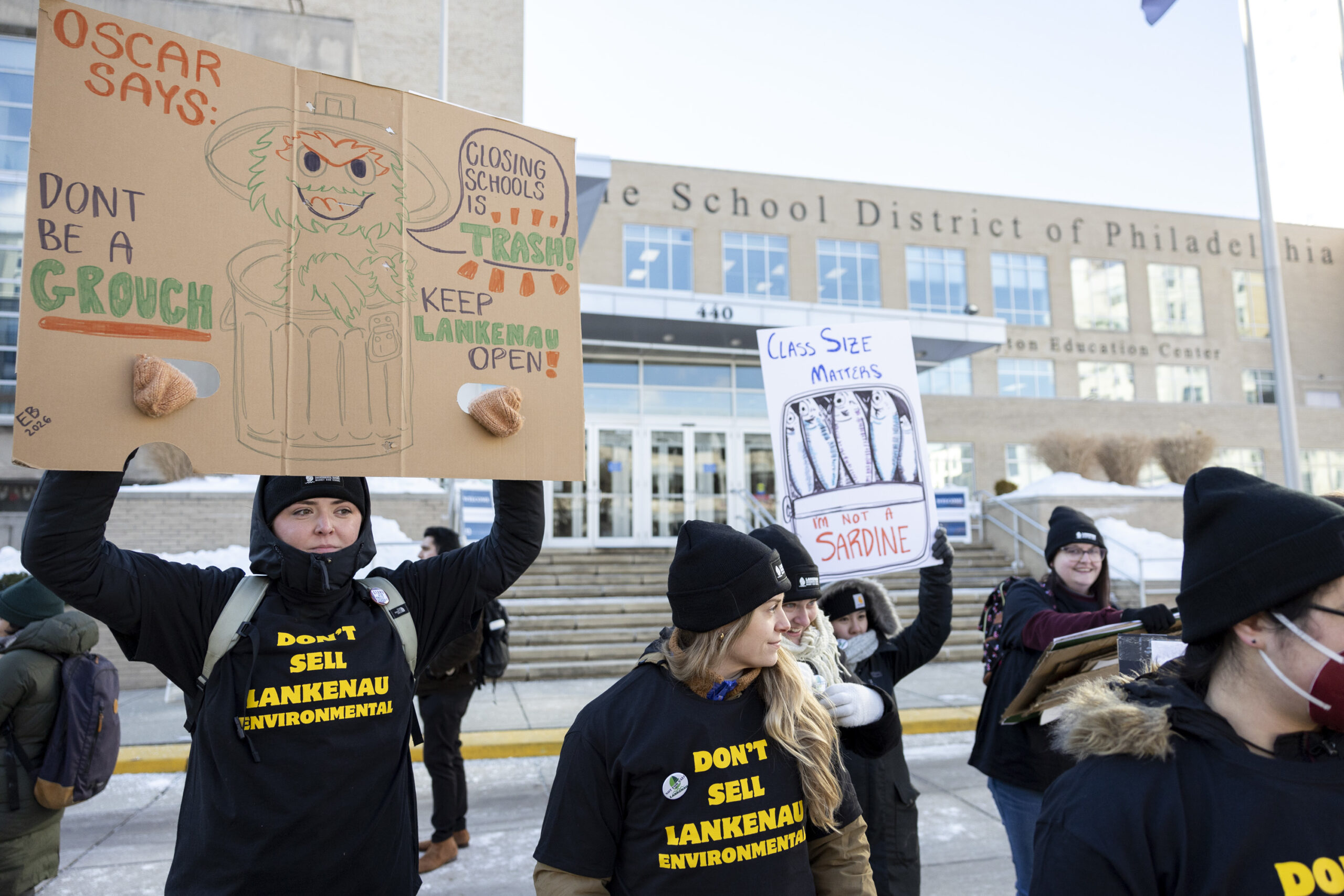
Prior to the meeting, more than 50 people gathered in the bitter cold outside Philadelphia School District headquarters, waving signs and shouting into bullhorns to show their displeasure with Watlington’s proposal.
Emily Brouder, 23, of West Philadelphia, Penn student and intern at Lankenau High School, holds a sign that says “Closing Schools Is Trash.”
Some of the demonstrators warned that removing children from their neighborhood schools would be traumatizing to already vulnerable kids.
“These schools are another home for these families,” said Margarita Davis-Boyer, president of the Lankenau High School Home & School Association. She said schools are a place where kids can get a meal, see a friendly face, and feel safe, especially when home may not offer the same reprieve.
“It’s just an injustice,” she said. Lankenau, the city’s environmental magnet school, would close under the plan, becoming an honors program inside Roxborough High School.
A strong Lankenau contingent packed both the rally and the board meeting, which happened immediately afterward.
LeeShaun Lucas, a Lankenau senior, is upset the school might close.
“To me, closing Lankenau doesn’t make sense,” Lucas said.
Lankenau’s campus is unique in the city — set against a wildlife preserve and a farm, a stream, and a forest.
Lucas has studied how to make the Schuylkill healthier by studying mussels, he said. He’s taking a dual enrollment GIS class — the only such high school in the city to offer such an opportunity, school officials believe.
That exposure has shaped Lucas, he said.
“I truly believe that voting to close Lankenau Environmental would be a mistake,” Lucas said. “Please vote to save Lank so that others may benefit from the type of learning that is only possible at Lankenau Environmental.”
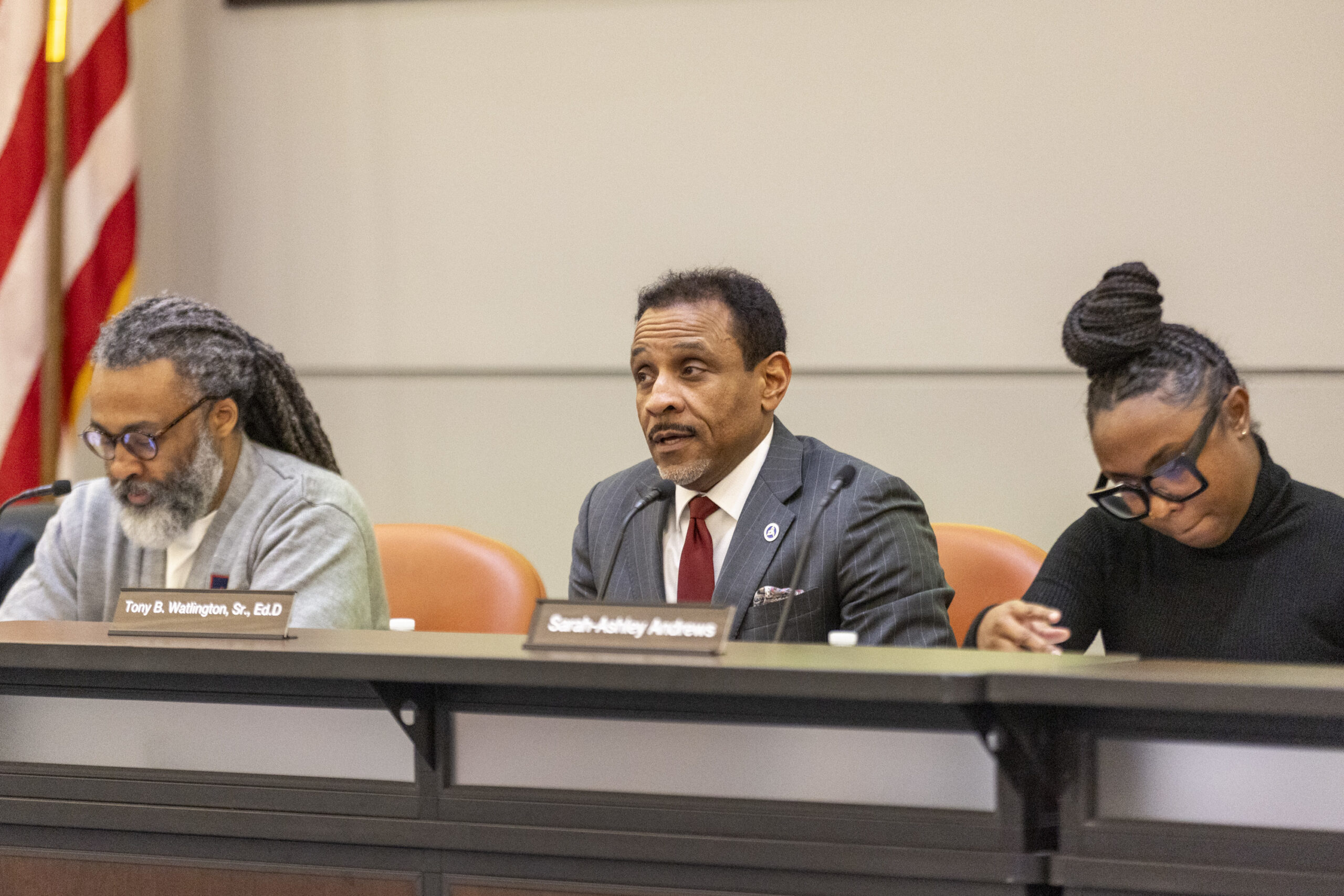
Superintendent Tony B. Watlington (center), Board President Reginald L. Streater, and Board member Sarah-Ashley Andrews at the School board meeting Jan. 29.
Disparate impact
Ryan Pfleger, an education researcher, said if underutilization and facility condition truly shaped Watlington’s recommendation, the burden of closure would fall roughly evenly across racial groups.
But that’s not the case with Watlington’s plan.
“Black students are overrepresented, roughly 1.6 times more likely to be enrolled in schools slated for closure,” Pfleger said. “Fifteen of 20 schools proposed for closure are majority Black. White students are underrepresented, about four times less exposed than expected. The schools slated for closure are also disproportionately low income.”
Pfleger’s conclusions match an Inquirer analysis of the closure data.
The plan, Pfleger concluded, “does not rectify educational injustice.”
Conwell shows up
A strong contingent of Conwell supporters also told the board they were unhappy with the plan to close their school, a magnet middle school in Kensington.
Conwell has just over 100 students in a building that can hold 500. But Erica Green, the school’s principal, said it’s worth saving.
“Conwell for many years has been the cornerstone in the Kensington community, a place where students flourish, where leaders are born; alumni included leaders in government, education, law, media, public safety, and professional sports: Living proof that diamonds truly are in our backyard,” Green said. “Times have changed, but excellence at Conwell has remained the same.”
Conwell is celebrating its 100th anniversary and has been the recipient of public and private donations to advance its building conditions and program offerings.
“Do not let the almighty dollar drive a choice to remove a beautifully designated historic school and beautifully gifted young people,” an impassioned Green said. “The essence, prestige and impact of Conwell Magnet Middle School cannot be duplicated.”
Priscilla Rodriguez, whose two sons attended Conwell, worries about the implications for families that rely on it for stability.
“When a school closes, families don’t just adjust. They struggle,” Rodriguez said. Conwell families “are already dealing with a lot. You won’t make it any better by closing Conwell.”
An incomplete plan?
Katy Egan came to the board with a long list of questions, none of which were addressed in Watlington’s plan: Which schools will be modernized? When? How? How will displaced students get to their new schools? What’s happening to students with special education plans forced to leave their schools? How do you plan to keep kids safe while merging schools?
Egan, a member of Stand Up for Philly Schools, called the blueprint “a 25% plan.”
But, she said, “we deserve more than 25%, and our students deserve everything.”
Community members can weigh in on the plan in the coming weeks at meetings around the city, and Watlington is scheduled to formally present it to the board on Feb. 26.
No vote will happen in February though, said board president Reginald Streater, who declined to weigh in on the merits of the plan until it’s handed over to the board.
In other board news
In other board matters, Watlington said he would soon ask to eliminate half days from the district’s calendar entirely.
The news came as he detailed a slip in year-over-year student attendance: in December, 54% of students attended school 90% of the time, compared to 66% in December 2024. That’s the largest drop in Watlington’s superintendency, he said.
He attributed the challenges to a two-hour delay for snow, light attendance prior to winter break — and light attendance during a half day called for professional development.
Watlington said at next month’s board meeting, he’ll propose amending the 2026-27 schedule to remove half days entirely.
“Half days in the calendar do not serve us well,” he said.
The board also installed three new student board representatives.
The non-voting members are: Brianni Carter, from the Philadelphia High School for Girls; Ramisha Karim, from Northeast High; and Semira Reyes, from the Philadelphia High School for Creative and Performing Arts.
All but two of Philadelphia’s 17 City Council members have sponsored a package of legislation aimed at limiting ICE operations in the city, a level of support that could ensure the measures become law even if they are opposed by the mayor.
The 15 cosponsors, confirmed Thursday by a spokesperson for Councilmember Kendra Brooks, indicate a potentially veto-proof majority of lawmakers back the sweeping “ICE Out” effort.
Brooks and Councilmember Rue Landau, the proposal’s authors, on Thursday formally introduced the seven bills in the package, which includes measures that would codify Philly’s “sanctuary city” status, ban U.S. Immigration and Customs Enforcement from operating on city-owned property, and prohibit employment discrimination on the basis of immigration status.
Landau said that “reaching a majority sends a clear message.”
“Philadelphia stands with our immigrant communities,” she said in a statement. “At a moment when the federal government is using fear and violence as governing strategies, this level of support shows that Council will do everything we can to protect our immigrant neighbors.”
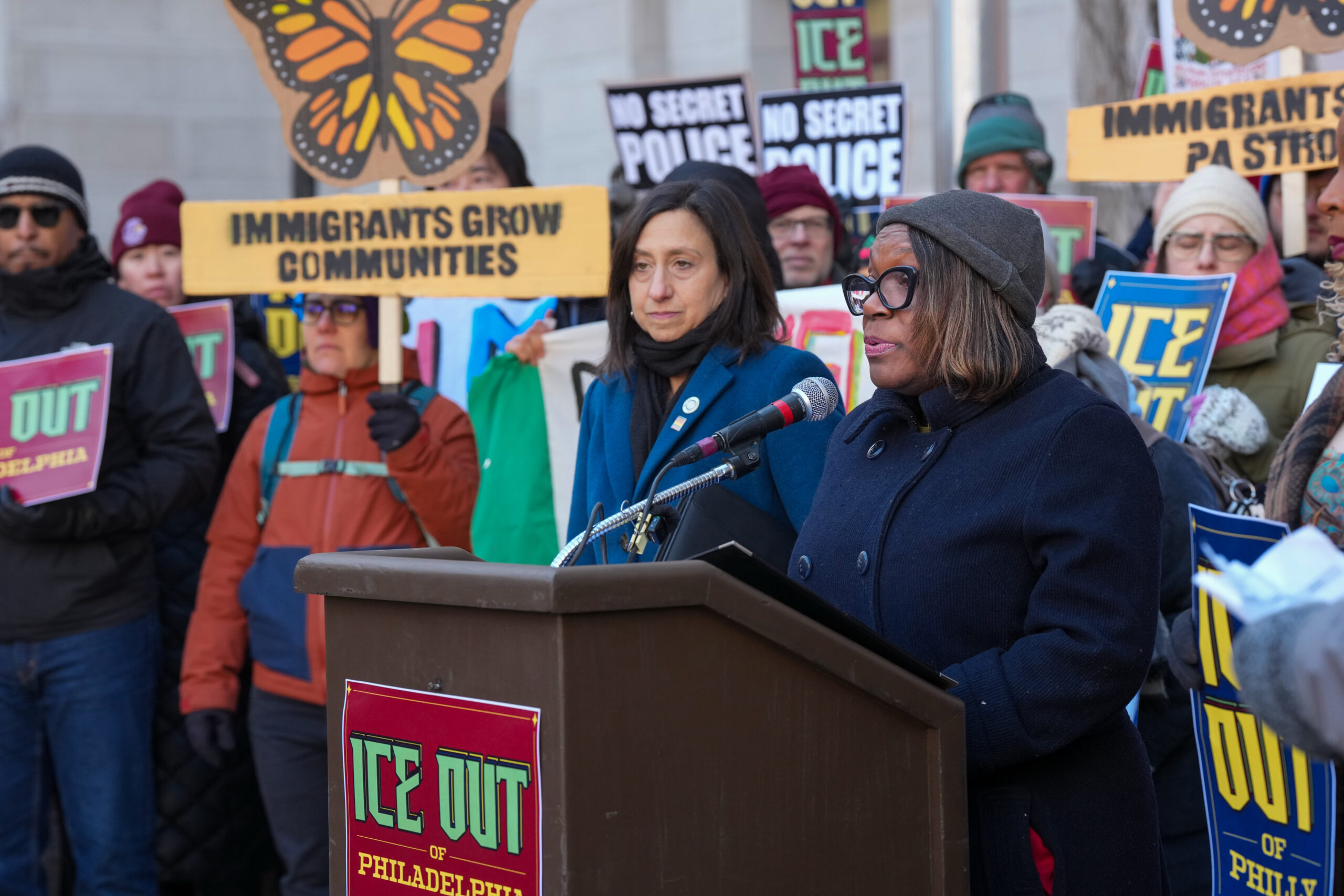
Advocates and protesters call for ICE to get out of Philadelphia, in Center City, January 27, 2026.
The 15 lawmakers on board with Brooks and Landau’s proposal have each cosponsored all seven bills, Brooks’ spokesperson Eric Rosso said. Only Councilmembers Mike Driscoll, a Democrat, and Brian O’Neill, Council’s lone Republican, declined to cosponsor the legislation, he said.
Driscoll, who represents lower Northeast Philadelphia, said in a statement that the shootings of Renée Good and Alex Pretti by federal agents in Minneapolis this month “caused real pain and fear” and “deserve serious attention.”
“Locally, we should aim for immigration policies that are focused, proactive and aimed at practical, long-term solutions that ultimately hold up in court,” he said.
Driscoll said he is open to amended versions of the legislation.
O’Neill, whose district covers much of Northeast Philadelphia, could not immediately be reached for comment.
The developments Thursday prompted Mayor Cherelle L. Parker to make one of her first public comments about President Donald Trump’s mass deportation campaign, saying in a statement that her administration “understand[s] the public’s fear of the unknown as it relates to federal policy associated with immigration.”
“We have a comprehensive approach to public safety, and we will always be prepared for any emergency, as we have consistently demonstrated and will continue to demonstrate,” Parker said. “I have a great deal of faith in our public safety leaders — our subject matter experts — who I asked to be a part of this team and we’re going to do our best to work in an intergovernmental fashion, along with City Council, to keep every Philadelphian safe.”
Parker said she and her team are reviewing the legislation.
Advocates and protestors call for ICE to get out of Philadelphia, in Center City, January 27, 2026.
The mayor has largely avoided confrontation with Trump’s administration over immigration policy, a strategy some have speculated has helped keep Philadelphia from the National Guard deployments or surges of ICE agents seen in Minneapolis, Chicago, Los Angeles, and elsewhere.
But the popularity of the “ICE Out” package among Council members may force her to wade into the issue. Administration officials will testify when the bills are called up for committee hearings. If they are approved, Parker will have the choice of signing the bills into law, vetoing them, or letting them become law without her signature.
Council bills require nine votes for passage, and 12 votes are needed to override mayoral vetoes. With 15 Council members already signaling their approval for the bills, chances appear strong that the city’s legislative branch has the numbers to override any opposition.
Mayor Cherelle L. Parker has avoided confrontation with the White House on immigration issues.
In a Council speech, Brooks addressed the debate over whether the legislation would draw Trump’s ire.
“Staying silent is not an option when people are being publicly executed in the streets and the federal government is covering up their murders,” Brooks, of the progressive Working Families Party, said. “I want to be clear: ICE is already here. We don’t want a Minneapolis situation, but I reject the claim of those who are pretending we don’t already have a problem.”
Council President Kenyatta Johnson, a centrist Democrat and an ally of Parker, shared a similarview.
“From my perspective, the Trump administration has already been looking at the city,” Johnson told reporters. “Overall, the majority of members of City Council support the legislation, and so we see this legislation being successfully voted out of committee.”
ICE agents have been arresting suspected undocumented immigrants in the city before and during Trump’s tenure, and his administration has canceled grants for the city and educational and medical institutions in Philadelphia. But the city has not seen a mass deployment of ICE agents or federalized troops.
Councilmember Anthony Phillips, also a centrist and Parker ally, represents the 9th District, from which the mayor hails.
“What the ’ICE Out’ legislation ultimately says to Donald Trump,” Phillips said, “is that no matter what you try to do to undermine the health and safety and well-being of Philadelphia citizens, we will stand up to you.”
Johnson suggested potential legal issues could be ironed out through amendments if needed.
“The reality is this: This is a moral issue, right?” he said. “And if there are any legality issues that has to be addressed as a body, we’ll work with our members to address it.”
Next, Johnson will refer the legislation to committee, where members will hold one or more hearings featuring testimony from administration officials, experts, stakeholders, and the public. Council members can also amend the bills in committee.
Kendra Brooks shown here during a press conference at City Hall to announce a package of bills aimed at pushing back against ICE enforcement in Philadelphia, January 27, 2026.
Supporters of the legislation packed Council chambers Thursday morning, and many spoke during public comment, ranging from leaders of advocacy organizations to a former immigration judge to immigrants who tearfully pleaded for Council to pass the package swiftly.
Several Spanish-speaking residents spoke through interpreters; other residents testified on behalf of friends or family members who are undocumented and were fearful to come to City Hall themselves. A school nurse told Council members that her students have asked her what tear gas feels like.
“The traumatic effects of these [ICE] raids on our children and our families and our communities will last for years and generations to come,” said Jeannine Cicco Barker, a South Philadelphia psychologist who said she is the daughter of immigrants. “These times call for bold, brave new measures to protect our community, and you have a chance to do some of that here. Philly urgently needs these protections.”
Ethan Tan, who said he is an immigrant and a father of two, said he is fearful for his family and community.
“To this administration, fear is the point. Alienation is the point. Isolation is the point,” he said. “The ‘ICE Out’ package says to me and immigrants that we may be afraid, but we can show solidarity and resolve anyway.”