The University of Pennsylvania in a legal filing Tuesday pushed back against a federal commission’s demand that in effect would require it to turn over lists of Jewish faculty, staff, and students, calling the request “unconstitutional,” “disconcerting,” and “unnecessary.”
The filing comes in response to a lawsuit filed against the university in November by the Equal Employment Opportunity Commission, asserting that Penn failed to comply with its subpoena. The commission is seeking employees’ names, home addresses, phone numbers, and email addresses to further an investigation it began in 2023 over the school’s treatment of Jewish faculty and other employees regarding antisemitism complaints that emerged following Hamas’ attack on Israel.
In its quest to find people potentially affected, the commission demanded a list of employees in Penn’s Jewish Studies Program, a list of all clubs, groups, organizations, and recreation groups related to the Jewish religion — including points of contact and a roster of members — and names of employees who lodged antisemitism complaints. It also sought names of participants in confidential listening sessions held by the school’s task force on antisemitism.
The request has spurred a backlash from some student and faculty groups, including Penn’s chapter of the American Association of University Professors, arguing that the names and personal information should not be turned over to the government.
Penn has refused to provide the information, and the school doubled down on that position in Tuesday’s legal filing.
“The EEOC insists that Penn produce this information without the consent — and indeed, over the objections — of the employees impacted while entirely disregarding the frightening and well-documented history of governmental entities that undertook efforts to identify and assemble information regarding persons of Jewish ancestry,” the university wrote in its filing. “The government’s demand implicates Penn’s substantial interest in protecting its employees’ privacy, safety, and First Amendment rights.”
Also on Tuesday, the Penn Faculty Alliance to Combat Antisemitism, a group of more than 150 primarily Jewish professors, filed a brief in support of the university’s decision not to comply with the commission’s demand.
“While the Alliance supports the EEOC’s efforts to combat antisemitism at Penn, its members are gravely concerned that the scope of the EEOC subpoena … invokes the troubling historical persecution of Jews and threatens the personal security of the Alliance’s members,” the group wrote in the brief.
The alliance includes members who have had concerns about antisemitism at Penn, including faculty who were harassed online after attending a trip to Israel following Hamas’ Oct. 7, 2023, attack on the country, said Claire Finkelstein, a professor at Penn Carey Law School, member of the alliance, and faculty director of the Center for Ethics and the Rule of Law.
Among its members are faculty “who have been really on the side of remediating antisemitism, do not believe that concerns about antisemitism are pretextual, do not think that it is a sham issue, and think there are real … issues to address at universities in general.”
Finkelstein said the alliance has not taken a position on whether the EEOC’s investigation is warranted or needed.
But the group is adamantly opposed to the subpoena and believes it could discourage membership in Jewish groups at Penn. In its brief, the group notes “the dark historical legacy associated with government lists of Jews,” including how Nazis “frequently demanded that others identify the Jews among them.”
Penn said in its filing that it had complied with the subpoena except for the list of names and contacts, noting it had provided over 900 pages of materials to the commission. The school noted that it even offered to send notices to all employees about the EEOC’s request to hear about antisemitism concerns with the commission’s contact information.
The university also asserted that the commission’s demand “is a particularly unjustified use of enforcement authority given the weakness of the underlying charge.”
The commission, the university argued, has not identified a “single allegedly unlawful employment practice or incident involving employees.”
“The charge does not refer to any employee complaint the agency has received, any allegation made by or concerning employees, or any specific workplace incident(s) contemplated by the EEOC, nor does it even identify any employment practice(s) the EEOC alleges to be unlawful or potentially harmful to Jewish employees,” Penn said in its response.
The original complaint was launched by EEOC Commissioner Andrea Lucas, now chair of the body, on Dec. 8, 2023, two months after Hamas’ attack on Israel that led to unrest on college campuses, including Penn’s, and charges of antisemitism. It was also just three days after Penn’s then-president, Liz Magill, had testified before a Republican-led congressional committee on the school’s handling of antisemitism complaints; the testimony drew a bipartisan backlash and led to Magill’s resignation days later.
Lucas, whom President Donald Trump appointed chair last year, also brought similar antisemitism charges against Columbia University that resulted in the school paying $21 million for “a class settlement fund.”
EEOC complaints typically come from those who allege they were aggrieved. Lucas, according to its complaint, made the charge in Penn’s case because of the “probable reluctance of Jewish faculty and staff to complain of harassing environment due to fear of hostility and potential violence directed against them.“
The commission’s investigation followed Lucas’ complaint to the commission’s Philadelphia office that alleged Penn was subjecting Jewish faculty, staff, and other employees, including students, “to an unlawful hostile work environment based on national origin, religion, and/or race.”
The allegation, the complaint said, is based on news reports, public statements made by the university and its leadership, letters from university donors, board members, alumni, and others. It also cited complaints filed against Penn and testimony before a congressional committee.
In its brief, the faculty alliance also asserted that the commission could have used other voluntary and informal methods to obtain contact information for Penn faculty and staff, such as setting up a website where people could report concerns.
Finkelstein, the Penn law professor, said she understands that the commission generally guarantees anonymity to witnesses or complainants, but leaks can occur.
“When state force extracts sensitive, personal details, those details could (and often do) become public, turning group members into targets for their enemies,” the group states in its filing.
Penn has done a lot to address antisemitism concerns, said Brian Englander, president of the alliance and a professor of clinical radiology who has been at Penn for 22 years.
In its brief, the alliance listed antisemitic incidents that occurred on Penn’s campus in 2023, including a swastika left on a Penn building and messages that Penn called antisemitic that were light-projected onto several Penn buildings.
“Penn is a very different place than what we were experiencing in the fall of 2023,” he said.
Finkelstein agreed.
“Penn is not Columbia or Harvard or UCLA,” she said. “The problems that have appeared on those campuses have been much more extreme than what happened on Penn’s campus.”
“I also think there may be a limit to what university leadership can do in the face of widespread antisemitism that has really affected university campuses all over the country.”
But there is always room for improvement, she said.
“To the extent that there is an atmosphere that has made Jewish students and faculty feel unwelcome, or not heard, or vilified, that is something the university has to continue to address and I believe they will continue to address it,” she said.
Finkelstein was among about 40 faculty who took a four-day, personal trip to Israel in January 2024 and said hey felt attacked for supporting academics there and trying to learn more about the Oct. 7 attacks. An Instagram account by Penn Students Against the Occupation was critical of the trip and accused faculty of “scholasticide.” The EEOC referred to that incident in its complaint.
“My dean got hundreds of letters,” she said, protesting faculty going on the trip.
Englander said there probably are members of the alliance who would be interested in talking to the commission.
“But they would want to do it voluntarily,” he said.
The alliance, he said, is “straddling this middle line” in that it supports Penn’s refusal to turn over the names, but also recognizes “that antisemitism is a massive problem in the United States right now.”
“So having government support, whatever the motivation for that, is meaningful,” he said.
Dien has accepted a consulting opportunity and was not available for an interview on Tuesday. The museum had no further details to share, a spokesperson said.
The change is the first in the senior executive team since veteran museum and nonprofit leader Daniel H. Weiss was brought in as director and CEO about eight weeks ago.
The museum is currently mulling whether to keep or alter the rebrand, Weiss said in a recent interview.
Dien, who was previously vice president of advancement and partnerships at the Grammy Museum in Los Angeles, oversaw the Art Museum’s name change and new visual identity. He and Suda had hoped the museum’s rebrand would revive sagging attendance after its unveiling in early October.
“It’s going to bring people in and help put us more clearly on the map,” Suda said at the time.
“We have so much research that shows there is this brand perception that we’re the castle on the hill,” Dien said last November, during the rebrand’s rollout. “And so my job right now is [to ask], ‘How do we come down the steps and meet people where they’re at?’”
New signage in the Art Museum’s cafe, Oct. 6, 2025.
But the campaign was widely — though not universally — mocked.
A Hyperallergic story carried the headline: “People Really Hate the Philadelphia Art Museum Rebrand.”
A review in trade blog Brand New praised the rebrand, saying that it infused the museum with a “much needed, new, distinct, and energetic identity that was sorely missing.”
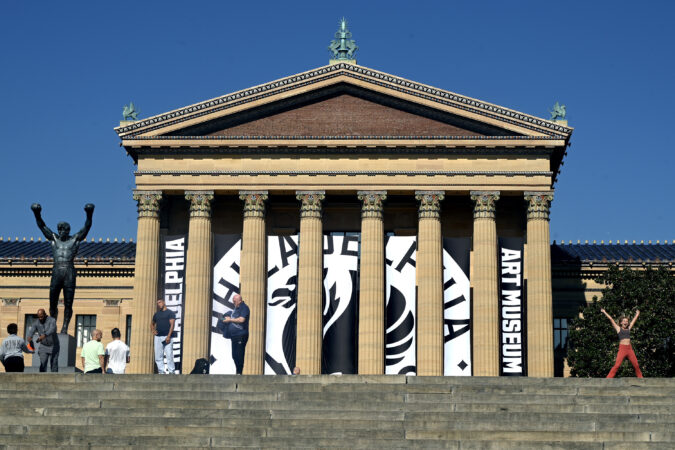
The rebrand, designed by Brooklyn-based branding and design firm Gretel, came with a name change for the institution, from Philadelphia Museum of Art to Philadelphia Art Museum, as well as a shorthand moniker — PhAM, which the museum has used for its new web address, visitpham.org, and in some marketing materials.
That drew an unfortunate joke moniker from wags — PhArt.
“We are an amazing museum with an amazing collection, amazing curators, and an amazing experience, and it’s really a shame, the jokes and negative reaction to the rebranding,” said museum trustee Yoram (Jerry) Wind a few weeks after the rebrand was introduced.
Another board member, Jennifer Rice, expressed support for it shortly after its launch.
“I do like it. I love the tagline ‘Wall to Wall Art for All.’ I like that it feels fresh and feels new and feels like it would connect with the audience we’ve had trouble connecting with,” Rice said
Some critics complained that a new logo inspired by the griffin figures adorning the building’s roofline looked less like that of an art museum and more reminiscent of a beer label or soccer team emblem.
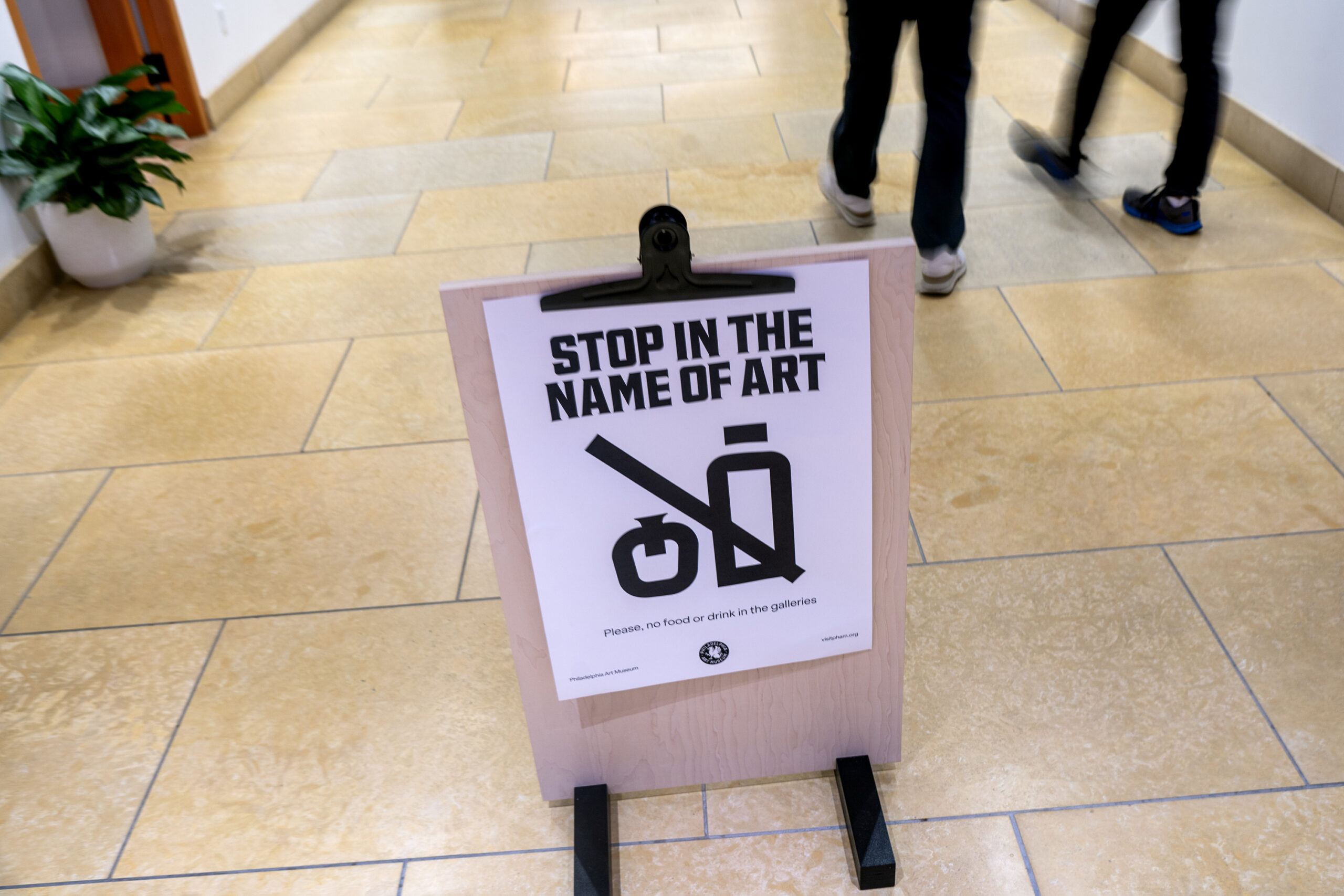
“Please no food or drink in the galleries” sign outside the cafe at the Philadelphia Art Museum, Oct. 6, 2025, showing the museum’s rebrand graphics.
The rebrand, including the name change, new logo, and bolder graphics, also comprises a series of punchy taglines, like “Made You Look” and “Revolutionary Since 1876.”
Weiss has set up a task force of board and staff to evaluate the rebranding to “take a look at how it’s playing, what works, what doesn’t work, to do some analytical work around that and get a sense of how our various constituencies are perceiving it, recognizing that almost any rebrand is controversial at first,” he said. “The question is whether we’re in the territory of a rebrand that is counterproductive to our ambition or not.”
Their findings will be presented to the board for discussion on whether “we stay as it is now or make changes.”
Suda was ousted as director and CEO in November, three years into her five-year contract. She filed a wrongful-dismissal lawsuit against the museum about a week later.
It was the start of a voicemail from the president to Pennsylvania Gov. Josh Shapiro, received one week after a man firebombed the governor’s residence in Harrisburg in an attempt to kill Shapiro while his family slept inside on the first night of Passover.
Shapiro hadn’t recognized the number Trump was calling from, and at first didn’t answer.
When Shapiro called back, Trump offered well wishes to the governor’s family, his usual braggadocio, and some advice: he shouldn’t want to be president, Shapiro recalls in his new memoir, set to be released later this month.
The book, Where We Keep the Light, which comes out on Jan. 27, has attracted a flood of attention as it signals Shapiro’s potential presidential aspirations and also serves as a retort to the unflattering portrayal of the governor in former Vice President Kamala Harris’ recent memoir.
In the 257-page book, Shapiro details his early life in Montgomery County, his two decades in elected office, his connection to his faith, and his pragmatic leadership approach.
And for the political observers who have watched Shapiro’s rise: He delves into his brief consideration of whether he should run for president after Joe Biden dropped out of the race in 2024, the whirlwind experience of being vetted to be Harris’ running mate, and the unfair scrutiny he felt he faced during that process.
Here are six takeaways from Shapiro’s forthcoming memoir, obtained by The Inquirer.
Trump to Shapiro: ‘He cautioned that I shouldn’t want to be president’
When Shapiro, 52, returned Trump’s call in April 2025, he received the president’s support and some unprompted compliments from Trump, he writes.
“[Trump] said he liked the way I talked to people and approached problems,” Shapiro retells, as Trump went through the list of potential 2028 Democratic Party presidential candidates. “He cautioned that I shouldn’t want to be president, given how dangerous it had become to hold the office now.”
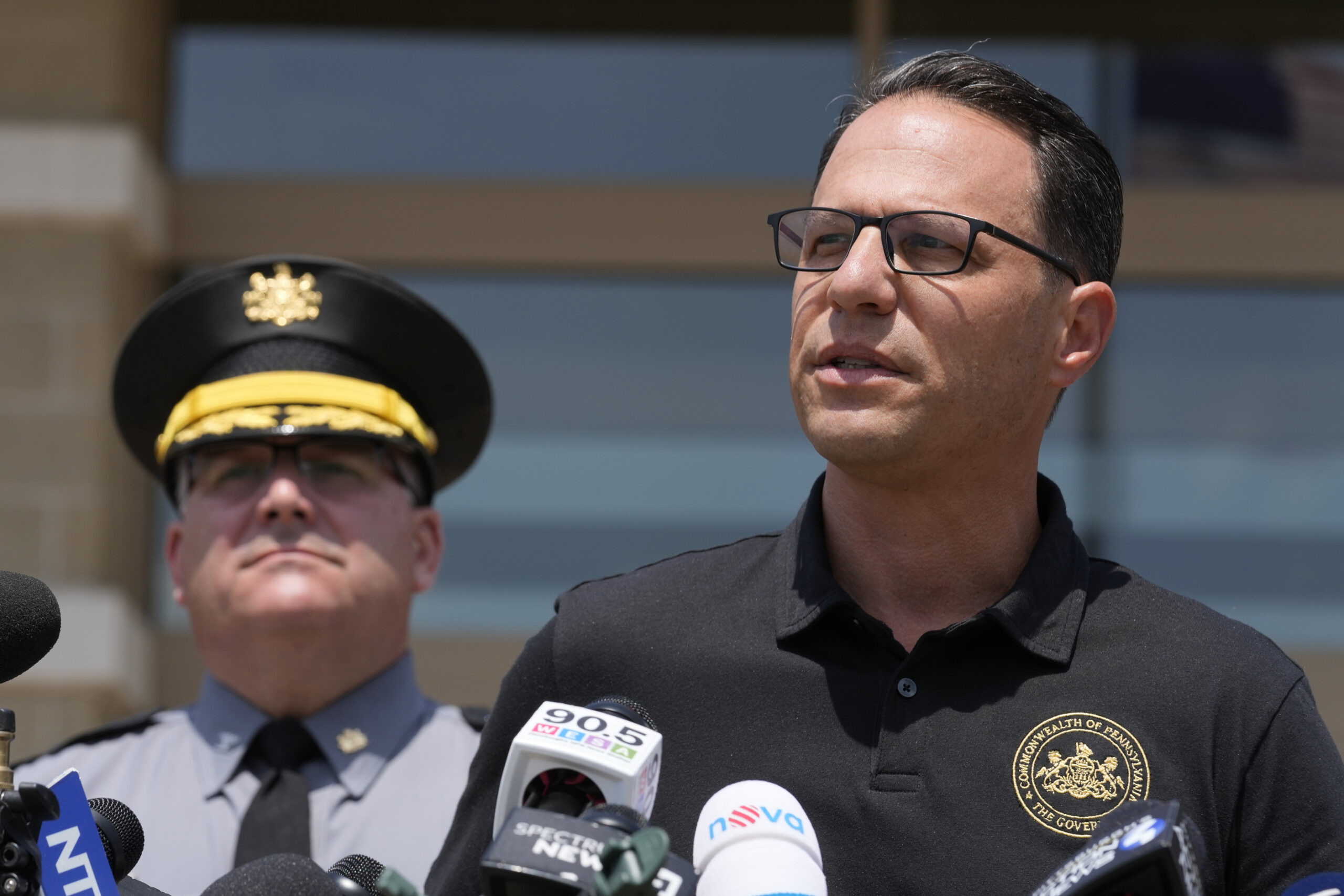
Gov. Josh Shapiro speaks during a news conference, in Butler, Pa., Sunday, July 14, 2024, following an assassination attempt on President Donald Trump.
(It is unclear whether Shapiro tried to call Trump after he experienced his own assassination attempt in Butler, Pa., the previous summer, though Shapiro publicly vehemently denounced the violence.)
Shapiro sells himself as a pragmatist and writes proudly of the times in which he has disagreed with his party or changed his positions.
For example, he recalls being asked by Harris’ vetting team about his past comments criticizing Democrats in federal, state, and local offices for how they handled COVID-19 closures. He stood by his criticism of former Gov. Tom Wolf at the time over business and school closures, and of the mask and vaccine mandates implemented by the Biden administration, he writes.
“I respectfully pushed back, asking if they believed that we had gotten everything right, to which they generally agreed that we had not,” Shapiro writes about his conversation with Harris’ vetting team. “I just had been willing to say the quiet part out loud, even if it wasn’t easy or popular or toeing the line to do so.”
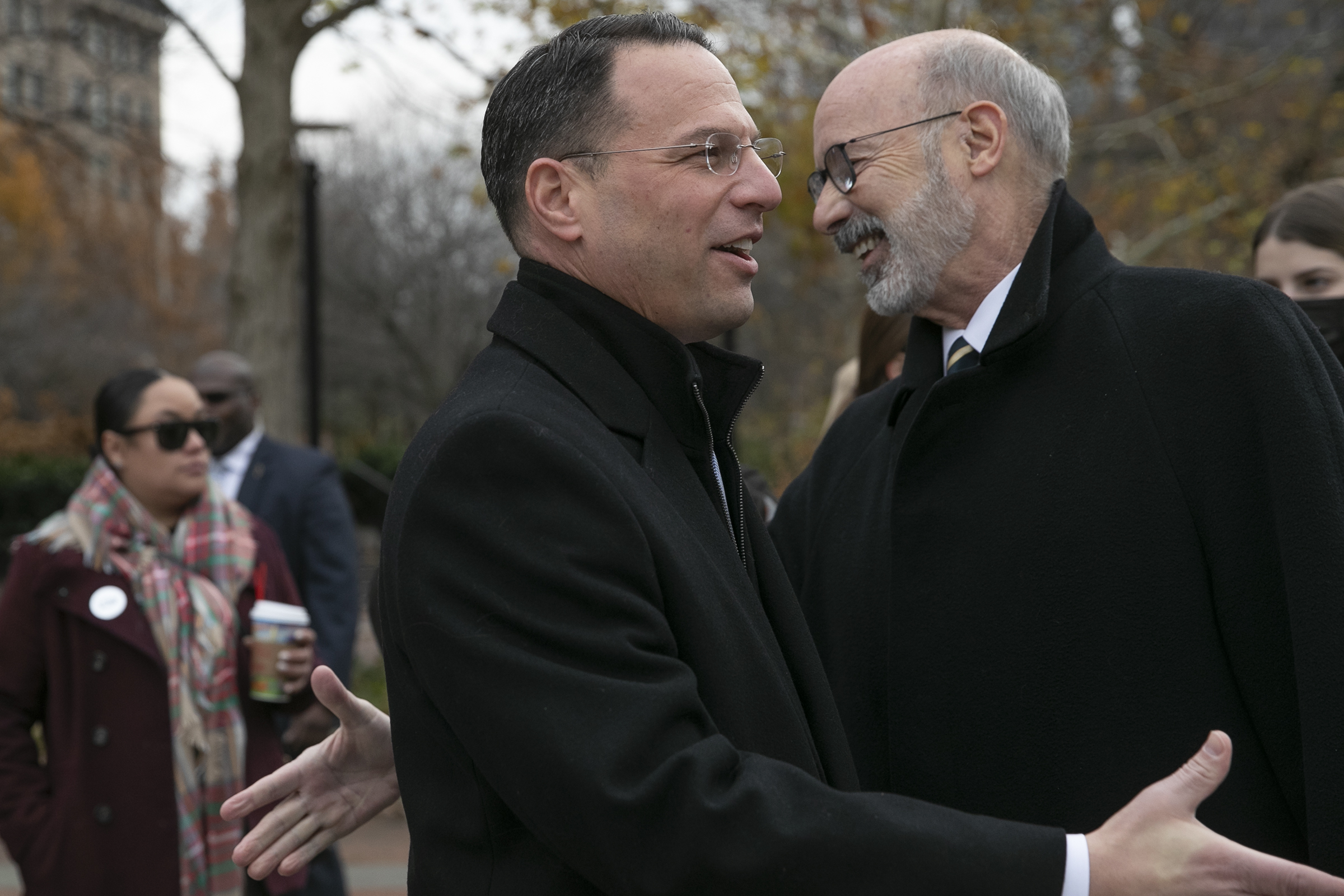
Then-Attorney General Josh Shapiro and Then-Gov. Tom Wolf both go in for handshakes before the start of a press conference on the harmful effects of anti-abortion policies at 5th and Market in Philadelphia on Thursday, Dec. 9, 2021.
He also writes about his journey to change his position on the death penalty over the years. In the days after the Tree of Life synagogue massacre in Pittsburgh, in which 11 Jewish people were killed while worshipping, he had initially supported the death penalty for the suspect. Since then, his views have evolved and he no longer supports capital punishment and called on the legislature to end the practice.
Lori Shapiro is behind most of her husband’s good ideas
Lori Shapiro, 53, mostly avoids her husband’s frequent appearances in the limelight.
But in his book, Shapiro writes that his wife has challenged him as she has supported his political rise, pushing him to question what he really wants, do the right thing, or even help him shape his messaging to voters. She discouraged him from running for U.S. Senate in 2016 after top Democrats approached him, which led him to run for attorney general instead. She was also his first call when Biden dropped out and he briefly considered whether he should run for president, and his voice of reason during the veepstakes.
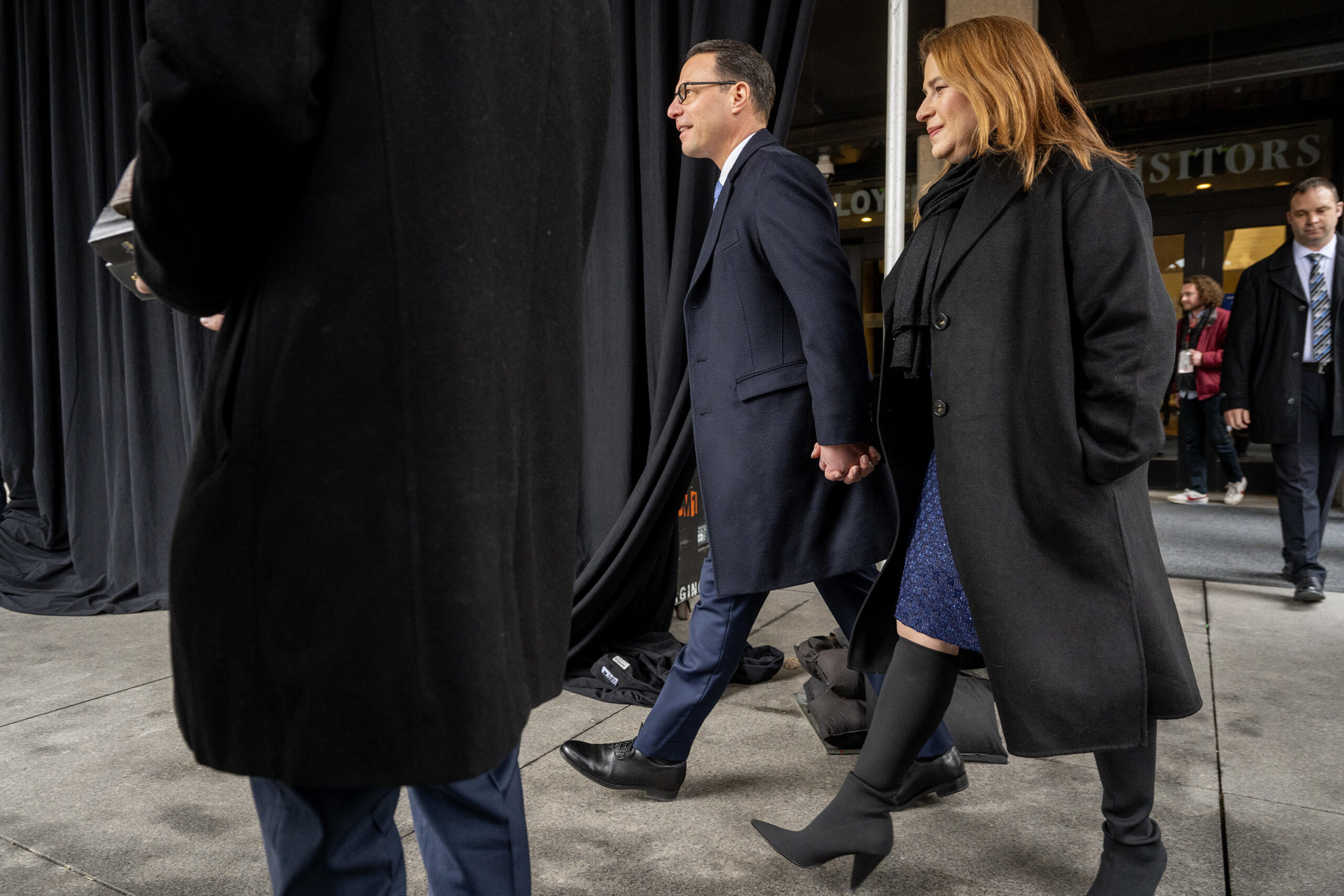
Josh Shapiro and his wife Lori leave the state Capitol in Harrisburg Tuesday, Jan. 17 2023, on his way to the stage to be sworn in as the 48th Governor of Pennsylvania.
The couple started dating in high school, before breaking up during college when they went to different universities in New York — he attended the University of Rochester, while she went to Colgate University. Shapiro writes that he quickly realized he missed her, and wrote her a letter in an effort to win her back.
“So I cracked my knuckles, and wrote my heart out. I was Shakespeare composing a sonnet. I was Taylor Swift before Taylor Swift. I was Lloyd Dobler in Say Anything, in a trench coat with the boom box over my head,” Shapiro writes. “I was getting the girl back.”
This earned Shapiro the title of “Mr. Lori” from her hall mates at Colgate. He did not win her back until years later, when the two reconnected in Washington after college, and quickly became engaged. The twomarried and had four children together, who each make frequent appearances throughout the book.
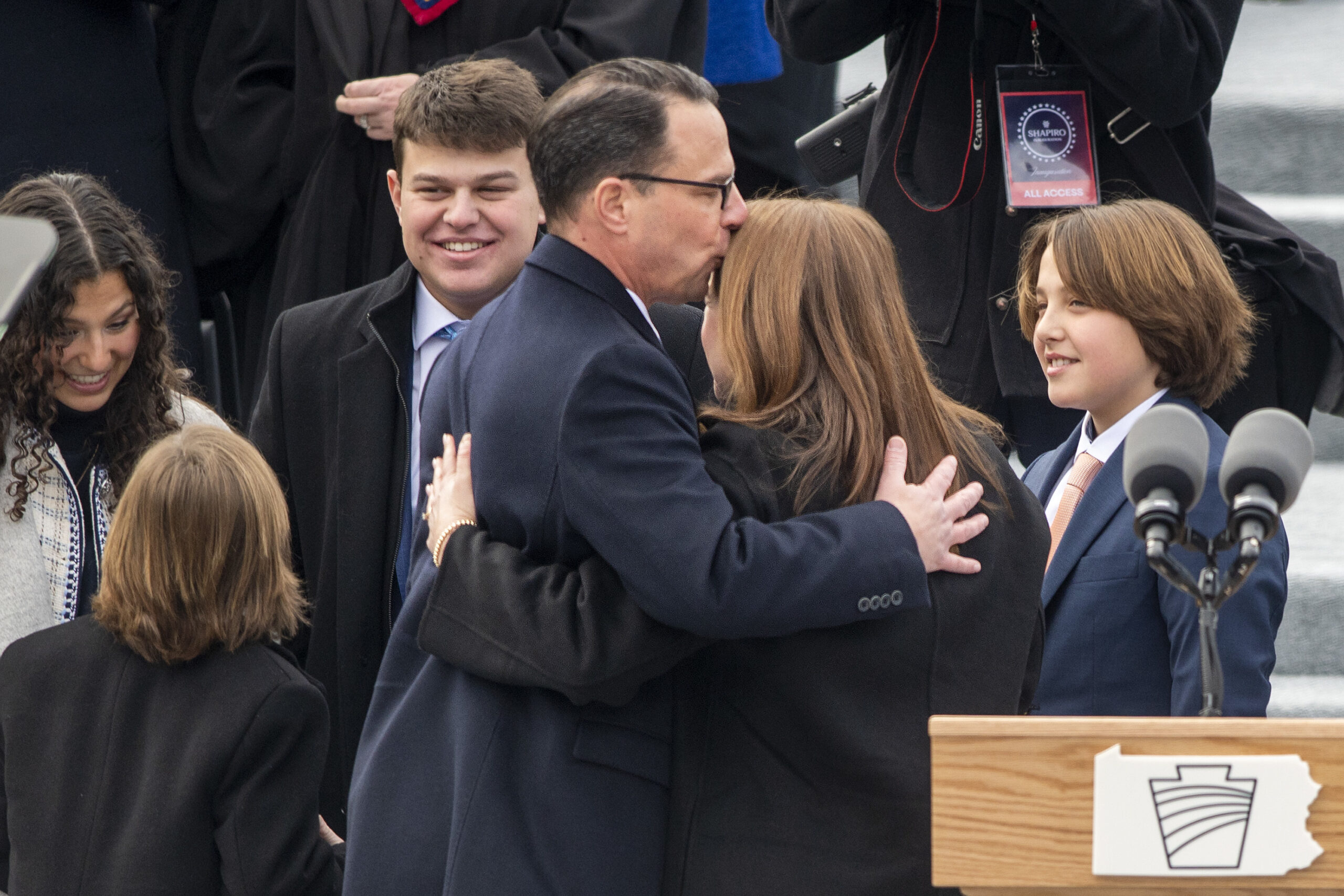
Surrounded by his four children, Gov. Josh Shapiro kisses his wife Lori after his is sworn in as the 48th Governor of Pennsylvania during inauguration ceremonies at the state Capitol in Harrisburg Tuesday, Jan. 17 2023.
Shapiro grapples with an early career move that kicked off his reputation as disloyal
Shapiro is not without regret for how some of his career moves and ambitions affected the people who helped him get where he is today, he writes.
Shapiro got his start in politics on the Hill under then-U.S. Rep. Joe Hoeffel, a Montgomery County Democrat. He quickly worked his way up to be Hoeffel’s chief of staff before returning to Abington Township to run for state representative.
But when Shapiro was done with frequent trips to Harrisburg and ready for his next rung on the ladder, Hoeffel was in the way. Shapiro had a plan to run for county commissioner and flip the board for the first time in more than 150 years — making Montco the first Philadelphia collar county to swing into Democratic control. Now all of the Philly suburban counties are controlled by Democrats, and Shapiro is credited for starting the trend. But Hoeffel was not a part of that calculation.
Shapiro writes that Hoeffel was “struggling politically.” He says he told him he would not run against him, but he also would not run with him.
“I knew that I couldn’t win with him, and I knew that it wasn’t the right thing for the party or the county, even if we could somehow eke out the victory,” Shapiro writes.
Hoeffel eventually decided not to run, and was quoted in The Inquirer in 2017 as saying that loyalty is not Shapiro’s “strong suit,” comments he has since stood by, in addition to praising Shapiro for his successes ever since.
“I’d hear about [Hoeffel] talking to the press or to people behind my back about how he thought I lacked loyalty, that I was someone who needed to be watched,” Shapiro writes. “It felt terrible, and of course, I never intended to hurt him in any way and I would never have run against him. I wanted the Democrats to have a shot, and I knew that I could get it done.”
Shapiro initially said antisemitism didn’t play into Kamala Harris’ running mate decision. Now he has more to say
In the days after Harris passed over Shapiro to be her running mate in favor of Minnesota Gov. Tim Walz, Shapiro said “antisemitism had no impact” on her decision.
Now, Shapiro questions whether he was unfairly scrutinized by Harris’ vetting team as the only Jewish person being considered as a finalist, including a moment when a top member of Harris’ camp asked him if he had “ever been an agent of the Israeli government.”
“I wondered whether these questions were being posed to just me — the only Jewish guy in the running — or if everyone who had not held a federal office was being grilled about Israel in the same way,” he writes.
Vice President Kamala Harris visits Little Thai Market at Reading Terminal Market with Gov. Josh Shapiro after she spoke at the APIA Vote Presidential Town Hall at the Pennsylvania Convention Center in Philadelphia, Pa., on Saturday, July 13, 2024. The photo was taken eight days before President Joe Biden’s decision to exit the race.
He details his broader concerns with how he was treated during the process, including some perceived insults about his family’s lack of wealth or Lori Shapiro’s appearance.
Since Shapiro’s book was leaked to the media over the weekend, sources close to Walz confirmed to ABC News that the Minnesota governor was also asked whether he was an agent of a foreign government, due to his multiple trips to China.
Shapiro, for his part, has written about his time in Israel, including a high school program in which he completed service projects on a farm, on a fishery at a kibbutz, and at an Israeli army base. He once described himself in his college student newspaper as a “past volunteer in the Israeli army” — a characterization that circulated widely after it was reported by The Inquirer during the veepstakes.
Vereb had been along for the ride for Shapiro’s time in the state House as a fellow state representative from Montgomery County (though he was a Republican), as a top liaison to him in the attorney general’s office, and eventually a member of his cabinet in the governor’s office until his resignation in 2023.
At Penn Medicine’s clinic where adults receive genetic counseling and testing, about 9% of patients are Black.
By contrast, one in four patients at the cardiology and endocrinology clinics located in the same facility in West Philadelphia are Black, while nearly 40% of cityresidents are. Those from low-income neighborhoods are also less likely to be seen at the genetics clinic, yet more likely to have positive results when tested, a recent Penn study found.
These findings line up with what Theodore Drivas, a clinical geneticist and the study’s senior author, had long suspected about the impact of racial disparities based on his own experience seeing patients at Penn’s clinic.
The study, published this month in the American Journal of Human Genetics, found that Black patients were also less likely to be represented at adult genetics clinics at Mass General Brigham, a Harvard-affiliated health system in Massachusetts.
There’s no biological reason why rates of testing should differ, Drivas said. The overall rate of genetic disease should be similar regardless of race, even though certain diseases are more prevalent in some populations.
“Genetic disease doesn’t favor one group or another,” he said.
That means if one group isn’t getting tested as much, they’re probably missing out on key diagnoses.
Racial disparities are an ongoing concern in medicine and have been attributed to a wide range of causes, including socioeconomic factors, unequal access to care, implicit bias, and medical mistrust due to historic injustices.
In a study published last August, Drivas’ team found that the chances of a genetic condition being caught varied widely by race. Among patients admitted to intensive care units across the Penn health system, 63% of white patients knew about their genetic condition, compared to only 22.7% of Black patients.
To address these disparities, Drivas is calling for changes to how the medical field approaches genetic testing, such as by integrating testing into standard protocols and improving national guidelines.
“It’s not just a Penn problem or a Harvard problem. It’s a genetics problem in general,” Drivas said.
Diving into the disparities
Drivas’ team analyzed data from 14,669 patients who showed up at adult genetics clinics at Penn and Mass General Brigham between 2016 and 2021. The findings are limited to the two major academic centers on the East Coast, which tend to see sicker patients compared to community medical centers.
Black patients were 58% less likely to be seen at Penn’s genetics clinic than would be expected based on the overall University of Pennsylvania Health System patient population.
At Mass General Brigham, Black patients were 55% less likely than would be expected based on that system’s population.
Some literature has suggested that Black patients and others from minority groupsare less likely to agree to genetic testing because of an inherent distrust in the medical system due to historic injustices. “But we don’t see that in our data,” Drivas said.
Once evaluated at Penn’s clinic, Black patients were 35% more likely to have testing ordered than white individuals.
His team also found disparities affecting lower-income individuals. Each $10,000 increase in the median household income of a person’s neighborhood was associated with a 2% to 5% higher likelihood of evaluation at a genetics clinic.
Meanwhile, patients from neighborhoods with lower median socioeconomic status were more likely to get positive results from testing than those from wealthier neighborhoods.
“We’re relatively over-testing the people from higher socioeconomic brackets and under-testing the people from lower socioeconomic brackets,” Drivas said.
The solution is not to stop testing the wealthier people, he clarified, but to improve access to testing for others.
Undoing disparities
People who want to get a genetic diagnosis often have to go to major medical centers.
The University of Pennsylvania health system comprises sevenhospitals across Pennsylvania and New Jersey. Its Perelman Center for Advanced Medicine, adjacent to the Hospital of the University of Pennsylvania in West Philadelphia, is the only one that has an adult genetics clinic.
Drivas has many patients who drive two or three hours to be seen for genetic testing.
The current wait time at his clinic is around three or four months, which he said is “pretty good” compared to others.
He thinks part of the solution to reducing disparities requires expanding the size and diversity of the genetics workforce so more patients can be seen.
Geneticists also need to better educate doctors in other fields about when to refer patients, he said. Creating better guidelines would help.
Notably, Black patients in the study were more likely to be evaluated than white individuals for genetic risk factors of cancer — an area where there are clear clinical practice guidelines recommending genetic testing.
They need to come up with similar guidelines for other conditions, such ascardiovascular and kidney diseases, he said.
Another idea he had was to make genetic testing more integrated into standard care in the hospital.
His earlier study found a surprising number of adults in ICUs at Penn had undiagnosed genetic conditions. Such testing is now widely available and often costs as little as a few hundred dollars.
“It costs money, but I think there are cost savings and life-saving interventions that can come from it,” Drivas said.
A Philadelphia charter school is building its own college.
Students at the Philadelphia Performing Arts Charter School, a K-12 facility of about 2,500 with campuses in South Philadelphia and Center City, should soon be able to graduate with high school diplomas and 60 college credits — for free.
PPACS is not the only early college in the city — the Philadelphia School District has Parkway Center City Middle College, and other schools allow students to take college courses while in high school. Some schools offer dual enrollment, and a new early college charter will open in the city in the fall.
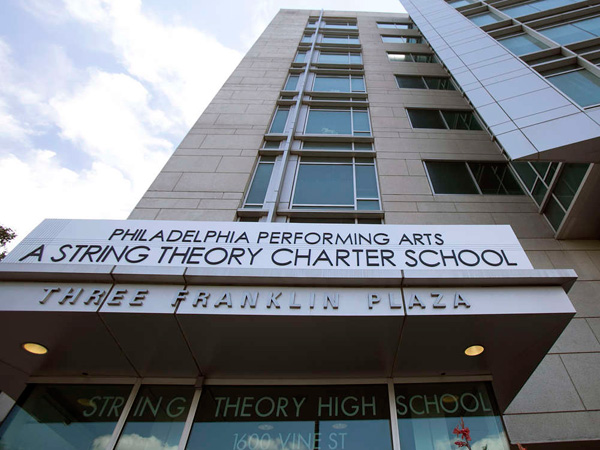
But instead of partnering with existing colleges, String Theory, the education management organization that runs PPACS, is in the process of openingits own degree-granting institution.
String Theory College will focus on design, technology, and entrepreneurship, offering PPACS students more flexibility than prior dual-enrollment partners had, said Jason Corosanite, the college president. Students won’t have to leave the school’s Vine Street campus to attend classes, either.
“The whole goal is to get all kids prepared for college, with as many college credits as possible,” Corosanite said.
The college already has Pennsylvania Department of Education approval, and its Middle States Commission on Higher Education accreditation vote is scheduled for March, commission officials said. Once schools are candidates for accreditation, that opens up college transferability, student loans, and Pell grant opportunities, though PPACS students pay no tuition because the school is a publicly funded charter.
Corosanite said he is confident the school will gain Middle States approval and ultimately be able to offer students associate’s degrees.
With Philadelphia’s crowded higher education market and a looming college enrollment cliff, it’s fair to question whether the city needs more degree-granting institutions, said Shaun Harper, a professor of education, public policy, and business at the University of Southern California. Some would say it does not.
But, Harper said, “if this new creation is going to expand access and make higher ed more affordable, I think that is a spectacular thing. We need more innovative models in education that create more seamless pipelines from high school to college.”
Harper’s research once centered on the experiences of high-achieving Black and Latino boys in New York schools who, once in college, “suddenly they realized that they were not as prepared for college as they had been led to believe by their high school teachers and by the grades they received in high school.”
That makes Harper consider whether String Theory students “are really going to be pushed to do college-level work, and perform like college students would otherwise be able to perform? I think that is a thing to be concerned about.”
Ultimately, Harper said, he is intrigued by the model.
“There’s a real opportunity for [String Theory] to ensure that they are providing the right kinds of professional learning and professional development experiences for these educators, so they amass the skills that will be able to make the curriculum much more complex, much more college-level,” Harper said. “They may have a real shot here at teaching the rest of the nation something that ultimately becomes replicable.”
High school and college in one stop
The seeds of the idea trace back to PPACS’ first high school graduates — the Class of 2017.
When Corosanite and other String Theory officials tracked those students, “some of our best and brightest kids were dropping out of college because of cost,” he said. “It wasn’t because they couldn’t do it. They were looking at the value proposition of these schools and dropping out. I felt the burden of, ‘We’re telling all these kids, yeah, you have to go to college,’ and then they graduate and can’t afford life. How do we solve for that?”
Enter String Theory College.
Theprogram is already underway — about 40 students who participated in a pilot program are on track to graduate with college credits in June, and about 40 more are in 11th grade now.
The college will initially be open only to students enrolled in PPACS. Going forward, every 11th- and 12th-grade honors and Advanced Placement course at the school will be a college-level course, and the PPACS faculty who teach the courses are college faculty.
Course offerings include multivariable calculus, linear algebra, biotechnology, entrepreneurship, anddesign.
Students still have access to the trappings of high school: All non-honors classes are still within the PPACS confines. And students must still meet state requirements for their high school diplomas — they are learning math, but it might be a design-focused math class, for instance.
“Kids still have their high school experience — they still come to school on time, they still go to the lunchroom with everybody they go to school with,” Corosanite said. “They still see their friends, they still have prom, but they also have college. It makes it a lot easier.”
There is no budget impact for PPACS, Corosanite said. The school,which as a charter is independently run and publicly funded, pays the college a per-credit hour rate that is roughly equivalent to community college, and that money covers teachers’ salaries and benefits.
“We’re trying to be as efficient as possible with the classes the teachers have, and the college is in our building,” he said. “We’ve designed it to be cost-neutral. This is not a moneymaker — it’s mission-driven.”
Going forward, Corosanite dreams of a graduate school of education — String Theory already offers continuing education for teachers — and offering college courses to other schools and districts.
‘This is a good opportunity’
Hasim Smith, a PPACS senior, was pitched on the idea of taking college classes in high school when he was a 10th grader.
Smith’s dad had heard about the pilot program and urged his son to go for it.
“He said, ‘This is a good opportunity. I don’t want you to miss out on it,’” Smith said. “I like to challenge myself and do things that other people see as hard. And I like that it’s free — it helps with college costs.”
Smith was game and now, at age 18, he’s looking forward to collecting his high school diploma and transferring dozens of credits to another college. (He’s already been accepted to 10 and is awaiting more decisions.)
The courses are challenging, he said, but manageable, especially with his teachers’ support. He’s enjoyed the design challenges in particular, Smith said.
“We had to learn a lot — it gets really deep. We have to learn about design, and different theories, and entrepreneurship,” Smith said.
He had always thought he might want to pursue nursing as a career, but his String Theory college experience has him also considering architecture, he said.
How to apply
The college-in-a-high-school program has a limited number of slots for students who will be in 10th through 12th grade for the 2026-27 school year, and is accepting applications for those seats and for its incoming ninth-grade class.
When State Sen. Sharif Tahir Street converted to Islam 30 years ago, he already had a Muslim name.
His father, John F. Street, who would go on to become Philadelphia’s mayor, gave his son a Muslim name when he was born in 1974 despite raising him in the Seventh-day Adventist Church, an evangelical Christian sect in which members of the Street family hold leadership roles to this day.
As the senator tells it, his father initially considered adopting the name Sharif himself — not because he was considering converting to Islam but because he wanted to embrace the movement of Black Americans reclaiming pre-slavery identities.
Instead, the elder Street, who had already built a reputation as a rabble-rousing activist, kept his name and dubbed his son Sharif, which in Arabic means noble or exalted one.
The story would be surprising if it weren’t from the idiosyncratic Street family, which has played a unique outsider-turned-insider role in Philly politics for decades. The late State Sen. Milton Street was the senator’s uncle, and Common Pleas Court Judge Sierra Thomas Street is his ex-wife.
This year, with Sharif Street a frontrunner in the crowded Democratic primary to replace retiring U.S. Rep. Dwight Evans, the family could make more history: If elected, Sharif Street would become the first Muslim member of Congress from Pennsylvania.
A Street win would mark another milestone in political representation for Philadelphia’s large Muslim community, an influential constituency that already includes numerous elected officials and power players.
But in characteristic Street fashion, that potential comes with a twist. Street has relatively moderate views on the conflict in Gaza and would likely stand out from Muslim colleagues in Congress like U.S. Reps. Ilhan Omar (D., Minn.) and Rashida Tlaib (D. Mich.), progressives who regularly denounce Israeli aggression.
To be sure, Sharif Street, 51,is highly critical of Israeli Prime Minister Benjamin Netanyahu and the war in Gaza. But he is also quick to defend Israel’s right to exist as a Jewish state, favors the two-state solution, and counts many prominent Philadelphia-area Jews among his friends and political supporters.
“Guess what? Benjamin Netanyahu is not the only leader of a major country in the world that’s committed war crimes, because Donald Trump has done the same thing,” Street said last week at a Muslim League of Voters event. ”But none of us would talk about getting rid of the United States of America as a country.”
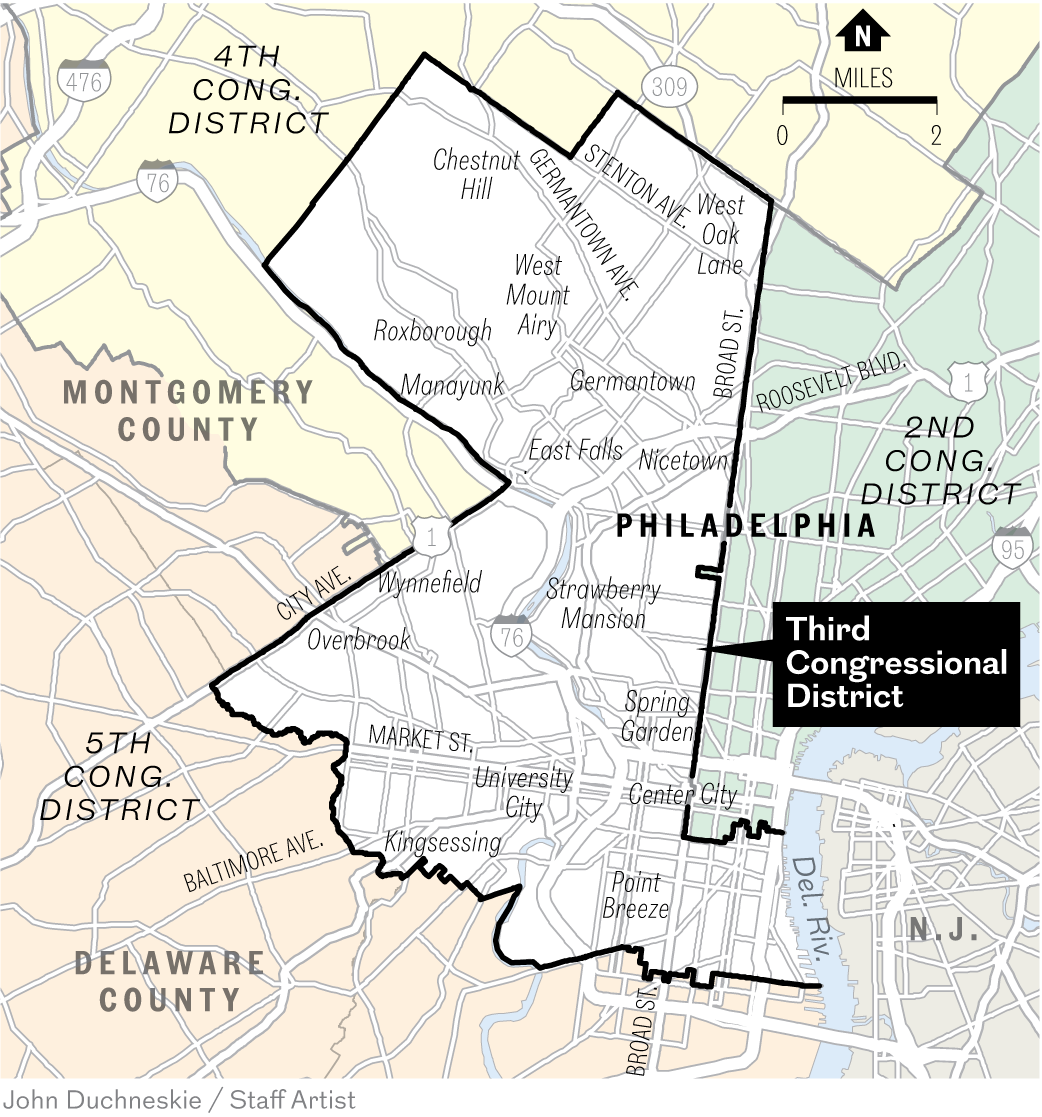
For Muslim voters who view the Middle East crisis as a top political concern, this year’s 3rd Congressional District race sets up a choice between one of their own and a candidate whose politics may more closely align with their views on Gaza: State Rep. Chris Rabb, a progressive who has been endorsed to succeed Evans by the national Muslims United PAC.
“F— AIPAC,” Rabb said at a recent forum, referring to the American Israeli Public Affairs Committee, which has spent large sums and wielded aggressive tactics to unseat lawmakers it views as antagonistic to Israel. “They are destroying candidates’ lives because they don’t like that we’re standing up to them, that we are actively and consistently acknowledging that there is a genocide in Gaza.”
Rabb, who is not religious and said he respects all faiths, is hoping that Muslim voters will embrace his stance on the issues.
“Making history is not the same as being on the right side of history,” Rabb said in a statement.
‘Embrace all of the texts’
Street said his Adventist upbringing immersed him in an Old Testament-rooted Christianity that led to a growing curiosity about all the Abrahamic faiths. As he got older and read more, he realized that he didn’t view Judaism, Christianity, and Islam “as separately as other people do.”
“I do believe that the Abrahamic religions were all correct. In no way were they all supposed to be separate religions,” he said. “Islam allowed me to embrace all of the texts, which I had already decided to do.”
Before converting, Street said he was embraced by the Muslim community in Atlanta when he was a student at Morehouse College. He officially converted after returning to Philly to earn his law degree at the University of Pennsylvania.
Street’s Shahada, the creed Muslims take when joining the faith, was administered by Imam Shamsud-din Ali, his father’s friend. (Years later, Ali was one the elder Street’s associates being targeted by federal investigators when an FBI listening device was discovered in the mayor’s office in 2003. The episode created a firestorm around John Street’s ultimately successful reelection campaign that year, and Ali was later convicted on fraud and racketeering charges.)
For many Muslim converts, the religion’s dietary strictures, such as abstaining from pork and eating Halal food, take some getting used to, Sharif Street said. That wasn’t a problem for him.
“Islam has a lot of rules — unless you were Seventh-day Adventist,” he said, referring to the denomination discouraging followers from eating pork, shellfish, and numerous other foods.
Street said his faith has guided him as an individual and public servant.
“Islam, for me, focuses on my personal responsibility,” he said, and “the idea that man’s relationship with God is and always was.”
His views on the unity of the Abrahamic religions also guide his perspective on the Middle East, he said.
“I recognize that there won’t be peace for the state of Israel without peace for the Palestinian people, but there won’t be peace for the Palestinian people unless there’s peace for the state of Israel at some point,” he said.
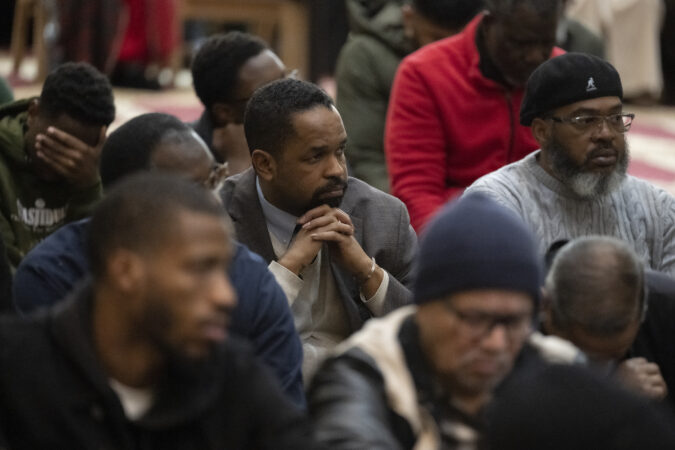
Sharif Street participates in Friday prayer at Masjidullah mosque recently.
Like elected officials of other religions, Street’s politics do not perfectly align with the teachers of Muslim leaders.
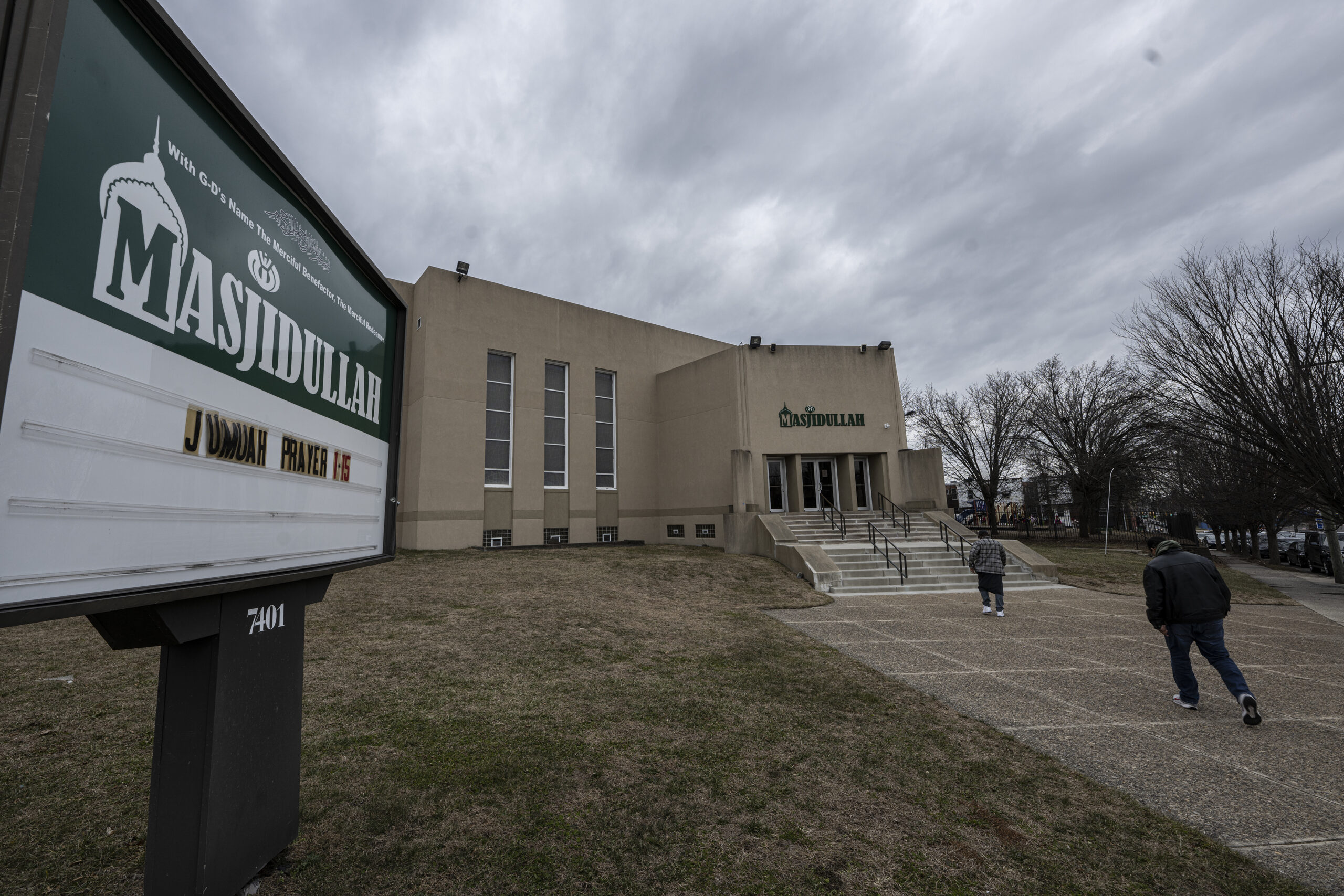
On a recent Friday, Street attended Jumu’ah, the weekly afternoon prayer service, at Masjidullah in Northwest Philadelphia. A sign at the entrance reminded Muslims that abortion and homosexuality are against Islam’s teachings.
“Almost every one of Philadelphia’s Muslim political leaders … are all pro-civil rights, including LGBTQ [rights] and pro-choice,” he said. The sign, he said, represented “some members of the faith leadership who are reminding us … that is not the stance of the official religious community.”
For Street, that type of dissidence hits close to home.
His father, he said, became Baptist after being “kicked out” of the Seventh-day Adventist Church for officiating a same-sex marriage in 2007 between Micah Mahjoubian, a staffer for Sharif Street, and his husband, Ryan Bunch.
The Seventh-day Adventist Church in North Philadelphia did not respond to a request for comment.
’One of the most Muslim urban spaces’
Ryan Boyer, who heads the Philadelphia Building and Construction Trades Council and is Muslim, likes to say he’s proud that members of his faith are so integrated into local politics that their religious identities are often overlooked.
“We’re a part of the fabric,” said Boyer, whose politically powerful coalition of unions has endorsed Street. ”To me, it’s not that big of a deal. We’re here.”
For Boyer, that means Muslim candidates like Street are judged based on their merits, not their identities.
“He’s Muslim,” Boyer said of Street. “Well, is he smart? Does he present the requisite skills and abilities to do the job? … The answer is yes.”
Other Muslim leaders in the city include: Sheriff Rochelle Bilal; City Councilmembers Curtis Jones Jr. and Nina Ahmad; former Police Commissioner Sylvester Johnson; and City Commissioner Omar Sabir, who is Boyer’s brother.
Philly has also sent several Muslim lawmakers to Harrisburg, including current State Reps. Keith Harris, Jason Dawkins, and Tarik Khan.
Although the community is less well-known nationally than those in Michigan or Minnesota, Philadelphia has one of the nation’s oldest and largest Muslim populations, with about 250,000 faithful in a city of 1.6 million, according to Ahmet Tekelioglu, executive director of the Council on American-Islamic Relations’ Philadelphia branch.
By some estimates, Philly’s Muslim community has the highest percentage of U.S.-born followers of any major American city, thanks to the conversion of thousands of Black Philadelphians in recent decades. While many came to the faith through the Nation of Islam movement, a vast majority of Black Muslims in Philadelphia now practice mainstream Sunni Islam, Tekelioglu said.
Add in thriving immigrant communities from West Africa and the Middle East, and Philadelphia is “one of the most Muslim urban spaces” in the country, he said.
“Within a few minutes of walking in the city, you come across a visibly Muslim individual,” said Tekelioglu, whose nonprofit group does not make political endorsements. “Halal cheesesteak, ‘the Philly beard,’ and such — these also have overlap with the Muslim community and [the city’s] popular culture.”
The Middle East and the 3rd Congressional District
As a lawmaker, Street has been instrumental in forcing the Pennsylvania Interscholastic Athletic Association to allow Muslim girls competing in sports to wear hijabs and in leading the School District of Philadelphia to recognize Eid al-Adha and Eid al-Fitr as official holidays.
That record is part of why he bristles at the Muslims United PAC’s endorsement of Rabb.
“We cannot allow other people to hijack our community and hijack our issue because it’s Black people, it’s Muslims dying in Philadelphia right now, and some of these candidates don’t have anything to say about that,” Street said at the Muslim League of Voters event. “Some of them even got some fugazi Muslim organizations to endorse them.”
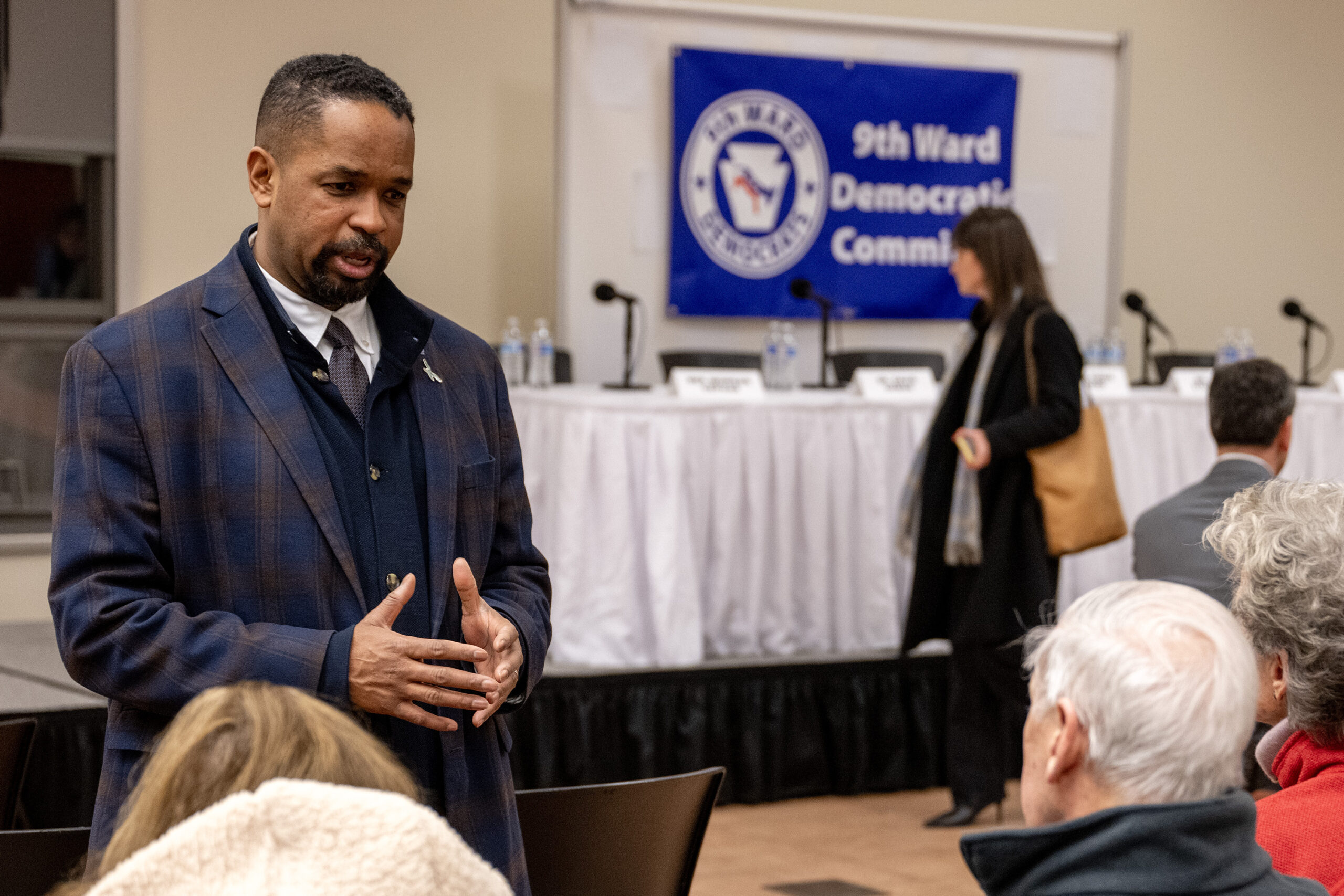
State Sen. Sharif Street appearing at a forum hosted by the 9th Ward Democratic Committee in December.
At another recent forum, the 3rd District Democratic candidates were asked whether they support legislation stopping U.S. weapons shipments to Israel after more than two years of conflict that has seen an estimated 70,000 Palestinians die in Gaza.
Street, who traveled to Israel and Palestine in 2017, said the one-minute response time wasn’t enough to unpack the complicated issues, and none of the other candidates gave straightforward answers — except Rabb, who said he supported the proposal.
“There are no two sides in this when we see the devastation,” Rabb said.
In an interview, Street said his comparatively moderate views on the crisis and his relationships with Jewish supporters will allow him to “play a really constructive role” in Congress.
“We need more people who can talk to both the Jewish and Muslim communities,” he said. “We need people who can have a nuanced conversation and do it with some real credibility.”
Tekelioglu said he has observed Muslim voters moving away from “identity politics” and toward “accountability-based political stance.” That evolution has accelerated during Israel’s war in Gaza following the Hamas attacks on Oct. 7, 2023, he said.
“Oct. 7 and everything that’s going on has made everything a bit more clear,” he said. “This doesn’t make it such that the Palestine issue is the main dealbreaker, but overall I see a trend of moving away from the identity politics.”
The real question, he said, is, “Are they going to represent our interests?”
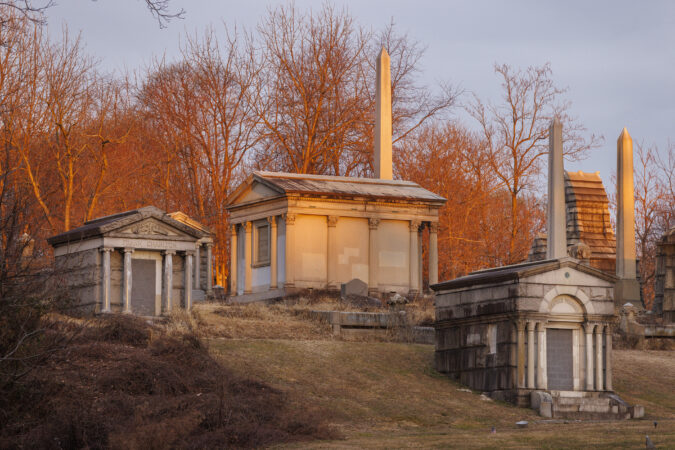
Past a marble monument for a Civil War hero, down a grass path where toppled headstones disappear into ivy and weeds and faded miniature American flags droop, lies the underground vault of James Campbell, who died in 1913 and whose remains mayhave been among the dozens stolen in one of the largest grave desecration cases ever uncovered in Pennsylvania.
Jonathan Christian Gerlach,who was charged with more than 500 offenses earlier this month and is being held in jail in lieu of $1 million bail, is accused of methodically breaking into burial vaults and mausoleums at Mount Moriah Cemetery, prying open caskets and removing human remains from Campbell’s burial ground and at least 25 other sites across the sprawling Philadelphia and Yeadon Borough cemetery.
Inside Campbell’s vault, where his family members were also entombed 12 feet beneath the cemetery’s surface as early as 1872, investigators said they found three broken caskets, crumbled marble, and a discarded pry bar. Six sets of human remains, they said, were missing.
Authorities allege that Gerlach moved through the cemetery repeatedly, at all hours, accessing sealed burial sites and removing dozens of remains over several weekswithout being detected. Large sections of the cemetery, overgrown and rarely monitored, offered long stretches of isolation — conditions investigators say Gerlach may have exploited. And as law enforcement continues to sort through the evidence, local officials and cemetery advocates are pressing for changes to prevent this from happening again.
“We were too slow to move,” said Yeadon Mayor Rohan Hepkins. “Nobody thought such a dastardly act — such an inhumane and incomprehensible act — was possible.”
Hepkins last week joined state and local officials to discuss what can be done to protect the burial grounds, where an estimated 180,000 people are buried.
He and others expressed cautious resolve that the cemeterycould be secured well enough to prevent another violation of this scale.
“I wish I could tell loved ones that I’m not critically concerned, but I am,” said State Sen. Anthony Williams, who represents the district where Mount Moriah Cemetery is located and was one of the officials who gathered to discuss preventive measures. “But I don’t know that Mount Moriah will ever be restored to the condition that they buried their loved ones in.”
Mount Moriah Cemetery, a historic landmark abandoned by its last owner and under court receivership, has long been plagued by neglect and limited oversight.
Investigators say Gerlach’s crimes unfolded over the course of months, starting in the fall and ending on the night of Jan. 6, when Yeadon detectives arrested the Pennsylvania man as he attempted to leave the cemetery.
License plate readers and cell phone towers place Gerlach near or inside the cemetery during both daylight and darkness. On Christmas Eve, for example, the technologies captured Gerlach’s vehicle or phone at least three times between 12:28 a.m. and 12:54 p.m., court records show.
The day before, on Dec. 23, a Yeadon investigator working the case saw scratch marks on the heavy stone slab sealing the underground Zeigler family vault, as if, a detective wrote in an affidavit of probable cause for Gerlach’s arrest, it had been “marked” as a target. When the detective returned on Dec. 26, the stone had been broken and nine sets of human remains stolen.
Yeadon police, who investigated the crimes alongside other authorities, have since been inundated with hundreds of calls and emails from anguished family members seeking answers, Chief Henry Giammarcco said.
Rescuing Mount Moriah
Mount Moriah Cemetery opened in 1855. Its owners, the Mount Moriah Cemetery Association, abandoned it in 2011, after years of mismanagement. The Friends of Mount Moriah, a volunteer-driven nonprofit, formed that same year with the goal of rescuing the grounds from vandalism, crime, and decay. In 2014, a Philadelphia judge appointed a receivership, the Mount Moriah Cemetery Preservation Corporation, to temporarily manage the cemetery until a permanent owner could be found.
More than a decade later, no permanent owner has emerged.
In 2018, the two groups and other stakeholders commissioned an ambitious strategic plan that called for stabilizing the cemetery’s finances, finding a permanent owner, and remaking Mount Moriah into a viable public space. The plan assumed significant investment and long-term stewardship. Neither materialized.
“There’s no clear revenue stream, and there’s significant infrastructure improvements and capital improvements that are required, on top of maintenance costs,” said Brian Abernathy, who served as chair of the preservation corporation when the plan was created.
At the time, Abernathy said, “there was a lot of hope and optimism about what we could accomplish with it. But the plan stalled over obstacles that persist today, he said, including enticing an owner when so many costly repairs are needed.
Under the court order, the corporation — a board composed of officials from Philadelphia and Yeadon, including Hepkins — is responsible for preserving the cemetery but has delegated day-to-day care to Friends of Mount Moriah.
Over the years, Friends of Mount Moriah made visible gains. Its 12-person board and volunteers hauled away abandoned cars, tires. and trash, righted toppled headstones, and uncovered burial vaults beneath thick vines, brush, and overgrowth.
“Until this happened,” said John Schmehl Jr., the group’s president, “security was not our first concern.”
<div data-analytics-viewport="autotune" data-analytics-label="visor-arcgis" id="bones"
  data-iframe-fallback="https://www.inquirer.com/resizer/ORTQkrqPSCXca2NSc4Uhl9preV8=/1400x932/smart/arc-anglerfish-arc2-prod-pmn.s3.amazonaws.com/public/5FUK4MYNPFH7LD3SAPB6X4O7TQ.jpg"
  style="width: 0; min-width: 100% !important; border: none;" data-iframe-fallback-height="509.789917082823"
  data-iframe="https://media.inquirer.com/storage/inquirer/projects/innovation/arcgis_iframe/bones.html"
  data-iframe-height="509.789917082823" data-iframe-resizable></div>
<script type="text/javascript">
  (function() {
    var l2 = function() {
      new pym.Parent('bones',
                     'https://media.inquirer.com/storage/inquirer/projects/innovation/arcgis_iframe/bones.html');
    };
    if (typeof(pym) === 'undefined') {
      var h = document.getElementsByTagName('head')[0],
        s = document.createElement('script');
      s.type = 'text/javascript';
      s.src = 'https://pym.nprapps.org/pym.v1.min.js';
      s.onload = l2;
      h.appendChild(s);
    } else {
      l2();
    }
  })();
</script>
Yet thieves knew the grounds. Last year, Schmehl said, more than $14,000 worth of lawn equipment — including mowers, weed trimmers, and hand tools — was stolen from the cemetery garage. Friends of Mount Moriah entered the growing season without the equipment needed to keep large sections of the cemetery accessible, he said.
Now, the group is scrambling to implement security improvements across the cemetery’s more than 100 acres, including repairing dilapidated fencing, launching random patrols, and installing cameras on both the Philadelphia and Yeadon sides of the property. Fencing construction began last week. Schmehl said the group is seeking a private security company to monitor the cameras around the clock.
Cemetery volunteers dwindle
The backyard of 60-year-old Robin Pitts’ house overlooks the Springfield Avenue side of Mount Moriah, where her mother, brother, and extended family are buried.
As a child, Pitts said, she played kickball on an unfenced stretch of the cemetery near where Betsy Ross — the seamstress whose burial helped cement Mount Moriah’s place in American history — rested for more than a century.
Those memories later drew Pitts to volunteer with Friends of Mount Moriah for nearly two decades, she said. On Saturdays, she said, she grilled hot dogs and hamburgers for volunteers who picked up trash and mowed the grass along Springfield Avenue.
But during the pandemic, Pitts said, the grounds began to deteriorate beyond what volunteers could manage. “I thought, ‘Enough’s enough. I can’t do this anymore,’” she said. She stopped volunteering.
Last week, Pitts walked down a path choked with waist-high grass and weeds where she once mowed. She pointed past a tangle of barren hemlock blocking a path to a tree and several headstones — some toppled, others obscured by vines and brush. “We used to clean it all the way past there,” Pitts said. “Now nobody does.”
A shrinking volunteer base has slowed progress at the cemetery, Schmehl said. Some cleanup events draw just one volunteer. “It’s a struggle, to say the least,” he said, adding that entire sections of the cemetery “have been reclaimed by nature.”
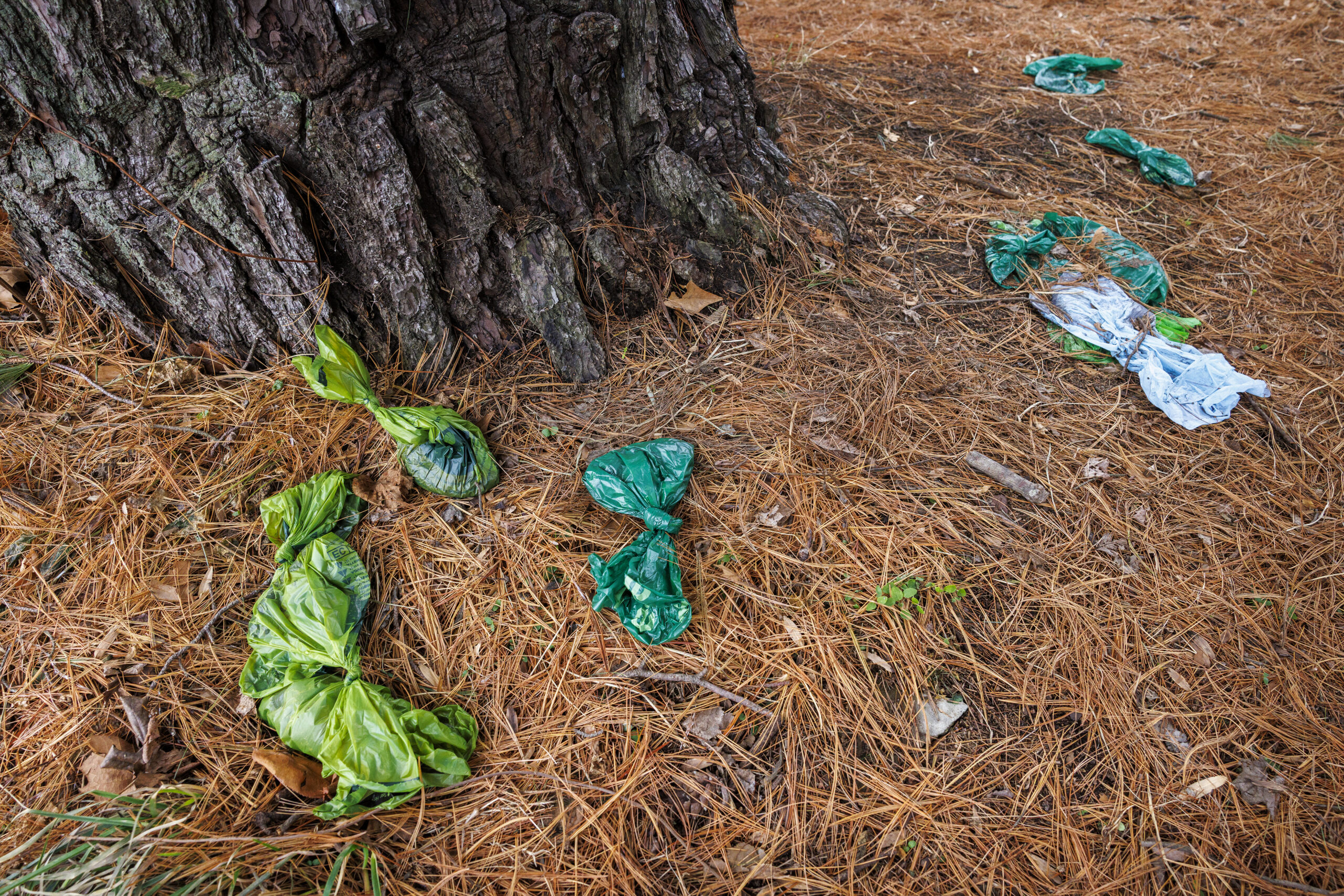
Picture of dog waste discarded on the grounds of Mount Moriah Cemetery on Wednesday, Jan. 14, 2026.
The cemetery is now open just two days a week, Saturdays and Sundays.
The costs of needed improvements are also significant. By Thursday, Friends of Mount Moriah had spent more than $20,000 of its roughly $90,000 annual budget to begin fencing construction and repairs, and secure the mausoleums and vaults that had been desecrated in the recent crimes. Additional donations, Schmehl said, will be needed to sustain the effort.
As recently as spring 2023, Mount Moriah Cemetery Preservation Corp. held more than $400,000 in its endowment, according to a letter filed in Philadelphia Orphans’ Court. Aubrey Powers,the receivership’s chair, did not respond to questions concerning the receivership’s contributions to the Friends of Mount Moriah or what the corporation will do to helpaddress security or infrastructure needs.
As a condition of the receivership, the corporation must file semiannual reports to the court. A year ago, the only reference to security was a brief note stating that the receivership “continues to encourage the Philadelphia and Yeadon Police Departments to schedule patrols in and around Mount Moriah Cemetery more frequently to deter criminal activity.”
Hepkins said increased patrols would be part of a broader strategyto reduce criminal activity and restore oversight to the cemetery. Meanwhile, a spokesperson for the Philadelphia Police Department said officers patrol the cemetery’s perimeter, not its grounds.
“There has to be some sort of intervention in order to rectify what’s happened at Mount Moriah,” Abernathy said. “And I just don’t know who’s going to provide that intervention.”
Whose remains are missing?
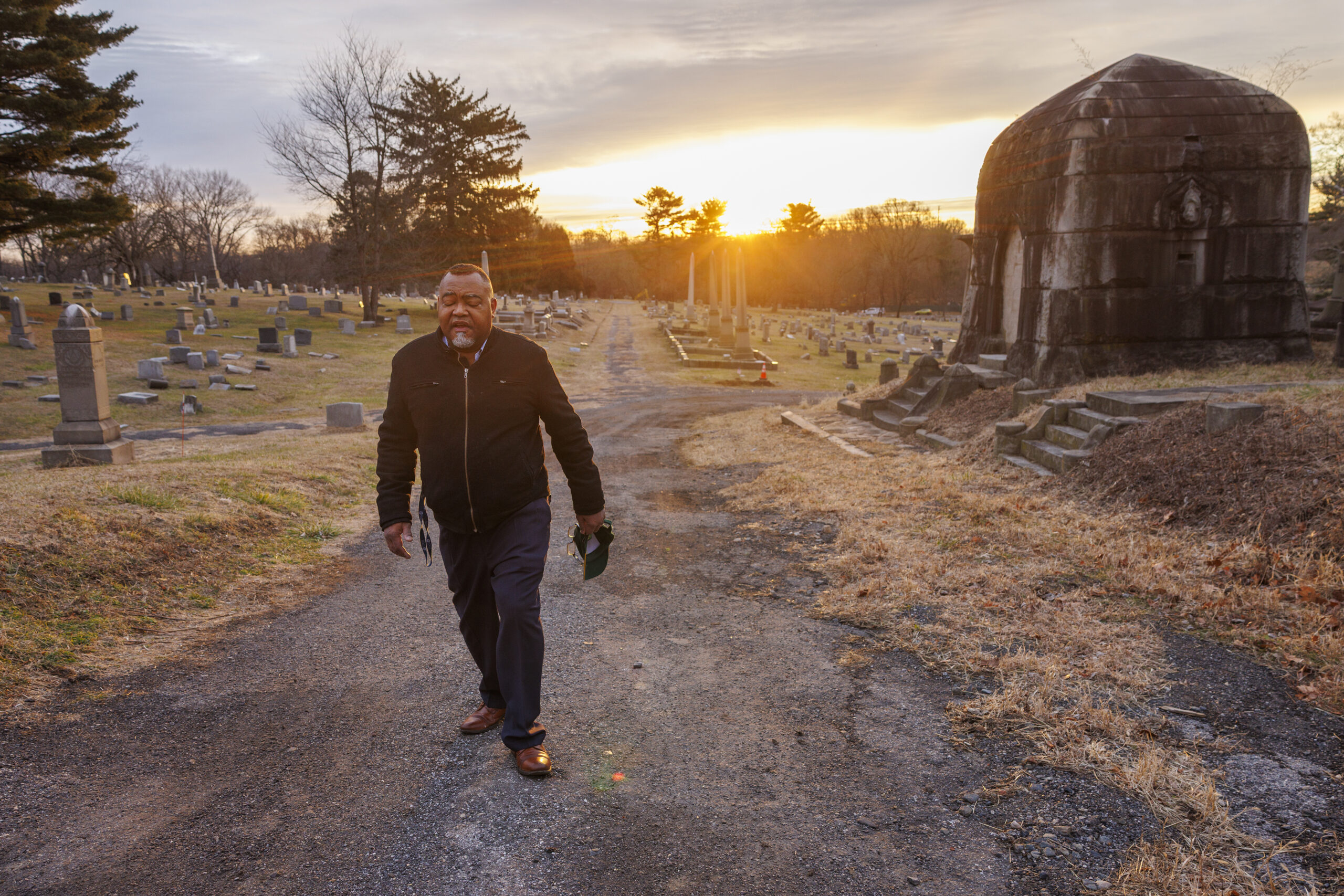
Hepkins on Wednesday climbed a steep hill from a small parking lot off Cobbs Creek Parkway to a cluster of mausoleums that Gerlach is accused of breaking into.
Yeadon Mayor Rohan Hepkins during a walking tour of Mount Moriah Cemetery, Wednesday, Jan. 14, 2026. Graves at the cemetery were allegedly robbed by Jonathan Christian Gerlach.
At the family mausoleum of John Hunter, a former president of the Mount Moriah Cemetery Association, authorities allege Gerlach smashed through a sealed cinder-block doorway and shattered the marble floor. He then rappelled 10 feet into the crypt and removed the remains of 15-year-old Martha Hunter, who died in 1869.
He left behind a length of white rope and a screwdriver, authorities said.
Just feet away, in the mausoleum of wholesale grocer Jonathan Prichard, Gerlach pulled cinder block from a sealed window and rifled through five of nine caskets inside, investigators allege. The remains of 62-year-old Mary Prichard Steigleman, Prichard’s daughter, are now missing.
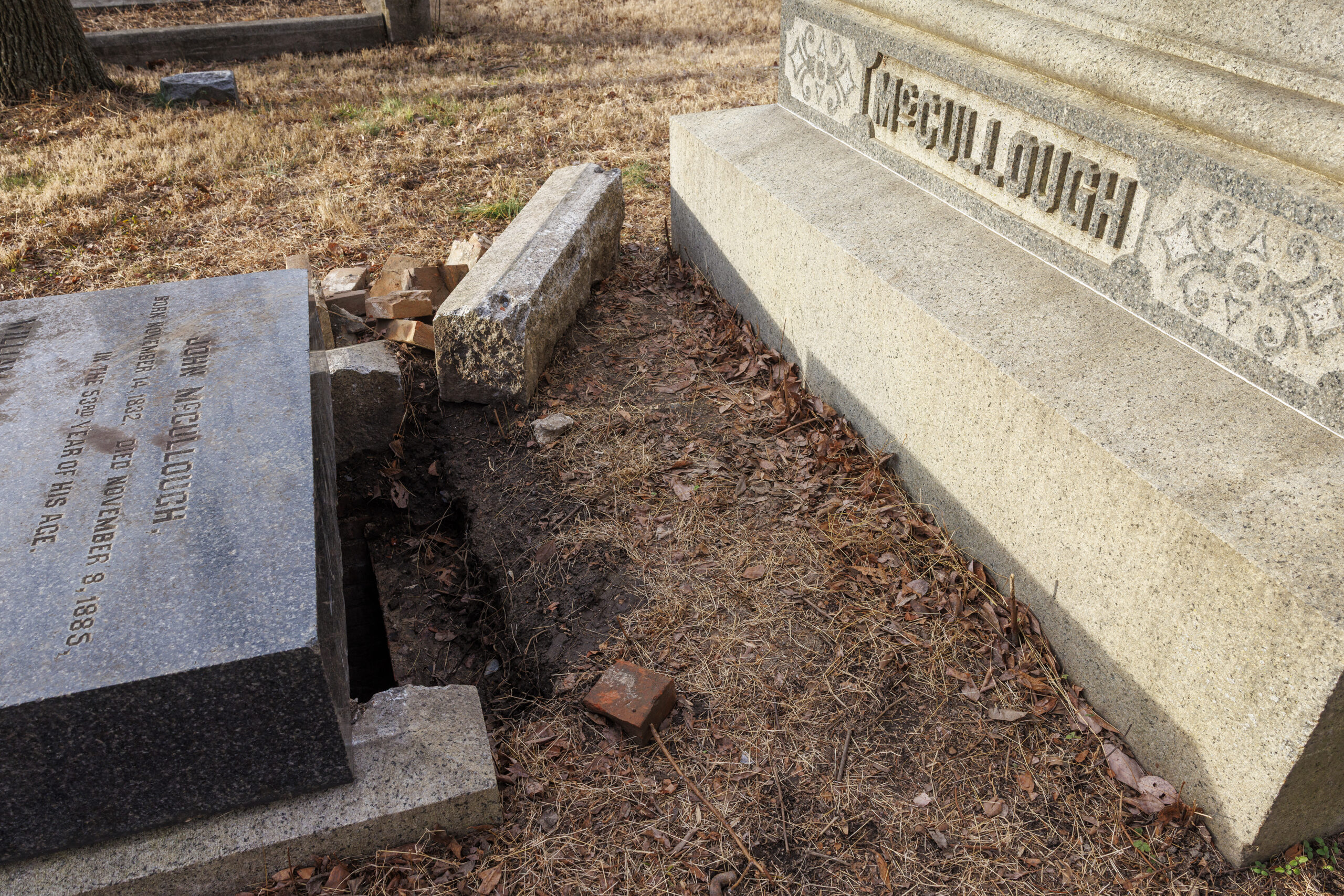
Nearby is the family vault of John McCullough, a Shakespearean actor who died in 1889. Beneath a towering monument etched with a line from Julius Caesar, authorities said they found two caskets disturbed, one tipped onto its side. Both were empty.
More than a week after Gerlach’s alleged break-in, bricks torn from the vault’s seal lay piled beside the entrance, and a foot-long hole exposed the floor below. Inside, wooden pallets that investigators believe Gerlach used to climb down cluttered the crypt.
The McCullough family burial tomb at Mount Moriah Cemetery, Wednesday, Jan. 14, 2026. This and several other graves at this cemetery were allegedly broken into by Jonathan Christian Gerlach.
A short walk away is the cemetery’s naval plot, where rows of identical white headstones mark the graves of more than 2,000 Navy officers. It’s Hepkins’ favorite part of the cemetery, he said.
Hepkins once hoped to be buried at Mount Moriah, a place he called “godly.” Now, he said, “I have to reconsider. I want my bones held somewhere in sacred perpetuity.”
In the most-watched race for Congress in Philadelphia in more than a decade, State Rep. Chris Rabb has cast himself as the unabashed anti-establishment leftist. He’s refusing donations from corporations, calls the war in Gaza a genocide, and wants to abolish U.S. Immigration and Customs Enforcement.
But despite announcing his campaign more than six months ago, he had yet to amass support from much of the city’s progressive flank, leading observers to wonder if he would be able to tap into the movement’s network of donors and volunteers.
It appears they’re coming around.
Rabb this week has won an endorsement from One PA, a progressive political group that’s aligned with labor and most of the city’s left-leaning elected officials. That comes after the environmental justice group Sunrise Movement said it, too, would back Rabb.
“This is a moment when democracy is at stake,” said Steve Paul, One PA’s executive director. “If there was any moment for the style of leadership that Chris [Rabb] brings to the table, it’s this moment.”
Rabb said he’s “energized” by the endorsement and what it means for the campaign.
“Our movement is growing every single day,” he said.
The questions now are whether some of the city’s most prominent progressive elected officials will lend their endorsements to Rabb, and if deep-pocketed national organizations will spend money to back him.
For example, Justice Democrats, a progressive political action committee, said it’s “very closely looking at this district.” And the Working Families Party, the labor-aligned third party that supports progressives across the nation, has endorsed candidates in four other congressional races with competitive primaries — but not yet in Philadelphia’s. The group previously spent millions to boost candidates in the region.
The primary election — the marquee race in deep-blue Philadelphia — isn’t until May. But some on the left say the movement should have already coalesced around Rabb.
“We will probably regret it in the end, because this is a seat we should win,” said one leader of a progressive organization in the city who requested anonymity to speak freely about the political dynamic.
Rabb is seen as something of a lone operator with his own political apparatus. He didn’t come up through the newer progressive organizations that have run their own candidates for office in the city. Rather, he won a seat in the state House for the first time a decade ago when he toppled an establishment-backed Democrat.
State Rep. Chris Rabb at a forum hosted by the 9th Ward Democratic Committee on Dec. 4, 2025. He is a Democratic candidate running to represent Philadelphia’s Third Congressional District.
Some of the city’s progressive leaders say they expect to back Rabb but that they were waiting to see how the field shaped up.
Last year, there were efforts to recruit other left-leaning candidates to run, including City Councilmember Kendra Brooks of the Working Families Party, and State Rep. Rick Krajewski, according to three sources with knowledge of the efforts who spoke on condition of anonymity to preserve relationships. Both decided against running.
Brooks — who emerged as a face of the Working Families Party six years ago after she became the first third-party candidate to win a seat on Council in 100 years — is likely to back whomever the organization endorses. The group is still in the midst of its endorsement process.
“We’re confident that we will land on a progressive who will fight for working people, not billionaire donors, big corporations, or special interests,” WFP spokesperson Nick Gavio said.
Krajewski, who represents parts of West Philadelphia, has also not endorsed a candidate but he said he will. Rabb, according to Krajewski, has the qualities necessary to be a member of Congress during “a pivotal moment for our country.”
“The question is: Do we allow the fascists and the ruling class to double down on this insanity that they’re pushing? Or do we use this opportunity to agitate and say a different world is possible?” Krajewski said. “That’s what I want from my member of Congress. Chris [Rabb] has demonstrated that he’s clear about that.”
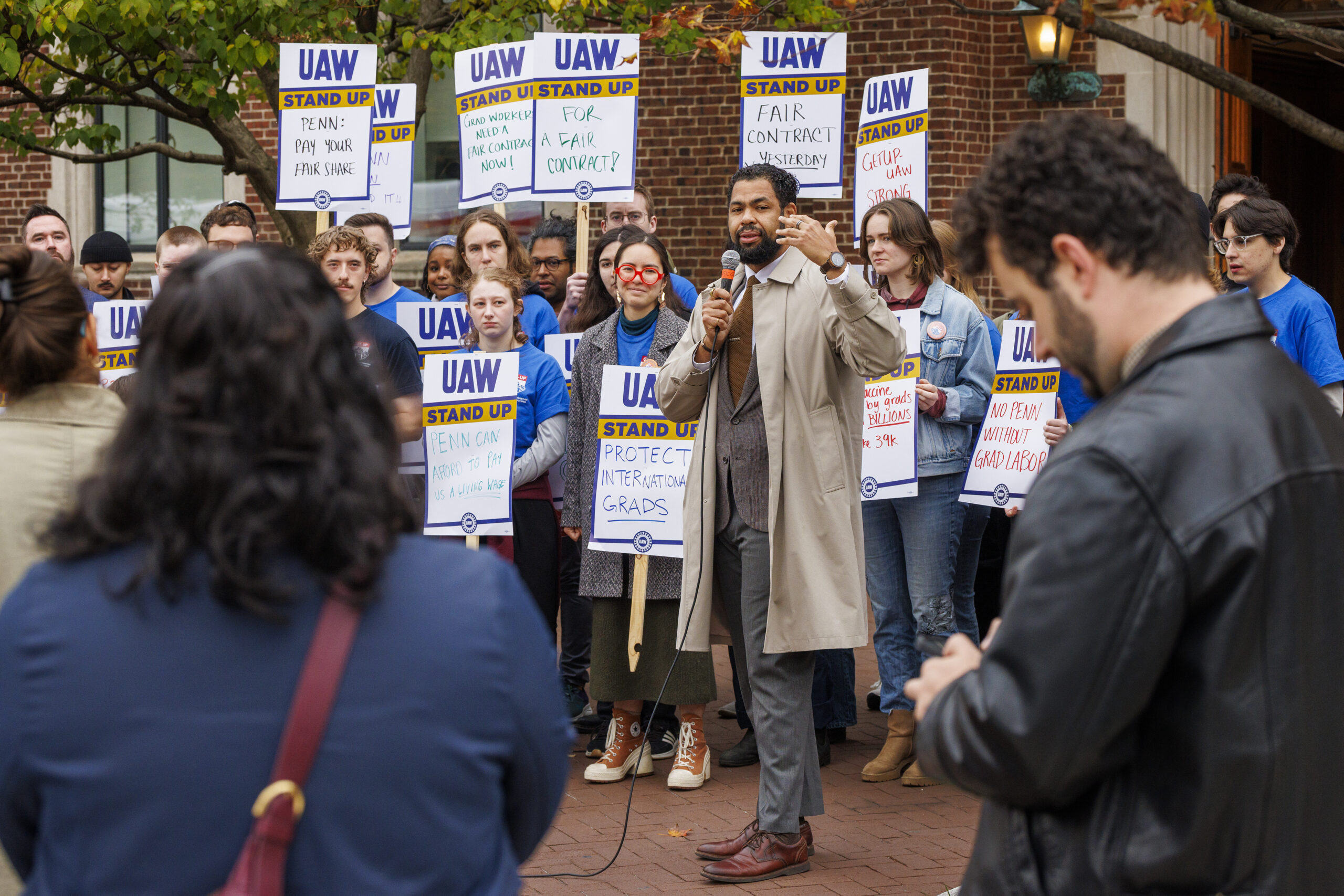
Pennsylvania State Rep. Rick Krajewski making statements at a news conference and rally by University of Pennsylvania graduate students. Grad students held the event to call for a strike vote against the university at corner of South 34th and Walnut Streets on Nov. 3, 2025.
Meanwhile, other candidates in the wide-open Democratic primary have tried to pick off progressive support.
State Sen. Sharif Street, the former chair of the state Democratic Party, is seen as the establishment’s pick for the seat. But he also has alliances with some of the city’s most progressive leaders.
That includes a decades-long relationship with Councilmember Rue Landau, who often votes with Council’s progressive bloc and is the first openly LGBTQ person ever elected to Council. Two sources familiar with Landau’s thinking said she is strongly considering endorsing Street.
Street has also worked closely on criminal justice reform matters with District Attorney Larry Krasner, perhaps the city’s most prominent elected progressive. He inherited some of Krasner’s political staff to manage his campaign.
However, several other candidates in the congressional race could be in the running for backing from Krasner, who recently won his third term in office in landslide fashion. Rabb, Street, and State Rep. Morgan Cephas previously endorsed Krasner for reelection.
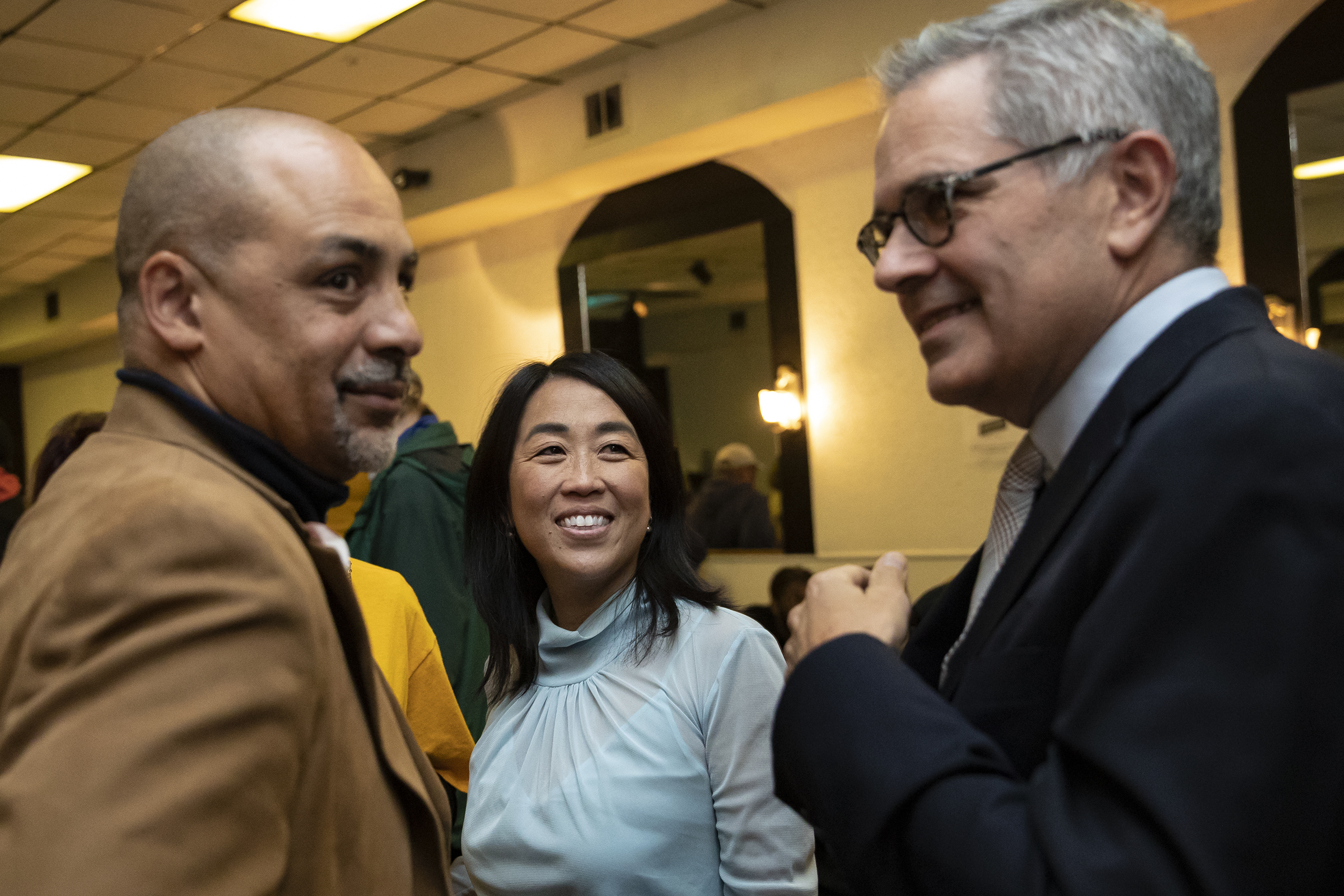
State Rep. Chris Rabb (left), Helen Gym (center), and District Attorney Larry Krasner attend the election results watch party for Working Families Party candidates Kendra Brooks and Nicolas O’Rourke in North Philadelphia on Nov. 5, 2019.
The crowded field may also mean that some elected officials choose not to get involved.
State Rep. Tarik Khan, a Democrat and nurse practitioner who has been backed by progressive organizations, said he has relationships with several leading candidates. That includes his colleagues in Harrisburg, as well as Ala Stanford, a surgeon. She and Khan were both prominent vaccine advocates during the COVID-19 pandemic.
“There’s a lot of good choices in this race,” Khan said. “I’m probably just going to let the process play out.”
PASSHE includes the 10 state-owned public universities. (State-related universities, including Pennsylvania State and Temple, are funded separately.)
Cheyney University, which is part of the system, got a special $5 million earmark “to develop and implement an enhanced transfer and workforce development initiative in partnership with a community college.” Cheyney, a historically Black college in Delaware and Chester Counties, and Community College of Philadelphia recently announced a partnership that will allow students to transfer seamlessly from CCP to Cheyney and earn bachelor’s degrees while remaining on CCP’s Philadelphia campus.
The state system had asked the state for a 6.5% increase in its general appropriation, which currently stands at $625 million. That would have brought in an additional $40 million for the 10-university system, said Christopher Fiorentino, chancellor of the system.
But he said the system has been preparing for the possibility of a funding freeze and had increased tuition this year for the first time in seven years, raising an additional $25 million.
“We knew it was going to be difficult, given the revenue situation in the commonwealth,” he said. “We weren’t blindsided by this.”
He said he was grateful for the system’s appropriation.
“That’s a huge amount of money,” he said. “… It is a significant commitment to public higher education, and we really appreciate that support.”
The system has requested a 5% state funding increase for 2026-27, which would allow universities to freeze tuition again, Fiorentino said.
But Kenneth M. Mash, president of the Association of Pennsylvania State College and University Faculties, the faculty union, said that would not be enough if tuition is to be frozen. And he has concerns about the freeze in state funding this year.
“Too often, we go in there and act as if this is what we need to maintain the status quo, but the status quo is not good,” he said, citing technology and program needs. “We don’t have the support for students that we should have. We need to start paying attention to the quality of education and make sure it doesn’t suffer.”
The system has been in a state of readjustment as it has lost about a third of its enrollment since 2010, including merging six of its universities into two entities. The system’s universities are: Cheyney, Commonwealth, East Stroudsburg, Indiana, Kutztown, Millersville, Penn West, Shippensburg, Slippery Rock, and West Chester.
Planning for a drop in enrollment
Another enrollment cliff is expected to begin this year as the population of high school graduates begins to drop.
“The demographics right now going forward are unfavorable, so we have to continue to be prepared for the fact that even if we maintain our market share, we’re going to see declines in enrollment,” Fiorentino said.
The system is attempting to recruit in new markets and bring back to college those who have some credits but no degree, he said. Older students may want more weekend, night, and online courses, and that is something the system is reviewing, too, he said.
The system also is contemplating partnering with area doctoral institutions, such as Temple, to bring in doctoral students to teach at the system’s universities. That would save money on faculty hiring, while cultivating new potential talent for the system, he said.
And the system is reevaluating its programs, he said. Ninety-five percent of students are graduating from half the programs the system offers, he said. Some of the larger enrollments are in business, education, health, and engineering, he said.
But only 5% of students are enrolled in the other half of the system’s programs.
“We have to take a look at that,” he said. “How do we redeploy the money that we currently are receiving to make sure that we’re supporting the programs that are critical to the success of the commonwealth?”
Mash, the union president, said that bringing in doctoral students would createa viable stream of quality candidates, and that, under the contract, the system is permitted to employ a certain number of adjuncts. But he is concerned about eliminating programs with lower enrollments.
“We should be providing as broad of a spectrum of opportunity for students as we can,” he said.
Fiorentino said he was pleased to see Cheyney get the additional funding. The school, which has struggled with enrollment, saw an increase of 234 students — nearly 38% — this year, the highest percentage increase of any school in the system. Cheyney enrolls 851 students this year, its highest enrollment since 2014.
The new effort will allow Philadelphia students to get a Cheyney degree without having to travel to the rural campus, he said.
“A lot of their market is Philadelphia,” Fiorentino said of Cheyney, “and for a lot of the Philadelphia students, transportation has become more and more difficult.”
Temple and Penn State were flat-funded again this year. Temple said in a statement that it was grateful to see the budget pass.
“We also continue to be deeply grateful for the ongoing financial support that the university receives to reduce tuition costs for Pennsylvania residents,” the school said.
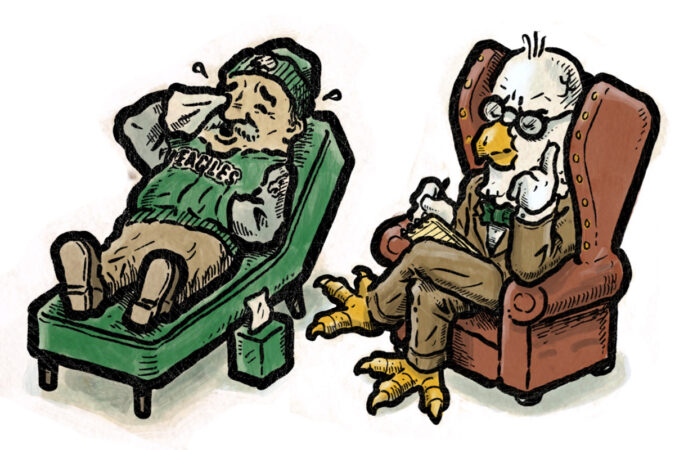
For Eagles fans, the end came suddenly, even if the signs were there all along. That doesn’t make the loss any easier to handle. Now that it’s all over, perhaps you’re confused and consumed by strong, unexpected emotions.
story continues after advertisement
The doctor is in
Pull up a chair. Here is a guide to identifying the five stages of grief for Eagles fans.
Denial
The first reaction to loss is denial — “How many times are they going to keep running four verticals against a quarters defense??” Your refusal to accept reality could be a psychological defense mechanism to avoid intense emotional pain, but football is a painful sport.
Anger
Anger is the birthright of a true Philadelphia sports fan. Just remember that venting your anger on other people (or homes of Eagles’ coaches) is off-limits. Whether to take out your frustrations on your TV is up to you, your significant other, and your budget.
Bargaining
If you find yourself saying something like “I’d give up my first-born child for another Super Bowl win,” perhaps amend the proposition to substitute a relative of lesser importance.
Depression
If the Eagles losing a playoff game has made you mournful and sullen, giving you feelings of emptiness and hopelessness, then welcome to life as a Philadelphia sports fan.
Acceptance
After cycling through the other stages of grief, you’ll come to this conclusion: Two Super Bowl wins in the last nine seasons is not too shabby.
story continues after advertisement
Of course, once you arrive at acceptance and you’re ready to move on to next season, we’ve got plenty of Eagles content to get you ready for the offseason.
Staff Contributors
Design: Steve Madden
Reporting: John Duchneskie
Digital Editing: Matt Mullin
Copy Editing: Tony Moss
(()=>{var R=(e,t)=>()=>(t||e((t={exports:{}}).exports,t),t.exports);var M=R(s=>{var G={0:”Jan.”,1:”Feb.”,2:”March”,3:”April”,4:”May”,5:”June”,6:”July”,7:”Aug.”,8:”Sept.”,9:”Oct.”,10:”Nov.”,11:”Dec.”};function y(e){return e===void 0&&(e=new Date),G[e.getMonth()]}var W={0:”Jan”,1:”Feb”,2:”Mar”,3:”Apr”,4:”May”,5:”Jun”,6:”Jul”,7:”Aug”,8:”Sep”,9:”Oct”,10:”Nov”,11:”Dec”};function S(e){return e===void 0&&(e=new Date),W[e.getMonth()]}function r(e){return e==null}function x(e){return typeof e==”number”&&isFinite(e)}function u(e){return x(e)&&Math.floor(e)===e}var Y=[“one”,”two”,”three”,”four”,”five”,”six”,”seven”,”eight”,”nine”],U=[“million”,”billion”,”trillion”,”quadrillion”,”quintillion”,”sextillion”,”septillion”,”octillion”,”nonillion”,”decillion”],b=[“th”,”st”,”nd”,”rd”,”th”,”th”,”th”,”th”,”th”,”th”],_=[11,12,13];function L(e){if(r(e))return””;var t=+e;return u(t)?_.indexOf(t%100)>-1?b[0]:b[t%10]:””}var Z=[“first”,”second”,”third”,”fourth”,”fifth”,”sixth”,”seventh”,”eighth”,”ninth”],K=new RegExp(/s+([^s]*)s*$/);s.apdate=function(e){return e===void 0&&(e=new Date),y(e)+” “+e.getDate()+”, “+e.getFullYear()},s.apdatetab=function(e){return e===void 0&&(e=new Date),S(e)+” “+e.getDate()+”, “+e.getFullYear()},s.apmonth=y,s.apmonthtab=S,s.apnumber=function(e){if(r(e))return””;var t=+e;return u(t)?t=10?e.toString():Y[t-1]:e.toString()},s.aptime=function(e){e===void 0&&(e=new Date);var t,n,o=e.getHours(),i=e.getMinutes(),a=i===0;if(a){if(o===0)return”midnight”;if(o===12)return”noon”}return o0?o:12):(t=”p.m.”,n=o===12?o:o-12),a?n+” “+t:n+”:”+(i<10?"0"+i:i)+" "+t},s.capfirst=function(e){if(r(e))return"";var t=String(e);return""+t.charAt(0).toUpperCase()+t.slice(1)},s.intcomma=function(e){if(r(e))return"";var t,n=+e;return x(n)?((t=n.toString().split("."))[0]=t[0].replace(/B(?=(d{3})+(?!d))/g,","),t.join(".")):e.toString()},s.intword=function(e){if(r(e))return"";var t=+e;if(!u(t))return e.toString();var n=Math.abs(t);if(n<1e6)return e.toString();var o=Math.ceil(Math.log(n+1)/Math.LN10)-1,i=o-o%3,a=t/Math.pow(10,i);return(a=Math.round(10*a)/10)+" "+U[Math.floor(i/3)-2]},s.ordinal=function(e,t){if(t===void 0&&(t=!1),r(e))return"";var n=+e;return u(n)?t&&n{n||(n=document.querySelector(“head”));let o=document.createElement(“script”);o.type=”text/javascript”,o.src=e,t&&(o.onload=t),n.appendChild(o)},A=()=>(window.PMNdataLayer?.[0]!==void 0&&window.PMNdataLayer[0])?.analytics?.user?.state===”Subscribed”,T=()=>{let t=(window.PMNdataLayer?.[0]!==void 0&&window.PMNdataLayer[0])?.analytics?.user?.state;return window.location.host.includes(“zzz-systest”)||window.location.host.includes(“pmn.arcpublishing.com”)||window.location.host.includes(“stage.fusion.inquirer.com”)||typeof t>”u”},q=()=>{let t=(window.PMNdataLayer?.[0]!==void 0&&window.PMNdataLayer[0])?.analytics?.user?.hasAdsFreeReading;return!!(t&&t==1)},m=()=>window.location.host.includes(“localhost”);var Q=()=>{q()&&document.querySelectorAll(“.js-adbox”).forEach(t=>{t.classList.add(“is-hidden”)})},k={init:()=>{Q()}};var c,E,V=()=>{c=document.getElementById(“js-inno-toast”)},X=e=>{if(!c)return;c.innerHTML=e,c.classList.add(“is-active”);let t=()=>{c.addEventListener(“transitionend”,ee,{once:!0}),c.classList.remove(“is-active”)};clearTimeout(E),E=setTimeout(t,5e3)},ee=()=>{c.innerHTML=””},l={init:()=>{V()},showToast:X};var p,j=!1,te=async()=>new Promise(e=>{setTimeout(()=>{console.log(“simulating createShareLink for localhost”),e(“https://inquirer.com/interactives”),ne()},100)}),ne=()=>{let e=document.querySelector(“.js-gift-toast-receiver”);!e||!(e instanceof HTMLElement)||setTimeout(()=>{let t=e?.querySelector(“span”);t&&(t.innerHTML=”Gift link copied to clipboard“)},20)},oe=()=>{let e=window.services?.createShareLink;e&&(p=e),m()&&(p=te),p&&se()},ie=async e=>{let t=”text/plain”,n=async()=>{try{return await p(window.location.pathname)}catch{e.dataset.state=”error”,l.showToast(“Hmm, we couldn’t generate a gift link…”)}},o=new ClipboardItem({[t]:n()});await navigator.clipboard.write([o]).catch(i=>{console.log(i),l.showToast(“Couldn’t copy to clipboard, try again?”),e.dataset.state=”error”}),l.showToast(“Gift link copied to clipboard!”),e.dataset.state=”complete”},se=()=>{document.querySelectorAll(“.js-gift”).forEach(t=>{(A()||m()||T())&&t.classList.add(“is-available”)}),document.querySelectorAll(“.js-gift-button”).forEach(t=>{t instanceof HTMLButtonElement&&t.addEventListener(“click”,()=>{t.classList.contains(“disabled”)||(t.dataset.state=”loading”,j=!0,ie(t),setTimeout(()=>{t.dataset.state=”ready”},2e3))})});let e=document.querySelector(“.js-gift-toast-receiver”);!e||!(e instanceof HTMLElement)||re(e)},re=e=>{new MutationObserver(n=>{for(let o of n){let i=[…o.addedNodes].at(0);if(!(i instanceof HTMLElement))return;j&&l.showToast(i.outerHTML)}}).observe(e,{subtree:!0,childList:!0})},P={init:()=>{oe()}};var ae=()=>{window.addEventListener(“message”,e=>{if(e.data[“datawrapper-height”]){let t=e.data[“datawrapper-height”];for(let n in t)document.querySelector(`#datawrapper-chart-${n}`).setAttribute(“height”,t[n])}})},ce=()=>{document.querySelectorAll(“.js-datawrapper-graphic”).forEach(e=>{h(`https://datawrapper.dwcdn.net/${e.dataset.id}/embed.js`,null,e)})},le=()=>{window.addEventListener(“message”,e=>{let t=e.data;document.querySelectorAll(`iframe[src*=”${t.id}”]`).forEach(o=>{o.style.height=`${t.height}px`})},!1)},de=()=>{document.querySelectorAll(“.js-pym-graphic”).forEach(e=>{if(typeof window{new window.pym.Parent(e.id,e.dataset.iframe)};typeof window.pym>”u”?h(“https://pym.nprapps.org/pym.v1.min.js”,t):t()}})},D={init:()=>{ae(),ce(),de(),le()}};var d,ue=()=>{document.querySelectorAll(“.js-hover”).forEach(e=>{e.addEventListener(“click”,()=>{C(e)}),e.addEventListener(“mouseenter”,()=>{C(e)}),e.addEventListener(“mouseout”,()=>{I(e)})}),window.addEventListener(“scroll”,()=>{d!==null&&pe()})},pe=()=>{(d>window.scrollY+100||d{I(e)})},C=e=>{e.classList.add(“is-visible”),d=window.scrollY},I=e=>{e.classList.remove(“is-visible”),d=null},N={init:()=>{ue()}};var f,fe=(e,t)=>{f=f||window.PMNdataLayer,f?f.push({event:”misc_event”,eventAction:e,eventLabel:t}):window.location.hostname.includes(“localhost”)?console.log(“Analytics event:”,e,t,”(not actually being sent due to localhost)”):console.log(“Failed to push analytics event”,e,t)},H={event:(e,t)=>{fe(e,t)}};var $=1,v=class{constructor(t){this.el=t,this.contentPosition=”default”,this.possibleSteps=new Array,this.currentStep=null,this.offset=window.innerHeight*.9,this.instanceOfSteps=$,$++,this.setPossibleSteps(),this.updateContent(),this.bindings()}setPossibleSteps(){this.el.querySelectorAll(“.js-steps-step”).forEach(t=>{t.dataset.step&&this.possibleSteps.push(t.dataset.step)})}bindings(){window.addEventListener(“scroll”,()=>{this.updateContent()}),window.addEventListener(“resize”,()=>{this.updateContent()})}updateContent(){this.updateCurrentStep()}updateCurrentStep(){let t;if(this.el.querySelectorAll(“.js-steps-step”).forEach((o,i)=>{o.getBoundingClientRect().top{let w=”is-“+i,g=”is-“+a;this.possibleSteps.indexOf(i){document.querySelectorAll(“.js-steps”).forEach(e=>{new v(e)})}};var he=()=>{},O={init:()=>{he()}};var B={init:()=>{k.init?.(),P.init?.(),D.init?.(),N.init?.(),F.init?.(),O.init?.(),l.init?.()}};var me=()=>{},z={init:()=>{me()}};var ve=document.querySelector(“.js-inno”),J=()=>{B.init(),z.init()};ve?J():new MutationObserver((t,n)=>{if(document.querySelector(“.js-inno”)){n.disconnect(),J();return}}).observe(document,{attributes:!0,childList:!0,subtree:!0});})();