Tag: Weekend Reads

  • More people in Philly and region struggle with insufficient food after Trump cuts: ‘Hunger has never been higher’

    More people in Philly and region struggle with insufficient food after Trump cuts: ‘Hunger has never been higher’

    Shelly Gaither, 51, of Cheltenham, makes sure her three sons, ages 6, 9, and 18, get their meals while she manages with whatever is left over — if anything ever is.

    “Oh, my God, groceries are too expensive,” said Gaither, a former data analyst who suffers from a disability that makes working difficult. She visits a food pantry regularly to make sure her kids eat chicken when they can. Her monthly SNAP (Supplemental Nutrition Assistance Program) benefits were reduced from $400 to $200 earlier this year because of changes to the program under President Donald Trump’s One Big Beautiful Bill Act.

    “I don’t think there’s hope,” she said. “I feel guilty for bringing children into a world that doesn’t want them to exist because the government makes cuts that take away their food and their healthcare.”

    For people like Gaither throughout the United States, levels of food insecurity have seen a “remarkable” rise since the pandemic in 2020, according to a national survey taken earlier this year and released in late May by the Federal Reserve Bank of New York.

    Around 10% of 1,300 heads of households polled in February reported a lack of enough food and said their children were missing meals, according to the survey. Nearly 16% relied on food donations. Among families taking in less than $50,000 a year, almost 20% reported being forced to skip meals or go without.

    In 2020, when the federal government stepped in to help families at the height of the pandemic, just 4% of households reported missing meals, including less than 7% of families earning less than $50,000 a year, according to the survey.

    At that time, temporary supplemental unemployment benefits, expanded SNAP payments, and direct government relief payments helped stave off hunger among Americans. Food insecurity increased after COVID-19 relief expired, according to the Urban Institute.

    But the recent surge in hunger has also been attributed to the sweeping law Trump signed last year, which reduces SNAP benefits and other safety net programs to help pay for his tax cut.

    Findings in the bank’s report also reflect Gaither’s sense of despair, a pessimism about personal finances and the overall economy among people with low incomes. That same group exhibits diminished expectations for finding a job and declining levels of consumer confidence, the survey says.

    (function(){function e(){window.addEventListener(`message`,function(e){if(e.data[`datawrapper-height`]!==void 0){var t=document.querySelectorAll(`iframe`);for(var n in e.data[`datawrapper-height`])for(var r=0,i;i=t[r];r++)if(i.contentWindow===e.source){var a=e.data[`datawrapper-height`][n]+`px`;i.style.height=a}}})}e()})();

    According to the reserve bank’s report, non-white Americans have been especially hard hit. The number of such households that reported missing meals increased from 4% in 2020 to 19% in February. At the same time, the number of non-white people receiving SNAP benefits jumped from 14% to more than 26%.

    Overall, the survey found food insecurity was particularly acute among lower-educated and lower-income households, as well as households with young children. Many families are experiencing financial stress due to the high cost of living, persistent inflation, and high interest rates, even as the stock market has been steadily rising, according to the survey.

    Pantries struggle to keep up with demand

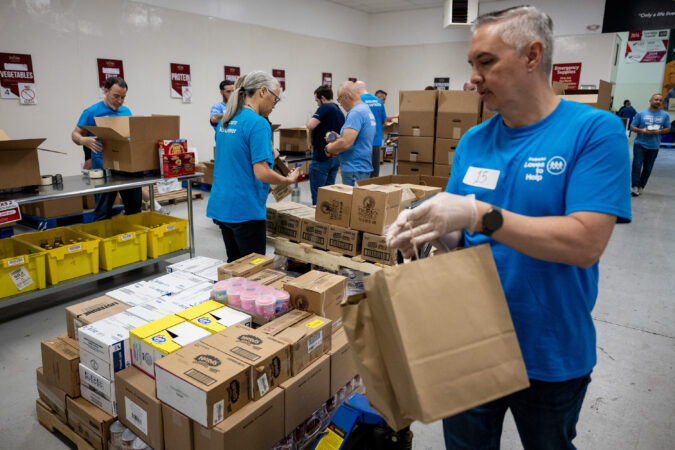
    More people are flocking to food pantries, but they are not equipped to take up the slack of reduced SNAP benefits.

    “Pantries across the state are in perpetual crisis mode,” said Stuart Haniff, CEO of Hunger-Free Pennsylvania in Pittsburgh. Add to that the advent of summer, when kids are no longer receiving free breakfast and lunch at school. “Families must now provide those 60 to 80 meals a month,” Haniff said.

    In Norristown, “immense need” has increased the number of people frequenting Martha’s Choice Marketplace, the largest food pantry in Montgomery County, by 100% since 2022, said Patrick Walsh, director of programs. “And I don’t expect things to get better.”

    Food prices are also up 3.2% this spring over last, according to U.S. Department of Agriculture figures, exacerbating the issue.

    In South Jersey, “we are seeing record numbers at our food distributions,” said Jane Asselta, president and CEO of the Food Bank of South Jersey, in a statement to The Inquirer. “Life is getting harder to afford for more and more people.”
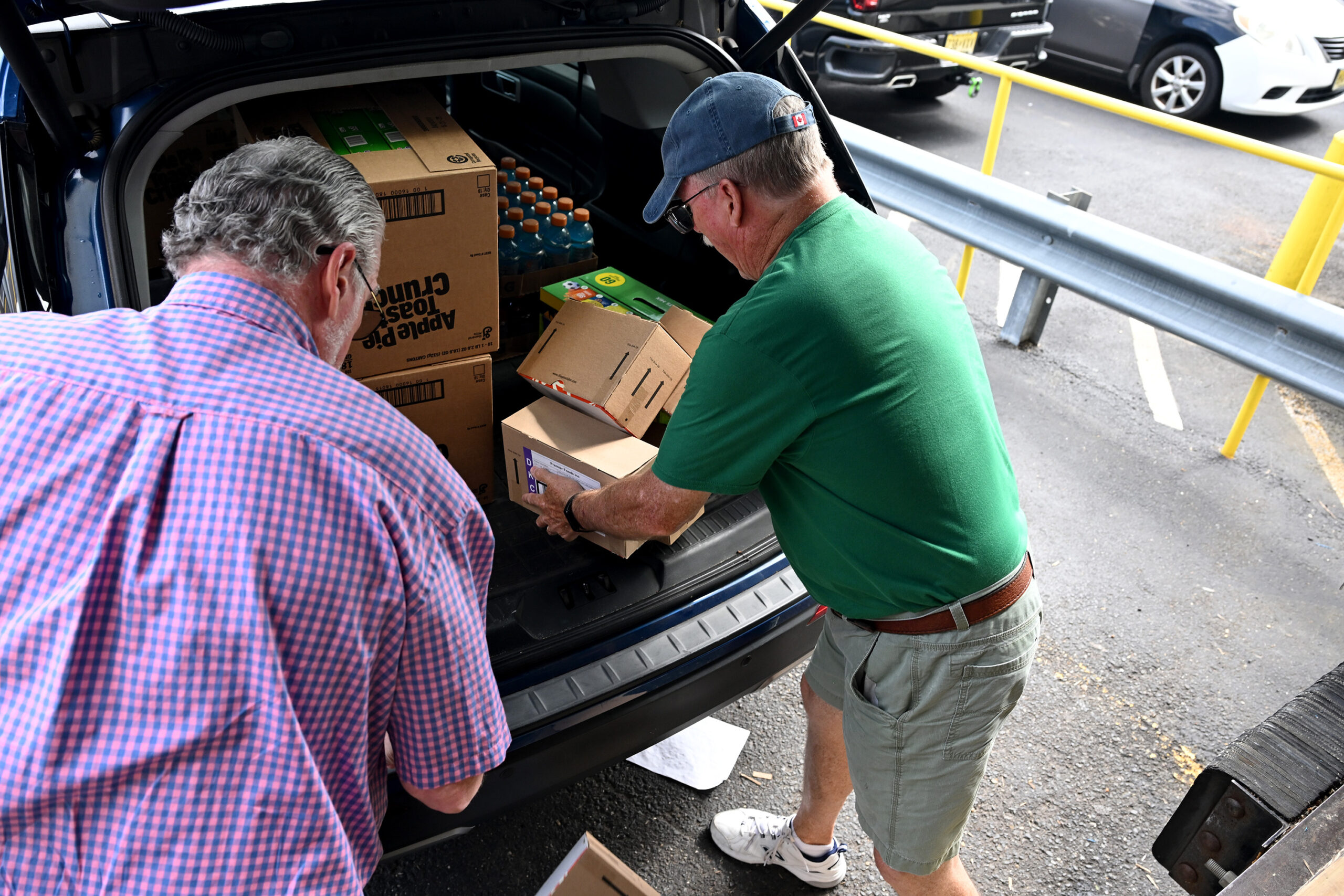
    Matt McDevitt (left) and Michael Hickey load their vehicle at the Food Bank of South Jersey Thursday, June 11, 2026. The men are volunteers at the Temple Lutheran Church in Pennsauken and their food bank is open from 5-6 p.m. every Thursday.

    Asselta said the Federal Reserve Bank’s report “mirrors” what her organization has observed through its network of 300 community partners.

    “Hunger has never been higher,” said Pastor Sonita Johnson, who runs the food pantry at St. John’s Pentecostal Outreach Church in Salem City, Salem County. “Food prices are high, and the lines you see you would not believe — a 50% increase in people just over the last two months.”

    Nationwide, between January 2025 and January 2026, SNAP rolls decreased by more than 4 million people — from 42 million to 38 million — according to USDA figures.

    Between last September and April of this year, nearly 90,000 Pennsylvanians lost SNAP benefits due to new eligibility requirements stipulated by the Trump administration, according to an analysis by the Pennsylvania Department of Human Services (DHS).

    And between December 2025 and last month, more than 32,000 Philadelphians lost benefits, DHS figures show.

    In New Jersey, SNAP participation has fallen by more than 50,000 individuals between March 2025 and March of this year, New Jersey Department of Human Services figures show.

    The Trump administration’s SNAP changes include an expansion of work requirements for people who receive SNAP benefits and increased documentation requirements “designed to make maintaining eligibility increasingly difficult,” according to the Food Research and Action Center (FRAC), the largest anti-hunger lobby in the United States.

    Deputy White House press secretary Anna Kelly said in a statement that Trump signed the changes to strengthen SNAP and to ensure that it is “sustainable for future generations.” She added that Trump was “elected to eliminate runaway spending across the federal government.”

    William Meo works on the loading dock at the Food Bank of South Jersey Thursday, June 11, 2026.

    For people like Shelley Gaither, how her reduced SNAP benefits could be seen as part of “runaway spending” is tough for her to figure, given her needs. To survive this precarious moment, Gaither said, she will do whatever she can.

    “We eat more vegetarian meals and I don’t buy my kids cookies or snacks,” she said. “If I drink enough coffee, maybe I just need one meal a day. This is our existence now. This is how we live.”
  • The only collaborative Keith Haring mural that still hangs in its original location is in Point Breeze. It could be your next home.

    The only collaborative Keith Haring mural that still hangs in its original location is in Point Breeze. It could be your next home.

    A Point Breeze rowhouse, now available for rent, offers residents a chance to live with a one-of-a-kind work of art — the only Keith Haring collaborative mural that is still intact and in its original location in the world.

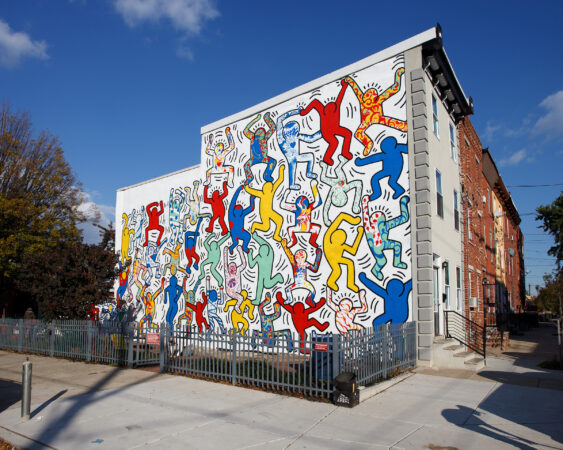
    The three-bedroom home at 2147 Ellsworth St. is adorned with the acclaimed street and pop artist’s We the Youth . The mural, painted on the building’s facade, has stood on the corner of 22nd and Ellsworth Streets for almost 40 years.

    “Keith believed that art was for everyone and that art should be accessible, so to have this mural still at this location for nearly 40 years is historically and culturally significant,” said Jane Golden, founder and executive director of Mural Arts Philadelphia.

    The mural features an array of Haring’s trademark dancing figures filled with bright colors and patterns. It also has a small garden next to it, affectionately called “Haring Park,” which has been tended by neighborhood residents since the 1980s.

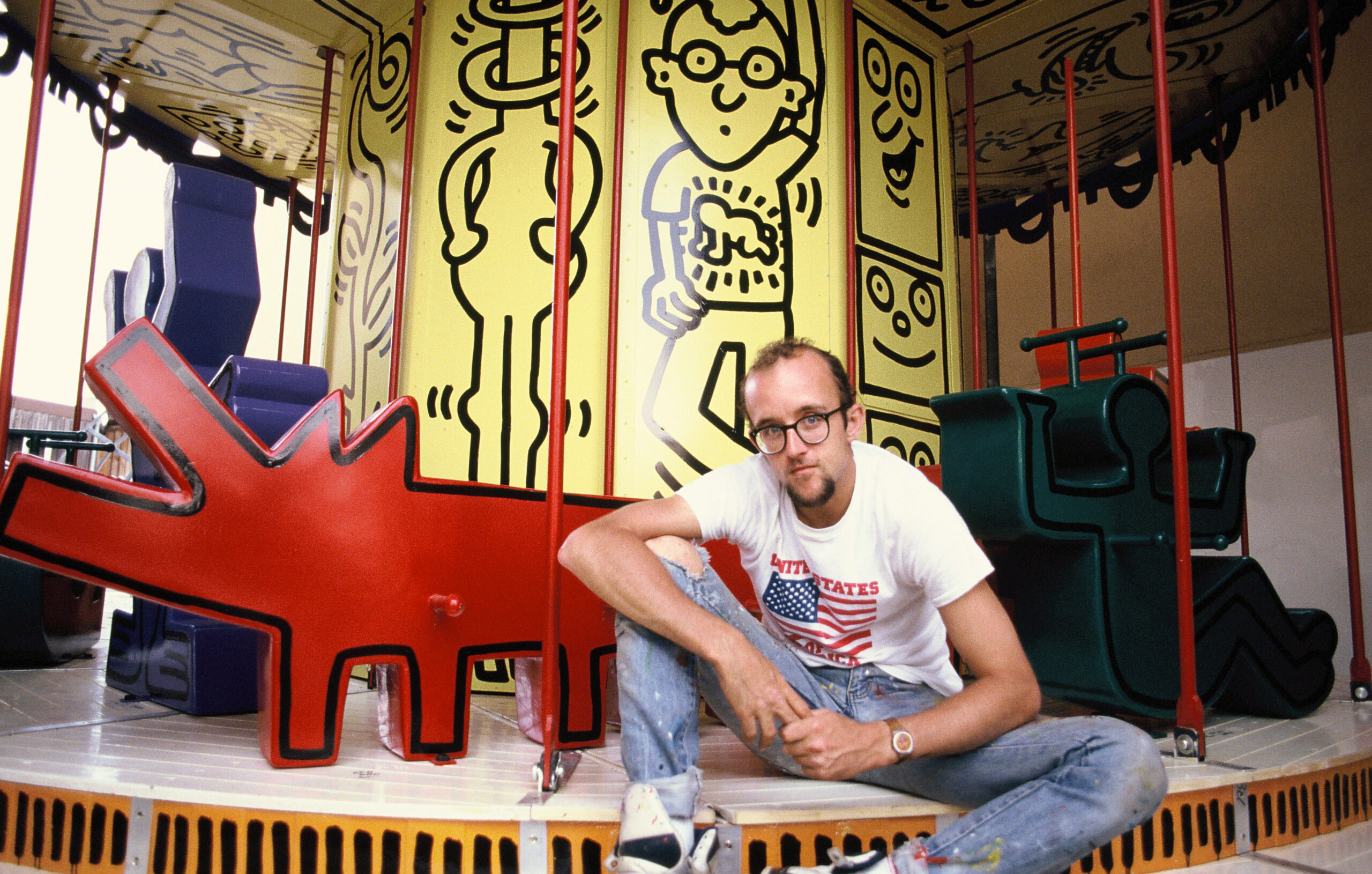
    Keith Haring, who died in 1990, with his painted carousel.

    Haring, who was born in Reading in 1958 and raised in Kutztown, drew the mural over a few days in September 1987, coinciding with the U.S. Constitution’s bicentennial. The title of the mural pays homage to the Constitution’s opening lines.

    Its location was important to Haring.

    He did not want the mural to be in a more upscale, trendy part of the city, one of the mural’s student collaborators, Rita Martello, told online art marketplace Artsy in 2022.

    “He wanted to put it in an actual urban neighborhood,” Martello said to Artsy.

    Invited by two nonprofits that worked with youth, CityKids NYC and Brandywine Workshop, Haring worked with 14 students. While some of the dancing figures are solid colored, others feature unique patterns and symbols, all contributed by the students.

    “Wherever [murals] are, they provide a foundation where change can begin,” said Golden. “They are a vehicle through which important stories are told, and they allow Philadelphia to maintain its status as a global leader in the arts and culture arena.”

    Presently about 1,000 murals are displayed on the sides of residential homes in Philadelphia through partnerships with Mural Arts.

    Erica Bryant mimics a figure from the Keith Haring mural on the Point Breeze house she and her husband own. It is the only mural Keith Haring made with community groups that is still intact.

    Haring, whose preferred medium was chalk, often created works that were not meant to be permanent. We the Youth too was not immune to decay over time.

    In 2013, after Erica and Lucas Bryant of St. Paul, Minn., bought the house, Mural Arts undertook a massive restoration of the piece, adding several layers of paint and a protective coating against the sun, entirely replacing damaged sections, and replacing the chain link fence.

    “Philly is very proud to have a Keith Haring mural and especially one embedded in the community that was done in such a collaborative manner,” said Golden.

    Haring, who started making chalk drawings in the New York subway, first wanted to paint We the Youth on a garbage truck but was refused by the Philadelphia Sanitation Department.

    He died in 1990, from AIDS-related complications at age 31.

    “You can be the only person in the world who lives in a Keith Haring art piece!” boasts the OCF Realty listing for the three-bedroom, 2 ½ bathroom apartment.

    The 1,797-square-foot, three-story rowhouse was renovated in 2020 and has a backyard patio and a roof deck. The property, managed by OCF Realty, rents for $3,295/month.

  • A complete guide to Cherry Hill’s newly improved H Mart

    A complete guide to Cherry Hill’s newly improved H Mart

    After nearly 25 years in operation, the newly renovated H Mart in Cherry Hill is drawing crowds as regulars and newcomers marvel at its major improvements.

    The outpost of the renowned Korean grocery store off Route 70 has served the local community since 2001. In April 2025, the Cherry Hill Township Planning Board approved plans for an expansion. A year later, the grocery store reopened with enhancements to the first floor and an open-concept food court, bakery, and retail space on the second.

    As a diehard H Mart fan, I decided to venture across the bridge on a recent Thursday and see the 39,000-square-foot store for myself.

    Customers shop inside H Mart Cherry Hill.

    Where to start your H Mart visit

    I arrived at the brick building, marked with the familiar “H Mart” sign in big red letters, at about 11 a.m. Entering through the double sliding doors of the second floor, I found myself inside the new food court.

    A few customers dined in the massive seating area that morning, enjoying various dishes. I decided to grab an iced brown sugar coffee boba from Tiger Sugar as a little treat to sip on during my exploration.

    Beginning the journey on the second floor was the right move, according to Ryan Solot, a regular shopper at H Mart. He and his wife, Miki Solot, came to the store once a week before renovations. The couple were shopping for dashi stock and Japanese sauces when I ran into them. They were happy to see the makeover, particularly on the second floor’s general shop department. But the Solots still felt the first-level aisles were a bit narrow for ideal grocery shopping.

    “The layout is strangely unchanged,” Ryan Solot said. “It’s still kind of awkward to get through the aisles … but start from the top [floor] and make your way down, it’s much more organized upstairs.”

    Korean beauty section at H Mart Cherry Hill.

    The second floor of H Mart: general goods, Korean beauty products, and an arcade

    Walking out of the food court area, I found a mini Korean beauty store with boxed shelving displaying creams, serums, cleansers, tonics, and other products from popular brands such as Medicube, Anua, and Beauty of Joseon. Attendants explained the various products to customers, especially to Korean skincare novices like myself.

    Neon arrow signs next to the beauty department directed me into H Mart’s general store and “H Pop” section. A small selection of drinks and snacks lined the shelves leading me into the rows of shelves with over-the-counter medicines, vitamins, toiletry items, slippers, bedding, and kitchenware.

    In the back corner I found a vast selection of cutesy notebooks, pens (ones with funky kiwi and toilet attachments), furry character key chains, mini toys, makeup storage containers, and other knickknacks. The prices for items were organized by serial numbers, which were listed on a card hanging off the shelves. Pro tip: Take a photo of that price card to reference as you shop.

    Customers shop inside H Mart Cherry Hill.

    The first floor of H Mart: frozen foods, fresh produce and seafood, snacks, and lots of instant noodles

    Taped to the elevator, two signs offered directions on where to find specific items. “Second floor: food court, house ware, characters, K-beauty, game, health food” and “First floor: Asian/Western, produce, fish, meat, ready to eat, banchan” were written in all caps and highlighted in yellow.

    The elevator also had another sign with an important tip for shoppers: “You are welcome to shop freely on both 1st and 2nd floor, and you may check out either floor.”

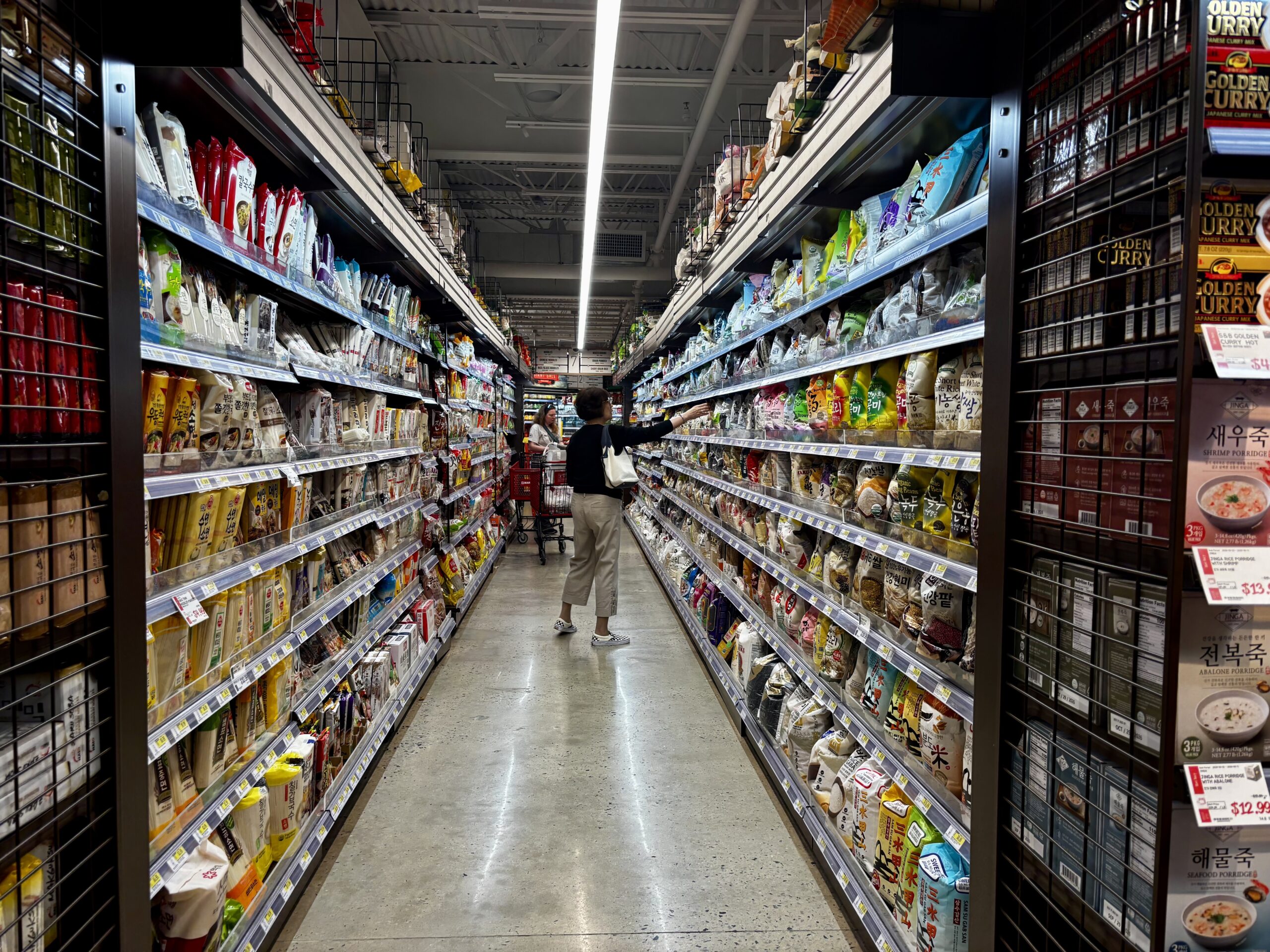
    Downstairs on the first level, the elevator opened up to aisles upon aisles of snacks, produce, sauces, packaged sweets, and lots of instant noodles. Each aisle is organized by number with a sign noting all the items available.

    Shrimp crackers at H Mart Cherry Hill.

    I walk into Aisle 3 as I exited the elevator and found snacks galore. KitKats, Pocky sticks, Buldak ramen-flavored chips, O’jelly real plum candies, lychee gummies, Poongnyun Bakery seaweed crackers, and so much more lined the shelves. I picked up some of my favorites: Shrimp crackers, crispy snacks made from starch and ground shrimp, and a bag of chocolate yogurt-covered orange slices sitting nearby.

    Next, I headed into Aisle 5 for beverages. The vast selection includes soy milk, hojicha, banana milk, corn silk tea, coconut milk and juice, and taro. I grabbed a tall can of Thai tea and a couple of glass bottles of Ramune, a fizzy, fruity, sweet Japanese soda.

    Thai tea at H Mart Cherry Hill.

    I stopped by Aisle 10 for chili oil and pho seasonings. And on Aisle 1, I found instant noodles plentiful — the Japanese-style soba noodle box piqued my interest. At the end of Aisle 9, I saw cups filled with ice in the freezer section and drinks packaged in pouches for easy pouring. I grabbed the peach mango tea to accompany my post-shopping food court lunch.

    As I walked deeper into the store, I found Catherine Yao and her mother, Jingjing Dong, in the massive seafood section, picking live crabs from a big box.

    Live crab selection at H Mart Cherry Hill.

    Yao and Dong, who live five minutes from the store, come to the H Mart every week. They come for the fresh seafood — live fish, lobsters, and crabs swim in big tanks near the butchers, while some sit in displays on ice — and frozen meats — think beef bulgogi and pork belly. The two also like exploring the premade foods section next door; I picked up a crab onigiri for the road.

    The mother-daughter duo recommended stopping by the vast produce section near the cashiers. “I like the fresh durian, lychees, mangoes, and the gold melons,” Dong said.

    Food court at H Mart Cherry Hill.

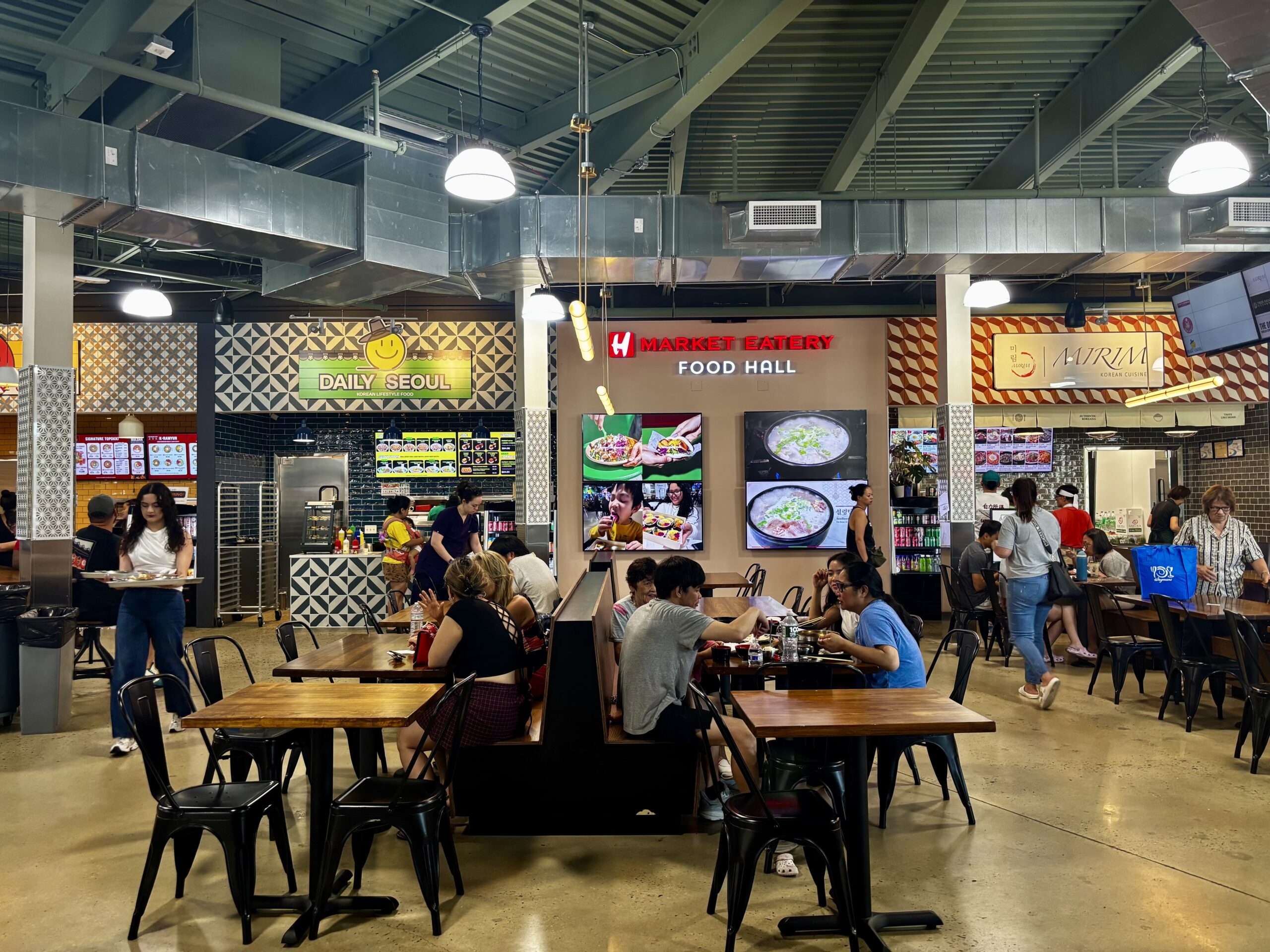
    The food court

    Around noon, I took the elevator back up to the second floor and ventured back into the food court for lunch.

    The court can feel overwhelming, with nine vendors to choose from — think bibimbap, Korean fried chicken, and noodles. Thankfully, Yao and Dong recommended a couple of options: Kyodong Noodles, a Korean-style Chinese noodle restaurant; Daily Seoul, a Korean lifestyle food brand; and Tiger Sugar, the Taiwanese bubble tea vendor I sampled earlier.

    While perusing the vendors, I ran into regular Ryan Solot at Mirim, a traditional Korean restaurant. He recommended the cold buckwheat noodle soup. “I didn’t like how it looked at first but then I tried it and it was very good,” he said.

    Spicy cold buckwheat noodle soup H Mart Cherry Hill.

    I ordered the spicy buckwheat noodles with beef at Mirim. The dish was served in a metal bowl with pickled vegetables on the side, chopsticks included.

    For Yao, the food court is a great addition to the store.

    “I like coming here more now because they have a food court — we go to eat there pretty often, for lunch and dinner sometimes,“ she said.

    H Mart Cherry Hill: 1720 Route 70 E, Cherry Hill; 856-489-4611; Monday to Sunday, 9 a.m. to 9 p.m.

  • Five Chester County centenarians, ranging from 99 to 104, give their life secrets

    Five Chester County centenarians, ranging from 99 to 104, give their life secrets

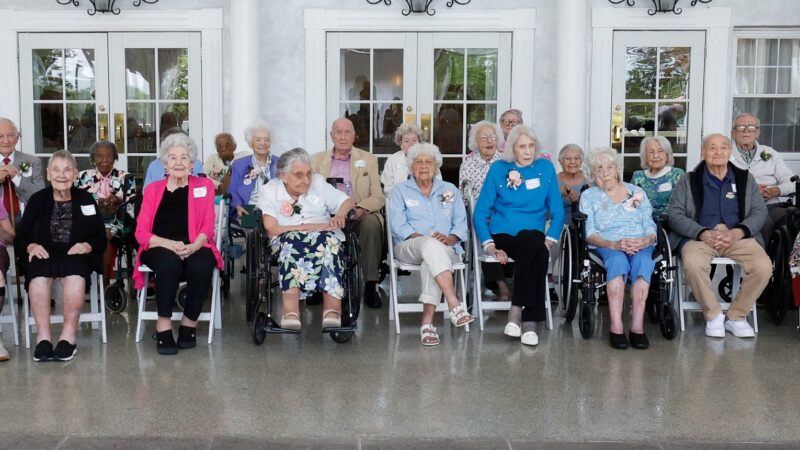
    From horses giving way to cars and the invention of television, to the election of more than a dozen presidents, World War II, and even the sale of sliced bread — the 45 Chester County centenarians who gathered for an annual luncheon this week have watched the world remake itself time and time again.

    “I saw a lot of things. A lot of wars, and a lot of popes. There’s a lot of good things,” said Anne Caporale, who will turn 100 in July. “I got married, had a family. I had a good life.”

    The annual luncheon celebrated Chester County’s group of centenarians — a total of 57 residents reaching or surpassing the milestone. Tuesday’s celebration saw a dozen who would turn 100 this year, plus quite a few returning attendees, including 108-year-old Evelyn Fair, who still writes poetry.

    “You are the builders, the teachers, the parents, the neighbors, and the foundation of the Chester County community,” Josh Maxwell, chair of the board of county commissioners, told attendees. “Every single comfort and freedom we enjoy today is a direct result of the hard work, sacrifice, and grace you poured into the world decades and decades ago. We are walking today on paths that you have all cleared.”
    Meet some of Chester County’s longest residents.

    Henry Jacks, 104

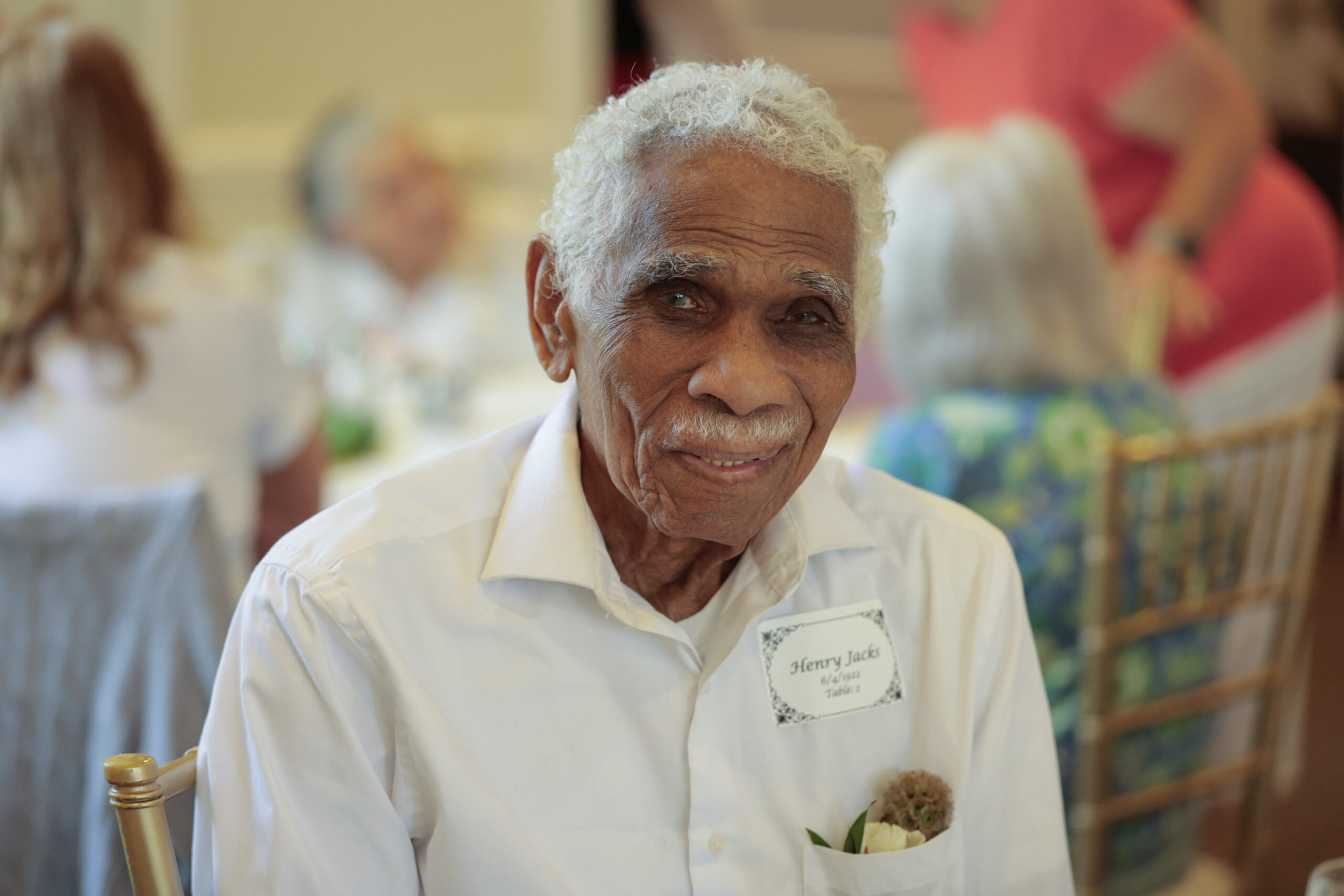
    Henry Jacks, 104, enjoys the annual centenarian luncheon hosted by the Department of Aging.

    Henry Jacks moved to South Coatesville when he was 4 years old, and has called it home ever since. He’s witnessed “quite a bit of change.”
    He remembers watching deliveries come by horse and wagon and recalls the hard days of the 1930s during the Great Depression (“cost of living wasn’t as bad as it is now,” he noted). Jacks joined the Army in 1940 during World War II, serving in the 92nd Engineers Regiment, and was stationed in Africa and Italy. He came back home to have three children, a boy and two girls.

    He was a Boy Scout leader, the first Black mail carrier in Coatesville, a city council member, and a judge of elections. He still sings in the church choir. (His advice: “Treat people right. Go to church.”)

    “So many changes that I’ve seen in the days,” he said. “I remember when I first saw TV; one of the neighbors had one, and all of the kids used to watch through his window. I’ve seen from the horses, to the cars, to the jet airplanes. And it’s been a wonderful life.”

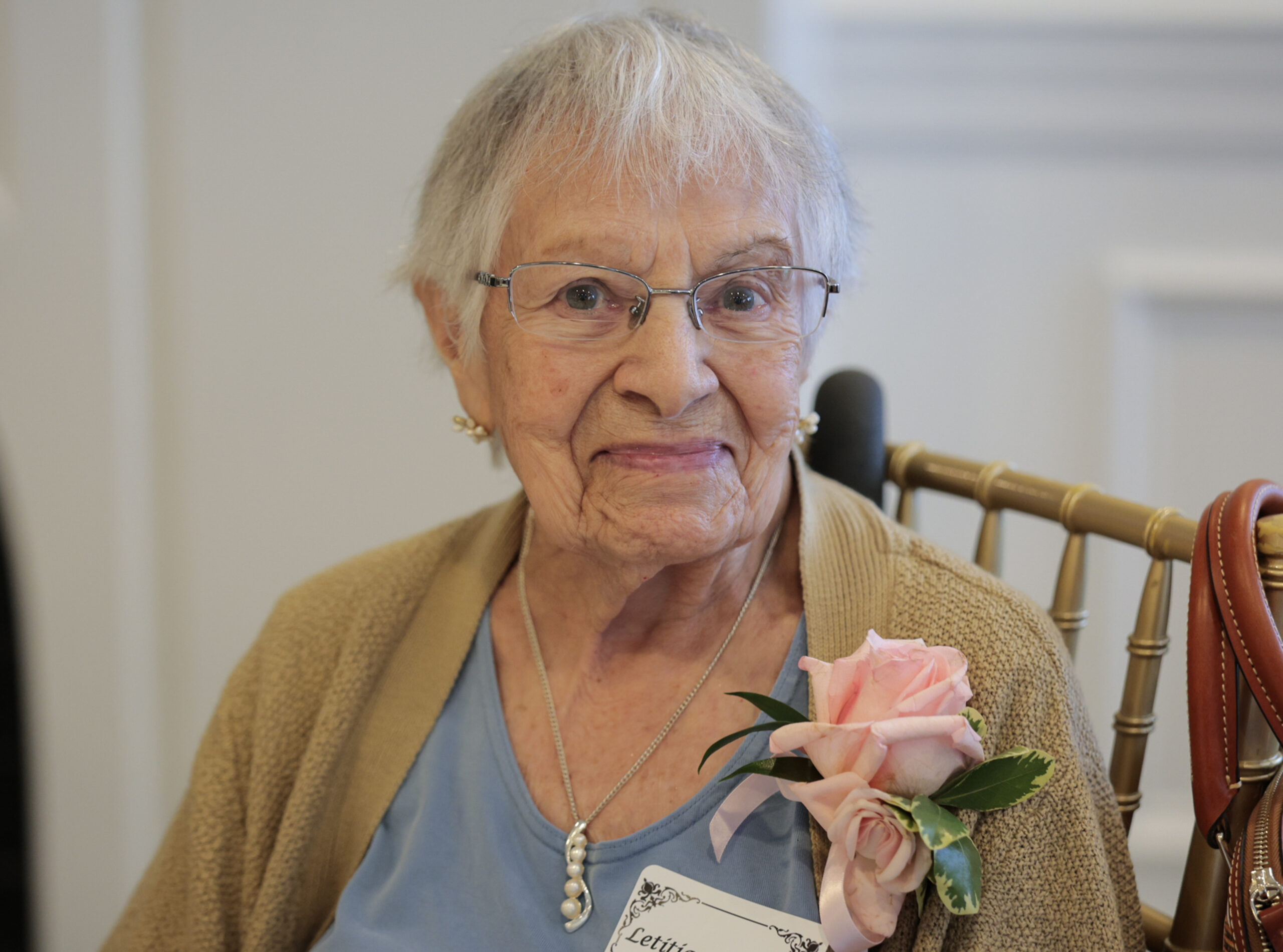
    Letitia Hemphill, 103

    Letitia Hemphill, 103, at Tuesday’s luncheon.

    Letitia Hemphill started her working life at the candy counter at the former F.W. Woolworth’s five-and-dime in her hometown of West Chester. Though her father remarked she wasn’t good at math, she’d go on to have a long career using her skills while filling the registers and doing the end-of-day count in a department store and later at the treasurer’s office.

    She retired in 1986 but had trouble sitting still.

    “I got bored of not working,” she said.

    She started cleaning houses. It was something she’d always done: help her mother clean in the morning, and then go to the park in the afternoon. She kept up the tradition with her two grandkids and her two great-grandkids, whom she babysat for 14 years.

    An active life has been key to Hemphill, who did 10 years of ballroom dancing and more than 20 years at the gym.

    “Keep your body moving and keep your mind moving,” she said.

    She keeps her mind active by painting landscapes in watercolor, a hobby she took up in 1995.

    Hemphill was born in West Chester to a stonemason father and a stay-at-home mother. Once, someone asked Hemphill if she had a lot of friends. With 11 brothers and sisters, she remarked she didn’t need any.

    When she journeys through West Chester, she points out all the stores that have changed over time.

    Still, Chester County is “beautiful,” and much of her family is still around to keep her moving: two children, two grandchildren, and two great-grandchildren.

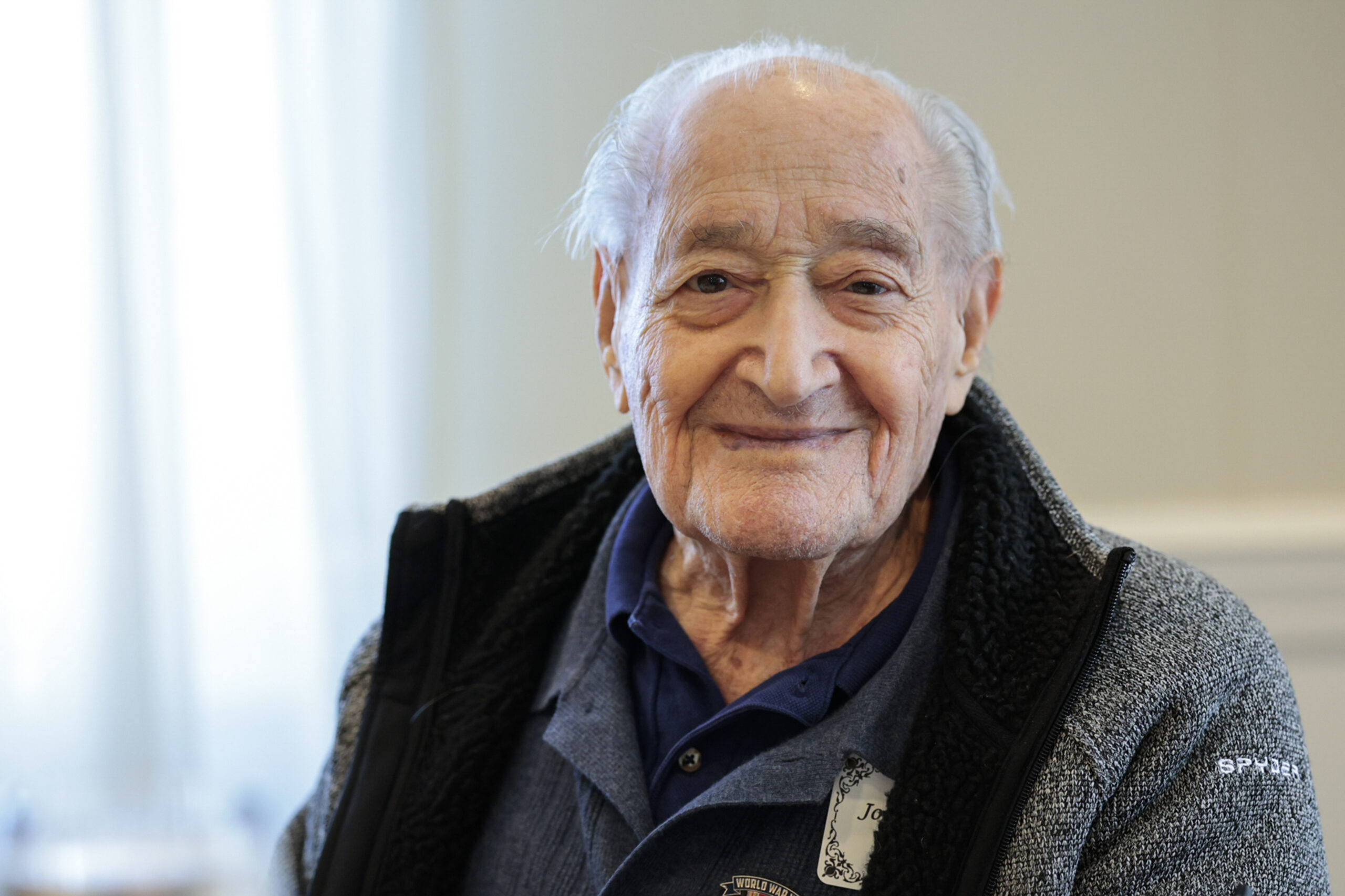
    Joseph Donia, 100

    Joseph Donia, 100. There were 45 centenarians in attendance at Tuesday’s luncheon.

    Up until last year or so, Joseph Donia’s hobby was building boats. He constructed a 20-foot wooden cabin cruiser from scratch. He had it for 40 years.

    “The only reason I sold it — my wife couldn’t get on it anymore,” he said.

    He had a lifelong love of boats, and spent five years at sea for the U.S. Merchant Marine in World War II. His time in service was the only time he wasn’t living in West Chester, where he bought a house and raised three kids. He also has six grandkids and three great-grandkids.

    His most recent project was a 35-foot sailboat. It’s still sitting behind his West Chester home, but he’s given it to his son to finish.

    It kept the 100-year-old active — something he advises.

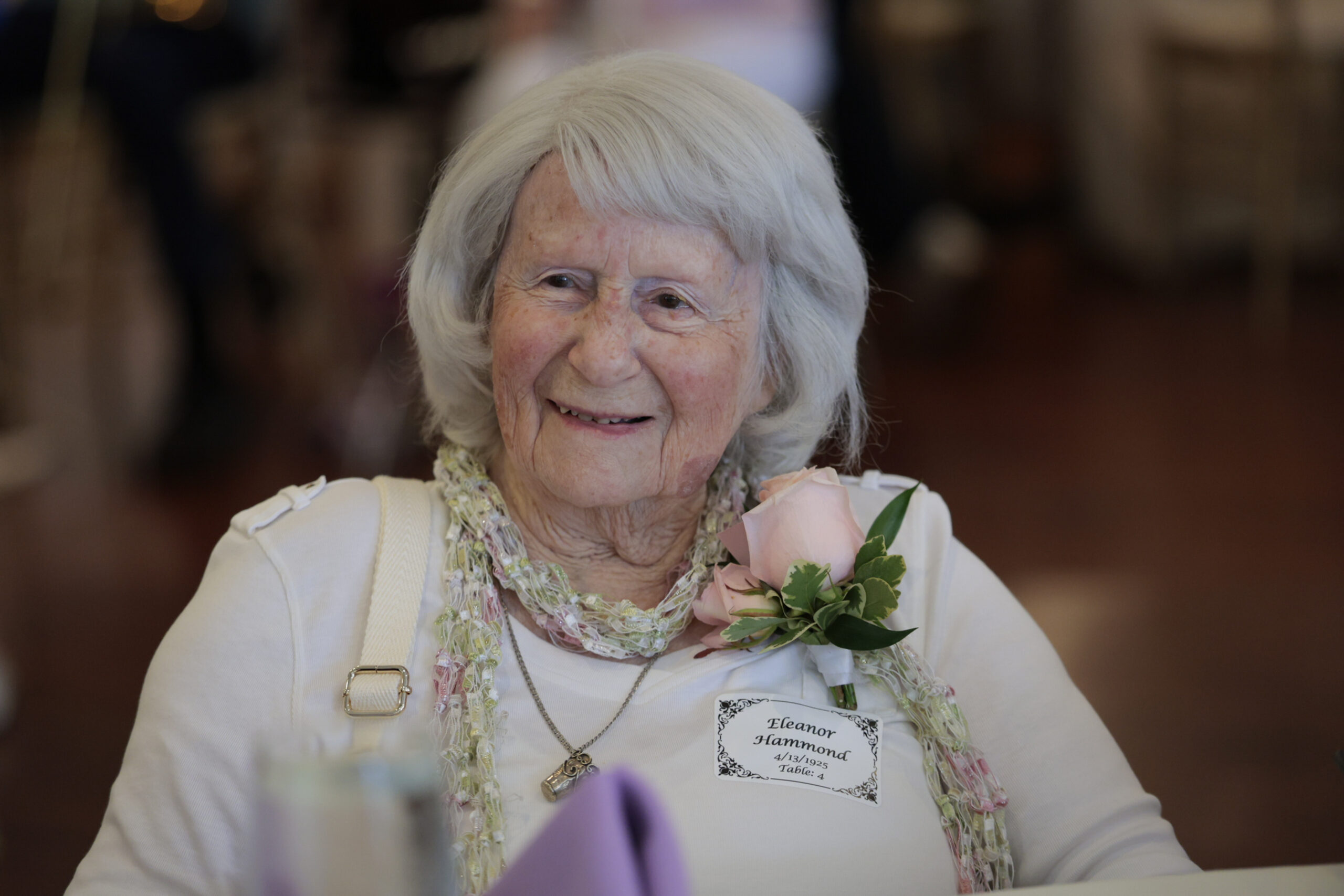
    Eleanor Hammond, 101

    Eleanor Hammond, 101, enjoys Tuesday’s annual luncheon.

    Eleanor Hammond has always been a fan of creative pursuits: a voracious reader who knitted and sewed. She stitched her daughter’s wedding gown, and, perhaps more memorably, a jacket for her husband.

    “He insisted I make him a jacket because I sewed for everyone else. He picked out the material; looked like Liberace. It was horrible,” she said. “I wouldn’t go out with him when he wore it.”

    A graduate of Coatesville High School, Hammond would go on to work there until she was 81, in the principal’s office. She was once a disciplinarian, and truancy officer. She’s watched the county change over time, marveling at the amount of development. And, less positively, the traffic.

    “The way to get here, I used to zip here,” she said. “But I can’t do that now.”

    Still, she likes it, and the changes that have come with time.

    “I’ve been here a long time. Everything about it is beautiful. The people are friendly, and it’s a beautiful place,” she said.

    And as much as she loves home, she recommends travel. If you don’t know the language, be nice, smile, and “use your arms” to convey your meaning.

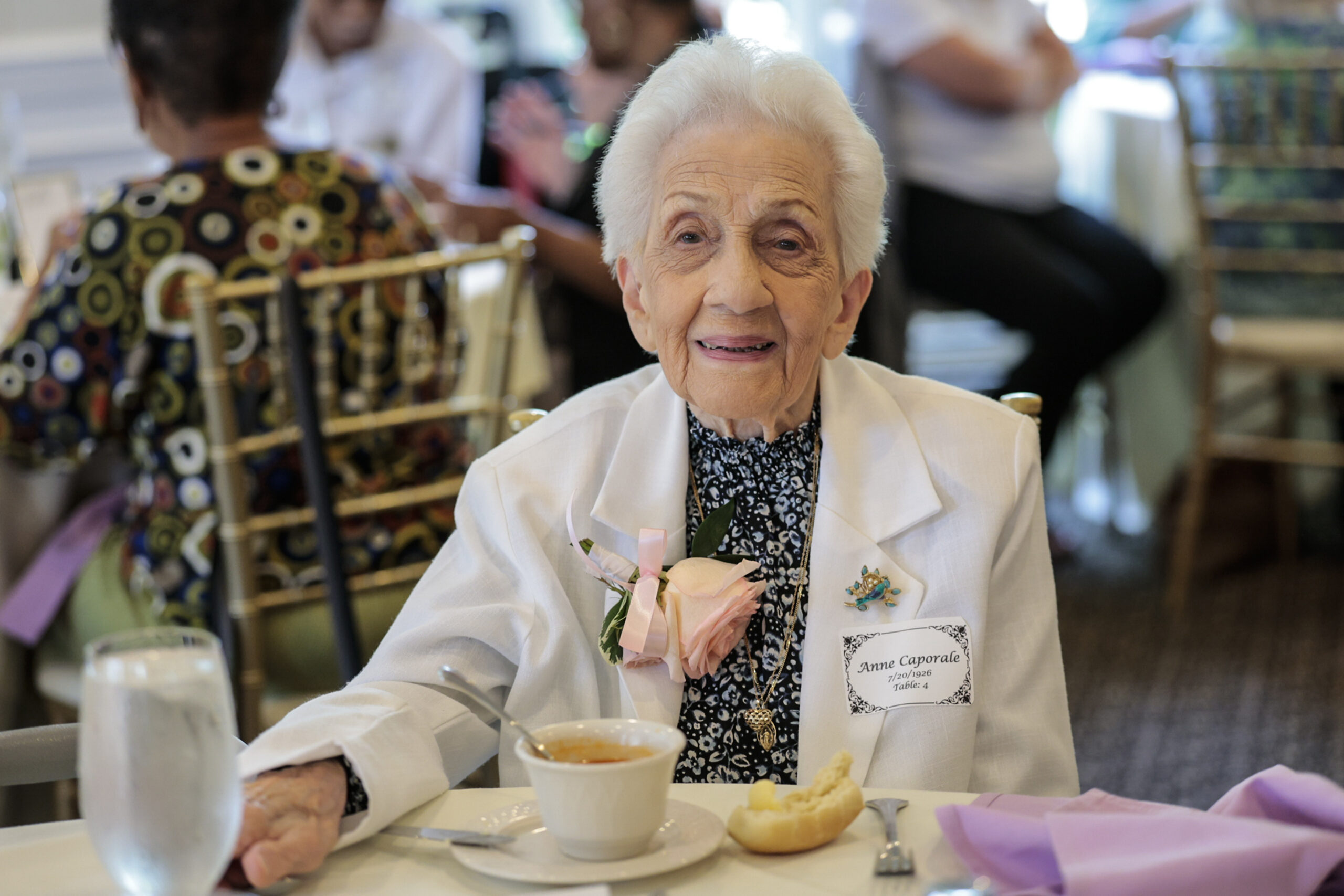
    Anne Caporale, 99

    Anne Caporale, who turns 100 in July.

    Anne Caporale graduated alongside Hammond at Coatesville High School. She went on to raise six kids, and has 10 grandchildren, 27 great-grandchildren, and three great-great-grandchildren.

    “We have quite a group,” she said. “I love them.”

    She has found Chester County to be a good place to live and “wouldn’t want to live anywhere else.”

    She lives at home, right by one of Downingtown’s high schools, which she loves because “the kids are great.” She still does her laundry and cooks every day. The luncheon Tuesday was a treat for her. “Let somebody else do the cooking,” she said.

    Keeping active is the secret, she said.

    “I know we’re here for a reason, but I don’t know it. I don’t question it,” she said.

    This suburban content is produced with support from the Leslie Miller and Richard Worley Foundation and The Lenfest Institute for Journalism. Editorial content is created independently of the project donors. Gifts to support The Inquirer’s high-impact journalism can be made at inquirer.com/donate. A list of Lenfest Institute donors can be found at lenfestinstitute.org/supporters.

  • Teaching an old don new tricks: How ‘Skinny Joey’ Merlino went from wiseguy to influencer

    Teaching an old don new tricks: How ‘Skinny Joey’ Merlino went from wiseguy to influencer

    At noon on a bright June Tuesday, the scene at Skinny Joey’s Cheesesteaks & Pizza on the Wildwood boardwalk felt more like a South Philly block party than a soft opening.

    Joseph “Skinny Joey” Merlino worked the crowd at his new shop — hugging, shaking hands, posing for photos — moving easily among his friends and admirers. At 64, five years removed from the criminal justice system, the onetime alleged head of Philadelphia’s underworld is enjoying a second act that few could have predicted: cheesesteak entrepreneur, podcaster, and social-media personality.

    Joseph “Skinny Joey” Merlino (left) and Joe “Lil Snuff” Perri Jr. (right) posing with a customer outside the Skinny Joey’s Cheesesteaks & Pizza shop in Wildwood.

    Orbiting him with a phone and a grin was Joe “Lil Snuff” Perri Jr. — 30 years his junior — Skinny Joey’s collaborator and the man who helped set him up with a new career. While customers lined up out front for steaks, slices, photos, $35 hats, and $25 T-shirts, Perri was shooting clips for social media.

    Their partnership has transformed Merlino from a flashy, polarizing tabloid fixture into a flashy, polarizing Instagram-age brand. Merlino provides the mythology, while Perri supplies the algorithm.

    Symbiotically, they are building an unlikely enterprise. Merlino gives Perri access, credibility, and a bigger stage. Perri gives Merlino comic relief, social-media fluency, and a way to be seen as entrepreneurial rather than simply infamous as a reputed former mob boss.

    “Without me, there’s no him,” Perri said. “Without him, there’s no me. It’s just a good mix.”

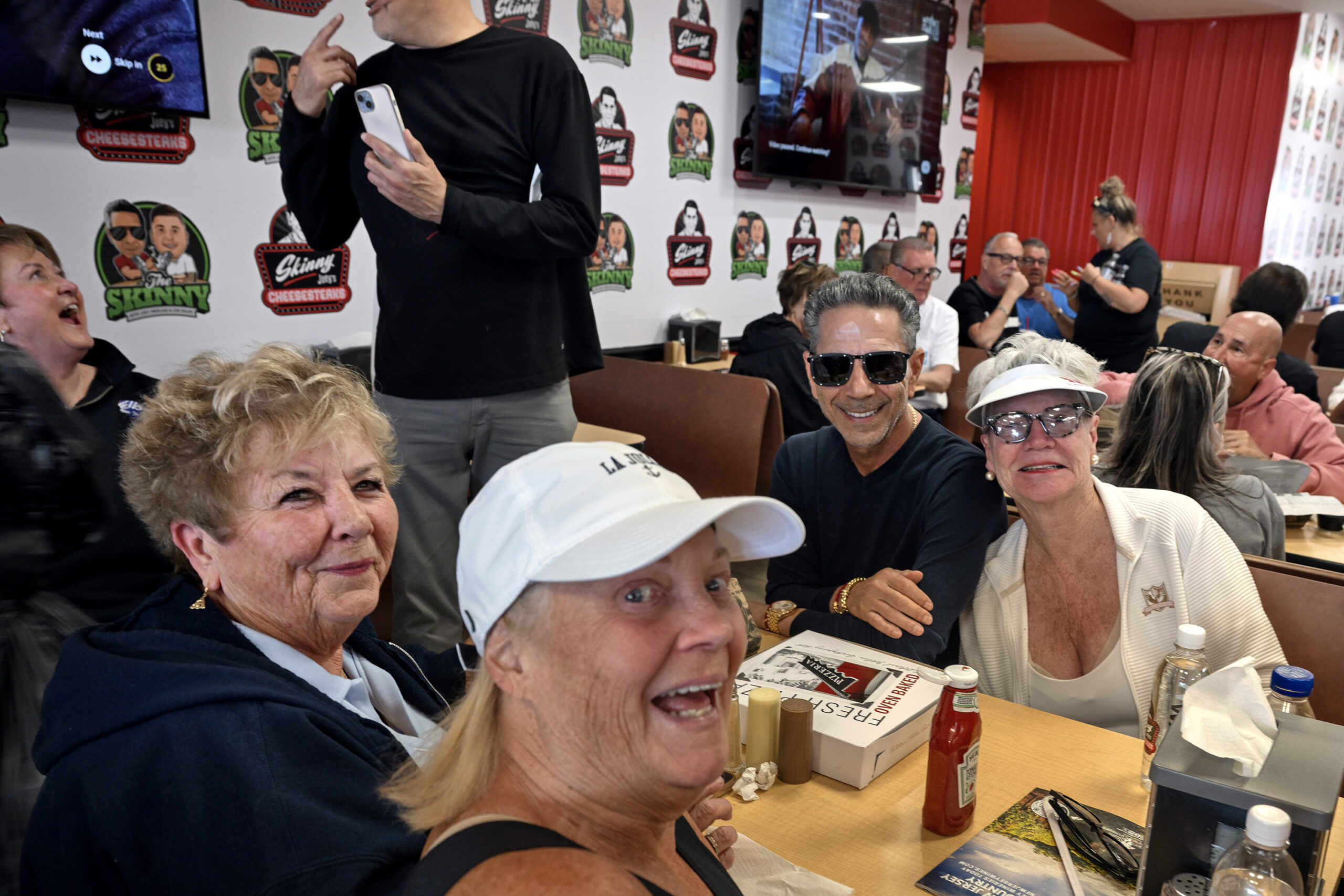
    Joseph “Skinny Joey” Merlino joining customers at Skinny Joey’s in Wildwood during its soft opening on June 2. They call themselves “the Schuylkill Girls” (from left): Julie Shelton, Cindy McCullough, and Terry Landy, all of whom now live in Wildwood.

    A ‘mob media’ moment

    George Anastasia, who covered organized crime for more than 30 years at The Inquirer and now teaches an organized-crime course at Rowan University, said Merlino’s new career fits a broader moment in mob media.

    Former wiseguys, associates, historians, and fans now gather in a true-crime subculture known online as “MobTube,” where the lore is packaged into YouTube shows, Patreon feeds, podcasts, clips, and merch.

    Merlino has lived the story that fuels the genre. One of Philadelphia’s most recognizable organized-crime figures, Merlino was convicted in 1990 for his role in a $352,000 armored truck robbery in 1987.

    In 2001, he and six co-defendants were tried on federal racketeering charges, including three counts of murder and two of attempted murder. Merlino was acquitted on those counts, but served about 12 years on other charges, including gambling and extortion. A supervised-release violation briefly returned him to prison in 2014, and a second major racketeering case ended in 2018 with a guilty plea to a single illegal-gambling charge after a mistrial. In a separate trial in 2004, he was acquitted of the 1996 killing of Joseph Sodano, an underling in North Jersey. Merlino completed federal supervision in 2021, but he’s been banned from New Jersey casinos since 1988 and from Pennsylvania casinos since a 2016 incident at the former SugarHouse Casino.

    And Merlino has made it no secret that he is different from many of the former figures who populate the MobTube genre. Unlike Sammy “The Bull” Gravano, John Alito, and Jimmy Calandra, Merlino never cooperated with prosecutors.

    “He saw guys who cooperated come back and become media sensations,” Anastasia said. “And I think he got [annoyed] that these are all guys who, in his view, violated the code, and now they’re making money on that old life. He did his time as a stand-up guy. ‘So [to heck with that] — I’m going to make money, too.’ And he created this brand.”

    Joseph “Skinny Joey” Merlino (left) and Joe Perri Jr. on the set of “The Skinny” podcast.

    Perri helped make that legible to a younger audience.

    “Lil Snuff is part sycophant and part guide,” Anastasia said. “He’s the one who, in a lot of ways, sets the flow. Joey is going to be Joey, but somebody has to keep bringing him back to the point.”

    The rise of Lil Snuff

    Before he was Merlino’s co-host, Perri was Lil Snuff.

    The nickname came from his father: As a 10-year-old, Joe Sr. turned around when a cousin was calling for a dog named Snuffy. Boom. He was Snuff. When his son was born at Methodist Hospital in 1992, Snuff became Big Snuff.

    As a teenager, Lil Snuff bussed tables at Stogie Joe’s, the Saloon, and Fitzwater Cafe. At 18, he joined the stagehands union. At 21, he got a job at Mall Chevrolet in Cherry Hill. The older salesmen had relationships and repeat customers. Perri’s mentor told him that he needed a lane.

    It was 2013, and social media was beginning to reshape promotion. Perri started making his own brassy, unscripted commercials. “Selling Chevys for less” became his tagline.

    He also made videos about gambling and food, his two passions. He was not famous, but he was visible in the South Philly-to-South Jersey social media corridor where restaurants, sports, betting, family, and neighborhood identity blur into one feed.

    At the same time, Perri said, he was abusing pills. In 2014, at 22, his parents found him a rehab center in South Florida. To make sure he got there safely, they called a family friend whose Italian restaurant in Boca Raton had recently opened:

    Joey Merlino.

    “My father grew up with his grandfather,” Merlino said, explaining the bond. “I grew up with his father. I’ve known him since he was born.”

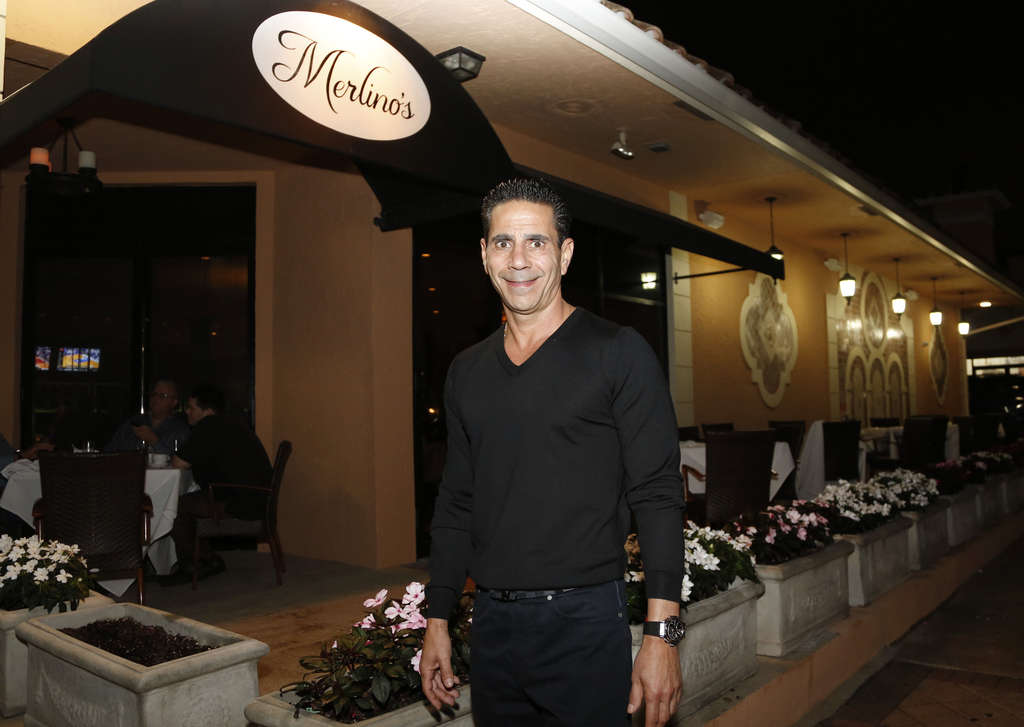
    Joseph “Skinny Joey” Merlino in 2014 at the Boca Raton restaurant bearing his name.

    Perri said it took several attempts before recovery stuck. He has been sober since Sept. 11, 2016. “I’m big with recovery,” he said. “That’s the main thing in my life. I put sobriety first and then everything after that.”

    Merlino’s — where Merlino was maitre d’ because his legal situation then precluded ownership — closed in 2016, just before the feds arrested Merlino at his home in Boca in the lead-up to his second racketeering case. “If I didn’t have this trouble, it would still be open,” Merlino said earlier this month.

    After Merlino attained freedom in July 2021, producers called with movie, television, and book deals. Merlino turned them all down. “Nothing seemed right,” Merlino said. Someone brought up the idea of a podcast.

    “I didn’t even know what that was,” Merlino said.

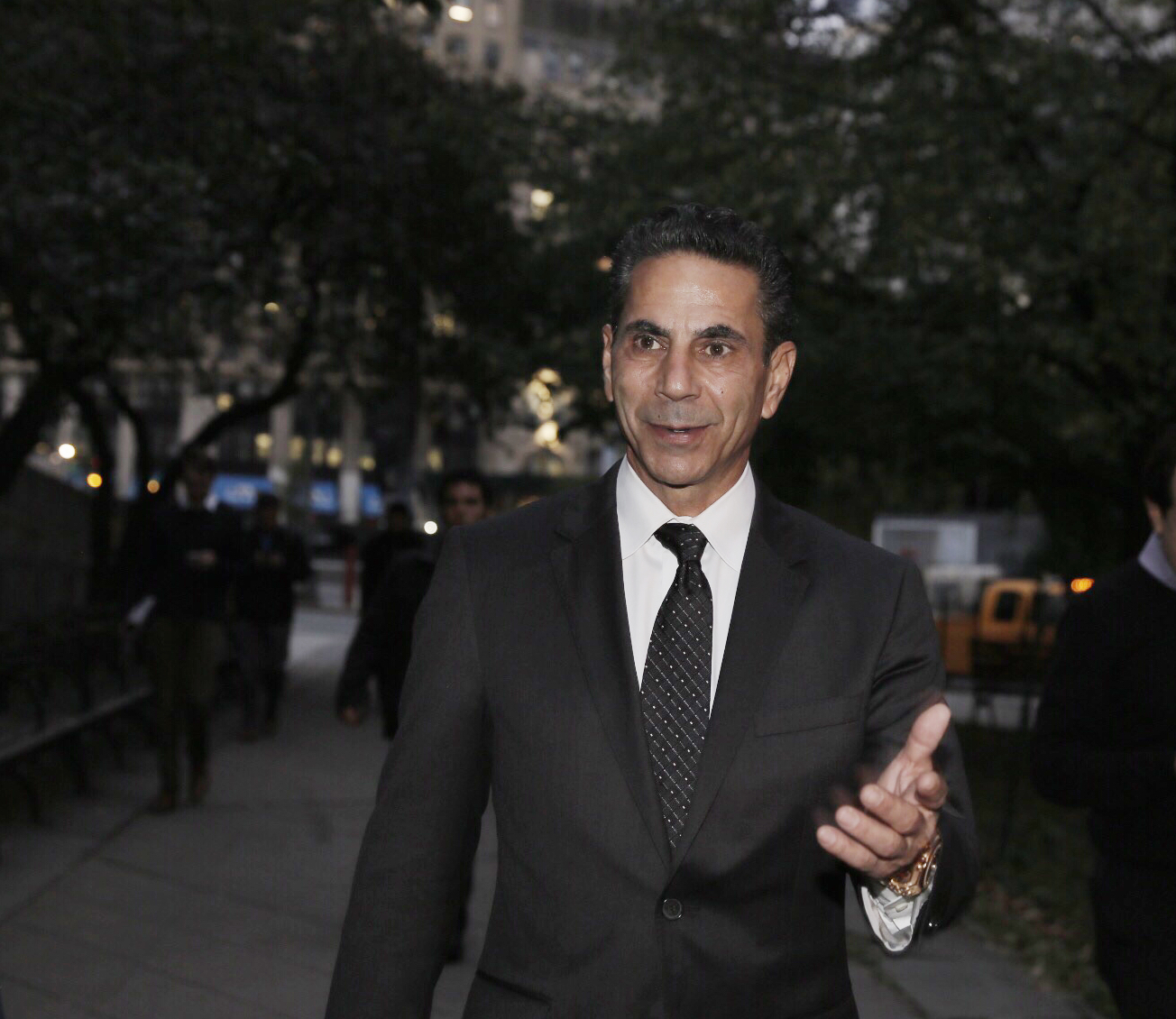
    Joseph “Skinny Joey” Merlino leaving the federal courthouse in Manhattan after being sentenced on Oct. 17, 2018.

    His friend Raymond “Wags” Wagner explained the concept and suggested a loose format built around food and sports betting. Actor Kevin Connolly of Entourage fame, who was involved early as a producer, told Merlino that he needed a co-host.

    “They said, ‘Who would you want?’” Perri said. “They were sending him people, and he was like, ‘I’m not doing nothing with these people.’”

    Then Ray Wags suggested Perri.

    “Joey was like, ‘100 percent. Get him on the phone,’” Perri said. “Kevin Connolly said, ‘Send me your videos.’ I sent him my videos, and he said, ‘You’re the guy.’ The rest was history.”

    The world of ‘MobTube’

    Merlino and Perri launched the video podcast in 2023. Viewers are not just watching Merlino talk about the old life. They see him bust Perri’s chops about eating too much and mock his parlays. They get gambling tips, watch them interview athletes and celebrities — all part of a South Philly generational comedy.

    Perri describes it in family terms. “My dad’s my dad, but he’s also my best friend, too,” Perri said. “We gamble together. We go out together. We have fun together. So they see me and Joey as that, and they can’t figure out how we mix so good.”

    “He’s good,” Merlino said. “I’m old, he’s young. He talks good, he’s funny. He’s a pain in the balls, but it’s a good fit.”

    They began The Skinny podcast on YouTube, but now focus more on Patreon, where the content is unfiltered. And better monetized. Perri says The Skinny has 1,600 Patreon subscribers paying $15.95 a month. He said their social-media pages combined average 30 million views a month.

    Perri’s wife, Danielle, handles bookings and schedules. “I produce,” Perri said. “I cut the clips. I do everything. It’s me and Joey. Two-man show.”

    A wider audience

    When they started, Perri was still selling cars at Mall Chevrolet. But the now-shuttered dealership got tired of people showing up hoping to see Merlino instead of test-driving a Suburban.

    Perri quit. The show grew. Merlino’s reinvention has coincided with a broader shift in the gambling world. Legal sportsbooks, now ubiquitous on television and online, have largely supplanted the corner bookmaker, turning an activity once associated with organized crime into a mainstream consumer business. Guests span sports, hip-hop, gambling, and entertainment, including Wallo267, Fat Joe, Ric Flair, and Bernard Hopkins.

    Each booking widened his audience, and Merlino was being absorbed into a broader celebrity ecosystem.

    Last October, Netflix released Mob War: Philadelphia vs. The Mafia, a docuseries revisiting the violent 1990s power struggle between John Stanfa and Merlino’s younger faction. It steered even more viewers to Merlino and Perri’s world.

    ‘Skinny Joey,’ wit’

    Then came the cheesesteaks.

    One night, Perri, Merlino, and friends were playing poker. Merlino wanted cheesesteaks. Perri said he’d make them.

    “He’s like, ‘You can’t make cheesesteaks,’” Perri said. “I said, ‘Are you nuts? I’ve been making them my whole life.’”

    Perri cooked some. “He was like, ‘This is the best f— cheesesteak ever,’” Perri said. “He said, ‘Let’s open up a cheesesteak place.’ I said, ‘All right. Call it Skinny Joey’s Cheesesteaks.’ And that was it.”

    The first shop opened in March 2025 at 3020 S. Broad St., near the sports complex. From the start, Skinny Joey’s was more than a sandwich shop. It was a set. The shop leaned into Merlino’s notoriety; the sandwiches are wrapped in a collage of newspaper articles about his past.

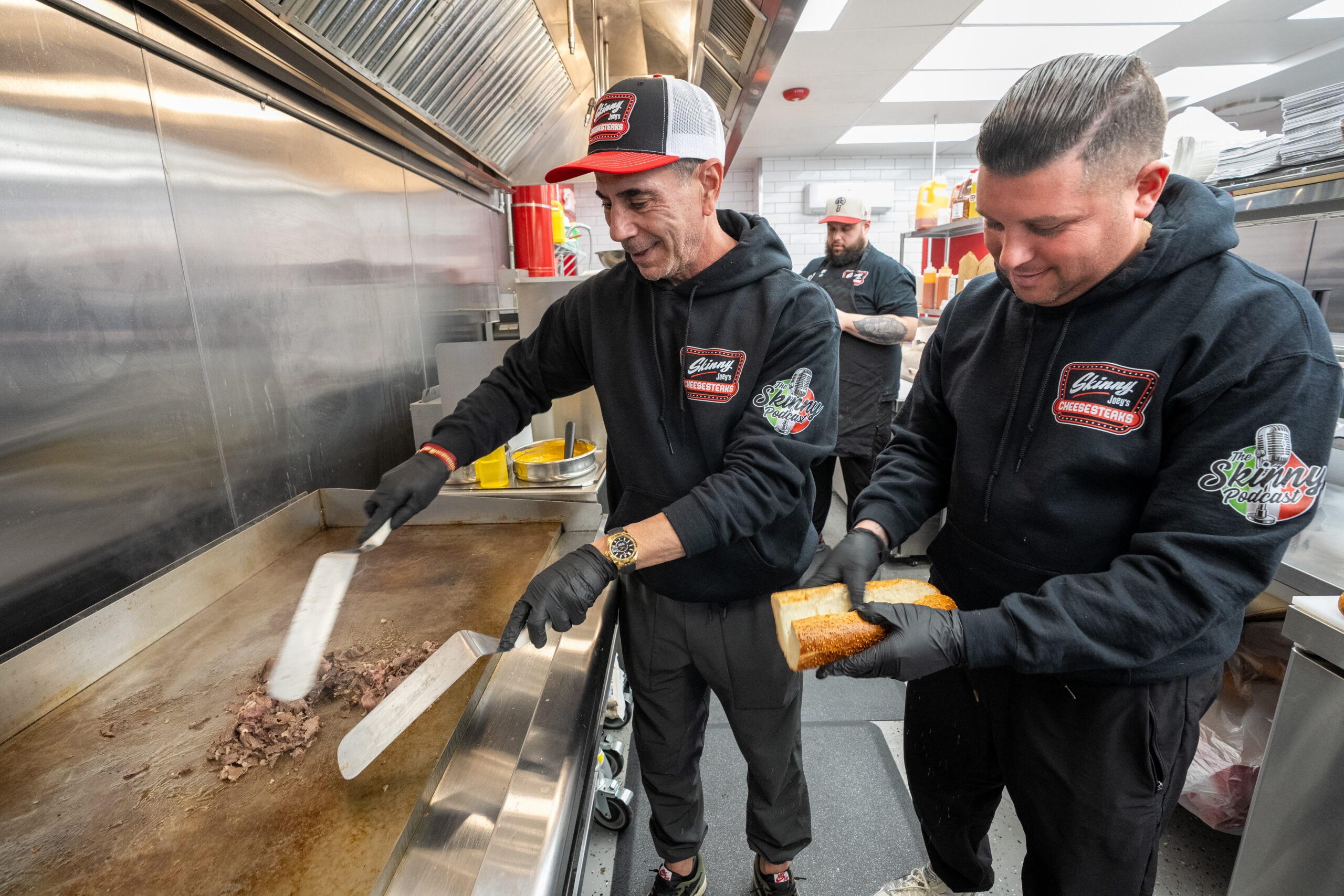
    Joseph “Skinny Joey” Merlino (left) working the grill beside Joe “Lil Snuff” Perri Jr. at the Skinny Joey’s Cheesesteaks in Philadelphia at its opening in March 2025.

    Celebrities showed up: Jason Kelce, Landon Dickerson, Mack Wilson. A customer eating a cheesesteak was good content. A recognizable person eating one on camera was better.

    The restaurant also became a magnet for the kind of drama that fuels digital engagement: online beef. Podcaster Gene Borrello, a former Bonnano crime family associate and Merlino antagonist, weighed in last year on an apparent feud between Skinny Joey’s camp and Frank Olivieri of Pat’s King of Steaks. Merlino and Perri had taken issue with a video posted by Olivieri — whose great-uncle invented the steak sandwich — in which he chided shops that chop the meat on the grill. Like most online food feuds, this seems to have subsided.

    Then came the deal for Wildwood, where Skinny Joey’s replaced Joe’s Pizzeria, which had been on the boardwalk at Magnolia Avenue for 15 years. There, Skinny Joey’s added pizza and stromboli, which are not sold at the South Philadelphia location.

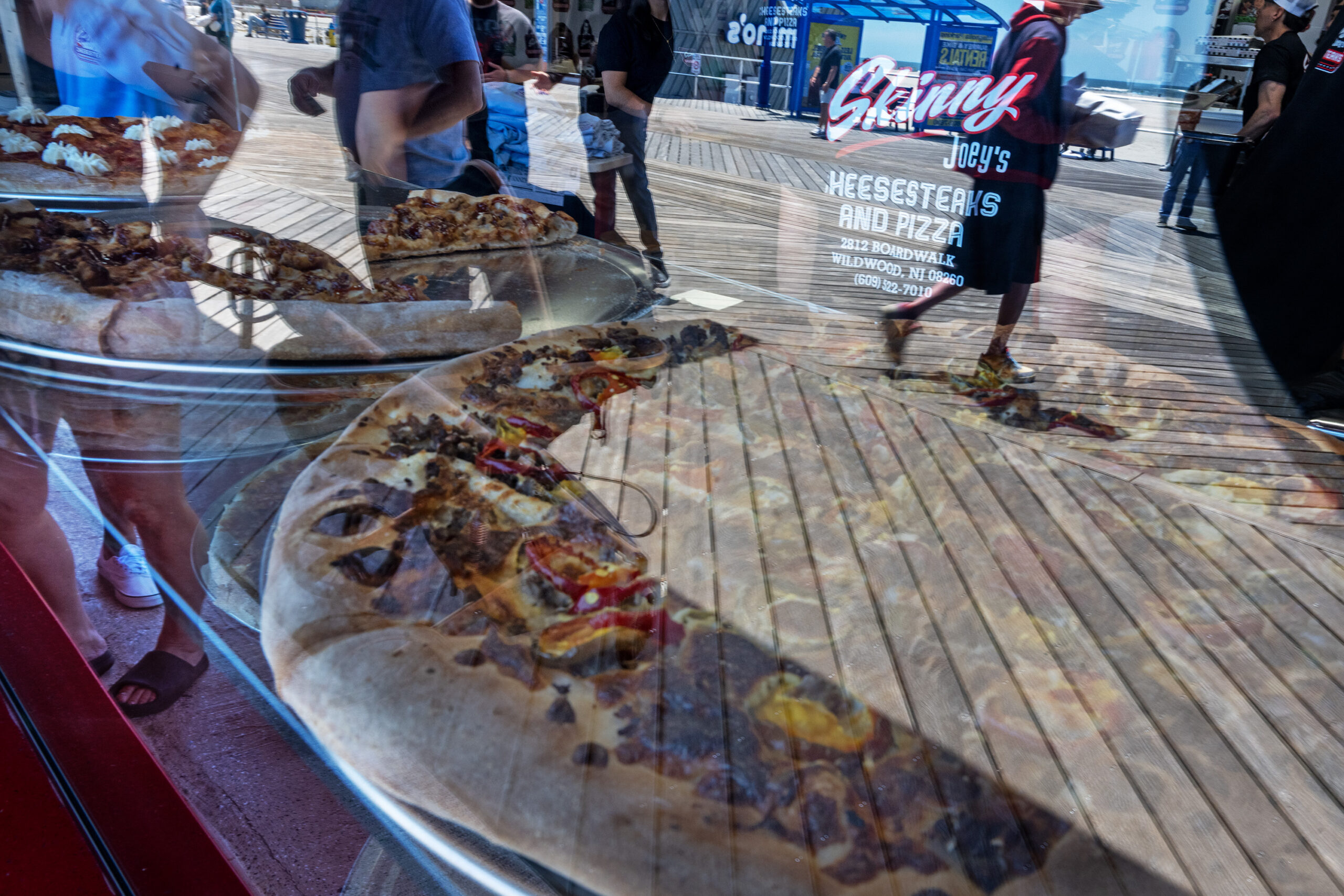
    Reflections in the pizza display case on the boardwalk at Skinny Joey’s Cheesesteaks & Pizza in Wildwood.

    The pizza recipe comes from Vito’s on Haddonfield Berlin Road in Cherry Hill, and the stromboli from Pizza Shack at 15th and Oregon in South Philadelphia, both owned by Skinny Joey’s business partners Stephen Casasanto and John Fioravanti, whom Merlino also described as longtime friends.

    More locations are planned. Perri said a Boothwyn shop is expected around Sept. 1, and several others are in the pipeline.

    Bypassing the gatekeepers

    Merlino is an extreme case of a recent phenomenon. People with complicated histories — criminal, scandalous, controversial, or simply overexposed — no longer need traditional gatekeepers to reintroduce themselves. They can speak directly to followers and monetize the attention.

    Perri is not a journalist, of course, or a publicist, exactly. He is not merely a manager, producer, or sidekick. He is something in between — a new kind of local media operator.

    He knows the scene, and how to make content feel unscripted even when the business behind it is deliberate. He is close enough to Merlino to bust his chops and deferential enough to preserve the hierarchy. He can translate Merlino to younger audiences without making him seem managed.

    Perri softens Merlino without sanding him down. Merlino still curses, rants, and mocks rivals. Anyone they disagree with is a “bedbug.”

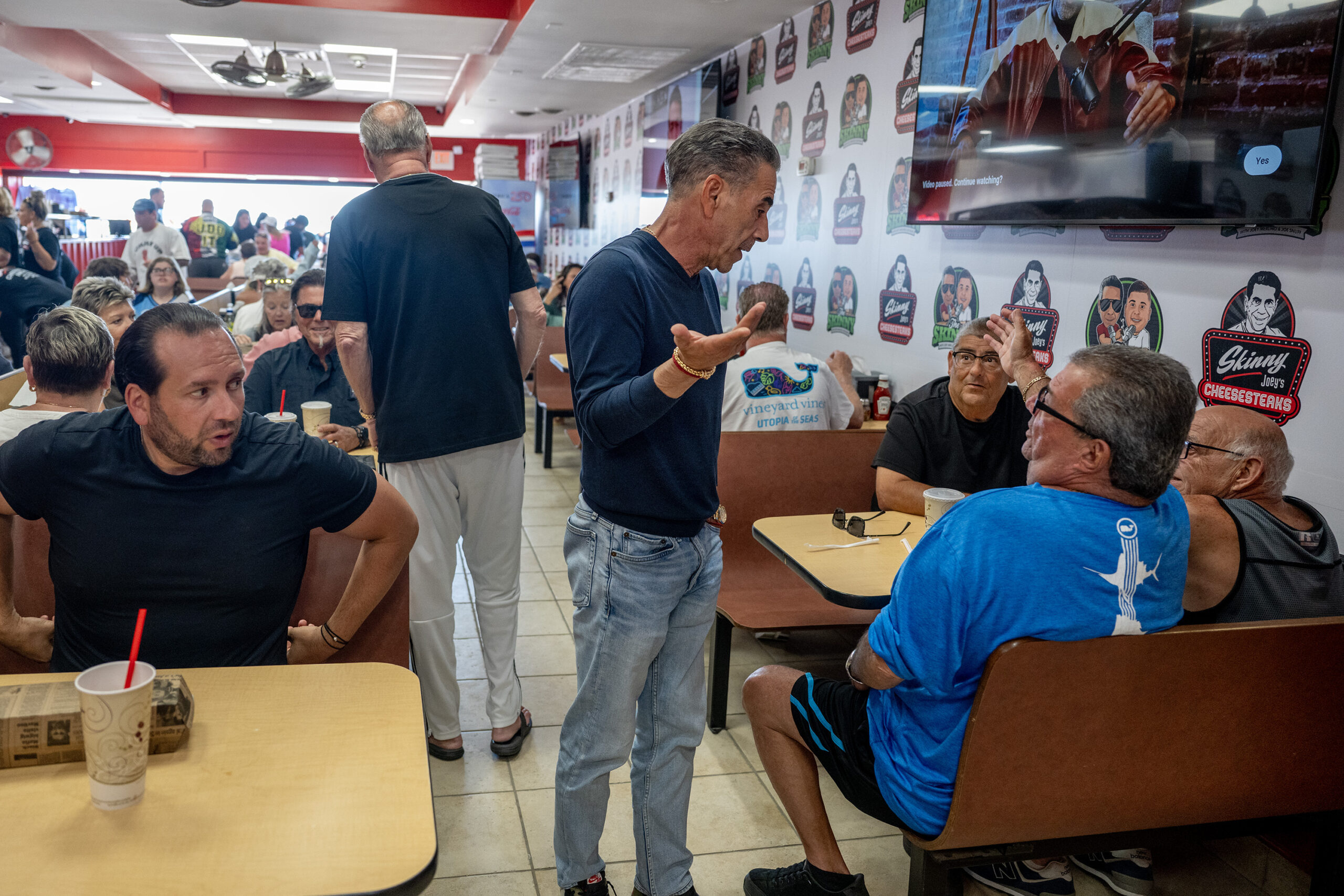
    Joseph “Skinny Joey” Merlino greets a table of customers at Skinny Joey’s Cheesesteaks & Pizza in Wildwood.

    “At the end of the day, Joey isn’t going to change who he is for anybody,” Perri said. “If he can’t talk the way he wants to talk, what’s the point?”

    That is part of the appeal and part of the discomfort. The audience knows Merlino’s history. They may see him as funny, defiant, loyal, misunderstood, or simply entertaining.

    “There’s a segment of the American population that has always been fascinated with the outlaw: Billy the Kid, Jesse James, Don Corleone, Al Capone,” Anastasia said. “What the internet has provided is: Here are these guys in their own words. Are they being genuine? I don’t know. You can say that about any personality. But here’s a look at them without any filter.”

    The filter used to be people like Anastasia.

    “I was, in a lot of ways, the middleman between the people who were interested in this and the guys who were doing it,” he said. “And people who are interested in this don’t need the middleman anymore. They just go online and listen to whoever they want to listen to.”

  • They served nearly three decades in prison for murder. Today, a Philadelphia judge overturned their convictions.

    They served nearly three decades in prison for murder. Today, a Philadelphia judge overturned their convictions.

    Three men who spent nearly three decades in prison for the 1997 stabbing death of a Northwest Philadelphia woman had their murder convictions overturned Tuesday after prosecutors, defense attorneys, and a judge agreed that key evidence in the case against them was unreliable.

    Marc Brittingham, Rasheed Turner, and Jermal Shuler will be set free after a Common Pleas Court judge vacated their convictions and life sentences, dismantling a prosecution that relied heavily on a timeline of the victim’s death that prosecutors now say can no longer be trusted.

    At trial in 1998, Bennett Preston, an assistant medical examiner, told jurors Essie Mae Thomas had likely died on the evening of Nov. 8, 1997 — a time frame prosecutors used to bolster the testimony of a sole witness who provided a direct link between the men and the killing.

    But the Conviction Integrity Unit of the Philadelphia District Attorney’s Office later determined that Preston’s findings and testimony were not reliable. Experts tapped by both defense attorneys and prosecutors found that Thomas died at least a day later than Preston said she did.

    Common Pleas Court Judge Jennifer Schultz said that information would likely have changed the outcome of the trial had jurors heard it at the time.

    After Schultz vacated the convictions and sentences, prosecutors withdrew the charges, clearing the way for the men’s release after nearly 28 years in prison.

    The case marks the first triple exoneration secured by the conviction integrity unit, which since its creation in 2018 has helped overturn a growing number of convictions tied to flawed forensic testimony, withheld evidence, and other investigative failures.

    Inside the courtroom Tuesday, relatives and supporters wept quietly as Schultz delivered her ruling. One woman rocked back and forth in her seat, sobbing. Others embraced and cheered after the judge formally dismissed the case.

    Family members declined to comment afterward.

    The attorneys — from the Innocence Project, DLA Piper, Pennsylvania Innocence Project, and the Exoneration Project — released a joint statement after the hearing, saying the three men had “maintained their innocence while serving time for a crime they did not commit.

    “The absence of physical evidence, along with new evidence discovered during the joint investigation, makes clear that this wrongful conviction should never have occurred,” the statement said.

    District Attorney Larry Krasner, who addressed reporters outside the courthouse, said the men had been “robbed of a fair trial, simply put.”

    He added that while the men’s convictions had been vacated, “that does not necessarily mean they are innocent. It means their convictions lacked integrity.”

    Thomas was found dead inside her home. Prosecutors contended at trial that Brittingham, Turner, and Shuler went to her house to rob her and ended up killing her.

    The prosecution’s case, led by Assistant District Attorney Carlos Vega, depended heavily on establishing when Thomas died. Vega could not be immediately reached for comment Tuesday.

    Preston testified that her injuries and condition indicated she was likely killed on Nov. 8 — a timeline prosecutors said matched the account of a witness who placed the three men at the house that day.

    But according to reviews by two forensic pathologists, Preston failed to account for several things that contradicted his conclusion, including evidence that rigor mortis may still have been developing — not disappearing — when Thomas’ body was examined. The experts concluded it was extremely unlikely Thomas died on Nov. 8.

    Defense attorneys argued in court filings that without Preston’s testimony, the case against the men largely unraveled. There was little physical evidence tying them to the killing, the lawyers said, and no DNA evidence linked them to the crime scene. Preston’s testimony about the timing of her death, they said, was used to prop up prosecutors’ otherwise unstable sole eyewitness, Wadia Brown, who admitted she was high on crack cocaine on the night she said she saw the three men on Thomas’ porch around that time.

    Efforts to reach Preston were unsuccessful Tuesday.

    Over the years, questions emerged about Preston’s work in multiple criminal cases, prompting renewed scrutiny from defense attorneys and prosecutors. In recent years, the conviction integrity unit began reexamining cases in which his testimony played a significant role, said unit supervisor Matthew Stiegler.

    Many of the specifics underlying the questions about Preston’s findings remain unclear. Court filings in the case were heavily redacted. Stiegler said Tuesday “what broke the case open” was the discovery that disciplinary action had previously been taken against Preston, but did not provide further details.

    Schultz concluded that the evidence uncovered by prosecutors and defense attorneys was crucial to the outcome of the trial and warranted a new one — a prosecution the district attorney’s office said it would no longer pursue.

  • Montco school officials expensed international trips, including a 14-day African safari

    Montco school officials expensed international trips, including a 14-day African safari

    The Montgomery County Intermediate Unit’s mission is to support schools in the county with early childhood intervention, professional development, and bulk-purchasing programs that save taxpayers’ money.

    In recent years, however, the Norristown-based intermediate unit has also served as an international travel agency of sorts — for its own leaders.

    Expense reports obtained by The Inquirer through a Right-to-Know request show that, since 2023, the Montco IU’s executive director, Regina Speaker, and its assistant executive director, Sandra Edling, have used public funds to book about $40,000 worth of professional-development travel to three continents.

    That includes a 14-day African safari that cost about $18,000.

    “Travel from towering Mount Kenya to the wild expanses of the Serengeti to witness the drama of the bush unfolding around you,” reads the online brochure for the trip Speaker and Edling took to Kenya and Tanzania in the summer of 2023.

    The expense reports show that Speaker subsequently used her IU credit card to fly to South Korea and Singapore for 11 days last spring. Edling used hers to purchase a trip to Central Europe in the fall, before the intermediate unit canceled it amid funding concerns.

    Some of the credit card charges lacked receipts or didn’t state a destination, or provide any indication that they involved overseas travel. Yet, they were approved by two presidents of the Montco IU board and a now-retired assistant executive director. The 21-person board is composed of members from each school district board in the county.

    The trips raise questions about how forthcoming the IU’s executive staff has been with the board about its spending, as well as the level of oversight provided by the board.

    In a recent interview, Speaker defended the trips as legitimate professional-development outings. She said she followed the proper procedure for spending money the board had already budgeted for that purpose.

    “Everything was signed off on by the board president and clearly communicated,” she said. “There was nothing underhanded about it.”

    Jennifer Wilson, who served on the intermediate unit’s board from 2017 to last November, first learned of the trips from an Inquirer reporter last month. She said some looked more like “vacations” that shouldn’t have been covered by the publicly-funded IU.

    “We never got notice [Speaker] was going on these trips at all,” said Wilson, who still serves as vice president of the Hatboro-Horsham School Board. “In my home school district, the superintendent tells us if he’s going out of town for the weekend.”

    Public finance experts also questioned whether taxpayers should pay for professional-development trips that include extensive leisure time, such as giraffe feeding and guided tours through the Great Rift Valley.

    Marguerite Roza, director of the Edunomics Lab at Georgetown University, said those types of expenses could leave taxpayers feeling cynical about how their money is being spent.

    “We use examples like this to warn people that these are public funds,” Roza said. “You need to make sure your expenditures make sense and are justified, but also, contemplate the optics.”

    The Montco IU, one of 29 state-mandated agencies in Pennsylvania, has a $198 million budget and 848 employees. It receives a mix of local, state, and federal funding, and provides support services to more than 200 public and private schools.

    Speaker, who was named executive director in 2020, has been thinking on a larger scale.

    “Our big mission is to be part of the global community,” Speaker, a former Great Valley School District superintendent, said in explaining her travel bills.

    The trip to Kenya and Tanzania, Speaker said, culminated a yearlong academy for education leaders run by the the School Superintendents Association, or AASA.

    “Everything was through the lens of leadership,” she said of the trip. “It was about that process of survival of the fittest, and how are you a leader, and what do you prioritize.”

    The itinerary included six sightseeing tours and eight wildlife drives in search of zebras, monkeys, lions, baboons, cheetahs, hippos, elephants, wildebeests and “the exceedingly rare black rhino,” as well as 11 nights in “handpicked hotels.”

    Speaker noted that the trip featured a visit to a tribal school.

    Expense reports show that in March 2025 Edling used her procurement card for about $7,000 related to what is described on the purchasing log as a “conference.” The documents don’t name a location or offer specifics.

    In response to questions from The Inquirer, Speaker said that Edling’s expenditure, which was approved by another assistant executive director in the office, was for a 10-day trip to Germany, Switzerland, and Austria in October 2025 sponsored by AASA, the superintendents group that put together the African safari.

    “The whole idea was to bring her up to speed on the leadership component,” Speaker said of Edling, who previously served as the IU’s chief financial officer.

    That trip, according to the online brochure, was to include a tour of Munich, quick-tempo Viennese waltz lessons, an underground train ride into Austria’s ancient Hallein salt mine, a “journey to crazy King Ludwig’s fairy tale castle of Neuschwanstein,” and an alpine hut dinner.

    “Ascend into the Alps for an evening of true Swiss hospitality,” reads the itinerary. “As you feast on beautiful views from your hosts’ mountain chalet, enjoy traditional food, entertainment and fun Swiss games and activities.”

    School visits were planned on day five and day nine, according to the itinerary.

    Speaker said that she subsequently froze all travel last year because Pennsylvania’s four-month budget impasse held up a large portion of the intermediate unit’s funding. The IU didn’t know if it would be able to pay its staff. The cancellation also came after The Inquirer had requested the records. Speaker said the IU was able to get a refund for that trip.

    Edling said that while she didn’t get to go on that trip, meeting with education leaders abroad is a justifiable public expense.

    “We believe we need to grow the global partnership concept. Other intermediate units are also working on that,” she said. “As an educational service agency, we have to be at the forefront of what’s next, what’s new.”

    Lara Wade, AASA’s director of communications, said in an email that her group is involved in planning the trips, but does not track whether participants bill taxpayers or pay their own way.

    “From AASA’s perspective, these international delegations are designed as professional learning experiences for senior education leaders,” Wade said. “They include school visits and meetings with education leaders, but they’re not intended to mirror classroom-style professional development or be evaluated solely by the number of hours spent inside schools.”

    A recurring theme

    Justin Marlowe, director of the Center for Municipal Finance at the University of Chicago, said questionable spending is a recurring theme at intermediate units and other regional educational agencies around the country.

    They received a lot of public money and are often given wide latitude in how to spend it.

    “The presumption is that everything is going to be on the up and up,” Marlowe said.

    At the same time, these organizations operate largely outside of public view and are overseen by board members who aren’t always as engaged as they are in their home school districts. Intermediate unit board meetings are open to the public but rarely draw much interest.

    “They don’t get the same level of scrutiny from taxpayers,” Marlowe said. “The stuff they do is not on people’s radar in the same way.”

    Still, he said, “I don’t know if I’ve seen African safaris.”

    Roza, the education finance expert at Georgetown, said board members have to be able to trust the judgment of executive directors and superintendents because they can’t review every expense. She said the safari, in her opinion, is a “misuse of public funds.”

    “If I was a board member and my superintendent was taking trips like this, I’d be like, ‘I think I just lost confidence in you,’” Roza said, after reviewing the itineraries for the African and Central European trips.

    A 2020 drone photograph of the annual migration of wildebeest in Serengeti National Park in Tanzania. Montco IU officials visited three years later on a professional-development trip.

    Roza compared the trips to those that made news in Clark County, Nevada in 2024. School district officials there spent more than $150,000 to attend job fairs and conventions around the country, including in Hawaii, with little to show for it.

    “Just because it’s legal doesn’t mean it’s advisable or a good use of public funds,” Roza said.

    Juliane Ramić, the former Montco IU board president who in 2023 approved Speaker’s credit card charges for the Africa trip, said this month that she could not recall if she was aware at the time what the charges were for.

    The records The Inquirer obtained show that some of the expenses Speaker submitted for that trip lack supporting documentation, even though she included receipts for routine business expenses.

    For instance, Speaker in May 2023 included a receipt for a $54.47 lunch at Redstone American Grill. But the $9,342 in purchases related to the safari only included what appears to be a screen grab from her phone showing the amount of money charged to the card.

    The only mention of Africa in the records came months later when she purchased a Tanzanian eVisa for $139.

    Ramić did not sign off on the expenses until August and September 2023, after Speaker and Edling had returned from Nairobi.

    Ramić, who now serves as the Montco IU board’s treasurer, said board members are focused more on big-picture issues, such as whether the unit’s programs are working correctly.

    “There is no onboarding or training for serving on an intermediate unit board,” said Ramić. “There is no guidance. There are gaps there.”

    In April 2025, with a new board president in place, Speaker traveled to South Korea and Singapore, as part of a leadership academy run by the Association of Educational Service Agencies. The registration cost $13,000, paid in two installments with Speaker’s IU credit card.

    Records show that one of the payments, in December 2024, apparently was not approved. That month’s expenses were not signed or dated by either Speaker or Janet Flisak, then the board president.

    Both lines are blank. Flisak, who has since left the board, could not be reached for comment.

    Ramić said she does not believe Speaker or Edling did anything wrong, but the board has requested more information from her office about travel expenses going forward. She said she intended to follow up with the board to see if new policies are needed to better monitor IU operational expenses.

    ‘It’s a personal trip’

    Not everyone who flew to Nairobi in 2023 billed their employer.

    Lee Ann Wentzel, who retired last year as superintendent of the Ridley School District, also went on the African safari, as well as an earlier trip to Israel that AASA sponsored. She paid for both trips herself.

    “Some people look at it as a vacation, others work related,” Wentzel said. “I think both things can be true.”

    Wentzel said she did not use Ridley school-district funds because her trips were too last-minute to include in her long-term professional development budget. But, she said, other superintendents are justified in using public funds.

    “Speaking to locals, learning about their personal education journeys and how different the government schools are versus the religious and private schools, and what services are offered, that’s something you’re not going to see unless you go to international settings,” Wentzel said.

    Janet Fike, superintendent of the Morris-Union Jointure Commission, a state-established educational service agency in New Jersey, also went on the Africa trip. In a detailed account written for the New Jersey Association of School Administrators’ website, she described it as a “bucket list” trip that she’d dreamed about for decades and explained how “a safari Jeep became our home on the road.”

    “The majestic Amboseli National Park, in the backdrop of Mt. Kilimanjaro, or ‘Kili’ as it is called in Africa, beckoned,” Fike wrote. “On this game drive, we saw the elusive cougars, cheetahs, plentiful wildebeests, elephants, and more giraffes, my favorite! Each species was more spectacular than the other.”

    Fike said recently that she paid for the trip out of pocket, instead of charging it as a business expense to the Morris-Union Jointure Commission.

    “I paid for my own trip because it’s a personal trip,” Fike said. “And I took vacation days.”

    Inquirer staff writer Kristen Graham contributed to this article.

  • Ala Stanford is banking on a healthcare message to break through in crowded Philly primary for Congress

    Ala Stanford is banking on a healthcare message to break through in crowded Philly primary for Congress

    At times, Ala Stanford feels like she doesn’t quite fit in.

    She’s a pediatric surgeon — albeit very well-known — who is running for political office for the first time, trying to win a seat in Congress that for decades has been held by a seasoned Philadelphia politician.

    At campaign events, when the top Democrats in the congressional race are chit-chatting among themselves, Stanford has found herself on the margins. Often, she feels more comfortable talking medical procedures with Dave Oxman, the other physician in the race, than whatever the sitting state representatives have going on in Harrisburg.

    The trail may get lonelier. Oxman is planning to drop out Wednesday and endorse Stanford, making her the hands-down most prominent outsider in a race that is stacked with political veterans.

    To amass support ahead of the crowded May 19 primary election — the likely deciding contest in one of the nation’s bluest congressional districts — Stanford will have to chart a path that beats both the Democratic establishment and the progressive left, which have chosen other candidates in the wide-open race.

    Stanford, 55, knows her lack of political experience makes her stand out, and she’s accentuating it on the campaign trail. She is highlighting her career as a physician, and she says she’ll fix a healthcare system her opponents failed to address in their years as public officials. Her candidacy comes as an increasing number of medical professionals are running for office across the country, and as thousands of Pennsylvanians have dropped their healthcare coverage due to rising costs.

    She has kept pace with three sitting lawmakers who are also running for the seat, in part by lending her campaign $250,000 of her own money.

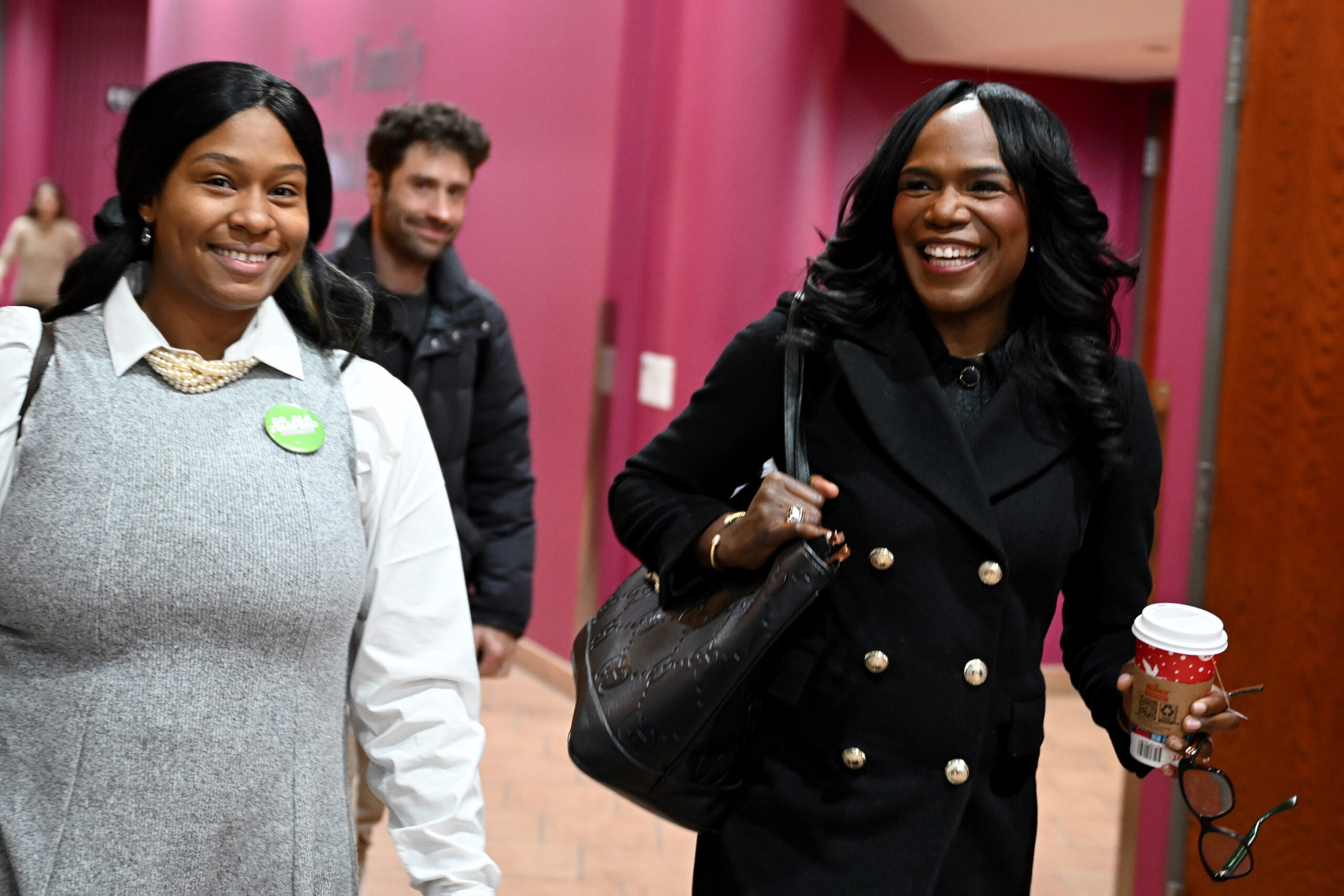
    Candidates (from left) State Rep. Morgan Cephas; physician David Oxman; State Rep. Chris Rabb; physician Ala Stanford and State Sen. Sharif Street appear at a forum hosted by the 9th Ward Democratic Committee in Mt. Airy Thursday, Dec. 4, 2025.

    Stanford also has a cadre of healthcare workers uplifting her. She has won endorsements from prominent doctors, as well as a national super PAC, 314 Action, which backs candidates with backgrounds in science and has poured $1.5 million into a pro-Stanford campaign.

    The group so far funded five weeks of television commercials reminding voters that Stanford founded the Black Doctors COVID-19 Consortium. In the throes of the pandemic, she set up mobile testing sites in majority-Black communities and ran vaccination clinics to inoculate thousands of Philadelphians, a grassroots effort to fill gaps left by government-funded programs.

    Today, she runs a primary care health clinic in North Philadelphia that bears her name.

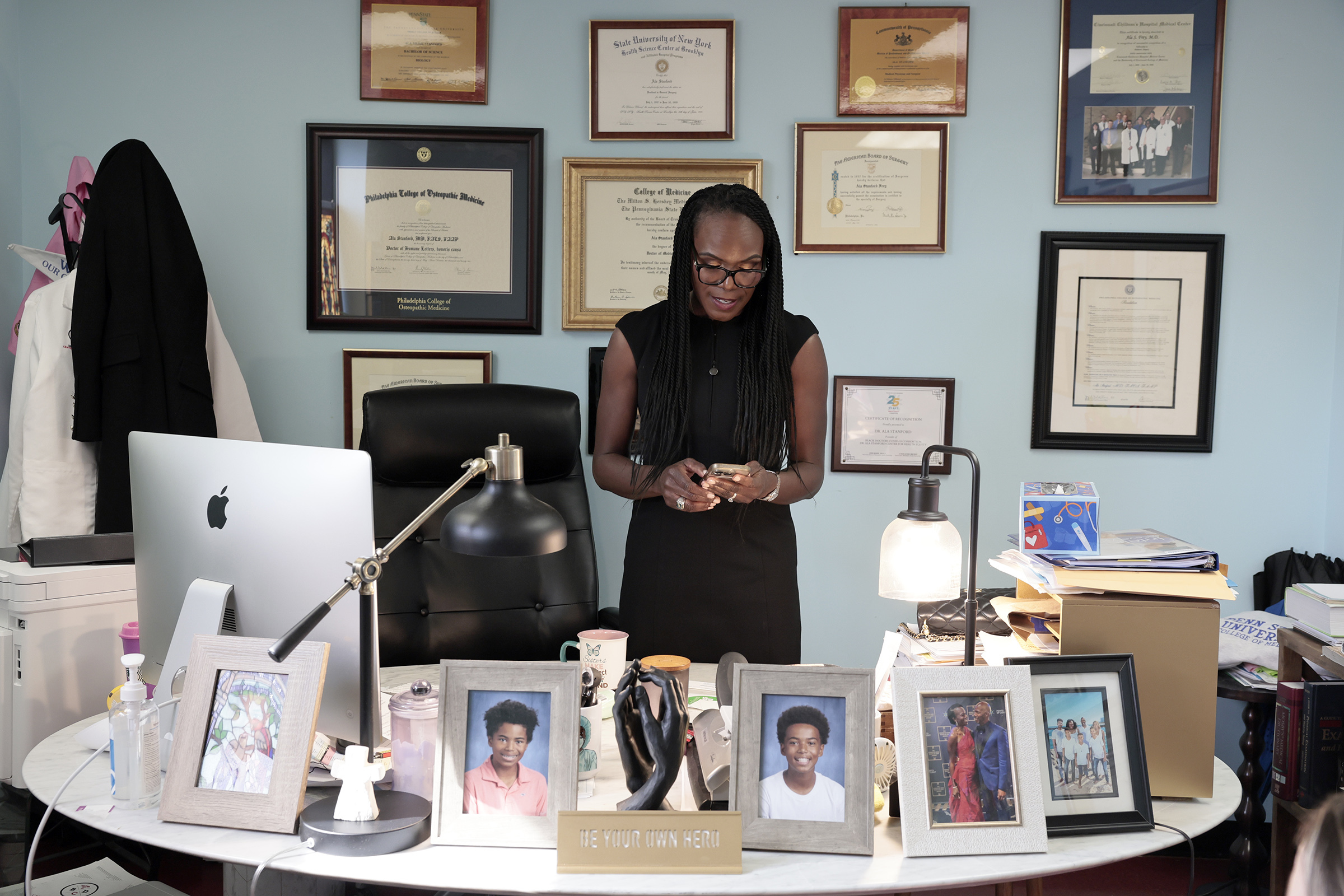
    Ala Stanford texts her son while in her office at the Dr. Ala Stanford Center for Health Equity, 2001 W Lehigh Ave. in Philadelphia on Friday, March 13, 2026

    It is a compelling story that has been told many times — across national media, on podcasts, and in Stanford’s own memoir.

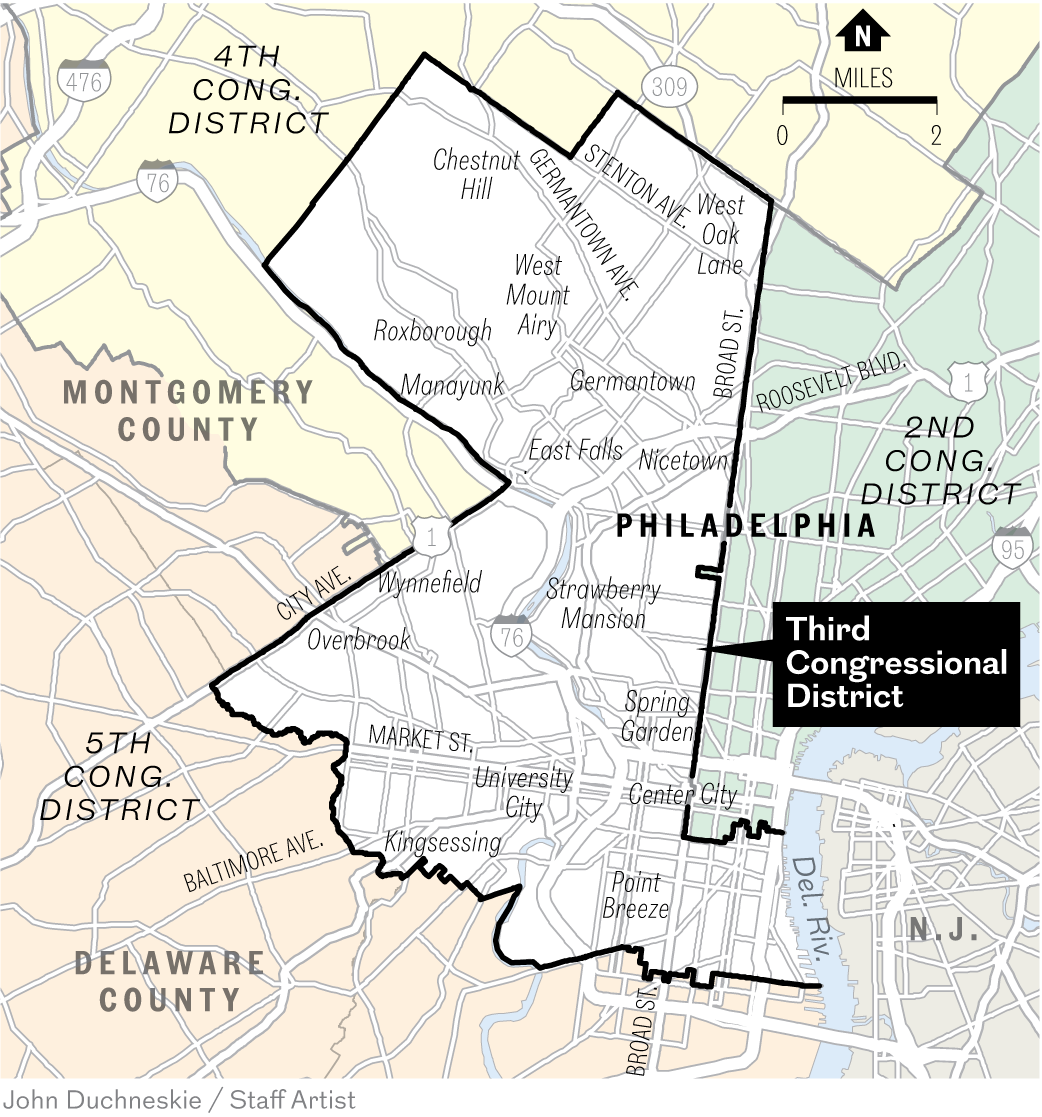
    What hasn’t been told is why it means she should represent the 3rd Congressional District, which covers much of Philadelphia, over her opponents who have spent years in politics.

    “People get so comfortable doing things the same way, the same way, the same way,” she said in a recent interview at her health clinic. “And no one likes change. But the city needs this. The city needs some change.”

    Other candidates say Stanford doesn’t have a monopoly on talking about healthcare. State Sen. Sharif Street, another front-runner in the race, has touted that he and other government officials helped secure funding for Stanford’s pandemic operation.

    “During COVID, he was very proud of his work,” Street spokesperson Anthony Campisi said, “to ensure that Doctor Stanford’s vaccination efforts received the support they needed so that we could get vaccines into arms quickly.”

    Stanford’s opponents also clearly know that her status as a physician may be an asset.

    She submitted paperwork to appear on the ballot as “Dr. Ala Stanford.” But on Tuesday, a member of the Democratic City Committee — which endorsed Street — filed a petition in state court, saying Stanford’s name should appear without the “Dr.” in front of it.

    In the coming days, a judge will decide.

    Leaning on healthcare as a core issue

    Stanford does not fit neatly onto the ideological spectrum.

    Of course, she is not conservative. She doesn’t call President Donald Trump by his name — he’s “47″ — and she uses words like “tyranny” and “running amok” to describe the current White House.

    But unlike some of her opponents, she is not of the Philadelphia Democratic establishment. She said she feels like the city’s long-entrenched party apparatus had always planned to endorse Street, the former head of the state party and the son of a Philadelphia mayor.

    Stanford is also not of the populist left. She believes Palestinians “deserve to have safety and freedom,” but thinks it’s inflammatory when her progressive opponent, State Rep. Chris Rabb, calls Israel’s war in Gaza a “genocide.”

    “I know when you use the G-word how hurtful it is to a group of people,” she said. “It’s like someone saying the N-word around me. I don’t want to hear that. And every time you shout that from the rooftops, how many people are you hurting?”

    What she does believe is that government systems have failed underserved communities, and that most domestic issues can be traced back to inequities in healthcare — points she has consistently emphasized in her campaign.

    Physician Ala Stanford (right) arrives at a forum hosted by the 9th Ward Democratic Committee Dec. 4, 2025. She is a Democratic candidate running to represent Philadelphia’s 3rd Congressional District.

    She has hammered Republicans for not extending pandemic-era subsidies that ensured people on Affordable Care Act health plans did not pay more than 8.5% of their income for care. She has advocated for universal healthcare. And she has harshly criticized Health and Human Services Secretary Robert F. Kennedy Jr., who has long been skeptical of vaccines.

    “In this country, wealth is linked to homeownership, home ownership is linked to education, education is linked to health outcomes, and health outcomes are all exacerbated by racial injustice,” Stanford said during a recent candidates forum. “So when you talk about one, you talk about all.”

    Stanford is careful to say that her focus on healthcare doesn’t mean she can’t discuss housing, immigration, or the war in Iran.

    But it is clear that she feels most comfortable talking about what she knows best. Her supporters say that’s an asset in the 3rd Congressional District, which has a disproportionately high number of people who rely on public healthcare systems.

    More than a third of the district’s residents, or more than 284,000 people, were on Medicaid as of December, according to the state Department of Human Services. Among Pennsylvania congressional districts, that’s the second-highest proportion of residents on Medicaid. (The first highest is the 2nd Congressional District, which also includes parts of Philadelphia.)

    Map of Pennsylvania’s 3rd Congressional District.

    The state estimates that more than 30,000 people in the district could lose their healthcare as a result of changes to Medicaid eligibility and coverage under Trump’s One Big Beautiful Bill Act.

    There were also more than 80,000 people in the district who last year had health coverage under the Affordable Care Act, either through expanded Medicaid eligibility or a plan they purchased through the marketplace.

    That number is also likely lower now since ACA subsidies expired this year and premiums rose. Statewide, one in five people who bought plans last year from Pennsylvania’s marketplace, Pennie, opted out for 2026.

    Ala Stanford speaks at the Black Doctors Consortium Dr. Ala Stanford Center for Health Equity in Philadelphia, Pa., on October 27, 2021. The center was opened with the goal of making healthcare accessible for those in communities who might struggle to get proper healthcare treatment.

    Stanford’s supporters think Philadelphia voters will trust a doctor to ensure affordable healthcare access. They point to a survey released this month by the Annenberg Policy Center at the University of Pennsylvania that found 86% of respondents said their primary healthcare provider is trustworthy.

    Erik Polyak, the executive director of 314 Action, said Stanford’s background differentiates her in a Democratic primary in which most candidates align on key issues.

    “Voters want healthcare decisions made by people who understand patients and the science,” he said, “and not politicians chasing headlines.”

    Oxman, Stanford’s now-former opponent, said physicians running for office can help rebuild a Democratic Party that has “lost the trust of so many people.”

    “So many people see us as not centered on their needs, particularly their economic needs,” he said. “If the Democrats are going to build a party that has a chance of winning in Center City Philadelphia and in central Pennsylvania, it’s got to regain the trust of the voters.”

    New to politics, but not government

    It was the spring of 2020, and the bills were piling up.

    Stanford, who was born in Germantown, had given up her well-paying day job as a surgeon to work full-time with the Black Doctors Consortium. She ran COVID-19 testing clinics in Philly parking lots and churches, and amassed some $200,000 in bills, saying she couldn’t “let one person lose their life for a test that costs $100.”

    That was the beginning of her pandemic experience with government.

    A lot of it was begging. As Stanford tells it, she peppered government officials with emails, telling them how many people she and her volunteers had tested that day, and asking for help securing funding.

    In this April 2020 file photo, Ala Stanford puts on her mask before running a coronavirus (COVID-19) testing site at the Miller Memorial Baptist Church in Philadelphia.

    U.S. Rep. Dwight Evans was immediately responsive. He connected Stanford with the White House, other members of Congress, and top insurance companies. And he publicly called on former Gov. Tom Wolf and then-Mayor Jim Kenney to allocate funding to Stanford’s organization, citing the group’s outreach to predominately Black communities and its work to address distrust of medical institutions.

    The money came in several months later. It was finally enough for Stanford to pay for testing, compensate her staff, and prepare to vaccinate thousands of Philadelphians.

    Fast-forward five years, and Evans has endorsed Stanford to replace him in Congress as he retires after decades of public service. His backing has been invaluable to Stanford, and it surprised some political observers who figured he might endorse one of the politicians whom he’d served alongside.

    Stanford said Evans’ support has not convinced some Democratic voters. Some tell her they plan to vote for Street, citing his family name, or they say that “it’s his turn now.”

    “What about if he is not what’s best for the people?” Stanford said. “Doesn’t that factor in?”

    She tells voters that despite being new to the campaign trail, she isn’t new to government. She worked as a regional director for the Department of Health and Human Services under former President Joe Biden, who appointed her to the role. And she leads medical services at the Riverview Wellness Village, the city-owned drug recovery center opened last year by Mayor Cherelle L. Parker’s administration.

    Physician Ala Stanford in an examination room at the primary medical care center run by her Black Doctors Consortium at Riverview Wellness Village, a city-owned drug recovery home in Northeast Philadelphia Tuesday, Nov. 25, 2025.

    Still, Stanford very much sees herself as a doctor.

    She often works out of a corner office in the North Philadelphia health center, and she still is alerted when the temperature of the vaccine refrigerator dips a degree too low. She has, on more than one occasion, tended to someone experiencing a medical emergency while she was campaigning.

    She knows that overseeing day-to-day operations at the health clinic won’t be possible if she’s in Congress. There’s a succession plan in place.

    “It’s just about, how can I have more significance at a larger scale? Congress is definitely a way to do it, but it might be somewhere else,” Stanford said. “That is, if I don’t win. But I want to win. I should win.”

  • Meet the journalist-turned-poet chronicling her Cherry Hill childhood in her debut book

    Meet the journalist-turned-poet chronicling her Cherry Hill childhood in her debut book

    In her poem, “To the Chimeras of South Jersey,” Jia-Rui Cook writes of teenage heartache, ’80s movies, and the gulf between her American childhood and the world of her parents, immigrants from China by way of Taiwan and Singapore.

    “… Acing / honors English but flunking Saturday / Chinese School: double cherries that ripen / when summer sun runs hot. This world / will feel less than whole for many years.”

    The Cherry Hill-bred and Los Angeles-based writer is set to release her debut poetry collection, Soft Beasts, next year. The book explores Cook’s upbringing in South Jersey, her coming of age in Los Angeles, and the various bodies we inhibit in our ever-changing world. Cook is the 2025 winner of the Philip Levine Prize for Poetry, a national prize out of Fresno State University that awards one writer $2,000 and the publication and distribution of a book.

    As she prepares for the release of Soft Beasts next year, Cook reflected on her formative years in Cherry Hill, which shaped her career as a writer and figure prominently in her poetry. Cherry Hill “was kind of an amazing incubator” for young writers like herself, Cook said.

    Jia-Rui Cook (right) and her father standing in front of her childhood home in Cherry Hill, N.J. around 1995, the year she graduated from Cherry Hill High School East.

    Cook’s parents settled in Cherry Hill when she was a toddler and sent her to James H. Johnson Elementary School, Henry C. Beck Middle School, and Cherry Hill High School East. At East, Cook played lacrosse, worked on the yearbook, participated in the all-South Jersey band, and wrote for the student newspaper. Cook took an early interest in playing with words (her parents had an Inquirer subscription, and Cook was a habitual reader of the crosswords and comics page). A 1995 Inquirer story profiled Cook (whose maiden name was Chong) and her classmate Gina Kang, both star lacrosse players who were headed to Harvard University.

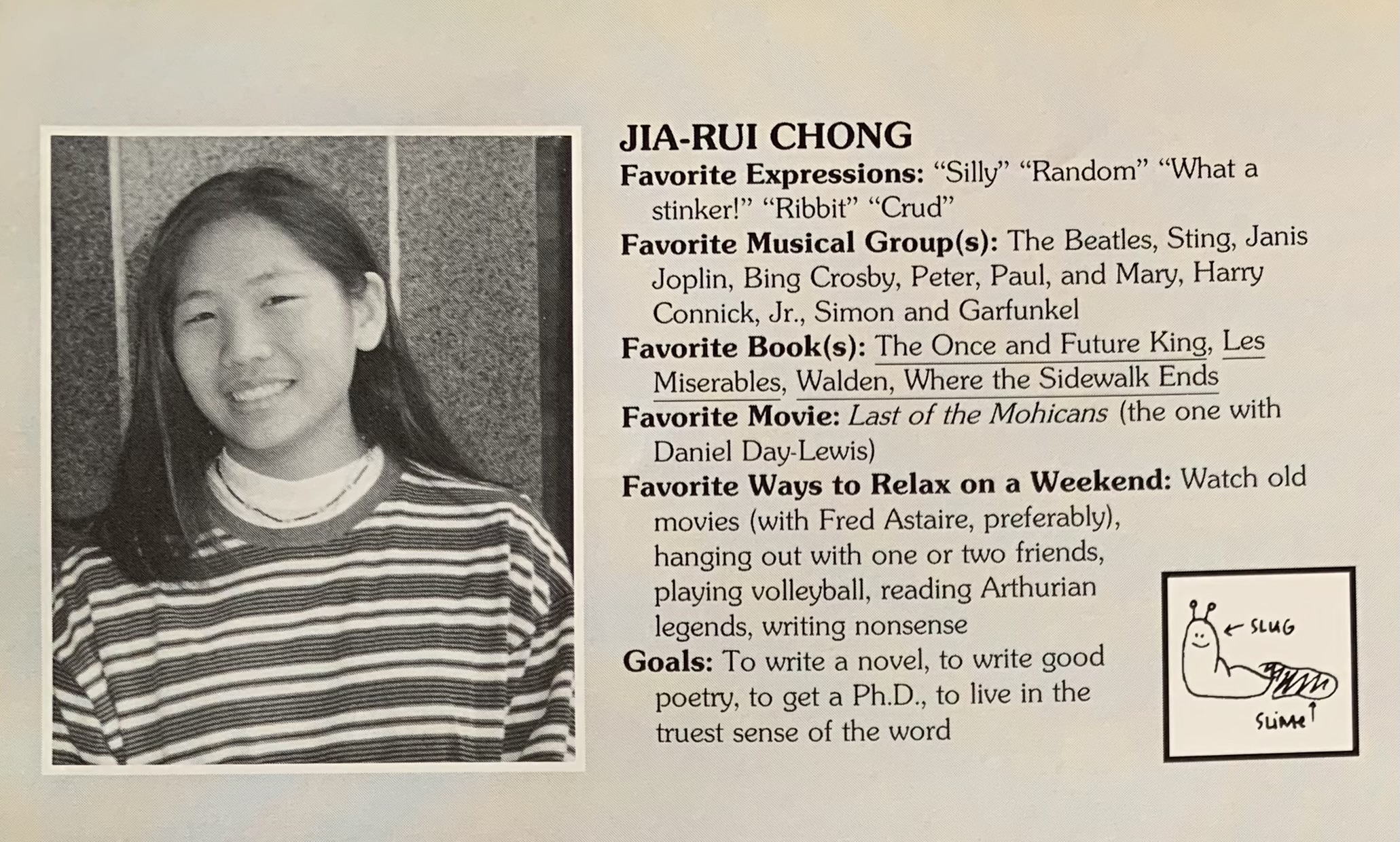
    In Cook’s high school yearbook, she wrote that it was her goal “to write good poetry.”

    Cook studied American history and literature at Harvard, joining the poetry board and studying under writers Seamus Heaney and Helen Vendler. She wrote a thesis on “Moby Dick.”

    Cook always wanted to be a writer, but didn’t know if she could make a living out of poetry. After college, she ventured into another form of storytelling — journalism. Cook spent six years at the Los Angeles Times, covering everything from medical research to Asian-American life in the city. She left journalism in 2009, and has worked in science and health communications since, including a stint at NASA’s Jet Propulsion Laboratory.

    Reporting and science writing are grounded in third-person observation and objectivity, Cook said, and as she was writing about rocket launches and research breakthroughs, she missed the creativity that drew her to writing in the first place.

    She wrote a few poems in the mid-2010s, and won the Zócalo Public Square Poetry Prize in 2013, but life quickly became busy with parenthood and work (Cook and her husband, Bryan, who is from the Main Line, have two daughters). It wasn’t until 2021 that Cook felt like she could pick up the pen again.

    “You get on this roller coaster of going, going, going, and then when you suddenly stop, you think, ‘Wow, actually, maybe I’ve learned some things. I have some things to share,’” she said, recalling how it felt to return to poetry five years ago.

    Jia-Rui Cook’s (then Chong) photo in her Cherry Hill High School East yearbook. Cook graduated from East in 1995.

    So Cook began to write again — about people, animals, her childhood in Cherry Hill, the subtleties of the Chinese-American experience she came to understand while living in and writing about Los Angeles.

    “I had to really step away and experience the world for a bit,” she said. “I had to go out and experience the world and to see it, and maybe try to tell other people’s stories for a while before I really understood, ‘What story did I want to tell about my own life?’”

    Anagrams (words or phrases made by rearranging the letters of a different word) figure prominently in her work.

    In her poem “Anagram No. 2,” Cook anagrams “Cherry Hill, New Jersey,” rearranging the letters to make sentences that resemble English, but don’t precisely follow its conventions. English was not Cook’s parents’ first language, and “there was always this kind of slipperiness with the language” in her house, she said.

    “Anagram No. 2” is “playing around with the English language” in a way that echos the experience of learning it.

    In January, Cook became a fellow with the Periplus collective, a mentorship program for writers-of-color. In February, she won the Levine Prize. Jake Skeets, the Levine Prize’s final judge, called Cook’s poetry “both wonder and wander,” holding “stark, living images of place” and teachings on how “to be alive in the present moment.”

    For Cook, publishing poetry has been an opportunity to “create something meaningful” in a world that “feels under siege.” The immigration crackdown that overtook Los Angeles last summer weighed heavily on her as the child of immigrants.

    “It just was really wonderful and incredibly meaningful to feel like I’ve been creating these little, tiny bits of beauty where I can in the world,” she said.

    Winning Fresno State’s Levine Prize is poignant for Cook. Fresno State was the first place Cook’s mother landed when she arrived in the U.S. and was where she learned English. Decades later, the university is helping to publish Cook’s first book.

    “It felt like a full-circle moment,” Cook said.

    Though California has been her residence for decades (and Cook says she has decidedly fallen in love with Los Angeles), she still considers South Jersey home. It’s the place where she became a writer and where her journey of self-understanding began.

    “It has to start somewhere,” she said of her book. “So it really does start in Cherry Hill.”

    This suburban content is produced with support from the Leslie Miller and Richard Worley Foundation and The Lenfest Institute for Journalism. Editorial content is created independently of the project donors. Gifts to support The Inquirer’s high-impact journalism can be made at inquirer.com/donate. A list of Lenfest Institute donors can be found at lenfestinstitute.org/supporters.

  • Chester County has more than 9,000 EVs. Now it wants to build more public electric vehicle charging stations

    Chester County has more than 9,000 EVs. Now it wants to build more public electric vehicle charging stations

    Chester County, home to one of the largest numbers of electric vehicles in the state, hopes to grow its footprint of public charging stations.

    Through the federally funded National Electric Vehicle Infrastructure program, administered through the Pennsylvania Department of Transportation, the county is looking to build up its community-based public EV charging stations for people who have or want an electric vehicle but do not have a charging station installed at home.

    Funding from the program flows directly to municipalities or other applicants for EV chargers. PennDot expects to fund more than 100 projects through the grant.

    It builds on an initial federally funded project under the same program, which sought to place charging stations every 50 miles along the major travel corridors to address long drives across the state. Through that program, Chester County projects received $3.2 million.

    Chester County’s proposal would increase the number of public chargers speckled around the county, from workplaces to businesses, giving drivers a place to charge their cars as part of their day-to-day routines.

    Chester County, which has both densely packed development and rolling agricultural pockets, saw its rates of EV ownership double between 2022 and 2024, with more than 9,000 EVs registered in the county in the state’s most recent data. The county is behind only Montgomery in overall EV registrations in the southeastern part of the state.

    “Things are pretty spread out, and with the infrastructure that we have in place right now, other modes of transportation that are carbon-free or less carbon intensive than single-occupancy vehicles are not as viable here as they are in other places that are more dense,” said Rachael Griffith, sustainability director for the Chester County Planning Commission. “If we’re looking at a lower carbon future for our transportation network, EVs are really a great option for that here in our land-use setting. Building out the network of EV chargers is really the way that we incentivize that.”

    EVs are expensive, but Chester County has the highest median income in the state, so it makes sense it would see the higher ownership rates, Griffith said.

    Under former President Joe Biden’s administration, there had been a broader push nationally for electric projects. But that shifted with President Donald Trump’s return to office, as the president slashed electric goals. Experts in clean transportation anticipated seeing more projects focused on propane and natural gas in response.

    Despite the policy shifts, “it’s very clear that the future of transportation is electric,” Griffith said.

    “The more that we can do to plan for that future, I think the better prepared we will be in the long term,” she said.

    The county’s planning commission is reaching out to municipalities and chambers of commerce to drive applications for the program, Griffith said. Applications are open until Aug. 21; any business registered in Pennsylvania is eligible for funds.

    This suburban content is produced with support from the Leslie Miller and Richard Worley Foundation and The Lenfest Institute for Journalism. Editorial content is created independently of the project donors. Gifts to support The Inquirer’s high-impact journalism can be made at inquirer.com/donate. A list of Lenfest Institute donors can be found at lenfestinstitute.org/supporters.