The Minneapolis-based artist can’t unsee the impact ICE and directives from President Donald Trump’s administration’s have had on her hometown in recent months.
“I don’t really know anyone whose life hasn’t been affected by the occupation in a tangible way,” she said. “Many people I know are volunteering to deliver meals, patrol schools, drive folks to work, and serve as peaceful observers — which is what both Renee Good and Alex Pretti were doing when they lost their lives at the hands of ICE agents.”
The independent graphic designer thought about ways she could get involved when it hit her. She’s joining a larger tradition of subversive font design.
Haddican, whose work focuses on typography, branding, and packaging, thought back to Moontype, a font created by designer Olli Meier that autocorrects “bad words,” like hate, into “good words,” like love.
Then she thought about language and its use today.
“It’s become impossible to ignore how blatantly the Trump administration is misusing language in order to control and distort the narrative,” she said. It clicked.
“Wouldn’t it be cool if you could change someone else’s words?” Haddican said. “I decided that the best practical use of this font feature would be a practical joke.”
This month, she launched Times New Resistance, a parody of the commonly used Times New Roman font, which autocorrects a slew of specific words as they’re typed. Notably, Times New Roman is the new (and old) official font of the State Department.
Using Times New Resistance, the term ICE autocorrects to “the Goon Squad.” Trump autocorrects to “Donald Trump is a felon.” Gay becomes “gay rights are human rights.” Illegal alien becomes “human being.”
Kingsley Spencer, a creative director and designer based in Jacksonville, Fla., says using the State Department’s own font is part of what makes Haddican’s font so powerful.
“Using technology as a form of commentary against a political regime that decided to weaponize Times New Roman as a form of culture shaping is sharp for a designer,” he said. “I love how direct and comical it is.”
The font is free, “just like America used to be,” Haddican‘s website says. She said Monday that it has been downloaded about 600 times so far. She describes it as a “social commentary meant to autocorrect the autocrats.”
The hope is that some users might secretly install the font onto the computers of “an ICE apologist,” or “morally bankrupt American” as a way of unleashing mischief.
To the untrained eye, the typeface looks like Times New Roman in the font menu — there’s just a sneaky extra space between the words Times and New. But it’s likely many downloads are by like-minded supporters who want to enjoy the font for themselves.
The technology behind the font is simple.
Haddican modified an existing open-source typeface that resembles Times New Roman and programmed the substitutions. She said the hardest part was deciding which autocorrections to make.
“I know I’ve done an imperfect job. The corrections are a mixture of serious stuff (for example, the word ‘good’ autocorrects to ‘Renee Good was murdered by ICE’) and things that I find funny, like changing ‘Stephen Miller’ to ‘Nosferatu,’” she said.
“The first draft was significantly more profane, but I toned it down. I wanted to offend people by speaking truth to power, not for swearing like a sailor.”
Spencer said the font uses something in the typography world called ligatures, which replaces a set of recognized characters with a single character phrase. An example of this is when you type a fraction or date in a document and it’s automatically formatted.
Haddican joins a group of other typography artists who have made jokes, social commentary, or both through text.
Times Newer Roman is a typeface created by the Brooklyn-based art collective MSCHF (pronounced mischief) in 2018 that looks identical to Times New Roman, except each character is 5% to 10% longer, making essays appear slightly longer without changing formatting rules.
It was billed as a font that could help students cheat on term papers. The font takes jabs at academic productivity culture, using typographic invisibility that’s undetected by the untrained eye.
Sang Mun, a designer and former National Security Agency contractor, created a subversive “surveillance proof” font called ZXX in 2013. The fonts were created to be legible to the human eye, but difficult for surveillance software used by Google and other companies to scan text to read.
More mainstream examples include Shepard Fairey, the artist behind OBEY and President Barack Obama’s iconic HOPE graphic, who is known for his use of single phrases and high-contrast graphics to make political propaganda-style art. In the 2024 presidential election, Fairey made a Kamala Harris poster that said FORWARD in the same style as his Obama art.
On social media, reception for Haddican’s font has been strong, garnering over 6,000 likes on Instagram and hat tips from fellow designers.
“I think just about anything can be a form of resistance, and I believe that humor and playfulness are powerful tools for pushing back against oppression and authoritarianism,” Haddican said. “The trickster (e.g. Bugs Bunny) always beats the martyr (e.g. Elmer Fudd) in the end.”
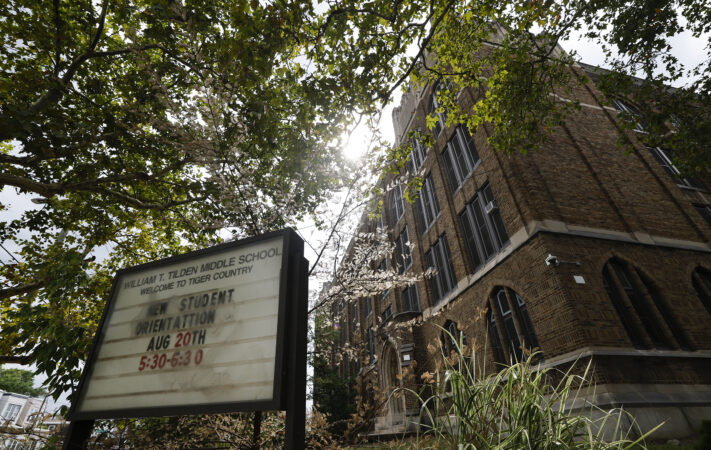
Students streamed out the front doors of William T. Tilden Middle School on a recent Friday afternoon, past the “Welcome to Tiger Country” sign at the corner. As they shouted to friends and threw snowballs to celebrate the weekend, they were dwarfed by the massive brick school building behind them.
That building, which spans half a city block in Southwest Philadelphia, is a primary reason the Philadelphia School District has proposed closing Tilden alongside19 other schools.
Capable of holding roughly 1,400 students, Tilden had only 266 enrolled last year, the district said. That means it is at just 18.5% capacity — the second-lowest of all the schools tapped to close, according to an Inquirer analysis. While enrollment in the school district overall has increased in the last four years, it has declined at Tilden, with just 24 students in this year’s fifth-grade class, district data shows.
The district has rated Tilden’s building as “poor” when it comes to being safe and accessible, meeting environmental standards, and having modern technology. Tilden is also one of six middle schools that Superintendent Tony B. Watlington Sr. has proposed closing in an effort to shift the district’s focus to the K-8 model.
Unlike some of the otherschools on the chopping block, the Tilden community so far has not mounted an organized fight against its closure as the school board prepares to vote this winter on Watlington’s recommendations. Just a dozen employees and residents showed up to an in-person meeting on a frigid Saturday morning earlier this month to discuss the school’s possible closure, according to Chalkbeat Philadelphia, and about 30 attended a virtual meeting about Tilden a few days later. There is no online petition to keep it open, as there are for manyother schools slated for closure.
Students who were set to graduate before the proposed changes would take effect said in interviews outside the school that they did not care much about the possible closure, though some adults expressed more concern.
“This school has had, and still does have, excellent community programs,” said Tilden teacher Cheryl Padgett through tears at the virtual meeting.
The district’s draft facilities plan recommends that in the fall of 2027, Tilden stop accepting new fifth graders, and then gradually phase out its remaining classes, closing for good in 2030.
All of Tilden’s current students would be able to graduate from the school under the proposal; new students who would have attended Tilden for middle school will instead stay at Patterson, Catherine, and Morton — the elementary schools that currently feed into Tilden. The district said all three of those schools would receive increased investment as they add grades and become K-8 schools.
Tilden is in a neighborhood deemed especially vulnerable by the district, which ranked it as “high risk” to account for its experience with previous school closures, as well as its high poverty rate, lack of publictransportation, and language barriers. (The district’s top vulnerability ranking is “very high risk.”)
Tilden’s building would eventually be repurposed as a sports facility for Bartram High and the broader neighborhood under the plan.
At the virtual meeting, community members worried that the buildings slated to become K-8 schools are not equipped for older children, and that younger students would be exposed to problematic behavior from older kids.
Some community members said they feared that changes resulting from the district’s plan, which spans a 10-year period, would not come soon enough.
“Do something now,” said Mama Gail Clouden, a longtime community activist. “While you’re talking about ‘in two years,’ and what you’re planning to do — right now, children and parents and staff are suffering in these schools.”
Tilden also has received additional support and funding from the city’s tax on sweetened beverages through the community schools program pioneered by former Mayor Jim Kenney.
“Our kids can succeed,” Kenney said at a 2017 news conference at Tilden announcing funding for the first group of schools. “They can meet their potential if we give them the resources.”
Asa community school, Tilden’s building serves as a center for such resources: The school hosts a food pantry every Friday, and families can access case management and utility and housing assistance and other supports through a partnership with Methodist Services.
“These kids, they have a way of growing on your heart,” said Wanellie Cummings, an attendance case manager with Methodist Services assigned to Tilden.
Cummings works with kids who have three or more absences to try to address any barriers at home that might prevent them from getting to school. She said she has not heard much from her clients about the potential school closure, though she did worry about Tilden’s food pantry closing.
“When you take that away from a community, what’s left? If those grandmoms and grandpops have to go somewhere else to get food …,” she said.
The district has said it would spend the 2026-27 year planning for how to maintain the resources now offered at Tilden.
When Sen. Dave McCormick stood on the Senate floor to call for nationwide rules mandating proof of citizenship and photo identification for voters, he invoked a drama that had played out three months earlier in Chester County.
The county had mistakenly left all third-party and unaffiliated voters off the Election Day voter rolls, creating a chaotic scene in which more than 12,000 voters were forced to cast provisional ballots, which take more time to count as officials must verify the eligibility of each voter. A subsequent investigation by a law firm hired by the county attributed the issue to human error and insufficient oversight.
“Every time Americans hear about election problems like Chester County’s, they rightly question the integrity of our electoral process,” McCormick said.
But in his recounting of events, the Pennsylvania Republican gave incomplete and inaccurate information about Chester County’s election error.
What did McCormick say about Chester County?
Americans, he said, overwhelmingly believe there are problems with U.S. elections, and he argued that has been demonstrated for them on multiple occasions, including in November when Chester County omitted more than 70,000 third-party and unaffiliated voters from its Election Day pollbooks.
“Registered voters were turned away at the polls. And an unknown number of unverified voters cast regular ballots,” McCormick claimed.
But there is no evidence that voters were turned away or that ineligible voters cast ballots. McCormick’s office did not respond to questions.
Were voters turned away?
According to county officials, no voter who wanted to vote was turned away.
Instead, for most of the day voters were offered the opportunity to vote by provisional ballot while county and state officials worked to get supplemental pollbooks distributedto polling places across the county.
Some voters did testify at county election board meetings that they voluntarily left their polling place when their name was not in the pollbook but that they returned later in the day when they could vote on machines.
Did unverified voters cast ballots?
There is no evidence that ineligible voters cast ballots. The identity and eligibility of all voters who cast ballots were verified, county officials said.
When the pollbook issue was discovered on Election Day, Chester County officials initially recommended that poll workers ask voters not included in the pollbook to sign the pollbook manually and vote as normal, according to the independent investigation of the incident.
To ensure those voters were eligible to vote, county officials said, poll workers were instructed to follow a detailed process that included verifying voters’ eligibility in the full voter list and verifying their identity with photo identification.
The Chester County Republican Committee has disputed the county’s version of events, contending that photo ID was not checked for all voters who wrote their names into pollbooks and that poll workers were unable to verify voters’ identities using signature matching.
Around 7:40 a.m., less than an hour after polls opened, Pennsylvania Department of State officials recommended the county shift to asking voters to cast provisional ballots to eliminate the risk of an ineligible voter casting a ballot, thereby invalidating the election.
A county spokesperson said there is no evidence that ineligible voters cast ballots during November’s election.
Whether voters wrote their names into a pollbook or cast a provisional ballot, “the identity and eligibility of each individual was verified by the poll workers,” said Chester County spokesperson Andrew Kreider.
Would the SAVE Act have changed anything?
The SAVE Act is a collection of election policies proposed by congressional Republicans that would require proof of citizenship to register to vote and mandate all voters show photo ID at the polls.
Such requirements would not have prevented Chester County’s error, which investigators determined was a clerical error resulting from inexperienced staff with insufficient training and oversight.
“Sen. McCormick was ignoring the facts and feeding into this larger narrative that our elections can’t be trusted and just feeding into the president’s narrative that there’s something wrong with Pennsylvania elections,” said Lauren Cristella, the CEO of the Committee of Seventy, a Philadelphia-based civic engagement and good-government organization.
In addition to Chester County, McCormick pointed to his own experience in close elections — both his 2022 primary loss and his 2024 general election win — as a reason he supports the bill’s proof of citizenship and voter ID requirements.
The policy, which passed the Republican-led U.S. House, still faces an uphill battle in the U.S. Senate, where it would need 60 votes to advance. It has faced significant opposition from Democrats who say it would needlessly make it harder for people to vote.
The proof of citizenship requirement, critics say, would place a higher burden on married people whose last names no longer match their birth certificates.
Enrique Fuentes counted on the $250 he received monthly in federal nutrition assistance to cover the cost of groceries. That changed last month.
Fuentes works three days a week as a technician assisting therapists who help autistic children and adults, ages 3 to 22. He is one of an estimated 3 million able-bodied Americans who do not work enough hours to qualify for the Supplemental Nutrition Assistance Program (SNAP) under a law signed by President Donald Trump.
“They cut me off because you need to work more than 20 hours a week to get benefits, and I didn’t have those hours,” said Fuentes, 27, who lives in Philadelphia. “I wasn’t even aware of that stipulation.”
Roughly 4 million Americans are expected to lose SNAP benefits in 2026 under the One Big Beautiful Bill Act. Many of them do not meet work requirements added to the anti-hunger program under the legislation, which paid for Trump’s tax cuts with cuts to SNAP and Medicaid.
In Pennsylvania, around 144,000 SNAP recipients could see benefits cut this year — an estimated 45,000 in Philadelphia and 12,000 in its collar counties, according to Pennsylvania Department of Human Services estimates.
Without enough food, Fuentes, who has an associate’s degree in psychology, felt overwhelmed, he said. He is consulting Community Legal Services, which serves people in poverty, for help.
“I fell into a downward spiral. It’s been upsetting,” he said.
“Lots of people didn’t know the rules, thinking the winds of Washington don’t affect them. But they do.”
Since January, advocates say, they have begun to hear from increasing numbers of people suddenly being removed from the program.
“The White House is rifling through our pockets for lunch money,” said George Matysik, executive director of the Share Food Program, a major provider of food to hundreds of pantries in the region. The cuts constitute “a rounding error for the federal government but [the money is] a lifeline for working-class families,” he added.
Asked for comment on criticism of the SNAP cuts, a White House spokesperson did not address the program. Instead, the spokesperson praised Trump for helping U.S. families by “fixing” former President Joe Biden’s “broken economy.”
The spokesperson saidthat benefits meant for American citizens are “no longer supporting illegal aliens.” But undocumented immigrants have never been eligible to receive SNAP benefits, according to the American Immigration Council,a group that provides legal services to immigrants.
Policy changes under Trump’s law
Because the new law revises categories of SNAP recipients — many of which will go into effect at different times — people are uncertain about what they may lose and when. Others who have already seen reductions say they are growing apprehensive because they don’t know whether the law is the reason, or whether bureaucratic adjustments or errors are the cause.
“Will all this change result in mass panic?” wondered Cailey Tebow, an education outreach coordinator for AmeriCorps VISTA, a national service program designed to alleviate poverty. Tebow works with low-income individuals in Northeast Philadelphia. “It’s scary to think what will happen when people realize what’s being taken from them.”
Hoa Pham, deputy secretary of the Office of Income Maintenancein the Pennsylvania Department of Human Services, which administers SNAP in the state, is more hopeful. She said she believes the efforts her department has been making will help Pennsylvanians understand SNAP revisions and will “avoid chaos.”
One category of potential confusion is the change in work requirements.
Until Trump’s spending plan rewrote the rules, groups of low-income people in Pennsylvania and other states were exempt from a long-standing requirement that childless adults without disabilities and under the age of 54 work, volunteer, or go to school 20 hours per week in order to be eligible for SNAP benefits.
The work stipulation had been waived for decades because of high levels of poverty and hunger, as well as diminished job opportunities in Philadelphia and elsewhere in the state.
Under the new policy, childless, able-bodied adults — whose age limit has now been increased to 64 — can be exempt from the work requirements only in areas with at least 10% unemployment — a rate of joblessness considered catastrophic, experts say. In November, Philadelphia’s unemployment rate was 4.8% and other areas in the region saw similar or lower rates.
“Work requirements in SNAP will put forward a substantial amount of bureaucracy that Pennsylvanians have to contend with,” Pham said. “It could kick many people off SNAP. The impact to people could be severe.”
She added that reducing SNAP rolls should not be construed as a savings for taxpayers, as Trump and other Republicans have long argued. That is because food insecurity exacerbates health problems, which will add other costs in the long term, Pham said.
“That will just drive up healthcare and insurance costs,” she said.
‘Life is already crumbling’
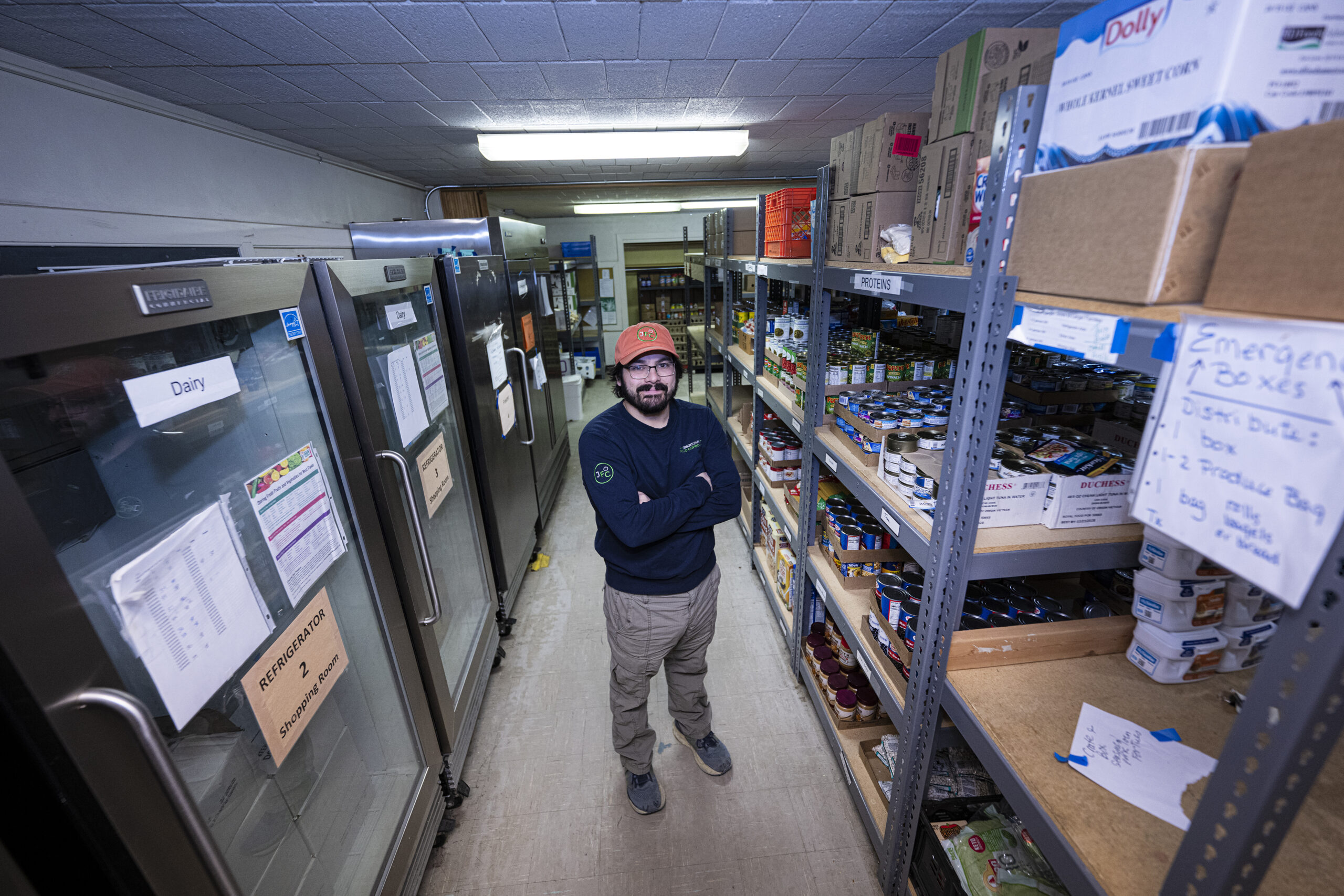
At the Jenkintown Food Cupboard last week, “anxiety about what will happen is growing,” said Nicolino Ellis, the executive director. “But bellies are already aching from hunger. Life is already crumbling today.”
Nicolino Ellis, executive director of the Jenkintown Food Cupboard, in the warehouse.
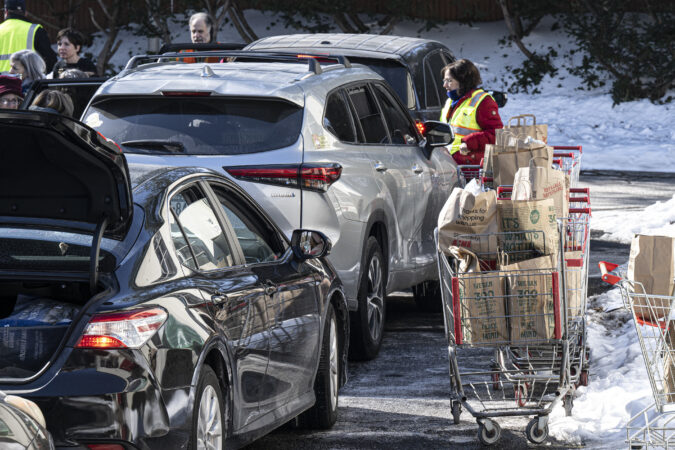
Outside the cupboard at the Jenkintown United Methodist Church, food was distributed in a driveway to clients who drove up in cars. A phalanx of volunteers slid bags of perishables and shelf-stable foods into trunks and back seats.
As SNAP benefits dry up while food prices soar, cupboards like this one become overburdened. But they are a less efficient means of feeding Americans in need, according to Stuart Haniff, CEO of the nonprofit Hunger-Free Pennsylvania.
“For every single meal distributed at a food pantry,” he said, “SNAP provides nine. And need in Philadelphia increased 140% over the last two years.”
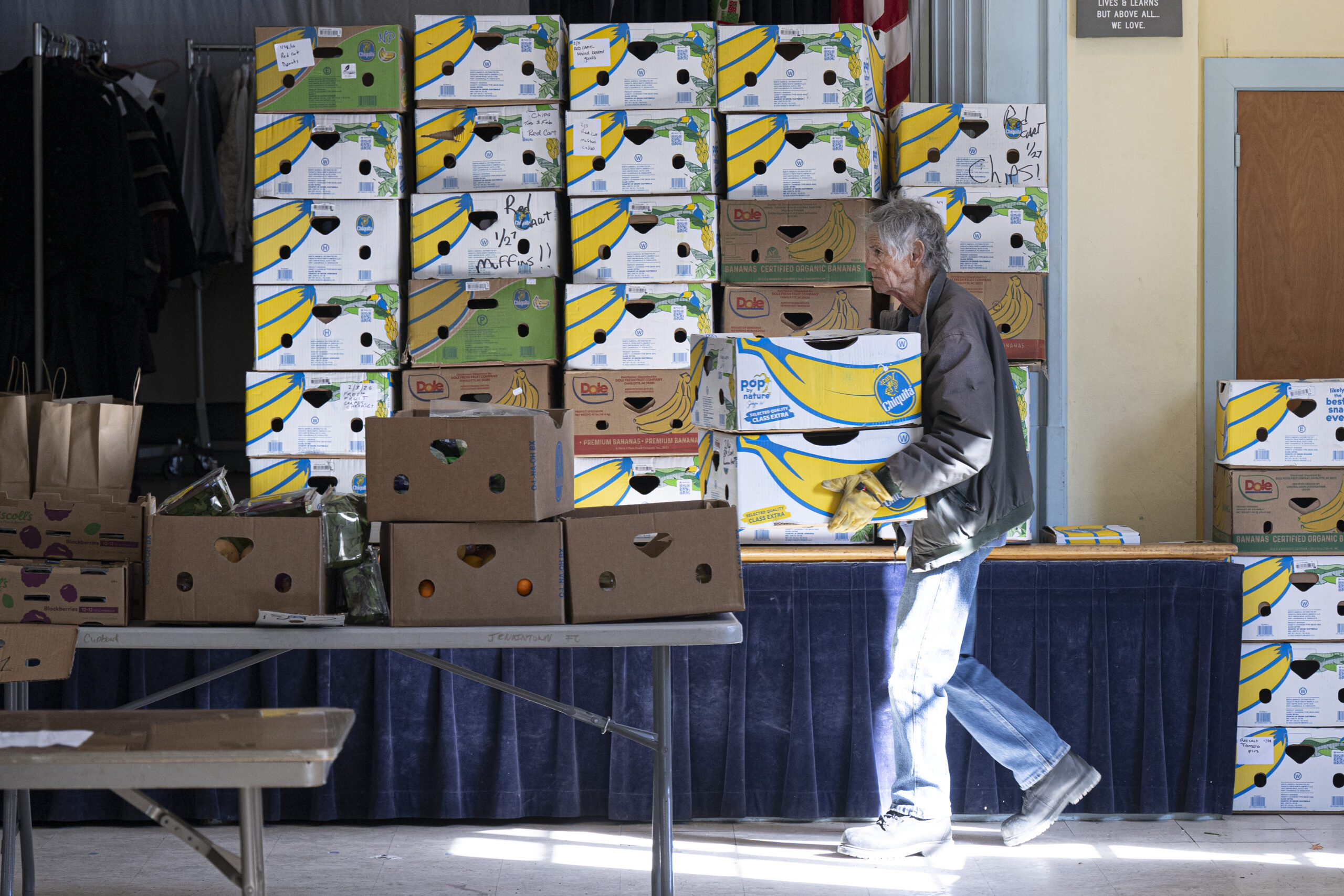
A Jenkintown Food Cupboard volunteer works to set up food distribution.
Shelley Gaither is one of the hundreds of people receiving groceries from the pantry.
Gaither, 51, is a former data analyst with an MBA who suffered a disability that caused her to stop working at a Malvern finance company 13 years ago. She now collects Social Security Disability Insurance and lives with her three sons, ages 6, 9, and 18, in Cheltenham.
Gaither said that in January, her SNAP payment dropped from $400 to $200. “I don’t know if it was a new formula from the government cutting me back, or some other reason,” she saidin a phone interview. “No one told me why. It’s not supposed to happen when you have a disability. It’s crazy.”
Whatever caused the cut, Gaither said, she is in trouble, and worried the benefit will shrink even further.
“Now, the money I used to pay for electricity and water has to go for food,” she said. “This makes surviving more difficult.”
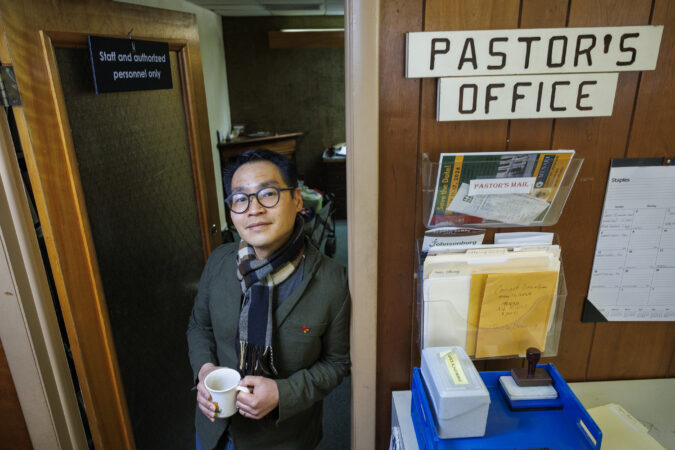
Within the serpentine halls and stairways of Olivet Covenant Presbyterian Church, congregants have established several private, off-limits rooms ― each a potential last-stand space where members would try to shield immigrants from ICE, should agents breach the sanctuary.
Church leaders call them Fourth Amendment areas, named for the constitutional protection against unreasonable search and seizure. The plan would be to stop ICE officers at the thresholds and demand proof that they carry legal authority to make an arrest, such as a signed judicial warrant.
“It’s a protective space,” said the Rev. Peter Ahn, pastor of the Spring Garden church. “While you’re here, you’re safe, is what we want to assert.”
Could it come to that? A pastor confronting armed Immigration and Customs Enforcement agents in the hallway of a church?
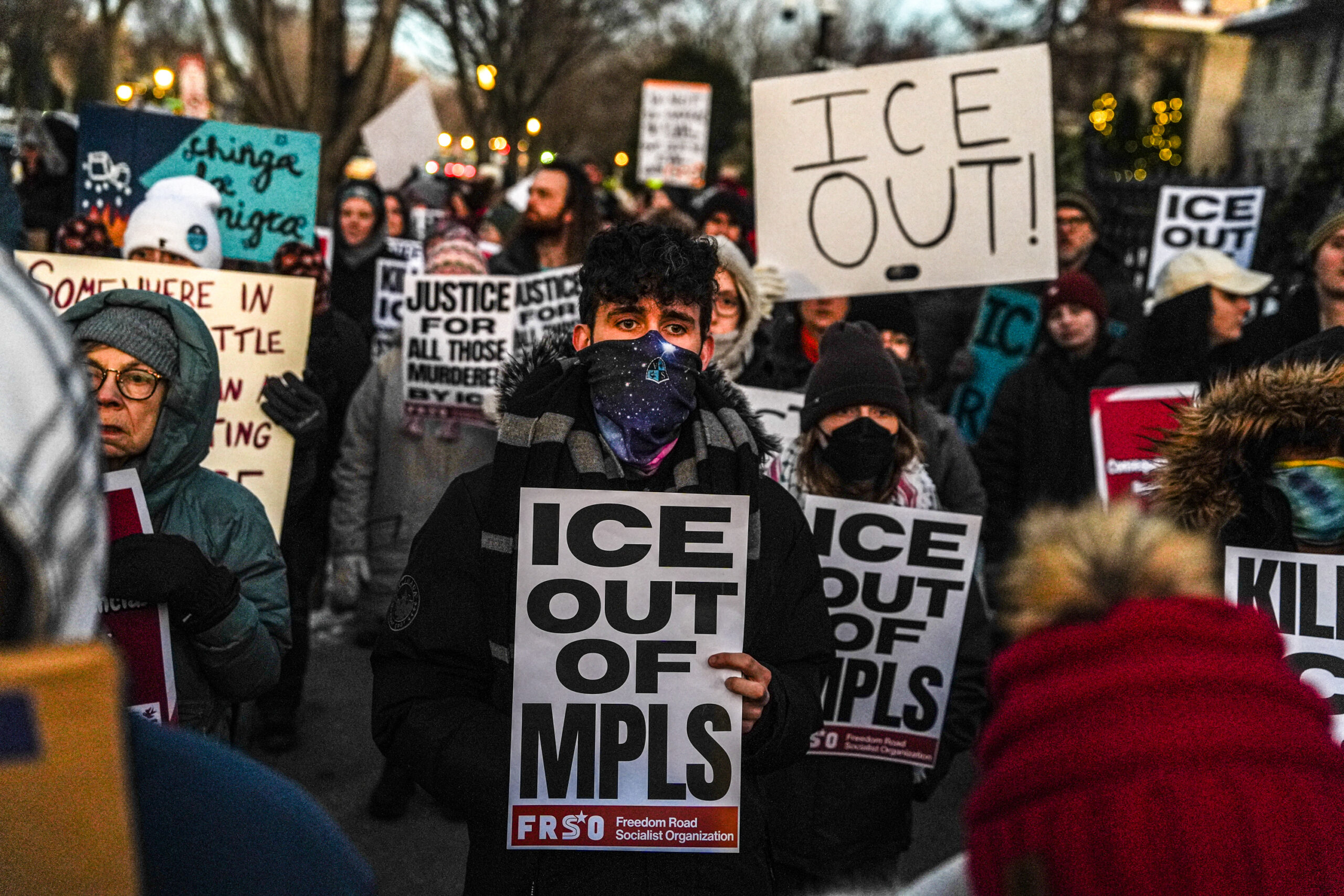
It’s impossible to know. But across Philadelphia, churches, community groups, immigration advocates, and block leaders are actively preparing for the time ― maybe soon, maybe later, maybe never ― that the Trump administration deploys thousands of federal agents. People say they must be ready if the president tries to turn Philadelphia into Minneapolis ― or Los Angeles, Chicago, or Washington, D.C.
People participate in an anti-ICE protest outside of the Governors Residence on Feb. 6, in St. Paul, Minn.
Know-your-rights trainings are popping up everywhere, often to standing-room-only attendance, and ICE-watch groups are abuzz on social media.
The First United Methodist Church of Germantown held a seminar last week to learn about nonviolent resistance, “so that we will be ready for whatever comes,” said senior pastor Alisa Lasater Wailoo.
“That may mean putting our bodies in the path to protect other vulnerable bodies,” she said. “We’re seeing that in Minnesota.”
In Center City, Temple Beth Zion-Beth Israel has ordered 300 whistles ― portable and efficient tools to immediately alert neighbors to ICE presence and warn immigrants to seek safety.
“There was a sense of needing to support our neighbors if it comes down to it,” said Rabbi Abi Weber. “God forbid, should there start to be ICE raids in our neighborhood, people will be prepared.”
In other places around the country, immigrant allies have similarly readied themselves for ICE’s arrival, and organized to react in concert when agents show up.
In Washington state, the group WA Whistles has distributed more than 100,000 free whistles to create what it calls “an immediate first line of community defense.” Chicago residents set up volunteer street patrols to warn immigrants of ICE and to contact family members of those detained. In Los Angeles, people raised money to support food-cart vendors, and organized an “adopt a corner” program to protect day laborers who seek work outside Home Depot stores.
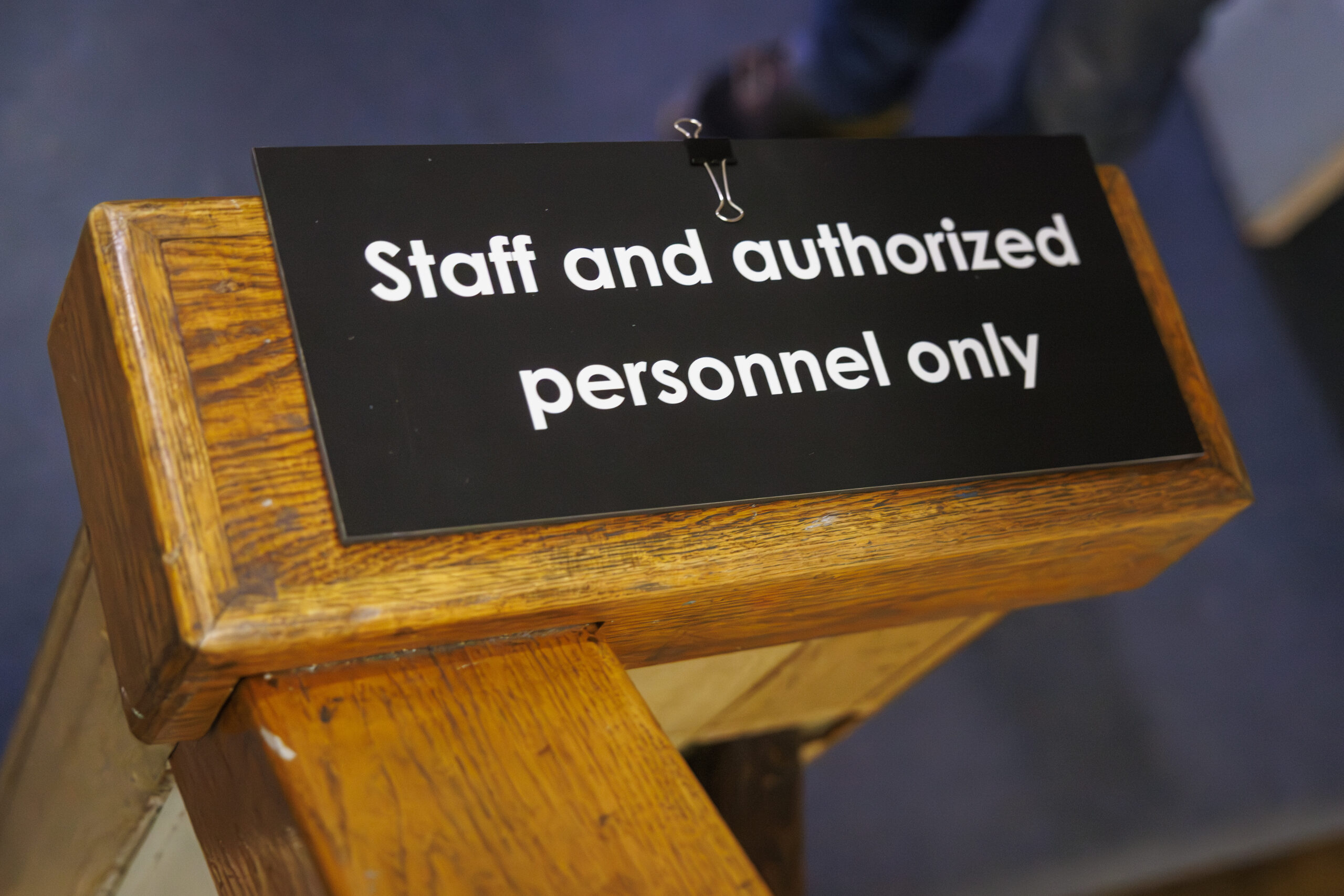
A small sign at the Olivet Covenant Presbyterian Church, where the Rev. Peter Ahn is creating space to shield immigrants if necessary.
The agency’s Philadelphia office serves as headquarters not just for the city but for all of Pennsylvania and for Delaware and West Virginia as well. Arrests take place every day in the Philadelphia region.
“You all seem to be ‘preparing’ for something that’s already happened,” veteran activist Miguel Andrade wrote on Facebook.
What has changed, however, is the dramatic escalation in ICE enforcement, particularly visible in Democratic-run cities like Minneapolis, where agents fatally shot two U.S. citizens in January.
ICE detained 307,713 people across the country in 2025, a 230% increase over the 93,342 in 2024. What federal immigration agencies record as detentions closely mirror arrests.
For immigrants who have no legal permission to be in the U.S. ― an estimated 14 million people ― the rising ICE presence steals sleep and peace of mind. They know not just that they could be arrested and deported at any moment, which has always been true, but also that the U.S. government is expending vast resources to try to make that happen.
A woman who came to Philadelphia from Jamaica last year, and who asked not to be identified because she is undocumented, said she rarely leaves her home. She said she steps outside only to go to the grocery store, a doctor, or an attorney.
She recently asked her daughter to check something on the computer, and the girl balked ― afraid to even touch the machine, worried that ICE could track her keystrokes and identify their location, the woman said.
“How can I tell her it’s going to be OK when I don’t know it’s going to be OK?”asked the woman, who came to the U.S. to escape potential violence in Jamaica. “You come here expecting freedom, but here it’s like you’re in jail except for the [physical] barriers of the four walls.”
Some say President Donald Trump doesn’t want to ruin the summer celebration of the nation’s 250th birthday, or spoil the grandeur of the World Cup or Major League Baseball’s All-Star Game. Others suggest that he might be timing an ICE deployment to do exactly that.
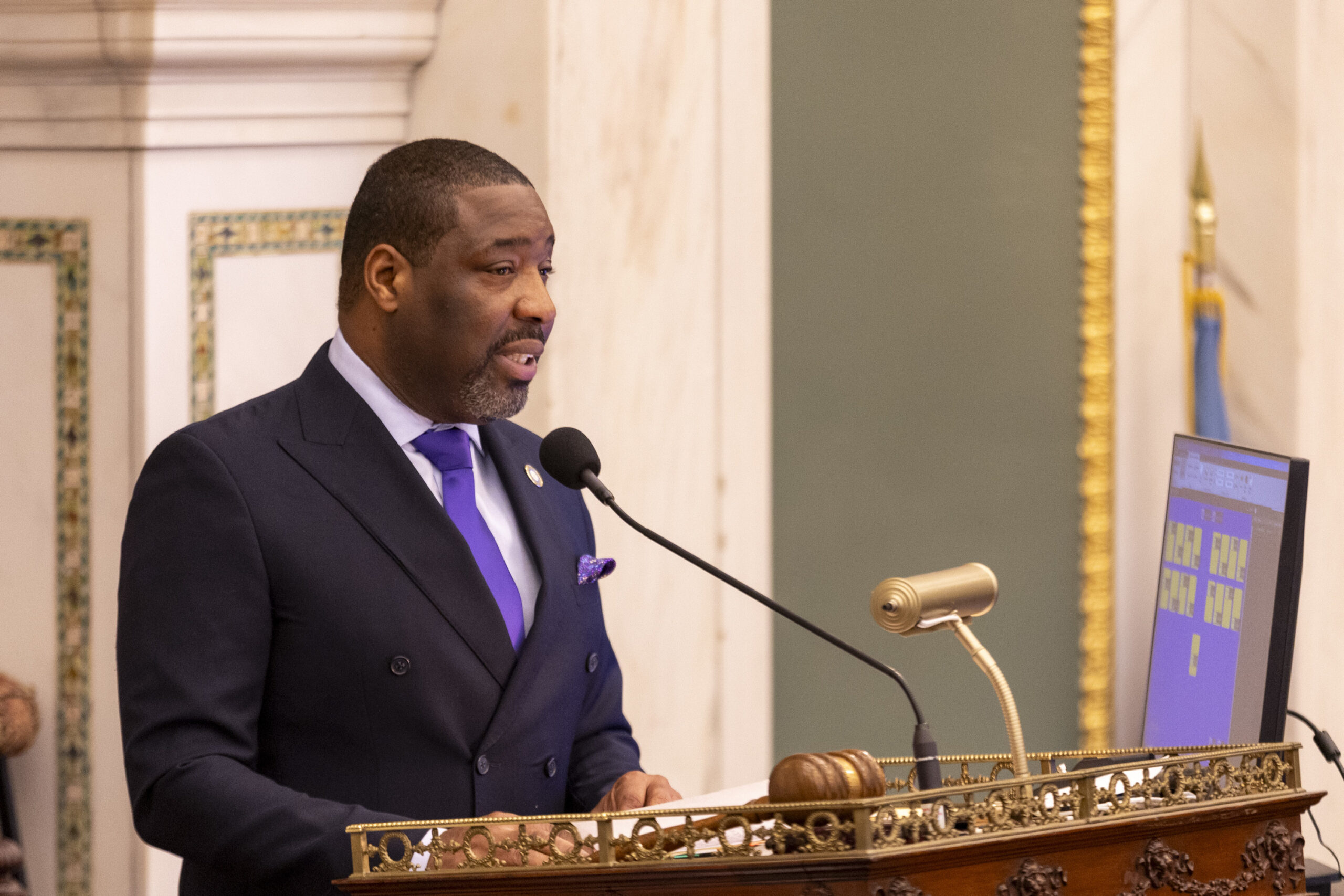
City Council President Kenyatta Johnson speaking at the City Council’s first session of the year Jan. 22. He said this month that it’s time to stand up for immigrants in Philadelphia. “It’s my responsibility to step up in this space and be more vocal,” he said.
Trump told NBC News this month that he is “very strongly” looking at five new cities.
Some people are not waiting to see if Philadelphia is on the list.
The monthly Zoom meeting of the Cresheim VillageNeighbors usually draws about 20 people. But a hundred logged on in January to hear a presentation: What to do if/when ICE comes to our neighborhood.
The short advice: If it happens, get out your phone and hit “record.”
“If I see ICE agents, I will film,” said neighbors group coordinator Steve Stroiman, a retired teacher and rabbi. “I have a constitutional right to do that.”
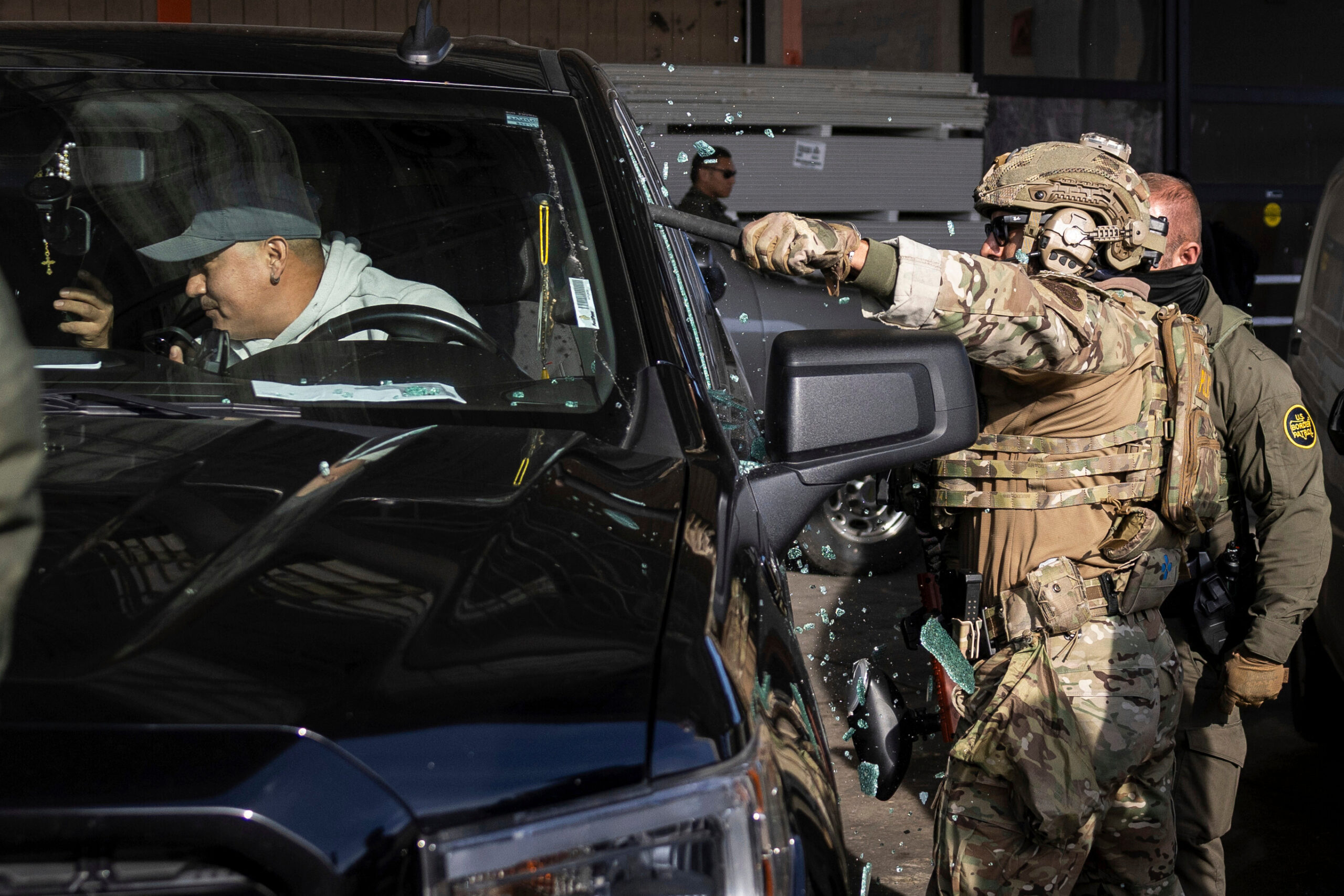
Federal immigration enforcement agents shatter a truck window and detain two men outside a Home Depot in Evanston, Ill., on Dec. 17, 2025.
In a sliver of University City, Miriam Oppenheimer has helped lead three block meetings where neighbors gathered to discuss how they would respond.
They set up a Signal channel so people can communicate. And they formulated a loose plan of action: People will come outside their homes and take video recordings ― and try to get the names and birth dates of anyone taken into custody, so they can be located later.
“Courage is contagious,” Oppenheimer said. “Everybody is waiting for somebody else to do something, but we have to be the ones.”
Inside Olivet Covenant Presbyterian Church, doorways to some rooms now bear black-and-white signs that say, “Staff and authorized personnel only.”
Issues around ICE access to churches have become more urgent since Trump rescinded the agency policy on “sensitive locations,” which had generally barred enforcement at schools, hospitals, and houses of worship.
Legal advocates such as the ACLU say ICE agents can lawfully enter the public areas of churches, including the sanctuaries where people gather to worship. But to go into private spaces they must present a warrant signed by a judge.
“There are many front lines right now,” said Ahn, the Olivet pastor. “We’re not trying to be simply anti-ICE, or anti-anybody. We’re just trying to be for the rights of the Fourth Amendment.”
Staff writer Joe Yerardi contributed to this article.
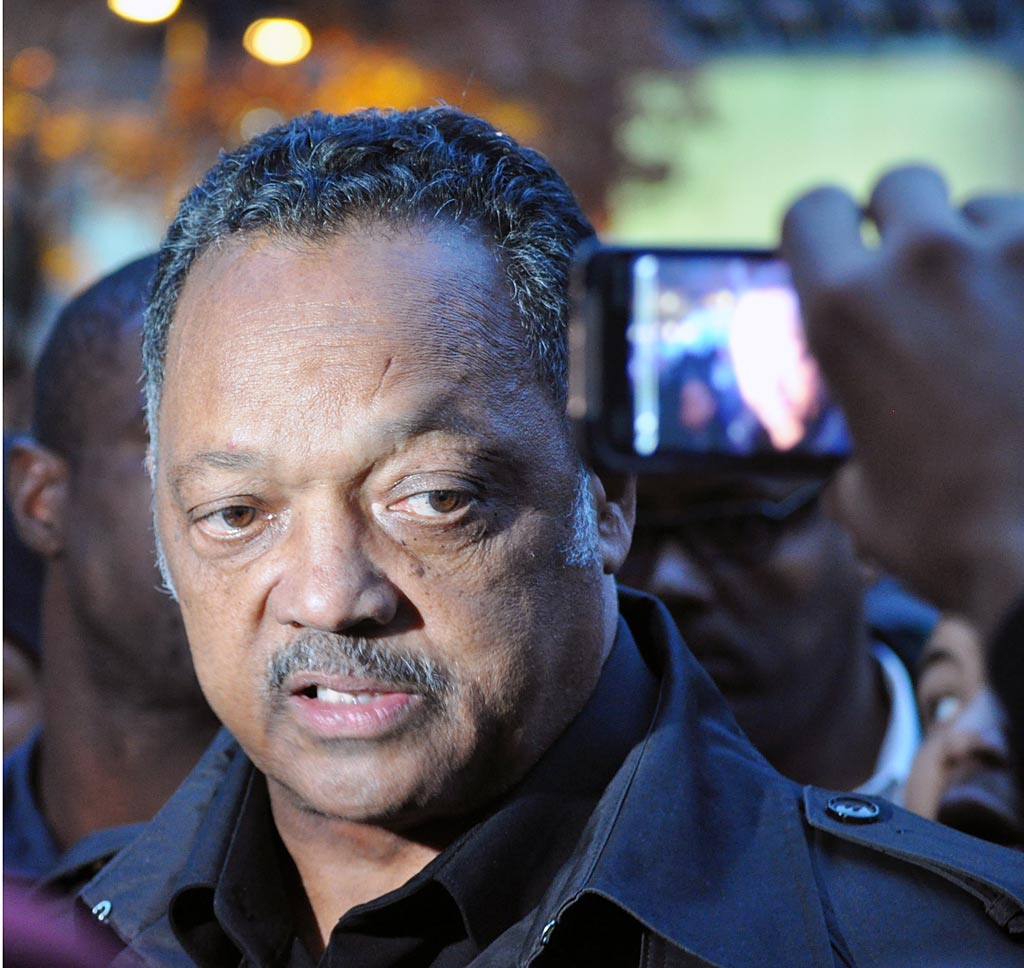
The Rev. Jesse L. Jackson, a civil rights icon and a regular presence in Philadelphia who energized Black voters both locally and nationally for more than five decades, died Tuesday at his home in Chicago following a prolonged battle with a rare neurological disorder. He was 84.
“Jesse Jackson will be remembered in Philadelphia as a civil rights hero, and a leader in terms of independent Black politics nationwide,” said former Councilmember W. Wilson Goode Jr., the son of Philly’s first Black mayor, W. Wilson Goode Sr. “He loved Philadelphia, and Philadelphia loved him.”
A native of Greenville, S.C., Rev. Jackson initially rose to prominence in the mid-1960s, when he joined the 1965 voting rights march that the Rev. Dr. Martin Luther King Jr. led from Selma to Montgomery, Ala. In the years following King’s assassination in 1968, Rev. Jackson largely came to be considered his successor.
Rev. Jackson would go on to become a prominent Black political and cultural leader in his own right, with his lengthy time in the public eye including presidential runs in 1984 and 1988. His visits to Philadelphia date back to the 1970s, and run the gamut from time in town supporting his own presidential campaigns — though neither of which were successful in the ‘80s — to appearances at the Democratic National Convention in 2016.
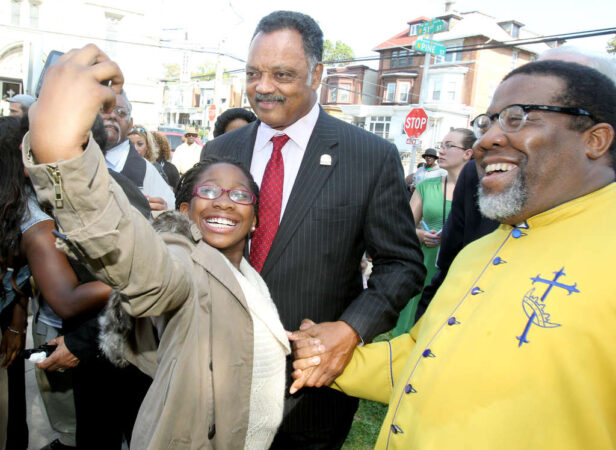
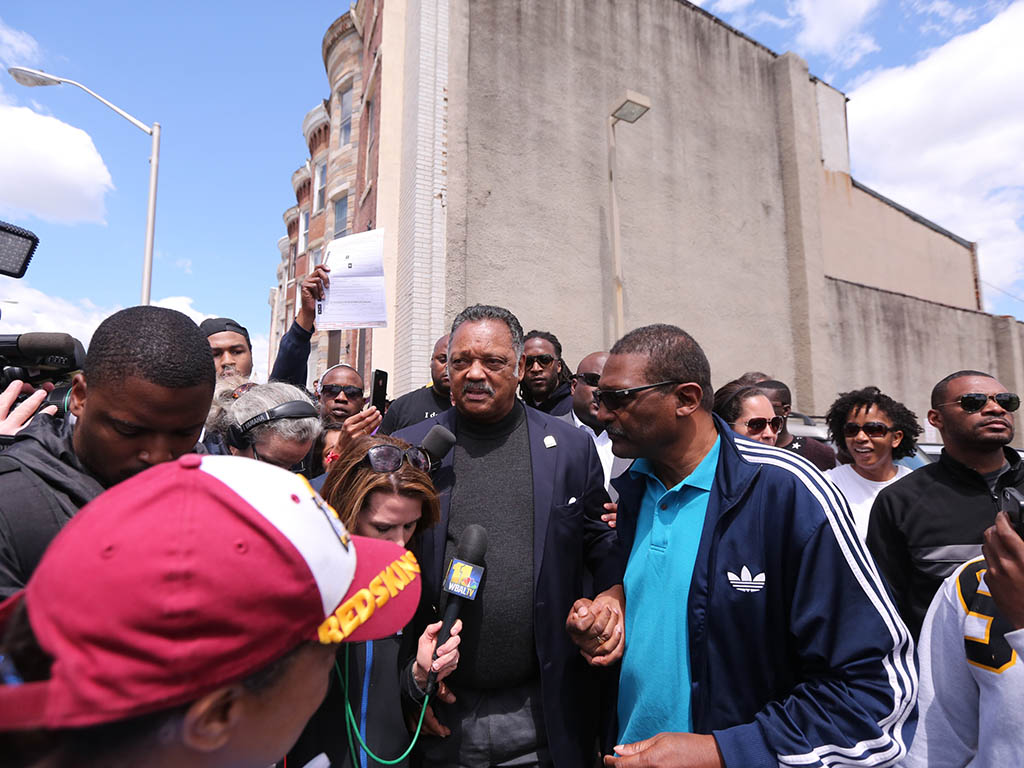
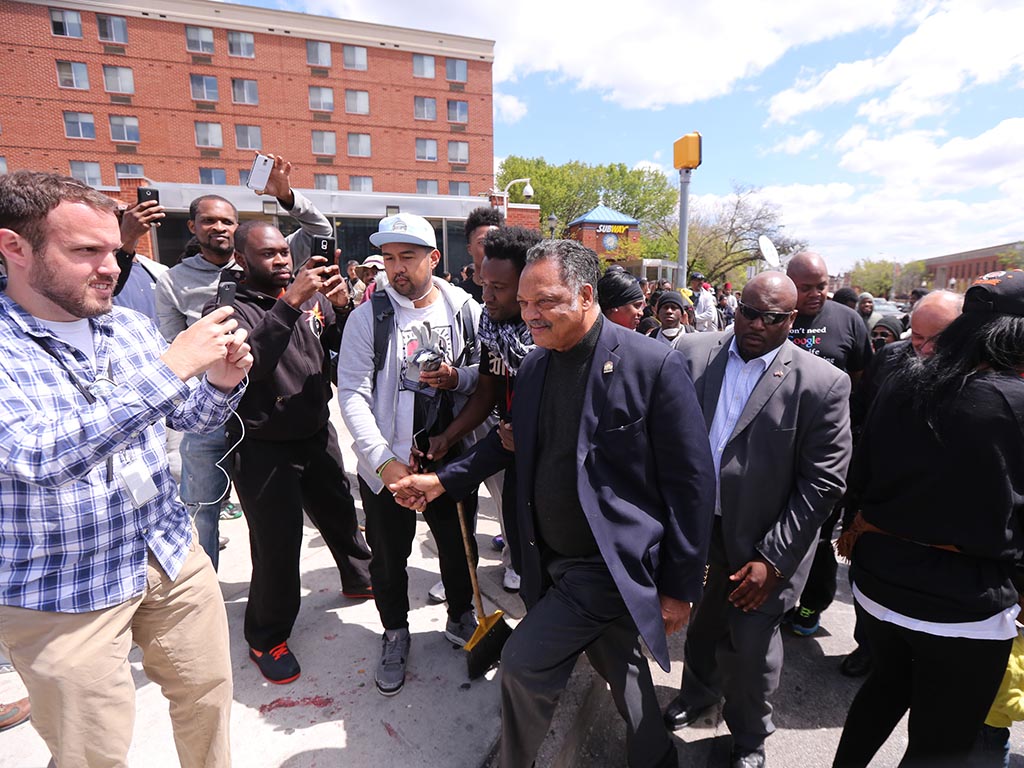
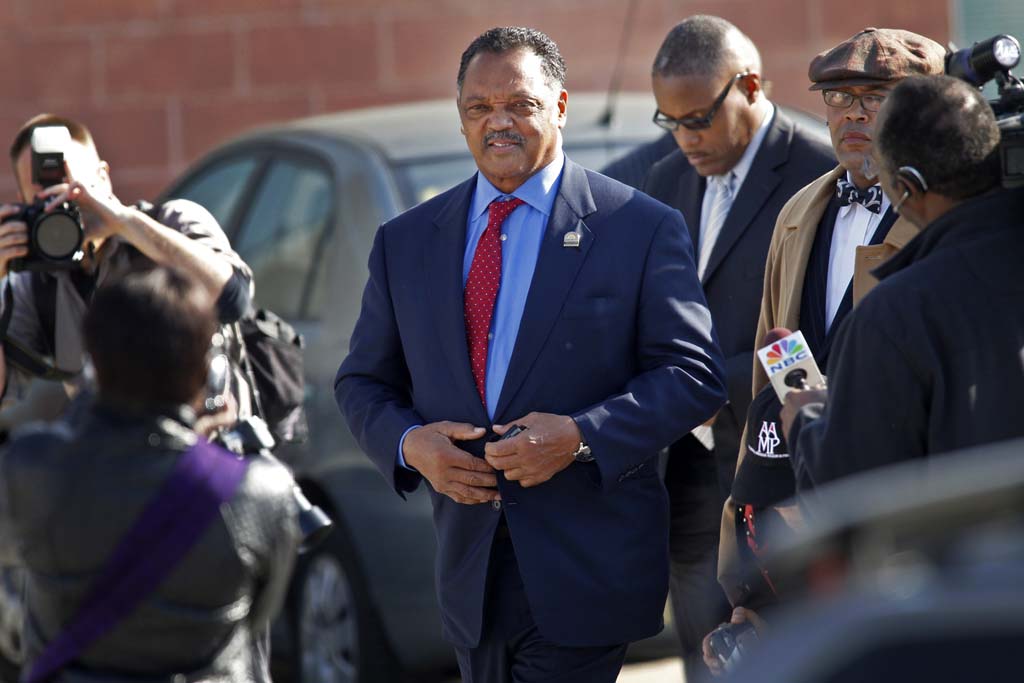
The Rev. Jesse Jackson, founder and president of the Rainbow/PUSH Coalition, acknowledges the cheers of delegates as he walks to the podium to deliver remarks on the third night of the Democratic National Convention in Philadelphia on July 27, 2016.Hillary Clinton supporters and the Rev. Jesse Jackson (right) on the fourth day of the Democratic National Convention at the Wells Fargo Center on July 28, 2016.The Rev. Jesse Jackson visits Baltimore’s turbulent intersection of West North Avenue and Pennsylvania Avenue on April 28, 2015.
Across that time, Rev. Jackson served as a sort of rallying figure for Black Philadelphians at large, who largely supported his candidacy during his presidential runs, despite him failing to secure the Democratic nomination statewide. Still, his impact for Black voters both in Philadelphia and nationally remains everlasting.
“That was the Rosetta stone to everything Jackson was trying to achieve,” said former Daily News scribe Gene Seymour, nephew of legendary People Paper columnist Chuck Stone. “We aren’t to be ignored or dismissed or cast aside — we matter.”
In that sense, Goode Jr. said, Rev. Jackson will remain a political icon who inspired the nationalization of Black political empowerment.
“Jesse Jackson is also a cultural icon in terms of telling people to be proud of being Black, and telling themselves, ‘I am somebody,’” Goode Jr. said, referencing Rev. Jackson’s famed refrain. “That is something that was indelible in the soul of Black people across the nation and world, and in Philadelphia here as well.”
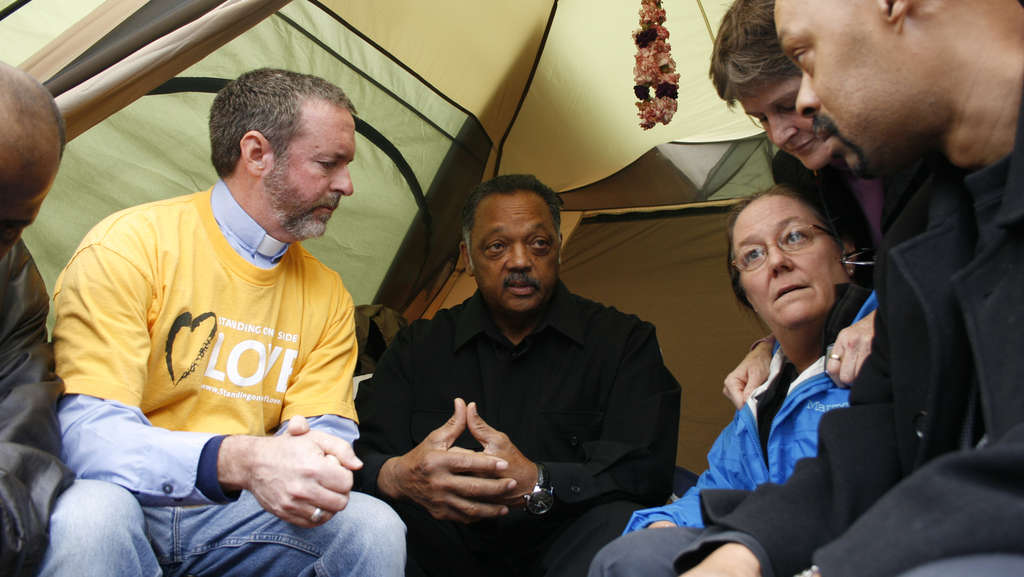
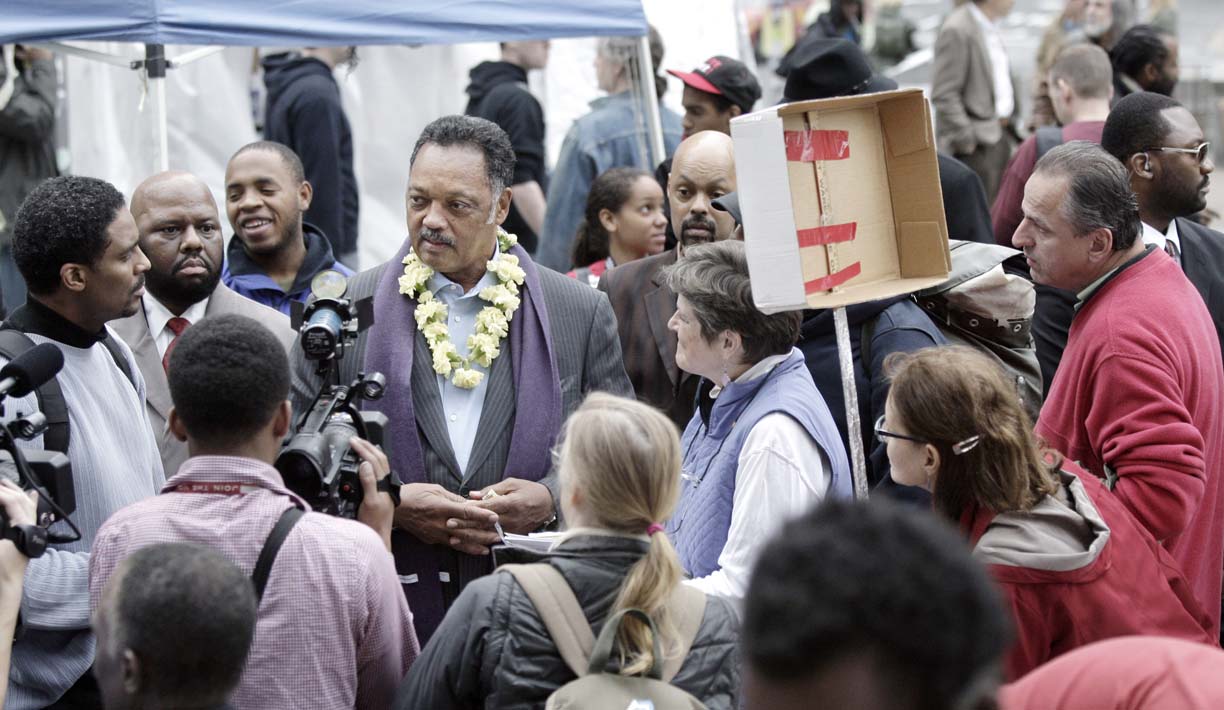
The Rev. Jesse Jackson visits the turbulent intersection of West North Avenue and Pennsylvania Avenue in Baltimore on April 28, 2015.The Rev. Jesse Jackson visited Occupy Philadelphia protesters on Nov. 13, 2011. He told them to “never surrender.”The Rev Jesse Jackson at Joe Frazier’s funeral at Enon Tabernacle Baptist Church on Cheltenham Avenue in Philadelphia on Nov. 14, 2011.The Rev. Jesse Jackson (center) visits the Interfaith tent, donated by Quakers, to talk to the Rev. Peter Friedrich (left) and (from right) Phillip Hall, Hollister Knowlton, and Joyce Moore in 2011.
Though Philadelphia’s Black community generally was supportive of and receptive to Rev. Jackson’s messaging historically, Seymour said, he maintained something of a complicated relationship with the city’s prominent politicians. Wilson Goode Sr., for example, officially supported Walter Mondale and Michael Dukakis for president in the 1980s. At least in 1988, Seymour said, Rev. Jackson likely had “the people’s hearts,” despite lacking the official nomination.
Wilson Goode Sr. was not immediately available for comment.
“His presidential campaigns in 1984 and 1988 reshaped American politics,” said the Rev. Gregory Edwards, of the Philly-based POWER Interfaith, in a statement. “Those campaigns widened the political imagination of this country and helped cultivate a generation of Black elected leaders.”
Rev. Jackson’s relationship with Goode Sr. was somewhat complicated following the 1985 MOVE bombing, which brought the civil rights leader to tour the ruins of the 6200 block of Osage Avenue in its aftermath. Rev. Jackson urged a congressional investigation into the incident, which he called “excessive force,” but avoided criticizing Goode directly in subsequent meetings. Goode, meanwhile, said that the city would cooperate with any groups investigating the incident, The Inquirer reported at the time.
“He was not happy with what happened in ‘85 with MOVE,” Seymour said.
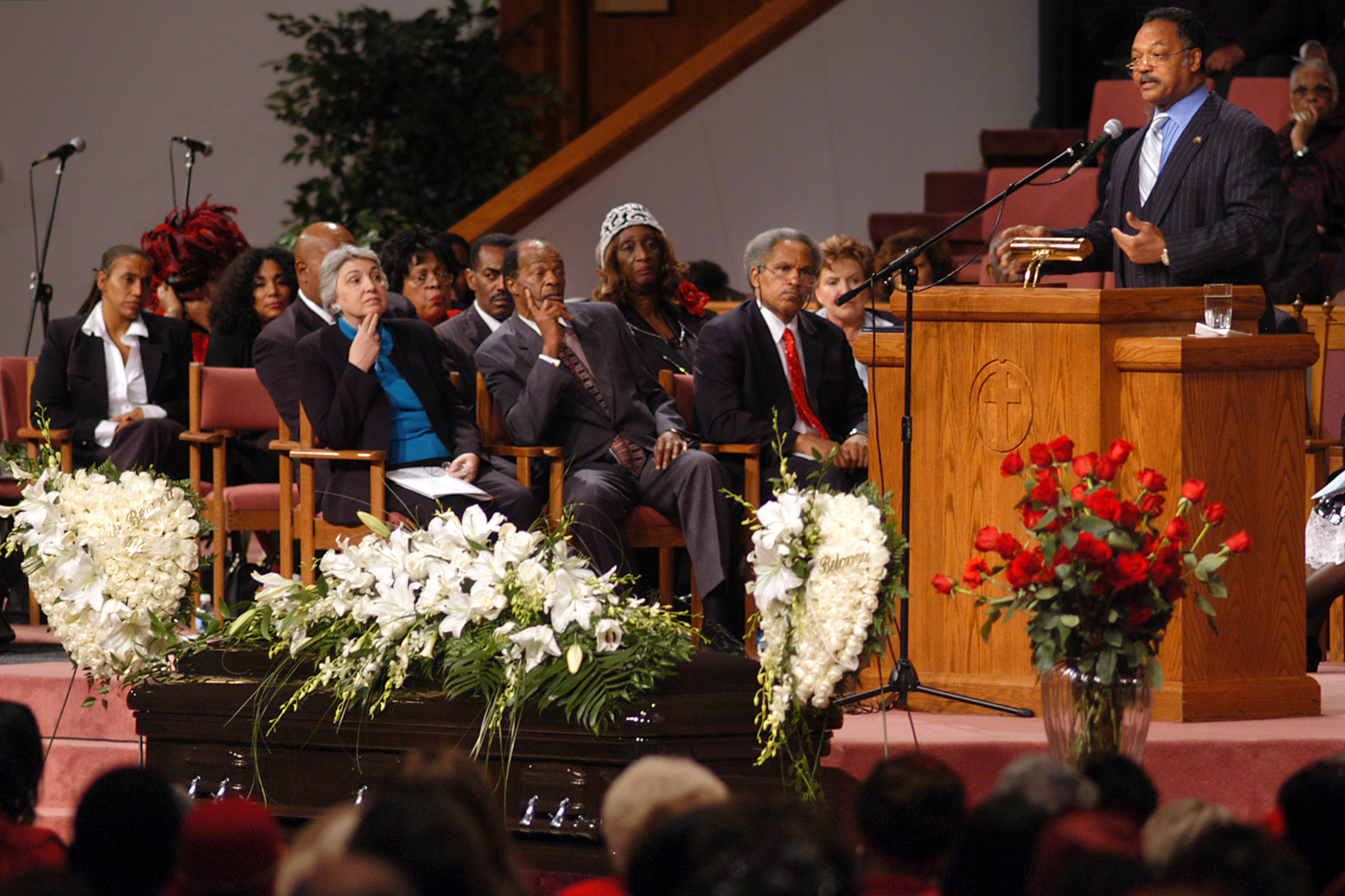
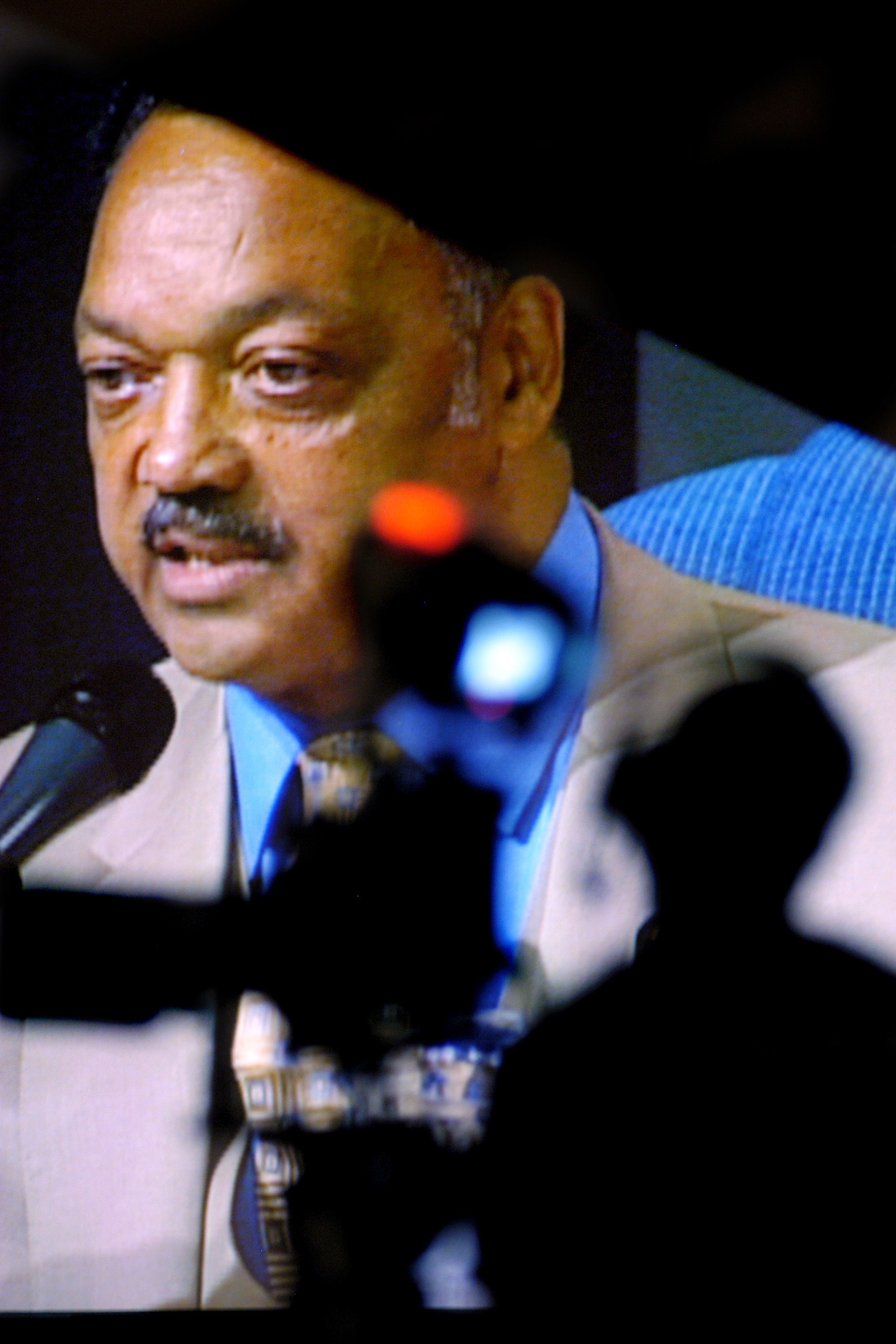
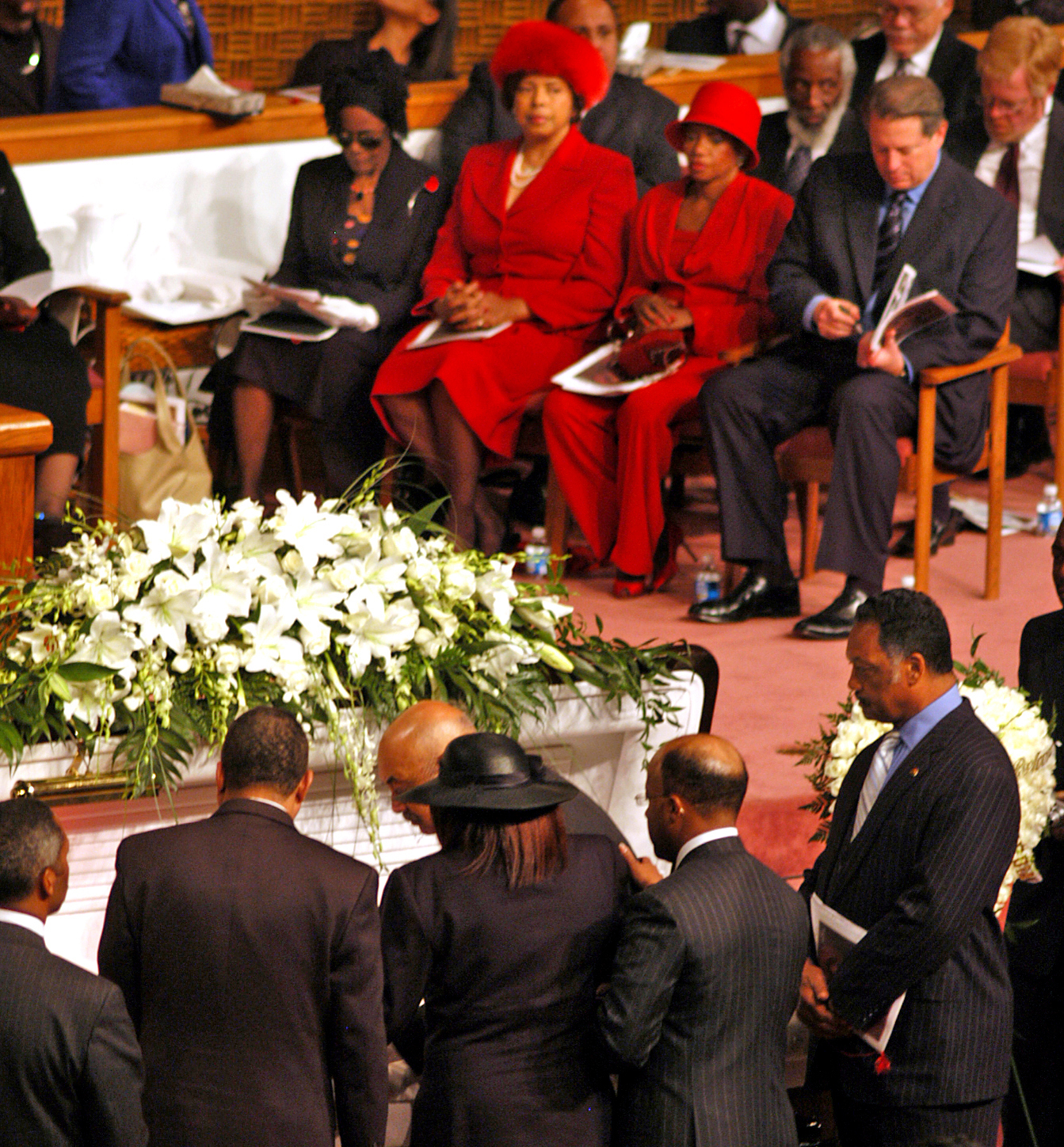
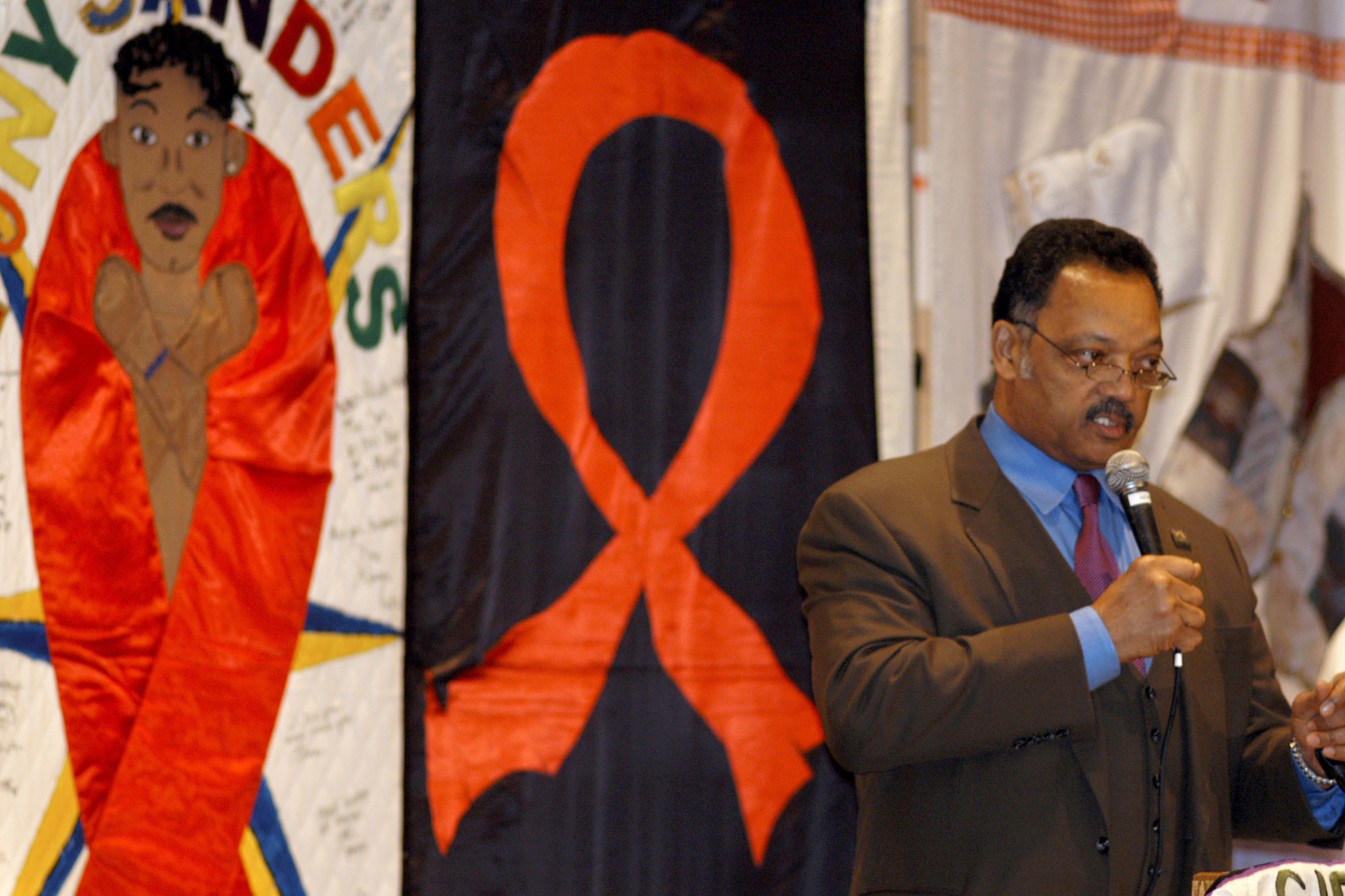
The Rev. Jesse L. Jackson speaks during during funeral services for civil rights activist C. Delores Tucker at Deliverance Evangelistic Church on Oct. 21, 2005. Seated in front row behind him, left to right are Eleanor Smeal, president of the Feminist Majority Foundation; Marion Barry, former mayor of Washington, and Philadelphia Mayor John Street. Rev. Jackson is projected live on a large screen monitor (camera operator in foreground) as he participates in a panel discussion laying out a legal and political strategy for fulfilling Brown v. the Board of Education, at the annual NAACP meeting on July. 14, 2004 at the Convention Center. Her family stands by as husband (partially hidden) William T. Tucker covers the body of civil rights activist C. Delores Tucker in her casket at the beginning of funeral service at Deliverance Evangelistic Church on Oct. 21, 2005. At right is the Rev. Jesse L. Jackson, founder and president of the Rainbow Coalition/PUSH, who later delivered the eulogy. Seated in rear at right is former Vice President Al Gore. AIDS quilt panels flank the podium as the Rev. Jesse Jackson speaks at an African American AIDS conference at the Wyndham Franklin Plaza Hotel on Feb. 28, 2005.
Still, Rev. Jackson often served as a defender of Philadelphia’s famed Black figures. In 2011, for example, Rev. Jackson spoke at the funeral of legendary world heavyweight boxing champion Joe Frazier, who had long competed with the fictional Rocky Balboa for recognition. As Jackson put it at the time, Frazier was the “real champion,” not the “Italian Stallion.”
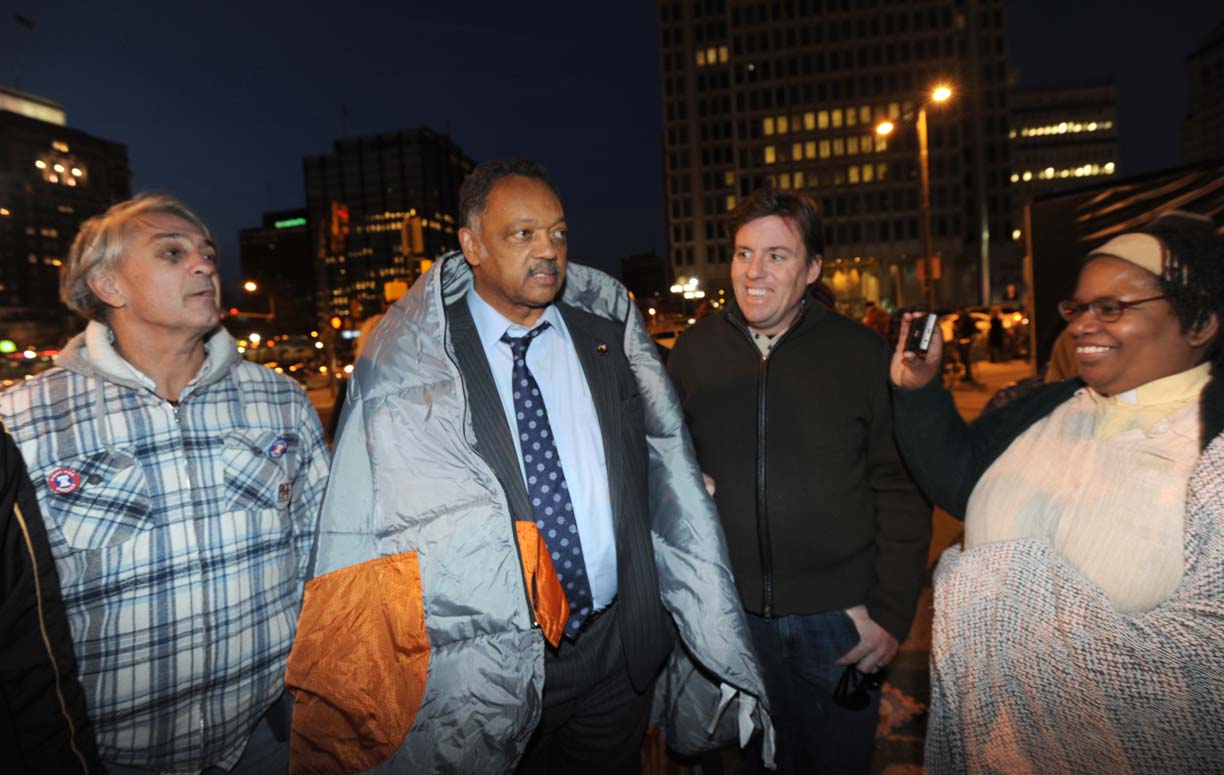
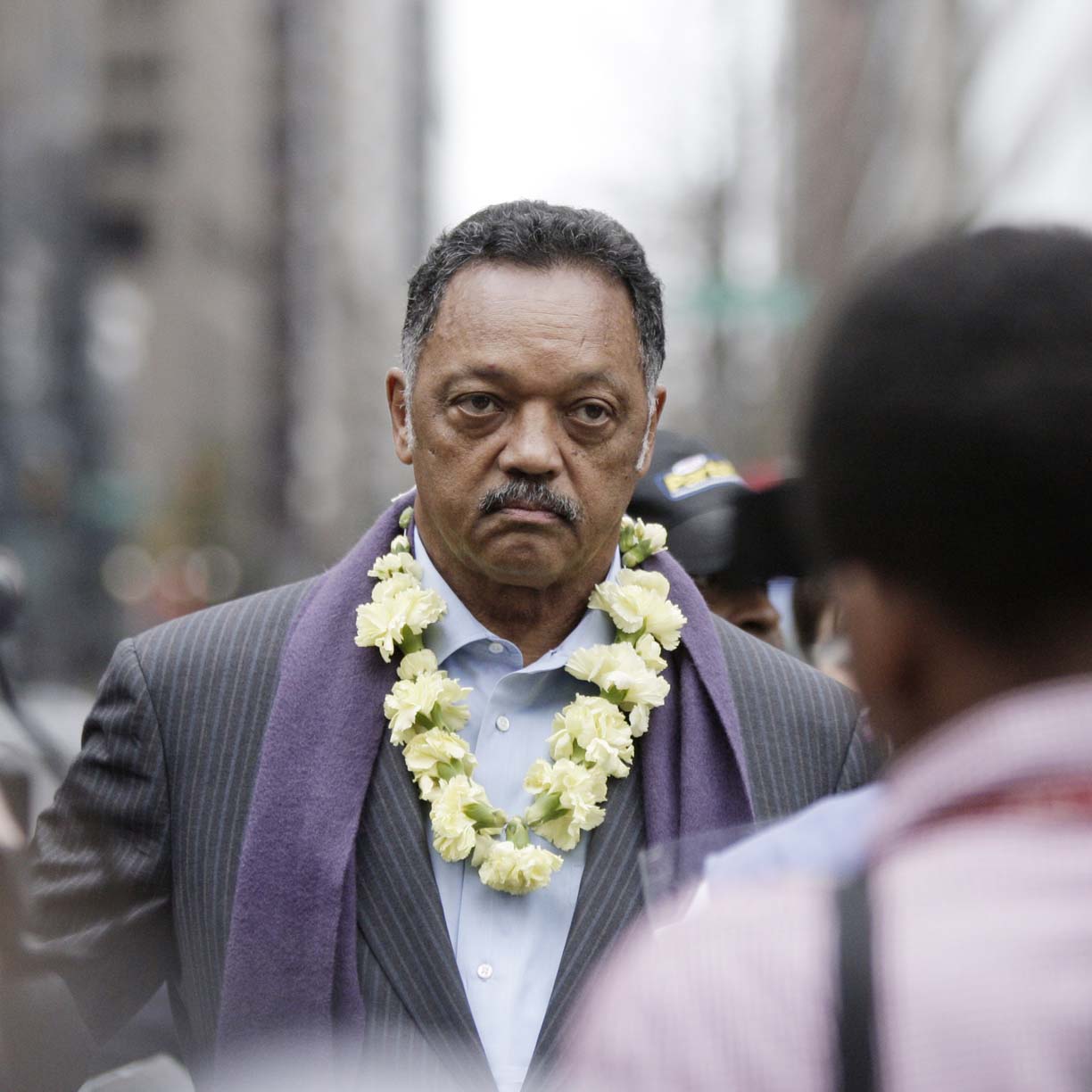
The Rev. Jesse Jackson, who has a sleeping bag draped around his shoulders, is talking and praying with Occupy Philadelphia demonstrators: Brad Wilson (from left); the Rev. Bill Golderer, pastor of Broad Street Ministry; and Donna Jones, pastor of the Cookman Baptist Initiative.
“If you were of importance as a Black person in America during the time [Jackson] was in the public eye,” Seymour said, “he was there to speak on your behalf.”
Goode Jr.’s most prominent memory of Rev. Jackson, meanwhile, dates back to the mid-1980s, when he was a student at the University of Pennsylvania. At the time, he said, Rev. Jackson attended a National Black Student Union conference following an invitation from its organizers, Goode Jr. included. It was, Goode Jr. said, an inspiration.
“It meant a lot to us,” Goode Jr. said. “Not just Black leaders at Penn, but across the nation, who were gathered there.”
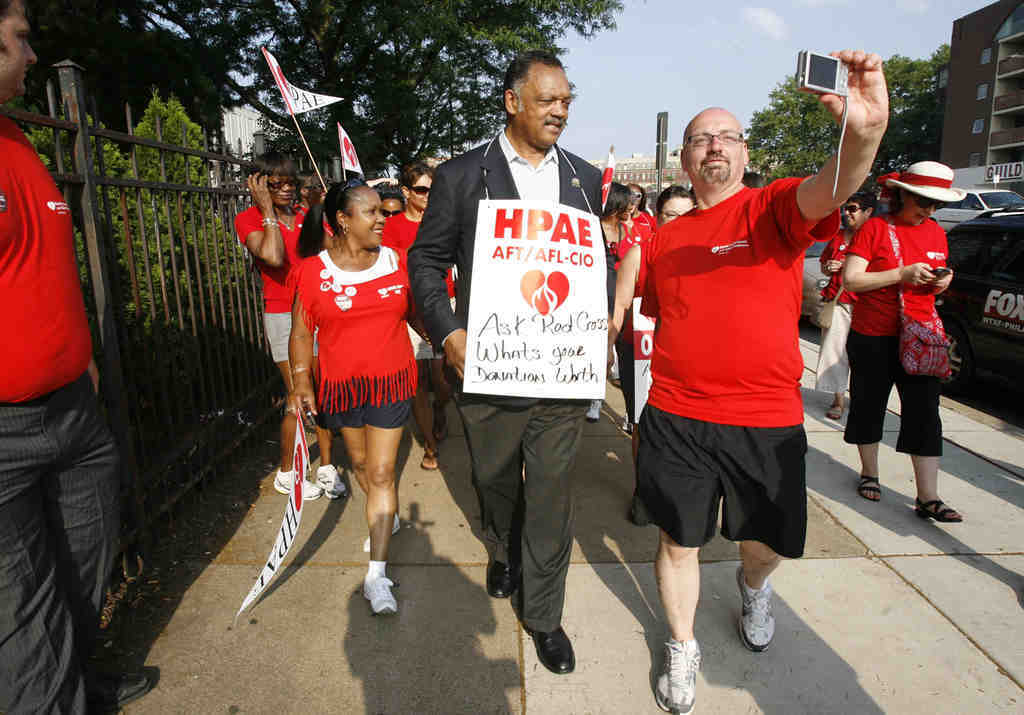
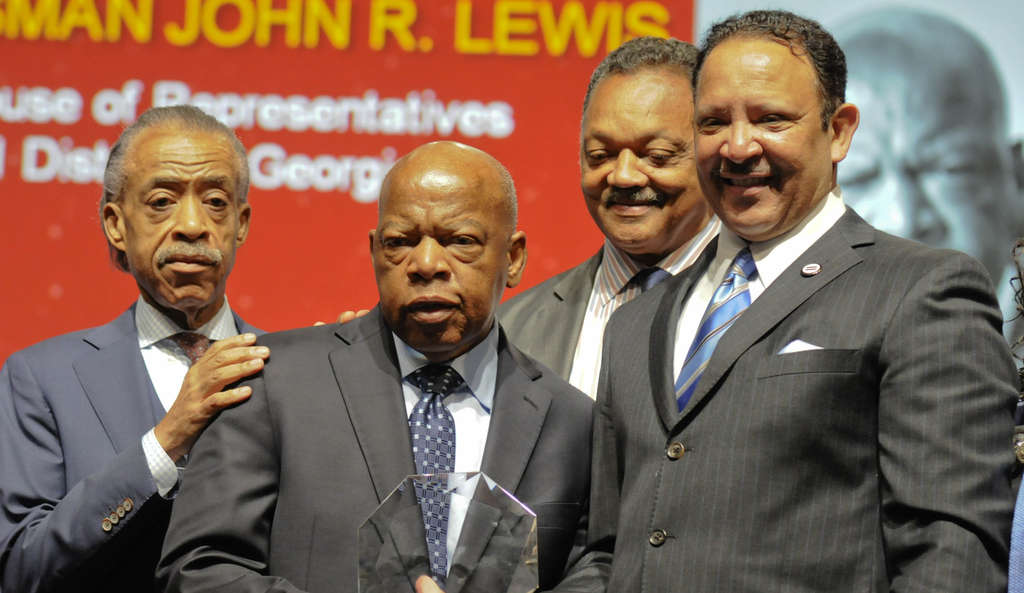
Striking Red Cross worker Lenny Lerro takes a picture of himself with the Rev. Jesse Jackson as they walk the picket line in 2011 on Spring Garden Street in Philadelphia.Rev. Jesse Jackson visits with folks at Occupy Philadelphia, just outside City Hall on Nov. 20, 2011.The Rev. Jesse Jackson visits with folks at Occupy Philadelphia, just outside City Hall on Nov. 20, 2011.U.S. Rep. John Lewis (second from left) is presented with the Civil Rights Champion Award in 2013 by (from left) the Rev. Al Sharpton, the Rev. Jesse Jackson, and Marc Morial, president of the Urban League.
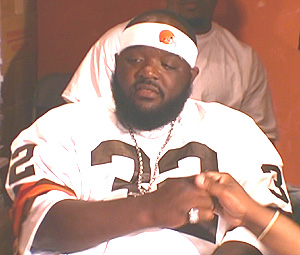
In 2009, after a federal judge effectively ordered Philadelphia drug kingpin Alton “Ace Capone” Coles to die in prison — imposing a life sentence plus 55 years for convictions on a host of drug and weapons charges — Coles momentarily dropped the swaggering persona he had displayed while building his vast cocaine empire.
“I never thought it would come to this,” Coles said at the time, his voice cracking as he spoke in court. “I don’t think life is deserved for selling drugs.”
On Tuesday, another federal judge offered something close to an endorsement of that view as she ordered Coles’ sentence be reduced to 25 years in prison — meaning Coles, now 52, could be released within a few years.
Coles’ twist of fate is the result of a complicated appellate process, one that has its roots in how federal laws have changed in recent years for some drug crimes, particularly those involving crack cocaine. The penalties for crack offenses were once significantly harsher than those tied to other narcotics, leading to widespread racial disparities because most defendants in crack cases were Black.
Coles’ lawyers say his case is also a demonstration of the “remarkable” turnaround Coles has made behind bars. While Coles once oversaw a drug operation that was estimated to have poured $25 million worth of cocaine and crack into Philadelphia — all as he served as the brash face of a local hip-hop record label — in prison, his lawyers said, he has become a barber, facilitated anti-violence programs for other inmates, and served as a counselor for prisoners with thoughts of self-harm.
“Knowing that he was facing the rest of his life in prison, Mr. Coles engaged in this extraordinary effort toward rehabilitation for the sole purpose of improving his life and of those around him,” his lawyer, Paul Hetznecker, wrote in court documents.
Federal prosecutors took a starkly different view, saying that Coles was “one of the major drug kingpins in Philadelphia during the last several decades” and that his eligibility to be resentenced was the result of a “pure technicality.” Even if Coles had committed his crimes today, prosecutors said — after Congress changed criminal sentencing guidelines — his actions would still warrant a life sentence.
“Coles led an armed and violent cocaine and crack distribution gang, which distributed quantities of deadly narcotics that [the trial judge] at sentencing aptly described as ‘staggering,’” prosecutors wrote in court documents.
U.S. District Judge Kai Scott said she believed that Coles had transformed his life in prison, and that 25 years of incarceration — even if much shorter than a life sentence — was still a substantial amount of time to serve behind bars.
Discussing Coles’ growth since being convicted, Scott said: “I’ve never seen this type of post-sentence rehabilitation.”
Coles, meanwhile, apologized for his crimes, telling Scott he is determined to try to make amends for his past.
“I am not the man I once was,” he said.
Building an empire
When Coles was federally indicted in 2005, prosecutors said he had run one of the largest drug organizations in modern city history. Coles and his coconspirators, they said, helped push a ton of cocaine and a half-ton of crack into the streets over the course of more than six years.
Coles was not charged with any crimes of violence, but federal authorities said they believed his group and its members were tied to nearly two dozen shootings and seven homicides.
As he was growing his drug empire, Coles was also building his reputation in the local rap scene. He helped found the hip-hop label Take Down Records, and staged popular parties and concerts around the city.
And he and a friend, Timothy “Tim Gotti” Baukman, produced and starred in a 31-minute music video called New Jack City, The Next Generation, in which they portrayed Philadelphia drug dealers who used violence and intimidation to cement their standing in the underworld.
Authorities used that video as part of a two-year investigation into Coles and his gang, and said Take Down Records amounted to a front for Coles to wash his money. They also wiretapped hundreds of conversations between drug associates, and went on to seize dozens of weapons and hundreds of thousands of dollars in raids on members’ homes.
Coles was charged in 2005, as were nearly two dozen associates, some of whom pleaded guilty or went on to cooperate with authorities.
Coles took his case to trial and testified in his own defense, saying he was not the kingpin prosecutors made him out to be.
But in 2008, a jury found Coles guilty of crimes including conspiracy to distribute cocaine and heading a continuing criminal enterprise. U.S. District Judge R. Barclay Surrick later sentenced Coles to life behind bars plus 55 years, saying: “The amount of drugs was staggering and the money involved was even more staggering … this crime was just horrendous.”
Ongoing legal saga
The imposition of that penalty, however, was hardly the end of the legal drama connected to Coles.
After Coles was sentenced, a Philadelphia police officer was convicted and imprisoned for tipping Coles off about his impending arrest.
A federal appeals court also later overturned a conviction tied to Coles’ girlfriend, who had been accused of helping him launder drug money to buy a house.
And Coles continued to file appeals challenging his case.
In 2014, he successfully argued to have one of his two prison sentences — the 55-year term — reduced to five years because of technicalities in how evidence was used to prove certain charges. His life sentence, however, remained intact.
But in 2020, Hetznecker, Coles’ appellate lawyer, filed a new motion challenging that penalty, saying a law passed by Congress in 2018 made Coles eligible to have his life sentence reduced.
The law, known as the First Step Act, was a sweeping attempt to undo some of the tough-on-crime laws from the 1990s that caused the federal prison population to swell. The bill received bipartisan support, and was signed into law by President Donald Trump.
One of the law’s provisions allowed some people who were sentenced for crack-related offenses to have their penalties reevaluated — part of an effort to unwind the racial disparities caused by disproportionately harsh sentences being imposed on Black defendants in crack cases.
Hetznecker, in seeking to have a judge reconsider Coles’ penalty, wrote that a life sentence “for a non-violent drug offense is a draconian sentence and, given the current paradigm of criminal justice reform, counter the movement toward a more just system.”
“The underlying principles of justice and fairness require that those subjected to punishment for crimes against society, especially those convicted of non-violent offenses, be provided the opportunity for re-integration back into society as rehabilitated individuals,” Hetznecker wrote.
Scott, the judge, agreed last month that Coles was eligible for a new sentence under the First Step Act. And in imposing the new penalty Tuesday, she said she believed Coles was unlikely to commit similar crimes in the future.
“It’s clear to me that you have been deterred — you have made changes,” she said.
Coles said he recognizes that he had once been “a negative influence on society,” but said he has now committed to bettering himself and trying to help others.
Hetznecker said Coles deserves the opportunity to demonstrate that he has moved beyond the persona he once inhabited on the streets.
“‘Ace Capone’ is dead, he’s gone,” Hetznecker said. “Alton Coles has emerged.”
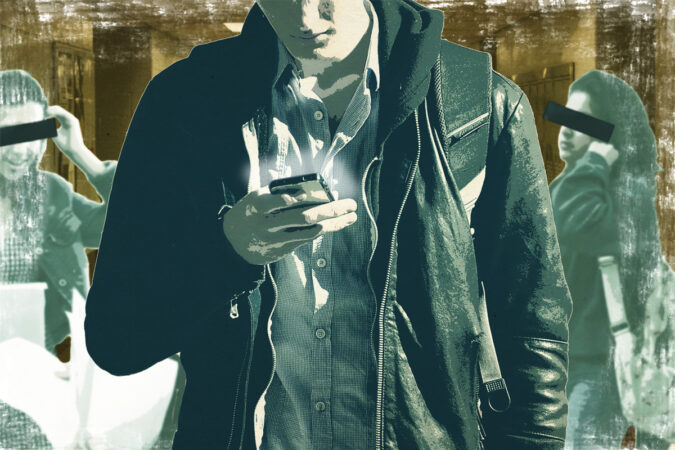
One night in early December, the phones of Radnor High School students started buzzing. Some freshmen girls were getting disturbing messages: A male classmate, they were told, had made pornographic videos of them.
When one of the girls walked into school the next morning, “she said everyone was staring at her,” said her mother, who requested anonymity to protect her daughter’s identity. “All the kids knew. It spread like wildfire.”
So-called AI deepfakes — pictures of a real person manipulated with artificial intelligence,sometimes with “nudify” features that can convert clothed photos into naked ones — have become the talk of school hallways and Snapchat conversations in some area schools.
As Pennsylvania lawmakers have pushed new restrictions cracking down on deepfakes — defining explicit images as child sexual abuse material, and advancing another measure that would require schools to immediately alert law enforcement about AI incidents — schools say they have no role in criminal investigations, and are limited in their ability to police students off campus.
But some parents say schools should be taking a more proactive stance to prepare for AI abuse — and are failing to protect victims when it happens, further harming students who have been violated by their peers.
In the Council Rock School District, where AI-generated deepfakes were reported last March, parents of targeted girls said administrators waited five days to contact the police about the allegations and never notified the community, even after two boys were charged with crimes.
“They denied everything and kind of shoved it under the rug and failed to acknowledge it,” said a mother in Council Rock, who also requested anonymity to protect her daughter’s identity. “Everybody thought it was a rumor,” rather than real damage done to girls, the mother said.
Council Rock spokesperson Andrea Mangoldsaid that the district “recognizes and understands the deep frustration and concern expressed by parents,” and that a police investigation “began promptly upon the district’s notification.”
Mangold said that current laws were “insufficient to fully prevent or deter these incidents,” and that the district was “limited in what we know and what we can legally share publicly” due to student privacy laws.
In Radnor, parents also said the district minimized the December incident. A district message last month said a student had created images of classmates that “move and dance,” and reported that police had not found evidence of “anything inappropriate” — even though police later saidthey had charged a student with harassment after an investigation into alleged sexualized images of multiple girls.
A Radnor spokesperson said the alleged images were never discovered and the district’s message was cowritten by Radnor police, who declined to comment.
The district “approaches all student-related matters with care and sensitivity for those involved,” said the spokesperson, Theji Brennan. She said the district was limited in what it could share about minors.
In both Radnor and Council Rock, parents said their daughters were offered little support — and were told that if they were uncomfortable, they could go to quiet rooms or leave classes early to avoid crossing paths with boys involved in the incidents.
“She just felt like no one believed her,” the Radnor mother said of her daughter.
How an investigation unfolded in Radnor
In Radnor, five freshman girls first heard they were victims of deepfakes on Dec. 2, according to parents of two of the victims who requested anonymity to protect their daughters’ identities. They said boys told their daughters that a male classmate had made videosdepicting them sexually.
In a Snapchat conversation that night, one boy said, “‘Nobody tell their parents,’” a mother of one of the victims recalled. Reading her daughter’s texts, “it quickly went from high school drama to ‘Wow, this is serious.’”
The girls and their parents never saw the videos. In an email to school officials the next morning, parents asked for an investigation, discipline for the students involved, and efforts to stop any sharing of videos. They also asked for support for their daughters.
Schooladministrators began interviewing students. The mother of one of the victims said her daughter was interviewed alone by the male assistant principal — an uncomfortable dynamic, given the subject matter, she said.
One mother said the principal told her daughter that it was the boys’ word against hers, and that he was “so glad nothing was shared” on social media — even though no one knew at that point where videos had been shared, the mother said.
The principal said the school had no authority over kids’ phones, so the girl and her family would need to call the police if they wanted phones searched, the mother said.
Brennan, the Radnor spokesperson, said that administrators contacted Radnor police and child welfare authorities the same day they spoke with families. “The district’s and the police department’s investigations have found no evidence that the images remain or were shared, posted, or otherwise circulated,” she said.
The male classmate acknowledged making videos of the girls dancing in thong bikinis, the parents said police told them. But the app he used was deleted from his phone, and the videos were not on it, the police told them.
The parents didn’t believe the admission.
“I don’t think a 14-year-boy would report a TikTok video of girls in bikinis,” said one of the mothers, who said her daughter was told she was naked and touching herself in videos.
The police told parents they did not subpoena the app or any social media companies, making it impossible to know what was created.
Radnor Police Chief Chris Flanagan declined to comment, as did the Delaware County District Attorney’s Office.
In a message sent to the district community Jan. 16 announcing the end of the police investigation, officials said a student, outside of school hours, had taken “publicly available” photos of other students and “used an app that animates images, making them appear to move and dance.”
“No evidence shared with law enforcement depicted anything inappropriate or any other related crime,” the message said.
A week later, the police released a statement saying a juvenile was charged with harassment after an investigation into “the possible use of AI to generate non-consensual sexualized imagery of numerous juveniles.”
Asked why the district’s statement had omitted the criminal charge or mention of sexualized imagery, Brennan said the statement was also signed by Flanagan, who declined to comment on the discrepancy.
Brennan said the district had provided ongoing support to students, including access to a counselor and social worker.
Parents said the district had erred in failing to initiate a Title IX sexual harassment investigation, instead telling parents they needed to file their own complaints.
“They kept saying, ‘This is off campus,’” the mother said. But “my daughter could not walk around without crying and feeling ashamed.”
Parents say girls were ‘not supported’ in Council Rock
In Council Rock, a girl came home from Newtown Middle School on March 17 and told her mother a classmate had created naked images of her.
“I’m like, ‘Excuse me? Nobody contacted me,’” said the mother, who requested anonymity to protect her daughter’s identity. She called the school’s principal, who she said told her: “‘Oh, my God, I meant to reach out to you. I have a list of parents, I just have not gotten to it’ — you know, really downplaying it.”
The mother and other victims’parents later learned that administrators were alerted to the images on March 14, when boys reported them to the principal. But instead of calling the police, the principal met with the accused boy and his father, according to parents. Police told parents they were contacted by the school five days later. The Newtown police did not respond to a request for comment.
Mangold, the Council Rock spokesperson, declined to comment on the specific timing of the school’s contact with police.
Police ultimately obtained images after issuing a subpoena to Snapchat; in total, there were 11 victims, the parents said.
Through the Snapchat data, police learned that a second boy was involved, the parents said, which made them question what was created and how far it spread.
Parents said they believe there are more pictures and videos than police saw, based on what their daughters were told — and because the delayed reporting to police could have given boys an opportunity to delete evidence.
“That’s kind of what the fear of our daughters is — like, what was actually out there?” said one mother, who also requested anonymity to protect her child’s identity.
Manuel Gamiz, a spokesperson for the Bucks County district attorney, said Newtown Township police had charged two juveniles with unlawful dissemination of sexually explicit material by a minor. Gamiz said the office could not provide further information because the case involved juveniles.
Juvenile cases are not public, but victims’ parents said both boys were adjudicated delinquent. While the boys had been attending Council Rock North High School with their daughters, the district agreed to transfer both after their cases were resolved, according to a lawyer representing four of the parents, Matthew Faranda-Diedrich.
“How can you let this person be roaming the halls?” said Faranda-Diedrich, who said it took formal demand letters in order for the district to transfer the boys.
He accused the district of mishandling the incident and “protecting the institution” rather than the victimized girls.
“They’re putting themselves above these students,” Faranda-Diedrich said.
Parents said school leaders warned their daughters against spreading rumors, and never sent a districtwide message about the incident.
“These girls were victims,” one of the mothers said, “and they were not supported.”
She and the other mothers who spoke to The Inquirer said the incident has deeply affected their daughters, from anxiety around what images may have been created — and how many people saw them — to a loss of trust in school leaders.
Some of the girls are considering switching schools, one mother said.
State law changes and a debate around education about deepfakes
Those changes came in 2024 and 2025, after a scandal over deepfakes of nearly 50 girls at a Lancaster private school.
Another bill that passed the state Senate unanimously in November would require school staff and other mandated reporters to report AI-generated explicit images of minors as child abuse — closing what prosecutors had cited as a loophole when they declined to bring charges against Lancaster Country Day School for failing to report AI images to the police. That legislation is now pending in the House.
Schools can also do more, said Faranda-Diedrich, who also represented parents of victims in the Lancaster Country Day School incident. He has pressed schools to conduct mandated reporter training for staff. “By and large they refuse,” he said.
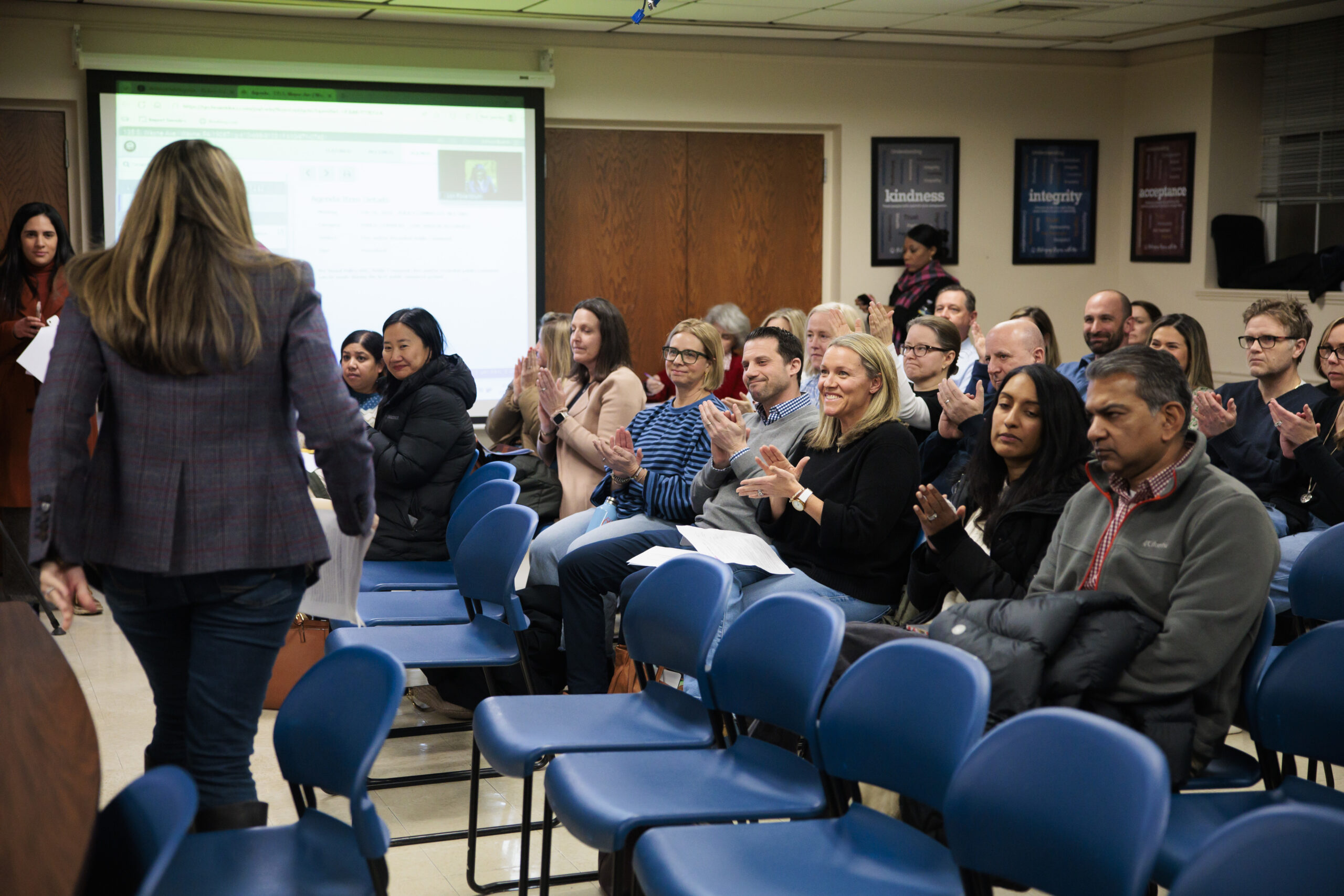
In Radnor, parents urged the school board at last week’s committee meeting to make changes.
Parent Luciana Librandi walks back to her seat after speaking during a Radnor school board committee meeting last week.
Luciana Librandi, a parent of a freshman who said she had been “directly impacted by the misuse of generative AI,” called for timelines for contacting police following an AI incident, safeguards during student questioning, and annual education for students and parents on AI.
Others called for the district to communicate the criminal charge to families, to enforce existing policies against harassment, and to independently review its response to the recent incident.
Radnor officials said they are planning educational programming on the dangers of making AI images without a person’s consent.
There is somedebate on whether to teach children about “nudify” apps and their dangers, said Riana Pfefferkorn, policy fellow at the Stanford Institute for Human-Centered AI, who has researched the prevalence of AI-generated child sexual abuse material. Alerting kids to the apps’ existence could cause them “to make a beeline for it,” Pfefferkorn said.
While “this isn’t something that is epidemic levels in schools just yet,” Pfefferkorn said, “is this a secret we can keep from children?”
One of the victims’ parents in Radnor said education on the topic is overdue.
“It’s clearly in school,” the mother said. “The fact there’s no video being shown on the big screen in your cafeteria — we don’t live in that world anymore.”
The University of Pennsylvania is getting $7.8 million over the next two years to study an overlooked aspect of human health: the lymphatic system.
Often described as the body’s sewer system, its main job is to maintain the body’s balance of fluid and filter out waste. Millions of Americans live with dysfunction in the system, often unknowingly.
The time to diagnose some lymphatic disorders is at least five years, said Maxim Itkin, an interventional radiologist who directs Penn’s center specializing in lymphatic disorders.
He’s even had a patient who experienced unexplained symptoms for 50 years before getting treatment.
“Right now, most healthcare providers simply aren’t equipped — or trained — to recognize lymphatic dysfunction, and the tools they need are virtually nonexistent,” said Kimberley Steele, a program manager at the Advanced Research Projects Agency for Health (ARPA-H), the federal agency organizing the research effort.
That’s why the government, through ARPA-H, is investing $135.7 million toward research headed by 11 institutions in the U.S. and Canada, including Penn, to improve detection of issues in the lymphatic system.
With its slice of funding, the team at Penn will develop ways to image the network and identify hidden signs of disease.
An inside look
Similar to plumbing, fluids in the lymphatic system can be flowing, obstructed, or leaking.
Doctors are able to “close” these leaks and even “open” obstructed areas, but the problem is knowing when those procedures are needed.
Existing contrast agents — substances used to increase visibility of tissues during imaging — for the lymphatic system are largely considered obsolete and offer poor resolution, said Itkin, who is leading the Penn project, which started last October.
When he began researching the system 20 years ago, he “started to realize that it’s of enormous importance, and it’s forgotten primarily because nobody can image [it] and do interventions,” he said.
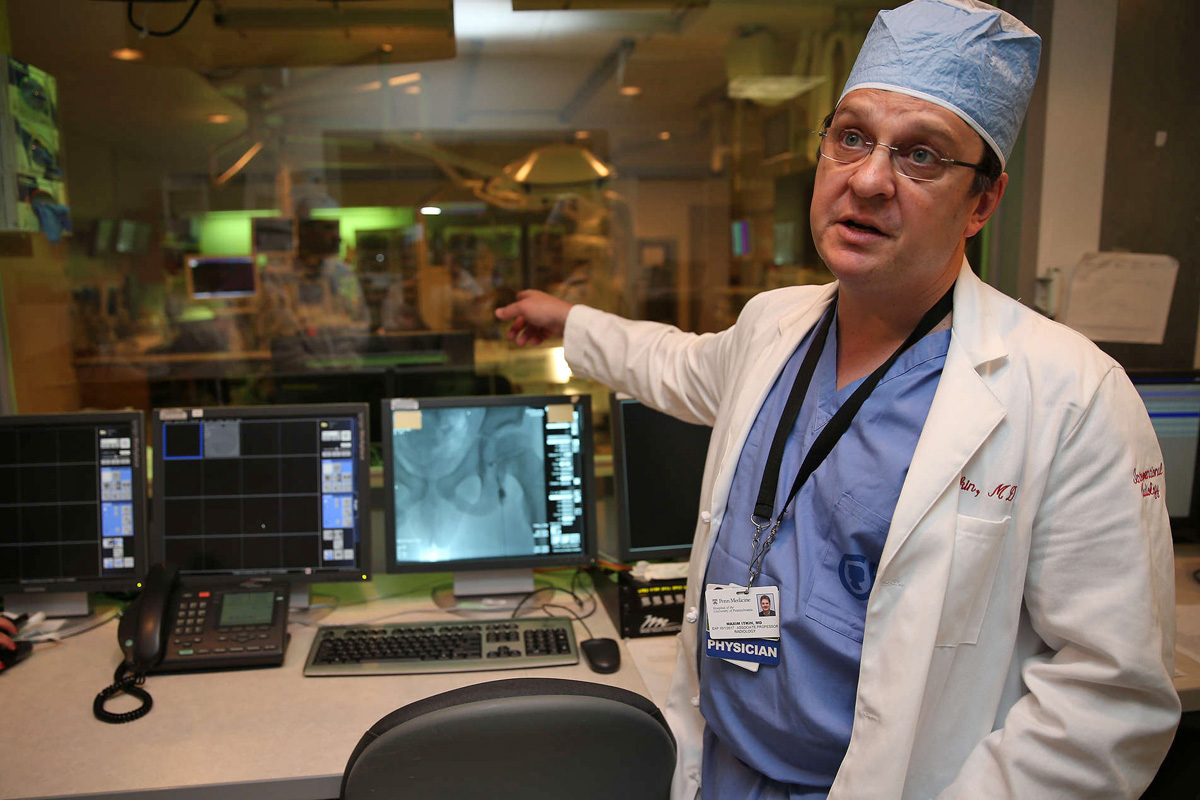
Maxim Itkin, an interventional radiologist at the Hospital of the University of Pennsylvania, found a way to track the flow of lymphatic fluid using X-ray imaging equipment.
Itkin and his team have come up with ways of imaging by injecting dye into lymph nodes and tissues and tracing the dye’s location. This has enabled him to diagnose hidden conditions and develop new treatment methods.
The ARPA-H funding will allow them to go even further, developing imaging agents that focus on the parts of the lymphatic system in the liver and gut — organs that generate the majority of the network’s flow in the body.
These will be used for CT (computed tomography) and MRI (magnetic resonance imaging) scans.
One of the imagingcandidates is designed to be swallowed and absorbed in the intestine, so doctors can see the lymphatic system in the gut. The second imaging agent will be administered via IV to show the system in the liver.
“It was my dream to see the lymphatic system from inside by itself,” Itkin said.
They’ll be using an approach called AI-driven multi-omics, where AI will analyze samples for unique molecules being excreted by the lymphatic system in the liver.
Penn and several other funded groups are working with the New York-based nonprofit Lymphatic Education and Research Network to help with research and patient recruitment.
Current funding is for two years, with the potential to extend for another three years.
Itkin says seeing the lymphatic system in the liver will be a thrill.
Before 1751, sick Pennsylvanians had few healthcare options other than often expensive home visits from doctors. That changed when Benjamin Franklin and physician Thomas Bond established a medical institution to treat the physically and mentally ill for free.
The result was the Pennsylvania Hospital on Spruce Street. The 275-year-old institution became home to the country’s first surgical amphitheater to teach students, the oldest medical library, and a nursing museum, among other historic firsts. It continues to advancemedical research as part of Penn Medicine.
Now the nation’s oldest charteredhospital will become Philadelphia’s newest museum.
The hospital’s Pine Building, which started construction in 1755, will be converted to the Pennsylvania Hospital Museum, Penn announced on Monday. The museum in the majestic Georgian architecture building at Eighth and Pine Streets, designed by architect Samuel Rhoads, is scheduled to open to the public on May8.
“It’s a very Philadelphia story to hear the history of the hospital because it really is about caring for other people,” said Stacey Peeples, lead archivist at Pennsylvania Hospital.
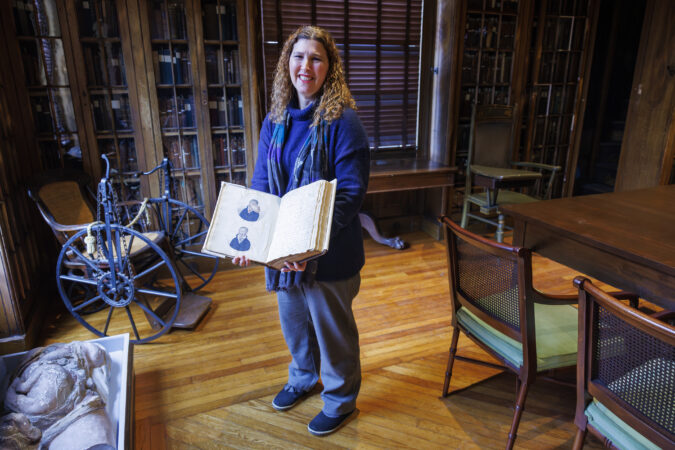
Stacey Peeples, lead archivist at Pennsylvania Hospital, described artifacts in the hospital’s new museum.
The medical library, surgical amphitheater, and apothecary have all been restored for the museum. Eight galleries will feature videos, hands-on activities, and archival objects describing the history of the hospital and the care it delivered.
The opening of the museum in the hospital’s 275th year coincides with America’s Semiquincentennial celebrations. (The University of Pennsylvania Health System, which merged with the hospital in October 1997, will run the museum.)
One of Peeples’ favorite items on display is a collection of medical cases compiled by the hospital’s doctors in the early 19th century.
Housed in the historic library, the book is flipped to a page showing a man with a seven-pound tumor in his cheek and neck area. Visitors can also find the actual preserved tumor from 1805 on display in the back of the room.
A historic medical book compiling interesting cases at Pennsylvania Hospital shows an image of Pete Colberry, a patient who fell from ship rigging and was stabilized on a bed to hold him in place, circa 1804.
A look at early medicine
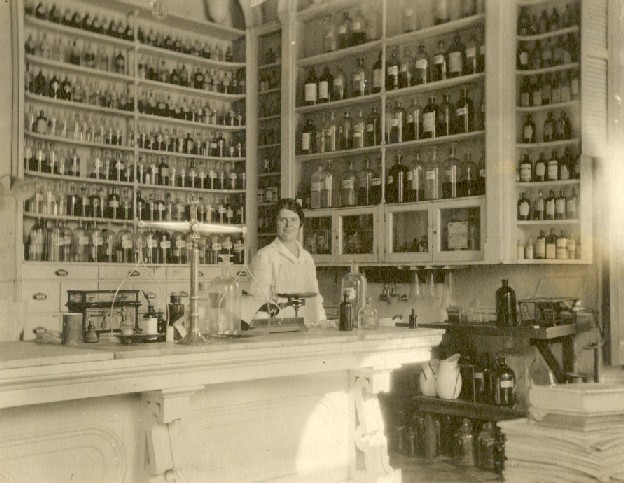
Pennsylvania Hospital’s apothecary — where medicines were mixed and sold — was last used for that purpose in the early 1900s.
Most recently, it served as a conference room.
It’ll now be restored to its original layout, based on historic images from the 19th century. That includes bringing back alcoves filled with shelves of bottles, the scale used to weigh ingredients, as well as a giant counter where the apothecary could mix medications, Peeples said.
An archival image of Mildred Carlisle working in the Pennsylvania Hospital apothecary, circa 1920s.
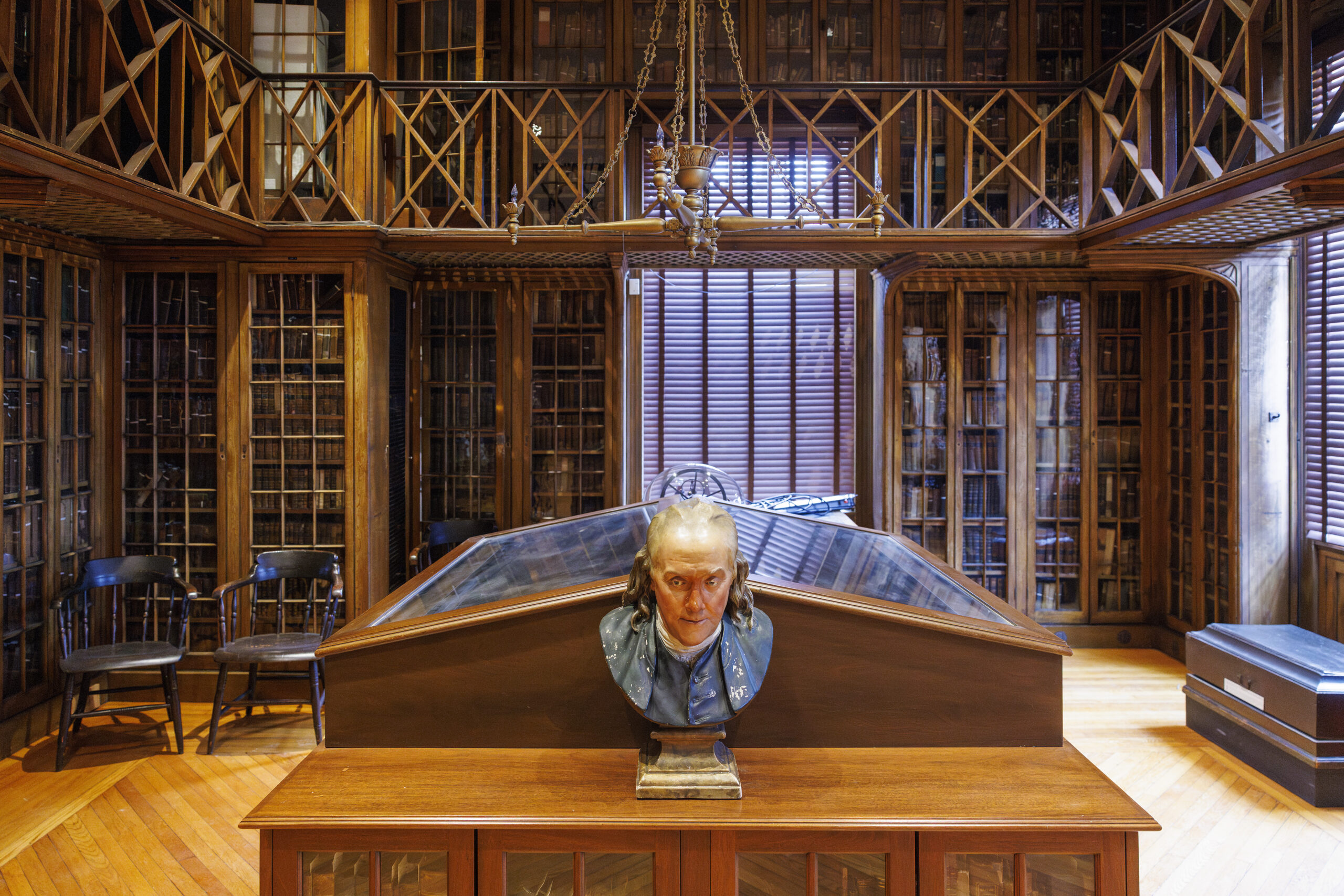
In the historic library, the only room ready for news media to view this week, the artifacts remained scattered around.
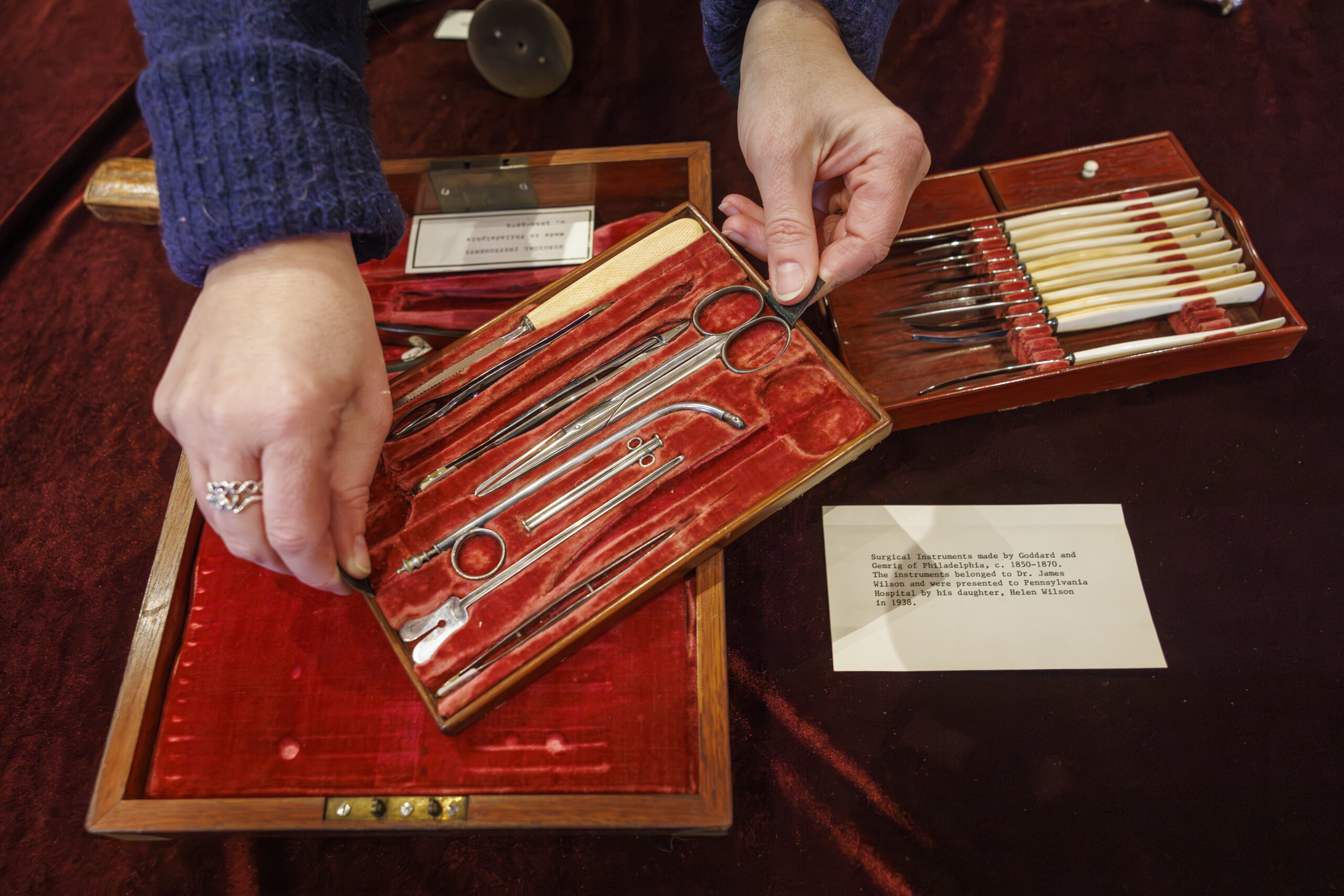
A tonsil guillotine, designed to remove tonsils using a blade, sat next to early surgical tools and stethoscopes. Some objects, such as the scalpel, have not changed significantly in form through the years.
“But how we treat those objects certainly is very, very different. We want to make sure everything’s sanitized now,” Peeplessaid.
Surgical instruments belonging to Dr. James Wilson from the 1800s.
Other artifacts included old tools of medical education.Like three anatomical casts of women who died during childbirth in the mid-1700s that were used for anatomical study in lieu of cadavers.
The museum’s exhibits will showcase the hospital’s history of delivering care related to behavioral health and women’s health, as well as its role treating patients during times of conflicts, beginning with the Seven Years’ War, and through pandemics.
“People would always talk about us being able to do something on a larger scale like this, and I honestly wasn’t sure that was ever going to happen,” said Peeples, who has been at the hospital for 25 years.
Tickets will go on sale at the end of the month and cost $12 per person, with discounts for those 12 and under, 65 and over, and the military.
The plan is for the museum to be a permanent fixture, open Wednesdays to Sundays. The rest of the hospital will keep operating as normal.
Interior of the Historic Library of Pennsylvania Hospital, located at Eighth and Pine Streets.
The hospital, older than the nation, houses 517 licensed inpatient beds, and saw 19,759 adult admissions, 54,023 emergency department visits, and 5,163 births in fiscal year 2025, per Penn Medicine’s statement.
“Pennsylvania Hospital is a jewel in the crown that is Penn Medicine, where our staff draw energy from our rich history to shape the future of medicine,” Alicia Gresham, CEO of Pennsylvania Hospital, said in a statement.