Three seismic developments occurred over the past three Eagles games, all losses. Seismic, because the developments involved the Eagles’ best current defender, the best receiver in club history, and perhaps the best player in the history of the franchise.
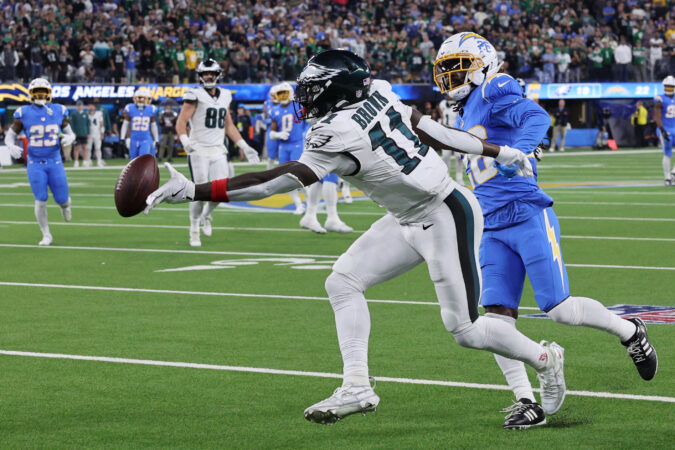
First, in an apparent response to complaints about his role in the offense, the Eagles began force-feeding wide receiver A.J. Brown. He was targeted 35 times in the three games in question. He’d been targeted 37 times in the five previous games.
Second, right tackle Lane Johnson, who might be the greatest Eagle in history, injured his foot. The Eagles win 66% of the time when Johnson plays, while their winning percentage without him is 34%, and falling.
Third, defensive tackle Jalen Carter was either hurting or absent. Carter missed the loss Monday night against the Chargers after undergoing a procedure on his shoulders, which had rendered him virtually useless in the two previous games.
Nothing can be done to remedy the conditions of Johnson or Carter. Johnson issued a cryptic Twitter/X message after Monday night’s game that indicated his return might come sooner than later, and he wasn’t put on injured reserve, but he’s going to miss Sunday’s game against the visiting Raiders. Carter isn’t on IR either, but he’s out, too.
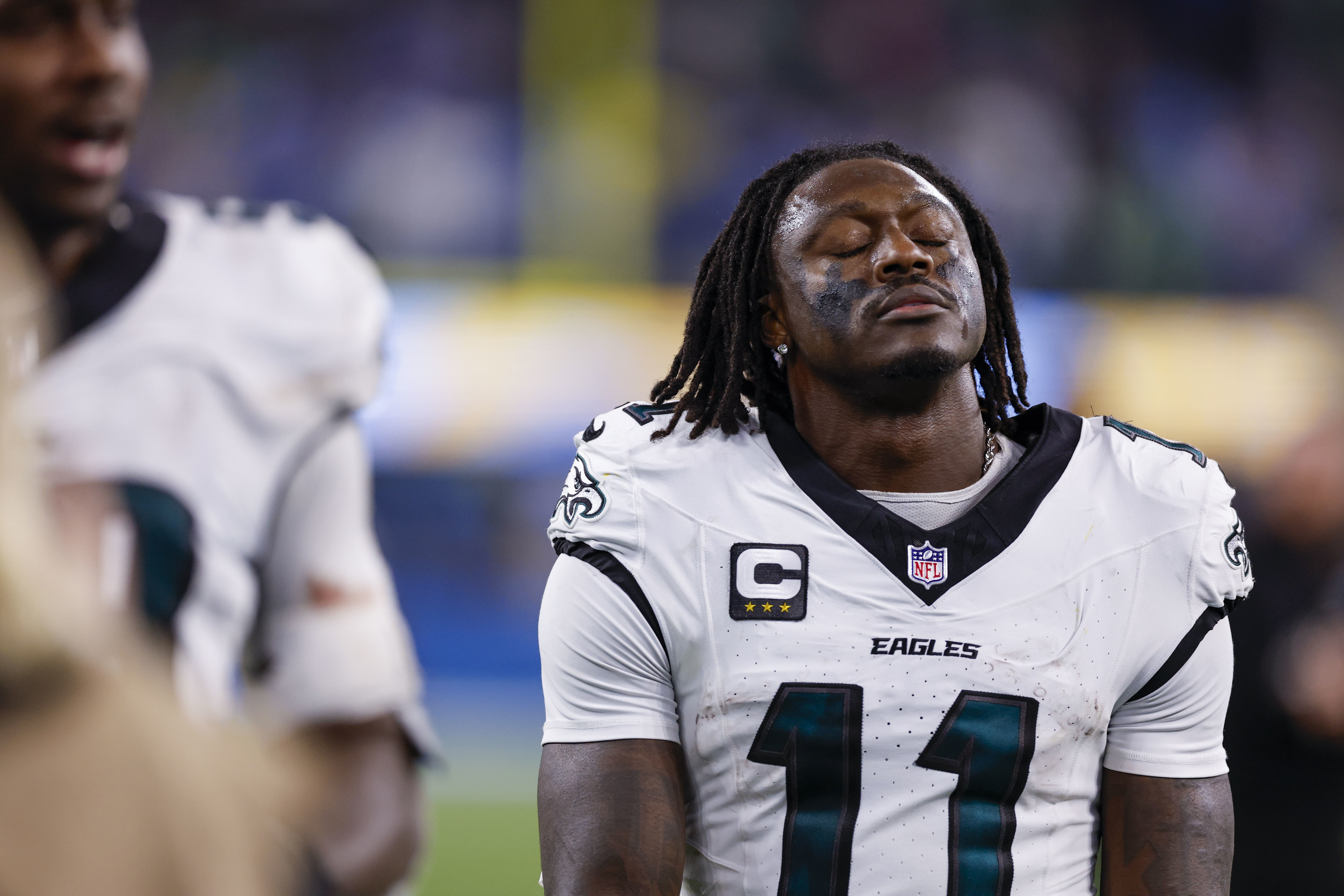
Which leaves A.J.
He was getting fewer and fewer looks. The ball just wasn’t finding him. He wanted the ball more. Hell, I wanted him to get the ball more. After all, with due respect to the golden oldies and one year of Terrell Owens, the Eagles have never had a receiver quite like him.
But getting it to him has spelled disaster.
Me, Me, Me
After the Eagles beat Tampa Bay in Game 4, Brown, who had two catches for 7 yards, posted a passage of scripture that indicated he was being ignored: “If you’re not welcomed, not listened to, quietly withdraw. Don’t make a scene. Shrug your shoulders and be on your way.”
Three games later, after a win at Minnesota, Brown posted, “Using me but not using me.” He had four catches for 121 yards and two touchdowns.
A week later, after a win in Green Bay, Brown was seen on a livestream playing a video game with a friend and saying the offense was a “(bleep)-show” and that he was “struggling” after catching two passes for 13 yards.
Brown might have been indiscrete, but he wasn’t wrong: He needs to be included, if not featured, in order for the Eagles’ offense to function properly. What the past three games proved is that he does not need to be featured in order for the football team to win.
A day after the “(bleep)-show” scandal, very publicly, on the sideline at practice, owner Jeffrey Lurie convinced Brown to stop publicly humiliating the team. Brown has gone silent.
He also has been targeted a whopping 46 times. The first 11 times came against the Lions, a game the Eagles won.
That was also the last time the Eagles had a healthy Lane Johnson and Jalen Carter.
Eagles wide receiver A.J. Brown has been targeted 35 times over the past three games, up from 37 in his previous five.
Correlation equaling causation?
How do the issues fit together?
Well, while the Eagles beat the Lions, they scored only 16 points — not exactly an offensive feast. They won not because Brown was targeted 11 times but because Carter had his second-best game of the season and the defense surrendered just nine points. The Birds scored just 10 in Green Bay the week before, but Carter & Co. limited the Packers to seven.
The offense wasn’t humming, but neither was it hurting the cause, in large part because the offensive line remained viable.
Before Johnson was injured, Hurts had committed three turnovers in 10 games. The team was 8-2.
Since Johnson’s injury, Hurts has seven turnovers in three games. The team is 0-3.
The defense has been pretty good in the past three games, but just before Carter wore down it had again developed into the type of elite unit that led the Eagles to their second Super Bowl win.
The defense has not been good enough to compensate for Hurts, who is playing the worst football of his career.
But is it because he’s trying to force the ball to A.J. Brown?
What about us?
Before Brown’s bellyaching got him more looks, bookend receiver DeVonta Smith was on pace for a career-high 1,241 receiving yards. That pace has been cut in half in the past four games.
Asked Friday why his inclusion and production had slowed, Smith paused, then replied:
“Um … ” five seconds passed as he looked into the distance and mused: ” … I don’t know. I don’t have an answer for that.”
No one can accuse Smith of being indiscrete.
Similarly, tight end Dallas Geodert was on pace for 72 catches, 13 more than his career best, and in a contract year, to boot. His pace has slowed by about 25%.
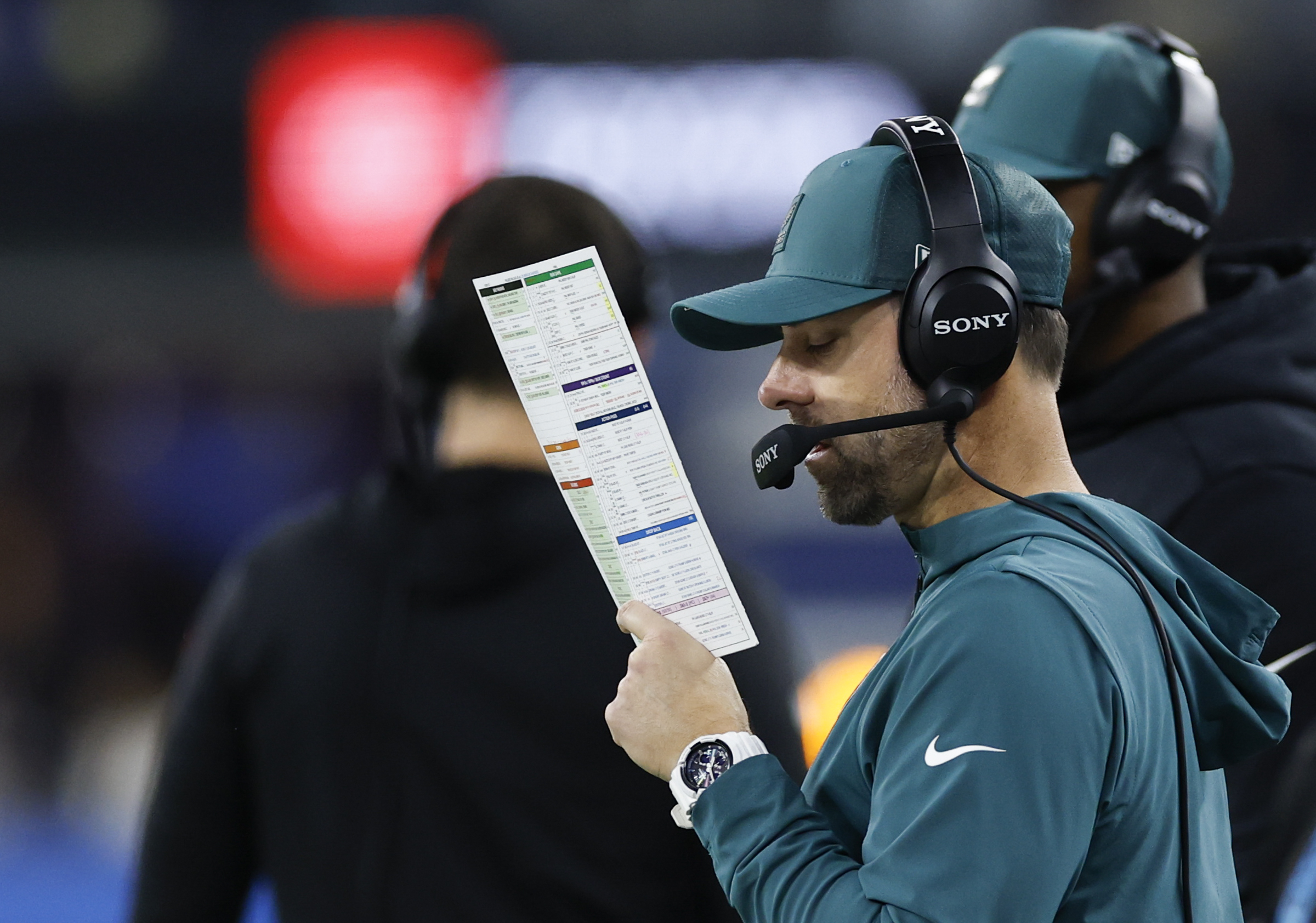
First-time playcaller Kevin Patullo runs an offense that is both predictable and flavorless.
Meanwhile, after projecting to fewer than 900 yards for 2025, Brown now has a chance for a fourth consecutive 1,000-yard season.
There are plenty of issues with the Eagles’ offense.
The biggest problem: The offensive line, due to rampant injury and aggregate fatigue, has declined from being the league’s best to being the league average.
Another problem: First-year offensive coordinator Kevin Patullo, who has never before called plays, runs an offense that is both predictable and flavorless.
The most recent problem: Hurts has become hesitant unless he’s throwing to Brown, usually on the first read.
All three of those problems get diminished the minute Lane Johnson returns. All three of those problems matter less if Jalen Carter is on the field.
But the only thing the Eagles can do Sunday is let the ball find A.J. when the ball finds A.J.
In another broadside against the board of the Philadelphia Art Museum, ousted director and CEO Sasha Suda has once again portrayed her difficulties at the museum as a struggle for modernizing an institution in the face of the status quo. A new court filing from Suda, filed on Thursday night, argues for a trial with jury rather than settling the dispute with the museum through arbitration.
The opposition brief, a response to the museum’s petition last month stating that the matter should be resolved in arbitration, says that Suda’s employment contract contained “an explicit exception” to the arbitration called for by the museum.
“The Court should therefore deny the museum’s motion and retain jurisdiction over this case — as the parties’ agreement and Pennsylvania law require,” states Thursday’s filing in Philadelphia Court of Common Pleas.
Suda, 45, was fired Nov. 4 for what the museum said was cause. Less than a week later, she filed a lawsuit against the museum claiming she was dismissed without a “valid basis.”
Suda’s lawyer, Luke Nikas, did not immediately comment on the matter Friday. The Art Museum had no comment on the new filing, an Art Museum spokesperson said.
Suda was dismissed after an investigation determined that she “misappropriated funds from the museum and lied to cover up her theft,” the museum alleged in a November court filing in response to her lawsuit.
Nikas, of Quinn Emanuel Urquhart & Sullivan, at the time called the accusations false. The money in question, $39,000, came in the form of increases to Suda’s compensation, and these increases were “authorized” and “budgeted” cost-of-living increases that were “fully approved” and “disclosed,” a source close to Suda previously stated.
Much of the new filing repeats the narrative laid out in the initial lawsuit filing, detailing Suda’s unhappiness with former board chair Leslie Anne Miller and current board chair Ellen T. Caplan, as well as a recounting of Suda’s accomplishments at the museum.
Suda and Miller experienced ongoing friction, and Miller “told third parties that Suda was untrustworthy, incompetent, a snake, immature, would not last, and that others were ‘drinking the Kool-Aid’ by supporting her,’” the new filing states.
“Those comments from an officer and agent of the Museum violated the Employment Agreement’s Non-Disparagement Clause,” and that violation entitles Suda to “immediate injunctive relief and a temporary order restraining any threatened or further breach, in addition to or in place of the arbitration provisions,” the filing states.
Miller declined to comment on Friday.
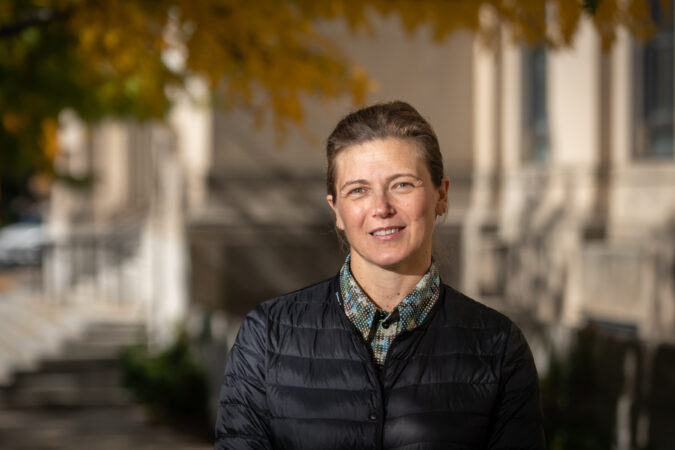
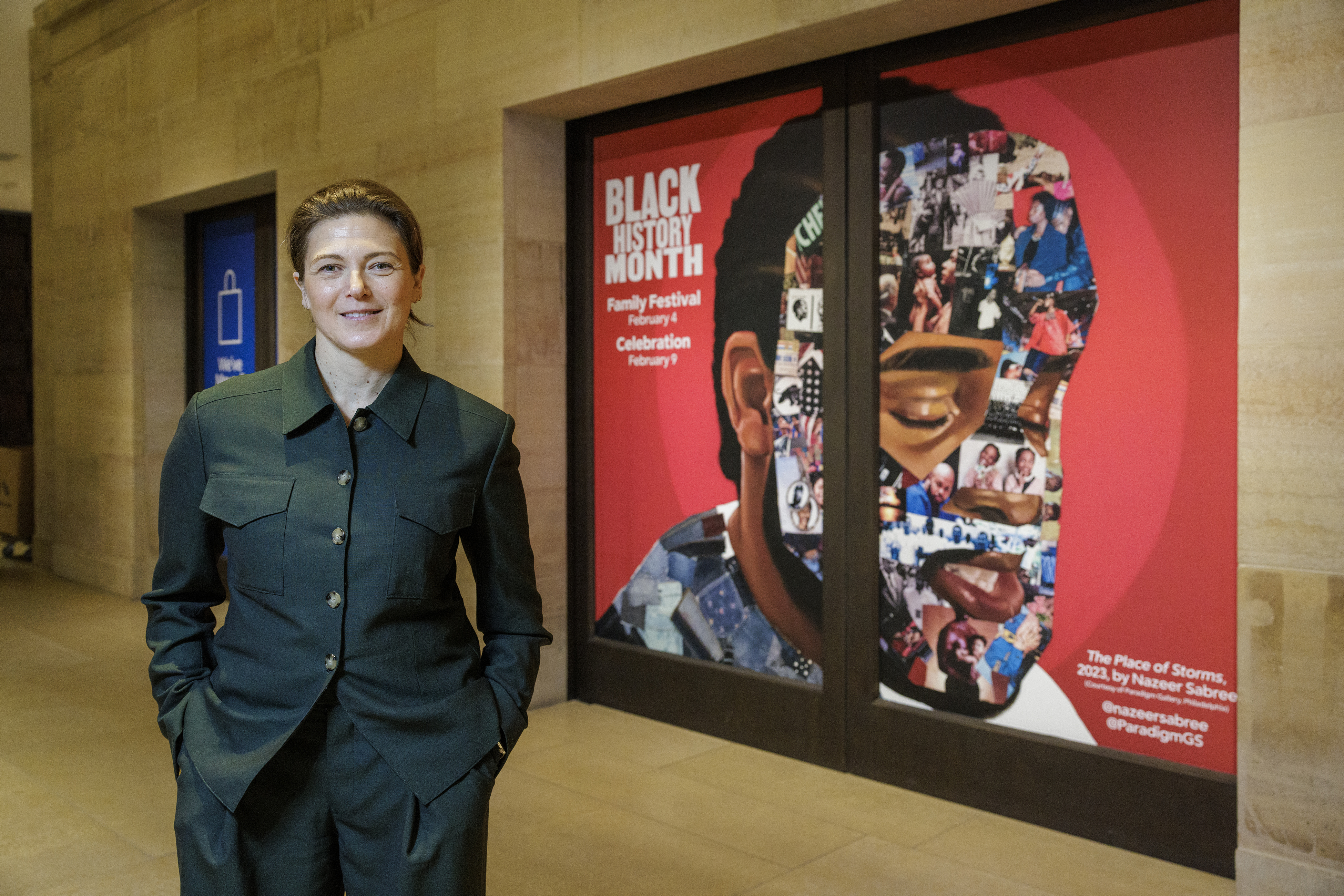
Sasha Suda, former director of Philadelphia Art Museum, Jan. 30, 2024.
Suda’s contract stipulates that any changes in her compensation would be determined at the “sole and absolute discretion” of the compensation committee. In its November petition, the museum said that Suda requested, and was denied, a salary increase from the compensation committee on Feb. 8, 2024. She then “awarded herself the salary increase” effective March 1, 2024, followed by a second “unauthorized” increase in July of that year, the petition claims.
In July 2025, according to the museum’s petition, Suda “awarded herself a third unauthorized pay increase, which she once again failed to disclose to the board.”
The new filing includes text messages of praise and encouragement from board member John Alchin. It says that in September 2023, Alchin — identified in the filing as chair of the finance committee — examined a draft report for a compensation subcommittee meeting and requested “schedules of salaries along with proposed/recent salary increases.”
“Suda’s compensation was also reviewed,” the filing states.
“As the board member with the most oversight of Suda’s financials, Alchin expressed no concerns about Suda’s approach to salary schedules or financial governance, which were discussed openly in committee meetings,” the filing states.
It provides a copy of an August 2025 letter from the museum to Suda outlining her annual salary increase, from $749,087 to $771,560. The letter is not signed by a specific person — only the museum’s human resources department — and was cc-ed to “finance.”
The new filing also includes 2023 correspondence from the museum’s CFO, Katherine Harper, to its HR director, Meredith Clayton, “trying to figure out what increase Sasha might be entitled to,” adding that “prior to finalizing, I will check with John Alchin or Leslie to make sure they are comfortable.”
Suda was in the third year of a five-year contract when she was dismissed in the beginning of November.
On Dec. 1, she was succeeded by veteran nonprofit administrator Daniel H. Weiss, former chief of the Metropolitan Museum of Art, who had already been engaged by the museum as a consultant prior to being named director and CEO.
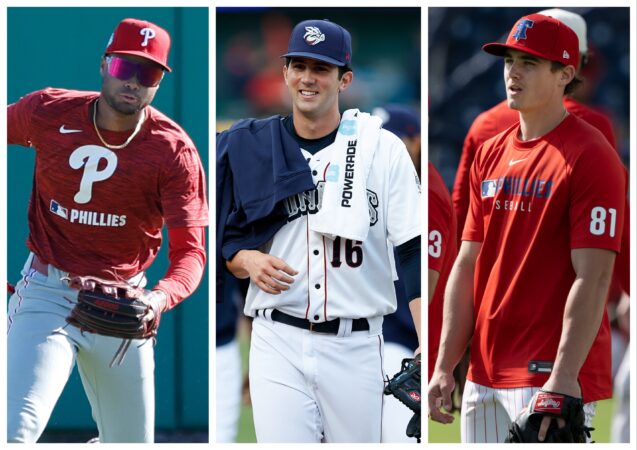
After a spring training workout in February, Kyle Schwarber contemplated the likelihood of the Phillies keeping most of the roster’s core intact through the end of the decade.
“I think we would love to all finish our careers together,” he said. “But who would want to come out and watch a bunch of 40-year-old dudes play baseball? Right?”
Well …
Schwarber will be only 37 when his newly minted five-year, $150 million contract expires in 2030. Bryce Harper will be 38 by then; Trea Turner and Aaron Nola 37; even Cristopher Sánchez will be 34. All will have no-trade rights, if they don’t already.
Maybe they will have World Series rings, too. In that case, the 42,000 fans who pack Citizens Bank Park on random weeknights in June won’t mind watching them ease into baseball old age together. Flags fly forever, you know.
But modern front offices obsess over long-term plans more than trying to win a championship one season at a time. Sustainability is their buzzword. Most whiz-kid general managers would look you in the eye and say that five-year contracts for 33-year-old designated hitters coming off 56-homer seasons are bad business. Don’t even get them started on multiyear deals for 35-year-old catchers who still play 130 games per year.
At 69, Dave Dombrowski is no kid. But five World Series appearances with four franchises and two titles make him a team-building wiz. And although he has hitched the Phillies’ hopes in 2026 and probably 2027 mostly to a handful of thirtysomething superstars, he outlined a second part of the plan that’s essential to success in 2028 and 2029, too.
President of baseball operations Dave Dombrowski is intent on incorporating more young players into the Phillies’ roster.
“I’ve said this all along, and I still believe this: We need to start working our young players into our [roster],” Dombrowski said this week at baseball’s winter meetings in the shadow of Disney World. “We have good young players, and we’ll be better for it. I do think that good organizations can blend young players with veterans.”
Look no further than the sport’s model organization.
Since 2023, the Dodgers have spent more than $1 billion on player salaries, including a record $415 million this year (calculated for the luxury tax, according to Cot’s Baseball Contracts). Yet they had 25 players make their major league debut, including center fielder Andy Pages, infielder Hyeseong Kim, and pitchers Bobby Miller, Gavin Stone, Emmet Sheehan, Jack Dreyer, Roki Sasaki, and World Series MVP Yoshinobu Yamamoto.
Conversely, the Phillies had 12 major league debuts in the last three seasons — fewer than any team, based on Fangraphs research — with setup reliever Orion Kerkering and reserve outfielder Johan Rojas having the most impact.
Dombrowski attributed the low graduation rate from the minor leagues to “a combination of factors,” including a veteran-laden roster that stayed mostly healthy relative to other teams and allowed few opportunities for call-ups.
But it will be different in 2026. It has to be.
Because it’s one thing to reunite Schwarber — and probably free-agent catcher J.T. Realmuto, too — with Harper, Turner, Nola, Sánchez, and Zack Wheeler on one of the majors’ oldest rosters and take a few more whacks at an elusive championship. It’s quite another to realize that long-term success — beyond, say, 2027, when Wheeler intends to retire — is tied to how good Justin Crawford, Andrew Painter, and Aidan Miller end up being.
“We have some really exciting talent that’s going to be coming up, and you’re looking forward to whenever they can step foot in the big-league locker room,” Schwarber said. “You want to make them feel like they’re going to be welcomed right away and feel like there’s going to be a seamless transition for them.”
And even as the Phillies bring back the band, the maturation of their next core will be an equally important 2026 storyline.
Top prospect Justin Crawford is expected to occupy a spot in the Phillies’ outfield on opening day.
A new ‘Daycare’
When the Phillies returned to the postseason in 2022, the lineup included three, sometimes four players who were 25 or younger: Alec Bohm, Bryson Stott, Brandon Marsh, and Matt Vierling.
Teammates and coaches dubbed them “Phillies Daycare.”
Although Bohm, Stott, and Marsh became solid contributors after Rob Thomson took over as manager (Vierling got traded to the Tigers for lefty reliever Gregory Soto), they’re mostly supporting actors rather than leading men in the Phillies’ ensemble. And as they outgrew their moniker — “They’re not the ‘Daycare’ anymore,” Harper finally declared last spring — there wasn’t another class coming behind them.
“Well, we traded quite a few players that could have been contributing members,” Dombrowski said, citing Vierling specifically. “We traded them for more veteran type of players to help us win at that particular time.”
Dombrowski also noted that five of the Phillies’ last six first-round picks — including Mick Abel (2020), Painter (2021), Crawford (2022), and Miller (2023) — were drafted out of high school, which typically means a longer path through the minors.
And when the Phillies did punch the accelerator and gave Painter a chance to make the team out of spring training as a 19-year-old in 2023, he tore a ligament in his right elbow, had Tommy John surgery, and missed two seasons.
The Phillies planned to call up Painter midway through this past season. But he struggled to regain his preinjury command, common for pitchers in the first year back from surgery. Painter stayed in triple A, and finished with a 5.40 ERA in 106⅔ innings.
“Honestly, some of the expectations we put on players is unfair,” minor league director Luke Murton told The Inquirer’s Phillies Extra podcast. “A guy that’s just coming back from Tommy John that pitched over 100 innings, was healthy, and at a level he’d never been at, I was very pleased, very satisfied.
“I think he accomplished a ton this year. Next year he’s looking forward to accomplishing more.”
Painter stands a good chance to crack the season-opening rotation, especially if Wheeler needs more time after thoracic outlet decompression surgery. And the Phillies expect Painter’s long-awaited arrival in the majors to help lessen the anticipated loss of Ranger Suárez in free agency.
Dombrowski has all but guaranteed Crawford’s spot in the opening-day lineup, either in center field or left. The Phillies came close this summer to calling up the 21-year-old but elected to leave him in triple A to win a batting title, especially after acquiring veteran center fielder Harrison Bader at the trade deadline.
“I really believe that [Crawford] could have played for us at some point,” Dombrowski said. “But then you also do what you think is best for the player and for us in that time period. You’re trying to win a championship. And it didn’t hurt him to go out and continue to play [in triple A].
“But now, all of a sudden, you’re in a position where you’ve got Crawford and you’ve got Painter knocking on the door. Miller’s close; [outfielder Gabriel] Rincones is close. [Otto] Kemp came up for us last year, and we like Kemp a lot. There’s others that we like. It’s exciting.”
Also, necessary.
The Phillies could fast-track Aidan Miller to the majors in 2026 if he can make a smooth transition to third base.
‘Close your eyes and let ‘em play’
Including Schwarber’s new deal, the Phillies have roughly $285 million in 2026 payroll commitments, calculated for the luxury tax. Bringing back Realmuto would likely push the total past $300 million.
And still, there are holes in the outfield and bullpen.
The Phillies have explored trading from the major league roster to create payroll flexibility, according to sources. Moving Bohm, entering his free-agent walk year, would clear approximately $10.3 million based on MLB Trade Rumors’ salary arbitration projections.
In that case, the Phillies could look inward to find Bohm’s replacement at third base. One possibility: Kemp, who made his major league debut this year and has drawn effusive praise from Dombrowski throughout the offseason.
“He’s a good hitter. The ball jumps off his bat,” Dombrowski said. “He’s a threat when he comes to the plate. He can play different positions. And he’s a tough son of a gun. He’s a championship-type player. What he played through last year, injury-wise, I don’t think that there’s many people that would have done that.”
Indeed, Kemp continued to play despite fracturing his left kneecap in June and finished with eight homers and a 92 OPS-plus. He had knee surgery and a minor procedure on his left shoulder after the season. The Phillies expect him to be ready for spring training.
Before long, third base could belong to Miller. Murton said the touted 21-year-old shortstop will move to third in spring training. Miller spent the last week of the season in triple A and could return for only a pit stop after finishing with 14 homers, 59 stolen bases, and an .825 OPS between two levels.
Could he follow Crawford and Painter as a major league debutant in 2026?
“You never know,” Murton said. “He’s a very talented player. Don’t want to put too much on him too soon. He’ll be a big-league spring-training invite. You bring him in and see what we’ve got.”
The timing lines up. As Harper posts Instagram videos of his elective blood-oxygenation treatments, the Phillies can finally inject fresh blood into the roster, acclimatizing Crawford, Painter, and eventually Miller while the old guard is still elite and bearing most of the pressure.
“We just need them performing to their best abilities,” Schwarber said. “We don’t need anyone feeling like they need to step out and be Superman. We don’t need them worrying about, ‘How does Schwarber, how does Trea Turner, how does Bryce Harper, how does whoever think about what I’m doing?’”
Said Thomson: “I always think, when you bring a young guy up, close your eyes and let him play. No matter what happens, he gets two, three months, whatever you want to give him, and don’t even talk. Just let him go. The guys that we have at the upper level of our system are performers, and eventually they’re going to perform.”
It’s not just overdue. It’s imperative to keeping the Phillies’ roster from going stale.
The semiquincentennial year in Philadelphia is set to start off with a bang.
The city’s celebration of the 250th anniversary of America will begin on New Year’s Eve with a free concert in front of the Philadelphia Art Museum steps.
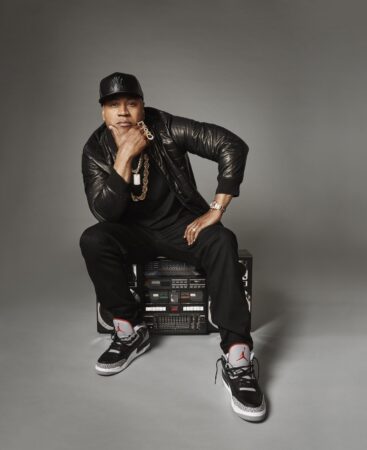
The lineup includes LL Cool J, DJ Jazzy Jeff, bassist and bandleader Adam Blackstone, and Los Angeles rock band Dorothy. Technician the DJ, who has toured with the likes of the L.O.X. and Ghostface Killah, is also on the bill.
Afterwards — at midnight — there will be fireworks.
“Philadelphia is thrilled to welcome everyone to our vibrant city as we celebrate New Year’s Eve and kick off the 250th anniversary of our nation’s independence,” Mayor Cherelle L. Parker said in a statement.
“This free concert and fireworks showcases the incredible spirit of our community and the cultural legacy that Philadelphia embodies … Join us for Philly’s first ever New Year’s Eve outdoor concert as we kick off 2026 in America’s Birthplace — this is truly the place to start our celebration of this historic anniversary!,” she said.
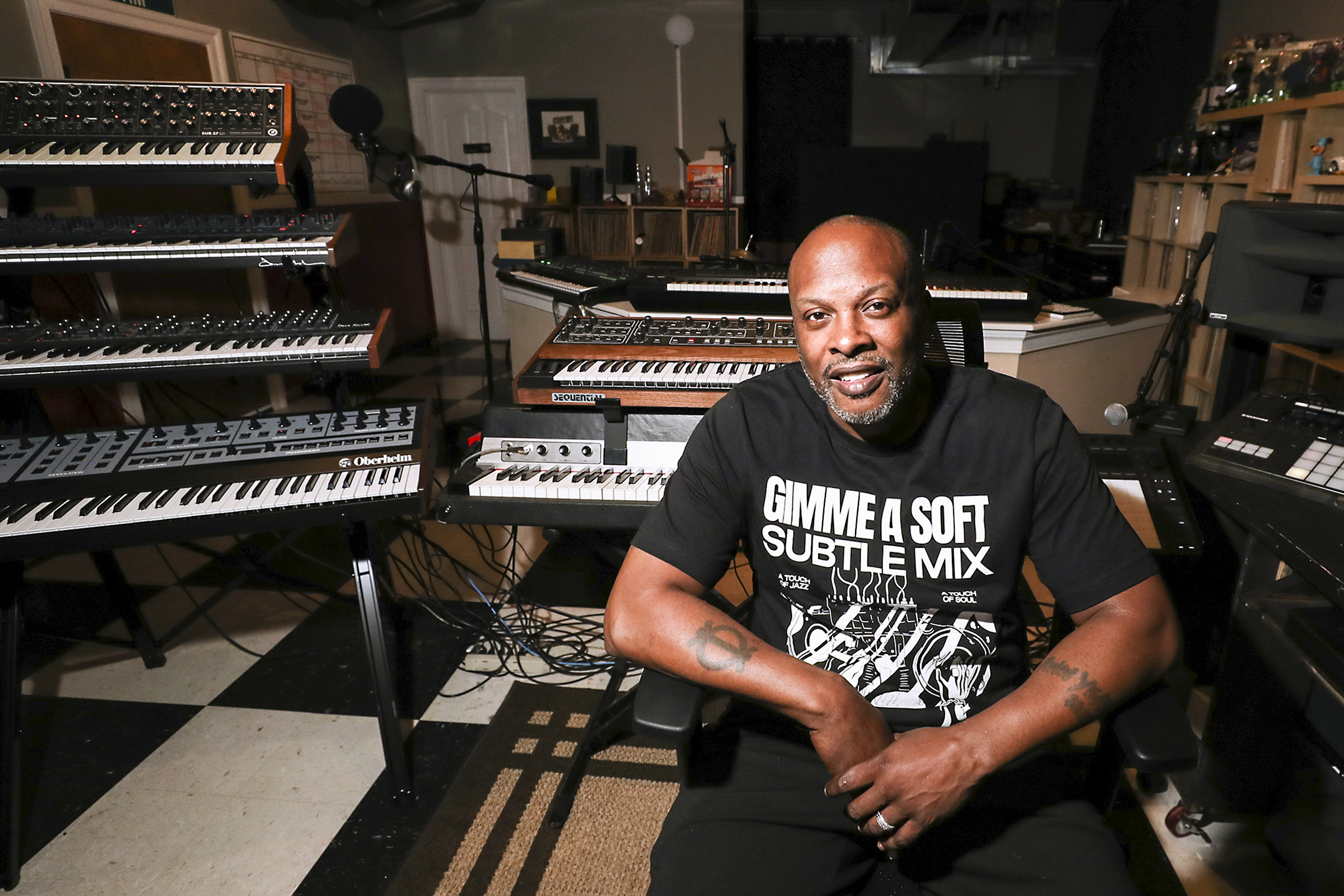
Jeffrey Allen Townes, better known as DJ Jazzy Jeff, poses for a photo in the recording studio section of his home in Bear, Del. in 2023. He’ll perform on New Year’s Eve on the Ben Franklin Parkway as part of the free concert and fireworks dispaly.
For LL Cool J, the New Year’s Eve concert will be a makeup show.
The “Mama Said Knock You Out” and “I Can’t Live Without My Radio” rapper, actor, and Rock and Roll Hall of Fame inductee was scheduled to play on the Parkway along with Jazmine Sullivan as part of the city’s July 4 celebration this year, but canceled in solidarity with striking municipal workers.
“Philly, don’t call it a comeback,” he said in a statement. “We’ve got unfinished business. Shout out to the Mayor for the invitation! Meet me on the Oval this New Year’s Eve as we bring in 2026 — live.”
Blackstone, who won a best musical theater album Grammy last year for his work on Alicia Keys’ Hell’s Kitchen, plans to debut “Brotherly Love,” a song he’s written with Curtis Mayfield’s cousin Cedric Mayfield, at the New Year’s Eve show.
Gates for the free concert open at 6 p.m., and the music starts at 8 p.m.
Think you know your news? There’s only one way to find out. Welcome back to our weekly News Quiz — a quick way to see if your reading habits are sinking in and to put your local news knowledge to the test.
Question 1 of 10
Bar Caviar, a new restaurant focusing on caviar and champagne, is coming to the Dwight D Hotel near Rittenhouse Square. The champagne selection is a collector’s catalogue with rare and exceptional bottles and glasses. One showstopper, Salon, is ultrarare and will cost roughly how much per pour?
CorrectIncorrect. XX% of other readers got this question right.
Salon is only produced in exceptional years from a single village and a single grape. Bar Caviar plans to offer it by the glass, at an estimated $600 per pour. Nonvintage options will start at $15.
Question 2 of 10
In honor of America’s 250th anniversary, 20 Philadelphia neighborhoods are getting a replica of this item, each painted in a different style by local artists.
CorrectIncorrect. XX% of other readers got this question right.
Twenty large replica Liberty Bells will decorate Philly neighborhoods for the national milestone. Designed by 16 local artists selected through Mural Arts Philadelphia — and planned for commercial corridors and public parks everywhere from Chinatown and South Philly to West Philly and Wynnefield — the painted bells depict the histories, heroes, cultures, and traditions of Philly neighborhoods.
Subscribe to The Philadelphia Inquirer
Our reporting is directly supported by reader subscriptions. If you want more journalism like this story, please subscribe today.
This week brought some conversation regarding the fate of the Rocky statue located at the top of the Philadelphia Art Museum’s steps (for now, it’s not moving). In total, how many official Rocky statues are in Philly?
CorrectIncorrect. XX% of other readers got this question right.
Philadelphia has three Rocky statues made by sculptor A. Thomas Schomberg. The original, at the foot of the museum’s steps, is owned by the city and has sat there since 2006. Sylvester Stallone commissioned that statue for Rocky II and later gave it to the city. The second was set at the top of the steps last December as part of the city’s inaugural RockyFest. The third is located at Philadelphia International Airport, where it was unveiled late last month in Terminal A-West.
Question 4 of 10
World Cafe Live remains open for now, but a potential eviction is looming. What institution owns the building where the venue’s currently located?
CorrectIncorrect. XX% of other readers got this question right.
Penn owns the building at 3025 Walnut St. that houses World Cafe Live’s 650-capacity Music Hall and 220-capacity Lounge. It is also home to the university’s radio station, WXPN-FM (88.5), which is a separate business. According to public documents obtained by The Inquirer, as early as July, Penn’s real estate office sent organizers notice that they had defaulted on their lease and owed the university $1.29 million for rent and utility payments dating back to April 2022.
Question 5 of 10
Rachel Billebault, once known around the world as Harlow, is regarded as the city’s most famous transgender woman. Today out of the spotlight, she mostly keeps to herself in Northeast Philly. But every now and then, the 77-year-old will get dressed up and head to this Gayborhood favorite:
CorrectIncorrect. XX% of other readers got this question right.
At 77, Billebault is still stylish, refusing to step out without a fully made-up face and perfectly coiffed hair. If she’s going out, she heads to Knock, the Gayborhood piano bar, owned by her dear friend Bill Wood and run by an attentive staff who dote on her. A Francesco Scavullo portrait of her remains permanently ensconced on the piano.
story continues after advertisement
Question 6 of 10
The largest U.S. outpost of the popular Vietnamese coffee brand Trung Nguyên Legend is open in South Philly. It features this architectural detail:
CorrectIncorrect. XX% of other readers got this question right.
The 5,000-square-foot cafe boasts two floors and a year-round roof deck, where customers can sip on citrusy espresso tonics, frothy Vietnamese egg coffees, or strong phin pour-overs, paired with a small array of European pastries (macarons, eclairs, mille-feuille) delivered daily from an off-site bakery.
Question 7 of 10
The new U.S. Mint coins commemorating America’s 250th anniversary include portrayals of three Philly landmarks, the Liberty Bell, Independence Hall, and:
CorrectIncorrect. XX% of other readers got this question right.
Three separate quarter designs include images of Independence Hall, where the Declaration of Independence was signed; the Liberty Bell, housed and managed by the National Park Service in Philadelphia; and a Continental Army soldier at Valley Forge commemorating the Revolutionary War.
Question 8 of 10
The original Fresh Prince, Will Smith, makes a cameo in the final scene of Bel-Air, Peacock’s reimagining of the 1990s hit The Fresh Prince of Bel-Air. He advises “younger Will” that sometimes he’ll mess things up, but he’ll learn from those mistakes. Then he adds this piece of sage advice:
CorrectIncorrect. XX% of other readers got this question right.
“Eat a cheesesteak,” the older Smith said with a laugh. “Not every day because cholesterol is real.” Smith told ET that the series’ final scene almost didn’t happen. “I almost played the father,” Smith said, of the role of Lou played by Marlon Wayans. “It just felt like it might be a little too meta, a little too weird.”
Question 9 of 10
The Phillies and Kyle Schwarber have agreed to a contract, the team announced on Tuesday night. How much was it for?
CorrectIncorrect. XX% of other readers got this question right.
The Phillies and Schwarber agreed to a five-year contract. A source told The Inquirer that the deal totals $150 million. The contract will take Schwarber, who turns 33 in March, through his age-37 season.
Question 10 of 10
West Philly rapper Bul Bey has had his music featured on Abbott Elementary twice. The artist said it’s all because he sent an “awkward” message to the show’s music supervisor on this platform:
CorrectIncorrect. XX% of other readers got this question right.
Back in February 2022, Richardson sent an introductory message on LinkedIn to Abbott Elementary music supervisor, Kier Lehman. Among the tens of tracks Richardson pulled from his catalog to include in that message, the 2014 single, “Where I’m From,” managed to strike a chord with Lehman.
Your Results
You have skipped .
You scored XX out of 10.
The average reader scored XX out of 10
Seems like you’ve been skimming more than reading there, buddy. There’s always next week.
You’ve read some articles (or made some educated guesses) but we wouldn’t come to you first for our local news recaps. Better luck next week!
Do you work here? You’re a local news stan with the latest updates on Philly happenings. Your friends definitely ask you for summaries on what’s going on and it shows.
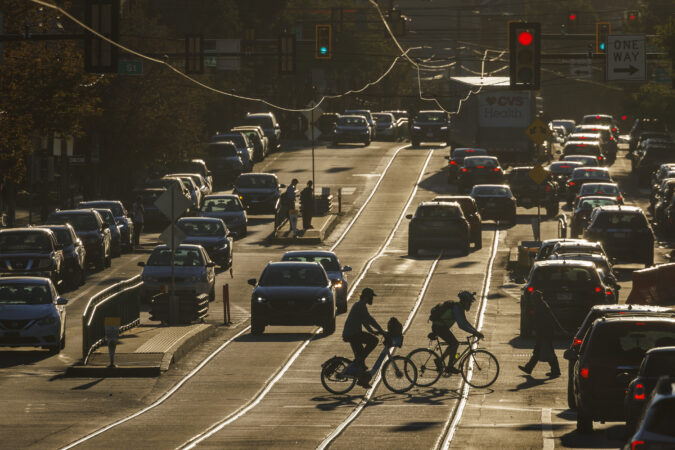
The average commute in Philadelphia takes longer than in most large U.S. cities — and it’s gotten slightly worse recently.
In 2024, commuters spent on average 33.2 minutes getting to work in the city, according to a new report from Yardi Kube, a digital management platform for coworking spaces. That’s more than the national average and a 2.1-minute increase from the previous year.
The increase in Philadelphia also reflects a larger national trend, according to the report. The average American’s commute time inched up in 2024 by nearly half a minute, to 27.2 minutes. Still, that’s less time than the average worker spent in transit to their job in 2019.
Meanwhile, Philadelphia faced some of the worst traffic congestion in the country last year, and public transit has confronted several challenges this year that caused disruption for commuters.
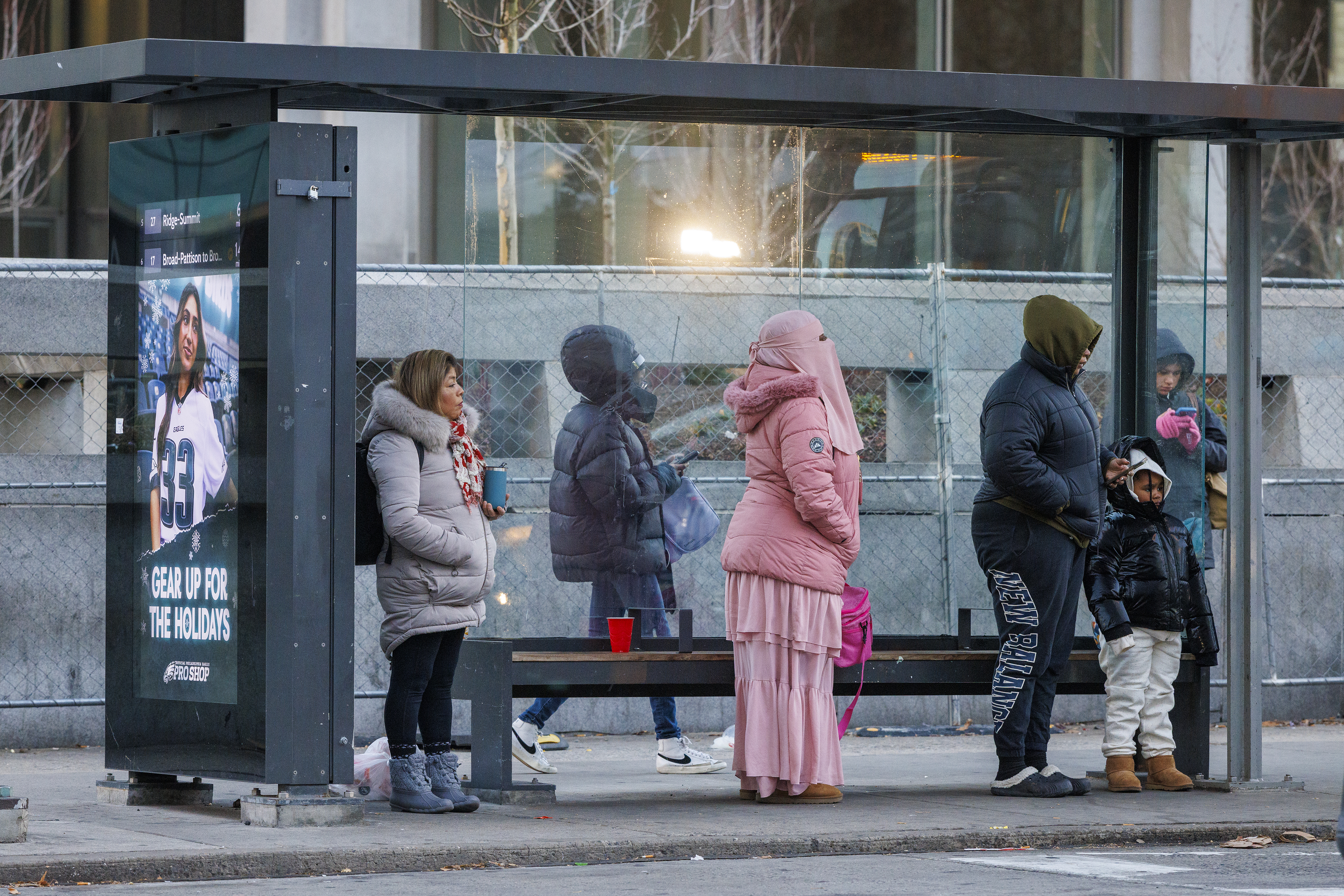
Commuters at a bus stop at 15th Street and JFK Boulevard on a cold December morning in Philadelphia.
The increase in Philadelphia and beyond comes as employers have increasingly called workers back to in-person work, reversing trends toward hybrid or remote arrangements during the pandemic. The report notes that as the number of Americans working from home has decreased, the average time spent commuting has inched up.
“Across the United States, how people get to work — and how often they do — continues to evolve,” the report reads.
“The rise of remote and hybrid work dramatically reshaped commuting habits, leading to sharp declines in travel times during the pandemic years,” it said. ”Yet as more employees return to the office, commute durations are climbing again, in some cases more quickly than before.”
The report is based on data from the U.S. Census Bureau’s American Community Survey. It took into consideration the 50 largest cities based on the size of their population and evaluated the time spent commuting for a one-way trip, regardless of mode of transportation.
window.addEventListener(“message”,function(a){if(void 0!==a.data[“datawrapper-height”]){var e=document.querySelectorAll(“iframe”);for(var t in a.data[“datawrapper-height”])for(var r,i=0;r=e[i];i++)if(r.contentWindow===a.source){var d=a.data[“datawrapper-height”][t]+”px”;r.style.height=d}}});
While Philadelphia’s average commute lengthened from 2023 to 2024, it’s still shorter than the average of 34.3 minutes in 2019.
But the region’s public transit system has seen a series of significant challenges this year, rankling commutes for many.
And SEPTA‘s Regional Rail system has encountered significant disruption and delays this fall, as the transit authority was ordered to inspect all of its 50-year-old Silverliner IV train cars following five train fires this year.
This week, SEPTA averted a worker strike, after coming to an agreement with Transport Workers Union Local 234 over improvements to the employee contract. The union represents some 5,000 SEPTA employees including operators of buses, subways, and trolleys.
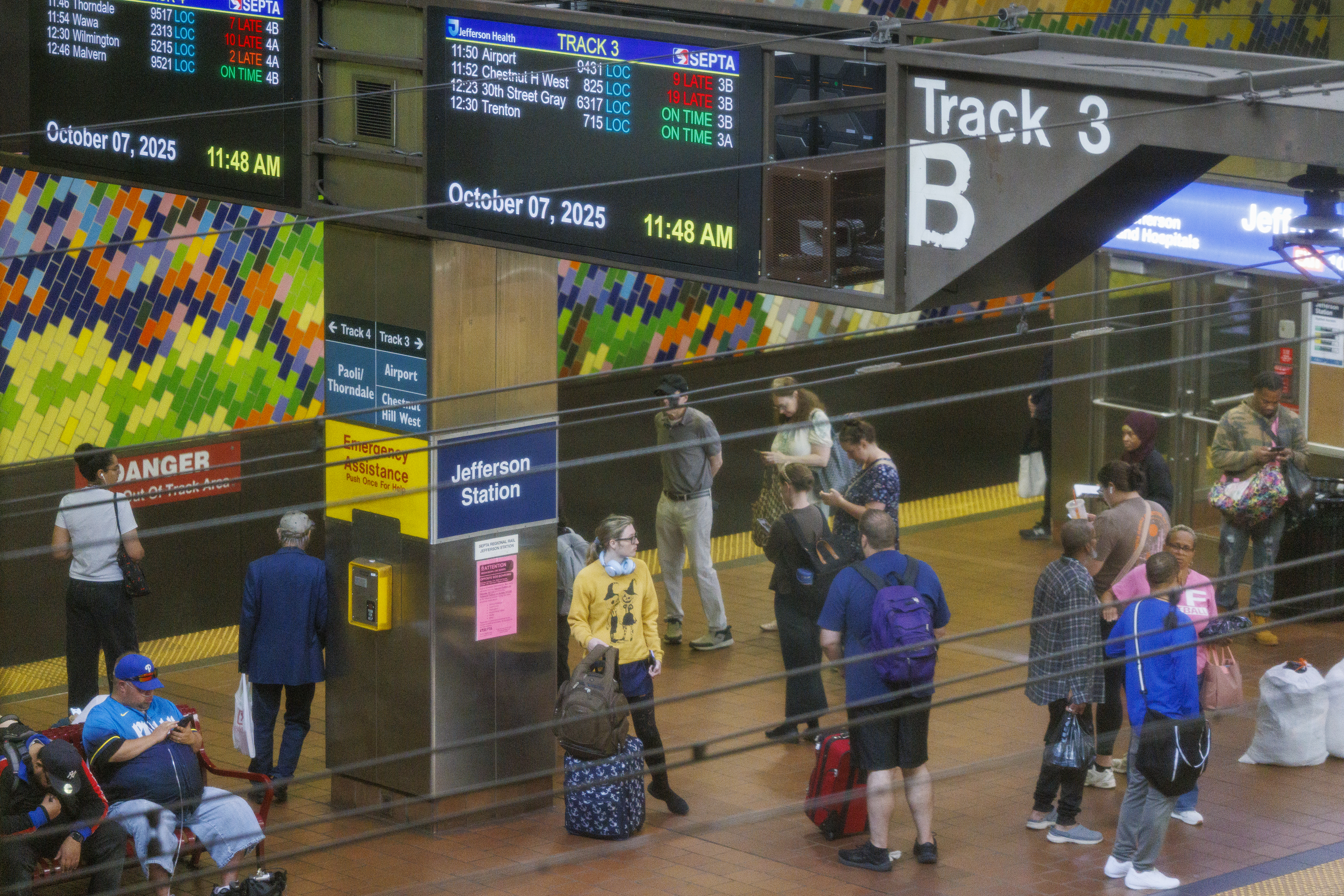
Commuters waiting for SEPTA Regional Rail at Jefferson Station on Oct. 7.
Other cities with long commutes last year include New York, Chicago, San Francisco, Los Angeles, and Boston. New Yorkers spent an average of 40.6 minutes getting to work in 2024, nabbing the worst commute time in the country. Chicago ranked second, with an average of 33.5 minutes in transit last year.
All of those cities saw an uptick in their commuting time in the past year.
Among the 50 most populous cities in the country, the places with the shortest commutes are Tulsa, Okla.; Omaha, Neb.; Memphis; Tucson, Ariz.; and Kansas City, Mo. Those cities had average commute times between 19.7 and 21.8 minutes last year.
As boxes of holiday gifts pile up on your stoop, beware: Porch pirates continue to strike in Philadelphia.
Reports of package theft from January through November of this year are up 6% compared to last year, according to The Inquirer’s analysis of Philadelphia Police Department data.
And if the past two years are any indication, porch pirates will be particularly active this month.
In neighborhoods across the city, residents have shared their frustration over repeated thefts. Katie Byrne said she’s had more a dozen packages swiped from out front of her Fishtown home. Often, she said, “before I even get the notification it got delivered.” This year, she said she and a neighbor have teamed up to grab each other’s packages when the other isn’t home.
Porch pirates strike in the suburbs, too. Exasperated consumers have vented about package thefts to their neighborhood Facebook groups in Brookhaven, Cheltenham, Conshohocken, Croydon, Lower Merion, Levittown, Media, West Chester, Quakertown, and even down the Shore.
Last holiday season in Newtown Square, Katy Retzbach said $150 in Christmas gifts were stolen from under her family’s mailbox in broad daylight.
Nationwide, at least 58 million packages were stolen last year, amounting to $16 billion in financial losses, according to a recent report from the U.S. Postal Service Office of the Inspector General. Most stolen packages are between $50 and $200 in value.
What Philly’s package theft data shows
window.addEventListener(“message”,function(a){if(void 0!==a.data[“datawrapper-height”]){var e=document.querySelectorAll(“iframe”);for(var t in a.data[“datawrapper-height”])for(var r,i=0;r=e[i];i++)if(r.contentWindow===a.source){var d=a.data[“datawrapper-height”][t]+”px”;r.style.height=d}}});
It’s difficult to determine how many package thefts will occur in Philadelphia before the year’s end, as reports of the crime spike each December. And some of these incidents go unreported to the police.
In 2023 and 2024, package-theft reports in December accounted for nearly 14% of the annual total on average, according to the analysis of police data.
If 2025 were to follow that pattern, Philadelphia would log around 450 reported package thefts this month — slightly more than last year but less than 2023 — and would end the year with a total of 3,300 reports, more than the city recorded each of the past two years.
The total number of reported package thefts declined by 1.2% between 2023 and 2024, according to the analysis. However, the number of thefts reported in December increased over the same period.
How to protect against porch piracy
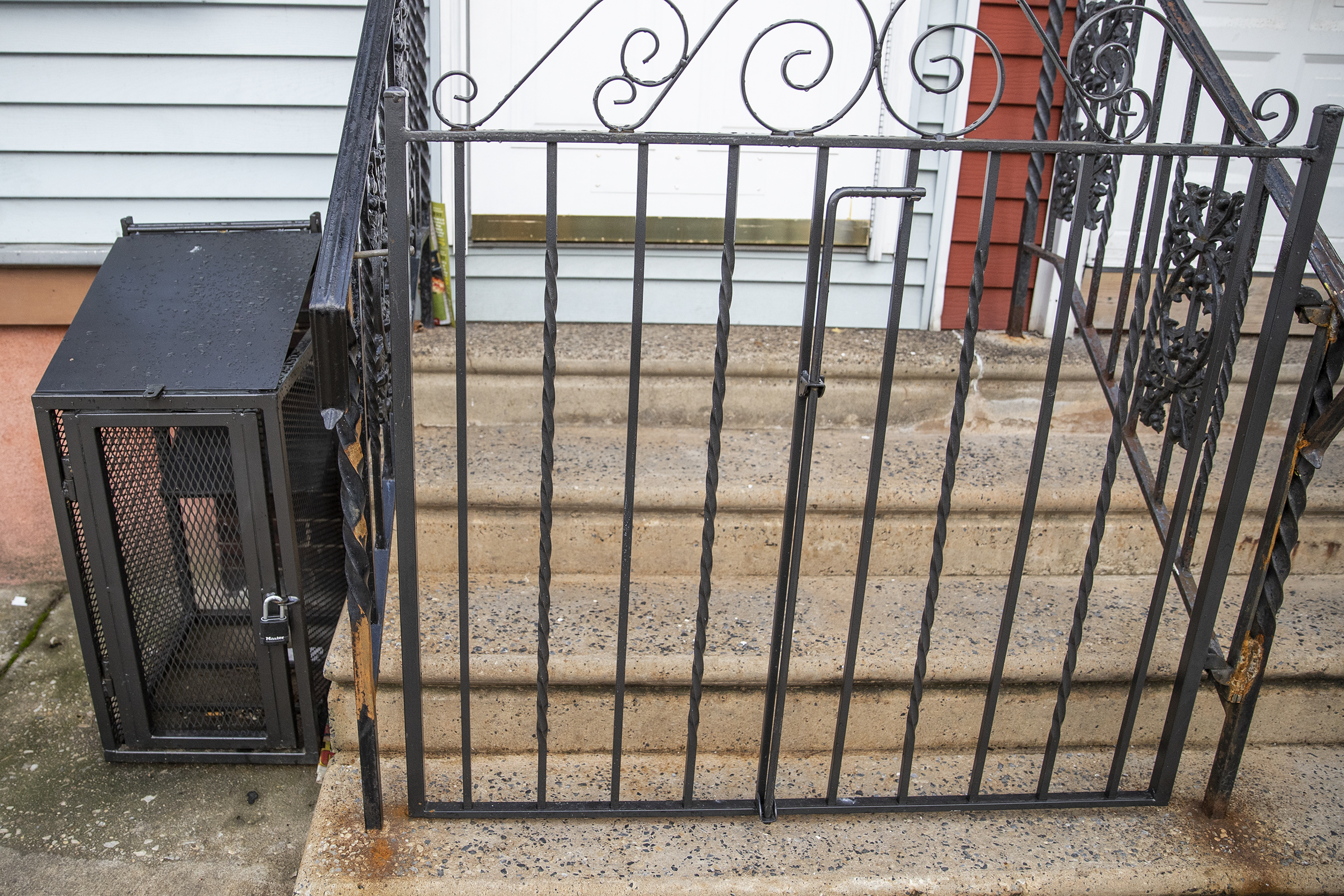
Some people find or erect secure places to have their packages delivered. A metal cage for packages is shown here in this 2019 file photo.
There’s no surefire way to prevent porch piracy.
But police departments and carriers like USPS, FedEx, and UPS provide the following tips to reduce your chances of falling victim — or to get your money back if your package is stolen:
Leave drop-off instructions: Log into your online account with the package carrier and ask that they leave deliveries in a less visible location, such as behind a planter, in a shed, or at a side door. Or ask that they require a signature for drop-off. This requires that delivery people read the instructions, which some Philadelphians have found is not always the case.
Redirect the delivery: You can also go online and redirect deliveries to locations such as your office, the home of a friend who doesn’t experience package theft, or a secure physical mailbox, such as a FedEx, UPS, or Amazon Locker pickup location. If you aren’t going to be home for a day, you can also request a hold on packages until you return, or have a neighbor or friend pick them up.
Use security cameras: Cameras can alert you that someone is outside and allow you to grab a package immediately if you’re at home. If a delivery is stolen, the footage can help police find the porch pirate. (If they’re charged and convicted in New Jersey, they could even go to prison.)
Report theft: After confirming that the package was in fact delivered, file a police report. Then, contact the seller, shipping company, and, if all else fails, your credit card company to see if they cover package theft.
A veteran lawyer in the Philadelphia District Attorney’s Office has been disbarred in the region’s federal courts after a panel of judges concluded he “lied repeatedly” while seeking to overturn the death sentence of a man who killed an East Mount Airy couple in their home and left their infant daughter inside to die.
Paul George, an assistant district attorney who handles appellate cases, was a key player in his office’s attempts to have Robert Wharton’s death penalty reversed so he could serve a life sentence instead.
U.S. District Judge Mitchell Goldberg denied that request, but not before finding that District Attorney Larry Krasner’s office had provided incomplete and misleading information in its efforts to free Wharton from death row.
After Goldberg made his decision, George and a colleague who handled the case faced federal disciplinary proceedings to examine whether their conduct — which was also criticized by an appeals court — was intentionally deceptive.
As part of that process, three federal judges concluded earlier this year that George’s actions were “misleading and dishonest,” saying he had lied to Goldberg about key facts, “flouted the interests of the public and the victims’ families,” and acted as the “quarterback” of efforts by the district attorney’s office to undo or undermine all death penalty cases.
“George’s conduct was the result of a ‘selfish or dishonest motive’ — placing the DAO’s policy priorities above its professional and prosecutorial responsibilities,” wrote U.S. District Judges Paul S. Diamond, Gerald J. Pappert, and John M. Gallagher. They recommended that George be barred from practicing in the region’s federal courts, and Chief Judge Wendy Beetlestone affirmed that in an October order.
George has denied the accusations and last month filed an appeal. His attorneys acknowledged in court documents that he had made mistakes in his handling of Wharton’s case, but said the opinion recommending his disbarment was based on a broader set of “extraordinary allegations” that lacked evidence and targeted the office he worked for.
George has displayed “exceptional legal skills and the highest level of professional ethics and honesty” during his 48-year legal career, his attorneys wrote. He is scheduled to retire at the end of this year.
Krasner said in an interview that he was largely unable to comment because most of the disciplinary matter had unfolded under seal. But he said that George’s career “has been conducted vigorously and ethically,” and that he believed the appeals court would find that the opinion criticizing George was filled with “factually and legally incorrect” statements.
“We will continue to try to be fair each and every day, and, as change makers often do, we will face the consequences of making change from people who could’ve made it, but didn’t, in their day,” Krasner said.
The disciplinary saga is the latest chapter in the unusually protracted fallout from Wharton’s death penalty appeal, and it might not be the last.
George’s colleague Nancy Winkelman — another supervisor in the district attorney’s law division — has also been the subject of a disciplinary inquiry in federal court for her role in the Wharton matter. Records in her case remain under seal.
The documents connected to George’s case were also supposed to remain secret, but they became public this week when aspects of his appeal were publicly filed in court. On Thursday, his attorney, David Rudovsky, filed court documents to have the entire record of the underlying disciplinary proceeding made public.
George became involved in the Wharton matter in 2019, while Wharton was appealing his death sentence in federal court.
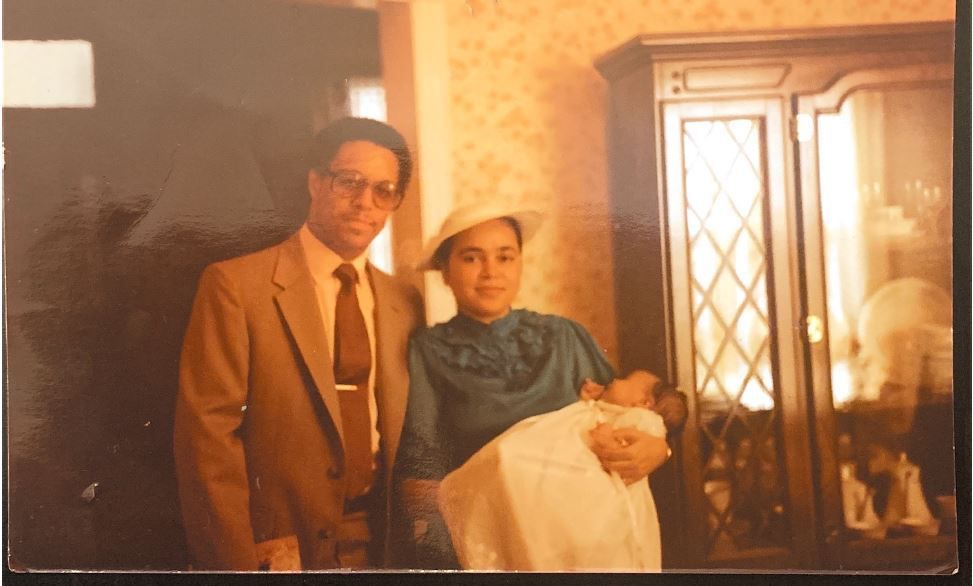
Wharton had been convicted along with a codefendant in the January 1984 strangulation and drowning deaths of Bradley and Ferne Hart. A jury concluded that Wharton killed the couple over a disputed debt, then turned off the heat in their home and left the couple’s 7-month-old baby, Lisa, to freeze to death. She survived.
Bradley and Ferne Hart in a 1983 photo with their baby daughter, Lisa, on her christening day. The husband and wife were murdered in their East Mount Airy home in January 1984 by Robert Wharton and Eric Mason. The baby was unharmed, but left to die in the house. She survived.
In the decades before Krasner took office, the district attorney’s office had consistently opposed Wharton’s attempts to overturn his conviction and sentence.
But Krasner said on the campaign trail that he would “never pursue a death sentence in any case.” And after he was sworn in, his office changed its stance on the Wharton case, saying it had “carefully reviewed the facts and the law” and agreed that Wharton should be spared from death row.
Goldberg did not immediately agree, and wrote in court documents at the time that the district attorney’s office had not sufficiently explained its reasoning for its “complete reversal of course.”
He then asked the Pennsylvania Attorney General’s Office to provide materials he said the district attorney’s office was not sharing. And after investigating, the attorney general’s office said it found evidence including documents detailing Wharton’s past attempts to escape from a courtroom — information that Goldberg said would have been crucial to his decision, but that George and Winkelman later said they were not aware of.
The attorney general’s office also said Krasner’s office had misled Goldberg about its communications with the victims’ relatives. Although the district attorney’s office gave the impression that the Hart family supported its change in stance on the death penalty, the truth was that prosecutors had spoken only to one relative, and never contacted the couple’s only surviving child, Lisa Hart-Newman, who vehemently opposed the idea of lessening Wharton’s sentence.
George later acknowledged that was a mistake, and Goldberg ordered Krasner to write apology letters to the Harts’ relatives.
In the disciplinary opinion filed earlier this year, the three-judge panel criticized George’s conduct throughout the case, saying that he “repeatedly lied” to Goldberg and that his efforts nearly undercut the integrity of a duly imposed jury verdict.
And, in an unusually pointed fashion, they ascribed a motive to his actions — accusing George of flouting legal guardrails to advance the policy interests of Krasner’s office.
“Upon the current District Attorney’s first election … the DAO established a policy, with Paul George at quarterback, to undermine duly imposed death sentences challenged in post-conviction proceedings,” the judges wrote. “George filed the concession in Wharton pursuant to that policy, not as the result of any review, careful or otherwise, of the facts and the law.”
George said in court documents that was not true, and his attorneys denied there has ever been an office policy opposing all capital sentences.
Krasner also said it was “flatly untrue” that his office has ever had a policy against the death penalty, and he denied that the committee he formed to review capital cases — which George once served on — was designed to undo such sentences.
“We follow essentially the same process as our predecessors, who routinely supported the death penalty and who were usually wrong,” Krasner said. “We actually try to be fair all the time. And that committee has concluded on many occasions that the death penalty should be reversed; it has also concluded with the law division in individual cases that the death penalty had to be affirmed. Those are the facts.”
George’s disbarment in federal court has not affected his ability to practice in state court, though George, 75, has already begun to wind down his office duties ahead of his retirement, his attorneys wrote in court documents.
They said that the penalty imposed against him was unwarranted and should be reversed.
“To label Mr. George as a liar, and by disbarment, place him among the worst of the worst lawyers in our community, is highly disproportionate and offends basic tenets of justice,” his lawyers wrote.
The federal judges who recommended his discipline disagreed.
“In the final years of his career,” they wrote, George “used [his] experience to circumvent and subvert, in misleading and dishonest ways, verdicts rendered by judges and juries who heard the evidence and applied the law.”
Children’s Hospital of Philadelphia was the most profitable nonprofit health system in Southeastern Pennsylvania during the three months that ended Sept. 30, according to an Inquirer review of financial filings.
CHOP reported $70 million in operating income in the first quarter of fiscal 2026, up from $67 million the same period a year ago. The nonprofit’s revenue climbed nearly 9% to $1.3 billion.
The biggest loss in percentage terms was at Redeemer Health, the region’s smallest health system and the only remaining operator with a single hospital. Redeemer had an $11.7 million operating loss on $103.4 million in quarterly revenue. That was an improvement over an $18.9 million loss last year.
Jefferson Health had the most patient revenue following its acquisition last year of Lehigh Valley Health Network. The 32-hospital system had $2.9 billion in patient revenue, $100 million more than the $2.8 billion at the University of Pennsylvania Health System, which has seven hospitals.
window.addEventListener(“message”,function(a){if(void 0!==a.data[“datawrapper-height”]){var e=document.querySelectorAll(“iframe”);for(var t in a.data[“datawrapper-height”])for(var r,i=0;r=e[i];i++)if(r.contentWindow===a.source){var d=a.data[“datawrapper-height”][t]+”px”;r.style.height=d}}});
Here’s a recap of selected systems’ results for September quarter:
Jefferson Health
Jefferson Health reported a $104 million operating loss, as its insurance business continued to drag down results. The loss included $19.4 million in restructuring charges for employee severance related to earlier job cuts and moves designed to make the system more efficient.
University of Pennsylvania Health System
University of Pennsylvania Health System had an operating gain of $109.3 million, up from $49.3 million in the same period a year ago. This year’s results include Doylestown Health, which Penn acquired April 1. Total revenue was $3.3 billion, up from $2.8 billion a year ago.
Temple University Health System
Temple University Health System’s loss in the quarter was $15 million, an improvement over a $17 million loss last year. Total revenue was $800 million, up 13% from $712.5 million a year ago. Outpatient revenue increased by nearly $62 million, much of it from the health system’s specialty and retail pharmacy business.
Conventional wisdom:Motor Trend likes that the Ioniq 5 XRT offers “proper fun in mild dirt,” that it’s “great as an everyday do-it-all crossover,” with “built-in NACS convenience.” But they lament the “off-road gear brings on-road compromises, using Tesla Superchargers not yet optimal,” and the “price close to high-end Ioniq 5 Limited trim.”
Marketer’s pitch: “Our fast-charging electric SUV that goes the distance.”
Reality: The off-road accoutrements are so limited, you might as well get one with more range.
Catching up: Last week, we tested a Chevrolet Equinox EV, which seemed like a real bargain until we started digging deeper.
This week we blow another $20,000 and see what we have to show for it.
What’s new: The Ioniq 5 received a refreshed appearance for 2025. It adds the NACS charging port, allowing easy access to Tesla superchargers, and boosts the size of the batteries across all models.
The new XRT model is marketed as a more rugged version, slightly lifted and with all manner of cladding and black.
Up to speed: The Ioniq 5 gets to 60 mph as fast as any EV. It reaches the magic number in just 4.5 seconds, according to Motor Trend. Unlike last week’s stripped-down Equinox, the Ioniq 5 offers power aplenty throughout the range of driving, as well as through the range of models.
Shiftless: I’ve been singing the praises of the Hyundai twisty-stalk gear selector, and that will continue.
On the road: The Ioniq 5 handled nicely on highways and wasn’t too bouncy for its squared-off shape. Country roads were quite fun, especially in Sport mode.
The Ioniq 5 did have more than its share of rattles, though, from either the hatchback door or the rear cargo area; the squarish shape of the vehicle is probably a factor here.
In the rain: EV makers put low-resistance tires on to help with range. I can’t specifically recall having any other EV in the rain, but the Ioniq 5 with its 235/60/R18 all-terrain tires designed for off-ish roading seemed like it would slide on wet roads. Test drive in the rain, if you can.
Steady speed: The Smart Cruise Control with curve control feature in the Ioniq 5 felt dumber than advertised. I’ve noticed many test vehicles from all brands slowing on curves while the cruise is set, and it’s a welcome feature, but more than a few times I found myself shouting at the dashboard as the Ioniq 5 suddenly started to slow dramatically from my set speed. The cruise was still engaged, too, so it required me taking complete control and starting from scratch.
This can all be controlled through the various settings, but I never found one that I thought worked as well as other manufacturers’ offerings.
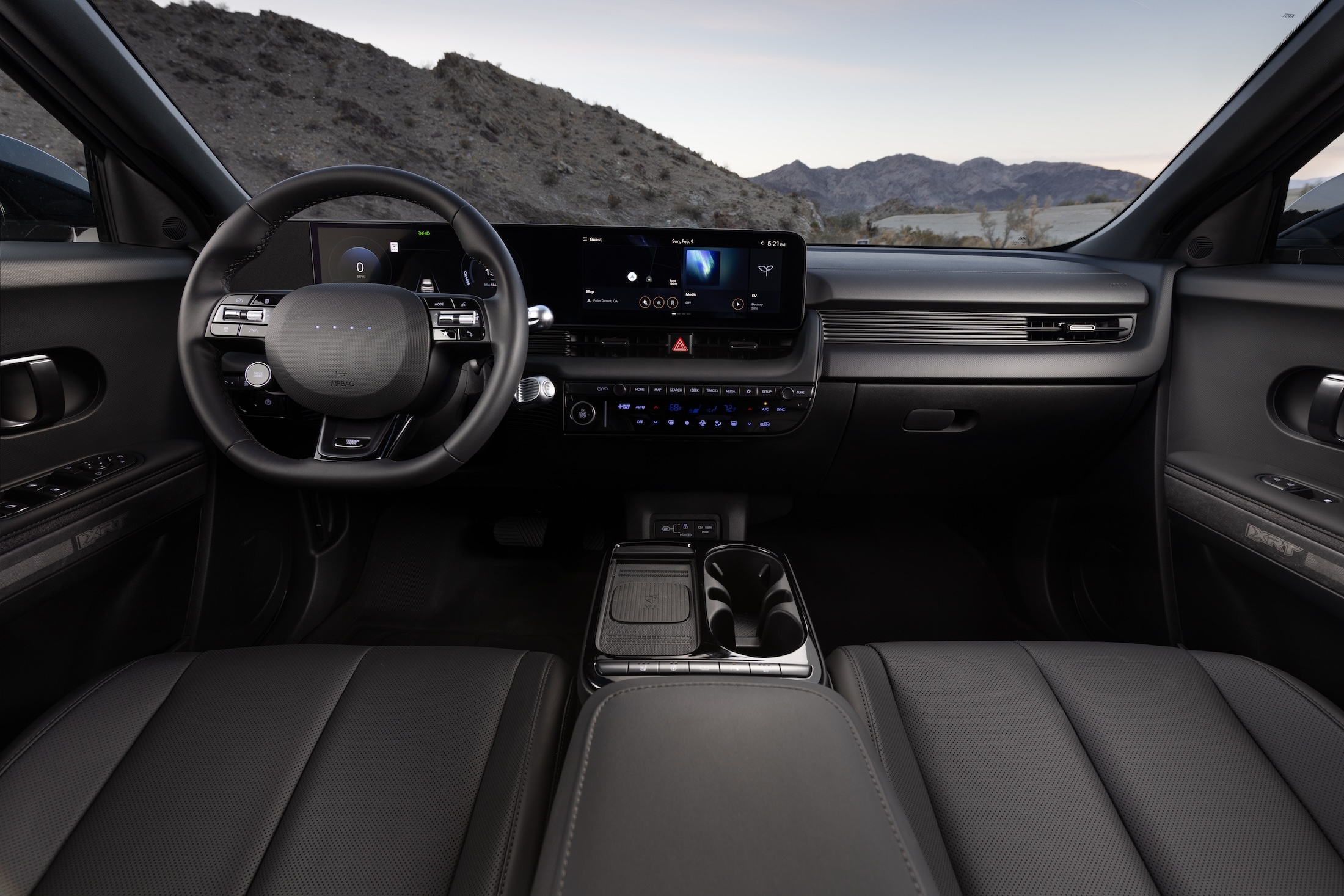
The interior of the 2026 Hyundai Ioniq XRT offers plenty of comfort and easy operation.
Driver’s Seat: The leather-covered seat was geared for comfort but still supportive. It held me in place while not getting fresh. The lumbar bolster was just fine and the seat bottom stretched to my knees, something often lacking at this vehicle size.
The seat heater operation and some other functions are in a row of silver buttons (yay!) on the console that will help you in yoga class, requiring a sharp contortion just to reach them (boo!).
Friends and stuff: Sturgis Kid 4.0 blessed the rear seat as comfortable and roomy on a trip to the Sweetest Place on Earth. The flat floor means middle seat occupants won’t feel too bad.
Cargo space is 26.3 cubic feet behind the rear seats and 58.5 when it’s folded.
Play some tunes: Sound from the system is pretty good, about an A-, maybe a B+.
The 12.3-inch touchscreen makes playing tunes and getting to other functions easy enough, and buttons and dials underneath offer a real assist. The home screen has large icons that make navigation swift.
Keeping warm and cool: I was at first pleased at the HVAC’s use of real buttons underneath the infotainment display. But things were not exactly as they appeared; those were just faux buttons of the highly sensitive touch pad variety. Every time my hand got close, I seemed to adjust three things I didn’t intend to. So the driver’s attention is still stolen away from the driving portion of our adventure and is instead trying to fix things that have been changed by accident.
Range: The Ioniq 5’s advertised range of 258 miles was about spot on, as determined by our trip to the AACA (Antique Automobile Club of America) museum in Hershey. We used up about 200 miles of range in 180 miles or so of travel — about half of them keeping up with turnpike traffic; those high speeds suck down the juice. (I could slow down, and yet, I don’t.)
A less expensive SE model would get you beyond 310 miles on a charge. Recharging from 10% to 80% takes as little as 20 minutes.
Where it’s built: Ellabell, Ga. This was the site of an ICE raid in September. It remains to be seen how long the Ioniq 5 will actually come from there, also considering recent trends in EV sales. Stay tuned.
The U.S. and Canada supply 29% of the parts; South Korea another 29%; and Hungary, 33%.
How it’s built:Consumer Reports predicts the reliability to be a 2 out of 5.
In the end: The Ioniq 5 has always been tied with the Kia EV6 on my list of EV champs; the Kia looks a little less stupid, so I’d probably go that direction. But the Equinox is a strong challenger and is worth a look.
A lower price and more range makes any of them more attractive.