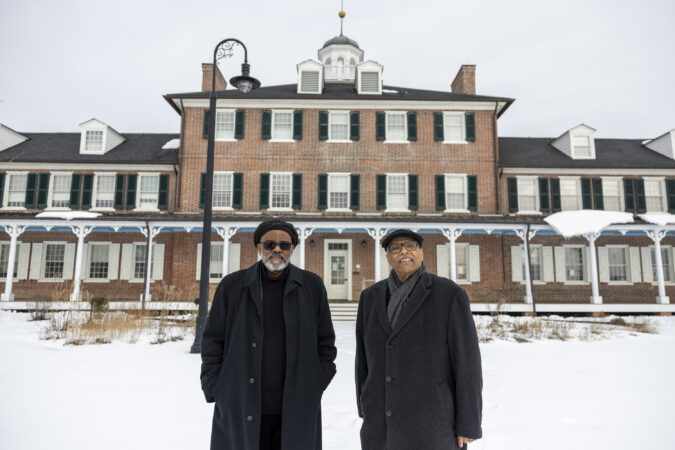
Twin brothers Larry and Kelly Ganges grew up outside of Trenton with people constantly mispronouncing their last name. “Grange, Grain, Ganger,” they’ve heard it all.
So they developed a standard reply: “It’s Ganges like the river [in India].”
Decades on, they’d find out the deep Philadelphia story behind it.
When the brothers, now 72, got older and traveled, they’d grab the phone book in whatever town they were in to see if anybody with their last name was listed. Then they’d call and ask if they knew anybody in their family; they often did.
“So we all thought, no matter where we were,” said Larry, “we were connected with somebody,”
But they were also connected with something — a ship, a travesty, and a providence.
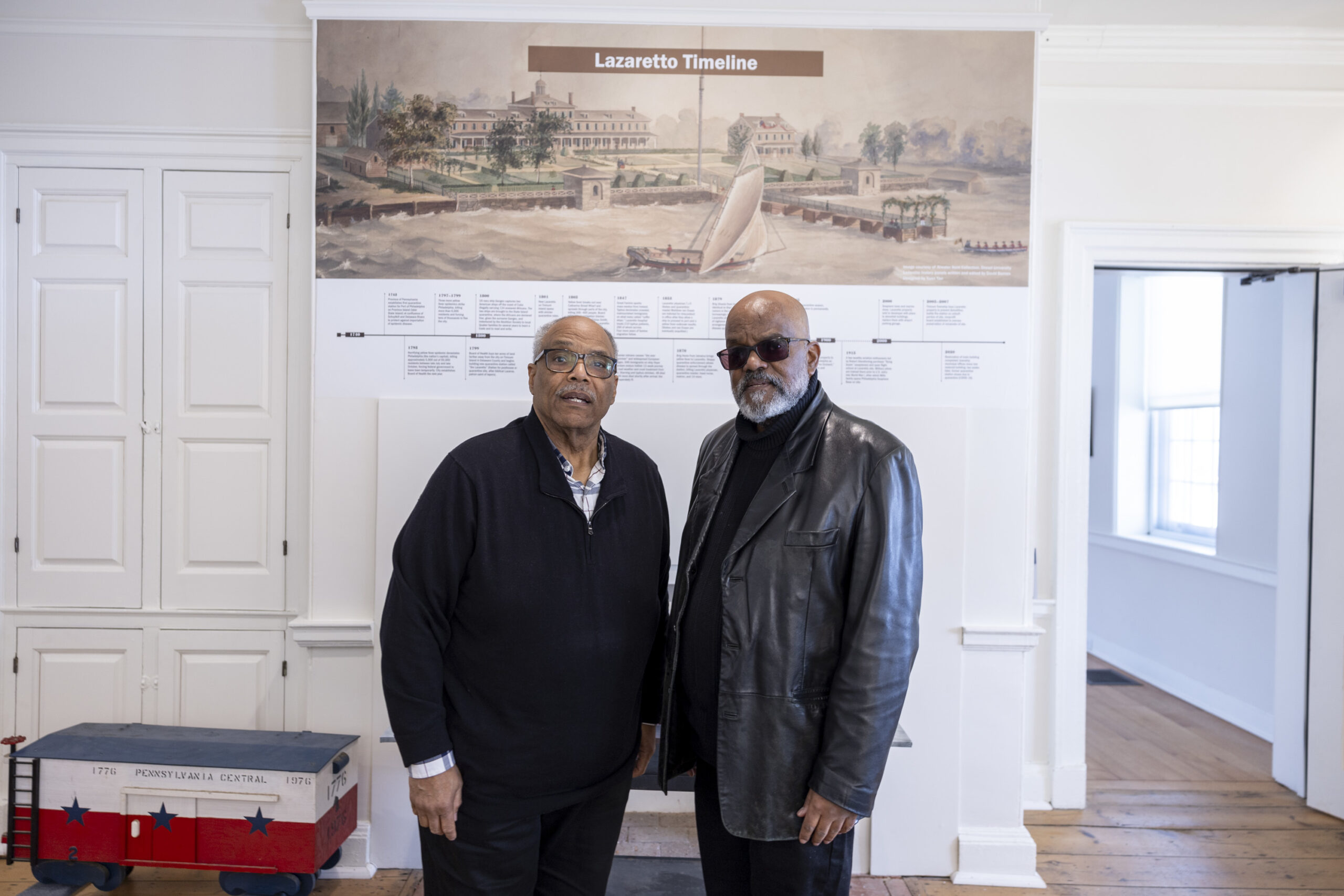
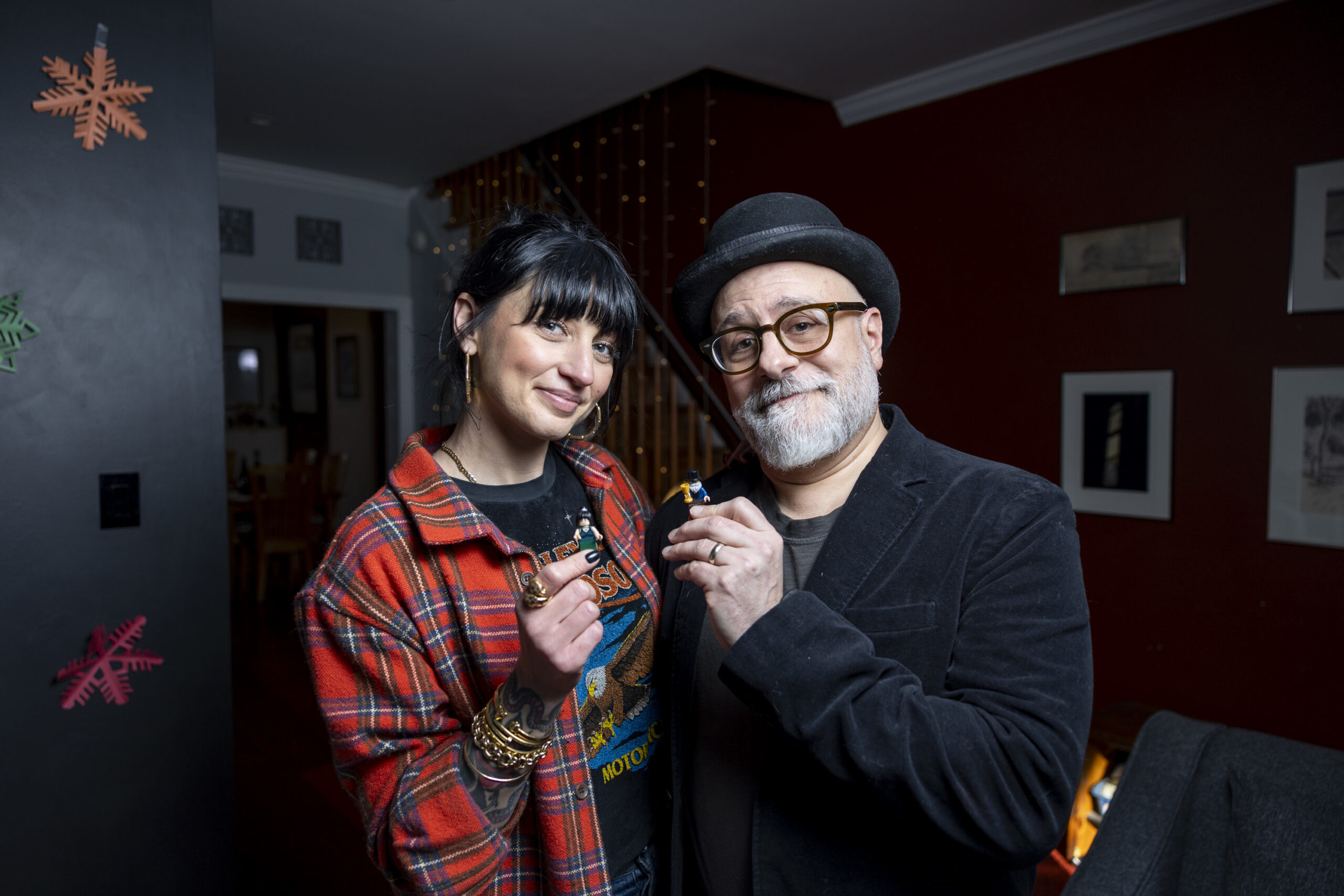
(From left to right) Twin brothers Larry Ganges, and Kelly Ganges, pose for a portrait at the Lazaretto in Tinicum, Pa., on Friday, Feb. 6, 2026. “It allows us to view and experience Black history,” Kelly said. “Pride in knowing our family was in this journey.”
The brothers’ first clue of their extended heritage arrived in 1975, when Kelly, was a student at Trenton State College. His journalism teacher, familiar with Bucks County cemeteries, asked if Kelly knew about the gravestones of two soldiers buried there.
Torbert and William Ganges had fought in the Civil War’s colored regiment, but Kelly couldn’t be sure if they were his relatives.
Nearly 30 years later, the brothers still don’t know if they are related to the soldiers, but they have discovered that their heritage is, as Kelly describes, “bigger than us, [it] extends beyond the continental United States and involves potentially the world.”
That information came in a phone call.
In the early aughts, Larry was working as the New Jersey Department of Health’s assistant commissioner for the HIV/AIDS division. His secretary told him that David Barnes, a University of Pennsylvania professor of history and the sociology of science, was on the line to talk about a different epidemic.
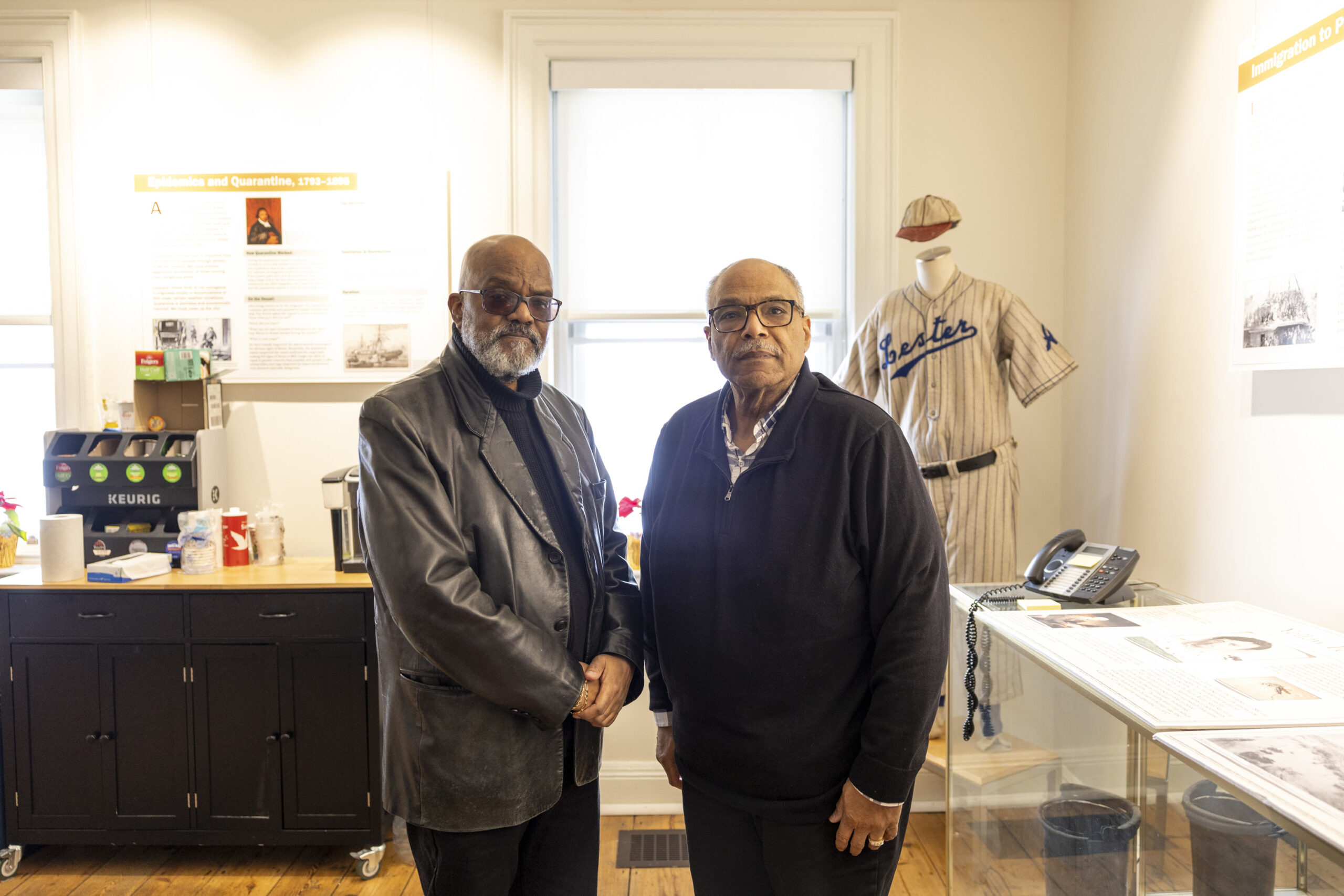
72-year-old twin brothers Kelly Ganges (left) and Larry Ganges, pose at the Lazaretto in Tinicum, Pa., on Friday, Feb. 6, 2026.
Barnes, who was seeking anyone with the Ganges name, had found Larry by chance in a New Jersey state employees directory. He wanted to discuss the 135 Africans who arrived in Philadelphia in 1800 and were detained at the old Lazaretto along the Delaware River.
At the time, every vessel arriving in Philadelphia was required to stop and be inspected at the Lazaretto — a hospital and quarantine station — where patients with yellow fever were treated.
Later, a brick facility replaced the old Lazaretto. Downriver from the original, the “new” Lazaretto, operational from 1801-1895, stands near present day Tinicum. It is the oldest surviving quarantine station in the Western Hemisphere and one of the 10 oldest in the world.
By the call’s end, Larry had learned not just the origin of his name but how his ancestors arrived in America.
“Wow, we had never heard about it. We just didn’t know,” he said.
The story goes: In 1800, the United States naval ship Ganges intercepted two schooners (the Phoebe and the Prudence) off the coast of Florida, near Cuba. Despite a new federal law banning the carrying of human beings for enslavement, the schooners, which experts believe disembarked from near Sierra Leone, contained 135 people from Africa, imprisoned as slaves, bound for the New World.
Ganges’ naval officers boarded the schooners — the Phoebe on July 19, 1800, and the Prudence on July 21, 1800 — took the enslaved into custody, and delivered them to the Ganges’ home port: Philadelphia.
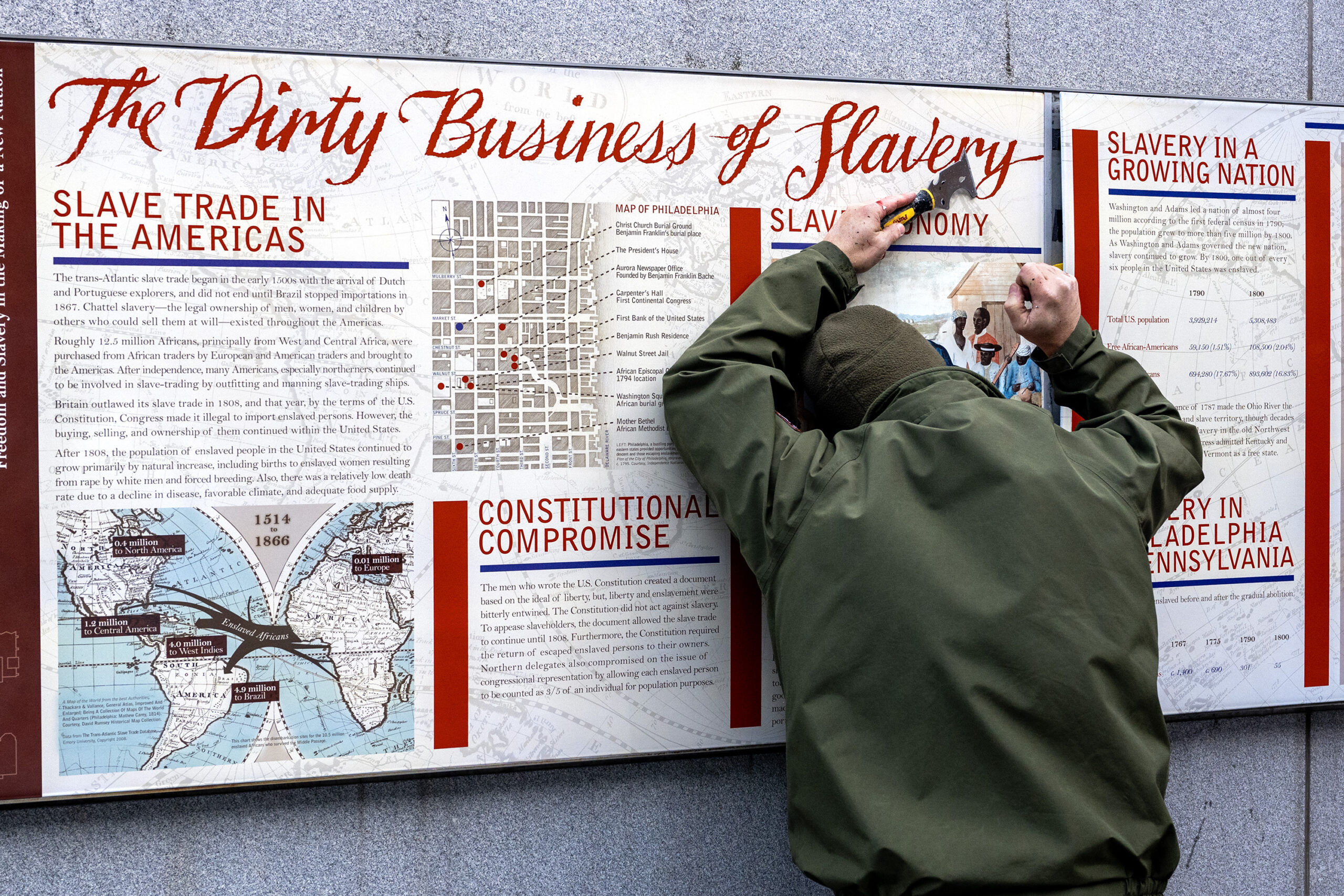
A NPS worker removes an interpretive panels – “The Dirty Business of Slavery” – at the President’s House site in Independence National Historical Park Thursday, Jan. 22, 2026.
When the schooners’ owners sued to reclaim their “property,” a Philadelphia judge ruled that the 135 aboard were people (not property) and ordered them freed. The Africans were remanded to the old Lazaretto for quarantine where they remained for up to three months.
Subsequently Sambo, Milnor, Yelle, and Culico Ganges and the rest of the 123 survivors were indentured to Pennsylvania Abolition Society members and others.
After Barnes’ phone call, the twins and their (late) older brother, Tendaji Ganges, visited the Lazaretto. At that time, the dilapidated building was locked. But Kelly returned with Barnes and gained access inside.
“I saw all of the little rooms … it was interesting to touch a piece of history, and know that that’s the genesis of how our family came to the United States,” he said.
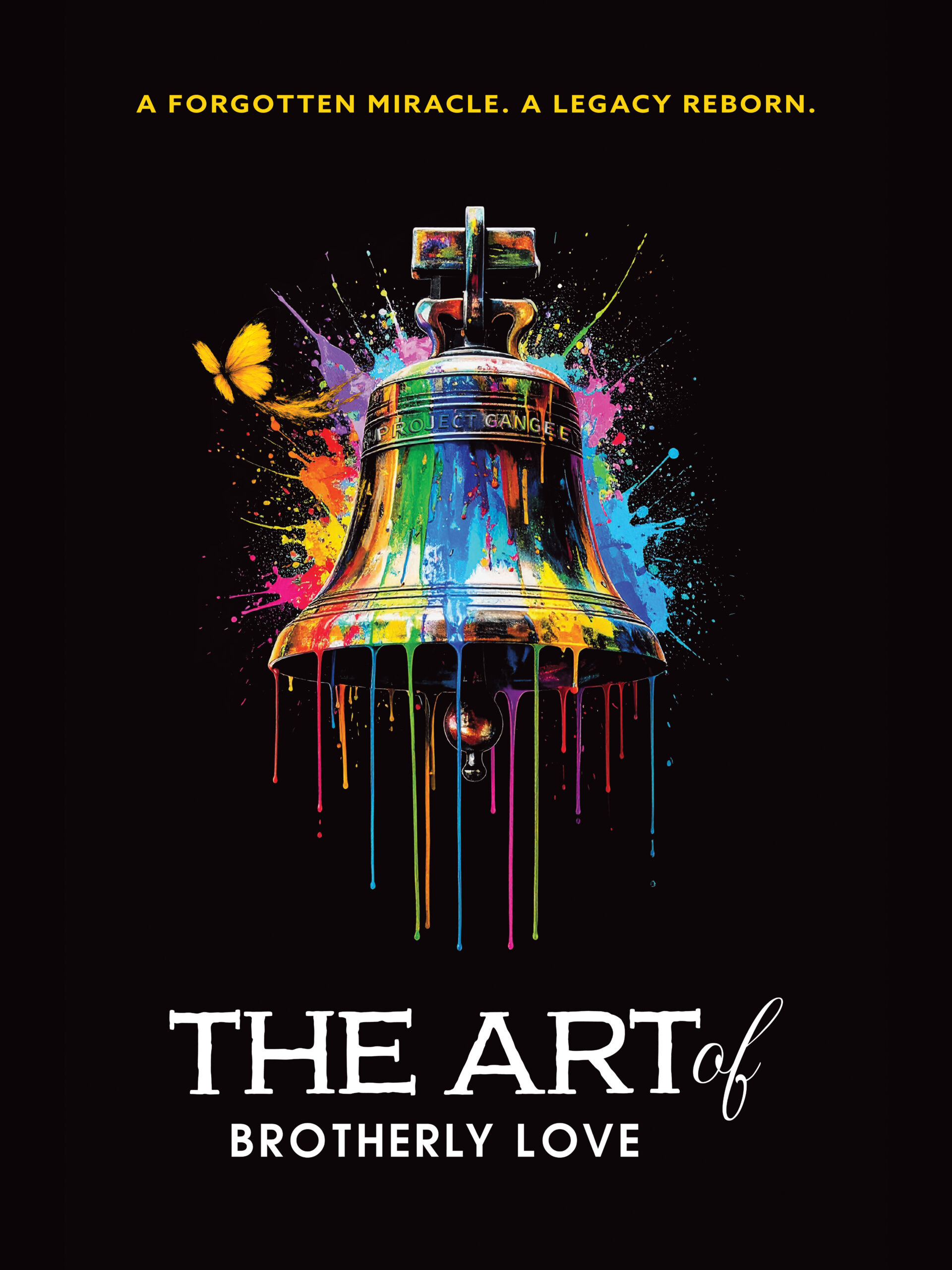
“These modern-day heirs carry the legacy of resistance and survival into today’s conversations around justice, identity, and belonging,” said filmmaker Rah Crawford, whose documentary The Art of Brotherly Love focuses on the Ganges’ story.
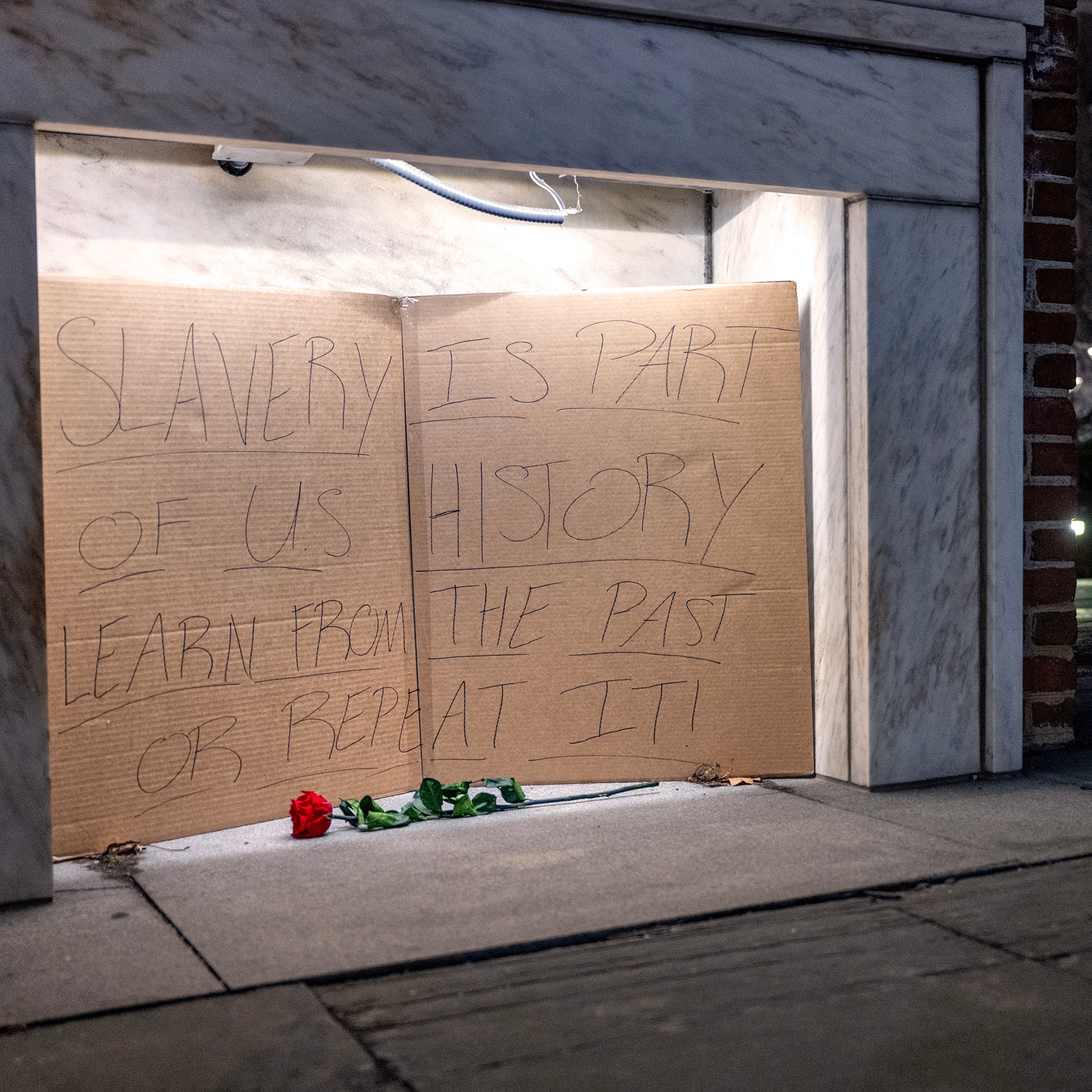
A single rose and a handwritten cardboard sign (“Slavery is part of U.S. history learn from the past or repeat it”) are inside an empty hearth at the President’s House site in Independence National Historical Park late Thursday, Jan. 22, 2026 after workers removed display panels about slavery.
When the film premiered in Brooklyn last year, Larry said that as he sat in the audience watching, he was shaking, almost in tears. His wife asked, “Are you OK? Are you cold?”
He was overcome with emotions: “I was sad, I was happy, I was mad.”
Although, as the brothers say, “we’ve got the generic connection to the name,” they don’t have a connection to identify individual family members that came through the old Lazaretto; they can’t yet determine how their bloodline was carried to them.
But thanks to the efforts of family historian Michael Kearney, who is tracking descendants of the Ganges’ survivors, Larry is confident that “my children and my children’s children [are going] to know what the story is, and to know how to access it, and know who the players are …. And hopefully this movie is not the last of what’s going to occur.”
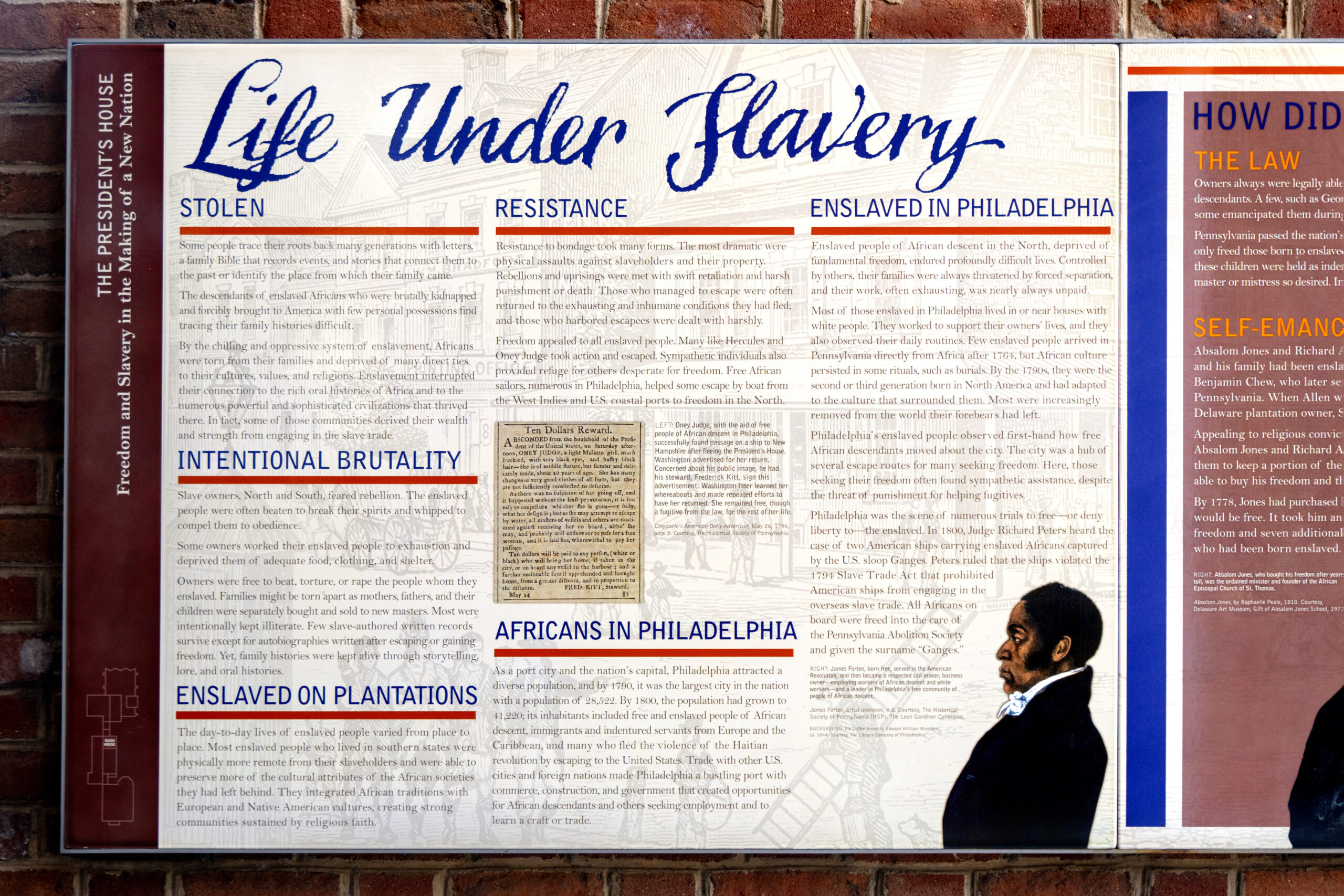
The “Life Under Slavery” sign at the President’s House in the Independence National Historical Park. The sign has since been removed. Photo from Sunday, Aug. 3, 2025.
“People made it through the troubled journey, the Middle Passage, and landed on American soil and contributed to make America a great nation,” said Kelly, “And nobody can ever deny that, and people can try and whitewash it and try to erase it, but it’s not going to work, because it’s real. Our contribution is documented.”
Prior to the opening of the President’s House in 2010, filmmaker Crawford was commissioned to create storyboards for a video installation at the site. Through his research, he first learned of the Ganges’ story, launching a 15-plus-year journey to produce the documentary.
Filmmaker Rah Crawford’s documentary “The Art of Brotherly Love” documents the story of the long-forgotten rescue of 135 enslaved Africans by the “Ganges” in the 1800s,
The Art of Brotherly Love, presented in partnership with Creative Philadelphia, is both a documentary and a trailer for a forthcoming animated feature. The Philadelphia premiere is slated for Feb. 14 at Ritz Five.
After the documentary screens, Kelly Ganges hopes that, “it just continues to cascade out — to inspire more genealogists and historians, and to reach more descendants and the next generation.”
“The Art of Brotherly Love,” Feb. 14, 11:30 a.m., Landmark’s Ritz Five, 214 Walnut St., eventbrite.com
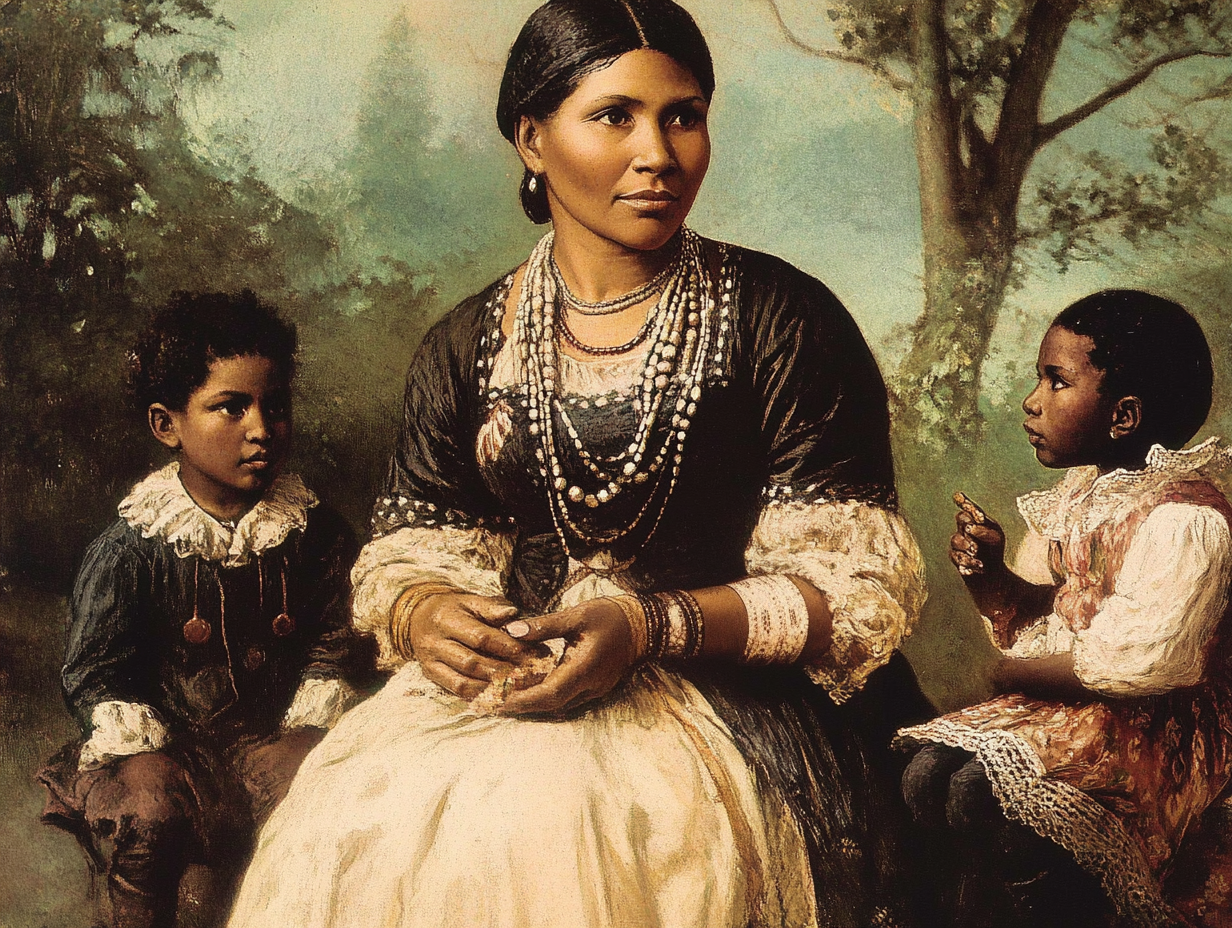
In 1773 Dinah Nevil, an Indigenous, Black, and European multiracial woman and her four children arrived in Philadelphia from Flemington, N.J, under orders from a slave trader who intended to eventually sell Nevil to the Deep South, or perhaps the Caribbean.
Nevil protested.
Philadelphia authorities sympathetic to her plight, kept her in a work house for two years while figuring out the next steps to her freedom. The conditions were so horrid two of her children died.
An image of Dinah Nevil imagined by the 1838 Black Metropolis.
Enter Israel Pemberton Jr. and Thomas Harrison, Quakers who, like most Quakers in colonial Philadelphia, actively fought slavery. Keeping people in bondage was considered immoral in their religion.
Pemberton and Harrison filed a lawsuit against Nevil’s enslaver because they sought to set a precedent by making it unlawful to sell Black people into slavery on free soil, not just in Pennsylvania, but in all of the colonies.
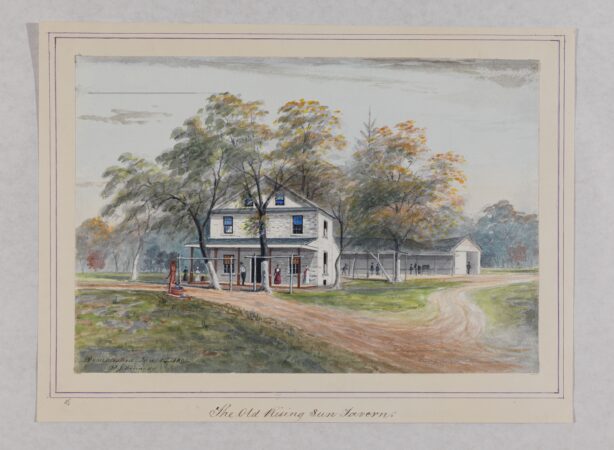
So, on April 14, 1775, Quaker leaders and educators Anthony Benezet and John Woolman gathered 24 men — 17 of whom were Quakers — at the Rising Sun Tavern to discuss legal strategies on how to make that happen.
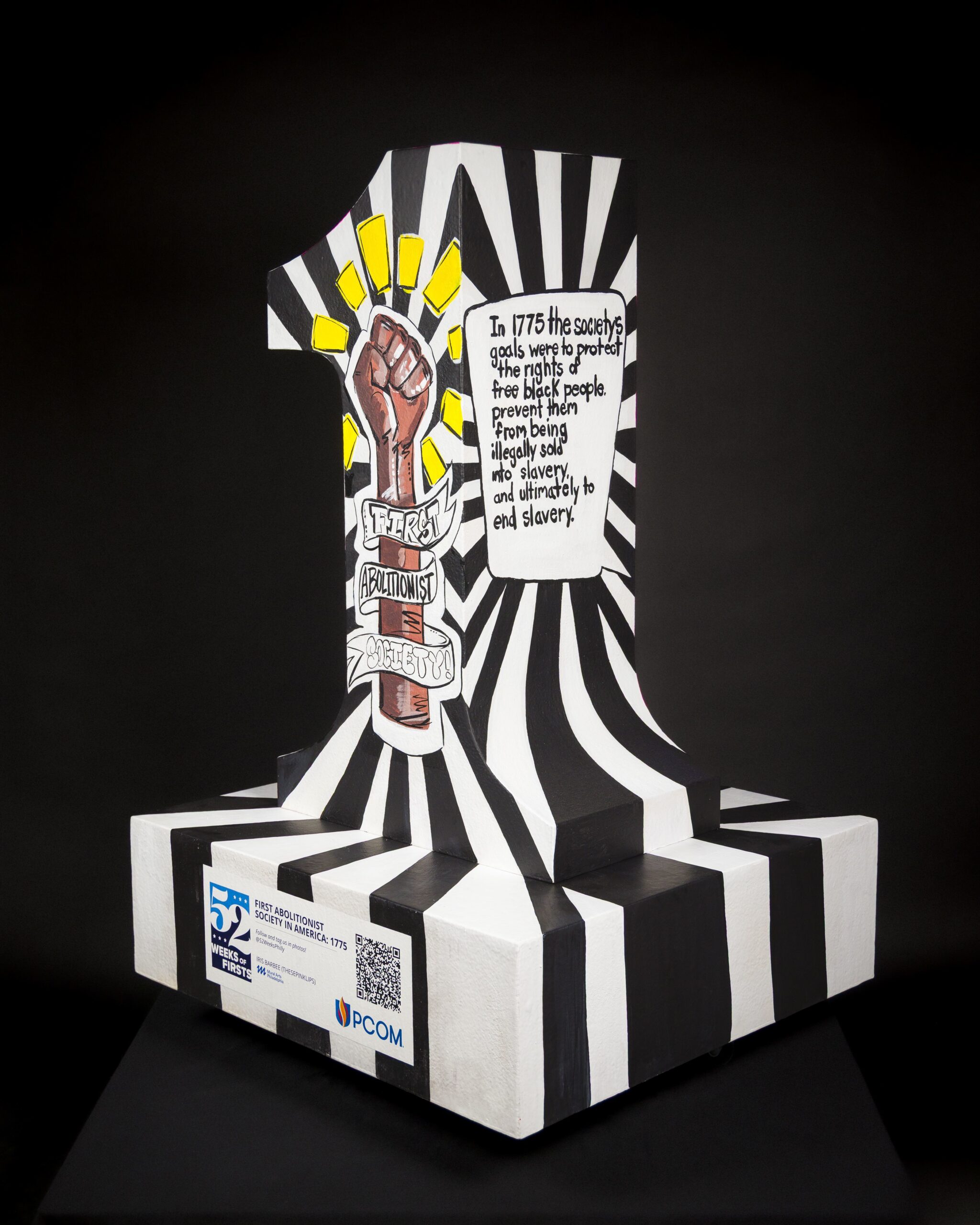
Artist Iris Barbee Bonner’s No. 1 statue pays homage to William Still, an Underground Railroad conductor and key member of the Pennsylvania Abolitionist Society.
That was the first gathering of an antislavery society in America and it will be celebrated Saturday at the African American Museum, part of the Philadelphia Historic District’s weekly firstival day party. Firstivals are a yearlong celebration of America’s 250th birthday marking events that happened in Philadelphia before anywhere else in America and often the world.
The group led by Benezet and Woolman named themselves the Society for Relief of Free Negroes Unlawfully Held in Bondage. In addition to Nevil’s case, they advocated for four other people of color who were in the midst of being sold away from their families. Nevil was ultimately freed when Harrison bought her and within days, signed manumission papers.
In 1776, 18 years after Quakers told their members they could no longer participate in the slave trade, Quakers were forbidden from enslaving people. Thanks to the Quakers’ advocacy, Pennsylvania enacted the 1780 Gradual Abolition of Slavery Act, America’s first law to end slavery.
Four years later, 18 Philadelphians resurrected the Society for Relief of Free Negroes and renamed it Pennsylvania Abolitionist Society, or PAS. Their goal was to stop Black and brown people from being indiscriminately picked up and sold into slavery in what was now a free state, but also to end slavery all together.
“They knew they couldn’t do it overnight,” said Emma Lapsansky-Werner, an American history professor at Haverford College. “What they did was organize so that one-by-one Black people would find freedom.”
Within two years, the PAS grew to 82 members and inspired other cities like New York and Boston to establish branches of their own. In 1787 — the same year the delegates voted that Black people were three-fifths of a person — Ben Franklin became the society’s president and under his leadership, the society petitioned the legislature to amend the act of 1780. This included preventing enslavers from taking pregnant enslaved women to the South so their children would remain property.
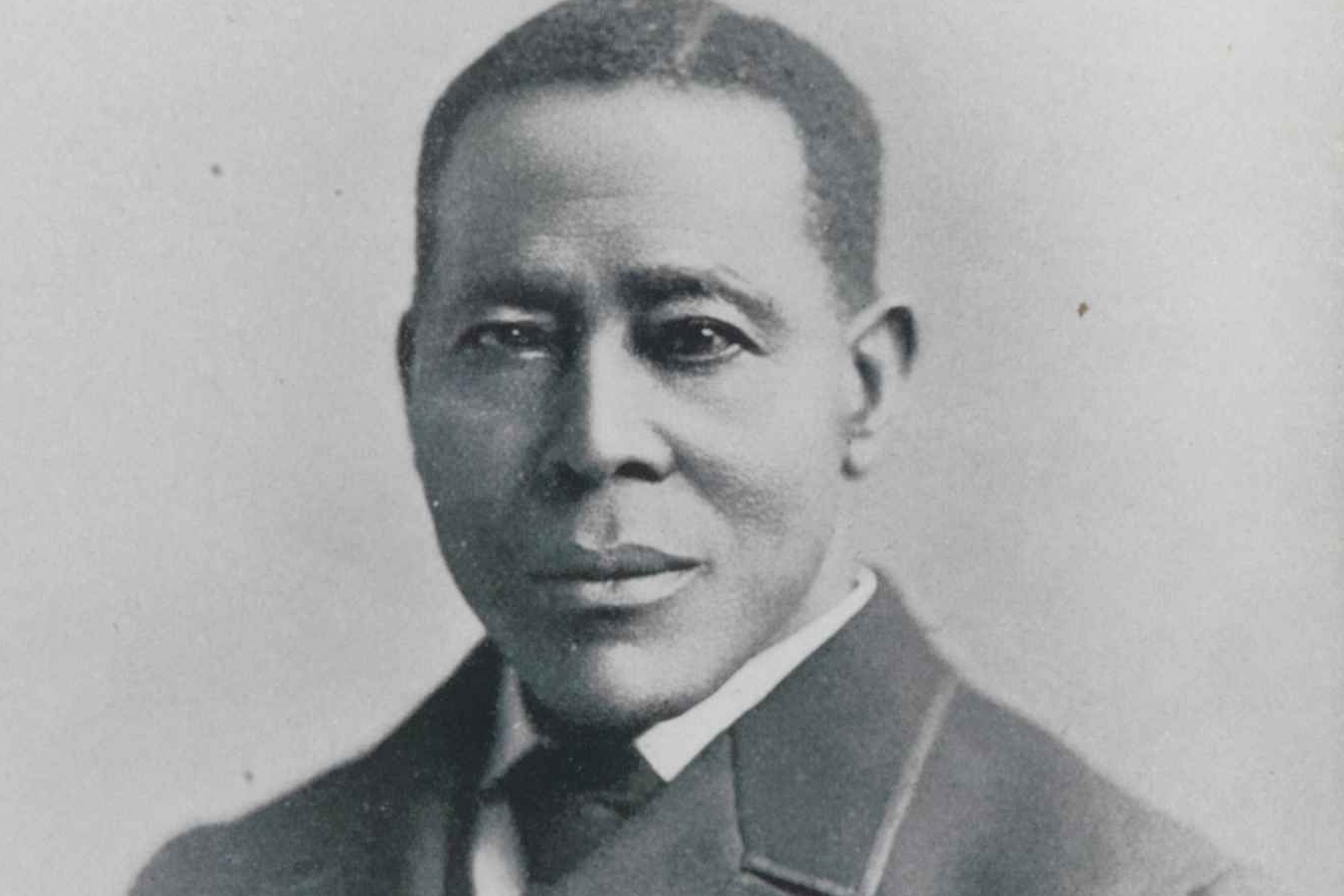
William Still was a member of the Pennsylvania Abolitionist Society and chair of the Vigilance Committee of the Pennsylvania Anti-Slavery Society.
The PAS still exists today and advocates for equal rights and opportunities for all Americans.
This week’s Firstival is Saturday, Feb. 14, 11 a.m.-1 p.m., The African American Museum Philadelphia, 701 Arch St. The Inquirer will highlight a “first” from Philadelphia Historic District’s 52 Weeks of Firsts program every week. A “52 Weeks of Firsts” podcast, produced by All That’s Good Productions, drops every Tuesday.
In January, Philadelphia announced it would join a national initiative to accept plastic cups made of polypropylene and paper to-go cups in the curbside collection program. These to-go cups now join dozens of other household items that make up an estimated 1.5 million pounds of recyclables collected per year, according to the Department of Sanitation.
Once a week, you and many other Philadelphians fill blue bins with paper, plastic, glass, and other recyclables, hoping to rescue them from landfills, but do you really know what should go in the bin and what shouldn’t? Philadelphia uses a single-stream system, meaning you don’t have to separate different types of recycling, but the rules can still be tricky. We are here to help walk you through what should go in your recycling bin and what should be thrown in the trash.
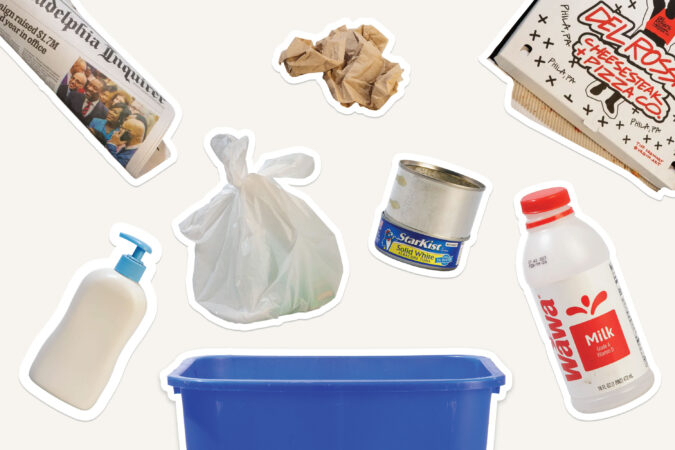
Let’s check your knowledge on some typical household items and see if you can place the item in the right bin.
story continues after advertisement
Paper
Let’s start with a newspaper. You’ve finished reading your Philadelphia Inquirer. Where do you put it?
Drag the paper to the bin or select a button
That’s right!
Not quite.
Newspapers and magazines can be recycled. Paper in most forms should go in your recycling bin. This includes things like junk mail, envelopes, scrap paper, and paper bags.
There are some exceptions to this. You might be surprised to learn that shredded paper should go in the trash.
Recycling
Newspapers
Magazines
Brochures
Catalogs
Junk mail
Envelopes
Writing paper
Scrap paper
Paper bags
Trash
Food-soiled paper
Tissues
Paper towels
Napkins
Plastics
Plastics can be a bit trickier because only certain kinds of plastics can be recycled. You’ve probably seen the stamped number codes before (they range from 1 to 7) and they represent the type of plastic used in the item. In this case, where would you put a lotion bottle with a No. 2 recycling symbol on the bottom?
That’s right!
Not quite.
Plastics with the codes 1, 2 and 5 can be recycled in Philadelphia. These codes can be found stamped somewhere on the container. If there is no stamp, assume it cannot be recycled. Non-transparent plastic bottles like the one above are generally labeled with No. 2. You can also leave the lid or pump on. If you live outside of Philadelphia, check your local municipality, not every recycling program accepts the same codes. More information about the types of plastics can be found here.
Recycling
No. 1: Easy to recycle plastic found in food and drink containers like water and soda bottles
No. 2: Non-transparent plastic found in things like shampoo bottles and laundry detergent containers
No. 5: a type of plastic found in some food containers
Trash
No. 3: More difficult plastic to recycle and can also include shampoo and laundry detergent bottles
No. 4: Used to make plastic bags
No. 6: also known as Styrofoam
Cardboard
You’ve just finished a delicious pizza from Del Rossi's. Where do you put the box?
That’s right!
Not quite.
While cardboard is a recyclable material, it must be dry and free of food waste. So, a food-soiled pizza box should go in the trash. Also, it might be enticing to use a cardboard box as your recycling bin, but the city does not recommend this since wet paper and cardboard is not recyclable and can fall apart, leaving trash on the street. Instead they encourage using a hard sided container with a free lid that can be found at one of six Sanitation Convenience Centers.
Recycling
Shipping boxes
Clean pizza boxes
Paper towel and toilet paper rolls
Egg cartons
Trash
Shredded cardboard
Greasy or food-soiled cardboard
Recycling bags
You’re cleaning up and throw some empty bottles and cans in a bag. Where does it go?
That’s right!
Not quite.
No plastic bag is acceptable in single-stream curbside bin recycling in Philadelphia, even those marketed as recycling bags. According to the city’s recycling guide, plastic bags can “tear and wrap around the moving parts in recycling processing machines, leading to higher maintenance costs, equipment damage, and even worker-safety issues.” Another common mistake, according to the city, is leaving packing plastic and peanuts inside of shipping boxes. Make sure those are thrown in the trash instead. And for dog walkers, be sure to put waste bags in the trash!
Metals
You’ve got some cleaned-out aluminum cans, where do they go?
That’s right!
Not quite.
Aluminum cans can be recycled! These should be emptied, rinsed, and dry. You can keep lids and caps on. While some leftover liquid is OK “do not discard a bottle with enough liquid to swallow,” says Kyle Lewis, recycling director. That’s so that leftover liquid doesn’t contaminate any paper and cardboard around it after it’s compacted in the truck.
Recycling
Aluminum and tin cans
Empty paint cans
Empty aerosol cans
Trash
Pots and pans
Food-soiled cans
Miscellaneous
That’s right!
Not quite.
Batteries cannot be recycled and should be placed in the trash. In addition, the city says that batteries should be wrapped in tape around both ends for disposal. There are other disposal options for things like electronics, hazardous waste, bulk items, and lithium or rechargeable batteries. Find more information on disposal options here.
Your Results
You have skipped .
You scored XX out of 6.
When in doubt, throw it out!
You’re almost a recycling pro.
You are a recycling pro! Thanks for playing.
What else you should know
In addition to the above, glass and cartons are also recyclable. Like cans, glass and cartons should be emptied, rinsed, and dry.
story continues after advertisement
Some additional things to avoid putting in your recycling are Styrofoam, packing peanuts, clothing hangers, wood, and ceramics. You can find a complete list from the city here.
If you don’t have a recycling bin, the city will provide one for you. You can also use any household container as long as it is no larger than 32 gallons and no more than 40 pounds. There are also no limits to the amount of recycling you can put curbside, as long as it is contained correctly.
“We encourage Philadelphians to recycle for our communal benefit. Reduce, reuse, recycle, repeat!,” said Lewis.
Staff Contributors
Design, development, and reporting: Garland Fordice
Editing and additional development: Sam Morris
Photography: Monica Herndon
Copy Editing: Brian Leighton
Subscribe to The Philadelphia Inquirer
Our reporting is directly supported by reader subscriptions. If you want more journalism like this story, please subscribe today
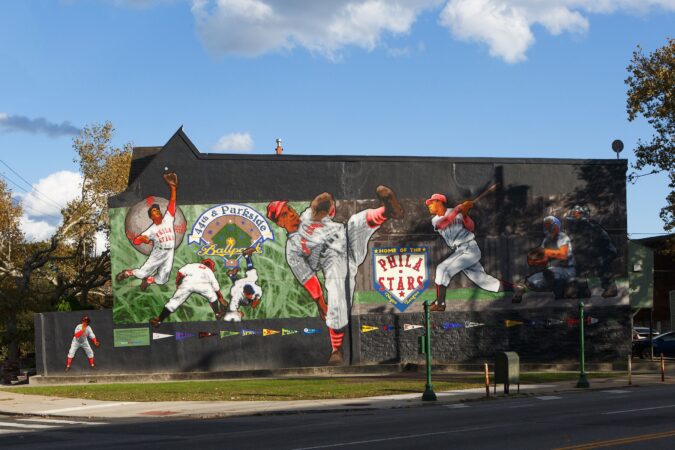
When a West Parkside mural honoring the Philadelphia Stars and Negro Leagues baseball was taken down last month, social media commenters were outraged as the news spread, fearing that Philadelphia had lost one of its iconic odes to Black history.
But the mural at 4304 Parkside Ave. won’t be gone for very long. In a collaboration among Mural Arts Philadelphia, Parkside community members, and the owners of its former building, a new version of the Stars mural will be re-created just across the street.
“It was put up over 20 years ago. We’ve been working really hard to spruce it up for the next 20 years,” said Marjorie Ogilvie, the president emeritus of the West Parkside Business Association, who helped erect the first mural in 2006.
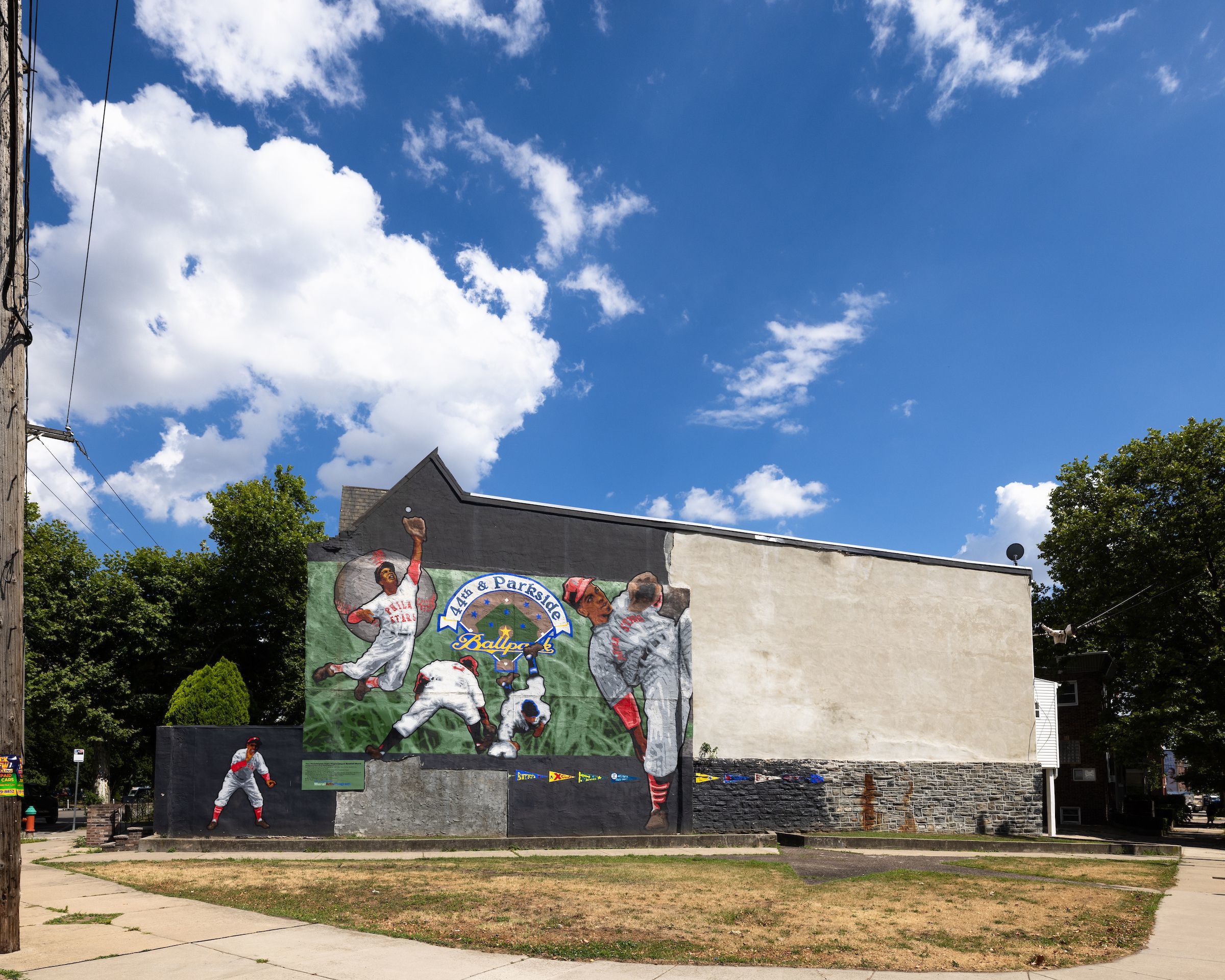
It seemed inevitable that the two-story mural would eventually be brought down. There was roof and wall damage to the home on which it is painted, and the building partially collapsed. Those repairs required the removal of half of the mural a few years ago, and it was never replaced.
And the possibility of development on the plot of land is now closer to being realized. The triangle-shaped grassy lot in front of the mural has been owned by developer Haverford Square Properties for several years, and it acquired the 4304 Parkside building in September.
Half of the mural was previously removed after repairs were needed for the damaged wall and roof of the property. This photo shows what remained of the mural in 2024.
Haverford Square planned to construct a six-story apartment building at the corner, but community members fought back, arguing that it would lead to overcrowding in the neighborhood. Haverford Square president German Yakubov said they have since reached something of a compromise on a smaller-scale development, which will include a baseball-themed coffee shop on the corner.
But Yakubov is helping to secure the long-term future of the mural. Haverford Square has donated $30,000 and design services to the project to create a new version across Belmont Avenue.
“I didn’t want to let it go,” he said of the mural he has been driving past since he was a student at St. Joseph’s University.
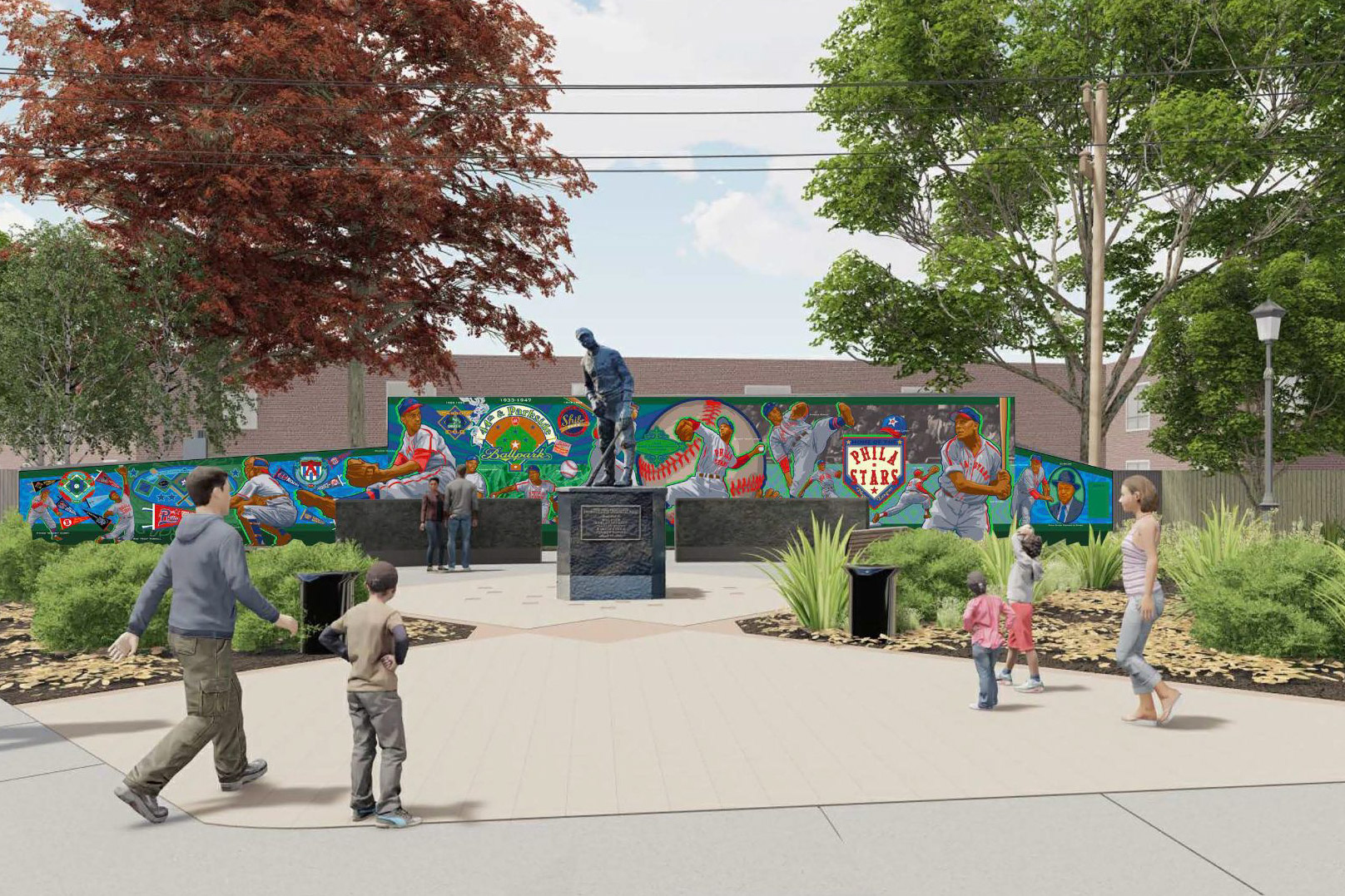
The mural will be painted on a yet-to-be-constructed wall in the Philadelphia Stars Negro Leagues Memorial Park, at the southwest corner of Parkside and Belmont Avenues. It will look slightly different from the previous version, since the new wall will be wider and shorter than the 4304 Parkside wall was. But the designs come from the artist who worked on the original mural, David McShane.
The park features a 7-foot bronze statue of a Negro Leagues baseball player, which was unveiled in a 2003 dedication ceremony at Veterans Stadium by five living Philadelphia Stars players —Bill Cash, Mahlon Duckett, Stanley Glenn, Harold Gould, and Wilmer Harris —before being placed at the park in 2005. The new mural will be raised behind the bronze statue.
A rendering of the proposed mural at the Philadelphia Stars Negro League Memorial Park. The recreated design is by the same artist, David McShane, behind the original mural. The proposed project will include the construction of a new wall behind the 7-foot bronze statue of a Stars player by Phil Sumpter.
“It’s great to see when everyone comes together to ensure that the story of the Negro League[s] and the Philadelphia Stars is not forgotten,” said Mural Arts Philadelphia executive director Jane Golden.
Many people reached out to Mural Arts once they heard in the fall that the mural was going to be removed, Golden said. They were furious and wanted to know what the organization would do to protect it.
Golden said she expects construction to begin early this spring after the project receives Philadelphia Art Commission approval, and for the mural to be completed by summer. Thousands of visitors are expected for numerous events in Philly, including the MLB All-Star Game in July.
The Stars are nearing their 100th anniversary, having played their first games in 1933. They joined the Negro National League the following season and won their first and only pennant, beating the Chicago American Giants in a controversial eight-game series, 4-3-1, after game 7 ended in a tie due to the state’s blue law curfew. Satchel Paige briefly played for the Stars, as did other Negro Leagues legends like Biz Mackey and Jud Nelson.
But after Major League Baseball was integrated in 1947, the popularity of the Negro Leagues dropped, and the Stars disbanded in 1952. They played the majority of their home games at the 44th and Parkside Ballpark, the site where the new mural will rise.
To be loved is to be known — or, better yet, to inspire a 3,233-piece custom Lego set.
Gene Gualtieri is devoted to Friday Saturday Sunday. Almost every Friday since 2021, the Fitler Square resident has lined up at 4:30 p.m. to score the same seat at the first-floor bar of Chad and Hanna Williams’ acclaimed Rittenhouse Square restaurant, where he is known to house a full roast chicken — bones and all — and order off-menu sherry martinis from bartender Paul MacDonald. It’s a ritual that has inspired a tattoo on Gualtieri’s bicep: “B9,” code for bar seat no. 9.
“It’s my seat,” said Gualtieri, 57, an engineer. “This feeling of hospitality and being welcomed [at the bar] … it’s a social hub for me.”
So when Gualtieri’s 21-year-old son, Leo, needed a Christmas present for his father, everyone from his aunt Claire to his older brother Sam had the same idea. What if, Leo recounts them wondering, there was a way to shrink Friday Saturday Sunday so it fits in your house?
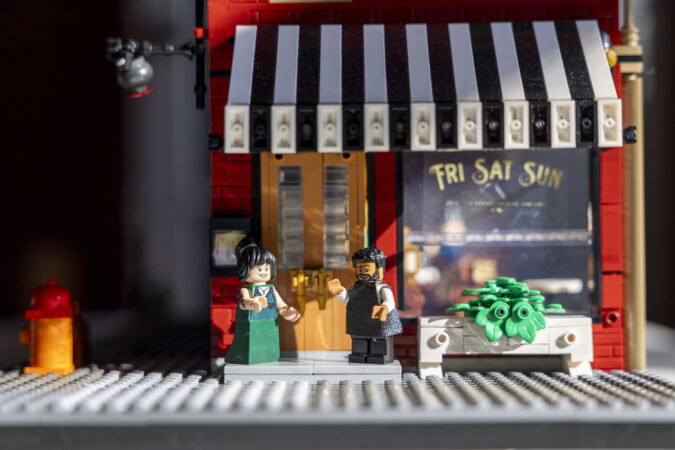
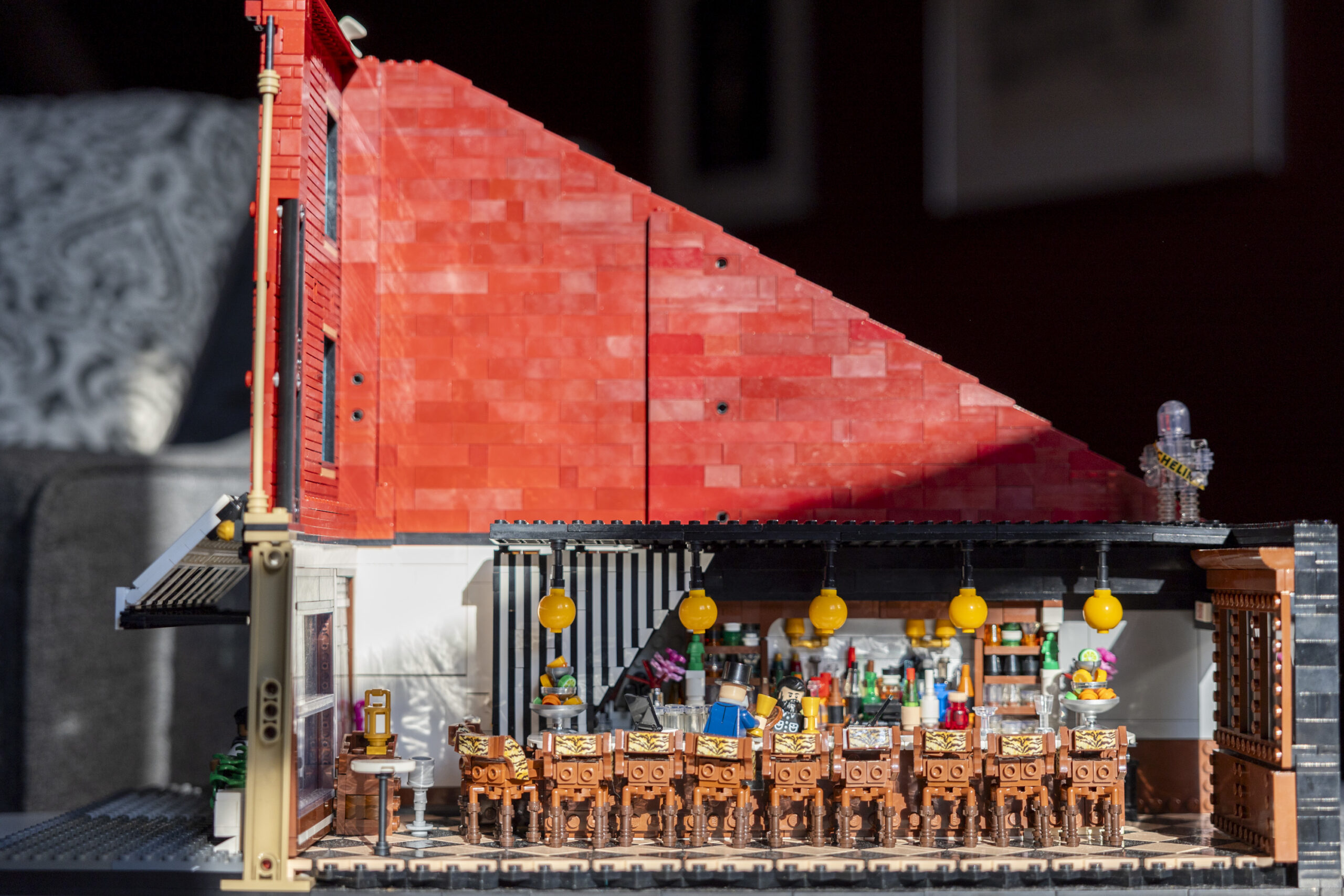
The resulting gift — a 1½-foot-tall replica of Friday Saturday Sunday’s facade and its ground-level Lovers Bar, constructed out of more than 3,200 Legos — doesn’t skimp on the details. Leo recreated everything, down to the discolored patches of sidewalk out front.
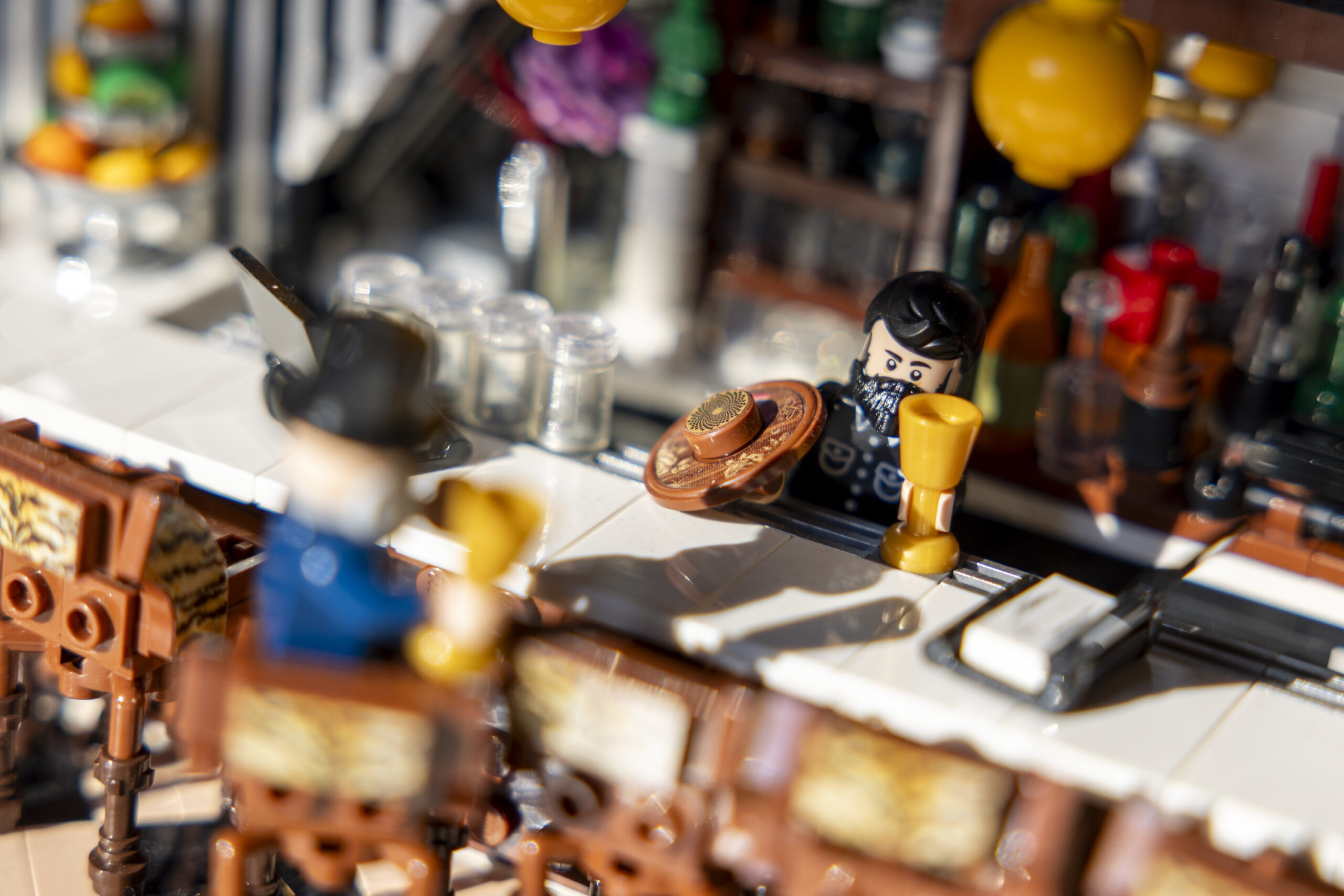
A figurine of bartender Paul MacDonald shows off a Lego version of his Fibonacci sequence wheel to a miniature of Gene Gualtieri inside a Friday Saturday Sunday replica his son built out of Legos.
Friday Saturday Sunday (Leo’s version) comes with Lego figurines of the Williamses, bartender MacDonald, and his father that can be posed to sit in one of the bar’s 13 tiger-print chairs. There’s a petite version of the Fibonacci carousel MacDonald uses to perfect his mixology, plus miniatures of the bar’s gargoyle- and raven-shaped pour spouts, mermaid caryatids, and towering citrus bowls. In honor of restaurant’s Michelin star, Leo even included a tiny and perfectly rotund Michelin Man.
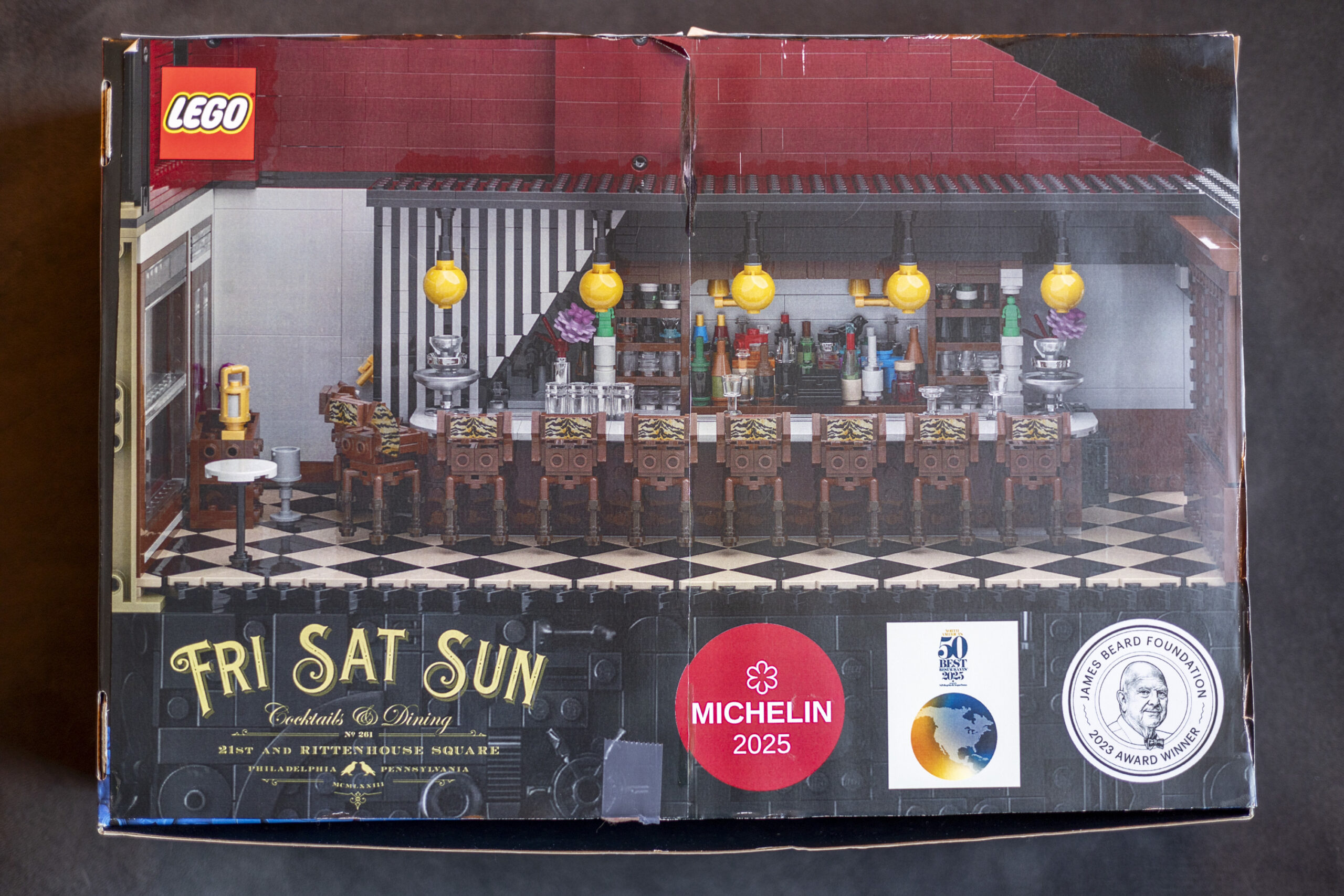
Leo stored the pieces in a repurposed Seinfeld Lego set box that he wrapped in a rendering of the finished design. When Gualtieri opened it on Christmas morning, he cried. The finished version inspired a similar response from others after Gualtieri and the restaurant posted photos on Instagram at the end of January.
Leo Gualtieri made custom packaging for the Friday Saturday Sunday Lego set he got his father Gene for Christmas.
“This is so beautiful I wanna cry,” commented one person. “Top 10 most impressive things I have ever seen,” wrote another.
Leo’s dad concurs. “I was pretty blown away,” Gualtieri said. “At first glance, it looks like a Lego set you’d get a store.”
A replica built brick by (plastic) brick
Recreating Friday Saturday Sunday was a labor of love for Leo, a self-described former Lego kid currently finishing up his senior year at Emerson College as a comedy major. As a child, Leo was fixated on building an ever-expanding amusement park out of the plastic blocks alongside his dad. It was an obsession that served him well this holiday season.
To reconstruct the restaurant, Leo first had to create a rendering of the bar and its exterior in Brick Link, Minecraft-esque software that lets users build and source their own custom Lego sets. Leo said he spent roughly 100 hours translating all the tiny details into Lego form, working first off images of the facade from Google. When those weren’t precise enough, he said, Leo begged MacDonald to send him photos of all the minutiae, from the glassware to close-ups of the light fixtures.
A replica of the Lovers Bar at Friday Saturday Sunday, built out of more than 3,200 custom Legos by Leo Gualtieri.
“It was addicting … I would work on it in class,” said Leo while on Zoom with his father, who scoffed at the admission. “Time would pass much faster because I was locked in.”
Once the rendering was complete, Leo and his mom spent $1,500 on the Lego pieces, sourced from 13 different Lego resellers across Japan, Spain, and the Netherlands. To find a realistic version of Chad Williams’ beard and apron, Leo had to commission custom blocks from an Etsy seller.
After Christmas, Leo spent the remainder of his winter break from college building mini Friday Saturday Sunday, developing calluses from clicking the bricks into place. Dad, Leo said, wasn’t much help.
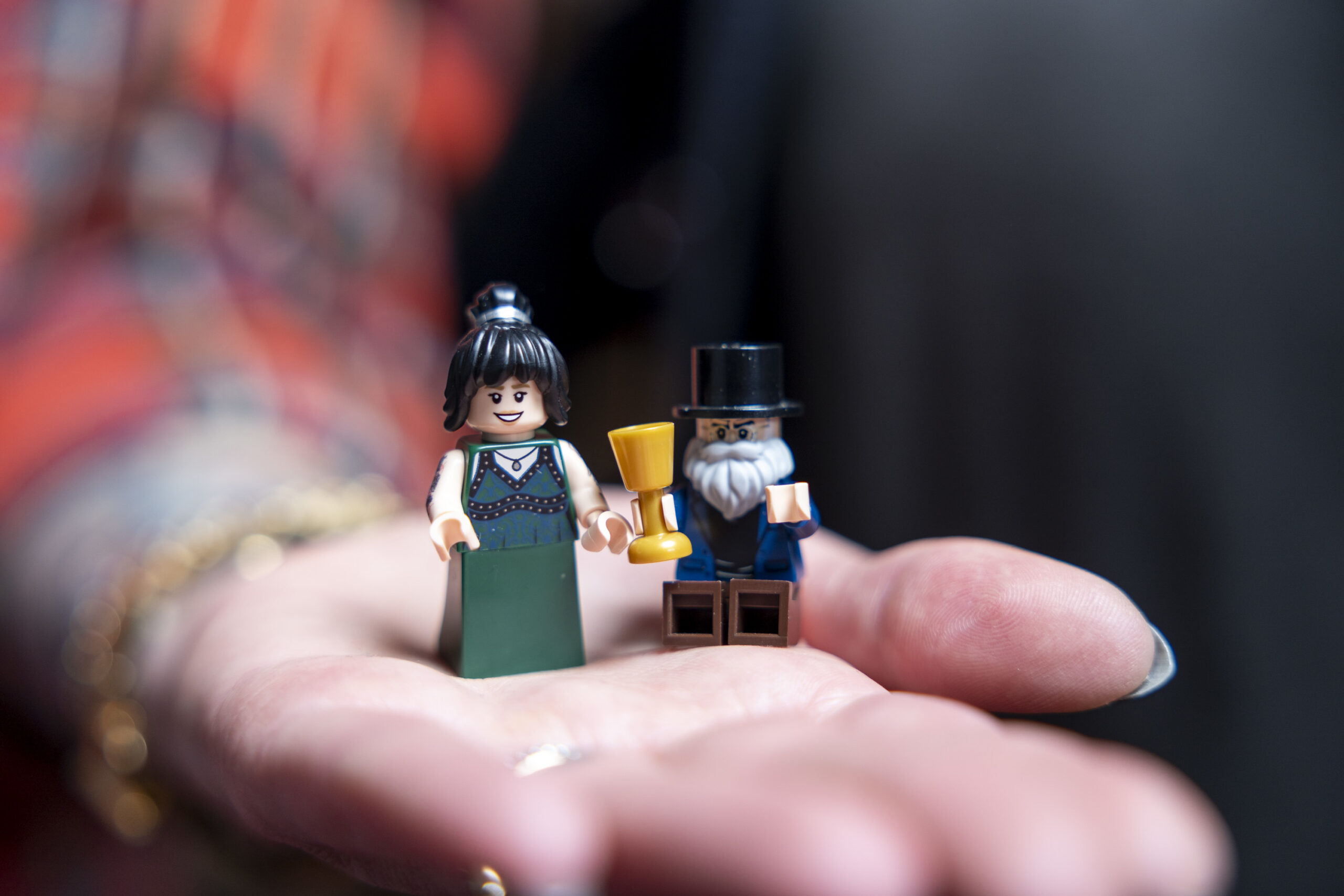
Hanna Williams, co-owner of Friday Saturday Sunday, holds Lego characters of herself and Gene Gualtieri, whose son Leo spent over 100 hours creating a miniature version of the restaurant out of the plastic blocks.
“He tried to build some chairs,” Leo said of his father. “I don’t think he’s cut out for it.” (Gualtieri agreed. Leo, he admitted, gets his dexterity from his mother.)
Every time he looks at the replica, Gualtieri said he discovers new details, like how the bottles mimic the exact ones behind MacDonald’s bar. Hanna Williams, Friday Saturday Sunday’s co-owner, felt the same when Gualtieri sent her progress updates on the build out.
Hanna Williams, co-owner of Friday Saturday Sunday, and Gene Gualtieri, a regular at the restaurant, pose with Lego action figures of themselves created by Gene’s son Leo.
“I think [Leo] might know every inch of the bar better than me,” she said. Williams especially loves her Lego dopplegangër: “A high bun, bangs, and tattoos? That’s so me.”
Williams is used to her restaurant being the recipient of the highest order of affection. In the decade since she and her husband revamped Friday Saturday Sunday from a classic fine-dining restaurant with excellent mushroom soup into cozy bar for walk-ins with a top-floor tasting menu that melds Caribbean, Asian, and soul food influences, the restaurant has earned a Michelin Star, a James Beard Award, and a spot on the World’s 50 Best North American restaurants. Just last week, Friday Saturday Sunday won an award for excellence in hospitality from the Tasties, Philly’s homegrown culinary honors.
And yet, Williams said, the Lego replica represents an extra-special type of achievement.
“It’s completely overwhelming,” she said. “But at the same time, there’s nothing that could make you feel better.”
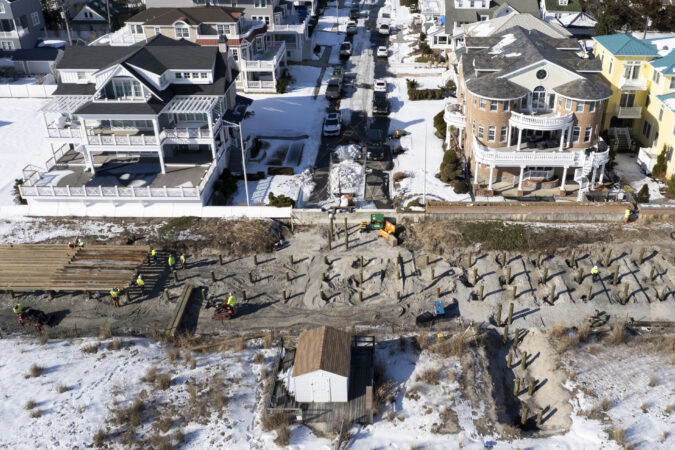
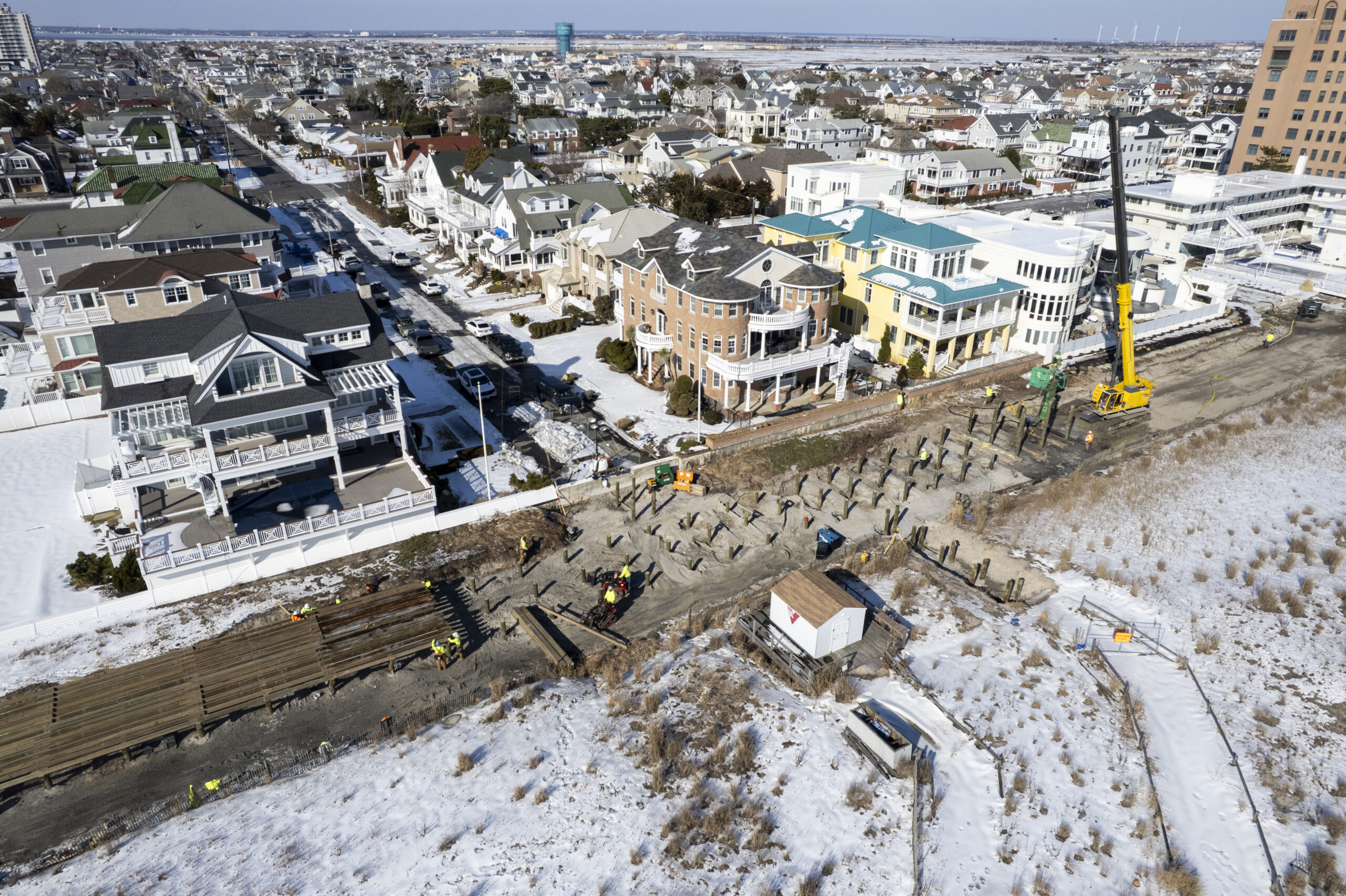
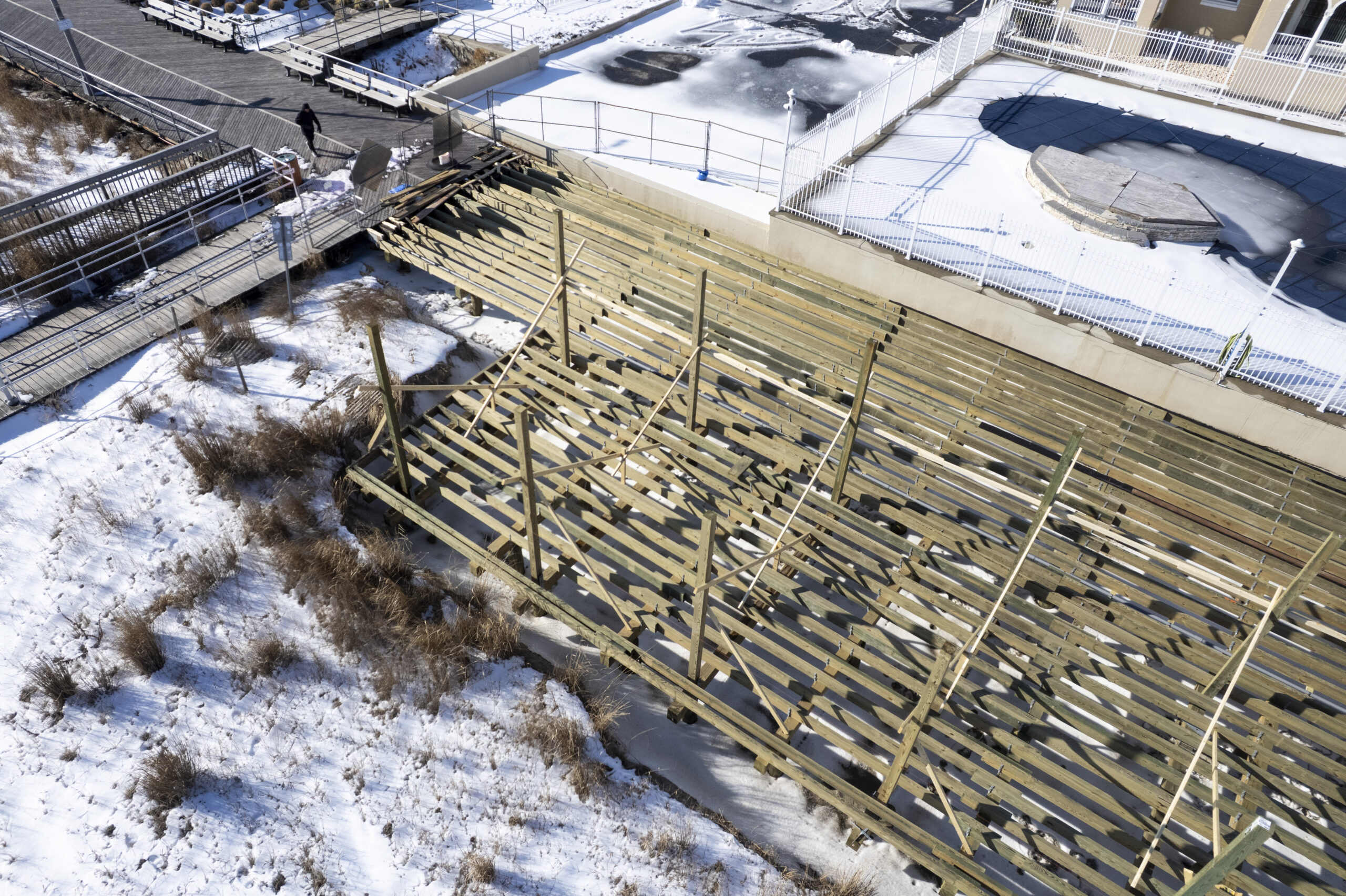
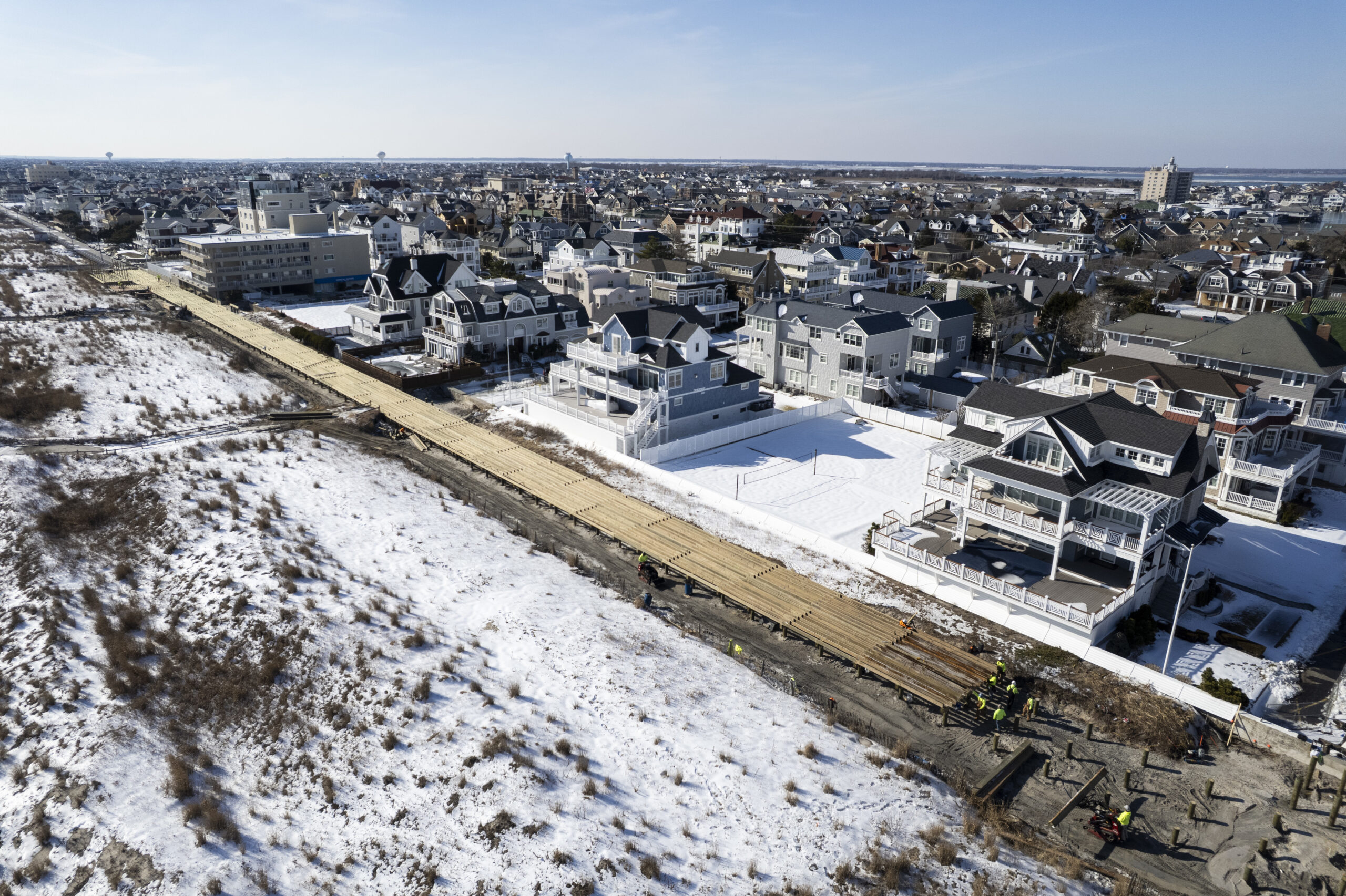
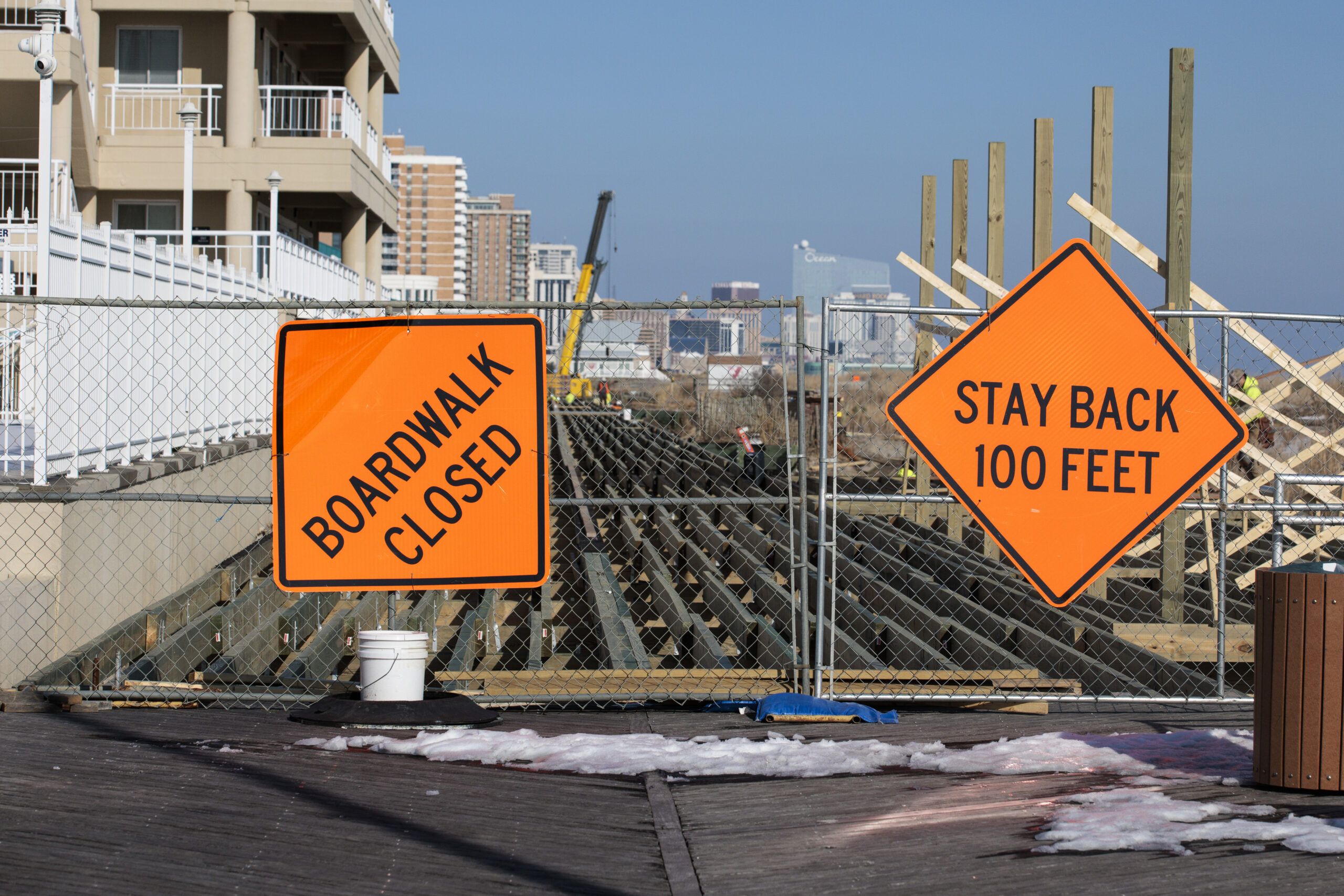
VENTNOR, N.J. — They demolished the existing boardwalk from the tennis courts to the fishing pier, north to south, and now they are building their way back up.
Financed mostly with federal funds granted to New Jersey from the COVID American Rescue Plan, Ventnor and other Shore towns like Ocean City, North Wildwood, Atlantic City, and Wildwood have set out to redo or upgrade their iconic pathways.
Ventnor is using $7 million in federal funds and bonded for about $4 million more, officials said.
Will this stretch of boardwalk reconstruction be done by Memorial Day?
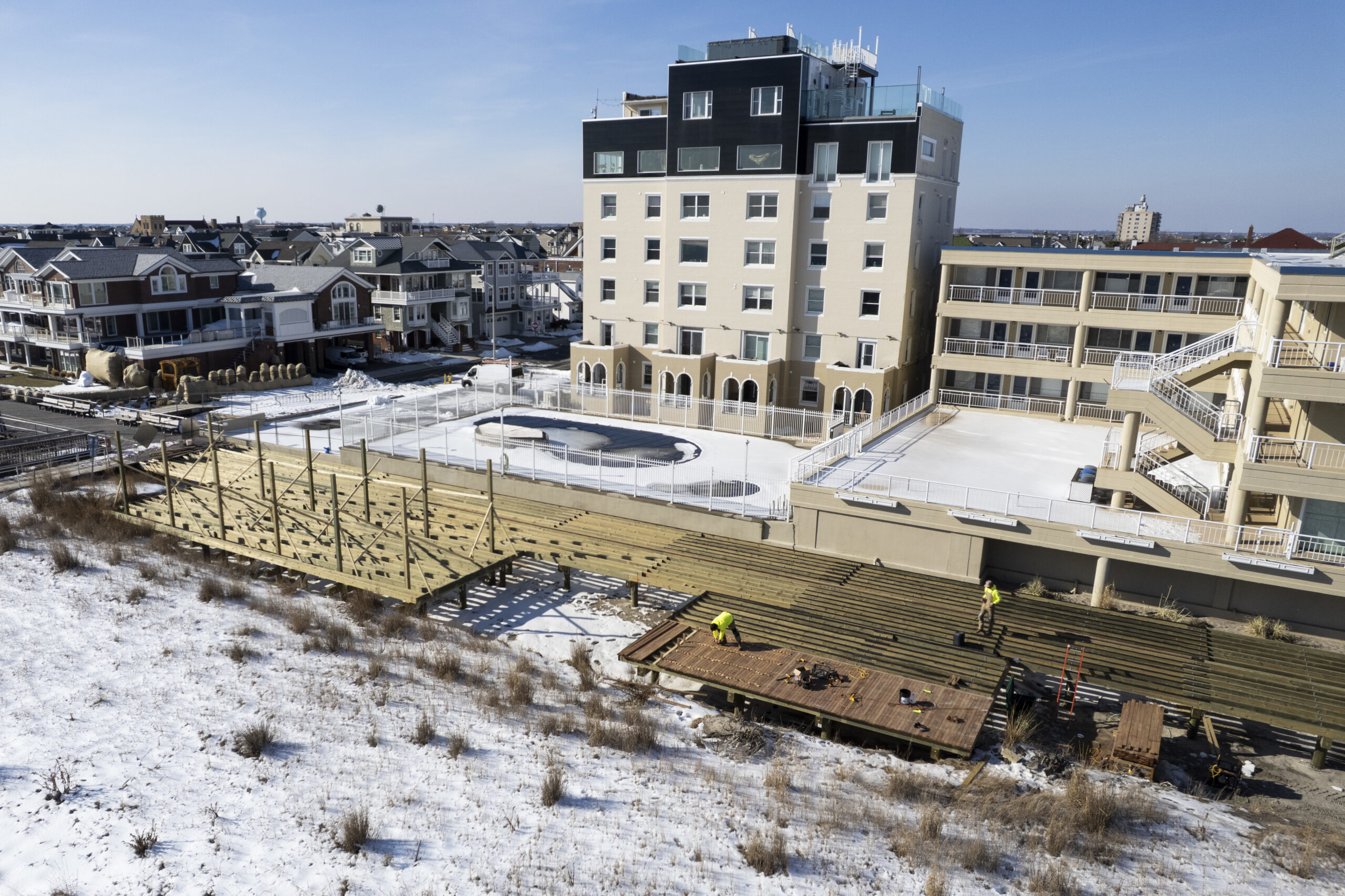
Construction continues on the boardwalk on Wednesday, Feb. 4, 2026, in Ventnor City, N.J.
“It’s always a worry,” Ed Stinson, the Ventnor city engineer, said in an interview late last month. “We’ve had multiple meetings with the contractor [Schiavone Construction], one as recent as three weeks ago. In all the meetings, he’s said it’ll be complete and open before Memorial Day.”
The reconstruction has delivered a seven-block offseason interruption in a walkway that is popular year-round.
Work will stop for the summer, city officials say. In the fall, a second 13-block section, from Suffolk Avenue to the Atlantic City border at Jackson Avenue, will begin. There is currently no funding or plan for the boardwalk from Cambridge south to the Margate border, said Stinson.
The biggest change people will notice is that the original and distinctive angled herringbone decking pattern of the boardwalk is being replaced with a straight board decking. Ultimately, it came down to cost over tradition.
“There was discussion about it,” said Stinson. “There’s additional lumber that’s wasted when you do the herringbone, and the labor to cut that material. The additional material costs were significant. It’s a waste of tropical lumber. The only reason to go herringbone is tradition and appearance.”
The reconstruction has delivered a seven-block offseason interruption in a walkway that is popular year-round. Work will stop for the summer, city officials say.
Other differences are changes in lighting (lower, more frequent light poles) and some enhancements of accessible ramps. The existing benches, with their memorial plaques, will be back.
To demolish the boardwalk, the contractor cut the joist and the decking in 14-foot sections, “swung it around, carried it over to the volleyball court,” Stinson said, on Suffolk Avenue.
“That’s where they did their crushing and loading into the dumpsters. They worked their way down and followed that with the pile removing.”
The original herringbone pattern can be seen on the left, compared with the new straight decking pattern on the new construction side.
The other massive job was excavating the sand that had accumulated under the boardwalk. “They screened it, cleaned it, and put it down there,” on the beach in piles. It will be spread around above the tide line, Stinson said.
Once the excavation was down, the pile driving crew set out beginning at the south end and working their way toward Suffolk Avenue. “Then the framing crew came in and started framing,” Stinson said. On Feb. 2, the third team began its work: the decking crew.
The weather has slowed the pace, Stinson said. “They were doing about 20 to 24 piles a day,” he said, a pace that dropped to about nine piles a day after the snowstorm and ice buildup.
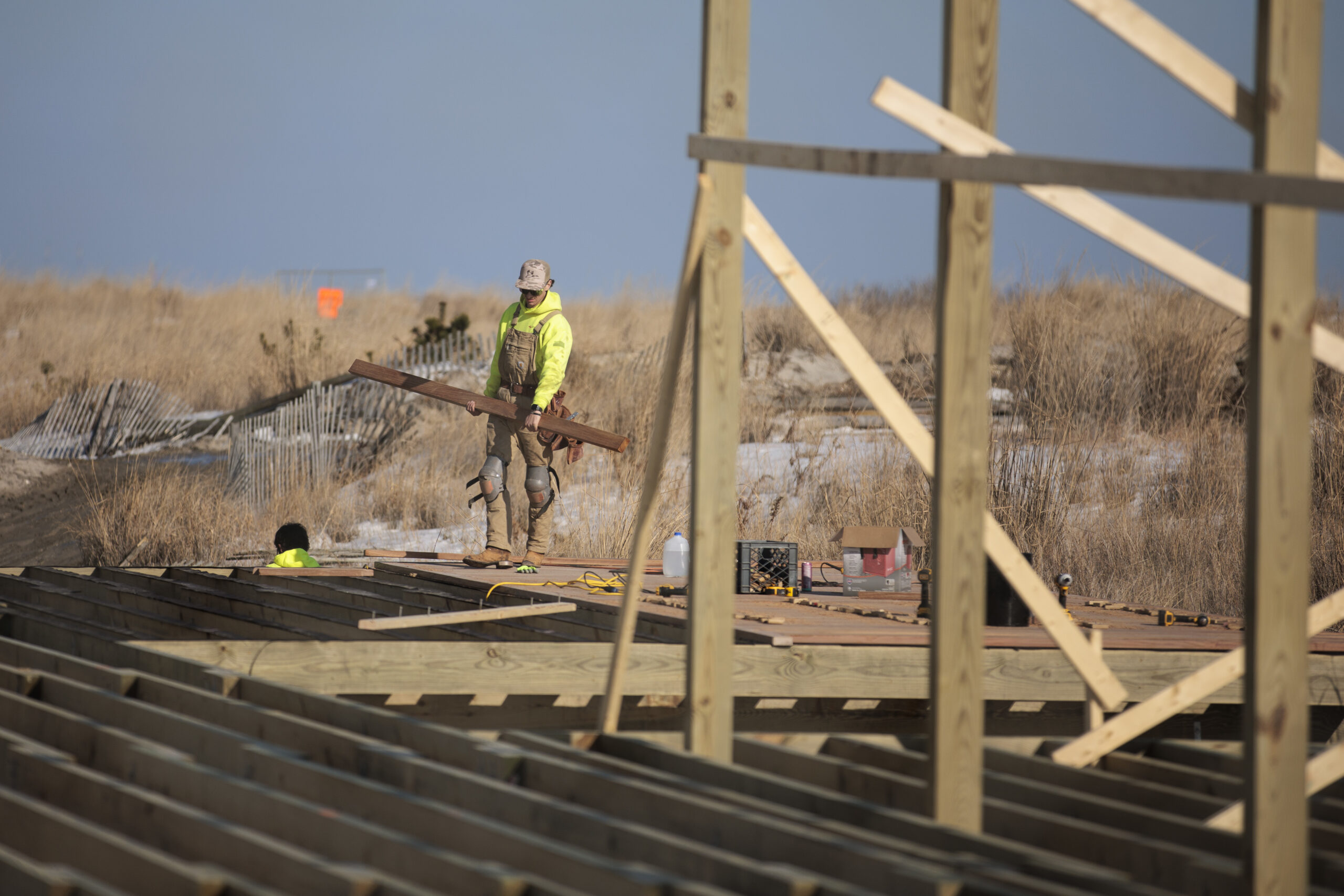
The framing crew installs pile caps, 8-by-14 beams that run across the boardwalk atop the pilings. The decking crew follows behind them, installing the wood, a tropical wood known as Cumaru. The use of Brazilian rainforest lumber at one time inspired protests, but that has not been an issue this time.
Construction continues on the boardwalk on Wednesday, Feb. 4, 2026, in Ventnor City, N.J.
Ventnor’s boardwalk, which links to Atlantic City’s famous walkway, dates to 1910. It was rebuilt twice before: once after the hurricane of 1944 and again after the March storm of 1962. Margate, on the southern end, never rebuilt its boardwalk after 1944.
Stinson said the tropical wood is noted for its “denseness and durability. It does not last forever.”
In all, $100 million of American Rescue funds was set aside by Gov. Phil Murphy for a Boardwalk Fund and awarded to 18 municipalities, including, as Stinson said, “anybody who has anything close to a boardwalk.”
Brigantine, with its promenade, received $1.18 million. Ocean City, in the process of rebuilding a portion of its north end boardwalk, received $4.85 million.
The two biggest recipients were Asbury Park and Atlantic City, each receiving $20 million. Atlantic City has completed a rebuilding of its Boardwalk to stretch all the way around the inlet to Gardner’s Basin. Wildwood, with $8.2 million, has undertaken a boardwalk reconstruction project, and North Wildwood, receiving $10.2 million, is rebuilding its boardwalk between 24th and 26th Streets, combining the herringbone pattern with a straight board lane for the tram car.
Although the timing of the reconstruction was no doubt prompted by the availability of the federal funds, Stinson said Ventnor’s boardwalk had shown signs of age.
“We’ve been into some significant repairs on the boardwalk,” Stinson said. “Those have increased every year. We were getting into pile failures. It was due. I don’t know if the city would have tackled it without the [federal] money.”
Ventnor’s boardwalk, which links to Atlantic City’s famous walkway, dates to 1910. It was rebuilt twice before: once after the hurricane of 1944 and again after the March storm of 1962.
Sonny Jurgensen was an Eagle and a Redskin but never a saint.
It’s been about a week since the hedonistic Hall of Famer died at 91 and nearly 62 years since he departed Philadelphia for Washington in a trade that left the city’s bartenders as downcast as its football fans.
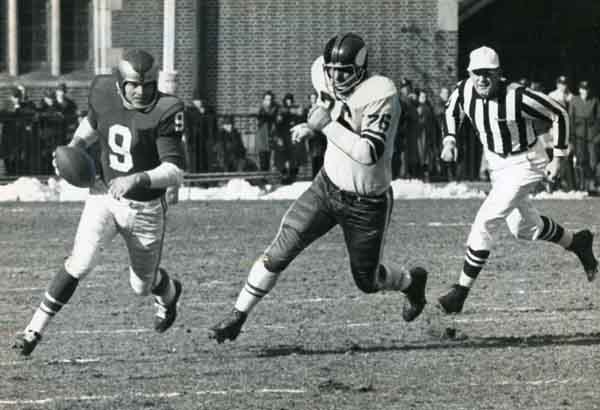
Thinking of Jurgensen now, I still conjure images of that flimsy helmet he wore with its single-bar face mask. I see him squirming in the pocket, quickly surveying the downfield action, then flicking those effortless passes to Tommy McDonald or Pete Retzlaff.
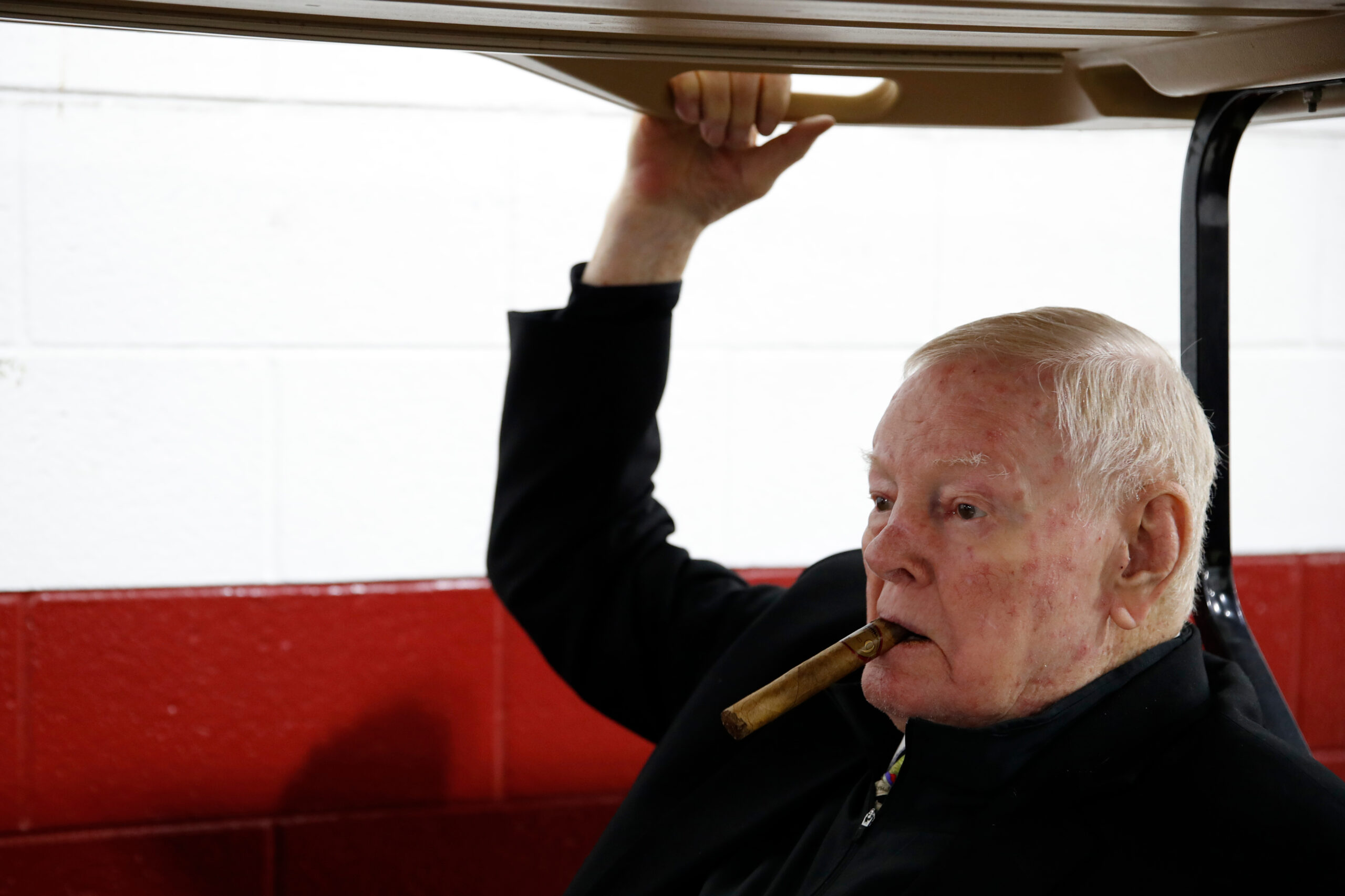
But I also still see, maybe more than in any other athlete from that era, his personal foibles. There was the booze, the pot belly, the mischievous smile, the postgame cigars that jutted from his mouth like middle fingers to those who disapproved.
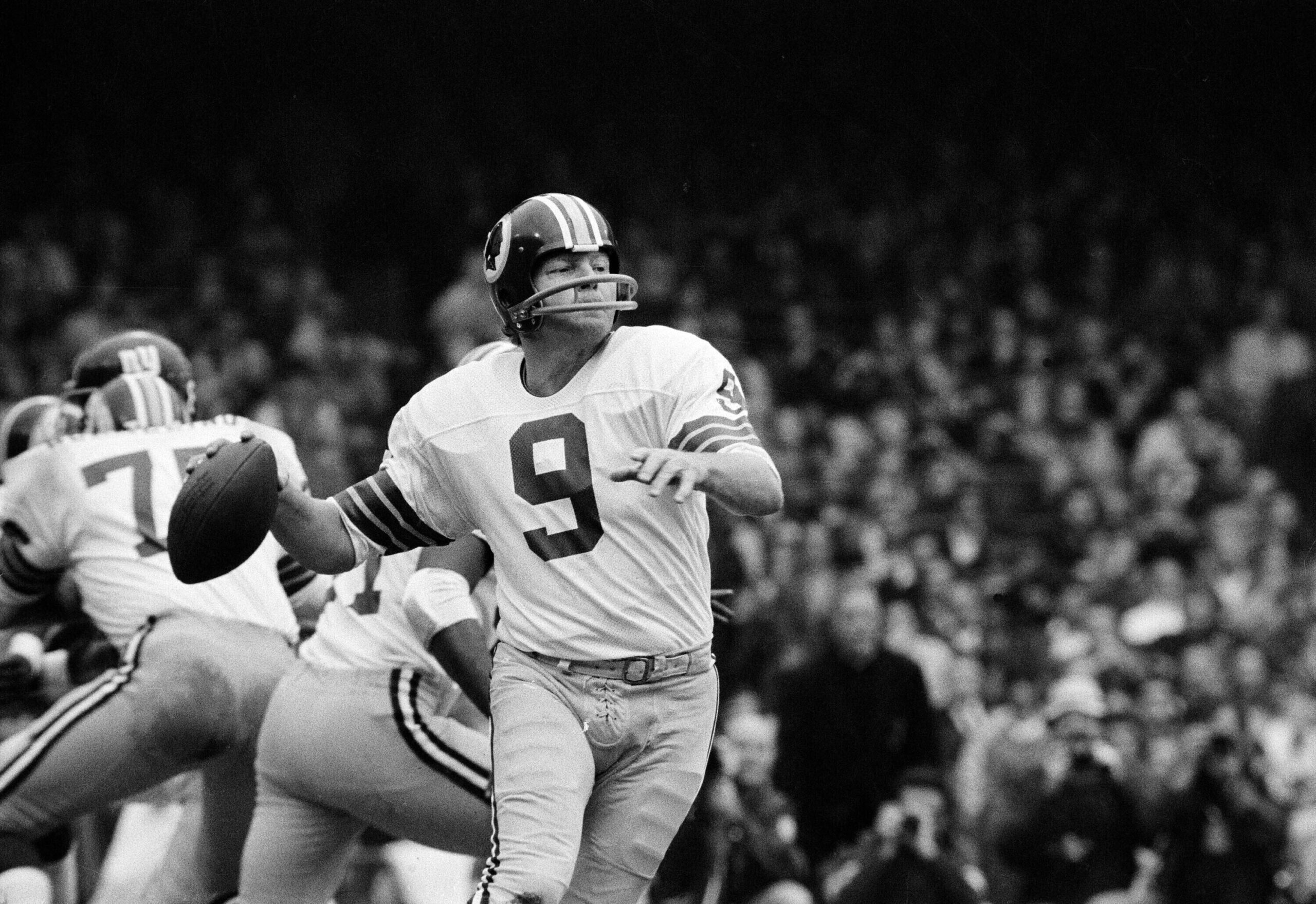
Sonny Jurgensen was one of the NFL’s great characters of his era and went go on to achieve exalted status in Washington.
Jurgensen was one of the first Philly athletes whose lifestyle was as well-known as his talents. Throughout his seven seasons as an Eagle, the last three as a starter, Philadelphia was rife with whispered stories about the redhead’s off-field encounters. It hardly was a secret that he loved liquor, ladies, and last calls.
Like many of his early-1960s Eagles teammates, the native North Carolinian lived during the season at the Walnut Park Plaza hotel at 63rd and Walnut, just a short stagger from one of the team’s favorite bars, Donoghue’s. Jurgensen regularly showed up there as well as Center City spots like the Latimer Club and Jimmy’s Milan.
Another of his favorite haunts was Martini’s, an Italian restaurant and bar in Berwyn where he befriended the owner, Louie DiMartini. DiMartini’s son, Bill, remembered all the nights that his dad and “Uncle Sonny” showed up at their house.
“One night, my siblings and I were in bed when we were awakened by loud singing,” DiMartini said. “Sonny and my dad had just made up a song called ‘Pine Tree.’ The song had no other lyrics but ‘pine tree,’ and they went on singing it for hours.
“Another time, the Eagles couldn’t find Sonny; he hadn’t shown up for practice. We woke up to get ready for school, and as my older brothers went downstairs they found Sonny sleeping on the couch. My father told us, ‘You didn’t see anything.’”
I was a 12-year-old sports nut when I learned of Jurgensen’s off-field proclivities. For me, pardon the expression, it was a sobering experience, perhaps the first time I realized sports heroes weren’t gods.
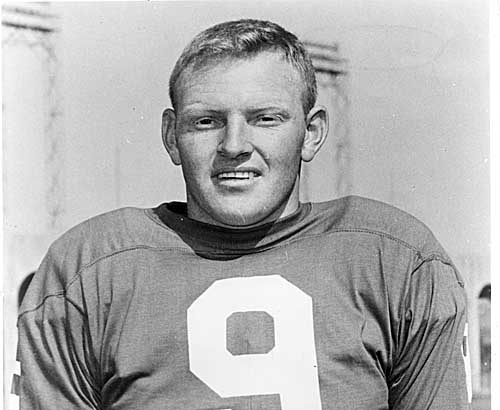
Sonny Jurgensen led the Eagles to a 10-4 mark and was an All-Pro in 1961. After two more seasons he was traded to Washington.
If my memory is accurate, it happened on a morning in January 1962. The night before, my father, the sports editor of two Philadelphia neighborhood weeklies, had attended his first Philadelphia Sports Writers Association banquet.
I couldn’t wait to hear about it. So at 7:30 the next morning, when he got home from his full-time job as a Bulletin proofreader, I was waiting at the door. As I peppered him with questions, he handed me the event’s program. On its front page were the autographs he’d gathered from sports celebrities he’d encountered there — Gene Mauch, Sonny Liston, Mickey Mantle.
Clearly a little starstruck himself, he eagerly described Mantle’s Oklahoma drawl, Liston’s enormous hands, Mauch’s steely eyes.
Then I saw another signature, this one from Jurgensen, the spirited quarterback who’d just emerged as an NFL star after throwing a league-best 32 touchdown passes during the Eagles’ 10-4 season in 1961.
I awaited my father’s impressions. A virtual teetotaler, his tone shifted when he said, clearly disapproving, “I’ve never seen anyone drink so much.”
That was a jolt. Could a star quarterback be a drunk? That didn’t compute. It was, after all, the pre-Ball Four world of the early 1960s when most of us knew nothing about things like Mantle’s carousing or Liston’s mob connections. Sports writers of the era, many of whom partied just as hard as Jurgensen, shielded the athletes they covered.
My young mind’s palette worked in black and white only. There were no shades of nuance. Heroes had no flaws. Or so I believed. Was Jurgensen a drunk or a hero? He couldn’t be both. Was he the pure-passing machine who’d just thrown for an NFL-high 3,723 yards? Or was he no different from those lost souls my grandmother pointed out in warning whenever we rode the 47 trolley past Vine Street’s Skid Row.
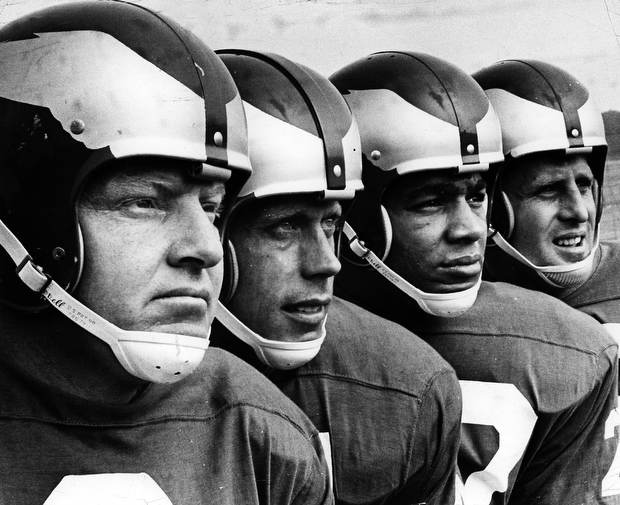
Eagles players (from left) Sonny Jurgensen, Pete Retzlaff, Timmy Brown, and Tommy McDonald during the 1963 season.
I still wasn’t sure when in April 1964, 12 days after he dealt McDonald, Jurgensen’s partner on and off the field, coach/general manager Joe Kuharich shocked Eagles fans by trading the colorful QB to Washington. I wondered if it had something to do with the then 29-year-old’s lifestyle. And I wasn’t alone. Daily News columnist Jack McKinney gave voice to what many thought was behind the incongruous trade.
“Another theory is that Jurgensen’s off-field antics, something less than that of a Boy Scout leader, may have been a factor.”
That trade, which brought pedestrian QB Norm Snead here, was a bad omen. It launched one of the longest and darkest stretches in Eagles history. They wouldn’t reach the postseason again until 1978. In those 14 intervening seasons, the team amassed a combined record of 68-122-6.
With Jurgensen, meanwhile, Washington made five playoff appearances in that span, and in his first six seasons there, he was named first- or second-team All-Pro four times.
No matter the Washington coach, Jurgensen flourished. For three seasons, he clashed with prudish Otto Graham — “He likes candy bars and milkshakes,” Jurgensen said, “and I like women and scotch” — but twice led the league in passing yards. He got along famously with Graham’s successor, Vince Lombardi. Never prone to hyperbole, Lombardi once admitted that Jurgensen “may be the best the league has ever seen.”
And he was still pretty formidable after hours, too. He became a regular at such late-night D.C.-area establishments as the Dancing Club and Maxie’s. At least twice, he was charged with driving while intoxicated.
Sonny Jurgensen spent 11 seasons as a player in Washington and was named to the Pro Football Hall of Fame in 1983.
Jurgensen ended his 18-year career in 1974 with the highest QB rating (82.62) of anyone in the pre-1978 era. Sometime in the 1980s he reportedly stopped drinking and for four decades was Washington’s drawling, plain-spoken radio analyst.
By then the NFL had changed. Its stars now endure round-the-clock scrutiny.
I’m not sure how Jurgensen would have dealt with social media, paparazzi, tabloid headlines. Would it have impacted his play? Would the DWIs have sent him to rehab? Would the whispers have become shouts?
In the end, I really don’t care.
I lost that sportswriters banquet program years ago. I lost a lot of that youthful righteousness, too. So from now on, in those corners of my mind where it’s always a sunlit Sunday at Franklin Field, I’ll remember Jurgensen simply as a gifted man with a child’s name who lofted all those beautiful spirals.
When your social media algorithm starts feeding you videos of Snoop Dogg, and Jason and Kylie Kelce learning how to curl, it must be time for the Winter Olympics.
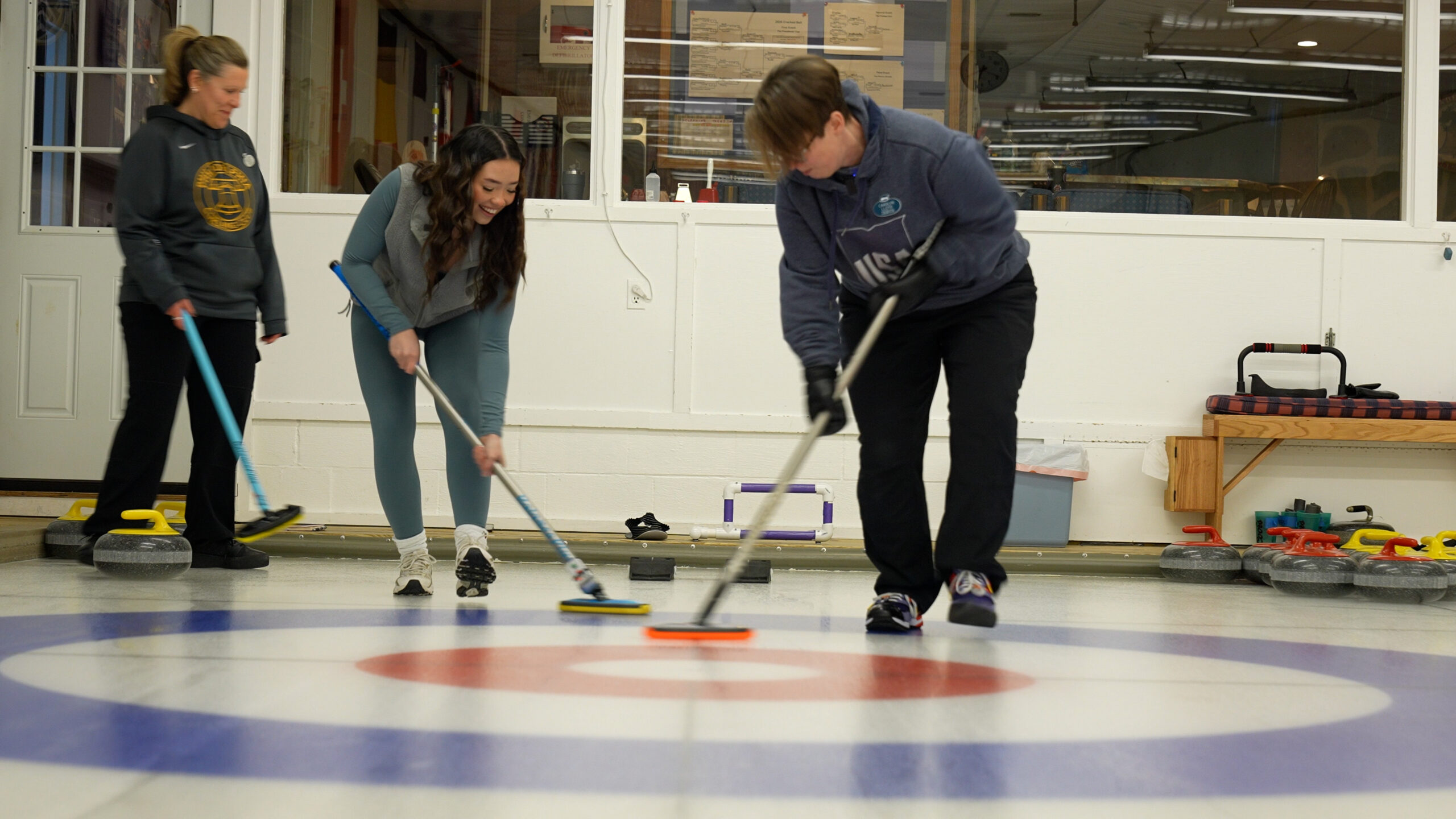
Ahead of the Milan Olympic Games, similar to the Kelces and Snoop Dogg, I had the opportunity to get some hands-on training. Here’s a look about the training that goes into the sport, my own experience on the ice, and some local places to play.
Curling can look effortless on television, but looks can be deceiving.
Daniel Laufer, 19, a freshman at Thomas Jefferson University from Richboro, Bucks County, who has been curling for 12 years, had the opportunity to compete on this year’s Olympics ice at the Cortina Olympic Stadium in Italy during last year’s World Junior Curling Championships as a member of Team USA.
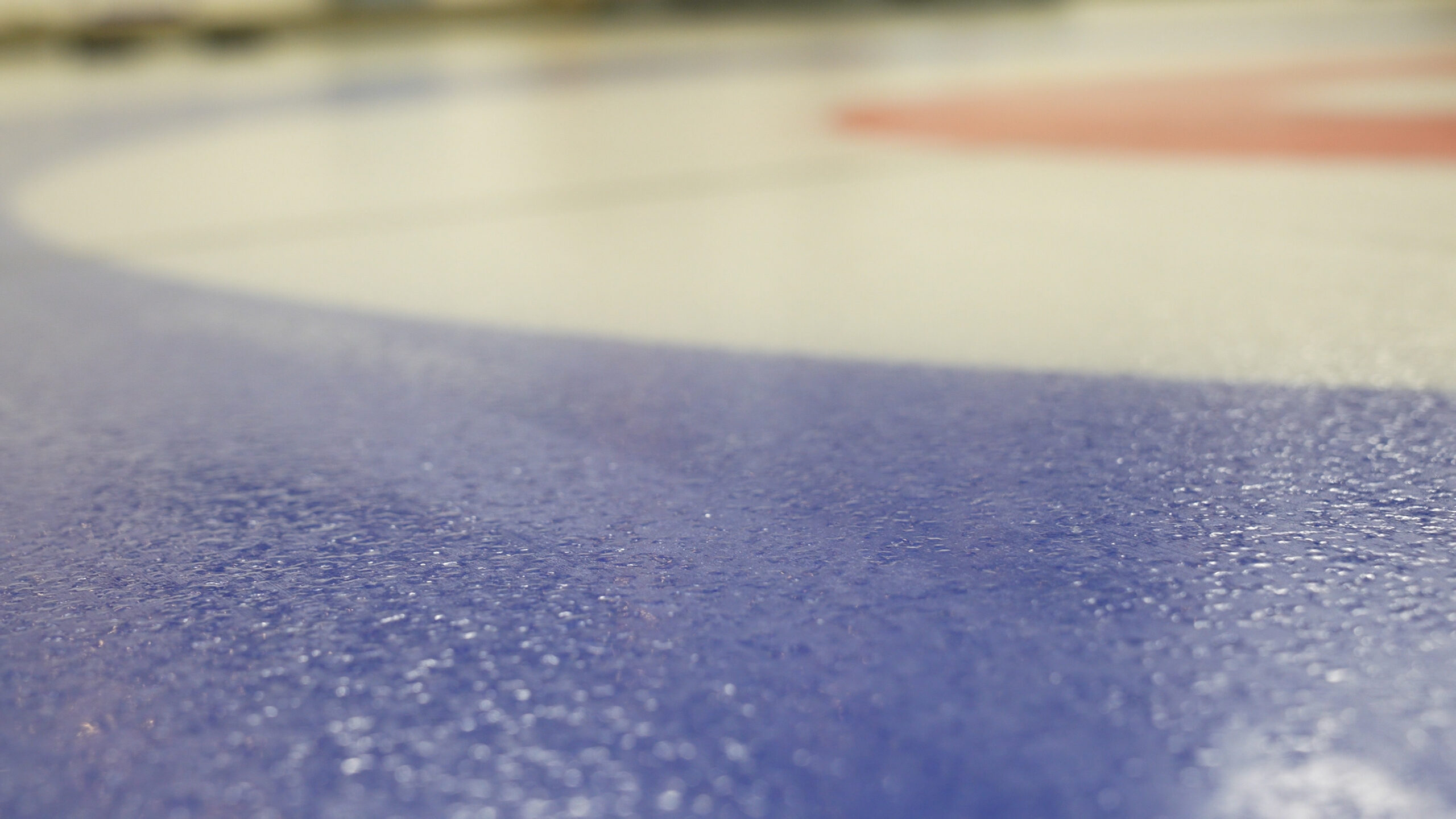
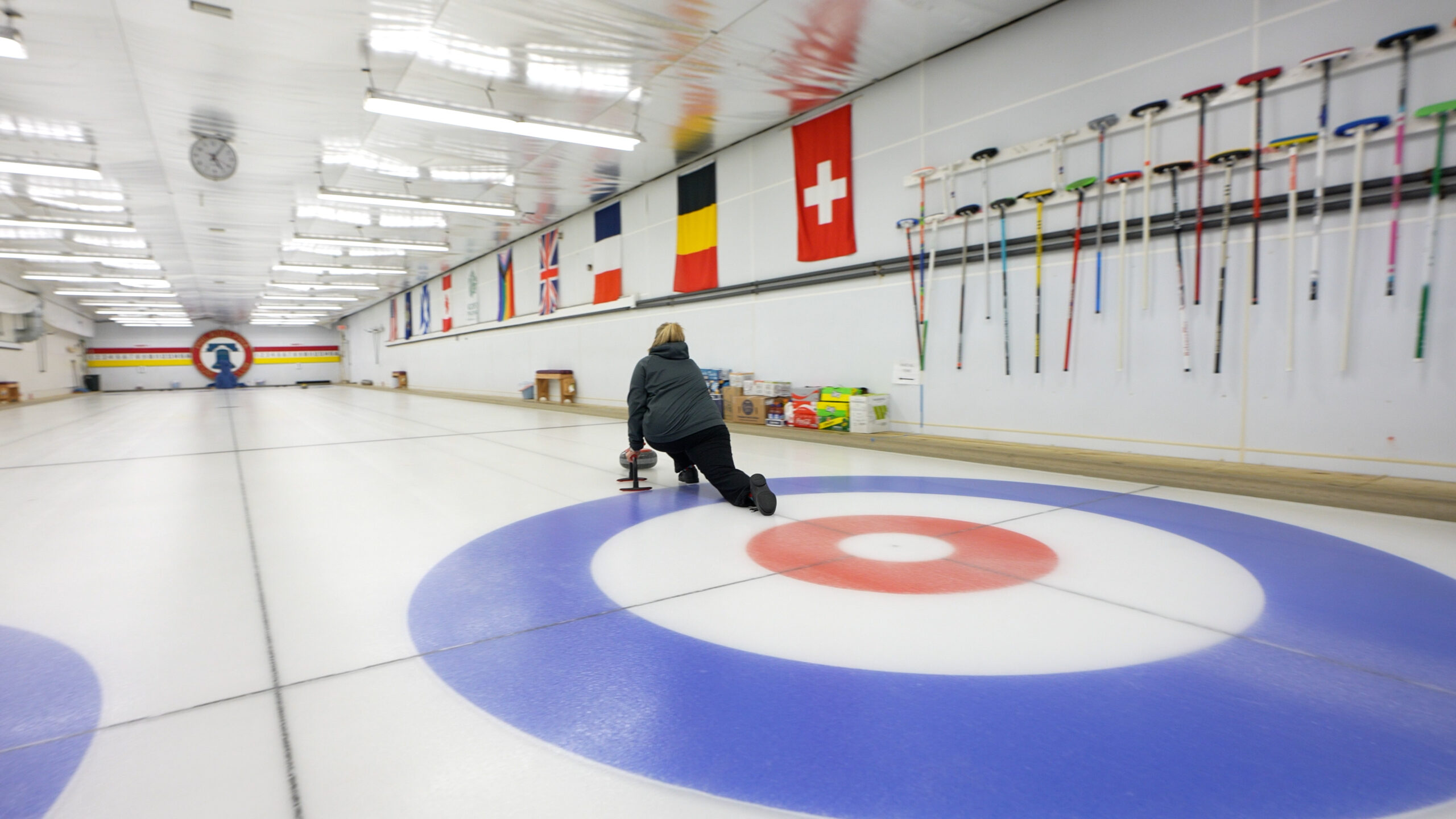
The ice at the Olympic curling center in Milan, like the ice seen here at the Philadelphia Curling Club in Paoli, is pebbled, which is different than the smooth ice you’d find at a Flyers game.
“That was a really great experience,” Laufer said. “[The ice] was really good. Obviously, not as good as it is for the Olympics. They were still figuring out the facilities and figuring out the rocks. We had a really good experience with that venue.”
This year, Laufer again will be competing in the World Junior Curling Championships, just outside Copenhagen, Denmark, from Feb. 24 through March 3. Ahead of the event, he’s been training, working on his strength and cardio.
“I usually try to lift four to five times a week and do a significant amount of cardio,” Laufer said. “When I was training specifically for Worlds last season, I had like three months where I was practicing five days a week. Practices are like two hours long. I probably throw 50 to 60 rocks every practice.
“That’s what a higher level training regiment looks like. But, it looks different for everybody.”
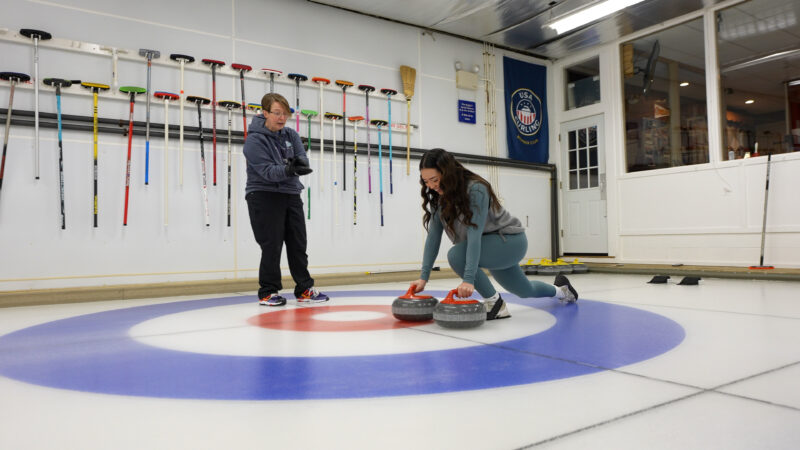
Inquirer reporter Ariel Simpson (center) gets instructions on how to sweep from Carolyn Lloyd (right) at the Philadelphia Curling Club in Paoli.
How hard is curling?
Not everyone trains like Laufer, especially amateurs. So how difficult is curling for the average person? I recently had the opportunity to get a hands-on experience at the Philadelphia Curling Club in Paoli with Carolyn Lloyd, a member for 20 years.
“I love exposing people to something that’s so special,” said Lloyd, who lives in Collegeville. “People don’t realize just how special it is. It’s different from a lot of sports, certainly in its culture. This sport captures my whole heart.”
Before this I had never stepped foot on ice — other than the sheet that covered my driveway for two recent weeks. So, I knew this was going to be a bit of a challenge, but Lloyd was more than up to the task of teaching me.
When it came to delivering the stone, I watched a number of YouTube videos ahead of time. So, of course, I felt like a pro walking in — I didn’t even need special shoes, just some attachments. But once I actually stepped onto the ice, with a gripper covering one shoe and a slider covering the other, I felt like a baby deer trying to walk for the first time.
Walking on the ice was hard enough. Now, imagine having to get into a squat position and push off the hack — a rubber block embedded into the ice — with one leg and balance on the other while holding a deep lunge and bracing your core.
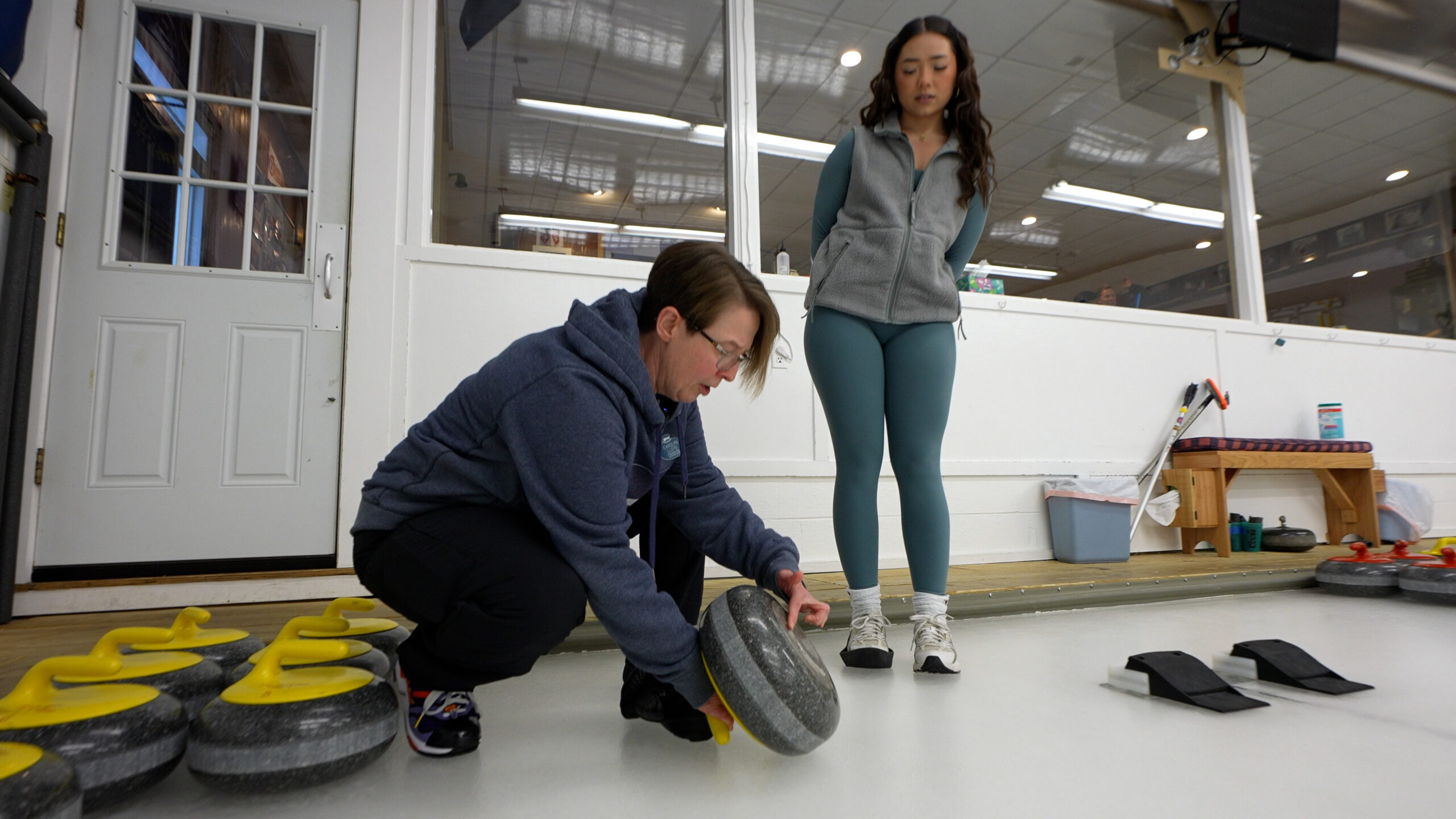
Then you have to aim, release, and spin a 42-pound granite stone. Easy? Trust me, it’s not like they make it look on TV.
Carolyn Lloyd (left) explains Inquirer reporter Ariel Simpson the parts of a curling stone at the Philadelphia Curling Club in Paoli.
It took me a few tries before I was even mentally prepared to push off with enough strength to move myself a few feet. But, once you get over the fear of falling onto the ice, you start to actually enjoy yourself and can focus on the next step — getting the stone to the house — which I did, eventually.
And all of this was only learning how to deliver the stone. Sweeping was a whole other issue. By the time I was ready to try sweeping, I had much more confidence walking on the ice, so that’s a plus. But now I had to run on it.
Afterward, I felt like I had done a full body workout. The amount of core, lower-body, and arm strength needed for curling is substantial and was certainly a surprise.
The one part of the sport I didn’t get a chance to take part in was the social aspect. It’s a game that’s big on camaraderie, including the post-round tradition of “broomstacking,” when the winning team buys the losing team a drink. But, hey, I was on the clock.
Where can I try curling in the Philly area?
If you want to give curling — and its rules and traditions — a try, there are a couple of local clubs where you can learn.
The Philadelphia Curling Club was started in 1957 but didn’t move to its current location until 1965. Since then they have grown, gaining over 200 members.
“This building was built for curling,” Lloyd said. “We bought the land. We built the club. And to this day, what you see here is a lot of the club members’ efforts. Most of the work that we do is not things that other people come in and do for us.”
The club offers a junior program on the weekends where kids can start as early as 5 years old.
“It’s something that anyone can pick up,” Lloyd said. “The game has adaptations for people who have different types of ability needs. You can learn very quickly, and then you can refine that skill for the rest of your life.”
A member of the Philadelphia Curling Club in Paoli delivers a stone during warmups last week.
There’s also the Bucks County Curling Club, located on York Road in Warminster, that was formed in 2010. The four-sheet club also has over 200 members and plays year-round.
Although it’s usually once every four years when the world tunes in to watch curling on TV, there is plenty of curling content that Laufer wants fans to know about.
“We have a ton of events,” he said. “There’s the Grand Slam of Curling events, which are our biggest tour events. There’s the World Championships, the European Championships. There’s a lot of events to watch, a lot of events that U.S. teams play in.”
The high-end, 31-story apartment tower at 210 S. 12th St. has nine penthouses on the top two floors. They have a variety of layouts, including three-bedroom, three-bathroom apartments that range from roughly 1,650 to 1,835 square feet and cost from $12,600 per month to $13,250 per month.
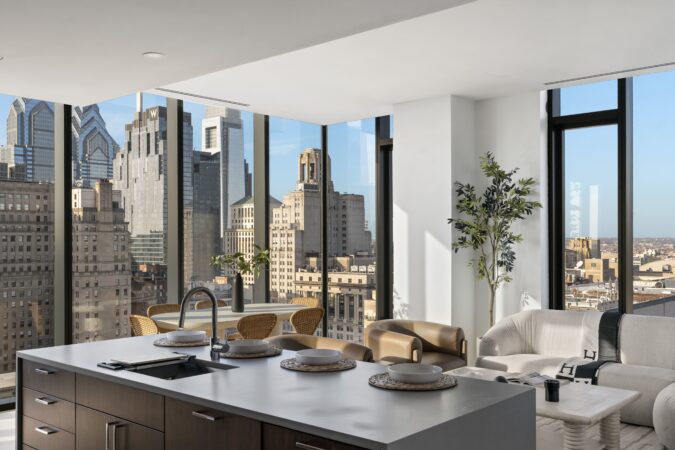
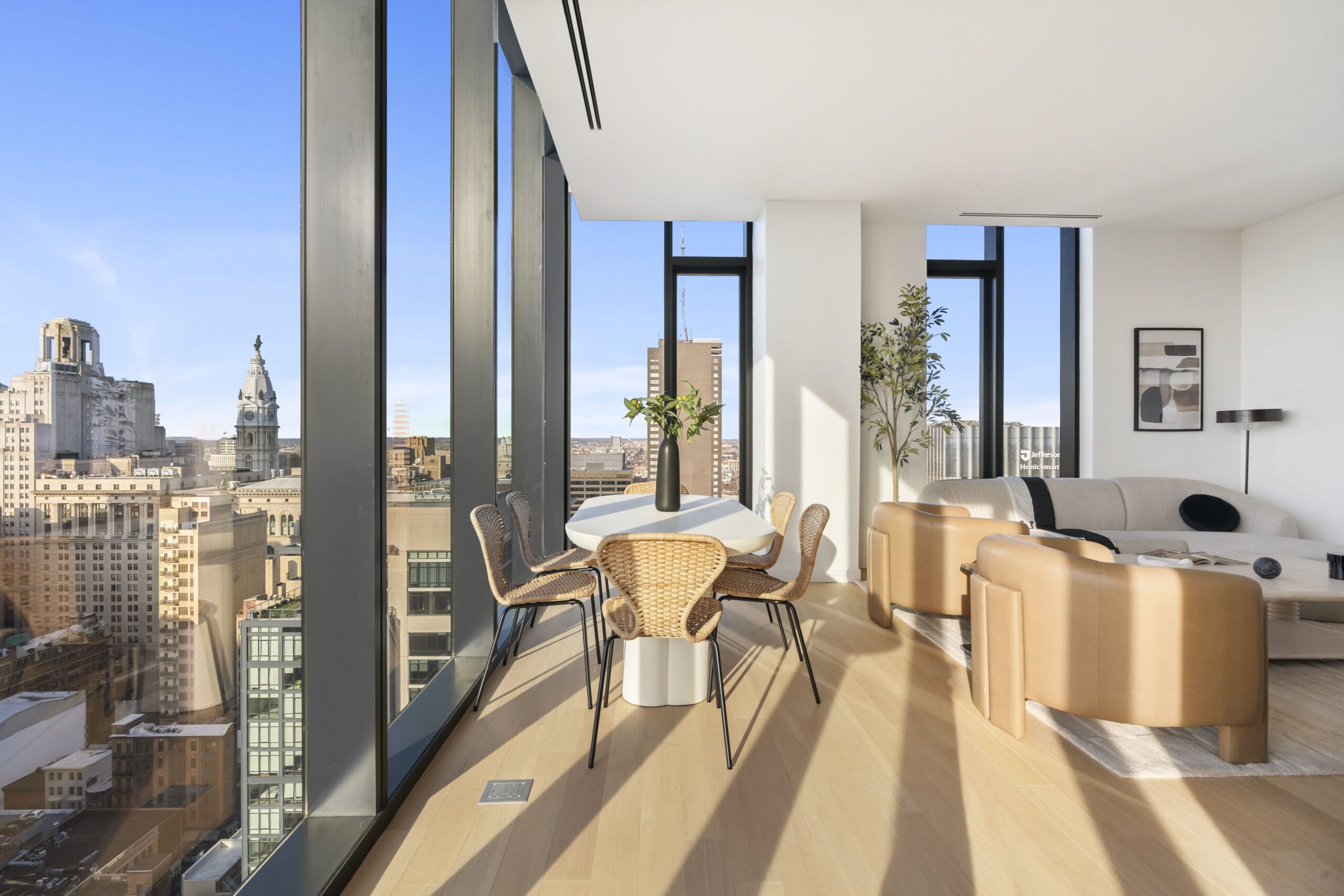
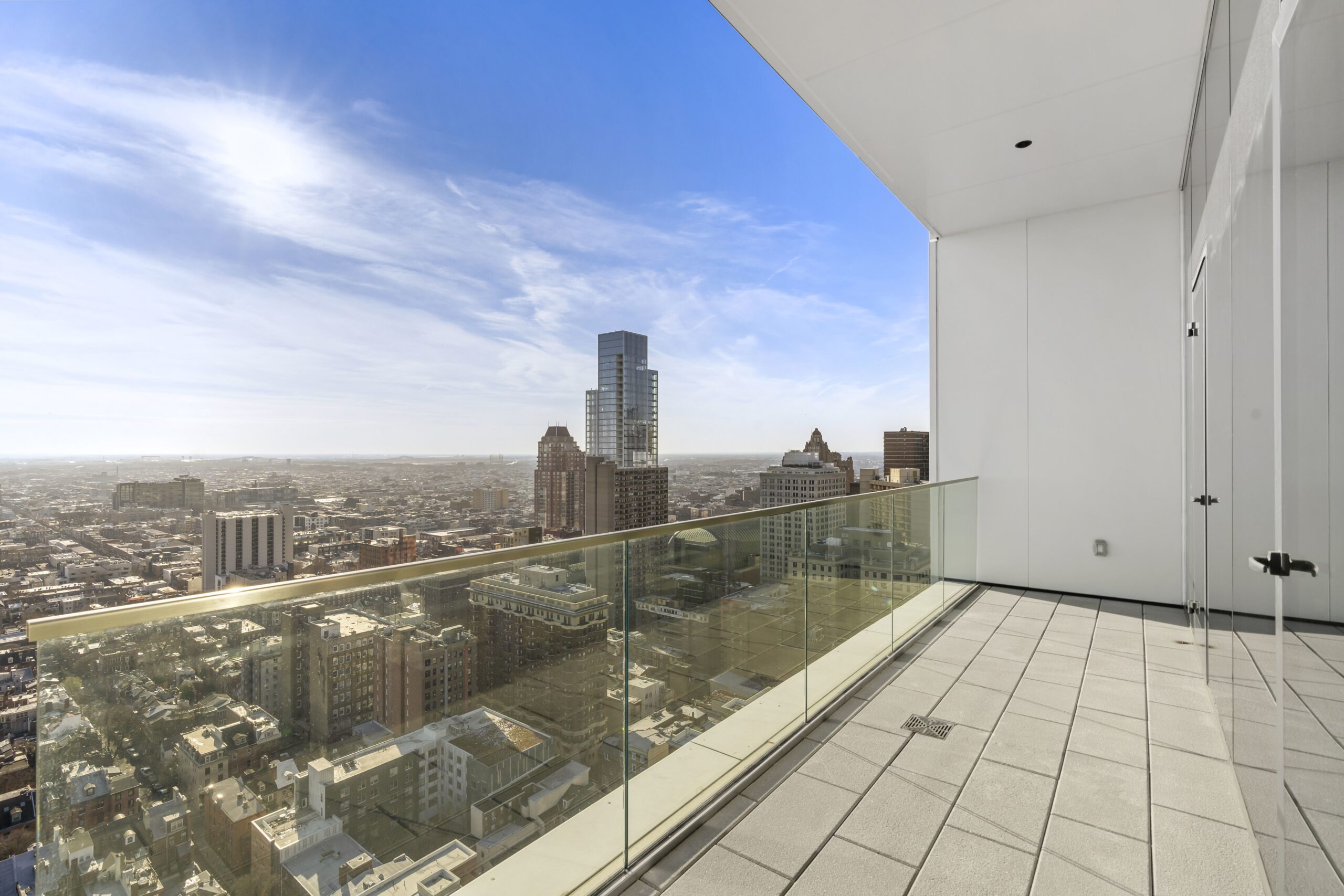
Penthouses for rent have at least one balcony and floor-to-ceiling windows that offer lots of natural light and panoramic views.
“You are literally looking at the Philadelphia skyline from the best view possible,” said listing agent Justyna Goldman with SERHANT.
Tenants can see the City Hall tower from this penthouse at the Center City apartment building.
The Philadelphia metropolitan area has had a growing number of very wealthy renters in recent years. For people who like the renting lifestyle or “if someone wants to live their best life but is only staying for a short time” in Philadelphia, the penthouses at 210 S. 12th could be for them, Goldman said.
“We offer an incredible space and incredible square footage for the price,” she said. “We are looking to make someone a very happy renter.”
Goldman said the building could be attractive to athletes, entrepreneurs, and people working in the medical field, since hospitals are nearby. The building’s Center City location means “you’re surrounded by everything you could possibly need,” she said.
The nine penthouses at 210 S. 12th are on the 30th and 31st floors and all have at least one balcony.
The penthouses include walk-in closets and spacious living areas and kitchens.
Parking spaces are available in an automated underground parking garage with electric vehicle chargers.
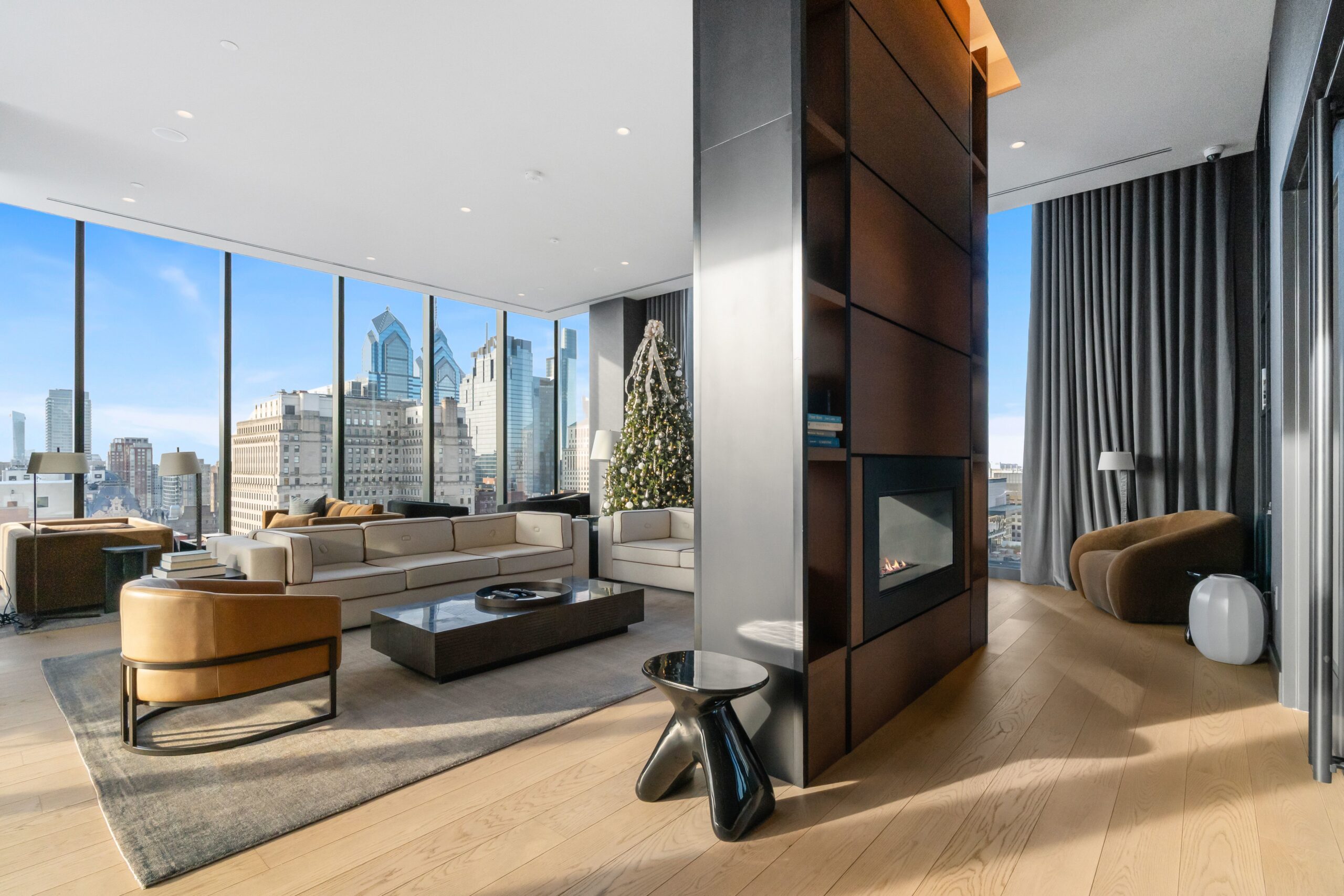
An amenity lounge on the 30th floor of 210 South 12th includes a fireplace and floor-to-ceiling windows with Philadelphia skyline views.
Tenants have access to amenities such as an outdoor pool, a fitness center, yoga and wellness studios, a game room, lounges and co-working spaces, outdoor terraces, a pet spa, and a dog park.
The tower includes studios and one- and two-bedroom apartments. Studios start at $1,968, one-bedroom dens start at $2,300, one-bedroom units start at $2,411, and two-bedroom units start at $3,809.
The building’s website is currently advertising rent deals. The property is offering 2½ to 3 months free for leases longer than a year.
Salon Republic, which offers salon suites for rent, is operating in one of the tower’s retail spaces and more retailers are expected to be announced soon.
The views make the penthouses at 210 S. 12th special, said listing agent Justyna Goldman with SERHANT.
In 1985, when Chris and Cynthia Swayze found a three-story colonial on 32 acres of farmland in Central Bucks County, they knew they were facing a challenge. The house, built in the late 1700s, was in disrepair. They also had no farming experience.
But they saw the home’s potential.
“We felt it was a diamond in the rough,” said Chris, a retired engineer.
The home’s prior owner, who had lived there for 40 years, had died. The Swayzes bought the house from her nephew, who shared her history.
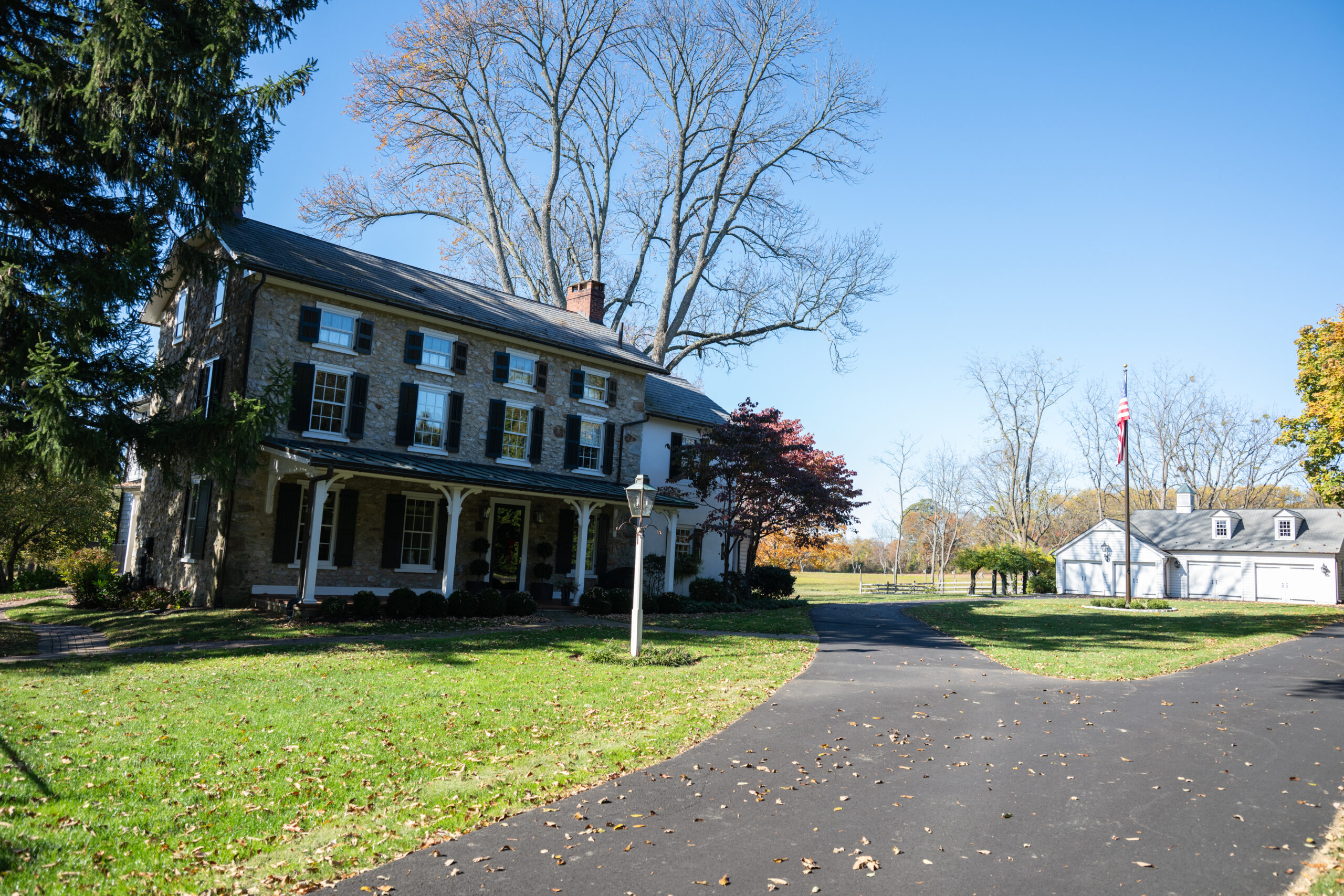
The front of the Swayze home and the garage. The house was built in the late 1700s.
“She had one of the original Sylvan pools, and the neighborhood kids learned how to swim in it,” Chris said.
She raised miniature collies on the property and the yard was littered with the remains of chain-link kennels. The collies also left their mark on the floors.
The windows, original to the house, had no screens, and the basement had a pile of coal left over from before the furnace was converted from coal to oil.
The Swayzes immediately got to work cleaning the overgrown property. They removed plaster that had been set over the home’s exterior fieldstones — in vogue in the 1700s. They refinished all the floors, painted, installed air-conditioning, and fixed the pool.
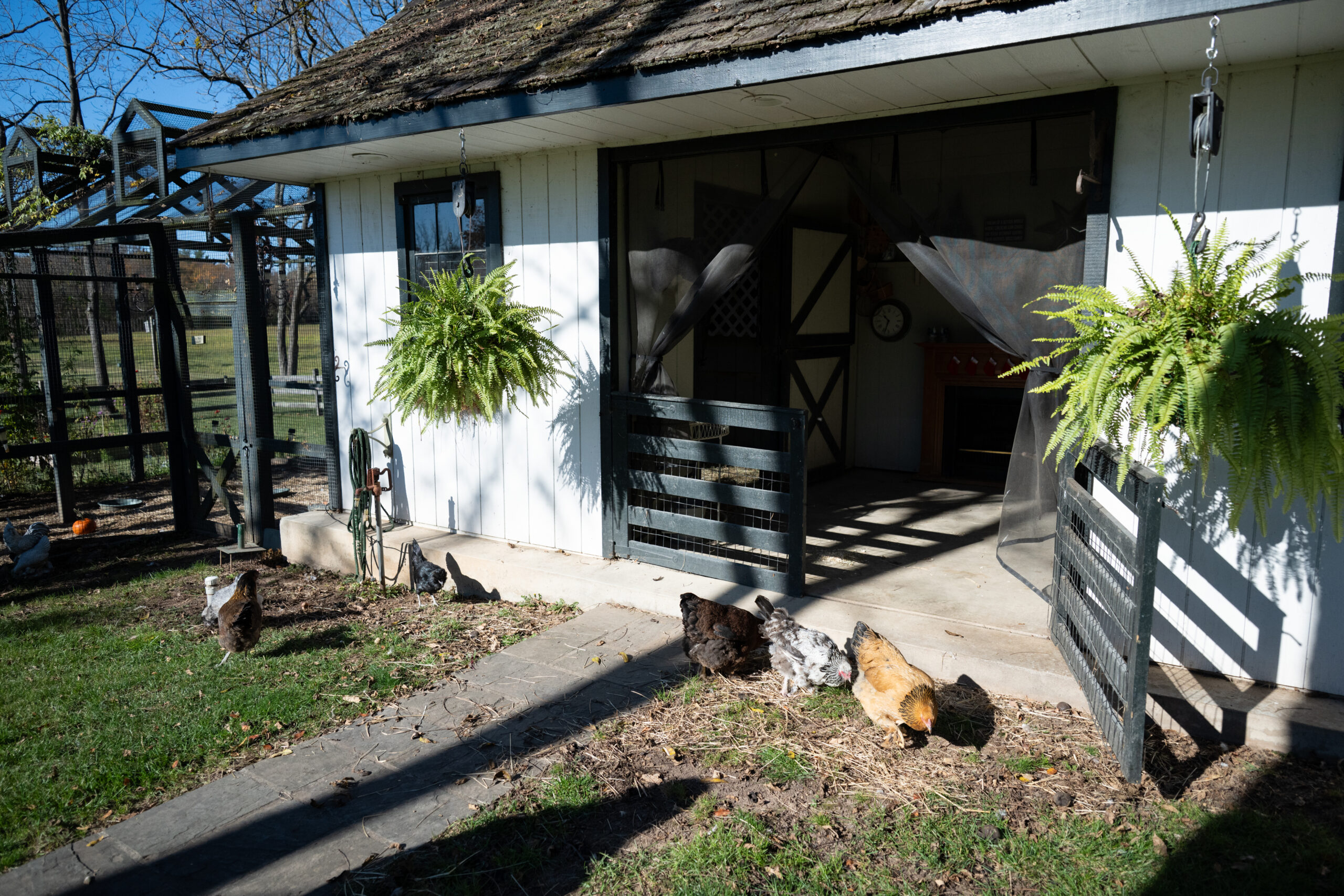
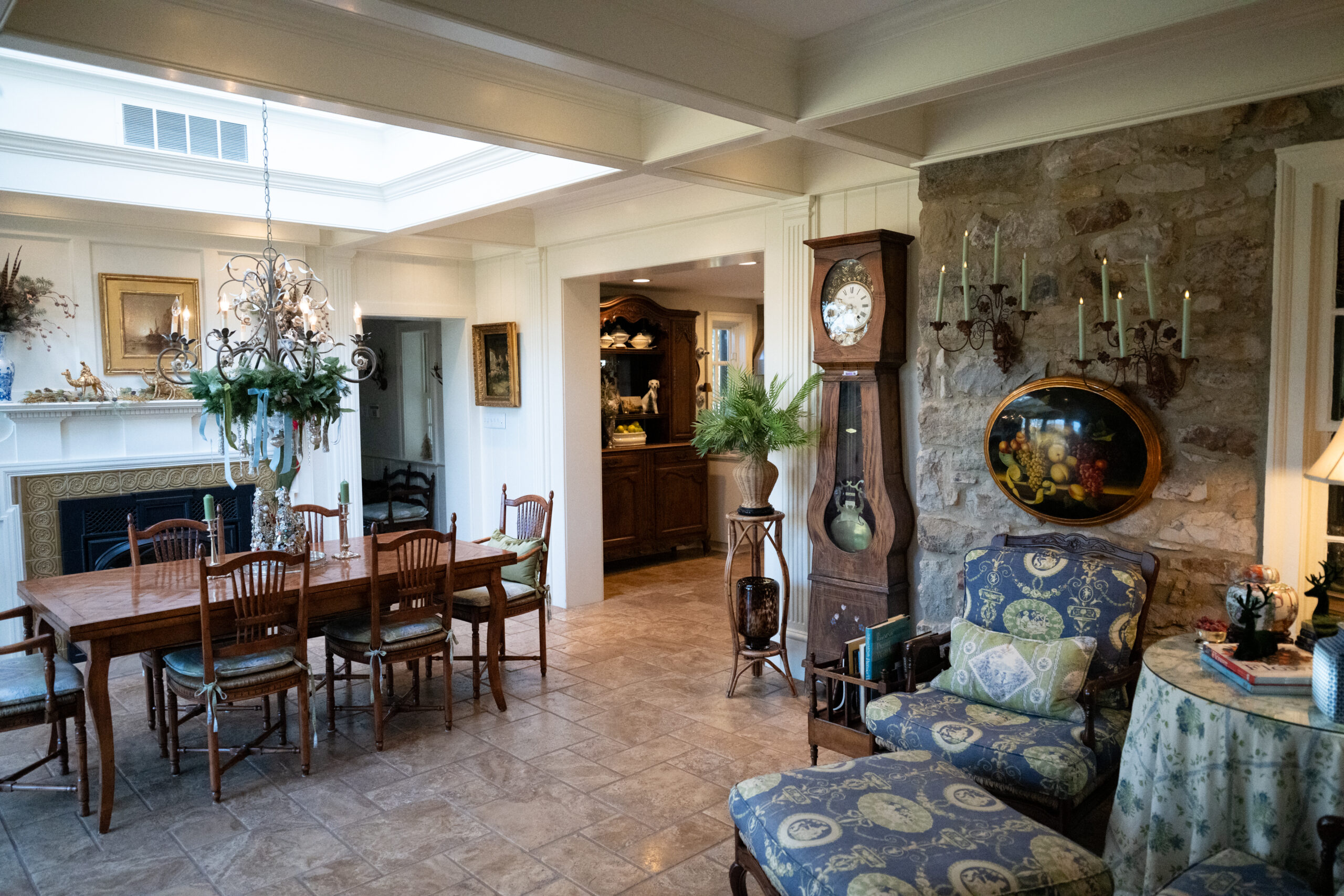
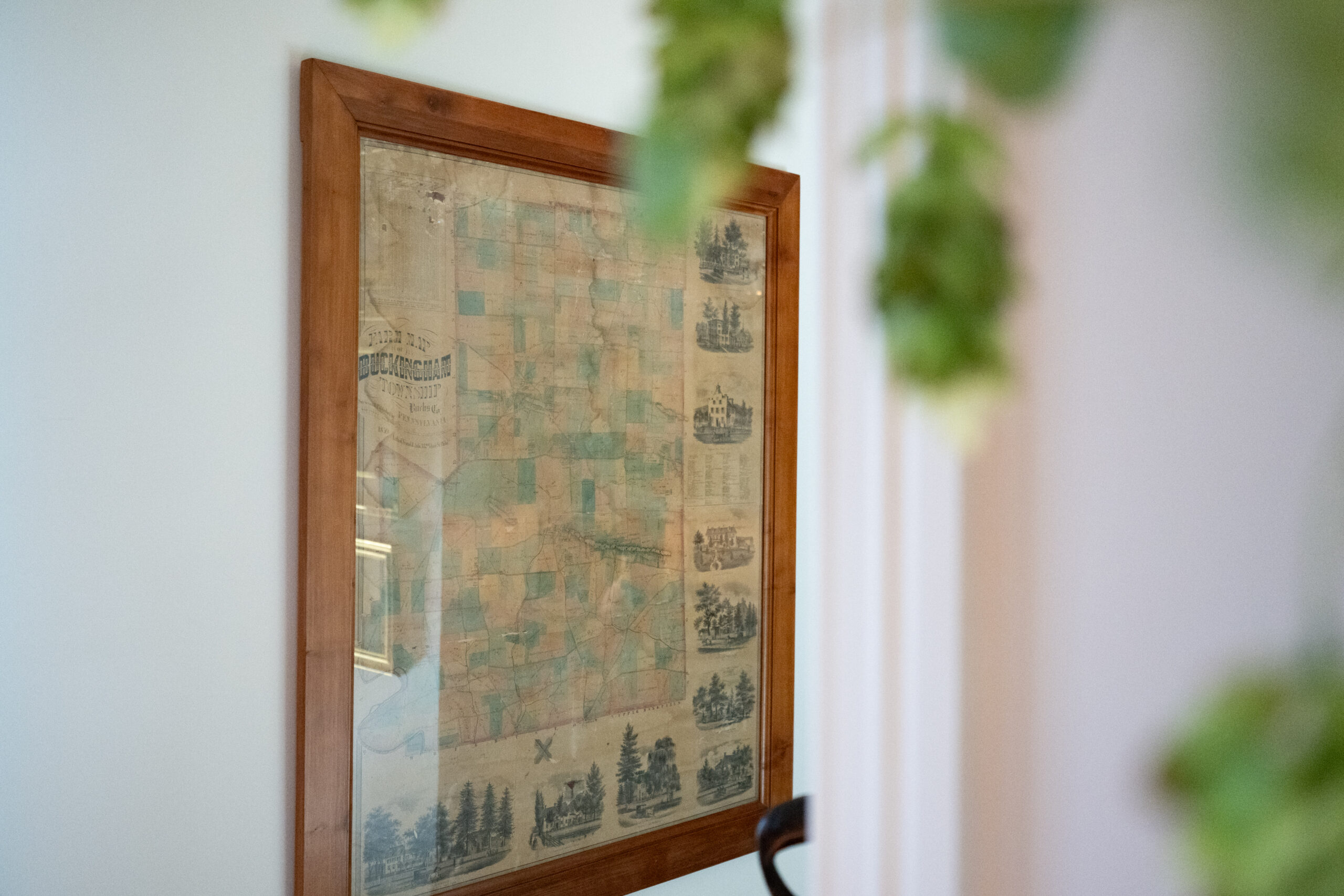
The chicken coop in the backyard.The house is surrounded by 32 acres of land.The dining room and sitting area, with details and decor that evoke the home’s history.A framed map of Philadelphia the Swayzes found when making a home repair.
With no experience in farming, they partnered with a local farmer. Initially he planted corn and soybeans in two back fields. Today they grow hay in those fields. Seven chickens keep them supplied with fresh eggs.
Over the decades, the couple made structural changes, including an addition to the back of the house and a kitchen expansion. Those projects increased the home’s size from roughly 3,000 square feet to about 6,500 square feet, including five bedrooms and four bathrooms. Two of the bedrooms are en suite and include sitting rooms.
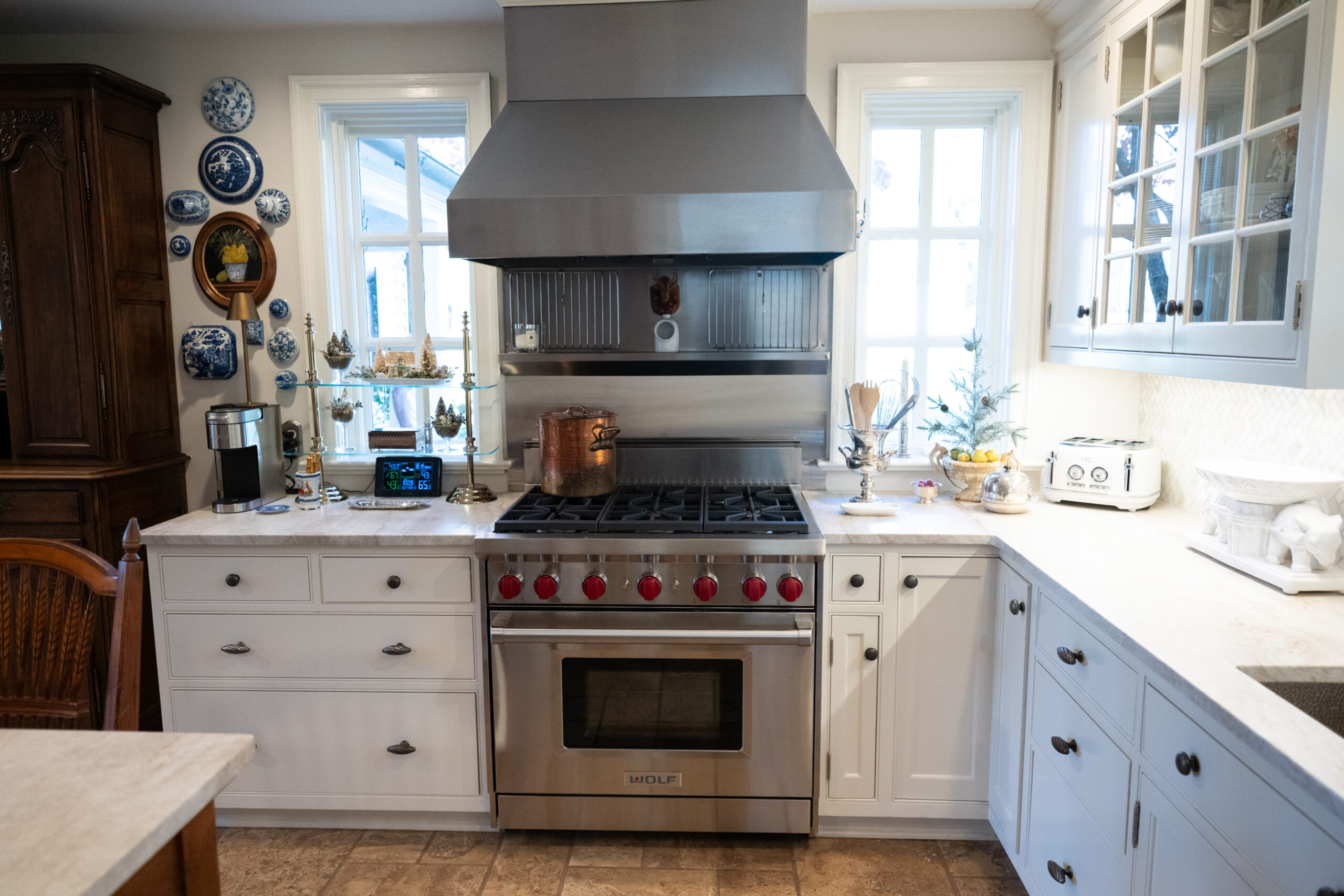
The kitchen, which had been a tiny room with a freestanding stove, free-standing refrigerator, and a couple of cabinets with a sink base, saw the greatest transformation. During two separate renovations, they moved a staircase that connected the kitchen to the basement, took down a wall, and broke through an existing kennel to expand the space.
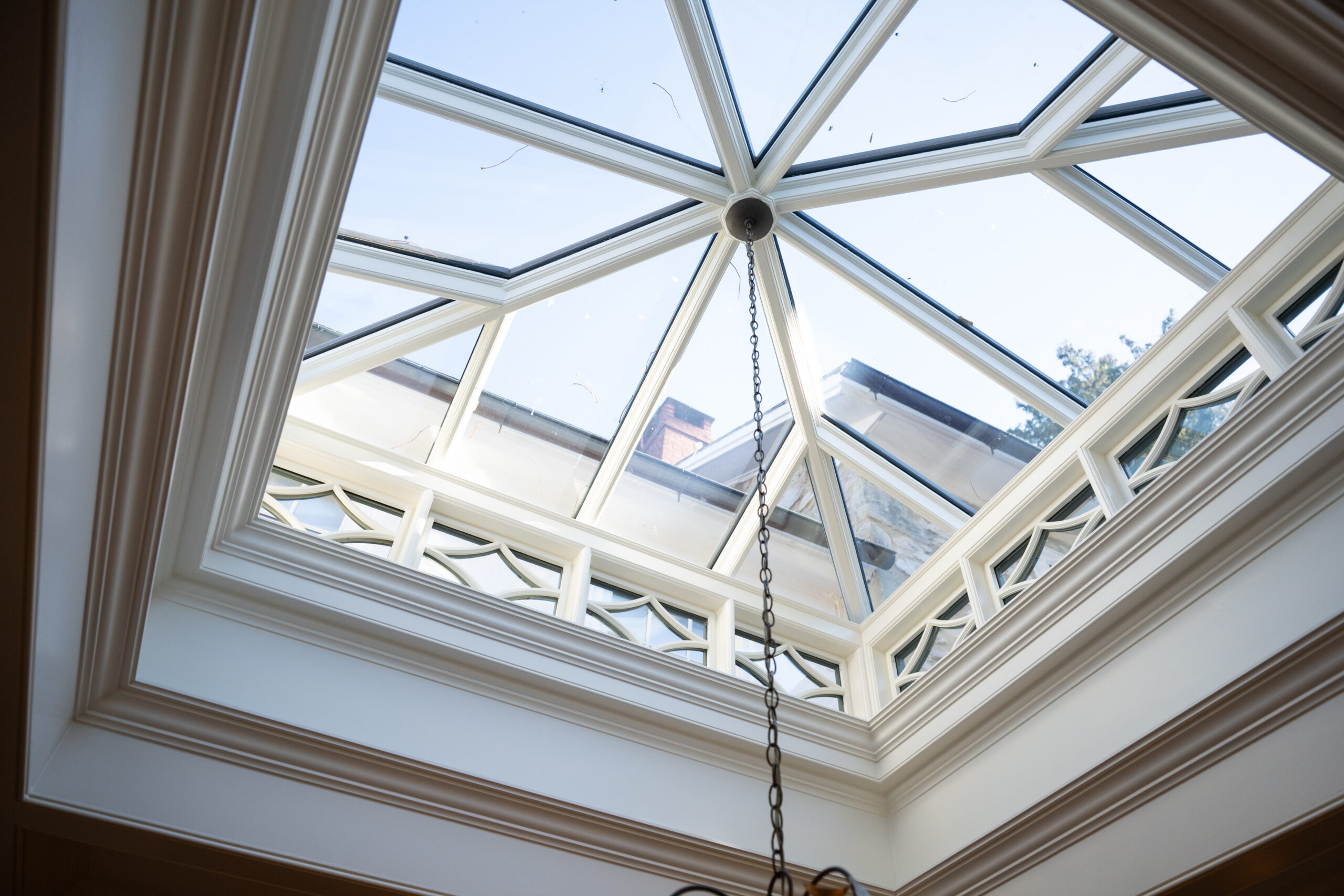
They added cabinets and counters, a peninsula, built-in appliances including a Sub-Zero refrigerator, and a professional range hood. Beyond the kitchen they created a new entrance, vestibule, and pantry. The expansive kitchen also includes a fireplace and a conservatory-style glass roof that they call the “party hat.”
Chris and Cynthia Swayze made significant changes to their kitchen, enlarging it and adding modern appliances.The conservatory-style glass roof above the dining area.
“We have heat lights under the range hood that keeps food warm,” said Cynthia. “It’s the one thing I can’t live without.”
During a separate renovation, an addition was put on the back of the house with a primary bedroom suite, family room, and finished basement.
Their daughter, Rebecca Nolan, co-owner of Home Tonic in Newtown, designed the interior in a traditional style. The home is filled with ornate chandeliers, intricate woodwork, and walls awash in rich colors as well as bold, colorful, patterned wallpapers.
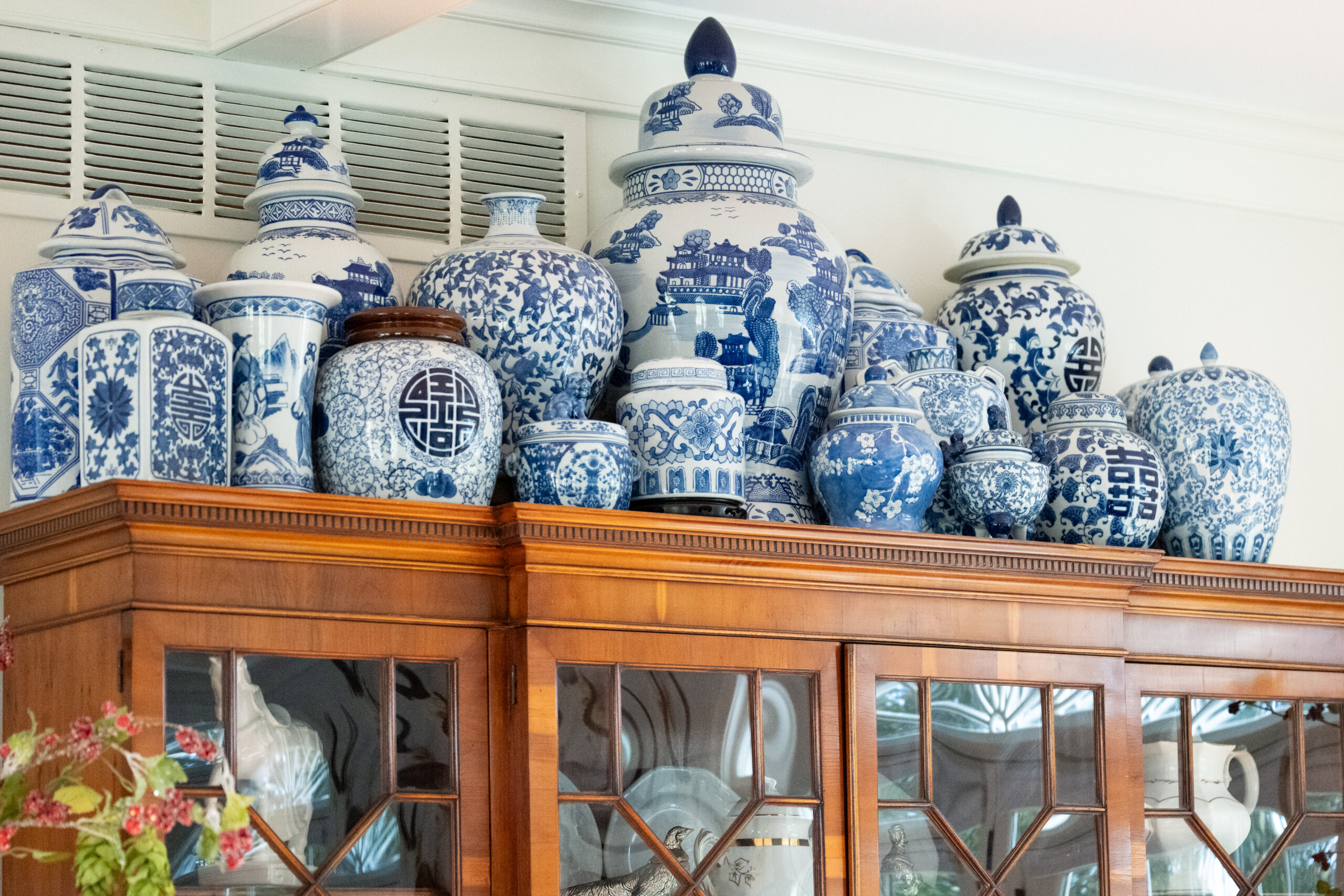
The puzzle room, where grandson Luke also enjoys playing chess.Assorted porcelain jars on top of a cabinet in the family room.
One of Cynthia’s favorite rooms is the guest room, painted in a deep chocolate brown, with a custom canopy over the bed.
“I wanted it to feel really cozy, like when you got into that bed you were surrounded by a big hug,” she said.
The puzzle room is where Cynthia and her grandson Luke, 8, hang out. In addition to working puzzles, he’s teaching her how to play chess.
A framed map of Philadelphia on linen, dated 1809, hangs in the basement. They found it in the garage attic when repairing a leak, and were amazed that it had survived.
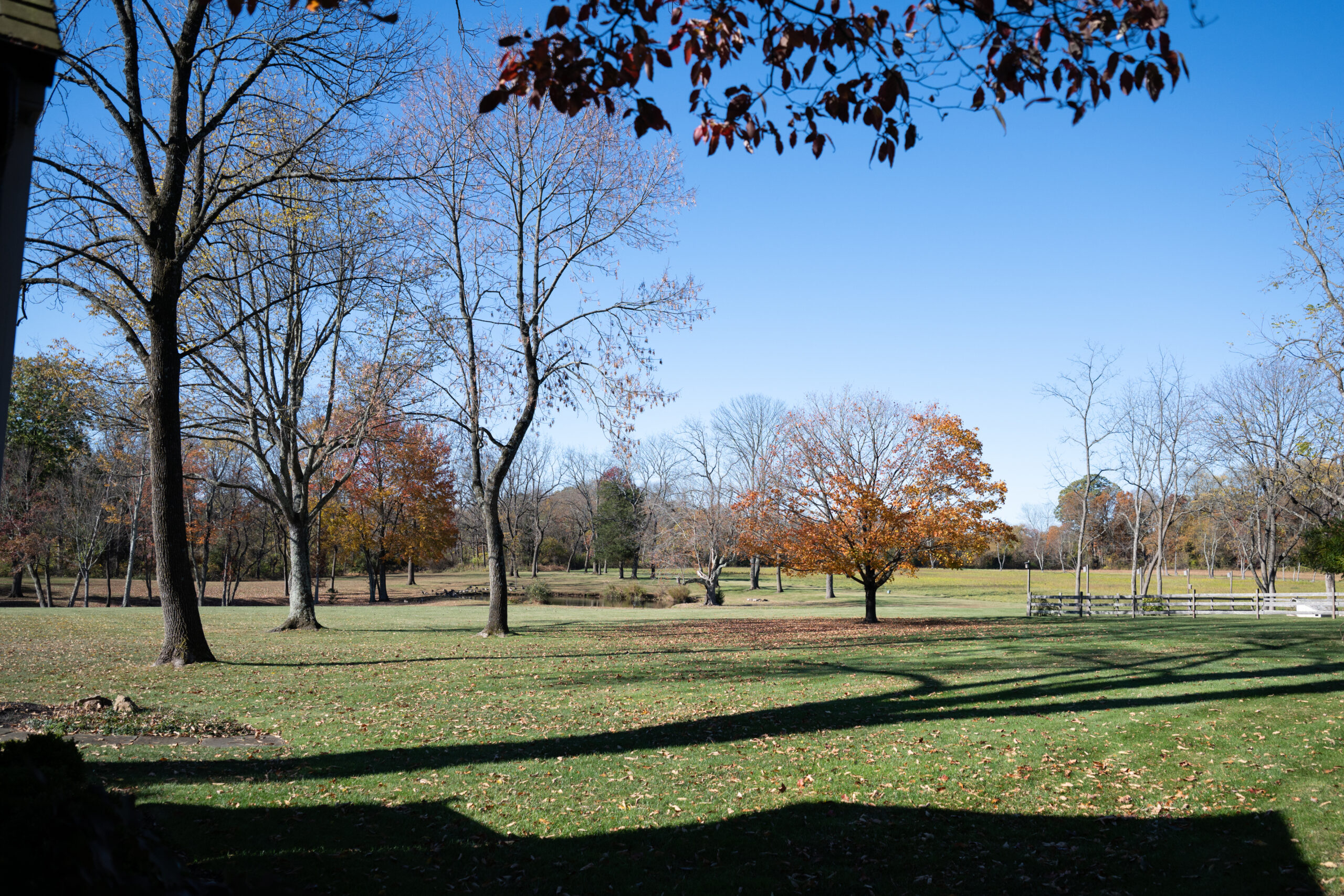
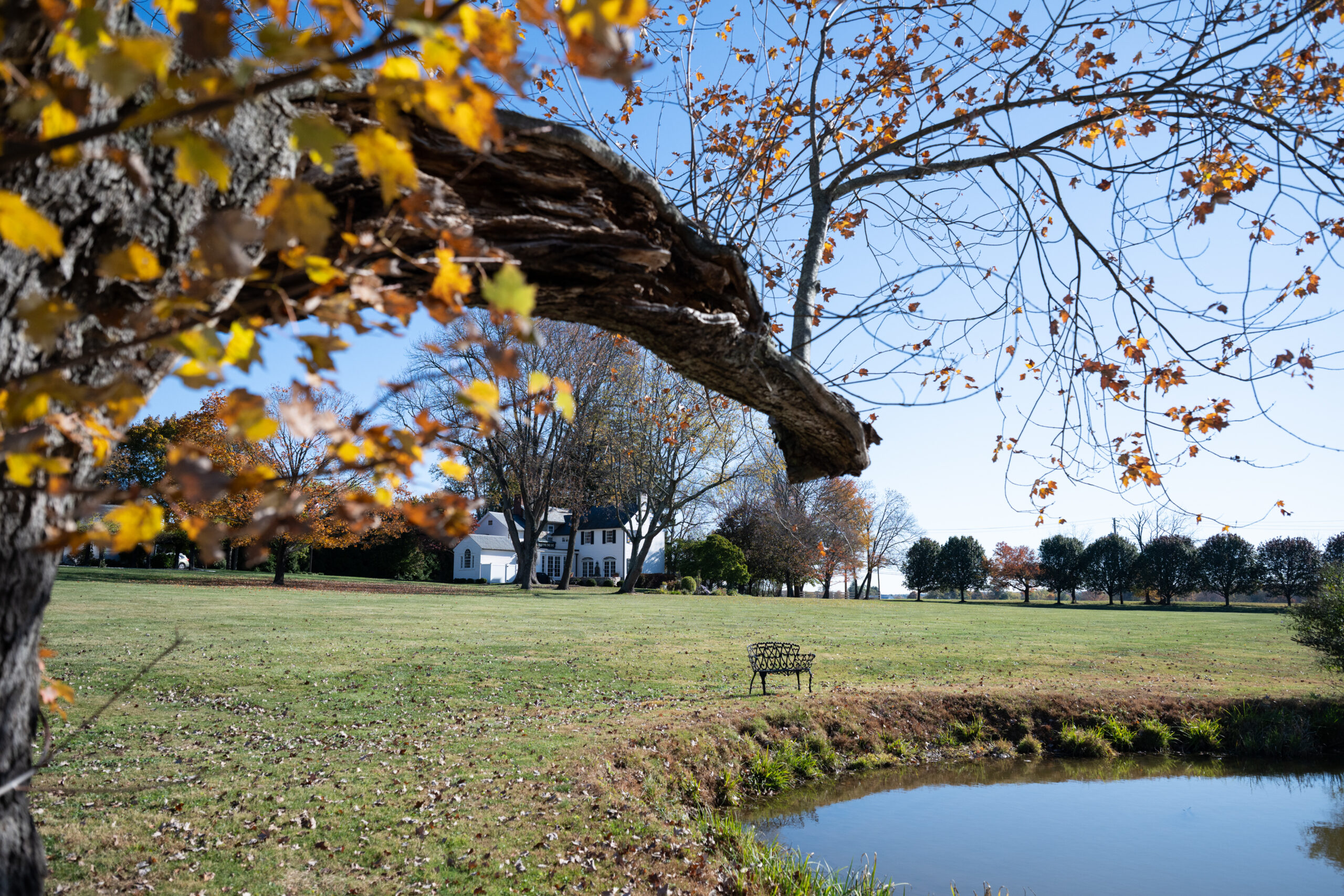
A pond and many tall trees are on the property.
The home’s expansive grounds offer a breathtaking view from the patio, accessible from the kitchen’s French doors. The peaceful vista includes sights of the swimming pool, pond, chicken coop, fields, and lots of open space. Chris especially appreciates the gigantic ash tree they’ve been treating for ash bore.
“From the circumference we’ve determined it’s over 200 years old,” said Chris. “We appreciate the history that Central Bucks County has to offer.”
Is your house a Haven? Nominate your home by email (and send some digital photographs) at properties@inquirer.com.