From the department of weirdly random, gratuitously hurtful actor observations about the world, Timothée Chalamet has informed us that opera and ballet are passé:
“I don’t want to be working in ballet, or opera, or things where it’s like, ‘Hey, keep this thing alive, even though, like, no one cares about this anymore.’ All respect to all the ballet and opera people out there.”
After suggesting that both art forms were wanting for support during a talk with actor Matthew McConaughey at a Variety and CNN town hall in University of Texas at Austin, the American and French actor joked: “I just lost 14 cents in viewership. I just took shots for no reason.”
Chalamet then mimicked an opera singer, the event video shows.
Opera and ballet figures all over have seized on his comments, and Philadelphia — where both opera and ballet fill the hall regularly — would like to have a word with the 30-year-old actor.
BalletX dancers Ashley Simpson, Itzkan Barbosa, Minori Sakita, and Lanie Jackson (back) in Amy Hall Garner’s “Petrushka.”
“I am a huge Timothée Chalamet fan, and I was shocked,” said Christine Cox, artistic and executive director of BalletX. “It was so dismissive and hurtful of entire industries. I see generations of people coming to this art form. We shouldn’t be putting each other down, we should be lifting each other up.”
BalletX’s spring run of seven performances this month are nearly sold out, Cox pointed out.
Philadelphia Ballet chief executive officer Shelly Power said that “Mr. Chalamet is obviously living outside the majority of the ballet world and out of touch. If his comments were true, why are our ticket sales and attendance numbers hitting all-time highs? We saw 10,000 more patrons from 2024 to 2025 in The Nutcracker alone.”
Its subscriber base, Power said, has returned to pre-pandemic numbers.
This season, most Opera Philadelphia performances have sold out or sold close to capacity. General director and president Anthony Roth Costanzo said that “in terms of whether I agree that no one cares about it, no, obviously I don’t agree with that as someone who cares about it a lot.”
But Costanzo says he prefers to focus on the underlying question of how to get even more people to care about both opera and film.
Anthony Roth Costanzo (right), countertenor, and Leah Hawkins (left), soprano, perform during ‘Home for the Holidays’, a concert part of Opera Philadelphia’s ‘Pipe Up!’ series at The Wanamaker Building’s Grand Court on Tuesday, Dec. 2, 2025.
“Timothée was talking about making film as relevant as it can be, and in that context, he said that he didn’t want to work in something that wasn’t relevant, to try and make it more relevant, and that’s what I’m doing. So in a way I feel allied. He’s just saying that he doesn’t want to do it in a medium that’s more difficult, so I guess he’s a little bit more of a wimp than I am.”
BalletX’s Cox said that Chalamet’s comments were surprising coming from someone whose mother, Nicole Flender, was a Broadway dancer, and someone who attended a performing arts high school. Chalamet attended New York City’s Fiorello H. LaGuardia High School of Music & Art and Performing Arts.
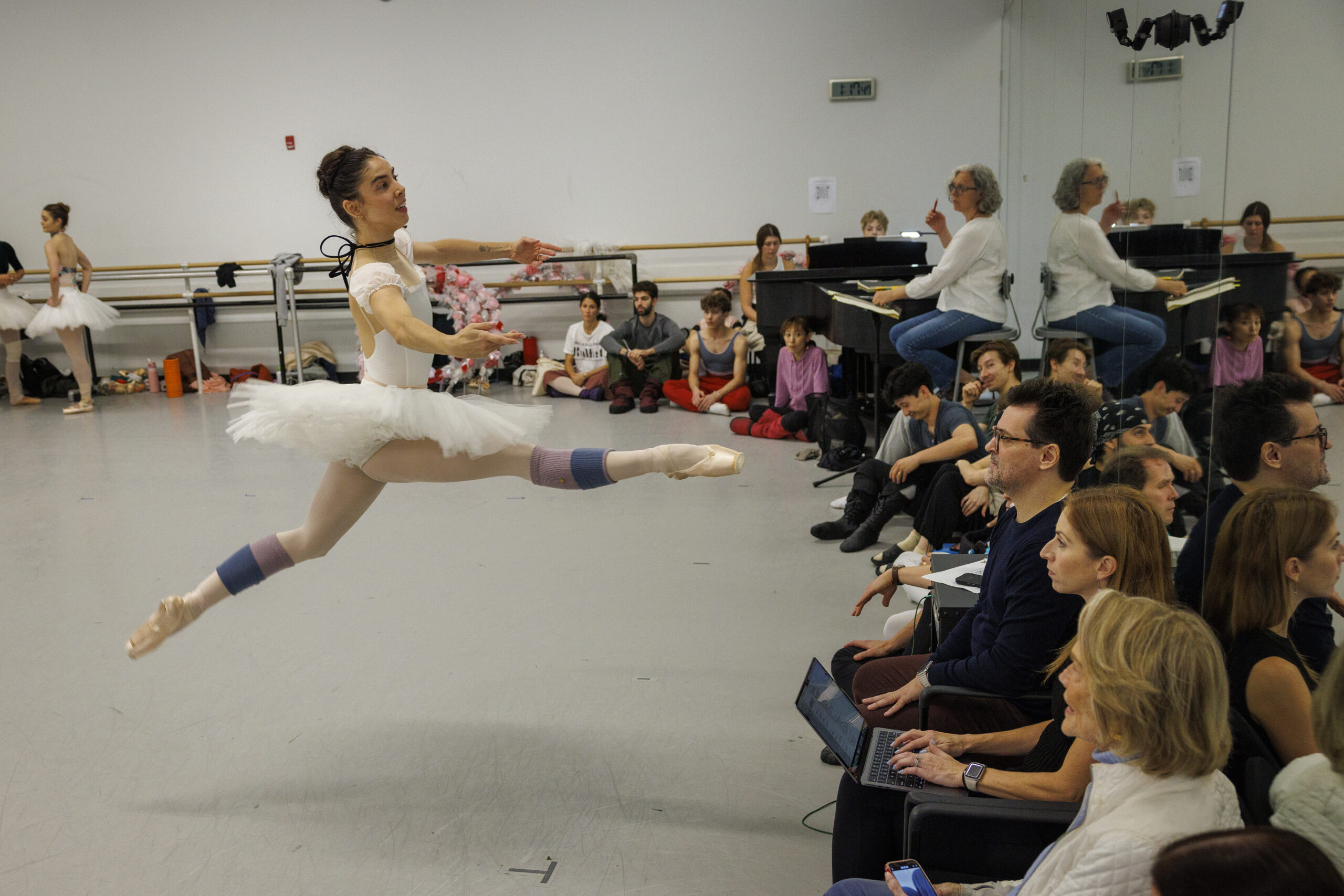
At left is Dayesi Torriente, playing Gulnare leaps in front of Angel Corella, artistic director, Philadelphia Ballet during rehearsal for “Le Corsaire” at the Philadelphia Ballet, Wood Street, Philadelphia, Wednesday, October 2, 2024.
“I bet you he’s going to be at a ballet soon, because he’s going to have to fix this,” Cox said.
As for Chalamet mimicking an opera singer during his talk with McConaughey, Costanzo has an idea.
“I invite him to star in an opera whenever he wants. Because after he said that, I saw some contrition as he tried to then sing an operatic note. And I thought, ‘Okay, there’s some promise there.’ So if he wants voice lessons, I’m available.”
Think you know your news? There’s only one way to find out. Welcome back to our weekly News Quiz — a quick way to see if your reading habits are sinking in and to put your local news knowledge to the test.
Question 1 of 10
It’s back! ABC’s Abbott Elementary, Quinta Brunson’s mockumentary featuring a fictional West Philly school, has been renewed again. How many seasons will that make?
CorrectIncorrect. XX% of other readers got this question right.
School will be in session for a sixth year at Abbott. ABC announced the renewal on the same day the show debuted its fifth season.
Question 2 of 10
Sixers center Andre Drummond announced a new partnership with this athletic wear company, as an investor and creative director:
CorrectIncorrect. XX% of other readers got this question right.
Drummond announced this week he was joining Stria Sports, a Chicago-based sneaker and apparel brand. Stria Sports is also the official performance shoe for the Harlem Globetrotters’ 100th season. For Drummond, the opportunity to be hands-on in the process of creating signature shoes and building up the brand was a key part of joining the company.
story continues after advertisement
Question 3 of 10
The owner of this Philly-rooted company said his product is “recession resistant” in an interview with The Inquirer this week. What is he selling?
CorrectIncorrect. XX% of other readers got this question right.
George Ball, 74, who owns Burpee Seeds, sold packets of his produce seeds at the Flower Show this week. Burpee has been rooted in the Philadelphia area since its founding by W. Atlee Burpee in 1876. Now, more than a century later, having once teetered on the brink, it’s again thriving and positioned for the future with seed, plant, and product sales in big box stores and online.
Question 4 of 10
Chef Nana Araba Wilmot’s career has taken her everywhere from top-tier French restaurants in New York City to dinner parties in Accra, Ghana. Now, the Cherry Hill-raised chef is taking her culinary skills to the TV screen. She’ll be in the latest season of this culinary show:
CorrectIncorrect. XX% of other readers got this question right.
Wilmot will compete on the 23rd season of Top Chef. She’s the owner of a private catering company and Love That I Knead, a traveling supper club grounded in Ghanaian cuisine. Her love for cooking was forged in her childhood home in Cherry Hill, where her parents and grandmother brought the flavors of their native Ghana into the house, and in kitchens in Philadelphia and New York City, where she learned the craft of restaurant cooking.
Question 5 of 10
Delaware native Aubrey Plaza is working on a new series for Prime about:
CorrectIncorrect. XX% of other readers got this question right.
Kevin, a comedy written and executive produced by Plaza, will follow a cat named Kevin who leaves his humans after their unexpected breakup and moves into a pet rescue in Astoria, Queens. He joins a “chaotic band of misfit animals,” who help him figure out what he “truly wants out of life,” according to the series logline.
Subscribe to The Philadelphia Inquirer
Our reporting is directly supported by reader subscriptions. If you want more journalism like this story, please subscribe today.
Philadelphians ran to social media Wednesday morning to report that the Benjamin Franklin Parkway’s iconic country flags were gone. What happened to them?
CorrectIncorrect. XX% of other readers got this question right.
Manna Bakery — a farmers market favorite for its Levantine and Palestinian baked goods — is due to open by early April. It will take over the former spot of this bakery:
CorrectIncorrect. XX% of other readers got this question right.
Saif Manna, who started baking treats out of his Temple dorm, is taking over Essen Bakery’s shuttered Kensington location. Manna acquired Essen’s equipment and said he only needs to do light work on the space.
Question 8 of 10
Fishtown resident Niall Paredes posts flyers across town with fun facts about this topic:
CorrectIncorrect. XX% of other readers got this question right.
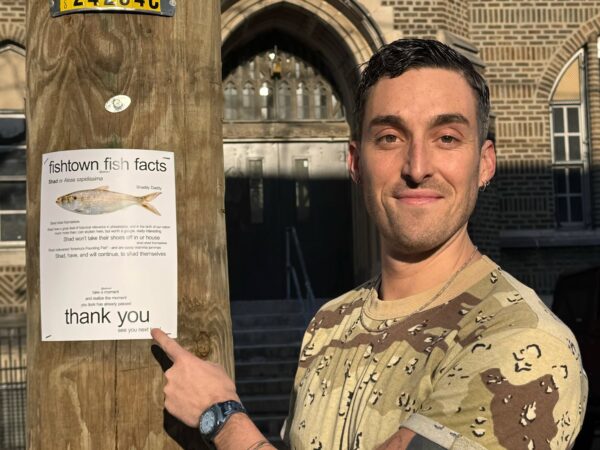
Fishtown fish facts, this series of more than a hundred posters across the area, was never an endeavor to turn a profit or rally support for a cause like some similar lamppost literature. It was just a modest attempt to make his neighbors smile, said 32-year-old Paredes, the brain behind the piscine production.
Question 9 of 10
Longtime Fox 29 sports director Tom Sredenschek retired last week after 40 years at the station. He was first hired by former sports talker:
CorrectIncorrect. XX% of other readers got this question right.
Howard Eskin, best known for his decades at 94.1 WIP, was hired by Channel 29 (as it was known in the pre-Fox days) in 1986 to launch their 10 p.m. newscast. Eskin hired Sredenschek to be his first producer.
Question 10 of 10
Metropolitan Bakery — one of the city’s foundational bread bakeries — is closing its Rittenhouse shop’s doors. But the bread will live on. The business has sold to Pete Merzbacher of Merzbacher’s. What item is Merzbacher’s best known for?
CorrectIncorrect. XX% of other readers got this question right.
The Philly muffin, a squared-off English muffin made with toasted cornmeal, is Merzbacher's flagship product.
Your Results
You have skipped .
You scored XX out of 10.
The average reader scored XX out of 10
Seems like you’ve been skimming more than reading there, buddy. There’s always next week.
You’ve read some articles (or made some educated guesses) but we wouldn’t come to you first for our local news recaps. Better luck next week!
Do you work here? You’re a local news stan with the latest updates on Philly happenings. Your friends definitely ask you for summaries on what’s going on and it shows.
On a chilly February morning, Mallory Valvano walked up two flights of stairs to a second-floor atrium filled with exotic plants leading her to a salon suite. The baker behind Party Girl Bake Club found herself back inside the Fishtown building to see Alex Furst, also known as Pepper Holidays on Instagram.
But Valvano wasn’t in the neighborhood to deliver one of her whimsical, eye-catching cakes or catering displays. She was there on an equally important task: a manicure.
Valvano is one of many Philly culinary professionals who see their nails as an extension of their brand personality as well as a self-care treat — despite the taboo of chefs cooking with polished nails. (ServSafe, the food and alcohol safety-training and certification organization, discourages the use of nail polish and/or extensions and highly recommends cooking with gloves.)
Valvano is ServSafe-certified, which means she knows the impact of food safety really well. She also believes that shouldn’t stop her from expressing herself — especially when the products Furst uses ensure chip-free, perfectly intact nails for up to four weeks.
“I’m an artist, by trade, in textile manufacturing and design — the food thing came a little later in life,” she said. “So, [getting your nails done] is about, one, taking care of how you look and being presentable. It’s also an extension of your own personal style. I like to have this whole vision of what a party girl is: neon and pastels, colors inspired by art, architecture, and interior design.”
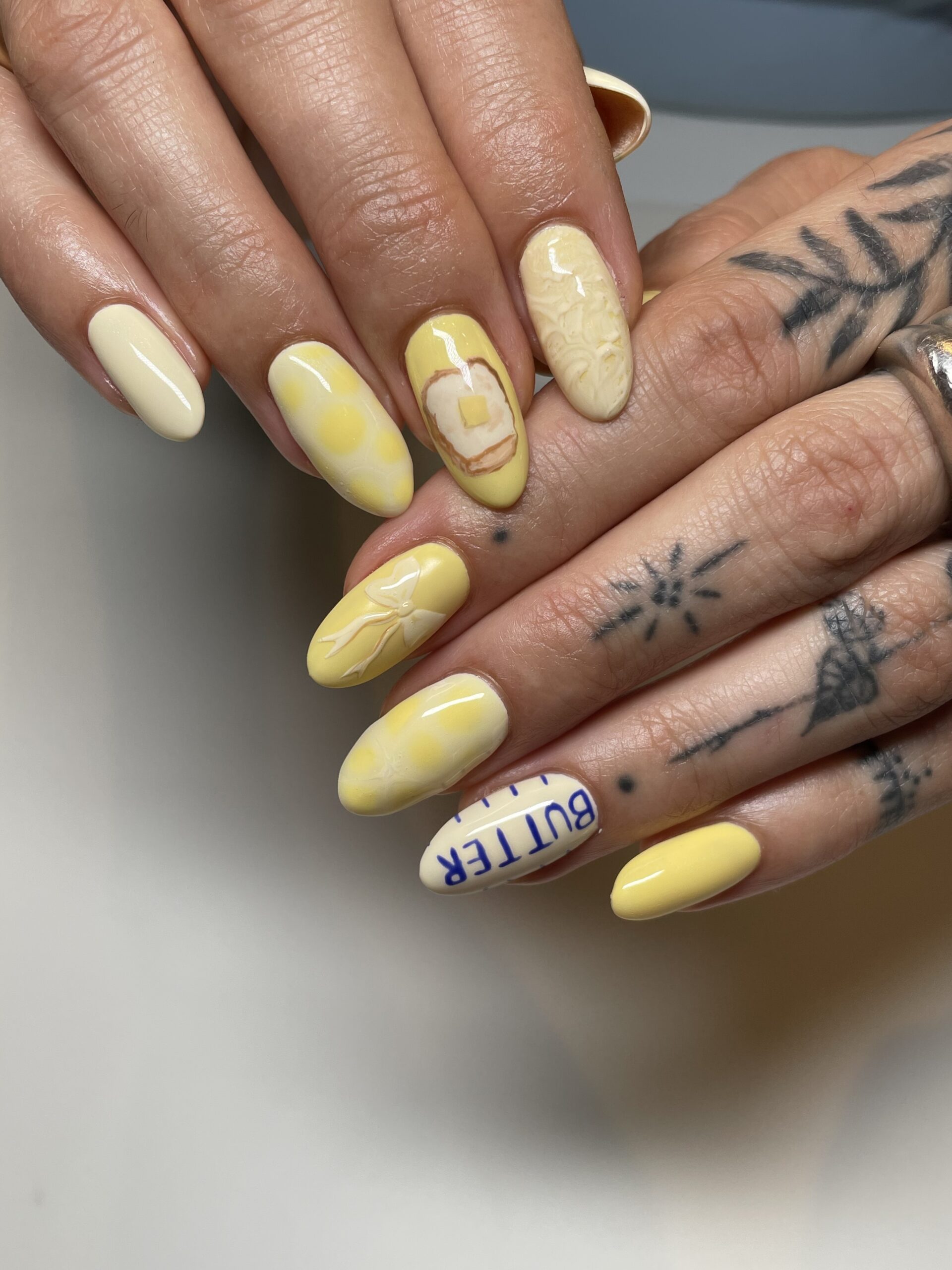
Mallory Valvano with butter-themed nails.
The key to nails that food professionals aren’t worried about working with? Regular sessions with a nail artist who emphasizes prep and uses gel builder, a thick-viscosity, strengthening product that creates a protective, hard shield with LED/UV light. And Furst is the woman to do the job for Valvano and Natalia Lepore Hagan of Midnight Pasta.
The 37-year-old nail artist is in her eighth year as a licensed nail technician. With two chef clients and a few nurse clients under her belt, Furst understands working on labor-intensive nails that exist in industries where unpainted nails are the norm.
“My philosophy for everyone is that the foundation is the most important thing — the prep or the way the product is applied, if that’s missing then you’re not going to have a long-lasting, strong manicure,” Furst said. “Gel body builder is strong enough that it allows the nails to maintain and support its structure so that they’re not going to be chipping or lifting in a three to four week time frame.”
What does a long-lasting manicure entail?
Each session begins with Furst removing old product and chatting with the client about what their month is looking like to determine length of nail. Then it’s prep: shaping and smoothing nails, pushing back the cuticles , and exfoliating, removing any sticky cuticle from the nail plate, and lightly etching the new nail growth.
“Our body naturally produces oil, so that prep is to ensure getting the gel completely adhered to the nail plate,” she said. “No one wants the gel to lift — when it lifts, it damages the nail. So, prep is important.”
Design comes next. Both Valvano and Lepore Hagan love to experiment with colors and incorporate their brands into the nail designs.
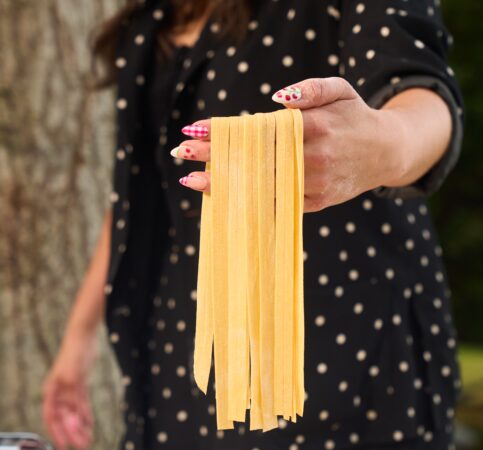
Natalia Lepore Hagan of Midnight Pasta and her nails.
Furst has drawn buttered toast designs for Valvano inspired by an all-butter event and tomatoes for Lepore Hagan inspired by an Italian picnic-themed event.
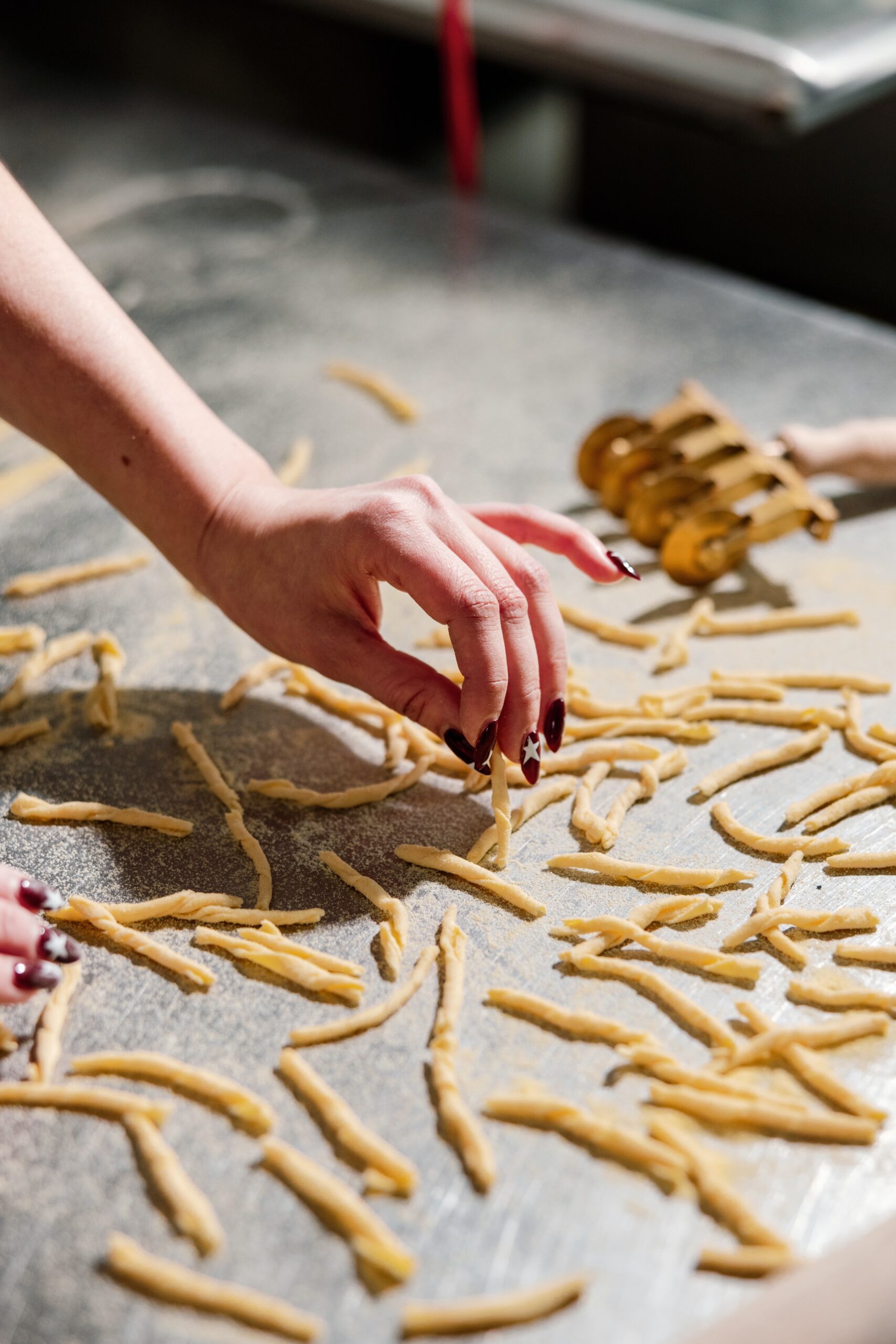
“I brought her an idea, and she sketched out all 10 nails in front of me,” Lepore Hagan said. “She said, ‘Let’s do tomatoes on this finger. We’ll do the checkers on your middle finger. And another with stripes.’ I love artists more than anything, and it’s so cool to collaborate with her on my nails.”
Gloves stay on while cooking, and nails come out for hosting. “Mallory and I are both really fashion-forward,” she said. “We care a lot about fashion. I am always looking at what she’s wearing and her nails because she’s a representation of her brand.”
But the pasta chef draws the line at gel extensions or acrylic nail tips, opting for only gel builder polish on her natural nails to ensure no attachments fall off when working.
“I want to be professional, and part of that professionalism is having my nails always done perfectly and interestingly,” Lepore Hagan said.
Jillian Moore’s nails with with My Loup’s Montreal cocktail.
Behind the bar with acrylics
Jillian Moore, however, is an acrylic nail queen.
She’s behind the bar at My Loup and Pine Street Grill, where customers will catch her perfectly pointed, brightly colored nails around spoons and cocktail shakers. As bar director at the two hot spots, she’s using her hands differently then chefs Valvano and Lepore Hagan, allowing her to opt for long acrylics decorated with gel polish every two weeks at her nail appointment with @nailsbylinny.
Expressing oneself through nails is similar to wearing makeup to work, Moore said, as long as food safety rules are followed. And following the ServSafe rules isn’t hard with nails, she said. “You still have to make sure your fingernails are clean [and put on gloves for prep work], regardless if you have extensions or not,” she said. “So that’s how I’ve always operated.”
For Moore, getting her nails done is way to share her personality, whether it’s with a specific color or theme — or repping the restaurants she works at. Every year for My Loup’s anniversary, she gets the color of the tiles at the bar with a little “ML” script on top. And when Pine Street opened, her nails were covered in little acorns.
“People are watching my hands all the time — it’s definitely something that people notice [and] we end up talking about it,” Moore said. “It’s just a fun way to express myself, [and] why I like it so much.”
“I make this joke all the time — I say, there are three people that you should never piss off: your bartender, your hairdresser, and your nail tech,” she added. “Maintain those relationships.”
If you’ve ventured out for a stroll in Fishtown in recent months you may have observed what looks like a page torn out of an oceanography textbook tacked to a lamppost or electrical pole.
It probably features a clinical-looking photo of a fish, that species’ Latin nomenclature, and a short blurb about the slithering sea dweller.
However, upon closer inspection, you’ll find these posters are only marginally educational.
“Striped Bass or Morone saxatilis,” one poster reads, above an image of an open-mouthed, beady-eyed, gray-and-white fish with translucent fins. “Slappadabass mon! Striped Bass live in Philadelphia water slurp slurp. Striped Bass born in saltwater, but live in fresh water. Stripe Bass lay 3,000,000 eggs. not in this economy!!!”
Disclaimer: Don’t rely on the facts in these posters to ace your next marine biology test. They’re not always accurate. Striped bass actually live in saltwater and spawn in freshwater typically, not the reverse.
Fishtown fish facts, this series of more than a hundred posters across the area, was never an endeavor to turn a profit or rally support for a cause like some similar lamppost literature. It was just a modest attempt to make his neighbors smile, said 32-year-old Niall Paredes, the brain behind the piscine production.
The posters contribute to a rich history of both professional and unsanctioned public art across the city. Mural Arts Philadelphia has facilitated more than 4,000 works of public art since its 1984 founding as an anti-graffiti network, while artists and amateurs alike have taken to the streets to plaster their own ephemeral works across Philadelphia.
Paredes, a native Philadelphian, got the idea for the series about a year ago after moving to Fishtown. As a creative, both professionally producing TV commercials and recreationally working with photo and video, he saw artistic potential in the telephone polls around his new neighborhood.
They were covered in flyers. Some asked for help. Some asked for attention. Some asked for money.
None simply asked for a laugh.
“I just kind of was inspired and started playing around with some funky fish,” he said.
Because, you know, Fishtown.
Since then, Paredes estimates he’s created hundreds of Fishtown fish facts posters highlighting dozens of species of fish.
His write-ups are infused with his own unique brand of humor. The descriptions read like a Mad Libs of Gen Z slang with some 2000s texting lingo sprinkled in the mix.
He punctuates each poster with the same tagline — “take a moment and realize the moment you took has already passed.”
The sentiment is intended to encourage the reader to stop, reflect, and “keep pushing” wherever they’re at in life, Paredes said.
Along the way, Paredes, whose only real relationship with marine biology is through surfing, has boned up on his knowledge of aquatic vertebrates.
Shad are quickly angling their way to the top of his ranking of most interesting fish, he said. That’s partly due to a legend that asserts that shad saved George Washington’s troops from starvation in 1778 at Valley Forge during the Revolutionary War.
“When Jeopardy! hits fish, I’m ready to roll,” Paredes said.
As far as the future of Fishtown fish facts go, Paredes said pedestrians can expect to be enlightened on many more species soon. And he’s planning to expand his fish facts to other neighborhoods; he’s already sprinkled some in Manayunk, Center City, and South Philly.
“I’m definitely going to be working on it for a bit,” he said. “I mean, there’s a lot of fish in the ocean.”
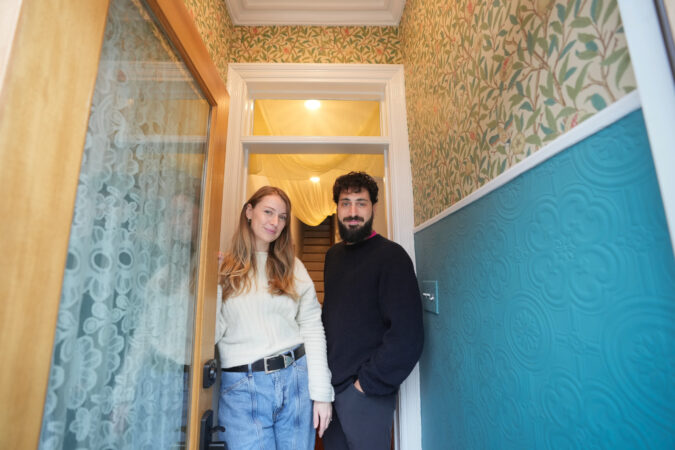
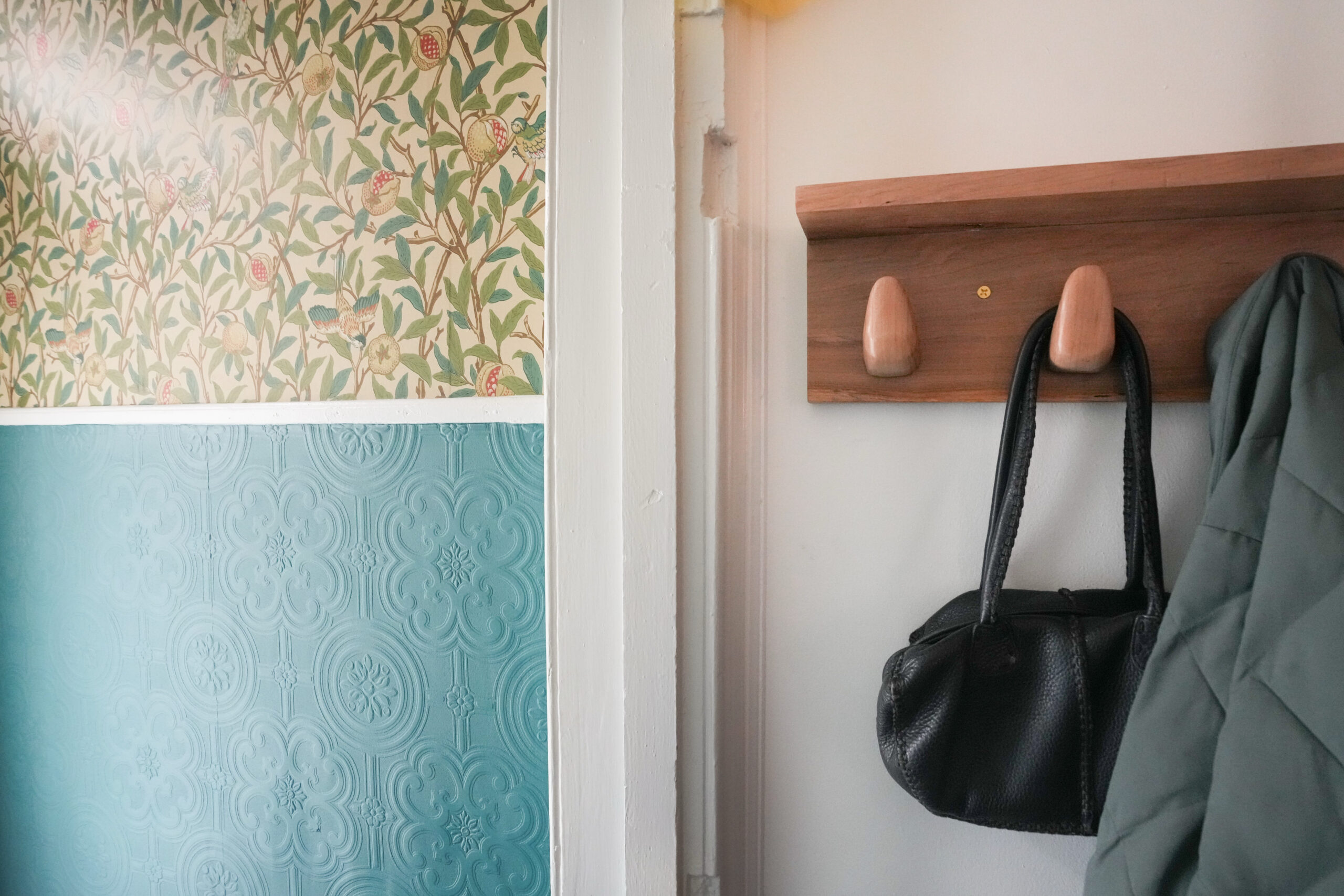
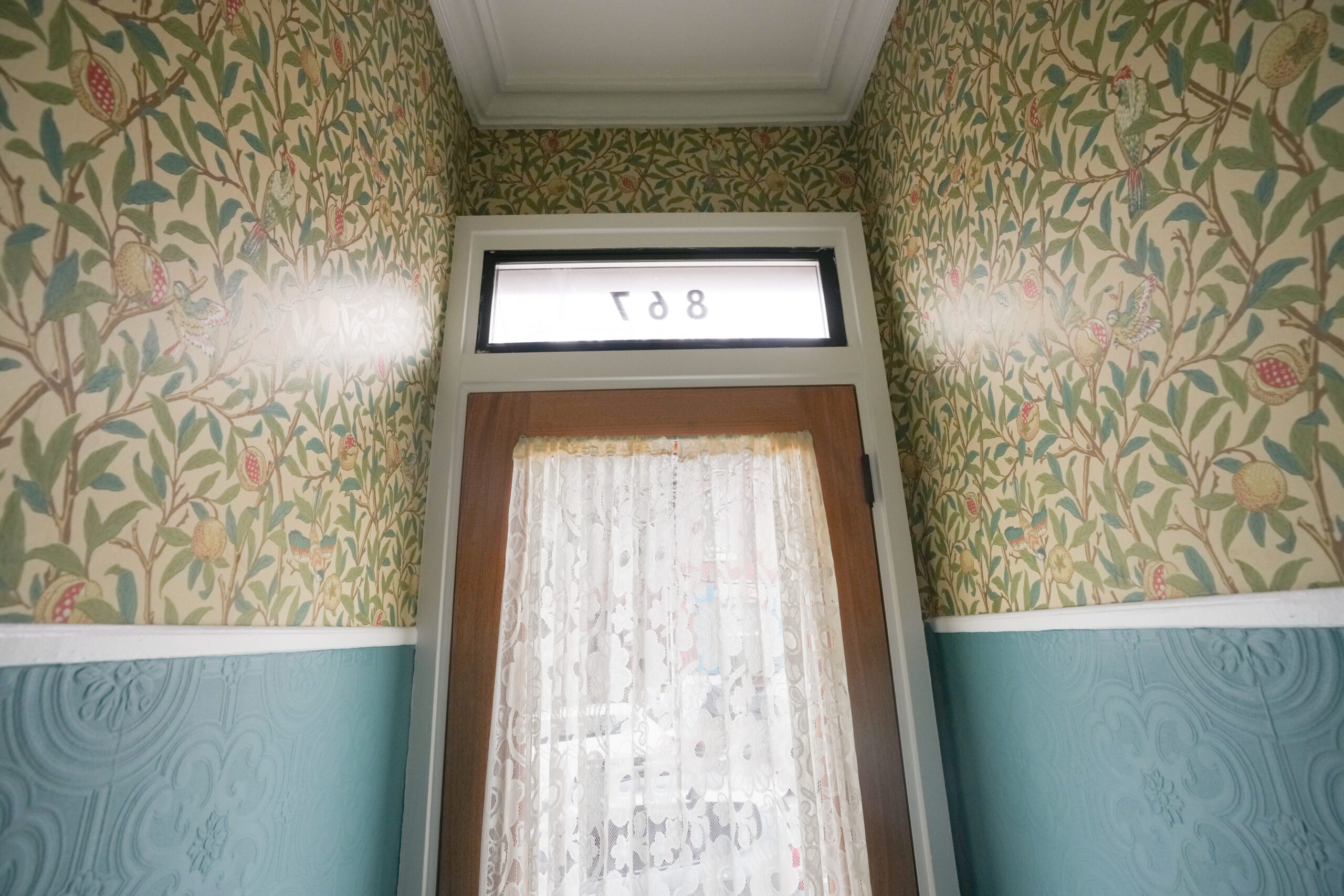
When decorating their circa-1920 townhouse, Eli Steiker-Ginzberg and Sarah Schrading wanted their vestibule to represent the home’s history. They chose a classic William Morris wallpaper called Bird and Pomegranate for above the chair rail and a textured Anaglypta paper painted in Benjamin Moore Baltic Sea below.
“Colonial Wallcoverings had so many options it was overwhelming,” recalled Steiker-Ginzberg, who lives in the Fairmount area. “The leaves and birds and colors of this one really jumped out.”
The William Morris paper was a splurge, so to stay on budget, they matched it with a less expensive paintable wallpaper. In total they spent about $2,000 on the materials and installation “for the smallest room in my house,” he joked.
Wallpaper is showing up in unique ways and in new places. Bold patterns on the ceiling, colorful oversized florals on an accent wall, custom murals in the living room, and funky patterns in the closet and mudroom that add pizzazz and make a statement.
The wallpapered vestibule in Eli Steiker-Ginzberg and Sarah Schrading’s home leads to a painted wall on the home’s first floor.
More homeowners are embracing bold wall coverings, according to the 2026 U.S. Houzz Fall Design Trends Report. The shift reflects a move toward deeply personal designs, with homeowners opting for vivid, expressive details that make their spaces feel unique and emotionally resonant, the report found.
“Wallpaper has character and brings out the life and beauty of a room,” said Paul Sperling, owner of Colonial Wallcoverings in Queen Village. “It shows off your personality.”
Modern wallpapers are also easier to hang and strip than older versions, with paste-the-wall and self-adhesive DIY options.
“A lot of people are afraid of wallpaper because it used to be a nightmare to take off,” Sperling said. “But most wallpapers now are easier to remove because of changes in how the papers are printed.”
Making a statement
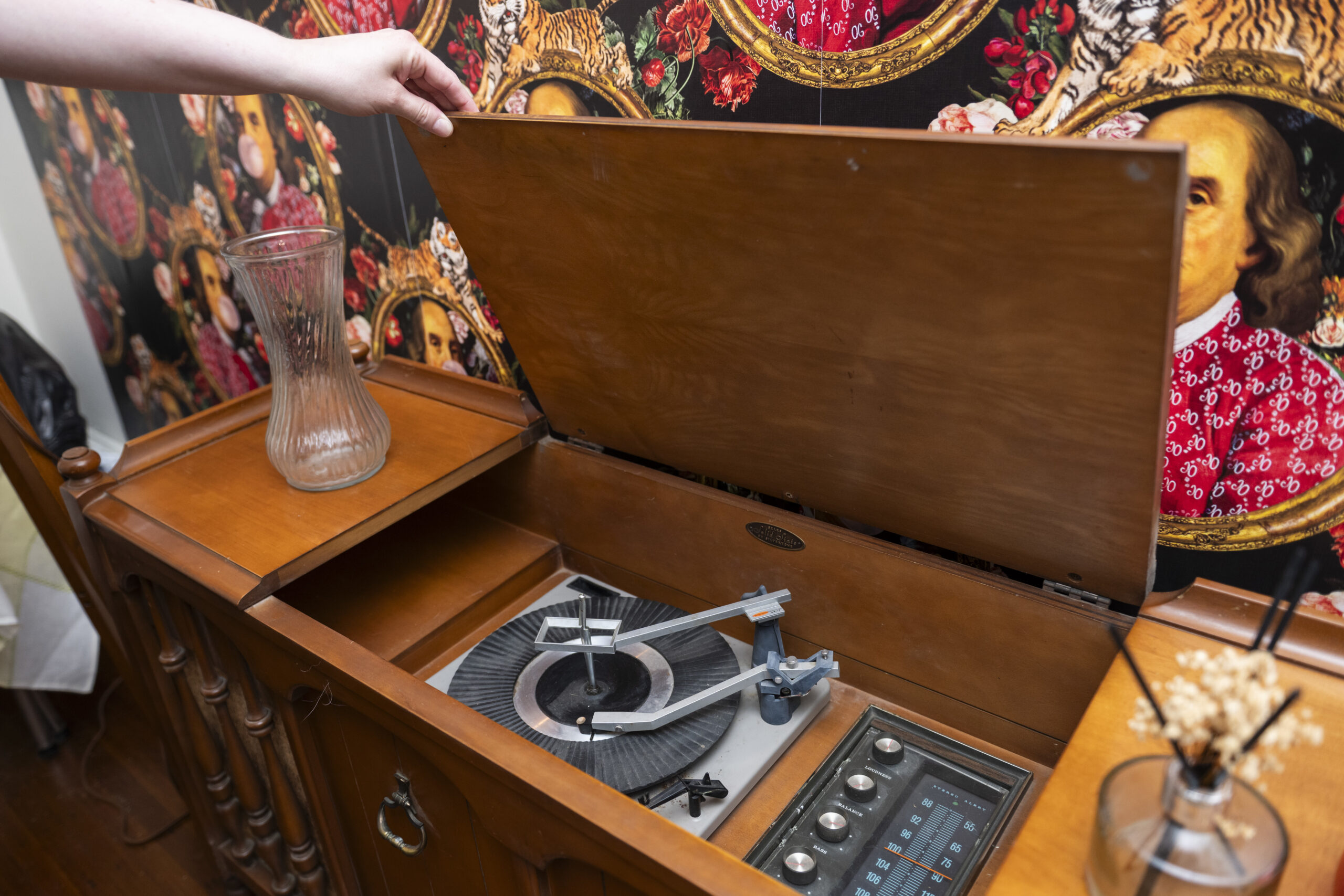
When Jessica Maiuro moved into her Rittenhouse apartment in 2024, she wanted a wow factor as soon as she came through the front door. After a couple months of searching, she discovered a bold patterned wallpaper featuring Ben Franklin within a gilded picture frame blowing a bubble gum bubble, surrounded by a tiger and flowers.
“I wanted something that would really make a bold statement and be a conversation starter when I hosted,” she recalled. “I had never seen any design like this, and I was instantly sold and in love. What could be more Philly?”
Jessica Maiuro was delighted to find this Benjamin Franklin wallpaper for her home in Center City.
Maiuro spent about $500 on the peel-and-stick wallpaper from the online seller Spoonflower and corralled her husband, John Jeong, and a friend to help her hang it. Her apartment is a rental, but she tested the paper and knows it will easily strip off when it’s time to take it down.
When investing in wallpaper, consider where and how it will make the most impact. Wallpapers with small, repeating patterns work best in a smaller space, such as a powder room or vestibule.
For larger spaces, wallpaper murals can serve as a focal point on the wall behind the bed or sofa, or continuing across several walls. They often feature grand designs or landscapes, including big, bold flowers and jungle scenes. Murals are more popular than ever, said Sperling, with brands like Rebel Walls and Glamora that specialize in custom sizes.
For a more personal design, Rich Art Graphics in Center City will take your artwork and create a custom wallpaper to fit your dimensions.
“Most of the time, a designer or artist will come to us with a fine art interpretation to be printed and installed in homes,” said Michael Antner, the print shop’s owner. “It’s something personal that they are very passionate about.”
For example, a client may have a favorite painting or photograph they want to reimagine on an entire wall. Cityscapes and naturescapes are especially popular. Rich Art will create a digital file with the picture and manipulate it to the exact size of the wall.
They offer traditional wallpaper adhered with paste or peel-and-stick adhesive. The average cost is $8 per square foot to create the paper, plus installation.
A record player dating to the 1960s sits in Maiuro’s home under the gaze of bubble-gum-chewing Ben Franklin.
The fifth wall
The ceiling has become the fifth wall of the room, where wallpaper can make a bold statement and add a new dimension. Options include very intricate designs where viewers can spot new details to simpler patterns like clouds or green tree canopies.
“It’s much more dramatic and brings more attention to the room,” Sperling said. “It takes vision.”
Parents are even wallpapering nursery ceilings as a stimulating focal point for their babies.
“Wallpapered ceilings have been a design staple for centuries in Europe, especially in homes where pattern and ornamentation played an important role in creating atmosphere and storytelling,” said Krystal Reinhard, founder and principal designer at Old Soul Design Studio in downtown West Chester.
She’s seen a noticeable uptick in the past five years as homeowners look for more expressive, layered interiors. Papered ceilings work in smaller, contained spaces like powder rooms, nurseries, and offices. But they can also make sense on larger ceilings in bedrooms, dining rooms, and kitchens.
When papering the ceiling, it’s important to consider the scale of the pattern — motifs or tonal textures often work beautifully overhead, Reinhard said. It’s best to hire an experienced installer because ceilings require precision and strong adhesive knowledge. Before committing to a pattern, one should test how it interacts with overhead lighting — fixtures can cast shadows that change the effect.
“A wallpapered ceiling is one of the most effective ways to give a room soul,” Reinhard said. “It’s a detail that feels thoughtful and intentional.”
Especially in the Philadelphia region, where so many homes have architectural character worth celebrating, treating the ceiling as a design opportunity can elevate the entire space, she said.
It’s a way to honor historic craftsmanship while embracing a very current, expressive design moment.
Steiker-Ginzberg and Schrading chose the wallpaper in their vestibule to represent the home’s history.
How much does wallpapering cost?
Wallpaper costs vary widely, starting at about $40 per 50-square-foot roll for peel-and-stick options from online sellers such as Wayfair. Textured materials from brands like Arte or historical luxury design houses like de Gourney or Zuber can reach several hundred dollars per individual square foot, Sperling said.
Many companies provide a measuring calculator to determine exactly how much is needed for your project. It’s essential to take pattern repeat into account and add an extra 10% for mistakes and future repairs.
Most companies sell samples. It’s helpful to hang those in various spots and observe over a few days to see how the pattern looks in the light at different times of day and night.
For Steiker-Ginzberg, the wallpaper investment was worthwhile.
“There’s something important and meaningful about the portal into your house and there being an intentional transition,” he said. “It makes a difference in the impression people get.”
Bright red strawberries and orange carrot sticks on the kitchen cutting board and greenery in white sculptural vases on the white counter and black dining table add rare splashes of color to Jasmine Williams’ one-bedroom apartment.
Williams has lived in her mostly two-toned residence in Garden Court Towers, in the Garden Court neighborhood in West Philadelphia, for four years. She loves the “clean and classic” white of the apartment’s walls, chairs, rugs, ottomans, throw pillows, and other accessories.
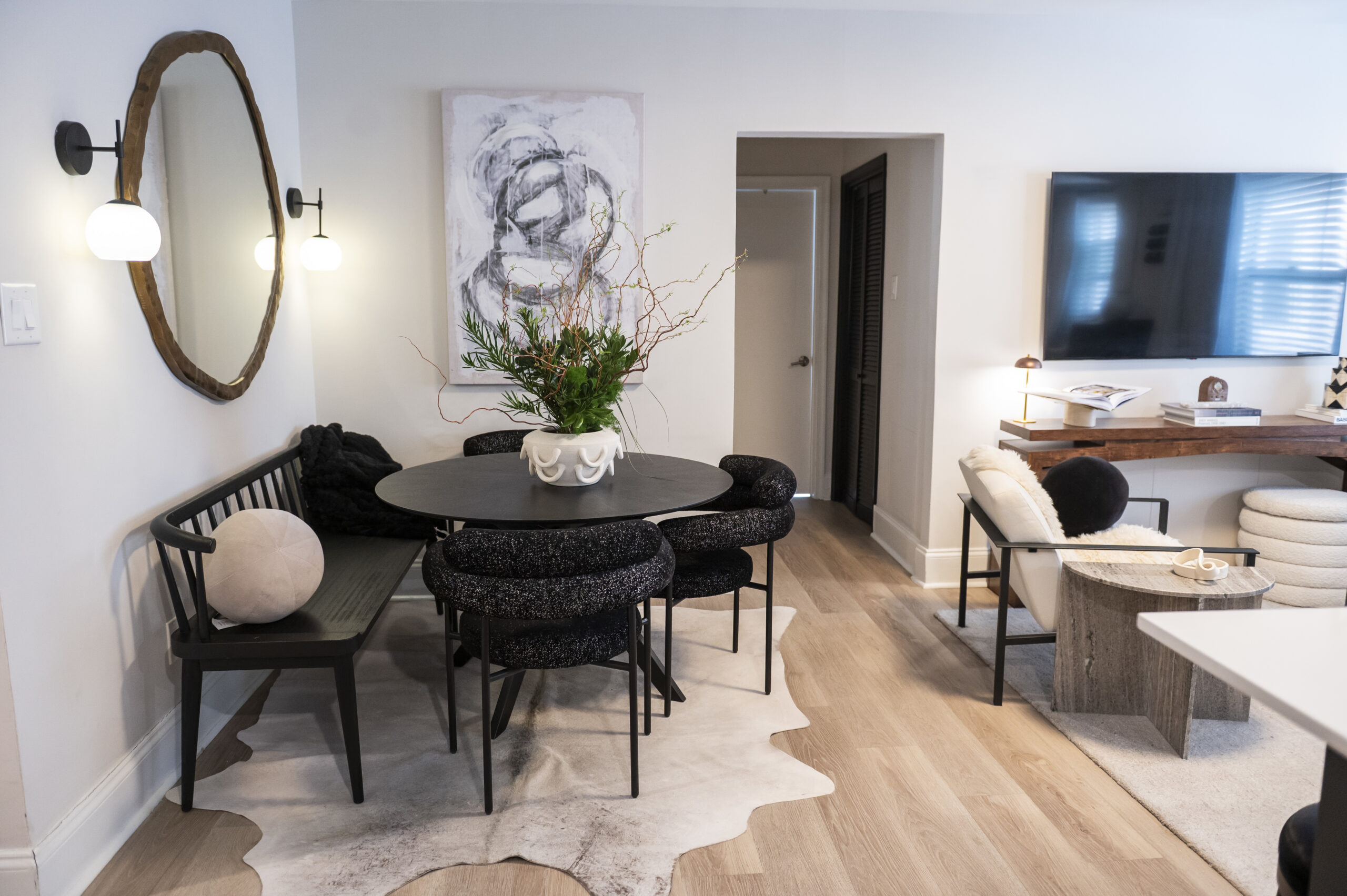
Contrasting black furnishings include leather chairs in the entry hall, a round table, the bench and chairs in the dining area, and black cabinets in the bedroom, which flank a radiator whose cover she painted black. She also painted the wall dividing the entry hall and the living area black.
Recently, Williams’ niece, Aubrey Harris, painted the folding doors to the laundry black. The rest of the doors in the apartment are white.
Williams already had the essentials when she chose her dramatic decor. Her 1,000-square-foot apartment’s renovated kitchen had black cabinets with white countertops. There were white fixtures in the bathroom and powder room. The laminate floors resembled white oak.
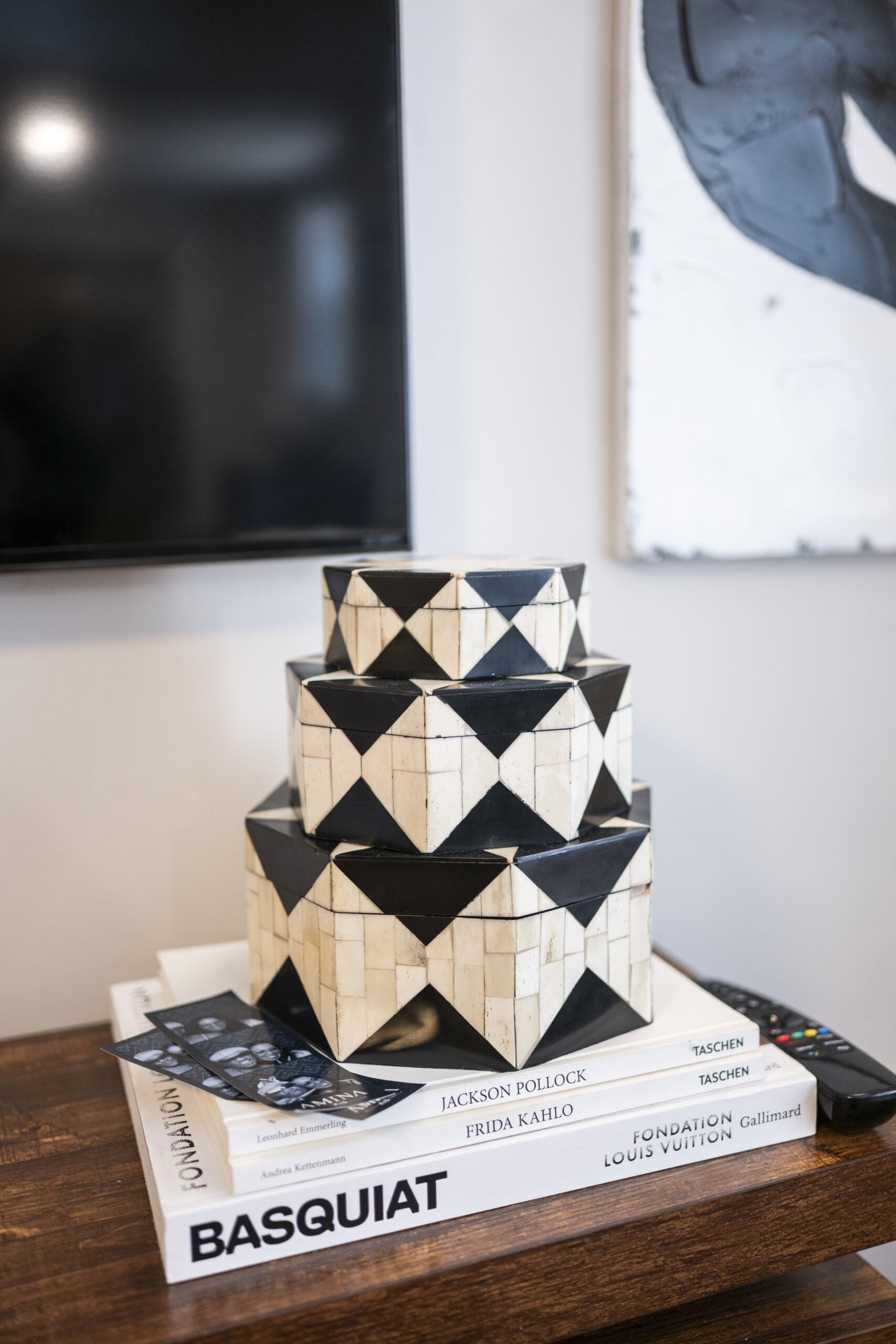
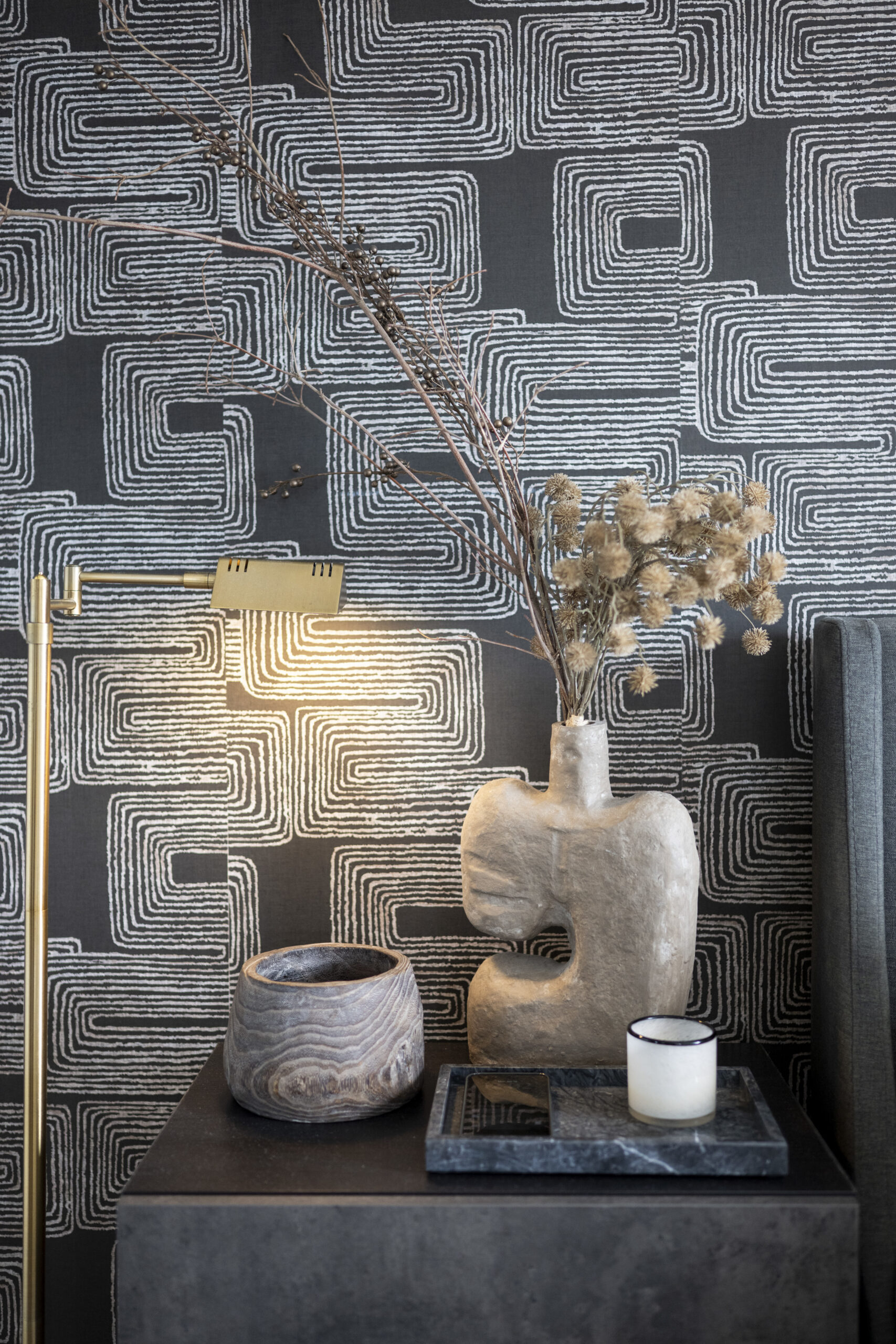
Decorative boxes and books are stacked on a media console in the living room.Decor on the nightstand next to Williams’ bed.
Williams, 36, spent the first decade of her life in a home on Larchwood Avenue, just blocks from Garden Court Towers. Her family then moved to Berlin, N.J. She graduated from Eastern Regional High School in Voorhees.
During the early days of the COVID-19 pandemic, she lived with her grandmother, Dolores Cook, in Northeast Philadelphia and redecorated Cook’s home.
“From the time she was a little girl Jasmine always liked art and design,” her mother, Yvette Baker, boasted during a visit with her daughter.
Williams was a project manager for nonprofits before becoming an interior design consultant. She is also a disaster relief volunteer for the American Red Cross in Philadelphia.
After her grandmother’s death in December 2020, “the housing market was awful,” Williams said, so she looked for a place to rent. She visited Garden Court Towers and admired the 1929 Art Deco lobby with its canopied entrance, carved wood paneled foyer, tile walls and floor, and original brass U.S. Mail box.
The lobby of the Garden Towers apartment building in West Philadelphia.
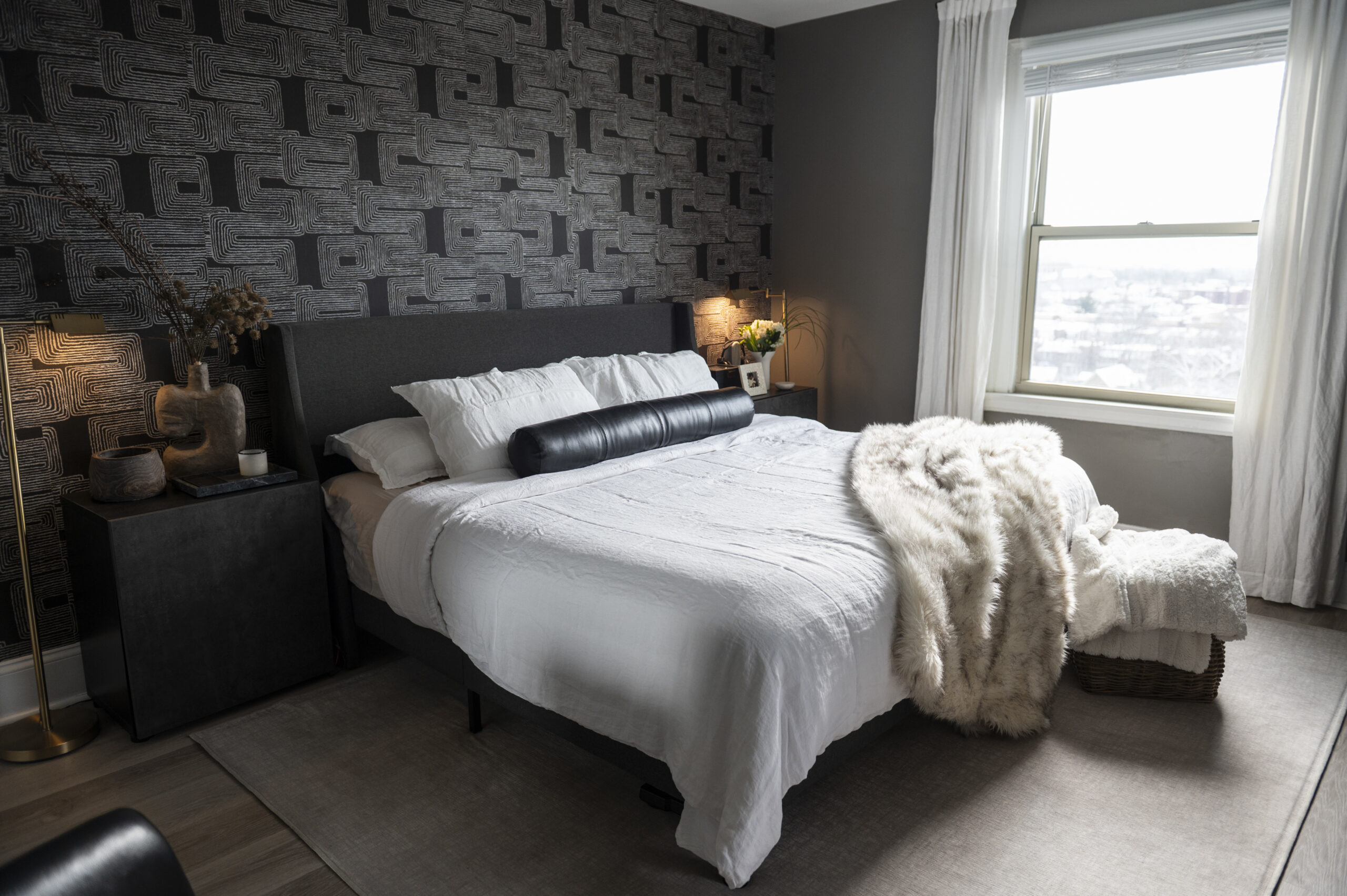
The Art Deco geometric design of the hallway carpeting is similar to the gray-and-white pattern of the wallpaper Jasmine chose to hang behind her bed, which has a gray headboard. She hung gray wallpaper as an accent on two other walls.
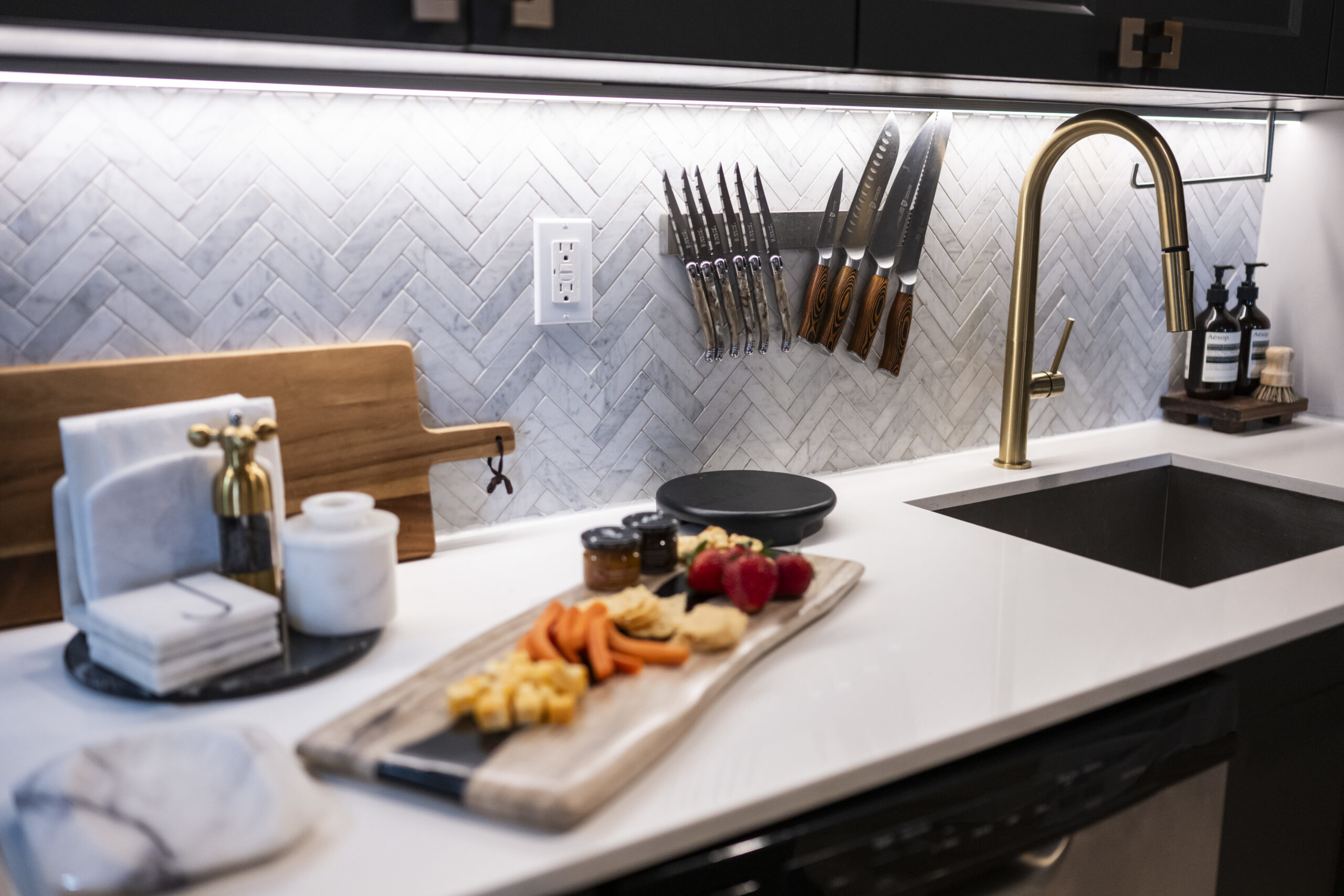
The living room couch is gray, as is the herringbone-patterned kitchen backsplash.
Gray softens the bold black-and-white surroundings, as does the wood-toned Parsons table under the TV in the living room. Brass lamps in the bedroom and a gilt mirror in the dining area add sparkle.
The dining area, with a variety of monochrome shapes and textures, connects to the living area.
The miniature antique radio on the Parsons table is actually a holder for wood coasters. Williams inherited the radio from her grandmother.
Abstract art in the apartment include two striking oil paintings from Amazon in the entry hall, depicting black figures on a white background.
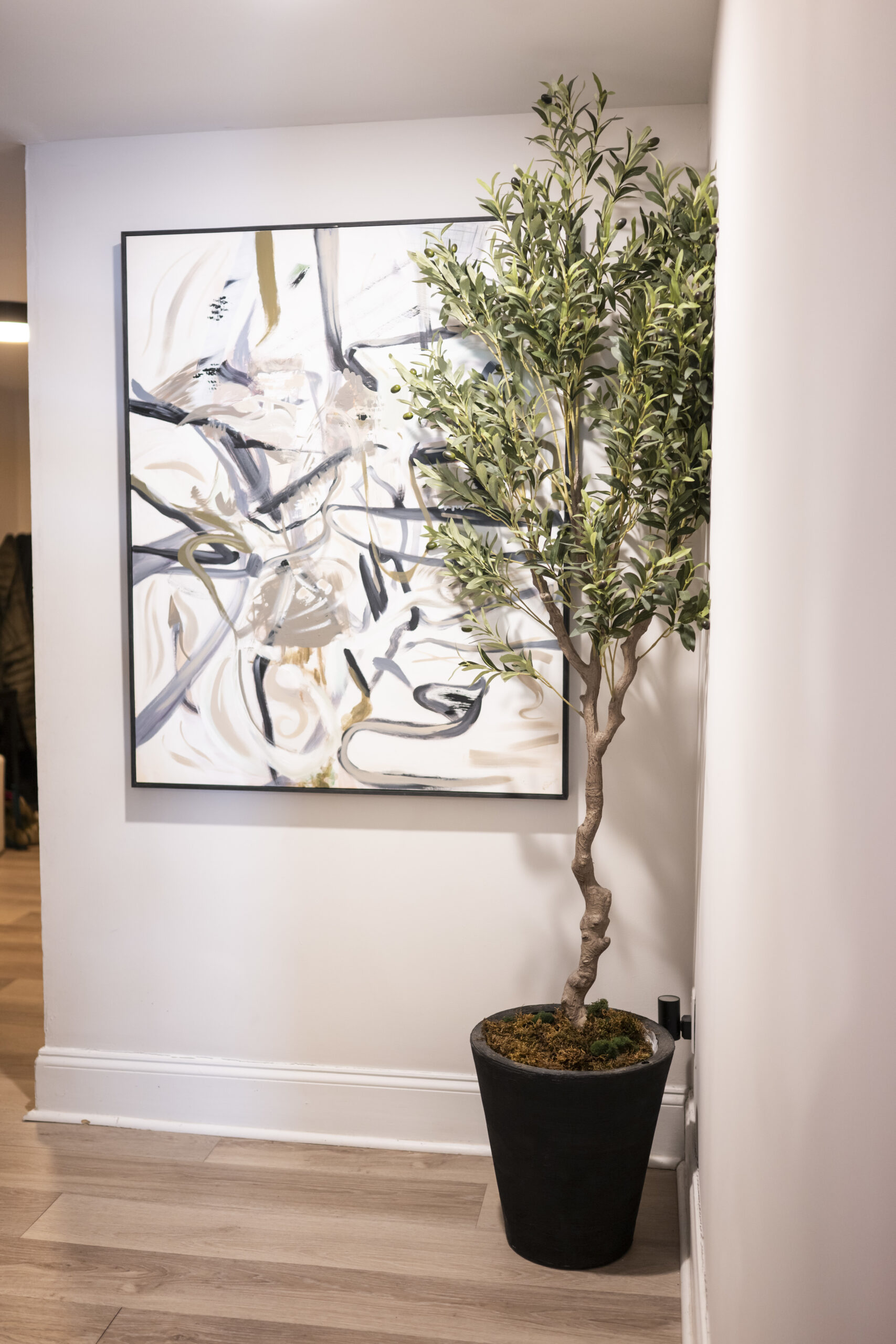
Nearby hangs a painting of gray, beige, and black stripes and swirls on a white background. The work was more colorful when Williams purchased it from CB2, but she and her sister Melyssa Pollard brushed over the vibrant shades to produce a more muted palette.
Williams’ brother in law, Jay Pollard, and her father, Edward Williams, installed light fixtures and hung paintings in the apartment.
Her favorite shopping destinations are CB2 and Crate & Barrel, but she has also purchased items from Amazon, Pottery Barn, Wayfair, and other vendors. The cowhide rug under the dining table came from Burke Decor.
Patterned wallpaper and simple white bedding contrast in the bedroom, where brass lamps add some shine.In the kitchen, an arrangement of brightly colored produce stands out from the black, white, and gray.
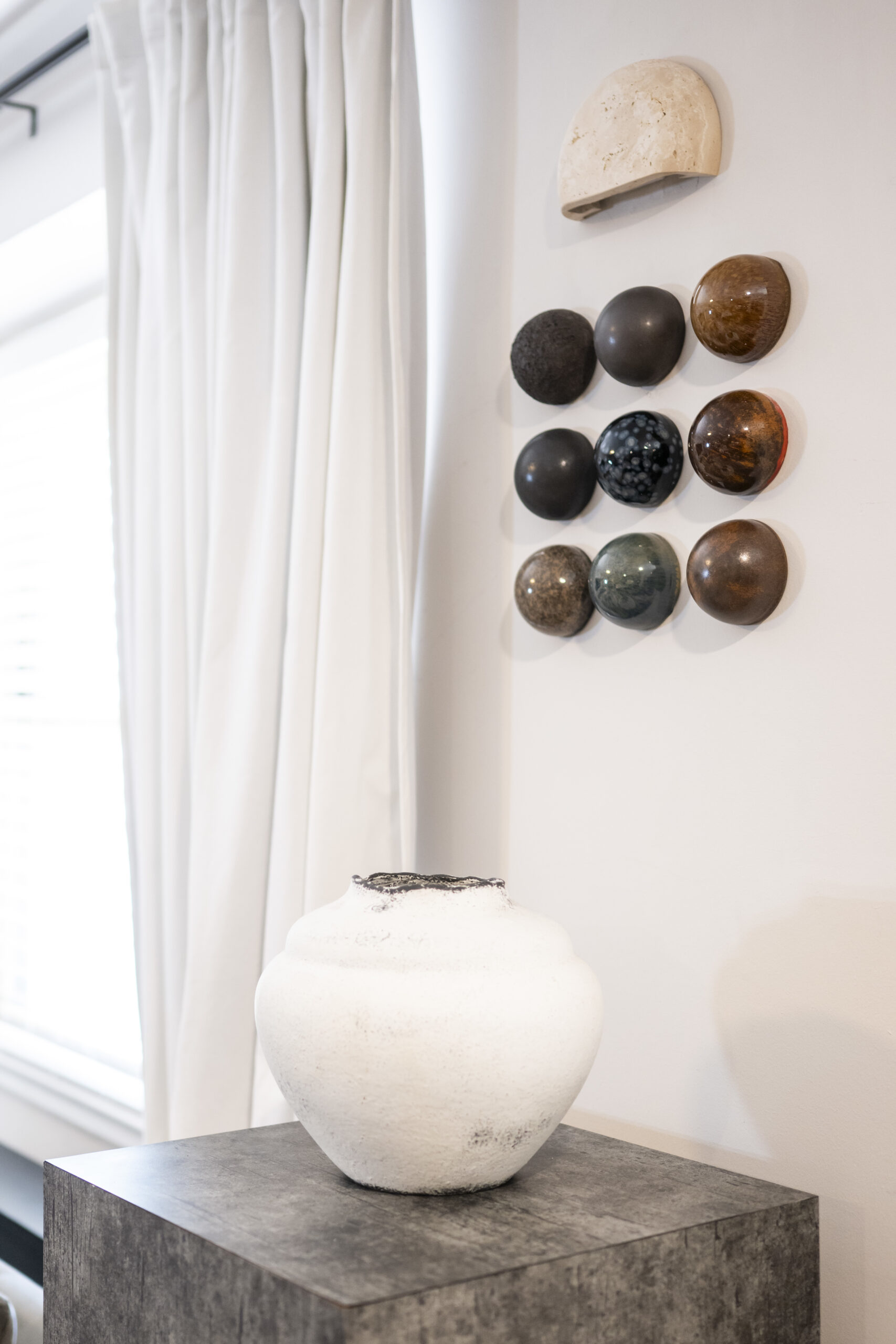
In the living room, a unique art installation of nine small domes in shades of black, brown, and gray are arranged on the white wall above a white clay bowl on a black pedestal. The glazed clay domes are the work of New Zealand ceramicist Sam Mayell.
Large windows fill the tenth-floor apartment with light.
An abstract painting and large olive plant decorate the hallway.Ceramics and wall art bring texture to the apartment’s interior design.
In the bedroom, with its white and black furnishings, a window frames a view of Garden Court homes below with their snow-covered lawns and rooftops.
The winter-white scene was “keeping my theme going,” quipped Williams.
Is your house a Haven? Nominate your home by email (and send some digital photographs) at properties@inquirer.com.
City Council’s housing committee advanced two bills on Wednesday meant to help Philadelphia renters living in unsafe or unhealthy homes.
One bill would protect tenants who complain about housing conditions from retaliation by rental property owners and affirm tenants’ rights to safe and sanitary homes.
The bills are the two remaining pieces of a legislative package of renter protections introduced by Councilmember Nicolas O’Rourke. The first bill in the Safe Healthy Homes Act passed last year and created an anti-displacement fund to give financial help to renters forced to move out of their homes because of unsafe or unhealthy conditions.
The remaining bills passed out of the housing committee Wednesday after months of discussions with Council members, Parker administration officials, and landlords.
All three bills were written in partnership with the groups OnePA Renters United Philadelphia, a coalition of renters unions and advocates, and Philly Thrive, an advocacy group for racial, economic, and environmental justice. At Wednesday’s Council hearing, tenants from these groups and others who rent homes across the city testifiedabout living with mold, pests, leaks, lack of heat, and falling ceilings.
“The stories that inform the creation of this legislation come from the tenants,” O’Rourke said. Philadelphia renters “have long had to fight for the right to dignified living.”
Proactive inspections
Bridget Collins-Greenwald, commissioner of L&I’s quality of life division, said the bill that allows for a program to proactively inspect rental homes incorporates the Parker administration’s feedback.
“We believe the administration’s concerns have all been addressed and that the bill as amended can be successfully implemented,” Collins-Greenwald said to cheers and applause from tenants in the audience.
A year ago, Collins-Greenwald testified at a Council hearing that L&I was working to create a proactive inspection program. According to a Pew report from 2021, the department inspected only about 7% of Philadelphia’s rentals in a year.
O’Rourke’s legislation would require L&I to provide annual reports to Council members about the progress of the proactive inspection program.
The bill also would require rental property owners to share a copy of their rental license with tenants and to inform tenants if the license is suspended. Landlords need a valid license in order to collect rent.
Owners would also have to tell tenants about outstanding health and safety violations.
Retaliation against renters
O’Rourke’s second bill would expand protections against landlord retaliation for renters who participate in tenant unions and/or investigations of code violations.
“With less fear of reprisal, tenants will be emboldened to advocate for themselves around severe habitability and repair issues,” she said. “Far too many Philadelphians live in rental units in need of significant repairs.”
The bill also would expand the city’s requirement that landlords have “good cause” for ending a tenancy — whether by lease nonrenewal or termination — and explain to tenants in writing why their tenancy is ending. Under the bill, this provision of the city’s landlord-tenant law would apply to most tenants, not just those with leases of less than a year, as it does now.
More amendments?
Groups that represent rental property owners and managers said that they support the broad goals of the bills, but that the legislation needs to be further amended. They said they worried about unintended consequences that could harm landlords, especially ones with only a few housing units.
The legislation includes a provision that would allow rental property owners to collect the full rent if they can show that the city was the reason they were unable to get a valid rental license on time. But landlords said they want more protections for rental property owners who strive to follow city laws but are stymied by government bureaucracy and frequently changing regulations.
For example, Steven Chintaman, vice president of government affairs at the Pennsylvania Apartment Association, said landlords should have to forfeit rent only if code violations impact the habitability of a home, “not [for] technical or administrative issues.”
“We remain committed to working collaboratively to preserve the intent of these bills while ensuring that they are balanced, workable, and do not unintentionally harm housing providers and the residents we serve,” Chintaman said.
O’Rourke said he would continue to work with rental property owners and other stakeholders and is open to further amendments as his bills move forward.
Could the white E-ZPass transponder on your windshield become a relic?
Well, not yet.
But New Jersey Turnpike officials will soon test out E-ZPass stickers in turnpike authority fleet vehicles, spokesperson Tom Feeney said Wednesday. The New Jersey Turnpike Authority also operates the Garden State Parkway.
“If there are no problems,” Feeney added, “we will make a plan to introduce them to NJ E-ZPass customers.”
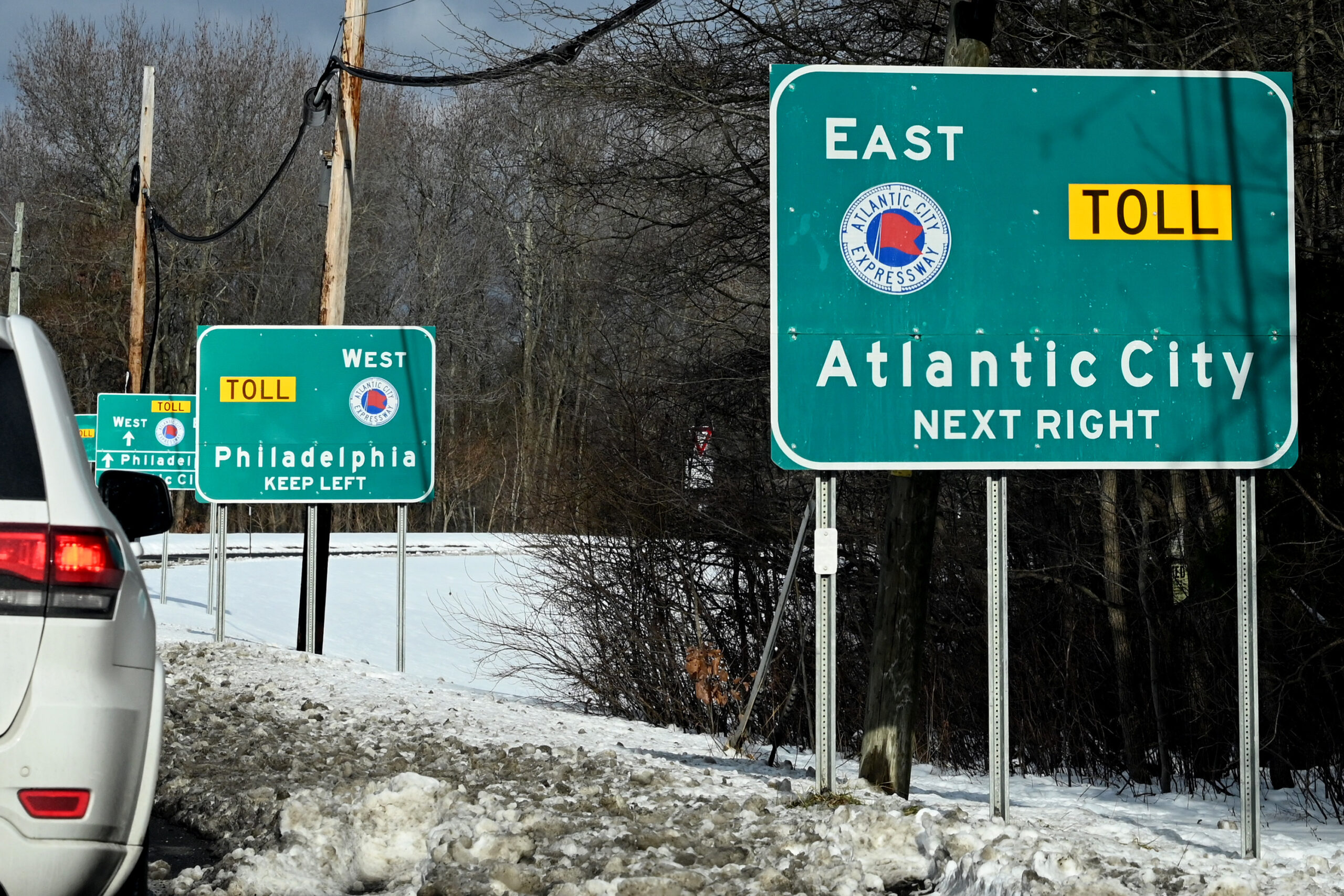
Drivers approach the Williamstown entrance ramp to the Atlantic City Expressway in 2022.
Both devices are equipped with digital chips, which are read by overhead gantries on the highways. The technology allows drivers to keep moving and be digitally charged for tolls.
This week, the Massachusetts Department of Transportation rolled out E-ZPass stickers, free of charge for new customers and those who need to replace their transponders, according to several local news reports.
Massachusetts officials estimate the switch will save the state more than $7 million a year, since the stickers’ production cost is a fraction of the cost of the transponders, according to a recent report from WBUR, the Boston NPR affiliate.
In New Jersey, officials spent $8.4 million in 2022 to replace the batteries of 920,000 E-ZPass transponders, according to NJ.com.
News of the Garden State’s E-ZPass sticker test comes two months after the Atlantic City Expressway went cashless, with the Garden State Parkway and the New Jersey Turnpike set to follow. Across the river, the Pennsylvania Turnpike has been cashless since 2020.
President Donald Trump and his administration insist their war of choice in Iran bears zero similarity to the bitter Iraq War the U.S. plunged into 23 years ago.
I disagree.
Both wars were based on lies about imminent threats from nuclear weapons to justify wars of choice.
In 2003, the intelligence on Saddam Hussein’s nuclear program was cherry-picked and false. In 2026, Trump told Americans in June that Iran’s nuclear program had been “obliterated” by U.S. and Israeli airstrikes. There is no evidence Tehran will be able to reconstitute the program in the foreseeable, or even the long term — so there was no “imminent threat” from Iran.
Today, as in 2003, the U.S. president has trouble clarifying the strategic goals of this war, or any plans for “the day after” the war stops. Trump’s aides say the aim is to destroy Iran’s military capacity with airstrikes, without sending in ground troops or conducting “regime change.”
Yet, POTUS is nurturing fantasies of regime change on the cheap. One day, he urges Iranian civilians to rise up and overthrow the regime, although they are likely to get slaughtered. The next, he demands the right to personally choose Iran’s next leader.
Such self-delusion propelled Americans to disaster in Iraq. As Trump directs policy solo, based on whim and ill-informed whispers from Jared Kushner and Steve Witkoff, it’s hard to see a happy ending in Iran.
Few Iranians will mourn the demise of the cruel and murderous Ayatollah Ali Khamenei or his cohorts, and a large segment of Iranians wants the corrupt religious regime gone. But Trump’s treacly protestations of sympathy with brave Iranian civilian protesters ring hollow.
All signs point to his willingness to abandon them if he needs a quick exit from his war as the U.S. supply of missile and drone interceptors runs short in the next few weeks.
This potential betrayal of Iranian hopes hits my gut hard because I watched similar scenarios play out when I covered the 1991 and 2003 wars in Iraq.
Iraqi civilians and U.S. soldiers pull down a statue of Saddam Hussein in downtown Baghdad, April 9, 2003.
In 1991, President George H.W. Bush called for Iraqi Kurds and Shiites to revolt against Hussein (whose mainly Sunni followers controlled Iraq). As the United States pushed into southern Iraq from liberated Kuwait, those Iraqis followed his call.
But Bush 41 chose not to continue on to Baghdad and depose the Iraqi regime; his advisers (rightly) warned this would spark an Iraqi civil war in which the U.S. would become entangled. When U.S. forces left, Hussein’s army slaughtered around 10,000 Shiites; several hundred thousand Kurds in Iraq’s north fled into the freezing mountains in winter, until the U.S. Air Force established a no-fly zone over Iraqi Kurdistan, and they could return home.
In February 2003, I crossed from Iran into Iraqi Kurdistan to await the invasion of Iraq by Bush 43, who claimed he had to destroy the (no-longer-existent) Iraqi nuclear program — and bring democracy to the country.
It was hard not to get swept up in the enthusiasm of Iraqi Kurds for the regime change the Americans were finally promising.
America’s regional allies, especially Israel, urged Bush to decapitate the Baghdad regime. White House hawks insisted “regime change” would quickly bring peace and democracy to the entire Mideast. So did exiled members of multiple Iraqi opposition groups, with whom I had been in contact since covering the 1991 Gulf War.
Bush 43 disbanded Iraq’s military and fired much of its government. But the White House had no grasp of the complex ethnic and religious politics of Iraq, which engulfed U.S. forces and ignited an internal Iraqi civil war between Shiite and Sunni Muslims. U.S. troops were caught in the middle, as Bush 41 had feared.
President George W. Bush speaks aboard the aircraft carrier USS Abraham Lincoln off the California coast on May 1, 2003.
Fast-forward to Trump. He says he won’t put U.S. boots on the ground but also says he’s not ruling them out “if they were necessary.” (“I don’t have the yips with respect to boots on the ground,” he said Monday. Figure that one out.)
However, the president has made clear, for now, that he won’t send U.S. troops to help unarmed Iranians retake their country, even as he keeps urging them to overthrow their leaders.
That may prevent the 2003-style quagmire Bush 43 blundered into. Yet, POTUS appears even blinder than Bush in Iraq about his ability to bend Iran’s future to his will.
Even though Iran’s 86-year-old supreme leader, Ayatollah Khamenei, was killed by an Israeli airstrike, along with dozens of other Iranian leaders, that’s not likely to end the regime.
The president has shown little interest — and advanced no concrete plans — for the future of Iran after the U.S. and Israel stop bombing. Trump has upturned the famous doctrine that the late Secretary of State Colin Powell applied to 2003 Iraq, namely, “If you break it, you own it.” The Trump Doctrine posits: “We break it, you own it. Goodbye and good luck.”
POTUS has stressed it is up to Iran’s people to rise and take over their country, even though civilians are bereft of leaders, organization, guns, or even internet connections (and Reza Pahlavi, the exiled son of the last shah, who hasn’t set foot in Iran for decades, has no armed forces of his own).
Squeezed by the MAGA faithful and partial to quick hits, Trump insists there will be no long-term U.S. involvement. This may avoid U.S. military casualties, but will probably leave Iran in chaos, ruled by regime holdouts who still retain the guns.
Indeed, the strongest remaining military force in Iran is the hard-line Islamic Revolutionary Guard Corps (IRGC), which is deeply rooted throughout the country. Behind them are hundreds of thousands of Basij militiamen, who have already killed thousands of unarmed regime opponents.
Iran’s Revolutionary Guard members stand in front of a Shahab-3 missile, which is displayed during the annual pro-Palestinian Al-Quds, or Jerusalem, Day rally in Tehran, Iran, April 29, 2022.
Perhaps Trump has devised a magical formula to profit from any such bleak denouement for the Iranian people: Iran will become Venezuela.
Trump has told journalists he wants to model his Iran venture on the U.S. intervention in Caracas, where the top leader, Nicolás Maduro, was kidnapped, and U.S. officials then made a deal with his vice president. Trump eliminated a dictator he disliked, but left in place the previous regime, which, in turn, handed him control over Venezuelan oil.
Sorry, even the most ill-informed observer can grasp that Iran bears no resemblance to Venezuela: The Islamic regime retains deep roots, many hard-line generals, hundreds of thousands of ideological purists, and many religious followers; it isn’t a one-man show.
Yet, POTUS insisted again Thursday that “what we did in Venezuela is the perfect scenario.” In an Axios interview, he said that he, personally, had “to be involved in the appointment [of Khamenei’s replacement] like with Delcy [Rodríguez] in Venezuela.”
In a godlike pronouncement, Trump expects Iran’s hard-line Shiite religious clerics to pick a new supreme leader who pleases him. Or what? He’ll send them to heaven as martyrs?
The president has already noted that “most people” he had considered for Iran’s top job “are dead” from the recent U.S.- Israel bombing. He speculated that Iran’s future leader could be “as bad” as the last.
More likely, Trump will try to cook a deal with a senior Iranian official, perhaps an IRGC general, to eliminate the remnants of Iran’s nuclear weapons program and its missile production. Perhaps he dreams of U.S. control of Iranian oil revenue as arranged with Venezuela’s new leader. Perhaps visions of “great U.S. deals” for Iranian oil dance like dollar signs in his head.
However, hard-line IRGC generals are more likely to fight to the end to hold power at home, even as Iran’s proxy militias in surrounding Arab countries are crushed. IRGC generals who were willing to gun down tens of thousands of Iranian civilians during recent Iranian protests would surely do so again to survive.
I worry that Trump’s continued call for a civilian uprising holds out the prospect that Iranian civilians will once again be mowed down — even as the president declares victory and sends the U.S. fleet home when his MAGA followers grow antsy. Israel may continue bombing, but that won’t help Iranian protesters topple the regime.
In a further sign of how the administration may use and abuse Iranians, news reports claim the CIA is arming Iranian Kurds to spark a wider uprising. This is cynicism to the max! Encouraging Iran’s ethnic minorities — Kurds, Azeris, Baluch, and Sunni Arabs — to fight will foment internal civil wars without changing the central regime or delivering a better one. Only a unified Iranian opposition can ultimately achieve that.
For POTUS, the Iran war is an exhibition of Trumpian power designed to bolster his strongman image, as the GOP faces dicey midterms and the Jeffrey Epstein hangover at home. For Iran’s people, Trump’s reality show is a life-threatening matter. His “we break it, you fix it” doctrine could consign many of them to death as he celebrates U.S. bomb strikes back home.
2026 Honda CR-V Hybrid AWD Sport Touring vs. Kia Sportage Hybrid SX-Prestige AWD: A challenger for the hybrid crown?
This week: Kia Sportage Hybrid
Price: $41,985 as tested
What others are saying: “Highs: Better acceleration than nonhybrid variant, well-mannered ride, plenty of space for people and cargo inside. Lows: Fuel economy isn’t as frugal as expected, not particularly entertaining to drive, exterior design isn’t for everyone,” says Car and Driver.
What Kia is saying: “Show up, show off.”
Reality: A hybrid challenger? There was much that was challenging about the Sportage Hybrid.
What’s new: The Sportage gets a new look, and some interior features. It comes in gasoline, hybrid, and plug-in models.
Up to speed: The Sportage Hybrid was a mostly pleasant companion to move about in. There were some hesitant moments as I pulled out and adjusted to hills over the first couple days, but those were on me. A last day trip to University City from West Chester was all smoothness and ease, both on the highways and in stop-and-go traffic. Eco mode was about the best all around, although I did pick Sport mode when I was really worried about cutting into traffic.
It takes 7.4 seconds for the 232-horsepower Sportage Hybrid to get to 60 mph, according to Car and Driver. That’s not stellar from the 1.6-liter turbocharged hybridized powertrain, but not too poky, and it’s faster than the 187-horsepower gasoline-powered 2.5-liter four-cylinder model.
A last-day pullout from 0-40 startled me with its quickness, so overall I’d say this midsize SUV is a peppy companion.
Shifty: The dial shifter works nicely, counterclockwise for Reverse and clockwise for Drive. Paddle shifters shift the 6-speed automatic transmission directly.
The transmission selection is what killed Sport mode for me. Many vehicles hold lower gears for a while in this mode, but the Sportage Hybrid always felt like it was stuck in 2nd when I’d be looking for 4th or 5th. Definitely less than ideal.
On the road: The handling in the Sportage Hybrid was not quite as enjoyable as the acceleration. Eco, Sport, or My Drive mode, nothing brought out the goose bumps as nicely as the S selection in the CR-V Hybrid.
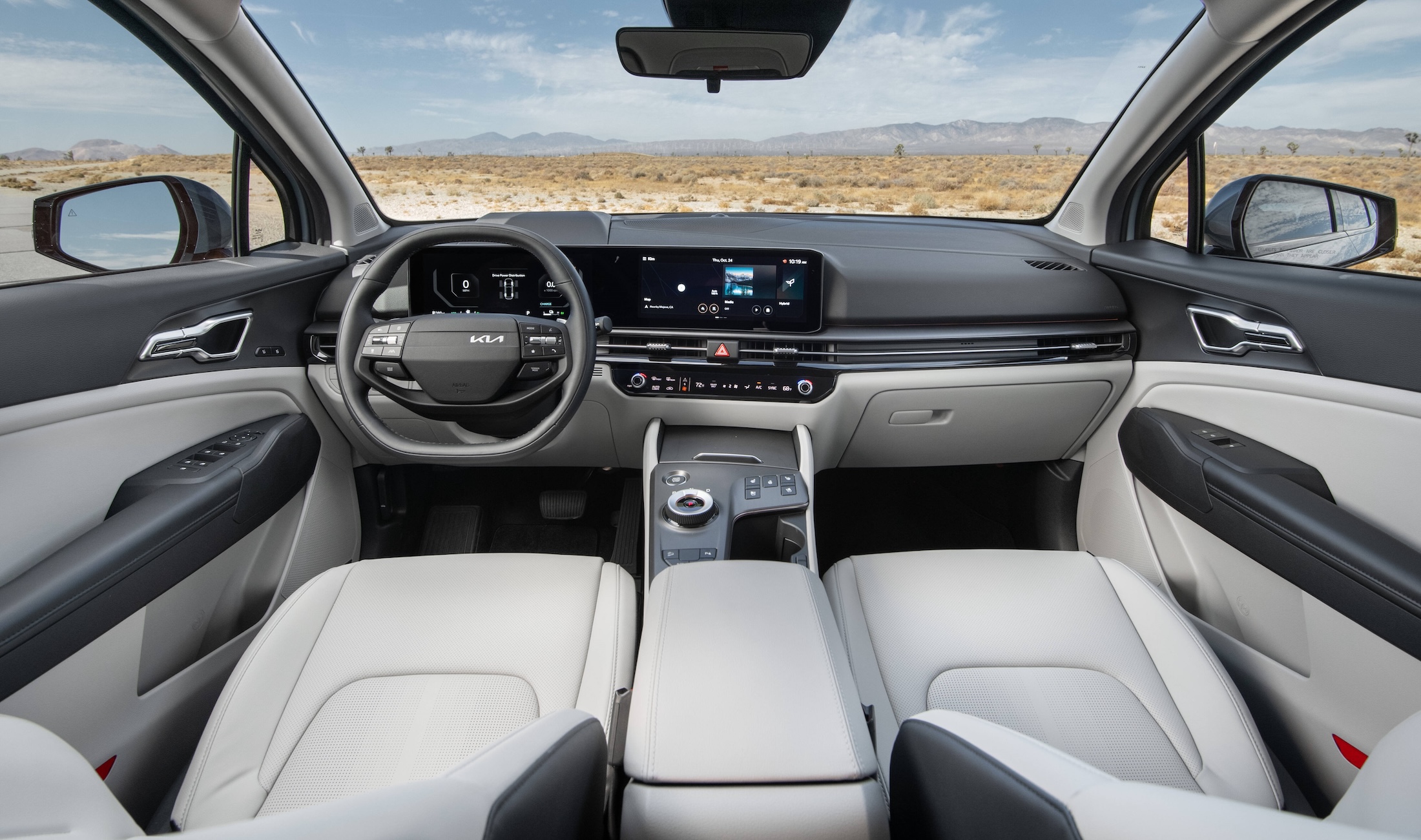
The interior of the 2026 Kia Sportage Hybrid is comfortable and the controls mostly easy to follow, except for the infotainment-HVAC button switch.
Driver’s Seat: Mr. Driver’s Seat put a lot of miles on the vehicle, and he never felt tired or sore.
The dashboard is standard issue Kia, which is clear and easy to set to your favorite info.
Friends and stuff: The rear seat in the Sportage Hybrid offers a comfortable place for passengers to ride. It’s fixed in place, but there’s plenty of legroom and foot room provided. The headroom is about the same as the CR-V, where my head is an inch away from the ceiling.
The Kia also offers several recline positions, as did the Honda.
Cargo space is 39.5 cubic feet in the rear and 73.7 with the rear seat folded, right in between the CR-V’s numbers.
In and out: The height of the Sportage matches the CR-V; it’s great for people who like to ride up high but not for people facing sore knees.
Play some tunes: The Harman Kardon stereo is an also-ran, like Kia audio systems tend to be. The clarity was fine for some songs and off for others, but the sound itself seemed just off throughout. Too much rattling bass and everything seemed to be in a minor key or something. B+.
The 12.3-inch touchscreen handles most of the controls well. You can use the dials, but you have to hit the switch to change them from HVAC controls. Kia thinks it’s clever or something with this system, because you can just take your eyes off the road to switch, right? What’s wrong with this picture?
The switch itself is very small and part of a touch pad, so it’s hard to pinpoint and unresponsive. So you make what you think are your adjustments, and then the stereo remains too loud, but you start feeling colder.
Keeping warm and cool: At least Kia has decided to let the controls default to HVAC. I’ve had other models where it stayed in the most recent selected, and I was always hitting the wrong thing. Owners may have their own perspective on this.
Dials control temperature, and the ebony touch pad handles everything else. Really, though, only the toggle between stereo and HVAC seemed to be the weak link.
Fuel economy: Speaking of weak links, the Sportage Hybrid fuel economy disappoints. Over the course of 400+ miles that include another driver — one who’s no doubt less inclined to race at stoplights — I could barely get this over 30 mpg. It’s disappointing, period. But it’s also no match for the CR-V Hybrid’s 35-plus. I’d averaged 35 in a 2023 Sportage Hybrid, so the upgrades are thirsty.
Where it’s built: Gwangju, South Korea. Ninety percent of parts come from South Korea, and less than 1% are from the U.S. or Canada.
How it’s built: The Sportage Hybrid gets a reliability rating of 3 out of 5 from Consumer Reports.
In the end: If you’re buying a hybrid to, you know, save fuel, then it’s CR-V Hybrid all the way. Consumer Reports claims to have gotten mid-30s, but Car and Driver and Mr. Driver’s Seat not so much.