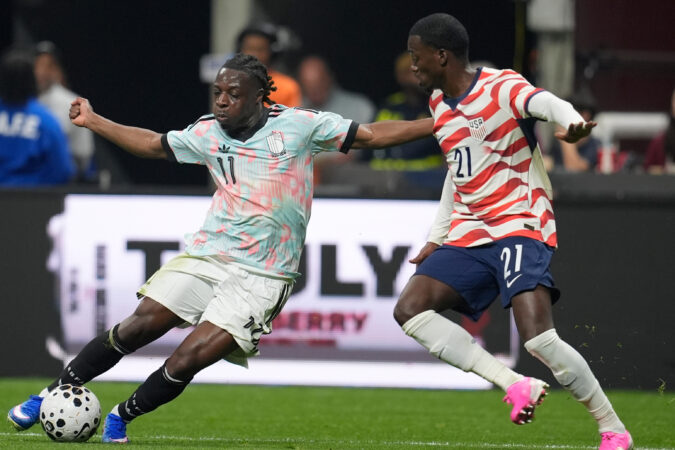
ATLANTA — The U.S. men’s soccer team wanted to test itself against Europe’s best this month, and it got what it asked for on Saturday.
It also failed that test in front of a pro-American crowd.
Belgium rolled over the Americans, 5-2, playing just as well against the U.S. starters as against the many second-half substitutes.
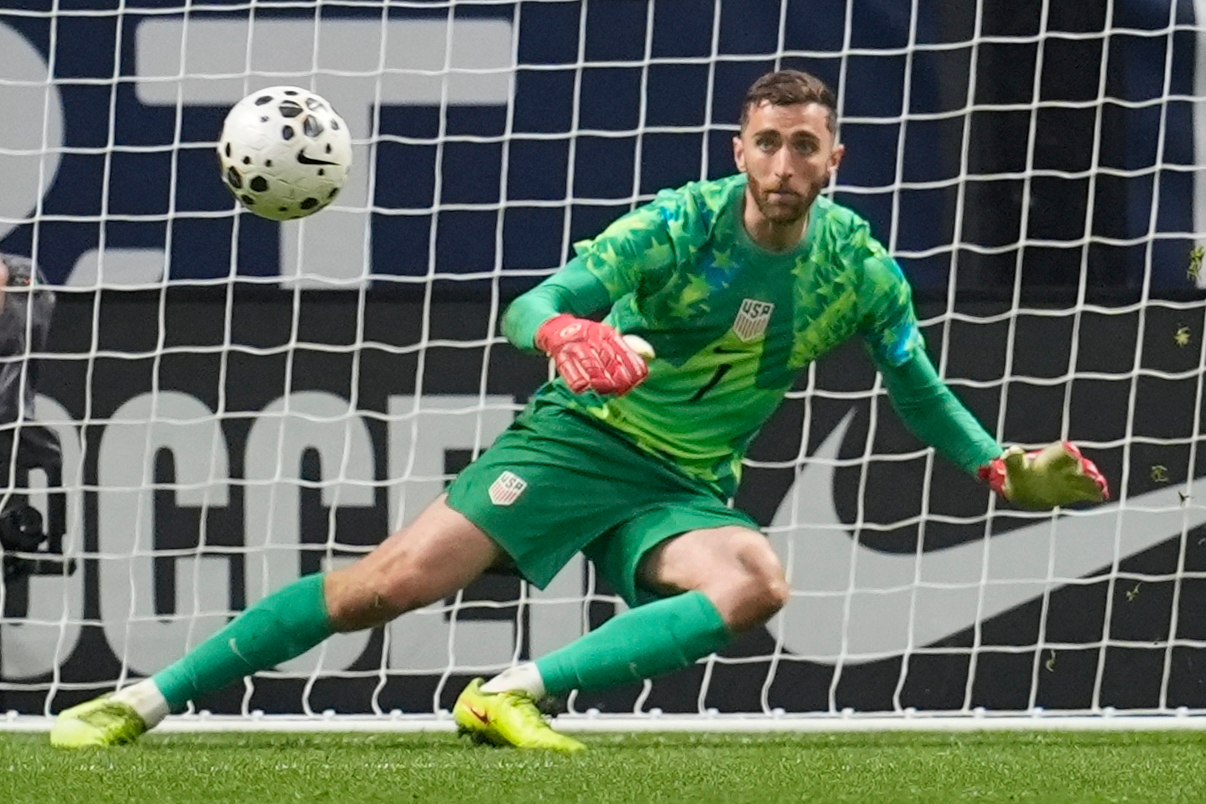
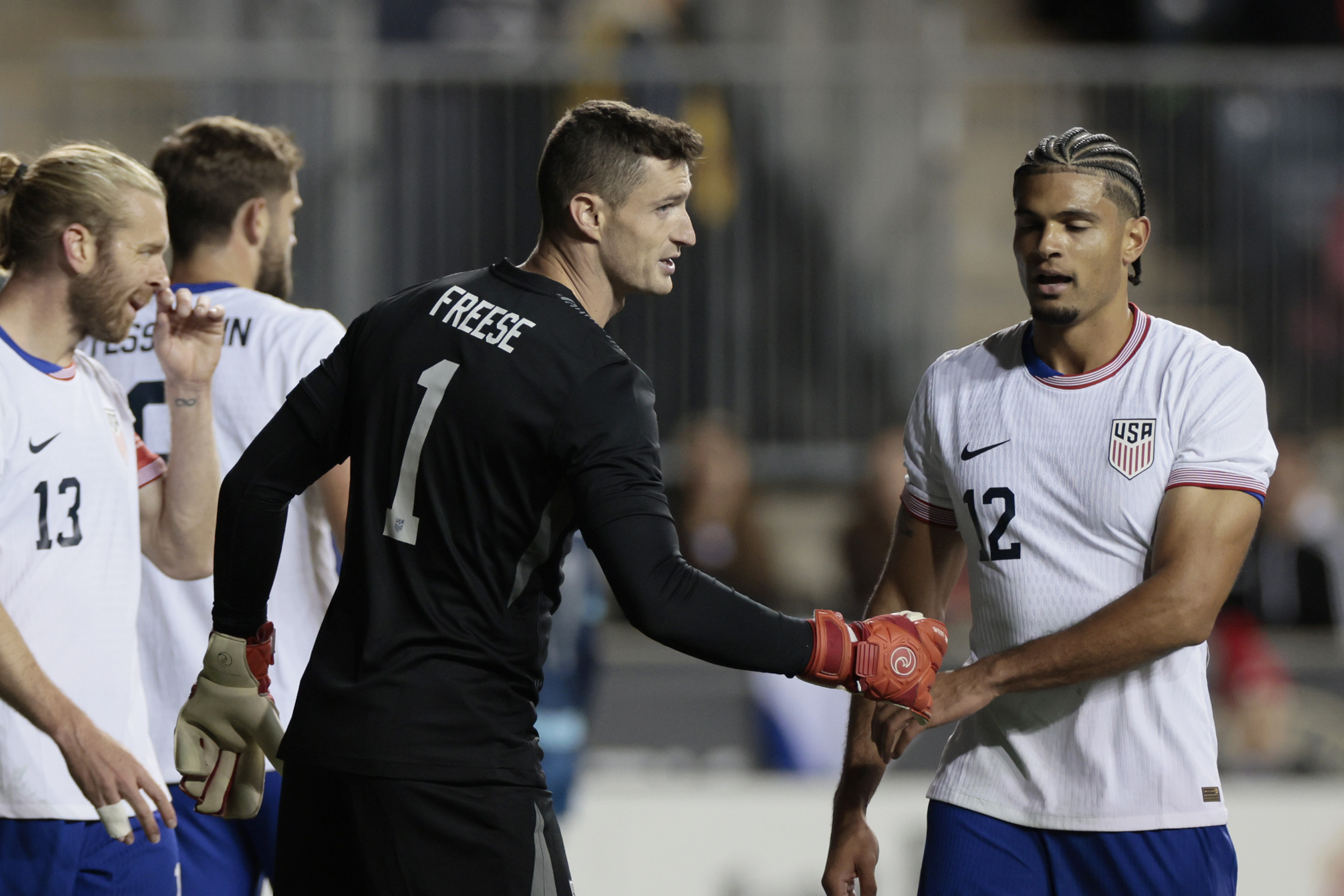
U.S. manager Mauricio Pochettino sprung some surprises with his starting lineup, the biggest being Matt Turner replacing Matt Freese at goalkeeper. Freese had played 12 straight games before Saturday, and seemed locked in as the World Cup starter.
Matt Turner in the U.S. net on Saturday.
There was also a surprise with the 10 players in front of Turner. Pochettino switched out of the three-centerback setup that was so successful in the fall, going with an attack-minded 4-2-3-1 instead.
The starting group would have been remarkably attack-minded against any opponent, but especially one of Belgium’s quality. Tim Weah and Antonee Robinson were the outside backs, and Christian Pulisic, Malik Tillman, and Weston McKennie lined up in midfield behind striker Folarin Balogun.
As risky as the setup felt, the U.S. took it to Belgium early. McKennie got the best in a series of looks, denied from 8 yards by a great save from goalkeeper Senne Lammens in the 17th minute.
Belgium equalized in the 45th with a mighty hit from Zeno Debast. Jérémy Doku started the play with a sprint in from the left flank, then shot hard, but Turner punched it out. Debast corralled the ball, no one pressed him, and the centerback fired through the crowd from some 30 yards.
If Turner didn’t look great on the play, it might have been worse that no U.S. player pressed Debast before he let fly, even if him shooting was unexpected.
Turner then finished the half with one more punch-out save, denying Alexis Saelemaekers’ bouncing shot off a corner from 18 yards.
Pochettino’s first substitution was Cristian Roldan for Cardoso at halftime. But that didn’t stop Belgium from taking control of the game. Amid notable misses from Pulisic and Weah, Amadou Onana put the Red Devils up, 2-1, in the 53rd.
Lots of U.S. players looked bad on the play. Mark McKenzie was caught one-on-one with the terrific Doku on the flank. Roldan came to help, but neither closed the play down, then a trio of Americans failed to stop Saelemaekers from passing the ball back to Onana. Tanner Tessmann was then late to close down Onana, and the shot followed from atop the box.
Five minutes later, Tim Ream was called for a handball in the box, and Belgium had a penalty kick. There was a long video review to judge the contact, but referee Esteban Ostojich stuck with his call, and De Ketelaere converted from the spot.
Mass subs started in the 63rd, when Pochettino sent in Max Arfsten, Alex Freeman, and Sebastian Berhalter for Robinson, Tessmann, and Weah.
Dodi Lukébakio slammed in the fourth in the 68th, catching Arfsten twice along the way: in a two-on-one with Thomas Meunier on the right, then in a one-on-one as he cut in to shoot.
Pochettino then made four more subs, and with it switched out of a four-back formation to three. Patrick Agyemang, Ricardo Pepi, Gio Reyna, and Joe Scally entered, with Scally taking up a right centerback post; and Balogun, McKennie, Pulisic, and Tillman exited.
Lukébakio struck again in the 82nd, off a give-and-go with Timothy Castagne. Lots of U.S. players were guilty again here. Lukébakio almost walked past Ream, Berhalter, and Arfsten before his pass, then Scally and McKenzie stood to try to block the shot instead of pressuring the shooter.
Agyemang got a consolation goal in the 87th, cashing in a loose ball after Pepi jumped on a poor backpass attempt by Youri Tielemans.
That was a good sign of the Americans’ mentality in the midst of a rout. But the rest of the game was a sign of how far the U.S. remains behind the world’s elite.
Soccer fans looking to buy tickets for this summer’s FIFA World Cup at face value will have a final opportunity on April 1.
In what FIFA is calling its Last-Minute Sales Phase, soccer’s governing body will sell remaining tickets via FIFA.com/tickets on a first-come, first-served basis, starting at 11 a.m. Philadelphia time. This will mark the final round of a four-part sales phase that began last September.
Tickets will be subject to availability, but according to FIFA, once prospective buyers bypass the queue, they will be able to see the remaining matches still up for grabs. There are two ways to secure tickets: either by viewing the seat map to see the remaining options or by selecting the “Book the best seat” option in the selected venue.
Brazil’s Vinicius Junior will be one of the main draws for fans at this summer’s World Cup group stage matches in Philadelphia when it takes on Haiti on June 19.
FIFA also announced that on April 1, fans who secured seats in earlier phases will be able to see where their purchased seats were allocated within their category. In earlier sale phases, fans were only able to purchase tickets across the Category 1 (lower level, prime seating), Category 2 (mid-upper level), and Category 3 (upper level) options.
After April 1, any remaining tickets will go onto secondary reseller markets, of which FIFA will manage its own via FIFA.com/tickets. It’s the first time the organization has opted to introduce its own secondary market, saying that purchasing on its secondary site is “the official and preferred source for FIFA World Cup 2026 tickets.”
FIFA continues to face pushback from people who believe the organization is running a monopoly when it comes to its own tournament, one that comes at the expense of fans, considering this is the first time the organization has elected to adopt a dynamic pricing system.
“This is what happens when one entity controls both supply and distribution,” said Ahmed Nimale, a former executive at Live Nation who now oversees a New York-based ticketing provider called KYD Labs. “Without competition, there is nothing to keep pricing or fees in check, and fans are left with no real alternatives. FIFA directly owns, controls and manages all ticketing for the World Cup, one of the most-watched sporting events on the planet, expected to draw as many as 5.5 million fans.“
FIFA president Gianni Infantino claims that a large part of the revenue it generates goes back into supporting 211 member associations from around the world.
On Wednesday, a release from FIFA reaffirmed its claim that over 500 million ticket requests have been submitted since the initial draw phase, with over 1 million tickets being sold since Feb. 27. The organization also held a secret phase for fans who it felt missed out on the opportunity for earlier phases.
However, FIFA president Gianni Infantino has said previously that much of its revenue goes back into “growing the game,” adding Wednesday that the money it generates “fuels the growth of men’s, women’s and youth football throughout its 211 member associations.”
SEPTA expects to receive about $5.5 million from a federal appropriation to offset the cost of providing transit service in Philadelphia during the FIFA World Cup.
The regional transportation authority projects it will spend $21.5 million for additional transit runs and extended service hours during the World Cup as well as a the celebration of the nation’s 250th birthday, officials said.
On Tuesday, the U.S. Department of Transportation announced about $100 million in funding to 11 cities and regions hosting FIFA championship matches, apportioned by formula.
“We are going to pull out all the stops to serve those big events — while also not missing a beat for our riders who rely on SEPTA every day,“ General Manager Scott Sauer said in a statement. He thanked the region’s congressional delegation and U.S. DOT for the ”much-needed investment to support this historic year.“
SEPTA said it would spend $18 million for overtime for transit operators and Transit Police, cleaning expenses, longer customer service hours and ambassadors to help people navigate the system.
Other extra operating costs for the events:
$1 million on safety and security, for portable surveillance equipment and a communications system to send police where they’re needed most.
$825,000 for signage, including World Cup branded signage, website and app upgrades to help visitors get around, as well as translation services.
Another $1.3 million will be spent on support services, SEPTA said.
Congress earmarked the money to help World Cup host cities and regions in this year’s federal budget, but improvements are required to benefit the general public, not just soccer fans.
“With the world coming to Philadelphia in 2026, we have a responsibility to be ready,” U.S. Rep. Brendan Boyle (D., Pa) said.
The federal largesse will “strengthen our transit system so it can handle the surge in ridership during the World Cup,” Boyle said. “Just as importantly, these improvements will benefit Philadelphians long after the tournament.”
In addition to the extra spending on operations, SEPTA said it is investing about $30 million for infrastructure upgrades in advance of 2026 events, including improvements at Broad Street Line and Market-Frankford Line rail stations expected to be primary hubs for event goers.
The projects include:
Roof replacement and platform resurfacing at NRG Station on the Broad Street Line, which serves Lincoln Financial Field and Citizens Bank Ballpark, where the Major League All-Star game will be held this summer.
Upgrades to the Second Street Station headhouse on the Market-Frankford Line.
Fern Rock Transportation Center lighting and painting.
Realignment of the fare line at City Hall Station on the BSL, as well as platform resurfacing and new LED lighting.
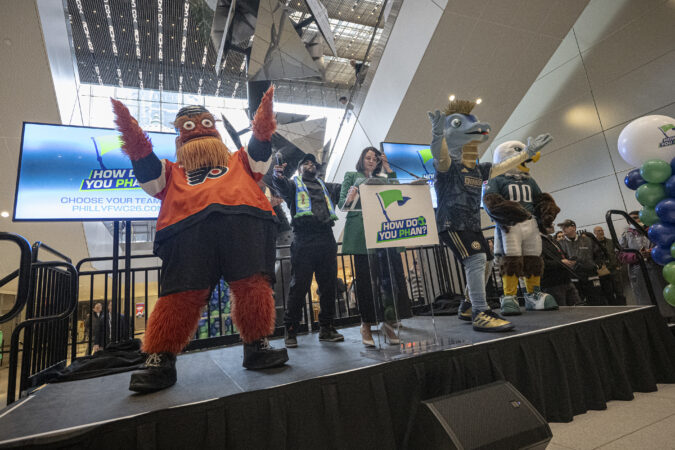
On Tuesday, Philadelphia Soccer 2026, in conjunction with the city, officially launched the “How do you Phan?” campaign at the Comcast Technology Center Concourse to commemorate the milestone.
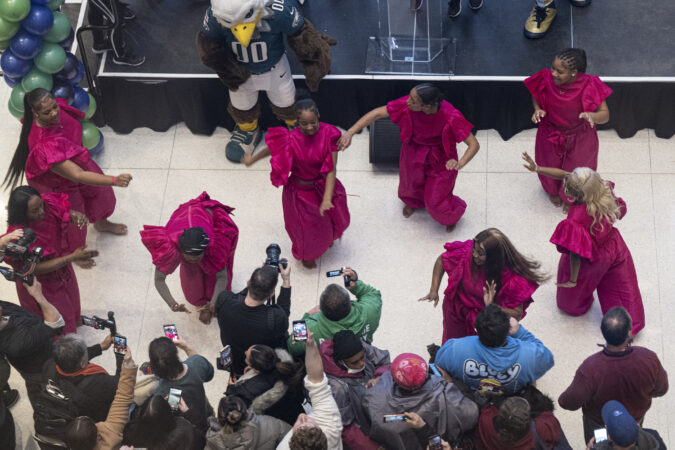
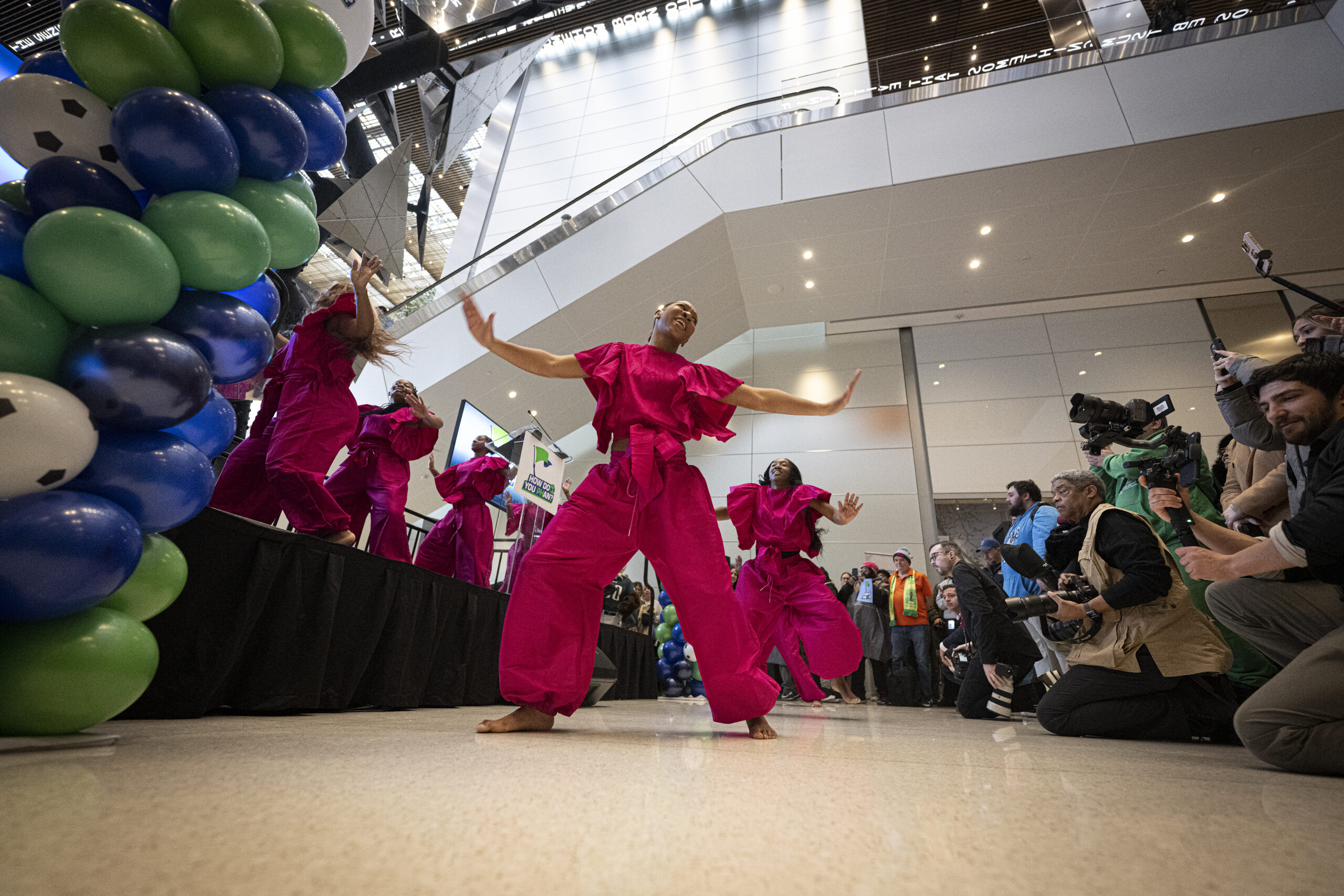
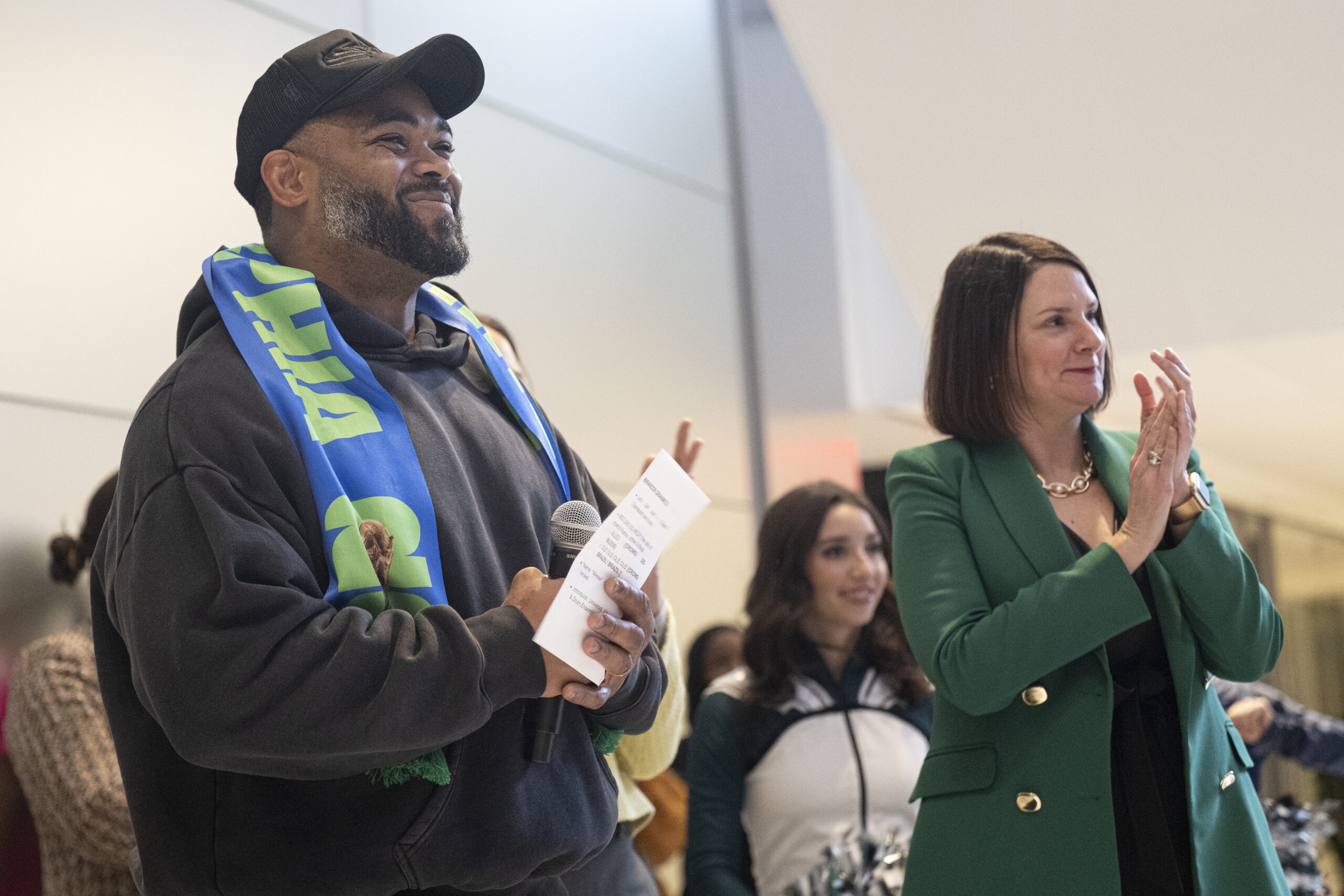
The event, emceed by Eagles defensive end Brandon Graham, featured performances by the Universal African Dance and Drum group — along with appearances by Philadelphia mascots Swoop, Gritty, and Phang.
“Let’s get an E-A-G-L-E-S Eagles real quick,” Graham said to open the event. “We’ve got a hundred days till the World Cup comes to our city. I hope y’all are all ready. Today, we got to get hype, this is a big event.”
International drummers and dancers perform during a rally celebrating 100 days until the 2026 FIFA World Cup on Tuesday at the Comcast Center.
Ready to be a fan?
Hundreds of fans stood in line to receive free merchandise — including shirts, hats, flags, and commemorative miniature posters — before remarks from Michelle Singer, co-chair of Philadelphia Soccer 2026 and Meg Kane, the chief executive for the Philadelphia Soccer 2026 host committee.
“This is exactly the kind of energy the world will experience when they come [to] Philadelphia this summer,” Singer said to an excited crowd. “As co-chair of Philadelphia Soccer 2026, I have the great privilege of working alongside an amazing team across the city and throughout Pennsylvania to prepare for one of the largest global events in the world.
“We know six matches will be hosted at the Linc will have a tremendous impact on our city. But what makes the World Cup even more powerful is the opportunity to showcase who we are as a city.”
— FIFA World Cup 26 Philadelphia™ (@FWC26Philly) March 3, 2026
After Philadelphia Soccer 2026 live premiered their “How Do You Phan” campaign video, Kane highlighted the eight known teams set to compete in Philadelphia — Brazil, France, Croatia, Ghana, Côte d’Ivoire, Ecuador, Haiti, and Curaçao — and encouraged fans to embrace each country’s culture, food, and even football chants.
Kane, who helped plan Philadelphia’s Papal visit in 2015, directed the crowd to Philadelphia Soccer 2026’s website for recently released “tool kits” that teach Philadelphians how to be fans of the incoming teams.
“We need to get ready in Philly,” Kane said. “We need to have a rooting interest. We love when we are watching a sporting event, and we want a winner. Like we’re rooting for someone. A great story, a great player, a great team. We have done it for all of our teams.
The Flyers, the Sixers, the Union, the Eagles, the Phillies — we’ve done it all. We brought the bedlam to the bank. We have shown everything about our sports passion and our fandom and that’s why today, it’s about bringing our energy to the global stage.”
Eagles defensive Brandon Graham (left) stands alongside Meg Kane, host city executive and CEO of Philadelphia Soccer 2026, in Tuesday’s pep rally celebrating 100 days until the 2026 FIFA World Cup.
Man of the people
If you are unfamiliar with soccer, the sport, don’t worry — so is Graham.
After the event, Graham stuck around briefly to take photos and talk with fans, mentioning his partial favoritism for the Ivory Coast (Côte d’Ivoire) national team, but also admitting his unfamiliarity with the sport.
“No,” he said when questioned on if he grew up a fan of soccer. “Just played FIFA on the game, that’s as close as I got.”
Despite his unfamiliarity, Graham is still excited to learn what is in store for this summer.
“I came to the [Premier League matches] when it was at the Linc,” Graham said. “That was cool, and now, I can’t wait to see what it’s all about.”
Next steps
There is still plenty to do before the first kickoff of World Cup matches in Philly, when Ivory Coast opens what will be the first of five group stage games against Ecuador on June 14 (7 p.m., FS1).
Philadelphia Soccer 2026 and the city of Philadelphia are still ironing out safety and transportation plans, according to Kane, while simultaneously working with FIFA to get Lincoln Financial Field up to shape ahead of the games,
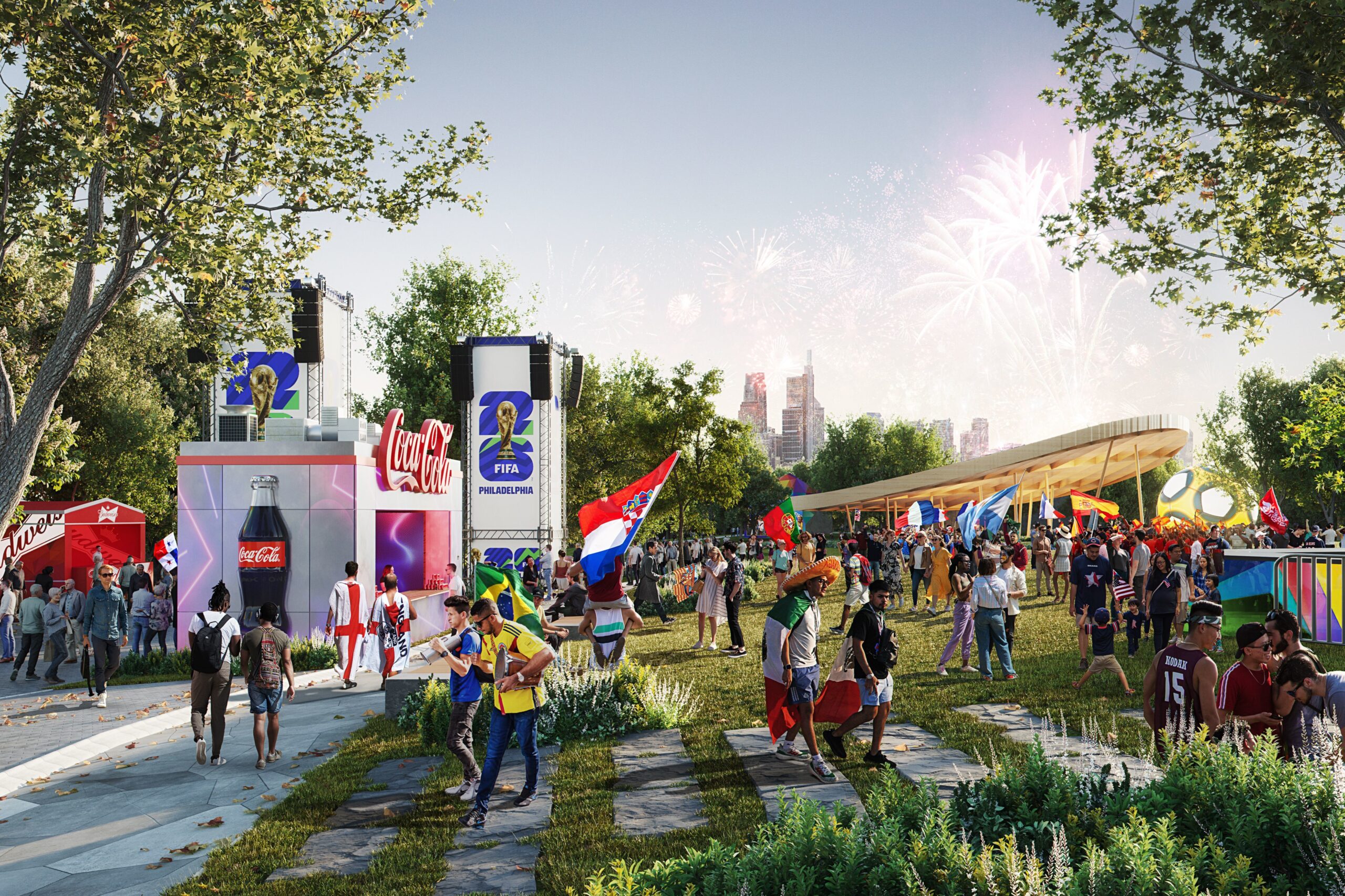
On top of it all, Philadelphia Soccer 2026 is looking to announce updates regarding their free Fan Festival, set to be hosted at Lemon Hill in Philadelphia’s Brewerytown neighborhood, in the coming weeks.
A rendering of what Philadelphia’s World Cup fan fest site at Lemon Hill Park is expected to look like.
“The Lemon Hill and FIFA fan festival is a key component of our planning,” Kane said. “So really focused on that and getting ready to hopefully make some announcements about what people can expect at Lemon Hill in the coming weeks. It’s going to be an incredible event. It’s going to be one of those spectacular, unexpected moments of the tournament for people who live here and for visitors alike.”
According to Kane, the city plans to invest $5.2 million into the park ahead of the World Cup, which will be partially spent on ADA accessible ramps, better lighting, paved walkways, and an improved playground noted as “quality of life improvements.”
“I think that one of the things that has been so incredibly heartening and productive around the planning is that the city really leaned in with Philadelphia soccer 2026 around community engagement and hearing from the community about their concerns,” Kane said. “But also, their hopes for the park. It is a beautiful park, and one that has not necessarily been invested in over the last 40 years. So for us, it’s exciting that we’re able to put some preliminary infrastructure in that is going to allow us to host this festival there.”
It was at the end of last year in the hazy stretch between Christmas and New Year’s when time doesn’t feel real, and some of Philly’s top Democrats were huddled around a secret proposal, racing to meet a deadline.
The group — convened by Mayor Cherelle L. Parker, her aides, and some key Philadelphia boosters — was preparing a lengthy bid to bring the Democratic National Convention back to the city in either 2028 or 2032, a potential economic boon and a chance to show off in front of lawmakers, celebrities, and international media.
The confidential proposal to the Democratic National Committee included everything from the city’s hotel space to police outfitting to nitty-gritty details about the electrical grid and voltage capacity at Xfinity Mobile Arena. SEPTA officials drafted a section about the public transportation Philadelphia could offer visitors, and tourism agencies chipped in with insights on hotels and restaurants.
David L. Cohen, a longtime Democratic fundraiser and the president of the recently formed nonprofit host committee called Pick Pennsylvania, said that while the mayor led the effort, the bid also emphasized the “unity of the region and the commonwealth.”
“She wanted it to be really clear this is more than a Philadelphia bid,” he said. “This is a unified Pennsylvania bid.”
It appears the Democratic National Committee was impressed. On Monday, the DNC announced that it is considering five cities, including Philadelphia, to host the 2028 convention, where a Democratic presidential nominee will be coronated. The party is also looking closely at Atlanta, Denver, Chicago, and Boston to hold the early August event.
What comes next is a campaign to lure the convention to Philly, complete with a carefully coordinated public relations effort and a significant fundraising push. Philadelphia’s host committee for 2016, the last time the city held a presidential nominating convention, raised more than $85 million.
The DNC has asked host cities to raise $5 million before being selected. Philly’s fundraising, Cohen said, “will be substantially higher than that number.”
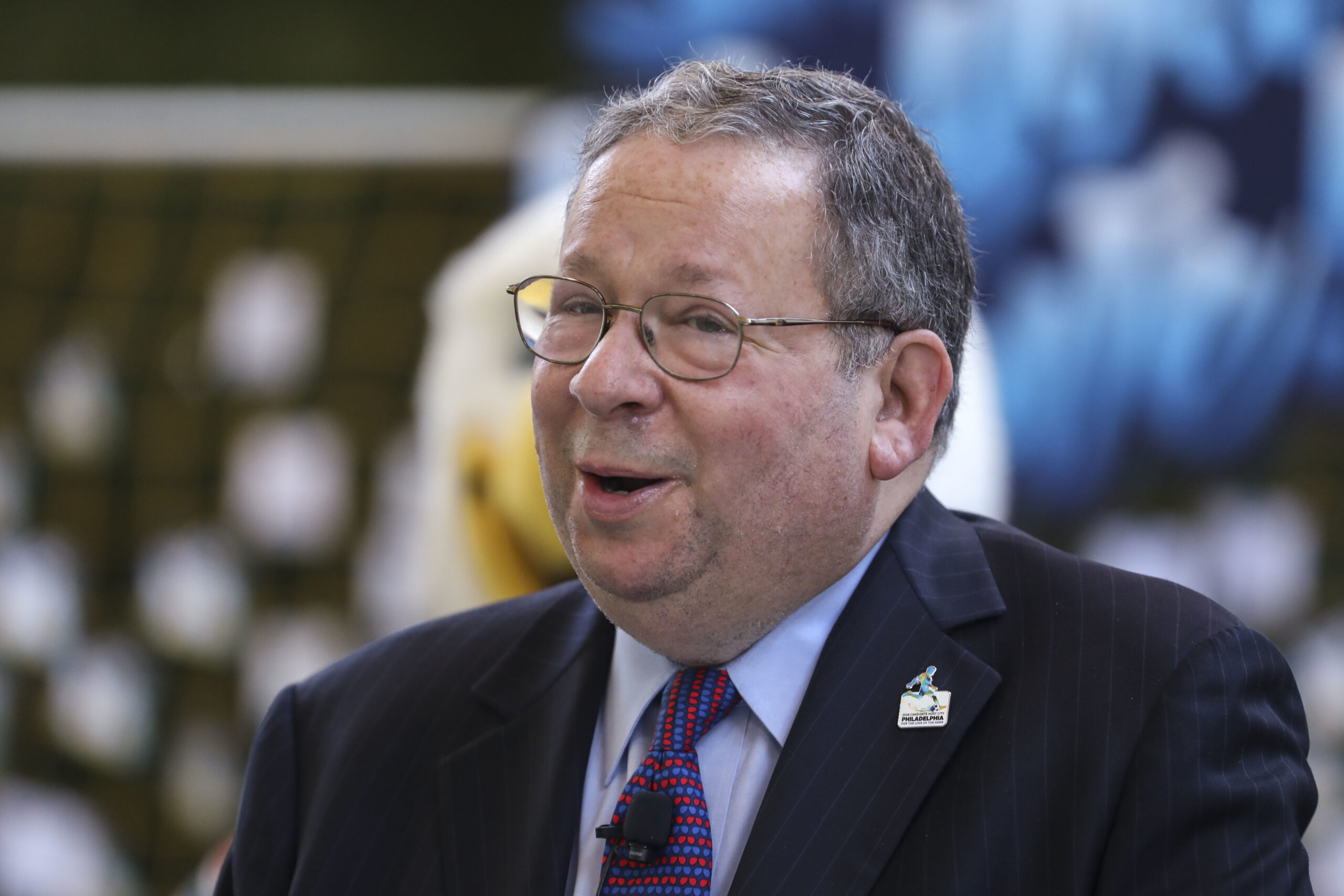
In this 2021 file photo, David L. Cohen speaks as Philadelphia Soccer 2026, the city’s World Cup 2026 bid committee, launched an interactive exhibit at the Independence Visitors Center in Philadelphia. He is now heading an effort to bring the Democratic National Convention to Philadelphia.
Cohen, a former Comcast executive and erstwhile chief of staff to former mayor Ed Rendell, is leading the effort alongside Daniel J. Hilferty, now the CEO of Comcast Spectacor.
Hilferty and Cohen have worked together repeatedly over the last two decades to bring major events to Philadelphia, including a successful bid to become one of a handful of North American cities to host World Cup games this year.
Also involved in coordinating the DNC proposal was Erin Wilson, a Philadelphia native who was a top aide to former Vice President Kamala Harris. She was the national political director for former President Joe Biden’s campaign and planned his 2021 inauguration.
When the DNC comes to town
DNC officials are expected to make a final decision on the 2028 site later this year. That call will likely be made by chair Ken Martin in consultation with top advisers and the committee’s Technical Advisory Group, which assesses logistics and operational matters.
Philadelphia could also have an advocate in State Rep. Malcolm Kenyatta, who represents parts of North Philadelphia and is a DNC vice chair. He is known to have a close relationship with Martin.
Committee officials and the advisory group will tour each of the five finalist cities for a yet-to-be-scheduled site visit this spring.
If history is any indication, the city will roll out the red carpet. In 2014, when 18 members of the DNC came to Philly to check out the city ahead of the 2016 convention, the host committee spent six figures to charm them.
The trip included a tour of Philly’s most popular sites, like Reading Terminal Market and the Philadelphia Museum of Art, as well as a swanky rooftop party and a breakfast at the Comcast Center. Predictably, cheesesteaks were also involved.
“The site visits are as much about feel as they are about technical details,” Cohen said. “After site visits, the teams who are making choices leave here and they have their socks knocked off. They can’t believe how vibrant the city is.”
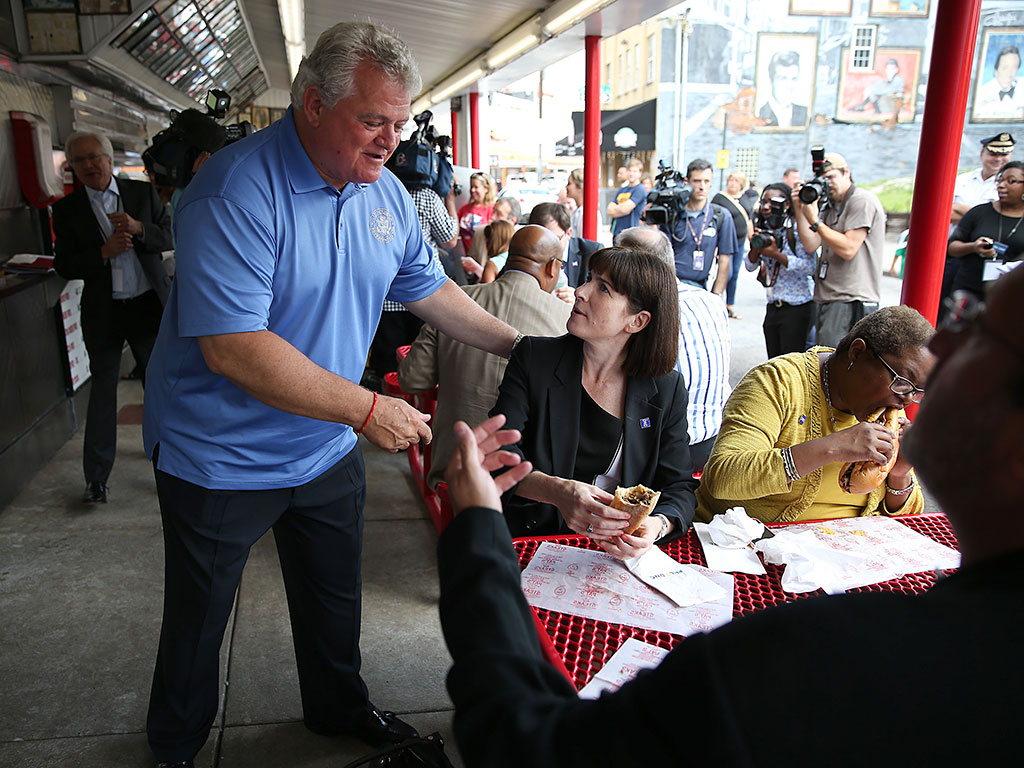
In this 2014 file photo, Congressman Bob Brady, left, talks with DNC CEO Amy Dacey, center, as they have lunch at Pat’s Steaks in South Philadelphia.
Ryan Boyer, the head of the Philadelphia Building and Construction Trades Council and a close Parker ally, said one of Philadelphia’s best assets might be its mayor. Parker is an unabashed cheerleader for the city and is leading preparations for several major events this year, including World Cup games, the MLB All-Star Game, and the commemoration of America’s 250th anniversary.
“She’s the most effective advocate for bringing people together,” Boyer said, “with just her level of passion, her love of the city, and her love of the job.”
Cohen said he spoke to Parker last year about the potential to bid for the convention, and when she asked him to lead the host committee, he said yes because the city has “a serious chance.”
“As a friend and longtime supporter of hers, if I didn’t think we had a legitimate shot, I would try to talk her out of it,” Cohen said. “If anything, I have poured gasoline on her flames of enthusiasm and said, ‘We should be all in for this.’
”I said, ‘Do what you do best,’” he added. “Get everyone excited about this.’”
That means there is a chance that Shapiro, who was raised in Montgomery County and whose family still lives there, could be nominated in what is essentially his hometown.
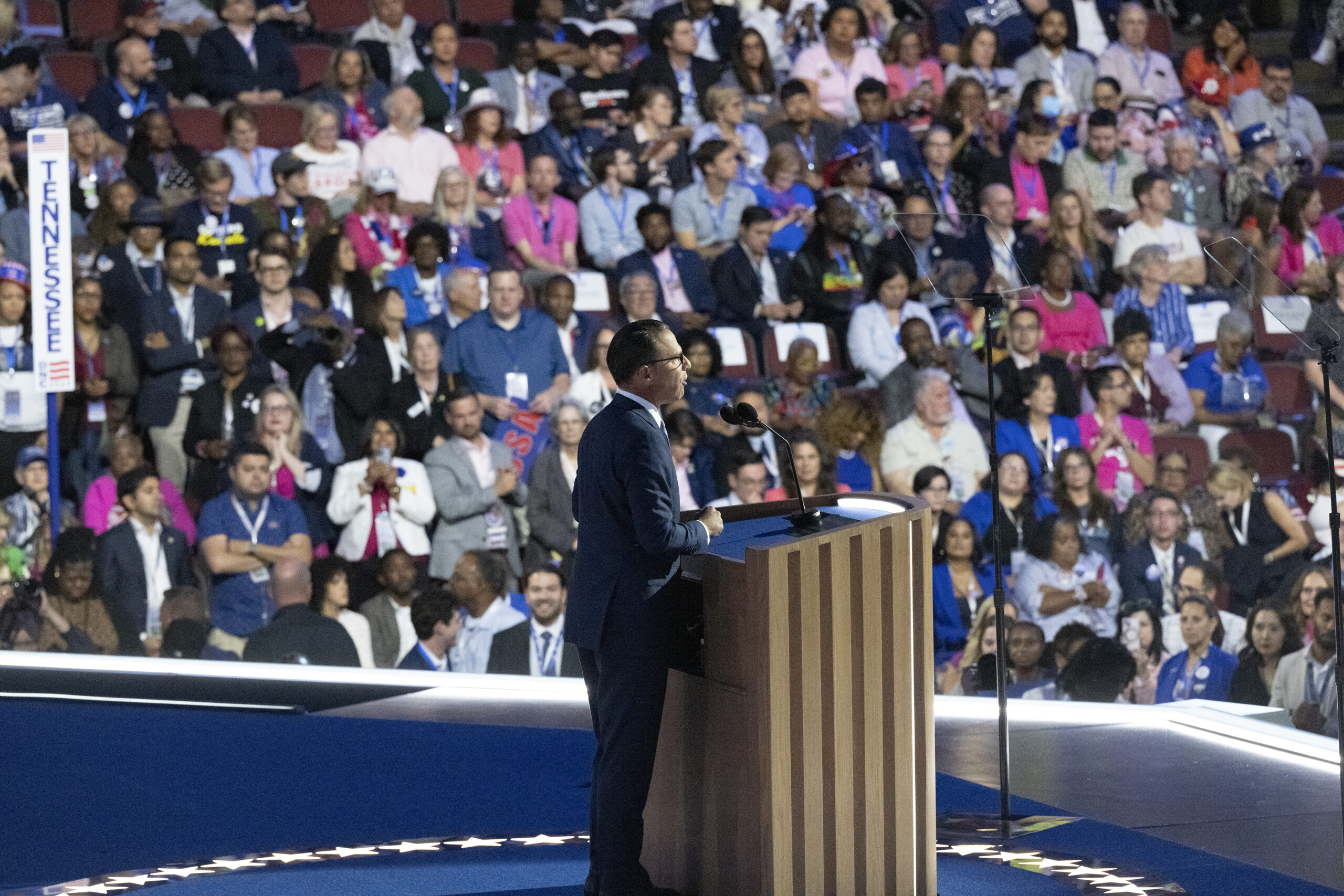
Pennsylvania Gov. Josh Shapiro speaks during the Democratic National Convention Aug. 21, 2024, in Chicago.
In a letter to Martin, Shapiro wrote that Philadelphia “would see substantial economic benefits” from hosting the convention and vowed that the state would be “prepared to ensure our infrastructure, public safety agencies, workforce, and business community are equipped to host thousands of delegates and attendees.”
What’s next: a close look at security and logistics
Behind the pomp of the DNC’s spring site visit will be a serious evaluation of security, transportation, hotels, and arena logistics.
The DNC said in a statement Monday that it will value “new and innovative approaches” to hosting a large-scale event that is likely to bring thousands of tourists. In 2016, the convention drew more than 5,000 attendees and an additional 29,000 visitors — nearly 20,000 of whom were media members.
Nominating conventions are typically designated as National Special Security Events, meaning the federal government leads security because the event is deemed at high risk for terrorism or other criminal activity. That means planners need to know specifics about law enforcement staffing, gear, and other capabilities.
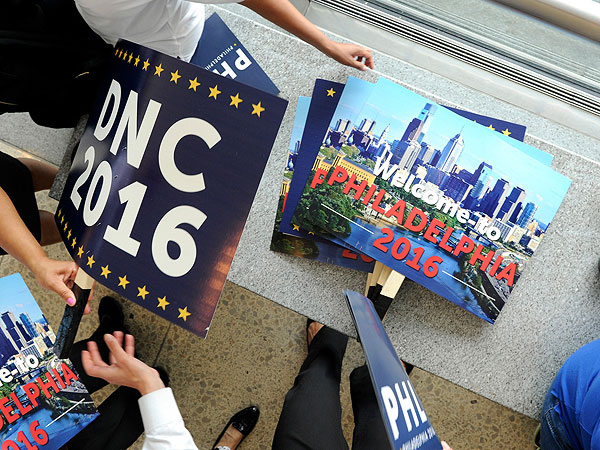
Placards promoting Philadelphia as the host city of the Democratic National Convention in 2016, while the Democratic National Committee was touring the city in August.
Support will also have to come from outside the city. During past conventions, federal law enforcement teamed up with Philadelphia police to secure the venue, and they were joined by officers from across the region.
The DNC also said in its announcement Monday that the committee would prioritize “the importance of forging a strong partnership between the DNC and the host city, including its community, political, and business leaders.”
To that end, the host committee and Parker asked elected officials and civic leaders from across the state to write letters of support that accompanied the city’s bid.
Authors ranged from City Council President Kenyatta Johnson, whose district includes the South Philadelphia stadium complex, to labor leaders to Democrats from the Philadelphia collar counties.
Montgomery County Commissioner Neil Makhija, who wrote a letter to the DNC boosting the bid, said it is important for the committee to see that local governments and law enforcement agencies outside the city are willing to offer support, because “pulling something like this off requires a lot of cooperation on many different fronts.”
“A real concern now when you’re thinking about hosting a political convention is ‘How are we going to manage public safety and a threat environment?’” he said. “There are a number of reasons to point to our region and see a level of collaboration that inspires confidence.”
Why are Americans allowed to place bets on death and destruction?
An advertisement by the American company Polymarket shows Zohran Mamdani and Andrew Cuomo ahead of the New York City mayoral election on Nov. 4, 2025, in New York.
Donald Trump’s splendid and not-so-little war that started during a Saturday rush hour in Tehran and has spread like a coronavirus to numerous other countries is entering its fourth day on Tuesday — far too early for one of journalism’s oldest clichés: the “winners and losers” piece.
Except for these winners: a few “lucky” — if that word can even apply to such a ghoulish enterprise — gamblers who woke up Saturday morning and learned that the first deadly explosions across Iran had already made them a lot richer, regardless of who wins or loses on the battlefield.
The initial weekend of war wasn’t even over before we learned that Polymarket, one of the two leading prediction markets that are the inevitable next downward spiral of our national sports gambling addiction, was hit by suspicious trading by six individuals who showed up to bet big on when the war would commence.
One trader up for particular attention earned a reported $553,000 over the weekend by placing large bets on when Iran’s supreme leader, Ayatollah Ali Khamenei — killed in the war’s initial minutes, reportedly — would be deposed. The handle on that well-timed, if macabre, gambler? “magamyman.”
My man, you aren’t even trying to hide it.
Polymarket’s brush with possible insider trading on predictive bets over the Iran war that is now a reality came as its customers bet a stunning half a billion dollars on the long-rumored conflict.
Many of them, presumably, are just regular schlubs desperate to get ahead in a dog-eat-dog economy. But it’s also hard not to contemplate that some may have had real advance knowledge of Pentagon war planning that loose-lipped insiders were audibly discussing in Joe’s Stone Crab just hours before the first cruise missile was fired.
I know … it’s shocking that something in America’s death spiral of late-stage capitalism is actually a rigged game, right? Still, it’s hard to decide which is worse about this new low of predictive betting on a war that’s already killed scores of innocent schoolgirls and hospital patients, and at least six U.S. service members: the rank immorality of wagering on death and destruction, or the insider trading that corrupts this already unholy process even further?
Over the weekend, even with the main focus on the latest missile attacks and changing Trump regime explanations for this undeclared war, there was growing outrage over the popularity of predictive betting on the news, especially when the news is deadly. Or, there’s the word the chief U.S. government official tasked with regulating Polymarket, Kalshi, or their rival firms has used to describe what’s happening.
Michael Selig, the lawyer tapped by Trump last year to head the U.S. Commodity Futures Trading Commission (CFTC), which — controversially — regulates these prediction markets, seems less a regulator and more of a cheerleader, maybe as much as “magamyman.” As several states have pushed to regulate or ban predictive markets as akin to sports betting sites, also under its purview, Selig has worked hard to override them with a claim of federal supremacy.
“The CFTC will no longer sit idly by while overzealous state governments undermine the agency’s exclusive jurisdiction over these markets by seeking to establish statewide prohibitions on these exciting products,” Selig wrote in a Wall Street Journal op-ed.
It’s worth noting Selig’s moves came at the same time that six Democratic senators wrote the CFTC chair to urge him to ban gambling on outcomes that result in death or physical harm — inspired by outrage that people were betting on whether a NASA spacecraft would fail to launch, as well as predictions around the fate of the former Venezuelan strongman Nicolás Maduro, seized in January by U.S. troops. Not surprisingly, the high volume of Iran war betting has sparked fresh calls to ban predictive market betting altogether.
“Life stops being something we live, but something we sell and trade,” Connecticut Democratic Sen. Chris Murphy posted on X, before saying he is studying legislation to ban prediction markets. “It will breed both corruption [and] emptiness.”
Unlike sporting events, betting on political or social developments whose occurrence and timing are controlled and known by humans is incredibly prone to insider trading. In a case that seems to typify the fundamental flaw of non-sports prediction markets, and which Kalshi was forced to acknowledge in an internal investigation, an editor for the wildly popular YouTube star Jimmy Donaldson, better known as MrBeast, was caught betting $4,000 on predictions about what MrBeast would say in his next video.
Because betting on influencer video topics is how far off the deep end we are going here. The addictive nature of online sports betting, which was once mostly banned until elite schemers realized how much money was to be made from increasingly desperate people, was always pointing American society in this warped direction.
Zoom out and there’s a much bigger picture here: A society where the traditional pathways to prosperity are rigged for the Epstein class has created an entire ethos that seeks to match that level of wealth through unconventional not-40-hour-workweek paths, like online influencers, or by hitting the big one, whether that’s through buying a meme stock, betting on college basketball, loading up on the right crypto, or — now — gambling on stuff like when Israel is going to bomb women and children in Gaza.
It seems no one near the top of the American kleptocracy is immune to cashing in, including — sigh — Big Media. It was bad enough that CNN partnered with Kalshi to promote predictive odds on events like Tuesday’s Texas primary, but now the venerable Associated Press picked Monday — amid all the negative publicity about the Iran war wagers — to announce its own deal with the site.
Meanwhile, the only safe bet would be a prediction that no one in Washington, D.C., will be able to successfully stop this in the near future. It’s not only that reckless and potentially corrupt get-rich-quick maneuvers like crypto, artificial intelligence, and now these “exciting” predictive markets are simply in the Trump regime’s toxic money-grubbing DNA.
To seal the deal, Donald Trump Jr. joined the advisory board of Polymarket last August, and his venture capital firm, called 1789 Capital, has reportedly invested tens of millions of dollars in the firm, as well. In a remarkable coincidence, two federal investigations into predictive markets that began during the Joe Biden presidency were shut down around the same time.
Today’s dollars stained with blood from the Middle East are the, dare I say it, predictable result. Why merely wage war when you can also wager on it? Our leaders, whether in D.C. or our 50 statehouses, can’t shut down Polymarket, Kalshi, and all their imitators fast enough.
Yo, do this!
Escaping from a global crisis is always a good time to get back to the basics, and for boomers of a certain age, nothing is more fundamental than the power chords and pounding drums of Led Zeppelin. Listening to and thoroughly enjoying Andrew Hickey’s A History of Rock Music in 500 Songs’ two-part episode on how the most classic of all classic rock bands came together at the end of the 1960s made me discover that there’s also an acclaimed 2025 documentary, Becoming Led Zeppelin, streaming on Netflix. Let’s watch it together.
The rising thermometer this week should serve as your reminder that the arrival of March means it’s also time for some baseball that actually counts. The World Baseball Classic, the sport’s World Cup knockoff that comes every three years, starts Thursday and runs through the March 17 final in Miami — site of 2023’s thrilling conclusion in which Japan’s Shohei Ohtani struck out the USA’s (and South Jersey’s) Mike Trout. Some 10 Phillies are competing, including Bryce Harper, Kyle Schwarber, and Brad Keller — on this year’s Team USA — and Dominican Republic ace Cristopher Sánchez, so let the games begin.
Ask me anything
Question: So one school of thought is that they are already trying to steal the midterms; another is that they really can’t. Where are you on the spectrum from mildly worried to totally anxious about this? Especially with Pa. being rather swingy. — Penthesilea (@hansklocker.bsky.social) via Bluesky
Answer: Yes, this is something I’ve already thought about quite a bit, and my answer — for now, anyway — is pretty much smack in the middle of the spectrum. It’s clear Donald Trump intends to use every implement in the voter suppression toolbox — extreme gerrymandering, executive orders aiming to require voter ID, or banning mail-in ballots — that would warp the voting outcomes, without going full Mussolini and canceling the election altogether. But I don’t think that can work for him — partly because any orders will almost certainly be struck down in the courts, but mainly because it looks like a Democratic landslide too large to easily suppress is building momentum. Just look at Texas, where the scheme to gerrymander five new GOP seats depended heavily on Latinos continuing to shift Republican, when polls show the exact opposite happening. Of course, in 2020-2021, few folks thought he would go so far as an attempted coup (I did). Who knows how far he’ll go to maintain power this time around?
What you’re saying about …
Last week’s question about how to handle the new prediction markets — anticipating the mess that occurred with the wagers on the start of the Iran war — and the surge in sports betting drew a tepid response. But it was pretty unanimous that sites like Polymarket and Kalshi should, at the bare minimum, be regulated under state gambling laws, and not as commodities trades — if not banned altogether. Wrote Mary Clare Gumbleton, who would ban Polymarket and Kalshi: “It’s just unregulated corruption and an incredibly awful incentive to both lose your shirt (as it were) and game the system where a handful of corrupt people can make a lot of money.”
📮 This week’s question: There’s only one thing on everyone’s mind: That crazy war in the Middle East. Now that Donald Trump and Benjamin Netanyahu have started it, how on earth do we end it? Please email me your answer and put the exact phrase “Iran war end” in the subject line.
History lesson on when the Iran thing really started
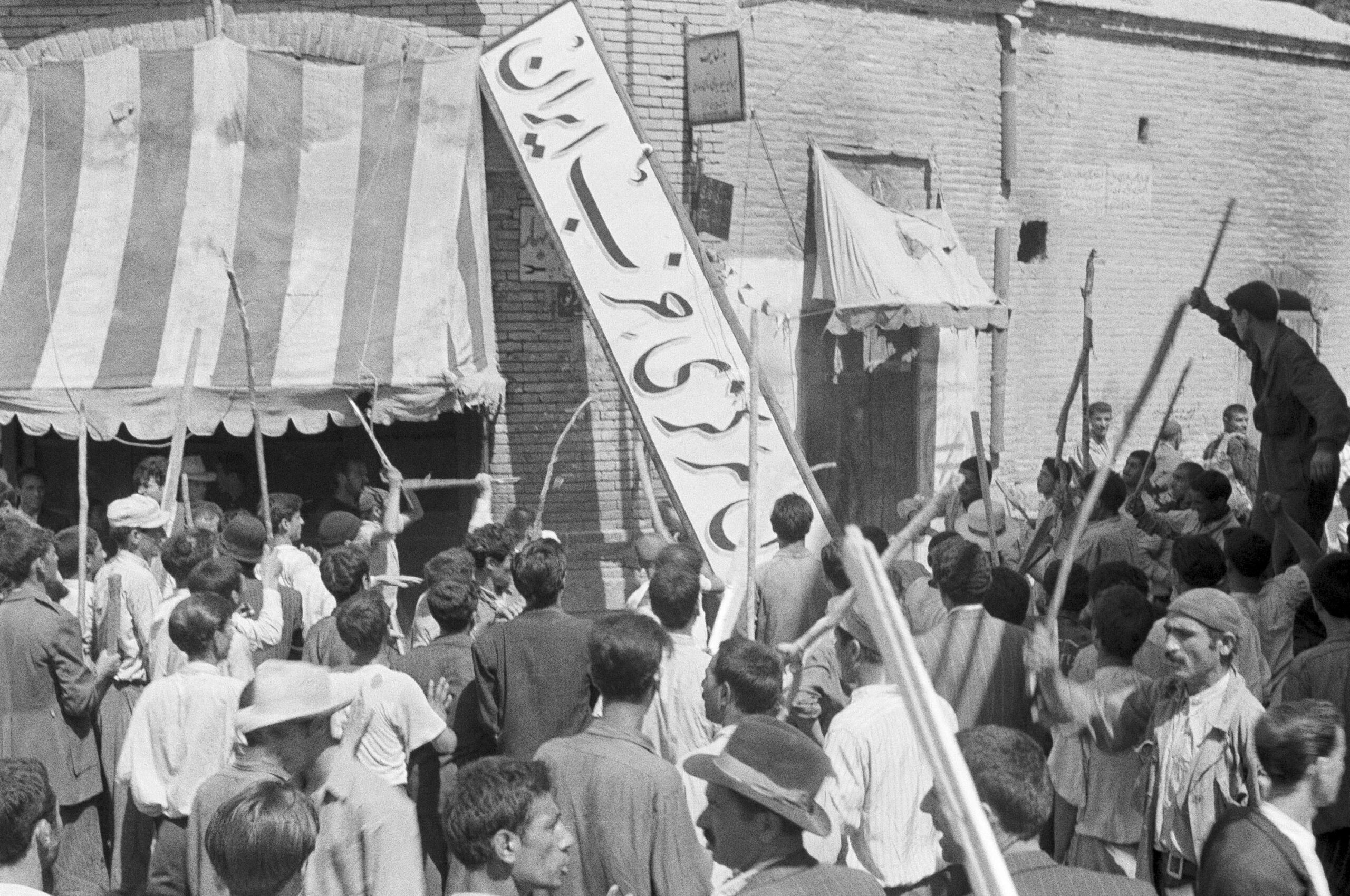
A crowd of demonstrators tear down the Iran Party’s sign from the front of its headquarters in Tehran on Aug. 19, 1953, during the CIA-backed coup that ousted Prime Minister Mohammad Mosaddegh and his government. The operation cemented the rule of Shah Mohammad Reza Pahlavi for more than 25 years before the 1979 Islamic Revolution.
It’s been a while since the last history lesson in this space, but the poor quality of the TV punditry about the four-day-and-counting Iran war screams out for better information. A lot of the folks advocating for this war of choice in the Middle East argue that we didn’t start the fire, that the roots go all the way back to the 1979 Iranian Revolution. That’s the year when Americans who never paid much mind to foreign affairs were shocked to see huge throngs in the streets of Tehran chanting “Death to America” and taking 52 hostages at the U.S. Embassy.
What did we do to deserve this? Well …
For most historians, and for many Iranians, the year that matters is not so much 1979, but 1953. In a post-World War II geopolitical environment where many nations sought to break free of imperialism, Iran in 1951 democratically elected a surprisingly left-leaning prime minister, Mohammad Mosaddegh, whose main project was to nationalize the then-British-controlled oil industry. This sparked great alarm in London, where U.K. leaders spent months lobbying Washington to join them in an effort to depose Mosaddegh in a coup that would advance Western oil interests.
It’s a messy story. The United States wavered and even flirted with backing Mosaddegh for a time, according to histories of the period, but ultimately British leaders leaned on the Eisenhower administration and America’s ongoing anti-left “Red Scare” of that era to get the relatively new CIA and its man in Tehran — Kermit Roosevelt Jr., grandson of Teddy Roosevelt — on board with the plot. The Americans threw around money and anti-Mosaddegh propaganda, and eventually organized street protests ahead of the government’s ouster.
To be sure, there is a never-ending debate over whether the U.S. involvement was central or just a subplot to the coup that gave power to the shah of Iran, Mohammad Reza Pahlavi, who ruled the nation with ruthless brutality for the next 26 years. Certainly, the nation’s Islamic clerics — powerful then, as now — played a key part in ousting a secular government. But the American role was so great that Barack Obama apologized in his 2009 Cairo speech, stating as fact that the CIA played a key role in the “overthrow of a democratically elected Iranian government.”
Whether the U.S. led the coup or was a bit player, the Iranian people have never forgotten our involvement or our close ties to the eventually despised shah. “The rancor has never melted,” a 24-year-old Iranian woman told the Associated Press in 2023, on the 70th anniversary of the coup, as she compared the American meddling to being “like wishing for an earthquake to get rid of a bad neighbor.”
So did a state of war between the United States and Iran start in 1979, as some GOP lawmakers insist, or in 1953, or on Feb. 28 of this year? In arguably the world’s most violent neighborhood, the cycles of violence often seem to have no beginning and no end. An imperial America chose to jump into the middle of this mess 73 years ago, and now getting out feels more impossible than ever.
What I wrote on this date in 2016
He’s all but forgotten now, but up until his mysterious death 10 years ago, the flamboyant Oklahoma natural gas mogul Aubrey McClendon had reshaped the Pennsylvania landscape as king of the commonwealth’s fracking boom. The company that McClendon (known to sports fans as an owner of the NBA’s Oklahoma City Thunder) cofounded, Chesapeake Energy, promised riches to Pennsylvania landowners, but left a trail of lawsuits and pollution. Less than 24 hours after his indictment by a federal grand jury, McClendon drove at full speed into a bridge embankment and was killed instantly. I wrote: “In Pennsylvania, Aubrey McClendon is survived by a legacy mostly of conflict, of thick lawsuits, of protesters facing off against armed marshals, of lawmakers and a governor at war over the taxes that gas drillers never had to pay, of brackish water and leaking methane adding to the greenhouse gases that may someday strangle the planet — of a promise of buried treasure that wasn’t really all it was cracked up to be.”
America is now at war on two fronts. In one column, I tackled the ongoing conflict in the streets of America, and looked at the tragic death on a frigid Buffalo street of the Rohingya refugee, Nurul Amin Shah Alam — a disabled and nearly blind man who was arrested by Border Patrol agents, and then dumped at a closed coffee shop five miles from his family’s home. It was a low point that spotlighted the unrelenting cruelty of a xenophobic mass deportation crusade by the Trump regime that has brought a mounting death toll. On Saturday morning, I knocked out my instant reaction to the news that the Trump regime had joined Israel in an all-out attack on Iran, which was that the war is both unconstitutional without the consent of Congress and also a clear violation of international law.
In moments of national and global crisis such as this, it’s easy to forget that many of the political decisions that shape people’s everyday lives occur on the local level. Here in Philadelphia, the school district’s plan to modernize its schools while closing 20 older buildings came as a shock to city parents, and The Inquirer’s coverage, anchored by our Pulitzer Prize-winning city public schools reporter, Kristen A. Graham, has been all over this story. The newsroom has explained the plan in detail, and covered the community protests and the fights over individual buildings, as well as Philly’s move away from middle schools. One advocate told me The Inquirer’s aggressive coverage of the story is why two schools have now been removed from the plan. A healthy community is one that has a vibrant news media. You nurture a better Philadelphia when you support The Inquirer by subscribing.
By submitting your written, visual, and/or audio contributions, you agree to The Inquirer’s Terms of Use, including the grant of rights in Section 10.
Philadelphia is one of five cities on a list of finalists to host the 2028 Democratic National Convention, a major gathering that could generate millions of dollars in economic impact for the city.
Party officials are also considering Boston, Atlanta, Chicago, and Denver, the Democratic National Committee announced Monday.
The convention will be held from Aug. 7 to Aug. 10, 2028, according to the party. If Philadelphia is selected, the convention would likely be held at the Xfinity Mobile Arena at the South Philly stadium complex, the largest indoor event space in the city.
DNC leaders and advisers are expected to make site visits this spring before selecting a host.
The DNC said in its statement that, in picking a host city, party leaders will consider how each city uses “new and innovative approaches in response to the challenges and opportunities that arise from hosting an event of this magnitude.”
The Republican Party’s 2028 convention will take place in Houston.
Top Philadelphia Democrats and donors formed a host committee — called Pick Pennsylvania — in recent months and, in partnership with Democratic Mayor Cherelle L. Parker, submitted a bid to host the 2028 convention.
In a statement, Parker said that Philadelphia’s selection as a finalist “reflects the strength of its proposal and the broad coalition of civic, business, labor, and community leaders committed to hosting a convention that is inclusive and memorable.”
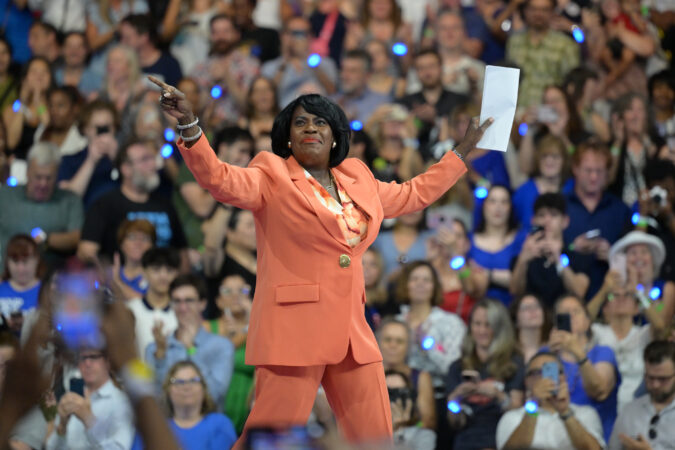
Parker, who is up for reelection next year, would no doubt play a major role in planning for an upcoming convention. So would Gov. Josh Shapiro, a Democrat currently running for reelection who is considered a contender for the 2028 presidential nomination.
The president of the Philadelphia host committee is David L. Cohen, a prominent party stalwart, and the chair is Daniel J. Hilferty, the CEO of Comcast Spectacor, which owns the Xfinity Mobile Arena.
He said in a statement that “there is no city more excited, more invested and more prepared than Philadelphia to host the 2028 Democratic National Convention.”
Philadelphia — the largest city in a critical swing state — last hosted a presidential nominating convention in 2016 at the South Philly arena, then called the Wells Fargo Center. Democrats that year nominated former Secretary of State Hillary Clinton, who was later defeated by Republican Donald Trump.
Before 2016, the city hosted major party conventions seven times, including the 2000 Republican National Convention. The GOP that year nominated then-Texas Gov. George W. Bush, who went on to serve two terms in the White House.
Former U.S. Rep. Bob Brady, the chair of the Philadelphia Democratic City Committee, said Monday that he had spoken multiple times to DNC leaders about the prospect of the city hosting the 2028 convention.
“We got a great reputation from the last convention we had,” Brady said. “Plus we’re going to show off the city very well this summer, which will really give us a good look.”
The news that Philadelphia is again a finalist to host the DNC is a welcome development for the city’s tourism and hospitality industry, as party conventions draw thousands of visitors and can be a boon for spending in the city.
The 2016 event generated $230.9 million in economic impact, according to the Philadelphia Convention and Visitors Bureau. Of that, about $132.9 million came from direct convention-related spending, and $11.1 million was generated by state and local taxes. That convention attracted more than 5,000 attendees and some 29,000 other visitors, leading to a record-breaking year for hotels in Center City, the bureau reported.
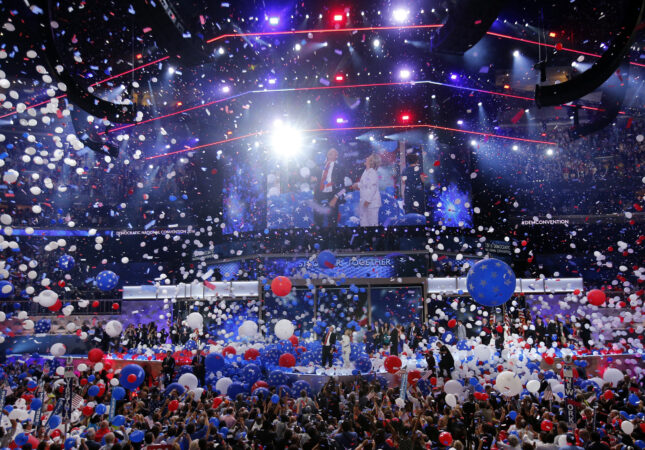
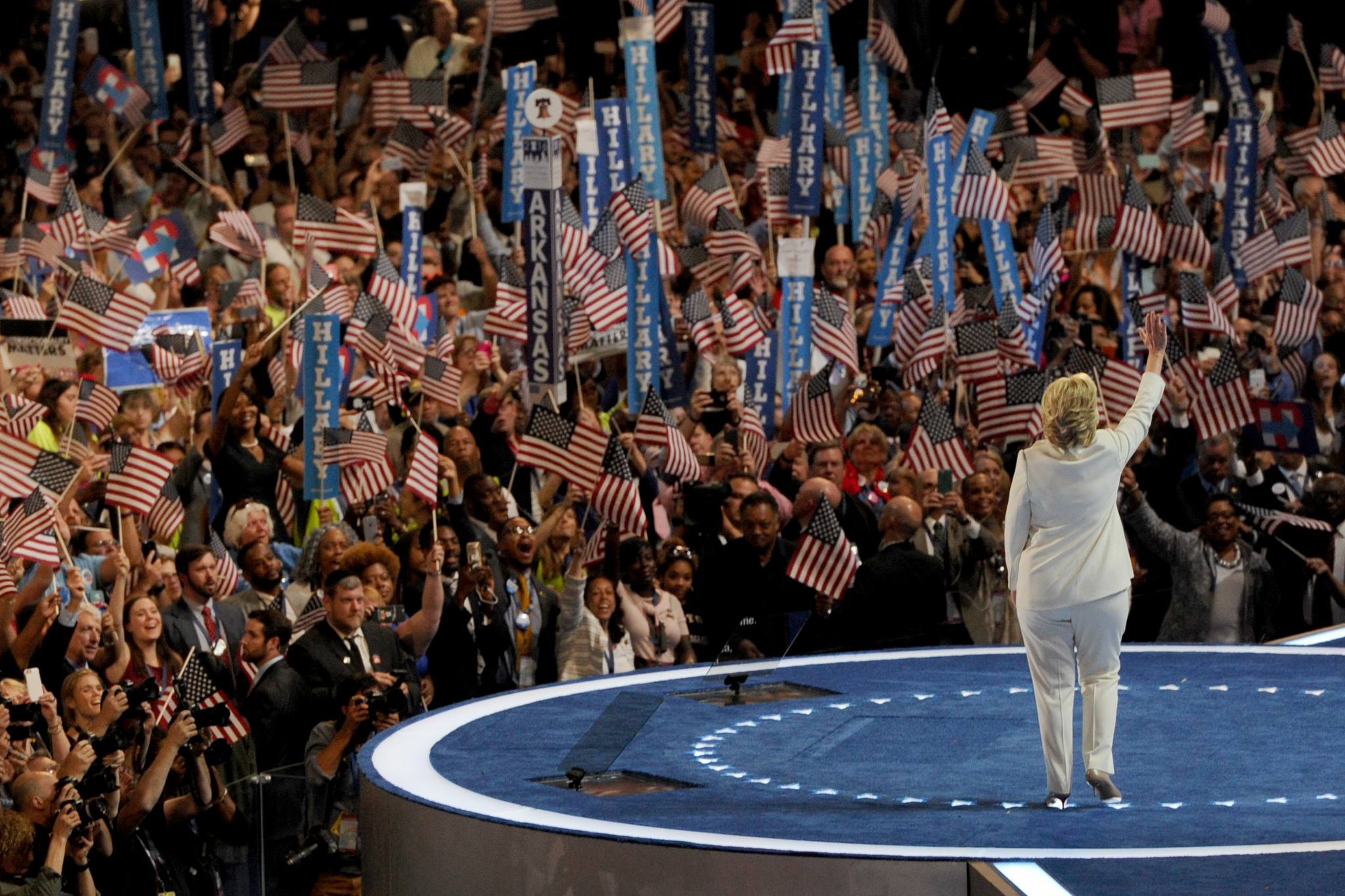
In this July 28, 2016 file photo, then-Democratic presidential nominee Hillary Clinton walks on stage at the arena in South Philly to accept the nomination of her party on the final night of the DNC.
If selected, Philadelphia may be uniquely positioned to host an influx of visitors.
The city’s hotel supply has expanded since the last time it hosted a DNC — and there are more than 19,000 hotel rooms in the city, according to Visit Philadelphia. That’s an increase from about 16,000 available in 2016.
The city has also invested millions of dollars on improvements to public spaces, transit hubs, and security ahead of several major events this year, including World Cup games, the MLB All-Star Game, and the commemoration of the 250th anniversary of America.
Conventions are also major logistical undertakings. Attendees include high-profile politicians and celebrities, and protests often form outside the events. The federal government has over the last two decades designated both parties’ nominating conventions as National Special Security Events, meaning they are deemed at high risk for terrorism and require federally led security.
In Chicago in 2024, the U.S. Secret Service led security planning alongside 16 other public safety entities, according to a local NBC affiliate. The law enforcement and security plan included designated protest zones, airspace monitoring, and traffic control.
Host committees are also responsible for raising millions of dollars to pay for parties, transportation for delegates, construction and venue upgrades, as well as other logistical services such as consultants, accountants, and communications staff.
In 2016, the Philadelphia host committee raised about $85 million — $10 million of which came from taxpayers in the form of a state grant. Other top contributions came from corporations, unions, and wealthy individual donors.
As the Union inflicted another loss upon themselves Sunday night, Matt Freese mostly got to just stand there and watch.
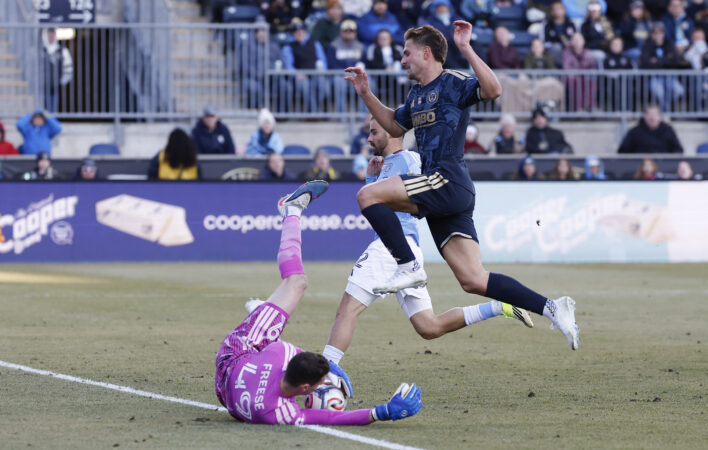
The Wayne native wasn’t really challenged until the late stages of his side’s 2-1 win at Subaru Park. In his sixth game for New York City FC against the team he grew up with, Freese didn’t face an official shot on target until the 54th minute, and the biggest save of his five didn’t come until the 80th.
Sure, there was Indiana Vassilev’s penalty kick equalizer in the 89th, followed by 10 minutes of stoppage time. But once Olwethu Makhanya was sent off for a second yellow card three minutes later, the field tilted back the other way, leading to Tayvon Gray’s eventual winner.
It might be a while before Freese has another day that easy, whether a Sunday or any other. In fact, many will soon be quite the opposite.
Three weeks from now, the 27-year-old goalkeeper will head to the U.S. men’s soccer team’s last training camp and games before the World Cup roster is set. Freese will arrive in Atlanta as the expected starter, a position he has done enough to keep while others have done too little to challenge him.
Along with the internal competition, Freese will be challenged by world powers Belgium and Portugal on the 28th and 31st. Both games will draw big crowds to Mercedes-Benz Stadium, with a sellout expected for the latter since it could be Cristiano Ronaldo’s first game on U.S. soil in 12 years.
Of all the positional battles to come in that camp, goalkeeper won’t be the most-watched. Centerback, central midfielder, attacking midfielder, and striker will all rank higher – which is every position except outside back.
But there will still be plenty of scrutiny on the net. Critics will pounce if Freese slips up, whether or not Matt Turner, Patrick Schulte, or any other candidate steps up to challenge him. Goalkeeper has been the U.S. team’s most solid position for decades, and it remains quietly awkward that right now it isn’t.
Matt Freese (center) in net during the U.S. men’s team’s game at Subaru Park last November.
Excitement for ‘big stages’
Freese isn’t thinking about that yet. He has enough on his plate with a New York team that hopes to silence its own critics, who see a starless roster.
“I’m just thinking about taking everything day by day, game by game,” he told The Inquirer. “I’m going to play some soccer today, and I’m going to play some soccer tomorrow, and [am] just going to continue on like that. So I’m really just focused on being present and improving every day, and making sure I’m ready for anything.”
“It’s a big stage, but I love big stages, I love big moments,” Freese said, “And the thing with big moments is, great preparation leads to great opportunities, and so that’s what I’m focused on: the preparation part.”
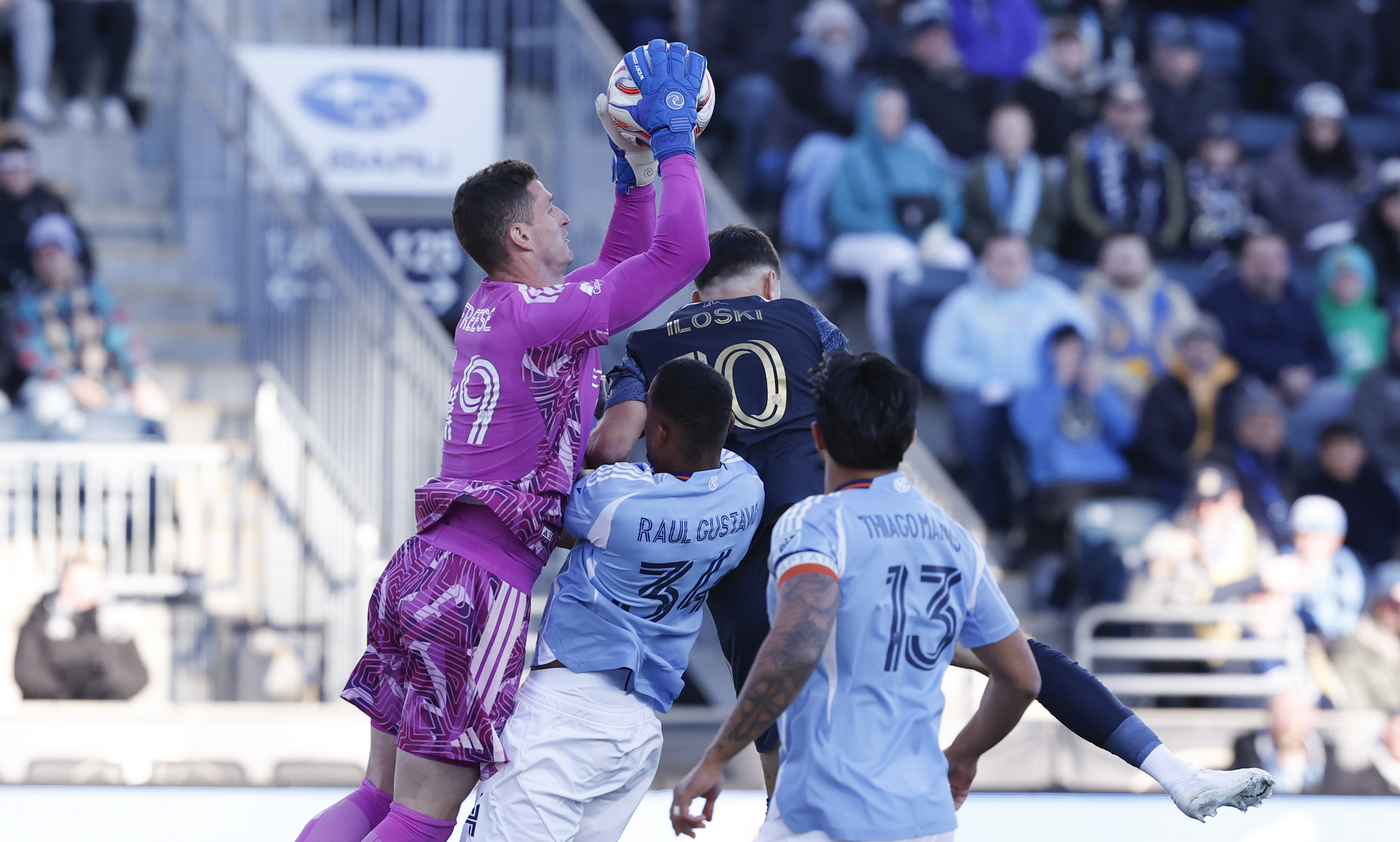
Matt Freese jumping to catch a ball in the air during the first half.
As it happens, Freese’s pre-World Cup schedule with New York is stacked with storylines. He’ll face the league’s three biggest stars, starting with Lionel Messi’s Miami on March 22 — the day before he goes to U.S. camp. Not many people these days get to face Messi and Ronaldo in a span of 10 days, and even fewer get to say they’ll host one of them at Yankee Stadium.
Later in the spring, Freese will visit Thomas Müller’s Vancouver, and host Son Heung-Min’s Los Angeles FC in Queens, the heart of New York’s big Korean population. He’ll also line up across from Schulte’s Columbus Crew, though he won’t face Turner’s New England Revolution until later in the year.
And for good measure, he’ll cross paths with Downingtown native Zack Steffen for just the second time. Steffen is out of the World Cup race at this point, but at least the duo might have some stories to swap.
On top in a growing rivalry
“Really, again, just focused on taking everything game by game,” Freese said. “In order to be the best, you’ve got to beat the best, and obviously this league at this point has, really, some of the best players in the world. It’ll be some big moments in the next two months of the games you’re talking about, but really just more focused on preparing for Orlando now [New York’s next opponent] after relaxing tonight.”
His use of “relaxing” was timely, given how much he could relax during the game. No one knows better how much of a rivalry the Union and New York City now have, except for maybe his old teammate Andre Blake.
“I think it’s just a matchup that brings the best out of each other,” Freese said. “I think it’s interestingly conflicting soccer philosophies, and I think that creates a really interesting game where we have to find different parts of us, and they have to find different parts of themselves. I think it really results in the two teams growing interestingly.”
This time, once again, the Union did not find different parts of themselves. After winning six of seven games against the Pigeons from 2022-24, New York has now won three of the last four, with Freese in net for all of them. And this time, he didn’t have to work too hard for it.
“It’s just part of the position, and that’s why I do so much work on staying in the present,” he said. “And just feeling the moment, and staying mentally engaged, staying vocally engaged, and physically engaged, following the game, and being ready for anything.”
He’ll have to be ready for a lot from now until the summer, and perhaps beyond.
The 2026 Winter Olympics in Milan may be over, but the political storm and protests stirred by the presence of U.S. Immigration and Customs Enforcement have not faded. With the FIFA World Cup set to bring millions of international fans to North America next, the Milan backlash now feels less like an isolated controversy and more like a warning of what could lie ahead.
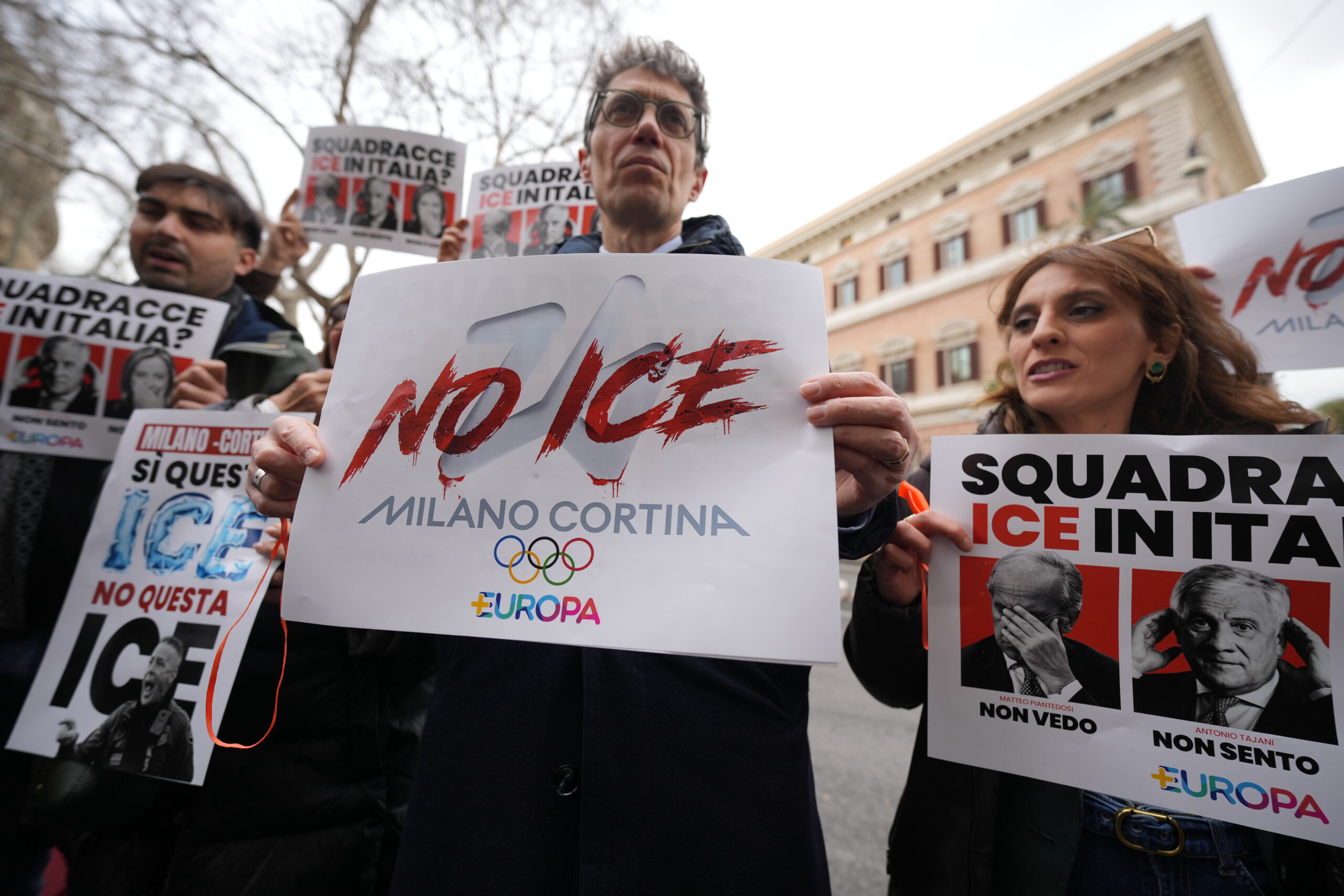
Italian lawmaker Riccardo Magi (center) shows a placard demanding that U.S. Immigration and Customs Enforcement (ICE) agents not be allowed at the Milan Cortina Olympics, during a protest staged outside the U.S. Embassy in Rome in January.
The last World Cup in Qatar drew about one million international visitors. The 2026 tournament — hosted across the United States, Canada, and Mexico — is expected to attract several times that number, making it the largest in soccer’s history. Its success will hinge not only on logistics and policing, but on whether teams and supporters feel welcome, safe, and able to move across borders within tight time frames.
That confidence is now under scrutiny. ICE acting Director Todd Lyons has said the agency will be a “key part of the overall security apparatus” for the World Cup. Yet, when immigration enforcement becomes visibly woven into the staging of a global tournament, it ceases to look like routine security and instead risks appearing as a projection of domestic policy onto an international stage.
Already, there are increasing calls to boycott the event for safety reasons, with fan groups like Football Supporters Europe expressing concern about the “ongoing militarization of police forces in the U.S.”
Meanwhile, supporters from Latin America, Africa, and the Middle East are already asking whether a valid visa will be enough. Could minor paperwork errors lead to detention? For mixed-status families living in the United States, the anxiety is sharper still. A major German team has reportedly canceled a U.S. tour, and online fan forums openly debate boycotts.
Sport has always intersected with politics. The 1936 Berlin Olympics were carefully orchestrated by the Nazi regime to project ideological confidence and international legitimacy, even as discriminatory policies continued at home. Decades later, the global boycott of apartheid South Africa — leading to the country being barred from the 1964 Olympic Games — showed that tournaments can reflect moral choices.
But there is a difference between holding regimes accountable and turning sporting events into stages for domestic enforcement policy. This point carries particular weight in the U.S., a country whose global appeal has long rested on openness and pluralism.
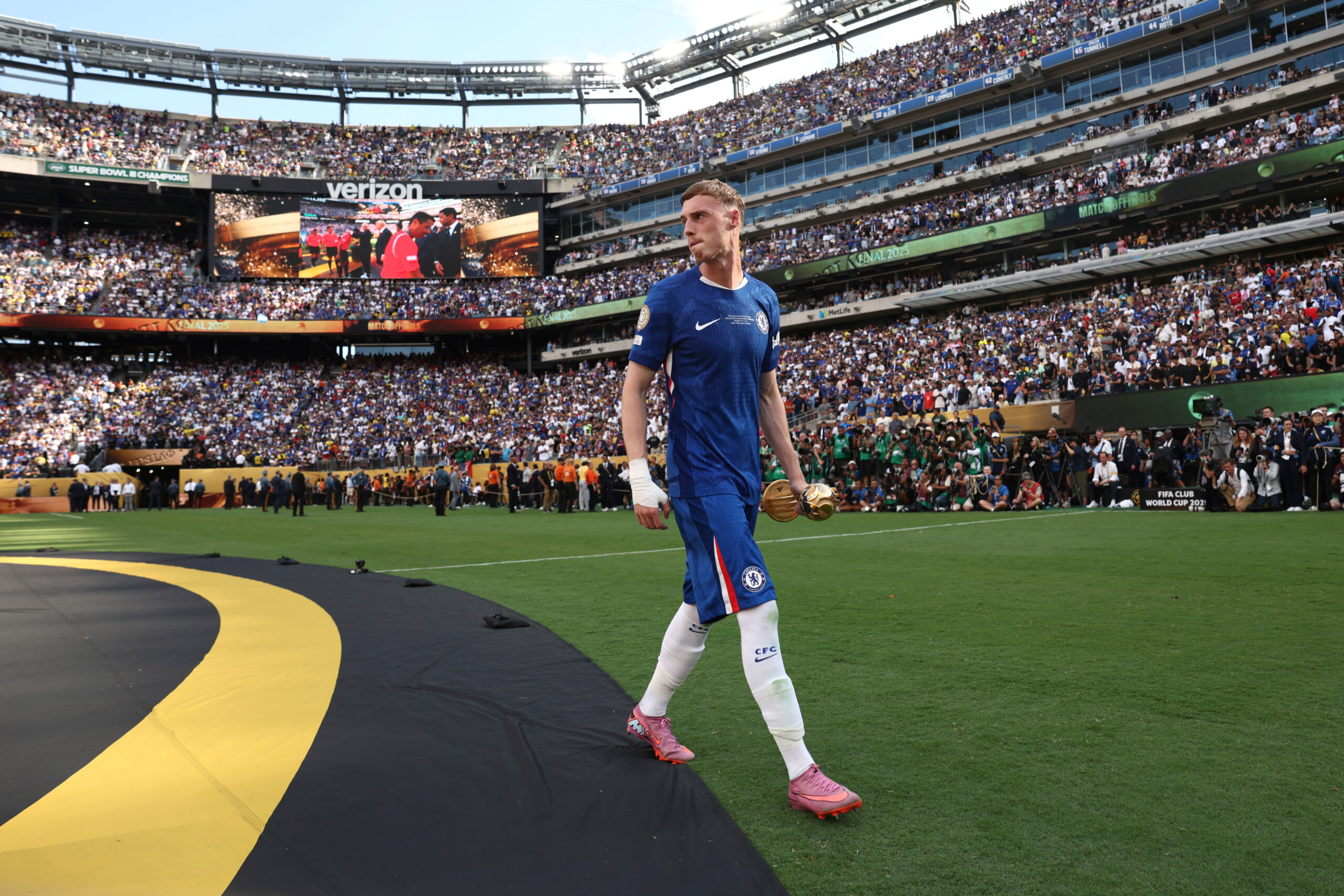
Chelsea’s Cole Palmer walks with the golden ball trophy after Chelsea won against Paris St. Germain in the Club World Cup final, at MetLife Stadium in East Rutherford, N.J., in July.
The World Cup is a soft-power moment. For one month, North America will present itself to billions of viewers not just as a host, but as a harmonious society — a rare global moment when rival nations share rules, rituals, and space on equal terms.
That is precisely why international bodies have treated soccer as a tool for cohesion rather than division. The United Nations has repeatedly promoted sport as a mechanism for refugee integration and social stability, while organizations working on counter-extremism and discrimination, including the Muslim World League, have similarly highlighted how athletics can cultivate “understanding, empathy and respect” across communities.
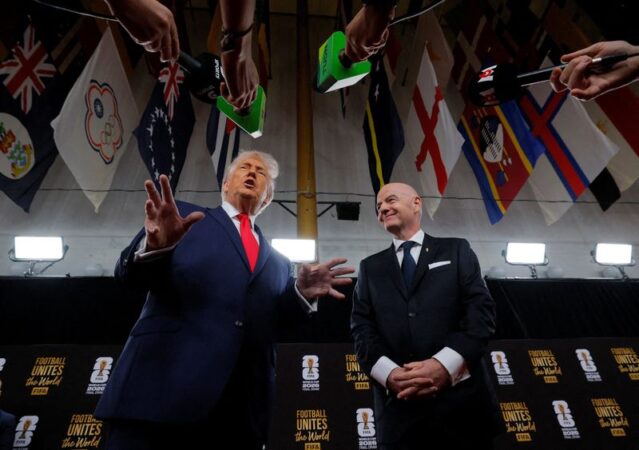
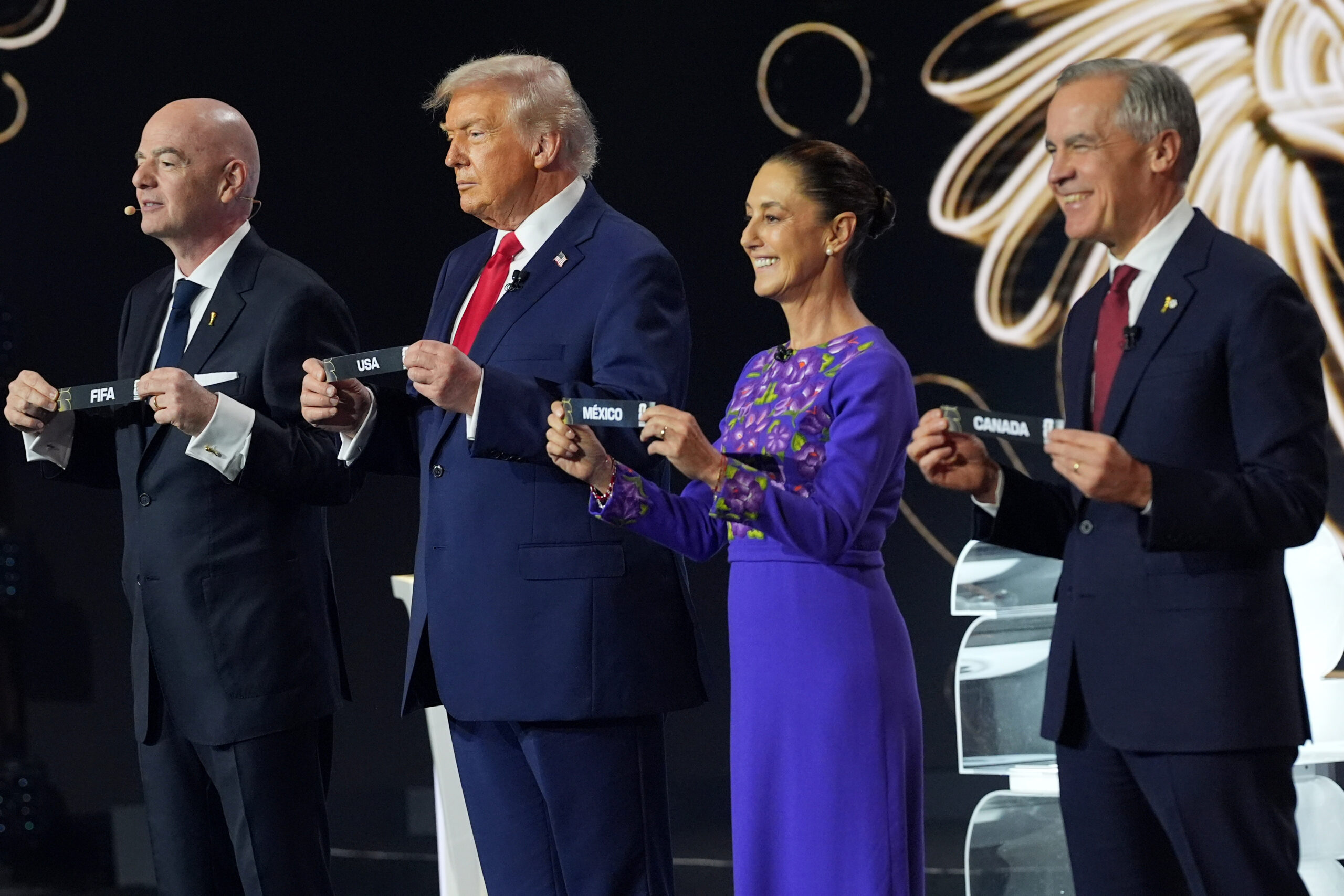
Canadian Prime Minister Mark Carney, Mexican President Claudia Sheinbaum, President Donald Trump, and FIFA President Gianni Infantino hold up country names during the draw for the 2026 FIFA World Cup at the Kennedy Center in Washington in December.
MWL’s secretary general, Mohammad bin Abdulkarim Al-Issa — who was recently recognized in the United States for his efforts to combat hate — has repeatedly warned that weak integration and social division are the biggest threats facing humanity today. Global sporting events, by contrast, offer rare shared civic spaces where diverse societies meet on equal terms, reinforcing inclusion rather than suspicion.
If enforcement spectacle overshadows the 2026 World Cup, the consequences will be economic as well as social. Travel hesitancy, empty seats, and reduced tourism would be immediate effects.
But the deeper risk is political: Visible exclusion at a global event reinforces narratives of division and grievance that extremists on all sides are quick to exploit. When people feel unwelcome in shared civic spaces, mistrust grows — and the integrative power that sport is meant to provide begins to erode.
That makes clarity from federal authorities essential. The U.S. Departments of Homeland Security and State and host city governments should coordinate to publish tournament-specific guidance covering visa processing timelines, entry procedures for ticket holders, and the scope of enforcement activity around official venues.
Clear assurances that immigration sweeps will not be conducted at stadiums, accredited fan zones, or public watch sites would reduce uncertainty without compromising border security.
For a country that prides itself on being a nation of immigrants — and for a president who places great stock in ratings, turnout, and global spectacle — the 2026 tournament presents an extraordinary opportunity to show that security and openness can coexist. Full stadiums and strong international attendance would reinforce the image of a confident, welcoming host nation.
If instead, travel hesitancy, empty seats, and visible enforcement dominate the optics, the tournament risks projecting exclusion rather than unity.
That outcome would not only diminish the World Cup’s global appeal but squander a rare moment of soft power that no amount of security planning alone can restore.
Khalid Sayed is the leader of the opposition for the African National Congress in the Western Cape Provincial Parliament in South Africa, now serving his second term. A former provincial leader of the ANC Youth League, he is an activist committed to social cohesion and democratic renewal in a postapartheid society.
Many soccer fans hoping to score early World Cup tickets have been unable to do so after missing out on previous presale windows. In an effort to appease those fans, FIFA offered a 48-hour special opportunity for supporters to purchase tickets to select matches in their desired markets. But prices remained sky high, availability was severely limited, and details — like where you’d actually be sitting — were minimal.
Over the course of three separate presales, which began in September with a special draw for Visa cardholders, FIFA claims more than 500 million fans have expressed interest, with many registering in ticket lotteries. These lotteries and presales come before what’s expected to be a free-for-all in April, FIFA’s last-minute sales phase, in which tickets will be available on a first-come, first-served basis, “processed as real-time transactions.”
So the surprise that FIFA offered a special, unannounced 48-hour presale to select fans — starting at 11 a.m. on Wednesday and ending the same time on Friday — came as a welcome shock for those looking for seats before they hit the secondary market.
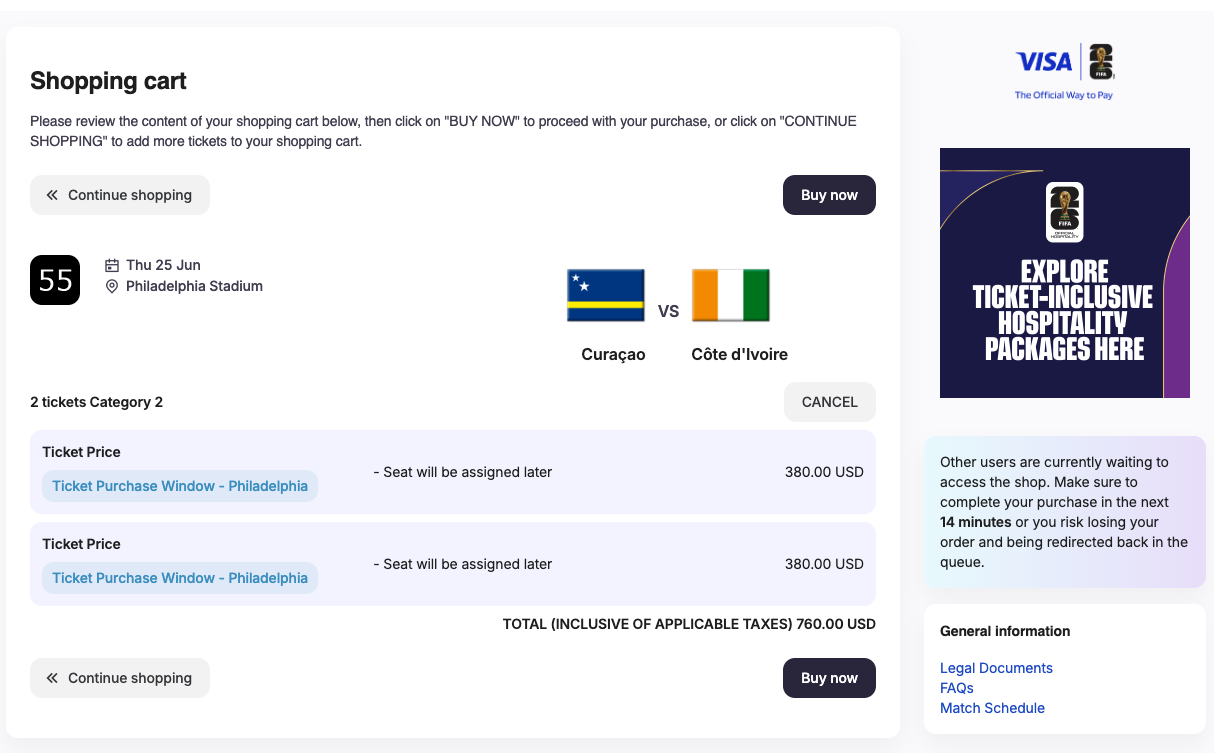
However, for some fans, the real shock arrived after they bypassed FIFA’s queue and gained access to the ticket portal. By Friday morning in Philadelphia, the only game left available was the Group E match between the Ivory Coast and World Cup first-timers Curaçao on June 25 (4 p.m., FS1).
It’s unknown if FIFA offered more than one match during this special presale or if it was just that one match, and requests for comment to its media team regarding the number of matches made available, as well as the number of matches in neighboring markets like New York for this presale, went unanswered at the time of this report.
Select fans looking to attend the World Cup in Philly were granted a special presale this week, but were still faced with high prices for match tickets to one game by Friday.
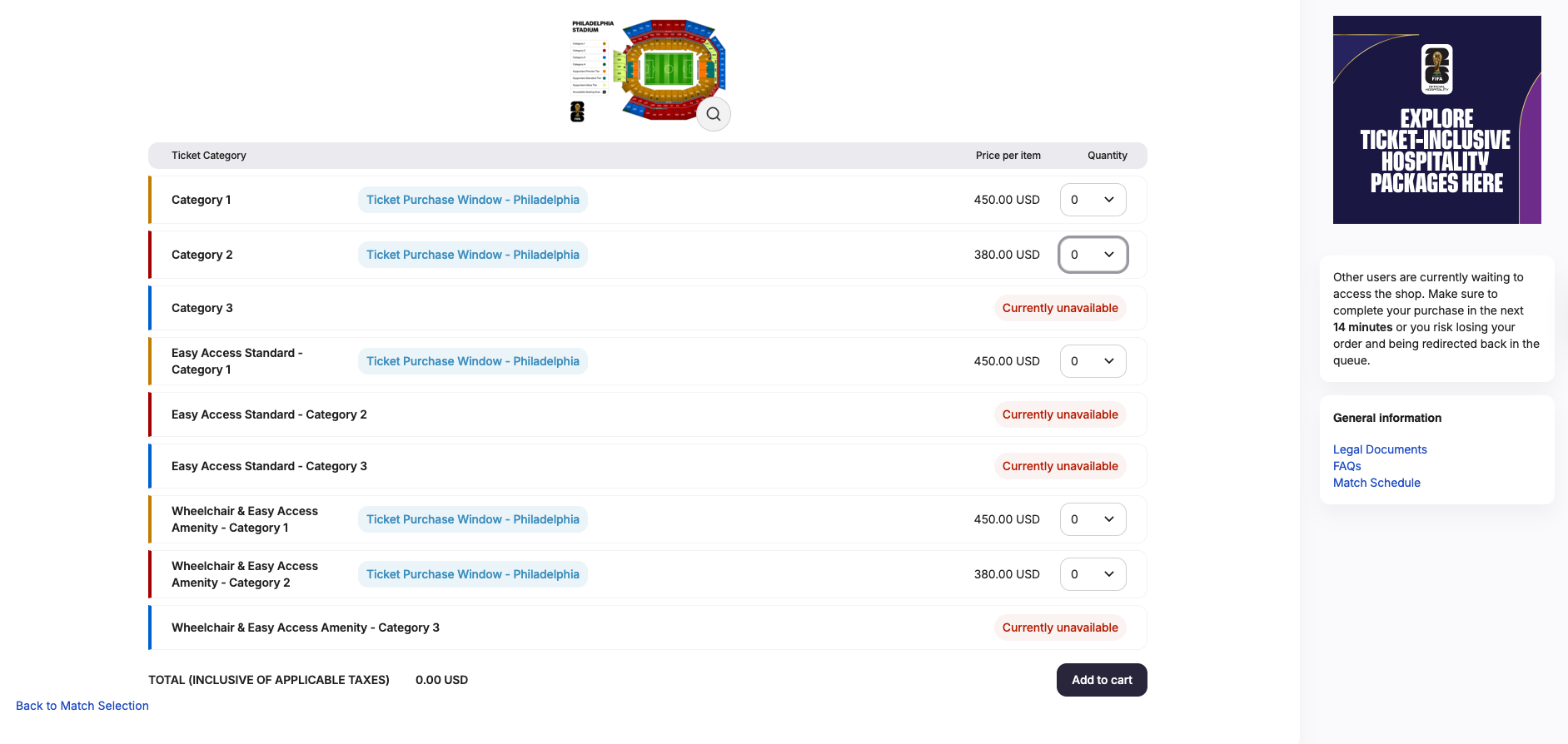
FIFA, which offers tickets in three categories ranging from Category 1 (the most expensive) to Category 3 (the least expensive), had seating in this special presale only for Categories 1 and 2 remaining on Friday morning. They started at $360 per ticket. For a seat in Category 1? $450.
These prices mirrored the original ticket prices for matches in Philly when they were first released in December, with Category 2 tickets in this latest special presale just $20 cheaper than the original $380 asking price.
Following global backlash in that same month, FIFA offered what they called a Supporter Entry Tier ticket, selling off a few hundred Category 3 seats across all 16 venues for just $60.
Lincoln Financial Field will host six World Cup matches, including a July 4 Round-of-16 knockout match.
However, it appears prices, fueled by FIFA’s employment of dynamic pricing for the first time in World Cup history, are back in the hundreds of dollars.
To some in this latest presale, the juice just didn’t feel worth the squeeze.
“Who can afford that for that game?” said Daniel Quinn, a Northeast Philly native who works in retail management. Quinn said he didn’t even notice the email from FIFA until Thursday night, as it hit his spam folder.
He rushed to the portal on Friday morning to see what was left.
“I just stared at my phone and laughed,” Quinn said. “Listen, I know it’s the World Cup, but I can’t justify paying $360 to watch a game where I can’t tell you a single soul playing on the field. Like, I know the Ivory Coast has good players, but for that to be the only game available and then to offer seats at those prices, just felt silly.”
One more surprise remained. The presale still only guaranteed fans what’s known as a “right to buy” ticket, meaning that seat selection, even after purchasing, remained a mystery and would only be made available as the match drew closer.
“Why are these still right to buy tickets?” Quinn continued. “This late in the game, I should know where I’ll sit so I can make an informed decision. Does a Cat 1 seat get me in the back [of the lower bowl] at the Linc, or a Cat 2, where I’m sitting up higher, but I might be in front? If you’re going to spend that type of money, I feel like you should at least know that.”
The total cost for two tickets for the June 25 game between the Ivory Coast and Curaçao inclusive of taxes and fees through a special presale FIFA offered select fans on Wednesday.
Earlier this week, a FIFA spokesperson told The Athletic that the fans chosen for its latest presale were “a defined group of applicants” selected in order to maximize fairness and acknowledge fans who have already demonstrated strong interest in the tournament.”
But the fact that, with just hours left before the Friday mid-morning deadline, the opportunity was availability for one game across the five group-stage matches coming to Philly beginning June 14, and that the cost to attend was still so high, rubbed soccer fans like Quinn the wrong way.
“Listen, shoutout to the people who can afford these [tickets],” he said. “I’m a lifelong soccer fan, and I’ve been to a lot of [soccer] games at the Linc. I went to the Club World Cup last year, and having the World Cup not just here in the States but literally where the Birds play feels like a bucket list [item]. But I think I’ll wait, man. Either these [ticket prices] drop because there are people like me who are laughing at what they’re charging, and prices will go way down, or people will snatch these up, and I’ll watch it for free on TV.