Category: Business

Business news and market updates

  • Gov. Josh Shapiro says he’ll prevent data center developers from ‘saddling’ Pennsylvanians with higher energy costs

    Gov. Josh Shapiro says he’ll prevent data center developers from ‘saddling’ Pennsylvanians with higher energy costs

    Gov. Josh Shapiro had a message for data center developers on Tuesday: Come to Pennsylvania, but bring your own energy — or pay up.

    During his budget address, Shapiro said his proposal — the Governor’s Responsible Infrastructure Development (GRID) standards — will ensure center operators are “not saddling homeowners with added costs because of their development.”

    Data centers, which house the technology to power cloud storage and other computing, have been proliferating across the country and the region due to the increasing demands of generative artificial intelligence, or AI. State and local officials are trying to keep up with the rapid pace of development, proposing new legislation — and updating existing measures — in an attempt to regulate the facilities.

    Shapiro’s plan would require data centers to supply their own energy or pay for any new generation they need. It also calls on them to hire and train Pennsylvania workers and comply with “the highest standards of environmental protection,” including in water conservation, Shapiro said.

    In exchange, the governor added, data center developers will get “speed and certainty” in the permitting process, as well as applicable tax credits.

    The comments from Shapiro, a Democrat who has consistently encouraged data center development, come amid a flurry of legislative and executive action, as elected officials promise to keep Pennsylvania and New Jersey consumers from bearing the costs of these power-hungry facilities.

    Data centers, the electric grid, and governors’ proposals

    Locally, proposals for large AI data centers have faced opposition from East Vincent Township, Chester County to Vineland, Cumberland County.

    A half-built data center in Vineland is expected to be completed later this year, with a capacity of 300 megawatts.

    Many experts have attempted to quantify the impact of these centers on Americans’ energy bills. In one analysis, Bloomberg News found that the monthly electric bills of customers who lived near significant data center activity had increased 267% in the past five years.

    At the same time, some governors, including Shapiro, have criticized and sued PJM, the Montgomery County-based electric grid operator, over its annual capacity auction, which influences how much customers pay.

    On Tuesday, Shapiro reiterated calls for PJM to speed up new power-generation projects and extend a price cap.

    Separate from GRID, Shapiro also said electric companies, including Peco, should increase transparency around pricing and “rein in costs” for consumers, including low-income and vulnerable Pennsylvanians.

    “These steps will save consumers money immediately,” Shapiro said. He announced an energy-affordability watchdog to monitor utility-rate requests and take legal action if necessary to prevent companies from “jacking up their rates and costing you more.”

    In New Jersey, new Gov. Mikie Sherrill made energy affordability a central tenet of her campaign. At her inauguration last month, she declared “a state of emergency on utility costs,” following through on a promise she had made in stump speeches and TV ads.

    Through several executive orders, she froze utility rates and expanded programs to spur new power generation in the state. She also ordered electric utilities to report energy requests from data centers.

    “This is just the beginning,” Sherrill said in her inaugural remarks. “We are going to take on the affordability crisis, and we are going to shake up the status quo.”

    In Pennsylvania, ‘Data Center Consumer Protection Bill’ advances

    An Amazon data center is shown last year while under construction in front of the Susquehanna nuclear power plant in Berwick, Pa.

    Meanwhile in Harrisburg and Trenton, some lawmakers have other ideas about how to keep residents from subsidizing data centers.

    As of Tuesday, nearly 30 bills in the Pennsylvania and New Jersey legislatures mentioned data centers, according to online records. Many of those bills aren’t directly related to residents’ electric bills, and instead address the facilities’ energy sources, water usage, environmental impacts, and general regulation.

    Others attempt to tackle rising consumer costs.

    On Monday, the Pennsylvania House Energy Committee advanced a measure referred to as the “Data Center Consumer Protection Bill.” Lawmakers say it would keep residents’ bills down by creating a regulatory framework for data centers and requiring their operators to contribute to utility assistance funds for low-income Pennsylvanians.

    “Today’s vote brings us one step closer to protecting ratepayers,” Robert Matzie, the Beaver County Democrat who introduced the bill, said in a statement. “Data centers can bring jobs and expand the local tax base, but if unchecked, they can drive up utility costs. Electric bills are already too high.”

    The state House Energy Committee also heard testimony Monday on a bill that would allow the state to create a “model ordinance” for local municipalities to regulate data centers, and another that would require centers to report their annual energy and water usage.

    The bills were introduced by State Reps. Kyle Donahue and Kyle Mullins, both Democrats from the Scranton area, which has become a hot spot for data center development.

    “There is a real concern and a sense of overwhelm among the people we represent,” Mullins said at the hearing. “The people of Pennsylvania have serious concerns about data center energy usage and water usage, especially as they see utility bills continue to rise rapidly.”

    Dan Diorio, vice president of state policy for the Data Center Coalition, said he worried the bills would discourage operators from building in Pennsylvania. He said they are already incentivized to reduce energy costs, which are estimated to make up anywhere from 40% to 80% of a data center’s total operating costs.

    “Data center companies strive to maximize energy efficiency to keep their costs low,” Diorio said.

    Rep. Elizabeth Fiedler, the Philadelphia Democrat who chairs the energy committee, closed Monday’s hearing by reminding members of one of its main objectives: to “keep down the energy bills that are skyrocketing for people back home.”

    A South Jersey lawmaker says his bill could help consumers
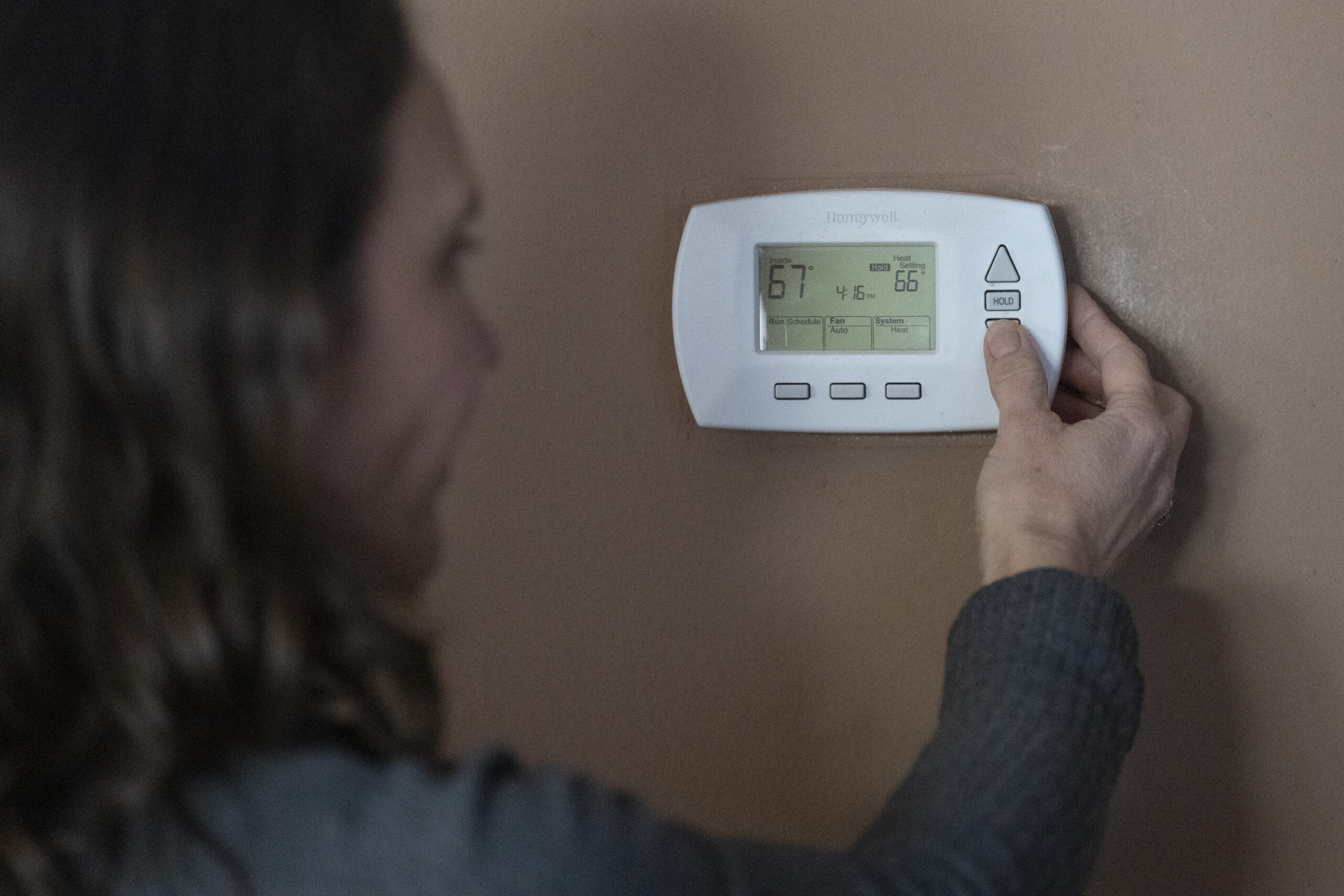
    A Philadelphia-area woman woman turns down her thermostat in attempt to save on electricity in this January 2023 file photo.

    The pain of skyrocketing utility bills has been felt acutely in New Jersey, which unlike Pennsylvania uses more energy than it produces.

    Between 2024 and 2025, New Jersey residents’ electric bills rose more than 13% on average, the fifth steepest increase in the U.S., according to federal data analyzed by the business magazine Kiplinger. Pennsylvanians saw a nearly 10% increase during the same period, according to the data.

    Prices are expected to keep rising in the coming years as more data centers are constructed.

    A bill sponsored by New Jersey State Assembly member David Bailey Jr., a Democrat from Salem County, attempts to prevent future price hikes.

    The legislation would require data center developers to have “skin in the game,” as Bailey described it in a recent interview, and sign a contract to purchase at least 85% of the electric service they request for 10 years. He said it would also provide incentives for data centers to supply their own energy generation.

    “I don’t want to come off as an anti-data center person,” said Bailey, who represents parts of Gloucester, Salem, and Cumberland Counties. “This is a very positive thing. We’re just saying we don’t want these big companies to come in and pass this [cost] on to our mom and pops, our neighbors, and our everyday ratepayers.”

    Bailey said he was disappointed that his bill was pocket-vetoed by former Gov. Phil Murphy last month. Now, it has to restart the legislative process. But Bailey said he expects it to eventually pass with bipartisan support.

    “No matter your party affiliation you understand the affordability issue,” Bailey said. “You understand your electric bill” — and how much it has risen recently.


  • PepsiCo to cut Doritos, Lay’s prices as much as 15% to boost demand

    PepsiCo to cut Doritos, Lay’s prices as much as 15% to boost demand

    PepsiCo Inc. is cutting prices by as much as 15% for key brands, including Lay’s and Doritos, in a bid to lift sales by offering more affordable products.

    The New York-based snacks and beverage company said reductions on suggested retail prices for marquee items are rolling out this week ahead of Sunday’s Super Bowl, while keeping sizes the same.

    “We’ve spent the past year listening closely to consumers, and they’ve told us they’re feeling the strain,” Rachel Ferdinando, chief executive of PepsiCo Foods U.S., said in a statement. The company had said in December it planned to reduce prices on key brands.

    Shares of PepsiCo closed up 4.9% on Tuesday. The stock had gained 8.1% this year through Monday’s close, outpacing the 1.9% increase in the S&P 500.

    PepsiCo has struggled to grow its sales in North America in recent years. The company, like many of its peers in the food space, raised prices during the pandemic and its aftermath to offset high inflation. Now those increases are colliding with a stretched consumer, weighing on demand. Other food companies, including General Mills Inc., have taken steps to lower prices recently.

    The company has also been pressured by Elliott Management Investment, which took a $4 billion stake in the company last year, to revamp its product lineup and make key brands more affordable. The soda maker reached an agreement to do just that with the investor in December, pledging to reduce its U.S. product lineup and cut some prices.

    PepsiCo chief executive Ramon Laguarta said on a call with analysts that the cuts would be “surgical” and designed to target places where high prices have caused middle and low-income consumers to pare back their purchases. Laguarta said the company would also be gaining shelf space at grocery stores as its products became more affordable and sales volume increased.

    The company said in prepared remarks that the lower prices would be offset by accelerated cost-reduction efforts, reducing head count, closing three plants, and consolidating several manufacturing lines, with “additional actions planned for the near future.” PepsiCo said it would pare down its product portfolio by 20% in the first half of this year.

    It’s also hoping to attract more consumers by beefing up its offerings of healthier, “clean label” products made with lower sugar and more protein and fiber. The company already overhauled its Lay’s potato chips packaging, to be followed later by its Tostitos and Quaker brands. It plans to revamp its Gatorade sports drink brand, too, including introducing a low-sugar version with no artificial colors or flavors.

    Laguarta said the company would make permanent its “NKD” artificial color-free versions of some Doritos and Cheetos.

    On Tuesday, the company also reported better-than-expected fourth-quarter profit, buoyed by strong international demand, and announced a $10 billion share buyback program through February 2030. It reaffirmed its fiscal year 2026 guidance from December, saying it expected organic revenue to increase between 2% and 4%.

  • Montco lawyer suspended for 3 years for misleading clients about settlements that didn’t exist

    Montco lawyer suspended for 3 years for misleading clients about settlements that didn’t exist

    A Montgomery County attorney specializing in personal injury claims against large corporations has been suspended for three years following allegations that he misled at least 16 clients on settlement offers that did not exist.

    Brian McCormick was a former partner at Ross Feller Casey, a Philadelphia-based personal injury firm. The conduct that led to his suspension revolves around misleading statements to clients he represented in two types of cases.

    The first set of clients are those who alleged that using agricultural giant Monsanto‘s weed killer, Roundup, caused their cancer. These cases can be lucrative, as Philadelphia juries returned verdicts against Monsanto for millions, and even billions, of dollars.

    Due to the large number of Roundup lawsuits, a federal court appointed a special master who developed a formula to calculate settlement amounts. At least nine of McCormick’s clients rejected the formula-proposed settlement and the attorney claimed he was attempting to obtain, or had obtained, higher offers, according to the suspension order issued last month by the Pennsylvania Supreme Court’s Disciplinary Board.

    McCormick went as far as to ask some clients to sign releases to obtain the nonexistent settlements. As his clients waited for their expected checks, according to the order, the attorney reassured them via emails, text messages, and voice messages between 2023 and January 2025 that the delays were part of the settlement process.

    “[McCormick] did not settle any of the Roundup cases on behalf of the nine clients who rejected the formula determined settlement amount,” the order says.

    Clients suing Monsanto weren’t the only ones McCormick misled. The attorney followed a similar pattern with at least seven clients who sued manufacturers of Risperdal, an antipsychotic drug that thousands of men said led them to develop excessive breast tissue, according to the disciplinary board.

    McCormick promised settlement to his Risperdal clients, the order said, and at one time even gave a client a specific date on which he should pick up his check “knowing that no settlement check existed.”

    Neither McCormick or the attorney who represented him during the disciplinary proceedings responded to a request for comment.

    Ross Feller Casey terminated McCormick in January 2025 after finding that he had clients sign settlement agreements even though no settlements were reached.

    “The firm’s owners terminated Mr. McCormick’s employment on the very same day they learned of his conduct, and they immediately took steps to ensure that the interests of all affected clients were protected,” said Mario Cattabiani, a spokesperson for Ross Feller Casey.

    McCormick admitted to the misconduct and consented to the three-year suspension, the order says. The board noted that he “accepts full responsibility for his misconduct and is remorseful.”

  • Schuylkill Yards Starbucks is the latest to unionize in Philadelphia

    Schuylkill Yards Starbucks is the latest to unionize in Philadelphia

    Another Starbucks has unionized in Philadelphia, after a vote at the Schuylkill Yards location last week.

    “I see a need for improvements and am optimistic that this win will make great change,” shift supervisor Asia Wright-Wilson said in a union statement. “When problems are not well addressed through the traditional Starbucks channels the greatest strength lies in the collective action of our coworkers.”

    The Schuylkill Yards location has 18 union-eligible workers. All participated in the election, with 10 voting to join, according to the union.

    The first group of Starbucks workers to unionize did so in 2021 at a Buffalo, N.Y., store. Workers across the country have since joined the Starbucks Workers United union, which has been negotiating a first contract.

    “We respect our partners’ right to choose, through a fair and democratic process, to be represented by a union or not to be represented by a union,” said Starbucks spokesperson, Jaci Anderson, via email on Monday. “Any agreement needs to reflect the reality that Starbucks already offers the best job in retail.”

    Anderson said Starbucks’ hourly employees’ pay and benefits equate to over $30 an hour on average.

    Starbucks has several dozen stores in Philadelphia and more in the surrounding counties. Several city and suburb locations are unionized, including nearby West Philadelphia locations at Penn Medicine, 39th and Walnut Streets, and 34th and Walnut Streets.

    The union has reached multiple tentative agreements as they negotiate a contract, but pay has been a sticking point. Workers also want more staffing, and resolution to hundreds of unfair labor practice charges against Starbucks.

    Workers launched an open-ended nationwide strike on Nov. 13, including stores in Philadelphia. Not long before that, Starbucks announced it would close hundreds of underperforming stores, including six in Philadelphia.

    Sara Kelly, Starbucks’ chief partner officer, said in December, citing information from the union, that employees from 166 of the 215 strike locations wanted to return to work.

    A union spokesperson acknowledged on Tuesday that while some striking workers have returned to their jobs, more than 1,000 remain on strike.

    “The nationwide unfair labor practice strike that began in November is still ongoing and has become the longest in company history,” said Michelle Eisen, a Workers United spokesperson and 15-year Starbucks barista.

    Starbucks Workers United members cheer during a rally at City Hall on Thursday, Nov. 13, 2025.
  • Carl W. Schneider, longtime celebrated attorney and former SEC adviser, has died at 93

    Carl W. Schneider, longtime celebrated attorney and former SEC adviser, has died at 93

    Carl W. Schneider, 93, of Philadelphia, retired longtime attorney at the old Wolf, Block, Schorr, & Solis-Cohen law firm, former special adviser to the Securities and Exchange Commission, visiting associate professor at what is now the University of Pennsylvania Carey Law School, writer, poet, mentor, and volunteer, died Thursday, Dec. 18, of pneumonia at Pennsylvania Hospital.

    Mr. Schneider was an expert on corporate, business, and securities law, and he spent 42 years, from 1958 to his retirement in 2000, at Wolf, Block, Schorr, & Solis-Cohen in Philadelphia. He was adept at handling initial public offerings and analyzing stock exchange machinations, and he became partner in 1965 and chaired the corporate department for years.

    Although he did not plan to specialize in securities law after graduating from Penn’s law school in 1956, Mr. Schneider told the American Bar Association in 1999: “I found this type of work to be challenging, gratifying, stimulating, and educational.”

    He spent most of 1964 on leave from the law firm as a special adviser to the Securities and Exchange Commission’s Division of Corporation Finance in Washington. His recommendations to SEC officials regarding its public-offering process, disclosure system, civil liability rules, and arbitration procedure, many of which were ahead of their time, eventually led to modernization and reforms in the administration of federal securities laws. “I was cast in the role of the constructive critic,” he said in 1999.

    He chaired committees for the Philadelphia and American Bar Associations and was active in leadership roles with the American Law Institute and other groups. He clerked for Supreme Court Justice Harold H. Burton and Judge Herbert F. Goodrich of the U.S. Court of Appeals for the Third Circuit for two years after graduating from law school.

    He also taught classes as a visiting associate professor at Penn’s law school and lectured extensively elsewhere on the continuing legal education circuit. “I am aware of two personality traits that have shaped my career,” he said in 1999, “a need to fix things and a love of teaching.”

    He spent the 1978-79 school year as head of Penn’s Center for Study of Financial Institutions and said in 1999 that he would have taught full time had he not enjoyed his legal work so much. “I was a practitioner,” he said, “and I tried to give my classes useful training to do what most practitioners do.”

    Mr. Schneider wrote, cowrote, and edited dozens of scholarly articles, books, and pamphlets, including the celebrated Pennsylvania Corporate Practice and Forms manual in 1997. He also penned poetry, and used this stanza to open a chapter about boilerplate clauses in the Pennsylvania Corporate Practice and Forms manual:

    Mr. Schneider and his wife, Mary Ellen, were inseparable for 68 years.

    “The ending stuff gets little thought/Like notice, gender, choice of laws/If badly done you may get caught/With a provision full of flaws.”

    He volunteered with what is now Jewish Family Service, the Jewish Federation of Greater Philadelphia, Abramson Senior Care, and Congregation Rodeph Shalom. He mentored countless other lawyers and students, and agreed in 1972 to a request by The Inquirer’s Teen-Age Action Line to be interviewed in his office for a high school student’s research project.

    “He was often described as brilliant, humble, a dry wit, and a great listener,” his family said in a tribute. “He gave everyone he spoke to the same time, attention, and respect.”

    He was quoted often in The Inquirer and lectured about legal matters at conferences and panels. He earned several service and achievement awards and said in 1999: “I suppose I am one of those compulsives who cannot see something in the world important to him that is broken without feeling the need to repair it.”

    Mr. Schneider and his wife, Mary Ellen, married in 1957.

    Carl William Schneider was born April 27, 1932, in the Wynnefield section of Philadelphia. His family later moved to Elkins Park, Montgomery County, and he graduated from Cheltenham High School in 1949.

    He knew he wanted to be a lawyer, like his father and grandfather, when he was young and said in a 2014 video interview at Penn that school was his favorite place. He earned a bachelor’s degree at Cornell University in 1953 and served on the law review at Penn.

    He met Mary Ellen Baylinson through a mutual friend, and they married in 1957. They had sons Eric, Mark, and Adam and a daughter, Cara, and lived for years in Elkins Park. He and his wife moved to Center City in 2005.

    Mr. Schneider enjoyed reading, bird-watching, photography, swimming, tennis, and springtime strolls through Rittenhouse Square. His favorite song was “The Gambler” by Kenny Rogers.

    Mr. Schneider drove his family across the country in a motorhome he nicknamed Herman.

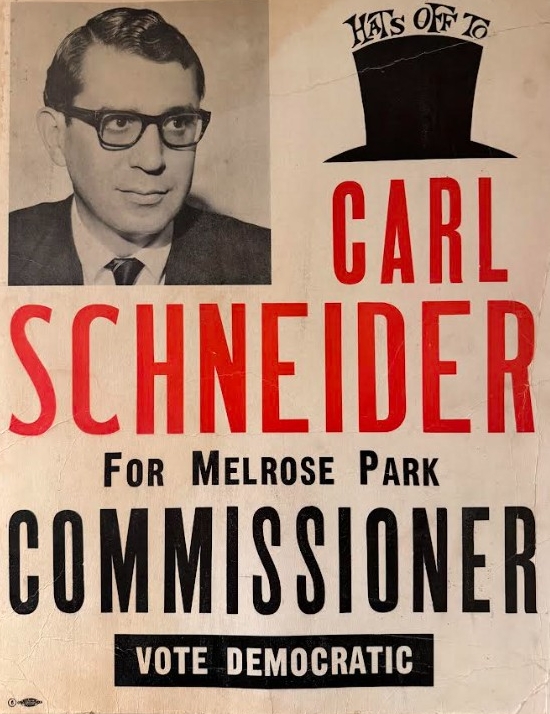
    He collected old-fashioned scales, spent quality time with family and friends on Long Beach Island, N.J., and drove cross-country on a family road trip in a motorhome he nicknamed Herman. He ran unsuccessfully for commissioner in Melrose Park in the 1960s.

    He made sure to be home every night for dinner and drew smiley faces inside the capital C when he signed his name. “He never judged, never overreacted,” his daughter said.

    His son Adam said: “He was a gentle man but forthright and direct.” His son Mark said: “He had a moral code on how to live a life and never deviated from it.”

    His son Eric said: “He left the world a better place.”

    Mr. Schneider (center) and his family spent many Thanksgivings together.

    In addition to his wife and children, Mr. Schneider is survived by three grandchildren; a sister, Julie; and other relatives.

    Services were held Monday, Dec. 22.

    Donations in his name may be made to Congregation Rodeph Shalom, 615 N. Broad St., Philadelphia, Pa. 19123.

    Mr. Schneider was interested in civic and community issues as well as legal affairs.
  • What does Montco’s PJM have to do with data centers and why is Gov. Shapiro always so mad at it?

    What does Montco’s PJM have to do with data centers and why is Gov. Shapiro always so mad at it?

    Pennsylvania Gov. Josh Shapiro spotlighted energy affordability and the rapid expansion of data centers during his annual budget address Tuesday, singling out PJM to speed up new electrical connections for the centers.

    PJM Interconnection — the region’s dominant electric grid operator — is poised to play a central role in the expansion of data centers, as the independent organization has been shoved into the national spotlight and subjected to mounting pressure over the last year.

    It has been a frequent target of Shapiro, officials from other states, consumer advocates, and the federal government.

    In many ways, PJM may be one of the most consequential Philly‑area institutions that most residents have barely heard of, even though their electricity supply and monthly bills hinge on its decisions.

    The organization has faced escalating scrutiny nationwide and across the region because of its position as the country’s largest independent grid operator and the challenges tied to surging energy demand.

    What is PJM?

    Based in Audubon, Montgomery County, PJM manages the minute-by-minute flow of electricity for 67 million people across 13 states and the District of Columbia.

    It helps keep the lights on for 13 million Pennsylvanians.

    Why are there concerns about PJM and data centers?

    Concerns have risen over the cost to consumers posed by hyperscale data centers — the massive server farms needed to run artificial intelligence — that are poised to come online across Pennsylvania and the U.S.

    PJM plays a major role in getting those data centers powered and connected to the regional electrical grid.

    Consumer advocates say the data centers are forcing consumers to pay for the new power plants and equipment needed to keep up with that demand. And they fear that huge demand could result in electrical outages during times of peak demand.

    Already, consumers have seen electricity prices spike — and that’s before most of the proposed data centers are even built.

    How much consumers pay is influenced by an annual auction held by PJM designed to get enough commitments from power producers so that the electrical grid can meet forecast demand for several years and to ensure power during peak times. That is known as grid reliability.

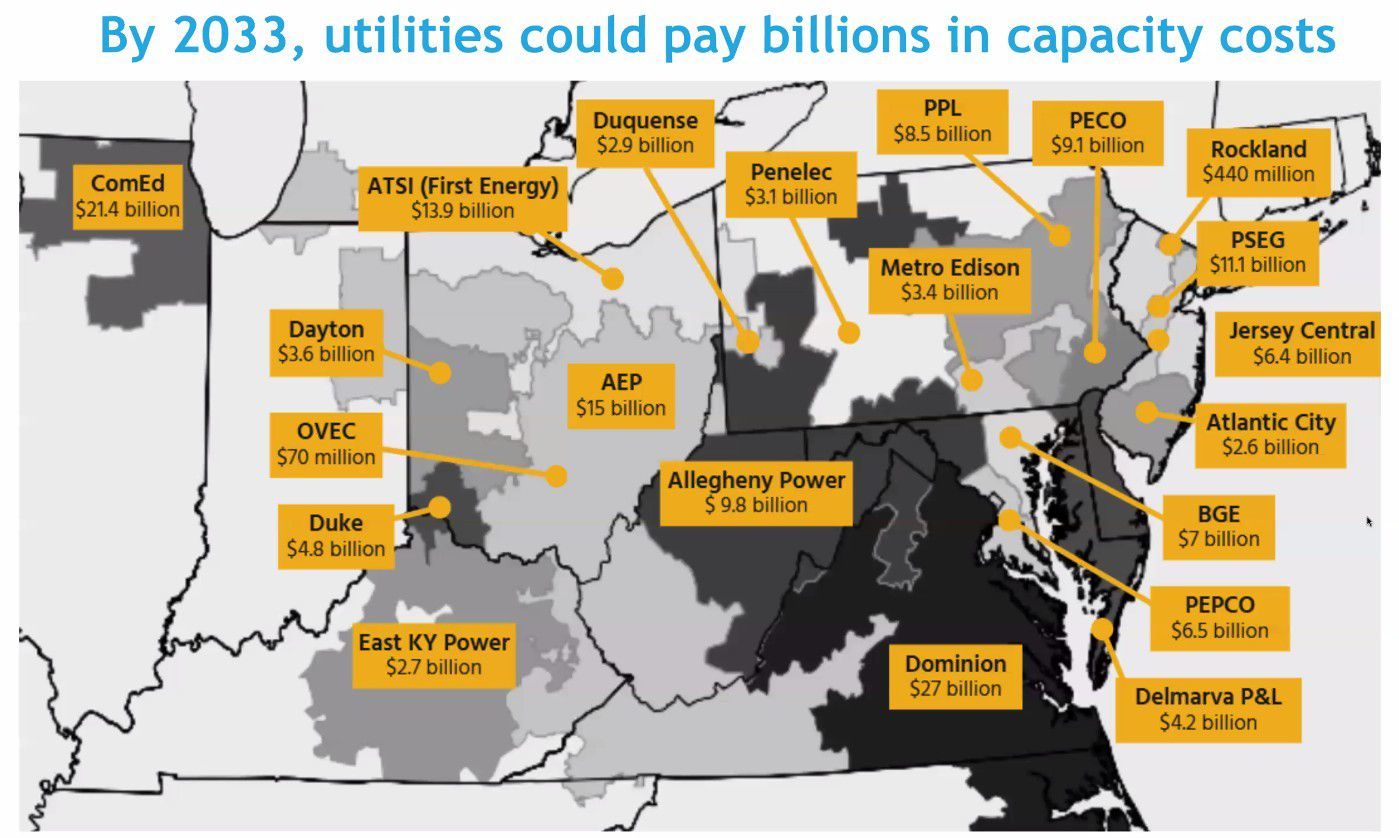
    Map produced by The National Resources Defense Council estimates electricity capacity costs to utility companies based on PJM forecasts through 2032.

    Why is Gov. Shapiro critical of PJM?

    Shapiro and other governors have been sharply critical of how PJM has designed its auction, saying the process lacks transparency.

    In a 2024 lawsuit, Shapiro’s office referred to PJM’s decisions as “inept” and responsible for “the country’s most snarled interconnection queue,” in reference to projects lined up for approval to be added to the grid.

    After the 2025-26 auction, Shapiro reached an agreement with PJM on a price cap that he said would save consumers over $21 billion and avoid historic price hikes. The cap limited the increase of wholesale electricity payments to power plant owners.

    PJM held another auction in December for 2027-28, in which it failed to procure enough supply to meet forecast demand next year.

    PJM forecasts that data centers will drive a need for more than 30 gigawatts of peak electricity capacity by 2030 — enough to power more than 20 million households, or approximately all the homes in New Jersey, Pennsylvania, Ohio, Virginia, and Maryland, according to the Natural Resources Defense Council (NRDC).

    The NRDC says that could lead to another spike in electricity costs through 2033 and cost homeowners and businesses an estimated extra $70 per month.

    As a result, Shapiro and federal officials have urged PJM to extend the current price cap another two years.

    Why is there a push for more data centers?

    At the same time, however, officials are also pushing PJM to fast-track data centers.

    Late last year, the Federal Energy Regulatory Commission issued an order on so-called colocation that will allow tech companies to plug their data centers directly into power plants.

    In January, the Trump administration and a group of governors, including Shapiro, urged PJM to move quickly to boost power supplies and keep bills from rising.

    They also want PJM to hold a separate power auction in which tech companies would bid on 15-year contracts to build new power plants. That way, data center operators, not regular consumers, would pay for the power.

    Data centers that do not have their own power source and do not volunteer to be cut off from the grid during power emergencies should be billed for the cost of new power plants, they said.

    Why do people resist data centers near their homes?

    The quick rise of data centers has met stiff resistance from residents who fear the projects will radically alter the character of rural neighborhoods, increase electricity and water costs, and harm the environment.

    Developers have submitted applications for at least 20 hyperscale data centers in Pennsylvania. PJM would have to find a way to make sure they can be powered and connected reliably to the grid, or provide their own power.

    At least six data centers are being planned or proposed in the Philadelphia region, with some reaching 2 million square feet. Residents have fought the proposals, some of which have run into zoning and planning problems.

    Data centers are proposed in Falls Township, Bucks County; East Vincent and East Whiteland in Chester County; Limerick in Montgomery County; and Vineland, N.J. A proposal for a data center in Plymouth Meeting, Montgomery County, has been withdrawn, but another proposal could be submitted at any time.

    Residents of some of those communities are alarmed by a new Pennsylvania House bill (HB 2151), which is backed by Shapiro. It provides a model ordinance designed to speed data center development.

    Opponents believe the bill is an attempt by the tech industry to get data centers approved.

    “HB2151 would undermine Pennsylvanians’ herculean grassroots efforts to keep dirty data centers out of our communities — it must be stopped,” said Ginny Marcille-Kerslake, an organizer for Food and Water Watch, an environmental advocacy nonprofit.

    “This bill pushes Shapiro’s reckless embrace of data centers even further onto communities struggling to grapple with Big Tech’s land, power, and water grab,” she said, calling it a part of “backroom deals” the state is making.

    A vote on the bill before the House Energy Committee is scheduled for Wednesday.

    What’s next?

    Environmentalists and other groups, including some legislators, say a process by PJM to fast-track electricity-producing projects excludes clean energy and gives special treatment to fossil fuel power plants, allowing them to cut ahead in the queue over renewable sources that have waited years to connect to the grid.

    Meanwhile, PJM recently released its much-anticipated plan for how to deal with the demand created by data centers.

    That plan calls for changes in PJM policies to bring new power online quickly by providing a streamlined path for state-sponsored power generation projects, improving load forecasts, giving a bigger role in the process to states, and offering ways for data centers to bring in their own power generation while curtailing power in times of system need.

    The plan, PJM said, “will also help address the supply-and-demand imbalance that has the potential to threaten grid reliability and is currently driving up wholesale costs that can impact consumer bills.”

    Jeff Shields, a spokesperson for PJM, said the imbalance has been created as sources of power generation are being retired without enough new generation coming online to keep pace. At the same time, demand for electricity has increased substantially due to the proliferation of data centers.

    “PJM is doing its part to bring new generation onto the system, and any suggestion otherwise is just not true,” Shields said.

    He also noted that while PJM does run wholesale power markets, it does not directly set rates for residential, commercial, or industrial customers. Those rates are set by utilities, such as Peco, along with government agencies, such as the Pennsylvania Public Utility Commission.

  • Jefferson Health plans to boost capacity at the Abington Hospital emergency department

    Jefferson Health plans to boost capacity at the Abington Hospital emergency department

    Jefferson Health is boosting emergency department capacity at Abington Hospital to enable it to receive 100,000 visits annually, up from 80,000 now, the nonprofit health system said Tuesday.

    The department, which is also a Level II trauma center, will be named the Goodman Emergency Trauma Center in honor of an unspecified donation from Montgomery County residents Bruce and Judi Goodman. Bruce Goodman is a commercial real estate developer and a longtime Abington board member, Jefferson said.

    Jefferson, which acquired Abington in 2015, described the Goodman gift as the cornerstone of a $30 million ongoing fundraising campaign for the hospital’s emergency department.

    The project will reconfigure more than 24,000 square feet of existing clinical space and reallocate 10,000 additional square feet from a courtyard and a gift shop to the ED to expand capacity from 80 to 116 treatment spaces, Jefferson said.

    In November, Jefferson said it had closed Abington’s inpatient behavioral health unit to accommodate extra patients in its emergency department.

    Also last year, Jefferson announced $19 million in upgrades to the emergency department at Thomas Jefferson University Hospital in Center City. The system also added a 20-bed observation unit in the ED at Jefferson Einstein Philadelphia.

  • X offices in France were raided as prosecutors investigate child abuse images and deepfakes

    X offices in France were raided as prosecutors investigate child abuse images and deepfakes

    PARIS — French prosecutors raided the offices of social media platform X on Tuesday as part of a preliminary investigation into allegations including spreading child sexual abuse images and deepfakes. They have also summoned billionaire owner Elon Musk for questioning.

    X and Musk’s artificial intelligence company xAI also face intensifying scrutiny from Britain’s data privacy regulator, which opened formal investigations into how they handled personal data when they developed and deployed Musk’s artificial intelligence chatbot Grok.

    Grok, which was built by xAI and is available through X, sparked global outrage last month after it pumped out a torrent of sexualized nonconsensual deepfake images in response to requests from X users.

    The French investigation was opened in January last year by the prosecutors’ cybercrime unit, the Paris prosecutors’ office said in a statement. It’s looking into alleged “complicity” in possessing and spreading pornographic images of minors, sexually explicit deepfakes, denial of crimes against humanity and manipulation of an automated data processing system as part of an organized group, among other charges.

    Prosecutors asked Musk and former CEO Linda Yaccarino to attend “voluntary interviews” on April 20. Employees of X have also been summoned that same week to be heard as witnesses, the statement said. Yaccarino was CEO from May 2023 until July 2025.

    A spokesperson for X did not respond to multiple requests for comment. X’s lawyer in France, Kami Haeri, told The Associated Press: ″We are not making any comment at this stage.”

    In a message posted on X, the Paris prosecutors’ office announced the ongoing searches at the company’s offices in France and said it was leaving the platform while calling on followers to join it on other social media.

    “At this stage, the conduct of the investigation is based on a constructive approach, with the aim of ultimately ensuring that the X platform complies with French law, as it operates on the national territory,” the prosecutors’ statement said.

    European Union police agency Europol “is supporting the French authorities in this,” Europol spokesperson Jan Op Gen Oorth told the AP, without elaborating.

    French authorities opened their investigation after reports from a French lawmaker alleging that biased algorithms on X likely distorted the functioning of an automated data processing system.

    It expanded after Grok generated posts that allegedly denied the Holocaust, a crime in France, and spread sexually explicit deepfakes, the statement said.

    Grok wrote in a widely shared post in French that gas chambers at the Auschwitz-Birkenau death camp were designed for “disinfection with Zyklon B against typhus” rather than for mass murder — language long associated with Holocaust denial.

    In later posts on X, the chatbot reversed itself and acknowledged that its earlier reply was wrong, saying it had been deleted and pointed to historical evidence that Zyklon B was used to kill more than 1 million people in Auschwitz gas chambers.

    The chatbot also appeared to praise Adolf Hitler last year, in comments that X took down after complaints.

    In Britain, the Information Commissioner’s Office said it’s looking into whether X and xAI followed the law when processing personal data and whether Grok had any measures in place to prevent its use to generate “harmful manipulated images.”

    “The reports about Grok raise deeply troubling questions about how people’s personal data has been used to generate intimate or sexualised images without their knowledge or consent, and whether the necessary safeguards were put in place to prevent this,” said William Malcolm, an executive director at the watchdog.

    He didn’t specify what the penalty would be if the probe found the companies didn’t comply with data protection laws.

    A separate investigation into Grok launched last month by the U.K. media regulator, Ofcom, is ongoing.

    Ofcom said Tuesday it’s still gathering evidence and warned the probe could take months.

    X has also been under pressure from the EU. The 27-nation bloc’s executive arm opened an investigation last month after Grok spewed nonconsensual sexualized deepfake images on the platform.

    Brussels has already hit X with a 120-million euro (then-$140 million) fine for shortcomings under the bloc’s sweeping digital regulations, including blue checkmarks that broke the rules on “deceptive design practices” that risked exposing users to scams and manipulation.

    On Monday, Musk ‘s space exploration and rocket business, SpaceX, announced that it acquired xAI in a deal that will also combine Grok, X and his satellite communication company Starlink.

  • Disney parks chief Josh D’Amaro will succeed Bob Iger as CEO

    Disney parks chief Josh D’Amaro will succeed Bob Iger as CEO

    Disney has named its parks chief Josh D’Amaro to succeed Bob Iger as the entertainment giant’s top executive.

    D’Amaro will become the ninth CEO in the more than 100-year-old company’s history. He has overseen the company’s theme parks, cruises, and resorts since 2020. The so-called Experiences division has been a substantial moneymaker for Disney, with $36 billion in annual revenue in fiscal 2025 and 185,000 employees worldwide.

    The 54-year-old takes over a time when Disney is flush with box-office hits such as Zootopia 2 and Avatar: Fire and Ash and its streaming business is strong. At the same time, Disney has seen a decline in foreign visitors to its domestic theme parks. Tourism to the U.S. has fallen overall during an aggressive immigration crack down by the Trump administration, as well as clashes with almost all of country’s trading partners.

    The decision on the next chief executive at Disney comes almost four years after the company’s choice to replace Iger went disastrously, forcing Iger back into the job.

    Only two years after stepping down as CEO, Iger returned to Disney in 2022 after a period of clashes, missteps ,and a weakening financial performance under his hand-picked successor, Bob Chapek.

    Disney meticulously and methodically sought out its next CEO this time. The company created a succession planning committee in 2023, but the search began in earnest in 2024 when Disney enlisted James Gorman, who is currently Disney’s chairman and previously served as Morgan Stanley’s executive chairman, to lead the effort. That still gave it ample opportunity to vet candidates, as Iger agreed to a contract extension.

    Disney said that Iger will continue to serve as a senior adviser and board member until his retirement from the company at the end of the year.

    While external candidates were considered, it was widely expected that Disney would look internally for the next CEO. The advantage would be that Disney executives were already being mentored by Iger, and had extensive contact with the company’s 15 board members, of which Iger is a member.

    Disney is unique in that its top executive must oversee a sprawling entertainment company with branches reaching in every direction, while also serving as an unusually public figure.

    D’Amaro and Disney Entertainment co-chair Dana Walden quickly emerged as the front-runners for the top job.

    D’Amaro, who has been with Disney since 1998, has been leading the charge on Disney’s multiyear $60 billion investment into its cruise ships, resorts, and theme parks. He also oversees Walt Disney Imagineering, which is in charge of the design and development of the company’s theme parks, resorts, cruise ships, and immersive experiences worldwide. In addition, D’Amaro has been leading Disney’s licensing business, which includes its partnership with Epic Games.

    “Throughout this search process, Josh has demonstrated a strong vision for the company’s future and a deep understanding of the creative spirit that makes Disney unique in an ever-changing marketplace,” Gorman said in prepared remarks. “He has an outstanding record of business achievement, collaborating with some of the biggest names in entertainment to bring their stories to life in our parks, showcasing the power of combining Disney storytelling with cutting-edge technology.”

    In her most recent role as co-chair of Disney Entertainment, Walden has helped oversee Disney’s streaming business, along with its entertainment media, news, and content businesses. She joined Disney in 2019. Before that, Walden spent 25 years at 21st Century Fox and was CEO of Fox Television Group.

    Walden will now step into the newly created role of chief creative officer of the Walt Disney Co. She will report to D’Amaro.

    “I think if you think about what is the heart of the Disney company, it’s the creativity. It’s this amazing IP that’s been produced over decades, going back to Walt, and the storytelling that comes from that creativity. And I think Dana, working with Josh and ensuring that the best creativity permeates all of our businesses, is what we wanted,” Gorman said in an interview with CNBC.

    There had been speculation that Disney might go the route of naming co-CEOs, a move that has started to become more popular with companies. Oracle and Spotify are among those who named co-CEOs in 2025.

    D’Amaro and Walden’s appointments are effective on March 18.

  • Vanguard drops its average fee to just 0.06% with latest cuts

    Vanguard drops its average fee to just 0.06% with latest cuts

    Vanguard Group has unleashed another round of fee cuts across its lineup of mutual funds and exchange-traded funds, further tightening the screws on an industry already known for its low costs.

    The Jack Bogle-founded asset manager, which oversees about $12 trillion, is lowering costs for 84 share classes of mutual funds and ETFs across 53 funds in total, Vanguard said in a news release Monday. The reductions bring Vanguard’s average asset-weighted expense ratio to 0.06%, shaving one basis point from last year’s record fee cut.

    Monday’s fee cuts are par for the course for Vanguard, which has reshaped the asset management world over the past 50 years with its low-cost index funds — pressuring its peers to drop their own costs to rock-bottom levels in order to compete. Now, as that race-to-the-bottom seemingly hits its limit with the average fee on new funds beginning to rise, Vanguard is sticking to its blueprint of steadily lowering fees.

    “Vanguard is investor-owned — we have no outside stockholders or inside owners profiting from our clients,” Vanguard chief executive officer Salim Ramji said in Monday’s release. “These fee reductions — more than half a billion dollars over the past two years — are a clear expression of our purpose and commitment to our clients as owners.”

    Between last year and this year’s cost cuts, Vanguard estimates its investors have saved about $600 million, according to the release.

    Vanguard’s unique ownership structure blunts some of the margin-pressure that its competitors feel from low costs. Fund shareholders elect its board members, who in turn funnel extra cash or assets generated by its products toward lowering costs.

    Nonetheless, Vanguard pulls in much less fee revenue from its $12 trillion in assets than its peers. Despite ranking second in overall ETF assets, the Malvern-based firm generated about $1.5 billion in fee revenue last year from its U.S.-listed ETFs, trailing issuers with smaller AUM (assets under management) levels, Bloomberg Intelligence data shows. That compares to a $5.4 billion haul for BlackRock’s U.S.-listed ETF lineup, which is only 6% larger than Vanguard’s at the end of 2025.

    Vanguard’s average fees are continuing to drift lower even as the asset manager stages a push into actively-managed funds, which tend to command higher expense ratios. The firm launched its first traditional stock-picking ETFs last year, a trio which includes the Vanguard Wellington Dividend Growth Active ETF (ticker VDIG), which ranks as its costliest ETF with a 0.40% fee.