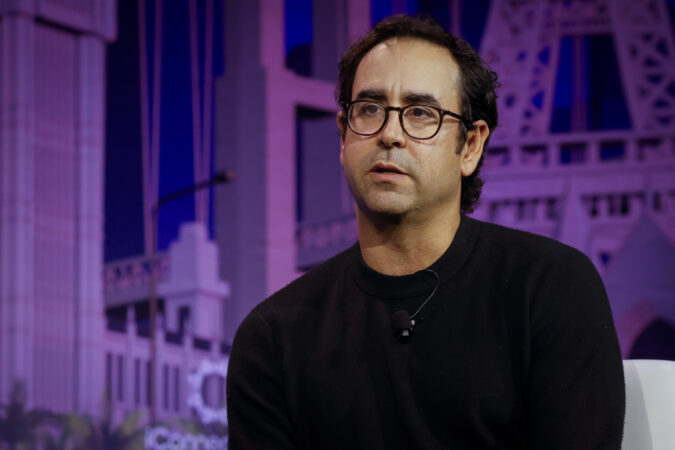
Rebecca Campbell, a former longtime Walt Disney Co. executive who has also worked in local television in Philadelphia, has joined The Inquirer’s board of directors.
Campbell has deep ties to Pennsylvania journalism: She was raised in Tamaqua — where her father owned a local newspaper — and she went on to study journalism at Bloomsburg University. Early in her career, Campbell worked at TV stations in Allentown and Lancaster, and later served as president and general manager of 6abc.
Campbell has read The Inquirer for over five decades. As her career took her out of the area, “Wherever I was in the world, I could access The Philadelphia Inquirer digitally,” Campbell said in a phone interview. “My roots are local, and I know what the paper is for the community and keeping everybody connected to that community.
“My whole background in media, streaming, digital, and even local television, gives me a strong appreciation for the tradition of journalism and what’s ahead. I’m honored — truly honored — to be asked to be on the board.”
During her 26-year tenure at Disney, Campbell had stints leading the global media and entertainment company’s operations in Europe, the Middle East, and Africa, and later Disneyland Resort, overseeing theme parks and hotels.Before retiring in 2023 she was chairman of international content and operations.
Campbell was mentioned as a potential successor to longtime CEO Bob Iger, who called her “a truly valuable and trusted leader,” the Orange County Register reported.
Her departure came at a tumultuous time for the company: Iger announced a major restructuring and job cuts aimed at making Disney’s popular but money-losing streaming services profitable, according to the Hollywood Reporter and the Los Angeles Times.
In May 2025, Campbell was asked to take over as interim CEO of Meow Wolf, a large-scale immersive art installation company, after joining the board of directors in 2024. Founded in 2008, that company is known for interactive, mind-bending multimedia attractions that operate in states including Texas, Nevada, Colorado, and New Mexico, and opening in Los Angeles later this year.
Campbell joined The Inquirer’s board Feb. 1. She is also on the board of Versant Media Group, a spin-off of Comcast that owns cable channels such as MS Now — formerly MSNBC — CNBC, and the Golf Channel. She lives part-time near Philadelphia.
The Inquirer’s board of directors, chaired by corporate finance attorney Lisa Kabnick, is responsible for key operational decisions, such as hiring the publisher. The newsroom operates independently.
Editor’s note: This story has been updated to include comments and background from Rebecca Campbell
Accompanying one of the more-enduring snowpacks in the period of record, ice has continued to build in the Philadelphia region’s waterways, and all indications are that it’s going to intensify in the next three days, perhaps significantly.
With temperatures expected to fall to single digits by Saturday night and wind gusts up to 55 mph, the region is about to experience an assault from a “cold air gun,“ said Alex Sosnowski, senior meteorologist at AccuWeather Inc.
The combination, plus the below-freezing temperatures at least through Monday and the ongoing cold spell that began last month, will not only deepen the ice cover but will make it more uniform by freezing over breaks in the ice.
“You’re going to see the ice-over become more extensive,” Sosnowski said.
Earlier in the week, icing temporarily stranded a vessel on the Delaware River that was delivering much-needed salt supplies to Philly. (They did eventually get here.)
The U.S. Coast Guard was using a 175-foot-long cutter to break up ice on a portion of the river channel that runs from the mouth of the ice-covered Delaware Bay — where Cape May-Lewes Ferry service was disrupted this week — to Trenton.
As of Friday morning, the craft had been ramming ice for 45 hours since the freeze began at the end of last month, U.S. Coast Guard Petty Officer Matthew West said.
So far, however, the ice hasn’t reached crisis levels, said Ryan Mulvey, a spokesperson for the Philadelphia Regional Port Authority. For ship traffic on the river, it’s been more a matter of “road work ahead” rather than ”road closed.”
“We’re open as usual,” he said. “I think the largest ships help with breaking up some of the ice flow.”
One thing is certain, meteorologists are warning: The ice factory is going to be in full production mode until Tuesday.
And, ironically, even as precipitation deficits and drought conditions persist, flooding potential is a source of concern.
The short-term outlook for icing in the Philly region
A key to melting, said Sosnowski, is having a sequence of daily average temperatures above freezing, not just daytime highs above 32 degrees. Nights also have to warm up.
The prospects of that happening aren’t looking good for the next several days. Officially, Friday was the 12th consecutive day of a snowpack of at least 5 inches at Philadelphia International Airport, the seventh-longest such stretch in records dating to the winter of 1884-85.
Daily average temperatures have been below freezing every day since Jan. 23.
Highs on Saturday and Sunday, even in the city, may struggle to reach 20 degrees, with lows in single digits Sunday and Monday mornings.
A promised warmup during the workweek wasn’t looking as toasty on Friday as it was earlier in the week. Monday’s temperatures were forecast to top out in the 20s, and no daily average temperatures are forecast above freezing through Friday.
Some rain or snow also is possible Wednesday, said Nick Guzzo, a meteorologist with the National Weather Service in Mount Holly. A storm is possible next weekend, but computer models continue to disagree with each other, and themselves.
To erase the snowpack, the region could use a warm, moist air mass and rain that would produce “river rises” that would help break up the ice, the weather service says.
But not too much rain.
The long-term outlook: Flooding concerns amid a drought
Moist air preceding a rainfall all but erased the snowpack with a historic melt. When that air came in contact with the snow, it condensed, releasing latent heat that sped up the melting.
Rain followed, and liberated ice jams led to destructive flooding along the Delaware and the Susquehanna Rivers and a presidential disaster declaration.
NOAA’s Middle Atlantic River Forecast Center is well aware of the potential and is monitoring conditions, said senior hydrologist Johnathan Kirk.
“That’s what we have to watch for,” said Sosnowski, who well remembers 1996.
“It is going to take one of the more mild-mannered thaws to avoid ice-jam flooding,” he said.
A mild thaw is possible, Sosnowski said, but “the odds are stacked against it. It’s been so cold for so long.”
When you walk into Koselig Nook, Aracelis Mullin wants you to feel a wave of calm. She intentionally designed the teahouse that way: From its welcoming furniture to its lighting, its green paint, its scents, it is meant to be a relaxing third space, a stopping point between work and home, where people can gather, craft, focus on wellness, or anything between. Don’t forget to take off your shoes. (Really. It’s a rule.)
Koselig Nook, a late-night teahouse, plans to open in Exton, at 333 E. Lincoln Highway, later this month. The business is relocating from Coatesville, where it opened in 2024, to be more central for customers within the county and traveling from Philly.
“The whole idea and the purpose is to bring the people out of their houses and to enjoy another place where they can network or just spend some time or talk,” Mullin said.
Named for the Norwegian term encompassing contentment and coziness, Koselig Nook’s seating is meant to be secure and comfortable — with plush, downy pillow seating and blankets, oils, and low lighting, inviting people to lounge.
So much of today’s gathering culture revolves around bars and drinking, Mullin said. Though sober options are opening in metropolitan areas, like Philadelphia, people in the county have fewer places — especially places open later, she said.
That’s the gap Koselig Nook seeks to fill, she said.
“I think there’s a big need for third places that are more calm; for introverted people, they can come and network, too, little by little, but they don’t have the pressure of society saying, ‘Hey, do you want to drink?’” she said.
Instead, customers can sit and study or work from 11 a.m. to 3 p.m. for $25 on Tuesdays through Fridays. Students spent a lot of time holed up in the Nook’s Coatesville location during finals week in December, Mullin said.
In the evenings, from 7 to 11 p.m. for $35 on Friday and Saturday, people can go somewhere that is not about drinking.
During various events offered week to week, people can come to workshops where they junk journal, cutting up pictures and pasting them into notebooks, or take a meditative break surrounded by gongs and chimes and singing bowls in a sound bath session, or spend time with a medium. You can pick up letters from a pen pal in another country or pen your own, facilitated through Koselig Nook. You can silently read your own book and then, in a formal discussion, chat about it with other readers, trading recommendations.
Some make events out of it. For one 24-year-old’s birthday, she and her friends journaled together, sipping their tea, and had a sound bath.
Others come alone and leave with connections: During a full moon ceremony, only two of the 15 women who came knew each other. By the end, “they all shared their phone numbers. … It was amazing,” Mullin said.
The business traces its lineage to when Mullin’s daughter, Victoria, was living in California in 2020. She frequented a teahouse where customers could reserve time and sit and enjoy themselves during the evening hours. After Mullin visited herself, she felt compelled to bring something similar to the East Coast. She picked the brains of the owners.
With her background — she ran a traveling tea party business for young girls and a birthday party business in Thorndale — Mullin embraced their model; her teahouse is reservation-only. There is unlimited tea, and a selection of premade snacks. Everything is provided without extra charge once you are in the Nook. Socks only.
“I wanted to have that community place where the people come and gather, regardless of what your politics and your religion, so we did it. I was scared to death,” she said.
She expected to have to go a bit more slowly in Chester County, for people to understand the business. But she was met with a lot of enthusiasm.
“The people are so in need of this that they love it,” she said.
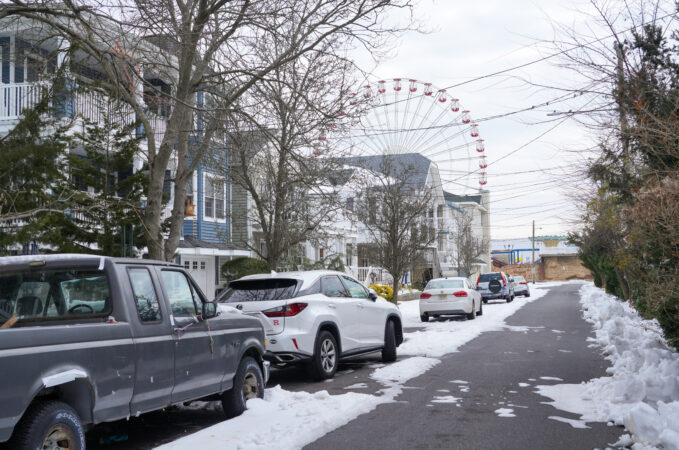
OCEAN CITY, N.J. — Marie Crawford was immediately charmed in 2021 when she and her soon-to-be-surfer husband Rich moved into their historic house in the literal shadow of Gillian’s Wonderland Pier.
They’d come from Blue Bell, Pa., to live year-round by the ocean, and landed with an amusement park right up the street.
“The ball drop, that was what we heard from my house,” she said, referring to the 130-foot-high Drop Tower ride. “It was, ‘Ah, ah, ahhhhhhhh,‘” she said, imitating the screams she would sometimes hear.
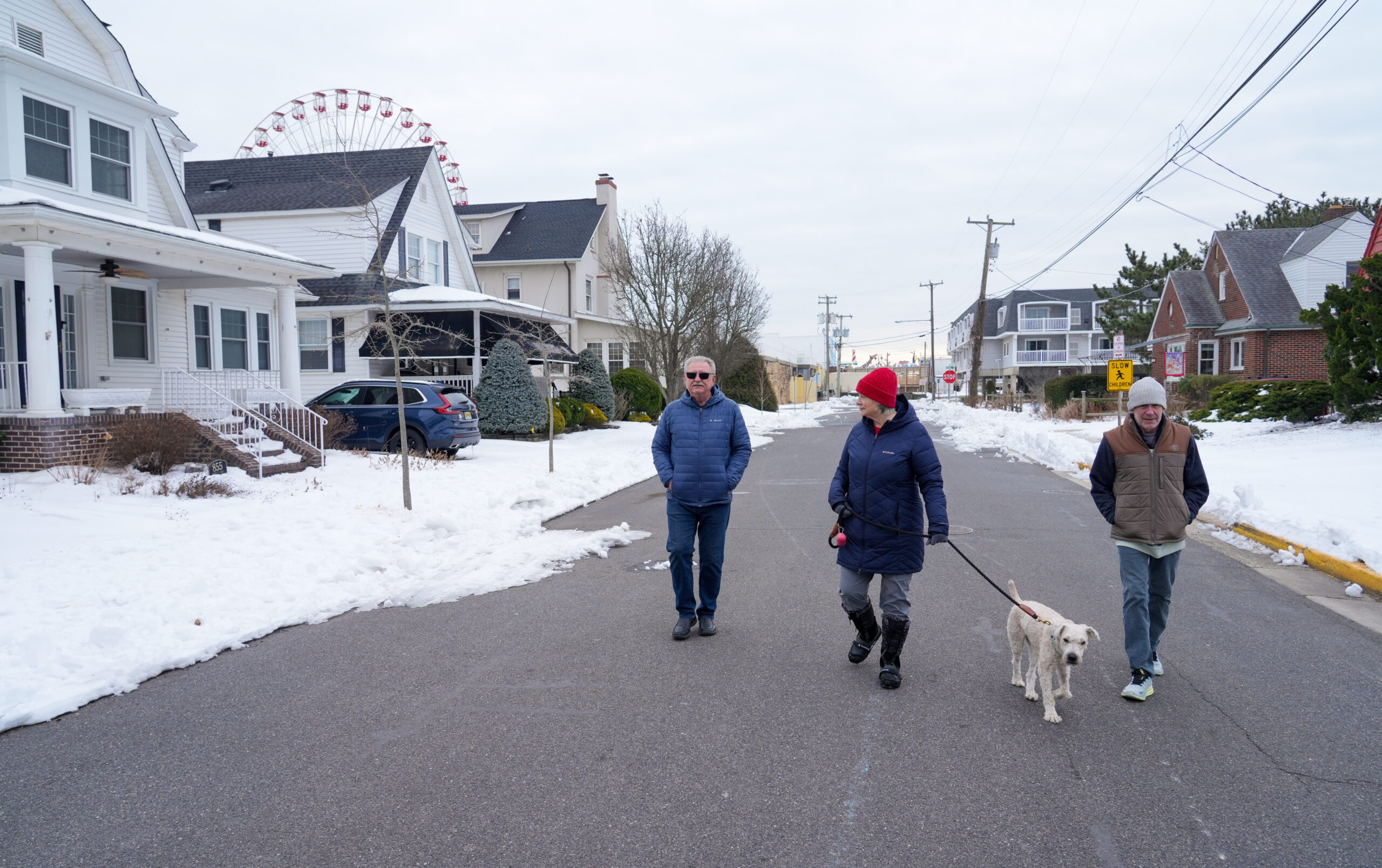
Jack Gutenkunst, left, Marie Crawford and her husband Richard with Shiloh, a 9-year-old soft coated wheaten terrier, walk along Plaza Place, in Ocean City, Tuesday, Feb. 3, 2026.
“It was so beautiful and romantic. On our porches, we would hear the ocean, not the amusement park. There were families, babies in strollers, coming up the street, flowing up to Wonderland. We were kind of ambassadors.”
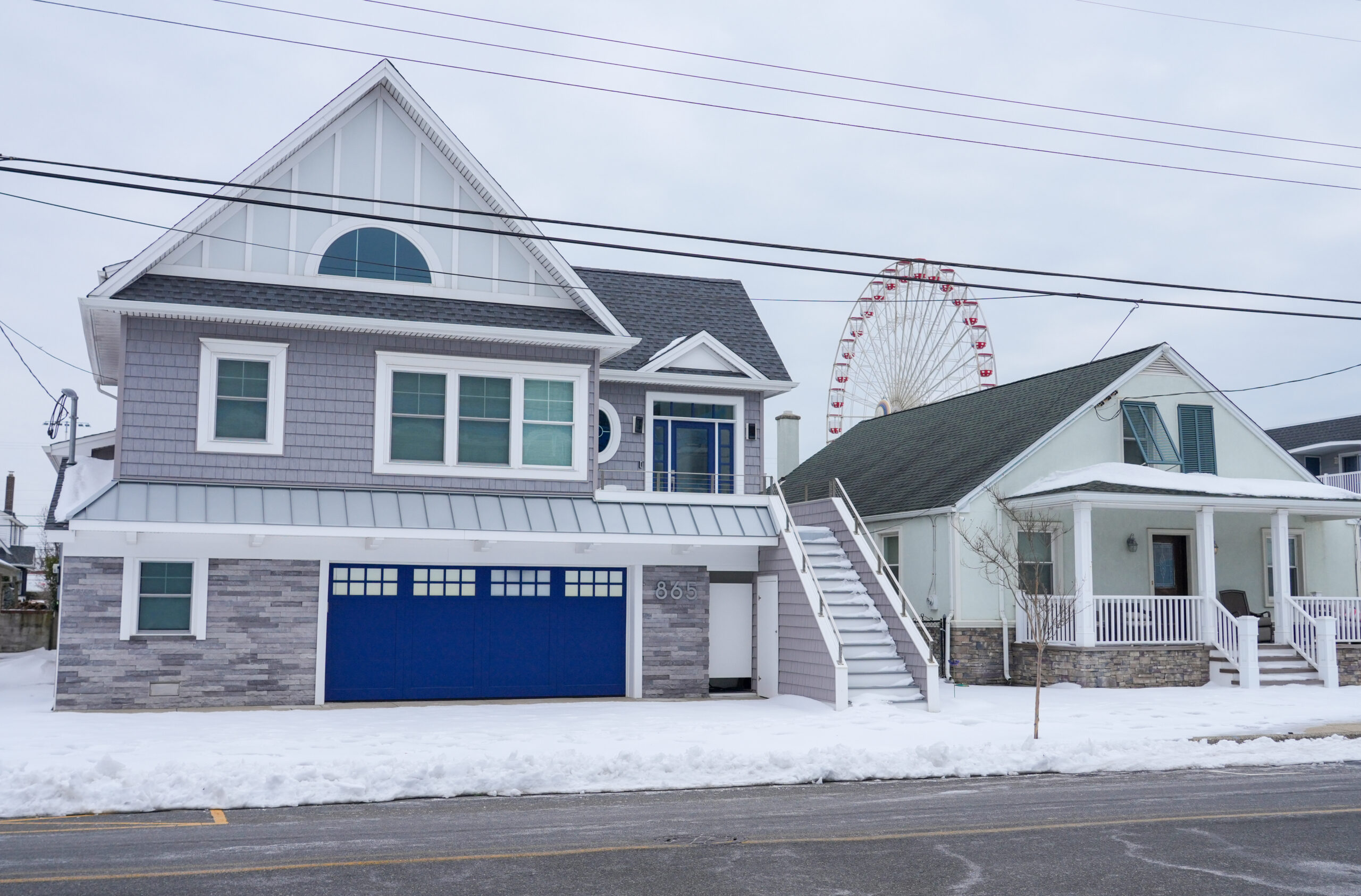
Now, more than a year after the closing of Gillian’s, the residents are faced with the possibility of a seven-story hotel they fear will block their sun, bring traffic to their streets, and threaten the small-town charm they found in their little pocket of Ocean City.
“It’s just another example of maximizing, pushing,” said Rich Crawford, Marie’s husband, who programs music for his family’s Christian radio station, WDAC, located in Lancaster, Pa. In his 60s, Rich fell in with Ocean City’s surfing crowd and unexpectedly grew to love his little community.
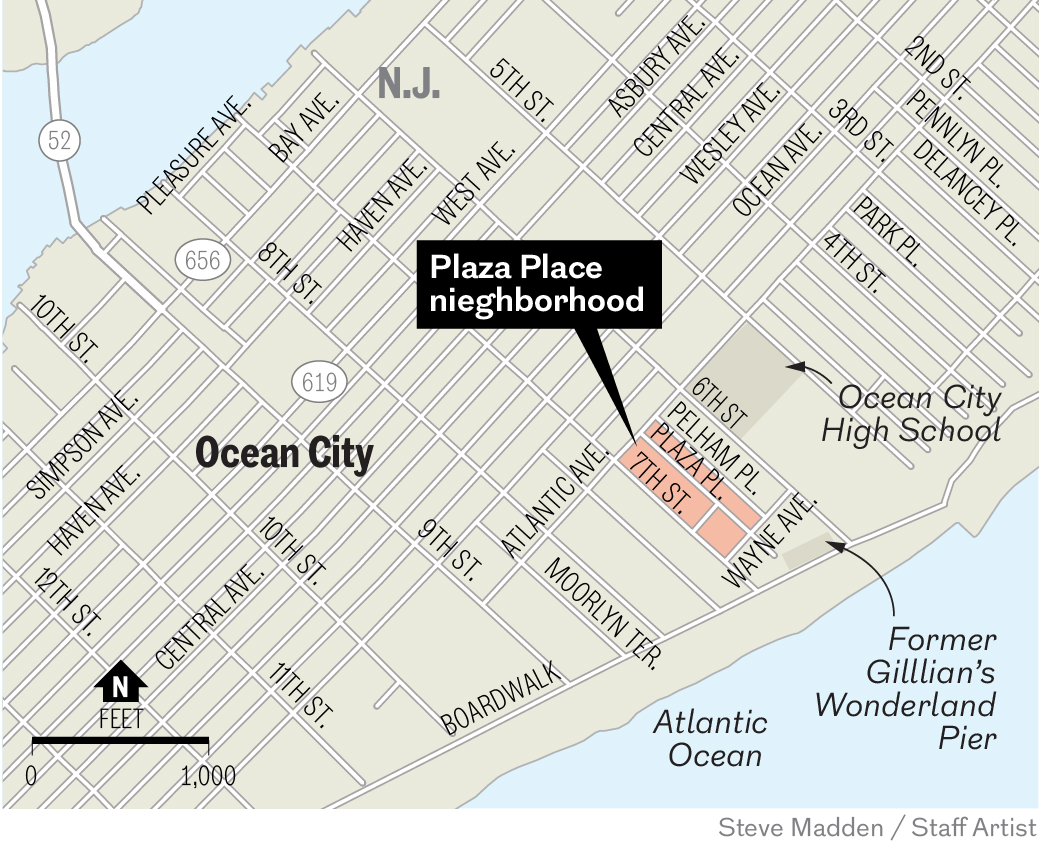
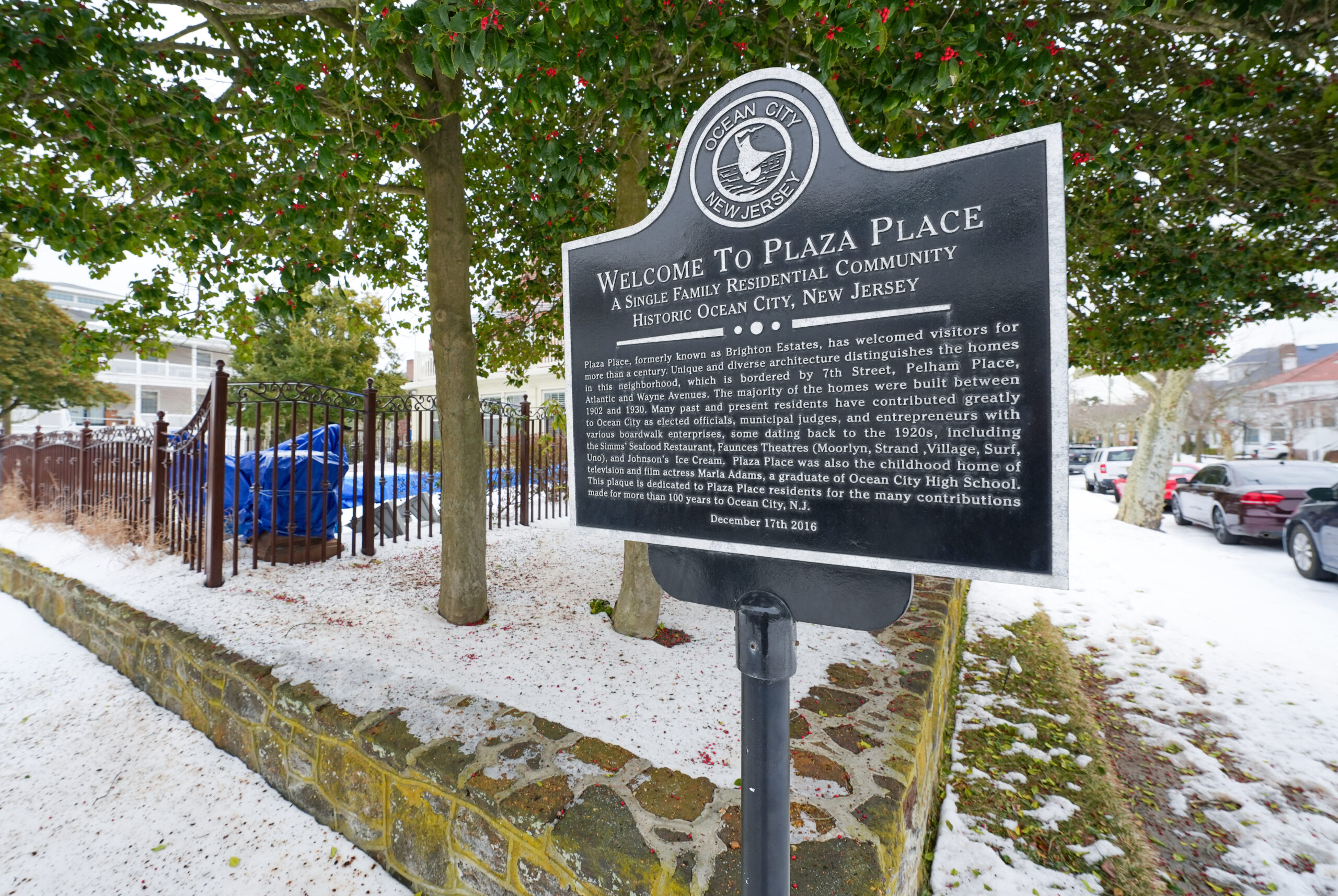
The Crawfords’ neighborhood of 100-year-old homes and 153 trees is called Plaza Place, which is one block each of Pelham Place, Plaza Place, and the north side of Seventh Street, between Wayne Avenue and Atlantic.
Across Wayne Avenue, toward the ocean, was Wonderland. On a clear day, a red ball of sun creeps up above the boardwalk and peeks into their little neighborhood.
On Pelham Place, residents each also own a two-foot- wide stretch of land across the street from their houses, a quirk of their deeds originally designed to prevent the rooming houses on Plaza Place that backed up against Pelham Place from using Pelham as an alleyway for their trash. There are dedicated gardeners on the streets who turn those strips into showpieces.
The sun sets behind the Ferris wheel on the final day for the beloved Wonderland Pier in Ocean City Sunday, Oct. 13, 2024.
Neighbor Barb Doctorman, whose family owns the Islander store on the boardwalk, said she used to take her children up on the Ferris wheel and peer down at their neighborhood. So lush, it looked like a forest, she said.
“I looked up the impact of a high-rise,” said Doctorman. “We’re going to lose some sun. The airflow is going to be totally changed from what it was. There’s a heat radiant that comes off it.”
Her husband, Doc, said: “We want something up there, but we know there could be more of a draw to that boardwalk than just the hotel.”
Marie Crawford (left) holds the leash of Shiloh, a 9-year-old soft-coated wheaten terrier, while standing with her husband Richard (center) and neighbor Jack Gutenkunst at the end of Pelham Place in Ocean City.
The land is owned by developer Eustace Mita, who has proposed Icona in Wonderland, a 252-room hotel that would preserve the Ferris wheel, carousel, and some kiddie rides.
So far, the city has not declared the site in need of rehabilitation, as Mita has requested, or otherwise moved to rezone the area to allow a hotel.
Merchants have begged the city to allow the hotel, and described how their businesses have suffered since the closure of Wonderland. Some residents have clung to the idea that an amusement park can return, though those numbers are dwindling.
Marie Crawford, her husband Richard, right, along with Shiloh, a 9-year-old soft coated wheaten terrier, and their neighbor Jack Gutenkunst, walk past a sign against the development of a hotel at the site of the old Wonderland Pier on the boardwalk in Ocean City, Tuesday, Feb. 3, 2026.
In Plaza Place, the opposition is less sentimental, more practical. They fear traffic, and the shadow from a neighboring seven-story hotel. Like residents in other towns who fought dunes, they fear the loss of the ocean breeze, or a shift in wind patterns that will affect surfing at the popular Seventh Street Beach.
“It’s got that old feel to it, and everybody’s house is different,” said Marie Crawford, who bought her Craftsman Colonial on the north side of Pelham for $905,000 in 2021. She estimates it’s worth $2.5 million now. There are about 60 homes in the Plaza Place civic association.
The association is one of several groups that are prepared to go to court if the city tries to change the zoning to allow a hotel, without going through a thorough master plan process, said Jack Gutenkunst, the Plaza Place Association president.
While Wonderland brought thousands of people on a summer night, the pier itself had no parking. So people parked elsewhere and excitedly walked through their neighborhood on their way to the rides. People on their porches called out, “Have a blessed evening,” and chatted the night away, said Crawford. The hotel proposal calls for parking underneath the structure.
A sign stands near the historic neighborhood behind the old site of the Wonderland Pier in Ocean City, Tuesday, Feb. 3, 2026. Residents are against the development of a hotel at the boardwalk site.
Crawford stressed that it’s not a case of selfish NIMBY, Not In My Backyard. Despite Ocean City’s decades-old pattern of replacing single-family homes with duplexes, there are nearly 1,400 homes over 100 years old still left in Ocean City, said Bill Merritt, president of Friends of OCNJ History & Culture.
Being a block from the boardwalk, and living in a beach town, does not mean the neighborhood’s purpose is primarily hospitality, said Crawford. Its distinct, increasingly rare Jersey Shore character deserves to be valued, she said.
“It’s height. It’s chaos. It’s the change in culture,” she said, when asked what specifically worries her about the hotel. “It’s a transient population coming through here for three nights at a time. That’s in the hospitality district. We are not the hospitality district.”
The neighborhood behind the old Wonderland Pier site on the boardwalk in Ocean City, Tuesday, Feb. 3, 2026. Residents are against the development of a hotel at the boardwalk site.
The demolish-and-rebuild mania that took over a lot of the rest of the island has mostly left Plaza Place alone, though residents acknowledge that is also a threat to their way of life. They also fear a hotel will prompt Plaza Placeans to sell.
“It’s a Norman Rockwell painting, it just is,” Councilman Keith Hartzell says in the documentaryPlaza Place: The Enigmatic Street, a locally made short film about the neighborhood. “It’s right here in Ocean City, and you kind of don’t expect it, when there’s two streets away a bunch of duplexes.”
Hartzell, who is running for mayor against incumbent Jay Gillian, the former owner of Wonderland who sold to Mita, says he hopes to negotiate with Mita over height, parking, and other issues before considering any kind of zoning allowance or rehabilitation designation. A city council-appointed subcommittee tasked with assessing the boardwalk’s usage as a whole is holding a public meeting at 10 a.m. on Feb. 7 at the city’s library.
The residents of Plaza Place worry about the survival of the hidden little neighborhood by the beach they fell in love with. “The neighborhood is so beautiful and so old,” said Marie Crawford. “If the hotel goes in, the dramatic change that will be for all of us with the traffic, the tone of the neighborhood — you’re going to see people sell. That threatens the neighborhood. The people won’t want to stay.”
Apollo Global Management’s John Zito left the audience of investors stunned.
Addressing a gathering in Toronto last fall, he said that the real threat for private capital markets wasn’t tariffs, inflation, or a prolonged period of elevated interest rates. Rather, he said, “the real risk is — is software dead?”
Zito’s comments, being reported for the first time, marked a forthright challenge to one of private equity’s most entrenched assumptions. For years, investors have funneled hundreds of billions into software businesses, banking on steady growth and resilient, recurring revenues. But the artificial-intelligence revolution is now testing that foundation.
As worries mount, firms including Arcmont Asset Management and Hayfin Capital Management have hired consultants to check their portfolios for businesses that could be vulnerable, according to people with knowledge of the matter. Apollo cut its direct lending funds’ software exposure almost by half in 2025, from about 20% at the start of the year.
The uncertainty about the eventual winners and losers is roiling multiple markets. On Tuesday, stocks seen as vulnerable to AI dropped after Anthropic released a new tool, exacerbating worries about disruption to businesses. In recent days, Blue Owl Capital Inc. revealed huge outflows from a tech-focused fund, and two European software firms put loan deals on ice.
While various business models are threatened, software-as-a-service is particularly vulnerable. AI-native firms can often offer quicker and cheaper solutions, meaning companies that once operated in a defensible sector are now at risk of competition from new players.
Anthropic’s Claude Code and other “vibe-coding” start-ups are disrupting traditional SaaS by allowing users with no coding experience to build software. That’s dramatically lowering the programming skill barrier and undermining rigid, one-size-fits-all products.
“Technology private equity, in its current form, is dead,” Isaac Kim, a partner at venture capital firm Lightspeed who previously led Elliott Investment Management’s tech private equity business, said in a recent LinkedIn post.
The sector has been a hugely popular target for buyout firms and their private credit cousins. From 2015 to 2025, more than 1,900 software companies were taken over by private equity buyers in transactions valued at more than $440 billion, according to data compiled by Bloomberg.
Deals were easily waved through most investment committees because the model was simple. Revenues are “sticky” because the tech is embedded into businesses, helping with everything from payroll to HR, and the subscription fee model meant predictable cash flows.
But now, lenders are zeroing in on how prospective borrowers are dealing with the new technology challengers, according to people familiar with the matter. It’s the first question software bosses are being asked during meetings about borrowing, they said.
Buying a software business, improving margins, and adding leverage “assumes the underlying product remains relevant long enough for financial engineering to work,” Kim said in the post. “AI has changed that assumption.”
Last year, two outsourcing companies, KronosNet and Foundever, fell into difficulty amid increased investor scrutiny around AI. The debt of both is now trading at distressed levels. Bond prices on other software names, including McAfee and ION Platform Investment Group, have tumbled.
Also in 2025, CVC Capital Partners’ credit unit took the keys of a contact center support business called Sabio Group after its previous owner struggled to find a buyer.
“Everyone’s focused on these bubble risks, I think the biggest risk is actually the disruption risk,” Blackstone’s Jon Gray said on Bloomberg TV. “What happens when industries change overnight, like what we saw to the Yellow Pages back in the nineties when the internet came along.”
In private markets, debt-laden firms have sought forbearance on borrowings, and big-name lenders have slashed valuations on loans to software companies such as Edmentum and Foundever, some to distressed levels.
Credit exposure
Sentiment in the equity market has grown increasingly bearish. The S&P North American software index fell 15% in January, its biggest monthly decline since October 2008.
Private credit’s exposure to software may be much higher than some figures suggest. Barclays estimates so-called business development companies — investment funds that lend directly to firms — have around 20% of their portfolios tied up with the sector, but others say it’s substantially more.
“If your software business is in healthcare, the fund classifies it as a healthcare exposure,” said Robert Dodd, an analyst at Raymond James. “The software exposure is meaningfully higher than it looks.”
An additional worry is the software industry’s asset-light model. With less physical infrastructure to seize to try recoup money, that can mean bigger losses.
Zito’s recent comments represent a change in how the AI threat is being assessed.
Back in 2022, shortly before Hellman & Friedman and Permira paid just over $10 billion to buy Zendesk Inc., the software firm’s board of directors set out the risks the firm was facing.
They cited a potential recession, persistently high inflation, and economic headwinds. Not mentioned: AI.
Just over a week after the sale closed in November 2022, ChatGPT launched.
But firms under threat aren’t just sitting back. Many have harnessed the technology themselves, and for those that do it effectively, AI could be a boon. Annual recurring revenue from Zendesk’s in-house AI offering, for example, now exceeds $200 million, amounting to 10% of revenue, a person with knowledge of the matter said. Some firms expect AI will help them to reduce costs.
Brian Ruder, co-CEO of Permira, says there are risks, but the concern has been overdone.
“If you look back at previous platform shifts in technology, history tells us there will be winners and losers on both sides of the AI-native and incumbent SaaS equation,” he said.
In the boom times, star businesses such as Coupa Software and Cloudera traded at almost 60 times earnings, according to data from Pitchbook.
In 2025, software-as-a-service firms were bought by private equity at an average multiple of 18 times, down from 24 the previous year.
The software industry’s “halo of invulnerability” has been inappropriate for some time, said Robin Doumar, founder of private credit manager Park Square, adding that metrics like huge earnings multiples “defy financial logic.”
American Airlines is planning a new route to Porto, Portugal, from Philadelphia.
The route is expected to become available in summer 2027, pending government approval, the airline noted in a news release Thursday.
The flight will be offered on a new aircraft — the Airbus A321XLR — that American just began operating in December. According to PHL chief commercial officer Kate Sullivan, having that aircraft is key to the new route availability.The aircraft will feature “Flagship Suite” seats, which were recently introduced on some PHL flights.
“Not only is seeing a summer 2027 route announced so early exceptional, the A321XLR will enable American to serve markets like Porto that have strong demand but may not support daily flights from wide-body aircraft,” Sullivan said. “Porto is just the beginning of what this aircraft will unlock for our region’s residents and visitors.”
This will be the first time that Porto is offered as a direct route out of PHL, airport spokesperson Heather Redfern confirmed Friday. Sullivan said the addition is “outstanding news for PHL.”
“Porto is exactly the type of new market the Airbus A321XLR enables us to serve,” Brian Znotins, a senior vice president at the airline, said this week at a conference.
American has recently added several other direct flights from PHL to Europe. In 2024, the airline launched routes connecting Philadelphia to Copenhagen, Denmark; Nice, France; and Naples, Italy.
The airline also launched a bus service in 2022 to shuttle passengers from airports in the region to PHL to take a flight. And it opened new lounges at PHL last year, featuring two bars, private phone rooms, and showers.
American was among the top 10 largest employers in Philadelphia in 2025 and is the largest airline by passenger volume operating out of PHL. In 2024, the airline carried nearly 20 million passengers through the airport.
Philadelphia International Airport CEO Atif Saeed is stepping down, just as Philadelphia prepares for an expected influx of tourists this year.
Saeed has led the city’s Department of Aviation, which also includes the Northeast Philadelphia Airport, since 2022, and plans to step down Feb. 27. He is heading west to be president and CEO of the San Diego County Regional Airport Authority.
“Under his direction, our airports emerged stronger from the pandemic, advanced critical modernization efforts, and positioned Philadelphia to welcome the world in 2026 and beyond,” Mayor Cherelle L. Parker said in a statement Thursday.
“We are grateful for his contributions and wish him continued success in this next chapter,” Parker said.
The city plans to hire a new CEO following a national search. Tracy Borda, PHL’s chief financial officer, will be interim CEO.
Saeed’s departure comes as Philadelphia expects to be inundated with visitors this year for the United States’ 250th anniversary, the MLB All-Star Game, and the FIFA World Cup games.
“I will always look back at my time at PHL and PNE fondly,” Saeed said in a statement Thursday. “I am confident that our airports are ready to welcome the world for the events of 2026 and beyond.”
“From the start, by addressing the unhoused situation at PHL with a caring, multiagency approach, this team was committed to ensuring that through strategic investments and thoughtful planning, PHL and PNE are in a position of strength to continue to enhance airport operations for an even brighter future,” Saeed said Thursday.
Sonder, the buzzy short-term rental company, is no more. But some of its former properties across Philadelphia are taking on new lives.
At least three of Philly’s last five Sonder properties have new ownership and have already reopened or are about to as boutique short-term rentals.
The former competitor with Airbnb and Vrbo touted modern “apartment-style hotels” nationwide. In November, when Sonder announced that it was closing, citing “severe financial constraints,” it marked a chance for local and national operators to swoop in and snag desirable properties.
As first reported by the Philadelphia Business Journal, Wyndham Hotels & Resorts partnered with the hospitality company Reside to reopen the Sonder property at 325 N. 13th St.in Callowhill in January. The 96-unit building is now called Heid Lofts by Reside.
The Queen Hotel at 628 S. Fifth St.in Queen Village is now being managed by Sosuite, a Philly-based short-term rental company that has taken over other previous PhillySonder properties over the years. The 30-unit property reopened under Sosuite in November.
The Edison at 312 N. Second St. in Old City is working to reopen as a 24-unit rental property in the coming weeks under operator PHL Stays, the Business Journal reported. The company is run by Jake Tovey, who operates a similar business in Pittsburgh called Pittsburgh Furnished Rentals.
As for the remaining former Sonder haunts, The Arco at 1234 Locust St. in Midtown Village is still closed, while the Witherspoon Building at 130 S. Juniper St. in Center City is pivoting to become a traditional apartment building with a mix of 186 studio and multi-family units.
COLLINGSWOOD, N.J. — The shawarma, falafel wraps and baklava at Jersey Kebab are great, but many of its patrons are also there these days for a side of protest.
A New Jersey suburb of Philadelphia has rallied around the restaurant’s Turkish owners since federal officers detained the couple last February because they say their visas had expired.
In fact, business has been so good since Celal and Emine Emanet were picked up early in the Trump administration’s immigration crackdown that they have moved to a bigger space in the next town over. Their regulars don’t seem to mind.
Celal Emanet, 52, first came to the U.S. in 2000 to learn English while he pursued his doctorate in Islamic history at a Turkish university. He returned in 2008 to serve as an imam at a southern New Jersey mosque, bringing Emine and their first two children came, too. Two more would be born in the U.S.
Before long, Celal had an additional business of delivering bread to diners. They applied for permanent residency and believed they were on their way to receiving green cards.
When the COVID-19 pandemic began and the delivery trucks were idled, Celal and Emine, who had both worked in restaurants in Turkey, opened Jersey Kebab in Haddon Township. Business was strong from the start.
On Feb. 25, U.S. marshals and Immigration and Customs Enforcement officers arrested the couple at the restaurant. Celal was sent home with an ankle monitor, but Emine, now 47, was moved to a detention facility more than an hour’s drive away and held there for 15 days.
With its main cook in detention and the family in crisis, the shop closed temporarily.
Emine Emanet hugs her husband Celal as she leaves the ICE Elizabeth Detention Facility on Wednesday, March 12, 2025.
Although the area is heavily Democratic, the arrests of the Emanets signaled to many locals that immigration enforcement during President Donald Trump’s second term wouldn’t stop at going after people with criminal backgrounds who are in the U.S. illegally.
“They were not dangerous people — not the type of people we were told on TV they were looking to remove from our country,” Haddon Township Mayor Randy Teague said.
Supporters organized a vigil and raised $300,000 that kept the family and business afloat while the shop was closed — and paid legal bills. Members of Congress helped, and hundreds of customers wrote letters of support.
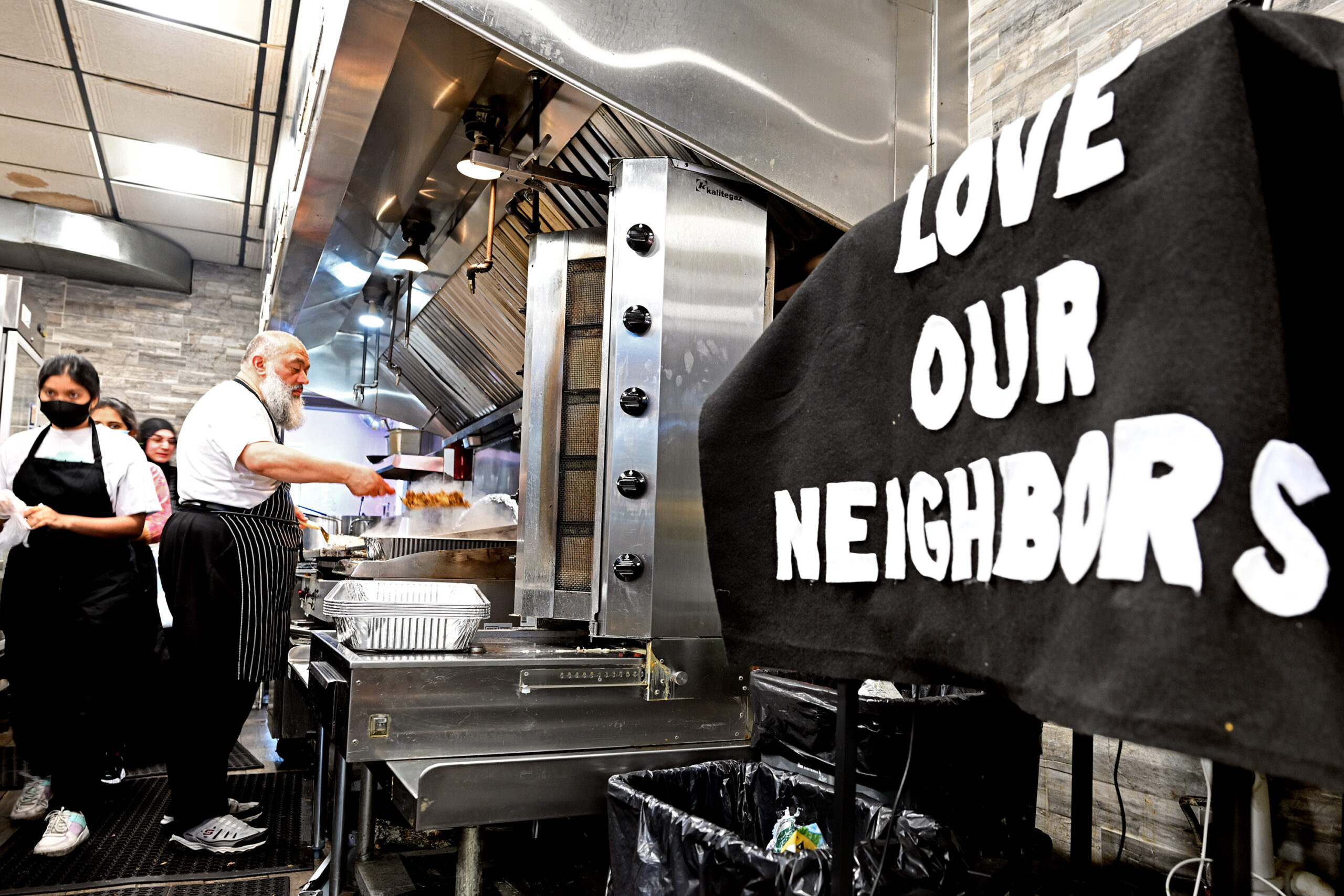
Celal Emanet works at the grill in his Jersey Kebab restaurant on Sunday, Mar. 30, 2025.
Space for a crowd
As news of the family’s ordeal spread, customers new and old began packing the restaurant. The family moved it late last year to a bigger space down busy Haddon Avenue in Collingswood.
They added a breakfast menu and for the first time needed to hire servers besides their son Muhammed.
The location changed, but the restaurant still features a sign in the window offering free meals to people in need. That’s honoring a Muslim value, to care for “anybody who has less than us,” Muhammed said.
Judy Kubit and Linda Rey, two friends from the nearby communities of Medford and Columbus, respectively, said they came to Haddon Township last year for an anti-Trump “No Kings” rally and ate a post-protest lunch at the kebab shop.
“We thought, we have to go in just to show our solidarity for the whole issue,” Kubit said.
Last month, with the immigration crackdown in Minneapolis dominating the headlines, they were at the new location for lunch.
Gretchen Seibert tapes up hearts with words of support for Celal and Emine Emanet, the owners of Jersey Kebab, after the couple was detained by ICE in February 2025.
The legal battle hasn’t ended
The Emanets desperately want to stay in the U.S., where they’ve built a life and raised their family.
Celal has a deportation hearing in March, and Emine and Muhammed will also have hearings eventually.
Celal said moving back to Turkey would be bad for his younger children. They don’t speak Turkish, and one is autistic and needs the help available in the U.S.
Also, he’d be worried about his own safety because of his academic articles. “I am in opposition to the Turkish government,” he said. “If they deport me, I am going to get very big problems.”
The groundswell of support has shown the family they’re not alone.
“We’re kind of fighting for our right to stay the country,” Muhammed Emanet said, “while still having amazing support from the community behind us. So we’re all in it together.”
Sandra Schultz Newman, 87, of Gladwyne, Montgomery County, the first woman elected to the Pennsylvania Supreme Court, the first female assistant district attorney in Montgomery County, the first woman named to the board of directors of the old Royal Bank of Pennsylvania, longtime private practice attorney, role model, mentor, and colorful “Philadelphia icon,” died Monday, Feb. 2. Her family did not disclose the cause of her death.
Reared in South Philadelphia and Wynnefield, and a graduate of Drexel, Temple, and Villanova Universities, Justice Newman, a Republican, was elected to the Commonwealth Court of Pennsylvania in November 1993 and to the state Supreme Court in 1995. She won a second 10-year term on the Supreme Court in 2005 but, having to step down in just two years due to a mandatory retirement age, left at the end of 2006.
“I love the court. I love my colleagues. The collegiality was great, and I’m going to miss that,” Justice Newman told The Inquirer. “But I just felt like I wanted to move on.”
During her 10-year tenure, Justice Newman was chair of the Supreme Court’s Judicial Council Committee on Judicial Safety and Preparedness and the court’s liaison to Common Pleas Court and Municipal Court in Philadelphia. She ruled on hundreds of issues and wrote opinions about all kinds of landmark cases, from environmental protections to school funding to clergy privilege to the Gary Heidnik and John E. du Pont murder cases.
She had worked in criminal and family law and handled many divorce and custody cases as a private attorney in the 1980s, and was praised later by court observers for her attention to Philadelphia Family Court matters. Lynn Marks, of Pennsylvanians for Modern Courts, told the Daily News in 2005: “She’s been a wonderful justice, and she’s made herself accessible to the public interest community.”
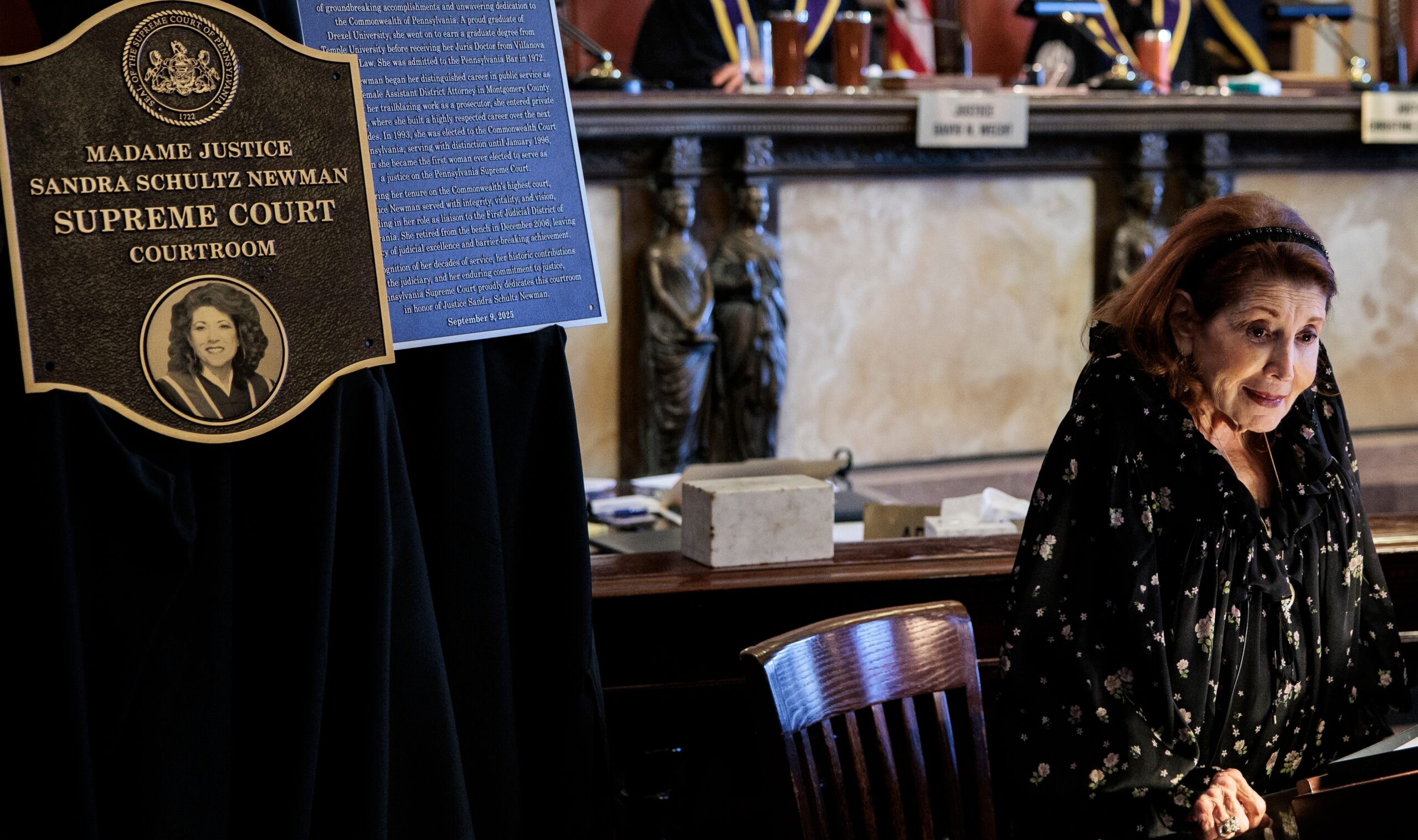
In 2025, her colleagues on the Supreme Court named their Philadelphia courtroom after her. “She was a remarkable jurist, public servant, and trailblazer for women, whose work and impact will leave a legacy beyond the bench,” Supreme Court Chief Justice Debra Todd said in a tribute.
News outlets across the state covered Justice Newman’s election to the Supreme Court as she campaigned in 1995, and she easily collected more votes in the Nov. 7 election than any of the other three candidates, all men. She told the Daily Item in Sunbury, Pa., in September ’95: “I don’t think anyone should be elected solely on their gender. But I don’t think anybody should not be elected because of it, either.”
Justice Newman touted her collegiality and feminine life experience during the 1995 campaign and told The Inquirer she wanted to be a “role model for everyone in Pennsylvania.” She told the Press Enterprise in Bloomsburg, Pa.: “I think I can bring a sensitivity and understanding on many issues, such as criminal issues like rape. I have a deep sense for the need of a safe society.”
Justice Newman speaks in 2025 during the ceremony in which the Supreme Court named its Philadelphia courtroom after her.
After her election, Inquirer staff writer Robert Zausnersaid: “Wealthy yet down-to-earth, Newman talked often during the campaign about her grandchildren and insisted that people ‘call me Sandy’ once she was outside her courtroom.”
Former Gov. Tom Ridge called Justice Newman a “pioneering legal giant” and said she “inspired generations of legal professionals across the Commonwealth.” Ezra Wohlgelernter, chancellor of the Philadelphia Bar Association, noted her “pathbreaking career” and “valuable service to our city and to the Commonwealth” in a tribute.
Either “the first” or “the only” in many of her professional pursuits, Justice Newman was called a “Philadelphia icon,” “a force of nature,” and a “beautiful and radiant star” in online tributes. She flirted with running for political office several times and was colorfully profiled in Philadelphia Magazine in 1988. In that story, writer Lisa DePaulo called her “part woman/part tigress.”
She famously endorsed a controversial cosmetic product on TV in 2006 and attended many galas and charity auctions, and her name appeared in the society and opinion pages nearly as often as the news section. In a 1983 feature, Inquirer writer Mary Walton described Justice Newman as “beautiful … with tousled auburn hair and a slender figure that she liked to cloak in expensive designer clothes.”
Justice Newman was the only woman on the state Supreme Court in 2002.
A friend said online she was “irrepressible in an Auntie Mame sort of way.” Another said: “The world has become a little quieter.”
Justice Newman served as the first female assistant district attorney in Montgomery County from 1972 to 1974 and was an in-demand, high-profile partner at Astor, Weiss & Newman from 1974 to 1993. She returned to private practice in 2006 and handled mostly alternative dispute resolution cases until recently.
She told the Press Enterprise in 1995 that colleagues in the Montgomery County District Attorney’s Office had adorned her desk with a green plant on her first day in 1972. “It was marijuana from the evidence room,” she said.
She wrote papers and book chapters about trial practice, death penalty statutes, and the electoral system in Pennsylvania. She spoke about all kinds of legal topics at seminars, conferences, and other events.
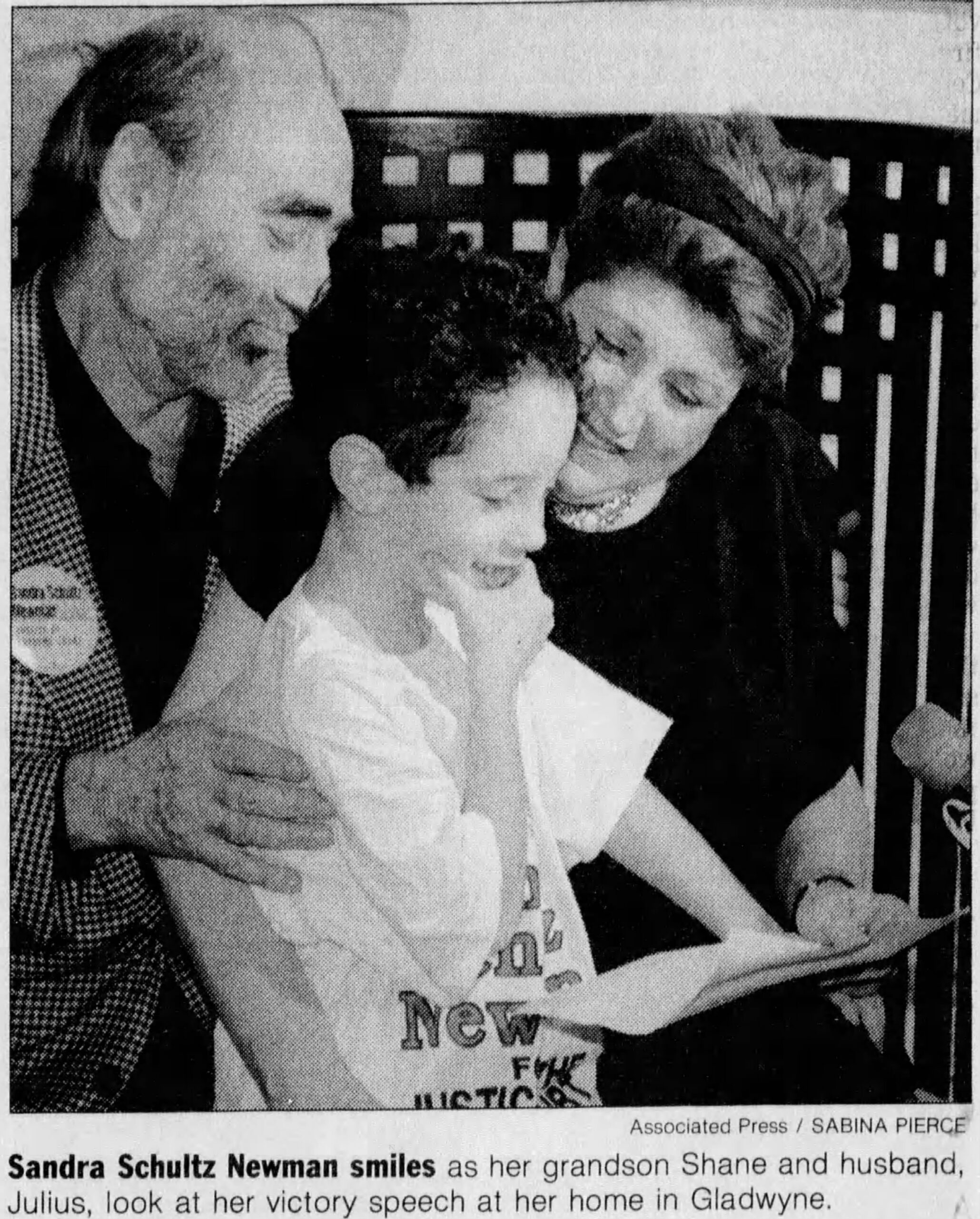
This photo of Justice Newman, her husband, Julius, and grandson Shane was taken for The Inquirer after she won on Election Day in 1995.
She cofounded what is now the Drexel University Thomas R. Kline School of Law in 2006, was a trustee for Drexel’s College of Medicine, and received dozens of service and achievement awards from Drexel, Villanova, the Pennsylvania and Philadelphia Bar Associations, the Women’s Bar Association of Western Pennsylvania, the Pennsylvania Association for Justice, and other groups.
She was the president of boards, chair of many committees, and active with the National Association of Women Justices, the Juvenile Law Center, the American Law Institute, and other organizations. She taught law classes at the Delaware Law School of Widener University in 1984 and ’85, and at Villanova from 1986 to 1993.
She earned a bachelor’s degree at Drexel in 1959 and a master’s degree in hearing science at Temple in 1969. In 1972, she was one of a handful of women to get a law degree at what is now Villanova’s Charles Widger School of Law. Later, she received four honorary doctorate degrees and was named a Distinguished Daughter of Pennsylvaniaby then-Gov. Ridge in 1996.
Outside the courtroom, Justice Newman volunteered for charities and legal associations. She was part of a group that tried unsuccessfully to buy the Eagles from then-owner Leonard Tose in 1983, and she was criticized in the early 2000s for her financial involvement in a bungled long-running effort to fund a new Family Court Building in Philadelphia.
Justice Newman chats with philanthropists and business leaders Raymond G. Perelman (middle) and Joseph Neubauer at the gala opening of the new Barnes Museum in 2018.
“Justice Newman filled every room she entered with her strength, energy, and exuberance for life and for the law,” Supreme Court Justice P. Kevin Brobson said in a tribute. “She lived with intention and spent her entire career focused on creating and expanding opportunities for future generations of legal professionals, especially women.”
Sandra Schultz was born Nov. 4, 1938. She graduated from Overbook High School and married cosmetic surgeon Julius Newman in 1959. They had sons Jonathan and David, and lived in Wynnefield, Penn Valley, and Gladwyne.
Her husband and son David died earlier. She married fellow lawyer Martin Weinberg in 2007, and their union was annulled 11 months later.
Justice Schultz was a longtime fashionista. She reveled in shopping trips to New York, and DePaulo reported in 1988 that her closet in Gladwyne was 800 square feet. She was also funny, generous, and kind, friends said.
Justice Newman dances with her grandson on Election Day in 1995. This photo appeared in the Daily News.
She funded several college scholarships, collected art, owned racehorses, cooked memorable matzo balls, enjoyed giving gifts, and tried to have dinner every night with her family. Sometimes, DePaulo reported, in the 1970s, she took her young sons to her law school classes at Villanova.
“Despite how busy she was, her family was always her priority,” said her brother, Mark. “She was also a true bipartisan who fought for equal rights and preserving our democratic institutions.”
In 2003, she was asked by Richard G. Freeman, editor in chief of the Philadelphia Lawyer, to describe her judicial decision-making process. She said: “There are beliefs that you have to put aside. One of the wonderful things about being on our court is that you can make new law where your beliefs fit into the law.”
In addition to her son Jonathan and brother, Justice Newman is survived by four grandchildren and other relatives. A grandson died earlier.
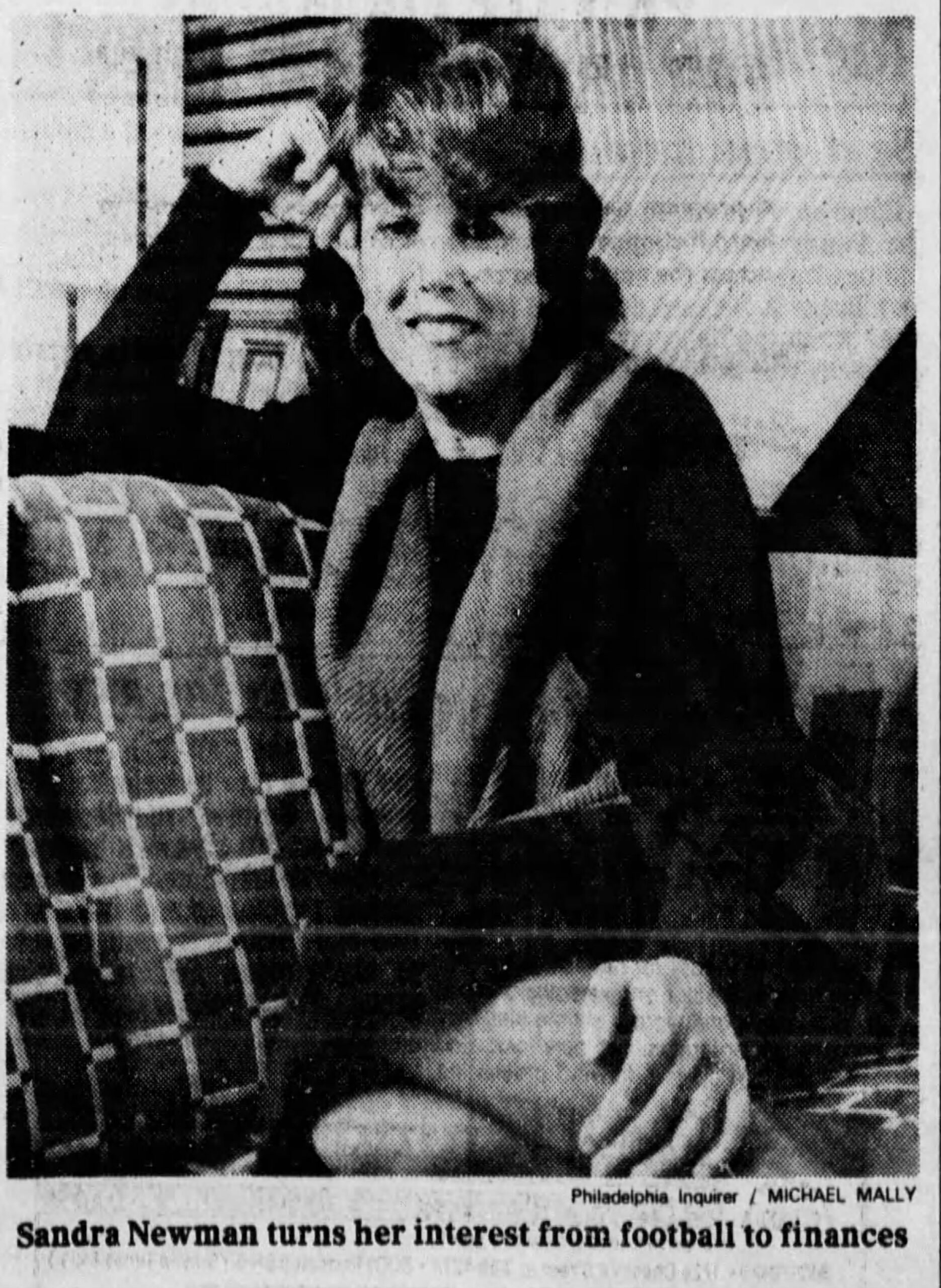
This photo of Justice Newman appeared in The Inquirer in 1983.
Services are private.
Donations in her name may be made to the Crohn’s and Colitis Foundation, 733 Third Ave., Suite 510, New York, N.Y. 10017.
Correction: One of the communities that Justice Schultz grew up in has been corrected.