Category: Nation & World

  • Popular THC drinks will soon be illegal. Companies are fighting to save the billion-dollar industry.

    Popular THC drinks will soon be illegal. Companies are fighting to save the billion-dollar industry.

    Right now, any Philadelphian 21 or older can go online or walk into a regional smoke shop and buy a THC-infused drink as potent as products in legal dispensaries.

    But soon, that might all change.

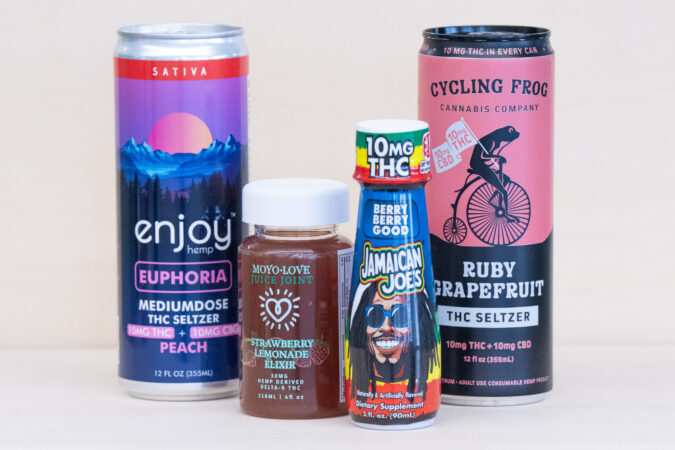
    The billion-dollar intoxicating beverage industry exploded in recent years, with THC-infused seltzers, lemonades, and teas that resemble popular products like Surfsides or White Claws. Sold in local gas stations, smoke shops, and liquor stores outside of Pennsylvania, these weed drinks deliver a cannabis high that is infused into bubbly, sweet canned beverages.

    While marijuana is still federally illegal, the hemp industry had found a way to manufacture and sell hemp-derived THC drinks across the country through a legal loophole that is soon closing.

    Last month, Congress banned all intoxicating hemp products, a slew of THC-infused smokeable, vape-able, and edible products that are derived from hemp plants but could be mistaken for actual marijuana. In many cases, the drinks are just as potent as conventional weed.

    Starting in 2027, almost all of them will be illegal, spurring a nationwide movement within the industry to save the burgeoning market.

    Arthur Massolo, the vice president of national THC beverage brand Cycling Frog, which sells its wares locally, said these restrictions will have devastating effects on the producers of thousands of hemp-derived products, like THC, but also CBD, the non-intoxicating cannabinoid popular for treating anxiety, sleep, and pain.

    Will Angelos, whose Ardmore smoke shop and wellness store, Free Will Collective, relies on THC drinks for nearly 40% of its business, is hoping for some saving grace. “We’re either looking to pivot or we’re disappearing,” he said.

    Adults share Cycling Frog canned THC drinks in this marketing photo provided by Cycling Frog.

    What are THC-infused drinks?

    Seltzers, sodas, teas, mocktails, and lemonades all infused with THC — and sometimes non-intoxicating CBD — exploded onto the scene a few years ago and grew into a billion-dollar business, said hemp market analyst Beau Whitney.

    “These drinks have transformed the hemp industry into this low-dose intoxicating health and wellness, alcohol-adjacent product,” said Massolo, who is also the president of U.S. Hemp Roundtable, a hemp business advocacy organization.

    The THC-infused drinks sold in gas stations, smoke shops, and liquor stores are supposedly formulated using legally grown hemp, which is allowed to be grown under the 2018 Farm Bill that opened the door to hemp farming in the U.S.

    Lawmakers carved out an exemption from federal drug laws for cannabis plants containing 0.3% or less of THC. These low-THC plants are considered “hemp” and are legal to grow. Cannabis plants over that THC threshold are considered marijuana and can carry felony charges if the plant is not being grown by state-licensed growers in places where adult use or medicinal marijuana is legal, like New Jersey and Pennsylvania.

    While intoxicating hemp products have enjoyed consistent growth in the past years, these THC-infused drinks have increasingly appeared in aisles of liquor stores and supermarkets in some states, allowing adults who normally don’t visit dispensaries to pick up a bottle of infused wine in the same place they grab groceries, said New Jersey cannabis lawyer Steve Schain.

    Hemp products photographed at the Philadelphia Inquirer, November 21, 2025.

    The ease of access to THC drinks allowed the national market to grow to $1.3 billion in annual sales, and if access continues, Whitney said, that figure could reach $15 billion in the coming years.

    This is all thanks to what Whitney calls the “FPS,” or “Female Power Shopper.” These women, ages 29 to 45, are the ones who are likely shopping for a household in grocery and liquor stores, and may jump at the chance to try cannabis products without diving headfirst into dispensaries, Whitney said.

    Women are becoming the fastest-growing demographic in the industry, and 2022 marked the first time daily marijuana users outnumbered daily alcohol drinkers. As alcohol consumption reaches historic lows, liquor stores and beer distributors have been “wonderfully buoyed” by THC drinks to keep them afloat, Schain said.

    Mary Ellen, 55, of Bucks County, who asked to not to be identified by her last name over concerns for her cannabis use and employment, said these THC drinks are the perfect way to unwind after a long day, especially for adults like her who choose not to drink alcohol. As a medical marijuana patient, she uses regulated cannabis for a variety of ailments, but also enjoys THC drinks like Nowadays’ infused mocktails that she buys at Angelos’ Ardmore store.

    “I’d rather come home and have a glass of Nowadays. That’s a lot better than having a glass of vodka or a benzodiazepine,” she said. “I’m not going to forget what I did the night before, and I’m not going to wake up feeling crappy the next morning.”
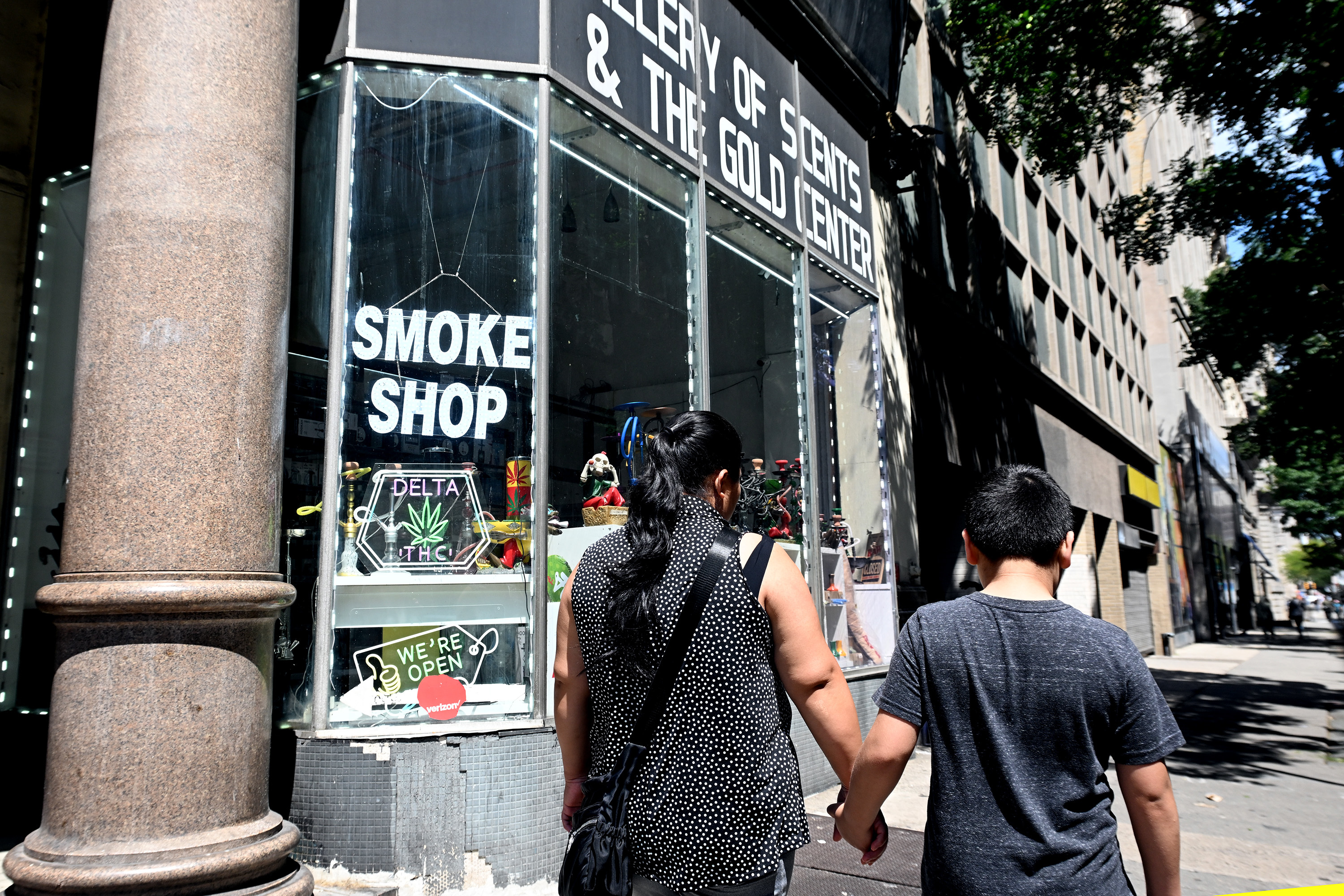
    City smoke shop exterior in the 1000 block of Chestnut Street Monday, July 21, 2025.

    What are the concerns over THC drinks?

    As the money started to roll in for THC drinks, fear among local communities and law enforcement began to grow. In the Philadelphia suburbs, the Bucks, Chester, and Montgomery County district attorneys’ offices finished a 10-month investigation into intoxicating hemp products and the local stores that sell them.

    The 107-page grand jury report speaks of a public health crisis unfolding in “plain sight” across Pennsylvania, where retailers have little to no oversight, in some cases selling actual marijuana.

    Montgomery County District Attorney Kevin Steele said the industry created a “Wild West situation” and urged state lawmakers to regulate the industry similarly to alcohol and tobacco, including age requirements, licensing, and mandatory lab testing.

    Stakeholders in the industry support regulation of some kind. While hemp-derived THC companies fear the economic collapse of their industry, Massolo and Angelos say there is concern that these products will leave overt brick-and-mortar operations known by local officials for more covert, illicit operations, similar to how these products were purchased before the 2018 Farm Bill.

    “We’ve basically traveled back to 10 seconds before the Farm Bill of 2018 was signed,” Schain said.

    Mary Ellen says the lack of regulation is a major sticking point for consumers who flock to these products, but would like some reassurance on the drinks they are ingesting.

    But, even if the ban goes into effect, she said, “people will just figure out another way for us to get it. It’ll be like a prohibition that we’ve seen in this country with alcohol and marijuana.”
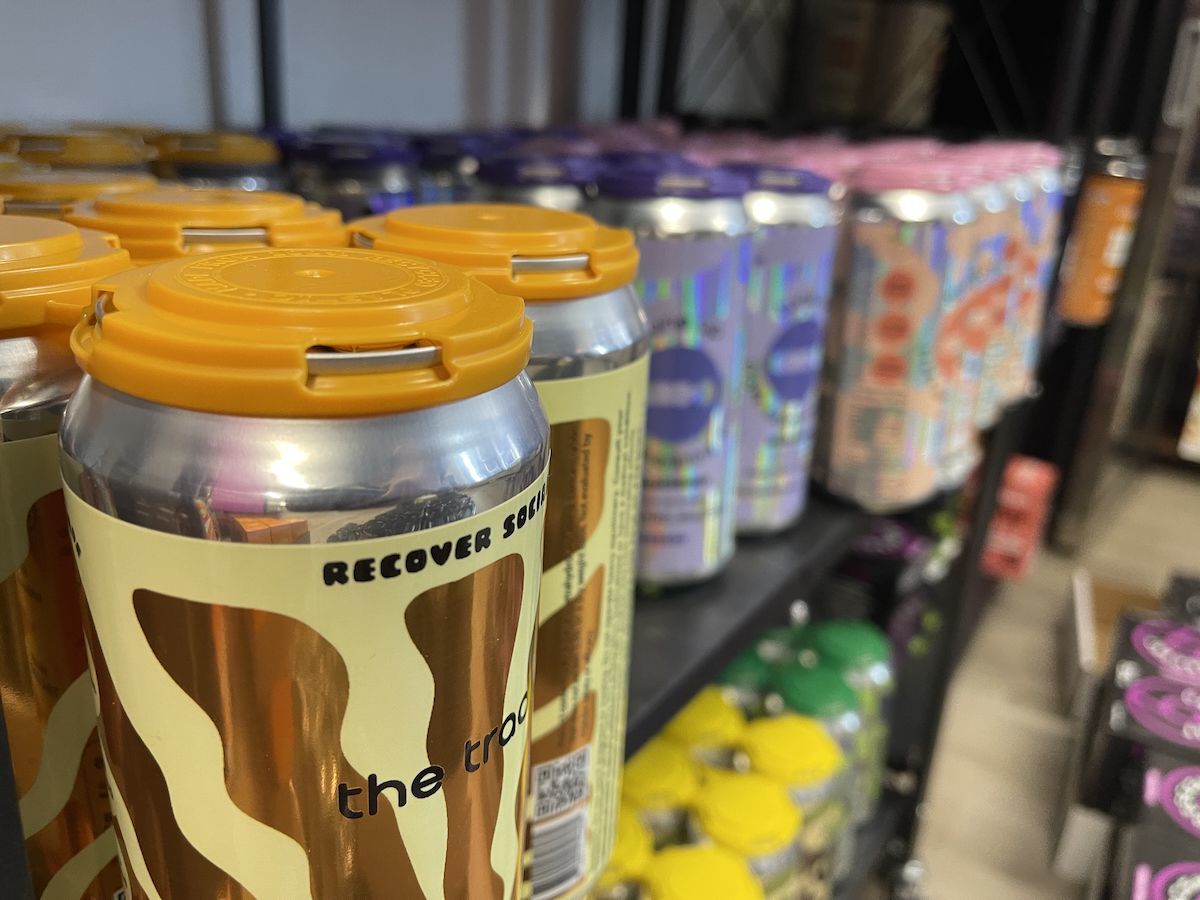
    THC and CBD-infused beverages on the shelves of Free Will Collective, an Ardmore smoke shop and wellness store owned by Will Angelos. As Congress moves to ban most intoxicating hemp products, business owners like Angelos aren’t sure they will be able to keep the doors open long past 2027 if current regulations go into effect.

    Will THC-infused drinks be banned or saved by 2027?

    Now, as the industry’s yearlong grace period begins before the ban takes effect, companies are scrambling.

    The intoxicating hemp manufacturers and retailers who spoke to The Inquirer said the game plan is to offload all of the intoxicating hemp products in stock, including THC-infused drinks, flower, vapes, and even CBD products.

    Some companies will see almost their entire product catalog become illegal, in some cases dwindling from 45 products on offer down to two, Whitney said of the firms he works with. The far-reaching impact will also hurt industrial hemp products, cannabis tourism, alcohol distributors, and even the legal cannabis industry, as some of their products, including CBD, will now have to contend with these new regulations, Schain and Whitney said.

    At the U.S. Hemp Roundtable, Massolo is having daily board meetings, including on weekends, to coordinate a response to federal lawmakers. It’s now a race against the clock to remedy or claw back some of the new regulations before damage is done to the industry’s distribution pipelines, Massolo said. The group hopes to rally other industries, like traditional beverages, wellness products, and supplements, to bolster its case.

    Among the U.S. Hemp Roundtable’s recommendations to lawmakers are an extension of the hemp ban grace period to two years, raising the limit on hemp-derived THC products, and allowing states to regulate these products as they see fit, to name a few.

    Stakeholders say they want regulations to help legitimize this billion-dollar endeavor and save it from annihilation, but smaller operators like Angelos hope it’s not at the expense of small independent businesses.

    While precautions like rigorous age verification systems and lab testing are necessary, Angelos said, if regulators “overtax, or over gate-keep,” many of the smaller retailers — who he said enjoy the benefit of knowing their local government officials and community — won’t be able to compete in the market.

    “There obviously has to be standards, but I’m scared of an overcorrection,” Angelos said of the hemp ban. “It’s not just a singular choice. If you want your kids to be safe, have a mechanism where you can keep your eyes on the product.”
  • Zohran Mamdani and the Louvre make the list of most mispronounced words of 2025

    Zohran Mamdani and the Louvre make the list of most mispronounced words of 2025

    DALLAS — From the election of Zohran Mamdani to the intrigue surrounding the jewel heist at the Louvre, keeping up with this year’s news also left some Americans struggling with pronunciations. That’s put both the name of New York City’s incoming mayor and the famed Paris museum on a list of the most mispronounced words in 2025.

    The language-learning company Babbel and closed-captioning company The Captioning Group on Thursday released a list of the words that news anchors, politicians, and other public figures in the U.S. struggled with the most this year, giving an overview of the people and topics that had Americans talking.

    As Mamdani made his political rise, the democratic socialist’s name often was mangled. When he takes office in January, the 34-year-old will become the city’s first Muslim mayor, first born in Africa, and first of South Asian heritage. Babbel said his name — which should be pronounced zoh-RAHN mam-DAH-nee — was most commonly mispronounced when people swapped the “M” and “N” in his last name.

    Mamdani has said he doesn’t mind if someone tries to pronounce his name correctly and misses but that some mispronounce it intentionally. During one mayoral race debate, he chided former New York Gov. Andrew Cuomo’s pronunciation of his name, telling his opponent: “The name is Mamdani. M-A-M-D-A-N-I.”

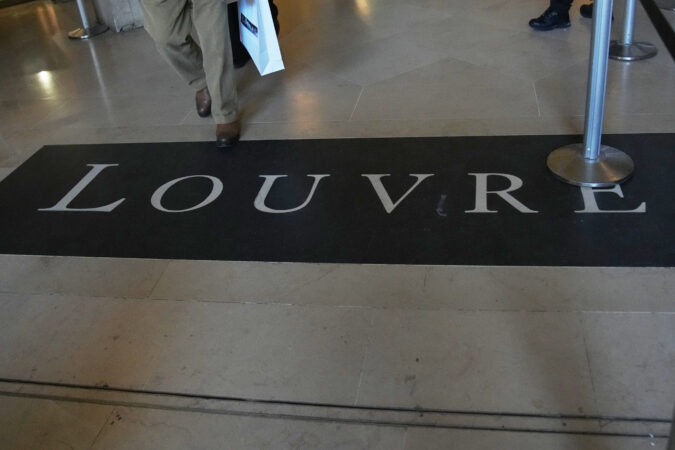
    The theft of France’s crown jewels from the Louvre in October had many people mispronouncing the name of the world’s most-visited museum. Babbel says the correct pronunciation is LOOV-ruh, with a very soft pronunciation on the “ruh,” which can be a challenge for English speakers.

    “A lot of these words come from different languages and so we have to adapt to a sound that we’ve never made before,” said Esteban Touma, a linguistic and cultural expert at Babbel.

    Other words and names on the list include:

    • Acetaminophen, the active ingredient in the Tylenol, is pronounced uh-SEE-tuh-MIH-nuh-fen. President Donald Trump gave comedians plenty of material when he stumbled over the word as he implored pregnant women to avoid taking the painkiller despite inconclusive evidence about whether too much could be linked to autism.
    • Alex Murdaugh, the prominent South Carolina attorney who was sentenced to life in prison for the 2021 fatal shootings of his wife and son, is pronounced AL-ick MUR-dock. This year the case was dramatized in a series on Hulu.
    • Mounjaro, pronounced mown-JAHR-OH, is part of a wave of diabetes and obesity medications that soared in popularity because of the weight people have lost while taking the injections.

    Several words on the U.S. list, including Louvre and Mounjaro, also made the list for the U.K., which was compiled by Babbel and the British Institute of Verbatim Reporters, an organization for subtitling professionals. Storm Éowyn, which battered Ireland, Northern Ireland and Scotland in January, put that name on the U.K. list. Babbel says the correct pronunciation is ay-OH-win, said with a three-beat pattern.

    Throughout the year, captioners note words that come up over and over as difficult to pronounce, spell or are newly emerging. Linguists at Babbel also track new pronunciation challenges they see.

    In a pronunciation surprise of the year, actor Denzel Washington told late-night talk show host Jimmy Kimmel that he was named after his father and their first names are actually pronounced DEN-zul. But, he said, that became confusing so his mother decided to pronounce her son’s name Den-ZELLE.

  • Could RoboCop be to Detroit what Rocky is to Philly?

    Could RoboCop be to Detroit what Rocky is to Philly?

    DETROIT — RoboCop has finally found a permanent home in Detroit.

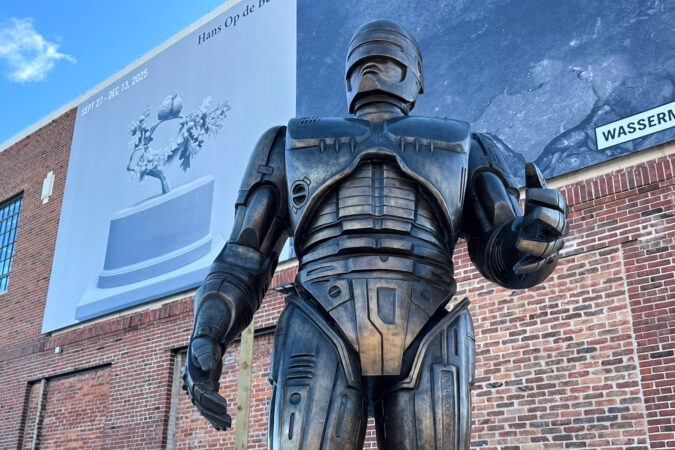
    A statue looming 11 feet tall and weighing 3,500 pounds has been drawing fans since it began standing guard over the Motor City on Wednesday afternoon, after about 15 years in the making. Even in a snowstorm in the dark, people were driving by to see it, said Jim Toscano, co-owner of the FREE AGE film production company where the bronze-cast statue now stands bolted near the sidewalk.

    RoboCop hit theaters in 1987, portraying a near-future Detroit as crime-ridden and poorly protected by a beleaguered and outgunned police force, until actor Peter Weller appeared as a nearly invincible cyborg, created by a nefarious corporation bent on privatizing policing.

    There was a time when Detroit pushed back on anything pointing to its past reputation as an unsafe city, and the movie, which developed a cult following, spawning two sequels and a reboot, didn’t help its image.

    But things have changed. Violent crime has been trending down for years. Homicide numbers have dropped below mid-1960s levels. And city officials offered no objections to the statue’s installation, Toscano said.

    “I think there will be a lot more acceptance,” Toscano said. “Detroit has come a long way. You put in a little nostalgia and that helps.”

    The statue campaign appears to have started around 2010 when Detroit Mayor Dave Bing was tagged in a tweet that noted Philadelphia’s statue of boxer Rocky Balboa and said RoboCop would be a “GREAT ambassador for Detroit.”

    Bing tweeted back, saying there were no such plans. But some Detroiters ran with the idea, crowdfunding it through a 2012 Kickstarter campaign that raised more than $67,000 from more than 2,700 backers worldwide, and Detroit sculptor Giorgio Gikas finished the statue in 2017.

    Then, it got stuck, stored away from public view.

    The Michigan Science Center in Detroit ultimately nixed plans to host the sculpture in 2021, citing pressures from the coronavirus pandemic and the need to focus museum resources. Officials in Stevens Point, Wis., raised their hands, hoping to honor Weller, a native son of that city, by erecting it outside the police station or in a park.

    The search for a suitable home for RoboCop remained in limbo until about three years ago when Toscano’s company bought a building in Eastern Market, an open-air produce market, shopping and entertainment district just northeast of downtown. Toscano says he thought they were “kidding” when he was contacted by the creator of the statue idea and Eastern Market officials. But he and his business partner gladly came on board: “It’s too unusual, too unique, too cool not to do,” Toscano said.

    Toscano, 48, says he’s only viewed the first RoboCop movie.

    “It wasn’t a big film in our house,” he admitted. But if there is one iconic line uttered by RoboCop that fits this moment, Toscano said it would be “Thank you for your cooperation.”

    On Thursday, James Campbell approached the statue and told three picture-takers: “I own this. Do you guys know that?”

    Campbell said he donated $100 to the original Kickstarter campaign over a decade ago, which makes him a “.038% owner of this statue.”

    “I’m here to see this big, beautiful, bronze piece of art,” he said. “What a piece of cinematic history to represent the city of Detroit.”

    Asked why RoboCop is an appropriate symbol for the city, Campbell said: “He’s a cyborg crime fighter! In the movie, in the futuristic Detroit, he’s there to save the city. He’s a symbol of hope.”

  • Grand jury rejects new mortgage fraud indictment against New York Attorney General Letitia James

    Grand jury rejects new mortgage fraud indictment against New York Attorney General Letitia James

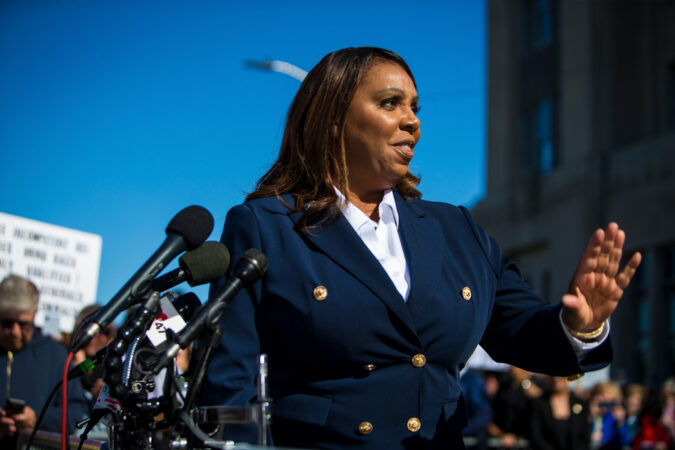
    NORFOLK, Va. — The Justice Department failed Thursday to secure a new indictment against New York Attorney General Letitia James after a judge dismissed the previous mortgage fraud prosecution encouraged by President Donald Trump, according to people familiar with the matter.

    Prosecutors went back to a grand jury in Virginia after a judge’s ruling halting the prosecution of James and another longtime Trump foe, former FBI Director James Comey, on the grounds that the U.S. attorney who presented the cases was illegally appointed. But grand jurors rejected prosecutors’ request to bring charges.

    It’s the latest setback for the Justice Department in its bid to prosecute the frequent political target of the Republican president.

    Prosecutors are expected to try again for an indictment, according to one person familiar with the matter who spoke on the condition of anonymity because they were not authorized to publicly discuss the case.

    James was initially charged with bank fraud and making false statements to a financial institution in connection with a home purchase in Norfolk, Va., in 2020. Lindsey Halligan, a former White House aide and Trump lawyer, personally presented the case to the grand jury in October after being installed as U.S. attorney for the Eastern District of Virginia amid pressure from Trump to charge Comey and James.

    James has denied any wrongdoing and accused the administration of using the justice system to seek revenge against Trump’s political opponents. In a statement Thursday, James said: “It is time for this unchecked weaponization of our justice system to stop.”

    “This should be the end of this case,” her attorney, Abbe Lowell, said in a statement. “If they continue, undeterred by a court ruling and a grand jury’s rejection of the charges, it will be a shocking assault on the rule of law and a devastating blow to the integrity of our justice system.”

    The allegations related to James’ purchase of a modest house in Norfolk, where she has family. During the sale, she signed a standard document called a “second home rider” in which she agreed to keep the property primarily for her “personal use and enjoyment for at least one year,” unless the lender agreed otherwise.

    Rather than using the home as a second residence, James rented it out to a family of three, allowing her to obtain favorable loan terms not available for investment properties, prosecutors alleged.

    It’s the latest example of pushback by grand jurors since the beginning of the second Trump administration. It’s so unusual for grand jurors to refuse to return an indictment that it was once said that prosecutors could persuade a grand jury to “indict a ham sandwich.” But the Justice Department has faced setbacks in front of grand juries in several recent cases.

    Even if the charges against James are resurrected, the Justice Department could face obstacles in securing a conviction against James.

    James’ lawyers separately argued the case was a vindictive prosecution brought to punish the Trump critic who spent years investigating and suing the Republican president and won a staggering judgment in a lawsuit alleging he defrauded banks by overstating the value of his real estate holdings on financial statements. The fine was later tossed out by a higher court, but both sides are appealing.

    The defense had also alleged “outrageous government conduct” preceding her indictment, which the defense argued warrants the case’s dismissal. The judge hadn’t ruled on the defense’s arguments on those matters before dismissing the case last month over the appointment of Lindsey Halligan as U.S. attorney.

    U.S. District Judge Cameron McGowan Currie took issue with the mechanism the Trump administration employed to appoint Halligan to lead one of the Justice Department’s most elite and important offices.

    Halligan was named as a replacement for Erik Siebert, a veteran prosecutor in the office and interim U.S. attorney who resigned in September amid Trump administration pressure to file charges against both Comey and James.

    The following night, Trump said he would be nominating Halligan to the role of interim U.S. attorney and publicly implored Attorney General Pam Bondi to take action against his political opponents, saying in a Truth Social post that, “We can’t delay any longer, it’s killing our reputation and credibility” and “JUSTICE MUST BE SERVED, NOW!!!”

    Comey was indicted three days after Halligan was sworn in by Bondi, and James was charged two weeks after that.

    The Justice Department had defended Halligan’s appointment but has also revealed that Bondi had given Halligan a separate position of “Special Attorney,” presumably as a way to protect the indictments from the possibility of collapse. But Currie said such a retroactive designation could not save the cases.

  • California activist gets jail time for taking chickens from Perdue Farms plant

    California activist gets jail time for taking chickens from Perdue Farms plant

    SANTA ROSA, Calif. — A California animal welfare activist who took four chickens from a major Perdue Farms poultry plant was sentenced to 90 days in jail after being convicted of felony conspiracy, trespassing and other charges.

    Zoe Rosenberg, 23, did not deny taking the animals from Petaluma Poultry but argued she wasn’t breaking the law because she was rescuing the birds from a cruel situation. A jury found her guilty in October after a seven-week trial in Sonoma County, an agricultural area of Northern California.

    Rosenberg was sentenced on Wednesday and ordered to report to the Sonoma County Jail on Dec. 10. She will serve the 90 days, but 60 of those may involve jail alternates, such as house arrest, the county’s district attorney’s office said. Rosenberg will also have two years of probation, and she is ordered to stay away from all Perdue facilities in the county.

    The activist with Direct Action Everywhere, or DxE, a Berkeley-based animal rights group, has said she does not regret what she did.

    “I will not apologize for taking sick, neglected animals to get medical care,” Rosenberg said following her conviction.

    The group named the birds — Poppy, Ivy, Aster, and Azalea — and placed them in an animal sanctuary.

    Petaluma Poultry has said that DxE is an extremist group that is intent on destroying the animal agriculture industry. The company maintains that the animals were not mistreated and said Wednesday’s sentencing upholds the rule of law.

    “We’re grateful that DxE has been held to account for its unlawful campaign –- training and paying staff to carry out dangerous, unauthorized intrusions onto private property,” Herb Frerichs, general counsel for Petaluma Poultry, said in a statement Thursday. “DxE’s actions show a reckless disregard for employee safety, animal welfare, and food security.”

    Rosenberg testified that she disguised herself as a Petaluma Poultry worker using a fake badge and earpiece to take the birds, and then posted a video of her actions on social media.

    Petaluma Poultry is a subsidiary of Perdue Farms — one of the United States’ largest poultry providers for major grocery chains.

    The co-founder of DxE was convicted two years ago for his role in factory farm protests in Petaluma.

  • Supreme Court lets Texas use congressional map favored by Trump

    Supreme Court lets Texas use congressional map favored by Trump

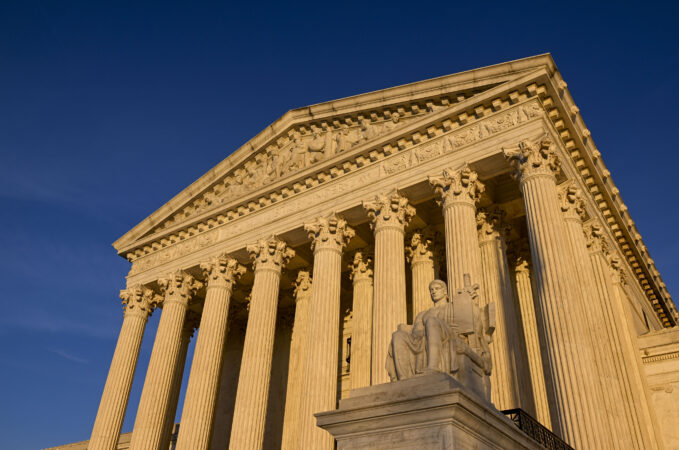
    WASHINGTON – Texas can use a congressional map drawn to give President Donald Trump and Republicans an advantage in the 2026 midterm elections, the Supreme Court said Dec. 4 in a decision that may help the GOP keep control of the U.S. House.

    An ideologically divided court paused a lower court’s ruling that the map likely discriminates against racial minorities by diluting the voting power of Hispanic and Black Texans.

    That opinion, which replaces a temporary freeze on the ruling issued by Justice Samuel Alito on Nov. 21, keeps the map in place for the midterm elections as litigation over the boundaries continues.

    The court said the order blocking the map from being used next year was improper because it came too close to the election.

    “The District Court improperly inserted itself into an active primary campaign, causing much confusion and upsetting the delicate federal-state balance in elections,” the majority wrote in a brief, unsigned opinion.

    The court’s three liberal justices dissented.

    Texas started redistricting push

    At the urging of the Trump administration, the GOP-controlled Texas legislature drew new district lines midway through the usual 10-year redistricting cycle, setting off a race among states to get in the game. Some of those other efforts are also being challenged in court.

    Despite the uncertainty about what the playing field will look like, Democrats remain favored to flip the House next year, according to nonpartisan handicappers at the University of Virginia’s Center for Politics.

    That could change, however, if the Supreme Court issues a ruling in a pending case from Louisiana that could open the door to more redistricting attempts in southern states. Depending on what the court says and how quickly the justices rule, Republicans could create multiple districts they’d be expected to win, analyst Kyle Kondik estimates.

    The new Texas map was designed to help Republicans win five more seats, although that’s not a sure thing.

    Republicans currently hold 25 of the state’s 38 seats in the U.S. House, where they have a slim majority. If Democrats seize control, they can block Trump’s legislative agenda and launch investigations into his administration.

    Racial gerrymandering?

    In redistricting battles, the Supreme Court has said federal courts can review whether race was improperly used to draw new lines, but not whether partisan politics was a factor.

    Civil rights groups and others challenging Texas’ new map argue it has fewer districts where Hispanic and Black voters together make up the majority, diminishing their voting power.

    “This is as stark a case of racial gerrymandering as one can imagine,” lawyers for some of the challengers said in a filing.

    A three-judge panel in Texas that reviewed the map ruled 2-1 that Texas Republican Gov. Greg Abbott directed the legislature to use race to redraw the lines following a demand from the Trump administration that discussed the racial makeup of some districts.

    “The public perception of this case is that it’s about politics. To be sure, politics played a role in drawing the 2025 Map. But it was much more than just politics,” Judge Jeffrey Brown, who was appointed to the federal bench by Trump in 2019, wrote. “Substantial evidence shows that Texas racially gerrymandered the 2025 Map.”

    In an irate and unusually personal dissent, Judge Jerry Smith – who was appointed by former President Ronald Reagan – called the decision “the most blatant exercise of judicial activism that I have ever witnessed.”

    Texas says race wasn’t main factor

    Texas’ attorneys told the Supreme Court that partisanship – not race – drove the redistricting. And the lower court’s ruling has caused chaos because candidates have already gathered signatures and filed applications to run in the new districts, they argued.

    Weighing in on behalf of Texas, the Justice Department told the Supreme Court that the lower court “misconstrued” the direction the administration gave the state.

    “Indeed, the record here affirmatively shows that the 2025 map was drawn in a race-blind manner,” the Justice Department wrote in a filing.

    The civil rights groups and voters challenging the map said the lower court’s decision was based on a nine-day hearing that included dozens of witnesses and hours of footage of legislators and Abbott discussing their motives.

    The challengers also said the impending December 8 filing deadline for Texas candidates running in the spring primary is not a reason to allow the new map to be used.

    Texas created its own emergency by unnecessarily choosing to create new maps, they told the Supreme Court, and “can’t insulate unconstitutional conduct from judicial review by deliberately timing that conduct close to an election.”

  • Speaker Johnson pleads with Republicans to keep concerns private after tumultuous week

    Speaker Johnson pleads with Republicans to keep concerns private after tumultuous week

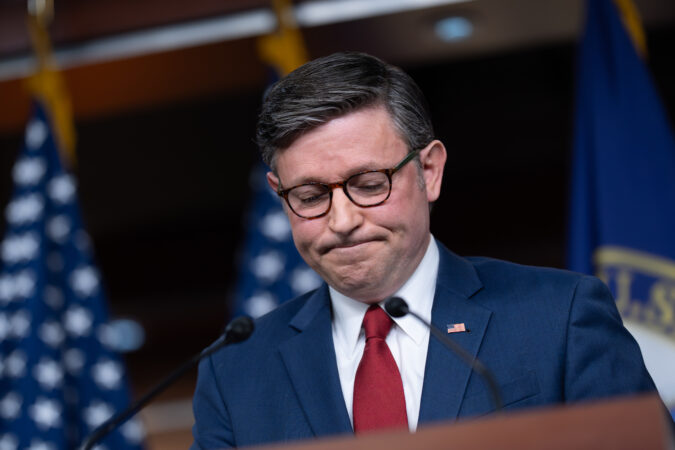
    WASHINGTON — House Speaker Mike Johnson is imploring his fellow Republicans to stop venting their frustrations in public and bring their complaints to him directly.

    “They’re going to get upset about things. That’s part of the process,” Johnson told reporters Thursday. “It doesn’t bother me. But when there is a conflict or concern, I always ask all members to come to me, don’t go to social media.”

    Increasingly, they’re ignoring him.

    Cracks inside the GOP conference were stark this week as a member of Johnson’s own leadership team openly accused him of lying, rank-and-file Republicans acted unilaterally to force votes and a leadership-backed bill faltered. It’s all underscored by growing worries that the party is on a path towards losing the majority next year.

    “I certainly think that the current leadership and specifically the speaker needs to change the way that he approaches the job,” GOP Rep. Kevin Kiley of California said on Thursday.

    Kiley, who has grown vocally critical of Johnson after the GOP’s nationwide redistricting campaign backfired in California, said that the speaker has been critical of rank-and-file Republicans, so “he needs to be prepared to accept any criticism that comes with the job.”

    “And I think, unfortunately, there’s been ample reason for criticism,” he added.

    ‘Why do we have to legislate by discharge petitions?’

    For the first part of 2025, Johnson held together his slim Republican majority in the House to pass a number of President Donald Trump’s priorities, including his massive spending and tax cut plan.

    But after Johnson kept members out of session for nearly two months during the government shutdown, they returned anxious to work on priorities that had been backlogged for months — and with the reality that their time in the majority may be running out.

    First was a high-profile discharge petition to force the vote on releasing the Jeffrey Epstein files, which succeeded after it reached the 218-signature threshold. Other lawmakers are launching more petitions, a step that used to be considered a major affront to party leadership.

    “The discharge petition, I think, always shows a bit of frustration,” said GOP Rep. Dusty Johnson.

    Another discharge petition on a bill that would repeal Trump’s executive order to end collective bargaining with federal labor unions reached the signature threshold last month, with support from seven Republicans.

    And this week, GOP Rep. Anna Paulina Luna of Florida brought a long-anticipated discharge petition for a bill to bar members of Congress from trading stock. A number of Republicans have already signed on, in addition to Democrats.

    “Anxious is what happens when you get nervous. I’m not nervous. I’m pissed,” Luna wrote on social media late Thursday, responding to leadership comments that she was overly anxious.

    GOP Rep. Nancy Mace of South Carolina signed both Luna’s petition and the one to release the Epstein files. She told reporters Thursday that she expressed her frustrations directly to Johnson in a phone call, and also in what she described as “a deeply personal, deeply passionate letter, that we are legislating by discharge petition.”

    “We have a very slim majority, but I want President Trump’s executive orders codified,” Mace said. “I want to see his agenda implemented. Why do we have to legislate by discharge petitions?”

    Johnson’s own leadership team going after him

    At the center of Johnson’s pleas for members to bring concerns to him privately instead of on social media is the chairwoman of House Republican leadership, New York Rep. Elise Stefanik.

    Angered that a provision she championed wasn’t included in a defense authorization bill, Stefanik blasted Johnson’s claims that he wasn’t aware of the provision as “more lies from the Speaker.” She conducted a series of media interviews criticizing Johnson, including one with The Wall Street Journal in which she said he was a “political novice” who wouldn’t be re-elected speaker if the vote were held today.

    Johnson told reporters Thursday that he had a “great talk” with Stefanik the night before.

    “I called her and I said, ‘why wouldn’t you just come to me, you know?’” Johnson said. “So we had some intense fellowship about that.”

    Asked if she had apologized for calling him a liar, Johnson said: “Um, you ask Elise about that.”

    Illinois GOP Rep. Mary Miller released a statement Thursday providing support for Johnson, saying that while there are differences among members “our mission is bigger than any one individual or headline.”

    Democrats, who have had leadership criticisms of their own, have reveled in the GOP’s disarray. House Republican leaders attempted to muscle through an NCAA-backed bill to regulate college sports after the White House endorsed it, before support within Republican ranks crumbled. Some GOP lawmakers pointedly said they had bigger priorities before the end of the year.

    “It’s not that Congress can’t legislate, it’s House Republicans that can’t legislate. It’s the gang that can’t legislate straight. They continue to take the ‘my way or the highway’ approach,” said House Democratic Leader Hakeem Jeffries.

    Underlying GOP unease about 2026

    All eyes in the U.S. House were on a special election Tuesday night in a Tennessee district that a Republican had won in 2024 by nearly 21 percentage points, with Trump carrying the area by a similar margin.

    Republicans hoped the contest would help them regain momentum after losing several marquee races across the country in November. Democrats, meanwhile, argued that keeping the race close would signal strong political winds at their backs ahead of next year’s midterms, which will determine control of both chambers.

    Republican Matt Van Epps ultimately won by nearly 9 percentage points.

    “I do think to have that district that went by over 20 points a year ago be down to nine, it should be a wake up call,” said GOP Rep. Don Bacon of Nebraska.

    He argued that Republicans need “to get some economic progress, like immediately,” adding that “the president and his team have got to come to grips” that tariffs are not driving the economic growth Americans are feeling.

    “I just feel like they’re going to have to get out of their bubble,” Bacon said of the White House. “Get out of your bubble. The economy needs improving. Fix Ukraine and we do need a temporary health care fix.”

    Bacon is among a growing number of House Republicans who have announced they will retire after this term. Republican Rep. Marjorie Taylor Greene abruptly declared last month that she would resign in January, citing multiple reasons, including that “the legislature has been mostly sidelined” this year.

    Those retirements add to the GOP’s challenge in holding the House, as the party must now defend more open seats. Republicans have also seen a redistricting battle — sparked by Trump’s pressure on Texas Republicans and then more states — backfire in part. In November, California voters handed Democrats a victory by approving a new congressional map.

    “That’s living in a fantasy world if you think that this redistricting war is what’s going to save the majority,” said Kiley, now at risk of losing his seat after redistricting in California.

    He added: “I think what would make a lot bigger impact is if the House played a proactive role in actually putting forward legislation that matters.”

  • National Guard can stay in D.C. for now, appeals court says

    National Guard can stay in D.C. for now, appeals court says

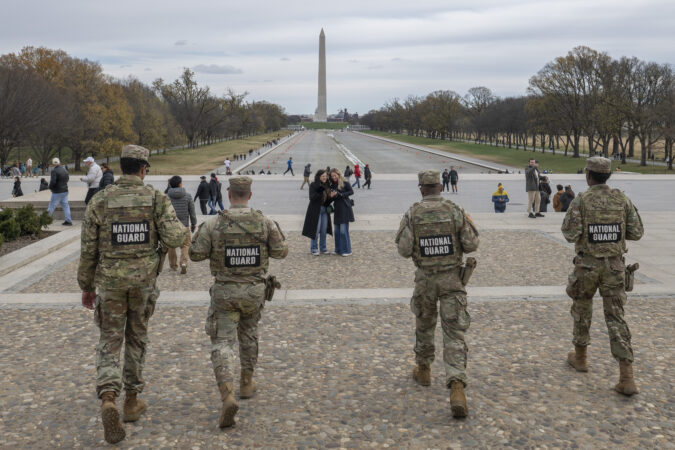
    The Trump administration will be allowed to continue its National Guard deployment in D.C. at least temporarily, pending another appeals court decision, a panel of U.S. Court of Appeals judges said Thursday.

    The ruling means the deployment of troops to the nation’s capital could persist beyond Dec. 11, the date a lower-court judge had previously set as a deadline for the administration to halt the mission.

    Judges with the D.C. Circuit of the U.S. Court of Appeals granted an administrative stay in the case, meaning the drawdown of troops in the capital will be delayed at least until the appeals court makes an additional ruling. The court emphasized that Thursday’s decision had nothing to do with the merits of the Trump administration’s arguments in the case.

    “The purpose of this administrative stay is to give the court sufficient opportunity to consider the motion for stay pending appeal and should not be construed in any way as a ruling on the merits of that motion,” the judges wrote.

    The appeals court ruling comes the week after an attack in which prosecutors say a man targeted National Guard members, killing one and critically injuring another in a busy downtown area of D.C. blocks from the White House. For Trump administration officials, the attack – allegedly carried out by a lone gunman who was resettled in the United States from his native Afghanistan after work for a CIA-backed counterterrorism squad – only deepened their resolve to keep the troops in the capital city.

    Trump called for an additional 500 troops; South Carolina’s governor said this week he would send up to 300 members of his state’s National Guard in response.

    “Our warriors are strong and we will not back down until our capital and our cities are secure,” Pentagon press secretary Kingsley Wilson said at a news briefing Tuesday.

    For D.C. Attorney General Brian Schwalb, who sued the Trump administration in September over the National Guard deployment, the shooting and its aftermath offered further proof that the deployment of troops was ill-advised and unsafe. D.C. police officers have since paired up with National Guard troops for the troops’ safety, potentially diverting officers from other public safety tasks, he said in a court filing this week.

    “The deployment impinges on the District’s home rule, requires the diversion of scarce police resources, and exposes both the public and Guard members to substantial public safety risks, as Defendants themselves acknowledged at the outset of the deployment, and as the horrific attack on two National Guard members last week tragically underscored,” Schwalb wrote.

    President Donald Trump deployed the D.C. National Guard to city streets on Aug. 11 as part of a broader crime crackdown he initiated in the city. He also took temporary control of the D.C. police department and launched a surge of federal law enforcement into D.C. neighborhoods. Multiple Republican governors heeded Trump’s call for reinforcements and sent troops from their National Guards to the District. As of Wednesday, about 2,300 National Guard members were stationed in the city – about 100 more than the previous day.

    The National Guard members have stood watch at Metro stations and picked up trash at national parks. They also carry weapons and have been instructed to use them only as a last resort.

    Unlike in states, where governors control their National Guards, the president is commander in chief of the D.C. National Guard – a role the administration argues gives Trump vast power over the deployment and legally authorizes his actions in the District. But Schwalb, in his lawsuit, has argued that the president’s power over the Guard has limits. Schwalb also has alleged that the troops in D.C. have been illegally engaged in law enforcement, in violation of a federal law that prohibits military troops from engaging in domestic policing.

    In November, U.S. District Judge Jia M. Cobb sided with D.C. in a preliminary ruling, writing that the National Guard deployment was illegal and that Trump lacked the authority to activate the Guard for the mission. Cobb ordered the Trump administration to halt the deployment in D.C. while litigation continued over whether the troops should be permanently withdrawn. However, she delayed her order from going into effect until Dec. 11 to give the Trump administration time to appeal.

    In response, the administration asked an appeals court for an emergency ruling to allow the deployment to continue while litigation continues, arguing in court documents that Cobb’s order “impinges on the President’s express statutory authority as Commander-in-Chief of the D.C. National Guard and impermissibly second-guesses his successful efforts to address intolerably high crime rates in the Nation’s capital.” The appeals court on Thursday did not rule on that request; the administrative stay means the deployment can continue while the appeals court considers it.

    The Trump administration has argued that the troops have not been engaged in city law enforcement and merely deter crime through their presence, freeing up police for other tasks.

    Questions of the mission’s safety implications have taken on new weight in the aftermath of last week’s attack, but each party in the lawsuit has argued that the city would be safer if the court sided with them.

    A group of retired senior military officers and the Vet Voice Foundation, a nonpartisan, nonprofit organization representing veterans and their supporters, filed a brief in the appeals court that they said was “in support of neither party.” They argued that the use of the National Guard in D.C. “threatens to undermine the apolitical reputation of the military as an institution, places service members in situations for which they are not specifically trained, and pulls the Guard away from its critical missions.”

    But attorneys general from 24 Republican-led states – including some that sent their troops to D.C. – argued that crime is high in D.C. and while the mission “has already produced strong results,” there is more to be done. Violent crime is down 28 percent in D.C. compared to last year, although crime in the city began to fall steeply well over a year before Trump surged federal law enforcement in August.

    “Danger still lingers,” the states’ attorneys general wrote in their brief, filed in support of the Trump administration. “Just last week, an Afghani national committed a heinous terror attack, shooting two National Guardsmen at close range and murdering one.”

    In arguing that the Guard troops should stay, they also cited a few actions that Guard members had taken to keep the city safe.

    “National Guard troops have stopped at least one fight near the metro,” they wrote, “helped provide first aid to elderly residents of the district, and aided in the successful search for a missing child.”

  • Immigration crackdown in New Orleans has a target of 5,000 arrests. Is that possible?

    Immigration crackdown in New Orleans has a target of 5,000 arrests. Is that possible?

    NEW ORLEANS — Trump administration officials overseeing the immigration crackdown launched this week in New Orleans are aiming to make 5,000 arrests with a focus on violent offenders, a target that some city leaders say is not realistic.

    It’s an ambitious goal that would surpass the number of arrests during a two-month enforcement blitz this fall around Chicago, a region with a much bigger immigrant population than New Orleans.

    In Los Angeles — the first major battleground in President Donald Trump’s aggressive immigration plan — roughly 5,000 people were arrested over the summer in an area where 10 million LA county residents are foreign-born.

    “There is no rational basis that a sweep of New Orleans, or the surrounding parishes, would ever yield anywhere near 5,000 criminals, let alone ones that are considered ‘violent’ by any definition,” New Orleans City Council President J.P. Morrell said Thursday.

    Census Bureau figures show the New Orleans metro area had a foreign-born population of almost 100,000 residents last year, and that just under 60% were not U.S. citizens.

    “The amount of violent crime attributed to illegal immigrants is negligible,” Morrell said, pointing out that crime in New Orleans is at historic lows.

    Violent crimes, including murders, rapes, and robberies, have fallen by 12% through October compared to a year ago, from a total of 2,167 violent crimes to 1,897 this year, according to New Orleans police statistics.

    A flood of messages about arrests

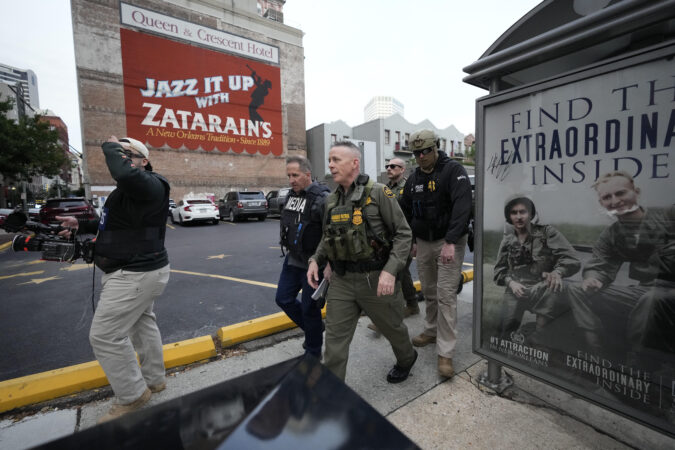
    Federal agents in marked and unmarked vehicles began spreading out across New Orleans and its suburbs Wednesday, making arrests in home improvement store parking lots and patrolling neighborhoods with large immigrant populations.

    Alejandra Vasquez, who runs a social media page in New Orleans that reports the whereabouts of federal agents, said she has received a flood of messages, photos and video since the operations began.

    “My heart is so broken,” Vasquez said. “They came here to take criminals and they are taking our working people. They are not here doing what they are supposed to do. They are taking families.”

    Several hundred agents from Customs and Border Protection and U.S. Immigration and Customs Enforcement are participating in the two-month operation dubbed “Catahoula Crunch.”

    House Speaker Mike Johnson, who is from Louisiana, is among the state’s Republicans supporting the crackdown. “Democrats’ sanctuary city policies have failed — making our American communities dangerous. The people of our GREAT city deserve better, and help is now on the ground,” Johnson posted on social media.

    Operation is being met with resistance

    About two dozen protesters were removed from a New Orleans City Council meeting Thursday after chants of “Shame” broke out. Police officers ordered protesters to leave the building, with some pushed or physically carried out by officers.

    Planning documents obtained last month by The Associated Press show the crackdown is intended to cover southeast Louisiana and into Mississippi.

    Homeland Security Department spokesperson Tricia McLaughlin said agents are going after immigrants who were released after arrests for violent crimes.

    “In just 24 hours on the ground, our law enforcement officers have arrested violent criminals with rap sheets that include homicide, kidnapping, child abuse, robbery, theft, and assault,” McLaughlin said Thursday in a statement. Border Patrol and immigration officials have not responded to requests for details, including how many have been arrested so far.

    She told CNN on Wednesday that “we will continue whether that will be 5,000 arrests or beyond.”

    Immigration arrests go beyond violent criminals

    To come close to reaching their target numbers in New Orleans, immigrant rights group fear federal agents will set their sights on a much broader group.

    New Orleans City Councilmember Lesli Harris said “there are nowhere near 5,000 violent offenders in our region” whom Border Patrol could arrest.

    “What we’re seeing instead are mothers, teenagers, and workers being detained during routine check-ins, from their homes and places of work,” Harris said. “Immigration violations are civil matters, not criminal offenses, and sweeping up thousands of residents who pose no threat will destabilize families, harm our economy.”

    During the “Operation Midway Blitz” crackdown in Chicago that began in September, federal immigration agents arrested more than 4,000 people across the city and its many suburbs, dipping into Indiana.

    Homeland Security officials heralded efforts to nab violent criminals, posting dozens of pictures on social media of people appearing to have criminal histories and lacking legal permission to be in the U.S. But public records tracking the first weeks of the Chicago push show most arrestees didn’t have a criminal record.

    Of roughly 1,900 people arrested in the Chicago area from early September through the middle of October — the latest data available — nearly 300 or about 15% had criminal convictions on their records, according to ICE arrest data from the University of California Berkeley Deportation Data Project analyzed by The Associated Press.

    The vast majority of those convictions were for traffic offenses, misdemeanors or nonviolent felonies, the data showed.

    New Orleans, whose international flavor comes from its long history of French, Spanish, African, and Native American cultures, has seen a new wave of immigrants from places in Central and South America and Asia.

    Across all of Louisiana, there were more than 145,000 foreign-born noncitizens, according to the Census Bureau. While those numbers don’t break down how many residents of the state were in the country illegally, the Pew Research Center estimated the number at 110,000 people in 2023.

  • N.Y. attorney general challenges authority of acting U.S. attorney investigating her Trump lawsuits

    N.Y. attorney general challenges authority of acting U.S. attorney investigating her Trump lawsuits

    ALBANY, N.Y. — President Donald Trump’s effort to install political loyalists as top federal prosecutors has run into a legal buzz saw lately, with judges ruling that his handpicked U.S. attorneys for New Jersey, eastern Virginia, Nevada, and Los Angeles were all serving unlawfully.

    On Thursday, another federal judge heard an argument by New York Attorney General Letitia James that the administration also twisted the law to make John Sarcone the acting U.S. attorney for northern New York.

    James, a Democrat, is challenging Sarcone’s authority to oversee a Justice Department investigation into regulatory lawsuits she filed against Trump and the National Rifle Association. It’s one of several arguments she is making to block subpoenas issued as part of the probe, which her lawyers say is part of a campaign of baseless investigations and prosecutions of Trump’s perceived enemies.

    Her attorney Hailyn Chen argued in court that since Sarcone lacks legitimate authority to act as U.S. attorney, legal steps taken by him in that capacity — like the subpoenas — are unlawful. In response to a question from U.S. District Judge Lorna G. Schofield, Chen said Sarcone should be disqualified from the investigation and the office.

    “Sarcone exercised power that he did not lawfully possess,” Chen told the judge.

    Justice Department lawyers say Sarcone was appointed properly and the motion to block the subpoenas should be denied. Assistant U.S. Attorney Richard Belliss argued that disqualifying Sarcone would be “drastic and extreme.”

    “We don’t think that’s a proper remedy,” Belliss said.

    Schofield, after peppering both attorneys with questions, did not say when she would rule.

    The fight in New York and other states is largely over the legality of unorthodox strategies the Trump administration has adopted to appoint prosecutors seen as unlikely to get confirmed by the U.S. Senate.

    The hearing came a week after a federal judge in Virginia dismissed indictments brought there against James and former FBI Director James Comey. That judge concluded that the interim U.S. attorney who brought the charges, Lindsey Halligan, was unlawfully appointed. The Justice Department is expected to appeal.

    On Monday, a federal appeals court ruled that Alina Habba, Trump’s former personal lawyer, is disqualified from serving as New Jersey’s top federal prosecutor.

    Under federal law, the president’s nominees for U.S. attorney must be confirmed by the Senate. If a position is vacant, the U.S. attorney general can appoint someone temporarily, but that appointment expires after 120 days. If that time period elapses, judges in the district can either keep the interim U.S. attorney or appoint someone of their own choosing.

    Sarcone’s appointment didn’t follow that path.

    Trump hasn’t nominated anyone to serve as U.S. attorney for the Northern District of New York. U.S. Attorney General Pam Bondi appointed Sarcone to serve as the interim U.S. attorney in March. When his 120-day term elapsed, judges in the district declined to keep him in the post.

    Bondi then took the unusual step of appointing Sarcone as a special attorney, then designated him first assistant U.S. attorney for the district, a maneuver federal officials say allows him to serve as an acting U.S. attorney.

    Chen called it an abuse of executive power.

    The New York subpoenas seek records related to a civil case James filed against Trump over alleged fraud in his personal business dealings and records from a lawsuit involving the National Rifle Association and two senior executives.

    Belliss argued in court that the U.S. attorney general has broad authority to appoint attorneys within her department and to delegate her functions to those attorneys. Belliss said that even if Sarcone is not properly holding the office of acting U.S. attorney, he can still conduct grand jury investigations as a special attorney.

    Sarcone was part of Trump’s legal team during the 2016 presidential campaign and worked for the U.S. General Services Administration as the regional administrator for the Northeast and Caribbean during Trump’s first term.

    Habba also served as an interim U.S. attorney. When her appointment expired, New Jersey judges replaced her with a career prosecutor who had served as her second-in-command. Bondi then fired that prosecutor and renamed Habba as acting U.S. attorney.

    A similar dynamic is playing out in Nevada, where a federal judge disqualified the Trump administration’s pick to be U.S. attorney there. And a federal judge in Los Angeles disqualified the acting U.S. attorney in Southern California from several cases after concluding he had stayed in the job longer than allowed by law.