Category: Nation & World

  • Fact check: A look at Trump’s false and misleading claims in his State of the Union speech

    Fact check: A look at Trump’s false and misleading claims in his State of the Union speech

    WASHINGTON — On inflation, immigration, tariffs, and matters of war and peace, President Donald Trump presented a frequently distorted account of the state of the nation Tuesday as he claimed a “turnaround for the ages” and myriad achievements that don’t pass scrutiny.

    Trump has spent the last year boasting of his accomplishments while mocking the record of his predecessor, Joe Biden. But much of this bluster has been based on misinformation, which he again fell back on during his State of the Union address.

    Here’s a closer look at the facts:

    The economy

    Claim: “When I last spoke in this chamber 12 months ago, I had just inherited a nation in crisis, with a stagnant economy.”

    The facts: Not quite. Voters were unhappy with high inflation in the 2024 election, but the U.S. economy was far from stagnant. The U.S. gross domestic product rose 2.8% in 2024 after adjusting for inflation. That’s a stronger pace of growth than the 2.2% achieved last year during the start of Trump’s second term.

    Trump: “Incomes are rising fast, the roaring economy is roaring like never before.”

    The facts: Not so. After-tax incomes, adjusted for inflation, rose just 0.9% in 2025, down from 2.2% in 2024, Biden’s last year in office. The annual gain in Trump’s first year is the smallest since 2022, when inflation soared and caused Americans’ inflation-adjusted income to drop.

    Wages and salaries are the largest component of incomes, and their growth has slowed as companies have sharply slowed hiring. Workers typically command smaller wage gains in such an environment.

    Investment

    Claim: “I secured commitments for more than $18 trillion pouring in from all over the globe.”

    The facts: Trump has presented no evidence that he’s secured this much domestic or foreign investment in the U.S. Based on statements from various companies, foreign countries, and the White House’s own website, that figure appears to be exaggerated, highly speculative, and far higher than the actual sum. The White House website offers a far lower number, $9.6 trillion, and that figure appears to include some investment commitments made during the Biden administration.

    A study published in January raised doubts about whether more than $5 trillion in investment commitments made last year by many of America’s biggest trading partners will actually materialize and questions how it would be spent if it did.

    Jobs

    Claim: “More Americans are working today than at any time in the history of our country.”

    The facts: Yes, but the number of Americans with jobs always rises as the population grows. The relevant figure is the proportion of Americans with jobs, which has fallen significantly in the last quarter-century, partly because the workforce is aging and more people are retired. The proportion of Americans with jobs peaked at 64.7% in April 2000, and was 59.8% in January.

    The unemployment rate is a low 4.3%, but was lower when Biden left office in January 2025, at 4%. During Biden’s presidency, the rate fell to a 50-year low of 3.4%.

    Foreign wars

    Claim: “My first 10 months I ended eight wars.”

    The facts: This statistic, which Trump frequently cites, is highly exaggerated.

    Although he has helped mediate relations among many nations, his impact isn’t as clear-cut as he makes it seem. In at least two instances of peace he claims credit for achieving, there were no wars to end: no fighting between Serbia and Kosovo, and friction rather than fighting between Egypt and Ethiopia over the Grand Ethiopian Renaissance Dam.

    The other wars Trump counts as those that he has solved were between Israel and Hamas, Israel and Iran, India and Pakistan, Rwanda and Congo, Armenia, and Azerbaijan, and Cambodia and Thailand. His influence varied in those conflicts.

    Tariffs

    Claim: Tariff revenues are “saving our country, the kind of money we’re taking in.”

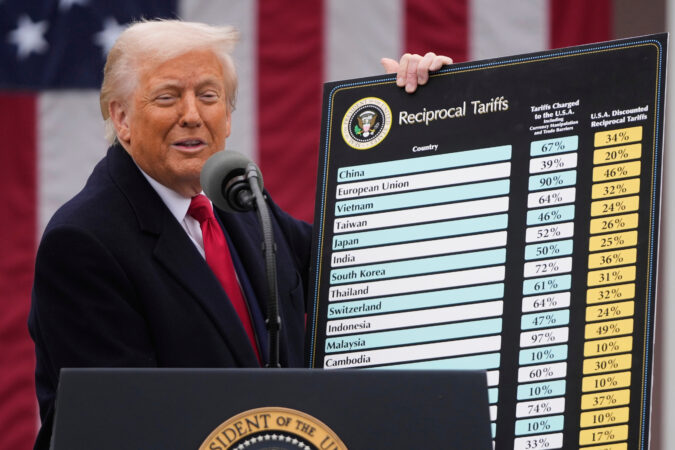
    The facts: Though Trump has imposed massive tax hikes on imports, they’re not sizable enough to make a dent in the government’s annual budget deficits. Nor have the tariffs corresponded with manufacturing job gains.

    Before the Supreme Court struck down Trump’s tariffs based on an emergency declaration, the Congressional Budget Office estimated that his new taxes would raise $3 trillion over 10 years, or $300 billion annually.

    That’s not enough to cover the cost of his $4.7 trillion in tax cuts, including additional interest cuts, that favored companies and the wealthy. Nor is it enough to pay down an annual budget deficit that last year was $1.78 trillion.

    Claim: “Tariffs paid for by foreign countries will, like in the past, substantially replace the modern day system of income tax.’’

    The facts: Not likely. Under Trump, tariff revenues have swelled — to $195 billion in the budget year that ended Sept. 30 from $77 billion the year before. But the import taxes accounted for less than 4% of federal revenue. Income taxes and payroll taxes that finance Social Security and Medicare account for 84%.

    Medicine

    Claim: “I took prescription drugs, a very big part of healthcare, from the highest price in the entire world to the lowest. That’s a big achievement. The result is price differences of 300, 400, 500, 600% and more.”

    The facts: This is impossible. Although the Trump administration has taken steps to lower drug prices, cutting them by more than 100% would theoretically mean that people are being paid to take medications.

    Geoffrey Joyce, director of health policy at the University of Southern California’s Schaeffer Center, said in August that this claim is “total fiction” by the president. He agreed that it would amount to drug companies paying customers, rather than the other way around.

    Crime

    Claim: “Last year, the murder rate saw its single largest decline in recorded history. This is the biggest decline. Think of it in recorded history, the lowest number in over 125 years.”

    The facts: Trump takes credit for a significant decrease in violent crime during 2025, claiming the murder rate in the U.S. dropped to its lowest in 125 years. But this is misleading. Crime had already been trending down in recent years.

    A study released in January by the independent Council on Criminal Justice, which collected data from 35 U.S. cities on homicides, showed a 21% decrease in the homicide rate from 2024 to 2025.

    The report noted that when nationwide data for jurisdictions of all sizes is reported by the FBI later this year, there is a strong possibility that homicides in 2025 will drop to about 4 per 100,000 residents. That would be the lowest rate ever recorded in law enforcement or public health data going back to 1900.

    FBI reports for 2023 and 2024 show significant reductions in violent crimes.

    Crime surged during the coronavirus pandemic, with homicides increasing nearly 30% in 2020 over the previous year, the largest one-year jump since the FBI began keeping records. But violent crime dropped to near pre-pandemic levels around 2022 when Biden was president.

    Immigration

    Claim: “We will always allow people to come in legally, people that will love our country and will work hard to maintain our country.”

    The facts: Trump has actually taken steps to restrict who can emigrate to the U.S., often in the name of protecting national security.

    He suspended the refugee program on his first day in office and in October resumed the program but only in limited numbers for white South Africans.

    Trump has also placed restrictions on who can travel or emigrate to the U.S. from nearly 40 countries around the world. Many of those countries are in Africa.

    Taxes

    Claim: “With the great big beautiful bill, we gave you no tax on tips, no tax on overtime and no tax on Social Security.”

    The facts: Though the president frequently says his big tax cut bill means no tax on Social Security, that’s not true for everyone. Not all Social Security beneficiaries will be able to claim the deduction, which lasts until 2029.

    Those who won’t be able to do so include the lowest-income seniors who already don’t pay taxes on Social Security, those who choose to claim their benefits before they reach age 65 and those above a defined income threshold. The deductions also phase out as income increases.

    Elections

    Claim: “I’m asking you to approve the Save America Act to stop illegal aliens and other who are unpermitted persons from voting in our sacred American elections. The cheating is rampant in our elections.”

    The facts: He and his allies have never produced evidence of rampant election cheating. Experts say voter fraud is extremely rare, and very few noncitizens ever slip through the cracks.

    For example, a recent review in Michigan identified 15 people who appear to be noncitizens who voted in the 2024 general election, out of more than 5.7 million ballots cast in the state. Of those, 13 were referred to the attorney general for potential criminal charges. One involved a voter who has since died, and the final case remains under investigation.

    1776

    Claim: “The revolution that began in 1776 has not ended. It still continues because the flame of liberty and independence still burns in the heart of every American patriot.”

    The facts: To be clear, the American Revolution started the previous year, on April 19, 1775. The colonies declared independence in 1776. It ended Sept. 3, 1783.
  • Trump administration hits Iran with new sanctions as nuclear talks near

    Trump administration hits Iran with new sanctions as nuclear talks near

    WASHINGTON — The Trump administration on Wednesday imposed another tranche of sanctions on people and companies accused of enabling Iran’s ballistic missile program, drone production, and illicit oil sales as the U.S. presses Tehran to make a deal ahead of nuclear talks this week.

    The sanctions against 30 people, companies, and ships come as President Donald Trump has massed the largest U.S. buildup of warships and aircraft in the region in decades and has threatened to use military action in a bid to get Iran to constrain its nuclear program.

    The latest round of talks between U.S. officials, including envoy Steve Witkoff, and Iranian negotiators via mediator Oman are scheduled for Thursday in Geneva.

    The new sanctions imposed by the Treasury Department’s Office of Foreign Assets Control include a list of ships accused of being part of Iran’s “shadow fleet,” which refers to rusting oil tankers that smuggle oil for countries facing stiff sanctions.

    Also targeted are drone manufacturing firms, including Qods Aviation Industries, which has supplied drones “to all branches of the Iranian military and buyers in Africa and Latin America,” the Treasury Department said.

    Among other things, sanctions deny the people and firms access to any property or financial assets held in the U.S. and prevent American companies and citizens from doing business with them. However, they are largely symbolic because many of them do not hold funds with U.S. institutions.

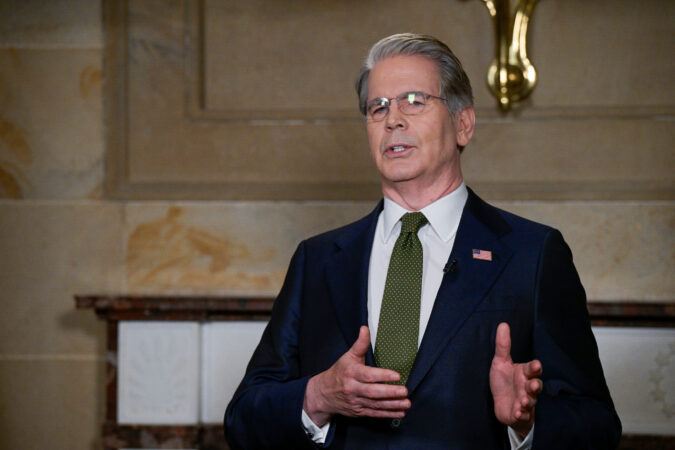
    “Treasury will continue to put maximum pressure on Iran to target the regime’s weapons capabilities and support for terrorism, which it has prioritized over the lives of the Iranian people,” Treasury Secretary Scott Bessent said in a statement.

    Trump and other top administration officials insist that Iran cannot be allowed to develop a nuclear weapon and ramped up pressure months after U.S. strikes in June on three Iranian nuclear sites.

    Iran long has maintained its nuclear program is peaceful. It had been enriching uranium up to 60% purity before the June attack — a short, technical step away from weapons-grade levels of 90%.

    “We wiped it out and they want to start all over again. And they’re at this moment again pursuing their sinister ambitions,” Trump said during his State of the Union speech Tuesday night. “We are in negotiations with them. They want to make a deal, but we haven’t heard those secret words: We will never have a nuclear weapon.”

  • States sue Trump administration over changes to childhood vaccine recommendations

    States sue Trump administration over changes to childhood vaccine recommendations

    SACRAMENTO, Calif. — More than a dozen states sued the Trump administration Tuesday over its rollback of vaccine recommendations for children, calling the move an illegal threat to public health.

    The states argue that the Centers for Disease Control and Prevention put children’s lives at risk when it announced last month that it would stop recommending all children get immunized against the flu, rotavirus, hepatitis A, hepatitis B, some forms of meningitis, and RSV. Under the new guidance, which was met with criticism from medical experts, protections against those diseases are recommended only for certain groups deemed high risk or when doctors recommend them in what’s called “shared decision-making.”

    The new vaccine recommendations ignore long-standing medical guidance and will make states have to spend more to protect against outbreaks, the states, including Arizona and California, said.

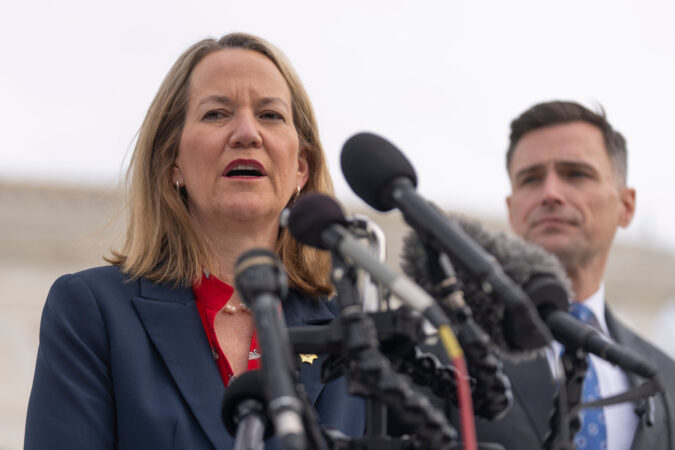
    “The health and safety of children across the country is not a political issue,” Arizona Attorney General Kris Mayes, a Democrat, said at a news conference. “It is not a culture war talking point.”

    Emily G. Hilliard, press secretary for the Department of Health and Human Services, blasted the complaint as a “publicity stunt dressed up as a lawsuit.”

    Pennsylvania, New Jersey, and Delaware all joined the Arizona-led lawsuit.

    “Every Pennsylvanian deserves accurate information to make their own healthcare decisions when consulting with their doctors — and science, not politics, will continue to guide our healthcare decisions here in the Commonwealth,” said Gov. Josh Shapiro, a Democrat who has repeatedly joined litigation against the Trump administration since last year.

    The lawsuit escalates an ongoing battle between Democratic-led states and Republican President Donald Trump’s administration over the federal government’s changes to public health policy under Health Secretary Robert F. Kennedy Jr. The Trump administration has laid off thousands of workers at federal public health agencies, cut funding for scientific research and altered government guidance on fluoride and other topics.

    Kennedy last year ousted every member of a vaccine advisory committee and replaced them with his own picks, which Tuesday’s complaint alleges was unlawful.

    The lawsuit comes months after the Democratic governors of California, Washington state, and Oregon launched an alliance to establish their own vaccine recommendations. The governors said the Trump administration was risking people’s health by politicizing the CDC.

    States, not the federal government, have the authority to require vaccinations for schoolchildren, though the CDC’s requirements typically influence state regulations.

  • Surgeon general nominee Casey Means grilled on vaccines, pesticides in hearing

    Surgeon general nominee Casey Means grilled on vaccines, pesticides in hearing

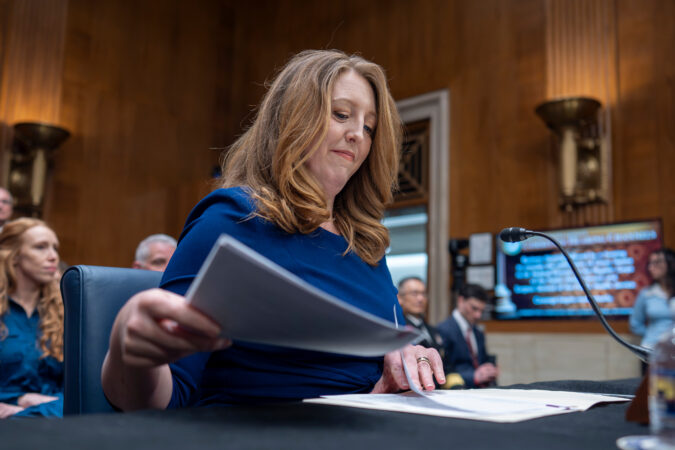
    After over a year without a surgeon general, the Senate Health Committee is grilling Casey Means on vaccinations, her business entanglements, and past comments on pesticides, as they weigh whether she should serve as the nation’s top doctor.

    Means wrote the book considered the bible of the Make America Healthy Again movement with her brother, Calley Means, a Trump administration official. As surgeon general, she could amplify many of her messages around healthy eating and exercise, although she has faced criticism for some of her ties to wellness products.

    Means is drawing fire and praise from both sides of the aisle, reflecting the MAHA coalition’s crosscutting appeal. Her messages on food found favor with both sides, while Democrats and the panel’s GOP chair probed her views on vaccinations and a Republican senator raised questions on how her stance on pesticides could impact American farmers.

    Means highlighted the nation’s chronic illness rates and a path to how she hopes to change them in her opening remarks.

    “Public health leaders must address the evidence-based, modifiable drivers of chronic diseases which include ultra-processed foods, industrial chemical exposure, lack of physical activity, chronic stress and loneliness, and overmedicalization,” Means said. “As surgeon general, I would call on every American and the Public Health Service to join in a great national healing — one that halts preventable chronic disease, makes healthy living the easiest choice, honors the body’s connection to the environment, and puts America back on the road towards wholeness and health.”

    Her initial confirmation hearing was delayed after she gave birth in the fall. This hearing is also a referendum on the controversial moves of her political patron, Health Secretary Robert F. Kennedy Jr., who has overhauled federal vaccine guidelines and upended the public health system. Means, like Kennedy, has publicly questioned the number of vaccines included in the childhood vaccine schedule, as well as the hepatitis B shot. Public health experts say the vaccine schedule is safe and effective.

    Vaccine questions

    At the beginning of the hearing, Chairman Bill Cassidy (R., La.) cautioned that as the nation’s top doctor, Means would have a responsibility to fight back against the vaccine skepticism rising across the country “at a time when so many, for whatever reason, sow distrust and confusion.”

    Sen. Bernie Sanders (Ind., Vt.), the panel’s ranking minority-party member, went further, accusing Trump and Kennedy of spreading misinformation on vaccines and pleading with Means to take a stand against them.

    Cassidy later peppered Means with questions around immunizations, pointing to children who have died of vaccine-preventable disease. Means emphasized that while she supports vaccines, she believes parents and patients must speak to their physicians. She also refused to explicitly say vaccines do not cause autism when pressed, instead saying that no stones should be left unturned in the search for the causes of autism. As health secretary, Kennedy instructed the Centers for Disease Control and Prevention to remove from its website the long-settled scientific conclusion that vaccines do not cause autism.

    In his questioning, Sanders started by pointing out the overlap between his and Means’s interest in fighting against ultra-processed food, before pivoting to further press Means on the scientific community’s determination that vaccines don’t cause autism.

    “Anti-vaccine rhetoric has never been a part of my message,” Means said, adding that the nation should study when children are getting many medications.

    Business ties and pesticides

    A Washington Post examination last year found that Means had made over half a million dollars from partnerships with companies that her financial forms described as selling “diagnostic testing,” “herbal remedies and wellness products,” and “teas, supplements, and elixirs” from 2024 into the summer of 2025, according to her financial disclosures. Legal and advertising experts told the Post last fall that they were concerned about whether Means clearly disclosed her ties to some brands.

    Sen. Tammy Baldwin (D., Wis.) grilled Means on some of her connections to wellness products: “It seems to me that you’ve spent your career sort of making money off the flaws” in the healthcare system.

    Sen. Chris Murphy (D., Conn.) said he was concerned that Means was in “willful violation” of Federal Trade Commission rules, recommending products without telling followers she was sponsored by such products.

    Means pushed back on the allegations and said she “would rectify that immediately” if it has inadvertently happened.

    “I take conflicts of interest incredibly seriously,” Means said.

    While many Republicans spoke highly of Means’s approach to improving American diets and fighting chronic disease, some others did not hold back in their questioning of her past remarks on psilocybin, pesticides, and other items.

    Pesticides are a hot-button issue among the MAHA movement after Trump issued an executive order protecting a key ingredient in a weed killer.

    She wrote in a newsletter sent in 2024: “How can we help bring a pesticide-free world to fruition? It starts with each of us prioritizing eating organic food as much as possible and standing firmly against buying or serving food sprayed with pesticides.”

    Sen. Jon Husted (R., Ohio) stressed that he has heard questions from Ohio farmers about her comments on pesticides, calling them critical for the food supply and farmers’ stability.

    Means called her thoughts on pesticides a core belief that was important to understand the impact pesticides could be having on Americans’ bodies, but noted she understood change could not happen overnight to destabilize the farming ecosystem.

    Means also got in a testy exchange with Sen. Patty Murray (D., Wash.) over birth control, with Means stressing that it’s important to highlight the possible risks including stroke for women. Means has a history of disparaging birth control, which has been under fire from wellness and right-wing influencers.

    Bucking the medical mainstream

    Secretary Kennedy has championed Means’s nomination.

    “She has an extraordinary capacity to communicate to the American public. That is the function of the surgeon general,” Kennedy said at an event Monday, saying Means would be a medical and “moral” authority for the public and he hoped she would be confirmed very soon.Means’ credentials — attending Stanford for her undergraduate education and medical school, racking up academic honors, writing scientific papers and working on research at top institutions — came up in the hearing.

    Means left her medical residency over seven years ago and has encouraged Americans to ask questions of their doctors — positions Kennedy has said led to her nomination.

    Means, a physician, has a medical license in Oregon that she voluntarily placed in inactive status, according to the state medical board, which means she cannot practice medicine in Oregon as of the beginning of 2024. Sen. Andy Kim (D., N.J.) raised concerns about Means’s medical license. Means pushed back on him by noting she practiced medicine and sees her background as “a feature, it’s not a bug.

    MAHA supporters have lauded her for challenging the medical mainstream.

    Public health experts have raised questions about some of her advice. In her book Good Energy, Means writes that “the ability to prevent and reverse” a variety of ailments, including infertility and Alzheimer’s, “is under your control and simpler than you think.”

    Medical experts have said that while there is significant evidence that diet and exercise can lower the risk of some chronic conditions and slow the progression of diseases, Means overstates the science when she says it can reverse many of them.

  • Takeaways from Trump’s address: Sales mode on economy, heavy on patriotism, dark turn on Democrats

    Takeaways from Trump’s address: Sales mode on economy, heavy on patriotism, dark turn on Democrats

    WASHINGTON — President Donald Trump started in sales mode, using his State of the Union address to deliver an upbeat vision of the U.S. economy.

    But that portrayal collides with the sentiment of Americans who remain anxious about their finances and feel they haven’t benefited from Trump’s policies. He took the high road to honor the gold medal-winning U.S. men’s Olympic hockey team and a war hero before pivoting abruptly to a darker tone as he ridiculed Democrats.

    Here are takeaways from the speech.

    Trump’s ‘roaring’ economy is at odds with sour public sentiment

    Much of the nation is worried about the direction of the economy, but Trump says the good times are here, insisting repeatedly that rising costs are no longer a problem.

    “The roaring economy is roaring like never before,” he said. He cheered the lower cost of gasoline, mortgage rates, prescription drug prices, and the rising stock market: “Millions and millions of Americans are all gaining.”

    Such optimism, as so many Americans are feeling economic strains, risks painting Trump as out of touch. Just 39% of U.S. adults approved of Trump’s handling of the economy in February, according to AP-NORC polling.

    Still, the president focused much of the first hour of his speech on the economy, something Republicans had urged him to do as they head into the midterm elections.

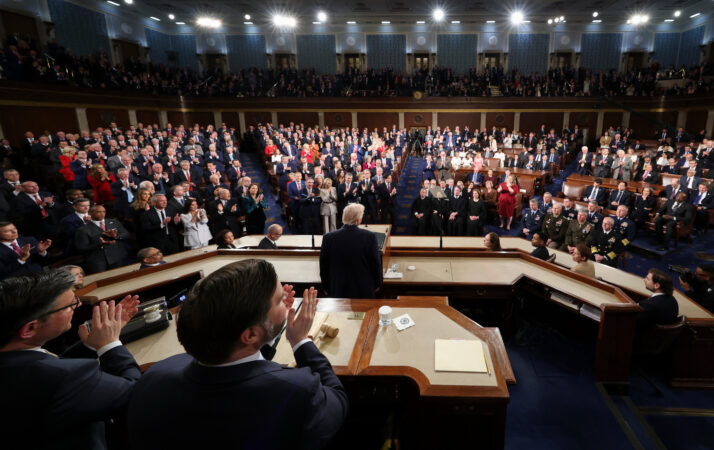
    First lady Melania Trump awards World War II Navy pilot Capt. Royce Williams the Congressional Medal of Honor as President Donald Trump delivers the State of the Union address to a joint session of Congress.

    Trump wraps himself in the flag

    For a president who always seems to be spoiling for a fight, Trump also tried to summon Americans’ innate patriotic impulses. In addition to the hockey team, he singled out war heroes and those who had taken brave stands in other countries, using the moment to bestow numerous presidential medals in an effort to give the address a more positive gloss.

    It underscored the president’s media savvy and understanding that even if a moment isn’t appreciated completely in real time, it can have an afterlife in the days following speech, especially on social media.

    Yet in one revealing moment, Trump lamented why he couldn’t give a congressional medal to himself.

    Taking aim at Democrats

    Tributes to the Olympic hockey team and a World War II veteran didn’t unify the room for long.

    The Republican president soon took aim at Democrats and blamed them for many of the nation’s ills.

    Trump said rising healthcare premiums are “caused by you,” suggested Democrats “are not protecting” Social Security and blamed them for the nation’s affordability crunch. “You caused that problem. You caused that problem,” Trump said as he glared at the Democratic side of the room.

    He seemed to get angrier as the speech progressed.

    “These people are crazy, I’m telling you, they’re crazy,” he said. “Democrats are destroying this country.”

    Trump’s MAGA base loves such aggression. It’s unclear, however, if the rest of the country feels the same.

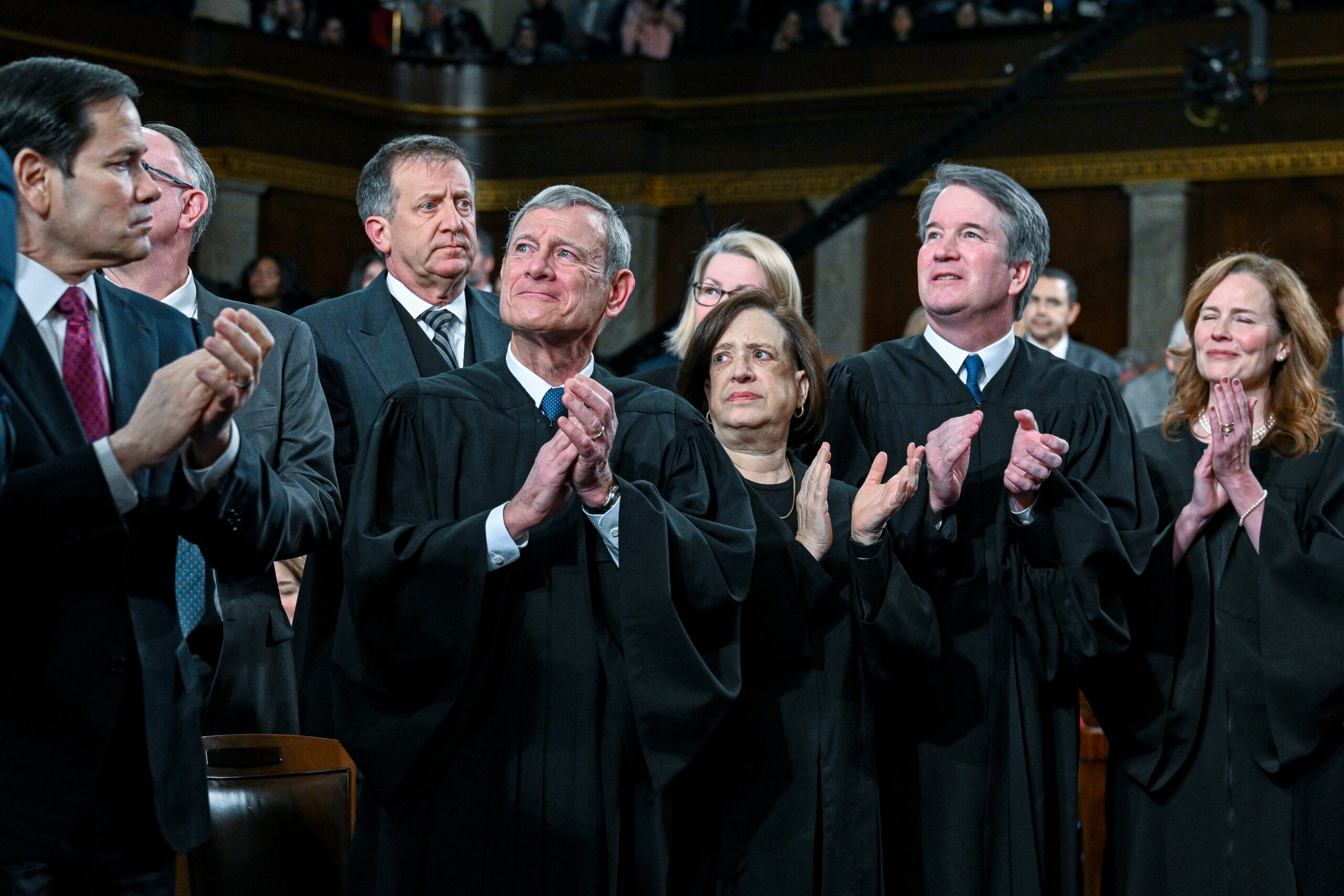
    Secretary of State Marco Rubio (from left), Chief Justice John Roberts, Justice Elena Kagan, Justice Brett Kavanaugh, and Justice Amy Coney Barrett applaud before President Donald Trump delivers the State of the Union address Tuesdy to a joint session of Congress in the House chamber at the U.S. Capitol.

    The Supreme Court’s ‘unfortunate’ decision

    By Trump’s standards, he held his tongue when it came to the Supreme Court.

    After the court struck down his tariff policy last week, Trump said the justices who voted against one of his signature issues were an “embarrassment to their families.” By Tuesday, he simply called the ruling “unfortunate.”

    Trump sought to treat the ruling with indifference, insisting that tariff revenues were “saving” the U.S., ignoring the fact that the levies haven’t made a significant dent in government debt. He said the tariffs were paid by foreign countries even as virtually every study concludes that costs have been paid by U.S. firms and consumers.

    At one point, he seemed to take the long view that history would ultimately vindicate him even if the Supreme Court would not.

    “As time goes by, I believe the tariffs paid by foreign countries will, like in the past, substantially replace the modern day system of income tax, taking a great burden off the people that I love,” he said.

    That is unlikely. The federal income tax is authorized by the 16th Amendment to the Constitution and the power to collect revenue is ultimately defined by Congress, not the president.

    Trump vows action on election ‘cheating’

    The president also used the speech to reprise his attack on the integrity of U.S. elections.

    “Cheating is rampant in our elections,” Trump said.

    Trump has made such claims for years, focused on his 2020 election loss, claims rejected by dozens of courts and his own attorney general at the time.

    But the timing of Tuesday’s prime-time claims, less than nine months before voters across America are scheduled to decide control of Congress, was noteworthy. So, too, was Trump’s suggestion that he would take action to address a problem that doesn’t appear to exist.

    “They want to cheat. They have cheated, and their policy is so bad that the only way they can get elected is to cheat,” Trump said of Democrats. “And we’re going to stop it. We have to stop it.”

    Trump is calling on Congress to pass a bill requiring voters to show a photo ID before casting ballots. But he also recently vowed to enact an executive order to address the issue, although the White House has not clarified what it might entail.

    No mention of Minneapolis

    Sometimes what’s not said is as notable as what is.

    Trump has highlighted immigration since the very first speech in which he announced his 2016 presidential campaign. And on Tuesday night, he revived much of the same language he’s used throughout the past decade, blasting “criminal aliens” and warning of “drug lords, murderers all over our country.”

    What he didn’t mention: the most aggressive immigration enforcement tactics that threatened to bring the U.S. to the brink earlier this year. He didn’t mention the deaths of two U.S. citizens in Minneapolis last month at the hands of federal agents.

    Indeed, it was Rep. Rashida Tlaib (D., Mich.), who shouted that “Alex wasn’t a criminal,” referring to Alex Pretti, one of the U.S. citizens killed in Minneapolis.

    During her Democratic rebuttal, Virginia Gov. Abigail Spanberger said law enforcement must work to build trust in communities and said Trump “every minute spent sowing fear is a minute not investigating murders.”

    Trump said nothing of his administration’s shift in tactics, including a drawdown of agents in the Twin Cities. And he made no acknowledgment of the broad concerns in the U.S. about Trump’s approach on immigration, as demonstrated by the 60% of U.S. adults who disapproved of his handling of the issue in February, according to AP-NORC polling.

    Drumbeat for war gets louder

    Trump has already built up the largest U.S. military presence in the Middle East in decades. And in his speech, he outlined a rationale for using those forces to launch a major military strike against Iran.

    The president said that Iran and its proxies have “spread nothing but terrorism, death and hate,” adding that its leaders killed at least 32,000 protesters in recent weeks, which is at the further end of estimates over the death toll. The U.S.-based Human Rights Activist News Agency has so far counted more than 7,000 dead and believes the death toll is far higher. Iran’s government offered its only death toll on Jan. 21, saying 3,117 people were killed.

    Trump also warned that the nation has developed missiles that can threaten Europe and is working on missiles “that will soon reach” the U.S.

    “My preference is to solve this problem through diplomacy. But one thing is certain, I will never allow the world’s number one sponsor of terror, which they are, by far to have a nuclear weapon. Can’t let that happen.”

    On brand, the speech was the longest SOTU ever

    The president, ever mindful of records that allow him to say he was the first, the best or had done the most, succeeded clearly on one thing: he beat his own record for the longest, clocking in at just under 1 hour, 48 minutes.

  • Hegseth warns Anthropic to let the military use the company’s AI tech as it sees fit, AP source says

    Hegseth warns Anthropic to let the military use the company’s AI tech as it sees fit, AP source says

    WASHINGTON — Defense Secretary Pete Hegseth gave Anthropic’s CEO a Friday deadline to open the company’s artificial intelligence technology for unrestricted military use or risk losing its government contract, according to a person familiar with their meeting Tuesday.

    Anthropic makes the chatbot Claude and is the last of its peers to not supply its technology to a new U.S. military internal network. CEO Dario Amodei repeatedly has made clear his ethical concerns about unchecked government use of AI, including the dangers of fully autonomous armed drones and of AI-assisted mass surveillance that could track dissent.

    Defense officials warned they could designate Anthropic a supply chain risk or use the Defense Production Act to essentially give the military more authority to use its products even if it doesn’t approve of how they are used, according to the person familiar with the meeting and a senior Pentagon official, who both were not authorized to comment publicly and spoke on condition of anonymity.

    The development, which was reported earlier by Axios, underscores the debate over AI’s role in national security and concerns about how the technology could be used in high-stakes situations involving lethal force, sensitive information, or government surveillance. It also comes as Hegseth has vowed to root out what he calls a “woke culture” in the armed forces.

    “A powerful AI looking across billions of conversations from millions of people could gauge public sentiment, detect pockets of disloyalty forming, and stamp them out before they grow,” Amodei wrote in an essay last month.

    The person familiar called the tone of the meeting cordial but said Amodei didn’t budge on two areas he has established as lines Anthropic won’t cross — fully autonomous military targeting operations and domestic surveillance of U.S. citizens.

    The Pentagon objects to Anthropic’s ethical restrictions because military operations need tools that don’t come with built-in limitations, the senior Pentagon official said. The official argued that the Pentagon has only issued lawful orders and stressed that using Anthropic’s tools legally would be the military’s responsibility.

    Anthropic will no longer be the only AI company approved for classified military networks

    The Pentagon announced last summer that it was awarding defense contracts to four AI companies — Anthropic, Google, OpenAI, and Elon Musk’s xAI. Each contract is worth up to $200 million.

    Anthropic was the first AI company to get approved for classified military networks, where it works with partners like Palantir. Musk’s xAI company, which operates the Grok chatbot, says Grok also is ready to be used in classified settings, according to the senior Pentagon official.

    The official noted that the other AI companies were “close” to that milestone. SpaceX, Musk’s space flight company that recently merged with xAI, didn’t immediately return a request for comment Tuesday.

    Hegseth said in a January speech at SpaceX in South Texas that he was shrugging off any AI models “that won’t allow you to fight wars.”

    Hegseth said his vision for military AI systems means that they operate “without ideological constraints that limit lawful military applications,” before adding that the Pentagon’s “AI will not be woke.”

    The defense secretary said that Grok would join the secure but unclassified Pentagon AI network, called GenAI.mil. The announcement came days after Grok — which is embedded into X, the social media network owned by Musk — drew global scrutiny for generating highly sexualized deepfake images of people without their consent.

    OpenAI announced in early February that it, too, would join GenAI.mil, enabling service members to use a custom version of ChatGPT for unclassified tasks.

    Anthropic calls itself more safety-minded

    Anthropic said in a statement after Tuesday’s meeting that it “continued good-faith conversations about our usage policy to ensure Anthropic can continue to support the government’s national security mission in line with what our models can reliably and responsibly do.”

    Anthropic has long pitched itself as the more responsible and safety-minded of the leading AI companies, ever since its founders quit OpenAI to form the startup in 2021.

    The uncertainty with the Pentagon is putting those intentions to the test, according to Owen Daniels, associate director of analysis and fellow at Georgetown University’s Center for Security and Emerging Technology.

    “Anthropic’s peers, including Meta, Google, and xAI, have been willing to comply with the department’s policy on using models for all lawful applications,” Daniels said. “So the company’s bargaining power here is limited, and it risks losing influence in the department’s push to adopt AI.”

    In the AI craze that followed the release of ChatGPT, Anthropic closely aligned with President Joe Biden’s Democratic administration in volunteering to subject its AI systems to third-party scrutiny to guard against national security risks.

    Amodei, the CEO, has warned of AI’s potentially catastrophic dangers while rejecting the label that he’s an AI “doomer.” He argued in the January essay that “we are considerably closer to real danger in 2026 than we were in 2023″ but that those risks should be managed in a “realistic, pragmatic manner.”

    Anthropic has been at odds with the Trump administration

    This would not be the first time Anthropic’s advocacy for stricter AI safeguards has put it at odds with President Donald Trump’s administration. Anthropic needled chipmaker Nvidia publicly, criticizing Trump’s proposals to loosen export controls to enable some AI computer chips to be sold in China. The AI company, however, remains a close partner with Nvidia.

    Trump’s Republican administration and Anthropic also have been on opposite sides of a lobbying push to regulate AI in U.S. states.

    Trump’s top AI adviser, David Sacks, accused Anthropic in October of “running a sophisticated regulatory capture strategy based on fear-mongering.”

    Sacks was responding on X to Anthropic cofounder Jack Clark, writing about his attempt to balance technological optimism with “appropriate fear” about the steady march toward more capable AI systems.

    Anthropic hired a number of ex-Biden officials soon after Trump’s return to the White House, but it’s also tried to signal a bipartisan approach. The company recently added Chris Liddell, a former White House official from Trump’s first term, to its board of directors.

    The Pentagon’s “breakneck” adoption of AI shows the need for greater AI oversight or regulation by Congress, particularly if AI is being used to surveil Americans, said Amos Toh, senior counsel at the Brennan Center’s Liberty and National Security Program at New York University.

    “The law is not keeping up with how quickly the technology is evolving,” Toh wrote in a post on Bluesky. “But that doesn’t mean DoD has a blank check.”

  • As invasion enters fifth year, the children of Ukraine learn to fight back

    As invasion enters fifth year, the children of Ukraine learn to fight back

    BUCHA, Ukraine — From her wooden schoolroom seat, Katya, 15, carefully eyes the assault rifles laid across the desks up front.

    Her mind flashes to the Russian checkpoint four years ago.

    She is crammed in the back of a neighbor’s car clutching her aunt’s cat as fear rises to her throat. Russian soldiers are pressed up against the car window, seething with anger, fingers on the triggers of their black guns.

    The teacher’s voice snaps her back to the present.

    “God willing, none of you will ever need the knowledge you gain here, not even once. But if, God forbid, it happens that you do need it — that you cross paths with these situations — it’s better that you know what needs to be done at any given moment,” he says. “Understood?”

    Katya nods. She looks again at the training guns. She isn’t scared anymore. Scared is for 11-year-old Katya in the back seat of that car. Scared is for the little girl trembling in the basement, whose mother covered her with her body while Russian war planes circled overhead.

    If Russian troops ever return to Bucha, Katya doesn’t want to be scared. She intends to be ready.

    The teacher asks for volunteers to try loading a rifle. Katya’s hand shoots up.

    As Russia’s full-scale invasion entered its fifth year Tuesday, Ukrainians were yearning for peace but also readying a new generation of defenders — a somber recognition that the Kremlin is still bombing civilians every night and pushing maximalist demands at the negotiating table. The war could go on for years, and even if a ceasefire is achieved, the Russian threat will live next door.

    Katya and her classmates have come of age during wartime.

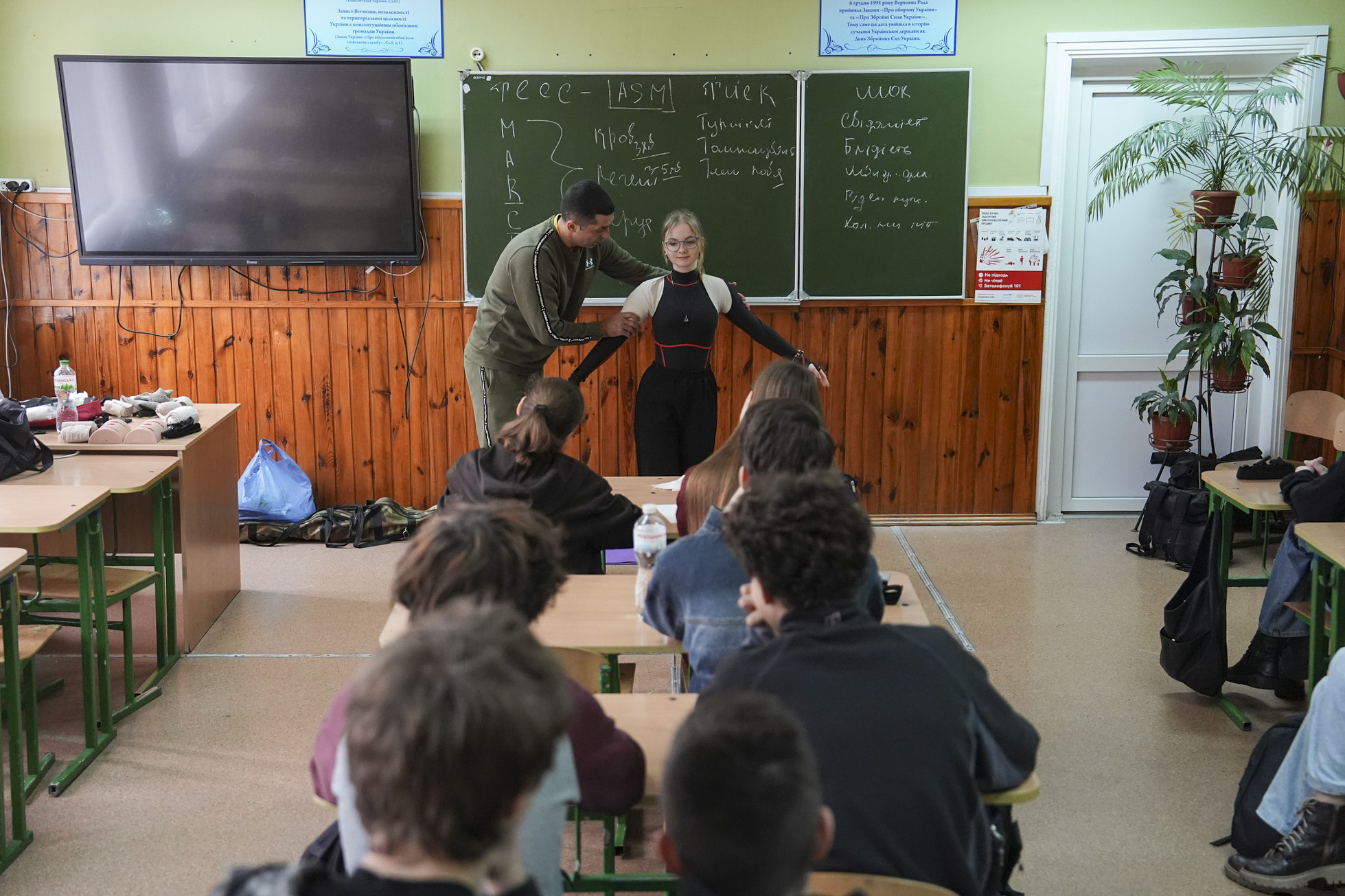
    Denys Kovalenko shows how to apply bandages on Varvara Koval, 15.

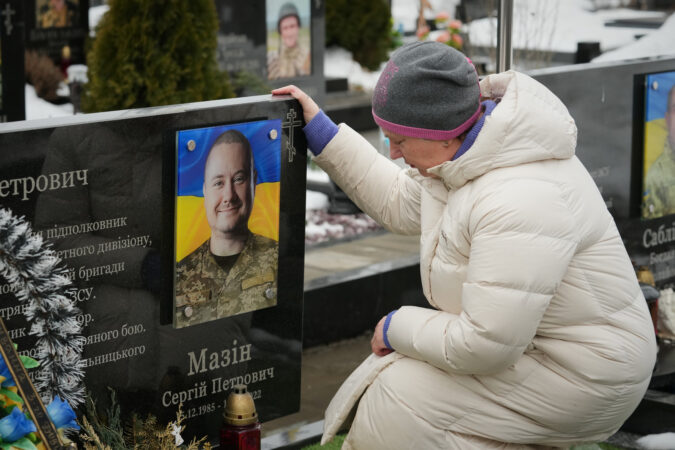
    In 2022, as tweens, they survived Russian occupation, made harrowing escapes from the front lines, and returned to find the bloodstained suburb of Bucha forever changed by the Russian massacre that unfolded on its streets in the first weeks of the war.

    Now 15 and 16, they are still too young to enlist to fight but old enough to understand they soon may be called upon to join their parents and older siblings in protecting their country from a nuclear-armed neighbor intent on denying them an independent future.

    While the United States escalates pressure on Kyiv to agree to a negotiated settlement, Ukraine is insisting on ironclad security guarantees — while preparing society to defend itself long term. That includes intensifying efforts to train its children on wartime readiness.

    In classrooms across Ukraine, more than 385,000 teenagers are enrolled in a revamped, mandatory course on handling weapons, battlefield tactics, emergency medicine, mine safety, radio communication, and how to respond to attacks on energy infrastructure.

    The course, called Protecting Ukraine, replaced a decades-old program that taught high-schoolers some basic weapons awareness but was largely a relic of the Soviet era that also involved dry lectures on military hierarchy and learning to march.

    That curriculum was developed long before school hallways were adorned with photos of students and teachers killed by Russia, before air alerts sent children scrambling into basements, before sandbags lined school windows to protect them from blasts or classes were held in subways.

    Ukraine’s Education Ministry invested $2.3 million in training teachers on the Protecting Ukraine program last year. “Our task was to form a defense mentality,” Education Minister Oksen Lisovyi said. “The need appeared, first of all of course, because of the military confrontation, terrorist threats and because Russia systematically terrorizes the civilian population.”

    Students learn “how to protect one’s self, how to protect those who are close to you, how the Ukrainian army works, which role you could find for yourself if you’d choose to take that path,” Lisovyi said. “But first of all, of course, it’s about the preparation of the civilian population.”

    Marina Kyziminska, 16, works with an assault rifle during class.

    Rifles, tourniquets, and CPR

    Most students in Katya’s classroom were in or near Bucha when Russian forces rampaged the Kyiv region in 2022, executing civilians before retreating from their failed campaign to seize the capital.

    When the instructor tells the students just how quickly a green, or safe, zone can turn red, they know exactly what he means.

    Katya shivered in a basement, replaying the happiest moments of her life as explosions shook her neighborhood.

    Zhenya walked miles along the railway tracks to reach Ukrainian-controlled territory as Russian warplanes circled overhead.

    A shell struck the eighth floor of Kyrylo’s apartment building but didn’t explode.

    Vasylisa remembers fleeing her hometown in the eastern Donetsk region as a toddler, only to resettle outside Kyiv and watch the sky turn red as streets burned in 2022.

    The instructor runs through the basics of trauma medicine: different kinds of tourniquets, how to put pressure on a major wound. He describes types of land mines, explains why radios are still used in an age of phones. He asks for volunteers for a CPR lesson. Katya and Vasylisa step to the front of the room. They giggle as Vasylisa lies down and Katya tips her chin back, opens her mouth, checking for obstruction.

    Zhenya Grebelna (left) Varvara, Katya and Ria Shapirko learn how to use a tourniquet.

    The students tie tourniquets to one another’s arms and practice twisting until they’re so tight they hurt. They remind each other to write down the time. They know that a tourniquet left on too long can lead to amputation.

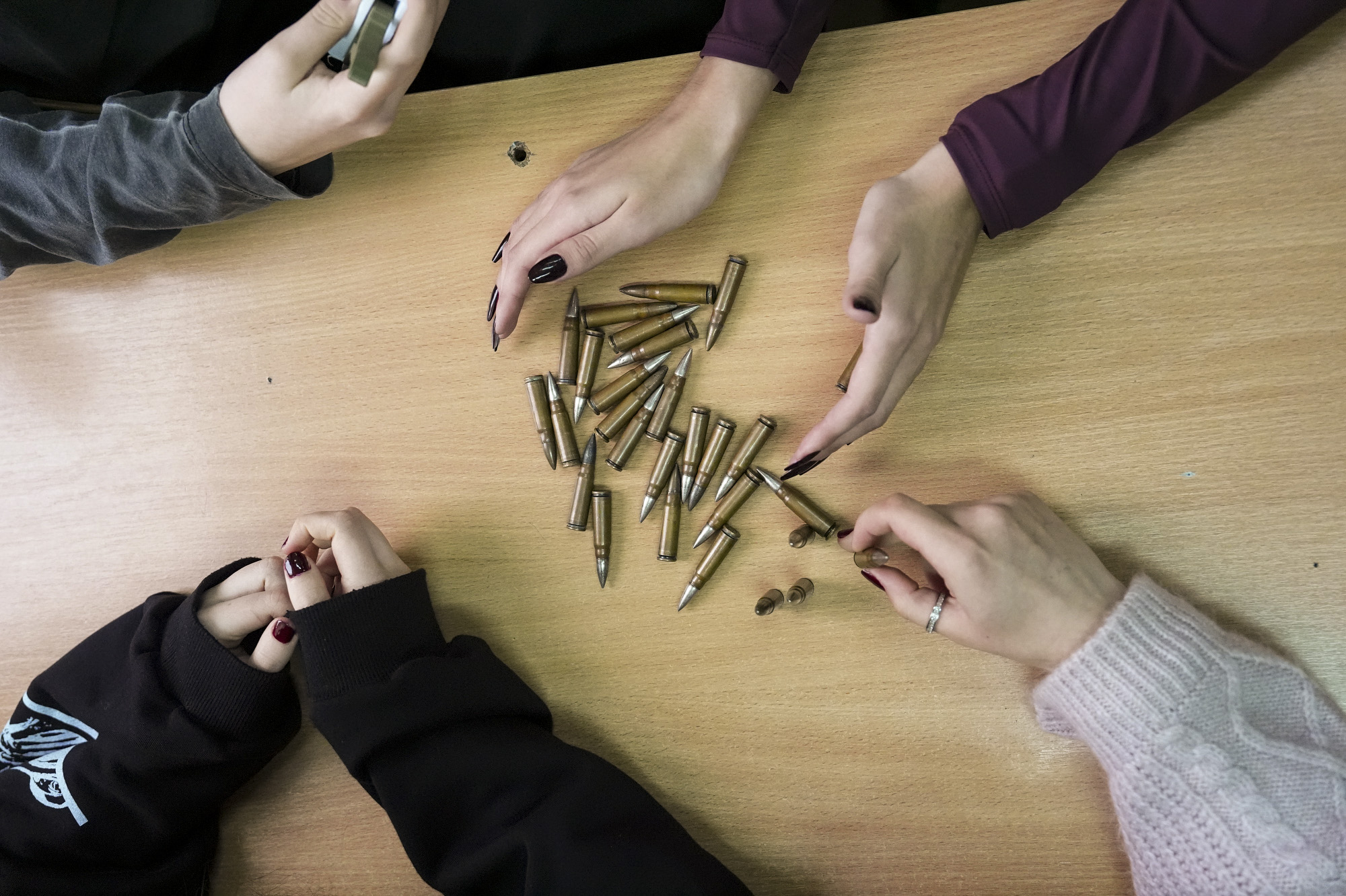
    When they go to load rifles, Katya is confident. She shows the other girls how it’s done while a group of boys plays with their phones in the back. Other students race to see who can load bullets into a magazine fastest.

    “I’m going to be dreaming about this already,” Katya says. Her friend Ria chimes in: “Like this, Katya: You wake up and we’re assembling a rifle on your bed!” The girls laugh. Their friend Varvara Koval takes a turn. Katya corrects her approach, takes the magazine and attaches it herself.

    Bullets used in the weapons training.

    The girls know that in schools in Russia, children their age are learning the same techniques. They know those kids are being taught that Ukraine is the aggressor, that Russia is liberating their territory by destroying it. They know that boys just a few years older than their classmates are being fitted for uniforms, crossing the border, killing Ukrainians and dying on Ukrainian land.

    “While they are being taught how to properly plant mines, we are being taught how not to step on them,” Katya says of how she pictures Russian students. In a better world, she acknowledged, it would not be normal to load an assault rifle at school or tie a tourniquet on your friend’s arm.

    “If no one were attacking our territory, or if Russia followed all the rules and conventions of conducting war, maybe we wouldn’t be learning this,” she adds. “But since they are striking civilian children just like us, we have to know all of this.”

    Vasylisa shows younger sister Stasia how to apply a tourniquet at home.

    Lost childhood

    Katya grew up in this school. Her mom is a teacher here. She knows Bucha like the back of her hand. Vasylisa was never supposed to be here. Born in the eastern Donetsk region, she always dreamed of graduating from the same school as her father. War pushed her family out in 2014. They moved again and again, eventually settling in Irpin, just outside Kyiv.

    On Feb. 23, 2022, as Russian forces massed on Ukraine’s borders, Vasylisa’s dad told her and her younger sister, Stasia, to prepare for the worst. Stasia, who was 9, burst out laughing.

    The next morning, Russia invaded. Little information trickled in through their unstable internet connection, and what did was terrible: executions. Whole families shot as they tried to flee. Just across the field from them, they could hear a Ukrainian machine gun picking off Russian troops.

    Bohdana Kolesnikova, right, with daughters Vasylisa and Stasia at home.

    In early March, they fled, packing their dog, guinea pig and several neighbors into their car. The girls thought they were taking a so-called “green corridor” — a safe path toward Kyiv. Their parents knew no such route existed. The trip was a dangerous leap of faith.

    Everything seemed to be on fire. They passed the mayor of Irpin hanging out of a car, a rifle in his hands. They eventually made it west, where their dad was quickly drafted to the military. The girls and their mom were stunned.

    Back then, Vasylisa thought of the military almost as an extracurricular activity — something to do after school or work. “And now he was taken away, and there was a war,” she said. “I was afraid that … well, I was afraid for Dad. I was crying, talking to him, and he was trying to calm me down, but that only made me cry more.”

    Eventually, the family settled into a new rhythm. They returned to the Kyiv region and moved to Bucha, where their dad is now based. Not everything Vasylisa is learning about war in school is new. Her dad taught her and Stasia some field medicine and asked them to always carry tourniquets when they go out. Last summer, they attended a camp where they practiced shooting.

    Stasia, at 12, can already assemble and disassemble an AK M-479 in less than a minute.

    “I get really upset when I realize that my teenage years are just slipping away like this and passing,” Vasylisa said through tears. “I’m now looking at my sister, who is 12 — the age I was then. And when I realize that she already feels kind of grown up, it makes me sad that I lost some years.”

    Their dad has seen Russia’s war come to his family home twice. His daughters, he said, might still be children. But in an emergency, they should be ready to act as adults.

    Vasylisa and Stasia with their dad.

    Sounds of war

    At school, the military lesson ends in the early afternoon. The class disperses, and the students zip up their backpacks, push past the younger kids through the hallways. Vasylisa goes to an English class. The other girls gather on the steps outside.

    The first stop after school is the grocery store for cookies, candies, and tea. Varvara’s mom isn’t home from work yet, but she agreed the girls can hang out at their apartment so long as Varvara runs upstairs first to clean.

    They kick their shoes off at the door and rush for the kitchen. They boil water. They crowd around the table. They hear an air raid siren and ignore it. They move to Varvara’s room, sit on her bed and floor. They don’t talk about guns or drones or soldiers or war. They talk about boys and girls and crushes and relationships.

    The girls in Varvara’s room.

    They laugh at Varvara’s cat, Masha. Eventually, Ria picks up Varvara’s blue acoustic guitar and starts to strum. The girls quiet down. She begins to sing. They all join in.

    When the song ends, they cheer and rush to hug her.

    The air alert has stopped. For this moment, safe in Varvara’s room, they are just teenagers. They are young and happy and free. They could almost be anywhere.

    But later that night, the sirens blare again. Russian missiles and drones soar overhead and crash into apartments and houses and a hospital and energy infrastructure. Four people are killed. Several children are wounded. Varvara moves from her bed to sleep on a bean bag in the hall. The girls all hope to survive another night, and meet in school again tomorrow.

  • Mexican cartel clashes fuel worries in lead-up to FIFA World Cup

    Mexican cartel clashes fuel worries in lead-up to FIFA World Cup

    GUADALAJARA, Mexico — Hugo Alejandro Pérez was in his house a few miles from the Mexican stadium that is slated to host FIFA World Cup games when gunfire and explosions erupted just outside his door.

    The 53-year-old restaurant owner was already skeptical about his city, Guadalajara, hosting the international sporting event.

    He saw a government that failed to fix basic things, like water service to his home, along with cartel violence in the surrounding state of Jalisco and shook his head. The surge of bloodshed this week following the Mexican military’s killing of the country’s most powerful cartel boss offered more confirmation of his doubts.

    “I don’t think they should host the World Cup here,” Peréz said. “We have so many problems, and they want to invest in the World Cup? With all the violence, it’s not a good idea.”

    Peréz joined other people Tuesday in questioning Guadalajara’s capacity to be a host city for the summer soccer competition, even as the Mexican government vowed that the international event — hosted jointly by Mexico, the United States and Canada — will not be affected.

    President offers ‘every guarantee’ for World Cup

    President Claudia Sheinbaum was asked at her daily news briefing what guarantees there are that World Cup matches will be held in Jalisco. “Every guarantee,” she said, adding that there was “no risk” for fans coming to the tournament.

    Jalisco Gov. Jesús Pablo Lemus said he had spoken with local FIFA officials, who have “absolutely no intention of removing any venues from Mexico. The three venues remain completely unchanged.”

    The same day, the Portuguese soccer federation said it was “closely monitoring the delicate situation” in Mexico.” Its national team was scheduled to play Mexico’s team in a friendly on March 28 at the newly renovated Azteca Stadium in Mexico City, which is scheduled to host the opening World Cup match on June 11.

    Jalisco, in western Mexico, was already facing scrutiny. The state has been plagued by some of the starkest examples of cartel violence in recent years, including the discovery of a cartel killing site at a ranch last March and a crisis of disappearances.

    The state, with Guadalajara as its capital, is the central hub for the Jalisco New Generation Cartel, whose leader Nemesio Oseguera Cervantes, or “El Mencho,” was killed Sunday in a capture attempt by the military.

    The operation and waves of violence killed 70 people. Cartel gunmen set fire to cars to block streets in states across the country, namely Jalisco, and fought with Mexican forces into Monday as the government said the conflict was under control.

    The death of Oseguera Cervantes came as Mexico’s government has stepped up its offensive against cartels in an effort to meet demands by U.S. President Donald Trump to crack down on criminal groups. The cartel, also known as CJNG, is one of the fastest-growing criminal networks in Mexico.

    The White House confirmed that the U.S. provided intelligence support to capture the cartel leader and applauded Mexico’s army for taking down a man who was one of the most wanted criminals in both countries.

    Drug lord’s death could lead to more violence

    Peréz, the restaurant owner, also commended Sheinbaum’s efforts to go after cartels, saying the government has taken cartel violence more seriously than her predecessors. At the same time, he said, local authorities in Jalisco have fallen short in protecting civilians.

    The root concern for many is that the death of “El Mencho” could pave the way for more violence. Killing capos, in what’s become known as the “kingpin strategy,” has been criticized by Sheinbaum herself because it can often spark internal conflict between cartel factions and push rival cartels to make territorial grabs.

    Vanda Felbab-Brown, an academic at the Brookings Institution, said she doesn’t see more acts of “revenge” by the cartel as likely, but the future remains uncertain, especially after leading figures in both CJNG and the Sinaloa Cartel have been knocked out in recent years.

    “If there is no clear line of succession (in CJNG), we might see a lot of fighting within the cartel, its breakup, and there are a lot of scenarios,” she said.

    On Sunday, when firefights broke out between the cartel and soldiers, and gunmen began to burn a car just feet in front of Peréz’s house, he let people on the street scramble inside his home to seek cover. The fighting raged for an hour.

    Now he says he doesn’t see the point of holding the games, adding that he doubts any of the money from the games will trickle down to businesses in working-class neighborhoods like his, even if they are just a 10-minute drive from the stadium. Similar tensions have simmered in Mexico City.

    The World Cup is expected to be a $3 billion economic engine in Mexico, according to the Mexican Soccer Federation.

    “It doesn’t help us residents at all, honestly. They should move it to Monterrey or Mexico City. But right now here, we’re not convinced,” he said. “Things aren’t in good enough shape for foreigners to be coming to Jalisco for an event like this.”

    On Monday, some foreign tourists trapped in the violence in the city of Puerto Vallarta took to social media to warn of the violence, with a few remarking that they didn’t plan to return.

    Hope of snapping back to normal

    Despite that, Guadalajara was snapping back to its normal rhythm Tuesday. Many businesses opened their doors for the first time in two days, and streets were packed with traffic.

    Workers were busy fixing up the exterior of the soccer stadium that will host World Cup matches. Cyclists zipped around outside the stadium, and parents played with children in parks.

    Heavily armed police officers and National Guard members roamed the city, a sign for some that the government had the situation under control.

    Juan Carlos Pila, a 55-year-old taxi driver, rolled his eyes at the reports of violence after spending two days waiting with his family for things to calm down. He said social media and local news outlets were overplaying the extent of the violence.

    “People should come, man. Everyone is welcome,” he said.

    Others, like Maria Dolores Aguirre, simply hoped for the best. Aguirre runs a small corner story in the cobblestoned tourist town of Tapalpa tucked away in Jalisco’s mountains, where Mexico’s military killed “El Mencho.”

    Aguirre’s family business of over 50 years depends on the flow of tourists to the normally sleepy town. Now she worries bloodshed will deal a blow to her livelihood and change towns like hers.

    “It’s going to affect us. It’s collateral damage,” Aguirre said. “The government is going to have to have a lot of security. … The entire world just saw what happened and, of course, people are going to think twice about coming.”

  • Zelensky says Putin has ‘not broken’ Ukrainians as he marks 4 years since Russia’s all-out invasion

    Zelensky says Putin has ‘not broken’ Ukrainians as he marks 4 years since Russia’s all-out invasion

    KYIV, Ukraine — Ukrainian President Volodymyr Zelensky declared Tuesday that Russia has not “broken Ukrainians” nor triumphed in its war, four years after an invasion that has severely tested the resolve of Kyiv and its allies and fueled European fears about the scale of Moscow’s ambitions.

    In a show of support, more than a dozen senior European officials headed to the Ukrainian capital to mark the grim anniversary of the conflict, which has killed tens of thousands of people, upended life for millions of Ukrainians, and created instability far beyond its borders.

    Zelensky said his country has withstood the onslaught by Russia’s bigger and better equipped army, which over the past year of fighting captured just 0.79% of Ukraine’s territory, according to the Institute for the Study of War, a Washington-based think tank. Russia now holds nearly 20% of Ukraine.

    “Looking back at the beginning of the invasion and reflecting on today, we have every right to say: We have defended our independence, we have not lost our statehood,” Zelensky said on social media, adding that Russian President Vladimir Putin has “not achieved his goals.”

    “He has not broken Ukrainians; he has not won this war,” Zelensky said.

    Despite the show of defiance, Ukraine has struggled to hold off Russia’s onslaught, and the war has brought widespread hardship for Ukrainian civilians. Russia’s aerial attacks have devastated families and denied civilians power and running water.

    Putin made no mention of the anniversary nor did he say how the war was going when he spoke at a meeting in Moscow of top officials of the Federal Security Service, or FSB, on Tuesday.

    However, he told them that the threat of Ukrainian attacks on Russian soil has grown. Ukraine has increasingly deployed long-range drones that it has developed to strike oil refineries, fuel depots and military logistics hubs more than 600 miles inside Russia.

    U.N. calls for an immediate ceasefire

    As the war of attrition enters its fifth year, a U.S.-led diplomatic push to end the largest conflict on the continent since World War II appears no closer to a peace deal.

    Negotiations are stuck on what happens to the Donbas, eastern Ukraine’s industrial heartland that Russian forces mostly occupy but have failed to seize completely, and the terms of a postwar security arrangement that Kyiv is demanding to deter any future Russian invasion.

    The U.N. General Assembly called Tuesday for an immediate ceasefire and a comprehensive peace in Ukraine, rejecting a U.S. attempt to eliminate language stressing the country’s sovereignty and territorial integrity.

    Washington supports an immediate ceasefire, U.S. Deputy Ambassador Tammy Bruce said before the vote, but opposed language stressing Ukraine’s territorial unity because it would “distract” from the peace talks.

    The 193-member General Assembly approved the original wording 107-12, with the United States among the 51 countries abstaining.

    Zelensky urges Trump to visit

    At a makeshift memorial in Kyiv’s central square, where thousands of small flags and portraits show photos of fallen soldiers, Zelensky said he would like President Donald Trump to visit and witness for himself Ukrainian suffering.

    “Only then can one truly understand what this war is really about,” Zelensky said. When later asked how four years of war had changed him, Zelensky said, “I don’t have time for friends or friendships.”

    Trump, who once vowed to end the war in a day, has repeatedly changed his tone toward Putin and Zelensky over the past year: sometimes criticizing the Ukrainian leader’s negotiating position while reaching out to the Russian leader and at others lashing out at Putin for heavy barrages and appearing more sympathetic to the Ukrainian predicament.

    Kremlin spokesperson Dmitry Peskov said that the invasion would continue in pursuit of Moscow’s goals. They include a demand that Ukraine renounce its bid to join NATO, sharply cut its army, and cede vast swaths of territory.

    Zelensky said he expected a fresh round of U.S.-brokered talks with Russia within the next 10 days.

    A ‘nightmare’ for Ukrainians

    The number of soldiers killed, injured or missing on both sides could reach 2 million by spring, with Russia sustaining the largest number of troop deaths for any major power in any conflict since World War II, a report last month from the Center for Strategic and International Studies estimated.

    European leaders see their countries’ own security at stake in Ukraine amid concerns that Putin may target them next.

    German Chancellor Friedrich Merz wrote on X that “for four years, every day and every night has been a nightmare for the Ukrainians — and not just for them, but for us all. Because war is back in Europe.”

    “We will only end it by being strong together, because the fate of Ukraine is our fate,” he added.

    Putin’s dangerous gamble

    Putin believes that time is on the side of his bigger army, Western officials and analysts say — and that Western support will trail off and that Ukraine’s military resistance will eventually crumble. Already Trump has ended new military aid to Ukraine — though other NATO countries now buy American weapons and give them to Kyiv.

    But French President Emmanuel Macron described the war as “a triple failure for Russia: military, economic, and strategic.” The war “has strengthened NATO — the very expansion Russia sought to prevent — galvanized Europeans it hoped to weaken, and laid bare the fragility of an imperialism from another age,” Macron said on X.

    The European Union has also sent financial aid, but has sometimes met with reluctance from members Hungary and Slovakia.

    While NATO countries have come to Ukraine’s aid, Russia has been helped by North Korea, which has sent thousands of troops and artillery shells; Iran, which has provided drone technology; and China, which the United States and analysts say has provided machine tools and chips.

    A defining conflict

    Among the European officials visiting Kyiv on Tuesday were President of the European Commission Ursula von der Leyen and Finnish President Alexander Stubb, as well as seven prime ministers and four foreign ministers.

    Zelensky later said von der Leyen assured him that Ukraine would receive the first tranche of a 90 billion euro loan by the spring despite Hungary’s attempts to block it.

    The only American listed among the official guests in Kyiv ceremonies was Lt. Gen. Curtis Buzzard, a U.S. officer who represents NATO in Ukraine.

    British Armed Forces Minister Al Carns said Russia’s war on Ukraine was “the most defining conflict” in decades, bringing a “revolution in military affairs,” especially through the rapid development of drone technology. Drones now cause the vast majority of battlefield casualties, he said.

    Both sides face challenges in finding enough troops and are increasingly turning to uncrewed aerial drones that can attack far from the front lines, the London-based International Institute for Strategic Studies said in its annual report on the global military situation.

    “Given both sides’ reliance on external support for materiel, decisions taken in foreign capitals will play an important role in shaping the war’s trajectory,” the think tank added.

    The United Kingdom on Tuesday announced a new package of military and humanitarian support for Ukraine, including sending teams of British military medics to instruct their Ukrainian counterparts.

    The cost of rebuilding war-battered Ukraine would amount to almost $588 billion over the next decade, according to World Bank, the European Commission, the United Nations, and the Ukrainian government. That is nearly three times the estimated nominal GDP of Ukraine for last year, they said in a report Monday.

  • Texas Rep. Gonzales resists calls to resign over allegations of an affair with an ex-staffer

    Texas Rep. Gonzales resists calls to resign over allegations of an affair with an ex-staffer

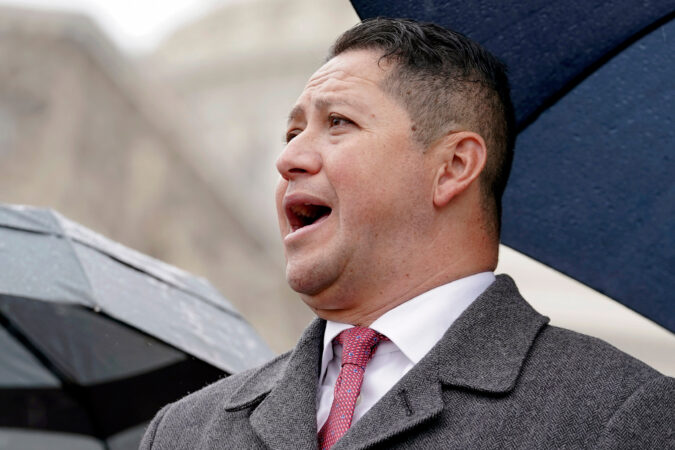
    HOUSTON — U.S. Rep. Tony Gonzales of Texas resisted growing calls Tuesday from fellow congressional Republicans to resign over a report of an alleged affair with a former staffer who later died after she set herself on fire.

    Rep. Thomas Massie of Kentucky joined Reps. Lauren Boebert of Colorado, Anna Paulina Luna of Florida, and Nancy Mace of South Carolina in demanding that Gonzales step down immediately. Gonzales is in a tough race in Texas’ Republican primary on March 3, facing a challenger he narrowly defeated in a 2024 GOP runoff.

    He told reporters he will not resign. A resignation would leave Republicans with a 217-214 majority until March, when the first of three special elections to fill vacancies is set in Georgia.

    “There will be opportunities for all of the details and facts to come out,” he said. “What you’ve seen is not all the facts.”

    House Speaker Mike Johnson said he would talk to Gonzales on Tuesday.

    Johnson said Monday that the accusations against Gonzales “must be taken seriously,” but he added, “in every case like this, you have to allow the investigation to play out and all the facts to come out.”

    “If the accusation of something is going to be the litmus for someone being able to continue to serve in the House, a lot of people would have to resign or be removed or expelled from Congress,” Johnson said.

    Meanwhile, Mace announced that she has introduced a resolution to force the House Ethics Commission to publicly release its reports and records of allegations of sexual harassment against members of Congress.

    Gonzales said in a social media post last week that he was being blackmailed and then suggested in another post Sunday that he is the target of “coordinated political attacks.”

    His main primary opponent is Brandon Herrera, a gun manufacturer and gun rights influencer who calls himself “the AK Guy” on YouTube, where his channel has nearly 4.2 million subscribers. Gonzales defeated Herrera by fewer than 400 votes in their 2024 runoff.

    President Donald Trump had endorsed Gonzales for reelection in December.

    The San Antonio Express-News reported last week that it had obtained text messages in which the former staffer, Regina Ann Santos-Aviles, wrote to a colleague that she had an affair with the lawmaker.

    The Associated Press has not independently obtained copies of the messages. An attorney for Adrian Aviles, Santos-Aviles’ husband, has said the husband found out about the affair before his wife’s death.

    Regina Ann Santos-Aviles, 35, died in September 2025. The Bexar County Medical Examiner’s Office later ruled her death was a suicide by self-immolation.

    “Where are the other men in the GOP?” Massie asked Tuesday in a post on X in calling for Gonzales to resign, adding that Trump should revoke his endorsement.

    Gonzales, whose district stretches from San Antonio to El Paso and runs along the U.S.-Mexico border, has six children with his wife.

    His allegation of blackmail is based on an email from the attorney for the staffer’s husband, Robert Barrera, discussing a possible lawsuit against the lawmaker and a potential settlement with a nondisclosure agreement. The email says that the maximum recoverable amount is $300,000.

    Barrera has said he was not trying to blackmail Gonzales and called the accusation an attempt by the congressman to look like a political victim.