BARCELONA, Spain — Barcelona’s towering Sagrada Familia basilica reached its maximum height on Friday, though the magnum opus of Catalan architect Antoni Gaudí remains years away from completion.
A crane placed the upper arm of a cross atop the Tower of Jesus Christ, the church’s soaring central piece, which now stands 566 feet above the city.
With Friday’s addition, the Sagrada Familia inched closer to being done. The unfinished monument became the world’s tallest church last year after another part of its central tower was lifted into place.
The first stone of the Sagrada Familia was placed in 1882, but Gaudí never expected it to be completed in his lifetime. Only one of its multiple towers was finished when he died at the age of 73 in 1926, after being hit by a tram.
In recent decades, work has sped up as the basilica became a major international tourist attraction, with people enthralled by Gaudí’s radical aesthetic that combines Catholic symbolism and organic forms.
Inside, the Tower of Jesus Christ is still being worked on. Those who wish to actually see the cross will have to wait until the tower’s inauguration this summer, when the scaffolding surrounding it will be removed, according to the church.
Topping the central tower, which soars above the transept, has been a priority ahead of celebrations this June that will mark the centenary of Gaudí’s death.
As Gaudí had planned, the cross has four arms so its shape can be recognized from any direction, said Sagrada Familia’s rector, the Rev. Josep Turull. If Barcelona’s city government will allow it, the original plan also includes a light beam shining from each of the cross’ arms, symbolizing the church’s role as a spiritual lighthouse, he added.
Millions of tourists visit the Sagrada Familia every year, and entrance fees largely fund the ongoing construction.
This year, the Sagrada Familia will hold several events to celebrate the Catalan Modernist’s legacy, which includes other stunning buildings in Barcelona and elsewhere in Spain.
The Sagrada Familia became the world’s tallest church last October, when it rose above the spire of Germany’s Ulmer Münster, a Gothic Lutheran church built over more than 500 years, starting in 1377. That church tops out at 530 feet.
At Sagrada Familia, a prayer verse is included at the base of the cross installed Friday afternoon, said church rector Turull.
It reads: “You alone are the Holy One, you alone are the Lord, you alone are the Most High.”
The U.S. military is stationing a vast array of forces in the Middle East, including two aircraft carriers, fighter jets and refueling tankers, with President Donald Trump saying that Iran had 10 to 15 days at most to strike a deal over its nuclear program.
“We’re either going to get a deal, or it’s going to be unfortunate for them,” Trump told reporters Thursday aboard Air Force One. On a deadline, Trump said he thought 10 to 15 days was “pretty much” the “maximum” he would allow for negotiations to continue.
“I would think that would be enough time,” he said.
The deployment is unlike anything the U.S. has done since 2003, when it amassed forces before the invasion of Iraq. It dwarfs the military buildup that Trump ordered off the coast of Venezuela in the weeks before he ousted President Nicolas Maduro.
While the U.S. isn’t likely to deploy ground troops, the buildup suggests Trump is giving himself discretion to launch a sustained campaign lasting many days, in cooperation with Israel. While discussions have focused on a sustained campaign far more sweeping than the overnight strikes the U.S. launched against Iran’s nuclear program last June, the president is also weighing a limited early strike designed to drive Tehran to the negotiating table, the Wall Street Journal reported Thursday.
“Maybe we’re going to make a deal,” Trump said in a speech on Thursday morning. “You’re going to be finding out over the next probably 10 days.”
Heightened geopolitical worries over U.S.-Iran tensions sent stocks lower and extended a surge in oil, with Brent crude, the global benchmark, rising above $71 a barrel on Thursday.
The open question is whether Iran can possibly satisfy Trump’s demands and whether, by positioning so much military hardware to the region, Trump may feel compelled to use it rather than backing down.
Tracking site FlightRadar24’s data shows a surge of flight activity by U.S. military transport, aerial tankers, surveillance aircraft and drones to bases in Qatar, Jordan, Crete and Spain.
The aircraft, whose transponders make them visible over land to the tracking site, include KC-46 and KC-135 air-to-air refuelers and C-130J cargo planes used to move troops and heavy equipment.
It also includes E-3 Sentry jets equipped with airborne warning and control system radar, which provide “all-altitude and all-weather surveillance” of potential battle zones, as well as RQ-4 Global Hawk surveillance drones.
The weapons at Trump’s disposal are formidable. The USS Abraham Lincoln aircraft carrier is accompanied by three Arleigh Burke-class guided-missile destroyers, which can carry Tomahawk missiles. The carrier’s air wing includes F-35C fighter jets.
The USS Gerald R. Ford, the most expensive U.S. warship ever built, at $13 billion, is accompanied by guided missile destroyers, and its associated air wing includes F/A-18E and F/A-18F Super Hornets, E-2D airborne early warning aircraft, as well as MH-60S and MH-60R Seahawk helicopters and C-2A Greyhounds.
The two carriers provide “more options, and would enable us to conduct operations on a more sustained basis – if it comes to that,” said Michael Eisenstadt, director of military studies for the Washington Institute for Near East Policy. He said the buildup “signals to the Iranians the need to be more flexible in negotiations.”
Trump met with his son-in-law, Jared Kushner, and special envoy, Steve Witkoff, on Wednesday for an update on the negotiations with Iran. Officials met in the Situation Room on Wednesday to discuss possible action and were told to expect that all U.S. military forces deployed to the region would be in place by mid-March, according to a U.S. official.
A major strike against Iran – where leaders are anxious about regime stability following widespread unrest – risks entangling the U.S. in its third war of choice in the Middle East since 1991, against a more formidable adversary than the U.S. has faced in decades.
Trump’s use of the military in his second term has been characterized by short and successful engagements with minimal harm to American troops, including the bombing of Iranian nuclear targets in June, attacking alleged drug-trafficking boats and the raid that extracted Maduro in early January.
But if fresh strikes on Iran prompt a wider conflagration, the president could face considerable public pressure. Trump spoke against U.S. engagement in foreign wars on the campaign trail, but has gone on to bomb Iran, Tehran-backed Houthi militants in Yemen and militants in Syria.
“With Iran’s air defenses largely neutralized by previous U.S. and Israeli strikes, the U.S. strike fighters would operate largely with impunity over Iranian airspace,” said Bryan Clark, a defense analyst for the Hudson Institute and a former Navy strategy officer. “There is always the risk of downed pilots, but I think the bigger risk is to ships. The same cruise and ballistic missiles the Iranians gave to the Houthis could be turned against U.S. ships in the Persian Gulf, Arabian Sea and Red Sea.”
Thousands of U.S. servicemembers in the region are also within range of Iranian ballistic missiles, and regime officials have vowed to respond with full force to a U.S. strike.
Beyond attacks on U.S. military assets, Iran could try to close the Strait of Hormuz, the narrow waterway between Oman and Iran traversed by 25% of maritime oil traffic.
The U.S. strikes in June 2025 focused on three sites associated with Iran’s nuclear program, but a more ambitious effort to topple the regime in Tehran could involve attacks on sites associated with the Islamic Revolutionary Guard Corps and potentially senior leadership including Supreme Leader Ayatollah Ali Khamenei.
But Iran might be able to withstand such decapitation attempts.
“Israel already killed the top leaders of the IRGC in its opening strikes in the June war and Iran was able to reconstitute and respond within 24 hours,” said Jamal Abdi, president of the U.S.-based National Iranian American Council. “They’ve now planned for these possibilities in future wars and so now may be even more resilient if senior leaders are killed.”
White House press secretary Karoline Leavitt said Wednesday that Iran was expected to offer a response to the negotiations within “the next couple of weeks,” but did not preclude the possibility of military action before that. “The president will continue to watch how this plays out,” she said.
Justices wrote the Constitution “very clearly” gives Congress the power to impose taxes, which include tariffs, and that Trump could not invoke emergency powers to impose them.
Philly area lawmakers, area businesses react to Supreme Court ruling
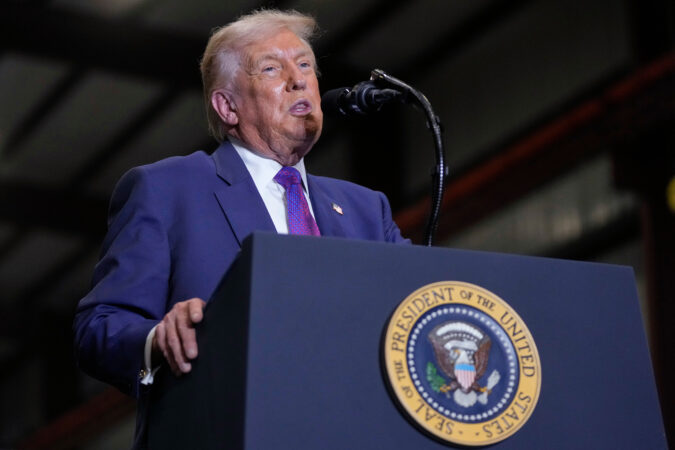
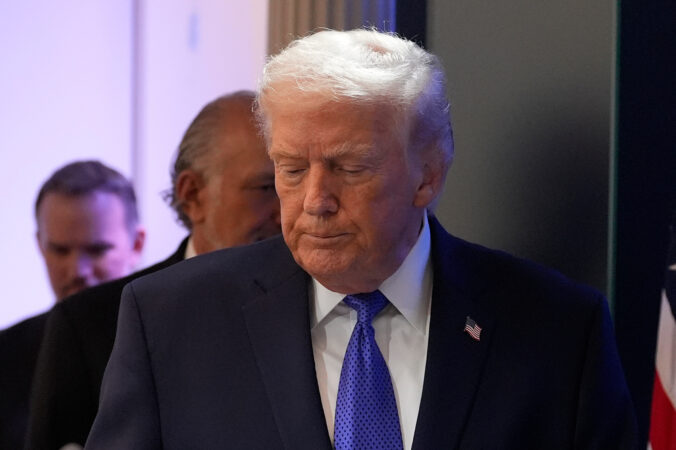
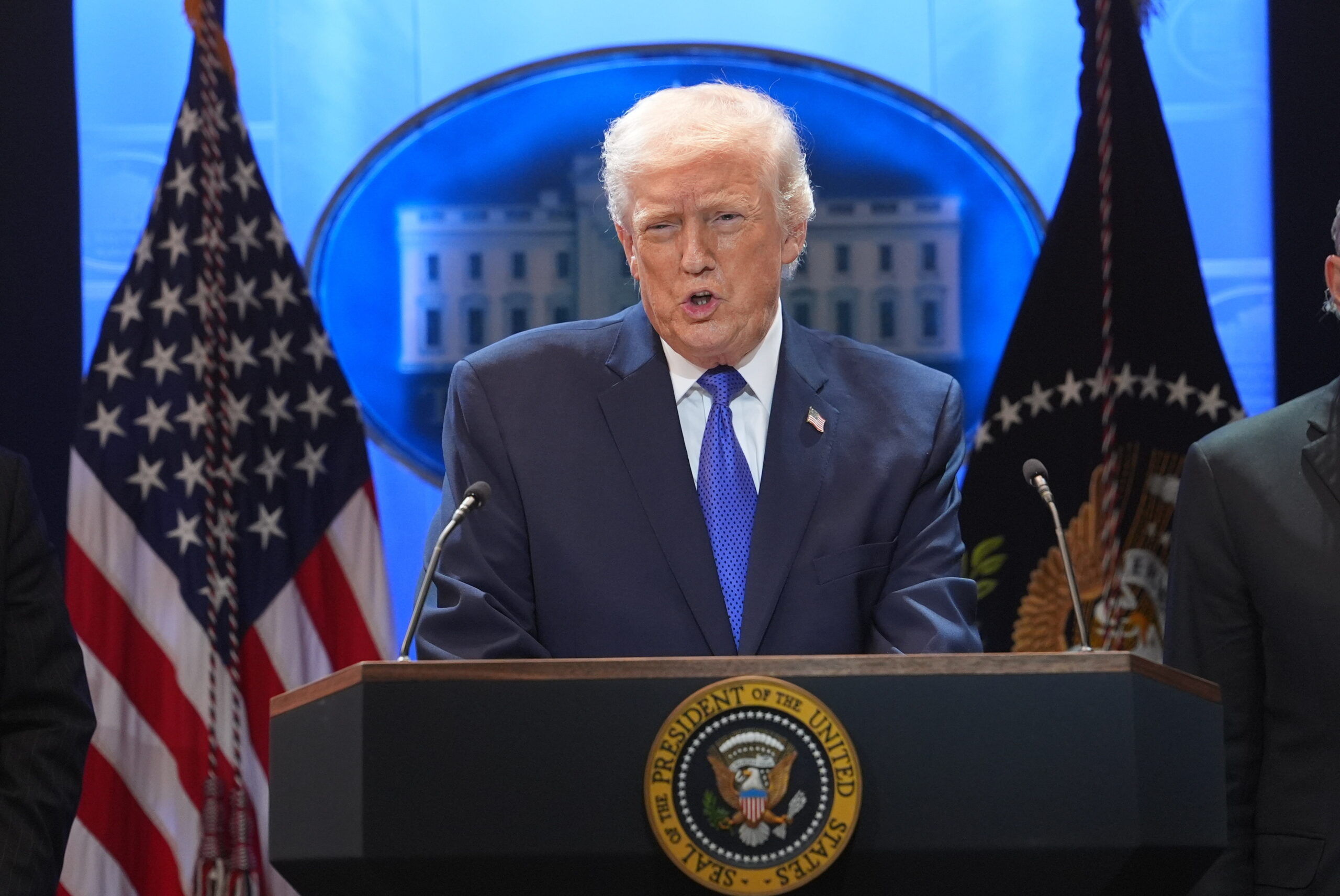
President Donald Trump slammed Republican-nominated Supreme Court justices who ruled against him Friday.
Pennsylvania lawmakers say Congress should reclaim its power over taxes and tariffs after the U.S. Supreme Court quashed President Donald Trump’s controversial global tariffs.
The nation’s high court ruled 6-3 Friday that Trump overstepped with tariffs imposed under an emergency powers law, dealing a significant blow to the president’s economic agenda and reasserting congressional authority.
Chief Justice John Roberts and Justices Neil Gorsuch and Amy Coney Barrett — both Trump nominees — joined liberal justices in the majority. Justices Brett Kavanaugh, Clarence Thomas, and Samuel Alito dissented.
Trump told reporters at the White House Friday that he was “ashamed” of the three Republican-appointed justices for not having “the courage to do what’s right for our country.”
But local lawmakers celebrated the decision as a step toward alleviating inflation exacerbated by Trump’s tariffs.
It’s “the first piece of good news that American consumers have gotten in a very long time,” said U.S. Rep. Brendan Boyle (D., Philadelphia), the ranking member of the House Budget Committee.
The decision is likely not the end of the road for Trump’s efforts to impose tariffs. The court struck down the broad authority Trump had claimed to impose sweeping tariffs but he could still impose additional import and export taxes using powers he employed in his first term.
President of Philly port operator says Supreme Court ruling ‘hard to interpret’
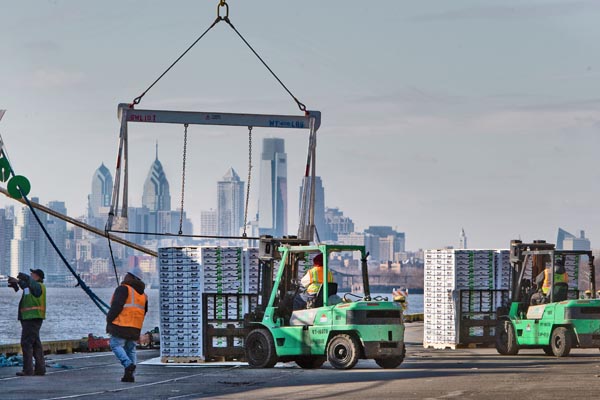
Workers move cargo at the Tioga Marine Terminal in Port Richmond.
Andrew Sentyz is president of Delaware River Stevedores, which operates the Port of Philadelphia’s publicly owned Tioga Marine Terminal in Port Richmond.
“It’s kind of hard to interpret,” he said of the Supreme Court ruling. “…I don’t know if I have a handle on what exactly it’s going to impact, and what it’s not. Some [tariffs] are still there, some are not.”
“Our business is a lot like a public utility in that there’s a demand and there’s a supply and we’re like the conduit the goods pass through,” he said. “…Trade policy massively affects how much moves or how much doesn’t move and in which direction.”
Sentyz said he’s cautiously optimistic about a normalization in trade.
“From the perspective that people have more certainty, I think it is welcome,” he said of the court ruling. “People receiving the cargo, they like a market that’s predictable. When it’s unpredictable it makes their business much harder. We’re impacted by how much they buy or sell.”
Will companies get refunds for paying tariffs the Supreme Court has now ruled were illegally imposed?
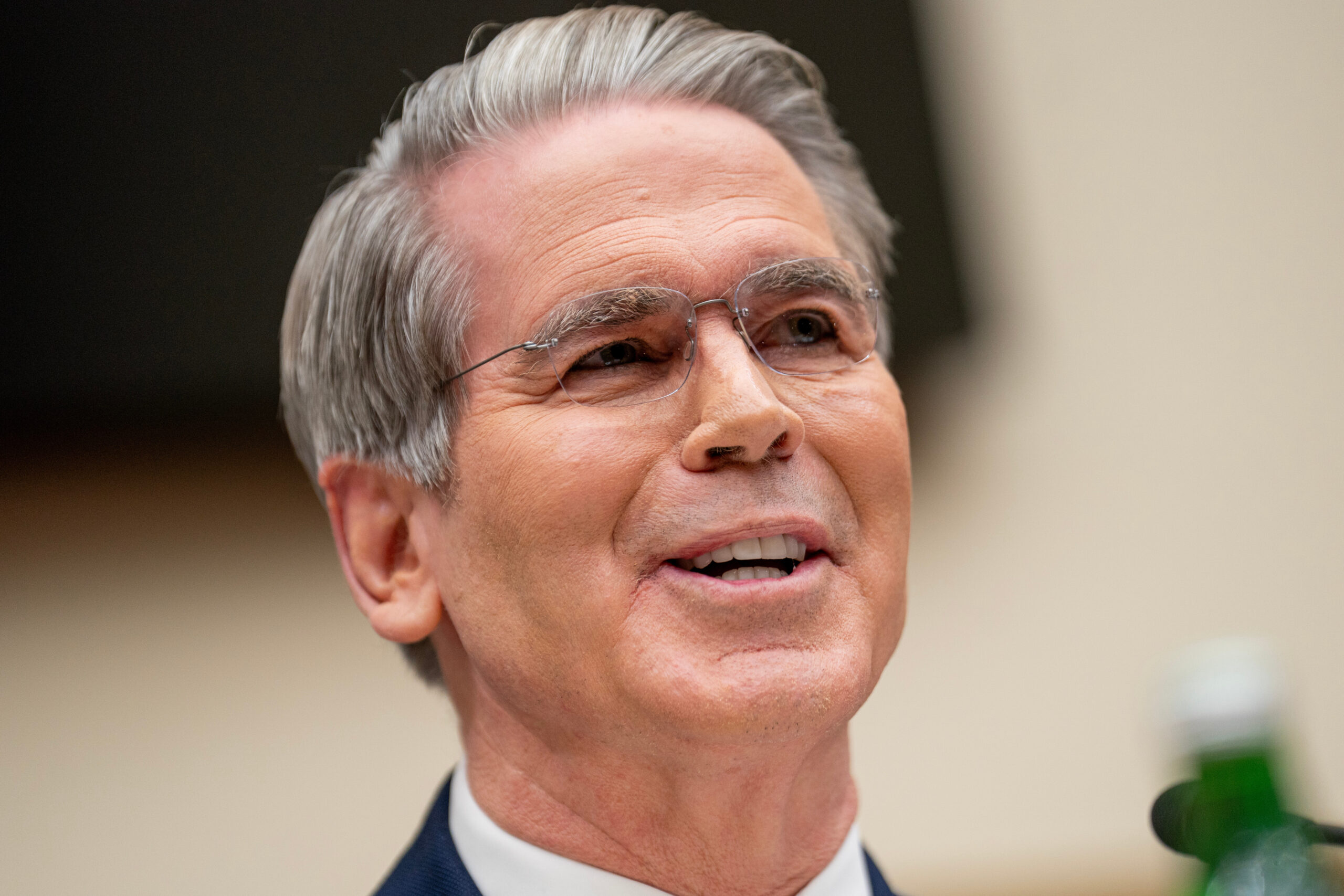
Treasury secretary Scott Bessent doesn’t think it’s likely.
“I got a feeling the American people won’t see it,” Bessent said during an interview at the Economic Club of Dallas Friday,
Bessent said he expects tariff revenue to be “virtually unchanged” in 2026 because the administration plans to turn to alternate methods to collect the levies.
Trump has already announced he plans to impose a 10% global tariff using an untested section of the 1974 Trade Act meant to address issues with international payments.
Reaction from Europe focuses on renewed upheaval, confusion
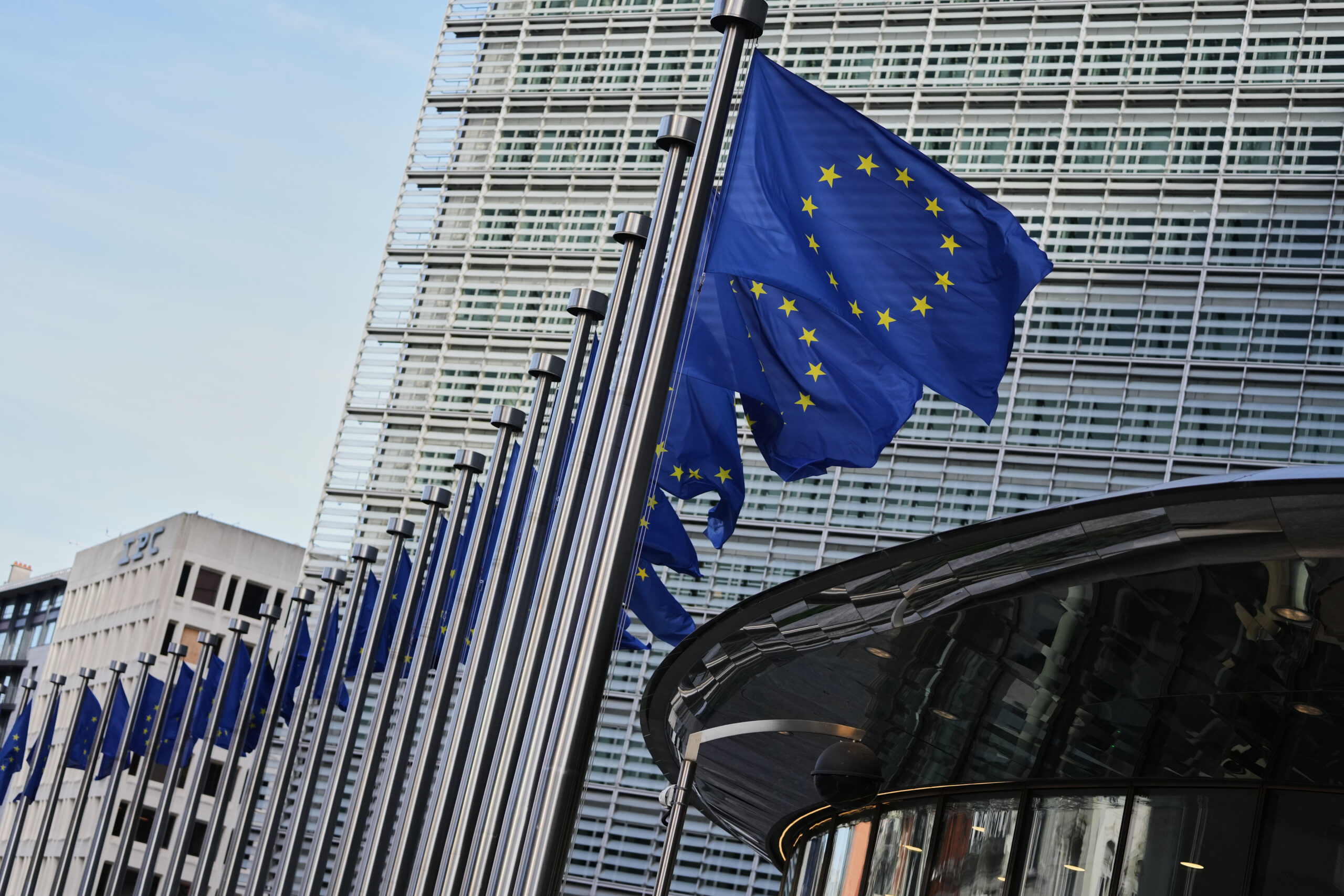
European Union flags flap in the wind outside of EU headquarters in Brussels.
The initial reaction from Europe focused on renewed upheaval and confusion regarding costs facing businesses exporting to the US.
The European Commission had reached a deal with the Trump administration capping tariffs on European imports at 15%. The deal gave businesses certainty that helped them plan, a factor credited with helping the 21 countries that use the euro currency skirt a recession last year.
“Uncertainty remains high for German enterprises doing business in the US,” said the German Chamber of Commerce and Industry. “Because there are other instruments for trade limitations in the hands of the US administration that German companies must prepare themselves for.”
Trump could resort to laws permitting more targeted tariffs that could hit pharmaceuticals, chemicals and auto parts, said Carsten Brzeski, global head of macro at ING bank: “Europe should not be mistaken, this ruling will not bring relief. … The legal authority may be different, but the economic impact could be identical or worse.”
— Associated Press
// Timestamp 02/20/26 3:08pm
Supreme Court ruling the beginning of a long legal battle
Among those following the issue, the Supreme Court ruling was “widely expected,” said Villanova University professor of international business Jonathan Doh.
In oral hearings, the Trump administration had argued that the tariffs were necessary due to trade disputes that constituted an emergency, said Doh, who had served as a trade policy negotiator during the 1990s.
However, the administration then touted the tariffs’ revenue-generating capacity — saying they’ve raised about $175 billion, Doh said. Supreme Court justices took notice of this when they weighed whether this was really an emergency.
“The justices spent as much time arguing about whether the remedy [for the trade dispute] was tariffs,” Doh said.
The 6-3 decision is having immediate effects, Doh said. Importers can no longer collect tariffs through this act. Companies are already looking for ways to recoup what they paid from the federal government. And the Trump administration has already announced it plans to implement “temporary” tariffs through another legal mechanism.
This “shifting playing field” only adds uncertainty to a business community that’s been watching tariffs closely since the start of Trump’s second term, Doh said. All of this will play out in legal battles in the lower courts.
“The decision was extremely significant, but it’s not the end of the story,” Doh said. “In some ways it’s just the beginning.”
Shapiro calls on Trump to ‘listen’ to the Supreme Court
Speaking to reporters on Friday, Gov. Josh Shapiro said he agreed with the Supreme Court’s decision to strike down Trump’s tariffs.
“I have made no bones about the fact that these tariffs are really harming,” the governor said. “I spend a lot of time on farmlands in our commonwealth. Farmers are getting killed by this.”
“We are hearing from folks in our rural communities sort of questioning why would the president do this,” Shapiro continued. “At the same time we’re seeing grocery prices go up, consumer goods go up, and there is a direct line connecting those price increases to the president pushing the tariff.”
Inflation reports show Trump’s tariffs inflated prices across household consumer items by as much as 5% at times.
Shapiro concluded by taking a jab at the president.
“I think the Supreme Court got it right. I say that as a former attorney general, and I say that as someone who actually follows the law,” he said. “And I think the president needs to actually listen to the Supreme Court and drop this and stop the pain for Pennsylvania and stop the pains for the Americans who are dealing with rising prices directly as a result of his tariffs.”
Bucks County Republican Rep. Brian Fitzpatrick ‘applauds’ Supreme Court decision
U.S. Rep. Brian Fitzpatrick (R., Pa.) is a moderate who represents Bucks County.
Casey-Lee Waldron, a spokesperson for U.S. Rep. Brian Fitzpatrick (R., Bucks), said in a statement Friday the lawmaker “applauds” the high court’s decision, “which validates the Congressman’s opposition to blanket and indiscriminate tariffs that are not narrowly tailored, and that do not lower costs for the American consumer.”
Waldron added that Fitzpatrick, a moderate who represents purple Bucks County, supports enforcing trade laws but that “This should always be done in a collaborative manner with a bipartisan, bicameral majority in Congress.”
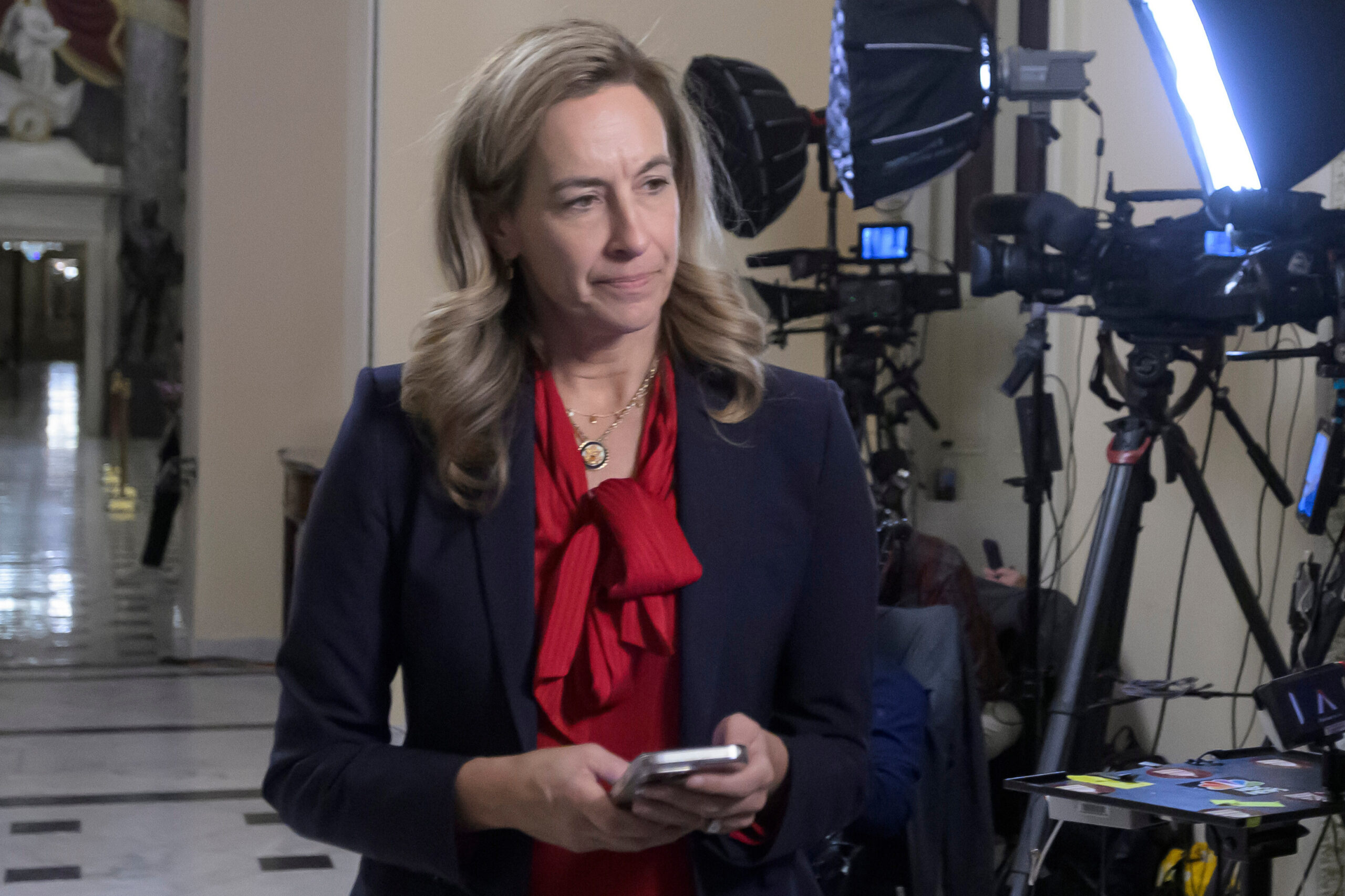
Rep. Mary Gay Scanlon, a Delaware County Democrat, joined the chorus of lawmakers applauding the decision Friday afternoon.
In a post to X she called the decision a “win for the American people.”
“If the President stands by his disastrous tariff policy, it’s because he doesn’t care about lowering costs for American families,” Scanlon wrote.
Trump says he’ll impose a 10% tariff on all countries using untested statute
President Donald Trump speaks with reporters Friday.
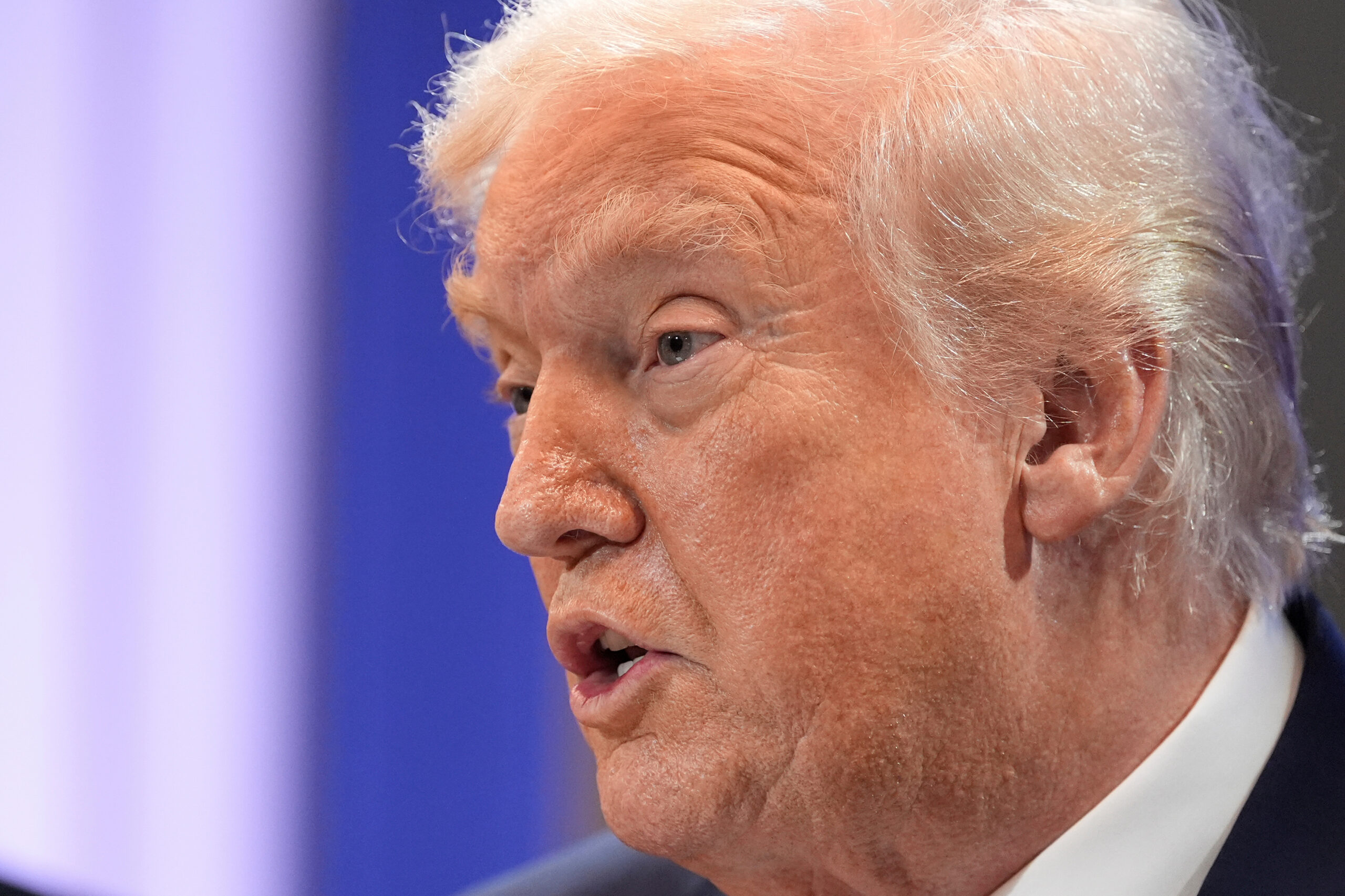
President Donald Trump told reporters he plans to sign an executive order enacting 10% global tariffs following the Supreme Court’s decision.
“Today, I will sign an order to impose a 10% global tariff under Section 122, over and above our normal tariffs already being charged,” Trump said Friday. “And we’re also initiating several section 301, and other investigations to protect our country from unfair trading practices of other countries and companies.”
Section 122, a statute created by the 1974 Trade Act, allows the president to impose temporary tariffs on countries to address issues with international payments. The statute, which has never been invoked by a president, limits tariffs to 150 days.
National Association of Manufacturers president: U.S. trade policy needs ‘clarity and durability’
Jay Timmons, president of the National Association of Manufacturers, said he and other leaders of the 14,000-member manufacturers’ group share President Trump’s goal of “ushering in the greatest manufacturing era.” But, he added, the court decision “underscores the importance of clarity and durability in U.S. trade policy.”
Timmons was in Philadelphia Friday morning to meet with leaders from the port, shipyard, Chamber of Commerce, and others in industry.
Stable tariffs and policies boost investment and hiring, but “legal and policy uncertainty make it more difficult” for American companies to compete, Timmons added in a statement. Since the court has ruled, “now is the time for policymakers to work together to provide a clear and consistent framework for trade.”
In the future, tariffs should be limited, according to the NAM leader. Timmons said punitive tariffs should target “specific unfair trade practices,” especially in “nonmarket” nations where government controls production.
NAM has pledged to work with Congress and the Trump administration on “durable” solutions to boost U.S. manufacturing and factory workers, he concluded.
‘Fools and lapdogs’: Trump says Republican-appointed Supreme Court justices lacked loyalty in tariff ruling
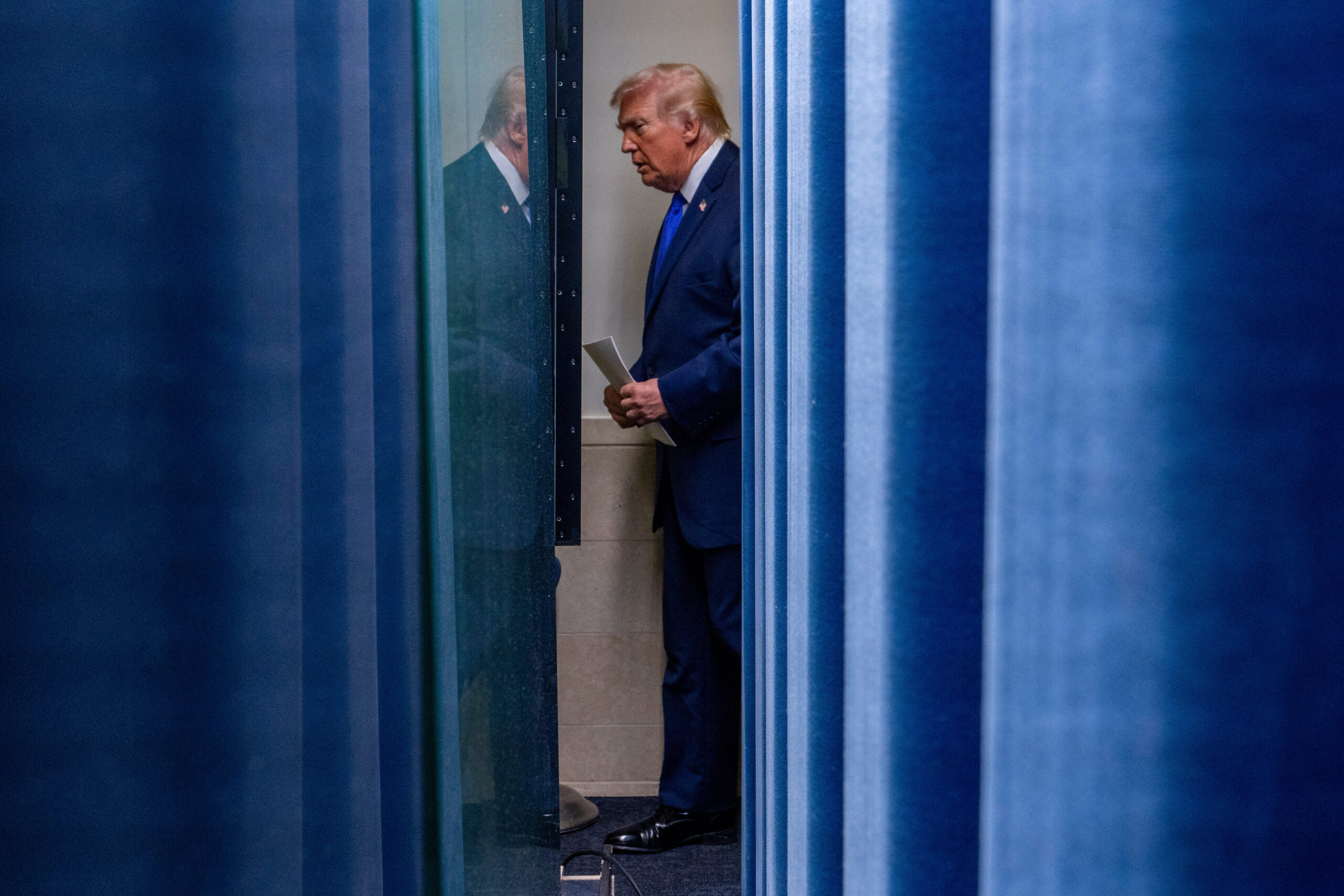
President Donald Trump speaks to reporters Friday.
President Donald Trump slammed three Republican-appointed Supreme Court justices for voting in favor of striking down his tariffs on foreign goods.
Two justices Trump nominated — Neil Gorsuch and Amy Coney Barrett — joined with chief justice John Roberts in ending Trump’s central economic policy.
Speaking to reporters at the White House Friday, Trump said he was “ashamed” the three justices — two of whom he nominated — didn’t have “the courage to do what’s right for our country.”
Trump also went after the court’s three Democratic appointees, calling them “automatic no” votes on any of his policies that make their way to the Supreme Court.
“You can’t knock their loyalty,” Trump said. “It’s one thing you can do with some of our people … They’re just being fools and lapdogs for the RINOs and radical-left Democrats.”
“Trump’s tariffs are FAR from over,” says Gene Marks, small business columnist for The Inquirer and founder of small-business consulting firm Marks Group in Bala Cynwyd.
Marks notes, “As Karoline Leavitt said back in June ‘we can walk and chew gum at the same time’ and as Scott Bessent said in December: ‘The administration will be able to replicate tariffs even if the SCOTUS rules against.’”
Some ways it could do so, Marks added, include:
The 1930 Smoot Hawley Act allows the U.S. to impose tariffs up to 50% on imports from countries that “discriminate” against U.S. goods through unfair duties, taxes, or regulations. But it requires congressional approval.
Section 122 of the Trade Act of 1974 gives the president “balance-of-payments” authority. This has a 150-day limit unless extended by Congress, and a 15% maximum rate.
Section 232 of the Trade Expansion Act of 1962/Section 301 of the Trade Act of 1974 allow tariffs on sectors or industries. These would require investigations and public comment.
“The only thing certain about tariffs in 2026 is that there will be a lot of uncertainty,” Marks said.
Tariffs had been impacting business at the Port of Philadelphia
Cranes at the Packer Avenue Marine Terminal in South Philadelphia.
Tariffs have slowed business at the Port of Philadelphia lately, with cargo volume down across the board — containers, steel, automobiles, and other commodities.
Philly is a major gateway for produce, bringing in more fresh fruit than any other U.S. port, largely from Central and South America. The port saw record container volume last year, handling almost 900,000 units, up 6% over 2024. About two-thirds of that cargo was refrigerated — fruit and meat, for example.
But the year got off to a slow start. “The story is increased competition and tariffs,” Sean Mahoney, marketing director at the Philadelphia Regional Port Authority (PhilaPort), said during the agency’s board meeting on Wednesday.
Container volume in January was down 14% over the year-earlier period. Auto imports fell 17%, and breakbulk cargoes (steel, paper, lumber) fell too. (Tariffs weren’t the only factor; Mahoney noted that ports in early 2025 happened to see more cargo than usual in part because shippers ordered more goods amid labor negotiations between employers and unions representing dockworkers.)
Shapiro hails Supreme Court decision to stop Trump’s ‘reckless approach’
Pennsylvania Gov. Josh Shapiro has been a vocal opponent of Trump’s tariffs.
Gov. Josh Shapiro, who has been a frequent critic of the tariffs, posted to X Friday applauding the Supreme Court’s decision.
“Donald Trump’s tariffs have been a disaster — wreaking havoc on Pennsylvania farmers, small business owners, and families who are just trying to make ends meet,” Shapiro wrote.
He urged Trump to follow the court’s ruling and “drop this reckless approach to economic policy that has done nothing but screw over Americans.”
New Jersey import-export company doesn’t expect it will be easy to get refunds
Now that the Supreme Court has made its decision, one big question for companies is whether they’ll be able to get refunds for the additional tariffs they’ve paid since “liberation day” 10 months ago, said Tim Avanzato, vice president of international sales at Lanca Sales Inc.
The New Jersey-based import-export company should be eligible for as much as $4 million in tariff refunds, Avanzato said. But getting that money is far from guaranteed.
“It’s going to create a paperwork nightmare for importers,” he said, and he doesn’t expect the Trump administration to make it easy.
He’ll also be on the lookout for other ways the Trump administration may implement tariffs, further complicating the matter.
Avanzato said President Trump was right when he said that other countries have been taking advantage of the U.S. with their tariffs — and in principle, the president was right to apply his own.
“He should have done more with a scalpel than with a bomb,” Avanzato said.
Though companies may be able to recoup some of what they lost, the same won’t go for consumers, he noted.
“Companies are not very good at passing on savings,” Avanzato said. “Nobody is going to rush to drop their prices.”
Supreme Court ruling brings uncertainty to Pennsylvania businesses
Canada is Pennsylvania’s biggest export market, with the state sending more than $14 billion in goods there in 2024.
The Supreme Court’s decision may be welcome news for U.S. businesses that pay the import taxes, but one immediate effect is more uncertainty as firms weigh whether to hire and make investments.
Not all of President Donald Trump’s tariff increases came through the use of the International Emergency Economic Powers Act and therefore some will remain in place, said Julie Park, a partner at London-based tax and business advisory firm Blick Rothenberg.
“This decision brings further uncertainty for businesses,” she said in a statement. That’s in part because Trump could seek to reimpose tariffs through other legal tools, leaving “businesses in limbo about if they will get refunded.”
U.S. exporters will also be closely following what happens next, since the fate of Trump’s tariffs will likely affect whether other countries like Canada keep their retaliatory measures in place. Canada is Pennsylvania’s biggest export market, with the state sending more than $14 billion in goods there in 2024. Top exports included machinery, cocoa, iron, and steel.
Pennsylvania’s dairy industry has also been caught in the middle of the global trade war, as China and Canada imposed extra taxes on those goods in response to U.S. tariffs.
President Donald Trump will hold a news briefing at 12:45 p.m. to address the Supreme Court’s ruling, White House Press Secretary Karoline Leavitt announced on social media.
// Timestamp 02/20/26 12:17pm
Gov. Mikie Sherrill, other New Jersey officials celebrate Supreme Court ruling
New Jersey Gov. Mikie Sherrill, seen here in November.
New Jersey Gov. Mikie Sherrill celebrated the court ruling on President Donald Trump’s tariffs, which she said have raised costs by $1,700 per New Jersey family and had a negative impact on small businesses and jobs.
“I’m thrilled that folks and businesses will start to see the relief they deserve – with no thanks to the president,” she added.
The new governor ran on a message combining affordability and fighting Trump. She took particular aim at his tariffs and visited small businesses in South Jersey to discuss their impact on local economies in the state.
Sen. Andy Kim, a South Jersey Democrat, said the Supreme Court’s decision is “a step” in righting wrongs by Trump’s administration, but that there’s “so much more to go.”
Calling the tariffs “unpopular and illegal,” the senator said the president cost Americans “a lot of money.”
“Trump 2.0: You pay for his tariffs, tax breaks for his billionaire donors, & insane corruption for his friends and family,” he added in a social media post.
Sen. Cory Booker, a North Jersey Democrat, lauded the Supreme Court for ruling “what we’ve all known: this administration cannot ignore the rule of law and Congress’ role to protect America’s economy from reckless and chaotic tariffs.”
“For nearly a year, Trump abused our trade tools to curry favors with foreign officials and exact revenge on his rivals, all while America’s working families and small businesses paid the price,” Booker said on social media. “Trump raised the cost on everything from the food we eat to the clothes we wear, and also failed to bring back good-paying jobs or fix our broken economy.”
Philly Rep. Dwight Evans calls on Congress to reassert its constitutional power
Congressman Dwight Evans, seen here in 2025.
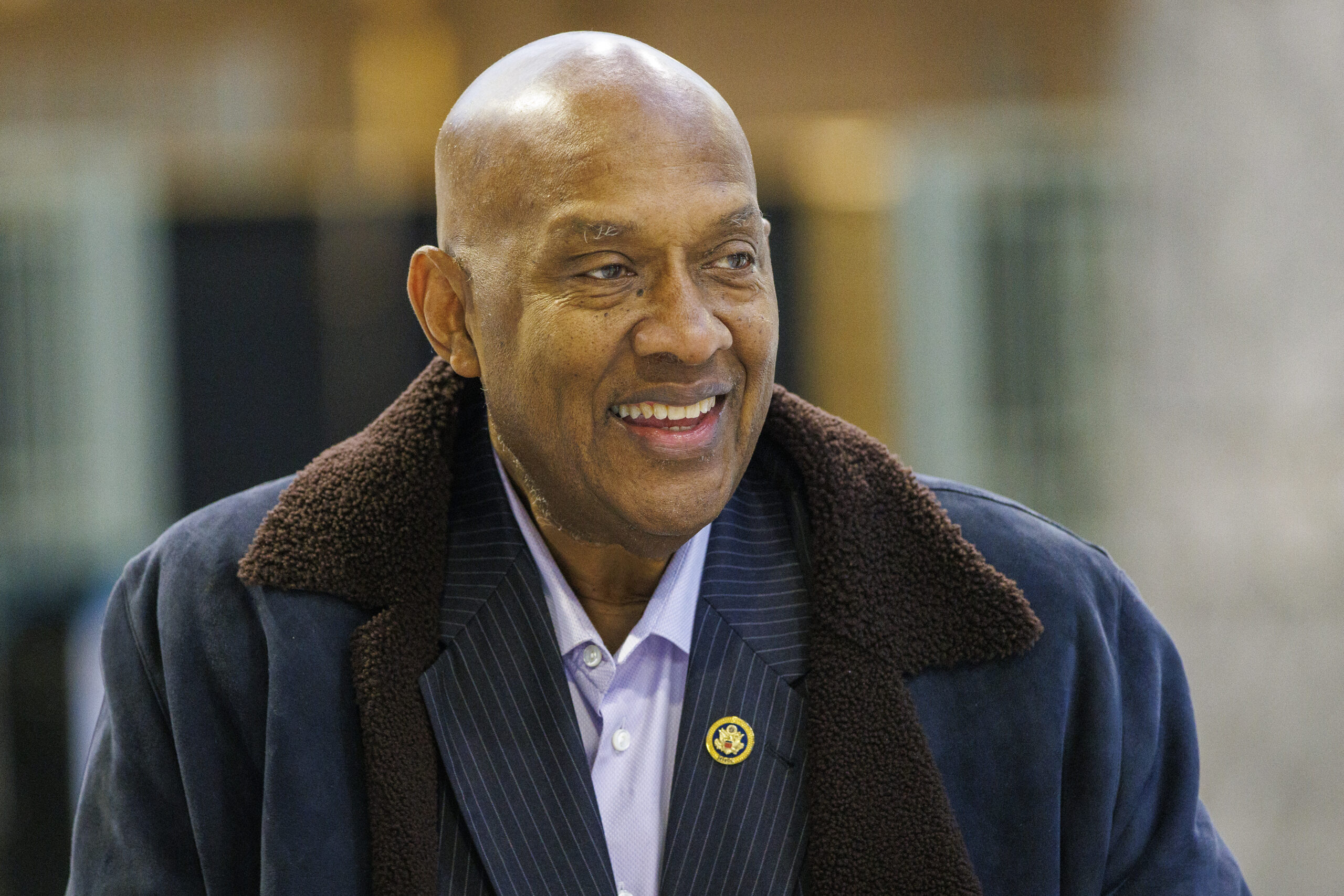
U.S. Rep. Dwight Evans (D., Pa.), who represents parts of Philadelphia, called the ruling a win for the wallets of Americans and called on Congress to reassert its power over the country’s economy.
“The Constitution is clear — only Congress has the power to levy tariffs and other taxes,” Evans wrote on social media. “I’m a co-sponsor of legislation to return this power to Congress — it’s long past time Republicans work with Democrats to pass it!”
The bill, which has no chance of passing in the Republican-controlled House, would require congressional approval for all new tariffs and the reversal of tariffs imposed on Mexico and Canada enacted through the United States-Mexico-Canada Agreement.
His call was echoed by Sen. Chuck Grassley, an Iowa Republican who serves as the chairman of the Senate Judiciary Committee.
In a statement, Grassley wrote, “I’ve made clear Congress needs to reassert its constitutional role over commerce, which is why I introduced prospective legislation that would give Congress a say when tariffs are levied in the future.”
President Trump described the Supreme Court decision as “a disgrace” when he was notified in real time during his morning meeting with several governors.
That’s according to someone with direct knowledge of the president’s reaction, who spoke on the condition of anonymity to discuss the private conversation. Trump was meeting privately with nearly two dozen governors from both parties when the decision was released.
— Associated Press
// Timestamp 02/20/26 11:03am
Brendan Boyle celebrates Supreme Court ruling as ‘good news’ for consumers
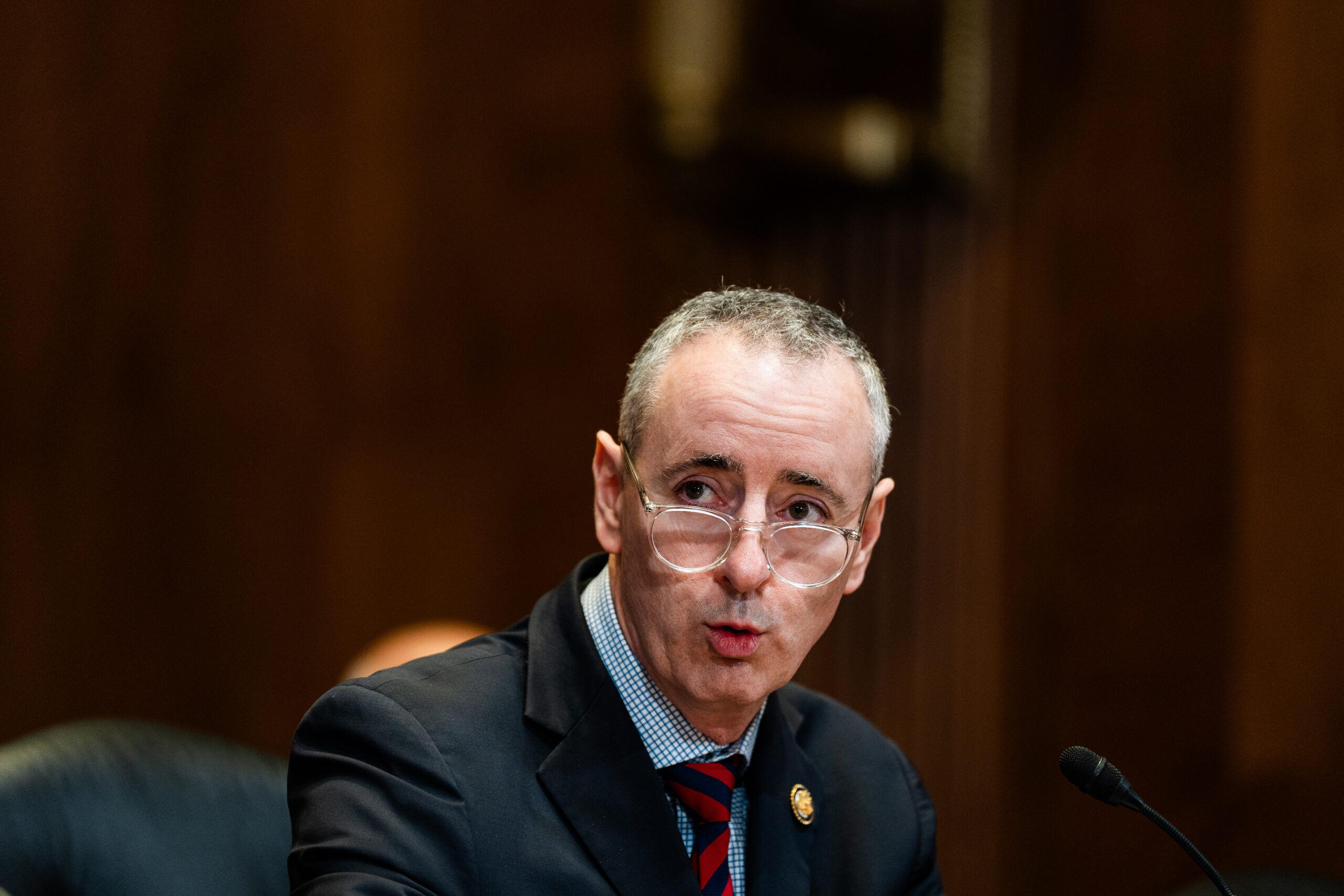
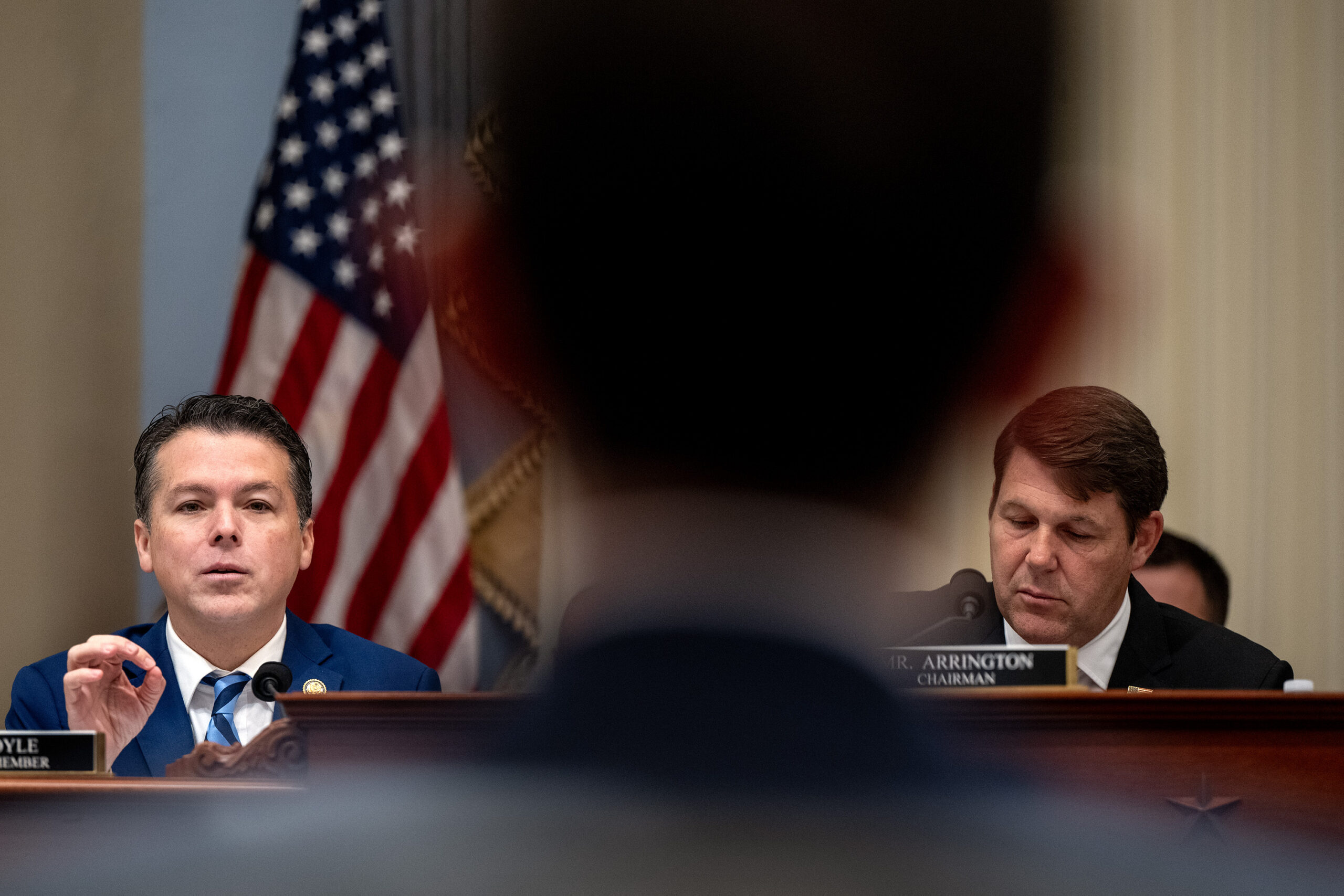
U.S. Rep. Brendan Boyle during a hearing on Capitol Hill in Washington, D.C., in November.
The decision is “the first piece of good news that American consumers have gotten in a very long time,” said U.S. Rep. Brendan Boyle (D., Philadelphia), the ranking member of the House Budget Committee, said in an interview Friday.
Boyle noted that the public will eventually see prices go down, but it remains unclear what will happen to tariff revenue that’s already been collected. But Pennsylvania lawmakers, including Boyle, are pushing for Congress to reassert its power to control the country’s purse strings.
“As the Supreme Court validated this morning, Congress has the authority to levy taxes and tariffs,” Boyle said. “It’s time now for us to finally reclaim that authority and bring some certainty and rationality to our tariff policy, which under Donald Trump has been all over the map and changes day by day, even hour by hour.”
Boyle and U.S. Rep. Dwight Evans (D., Philadelphia) have cosponsored a bill that would require congressional approval for all new tariffs and the reversal of tariffs imposed on Mexico and Canada enacted through the United States-Mexico-Canada Agreement. It’s unlikely that it will pass the Republican-controlled U.S. House.
Will businesses get refunds? One Supreme Court justice says the process will be a ‘mess’
Supreme Court Justice Brett Kavanaugh, who was one of three who ruled against striking down the tariffs.
Companies have collectively paid billions in tariffs. Many companies, including the big-box warehouse chain Costco, have already lined up for refunds in court, and Justice Brett Kavanaugh noted the process could be complicated.
“The Court says nothing today about whether, and if so how, the Government should go about returning the billions of dollars that it has collected from importers. But that process is likely to be a ‘mess,’ as was acknowledged at oral argument,” Kavanaugh wrote in the dissent.
We Pay the Tariffs, a coalition of more than 800 small businesses that has been advocating against the tariffs, said a process for refunding the tariffs is imperative.
“A legal victory is meaningless without actual relief for the businesses that paid these tariffs,” executive director Dan Anthony said in a statement. “The administration’s only responsible course of action now is to establish a fast, efficient, and automatic refund process that returns tariff money to the businesses that paid it.”
— Associated Press
// Timestamp 02/20/26 10:36am
The Supreme Court strikes down Trump’s tariffs
The Supreme Court struck down President Donald Trump’s far-reaching global tariffs on Friday, handing him a significant loss on an issue crucial to his economic agenda.
The 6-3 decision centers on tariffs imposed under an emergency powers law, including the sweeping “reciprocal” tariffs he levied on nearly every other country.
It’s the first major piece of Trump’s broad agenda to come squarely before the nation’s highest court, which he helped shape with the appointments of three conservative jurists in his first term.
The majority found that the Constitution “very clearly” gives Congress the power to impose taxes, which include tariffs. “The Framers did not vest any part of the taxing power in the Executive Branch,” Chief Justice John Roberts wrote.
Justices Samuel Alito, Clarence Thomas, and Brett Kavanaugh dissented.
“The tariffs at issue here may or may not be wise policy. But as a matter of text, history, and precedent, they are clearly lawful,” Kavanaugh wrote in the dissent.
The economic impact of Trump’s tariffs has been estimated at some $3 trillion over the next decade, according to the Congressional Budget Office. The Treasury has collected more than $133 billion from the import taxes the president has imposed under the emergency powers law, federal data from December shows. Many companies, including the big-box warehouse chain Costco, have already lined up in court to demand refunds.
— Associated Press
// Timestamp 02/20/26 10:34am
Trump could still impose tariffs under other laws
The Supreme Court’s tariffs decision doesn’t stop President Donald Trump from imposing duties under other laws.
While those have more limitations on the speed and severity of Trump’s actions, top administration officials have said they expect to keep the tariff framework in place under other authorities.
“It’s hard to see any pathway here where tariffs end,” said Georgetown trade law professor Kathleen Claussen. “I am pretty convinced he could rebuild the tariff landscape he has now using other authorities.”
The Constitution gives Congress the power to levy tariffs. But the Trump administration argued that a 1977 law allowing the president to regulate importation during emergencies also allows him to set tariffs. Other presidents have used the law dozens of times, often to impose sanctions, but Trump was the first president to invoke it for import taxes.
Trump set what he called “reciprocal” tariffs on most countries in April 2025 to address trade deficits that he declared a national emergency. Those came after he imposed duties on Canada, China, and Mexico, ostensibly to address a drug trafficking emergency.
A series of lawsuits followed, including a case from a dozen largely Democratic-leaning states and others from small businesses selling everything from plumbing supplies to educational toys to women’s cycling apparel.
The challengers argued the emergency powers law doesn’t even mention tariffs and Trump’s use of it fails several legal tests, including one that doomed then-President Joe Biden’s $500 billion student loan forgiveness program.
— Associated Press
Two Trump Supreme Court appointees ruled against his tariffs
Chief Justice John Roberts wrote the court’s majority opinion, joined by Justices Neil Gorsuch and Amy Coney Barrett, two of Trump’s three Supreme Court picks. The three liberal justices were also part of the majority.
Justice Brett Kavanaugh, Trump’s other appointee, wrote the main dissent, joined by Justices Clarence Thomas and Samuel Alito.
Whatever unfolds almost certainly won’t resemble what came down from the skies on Jan. 25 or its obstructive aftermath, but accumulating snow Sunday into Monday is looking more likely.
The National Weather Service on Friday listed a 90% chance of precipitation, with a 75% likelihood of two inches or more of snow for the immediate Philadelphia region, and about a one in three shot of at least six inches.
And add about a 100% chance of uncertainty regarding how this would play out, said Richard G. Bann, a forecaster with the National Oceanic and Atmospheric Administration’s Weather Prediction Center, in College Park, Md.
Computer models continued to show a wide range of outcomes from a storm that was still two days away from developing, ranging from a gentle snowfall to a school and road closer. Expect differences to persist.
In addition to snow, a potent storm with powerful onshore winds could result in coastal flooding, the weather service office in Mount Holly advised.
“I don’t think we would jump to either end of the extremes,” Bann said, “but we can’t say anything is completely out of the realm of possibility just yet.”
The storm would evolve from multiple moving parts before maturing off the Southeast coast, he added. “Part of the equation is starting to come together but we’re still not there yet.”
By Saturday, he said, “hopefully we’ll kind of know what part of the chessboard we’re working on.”
When snow might begin in the Philly region
Timing issues are among those likely to be fine-tuned in the next couple of days, but the early thinking is that snow, or rain changing to snow, would arrive in the Philly region Sunday morning or in the afternoon, continuing into Monday.
The intensity of the snow and winds would depend on the strength of the storm, precisely where over the ocean it ripens, and the eventual track.
The U.S. model has been bullish on bringing it close enough for a major snowfall along I-95. The other models, not so much, but the weather service noted that one of the balkers, the European, had come on board with at least light accumulations for the region.
“We’re definitely going to be spinning up an area of low pressure,” Bann said, “but exactly what that means for D.C., Philly — any of us — is still in question.”
But on the plus side: No ice is expected in this go-round.
So much for the remnants of Jan. 25
One of the most-stubborn snowpacks in the period of record, which has mutated into one of the uglier snowpacks in the period of record, should be pretty much erased by the time any flakes start falling Sunday.
Submerged objects have been reappearing, evoking a surfacing submarine, and bare ground is becoming ever more visible.
A decent, soaking rain on Friday — perhaps double Philly’s month total so far, a mere 0.25 inches — and temperatures in the 40s, combined with a sunny Saturday with high near 50 degrees, should pretty well clear the yards. Those plowed-snow mountains are likely to survive a while longer.
The snowpack’s tenacity had everything to do with the two to three inches of sleet — melt-resistant white ice — that fell atop the several inches of snow on Jan. 25. The entire mess was locked in by an Arctic freeze.
Bann endured similar conditions in his area, and recalled that it was way harder to move out of the way than the Mid-Atlantic mega-snows of February 2010, when 35 to 45 inches accumulated.
He said he shoveled awhile, took a break, and then was astonished to see that his neighbors were finishing his work.
Asked if he sent them any thank-you gifts, he replied: “I haven’t stopped.”
By 2019, after a decade of producing dozens of documentaries about Philadelphia history, the filmmakers at History Making Productions realized they had more than just the story of a city.
They had the story of America.
On Friday, the studio released its epic, new telling of that 400-year-old story: In Pursuit: Philadelphia and the Making of America. Directed by documentary filmmaker Andrew Ferrett and written by author and historian Nathaniel Popkin — and mixing modern footage with historical recreation and more than 600 on-camera interviews — the 10-episode series explores the history of America through the lens of Philadelphia, its birthplace.
Belinda Davis as Sarah Forten in “In Pursuit: Philadelphia and the Making of America.”
Timed to coincide with the 250th anniversary of the Declaration of Independence in 2026, known as the Semiquincentennial, the series provocatively grapples with urgent questions, like how did the American experiment actually unfold? And how can it endure?
“Philadelphia is not just the birthplace of American democracy — it has been its proving ground,” said Sam Katz, series creator, executive producer, and founder of History Making Productions. “This series looks honestly at how ideals were formed, challenged, expanded, and sometimes betrayed, and why that history matters so urgently.”
‘A national moment’
Spanning 400 years of Philadelphia history, from its indigenous roots to the MOVE Bombing the series is equal parts entertainment and civic project. Funded by Katz and philanthropies like Pew Center for Arts & Heritage, Penn Medicine, and Lindy Communities, the series premiered at the National Constitution Center on Thursday.
Episode One is now streaming online. Katz and the filmmakers will host screenings and community conversations at Pennsbury Manor in Bucks County on Sunday, and another screening Feb. 26 at the Bok Building in South Philadelphia.
Throughout 2026, as the city and country celebrate the national milestone, a citywide “In Pursuit of History Film Festival” will promote each new installment with monthly screenings and public events. 6ABC will also air monthly hourlong shows to highlight new episodes.
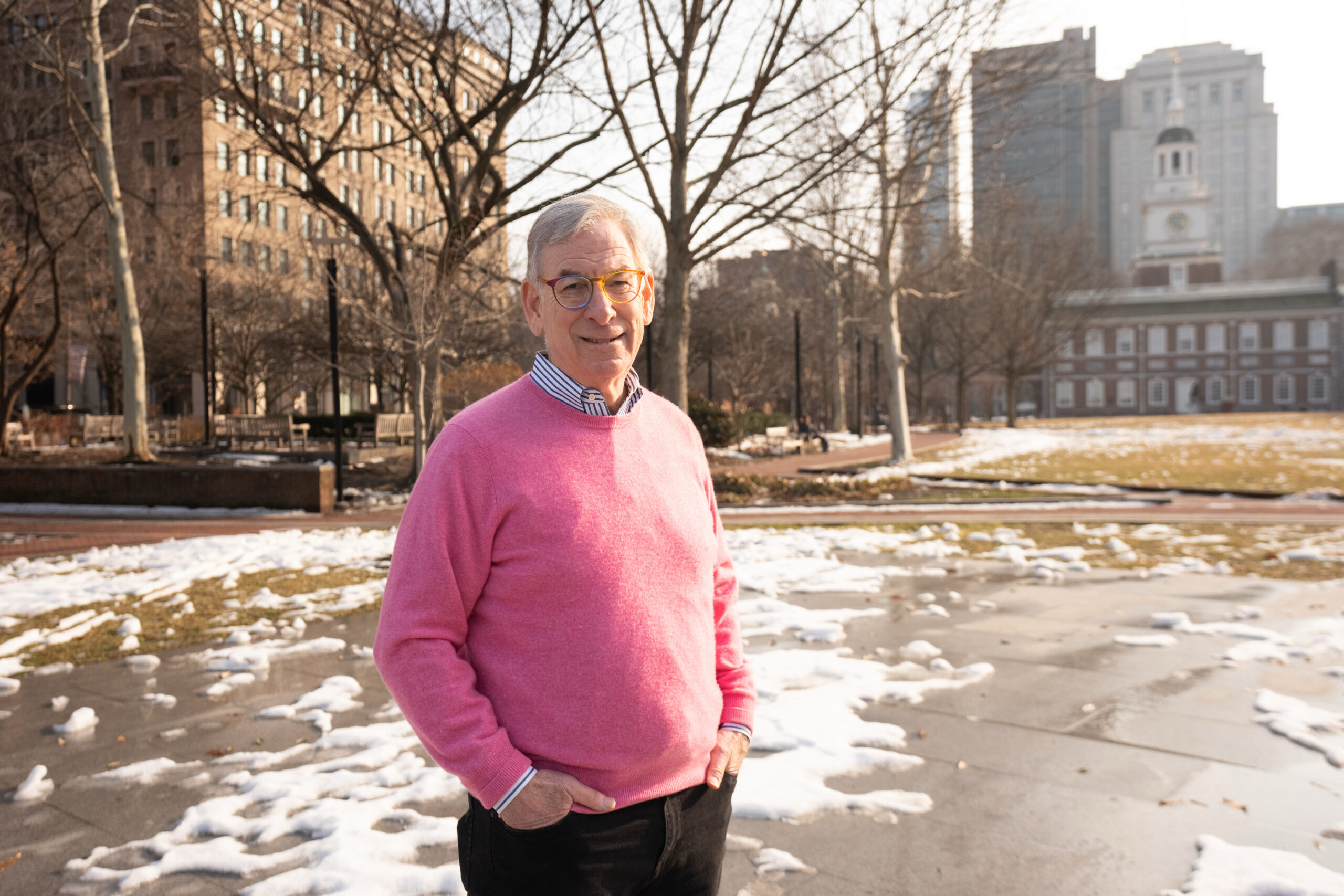
Sam Katz at Independence Hall, in Philadelphia, Tuesday, Feb. 17, 2026, in Philadelphia
From the beginning, the project was meant to get people talking about the true meaning of the American experience, and those it has left behind.
“We’re going to get partners all over the city, and we’re going to have screenings all over the place,” said Katz, the civic-leader-turned-producer. “We’re going to create opportunities for people to come and meet the filmmakers, or meet a historian or an artist, who will then lead a conversation. It really is an opportunity for Philadelphia to take stock of itself.”
Popkin, who co-founded Hidden City Daily, said the project tells the story of events that shaped a city and a country founded on ideals not yet fully realized — and now divided and tested as they’ve been in decades.
“The timing is perfect,” he said. “I think a film can really launch a lot of conversations. This is a moment for us as a nation.”
Fresh portals
Ferrett, who grew up in Bucks County, and has been directing and producing films at History Making Productions for more than 15 years, said the project revealed itself.
For earlier Philly projects — including The Great Experiment, an Emmy-award winning, 14-part docuseries spanning 500 years of Philly history, and Urban Trinity: The Story of Catholic Philadelphia — the filmmakers had amassed hundreds of unused hours of interviews with local and national historians, artists, and cultural leaders.
Over the years, much of it had to be left on the cutting room floor, including magical moments that he said opened fresh portals to Philly history, said Ferrett.
“We talked to pretty much anyone you can imagine who was either involved with studying Philadelphia history, or in the case of 20th-century history, a lot of witnesses to it,” he said.
Poet Ursula Rucker during filming of “In Pursuit: Philadelphia and the Making of America.” The new 10-part docuseries examines the history of America, through the story of Philadlephia.
Besides, he said, nowhere else could hold a better mirror to America, than the place of its birth.
“It really became obvious to us that what we have here is much more than a local history,” he said. “It’s a history of the whole United States because so many consequential moments that shaped the country’s history went through Philadelphia.”
History that feels alive
Setting out to tell the story anew, Katz raised money to shoot updated interviews and fresh historical recreations.
Meanwhile, history did not slow down, from the COVID-19 pandemic, to the killing of George Floyd, and the Black Lives Matter movements, to Trump, and immigration crackdowns.
“We were asking how do we deal with history while all this is happening,” Katz said. “We were writing about it right now.”
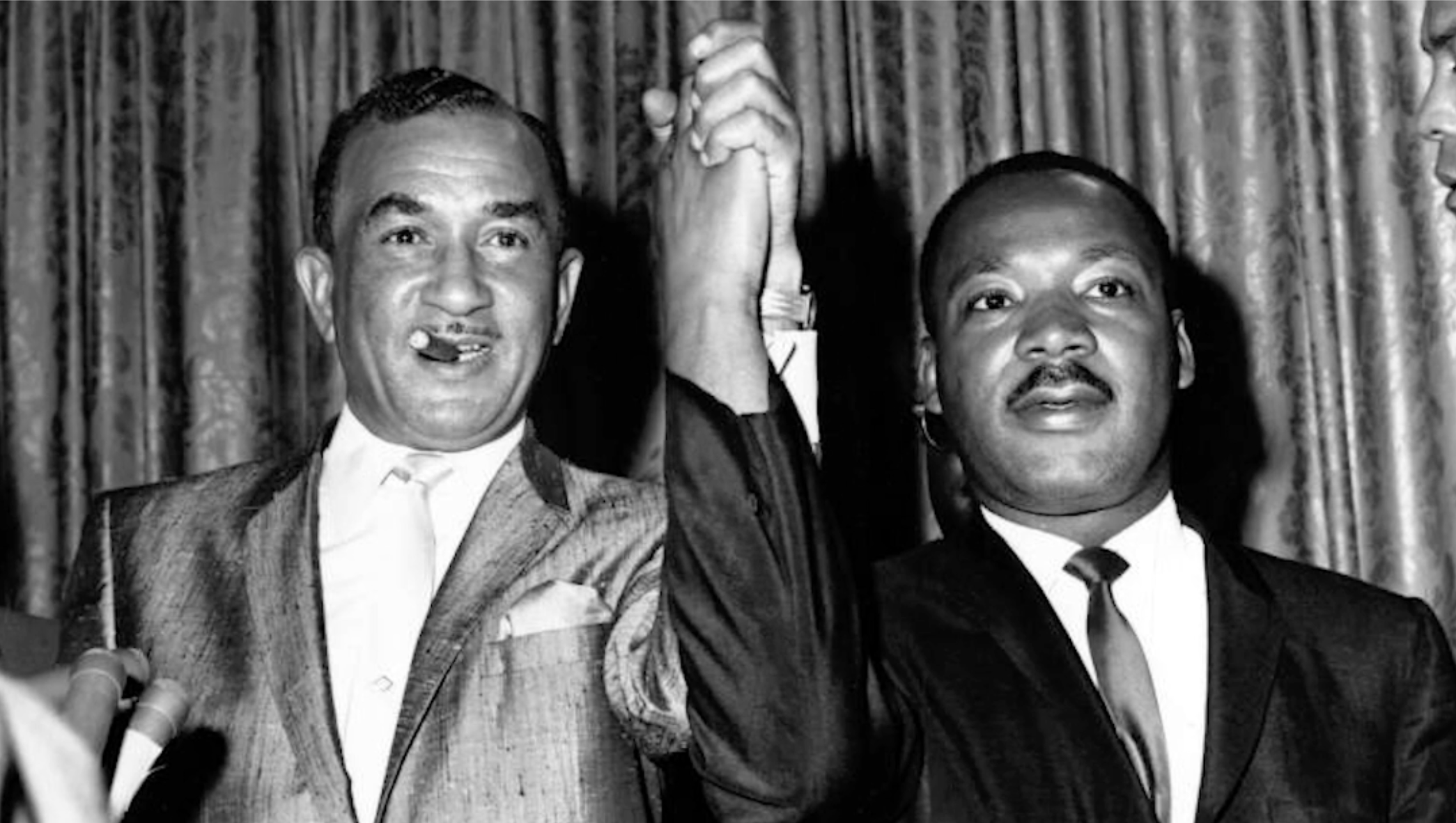
Cecil B. Moore and Martin Luther King, Jr in footage from “In Pursuit: Philadelphia and the Making of America.”
Narrated in a warm, resonant baritone by actor Michael Boatman, known for roles in shows Spin City and The Good Wife, In Pursuit is no dull, black-and-white history. The city feels alive, the stakes serious and undecided.
Threading modern day footage of bustling Philly streetscapes and soaring neighborhood shots with commentary and historical recreations imprints the series with a powerful immediacy.
The story stretches far beyond 1776, though the dramatic details of that sweltering summer in Philadelphia are recounted in episode three in gripping scenes of refreshingly believable historical recreations.
“We were able to shoot these lush and full reenactments,” said Ferrett, of all 10 episodes. “Sam was always like, ‘Where’s the dirt? I don’t want to see people with perfect teeth and smiling.’”
The start
Episode One, “Freedom (to 1700),” begins at the beginning, pulling no punches as it tells the story of the Lenape people, Philadelphia’s earliest Indigenous settlers — and of the generations of Dutch and other European colonists’ efforts to eradicate them through violence and disease.
It surprises even in the telling of William Penn, recounting how the rebellious aristocrat’s non-conformist ways landed him in jail more than once, before he founded a City of Brotherly Love meant to be a better world, and a testing ground of the most advanced ideals in Europe.
The episode also showcases what Ferrett describes as “deepeners,” when the story cuts away from the arc of history for moments of reflection from modern Philly voices.
“We all feel it here … it’s all in our bloodstream,” poet Ursula Rucker says in the episode. “What does this city mean to me? Everything. Everything.”
In the wake of the U.S. Bicentennial, in which Philadelphia was at the center of a yearlong celebration of the country’s 200th birthday, one of the city’s contributions to public health was put on the chopping block.
On Feb. 15, 1977, city officials confirmed that Mayor Frank Rizzo was closing Philadelphia General Hospital.
The poorhouse
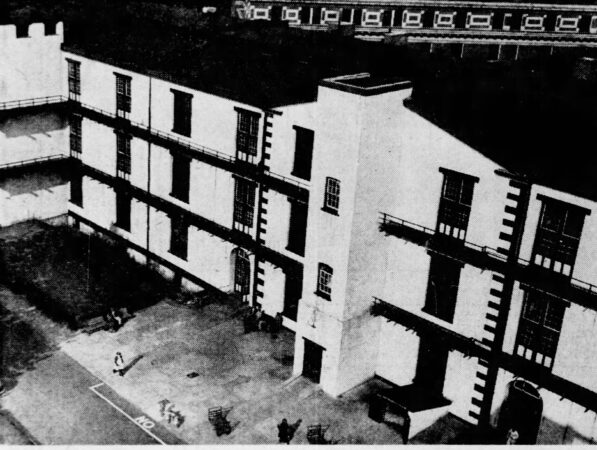
Philadelphia General Hospital traced its lineage back to 1729, predating even therevered Pennsylvania Hospital, which was founded in 1751 andis generally considered the nation’s first chartered hospital.
Philadelphia General Hospital was originally established at 10th and Spruce Streetsas an almshouse, also known as an English poorhouse.
“The institution reflected the idea that communities assume some responsibility for those unable to do so themselves,” Jean Whelan, former president of the American Association for the History of Nursing, wrotein 2014.
The almshouse was used as housing for the poor and elderly, as well as a workhouse. It also provided some psychiatric and medical care.
It moved in the mid-1800s into what was then Blockley Township, atwhat is now 34th Street and Civic Center Boulevard, and began offering more traditional medical services. The Blockley Almshouse’s barrage of patients and their variety of maladies helped it naturally grow into a teaching tool for nursing and medical students.
And by turn of the 20th century, it had become a full-blown medical center, made official by its new name: Philadelphia General Hospital.
But it held onto its spirit.
Its doors were open to anyone who needed care, no matter that person’s race, ethnicity, class, or income.
Healthcare was a given. Workers saw it as a responsibility.
Even if it wasn’t always the best care.
Poor health
The hospital relied on tax dollars, and as a result was often short on staffing and low on supplies. It was a source of political corruption, scandal,and discord among its melting pot of patients.
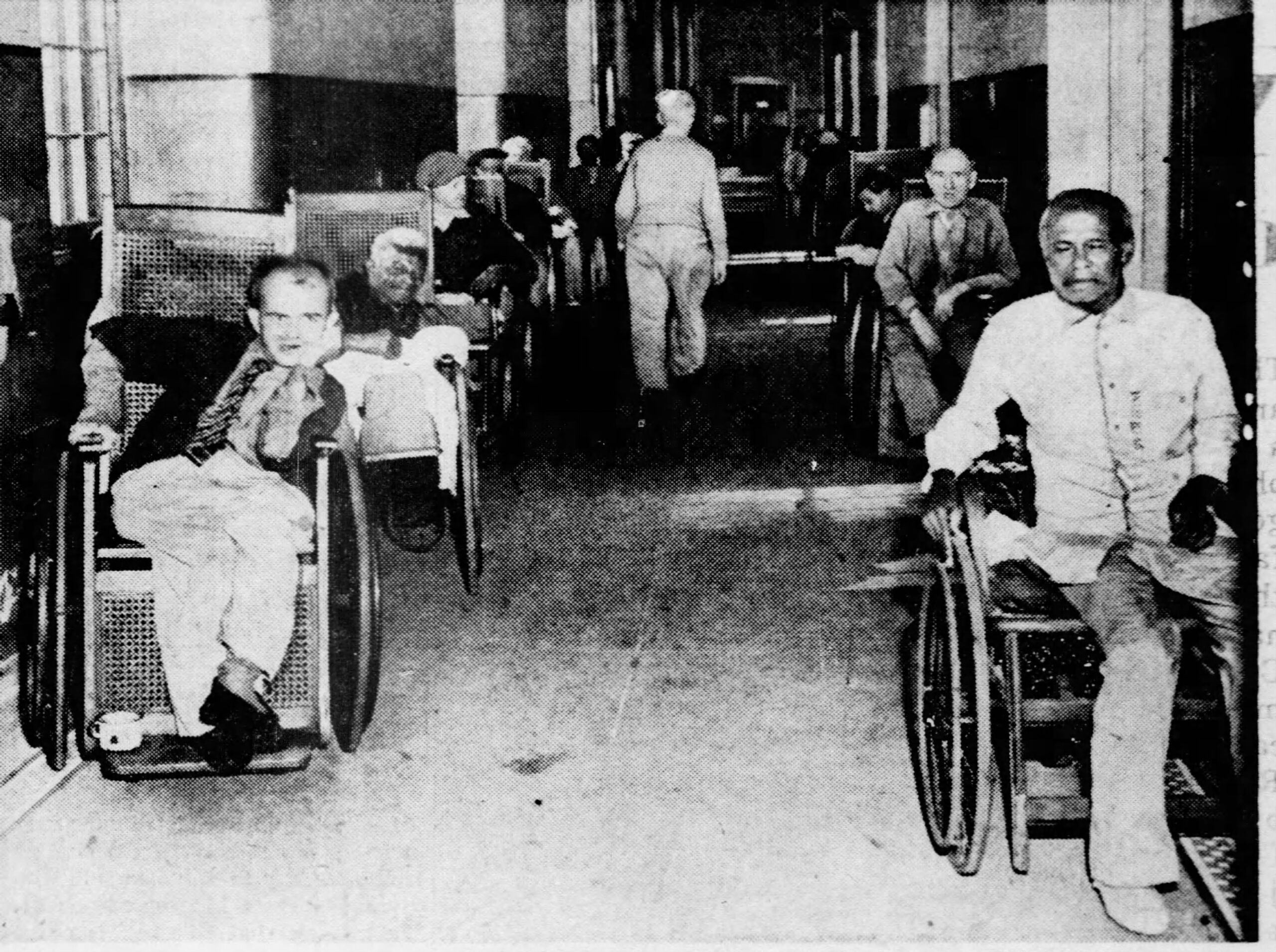
Patients in the hallways of Philadelphia General Hospital in the 1940s.
Eventually, it collapsed under the weight of its mission.
Its facilities became outdated, its services could not keep up, and its role as educator was outsourced to colleges and universities.
Philadelphia General Hospital’s closure left a gaping hole in available services in West Philadelphia. It was no longer there to help support the uninsured.
Before it officially closed in June 1977, it was considered the oldest tax-supported municipal hospital in the United States.
“There’s a common misunderstanding that PGH recently has become a poor people’s hospital,” said Lewis Polk, acting city health commissioner, in 1977. “It’s always been a poor people’s hospital. The wealthy never chose to go there.”
Its old grounds are now occupied by several top-rated facilities, including Children’s Hospital of Philadelphia and the University of Pennsylvania medical campus.
A historical marker there notes Philadelphia General Hospital’s nearly 250 years of service to the community.
Think you know your news? There’s only one way to find out. Welcome back to our weekly News Quiz — a quick way to see if your reading habits are sinking in and to put your local news knowledge to the test.
Question 1 of 10
This iconic Philly sculpture has been temporarily removed from its perch at Sister Cities Park so it can be restored by original artist Robert Indiana’s foundation after years of UV and weather exposure.
CorrectIncorrect. XX% of other readers got this question right.
Indiana’s AMOR sculpture was removed on Wednesday for conservation and restoration. The sculpture was transported to Fine Finishes Painting Studio in Peekskill, NY, where conservators approved by the Robert Indiana Foundation will strip and repaint it. It’ll be back in May.
Question 2 of 10
After 96 years, Pat’s King of Steaks is changing how it makes cheesesteaks and is offering a new ingredient option. What is it?
CorrectIncorrect. XX% of other readers got this question right.
Owner Frank Olivieri said his father didn’t want seeded rolls. “But since my father unfortunately passed several weeks ago, I thought maybe it’s time to change up a little bit,” he said. Pat’s announced the “new school” seeded-roll option on Instagram as a limited-time offering, but Olivieri said it likely will be permanent. (Across the street, Geno’s still offers plain rolls only.)
story continues after advertisement
Question 3 of 10
What is the proposed replacement for the site of the Broad Street Diner, which continues to operate but has held demolition permits since 2022?
CorrectIncorrect. XX% of other readers got this question right.
On Tuesday, plans for a six-story Hyatt Studios hotel were posted on the Philadelphia Planning Commission’s website. The proposal includes 105 hotel rooms and 42 underground parking spaces. Hyatt Studios is a recently launched extended-stay brand of the larger hotel chain.
Question 4 of 10
A federal judge ordered the Trump administration to restore the slavery exhibits that were removed from Philly’s President’s House. In her 40-page opinion, Judge Cynthia M. Rufe compared the federal government’s removal to this novel:
CorrectIncorrect. XX% of other readers got this question right.
Rufe, a George W. Bush appointee, compares the federal government’s argument that it can unilaterally control the exhibits in national parks to the Ministry of Truth in George Orwell’s 1984, a novel about a dystopian totalitarian regime. The Trump administration has appealed. National Park employees began restoring the exhibit Thursday.
Question 5 of 10
Philadelphia bars Grace & Proper, Sonny’s Cocktail Joint, and WineDive, produce and serve this signature liqueur:
CorrectIncorrect. XX% of other readers got this question right.
Ginjinha, a classic sour cherry Portuguese liqueur, is enjoyed in its home country across sidewalk-facing counters and to-go windows. In the Philly area, you’ll be hard-pressed to find it at most establishments — except for the bars owned and operated by Chris Fetfatzes’ Happy Monday Hospitality: Sonny’s on South Street, Grace & Proper in Bella Vista, and WineDive in Rittenhouse.
Subscribe to The Philadelphia Inquirer
Our reporting is directly supported by reader subscriptions. If you want more journalism like this story, please subscribe today.
For the 800th episode of The Simpsons, the show showcased Philadelphia and parodied National Treasure. Which Philly-tied celebrity was not featured in the episode?
CorrectIncorrect. XX% of other readers got this question right.
When Homer Simpson and his family arrive in Philly, passing a welcome sign calling the city “The Big Scrapple,” a hotel concierge played by Kevin Bacon greets them. “We offer 24-hour room service from our full Boyz to Menu. If you need a wooder or any other jawn just ring the Patti LaBelle and we’ll send a jabroni right up,” he said. Quinta Brunson, Questlove, and The Roots were featured in the episode. Boyz II Men also contributed their own version of The Simpsons theme song for the episode.
Question 7 of 10
The Pennsylvania Restaurant and Lodging Association is pushing for Philly bars to stay open until 4 a.m. (instead of 2 a.m.), special for the FIFA World Cup. To change the closing time for bars, what would have to happen?
CorrectIncorrect. XX% of other readers got this question right.
Any changes to bar closing times would have to come from new legislation, as the Pennsylvania Liquor Control Board does not have the authority to change the liquor code to allow bars to sell alcohol after 2 a.m. No legislation on keeping Philly bars open later has been introduced yet.
Question 8 of 10
The nation’s oldest chartered hospital — Pennsylvania Hospital’s Pine Building — will become Philadelphia’s newest museum. It was originally founded by physician Thomas Bond and this historic figure:
CorrectIncorrect. XX% of other readers got this question right.
Benjamin Franklin and Bond established a medical institution to treat the physically and mentally ill for free. The hospital’s Pine Building, which started construction in 1755, will be converted to the Pennsylvania Hospital Museum, Penn announced on Monday. It’s scheduled to open to the public on May 8.
Question 9 of 10
While Morey’s Piers’ iconic Ferris wheel is undergoing much-needed renovations in the South Philadelphia Navy Yard, thieves snuck into a temporary work site at the Wildwood theme park to steal mechanical components valued at more than $175,000 from the beloved ride. How tall is the Ferris wheel?
CorrectIncorrect. XX% of other readers got this question right.
The Giant Wheel, a 156-foot LED-lit Ferris wheel and one of the tallest at the Jersey Shore, is disassembled, repaired, and repainted regularly, but this year’s renovation required transportation to the Navy Yard to work on its 16,000-pound centerpiece.
Question 10 of 10
Narberth artist Emily Stewart is making “ephemeral” public art out of this commonly accessible medium:
CorrectIncorrect. XX% of other readers got this question right.
Stewart is making intricate temporary sculptures out of snow, transforming her neighborhood into a temporary, open-air gallery. She carves sculptures and intricate figures out of the snow. She describes it as a way to foster community.
Your Results
You have skipped .
You scored XX out of 10.
The average reader scored XX out of 10
Seems like you’ve been skimming more than reading there, buddy. There’s always next week.
You’ve read some articles (or made some educated guesses) but we wouldn’t come to you first for our local news recaps. Better luck next week!
Do you work here? You’re a local news stan with the latest updates on Philly happenings. Your friends definitely ask you for summaries on what’s going on and it shows.
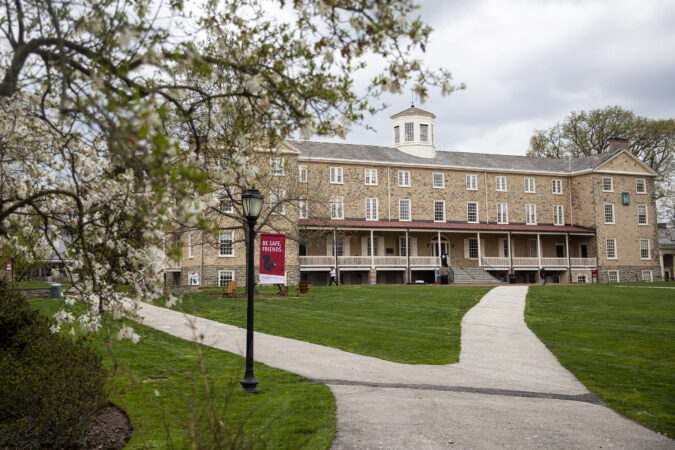
During a talkby an Israeli journalist at Haverford College earlier this month, a group of about a dozen masked people sat and stood in the audience.
At one point, one of them began shouting through a bullhorn, “Death to IOF,” or Israeli Occupying Forces, a name critics use to refer to Israel Defense Forces,and “Shame,” according to a video of the incident and people who attended the event. The protesters’ faces were covered by masks or keffiyehs, a symbol of Palestinian identity.
“When Gaza has burned, you will all burn, too,” the protester shouted at the audience of about 180 people, many of them members of the local Jewish community, according to another video viewed by The Inquirer.
An audience member grabbed at the bullhorn and appeared to make contact with the protester as the protester yelled in his face, according to a video. The college’s campus safety personnel ejected both the bullhorn user and the audience member and has since banned both from campus, college officials said, noting that neither is an employee, student, or alumnus of Haverford.
The event sparked renewed charges of antisemitism on the highly selective liberal arts campus, which already is under scrutiny by a Republican-led congressional committee for its handling of antisemitism complaints and is the subject of an open investigation by the U.S. Department of Education.
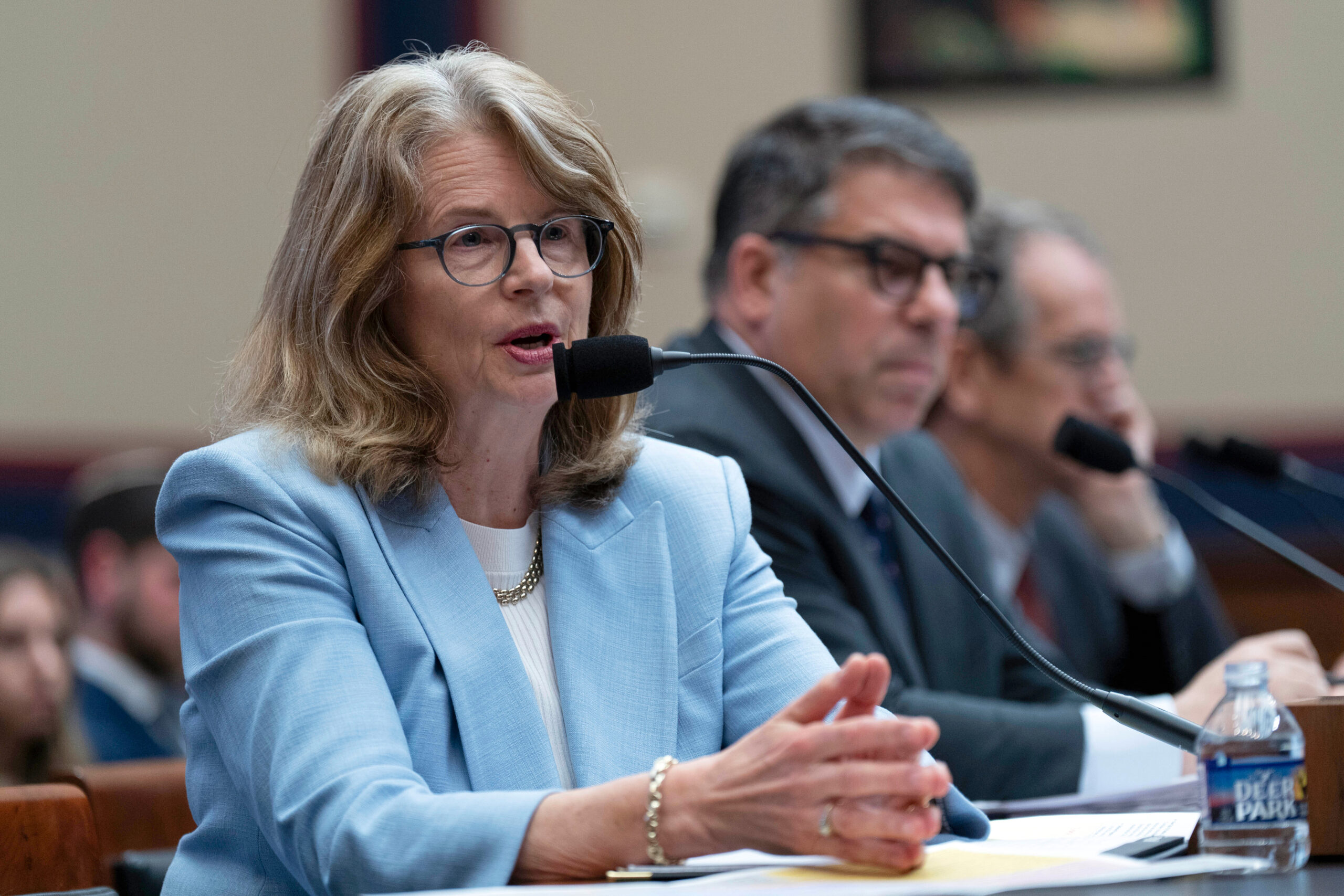
It will also lead to changes in Haverford’s policies. In a message to the campus after the event, president Wendy Raymond — who faced intense questioning from the congressional committee about the school’s response to antisemitism last year — said “shouting down a speaker whom one does not agree with is never acceptable and stands outside of our shared community values.”
College officials acknowledged that Haverford needs to upgrade its event policies andsaid changes would be rolled out no later than after spring break.
Some people who attended the event to hear journalist Haviv Rettig Gur said they were afraid because they did not know who the masked attendees were or what they had in their belongings, and in light of recent mass violence at Jewish events around the world.
“I was scared to walk back to my car by myself, which is the only time I ever felt that way in Lower Merion, where I live,” said Susan Taichman, a resident of Bala Cynwyd, who was in the audience.
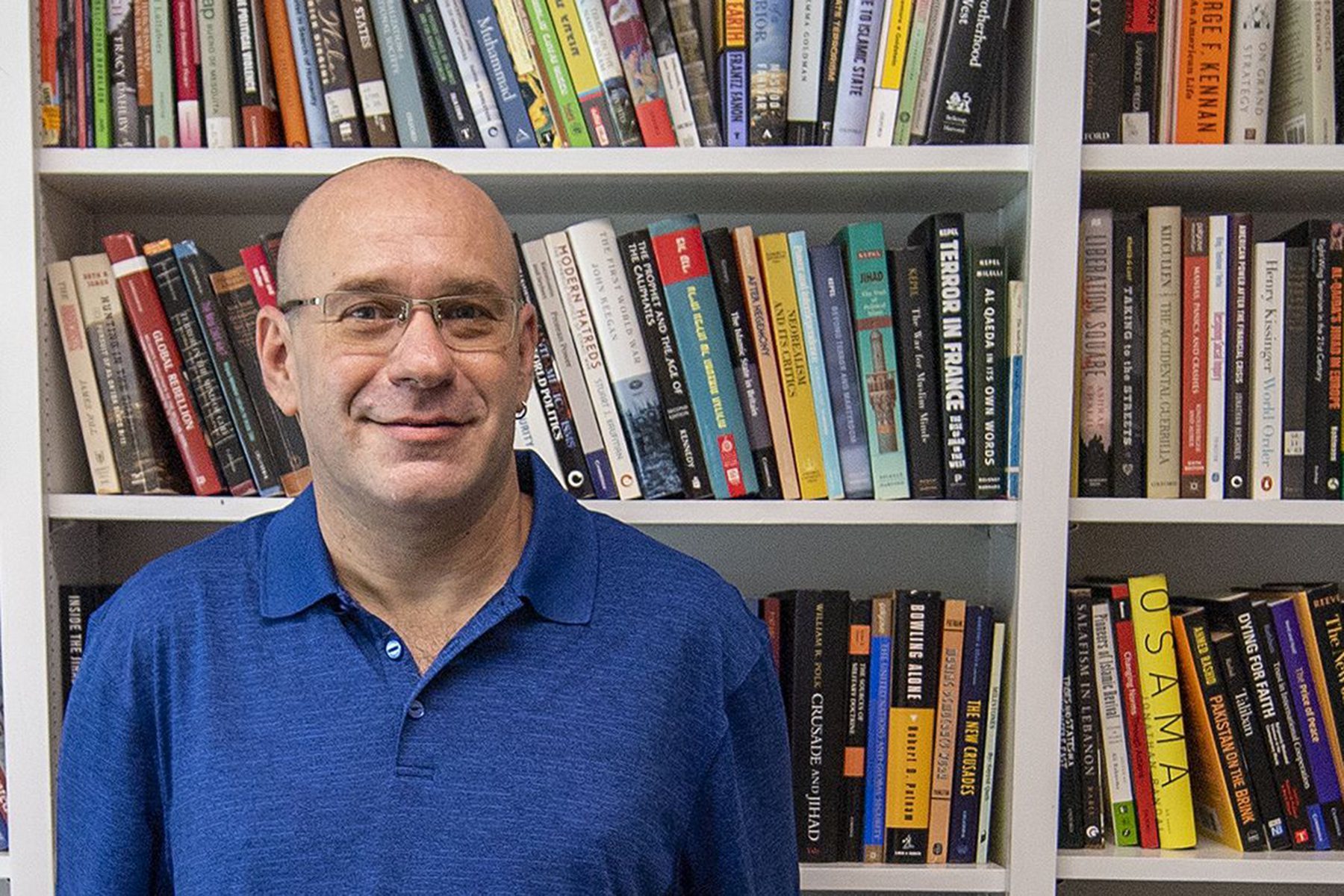
Barak Mendelsohn,professor of political science at Haverford College
Several students in attendance that night said most of the protesters sat or stood silently during the event — which is permitted under campus policy.
“I went into that event not with hatred for Jewish people, as some … have claimed was the intention of the protesters at the event,” said one Haverford student protester who asked that her name be withheld for safety reasons. “I went in with love, empathy, and deep concern for the Palestinians experiencing abhorrent amounts of violence in their homeland, as well as an understanding of the historical contexts that led to this violence, including the historic persecution of Jewish people that led to the development of Zionist thought.
“This context, in my opinion, is not an excuse for the genocide. It’s something really tragic that is going on, and I feel really strongly that it has to be stopped.”
Cade Fanning, the associate editor of the Clerk, Haverford’s student newspaper, cited three interruptions by protesters. One early on argued with Gur for an extended period, followed by the bullhorn incident less than an hour into the event, and then some banging on doors and yelling outside the room, said Fanning, 21, a senior history major from Annapolis, who attended the event.
Haverford professor Barak Mendelsohn, who helped organize the nearly three-hour event and has complained about the college’s handling of antisemitism in the past, said attendees were terrified as disruptions continued.
“I can’t tell you how ashamed I am as one of the organizers,” said Mendelsohn, an Israeli-born professor of political science and a terrorism scholar.
Leaders of Haverford’s students’ council, meanwhile, voiced concerns that an audience member had initiated physical contact with the protester, “which deeply frightened and disturbed members of Students’ Council,” they wrote. “We believe it is paramount to prioritize the safety of members of our college community. Actions like this have no place in our community.”
Some community members also interrupted and “heckled” protesters, Fanning said, adding that Gur belittled the activists as “children” who did not know enough about the world. The college, Fanning said, should have addressed that in its statement to the community.
“It would have been beneficial had they at least acknowledged that he wasn’t the most conducive to respectful, honest, open debate either,” Fanning said of Gur. “He didn’t treat the students with the most respect.”
But Anna Braun, 21, a senior English major from New York City who attended the event, said she was impressed with how Gur handled the protesters.
“He decided to engage with them one on one to really ask them questions and try to deconstruct why they were protesting,” she said. “The only way we can have any hope for peace is for people to listen to each other and to find some middle ground. And if you’re ignoring each other or if you are interrupting each other, then there is no potential for seeing eye to eye.”
An effort to ensure safe events
“It has become clear that there are gaps in how events are reviewed, supported, and managed on campus,” Raymond said in her message to campus. “We are actively revising our event management and space use policies to improve clarity and processes.”
Wendy Raymond, president of Haverford College, testifies before the House Committee on Education and Workforce hearing on antisemitism on American campuses on May 7, 2025.
The new policy, she said, “will clarify expectations for different types of events, strengthen coordination among College offices, and establish additional planning and support for events that require heightened attention.”
Factors such as “significant attendance or operational complexity, heightened public visibility, safety, security, or crowd-management considerations, media presence or external participation, and increased likelihood of disruption or protest activity” may trigger the need for additional review to determine whether more resources are needed, said Melissa Shaffmaster, Haverford’s vice president for marketing and communication.
“Our intention … is not in any way to restrict free speech or restrict access for different speakers or topics to be discussed on campus,” she said. “We want to make sure that the proper resources are allocated so events can happen safely, people can have really thoughtful discourse, and these events can go off the way they are intended.”
The indoor use of bullhorns violated the school’s “expressive freedom” policy put in place last spring, she said.
The college is participating in the Hillel Campus Climate Initiative, touted as an effort to help college leaders counter antisemitism. A survey “to better understand the current climate for Jewish students” will be part of the effort.
Haverford also is preparing for a major change in leadership. Raymond said in November she would step down as president in June 2027; John McKnight, the dean of the college, also announced he would be leaving at the end of this semester for a new role at Dartmouth College; and the college’s vice president for institutional equity and access also will exit that post in May.
‘The howling cry of an uneducated child’
Gur’s talk was titled “Roots, Return, and Reality: Jews, Israel, and the Myth of Settler Colonialism.” In an opinion piece for the Free Press after the talk, Gur said he had gone to Haverford to talk “about the Jewish history that forged Israeli identity.”
While he saw the audience “tense up” when protesters entered, he wrote, he saw it as “a chance to explore managing an encounter with the abusive ideologues.”
He said he invited protesters to stay, but told them they had to remove their masks, which they did not do. Most protesters remained for the entire talk, he said, some even crying and engaging in dialogue with him.
“The more I treated them like neglected children hungry for knowledge, the more likely they were to respond in healthy and productive ways,” he wrote.
The event was organized by Kevin Foley, a 1983 Haverford graduate. Foley said he was impressed with Gur, a political correspondent and senior analyst for the Times of Israel, after seeing a video of him teaching.
“I thought I could do something good for Haverford by having him teach there,” said Foley, who lives in Connecticut and New York City and spent his career running electronic trading businesses at Bloomberg and Cantor Fitzgerald.
Foley’s best friend was killed in the 9/11 attacks and he said he experienced Hamas’ October 2023 attack on Israel as an “echo trauma.” To see concerns at Haverford about its handling of antisemitism “was disappointing,” he said, and what happened at Gur’s talk reinforced those concerns.
“What I can’t believe is that Haverford has so abandoned its liberal values of academic freedom, freedom of inquiry, that it’s considered acceptable for protesters to come in and disrupt and shut down an educational class,” Foley said.
Foley called on the college to ban masks and have metal detectors available when needed, and to apologize to Gur’s audience.
Shaffmaster said the college’s policy allows people to wear masks, but they must remove them if they are asked by campus safety officers or administrators for identification purposes.
Ongoing tensions on campus
Several students in attendance, who asked not to be named because of tensions on campus over the issue, said they thought campus safety and the college handled the event as best they could without silencing either side.
“No matter what they had done, people would be mad at them,” one said.
Fanning, the student editor, understood why older community members may have been fearful, but said protesters also have fears of being harassed or doxed for their pro-Palestinian advocacy if their identity is known.
“They are not fearless themselves,” Fanning said. “Nobody is.”
But Mendelsohn, the professor, was disturbed that Haverford seemed to equate the actions of the audience member who grabbed the bullhorn with those of the protester.
“The person acted in self-defense and managed to get the bullhorn from her hands,” he said. “If someone turned to you with a microphone and screamed, you would not sit there and do nothing.”
Mendelsohn has been at the forefront of allegations that Haverford has not done enough to address antisemitism, and the college has investigated him for speaking out on social media and in emails, according to a lawsuit filed against the college last year by a Jewish group. Much of the complaint was dismissed, but the judge allowed a portion involving breach of contract that would result in nominal damages to proceed, and that is in mediation, court records show.
The actions at Gur’s speech were just one of several ongoing problems with antisemitism on the campus, Mendelsohn said. His mezuzah — an object signifying the Jewish faith — was stolen from his office door a couple of months ago, he said. And he referred to a bias complaint over comments made around funding for the Haverford Chabad board. That remains under review, the college said.
Braun, the English major, said that she was heartened to see improvement in Haverford’s handling of the Gur event and that the campus has been more welcoming to Jewish students. Most people she has spoken with, she said, did not think the use of the bullhorn was appropriate.
“That’s not something I would have heard two years ago on this campus,” she said. “I sincerely believe there is more of a desire to create an inclusive environment.”
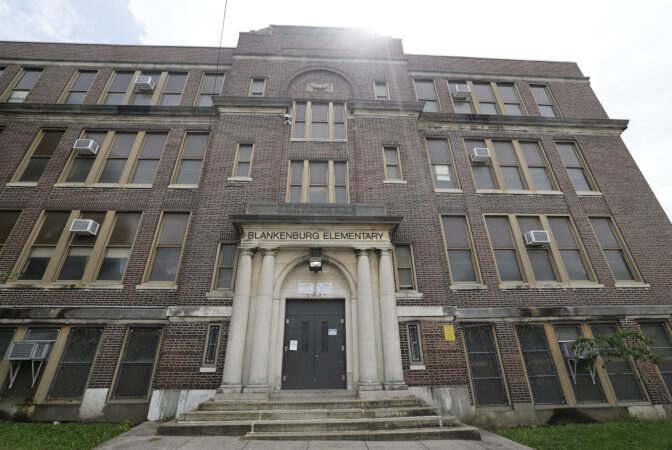
Rudolph Blankenburg Elementary School in West Philadelphia serves kids with complex needs — and test scores reflect that.
The school, where nearly 95% of students are considered economically disadvantaged, had been a Comprehensive Support and Improvement school — a federally mandated designation for schools performing in the bottom 5% statewide.
But last fall, Blankenburg shed that label. Many students are still struggling but are making gains, teachers said — progress they fear will be threatened by a district proposal to close the schoolas part of a sweeping facilities plan.
“We’ve worked really hard, with a consistent staff and all types of resources in place, for our students to pull ourselves out of that status,” said Flori Thomas, a middle school science teacher at Blankenburg.
That’s her biggest fear, she said: “You’re going to impact our scholars.”
Blankenburg is one of 20 district schools proposed for closure under the plan released last month. Six other schools would be colocated and more than 150 modernized as part of the proposal — which is facing resistance from City Council.
District officials say closures are needed in a system that has lost more than 80,000 students over the last 30 years, many to charter schools. The district has struggled to fund repairs of aging buildings — including at Blankenburg, where staff report chipping paint and roof leaks.
Marquita Jenkins, the school’s dean of climate and culture, does not disagree that the building, which opened in 1925, needs repairs — or that it is underutilized. The K-8 school, which currently enrolls 278 students, has room for almost 600. Officials said the school’s enrollment has declined by about 100 students over the last four years.
But the relatively low enrollment has also enabled smaller class sizes, helping student growth, Jenkins said. A former fourth- and sixth-grade teacher at Blankenburg, she recalled teaching a class of 33 students, 11 of whom had individualized special education plans: “It was tough.” Classes now are smaller, she said.
Like other staff, she worried about where Blankenburg students would end up. The district proposes to reassign them to Edward Heston School, James Rhoads Elementary School, and a newly colocated Martha Washington Academics Plus School and Middle Years Alternative School.
Blankenburg‘s building near 46th and Girard, meanwhile, would be conveyed to the city for “affordable workforce housing and/or job creation,” according to the district.
Jenkins and other staff questioned the safety of the routes to schoolfor reassigned students.
They also voiced concern for particularly vulnerable students: Blankenburg is surrounded by at least seven homeless shelters and “tends to have attendance fluctuations,” assistant principal Sandra Pitts said at a virtual community meeting with district officials this month. She questioned how families would be “assisted to avoid further trauma.” (Officials said they would be supporting students with housing instability in placements.)
Staffers noted that Blankenburg also has a significant population of students with special needs, who make up 25% of its enrollment.
Among them is Sherell Robinson’s kindergartener, Illiyin, who has autism and medical complexities.
Robinson, who lives in West Philadelphia, said that Illiyin had been denied enrollment at other district schools, and that she was told she had to send her daughter to Blankenburg.
Robinson initially had a negative impression of Blankenburg but was impressed with the school’s principal, Sheena Wilson, who “didn’t try to sell me, or placate me” — just presented what the school had to offer, she said.
What Robinson found was a small environment, “loving people,” and a routine for Illiyin. Now she is panicked at the prospect of the school closing.
“For them to be taking this whole community away is really devastating,” Robinson said. “It takes time to find the correct programming and environment and teachers who are neuro-affirming, especially for Black children.”
A real estate agent, Robinson said there was an irony to the district’s plan to convert Blankenburg to workforce housing — something she believes she currently would qualify for. But if she does not find a stable school environment for her daughter, she isn’t sure she will be able to keep her job.
“They might look at me as a single case, but I can assure you I am not an anomaly,” said Robinson, who also works for a disability nonprofit and is in touch with other parents of autistic children. “This is going to affect how we can take care of our families, how that perpetuates what we’re already experiencing. … I don’t want to normalize that struggle to them.”
Teachers said they are committed to Blankenburg’s students. “We bring a lot of positivity and try to keep our kids safe,” said Jenkins, who has led field trips to places including the Kimmel Center in Center City and the National Museum of African American History and Culture in Washington.
Thomas, who grew up in the neighborhood around Blankenburg and now lives in New Jersey, said that whenever students learn about her commute, she tells them they are worth the drive.
Others outside the city see headlines about crime, Thomas said, but she tells students: “I see you.”
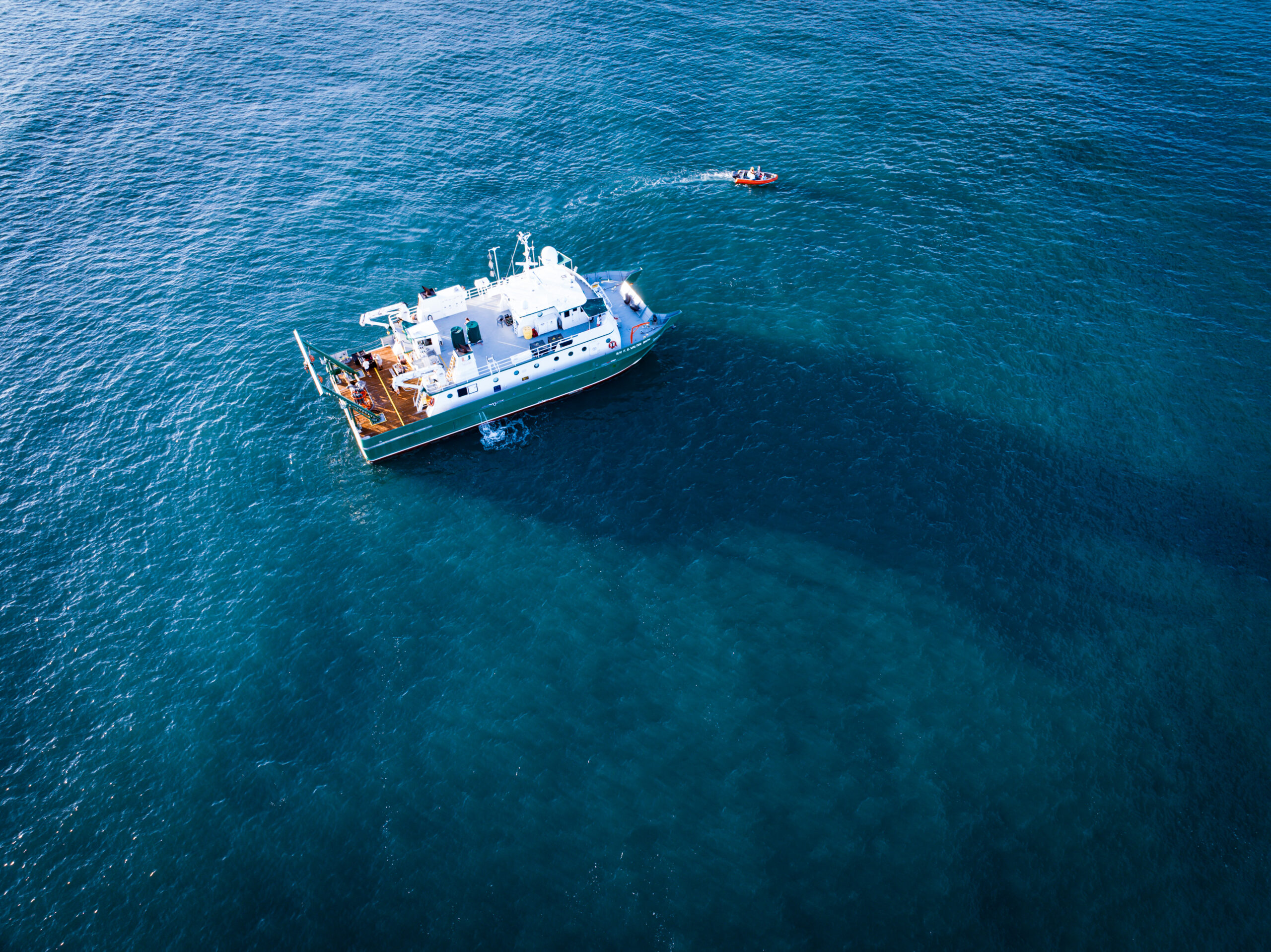
STRAITS OF FLORIDA — At 2 a.m., oceanographer Ryan Smith was headed into his 12th hour of work with little sleep when trouble started.
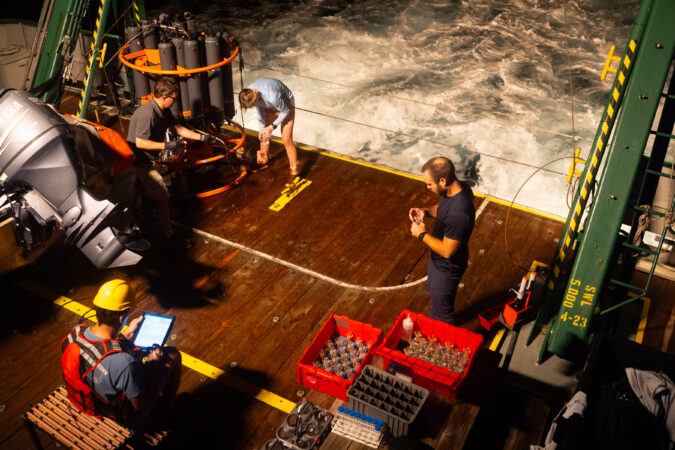
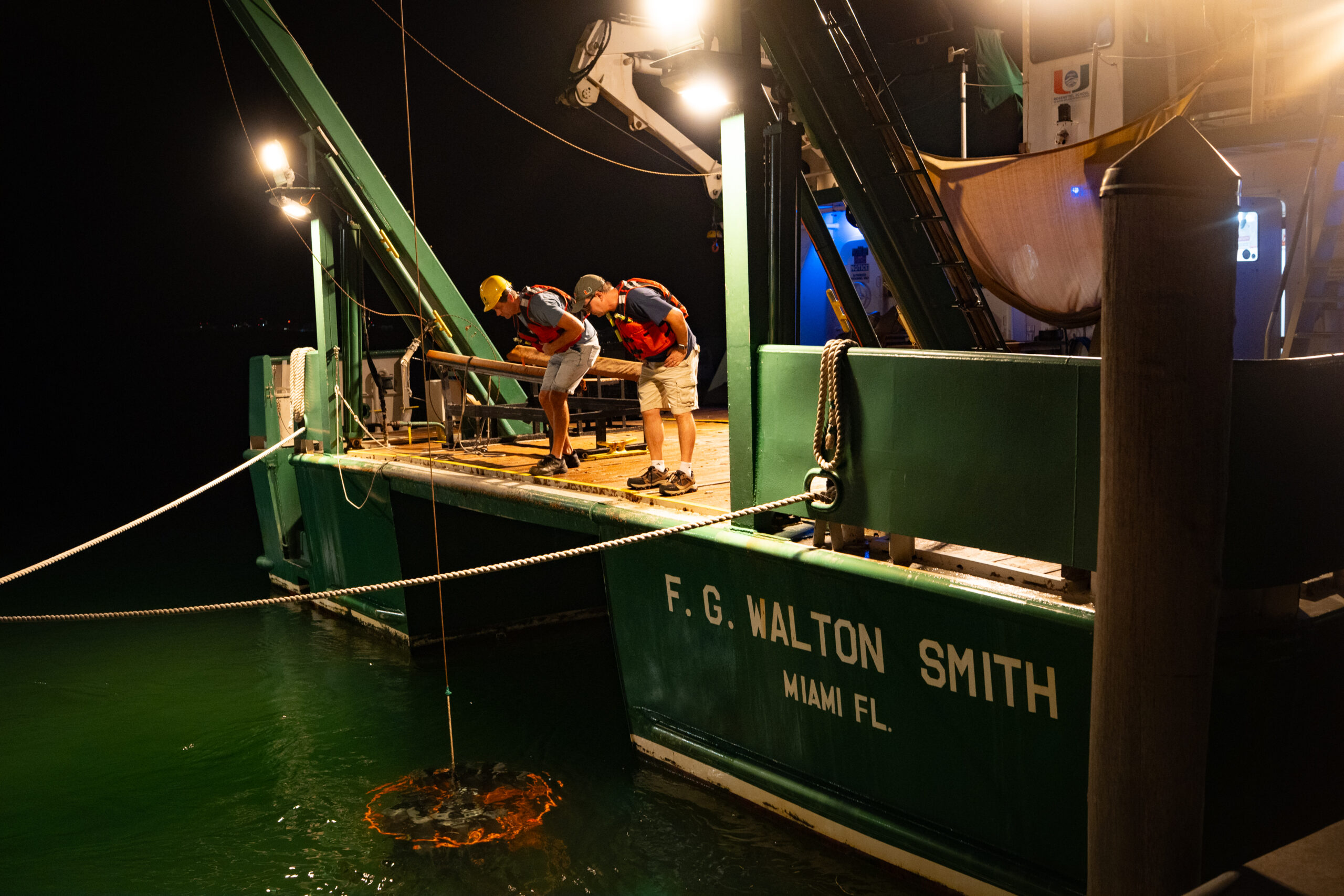
From the rear deck of the University of Miami’s research boat, he guided the vessel’s winch to lower a cage containing 14 long, gray tubes, collectively weighing about 1,000 pounds, hundreds of meters deep into the Atlantic Ocean, to record the temperature, salinity and density of the water. But after running smoothly for the first two-thirds of the trip, the sensors now suddenly stopped transmitting data.
There was no time for a hiccup. With urgency mounting, Smith signaled to bring the cage to the surface.
At sea, there is no helpline to call for a broken instrument at this hour (or any hour). If the team couldn’t fix it, they would need to make a 12-hour slog back to Miami through the fast-moving Florida Current — the precise subject they were trying to measure.
For 43 years, scientists have been studying the strength of the water flow between Florida and the Bahamas to learn what drives its changes over time. The information could help scientists answer a pressing question: Is the Florida Current, one of the world’s fastest ocean currents, slowing down? If so, it could indicate weakening of the larger circulation system in the Atlantic Ocean — what scientists call the Atlantic Meridional Overturning Circulation (AMOC) — which could be disastrous.
Even Hollywood has imagined the harm that could result from a collapse of this system of currents, which acts like a conveyor belt as it transports water, nutrients, and heat through the Atlantic.
While scientists doubt the scenario sketched out in the 2004 movie The Day After Tomorrow, in which the AMOC’s failure prompts a calamitous ice age across the Northern Hemisphere, researchers say rain patterns could change or fail in Southeast Asia and parts of Africa, disease may spread to new populations, and temperatures would probably drop across Western Europe. Iceland has even declared that the risk of such a collapse is a national security threat.
But climate scientists are at odds over how soon, or whether, the circulation system may weaken. Researchers largely agree that the AMOC may weaken over this century as the world warms, but they differ on whether the system is already slowing down.
Direct observations of the AMOC’s and the Florida Current’s flow, velocity, temperature and salinity could help clarify this. The Florida Current, which helps shuttle water north, is a key component in calculating the system’s strength.
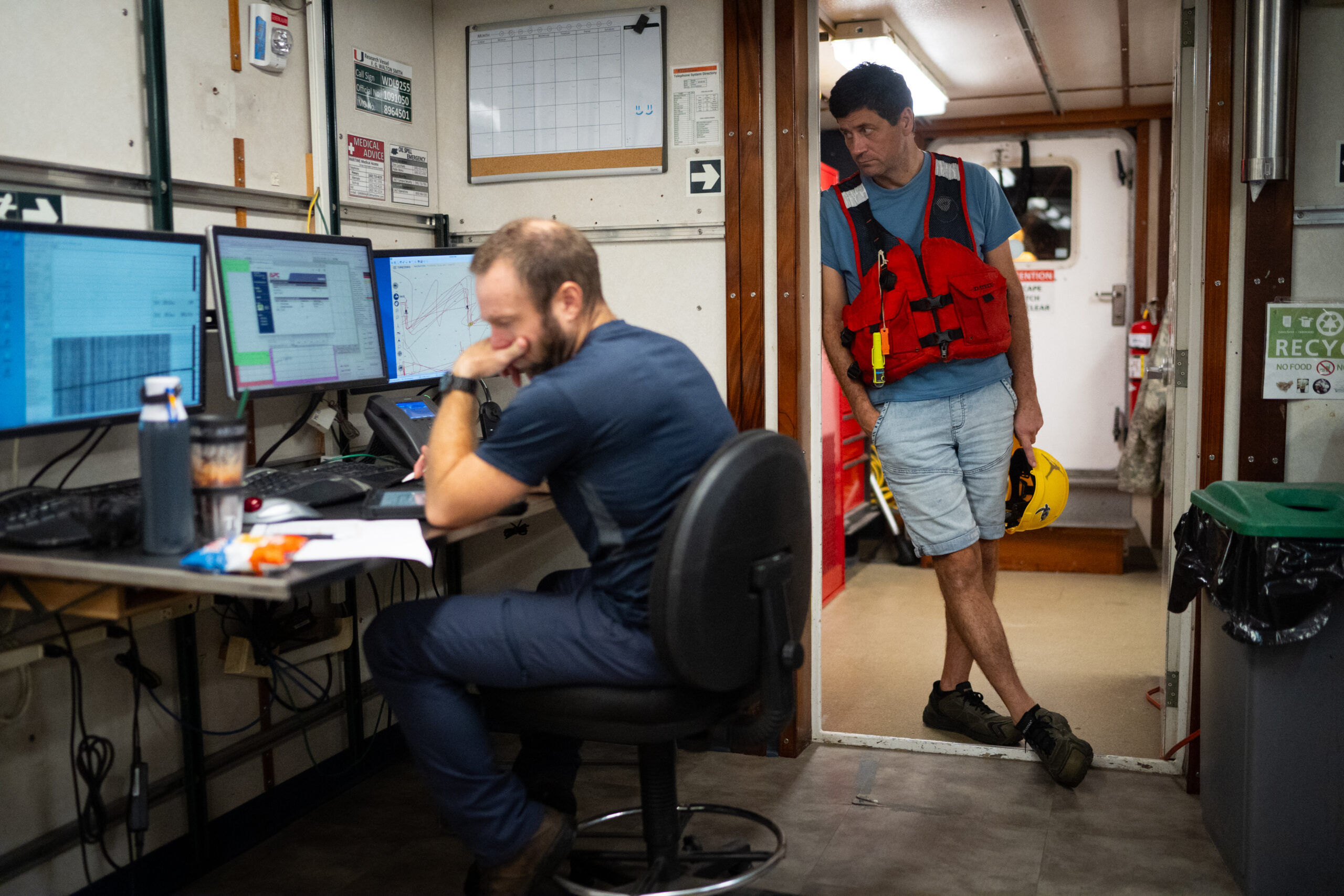
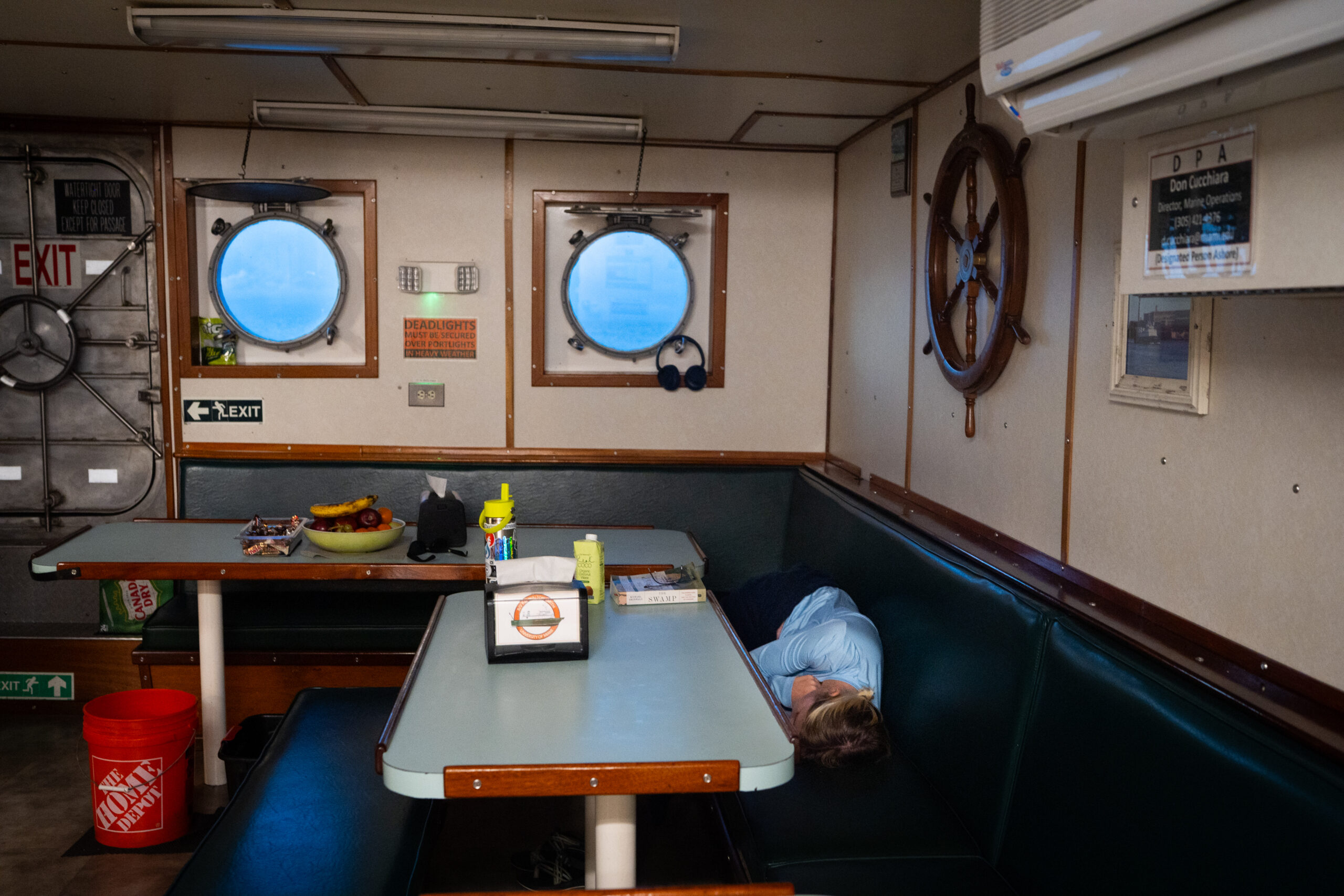
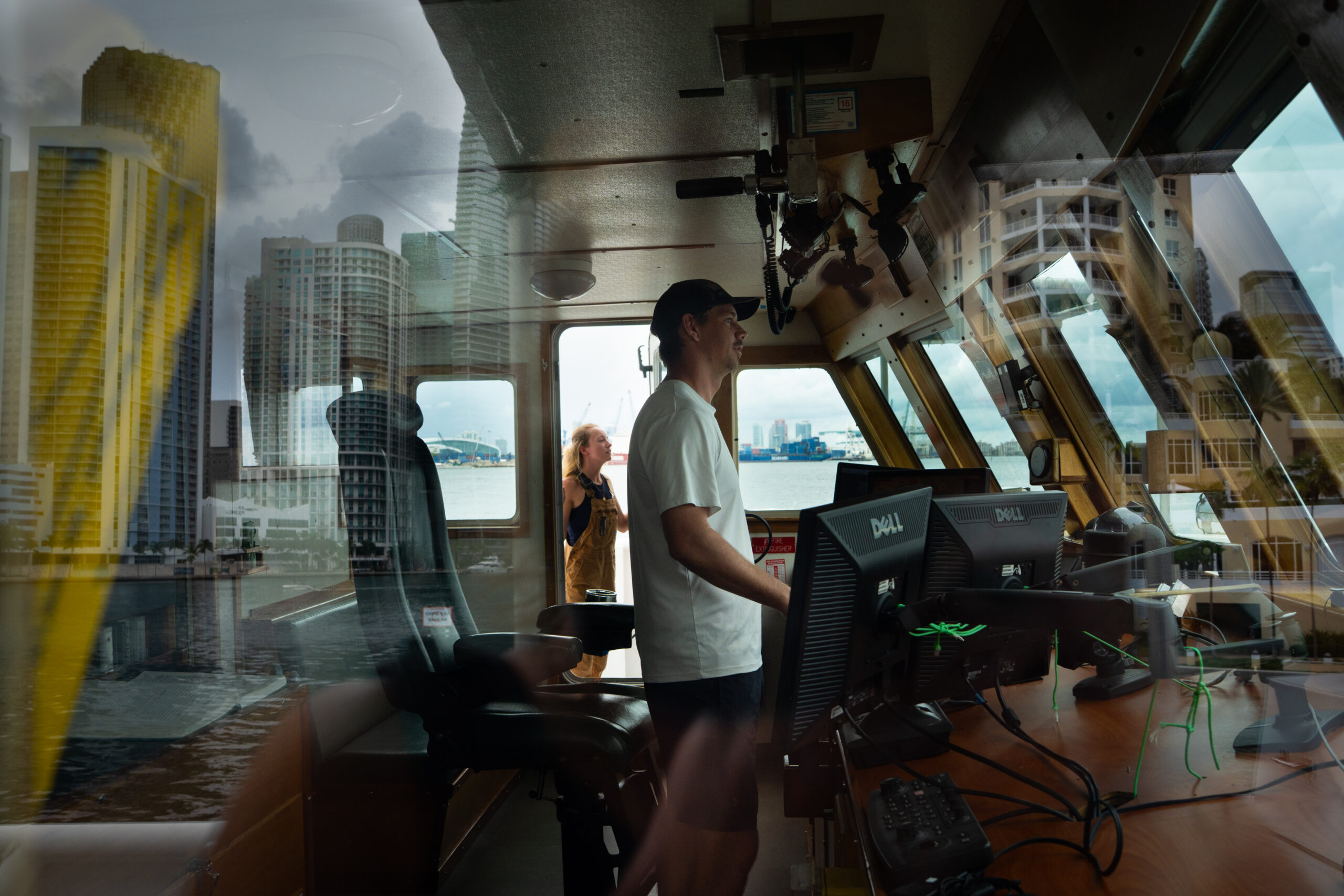
Traveling between Miami and the Bahamas, a crew from the University of Miami and the National Oceanic and Atmospheric Administration homed in on the Florida Current, the world’s longest nearly continuously observed ocean current. Over 36 sleep-deprived hours, six researchers and seven crew members traversed the ocean, dove underwater, and collected gigabytes of measurements. These expeditions gather data that generations of scientists can use to better understand the state of our oceans — and humanity’s future.
Tyler Christian, a marine scientist, takes a photo of a waterspout during a research trip to collect data on the Florida Current.
The AMOC debate
For more than four decades, scientists have almost continuously measured water flow across the Florida Current, largely with the help of a decommissioned AT&T telecommunications cable running from West Palm Beach to Grand Bahama Island.
The telephone line wasn’t intended for ocean research, but NOAA scientists noted that it picked up tiny voltages induced by seawater flowing across the Florida Straits, which changed depending on the current’s flow.Using direct measurements of the waterway from research cruises, scientists can convert the voltages into the volume of water carried each second through the strait.
In 2005, British oceanographer Harry Bryden tapped these cable measurements and the limited available ship measurements in a seminal paper that suggested a possible slowdown in the AMOC between 1957 and 2004. Using data across the Atlantic Basin today, scientists have found that the AMOC varies, daily and seasonally, yet it also appears to have experienced a slight weakening over the past two decades.
But is it on a long-term decline because of human-induced planetary warming? Debatable.
At about 4 a.m., oceanographer Denis Volkov, right, checks in on Jay Hooper, who helps the team with data management
The Florida Current is one of the main forces that make up the western boundary of the AMOC. The warm Florida waters feed into the mighty Gulf Stream, which merges with the warm North Atlantic Current headed toward Europe. As the current reaches the Arctic, air temperatures cool the water, which becomes denser. The water sinks and moves south toward the equator, where it is again warmed by the sun and returns north.
“The role of the AMOC in the climate is it carries a huge amount of heat from the equator towards the poles,” said Denis Volkov, who is a co-principal investigator of NOAA’s Western Boundary Time Series project along with Smith.
But scientists say a warming world is throwing off this balance. As Arctic ice melts, freshwater enters the North Atlantic — making the ocean water less dense, so it is less likely to sink. As a result, scientists propose thatit cannot power the ocean conveyor belt as well, so less salty, warm water is getting transported northward.
A major shift in the Atlantic Ocean’s circulation could create severe drought in some areas and damaging floods in others. Sea level could rise by a foot or more along the U.S. East Coast if it collapsed.
Scientists have typically used data that indirectly hints at the current’s movement — such as sea surface or air temperature — to reconstruct the oceans in models and track whether the overall system is weakening, but they have reached mixed conclusions.
For instance, a 2018 study plugged sea surface temperatures into computer models to show that the AMOC is weakening. Then, a paper released last January reported no evidence of weakening over the past 60 years after examining data on heat exchanges between the air and the ocean called air-sea fluxes.
The dive boat takes scientists to a site to collect data on the Florida Current.
Volkov and his colleagues are helping approach the puzzle with observations. In 2024, they reassessed the cable data from the Florida Current, adjustingfor changes from Earth’s geomagnetic field. First, they found that the current had remained stable over the past four decades. Then, they updated calculations of the AMOC in this region, which has been monitored for only 20 years or so, with the corrected data and found that the AMOC wasn’t weakening as much as previously calculated at this latitude.
“But there is a caveat that observational data is very short,” said Volkov. He said scientists would need another 20 years of AMOC observations to determine if the small decline is a robust feature and not part of natural variability.
And the AMOC can still weaken even if the Florida Current remains strong, he said, since it is the sum of currents across the basin. But long-term changes in the Florida Current can serve as an indicator of trouble for the rest of the system.
One snag, said Volkov: The serendipitous cable that provided data for more than 40 years malfunctioned in 2023 — perhaps broke. Until it’s fixed, researchers are ramping up their diving operations to recover data from underwater acoustic barometers on the ocean floor.
Volkov, left, and Smith watch as a sampling instrument drops into the water.
The expedition
When the research vessel departed from the university’s dock around 4 a.m. on Sept. 3, the sun and most of the science staff were down for the night. A few shipmates gazed at the illuminated cityscapes from the stern deck, next to the diesel engine’s deep rumble. After traversing rocking waves, the crew reached scenic Bahamian waters eight hours later.
The green F.G. Walton Smith, 96 feet long, and its crewmake this overnight trip about six times a year, traveling 93 nautical miles diagonally from Miami toward the Little Bahama Bank. From there, they go west and collect data at nine sites from the boat and dive underwater at two others.
The team’s goal is to determine the amount of water flowing north through the Florida Current per second through a series of underwater instruments, from the boat and from satellites. They also collect temperature, salinity, density and velocity data; velocity and temperature, for example, can be combined to calculate the amount of heat transported across an area.
Chomiak, left, and Zach Barton, a technician and engineer, return from diving to the seafloor to place a data-collection instrument.
At the first dive site, a remora — a long, torpedo-shaped suckerfish — circled the two scuba divers less than a mile from the boat. The slender fish is known for a unique fin on its head that suctions itself to sharks, whales, and turtles to feed off their detritus. And for a quick moment, it latched onto Leah Chomiak’s head. And her thigh.
Chomiak focused on the barometer in front of her. Her bulky gloves made it harder to use a screwdriver 50 feet below the Bahamian surface. She and her fellow diver held onto the long tubes that had been recording data every five minutes for the previous two months, since the last time divers brought the instruments to the surface and downloaded the data.
“Now we decided to service them more frequently, because, at the moment, this is the only source of data for our Florida Current transport estimates,” Volkov said. The scientists can use the pressure data to help calculate the amount of water flowing through the area.
Next, the ship arrived at the first of nine hydrographic stations andlowered a cage of sensors known as a CTD-rosette sampler (CTD stands for conductivity, temperature and depth, although it measures many more properties). Researchers can use the temperature and salt concentrations of a particular mass of water to infer where it came from and how it reaches other parts of the world.
Christian takes a quick nap in the galley as the vessel travels back to Miami.
Jay Hooper, who has been on these trips for 10 years and helps with data management, sat at the ship’scomputer station.
“Ready whenever you are,” he said into his headset.
From the top deck, the captain lowered the rosette into the water, dropping 60 meters each minute. As the instruments approached the bottom at 486 meters, Hooper said to slow down.
Lines of various colors — representing salinity, temperature, and density — squiggled down on Hooper’s computer screen as the sensors dropped. Temperature decreased and density increased as the instruments descended. Seventeen minutes later, the rosette was brought back onto the boat.
After hours of gathering data, Hooper and Smith hit a snag at the seventh station. The rosette now wasn’t sending any information to the computer. Was it human error? Did the instrument break?
The two tried different solutions as the other scientists slept. Then they replaced the sensors’ cable, andas they lowered the rosette, data filled the computer screen.
The boat stopped for the last dive near the Florida coast to retrieve the second set of underwater acoustic barometers. But the water was so cloudy, thick and green that the divers couldn’t see their hands, so they decided they would try on the next trip.
Captain John Cramer pilots the vessel back to the university.
For the next 12 hours, the boat fought against the Florida Current to take the crew home. Some aboard mustered up energy to sing “Happy Birthday” to one of the crew members.
The next morning, Smith and his colleagues processed the data to upload to NOAA’s Atlantic Oceanographic & Meteorological Laboratory website. There were no notes about a cable malfunction, encounters with remoras or sleep deprivation.
The Excel spreadsheet had a single note for each station it recorded: “Profile looks good; use these data.”