WASHINGTON — President Donald Trump signed a roughly $1.2 trillion government funding bill Tuesday that ends the partial federal shutdown that began over the weekend and sets the stage for an intense debate in Congress over Homeland Security funding.
The president moved quickly to sign the bill after the House approved it with a 217-214 vote.
“This bill is a great victory for the American people,” Trump said.
The vote Tuesday wrapped up congressional work on 11 annual appropriations bills that fund government agencies and programs through Sept. 30.
Passage of the legislation marked the end point for one funding fight, but the start of another. That’s because the package only funds the Department of Homeland Security for two weeks, through Feb 13, at the behest of Democrats who are demanding more restrictions on immigration enforcement after the shooting deaths of Alex Pretti and Renee Good by federal officers in Minneapolis.
House Democratic Leader Hakeem Jeffries quickly warned Democrats would not support any further temporary funding for Homeland Security without substantial changes to its immigration operations., raising the potential of another shutdown for the department and its agencies.
“We need dramatic change in order to make sure that ICE and other agencies within the department of Homeland Security are conducting themselves like every other law enforcement organization in the country,” Jeffries said.
Speaker Mike Johnson said he expects the two sides will be able to reach an agreement by the deadline.
“This is no time to play games with that funding. We hope that they will operate in good faith over the next 10 days as we negotiate this,” said Johnson. “The president, again, has reached out.”
But Johnson’s counterpart across the Capitol, Senate Majority Leader John Thune, (R., S.D.), sounded less optimistic of a deal. “There’s always miracles, right?” Thune told reporters.
Voting with no margin for error
The funding bill that cleared Congress Tuesday had provisions that appealed to both parties.
Republicans avoided a massive, catchall funding bill known as an omnibus as part of this year’s appropriations process. Such bills, often taken up before the holiday season with lawmakers anxious to return home, have contributed to greater federal spending, they say.
Democrats were able to fend off some of Trump’s most draconian proposed cuts while adding language that helps ensure funds are spent as stipulated by Congress.
Still, Johnson needed near-unanimous support from his Republican conference to proceed to a final vote on the bill. He narrowly got it during a roll call that was held open for nearly an hour as leaders worked to gain support from a handful of GOP lawmakers who were trying to advance other priorities unrelated to the funding measure.
The final vote wasn’t much easier for GOP leaders. In the end, 21 Republicans sided with the vast majority of Democrats in voting against the funding bill, while that exact same number of Democrats sided with the vast majority of Republicans in voting yes.
Trump had weighed in Monday in a social media post, calling on Republicans to stay united and telling holdouts, “There can be NO CHANGES at this time.”
Key differences from the last shutdown
The current partial shutdown that is coming to a close differed in many ways from the fall impasse, which affected more agencies and lasted a record 43 days.
Then, the debate was over extending temporary coronavirus pandemic-era subsidies for those who get health coverage through the Affordable Care Act. Democrats were unsuccessful in getting those subsidies included as part of a package to end the shutdown.
Congress made important progress since then. Some of the six appropriations bills it passed prior to Tuesday ensured the current shutdown had less sting. For example, important programs such as nutrition assistance and fully operating national parks and historic sites were already funded through Sept. 30.
The remaining bills passed Tuesday mean that the vast majority of the federal government has been funded.
“You might say that now that 96% of the government is funded, it’s just 4% what’s out there?” Johnson said. ”But it’s a very important 4%”
President Donald Trump said Monday that Republican lawmakers should nationalize voting — claiming a power explicitly granted to states in the U.S. Constitution.
Speaking to right-wing podcaster Dan Bongino, who recently stepped down from his role as the FBI’s deputy director, Trump again falsely alleged that the 2020 election was stolen from him, and he urged Republicans to “take over” elections and nationalize the process.
“We should take over the voting, the voting, in at least 15 places,” Trump told Bongino. “The Republicans ought to nationalize the voting.”
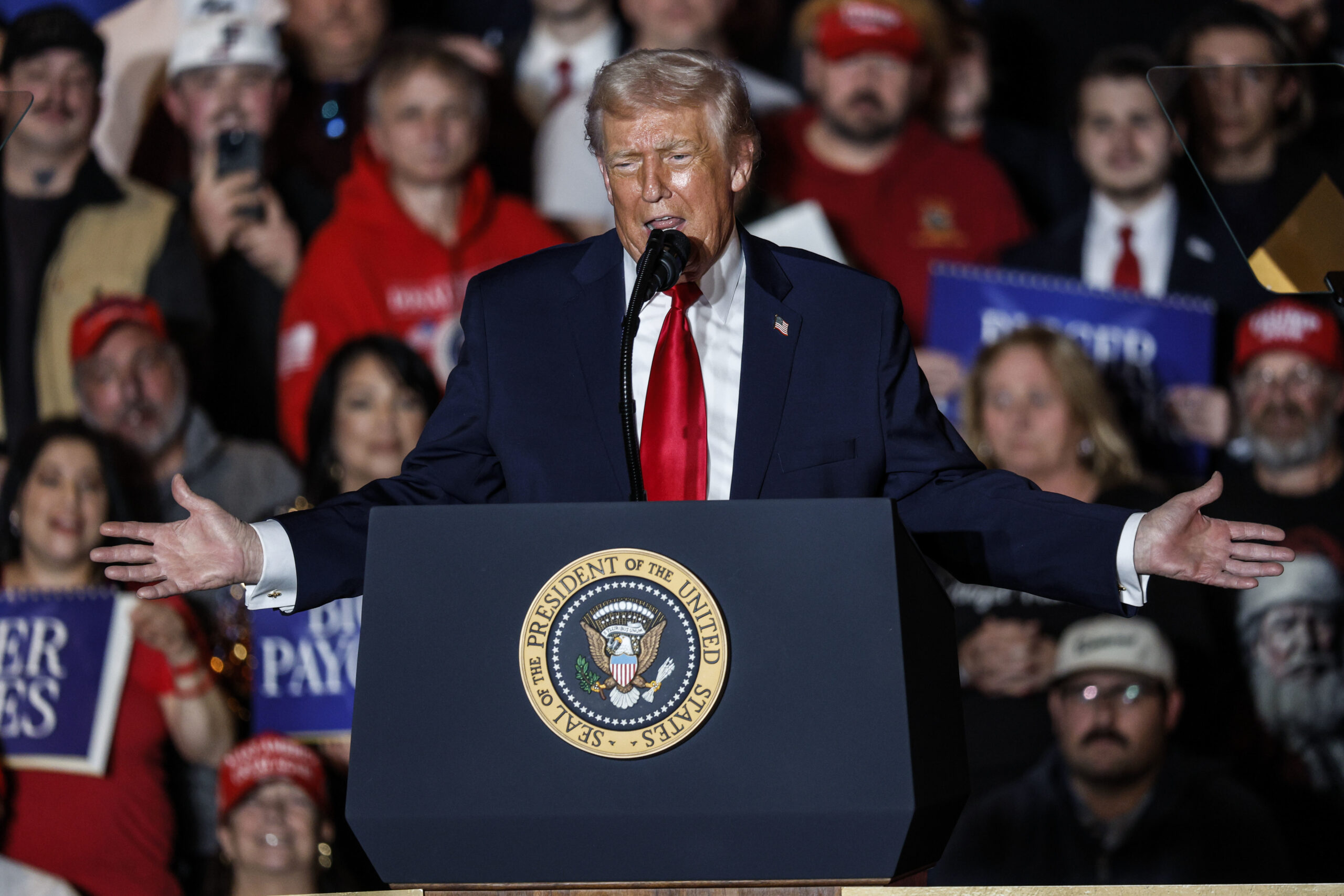
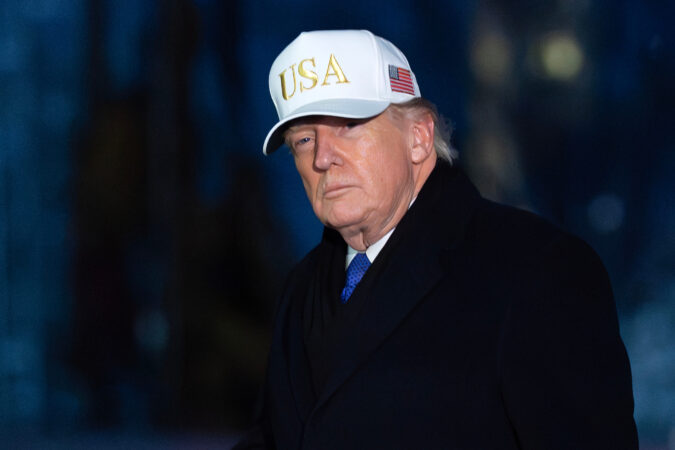
President Donald Trump speaks in Mt. Pocono, Pa., on Tuesday, Dec. 9, 2025.
Under the Constitution, the “Times, Places and Manner” of holding elections are determined by each state, not the federal government. Congress has the power to set election rules, but the Constitution does not give the president any role on that subject. Republicans in recent decades have often argued in favor of states’ rights and against a powerful federal government.
Trump’s demand comes less than a week after the FBI executed a search warrant at a warehouse in Fulton County, Georgia, which is at the heart of right-wing conspiracy theories about the 2020 election. The unusual warrant authorized agents to seize all physical ballots from the 2020 election, voting machine tabulator tapes, images produced during the ballot count and voter rolls from that year. Days before the search, Trump claimed in a speech at the Davos World Economic Forum that the 2020 election was rigged.
On Monday, while speaking to Bongino, Trump said without offering evidence that there are “states that are so crooked” and that there are “states that I won that show I didn’t win.” He also baselessly claimed that undocumented immigrants were allowed to vote illegally in 2020.
He then teased that there will be “some interesting things come out” of Georgia, but did not discuss the FBI warrant or its findings.
While Trump has repeatedly and baselessly accused states such as Georgia of running fraudulent elections, U.S. national security officials have said they found no evidence of widespread fraud in the 2020 election, and numerous courts rejected claims of election irregularities as unfounded.
This is not the first time Trump has tried to minimize states’ roles in the running of elections. In August, while complaining in a Truth Social post about mail-in voting, Trump said he would sign an executive order that would “help bring HONESTY” to this year’s midterm elections, arguing that states are meant to follow federal instructions when it comes to voting.
“Remember, the states are merely an ‘agent’ for the Federal Government in counting and tabulating the votes,” Trump wrote then. “They must do what the Federal Government, as represented by the President of the United States, tells them, FOR THE GOOD OF OUR COUNTRY, to do.”
It is not clear what Republicans in Congress could do if they were to “take over” elections, as Trump suggested. While Congress has exercised its power on elections rules throughout history by, for example, creating a national Election Day, or by requiring states to ensure that their voter rolls are accurate, lawmakers have historically allowed states to run elections under their own laws and procedures.
There’s one reason to believe this year’s budget could see a faster resolution: 2026 is an election year.
// Timestamp 02/03/26 4:26pm
SEPTA not considering imminent service cuts, fare increases as long-term funding remains unresolved
SEPTA officials are sketching out their own budget plans but already know it’s not going to look or sound like last year’s “doomsday” scenario.
“We won’t be talking about deep service cuts and fare increases and layoffs and all the things that were discussed then,” SEPTA General Manager Scott Sauer said in an interview Tuesday following Gov. Josh Shapiro’s budget address.
Last August, the transit agency implemented service cuts of 20%, including the elimination of some bus routes, and raised fares by 21.5% after the legislature failed to pass new money for transit operations.
House Majority Leader Matt Bradford (D., Montgomery) said that the latest use of capital funds for mass transit operations deferred the issue for two years, so the General Assembly can agree on a long-term revenue stream to increase state support for public transit in Pennsylvania’s metropolitan areas and beyond.
“The governor bailed out the legislature again on the issue of transit last year and got us a two-year bridge, which will have us dealing with this issue immediately after the next election,” Bradford said in a Harrisburg press conference.
SEPTA officials said they will be able to continue robust service through July 1, 2027 because of the converted capital money.
The maneuver allowed SEPTA to quickly restore the 2025 service cuts; it came as the agency faced a judge’s order to do so.
Longer term, Shapiro proposed to increase the share of the state sales and use tax devoted to mass transit subsidies by 1.75% for five years. But it wouldn’t take effect until fiscal year 2008, raising an additional $319.6 million in the first year to help strapped public transportation systems.
It’s the same proposal as last year’s, though projected to generate more because of growth in sales-tax revenue.
Democrats are pushing to hold Senate GOP lawmakers accountable at the ballot box in November for their failure to find a long-term revenue source last year.
“Now the people are going to have their say on this,” Bradford said. “Do you support this type of obstruction? Do you support staying in the way of funding mass transit systems in this commonwealth? I think the answer is decidedly not.”
To be fair, both parties proved unable to reach a compromise but the sticking point was in the Senate, controlled by Republicans.
Democrats hope the issue will help them flip the state Senate and give them a trifecta of control in the state House, Senate and governor’s mansion.
For his part, Sauer said the governor’s renewed funding proposal and his rhetorical support in the address will help.
“The fact that we’re still in the conversation is important,” he said. “That’s the most I can hope for at this stage.”
Senate Republicans pan Shapiro’s budget proposal as overspending
Senate Republicans were quick to pan Shapiro’s budget proposal as overspending that would harm the state’s economic outlook in the long term.
In a press conference responding to the budget address Tuesday, Republican leaders said the governor’s proposed spending increases relied on revenue streams that may not be approved by the legislature while perpetuating a structural deficit that would dip into the state’s Rainy Day Fund.
“We’re going to do everything we can to protect the taxpayer and make sure that the dollars that are allocated are wisely used,” Senate Majority Leader Joe Pittman (R., Indiana) said. “We have to make sure we’re, again, stretching every taxpayer dollar we can and bringing the cost of government down as much as possible.”
Sen. Scott Martin (R., Lancaster), who chairs the Senate Appropriations Committee, called the spending “mind-boggling.”
Shapiro’s budget assumes that more than $1 billion in new revenue will come from legalization of recreational marijuana and regulation and taxation of skill games. Pittman did not commit to moving either forward in the state Senate this year.
Democratic leaders, however, lauded Shapiro’s budget, insisting that Republicans would be forced to support it or come up with an alternative if they wanted to retain their slim majority in the state Senate.
“I would argue the polls indicate that we have a very popular governor. They tried to obstruct him and his numbers only got more popular,” House Majority Leader Matt Bradford (D., Montgomery) said. “My suggestion is it would be the political imperative, regardless of the policy implications, that they start working with this governor to pass things.”
Asked whether his caucus disagreed with any part of Shapiro’s budget, or were disappointed to see any items left out, Bradford said no.
Gov. Josh Shapiro proposes $53.2 billion state budget focusing on affordability, development, and raising Pennsylvania’s minimum wage
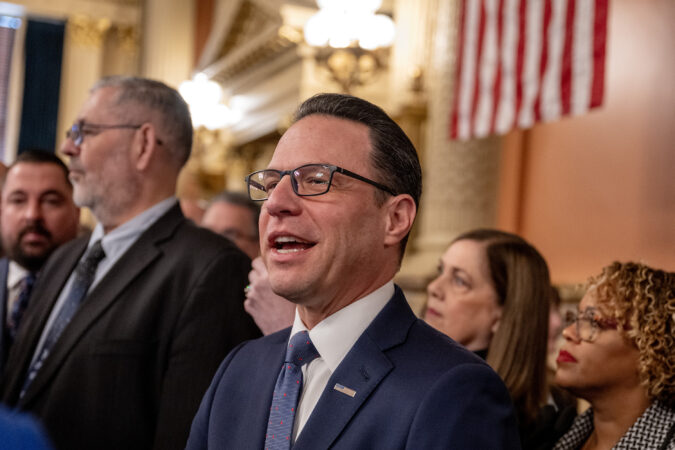
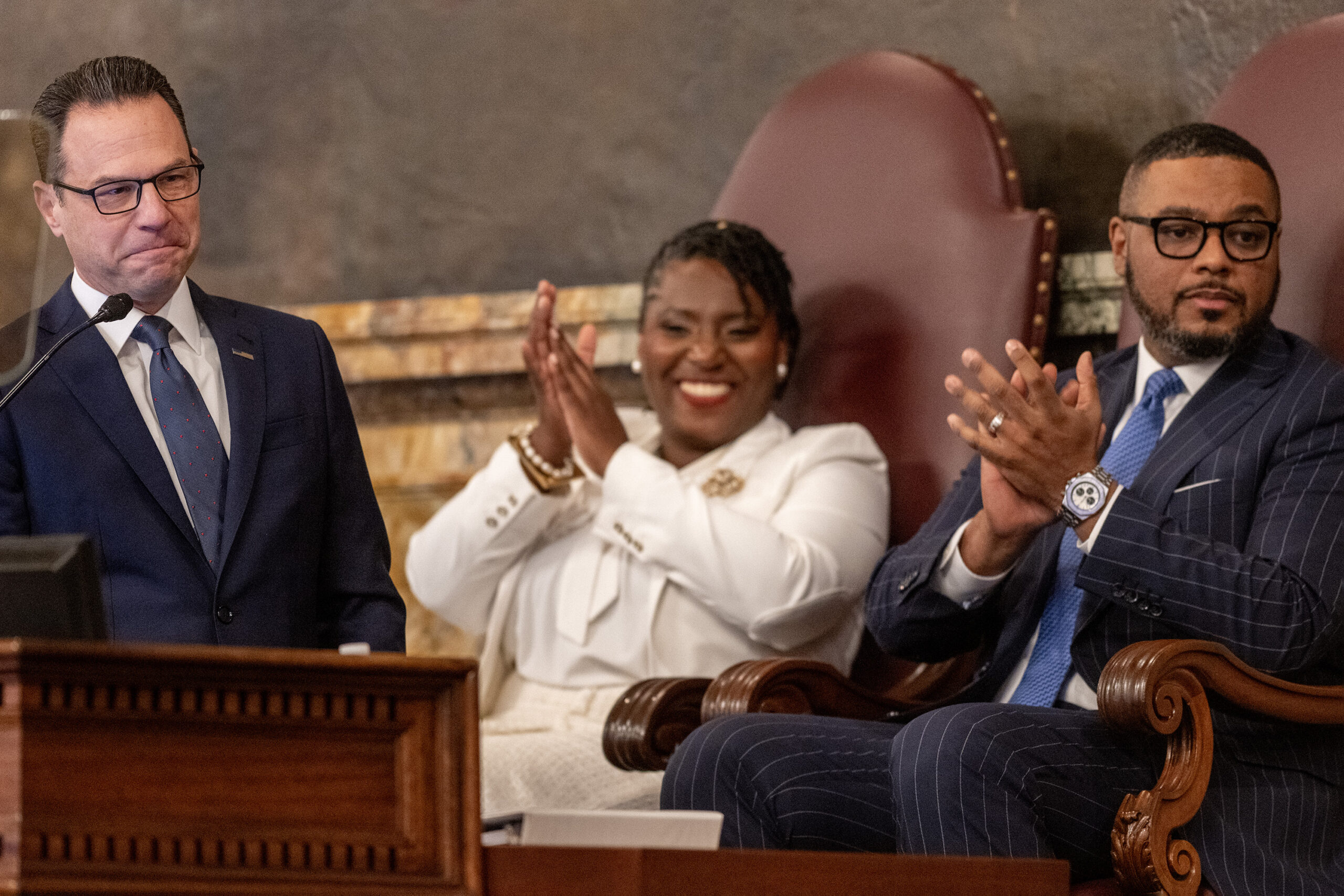
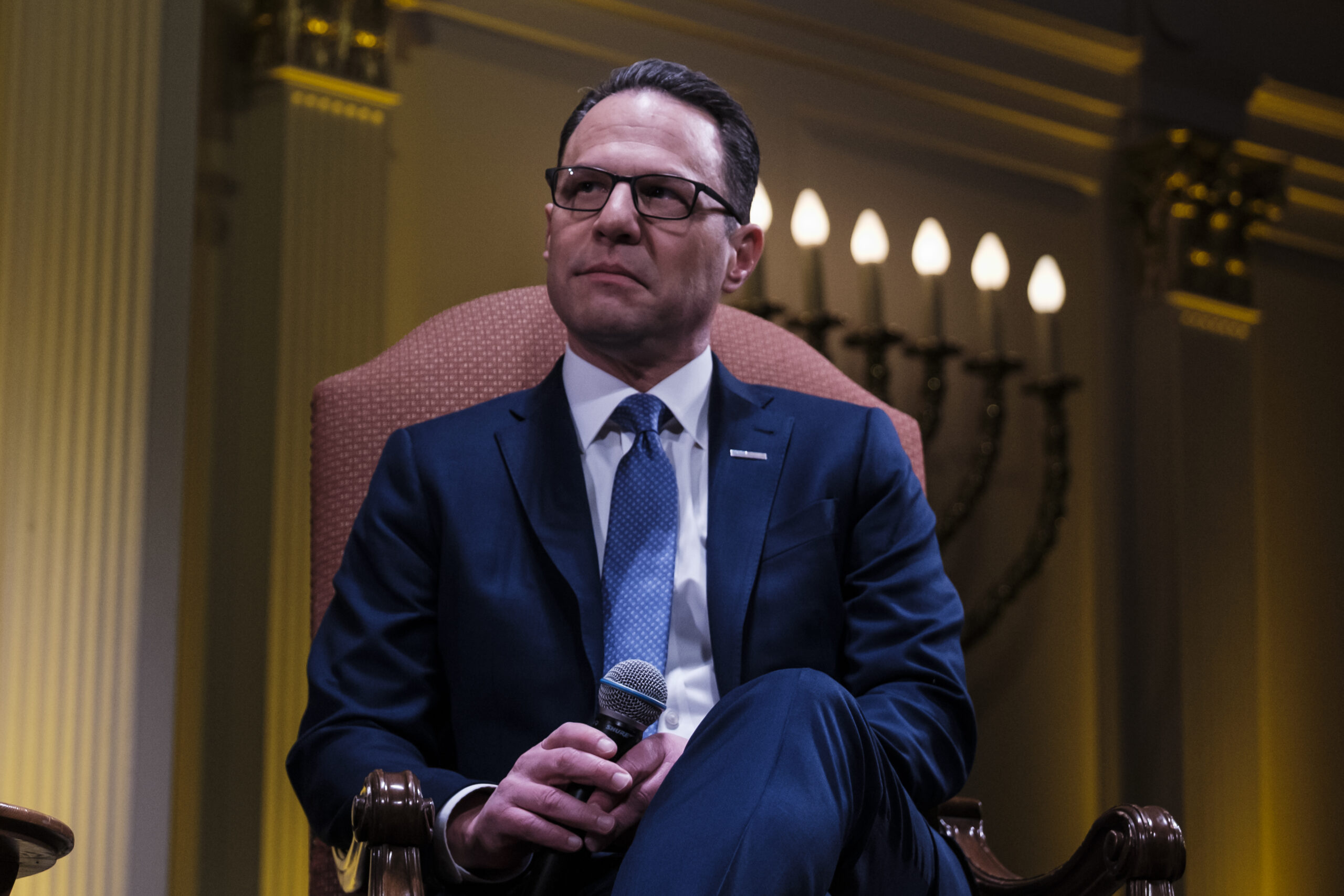
Gov. Josh Shapiro make his annual budget proposal in the state House chamber in Harrisburg Tuesday, Feb. 3, 2026. Pa. House Speaker Joanna McClinton (left) and Lt. Gov. Austin Davis (right) are seated behind him.
HARRISBURG — Gov. Josh Shapiro on Tuesday unveiled a $53.2 billion state budget proposal with a focus on affordability and attracting development in Pennsylvania, in what — if approved by the state’s divided legislature — would be a 6.2% increase over last year’s budget.
Shapiro’s $53.2 billion pitch is likely setting him up for another fight during the election year with Senate Republicans, who control the chamber and have promised fiscal restraint as their top priority and are unlikely to approve a major spending increase. Shapiro’s budget proposal would spend $4.6 billion more than the state is projected to bring in in the 2026-27 fiscal year, requiring the state to pull most of new spending from Pennsylvania’s Rainy Day Fund that currently tops more than $7 billion.
Shapiro on Tuesday said he wants to avoid another lengthy stalled budget, which forced schools, counties and nonprofits to take out billions in loans to stay afloat during the four-month-long impasse.
He invited leaders of all four caucuses — Senate Democrats, Senate Republicans, House Democrats, and House Republicans — to meet on Wednesday to start budget talks much sooner than prior years. They all agreed to attend, he added.
“We all recognize it took too long last year and that had real impacts on Pennsylvanians, but we learned some valuable lessons through that process,” Shapiro said in his address lasting an hour and 24 minutes. “We learned that we all need to be at the table, and that we all need to be at the table sooner.”
Shapiro takes aim at grid operator PJM, utility companies for high rates
Pennsylvania Gov. Josh Shapiro had sharp words for PJM, the region’s independent electric grid operator, during his budget address Tuesday, saying it has “moved too slow to supply new power,” helping lead to high energy rates to consumers.
Shapiro and advocates have long criticized the way PJM holds auctions that impact the rates consumers pay to energy providers. On Tuesday, he called for a continued cap on rates of wholesale electricity payments to power plant owners.
But Shapiro, calling PJM “just one part of the problem,” also took aim at utility companies, saying they have “too little public accountability or transparency.”
“That’s going to change,” Shapiro said.
According to the governor, only about 20% of the amount people pay on utility bills comes from energy use.
“Another big chunk comes from fees and costs that your local utility company charges to get electricity to your home,” Shapiro said. “Utilities companies in Pennsylvania make billions of dollars every year, while at the same time, they’ve increased the cost for consumers.”
Shapiro said major utility providers, such as PECO have agreed to take four steps to rein in costs. PECO serves 2,100 square miles in Southeastern Pennsylvania and provides electricity to up to 1.7 million customers.
The steps are:
End so-called “black box” settlements, which are confidential negotiated agreements between utility companies and regulators that determine rate changes, and agree to set prices transparently.
Enact “common sense reforms” to ban “deceptive contracts.”
Eliminate “jump fees” utilities charge low-income Pennsylvanians to have their services reconnected “something that literally can be done with the press of a button.”
Work to extend protections for low-income and vulnerable residents from shut-offs while managing unpaid bills.
In an apparent effort to dodge a repeat of last year’s five month (135 day) budget impasse, Shapiro announced he would be meeting with legislative leaders on Wednesday to begin budget talks.
Shapiro said he had invited the leaders of all four caucus in the House and Senate to his office and each had accepted.
“We all recognize it took too long last year — and that had real impacts on Pennsylvanians,” Shapiro said. “But we learned some valuable lessons through that process.”
The impasse resulted in temporary cuts to social services, schools and counties across the state as budget talks stretched on into November and state dollars stopped flowing.
This played out in Pennsylvania alongside a federal government shutdown that threatened critical food assistance dollars. But Shapiro said the final deal showed progress.
“At a time when dysfunction and chaos reigns elsewhere, Pennsylvania is showing that we can be a model for steady progress when we come together, treat others with respect, and find ways to extend a helping hand to our neighbors,” he said.
Shapiro calls for renter protections including a statewide cap on rental application fees
Shapiro also used his budget address to call for protections for households that either rent their homes or rent the land their homes sit on.
He called for a statewide cap on rental application fees, “limiting them to the actual cost of screening, and prohibiting landlords from charging fees before a prospective tenant can view a property.”
Philadelphia City Council members last year passed legislation that prohibits rental property owners from charging rental application fees of more than $50 or the cost of running a background and/or credit check, whichever is less. And landlords are banned from charging application fees unless they are used to cover the cost of these checks.
City Councilmember Rue Landau, who introduced the legislation, said some renters had been paying $100 or more per application, which adds up when tenants apply to multiple properties.
Shapiro also called for protections for owners of manufactured homes, which are single-family dwellings often built off-site and placed on a lot. These households own their homes, but many of them rent the land their homes sit on.
Manufactured homes represent one of the most affordable forms of homeownership. But homeowners are often left vulnerable, because they have no other option than to pay increased rent costs if they want to keep the homes they own. Manufactured-home communities are increasingly being bought by private equity companies and other institutional investors, and rent hikes tend to follow.
Across Pennsylvania, 56,000 households live in these communities, Shapiro said. He asked lawmakers to limit the rent increases that landowners can charge.
Last year, New Jersey enacted a law that limits annual rent increases to 3.5% for these lots. Landlords who want higher increases must ask the state’s Department of Community Affairs for permission.
“Last year, we all – all of us – identified a problem that we don’t have enough childcare workers, and that’s because we don’t pay them enough,” said Shapiro.
“We showed them the respect that they deserve,” said Shapiro.
On Tuesday Shapiro proposed increasing the recruitment and retention bonus from $450 to $630 as he noted the program has seen overwhelming demand.
“That’s more money in the pockets of our childcare workers, and more available child care for Pennsylvania families. It’s a win, win,” he said.
Staffing shortages plague the childcare sector in Pennsylvania and nationally, and the need for workers is expected to continue to grow. Employees who work as care providers are some of the lowest paid workers, earning on average roughly $30,000 annually in Philadelphia, Montgomery, Delaware, Chester and Bucks Counties.
And when parents can’t find adequate childcare, the Pennsylvania economy takes a hit, the Inquirer has reported. The state loses out on $6.65 billion annually when parents have to call out of work or lose their job due to childcare issues.
Shapiro renews calls for lawmakers to legalize marijuana in Pennsylvania
Shapiro renewed his calls for the state General Assembly to legalize recreational, also known as adult-use, marijuana as a way to drive needed revenue in the commonwealth.
According to the National Conference of State Legislatures 24 states, including Pennsylvania’s neighbors in Delaware, New Jersey, New York and Ohio, have legalized adult use marijuana. Pennsylvania is among 14 states that allow marijuana for medicinal purposes only.
The governor’s budget proposal calls for a 20% tax on marijuana products sold with sales beginning on January 1 of next year. According to budget documents from his office that tax would provide Pennsylvania with $729 million in revenue in its first year.
The figure is nearly $200 million more than Shapiro’s administration projected for revenues from legalization when he made the same proposal in last year’s budget.
A Shapiro administration official credited the increased projection as a result of increased interest among marijuana companies who would want to come to Pennsylvania and purchase licenses.
Approving recreational use of cannabis will be an uphill battle for Shapiro with a split legislature. Even as the federal government moves towards rescheduling marijuana and opening the door to more research, Senate Republicans have been reluctant to legalize the drug in the commonwealth.
If Pennsylvania doesn’t take action to build and preserve more housing, it will be short 185,000 homes by 2035, Shapiro said during his budget address. He called for the construction of more homes and the reform of local land-use laws to allow for more housing and lower housing costs.
Shapiro’s budget would create a $1 billion fund, supported by the issuing of bonds, to pay for a range of infrastructure projects. He called the fund “a major investment in building new housing.”
“We need hundreds of thousands of new homes,” Shapiro said. “This is how we build them.”
He also noted that local land-use laws vary across Pennsylvania’s 2,560 municipalities. He called for the state to create a catalog of local zoning rules and to help local governments reform ordinances to allow for more housing.
Shapiro called for local governments to allow for the construction of more homes near mass transit, streamline the construction of mixed-use development, and allow accessory dwelling units – such as in-law suites, garage apartments, and backyard cottages.
Most Pennsylvania municipalities ban the building of accessory dwelling units or make building them difficult.
The day before Gov. Shapiro’s budget address, a group of lawmakers in the state House announced a bipartisan package of bills meant to make homes more affordable. The two bills that have been introduced so far would allow for more housing density.
One would allow accessory dwelling units – such as in-law suites, garage apartments, and backyard cottages – in areas zoned for single-family housing. Property owners would have the right to build ADUs without asking their local government for a special exception, but municipalities would still be allowed to make “reasonable” restrictions, state Rep. John Inglis (D., Allegheny) said at a news conference Monday.
ADUs are “a simple way to add affordable housing without changing the character of our neighborhoods, and we can’t afford to keep blocking these solutions,” Inglis said.
Another bill would promote the construction of duplexes, triplexes, and quadplexes in certain areas that are zoned for single-family housing. It would require larger municipalities to allow these types of multifamily housing “while still allowing local governments to reject certain projects that might not be viable in their communities,” Inglis said.
Pennsylvania isn’t building enough housing, and that lack of supply is hiking prices for homeowners and renters, the Pew Charitable Trusts said in a report released last year.
Pennsylvania is one of the states that has allowed the least amount of housing to be built. It ranked 44th for the share of homes approved to be built from 2017 to 2023, according to the nonpartisan, nonprofit research and public policy organization.
Pew researchers cited restrictive local land-use laws as a cause and recommended the loosening of zoning rules.
“The bottom line is the best way to bring high rents and housing costs down is to build more housing and to build more varied types of housing,” Seva Rodnyansky, a manager in Pew’s housing policy initiative, told The Inquirer last year.
Shapiro urges GOP lawmakers to pass statute of limitations reforms for child sex abuse victims
After years of advocating for statute of limitations reform to allow a window for child sex abuse victims to sue their abusers, Shapiro placed the blame for the policy’s lack of movement at the feet of Senate Republicans in Tuesday’s address.
“Stop cowering to the special interests, like insurance companies and lobbyists for the Catholic Church,” Shapiro said to Senate Republicans as Republicans in the chamber booed.
The governor has pushed for the window since his time as Attorney General when, in 2018, his office released a grand jury report on clergy abuse in the state that called for the window among other reforms.
The policy passed the General Assembly as a constitutional amendment in 2020 but failed to reach voters’ ballots due to an administrative error from Gov. Tom Wolf’s Department of State.
Ever since, the policy has stalled as Senate Republicans have sought to tie it to constitutional amendments relating to voter identification and other GOP priorities.
The governor, who has faced criticism from some survivors for not being a strong enough advocate for reform enough since becoming governor, made an impassioned plea to Senate Republicans, urging them to “stop trying justice for abused kids to your pet political projects.”
“It is shameful that this hasn’t gotten done here in Pennsylvania when almost 30 other states have followed our grand jury report and passed it in their legislatures,” Shapiro said. “Pass statute of limitations reform this year — and give survivors of sexual abuse the chance to confront their abusers in court.”
‘Stop delaying’: Shapiro again asks legislators to raise the state minimum wage
On Tuesday, Gov. Josh Shapiro once again asked legislators to raise Pennsylvania’s minimum wage.
“I am calling on the General Assembly to stop delaying and put a minimum wage bill on my desk, and I will sign it,” he said to audible cheers.
Some in the crowd chanted “raise the minimum wage” as he brought up the issue. Shapiro responded to the chant, noting that 25 senators stood to applaud raising the minimum wage, including two Republicans: Sen. Joe Picozzi (R., Philadelphia) and Sen. Devlin Robinson (R., Allegheny).
Since taking office as governor, Shapiro has backed raising the minimum wage at every annual state budget address.
Pennsylvania’s minimum wage is the federal minimum of $7.25, which was set in 2009. Neighboring states all have higher minimum wages. In January, New Jersey’s minimum wage increased by $0.43 to $15.92 – making it more than double that of Pennsylvania’s.
“Our minimum wage in Pennsylvania has been stuck at $7.25 for the last 16 years. In that time, every single one of our neighboring states has raised the wage for their workers,” he said.
Shapiro noted Tuesday that raising the minimum wage to $15 an hour would save the state $300 million on entitlement programs like Medicaid.
“If you aren’t going to do this because it’s the right thing to do, or because it would let more families put food on the table for their kids, then do it because it’s going to save us $300 million, shrink our entitlement budget by growing our workforce and putting more money back in workers’ pockets,” he said.
In order to cover their basic needs, an adult living in Pennsylvania needs to earn $22.91 an hour, according to a living wage calculator developed at the Massachusetts Institute of Technology.
Only 2% of hourly wage earners in Pennsylvania earn the minimum wage or less, according to a report from the state’s Department of Labor and Industry based on 2022 data.
Shapiro calls for faster licensing for social workers and other professionals
Shapiro, who has touted himself as a good for business governor and last year worked with Republicans to approve building permitting reform, asked lawmakers to help him move that work forward in reducing licensing time for Pennsylvania professionals.
He called on the General assembly to approve reforms allowing social workers to be licensed in conjunction with graduate school, helping to address a shortage in the state, and he called for lower wait times for other professionals like barbers and pharmacists.
“We’ve put ourselves at a competitive disadvantage by incentivizing workers to go to another state,” he said.
Shapiro proposes adding $5 million to Pa.’s student teacher stipend program
As Pennsylvania continues to struggle with teacher shortages, Shapiro proposed adding another $5 million to the state’s student teacher stipend program — bringing the program up to $35 million.
Growing the program, which provides $10,000 to student teachers completing their required placements, will “ensure there are more well-trained teachers,” Shapiro said. He called out a teacher from Susquehanna Township, Hallie Sill, who he said had told him how the stipend program that launched in 2024 had helped her land a job after graduating from the University of Pittsburgh.
“Let’s increase our commitment to this initiative that we know works,” Shapiro said.
Budget would add $18 million in funding for career and technical education
The governor wants to increase funding for career and technical education in the state by $18 million, bringing up total funding for these initiatives to $200 million.
He noted that career and technical education, apprenticeship and vocational technical program funding has increased 50% since he took office.
“We’ve registered 231 new pre-apprenticeships and apprenticeships, and more than 39,000 of our fellow Pennsylvanians have participated in an apprenticeship during my time as your governor in fields ranging from welding to nursing to dairy herd management,” said Shapiro. “Those investments are making a meaningful difference, and they’re creating pathways of opportunity.”
He highlighted that some workers in the state lack a high school degree.
“We can’t lose sight of the fact that there are literally hundreds of thousands of Pennsylvanians who could be added to the workforce if we take care to give them the tools they need to succeed,“ said Shapiro. “Take the 614,000 Pennsylvania adults who don’t have a high school degree, for example. That’s a ton of untapped potential.”
Shapiro introduces ‘GRID’ plan for the rise of massive data centers
Saying the U.S. is in a race to dominate artificial intelligence, Pennsylvania Gov. Josh Shapiro announced a new plan he says will protect consumers against rising energy costs associated with data centers, while also easing a path for tech companies to build.
The Governor’s Responsible Infrastructure Development (GRID) plan would make data center developers either bring their own power generation or pay for any new generation they’ll need, “not saddling homeowners with added costs because of their development.”
Shapiro said too many data center proposals have been “shrouded in secrecy” but that they are crucial to the U.S.
“The United States is locked in a battle for AI supremacy against China. Look, I don’t know about you, but I’d much rather the future be controlled by the United States of America and not Communist China,” Shapiro said.
Components of the plan include:
Commit to “strict transparency standards.”
Engage communities.
Hire and train local workers from Pennsylvania.
Enter into community benefit agreements.
In return, developers would be “speed and certainty” in getting permits, as well as qualifying for tax credits.
“I know everyone … wants to see our economy grow and create more jobs and more opportunity,” Shapiro said. “But I also recognize this is unchartered territory, so let’s come together, codify these principles and take advantage of this opportunity.”
Shapiro proposes ensuring access to recess for Pennsylvania students
The governor made another proposal for Pennsylvania schools: ensuring they have recess.
“Recess, to me, isn’t just an extra block on the schedule. I would argue it’s just as critical as learning math and science and English,” Shapiro said.
He said he had directed the Pennsylvania State Board of Education to develop recommendations to “guarantee recess for our students.”
“Students need to spend less time focused on their phones and more time focused on learning, on talking to their friends face to face, and on developing the critical skills that they will need later in life,” said Shapiro, who drew sustained applause for the proposal. (“If applause could vote, we’d have this whole thing done already,” the governor quipped.)
He told lawmakers: “I know there are bills in both chambers to do this — I urge you respectfully to come together and send a bill to my desk.”
Some proposals garner unanimous standing ovations from lawmakers
Shapiro’s budget address is a workout for Democratic lawmakers, as they stand up, clap, repeat for each of his ideas.
As Shapiro mentioned mass transit — which he is proposing a long-term funding stream to begin in 2027 — all Democrats quickly shot up to applaud. Only one Republican lawmaker, Sen. Joe Picozzi (R., Philadelphia) stood to celebrate the mention.
As Shapiro talked about new standards he plans to implement for new data centers in Pennsylvania, a handful of other Republicans also stood to applaud.
Two popular proposals that garnered unanimous standing ovations: mentions of first responders and Shapiro’s pitch for restricting children’s access to dangerous AI chatbots.
Shapiro joked at one point, as he has in prior years, that Republicans should applaud his federal response fund because it will help safeguard money Pennsylvanians deserve. This brought a laugh from Democrats, but no reaction from Republicans.
Shapiro calls for limitations on AI to protect children and seniors
Shapiro called for a litany of limits on artificial intelligence as the emerging technology presents new risks to children and seniors across the commonwealth.
In recent months AI developers have faced calls for regulation nationwide and lawsuits from parents who say their children’s relationship with chatbots drove them to self harm.
Even as Shapiro advocated for making Pennsylvania a hub for AI, he said safeguards needed to be established.
He called for age verification and parental consent for chat bots, requirements that companies direct mentions of self harm or violence from children to the correct authorities and periodic reminders from AI chatbots that they are not human.
Furthermore, he called for prohibiting AI chatbots from producing sexually explicit or violent content involving children.
“This space is evolving rapidly. We need to act quickly to protect our kids,” Shapiro said.
In addition to for calling for the General Assembly to pass legislation imposing those limits, Shapiro said he had directed state agencies to explore legal avenues to hold app developers accountable.
Shapiro touts list of achievements as governor: ‘We’re solving problems and getting stuff done’
In his fourth budget address, and final before he stands for reelection in November, Shapiro touted a laundry list of his administration’s accomplishments – from funding of education, to investments in the state’s economy to reducing violent crime across the state.
“We’re solving problems and getting stuff done to improve people’s lives,” Shapiro said, referencing his campaign’s slogan “get sh*t done.”
The list of accomplishments closely mirrored the stump speech the governor gave to supporters in Pittsburgh and Philadelphia last month as he formally launched his reelection campaign and his talking points as he hit the cable news circuit on his book tour last month.
Likely to face State Treasurer Stacey Garrity in the general election next year the centrist Democrat has focused on the idea that he, as governor, can accomplish things for Pennsylvanians regardless of party affiliation.
He will retain that focus throughout his budget address, and throughout the next year as he campaigns for reelection while raising his national profile ahead of a possible 2028 presidential run.
Proposal includes $565 million funding increase to raise poor schools to ‘adequately’ funded levels
Gov. Shapiro is sticking to the state’s plan for remedying constitutional underfunding of its public schools — proposing another $565 million increase to raise poor schools to “adequately” funded levels, and reimburse high-taxing districts.
The governor’s proposed budget also includes a $50 million increase in basic education funding to be distributed to all K-12 schools and a $50 million increase in special education funding.
And it takes another step to curb payments from school districts by $75 million to cyber charter schools, after funding changes last year that were projected to save districts $175 million. While school districts have long accused charters of draining their budget, the cyber schools have vigorously protested proposals to scale back their payments, arguing their students will be hurt.
State mass transit funding fight could be postponed until 2027
Gov. Josh Shapiro is ready to postpone until 2027 a likely fight over a longer-term enhancement of state mass transit funding, citing the temporary cash infusion the administration arranged last year to bail out SEPTA.
“We believe that they are stabilized for two years,” said a Shapiro administration official on Tuesday, adding that they are happy to discuss the issue sooner if the General Assembly is willing.
The money, spread over two fiscal years, allowed SEPTA to reverse 20% service cuts it had imposed last year amid a $213 million deficit. It also was to carry the transit agency through the coming budget year. Shapiro’s proposed spending plan and annual address Tuesday kicked off the negotiations process.
Yet the governor did put on record his preferred stable funding solution for mass transit, which looks just like the one lawmakers spurned last year.
The spending plan would increase the share of the sales and use tax devoted to mass transit subsidies by 1.75%, raising an additional $319.6 million yearly to help strapped local and regional public transportation systems, according to budget documents.
But the proposal would not take effect until July 1, 2027, the start of the fiscal year that will run through June 2028.
“I bought us two years — but we have to keep working at this, because this isn’t a problem we can ignore,” Shapiro said Tuesday. “Mass transit helps drive our economy — this is an issue of economic competitiveness. You know I’m competitive as hell — and I want to win.”
State lawmakers share bipartisan hugs ahead of Shapiro’s budget address
The joint session of the Pennsylvania House and Senate was called to order, and as the group of state lawmakers awaited the arrival of Gov. Josh Shapiro to the chamber to deliver his $53.2 billion budget proposal.
Up until Shapiro’s arrival, attendees gave bipartisan, bicameral hugs to lawmakers from their opposing chamber. Several legislators reunited with their former colleagues who had returned to Harrisburg on Tuesday in their current roles as mayors or executives across the state, including Philadelphia Mayor Cherelle L. Parker, who previously served in the state House for 11 years.
Seated nearby to Shapiro’s left is state Treasurer Stacy Garrity, alongside the other GOP row officers Auditor General Tim DeFoor and Attorney General Dave Sunday. Garrity is likely to challenge Shapiro in November’s midterm election as the state GOP- endorsed candidate for governor.
Shapiro has delivered some lengthy speeches in past years during his first term, running for more than an hour to lay out his priorities for the upcoming fiscal year.
Shapiro’s budget would allot $30 million in performance-based funding for Temple, Penn State and Pitt
Gov. Shapiro’s budget once again proposes to allot money for performance-based funding for Temple, Pennsylvania State University and the University of Pittsburgh.
The budget includes $30 million for the effort, half of what Shapiro proposed last year, according to a source close to the process. When the current budget was passed, however, it included no money for performance-based funding this year.
Whether the initiative will gain legislative support in the new budget year is unclear.
The three universities currently receive about $551 million in state funding.
The new performance measures that would determine how the $30 million is allotted include graduation rates, affordability, and enrollment of low-income students and those pursuing degrees in wide-ranging occupations deemed critical for the state. The criteria were developed last year by a bipartisan council of legislative leaders and the acting secretary of education.
The universities in Pennsylvania’s State System of Higher Education, meanwhile, would be flat-funded for a second consecutive year under the budget, according to the source.
West Chester, East Stroudsburg, Kutztown, Millersville, Slippery Rock, Shippensburg, Commonwealth, Pennsylvania West and Indiana received the same basic funding this year that they did last year. That was the first time since 2021-22 that the schools did not receive an increase.
Cheyney also got the same basic funding, but the historically Black college got a special $5 million earmark “to develop and implement an enhanced transfer and workforce development initiative in partnership with a community college.”
The state’s community colleges also would be flat-funded under the governor’s proposal.
PJM Interconnection — the region’s dominant electric grid operator — is poised to play a central role in that expansion, as the independent organization has been shoved into the national spotlight and subjected to mounting pressure over the past year.
In many ways, PJM may be one of the most consequential Philly‑area institutions that most residents have barely heard of, even though their electricity supply and monthly bills hinge on its decisions.
The organization has faced escalating scrutiny nationwide and across the region because of its position as the country’s largest independent grid operator and the challenges tied to surging energy demand.
But what is PJM and why is everyone always so mad at it?
Shapiro will pitch $100 million reserve in the event Trump cuts federal funds for Pennsylvania
Gov. Josh Shapiro is expected to propose a new $100 million fund to use as a reserve in the event President Donald Trump’s administration opts to withhold federal funds from Pennsylvania.
Shapiro will pitch the new Federal Response Fund on Tuesday, when he delivers his fourth budget address before a joint session of the state General Assembly.
While Shapiro’s budget pitch will outline how he believes the state should spend $53.3 billion in state revenue and reserves, it is only a piece of Pennsylvania’s annual spending. In the 2025-26 budget, the state was projected to receive $53.1 billion in additional funds from the federal government, or 40% of the state’s total annual spending.
Shapiro has repeatedly said the state cannot backfill the federal cuts by the Trump administration and Congress to Medicaid, health subsidies, food assistance, and more, as these cuts total billions in federal funds. The proposed fund would not try to replace this money, but would be available if the Trump administration chooses to withhold federal fund as it did multiple times last year.
Shapiro is expected to note in his address the 19 times he sued or joined lawsuits against the Trump administration for failing to release federal funds, such as $18 million set aside for state-level Homeland Security funding or $2 billion for environmental and energy projects already appropriated by Congress during former President Joe Biden’s tenure.
Shapiro frequently sued Trump during his first administration while he was Pennsylvania’s attorney general, and has chosen to continue to legally challenge him in his capacity as the state’s governor on numerous occasions.
In his new memoir Where We Keep the Light, which was released last week, Shapiro gave a window into how he decided to join lawsuits as attorney general, noting the many times he beat the Trump administration in court because “we were rooted in the law, not politics.”
“But while I had profound differences with [Trump], and I didn’t like the way he talked, and I certainly didn’t like the values and viewpoints he espoused, I only sued his administration when I believed that he was actually violating the law,” Shapiro wrote.
One reason the budget could get resolved faster than last year
There is one bright spot for the schools, counties and nonprofits that rely on state funding and which last year had to wait more than four months for the money when lawmakers couldn’t agree: It’s an election year.
Election years often result in quicker budget resolutions, as lawmakers and officials want to secure money for their districts before they go home to campaign for reelection.
In 2018, when former Democratic Gov. Tom Wolf was up for reelection, he signed the state budget on June 23 — a week ahead of the July 1 deadline.
This year, Gov. Josh Shapiro is up for reelection, likely to face a November challenge from State Treasurer Stacy Garrity, the state-GOP endorsed candidate. And many other state lawmakers are in the same boat.
All 203 seats in the state House and half the 50 seats in the state Senate are on the ballot in November. Several lawmakers have announced they will not seek reelection, allowing for competitive elections to fill the vacancies.
Gov. Josh Shapiro proposed to generate an additional $1.5 billion over five years to subsidize public transit operations by increasing its share of state sales tax income.
Senate Republicans, in the majority in the chamber, opposed using the sales tax, though the rate would not have increased.
They preferred a new source for the state’s transit aid rather than a broad-based levy, and said SEPTA was mismanaged, citing high-profile crimes, rampant fare evasion, and spending decisions.
Hopes were raised of a deal to use money from a new tax on games of “skill,” slot-like machines that are currently untaxed or regulated — the proverbial magical money pot that would make raising cash painless. It had featured in several budget cycles but again did not come together amid clashing opinions among GOP lawmakers.
When the state budget passed in December, there was no new transit money in it.
In November, the administration also sent $220 million in emergency money in November for repairs to the ailing Regional Rail fleet and the trolley tunnel.
SEPTA officials and transit advocates say they are unsure what’s coming this time around, if anything.
One thing is clear in advance: A Pennsylvania budget process ain’t Schoolhouse Rock, so hang on.
Shapiro could promote effort to ban cell phones from Pa. schools today
Gov. Josh Shapiro is backing a proposal to ban cell phones from Pennsylvania classrooms, joining a growing chorus of parents, teachers, and officials seeking to curb school disruptions and detach kids from addictive devices.
“It’s time for us to get distractions out of the classroom and create a healthier environment in our schools,” Shapiro said in a post on X on Thursday.
He called on Pennsylvania lawmakers to pass a bill that would require schools to ban the use of cell phones during the school day, “from the time they start class until the time they leave for home.”
The endorsement from the Democratic governor — who could promote the issue during his budget address Tuesday — comes as school cell phone bans have increasingly become the norm: 31 states have restrictions of some kind on phones, including 23 states with “bell-to-bell” bans barring the use of phones the entire school day, according to Education Week.
Housing, affordability, and new revenue: What we’re watching for in Gov. Josh Shapiro’s budget address
HARRISBURG — Gov. Josh Shapiro on Tuesday is expected to propose a $53.2 billion state budget for the 2026-27 fiscal year, just three months after settling a bitter, 135-day budget impasse that forced schools, counties, and nonprofits to take out loans to stay afloat.
Shapiro, a first-term Democrat running for reelection this year and potentially poised for higher office, will deliver his fourth annual budget address before a joint session of the Pennsylvania General Assembly, where he plans to pitch an expansive $1 billion housing and infrastructure plan to incentivize new housing development with an overall focus on affordability in the state.
And as in years past, Shapiro is expected to again propose new revenue streams to fill a more than $5 billion deficit, such as the legalization and taxation of adult-use cannabis, as Pennsylvania is again expected to spend more than it brings in tax revenues.
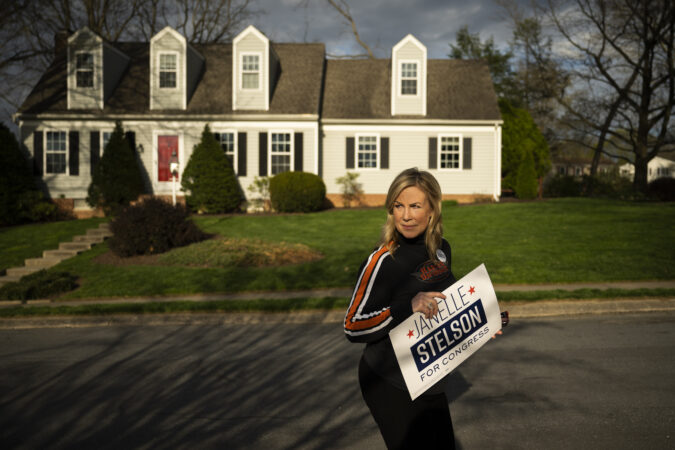
Democrat Janelle Stelson outraised U.S. Rep. Scott Perry for the second quarter in a row in her bid to flip the Central Pennsylvania district, which could determine control of the House in November.
Stelson, who lost by a little more than 1 percentage point to Perry in 2024, has raised more than $2.2 million since launching her rematch campaign in July. She has outraised Perry in both quarters since her kickoff and has more cash on hand than the incumbent Republican when taking his campaign debt into consideration.
Perry, a close ally of President Donald Trump, appears to be in the toughest fight of his political career. The seven-term lawmaker continues to be a Trump loyalist even as other swing-district Republicans in the state increasingly look to distance themselves from the president.
“I think the story of Scott Perry just keeps getting worse,” Stelson, 65, said in an interview. “He’s somebody who I covered for years on the news, and people have just really had enough. After more than a decade in Washington, he’s caused a lot of problems.”
Perry, 63, a member of the conservative House Freedom Caucus, voted last month against a Democratic-led bill to restore recently expired healthcare subsidies amid a national spike in insurancepremiums, a vote Stelson has seized upon. Three other Pennsylvania Republicans who represent swing districts — U.S. Reps. Brian Fitzpatrick, Rob Bresnahan, and Ryan Mackenzie — voted for the measure.
Stelson would need to win the Democratic primaryin May to set up the November rematch. She is facingDauphin County Commissioner Justin Douglas, a progressive pastor,who has raised under $85,000 this year. Perry also has his first primary challenge, from Karen Dalton, a retired attorney for Harrisburg Republicans, who reported raising a little more than $11,000 since launching her campaign.
Perry raised more than $2.9 million in 2025, and Stelson has raised $2.2 million since she launched her campaign in July. Stelson raised more than $946,000 from October through December,beating Perry’s haul for the quarter of $780,031.
Stelson ended the year with $1.52 million cash on hand, while Perry had $1.66 million. But Perry’s campaign also has nearly $280,000 in debt, which would put Stelson ahead when factored into the totals.
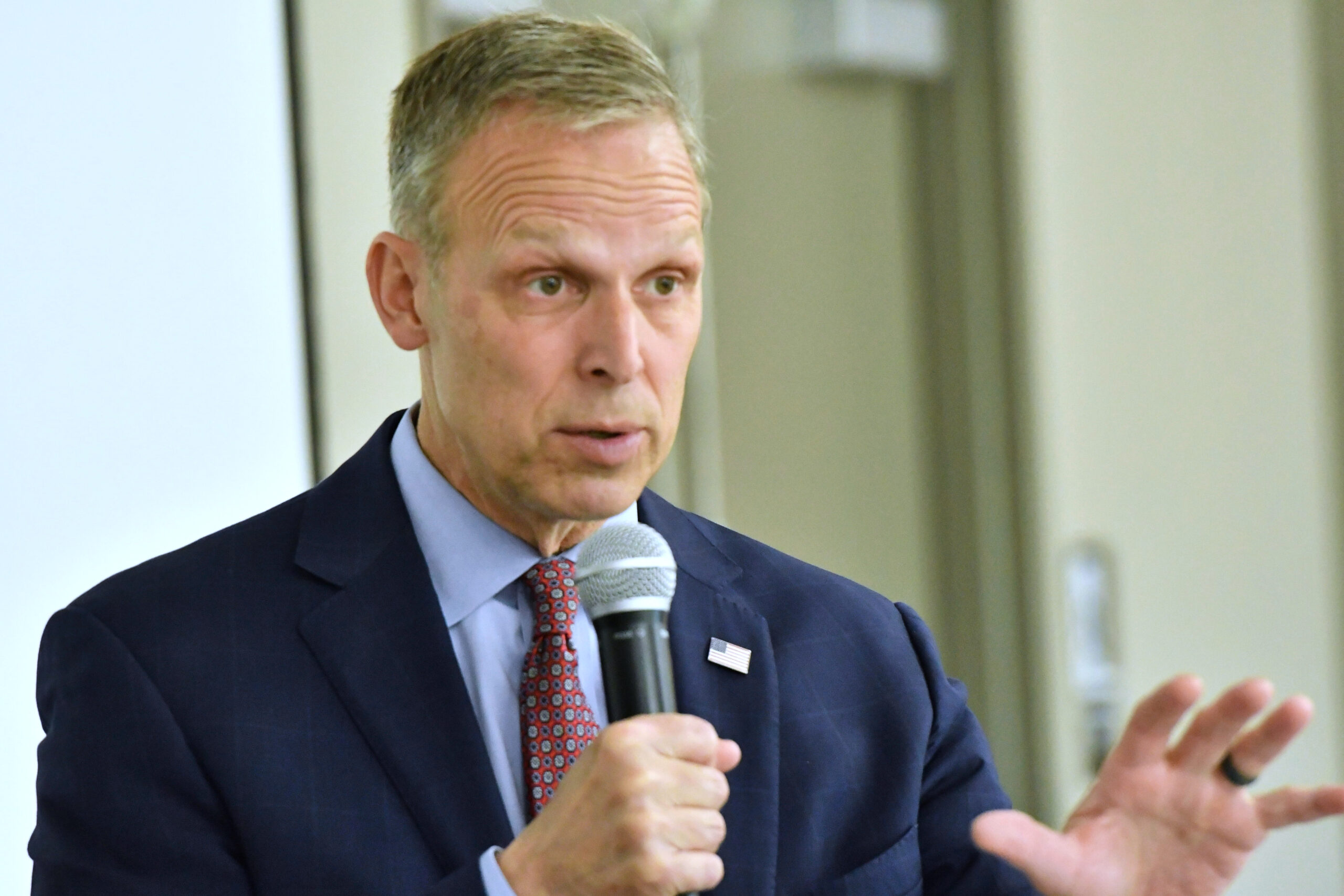
FILE – U.S. Rep. Scott Perry, R-Pa., speaks during a campaign event in front of employees at an insurance marketing firm, Oct. 17, 2024, in Harrisburg, Pa.
The nonpartisan Cook Political Report rated the district as a toss-up alongside Mackenzie’s Lehigh Valley district, marking them as among the most competitive races in the country.
Perry campaign spokesperson Matt Beynon said Perry’s fundraising last quarter was “incredibly strong” and pointed to how he outraised fellow swing district Republicans Bresnahan and Mackenzie during that stretch.
Beynon said Perry is in a better position to ward off a Democratic challenge this year because his district has emerged as a priority for national Republicans, landing on the National Republican Congressional Committee’s Patriots Program — a list of priority races that he was not on in 2024.
“Seeing the results last go-around, and seeing how hard we fought to make sure that the congressman was reelected, I think did open some eyes, and the congressman has been able to make the case that he needs support, too,” Beynon said in an interview.
He said it has been “a learning experience for folks to understand” that the district has become increasingly blue in recent years. The 10th Congressional Districtincludes Dauphin County and parts of York and Cumberland Counties, and is home to Harrisburg and Hershey.
Perry declined to be interviewed for this article.
Stelson said Republican voters in the district who have historically voted along party lines are “really waking up” and are beginning to view Perry as more of an “extremist” than a Republican.
She criticized Perry for urging his colleagues to throw out Pennsylvania’s votes hours after the Jan. 6, 2021, attack on the Capitol. She also pointed to his vote against awarding the Congressional Gold Medal to Capitol Policeofficers, as well as his support for Trump’s One Big Beautiful Bill Act, which made cuts to Medicaid and SNAP in order to help fund Trump’s tax cuts and immigration crackdown.
“He’s always putting his far-right politics ahead of the needs of people in this area,” Stelson said. “They can’t pay their bills. … His defeat actually would be a defeat for extremism in our politics.”
Democrats are optimistic that having Gov. Josh Shapiro, who won the district in 2022, at the top of the ticket will boost Stelson’s chances and build on last year’s momentum in local races.
Perry’s campaign has called Stelson a “carpetbagger,” since she lived outside district lines in nearby Lancaster last time she ran. Stelson has argued that she knows the district well because of her decades-long career as a local journalist, and that she used to live in it.
Stelson campaign spokesperson Alma Baker confirmed Stelson now rents a home in the district in Camp Hill while still owning her Lancaster residence, noting she lives in the district full-time.
Stelson pointed to what she described as “national problems” when asked about unique issues in the district, such as the economy. Her campaign soon after unveiled an agenda aimed at supporting farmers and other rural residents.
Beynon said that Perry will speak about his support for provisions in Trump’s One Big Beautiful Bill Act like ending tax on tips and extending tax benefits for overtime. He will also point to his long-held position sponsoring a bill to ban stock trading in Congress, on which he has collaborated with Democrats.
Both candidates plan to talk about affordability, which has emerged as a successful message for both sides of the aisle.
“It’s just getting worse when you have to worry about whether you’re going to put groceries on the table or pay your skyrocketing utility premiums, that’s a real problem,” Stelson said. “You can’t send kids to school without something in their tummies, otherwise they’re going to be thinking about that all day instead of learning.”
As a broadcast journalist for decades, the second-time candidate said, she listened to and highlighted concerns from people in the district.
“And I feel like now they can teach me what I need to be doing in Congress when I carry their voices there,” she added.
WASHINGTON — In a string of public appearances since federal agents fatally shot Alex Pretti, Gov. Josh Shapiro has repeatedly decried the federal immigration operation in Minnesota as unconstitutional and called on President Donald Trump to “terminate the mission.”
The centrist Democratic governor leaned heavily into criticism of the Trump administration as he toured the East Coast —andnetwork and cable news shows — to promote his new memoir, Where We Keep The Light, last week.
“I believe this administration in Washington is using [government] for pure evil in Minnesota right now,” Shapiro, who is widely believed to be setting up a presidential run, told Late Show host Stephen Colbert last week. “And it should not be hard to say that.”
Known to be a careful messenger, Shapiro’s approach to the Immigration and Customs Enforcement and Border Patrol operations in Minneapolis evolved over the last week, from his initial decision over the first year of Trump’s second presidency not to aggressively speak out against ICE’s enforcement tactics to a hard-line approach condemning the Trump administration’s mission following the killing of another U.S. citizen by federal agents that became national tipping point.
When ICE agents killed Renee Good in early January, Shapiro issued a statement mourning her death, but made no broader conclusions about ICE and did not mention her by name.
Now, he has honed a clear and authoritative message that the Trump administration’s strategies are eroding trust in law enforcement, violating constitutional rights and making communities less safe. If Trump moves his focus and forces to Pennsylvania, he says, state officials are prepared to push back.
According to polling obtained by Puck News, Shapiro has landed on some of the most effective messaging on immigration in the country.
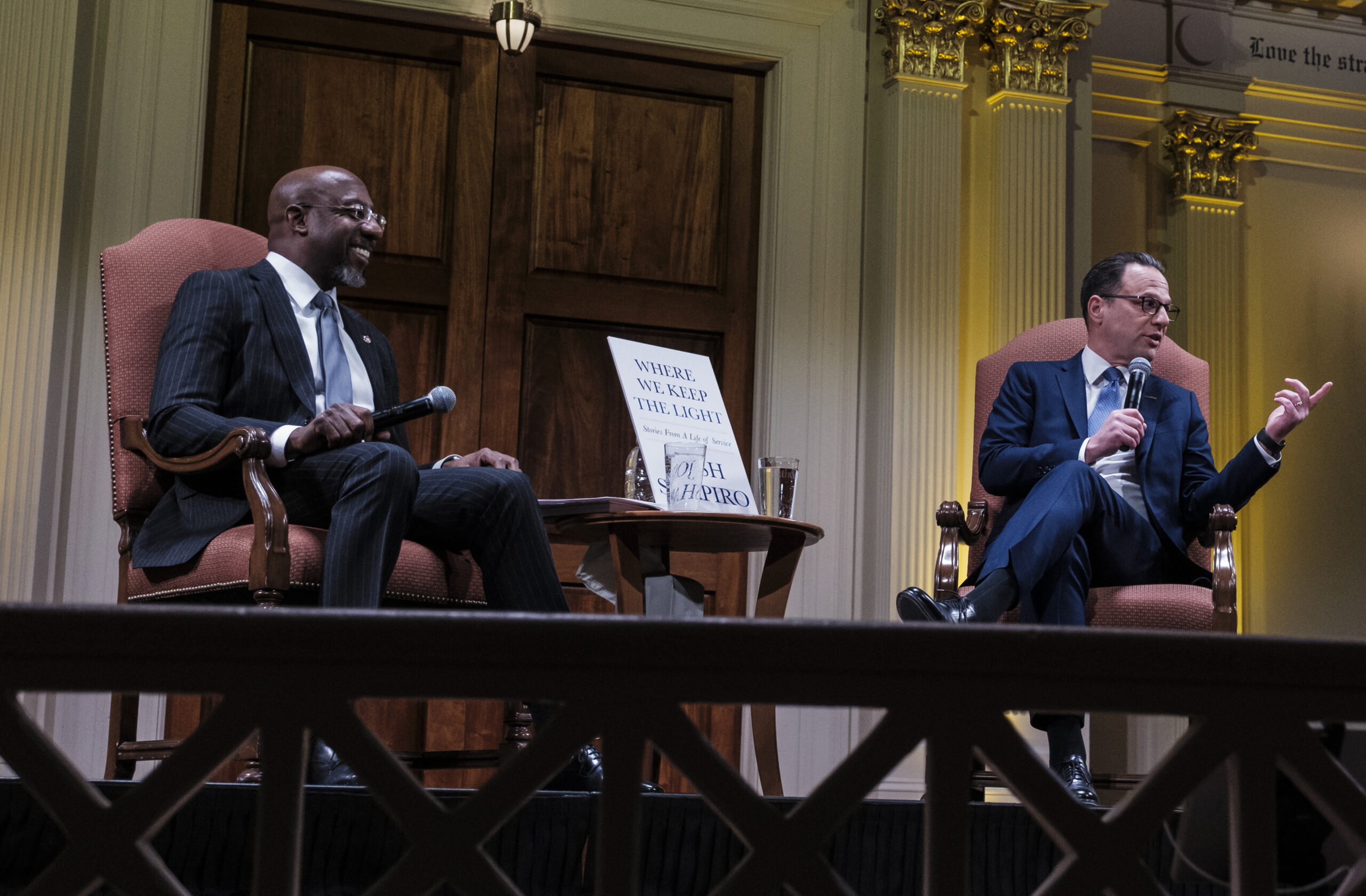
Governor Josh Shapiro (D-PA) and Sen. Raphael Warnock (D-GA) speak during a talk for his new memoir “Where We Keep the Light” on January 29, 2026 in Washington, D.C
But immigrant rights groups in Pennsylvania say the governor took too long to speak up and has yet to back his rhetoric up with concrete actions in his home state by ending cooperation with ICE.
“Because it is the topic of the day, he’s getting these pointed questions, and his answer to that is to point to what they’re doing wrong in Minnesota. Meanwhile, he’s over here telling us that he’s not going to stop collaborating with ICE,” said Tammy Murphy, advocacy manager at immigrant rights group Make the Road Pennsylvania. “It’s easy for him to point the finger to somebody else, but then what is he doing at home?”
At a roundtablewith journalists in Washington on Thursday, Shapiro said he didn’t view his new outspokenness against ICE’s operations in Minneapolis as a tone shift, but acknowledged that the situation had become more serious in recent days and he “reached a point where it was critically important” to comment on the situation in Minnesota and tell Pennsylvanians his views.
“I think I’ve been in the same place on this to protect our immigrant communities and also make sure that Pennsylvania is safe,” Shapiro said.
“Both [Good and Pretti’s deaths] told me the same story that you had people who were not following proper policing tactics. People who were in the field who seemingly, and it became more clear to me over the last week or two, did not have a clear mission and that the directive that they had clearly was not within the bounds of the constitution.”
“That’s people power right now, and this is a moment where we need to raise our voices,” Shapiro said. (His event was then promptly, but briefly, interrupted by climate protesters)
“It’s always good to cooperate with ICE, especially when they’re doing targeted actions,” Garrity said.
Samuel Chen, a GOP strategist, said Shapiro’s harsh rhetoric would create a clear distinction between him and Garrity while “endearing him to the Democrats should he run in 2028.”
Chen noted that even some Republicans have criticized Trump’s approach to Minnesota, which creates an opportunity for Shapiro to speak out.
“With that being public opinion the governor has a lot of cover to come out even harder,” Chen said. “It’s a win, win, win for him.”
Chalk on the sidewalk reading “Shapiro Stop ICE in PA,” during a protest outside the Free Library as Gov. Josh Shapiro promoted his new book “Where We Keep The Light” in Philadelphia, Pa., on Saturday, Jan. 24, 2026.
Even as he makes the case against ICE’s recent actions, Shapiro is still being careful not to go too far. He frequently mentions that Pennsylvania is not a sanctuary state. In an interview with Fox News last week, he criticized Philadelphia District Attorney Larry Krasner’s comments comparing ICE agents to Nazis as unacceptable rhetoric.
“It is abhorrent and it is wrong, period, hard stop, end of sentence,” Shapiro said.
What is most frustrating to immigrant rights groups is the Shapiro administration’s willingness to cooperate with ICE — even if on a limited basis — while other Democratic governors have taken strong actions against it. Gov. Maura Healy of Massachusetts, for example, banned ICE from state facilities.
Meanwhile, Shapiro’s administration honors some ICE detainers in state prisons and provides ICE with access to state databases that include personal identifying information for immigrants.
“You are still collaborating with the agency that is murdering our people, that you yourself have named as violating the constitution,” said Jasmine Rivera, the executive director of the Pennsylvania Immigration Coalition.
“You know, Parady La’s death was also bad,” said Murphy, who is with Make The Road. “That happened in this state at the hands of federal agents. And he’s silent about that, but then he’s got something to say about Renee Good or Alex Pretti. He’s talking about those people, but not the people here.”
The Shapiro administration says that outside agencies do not have “unfettered access” to state databases but may offer access to federal agents for “legitimate investigations that involve foreign nationals who have committed crimes.”
Furthermore, they say ICE detainers are honored only when a detainee has been convicted of a crime and sentenced to state prison.
In a letter to advocates last month, the administration vowed not to lease state property to ICE and reiterated that State Police are barred from conducting immigration enforcement and that federal agencies must obtain a warrant to access non-public space in state buildings.
Gov. Josh Shapiro speaks with Stephen Colbert last week.
This cautious approach is part of a balancing act Shapiro must handle as he pursues reelection in a politically split state and weighs a potential run for higher office, said Alison Dagnes, a political science professor at Shippensburg University.
“He is spinning plates and juggling flaming torches, all while he’s playing the kazoo,” Dagnes added “That combination is really important to consider as we look at his shifting rhetoric, his carefulness that moved into a louder stance.”
But advocates want Shapiro to take a firmer stance and say they won’t stop pushing until he does.
“Politically, he wants to be seen as ‘both sides,’” Murphy said. “He doesn’t want to be seen challenging Trump or this deportation machine.”
A 21-year-old Temple University student was arrested Monday on charges that he conspired with nine other people, including journalist Don Lemon, to interfere with the First Amendment rights of worshipers during a Jan. 18 anti-ICE protest at a church in St. Paul, Minn.
Jerome Richardson, 21, a senior at Temple who is a native of St. Paul, turned himself in Monday morning to federal authorities in Philadelphia, according to a post on a GoFundMe page created to pay for his legal defense. A photo was posted showing Richardson entering the United States Custom House with several federal law enforcement officers apparently waiting for him at the entrance.
The arrests of Richardson and Ian Davis Austin, an Army veteran from Montgomery County, were announced at 9:10 a.m. on X by Attorney General Pam Bondi. Austin was arrested Friday.
“If you riot in a place of worship, we WILL find you,” Bondi wrote. “We have made two more arrests in connection with the coordinated attack on Cities Church in St. Paul, Minnesota: Ian Davis Austin and Jerome Deangelo Richardson.”
The arrest of Don Lemon was made public on Friday.
The protesters went to Cities Church because a pastor there is also a U.S. Immigration and Customs Enforcement official.
If you riot in a place of worship, we WILL find you.
We have made two more arrests in connection with the coordinated attack on Cities Church in St. Paul, Minnesota: Ian Davis Austin and Jerome Deangelo Richardson.
Lemon entered the church while livestreaming and said repeatedly: “I’m not here as an activist. I’m here as a journalist.” He described the scene before him, and interviewed churchgoers and demonstrators.
A magistrate judge had rejected prosecutors’ initial bid to charge the veteran journalist. Lemon was charged, as were Richardson and seven others, by grand jury indictment last Thursday.
The indictment described the protest as a “coordinated takeover-style attack” on the church that caused people to flee in fear. Protesters chanted “ICE out!” and “Hands up! Don’t shoot!” The indictment quotes Lemon, who in the moment described the scene as “traumatic and uncomfortable.”
Before his arrest, Richardson shared a video online in which he said he feared for his safety and needed help to pay legal bills.
Richardson said he assisted Lemon “by helping with logistics and connecting him with local contacts.”
“Don was reporting on the situation,” Richardson said, adding that he was proud to help.
“As a consequence of this support, I am now being targeted by Trump and the federal administration,” Richardson said, adding that he was proud of the other defendants in the case.
“This is the price of being unapologetic about humanity and love of Christ,” he said.
Richardson, who traced his activism to the murder of George Floyd in 2020, said he still hoped to complete his degree and graduate from Temple in May.
In a statement, Temple University said it was aware of media reports about the arrest of a student.
“We understand that the circumstances surrounding this matter are developing. Out of respect for the privacy of the student and the ongoing legal process, the University will not comment on the specifics,” the statement says.
“As we’ve shared previously, we deeply value the First Amendment, including the rights of free speech, a free press, and the freedom to exercise religion,” the statement says. “We encourage and educate our students to engage thoughtfully and lawfully to advocate for their beliefs and values, raise awareness and contribute to constructive dialogue.”
This article contains information from the Associated Press.
State Sen. Sharif Street maintained his financial advantage. Physicians Ala Stanford and David Oxman have turned to self-funding their campaigns. And State Reps. Chris Rabb and Morgan Cephas are low on cash — but one might be getting help soon.
The crowded Democratic primary for Pennsylvania’s 3rd Congressional District is beginning to come into focus after the candidates this weekend filed new campaign finance reports. The filings cover the last three months of 2025, providing insights into the candidates’ resources as the campaign heats up.
window.addEventListener(“message”,function(a){if(void 0!==a.data[“datawrapper-height”]){var e=document.querySelectorAll(“iframe”);for(var t in a.data[“datawrapper-height”])for(var r,i=0;r=e[i];i++)if(r.contentWindow===a.source){var d=a.data[“datawrapper-height”][t]+”px”;r.style.height=d}}});
Fundraising will not be the only factor that determines the outcome of the May primary election, which will ultimately be decided by voters. But the 3rd District candidates need money to pay staff and buy advertisements to spread their message, and the beginning of an election year is often a pivotal time for campaigns to prove their viability.
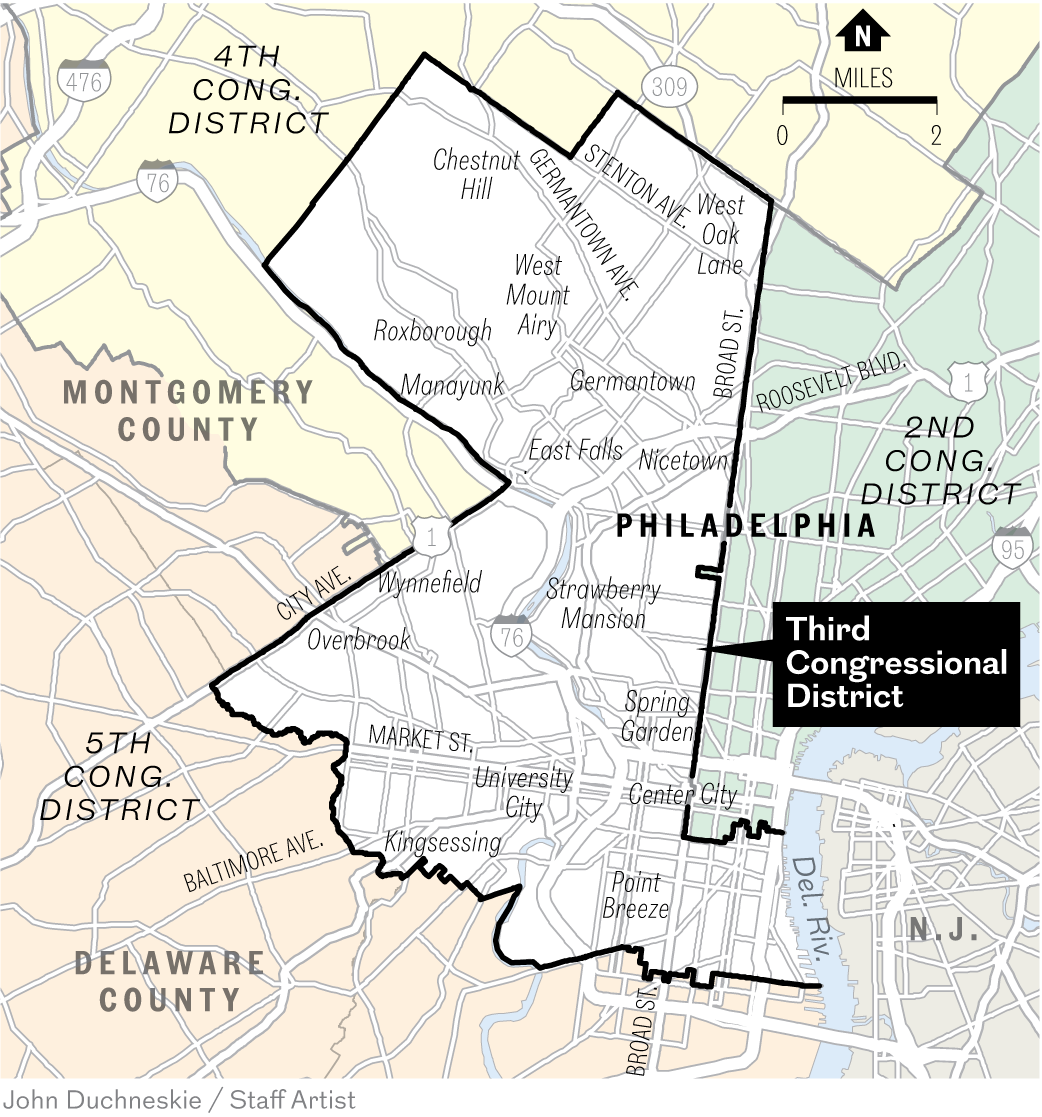
Map of Pennsylvania’s 3rd Congressional District.
After U.S. Rep. Dwight Evans (D., Philadelphia) last year announced he would not seek reelection to the nation’s bluest district, more than a dozen candidates tossed their hats in the ring. It’s likely some will not stay in the race long enough to appear on the May 19 primary ballot.
The 3rd District includes all of Northwest and West Philadelphia, as well as parts of Center City and North, South, and Southwest Philadelphia.
Street led the field by raising about $347,000 from Oct. 1 to Dec. 31 of last year, according to his report. His campaign spent $193,000 during that period, and he had $527,000 in cash on hand at the start of 2026.
window.addEventListener(“message”,function(a){if(void 0!==a.data[“datawrapper-height”]){var e=document.querySelectorAll(“iframe”);for(var t in a.data[“datawrapper-height”])for(var r,i=0;r=e[i];i++)if(r.contentWindow===a.source){var d=a.data[“datawrapper-height”][t]+”px”;r.style.height=d}}});
Campaign manager Josh Uretsky said Street’s fundraising totals “demonstrate that our strong track record of progressive leadership — from lowering health care costs to leading the fight to legalize recreational cannabis and reform our justice system — is resonating in every corner of the district.”
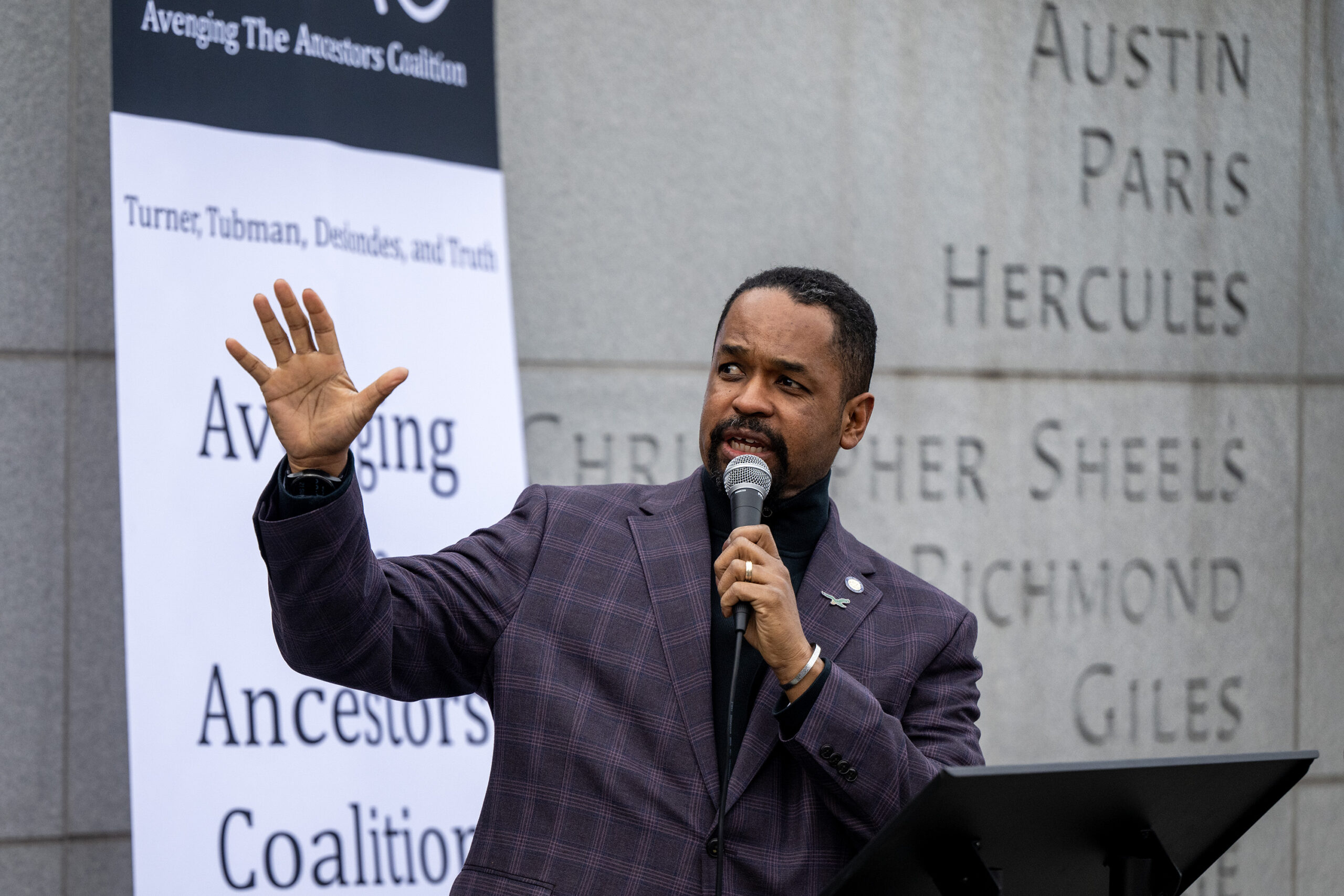
State Sen. Sharif Street speaks in front ofthe engraved names of nine enslaved people who lived and worked at President George Washington’s home, as the 15th anniversary of the President’s House exhibit in Independence National Historical Park is celebrated Sunday, Dec. 21, 2025.
Street has benefited from contributions from the deep-pocketed building trades unions, which endorsed him last fall. In the past, those unions have also funded outside spending committees, or super PACs, to support their preferred candidates, and it’s likely they’ll do the same for Street this spring.
Street collected more than $40,000 from labor groups in the most recent reporting period.
First-time candidates Ala Stanford and David Oxman turn to self-funding
Last month, it appeared that Stanford,a pediatric surgeon, was raking in cash when her campaign released a statement saying she had raised more than $467,000, a significant haul for a first-time candidate. The campaign said at the time that her fundraising prowess “solidifies [her] leading role” in the race.
But it turns out that more than half of the money the campaign brought in came from Stanford herself. The new report showed that Stanford lent her campaign $250,000 on Dec. 31, the last day of the reporting period, bringing her total cash on hand to about $392,000 at the end of the year.
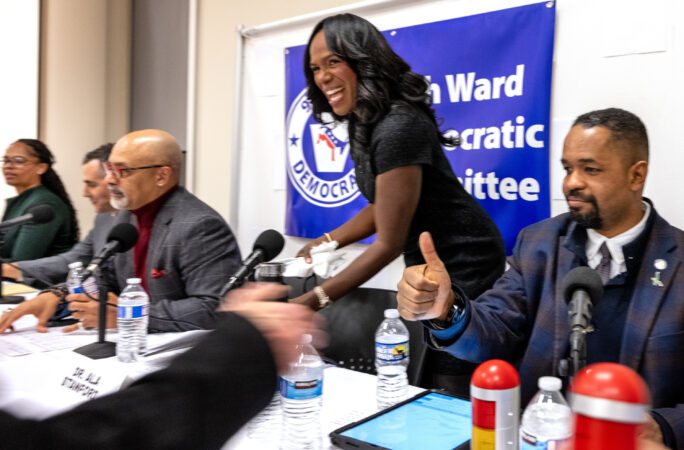
Physician Ala Stanford at a forum hosted by the 9th Ward Democratic Committee Dec. 4, 2025.
In a statement Monday, Stanford emphasized her humble upbringing in North Philadelphia public housing, saying she “never imagined being in this position, but this city has given me so much.”
Her campaign noted that she also invested her own money in her nonprofit organization, the Black Doctors Consortium, to bolster the city’s COVID-19 testing and vaccination programs during the height of the pandemic.
“I’ve stood up and led during a crisis before — and spent my own money to do it — so I’m going do whatever it takes to fight for our city,” Stanford said. “I’m incredibly grateful that in just the first few months of our campaign, that commitment has been matched with amazing grassroots financial support, too, and we’re just getting started.”
Stanford is not the only doctor self-funding their congressional campaign. Oxman, another political outsider and physician, brought in just over $107,000 between October and December — including $75,000 that he lent to his own campaign.
Oxman, an intensive-care physician and professor at Thomas Jefferson University, has lent his campaign $175,000. At the end of the year, he had $357,000 in the bank.
Physician David Oxman at a forum hosted by the 9th Ward Democratic Committee Dec. 4, 2025.
In a press release Sunday, Oxman emphasized that he was not accepting corporate PAC donations.
“You cannot fight for the health of the people of the 3rd district while you are taking money from nursing home companies and health insurance PACs,” Oxman said. “The corporatization of medicine is just a piece of a larger corporatization of American life that is hollowing out our economy as well as our democracy.”
Chris Rabb and Morgan Cephas enter 2026 low on cash
Both Cephas and Rabb raised less money in the fourth quarter of 2025 than in the opening months of their campaigns, and they both closed the year with roughly $100,000 in cash on hand.
Cephas, who represents a West Philadelphia district and chairs the city’s delegation to the Pennsylvania House, entered the year with about $109,000 in cash on hand.
State Rep. Morgan Cephas at a news conference Sept. 3, 2025.
“The residents of the 3rd Congressional District are more concerned with the skyrocketing cost of living, fewer health care options, and making sure their communities are safe than who raised the most money,” Cephas campaign manager Salvatore Colleluori said. “Rep. Cephas has only one priority in this race, the residents of Philadelphia’s 3rd Congressional District.”
“I’m incredibly proud of the thousands of people in Philly and across the country fueled by a movement so much bigger than electoral politics,” Rabb said. “Our momentum is undeniable. We always knew we wouldn’t outraise the corporate-backed and self-funded campaigns — and we don’t need to.”
Pablo McConnie-Saad, a 39-year-old South Philly resident who worked in Biden’s administration, entered the race to represent Pennsylvania’s 3rd Congressional District.
Meanwhile, Pablo Iván McConnie-Saad — a Bella Vista resident who worked in Delaware politics before serving in the Treasury Department under former President Joe Biden — brought in a fundraising haul similar to the sitting state representatives last quarter despite his campaign largely flying under the radar.
McConnie-Saad collected $119,000 in contributions last quarter, and he had $69,000 on hand at the start of the year.
In a statement, campaign field director Matt Cárdenas said McConnie-Saad offered voters a “different choice.”
“This campaign is entirely people-powered,” he said. “No corporate PAC money, no AIPAC, just everyday people investing in a different kind of politics. We’re proud of what we’ve built so far. Politicians have failed us, and Washington won’t change unless we challenge it.”
The Democratic Socialists of America’s Philadelphia chapter recently endorsed him, as did two liberal wards in South Philadelphia. And Reclaim Philadelphia leaders are recommending that its members back Rabb in the progressive group’s internal endorsement process.
The Working Families Party of Pennsylvania, which often funds super PACs to back left-leaning candidates, has not yet weighed in.
Candidates (from left) State Reps. Morgan Cephas, and Chris Rabb; and physician David Oxman appear at a forum hosted by the 9th Ward Democratic Committee in Mt. Airy Thursday, Dec. 4, 2025.
“We’re still going through an active endorsement process, but we’re confident that we will land on a progressive who will fight for working people, not billionaire donors, big corporations, or special interests,” said Nick Gavio, a spokesperson for the party.
Additionally, the Justice Democrats, a national group founded by operatives from Bernie Sanders’ presidential campaign, may also get involved. In the past, the PAC has backed candidates with similar platforms to Rabb’s.
Justice Democrats “will likely come to a decision with news to share in the very near future in support of a candidate we can be confident will represent the values of the everyday people in this district,” spokesperson Usamah Andrabi said.
Data reporter Joe Yerardi contributed to this article.
Philadelphia’s bombastic district attorney, Larry Krasner, is no stranger to opposition from within his own party, but the anger directed at him last week after he said ICE agents are “wannabe Nazis” was more pronounced than usual.
After making the comparison, Krasner faced a wave of criticism, including from Pennsylvania Gov. Josh Shapiro, a Democrat, who called the comments “abhorrent” and said the rhetoric doesn’t help “bring down the temperature.”
But the progressive district attorney said Monday that he would not back down, saying “these are people who have taken their moves from a Nazi playbook and a fascist playbook.”
“Governor Shapiro is not meeting the moment,” Krasner said in an interview. “The moment requires that we call a subgroup of people within federal law enforcement — who are killing innocent people, physically assaulting innocent people, threatening and punishing the use of video — what they are. … Just say it. Don’t be a wimp.”
Krasner pointed to a speech by Rabbi Joachim Prinz at the March on Washington in 1963: “Bigotry and hatred are not the most urgent problem. The most urgent, the most disgraceful, the most shameful, and the most tragic problem is silence.”
In invoking that speech, Krasner said: “A reminder, Mr. Governor: Silence equals death.”
Krasner’s defense came after days of criticism from across the political spectrum, ranging from the White House press secretary to Democratic members of Congress. And it punctuated a yearslong history of conflict with Shapiro.
The governor and Philadelphia’s top law enforcement official have feuded politically,sparred in court, and disagreed on policy. In 2019 — when lawyers from Krasner’s office decamped to work for then-Attorney General Shapiro — DA’s office staffers referred to Shapiro’s office as “Paraguay,” a reference to the country where Nazis took refuge after the war.
Last week, during a news conference about proposed restrictions on immigration enforcement in Philadelphia, the district attorney said he would “hunt down” and prosecute U.S. Immigration and Customs Enforcement agents who commit crimes in the city.
“There will be accountability now. There will be accountability in the future. There will be accountability after [Trump] is out of office,” Krasner said. “If we have to hunt you down the way they hunted down Nazis for decades, we will find your identities.”
During an interview Thursday on Fox News’ Special Report with Bret Baier, Shapiro was asked about Krasner’s comparison of ICE agents to Nazis and called the comments “unacceptable.”
“It is abhorrent and it is wrong, period, hard stop, end of sentence,” Shapiro said.
Several other Democrats in political and media circles weighed in. U.S. Sen. John Fetterman, a Pennsylvania Democrat who has at times sided with Trump on immigration matters, appeared on Fox News and said he “strongly” condemned Krasner’s language.
He said that “members of ICE are not Nazis.”
“That’s gross,” Fetterman said. “Do not compare anyone to Nazis. Don’t use that kind of rhetoric. That can incite violence.”
U.S. Rep. Chris Deluzio, a Democrat who represents parts of Western Pennsylvania, in an interview with the Washington Examiner contrasted his own approach with Krasner’s, saying: “I reserve throwing the phrase Nazis at actual Nazis. I don’t just throw that around.”
And State Rep. Manuel Guzman Jr., a Democrat who represents a significant Latino population in Berks County, wrote on social media Friday: “I really, really want Krasner to chill tf out.”
“I get it. We want to protect our immigrant community,” Guzman wrote, “but I question if constantly poking the bear is the right strategy. At the end of the day it’s my community that is under siege.”
And U.S. Rep. Dan Meuser, a Republican who represents parts of Northeast Pennsylvania, appeared on Newsmax and called Krasner a “psychopath with a badge.”
Meuser — who considered challenging Shapiro for governor with Trump’s backing but ultimately decided not to run — also on social media decried “the Left’s silence and, in many cases, encouragement of this rhetoric.”
Krasner doubled down. In an interview on CNN on Thursday, he criticized Fetterman as “not a real Democrat” and also said, “There are some people who are all in on the fascist takeover of this country who do not like the comparison to Nazi Germany.”
He said that when he promised to “hunt down” federal agents who kill someone in his jurisdiction, he was attempting to make a point that there is no statute of limitations on homicide.
The interviewer, Kaitlan Collins, asked Krasner whether he could have made that point without comparing agents to Nazis.
“Why would I do that?” Krasner responded. “They’re taking almost everything they do out of the Nazi playbook.”
WASHINGTON — President Donald Trump might be bragging about his administration’s work on affordability, but recent polling suggests that Americans aren’t buying it as they grow increasingly frustrated with his leadership.
Many Americans say Trump is focusing on the wrong priorities, according to multiple surveys, including a January AP-NORC poll, and they largely think Trump is neglecting the issue of costs at home. Compounding his problems, there are signs that frustration is rising over his approach to immigration, and some of his recent fixations, like taking over Greenland, are downright unpopular.
This has created separate — but related — problems for Trump as his party heads into a midterm year. Americans don’t think he’s paying enough attention to the economy and many want him to focus less on immigration and foreign policy. But those are the issues that dominated the headlines over the past month, thanks to Trump’s aggressive approach.
Many don’t see Trump helping costs
Trump was reelected in large part because of economic concerns, but recent polling shows that the bulk of Americans aren’t seeing benefits from his policies yet, and most don’t think he’s paying enough attention to the issue.
A large share of registered voters see the economy as one of the top issues facing the country, and a recent New York Times poll found that about half of registered voters say Trump’s policies have made life for most Americans “less affordable.”
Similarly, about 7 in 10 registered voters in a new Fox News poll said Trump is not spending enough time focusing on the economy, including about half of Republicans.
Meanwhile, about 4 in 10 voters in the Fox News poll said Trump’s economic policies have “hurt” them personally, while about the same share said the policies haven’t made a difference. Only about 2 in 10 say the president’s economic path has benefited them — and looking ahead, 45% of voters say they expect the economy will “get worse” in the next year.
Most voters see ICE as too aggressive
Even though many Americans continue to support Trump’s goal of deporting people in the country illegally, polling shows that they’re increasingly uncomfortable with his immigration’s tactics.
About 6 in 10 registered voters said ICE tactics have “gone too far” in the New York Times poll. The Fox News poll found a similar share of voters felt ICE was being “too aggressive” in its efforts to deport immigrants in the country illegally, a measure that’s up 10 percentage points from July.
Those measures — which were conducted before the shooting of Alex Pretti by Border Patrol agents in Minneapolis — point to Americans’ broad frustration with immigration officers’ actions in cities across the U.S. even before the situation in Minnesota escalated further.
Immigration was among Trump’s strongest issues when he started his second term in AP-NORC polling, but it’s since fallen. Just 38% of U.S. adults approve of how Trump is handling immigration, down from 49% in March. That poll was conducted Jan. 8-11, shortly after the death of Renee Good, who was shot and killed by an ICE officer in Minneapolis.
There’s also some indication that Trump’s approval on immigration could be slipping among Republicans. It fell from 88% in March to 76% in the January AP-NORC poll, an apparent shift among his supporters during his first year back in office.
Polling shows that many Americans want Trump more focused on issues at home. About 4 in 10 voters want Trump less locked in on foreign policy, according to the Fox poll. Roughly one-third of Americans said Trump’s time spent on foreign policy was “about right,” and about 3 in 10 said he was not spending enough time on it.
Control of Greenland is an unpopular issue for Trump. A recent Pew Research Center poll found that about 6 in 10 U.S. adults strongly or somewhat opposed the U.S. taking over Greenland, as Trump has proposed. Republicans were split on the issue: about 4 in 10 favored a takeover, but about one-third were opposed. About one-quarter were uncertain.
Republicans less confident in Trump’s character, mental fitness
Trump has been a prominent political figure for about a decade, and his supporters have often not been deterred by his nontraditional or brash behavior in the White House. Polling has often shown that issue priorities often drive voters much more than candidate character.
Despite that, there’s a possible warning for Trump in new Pew Research Center polling that shows that just over half of Republicans, 56%, support “all” or “most” of Trump’s plans and policies, down from 67% just after he took office last year.
The poll also found sharp declines in Republicans’ confidence that Trump has the mental fitness to serve as president, respects the country’s democratic values, or acts ethically in office. Only about 4 in 10 Republicans are now “extremely” or “very” confident in Trump acting ethically, down from 55% early last year.
Also concerning for Trump, given his focus on his predecessor’s mental fitness, about two-thirds of Republicans are now highly confident that Trump has the mental fitness needed to do the job of president. That’s down from 75% at the start of his second term.
“I did not see anything that concerned me about the condition, because there are some marks, but I can’t portray where they are from, and I do not believe that they’re in a worsened condition now,” Judge Cynthia M.Rufe told reporters after spending about 30 minutes in the storage facility, which is controlled by the National Park Service even though the center is not part of the agency.
After the inspection, Rufe ordered the government to safeguard the removed exhibits and mitigate any potential harm to them.
The suit came after National Park Service employees took down educational panels about slavery from the President’s House at Independence National Historical Park on Jan. 22.
It also follows a hearing in federal court Friday in which city attorneys and U.S. attorneys sparred over the removal of the exhibits. During the hearing, Rufe, a George W. Bush appointee, chastised a U.S. attorney representing President Donald Trump‘s administration for talking out of “both sides of his mouth” and making “dangerous” arguments.
Rufe issued an order Monday preventing further removals or changes to the President’s House until further notice. The judge also instructed the city to file a new injunction request to clarify what it is seeking, and gave the U.S. attorney’s office another week to respond.
Michael Coard, leader of advocacy group Avenging the Ancestors Coalition, which helped develop the President’s House in the early 2000s and is providing legal backing to the city’s suit, told reporters that he didn’t see any damage to the panels, but “there was desecration.”
What he saw was“completely disrespectful, demoralizing, defiling, and desecration,” Coard said, noting that the signs, many of which are fragile, were not cushioned and that some were against the wall on a cement floor.
Coard joined the judge and attorneys in the storage facility as a representative for the coalition’s legal support of the lawsuit.Members of the press were not allowed to review the exhibits.
Before going to the storage facility Monday, Rufe and the attorneys gathered in the lobby of the Constitution Center, which has a direct view to Independence Hall from Arch Street to Chestnut.
Rufe invoked the iconic building Friday to set the stakes for the city’s suit against Interior Secretary Doug Burgum, acting National Park Service Director Jessica Bowron, and their respective agencies.
“It’s threatening to think that that could happen to Independence Hall tomorrow,” Rufe said during the hearing. “It’s frightening to think that the citizenry would not be involved in such an important change.”
After having been in limbo for months, the informational panels were removed by Park Service employees using wrenches and crowbars onorders from the Trump administration, provoking outrage from Philadelphians. The displays were then piled into the back of a pickup truck and transported to the storage facility.
Mijuel Johnson (left), a guide with The Black Journey: African-American Walking Tour of Philadelphia, shows Judge Cynthia Rufe (right) around the President’s House in Independence National Historical Park on Monday.
The exhibits are stored by the National Parks Service in a room accessible through the National Constitution Center, but the civics-nonprofit “does not oversee that space, and Center staff have no knowledge of what materials may be stored there,” a spokesperson said in a statement.
After reviewing the removed exhibits for roughly 30 minutes, Rufe and her law clerks walked across Independence Mall toward the President’s House, a block away at Market Street. The judge stood at the site of the former home of Presidents George Washington and John Adams, as a guide from The Black Journey explained the historical significance of the slavery exhibit.
“This is the first of its kind memorial on federal property to the enslaved people of the United States,” said Mijuel Johnson, who led the tour.
Johnson directed the judge’s attention to panels telling the story of the presidency and the enslaved Africans who lived on the property, part of the routine tour script, but the walls were bare.
Rufe asked questions about the removed panels and what exhibits could be further removed. She walked around the site, still not cleared of the previous weekend’s snow, to review a wall in which the names of the President’s House enslaved residents are etched into the stone.
Judge Cynthia Rufe views the “Memorial to Enslaved People of African Descent in the United States of America,” during a visit to the President’s House in Independence National Historical Park on Monday. This exhibit was not removed with other panels at the site on Jan. 22. The judge visited the site while hearing the Parker administration’s suit to have President Trump’s administration restore the panels.
Outside the location that served as the slaves’ quarters, adjacent to the Liberty Bell, Rufe paused and took out her glasses to read a memorial panel.
“This enclosed space is dedicated to millions of men, women and children of African descent who lived, worked and died as enslaved people in the United States of America,” the panel read. “They should never again be forgotten”
Relevant to the core disagreement in the lawsuit, about who has the right to change the site, the bottom of the memorial panel bears the names of two entities: the National Park Service and the City of Philadelphia.