Category: Washington Post

  • This musician taught an octopus to play the piano

    This musician taught an octopus to play the piano

    The white package that arrived at Mattias Krantz’s home in Sweden after a five-hour flight contained an octopus that Krantz saved from becoming someone’s meal.

    Krantz’s hopes for the octopus, which he named Takoyaki, were high — maybe unreasonably so. Within about six months, Krantz wanted Takoyaki to play the piano so well that the animal could perform “Under the Sea” and the theme from the movie Jaws.

    Krantz, who typically makes YouTube videos playing instruments he modifies, had long wanted to teach piano to an animal. Krantz said octopuses, whose eight arms can each act somewhat independently because of the neurons inside them, had the most potential.

    But the task proved more difficult — and fulfilling — than Krantz imagined, requiring hundreds of hours and a wealth of patience. His YouTube video detailing the teaching process has more than 6 million views.

    “It was probably the worst thing I’ve ever done, and maybe the coolest thing, but also the worst ever,” Krantz, 28, told the Washington Post. “I never pushed myself to such limits.”

    Takoyaki, an octopus, played piano keys while Mattias Krantz played an acoustic guitar.

    Krantz purchased Takoyaki from a Portuguese fishery in March; he did not buy the octopus from a Korean market as is depicted in his YouTube video. Once Krantz got the octopus into his home, he dumped the creature into a roughly 110-gallon tank containing rocks, sand, and dog toys. The tank was connected to machines that filtered water and removed octopus waste.

    “You’re going to be the greatest pianist the sea has ever known,” Krantz told Takoyaki, which he nicknamed Tako.

    Mattias Krantz bought Takoyaki, an octopus, from a Portuguese fishery in March.

    But first, Krantz had to earn Tako’s trust.

    On the first day in its tank, Tako hid behind rocks and didn’t eat the small crabs and mussels Krantz had fished off Sweden’s southern coast. Tako began eating on the second day, and soon Krantz gave Tako a simple task to judge whether the octopus was up for the piano challenge: Take a plastic lid off a glass jar containing crab and shrimp. Tako passed the test after about three days.

    Krantz then designed a piano key on his computer, 3D-printed it and set it down in the tank. When Tako touched the key on the second day, Krantz gave the octopus a treat. But Krantz wanted Tako to push the key to play a note, so he added a white lever that Tako wrapped its arms around and pulled to make a sound (Tako also broke the key off its mount a few times and hid it under rocks).

    After that first success, Krantz built Tako a 15-key piano — a process Tako seemed to watch closely by pressing its body against the glass. But when Krantz placed the piano in the tank, Tako sat on it instead of playing it.

    One of Takoyaki’s first tasks was to open a plastic lid off a glass jar.

    So Krantz tried different approaches.

    First, he added a blue underwater speaker that allowed Tako — whose species has poor hearing — to feel a vibration when the octopus played a key. Tako began playing random notes, Krantz said, but he wanted Tako to play particular keys to form a melody.

    Krantz added symbols to the keys he wanted Tako to play — circles, crosses, and stripes — which Tako didn’t respond to. Krantz even added pictures of an orange crab to the keys. The octopus was interested in the pictures but not in playing the keys.

    Takoyaki took the piano key Mattias Krantz made.

    But one thing seemed to grab Tako’s attention: movement. When a bubble formed in the tank, Tako chased it.

    So, with fishing wire, Krantz wiggled the lever on the keys he wanted Tako to play. It worked — despite Tako also spending time playing the wires like a harp. (Marine scientist Jenny Hofmeister said octopuses are attracted to movement because it might signal prey.)

    After a week, Tako played two notes in a row. After two weeks, Tako played a pair of notes simultaneously.

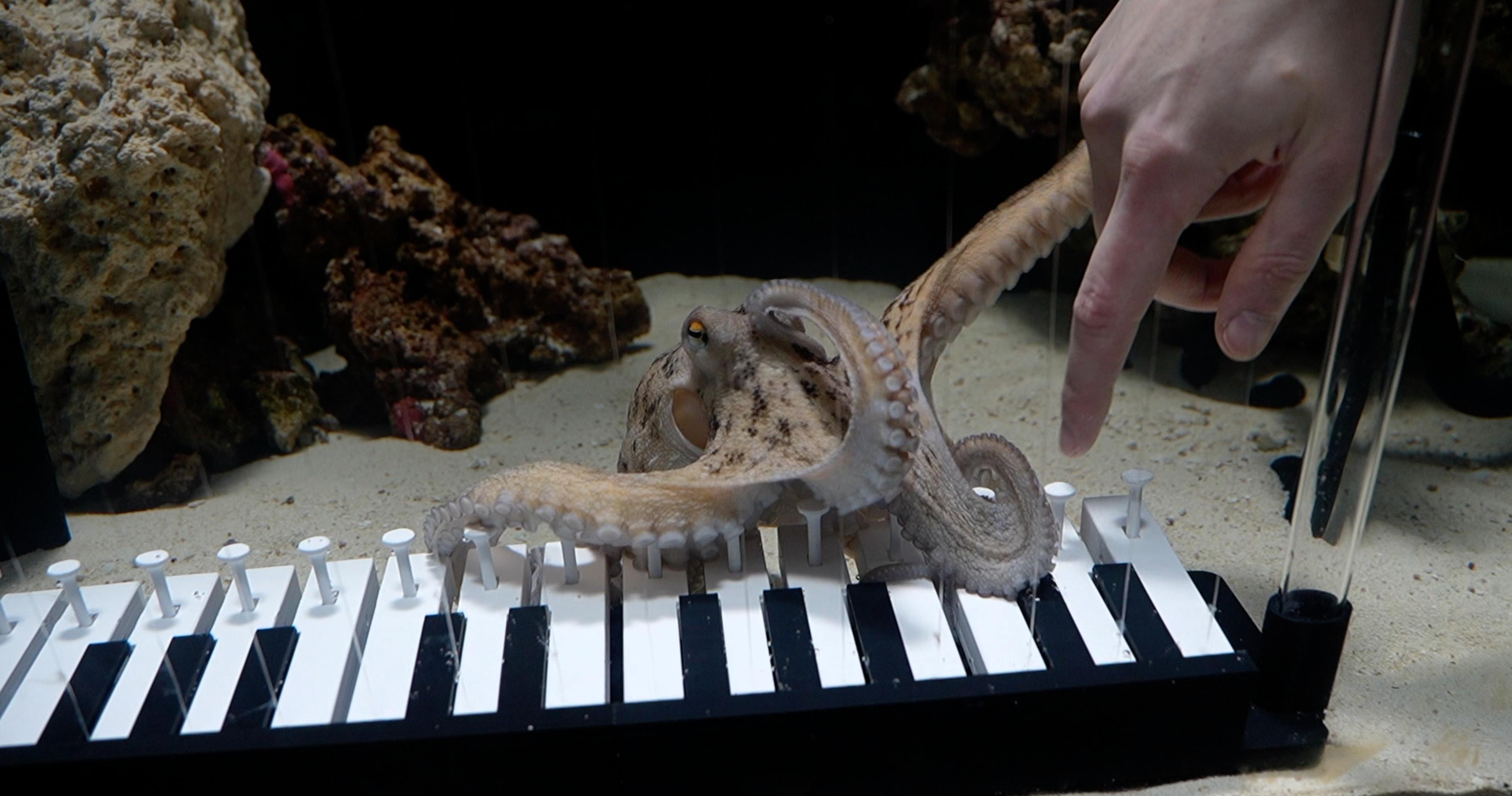
    After Mattias Krantz built Takoyaki a 15-key piano, the octopus seemed to resist Krantz pointing to the keys from inside the tank.

    But in the following weeks — after about four months of training — Tako plateaued.

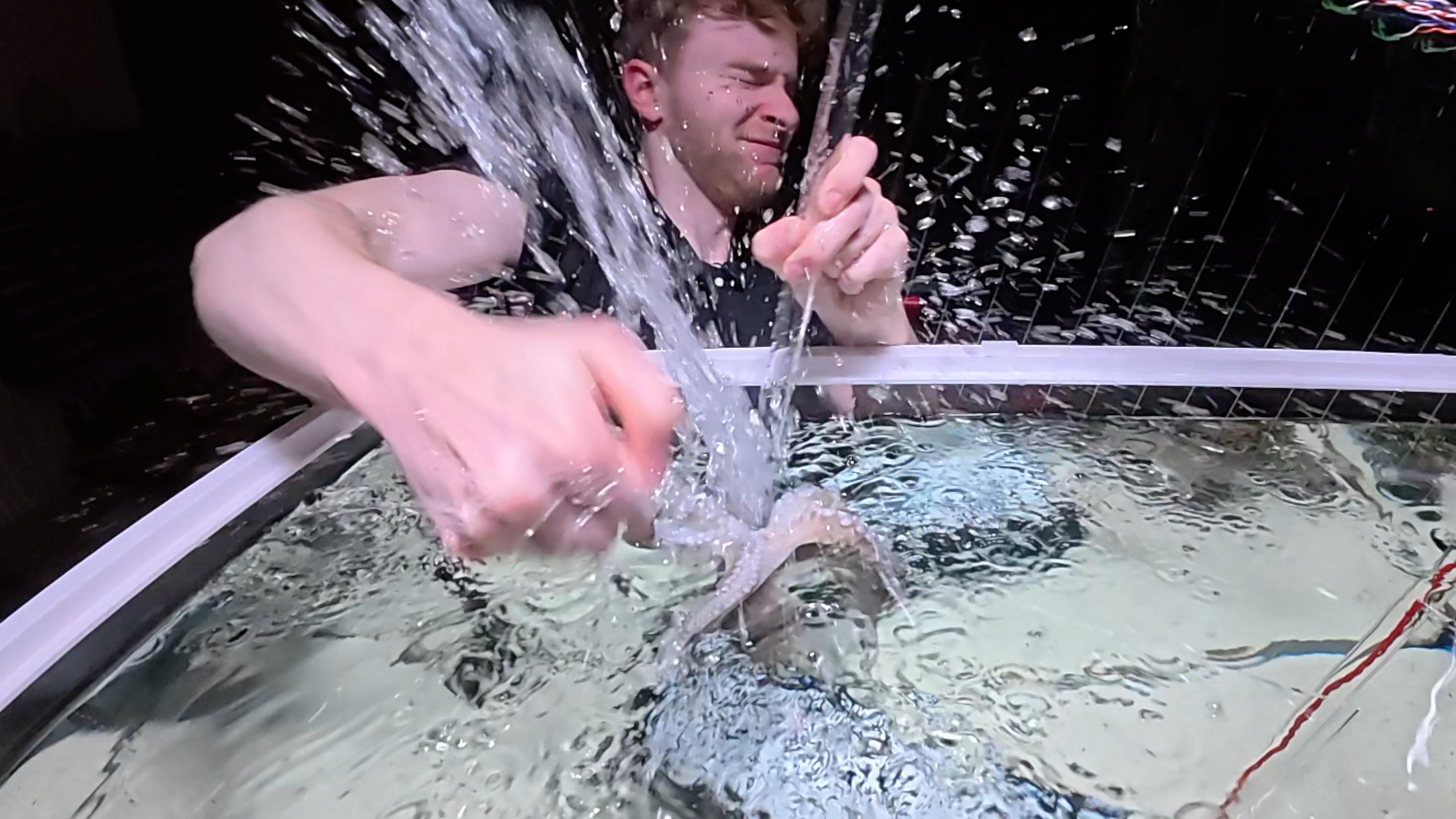
    Plus — as expected from an octopus — Tako wasn’t focused on learning the instrument. Tako wrapped its arms around the GoPro camera in its tank, squirted water at Krantz, and, once, escaped the tank and hid in a cupboard.

    Krantz lost hope that Tako could learn to play.

    Takoyaki sometimes squirted water outside of the tank.

    But Tako stared at the piano, which sat on the ground beside the tank, throughout the day, appearing to want to play at the usual 6 p.m. training time, Krantz said. So Krantz experimented with a new strategy.

    “The one thing I’m really good at is insane stubbornness,” Krantz said.

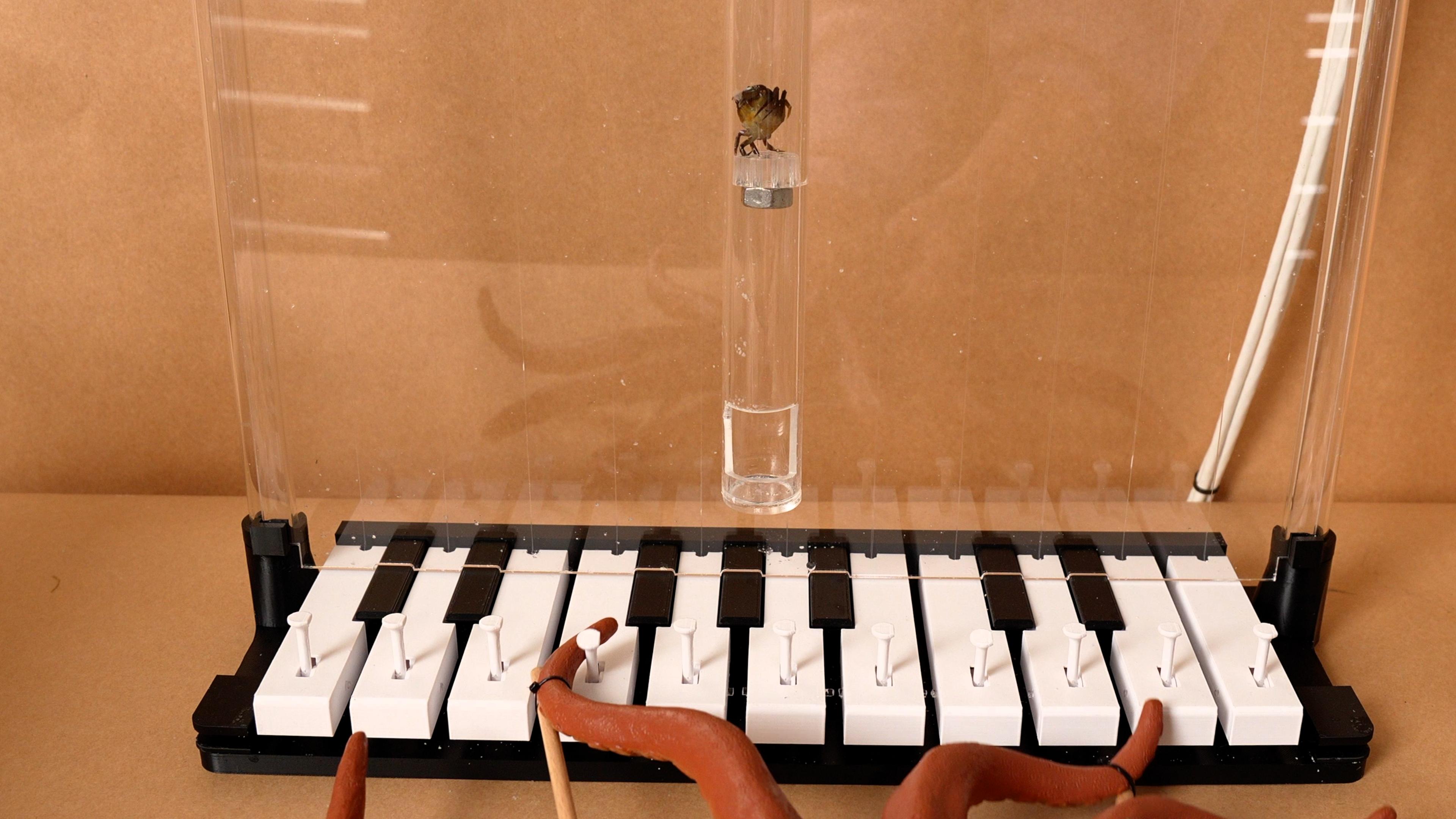
    In early August, he placed an acrylic tube inside the tank and inserted a crab — Tako’s favorite treat — at the top. When Tako played a key, Krantz lowered the crab closer to the bottom of the tube. Krantz called his device the “crab elevator.”

    Mattias Krantz built a “crab elevator” for his octopus, Takoyaki.

    Tako initially tried to retrieve the crab by swimming into the tube and attempting to pull the crab down. But once Tako saw the crab inch closer after playing a note, the octopus became more motivated to play. After a few weeks, Krantz gave Tako the crab once the octopus played seven or eight keys.

    In mid-August, Krantz began playing chord progressions on his acoustic guitar and simultaneously wiggled keys for Tako to play so they could perform together. Krantz fed Tako after each recital.

    Krantz never taught Tako to consistently play the right keys at the right times. Sometimes the piano sounded good; other times, not so much. Tako played the keys to “Baby Shark” — even if it was off tempo, Krantz said.

    “I can’t believe I sit here and play with an octopus,” Mattias Krantz said.

    But the fact that Tako could play keys at all was like a “fever dream,” Krantz said.

    Hofmeister, the marine scientist, said Tako probably didn’t know he was playing the piano; he was motivated by food.

    Octopuses are smart in their own ways: They change colors based on their surroundings, build dens with stones, use makeshift weapons, throw objects at targets, and eject ink clouds when they’re in danger.

    Takoyaki, an octopus, seemed to enjoy playing piano keys.

    “The octopus is not perceiving rhythm,” Hofmeister said. “It’s not perceiving, you know, tempo. It wants to do the steps it has to do to get the crab.”

    She said teaching an octopus to play the piano perfectly is nearly impossible.

    But in addition to creating music, Krantz received another benefit from the process: a friend. He has kept Takoyaki — the name means grilled octopus — as a pet.

    Takoyaki still plays the piano about every other day.

    Octopuses typically live for a year or two, and Krantz said Tako, which he estimated to be about 14 months old, now sleeps most of the day. But that hasn’t stopped Tako from continuing to practice its unique skill; the octopus plays piano about every other day.

    The recitals still leave Krantz in awe.

    “I can’t believe I sit here,” Krantz said last week, “and play with an octopus.”

  • Silver prices just smashed a new record. What does this mean for the economy?

    Silver prices just smashed a new record. What does this mean for the economy?

    Silver is giving gold a run for the money.

    The precious metal has more than doubled in value since the start of the year and broke a fresh record on Tuesday, rising above $60 per troy ounce on New York’s Commodity Exchange for the first time ever. Now it’s up 102% for 2025 far outpacing the record-building rush that has lifted gold 59%.

    A mix of forces are boosting silver, including the weakened dollar, tariff politics, and supply shortages. Especially critical in recent weeks, though, was the growing expectation that the Federal Reserve would announce another rate cut, which it did on Wednesday, as the U.S. economy continues to slow down. Analysts say that’s likely to further pressure the dollar lower while lifting silver a classic safe-haven asset even higher.

    In light of Fed concerns, “precious metals prices are rising as a bit of a hedge,” said Michael Farr of the D.C.-based investment firm Farr, Miller & Washington, ahead of the meeting.

    But silver’s rise is also a global story with a combination of forces at play. Here’s what you need to know about its soaring popularity.

    Dollar weakness and the ‘debasement trade’

    The softening of the greenback which depreciated about 8.5% since the start of the year is a big part of the story. Most of this drop occurred in the first half of the year, after the Trump administration unleashed steep tariffs on trading allies and competitors alike and reduced U.S. attractiveness as a reliable trade and investment partner. At the same time, rising U.S. debt and lingering concerns about inflation have also diminished the dollar’s value.

    The weakened dollar, in turn, has been driving what’s known as the “debasement trade”: Investors are looking for other assets which include gold as well as silver because the dollar is no longer seen as ultrasafe as it used to be, said Collamore Crocker of the economic consultancy New Century Advisers.

    “‘Concern’ is a big piece of the trade‚” Cocker said. “If you’re worried about governments undermining the value of their own currencies, you might buy precious metals.”

    The Fed rate decision could very well push the dollar down even more. Typically, lower interest rates make a currency less attractive for investors because there’s a lower return on assets in that currency.

    “Lower rates are bullish for precious metals,” said Bob Gottlieb, an independent consultant who previously worked at JP Morgan and other financial institutions.

    The tariff factor

    Traditionally, silver tends to be more volatile compared to gold and more sensitive to policy changes, say analysts. Tariffs are a good example. Recently, concerns spiked that the U.S. could add tariffs specifically for silver after it was added to the U.S. Geological Survey’s list of critical minerals last month, along with copper, lead, and other rare metals.

    The list allows the federal government to “understand where strategic domestic investments or international trade relationships may help mitigate risk to individual supply chains,” USGS acting director Sarah Ryker said in a statement.

    Adding a metal to the list can signal tariffs to come, and many investors reacted accordingly, pushing silver higher. The threat of additional tariffs has also led metals traders to shift silver to the United States and out of London or Shanghai, as a way to preempt the hit from new import taxes on the precious metal.

    Demand and supply squeeze

    The tariff uncertainty and dollar weakness are coinciding with a long-running silver shortage. A recent report from the Silver Institute estimated industrial demand for silver has soared about 18% over the past four years, due in part to India now the world’s second-largest market for silver investment, according to Kitco News, a metals publication.

    Silver is culturally seen as a “poor man’s gold,” said Hiren Chandaria, managing director at the financial firm Monetary Metals. “With gold prices rising so high, many households and smaller investors have shifted toward silver as a more affordable precious metals store of value, so investment and gifting demand has shot up alongside traditional jewelry and silverware buying.”

    Investor demand from India is also spurred by a recent decision by the country’s central bank that allowed for regulated silver-backed loans. The Silver Institute has reported roughly a doubling in silver-backed exchange-traded fund price in India since January 2023, amid a surge of investment.

    Beyond India, broader supply crunches are in play. The world’s mines are expected to produce only about 813 million ounces of silver this year, slightly less than they did in 2021, according to the Silver Institute. Mines can only produce so much each year, and it takes many years to get a new one up and running something that puts a cap on supply.

    Industrial demand

    The buying frenzy for silver and resulting shortage are also driven by technological change across the industrial world that has unfolded over the past five years.

    While gold has relatively little practical use aside from jewelry, silver is a high-quality conductor of electricity and heat and holds a range of industrial applications “at the cusp of precious metals and industrial metals,” as Chandaria describes it.

    Surging investments in electric vehicles and artificial-intelligence data centers, for example, are among the sectors driving demand. Silver is laced throughout electric vehicles and their batteries, which is one reason for its surge during the electric-vehicle investment boom by major automakers in recent years. It’s also used in AI semiconductors.

    “There is an inherent tightness still in the silver market … demand is greater than supply every year,” said Bob Gottlieb, a former metals trader with leading financial institutions.

    Meanwhile, the silver boom is lifting mining companies. Canada’s Wheaton Precious Metals, the largest silver mining company by market capitalization, has seen its stock price rise close to 85% year-to-date. Fresnillo, a Mexico City-based mining company that bills itself as the world’s leading producer of silver ore, is up 365% since the start of the year, while Mexico’s Industrias Peñoles has risen around 230%. Canadian mining conglomerate Pan-American Silver rose 105%.

    Gottlieb, the metals trader, says he believes silver will settle between $50 and $75 an ounce over the next year, adding that he views India’s demand as grounds to stay bullish. But he also urged caution. “I learned a long time ago that whenever you forecast a price, the real movement is not from what you forecasted,” Gottlieb said.

  • Trump seeks to cut restrictions on marijuana through planned order

    Trump seeks to cut restrictions on marijuana through planned order

    President Donald Trump is expected to push the government to dramatically loosen federal restrictions on marijuana, reducing oversight of the plant and its derivatives to the same level as some common prescription painkillers and other drugs, according to six people familiar with the discussions.

    Trump discussed the plan with House Speaker Mike Johnson (R., La.) in a Wednesday phone call from the Oval Office, said four of the people, who, like the others, spoke on the condition of anonymity because they were not authorized to speak publicly. The president is expected to seek to ease access to the drug through an upcoming executive order that directs federal agencies to pursue reclassification, the people said.

    The move would not legalize or decriminalize marijuana, but it would ease barriers to research and boost the bottom lines of legal businesses.

    Trump in August said he was “looking at reclassification.” He would be finishing what started under President Joe Biden’s Justice Department, which followed the recommendation of federal health officials in proposing a rule to reclassify marijuana; that proposal has stalled since Trump took office.

    “We’re looking at it. Some people like it, some people hate it,” Trump said this summer. “Some people hate the whole concept of marijuana because it does bad for the children, it does bad for the people that are older than children.”

    Trump cannot unilaterally reclassify marijuana, said Shane Pennington, a D.C. attorney who represents two pro-rescheduling companies involved in the hearing. But he can direct the Justice Department to forgo the hearing and issue the final rule, Pennington said.

    “This would be the biggest reform in federal cannabis policy since marijuana was made a Schedule I drug in the 1970s,” Pennington said.

    The president was joined on the Wednesday call with Johnson by marijuana industry executives, Health Secretary Robert F. Kennedy Jr., and Centers for Medicare and Medicaid Services chief Mehmet Oz, three of the people said.

    Johnson was skeptical of the idea and gave a list of reasons, including several studies and data, to support his position against reclassifying the drug, two of the people said.

    Trump then turned the phone over to the executives gathered around his desk, who rebutted Johnson’s arguments, the people said.

    Trump ended the call appearing ready to go ahead with loosing restrictions on marijuana, the people said, though they caution the plans were not finalized and Trump could still change his mind.

    A White House official said no final decisions have been made on rescheduling of marijuana.

    The Department of Health and Human Services referred questions to the White House. The Centers for Medicare and Medicaid Services did not immediately respond to a request for comment. A representative from Johnson’s office declined to comment.

    Marijuana is currently classified as a Schedule I substance, the same classification as heroin and LSD. Federal regulations consider those drugs to have a high potential for abuse and no accepted use for medical treatment.

    Trump would move to classify marijuana as a Schedule III substance, which regulators say carry less potential for abuse and are used for certain medical treatments, but can also create risks of physical or psychological dependence.

    Other Schedule III drugs include Tylenol with codeine, as well as certain steroid and hormone treatments.

    Democrats and Republicans alike have been interested in reclassifying marijuana, with some politicians citing its potential benefit as a medical treatment and the political popularity of the widely used drug.

    Marijuana has become easier than ever to obtain, growing into an industry worth billions of dollars in the United States. Dozens of states and Washington, D.C., have legalized medical marijuana programs, and 24 have approved recreational marijuana.

    The Biden administration pursued efforts to ease access to the drug, with health officials recommending reclassification to Schedule III in 2023. But health officials have said that those recommendations were slowed down by the Drug Enforcement Administration, which took months to undergo required administrative reviews and were not completed before the end of Biden’s term.

    The Drug Enforcement Administration was supposed to hold an administrative hearing on the proposal, with a judge hearing from experts on the health benefits and risks of marijuana. But the hearing has been in legal limbo since Trump took office, amid allegations from cannabis companies that the DEA was working to torpedo the measure.

  • Why these red state Republicans are resisting Trump’s efforts to expand GOP power

    Why these red state Republicans are resisting Trump’s efforts to expand GOP power

    INDIANAPOLIS — In 44 years in Indiana’s legislature, Vaneta Becker had never before had a call with the White House.

    President Donald Trump was on the line that day in October, urging her and her GOP colleagues to redraw the state’s congressional map to help Republicans in next year’s midterm elections. She told the White House she opposed the idea, and a week or so later got a voice message from an aide asking for a follow-up conversation. Becker called back to leave a message of her own.

    “I’m not going to change my position,” Becker, 76, recalled saying. “You’re wasting your time on me, so just focus on somebody else.”

    Indiana, a state Trump won by 19 percentage points last year, is serving up an unusual amount of resistance to his plan to carve up congressional districts around the country. Since this summer, Republicans in four other states have rejiggered their maps to give their party as many as nine more seats part of a larger plan aimed at retaining power in Congress after next year’s elections.

    But in Indiana, a contingent of GOP state senators has politely but persistently said no. The GOP opponents told Trump and Gov. Mike Braun (R) they weren’t on board and last month 19 of them voted with Democrats to end a legislative session without acting on redistricting. Trump and his allies kept pressing, and the state House passed a plan last week that would likely give Republicans all nine of the state’s congressional districts, two more than they have now.

    The leader of the State Senate, Rodric Bray, agreed to bring the senators back to the state capitol to take up the issue even though he was among those who had voted to end the session. They are expecting to vote Thursday.

    Opponents include longtime Republican lawmakers like Becker who got involved in politics years before the rise of Trump and his Make America Great Again movement. Hoosiers bristle at meddling from Washington, even when it comes from allies, the opponents say.

    The state senators have been increasingly on edge in recent weeks as they endured intimidation — political and physical — and a stream of hoax police reports that seemed designed to draw large law enforcement responses to their homes.

    States draw their congressional districts after the census, and lawmakers from both parties often try to maximize their advantage. Years of litigation sometimes follow, but state lawmakers typically don’t redraw their lines in the middle of the decade unless a court orders it. Trump has rejected the usual way of doing business, demanding Republican-led states make immediate changes.

    So far, Republicans have not netted as many seats as they’d hoped because Democrats have counteracted them by adopting a new map in California and are trying to do the same in Virginia and other states. Opponents of a new GOP-friendly map in Missouri submitted more than 300,000 signatures to the state to try to block it from going into effect until a referendum on it can be held.

    But the GOP resistance in Indiana stands apart, in large part because Republicans across the country have readily acquiesced to Trump’s demands and threats on a range of issues.

    Trump may yet prevail. But the rare instance of pushback here could offer warning signs to Trump that his grip on the party may be loosening amid slides in his public approval rating. A vote against a new map in Indiana would add to his woes as Republicans fret over their ability to hold onto the House next year.

    What happens in Indiana will have effects elsewhere. If Republicans reject the map here, Trump may put more pressure on officials in other states. If they go along with the plan, Democrats in Illinois and Maryland who have resisted redistricting may feel they need now to jump into the fight.

    Time is running short because election officials, candidates and voters need to know where the lines are well ahead of next year’s primaries. But the fight over maps will continue for months. Republicans in Florida are poised to draw a new map and GOP lawmakers in Utah are trying to reverse a court decision that is expected to give Democrats one of the state’s districts.

    In Indiana, lawmakers have been debating whether to redraw the lines since August, but they didn’t see the proposed map until the House unveiled it last week. The map would break Marion County, the home to Indianapolis and the state’s largest African American population, into four districts, diluting Democratic votes. It would likely doom the reelection chances of Democratic Reps. Frank J. Mrvan and André Carson, the only Black member of Indiana’s congressional delegation.

    Trump has hosted Indiana officials at the White House. He’s dispatched Vice President JD Vance to the state twice. In October, he and his aides held their conference call with Indiana state senators to talk up redistricting. At the end of the call, the senators were told to press a number on their phone to indicate whether they supported redrawing the map, even though they were yet to see how the lines would change.

    On Wednesday night, Trump lashed out at the State Senate leader on Truth Social, calling Bray “the only person in the United States of America who is against Republicans picking up extra seats” and warning that lawmakers who oppose the changes were at risk of losing their seats.

    A White House official said earlier that Trump’s team is “not arm twisting. Just outlining the stakes and reminding them western civilization stands in the balance of their decision.”

    About 800 of Becker’s constituents in southwestern Indiana have told her they are against the plan and about 100 have told her they’re for it, she said. Sitting in her wood-paneled cubicle Tuesday in the state capitol, she slid a constituent’s letter out of its envelope.

    “Mid-decade redistricting at the request of President Trump will unnecessarily intensify the already deep partisan divisions in our country,” the man wrote. “Even bringing this topic up in the Indiana legislature will ratchet up the antagonism.”

    Voters know the push is coming from Trump, and many are not afraid to criticize him for it, even if they otherwise support the president, she said. Becker declined to say whether she’d voted for Trump but said she’s “not crazy about him,” especially after the Jan. 6, 2021, attack on the U.S. Capitol.

    Trump is not letting up on his push. Last month the president called out State Sen. Greg Goode (R) in a post on Truth Social, saying he was “very disappointed” that he opposed redistricting even though Goode had not taken a position. Later that day, Goode said, someone falsely told police he had murdered his wife and barricaded himself in his house. Police kicked in the door just after Goode got out of the shower, while his wife and son were getting Christmas decorations in the basement, and officers pointed their guns at Goode’s chest, he said.

    Goode, who serves as the state director for U.S. Sen. Todd Young (R., Ind.), said he didn’t blame Trump for the incident. He got a call from Trump the next day, which he described as polite. Trump called Goode again on Monday, as the state senator was listening to the redistricting debate in committee.

    “It was not a pressured call at all,” Goode said. “The overarching message really from day one is the importance for the Republican Party to maintain control of the United States House of Representatives.”

    Goode said he won’t decide how he’s voting until he hears the final debate among the senators. He’s voted for Trump three times and takes his opinion seriously, but also is listening closely to his constituents, who have overwhelmingly told him they oppose redistricting, he said.

    On Friday, hours after the State House passed the map, Trump named Goode and eight other state senators in a social media post as needing “encouragement to make the right decision.” The conservative group Turning Point Action has claimed it will team up with other Trump-aligned organizations to spend $10 million or more on primaries in 2026 and 2028 against GOP state senators in Indiana who vote against the map. Several Republicans, including Becker, said they’re skeptical the groups would spend so much against members of their own party.

    State Sen. Travis Holdman (R) got a call from the White House a couple of weeks ago asking if he would come to Washington to talk about redistricting, but he declined because he couldn’t miss work as a banking consultant. Adopting a new map now would be unfair, he said, and he doesn’t think the president’s team could change his mind.

    “I voted for Donald Trump in every election,” he said. “I really agree with his policies. We just disagree on this issue.”

    Republicans control the State Senate 40-10, and at least 16 of them would need to vote with Democrats to sideline the map.

    Supporters of the altered map said they want to ensure Republicans hold onto Congress and are responding to districts Democrats drew favoring their party years ago in states they control. Indiana State Sen. R. Michael Young told his colleagues on Monday that the Supreme Court had blessed letting states draw districts for partisan advantage, holding up a recent decision that upheld a new map in Texas.

    “For all those people who think they’re lawyers in Indiana, who think it’s against the law or wrong, the Supreme Court of the United States says different,” he said.

    Others have made their opposition clear, with some saying they’re pushing back on what they call bullying. State Sen. Mike Bohacek (R) grew incensed last month when Trump called Minnesota Gov. Tim Walz (D) “seriously retarded” in a social media post. Bohacek, who has a daughter with Down syndrome, said in a social media post that Trump’s “choice of words have consequences.”

    “I will be voting NO on redistricting, perhaps he can use the next 10 months to convince voters that his policies and behavior deserve a congressional majority,” Bohacek wrote in his post.

    In the State House, Rep. Ed Clere was among 12 Republicans to vote against the map. He believes Trump’s MAGA movement is starting to crack, but doesn’t think that’s what’s behind the GOP resistance to redistricting in Indiana. It stems from a sense of independence that is, he said, “part of Indiana’s DNA.”

    Becker agrees.

    “Hoosiers are very independent,” she said. “And they’re not used to Washington trying to tell us what to do.”

    GRAPHIC

  • How a U.S. admiral decided to kill two boat strike survivors

    How a U.S. admiral decided to kill two boat strike survivors

    In the minutes after U.S. forces attacked a suspected drug smuggling boat near Trinidad, Adm. Frank M. Bradley, the commander overseeing the operation, faced a choice.

    A laser-guided bomb had killed nine of the 11 people on board, sunk the boat’s motor and capsized the vessel’s front end, according to people who have viewed or been briefed on a classified video of the operation. As smoke from the blast cleared, a live surveillance feed provided by a U.S. aircraft high overhead showed two men had survived and were attempting to flip the wreckage.

    Ahead of the Sept. 2 mission, Defense Secretary Pete Hegseth had given an order to U.S. forces to kill the passengers, sink the boat and destroy the drugs, three people familiar with the operation said. It appeared to Bradley that none of those objectives had been achieved, the admiral would later recount for lawmakers.

    The video feed showed that the two men were struggling to stay atop the flotsam, which people who’ve seen the footage described as roughly the size of a dining room table. Bradley turned to the military lawyer advising him and requested input, according to members of Congress who spoke with him privately last week and people later briefed on those conversations. Under the law of armed conflict, were the men now “shipwrecked” and therefore out of the fight, rendering them unlawful targets?

    The admiral decided that definition did not apply, these people said. Instead, what Bradley explained to lawmakers left some with the impression that there was a prevailing lack of certainty — about the existence of any drugs beneath the wreckage and whether the survivors had a means to call for help or intended to surrender — when he concluded that further action was warranted.

    He ordered a second strike, killing both men. Moments earlier, the video feed had shown them waving their arms and looking skyward, people who saw the footage said. It was unclear, they added, why they were doing so.

    The 30-plus minutes that elapsed between the first strike and the second has become the most consequential moment in Bradley’s three-decade military career — one that includes direct involvement in more than 1,000 lethal strikes governed by the law of armed conflict central to understanding the events of Sept. 2 and whether the strike survivors were lawful targets. The episode has put the admiral and his advisers under a spotlight alongside Hegseth, who has expressed support for Bradley while attempting to distance himself from the fallout.

    Bradley defended his actions when summoned to Capitol Hill last week, telling lawmakers he weighed the fate of the survivors with the understanding that the Trump administration has argued illicit drugs are weapons responsible for killing Americans, and that those who traffic them are not criminals but enemy combatants. U.S. intelligence, he said, showed that everyone on the boat was a “narco-terrorist,” consistent with the administration’s definition, which allowed for deadly force. His testimony provided lawmakers with the fullest account of the operation since the publication of a Washington Post report on Nov. 28 revealing Hegseth’s authorization ahead of the first attack to kill the entire crew and Bradley’s order of a second strike that killed the two survivors.

    Law of war experts and some lawmakers have challenged the admiral’s reasoning and cast doubt on the lawfulness of using the military to kill alleged criminals.

    The military lawyer who advised the admiral, whom The Post is not identifying because they serve in a secretive unit, explained to Bradley how the law of armed conflict defines “shipwrecked,” these people said. International law defines “shipwrecked” persons as those who “are in peril at sea” as a result of a mishap affecting their vessel “and who refrain from any act of hostility.” Combatants who are shipwrecked receive special protection because, unlike troops on land, they cannot take refuge, experts note.

    Bradley spent about eight hours meeting with more than a dozen lawmakers Dec. 4. Four people familiar with those sessions said that he affirmed having sought real-time legal advice, but that he did not say whether his military lawyer considered the survivors shipwrecked and out of the fight.

    There was dissent in the operations room over whether the survivors were viable targets after the first strike, according to two people. What the lawyer advised, though, and whether they rendered a definitive opinion remains unclear.

    A spokesperson for U.S. Special Operations Command, where Bradley is the top commander, declined to comment. The military attorney did not respond to requests for comment.

    Former military lawyers said that in such situations a commander’s top legal adviser would be expected to offer an assessment, but their role is only to advise, not to approve a strike.

    This report is based on the accounts of 10 people who either spoke directly with Bradley on Capitol Hill last week, were briefed on his conversations afterward or are otherwise familiar with the operation. Most spoke on the condition of anonymity because the matter is highly sensitive and Bradley’s communication with lawmakers occurred in classified settings.

    The chain of command

    Two Republican-led committees in Congress have opened inquiries into the Sept. 2 operation, though on Tuesday, Rep. Mike Rogers (R., Ala.), who heads the House Armed Services Committee, said that he was satisfied with the information he had received and planned to end his probe once other members of the panel are given an opportunity to see unedited video of the operation, as he has. A separate Senate inquiry continues.

    President Donald Trump appeared to support releasing video footage of the operation before abruptly backtracking this week and deferring to Hegseth on whether to do so. Hegseth has been noncommittal, saying the Pentagon is “reviewing” the footage to ensure it would not expose military secrets.

    Democrats have demanded fuller investigations and called on the administration to share more evidence with lawmakers. Sen. Mark Warner (D., Va.), the Senate Intelligence Committee’s senior Democrat, said after meeting with Hegseth and other officials Tuesday that he was seeking written documentation of the opinion rendered by Bradley’s military lawyer.

    The first strike Sept. 2 was carried out with a laser-guided GBU-69, according to people familiar with Bradley’s briefings. The munition exploded just above the crew, a setting designed to maximize the blast and the spread of shrapnel fragments. The follow-on strike was taken with a smaller AGM-176 Griffin missile, which killed the two men on impact, people familiar with the video footage said. U.S. forces then fired two additional Griffins at the wreckage to sink it.

    While Bradley made the decision to conduct the follow-on strike that killed the two survivors, Hegseth was the operation’s target engagement authority, meaning he authorized the use of force and ultimately was responsible for the strikes ordered, people familiar with the matter said.

    Hegseth has said that he watched live video of the initial attack but left for other meetings minutes later and was unaware initially that the first strike had left two men alive. It was a couple of hours, Hegseth has said, before he learned that Bradley ordered the second strike.

    Sean Parnell, a spokesman for Hegseth, said in a statement, “We are not going to second-guess a commander who did the right thing and was operating well within his legal authority.”

    Gen. Dan Caine, who as chairman of the Joint Chiefs of Staff is the military’s top officer, saw the full video of the Sept. 2 strike for the first time Dec. 4, when he joined Bradley’s meetings with lawmakers, two U.S. officials said. In a statement for this report, a spokesman for Caine said the chairman has “trust and confidence” in Bradley and military commanders “at every echelon.”

    The admiral’s defense

    The Sept. 2 operation was the first in what has become an extended campaign to target suspected drug runners in the waters around Latin America. In strikes on more than 20 boats, U.S. forces have killed nearly 90 people to date, according to public notices from the Trump administration.

    At the core of Bradley’s defense of the second strike, according to several people familiar with his conversations on Capitol Hill, was his assertion that the attack was not directed at the two survivors but at the boat wreckage and any cocaine it may have sheltered.

    The laws of war stipulate that military commanders must consider the collateral damage of a strike only if the action could pose a threat to civilians, said Geoffrey Corn, a retired Army lawyer. By labeling suspected drug smugglers as combatants in an armed conflict against Americans, as the Trump administration has done, the Defense Department can argue that the military did not need to consider the harm to survivors when striking again, Corn said.

    But many experts, Corn among them, dispute that the U.S. is in an “armed conflict” with cartel groups. Corn also noted that even if they are combatants, once shipwrecked, feasible measures must be taken to try to rescue them before attacking the target again, he said. “That to me is the most troubling aspect of the attack,” he said.

    Bradley’s contention that he was targeting the boat rather than the people, Corn said, fails to explain why the admiral deemed it necessary to launch the second strike rather than first trying to rescue the survivors.

    The admiral told lawmakers that intelligence gathered ahead of the operation indicated the boat being targeted was expected to transfer its cargo to another vessel while both were at sea. After the first strike, Bradley explained, he and his team were unable to rule out whether the men, who were shirtless, had a communications device either on their person or somewhere under the vessel’s wreckage that could have been used to call for help.

    U.S. forces did not intercept any communications from the two survivors after the first strike, Bradley told lawmakers.

    The admiral also theorized, multiple people said, that the two survivors could have drifted to shore or found a way to sail the wreckage to their intended rendezvous point. When the U.S. aircraft providing the live video feed scanned the surrounding area, it did not find another vessel coming to the boat’s aid. And the admiral conceded to some lawmakers that the survivors probably would not have been able to flip the wreckage, said one lawmaker and a U.S. official familiar with Bradley’s conversations.

    The doubts that have emerged

    Todd Huntley, a former director of the Navy’s international law office, which handles law of the sea matters, said in an interview with The Post that the legal definition for being shipwrecked does not require that people are drowning or wounded.

    “They just have to be in distress in water,” said Huntley, a former military lawyer who advised Special Operations forces.

    Huntley also said that the potential presence of a communications device should have been irrelevant. “You can’t kill somebody in the water merely because they have a radio,” he said. The prospect of a rendezvous with another vessel does not indicate an intent to engage in hostilities or prove the survivors posed a threat, he added. “That is such a far-out theory,” Huntley said.

    Trump and other Republicans have framed the administration’s counternarcotics campaign as a necessary measure to defend Americans from fentanyl, the leading cause of drug overdoses in the United States. But the Sept. 2 strike — and most of those that have followed — targeted a boat believed to be ferrying cocaine. Fentanyl smuggled into the U.S. mostly comes through border crossings.

    People familiar with Bradley’s account to lawmakers said that the cargo in this case was heading next to Suriname, a small country east of Venezuela, not the United States. As The Post and others have reported, most of the narcotics that move through the Caribbean are headed toward Europe and Western Africa rather than the U.S.

    “That further underscores that this boat was not a threat to the United States and not a lawful target,” Huntley said.

    While speaking with lawmakers, Bradley said he looked for signs the men were surrendering, such as waving a cloth or holding up their arms. The admiral noted that he saw no such gesture, and did not interpret their wave as a surrender, people familiar with his interviews said.

    To legal experts, Bradley’s assertion that he scanned for a sign of surrender reflected a foundational flaw with the Trump administration’s lethal force campaign: The laws of war weren’t written to address the behavior of criminal drug traffickers, they said.

    On Sept. 2, the 11 passengers on board the targeted boat were almost certainly unaware the Trump administration had declared “war” on them, people familiar with the operation said. It’s unclear whether the strike survivors even realized a U.S. military aircraft was responsible for the explosion that had occurred, these people familiar said, or whether they knew how to indicate surrender — or that surrender was even an option.

    In the weeks leading up to the attack, the Defense Department ran simulations that showed there was the potential for people to survive a first strike, three people familiar with the matter said. That did not appear to affect military planning for this operation. On the day of the attack, the U.S. military had no personnel or equipment on hand to rescue anyone.


  • The NBA’s $525 million injury epidemic

    The NBA’s $525 million injury epidemic

    LOS ANGELES – Golden State Warriors Coach Steve Kerr sparked a moment of introspection for the NBA last month when he said his team’s medical staff believed modern basketball’s fast pace and heavy mileage were contributing to a rash of injuries. After bemoaning the lack of practice and recovery time, Kerr demurred when asked whether he thought the league would consider shortening its 82-game schedule in an attempt to protect player health.

    “The tricky part is all the constituents would have to agree to take less revenue,” Kerr said. “In 2025, in America, good luck in any industry. … That’s not happening.”

    Kerr’s doubt was well founded, because the NBA’s business is booming: Commissioner Adam Silver recently struck new media rights deals worth $76 billion over 11 years, the league’s 30 teams combined to generate a record $12.25 billion in revenue last season, and a record 16 players will earn at least $50 million in salary this season.

    But as the NBA’s top-line financial metrics continue to increase, so, too, do the skyrocketing costs associated with lost productivity for injured stars. Remarkably, if early trends hold, the NBA’s 30 highest-paid players, according to salary data compiled by ESPN, could combine to cost their teams more than $525 million in empty salary associated with games they do not play this season.

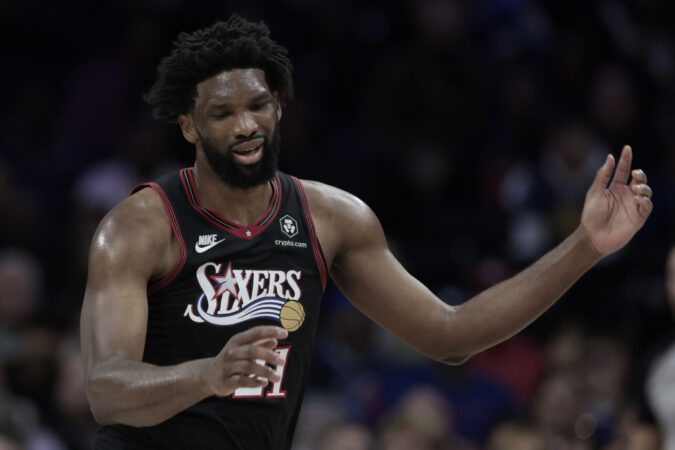
    Stephen Curry (who will earn $59.6 million) is sidelined with a quadriceps injury. Joel Embiid ($55.2 million) has missed more games than he has played because of recurring knee problems, Kawhi Leonard ($50 million) has already missed 10 games because of a foot injury, and Bradley Beal ($53.7 million including a contract buyout) played only six games before suffering a season-ending hip injury. LeBron James ($52.6 million) and Anthony Davis ($54.1 million) missed the first four weeks of the season because of injury, and Giannis Antetokounmpo ($54.1 million) and Ja Morant ($39.4 million) are out with muscle strains.

    Jayson Tatum, Damian Lillard, Tyrese Haliburton and Kyrie Irving are on the books for $204.4 million combined but have yet to play because of major injuries suffered last season. During one recent loss, the New Orleans Pelicans took the court without their five highest-paid players, who will combine to earn more than $140 million.

    Stephen Curry is currently sidelined with a quadriceps injury.

    Many of those absences have directly led to trouble in the standings. Haliburton’s Indiana Pacers, who reached the NBA Finals in June, have dropped to 14th in the Eastern Conference. Antetokounmpo’s Milwaukee Bucks are at risk of missing the playoffs for the first time since 2015-16 and must pay Lillard $113 million over the next five seasons after waiving him using the league’s stretch provision. And the Los Angeles Clippers, wobbly with Leonard and Beal missing time, are on track for their first losing season since 2010-11.

    “When you lose your best player and a top-10 player when he’s on the floor, it’s hard to make up for that,” Clippers Coach Tyronn Lue said last week. “I know a lot of people say ‘next man up,’ but if [Leonard] is making [$50] million and your next man up is making $400,000, it’s not really the same.”

    In two notable cases, star injuries have already contributed to major personnel changes. Without Davis and Irving, the Dallas Mavericks struggled out of the gate and fired general manager Nico Harrison less than a month into the season. And well before Zion Williamson’s latest injury, a hip strain that will keep him out for weeks, the Pelicans had crashed into the Western Conference’s basement and fired Willie Green after he coached just 12 games.

    “We have a lot of guys that are in street clothes,” Mavericks Coach Jason Kidd said shortly after Harrison’s firing. “We’ve got over, I think, $100 million sitting on the sideline.”

    More injuries, more problems

    The rise in star injuries goes well beyond this season’s most extreme examples of the Pacers, Clippers, Mavericks and Pelicans.

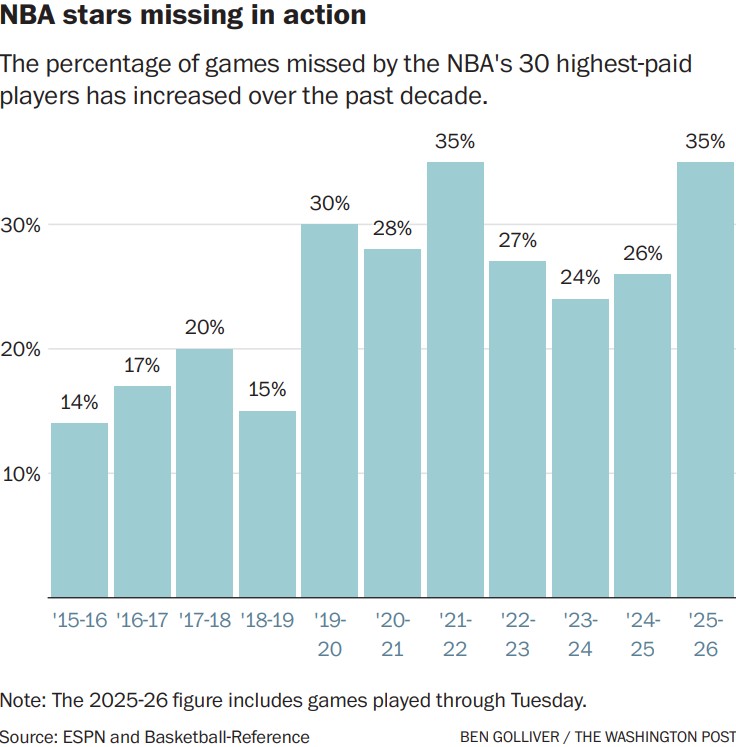
    Flash back one decade: During the 2015-16 season, NBA teams averaged 102.7 points, 24.1 three-point attempts and 95.8 possessions per game. That year, the league’s 30 highest-paid players combined to miss just 14 percent of their teams’ games.

    This season, teams entered Wednesday averaging 116.6 points, 36.9 three-point attempts and 100 possessions per game. The league’s highest-paid players have combined to miss 35 percent of their teams’ games. A faster, higher-scoring and more rigorous sport appears to be taxing players like never before.

    John DiFiori, the NBA’s director of sports medicine, said the league views the 2019-20 season as an “inflection point” for star injuries. During the four seasons before that campaign, which was interrupted by the coronavirus pandemic, the NBA’s 30 highest-paid players missed between 14 and 20 percent of their teams’ games. Since 2019-20, that number has jumped, ranging from 24 percent to 35 percent. The missed games rate has remained elevated in the years after the NBA stopped requiring players to sit out if they tested positive for the coronavirus.

    “Injury rates are going up,” DiFiori said. “When we look back at what we’ve been doing the last 10 or 12 years, it’s a moving target. The game doesn’t stay the same. We’re trying to reduce injuries, and the game is also changing. All these other factors, the pace of play and what players are doing in training, those are all moving targets. To wrap our arms around that is a challenge. It’s something we’re quite focused on. … [Teams are] spending a lot of time and money and bringing in a lot of expertise. Despite all of that, we’re seeing an increase in injuries. It’s not for teams’ lack of focus on it.”

    The percentage of games missed by the NBA's 30 highest-paid players has increased over the past decade.
    The percentage of games missed by the NBA’s 30 highest-paid players has increased over the past decade.

    The NBA instituted the Player Participation Policy (PPP) before the 2023-24 season to address what it calls “a statistically significant increase” in star absences and to curb “load management,” a strategy used by some teams to rest players throughout the season. With the NBA negotiating new media rights deals and debuting the NBA Cup in-season tournament to spark interest, then-league executive Joe Dumars met with all 30 teams to remind them that the NBA is an “82-game league.” To reinforce that message, the PPP mandated that players appear in at least 65 games to be eligible for end-of-season awards, and the league began fining teams if they rested healthy players for nationally televised games.

    The PPP enjoyed some initial success: The 30 highest-paid players missed just 24 percent of games in 2023-24, the league’s best mark since the pandemic. That progress proved short-lived, however; the availability of the NBA’s highest-paid players has regressed noticeably over the past three seasons. During the 2025 playoffs, Tatum, Lillard and Haliburton all suffered season-ending Achilles tendon injuries during a span of less than two months.

    Muscle strains have been another point of immediate concern. The Mavericks shocked the basketball world by trading franchise player Luka Doncic last season while he was recovering from a calf strain; Antetokounmpo, Davis, Morant and Victor Wembanyama are among the stars who have been sidelined by the same injury this season. Haliburton was still recovering from a calf strain when he tore his Achilles during Game 7 of the NBA Finals, but the NBA’s medical staff has yet to identify clear evidence that suggests a prior calf injury increases the risk of an Achilles tear.

    “When you have a small prevalence of injury, it’s hard to scientifically study that,” DiFiori said. “Typically over the last 15 years, we average about two Achilles tendon injuries per year. Last year, we had seven. That’s a lot. One year prior, also with a high pace of play, we had zero. We’re taking it very seriously. We’re concerned about it, but I don’t think we have our finger on what’s the driver here or what factors may have led to last season’s unusually high number.”

    More injuries, more money

    Kerr is hardly the only voice in the basketball and medical communities raising the alarm about the increase in injuries. A range of theories abound.

    The NBA cut its preseason to three weeks in 2017, reducing the amount of time players have to ramp up for game action to spread out the regular season more evenly and eliminate instances of four games in five nights. The league changed its shot clock reset to 14 seconds and emphasized greater freedom of movement for players to encourage faster and less restrictive play in 2018. The pandemic created calendar disruptions and shortened schedules in 2020-21 and 2021-22, and the NBA has tweaked its regular season schedule in each of the past three seasons to accommodate the NBA Cup in November and December.

    Aside from those legislative moves and the possibility of unintended consequences, the use of analytics has swept through the league and transformed the sport into a perimeter-dominated endeavor. Playing at a fast pace and shooting a high volume of three-pointers are now generally viewed as optimal strategies for underdogs hoping to increase variance against more talented opponents.

    The Pacers’ unexpected Finals run, driven by a breakneck offense and high-pressure defense, has spawned copycats. The results haven’t always been positive: The Portland Trail Blazers made waves by regularly deploying a full-court press to start the season, only to endure injuries to their guards in recent weeks.

    It’s also worth noting that a cohort of superstars such as Curry and James has remained highly productive late into their lengthy careers. While these older players have remained among the league’s biggest earners, their durability has tended to decrease as they proceed through their late 30s.

    On the flip side, a younger generation of high draft picks – such as Williamson, Morant, LaMelo Ball and Ben Simmons – has encountered recurring injuries before they reach their late 20s, which have typically been viewed as the prime years for basketball players. NBA executives have long expressed serious concerns that the modern generation of players is arriving to the NBA with preexisting injuries or risks that result from playing too many games at the youth level and specializing in only one sport.

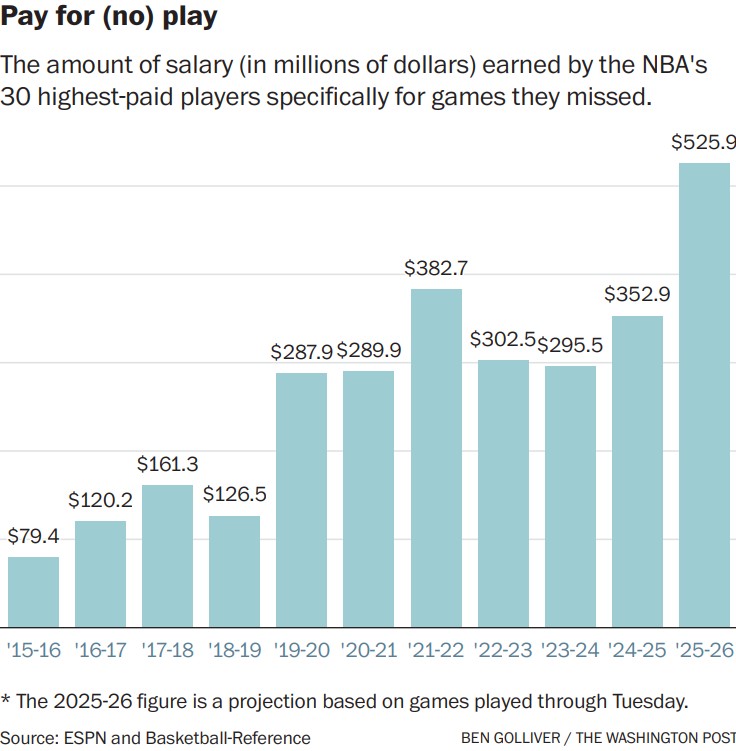
    The amount of salary (in millions of dollars) earned by the NBA's 30 highest-paid players specifically for games they missed.
    The amount of salary (in millions of dollars) earned by the NBA’s 30 highest-paid players specifically for games they missed.

    As the NBA and its fans continue to debate possible solutions, the injury epidemic has reached staggering heights when it comes to lost productivity. Back in 2015-16, the 30 highest-paid players combined to earn roughly $560 million. Because those players only combined to miss 14 percent of their teams’ games, their teams combined to pay roughly $79 million in empty salary.

    Last year, the empty salary mark reached more than $352 million. This season, with the 30 highest-paid players combining to earn more than $1.49 billion and missing 35 percent of their teams’ games entering Wednesday, the number is on pace to exceed $525 million.

    That would easily set a record for lost productivity. As Lue and Kidd might say, NBA teams could soon have a half-billion dollars sitting on the sideline.

  • Can zinc shorten your cold? Here’s how to take it the right way.

    Can zinc shorten your cold? Here’s how to take it the right way.

    The question: Can zinc cure a cold?

    The science: Everyone loves a good cold remedy — vitamins, homemade concoctions, nasal irrigation systems. And zinc, a mineral, is a popular one, sold over the counter as lozenges, quick-dissolve tablets, and nasal sprays.

    While there’s no conclusive evidence that zinc can prevent a cold, there is research suggesting it might help shave a little time off the duration of a cold, which usually runs for seven to 10 days.

    “If you’re trying to get better, say, before you go see your brand-new grandchild or because you have a big presentation coming up at work, it may cut a day or two off your cold but you might still have persistent symptoms,” said Rebecca Andrews, a professor at the University of Connecticut School of Medicine and chair of the Board of Regents for the American College of Physicians.

    Scientists have hypothesized that zinc may prevent rhinoviruses — which are common viruses that cause about 50% of colds — from infecting our cells, said Roy Gulick, the chief of the Division of Infectious Diseases at Weill Cornell Medicine and attending physician at New York Presbyterian Hospital in New York City.

    The mineral also enhances immune function and responses to infection, among other things, he said.

    In a 2024 Cochrane review, researchers analyzed 34 trials using zinc to prevent and treat colds. The authors found little to no evidence that zinc, when taken proactively, can prevent a cold or reduce the number of colds a person gets.

    For people who already have a cold, the reviewers found some evidence that zinc might shorten the duration of symptoms by about two days compared with a placebo. However, they also found that zinc was associated with mild side effects such as nasal and oral irritation, problems with taste, stomach pain, constipation, diarrhea, and vomiting, among others.

    Outside those trials, some people who use certain zinc nasal products have reported a loss of smell. It prompted the Food and Drug Administration to issue a public health advisory in 2009, warning people about the link between some zinc nasal products and long-lasting or permanent loss of smell.

    Our bodies don’t produce zinc, which we need for proper immune system and metabolism functioning and wound healing. Adult women should get 8 milligrams of zinc from their diets each day and men 11 mg, according to federal health authorities. Zinc-rich foods include meat, fish, and seafood such as oysters.

    The optimal zinc dose for the treatment of colds is uncertain because researchers conduct studies in different ways, and test different forms of zinc and different doses. However, a number of studies on zinc as cold treatments use doses of 80 mg or more per day. Many over-the-counter zinc lozenges are supposed to be taken every few hours, which amounts to about 80 mg.

    But Andrews said that if you exceed 50 mg of zinc per day, you increase your likelihood of side effects. And don’t use it to prevent a cold — only to treat an ongoing one, she said.

    “When you supplement, you’re going to get a lot more than what you need in your diet, which is more likely to cause stomach upset and send you either into my office or an urgent care, where you might get treated for something that you don’t have because the symptom could be from the zinc,” she said.

    What else you should know

    Before taking zinc, speak with your healthcare provider, as the mineral can interact with some medications. For instance, high zinc intake may make certain chemotherapy drugs less effective, Andrews said.

    If you want to try zinc to treat a cold, consider these suggestions:

    • Don’t use zinc supplements as a preventive, only a treatment. Because there’s little to no evidence that zinc can prevent a cold and it’s associated with a number of side effects, use it only when you have symptoms of a cold.
    • Try lozenges, but in moderation. Most studies have evaluated the effectiveness of zinc lozenges over other formulations, probably because they are easy to take and may help ease sore throats, a common symptom of a cold, Andrews said. But don’t overdo it. If you exceed 50 mg daily, you increase your risk of stomach upset and other side effects, she said.
    • Don’t take zinc with certain foods. High-fiber foods, legumes, and grains, foods rich in calcium and iron, and excessive alcohol, among other things, can reduce zinc absorption.
    • Zinc aside, build up your immune system. Eating a healthy, well-balanced diet, drinking plenty of water, and getting enough sleep are key for ensuring your immune system “is top-notch from a cold-fighting perspective,” Andrews said.

    The bottom line: While zinc is unlikely to prevent a cold, it may help reduce the duration of a cold by a day or two. But potential benefits of zinc, particularly at higher levels, may be offset by adverse reactions, including irritation in the nose and mouth, an upset stomach, and other side effects.

  • U.S data agencies need ‘immediate’ help to do their job, report says

    U.S data agencies need ‘immediate’ help to do their job, report says

    U.S. data agencies need urgent help from the Trump administration and Congress to ensure they can carry out their basic duties and restore public confidence amid a deepening crisis, according to a new report by some of the country’s top statistics experts.

    The agencies are struggling with fragile capacity and eroding trust — as well as diminished safeguards for data integrity — and need more money and staff, says the study led by the American Statistical Association. It cites challenges that have grown more acute since last year’s inaugural version of the report, published before President Donald Trump returned to office.

    Government departments such as the Bureau of Labor Statistics, Bureau of Economic Analysis, and Census Bureau are tasked with publishing all kinds of data, which cover the economy and many other topics, and are key to decisions by policymakers, investors, and companies as well as the wider public. Their work has been made harder by longstanding problems such as shrinking budgets and falling response rates for surveys — as well as more recent threats to their independence and integrity.

    “Immediate action must be taken to halt the severe decline in the federal statistical agencies’ ability to meet their basic mission and be positioned to keep up with increasing information needs and to address uncertainty in the trustworthiness of federal statistics,” says the report, which was published Wednesday.

    In Trump’s second term, the strain on federal statistics has intensified. His administration’s campaign to downsize the government left gaping holes in many agencies, with data products becoming collateral damage of the staffing cuts. Organizations such as the ASA have created dashboards to keep an eye on changes to datasets and highlight any that disappear.

    Headcount at the BLS was down 20% last fiscal year compared with the previous one, and the BEA has seen a 25% drop since 2019, the report says. Trump has proposed further cuts in his 2026 budget.

    Trump’s most drastic action so far on the data front came when he fired the head of the BLS in August after a weak jobs report — accusing her, without providing evidence, of rigging the numbers to make him look bad. Economists and statisticians have lined up to reject that claim. The administration pointed to large revisions in employment data and said the numbers needed to be “fair and accurate.”

    Just a day before all this drama unfolded, the statistics experts behind Wednesday’s study had published an interim report saying they were confident that data could be trusted and there were no signs of meddling by the executive branch. Trump’s move against the BLS forced a rapid rethink. The document was amended to say that the president’s actions “undermine trust in the future by accusing statistical agency heads of past political manipulation.”

    The group’s new report cites a survey which found the share of the public expressing trust in federal data had declined to 52% in September, from 57% in June.

    It calls out other administration actions this year that undermined official statistics, like the termination of advisory committees, failure to fill leadership roles, and elimination of datasets without consulting Congress or the public. It notes that the positions of chief statistician and Census director have been staffed with political appointees who already held other full-time positions, and argues this could further erode trust.

    The report urges the Trump administration to exempt key data-agency positions from the federal hiring freeze, and calls on Congress to fund research and enhancements in IT infrastructure that can help improve the quality of statistics. Such measures would “begin to restore the system’s capacity to deliver the timely, relevant, and trustworthy statistics the nation depends upon,” it says.

  • Scientists discover oldest evidence of human-made fire in a 400,000-year-old hearth

    Scientists discover oldest evidence of human-made fire in a 400,000-year-old hearth

    Scientists have discovered the oldest evidence of ancient humans igniting fires: a 400,000-year-old open-air hearth buried in an old clay pit in southern England.

    The study, published in the journal Nature, is based on a years-long examination of a reddish patch of sediment excavated at a site in Barnham. It pushes back the timeline on fire-making by about 350,000 years.

    The nebulous question of how far back human ancestors conjured fire is deeply intertwined with some of the biggest outstanding mysteries about human evolution. The ability to reliably set fires would have allowed humans to cook food, expanding the range of what they could eat and making meals more digestible. That, in turn, could have supported bigger brains that consumed more energy, catalyzing new social behaviors as humans gathered around campfires.

    But campfires don’t leave fossils. It takes painstaking work to reconstruct these ephemeral uses of technology. And what remains unclear is who set them. No telltale bones have been recovered at Barnham, but researchers think it was Neanderthals, close cousins of our species who interbred with our ancestors.

    “The evidence of fire is incredibly difficult to preserve. If you get to ash and charcoal, it can wash away. Sediment can get washed away,” said Nicholas Ashton, curator of Paleolithic collections at the British Museum and one of the leaders of the work. “We just found this one pocket — quite a large site — where it happens to be preserved.”

    Even when traces of fire remain, the task of distinguishing incidental flames sparked by lightning strikes or wildfires from those set by people is difficult. Perhaps most challenging is distinguishing between fires ignited by humans with the know-how from those produced by scavenging embers from wildfires.

    The study could spark more debate.

    “The authors did an excellent job with their analysis of the Barnham data, but they seem to be stretching the evidence with their claim that this constitutes the ‘earliest evidence of fire making,’” Wil Roebroeks, an archaeologist at Leiden University, said in an email, calling the evidence “circumstantial.”

    Ségolène Vandevelde, an archaeologist and adjunct professor at the University of Quebec at Chicoutimi, praised the multidisciplinary approaches the authors used and said the finding was “solid.”

    Pyroarchaeology

    In the Paleolithic era, the Barnham site would have been a woodland with a seasonal pond — set away from the main river valley, where predators might have roamed, according to Robert Davis, an archaeologist at the British Museum and one of the authors of the study. The wildlife would have included elephants, lions, deer, fish and other small mammals.

    Despite the fleeting nature of fire, it can leave traces under the right conditions. At the site in Barnham, where artifacts such as heat-shattered flint hand axes were also found, researchers were intrigued by a layer of reddish sediment — a result of iron-rich sediments being heated to produce a mineral called hematite. For four years, they studied it, trying to determine whether it was the result of a wildfire or deliberate human activity.

    One of the first questions they asked was whether this was a one-time blaze or something closer to a fireplace that was lit and relit many times.

    To deconstruct this question, scientists studied the magnetism of the sediment, which is altered by heating. They conducted modern experiments, to see if they could come up with an estimate of how many heating events might have resulted in the magnetic profile of the sediment — and found that after about a dozen heating events, each one four hours long, their modern samples mimicked the archaeological one.

    Then they examined the chemistry of the site — scrutinizing particular chemical compounds left behind. The patterns they found suggested humans had been using these fires.

    The last element was small pieces of cracked flint scattered about the site — as well as two bits of pyrite, which can create a spark when struck together. A geological study of the area showed that pyrite was scarce in the local landscape, leading the authors to argue that the inhabitants had carried it there for the specific purpose of making fire.

    Scavenging sparks vs. setting fires

    The archaeological record with examples of fires used by hominins — the ancestors of humans — stretches back more than a million years ago in Africa.

    But what interests scientists is not just the ability to successfully scavenge sparks from wildfires or lightning strikes, but also the ability to reliably create it — possibly by striking flint and pyrite together to create sparks.

    The oldest accepted evidence of fires purposefully set are from a Neanderthal site dated to 50,000 years ago in France. That evidence is considered convincing in part because there are chunks of flint showing “microwear traces of having been struck” to create sparks, Roebroeks said. But at Barnham, there are no microwear traces, leaving room for disagreement.

    “It’s a very contentious debate that’s been going on for some time,” Davis said.

    Early hominins would have learned to harvest fire by collecting embers, harvesting the right fuel and tending the fire. And eventually, they had to learn how to make it on demand — which would allow them to live in colder places, cook, fend off predators and socialize after dark.

    The study does not suggest that Barnham was where fire originated; it was probably widespread across the ancient world. But it does offer a rare, preserved snapshot of prehistoric life.

    “The maintenance of fire requires social cooperation, cultural rules and work coupled with knowledge of wood types, and means that a complicated tradition is at play,” said John Hawks, a paleoanthropologist at the University of Wisconsin at Madison.

  • Supreme Court wrestles with death penalty in cases of intellectual disabilities

    Supreme Court wrestles with death penalty in cases of intellectual disabilities

    The Supreme Court on Wednesday wrestled with whether to allow Alabama to execute a man with low cognitive function, a ruling that could set new rules for states to condemn those with borderline intellectual disabilities to death row.

    Roughly two hours of intense arguments did not seem to produce a consensus among the justices over how states should assess IQ tests to determine mental disability.

    In a landmark 2002 ruling Atkins v. Virginia, the court decided that sentencing a mentally disabled person to death violated the Eighth Amendment’s prohibition on “cruel and unusual punishment,” but left it up to states to come up with standards for determining who is too disabled.

    Since then, the rules states have used to determine who is ineligible for the death penalty have come before the court several times, in part because many death row inmates skirt the line of intellectual disability.

    In the current case, Alabama is asking the court to cut back on protections that those previous rulings have given to those who have borderline intellectual disabilities. The case involves how lower courts weighed Alabama’s use of multiple IQ tests to decide Joseph Clifton Smith should face death for robbing and killing a man in 1997.

    Under Alabama’s death penalty rules, a defendant is ineligible for the death penalty if he or she has an IQ at or below 70 and significant deficits in everyday skills and those issues occurred before adulthood. Many states have similar IQ thresholds.

    In Wednesday’s argument, Robert Overing, deputy solicitor general for Alabama, told the justices that lower courts, which threw out Smith’s death sentence, had placed too much weight on a single low IQ score and additional evidence of impairment, rather than considering the cumulative results of five tests that placed Smith above the IQ cutoff. He said the latter was a more accurate yardstick for his abilities.

    “He didn’t come close to proving an IQ of 70 or below … but the lower courts changed the rules,” Overing said.

    The court’s three liberal justices expressed skepticism the law required lower courts to consider the cumulative effect of multiple scores as Overing suggested.

    In previous rulings, the high court said defendants were permitted to offer additional evidence of cognitive impairment if IQ scores fell below the threshold, but Overing downplayed that idea. That drew rebukes from the liberals as well as questions from conservative Justice Brett Kavanaugh.

    “What you’ve done is shift this to be all about the IQ test, which is not supported by our case law,” Justice Ketanji Brown Jackson told Overing.

    Kavanaugh asked at another point about additional evidence: “What’s the logic or the rationale or the sense behind not having a district court or a trial court or a state court have the ability in those circumstances to go on and look at more?” he asked.

    Justice Neil Gorsuch floated the idea of a ruling that would allow states to set the threshold for a claim of mental disability, but not allow eligibility to turn solely on a single IQ test score. Any additional evidence of impairment would not be allowed to outweigh a low test score.

    But there was little agreement among the justices as they groped for the proper standard.

    Smith’s murder case began in 1997, while he was on work release from prison. Smith and an accomplice robbed a man of $140 and killed him. A jury convicted Smith of capital murder during a robbery and sentenced him to death.

    After the court’s 2002 decision in the Atkins case, Smith filed a petition in federal court arguing his intellectual disability met the criteria to bar his execution. The case has gone back and forth in the lower courts ever since.

    During an evidentiary hearing, testimony revealed Smith had scored 75, 74, 72, 78 and 74 on IQ tests over the course of his lifetime. Those were the scores Overing, the lawyer for Alabama, pointed to in arguing that the cumulative effect of the tests placed Smith slightly above the state’s IQ cutoff.

    The federal district judge considering the case, however, pointed to the test on which Smith scored 72, saying it indicated his IQ could be as low as 69, since the test had a three-point error range. For that reason, the court allowed Smith to present additional evidence of his impairment to assess his cognitive function.

    In seventh grade, Smith’s school classified him as “Educable Mentally Retarded,” meaning he had mild intellectual disability. Smith never consistently held a job, never had a bank account and had difficulty following laws, according to testimony in the lower court hearings. He also acted impulsively, and read and did math at a low level.

    The court determined Smith’s “actual functioning” was comparable to someone who was intellectually disabled so he couldn’t be sentenced to death.

    After an appeals court ruled in Smith’s favor, Alabama appealed to the Supreme Court. The high court vacated the decision, asking the appeals court to clarify whether its ruling was based solely on one low IQ score or had considered other evidence and expert testimony.

    The appeals court once again found Smith was intellectually disabled and said its decision was based on a holistic approach that considered Smith’s deficits in everyday skills along with the IQ score of 72. Alabama again appealed to the Supreme Court, which agreed to take up the case it heard Wednesday.

    Seth P. Waxman, an attorney for Smith, said the lower courts had not erred in their assessment of Smith and it was proper to consider additional evidence of his impairment.

    “Every court in Alabama … this court and every other court in every other state that I am aware of understands that raw observed test scores is not the definition of true IQ,” Waxman said.

    But Harry Graver, an attorney for the Trump administration, which backed Alabama’s position, said the lower court did not give proper weight to the multiple IQ scores.

    “Even if you look at other evidence, you still need to circle back and see how that weighs against the evidence on the other side of the scale,” Graver said.

    Smith’s case is not the first time the Supreme Court has tackled intellectual disability and the death penalty.

    In a 2014 case from Florida and a 2019 case from Texas, the high court noted that IQ tests are not precise. In the 2019 case, the court specifically said that lower courts needed to consider the possible error range in IQ scores.