Category: Washington Post

  • Those seeking to sue ICE for injuries or damage face an uphill battle

    Those seeking to sue ICE for injuries or damage face an uphill battle

    An undocumented immigrant is seeking $1 million in damages after he says he was riding his bike in Melrose Park, Ill., when a U.S. Border Patrol agent suddenly tackled him, placed him in a chokehold and punched his head.

    A Chicago resident says that federal agents caused $30,000 worth of property damage when they broke a lock on his wrought-iron gate and scaled a wooden fence to chase after construction workers repairing his Victorian-era home.

    A Columbia University student and activist who spent 104 days in a U.S. Immigration and Customs Enforcement detention center is demanding $20 million over what he says was a false arrest.

    All three should expect a long and difficult fight under the current legal landscape, lawyers warn.

    These and scores of other claims expected to arise out of the Trump administration’s crackdown on illegal immigration are winding through a bureaucratic process mandated under the Federal Tort Claims Act. It is the primary legal recourse for people seeking compensation for property damage, injuries and even deaths allegedly caused by federal agencies and their employees.

    First, individuals must fill out a form and submit it for review by the agency that they say caused the harm. Agencies such as ICE and Customs and Border Protection have six months to deny a claim, offer a settlement, or not respond at all. Only then can people sue in court under the Federal Tort Claims Act.

    But these cases are different from civil rights lawsuits. Judges, not juries, decide the outcome. Awarded damages are likely to be much lower. And individual officers can’t be named as defendants.

    “It’s absolutely bonkers,” said Brian Orozco, a Chicago attorney for Ricardo Aguayo Rodriguez, the bike-riding immigrant who was hospitalized and is now detained, awaiting deportation to Mexico. “If a Chicago police officer abuses my civil rights, I can file a claim immediately. I don’t have to wait six months [to file a lawsuit]. I have a right to a jury trial. I don’t have that when I’m up against the federal government. It’s scary to me how protected these federal agents are.”

    After the Civil War, Congress passed a law that established the right to sue local and state officials for the violation of constitutional rights. Federal officials weren’t included in the law, though a 1971 Supreme Court ruling established precedence for such lawsuits. But legal experts said that the court’s decisions within the past decade have narrowed that path and made it nearly impossible to successfully sue federal agents for civil rights violations.

    “It is arguably harder today in 2026 than at any other time in American history to sue federal officials for money damages if they violate your constitutional rights,” said Harrison Stark, senior counsel at the State Democracy Research Initiative at the University of Wisconsin Law School.

    Relatives of both Renée Good and Alex Pretti, Minneapolis residents who were fatally shot in separate encounters by federal immigration officers in January, have hired attorneys. In a statement, Romanucci & Blandin, the law firm retained by Good’s family, said it is pursuing a tort claim and would not be deterred by “the byzantine, time-consuming processes mandated by the Federal Tort Claims Act.” The attorney hired by Pretti’s parents did not respond to a request for comment.

    People visit a makeshift memorial on Jan. 26 in Minneapolis for 37-year-old Alex Pretti, who was fatally shot by immigration officers.

    An ICE spokesperson said the agency received about 400 tort claims in fiscal 2025, which ended Sept. 30, but did not provide a breakdown of how many resulted in settlements or denials.

    “Despite facing a more than 1,300% increase in assaults against them, 8,000% increase in death threats, and a 3,200% increase in vehicle rammings, the men and women of ICE continue working around the clock” to arrest and remove “the worst of the worst criminal aliens from the United States,” ICE said in an emailed statement. The Washington Post could not independently verify these numbers.

    A U.S. Customs and Border Protection spokesperson declined to provide data about the number of tort claims the agency received last year.

    “Rioters and agitators have created an extraordinary amount of damage to public and private property, not to mention the harm they have put our officers and the public in,” a CBP spokesperson said in a statement. “We expect these agitators will be held responsible for their actions.”

    Spokespeople for ICE and CBP declined to comment on individual claims described in this story. They broadly said their agencies adhere to the Federal Tort Claims Act.

    A significant settlement is not impossible. The estate of Ashli Babbitt, the woman who was shot and killed on Jan. 6, 2021, during the U.S. Capitol riot, filed a tort lawsuit and reached a nearly $5 million settlement with the government.

    But the challenges of navigating the Federal Tort Claims Act — coupled with an anticipated rise in claims as violent encounters continue in cities across the United States — have put pressure on Congress to pass legislation to allow civil rights lawsuits against federal officers and agents.

    Such an effort would probably face pushback, experts said. Several years ago, the National Border Patrol Council, a union that represents Border Patrol agents, warned the Supreme Court of the “potentially massive financial impact” that would occur if thousands of its agents were exposed to “liability for personal damages.”

    ‘Not very hopeful’

    Leo Feler said he ran into challenges as soon as he decided to pursue a tort claim. For one thing, he wasn’t sure where to send it: Feler didn’t know which federal agency employed the masked men who came to his Chicago home on Oct. 24.

    Feler, a 46-year-old economist, said he wasn’t there at the time. But he received a notification from his Ring security camera: Someone was on his property.

    A construction crew had been repairing the windows and siding of his home in the affluent Lakeview neighborhood. As the workers ate lunch outside, armed men in green uniforms jumped from two vehicles and tried to break the locks on the gates of a nearly 6-foot-high wrought-iron fence, according to Feler, who reviewed security camera footage of the incident and a video taken by a neighbor.

    The agents, Feler said, had scaled a wooden fence along the side of his house and hopped onto his balcony in pursuit of the fleeing workers.

    One worker was injured as he scrambled through a construction site littered with wood and nails, Feler said, leaving a trail of blood in the home. Another worker was detained, he said.

    Feler said a tenant who rented a unit on his property asked the officers to provide a warrant that authorized the raid, but they refused to do so. Through his Ring camera’s intercom system, Feler told the agents that they were trespassing and needed to leave. But they ignored him, he said.

    Feler later sought legal advice. Attorneys told him he could file a tort claim for damages.

    Unsure which agencies had come to his house, Feler sent the paperwork for his tort claim in December to ICE, Customs and Border Protection and the Department of Homeland Security.

    He described the damage to his property — including to his locks and fence — and also wrote that the agents “robbed me and my family of the feeling of security we once enjoyed in my home.” His tenant was afraid and asked to break her lease early, which Feler said he agreed to do.

    Overall, Feler estimated $30,000 in damage to his property.

    He said he is “not very hopeful” that he will receive payment. If his claim is denied, he said he and his attorneys will pursue a lawsuit under the Federal Tort Claims Act.

    Others caught up in Operation Midway Blitz, the administration’s immigration enforcement actions in the Chicago area last fall, also said they expect it will be difficult to recover alleged damages.

    Leigh Kunkel, a 39-year-old freelance journalist, said she was documenting federal agents shooting pepper balls at protesters in late September outside an ICE facility in Broadview, Ill. An agent then aimed the weapon at her and fired pepper balls, she said, striking her in the back of the head and the nose and leaving her bloodied.

    A week later, her fiancé, Kyle Frankovich, also was protesting in Broadview within an area that he said state police monitoring the scene had designated a “free speech zone.” Federal officials, including Border Patrol commander Gregory Bovino, emerged from the ICE facility and began arresting protesters, according to video footage.

    Frankovich, 41, said he showed no aggression toward agents; nevertheless, he said, they took him to the ground and put him in handcuffs. They later lined him up with other detainees along a guardrail near the facility. The scene served as a backdrop to a Department of Homeland Security promotional video featuring Secretary Kristi L. Noem.

    He said he was detained for eight hours before a federal agent dropped him off at a nearby gas station. Frankovich has not been charged with a crime.

    Antonio Romanucci, a civil rights lawyer and founding partner at the Chicago-based firm representing Renée Good’s family, said his office plans to file federal tort claims for Kunkel and Frankovich. The couple said they understand the path may be long and their case could be unsuccessful, while also exposing them to public scrutiny.

    “Ultimately, we landed on the feeling that we are privileged enough to have the opportunity to fight back against this as citizens,” Kunkel said, “and that if we can do that, if this is one little way that we can push back, that we should.”

    Pushing for change

    Previous efforts to change the federal law have failed to gain traction.

    A law signed by President Ulysses S. Grant in 1871 established the statutory right to sue local or state officials for constitutional violations. Nearly two years ago, a group of U.S. lawmakers introduced draft legislation that would have amended that law by inserting just four words — “or the United States” — and established the right to sue federal officials as well. But the effort stalled.

    “It’s a somewhat complicated area of law across different jurisdictions,” Sen. Sheldon Whitehouse (D., R.I.) said of the challenges in garnering support for the bill, which he sponsored. “But I didn’t see any huge partisan issues.”

    Whitehouse said there was a lack of urgency at the time, even though the Supreme Court had “more or less strangled” the legal pathway that had been used since the 1970s to sue federal officials for civil rights violations.

    Last fall, Whitehouse and Rep. Hank Johnson (D., Ga.) reintroduced the measure. Legal experts told the Post they think it is unlikely to pass, citing anticipated concerns about exposing federal law enforcement officers to personal liability.

    A handful of states already have laws that authorize claims against federal officials for the violation of constitutional rights, including New Jersey and Massachusetts, according to research compiled by Stark of the University of Wisconsin Law School. Lawmakers in other states are scrambling to draft similar bills.

    Last week, the California Senate passed the “No Kings Act” to allow civil rights lawsuits against federal officers. The measure will head to the State Assembly next.

    In Colorado, Mike Weissman, a Democratic state senator, recently introduced a similar bill. He described talking with state legislators in Washington, New Mexico, and Virginia, to exchange ideas.

    And in Minnesota, State Rep. Jamie Long, a Democrat whose district includes part of Minneapolis, has drafted such a bill for the legislative session that begins later this month.

    “We know that there is evidence of these severe constitutional violations happening, and that’s why we think it’s appropriate to create this state remedy,” Long said.

    Such measures are likely to be challenged. The U.S. Justice Department has already sued Illinois, alleging that its new law authorizing civil rights claims against federal officers is an “unconstitutional attempt to regulate federal law enforcement officers.”

    In the meantime, those who say they have sustained property damage or injuries during immigration enforcement efforts and their attorneys are continuing to press lawmakers to enable them to sue federal officers.

    Christopher Parente, a Chicago-based lawyer, is representing Marimar Martinez, a 30-year-old teacher’s assistant who was shot five times by a Border Patrol agent in October and survived. In an interview with the Post, her attorney said he thinks that Congress should change the law.

    Parente, a former federal prosecutor who plans to file a tort claim on Martinez’s behalf, said, “There is no deterrence — in fact, these agents are embraced and celebrated by this administration and their colleagues.”

    Marimar Martinez (center) is greeted by her family after being released from the Metropolitan Correctional Center on Oct. 6, 2025, after being shot by immigration agents and charged with assaulting federal officers in an incident in Chicago’s Brighton Park.

    A chilling effect

    People seeking compensation from the federal government may face another roadblock: finding an attorney to take their case.

    “I’ve met people who spent the entire statute of limitations period, which is generally two years, looking for attorneys to represent them in cases against the federal government or federal officials and not being able to find them,” said Anya Bidwell, senior attorney for the Institute for Justice, a nonprofit law firm based in the D.C. area.

    Bidwell said many attorneys are deterred from taking Federal Tort Claims Act cases because the government often invokes “a very broad immunity that courts traditionally interpret to pretty much swallow any of the claims that involve any kind of a judgment or choice on behalf of an officer.”

    In other words, many cases are dismissed. Bidwell said “even getting to trial is extremely difficult.”

    Some people who consider filing claims ultimately decide not to, discouraged by the long and difficult process.

    In Minneapolis, Gina Christ, a 55-year-old business manager, contacted a lawyer to challenge what she described as an unlawful detention. But the attorney she met with told her suing the government would be “very, very difficult,” Christ recalled.

    Christ had driven to a protest that began after Border Patrol agents allegedly tried to arrest a pair of Latino teens. She said she parked along the side of the street to observe the agents, not to obstruct them.

    Christ said she was soon surrounded by agents and protesters. Agents yelled at her to move before smashing the window of her Ford Escape. They opened the door, pulled her out of the car, and held her facedown on the pavement, she said.

    Agents restrained her wrists with plastic zip ties, Christ said, while her eyes and throat burned from tear gas fired into the nearby crowd.

    Authorities took her to a federal building for processing, she said, and placed her in metal arm and leg shackles. She said they walked her to a folding table, where there was a makeshift sign with the criminal code for assaulting an officer. They told her she would face charges and took her fingerprints and a DNA swab.

    Christ said she spent nearly four hours in custody before she was released. She hasn’t been charged with a crime.

    A Customs and Border Protection spokesperson did not answer questions about the agency’s interaction with Christ.

    After weighing the difficulty of pursuing a tort claim, Christ said she plans to pay to fix her window herself. Given what others have lost, she said, it seems too small to pursue.

  • How to claim tax breaks on overtime, tips, and more this filing season

    How to claim tax breaks on overtime, tips, and more this filing season

    Many Americans stand to collect larger tax refunds this year, whether they itemize or not.

    Certain filers can now write off tips, overtime pay, and auto loan interest because of changes enacted under last year’s sweeping tax and spending bill. People 65 and older can collect a $6,000 write-off. And the standard deduction has grown, as has the child tax credit.

    Many workers may have had more money withheld from their paychecks than needed because the IRS did not adjust withholding tables after Republicans’ One Big Beautiful Bill was signed into law on July 4. Excess withholding is different from a tax cut, of course, but it generally translates into larger refunds because the government returns the overpayment.

    Overall, the law disproportionately benefits the wealthy and shifts government benefits from low-income households to higher-earning ones, according to independent analyses. Though most people will see some reduction in taxes, many low-income households lost more in federal benefits like SNAP or Medicaid than they would gain from tax cuts.

    Here’s what filers need to know about the new provisions heading into tax season, which runs through April 15.

    Tips

    Workers in specific jobs — such as bartenders, gambling dealers, DJs, babysitters, tailors, and many more — can deduct as much as $25,000 in tips from their taxable income. They don’t need to itemize; however, married filers must file jointly. Those who earn more than $150,000 (or $300,000 jointly) cannot claim the full deduction.

    The new deduction is only available to filers with a Social Security number, which will prevent some immigrants from claiming it.

    Next year, employers will have new tax forms for recording their workers’ tips that qualify for the deduction. This year, however, workers will need to figure out their qualifying tips on their own.

    The IRS estimates that about 6 million people can claim the new deduction. The Congressional Budget Office estimates they will collectively pay about $10 billion less in taxes this year.

    Overtime wages

    When workers earn a bonus for working extra hours — the “half” part of those “time-and-a-half” earnings — that money won’t be taxed. The income limitation is the same as those on tips, but the total allowable deduction is capped at $12,500 for an individual and $25,000 for joint filers.

    This deduction also requires taxpayers to have a Social Security number and to file jointly if married. It isn’t limited to specific named occupations, though not all workers are entitled to overtime pay under the Fair Labor Standards Act. The number of salaried, full-time workers who are guaranteed overtime based on their wages dropped from roughly 65% in the 1970s to 15% in 2024, according to the National Employment Law Project. Still, this deduction is one of the more costly ones in the new law, projected to decrease tax revenue by more than $32 billion.

    Like tips, the deduction is available whether taxpayers itemize or not. And workers will be responsible for calculating their overtime pay this year, as the IRS will not have forms available until next tax season. Many employers will provide workers with pay statements to help them figure out what they can claim.

    Car loan interest

    If you took out an auto loan in 2025, you may be able to write off as much as $10,000 in interest. The deduction is Republicans’ response to rising car payments: Consumers are now paying more than $50,000, on average, for a new vehicle, leaving 1 in 5 of them with payments in excess of $1,000 a month.

    The deduction is reserved for automobiles that had their “final assembly” in the United States. A long list of popular cars and SUVs from both American and foreign brands are assembled here, but some vehicles won’t qualify. The Nissan Sentra, for example, is assembled in Mexico, and many Toyota Corollas are assembled in Japan. You can look up your own car at vpic.nhtsa.dot.gov/decoder.

    Only taxpayers with modified adjusted gross income below $100,000, or joint filers below $200,000, can claim the full deduction.

    The CBO estimated that the deduction will cost the government $5.4 billion in 2026.

    Senior citizens

    Taxpayers 65 and older already get a larger standard deduction than younger people. The Republican law bumps it up by $6,000 for low- and moderate-income seniors (individuals with as much as $75,000 in income or joint filers with $150,000). It also allows those seniors who itemize instead of claiming the standard deduction to be eligible for the same additional $6,000 deduction.

    Republicans created this deduction instead of exempting Social Security income from taxes, an idea floated by President Donald Trump during his campaign. With the new deduction, few seniors will wind up owing taxes on their Social Security benefits.

    The Joint Committee on Taxation has estimated that the enhanced deduction will cost the government more than $17.6 billion a year.

    Bigger deductions

    The standard deduction rises to $15,750 for individuals, $23,625 for heads of households, and $31,500 for couples filing jointly.

    The Republican bill passed in July extended many of the provisions of a 2017 tax law that otherwise would have expired — including a larger standard deduction and no more personal exemptions.

    The law increased the maximum Child Tax Credit to $2,200 per child, and the amount of state and local taxes (SALT) that filers can deduct from their taxable income, from $10,000 to $40,000.

  • In northwest Nigeria, U.S. confronts a growing terrorist threat

    In northwest Nigeria, U.S. confronts a growing terrorist threat

    BAIDI, Nigeria — There are still bloodstains and bullet holes in the mud-brick alcove where villagers took shelter last month after militants overran their community, opening fire on residents who had gathered to drink tea in the town square.

    Six people, ages 18 to 60, were killed in Baidi that night, locals said, gunned down without warning by men whose faces were obscured by the darkness. The attack was the latest in Nigeria’s northwestern Sokoto state, carried out by what Nigerian and U.S. officials believe is the newest African affiliate of the Islamic State.

    On Christmas night, President Donald Trump announced that United States had launched airstrikes against the group, known here as Lakurawa, part of what the White House and its allies have described as a campaign to put a stop to the “slaughter of Christians” in Nigeria. But the U.S. strikes were largely ineffective, Nigerian officials, analysts and residents said, and there are very few Christians in Sokoto to protect. The state, once part of a 19th-century caliphate, remains overwhelmingly Islamic, and it is Muslims in villages like this one who have borne most of the violence in Sokoto.

    Yet no one here denies there is a real and growing security crisis. Islamist militants from several different groups have wrought havoc in Mali, Burkina Faso and Niger in recent years while quietly extending their reach into northern Nigeria. Most researchers see Lakurawa as an extension of the Islamic State Sahel Province (ISSP), which is strongest along the borderlands between Mali and Niger but has shown the ability to strike high-profile targets. Its fighters kidnapped an American missionary in central Niamey, Niger’s capital, late last year and, just last week, executed a large-scale attack on Niger’s international airport.

    Now, according to five Nigerian and U.S. officials, ISSP is sharing intelligence and coordinating logistics with the more established Islamic State West Africa Province (ISWAP), which is based hundreds of miles to the east on the islands of Lake Chad. Together, officials fear, the two groups could destabilize vast stretches of northern Nigeria, home to an estimated 130 million people, where authorities have long struggled to contain insurgent violence.

    “This is not just a Nigeria problem,” said one of the Nigerian security officials, speaking like others in this story on the condition of anonymity to discuss sensitive and ongoing operations. “It affects the entire region.”

    Men handle donkeys at the market in Tangaza, Nigeria, on Jan. 26. Many kidnappings and attacks occur in this area.

    The U.S. has ramped up cooperation with Nigeria’s military in recent months, according to four of the officials, running daily surveillance flights over northern Nigeria with drones launched from Ghana. Officials said the flights have provided actionable intelligence used in additional strikes by the Nigerian military.

    What, if anything, the U.S. and Nigerian strikes have achieved against militants in the northwest remains difficult to discern. Both nations are playing catch-up on a threat that analysts say has been building for years and is still poorly understood. Attacks by Lakurawa have not been officially claimed by the Islamic State, and researchers and officials have competing theories about the group’s origins and allegiances.

    What was clear over the course of more than 20 interviews across Sokoto state is that the militants are on the offensive. Residents in multiple front line villages say armed men are increasingly imposing an extreme version of Islamic law on their communities, demanding they pay taxes known as zakat and punishing those who refuse.

    Fighters often announce their arrival by barging into mosques and dictating the rules communities must live by. Most of the villages around Baidi, residents said, have already fallen under Lakurawa’s control. Western schools, already rare in this impoverished region, have been shuttered. Music, cigarettes, and traditional celebrations, including weddings and naming ceremonies, have been banned. Drinking and drugs are forbidden and strict dress codes are enforced.

    Musa Sani next to blood and bullet holes where Lakurawa shot during a recent attack that killed several people in Baidi, Nigeria, on Jan. 26.

    A few weeks before the attack in Baidi, residents said, militants approached members of a local vigilante group that had formed to defend the community, demanding they urge local leaders to submit to their rule. The leaders refused.

    “We understood there would be retaliation,” said Musa Sani, 47, one of the vigilantes. “But we did not want to live under a terrorist regime.”

    Men hang out in Silame, Nigeria, where Lakurawa pass through, on Jan. 25. Lakurawa have been known to punish people for having cell phones. Many kidnappings and attacks occur in this area.

    ‘Under the radar’

    In November, U.N. secretary-general António Guterres told the U.N. Security Council that Africa’s Sahel region, spanning the breadth of the continent from the Atlantic Ocean to the Red Sea, now accounts for more than half of all terrorism deaths worldwide and warned of a “disastrous domino effect across the entire region.”

    A dizzying array of armed groups thrive across a succession of weak states with porous borders. JNIM, a powerful al-Qaeda affiliate, and ISSP compete for influence in Mali, Burkina Faso, and Niger (JNIM also claimed its first attack in Nigeria in late October). ISWAP and the remnants of the Boko Haram jihadist movement are dominant in northeast Nigeria and around Lake Chad.

    Boko Haram’s rampage in northeast Nigeria captured the world’s attention more than a decade ago when fighters kidnapped nearly 300 schoolgirls from their dormitories in Chibok. But the arrival of Sahelian militants in the northwest a few years later flew largely under the radar and has been a source of growing alarm for Nigerian officials.

    Hakimi Maikudi, community leader, stands in the road where Lakurawa came through during the attack in Baidi, Nigeria, on Jan. 26.

    In early November, when Trump suddenly threatened to go “guns-a-blazing” into Nigeria to protect embattled Christmas, officials here were surprised and angry. Nigeria’s population of 230 million is roughly split between Christians and Muslims, and people of both faiths have been targeted by extremists.

    But Nigeria’s military was watching the militant violence, especially in the northwest, with growing concern, acknowledged Daniel Bwala, a senior adviser to President Bola Tinubu. “We had always viewed the United States as a senior brother,” said Bwala. “We needed to find a way to work with [them].”

    Bwala and a delegation of top officials made the rounds in Washington, appealing for help in addressing a security crisis they said impacted all Nigerians. Their efforts paid off: When the U.S. launched strikes on Dec. 25, it was against Lakurawa targets provided by Nigerian officials.

    Although Trump and other U.S. officials have publicly claimed the strikes were a success, they have provided no evidence to support their claims. At least four of the 16 Tomahawk missiles failed to explode, the Washington Post found, landing in open fields and a residential area far from where the militants are known to operate. Nigeria’s government has said three dozen suspected militants were arrested while attempting to flee Sokoto state following the strikes. Mohammed Idris, the country’s information minister, told the Post that a “comprehensive evaluation” was still underway.

    A senior Nigerian intelligence official who deployed a team to the sites where missiles reached their targets told the Post that while Lakurawa camps were destroyed, there was no indication that militants were killed. Three other Nigerian officials conceded that the sheer number of armed groups operating in the northwest, and shifting alliances among them, have made it difficult to obtain accurate intelligence.

    That lack of clarity presents “a real operational challenge vis-à-vis targeting,” said James Barnett, a Nigeria specialist based between Lagos and Britain. “Intelligence has to be precise and fresh for it to be effective.”

    Barnett also cautioned that Lakurawa may not be a single coherent group, but rather a catchall term for Sahelian Islamist militants. Allied criminal bandits, he added, may be exploiting the confusion and operating under its name.

    As officials try to make sense of the situation, fighters loyal to ISSP have “entrenched themselves in the Niger-Nigeria borderland and are advancing toward Benin,” said Héni Nsaibia, the senior West Africa analyst for the Armed Conflict Location & Event Data project.

    “They have decided to run their operations covertly,” he said, “to try to stay under the radar.”

    Children leave their home in Silame, Nigeria, where Lakurawa pass through, on Jan. 25.

    Rule of the gun

    Driving north from the bustling city of Sokoto, the regional capital, toward the border with Niger, the roads are largely devoid of traffic. Rolling brushland is interrupted only by the occasional farm.

    It is in these remote, ungoverned spaces that Lakurawa established a foothold, officials say, and is now expanding.

    Residents in four towns and villages described armed men arriving here more than five years ago from Mali and Niger, traveling on motorbikes and speaking languages they didn’t understand.

    At first, they presented themselves as peacemakers — mediating disputes between herders and farmers, which sometimes turned violent, and protecting communities from roving bandits. But it was not long before they showed their true colors, residents said, issuing draconian decrees at gunpoint.

    Over the last year, according to experts, residents and officials, the militants have widened their reach, bringing more villages under their control and using violence against those who resist.

    Residents in Dankale recalled being crowded into the village meeting place last year by 10 men with AK-47s, their faces mostly hidden by turbans. Through an interpreter, the Islamists demanded that locals disarm and adhere to their rules, said Awal, one of the men present that day.

    “We knew that if we spoke,” he said, “we would be killed.”

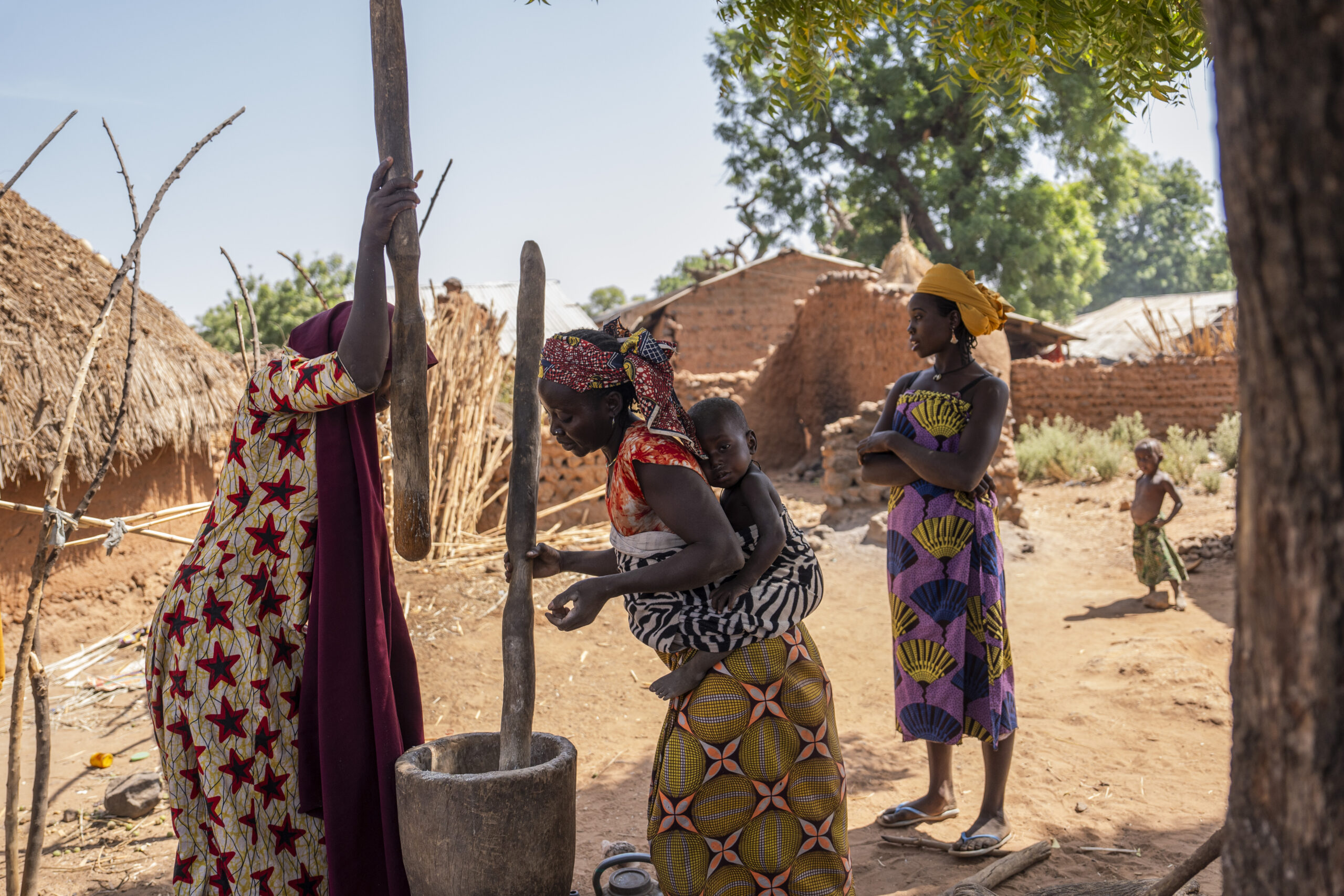
    Habiba, left, and Bashariya, carrying baby Awaisu, grind cornmeal in Dankale, Nigeria, where Lakurawa pass through, on Jan. 25.

    In nearby Karadal, imam Sirajo Lawal said that virtually everyone in his village tries to live by the Quran. But the Islam that he preaches, and that his father preached before him, gives people the freedom to choose their own path, he said.

    With the militants, however‚ “they say, ‘You must do this, otherwise, hellfire,’” said Lawal, 55. “This is the point of difference.”

    He spoke to the Post at a school in Tangaza, about six miles from his village, now solidly under the control of Lakurawa. Interviewing him there would have been too dangerous. Men in the community who listen to music or refuse to grow beards are beaten or fined by the militants, he said. Gunmen have also burst into traditional ceremonies, which are no longer permitted, and fired into the air.

    Imam Sirajo Lawal in Tangaza, Nigeria, on Jan. 26.

    In Karadal, and dozens of communities like it, the group rules by extortion: forcing locals to pay taxes in exchange for safety. Lawal said he had put aside eight bags of grain for his next payment to the group.

    Kingsley L. Madueke, the Nigeria research coordinator for the Global Initiative Against Transnational Organized Crime, said much of Lakurawa’s funding is believed to come from tax collection, though the group also carries out kidnappings for ransom and steals cattle from herders. Often, he added, they cooperate with local bandits who know the terrain.

    Most analysts believe Lakurawa is part of, or affiliated with, the Islamic State Sahel Province, which first emerged in 2015, killed four U.S. soldiers in an ambush in rural Niger in 2017 and was officially recognized as a “province” by the Islamic State in 2022. How much support Lakurawa receives from the Islamic State’s hub in northern Somalia is unclear — one of many things researchers are still trying to pin down.

    Lawal said the militants came straight to him when they wanted to enter his village. He acquiesced to their demands, he said, knowing the Nigerian government would not protect them.

    “We are not comfortable at all, but we cannot do otherwise,” he said. “They could kill us at any time.”

    In the wake of U.S. strikes, Lakurawa have apparently moved their camps, Madueke said, but their attacks have continued. Dislodging them from the northwest would require a clear strategy and sustained commitment from an administration that has not prioritized Africa, said retired U.S. Air Force Maj. Gen. Kenneth Ekman.

    “A dozen cruise missiles does not a counterterrorism mission make,” he said. “We’ve learned time and again that success requires consistent presence with sufficient capability and will alongside our partners.”

    Men walk with camels in Baidi, Nigeria, on Jan. 26. A recent attack by Lakurawa here killed several people.

    Sani, the vigilante in Baidi, was initially hopeful the U.S. strikes would wipe out so many militants that they would abandon the area. He knew he was mistaken when he heard the gunfire in the town square.

    He found his grandfather among the dead, his stomach perforated with bullets. Through his tears, he tried to help two men with critical injuries, he said, but neither made it. He expects more violence is coming.

    “We’re more scared than ever before,” he said. “It feels like they’ve dispersed and are everywhere.”

  • Trump launches TrumpRx.gov, branding his push to lower prescription prices

    Trump launches TrumpRx.gov, branding his push to lower prescription prices

    NEW YORK — The Trump administration on Thursday launched TrumpRx, a website it says will help patients buy prescription drugs directly at a discounted rate at a time when health care and the cost of living are growing concerns for Americans.

    “You’re going to save a fortune,” President Donald Trump said at the site’s unveiling. “And this is also so good for overall health care.”

    The government-hosted website is not a platform for buying medications. Instead, it’s set up as a facilitator, pointing Americans to drugmakers’ direct-to-consumer websites, where they can make purchases. It also provides coupons to use at pharmacies. The site launches with over 40 medications, including weight-loss drugs such as Ozempic and Wegovy.

    The site is part of a larger effort by the Trump administration to show it’s tacking the challenges of high costs. Affordability has emerged as a political vulnerability for Trump and his Republican allies going into November’s midterm elections, as Americans remain concerned about the cost of housing, groceries, utilities and other staples of middle-class identity.

    Trump stressed that the lower prices were made possible by his pressuring of pharmaceutical companies on prices, saying he demanded that they charge the same costs in the U.S. as in other nations. He said prescription drug costs will increase in foreign countries as a result.

    “We’re tired of subsidizing the world,” Trump said at the event on the White House campus that lasted roughly 20 minutes.

    The president first teased TrumpRx in September while announcing the first of his more than 15 deals with pharmaceutical companies to lower drug prices to match the lowest price offered in other developed nations. He said in December the website would provide “massive discounts to all consumers” — though it’s unclear whether the prices available on drugmakers’ websites will routinely be any lower than what many consumers could get through their insurance coverage.

    The website’s Thursday release came after it faced multiple delays, for reasons the administration hasn’t publicly shared. Last fall, Mehmet Oz, administrator of the Centers for Medicare and Medicaid Services, told Trump the site would share prices for consumers before the end of the year. An expected launch in late January was also pushed back.

    The president has spent the past several months seeking to spotlight his efforts to lower drug prices for Americans. He’s done that through deals with major pharmaceutical companies, including some of the biggest drugmakers like Pfizer, Eli Lilly and Merck, which have agreed to lower prices of their Medicaid drugs to so-called “most favored nations” pricing. As part of the deals, many of the companies’ new drugs are also to be launched at discounted rates for consumer markets through TrumpRx.

    Many of the details of Trump’s deals with manufacturers remain unclear, and drug prices for patients in the U.S. can depend on many factors, including the competition a treatment faces and insurance coverage. Most people have coverage through work, the individual insurance market or government programs like Medicaid and Medicare, which shield them from much of the cost.

    Trump’s administration also has negotiated lower prices for several prescription drugs for Medicare enrollees, through a direct negotiation program created by a 2022 law.

  • As West goes after Russia’s oil fleet, Moscow fears for its war funding

    As West goes after Russia’s oil fleet, Moscow fears for its war funding

    Europe is tightening the net on Russian oil being shipped through its waters, squeezing Moscow’s ability to fund its war even as officials and business executives in Russia fear the window is narrowing to reach a peace deal before the economy deteriorates.

    The European Union is considering imposing an outright maritime ban on services needed to ship Russian oil, such as insurance and transportation, as part of a new sanctions package marking four years of Russia’s war.

    The ban would significantly ratchet up the sanctions imposed on Russian oil, replacing the current oil price cap system, and comes as 14 European nations — including Britain, France, and Germany — warned last week they could intercept the shadowy fleet of tankers Russia created to help it evade sanctions operating in breach of international maritime law.

    Russian oil revenue plummeted by 50 percent in January compared with the same month the previous year after tough new sanctions imposed by the U.S. Treasury on Russian oil majors Rosneft and Lukoil in October. The penalties forced Moscow to accept ever-steeper discounts of more than $20 per barrel for its oil. Combined with India’s apparent agreement to halt Russian oil purchases in favor of increased imports from the United States and potentially Venezuela, the measures threaten to further strain the resources Moscow needs to fuel its war machine, risking crisis as nonpayments grow across the economy.

    Inspired by the seizure last month by U.S. forces of the Marinera tanker after a weeks-long pursuit despite a Russian submarine escort, the French navy briefly captured another suspected Russian shadow fleet tanker, the Grinch, which had been traveling from the Russian Arctic port of Murmansk across the Mediterranean carrying 730,000 barrels of oil under the flag of Comoros.

    French President Emmanuel Macron said the vessel was subject to international sanctions and suspected of flying a false flag.

    After Russia launched its full-scale invasion of Ukraine in February 2022, the Kremlin used intermediaries to buy up aging tankers and created what became known as the shadow fleet, to lessen its dependency on Western shipping services and reduce sanctions risks. Instead of being insured through Western companies, these tankers often receive insurance from Russia, backed by the country’s central bank, and sail under the flags of less stringent jurisdictions such as Sierra Leone and Cameroon, to conceal the origin of the oil.

    If enforced, the proposed measures could impact nearly a half of Russia’s oil exports, or about 3.5 million barrels per day, which head through European waters via the Baltic and Black seas, with crude shipments mostly bound for refineries in India, China, and Turkey.

    It’s not yet clear if the proposed EU maritime services ban, which requires a unanimous vote by member states, will be passed. But with the risk on the shadow vessels increasing from interceptions as well as attacks by Ukrainian drones, the costs are rising for shipments through Europe.

    “Russian oil exports are highly sensitive to disruptions in shipping. It is an Achilles’ heel,” said Janis Kluge, an economist at Germany’s Institute for International and Security Affairs. “If I were in Russia’s shoes, I would be very worried about the developments both with regards to a stricter policy against the shadow fleet and the Ukrainian drone attacks against tankers. Because both create significant risks. It is critical for Russia to have these shipping lanes open for its oil, or it will really run into big trouble.”

    A Russian academic close to senior Moscow diplomats said any European ban on maritime services for Russian oil and any further interceptions of shadow fleet tankers were “serious threats for Russia.”

    “This is a threat not just for the economy, but also it’s a political question about whether Russia can allow such actions without losing its political reputation,” the academic said.

    Even without the further risk to oil exports, Russian finance officials have been writing with increasing urgency to President Vladimir Putin to warn of a potential crisis by the summer, according to a person in contact with these officials and who spoke on the condition of anonymity because of the sensitivity of the subject.

    The officials have warned falling revenue means the budget deficit is only set to grow without further tax hikes while pressure is mounting on the Russian banking system due to high interest rates and a corporate borrowing spree to fund the war.

    One Moscow business executive said the crisis could hit in “three or four months” as signs appear that real inflation is spiraling far beyond the officially declared 6 percent despite interest rates being held at a high 16 percent. Signs of growing strain in the economy are the biggest numbers of closures of restaurants in Moscow since the pandemic and the forced layoffs of thousands of workers as costs grow, the executive said, also on the condition of anonymity.

    But there is little sign that Putin is set to change his calculus and step back from the Kremlin’s maximalist war demands. Last week, Foreign Minister Sergei Lavrov dismissed the Western security guarantees Ukraine says it needs for any deal, calling instead for an end to the regime in Kyiv.

    “We have no understanding about when the war will end,” the business executive added.

    The growing economic pressures are nevertheless weighing on Moscow as it seeks to keep the Trump administration on its side during negotiations to end the war. “If Trump comes to the conclusion that Russia is sabotaging the negotiation process then it’s possible there could be new sanctions including on the energy sector, and this is a serious challenge for Russia,” the Russian academic said.

    If anything, Russia is only growing more vulnerable to economic pressure, said Craig Kennedy, a former vice president at Bank of America Merrill Lynch now at Harvard University.

    “Oil revenues are sliding, credit is overextended. And Moscow knows things are only likely to get worse in 2026,” he said.

    Not all of Russia’s oil is under sanction, and Western companies can ship this oil as long as it is sold under the price cap first imposed by the European Union in December 2022. The EU had hesitated over imposing a full ban over fears it could cause a counterproductive oil price spike.

    But when the U.S. sanctioned Russia’s two biggest oil majors, Rosneft and Lukoil, in October last year, it sharply increased the share of Russia’s total oil output under U.S. sanctions to 80 percent. Moscow became even more reliant on its shadow fleet to transport its oil through the Baltic and Black seas to refineries in India, Turkey, and China.

    “The amount of unsanctioned oil now produced in Russia is a lot lower,” Kennedy said. “If shipping compliance gets tightened, it could put even more pressure on Russian export revenue.”

    Ukraine has also been stepping up its own efforts to target the shadow fleet, further increasing the risks and costs of shipping Russian oil. Since late November its forces have attacked at least nine Russia-linked tankers, deploying naval and aerial drones, as well as mines.

    European officials will likely still face a game of cat and mouse in targeting the illicit Russian oil. Already since the U.S. imposed sanctions on Rosneft and Lukoil, two mysterious new intermediary companies — Redwood Global Supply FZE LLC and Alghaf Marine DMCC — emerged out of nowhere to become major exporters of Russian oil, according to data from Kpler, a global commodities intelligence firm, compiled by the Kyiv School of Economics.

    Redwood sold 757,000 barrels per day in December, and Alghaf sold 174,000 barrels per day after trading zero amounts of oil previously, according to the data. “What we observed is that volumes traded by these new companies skyrocketed,” said Borys Dodonov, head of the Center for Energy and Climate Studies at the Kyiv School of Economics.

    European governments also argue that many of the Russian shadow fleet vessels flying flags of convenience from nations such as Cameroon and Sierra Leone are not compliant with international maritime safety standards, while those that sail under more than one flag during a voyage — as the Marinera did — can be treated as “stateless” under international maritime law allowing them to be boarded and searched.

    Amid the crackdown, Russia could be forced to register more of its shadow fleet under Russian flags, making them easier targets for sanctions, analysts said, especially if they are de-registered by other flag states.

    Any such move however could also increase the possibility of conflict over attempts to board Russian-flagged vessels with Moscow seeking to intimidate Europe out of taking any action. Russia’s Maritime Board, overseen by hawkish former Security Council chief Nikolai Patrushev, warned late last month that measures would be taken to protect Russian shipping interests against actions by “unfriendly states.”

    “It’s a question of whether these actions will be taken by the Europeans by themselves without the participation of the U.S.,” the Russian academic said. “Then there could be some measures in response like protection by a military convoy.”

  • Demise of U.S.-Russia nuclear pact sparks fears of new arms race

    Demise of U.S.-Russia nuclear pact sparks fears of new arms race

    The last major arms-control agreement between the U.S. and Russia expired Thursday, increasing the risk of a new arms race between the world’s two largest nuclear powers amid growing global instability.

    The 2011 Strategic Arms Reduction Treaty, or New START, limited the size of the Russian and U.S. nuclear arsenals and allowed for inspections and exchanges of information. Its demise leaves Moscow and Washington without a framework to regulate their strategic stockpiles for the first time since the depths of the Cold War in the 1980s.

    The end of the accord “definitely doesn’t make the world safer,” said Pavel Podvig, a senior researcher at the United Nations Institute for Disarmament Research in Geneva. “The real loss will be a loss of transparency and it will increase political risks.”

    START is expiring as relations between Russia and Europe have spiraled to their worst in decades over the war in Ukraine and with uncertainty among U.S. allies about its longterm commitment to the NATO military alliance. China is bolstering its strategic forces and other nations are eyeing the need for nuclear weapons to safeguard themselves as major powers increasingly jostle for dominance in their regions.

    The treaty had been due to expire in 2021 before the two sides agreed to a five-year extension, though Russian President Vladimir Putin suspended formal participation in 2023, halting inspections and information exchanges as confrontation with the U.S. surged over his full-scale invasion of Ukraine. Still, he pledged to uphold the pact, which restricts each side to 1,550 deployed strategic warheads.

    “The immediate danger is that, in the absence of legal constraints and verification measures, both countries will revert to worst-case planning and begin uploading hundreds more warheads to their deployed forces out of fear that the other is doing so,” said Mackenzie Knight-Boyle, a senior research associate for the Nuclear Information Project at the Federation of American Scientists. “The United States and Russia have significant upload capacity that would allow them to drastically increase their numbers of deployed nuclear warheads in a short amount of time.”

    In September, Putin said he’d be ready to adhere to the terms of the treaty for another year after it expired if the U.S. did the same. President Donald Trump didn’t formally respond to that idea.

    Trump will decide the path forward on nuclear arms control and will clarify it in his own timeline, a White House official said. The president has spoken repeatedly of addressing the threat from nuclear weapons and indicated that he wants to involve China in arms control talks, the official added.

    “China’s nuclear strength is by no means at the same level with that of the U.S.,” Lin Jian, a Chinese Foreign Ministry spokesperson, told reporters at a Feb. 3 briefing. “It is neither fair nor reasonable to ask China to join the nuclear disarmament negotiations at this stage.”

    China hopes the U.S. will respond to Russia’s “constructive” proposal for extending START’s terms and “truly uphold global strategic stability,” the spokesman added.

    Russia now assumes the two sides “are no longer bound by any obligations or symmetrical declarations within the context of the treaty” and are “free to choose their next steps,” the Foreign Ministry in Moscow said in a statement late Wednesday. Still, Moscow “remains open to the search for political and diplomatic ways to comprehensively stabilize the strategic situation,” it said.

    Some Republican lawmakers privately urged Trump not to entertain Putin’s proposal, according to a person familiar with the matter, in light of the risk it would end up constraining the U.S.’s ability to maneuver without doing much to limit Moscow’s actions.

    In particular, the treaty only regulated strategic weapons and didn’t place limits on tactical nuclear weapons for either side. Former CIA Director Bill Burns has said there was a genuine risk of Russia resorting to those shorter-range and lower-yield weapons in Ukraine in the fall of 2022.

    At a Senate hearing on Tuesday, retired admiral Charles A. Richard, a former commander of United States Strategic Command, told lawmakers that “simply extending the New Start Treaty for one year does not constrain Russia to the same way that it constrains us,” and that doing so would prevent the U.S. from meeting the challenge posed by China’s own rapid buildup.

    Rose Gottemoeller, a former undersecretary of State for arms control in the Obama administration who was the chief U.S. negotiator of the New START treaty, advocated for an extension, saying it would be better to “keep them limited at least for another year while we continue to plan and prepare for the Chinese threat.”

    China has been growing its nuclear forces to catch up with Russia and the U.S.. In its 2025 annual report to Congress on military developments in China, the Pentagon said Beijing had “continued its massive nuclear expansion” as part of its goal of achieving “strategic counterbalance” against the U.S. by 2027.

    The People’s Liberation Army is on track to have more than 1,000 warheads by 2030 from a stockpile in the low 200s at the start of this decade, according to the Pentagon report. While Beijing adheres to a no-first-use policy on nuclear weapons, China “has not demonstrated a willingness to advance discussions on nuclear risk reduction measures, bilaterally or multilaterally,” it said.

    Russia may indicate “a willingness to refrain from buildups until the United States increases its strategic arsenal,” said Dmitry Stefanovich, a research fellow at the Center for International Security at the Institute of World Economy and International Relations in Moscow. Still, the absence of binding agreements between the nuclear powers creates “the foundation for an increase in strategic offensive weapons in the medium term,” he said.

    An unconstrained nuclear era that led to increases in Russian and U.S. weapons would likely prompt other states from the UK and France to North Korea and Pakistan to seek to increase their strategic arsenals, according to Knight-Boyle of the Federation of American Scientists.

    Putin boasts that Russia has developed a new range of strategic weapons in recent years that are capable of evading existing defenses. They include the nuclear-powered Burevestnik cruise missile and Poseidon torpedo drone, as well as the Kinzhal hypersonic ballistic missile that’s claimed to be capable of traveling at up to 10 times the speed of sound.

    Russia has also used the Oreshnik intermediate-range ballistic missile in strikes on Ukraine, a weapon that’s capable of carrying atomic warheads and has a range of 3,100 miles, putting most of Europe and the U.S. West Coast in striking distance.

    After Moscow conducted trials of the nuclear-capable Poseidon and Burevestnik, Trump threatened to resume atomic tests “on an equal basis” to other powers. That prompted Putin to order his officials to seek more information about Washington’s intentions and to set out proposals for “the possible commencement of work on nuclear weapons testing.”

    The last U.S. nuclear explosive test was in 1992, though it continues to test delivery systems. Russia’s last known nuclear detonation was in 1990, while China’s was in 1996.

    Russian officials say negotiations on a potential new agreement would also have to cover the issues of North Atlantic Treaty Organization expansion, the U.S. global missile-defense system and medium- and short-range missile deployments.

    A deal to settle the war in Ukraine “could open up a broader dialog with the Russians on strategic stability,” said Ankit Panda, Stanton Senior Fellow in the Nuclear Policy Program at the Carnegie Endowment for International Peace. “The Russians will be interested in engaging on arms control.”

  • When patients see the line between life and death, should we believe them?

    When patients see the line between life and death, should we believe them?

    After she dropped to her knees outside her home in Midlothian, Va., suffocating, after she was lifted into the ambulance and told herself, “I can’t die this way,” and after emergency workers at the hospital cut the clothes off her to assess her breathing, Miasha Gilliam-El, a 37-year-old nurse and mother of six, blacked out.

    What happened next has happened to thousands who’ve returned from the precipice of death with stories of strange visions and journeys that challenge what we know of science. Last year, a team of researchers from Belgium, the United States, and Denmark launched an ambitious effort to explain these experiences on a neurobiological level — work that is now being contested by a pair of researchers in Virginia.

    At stake are questions almost as old as humanity, concerning the possibility of an afterlife and the nature of scientific evidence — questions likely to take center stage at a conference of brain experts in Porto, Portugal, in April.

    “The next thing I knew, I was out of my body, above myself, looking at them work on me, doing chest compressions,” Gilliam-El said, recalling Feb. 27, 2012, the day she suffered a rare condition called peripartum cardiomyopathy. For reasons that aren’t fully understood, between the last month of pregnancy and five months after childbirth, a woman’s cardiac muscle weakens and enlarges, creating a risk of heart failure.

    Gilliam-El, who had given birth just three days earlier, recalled watching a doctor try to snake a tube down her throat to open an airway. She remembered staring at the machine showing the electrical activity in her heart and seeing herself flatline. Her breathing stopped.

    “And then it was kind of like I was transitioned to another place. I was kind of sucked back into a tunnel,” she said. “It is so peaceful in this tunnel. And I’m just walking and I’m holding someone’s hand. And all I’m hearing is the scripture, ‘Yea, though I walk through the valley of the shadow of death …’”

    While neuroscientists have discovered more and more about the inner workings of the brain in recent decades, a deep mystery still surrounds near-death experiences like Gilliam-El’s.

    Writing last year in the journal Nature Reviews Neurology, a research team led by Charlotte Martial, a neuroscientist at the University of Liège in Belgium, synthesized some 300 scientific papers focusing on commonalities across the following experiences: viewing one’s body from the outside, journeying through a tunnel toward a brilliant light, and experiencing a deep sense of peace. The authors linked these experiences to specific changes in the brain, creating a pioneering model called NEPTUNE (neurophysiological evolutionary psychological theory understanding near-death experience).

    Bruce Greyson and Marieta Pehlivanova, researchers at the University of Virginia School of Medicine, responded with a sweeping critique of the NEPTUNE model in the journal Psychology of Consciousness: Theory, Research, and Practice.

    While calling the model “an admirable strategy,” they wrote that aspects of such experiences cannot be explained solely by brain physiology, and they criticized the NEPTUNE authors for omitting evidence that did not support their ideas.

    Although this debate is taking place in the rarefied atmosphere of scientific journals and conferences, it is almost certainly one that has crossed the minds of most people.

    “This is not the digestive function of some lower life form we’re talking about here. These are implications that reach all of humanity,” said Jeffrey Long, a radiation oncologist and co-author of the 2011 book Evidence of the Afterlife: The Science of Near-Death Experiences.

    “Do we have some evidence?” he asked. “And how strong is that evidence that we have life after death, that our consciousness survives bodily death?” Long — who was not involved in either the NEPTUNE paper or the critique — said he has studied more than 4,000 near-death experiences.

    The NEPTUNE researchers cited several studies showing that about 10 to 23% of near-death experiences occur after a heart attack, 15% after a prolonged stay in intensive care and 3% after a traumatic brain injury. Others occur after electrocution, near drowning, and complications during childbirth.

    “For most of them, it’s a life-transforming experience,” Martial said. “Typically, they are less afraid to die [afterward].” They tend to develop greater interest in spirituality, she said, and can become more empathetic to others.

    To create the NEPTUNE model, scientists examined changes in gas concentrations in blood vessels in the brain: the decreased oxygen and increased carbon dioxide that occur just before and during a cardiac arrest.

    They cited studies suggesting that sensations resembling out-of-body experiences may be generated in the temporoparietal junction, a high-level hub for processing sensory information and helping distinguish the self from others. Studies indicate that applying electric stimulation to this area, located behind and just above the ear, could trigger an out-of-body experience, they wrote.

    Folded into their analysis were observations about brain chemistry, including the nerve cells and chemical messengers that regulate mood, sleep, and learning. Martial said the model is intended as a living document that can be revised as scientists learn more.

    But Greyson and Pehlivanova disputed key aspects of the model. They wrote that illusions triggered by electric stimulation are “nothing like the visions of deceased persons reported in [near-death experiences].” For example, one study reported inducing an illusion in which a patient felt the presence of a person behind them whom they could not see or hear.

    “This is not remotely comparable to the visions reported in many [near-death experiences] of identified deceased persons who are seen, heard, smelled, and touched,” wrote Greyson and Pehlivanova, who are, respectively, a professor emeritus of psychiatry and neurobehavioral sciences and a research assistant professor of psychiatry and neurobehavioral sciences.

    The two acknowledged that near-death experiences “are typically triggered by physiological events” but stressed that such events do not account fully for the experiences people have described. They faulted the NEPTUNE authors for dismissing evidence from patients’ near-death accounts and from hospital staff who have supported aspects of those accounts — for example, the number of people who were in the room during resuscitation.

    Scientists disagree on whether the stories patients tell constitute reliable scientific data.

    Near-death experiences have been described since antiquity, said Greyson. Researchers have been collecting and discussing accounts since at least 1892, when Swiss mountaineer and geologist Albert Heim discussed stories he’d collected since his own brush with death while climbing in the Alps.

    By their nature, these reports can be difficult to define and even harder to analyze with scientific rigor. In a 1983 paper, Greyson described a 16-item scale he developed for measuring accounts of near-death experiences and standardizing research into them.

    But the effort to impose rigor on the study of near-death experiences forces researchers into an uncomfortable zone that straddles the line between the scientific and the spiritual.

    “These stories are seductively powerful narratives that give hope to our deepest yearnings for consciousness beyond our death,” Kevin Nelson, an emeritus professor of neurology and retired chief of medical staff affairs at University of Kentucky HealthCare, wrote in an email. “I too have such hope, but with wax in my ears and science lashing me to the mast, I will not succumb to the siren’s song.” (Nelson was one of the authors of the NEPTUNE paper.)

    Greyson said the NEPTUNE researchers may dismiss the testimony of patients who have come close to dying “as not evidential, but the fact is that every scientific discovery begins with subjective observation that may eventually be corroborated by controlled experiment.”

    In addition to testing aspects of the NEPTUNE model, Greyson and Pehlivanova wrote that “it will also be important to remain open to other potential causes, whether currently unknown or not yet fully understood.”

    By necessity, most previous studies have involved researchers going back to patients after their near-death experiences to gather their accounts and medical records. But such retrospective studies are open to biases in how people remember such events after time has passed and how they have shared their accounts with others.

    However, Martial, the NEPTUNE researcher, said that she and three of her colleagues at the University Hospital of Liège are in the midst of a prospective study that involves tracking patients from the moment they are taken to the hospital’s resuscitation room. It will involve video footage recorded at the hospital as well as electroencephalograms that measure electrical activity in the brain.

    “When we die, this is a process — not just an event,” Martial said. “For example, during a cardiac arrest, we have a decrease of oxygen, which leads to a decrease of brain activity. But at some point, actually, we see an increase of electrical brain activity, and then we can observe a kind of flatline.”

    Gilliam-El, the nurse, remembered that her near-death experience ended when a powerful voice told her “Not yet,” and she felt herself return to her body. Everything looked blurry in the bright hospital room.

    She feared that if she told anyone what had happened, they wouldn’t believe her.

  • As cold-stunned invasive iguanas fall from trees, Floridians scoop them up for killing

    As cold-stunned invasive iguanas fall from trees, Floridians scoop them up for killing

    Ryan Izquierdo woke up on a recent morning groggy, cold and most of all ready — to go iguana hunting.

    Temperatures in Jupiter, Fla., where the 27-year-old social media star lives, had dipped well below 50 degrees, as a cold front swallowed much of the East Coast in snowfall and record-breaking low temperatures. As flurries fell on parts of the state, residents braced for the inevitable: Cold-stunned green iguanas — one of Floridians’ most reviled invasive pests — began to lose consciousness and fall out of trees.

    The dry, scaly deluge is a familiar forecast in those parts. These cold-blooded reptiles’ nervous systems shut down when temperatures dip into the 40s and below. They become paralyzed and fall from their leafy perches. This time, for some unlikely conservationists, as well as state officials, that meant killing season.

    In a first, officials capitalized on the paralyzed pests and told residents they could bring them in for disposal.

    “This is the first time we have organized a removal effort of invasive iguanas,” said Shannon Knowles, communications director for the Florida Fish and Wildlife Conservation Commission (FWC).

    “South Florida has not experienced this level of cold weather in many years,” she added. “So we used this opportunity to remove this invasive non-native species from the landscape.”

    The commission issued an executive order that allowed people without permits to gather and transport the iguanas to one of several offices to be humanely killed, “or, in some cases, transferred to permittees for live animal sales.”

    Typically people can themselves humanely or painlessly do away with green iguanas when they see them, but they’re not allowed to transport them. Knowles added that people lined up, cloth bags and bins brimming with the lizards, to drop them off Sunday and Monday. While she said the commission did not yet have an official estimate, Izquierdo was floored by what he saw.

    “It was a madhouse,” Izquierdo said of the FWC site near Fort Lauderdale where he deposited about 100 iguanas Monday. “There were iguanas that were pushing six to six-and-a-half feet long. They look like dragons, absolutely crazy.”

    Green iguanas are a scourge of South Florida. First documented in the 1960s, their population has since exploded to, by some estimates, more than 1 million. They’ve wreaked havoc on the region’s infrastructure, burrowing holes around homes, sidewalks and seawalls. They’ve chewed through some of the state’s most crucial native plants such as nickerbean, which helps sustain the endangered Miami Blue butterfly.

    Izquierdo has been catching iguanas since he was 10 years old. In his grandmother’s backyard, he found them to use as fishing bait for peacock bass.

    “I’ve always loved nature and the outdoors,” he said.

    Now, he makes a living out of it as a content creator, documenting his fishing excursions around the world. But as the dipping temperatures created a new opportunity last weekend, he decided to temporarily pivot to the quest he dubbed “a Florida man Easter egg hunt for dinosaurs.”

    He jumped into his pickup truck and began hunting.

    In warm temperatures, iguanas are almost impossible to nab. You need either a gun or a 15-foot-long pole with an invisible lasso attached to it, Izquierdo said.

    “If you want to do iguana management, this is a good time to do it because they’re very vulnerable to removal,” said Frank Mazzotti, a professor of wildlife ecology at the University of Florida.

    But in the cold, chase proved easy and bountiful. “This is the most I’ve ever found,” he said. “We were practically almost stepping on them.”

    Despite the fun and viral Instagram reels, he’s not immune to the difficult decisions that come with maintaining a balanced ecosystem.

    “They’re animals, so people do have a soft spot in their heart for them and so do I because they’re really cool, especially the little baby ones,” Izquierdo said. “But you have to look at the bigger picture of things.”

    He’s passionate about making the most of a dead green iguana. On Monday night, he and his friends baked an iguana pizza, (delicious, he said, they’re nicknamed “chicken of the trees”) and he plans to use the skin and some meat for fishing lures and bait.

    On Tuesday morning, as the temperatures in Florida finally began to creep up to milder levels, Izquierdo sat in his truck, filled with about a dozen stunned iguanas, knowing his hours of hunting were numbered.

    “As the temperature starts climbing back up, it’s going to get back to normal,” he said. Two motionless lizards, a male and a female, lay in his lap. “Yeah, these iguanas will be back about their business.”

  • Gavin Newsom sat by his mother during her assisted suicide, and came to terms with anger and grief

    Gavin Newsom sat by his mother during her assisted suicide, and came to terms with anger and grief

    It was the spring of 2002 when Gavin Newsom’s mother Tessa, dying of cancer, stunned him with a voicemail. If he wanted to see her again, she told him, it would need to be before the following Thursday, when she planned to end her life.

    Newsom, then a 34-year-old San Francisco supervisor, did not try to dissuade her, he recounted in an interview with the Washington Post. The fast-rising politician was wracked with guilt from being distant and busy as she dealt with the unbearable pain of the breast cancer spreading through her body.

    Newsom’s account of his mother’s death at the age of 55 by assisted suicide, and his feelings of grief and remorse toward a woman with whom he had a loving but complex relationship, is one of the most revealing and emotional passages in the California governor’s book, Young Man in a Hurry: A Memoir of Discovery, which will be published Feb. 24.

    Newsom, a potential Democratic candidate for president, has seldom spoken of the chapter in his family’s life, which is likely to generate controversy if he enters the race. Assisted suicide, at the time, was illegal in California and remains illegal in all but 12 states and the District of Columbia, according to the advocacy group Death with Dignity.

    When that Thursday in 2002 arrived, Newsom and his sister Hilary did as his mother asked and sat by her bedside in Pacific Heights, Newsom said in an interview this week. He wanted her suffering to end, he said, but it would be years before he could forgive her for asking him to be there.

    “I hated her for it — to be there for the last breath — for years,” he said in an interview in San Diego this week. “I want to say it was a beautiful experience. It was horrible.”

    Forty-five minutes before the “courageous doctor” arrived to administer the medicine that would end her life, Newsom and his sister gave their mother her regular dose of painkillers to keep her comfortable, he said.

    When the doctor arrived, Tessa Newsom lucidly answered his questions and told him she was sure of her decision, Gavin Newsom said. Her labored breathing and the gravity of the moment became too much for Newsom’s sister. She left the room. Newsom stayed.

    “Then I sat there with her for another 20 minutes after she was dead,” he said, his voice breaking briefly and his eyes welling as he told the story. “My head on her stomach, just crying, waiting for another breath.”

    Despite his painful memories, Newsom said that he believes assisted suicide should be legal nationally, that people should have “the freedom to make that decision themselves.” California legalized the practice in 2015 with the “End of Life Option Act.”

    Six years after voters approved the practice, and two years after he became governor in 2019, Newsom signed a second bill that reduced the waiting period for a drug-induced suicide from 15 days to 48 hours and eliminated a requirement for a formal written declaration of intent at the end of the process. Last year, Newsom signed a third bill that eliminated a sunset clause in the 2015 bill, making assisted suicide legal in California indefinitely.

    When the bill came up in the California legislature, Newsom heard objections not only from churches and religious groups, but also from “the old Irish Catholic side of my family.”

    They were “up in arms about that bill, and obviously, by extension, by what my mom did,” he recalled. But Newsom said his own experience with his mother strengthened his support for the bill.

    “I watched the physical deterioration, the mental deterioration, just the cries of pain,” he said this week. “She would have just suffered.”

    Last year in an interview on the Diary of a CEO podcast, Newsom said he had no regrets about his role — “If you want to come after me, come after me, she needed to do it,” he said.

    Tessa Newsom worked three jobs to support her two children after her husband left, Newsom wrote in the book. His father, William Newsom, an attorney who became a judge, was the best friend of the billionaire Gordon Getty — and had for a time helped manage the Getty Trust. Their father’s friendship with the Gettys, which began in high school, created what Newsom described as a “surreal” double life for the two Newsom children, who joined their father and the Gettys during summer vacations that involved private jets, resorts and limousines.

    Tessa Newsom, a quiet but dominant force who shaped his work ethic, he said, did not approve of Newsom’s political ambitions.

    She urged him to stay immersed in his business, the PlumpJack Group, a wine and hospitality company that he founded in 1992.

    “Get out before it’s too late,” Tessa Newsom told her son after he had become a San Francisco supervisor in 1997 and was considering a 2003 run for mayor of San Francisco, which had been his father’s dream.

    She never fully explained the admonition. But William Newsom had also harbored political ambitions for a time — running for San Francisco county supervisor and state senator. And the younger Newsom learned years later, through an oral history his father recorded, that his electoral failures and subsequent debt had led to the unraveling of his parents’ marriage, Newsom said in an interview with the Post and in his book.

    Newsom — a father of four who is married to Jen Siebel, a documentary filmmaker — said his mother’s warning still haunts him.

    “I think about it any time when things are really going down — that she was right,” he said with a laugh. And while many people don’t believe that Newsom is still wrestling with whether he will run for president, his mother’s warnings are part of the quandary, he said.

    “I don’t think people are taking me as literally as they should. We’ll see what happens,” he said of a potential presidential run. “Every day, I just try to get better, and be a better husband, be a better father. I’ve got to take care of them, and I can’t do what my father did.”

  • A self-collected test allowed me to finally get cervical cancer screening

    A self-collected test allowed me to finally get cervical cancer screening

    If you have a cervix you may have felt a surge of relief — joy, even — when the American Cancer Society (ACS) announced its updated guidelines for cervical cancer screening in December. I know I did.

    The organization now allows for a self-collection test for human papillomavirus, or HPV, a sexually transmitted infection that causes almost all cases of cervical cancer, as an alternative to a more traditional clinician-collected test. For some women — including me — this endorsement means that we can finally access this lifesaving screening.

    Over the last decade, there have been notable changes in how and when women are screened for cervical cancer. The go-to method used to be the Pap smear, which involves inserting a speculum so that a provider can collect cells from the cervix, the lowest end of the uterus that connects to the vagina. Eventually, in 2020, the ACS began recommending that all women at average risk of cervical cancer start screening at age 25 with a clinician-collected HPV test.

    For the patient, the experience was the same for a Pap or HPV test: Your provider would still have you lie on your back with your feet in stirrups, insert a speculum, and use a swab to collect a sample of cells from your cervix. As someone with vaginismus — a condition that causes my vaginal muscles to involuntarily contract — it would have been impossible for me to get these done.

    Then, in 2024, the Food and Drug Administration (FDA) approved self-collected HPV tests for use in healthcare facilities — meaning that women at average risk could opt to do a less-invasive self-swab of their vagina with their provider present. And in 2025, the FDA approved the first at-home tool, a wand made by Teal Health, to screen for cervical cancer, allowing women to collect the sample and mail it to a lab without even needing to visit their doctor. (If you have a personal history of cervical cancer or are at high risk, you may not be a candidate for self-collected testing).

    At 26, I was officially overdue for my first screen, so my doctor recommended I try the in-office self-collection test.

    What the self-collected HPV test was like

    Before self-collection became an option, I would lie on the exam table at my gynecologist’s office, put my legs in stirrups, and involuntarily clench at any touch. I was excited to try the self-collection test, but also skeptical that it would work for me.

    The self-swabs in the clinic looked manageable and controllable, something I could hold and insert myself. The handle was as narrow as a mascara wand, and the brush at the end was made of flexible plastic bristles that felt soft. Most importantly, it did not need to directly touch my cervix. It was less invasive, without the internal pressure that usually made my body tense. I inserted the swab about two inches into my vagina, rotated it for 30 seconds and then handed it to my doctor, who swirled it inside a vial with liquid solution.

    “That’s it?” I asked my doctor once she screwed the cap on the vial. “Is it for sure as accurate as a regular Pap smear?” Yes and yes, she assured me. I was in awe. There was a time earlier in life when my vaginismus made it feel impossible to even insert a tampon — I couldn’t believe I had completed an HPV test.

    My doctor mailed my sample to a lab, and I received the results in less than two weeks. My Pap smear came back normal with no signs of HPV. Even better, this meant I did not need to be tested again for another five years.

    Amy Banulis, an OB/GYN and associate medical director for Women’s and Maternal/Child Health at Kaiser Permanente in Virginia, said most women will be able to comfortably complete the self-collected test, even if they have vaginismus.

    “For those that still do have discomfort, there are relaxation techniques that can be utilized,” Banulis said. These could include progressive muscle relaxation, deep breathing, and imagery or visualization. If these tactics don’t make a difference, your OB/GYN can refer you to a pelvic floor physical therapist that may be able to help you with this, Banulis said.

    How effective it is compared to a traditional Pap

    The experience was so seamless that I actually worried something was wrong. What if I didn’t insert the swab high enough? I wondered when I got home. Would the results of the test still be reliable if, God forbid, I did not rotate it long enough? It almost felt too comfortable, so how effective was it really? Many women share the same concerns, but they don’t need to worry, said Jasmin Tiro, a professor of public health sciences at the University of Chicago.

    Many women who use the test say it’s easy to do and doesn’t hurt, Tiro said, adding: “It’s very hard to do it wrong.”

    It’s important to clarify that the self-collected HPV test is not the exact same test as a Pap smear or a clinician-collected HPV test, she said. The self-test collects vaginal cells, while the latter two tests use a sample of cervical cells. While a cervical sample can be tested for both HPV and abnormal cells (cancerous or precancerous), vaginal cells can only reveal if you have HPV, Tiro said.

    This means that a self-collected test may be only one part of the screening process, Tiro said. About 10% of women will screen positive for HPV, she said. If you get a positive HPV self-collected result, the next step may be a type of test or procedure that involves a pelvic exam to look for precancerous or cancerous cervical cells. That follow-up test is essential for the screening process to be effective, Tiro said.

    However, HPV does not always turn into cervical cancer; especially in people in their teens or early 20s, the virus often clears on its own without causing any health issues — which is why screening isn’t even recommended before 25. So depending on your age, your doctor may just want to retest you a few years later to see if you still have an HPV infection and determine then if that warrants further testing.

    My takeaway: We need to make screening more accessible

    I’m grateful for testing that is less invasive and painful, but I still find myself wondering why it took so long for us to arrive here. How many women would have been protected if our pain and concerns were not routinely diminished? In the past, I had doctors tell me, “Since you’ve had sex before, the speculum shouldn’t feel intimidating.” I became so used to people, including well-meaning physicians, questioning the validity of my pain. And I felt demoralized that I couldn’t even complete a test that was essential for detecting and preventing a disease that kills about 4,000 women in the U.S. each year.

    I also wonder what, if anything, can be done to ensure the new self-swab testing is accessible to all women who want or need it? When I asked Tiro, she told me that gathering more patient testimonials, developing patient-centered guidance for people who may still not want to complete the test, and devoting more research to the testing can all help. These are all things that physicians and researchers are actively working on.

    Personally, the self-collected HPV test has given me a sudden sense of agency, something I have rarely felt in a gynecologist’s office. My hope is that this alternative option can give other women greater control over their healthcare, too. Cervical cancer screening is an essential preventive care service. If you have trouble undergoing a Pap smear, ask for the alternative self-collection test. There is no shame, only power, in advocating for your health.