A familiar legend at Delaware County’s Darby Free Library goes as follows.
It was an October day in 1947 when a woman walked into the library and returned a book. The woman had found the library book while going through her late grandfather’s possessions, she said, and she was returning it on his behalf. What was remarkable was that the book had been taken out of the library in the mid-1800s, more than 100 years earlier. It was overdue by a century.
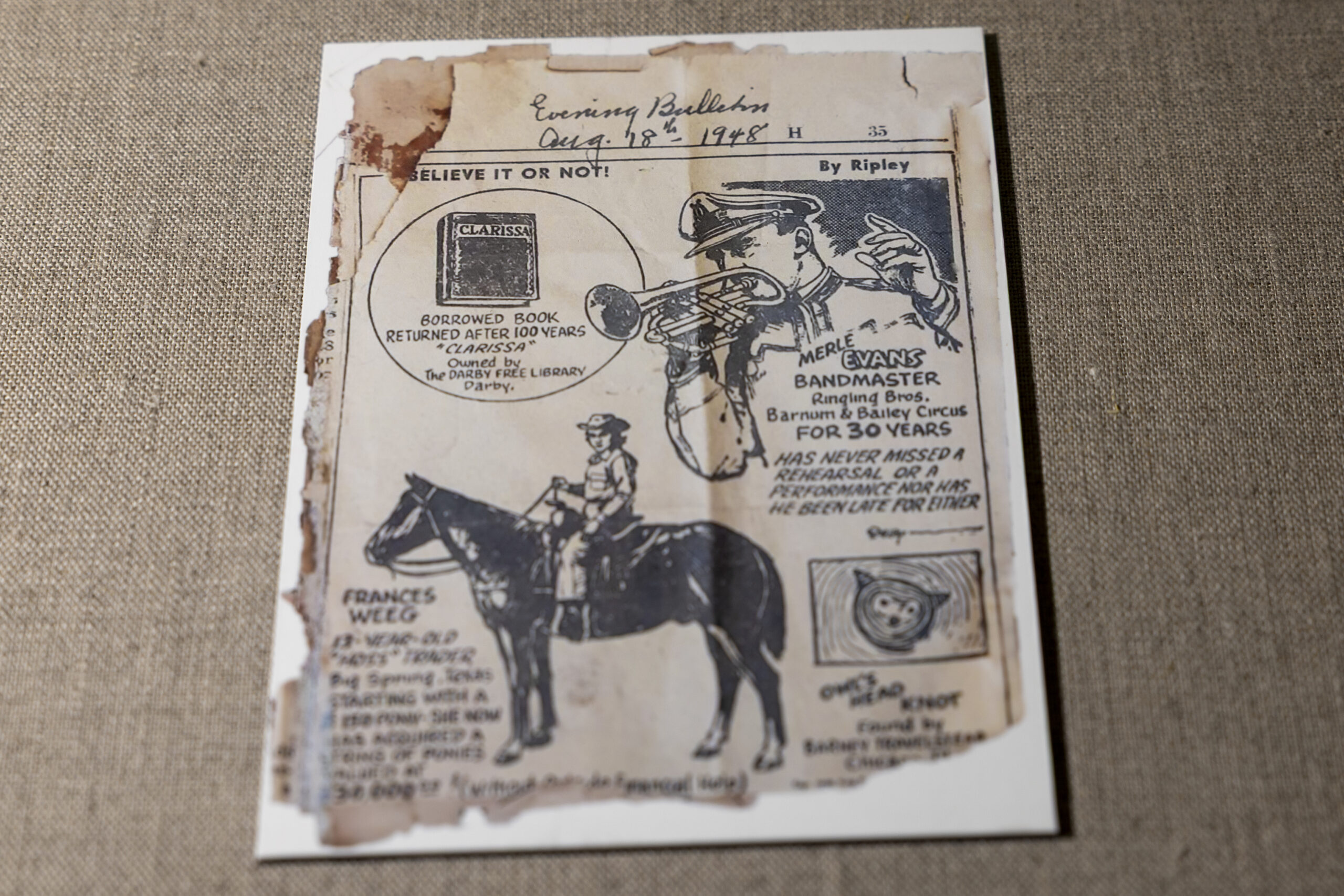
The local paper purportedly caught wind of the story, and on Aug. 18, 1948, the tale was featured in the Ripley’s Believe It or Not! panel and syndicated in over 750 newspapers around the world.
“BORROWED BOOK RETURNED AFTER 100 YEARS,” the Ripley‘s panel declared.
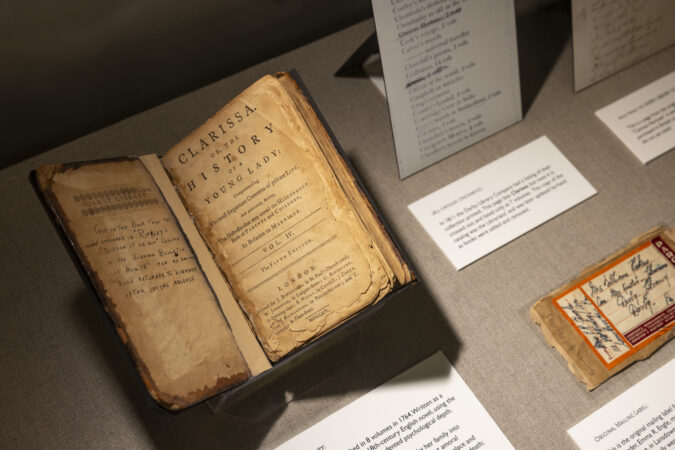
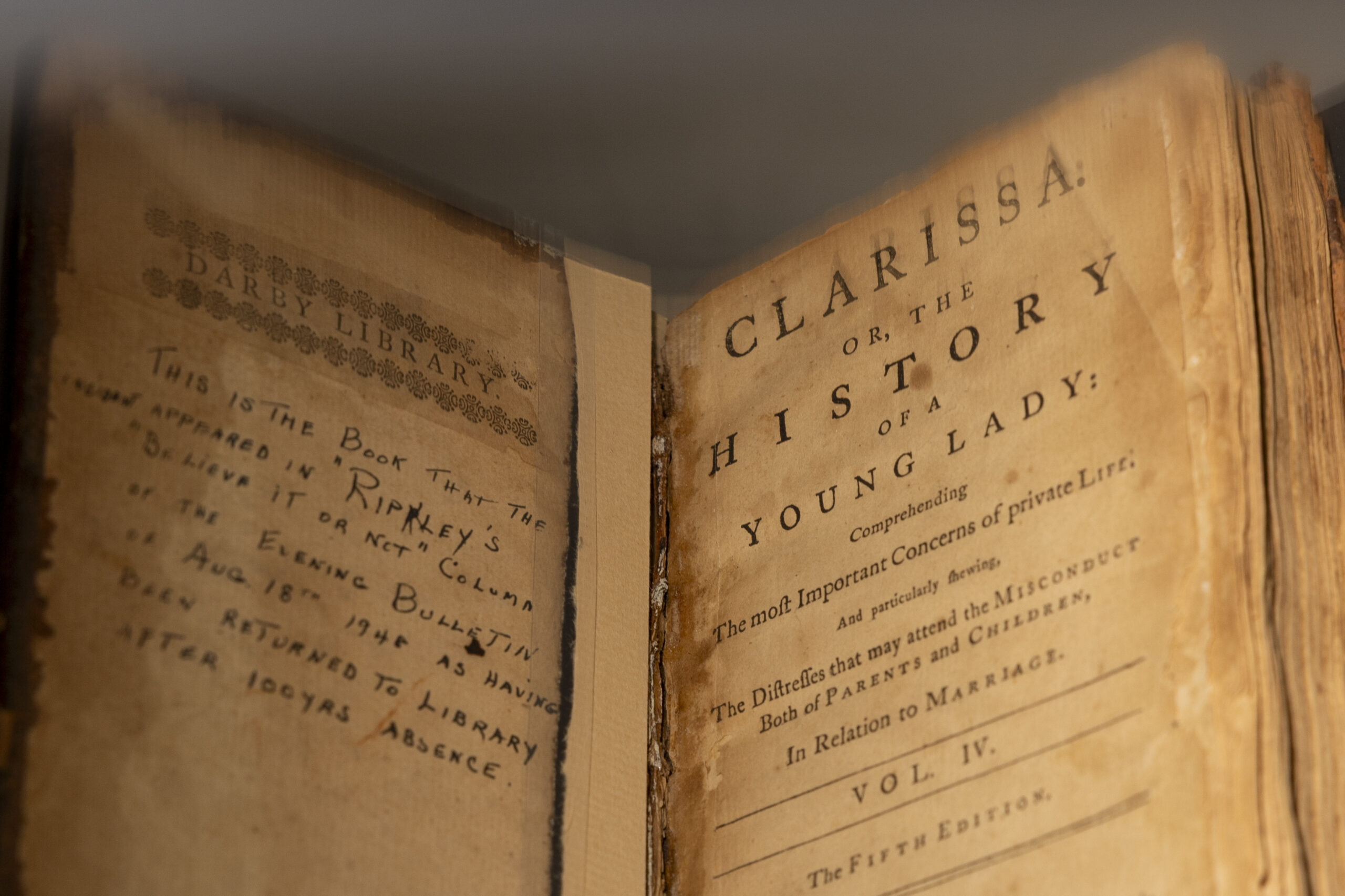
The famed book was volume four of Clarissa, a 1748 novel by Samuel Richardson that follows the trials and tribulations of Clarissa Harlowe, a young woman who flees home with a charming but untrustworthy man, Robert Lovelace. The book, considered controversial by many at the time, is written largely in the form of letters between Clarissa and Robert Lovelace and is thought to be an early great psychological novel, exploring the characters’ inner lives and the complex themes of gender, power, and freedom. Clarissa spans seven to eight volumes and has a word count of nearly one million.
The Darby Free Library’s Emily Finigan was sorting through the library’s collection a few years ago when she came across the famed overdue copy of Clarissa. Finigan found the book inside of a small box adorned with a mailing label. Attached to the mailing label was the Ripley’s clip, and inside the book was an inscription: “This is the book that the incident appeared in ‘Ripley’s Believe It or Not’ column of the Evening Bulletin of Aug. 18th, 1948 as having been returned to library after 100 yrs absence.”
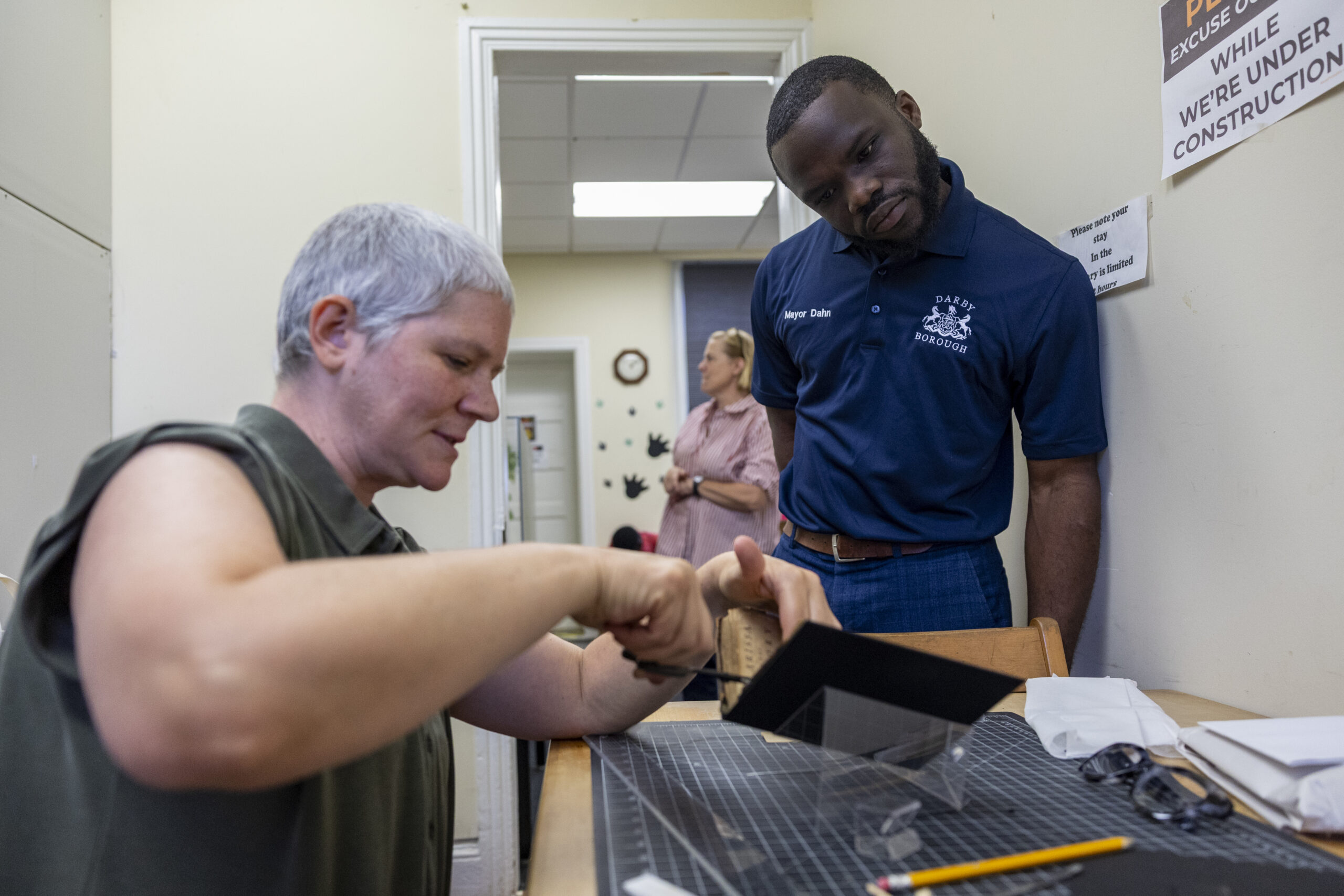
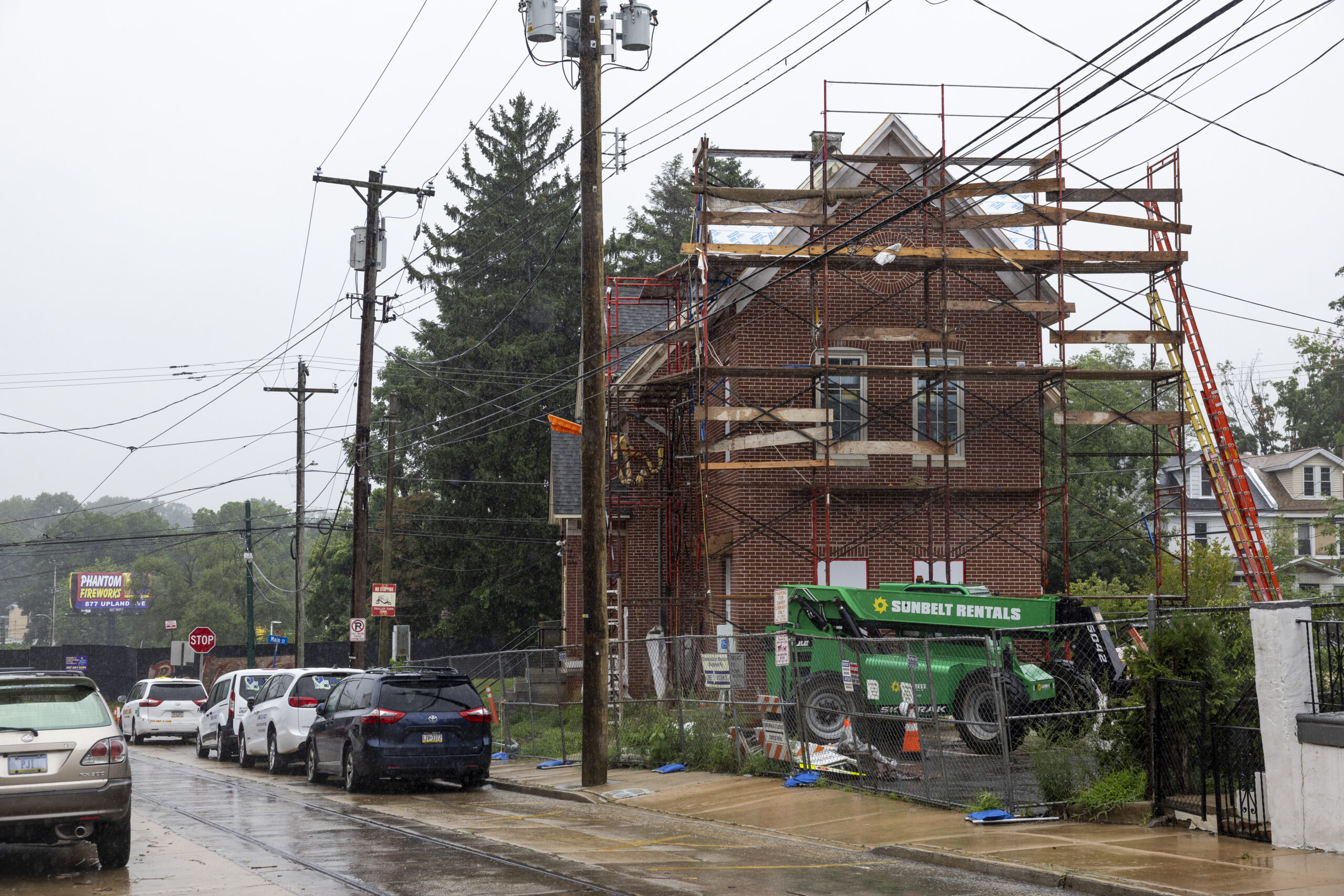
Finigan wears a lot of hats at the library, including fundraising, volunteer work, and, with her husband, managing the library building’s restoration.
Finding Clarissa piqued her interest, and she began to wonder if she could use archival research to uncover the identity of the borrower who first checked out the 100-year overdue book.
Yet a quest to identify the original borrower of volume four of Clarissa sent Finigan down a rabbit hole that left her with more questions than answers: Was Clarissa really a century-old overdue book? And, if not, what really happened to the library’s copy of the 1700s novel?
The Darby Free Library was founded in March 1743 by a group of Quaker farmers and merchants looking to organize their village’s first cultural institution. The group, made up of 29 townsmen, threw together money to purchase 45 original books, many of which are on display in the library today.
In 1826, the library offered up borrowing rights to anyone who could pay three pounds. In 1898, it became a public library. Nearly a century later, in 1984, the Darby Free Library was adopted into the Delaware County Libraries system.
According to records, the Darby Free Library acquired all eight volumes of Clarissa in 1769 for 2 pounds, 6 shillings, and 2 pence.
By 1811, a catalog of the library’s collection only counted seven of eight volumes, a sign that one may have already gone missing, or had been borrowed by a reader.
Though the legend of the 100-year overdue volume of Clarissa involved a woman walking into the library to return the book, the copy, Finigan noted, had seemingly been mailed to the library, not returned by a mysterious visitor. So who mailed the package?
The original shipping label identified the sender as Emma Engle, a local librarian who mailed the book from her sister Josephine’s home in Landsdowne. Emma and Josephine’s parents and grandparents weren’t local to the area, according to archival research, making it unlikely that Emma Engle had returned her own grandfather’s book, as the legend went.
Josephine Engle, however, was married to a man named Isaac Rhoads, a member of the Darby Quaker Meeting, which was affiliated with the library. Isaac’s mother, Mary Hibberd Rhoads, was listed as a library member, and his grandfather, Samuel Rhoads, would have been alive around the time Clarissa was taken out of the library.
So was Engle mailing back a long-lost book once taken out, and never returned, by her brother-in-law’s grandfather? That’s one possibility, Finigan said.
Another possibility? The Darby Free Library may have sold off Clarissa in an attempt to clear its shelves of controversial material, and one volume made its way back to the library through Engle.
In 1826, the same year the library opened borrowing rights to the community, it appointed a committee to make a list of books that it “may be expedient … to dispose of.” When they met again the following year, a number of titles had made the chopping block, including the seven accounted-for volumes of Clarissa.
Why would the Darby Free Library want to sell Clarissa, among other books? Finigan has a few ideas. In the eighteenth and nineteen centuries, some saw novels as frivolous, distracting, and tempting readers toward vanity. Some novels with more sinister or self-interested characters may have been viewed as at-odds with the values of honesty and sincerity held by Darby’s Quaker residents, Finigan said.
So, was the missing volume of Clarissa actually removed from the library in the early 1800s for objectionable content? That would be one explanation as to why seven, not eight, volumes were listed for sale in 1827.
Was volume four actually sold with the rest of the collection in 1827 before eventually making it back to the library through Emma Engle? Could the list of seven, and not eight, volumes have been an incorrect count?
Or could it have truly been an overdue book, taken out by a relative of Emma Engle’s and returned over 100 years later?
Finigan says the mystery remains, and may never be revealed. But curious minds can view the famed “century overdue” copy of Clarissa at the Darby Free Library from July 10 through Aug. 1 during normal library hours.
“Treasures from the Darby Library: THE 100-YEAR OVERDUE BOOK”
📍 Darby Free Library, 📅 through Aug. 1, 🌐 darbylibrary.org/programs
This suburban content is produced with support from the Leslie Miller and Richard Worley Foundation and The Lenfest Institute for Journalism. Editorial content is created independently of the project donors. Gifts to support The Inquirer’s high-impact journalism can be made at inquirer.com/donate. A list of Lenfest Institute donors can be found at lenfestinstitute.org/supporters.
Leave a Reply