Tag: Cherelle L. Parker

  • Philly lawmakers want to restrict cooperation with ICE and ban agents from wearing masks

    Philly lawmakers want to restrict cooperation with ICE and ban agents from wearing masks

    Philadelphia lawmakers are set to consider legislation that would make it harder for ICE to operate in the city, including limiting information sharing, restricting activity on city-owned property, and prohibiting agents from concealing their identities.

    Among the package of bills set to be introduced Thursday is an ordinance that effectively makes permanent Philadelphia’s status as a so-called “sanctuary city” by barring city officials from holding undocumented immigrants at ICE’s request without a court order. Another bans discrimination based on immigration status.

    Two City Council members are expected to introduce the legislation as U.S. Immigration and Customs Enforcement is facing mounting national scrutiny over its tactics in Minneapolis, where federal agents fatally shot two U.S. citizens this month.

    Councilmembers Rue Landau, a Democrat, and Kendra Brooks, of the progressive Working Families Party, said in an interview that the violence in Minneapolis hardened their resolve to introduce legislation to protect a population that includes an estimated 76,000 undocumented immigrants in Philadelphia.

    “It’s been very disheartening and frightening to watch ICE act with such lawlessness,” Landau said. “When they rise to the level of killing innocent civilians, unprecedented murders … this is absolutely the time to stand up and act.”

    The package of a half-dozen bills is the most significant legislative effort that Council has undertaken to strengthen protections for immigrants since President Donald Trump took office last year on a promise to carry out a mass deportation campaign nationwide.
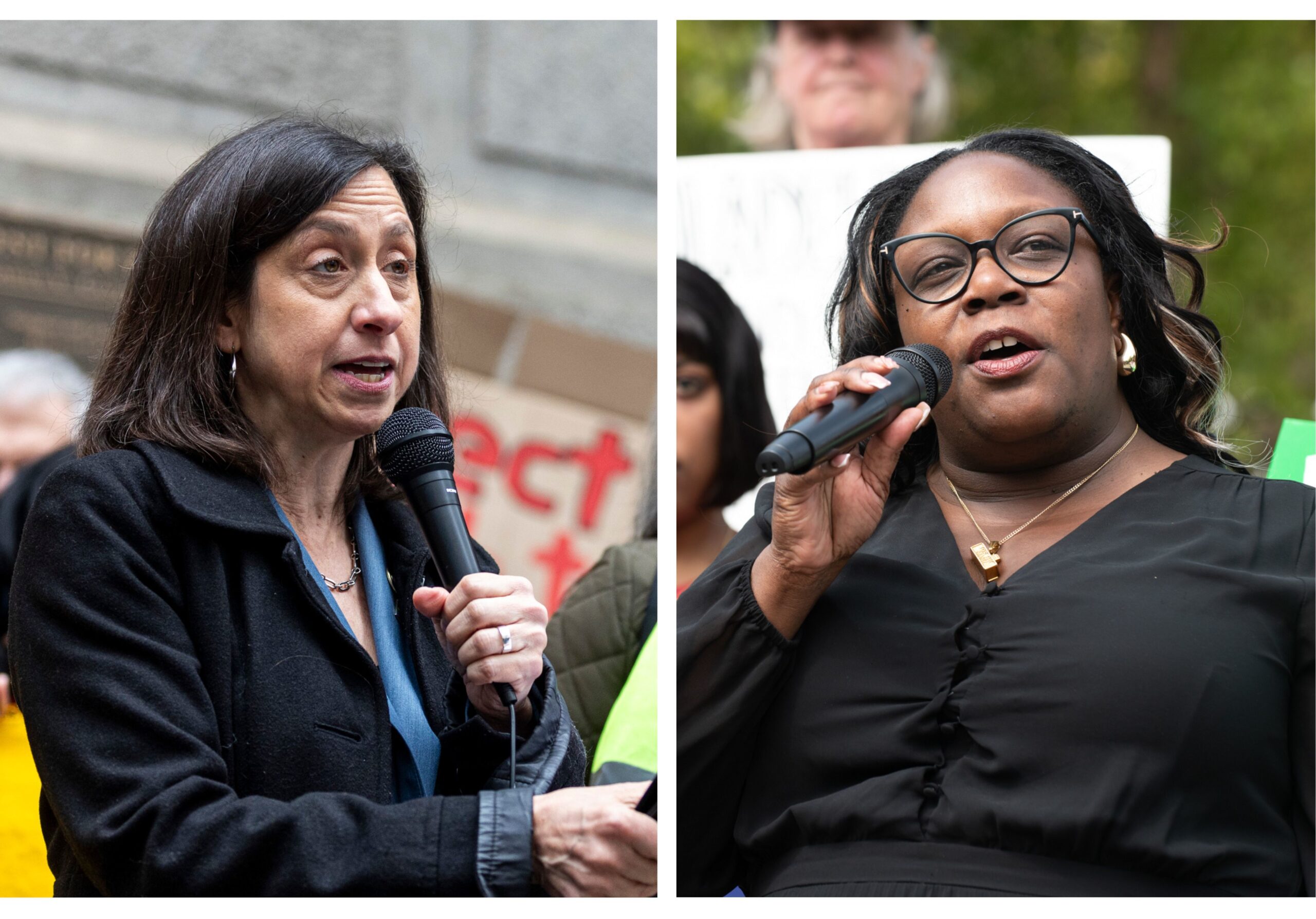
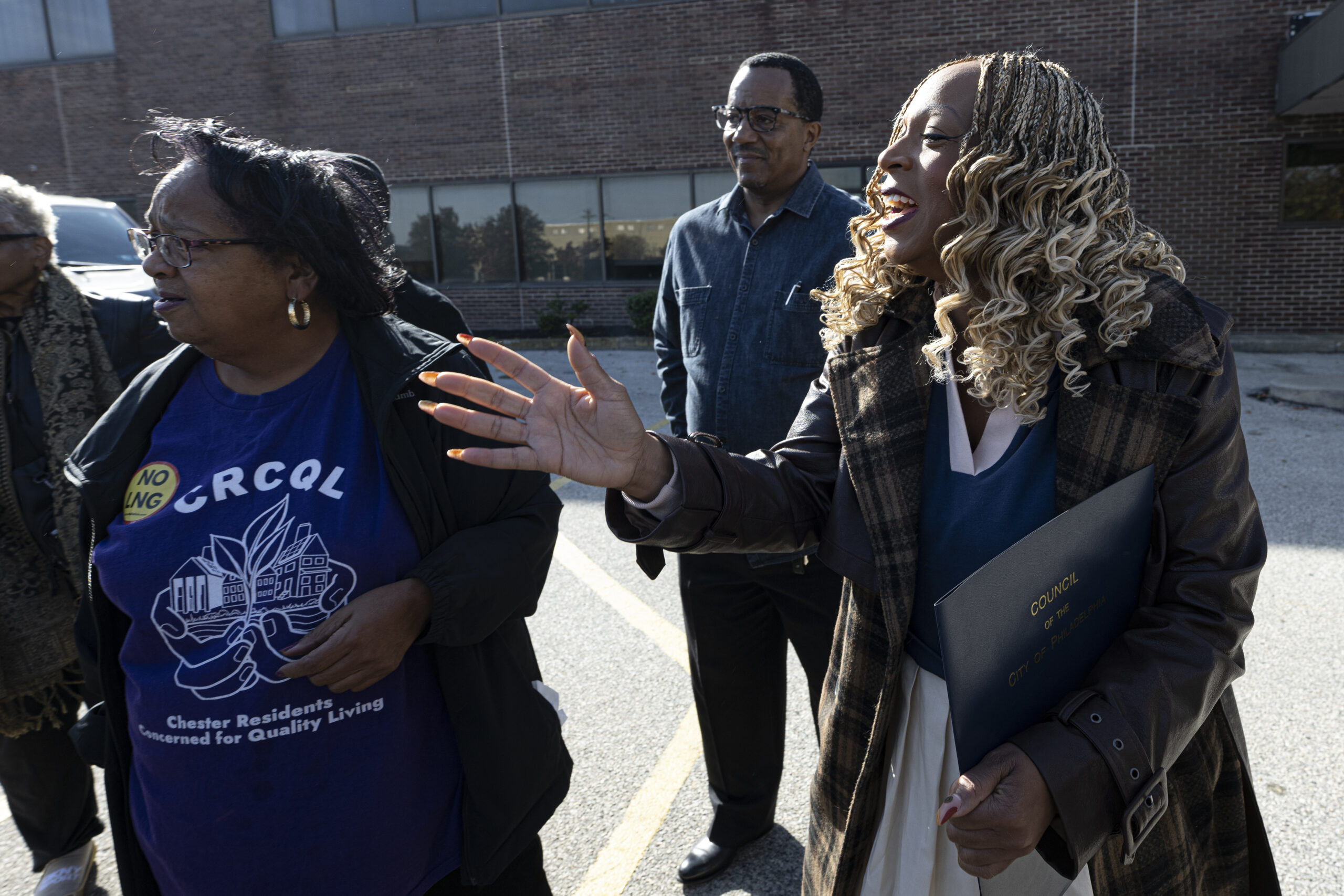
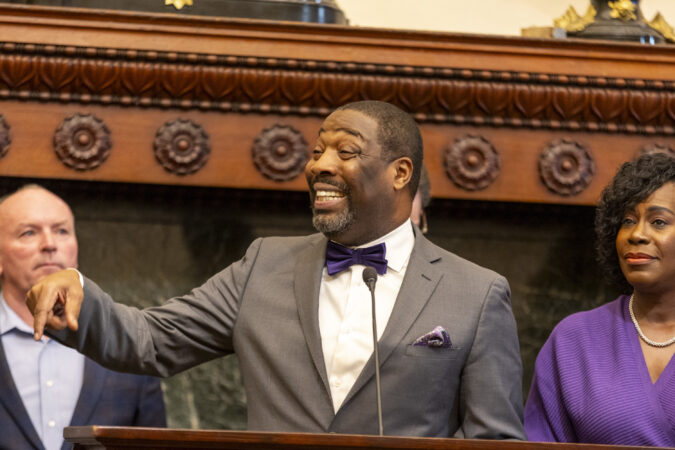
    Left: City Councilmember Rue Landau. Right: City Councilmember Kendra Brooks. Landau and Brooks are introducing legislation this week to make it harder for ICE to operate in Philadelphia, including by limiting city cooperation with the agency.

    ICE spokespeople did not immediately reply to a request for comment.

    Jasmine Rivera, executive director of the Pennsylvania Immigration Coalition, said it’s not the job nor the jurisdiction of the city to enforce federal law.

    The goal of the legislation, Rivera said, is ensuring that “not a single dime and single second of our local resources is being spent collaborating with agencies that are executing people.”

    Activists have for months urged Mayor Cherelle L. Parker to formally affirm her commitment to the city’s sanctuary status. Top city officials say an executive order signed by the former mayor to limit the city’s cooperation with ICE remains in place.

    But Parker, a centrist Democrat, has taken a quieter approach than her colleagues in Council, largely avoiding criticizing the Trump administration outwardly and saying often that she is focused on her own agenda.

    Now, the mayor could be forced to take a side. If City Council passes Landau and Brooks’ legislation this spring, Parker could either sign the bills into law, veto them, or take no action and allow them to lapse into law without her signature. She has never vetoed a bill.

    Joe Grace, a spokesperson for Parker, declined to comment on the legislation.
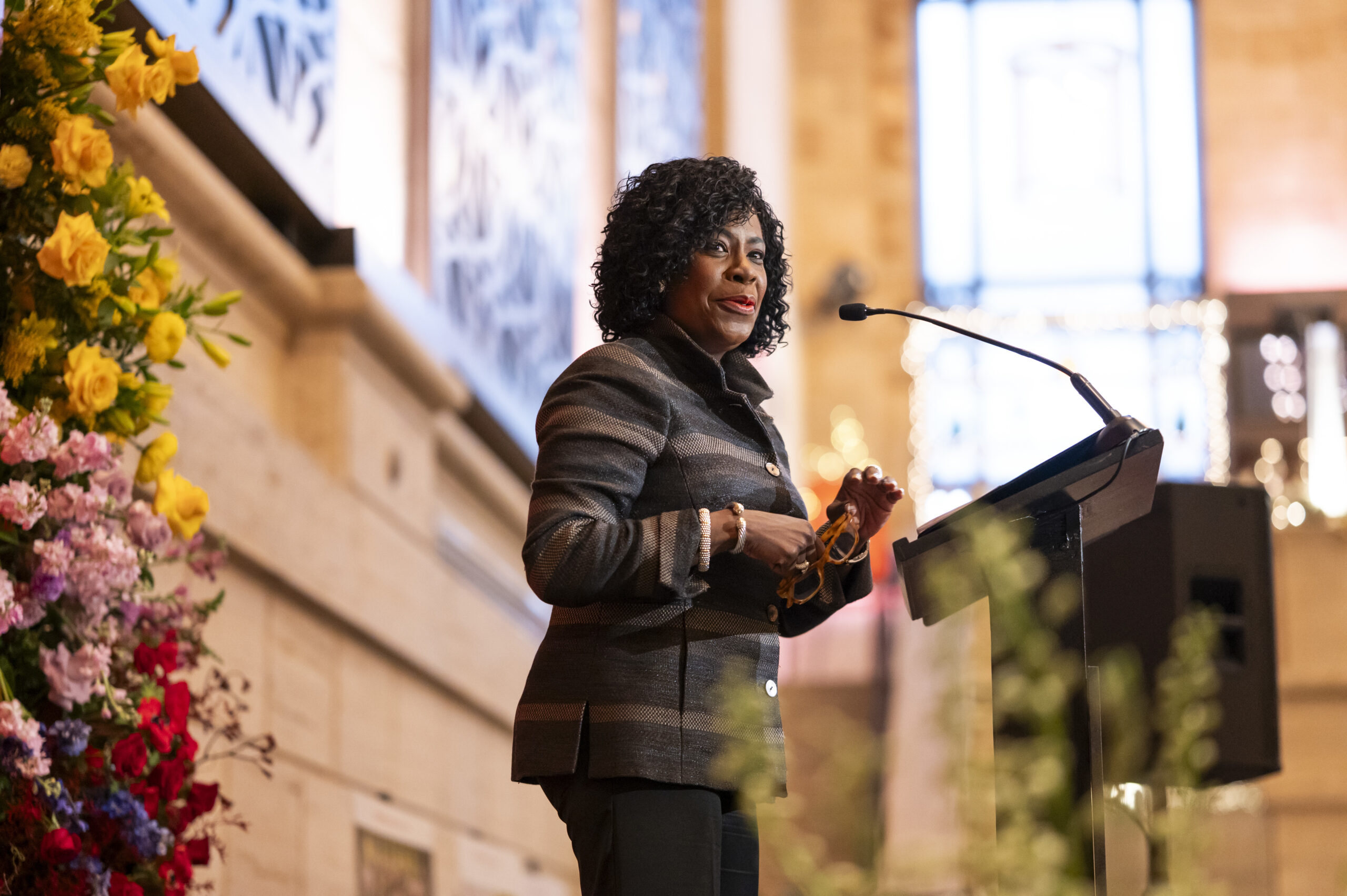
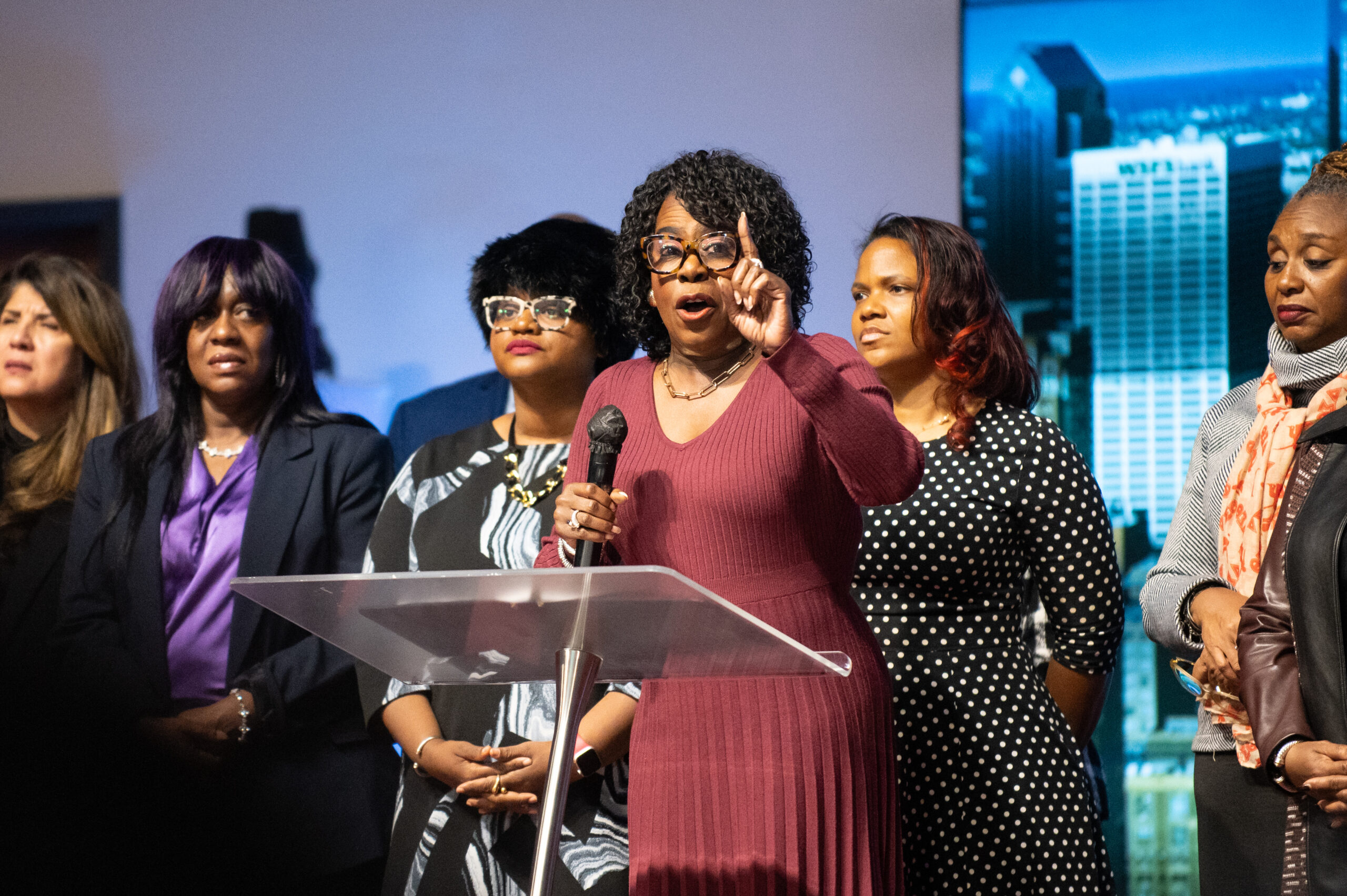
    Mayor Cherelle L. Parker speaks at a news conference earlier this month. It is unclear how she will act on upcoming legislation related to ICE operations in Philadelphia.

    It’s unclear what fate the ICE legislation could meet in Council. The 17-member body has just one Republican, but Parker holds influence with many of the Democrats in the chamber.

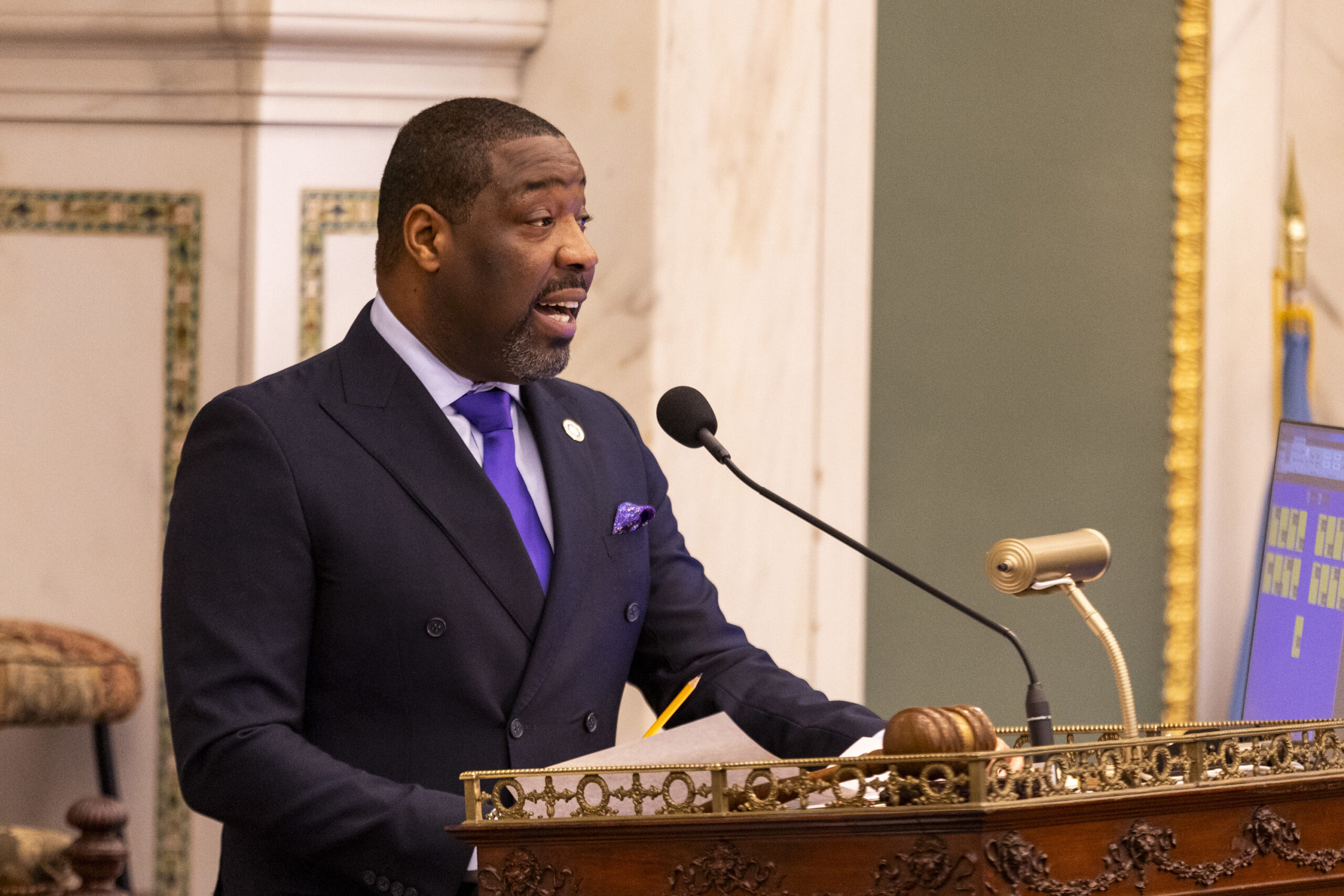
    City Council President Kenyatta Johnson, a Democrat who controls the flow of legislation, has not taken a position on the package proposed by Landau and Brooks.

    But he said in a statement that “Philadelphia has long positioned itself as a welcoming city that values the contributions of immigrants and strives to protect their rights and safety.”

    “I have deep concerns about federal ICE actions directed by President Donald Trump’s administration that sow fear and anxiety in immigrant communities,” Johnson said, “underscoring the belief that enforcement practices should be lawful, humane, and not undermine trust in public safety.”

    Making sanctuary status the law

    Border Patrol and ICE are both federal immigration agencies, which are legally allowed to operate in public places and subject to federal rules and regulations. Some cities and states — not including Pennsylvania and New Jersey — actively cooperate with ICE through written agreements.

    Since 2016, Philadelphia has operated under an executive order signed by former Mayor Jim Kenney, which prohibits city jails from honoring ICE “detainer requests,” in which federal agents ask the city to hold undocumented immigrants in jail for longer than they would have otherwise been in custody to facilitate their arrest by federal authorities.

    Undocumented immigrants are not shielded from federal immigration enforcement, nor from being arrested and charged by local police for local offenses.

    Some refer to the noncooperation arrangement as “sanctuary.” As the term “sanctuary cities” has become politically toxic, some local officials — including in Philadelphia — have backed away from it, instead declaring their jurisdictions to be “welcoming cities.”

    Parker administration officials have said several times over the last year that Philadelphia remains a “welcoming city.”
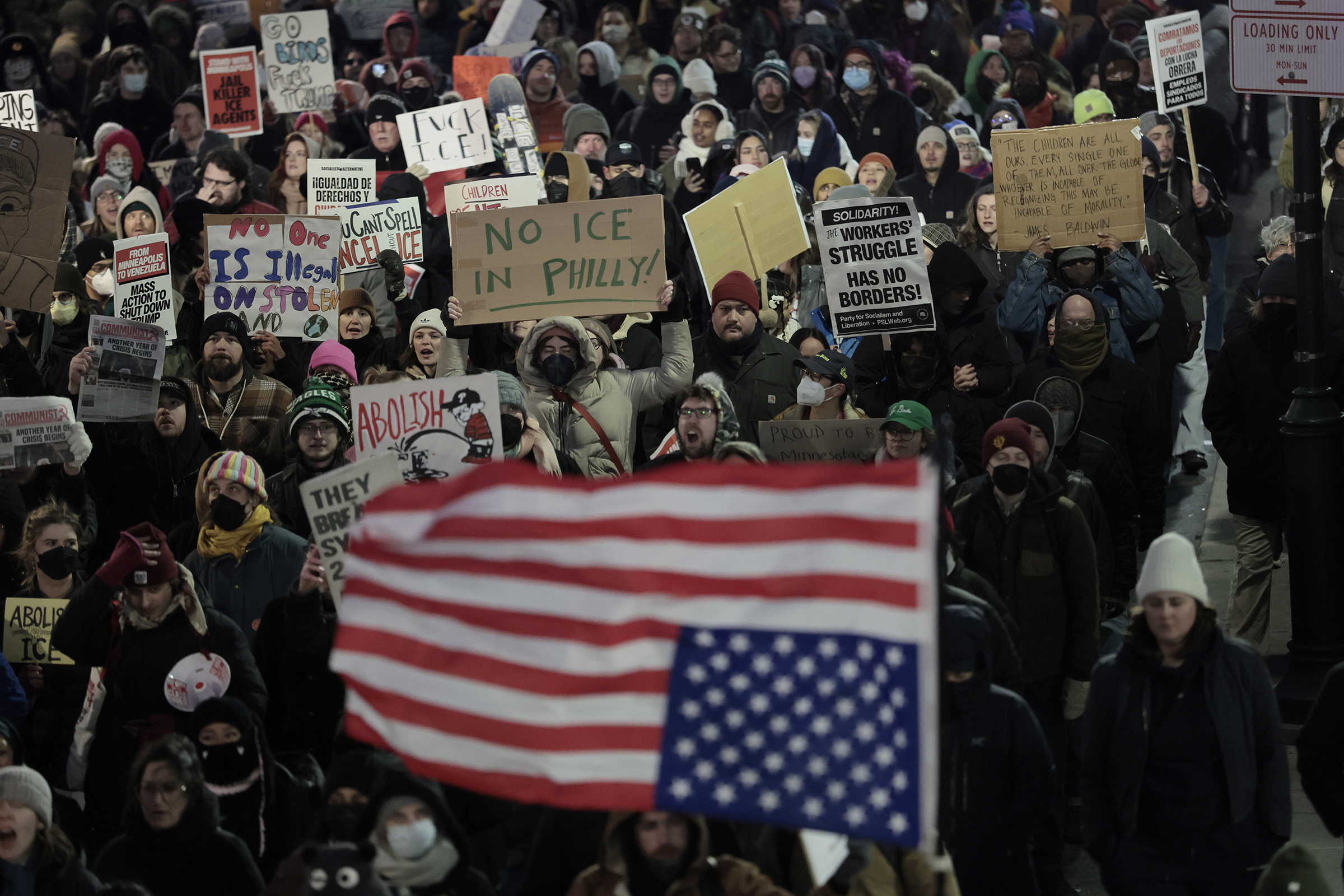
    Protesters march up Eighth Street, toward the immigration offices, during the Philly stands with Minneapolis Ice Out For Good protest at Philadelphia’s City Hall on Jan. 23.

    But advocates for immigrants have said they want an ironclad city policy that can’t be rescinded by a mayor.

    Landau and Brooks’ legislation would be that, codifying the executive order into law and adding new prohibitions on information sharing. The package includes legislation to:

    • Strengthen restrictions on city workers, including banning local police from carrying out federal immigration enforcement and prohibiting city workers from assisting in enforcement operations.
    • Prohibiting law enforcement officers from concealing their identities, including by wearing masks or covering up badges with identifying information.
    • Banning ICE from staging raids on city-owned property and designated community spaces such as schools, parks, libraries, and homeless shelters. (It would not apply to the Criminal Justice Center, where ICE has had a presence. The courthouse is overseen by both city and state agencies.)
    • Prohibiting city agencies and contractors from providing ICE access to data sets to assist in immigration enforcement.
    • Restricting city employees from inquiring about individuals’ immigration status unless required by a court order, or state or federal law.

    Peter Pedemonti, co-director of New Sanctuary Movement of Philadelphia, an advocacy organization that partnered with the Council members to craft the package of bills, compared ICE to an octopus that has multiple arms reaching into different facets of American life.

    The proposed legislation, he said, is a means to bind a few of those arms.

    “The whole world can see the violence and brutality,” Pedemonti said. “This is a moment where all of us need to stand up, and Philadelphia can stand up and speak out loud and clear that we don’t want ICE here to pull our families apart, the families that make Philadelphia Philadelphia.”

    An impending showdown that Parker hoped to avoid

    Homeland Security officials claim that sanctuary jurisdictions protect criminal, undocumented immigrants from facing consequences while putting U.S. citizens and law enforcement officers in peril.

    Last year, the Trump administration named Philadelphia as among the jurisdictions impeding federal immigration enforcement. The White House has said the federal government will cut off funding to sanctuary cities by Feb. 1.

    However, the president has made no explicit threat to ramp up ICE activities in Philadelphia.

    Some of Parker’s supporters say the mayor’s conflict-averse strategy has spared Philadelphia as other cities such as Washington, New York, Los Angeles, Chicago, and Minneapolis have seen National Guard troops or waves of ICE agents arrive in force.
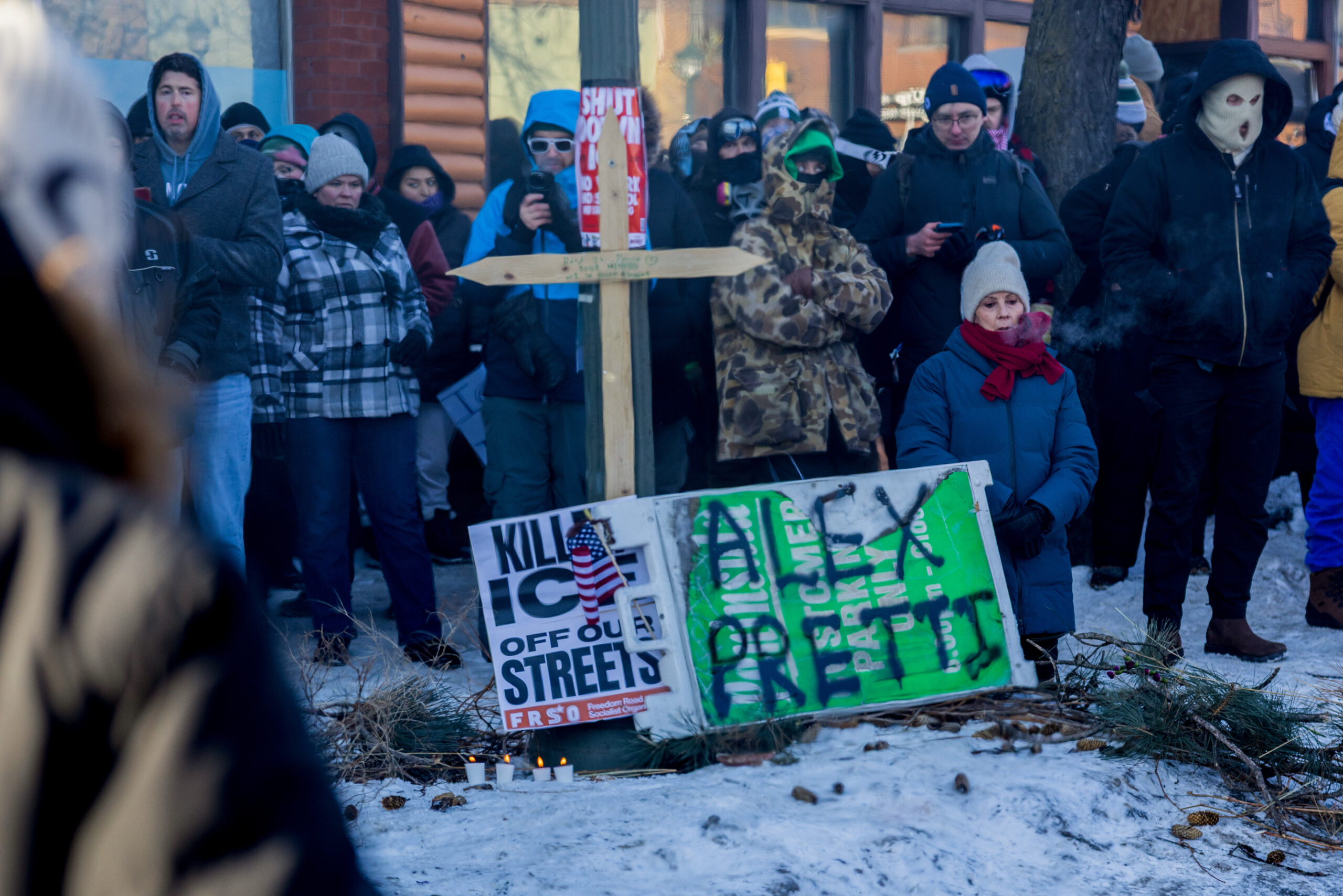
    Residents near the scene of a shooting by a federal law enforcement agent in Minneapolis on Saturday.

    Critics, including the backers of the new legislation, have for months pressed Parker to take a stronger stand.

    Brooks said she “would love to have the support of the administration.”

    “This should be something that we should be working collaboratively on,” she said. “Philadelphia residents are demanding us do something as elected officials, and this is our time to lead.”

    But Parker has not been eager to speak about Philadelphia’s immigration policies.

    For example, the city is refusing to release a September letter it sent to the U.S. Department of Justice regarding its immigration-related policies, even after the Pennsylvania Office of Open Records ruled its reasoning for keeping the document secret was invalid. The Inquirer has requested a copy of the letter under the state Right-to-Know Law.

    The new Council legislation and the increasing tension over Trump’s deportation push may force Parker to take a clearer position.

    Notably, the city sued the federal government last week over its removal of exhibits related to slavery from the President’s House at Independence National Historical Park, potentially signaling a new willingness by Parker to push back against the White House.

    But even then, Parker declined to take a jab at Trump.

    “In moments like this,” she said last week, “it requires that I be the leader that I need to be for our city, and I can’t allow my pride, ego, or emotions to dictate what my actions will be.”

  • Philly schools virtual for Tuesday, and here’s what other districts are doing as road conditions remain iffy

    Philly schools virtual for Tuesday, and here’s what other districts are doing as road conditions remain iffy

    Philadelphia school buildings won’t be open Tuesday as road conditions remain rough in many places after the weekend’s significant winter storm.

    After Mayor Cherelle L. Parker told residents city offices and courts would be closed Tuesday, Superintendent Tony B. Watlington Sr. affirmed the virtual learning call for schools.

    “Given the conditions of the roads and the issues that the mayor and others have talked about, and out of an abundance of caution,” district offices will remain closed Tuesday, and after-school programs and athletics are also closed, Watlington said.

    The superintendent prioritizes in-person learning, he said, but Tuesday “and any subsequent inclement weather days will be remote learning days.”

    The district sent students’ Chromebooks home with them Friday.

    Philadelphia schools had already planned half days Thursday and Friday for report card conferences.

    Virtual instruction, closures and delays beyond Philly

    Districts around the region were starting to make similar calls.

    Haddon Heights, in South Jersey, had already called a two-hour delay.

    The Cheltenham School District is also going virtual.

    “After consulting with my team, many roads remain unpassable and are likely to refreeze after dusk, making bussing on Tuesday too risky,” Superintendent Brian Scriven told families in a message Monday afternoon.

    Schools have increasingly been turning to online instruction during winter storms, though some districts use a different calculus on when to go virtual. New Jersey schools do not allow for virtual instruction.

    Scriven said Cheltenham administrators were “hopeful schools will return to normal operations as soon as possible,” and would communicate any additional schedule changes before Wednesday.

    Upper Darby schools also announced virtual instruction.

    “Unfortunately, we are going to need another day to continue to remove snow and ice,” Superintendent Dan McGarry told families Monday afternoon.

    Officials with the Centennial School District in Bucks County also said they would have virtual instruction, telling community members in a message that “conditions remain challenging, and our facilities personnel are hard at work clearing lots and entryways.” Central Bucks also called a remote learning day.

    The Colonial School District, meanwhile, announced a second traditional snow day Tuesday.

    “More work needs to be completed on our secondary roads to make it safe for our students to travel on Wednesday,” Superintendent Michael Christian said in a message to families. In the event of more inclement weather, Christian said, the district would have virtual instruction.

    Camden schools will also be closed on Tuesday. So will Cherry Hill, Winslow, Woodbury, and Washington Township, among others.

  • Tackling gun violence as our shared purpose

    Tackling gun violence as our shared purpose

    As we start the new year, many of the challenges that persisted in 2025 remain on our horizon for 2026. Sadly, gun violence is one such challenge, but our city has demonstrated what the power of working together can do in making progress in such a significant way.

    Philadelphia made history in 2025, recording the fewest homicides in almost 60 years, and it is true that many cities nationwide are also experiencing this trend. But Philadelphia’s gains are noteworthy in that it is seeing these tremendous public safety gains despite continuing to struggle with issues like deeply entrenched poverty.

    There are many factors driving these numbers, and Mayor Cherelle L. Parker’s public safety strategy of prevention, intervention, and enforcement (PIE) has brought vital focus and intention driven by data. Working together — the Philadelphia Police Department and the Office of Public Safety working in tandem, along with organizations like the group I lead, the Civic Coalition to Save Lives — enable the sum to become greater than the parts in their overall effectiveness in bolstering the city’s strategy.

    For our part, we represent nonprofit and private-sector partners by activating resources like subject matter experts, new data infrastructure, and innovative cross-jurisdictional collaborations.

    The results are compelling: One analysis found that Philly had the best community safety infrastructure of any of the nation’s 10 largest cities, and a Pew poll found that public perception of safety is improving. That means the Office of Public Safety — an entity only two years old — is leading other major cities in its comprehensive approach to violence prevention and intervention.

    This is something our city should be proud of and raise up.

    Just a few years ago, the city was struggling with record-high shooting and homicide rates coming out of the pandemic, and while many individuals and organizations from every sector had meaningful tools to address the issue, it lacked one cohesive, well-coordinated approach to save the maximum number of lives from gun violence in the near term.

    From this gap, both the coalition and the Office of Public Safety were derived, the latter via mayoral executive order, and have grown intertwined in expanding the reach and capacity of Philadelphia’s vast network of anti-violence and cognitive behavioral health approaches deployed to reduce shootings.

    The credit for the success of these many violence prevention and intervention strategies lies with our leaders who have the focus and political will, the practitioners and participants in these programs relentlessly choosing to do this hard work, the public and private funders, and informed and engaged nongovernmental partners.

    Looking to the future, maintaining success and remaining focused on Mayor Parker’s and City Council’s goal of being the safest city will require continued vigilance and commitment to what works. Unfortunately, many organizations are already facing historic budget challenges exacerbated by losses of funding at the federal level that had incentivized proven, focused violence intervention practices.

    As we confront this reality, let’s keep in mind the adage that an ounce of prevention is always worth a pound of cure.

    According to a report by the city, every fatal shooting in Philadelphia can cost as much as $1.5 million in related policing, healthcare, job/property loss, and that is not even accounting for the indirect lost tax revenue or economic activity in high crime areas, or the most important cost: the human impact and intergenerational trauma carried through families and communities.

    A report by the City Controller’s Office also estimated that an investment of $43 million over five years could reduce homicides by 35%, which would translate into a more than $70 million return on investment in increased property tax revenue alone.

    Our call to action for Philadelphians when it comes to reducing violence is this: Stay tuned in and keep showing up, however you can. As Mayor Parker often says, don’t just listen to what is said, watch what people do.

    The unified, coordinated effort to reduce gun violence is working (for context, 2025 saw fewer than half of the record-high homicides and shootings seen in 2021). Mayor Parker, Police Commissioner Kevin J. Bethel, and Public Safety Director Adam Geer have said it, too: “We can’t let up off the gas pedal.”

    We agree.

    There is an African proverb that says: “If you want to go fast, go alone. If you want to go far, go together.” Reducing gun violence can only be achieved over time — not overnight. And the only way we’ll be able to solve it is by working together.

    Here’s to the promising journey ahead.

    David W. Brown serves as the executive director of the Civic Coalition to Save Lives.

  • How some Philly-area workers make $100,000 without a bachelor’s degree

    How some Philly-area workers make $100,000 without a bachelor’s degree

    Can you make $100,000 a year in the Philadelphia area without a four-year college degree?

    Yes. But it’s not common.

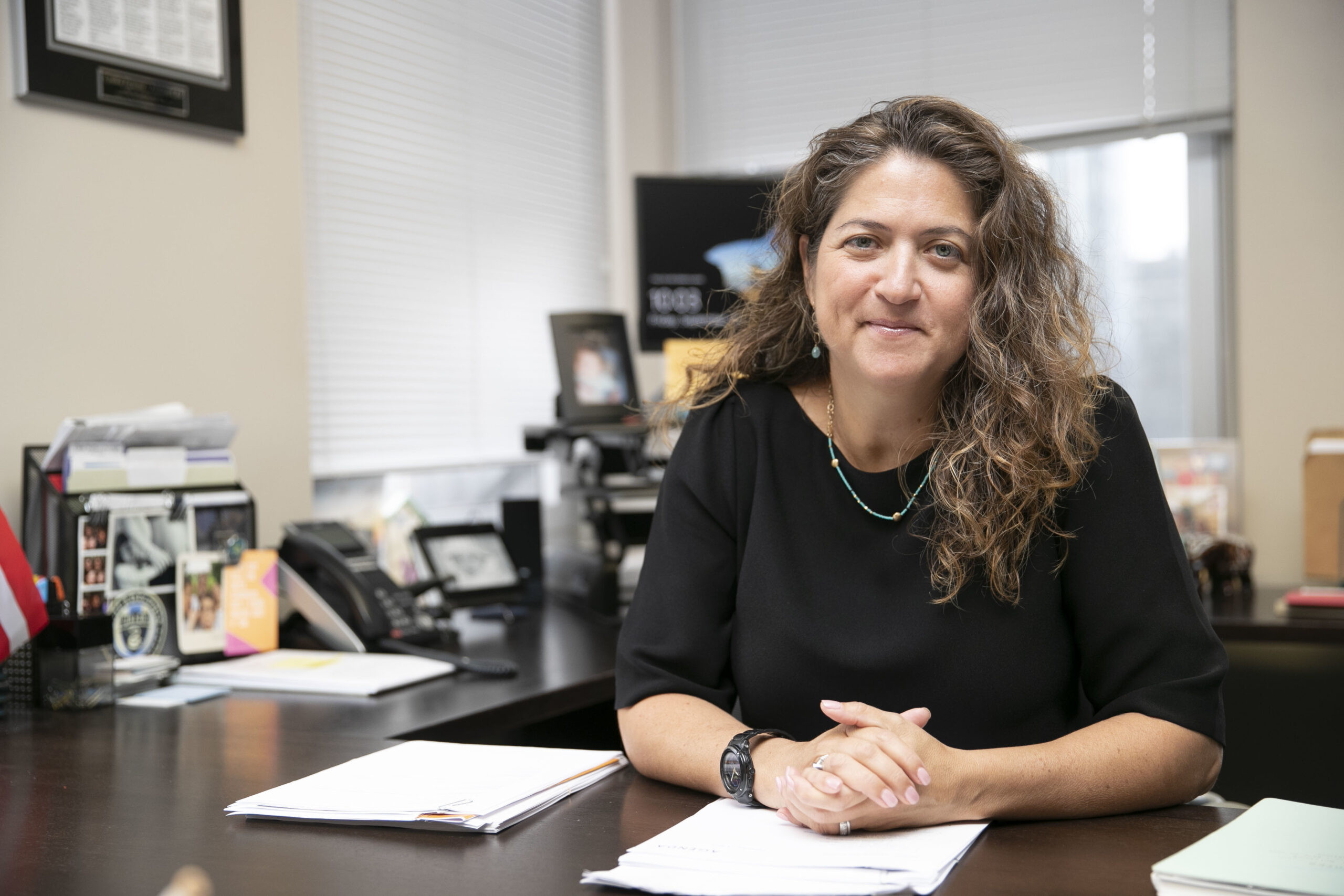
    “There is no magic wand to get to a six-figure salary,” said Cynthia Figueroa, who leads workforce development nonprofit JEVS Human Services. “There’s a lot of steps that have to happen along the way.”

    Companies including IBM, Delta, and Google have dropped degree requirements in recent years. Locally, Pennsylvania Gov. Josh Shapiro slashed college degree requirements for most state jobs in 2023, and Mayor Cherelle L. Parker has advanced an effort to do the same for some city jobs. Meanwhile, more are pursuing vocational training, the Wall Street Journal reported, as some in Gen Z turn to the trades amid the rising cost of college.

    Data center technicians are increasingly in demand, don’t require a college degree, and can make a six-figure salary after some experience. And store managers at Walmart, who often don’t have college degrees, can make $128,000 before bonuses.

    But who actually makes $100,000 or more in the Philadelphia area without a four-year degree and what does that path look like? The Inquirer took a look at the data.

    Cynthia Figueroa poses for a portrait in Philadelphia in 2019. She is the CEO and president of JEVS Human Services.

    What industries pay $100,000-plus without a bachelor’s degree?

    Among the Philadelphia metro area’s 3.97 million workers, the vast majority who make a six-figure salary have at least a bachelor’s degree, according to Census data compiled by IPUMS USA at the University of Minnesota. The metropolitan area includes 11 counties in Pennsylvania, New Jersey, Delaware, and Maryland.

    Roughly 159,000 people made $100,000 or more without a four-year college degree in 2024, the data indicates. (That includes people with an associate’s degree.)

    window.addEventListener(“message”,function(a){if(void 0!==a.data[“datawrapper-height”]){var e=document.querySelectorAll(“iframe”);for(var t in a.data[“datawrapper-height”])for(var r,i=0;r=e[i];i++)if(r.contentWindow===a.source){var d=a.data[“datawrapper-height”][t]+”px”;r.style.height=d}}});

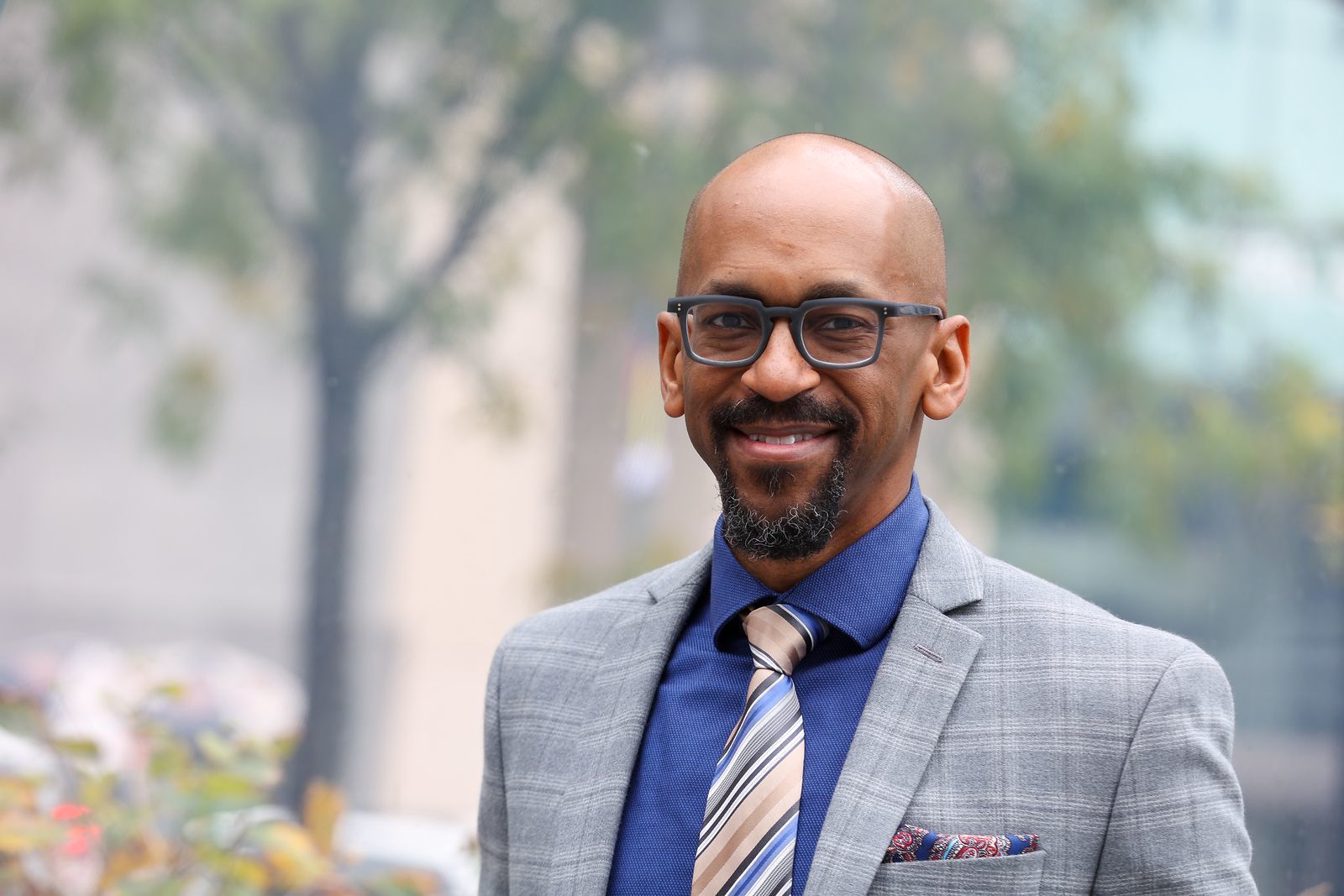
    “There is potential” for high earning without college, but it’s not typical, said Sean Vereen, president and CEO of career-focused education nonprofit Heights Philadelphia.

    “We know that not everybody wants to go to college, but particularly the way the economy in this region is constructed, that college degree still is very useful,” said Vereen.

    But the majority of the workforce in the Philadelphia metro area lacks a bachelor’s degree. Only about 7% of them reach the high-earning $100,000-plus bracket.

    It’s more common in jobs where salaries overall tend to be higher, such as management, business, and finance. About 51,000 Philly-area people in those jobs with less than a bachelor’s degree earned $100,000 or more in 2024.

    window.addEventListener(“message”,function(a){if(void 0!==a.data[“datawrapper-height”]){var e=document.querySelectorAll(“iframe”);for(var t in a.data[“datawrapper-height”])for(var r,i=0;r=e[i];i++)if(r.contentWindow===a.source){var d=a.data[“datawrapper-height”][t]+”px”;r.style.height=d}}});

    What industries are adding more $100,000 jobs?

    Still, more opportunities for people without a four-year degree could be on the horizon.

    Shipbuilding is having a resurgence in Philadelphia’s Navy Yard, and more electricians, carpenters, and welders will be needed, said Figueroa.

    Among Philadelphia construction workers, including carpenters and welders, more than 11,000 do not have a bachelor’s degree and make at least $100,000 annually.

    Hanwha plans to expand its shipbuilding operations in Philadelphia and will need to hire. That includes positions requiring considerable math skills, said Figueroa, of JEVS. The organization is currently figuring out how to get job-training graduates into opportunities.

    Philadelphia Works, the city’s workforce development board, is working closely with Hanwha, CEO and president H. Patrick Clancy said.

    “Our goal is to do more of the pre-apprenticeship,” Clancy said. “They have a lot of people interested in applying for their roles, but not all of them are passing the math and reading [requirements].”

    The newly repainted Goliath Crane is shown July 16, 2025, at the Hanwha Philly Shipyard in Philadelphia.

    Last year, a Brookings Institution report highlighted enterprise digital solutions (business software), specialized manufacturing (like producing parts for medical devices or industrial electronics), and biomedical commercialization (life sciences businesses) as areas where Philadelphia residents should be able to find good jobs. Many jobs in those sectors don’t require a college degree.

    “We need to be focused on creating the right kinds of jobs,” said Chellie Cameron, CEO and president of the Chamber of Commerce for Greater Philadelphia, which is now focusing on the areas Brookings identified.

    The right kinds of jobs, Cameron said, are not minimum-wage positions. They “start at a place where people can earn a family-sustaining wage and have access to pathways for promotion and making more money over the course of their career.”

    Paths and training for high-earning jobs

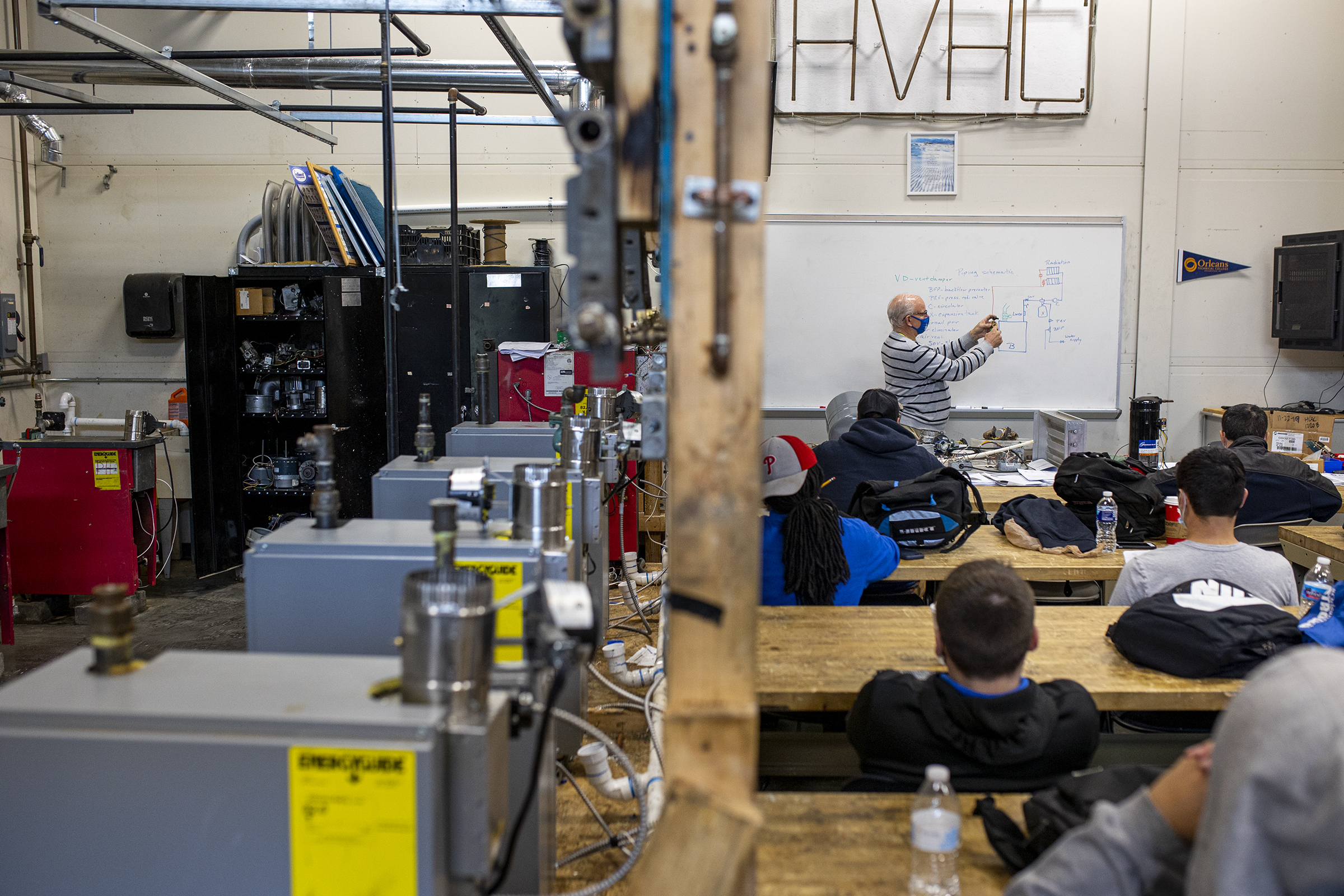
    Orleans Technical College in Northeast Philadelphia, run by JEVS, trains people for building trades and healthcare professions. It had 379 students last year. Tuition ranges from roughly $13,000 to $25,000, but most students get financial assistance and typically leave with $6,000 or less in debt.

    Residential and commercial electrician Dan Finke, 25, of Abington, (right), is learning about motor controls with fellow classmates at Orleans Technical College, in Northeast Philadelphia on a Friday in September 2020.

    “There’s still very much the physical application of running wire, bending metal,” said Figueroa, and many medical tasks seem to be AI-proof for now. “At the end of the day, you need somebody who is taking the blood pressure next to the bed, and who is drawing the blood.”

    Construction management and HVAC students can expect starting salaries around $75,000 and $60,000 respectively. Those who work overtime can make even more, Figueroa noted, and pay also increases over the course of a career.

    That’s not a six-figure salary on Day One, she acknowledged. But college graduates can make a similar amount in their first job, and “they have this enormous debt” from their schooling.

    Lou Abruzzese, HVAC Instructor, is teaching his class about hydronics at Orleans Technical College, in Northeast Philadelphia on Friday, Sept. 25, 2020.

    Orleans also offers healthcare training for clinical medical assistants and practical nursing. Starting salaries for those jobs are generally around $44,000 and $64,000 respectively.

    “Going from an hourly wage — at like a Target, McDonald’s, Walgreens, what have you — to salaried, hopefully with benefits, is a huge first step,” Figueroa said.

    Connecting people to employment also means addressing barriers like lacking a driver’s license, needing childcare, financial literacy, or housing support, says Clancy. Pursuing training might mean going without paid work for weeks or months, which can be a challenge. Philadelphia Works has some funds available to pay people during their training.

    Sean Vereen is the president and CEO of Heights Philadelphia.

    Young adults need to be aware of opportunities, too, said Vereen. For instance, he said, sterilization technician is a good job within a hospital, but young people may not know it’s a path available to them without going to college.

    And sometimes young people need to catch up before training for jobs in the trades, Vereen says. “We’ve heard things like, ‘The kid coming from the school district doesn’t have strong enough math skills to take the test for the building trades,’” he said.

    “You need basic academic skills that are about math and reading and reading comprehension,” he said. “We don’t get away from giving kids basic knowledge.”

  • How Jamie Gauthier charted a new path to power in Philadelphia City Hall

    How Jamie Gauthier charted a new path to power in Philadelphia City Hall

    When Mayor Cherelle L. Parker unveiled her much-anticipated plan to address Philadelphia’s housing crisis last year, there was predictable criticism from the political left. Activists said the proposal drafted by the moderate Democrat would not do enough for the city’s poorest residents.

    Less predictable was that a majority of City Council stood with them.

    Even the Council president, a centrist ally of the mayor, sided with a progressive faction that just two years ago had been soundly defeated in the mayor’s race — but whose new de facto leader in City Hall has proven adept at building alliances across the ideological spectrum.

    At the center of that shift was Jamie Gauthier.

    The second-term Democratic lawmaker from West Philadelphia has solidified herself over the last year as a leading voice on Council and a counterweight to Parker. She has worked within the system as opposed to trying to break it, maintaining relationships with power players who disagree with her on policy.

    She counts Ryan N. Boyer — the labor leader who is Parker’s closest political ally — among those who consider her a “thought leader.”

    “Over the last year, what you saw,” Boyer said, “is her modulate her positions to become more practical.”

    Gauthier has generally voted with progressives, including last year when she opposed the controversial Center City 76ers arena proposal. But she has also endeavored to be a team player, at times compromising on ideological battles to focus on priorities in her district.

    Last year, she voted for Parker’s plan to cut taxes for businesses and corporations when other progressives opposed it, because her main priority was securing housing funding. She has not opposed some tough-on-crime efforts in the Kensington drug market, instead allowing her colleagues who represent that area to dictate the policy there.

    She says she is trying to use her political capital where it matters.

    “Why would I take a protest vote and tank a relationship with a colleague when I’m going to need them later?” she said. “I want to win.”

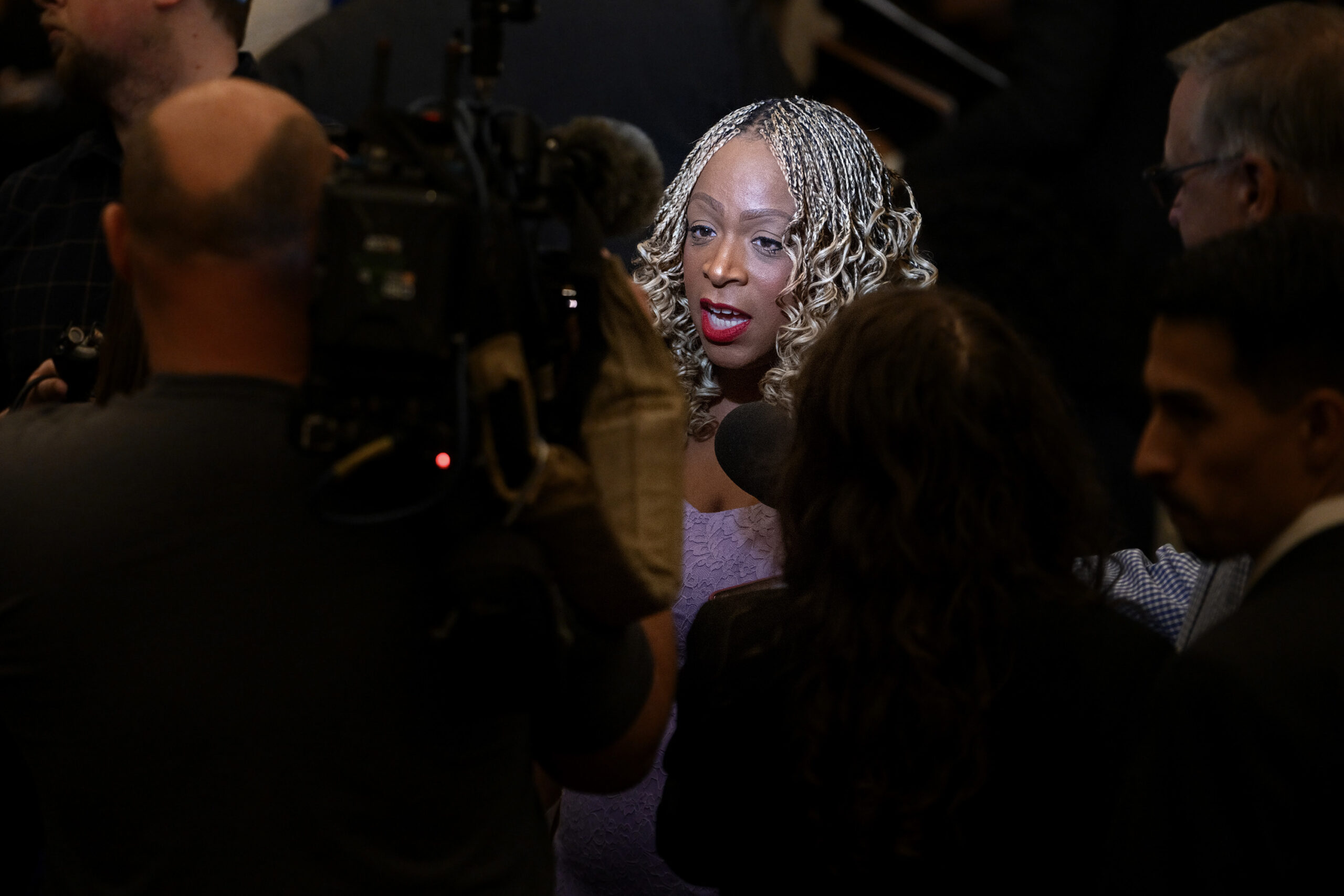
    Councilmember Jamie Gauthier talks with news media following a special session of City Council on March 24, 2025.

    The fact that Gauthier is a district Council member who represents a large swath of the city west of the Schuylkill also gives her cachet with colleagues. Council has a long tradition of honoring how members want their own neighborhoods to be governed.

    Gauthier, who leads Council’s housing committee, has used the influence to make West Philadelphia something of a testing ground for left-of-center policy. Plenty oppose what they see as draconian restrictions on real estate development in her district.

    Others see a progressive champion, and some political observers think Gauthier could amass enough support to run for mayor one day. She doesn’t deny that she has thought about it.

    But for whatever politics Gauthier can navigate in City Hall, she knows she can rise only if she is successful at home.

    ‘Not just a lone actor’

    When Parker took office, Council was in a moment of upheaval. Council President Kenyatta Johnson was the new leader of the chamber, and several prominent voices were gone after they had resigned to run for mayor themselves.

    One was Helen Gym, who was seen as the leader of Council’s left flank. There were questions about who would fill the void once Gym was gone.

    Gauthier, 47, an urban planner by trade, did not come up through an activist movement in the same way Gym did, and was a bit more reserved in her style.

    But she carries the mantle for the same theory of governance: that lawmakers should prioritize the vulnerable, and that what is good for business is not necessarily good for everyone else.

    That set Gauthier on an ideological collision course with Parker, a former Council member who ran for office on a promise to uplift the middle class, a group the mayor believes has been too often ignored.

    It came to a head in the fight over Parker’s Housing Opportunities Made Easy, or H.O.M.E., initiative.

    Parker wanted to set unusually high income eligibility thresholds for some of the programs so that middle-class families could unlock government subsidies they may not otherwise qualify for. A significant portion of Council, meanwhile, wanted the money to go initially to Philadelphians most vulnerable to displacement.

    Parker was clear-eyed about who was leading the charge.

    “Councilmember Jamie Gauthier, she may be comfortable and OK with telling Philadelphia homeowners, working-class Philadelphians, that they have to wait and there is no sense of urgency for them,” Parker said in a December interview on WHYY. “But that is not a sentiment that I support or agree with.”

    Gauthier is quick to point out that she did not work alone, and that one member of a 17-member body cannot accomplish much. Alongside Councilmember Rue Landau, a fellow Democrat and a housing attorney by trade, Gauthier worked for months to win over her colleagues.

    In the end, Council approved a version of the housing initiative closer to Gauthier’s vision.

    Gauthier didn’t think Parker helped her own cause. A “line was crossed,” she said, when Parker took the fight outside City Hall and to the pulpit. Amid negotiations with Council, the mayor went to 10 churches on one Sunday in December to lobby for support, saying her vision was to not “pit the ‘have-nots’ against those who have just a little bit.”

    Mayor Cherelle L. Parker speaks to the crowd at The Church of Christian Compassion in the Cobbs Creek neighborhood of West Philadelphia on Sunday, Dec. 7, 2025. Parker visited 10 churches in Philadelphia on Sunday to share details about her HOME housing plan.

    To Gauthier, the divisiveness was coming from the mayor’s office.

    “I wish the mayor and her administration were more open to other people’s ideas, were more OK with disagreement on policy issues, and more aware of Council as a completely separate chamber of government,” Gauthier said, “as opposed to a body that works for her.”

    That is a candid assessment of the relationship between Parker and City Council from Gauthier. Few lawmakers from the mayor’s own party have criticized her publicly.

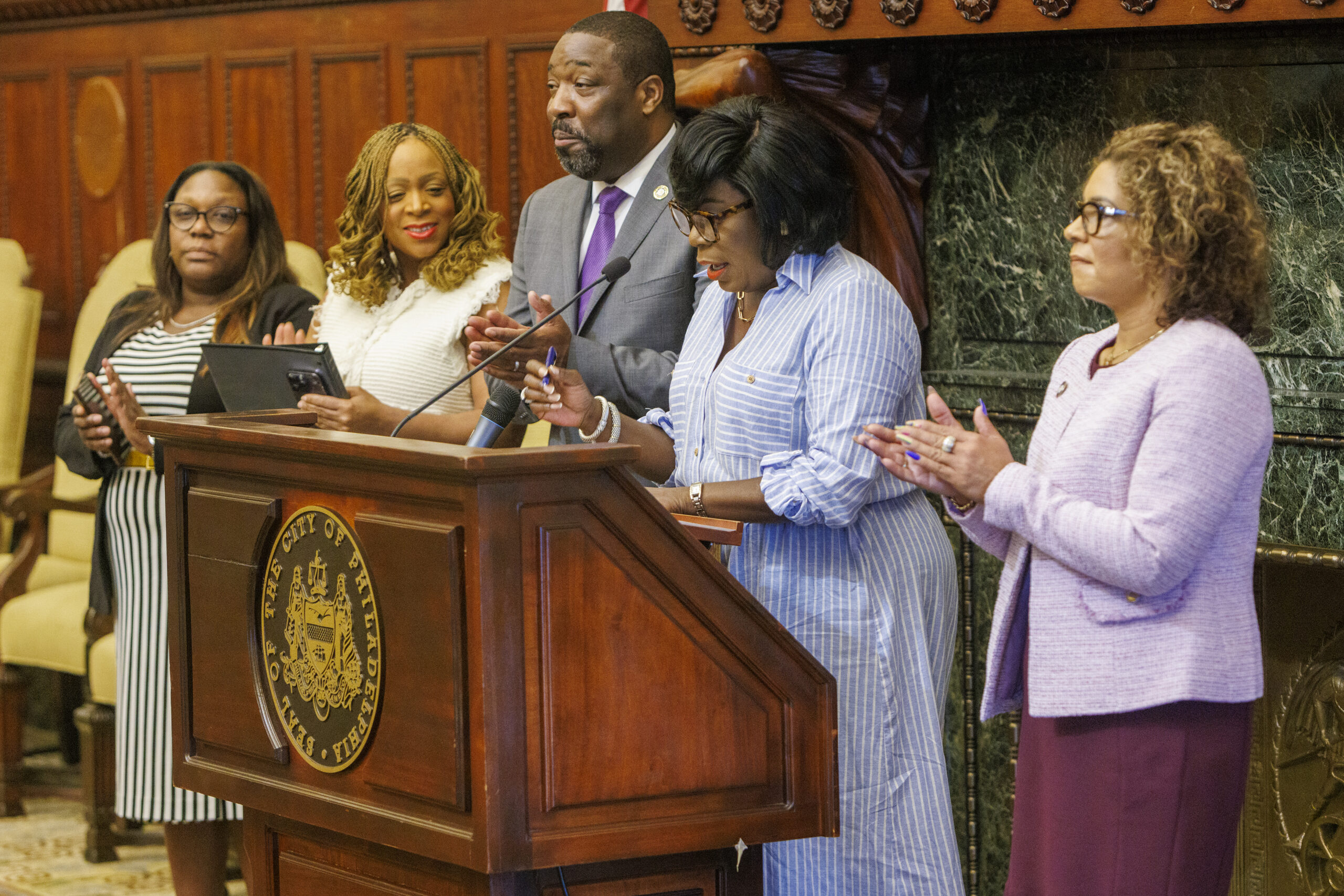
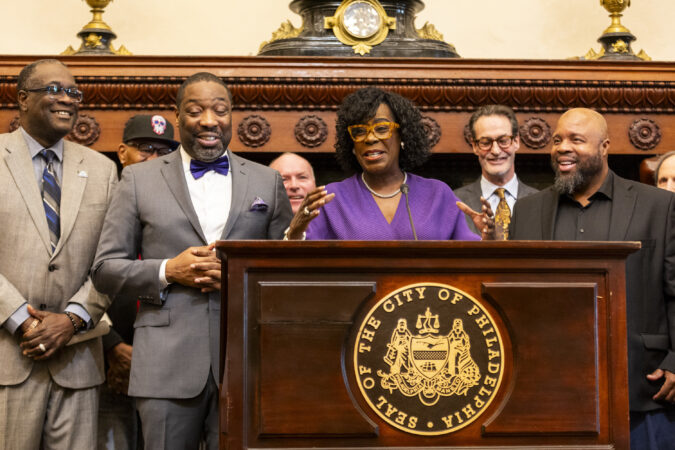
    Philadelphia Mayor Cherelle Parker holds a press conference regarding her first budget flanked by members of city council in her reception room, Philadelphia City Hall on Thursday, June 6, 2024. Council members from left are Kendra Brooks, Jamie Gauthier, council president Kenyatta Johnson, and Quetcy Lozada.

    State Rep. Rick Krajewski, a West Philadelphia Democrat and a progressive who has worked closely with Gauthier, said the fight over H.O.M.E. showed that Gauthier has learned “the diplomacy required to be an effective legislator.”

    “It was a good example of not being afraid of a conflict that felt important to stand up for,” he said, “but then to not just be a lone actor, but organize with other colleagues and allies.”

    Gauthier’s most important ally was Johnson, who negotiated directly with Parker through the process and controls the flow of legislation in the chamber.

    The two go back years. Before Johnson was Council president, he made a point of welcoming new members, a gesture that has always stuck with Gauthier. They worked closely to secure funding for gun violence prevention. And Gauthier said that since Johnson took the gavel, he has been more open to working with progressives than his predecessor was.

    She was also key to Johnson’s ascent. When he was locked in a tight battle for the Council presidency, it was Gauthier who became the ninth Council member to commit to voting for Johnson, allowing him to secure a majority of members and the presidency.

    He does not talk about that publicly. What he will say is that he works in partnership with Gauthier because she understands “the bigger picture in terms of how we move forward as the institution.”

    “I consider her to be a pragmatic idealist,” Johnson said. “She wears her heart on her sleeve, and she really believes in actually doing the work.”

    Creating a testing ground in West Philly

    When Gauthier first ran for office in 2019 against a member of one of Philadelphia’s most entrenched political families, she ran as a good-government urbanist. She railed against councilmanic prerogative, the city’s long tradition of allowing district Council members final say over land-use decisions in their areas.

    She was also supported by real estate interests, some of whom now have buyer’s remorse.

    After Gauthier pulled off a shock win, she arrived in Council and quickly aligned with the progressive bloc. Through her first two terms, she has used councilmanic prerogative often, and has voted with her district Council colleagues so that they can do the same.

    She admits that it is an effective tool for accomplishing her goals quickly.

    Carol Jenkins, a Democratic ward leader in West Philadelphia, said Gauthier’s use of councilmanic prerogative is “part of her maturation.”

    “That’s the power you have,” Jenkins said.

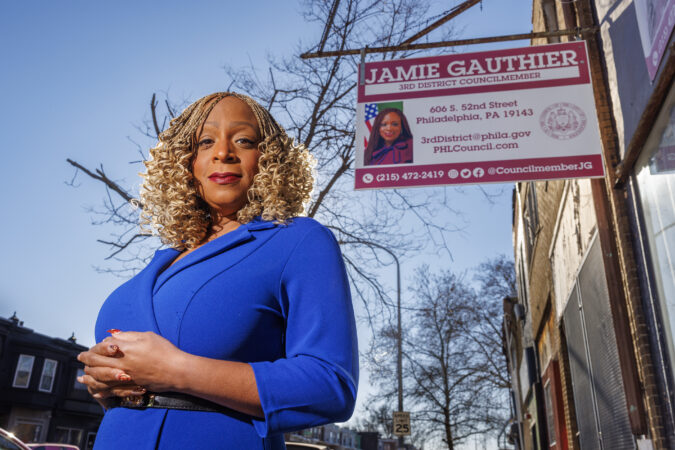
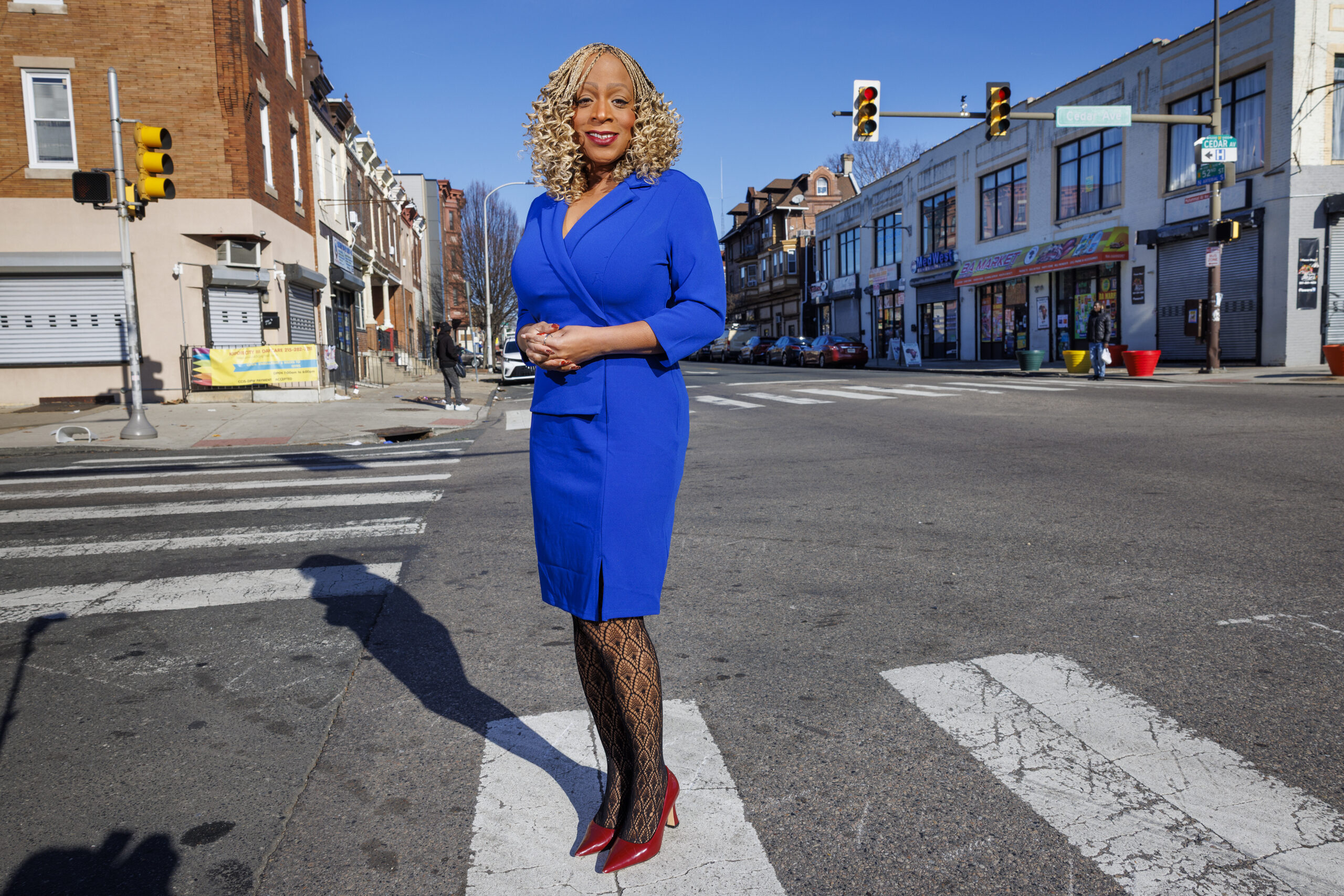
    City Councilmember Jamie Gauthier in her district near 52nd Street and Cedar Avenue in Philadelphia on Monday, Dec. 22, 2025.

    Gauthier has at times used the power in ways that the city’s urbanists and development interests can get behind. She has quickly approved bike lane expansions. And she recently was the only district Council member to allow her entire district to be included in legislation that cuts red tape for restaurants that want to offer outdoor dining.

    However, her most notable use of councilmanic prerogative has been in housing policy, and some developers say her district is now the most hostile to growth in the city.

    In Gauthier’s first term, she championed legislation to create what is known as a Mixed Income Neighborhood overlay. In essence, it requires that developers building projects with 10 or more units in certain parts of her district make at least 20% of their units affordable. That is defined as accessible for rental households earning up to 40% of the area median income.

    For Gauthier, it’s a tool to slow the rapid gentrification of her majority-Black district.

    But developers say that growth has slowed significantly in the areas covered by the overlay since it took effect in 2022. Some have said they avoid seeking to build in the 3rd District entirely. The only major project currently in the works in the area is a parking garage.

    Ryan Spak, an affordable housing developer who said he considers Gauthier a friend, has been among the most outspoken critics of the overlay. He said while Gauthier’s “moral compass is pointed in the right direction, her policies don’t math.”

    “You would never ask a restaurant to give away its ninth and 10th meal for 40 cents on the dollar, with no additional discounts or benefits,” he said, “and expect that restaurant to survive.”

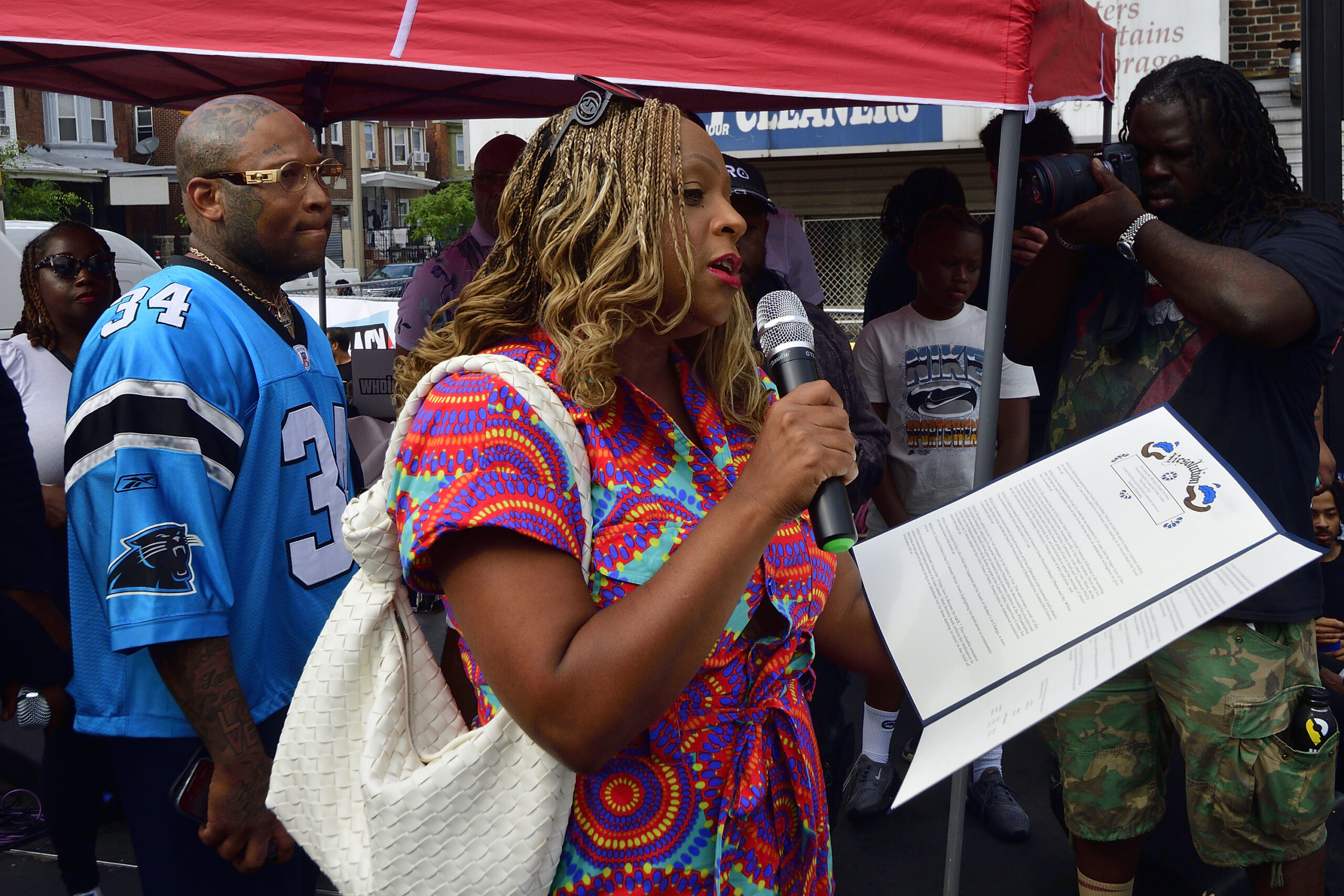
    Councilmember Jamie Gauthier reads out a citation honoring Rapper Mont Brown during a street naming ceremony for the Southwest Philadelphia native at the 13th Annual Stop the Violence Kickback Block Party at 55th Street and Chester Avenue, in Southwest Philadelphia on August 17, 2024.

    Gauthier said she has made adjustments, and she championed legislation to accelerate permitting and zoning approvals. The mandate, she said, is necessary because the market won’t build enough affordable housing on its own.

    “As untenable as it is to them that they can’t make the numbers work, it’s untenable to me that people can’t afford to live here,” Gauthier said. “So we can come together and we can fix that. But I’m not going to move from my position that we have to demand affordability.”

    Mayoral buzz, but no ‘stupid campaigns’

    Gauthier is one of several names that have been floated in political circles as potential candidates for mayor in 2031, which would be Parker’s final year in office if she runs for and wins a second term. Several of her Council colleagues, including Johnson, are seen as potential contenders.

    “I’d be lying if I didn’t say that mayor could be interesting one day,” Gauthier said. “I also don’t believe in stupid campaigns. So I would never do that if I didn’t think I had a path.”

    Boyer said he has counseled Gauthier to pursue moderate policy and avoid being “label-cast” as far left. He said Philadelphia is not Chicago or New York, and he doesn’t see the city electing an uber-progressive to be the mayor any time soon.

    “Philadelphia has always been a real center-left community,” Boyer said, “and just because you’re the loudest isn’t the most popular.”

    The left may have other plans. Robert Saleem Holbrook, a progressive activist, said that Gauthier would be an “ideal candidate” for higher office and that the city’s leftists would back her.

    Probably.

    “So long as she stays true and supportive of progressive ideals,” Holbrook said. “You can’t compromise on your way up.”

  • Mayor Cherelle Parker’s housing plan is back on track after Council again reapproved $800 million in city bonds

    Mayor Cherelle Parker’s housing plan is back on track after Council again reapproved $800 million in city bonds

    Mayor Cherelle L. Parker’s housing initiative is back on track.

    In its first meeting of the year, City Council on Thursday reapproved a bill to authorize the administration to issue $800 million in bonds to fund the Housing Opportunities Made Easy, or H.O.M.E., initiative.

    Parker wasted no time, signing the bill into law at a news conference Thursday afternoon to fast-track the process for the city to sell the first $400 million tranche of bonds in late March or early April. The administration plans to sell the second $400 million in 2027.

    “We are signing into law the largest and most significant investment in housing in the city of Philadelphia’s history, a $2 billion plan that will create and preserve 30,000 units of housing here in the city of Philadelphia,” Parker said, citing a sum for H.O.M.E.’s budget that also includes other funding steams and the value of city-owned land the administration hopes to redevelop into housing through the plan.

    In March 2025, when Parker unveiled her housing plan — with the goal of helping the city build or preserve 30,000 units of housing in her first term — she wanted to issue the bonds that fall. Council initially approved the bond authorization and other legislation related to H.O.M.E. in June.

    But in the fall, lawmakers made significant changes to a related piece of legislation — which details the $277 million first-year budget for spending the bond proceeds — that triggered a redo of the bond bill.

    The most notable changes, championed by progressive Councilmembers Jamie Gauthier and Rue Landau, lowered the income thresholds for some of the programs funded by H.O.M.E. to prioritize lower-income Philadelphians.

    Mayor Cherelle L. Parker unveils her long-awaited plan to build or preserve 30,000 units of housing during a special session of City Council Monday, Mar. 24, 2025. Council President Kenyatta Johnson is at left.

    Parker opposed the amendment, and administration officials testified that H.O.M.E. was meant to serve residents at a variety of income levels, including middle-class households that are struggling but often make too much to qualify for government support programs.

    But Council members argued that even with the new infusion of funds, Philadelphia’s resources are too limited to help the city’s hundreds of thousands of impoverished residents — let alone aid middle-income residents as well.

    “City Council demonstrated through its actions — not just its words — that it’s serious about putting City Hall to work for communities that have too often been left behind,” Gauthier, Landau, and their allies said in a group statement Thursday.

    The dispute proved to be the most significant public disagreement to date between Parker and Council President Kenyatta Johnson, who sided with Gauthier and Landau.

    The changes required Council to pass an updated bond authorization before moving forward because the previously adopted version no longer aligned with the language in the budget resolution. Lawmakers ran out of time to pass the new bond bill before adjourning for their winter break in December.

    They approved it unanimously on Thursday.

    A couple of hours later, Johnson and Parker profusely praised each other at the bill-signing ceremony, going out of their way to show that their strong working relationship remains intact now that the conflict was behind them.

    “My commitment is to make sure that our 100th, first woman, mayor is successful,” Johnson said.

    The moment of congeniality was a stark contrast to the dynamic between the two late last year.

    Parker at one point said Council’s delay “means homes are not being restored” and “homes are not being built or repaired.” Johnson fired back, “Council’s responsibility is not to rubber-stamp legislation.”

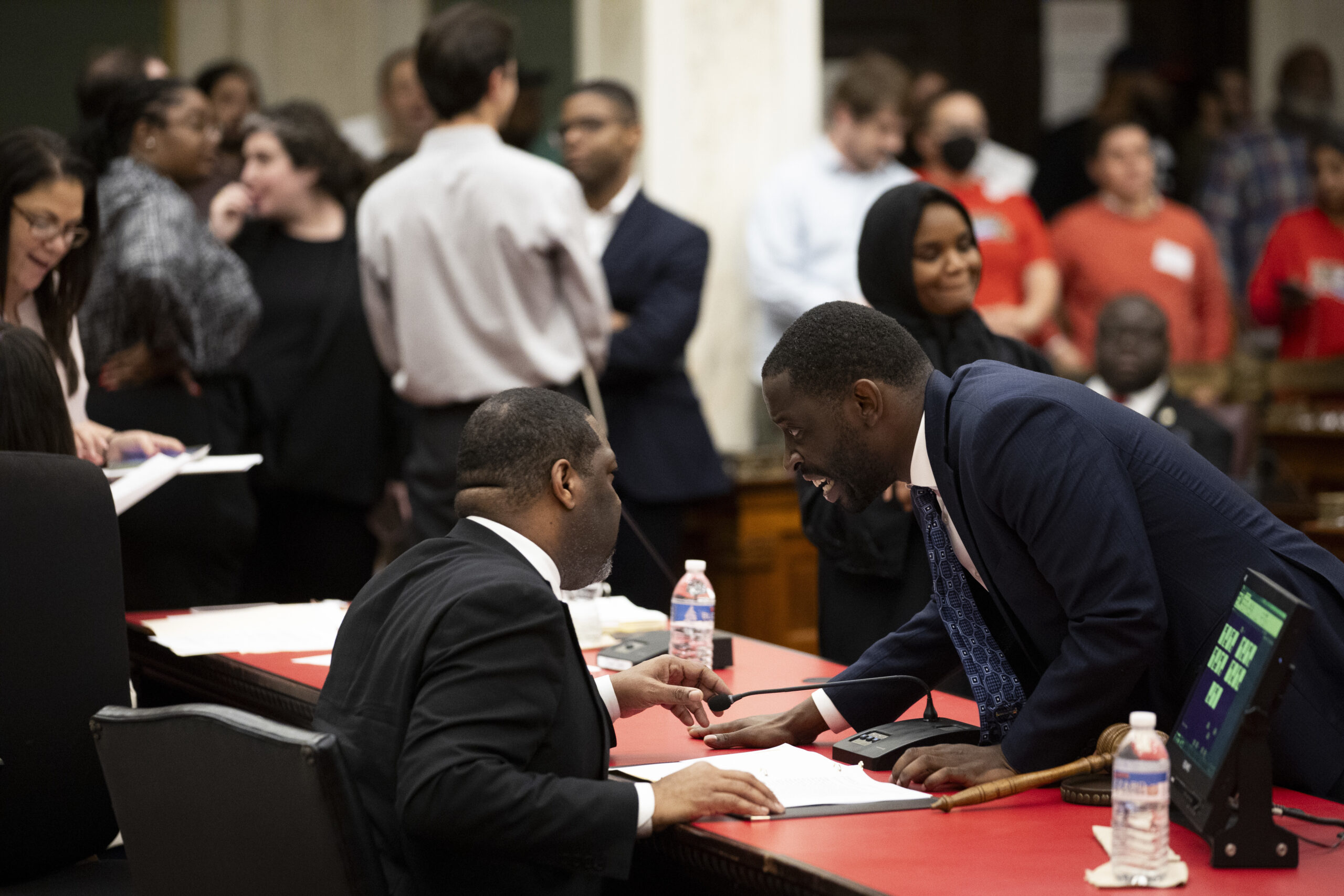
    City Council President Kenyatta Johnson speaking at the City Council’s first session of the year in Philadelphia, Pa., on Thursday, Jan. 22, 2026.

    But on Thursday, there was enough feel-good energy between the mayor and Council that it extended beyond Johnson to members who have more frequently clashed with the administration.

    Gauthier and Councilmember Isaiah Thomas, who questioned the mayor’s agenda last year over concerns that she was taking out too much debt for housing, also stood alongside the mayor at Thursday’s news conference.

    After the delays to her agenda at the end of last year, the mayor appears to be trying to regain control of the narrative this week. Thursday’s bill-signing ceremony marked Parker’s third major update related to H.O.M.E. in three days.

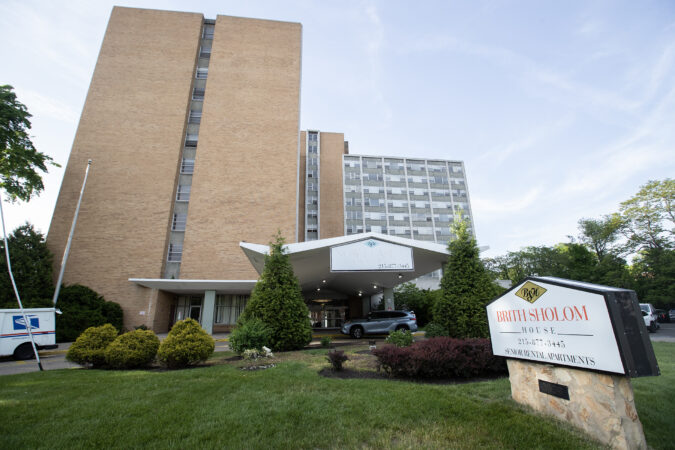
    On Tuesday, she announced that her administration was partnering with the city’s building trades unions and the Philadelphia Housing Authority to redevelop the Brith Sholom House, a notoriously dilapidated senior facility that closed in 2024, into affordable housing for seniors.

    And on Wednesday, she laid out a vision to build a modular housing manufacturing facility on the long-vacant Logan Triangle tract in North Philadelphia. The city issued a request for information from developers potentially interested in building such factories in the city, with a deadline in late March.

    Parker on Thursday only indirectly responded to a question about how many units could be built or repaired in the two years left in her term.

    But she said that her administration is working on a second package of zoning legislation to accelerate home construction in Philadelphia, and that she is working with Council to speed 1,000 properties through the land bank.

    She also expects Gov. Josh Shapiro, at his forthcoming budget address, to announce state-level housing reforms that would help “as it relates to streamlining state processes [to] run more efficiently.”

    Staff writer Anna Orso contributed to this article.

  • Philly bill to ban waste incineration gets put on hold after failing to gain Council support

    Philly bill to ban waste incineration gets put on hold after failing to gain Council support

    A high-profile bill to ban Philadelphia from incinerating its trash was put on hold Thursday after intense lobbying by residents, activists, and industry put its future in doubt.

    The bill’s sponsor, Councilmember Jamie Gauthier, made a last-minute decision to pull the measure, which would prevent the city from shipping its trash to be burned for energy at the Reworld Delaware Valley Resource Recovery Facility in Chester.

    “I made the difficult decision to hold the bill today because my colleagues have asked for more time with it,” Gauthier said, noting she had not given up on the bill.

    Gauthier said the bill would prevent “dumping on cities that are more vulnerable than us.”

    “This would never happen in a community that wasn’t populated mainly by Black people, and mainly by poor Black people,” she said of Chester. “The people that are lobbying otherwise — they know that they would never accept this where they live.”

    The move to hold the bill came after hours of public testimony by people speaking for and against it.

    However, almost all of those speaking against the bill either work for Reworld, the Chester waste-to-energy plant, or represent labor unions. Reworld employees could be seen lobbying Council members in the hallways.

    File: Philadelphia Councilmember Jamie Gauthier.

    What’s in the bill?

    Gauthier’s “Stop Trashing Our Air Act” would prohibit the city from contracting with companies that incinerate solid waste or recyclables. Gauthier said that 37% of the city’s trash is incinerated.

    The bill, she has said, is designed to combat environmental injustice, contending incineration has been particularly harmful to the Chester area.

    Chester Mayor Stefan Roots and local activists expressed support for the legislation on Thursday, citing health and environmental concerns.

    “I’m asking you and begging you,” Roots said in asking Council to vote in favor of the bill. “We’re counting on all of you to support it.”

    Chester resident Zulene Mayfield, left, Philadelphia Councilmember Jamie Gauthier, right, and Chester Mayor Stefan Roots meet to discuss Gauthier’s “Stop Trashing Our Air Act,” which would ban the city from incinerating waste, during a visit with lawmakers and staff in Chester, Pa., on Friday, Nov. 7, 2025.

    Roots said the Reworld plant burns more trash than all of Delaware County produces.

    Multiple Chester and Philly residents say the emissions from Reworld either caused or exacerbated asthma and other health conditions.

    Andrea Robinson moved to Chester three years ago, she testified to Council. But she was unaware of the Reworld facility when she moved there.

    “I walk out my door and smell the stinky odor. I’m embarrassed to invite family and friends over. There are dust and dirt all over the car and windows,” she said.

    Fierce lobbying

    Gauthier’s bill ran up against a fierce effort to prevent its passage.

    Alex Piscitelli, facility manager at Reworld, testified that the plant operates under “the strict requirements of the Clean Air Act.”

    He said claims that the facility causes human health issues “are simply not supported by the data” and emissions “operate well below federal limits.”

    Multiple representatives of the company spoke, including workers who lived in Chester and Philadelphia.

    Ramona Jones, who lives in Chester and works at Reworld, said the job allows her to be close to her children and family. She said the company has given her ”a livable wage, a higher wage.”

    Matt Toomey, a business agent for the operating engineers union, told Council that “up to 120 family-sustaining jobs” were at stake, and noted the Reworld plant is heavily regulated and located in an already industrialized area.

    Political reality

    Aides for Mayor Cherelle L. Parker, whose administration opposes the legislation, also worked the room.

    Council members hardly ever call for votes on doomed bills. But Gauthier initially appeared to be willing to roll the dice by calling the measure up for a vote despite its uncertain fate.

    As the morning progressed, however, it became clear she did not have the nine votes needed for passage and almost certainly did not have the 12 votes that would be needed to overcome a likely veto by Parker.

    Insisting on the vote would mean that Gauthier was putting colleagues in the uncomfortable position of choosing between environmental advocates and trade unions, two important constituencies in Democratic primaries.

    But Gauthier pledged to push for the bill.

    “I am committed to this,” she said. “At the City of Philadelphia, we have to be a model for brotherly love, sisterly affection.”

  • What we know and what we don’t know about Philly school closings

    What we know and what we don’t know about Philly school closings

    Details of Philadelphia’s long-awaited facilities master plan are finally out, with proposed changes that include 20 closures, six co-locations, one new school building and other investments.

    Superintendent Tony B. Watlington Sr. has said he would share specifics of his facilities master plan at a school board meeting in February.

    Here’s what we know so far:

    What’s happening to the district’s buildings?

    Of the district’s 307 buildings, most schools — 159 in total — would be modernized under the proposed plan. The district pointed to Frankford High, which closed for two years because of asbestos issues and just reopened in the fall with $30 million worth of work to spruce it up, as an example of modernization.

    An additional 122 schools would fall into a “maintain” category, meaning they would receive regular upkeep. And six facilities would be co-located, meaning two separate schools would be housed under one roof, each with its own principal and team.

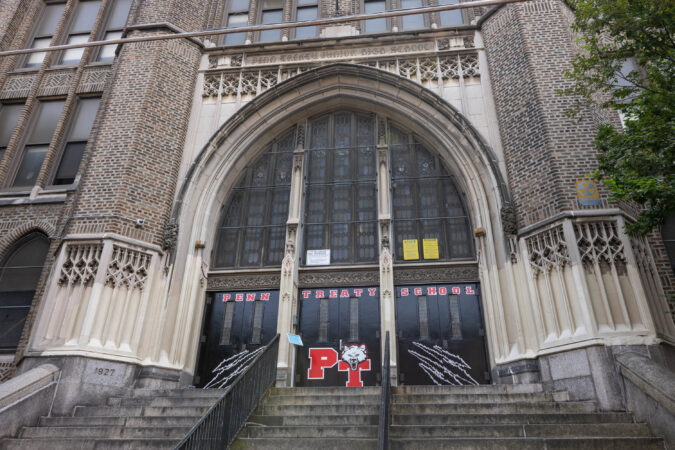
    Finally, 20 schools would be recommended for closure. Among them is Penn Treaty, now a 6-12 school, which would close in its current form, but go on to house the current Bodine High School, a magnet in Northern Liberties. Bodine’s building would become the home of Constitution High, which now occupies a rented space in Center City.

    As proposed, Watlington’s plan would cost $2.8 billion over 10 years. The district would put up $1 billion via capital borrowing during that time — leaving $1.8 billion unaccounted for that the superintendent said would need to be covered by state money or philanthropic support. If the district doesn’t get all or some of that amount, the plan would have to be amended.

    Will some schools definitely close? Which ones?

    Right now, the closures are just a proposal, and the school board is slated to have the final say at a vote this winter. They could adopt all, some, or none of Watlington’s recommendations.

    If the closures are approved, no school would be shuttered before the 2027-28 school year. And should some schools close, no job losses are expected, Watlington said.

    Of the 20 facilities targeted for closure, 12 would be repurposed for district use. Eight would be given to the city for affordable workforce housing, or job creation, both priorities of Mayor Cherelle L. Parker.

    We don’t have the full list of proposed modernizations yet, so it’s tough to say the proposed fate of every school.

    What will happen to students who attend closing schools?

    Every affected student would be routed to a new school. A new transition office would work closely with impacted communities to make sure academics, attendance, and social-emotional needs don’t suffer, Watlington said.

    “These families will get gold-standard, red-carpet treatment directly from the superintendent’s office,” he pledged.

    Why are these changes necessary?

    The district hasn’t had a facilities master plan in more than a decade. It has 70,000 empty seats citywide, with some schools overcrowded and others with entire unused floors. It’s also got a lot of aging buildings — the average district school is nearly 75 years old — and many have environmental and/or significant systems issues.

    Officials said they want to solve district-wide disparities: Some schools have art, music, and ample space for physical education, plus extracurricular activities, and some have few of those things.

    How were school buildings’ fates determined?

    Watlington said there was no formula to determine his recommendations. But four factors entered into the decision: building condition, utilization, the school’s ability to offer robust programming, and neighborhood vulnerability — a new measure that considers things like poverty and whether the area has lived through prior school closings.

    The district formally launched the final phase of its facilities master planning process in late 2024. Since then, officials have hosted 47 community conversations and received 13,700 survey responses from people in every zip code in the city. Officials heard from a project team of 30 members and received feedback from nine advisory groups composed of more than 170 members.

    However, some of those members, and others, are skeptical of the process, saying they feel like their input was performative. In the fall, a grassroots coalition urged the district to pause the process, focus more on investments, and promise no closures.

    Officials said more community conversations would be scheduled for February. They’re also accepting input via the facilities planning process website.

    How long did it take officials to get to this point?

    The draft plan has been years in the making, and comes following a previous attempt to make one that ended before it went anywhere.

    Watlington launched this final phase of the planning process in the fall of 2024. Decisions were originally promised by the end of 2025, but that was pushed off when officials said they needed more time to gather feedback.

    The district later launched surveys to gain more input, with the topline result being that Philadelphians didn’t want their local schools closed. Many respondents outlined fears about potential hardships that closing schools could create, such as longer walks to school or tough bus rides in unfamiliar or unsafe areas.

    And they flagged worries about merging schools and having large grade spans in a single building.

    When did the district last close schools?

    Mass school closures last happened in 2012 and 2013, when 30 schools shut.

    That process hit economically disadvantaged neighborhoods disproportionately, did not yield substantial savings, and generally led to worse academic outcomes and attendance for students.

    The mistakes of 2012 informed this go-round, officials said. They have promised better services for schools, students and families affected by any coming transitions.

  • ICE, housing, and ‘resign to run’: What’s on Philadelphia City Council’s 2026 agenda

    ICE, housing, and ‘resign to run’: What’s on Philadelphia City Council’s 2026 agenda

    Philadelphia City Council’s first meeting of 2026 on Thursday comes as tensions rise over President Donald Trump’s immigration crackdown and as Mayor Cherelle L. Parker continues to sidestep that conversation while focusing on advancing her signature housing initiative.

    During the first half of the year, city lawmakers are expected to have a hand both in shaping the city’s response to Trump and in advancing Parker’s Housing Opportunities Made Easy, or H.O.M.E., initiative.

    They will also tackle the city’s waste-disposal practices, a long-standing law requiring Council members to resign before campaigning for higher office, and the city budget.

    Meanwhile, events largely outside Council’s control, including potential school closings and Philly’s role in the nation’s 250th birthday, are also expected to prompt responses from lawmakers.

    Here’s what you need to know about Council’s 2026 agenda.

    ‘Stop Trashing Our Air’ bill up for vote

    The first meeting of a new Council session rarely features high-profile votes, but this year could be different.

    Council on Thursday is expected to take up a bill by Councilmember Jamie Gauthier that would ban Philadelphia from incinerating its trash.

    Currently, the city government sends about a third of the trash it collects to the Reworld trash incinerator in Chester, with the rest going to landfills. Those waste-disposal contracts expire June 30, and Gauthier is hoping to take incineration off the table when new deals are reached.

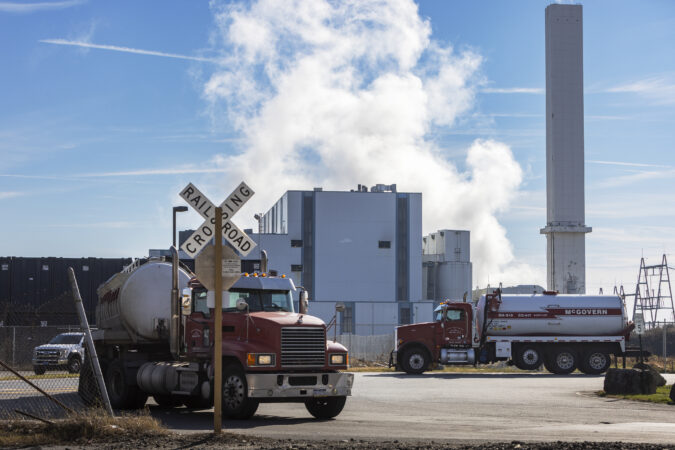
    The Reworld incinerator in Chester, Pa., on Friday, Nov. 7, 2025.

    “Burning Philadelphia’s trash is making Chester, Philadelphia, and other communities around our region sick,” Gauthier has said, pointing to elevated rates of asthma and other ailments and a legacy of “environmental racism” in Chester. The low-income and majority-Black city downriver from Philly has been home to numerous heavy industrial facilities.

    Reworld has said its waste-to-energy facility, which produces some electricity from burning trash, is a “more sustainable alternative to landfilling.”

    At a hearing last year, Parker administration officials said the city is including language in its request for proposals for the next contracts that will allow the city to consider environmental impacts. But they asked lawmakers not to vote for a blanket ban on incineration to allow the city to study the issue further.

    Parker waiting for Council to reapprove $800 million in bonds for her H.O.M.E. plan

    The biggest agenda item left hanging last month when lawmakers adjourned for the winter break was a bill to authorize the Parker administration to issue $800 million in city bonds to fund her H.O.M.E. initiative.

    Parker had hoped to sell the bonds last fall, and Council in June initially authorized the administration to take out new debt. But lawmakers made significant changes to the initiative’s first-year budget, especially by lowering income thresholds for some programs funded by the H.O.M.E. bonds to prioritize the lowest-income residents.

    Mayor Cherelle L. Parker speaks to the crowd at The Church of Christian Compassion in the Cobbs Creek neighborhood of West Philadelphia on Sunday, Dec. 7, 2025. Parker visited 10 churches in Philadelphia on Sunday to share details about her H.O.M.E. housing plan.

    That move, which Parker opposed and which sparked Council’s most significant clash with her administration to date, required a redo of the bond authorization. Lawmakers ran out of time to approve a new version of the measure in December, but Council President Kenyatta Johnson said it could come up for a final vote Thursday.

    “Council members have always been supportive of the H.O.M.E. initiative,” Johnson said. “H.O.M.E. advances City Council’s goals to expand access to affordable homeownership for Philadelphians … and to ensure that city housing investments deliver long-term benefits for families and neighborhoods alike.”

    Council aims to limit ‘resign to run’ … again

    Council is also expected to vote this spring on legislation that would change Philadelphia’s 74-year-old “resign to run” law and allow city officeholders to keep their jobs while campaigning for other offices.

    Currently, Council members and other city employees are required to quit their jobs to run for higher office. Lawmakers have tried several times over the last 20 years to repeal the law, but they have been unsuccessful. Changing the rule requires amending the city’s Home Rule Charter, which a majority of voters would have to approve through a ballot question.

    Council President Kenyatta Johnson talks with Councilmember Isaiah Thomas at City Hall on Wednesday, Dec. 11, 2024 in Philadelphia.

    The latest attempt, spearheaded by Councilmember Isaiah Thomas, would not entirely repeal the resign-to-run law, but instead would narrow it to allow elected officials to keep their seats only if they are seeking state or federal office, such as in Congress or the state General Assembly. Council members who want to run for mayor would still have to resign.

    Thomas, a Democrat who represents the city at-large and is rumored to have ambitions of running for higher office, plans to make minor amendments to the legislation this spring, a spokesperson said, before calling it up for a final vote. The goal, Thomas has said, is to pass the legislation in time for a question to appear on the May primary election ballot.

    Incoming clash over immigration?

    Parker has spent the last year avoiding direct confrontation with the Trump administration, a strategy that supporters say has helped keep Philadelphia out of the president’s crosshairs.

    The mayor, however, cannot control what other local elected officials say about national politics, and Trump’s immigration crackdown appears to be stirring stronger local reaction heading into his second year in office.

    After an Immigration and Customs Enforcement agent fatally shot Renee Good in Minneapolis this month, Sheriff Rochelle Bilal went viral for saying federal agents “will not be able to hide” in Philly. (Bilal, however, does not control the Philadelphia Police Department, which is under Parker’s purview.)

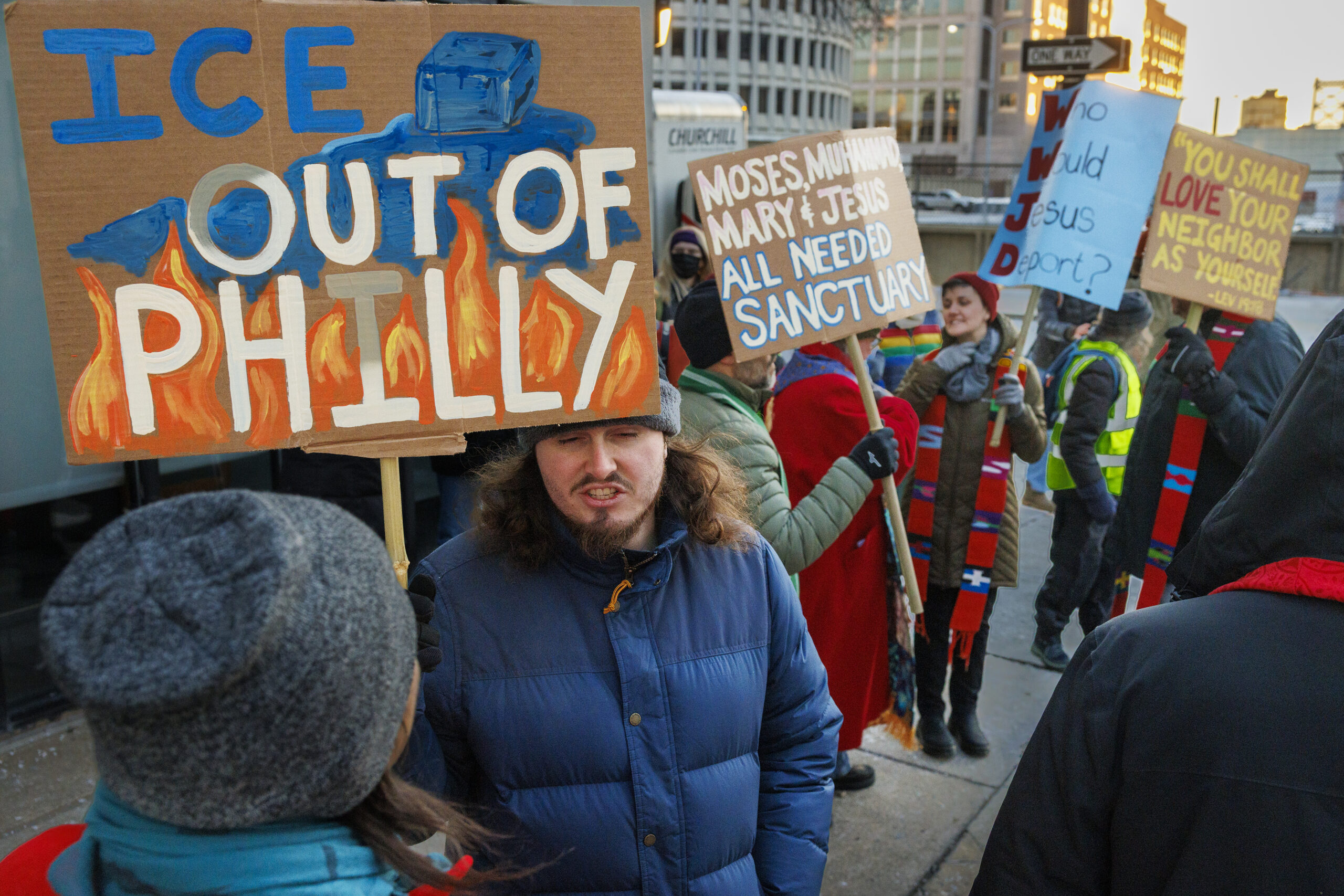
    Meanwhile, progressive Councilmembers Rue Landau and Kendra Brooks this year are expected to introduce legislation aimed at constricting ICE operations in Philadelphia.

    Demonstrators from No ICE Philly gathered to protests outside the U.S. Immigration and Customs Enforcement, office at 8th and Cherry Street, Philadelphia, Tuesday, Jan. 20, 2026.

    It is not yet clear what the lawmakers will propose. But Brooks, who has called on Parker to take a firmer stand against Trump, recently criticized the Philadelphia courts for allowing agents to seize suspects leaving the Criminal Justice Center. She said officials who in her view have failed to stand up to ICE are engaged in “complicity disguised as strategic silence,” and she vowed to force those who “cooperate with ICE in any way” to testify in Council.

    “Cities across the country are stepping up and looking at every available option they have to get ICE out,” Brooks said at a news conference earlier this month. “In the coming days, you will hear about what my office is doing about city policy. These demands must be met or face the consequences in Council.”

    Landau added Philly cannot allow “some masked, unnamed hooligans from out of town [to] come in here and attack Philadelphians.”

    “We are saying, ‘ICE out of Philadelphia,’” she said.

    Parker has said her administration has made no changes to the city’s immigrant-friendly policies, but she continues to be tight-lipped about the issue.

    The Pennsylvania Office of Open Records last week ruled in favor of an Inquirer appeal seeking to force Parker’s administration to disclose a September letter it sent the U.S. Department of Justice regarding local policies related to immigration.

    The administration still has not released the document. It has three more weeks to respond or appeal the decision in court.

    South Philly arena proposal still in the works

    After the 76ers abandoned their plan to build a new arena in Center City a year ago, the team announced it would partner with Comcast Spectacor, which owns the Flyers, to build a new home for both teams in the South Philadelphia stadium complex.

    The teams announced last fall they have selected an architect for the new arena, which is scheduled to replace the Spectacor-owned Xfinity Mobile Arena, formerly the Wells Fargo Center, in 2031.

    If the teams are still planning to open the new arena on their previously announced timeline, legislation to green-light the project could surface as soon as this spring. But so far, there has been no sign of movement on that front.

    “There is currently no timeline for introducing legislation to build a new Sixers arena in South Philadelphia,” said Johnson, whose 2nd District includes the stadium complex. “At the appropriate time, my legislative team and I will actively collaborate with Mayor Cherelle L. Parker’s administration on drafting any legislation related to the Sixers arena before it is introduced in City Council.”

    School closings and 2026 celebrations also on the horizon

    In addition to its legislative agenda, Council this year will likely be drawn into discussions over school closings and the high-profile gatherings expected to bring international attention to Philly this summer.

    The Philadelphia School District is soon expected to release its much-anticipated facilities plan, including which school buildings are proposed for closure, consolidation, or disposition. The always-controversial process is sure to generate buzz in Council.

    “We will do our due diligence on the District’s Facilities Plan,” Johnson said in a statement.

    Additionally, the city is preparing for the nation’s Semiquincentennial, FIFA World Cup games, and the MLB All-Star Game. While the administration is largely responsible for managing those events, some Council members have said ensuring the city is prepared for them is a major priority.

    Johnson said his agenda includes “making sure Philadelphia has a very successful celebration of America’s 250th Birthday that results in short and long-term benefits for Philadelphia.”

    Staff writers Jake Blumgart, Jeff Gammage, and Kristen A. Graham contributed to this article.

  • Man found dead in shuttered senior housing complex was electrocuted, authorities say

    Man found dead in shuttered senior housing complex was electrocuted, authorities say

    A man died after being electrocuted inside a dilapidated West Philadelphia senior housing complex Wednesday morning, authorities say.

    The discovery came a day after city officials touted a $50 million investment into the vacant property, the Brith Sholom House,which is owned by the Philadelphia Housing Authority and has been shuttered since August 2025.

    The man’s body was found around 5:45 a.m. after police were called to the property, located on the 3900 block of Conshohocken Avenue.

    The man, whom police did not identity, was pronounced dead at the scene at 6:40 a.m.

    Kelvin A. Jeremiah, president and CEO of the Philadelphia Housing Authority, said the complex’s doors and windows on the lower floors have been sealed since tenants left the property, though there have been several instances in which individuals managed to enter in an attempt to steal copper wiring from within the structure.

    Early Wednesday morning, a 911 call was placed from Brith Sholom by a man who told police that a contractor had gotten hurt on the job and needed assistance, Jeremiah said.

    But Jeremiah said the housing authority had not authorized any such work, and no one was permitted on the property at the time.

    The housing authority later learned that the man was electrocuted and died after he tried to strip copper wire from the complex’s basement. The body was found next to the switch gears, Jeremiah said.

    The CEO suspects the person who called 911 was an accomplice in the break-in, though police are still investigating.

    The housing authority’s security cameras were not active during the incident because much of the building’s power is off, and other cameras have been destroyed by bad actors, according to Jeremiah.

    He said the individuals might have used a ladder to enter the complex through the third floor.

    Just a day earlier, Brith Sholom received a much different sort of attention.

    On Tuesday, Mayor Cherelle L. Parker announced that the city’s powerful building trades unions would offer PHA a sizable loan to redevelop the complex, which the housing authority purchased from its former owners in 2024 in order to preserve it.

    Prior to the sale, tenants had complained of rampant neglect and repeated code violations, including deteriorating infrastructure, threats of utility shutoffs, squatters, and severe pest infestations.

    After PHA acquired the property, it initially told its 111 residents they could remain in their units. But upon discovering some units were damaged beyond repair, officials told those residents they would need to move out and return at a later date.

    The Brith Sholom project, when completed, is expected to add 336 affordable units for seniors on fixed incomes, Parker said in her announcement Tuesday.

    The mayor cast the complex’s revival as a first-of-its-kind approach to expanding the city’s affordable housing stock, one that would help her administration reach its goal of building, redeveloping, or preserving 30,000 units.