Nemours Children’s Hospital is launching a new maternal and fetal health program designed to help families with complex fetal diagnoses get specialized care closer to home.
The Institute for Maternal Fetal Health will begin treating patients at Nemours’ flagship hospital in Wilmington in early 2026. The institute’s goal is to provide advanced care for mothers and babies with potentially life-threatening diagnoses, such as congenital heart disease, metabolic disorders, and genetic defects. They may otherwise have had to travel to farther-away hospitals in Philadelphia, Baltimore, Pittsburgh, or New York.
The institute will provide in utero surgery — procedures that are done on a fetus before birth to correct certain debilitating birth defects, such as spina bifida, which is when the spinal column does not completely close and leaves the spinal cord exposed.
It will also offer more education and resources for other family members, especially other children, to help them cope with a fetal diagnosis.
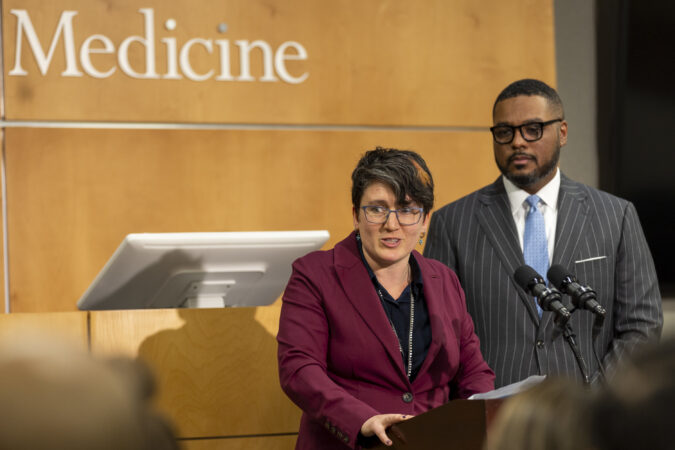
“Our biggest impetus is to help families stay closer to home,” said Julie S. Moldenhauer, a maternal-fetal medicine specialist and the institute’s inaugural executive director.
Julie S. Moldenhauer, a maternal-fetal medicine specialist and fetal interventionalist, is the inaugural executive director of the Institute for Maternal Fetal Health.
Advanced prenatal care at Nemours
The new maternal fetal health institute builds on Nemours growth in the area. The Delaware-based nonprofit health system in 2024 took over pediatric offices previously operated by Crozer Health, which closed under bankruptcy earlier this year.
At its Wilmington hospital, Nemours is adding three new dedicated operating rooms for C-sections, complex deliveries, and fetal surgeries.
The institute will also include more patient rooms and neonatal stabilization rooms for babies who need extra support after birth.
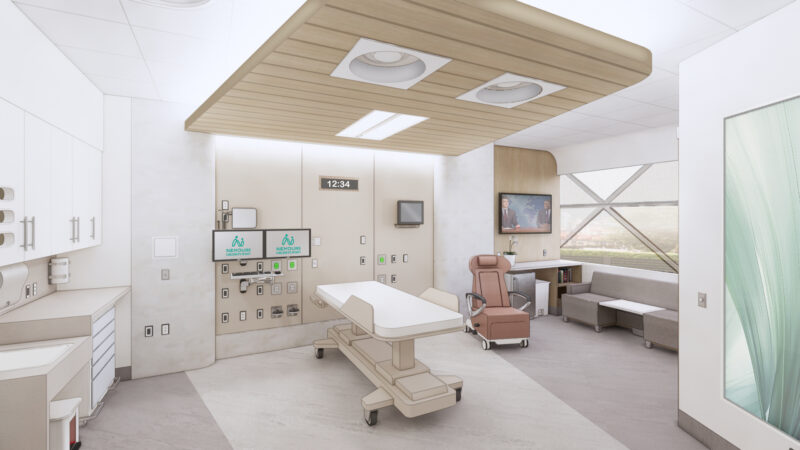
A new wellness room will serve as a place for families to gather for a meal, play time, art therapy, or yoga.
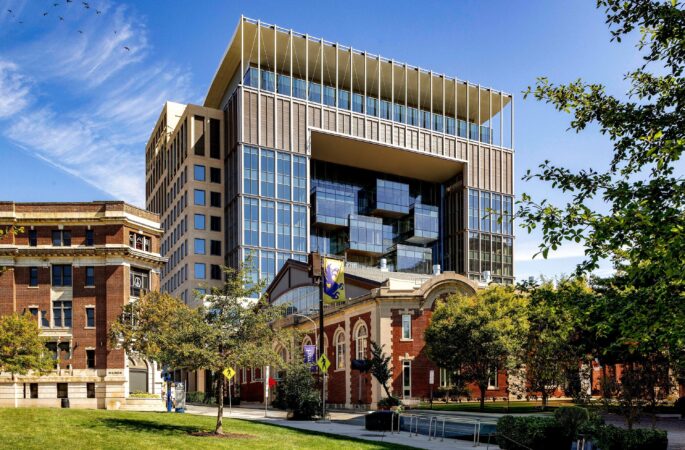
A rendering of a shared patient space planned for the Institute for Maternal Fetal Health at Nemours Children’s Hospital in Wilmington, where families will be able to gather for a meal, play time, or planned activities.
Support for the whole family
For parents, a fetal diagnosis can result in excitement about a new baby being replaced by fear for their child’s health.
What’s more, getting the care they need may involve traveling from home for frequent appointments and procedures. That can be expensive for families who need to take time off work, pay for travel and hotel stays, and find childcare for any siblings remaining home.
“All those hopes and dreams can feel like they’re a candle being blown out,” Moldenhauer said. “Building a beautiful nursery becomes — how are we going to get back and forth to all these appointments?”
When families have to travel for advanced prenatal care, siblings who remain at home may feel left out or scared about whether their parents and the baby will be all right.
At its new institute, Nemours will offer support groups for grandparents, and education for siblings to demystify the medical process.
Psychologists can help couples who are struggling with their relationship during a complex pregnancy, or talk to children who are showing signs of being affected by their parents’ stress.
“Until you see your child with all the tubes in a NICU, in an incubator, it doesn’t feel real,” said Moldenhauer. “We want to fortify the whole family.”
A patient with no home to return to was pushed in a wheelchair to the curb outside Temple University Hospital. Staffers left him sitting on a bench, even though he was considered at a high risk of falling.
An hour later, a security officer found the man had fallen and was lying on the ground.
He was shaking when the guard brought him back into the hospital, but didn’t respond to a nurse’s questions. So hospital staff again sent him away — this time leaving him alone in a wheelchair outside the emergency department.
He was found there five hours later, slumped over, unresponsive, and without a pulse. He died the following week.
Temple’s treatment of the patient during the Oct. 3 incident prompted state and federal investigations. In a report released earlier this month, the Pennsylvania Department of Health cited Temple for violating state rules that require hospitals to provide emergency care.
Experts say the hospital’s actions amounted to “patient dumping,” a practice prohibited under a federal law that requires hospital emergency departments to medically screen and stabilize all patients.
The Centers for Medicare and Medicaid Services (CMS), which oversees hospital safety nationally, confirmed it is also investigating, but has not released details.
Hospitals that violate the Emergency Medical Treatment and Labor Act, known as EMTALA, risk hefty fines or losing their Medicare license, though such penalties are rare.
Temple acknowledged that its own protocols were not followed. Health system officials told state investigators the patient should not have been removed from the hospital without being evaluated and cleared by medical staff.
“The safety of our patients, visitors and staff is Temple’s highest priority,” the hospital said in a statement to The Inquirer. “We believe that everyone deserves high quality care.”
The hospital declined to say whether any of the staff members involved were disciplined or fired.
But such incidents are rarely the fault of one individual, legal experts and homelessness advocates said. Rather, they are a sign of systemic problems, such as understaffing that can leave staff overwhelmed, and bias among medical providers that can put vulnerable patients at risk of being dismissed.
“If you work in an environment where safety is prized and honored and enforced from the top down, everyone feels that’s their mission,” said Eric Weitz, a medical negligence lawyer in Philadelphia. “If that’s not a priority being set by leadership, then it’s no surprise the culture doesn’t reinforce it.”
Hospital administrators said the triage nurse who turned away the patient should have sought help, if the patient wasn’t responding to questions. The nurse said she was overwhelmed and working without sufficient support in one of the region’s busiest trauma hospitals.
“I was busy and alone,” she told state inspectors.
The incident violated Temple’s emergency department protocol, staff told Pennsylvania Department of Health inspectors.
Pa. Department of Health investigates Temple
To piece together what went wrong, Pennsylvania Department of Health inspectors watched security camera footage, interviewed staff members, and reviewed internal hospital reports. Their timeline shows a series of mistakes.
At about 3:15 p.m., an employee brought the patient in a wheelchair to a bench near the curb outside the hospital, and left him there on the mild October day with highs near 70 degrees.
He was being discharged to “the community” because he was experiencing homelessness, according to the inspection report. (The state report does not say whether staff attempted to place him at a skilled nursing facility, rehabilitation center or homeless shelter.)
The man sat alone on the bench for an hour before standing unsteadily, taking a few steps, and ultimately falling to the ground.
He managed to get back up, leaning against a tree for support, only to fall again. He was on the ground for 10 minutes before a security guard found him.
The guard brought the man back into the emergency department in a wheelchair about two hours after he had been released.
Back inside the hospital, the man followed orders to raise his arms for a security check at the door. Then he waited in line to be seen by the triage nurse responsible for checking in patients at the emergency department.
When he reached the front of the line, he did not respond to the nurse’s questions. “He was not answering any questions, just shaking,” according to a Temple incident report reviewed by inspectors. Staff said the patient was “not cooperating” and should be sent to the back of the line.
After two minutes with the nurse, a security guard moved his wheelchair to a corner of the emergency department near the entrance.
The man was once again wheeled outside the hospital a few minutes later and left alone.
He was found by medical staff around 9:30 p.m., slumped over in his wheelchair.
Staff began CPR, rushing him back inside for trauma care.
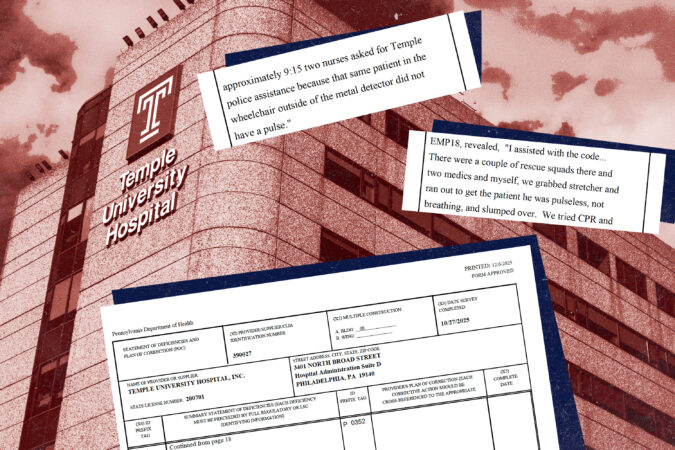
Pennsylvania Department of Health’s inspection report details how a patient in Temple’s emergency department was rolled away in a wheelchair without being evaluated.
The inspection report does not identify the patient’s name, age, or provide details on the medical condition for which he had been hospitalized. It also does not say what happened after he was found unresponsive. He died five days later, on Oct. 8.
Temple responds
Medical screening of every patient who comes to the emergency department is “explicitly required” under Temple’s EMTALA policies, according to the hospital’s response to the state findings.
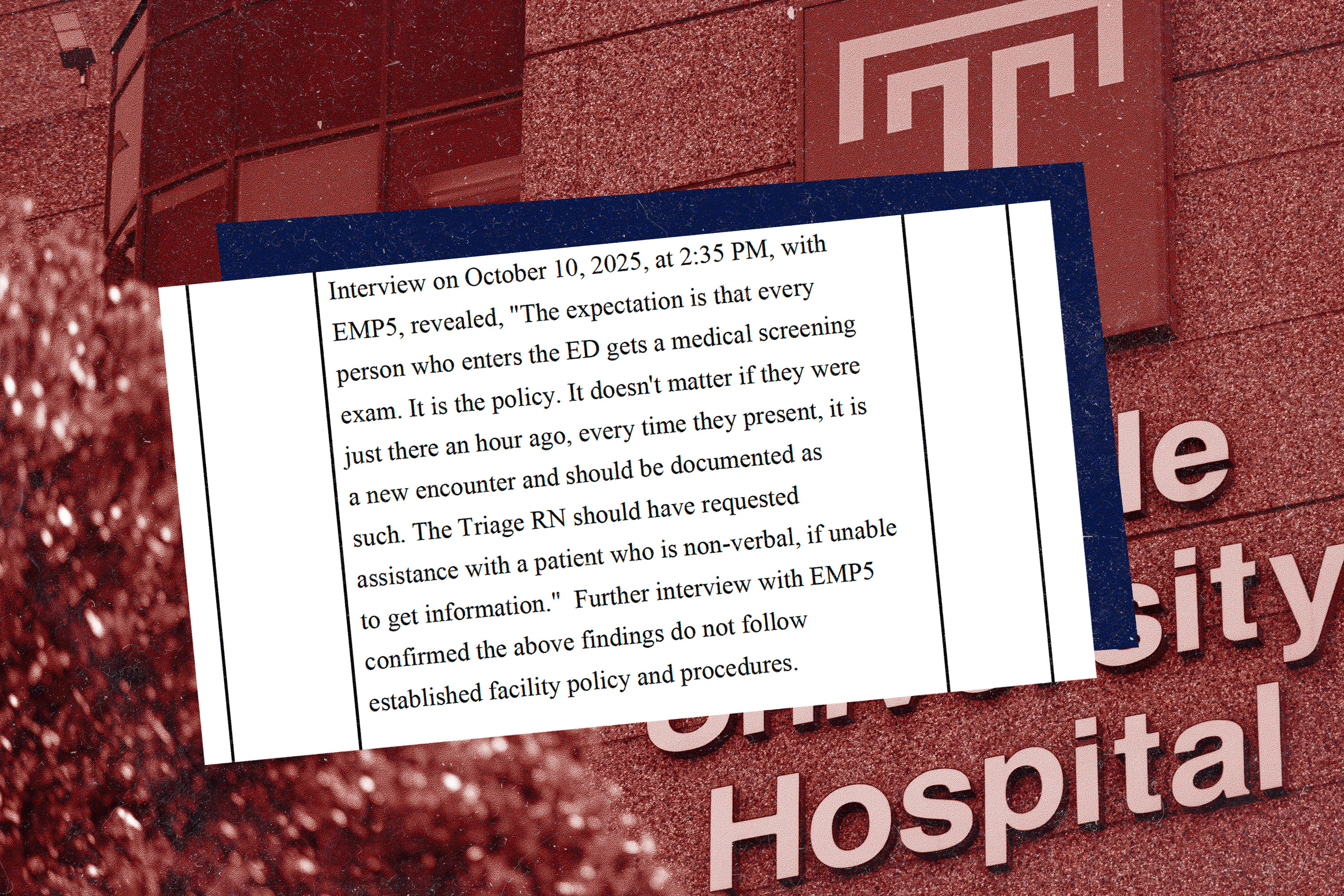
“It doesn’t matter if they were just there an hour ago, every time they present, it is a new encounter and should be documented as such,” a Temple staffer said in an interview with inspectors.
The hospital told the state it would retrain staff on EMTALA rules, making clear that security officers cannot remove patients from the emergency department unless they have been evaluated and cleared for release by a medical professional.
A week after the incident, hospital staff were instructed to keep a log of patients who are removed from the emergency department and the name of the provider who approved their release. (Temple police may still remove patients from the emergency department if they are threatening the safety of other patients or staff.)
The hospital also said that it would order mobility evaluations for patients who are being discharged “to the community” if they had a high risk of falling, with a doctor’s sign-off required.
Temple treats some of Philadelphia’s most vulnerable patients in an emergency room that sees more than 150,000 visits a year, including high numbers of gunshot victims and people experiencing opioid withdrawal. It operates a Level I trauma center in a North Philadelphia community where 87% of patients are covered by publicly funded Medicare or Medicaid.
The emergency department is so busy that about 8% of patients choose to leave before being seen, according to CMS data, compared to about 2% of patients at hospitals nationally and across Pennsylvania.
The triage nurse on duty Oct. 3 is not identified in the inspection report.
Two healthcare lawyers who reviewed the state’s inspection report said the entire episode is troubling.
“It sounds like they violated every part of EMTALA,” said Sara Rosenbaum, professor emerita of health law policy at George Washington University.
The law does not require specific treatment, but mandates that hospitals evaluate everyone who walks in the door seeking care, and prohibits them from sending them away or transferring them until they are medically stable.
“They failed to screen him, threw an unstable person back on the street, and didn’t arrange a medically appropriate transfer,” she said.
What’s more, the hospital could be sued for malpractice over how it initially discharged the patient.
The incident appears to be “a classic EMTALA violation,” said Weitz, the Philadelphia lawyer who serves on Pennsylvania’s Patient Safety Authority, an independent state agency that monitors hospital errors.
The health department’s description of what happened is “almost eerily the exact fact pattern the law was passed to prevent,” he said.
Healthcare challenges for patients experiencing homelessness
People who are experiencing homelessness often receive subpar treatment when they seek medical care, research shows.
One study that analyzed thousands of California patient records found that those who were described in their medical records as “homeless” were more likely than patients who have a permanent legal address to be discharged from the emergency department, rather than being admitted for care.
In the Philadelphia region, caring for this population is increasingly challenging. The number of available shelter beds has declined in recent years, while the number of people who are considered unhoused has risen, according to Philadelphia’s Office of Homeless Services.
Stephanie Sena, CEO of Breaking Bread Community Shelter in Delaware County, said the colder months also see more people experiencing homelessness coming to hospitals to get off the street.
“If they say they’re sick, they might get a bed and be able to survive the night,” Sena said.
The pattern can make doctors and nurses less likely to believe patients when they report real medical needs. Especially when staff are overwhelmed in busy hospitals, patients experiencing homelessness may be at greater risk of getting denied or discharged when they need help, she said.
Sena said she was disappointed to hear about the Temple incident.
“It is tragic,” she said, “but also not at all surprising, unfortunately.”
Fox Chase Cancer Center was not cited by the Pennsylvania Department of Health for any safety violations between November 2024 and October of this year.
Here’s a look at the publicly available details:
Feb. 21, 2025: Inspectors came to investigate a complaint but found the hospital was in compliance. Complaint details are not made public when inspectors determine it was unfounded.
March 17: Inspectors came to investigate a complaint but found the hospital was in compliance.
April 15: The Joint Commission, a nonprofit hospital accreditation agency, renewed the hospital’s accreditation, effective January 2025, for 36 months.
Drexel University has signed a lease that will enable it to consolidate its College of Medicine research labs in University City, Drexel and the developers of a new building at 3201 Cuthbert St. said Thursday.
Drexel’s space in the $500 million building, a joint project from Gattuso Development Partners and Vigilant Holdings, is slated for completion in 2027. Drexel researchers moving from sites in Center City and East Falls are expected to fill four floors of the structure.
“By bringing our research spaces together in University City, we will create an environment that fosters greater interdisciplinary collaboration, accelerates innovation, and strengthens our collective capacity for discovery,” Drexel president Antonio Merlo said in a message to the school community.
Drexel will occupy 150,741 square feet of the 11-story, 520,000-square-foot building. The developers’ goal is to fill the rest of the building with life sciences tenants, though that could be harder than it was in 2022, when the building was announced as a partnership between Drexel and Gattuso Development.
The move of research labs to University City is part of a long-term plan to centralize the Drexel College of Medicine, which includes the combined operations of the former Hahnemann Medical College in Center City and the former Medical College of Pennsylvania in East Falls.
ChristianaCare and Virtua Health have ended merger negotiations that would have created a healthcare system with more than $6 billion in annual revenue and business in four states, the two nonprofits announced Thursday.
The nonprofits, the largest in South Jersey and the largest in Delaware, had disclosed a preliminary agreement to join forces in July. ChristianaCare and Virtua did not share specific reasons for dropping the idea.
They issued identical statements: “After thoughtful evaluation, both organizations have determined that they can best fulfill their missions to serve their communities by continuing to operate independently.”
It wasn’t obvious to industry insiders what advantages combining the two systems would have brought other than more revenue and the potential for some relatively small savings from greater scale.
Both systems are financially solid. Virtua has a AA- credit rating from Standard & Poor’s. The S&P rating for ChristianaCare is two notches higher, at AA+.
ChristianaCare explored an acquisition of Crozer Health in 2022, but decided not to go through with the deal. It won a May bankruptcy auction with a $50.3 million bid to assume Crozer leases at five outpatient locations in Delaware County. It has since opened 15 medical practices at those locations.
ChristianaCare previously acquired the shuttered Jennersville Hospital in Chester County and turned it into a micro-hospital. It plans two more micro-hospitals for Delaware County.
The five-hospital Virtua system had $3.24 billion in revenue last year. ChristianaCare, with three full-scale hospitals, had $3.3 billion in revenue in the year that ended June 30, 2025.
Capstan Therapeutics’ sale this year for $2.1 billion, the highest price paid for a private early-stage biotech company since 2022, was a triumph for its founders at the University of Pennsylvania.
Unfortunately for Philadelphia, the company is based in San Diego. Investors wanted an executive who lives there to be CEO.
Capstan was a miss for Philadelphia, said Jeffrey Marrazzo, who cofounded a high-profile regional biotech company, Spark Therapeutics, and is now an industry investor and consultant.
If Philadelphia had a bigger talent pool of biotech CEOs, “it would have and should have been here,” he said.
The Philadelphia region has lagged behind other biotech centers in landing companies and jobs, but industry experts are working to close the gap and better compete with Boston, the San Francisco Bay Area, and San Diego.
According to Marrazzo and others, the Philadelphia region’s relatively shallow pool of top biotech management is a key challenge.
Big investors go to managers who have proven ability to deliver big investment returns, said Fred Vogt, interim CEO of Iovance Biotherapeutics, a California company with a manufacturing facility in the Navy Yard.
“They want the company to perform. They’ll put it in Antarctica, if that was where the performance would come from,” he said.
The Lilly announcement last month also reflects Philadelphia’s national biotech stature. It’s the fourth U.S. city to get a Lilly Gateway Lab, behind Boston, the San Francisco Bay Area, and San Diego.
Those places have far outpaced Philadelphia in the creation of biotech research and development jobs, even as the sector’s growth has slowed.
From 2014 through last year, the Boston area added four biotech research and development jobs for every one job added here, according to an Inquirer analysis of federal employment data.
window.addEventListener(“message”,function(a){if(void 0!==a.data[“datawrapper-height”]){var e=document.querySelectorAll(“iframe”);for(var t in a.data[“datawrapper-height”])for(var r,i=0;r=e[i];i++)if(r.contentWindow===a.source){var d=a.data[“datawrapper-height”][t]+”px”;r.style.height=d}}});
Penn’s role in Philadelphia biotech
Philadelphia’s reputation as an innovation center — boosters like to call the region “Cellicon Valley” — starts with the University of Pennsylvania, which has long been a top recipient of National Institutes of Health grants to advance scientific discovery.
Research at Penn has contributed to the creation of 45 FDA-approved treatments since 2013, according to the university.
“Penn discoveries help spark new biotech companies, but we can’t build the whole ecosystem in this area alone,” said John Swartley, Penn’s chief innovation officer. “Great science is just one ingredient. We also need capital, experienced leadership, real estate and manufacturing infrastructure, and strong city and state support.”
Penn was one of two Philadelphia institutions receiving more than $100 million in NIH funding in the year that ended Sept. 30. The otherwas the Children’s Hospital of Philadelphia.
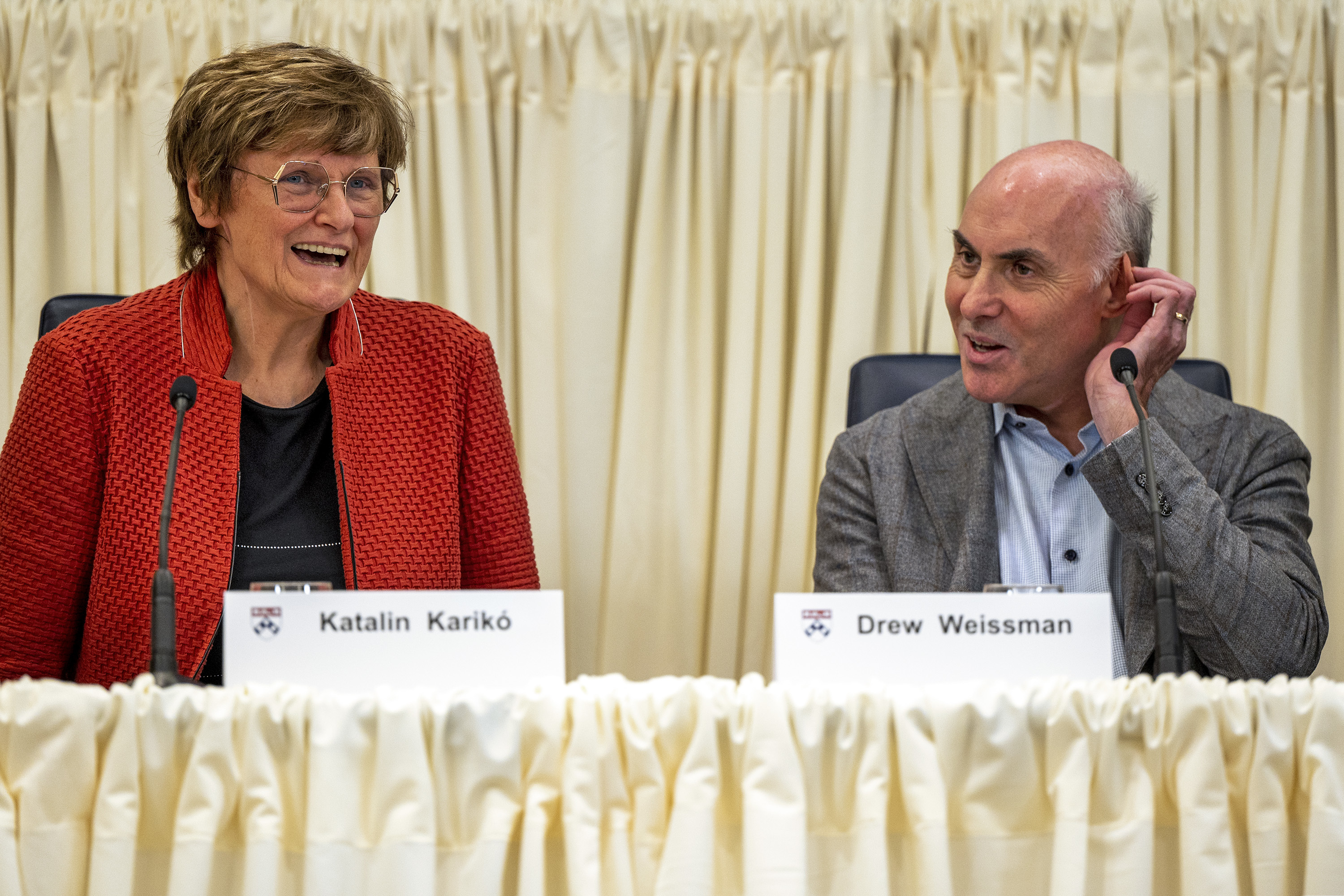
Katalin Karikó and Drew Weissman spoke at a University of Pennsylvania news conference after they were named winners of a 2023 Nobel Prize in medicine. Their work was instrumental to modifying mRNA for therapeutic uses, such as the rapid development of lifesaving vaccines during the COVID-19 pandemic.
By contrast, the Boston area was home to 10 institutions with at least $100 million in NIH grants, generating more spinoffs and jobs.
The Philadelphia region has a healthy number of biotech spinouts, but the biggest markets have more from a larger number of research institutions, said Robert Adelson, founder Osage University Partners, a venture capital firm in Bala Cynwyd.
That concentration of jobs and companies in the Boston area — where nearly 60,000 people worked in biotech R&D last year — makes it easier to attract people. By comparison, there were 13,800 such jobs in Philadelphia and Montgomery County, home to the bulk of the regional sector.
If a startup fails, which happens commonly in biotech, “there’ll be another startup or another company for me to go to” in a place like Boston, said Matt Cohen, a managing partner for life science at Osage.
Another challenge for Philadelphia: It specializes in cell and gene therapy, a relatively small segment of the biotech industry, whose allure to investors has faded in the last few years.
Such market forces shaped the trajectory of Spark, a 2013 Children’s Hospital of Philadelphia spinout that developed Luxterna, the first FDA-approved gene therapy, used to treat an inherited form of blindness. The promise of Spark’s gene therapy work for a form of hemophilia spurred its 2019 acquisition by Swiss pharmaceutical titan Roche for $4.8 billion.
The company still employs about 300 in the city, a spokesperson said, and work continues on its $575 million Gene Therapy Innovation Center at 30th and Chestnut Streets in University City.
The long arc of biotech
A handful of companies dominated the early days of U.S. biotech. Boston had Biogen and Genzyme, San Francisco had Genentech, San Diego had Hybritech, and Philadelphia had Centocor. All of them started between 1976 and 1981.
Centocor started in the University City Science Center because one of its founders, virologist Hilary Koprowski, was the longtime director of the Wistar Institute. Centocor’s first CEO, Hubert Schoemaker, moved here from the Boston area, where he had gotten his doctorate at the Massachusetts Institute of Technology.
Another drug still under development at the time of the sale, Stelara, went on to become J&J’s top-selling drug as recently as 2023 with $10.9 billion in revenue. Stelara, approved to treat several autoimmune disorders, remains a testament to Centocor’s legacy.
Despite its product success, Centocor didn’t have the same flywheel effect of creating new companies and a pipeline of CEOs as peer companies did in regions outside of Philadelphia.
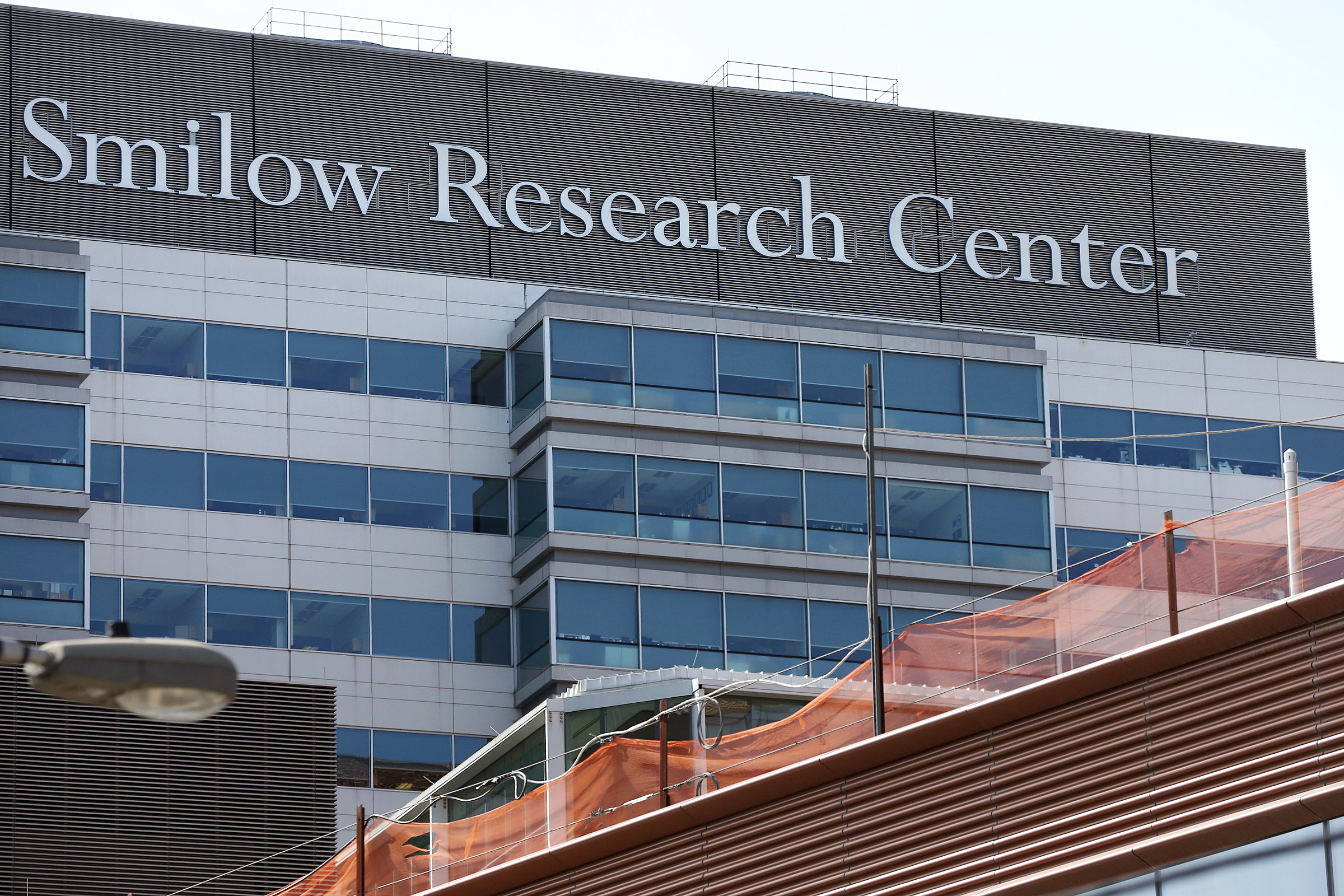
The University of Pennsylvania’s Smilow Center for Translational Research, shown in 2020, is one of the school’s major laboratory buildings.
“There are a lot of alums of Centocor that are really impressive, but they seem to have wound up elsewhere,” said Bill Holodnak, CEO and founder of Occam Global, a New York life science executive recruitment firm.
Among the Centocor executives who left the region was Harvey Berger, Centocor’s head of research and development from 1986 to 1991. He started a new company in Cambridge, Mass.
At the time, the Philadelphia area didn’t have the infrastructure, range of scientists, or management talent needed for biotech startups, he said.
Since then, he thinks the regional market has matured.
“Now, there’s nothing holding the Philadelphia ecosystem back. The universities, obviously Penn, and others have figured this out,” Berger said.
Conditions have changed
Penn’s strategy for helping faculty members commercialize their inventions has evolved significantly over the last 15 years.
It previously licensed the rights to develop its research to companies outside of the area, such as Jim Wilson’s gene therapy discoveries and biochemist Katalin Karikó and immunologist Drew Weissman’s mRNA patents. Now it takes a more active role in creating companies.
Among Penn’s latest spinouts is Dispatch Bio, which came out of stealth mode earlier this year after raising $216 million from investors led by Chicago-based Arch Venture Partners and San Francisco-based Parker Institute for Cancer Immunotherapy.
Dispatch, chaired by Marrazzo, is developing a cell therapy approach that uses a virus to attach what it calls a “flare” onto the cells it wants the immune system to attack.
Marrazzo said in July that he wasn’t going to be involved in Dispatch if it wasn’t based largely in Philadelphia. As of July, 75% of its 60 employees were working in Philadelphia. Still, Dispatch’s CEO is in the San Francisco Bay Area.
The Philadelphia region is increasingly well-positioned for the current biotech era, said Audrey Greenberg, who played a key role in launching King of Prussia’s Center for Breakthrough Medicines about five years ago. The center is a contract developer and manufacturer for cell and gene therapies.
“You no longer need to move to Kendall Square to get a company funded,” she said, referring to Cambridge’s biotech epicenter. “You need good data, a credible translational plan, experienced advisers, and access to patient capital, all of which can increasingly be built here.”
Greenberg now works as a venture partner for the Mayo Clinic, with the goal of commercializing research discoveries within the health system’s network of hospitals in Minnesota, Arizona, and Florida.
She plans to bring that biotech business to the Philadelphia region.
“I’m going to be starting my companies all here in Philadelphia, because that’s where I am. And I know everybody here, and everybody I’m going to hire in these startups that are going to be based here,” she said.
Once considered the loudest hospital in the Philadelphia area, Riddle Hospital in Media has significantly reduced its nighttime noise levels, newly released federal data shows.
At the Main Line Health Riddle hospital, only 12% of patients from the most recent survey rated the area around their room at night as “sometimes” or “never” quiet — down from 26% of patients surveyed between July 2022 and June 2023.
Across the Philadelphia region, 52% of patients said their hospital room was “always” quiet at night. That’s slightly worse than nationally, where patients said hospitals were quiet throughout their stay 57% of the time.
Virtua Mount Holly Hospital in New Jersey is now rated the loudest by patients.
Nazareth Hospital in Northeast Philadelphia, owned by Trinity Health, was ranked the second loudest in the region.
window.addEventListener(“message”,function(a){if(void 0!==a.data[“datawrapper-height”]){var e=document.querySelectorAll(“iframe”);for(var t in a.data[“datawrapper-height”])for(var r,i=0;r=e[i];i++)if(r.contentWindow===a.source){var d=a.data[“datawrapper-height”][t]+”px”;r.style.height=d}}});
Quieter hospitals have benefits for both patients and staff, helping to lower anxiety levels, improve sleep quality, and ease the flow of communication.
Riddle Hospital’s improvement follows construction of a new 230,000-square-foot patient pavilion that had temporarily increased noise at its Delaware County campus.
“With the pavilion’s 2023 completion, as well as the resulting addition of more private rooms, noise is significantly reduced,” spokesperson Larry Hanover said.
Reducing noise is also priority for Penn Medicine, whose Hospital of the University of Pennsylvania (HUP) was rated the quietest hospital among the 25,000 patients surveyed in the Philly-area.
Chester County Hospital, also owned by Penn Medicine, was ranked the second quietest.
The health system has made big investments in recent years to address noise levels at its hospitals, according to the university’s website. The Pavilion, which opened at HUP in Center City in 2021, was designed to reduce noise levels and nightly disruptions by separating nonclinical work from patient care areas.
Each floor of the $1.6 billion building centers around an “offstage” area for staff to hold conversations and calls away from patient rooms that line the perimeter. The design of the rooms also allows care teams to check vitals and refill medications from the hallway, reducing nighttime disruptions.
window.addEventListener(“message”,function(a){if(void 0!==a.data[“datawrapper-height”]){var e=document.querySelectorAll(“iframe”);for(var t in a.data[“datawrapper-height”])for(var r,i=0;r=e[i];i++)if(r.contentWindow===a.source){var d=a.data[“datawrapper-height”][t]+”px”;r.style.height=d}}});
Doylestown Hospital was not cited by the Pennsylvania Department of Health for any safety violations between November 2024 and October of this year.
Here’s a look at the publicly available details:
Nov. 6, 2024: Inspectors came to investigate a complaint but found the hospital was in compliance. Complaint details are not made public when inspectors determine it was unfounded.
Nov. 14: Inspectors followed up on an October 2024 complaint and found the hospital was in compliance. The hospital had been cited for not following protocol for admitting mental health patients.
Nov. 20: Inspectors followed up on a July 2024 complaint and found the hospital was in compliance. The hospital had been cited for not following protocol for identifying patients prior to surgery.
Jan. 10, 2025: Inspectors visited for a special monitoring survey and found the hospital was in compliance.
July 24: Inspectors came to investigate a complaint but found the hospital was in compliance.
Children’s Hospital of Philadelphia was the most profitable nonprofit health system in Southeastern Pennsylvania during the three months that ended Sept. 30, according to an Inquirer review of financial filings.
CHOP reported $70 million in operating income in the first quarter of fiscal 2026, up from $67 million the same period a year ago. The nonprofit’s revenue climbed nearly 9% to $1.3 billion.
The biggest loss in percentage terms was at Redeemer Health, the region’s smallest health system and the only remaining operator with a single hospital. Redeemer had an $11.7 million operating loss on $103.4 million in quarterly revenue. That was an improvement over an $18.9 million loss last year.
Jefferson Health had the most patient revenue following its acquisition last year of Lehigh Valley Health Network. The 32-hospital system had $2.9 billion in patient revenue, $100 million more than the $2.8 billion at the University of Pennsylvania Health System, which has seven hospitals.
window.addEventListener(“message”,function(a){if(void 0!==a.data[“datawrapper-height”]){var e=document.querySelectorAll(“iframe”);for(var t in a.data[“datawrapper-height”])for(var r,i=0;r=e[i];i++)if(r.contentWindow===a.source){var d=a.data[“datawrapper-height”][t]+”px”;r.style.height=d}}});
Here’s a recap of selected systems’ results for September quarter:
Jefferson Health
Jefferson Health reported a $104 million operating loss, as its insurance business continued to drag down results. The loss included $19.4 million in restructuring charges for employee severance related to earlier job cuts and moves designed to make the system more efficient.
University of Pennsylvania Health System
University of Pennsylvania Health System had an operating gain of $109.3 million, up from $49.3 million in the same period a year ago. This year’s results include Doylestown Health, which Penn acquired April 1. Total revenue was $3.3 billion, up from $2.8 billion a year ago.
Temple University Health System
Temple University Health System’s loss in the quarter was $15 million, an improvement over a $17 million loss last year. Total revenue was $800 million, up 13% from $712.5 million a year ago. Outpatient revenue increased by nearly $62 million, much of it from the health system’s specialty and retail pharmacy business.
Several Philadelphia-area violence prevention efforts will benefit from nearly $3 million in newly released state funding to help hospitals address a leading cause of death and injury.
The new funding for hospital-based violence intervention programs (HVIP) was announced by Pennsylvania Lt. Gov. Austin Davis on Wednesday at Penn Presbyterian Medical Center. One of the recipients, the Penn Trauma Violence Recovery Program, is based at the Penn Medicine hospital in University City.
Other local awardees includeTemple University Hospital in North Philadelphia and the Philadelphia-based nonprofit Urban Affairs Coalition. The coalition received funding on behalf of the Chester Community Coalition to relaunch a program that had been at the now-shuttered Crozer-Chester Medical Center.
The University of Pittsburgh Medical Center also received funding. The amounts awarded to each program were not announced.
The Pennsylvania Commission on Crime and Delinquency, which Davis chairs, received 15 applications in total seeking nearly $12 million in funding — four times what was available.
“Addressing the epidemic of gun violence is a top priority for our administration,” Davis said.
Lieutenant Governor Austin Davis speaks at a press conference announcing the $3 million in grants for hospital-based violence intervention programs.
The programs aim to connect patients at risk of repeat violence with resources while they are in a hospital, so they leave with a safety plan. Services can include long-term community-based case management, mentoring, and home visits.
Since the first HVIP was established in the mid-1990s, dozens have spread around the country and abroad, including in Philadelphia.
Several local institutions have these programs, including Temple Health, Children’s Hospital of Philadelphia, Penn Medicine, Jefferson Health, and Drexel University. The City of Philadelphia, in conjunction with the area’s Level 1 trauma centers, launched an HVIP Collaborative in 2021.
Studies have shown these programs reduce rates of repeat violent injuries and recidivism among participants.
After shootings spiked during the COVID-19 pandemic, gun violence is now declining in Philadelphia. As of July, shootings for the year were at their lowest total since at least 2015.
Davis noted that Philadelphia has seen a 15% decrease in homicides this year, with roughly four in fivegunshot victims surviving their injuries.
The new funding will allow the Penn Trauma Violence Recovery Program to increase its community presence and mental health programming, said its director, trauma surgeon Elinore Kaufman.
Through her experience treating victims of violence, she has learned that injuries can be deeper than the physical wounds.
The program was launched to address social factors often involved in violence by providingpsychosocial support and connecting patients with services to help with education,job training, and housing.
“We’ve worked with patients long enough now that we have high school graduation photos, we have baby pictures,” Kaufman said. “We have patients who want to give back and have joined our patient advisory board to help push us forward.”