Tag: Weekend Subscribers

  • How can Don Mattingly help Bryce Harper? It starts with his star power.

    How can Don Mattingly help Bryce Harper? It starts with his star power.

    A.J. Preller grew up in New York — Long Island, to be specific — in the ’80s.

    Guess which baseball player was his favorite.

    “Don Mattingly,” the San Diego Padres president of baseball operations said, never hesitating, a few years ago over the phone. “That was the guy. ‘Hitman’ poster on the wall. I was at the last game of the [1984] season, when he won the batting title over [Dave] Winfield. ’85 MVP; ’84-’85-’86-’87, those were my formative baseball years.

    “And he was the guy I grew up with.”

    Preller went on and on, and a generation of fans might as well have nodded in agreement. Because for most of a decade, when baseball could still reasonably call itself America’s pastime, Mattingly was the face of the sport — with a nickname to match.

    “Donnie Baseball” captained the most storied franchise in the biggest city and ranked among the best players in the majors. But he also penetrated into pop culture, guesting with David Letterman and getting booted from Mr. Burns’ power-plant softball team on The Simpsons.

    Don Mattingly (left) is the Phillies’ new bench coach after being hired this week by president of baseball operations Dave Dombrowski.

    And while none of that may mean much to many millennials, it surely does to Bryce Harper, never mind that he was eight days shy of turning 3 in 1995 when Mattingly played his final game.

    “Players that came before, we usually don’t think that this generation of players knows as much about us as they should,” Mike Schmidt said recently on Phillies Extra, The Inquirer’s baseball podcast. “Not with Bryce. He’s very informed about the alumni like myself.”

    Indeed, Harper is a baseball obsessive with a respect for the game’s past. He talks with familiarity about the ’70s Reds, his father’s favorite team. He picked No. 7 in youth baseball after hearing about Mickey Mantle. As Dusty Baker once said when he managed Harper in Washington, “He’s as knowledgeable of baseball history as anybody that I’ve had.”

    So, although Harper met Mattingly only briefly at the 2017 All-Star Game in Miami and may not be able to recite all the pertinent numbers — .307 average, 222 homers, nine Gold Gloves, six All-Star appearances — it’s a safe bet he appreciates his nearly Hall of Fame-level place in the sport.

    And it has been years since Harper played for anyone with those credentials as a player.

    That wasn’t the primary reason the Phillies this week finalized a two-year contract with Mattingly to be the bench coach. They wanted another voice in the dugout alongside manager Rob Thomson. Mattingly managed for 12 seasons with the Dodgers and Marlins; at 64, he insists he doesn’t want to do it again.

    But Thomson also conceded that Mattingly’s distinguished playing career sets him apart among the Phillies’ coaches. Because Thomson didn’t play in the majors. Caleb Cotham (pitching), Kevin Long (hitting), Bobby Dickerson (infield), and others are well-regarded across the majors, but they played in the big leagues only briefly or not at all.

    Mattingly’s career gives him instant credibility among players, especially star players. His impact on Harper could be profound.

    Bryce Harper (left) played for manager Dusty Baker with the Nationals.

    By all accounts, Harper is coachable. He confides in Long, with whom he worked in Washington before Philadelphia. He took a crash course at first base from Dickerson in 2023 and learned the position on the fly.

    But for a two-time MVP who’s likely headed to the Hall of Fame, the conversations with someone like Mattingly must resonate differently.

    Harper’s first two Phillies managers — Gabe Kapler and Joe Girardi — had long playing careers. But he hasn’t played for a manager or coach with Mattingly’s name or stature since Baker with the Nationals in 2017.

    Add the fact that Mattingly became an icon at first base, and it would appear that he’s uniquely suited to relate to Harper on multiple levels.

    “If there’s things he wants to talk about from a first-base standpoint, then we can talk about it,” Mattingly said in a video news conference this week. “If there’s things he thinks about at the plate, hitting the lefty or hitting the righty, or a certain style of pitcher, I’m going to be like, ‘Hey, what are you trying to do with this guy? What are you thinking?’ I want to learn, too.”

    Mattingly recalled fondly a conversation with Harper and former Reds star Joey Votto at the 2017 All-Star Game. He also marveled, like most baseball observers, at how good Harper already was upon making his major league debut at age 19.

    “Watching his development over the years, this cat can go,” Mattingly said. “This is a first-ballot Hall of Famer, hands down.”

    (Mattingly and Harper did get into a spring-training rock fight through the media in 2018 over Harper’s criticism of the Marlins’ offseason moves, though eight years is a long time for water to flow under a bridge.)

    In Washington, Harper hit it off with Baker, whose long, successful managerial tenure was preceded by 19 major league seasons in which he got nearly 2,000 hits and slugged 242 homers. It was reciprocal. Baker once called Harper “a pretty cool little dude” and said he’s “pretty hip on a lot of fronts.” Harper batted .319 with a 1.008 OPS for Baker in 2017.

    Nearly a decade later, as one of this generation’s biggest baseball stars, Harper figures to find “Donnie Baseball” to be relatable and potentially helpful.

    “Well, I think we’ll find out, right?” Mattingly said. “You’ve got to build a relationship first. I’ve seen him from afar; I’ve not seen him from the inside. Listen to him, watch him, and just talk.”

    The conversations will begin next month at first base on the spring-training half-field in Clearwater.


  • 2026 Mercedes GLE 450 SUV: Showing the others how it’s done

    2026 Mercedes GLE 450 SUV: Showing the others how it’s done

    2026 Genesis GV80 Coupe 3.5T E-supercharger vs. 2026 Land Rover Defender 130 V-8 vs. 2026 Mercedes-Benz GLE 450 4Matic SUV: Off-roading in high style.

    This week: Mercedes-Benz GLE 450 SUV

    Price: $79,100 as tested.

    What others are saying: “Highs: A powertrain for every need, well-appointed and spacious interior, legitimately capable; Lows: Rivals offer smoother rides and better handling, Benz charges extra for ubiquitous features.” — Car and Driver

    What Mercedes is saying: “It’s innovative. Intelligent. And just a bit indulgent.”

    Reality: Cushy, yet satisfying.

    What’s new: The GLE 450 SUV carries on fairly unchanged since the 2024 model year, when it received tech updates and available hybrid power.

    Competition: In addition to the GV80 Sport and the Defender, there are the BMW X5, Lexus RX, Lincoln Nautilus, and Toyota Land Cruiser.

    Up to speed: The GLE 450 is powered by a 3-liter inline six-cylinder engine with a mild hybrid system. It creates 375 horsepower. It gets to 60 mph in 5.3 seconds, according to Car and Driver.

    I never found the GLE lacked power, but it definitely seemed sedate. I used it in Sport mode, and nobody ever felt planted in their seats during test maneuvers. Strange how it was almost an exact match with the GV80’s 5.2-second time, but somehow the Genesis felt much more exuberant.

    Shifty: Mercedes originated the latest incarnation of the column shifter, with a bump up for Reverse and down for Drive. Shifting of the 9-speed automatic transmission happens through steering wheel paddles.

    On the road: The GLE handled about as I expected from a Mercedes — very smooth, almost to a fault. Pennsylvania’s ruttiest roads, including Route 202 around King of Prussia, could send the GLE into jumping fits, but the rest of the time the SUV felt serene, quiet, cushy.

    Speaking of cushy, that’s where the GLE handling lives — don’t expect this SUV to perform feats of derring-do on country roads. But stay within its limits and life is pleasant.

    At least when you’re in Sport mode. The vehicle defaults to Comfort mode, and that has a sway and bounce that takes cushy into nauseating.

    The interior of the 2026 Mercedes-Benz GLE 450, on the other hand, could very well win several beauty contests.

    Driver’s Seat: Ooo, aaah. Great leather coverings, not too firm, not too soft. The front seats are wide as well, perfect for large dinners at fancy restaurants.

    Visibility up front could be a bit challenging. I raised the seat up quite high and still was unsatisfied with what I could see in the corners. But I did ace a couple head-first parking lot episodes, which normally I find can be rather difficult in SUVs, so maybe it’s better than I think.

    The interior is fancy like a Mercedes should be, but the trim around the HVAC vents leaves something to be desired. They come in a contrasting color and look like I could pop them out with a small screwdriver, if I were so inclined. Why offer this?

    Friends and stuff: The other couple you bring along to show off your Mercedes (practice saying it like Cary Grant in North by Northwest — “Laura’s Meh-seddies”) will definitely be impressed. The seat is awesome, and there’s so much room to spread out, you’ll feel like you’re being chauffeured.

    A third row is optional.

    Cargo space is 33.3 cubic feet in the back and 74.9 with the seat folded.

    Towing capacity maxes out at 7,700 pounds, just 500 less than the Defender and more than 1,500 over the GV80.

    In and out: The GLE 450 sits up a little high so entry and exit are not the easiest in the world, but it sure beats the Defender.

    Play some tunes: Sound from the system is delightful, an A veering close to A+ territory.

    My ratty old iPhone plugged in and just worked, a nice touch. I’m forever getting defaulted to Bluetooth in various vehicles and then I have to fight and do dances to get it to link. But this one worked every time.

    The screen offers a simple CarPlay tab and another main tab. Console controls are also available, for those who are used to them.

    Keeping warm and cool: A row of silver toggles underneath the infotainment system looks sharp and operates with ease. I could change the temperature and the fan speed without looking after a couple tries, as it should be.

    Large vents provide plenty of airflow but never seemed to blast us.

    Fuel economy: That mild hybrid is definitely mild, as the GLE averaged 18.5 mpg for me. Gulp, but still the winner among the three tested.

    Where it’s built: Vance, Ala. Germany supplies 34% of the parts; Mexico 17%.

    How it’s built: Consumer Reports predicts the GLE SUV reliability to be a 3 out of 5.

    In the end: I felt a little bad about setting up this trio, as they do aim in different directions. But the Genesis fell short in so many areas that had nothing to do with its size — comfort and handling among them. The Land Rover really was quite nice, but their reliability reputation makes that a gamble.

    Fortunately, the Mercedes was hands down the nicest among the three, slightly sippier, more comfortable, and nice to drive. And there’s enough money left over among the three to consider a hybrid model.

  • For $9.9 million, you can own this Lower Merion mansion and a bonus house next door

    For $9.9 million, you can own this Lower Merion mansion and a bonus house next door

    On Creighton Road in Lower Merion, it’s not unusual for residents to buy the house next door.

    The owners of the 3.85-acre property at 648 Creighton Rd. did just that when they purchased the home but wanted a pool. They decided to put one on the neighboring property.

    Now, the properties are being sold as a package deal.

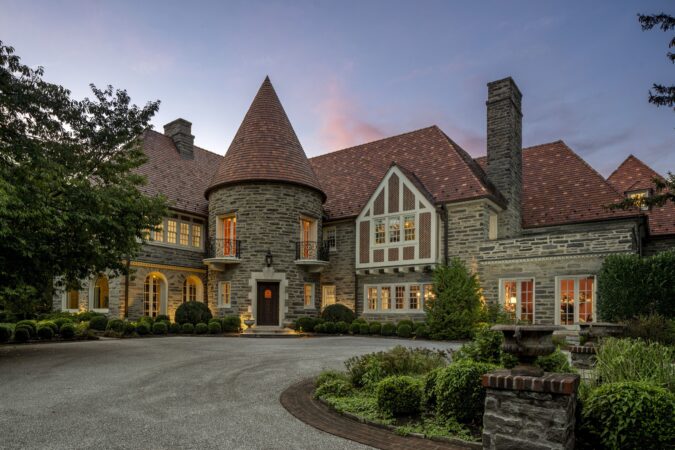
    The century-old main house with seven bedrooms, seven full bathrooms, and three half bathrooms is available for $7.9 million. And the one-bedroom, one-bathroom carriage house next door that was rebuilt in 2015 is on the market for $2 million.

    Creighton Road “has become the estate street,” said listing agent Lavinia Smerconish with Compass Real Estate.

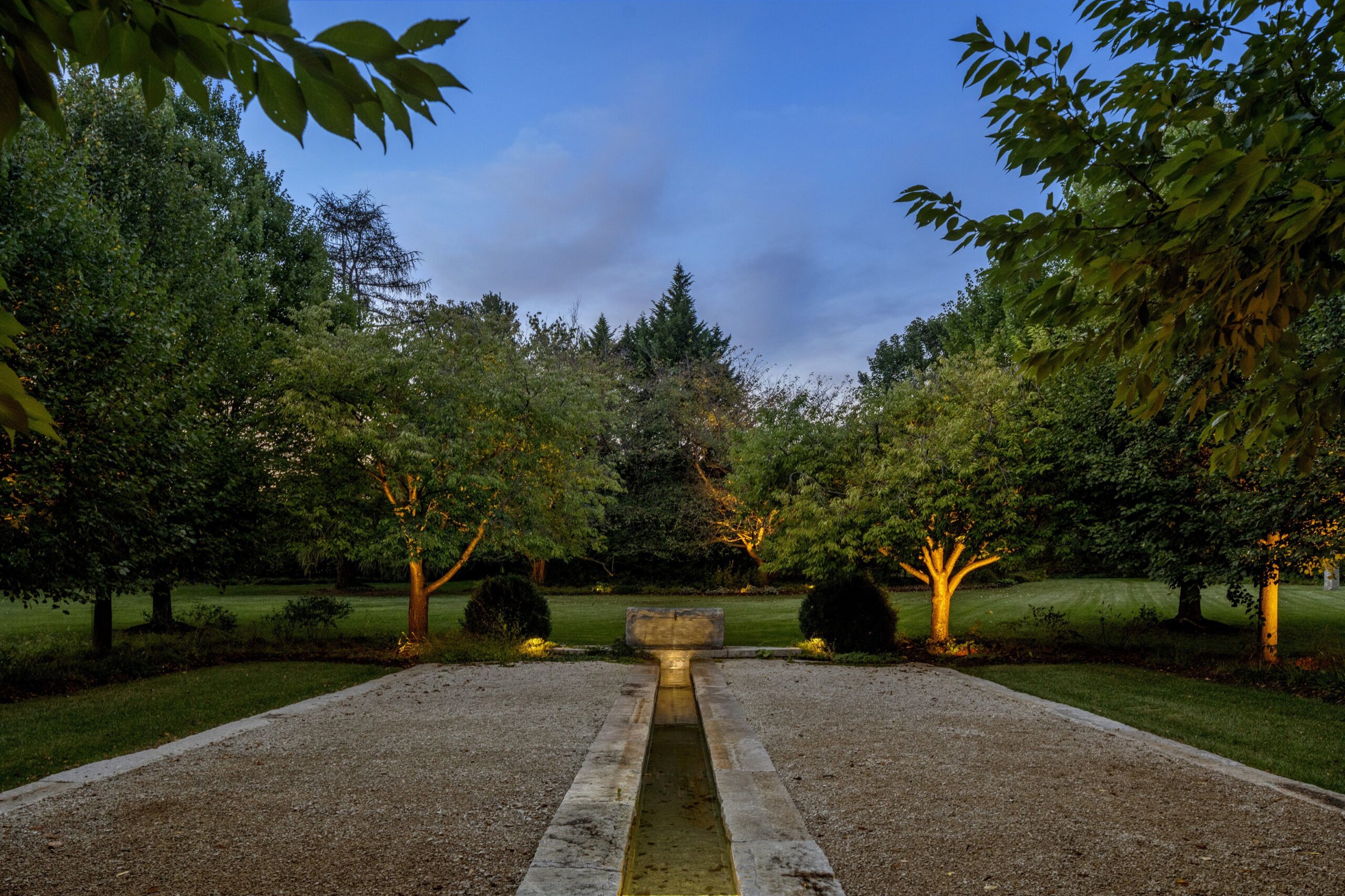
    The property is 3.85 acres and includes a sprawling yard.

    The owners are open to selling their properties separately, but they won’t sell the carriage house before the main one in case a buyer wants both.

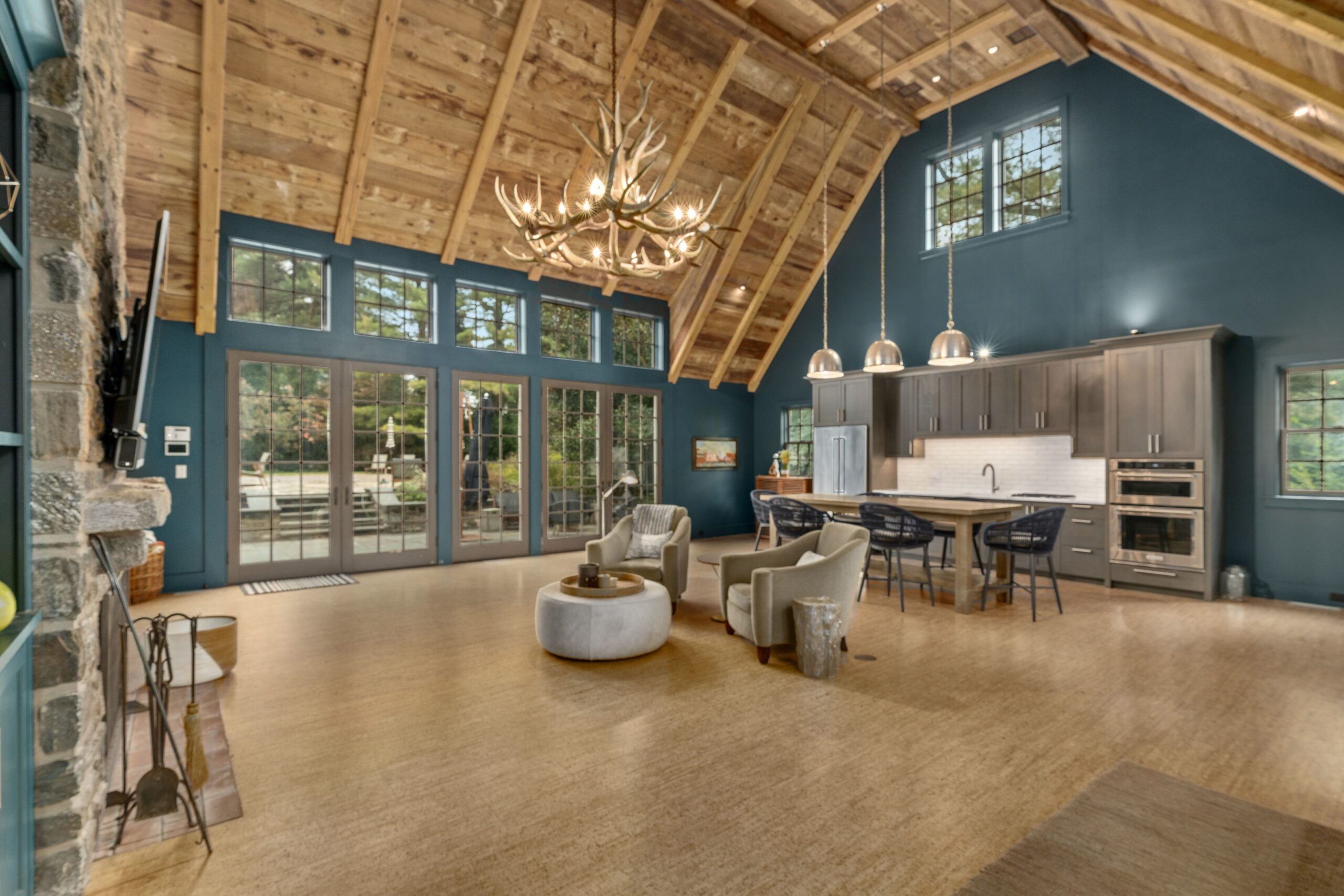
    The fieldstone main house is 11,418 square feet. It used to have a series of small rooms for staff and a giant entrance that looked like a banquet hall that no one knew what to do with, Smerconish said. A previous owner reimagined the home with larger rooms, more natural light, and more functional space.

    The home has a commercial kitchen with a large island with seating.

    The front door opens to an entrance tower with a chandelier and winding staircase. Living and dining rooms branch off from the foyer with the family room straight ahead.

    The home has a commercial kitchen with an island with seating. The property includes an exercise room, solarium, four fireplaces, suite above the attached garage for guests or a nanny, sprawling yard lined with trees and hedges, terraces, and detached garage. The sitting room off the primary bedroom could be kept as is or turned into a huge closet, Smerconish said.

    “It’s just an extraordinary house,” she said.

    The finished basement alone spans 1,538 square feet. According to an annual report by the National Association of Realtors, the median size of homes purchased by first-time buyers in the United States is 1,600 square feet.

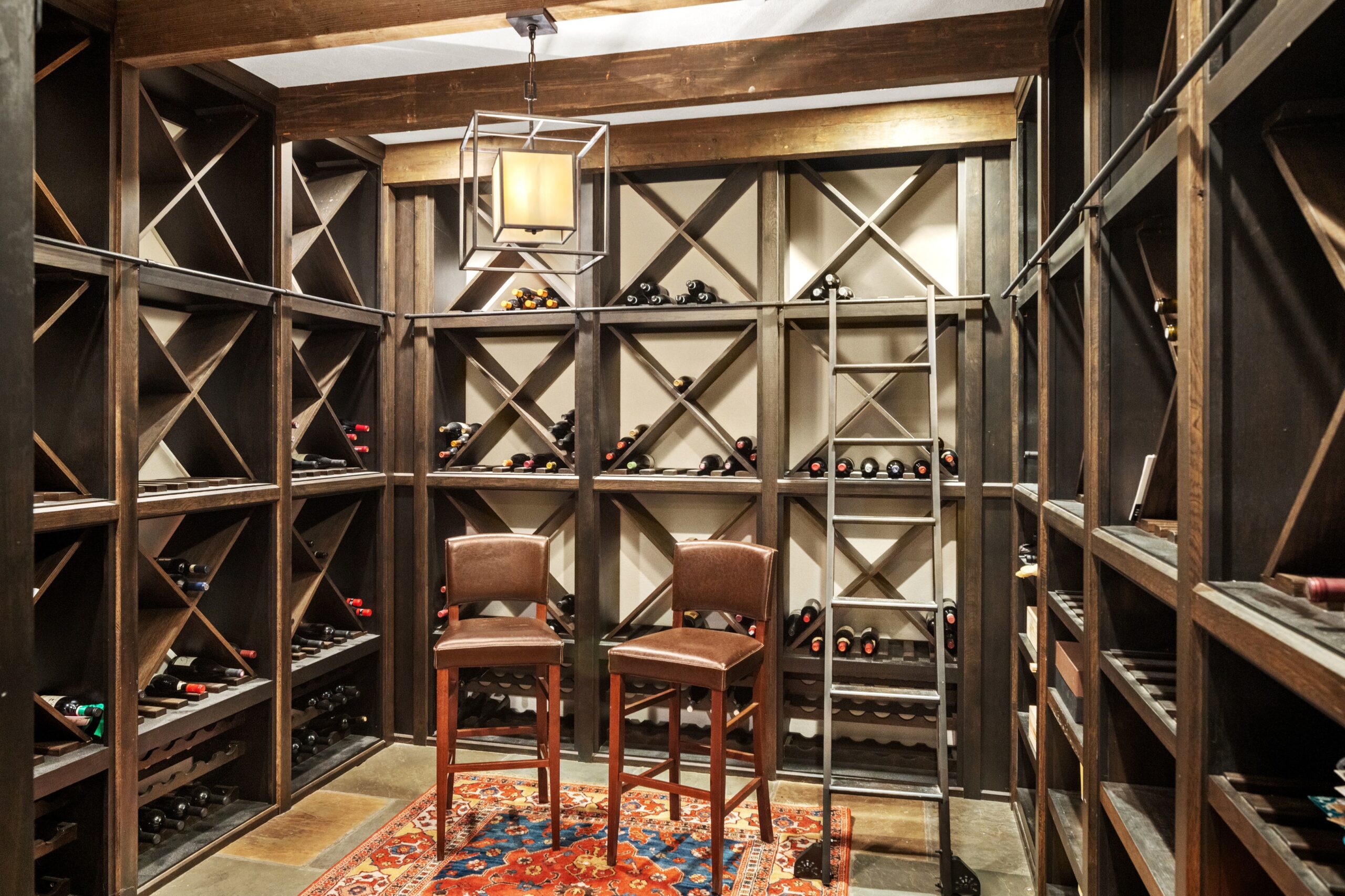
    The finished basement spans 1,538 square feet and includes a wine cellar.

    The basement includes a sports bar with TVs, wine cellar for up to 3,000 bottles, movie room, gym, and bathroom.

    The property “is both impressive and cozy at the same time,” Smerconish said.

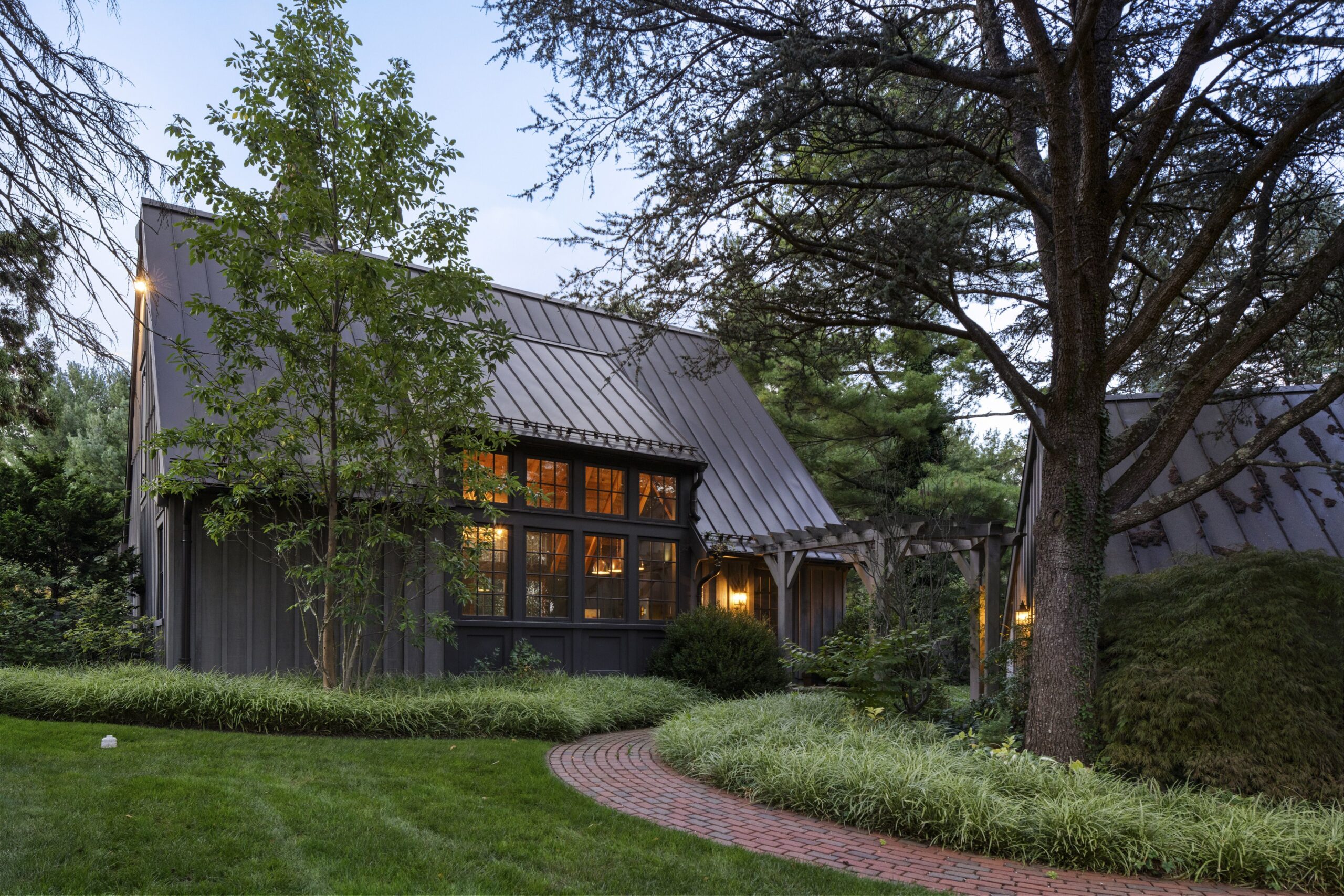
    The carriage house on the market for $2 million on Creighton Road in Lower Merion is being sold as a package along with the $7.9 million house next door.

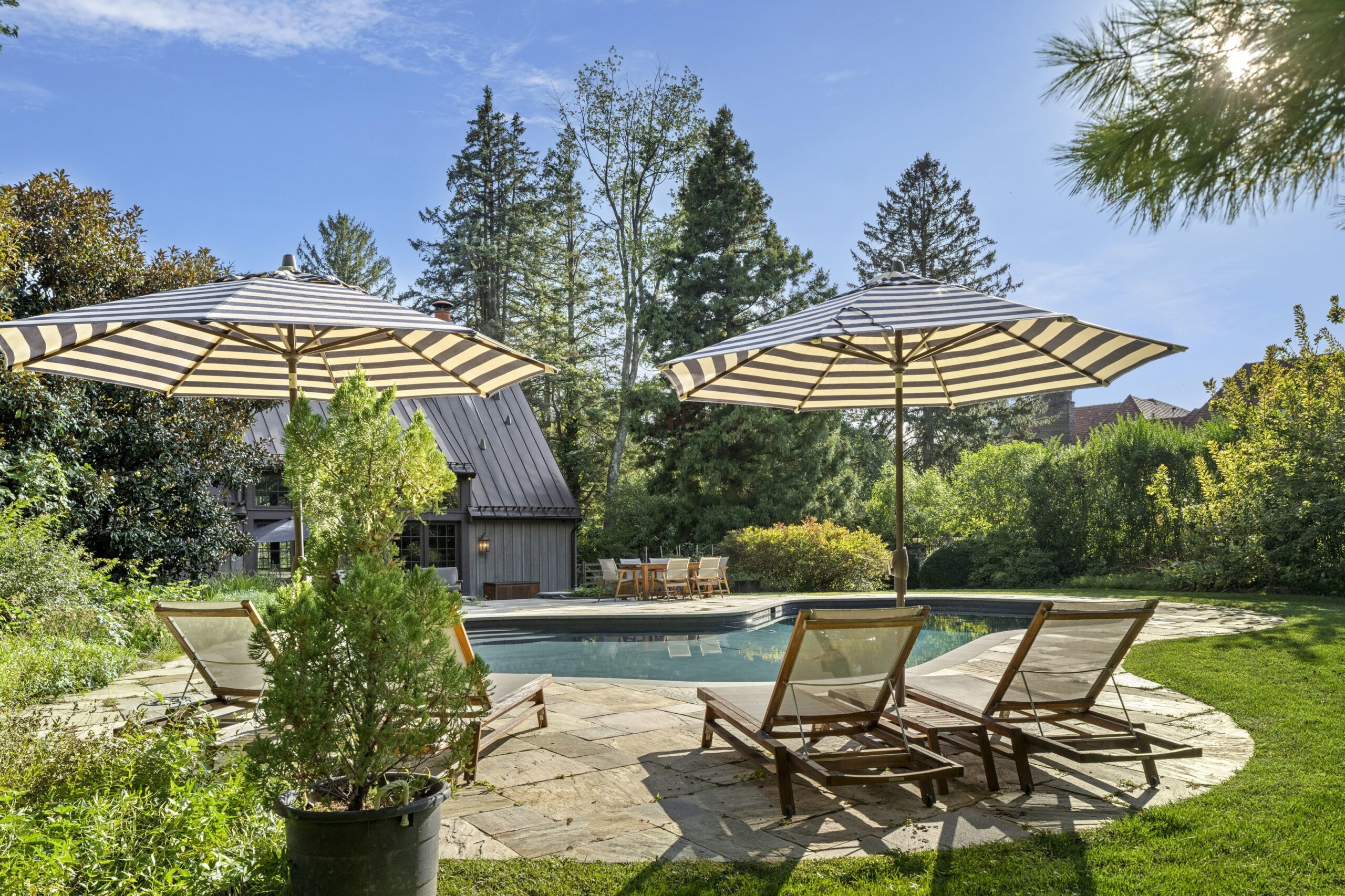
    The carriage house next door spans just over 1,000 square feet on an almost one-acre lot. It has a bedroom, bathroom, laundry room, eat-in kitchen, and living room. A flagstone patio leads to the heated saltwater pool.

    The properties are walking distance from the Appleford estate, which is an event venue, bird sanctuary, and arboretum with gardens and walking paths. They are minutes from Villanova University and Stoneleigh, a public garden of the nonprofit Natural Lands.

    And they’re also minutes from the Schuylkill Expressway and I-476.

    The carriage house includes a kitchen, bathroom, and bedroom.

    The properties were listed for sale on Dec. 5. Now that the holidays are over, Smerconish said, she will start accepting appointments to tour them. She said photos of the main house especially don’t do it justice.

    “You get more with a physical tour and experiencing it,” she said.

    Flagstone surrounds the carriage house’s heated saltwater pool.
  • Her Bella Vista apartment has a second-story tree view and brings nature inside

    Her Bella Vista apartment has a second-story tree view and brings nature inside

    Last spring, Katie Kring-Schreifels noticed two mourning doves fluttering in the maple tree outside her bedroom window. With the help of binoculars, over the course of several weeks she watched as the birds made a nest in the crook of two branches, then two eggs appeared in the nest, then fledglings hatched, and finally the baby birds grew up and flew away.

    Kring-Schreifels wasn’t surveying birds from a house in a bucolic suburb. She was watching from her second-floor apartment in a brick rowhouse in Bella Vista.

    Wanting to share the urban wildlife’s saga, Kring-Schreifels alerted her upstairs and downstairs neighbors to the nesting doves so they could watch, too.

    The Temple graduate loves city living, shopping at the Italian Market two blocks away, and taking courses at Fleisher Art Memorial down the street.

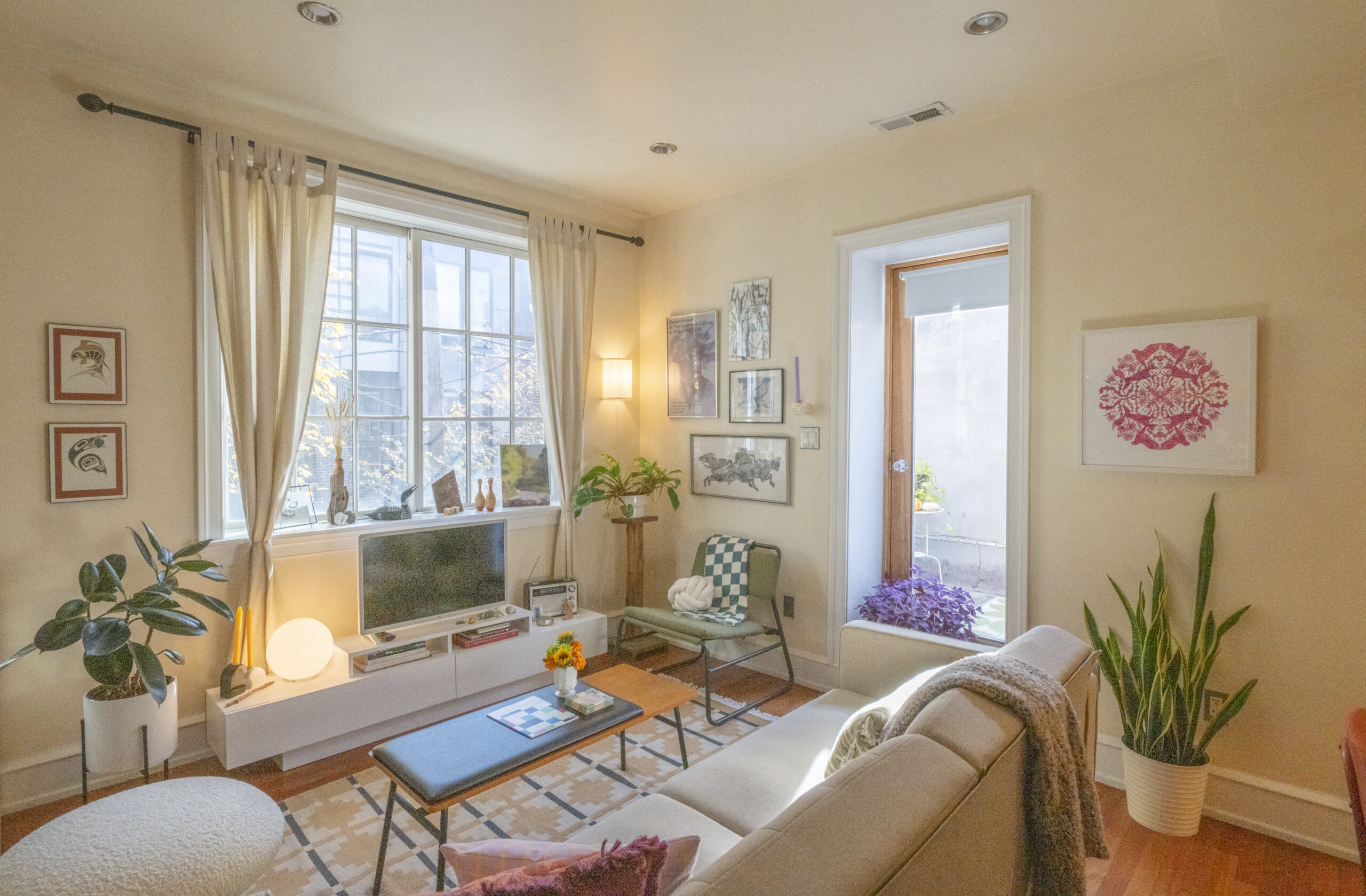
    The apartment is painted in a pale yellow, with live plants throughout the living space.

    Having grown up in Elkins Park, she values nature and has found ways to bring it into her one-bedroom rental. Her walls are painted pale sunshine yellow, for instance, and a flock of paper bluebirds is suspended from string, creating the illusion that they’re flying across a living room window.

    Kring-Schreifels’ mother, Julie, found the birds at a craft show. Julie, an artist, also created the framed collage with red poppies. And her prints of a fanciful salmon and a raven were purchased on a family trip to Vancouver.

    A map of London combining drawings of birds and foxes with street names was acquired by Kring-Schreifels when she spent a college semester abroad.

    Paper birds hang in the living room window.
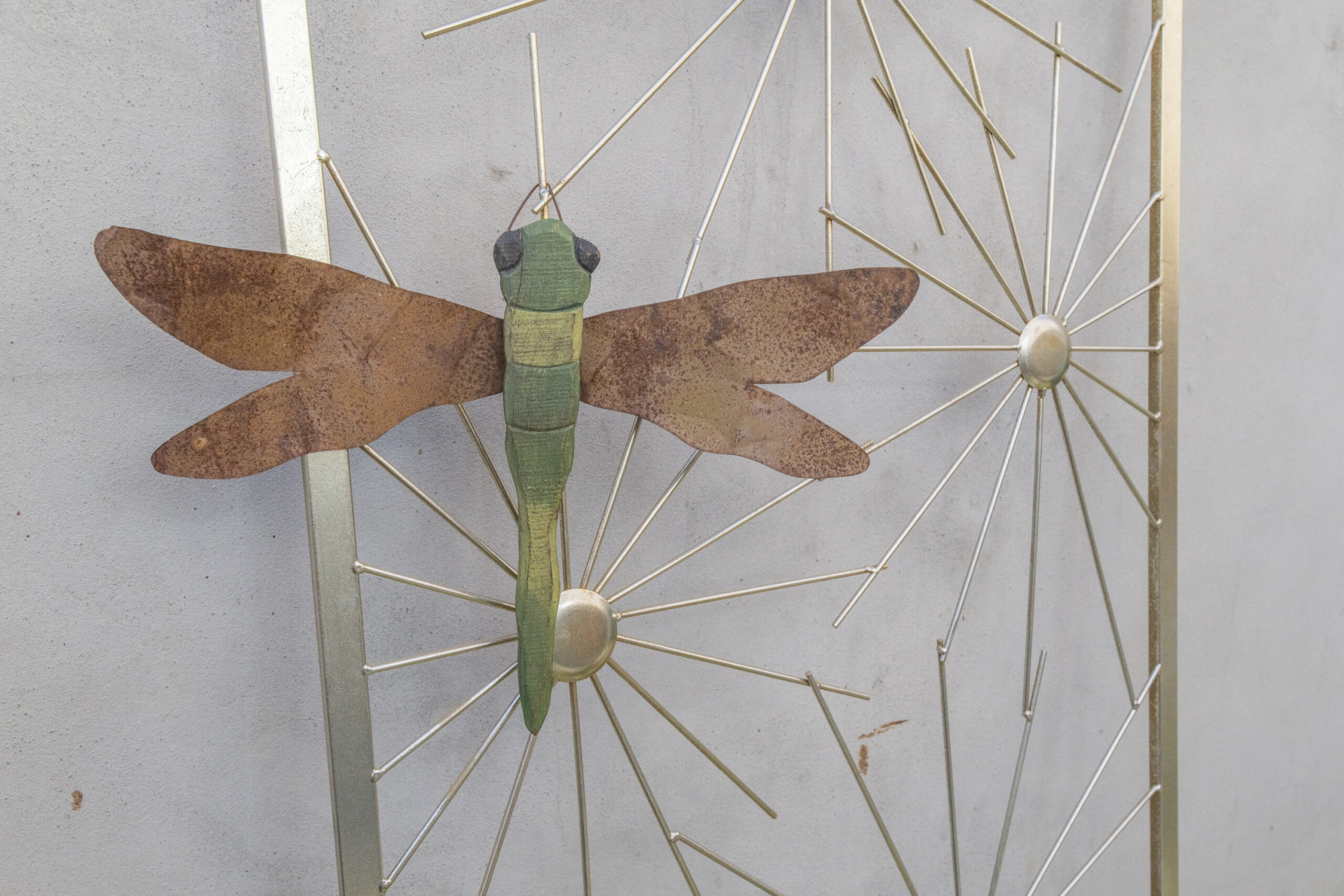
    A green and bronze dragonfly is attached to a repurposed headboard on the patio.

    The beige pullout couch and coffee table in the living room came from Wayfair. The green chair, globe lamp, and the beige, cream, and black rug were purchased from Ikea, one of her favorite shopping destinations. “I love Scandinavian design,” she said, “It’s simple and warm.”

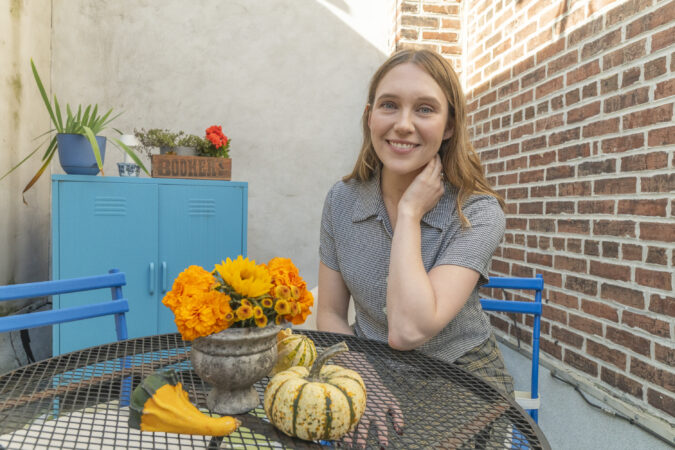
    In warm weather, marigolds and other annuals fill pots on the balcony, which is furnished with a blue storage cabinet from Target, blue chairs from Ikea, and a black metal table from her aunt, Mindy Kring. A brass sunburst headboard has been repurposed as a resting place for a green and bronze dragonfly found at the flea market on Head House Square.

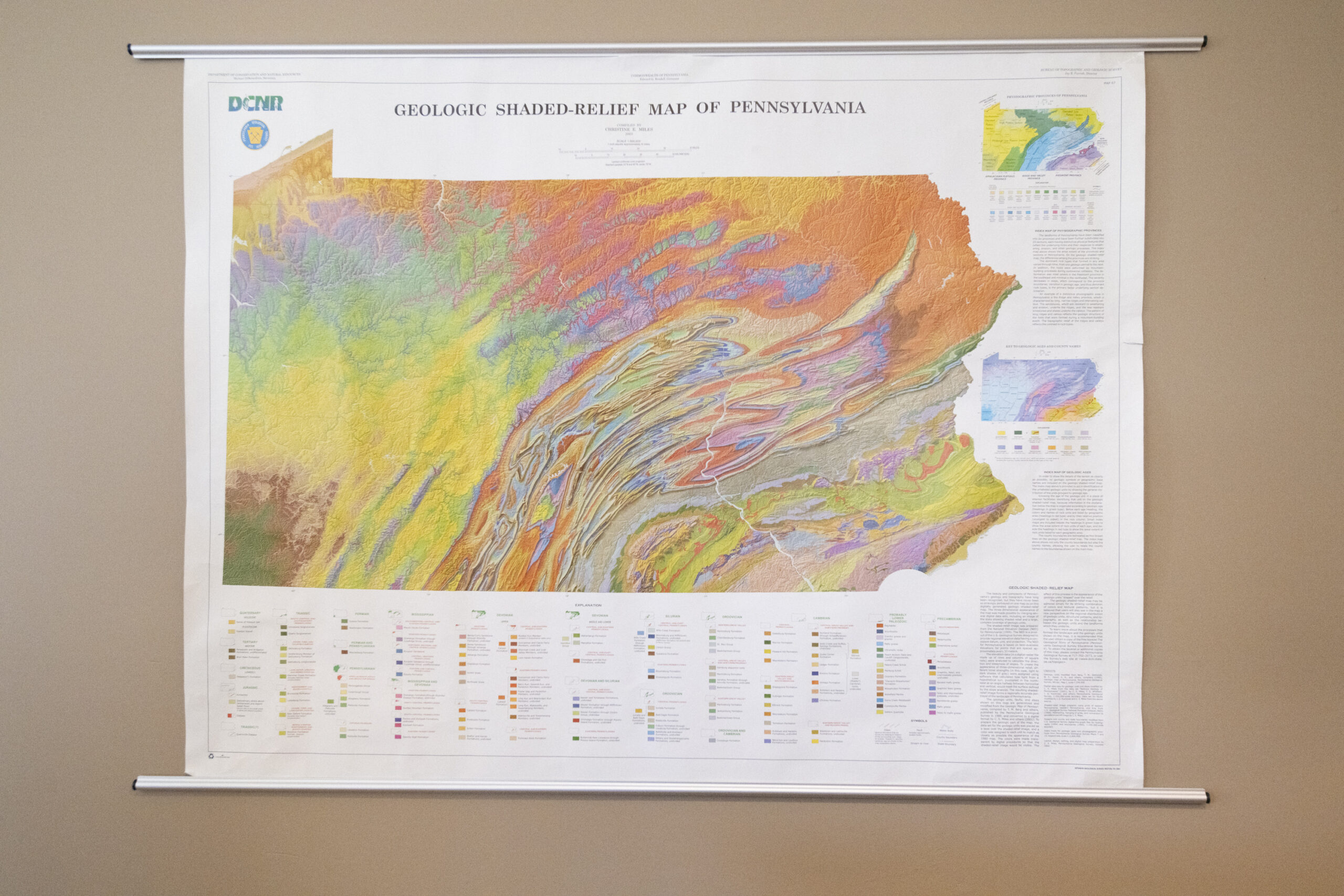
    Inside, on an accent wall painted taupe, hangs a multihued Geologic Shaded-Relief Map of Pennsylvania. Kring-Schreifels finds ancient rock croppings fascinating. “I wish I had been a geology major,” she said.

    A geological map of Pennsylvania, a gift from a friend, hangs near the kitchen.

    Instead she was a public relations and art history major and now works as an executive assistant for a promotional products producer.

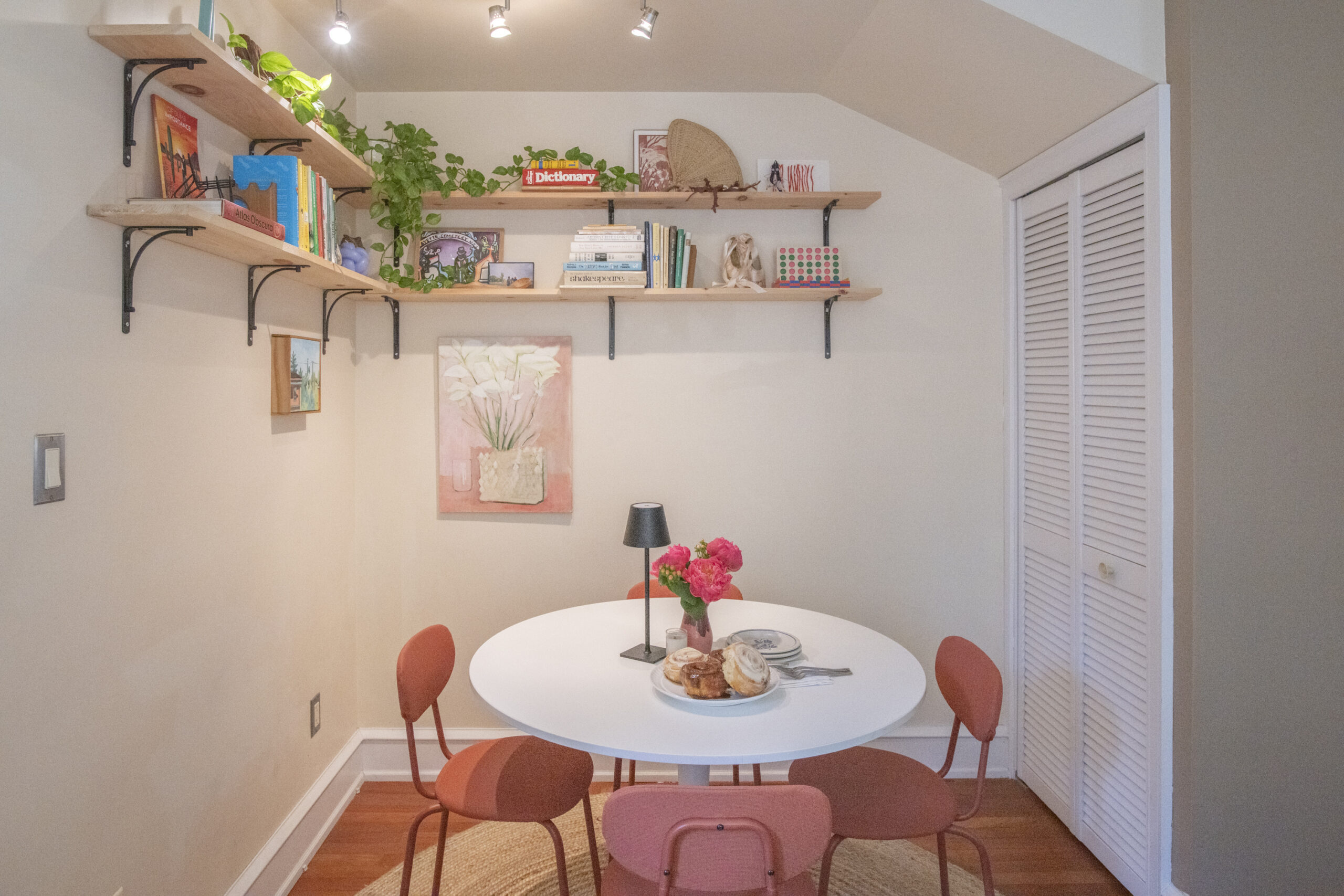
    Plants and books fill shelves over a dining nook furnished with a white table and red chairs from Ikea.

    The kitchen, with pale pine cabinetry and stainless steel appliances, including an apartment-size dishwasher, and the apartment’s oak flooring were installed after Kring-Schreifels’ landlord, Nate Carabello, bought the house in 2005.

    The dining area features a white table and red chairs from Ikea.
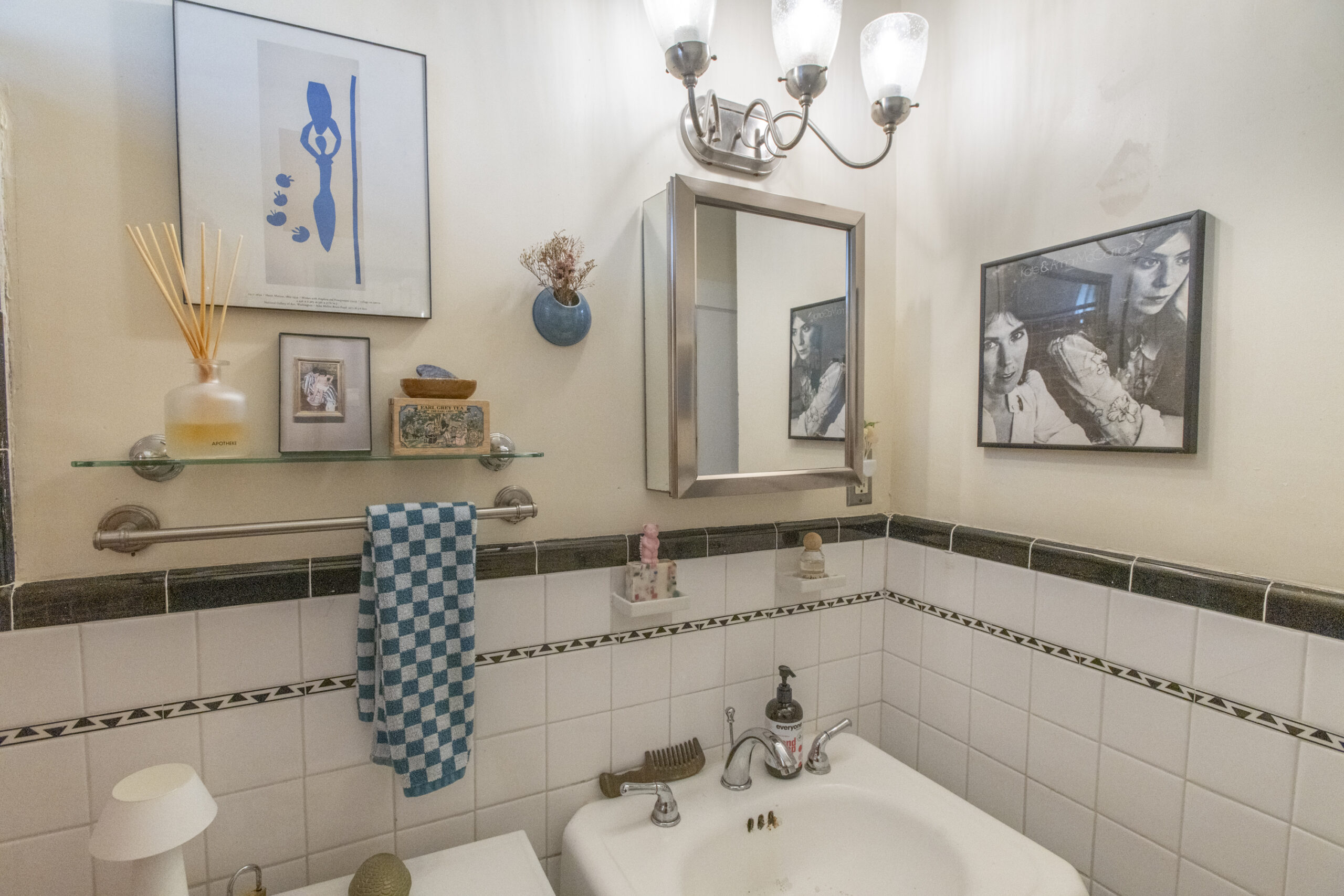
    The property owner was able to salvage the black-and-white tile in the bathroom.

    It had been boarded up for 30 years, he said, and a tree was growing in the middle of the then-roofless house. The brick rowhouse probably had been built in the early 1900s and enlarged in the 1920s, said Carabello, who lives nearby.

    The reglazed white fixtures and black-and-white tile in the bathroom were the only items from the 1920s he was able to salvage.

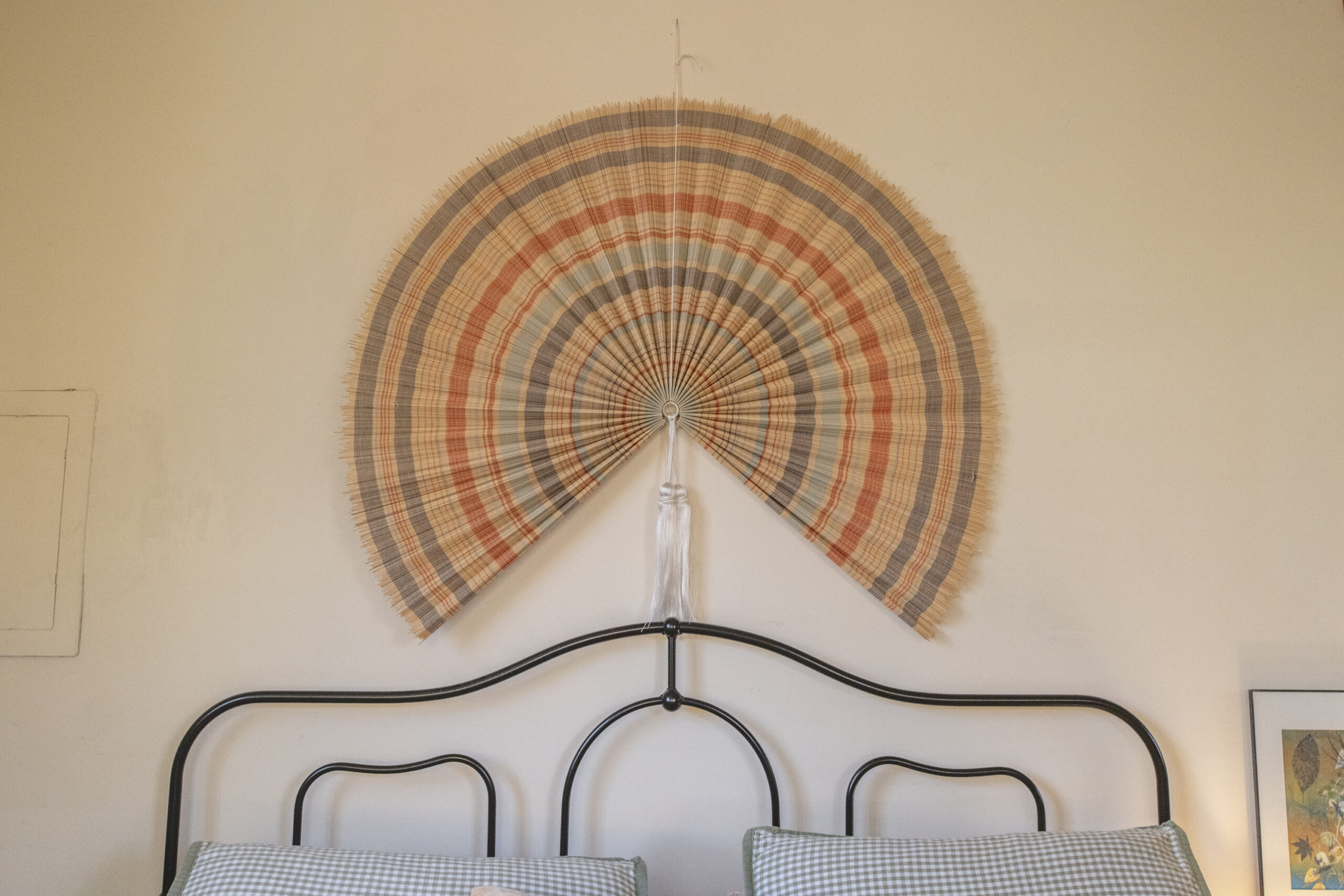
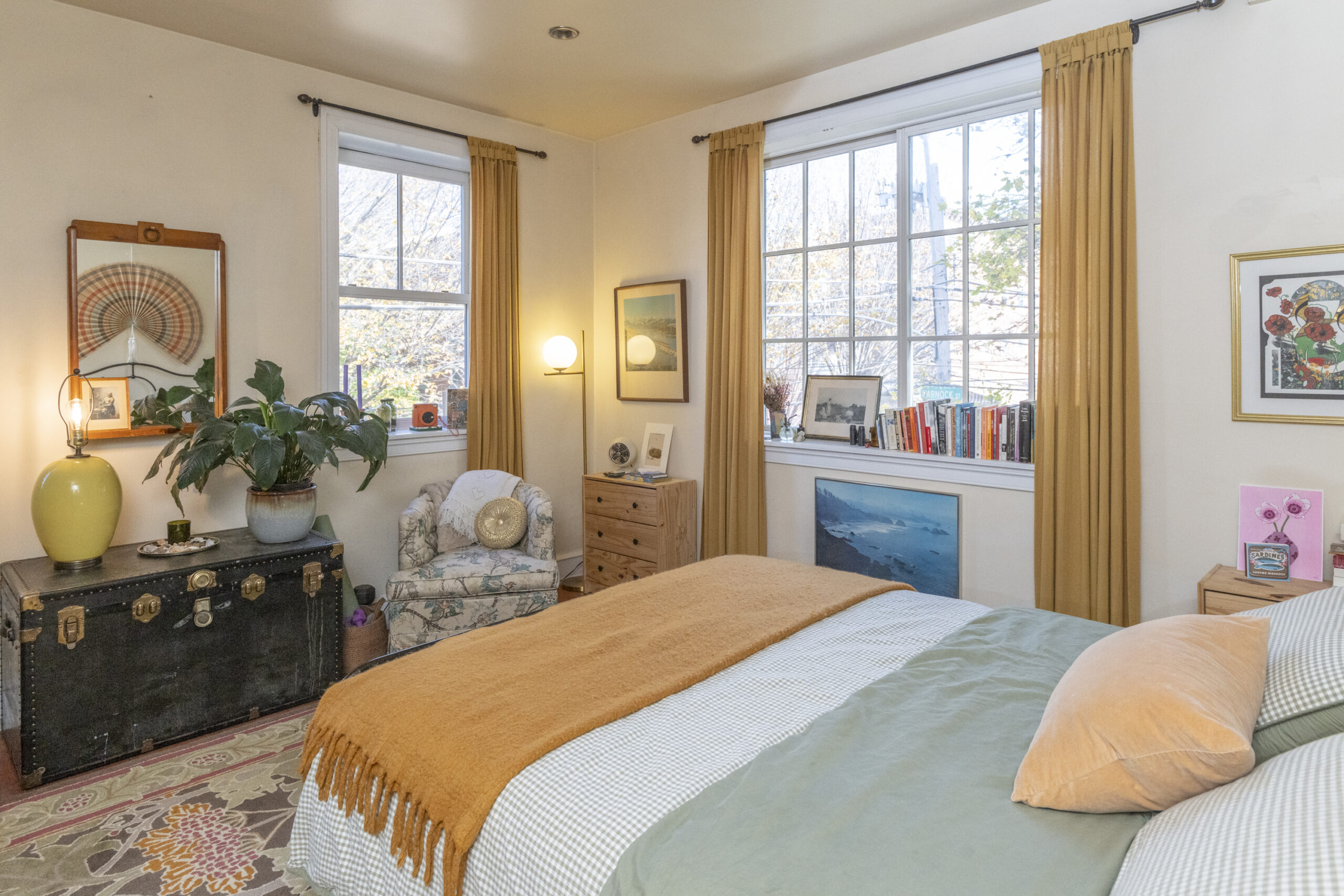
    In the bedroom, Kring-Schreifels’ favorite find is the coral, green, and cream-colored fan above her bed, which she purchased on Facebook Marketplace for $30. The fan’s colors are picked up in the small armchair from the Habitat for Humanity ReStore and in the William Morris-inspired floral patterned rug from eBay.

    A fan over the bed, which Kring-Schreifels found on Facebook Marketplace.

    The iron bed came from Amazon. The gold drapes, green-and-white bedding, and tan blanket came from a nearby Target. The leather trunk with brass fittings belonged to Kring-Schreifels’ great-grandmother.

    Shades covering storage spaces above two closets were hung by Kring-Schreifels’ father, Jeff, who also provides transportation when his daughter, who has no car, wants her purchases hauled home.

    Under the bedroom window hangs a photo of a seascape with roiling blue waves. On the windowsill next to an ethereal print called Evening in Paris are binoculars awaiting the return of mourning birds next spring.

    The bedroom is decorated with eclectic items, including a leather trunk that belonged to Kring-Schreifels’ great-grandmother.

    Is your house a Haven? Nominate your home by email (and send some digital photographs) at properties@inquirer.com.

  • Between Grok, Trump, and RFK Jr., it’s a dangerous time to be a child in America

    Between Grok, Trump, and RFK Jr., it’s a dangerous time to be a child in America

    It is a terrible time to be a child in America.

    From removing protections from newly resurgent communicable diseases to investing good money after bad into industries that will make the planet more inhospitable during their lifetimes, we adults have wholly abdicated our responsibilities to Gen Alpha (and the infant Gen Beta). We’ve especially failed them by ceding to our own most juvenile inclinations — we elect the irresponsible and reward the feckless — and abandoning them to what we’ve wrought.

    You grok? Yeah, that used to mean “to understand profoundly and intuitively,” but thanks to the sots that run the social media site X, it now refers to the artificial intelligence assistant that is, as we speak, actively degrading children by allowing users to take any innocently posted photo and, via prompt, have Grok edit and return the same image with the children stripped of their clothing, sometimes with other sexually suggestive details added.

    When first called out, the AI assistant itself claimed the offending, nonconsensual, manipulated images were isolated cases.

    But after outcry from ordinary folks and from officials from France, the United Kingdom, India, and others globally, Elon Musk — the CEO of X’s holding company, who initially posted laughing emojis about some of the more innocuous manipulated images — has now, according to the Guardian, posted that “anyone using Grok to make illegal content will suffer the same consequences as if they upload illegal content.”

    Nevertheless, as of yesterday, the degrading images were still being generated and posted, the Guardian noted.

    It’s not only children. The majority of the nonconsensual AI manipulated images created this way between Dec. 25 and Jan. 1, according to an analysis by a French forensic nonprofit, are of women under the age of 30, with only 2% involving minors under the age of 18. Still, it is particularly troubling that some of the minors subjected to this kind of image editing are allegedly as young as 5 years old.

    The creation of these deepfakes isn’t, unfortunately, limited to X. According to a recent article by Wired, Google’s and OpenAI’s chatbots also enable users to manipulate existing images nonconsensually this way.

    As the adults in the room, our gravest fault in all this isn’t that we’ve given puerile middle-aged tech leaders like Musk the space to ply generative products that retcon our children’s images in gross and nonconsensual ways, though that’s certainly bad enough. No, it’s the cumulative harms to our children we’re enabling across the board and right under our noses.

    Elon Musk holds up a chain saw he received from Argentina’s President Javier Milei (right) as they arrive to speak at the Conservative Political Action Conference (CPAC) at the Gaylord National Resort and Convention Center in Oxon Hill, Md., in February.

    The generative AI that fuels the nonconsensual pornification of our children’s visages for entertainment purposes is part of what empowers Big Tech funding support of the Trump administration. An administration that is working mightily to restrict the image our children themselves can choose to present in the world, and to deny the bodily autonomy of anyone younger than 19.

    It’s an administration that has thwarted the release of the Jeffrey Epstein files, despite the calls to do so from the women who were preyed upon and victimized when they were young girls. The same administration that has cut the SNAP benefits that feed millions of young people, and has dismantled educational resources for disabled students. An administration that, under Robert F. Kennedy Jr.’s direction, has narrowed access to healthcare, blamed Tylenol for autism, and curtailed gold-standard vaccines for children rather than expanded them.

    In the longer term, the same Big Tech responsible for the development of generative AI is responsible for the explosion of data centers, which we adults welcome because, sure, they create jobs for us now. But since each one consumes up to five million gallons of freshwater per day, the world we are shaping for Gen Alpha and Gen Beta children to inhabit will have drastically diminished, or contested, capacity to support human life.

    There are so many other examples of how we, the adults in the room, are choosing to be callow and cavalier about the future. So can we really bristle when we hear members of Gen Alpha (or even Gen Z) say we’ve ruined the world?

    If we want the younger generations to be mistaken about that, we must change course now. And the opportunity to flex on the Grok grotesquerie is staring us in the face. Let’s push to close it down altogether until the coding is modified, and no one can prompt the AI assistant to strip our children of their clothes, their dignity, and their agency. We owe them that.

    Then we can get started on fixing all the rest.

  • Media-based painter Rinal Parikh is redefining Indian folk art with contemporary themes and local imagery

    Media-based painter Rinal Parikh is redefining Indian folk art with contemporary themes and local imagery

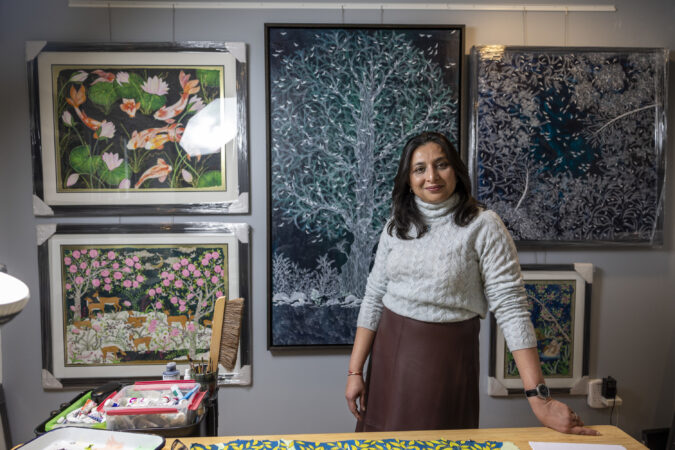
    As a blanket of snow and sleet melted into the grass and an early winter fog hung over the Delaware Valley last month, Rinal Parikh’s art studio was a tranquil portal to the outside world.

    In her studio, lofty windows look out onto a sprawling backyard. The walls are adorned with Parikh’s paintings, both completed and in progress, and its shelves are stacked with art supplies and mementos.

    “What inspires me is my surroundings, and I’m blessed with an amazing backyard,” Parikh said, looking out the window. “That is my main inspiration.”

    Parikh is a Media-based painter and biochemist by trade whose art blends traditional Indian folk styles with contemporary themes. Her art, rich in texture, color, and meaning, uses a collection of materials, from sand and fabric to glass, beads, and stucco. She paints with acrylic and watercolors, and creates detailed drawings with thin brushes. Her work fuse her upbringing in India with her current life in Media, an amalgamation of past and present, of here and there.

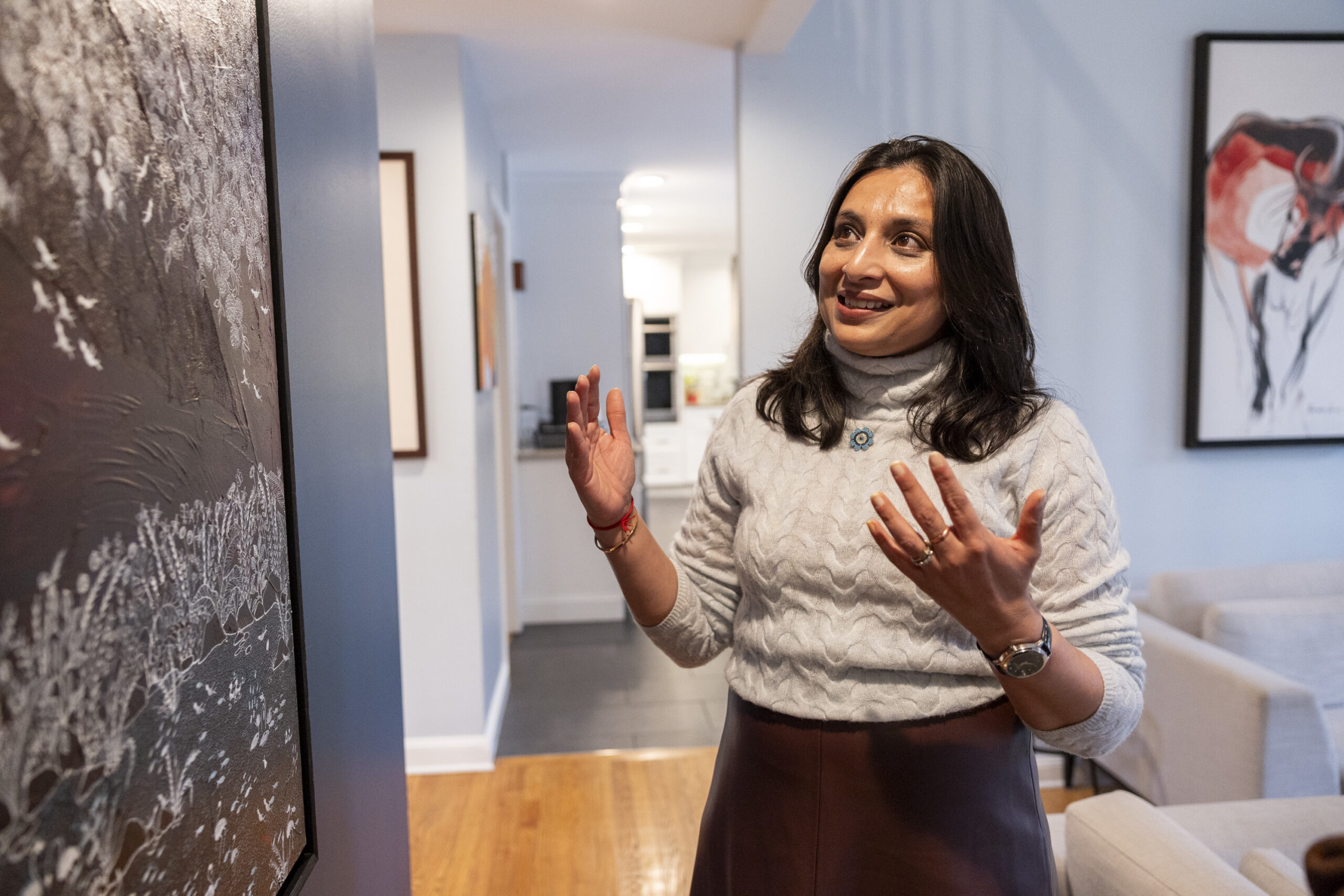
    Rinal Parikh, 43, Media-based artist, talking about her art work in her home in Media, Pa., on Tuesday, Dec. 23, 2025.

    Parikh, 43, took a circuitous route to becoming an artist. She moved to Philly in 2005 from Gujarat, India, to follow her husband, Bhavin, who had immigrated a few years earlier (the day of our interview was the 20th anniversary, to the date, of her arrival in the U.S.). She enrolled in a masters in molecular biology program at Drexel University, a step toward her Ph.D., and got a job in a lab at Penn Presbyterian Medical Center.

    A few years after her move, Parikh’s first son was born with health complications. With no family close by, Parikh quit her job to focus on taking care of her son. He’s now a healthy teenager, she notes.

    Seeing that Parikh was missing out on work, her husband made a suggestion: Why not paint something for their new house? That first painting, “Krishna-leela,” now hangs in the Parikhs’ living room, an eye-catching depiction of the Hindu deity Krishna.

    Rinal Parikh’s painting “Krishna-leela” is displayed at home in her formal living room in Media, Pa., on Tuesday, Dec. 23, 2025.

    When her son was 9 months old, Parikh stopped by an art fair at the Creative Living Room, a community arts center in Swarthmore. She struck up a conversation with some of the women there. A few days later, they called with a question: Would she like to do a solo show?

    “I didn’t even know what that means,” she said.

    Nonetheless, she agreed. She worked tirelessly for three months to make 20 pieces. She didn’t know where to buy art supplies, so she imported them from India (someone would later point her toward the now-closed Pearl Art & Craft Supplies on South Street). In fall 2009, she displayed her paintings for the first time as a professional artist — and sold her first painting, too. The rest, she said, is history.

    Parikh melds together three types of Indian folk art — Warli, Madhubani, and Kalamkari. Warli is a tribal art that depicts day-to-day life in a mural-like format. Madhubani uses geometric patterns and typically reflects celebrations of life. Kalamkari, Parikh said, is “very refined,” a style of art that uses a fine brush to create delicate and detailed line drawings. All three art forms have traditionally been practiced by women.

    Parikh feels like she speaks “a global language.”

    Though her paintings take inspiration from the traditional Indian folk style, the scenes depicted are not just of India. They’re often of the Philly area, and of the flora and fauna in her backyard.

    “I still practice Indian folk art, but the subject matters are very ‘now,’” Parikh said. “The language is still very traditional, but the conceptualization, the visualization, is much more contemporary.”

    A painting called “Home” painted by Rinal Parikh, 43, displayed in the family room of her home in Media, Pa., on Tuesday, Dec. 23, 2025.

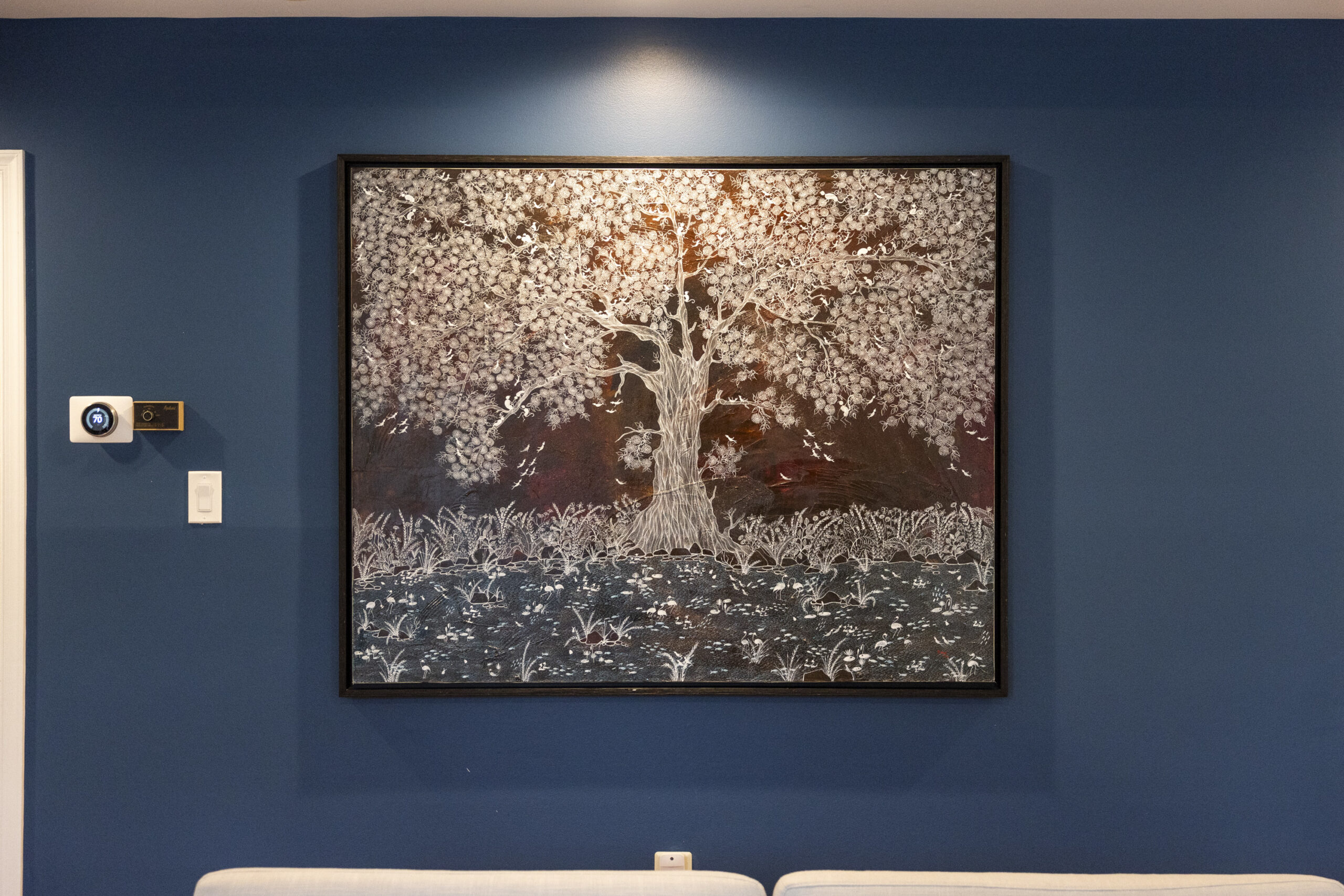
    In her family room hangs “Home,” a 2021 Warli painting of a tree. The background is complex in both texture and color, with blues, browns, and purples peeking out. Hanging from the tree are monkeys, which Parikh said captures the energy of having two boys, now 17 and 12, in the house. (They’re very good kids, she clarifies.)

    “I observe my surroundings, I experiment with styles, I do a lot of repetitive patterns, and I tell my story,” she said.

    Since jumpstarting her art career, Parikh has become involved in the region’s growing art community. She’s the marketing chair for the Rittenhouse Square Fine Arts Show and is involved with the Community Arts Center of Wallingford.

    She said she understands the anxieties of young artists and wants to support the organizations that nurture their careers.

    “I was supported by the community, and I want to do the same thing.”

    Parikh’s art can be found on her website and her Instagram page.

    This suburban content is produced with support from the Leslie Miller and Richard Worley Foundation and The Lenfest Institute for Journalism. Editorial content is created independently of the project donors. Gifts to support The Inquirer’s high-impact journalism can be made at inquirer.com/donate. A list of Lenfest Institute donors can be found at lenfestinstitute.org/supporters.

  • House of the week: An expanded four-bedroom Colonial in Abington Township for $599,900

    House of the week: An expanded four-bedroom Colonial in Abington Township for $599,900

    Living in the Fox Chase Manor neighborhood in the mid-1990s, Linda and Mike Tobin admired the location of houses across the street. So in 1997, they decided to buy one and enlarge it.

    They raised their two children there and sent them to the Abington School District. But now the children are grown up and have moved to Cherry Hill, where Linda is from, so the Tobins will follow them there.

    Mike installs telecommunications systems for businesses, and Linda is a retired telecommunications professional.

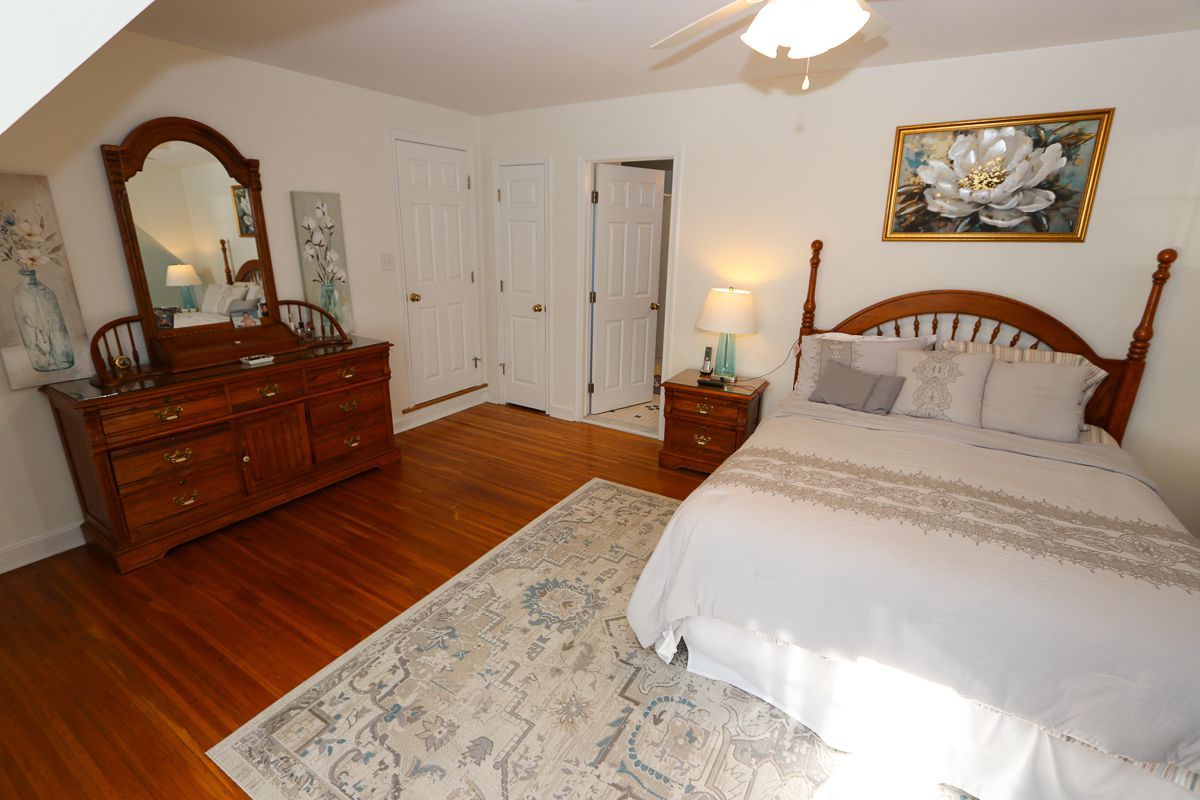
    The primary bedroom.

    Mike said they were particularly attracted by “the quaintness of the neighborhood, the big oak trees,” and township-residents-only Alverthorpe Park, with its variety of athletic facilities.

    So they undertook a major renovation of the house on one of the larger plots of Fox Chase Manor, with a two-car attached garage and driveway parking for four more cars.

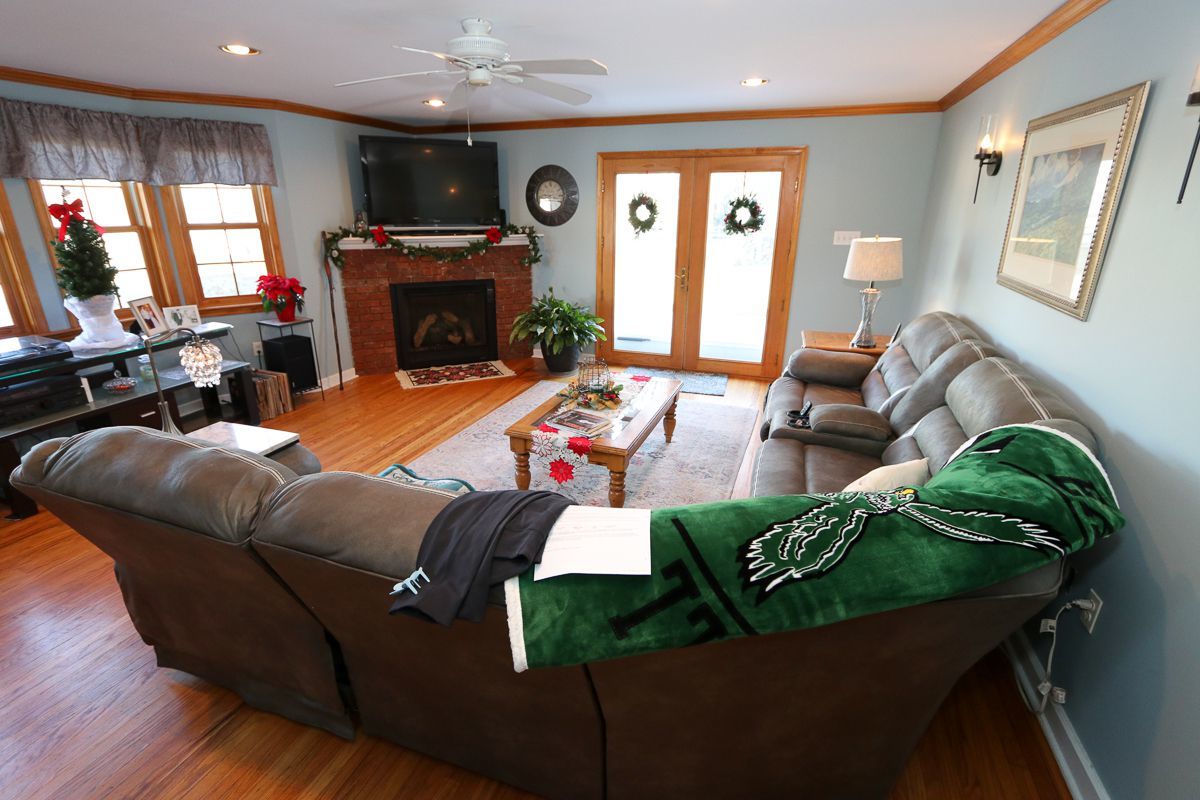
    The family room has a gas fireplace.

    The renovation comprised an expanded eat-in kitchen, first-floor powder room, and a family room with a gas fireplace and a large patio.

    The second level was expanded for the house to have four bedrooms, two full bathrooms, and a laundry room.

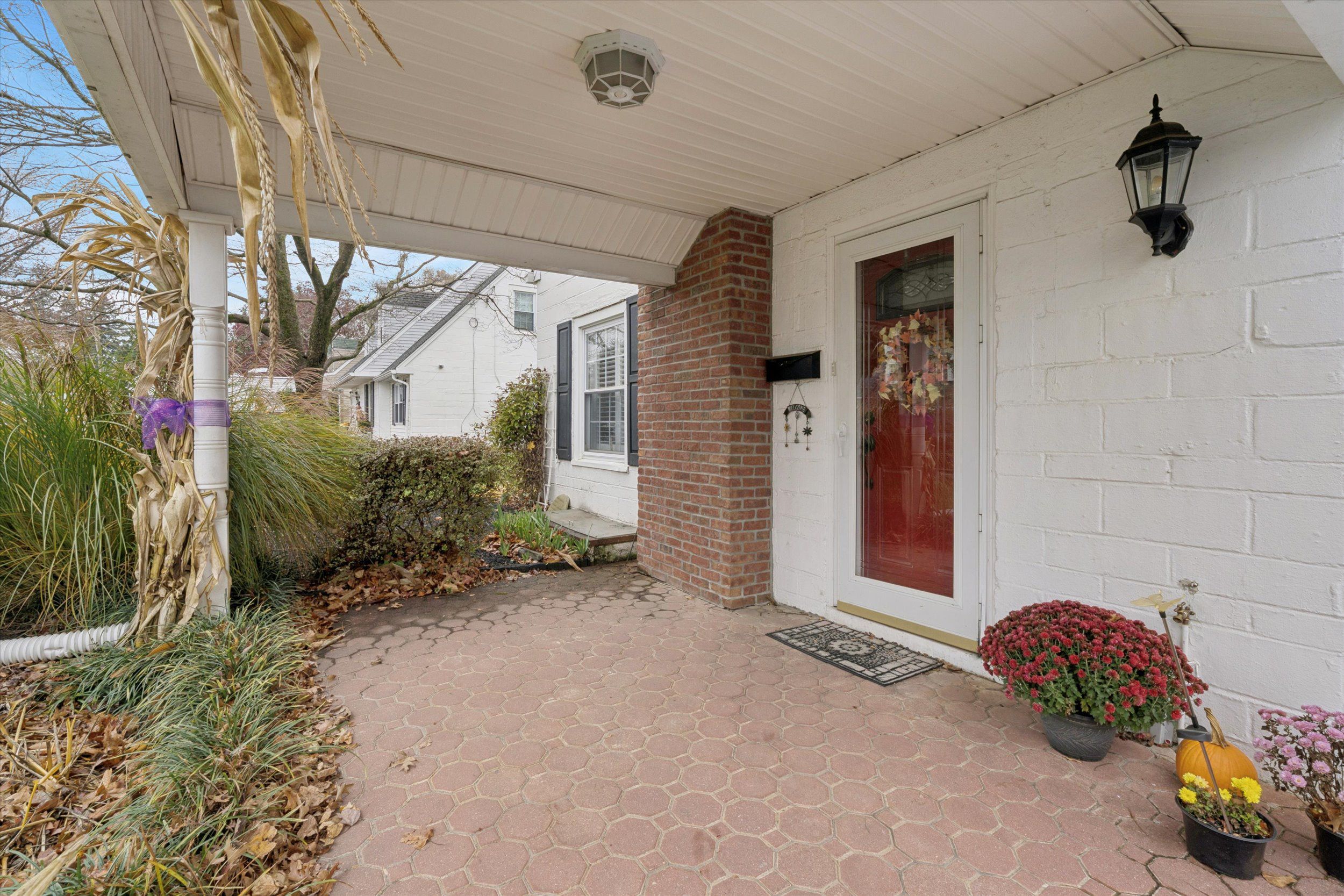
    Entrance to the house is through a covered front porch into the foyer, living room, and formal dining room.

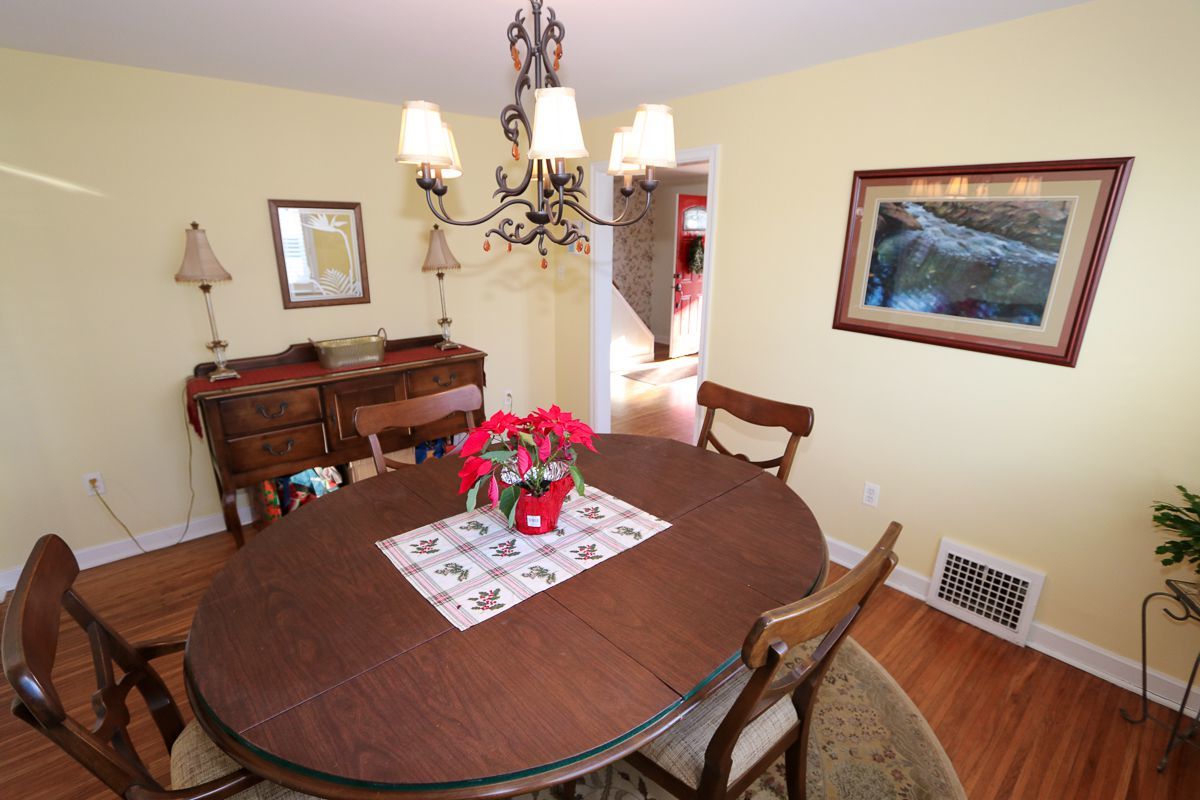
    The dining room.

    The second level has the bedrooms, and the primary bathroom has a stall shower and walk-in closet.

    The partially finished basement has heat.

    There are hardwood floors in most of the home, and tile in the kitchen and bathrooms.

    A covered front porch at the entrance to the house.

    The roof was replaced in 2015 and there is 200-amp electric throughout.

    The house is close to Huntingdon Valley Shopping Center and a Giant supermarket.

    It is listed by Don Rowley of Coldwell Banker Hearthside Realtors for $599,900.

  • A Chesco town lowered taxes. That’s pretty unusual — but may not be something others can copy.

    A Chesco town lowered taxes. That’s pretty unusual — but may not be something others can copy.

    It was something of a lucky confluence of factors in West Bradford Township that led to residents seeing a reduction in their property taxes going into the new year, as other communities in the state see hikes.

    A number of loans that were refinanced during record-low interest rates at the height of the COVID-19 pandemic in 2020, plus long-term lease agreements that brought the municipality more money, eventually equaled “substantial savings,” said Justin Yaich, town manager.

    Savings in hand, the township decided they’d give it back to residents, he said, rather than funding “another pet project or another program.”

    In the budget, passed last month by the town’s board of supervisors, West Bradford set its property tax millage for a 0.25 mill — a 50% reduction in the tax for residents. For a home worth roughly $300,000, residents will now pay $75 a year, down from $150.

    It comes as Philadelphia’s collar counties and municipalities have faced tightening budgets and have had to hike taxes after years of stagnation.

    It’s unusual, John Brenner, executive director of the Pennsylvania Municipal League, said of West Bradford’s reduction.

    “There have been increases, and I’ve seen a number of them from municipal leaders throughout the Commonwealth — cities, boroughs, townships,“ Brenner said. ”You’re seeing counties raise taxes that haven’t in a long, long time. So that tells you the environment we’re in.”

    Local governments are fairly limited in how they can levy taxes under state law, with the biggest portion of revenue coming from “the beleaguered property tax,” Brenner said. Schools and the county take from that same source, with local municipalities usually taking far less.

    “Local government is not a business,” Brenner said. “It’s a provider of services, and those services cost money, and somebody has to pay for it.”

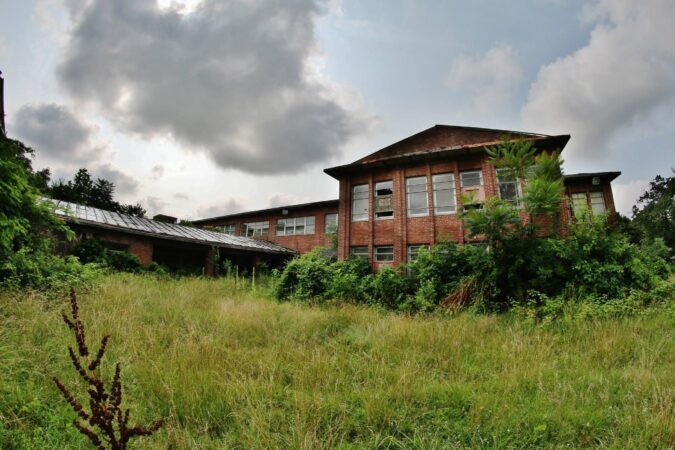
    But in West Bradford, it was years of planning and a flurry of factors, Yaich said. It started in 2019, when the town purchased the former Embreeville State School and Hospital, an abandoned 900,000-square-foot psychiatric hospital that had been deteriorating for more than two decades. A developer had sought to transform the property into a high-density residential complex, which saw community pushback and years of litigation.

    To purchase the site for roughly $23 million to turn it into 200 acres of open space, the township — for the first time — levied a real estate tax. (Residents already paid property tax to Downingtown Area School District and the county but previously did not pay the town.)

    But early in 2020, West Bradford refinanced its outstanding debts, renegotiated some lease terms, and began to hold other costs consistent. Over the years, it culminated in the township being able to reduce the real estate tax, Yaich said.

    The board’s philosophy is to do its core responsibilities — taking care of roads and infrastructure, caring for the open spaces and parks, running trash and recycling programs — and make sure there’s enough leftover for new programs or capital improvements, Yaich said. But anything beyond that, return it to the taxpayers, rather than figure out how to spend it, he said.

    It is easier to spend money than it is to trim, Yaich added, noting that the township faces rising costs and shrinking revenue sources: Cable providers, who once were paying $300,000 to the township in a year to put their lines in, are dwindling as people turn to streaming services. With more electric vehicles, fewer people are filling up at the pumps, meaning less liquid fuels money for the township, too. It’s rare, and unlikely to be replicated in a few years, to cut costs for residents like this, he acknowledged.

    As other town managers call and ask Yaich how to emulate him, he tries to dispel the magic.

    “We’re in a unique situation that we were able to do it,” Yaich said. “There’s no magic sauce or magic potion that we’re doing here that other places aren’t doing. It’s just that we were set up at the right time in the right place, and we acted when things were favorable to us and we were fortunate.”

    This suburban content is produced with support from the Leslie Miller and Richard Worley Foundation and The Lenfest Institute for Journalism. Editorial content is created independently of the project donors. Gifts to support The Inquirer’s high-impact journalism can be made at inquirer.com/donate. A list of Lenfest Institute donors can be found at lenfestinstitute.org/supporters.

  • Art makes this Chesco 15-year-old happy. So she launched a nonprofit to teach younger kids.

    Art makes this Chesco 15-year-old happy. So she launched a nonprofit to teach younger kids.

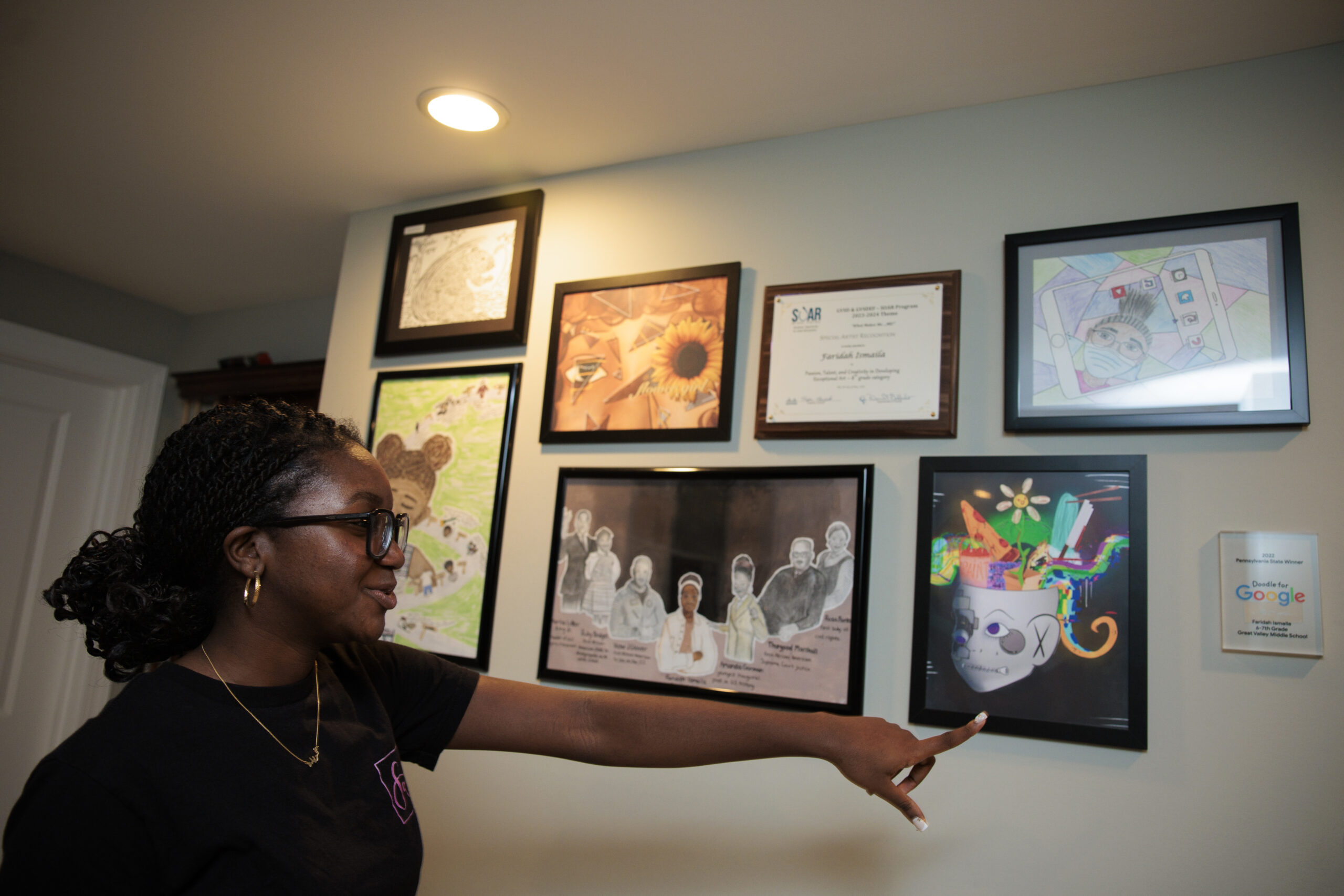
    Something about the phrase “Do what makes you happy” struck Faridah Ismaila. It became the title of, and inspiration behind, one of her art pieces. It’s printed onto the back of her T-shirt. It’s something the 15-year-old artist lives her life by.

    “When I do art, it’s because it makes me happy, and when I can give my art to other people or spread the joy of art, it’s making them happy,” she said.

    Following that guiding light of happiness, Ismaila, a digital artist and a sophomore at Great Valley High School, recently launched her nonprofit, A Paint-full of Promise, which offers free monthly art classes for kids in her school district in kindergarten through grade six.

    Working with educators in the district, Ismaila devises themed art projects and provides supplies and classroom time to teach young artists how to express themselves. The first club is slated for mid-January, with a winter wonderland theme. Children will make snowflakes and paint winter-themed coasters.

    Ismaila has been recognized for her art nationally: She was the state winner and a national finalist in the 2022 Doodle for Google competition, where young artists compete for their work to be featured as the Google homepage design. That recognition helped give her the confidence to pursue big dreams, like her nonprofit and club.

    “It makes me feel I can still do this. Because sometimes I’ll doubt myself. … I can’t be having all these big dreams,” she said. “But if people want to vote for me and I am recognized nationally, I feel on top of the world. I can do anything.”

    The first brushes of the nonprofit — which she hopes one day will grow to multiple sessions a month — started years ago, when Ismaila began making YouTube videos, teaching the fundamentals of art. She showed viewers how to make a gradient, how to depict a sunrise. She circulated the videos around her Malvern neighborhood, and she thought: Why not hold a class for younger kids?

    Faridah Ismaila, 15, poses for a portrait at her home on Wednesday, Dec. 17, 2025, in Malvern. Ismaila started a kids art nonprofit called A Paint-full of Promise. She also sells her art online.

    Over a summer, in her garage, she set up two art projects — painting and colored pencils — and led about eight kids through a lesson. She called it Faridah’s Art Crafty Corner.

    Holding the class made her happy. So she did it again, but bigger, turning it into a summer camp, under the new name: A Paint-full of Promise.

    “Then I decided, why not actually make this a club, so not only my community can get this, my entire district can?” she said.

    And now, the teenager has a nonprofit under her belt. She officially launched the organization last month at an event in Malvern, where she raised money by auctioning off prints of her work and selling T-shirts with her designs.

    Anne Dale, an art teacher at Great Valley High School who is an adviser for the club, said she was impressed with Ismaila’s ability to get other high school students involved in running the club.

    “A lot of students have big ideas for clubs, but there’s not always follow-through. With her, it’s definitely different, and I knew that when she approached me with it,” Dale said.

    Giving kids the tools and opportunity to create artwork was essential to Ismaila, who gravitates to art to process her emotions.

    “It’s just the best thing ever,” she said. “Once you start doing art as a kid, it’s just a great way to get your feelings out there and express yourself, even if you can’t use words to describe it.”

    One of her pieces, Beauty Within, depicts a skeletal hand holding a white mask, a tear running down its cheek. Behind the mask, flowers bloom. It came from a feeling of constantly analyzing herself, the feeling that what you show people is not necessarily what’s on the inside.

    Another piece, made when she was “seriously sleep-deprived,” shows a face with an assortment of pixels, pizza, stick figures, and paint pouring out.

    Faridah Ismaila, 15, talks about some of her early works at her home on Wednesday, Dec. 17, 2025, in Malvern. Ismaila started a kids art nonprofit called A Paint-full of Promise. She also sells her art online.

    A piece she is working on now shows herself, in vibrant colors, pointing to her reflection. She wanted to capture the feeling of two versions of the self — one confident, the other fragile.

    Sometimes, her mother Nofisat Ismaila said, her parents feel as if they are holding her back.

    “I don’t know how I’m gonna keep keeping up with this girl, because she’s just taking us to places, keeping us busy, keeping us on our toes,” she said. “She’s turning out to be a really young, determined adult.”

    Faridah Ismaila, 15, poses for a portrait at her home on Wednesday, Dec. 17, 2025, in Malvern. Ismaila started a kids art nonprofit called A Paint-full of Promise. She also sells her art online.

    But to Faridah Ismaila, it’s about finding happiness, and giving it to others, too.

    “I really hope the kids just do what makes them happy. … It’s also just not being afraid to get out there, because when I was a kid-kid, I wasn’t afraid of anything,” she said. “I think middle school really kicks some kids in the butt, and getting up out of that — at least for me, art was a way to do that. I just want to give that to kids.”

    This suburban content is produced with support from the Leslie Miller and Richard Worley Foundation and The Lenfest Institute for Journalism. Editorial content is created independently of the project donors. Gifts to support The Inquirer’s high-impact journalism can be made at inquirer.com/donate. A list of Lenfest Institute donors can be found at lenfestinstitute.org/supporters.

  • Trump’s attack on Venezuela further flouts the Constitution he swore to uphold | Editorial

    Trump’s attack on Venezuela further flouts the Constitution he swore to uphold | Editorial

    So much for Donald the Dove.

    President Trump mounted an illegal invasion of Venezuela, kidnapping president Nicolás Maduro and his wife and spiriting them out of the country.

    The breathtaking use of military force against a sovereign state has no legal justification. It opens the door for anarchy in Venezuela and threatens to make the United States a pariah with no moral authority for other dictatorships around the globe.

    Trump acted without the authorization of Congress, in clear violation of the Constitution. But then again Trump has long mocked the Constitution he swore to uphold.

    Former President George W. Bush at least sold a phony story about weapons of mass destruction to get Congress to go along with his reckless invasion of Iraq. That catastrophic folly lasted nearly nine years, resulting in tens of thousands of needless deaths and costing taxpayers roughly $3 trillion.

    Trump once promised to avoid forever wars and claimed to be the president of peace. But without any provocation or convincing explanation, he launched a military buildup in the Caribbean and began illegally bombing small boats, killing alleged drug smugglers in Central and South America.

    President Nicolás Maduro joins a rally in Caracas, Venezuela, on Dec. 10, 2025. The Trump administration designated Cartel de los Soles, which it says is headed by Maduro, a foreign terrorist organization.

    Trump has offered shifting explanations — and even less evidence — for the military action ranging from wanting to stop drug trafficking to accusing Maduro of “stealing” U.S. oil and land.

    After the attack, Trump came clean on just how out of control the operation is, claiming the U.S. is ”going to run the country” and take over oil production.

    There is scant public support for Trump’s attacks in Venezuela.

    Congress, which under the Constitution, has the sole power to declare war, rejected efforts to rein in Trump’s warmongering. House Speaker Mike Johnson, a Trump puppet, praised the attack as a “justified operation that will protect American lives.”

    Sen. Andy Kim (D., N.J.) called the move “disastrous” and said Secretary of State Marco Rubio and Defense Secretary Pete Hegseth “blatantly” lied to Congress when they said the goal of the military buildup was not to topple Maduro.

    To be sure, Maduro is a corrupt and undemocratic leader who has brought economic ruin and death to Venezuela. Under his repressive regime, roughly 8 million people have fled the country.

    But if the Trump doctrine is the removal of corrupt and undemocratic leaders, where do the military actions end? How does Trump square the removal and prosecution of Maduro with his outrageous pardon last month of former Honduras President Juan Orlando Hernández, who was convicted of drug trafficking by federal prosecutors?

    Trump’s strongman act will do little to spread peace and democracy around the globe. In fact, the military actions in Venezuela may embolden China to invade Taiwan. It also signals to Russian dictator Vladimir Putin that Trump is not serious about defending Ukraine or Europe.

    It is painfully clear there is a corrupt and unrestrained madman in the White House. Yet, the conservatives on the U.S. Supreme Court and the Republicans in Congress have abandoned their role to act as checks on the executive branch, starting with the insurrection Trump fomented nearly five years ago.

    Under Trump, the American democracy that is getting ready to celebrate 250 years, is backsliding. A Harvard professor who studies democracies said flatly: “We are no longer living in a democratic regime.”

    The unauthorized attack in Venezuela is just the latest example of Trump’s growing authoritarian rule.