Tag: Weekend Subscribers

  • Pancreatic cancer is among the deadliest cancers. A new drug being tested at Penn is giving patients and doctors hope.

    Pancreatic cancer is among the deadliest cancers. A new drug being tested at Penn is giving patients and doctors hope.

    Irene Blair was expected to have another six to eight months to live in June, after her pancreatic cancer rapidly advanced to stage 4 less than a year after her initial diagnosis.

    A new drug being tested in clinical trials around the world, including at Penn Medicine’s Abramson Cancer Center, was the 59-year-old grandmother from Newark, Del.’s best hope for more time.

    The drug belongs to a class of pharmaceuticals long considered the holy grail of cancer research. It is a KRAS inhibitor, capable of blocking a protein that fuels an especially deadly cancer. Only 13% of pancreatic cancer patients are still alive five years after their diagnosis, the highest mortality rate of all cancers.

    Called daraxonrasib, the drug is not considered a cure. But the results emerging from clinical trials point to the first major advancement in decades for a devastating cancer usually caught in late stages. Former Nebraska Sen. Ben Sasse last week disclosed in a blunt social media post that he was recently diagnosed with metastasized, stage-four pancreatic cancer and is “gonna die.”

    In recent months, the federal government has sped up the review timeline for the drug made by California-based company Revolution Medicines, Inc., based on early clinical trial results.

    Across 38 patients in a phase 1 trial, the drug appeared to double the survival time for at least half of patients compared to standard chemotherapy, from roughly seven months to 15.6 months.

    “In pancreatic cancer, for too long, we haven’t had effective therapies beyond just chemotherapy,” said Mark O’Hara, Blair’s oncologist who leads multiple clinical trials testing KRAS inhibitors at Penn.

    Blair started the therapy through a phase 3 trial in July. Within three weeks, her cancer-associated pain went away.

    In October, her tumors looked stable or decreasing on scans. Her most recent December scan showed her cancer had not progressed.

    Aside from occasional facial rashes, she feels normal. It’s a big improvement from how she felt previously on chemotherapy, which caused her to lose 35 pounds and become so weak she couldn’t walk.

    The question now is how long the therapy can remain effective. Blair seeks extra time to “start living life.”

    She officially retired from her job in real estate in May and wants to travel, with trips planned to see family in California and Florida.

    Holidays have been especially hard for her.

    “You just wonder, ‘Will I be here next year?’” she said.
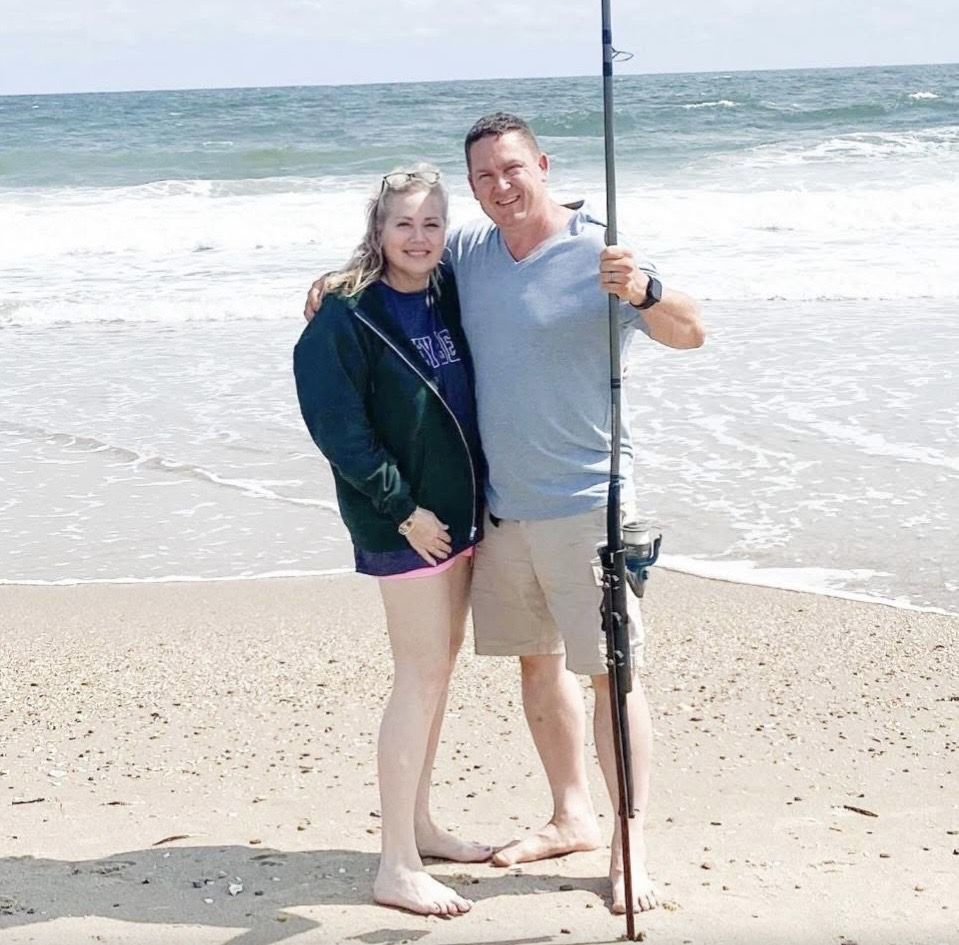
    Irene Blair and her husband, Charles, at a beach in Delaware.

    How does the therapy work?

    Cancer researchers have worked to design a drug targeting KRAS, a protein that acts like a “gas pedal” for cancer growth when mutated, since its discovery in 1982.

    The mutant protein is like a pedal stuck in the down position, driving uncontrolled proliferation — which tumors thrive on. These mutations are found in a quarter of human cancers, mostly aggressive cancers of the pancreas, lung, and colon.

    Scientists finally succeeded in 2021, when the first drugs capable of blocking KRAS were approved by the FDA for lung cancer. Dozens of KRAS inhibitors are now in various stages of development.

    Daraxonrasib is one of the first tested for pancreatic cancer, a tumor type where nearly 90% of cases have these mutations. Also called a ‘pan-RAS inhibitor,’ it not only targets KRAS, but two other related proteins that drive cancer when mutated, HRAS and NRAS.

    More than 90% of the 83 patients in a phase 1 trial saw their pancreatic cancer stall during treatment, and roughly 30% saw shrinkage.

    While taking the drug, at least half of patients gained more than eight months before the cancer started progressing again.

    The drug comes in pill form.

    The drug comes in the form of three pills, taken daily at home.

    The most prevalent side effect is a rash — 91% of patients in a phase 1 trial experienced this symptom, with 8% having severe cases. It often shows up on the face or scalp and is similar to acne, O’Hara said.

    Diarrhea, nausea, vomiting, and mouth sores are other common symptoms.

    O’Hara said these are manageable with medications for most patients and still allow them to have a better quality of life than chemotherapy.

    “I want to be able to give KRAS inhibitors to all my patients right now,” he said.

    Irene Blair of Newark, Del., meets with her doctor, Mark O’Hara, at her December appointment.

    Looking forward

    O’Hara runs multiple trials of KRAS inhibitors at Penn.

    Some of them are testing the inhibitor as a treatment for patients with metastatic cancer after other options have stopped working. Another is evaluating its use in combination with chemotherapy as an initial approach.

    “I’m looking for more tools to put in that toolbox, and I think this provides a new tool,” O’Hara said.

    Ben Stanger, a gastroenterologist and scientist at Penn, has led experiments in mice that showed combining a KRAS inhibitor with immunotherapy may be more effective than using the former alone.

    If this approach makes it into clinical trials as well, it could still take years to evaluate the safety and efficacy of the combination.

    He believes KRAS inhibitors could be “a game-changer” for pancreatic cancer if approved, particularly if paired with other anti-cancer drugs.

    “Goal number one would be to make pancreas cancer, instead of a death sentence, into a more ‘chronic’ disease that is treated over time,” he said.

    The federal government has granted the drug Breakthrough Therapy and Orphan Drug designations.

    In October, the drug was also one of the first selected for a new program that aims to accelerate review times for drugs from one year to as short as a month, potentially putting it on a faster path to approval.

    Daraxonrasib, also known as RMC-6236, earned Breakthrough Therapy and Orphan Drug designations in 2025.

    Limited options

    When Blair first started having back pain around May 2024, she thought it was a pulled muscle from kickboxing.

    She put a heating pad on the back of her chair and went on with life.

    After her father had a stroke that July, she got it checked out at the hospital where he was admitted.

    A day later, she was diagnosed with stage 2B pancreatic cancer.

    “My first thought is, ‘I’m dying,’” she said.

    Had she been diagnosed earlier, she would have retired early, instead of worrying about saving money.

    Instead, she spent her final working year undergoing surgery to remove part of her pancreas, spleen, and several lymph nodes, followed by 12 difficult sessions of chemotherapy.

    When she finished her last session in March, Blair’s scans showed no evidence of the cancer. But by late April, her back pain returned.

    Two months later, more scans showed that the cancer was now considered stage 4, as it had metastasized to her liver, forming 10 to 15 new tumors.

    Her best option was to enter a clinical trial of daraxonrasib at Penn.

    Much to her relief, she was chosen to receive the drug in July upon enrolling in a study in which half of patients are randomized to receive chemotherapy.

    “It’s enabled me to start living again,” she said, but knows eventually the therapy will likely stop working.

    In that case, doctors may try the standard chemotherapy — which usually works for three to four months — or test a different therapy based on her cancer’s genomic profile, O’Hara said.

    For now, she described herself as “living scan to scan,” seeking as much time as possible with her son, grandchildren, and husband.

    Irene Blair and her husband Charles, son Tom, daughter-in-law Kelsey, and two of her three grandchildren, Aidan and Madilynn.

    Blair’s next evaluation is in February. She hopes it shows her disease remains stable, and she can stay in the trial.

    “The alternative, honestly, is death,” she said.

  • Once a precocious theater kid from West Philly, Hollywood production designer Wynn Thomas has won an overdue Oscar at 72

    Once a precocious theater kid from West Philly, Hollywood production designer Wynn Thomas has won an overdue Oscar at 72

    When famed production designer Wynn Thomas prepared an acceptance speech for his long-awaited Oscar at the age of 72, he wanted to highlight his own Philadelphia story.

    “My journey to storytelling began as a poor Black kid in one of the worst slums in Philadelphia. There were street gangs and poverty everywhere. And to escape that world, I immersed myself in books,” Thomas told the Hollywood audience at the Governor’s Awards ceremony in November. “I would sit on my front stoop and I would travel around the world. Now, the local gangs looked down on me and called me ‘sissy.’ But that sissy grew up to work with some great filmmakers and great storytellers.”

    It was a significant moment for an artist who has spent nearly 50 years behind the camera to finally step into the spotlight himself. The honorary Oscar — which also went to Tom Cruise and Debbie Allen — recognizes “legendary individuals whose extraordinary careers and commitment to our filmmaking community continue to leave a lasting impact.”

    During his extensive film career, Thomas has designed epic, comedic, and dramatic worlds for filmmakers like Spike Lee (Do The Right Thing, Malcolm X), Ron Howard (A Beautiful Mind, Cinderella Man), Robert DeNiro (A Bronx Tale), Tim Burton (Mars Attacks), and Peter Segal (Get Smart).

    And while at it, he broke several barriers along the way: Thomas is considered the first Black production designer in Hollywood history.

    No matter how far his work took him, though, he was always proud to discuss his Philadelphia roots.

    The theater kid from West Philly

    Long before he worked on major feature films, Thomas grew up as one of six kids in West Philadelphia, living primarily near 35th and Spring Garden Streets. Avid reading kept him out of trouble. His mother, Ethel Thomas, wrote a permission letter to the local library so he could access the adult section, and he immersed himself in the worlds of Harper Lee, James Baldwin, William Shakespeare, and Lillian Hellman.

    The young Thomas always looked forward to Saturdays, when he could spend nearly all day at a movie theater on Haverford Avenue. Occasionally, he took classes at Fleisher Art Memorial, too.

    The 1961 movie Summer and Smoke, written by Tennessee Williams, he said, inspired him to pursue theater.

    “I absolutely said, ‘My God, what is this?’ I think it was just the nature of the story that really affected me,” Thomas, who now lives in New York, said in a recent interview. “I couldn’t believe what I had just seen, what I had just experienced. So I went to my library and got as many Tennessee Williams plays as I could.”

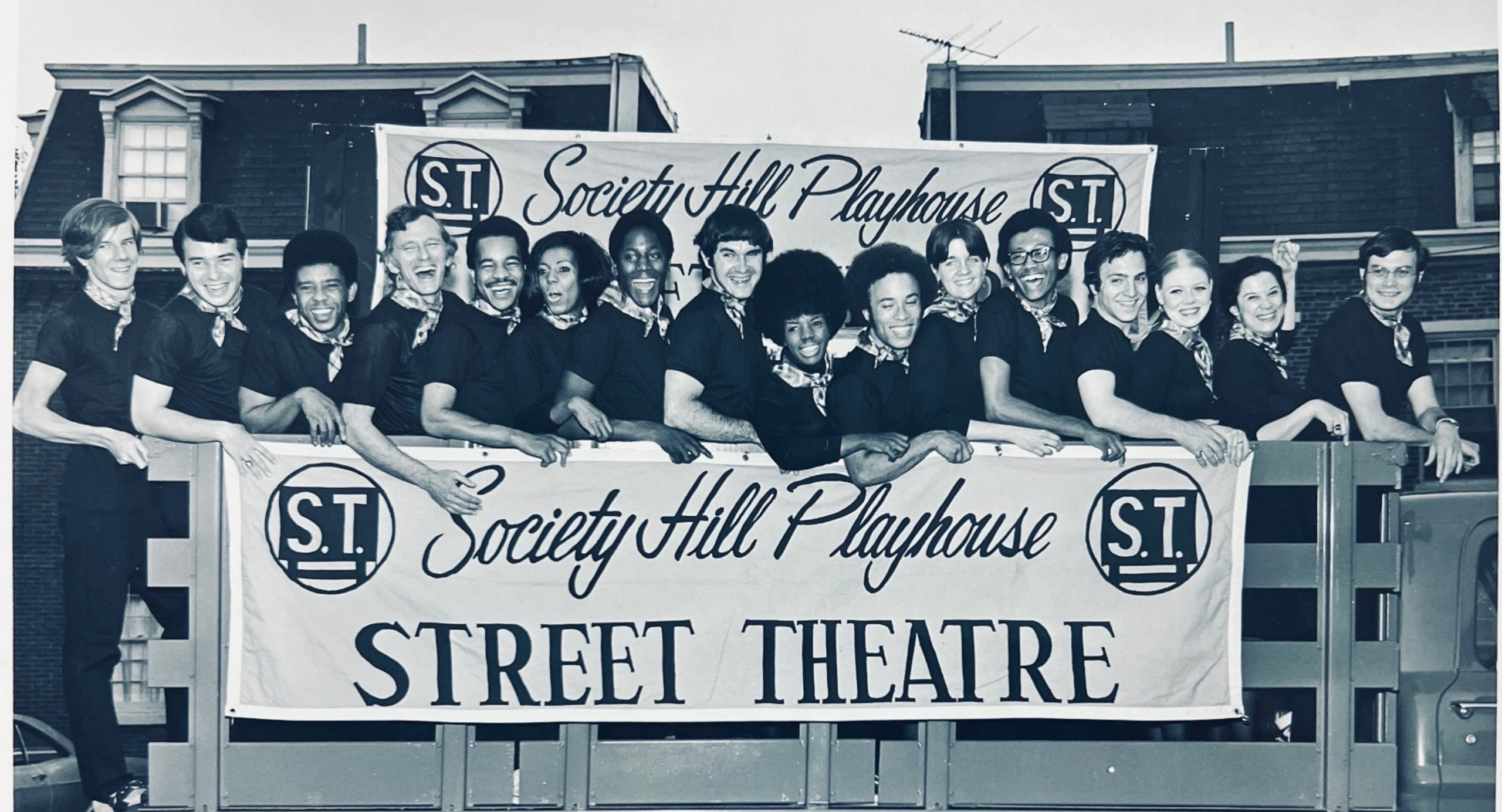
    Wynn Thomas (fifth from right) at the Society Hill Playhouse as a teen in the late 1960s.

    A couple of years later, Thomas heard that Society Hill Playhouse was holding open auditions. He was too young to audition himself, so he persuaded his older sister Monica to try out.

    “I remember saying to her, ‘You need to do a scene from Who’s Afraid of Virginia Woolf,’” he recalled, chuckling. “Now, can you imagine being a 14-year-old kid who knows Who’s Afraid of Virginia Woolf? That’s a geek!”

    She earned a spot in the company for a season and Thomas frequently tagged along, volunteering as an usher and eventually forming a close relationship with the owners, legendary Philadelphia theater couple Jay and Deen Kogan.

    Throughout high school, the Overbrook High art student spent most of his after-school time across town at the playhouse. He acted, painted scenery, and served as a stage manager.

    One of the final productions he stage-managed was The Great White Hope, loosely based on boxing champion Jack Johnson, who was played by Richard Roundtree — the soon-to-be Hollywood star who went on to lead the 1971 classic Shaft. While he was performing at Society Hill Playhouse, Roundtree was auditioning for the life-changing role.

    Shaft was a very important and very pivotal film for that time period,” said Thomas. “It was about a strong Black male who lived in the world under his own terms. That was not a character that was portrayed often in films.”

    It was a glimpse into the worlds Thomas would help create in the future — with Black characters who had agency at the center.

    Some four decades later, he worked with Roundtree once more for the 2019 remake of Shaft and they had an “incredible reunion.”

    From Philly to Boston to New York

    Thomas received his bachelor of fine arts in theater design from Boston University. After graduating in 1975, he returned to Philadelphia and worked as a window dresser at the Strawbridge & Clothier department store on Market Street for a few months before landing his next theater job.

    For about four years, Thomas was a painter for the Philadelphia Drama Guild, operating out of the Walnut Street Theatre. He also returned to Society Hill Playhouse as a production designer.

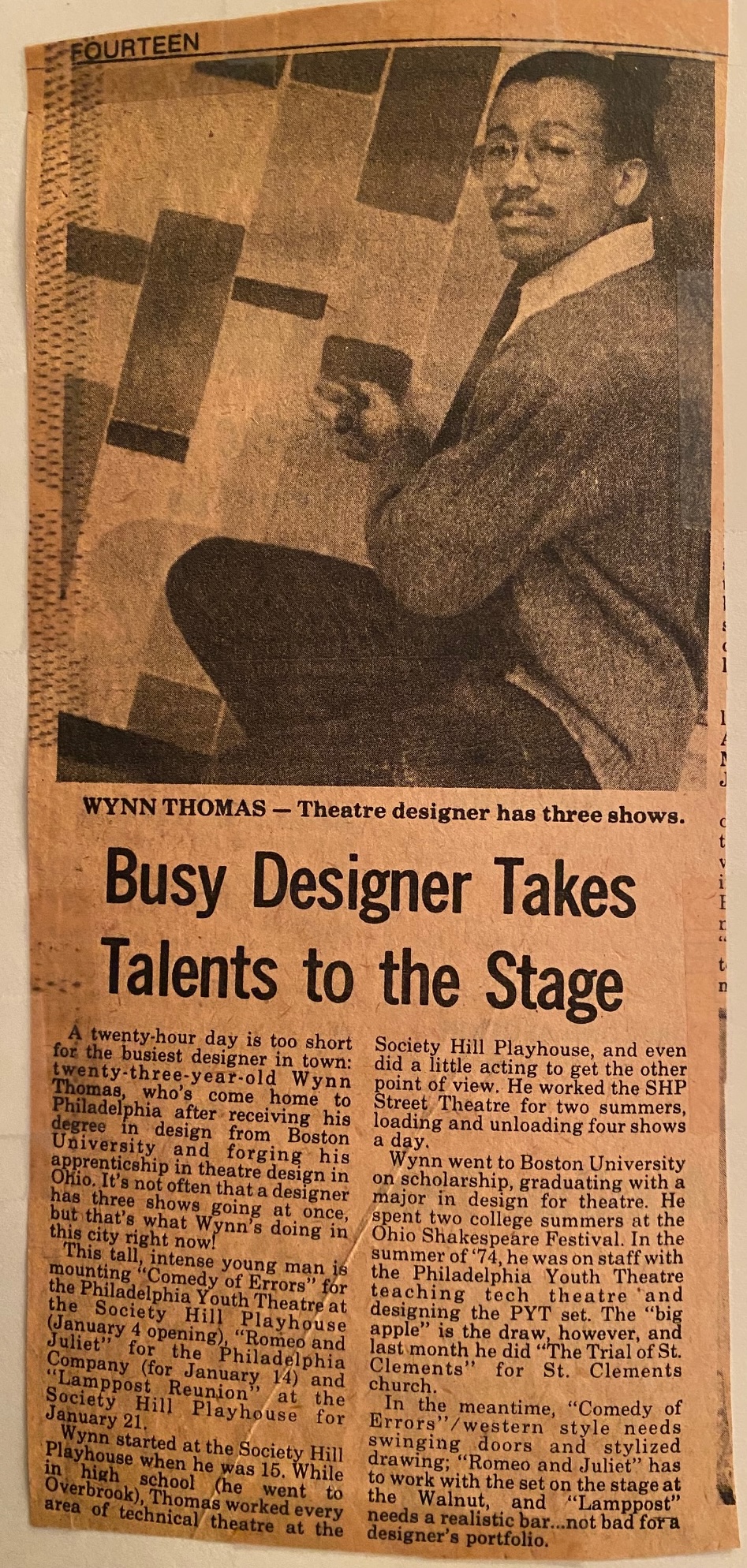
    An article about Wynn Thomas when he was 23 years old and working as a theater designer in Philadelphia in the mid 1970s.

    “It was a huge learning phase for my career, because I was painting all these different kinds of shows,” Thomas said.

    By his mid-20s, Thomas had moved to New York and soon became the resident set designer for the legendary Negro Ensemble Company, where he worked with not-yet-famous actors from Denzel Washington to Phylicia Rashad.

    “There was an actor who had auditioned for the company but did not get in. He was looking for a job and it turns out that he had carpentry skills, so I ended up hiring this actor who built my sets for my very first season at NEC,” Thomas recalled.

    “That actor was Samuel L. Jackson.”

    Breaking into film

    Thomas loved theater but sought higher-paying work in film. After multiple job rejections, he joined the United Scenic Artists Local 829.

    In an event the union organized with renowned production designer Richard Sylbert, who was working on Francis Ford Coppola’s The Cotton Club, Thomas was the sole Black person in attendance.

    The next day, he called Sylbert and introduced himself: “I’m the Black guy that was in the room last night. Do you remember seeing me?”

    He convinced Sylbert to hire him to build model sets, and Sylbert became a crucial reference that helped Thomas secure art director jobs, like on 1984’s Beat Street (directed by fellow Philly native Stan Lathan). That’s where he met Spike Lee, who interviewed “for the coffee-fetching position of assistant to the director,” Thomas recalled. When Lee stopped by the art department to greet a friend, the aspiring filmmaker was surprised to see Thomas.

    “He said he didn’t know there were any Black people doing this [work],” Thomas said.

    Filmmaker Spike Lee, center right, appears with his brother David Lee, center left, with castmembers, including Halle Berry, left, and Wesley Snipes, right, on the set of the 1991 film, “Jungle Fever.” Wynn Thomas served as production designer.

    A storied career of firsts

    That Beat Street encounter led to one of the most fruitful collaborative relationships of Thomas’ career: He went on to make 11 films with Lee, from She’s Gotta Have It to School Daze to Jungle Fever. Lee regularly worked with the same collaborators (“the family”) including Thomas, costume designer Ruth Carter, and cinematographer Ernest Dickerson.

    “We wanted to present images of Black and brown folks that had not been seen before on the screen. We did not want to present any negative images. If you look at those films, there’s no drugs, there’s no alcohol, there’s no domestic abuse — none of that trauma that people used to associate with our communities,” said Thomas. “That was the artistic link, the journey for all of us …[and] that has been a criteria for me.”

    Meanwhile, he continued to find mainstream success on commercial films, fueled by a relentless work ethic and a commitment to hiring a diverse crew of artists on his team. Later in his career, he was elected to the Academy’s Board of Governors where he pushed for expanding educational programs nationwide.

    Thomas’ films showcase a breadth of world-building talent across genres like comedy (To Wong Foo, Thanks for Everything! Julie Newmar, Get Smart), romance (The Sun Is Also a Star), and dramas about other Black barrier-breakers, like King Richard (starring fellow Overbrook alum Will Smith), Hidden Figures, and the miniseries Lawmen: Bass Reeves.

    It’s rare that he returns to his hometown for a job, but in 2014, he was thrilled to work on the pilot of the Philadelphia-set show How to Get Away with Murder.

    Thomas believes the city holds countless rich, untold stories that he hopes will one day receive a bigger spotlight.

    For now, he’s enjoying seeing the Oscar statue grace his living room.

    “It really means a great deal to me, after 40-plus years of working in the business, to have my work recognized by this organization,” said Thomas. “I’ve worked on a lot of films that should have been recognized by the Academy, [for which] I should have been nominated, and it never happened. So I think this was a way for the Academy to correct that oversight.”

  • ICE plans $100 million ‘wartime recruitment’ push targeting gun shows, military fans for hires

    ICE plans $100 million ‘wartime recruitment’ push targeting gun shows, military fans for hires

    U.S. Immigration and Customs Enforcement officials are planning to spend $100 million over a one-year period to recruit gun-rights supporters and military enthusiasts through online influencers and a geo-targeted advertising campaign, part of what the agency called a “wartime recruitment” strategy it said was critical to hiring thousands of new deportation officers nationwide, according to an internal document reviewed by the Washington Post.

    The spending would help President Donald Trump’s mass-deportation agenda dominate media networks and recruitment channels, including through ads targeting people who have attended UFC fights, listened to patriotic podcasts, or shown an interest in guns and tactical gear, according to a 30-page document distributed among officials in this summer detailing ICE’s “surge hiring marketing strategy.”

    The Department of Homeland Security has spoken publicly about its fast-tracked effort to significantly increase ICE’s workforce by hiring more than 10,000 new employees, a surge promoted on social media with calls for recruits willing to perform their “sacred duty” and “defend the homeland” by repelling “foreign invaders.” The agency currently employs more than 20,000 people, according to ICE’s website.

    But the document, reported here for the first time, reveals new details about the vast scale of the recruitment effort and its unconventional strategy to “flood the market” with millions of dollars in spending for Snapchat ads, influencers and live streamers on Rumble, a video platform popular with conservatives. Under the strategy, ICE would also use an ad-industry technique known as “geofencing” to send ads to the phone web browsers and social media feeds of anyone who set foot near military bases, NASCAR races, college campuses, or gun and trade shows.

    The document was also distributed among ICE officials in the days after the agency published a request for bids seeking contractors who could use “precise audience targeting, performance media management, and results-driven creative strategies” to “accelerate the achievement of [its] recruiting goals.” The language in the published bid closely mirrored language in the strategy document. That same month, DHS awarded two marketing firms nearly $40 million to support ICE’s public affairs office “recruitment campaign,” according to federal awards data.

    It’s unclear how much of the spending and strategy have been carried out. But the plans outlined in the document have coincided with a rush of recruitment ads online seeking Americans who will “answer the call to serve.”

    The rapid-recruitment approach is unlike anything ICE has ever pursued, said Sarah Saldaña, a director of ICE during the Obama administration, who recalled the agency filling its open positions through local police departments and sheriff’s offices with appeals to officers’ interests in federal public-safety work.

    She said she worries that the speed with which ICE is racing to bring on new hires — coupled with the ad campaign’s framing of the jobs as part of a war — will raise the risk that the agency could attract untrained recruits eager for all-out combat.

    The appeal to law enforcement should not be “the quicker we get out there and run over people, the better off this country will be,” she said. “That mentality you’re fostering tends to inculcate in people a certain aggressiveness that may not be necessary in 85 percent of what you do.”
    ICE deferred comment to Tricia McLaughlin, a DHS spokeswoman, who did not dispute a detailed list of claims and financial figures sent by the Post and said she was “thrilled to see the Washington Post highlight … [the] wildly successful ICE recruitment campaign, which is under budget and ahead of schedule.”

    The agency, she said, has received more than 220,000 job applications in five months and has issued more than 18,000 tentative job offers. More than 85% of the new hires had experience in law enforcement, she added.

    Tricia McLaughlin, spokeswoman for the Department of Homeland Security, is flanked by Madison Sheahan, second in command at ICE, and Todd Lyons, acting ICE director, at a May 21 news conference in Washington.

    Congress this summer tripled ICE’s enforcement and deportation budget to about $30 billion by passing the One Big Beautiful Bill Act, helping to start a hiring spree that officials have said would be necessary to carry out the Trump administration’s promise of the biggest mass deportation in American history. Officials set a goal of 1 million deportations within the first year of Trump’s term.

    To bolster its recruiting, the agency has removed its age limits for applicants and offered signing bonuses of up to $50,000. A job listing on a federal hiring board said the salaries for many deportation officers could range from $50,000 to $90,000 a year.

    Recruitment ads have proliferated across TV, radio, print and podcasts directing viewers to an ICE hiring website that portrays immigration as an existential threat. “America has been invaded by criminals and predators,” reads the website, which includes an image of Uncle Sam. “We need YOU to get them out.”

    On social media, administration accounts have mixed immigration raid footage with memes from action movies and video games to portray ICE’s mission as a fight against the “enemies … at the gates.” “Want to deport illegals with your absolute boys?” one post says. “Are you going to cowboy up or just lay there and bleed?” says another.

    A U.S. Immigration and Customs Enforcement agent is seen in Park Ridge, Ill., on Sept. 19.

    But to reach ICE’s “rapid hiring” goal of about 14,000 new Enforcement and Removal Operations officers, Homeland Security Investigations agents, ICE lawyers and support staff, the strategy document also calls for deploying more finely targeted digital advertising tools that can home in on viewers’ interests and lifestyles.

    ICE recruitment ads, the plan said, would be shown to people with an interest in “military and veterans’ affairs,” “physical training,” or “conservative news and politics” and would target people whose lifestyles are “patriotic” or “conservative-leaning.”

    The strategy said to target listeners of conservative radio shows, country music and podcasts related to patriotism, men’s interests and true crime, as well as any accounts that resemble users with an interest in “conservative thought leaders, gun rights organizations [and] tactical gear brands,” the document said.

    To further attract recruits, the strategy called for spending at least $8 million on deals with online influencers whose followers are largely Gen Z and millennials and who were in the “military families,” “fitness,” and “tactical/lifestyle enthusiast communities.”

    The document did not name specific influencers but said it would focus on “former agents, veterans and pro-ICE creators” who would be expected to host live streams, attend events and post short- and long-form videos and other content to Facebook, Instagram, Rumble, X and YouTube. Blogs, Substack newsletters, and Threads accounts would also be targeted for more “niche communities,” the document said.

    The objective, it said, is to build trust through “authentic peer-to-peer messaging” and to “normalize and humanize careers at ICE through storytelling and lived experiences.” The document said it expected more than 5,000 applicants would come through the influencer program, costing ICE about $1,500 per application.

    ICE has run ads on Google, LinkedIn, Instagram and Facebook, targeting the latter to military veterans and “entry-level job” seekers, according to the companies’ ad libraries, which share public data on the platforms’ ad campaigns. Millions more in advertising was slated for delivery to gaming consoles, connected TV devices and streaming services such as ESPN, Fox News and Paramount+, as well as across newspapers, billboards and box trucks, the strategy document said.

    Listeners on Spotify have heard ICE ads calling on recruits to “fulfill your mission,” leading to hundreds of complaints on the music service’s message board. One NASCAR viewer who saw the ads on live streams said in a Reddit post that they changed the channel, and separately told the Post that they had “never felt such distaste for our government airing such ads.”

    Natalia Banulescu-Bogdan, a deputy director at the Migration Policy Institute, a nonpartisan Washington think tank, said ICE’s ads harked back to World War I recruitment posters by using symbols like Uncle Sam.

    The war rhetoric is in line with the Trump administration’s broader efforts to push mass deportations as critical to American security and immigration officials’ work as heroic, she said. But the ads also allow ICE to gloss over the “messy realities of immigration enforcement,” including “the public backlash, the legal pushback and the very real operational constraints.”

    “We’ve never seen immigration agencies kind of strip down the policy debates to this level of raw imagery and symbolism,” she added.

    The strategy document features on the cover ICE’s second-in-command, Madison Sheahan, who worked as an aide to DHS Secretary Kristi L. Noem when she was governor of South Dakota. In the photo, Sheahan, 28, wears a “police” vest and an ICE badge under the words “Defend the Homeland.”

    The document called for spending “$100 million within one year” as part of an “aggressive” recruitment program that would “saturate digital and traditional media” and prioritize “speed, scale, and conversion at every level.”

    Public ad-tracking figures from Google and Meta show ICE’s digital ad spending so far is a fraction of the strategy’s proposed budget for their platforms. McLaughlin, the DHS spokeswoman, did not respond to questions about how much money had been spent already or whether the strategy had changed.

    Beyond demographic targeting, the strategy document also identified New York, Los Angeles, Minneapolis, Chicago, and Boston as “key locations” for finding recruits. The cities have been the targets of intense ICE sweeps and major anti-deportation protests over the last year.

    The largest local recruitment target, seeking up to 1,000 removal officers, is slated for the New Orleans field office. The state of Louisiana has one of the country’s biggest immigrant detention populations, second only to Texas, and the New Orleans field office manages all nine detention facilities in the state.

    ICE has hosted hiring events around the country, including at a Texas job fair earlier this year, during which a former mixed martial arts fighter told the Post he was eager to “work with these guys that are going to arrest you, slam your face on the pavement and send you home.”

    But the strategy has also called for boosting recruitment at major gatherings and sporting events, including a booth at the NASCAR Cook Out Southern 500 in South Carolina in August; a “gym-based recruitment” event with “influencer-style content” at the UFC Fight Night in Las Vegas in November; and a planned sponsorship devoted to “patriotism, strength [and] grit” at the National Finals Rodeo this month in Las Vegas.

    DHS did not say whether all the events proposed in the strategy were carried out, but their ads did accompany several of the events on TV. “ICE commercial during the UFC event tonight?! How gross,” one X user said in October. ICE also posted a bid in November seeking a firm to “identify suitable event locations” for “recruitment and outreach events.”

    The recruitment ads run separately from other large-scale DHS campaigns that celebrate Trump’s immigration agenda and urge undocumented immigrants to leave the U.S. DHS has awarded more than $200 million in contracts this year to People Who Think and Safe America Media, two marketing firms linked to Republican political consultants, federal contracting records show. Representatives from the firms did not respond to requests for comment.

    Those efforts, too, have relied on ad-targeting techniques more commonly used by corporate marketing campaigns. The ad library for Meta, which runs Facebook and Instagram, shows that DHS has spent more than $1 million on “self-deportation” ads in the last 90 days targeted to people interested in “Latin music,” “Spanish as a second language,” and “Mexican cuisine.”

    On a message board for the music streaming service Pandora, some users were furious about the ads they called “fearmongering … propaganda.” One user, who said she is a U.S. citizen who likes listening to reggaeton, said she had been overwhelmed by DHS commercials “implying I am an undocumented immigrant and instructing me to ‘go home’” that played in “nearly every other ad slot I hear.”

    ICE’s ads have drawn criticism from some Democrats, who have called them overly inflammatory. The Senate Judiciary Committee, led by Sen. Dick Durbin (D., Ill.), said in October that ICE’s “polarizing recruitment ads” would “only attract MAGA radicals.”

    And some of the platforms on which the ads have run have expressed their own reservations. Earlier this month, a transit operator in Long Beach, Calif., removed ICE recruitment ads from its buses and apologized for the “uncertainty and fear” they may have caused, as was first reported by the Long Beach Watchdog, a local news source.

    Americus Reed, a marketing professor at the University of Pennsylvania’s Wharton School, said the ICE strategy reminded him of the “Army of One” campaign that the military once used to build up recruits as mighty warfighters critical to safeguarding the American way of life.

    “They’re aiming for that sweet spot of people who’ve got something to prove, who want to have that power, under the guise of patriotism,” he said.

  • What Joe Khan, Bucks County’s first Democratic DA, says he’ll do when he takes office in January

    What Joe Khan, Bucks County’s first Democratic DA, says he’ll do when he takes office in January

    With the election behind him and the top law enforcement job in Bucks County ahead, Joe Khan says he’s ready for his next challenge.

    In January, Khan, a former federal prosecutor and onetime Bucks County solicitor, will become the first Democrat to serve as district attorney in the county since the end of the Civil War. (That’s not counting Ward Clark, a Republican who switched parties to run as a Democrat in 1965 and immediately switched back to his GOP roots after he won.)

    Khan, 50, is also the first candidate from outside the district attorney’s office to win the top post after several decades in which voters routinely replaced outgoing district attorneys with successors from among inside the ranks of the office.

    To claim that mantle, Khan decisively beat Jen Schorn, the Republican incumbent and a career prosecutor in the district attorney’s office, winning 54% of the vote in the November election, which broke a 20-year record for voter turnout.

    County political leaders say Khan’s victory signals voters’ desire for regime change in the once GOP-dominated suburb.

    They point to Khan’s win, along with fellow Democrat Danny Ceisler’s victory over controversial Republican Sheriff Fred Harran — whose plan to have his deputies assist federal authorities in immigration enforcement sparked protests and a lawsuit — as a rebuke to President Donald Trump.

    “Democrats came out because they felt like it was necessary to push back on what Trump was doing,” said State Sen. Steve Santarsiero, the chair of the Bucks County Democratic Party. “And in the case of Joe, they recognized him as someone who is going to stand up to an administration that has shown it’s willing to flout the law.”

    Khan, for his part, says politics is in the rearview mirror as he prepares for his new job.

    “I don’t care what political party you’re from, I don’t care who you voted for president or for district attorney,” he said in a recent interview. “What I care about is that you’re here to support the mission of keeping Bucks County safe and seeking justice every day.”

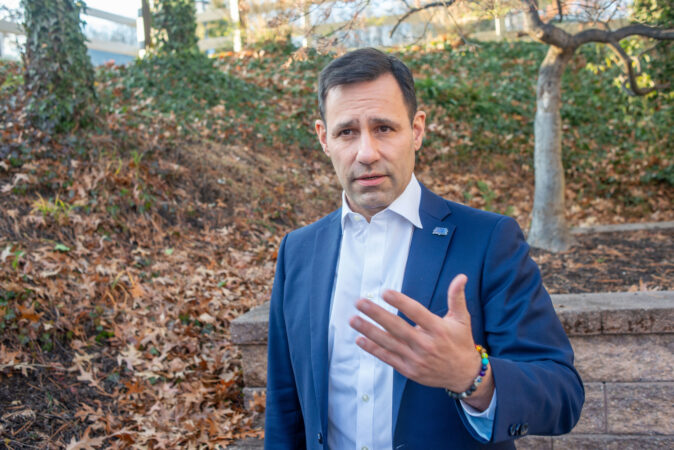
    Joe Khan greets and signs a poster for supporter Phyllis Rubin-Arnold as he waits for a meeting with the Buckingham Township Police chief. Khan says that politics has no role in his plans for the district attorney’s office.

    He said he respects Schorn’s work and that of her colleagues in the office, winning prosecutions in high-profile cases, like the trial and conviction of Justin Mohn, who beheaded his father and displayed his severed head in a YouTube video that went viral. Khan also praised the improvement Schorn and her colleagues have made to diversionary programs like drug and veterans courts.

    And he said he would expand that work — Khan tapped Kristin McElroy, one of Schorn’s top deputies, to serve as his first assistant.

    Drawing on his experience in the U.S. Attorney’s Office in Philadelphia, Khan said he would pursue environmental crimes and prosecute cases involving violations of workers’ rights.

    “We have seen all kinds of advances in terms of the powers that DAs have in Pennsylvania, so I think it’s great to have an opportunity to look at things with fresh eyes,” he said.

    Khan grew up in Northeast Philadelphia, where his father settled after emigrating from Pakistan. Like his brother, State Rep. Tarik Khan (D, Philadelphia), he took an early interest in public service. He followed those aspirations to Swarthmore College and, later, the University of Chicago Law School.

    Khan said he was drawn to Bucks County later in his career, and has made it his home in the 14 years he has lived with his sons, Sam, 14 and Nathan, 11, in Doylestown Township. He and the boys’ mother are divorced but co-parent amicably, he said, and live a few doors down from each other.

    After stints in the Philadelphia District Attorney’s Office and the U.S. Attorney’s Office — where he specialized in prosecuting gun crimes and locking up child predators — Khan ran for the top prosecutor’s job in Philadelphia in 2017, losing the race to Larry Krasner.

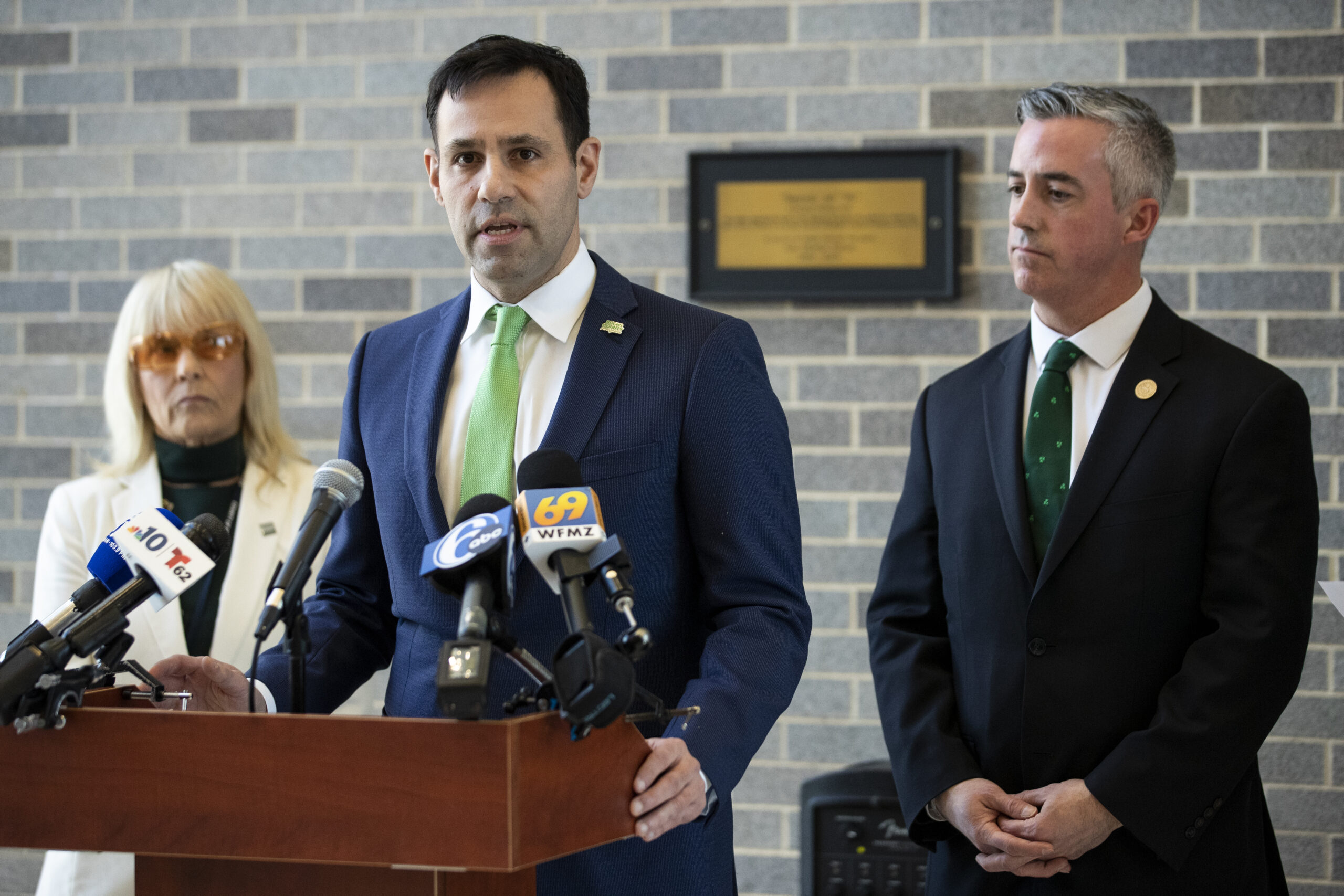
    Joe Khan (center) is seen here in March 2023 alongside County Commissioners Diane M. Ellis-Marseglia and Robert J. Harvie Jr. as they announced a lawsuit filed against multiple social media companies for “fueling a mental health crisis among young people.”

    Three years later, Khan took over as Bucks County solicitor. He developed an interest in local politics, he said, after watching the culture-war debates over library books and allegations of abuse that embroiled the Central Bucks School District, where his kids are enrolled.

    “It’s really central to my view of what parents need from their government,” he said. “They need people in roles like this that are going to make life easier, not harder, and that are going to help them with the challenges that they’re facing.”

    Not long after taking over the office, Khan challenged Trump’s efforts to dismiss mail-in ballots during the 2020 election. He also waged legal battles, taking on companies including 3M, DuPont, and Tyco by filing lawsuits over the “forever chemicals” that had leached their way into residents’ water supplies.

    And he made headlines for joining a national lawsuit against social media giants like TikTok, bidding them to address the mental health of their young users.

    When now-Gov. Josh Shapiro left the state attorney general’s office, Khan stepped down to join a crowded primary to replace him, running in 2023 on a platform to “continue what has been a lifelong fight to keep people safe.”

    After losing that race, Khan set his sights on the top law enforcement job in his new home, challenging the long-standing Republican machine that had controlled it for decades.

    “I think that if you do a good job and you let people know why you’re doing the things that you’re doing, whether or not they agree with you on every political position, if they know that you’re honest, you got a pretty good shot at earning their vote,” he said.

    “And I think that’s a big part of how we won this election.”

    A voter walks past the election lawn signs, including one for Joe Khan and his running mate, Danny Ceisler, outside the Bucks County Senior Citizens polling location in Doylestown on Nov. 4.

    Santarsiero, the county Democratic Party chair, said he was confident that Khan would make a fine district attorney.

    Winning the post required political prowess, of course, but he said that is a dichotomy unique to the office: Politics are required every four years to secure a position that is apolitical.

    Party affiliation aside, he said, Khan would work for the good of the county.

    Khan, for his part, says he is ready to give it his all.

    “We are here to keep people safe, and we’re going to do that in new and exciting ways,” he said. “I have my values, I wear them on my sleeve, and I’m very clear about the direction that we’re going to go to make sure that people who deserve a healthy environment for their families are getting a higher level of service than they’re used to.”

  • Philly’s new U.S. attorney has largely avoided the chaos swirling around other parts of Trump’s Justice Department

    Philly’s new U.S. attorney has largely avoided the chaos swirling around other parts of Trump’s Justice Department

    When President Donald Trump announced earlier this year that he was nominating David Metcalf to be Philadelphia’s U.S. attorney, it initially seemed as if the move was in line with Trump’s chaotic and contentious attempt to upend the nation’s justice system.

    The decision was abrupt, apparently made without advanced input from Sen. Dave McCormick (R., Pa.), who’d set up a commission to identify candidates to serve as the region’s top federal prosecutor.

    Metcalf was 39 and, unlike many of his predecessors, didn’t have deep roots in the region — but did have some reported ties to officials who’d sought to help Trump adviser Roger Stone years earlier.

    And the appointment was announced as Trump was openly pledging to “clean house” in the Justice Department and pull the agency more directly in line with the White House.

    But in the months since Metcalf has assumed control over the office and its 140 lawyers, what has stood out so far has been the serious temperament the veteran prosecutor has brought to the role, and the relative lack of drama he’s overseen — particularly in comparison to nearby jurisdictions, where U.S. Attorney’s Offices have been embroiled in controversies over leadership appointments and whether to indict Trump critics.

    During a recent interview with The Inquirer at his Center City office, his first since being appointed in March, Metcalf said his deliberate approach toward his first few months in the job has been influenced by his decade-plus career as a Justice Department lawyer — one that included stints in Baltimore, Philadelphia, and Washington, D.C.

    He has met with a host of other local stakeholders since taking over — including Police Commissioner Kevin J. Bethel, District Attorney Larry Krasner, and federal judges — and has avoided ushering in drastic upheaval within his office.

    U.S. Attorney David Metcalf outside the federal courthouse in July, with Police Commissioner Kevin Bethel standing behind him.

    Instead, he said, a key focus has been to encourage his prosecutors to pursue large, ambitious, complex investigations targeting violent crime, synthetic opioid abuse, and healthcare fraud — subjects he said were critical to public safety in the Philadelphia region.

    “I do not feel some personal impulse to burn my brand on this office by restructuring and reorganizing it,” he said, later adding: “The greatest offices and the greatest cases come from prosecutors who are hunting them down and competing for them … and that’s the breed of prosecutor we’re trying to create here.”

    Composed and self-assured, Metcalf was uninterested in commenting on the broader political landscape surrounding his job. He instead concentrated on the work of his office, whose lawyers prosecute matters including drug trafficking, political corruption, and terrorism across nine counties from Philadelphia to Allentown and west past Reading. They also litigate civil matters on behalf of the federal government.

    “I don’t want to say that I’m … bound by precedent or a devotee to the status quo,” he said. “But I do believe in stability, and I’m certainly not going to change things just for the sake of changing them.”

    That approach has been generally well-received by many lawyers in his office, particularly given the volatile environment across other parts of the Justice Department.

    Even Krasner — an outspoken progressive Democrat who rarely misses an opportunity to criticize Trump, and who was engaged in a long-running feud with a Trump-appointed U.S. attorney four years ago — said he had a “professional and pleasant lunch” with Metcalf earlier this year.

    “We have always worked well with the career prosecutors at the U.S. Attorney’s Office, and our teams seem to be continuing to work well together,” Krasner said in an interview.

    Rod Rosenstein, who was the deputy attorney general during Trump’s first term, said in an interview that he hired Metcalf a decade ago, when Rosenstein was the U.S. attorney in Maryland. And their paths continued to intersect over the years as their careers wound through the Justice Department.

    Rosenstein said Metcalf had “superb legal skills” and “excellent judgment” — two qualities he views as critical for leading a U.S. attorney’s office.

    “I think people recognize he’s got the right qualifications,” Rosenstein said.

    U.S. Attorney David Metcalf in his Center City office.

    ‘An exhilarating vocation’

    Metcalf grew up in northern Virginia and graduated from The Wakefield School, a private prep school about an hour west of Washington, D.C. His father was once an Army colonel, he said, and his grandfather was Joseph Metcalf III, the Navy vice admiral who led the 1983 invasion of Grenada.

    Metcalf was a standout soccer player in high school, and was recruited to play by more than 80 college teams, the Washington Post reported in 2003. He used the situation to his advantage, the paper reported — making a deal with his mother that he could let his hair grow down past his shoulders once Division I colleges started sending him letters.

    He ended up attending Princeton — playing soccer all four years — and then went on to graduate from the University of Virginia’s law school.

    After clerking for U.S. Circuit Judge Albert Diaz, Metcalf spent a few years in private practice before becoming an assistant U.S. attorney in Maryland under Rosenstein.

    Metcalf said he didn’t have a single epiphany that made him realize he wanted to become a prosecutor. But he said he was quickly drawn to the work, which he found more interesting and important than other legal jobs.

    “I thought it was really just an exhilarating vocation in a profession that doesn’t always have the most glamorous applications,” he said.

    High-profile connections

    From 2015 through 2022, Metcalf worked as a line prosecutor in Baltimore and, later, in Philadelphia — the office he now leads. The two years he spent here were unusual, he said, because they unfolded during the peak of the pandemic, when many aspects of the court system were disrupted and most people were working from home.

    Metcalf also spent time during the first Trump administration in Washington, D.C. While there, he worked closely with prominent Justice Department officials including Rosenstein; Deputy Attorney General Jeffrey A. Rosen; Timothy Shea, the onetime U.S. Attorney for Washington, D.C.; and then-Attorney General William Barr.

    Attorney General William Barr and President Donald Trump in the Oval Office of the White House on Nov. 26, 2019.

    Metcalf’s name was briefly in the news in 2020, when Barr and Shea, Metcalf’s then-boss, intervened in the prosecution of Stone, Trump’s longtime ally, who had been convicted of lying to Congress. After the trial prosecutors wrote in court documents that Stone should be sentenced to at least seven years in prison, Barr and Shea ordered them to walk that back and reduce their recommendation.

    Some assigned to the case viewed that as political interference and an attempt to placate Trump. A Justice Department investigation later faulted “ineffectual” leadership by Shea for how the episode unfolded, not politics.

    In 2022, Metcalf left the public sector and went to work as a corporate counsel for Amazon. But this March — after Trump was reelected for a second term — Metcalf was suddenly thrust back into the Justice Department, as the White House announced it was nominating him to be Philadelphia’s U.S. attorney.

    From nominee to confirmation

    The decision came as something of a surprise.

    McCormick, Pennsylvania’s newly elected GOP senator, had made a point of publicly announcing that he’d formed a committee to review and vet potential candidates for federal law enforcement positions across the state. And other GOP-connected lawyers in the region had been jockeying for months to try to figure out who might be able carve a path toward the coveted position.

    When the White House named Metcalf its permanent nominee, the process was effectively short-circuited.

    Metcalf said he couldn’t speak to how or why the process played out the way it did. He said he applied for the job, and “had relationships with folks in the Trump administration” due to his time in Washington during Trump’s first term.

    He didn’t specify who those people were. And some of his former bosses — particularly Barr — had fallen out of favor with Trump after his first term.

    But Rosenstein said “it’s a mistake to think that people are the people they work for. It’s a big government, and not everyone agrees all the time.”

    And in any case, Rosenstein said, he believed Metcalf was nominated “on merit, not on connections.”

    Rod Rosenstein, deputy attorney general during President Donald Trump’s first term, says Metcalf has “superb legal skills” and “excellent judgment.”

    William McSwain, who served as U.S. attorney during Trump’s first term, said he believed Metcalf was “extremely well-qualified for the position.”

    It took the U.S. Senate six months to vote to confirm Metcalf along with a host of other Trump nominees, but by then, the Philadelphia region’s federal judges had already voted to extend Metcalf’s appointment indefinitely while the process played out.

    That move stood in contrast to several other jurisdictions, including New Jersey, where the judiciary declined to extend the tenure of Trump’s nominee, Alina Habba. For months afterward, that office was thrust into turmoil as questions swirled about who could legally serve as its leader.

    Pursuing notable cases

    During his tenure so far, Metcalf said, he’s been seeking to focus his prosecutors on finding what he called “nationally significant” cases, particularly those targeting violence, drugs, and healthcare fraud, which he views as priorities for the region.

    One of the first big indictments he announced was in October when FBI Director Kash Patel visited Philadelphia to help reveal that 33 people had been charged with being part of a Kensington-based drug gang. Metcalf said the case was the largest single prosecution in the region in at least two decades.

    FBI Director Kash Patel helping announce the arrest of dozens of suspects in a Kensington drug case.

    He also helped create a new program dubbed PSN Recon, an initiative designed to help Philadelphia Police more readily share intelligence with state and federal agencies about which groups or suspects should be investigated.

    Prosecutions overall have increased on his watch, according to the Transactional Records Access Clearinghouse (TRAC), a research organization that collects federal courts records.

    So far this fiscal year, prosecutions in the Eastern District of Pennsylvania were up 32% compared to last year, TRAC found, and were on their highest pace since 2019. The most common types of cases charged this year were immigration violations, drug offenses, and illegal firearm possession, according to TRAC.

    Earlier this year, Metcalf was reportedly involved in one particularly significant case: an investigation into former CIA Director John Brennan and his role in producing an intelligence assessment about Russian interference in the 2016 election. Brennan went on to become a prominent Trump critic.

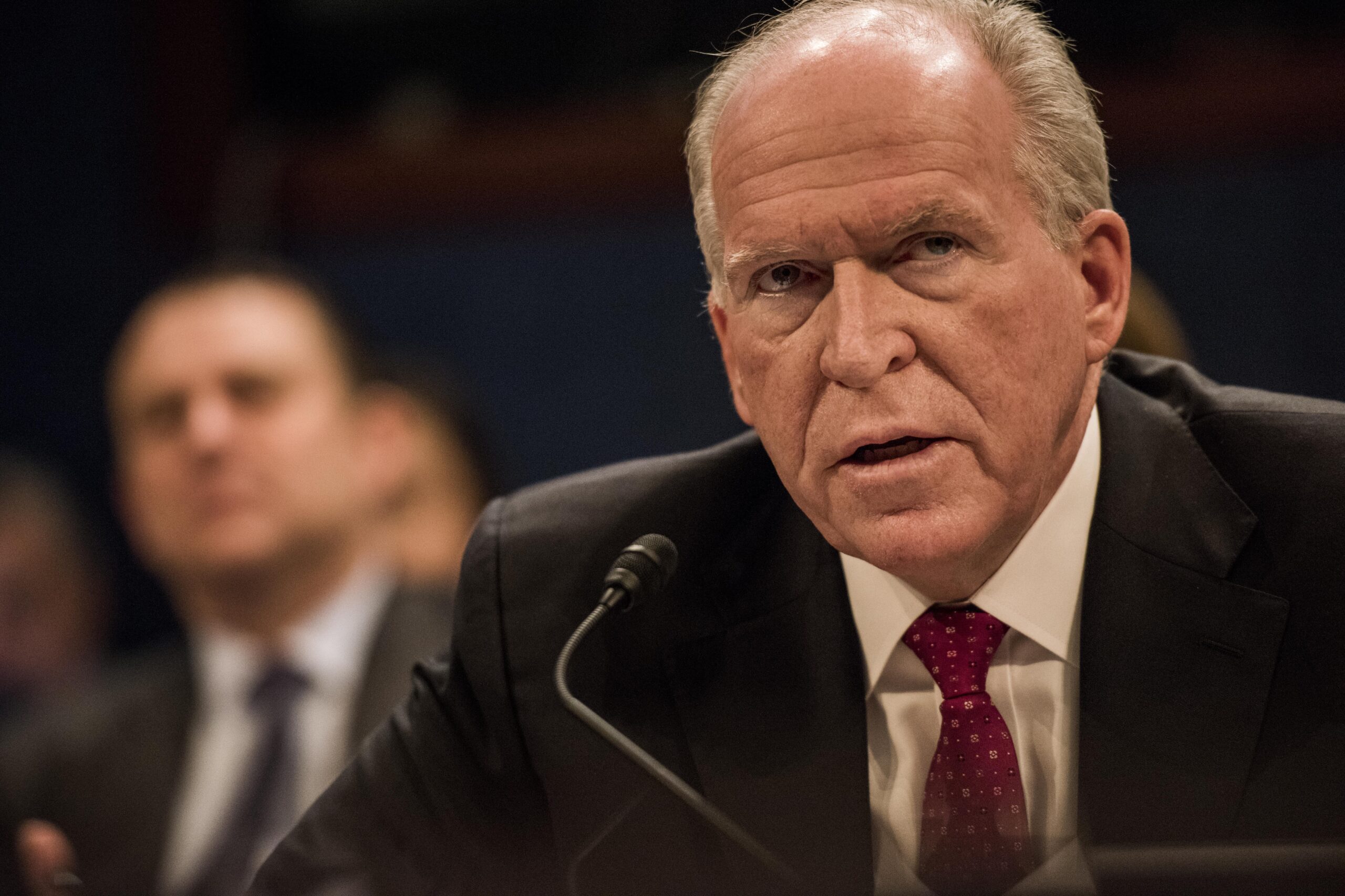
    Former CIA director John Brennan testifies before the House Intelligence Committee in 2017.

    National outlets including Axios and the New York Times reported that Metcalf had been leading the probe, and that he had concerns about its viability — a notable development given Trump’s public demands to prosecute other adversaries, including former FBI Director James Comey.

    Metcalf never commented publicly on his purported involvement in the Brennan case, and declined to do so again during his interview with The Inquirer. The investigation is now reportedly being handled by federal prosecutors in Florida.

    Metcalf did allow a short peek into his professional mindset when he was asked more broadly if he’d ever felt pressure from Washington to sign off on a decision he didn’t agree with.

    After declining to comment on any discussions he may or may not have had with Justice Department leaders, he paused for a moment and added one final point.

    “I will also say that I would be very surprised if that ever happened to me,” he said. “I don’t see it as a problem here.”

  • Former Rep. Dick Schulze, who represented the Philly burbs in Congress for 18 years, has died at 96

    Former Rep. Dick Schulze, who represented the Philly burbs in Congress for 18 years, has died at 96

    Former U.S. Rep. Richard “Dick” Schulze, a Republican who represented the Philadelphia suburbs from 1975 until 1993, died last week at the age of 96.

    Mr. Schulze, who served in the Pennsylvania General Assembly before running for Congress, died of heart failure in his home in the Washington, D.C., area on Dec. 23, according to a news release from his wife, Nancy Shulze, and former chief of staff Rob Hartwell.

    During his first term in the U.S. House, Mr. Schulze led the charge to make Valley Forge, seven miles from his home at the time, a national historical park. President Gerald Ford signed the legislation Mr. Shulze authored into law on July 4, 1976, the nation’s bicentennial.

    By the time he retired from the House in 1993, Mr. Schulze was a member of the powerful House Ways and Means Committee. He spent his whole congressional career in the political minority, retiring shortly before Republicans retook the chamber in 1994 for the first time since the mid-50s.

    “He knew what he believed and he stood for what he believed but he was not, he was not partisan,” Nancy Schulze said in an interview with The Inquirer Tuesday.

    Mr. Schulze’s former employees described him as tough but fair, demanding a lot of his staff but offering them the space to achieve it.

    “You really had to be at the top of your game,” said Tim Haake, a former attorney in Mr. Schulze’s congressional office who had reconnected with him in recent years. “Overall he was a very nice man, very polite, very cordial.”

    Mr. Schulze, Hartwell said, “probably taught me more in my life than anybody.”

    Hartwell remembered his former boss as a man willing to work across the aisle in a way that is less common in today’s politics. Mr. Schulze founded the Congressional Sportsman Caucus and served on the National Fish and Wildlife Board among other posts focused on wildlife.

    Hartwell recalled that Mr. Schulze played a key role in securing the 1983 release of Romanian Orthodox priest Gheorghe Calciu-Dumitreasa who had been held as a political prisoner in the country, representing President George H.W. Bush in negotiations with the country’s communist leaders.

    Serving in the minority throughout his career, Hartwell said, Mr. Schulze was willing to make deals and work for the benefit of his district, which included portions of Montgomery, Delaware, and Chester Counties.

    “He was a man of his word and he was a man who wanted to accomplish things for his district and his constituents,” Hartwell said. “Unlike today he would reach across the aisle to get those things done.”

    Mr. Schulze unsuccessfully proposed a constitutional amendment imposing term limits of 18 years for members of the House of Representatives. Although the proposal did not advance, Mr. Schulze himself chose not to seek reelection in 1992 after serving 18 years in office. He went on to work as a lobbyist for a conservative firm.

    “He did not cling to his role as a congressman and he did not go to occupy a seat,” Nancy Schulze said.

    Nancy Schulze and Dick Schulze were married following the 1990 death of his first wife, Nancy Lockwood Schulze, after a battle with cancer, and the death of her first husband, Montana Secretary of State Jim Waltermire.

    In addition to his wife, Mr. Schulze is survived by four children, seven grandchildren, and five great-grandchildren.

    Nancy Schulze remembered her husband as a gentleman, an Eagle Scout who lived by the scouting oath and was dedicated to loving and serving his country, state, district and family.

    “He was a man of dignity,” she said.
    Services to honor Mr. Schulze are scheduled for Saturday Jan. 10 at 2 p.m. at the Great Valley Presbyterian Church in Malvern.

  • A bank’s ‘racist and overzealous’ fraud investigator ruined a Pa. car dealership, lawsuit says

    A bank’s ‘racist and overzealous’ fraud investigator ruined a Pa. car dealership, lawsuit says

    Tianna Williams didn’t finish high school after becoming a mom at 16. As a teen dropout, she began flipping cars to make money, and by her late 20s, her car sales acumen led her to open a dealership in Lehigh Valley that grossed over $1 million in annual sales.

    An opportunity to get a line of credit with one of the nation’s largest banks turned Williams’ dream into a nightmare, she said, which led the 30-year-old to file a lawsuit.

    M&T Bank opened a fraud investigation into Williams in spring 2023, says the suit filed in Common Pleas Court in Philadelphia in March. The bank inappropriately informed her financial partners that her business could be illegitimate, the complaint says. The bank froze her account, her partners cut ties, and her checks bounced. Williams’ growing businesses crashed.

    The investigation found no fraud, M&T lawyers said in a September hearing. But Williams says the damage was done.

    The complaint says the Black entrepreneur was a victim of the bank’s “racist and overzealous fraud investigator” who tormented the business owner for weeks. The investigator told Williams “you people” have ways of making fraudulent behavior seem legitimate, the suit says.

    Despite eventually finding no fraud, the investigator shared an email with a colleague, signed with a smiley-face emoji, saying “doing my best to not let her win on my watch.”

    “She killed my self-esteem,” Williams said of the investigator. “I lost all financial security.”

    The phenomenon of Black people being treated with suspicion by financial institutions has been dubbed “banking while Black” and has a history going back at least to the 1930s, when red lines on maps labeled majority-Black neighborhoods as unworthy of mortgages. More subtle variations of the practice have continued into the 21st century, resulting in settlement agreements for millions of dollars.

    Black customers have also reported tellers refusing to cash their checks, and banks calling police in disbelief that deposits made by Black people were legitimate. Studies further found that banks are more likely to scrutinize, and less likely to offer assistance to, Black small-business owners compared with their white counterparts.

    The Philadelphia area is not immune to the phenomenon. Black Philadelphians are less likely to have a bank account than their white neighbors, according to a report from the Economy League of Greater Philadelphia. And multiple banks entered settlements over offering worse interest rates and ratcheting up closing costs for Black mortgage seekers.

    ‘Somebody really has it out for you’

    Williams’ rags-to-riches story began in 2012, when she became pregnant at the age of 16. Her mother had recently been diagnosed with cervical cancer, and the family barely scraped by. After dropping out of high school before completing 10th grade, Williams learned how to flip cars from auctions with the help of a mentor she met through Facebook.

    Her first car: a 2002 Lincoln that as a 17-year-old she sold the next day for a $700 profit.

    The young hustler with a knack for sales got her auction license a couple of years later. She kept selling cars on Craigslist and through other social media connections. In 2018, she began working at an auto dealership. She learned the trade and became especially good at working with people who had low credit scores.

    Williams’ cut from each sale at the dealership was a fraction of the overall profit, so she decided to go it alone. She bought a lot in Easton in 2020 and set to work. The cars she sold became newer and more expensive.

    Tianna Williams next to the sign of her car dealership in Easton.

    To sell cars for more than a couple of thousand dollars, Williams needed to offer financing options. She got her banking license and contracted with lenders. Her business was booming and she was planning to open a second location.

    That’s when Shazard Mohammed from M&T reached out, the complaint says. He offered Williams a line of credit that would allow her to take her business to the next level, and she transferred her accounts to the bank.

    Within days, Williams’ lenders contacted her to say they could no longer offer her financing because she was being investigated by M&T for fraud. Nearly overnight, she was without a business while owing about $200,000 in business and tax debts.

    “M&T BANK basically told me that they suspected you of fraud,” one business partner told Williams in a text message, according to the complaint. “If that’s not true, then somebody really has it out for you.”

    Records fight

    The bank is now fighting in court to keep documents related to the investigation secret, despite an attorney representing M&T saying in a September hearing that “there was no finding of fraud,” according to a transcript.

    M&T said in that hearing that Williams was investigated because of “red flags,” such as misspellings on checks that were immediately withdrawn as cash, and that the investigation lasted only seven days.

    Common Pleas Court Judge Paula Patrick sanctioned the bank’s lawyers in October for their failure to produce documents and ordered them to pay nearly $8,000 in attorneys’ fees. The judge also found that most records should not be sealed. M&T is appealing the ruling.

    Dean Malik, the attorney representing Williams, frames the case as a fight of David vs. Goliath. By issuing sanctions, he said, the judge reminded large entities that in court the playing field is leveled.

    “The judge is sending a message that it doesn’t matter if you are a billion-dollar bank and have two law firms representing you with five lawyers, you are still bound by the orders of the court,“ Malik said.

    Williams now cleans houses with her mother to support her family financially. She said her self-esteem has been shattered, and she hasn’t set foot inside a bank out of fear since her business closed in 2023.

    “There is nothing else I know how to do,” Williams said. “All I know is cars.”

  • Overdose deaths in Philly on track to be the lowest in nearly 10 years. Pa. deaths are also declining dramatically.

    Overdose deaths in Philly on track to be the lowest in nearly 10 years. Pa. deaths are also declining dramatically.

    Philadelphia is on track to record the lowest number of fatal overdoses in nearly a decade in 2025, according to preliminary state data.

    State officials reported 747 overdose deaths in the city as of Dec. 23. The city last recorded fewer than 1,000 deaths in 2016, when 907 people died of overdoses.

    The dramatic decline mirrors national trends in overdose deaths, which peaked during the COVID-19 pandemic and have since been steadily falling.

    window.addEventListener(“message”,function(a){if(void 0!==a.data[“datawrapper-height”]){var e=document.querySelectorAll(“iframe”);for(var t in a.data[“datawrapper-height”])for(var r,i=0;r=e[i];i++)if(r.contentWindow===a.source){var d=a.data[“datawrapper-height”][t]+”px”;r.style.height=d}}});

    Likewise, overdose deaths are dropping in Pennsylvania, with a 29% decline in deaths reported statewide between 2023 and 2024, according to preliminary data from the state.

    Preliminary data for 2025 indicate that deaths are also on track to decline again across the state, with 2,178 overdoses reported as of Dec. 23, according to state data. In all of 2024, the state recorded 3,340 overdose deaths.

    window.addEventListener(“message”,function(a){if(void 0!==a.data[“datawrapper-height”]){var e=document.querySelectorAll(“iframe”);for(var t in a.data[“datawrapper-height”])for(var r,i=0;r=e[i];i++)if(r.contentWindow===a.source){var d=a.data[“datawrapper-height”][t]+”px”;r.style.height=d}}});

    City officials in Philadelphia said there are slight differences in how the state and the city report overdose data and could not comment extensively on the state figures. But the city’s own data also show dramatic drops in deaths in the last several years.

    As recently as 2022, deaths in the city had soared to their highest-ever rate. But they decreased slightly in 2023.

    Citing preliminary data from 2024, Philly Stat 360, a city-run database that tracks quality-of-life metrics, reported 1,064 overdose deaths — a 19% decrease in fatal overdoses from the year before. The city has not yet released its own statistics for 2025.

    “My first reaction to hearing these numbers is absolute joy,” said Keli McLoyd, the director of the Philadelphia Overdose Response Unit (ORU). “With that said, the number should be zero. Every overdose is preventable. Every single one of those lives lost is a person.”

    State officials said their work to expand overdose prevention efforts and ease entry to treatment has contributed to the dramatic drops in deaths. Still, they said, there is more work to be done.

    “Even with the overall decreases, we are still losing too many people — mothers, fathers, sons, daughters, grandparents, grandchildren — to overdose,” said Stephany Dugan, a spokesperson for the Pennsylvania Department of Drug and Alcohol Programs.

    She added that all Pennsylvanians “deserve equal and equitable access” to addiction treatment.

    Decreases in overdoses in Philadelphia

    Discerning the cause of the dramatic drops in overdose deaths can be difficult, city officials say.

    “We have to acknowledge that it’s a huge, huge change, and so we really are hopefully doing something right. But I think it’s going to be very hard, if not impossible, to say that one thing resulted in this massive reduction in fatal overdose deaths,” McLoyd said.

    Still, efforts at the state and local levels to increase access to naloxone, the overdose-reversing drug, likely made a difference, she said.

    A number of local advocates in the addiction medicine field have speculated that there is still much to learn about how the COVID-19 pandemic affected overdose rates, said Daniel Teixeira da Silva, the director of the Division of Substance Use Prevention and Harm Reduction at the Philadelphia Department of Public Health.

    “When we look at the [overdose] increases after 2016, leading up to COVID, we can tie that to the introduction of fentanyl to the [drug] supply,” he said Monday, referring to the synthetic opioid behind most of the city’s fatal overdoses.

    “When you look at the increases from 2020 to 2022 — this is where I just don’t think we know enough yet. It’s hard to say COVID didn’t impact [deaths]. We look at what was going on at the time, contributors to more risky substance use such as people losing employment, the isolation,” Teixeira da Silva said.

    Likewise, he said, policy changes that came about during the pandemic, such as easing some restrictions around opioid addiction medications, could be contributing to a drop in deaths now.

    “Maybe we’re seeing benefits of the policies enacted during COVID,” he said.

    A changing drug landscape

    On Philly Stat 360, city officials said fentanyl still drives nearly all of the opioid overdose deaths in the city.

    But about 70% of deaths involved a stimulant like cocaine or methamphetamine in 2024. And about half of the city’s fatal overdoses that year involved both stimulants and opioids.

    Taking stock of the drop in overdose deaths, city officials noted the success of a 2024 program at the ORU to deliver naloxone, the opioid overdose-reversing drug sold under the brand name Narcan, to households in neighborhoods seeing a high number of overdoses.

    They included neighborhoods in North Philadelphia, where overdose deaths had risen over the last several years. Across the city, Black and Hispanic communities had seen high rises in overdoses — but neighbors often reported receiving fewer resources to address them.

    Workers assigned to the naloxone initiative knocked on 100,000 doors offering the medication and access to addiction treatment. In some neighborhoods, up to 88% of neighbors who answered their doors accepted some kind of resource from staffers, according to a city report on the program. McLoyd also helmed an effort to ensure all city fire stations had naloxone on hand.

    “We’re sharing those messages that this is a tool for everyone, not just people who use drugs or people who love those who use drugs,” since some people may hide their addiction from others, she said.

    This year, the city launched another campaign to educate residents about the risk of heart disease from stimulant use. Eighty percent of overdose deaths among Black Philadelphians in 2023 involved a stimulant, and about half of the Black Philadelphians who died of an overdose between 2019 and 2022 had a history of cardiovascular disease.

    “We see opioid-stimulant [overdose deaths] decreasing, but stimulant-only [overdoses] being really persistent,” Teixeira da Silva said. “Stimulant overdoses are not reversed by Narcan,” so it is important to help vulnerable residents understand the specific harms caused by stimulants.

    As overdoses decrease in the general population, McLoyd said, it is crucial to maintain outreach efforts toward groups that have seen rising overdoses in recent years, like pregnant people and teens in the juvenile justice system.

    “Within certain populations, overdoses are still disproportionately high. We want to develop programs that speak specifically to those populations,” she said.

    City officials have also hailed the Riverview Wellness Center, a 234-bed recovery home that offers supportive services to people who have completed a 30-day stay in inpatient treatment.

    But Mayor Cherelle L. Parker’s administration has faced criticism from advocates for people in addiction over her decision last year to slash funding for syringe exchanges. Critics have also decried City Council legislation that regulates mobile medical services for people with addiction, requiring permits to offer care and limiting operating hours and locations in some neighborhoods.

    Teixeira da Silva said that the city is using the legislation to more effectively coordinate care for people with addiction. He said his division has been involved in the new permitting process for mobile services to “get them approved as fast as possible to ensure there isn’t a gap in access.”

    Statewide initiatives

    Across Pennsylvania, the state’s Overdose Prevention Program handed out more than 415,000 doses of naloxone in the first six months of 2025, said Dugan, the Pennsylvania Department of Drug and Alcohol Programs spokesperson.

    Those doses helped reverse more than 6,100 overdoses, Dugan said earlier this month.

    The state also distributed 437,000 test strips to help drug users detect fentanyl and xylazine. The animal tranquilizer contaminated much of Philadelphia’s illicit opioid supply starting at the beginning of the decade and can cause severe skin wounds that sometimes lead to amputation.

    Authorities credited efforts to increase access to treatment in rural counties and to decrease wait times for addiction treatment, implementing a “warm handoff” program that allows patients to transfer directly from hospitals to addiction treatment.

    More than 22,000 Pennsylvanians were offered addiction treatment from hospitals in the first 10 months of 2025. Nearly 60% of people who received referrals accepted them, state officials said.

    Advocates say that the state’s focus on programs to prevent overdoses has paid off.

    “I’m really impressed and grateful for the state and their investment in harm-reduction programs,” said Sarah Laurel, who heads the Philadelphia-based addiction outreach organization Savage Sisters.

    But as the drug supply changes, she said, it is vital for health officials to collect more data on other harms of drug use besides overdoses.

    For example, medetomidine, another powerful animal tranquilizer not approved for human use, has supplanted xylazine in Philadelphia’s illicit opioid supply.

    It causes intense withdrawal that has flooded emergency rooms with patients suffering from dangerous spikes in blood pressure and other heart complications. Some doctors have raised concerns that patients undergoing medetomidine withdrawal risk brain damage from high blood pressure.

    Medetomidine was detected in about 15% of all fatal overdoses in Philadelphia between May 2024 and May 2025, according to preliminary city data obtained by The Inquirer this fall.

    “It’s great they’re distributing naloxone at the rate they are. However, we have not really seen a ton of data on the complications that this polychemical substance wave is causing for people,” Laurel said.

    “It’s a big area where we can look into the people we’re serving and the way their lives are being impacted by drugs.”

    Teixeira da Silva said that city officials successfully pushed federal officials this fall to institute new medical billing codes for xylazine use and related amputations, a crucial step to allow hospitals to better track harms from the drug. They are hoping to do the same for medetomidine and its withdrawal symptoms.

    “I definitely agree that we need a broader perspective in terms of the harms caused by drug use beyond death,” he said. “Of course, death is the worst harm. That has to be a metric that we continue to monitor and work toward zero.”

  • Marsha Levick, a ‘superhero’ who helped rewrite the country’s juvenile justice system, steps down from Juvenile Law Center

    Marsha Levick, a ‘superhero’ who helped rewrite the country’s juvenile justice system, steps down from Juvenile Law Center

    Marsha Levick took her seat at a conference table at the Juvenile Law Center on a recent Wednesday for what would be one of her last meetings. She walked colleagues through the basic principles of the United Nations Convention on the Rights of the Child, the 1989 treaty that laid out, in clear terms, what the world said it owed young people.

    At the heart of the treaty is a simple idea: A child’s best interests come first — even when that child enters the justice system. It has been ratified by all but one of the U.N.’s member nations: the U.S. And in many of those 196 other countries, Levick said, children younger than 14 cannot be prosecuted at all.

    “Wait,” a staffer interjected. “Kids younger than 14 aren’t in the justice system?”

    “I know,” Levick said. “It’s very different.”

    Marsha Levick, chief legal officer and cofounder of the Juvenile Law Center, speaks with staff on Dec. 17.

    For 50 years, Levick, 74, has been one of the most persistent and influential voices in the American juvenile justice system, a driving force in turning what was once a niche legal specialty into a national civil rights movement. Colleagues credit her with helping to rewrite how courts view children — persuading judges, including those on the U.S. Supreme Court, to treat youth not as miniature adults but as citizens with distinct constitutional protections and needs.

    Levick will step down Wednesday from her position as chief legal officer of the Juvenile Law Center, the Philadelphia-based organization she helped build from a walk-in legal clinic in 1975 into a national leader in children’s rights.

    Her departure coincides with the center’s 50th anniversary. At a celebration gala in May, the nonprofit honored Levick with a leadership award that recognized her body of work.

    Levick’s career ranged from representing individual teenagers to steering landmark litigation that forced states to overhaul abusive practices. She helped lead the Juvenile Law Center’s response to the “kids for cash” scandal in Luzerne County. She coauthored briefs in a series of U.S. Supreme Court victories that throttled the harshest punishments for kids, including life in prison.

    But Levick is also stepping down at what she calls a “dark moment” for civil liberties in America — a time when rights once thought settled are being rolled back.

    Levick was in law school in 1973 when the U.S. Supreme Court handed down Roe v. Wade, the landmark decision that recognized a constitutional right to abortion. In the years that followed, a constellation of rights — from marriage equality to access to contraception — also expanded.

    Roe was overturned, however, in 2022. Since then, other decisions have also chipped away at affirmative action in colleges and LGBTQ+ protections.

    “It’s hard to convey the shock that it imposes,” Levick said in a recent interview. “Now, 50 years later, you’re pushing the rock back up the hill.”

    She made clear she was unsparing with herself, quick to point out what she perceived as shortcomings. “There were high moments for sure,” she said. “But I am not foolishly happy about that. I’m shocked that that’s all we could do. That’s as far as we got.”

    Yet even as fresh battles loom, colleagues say the groundwork Levick has laid will guide the Juvenile Law Center’s mission and the broader fight for children’s rights for years to come.

    Jessica Feierman, the center’s senior managing director, will step into Levick’s role. “It is a huge privilege and also an immense responsibility,” she said. “In this moment of attacks on civil rights and children’s rights, it’s even more vital that we build on the victories of the last 50 years.”

    From Philadelphia to the U.S. Supreme Court

    Raised in Philadelphia’s Fairmount neighborhood, Levick discovered early the charge of using her voice, first as a girl who demanded a recount in an elementary school election and won the presidency, and later as a teenager who inhaled The Feminine Mystique and the feminist writers who followed. She earned an undergraduate degree from the University of Pennsylvania and a law degree from what is now Temple University Beasley School of Law.

    She cofounded the Juvenile Law Center in 1975 with three law school classmates: Bob Schwartz, a classical music aficionado and part-time semi-pro baseball umpire; Phil Margolis, a vegetarian and free spirit; and Judy Chomsky, a mother of two and passionate Vietnam War resister.

    Seven years earlier, the U.S. Supreme Court had ruled that juveniles were entitled to due process. That decision cracked open an untapped field, Levick said, to build with her classmates a new kind of civil rights practice focused on children.

    For the first year, they worked out of the Chestnut Street office of Chomsky’s husband, a cardiologist, carving out space in his waiting room and sidestepping an exam room on the days he saw patients.

    In its earliest years, the center took on individual cases for children. One of Levick’s first clients was in Montgomery County, a teen girl who had participated in a protest at a nuclear plant and who was arrested and charged with trespassing, she said.

    But the center struggled financially. The founding partners laid themselves off at one point, Levick said, so they could keep paying the few employees they had hired: a divorced mother who worked as a receptionist; their first lawyer, Anita DeFrantz, who was an Olympic rower; and a social worker.

    In 1982, Levick quit the center to become the legal director of the national NOW Legal Defense and Education Fund, now Legal Momentum. By the time she left there six years later, she had become its executive director.

    At the NOW Legal Defense and Education Fund, Levick said, she learned how to build national cases — coordinating multistate litigation and filing amicus briefs in federal courts. By the time she returned to the Juvenile Law Center in 1995, after a stint at a small Paoli firm, she had come to believe that individual wins, while necessary, would not be enough to create lasting change.

    The center’s mission became more focused on appellate litigation and national advocacy, setting the stage for children’s rights to reach state supreme courts and, eventually, the U.S. Supreme Court.

    Hundreds of juveniles resentenced, released

    In 2005, in Roper v. Simmons, Levick cowrote in a brief that social science research on youth development should inform constitutional law. Children, she also wrote, have a greater capacity to change.

    “We just pushed ourselves into the center of it,” Levick said. “We were like, ‘We’re here. We’re writing the amicus brief.’”

    The high court overturned decades of precedent when it ruled in Roper that the Eighth Amendment forbids the death penalty for juveniles. Five years later, in Graham v. Florida, it barred life-without-parole sentences for juveniles in non-homicide cases, after reading another brief Levick coauthored.

    In 2012, Levick helped persuade the court to end mandatory life-without-parole sentences for youths convicted of homicide in Miller v. Alabama. And in 2016, she served as cocounsel in Montgomery v. Louisiana, the case that made the Miller decision retroactive across the country.

    Since then, hundreds of juveniles — including nearly 500 in Pennsylvania — have been resentenced or released from prison. One of them: Donnell Drinks, freed in 2018 after 27 years.

    The first time Drinks met Levick, he hugged her. “I couldn’t believe how small she was, because of her presence, her legal prowess, has all been so enormous,” recalled Drinks, who works as a leadership and engagement coordinator at the Campaign for the Fair Sentencing of Youth. Levick is 5-foot-3.

    Those cases brought Levick into courtrooms across the state, often alongside public defenders. One of them, Bradley S. Bridge, a retired Philadelphia public defender who worked with her on dozens of resentencings, called Levick a “zealous advocate” who “always saw the big picture.”

    Her ability, he said, “to think toward the future, I think, was most glorious.”

    Levick agreed that looking ahead had always been part of her work. “We always tried to look around the corner,” she said.

    One of those moments came in 2008, when she and her colleagues began fielding troubling calls from Luzerne County — the first hints of what would become the “kids-for-cash” scandal.

    Seeing more in the ‘kids-for-cash’ scandal

    In 2007, Laurene Transue called the Juvenile Law Center. Her daughter, 14-year-old Hillary Transue, had been ordered to serve three months in a detention facility after she created a Myspace page mocking her school principal, she said at the time.

    “We saw in that one phone call something that was clearly much bigger,” Levick said.

    In fact, it was one of the most egregious judicial corruption cases in modern American history: Two Luzerne County judges had accepted kickbacks in exchange for sentencing thousands of juveniles — many for minor misbehavior — to extended stays in private detention centers.

    “It was kind of like, if I may, what the f— in my mind,” Levick recalled.

    Levick and the center petitioned the Pennsylvania Supreme Court, which ultimately threw out and expunged thousands of adjudications. They later helped families pursue civil damages, with the help of other firms. The judges, Mark Ciavarella and Michael Conahan, were convicted of federal crimes and sentenced to long prison terms; President Joe Biden commuted Conahan’s sentence in 2024.

    Hillary Transue now serves on the Juvenile Law Center’s board.

    Transue told The Inquirer that as a teenager she believed that “highly educated” adults in “positions of authority” were “mean, nasty people who were out to hurt you.” But Levick, she said, “brushed up against my perception of adults” and proved her wrong.

    “I think she’s a goddamn superhero,” Transue said recently.

    Marsha Levick (center) stands with staffers at the Juvenile Law Center earlier this month.

    Among the successes, Levick still sees failures

    Despite the victories, Levick is quick to cite the cases she lost. “I’ve had successes. I’ve also failed many times,” she said.

    She still thinks about clients like Jamie Silvonek, sentenced to 35 years to life in prison after killing her mother, whose early release Levick has fought for but has not yet won, or a recent bid to expand parole access for people convicted as juveniles that fell flat in Florida.

    Those losses have hardened her view of how deeply punishment is embedded in American law. “I feel like punishment is in our bones,” she said. “The way that we think about crime is that it is always followed by punishment.”

    That instinct, she said, has left behind people who could have thrived outside prison — including juvenile lifers who will never be released. One of them is Silvonek, whom Levick described as brilliant and warm. “I want her to be able to share that warmth and joy with her family and with her community, who are all behind her,” Levick said.

    “We lost what they had to give,” she added.

    Levick isn’t done yet

    Levick, who is married with two adult daughters, is not leaving the field. She will become the Phyllis Beck chair at Temple’s Beasley School of Law, a post once held by her cofounder Bob Schwartz, and will teach constitutional law to first-year students.

    She feels newly urgent about the course. “I am outraged at the degree to which the law has been perverted by the current moment, and I think I still can say and do something about that,” she said. “I think that the things that motivate me include outrage.”

    She expects much of the future progress in youth justice to come from state supreme courts rather than the U.S. Supreme Court — a shift she sees as pragmatic, not pessimistic. Washington State Supreme Court Justice Mary Yu, who has heard Levick argue successfully before her, called her a fearless litigator. “She’s an extraordinary appellate lawyer,” Yu, who is also retiring Wednesday, said in an interview. “It’s almost instinctual to her.”

    And even now, Levick said, she has hope.

    “We’re not going to abolish the juvenile justice system in America, but we could transform it radically,” Levick said. “I believe that. But it takes more than just lawyers to care. It takes more than the community to care. It takes people in positions of power to care. And that’s the hard part.”

    Correction: An earlier version of this article misstated the name of a legal advocacy group at which Levick worked. She worked at NOW Legal Defense and Education Fund. The story also misstated the year Laurene Transue called the Juvenile Law Center; she called the law center in 2007.

  • ‘I’m thankful’: A decade-long quest to be paid by NFL concussion settlement program ends in million-dollar award

    ‘I’m thankful’: A decade-long quest to be paid by NFL concussion settlement program ends in million-dollar award

    In May, Donald Frank packed a bag and left his home in Wake Forest, N.C. His destination sat about 390 miles to the south, in Georgia, where he was scheduled to undergo a series of grueling medical evaluations.

    Doctors spent two days testing his memory, attention span, language comprehension, and visual-spatial perception skills, to gauge the extent of a neurocognitive illness that had gradually eroded the contours of his everyday life.

    A separate consultation with a neurologist resulted in a new diagnosis: Frank, a 60-year-old former San Diego Chargers defensive back, had Parkinson’s disease.

    Frank believes that his health woes can be traced to the countless brain-rattling collisions that he absorbed during his six-year professional football career. But over the last seven years, the NFL’s controversial concussion settlement program has on four occasions denied Frank’s quest to be paid for the brain trauma that he sustained.

    Nevertheless, he decided to make the case once more. Frank included the results of the May neuropsychological tests, and the Parkinson’s diagnosis, in a claim that he submitted to the settlement program.

    Then he waited. And worried.

    Donald Frank and his girlfriend, Deirdre Brown, learned in early November that the NFL’s concussion settlement program had agreed to pay Frank $1.4 million as he battles Parkinson’s disease.

    The settlement program has doled out more than $1.6 billion, yet not every former football player who applies for a payment is compensated. Some, including members of the 1980 Philadelphia Eagles, have faced long delays and demoralizing denials.

    The Inquirer found that Frank’s case is an extreme outlier. More than 4,400 ex-NFL players have submitted claims with the program, but only two others have received as many as four rejections.

    On Nov. 4, Frank’s girlfriend, Deirdre Brown, opened an email from the settlement program’s claims department.

    “Notice of monetary award claim determination,” read the first line.

    Her eyes traced familiar details about Frank’s case and his medical history, then arrived at something new: an award for $1.4 million.

    “It was a breath of fresh air,” Frank said, “considering all the years I’ve gone through this.”

    From a small college to the pros

    Frank followed an unlikely path to the NFL.

    As a strong safety at a Division II college, North Carolina’s Winston-Salem State University, he attracted little attention from scouts. He had a bodybuilder’s physique, though, and could run the 40-yard dash in 4.4 seconds.

    Those attributes persuaded the Chargers to take a flier on Frank in 1990 and sign him as an undrafted free agent. That same year, the team selected linebacker Junior Seau with their No. 1 pick in the NFL draft.

    Frank made the team and quickly impressed coaches with his knack for game-changing interceptions, prompting the Los Angeles Times to liken his rise — from relative obscurity to an NFL roster — to a fairy tale.

    Frank, like so many players from prior generations, didn’t realize that the violent collisions he experienced each year — during practices and in training camp, throughout the regular season and playoffs — could cause long-term neurological harm.

    Donald Frank’s 102-yard interception return for a touchdown helped the Chargers defeat the Los Angeles Raiders on Oct. 31, 1993.

    “When you got knocked out, or got your bell rung, they would put smelling salts to your nose to wake you up,” Frank previously told The Inquirer. “I don’t even remember there being an attempt to evaluate you. It was always, ‘OK, just let him sit on the bench for a minute to clear his head.’”

    By 1993, Frank earned a role as a starting cornerback. That season, during a Halloween game against the Los Angeles Raiders, Frank intercepted a pass from Raiders quarterback Jeff Hostetler and returned it 102 yards for a touchdown.

    For an undrafted athlete, it was a moment of remarkable personal triumph.

    Just two years later, Frank reached the end of his NFL career. He was hindered by a back injury and had grown wary of hitting his head.

    But there was another nagging problem that Frank initially kept to himself: On even simple defensive plays, he could no longer remember what he was supposed to do.

    Confusion, then clarity

    Frank’s memory problems began to deepen in 2008, according to medical records previously viewed by The Inquirer, and he grappled with depression and unpredictable mood swings.

    He stopped driving and had to rely on Brown to help care for him on a daily basis.

    In 2012, Seau, Frank’s old Chargers teammate, died by suicide at age 43. Researchers discovered that he had the degenerative brain disease chronic traumatic encephalopathy (CTE), which has been found in the brains of hundreds of former football players, including former Eagles Andre Waters, Max Runager, Frank LeMaster, Guy Morriss, and Maxie Baughan.

    Dozens of ex-players had sued the NFL a year earlier in California and Pennsylvania, accusing the league of downplaying the risks of repeated brain injuries. The number of plaintiffs climbed into the thousands — Frank among them — and the cases were consolidated in Philadelphia federal court.

    Three years later, the NFL settled the case.

    The league admitted no wrongdoing but agreed to fund, for 65 years, a program that would pay retired players who developed neurocognitive impairment, Alzheimer’s disease, Parkinson’s disease, or amyotrophic lateral sclerosis (ALS, also known as Lou Gehrig’s disease).

    Donald Frank signed with the Chargers as an undrafted free agent in 1990. “My attitude, coming from where I came from, was basically, ‘You got to do everything you can to stay here,’” said Frank, 60. “And I was a physical player.”

    In 2016, the chair of Duke University’s Department of Neurology evaluated Frank and determined that he had a “major neurocognitive disorder,” according to the medical records.

    That same year, the NFL awarded Frank a benefit through the league’s 88 Plan, which provides financial reimbursements for medical care for players who have dementia, Alzheimer’s disease, or Parkinson’s. (The league spends more than $20 million a year on such reimbursements.)

    Despite the seemingly widespread agreement that Frank suffered from a serious illness, he found little success navigating the concussion settlement program.

    Retired players are required to be evaluated by doctors who belong to a network managed by a third-party company, BrownGreer LLC, and to have a diagnosis that meets the settlement program’s three tiers of cognitive impairment: level 1.0 for moderate decline; level 1.5 for early dementia; level 2.0 for severe cognitive decline.

    Frank submitted three claims for a diagnosis of Alzheimer’s, but an appeals panel rejected each, noting that his test results were not consistent with the disease.

    The denials sank Frank into depressive spirals and made him question whether he should abandon his crusade to be paid by the settlement program.

    “It felt like a big confusion,” Frank said. “[The doctors] couldn’t get a grip on what was going on with me.”

    Clarity finally arrived earlier this year, when his attorney asked Frank if he had ever experienced any tremors or shakes.

    “I said, ‘Yes, I do,’” Frank recalled. “I told Dee a year ago, maybe two years, that I experienced some tremors in my right hand. I just never paid it no mind.”

    After a neurologist and a movement disorder specialist each confirmed that Frank had Parkinson’s, he began taking medication meant to alleviate symptoms.

    “It felt like an immediate release of pressure off my brain,” he said. “I felt like the tremors weren’t bothering me as much.”

    Frank has noticed something else, too: a sense of optimism and gratitude that has pierced the frustration and uncertainty that had clouded his life for so long.

    The concussion settlement program is scheduled to deliver its payment to him in January, and his daughter and 6-year-old grandson have moved in with him, filling his house with the welcome sound of busy lives and laughter.

    “I’m looking forward to more hours with my grandson. I’m looking forward to the future,” Frank said. “I’m thankful.”