Forty-five years ago this week, the Phillies won their first World Series.
At the center of it all, Michael Jack Schmidt.
Schmidt went 8-for-21 with two homers and seven RBIs against the Royals and was named World Series MVP, a crowning achievement in his Hall of Fame career. But he badly needed that performance to change the narrative after several years’ worth of playoff disappointment, individually and for the team.
Here’s an excerpt from our conversation, edited for brevity and clarity. Watch the full interview below and subscribe to the Phillies Extra podcaston Spotify or Apple Podcasts.
Q: Kyle Schwarber has 340 home runs through age 32. What’s the key to maintaining the production on the back nine of a career?
A: You’re getting into your middle 30s, moving a little bit into your late 30s, if you can stay healthy, continue a really, really strong workout program in the offseason. Your flexibility has to be there. Your bat speed obviously has to stay up. Your eyes have to stay — you’ve got to be able to see. I had 20/10 vision when I played. And it’s important to have good eyesight as you’re going forward, like you did when you were young.
There’s a lot of nonmechanical baseball swing issues that have got to stay right because you’ve got to be quick.
Schwarber is now quick to the ball, and you have to have confidence you could hit a 95 mph fastball as you get older. That’s what kind of sent me out of the game — that fastball just started to just get by me. My reactions weren’t as strong as they were when I was young. My bat speed wasn’t what it used to be.
It’s like golf. As you get older, you wonder, ‘Why did I lose my length? How come I can only hit at 240 now? I used to be able to hit it 290-300,’ and things just change when you get older. So you’ve got to fight that off as long as you can. You’ve got to push that off into your 40s or whatever. And so, that’s a big issue.
… We’re crazy to [only] use the number 500 [homers] with Kyle Schwarber. You’re only talking about what, five more years at 30 a year to get to 500? He’s probably got, let’s say, five more years at 50 a year. Five more years at 40-45, a year. So, his No. 500, I believe, is selling a little bit short.
Q: Why do you think Bryce Harper has been such a good fit for Philly and maybe vice versa?
A: I had my doubts in the beginning, from a distance, from what I knew about [him] playing at Washington. I had my doubts about that. Plus, you add in that crazy amount of money [$330 million] the Phillies gave him to come to Philadelphia and the number of years [13], and I just had my doubts. And he has taken to Philly like a duck to water. He’s got a fantastic team around him. He’s a great family man. He plays the Philly way — down and dirty, and that’s the way he is. And he brings the crowd into his game, and the game into the crowd. He’s a little bit the opposite of me. I kind of played with those blinders on, and he’s very emotional when he plays the game. The Philly fans love that. He’s gotten a lot of big hits. He loves that big moment. The fans love to be there when Bryce comes up in a big moment. So he’s a clutch player, there’s no question about that.
And he knows the history of the game. He gives me a lot of respect. And also other players to play before him. That’s good. Players of my era like to see that in current-day players as a rule. … We don’t think that this generation of players knows as much about us as they should, because I know that when we played, we knew about the guys that came before us. We had their baseball cards when we were young, and … if somebody walked in, if Stan Musial walked into our clubhouse, we’d all rush over to meet him. We all knew who he [was]. I don’t want to get too deep into this, but I think over time, the sense of the people that came before you — and in all sports — I truly believe that is diminished from what it was 20-30 years ago. Not with Bryce. Bryce is very informed about the alumni like myself.
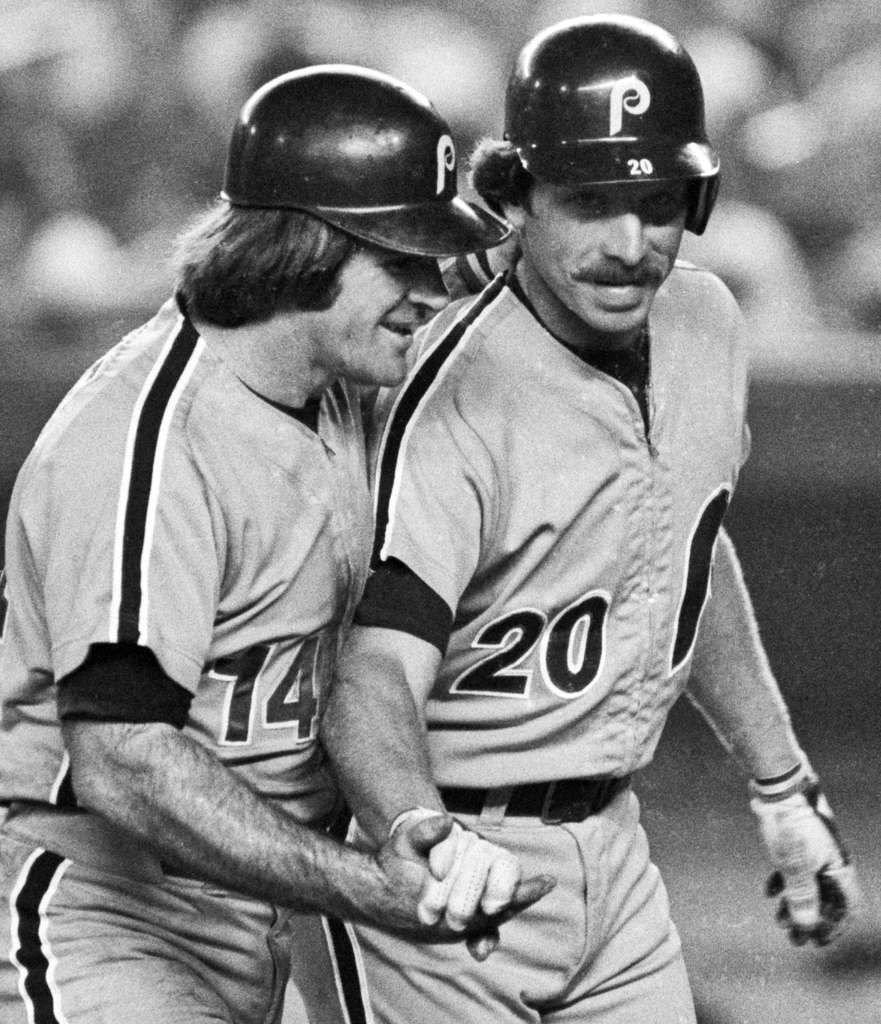
Pete Rose (left) was Phillies teammates with Mike Schmidt for five seasons.
Q: In May, the commissioner posthumously reinstated Pete Rose, whose name could be put before a Hall of Fame era committee for consideration for induction in December 2027. Within the Hall of Fame community, do you think there’s support to put Pete Rose in the Hall of Fame?
A: I do, but I don’t know that it’s any more than 50% … There are as many detractors as supporters in Pete’s case. However [Hall of Fame chairman of the board of directors] Jane Clark forms the committee, that will determine Pete’s fate. And even if they put 16 ex-players, members of the Hall of Fame on it, I still think it would be 50/50. And if they put four or five Hall of Fame members on it, and GMs and team presidents and media people and historians, and they put all those guys on it, I still think it runs 50/50. [Note: 75% support is required for election.]
… I can’t go one way strong or the other, based upon my experiences and talking about Pete, wherever I’ve been, be it around the members of the Hall of Fame or media types, Just general conversation at a restaurant or something with people.
What a tumultuous life that man led. I don’t think he handled the whole situation very well. I’m not a proponent of him gambling on the game, which was the big issue, of course. The people’s lives that he affected through that, through his life during that period, the way he handled when he admitted on that, and the way that Mr. [former commissioner Bud] Selig was hoping that he would change his life and do some good, change his habits in life to positive things for the game of baseball and for himself and his family, which didn’t happen.
So I think he created his own fate. And now we will find out, I guess in two or three years, when this committee votes whether he will have a plaque in the Hall of Fame. And I believe that if he doesn’t, I still think there should be a big corner in the museum somewhere that shows pictures and tells the story, maybe a video of some sort, of Pete Rose happening in the history of baseball. Because I think it’s important. Whether it was a negative stain on the sport or not, that’s part of it.
Last summer, after six years in their home, Danielle and Jonah Abrams decided to upgrade their 1,000-square-foot, two-story rowhouse in East Passyunk. The neighborhood was ideal, Danielle said, but they needed to accommodate their growing family.
“We love our location and have great relationships with our neighbors. We know at least half our block by first name,” she said.
Both are heavily involved in the neighborhood, both politically and civically.
“When we were expecting our daughter, everyone asked us if we were moving to the suburbs,” Danielle said. “Instead, we doubled down on our investment in our home by renovating.”
They contracted with City Living Construction to complete the renovations. The process required staying with Danielle’s parents for three weeks, when she was seven months pregnant, while contractor Christtian Mazza, “transformed our full bath into the respite of our dreams,” Danielle said.
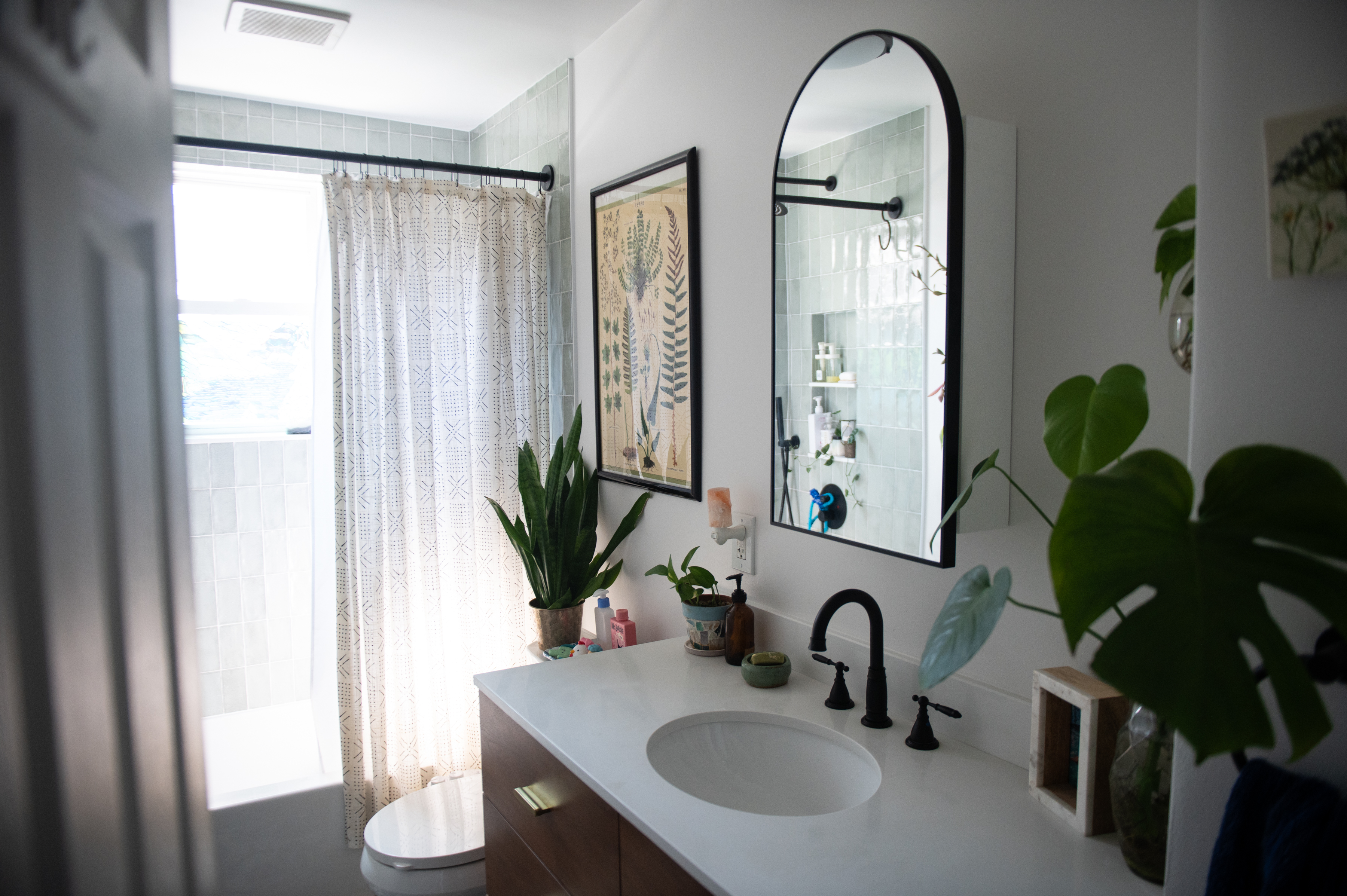
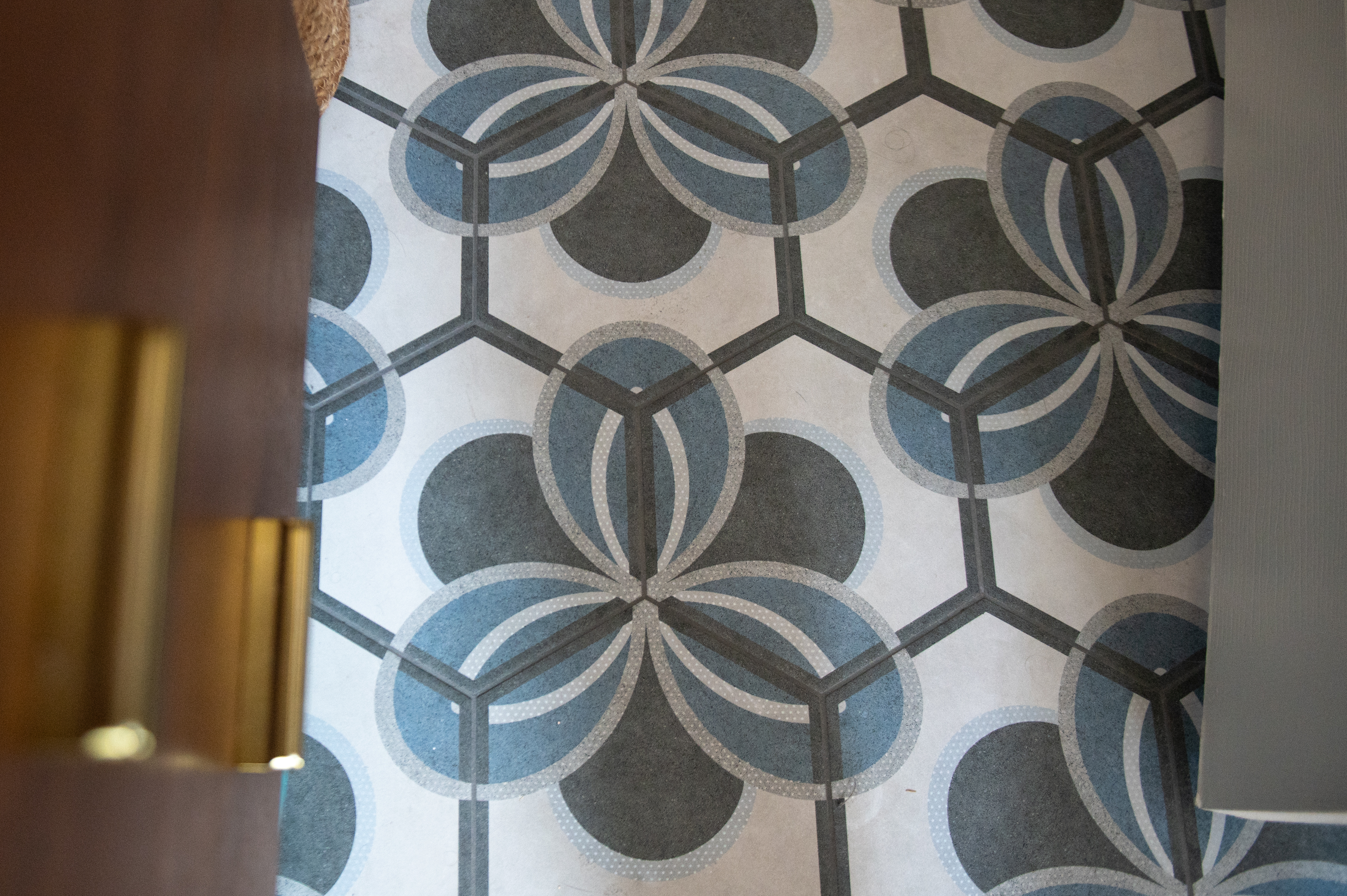
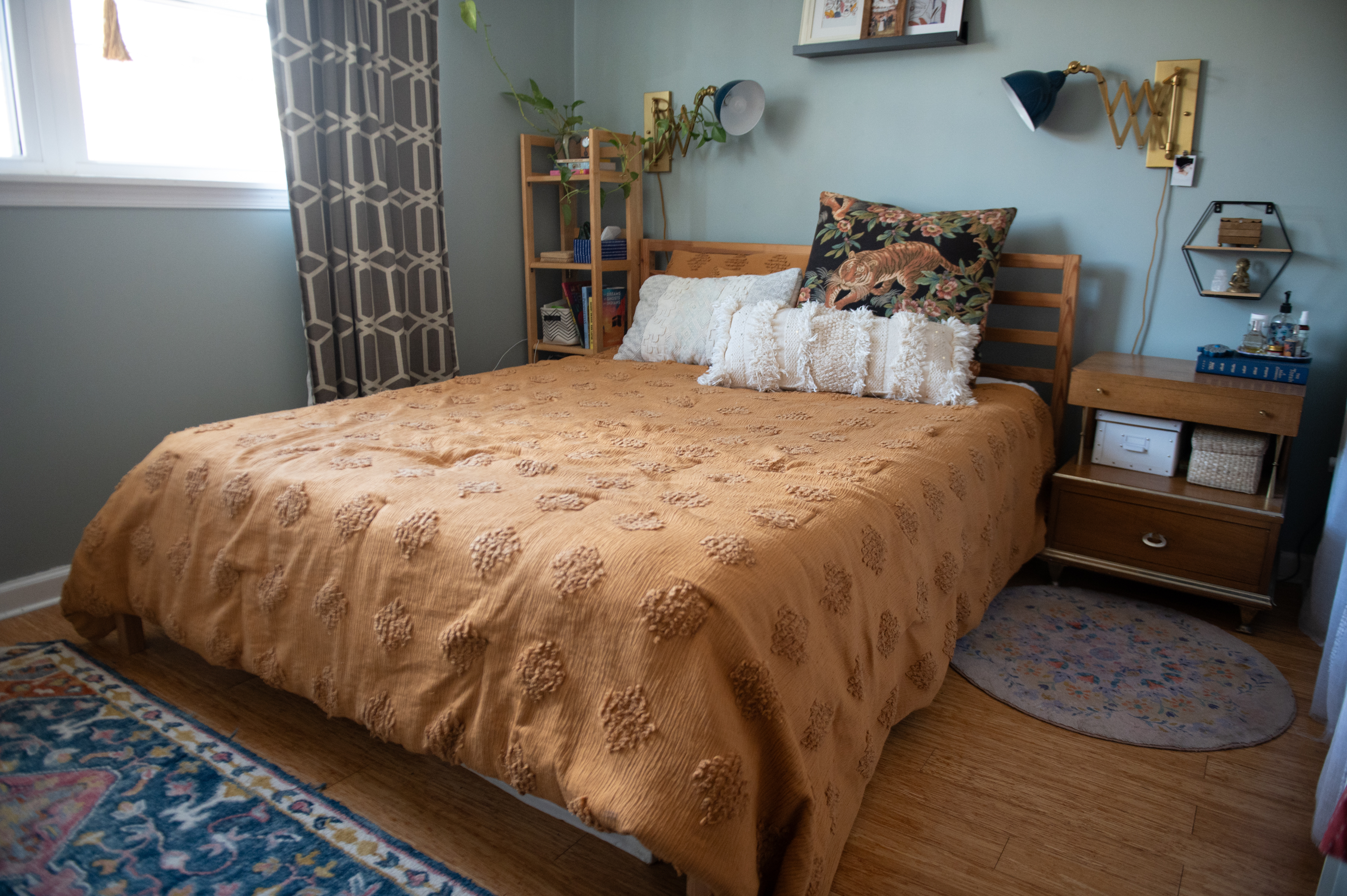
Danielle and Jonah Abrams’ second-floor bathroom, which they renovated before their child was born.A decorative window covering in the second-floor bathroom.Bathroom tiles, which the couple chose at a store in Fishtown.Danielle and Jonah Abrams’ primary bedroom.
“I designed the space by picking the fixtures and making multiple mood boards in PowerPoint showing the different tile, vanity, mirror, and fixture options,” Danielle said. ”We visited a tile store in Fishtown together and chose the flooring and shower tile, which took over an hour of laying different options on the floor of the showroom.”
Most of the home’s furniture was secondhand and sourced from local social media groups, Danielle said.
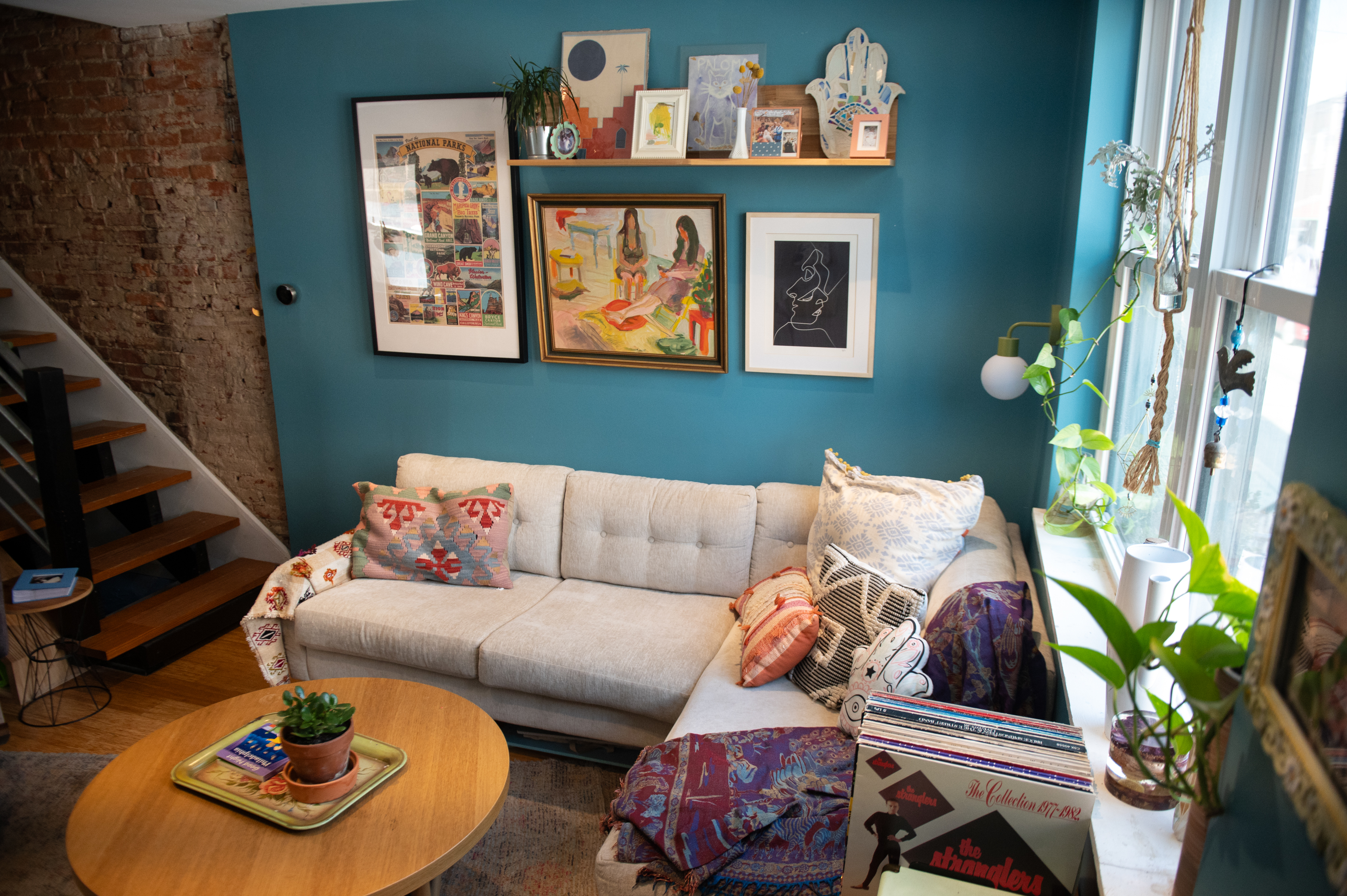
“The one piece we splurged on was our sofa, which is from Joybird,” she said. “We chose the ivory pet-proof fabric to brighten up the space and also to hide cat hair.”
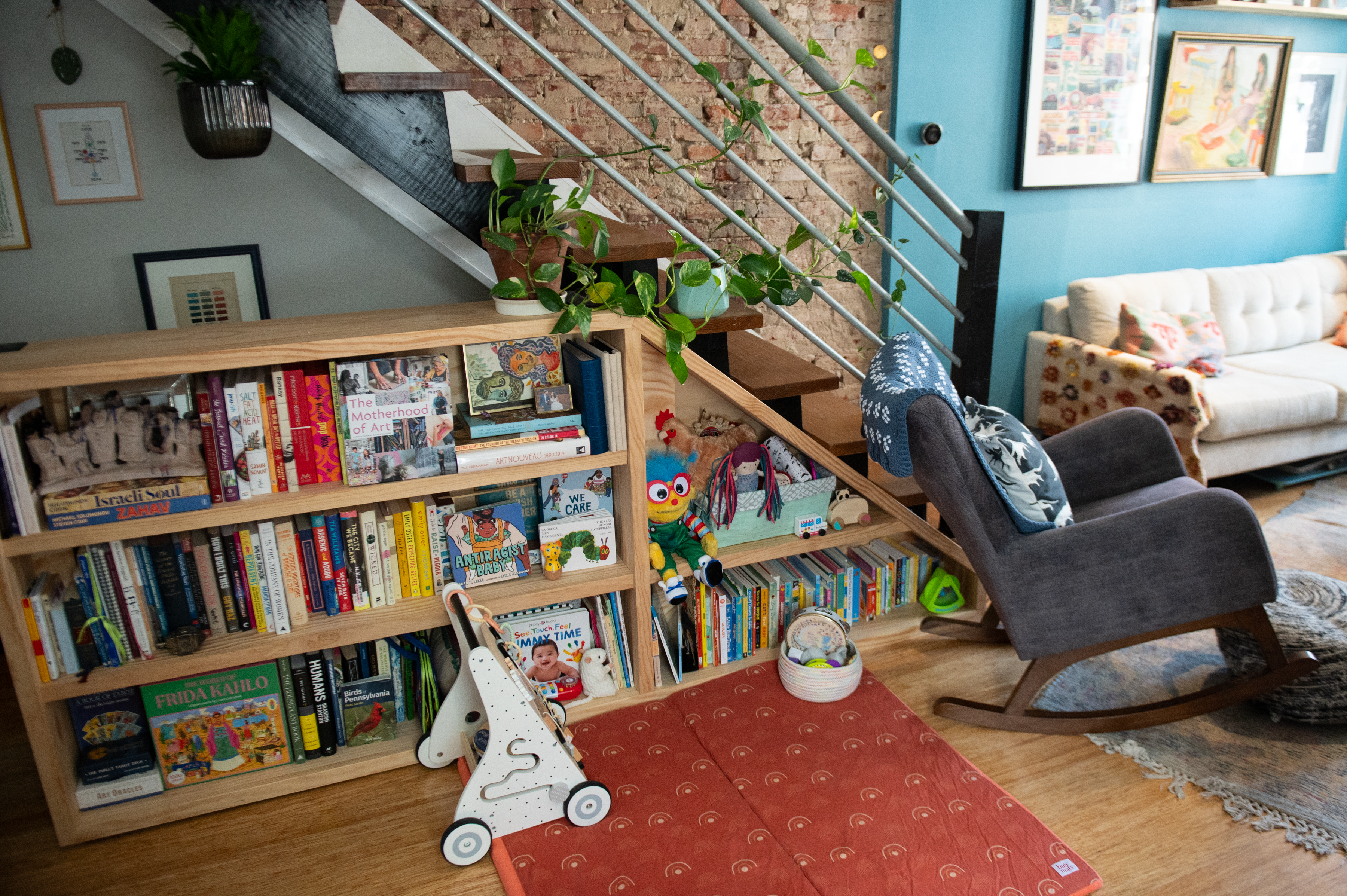
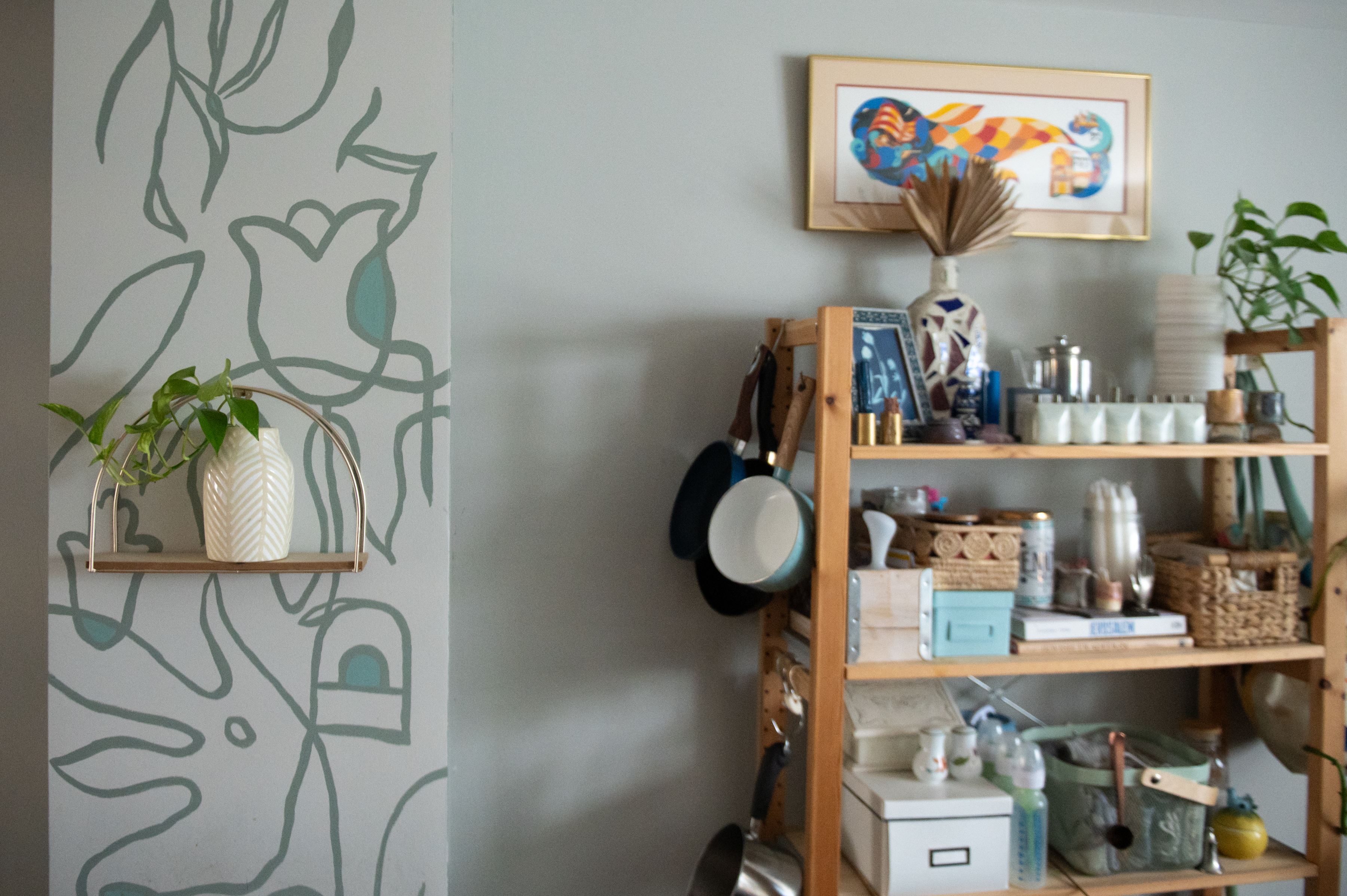
A play area between the living room and kitchen in the Abrams’ home. The bookshelf, which also serves as a railing to the basement, was added while the couple renovated the home.The couch was one splurge item for the couple in their renovations.
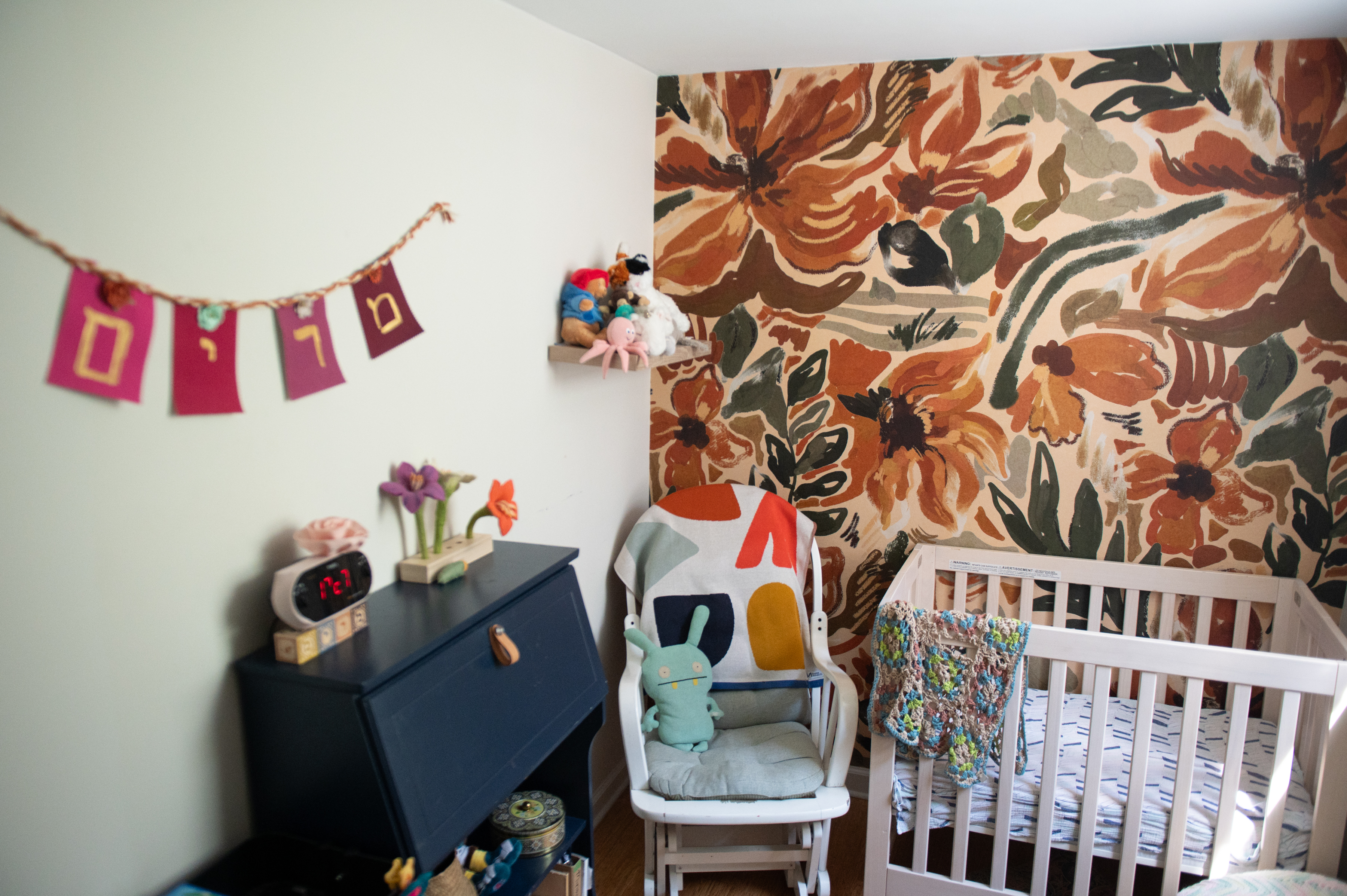
The nursery is the smallest room in the house. Again, the couple’s practical sense took a role.
“We worked with furniture we already had, including the rocking chair from my childhood bedroom,” Danielle said.
They added handmade touches throughout the space, including the felt mobile in the window and the name garland on the wall.
“The only new piece of furniture in the room is the crib,” Danielle said. “We opted to get a mini crib from Babyletto that would better fit the small space.”
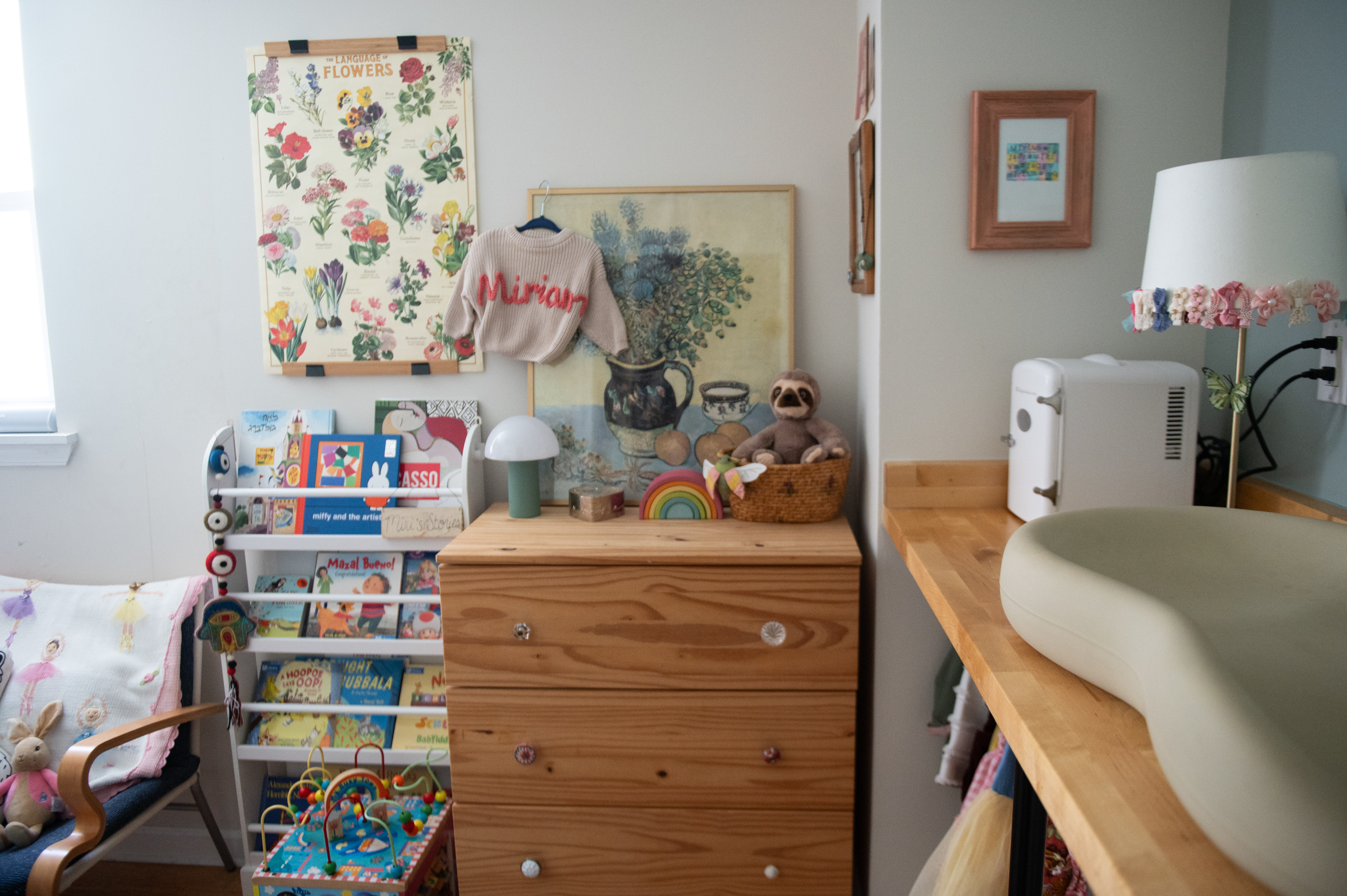
In Miriam’s nursery, the couple purchased a mini crib to better fit the small bedroom space.A homemade felt mobile hangs in the nursery window.Bows line a lampshade in the nursery.Children’s books and decorations in Miriam’s nursery.
In terms of color, the home showcases blue and sage green throughout. Danielle also added her own personal artwork. She is especially proud of a mural that she painted in the kitchen, a continuous line design that incorporates botanical leaf shapes and the Hebrew letters that spell out Shalom.
The stairwell was the couple’s final project, with a goal to create a space for their daughter’s books and toys.
“Choosing to stay in the city after having a baby makes our home stand out from many of our neighbors’ homes,” Danielle said. It “demonstrates how to be resourceful and creative in your home design rather than moving out to a larger property in the suburbs.”
Decorations and storage for kitchen items on the first floor of the home.
A 15-year retail veteran who has worked at many retailers in the Philadelphia area, including Burlington, Five Below, Anthropologie, and Terrain, she is a graduate of Drexel’s Westphal College of Media Arts & Design. She currently runs her own business, a sustainable Judaica brand called HamsaMade, while also working for a local woman-owned company that sells safety accessories to essential workers.
Jonah is a project manager in the renewable energy field. He’s equally happy to be living in the city.
“Being right by Goldstar Park, Capitolo Park, and Paolone Park is one of our favorite things about where we live,” he said. “Before we moved in together, I was living in Queen Village and Danielle was in Bella Vista so we clearly love South Philly.”
Paintings and mosaics decorating Danielle and Jonah Abrams’ backyard.
Last year’s renovation, Jonah noted, was not the couple’s first home project since they bought the house in 2018, but it was the first “that was not to solve an immediate problem.” He appreciates the surrounding community, and serves as a ward committeeperson. He can sometimes be found traveling the neighborhood by foot, “wearing our baby as I knock the doors of my neighbors, hearing about their challenges and helping them to vote.”
“We love being able to walk to so many of our favorite places and favorite people, and we want our daughter to grow up being able to do the same,” Jonah said. “And we are dedicated to making our neighborhood even better.”
Is your house a Haven? Nominate your home by email (and send some digital photographs) at properties@inquirer.com.
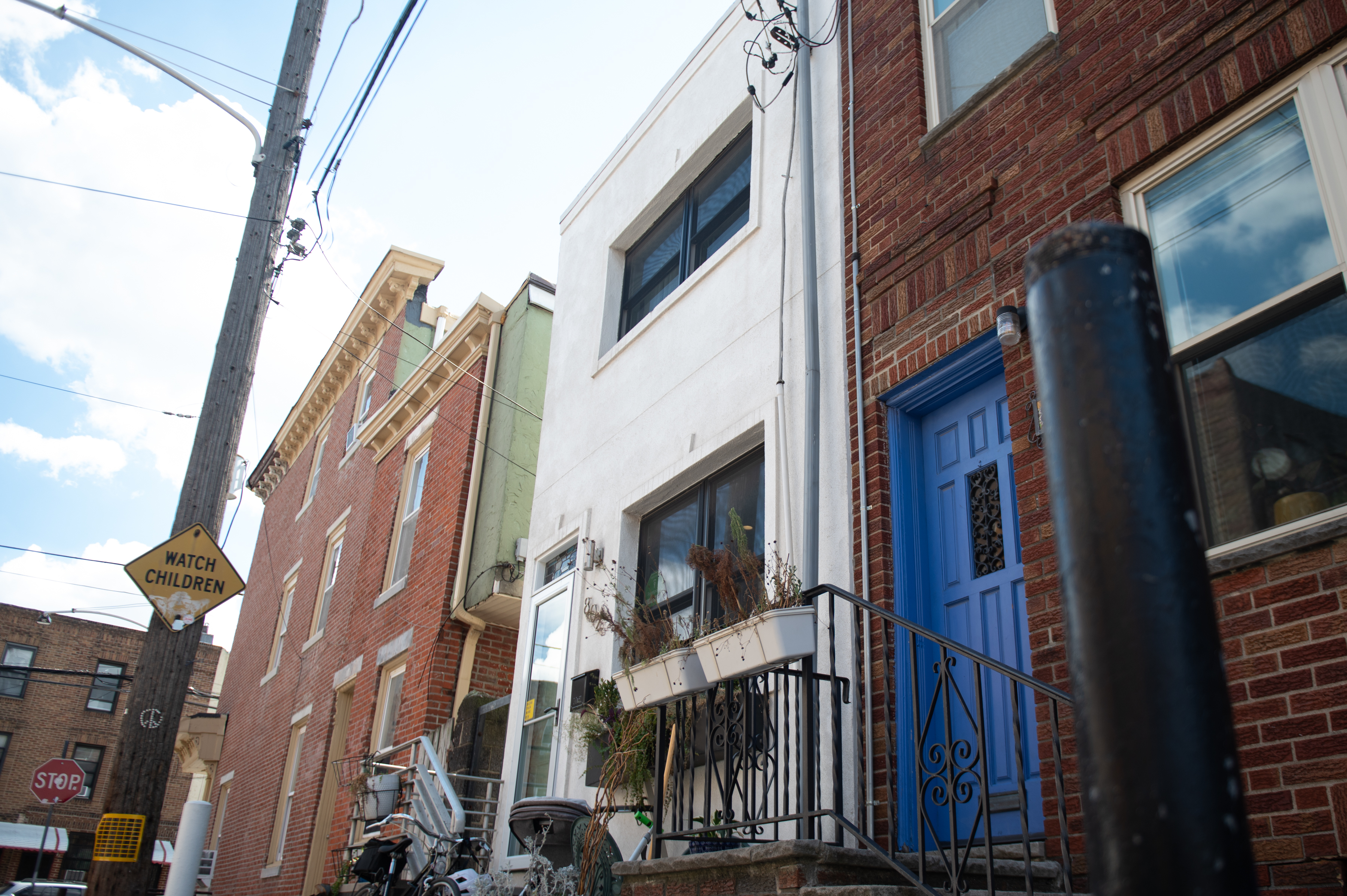
The outside of Jonah and Danielle Abrams’ South Philadelphia home.
Clearing a golf ball past the 250-yard mark into the sunlit fairway of California’s Titleist Performance Institute is getting easier for a whole lot of people in the region.
All they have to do is stop by the virtual golf simulators at Cherry Hill’s PGA Tour Superstore. The Georgia-based chain is opening store No. 80 in South Jersey. It already has an outlet in the Metroplex Mall in Plymouth Meeting, and is looking to expand to Ocean Township, N.J., soon.
The company has undergone a significant growth spurt in the last six years with new brick-and-mortar locations and a 200% jump in e-commerce, a company spokesperson said.
The sprawling 40,000-square-foot superstore in Cherry Hill will open at 9 a.m. Saturday with $30,000 worth of giveaways, including a full set of iron golf clubs to the first two customers.
It will house dozens of aisles of the latest golf clubs, balls, apparel, and other gear, among six practice and play hitting bays, virtual golf simulation stations, and an expert club fitting area. Store sales manager Lexi Humbert, a golfer of 16 years, said she added 10 yards to her drive after a new club head suggestion.
Store general manager Lisa-Jo Donnelly reacts as she sinks a putt on the practice green at the PGA Superstore.
The real draw is the golf simulation bay, where customers can cycle through world-famous golf courses projected onto a screen, and drive balls nearly 100 mph into them, receiving analytics on each swing.
The putting green is lined with the most popular putters from classics like Taylor Made Spiders and Scotty Cameron Phantoms to the fresh lineup of L.A.B. brand putters. Golfers can explore clubs and then test them out in the golf simulation bays, or get hands-on fittings with the experts. Regripping and repair services are available, too.
Golf, historically associated with wealthier, white men, is a growing sport — especially “off-course golf.” It was made popular by TopGolf — a trend PGA Tour Superstore hopes to capitalize on with recurring Saturday events, inviting youth groups (like First Tee) in for lessons, and providing a social space for those looking to get some swings in outside of the green.
“The average golfer is now down to their early 40s‚” said the store’s general manager, Lisa-Jo Donnelly. The goal is to create a space that will become part of the Cherry Hill golfing community, within a region that is home to 70 courses and a local high school team that likes bringing home trophies, she said.
The store has an expansive women’s and juniors’ sections. Humbert, who said she has been to golf stores all over the country, said the selections will be refreshing for many, as stores tend to skimp on women’s and junior equipment.
“When I go to other stores, I already know that I’m not going to have nearly the selection that I need. I always get frustrated,” Humbert said. “The biggest thing for me is for those just wanting to get into golf and see a PGA shirt at other places for $150, whereas here you can go into the back of the store and find something for $20 to $30.”
Store sales manager Lexi Humbert reacts after a great drive on a virtual golf simulation at the PGA Superstore.
Saturday’s opening day is likely to lure hundreds to the store for giveaways, but they may have to contend with the dozens of people who will camp out for days to be first.
“These opening giveaways are so popular that we had, for quite a few openings, the same person in the front of the line. He was traveling around the country and getting there first,” Donnelly said.
The store will provide campers with pizza on Friday night and coffee and Krispy Kreme doughnuts on Saturday. The new PGA Tour Superstore CEO, Troy Rice, and Cherry Hill Mayor David Fleisher will also be in attendance Saturday, alongside members of the township council.
📅 Opening Oct. 25, at 9 a.m.📍2232 N.J. Route 70, Suite C, Cherry Hill Township, N.J. 08002, 🕒 Monday to Friday 10 a.m. to 8 p.m., Saturday 9 a.m. to 8 p.m., Sunday 10 a.m. to 6 p.m. 🌐 pgatoursuperstore.com
“Is it funny?” “Am I just old?” “What does it actually mean?”
Those are common questions you’ll come across while searching for “six-seven” (or “6-7”), a phrase that has eclipsed internet obscurity and made its way into everyday speech, filling timelines, classrooms, and group chats in a way only the chronically online could understand.
The numbers, said out loud together, are really just that. It’s not code, or sexual innuendo. In reality, it’s just a lyric lifted from a song by Kensington-based rapper Skrilla.
The 27-year-old rapper, whose legal name is Jemille Edwards, has over 130 million streams across platforms and continues to rise in popularity.
In 2023, he signed with Priority Records — a Los Angeles-based label significant within the rap scene that worked with N.W.A and Ice Cube. Last year, his album Zombie Love Kensington Paradise earned praise in the industry.
The 19-track album, which he rereleased this year as a deluxe version with eight additional songs, underlines Edwards’ “affinity for the neighborhood while displaying his vocal flexibility and off-kilter delivery,” Pitchfork said in its mostly positive review, calling him likely “on the road to rap stardom.”
Philly rapper Tierra Whack has repeatedly shouted out Skrilla’s work while North Philly’s Lil Uzi Vert has collaborated with him.
In August, Edwards was arrested by Philadelphia Police during a music video shoot where he used a toy gun filled with gel pellets to shoot at an officer. He was charged with assaulting a police officer and related offenses.
One particular single by Skrilla has raised the rapper’s internet prominence.
Where did ‘six-seven’ come from?
Skrilla raps the lyric “six-seven” in his song “Doot Doot (6 7),” a track from the deluxe version of Zombie Love Kensington Paradise about life on the streets, fast cars, money, violence, and loss.
It’s a high-energy track that nods to Skrilla’s drill-rap style. The song’s chorus includes the lines, “6-7, I just bipped right on the highway,” and “pull up, doot-doot.”
What does ‘six-seven’ mean?
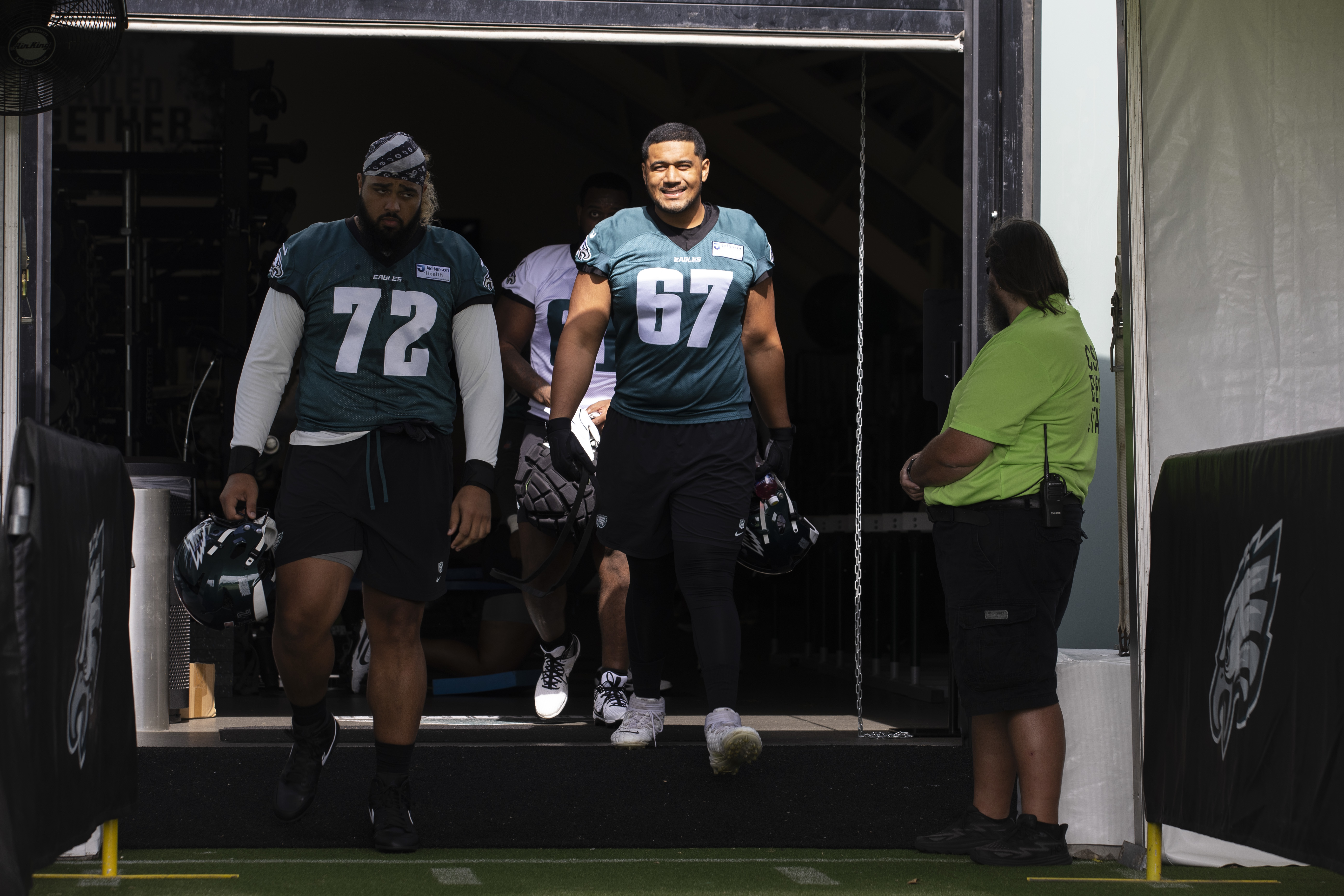
Philadelphia Eagles offensive tackle Laekin Vakalahi smiles while taking the field during the first day of Eagles Training Camp at the NovaCare Complex on Wednesday, July 23, 2025 in Philadelphia.
Well, it’s ambiguous. And Skrilla has said in interviews that he kind of likes it that way.
Meme lovers and unofficial lyric decoders have theories. Many think it refers to 67th Street in Philly, where Skrilla grew up (that’s what the Washington Post went with).
Owen Carry with Know Your Meme believes the Philadelphia ties are “largely speculative.”
Others think that it’s a nod to 67th Street in Chicago, where he has family. Taylor Jones, a linguistics and African American English expert, suggested it might be a nod to police radio code, where 10-67 is used to notify of a death. A contributor on Genius, a site dedicated to annotating song lyrics, theorized it was a reference to burial plots, six feet under and seven feet apart.
“Everybody else got their own different meaning,” Skrilla told Complex recently. “But for me, it’s just ‘negative to positive.’”
The most important part here is that it doesn’t really matter.
“Six-seven” has taken on a life of its own in recent months due to the pedestal it’s been placed on across TikTok and other social media platforms.
Why is ‘six-seven’ so popular?
The meme’s origins date back to late last year when Skrilla unofficially released “Doot Doot (6 7)” via Instagram as a leftover track from Zombie Love Kensington Paradise. It quickly started making the rounds on TikTok.
Content creators were using the line from the chorus in different, playful, extremely unserious ways: edits of a 6-foot-7 basketball player, lip dub memes, and scenarios that force someone to say the two numbers together. The creators are often nonsensical and copy Skrilla’s vocal pattern, a singsong “six-seven,” usually coupled with an open-palmed hand gesture.
Experts at Know Your Meme, who have been tracking the phenomenon since its inception, say videos surrounding “six-seven” have been viewed millions upon millions of times.
“The trend started with a series of bait-and-switch LaMelo Ball (of the Charlotte Hornets) edits late last year, which would intro with a random clip that included someone saying, ‘six-seven,’ and then switch to a Ball highlight reel,” said Carry, associate editor at Know Your Meme. “Skrilla’s ‘6-7′ lyric was used to queue the transition (Ball is 6 feet, 7 inches, which is relevant to why he was chosen).”
In turn, Carry said, young boys especially have been saying the numbers on camera in hopes of becoming the next NBA TikTok edit star.
“Six is a perfect number, and seven is a prime number, but only a glutton for punishment would put them together in front of a bunch of 13-year-olds,” the Wall Street Journal wrote in a piece about how the meme is wreaking havoc across campuses.
It’s safe to say the phrase has officially made its way into the mainstream.
“South Park” continued a buzzy season with its latest episode, “Twisted Christian,” on Oct. 15.
“Six-seven” was mentioned in a recent South Park episode where the kids can’t stop using the phrase, leading to an assembly about the Antichrist and satanic numerology.
Pro wrestler Je’Von Evans wore a “67″ jersey during his walk-in entrance last week, Shaq has given the trend his blessing (though he admits he doesn’t totally get it), and Skrilla claims the song will be included in the Grand Theft Auto VI soundtrack, though that hasn’t been made official yet.
Skrilla also performed the track in Philly last month when millennial icon Natasha Bedingfield, who was performing at the Theatre of Living Arts, pulled him on stage for a guest appearance. Bedingfield told Complex she’s a fan of the rapper and would like to get on a remix of “Doot Doot (6 7).”
Skrilla will be back in town at the Fillmore on Nov. 30.
What has Skrilla said about it?
In an interview this week with the Washington Post, he suggested the song referred to 67th Street in Philly, a block where a lot of his friends lived. It’s worth noting there isn’t a 67th Street in Kensington.
“We just rode by a truck that had ‘6-7’ written on it in dust, in Arizona, all the way out here,” the rapper said, speaking from a gas station on the way to Los Angeles.
The Inquirer couldn’t reach Skrilla for additional comment.
Will ‘six-seven’ still be cool by the time I start saying it?
Probably not.
With its place solidified in the mainstream — being analyzed by linguistic experts, printed on merch, and reported on by multiple newspapers (including this one), it’s safe to say the trend is likely on its way out the door.
But at least, for a fleeting moment, you can say you know what it means — which is nothing.
Phillies pitcher Orion Kerkering gets replaced by manager Rob Thomson in the eighth inning against the Atlanta Braves on Sunday, August 31, 2025 in Philadelphia.Yong Kim / Staff Photographer
The Phillies are primed for big changes. Who needs to come back, and who needs to go? Swipe and decide
For the second straight year, the Phillies won the National League East. And for the second straight year, the season came to an unceremonious end in the National League Division Series.
Dave Dombrowski tried to improve the roster at the margins last winter, signing pitchers Joe Ross and Jordan Romano and outfielder Max Kepler to one-year deals and trading for Jesús Luzardo. Neither Ross nor Romano threw a pitch for the Phillies after August.
The Phillies have around $170 million committed to eight players for 2026, plus nine arbitration-eligible players. But with several key members of the Phillies core set to hit free agency this year, they are primed for bigger changes. Will they go bigger and bolder this year?
“You’re always looking to get better, so we will be open-minded to that,” Dombrowski said at his year-end press conference on Thursday. “I think it's a little bit different in that there's some built-in situations for us that are going to have to be addressed. So where you go as a club is very much dictated on some of those moves that end up happening.”
As the Phillies consider their next move, you can have your say. Make your pick for each player by swiping the cards below — right for Stay or left for Go. Yes, just like Tinder. Finding it hard to decide? We'll also show you how other Inquirer readers have voted so far and what we think the team will do.
Advertisement
Pitchers
For the first time under manager Rob Thomson, the Phillies have a bona-fide closer to go with a top-end starting rotation. But some changes will be coming, with Ranger Suárez heading to free agency and the enduring Andrew Painter question. The Phillies also have to address their middle relief corps. Navigating the bridge from their starters to Jhoan Duran was a weakness during the playoffs.
#45
Zack
Wheeler
All-Star
Crowd says
Contract
Signed thru '27
Age
35
Inky Says Stay
March: Wheeler is expected back from thoracic outlet surgery in the first half of ’26. He had a 2.71 ERA before his diagnosis and was building another Cy Young-caliber year.
#55
Ranger
Suárez
Crowd says
Contract
Free agent
Age
30
Inky Says Go
March: Suárez is primed for a big payday, but with a crowded rotation and Andrew Painter on the way, it’s unlikely the Phillies will outbid other teams to keep him.
#27
Aaron
Nola
Crowd says
Contract
Signed thru '30
Age
32
Inky Says Stay
March: Hampered by injuries, Nola had a career-worst 6.01 ERA. But some better starts late in the year showed flashes of the old Nola, signaling a bounce back next season.
#50
Orion
Kerkering
Crowd says
Contract
Pre-arbitration
Age
24
Inky Says Stay
March: If Kerkering regains confidence after that brutal finish, he’s worth keeping. Despite inconsistent execution, his 33.5% hard-hit rate at age 24 signals back-end potential.
#61
Cristopher
Sánchez
Crowd says
Contract
Signed thru '28
Age
28
Inky Says Stay
March: Sánchez stepped into the role of the Phillies’ ace in the absence of Zack Wheeler. He had a 2.50 ERA over 202 innings (22 quality starts) and his 8.0 bWAR led all pitchers.
#46
Jose
Alvarado
Crowd says
Contract
Club option
Age
30
Inky Says Stay
March: If the Phillies are betting on first-half Alvarado — who had a 2.70 ERA and a 99 mph fastball before his PED suspension — it’s worth exercising their club option.
#58
Tanner
Banks
Crowd says
Contract
Arbitration elig.
Age
33
Inky Says Stay
March: Banks has developed into a reliable option against left-handed hitters, holding them to a .175 batting average this season.
#31
Walker
Buehler
Crowd says
Contract
Free agent
Age
31
Inky Says Go
March: Buehler had a 0.66 ERA in a tiny sample size (13⅔ innings) with the Phillies, but had major struggles with command all year. It would be risky to commit a rotation spot.
#59
Jhoan
Duran
Crowd says
Contract
Arbitration elig.
Age
27
Inky Says Stay
March: As the Phillies’ closer, Duran is the anchor of the bullpen. His 32 saves in 2025 were a career high.
#44
Jesús
Luzardo
Crowd says
Contract
Signed thru '26
Age
28
Inky Says Stay
March: Luzardo had some rough patches, but overall put together a strong season. His 183⅔ innings were a career high, and he finished second in the NL in strikeouts (216).
#54
Tim
Mayza
Crowd says
Contract
Free agent
Age
33
Inky Says Stay
March: Mayza pitched only 16⅔ innings in an injury-plagued season, but left-handed relievers with a 53.8% ground-ball rate can be hard to come by. He could be worth another shot.
#30
David
Robertson
Crowd says
Contract
Free agent
Age
40
Inky Says Go
March: Robertson had a 28.2% strikeout rate in 20 games. He has undeniable experience, but will be entering his age-41 season and the Phillies may prefer to build for the future.
#68
Jordan
Romano
Crowd says
Contract
Free agent
Age
32
Inky Says Go
March: Romano was a reclamation project that didn't pan out, and he ended the season on the injured list after struggling to an 8.23 ERA. A change of scenery will be best for all.
#25
Matt
Strahm
Crowd says
Contract
Signed thru '26
Age
33
Inky Says Stay
March: One of the leaders in the bullpen, Strahm can get lefties and righties out and is a solid setup man for Jhoan Duran. Strahm held opponents to a 4.3% barrel rate in 2025.
#57
Lou
Trivino
Crowd says
Contract
Free agent
Age
34
Inky Says Go
March: Trivino had a 1.343 WHIP across three teams. Though his numbers improved with the Phillies late in the year, they may prefer a more consistent middle relief option.
#99
Taijuan
Walker
Crowd says
Contract
Signed thru '26
Age
33
Inky Says Stay
March: Walker improved from his 2024 season as he bounced between the rotation and bullpen. There were still inconsistencies, but his fastball velocity increased to 92.1 mph.
It isn’t usually the best idea to offer a multiyear contract to a catcher who is entering his age-35 season and coming off his worst offensive season in 10 years. But here’s the question: If not J.T. Realmuto, then who? The pitchers swear by Realmuto, and the Phillies are built on pitching. Maybe it isn’t such a difficult decision after all.
#10
J.T.
Realmuto
Crowd says
Contract
Free agent
Age
34
Inky Says Stay
Lauber: Signing a 35-year-old catcher to a multiyear contract usually isn't wise. But what's the alternative? As Cristopher Sánchez said, “We’re basically nothing without him."
#13
Rafael
Marchán
Crowd says
Contract
Arbitration elig.
Age
26
Inky Says Stay
Lauber: How do you evaluate a catcher who plays once a week? Say this: There's upside for a larger workload, although he remains the backup to J.T. Realmuto or a replacement.
#21
Garrett
Stubbs
Crowd says
Contract
Arbitration elig.
Age
32
Inky Says Stay
Lauber: After stepping back to triple A, he's out of minor league options. But if there's a way to keep him and Rafael Marchàn in the organization, catching depth is important.
The infield, to quote Dombrowski, is “pretty well solidified.” The Phillies prefer to keep Bryce Harper at first base, and Trea Turner quieted talk of a position change by making drastic improvements in his defense at shortstop. Bryson Stott will likely reprise his role at second base, with Edmundo Sosa providing an option against left-handed pitching. Get ready, then, for another round of Alec Bohm trade rumors. Third base is the one spot where change could be coming.
#7
Trea
Turner
Crowd says
Contract
Signed thru '33
Age
32
Inky Says Stay
Lauber: Behold the NL batting champ. Also, one of four Phillies players to bat .300 with at least 175 hits, 15 homers, and 30 steals in a season. He's squarely in his prime.
#3
Bryce
Harper
Crowd says
Contract
Signed thru '31
Age
33
Inky Says Stay
Lauber: Something seemed … off? … all season. Maybe it was his achy right wrist. He still finished 11th in OPS among NL hitters. Everything continues to revolve around No. 3.
#28
Alec
Bohm
Crowd says
Contract
Arbitration elig.
Age
29
Inky Says Go
Lauber: Get ready for another winter as a walking trade rumor. But after an injury-filled, league-average season with Bohm entering his walk year, the Phillies will be selling low.
#4
Otto
Kemp
Crowd says
Contract
Pre-arbitration
Age
26
Inky Says Stay
Lauber: An undrafted Division II college player reaching the majors was one of the year's best Phillies stories. He'll have a chance to stick around as a right-handed bench bat.
#33
Edmundo
Sosa
Crowd says
Contract
Arbitration elig.
Age
29
Inky Says Stay
Lauber: A versatile fill-in all over the infield, he's also the lefty-mashing half of a potential second-base platoon with Bryson Stott. Either way, he brings energy and value.
#5
Bryson
Stott
Crowd says
Contract
Arbitration elig.
Age
28
Inky Says Stay
Lauber: He batted .310 with an .880 OPS after Aug. 1 by lowering his hands and moving closer to the plate, à la Kyle Schwarber. Maybe it unlocked peak Stott. At last.
It’s possible the Phillies could have an entirely new outfield. Nick Castellanos isn’t expected back. Harrison Bader and Kepler are free agents, with only Bader on the Phillies’ radar. Justin Crawford is on the way, but will he play center field or left? The answer could impact Brandon Marsh’s future. It’s the most unsettled area on the field … again. Oh, and there’s a $125-ish million question at DH, with free agent Kyle Schwarber.
#12
Kyle
Schwarber
All-Star
Crowd says
Contract
Free agent
Age
32
Inky Says Stay
Lauber: As long as the Phillies are spending $125 million or so, what about a solid outfield defender with a low strikeout rate? Cody Bellinger, anyone? Probably not over Schwarber.
#8
Nick
Castellanos
Crowd says
Contract
Signed thru '26
Age
33
Inky Says Go
Lauber: In a hitting-depressed era, someone (Royals? Reds? Giants?) may take a one-year flier. How much of his $20 million salary must the Phillies eat? Regardless, he's gone.
#16
Brandon
Marsh
Crowd says
Contract
Arbitration elig.
Age
27
Inky Says Stay
Lauber: Subtract April, and he was seventh among NL outfielders in OPS (.836). How's that for a trade pitch? Problem is, he's one of the Phillies' few outfield assets.
#2
Harrison
Bader
Crowd says
Contract
Mutual option
Age
31
Inky Says Go
Lauber: If the Phillies are honest, he surpassed expectations after a deadline trade. Assuming he declines his $10 million option, bid him farewell and usher in Justin Crawford.
#17
Max
Kepler
Crowd says
Contract
Free agent
Age
32
Inky Says Go
Lauber: A .791 OPS in August and September kept him from being a total bust. Overall, he underperformed a $10 million, one-year contract. He isn't the answer in left field.
#23
Johan
Rojas
Crowd says
Contract
Pre-arbitration
Age
25
Inky Says Go
Lauber: You could do worse for late-inning defense and speed off the bench. But after Rojas was sent back to the minors in July, a change of scenery is probably best for everyone.
#37
Weston
Wilson
Crowd says
Contract
Pre-arbitration
Age
31
Inky Says Stay
Lauber: He's out of minor league options, which could be a factor in a potential spring-training competition with Otto Kemp for a spot as a right-handed hitter off the bench.
All Outfielders rated!
Advertisement
Staff Contributors
Development: Sam Morris and Jasen Lo
Design: Sam Morris, Jasen Lo, and Luke Reasoner
Reporting: Scott Lauber and Lochlahn March
Editing: John Roberts and Jim Swan
Photo Editing: Danese Kenon
Photography: Staff Photographers, additional photography provided by Associated Press
Dane Jensen isn’t a developer by training or profession, but he loves old buildings and he’s got big plans for the church at 1800 Tasker St.
The 138-year-old institution is a fixture in Point Breeze, but Second Nazareth Missionary Church’s shrinking congregation hadn’t been able to keep up with repairs. In 2024, as the church sought to sell, its leadership met with Jensen, who pitched them on his vision of a continuing life for the building as a communal space, if not a sacred one.
“A lot of adaptive reuse is taking these big institutional buildings and turning them into apartments and, to me, that loses some of the intent of the space,” Jensen said. “We are trying to preserve it as something where people can still gather and feel fellowship. Even without religious intent, it can still be a place where people can connect.”
Jensen bought the property in mid-2024 for $1.75 million, and he has begun renovations. He hopes to turn the church into a family-friendly restaurant, brewery, and event space, outfitted with an indoor playground, an idea he successfully pitched to Second Nazareth’s leadership.
“It’s a little scary to put that word out there because some people hear brewery, and they hear bar. They hear place to get drunk,” he said. “We envision it as a community space. During the day you can go grab a cup of coffee and do some work. In the afternoon, you can meet up with friends and have lunch, and, yeah, maybe you can grab a beer.”
Jensen isn’t imagining a traditional brewery, with giant silos and vats. He wants a place he will feel comfortable bringing his children, who are 4 and 7. That’s also why he’s been drawing up plans for play equipment inside the space.
The church is currently zoned for single-family use, like the rowhouses that surround it. But in 2019, City Council created historic preservation incentives to make it easier to repurpose churches that are on the Philadelphia Register of Historic Places.
That means Jensen can move forward, since the church was added to the register earlier this month. He won’t have to go to the Zoning Board of Adjustment or seek a legislative zoning change from Council President Kenyatta Johnson, who represents the area.
However, Jensen said he still plans to meet Johnson and arrange meetings with surrounding neighborhood groups known as Registered Community Organizations (RCOs).
“Needing to talk to your councilmember, needing to talk to your community through the RCOs, is incredibly valuable,” Jensen said. “We want to do that to make sure we’re not just coming in to extract value from the neighborhood. We really want to contribute in a real and meaningful sense. Hiring from the neighborhood feels really important.”
Jensen is applying for a sit-down restaurant and artisan industrial use permit. Other possible uses of the building include a bakery and a coffee roastery.
Whatever the final use, the historic church will require extensive renovation first. Currently, Jensen’s team is putting in steel reinforcements to brace the building. He plans to restore most of the stained glass, fix the leaky roof, and install fire safety and Americans with Disability Act infrastructure.
The church dates to 1886, when it was known as the Presbyterian Church of the Evangel. That denomination was in place for almost 100 years, but as that congregation shrank, the church sought a successor.
In 1978, the Second Nazareth Missionary Church took over the building and remained until 2024. In recent years, that congregation began facing many of the same challenges as their predecessors even as their membership was shrinking and repair costs were growing.
Jensen said he found notes from the waning days of the Presbyterian era that showed the leaking roof was a problem back then — a challenge that decades later, Second Nazareth was facing again.
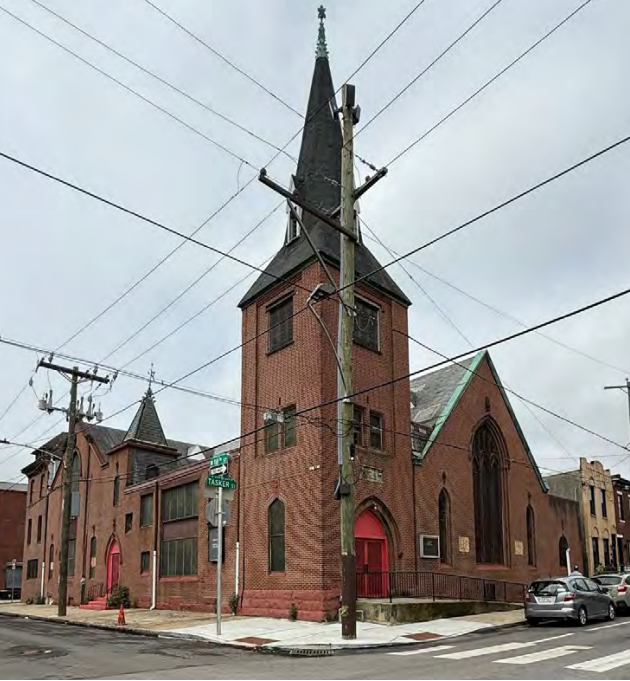
The church as seen from the north side, in an image included in Dane Jensen’s nomination of the building to Philadelphia’s Register of Historic Places.
When the Historical Commission accepted Jensen’s 48-page argument for the building’s importance earlier this month, that triggered the 2019 law that made it easier to find new uses for historic “special use” properties — like churches or theaters — by granting them more flexible zoning. That means no trip to the zoning board, which can add over half a year to the development process and often more if neighborhood groups or councilmembers contest the board’s ruling in court.
“I’ve really fallen in love with the building throughout this process,” Jensen said. “I’m excited that I am in a position to try to get the building to a point that it can last another 140 years and still have people feeling togetherness in it.”
Nikka Landau and Peter Beaugard‘s townhome in the Graduate Hospital area serves three generations.
They moved there to be closer to both sets of parents, and their kids like the accessibility of the YMCA across the street, and its pool.
“It’s a great block,” Landau said, “lots of kids.”
Kitchen
Landau, who manages communications for a nonprofit, and Beaugard, who is in fashion marketing, aren’t moving far away, just a few houses closer to her parents. Both grew up in the Philadelphia area, and had been living in Connecticut for several years before moving to Graduate Hospital in 2022.
The 1,830-square-foot, three-bedroom, 2½-bathroom house was built in 1920, and at some point was bought by two architects who redesigned it over a period of years.
“There was a lot of sensitivity to the design,” Beaugard said.
Backyard
Entry is through a vestibule, which has space for coats and bags. The first floor is open concept, with a sunken living room with high ceilings and large south-facing windows with built-in shelving.
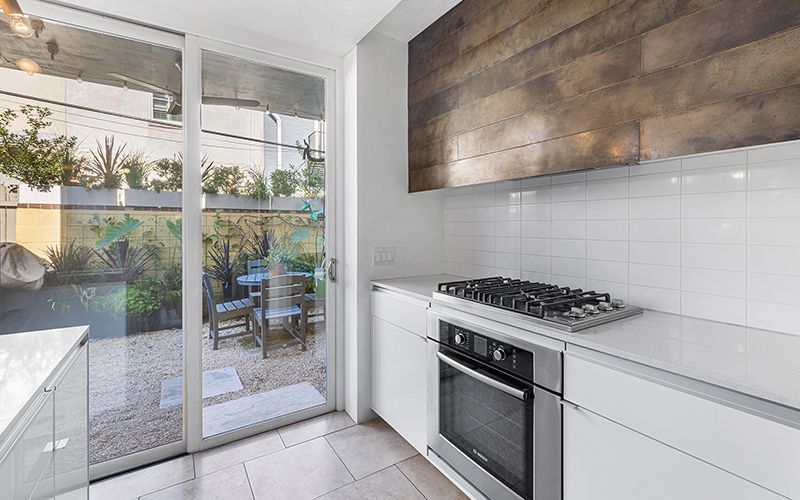
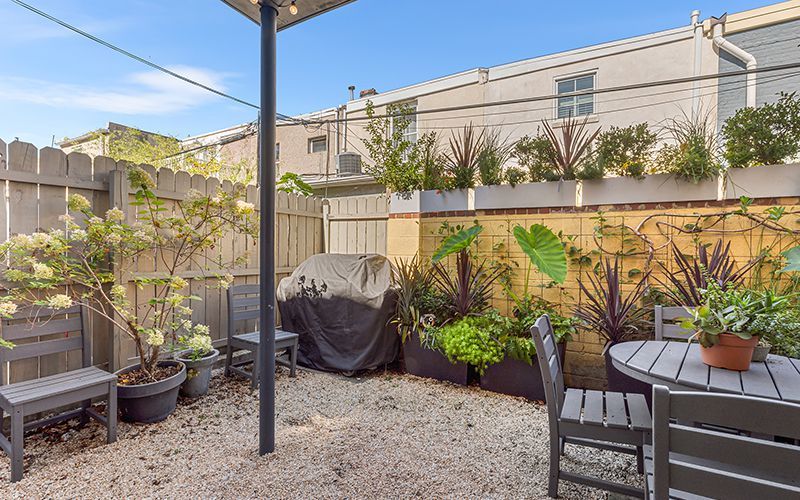
The kitchen has quartz countertops, stone flooring, stainless steel appliances, a Wolf range, and a magnetic blackened steel wall. There is a private garden patio.
The second floor has two bedrooms, a full bath with cast iron tub, and a den. The third floor has the primary suite, and the bathroom has a marble-top vanity and a tiled shower.
Roof deck
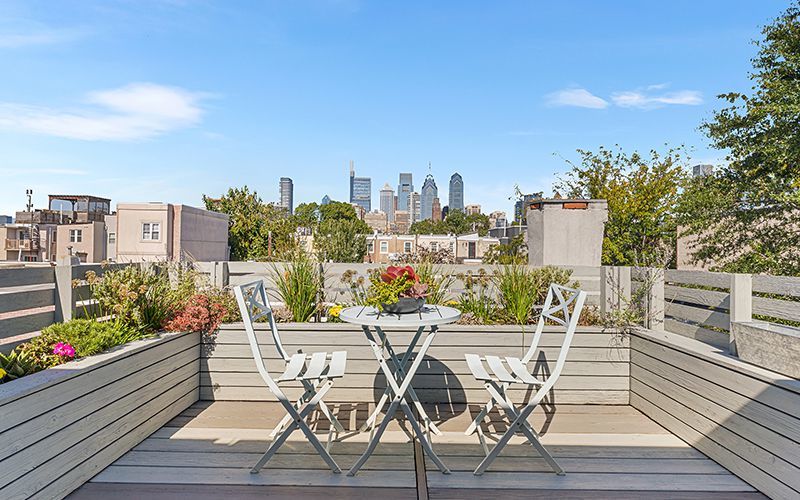
The roof deck has unobstructed skyline views.
The house is in the Edwin M. Stanton School catchment area.
It is listed by Kyle Miller of Compass Realty for $795,000.
The killing of Kada Scott is tragic on many levels, but hopefully, some lessons can be learned to honor her life.
Scott’s death is all the more painful for her family and friends because it could have been prevented. That’s because it appears District Attorney Larry Krasner and the Philadelphia court system failed her.
The man accused of abducting Scott had been previously charged with assaulting an ex-girlfriend twice in the last year, but prosecutors withdrew the charges after the victim did not show up for court.
After Scott’s disappearance, Krasner’s office admitted its handling of the earlier cases was a mistake. If the district attorney’s office had instead prosecuted Keon King, 21, then perhaps Scott, 23, would still be alive.
“We could’ve done better,” Krasner said at a news conference Monday, echoing earlier comments from Assistant District Attorney Ashley Toczylowski, who said last week, “Everyone involved at this point, including the [initial prosecutor], agrees that we wish this happened differently.”
To be sure, hindsight is 20/20. But a review of King’s legal entanglements indicates a series of miscues may have enabled Scott’s death.
The case also offers a window into the challenges of filing domestic abuse charges, and underscores the need for prosecutors to be more aggressive in going after the accused while doing more to ensure the safety of victims.
For starters, King’s initial assault charges last November were handled by an inexperienced assistant district attorney who was juggling multiple cases. During that incident, prosecutors said, King grabbed an ex-girlfriend by the neck and tried to strangle her after she refused to lie on the bed with him, according to the affidavit.
But after initially cooperating with the authorities, King’s accuser stopped responding to calls from prosecutors. After she failed to appear at three court hearings, the district attorney’s office withdrew the case.
In January, King tried to break into the woman’s home, but fled before police arrived, according to an affidavit. He returned later in the day and dragged the woman by her hair, shoved her in a car, and drove away before dropping her off on the side of the road.
This time, the woman and her friend captured video of King trying to get into her home. He was arrested again and charged with kidnapping, strangulation, and other charges.
But once again, the victim and her friend refused to cooperate with prosecutors, so the charges were withdrawn in May.
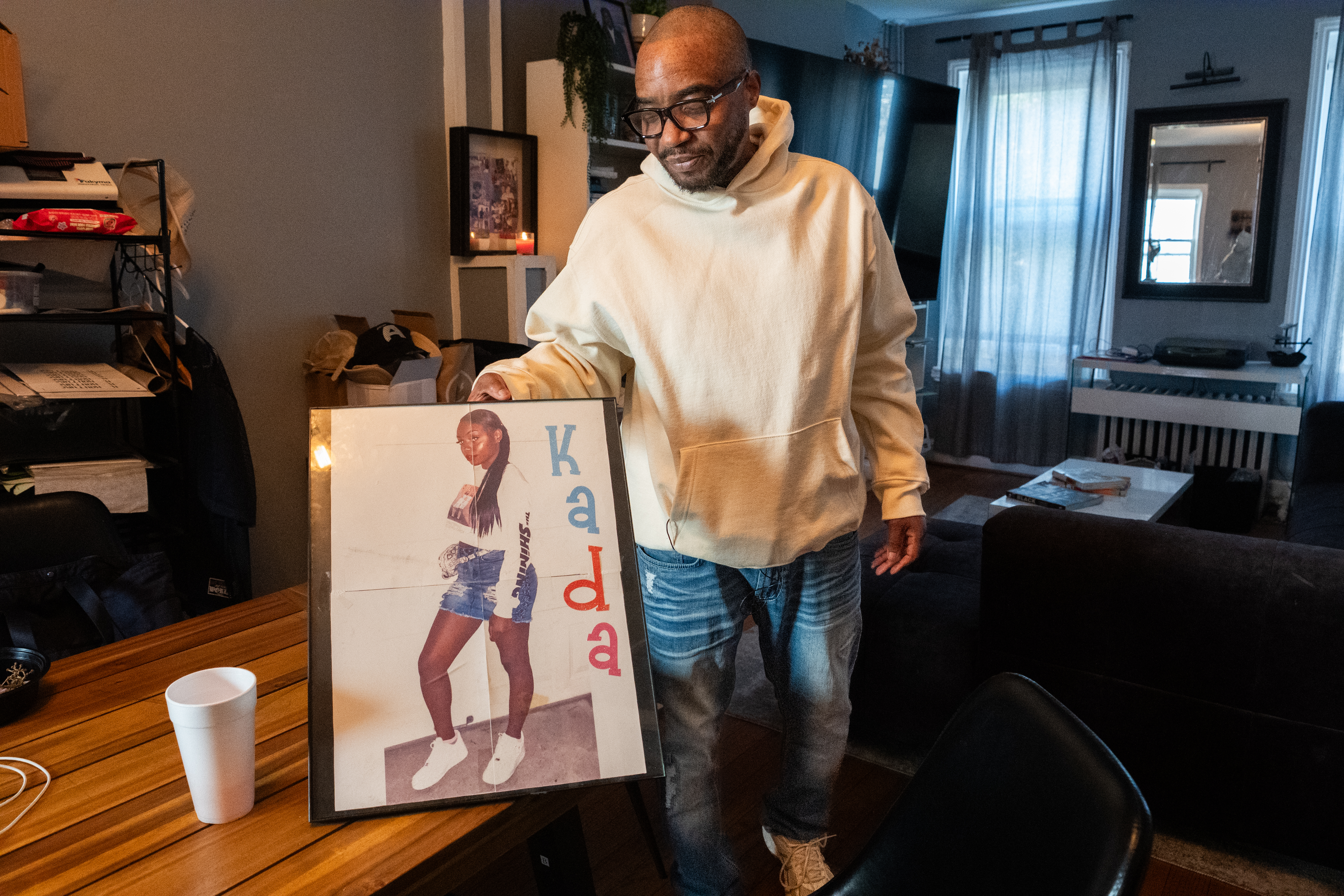
Kevin Scott, Kada Scott’s father, with a photo of his daughter.
This is not unusual, as victims of domestic violence often live in fear of the perpetrators. Reviewing the period between 2010 and 2020, researchers at the University of Pennsylvania found that 70% of victims of domestic violence cases failed to appear in Philadelphia’s courts.
A big part of the problem is that the accused are often out on bail and still threatening the victims. In King’s case, after the second set of assault charges, prosecutors requested bail of $1 million, but the magistrate lowered it to $200,000.
King posted the necessary 10% — or $20,000 — and was released in April.
Krasner blamed the magistrate for lowering the bail, but his office could have appealed the ruling.
There is a fine line in detaining suspects accused of crimes for months on end until a trial. But in domestic violence cases, the current system is not working and needs to be revamped.
Prosecutors and judges must do everything possible to guarantee the safety of victims. Victims need more support within the criminal justice system to ensure their safety.
More broadly, additional preventive steps are needed to reduce violence against women, including standing up to rape culture, empowering women, and teaching boys to respect women.
Black women disproportionately experience higher rates of domestic abuse, including rape and homicides, studies show, further underscoring the need for more awareness, training, and preventive measures.
In this instance, given that King had been charged once before, the magistrate and Krasner’s office dropped the ball.
And although the victim refused to testify, the district attorney’s office could have used the video evidence to move forward with King’s prosecution — though not having the witnesses testify certainly would have made for a tougher case.
To his credit, Krasner, a former defense attorney who faces reelection next month and has been criticized for being soft on crime, admitted his office was ultimately to blame.
Sadly, a young, vibrant woman full of promise has died, and another woman was previously assaulted and traumatized. Krasner said the public played an enormous role in Scott’s case, and asked for anyone with information to call 215-686-TIPS.
The only positive outcome will be to ensure justice is served, and a broken legal system in which victims are afraid to testify is fixed, so others do not experience the same horrific outcome.
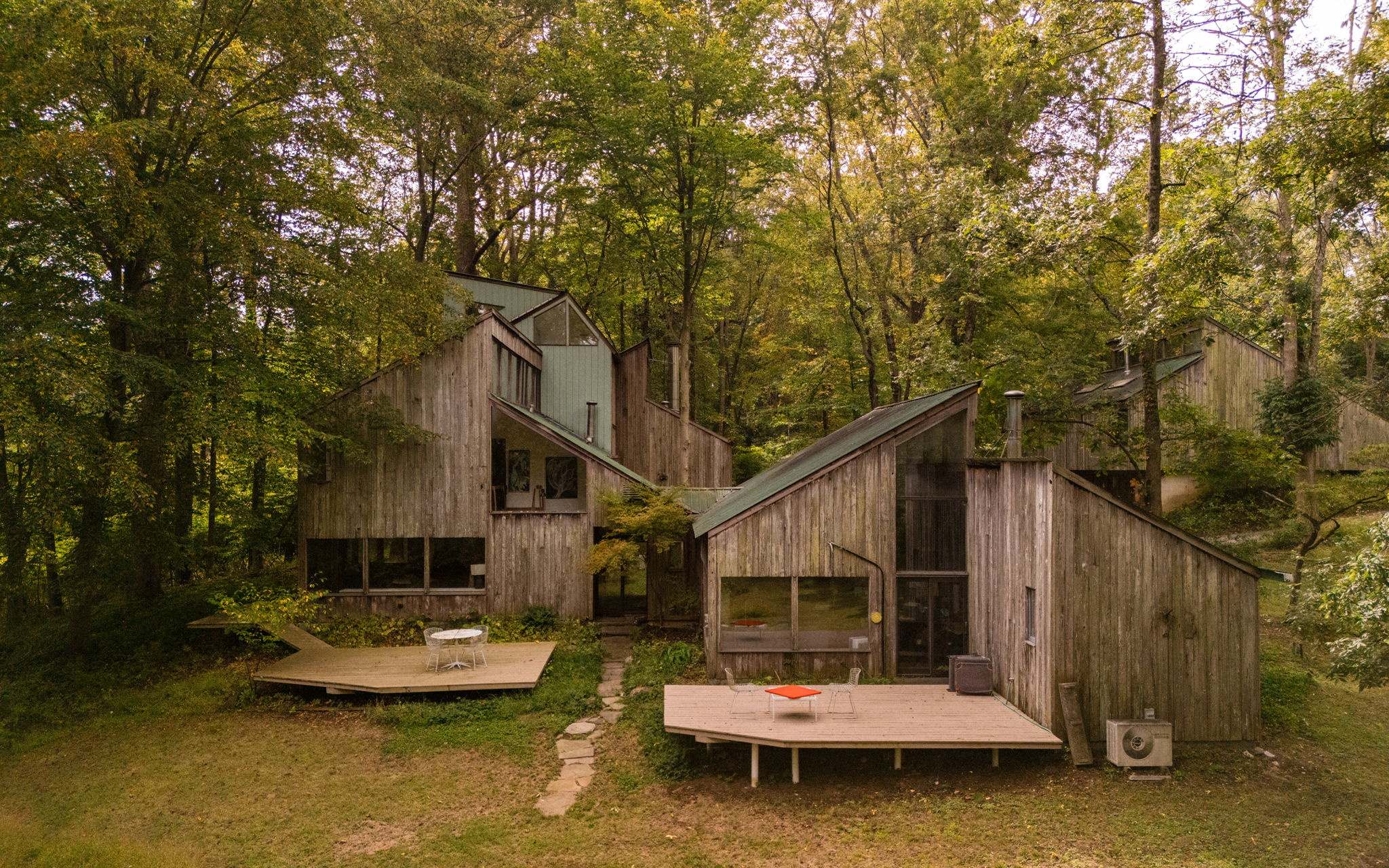
This Willistown Township home, for sale for nearly $2 million, was designed by Robert McElroy and has a wing that was devoted to his wife Annamaria’s art studio.
McElroy, who is credited with building more than 200 homes around the Main Line, designed and built this home for his own family in 1975, according to Marion Dinofa, Compass RE Realtor and modern home specialist.
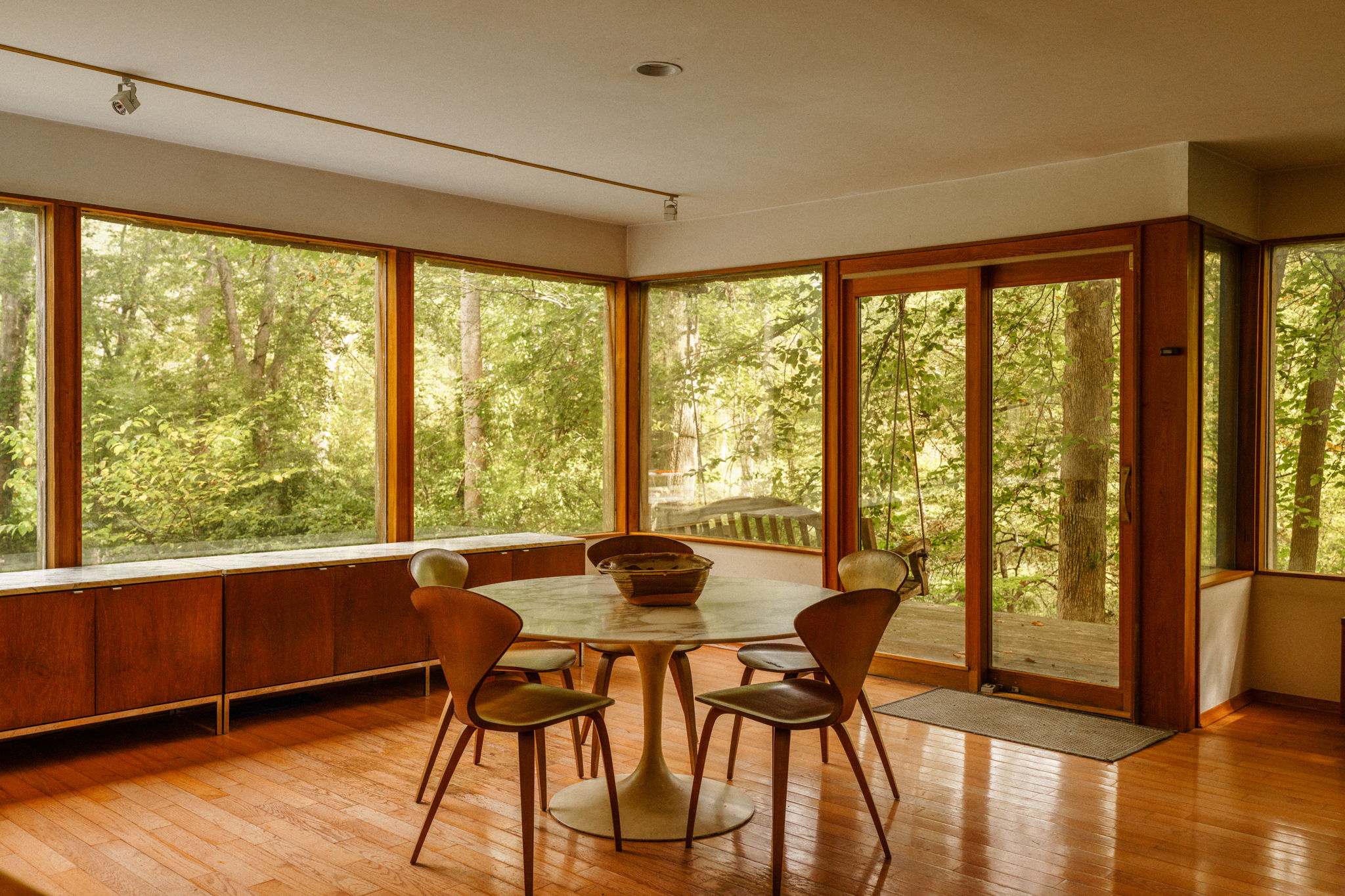
Tucked far off Rabbit Run Road in Willistown Township, McElroy’s three-bedroom, 3½-bath home features a contemporary design and floor-to-ceiling windows that let in abundant natural light.
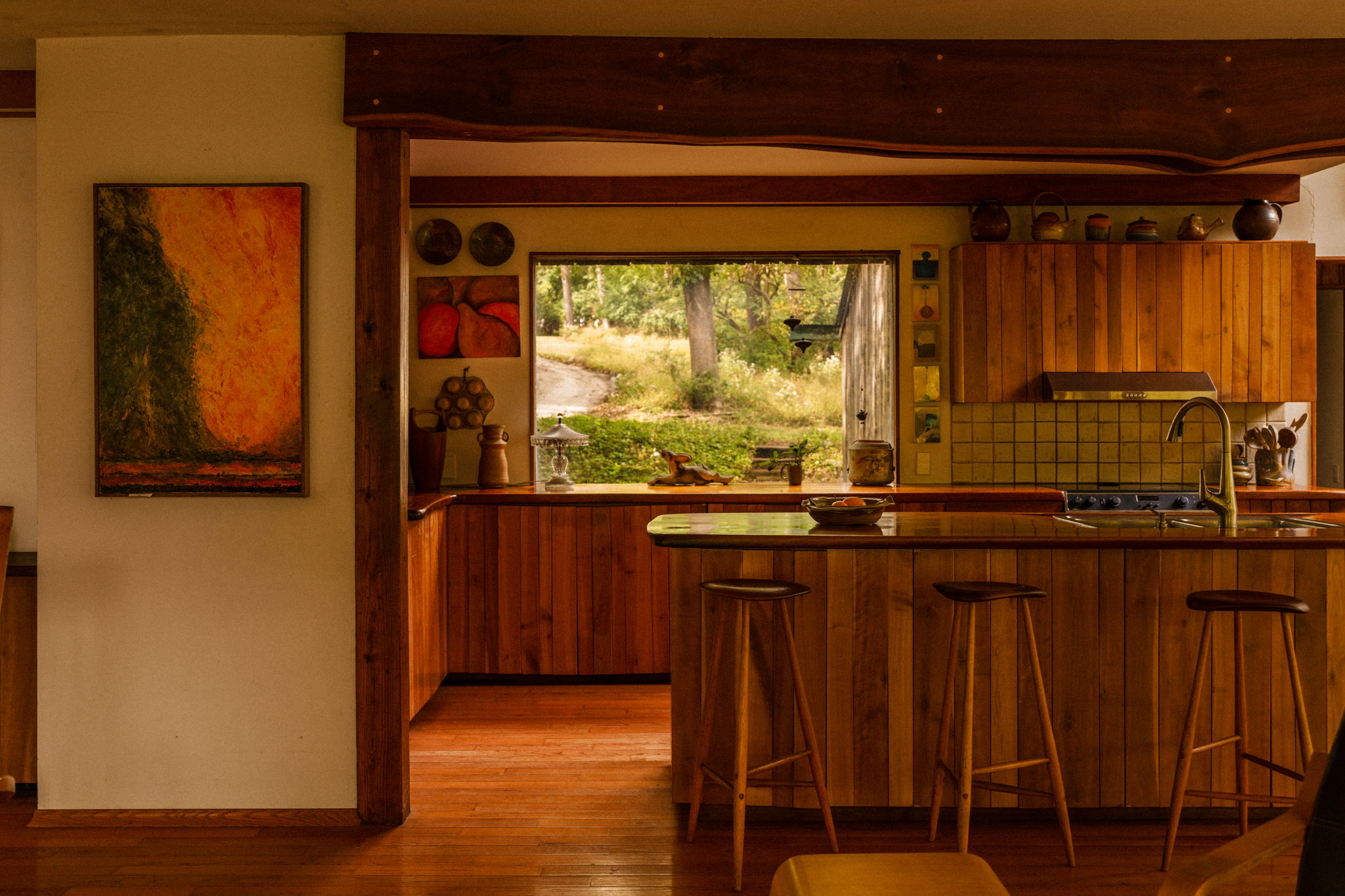
“I see a lot of really cool houses, but this one, almost more than any other house, is truly like you’re living in a work of art, between the craftsmanship of the woodworking, the views through the windows that are ever changing with the seasons, and the design of the home itself,” Dinofa said.
Wooden details make Robert McElroy’s former home in Willistown Township unique, said Realtor Marion Dinofa.
Almost every piece of wood in the home was crafted by Horace Hartshaw, who collaborated with the renowned sculptural furniture maker Wharton Esherick. This includes everything from the wood doors to the custom kitchen cabinets to the staircases, including a spiral one at its center.
McElroy wasn’t the only artist who resided in the home: His wife, Annamaria, a painter and sculptor, also left her mark, showcasing her artwork on the walls and using a wing of the home as her studio.
Dinofa noted that the house also includes a detached two-story garage that could be converted into more creative space.
The secluded home features custom wood features that were crafted by renowned artist Horace Hartshaw and lots of windows.
Between Robert’s vision and Annamaria’s artistic touches, their home “was a labor of love,” Dinofa said. “And it’s really well preserved. You can tell it hasn’t changed much.”
Annamaria and Robert lived at the home into their 90s, Dinofa said. They died in 2023 and 2024, respectively. Dinofa said the home is being sold by their daughter, Loretta.
Dinofa said she could see the property being bought by artists or by adventurous young parents who want to raise their children amid nature.
“It would be such a fun place for kids to play outside,” with a stream in the backyard and plenty of space to run around, Dinofa said. “I can only imagine the wildlife that they have viewed from that house.”
The University of Pennsylvania Health System, the Philadelphia region’s biggest provider of cancer care and a national leader in developing new treatments, is spending more than $500 million on two new cancer facilities in Philadelphia and central New Jersey to keep growing.
“What we’ve seen pretty consistently is that demand is there to meet any capacity increases,” Julia Puchtler, the health system’s chief financial officer, said in an interview about fiscal 2025 financial results.
Penn is not alone in its push to expand cancer services. Jefferson’s Sidney Kimmel Cancer Center, Temple’s Fox Chase Cancer Center, and the MD Anderson Cancer Center at Cooper are pushing into the suburbs to reach more patients.
The same thing is happening nationally as financially pressured health systems are looking for ways to increase revenue in a growing and lucrative market for cancer care.
Penn stands out locally for the scale of its investment in a strategy to deliver cancer care seamlessly across its seven hospitals and a growing network of outpatient clinics, with the expectation that patients will keep coming back for their ongoing health needs.
Penn sees an opportunity to expand its market share even more, as cancer diagnoses rise. The U.S. is expected to see a nearly 40% increase in cancer diagnoses between 2025 and 2050, according to the Philadelphia-based American Association of Cancer Research.
Experts attribute the rise to a wide variety of factors, from better early detection, to longer life spans, and to environmental exposures that are poorly understood.
Much of Penn’s investment is in outpatient facilities, including a $270 million center being built in Montgomeryville that will have radiation oncology and an infusion center. “More and more patients want to receive care closer to home,” according to Lisa Martin, a senior vice president at Moody’s Rating. “All of that is really what’s behind all of this investment.”
Cancer treatment overall is profitable. At Penn, cancer services account for up to 60% of the system’s operating margin by one simple measure that subtracts direct costs from direct revenue and excludes back-office expenses and other centralized costs.
Puchtler attributed the profitability of cancer care to the prevalence of drugs, such as chemotherapy, that Penn can buy at a discount, while getting the full price from insurers, and the higher percentage of younger cancer patients with better-paying private insurance than is typical for many healthcare services.
The expansion efforts are expensive in an industry where the consumers both benefit from advances and pay ever-rising healthcare costs. Proton therapy, in particular, costs more, but has not yet been proven to have better outcomes across a wide range of cancers.
The intensifying competitive landscape
Penn treats about one-third of adults with cancer in its market area, which stretches from central New Jersey to the Susquehanna, according to Robert Vonderheide, who is director of Penn’s Abramson Cancer Center and leads all of Penn’s efforts in oncology treatment and research.
Penn counted 47,053 new cancer patients in the 12 months that ended June 30, up 40% from five years ago, according to Penn. The system has 14 locations where patients can receive chemotherapy and even more radiation oncology sites.
Competitors are also trying to expand their reach, and Temple’s Fox Chase Cancer Center is succeeding.
window.addEventListener(“message”,function(a){if(void 0!==a.data[“datawrapper-height”]){var e=document.querySelectorAll(“iframe”);for(var t in a.data[“datawrapper-height”])for(var r,i=0;r=e[i];i++)if(r.contentWindow===a.source){var d=a.data[“datawrapper-height”][t]+”px”;r.style.height=d}}});
Fox Chase had 21,442 new patients in fiscal 2025, up 148% from 2020, the nonprofit said. Fox Chase has added suburban offices in Voorhees and Buckingham, Bucks County, and is expanding its infusion capacity at its main campus on Cottman Avenue. Fox Chase has a significantly smaller footprint than Penn, with six locations for infusions and four for radiation.
The MD Anderson Cancer Center at Cooper said it had 4,326 new patients last year, up 27% over the last five years. Cooper has taken the MD Anderson Cancer Center brand to the former Cape Regional Medical Center, which it acquired last year and which used to be part of the Penn Cancer Network. Cooper also offers cancer services at its new Moorestown location.
Jefferson Health’s Sidney Kimmel Cancer Center did not respond to requests for patient data, but has in recent years opened cancer center locations at its Torresdale and Bucks County Hospitals. Jefferson’s cancer center also attained the highest designation from the National Cancer Institute last year — the Philadelphia region’s third comprehensive cancer center, matching Penn and Fox Chase.
Lancaster County resident Susan Reese, 56, said she experienced smooth cooperation between her doctor at Penn’s Lancaster General Hospital and the team at HUP during her treatment for non-Hodgkin lymphoma.
“I never had any question in my mind that one doctor didn’t know what the other doctor was doing,” said Reese, who received CAR-T therapy at HUP in September 2022. Penn has since started offering CAR-T at Lancaster General.
After she relapsed in early 2023, she came back to HUP for a stem cell transplant. She could have gone to Penn State Health’s Hershey Medical Center for that. It’s significantly closer to her home in Willow Street, but she wanted to stay within the Penn system.
Reese’s experience of integration of services at HUP and Lancaster General is what Penn is aiming for in a territory that stretches from central New Jersey to central Pennsylvania.
Oncologist Robert Vonderheide, director of Penn Medicine’s Abramson Cancer Center, oversees all Penn’s cancer services and research.
Electronic medical records help with the integration needed to ensure the thousands of cancer patients Penn physicians treat annually get the most advanced care possible, according to Vonderheide, whose research focuses on cellular immunotherapies.
“We treat patients’ cancers now in a very precise way; the precise mutation, the precise type of chemotherapy, the precise dose” are the focus for doctors, Vonderheide said. “This is no longer appropriate for the telephone game. This has to be data-driven.”
Reese’s decision to stay within Penn is part of a broader trend of patients tending to receive all their care within one health system, according to Rick Gundling, a healthcare expert at the Healthcare Financial Management Association in Washington, D.C.
That’s particularly important in oncology, which typically involves multiple specialties, such as medical oncology, radiation oncology, and surgical oncology, he said.
“Seamless coordination across all those disciplines really makes it a better patient experience and clinical experience because it reduces delay, improves access,” Gundling said.
Taking advanced treatments from HUP to the network
Part of Penn’s strategy is to begin offering advanced services at locations beyond HUP. That’s where Penn pioneered CAR-T cell therapy, which harnesses the immune system to attack cancer, and for years that was the only place Penn offered it.
HUP still performed the bulk of the CAR-T treatments for blood cancers, 123 inpatient cases and 14 outpatient cases last year, but now CAR-T is also available at Lancaster General and at Penn’s Pennsylvania Hospital in Center City.
Fox Chase was the next biggest center in the region for the relatively new treatment that Penn scientist Carl June and his research teams helped develop. For the fiscal year that ended June 30, 2025, Fox Chase had 21 inpatient cases and 67 outpatient cases, the center said.
In the Penn system, certain kinds of bone marrow transplants also used to be available only at HUP. “Now we do them at HUP and Pennsylvania Hospital,” Vonderheide said.
Even the most complicated pancreatic surgeries are going to be done at Princeton, in conjunction with experts at HUP, Vonderheide said. Penn held a ceremonial groundbreaking Monday for the hospital’s $295 million cancer center.
Remaining only at HUP are bone marrow transplants that use another person’s cells to treat blood cancers, Vonderheide said. HUP performed 118 of those so-called allogeneic bone marrow transplants on the top floor of its $1.6 billion patient pavilion, now known as the Clifton Center.
Pennsylvania’s next-biggest provider of the treatment was Hershey Medical Center, near Harrisburg, with 71, according to state data.
window.addEventListener(“message”,function(a){if(void 0!==a.data[“datawrapper-height”]){var e=document.querySelectorAll(“iframe”);for(var t in a.data[“datawrapper-height”])for(var r,i=0;r=e[i];i++)if(r.contentWindow===a.source){var d=a.data[“datawrapper-height”][t]+”px”;r.style.height=d}}});
Penn started offering proton therapy at HUP in 2010, and expanded its availability in the last three years to Lancaster General and Voorhees, through a joint venture with Virtua Health. Those two centers only have one proton machine each, compared to five at HUP.
It’s a type of radiation that is designed to precisely target tumors and do less damage to surrounding tissues. That makes the treatment, which costs more, particularly helpful for children, and it is proving beneficial for treating certain neck and throat cancers.The use of proton therapy for the more common prostate cancer has been more controversial.
Penn’s fourth proton center, with two machines, is under construction and is expected to open at Presbyterian in late 2027. When that $224 million center opens, Penn will have more proton treatment rooms than the entire West Coast, said Jim Metz, chair of radiation oncology at Penn.
Currently about 10% of Penn’s roughly 10,000 annual radiation oncology patients are treated with protons, though it’s a higher percentage at locations with proton machines, Penn said.
Penn officials have noted that some cancer patients come to Penn for proton therapy. Even when it’s not appropriate for them, they tend to stay within Penn. “We have seen, when we build protons, our market share increases, ” Metz said.
Editor’s note: This article has been updated with more recent Fox Chase data.