Author: Kristen A. Graham

  • This Philly charter is starting its own college so kids can graduate with high school diplomas and college credits — for free

    This Philly charter is starting its own college so kids can graduate with high school diplomas and college credits — for free

    A Philadelphia charter school is building its own college.

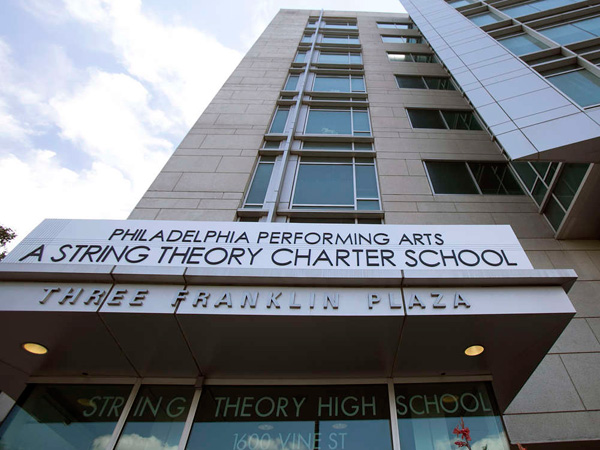
    Students at the Philadelphia Performing Arts Charter School, a K-12 facility of about 2,500 with campuses in South Philadelphia and Center City, should soon be able to graduate with high school diplomas and 60 college credits — for free.

    PPACS is not the only early college in the city — the Philadelphia School District has Parkway Center City Middle College, and other schools allow students to take college courses while in high school. Some schools offer dual enrollment, and a new early college charter will open in the city in the fall.

    But instead of partnering with existing colleges, String Theory, the education management organization that runs PPACS, is in the process of opening its own degree-granting institution.

    String Theory College will focus on design, technology, and entrepreneurship, offering PPACS students more flexibility than prior dual-enrollment partners had, said Jason Corosanite, the college president. Students won’t have to leave the school’s Vine Street campus to attend classes, either.

    “The whole goal is to get all kids prepared for college, with as many college credits as possible,” Corosanite said.

    The college already has Pennsylvania Department of Education approval, and its Middle States Commission on Higher Education accreditation vote is scheduled for March, commission officials said. Once schools are candidates for accreditation, that opens up college transferability, student loans, and Pell grant opportunities, though PPACS students pay no tuition because the school is a publicly funded charter.

    Corosanite said he is confident the school will gain Middle States approval and ultimately be able to offer students associate’s degrees.

    With Philadelphia’s crowded higher education market and a looming college enrollment cliff, it’s fair to question whether the city needs more degree-granting institutions, said Shaun Harper, a professor of education, public policy, and business at the University of Southern California. Some would say it does not.

    But, Harper said, “if this new creation is going to expand access and make higher ed more affordable, I think that is a spectacular thing. We need more innovative models in education that create more seamless pipelines from high school to college.”

    Harper’s research once centered on the experiences of high-achieving Black and Latino boys in New York schools who, once in college, “suddenly they realized that they were not as prepared for college as they had been led to believe by their high school teachers and by the grades they received in high school.”

    That makes Harper consider whether String Theory students “are really going to be pushed to do college-level work, and perform like college students would otherwise be able to perform? I think that is a thing to be concerned about.”

    Ultimately, Harper said, he is intrigued by the model.

    “There’s a real opportunity for [String Theory] to ensure that they are providing the right kinds of professional learning and professional development experiences for these educators, so they amass the skills that will be able to make the curriculum much more complex, much more college-level,” Harper said. “They may have a real shot here at teaching the rest of the nation something that ultimately becomes replicable.”

    High school and college in one stop

    The seeds of the idea trace back to PPACS’ first high school graduates — the Class of 2017.

    When Corosanite and other String Theory officials tracked those students, “some of our best and brightest kids were dropping out of college because of cost,” he said. “It wasn’t because they couldn’t do it. They were looking at the value proposition of these schools and dropping out. I felt the burden of, ‘We’re telling all these kids, yeah, you have to go to college,’ and then they graduate and can’t afford life. How do we solve for that?”

    Enter String Theory College.

    The program is already underway — about 40 students who participated in a pilot program are on track to graduate with college credits in June, and about 40 more are in 11th grade now.

    The college will initially be open only to students enrolled in PPACS. Going forward, every 11th- and 12th-grade honors and Advanced Placement course at the school will be a college-level course, and the PPACS faculty who teach the courses are college faculty.

    Course offerings include multivariable calculus, linear algebra, biotechnology, entrepreneurship, and design.

    Students still have access to the trappings of high school: All non-honors classes are still within the PPACS confines. And students must still meet state requirements for their high school diplomas — they are learning math, but it might be a design-focused math class, for instance.

    “Kids still have their high school experience — they still come to school on time, they still go to the lunchroom with everybody they go to school with,” Corosanite said. “They still see their friends, they still have prom, but they also have college. It makes it a lot easier.”

    There is no budget impact for PPACS, Corosanite said. The school, which as a charter is independently run and publicly funded, pays the college a per-credit hour rate that is roughly equivalent to community college, and that money covers teachers’ salaries and benefits.

    “We’re trying to be as efficient as possible with the classes the teachers have, and the college is in our building,” he said. “We’ve designed it to be cost-neutral. This is not a moneymaker — it’s mission-driven.”

    Going forward, Corosanite dreams of a graduate school of education — String Theory already offers continuing education for teachers — and offering college courses to other schools and districts.

    ‘This is a good opportunity’

    Hasim Smith, a PPACS senior, was pitched on the idea of taking college classes in high school when he was a 10th grader.

    Smith’s dad had heard about the pilot program and urged his son to go for it.

    “He said, ‘This is a good opportunity. I don’t want you to miss out on it,’” Smith said. “I like to challenge myself and do things that other people see as hard. And I like that it’s free — it helps with college costs.”

    Smith was game and now, at age 18, he’s looking forward to collecting his high school diploma and transferring dozens of credits to another college. (He’s already been accepted to 10 and is awaiting more decisions.)

    The courses are challenging, he said, but manageable, especially with his teachers’ support. He’s enjoyed the design challenges in particular, Smith said.

    “We had to learn a lot — it gets really deep. We have to learn about design, and different theories, and entrepreneurship,” Smith said.

    He had always thought he might want to pursue nursing as a career, but his String Theory college experience has him also considering architecture, he said.

    How to apply

    The college-in-a-high-school program has a limited number of slots for students who will be in 10th through 12th grade for the 2026-27 school year, and is accepting applications for those seats and for its incoming ninth-grade class.

    The school’s application deadline is Jan. 30.
  • Martin Luther King Jr. spoke to Philly students in 1967. These men say it influenced the rest of their lives.

    Martin Luther King Jr. spoke to Philly students in 1967. These men say it influenced the rest of their lives.

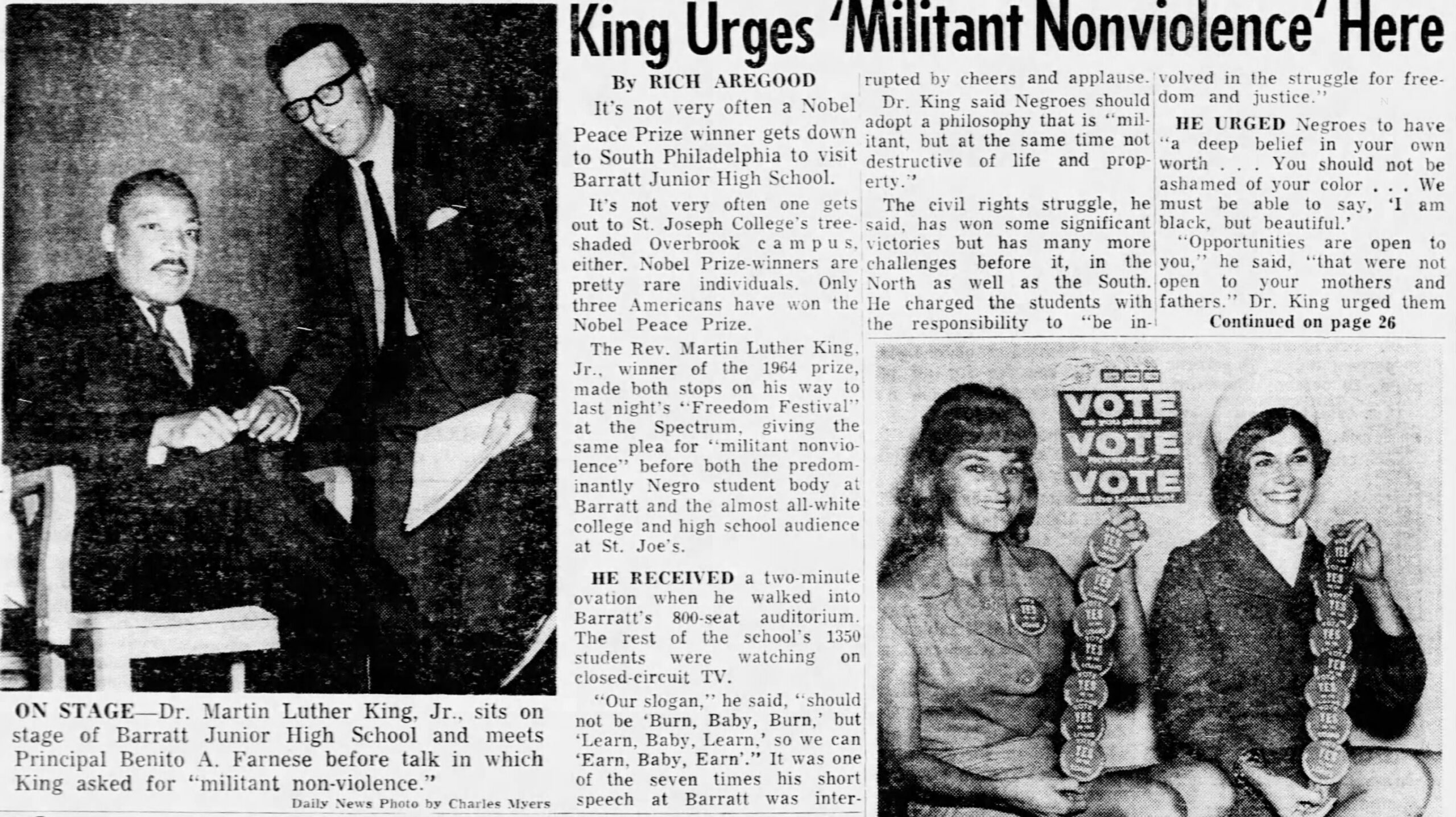
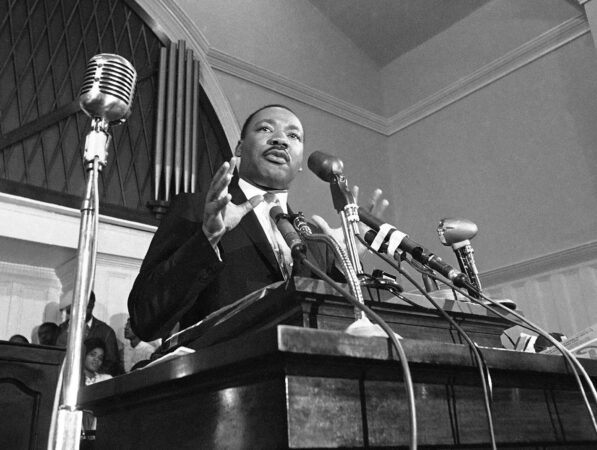
    The limousine door burst open, and the Rev. Dr. Martin Luther King Jr. stepped out onto the sidewalk in front of Dennis Kemp’s South Philadelphia school.

    Kemp was 13 that day in October 1967, a member of the stage crew and the basketball team asked by the principal of Barratt Junior High to greet the school’s surprise special guest.

    “In just about every Black household that I went into those days, there were three pictures hanging: Jesus, John Kennedy, and Dr. King,” said Kemp, now 72. “To actually meet this guy, it just blew me away.”

    King’s historic speech, made six months before he was assassinated, had a profound effect on Kemp and many of the 800 students crowded into the school auditorium.

    “What is your life’s blueprint?” King asked the students. “This is a most important and crucial period of your lives, for what you do now and what you decide now at this age may well determine which way your life shall go.”

    The community will mark the historic moment Monday, on Martin Luther King Jr. Day, with a showing of the speech in the auditorium of the school now known as Childs Elementary, then a day of service projects inside the building. One group hopes to apply to have a historical marker commemorating the visit placed outside the school.

    Kemp is glad that people still view and discuss King’s speech. Although he was a child, he sensed that he was part of something significant.

    Though nearly 1,000 students had packed into the Barratt auditorium, crowding into aisles and leaning over balconies, the room was silent save for King’s voice, Ben Farnese, then the school’s principal, told The Inquirer in 2006. In a nearby overflow room, 450 more students watched King on closed-circuit TV.

    “I took it in,” said Kemp, who was in the auditorium. “I said, ‘I’m going to keep this with me as long as I live.’”

    Charles Carter, a ninth grader who was in the auditorium, remembers the quiet.

    “Just figure — kids can be a little rowdy,” Carter said. “But we were transfixed, we were glued. We weren’t rowdy that day.”

    Jeffrey Miles, another Barratt student, had a good seat that day. He had heard a speaker was coming to school, and he was excited — he thought it might be Georgie Woods, the prominent DJ.

    After he heard King speak, he couldn’t help himself.

    “I had the end seat, and I jumped up out of my seat,” said Miles, who had turned 14 a few weeks before King spoke. “The speech was so exhilarating and so electrifying, I couldn’t control myself. He was walking down the aisle with [DJ] Georgie Woods, and I said, ‘Dr. King, can I shake your hand?’”

    King said yes. Miles grabbed his hand, which was sweaty — a detail that sticks in his mind, along with the sound of the Barratt students clapping thunderously for King.

    A belief in ‘somebodiness’

    King was in town for a “Stars for Freedom” show at the new Spectrum, opened the prior month in South Philadelphia.

    The Philadelphia Daily News recounted Martin Luther King Jr.’s visit to Barratt Junior High in October, 1967.

    “I know you’ve heard of that new impressive structure called the Spectrum, and I know you’ve heard of Harry Belafonte and Aretha Franklin and Nipsey Russell and Sidney Poitier and all of these other great and outstanding artists,” King said. He told the students to urge their parents to attend. “And I hope you will come also, for it will be a great experience and, by coming, you will be supporting the work of the Civil Rights Movement.”

    King did not use notes, Farnese said. He spoke for 20 minutes, an address that would eventually be known as his “What is Your Life’s Blueprint?” speech.

    The Barratt students, seventh, eighth, and ninth graders, were poised to move into a time that would determine the course of the rest of their lives.

    The great civil rights figure, who had by that time already won the Nobel Peace Prize, told the young people to have “a deep belief in your own dignity, your own worth, and your own somebodiness. Don’t allow anybody to make you feel that you are nobody.”

    Take pride in your color, your natural hair, King told the students, most of whom were Black.

    “You need not be lured into purchasing cosmetics advertised to make you lighter, neither do you need to process your hair to make it appear straight,” King said. “I have good hair and it is as good as anybody else’s in the world. And we’ve got to believe that.”

    ‘Learn, baby, learn’

    King urged the crowd to set upon a path to excellence, whatever that looks like.

    “I say to you, my young friends, that doors are opening to each of you — doors of opportunity are opening to each of you that were not open to your mothers and your fathers,” King said. “And the great challenge facing you is to be ready to enter these doors as they open.”

    Kemp remembers being surprised that King came to South Philadelphia.

    “Our neighborhood was pretty poor,” said Kemp, who grew up as one of nine children in a family that struggled. “There really wasn’t too much to look forward to in our neighborhood.”

    King acknowledged the “intolerable conditions” faced by many of the children he addressed. But, he said, it was incumbent on them to stay in school, to build a good life.

    “Set out to do a good job and do that job so well that the living, the dead, and the unborn couldn’t do it any better,” King said. “If it falls to your lot to be a street sweeper, sweep streets like Michelangelo painted pictures.”

    The civil rights hero told students to commit to “the eternal principles of beauty, love, and justice. Don’t allow anybody to pull you so low as to make you hate them.”

    King, who encouraged peaceful resistance, urged “a method that can be militant, but at the same time does not destroy life or property.”

    “And so our slogan must not be ‘Burn, baby, burn,’” King said, referring to a chant that had become associated with the 1965 Watts riots in Los Angeles. “It must be ‘Build, baby, build. Organize, baby, organize.’ Yes, our slogan must be ‘Learn, baby, learn’ so that we can earn, baby, earn.

    “And with a powerful commitment, I believe that we can transform dark yesterdays of injustice into bright tomorrows of justice and humanity.”

    ‘I’ll never forget it’

    Some of the members of the Barratt class in the room that day soared: Kevin Washington, who was on the basketball team with Kemp, went on to become the first Black president of the national YMCA.

    Kemp was bright, but his family’s economic struggles weighed on him, he said. He dreamed of college, but it wasn’t in reach. He ended up leaving South Philadelphia High without a diploma, eventually earning a GED.

    He raised children, built a life working — often in maintenance. He spent time as a school basketball coach.

    After suffering medical and marital issues, Kemp fell on hard times. He spent four months without a home, sleeping in parks and at 30th Street Station.

    “Dr. King’s speech really helped,” he said. “That used to come to mind when I was on the street. I’ll never forget it.”

    Kemp rallied; he now lives in an apartment in South Philadelphia.

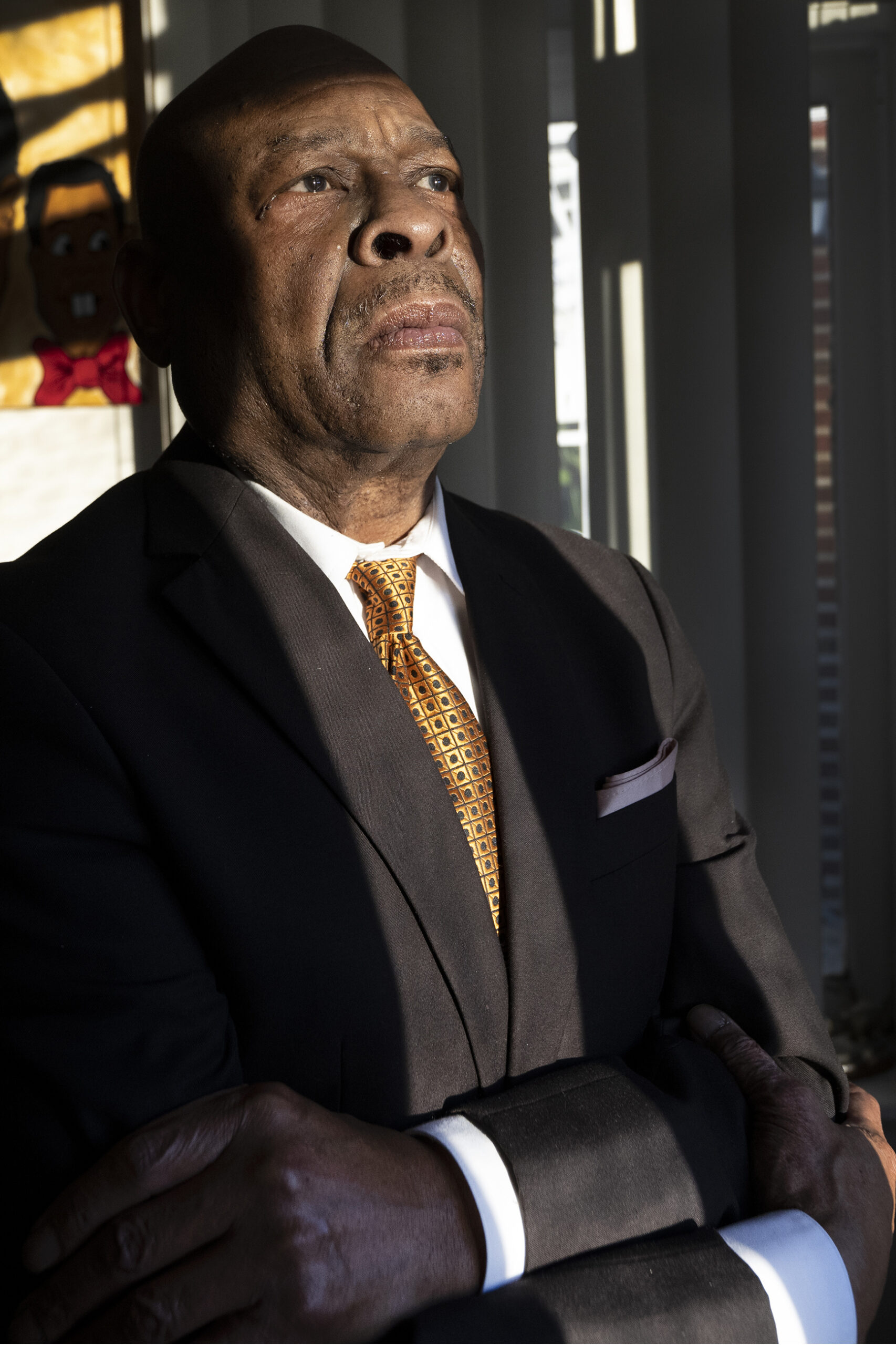
    Jeffrey Miles is photographed at his home in Philadelphia on Friday, Jan. 16, 2026. Miles was 13 in October 1967 when he shook the hand of the Rev. Dr. Martin Luther King Jr. and witnessed a speech that altered the course of his life.

    The speech also altered the course of Miles’ life.

    “I was a member of a gang in South Philly,” said Miles, now 72. “I never paid attention to adults and teachers. But that day I paid attention to Dr. King.”

    King’s words — reach for more, do your best, no matter your struggles — resonated. He buckled down at school, graduated from high school, from college. He became an optician and even taught students at Salus University.

    “When Dr. King said, ‘instead of burn, baby, burn, learn, baby learn,’ that gave me a window,” said Miles, who lives in West Oak Lane. “It gave me hope.”

  • Philly students are posting their best math performance in years

    Philly students are posting their best math performance in years

    Philadelphia students are performing the best they have in math in years, showing steady improvement since the pandemic.

    Still, just a quarter of city third through eighth graders passed Pennsylvania math assessments, with 25.1% of students scoring proficient or advanced on the 2024-25 exam, up from a 22% pass rate the prior year and 18.9% in 2016-17.

    That means the district surpassed the school board’s goal of a 22.2% pass rate for last school year — but fell well below the 2029-30 target of 52% proficiency.

    Philadelphia students still lag Pennsylvania averages considerably, though — for the 2024-25 year, 41.7% of students in grades three through eight statewide passed math tests.

    Scores are slightly stronger in the lower grades. Overall, 33.7% of Philadelphia third graders passed the state test, compared to 27.4% the prior year. The board’s third-grade target is 57.5% for 2029-30; it was 28% last year, a nod to prior performance.

    Officials said the jumps are due in part to the new math curriculum the district adopted in 2023-24.

    The school board devoted its full Thursday night progress monitoring session to examining math goals. The highlighted findings include:

    Attendance correlates with math scores

    Students’ attendance generally correlates to their math performance. Of pupils who attended school 90% of the time or more, the highest percentage of students were at or above benchmark (29%) and the lowest percentage needed the most intense interventions (24%).

    The reverse is true for students who are considered “chronically absent” — those who attend school less than 80% of the time. In that category, more than half of students — 52% — needed intense interventions, and just 7% scored proficient or above.

    Improvements for students learning English

    English language learners’ math skills are improving, as measured by Star tests, which the district gives periodically throughout the school year to measure student learning.

    The math proficiency of third grade English learners, for example, was up year-over-year as marked by the winter Star exam. This school year, 23% of English learners passed the test, compared with 18% at the same point in 2024-25.

    Slight improvements for students with disabilities

    Students with disabilities scored lower. Overall, 11% of students with disabilities passed the winter Star exam, up slightly from 10% last year.

    Focus on early math skills

    Officials said gains were made in part because of a focus on building foundational math skills.

    Students in kindergarten and first and second grades all saw jumps from fall to winter in mastering skills such as numeral recognition, addition to 10, and subtraction to 10, as measured by Star tests. The district showed significant gains in third grade performance this year.

  • Cheltenham High football ‘toxic’ culture led to hazing, investigation concludes; team may not play in 2026

    Cheltenham High football ‘toxic’ culture led to hazing, investigation concludes; team may not play in 2026

    Nearly 20 people witnessed an assault in the Cheltenham High football team’s locker room last fall, according to an external investigation commissioned by the school district.

    No one tried to stop it, “and several participated freely in it,” Superintendent Brian Scriven told the Cheltenham community in an e-mailed message Thursday. “Several students also filmed the assault.”

    The assault — which happened Sept. 3 — ultimately resulted in the cancellation of the team’s season in October and led to the hazing investigation, for which Scriven released the results Thursday night. His message did not include additional details about the assault.

    Though a pattern of hazing was “not fully substantiated,” Scriven wrote, other troubling findings include: inadequate student supervision in the locker room, “a failure to prioritize student safety by the coaching staff and/or adult volunteers,” no anti-bullying or anti-hazing education for team members, and “a toxic and negative culture within the current football program.”

    The team’s head coach, according to a 2025 Cheltenham news release, had been Terence Tolbert, a business teacher at the school and a former semi-professional football player. When reached Thursday, Tolbert declined to comment.

    Cheltenham’s football program will be rebuilt eventually, Scriven said, and the district will adopt investigators’ recommendations, including identifying, hiring, and training a “new coaching staff with strong commitment to leading student-athletes in a positive and responsible manner,” and strengthening team supervision.

    But, Scriven said, fielding a team in 2026 is not a given for the district.

    The superintendent alluded to “a general lack of credibility on the part of many of those interviewed during the investigatory process” and said parent, student, and staff cooperation going forward is crucial.

    “Those students who were not involved in this situation are especially important to rebuilding the culture of our program,” Scriven said. “If all of these conditions are met, the district will stand up a football team for the 2026 season.”

    It is not yet clear whether the students involved could face punishment or criminal charges. Multiple students have ongoing Title IX and disciplinary matters, which could affect their eligibility to play football. Cheltenham Township police and the Montgomery County District Attorney’s Office are both still investigating the incident, according to the district’s message Thursday.

    Staff writer Robert Moran contributed to this article.

  • Kids get free dental care at this Philly school. Officials say it’s a model that could be replicated in schools with empty space.

    Kids get free dental care at this Philly school. Officials say it’s a model that could be replicated in schools with empty space.

    Crystal Edwards didn’t see a dentist until she had a deep cavity at age 10: growing up in a struggling Philadelphia family, the resources to access dental checkups just weren’t there.

    So she jumped at the opportunity to locate a dental clinic in the school where she is now principal, W.D. Kelley, a K-8 in North Philadelphia.

    “This dental clinic is saving lives,” said Edwards.

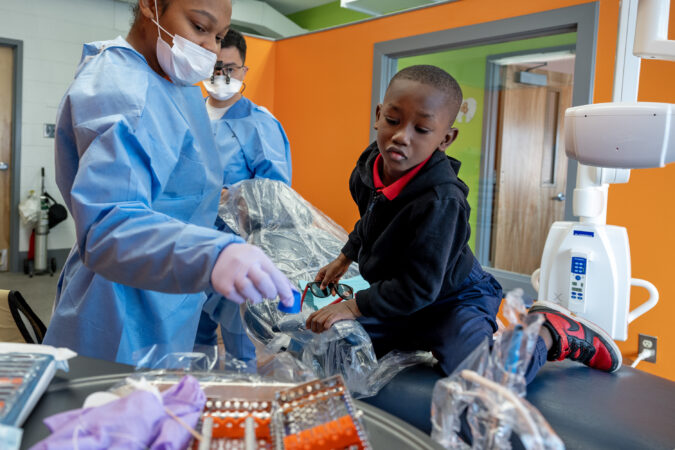
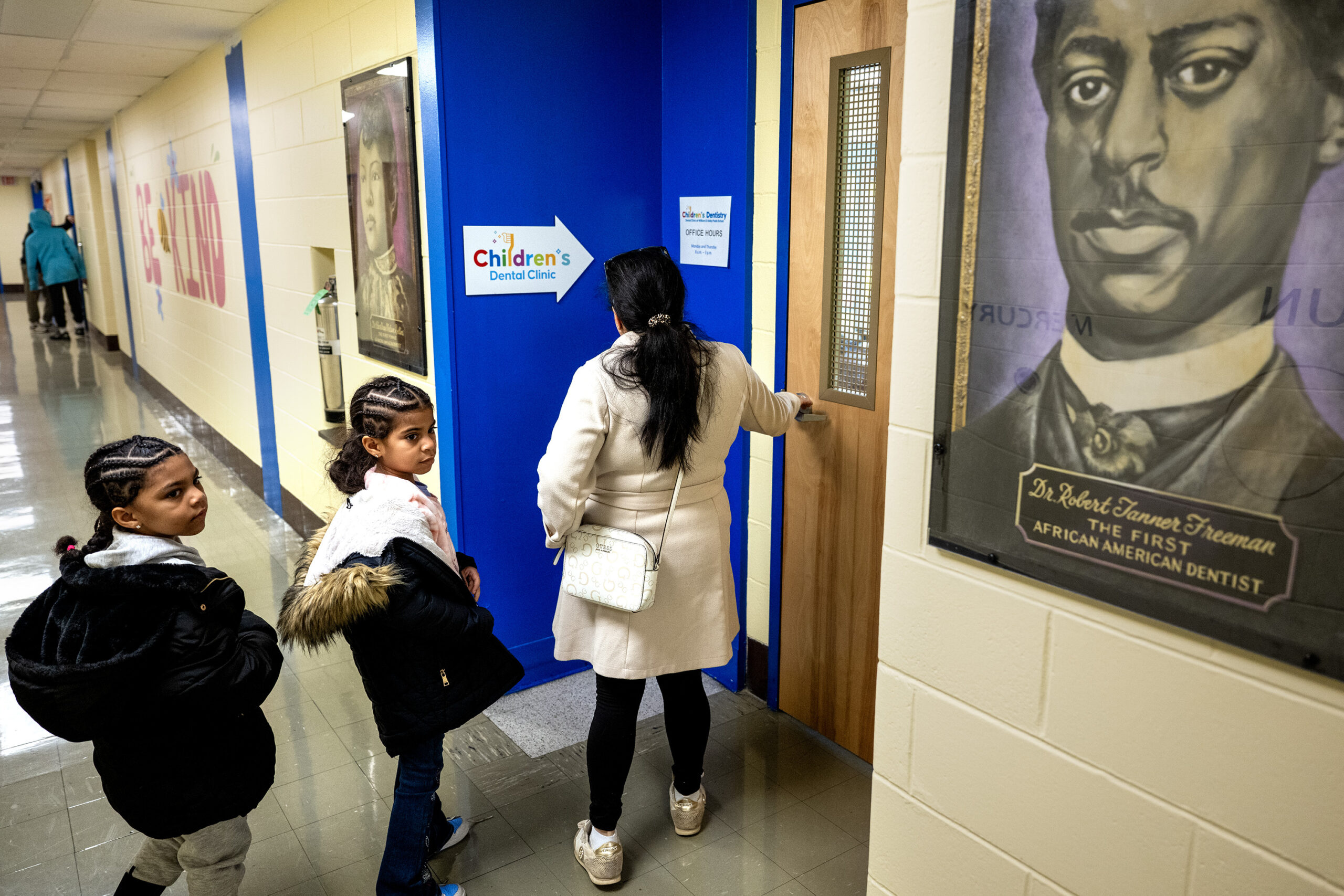
    Tucked into a converted science lab on the school’s third floor, the Dental Clinic at William. D. Kelley, operated by Temple University’s Maurice H. Kornberg School of Dentistry, is nearing its third year of operation. It is open to all Philadelphia children, including those who do not attend Kelley, regardless of insurance status.

    School district officials have pointed to the Kelley clinic as a model as it prepares to make facilities master plan decisions, which will result in closing, combining, and reconfiguring some school buildings. The clinic is an example, they say, of how the system could use available space in some of its schools for public good.

    Soribel Acosta arrives at the Dental Clinic at William D. Kelley public school on Thursday, with her children, Andrea Jimenez (left), 6. And Sayra Jimenez, 7.

    “This is certainly a great example of what can happen when a university partners with a school district to create life-changing opportunities and outcomes for young people,” Superintendent Tony B. Watlington Sr. said in a statement in 2023, when the clinic opened.

    Temple dental school officials said more clinics could follow elsewhere in the city.

    Taking care of every child

    The underlying concept is simple, said Eileen Barfuss, the Temple dental professor who leads the clinic.

    “If your tooth hurts, if you’re not feeling well, you’re not going to learn,” said Barfuss. “In the past, there have been a lot of barriers to care for dentistry that weren’t there for medicine, but preventative care is so important so it doesn’t get to the point of pain.”

    The clinic accepts all comers, including those who are uninsured or underinsured, and sometimes treats students’ parents. (Most, but not all, patients have Medicaid dental, and grants help cover treatment for those without insurance.)

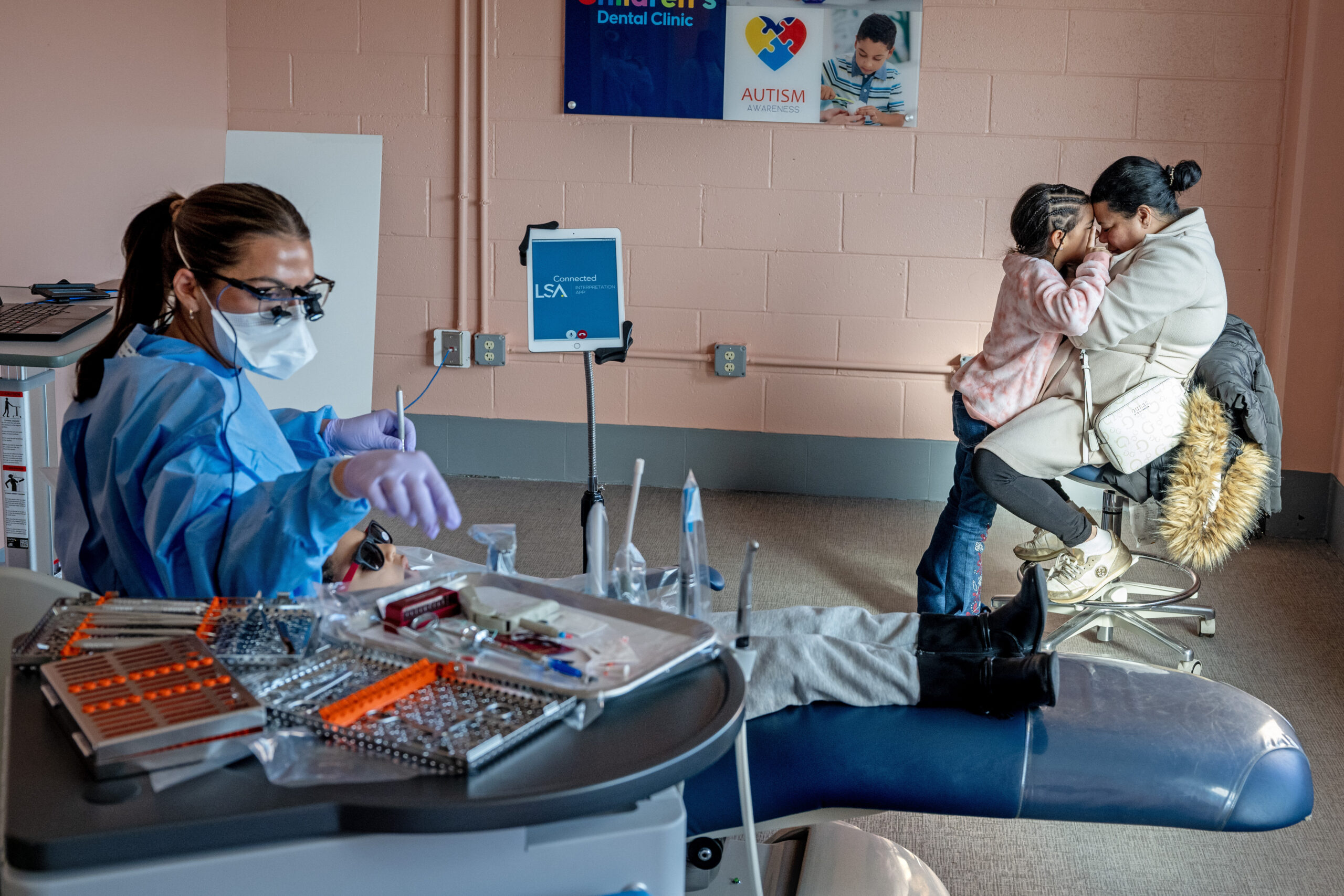
    Temple dentistry student Carly Pandit works on the teeth of Andrea Jimenez, 6, as her mother, Soribel Acosta, entertains sister Sayra Jimenez, 7, waiting her turn in the char at the dental clinic at William D. Kelley public school on Thursday.

    “We try to take care of every child in the Philadelphia School District,” said Barfuss. “There’s a place that they can come and get comprehensive care and establish a dental home.”

    To date, the clinic has seen nearly 700 patients, some of whom are repeat visitors. Patients are treated both by Barfuss and dental students she supervises.

    Students do come from other schools to the clinic; Barfuss said her team does outreach at community events and spreads the word through the district’s school nurses, who often send patients to the clinic. And staff teach lessons in Kelley classrooms on oral health and the importance of seeing a dentist twice a year.

    Being in a school helps normalize the dentist for many kids, who might poke their heads into the clinic to look around and see the friendly dental staff in their scrubs in the hallways, Barfuss said.

    ‘This is a good dentist’

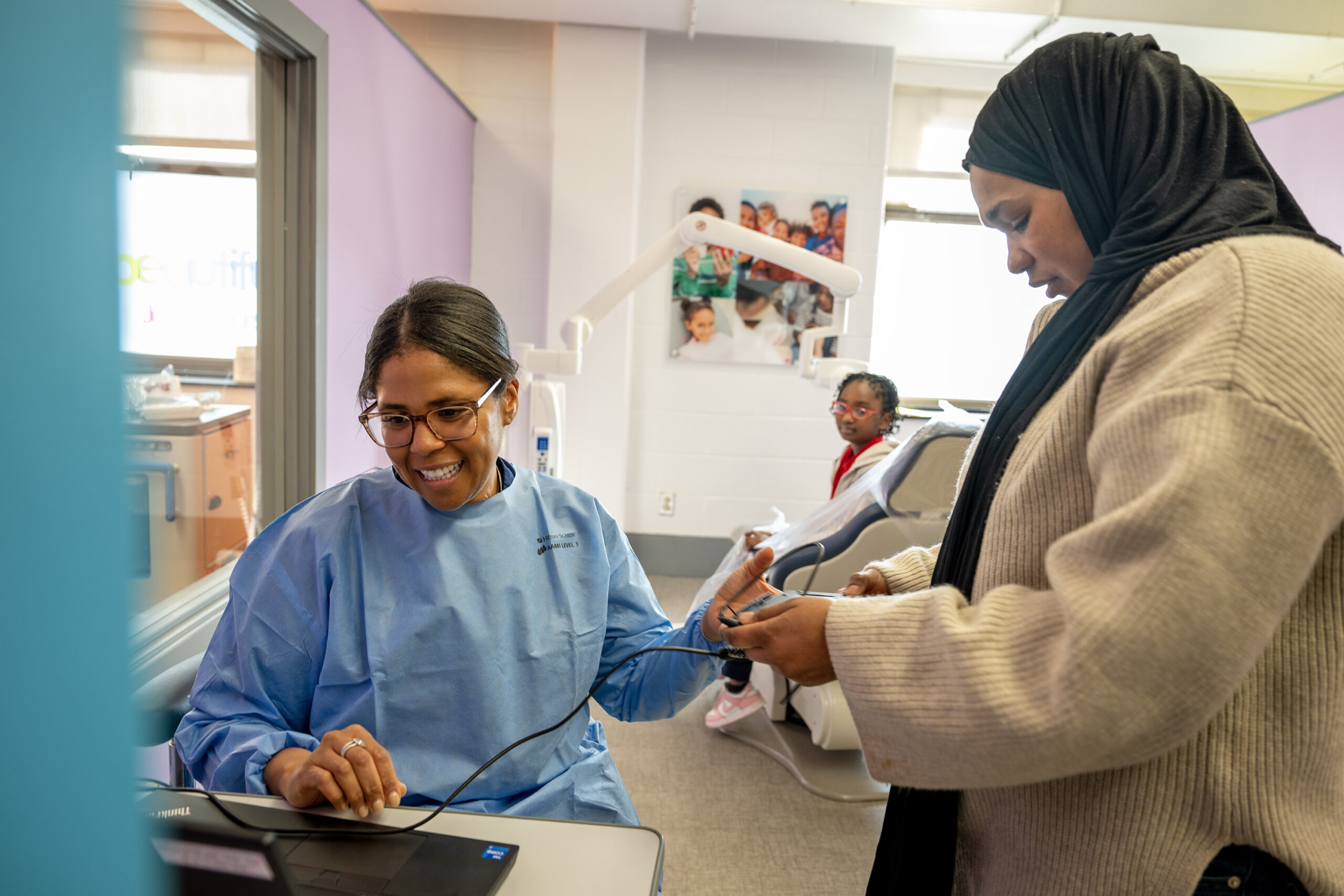
    On Thursday, Fatoumata Bathily, a fourth grader with pink glasses and a bright smile, swung her legs down from a Kelley clinic dentist chair after a successful checkup.

    Eileen K. Barfuss (left), a pediatric dentist and Temple dentistry instructor consults with Fily Dramera after her daughter Fatoumata Bathily (rear), 9, was seen by a Temple student dentist at the Dental Clinic at William D. Kelley public school on Thursday.

    “It’s good here,” said Fatoumata, who attends nearby Robert Morris Elementary, and came for preventive care along with her brother, Abubakr. “This is a good dentist. I like that it’s colorful, and the people are nice.”

    Amid Ismail has wanted to bring such a model to the city since he became dean of Temple’s dental school in 2008. Decades ago, some schools offered dental care via city services, but as funding dried up, those clinics went away, Ismail said.

    Ismail raised the idea of a Temple-district partnership, but it took several years to get off the ground. Edwards, an award-winning principal who takes pride in bringing the community into Kelley, got the vision intuitively, he said.

    Temple paid to transform a large science lab into the dental clinic; the district provides the space and does not charge rent. There are four chairs, including one in a space specifically designed for patients with autism who might need a quieter environment and more room. Rooms are bright and modern.

    “The message to the parents and caregivers is that this is a nice place where all treatment is provided,” Ismail said. “A lot of children do have dental problems, but here we can treat them easily — they miss one class, max, and they don’t have to stay a long time.”

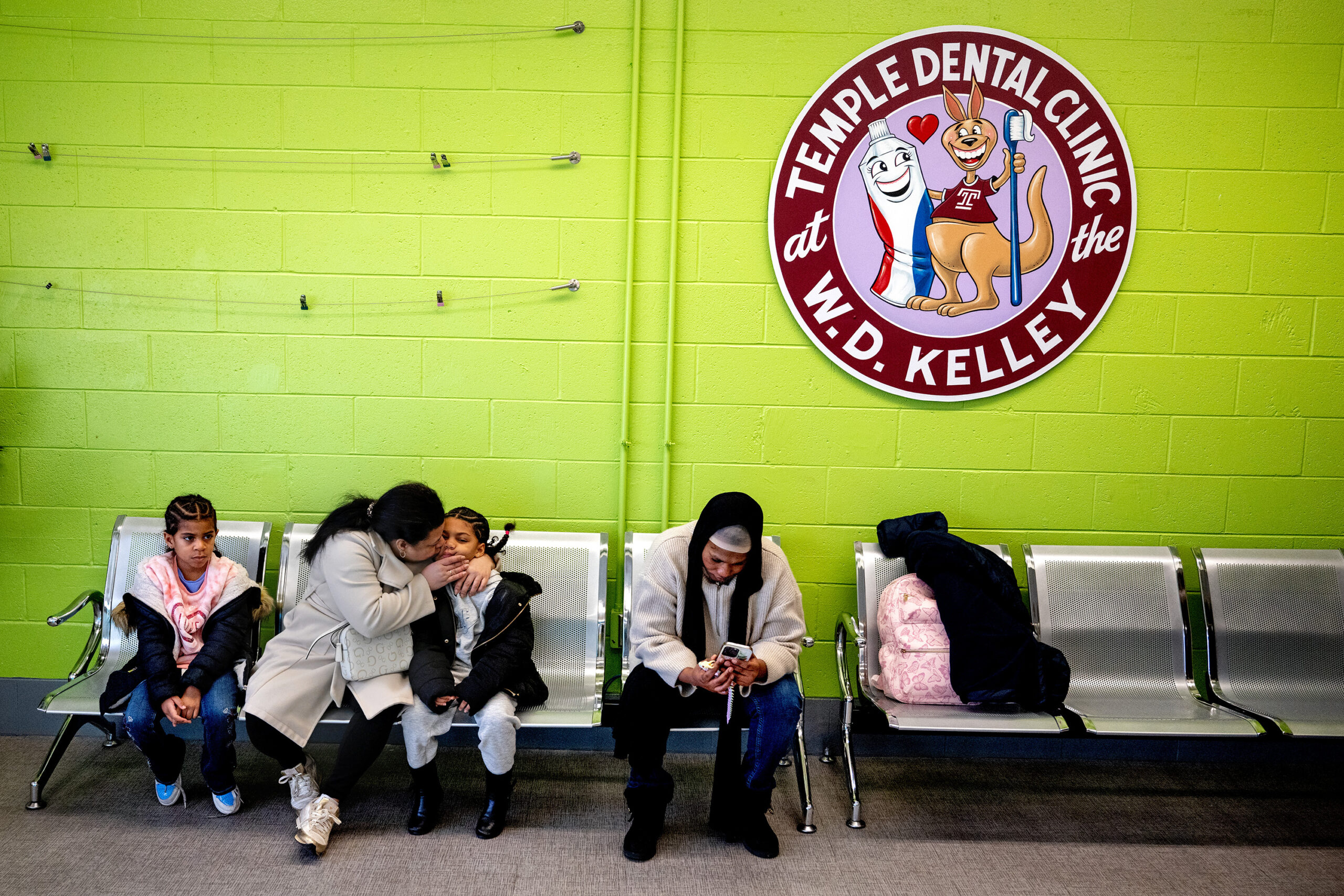
    Soribel Acosta waits for their appointment with her children, Sayra Jimenez (left), 7; and Andrea Jimenez (right), 6, at the Dental Clinic at William D. Kelley public school on Thursday.

    The clinic, which is about to celebrate its third anniversary, just expanded its schedule — it’s open four days a week, and officials eventually hope it will be open five days.

    Edwards fought for the clinic to come to Kelley, and it’s been just the boon she had hoped, she said.

    “This is a historic community that was really devastated and hard hit by the crack and drug pandemic,” said Edwards. “The dental office has really given us leverage on how to serve the community better.”

  • Two new ‘year-round’ public schools, with a special model and resources, are coming to Philadelphia

    Two new ‘year-round’ public schools, with a special model and resources, are coming to Philadelphia

    Two new schools are coming to the Philadelphia School District.

    Both schools, a K-8 and a high school, district officials said Wednesday, will have resources to help eliminate long-standing achievement and opportunity gaps for kids from underresourced communities.

    They’ll be part of the “North Philadelphia Promise Zone,” Superintendent Tony B. Watlington Sr. announced. Watlington said they would be the first schools in the United States to replicate the success of the acclaimed Harlem Children’s Zone, with the blessing of its founder, Geoffrey Canada,who pioneered a model that takes a birth-to-career approach to tackling generational poverty.

    Watlington said the schools would be “true year-round schools.” They would bring a new approach to the new Philadelphia public schools, where prior attempts to replicate the Harlem Children’s Zone blueprint have shown mixed results.

    Harlem Children’s Zone runs charters in New York City, but the proposed Philadelphia schools will be run by the district using the organization’s educational model, which includes extra resources and a longer school day and school year, as well as extensive social service supports.

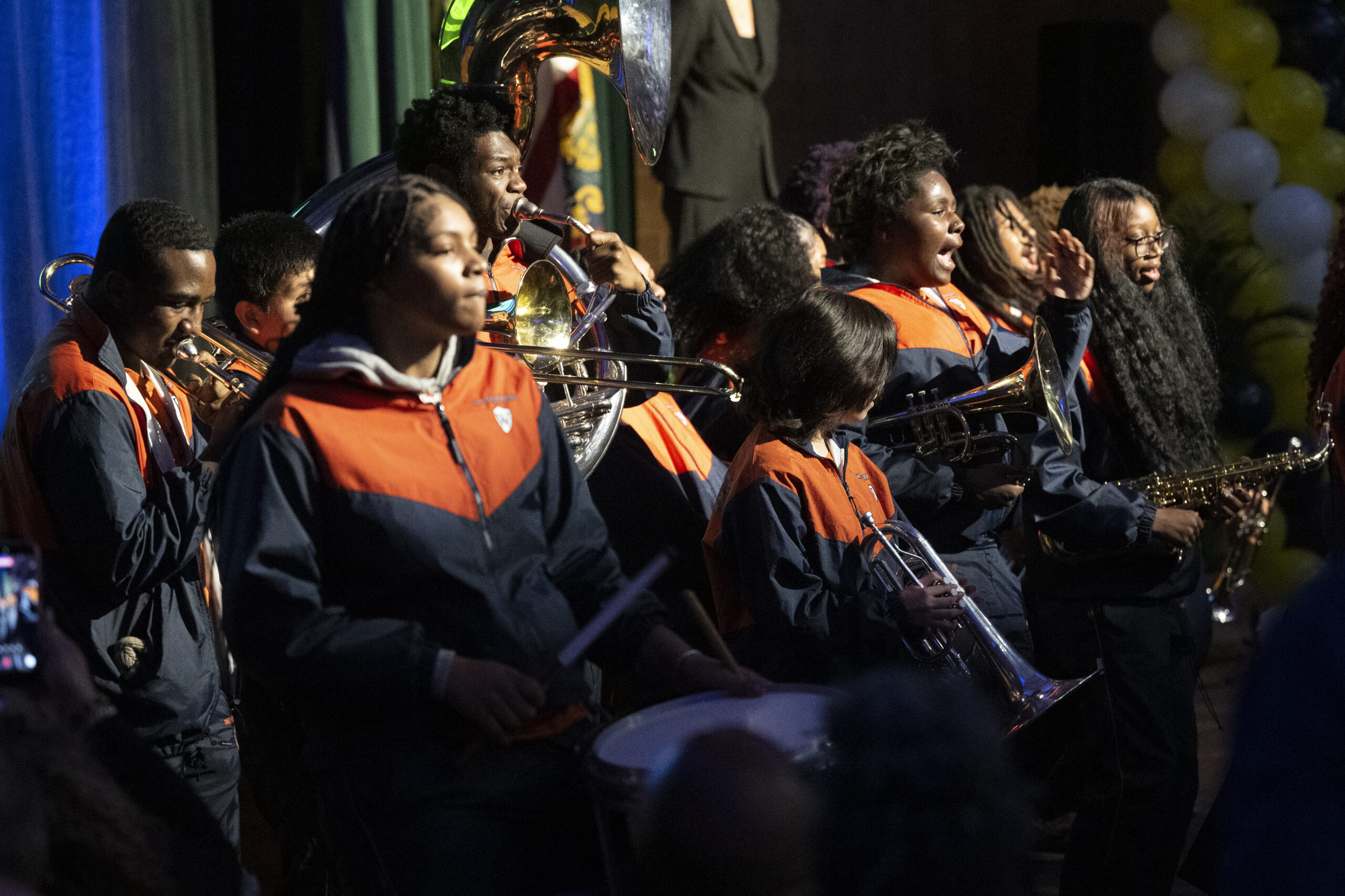
    Members of the West Philadelphia Marching Orange & Blue perform before Philadelphia Mayor Cherelle L. Parker speaks on the state of Philadelphia schools during a gathering at Edison High School in Philadelphia, Wednesday, Jan. 7, 2026.

    “We’re going to be partners in opening these two state-of-the-art schools,” Watlington said at his state of the schools address, held Wednesday at Edison High School in North Philadelphia.

    The district has big hopes for the schools, which officials said will be opened in existing Philadelphia school buildings — no new school structures will be involved.

    “Not only will they get better, but get better faster than our district average. We’re going to make sure the school is staffed with the very best, most effective principals,” Watlington said. “We’re going to ensure that these schools are staffed with the very best, most effective teachers.”

    They will be schools of choice, meaning parents can opt into having their children attend rather than basing enrollment on where students live.

    The schools will also pull in Temple University; Watlington said that via the Temple Future Scholars program, “every single one of these graduates from this K-8 and high school” will be college-ready.

    Many details were not clear Wednesday, including when the schools will open, what the year-round model will look like, the exact relationship with Harlem Children’s Zone, how the schools will be funded, and who will staff them. The district said it could not give more details immediately.

    News of the new schools caught an important partner off guard. Arthur Steinberg, president of the Philadelphia Federation of Teachers, said Watlington’s speech was the first he heard of the initiative.

    “Any changes in working conditions must be negotiated with the PFT,” Steinberg said. “We will not agree to anything that requires members to work additional days or hours.”

    Watlington said the K-8 school will open first, and he has tapped Aliya Catanch-Bradley, the respected principal of Bethune Elementary in North Philadelphia, to lead the efforts to open the North Philadelphia Promise Zone schools.

    Catanch-Bradley said it was too soon to discuss the particulars about the schools, which will be built with significant community involvement.

    But, she said, North Philadelphia is a prime location for the cradle-to-career Harlem Children’s Zone model.

    “We know that it’s not a food desert, because food… deserts are natural,” she said of North Philadelphia. “It is food insecure by design, right? And so, we now know that you have a resource drought there, to which it’s going to take an intentional pouring of all types of resources to wrap around a community, to help expand and become a very successful ecosystem.”

    Philadelphia district officials will take time to study Harlem Children’s Zone, “but also to understand the landscape of Philadelphia, what needs to be augmented to echo the needs of this community,” Catanch-Bradley said.

    Mayor Cherelle L. Parker campaigned on the promise of year-round schools, and her administration has put extended-day, extended-year programs into 40 district and charter schools. But those programs are essentially before- and after-care and summer camps, paid for with city funds and offered free to 12,000 students, rather than traditional year-round education.

    Harlem Children’s Zone schools have longer school days and longer school years. It’s not clear what form the proposed North Philadelphia Promise Zone schools might take, and how these efforts would differ from prior attempts around the country to replicate the success of the Harlem Children’s Zone. Former President Barack Obama in 2010 highlighted the model and selected 20 communities, including Philadelphia, to start “Promise Neighborhood” programs that would improve access to housing, jobs, and education. Those efforts were met with varying degrees of success, and no schools opened in Philadelphia.

    Watlington’s new-school announcement capped a two-plus-hour, pep-rally-style event where he and others underscored progress the district has made in the past year — and since the superintendent came to Philadelphia four years ago.

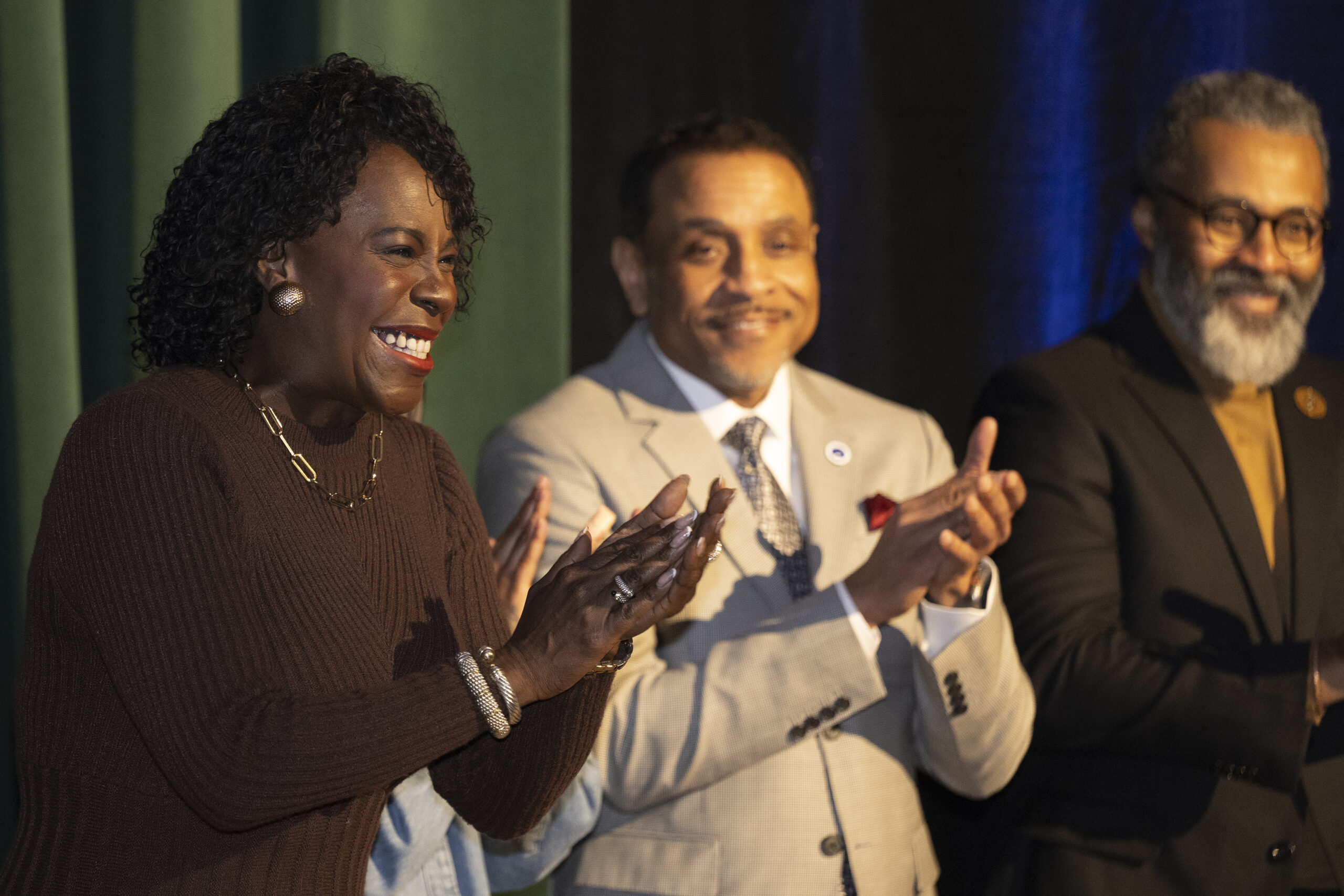
    Philadelphia Mayor Cherelle Parker (left), Superintendent Tony B. Watlington Sr. (center), and school board president Reginald Streater during a ceremony on the state of Philadelphia schools at Edison High School on Wednesday.

    Other news from the state of Philadelphia schools event

    Parker, who led off the event, said she was pleased with the state of schools.

    “The school district has continued to make steady and meaningful progress,” Parker said. “Test scores are rising, attendance is rising. Dropout rates are declining, and those gains are real, and they reflect what happens when we invest in our students.”

    Parker emphasized her desire to have the city take over a list of abandoned district buildings. The school board took the first step in December, voting to authorize Watlington and his administration to begin negotiating with the city to do just that.

    Parker said that some of the buildings have been vacant for as long as 30 years. The district has not yet released a list of buildings to consider transferring, but the mayor said it includes at least 20 former schools.

    “I want you to be clear about what my goal and objective is,” Parker said. “It’s not OK for me to have 20, 21 buildings consistently vacant, red on the school district’s balance sheet, generating no revenue and not at all working at their best and highest use. We’re going to find a way to do what has never been done in the city of Philadelphia before — develop a plan for those persistently vacant buildings.”

    Watlington also ran down a laundry list of accomplishments, including ongoing fiscal stability and improvements on the National Assessment of Educational Progress, known as the nation’s report card.

    He said the district would “retire” its structural deficit completely by 2029-30 though declined to give details.

    He and Reginald Streater, president of the city’s school board, said the district still has a ways to go but has made strides. More than half of all district students still fail to meet grade-level standards in reading and math.

    But, Watlington said, “I can assure you we’re making progress. We’re going to double down. More for our children, not less. More opportunities, more access, more exposure, more good things to come in 2026.”

  • Parents and teachers want smaller classes and no school closures. Here’s what else they said in Philly’s facilities planning survey.

    Parents and teachers want smaller classes and no school closures. Here’s what else they said in Philly’s facilities planning survey.

    The Philadelphia School District now has the feedback officials said they needed before making decisions about school closings and reconfigurations.

    The topline result: Philadelphians don’t want their local schools closed.

    Some urged prioritizing small classes. Others suggested adding more magnets, like Masterman; pouring more resources into neighborhood K-8s and high schools, and modernizing facilities.

    But while Superintendent Tony B. Watlington Sr. promised to use the feedback to shape the district’s plan, he and other district leaders have said school closings are a given — the district has 70,000 excess seats in schools across the district of 113,000, and dozens of buildings that are in poor shape.

    That process is expected to play out this year. It initially was to have yielded decisions in December, but Watlington said his administration needed more time to analyze data and reach out to school communities before ordering sweeping changes that they say are necessary.

    Watlington now says he will present a draft facilities plan sometime this winter, with more feedback and revisions to come before a board vote. The timeline for a final vote is not clear.

    In an email, he thanked those who participated in the survey and other parts of the planning process. “We have, and will continue to take your feedback very seriously, as we know these will be difficult decisions that could impact many families,” he wrote, adding that there will be additional “community conversations” before the final plan goes to the board.

    The district last engaged in a similar process in 2012, closing 30 schools by 2013, a hugely controversial process that officials later said did not improve academic outcomes for students or yield significant long-lasting savings for the district. Officials have said they will undertake the process more deliberately and with different aims in this incarnation.

    More than 8,000 parents, teachers, students, and community members participated in Watlington’s survey, sharing their priorities for the long-awaited facilities master planning process.

    Boosting neighborhood high schools, strengthening K-8s

    The new survey data, released by officials as winter break began, did not yield surprises, but reiterated themes that will be tough for the cash-strapped district to balance.

    Officials had previously identified four main topics that have emerged from more than a year of analyzing data and gathering feedback — strengthening K-8 schools, reinvesting in neighborhood high schools, reducing school transitions for students, and expanding access to grades 5-12 criteria-based high schools.

    Survey respondents rated each of those “important” or “very important” — with reinvesting in neighborhood high schools (85%) and strengthening K-8 schools (81%) at the top of the priority list.

    Overall, those who responded to the survey support their local schools, want strong schools close to where they live, and want the buildings closest to where they live to be renovated, not shut down.

    Respondents raised concerns around several topics districtwide: overcrowding, inadequate staffing, school safety, insufficient supports for students with disabilities, student behavior issues, facilities quality and cleanliness, and support for libraries, recess, and extracurricular activities.

    Some also expressed worries about transparency in the facilities planning process, and worries that when the district says its goal is “better use of space” it means that it will close schools.

    They outlined fears about potential hardships that closing schools could create, such as longer walks to school or tough bus rides in unfamiliar or unsafe areas. And they flagged worries about merging more than one school into a single building and having large grade spans in a single building. (Though some said they relished the idea of having many grades in one spot.)

    In their own words

    Respondents had plenty of ideas for officials as they plan steps that will have implications for the city for years to come. Here are some excerpts from survey responses:

    “I believe that we should stop closing schools and update areas so that we can utilize small class sizes. The ONLY way to accomplish meeting the needs of students, emotionally, physically, psychologically, and educationally is to have SMALL class sizes,” one person wrote.

    By closing buildings and combining schools, some children will have to walk an additional distance, most likely making them late or just deciding on certain days that the travel distance is just not worth it,” another respondent said.

    We need new high schools, middle schools, especially with vocational training. Current year textbooks, technology, air-conditioning, and programs for Tech and Art,” said another writer.

    Many [Philadelphia high schools] currently lack basic college-preparatory opportunities — few or no Honors or AP courses, limited world languages, and minimal enrichment options. This pushes academically motivated students into magnet schools, leaving neighborhood schools underenrolled and concentrated with students who have the highest support needs,” wrote one commenter.

    More schools like Masterman will prevent families from leaving the city if their child cannot get in through the lottery. It is beneficial to Philadelphia as a whole to keep these parents/families in the city instead of fleeing to the suburbs,” wrote one person.

  • Racist, antisemitic graffiti scrawled outside Roxborough High School

    Racist, antisemitic graffiti scrawled outside Roxborough High School

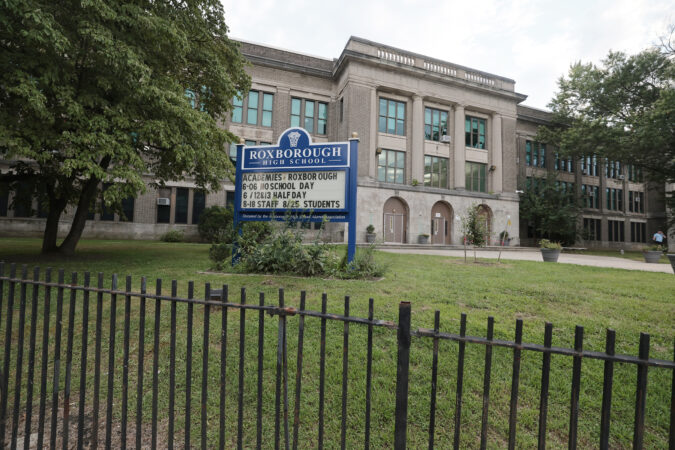
    Vandals scrawled racist and antisemitic graffiti outside Roxborough High School over the weekend.

    Philadelphia Police Department officials and State Rep. Tarik Khan (D., Philadelphia) confirmed the existence of the graffiti, which included a swastika and a racial epithet written multiple times.

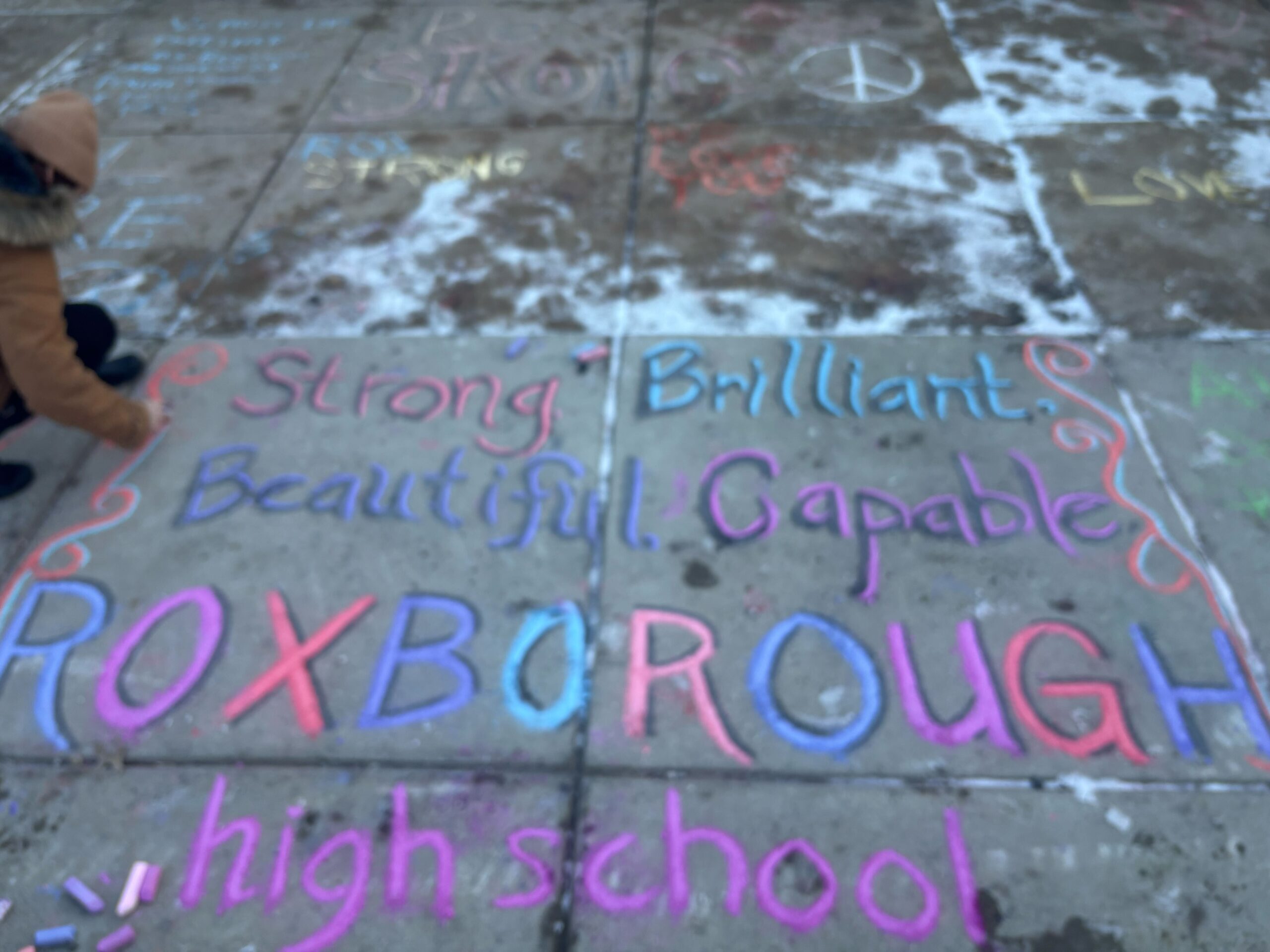
    After officials painted over the messages on Sunday, school administrators and community members gathered to counter the hate, chalking positive messages onto the sidewalk.

    “Welcome. Peace. Love. RHS,” people wrote in blue and yellow chalk Sunday afternoon. “Strong. Brilliant. Beautiful. Capable.”

    Several members of the group said they also plan to be outside Roxborough High on Monday morning, welcoming students back to school after a long winter break.

    “Let me be clear: targeting students in the middle of the night is cowardice, and it does not define us,” Khan wrote in a message shared on social media Sunday. He also came to the school to chalk messages. “Our community is bigger than a racist. … Our students are bigger. … Every student deserves to feel safe and respected when they walk into school, not have to deal with hate meant to scare and intimidate them.”

    Kristin Williams Smalley, Roxborough’s principal, informed the school community about the graffiti in a letter sent Sunday afternoon.

    “We are deeply disappointed by these actions,” Williams Smalley wrote. “We wish to remind everyone that we have a zero-tolerance policy for harassment or hate speech of any kind, and we will investigate all matters involving racist remarks and other hate speech.”

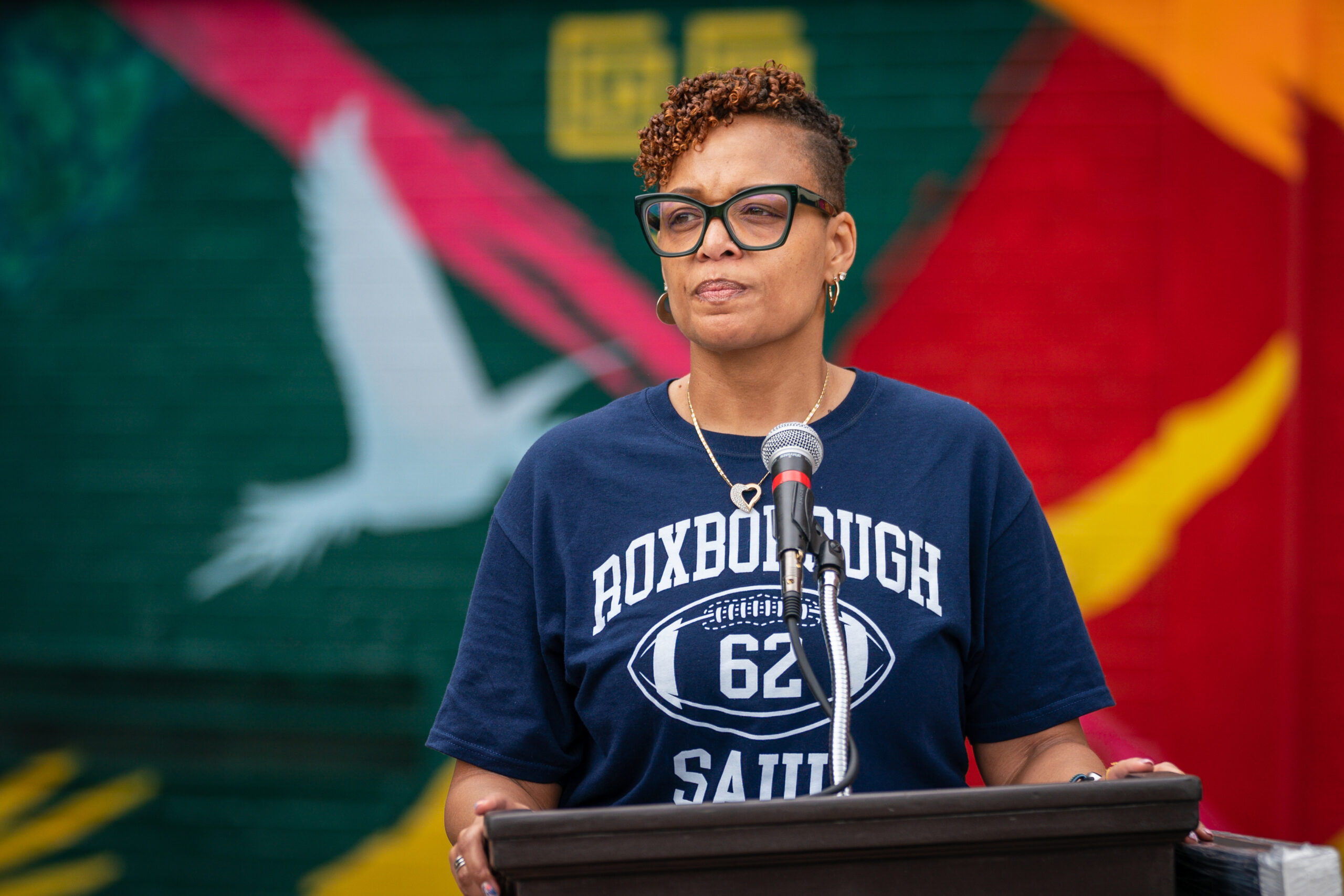
    Kristin Williams Smalley, principal at Roxborough High School, is shown in this 2023 file photo speaking at a mural dedication for Nicholas Elizalde.

    Roxborough — and the district — are diverse communities, and that’s a point of pride, Williams Smalley said.

    “We all play a role in supporting a positive and supportive school culture. We encourage you to speak with your children and have conversations about the seriousness and potential consequences of these unacceptable behaviors.”

    Students — whether alleged victims or not — should report bullying, harassment or discrimination, the principal said.

    “Please keep in mind that the young people around you are watching and listening,” Williams Smalley wrote. “We encourage all of us to be the role models they deserve. Words are powerful and we truly believe that if you work to build bridges of empathy and understanding, and demonstrate respect, our young people will follow and will create a community where everyone feels valued, seen and heard.”

    ‘No person needs to see that’

    Marge LaRue, whose grandson, Nicholas Elizalde, was shot and killed outside Roxborough in 2022, was also among the group that gathered. She and her daughter Meredith Elizalde, Nicholas’ mother, have remained involved with Roxborough staff and students since Nick’s murder.

    Members of the Roxborough High community chalked positive messages outside the school on Ridge Avenue after racist and antisemitic graffiti was scrawled at the school.

    LaRue and Elizalde’s immediate concern was making sure the mural, memorial garden, and scoreboard dedicated to Nick were not defaced. They were not.

    But they also wanted to show up for the students and staff.

    “That’s Nick’s community, the Roxborough community,” said LaRue. “Those hateful messages — I don’t know where they came from. No school, no person needs to see that, on their school, in their community.”

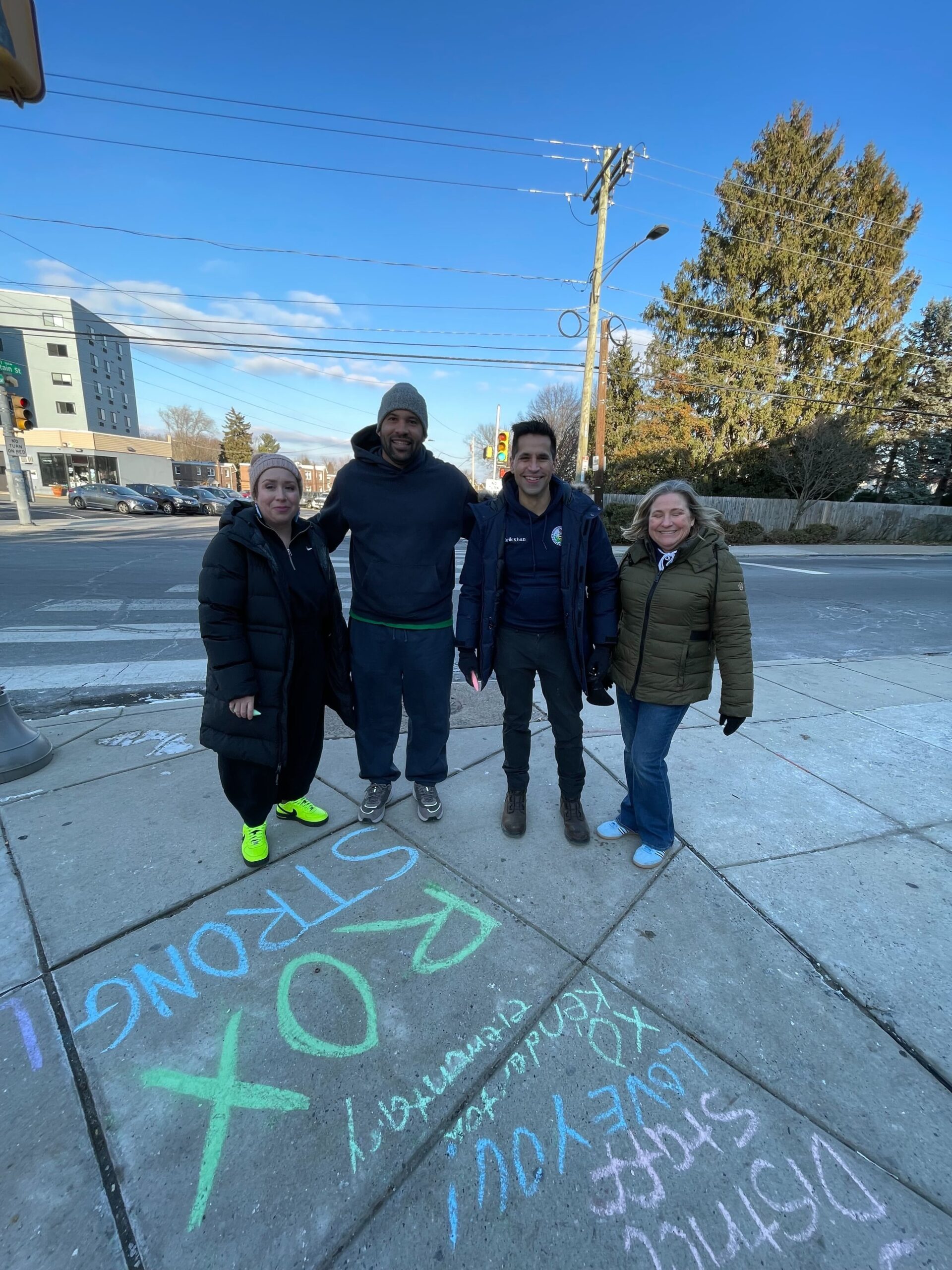
    Roxborough High supporters, including Meredith Elizalde, Eric Chappelle, State Rep. Tarik Khan, and Megan McCarthy-May, the school’s assistant principal, stand outside the school after chalking positive messages to counter racist and antisemitic graffiti.

    Police responded to the vandalism Sunday, a spokesperson confirmed, but no further information was available. School officials said city police and the district’s school safety office were investigating the incident.

  • 2026 Mummers Parade drew thousands to a Philly tradition despite disruptive high winds

    2026 Mummers Parade drew thousands to a Philly tradition despite disruptive high winds

    With sequins and glitter, music and pageantry, the nation’s oldest folk parade strutted through downtown Philadelphia on Thursday, delighting thousands who lined Broad Street despite fierce, damaging, and bitter winds.

    Over 125 years, there have been weather events — postponements because of cold, rain and snow and, in 2021, a COVID cancellation. But for the first time in Mummers history, one part of the parade was suspended.

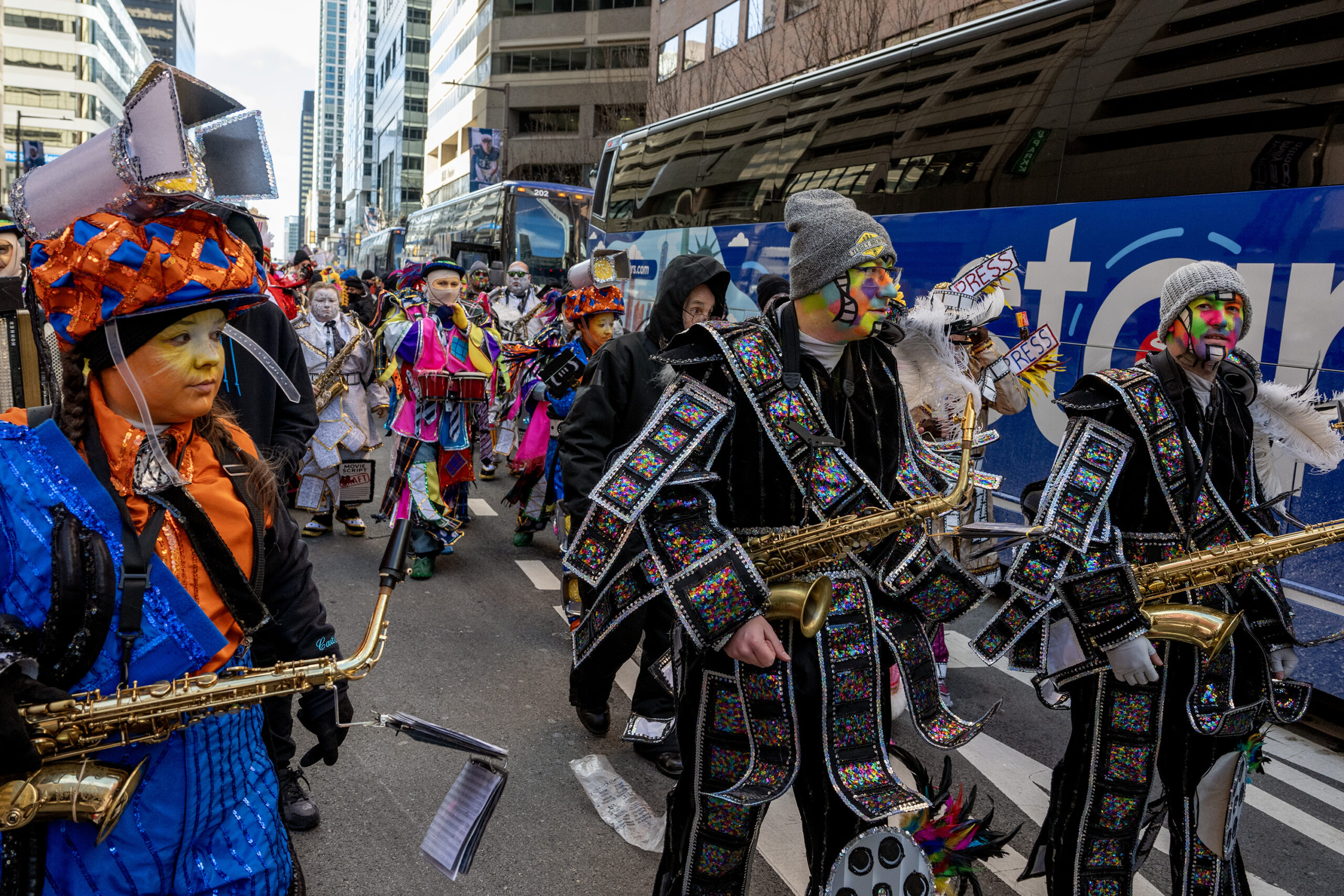
    The popular String Band Division called off its competition because of punishing winds that destroyed props and sent five people to the hospital early Thursday morning during parade setup. Each of the 14 string bands marched later Thursday, playing music in costumes and makeup, but solely for entertainment purposes and not with their planned routines.

    A full string band competition, with judges and routines the clubs have spent a full year devising and practicing, will happen on a yet-to-be-determined date, after logistics and finances are worked out.

    Still, the 2026 parade was quintessentially Philadelphia — not perfect, but full of heart-on-its-sleeve scrappiness.

    Ryan Echols, president of the Hegeman String Band, said the group had shortened its performance and packed up props due to the gusty wind, but still came to play.

    “The parade still goes on, regardless,” said Echols. “We’re still here to perform for the city of Philadelphia.”

    The cancellation had thrown a wrench in the day, said Nick Magenta, captain of the Polish American String Band.

    “You get used to all these years — how the parade goes, how the morning goes,” he said. “When you have something like those, it kind of throws you off your focus.”

    Still, Mummer morale remained high, he said.

    “You can’t change it, regardless,” said Magenta. “Everyone is just looking forward to being out here and celebrating the new year.”

    Musicians with the Uptown String Band arrive on buses, to play for their theme of “From Script to Screen,” highlighting the golden age of Hollywood movie making.

    ‘Things were just being ripped out of our hands’

    String band officials saw the forecasts: possible snow squalls and wind gusts early Thursday morning. They monitored forecasts hour by hour.

    But in the 5 a.m. reality of readying “a mobile Broadway show,” it quickly became apparent that they were not gusts, but, on Broad Street, sustained 30-mile-per-hour winds. As clubs set up their elaborate props, five people sustained injuries that sent them to the hospital. Some clubs had important set pieces destroyed.

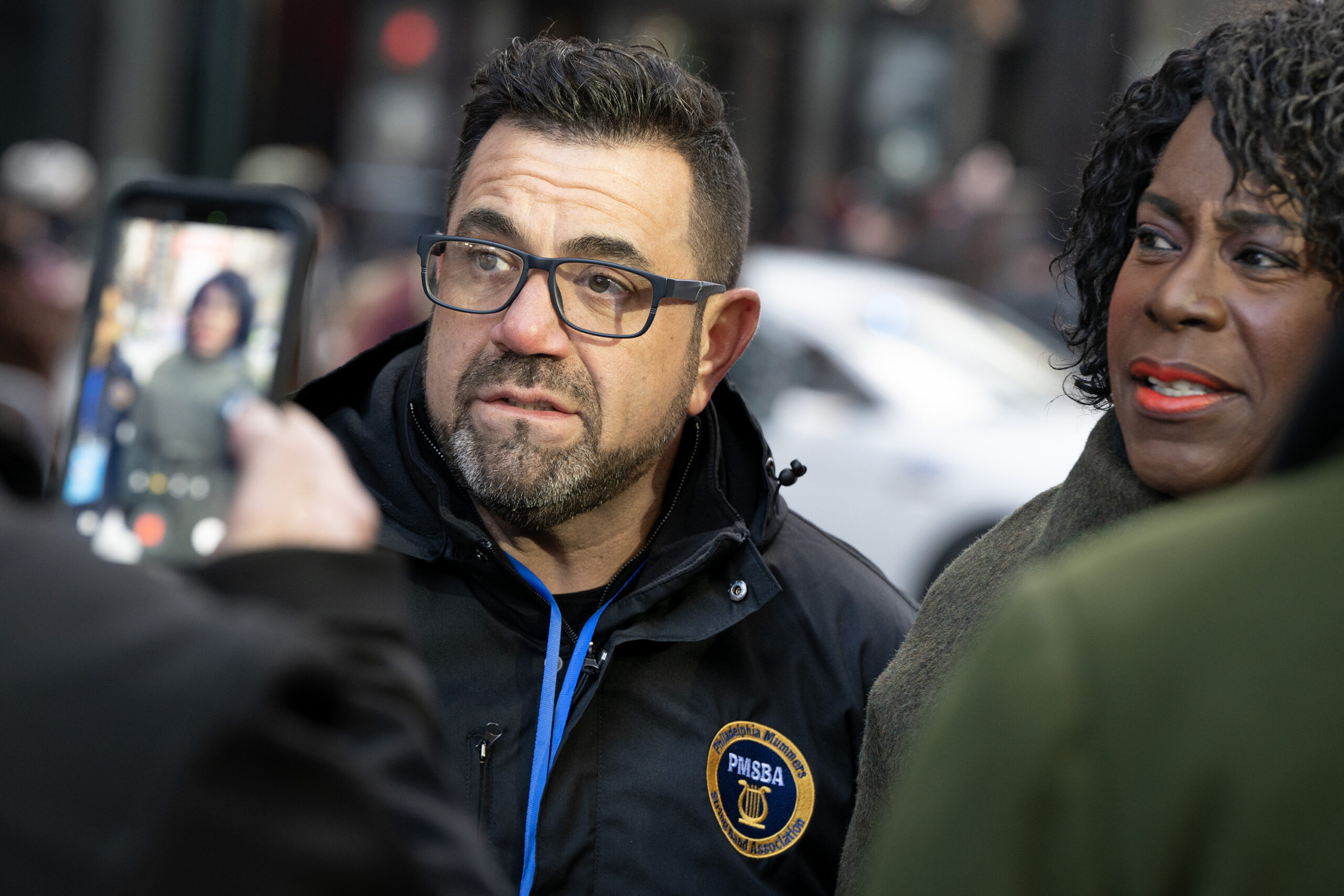
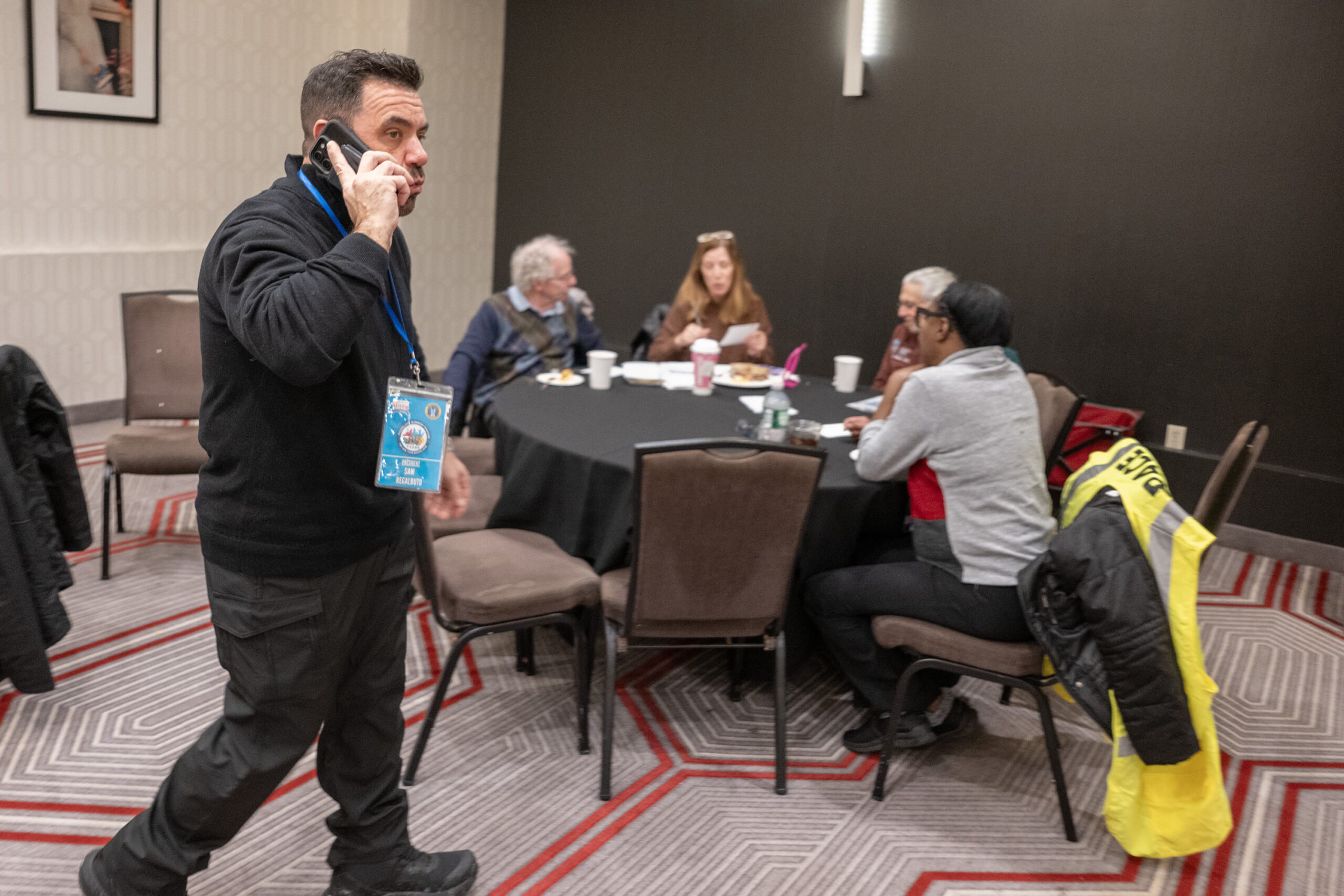
    “We did everything precaution-wise — sandbags and all of that,” said Sam Regalbuto, president of the Philadelphia Mummers String Band Association. “But as they were trying to assemble, things were just being ripped out of our hands.”

    Regalbuto quickly called a meeting of association delegates, and the consensus was to suspend the competition but still march. Only a little differently, not putting anyone at a disadvantage, because several bands had lost key pieces of their show.

    Sam Regalbuto, president of the Philadelphia Mummers String Band Association, pauses for a photo with Mayor Cherelle L. Parker, during the Mummers Parade Thursday. The string band competition was suspended because of high winds that destroyed props and caused injuries during morning setup. The bands still marched and played their music, but did not carry props, and would not be judged.

    Even into the afternoon, winds were still brisk, with temperatures in the 30s. (Cold temperatures are scheduled to continue into the weekend.)

    “We’ve lost sets, we’ve lost props that we’ve worked 365 days to put together to bring you the best possible string band spectacular that we do every year,” he said. “It was very hard for all of us, as a unit, to make this decision.”

    After the last Comic Divisions finished, it was showtime for the strings, with Duffy String Band leading off.

    Crowds seemed unfazed by the amended show. Some Mummers wore beanies instead of their typical elaborate headpieces.

    A jubilant Mayor Cherelle L. Parker’s spirits were undimmed by the changes.

    “I want you to remember how much time, energy, and practice and effort goes into preparing,” Parker said. “Don’t forget about the generations of families who are here. We are proud, and this is our Philly tradition.”

    ‘Our thing, together’

    Dressed in handmade, bedazzled Colonial-era costumes, Joe Bongard, 47, and his teenage daughter, Lucy, were the first Mummers to march.

    By parade time, it had almost seemed like they hadn’t slept in days, the Bongards said. Father and daughter had been preparing since September.

    Bruce Platt, a parade marshal for 17 years, holds back the rush of Froggy Carr wenches as they take off for their TV start time march,

    In the final hours before Parade Day, Lucy sewed her bejeweled and sparkled red-white-and-blue Colonial-era woman’s costume. Meanwhile, her father, who is in his first year as captain of Golden Sunrise Fancy Club, applied finishing touches to his Ben Franklin outfit and practiced his knee step for the dance routine.

    Poised in the warming glow of the television cameras, their patriotic sequins and feathers rustling in the icy wind, Joe and Lucy Bongard said this is what they love to do.

    “It’s our thing, together,” Joe Bongard said.

    Proudly watching her husband and daughter from the grandstand, Erika Bongard laughed when she said that, for her, the Mummers Parade represented something else entirely. “Honestly for me, lots of cleaning, because there is sequins and glitter everywhere for months,” she said, recording as Joe and Lucy began to strut and dance to Rocky theme song “Gonna Fly Now,” officially kicking things off.

    “Clearly, Lucy got her rhythm from me, and not Joe,” said Erika Bongard, beaming about her daughter’s smooth steps.

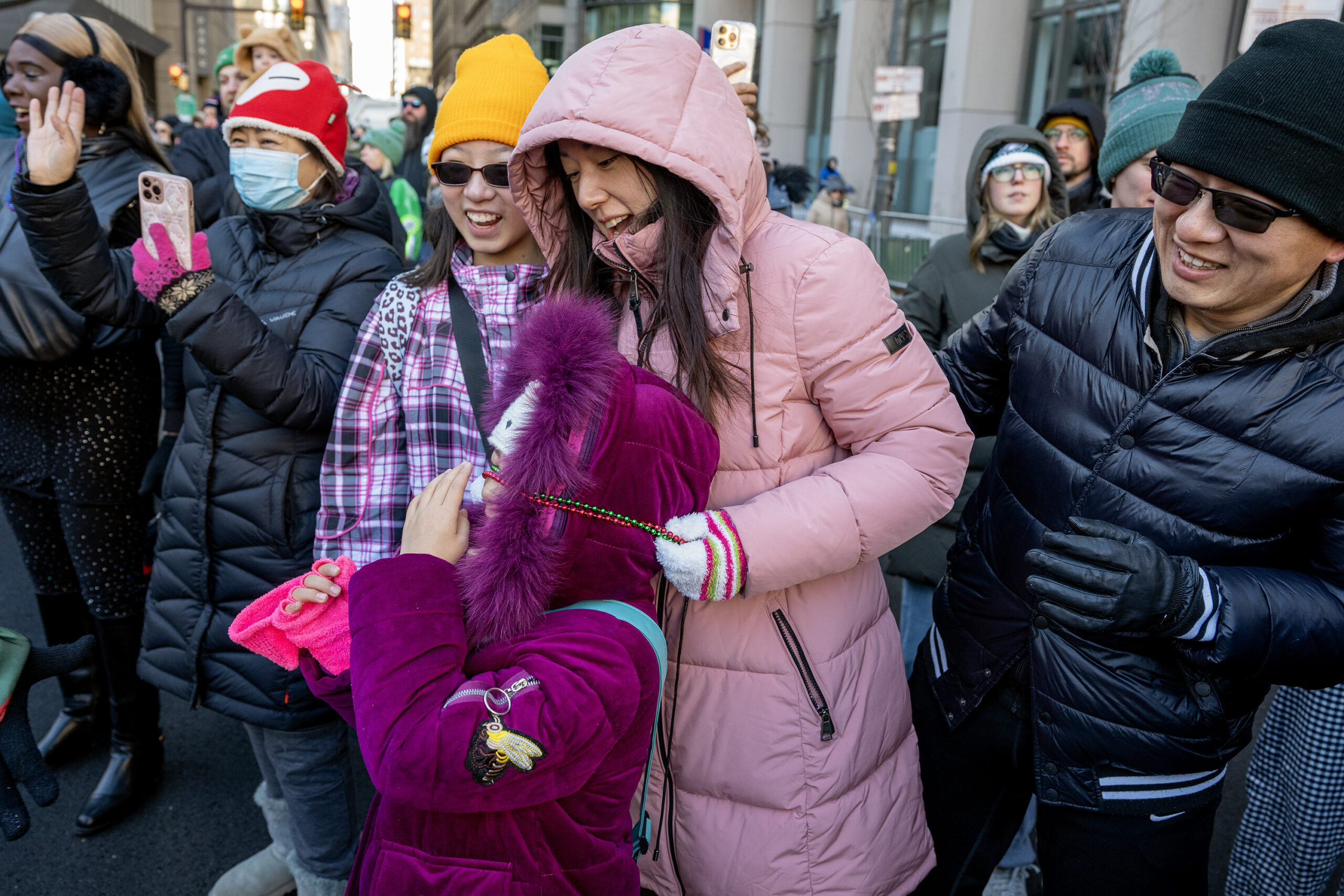
    McKenna Wei, 7, gets help putting on a set of beads given to her by a passing Mummer Wench as the Newtown Square family watches the Mummers Parade Thursday, the 125th anniversary of Philly’s iconic New Year’s Day celebration. From left is grandmother Qin; sister Mabel, 12; mom, Helen and dad, Michael.

    Nearby, Ellie Jozefowski, 75, fought back tears as she strutted in a sequined Flyers jacket. The tears come easily every year for Jozefowski, a parade veteran of more than three decades.

    Thursday was no different. They flowed freely as four generations of Jozefowskis marched together for Golden Sunrise, including Ellie’s 7-month-old grandson, Peter, bundled up in a cheesesteak costume and carried by his mother, Molly.

    “I’m crying because I’m happy!” shouted Ellie Jozefowski.

    Farther back in line, Mummer Brian Creamer, of South Philly, shivered over his coffee. His young daughter, Amita, also a Mummer, had helped him bejewel his pirate king costume. He would not miss it for the cold or the wind, he said.

    “It’s about spreading the new year joy,” he said.

    Even farther back, wenches Ricky Dinaro, 35, and his pal, Anthony Putnick, warmed themselves on the regenerative powers of Miller Lite.

    They’d been born into the parade, they said, and marched all their lives. They had been drinking for hours.

    “I stayed up all night,” said Putnick, of the MGK Outsiders NYB.

    Others had found their way into the longest-running continuous folk parade.

    Cheyenne Cohen, of Golden Sunrise, grew up in Northern California before joining the Mummers three years ago after she moved to Philly. There was nothing like the Mummers in Santa Cruz, she said, adding that she now also works at the Mummers Museum in South Philly.

    “Absolutely, the most welcoming community,” she said of her sequined and feathered found family.

    It was a parade of firsts for the Mummers of the Philadelphia Chinese Community Organization United troupe.

    Celebrating its inaugural year, the Chinatown Mummers danced traditional Chinese folk dances, which many members practiced late nights after their restaurant jobs.

    “We want to welcome people to Chinatown and show our culture,” said member Holly Ming.

    In the crowded grandstands, new and old fans shivered.

    Kenzie McBride thought what better year to score front-row grandstand seats for her stepmother, Jennifer Smithson, than the 125th anniversary?

    Smithson, bundled in a blanket, approved.

    “It’s been on my bucket list,” she said.

    And though some would-be parade-goers stayed home because of the string band news, plenty came out to enjoy the iconic parade anyway.

    In the grandstands as darkness fell, Patrick Finnegan, 46, of Oreland, danced with his son, Dylan, 6, on his shoulders. His 8-year-old twins, Arielle and Melody, were by his side.

    It was the first time he had brought the kids to the parade.

    The cancellations didn’t affect their fun, Finnegan said.

    “It’s all about riding the train downtown to see the Mummers,” Finnegan said, mid-strut. “My wife thinks I’m crazy.”

  • Mummers string band competition has been ‘suspended’ because of high winds but the bands are still marching

    Mummers string band competition has been ‘suspended’ because of high winds but the bands are still marching

    Weather concerns have snarled Philadelphia’s New Year’s Day plans.

    The string band competition has been “suspended until further notice,” the Philadelphia Mummers Parade and Philadelphia String Band Association announced Thursday morning.

    High winds, “wind damage during unloading and setup and safety concerns” prompted the call, officials said in a statement.

    “In the spirit of celebrating New Year’s Day and this important milestone for our city and nation, the String Bands will all still march in full costume and makeup and perform for TV, internet, and live audiences on Broad Street and City Hall,” the statement said. “They will march without props. Times and order will remain the same. Safety of performers is of utmost importance when making this decision.”

    This year marks the 125th anniversary of the iconic parade.

    Sam Regalbuto, president of the String Band Association, at the Mummers headquarters hotel Thursday, Jan. 1, 2026, after the string band competition was suspended because of high winds that destroyed props and caused injuries to club members during morning setup.

    Sam Regalbuto, president of the String Band Association, said that the clubs were caught off-guard by “the squalls that came through, the wind changes that happened without us knowing.”

    Several club members were sent to hospitals with minor injuries sustained during attempted setup this morning, Regalbuto said. All have been treated and released.

    “We’ve lost sets, we’ve lost props that we’ve worked 365 days to put together to bring you the best possible string band spectacular that we do every year,” he said. “It was very hard for all of us, as a unit, to make this decision.”

    The call came after String Band Association delegates voted on whether to postpone, Regalbuto said.

    Ultimately, “we just think, safety, safety, safety, first,” he said.

    It was important to clubs to still put on a show for those fans who are crowding Philadelphia streets expecting to see Mummers, said Regalbuto. Though there will be no props, the string bands will “still come in full costume, full makeup, and entertain you, the viewers, at home, and our fans here on the parade route. So please, if you’re thinking of not coming, we’re here. We are performing for you, and we will give you the best show that we can possibly give you.”

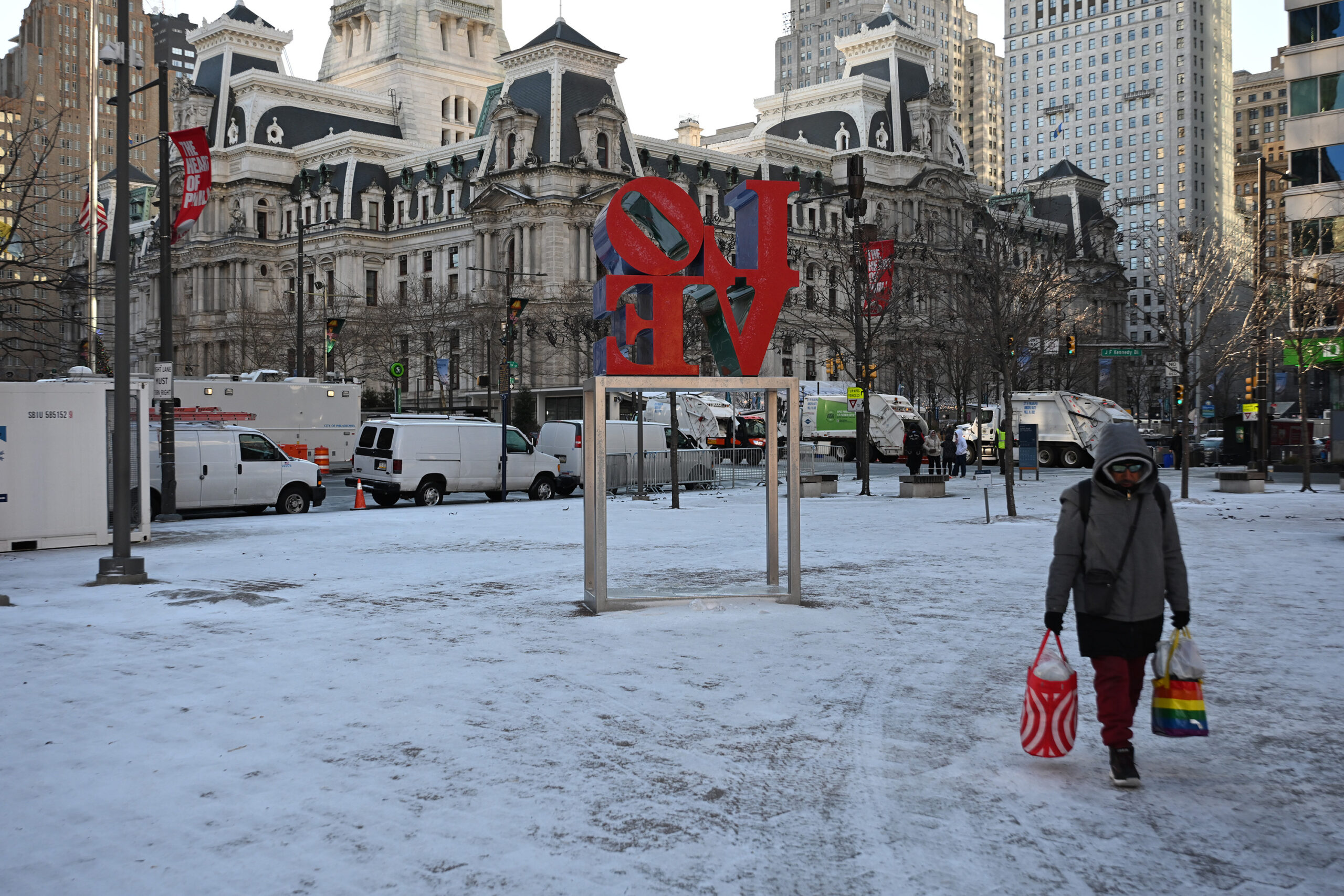
    An early morning snow squall left a dusting in LOVE Park before the start of the Mummers Parade near City Hall Thursday, Jan. 1, 2026. This year marks the 125th anniversary of Philly’s iconic New Year’s Day celebration.

    A 5 a.m. shocker

    Nick Guzzo, a meteorologist with the National Weather Service in Mount Holly, said snow squalls and wind “did not come out of nowhere.”

    On Wednesday, the National Weather Service issued a warning for snow squalls between 2 a.m. and 10 a.m. Thursday.

    “Snow squalls can produce intense bursts of heavy snow and gusty winds, resulting in rapidly reduced visibility and poor road conditions, making travel difficult and potentially dangerous. Extra care should be taken as a result with any travel early on New Year’s Day,” officials wrote on Wednesday.

    Regalbuto said the string bands were closely monitoring hourly weather updates and city messages overnight, but were expecting lesser winds, and gusts, not the sustained wind blasts that ultimately came “shooting from City Hall, straight up Market, and straight up JFK.”

    Because the string bands are essentially “a mobile Broadway show,” with heavy, elaborate pieces that require significant work to install, that setup began in the predawn hours, at about 5 a.m., Regalbuto said.

    It became apparent quickly that a Thursday string band competition would be dangerous.

    Winds “destroyed multiple sets for different organizations,” he said. “We did everything precaution wise — sandbags, and all of that. But as they were trying to assemble, things were just being ripped out of our hands.”

    It was then that Regalbuto convened his delegation. The vote was clear.

    “We knew that there was already an unfair advantage, because some clubs had already lost their sets,” he said.

    Weather reports called for gusts of up to 30 miles per hour well into the afternoon.

    “We just had to batten down the hatches,” Regalbuto said.

    A rescheduled competition, Regalbuto said, will be held “very soon” at a to-be-determined venue once logistics and financials are worked out. Planning meetings will begin Friday.