The question: Does ginger really help an upset stomach?
The science: For more than 2,500 years, ginger has been used for its medicinal properties.
Ginger is stilloften recommended as a way to ease stomach upset.
Ginger, which is available at almost any grocery store and often used as a spice, looks like a root but is technically a rhizome — a modified, horizontal-growing stem of the Zingiber officinale plant.And it has properties that can relieve mild to moderate nausea, experts and studies say. However, it works better for some types of stomach trouble than others — and it matters how you take it.
“We live in a world where there’s this gigantic box of options for our patients and so many of them are costly and have side effects,” said Joshua Forman, a gastroenterologist at the University of Maryland St. Joseph Medical Center, who recommends ginger to his patients. “It’s interesting how sometimes the simplest things fly under the radar.”
What is ginger, and why does it work?
Ginger can be eaten raw or cooked, steeped in tea, or taken as lozenges, gummies, or chews. But when taken for medicinal purposes, Forman said, he advises his patients to take ginger root powder in capsule form, which offers more consistent dosing than most other variations, to ease symptoms of nausea, indigestion, and other symptoms.
Here’s why it works. Ginger contains compounds such as gingerol, shogaol, and zingerone that act on receptors in our gut and nerves that send signals to our central nervous system. One receptor, 5-HT3, regulates nausea, while another, TRPV1, triggers pain signals. By affecting these receptors, ginger may help ease nausea and discomfort, Forman said.
Additionally, these compounds can help the lower part of the stomach contract, which speeds up digestion and reduces fullness and bloating, he said.
Ginger also has anti-inflammatory and antioxidant properties, which may help protect against gastrointestinal irritation, said Keshab Paudel, an associate professor of pharmacology at Burrell College of Osteopathic Medicine in Florida, who studies ginger.
In a 2025 literature review on the pharmacological effects of ginger, Paudel and his colleagues found that ginger reduced nausea, particularly nausea related to pregnancy, but did not consistently relieve vomiting. Ginger also showed other potential benefits such as helping to reduce inflammation, oxidative stress, and blood glucose levels, said Paudel, who was the lead author of the study.
Additionally, some studies show that ginger may help with nausea and vomiting caused by chemotherapy, particularly when combined with antinausea medications. It may help ease nausea after surgery, though findings are mixed on postoperative vomiting. It may also help with nausea related to migraine pain.
There isn’t enough data, however, to suggest that ginger can curb nausea related to stomach viruses, hangovers, or chronic acid reflux, Paudel said.
How should I take ginger for a stomachache?
The amount of ginger used in studies to treat nausea varies from 500 to 1,500 milligrams divided throughout the day, with 1 to 3 grams daily at the upper end. More than that and itmay worsen reflux, heartburn, and other gastrointestinal symptoms. Forman said he recommends taking 500 mg twice per day.
If you like the taste, fresh ginger root works well in hot tea, though it’s harder to figure out what dose you are getting, Forman said.
Just boil freshly grated or sliced ginger in a pot of water and let it steep for at least 10 minutes, then strain out the ginger. Add a tea bag or loose tea leaves (which you would also strain out)and, if you’d like, honey and lemon.
Forman cautioned against using store-bought ginger tea drinks as they often contain sweeteners and other ingredients.
Don’t waste your time with most ginger ales,Forman said. Many contain ingredients such as high-fructose corn syrup and very little ginger, sometimes using artificial ginger flavoring. Ginger beers (which are generally nonalcoholic, despite the name) can sometimes contain more ginger than soda, but the amount can vary.
Who shouldn’t take ginger medicinally?
Although ginger is generally considered safe and is almost universally well-tolerated, it can lower blood sugar and impair blood platelet function when taken regularly at high doses, Forman said. If you have diabetes or take blood thinners, talk to your doctor before taking ginger supplements.
Additionally, there is limited clinical data on the use of ginger in young children, so before giving it to your child as a daily supplement, consult a pediatrician, Paudel said.
Ginger “should be viewed as a supportive, evidence-based complementary option, not a cure-all,” and people with persistent or severe gastrointestinal symptoms should seek medical care rather than trying to treat the condition on their own, he said.
What else you should know
There are various over-the-counter medications to treat nausea and vomiting such as dimenhydrinate (Dramamine), which is commonly used to combat motion sickness, and bismuth subsalicylate (Pepto-Bismol), which can help with nausea, indigestion, and diarrhea often related to stomach bugs.
If you prefer natural remedies, however, here are some ideas from experts:
Peppermint oil may relieve gastrointestinal discomfort and symptoms of irritable bowel syndrome. Although the evidence is not conclusive, some research suggests that enteric-coated peppermint oil capsules may reduce abdominal pain, bloating, and gas, Paudel said. (Enteric coating keeps the pill from dissolving in stomach acid so that the drug is released in the intestines, where it can be best absorbed.) But similar to ginger, “the effectiveness of these interventions largely depends on the underlying cause of the symptoms,” he said. In studies, peppermint oil appears safe for most people, but there isn’t much research on its medicinal use in women who are pregnant or breastfeeding, so consult your doctor before taking it.
Vitamin B6 may help with morning sickness — nausea and vomiting related to pregnancy, Paudel said. In some studies, doses have ranged from 10 mg to 25 mg, taken up to three times per day.
Chamomile tea also may help ease an upset stomach. A 2025 review found that chamomile was associated with reductions in sores and discomfort in the mucous membranes lining the digestive tract, suggesting it may have anti-inflammatory properties.
The bottom line: Ginger — whether taken in capsules or fresh, homemade tea — can ease mild to moderate nausea, but research doesn’t show that it consistently reduces vomiting. It also hasn’t been shown to help with nausea related to stomach viruses, hangovers or chronic acid reflux.
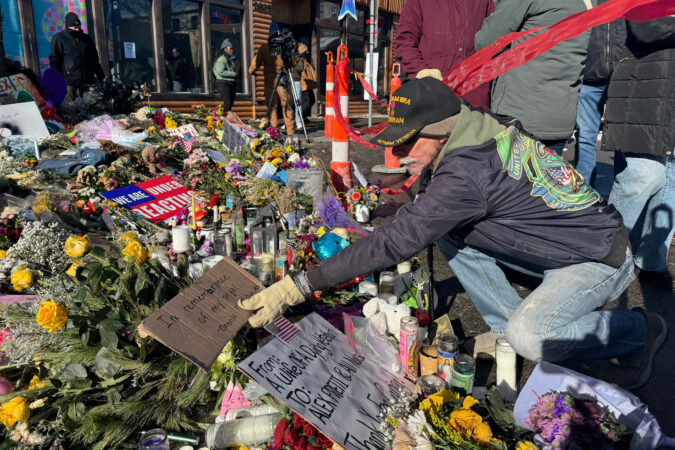
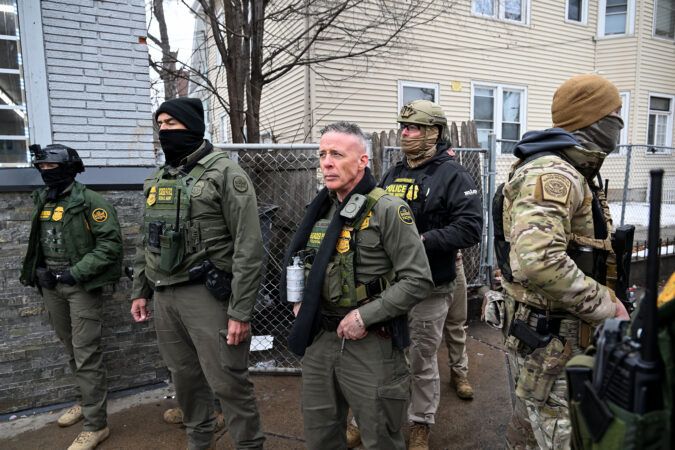
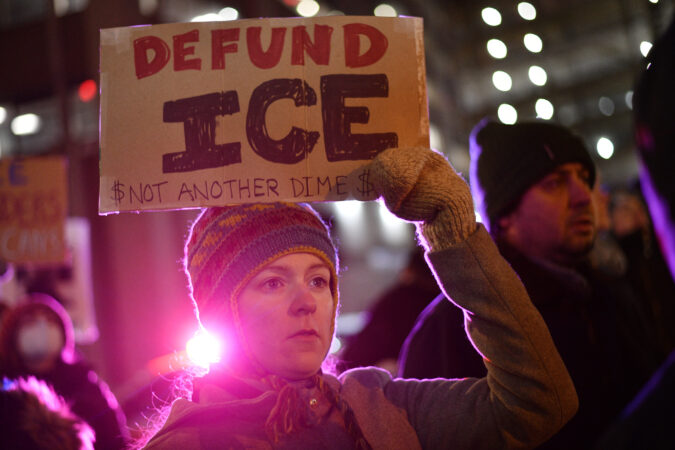
The Trump administration on Wednesday announced criminal charges against 16 people in Minneapolis whom it accused of assaulting officers or interfering with federal immigration enforcement operations as tensions in the city continue to escalate.
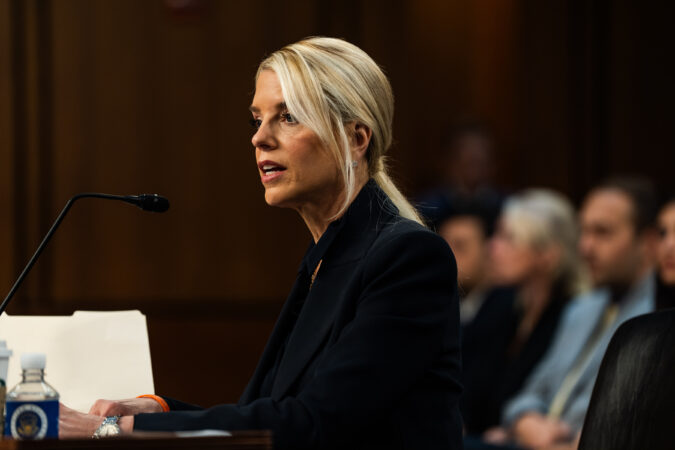
Attorney General Pam Bondi announced the Justice Department prosecutions in a social media post, naming those who were charged and indicating she expects more arrests.
“I’ve said it before and I’ll say it again: NOTHING will stop President Trump and this Department of Justice from enforcing the law,” Bondi wrote on X, adding that she was in Minneapolis.
Already this month, federal prosecutors had charged 17 people in Minneapolis with crimes tied to protests or related to the administration’s surge in immigration enforcement.
Bondi’s defiant posture came despite what appeared to be a shift in tone from President Donald Trump and other senior aides amid widespread outrage over immigration officers’ fatal shootings of two U.S. citizens in the city this month. Authorities said the two federal agents who fired at Alex Pretti, 37, on Saturday have been placed on administrative leave, per standard agency protocol.
Those developments came a day after the Department of Homeland Security provided the first official timeline of the deadly encounter in a statement sent to some members of Congress. The document, which was based on preliminary review, made no mention of Pretti brandishing a weapon, contradicting Trump administration comments in the immediate aftermath of the shooting, when senior officials described Pretti as a direct threat to federal agents and officers.
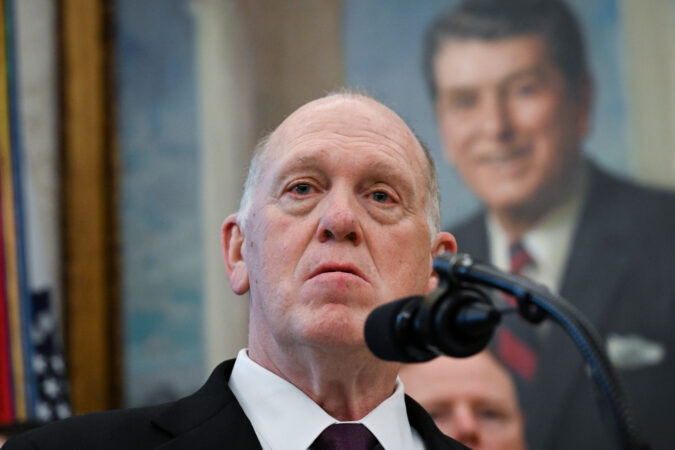
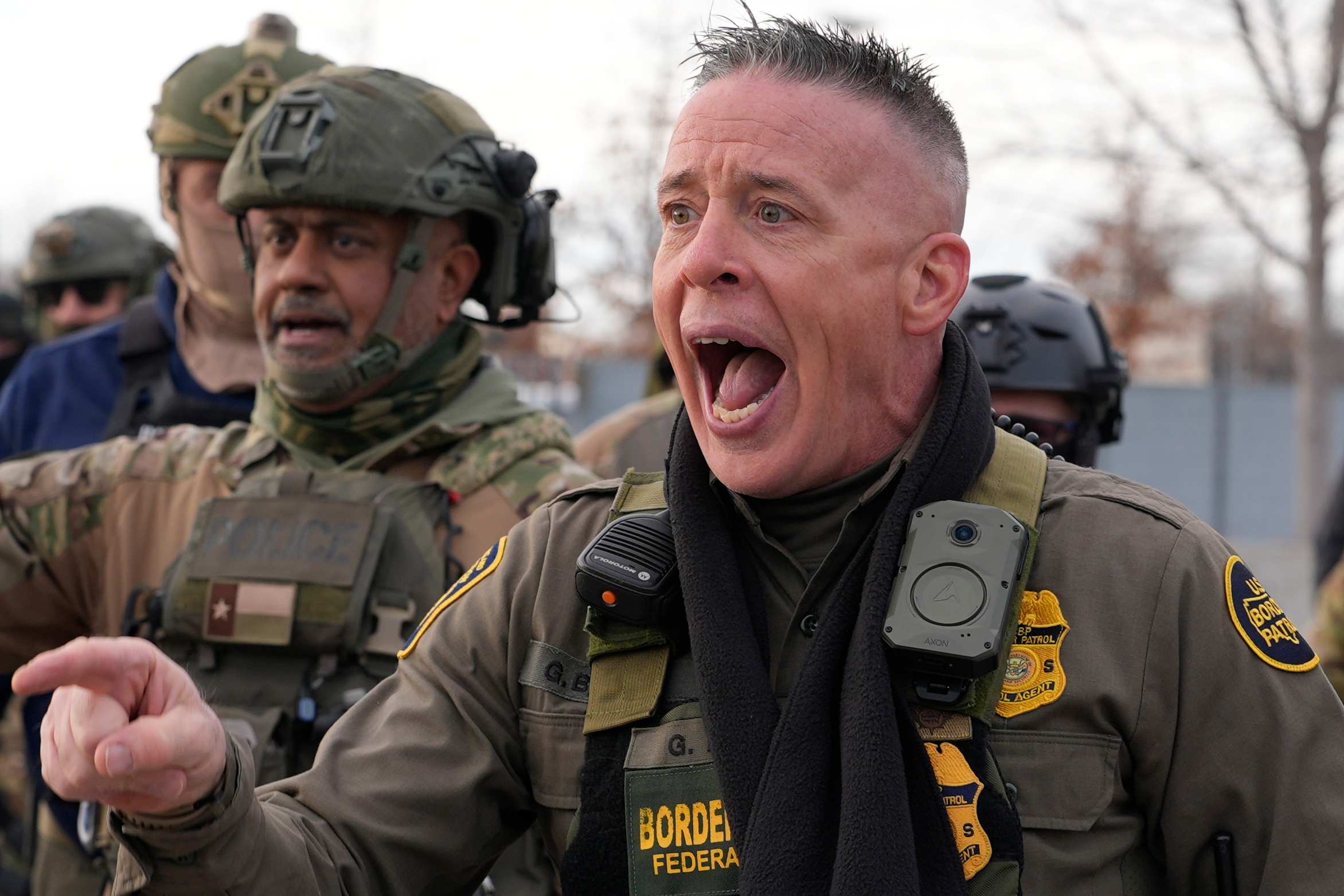
The Trump administration has begun to back away from some of its inflammatory rhetoric about the shooting and replaced Greg Bovino, the Border Patrol commander who was overseeing the Minneapolis operation, with border czar Tom Homan.
“I think the whole thing is terrible,” Trump said Tuesday in an interview with Fox News when asked about events in Minnesota over the past week and Pretti’s killing. “I don’t like the fact that he was carrying a gun that was fully loaded. … Bottom line, it was terrible.”
The news that two immigration agents involved in Pretti’s shooting are on leave undercuts Bovino’s previous claim that “all agents that were involved in that scene are working, not in Minneapolis, but in other locations.”
The broader shift in the White House’s tone on Pretti’s killing comes as a growing number of Republicans challenge the Trump administration’s handling of the shooting and become more critical of Homeland Security Secretary Kristi L. Noem. It also reflects concern that without a significant course correction, Republicans are likely to lose control of Congress in November’s midterm elections.
Stephen Miller, Trump’s White House deputy chief of staff, called Pretti an “assassin” in the immediate aftermath of his killing. On Tuesday, Miller said the administration was evaluating whether Customs and Border Protection “may not have been following” official protocol before the shooting.
Noem also initially portrayed the circumstances surrounding the fatal shootings of both Pretti and Renée Good in Minneapolis as assaults on federal law enforcement, despite video evidence to the contrary.
A woman who said she filmed Pretti’s shooting rebutted DHS’s initial claims that Pretti had brandished a weapon or was acting in a threatening manner.
Speaking to CNN’s Anderson Cooper on Tuesday, Stella Carlson, who estimated she was no more than 10 feet from Pretti when he was shot, said he was filming immigration enforcement personnel and trying to direct traffic.
Carlson said she got out of her car and started filming Pretti, whom she had never met, as he directed traffic. She said that Pretti was acting “calm” and “definitely without threat,” and that she did not see him brandish a weapon. “If I had, I maybe wouldn’t have stayed so close” to him, she said.
Pretti’s death has prompted bipartisan calls for an independent investigation. Top Justice Department officials said previously that they saw no basis for a civil rights investigation into Good’s Jan. 7 shooting. The department, however, has sought to pursue an investigation into Good’s partner, the Washington Post has reported.
On Tuesday, Rep. Ilhan Omar (D., Minn.), a frequent target of the Trump administration, was attacked during a town-hall meeting and Immigration and Customs Enforcement agents tried to enter the Ecuadoran Consulate before being turned away.
A man used a syringe to spray an unknown liquid in Omar’s direction, police said, shortly after Omar called on Noem to “resign or face impeachment.” The man, later identified as 55-year-old Anthony Kazmierczak, was immediately tackled and arrested, and Omar later said she was “OK.”
One year ago, Gregory Bovino was a low-profile Border Patrol chief overseeing a relatively small stretch of the U.S.-Mexico border in California. Just months into President Donald Trump’s second term, however, Bovino emerged as the face of one of the most aggressive immigration crackdowns in U.S. history, leading federal agents as they flooded one predominantly Democratic city after another, making thousands of arrests.
Now that approach has turned into a political liability for Trump. And Bovino, 55, has been dispatched back to California, days after he declared — despite video evidence to the contrary — that the intensive care nurse fatally shot in Minneapolis on Saturday by federal immigration personnel wanted to “massacre law enforcement.”
Bovino’s rapid rise and fall reflects the arc of the Trump administration’s combative immigration enforcement tactics and the mounting public backlash it has generated.
The administration’s enforcement operations in multiple metropolitan areas formed the capstone of Bovino’s three-decade career in U.S. Customs and Border Protection, the nation’s biggestfederal law enforcement agency. His visibility also demonstrated the more prominent role that Trump and Homeland Security Secretary Kristi L. Noem has given tothe Border Patrol in urban areas, mostly far from its traditional purview over the U.S.-Mexico border.
Dressed in his signature olive-green uniform and sporting a buzz cut, Bovino led masked agents into American cities like a military commander directing troops into battle. Bovino relished trading insults with critics on social media, posting action videos of his agents’ maneuvers and appearing on the front lines of tear-gas-laced clashes with protesters.
His leadership drew criticism over time,including an admonishment from a federal judge in Illinois, who said the use of force by federal agents “shocks the conscience.” That criticism mounted this month amid Bovino’s forceful defense of the fatal shootings by federal immigration personnel of two American citizens in Minneapolis, Renée Good and Alex Pretti.
Even Trump, who has touted the blue-city operations, seemed to acknowledge that in Minneapolis, Bovino had pushed past the boundaries of traditional law enforcement tactics.
“You know, Bovino is very good, but he’s a pretty out-there kind of a guy,” Trump said in a Fox News interview Tuesday. “And in some cases, that’s good. Maybe it wasn’t good here.”
Some former officials of the Department of Homeland Security, which oversees CBP, said they welcomed Bovino’s departure from Minneapolis out of concern for the agency’s credibility.
“I hope it’s a sign that perhaps there is a recalibration going on about how to approach the enforcement of immigration laws,” said Tim Quinn, a longtime CBP official who resigned last year. “I don’t think agents were well represented by his actions, and I fear that the country’s view of the Border Patrol is going to be negatively affected, but hopefully not irreparably damaged.”
Bovino’s elevated status within the agency was unusual because he didn’t appear to operate within the chain of command, which would require him to answer to senior CBP officials. Instead, he was in direct contact with Noem, said Robert Danley, who retired as CBP head of professional responsibility in December.
“He has a more direct line to the secretary, and he’s able to do what she wants and what he wants,” Danley said.
DHS and Bovino did not respond to multiple requests for comment this week. Tricia McLaughlin, a DHS spokesperson, said Monday evening on X that Bovino “has NOT been relieved of his duties” and called him a “key part of the President’s team and a great American.”
Nick Sortor, a conservative influencer whose arrest at an anti-Immigration and Customs Enforcement protest in Portland won admiration from Trump, has championed Bovino’s leadership and said he hopes the administration keeps him at the center of its crackdown on illegal immigration.
“His presence on the front lines was a huge morale booster for the Border Patrol, which is obviously under heavy scrutiny,” Sortor said. “Him being there and risking his life beside them every day was sort of like fuel for them … He was becoming a figurehead for the mass deportation effort, somebody who was hell-bent on fulfilling what hebelieved was a mandate from the 2024 election.”
Days before Trump took office, Bovino oversaw a Border Patrol raid in Kern County, at the southern end of California’s Central Valley,some 250 miles from the border. Although the agency described the operation as targeted, Border Patrol agents had no knowledge of the criminal or immigration history for 77 of the 78 people arrested, according to CalMatters, a nonprofit news organization.
The American Civil Liberties Union alleged in a lawsuit that agents were conducting arrests indiscriminately of people of color “who appeared to be farmworkers or day laborers, regardless of their actual immigration status.” A federal judge issued a preliminary injunction last spring barring Border Patrol agents from stopping people in that region without reasonable suspicion that they were violating U.S. immigration law.
“Looking back on last year, the operation looks like an audition for Greg Bovino, and he got the part,” said Bree Bernwanger, senior staff attorney at the ACLU of Northern California. “That raid was a precursor to the policies and practices that DHS would adopt writ large across the country. … We’ve seen them ignoring proof of immigration status and an utter disregard for the laws on the books that restrict immigration arrests without a warrant.”
Bovino remained little known nationally until June, when Border Patrol agents began making arrests in Los Angeles. After agents descended on a park in an immigrant-rich neighborhood on horseback and in military vehicles, Bovino told Fox News, “Better get used to us now, because this is going to be normal very soon.”
Several weeks later, in Chicago, Bovino’s aggressive tactics became more visible, as federal agents deployed tear gas and protesters clashed with law enforcement outside an ICE processing facilitywest of downtown. The nonprofit Chicago Headline Club filed a lawsuit against administration officials, alleging that the use of rubber bullets and tear gas against reporters and protesters violated their First Amendment rights.
Bovino, who was among multiple defendants in the lawsuit, claimed in a deposition that the agents’ conduct was “more than exemplary.” But U.S. District Judge Sara Ellis concluded that Bovino’s testimony was “not credible” and wrote in a court opinion that Bovino admitted “he lied multiple times” about the events that led up to his throwing a tear-gas canister toward a crowd. Bovino and DHS said that a rock hit him in the head before he threw the canister, and he said that he was “mistaken” in his deposition.
“I see little reason for the use of force that the federal agents are currently using,” Ellis said when she issued a preliminary injunction prohibiting immigration officers from using tear gas and pepper spray on those who do not pose a threat. “I would find the use of force shocks the conscience.”
From Chicago, Bovino continued on to shorter-term operations in New Orleans and Charlotte. Then came his posting to Minneapolis, which has turned out to be an inflection point for his career and, perhaps, for the administration’s immigration crackdown in urban areas.
On the morning of Jan. 7, an ICE officer, Jonathan Ross, shot and killed 37-year-old Good while she drove her SUV near her home in Minneapolis. A Washington Post analysis of video footage found Good’s car did move toward Ross but that he was able to move out of the way and fire at least two of three shots from the side of the vehicle as it veered past him.
Bovino, however, did not hesitate to condemn Good’s actions and praise the shooter, saying, “Hats off to that ICE agent” in a Fox News interview.
Seventeen days later, Bovino would once again defend the use of fatal force as the news broke that Pretti had been shot and killed in an encounter with federal immigration personnel.
At a news conference just hours after Pretti’s death, Bovino claimed that agents tried to disarm Pretti, but he “violently resisted.” An agent fired “defensive shots,” he said.
“This looks like a situation where an individual wanted to do maximum damage and massacre law enforcement,” Bovino added.
Analysis of videos of the scene by several media organizations does not support Bovino’s claims. Federal immigration personnel had already secured Pretti’s handgun by the time they fatally shot him, according to a Post analysis of videos that captured the incident from several angles. As many as eight officers and agents were attempting to detain the 37-year-old ICU nurse, videos show. Federal officials now say that a Border Patrol agent and a CBP officer both shot Pretti, and they no longer claim that he had menaced law enforcement with his gun.
By Sunday, some Republican members of Congress had begun raising concerns about the shooting and pressing for an independent investigation. And by the following day, both Trump and White House spokeswoman Karoline Leavitt signaled a change, saying that Trump’s border czar, Tom Homan, would be taking over the operation in Minneapolis.
“Mr. Bovino is a wonderful man, and he is a great professional,” Leavitt said. “He is going to very much continue to lead [Customs and Border Protection] throughout and across the country. Mr. Homan will be the main point of contact on the ground in Minneapolis.”
The news drew praise from Bovino’s critics.
“This move by the administration is a political recognition that the violence we’re seeing across our communities, from Minneapolis to cities nationwide, is deeply unpopular, unacceptable, and politically toxic,” said Todd Schulte, president of the immigration advocacy group FWD.us.
Bovino allies like Sortor registered their disappointment. “Bovino put his life on the line EVERY SINGLE DAY pushing for mass deportations across the country, going head to head with leftists and reminding THEM who’s boss,” he said on X: “DO NOT COWER TO THE DEMOCRATS, PRESIDENT TRUMP! BACK BOVINO!”
Bovino’s typically busy social media feed has been quiet since then. His most recent post on X came Monday morning before news of his departure spread. “Finding and arresting criminal illegal aliens,” he wrote, “this is why we are deployed across the country.”
U.S. Immigration and Customs Enforcement and other immigration enforcement agencies would keep operating even if broad swaths of the federal government close this weekend.
Lawmakers face a Friday deadline for a partial government shutdown, 80 days after they reopened federal agencies after the longest shutdown ever in November. Congress has approved half of its annual spending bills since then and was poised to approve the other the bills late last week in one combined measure.
But the killing of Alex Pretti in Minneapolis by immigration authorities on Saturday — just weeks after an ICE officer killed Renée Good in the same city — outraged congressional Democrats, who say they’ll block the spending bill unless it includes more oversight of ICE. Republicans so far have rebuffed that demand, setting up a likely partial shutdown that would close agencies whose funding hasn’t been enacted.
ICE largely doesn’t need the spending bill to pass, however, even though its operations are at the heart of the standoff. That’s because the massive tax and immigration policy law the GOP passed last summer at President Donald Trump’s urging included $75 billion for the enforcement agency over the next four years.
The one-time bonus was nearly eight times as much as the agency received in 2020, its highest-funded year to date, and the largest investment in immigration enforcement since the creation of the Department of Homeland Security in 2003. Including the ICE funds, DHS overall received $170 billion for immigration enforcement in the GOP law, the $3.4 trillion One Big Beautiful Bill.
The law put $45 billion toward immigration detention facilities and nearly $30 billion for hiring and training ICE agents. It also included $3.5 billion for Justice Department grants to reimburse local law enforcement agencies that help with immigration operations; $6.2 billion for Customs and Border Protection personnel hiring and bonuses; and $6.2. billion for border security technology and screening. Last summer, the influx landed right as ICE appeared close to burning through its annual appropriations.
It’s not clear how much of the money the agency has already spent, said Jennifer Ibáñez Whitlock, senior policy counsel at the National Immigration Law Center.
“It’s our best guess … that they still have significant amounts of that $170 billion to spend,” she said. “DHS doesn’t need any more money through the regular appropriation process because they received such a significant windfall under the One Big Beautiful Bill.”
DHS spokesperson Tricia McLaughlin said in a statement that Senate Democrats are “blocking vital DHS funding that keeps our country secure and its people safe,” including Transportation Security Administration, the Federal Emergency Management Agency, the Coast Guard and Border Patrol.
“This funding supports national security and critical national emergency operations, including FEMA responses to a historic snowstorm that is affecting 250 million Americans. Washington may stall, but the safety of the American people will not wait,” she said.
Republican leaders have rejected calls to separate this year’s Homeland Security spending from the measure to fund the rest of the government, but Senate Appropriations chair Susan Collins (R., Maine) and Homeland Security Appropriations subcommittee chair Sen. Katie Boyd Britt (R., Ala.) say they’re exploring options that could satisfy both sides.
Senate Majority Leader John Thune (R., S.D.) said on the Senate floor Tuesday that “productive talks are ongoing” and encouraged Democrats to remain engaged to find a solution to avoid a “needless shutdown.”
The extra money from last summer means Trump would have even more leeway than usual to keep his priorities going in a partial shutdown.
Presidents generally have broad discretion over which agencies should close and which should stay open with unpaid workers during shutdowns. Traditionally, the White House budget office has preserved functions crucial to national security, public safety, and protecting government property, even if the agencies responsible for those activities aren’t funded.
But outside funding streams — from other legislation or fees collected from government activities — give administrations room to move money around to their most favored agencies, even outside the bounds of spending laws.
Other federal functions without new appropriations would grind to a halt, and Trump and White House budget director Russell Vought leveraged the 2025 shutdown to marginalize agencies they felt mostly served Democratic-controlled constituencies.
In a potential shutdown this weekend, the IRS would shutter justdays into tax season. Money for housing assistance programs would be at risk in the aftermath of a winter storm that sent temperatures plummeting to historic lows. Government-backed scientific research would halt overnight.
“The Trump administration knows that if there isn’t an appropriations bill, they can still do a lot of things. Many of the chains come off of them,” said Richard Stern, who studies the federal budget at Advancing American Freedom, a conservative think tank founded by former Vice President Mike Pence. “They showed in the last shutdown that they’ll use full executive authority if Congress won’t do its job, and in that sense, they called the Democrats’ bluff. This time, the precise thing Democrats are fighting over is the thing Trump already has permanent funding for.”
The prolonged government closure in November — forced by disagreements over extending enhancedAffordable Care Act subsidies that expired last year — concluded with an agreement to approve three of 12 appropriations bills through September and set a deadline of Jan. 30 for the remaining bills.
Three more passed earlier this month, leaving six of the largest and most controversial funding bills to be negotiated between Republicans and Democrats. That bipartisan agreement was announced last week and initially appeared on track to pass.
But the Trump administration also flooded Minneapolis with federal immigration officials as part of Operation Metro Surge, which it called the largest enforcement operation in the agency’s history. Democrats began raising concerns with agents’ aggressive actions against U.S. citizens and undocumented immigrants with no criminal history.
Top Democrats on the House and Senate Appropriations committees at first backed the funding agreement they helped negotiate, which would send $64.4 billion to Homeland Security, including $10 billion for ICE — similar to itsexisting funding levels.
They touted the changes they secured in the bill — including a decrease in detention beds, lowered funding for Border Patrol and for ICE’s enforcement and removal operations, and money for body cameras — and argued that denying funding for Homeland Security would also affect FEMA, the TSA and the Coast Guard. The measure did not include other changes Democrats pushed for, including prohibitions on ICE agents shooting at moving vehicles or detaining U.S. citizens.
Last week, top Democrats also noted that the 2025 GOP law meant ICE could continue to operate in a shutdown. The bill narrowly passed the House, primarily along party lines.
After federal officers shot and killed Pretti on Saturday, though, Democratic outrage boiled over. In the Senate — where at least seven Democrats would have to vote with Republicans to overcome a filibuster — the party’s leaders pledged to block the Homeland Security funding bill until Republicans agree to new accountability measures for ICE.
Now Democrats want Republicans to strip the Homeland Security funding bill from the rest of the package, which has wider bipartisan support. They acknowledge that it would do little to shut down ICE’s operations, but argue it’s necessary to force changes.
“Americans must be eyes wide open that blocking the DHS funding bill will not shut down ICE. ICE is now sitting on a massive slush fund it can tap, whether or not we pass a funding bill,” Sen. Patty Murray (D., Wash.), the lead Democrat on the Senate Appropriations Committee, said in a statement. “But we all saw another American shot and killed in broad daylight. There must be accountability, and we must keep pushing Republicans to work with us to rein in DHS.”
MYKOLAIV, Ukraine — She’d applied for job after job, but none of them had worked out. Not the gig in her uncle’s restaurant. Not the bakery internship. Not waitressing. Now Vika was 18 and still unemployed, her life seemingly dead-ending before it ever even began.
Shelay back on the couch, scrolling through more job listings on her cell phone. It was March of last year, and for the past few weeks, she’d been crashing at her brother’s apartment in this southern Ukrainian port city. Her mom, Lesia, kept urging her to move home, but the last thing Vika wanted was to return to her tiny village, with its shrapnel-pocked homes and caved-in school, where the only opportunity was seasonal work picking tomatoes.
Just then, a Telegram message pinged in her inbox: “Do you still need a job?”
She thumbed over it and paused. The man, who said his name was Danylo, was offering $2,500 if she agreed to pick up a package on the city’s outskirts and drop it off at a police station the next morning.
Vika, who agreed to speak on the condition that the last names of her and her family not be used because of pending legal action against her, didn’t consider similar cases that had recently appeared on the local news. There were the four Ukrainian boys who had built a bomb that killed three at a cafe a few miles away on Valentine’s Day. The 17-year-old who died when a bomb disguised as a thermos exploded on his way to a train station. The two 14-year-olds who lit an explosive next to a police station near Kyiv.
All had been recruited through messages on Telegram or other social media channels. Behind the screen: Russian intelligence agents.
These sabotage operations are a dangerous new form of hybrid warfare, with both Russia and Ukraine accusing the other side of manipulating vulnerable populations — including children and the elderly — into committing acts of violence for a quick paycheck.
Since 2022, the Russian Supreme Court alleged, every fourth person convicted of sabotage fell between the ages of 16 and 17, though Russian authorities rarely provide evidence and confession videos are often filmed by the Federal Security Service, known for its coercive tactics. Ukrainian officials have been transparent about their investigations, identifying and proving in courtabout 1,400 sabotage operationslinked to Russian intelligence services over the past two years, including 800 in 2025, with a quarter of those arrested below the age of 18. Neither figure could be independently verified, and both countries deny their roles in such operations.
Vika hadn’t seen the new campaign from Ukraine’s internal security agency, the SBU, which explained that “if someone offers you ‘a simple delivery’ to a military enlistment office, police station, or government building, know that they are trying to kill you,” or the Telegram bot where suspicious messages could be flagged. All she knew was that $2,500 was enough to give her life direction — the launching pad to a new future.
Writing back, she immediately agreed.
‘Vulnerable’
The next morning, Vika woke before her brother and stepped outside to call Danylo.
He picked up on the second try, giving her an address out by the city’s train station where he said the package was waiting. Vika considered asking him what was inside, then thought better of it and called a taxi. She needed the money.
By that point, she’d been to more than 10 job interviews and had invested dozens of hours looking for open positions. Her brother Ihor promised that she could stay with him and his girlfriend for as long as she needed, but Vika wanted independence.
“She was definitely in a vulnerable state at that time,” Ihor said later. “We were explaining to her that everyone goes through this. She didn’t believe us.”
Vika, 18, with her brother Ihor, who was in the military.
They came from a family that talked over each other, with Ihor often getting the last word. He was seven years older, a soldier who had nearly lost his leg fighting in the Donetsk region in 2023. Chronic pain and disability forced his resignationfrom the army. Where Ihor was open and driven, Vika was quiet and closed off, struggling to find her way. She hid behind a curtain of straight, dark hair and chipped away at her nail polish when nervous.
She was 16 when the full-scale war started, evacuating to western Ukraine with her mother while her father stayed behind. Russian troops rolled past their village, not far from the front line in Kherson. When it was safe enough, her family returned home. The past painful, they fixated on her future. Perhaps in the food industry, building on her degree in food science.
They hoped she’d land on her feet.
‘A fatal mistake’
Vika slid out of the back seat of the taxi with a strange feeling in the pit of her stomach. Wanting to back out, she texted her boyfriend, a soldier fighting in Ukraine’s northern Kharkiv region.
“I almost made a fatal mistake. I’ll tell you when we’re together.”
“At least hint,” he replied.
“I’ll tell you everything, but not like this,” she said.
Then the threats started rolling in.
Danylo demanded to know where she was. He told her to call him, then promised that no one would hurt her — if she followed through.
“It was sort of like I was under some hypnosis,” she said later. “I wasn’t thinking. I was just doing what the man was telling me to.”
So she set aside her fear and carried on with the plan. She picked up the package, which consisted of two reusable shopping bags. One was heavy with a five-liter jug that sloshed with a milky substance. The other contained two cell phones. She carried the bags across the street and called Danylo. He instructed her to tape one of the phones to an orange fuse snaking out of the bottle top of the jug. On the other, he told her to activate an app.
People walk through a park in Mykolaiv, Ukraine.
Vika didn’t know it yet, but a counterintelligence agent from the SBU was watching. He’d worked a growing number of cases like hers, largely driven by financial insecurity. The plot often started small, a few bills offered for a menial task. As trust grew, the severity of the assignment increased, then turned toward violence. At that point, the agent said, “they can just threaten the victim with exposure” if they refused to follow through.
“It’s easier to work with teenagers who are not psychologically ready to deal with stuff like that,” he said, speaking on the condition of anonymity in keeping with security service protocols.
His job was to stop an attack before it happened. The SBU was 90% effective, he said. But the number of cases was rising, and agents couldn’t be everywhere at once. In one case, a teenager near Vinnytsia in central Ukraine had already thrown two molotov cocktails at a government building, engulfing it in flames, when the SBU arrested him a few days later. He had received more than $1,300 — money he said he planned to use, in part, to pay his grandmother’s hospital bills.
“Every person has their own reasoning for why they do this,” the agent said later, declining to specify how Vika’s case came onto his radar. “To me, it’s hard to understand.”
He watched as she settled onto a bench near a playground and peered into the shopping bags, fiddling with what was inside. Nearby, a mother pushed her young son and daughter on the swings.
He video-recorded the scene as evidence. “Kids are playing, this girl is making a bomb,”he said, his radio crackling in the background.
The police station near where Vika, 18, is accused of trying to plant a bomb in Mykolaiv, Ukraine.
In a trance
Vika left the playground in what felt like a trance and hailed a cab toward the police station. As the city whipped by, a blur of winter blue and gray, messages from Danylo pinged on her cell phone. He praised her, calling her a “good girl,” and implored that she keep him updated on timing.
“I’ll call when I’m close to the place,” she replied.
“If everything goes well, $3,000,” he said, upping the initial price. “I’ll send it to you! I give you my word! … Make sure you place the bag carefully without shaking it.”
She was now only a few minutes away.
“The bag seems large,” she said. “Or is it OK?”
“It’s just the right size!” he said. “It doesn’t raise suspicion.”
She got out of the taxi.
A few minutes later, three SBU agents disguised as civilians approached. They asked what she was carrying. Vika panicked. She didn’t want to lie. When she finally spoke, it felt like someone else was answering.
“I think,” she admitted, “this might be an explosive.”
A view of Mykolaiv, Ukraine.
The trial
No lawyer would touch Vika’s case.
Charged with terrorism, she faces up to 10 years in prison, though the prosecutor is willing to lessen her sentence if she cooperates with investigators. After multiple consultations with private attorneys failed, Vika’s mother recommended she accept a court-appointed lawyer. Vika was surprised to learn the tall and burly man wasa retired SBU member — once assigned to investigate the type of clients he now defends.
For seven months, Vika remained in custody as the SBU raided her brother’s apartment and her parents’ home for evidence. Lesia, her mother, mailed care packages of Vika’s favorite snacks. They caught up over the facility’s allotted 15-minute phone calls. Vika didn’t say much about the bunk room she shared with 13 other inmates or how they tried not to discuss their cases, some of them violent.
Vika cycled through three judges before the final one, Volodymyr Aleynikov, released her in the fall on a $6,000 bail, which Lesia scraped together with donations from multiple family members. Now under court supervision as the beginning of her trial approaches, Vika is back to where she started: sleeping in the twin-size bed of her childhood bedroom, stuck in her home village.
She felt “stupid” to have been tricked into such a plot, she said in an interview with the Washington Post in the fall.
On a brisk November morning, Vika and Lesia entered the courthouse, walking through a broken metal detector and down a dimly lit hallway to Courtroom 2. Aleynikov shuffled in soon after. At 53, he’d presided over this room for decades, his caseload increasing as the war slogged on.
The facts of Vika’s case didn’t shock him. Not that investigators discovered that the bomb she’d been carrying was built by four local boys between the ages of 14 and 16. Not that she’d ignored so many red flags. Not that it would probably take two years to sift through all the evidence. Aleynikov had nine similar cases on his docket, enough for him to ban smartphones at home, where he had a 15-year-old son.
Now he turned to Vika.
“Do you understand your rights?” he asked.
She nodded. Glancing at her mother for reassurance, she asked the judge if it would be possible to move back in with her brother in Mykolaiv. She’d gotten a new cell phone for her 19th birthday, she offered, and he could contact her there.
“Just don’t look for a job with that phone,” Aleynikov said.
He set the date of her next hearing and the court adjourned for the day. Vika and her mom walked back outside, her fate yet undecided.
Ashigh schoolteacher Christa McAuliffe prepared to be strapped into the space shuttle Challenger, Brian Russell, an official at the company that built the craft’s solid rocket boosters, had just participated in a fateful teleconference from his Utah headquarters.
Like every other engineer in the conference room at Morton Thiokol on that day four decades ago, the 31-year-old Russell opposed launching because the bitterly cold temperature at Florida’s Kennedy Space Center threatened the O-rings that sealedthe rocket boosters. Their managers initially supported this view, but Russell listened in dismay as they reversed themselves under pressure from NASA officials and senior company officials and signed off on the launch.
The mission ended in catastrophe for the reason that Russell feared — a story I know well as a reporter who covered McAuliffe and witnessed the Challenger’s explosion. But for those involved in this tragedy, the families of the astronauts and those who approved the launch, much about thisstory is perhaps even more relevant today than it was on Jan. 28, 1986.
The belief that there are still lessons to learn from the disaster is what led Russell last year to take an extraordinary step that, until now, has received no public notice. He visited NASA centers across the country, telling the Challenger story in hopes that similar mistakes will not occur as the space agency prepares to launch four astronauts on Artemis II, which is scheduled to fly by the moon as soon as February.
The lesson of Challengeris not just about the O-rings that failed. For Russell and colleagues who accompanied him on the NASA tour, understanding the human causes behind the Challenger disaster provides still-crucial lessons about managers who fail to heed the warnings of their own experts. Russell made his tour to make sure NASA officials “heard it from us, and heard the emotional impact that we felt.”
‘America’s finest’
On that day four decades ago, I was standing alongside McAuliffe’s parents and friends. I was a reporter in the Boston Globe’s bureau in Concord, New Hampshire, and I was assigned to follow McAuliffe’s journey from Concord to Cape Canaveral. I visited McAuliffe in her home, flew with her son’s class to Florida and witnessed the disaster.
As the 40th anniversary neared, I revisited McAuliffe’s journey, documented in my clippings as well as thousands of pages of books, reports, and previously unpublished material. I tracked down the handful of survivingformer officials involved in the launch decision, including the rocket company manager, who reversed himself and signed off on the launch.
What I found areintertwined stories: one of McAuliffe and her fellow crewmates, determined to revive interest in the space program, and another of behind-the-scenes turmoil as rocket engineers all but begged that the launch be scrubbed.
President Ronald Reagan hadannounced in 1984 that he wanted the first private citizen in space to be “one of America’s finest — a teacher.” McAuliffe was chosenby a government-appointed panel in July 1985 from 11,000 applicants to be the “space teacher.” Invariably portrayed in media as a small-town teacher with a nervous laugh, she was in fact a teacher like few others, a bit of a rebel who was bursting to speak about inequality, woeful pay, and the power of politics — if only she was asked.
McAuliffe, 37, taught a history course called The American Women, which included study of astronaut Sally Ride, who in 1983 became the first American woman in space, assigned to the Challenger. Two years later, when McAuliffe learned that Reagan had sought a teacher to be the first civilian in space, she filled out an application seeking to follow in Ride’s path — which, as it happened, would be aboard the same space shuttle.
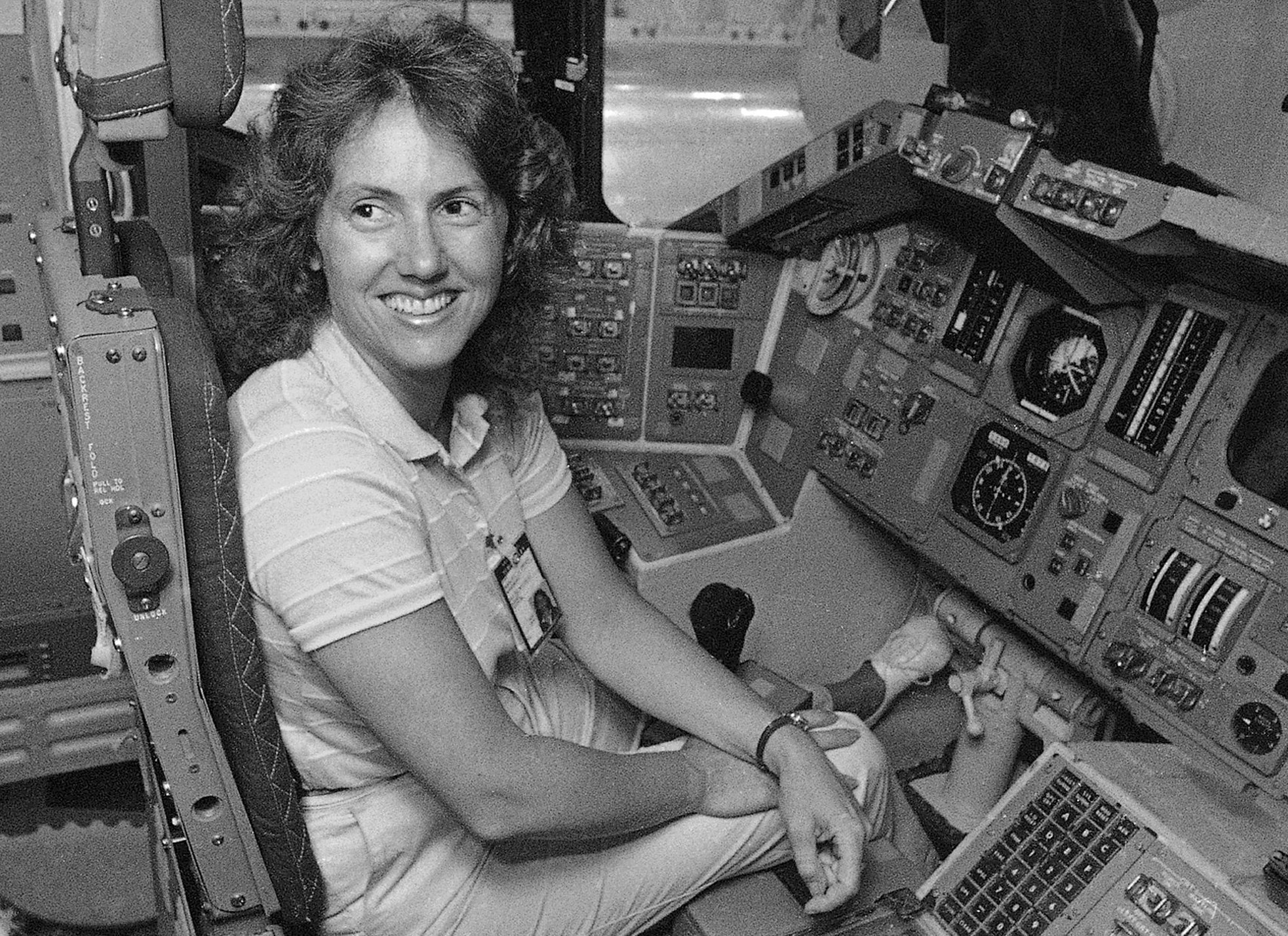
Christa McAuliffe tries out the commander’s seat on the flight deck of a shuttle simulator at the Johnson Space Center in Houston on Sept. 13, 1985.
“As a woman, I have been envious of those men who could participate in the space program and who were encouraged to excel in the areas of math and science,” McAuliffe wrote in her application. “I felt that women had indeed been left outside of one of the most exciting careers available. When Sally Ride and other women began to train as astronauts, I could look among my students and see ahead of them an ever increasing list of opportunities.”
McAuliffe became one of 10 finalists, training with the group and traveling to Cape Canaveral on July 12, 1985, to witness a launch of the Challenger. But the flight was aborted three seconds before liftoff because of a faulty valve. Days later, McAuliffe was unanimously chosen by the government-appointed panel of expertsto be the teacher in space, a decision announced at the White House on July 19, 1985, by Vice President George H.W. Bush.
Ten days later, after NASA fixed the valve, the spacecraft launched but was almost immediately in trouble. One of the three engines shut down, leading to concern that the shuttle would have to make an emergency landing. NASA controller Jenny Howard probably saved the mission when she made a split-second decision that faulty sensors caused the shutdown and overrode them, enabling the flight to continue. Twice in two weeks, Challenger had been in danger, but the teacher-in-space show went on.
Only two days later, NASA publicists whisked McAuliffe onto the set of The Tonight Show, where she gave host Johnny Carson a kiss and won him over, along with a national audience of millions. The recent problems with Challenger, however, were on her mind, as she said the timing of her flight was “being bumped up a little bit with the problems they’ve had.”
“Are you in any way frightened of something like that?” Carson said, noting that “they had a frightening [incident] and one of the engines went out.”
“I really haven’t thought of it in those terms because I see the shuttle program as a very safe program,” McAuliffe responded. “But I think the disappointment …”
Carson interrupted to recall a joke by another astronaut: “It’s a strange feeling when you realize that every part on this capsule was made by the lowest bidder.”
‘I think it’s important to be involved’
A few days later, McAuliffe was back in Concord and agreed to see me at her gracious three-story house in a neighborhood known as The Hill. Her husband, Steven, who was then in private law practice, listened attentively.
At the time, New Hampshire was a solidly conservative Republican state. McAuliffe was an outspoken activist with political ambition; she had been the head of a local teachers union and, true to her Massachusetts roots, a self-described feminist and Kennedy Democrat.
Although rarely mentioned in national stories, her fight for teacher salaries had made her a local legend when she made the case before a town meeting to raise pay, and she succeeded.
By the time McAuliffe applied to be a teacher in space, New Hampshire teacher salaries averaged only $18,577, better than only Maine and Mississippi, according to NEA statistics, and she made only $24,000 annually after 15 years. When I asked her about the salary fight and the continuing low pay for teachers, McAuliffe looked up from packing a bag labeled “Teacher in Space” and said that, after dozens of interviews, this was the first time she had been asked such a question about education. She hoped that her space mission would give her a platform to fight for teachers.
“My sympathies have always been for working-class people. I grew up in that era — we are real big Kennedy supporters — and I think it’s important to be involved.”
As we discussed McAuliffe’s recent round of rousing public appearances, including on The Tonight Show, Steven McAuliffe couldn’t resist hinting about a future in politics: “The Democratic Party could use a good candidate,” he said. “I think she’d be pretty good, don’t you?”
Warning signs
The space shuttle was one of the greatest triumphs in aeronautical design that the world had seen. The airplane-like orbiter carried astronauts and payload such as satellites and could return to Earth for a runway landing. It was launched into space by an external tank with liquid hydrogen and liquid oxygen, propelled by two solid rocket boosters that were jettisoned about two minutes into flight and could be reused.
But the solid rocket boosters had a potential weakness. They were constructed in sections at the Morton Thiokol plant in Utah, shipped across the country by rail and reassembled at the Florida launch site. This meant the rocket was fit together at a series of field joints, as they were called, which would have to be sealed with an O-ring, a supersize version of a rubber seal on a kitchen faucet.
The O-rings were only a quarter-inch thick, wrapped around the rocket sections at a circumference of 37 feet. It was well known that the slightest leak in an O-ring could be catastrophic, so a second seal was added for redundancy.
NASA insisted the rockets were so secure that the probability of failure was too small to calculate — they could fly every week for 100 years without incident, the government asserted at one point.
Indeed, when a NASA official briefed McAuliffe and others, he said if a crucial part should fail, a backup assured success, citing the need for such redundancy to prevent “a burn-through in the solid rocket boosters … because we’re very concerned about the first two minutes you’re on the solid rockets. If one of those rockets goes, why, it’s pretty bad,” according to I Touch the Future, a 1986 biography of McAuliffe by Robert T. Hohler.
But the warning signs had been piling up.
Seven months before McAuliffe’s selection was announced, Morton Thiokol engineer Roger Boisjoly was alarmed at what he saw during an examination of rockets retrieved after the launch of space shuttle Discovery. That spacecraft had launched after days of what was called a once-in-a-century freeze in which temperatures at the launchpad dropped to 18 degrees. Boisjoly’s postlaunch inspection found damage to O-rings that he determined had been caused by the cold.
Yet when tests confirmed Boisjoly’s thesis, “management insisted that this position be softened,” Boisjoly later said at a Massachusetts Institute of Technology speech.
Boisjoly was so concerned that his warnings were being ignored that on July 31, 1985 — the same day McAuliffe appeared on The Tonight Show — he wrote a memo to his superiors ominously titled “SRM O-ring Erosion/Potential Failure Criticality.”
“This letter is written to insure that management is fully aware of the seriousness of the current O-ring erosion problem …” Boisjoly wrote. If there was a repeat of an O-ring problem that occurred on an earlier mission, he feared, “The result would be a catastrophe of the highest order — loss of human life.”
‘I think it’s safe enough’
On the day that the field of teacher-in-space candidates had been narrowed to 10, the shuttle’s commander, Richard Scobee, told his wife, June, that he was concerned about the impression given by NASA about how safe the shuttle program had become.
“They have 10 finalists, and they’re really counting [on] how safe it is to fly the shuttle now,” Scobee said, as June recounted in aninterview this month with the Washington Post. “And we know it’s still a test vehicle. It’s not a commercial flight. Should I go to Washington to talk to the 10 finalists?”
June told her husband that he should go, “and if any of them wanted to back out, that’s a good time.”
Scobee delivered his warning to the finalists. None backed out.
After McAuliffe was chosen and traveled to Houston for training, she visited June at her home.
“Do you think it’s really safe?” McAuliffe asked.
“Christa, no one really knows for certain, but if it’s safe enough that I’m encouraging my husband to fly, then I think it’s safe enough,” June responded.
Thinking back on the moment almost 40 years later, June recalled, “She appreciated that. And that’s all I could say. What did I know?”
McAuliffe turned from her round of interviews to an intense training schedule — much compressed compared with that of astronauts — and earned the admiration of skeptical colleagues who at one time saw her as taking away a seat from others who had been waiting years for their turn. Eventually the view was that she had become so popular that she might be the savior of the shuttle program.
As launch day approached,McAuliffe had allowedme to accompany her son’s flight to Florida on Jan. 22, 1986. Scott, 9 years old and accompanied by his third-grade classmates, sat in a window seat as he drew a Martian on a pad. He was looking forward to the launch — and visiting Sea World to see a killer whale.
As the United flight descended through the clouds, Scott looked out the window and saw Kennedy Space Center and the launchpad from which his mother was scheduled to lift off.
“Someone called to him to play a game,” I wrote, “but Scott stayed by the window, transfixed.”
Determined to fly
For several days, launches were planned and scrubbed. McAuliffe’s father, Ed Corrigan, a plainspoken and proud dad, wandered into a Cocoa Beach store that had advertised “Teacher in Space Souvenirs.” The store offered him a 10 percent discount on large buttons with an image of his daughter and, as he told it, he bought dozens and “I’m giving them out like cigars.” He said Christa was “very anxious” and couldn’t wait until liftoff.
The cancellations had made NASA the butt of jokes on national newscasts, particularly the hapless circumstances of Jan. 27, which CBS anchor Dan Rather called a “red faces all around … high-tech low comedy.” That day’s flight was postponed after technicians noticed a screw protruding from a door latch and could not locate a drill to remove it; then, when a drill was found, its battery could not be located. Finally, after hacksawing the screw, high winds canceled the launch. I wrote in my story that day that a NASA official said while there had been only a “minuscule chance” of a problem, “we are dealing with human life here and we don’t take chances.”
The attitude was, ignore the critics, safety first. Or so it seemed.
The plan was to launch the following morning, but the forecast was foran overnight low of 18 degrees and freezing temperaturesinto the morning. It was broadly assumed there would be another cancellation. A year earlier, similar temperatures had been called a once-in-a-century freeze and — unknown to the public — had caused almost catastrophic damage to the O-ring.
But NASA was determined to fly. Questions would later be raised in a congressional investigation and elsewhere about whether the push to launch was due partly to Reagan’s intention to highlight McAuliffe in his State of the Union speech that evening, but White House officials denied exerting pressure.
Boisjoly, meanwhile, was making one last effort to convince his superiors at Morton Thiokol as well as NASA that they were risking catastrophe. He was joined in a meeting at the company’s Utah facility by Brian Russell, the engineer who had recently been promoted to project manager.
Brian Russell at his home in North Ogden, Utah, on Jan. 20.
Russell came prepared with data that underscored his concern about whether the O-rings would fail in cold weather. “We were unified as an engineering team going into that meeting on recommending a delay,” Russell said.
That was going to be their message in a teleconference with NASA officials who had gathered at Cape Canaveral and the Marshall Space Flight Center in Alabama. Around 9 p.m. Eastern time — about 12 hours before the scheduled launch, Boisjoly said that no launch should take place if the temperature was below 53 degrees, which seemed to rule out a launch given the forecast. The final word seemed to come from Morton Thiokol’s vice president, Joseph Kilminster.
“I stated, based on the engineering recommendation, I could not recommend launch,” Kilminster, now 91, said in an interview this month.
That could have been the end of the discussion. But NASA officials — who had come up with the teacher-in-space program partly to offset criticism of their costly inability to launch as many shuttle flights as promised — were aghast. While stressing they wouldn’t go against the rocket maker’s recommendation, they made clear they wanted the liftoff to proceed.
“My God, Thiokol, when do you want me to launch, April?!” said Lawrence Mulloy, the NASA solid rocket booster project manager, according to congressional testimony.
The data, NASA officials told Morton Thiokol, was not conclusive. They pressured the company officials to further explain its reasoning. Company officials said they wanted to discuss the matter privately and muted the teleconference.
As Russell recalled it, the company faced great pressure, including the likelihood that NASA was about to solicit competition to build future rockets. “We as a company had a very, very strong desire to please our customer,” Russell said.
As Thiokol paused the teleconference, Kilminster said in the interview, he talked with another company official and became comfortable that liftoff would be safe at the predicted launch-time temperature. The call was resumed, with Mulloy continuing to push for permission to launch.
With urging from a more senior company official as well as space agency officials, Kilminster then reversed himself and supported launching. He said in the interview that while there was pressure from NASA, “I don’t want to say it was the insistence of the NASA people that made me do that.” He also thought that O-rings could perform at a lower temperature than the ambient rate predicted for the following morning.
Looking back, Russell said he wished he had spoken up so that NASA officials on the call would have realized there was strong internal dissent.
“Why didn’t I speak up?” Russell said in the interview. “There had to be on me an intimidation factor that once the decision was made that I would not dare to refute it. That’s my biggest regret. I wish so much that after we had gone back [on the teleconference], I wish I’d have said that there’s a dissenting view here so they would know we’re not unanimous.”
Brian Russell holds an example of an O-ring that was used in the construction of the Challenger.
Russell concluded that NASA had turned decision-making on its head. “I’m convinced what happened is that the burden of proof toward safety had been flipped, that we, in our recommendation, could not say, here’s the temperature when it would fail. We couldn’t prove it was going to fail,” Russell said.
Morton Thiokol’s representative at Cape Canaveral, Allan McDonald, could not believe what he was hearing. Like Boisjoly and Russell, he had deep concerns about the effect of the cold on the O-rings. So McDonald took a rare step: He refused to go along.
“I told Mulloy that I would not sign that recommendation,” which he considered “perverse,” McDonald wrote in his memoir, Truth, Lies and O-rings. If NASA wanted signed approval, it would have to come from a company official in Utah. The whole exercise, he wrote, was a “Cover Your Ass” effort by NASA.
McDonald made one more effort to cancel liftoff, telling NASA officials: “If anything happens to this launch, I wouldn’t want to be the person that has to stand in front of a Board of Inquiry to explain why we launched outside of the qualification of the solid rocket motor.”
Kilminster signed the document saying that Morton Thiokol supported a liftoff. It wound up being Russell’s task to send the fax that recommended the opposite of what he had wanted. NASA got what it wanted. The launch was a go.
After the meeting, Boisjoly wrote in his log that he and his team had done everything they could to stop a liftoff, writing, “I sincerely hope that launch does not result in a catastrophe.” Later that night, believing that “the chance of having a successful flight was as close to Zero that any calculations could produce,” he vented to his wife, Roberta, according to the account in his unpublished memoir. (Boisjoly, who died in 2012, gave the memoir to Professor Mark Maier, the founder of a leadership program at Chapman University, who provided a copy to the Post.)
“What’s wrong?” Roberta asked her husband.
Responded Boisjoly: “Oh nothing, the idiots have just made a decision to launch Challenger to its destruction and kill the astronauts.”
‘Go Christa!’
That same evening, McAuliffe talked on the phone with her close friend and fellow Concord teacher, Jo Ann Jordan, who was at Cape Canaveral to witness the launch and recalled the conversation in an interview.
“I’ll call you when I get back,” McAuliffe said, and then added with a laugh, “Oh, it sounds like I’m going to New Jersey!”
Early the following morning, McAuliffe put on her blue flight suit, took an elevator up the launchpad, past rows of icicles on the superstructure, and buckled into her seat in the Challenger. She was joined by six crewmates: Scobee; pilot Michael J. Smith; mission specialists Ronald E. McNair, Ellison S. Onizuka, and Judith Resnik; and payload specialist Gregory B. Jarvis.
The Challenger 7 flight crew: Ellison S. Onizuka; Mike Smith; Christa McAuliffe; Dick Scobee; Gregory Jarvis; Judith Resnik; and Ronald McNair in Netflix’s “Challenger: The Final Flight.”
McAuliffe had told a friend what it had been like waiting for liftoff before a flight was canceled: lying on her back, unable to read or watch anything, head in a helmet and her body “strapped down really tightly, with oxygen lines and wires coming out of your suit.” She had packed several mementos, including a T-shirt emblazoned with what became her motto: “I touch the future — I teach.”
Steven McAuliffe, Scott and daughter Caroline, 6, were escorted to a rooftop building to watch the liftoff. Christa’s parents, Ed and Grace Corrigan, arrived with Scott’s third-grade class and other friends to watch from a grandstand. Given my assignment to tell the family’s story, I was escorted to sit near the parents.
The day seemed postcard-perfect crystalline, at least in terms of unlimited visibility and no forecast of precipitation. But the predawn temperature was 22 degrees. As Grace Corrigan later wrote, it was “cold, cold, cold. … We could see icicles hanging from the shuttle. How could they lift off like this?”
Television footage of the icicles on launchpad 39B prompted Rocco Petrone, the president of Rockwell Space Transportation System, a division of the company that built the shuttle, to advise against the launch. As Petrone later testified, he feared the icicles could damage the shuttle, and he told NASA, “Rockwell cannot assure that it is safe to fly.” NASA decided that it had sufficiently dealt with the ice problem, and the warning was dismissed.
For two hours, the launch was delayed. Now it was 11:38 a.m. The temperature had climbed, but the ambient reading was still only 36 degrees, and it was colder at the right field joint of the rocket booster, because of high winds sending super-cold gases down the tank. At company headquarters, engineers were in disbelief that the launch was going ahead.
Indeed, the astronauts had figured such cold would cause a delay, even though they were not apprised of the danger from the O-rings. But NASA had made its decision. McAuliffe’s parents and friends and the students from Scott’s class gathered in front of a large homemade banner that said, “Go Christa!”
‘The vehicle has exploded’
“3, 2, 1!” the children shouted.
A voice from a loudspeaker exulted: “Liftoff! Liftoff of the 25th space shuttle mission, and it has cleared the tower!”
“Look at it, all the colors,” a child said.
Then: “Where is it?”
Seventy-three seconds into flight, massive white plumes billowed from the rockets, painting curlicue contrails. To the untrained naked eye, it was hard to discern whether this was anything other than a routine separation of the shuttle from its rockets.
“It’s beautiful,” said one of McAuliffe’s friends, not realizing.
Aboard Challenger, the last words were spoken by pilot Smith: “Uh-oh.”
Forty-three seconds passed as the confused crowd looked skyward. Finally, a voice came over the loudspeaker: “Flight controllers here are looking very carefully at the situation. Obviously a major malfunction.”
Almost another minute passed.
Mission control: “We have a report from the flight dynamics officer that the vehicle has exploded.”
I looked at Ed and Grace Corrigan, Scott’s classmates, McAuliffe’s friends.
“Contingency procedures are in effect,” said the monotone voice from the speakers.
Again, the loudspeaker voice: “We have a report relayed through the flight dynamics officer that the vehicle has exploded.”
“Oh my God,” said one of the chaperones for Scott’s classmates. “Everyone, get together.”
Jo Ann Jordan, the friend who had talked hours earlier with McAuliffe, exclaimed, “It didn’t explode, it didn’t explode.”
The Corrigans looked shell-shocked, squinting at the white streaks expanding across the sky, obscuring the craft that had carried their daughter. Finally, they inched down the steps of the grandstand, whisked away by a NASA official.
The space shuttle Challenger explodes shortly after lifting off from Kennedy Space Center, Fla., on Jan. 28, 1986.
Only later, it was determined the vehicle had not entirely exploded. At least some of the crew members were probably briefly alive, perhaps for as long as two minutes. Evidence later showed that Smith’s personal emergency air pack had been activated for him by another astronaut, and that Smith had turned a switch to regain power. But they were in an uncontrollable piece of the shuttle. Escape was impossible because NASA had decided there was no need to plan for such an emergency. The cabin slammed into the ocean. The remains of the bodies would be recovered from the bottom of the sea.
Reagan canceled his State of the Union speech. He instead delivered a brief address, paraphrasing a famous poem by American aviator John Magee called High Flight: “They slipped the surly bonds of Earth to touch the face of God.”
Reagan had no way of knowing it, but McAuliffe had slipped a full copy of the poem into her flight suit before boarding the Challenger.
Back at Morton Thiokol headquarters, Boisjoly and Russell watched the Challenger liftoff from the same conference room where they had opposed the launch only hours earlier. Retreating to Boisjoly’s office, the two embraced and cried. “We just knew inside of us it was us — that it was the booster, it was the joint, it was just what we talked about the night before, we both felt we were profoundly sorrowful,” Russell said in the interview.
‘She died because of NASA’
In those days before the internet and cellphones, and with network television stations broadcasting regular programing, the launch had been carried live by CNN and satellite feeds to classrooms, where millions of schoolchildren saw the events unfold. Within an hour, most Americans had heard the news and seen replays. I wrote an initial story for a rare extra edition, headlined “Globe reporter with family at scene,” accompanied by a massive picture of the explosion. The Post assembled a team of reporters to write a book, Challengers, which profiled the astronauts.The disasterbecame one of the biggest stories in years.
The disaster, after all, had led to the first in-flight deaths of American astronauts. (Three astronauts had died in a launchpad accident in 1967.) Tens of millions of viewers tuned in to watch the televised hearings of an investigative commission. Soon came confirmation of all that the Morton Thiokol engineers had warned about: the years of disregarded red flags that the O-rings were susceptible to the cold, as evidenced by the meeting before the launch at which company engineers were overruled by managers.
Ed Corrigan absorbed it all with growing anger. Like many members of the family, McAuliffe’s fatherhad initially declined to speak against NASA. But after he died in 1990, his widow, Grace, discovered a notebook in which he laid out his feelings. “NASA’s ineptitude,” Ed Corrigan titled one paper, in which he listed the names of those who had opposed the launch, Grace Corrigan later revealed in her memoir, A Journal for Christa.
“I have been angry since January 28, 1986, the day Christa was killed,” Ed Corrigan wrote. “My daughter Christa McAuliffe was not an astronaut — she did not die for NASA and the space program — she died because of NASA and its egos, marginal decision, ignorance and irresponsibility. NASA betrayed seven people who deserved to live.”
NASA officials said in congressional hearings that they made the decision based on information supplied to them at the time, including the faxed recommendation for launch from the Morton Thiokol official who had reversed himself.
While much became known in the weeks following the explosion, more information has emerged in the ensuing four decades. McDonald published his memoir in 2009 and died in 2021. Boisjoly, who often spokeabout his anger about his unheeded warnings and documented his actions in his unpublished memoir,which was cited in a2024book, Challenge, by Adam Higginbotham. Some of those involved in the launch decision gave interviews for a 2020 Netflix documentary, Challenger: The Final Flight. Among them was Mulloy, the project manager at Marshall Space Flight Center who pushed Morton Thiokol to reverse his recommendation.
“I feel I was to blame,” said Mulloy, who died at 86 years old in 2020. “But I felt no guilt.”
Kilminster, the Thiokol vice president who reversed himself to recommend a launch, spent the following 40 years seeing himself cast as a villain. He said in his interview with the Post that he is “haunted by the fact that I was involved in a solid rocket and motor launch decision resulting in the deaths of seven extremely capable, dedicated and admirable individuals.”
But Kilminster also said he has been wrongly singled out.Kilminster said that he had been unaware at the time that the shuttle’s tanks had been venting liquid oxygen longer than he considered usual, which he said meant super-cold oxygen flowed downward and caused the O-rings to be much colder than the ambient temperatures.
“The temperature on the O-rings was a lot colder than anyone wanted to admit,” Kilminster said. Had he known that temperature at the field joint was colder than he considered acceptable, he said there is “no question” he would have reversed himself again and opposed the launch.
A number of engineers who worked under Kilminster have said, however, that even the ambient temperature of 36 degrees at liftoff was more than cold enough to have followed their recommendation against a launch. While Russell said he did not doubt that it was much colder at the O-ring, “the ambient temperature was cold enough to make me concerned and wanting a delay.”
A presidential commission determined that cold temperatures caused the O-ring failure, as well as flawed decisions and internal conflicts leading up to the launch. It was not within the commission’s mandate to judge whether NASA was at fault for putting McAuliffe on the flight. However, Alton Keel, who was the executive director of the commission, said in an interview that the lesson was clear to him then and now.
“They let the PR get in the way of good judgment,” Keel said. “A tragic example of that was Christa McAuliffe. She should not have been put on that flight. I’m sorry. But those flights were experiments. There’s too much risk involved.”
The rocket booster was redesigned by Morton Thiokol and never again failed. But in 2003, the space shuttle Columbia broke up during its return to Earth because its wing had been hit by a loose piece of insulating foam. An investigation found that, as in the Challenger disaster, NASA mismanagement was partly to blame. The last shuttle flew in 2011.
Wayne Hale, a former NASA flight director who worked on many shuttle launches, said in an interview that the culture changed after Challenger in which “safety was much more important than schedule,” encouraging dissent with the establishment of an anonymous reporting system and other measures. Still, he warned that “no matter how well things are prepared, there’s still a huge element of risk involved.”
‘This is still difficult for me’
The disaster profoundly influenced my outlook as a journalist, a career that soon took me to Washington, where I have spent much of the past 40 years covering the White House and those who seek to occupy it. In the wake of the Challenger explosion, I vowed that I would remember how NASA officials assured the public about the shuttle’s safety, and I sought to probe beyond official statements. And I would apply what I called the O-ring lesson: Make every story as airtight as possible. The O-ring failure proved the aphorism that nothing is stronger than its weakest link.
Steven McAuliffe has sought to keep the focus on his wife’s work for education. A little more than five months after the explosion, he delivered a speech to the National Education Association, in which he urged members to remember her legacy by working “until we have a system that honors teachers and rewards teachers as they deserve.”
Forty years later, that mission is still a work in progress. New Hampshire today ranks 38th in starting teacher salaries, at an average of $42,588, according to the National Education Association.
In 1992, seven years after George H.W. Bush had announced Christa McAuliffe’s selection at the White House, Bush was president and nominated Steven McAuliffe to be a judge on the U.S. District Court in New Hampshire — a seat that McAuliffe still holds under part-time senior status. The pick transcended the fact that McAuliffe was an outspoken Democrat and Bush was a Republican seeking reelection.
Steven McAuliffe, who remarried and still lives inNew Hampshire’s capital city, spoke in September 2024 at the unveiling of a statue of Christa on the State House lawn. He focused on Christa’s support for teachers, which he has said is democracy’s lifeline and was “far more” important to her than spaceflight.
“This is still difficult for me,” McAuliffe, who did not respond to an interview request, told the crowd of schoolchildren, friends, and politicians. “Which I guess I’m kind of proud of.”
June Scobee Rodgers, the widow of the Challenger commander, said that soon after the disaster, she talked to the other family members about a way to ensure that the mission’s message is not forgotten.
“I know NASA will continue spaceflight — they have to,” she said. “But who will continue Christa’s lessons? I talked to the other families and I said, these lessons aren’t just a textbook, they are a real-world application of adventures in space.” That led her to spearhead the development of Challenger Center, which has 33 locations. Students who visit the centers take part in a simulated space mission that faces a crisis, either in a mock spacecraft or mission control, as a way to stimulate interest in math, science, and aerospace.
“I hope and pray to this day that’s what Christa would want,” Scobee Rodgers said.
Although Scobee Rodgers knew much about the disaster, she said it wasn’t until recent years that she fully realized how aggressively the rocket company’s engineers had tried to cancel the launch, understood how NASA was motivated by its drive for boosting its support, and saw enhanced video showing an early leak at the O-ring, among other factors.
“I finally understood,” she said.
Last week, Scobee Rodgers stood silently with a bouquet at Arlington National Cemetery, where she and other family members of fallen astronauts attended NASA’s “Day of Remembrance.”
For Russell, the Challenger mission has never really ended. Last year, he visited NASA centers across the country to deliver a presentation about the lessons that are as relevant as ever: Leaders need to listen to warnings from those who work directly on the spacecraft.
“The whole goal of it was to make the team better and learn from our experience,” he said. “I would tell them flat out: I really wish and hope with all my being that you will do better than we did.”
ChatGPT now says it can answer personal questions about your health using data from your fitness tracker and medical records. The new ChatGPT Health claims that it can help you “understand patterns over time — not just moments of illness — so you can feel more informed.”
Like many people who strap on an Apple Watch every day, I’ve long wondered what a decade of that data might reveal about me. So I joined a brief wait list and gave ChatGPT access to the 29 million steps and 6 million heartbeat measurements stored in my Apple Health app. Then I asked the bot to grade my cardiac health.
It gave me an F.
I freaked out and went for a run. Then I sent ChatGPT’s report to my actual doctor.
Am I an F? “No,” my doctor said. In fact, I’m at such low risk for a heart attack that my insurance probably wouldn’t even pay for an extra cardio fitness test to prove the artificial intelligence wrong.
I also showed the results to cardiologist Eric Topol of the Scripps Research Institute, an expert on both longevity and the potential of AI in medicine. “It’s baseless,” he said. “This is not ready for any medical advice.”
AI has huge potential to unlock medical insights and widen access to care. But when it comes to your fitness tracker and some health records, the new Dr. ChatGPT seems to be winging it. That fits a disturbing trend: AI companies launching products that are broken, fail to deliver, or are even dangerous. It should go without saying that people’s health actually matters. Any product — even one labeled “beta” — that claims to provide personal health insights shouldn’t be this clueless.
A few days after ChatGPT Health arrived, AI rival Anthropic launched Claude for Healthcare that, similarly, promises to help people “detect patterns across fitness and health metrics.” Anyone with a paid account can import Apple Health and Android Health Connect data into the chatbot. Claude graded my cardiac health a C, relying on some of the same analysis thatTopol found questionable.
OpenAI and Anthropic say their bots can’t replace doctors or provide diagnosis and include contextual disclaimers. Yet both products willingly provided detailed analysis of my cardiac health. (The Washington Post has a content partnership with OpenAI.)
The companies also say their health bots are in early testing phases, but didn’t specify how they planned to improve their ability to provide personal analysis of body data. Apple says it didn’t work directly with either AI company on these products.
The more I used ChatGPT Health, the worse things got.
How ChatGPT misread my charts
The whole premise of ChatGPT Health involves a leap of faith: handing over your most intimate health information to a data-gobbling AI company. People are right to be cautious about AI privacy.
OpenAI says its Health mode takes extra steps to protect your privacy: it won’t use your data to train its AI or mingle it with other chats, and it encrypts the data. Still, it’s essentially a pinkie promise: ChatGPT isn’t a healthcare provider, so it isn’t covered by the federal health privacy law known as HIPAA.
After I connected ChatGPT to Apple Health, I asked the bot to share what health recommendations it had for me, and to call out any red flags. It said I should talk with my doctor about a “notable increase” in my resting heart rate, but congratulated me on my sleep and activity levels.
Then I asked the bot to “give me simple scores for heart health and longevity.” That’s when it handed me an F.
I asked ChatGPT: “You really think my heart health and longevity deserve failing grades?”
It responded: “Short answer: no — I don’t think you’re a lost cause, and I’m sorry the raw letter grades felt harsh. They were a blunt, heuristic readout from device-only data.” It said it could give me a more useful score if I also connected the medical records stored by my doctor’s office.
So I did that, and asked it again to “give me a simple score (A-F) for my cardiovascular health over the last decade.” The grade ticked up to D.
Topol was appalled when I showed him the bot’s analysis.
Despite having access to my weight, blood pressure, and cholesterol, ChatGPT based much of its negative assessment on an Apple Watch measurement known as VO2 max, the maximum amount of oxygen your body can consume during exercise. Apple says it collects an “estimate” of VO2 max, but the real thing requires a treadmill and a mask. Apple says its cardio fitness measures have been validated, but independent researchers have found those estimates can run low — by an average of 13%.
ChatGPT’s evaluation also emphasized an Apple Watch metric called heart-rate variability, which Topol said has lots of fuzziness. “You sure don’t want to go with that as your main driver,” he said.
When I asked ChatGPT to chart my heart rate over the decade, I spotted another problem: There were big swings in my resting heart rate whenever I got a new Apple Watch, suggesting the devices may not have been tracking the same way. (Apple says it keeps making improvements to those measurements.) But once again, ChatGPT treated a fuzzy data point like a clearhealth signal.
Claude’s C grade for me was less panic-inducing, but it also wasn’t sufficiently critical about the VO2 max data (which it graded a D+). Anthropic says there’s no separate health-tuned version of Claude, and it can only provide general context for health data, not personalized clinical analysis.
My real doctor said to do a deep dive on my cardiac health, we should check back in on my lipids, so he ordered another blood test that included Lipoprotein (a), a risk factor for heart disease. Neither ChatGPT Health nor Claude brought up the idea of doing that test.
An erratic analysis
Both AI companies say their health products are not designed to provide clinical assessments. Rather, they’re to help you prepare for a visit to a doctor or get advice on how to approach your workout routine.
I didn’t ask their bots if I have heart disease. I asked them a pretty obvious question after uploading that much personal health data: How am I doing?
What’s more, if ChatGPT and Claude can’t accurately grade your heart health, then why didn’t the bots say, “Sorry, I can’t do that?”
The bots did declineto estimate at what age I might die.
There was another problem I discovered over time: When I tried asking the same heart longevity-grade question again, suddenly my score went up to a C. I asked again and again, watching the score swing between an F and a B.
Across conversations, ChatGPT kept forgetting important information about me, including my gender, age, and some recent vital signs. It had access to my recent blood tests, but sometimes didn’t use them in its analysis.
That kind of randomness is “totally unacceptable,” Topol said. “People that do this are going to get really spooked about their health. It could also go the other way and give people who are unhealthy a false sense that everything they’re doing is great.”
OpenAI says it couldn’t replicate the wild swings I saw. It says ChatGPT might weigh different connected data sources slightly differently from one conversation to the next as it interprets large health data sets. It also says it’s working to make responses more stable before ChatGPT Health becomes available beyond its wait list.
“Launching ChatGPT Health with wait-listed access allows us to learn and improve the experience before making it widely available,” OpenAI vice president Ashley Alexander said in a statement.
When I repeated the same query on Claude, my score varied between a C and B-. Anthropic said chatbots have inherent variation in outputs.
Should you trust a bot with your health?
I liked using ChatGPT Health to make plots of my Apple Watch data, and to ask more narrow questions such as how my activity level changed after I had kids.
OpenAI says more than 230 million users already ask ChatGPT health and wellness questions every week. For those people, a more private way to import information and have chats about their bodies is a welcome improvement.
But the question is: Should we be turning to this bot for those answers? OpenAI says it has worked with physicians to improve its health answers. When I’ve previously tested the quality of ChatGPT’s responses to real medical questions with a leading doctor, the results ranged from excellent to potentially dangerous. The problem is ChatGPT typically answers with such confidence it’s hard to tell the good results from the bad ones.
Chatbot companies might be overselling their ability to answer personalized health questions, but there’s little stopping them. Earlier this month, Food and Drug Administration Commissioner Marty Makary said the agency’s job is to “get out of the way as a regulator” to promote AI innovation. He drew a red line at AI making “medical or clinical claims” without FDA review, but both ChatGPT and Claude insist they’re just providing information.
Scientists have worked for years to analyze long-term body data to predict disease. (In 2020, I participated in one such study with the Oura Ring.) What makes this kind of AI work so difficult, Topol told me, is that you have to account for noise and weaknesses in the data and also link it up to people’s ultimate health outcomes. To do it right, you need a dedicated AI model that can connect all these layers of data.
OpenAI’s Alexander said ChatGPT Health was built with custom code that helps it organize and contextualize personal health data. But that’s not the same as being trained to extract accurate and useful personal analysis from the complex data stored in Apple Watches and medical charts.
Topol expected more. “You’d think they would come up with something much more sophisticated, aligned with practice of medicine and the knowledge base in medicine,” Topol said. “Not something like this. This is very disappointing.”
Geoff’s column hunts for how tech can make your life better — and advocates for you when tech lets you down.
The Trump administration deployed border czar Tom Homan to Minneapolis on Tuesday, the day after a lengthy meeting at the White House in which the president expressed frustration with the situation in Minnesota since Alex Pretti was fatally shot by Border Patrol.
President Donald Trump said Monday he would send Homan to replace Border Patrol Commander Gregory Bovino, who has been the face of the operation in Minneapolis and previous ones in Los Angeles and Chicago.
Pretti’s sister issued a statement memorializing her brother and condemning “disgusting lies” she said had been told about him since his death on Saturday. Video footage of Pretti’s killing has raised questions about Department of Homeland Security officials’ immediate account of the incident.
U.S. Border Patrol Cmdr. Gregory Bovino shouts at protesters, Sunday, Jan. 11, 2026, in Minneapolis. (AP Photo/Jen Golbeck)
The day Pretti was shot, Bovino suggested he had wanted to “massacre” officers. A Washington Post analysis of the incident’s footage found that agents secured a handgun from Pretti before he was shot multiple times. Local authorities said he was carrying the weapon lawfully.
The White House in the last 24 hours has adopted a more measured tone in its response to the shooting. Trump showed his dissatisfaction with the situation in Minnesota during an extended meeting with Homeland Security Secretary Kristi L. Noem late on Monday, according to a personal familiar with the meeting who spoke on the condition of anonymity to discuss a private conversation.
Homan is set to meet with local officials in Minneapolis when he arrives there Tuesday.
Pretti’s sister, Micayla Pretti, in the statement shared by an Associated Press reporter late Monday, described her grief as “a pain no words can fully capture” and expressed a sense of exasperation. “When does this end? How many more innocent lives must be lost before we say enough?” she wrote. It was not immediately clear what falsehoods she was referring to.
Alex Pretti, a 37-year-old ICU nurse, was the third person to be shot by federal immigration authorities in Minneapolis this month, and the second to be killed.
In a remarkable filing late Monday, Minnesota’s chief federal judge demanded that Todd M. Lyons, the acting head of Immigration and Customs Enforcement, personally appear in court on Friday to explain what he said were repeated failures to comply with court orders amid ICE’s enforcement efforts in the state.
The order threatened possible contempt proceedings against Lyons and sets up another potential showdown between federal judges and Trump officials.
It was not clear Tuesday how Lyons would respond or whether Justice Department attorneys would seek to block the order in court.
Minneapolis Mayor Jacob Frey (D) said late Monday, after speaking to Trump, that some federal troops would begin leaving the area on Tuesday. Minnesota Gov. Tim Walz (D) said separately that Trump had agreed in a phone call Monday “to look into reducing the number of federal agents” in the state. DHS did not immediately respond to an early Tuesday request for comment. Both Frey and Trump said Homan would speak with the mayor Tuesday.
First lady Melania Trump called for unity in Minneapolis in a Fox & Friends interview Tuesday morning, saying: “I know that my husband, the president, had a great call yesterday with the governor and the mayor. And they are working together to make it peaceful and without riots. I’m against the violence. So please, if you protest, protest in peace. We need to unify in these times.”
“Nobody in the White House, including President Trump, wants to see people getting hurt or killed in America’s streets,” White House press secretary Karoline Leavitt said Monday. “It is President Trump’s hope and wish and demand for the resistance and chaos to end today.”
Texas’s attorney general sued an out-of-state nurse practitioner Monday for allegedly mailing abortion pills to women in Texas, where the drugs are illegal — the latest in a string of similar lawsuits by conservative officials seeking to limit access to the pills.
Attorney General Ken Paxton (R) filed a lawsuit against Debra Lynch, who runs Her Safe Harbor, a Delaware-based service that remotely prescribes and mails abortion pills to women across the country. Paxton’s court filing suggests that he learned about Lynch’s operations from news interviews she’d done over the last year, including with the Austin American-Statesman and the New York Times.
In those interviews, Lynch “boasted” about mailing abortion drugs to Texas, the court filing says.
“The day of reckoning for this radical out-of-state abortion drug trafficker is here,” Paxton said in a statement Tuesday. “No one, regardless of where they live, will be freely allowed to aid in the murder of unborn children in Texas.”
Lynch and Her Safe Harbor did not immediately respond to requests for comment Tuesday afternoon.
She and her group join a growing list of out-of-state abortion providers and groups that Texas has sought to punish. All so far have worked out of states with “shield laws” enacted after the Supreme Court threw out the constitutional right to an abortion, to protect abortion providers from out-of-state prosecution.
That legal strategy has come under fire from officials in states with abortion bans, with Texas leading the way. Paxton, his allies at the Texas Capitol, and antiabortion advocates and attorneys have for months worked to thwart access to the abortion pills that are still flowing into their state.
Last year, Paxton sued a doctor in New York for sending abortion pills to Texas. This year, he sent cease-and-desist letters to a California doctor, along with Her Safe Harbor — Lynch’s group, which prescribes and mails pills — and another organization that provides information on where to access pills. Louisiana has indicted the same New York and California doctors, also accusing them of illegally sending mailing abortion pills.
New York and California have declined to cooperate with the actions by the red states.
When she spoke with the American-Statesman and the Times this year, Lynch let reporters and photographers shadow her work, allowing them to chronicle her process of taking patient phone calls and packaging the pills alongside her husband.
Across the country, there are eight states that explicitly protect abortion providers that mail pills to patients in states with abortion bans, but that group does not include Delaware, where Her Safe Harbor began providing services in June 2024. Delaware is one of more than a dozen states that offer varying levels of protection for telehealth providers of abortion and gender transition care.
The New York Times reported in June that Lynch had decided to move to one of the eight states with the strongest shield laws. It is not clear whether she did so.
For months, President Donald Trump’s administration has been trying to force Minnesota’s Democratic leaders to turn over detailed information about the state’s voters, including driver’s license numbers and partial Social Security numbers.
State officials have said no. Now, Attorney General Pam Bondi is repeating those demands in a letter that also references the federal government’s aggressive deployment of immigration agents to the streets of Minneapolis.
Her letter, dated Saturday, presses the state on sharing the voter information, turning over public assistance data and assisting the federal government with immigration enforcement. It was sent the same day border agents fatally shot Alex Pretti, an intensive care nurse, in Minneapolis.
Bondi’s approach has led Democrats in Minnesota and other states to accuse the administration of blackmailing and bullying them into ceding more power to the administration. It comes as she tries to extract similar data from dozens of other states.
“The states have power,” Minnesota Attorney General Keith Ellison (D) said. “And Trump is saying, ‘No you don’t, not while I’m president. We’ll run you over. We’ll kill your people. We’ll shoot pepper balls at you. We’ll invade your city. We’ll terrorize everyone. We’ll kill citizens.’”
The Department of Homeland Security launched Operation Metro Surge last month and has sent thousands of agents to Minnesota since then. Pretti’s death came2½ weeks after another agent killed Renée Good in her vehicle. Both victims were 37.
The federal government has sweeping authority to enforce immigration laws, as a federal judge made clear Monday as she repeatedly expressed skepticism in responseto Minnesota’s arguments in a lawsuit seeking to halt the surge of immigration agents to the state. The administration has far less power when it comes to elections because the Constitution gives states the primary responsibility for voting policies.
Bondi’s letter to Minnesota Gov. Tim Walz (D) appeared to try to leverage immigration enforcement to get the state’s voter list. Minnesota officials rejected the demand and said Bondi was trying to force them to give up sensitive voter data that the Justice Department is not entitled to have.
“This was never about immigration,” Ellison said. “It was never about fraud. It’s about coercion and bullying.”
The Justice Department recently launched an investigation into whether Walz and others were impeding immigration enforcement. Trump on Monday struck a new tone, writing on social media that he had talked to Walz and believed they were “on a similar wavelength.” He said he expected them to talk again soon.
But in court, the two sides clashed at a hearing over the surge of Immigration and Customs Enforcementagents. U.S. District Judge Katherine Menendez asked a Justice Department attorney whether Bondi with her letter to Walz was trying to “achieve a goal through force, which it can’t achieve through the courts.” Justice Department attorney Brantley Mayers waved off the possibility the enforcement activities were linked to what Bondi sought in her letter.
“I have all of these quotes in the record,” Menendez said. “You’re telling me that I’m reading them wrong?”
Throughout the hearing, the judge expressed skepticism that she has the power to curtail the administration’s immigration enforcement and said she would rule soon.
In a statement, White House spokesperson Abigail Jackson said Trump “wants to work with local leaders to remove the worst of the worst from American streets.” The Justice Department declined to comment on the record.
Georgetown University law professor Stephen I. Vladeck said Minnesota officials, in their lawsuit trying to stop the federal immigration surge, were testing a legal theory about the limits of the federal government’s power that is “designed for novel times.”
“Our existing legal doctrines were not designed for rampant lawlessness on the part of the executive,” he said.
Ahead of the hearing, Maine Gov. Janet Mills (D) said she was watching the case closely, particularly now that immigration agents have flooded into her state. Mills, a former state attorney general, said Republicans were acting hypocritically, given the party’s historical support of states’ rights, which are granted in the 10th Amendment of the Constitution.
“Republicans have always loved the 10th Amendment,” she said. “Suddenly, they’re against it.”
Kansas Attorney General Kris Kobach (R) said he has a “long-standing pro-states’ rights, pro-10th Amendment point of view.” But the federal government has clear authority over immigration, he said.
He said Bondi was making a “policy recommendation” to Minnesota when she urged the state to change how it cooperates with immigration authorities. He said he didn’t think she was linking the request to the surge of agents in the state.
“She’s not threatening to do something,” he said. “I don’t think it’s coercive.”
The federal government has a right to data on public assistance programs because it funds them, he argued. The request for the voter rolls may be “tangential” to what is happening in Minnesota, Kobach said, but he believes the federal government has a right to that data, which he supports using in an effort to find illegal voters.
The dispute over the connection between voter rolls and immigration enforcement has played out over social media in recent days. Rep. Ilhan Omar (D., Minn.) said online that Bondi’s letter showed the surge of immigration agents “was always about rigging elections.”
Vice President JD Vance responded to her on Monday by stating that Democrats are effectively saying, “We really want illegal aliens to vote in elections and will riot to ensure that it is so.”
Democratic-led states have brought dozens of lawsuits against the Trump administration over the past year. California Attorney General Rob Bonta (D) said litigation has been an essential check on a federal government intent on pushing the limits of its power.
“The check of the Congress is completely absent,” he said. “A Republican-led Congress is completely supine, ready to jump when asked to jump by the Trump administration, and they ask how high it is.”
The Justice Department’s demand for Minnesota’s voter rolls comes after the agency spent months suing states to get personal information on voters, including their dates of birth, driver’s license numbers and partial Social Security numbers.
In all, the Justice Department has sued two dozen states for their voter lists, but judges have not ruled in most of the cases. A federal judge this month threw out the lawsuit against California, saying the Justice Department is not entitled to the information. That case could sway how other courts look at the issue.
Justice Department officials have said they want the lists so they can check whether states are properly maintaining them. It has been sharing data it has received from some states with the Department of Homeland Security, which oversees immigration enforcement.
Under the Constitution, states, rather than the federal government, are responsible for running elections. Congress has not given the administration the authority to “centralize the private information of all Americans within the Executive Branch,” U.S. District Judge David O. Carter for the Central District of California wrote in his recent decision rejecting the Justice Department’s attempts to get that state’s voter rolls.
Allowing the Justice Department to get the list “would inevitably lead to decreasing voter turnout as voters fear that their information is being used for some inappropriate or unlawful purpose,” the judge wrote.
Minnesota Secretary of State Steve Simon (D), who oversees the state’s voter rolls, rejected Bondi’s latest demand and noted that most states have taken a similar stance.
“This isn’t a defiant Minnesota on its own,” he said. “A large majority of states that have been asked for this information have said no on a similar basis to ours.”
Maine Secretary of State Shenna Bellows (D) has fought the Justice Department’s demand for the voter list in her state.
“I think what Bondi’s letter makes clear is that ICE invading Minnesota and Maine was never about immigration, but rather about inflicting violence and creating chaos to try to control our states and our elections,” she said.
If the administration gathers state voter rolls, it can use them to challenge the ability of people to vote, said Uzoma Nkwonta, an attorney who represents Democratic voters who have intervened in the litigation over voter lists.
“This is how you steal elections,” he said. “This is the path — taking these lists and then submitting them either to prevent people from voting or after the fact in order to reject the results of an election.”